EP2964202B2 - Oral formulations of deferasirox - Google Patents
Oral formulations of deferasirox Download PDFInfo
- Publication number
- EP2964202B2 EP2964202B2 EP14710654.6A EP14710654A EP2964202B2 EP 2964202 B2 EP2964202 B2 EP 2964202B2 EP 14710654 A EP14710654 A EP 14710654A EP 2964202 B2 EP2964202 B2 EP 2964202B2
- Authority
- EP
- European Patent Office
- Prior art keywords
- deferasirox
- tablet
- tablets
- study
- exjade
- Prior art date
- Legal status (The legal status is an assumption and is not a legal conclusion. Google has not performed a legal analysis and makes no representation as to the accuracy of the status listed.)
- Active
Links
Images


Classifications
-
- A—HUMAN NECESSITIES
- A61—MEDICAL OR VETERINARY SCIENCE; HYGIENE
- A61K—PREPARATIONS FOR MEDICAL, DENTAL OR TOILETRY PURPOSES
- A61K9/00—Medicinal preparations characterised by special physical form
- A61K9/20—Pills, tablets, discs, rods
- A61K9/28—Dragees; Coated pills or tablets, e.g. with film or compression coating
- A61K9/2806—Coating materials
- A61K9/2833—Organic macromolecular compounds
- A61K9/284—Organic macromolecular compounds obtained by reactions only involving carbon-to-carbon unsaturated bonds, e.g. polyvinyl pyrrolidone
- A61K9/2846—Poly(meth)acrylates
-
- A—HUMAN NECESSITIES
- A61—MEDICAL OR VETERINARY SCIENCE; HYGIENE
- A61K—PREPARATIONS FOR MEDICAL, DENTAL OR TOILETRY PURPOSES
- A61K31/00—Medicinal preparations containing organic active ingredients
- A61K31/12—Ketones
- A61K31/122—Ketones having the oxygen directly attached to a ring, e.g. quinones, vitamin K1, anthralin
- A61K31/125—Camphor; Nuclear substituted derivatives thereof
-
- A—HUMAN NECESSITIES
- A61—MEDICAL OR VETERINARY SCIENCE; HYGIENE
- A61K—PREPARATIONS FOR MEDICAL, DENTAL OR TOILETRY PURPOSES
- A61K31/00—Medicinal preparations containing organic active ingredients
- A61K31/33—Heterocyclic compounds
- A61K31/395—Heterocyclic compounds having nitrogen as a ring hetero atom, e.g. guanethidine or rifamycins
- A61K31/41—Heterocyclic compounds having nitrogen as a ring hetero atom, e.g. guanethidine or rifamycins having five-membered rings with two or more ring hetero atoms, at least one of which being nitrogen, e.g. tetrazole
- A61K31/4196—1,2,4-Triazoles
-
- A—HUMAN NECESSITIES
- A61—MEDICAL OR VETERINARY SCIENCE; HYGIENE
- A61K—PREPARATIONS FOR MEDICAL, DENTAL OR TOILETRY PURPOSES
- A61K9/00—Medicinal preparations characterised by special physical form
- A61K9/0012—Galenical forms characterised by the site of application
- A61K9/0053—Mouth and digestive tract, i.e. intraoral and peroral administration
-
- A—HUMAN NECESSITIES
- A61—MEDICAL OR VETERINARY SCIENCE; HYGIENE
- A61K—PREPARATIONS FOR MEDICAL, DENTAL OR TOILETRY PURPOSES
- A61K9/00—Medicinal preparations characterised by special physical form
- A61K9/14—Particulate form, e.g. powders, Processes for size reducing of pure drugs or the resulting products, Pure drug nanoparticles
- A61K9/141—Intimate drug-carrier mixtures characterised by the carrier, e.g. ordered mixtures, adsorbates, solid solutions, eutectica, co-dried, co-solubilised, co-kneaded, co-milled, co-ground products, co-precipitates, co-evaporates, co-extrudates, co-melts; Drug nanoparticles with adsorbed surface modifiers
- A61K9/148—Intimate drug-carrier mixtures characterised by the carrier, e.g. ordered mixtures, adsorbates, solid solutions, eutectica, co-dried, co-solubilised, co-kneaded, co-milled, co-ground products, co-precipitates, co-evaporates, co-extrudates, co-melts; Drug nanoparticles with adsorbed surface modifiers with compounds of unknown constitution, e.g. material from plants or animals
-
- A—HUMAN NECESSITIES
- A61—MEDICAL OR VETERINARY SCIENCE; HYGIENE
- A61K—PREPARATIONS FOR MEDICAL, DENTAL OR TOILETRY PURPOSES
- A61K9/00—Medicinal preparations characterised by special physical form
- A61K9/20—Pills, tablets, discs, rods
- A61K9/2004—Excipients; Inactive ingredients
- A61K9/2013—Organic compounds, e.g. phospholipids, fats
-
- A—HUMAN NECESSITIES
- A61—MEDICAL OR VETERINARY SCIENCE; HYGIENE
- A61K—PREPARATIONS FOR MEDICAL, DENTAL OR TOILETRY PURPOSES
- A61K9/00—Medicinal preparations characterised by special physical form
- A61K9/20—Pills, tablets, discs, rods
- A61K9/2004—Excipients; Inactive ingredients
- A61K9/2022—Organic macromolecular compounds
- A61K9/2027—Organic macromolecular compounds obtained by reactions only involving carbon-to-carbon unsaturated bonds, e.g. polyvinyl pyrrolidone, poly(meth)acrylates
-
- A—HUMAN NECESSITIES
- A61—MEDICAL OR VETERINARY SCIENCE; HYGIENE
- A61K—PREPARATIONS FOR MEDICAL, DENTAL OR TOILETRY PURPOSES
- A61K9/00—Medicinal preparations characterised by special physical form
- A61K9/20—Pills, tablets, discs, rods
- A61K9/2004—Excipients; Inactive ingredients
- A61K9/2022—Organic macromolecular compounds
- A61K9/2031—Organic macromolecular compounds obtained otherwise than by reactions only involving carbon-to-carbon unsaturated bonds, e.g. polyethylene glycol, polyethylene oxide, poloxamers
-
- A—HUMAN NECESSITIES
- A61—MEDICAL OR VETERINARY SCIENCE; HYGIENE
- A61K—PREPARATIONS FOR MEDICAL, DENTAL OR TOILETRY PURPOSES
- A61K9/00—Medicinal preparations characterised by special physical form
- A61K9/20—Pills, tablets, discs, rods
- A61K9/2004—Excipients; Inactive ingredients
- A61K9/2022—Organic macromolecular compounds
- A61K9/205—Polysaccharides, e.g. alginate, gums; Cyclodextrin
- A61K9/2054—Cellulose; Cellulose derivatives, e.g. hydroxypropyl methylcellulose
-
- A—HUMAN NECESSITIES
- A61—MEDICAL OR VETERINARY SCIENCE; HYGIENE
- A61K—PREPARATIONS FOR MEDICAL, DENTAL OR TOILETRY PURPOSES
- A61K9/00—Medicinal preparations characterised by special physical form
- A61K9/20—Pills, tablets, discs, rods
- A61K9/2072—Pills, tablets, discs, rods characterised by shape, structure or size; Tablets with holes, special break lines or identification marks; Partially coated tablets; Disintegrating flat shaped forms
- A61K9/2077—Tablets comprising drug-containing microparticles in a substantial amount of supporting matrix; Multiparticulate tablets
-
- A—HUMAN NECESSITIES
- A61—MEDICAL OR VETERINARY SCIENCE; HYGIENE
- A61K—PREPARATIONS FOR MEDICAL, DENTAL OR TOILETRY PURPOSES
- A61K9/00—Medicinal preparations characterised by special physical form
- A61K9/20—Pills, tablets, discs, rods
- A61K9/2095—Tabletting processes
-
- A—HUMAN NECESSITIES
- A61—MEDICAL OR VETERINARY SCIENCE; HYGIENE
- A61K—PREPARATIONS FOR MEDICAL, DENTAL OR TOILETRY PURPOSES
- A61K9/00—Medicinal preparations characterised by special physical form
- A61K9/20—Pills, tablets, discs, rods
- A61K9/28—Dragees; Coated pills or tablets, e.g. with film or compression coating
- A61K9/2886—Dragees; Coated pills or tablets, e.g. with film or compression coating having two or more different drug-free coatings; Tablets of the type inert core-drug layer-inactive layer
-
- A—HUMAN NECESSITIES
- A61—MEDICAL OR VETERINARY SCIENCE; HYGIENE
- A61K—PREPARATIONS FOR MEDICAL, DENTAL OR TOILETRY PURPOSES
- A61K9/00—Medicinal preparations characterised by special physical form
- A61K9/20—Pills, tablets, discs, rods
- A61K9/28—Dragees; Coated pills or tablets, e.g. with film or compression coating
- A61K9/2893—Tablet coating processes
-
- A—HUMAN NECESSITIES
- A61—MEDICAL OR VETERINARY SCIENCE; HYGIENE
- A61K—PREPARATIONS FOR MEDICAL, DENTAL OR TOILETRY PURPOSES
- A61K9/00—Medicinal preparations characterised by special physical form
- A61K9/48—Preparations in capsules, e.g. of gelatin, of chocolate
- A61K9/50—Microcapsules having a gas, liquid or semi-solid filling; Solid microparticles or pellets surrounded by a distinct coating layer, e.g. coated microspheres, coated drug crystals
- A61K9/5005—Wall or coating material
- A61K9/5021—Organic macromolecular compounds
- A61K9/5026—Organic macromolecular compounds obtained by reactions only involving carbon-to-carbon unsaturated bonds, e.g. polyvinyl pyrrolidone, poly(meth)acrylates
-
- A—HUMAN NECESSITIES
- A61—MEDICAL OR VETERINARY SCIENCE; HYGIENE
- A61K—PREPARATIONS FOR MEDICAL, DENTAL OR TOILETRY PURPOSES
- A61K9/00—Medicinal preparations characterised by special physical form
- A61K9/48—Preparations in capsules, e.g. of gelatin, of chocolate
- A61K9/50—Microcapsules having a gas, liquid or semi-solid filling; Solid microparticles or pellets surrounded by a distinct coating layer, e.g. coated microspheres, coated drug crystals
- A61K9/5089—Processes
-
- A—HUMAN NECESSITIES
- A61—MEDICAL OR VETERINARY SCIENCE; HYGIENE
- A61P—SPECIFIC THERAPEUTIC ACTIVITY OF CHEMICAL COMPOUNDS OR MEDICINAL PREPARATIONS
- A61P3/00—Drugs for disorders of the metabolism
- A61P3/12—Drugs for disorders of the metabolism for electrolyte homeostasis
-
- A—HUMAN NECESSITIES
- A61—MEDICAL OR VETERINARY SCIENCE; HYGIENE
- A61P—SPECIFIC THERAPEUTIC ACTIVITY OF CHEMICAL COMPOUNDS OR MEDICINAL PREPARATIONS
- A61P39/00—General protective or antinoxious agents
-
- A—HUMAN NECESSITIES
- A61—MEDICAL OR VETERINARY SCIENCE; HYGIENE
- A61P—SPECIFIC THERAPEUTIC ACTIVITY OF CHEMICAL COMPOUNDS OR MEDICINAL PREPARATIONS
- A61P39/00—General protective or antinoxious agents
- A61P39/04—Chelating agents
-
- A—HUMAN NECESSITIES
- A61—MEDICAL OR VETERINARY SCIENCE; HYGIENE
- A61P—SPECIFIC THERAPEUTIC ACTIVITY OF CHEMICAL COMPOUNDS OR MEDICINAL PREPARATIONS
- A61P7/00—Drugs for disorders of the blood or the extracellular fluid
Definitions
- compositions and technologies of manufacturing medicaments for Exjade TM (desferasirox) with high drug loading to potentially reduce variability of the gastric emptying, minimize food effect, prevent gastric irritation and also reduce the size and delivery route of the dosage form to improve patient compliance.
- Exjade TM (deferasirox) is a marketed product from Novartis that is formulated as dispersible tablets in 125mg, 250mg and 500mg dose strengths. Exjade TM (deferasirox) is given once daily for the treatment of chronic iron overload due to blood transfusions, which is referred to by medical professionals and clinicians as transfusional hemosiderosis, in patients 2 years of age and older.
- Exjade TM Due to the poor solubility of Exjade TM (deferasirox), a high dose is required to achieve the desired therapeutic effect, which results in unwanted side effects, such as gastrointestinal (GI) irritation and kidney toxicity.
- GI gastrointestinal
- the poor solubility of Exjade TM (deferasirox) also presents technical difficulties in developing pharmaceutical formulations, as seen from the solubility profile summarized in Table 1.
- Exjade TM was developed as dispersible tablets with about 29.4% drug load.
- WO 2005/097062 discloses dispersible tablets comprising 1000 mg deferasirox, which contain lactose and sodium lauryl sulfate as well.
- Gastrointestinal (GI) irritation has been reported for patients using the current dispersible tablets. Upper gastrointestinal ulceration and hemorrhage has also been reported in patients, including children and adolescents. Multiple ulcers have been observed in some patients. Stomach bleeding is a severe side effect that occurs for patients currently under Exjade therapy because of acidity of Exjade TM (deferasirox), and local accumulation of drug content. Therefore, it is desirable to re-formulate an Exjade TM (deferasirox) dispersible formulation to limit the direct contact of drug compound with stomach mucosa. It is further desirable to provide a high load deferasirox formulation that has no food effect. For instance, as enteric coated form or multi-particulate form where dosage form is emptied faster from the stomach.
- the current invention describes formulated compositions and the corresponding technology of manufacturing tablets for Exjade TM (deferasirox) to prevent gastrointestinal irritation, having no food effect and improve patient compliance.
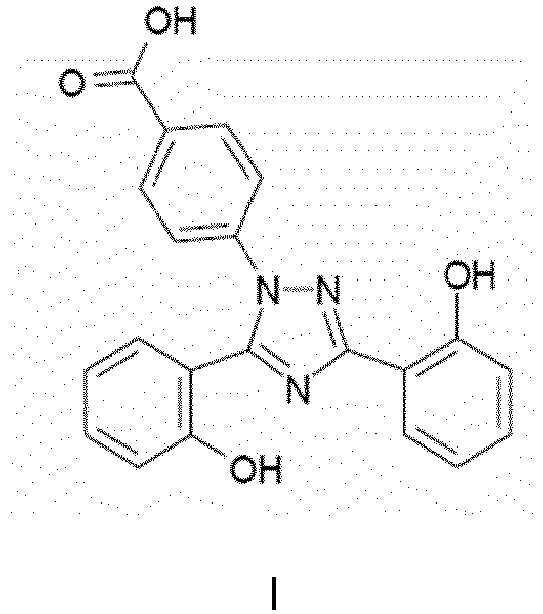
- An aspect of the present disclosure provides a tablet for treating diseases which cause an excess of metal, such as iron, in a human or animal body or are caused by an excess of metal in a human comprising Exjade TM (deferasirox) of the formula I: or a pharmaceutically acceptable salt thereof present in an amount of from 45% to 60% by weight based on the total weight of the tablet, said tablet having a reduced release under gastric conditions and fast release at near neutral pH or at neutral pH.
- Exjade TM deferasirox
- An aspect of the present invention provides a coated tablet according to claim 1, comprising (a) deferasirox or a pharmaceutically acceptable salt thereof, and (b) at least one pharmaceutically acceptable excipient suitable for the preparation of tablets, wherein deferasirox or a pharmaceutically acceptable salt thereof is present in an amount of from 45% to 60% by weight based on the total weight of the tablet.
- the tablets are optionally enteric coated.
- a sachet comprising (a) deferasirox or a pharmaceutically acceptable salt thereof, and (b) at least one pharmaceutically acceptable excipient suitable for the preparation of sachets, wherein deferasirox or a pharmaceutically acceptable salt thereof is present in an amount of from 45% to 60% by weight based on the total weight of the sachet.
- Another aspect of the present invention provides a coated deferasirox tablet according to claim 1, comprising:
- Another aspect of the present disclosure provides a process for the preparation of a coated deferasirox tablet according to any one of the preceding claims, which process comprises
- Exjade TM deferasirox
- the current commercial formulation of Exjade TM is a dispersible tablet.
- the current formulation is dosed under fasted state due to a GI irritation issue.
- the new intended swallowable (ingestible, orally administrable) deferasirox tablets have an improved GI irritation AE profile due to a slower release profile and removal of sodium lauryl sulfate and lactose from the dispersible formulation.
- the invented formulation allows for patient compliance, no food effects and reduced GI irritation as compared to the current marketed Exjade TM (deferasirox) product.
- Exjade TM deferasirox
- a surfactant e.g., a poloxamer
- the formulation also possesses certain improved in vitro characteristics.
- the process allows for and contributes to the high deferasirox loading.
- Wet granulation of the deferasirox active can be done with high drug loading (40-80% by weight) and compressed into tablets for enteric coating to achieve a final deferasirox loading of about 45-60% by weight, preferably 56% by weight.
- a suitable dose of deferasirox ranges from 90 to 360 mg, especially, 90 mg, 180 mg, 360 mg unit dosage for film coated tablets and 100 to 400 mg, especially, 100mg, 200mg, 400mg unit dosage for granule formulation filled into stick-packs.
- the dose of deferasirox administered to a patient depends on numerous factors such as weight of patient, the severity of symptom and the nature of any other drugs being administered.
- the current product of deferasirox is presented on the market with three dosage strengths, 125 mg, 250 mg and 500 mg.
- the present invention provides exemplary embodiments for manufacturing swallowable (ingestible, orally administrable) deferasirox tablets with different dissolution profiles that correspond to commercial Exjade TM (deferasirox) product from a human clinical study, the invented deferasirox formulation demonstrated higher bioavailability, as compared to the previous marketed Exjade TM (deferasirox) formulation. Therefore, the therapeutic dose was adjusted accordingly to achieve comparable pharmacokinetic profile and similar therapeutic effect. In summary, the invented formulation was developed with higher deferasirox loading and superior bioavailability. Lowering the dose will eventually improve patient compliance.
- one or more pharmaceutically acceptable excipients are present in the deferasirox dispersible tablets, including but not limited to conventionally used excipients: at least one filler, e.g., lactose, ethylcellulose, microcrystalline cellulose; at least one disintegrant, e.g. cross-linked polyvinylpyrrolidone, e.g. Crospovidone ® ; at least one binder, e.g. polyvinylpyrrolidone, hydroxypropylmethyl cellulose; at least one surfactant, e.g. sodium lauryl sulfate, poloxamer; at least one glidant, e.g. colloidal silicon dioxide; and at least one lubricant, e.g. magnesium stearate.
- filler e.g., lactose, ethylcellulose, microcrystalline cellulose
- disintegrant e.g. cross-linked polyvinylpyrrolidone, e.g.
- the deferasirox film-coated tablets will include the following compendial excipients: microcrystalline cellulose, povidone, crospovidone, poloxamer 188, colloidal silicon dioxide, and magnesium stearate.
- Opadry coating material hyperromellose, titanium dioxide, polyethylene glycol, Macrogol, talc and FD&C blue #2/lndigo carminine aluminum lake (C.I. 7305, E132)
- poloxamer 188 and the coating material represent new excipients for Exjade; lactose and sodium lauryl sulphate would no longer be present.
- Fillers include but are not limited to microcrystalline cellulose, including but not limited to Avicel TM PH 102, PH 101.
- Disintegrants include but are not restricted to: maize starch, CMC-Ca, CMC-Na, microcrystalline cellulose, cross-linked polyvinylpyrrolidone (PVP), e.g. as known and commercially available under the trade names Crospovidone ® , Polyplasdone ® , available commercially from the ISP company, or Kollidon ® XL, alginic acid, sodium alginate and guar gum.
- PVP polyvinylpyrrolidone
- Crospovidone ® e.g. as known and commercially available under the trade names Crospovidone ® , Polyplasdone ® , available commercially from the ISP company, or Kollidon ® XL
- alginic acid sodium alginate and guar gum.
- cross-linked PVP e.g. Crospovidone ® is used.
- Binders include but are not restricted to: starches, e.g. potato, wheat or corn starch, microcrystalline cellulose, e.g. products such as Avicel ® , Filtrak ® , Heweten ® or Pharmacel ® ; hydroxypropyl cellulose, hydroxyethyl cellulose, hydroxypropylmethyl cellulose, e.g. hydroxypropylmethyl cellulose-Type 2910 USP, hypromellose, and polyvinylpyrrolidone, e.g. Povidone ® K30 from BASF. In one embodiment, polyvinylpyrrolidone is used, most preferably PVP K 30 TM .
- Surfactants include but are not restricted to: betain, quaternary ammonium salts, polysorbates, sorbitan erters and a poloxamer.
- the surfactant is a poloxamer, preferably Pluronic TM F68 grade.
- Glidants include but are not restricted to: silica; colloidal silica, e.g. colloidal silica anhydrous, e.g. Aerosil ® 200, magnesium trisilicate, powdered cellulose, starch and talc.
- colloidal silicon dioxide is used.
- Lubricants include but are not restricted to: Mg-, Al- or Ca-stearate, PEG 4000 - 8000, talc, sodium benzoate, glyceryl mono fatty acid, e.g. having a molecular weight of from 200 to 800 Daltons, e.g. glyceryl monostearate (e.g. Danisco, UK), glyceryl dibehenate (e.g. CompritolAT0888 TM , Gattefosse France), glyceryl palmito-stearic ester (e.g.
- Precirol TM Gattefosse France
- polyoxyethylene glycol PEG, BASF
- hydrogenated cotton seed oil Lubitrab TM , Edward Mendell Co Inc
- castor seed oil Cutina TM HR, Henkel
- magnesium stearate is used.
- the present disclosure provides a tablet for treating diseases which cause an excess of metal, such as iron, in a human or animal body or are caused by an excess of metal in a human comprising Exjade TM (deferasirox) of the formula I: or a pharmaceutically acceptable salt thereof present in an amount of from 45% to 60% by weight based on the total weight of the tablet where said tablet having a reduced release under gastric conditions and fast release at near neutral pH or at neutral pH.
- Exjade TM deferasirox
- the present invention provides a coated tablet according to claim 1, comprising (a) deferasirox or a pharmaceutically acceptable salt thereof, and (b) at least one pharmaceutically acceptable excipient suitable for the preparation of tablets, wherein deferasirox or a pharmaceutically acceptable salt thereof is present in an amount of from 45% to 60% by weight based on the total weight of the tablet, wherein the tablets are optionally enteric coated.
- the present invention provides a coated deferasirox tablet according to claim 1, comprising:
- the disclosure provides a process for the preparation of a coated deferasirox tablet according to any one of the preceding claims, which process comprises:
- FIG. 1 A flow chart showing the manufacturing process of coated deferasirox tablets prepared by wet granulation is summarized in Figure 1 .
- the wet granulation step is performed using 40-80% by weight of deferasirox, a poorly soluble drug with PVP K-30 TM as a binding agent, Avicel TM PH 101 as a filler, crospovidone as a disintegrating agent and SLS or Poloxamer as a solubilizing agent. Water was used as granulation media. The granules were mixed with external excipients, e.g., Avicel TM PH102, crospovidone, Aerosil TM as glidant and magnesium stearate as an anti-sticking agent. The final granules were compressed into tablets and enterically coated using Acryl-EZE TM 93F, a Eudragit TM based polymer. The tablets has shown optimal hardness, friability and disintegration time. The dissolution profile of the coated deferasirox tablet is bioequivalent to the commercial Exjade (deferasirox) tablets, as shown in Figure 2 .
- the disclosure provides a formulation with a full enteric coating.
- the enteric coating comprises Opadry ® 03K19229 and Acryl-EZE TM was applied to a deferasirox tablet core at level of 5-15% by weight gain.
- Full enteric protection is achieved after greater than 5% by weight gain. No major impact on deferasirox drug release was observed for enteric-coated deferasirox tablets after two hours acid treatment. Except for 10 minutes of the delay initially, the deferasirox drug release profiles are comparable to commercial Exjade TM (deferasirox) product, as shown in Figure 3 .
- the enteric coated tablets release the drug slowly.
- the use of unique polymer, for example PVP, as binder produces fast release of drug without any significant lag time. This will be helpful for achieving bioequivalency of the formulation as compared to reference product, which is a non-enteric dispersible tablet.
- the deferasirox medicament is packaged for use by the patient or caregiver.
- the medicament can be packaged in a foil or other suitable package and is suitable for mixing into a food product (e.g. applesauce and other food vehicles) or into a drink for consumption by a patient.
- a food product e.g. applesauce and other food vehicles
- the disclosure provides a process for the preparation of a coated deferasirox tablet, which comprises the steps:
- manufacturing deferasirox multi-particulates using a fluidized process technique or other pelletization techniques includes but is not limited to the following considerations:
- Formulations for preparing tablets are set out below.
- the tablets are formulated utilizing enteric coatings.
- Reference Example 1 Enteric coated wet granulated deferasirox tablets comprising a surfactant, sodium lauryl sulfate (SLS)
- Reference Example 2 Enteric coated wet granulated deferasirox tablets comprising a poloxamer (Pluronic TM F68 grade)
- Reference Example 3 Composition of Deferasirox Pellets Manufactured by Extrusion-Spheronization Granulation
- Example 4 Composition of Deferasirox Pellets Manufactured by Fluidized Technique
- compositions of the present invention and manufacturing processes provide coated tablets of Exjade (deferasirox) and thereby minimize local Gl irritation.
- Exjade deferasirox
- the present invented methods and corresponding invented improved deferasirox formulations increase the drug load for producing swallowable (ingestible) deferasirox tablets that improve patient compliance.
- Example 5 Deferasirox coated tablets prepared by wet granulation using non-functional coating
- the food effect study 4 showed overall equivalence of the administration with a soft food (apple sauce or yogurt) or with a low-fat meal when compared to fasting intake with water.
- the exposure after administration with a high-fat meal was close to the equivalence limits of 80% to 125% for AUC last .
- Table 4 Summary of pharmacokinetic comparisons for invented deferasirox formulation Study No.
- Study 3 also tested dose linearity (at 400mg/800mg/1200mg) for the granules.
- the two remaining clinical pharmacology studies aim to confirm the comparative bioavailability results for the granules, and to test the food effect for the FCT.
- the new Exjade formulations represent a significant improvement in patient care and support compliance with chelation therapy because of the improved pharmaceutical properties and because of the changes in composition. These improvements are expected to provide for a positive benefit risk due to the importance of compliance/adherence to chelation therapy for patients with chronic iron overload aged 2 years and older:
- Figure 4 summarizes mean concentration ( ⁇ mol/L)-time profiles of the key pharmacokinetic results for studies 1 (non-strength-adjusted tablet comparison), 2 (pivotal strength-adjusted FCT study), 3 (pilot strength-adjusted granule study), and 4 (granule food-effect study).
- Figure 5 includes C max data from (1) previous CP studies in healthy subjects given 20 mg/kg deferasirox DT, (2) FCT treatment in Study 2, and (3) granule treatment in Study 3.
- Clinical data has been generated and analyzed from a one-year, open-label, single arm, multi-center trial evaluating the efficacy and safety of oral deferasirox formulation (20 mg/kg/day) in 1744 patients with transfusion dependent iron overload; thalassemia, MDS, SCD, and rare anemias (Study 7).
- Study 7 used sparse PK sampling: in addition to efficacy and safety data, deferasirox PK data were collected in a large sub-group of patients ( ⁇ 600) at pre-dose (C trough , a proxy for AUC) and 2 hours post-dose (C2h; a proxy for Cmax) on day 1, week 12 and week 28.
- the C max values for the new high load deferasirox formulations at steady-state (predicted by a nonparametric superposition approach) in studies 2 and 3 lie within the range of observed steady-state deferasirox C2h values with the current DT formulation.
- deferasirox exposure in healthy subjects is generally higher than in iron-overloaded patients; in addition, the sampling time point in Study 7 (C2h) underestimates C max (since deferasirox T max usually occurs between 2 and 4 hours post-dose). Since clinical safety data were assessed within this range of C max , it is unlikely that C max observed with the new formulations would lead to additional safety issues.
- Cmax values in healthy volunteers are generally higher than in patients. Two healthy volunteer studies in the initial registration package in 2005 were therefore reviewed for potential Cmax-related adverse events. In the thorough QT healthy volunteer study (which found no effect of Exjade on the QT interval), 44 volunteers received Exjade TM (deferasirox 40 mg/kg immediately after consumption of a high-fat breakfast to maximize C max . C max averaged 256 ⁇ M (range 134-472 ⁇ M). Safety findings in these subjects were limited to GI symptoms (diarrhea/loose stools, flatulence, and nausea) in 18% of patients, and headache and dizziness in one patient each (2%).
Landscapes
- Health & Medical Sciences (AREA)
- Life Sciences & Earth Sciences (AREA)
- Public Health (AREA)
- Chemical & Material Sciences (AREA)
- Medicinal Chemistry (AREA)
- Veterinary Medicine (AREA)
- Pharmacology & Pharmacy (AREA)
- Animal Behavior & Ethology (AREA)
- General Health & Medical Sciences (AREA)
- Epidemiology (AREA)
- Bioinformatics & Cheminformatics (AREA)
- Engineering & Computer Science (AREA)
- Organic Chemistry (AREA)
- General Chemical & Material Sciences (AREA)
- Chemical Kinetics & Catalysis (AREA)
- Nuclear Medicine, Radiotherapy & Molecular Imaging (AREA)
- Diabetes (AREA)
- Hematology (AREA)
- Toxicology (AREA)
- Physiology (AREA)
- Nutrition Science (AREA)
- Biophysics (AREA)
- Molecular Biology (AREA)
- Obesity (AREA)
- Botany (AREA)
- Zoology (AREA)
- Medicinal Preparation (AREA)
- Pharmaceuticals Containing Other Organic And Inorganic Compounds (AREA)
- Acyclic And Carbocyclic Compounds In Medicinal Compositions (AREA)
- Medicines That Contain Protein Lipid Enzymes And Other Medicines (AREA)
Description
- Compositions and technologies of manufacturing medicaments for Exjade™ (desferasirox) with high drug loading to potentially reduce variability of the gastric emptying, minimize food effect, prevent gastric irritation and also reduce the size and delivery route of the dosage form to improve patient compliance.
- Exjade™ (deferasirox) is a marketed product from Novartis that is formulated as dispersible tablets in 125mg, 250mg and 500mg dose strengths. Exjade™ (deferasirox) is given once daily for the treatment of chronic iron overload due to blood transfusions, which is referred to by medical professionals and clinicians as transfusional hemosiderosis, in
patients 2 years of age and older. - Due to the poor solubility of Exjade™ (deferasirox), a high dose is required to achieve the desired therapeutic effect, which results in unwanted side effects, such as gastrointestinal (GI) irritation and kidney toxicity. The poor solubility of Exjade™ (deferasirox) also presents technical difficulties in developing pharmaceutical formulations, as seen from the solubility profile summarized in Table 1. To meet the high dose requirement and reduce pill burden Exjade™ (deferasirox) was developed as dispersible tablets with about 29.4% drug load. Furthermore,
WO 2005/097062 discloses dispersible tablets comprising 1000 mg deferasirox, which contain lactose and sodium lauryl sulfate as well. The disadvantage of this type of formulation is that the tablets have to be dispersed in water or appropriate liquid, such as in orange juice or apple juice and stirred until a fine suspension is obtained prior to administration. Further, the dispersible tablets have to be taken at least 30 minutes before food.Table 1. Exjade™ (deferasirox) Solubility Profile pH Solubility (mg/ml) at 37C water 0.02 1 < 0.01 2 < 0.01 3 < 0.01 4 < 0.01 5 < 0.01 7-5 0.167 - Gastrointestinal (GI) irritation has been reported for patients using the current dispersible tablets. Upper gastrointestinal ulceration and hemorrhage has also been reported in patients, including children and adolescents. Multiple ulcers have been observed in some patients. Stomach bleeding is a severe side effect that occurs for patients currently under Exjade therapy because of acidity of Exjade™ (deferasirox), and local accumulation of drug content. Therefore, it is desirable to re-formulate an Exjade™ (deferasirox) dispersible formulation to limit the direct contact of drug compound with stomach mucosa. It is further desirable to provide a high load deferasirox formulation that has no food effect. For instance, as enteric coated form or multi-particulate form where dosage form is emptied faster from the stomach. In addition, data from THALASSA (NTDT) study placebo arms (contains all components in Exjade™ dispersible tablets (except API) suggest that excipients in the marketed dispersible formulation could contribute to GI adverse effects (AE) profile of Exjade™.
- The current invention describes formulated compositions and the corresponding technology of manufacturing tablets for Exjade™ (deferasirox) to prevent gastrointestinal irritation, having no food effect and improve patient compliance.
- With aforementioned cumbersome drug administration, it is also desirable to re-formulate the current dispersible Exjade™ (deferasirox) tablets into swallowable (ingestible, orally administrable) tablets and sachets, which increase the drug load by up to and greater than 100% of the current dispersible tablet and sachet per dose requiring less pill burden while maintaining equivalent pharmacokinetic profile, and consequently the therapeutic outcome as compared to commercially marketed dispersible Exjade™ (deferasirox) tablets.
- An aspect of the present disclosure provides a tablet for treating diseases which cause an excess of metal, such as iron, in a human or animal body or are caused by an excess of metal in a human comprising Exjade™ (deferasirox) of the formula I:

- Typically, a drug product that shows faster dissolution will have a much higher exposure level when tested in humans. Surprisingly, in the current case, Exjade™ (deferasirox) tablets formulated to have slower release showed much higher bioavailability and no food effects when compared with commercial dispersible tablets, which have a faster dissolution rate but which exhibit significantly lower exposure levels. The characteristics of the new swallowable (ingestible, orally administrable) tablets and sachets, such as its disintegration time and dissolution are uniquely needed to reach the intended exposure levels.
- An aspect of the present invention provides a coated tablet according to
claim 1, comprising (a) deferasirox or a pharmaceutically acceptable salt thereof, and (b) at least one pharmaceutically acceptable excipient suitable for the preparation of tablets, wherein deferasirox or a pharmaceutically acceptable salt thereof is present in an amount of from 45% to 60% by weight based on the total weight of the tablet. The tablets are optionally enteric coated. - Another aspect of the present disclosure provides a sachet comprising (a) deferasirox or a pharmaceutically acceptable salt thereof, and (b) at least one pharmaceutically acceptable excipient suitable for the preparation of sachets, wherein deferasirox or a pharmaceutically acceptable salt thereof is present in an amount of from 45% to 60% by weight based on the total weight of the sachet.
- Another aspect of the present invention provides a coated deferasirox tablet according to
claim 1, comprising: - (i) at least one filler in an amount of about to 10% to 40 % by weight based on the total weight of the tablet;
- (ii) at least one disintegrant in an amount of about 1% to 10% in weight based on the total weight of the tablet;
- (iii) at least one binder in an amount of about 1% to 5% by weight based on the total weight of the tablet;
- (iv) at least one surfactant in an amount of about 0.0% to 2% by weight based on the total weight of the tablet;
- (v) at least one glidant in an amount of about 0.1% to 1% by weight based on the total weight of the tablet;
- (vi) at least one lubricant in an amount of less than about 0.1% to 2% % by weight based on the total weight of the tablet; and
- (vii) a coating.
- Another aspect of the present disclosure provides a process for the preparation of a coated deferasirox tablet according to any one of the preceding claims, which process comprises
- (i) mixing deferasirox or a pharmaceutically acceptable salt thereof and at least one pharmaceutically acceptable excipient;
- (ii) wet-granulating the mixture obtained in step (i) in a high shear granulator followed by drying and screening to produce a granulate;
- (iii) mixing the granulates obtained in step (ii) with at least one pharmaceutically acceptable excipient to form a mixture;
- (iv) compressing the mixture obtained in step (iii) to form a tablet; and
- (v) coating the tablet.
- (i) mixing deferasirox or a pharmaceutically acceptable salt and at least one pharmaceutically acceptable excipient;
- (ii) wet-granulating the mixture obtained in step (i) in a high shear granulator;
- (iii) extruding and spheronizing the wet granulates obtained in step (ii);
- (iv) drying the extruded and spheronized pellets; and
- (v) coating the pellets.
-
-
Figure 1 depicts a flow chart showing the manufacturing process of coated deferasirox tablets prepared by wet granulation -
Figure 2 summarizes the dissolution profile of deferasirox from tablets prepared by wet granulation. -
Figure 3 summarizes the dissolution profile of deferasirox from enteric coated tablets prepared by wet granulation. -
Figure 4 summarizes deferasirox mean concentration versus time profiles for the invented formulations. -
Figure 5 summarizes inter-subject varabilities in pharmokinetic parameters AUClast, AUCinf, and Cmax for the invented formulations. -
Figure 6 summarizes a deferasirox Cmax comparison in the invented formulation versus commercially available formulation for healthy volunteers. -
Figure 7 summarizes steady state deferasirox C2h values versus Cmax for the invented formulation versus commercially available formulation. -
Figure 8 summarizes a scatterplot of deferasirox C2h for the invented formulation onDay 1 versus percent change from baseline in serum creatinine at Week 4. - The current commercial formulation of Exjade™ (deferasirox) is a dispersible tablet. The current formulation is dosed under fasted state due to a GI irritation issue. The new intended swallowable (ingestible, orally administrable) deferasirox tablets have an improved GI irritation AE profile due to a slower release profile and removal of sodium lauryl sulfate and lactose from the dispersible formulation. The invented formulation allows for patient compliance, no food effects and reduced GI irritation as compared to the current marketed Exjade™ (deferasirox) product.
- The present disclosure provides a Exjade™ (deferasirox) formulation having a unique combination of excipients and a surfactant (e.g.,a poloxamer) that are compatible with deferasirox at physiological pH environment. The formulation also possesses certain improved in vitro characteristics.
- The process allows for and contributes to the high deferasirox loading. Wet granulation of the deferasirox active can be done with high drug loading (40-80% by weight) and compressed into tablets for enteric coating to achieve a final deferasirox loading of about 45-60% by weight, preferably 56% by weight.
- A suitable dose of deferasirox ranges from 90 to 360 mg, especially, 90 mg, 180 mg, 360 mg unit dosage for film coated tablets and 100 to 400 mg, especially, 100mg, 200mg, 400mg unit dosage for granule formulation filled into stick-packs. The dose of deferasirox administered to a patient depends on numerous factors such as weight of patient, the severity of symptom and the nature of any other drugs being administered. The current product of deferasirox is presented on the market with three dosage strengths, 125 mg, 250 mg and 500 mg. The present invention provides exemplary embodiments for manufacturing swallowable (ingestible, orally administrable) deferasirox tablets with different dissolution profiles that correspond to commercial Exjade™ (deferasirox) product from a human clinical study, the invented deferasirox formulation demonstrated higher bioavailability, as compared to the previous marketed Exjade™ (deferasirox) formulation. Therefore, the therapeutic dose was adjusted accordingly to achieve comparable pharmacokinetic profile and similar therapeutic effect. In summary, the invented formulation was developed with higher deferasirox loading and superior bioavailability. Lowering the dose will eventually improve patient compliance.
- In a disclosure, one or more pharmaceutically acceptable excipients are present in the deferasirox dispersible tablets, including but not limited to conventionally used excipients: at least one filler, e.g., lactose, ethylcellulose, microcrystalline cellulose; at least one disintegrant, e.g. cross-linked polyvinylpyrrolidone, e.g. Crospovidone®; at least one binder, e.g. polyvinylpyrrolidone, hydroxypropylmethyl cellulose; at least one surfactant, e.g. sodium lauryl sulfate, poloxamer; at least one glidant, e.g. colloidal silicon dioxide; and at least one lubricant, e.g. magnesium stearate.
- In one embodiment, the deferasirox film-coated tablets will include the following compendial excipients: microcrystalline cellulose, povidone, crospovidone, poloxamer 188, colloidal silicon dioxide, and magnesium stearate. Opadry coating material (hypromellose, titanium dioxide, polyethylene glycol, Macrogol, talc and FD&C
blue # 2/lndigo carminine aluminum lake (C.I. 7305, E132)) is used for the film-coated tablets. Among the above excipients, only poloxamer 188 and the coating material represent new excipients for Exjade; lactose and sodium lauryl sulphate would no longer be present. - Reference is made to the extensive literature on the subject for these and other pharmaceutically acceptable excipients and procedures mentioned herein, see in particular Handbook of Pharmaceutical Excipients, Third Edition, edited by Arthur H. Kibbe, American Pharmaceutical Association, Washington, USA and Pharmaceutical Press, London; and Lexikon der Hilfsstoffe für Pharmazie, Kosmetik and angrenzende Gebiete edited by H.P. Fiedler, 4th Edition, Editor Cantor, Aulendorf and earlier editions.
- Fillers include but are not limited to microcrystalline cellulose, including but not limited to Avicel™ PH 102, PH 101.
- Disintegrants include but are not restricted to: maize starch, CMC-Ca, CMC-Na, microcrystalline cellulose, cross-linked polyvinylpyrrolidone (PVP), e.g. as known and commercially available under the trade names Crospovidone®, Polyplasdone®, available commercially from the ISP company, or Kollidon® XL, alginic acid, sodium alginate and guar gum. In one embodiment, cross-linked PVP, e.g. Crospovidone® is used.
- Binders include but are not restricted to: starches, e.g. potato, wheat or corn starch, microcrystalline cellulose, e.g. products such as Avicel®, Filtrak®, Heweten® or Pharmacel®; hydroxypropyl cellulose, hydroxyethyl cellulose, hydroxypropylmethyl cellulose, e.g. hydroxypropylmethyl cellulose-Type 2910 USP, hypromellose, and polyvinylpyrrolidone, e.g. Povidone® K30 from BASF. In one embodiment, polyvinylpyrrolidone is used, most preferably PVP K 30™.
- Surfactants include but are not restricted to: betain, quaternary ammonium salts, polysorbates, sorbitan erters and a poloxamer. In one embodiment, the surfactant is a poloxamer, preferably Pluronic™ F68 grade.
- Glidants include but are not restricted to: silica; colloidal silica, e.g. colloidal silica anhydrous,
e.g. Aerosil ® 200, magnesium trisilicate, powdered cellulose, starch and talc. Preferably, colloidal silicon dioxide is used. - Lubricants include but are not restricted to: Mg-, Al- or Ca-stearate, PEG 4000 - 8000, talc, sodium benzoate, glyceryl mono fatty acid, e.g. having a molecular weight of from 200 to 800 Daltons, e.g. glyceryl monostearate (e.g. Danisco, UK), glyceryl dibehenate (e.g. CompritolAT0888™, Gattefosse France), glyceryl palmito-stearic ester (e.g. Precirol™, Gattefosse France), polyoxyethylene glycol (PEG, BASF), hydrogenated cotton seed oil (Lubitrab™, Edward Mendell Co Inc), castor seed oil (Cutina™ HR, Henkel). In one embodiment, magnesium stearate is used.
- Accordingly, the present disclosure provides a tablet for treating diseases which cause an excess of metal, such as iron, in a human or animal body or are caused by an excess of metal in a human comprising Exjade™ (deferasirox) of the formula I:
- Typically, a drug product that shows faster dissolution will have a much higher exposure level when tested in humans. Surprisingly, in the current case, Exjade™ (deferasirox) tablets formulated to have slower release showed much higher bioavailability when compared with commercial dispersible tablets, which have a faster dissolution rate but which exhibit significantly lower exposure levels. The characteristics of the new swallowable (ingestible, orally administrable) tablets, such as its disintegration time and dissolution are uniquely needed to reach the intended exposure levels.
- In a separate embodiment, the present invention provides a coated tablet according to
claim 1, comprising (a) deferasirox or a pharmaceutically acceptable salt thereof, and (b) at least one pharmaceutically acceptable excipient suitable for the preparation of tablets, wherein deferasirox or a pharmaceutically acceptable salt thereof is present in an amount of from 45% to 60% by weight based on the total weight of the tablet, wherein the tablets are optionally enteric coated. - In a separate embodiment, the present invention provides a coated deferasirox tablet according to
claim 1, comprising: - (i) at least one filler in an amount of about to 10% to 40% by weight based on the total weight of the tablet;
- (ii) at least one disintegrant in an amount of about 1% to 10% in weight based on the total weight of the tablet;
- (iii) at least one binder in an amount of about 1% to 5% by weight based on the total weight of the tablet;
- (iv) at least one surfactant in an amount of about 0.0% to 2% by weight based on the total weight of the tablet;
- (v) at least one glidant in an amount of about 0.1% to 1% by weight based on the total weight of the tablet;
- (vi) at least one lubricant in an amount of less than about 0.1% to 2% % by weight based on the total weight of the tablet; and
- (vii) a coating, wherein the coating comprises a functional or non-functional polymer.
- The disclosure provides a process for the preparation of a coated deferasirox tablet according to any one of the preceding claims, which process comprises:
- (i) mixing deferasirox or a pharmaceutically acceptable salt thereof and at least one pharmaceutically acceptable excipient;
- (ii) wet-granulating the mixture obtained in step (i) in a high shear granulator followed by drying and screening to produce a granulate;
- (iii) mixing the granulates obtained in step (ii) with at least one pharmaceutically acceptable excipient to form a mixture;
- (iv) compressing the mixture obtained in step (iii) to form a tablet; and
- (v) coating the tablet, wherein the coating further comprises a functional or non-functional polymer.
- A flow chart showing the manufacturing process of coated deferasirox tablets prepared by wet granulation is summarized in
Figure 1 . - The wet granulation step is performed using 40-80% by weight of deferasirox, a poorly soluble drug with PVP K-30™ as a binding agent, Avicel™ PH 101 as a filler, crospovidone as a disintegrating agent and SLS or Poloxamer as a solubilizing agent. Water was used as granulation media. The granules were mixed with external excipients, e.g., Avicel™ PH102, crospovidone, Aerosil™ as glidant and magnesium stearate as an anti-sticking agent. The final granules were compressed into tablets and enterically coated using Acryl-EZE™ 93F, a Eudragit™ based polymer. The tablets has shown optimal hardness, friability and disintegration time. The dissolution profile of the coated deferasirox tablet is bioequivalent to the commercial Exjade (deferasirox) tablets, as shown in
Figure 2 . - The disclosure provides a formulation with a full enteric coating. The enteric coating comprises Opadry® 03K19229 and Acryl-EZE™ was applied to a deferasirox tablet core at level of 5-15% by weight gain. An addition of sub-coating, such as Opadry™ 03K19229, enhanced the effectiveness of enteric coating. Full enteric protection is achieved after greater than 5% by weight gain. No major impact on deferasirox drug release was observed for enteric-coated deferasirox tablets after two hours acid treatment. Except for 10 minutes of the delay initially, the deferasirox drug release profiles are comparable to commercial Exjade™ (deferasirox) product, as shown in
Figure 3 . - In general, after reaching the small intestine, the enteric coated tablets release the drug slowly. However, in the present invention, the use of unique polymer, for example PVP, as binder produces fast release of drug without any significant lag time. This will be helpful for achieving bioequivalency of the formulation as compared to reference product, which is a non-enteric dispersible tablet.
- In another disclosure, the deferasirox medicament is packaged for use by the patient or caregiver. For example, the medicament can be packaged in a foil or other suitable package and is suitable for mixing into a food product (e.g. applesauce and other food vehicles) or into a drink for consumption by a patient.
- The disclosure provides a process for the preparation of a coated deferasirox tablet, which comprises the steps:
- (i) mixing deferasirox or a pharmaceutically acceptable salt and at least one pharmaceutically acceptable excipient;
- (ii) wet-granulating the mixture obtained in step (i) in a high shear granulator;
- (iii) extruding and spheronizing the wet granulates obtained in step (ii);
- (iv) drying the extruded and spheronized pellets; and
- (v) coating the pellets.
- Accordingly, manufacturing deferasirox multi-particulates using a fluidized process technique or other pelletization techniques includes but is not limited to the following considerations:
- a) Pre-wetting: Water is evenly distributed to the dry blend of drug and Avicel™ PH105 in a high shear granulator.
- b) Pelletization: The pre-wetted blend was pelletized by mechanical and gravitational forces acting on the blend while being processed. Moisture (water) was constantly applied. Once the pellets reached the desired particle size range, a small percentage of the dry blend (or excipient alone) was incorporated on the pellets to stop growth and smooth the pellet surface.
- c) Drying: The drying of the pellets was performed in a fluid-bed processor The pellets were dried to moisture content below 3% by weight.
- The following examples illustrate aspects of the invention and are not a limitation on the present invention. Formulations for preparing tablets are set out below. In one aspect the tablets are formulated utilizing enteric coatings.
-
Granulation Internal phase Ingredient Weight % (range) Deferasirox 55.97 % Avicel™ PH 101 / 105 14.4% (5-25) PVP K-30™ 2.25% (1-5) Crospovidone 2% (1-5) SLS 0.375 % (0-1) External phase Ingredient Weight % (range) Dried Granules 75% Avicel™ PH 102 18.5% (5-25) Crospovidone 5% (2-10) Aerosil™ 0.5ranges% (0.1-1) Magnesium Stearate 1% (0.1-2) Subcoating Opadry™ 03K19229 1% (0-2) Enteric coating Eudragit™ (Acryl EZE 93F) 7% (5-20) -
Granulation Internal phase Ingredient Weight % (range) Deferasirox 55.97 % Avicel™ PH 101 / 105 14.4% (5-25) HPMc™ 3 cps 2.25% (1-5) Crospovidone 2% (1-5) Pluronic™ 0.375 % (0-1) External phase Ingredient Weight % (range) Dried Granules 75% Avicel™ PH 102 18.5% (5-25) Crospovidone 5% (2-10) Aerosil™ 0.5ranges% (0.1-1) Magnesium Stearate 1% (0.1-2) Subcoating Opadry™ 03K19229 1% (0-2) Enteric coating Eudragit™ (Acryl EZE™ 93F) 7% (5-20) -
Ingredient Weight % (range) Deferasirox 60-80 % Avicel™ PH 101 / 105 8-32% PVP K-30™ or HPMC™ 3cps or HPC EXF™ 2-5% Crosspovidone 5% SLS / Poloxamer™ 1-2% Enteric coating Eudragit™ (Acryl EZE™ 93F) 5-20% -
Granulation Ingredient Weight % ICL670™ 70-80% Avicel™ PH 105 20-30% - The compositions of the present invention and manufacturing processes provide coated tablets of Exjade (deferasirox) and thereby minimize local Gl irritation. When compared to the dispersible Exjade (deferasirox) tablets having a 29.4% drug load, the present invented methods and corresponding invented improved deferasirox formulations increase the drug load for producing swallowable (ingestible) deferasirox tablets that improve patient compliance.
-
Deferasirox Tablets: Invented doses Variant A Component % (w/w) (range) mg/648mg tab mg/324mg tab mg/162mg tab Deferasirox 55.56 360.00 180.00 90.00 Microcrystalline cellulose PH101™ 15.09 97.81 48.91 24.45 Microcrystalline cellulose PH102™ 18.00 116.64 58.32 29.16 Poly Vinyl Pyrrolidone K-30™ 2.25 14.58 7.29 3.65 Crospovidone 7.00 45.36 22.68 11.34 Pluronic™ F68 0.10 0.65 0.32 0.16 Aerosil™ 0.50 3.24 1.62 0.81 Magnesium Stearate 1.50 9.72 4.86 2.43 Total 100.00 648.00 324.00 162.00 Coating Opadry™ Blue 3.00 19.44 9.72 4.86 Final tablet weight 103.00 667.44 333.72 166.86 Invented Deferasirox Paediatric Granule Doses Variant A Component % (w/w) mg/720mg tab mg/360mg tab mg/180mg tab Deferasirox 55.56 400.00 200.00 100.00 Microcrystalline cellulose PH101™ 15.09 108.68 54.34 27.17 Microcrystalline cellulose PH102™ 18.00 129.60 64.80 32.40 PolyVinyl Pyrrolidone K-30™ 2.25 16.20 8.10 4.05 Crospovidone 7.00 50.40 25.20 12.60 Pluronic™ F68 0.10 0.72 0.36 0.18 Aerosil™ 0.50 3.60 1.80 0.90 Magnesium Stearate 1.50 10.80 5.40 2.70 Total 100.00 720.00 360.00 180.00 - Summary of Deferasirox Variants Used in Clinical Pharmacokinetic (PK) Study
Materials Variant A Qty (%) Variant B Qty (%) Variant C Qty (%) Deferasirox 55.56 55.56 54.08 Cellulose microcrystalline 15.09 14.19 13.82 Crospovidone 7.00 7.0 6.81 Polyvinylpyrrolidone K30™ 2.25 2.25 2.19 Poloxamer™ 188 0.10 1.00 0.97 Cellulose MKR™ GRN 18.00 18.00 17.52 Aerosil™ 0.50 0.50 0.49 Magnesium stearate 1.50 1.50 1.46 Eudragit™ L 100-55 - - 2.17 Hypromellose 5cps - - 0.11 Sodium hydroxide - - 0.03 Triethyl citrate - - 0.28 Polysorbate™ 80 - - 0.002 Glycerol monostearate - - 0.06 Total weight (mg) 100.00 100.00 100.00 Tablet properties Tooling 19x7.5 19x7.5 19x7.5 Ovaloid Ovaloid Ovaloid Mean weight (mg) 910.24 916.22 903.62 Compression force (kN) 25.00 25.00 25.00 Mean hardness (N) 267.60 231.70 236.70 % friability 0.00 0.02 0.11 Dissolution Time (DT, min.) with discs 3.42 5.45 6.45 Mean thickness (mm) 6.96 6.86 6.92 - Granule Size for Deferasirox Variant A Formulation Corresponding to a Representative Batch for a Pilot Phase
Weight of granules on screens (g) Screen Size (mm) Water (%) Water addition time (min) LOD (%) Bulk Density (g/ml) Tap Density (g/ml) 1.4 1.0 0.71 0.5 0.25 0.18 0.125 0.09 Pan Total (g or %) Clinical Deferasiro x Batch 5Kg 26 7 0.49 0.65 0 7.4 17.1 10.9 14.3 7.1 10.6 9.4 23.3 100.1 0.00% 7.39% 17.08% 10.89% 14.29% 7.09% 10.59% 9.39% 23.28% 100.00% Pilot phase DoE batch 20 Kg 26 7 0.47 0.66 0 0 3.7 7.6 9.2 5.2 6.3 5.1 12.7 49.8 0.00% 0.00% 7.43% 15.26% 18.47% 10.44% 12.65% 10.24% 25.50% 100.00% - Patient Data from the clinical study are summarized in Table 2.
Table 2. PK results from deferasirox tablets prepared by wet granulation with non-functional coating Cmax AUC A B C A B C 0501_00001 0.906 1.239 0.112 0.891 1.339 0.276 0501_00008 1.576 1.897 1.554 1.624 1.449 1.475 0501_00013 1.347 1.516 1.046 1.433 1.785 1.305 0501_00020 0.952 1.153 1.202 0.943 1.087 1.154 0501_00023 1.727 1.225 1.765 1.567 0.974 1.574 0501_00026 0.981 1.133 1.420 0.963 0.998 1.018 0501_00027 2.293 1.122 2.477 1.015 0501_00031 1.820 2.482 1.664 2.031 3.152 2.060 0501_00035 1.778 1.517 1.672 1.246 1.015 1.249 0501_00038 1.412 1.858 1.350 1.673 2.233 1.126 0501_00049 1.714 2.233 1.467 1.929 1.525 1.752 0501_00052 1.176 1.244 1.538 1.774 1.564 1.538 0501_00053 1.057 1.340 1.091 0.894 1.269 1.138 0501_00054 0.781 0.769 0.369 0.791 0.789 0.380 0501_00055 1.652 1.326 1.380 2.039 1.094 2.672 0501_00075 1.317 1.268 1.380 1.010 1.388 1.318 0501_00088 1.604 1.580 0.921 1.552 1.452 1.075 0501_00093 1.689 1.713 1.976 1.767 1.924 1.472 0501_00104 1.827 1.556 1.519 1.489 1.360 1.495 0501 00107 1.352 1.060 0.725 1.370 1.357 0.614 - The dissolution profile for clinical deferasirox variants A, B, and C (500mg) is highlighted in Table 3.

- ▪ Data for Cmax were comparable to those for AUC.
- ▪ Median Tmax (3-4 hrs) appeared to be similar with all formulations.
- ▪ Deferasirox PK was slightly less variable with variants A, and B (CV 23-38%), and slightly more variable with variant C (CV 54-61%) as compared to a conventional marketed commercial formulation (CV 31-49%).
- ▪ PK data with the current formulation in this study were consistent with data from previous studies.
- Six clinical studies have been initiated with corresponding pharmacology studies in healthy adult volunteers. Four studies have been completed and two studies are ongoing. In the initial clinical pharmacology study for variant selection (study 1), the tablet variant selected for development displayed suprabioavailability: both AUC and Cmax for the invented deferasirox formulation were approximately 40% higher compared to the current dispersible tablet (DT) at a single dose of 1500 mg. Therefore, the subsequent clinical pharmacology studies used strength-adjusted formulations (400 mg granules and 360 mg FCT to match the 500 mg DT), in line with EMA/618604/2008 Rev. 7, which states that "If suprabioavailability is found, development of a lower dosage strength should be considered".
- Study 2 (pivotal study with FCT) and study 3 (pilot study with granules) both demonstrated fully equivalent exposure with an AUClast ratio of 100%. However, Cmax did not meet the standard bioequivalence criteria (as summarized in Table 4): values were higher for both strength-adjusted formulations.
- The food effect study 4 (granules) showed overall equivalence of the administration with a soft food (apple sauce or yogurt) or with a low-fat meal when compared to fasting intake with water. The exposure after administration with a high-fat meal was close to the equivalence limits of 80% to 125% for AUClast.
Table 4. Summary of pharmacokinetic comparisons for invented deferasirox formulation Study No. N deferasirox dose [mg] (form) food AUClast ratio (90%CI) Cmax ratio (90%CI) Completed Studies 1 20 1500(F) / 1500(DT) fasted/fasted 1.38 (1.179-1.620) 1.39 (1.164-1.661) 2 32 1080(F) / 1500(DT) fasted/fasted 1.00 (0.932-1.078) 1.30 (1.203-1.400) 3 20 1200(G) / 1500(DT) fasted/fasted 1.00 (0.915-1.099) 1.18 (1.050-1.323) 4 24 1200(G) / 1200(G) applesauce/wat er 0.996 (0.934-1.063) 0.972 (0.891-1.061) 1200(G) / 1200(G) yogurt/water 0.986 (0.924-1.052) 0.988 (0.905-1.077) 24 1200(G) / 1200(G) breakfast/water 0.917 (0.845-0.995) 0.887 (0.789-0.997) 1200(G) / 1200(G) high-fat breakfast/ water 1.194 (1.099-1.298) 0.949 (0.843-1.069) Ongoing Studies (results expected by Dec 2013) 5 1080(F) / 1080(F) fed/fasted TBD TBD 6 1200(G) / 1500(DT) fasted/fasted TBD TBD DT: dispersible tablets (current formulation); F: film-coated tablets; G: granules; N= number of subjects. Study 3 also tested dose linearity (at 400mg/800mg/1200mg) for the granules. Study No. N deferasirox dose [mg] (form) food AUClast ratio (90%CI) Cmax ratio (90%CI) Values outside the equivalence limits [0.8-1.25] are highlighted in bold DT and G are not in the scope of the claims. - The two remaining clinical pharmacology studies (to be conducted in 2H2013) aim to confirm the comparative bioavailability results for the granules, and to test the food effect for the FCT.
- The new Exjade formulations represent a significant improvement in patient care and support compliance with chelation therapy because of the improved pharmaceutical properties and because of the changes in composition. These improvements are expected to provide for a positive benefit risk due to the importance of compliance/adherence to chelation therapy for patients with chronic iron overload aged 2 years and older:
- a lower inter-subject variability in exposure (CV% geometric mean in study F2102 for FCT and DT: AUClast 39.2% vs 49.7%, Cmax 27.5% vs 33.4%, respectively) and the absence of a substantial food effect (study 4) suggest that the new formulations achieve a more predictable dose-exposure relationship in clinical practice.
- the absence of a substantial food effect (study 4) which obviates the requirement to take the drug on an empty stomach at least 30 minutes before food and therefore allows patients more convenience and flexibility in the scheduling and administration of their daily dose.
- a more palatable alternative to the currently approved dispersion, particularly for elderly and paediatric patients (an aspect that was investigated in one of the measures of the currently approved Exjade EU PIP).
- The currently approved Exjade tablet is formulated with sodium lauryl sulphate, which may be associated with gastrointestinal tract irritation. Exjade currently also contains lactose and so is not recommended in patients with rare hereditary problems of galactose intolerance, the Lapp lactase deficiency, glucose-galactose malabsorption or severe lactase deficiency. Novartis believes the exclusion of lactose and sodium lauryl sulfate in the new formulations will improve the gastrointestinal tolerability of the product. This is supported by the recently completed one-year study 2209 where NTDT patients in the placebo arm, which contained the same excipients as the currently marketed Exjade formulation, reported GI adverse event rates that were comparable to the active treatment arm (42.9% for placebo vs. 36.4% for
Exjade 10 mg/kg). - total drug exposure (AUC) is the key parameter predicting safety and efficacy of deferasirox; chelation efficacy for iron chelators is commonly accepted to be related to AUC. In a 24-hour PK study following a single 35 mg/kg dose of oral deferasirox that was published by Chirnomas et al (2009), patients with inadequate response to deferasirox had significantly lower systemic drug exposure compared with control patients (P < 0.00001). Cmax, volume of distribution/bioavailability (Vd/F), and elimination half-life (t(1/2)) were not different between the groups.
- no effect on the QT interval (a typical Cmax-related toxicity) was observed in the thorough QT study (submitted with the original application in 2005); in that study, healthy volunteers (in whom exposure is higher than in iron-overloaded patients) were given doses of up to 40 mg/kg in order to achieve high Cmax levels
- the range of Cmax values observed in previous healthy volunteer studies with over 200 subjects is consistent with the range of Cmax values observed with the new formulations (see below)
- a large amount of safety, efficacy and exposure data exist for the current formulation (see below for details)
- in previously submitted patient studies, only minor safety findings such as nausea and headaches were noted at Tmax (see below for details)
- a statistical analysis to correlate pharmacokinetic parameters (Ctrough as a proxy of AUC, C2h as a proxy for Cmax) with renal effects in the large, one year patient study A2409 indicates that creatinine changes are more strongly correlated with AUC than with Cmax (see below for details)
- Exjade™ (deferasirox) is titrated based on efficacy and tolerability: the recommended starting dose is 20 mg/kg/day, with up-titration recommended in 5-10mg/kg steps every 3-6 months. Therefore, patients would only be exposed to the highest approved dose (40 mg/kg/day for the current formulation) after an extended period of up-titration with confirmed tolerability
- the absence of a significant food effect results in a lower risk of increased exposure when the drug is taken with a meal. With the currently approved DT formulation, ingestion of 20 mg/kg with a high fat meal (previous study for commercially marketed formulation) resulted in an average Cmax of 138 µM in healthy volunteers, whereas dispersion in water (study 2120) resulted in a lower Cmax of 71 µM in healthy volunteers. In the patient study A0105F, exposure nearly doubled (to a variable extent) when Exjade was given after a high-fat breakfast. No such effect was observed with the new granule formulation (Table 4).
-
Figure 4 summarizes mean concentration (µmol/L)-time profiles of the key pharmacokinetic results for studies 1 (non-strength-adjusted tablet comparison), 2 (pivotal strength-adjusted FCT study), 3 (pilot strength-adjusted granule study), and 4 (granule food-effect study). - Individual Cmax values from
Study 2 and Study 3 are within the range of historical Cmax values observed with the current commercially marketed DT formulation:Figure 5 includes Cmax data from (1) previous CP studies in healthy subjects given 20 mg/kg deferasirox DT, (2) FCT treatment inStudy 2, and (3) granule treatment in Study 3. - Clinical data has been generated and analyzed from a one-year, open-label, single arm, multi-center trial evaluating the efficacy and safety of oral deferasirox formulation (20 mg/kg/day) in 1744 patients with transfusion dependent iron overload; thalassemia, MDS, SCD, and rare anemias (Study 7). Study 7 used sparse PK sampling: in addition to efficacy and safety data, deferasirox PK data were collected in a large sub-group of patients (∼600) at pre-dose (Ctrough, a proxy for AUC) and 2 hours post-dose (C2h; a proxy for Cmax) on
day 1,week 12 and week 28. As shown inFigure 6 , the Cmax values for the new high load deferasirox formulations at steady-state (predicted by a nonparametric superposition approach) instudies 2 and 3 lie within the range of observed steady-state deferasirox C2h values with the current DT formulation. Of note, deferasirox exposure in healthy subjects is generally higher than in iron-overloaded patients; in addition, the sampling time point in Study 7 (C2h) underestimates Cmax (since deferasirox Tmax usually occurs between 2 and 4 hours post-dose). Since clinical safety data were assessed within this range of Cmax, it is unlikely that Cmax observed with the new formulations would lead to additional safety issues. - Deferasirox Cmax values in healthy volunteers are generally higher than in patients. Two healthy volunteer studies in the initial registration package in 2005 were therefore reviewed for potential Cmax-related adverse events. In the thorough QT healthy volunteer study (which found no effect of Exjade on the QT interval), 44 volunteers received Exjade™ (
deferasirox 40 mg/kg immediately after consumption of a high-fat breakfast to maximize Cmax. Cmax averaged 256 µM (range 134-472 µM). Safety findings in these subjects were limited to GI symptoms (diarrhea/loose stools, flatulence, and nausea) in 18% of patients, and headache and dizziness in one patient each (2%). In a study (a randomized crossover study in 28 healthy volunteers to evaluate the bioequivalence of a single 20 mg/kg dose of Exjade™ dispersed in fruit juice or water), three HV subjects reported loose stools 2.5 to 5 hours after Exjade intake, each on two separate occasions, lasting for 5-30 minutes. - In addition, a new analysis of creatinine and creatinine clearance changes was performed to explore whether deferasirox-associated renal changes are a function of peak exposure (Cmax) or of overall exposure (AUC). The analysis used data from the large multicenter study 7, in which Ctrough (a proxy of AUC) and deferasirox C2h (a proxy of Cmax) was collected at multiple time points. Even though both PK parameters correlate with dose, the analyses summarized below indicate that renal functional changes are more closely associated with AUC than with Cmax.
- Based on study 7 data, the relationship between PK parameters at steady state (Ctrough and C2h) and serum creatinine was investigated by using a linear mixed model of log-transformed creatinine values (1990 observations at
week 12 and 28) with patient included in model as a random effect. After log-transformation, baseline creatinine levels, C2h and Ctrough were included as predictors in the model. As shown in Table 5, a far higher slope (estimate) was observed for log(Ctrough) than for log(C2h), indicating a higher correlation with Ctrough (a proxy of AUC) than with C2h (a proxy of Cmax). For a 30% increase in Cmax (as observed for the FCT), the serum creatinine ratio would be 1.0087 (=1.3^0.03287) with upper bound of the 95% Cl of 1.0127 (with all other factors held constant). The potential of multicollinearity for log(C2h) and 10g(Ctrough) was assessed in the statistical model described above and did not show any multicollinearity issue (Variance Inflation Factor (VIF)=1.56 and condition index <30).Table 5. Linear mixed effect model of percent change in serum creatinine for deferasirox formulations Parameter Estimate Standard error T value Pr >¦t¦ Lower Upper Log(baseline creatinine) 0.9593 0.01226 78.22 <0.000 1 0.9391 0.9795 Log(C2h) 0.03287 0.007786 4.22 <0.000 1 0.02005 0.04569 Log(Ctrough) 0.06504 0.004803 13.54 <0.000 1 0.05713 0.07295 -
Day 1 C2h values did not predict the extent of creatinine changes at week 4 (N=682): the slope of the linear regression betweenDay 1 C2h and percent change in serum creatinine at week 4 was 0.03 (-0.01, 0.08), with a p-value of 0.22, and R-square < 0.01, as summarized inFigure 8 . - There was no statistical difference in the rate of serum creatinine increases (either >33% over baseline, or >33% over baseline and >ULN) between patients whose C2h value was below the median (56.5 µmol/L in this analysis) and those whose C2h value was at or above the median, based on the Chi-square test in a population exposed to a dose of approximately 20mg/kg (N=528; Table 6). A similar analysis was performed considering another classification for
Day 1 C2h using quartiles (< Q1; Q1 - < median; median - < Q3; ≥ Q3) and results led to the same conclusion.Table 6. Statistical analysis of C2h on day 1 versus notable serum creatinine values at week 4 (dose range 17.5 - 22.5 mg/kg) for deferasirox formulationDay1 C2h <median (N=264); % (N) Day1 C2h ≥median (N=264); % (N) Chi-square test p-value SCr increase >33% from baseline at week 4 14.39% (38) 18.56% (49) 0.197 (NS) SCr increase >33% from baseline and >ULN at week 4 5.68% (15) 7.58% (20) 0.382 (NS)
All analyses summarized in this section will be described in full detail in the registration dossiers for the FCT and the granules.Table 7. Summary results of ordinal logistic regression model analysis based on week 12 dataParameter Estimate Std error Pr > ChiSq OR* for a 2-fold increase in PK parameter (95% CI) OR* for a 30% increase in PK parameter (95% CI) Log(baseline creatinine clearance) -10.3474 0.640 5 <0.000 1 Log(C2h) -0.00203 0.266 3 0.9939 0.999 (0.695, 1.434) 0.999 (0.872; 1.146) Log(Ctrough) 0.9346 0.165 3 <0.000 1 1.911 (1.527, 2.393) 1.278 (1.174; 1.391) Response profile based on the following CrCI Categories (with ordered value): 1: 90 ml/min or more (N=766); 2: 60 to <90 ml/min (N=193); 3: 15 to <60 ml/min (N=77); *OR : Odds Ratio -
- Cappellini MD, Bejaoui M, Agaoglu L, et al (2007). Prospective evaluation of patient-reported outcomes during treatment with deferasirox or deferoxamine for iron overload in patients with beta-thalassemia. Clin Ther 29:909-917.
- Chirnomas D, Smith AL, Braunstein J et al (2009): Deferasirox pharmacokinetics in patients with adequate versus inadequate response. Blood 114(19): 4009-13
- Mednick LM, BraunsteinJ, Neufeld E (2010) Oral chelation: Should it be used with young children. Pediatr Blood Cancer 55:603-605
- Osborne RH, Lourenco RD, Dalton A, et al (2007). Quality of life related to oral versus subcutaneous iron chelation: A time trade-off study. Value Health 10:451-456.
- It is understood that while the present invention has been described in conjunction with the detailed description thereof that the foregoing description is intended to illustrate and not limit the scope of the invention, which is defined by the scope of the following claims.
Claims (5)
- A swallowable film coated tablet comprising deferasirox or a pharmaceutically acceptable salt thereof present in an amount from 45% to 60% by weight based on the total weight of the tablet, wherein the tablet is without sodium lauryl sulfate and lactose, and comprises(i) microcrystalline cellulose;(ii) crospovidone;(iii) povidone;(iv) poloxamer 188;(v) colloidal silicon dioxide;(vi) magnesium stearate.
- The swallowable film coated tablet according to claim 1 wherein:(i) microcrystalline cellulose is present in a total amount of 10% to 40 % by weight based on total weight of the tablet;(ii) crospovidone is present in a total amount of 1% to 10 % by weight based on total weight of the tablet;(iii) povidone is present in a total amount of 1% to 5 % by weight based on total weight of the tablet;(iv) poloxamer 188 is present in a total amount of up to 2% by weight based on total weight of the tablet;(v) colloidal silicon dioxide is present in a total amount of 0.1% to 1% by weight based on total weight of the tablet;(vi) magnesium stearate is present in a total amount of 0.1% to 2% by weight based on total weight of the tablet;(vii) the coating comprises a functional or non-functional polymer.
- The swallowable film coated tablet according to claim 1, wherein the tablet contains 90 mg of deferasirox.
- The swallowable film coated tablet according to claim 1, wherein the tablet contains 180 mg of deferasirox.
- The swallowable film coated tablet according to claim 1, wherein the tablet contains 360 mg of deferasirox.
Priority Applications (9)
| Application Number | Priority Date | Filing Date | Title |
|---|---|---|---|
| PL14710654T PL2964202T3 (en) | 2013-03-08 | 2014-03-06 | ORAL DEFERAZYROX FORMULATIONS |
| HRP20190173TT HRP20190173T1 (en) | 2013-03-08 | 2014-03-06 | ORAL FORMULATIONS OF DEFERASIROX |
| SI201431064T SI2964202T1 (en) | 2013-03-08 | 2014-03-06 | Oral formulations of deferasirox |
| PL16188627T PL3124018T3 (en) | 2013-03-08 | 2014-03-06 | ORAL DEFERAZYROX FORMULATIONS |
| MEP-2019-30A ME03297B (en) | 2013-03-08 | 2014-03-06 | ORAL FORMULATIONS OF DEFERASIROX |
| RS20190142A RS58317B1 (en) | 2013-03-08 | 2014-03-06 | Oral formulations of deferasirox |
| EP16188627.0A EP3124018B2 (en) | 2013-03-08 | 2014-03-06 | Oral formulations of deferasirox |
| DK16188627.0T DK3124018T3 (en) | 2013-03-08 | 2014-03-06 | Oral formulations of deferasirox |
| CY20181100302T CY1120021T1 (en) | 2013-03-08 | 2018-03-12 | TRANSFERRAL PREPARATIONS FOR ORAL ADMINISTRATION |
Applications Claiming Priority (3)
| Application Number | Priority Date | Filing Date | Title |
|---|---|---|---|
| US201361774893P | 2013-03-08 | 2013-03-08 | |
| US201361824435P | 2013-05-17 | 2013-05-17 | |
| PCT/IB2014/059494 WO2014136079A1 (en) | 2013-03-08 | 2014-03-06 | Oral formulations of deferasirox |
Related Child Applications (2)
| Application Number | Title | Priority Date | Filing Date |
|---|---|---|---|
| EP16188627.0A Division EP3124018B2 (en) | 2013-03-08 | 2014-03-06 | Oral formulations of deferasirox |
| EP16188627.0A Division-Into EP3124018B2 (en) | 2013-03-08 | 2014-03-06 | Oral formulations of deferasirox |
Publications (3)
| Publication Number | Publication Date |
|---|---|
| EP2964202A1 EP2964202A1 (en) | 2016-01-13 |
| EP2964202B1 EP2964202B1 (en) | 2018-10-31 |
| EP2964202B2 true EP2964202B2 (en) | 2023-05-31 |
Family
ID=50288212
Family Applications (2)
| Application Number | Title | Priority Date | Filing Date |
|---|---|---|---|
| EP14710654.6A Active EP2964202B2 (en) | 2013-03-08 | 2014-03-06 | Oral formulations of deferasirox |
| EP16188627.0A Active EP3124018B2 (en) | 2013-03-08 | 2014-03-06 | Oral formulations of deferasirox |
Family Applications After (1)
| Application Number | Title | Priority Date | Filing Date |
|---|---|---|---|
| EP16188627.0A Active EP3124018B2 (en) | 2013-03-08 | 2014-03-06 | Oral formulations of deferasirox |
Country Status (42)
Families Citing this family (17)
| Publication number | Priority date | Publication date | Assignee | Title |
|---|---|---|---|---|
| HUE036921T2 (en) | 2013-03-08 | 2018-08-28 | Novartis Ag | Oral deferasirox preparations |
| US9866684B2 (en) * | 2015-02-16 | 2018-01-09 | Microsoft Technology Licensing, Llc | Process for real-time data exchange between users on a phone call |
| WO2016167729A1 (en) * | 2015-04-16 | 2016-10-20 | Öğün Yusuf Toktamiş | Dispersible tablets comprising deferasirox |
| JP2018517734A (en) * | 2015-06-17 | 2018-07-05 | ディスパーソル テクノロジーズ リミテッド ライアビリティ カンパニー | Improved formulation of deferasirox and method for its preparation |
| WO2017158559A1 (en) | 2016-03-17 | 2017-09-21 | Lupin Limited | Compositions of deferasirox |
| CA2937365C (en) | 2016-03-29 | 2018-09-18 | F. Hoffmann-La Roche Ag | Granulate formulation of 5-methyl-1-phenyl-2-(1h)-pyridone and method of making the same |
| CA3029543C (en) * | 2016-07-05 | 2021-11-23 | Jubilant Generics Limited | Immediate release pharmaceutical composition of iron chelating agents |
| EP3518904A1 (en) | 2016-09-30 | 2019-08-07 | Synthon B.V. | Pharmaceutical composition comprising deferasirox |
| CZ2017255A3 (en) | 2017-05-04 | 2018-11-14 | Zentiva, K.S. | Film-coated Deferasirox tablets |
| TR201707764A2 (en) * | 2017-05-29 | 2018-12-21 | Biofarma Ilac Sanayi Ve Ticaret Anonim Sirketi | Split tablet forms of deferasirox. |
| WO2019108156A1 (en) * | 2017-11-28 | 2019-06-06 | Biofarma Ilac Sanayi Ve Ticaret A.S. | A scored tablet formulation comprising deferasirox in a film tablet form |
| KR20200113116A (en) | 2019-03-22 | 2020-10-06 | 주식회사 한국팜비오 | A film-coated tablet comprising deferasirox |
| EP3854385A1 (en) * | 2020-01-27 | 2021-07-28 | ROS Therapeutics ApS | Methotrexate dosage form |
| WO2022186809A1 (en) * | 2021-03-05 | 2022-09-09 | Sanovel Ilac Sanayi Ve Ticaret Anonim Sirketi | The film coated tablet comprising deferasirox |
| AU2022289906A1 (en) * | 2021-06-07 | 2023-11-09 | R.P. Scherer Technologies, Llc | Protective coating for moisture sensitive pharmaceutical compositions |
| CN115154428B (en) * | 2022-09-06 | 2023-01-10 | 上海奥科达医药科技股份有限公司 | Deferasirox pharmaceutical composition and preparation method thereof |
| WO2025242589A1 (en) | 2024-05-21 | 2025-11-27 | Chiesi Farmaceutici S.P.A. | Pharmaceutical dosage forms for deferiprone and deferasirox combined therapy |
Citations (1)
| Publication number | Priority date | Publication date | Assignee | Title |
|---|---|---|---|---|
| WO2009067557A1 (en) † | 2007-11-19 | 2009-05-28 | Teva Pharmaceutical Industries Ltd. | Deferasirox pharmaceutical compositions |
Family Cites Families (13)
| Publication number | Priority date | Publication date | Assignee | Title |
|---|---|---|---|---|
| MY129541A (en) * | 1996-06-25 | 2007-04-30 | Novartis Ag | Substituded 3,5-diphenyl-1,2,4-triazoles and their use as pharmaceutical metal chelators |
| GB0223978D0 (en) | 2002-10-15 | 2002-11-20 | Novartis Ag | Organic compound |
| GB0408078D0 (en) * | 2004-04-08 | 2004-05-12 | Novartis Ag | Organic compounds |
| KR20070022243A (en) * | 2004-04-08 | 2007-02-26 | 노파르티스 아게 | Deferasirox dispersible tablet |
| NZ567155A (en) * | 2005-10-19 | 2010-06-25 | Novartis Ag | Dispersible tablets comprising deferasirox |
| WO2009106824A2 (en) | 2008-02-25 | 2009-09-03 | Cipla Limited | Pharmaceutical formulations |
| EP2291360A2 (en) * | 2008-04-21 | 2011-03-09 | Actavis Group PTC ehf. | Solid state forms of deferasirox salts and process for the preparation thereof |
| WO2010035282A1 (en) | 2008-09-24 | 2010-04-01 | Matrix Laboratories Limited | Pharmaceutical compositions comprising deferasirox |
| WO2010143006A1 (en) * | 2009-06-10 | 2010-12-16 | Carlo Ghisalberti | Orally bioavailable iron chelators in the treatment of an inflammatory bowel disease |
| CA2805568A1 (en) * | 2010-07-08 | 2012-01-12 | Ratiopharm Gmbh | Oral dosage form of deferasirox |
| PE20140166A1 (en) | 2010-10-01 | 2014-02-17 | Cipla Ltd | PHARMACEUTICAL COMPOSITION INCLUDING DEFERASIROX |
| HUE036921T2 (en) | 2013-03-08 | 2018-08-28 | Novartis Ag | Oral deferasirox preparations |
| WO2017158559A1 (en) | 2016-03-17 | 2017-09-21 | Lupin Limited | Compositions of deferasirox |
-
2014
- 2014-03-06 HU HUE16188627A patent/HUE036921T2/en unknown
- 2014-03-06 NZ NZ711179A patent/NZ711179A/en unknown
- 2014-03-06 KR KR1020157027470A patent/KR101925671B1/en active Active
- 2014-03-06 HU HUE14710654A patent/HUE041224T2/en unknown
- 2014-03-06 UY UY0001035367A patent/UY35367A/en not_active Application Discontinuation
- 2014-03-06 PL PL14710654T patent/PL2964202T3/en unknown
- 2014-03-06 LT LTEP16188627.0T patent/LT3124018T/en unknown
- 2014-03-06 GE GEAP201713929A patent/GEP20186810B/en unknown
- 2014-03-06 HR HRP20190173TT patent/HRP20190173T1/en unknown
- 2014-03-06 ES ES16188627T patent/ES2663135T5/en active Active
- 2014-03-06 AP AP2015008668A patent/AP2015008668A0/en unknown
- 2014-03-06 JO JOP/2014/0075A patent/JO3570B1/en active
- 2014-03-06 EP EP14710654.6A patent/EP2964202B2/en active Active
- 2014-03-06 SI SI201431064T patent/SI2964202T1/en unknown
- 2014-03-06 DK DK14710654.6T patent/DK2964202T3/en active
- 2014-03-06 BR BR112015021254A patent/BR112015021254A2/en not_active IP Right Cessation
- 2014-03-06 EA EA201591665A patent/EA031719B1/en not_active IP Right Cessation
- 2014-03-06 MY MYPI2015702695A patent/MY170303A/en unknown
- 2014-03-06 JP JP2015560837A patent/JP6434429B2/en active Active
- 2014-03-06 CA CA2890465A patent/CA2890465A1/en not_active Abandoned
- 2014-03-06 CN CN201480012815.XA patent/CN105025886B/en active Active
- 2014-03-06 PE PE2015001870A patent/PE20151600A1/en unknown
- 2014-03-06 KR KR1020177010591A patent/KR20170045391A/en not_active Withdrawn
- 2014-03-06 PL PL16188627T patent/PL3124018T3/en unknown
- 2014-03-06 TW TW103107731A patent/TWI625136B/en active
- 2014-03-06 ME MEP-2019-30A patent/ME03297B/en unknown
- 2014-03-06 WO PCT/IB2014/059494 patent/WO2014136079A1/en not_active Ceased
- 2014-03-06 AU AU2014224198A patent/AU2014224198B2/en active Active
- 2014-03-06 ES ES14710654T patent/ES2708955T5/en active Active
- 2014-03-06 CU CUP2015000110A patent/CU24348B1/en unknown
- 2014-03-06 TW TW107112193A patent/TWI686215B/en active
- 2014-03-06 SG SG11201506491RA patent/SG11201506491RA/en unknown
- 2014-03-06 SI SI201430621T patent/SI3124018T1/en unknown
- 2014-03-06 PT PT14710654T patent/PT2964202T/en unknown
- 2014-03-06 PT PT161886270T patent/PT3124018T/en unknown
- 2014-03-06 RS RS20190142A patent/RS58317B1/en unknown
- 2014-03-06 DK DK16188627.0T patent/DK3124018T3/en active
- 2014-03-06 RS RS20180167A patent/RS56890B1/en unknown
- 2014-03-06 MX MX2015011962A patent/MX361055B/en active IP Right Grant
- 2014-03-06 EP EP16188627.0A patent/EP3124018B2/en active Active
- 2014-03-06 US US14/198,872 patent/US9283209B2/en active Active
- 2014-03-06 SG SG10201807204YA patent/SG10201807204YA/en unknown
- 2014-03-06 LT LTEP14710654.6T patent/LT2964202T/en unknown
-
2015
- 2015-05-12 SA SA515360425A patent/SA515360425B1/en unknown
- 2015-08-20 ZA ZA2015/06060A patent/ZA201506060B/en unknown
- 2015-08-24 IL IL240797A patent/IL240797B/en unknown
- 2015-09-04 TN TN2015000393A patent/TN2015000393A1/en unknown
- 2015-09-07 NI NI201500126A patent/NI201500126A/en unknown
- 2015-09-07 CL CL2015002495A patent/CL2015002495A1/en unknown
- 2015-09-07 PH PH12015501981A patent/PH12015501981A1/en unknown
- 2015-09-08 DO DO2015000220A patent/DOP2015000220A/en unknown
- 2015-09-08 CR CR20150467A patent/CR20150467A/en unknown
- 2015-10-08 EC ECIEPI201542897A patent/ECSP15042897A/en unknown
-
2016
- 2016-02-05 US US15/017,084 patent/US20160220493A1/en not_active Abandoned
-
2017
- 2017-06-08 AU AU2017203897A patent/AU2017203897B2/en active Active
- 2017-06-16 US US15/625,863 patent/US20170290811A1/en not_active Abandoned
-
2018
- 2018-03-06 HR HRP20180387TT patent/HRP20180387T1/en unknown
- 2018-03-12 CY CY20181100302T patent/CY1120021T1/en unknown
- 2018-03-23 US US15/934,595 patent/US20180221285A1/en not_active Abandoned
- 2018-05-24 JP JP2018099612A patent/JP6739470B2/en active Active
-
2019
- 2019-01-31 CY CY20191100143T patent/CY1121315T1/en unknown
-
2020
- 2020-06-08 JP JP2020099402A patent/JP2020180123A/en active Pending
Patent Citations (1)
| Publication number | Priority date | Publication date | Assignee | Title |
|---|---|---|---|---|
| WO2009067557A1 (en) † | 2007-11-19 | 2009-05-28 | Teva Pharmaceutical Industries Ltd. | Deferasirox pharmaceutical compositions |
Also Published As
Similar Documents
| Publication | Publication Date | Title |
|---|---|---|
| EP2964202B1 (en) | Oral formulations of deferasirox | |
| US20180071220A1 (en) | Oral formulations of deferasirox | |
| WO2023089553A1 (en) | Controlled release formulations of flavoxate and process for preparation thereof | |
| HK1229224B (en) | Oral formulations of deferasirox | |
| HK1212242B (en) | Oral formulations of deferasirox | |
| HK1229224A1 (en) | Oral formulations of deferasirox | |
| HK1229224A (en) | Oral formulations of deferasirox | |
| EA051949B1 (en) | FURAZIDINE-BASED COMPOSITION WITH EXTENDED RELEASE |
Legal Events
| Date | Code | Title | Description |
|---|---|---|---|
| PUAI | Public reference made under article 153(3) epc to a published international application that has entered the european phase |
Free format text: ORIGINAL CODE: 0009012 |
|
| 17P | Request for examination filed |
Effective date: 20151008 |
|
| AK | Designated contracting states |
Kind code of ref document: A1 Designated state(s): AL AT BE BG CH CY CZ DE DK EE ES FI FR GB GR HR HU IE IS IT LI LT LU LV MC MK MT NL NO PL PT RO RS SE SI SK SM TR |
|
| AX | Request for extension of the european patent |
Extension state: BA ME |
|
| REG | Reference to a national code |
Ref country code: HK Ref legal event code: DE Ref document number: 1212242 Country of ref document: HK |
|
| STAA | Information on the status of an ep patent application or granted ep patent |
Free format text: STATUS: EXAMINATION IS IN PROGRESS |
|
| 17Q | First examination report despatched |
Effective date: 20161125 |
|
| GRAP | Despatch of communication of intention to grant a patent |
Free format text: ORIGINAL CODE: EPIDOSNIGR1 |
|
| STAA | Information on the status of an ep patent application or granted ep patent |
Free format text: STATUS: GRANT OF PATENT IS INTENDED |
|
| INTG | Intention to grant announced |
Effective date: 20180426 |
|
| GRAS | Grant fee paid |
Free format text: ORIGINAL CODE: EPIDOSNIGR3 |
|
| GRAJ | Information related to disapproval of communication of intention to grant by the applicant or resumption of examination proceedings by the epo deleted |
Free format text: ORIGINAL CODE: EPIDOSDIGR1 |
|
| GRAL | Information related to payment of fee for publishing/printing deleted |
Free format text: ORIGINAL CODE: EPIDOSDIGR3 |
|
| STAA | Information on the status of an ep patent application or granted ep patent |
Free format text: STATUS: EXAMINATION IS IN PROGRESS |
|
| GRAR | Information related to intention to grant a patent recorded |
Free format text: ORIGINAL CODE: EPIDOSNIGR71 |
|
| STAA | Information on the status of an ep patent application or granted ep patent |
Free format text: STATUS: GRANT OF PATENT IS INTENDED |
|
| GRAA | (expected) grant |
Free format text: ORIGINAL CODE: 0009210 |
|
| STAA | Information on the status of an ep patent application or granted ep patent |
Free format text: STATUS: THE PATENT HAS BEEN GRANTED |
|
| INTC | Intention to grant announced (deleted) | ||
| AK | Designated contracting states |
Kind code of ref document: B1 Designated state(s): AL AT BE BG CH CY CZ DE DK EE ES FI FR GB GR HR HU IE IS IT LI LT LU LV MC MK MT NL NO PL PT RO RS SE SI SK SM TR |
|
| AX | Request for extension of the european patent |
Extension state: BA ME |
|
| INTG | Intention to grant announced |
Effective date: 20180921 |
|
| REG | Reference to a national code |
Ref country code: GB Ref legal event code: FG4D Ref country code: CH Ref legal event code: EP |
|
| REG | Reference to a national code |
Ref country code: AT Ref legal event code: REF Ref document number: 1058539 Country of ref document: AT Kind code of ref document: T Effective date: 20181115 |
|
| REG | Reference to a national code |
Ref country code: DE Ref legal event code: R096 Ref document number: 602014035056 Country of ref document: DE |
|
| REG | Reference to a national code |
Ref country code: IE Ref legal event code: FG4D |
|
| REG | Reference to a national code |
Ref country code: HR Ref legal event code: TUEP Ref document number: P20190173 Country of ref document: HR |
|
| REG | Reference to a national code |
Ref country code: RO Ref legal event code: EPE |
|
| REG | Reference to a national code |
Ref country code: PT Ref legal event code: SC4A Ref document number: 2964202 Country of ref document: PT Date of ref document: 20190206 Kind code of ref document: T Free format text: AVAILABILITY OF NATIONAL TRANSLATION Effective date: 20190130 |
|
| REG | Reference to a national code |
Ref country code: DK Ref legal event code: T3 Effective date: 20190218 |
|
| REG | Reference to a national code |
Ref country code: NL Ref legal event code: FP |
|
| REG | Reference to a national code |
Ref country code: HR Ref legal event code: ODRP Ref document number: P20190173 Country of ref document: HR Payment date: 20190125 Year of fee payment: 6 |
|
| REG | Reference to a national code |
Ref country code: SE Ref legal event code: TRGR |
|
| REG | Reference to a national code |
Ref country code: EE Ref legal event code: FG4A Ref document number: E016715 Country of ref document: EE Effective date: 20190129 |
|
| REG | Reference to a national code |
Ref country code: HR Ref legal event code: T1PR Ref document number: P20190173 Country of ref document: HR |
|
| REG | Reference to a national code |
Ref country code: NO Ref legal event code: T2 Effective date: 20181031 |
|
| REG | Reference to a national code |
Ref country code: ES Ref legal event code: FG2A Ref document number: 2708955 Country of ref document: ES Kind code of ref document: T3 Effective date: 20190412 |
|
| REG | Reference to a national code |
Ref country code: GR Ref legal event code: EP Ref document number: 20190400373 Country of ref document: GR Effective date: 20190422 |
|
| REG | Reference to a national code |
Ref country code: HU Ref legal event code: AG4A Ref document number: E041224 Country of ref document: HU |
|
| PG25 | Lapsed in a contracting state [announced via postgrant information from national office to epo] |
Ref country code: SE Free format text: LAPSE BECAUSE OF FAILURE TO SUBMIT A TRANSLATION OF THE DESCRIPTION OR TO PAY THE FEE WITHIN THE PRESCRIBED TIME-LIMIT Effective date: 20181031 |
|
| REG | Reference to a national code |
Ref country code: SK Ref legal event code: T3 Ref document number: E 30151 Country of ref document: SK |
|
| REG | Reference to a national code |
Ref country code: DE Ref legal event code: R026 Ref document number: 602014035056 Country of ref document: DE |
|
| PLBI | Opposition filed |
Free format text: ORIGINAL CODE: 0009260 |
|
| PLBI | Opposition filed |
Free format text: ORIGINAL CODE: 0009260 |
|
| PLAX | Notice of opposition and request to file observation + time limit sent |
Free format text: ORIGINAL CODE: EPIDOSNOBS2 |
|
| 26 | Opposition filed |
Opponent name: TEVA PHARMACEUTICAL INDUSTRIES LTD Effective date: 20190723 |
|
| PG25 | Lapsed in a contracting state [announced via postgrant information from national office to epo] |
Ref country code: SM Free format text: LAPSE BECAUSE OF FAILURE TO SUBMIT A TRANSLATION OF THE DESCRIPTION OR TO PAY THE FEE WITHIN THE PRESCRIBED TIME-LIMIT Effective date: 20181031 |
|
| 26 | Opposition filed |
Opponent name: INVOKAT INTELLECTUAL PROPERTY SERVICES Effective date: 20190731 Opponent name: HGF LIMITED Effective date: 20190730 |
|
| PG25 | Lapsed in a contracting state [announced via postgrant information from national office to epo] |
Ref country code: MC Free format text: LAPSE BECAUSE OF FAILURE TO SUBMIT A TRANSLATION OF THE DESCRIPTION OR TO PAY THE FEE WITHIN THE PRESCRIBED TIME-LIMIT Effective date: 20181031 |
|
| PLAF | Information modified related to communication of a notice of opposition and request to file observations + time limit |
Free format text: ORIGINAL CODE: EPIDOSCOBS2 |
|
| PLBB | Reply of patent proprietor to notice(s) of opposition received |
Free format text: ORIGINAL CODE: EPIDOSNOBS3 |
|
| REG | Reference to a national code |
Ref country code: HR Ref legal event code: ODRP Ref document number: P20190173 Country of ref document: HR Payment date: 20200224 Year of fee payment: 7 |
|
| PLAB | Opposition data, opponent's data or that of the opponent's representative modified |
Free format text: ORIGINAL CODE: 0009299OPPO |
|
| PLAB | Opposition data, opponent's data or that of the opponent's representative modified |
Free format text: ORIGINAL CODE: 0009299OPPO |
|
| R26 | Opposition filed (corrected) |
Opponent name: HGF Effective date: 20190730 |
|
| R26 | Opposition filed (corrected) |
Opponent name: HGF LIMITED Effective date: 20190730 |
|
| PLAB | Opposition data, opponent's data or that of the opponent's representative modified |
Free format text: ORIGINAL CODE: 0009299OPPO |
|
| R26 | Opposition filed (corrected) |
Opponent name: TEVA PHARMACEUTICAL INDUSTRIES LTD Effective date: 20190723 |
|
| REG | Reference to a national code |
Ref country code: AT Ref legal event code: UEP Ref document number: 1058539 Country of ref document: AT Kind code of ref document: T Effective date: 20181031 |
|
| REG | Reference to a national code |
Ref country code: HR Ref legal event code: ODRP Ref document number: P20190173 Country of ref document: HR Payment date: 20210225 Year of fee payment: 8 |
|
| APAH | Appeal reference modified |
Free format text: ORIGINAL CODE: EPIDOSCREFNO |
|
| APBM | Appeal reference recorded |
Free format text: ORIGINAL CODE: EPIDOSNREFNO |
|
| APBP | Date of receipt of notice of appeal recorded |
Free format text: ORIGINAL CODE: EPIDOSNNOA2O |
|
| APBM | Appeal reference recorded |
Free format text: ORIGINAL CODE: EPIDOSNREFNO |
|
| APBP | Date of receipt of notice of appeal recorded |
Free format text: ORIGINAL CODE: EPIDOSNNOA2O |
|
| APBQ | Date of receipt of statement of grounds of appeal recorded |
Free format text: ORIGINAL CODE: EPIDOSNNOA3O |
|
| APBQ | Date of receipt of statement of grounds of appeal recorded |
Free format text: ORIGINAL CODE: EPIDOSNNOA3O |
|
| REG | Reference to a national code |
Ref country code: GB Ref legal event code: 732E Free format text: REGISTERED BETWEEN 20210708 AND 20210714 |
|
| REG | Reference to a national code |
Ref country code: ES Ref legal event code: GD2A Effective date: 20210811 |
|
| REG | Reference to a national code |
Ref country code: GB Ref legal event code: S72Z Free format text: CLAIM LODGED; CLAIM FOR REVOCATION LODGED AT THE PATENTS COURT ON 9 DECEMBER 2020 (HP-2021-000010) |
|
| REG | Reference to a national code |
Ref country code: GB Ref legal event code: S75Z Free format text: PATENT NUMBER: EP2964202PATENT COURT ACTION NUMBER: HP-2021-000010TITLE OF PATENT: ORAL FORMULATIONS OF DEFERASIROXINTERNATIONAL CLASSIFICATION: CLASSIFICATION. A61KNAME OF PROPRIETOR: NOVARTIS AG PROPRIETOR'S ADDRESS FOR SERVICE: BRISTOWS LLP 100 VICTORIA EMBANKMENTLONDON EC4Y 0DH THESE AMENDMENTS MAY BE VIEWED ON OUR WEBSITE AND HAVE BEEN OFFERED ON AN CONDITIONAL AND UNCONDITIONAL BASIS. |
|
| PLAB | Opposition data, opponent's data or that of the opponent's representative modified |
Free format text: ORIGINAL CODE: 0009299OPPO |
|
| R26 | Opposition filed (corrected) |
Opponent name: TEVA PHARMACEUTICAL INDUSTRIES LTD. Effective date: 20190723 |
|
| REG | Reference to a national code |
Ref country code: HR Ref legal event code: ODRP Ref document number: P20190173 Country of ref document: HR Payment date: 20220302 Year of fee payment: 9 |
|
| REG | Reference to a national code |
Ref country code: BE Ref legal event code: QB Free format text: DETAILS LICENCE: LICENCE, NEW LICENCE REGISTRATION Name of requester: NOVARTIS PHARMA NV Effective date: 20220317 Ref country code: BE Ref legal event code: QB Free format text: DETAILS LICENCE: LICENCE, NEW LICENCE REGISTRATION Name of requester: NOVARTIS PHARMA NV Effective date: 20220315 |
|
| APBU | Appeal procedure closed |
Free format text: ORIGINAL CODE: EPIDOSNNOA9O |
|
| REG | Reference to a national code |
Ref country code: FR Ref legal event code: PLFP Year of fee payment: 10 |
|
| REG | Reference to a national code |
Ref country code: HR Ref legal event code: ODRP Ref document number: P20190173 Country of ref document: HR Payment date: 20230227 Year of fee payment: 10 |
|
| PGFP | Annual fee paid to national office [announced via postgrant information from national office to epo] |
Ref country code: RO Payment date: 20230227 Year of fee payment: 10 Ref country code: NO Payment date: 20230309 Year of fee payment: 10 Ref country code: LU Payment date: 20230227 Year of fee payment: 10 Ref country code: LT Payment date: 20230223 Year of fee payment: 10 Ref country code: IE Payment date: 20230223 Year of fee payment: 10 Ref country code: FI Payment date: 20230315 Year of fee payment: 10 Ref country code: DK Payment date: 20230314 Year of fee payment: 10 Ref country code: CZ Payment date: 20230228 Year of fee payment: 10 |
|
| PUAH | Patent maintained in amended form |
Free format text: ORIGINAL CODE: 0009272 |
|
| STAA | Information on the status of an ep patent application or granted ep patent |
Free format text: STATUS: PATENT MAINTAINED AS AMENDED |
|
| 27A | Patent maintained in amended form |
Effective date: 20230531 |
|
| AK | Designated contracting states |
Kind code of ref document: B2 Designated state(s): AL AT BE BG CH CY CZ DE DK EE ES FI FR GB GR HR HU IE IS IT LI LT LU LV MC MK MT NL NO PL PT RO RS SE SI SK SM TR |
|
| PGFP | Annual fee paid to national office [announced via postgrant information from national office to epo] |
Ref country code: TR Payment date: 20230303 Year of fee payment: 10 Ref country code: SK Payment date: 20230223 Year of fee payment: 10 Ref country code: SI Payment date: 20230224 Year of fee payment: 10 Ref country code: SE Payment date: 20230227 Year of fee payment: 10 Ref country code: RS Payment date: 20230301 Year of fee payment: 10 Ref country code: PL Payment date: 20230220 Year of fee payment: 10 Ref country code: LV Payment date: 20230221 Year of fee payment: 10 Ref country code: IS Payment date: 20230226 Year of fee payment: 10 Ref country code: HU Payment date: 20230308 Year of fee payment: 10 Ref country code: HR Payment date: 20230227 Year of fee payment: 10 Ref country code: GB Payment date: 20230216 Year of fee payment: 10 Ref country code: EE Payment date: 20230221 Year of fee payment: 10 |
|
| REG | Reference to a national code |
Ref country code: DE Ref legal event code: R102 Ref document number: 602014035056 Country of ref document: DE |
|
| REG | Reference to a national code |
Ref country code: HK Ref legal event code: AM43 Ref document number: 1212242 Country of ref document: HK |
|
| PGFP | Annual fee paid to national office [announced via postgrant information from national office to epo] |
Ref country code: AL Payment date: 20230315 Year of fee payment: 10 |
|
| REG | Reference to a national code |
Ref country code: NL Ref legal event code: FP |
|
| REG | Reference to a national code |
Ref country code: NO Ref legal event code: MMEP |
|
| PG25 | Lapsed in a contracting state [announced via postgrant information from national office to epo] |
Ref country code: NO Free format text: LAPSE BECAUSE OF FAILURE TO SUBMIT A TRANSLATION OF THE DESCRIPTION OR TO PAY THE FEE WITHIN THE PRESCRIBED TIME-LIMIT Effective date: 20230831 |
|
| REG | Reference to a national code |
Ref country code: GB Ref legal event code: S75Z Free format text: APPLICATION DISMISSED; CLAIM FOR REVOCATION LODGED AT THE PATENTS COURT ON 19 FEBRUARY 2021 (HP-2021-000010). IN AN ORDER OF THE HIGH COURT DATED 7 MARCH 2023, THE PATENT WAS REVOKED AND THE AMENDMENTS UNDER SECTION 75 FILED ON 25 AUGUST 2021 WERE DISMISSED. COURT ORDER STAYED PENDING APPEAL AND NO APPEAL WAS LODGED. Ref country code: GB Ref legal event code: S72Z Free format text: CLAIM ALLOWED: PATENT REVOKED; CLAIM FOR REVOCATION LODGED AT THE PATENTS COURT ON 19 FEBRUARY 2021(HP-2021-000010). PATENT REVOKED BY THE ORDER OF HIGH COURT DATED 7 MARCH 2023. NO APPEAL LODGED. |
|
| REG | Reference to a national code |
Ref country code: GR Ref legal event code: EP Ref document number: 20230401451 Country of ref document: GR Effective date: 20231010 |
|
| REG | Reference to a national code |
Ref country code: ES Ref legal event code: DC2A Ref document number: 2708955 Country of ref document: ES Kind code of ref document: T5 Effective date: 20231110 |
|
| REG | Reference to a national code |
Ref country code: SE Ref legal event code: NAV |
|
| PG25 | Lapsed in a contracting state [announced via postgrant information from national office to epo] |
Ref country code: SK Free format text: LAPSE BECAUSE OF FAILURE TO SUBMIT A TRANSLATION OF THE DESCRIPTION OR TO PAY THE FEE WITHIN THE PRESCRIBED TIME-LIMIT Effective date: 20230531 |
|
| PG25 | Lapsed in a contracting state [announced via postgrant information from national office to epo] |
Ref country code: GB Free format text: THE PATENT HAS BEEN ANNULLED BY A DECISION OF A NATIONAL AUTHORITY Effective date: 20230307 |
|
| PG25 | Lapsed in a contracting state [announced via postgrant information from national office to epo] |
Ref country code: GB Free format text: THE PATENT HAS BEEN ANNULLED BY A DECISION OF A NATIONAL AUTHORITY Effective date: 20230307 Ref country code: DK Free format text: LAPSE BECAUSE OF FAILURE TO SUBMIT A TRANSLATION OF THE DESCRIPTION OR TO PAY THE FEE WITHIN THE PRESCRIBED TIME-LIMIT Effective date: 20230531 Ref country code: CZ Free format text: LAPSE BECAUSE OF FAILURE TO SUBMIT A TRANSLATION OF THE DESCRIPTION OR TO PAY THE FEE WITHIN THE PRESCRIBED TIME-LIMIT Effective date: 20181031 |
|
| PGFP | Annual fee paid to national office [announced via postgrant information from national office to epo] |
Ref country code: MK Payment date: 20230224 Year of fee payment: 10 |
|
| REG | Reference to a national code |
Ref country code: HR Ref legal event code: PBON Ref document number: P20190173 Country of ref document: HR Effective date: 20140306 |
|
| PG25 | Lapsed in a contracting state [announced via postgrant information from national office to epo] |
Ref country code: FI Free format text: LAPSE BECAUSE OF NON-PAYMENT OF DUE FEES Effective date: 20240306 |
|
| REG | Reference to a national code |
Ref country code: LT Ref legal event code: MM4D Effective date: 20240306 |
|
| REG | Reference to a national code |
Ref country code: EE Ref legal event code: MM4A Ref document number: E016715 Country of ref document: EE Effective date: 20240331 |
|
| PG25 | Lapsed in a contracting state [announced via postgrant information from national office to epo] |
Ref country code: PL Free format text: THE PATENT HAS BEEN ANNULLED BY A DECISION OF A NATIONAL AUTHORITY Effective date: 20230831 |
|
| PG25 | Lapsed in a contracting state [announced via postgrant information from national office to epo] |
Ref country code: LV Free format text: LAPSE BECAUSE OF NON-PAYMENT OF DUE FEES Effective date: 20240306 |
|
| PG25 | Lapsed in a contracting state [announced via postgrant information from national office to epo] |
Ref country code: RO Free format text: LAPSE BECAUSE OF NON-PAYMENT OF DUE FEES Effective date: 20240306 Ref country code: PL Free format text: THE PATENT HAS BEEN ANNULLED BY A DECISION OF A NATIONAL AUTHORITY Effective date: 20230831 Ref country code: LV Free format text: LAPSE BECAUSE OF NON-PAYMENT OF DUE FEES Effective date: 20240306 Ref country code: FI Free format text: LAPSE BECAUSE OF NON-PAYMENT OF DUE FEES Effective date: 20240306 Ref country code: RS Free format text: LAPSE BECAUSE OF NON-PAYMENT OF DUE FEES Effective date: 20240306 |
|
| PG25 | Lapsed in a contracting state [announced via postgrant information from national office to epo] |
Ref country code: LU Free format text: LAPSE BECAUSE OF NON-PAYMENT OF DUE FEES Effective date: 20240306 |
|
| PG25 | Lapsed in a contracting state [announced via postgrant information from national office to epo] |
Ref country code: HU Free format text: LAPSE BECAUSE OF NON-PAYMENT OF DUE FEES Effective date: 20240307 |
|
| PG25 | Lapsed in a contracting state [announced via postgrant information from national office to epo] |
Ref country code: LU Free format text: LAPSE BECAUSE OF NON-PAYMENT OF DUE FEES Effective date: 20240306 Ref country code: HU Free format text: LAPSE BECAUSE OF NON-PAYMENT OF DUE FEES Effective date: 20240307 |
|
| PG25 | Lapsed in a contracting state [announced via postgrant information from national office to epo] |
Ref country code: LT Free format text: LAPSE BECAUSE OF NON-PAYMENT OF DUE FEES Effective date: 20240306 |
|
| PG25 | Lapsed in a contracting state [announced via postgrant information from national office to epo] |
Ref country code: EE Free format text: LAPSE BECAUSE OF NON-PAYMENT OF DUE FEES Effective date: 20240331 |
|
| PG25 | Lapsed in a contracting state [announced via postgrant information from national office to epo] |
Ref country code: IE Free format text: LAPSE BECAUSE OF NON-PAYMENT OF DUE FEES Effective date: 20240306 |
|
| PG25 | Lapsed in a contracting state [announced via postgrant information from national office to epo] |
Ref country code: LT Free format text: LAPSE BECAUSE OF NON-PAYMENT OF DUE FEES Effective date: 20240306 Ref country code: IE Free format text: LAPSE BECAUSE OF NON-PAYMENT OF DUE FEES Effective date: 20240306 Ref country code: EE Free format text: LAPSE BECAUSE OF NON-PAYMENT OF DUE FEES Effective date: 20240331 |
|
| PG25 | Lapsed in a contracting state [announced via postgrant information from national office to epo] |
Ref country code: HR Free format text: LAPSE BECAUSE OF FAILURE TO SUBMIT A TRANSLATION OF THE DESCRIPTION OR TO PAY THE FEE WITHIN THE PRESCRIBED TIME-LIMIT Effective date: 20240306 |
|
| REG | Reference to a national code |
Ref country code: SI Ref legal event code: KO00 Effective date: 20240307 |
|
| PG25 | Lapsed in a contracting state [announced via postgrant information from national office to epo] |
Ref country code: SE Free format text: LAPSE BECAUSE OF NON-PAYMENT OF DUE FEES Effective date: 20240307 |
|
| PGFP | Annual fee paid to national office [announced via postgrant information from national office to epo] |
Ref country code: NL Payment date: 20260227 Year of fee payment: 13 |
|
| REG | Reference to a national code |
Ref country code: CH Ref legal event code: U11 Free format text: ST27 STATUS EVENT CODE: U-0-0-U10-U11 (AS PROVIDED BY THE NATIONAL OFFICE) Effective date: 20260401 |
|
| PGFP | Annual fee paid to national office [announced via postgrant information from national office to epo] |
Ref country code: DE Payment date: 20260218 Year of fee payment: 13 |
|
| PGFP | Annual fee paid to national office [announced via postgrant information from national office to epo] |
Ref country code: AT Payment date: 20260225 Year of fee payment: 13 |
|
| PGFP | Annual fee paid to national office [announced via postgrant information from national office to epo] |
Ref country code: BE Payment date: 20260227 Year of fee payment: 13 Ref country code: IT Payment date: 20260226 Year of fee payment: 13 |
|
| PGFP | Annual fee paid to national office [announced via postgrant information from national office to epo] |
Ref country code: FR Payment date: 20260223 Year of fee payment: 13 |
|
| PGFP | Annual fee paid to national office [announced via postgrant information from national office to epo] |
Ref country code: PT Payment date: 20260302 Year of fee payment: 13 |
|
| PGFP | Annual fee paid to national office [announced via postgrant information from national office to epo] |
Ref country code: GR Payment date: 20260225 Year of fee payment: 13 Ref country code: CY Payment date: 20260220 Year of fee payment: 13 Ref country code: MT Payment date: 20260325 Year of fee payment: 13 |
|
| PGFP | Annual fee paid to national office [announced via postgrant information from national office to epo] |
Ref country code: BG Payment date: 20260227 Year of fee payment: 13 |
|
| PG25 | Lapsed in a contracting state [announced via postgrant information from national office to epo] |
Ref country code: SI Free format text: LAPSE BECAUSE OF NON-PAYMENT OF DUE FEES Effective date: 20240307 |
|
| PG25 | Lapsed in a contracting state [announced via postgrant information from national office to epo] |
Ref country code: TR Free format text: LAPSE BECAUSE OF NON-PAYMENT OF DUE FEES Effective date: 20240306 |
|
| PGFP | Annual fee paid to national office [announced via postgrant information from national office to epo] |
Ref country code: ES Payment date: 20260409 Year of fee payment: 13 |
|
| PGFP | Annual fee paid to national office [announced via postgrant information from national office to epo] |
Ref country code: CH Payment date: 20260401 Year of fee payment: 13 |
|
| PG25 | Lapsed in a contracting state [announced via postgrant information from national office to epo] |
Ref country code: IS Free format text: LAPSE BECAUSE OF NON-PAYMENT OF DUE FEES Effective date: 20241002 |