EP2958887B1 - Bilaterally-substituted tricyclic compounds for the treatment of human immunodeficiency virus type-1 (hiv-1) infection and other diseases - Google Patents
Bilaterally-substituted tricyclic compounds for the treatment of human immunodeficiency virus type-1 (hiv-1) infection and other diseases Download PDFInfo
- Publication number
- EP2958887B1 EP2958887B1 EP14705358.1A EP14705358A EP2958887B1 EP 2958887 B1 EP2958887 B1 EP 2958887B1 EP 14705358 A EP14705358 A EP 14705358A EP 2958887 B1 EP2958887 B1 EP 2958887B1
- Authority
- EP
- European Patent Office
- Prior art keywords
- rre
- iis
- terphenyl
- virus
- hiv
- Prior art date
- Legal status (The legal status is an assumption and is not a legal conclusion. Google has not performed a legal analysis and makes no representation as to the accuracy of the status listed.)
- Not-in-force
Links
- 150000001875 compounds Chemical class 0.000 title claims description 118
- 238000011282 treatment Methods 0.000 title claims description 28
- 208000015181 infectious disease Diseases 0.000 title claims description 15
- 241000713772 Human immunodeficiency virus 1 Species 0.000 title description 33
- 208000037265 diseases, disorders, signs and symptoms Diseases 0.000 title description 19
- 201000010099 disease Diseases 0.000 title description 18
- UHOVQNZJYSORNB-UHFFFAOYSA-N Benzene Chemical compound C1=CC=CC=C1 UHOVQNZJYSORNB-UHFFFAOYSA-N 0.000 claims description 81
- 238000000034 method Methods 0.000 claims description 28
- 150000002148 esters Chemical class 0.000 claims description 27
- -1 aminopropyl Chemical group 0.000 claims description 24
- XJKSTNDFUHDPQJ-UHFFFAOYSA-N 1,4-diphenylbenzene Chemical group C1=CC=CC=C1C1=CC=C(C=2C=CC=CC=2)C=C1 XJKSTNDFUHDPQJ-UHFFFAOYSA-N 0.000 claims description 20
- 239000008194 pharmaceutical composition Substances 0.000 claims description 19
- 208000031886 HIV Infections Diseases 0.000 claims description 16
- 241000700605 Viruses Species 0.000 claims description 16
- 230000002146 bilateral effect Effects 0.000 claims description 16
- 125000000022 2-aminoethyl group Chemical group [H]C([*])([H])C([H])([H])N([H])[H] 0.000 claims description 15
- 229910052739 hydrogen Inorganic materials 0.000 claims description 15
- 239000001257 hydrogen Substances 0.000 claims description 15
- 241000894006 Bacteria Species 0.000 claims description 11
- 229910052799 carbon Inorganic materials 0.000 claims description 11
- 150000003839 salts Chemical class 0.000 claims description 11
- 239000012453 solvate Substances 0.000 claims description 10
- 150000001721 carbon Chemical group 0.000 claims description 9
- 230000002265 prevention Effects 0.000 claims description 9
- UFHFLCQGNIYNRP-UHFFFAOYSA-N Hydrogen Chemical compound [H][H] UFHFLCQGNIYNRP-UHFFFAOYSA-N 0.000 claims description 7
- 238000006069 Suzuki reaction reaction Methods 0.000 claims description 7
- 125000004183 alkoxy alkyl group Chemical group 0.000 claims description 7
- 125000004202 aminomethyl group Chemical group [H]N([H])C([H])([H])* 0.000 claims description 6
- 125000000008 (C1-C10) alkyl group Chemical group 0.000 claims description 5
- 239000003814 drug Substances 0.000 claims description 5
- ZJODKMCRGGTIJZ-UHFFFAOYSA-N 2-[3-(2-aminoethyl)-5-[4-[2,6-bis(2-aminoethyl)-4-methoxyphenyl]-2,6-diethylphenyl]-2-phenylmethoxyphenyl]ethanamine Chemical compound CCC1=CC(C=2C(=CC(OC)=CC=2CCN)CCN)=CC(CC)=C1C(C=C1CCN)=CC(CCN)=C1OCC1=CC=CC=C1 ZJODKMCRGGTIJZ-UHFFFAOYSA-N 0.000 claims description 4
- 206010009944 Colon cancer Diseases 0.000 claims description 4
- 241000711549 Hepacivirus C Species 0.000 claims description 4
- 206010060862 Prostate cancer Diseases 0.000 claims description 4
- 208000000236 Prostatic Neoplasms Diseases 0.000 claims description 4
- 125000005907 alkyl ester group Chemical group 0.000 claims description 4
- 150000004820 halides Chemical class 0.000 claims description 4
- 125000001188 haloalkyl group Chemical group 0.000 claims description 4
- 229910052736 halogen Inorganic materials 0.000 claims description 4
- 150000002367 halogens Chemical group 0.000 claims description 4
- 150000002431 hydrogen Chemical group 0.000 claims description 4
- 125000004435 hydrogen atom Chemical group [H]* 0.000 claims description 4
- 125000002768 hydroxyalkyl group Chemical group 0.000 claims description 4
- 206010025135 lupus erythematosus Diseases 0.000 claims description 4
- 239000000546 pharmaceutical excipient Substances 0.000 claims description 4
- 238000002360 preparation method Methods 0.000 claims description 4
- 125000000027 (C1-C10) alkoxy group Chemical group 0.000 claims description 3
- 125000004169 (C1-C6) alkyl group Chemical group 0.000 claims description 3
- 125000000171 (C1-C6) haloalkyl group Chemical group 0.000 claims description 3
- 125000004209 (C1-C8) alkyl group Chemical group 0.000 claims description 3
- 208000024827 Alzheimer disease Diseases 0.000 claims description 3
- 206010006187 Breast cancer Diseases 0.000 claims description 3
- 208000026310 Breast neoplasm Diseases 0.000 claims description 3
- 208000011691 Burkitt lymphomas Diseases 0.000 claims description 3
- 125000006577 C1-C6 hydroxyalkyl group Chemical group 0.000 claims description 3
- 241000725619 Dengue virus Species 0.000 claims description 3
- 241001115402 Ebolavirus Species 0.000 claims description 3
- 241000991587 Enterovirus C Species 0.000 claims description 3
- 208000001640 Fibromyalgia Diseases 0.000 claims description 3
- 208000009889 Herpes Simplex Diseases 0.000 claims description 3
- 241000713340 Human immunodeficiency virus 2 Species 0.000 claims description 3
- 206010020772 Hypertension Diseases 0.000 claims description 3
- 208000034578 Multiple myelomas Diseases 0.000 claims description 3
- 206010029260 Neuroblastoma Diseases 0.000 claims description 3
- 206010033128 Ovarian cancer Diseases 0.000 claims description 3
- 206010061535 Ovarian neoplasm Diseases 0.000 claims description 3
- 208000002606 Paramyxoviridae Infections Diseases 0.000 claims description 3
- 208000018737 Parkinson disease Diseases 0.000 claims description 3
- 206010035226 Plasma cell myeloma Diseases 0.000 claims description 3
- 201000004681 Psoriasis Diseases 0.000 claims description 3
- 208000006265 Renal cell carcinoma Diseases 0.000 claims description 3
- 241000702670 Rotavirus Species 0.000 claims description 3
- 201000003176 Severe Acute Respiratory Syndrome Diseases 0.000 claims description 3
- 241000710886 West Nile virus Species 0.000 claims description 3
- 241000710772 Yellow fever virus Species 0.000 claims description 3
- 125000002102 aryl alkyloxo group Chemical group 0.000 claims description 3
- 150000007860 aryl ester derivatives Chemical class 0.000 claims description 3
- 208000006673 asthma Diseases 0.000 claims description 3
- 208000029742 colonic neoplasm Diseases 0.000 claims description 3
- 206010015037 epilepsy Diseases 0.000 claims description 3
- 201000010536 head and neck cancer Diseases 0.000 claims description 3
- 208000014829 head and neck neoplasm Diseases 0.000 claims description 3
- 125000002887 hydroxy group Chemical group [H]O* 0.000 claims description 3
- 201000006417 multiple sclerosis Diseases 0.000 claims description 3
- 208000015347 renal cell adenocarcinoma Diseases 0.000 claims description 3
- 206010039073 rheumatoid arthritis Diseases 0.000 claims description 3
- 230000000699 topical effect Effects 0.000 claims description 3
- 241000712461 unidentified influenza virus Species 0.000 claims description 3
- 229940051021 yellow-fever virus Drugs 0.000 claims description 3
- 208000035143 Bacterial infection Diseases 0.000 claims description 2
- 238000010485 C−C bond formation reaction Methods 0.000 claims description 2
- CHJJGSNFBQVOTG-UHFFFAOYSA-N N-methyl-guanidine Natural products CNC(N)=N CHJJGSNFBQVOTG-UHFFFAOYSA-N 0.000 claims description 2
- ZRALSGWEFCBTJO-UHFFFAOYSA-N anhydrous guanidine Natural products NC(N)=N ZRALSGWEFCBTJO-UHFFFAOYSA-N 0.000 claims description 2
- 208000022362 bacterial infectious disease Diseases 0.000 claims description 2
- SWSQBOPZIKWTGO-UHFFFAOYSA-N dimethylaminoamidine Natural products CN(C)C(N)=N SWSQBOPZIKWTGO-UHFFFAOYSA-N 0.000 claims description 2
- 108091032973 (ribonucleotides)n+m Proteins 0.000 description 47
- 230000003993 interaction Effects 0.000 description 41
- YJTKZCDBKVTVBY-UHFFFAOYSA-N 1,3-Diphenylbenzene Chemical group C1=CC=CC=C1C1=CC=CC(C=2C=CC=CC=2)=C1 YJTKZCDBKVTVBY-UHFFFAOYSA-N 0.000 description 37
- ZUOUZKKEUPVFJK-UHFFFAOYSA-N diphenyl Chemical compound C1=CC=CC=C1C1=CC=CC=C1 ZUOUZKKEUPVFJK-UHFFFAOYSA-N 0.000 description 36
- 239000000203 mixture Substances 0.000 description 36
- 230000027455 binding Effects 0.000 description 31
- 238000002474 experimental method Methods 0.000 description 29
- 239000003446 ligand Substances 0.000 description 26
- OKKJLVBELUTLKV-UHFFFAOYSA-N Methanol Chemical compound OC OKKJLVBELUTLKV-UHFFFAOYSA-N 0.000 description 24
- 238000003556 assay Methods 0.000 description 23
- 238000002198 surface plasmon resonance spectroscopy Methods 0.000 description 20
- 235000010290 biphenyl Nutrition 0.000 description 19
- 230000005764 inhibitory process Effects 0.000 description 19
- 150000001911 terphenyls Chemical class 0.000 description 18
- 239000004305 biphenyl Substances 0.000 description 17
- 239000003112 inhibitor Substances 0.000 description 16
- 238000013518 transcription Methods 0.000 description 16
- 230000035897 transcription Effects 0.000 description 16
- FAPWRFPIFSIZLT-UHFFFAOYSA-M Sodium chloride Chemical compound [Na+].[Cl-] FAPWRFPIFSIZLT-UHFFFAOYSA-M 0.000 description 15
- 210000004027 cell Anatomy 0.000 description 15
- SJDURFRPNNLLOO-LYAKTKFASA-N chembl415806 Chemical compound C1=CC=C2C(C[C@H](NC(=O)[C@H](CCCNC(N)=N)NC(=O)[C@H](CCCNC(N)=N)NC(=O)[C@H](CCCNC(N)=N)NC(=O)[C@H](CCCNC(N)=N)NC(=O)[C@H](CC(N)=O)NC(=O)[C@H](CCCNC(N)=N)NC(=O)[C@H](CCCNC(N)=N)NC(=O)[C@H](C)NC(=O)[C@H](CCC(N)=O)NC(=O)[C@H](CCCNC(N)=N)NC(=O)[C@@H](N)[C@H](O)C)C(=O)N[C@@H](CCCNC(N)=N)C(=O)N[C@@H](CCC(O)=O)C(=O)N[C@@H](CCCNC(N)=N)C(=O)N[C@@H](CCC(N)=O)C(=O)N[C@@H](CCCNC(N)=N)C(O)=O)=CNC2=C1 SJDURFRPNNLLOO-LYAKTKFASA-N 0.000 description 15
- 230000002458 infectious effect Effects 0.000 description 14
- KDLHZDBZIXYQEI-UHFFFAOYSA-N Palladium Chemical compound [Pd] KDLHZDBZIXYQEI-UHFFFAOYSA-N 0.000 description 13
- 230000000694 effects Effects 0.000 description 13
- 108090000623 proteins and genes Proteins 0.000 description 13
- 208000017667 Chronic Disease Diseases 0.000 description 12
- 208000035473 Communicable disease Diseases 0.000 description 12
- 229960003704 framycetin Drugs 0.000 description 12
- PGBHMTALBVVCIT-VCIWKGPPSA-N framycetin Chemical compound N[C@@H]1[C@@H](O)[C@H](O)[C@H](CN)O[C@@H]1O[C@H]1[C@@H](O)[C@H](O[C@H]2[C@@H]([C@@H](N)C[C@@H](N)[C@@H]2O)O[C@@H]2[C@@H]([C@@H](O)[C@H](O)[C@@H](CN)O2)N)O[C@@H]1CO PGBHMTALBVVCIT-VCIWKGPPSA-N 0.000 description 12
- 235000018102 proteins Nutrition 0.000 description 12
- 102000004169 proteins and genes Human genes 0.000 description 12
- 150000003863 ammonium salts Chemical class 0.000 description 11
- 239000013612 plasmid Substances 0.000 description 11
- 108090000765 processed proteins & peptides Proteins 0.000 description 11
- 239000007787 solid Substances 0.000 description 11
- 125000001424 substituent group Chemical group 0.000 description 11
- 230000003115 biocidal effect Effects 0.000 description 10
- 238000002875 fluorescence polarization Methods 0.000 description 10
- 239000000243 solution Substances 0.000 description 10
- 238000003786 synthesis reaction Methods 0.000 description 10
- 230000015572 biosynthetic process Effects 0.000 description 9
- 239000003795 chemical substances by application Substances 0.000 description 9
- 230000006870 function Effects 0.000 description 9
- 229930184652 p-Terphenyl Natural products 0.000 description 9
- XEKOWRVHYACXOJ-UHFFFAOYSA-N Ethyl acetate Chemical compound CCOC(C)=O XEKOWRVHYACXOJ-UHFFFAOYSA-N 0.000 description 8
- 125000003118 aryl group Chemical group 0.000 description 8
- 239000012043 crude product Substances 0.000 description 8
- 125000001495 ethyl group Chemical group [H]C([H])([H])C([H])([H])* 0.000 description 8
- 230000002401 inhibitory effect Effects 0.000 description 8
- 230000001404 mediated effect Effects 0.000 description 8
- 239000011780 sodium chloride Substances 0.000 description 8
- 108020004414 DNA Proteins 0.000 description 7
- 239000000556 agonist Substances 0.000 description 7
- 239000007864 aqueous solution Substances 0.000 description 7
- 238000010494 dissociation reaction Methods 0.000 description 7
- 230000005593 dissociations Effects 0.000 description 7
- 239000012634 fragment Substances 0.000 description 7
- 125000002496 methyl group Chemical group [H]C([H])([H])* 0.000 description 7
- 125000001997 phenyl group Chemical group [H]C1=C([H])C([H])=C(*)C([H])=C1[H] 0.000 description 7
- VEXZGXHMUGYJMC-UHFFFAOYSA-N Hydrochloric acid Chemical compound Cl VEXZGXHMUGYJMC-UHFFFAOYSA-N 0.000 description 6
- 108060001084 Luciferase Proteins 0.000 description 6
- 239000005089 Luciferase Substances 0.000 description 6
- 238000005481 NMR spectroscopy Methods 0.000 description 6
- HEMHJVSKTPXQMS-UHFFFAOYSA-M Sodium hydroxide Chemical compound [OH-].[Na+] HEMHJVSKTPXQMS-UHFFFAOYSA-M 0.000 description 6
- 239000004480 active ingredient Substances 0.000 description 6
- 238000013459 approach Methods 0.000 description 6
- 241001493065 dsRNA viruses Species 0.000 description 6
- VLKZOEOYAKHREP-UHFFFAOYSA-N n-Hexane Chemical compound CCCCCC VLKZOEOYAKHREP-UHFFFAOYSA-N 0.000 description 6
- ISWSIDIOOBJBQZ-UHFFFAOYSA-N phenol group Chemical group C1(=CC=CC=C1)O ISWSIDIOOBJBQZ-UHFFFAOYSA-N 0.000 description 6
- 230000008569 process Effects 0.000 description 6
- 230000010076 replication Effects 0.000 description 6
- 239000000126 substance Substances 0.000 description 6
- 238000001890 transfection Methods 0.000 description 6
- 150000008648 triflates Chemical class 0.000 description 6
- KCXVZYZYPLLWCC-UHFFFAOYSA-N EDTA Chemical compound OC(=O)CN(CC(O)=O)CCN(CC(O)=O)CC(O)=O KCXVZYZYPLLWCC-UHFFFAOYSA-N 0.000 description 5
- 241000588724 Escherichia coli Species 0.000 description 5
- 230000004570 RNA-binding Effects 0.000 description 5
- 239000003242 anti bacterial agent Substances 0.000 description 5
- 230000000840 anti-viral effect Effects 0.000 description 5
- 230000007541 cellular toxicity Effects 0.000 description 5
- 238000006243 chemical reaction Methods 0.000 description 5
- 230000000052 comparative effect Effects 0.000 description 5
- 210000000805 cytoplasm Anatomy 0.000 description 5
- 239000000839 emulsion Substances 0.000 description 5
- 238000000338 in vitro Methods 0.000 description 5
- 239000004615 ingredient Substances 0.000 description 5
- 238000002844 melting Methods 0.000 description 5
- 230000008018 melting Effects 0.000 description 5
- 125000000956 methoxy group Chemical group [H]C([H])([H])O* 0.000 description 5
- 239000002773 nucleotide Substances 0.000 description 5
- 239000012074 organic phase Substances 0.000 description 5
- 229910052763 palladium Inorganic materials 0.000 description 5
- 230000003389 potentiating effect Effects 0.000 description 5
- 239000000725 suspension Substances 0.000 description 5
- 239000003826 tablet Substances 0.000 description 5
- 239000003981 vehicle Substances 0.000 description 5
- 238000005160 1H NMR spectroscopy Methods 0.000 description 4
- YMWUJEATGCHHMB-UHFFFAOYSA-N Dichloromethane Chemical compound ClCCl YMWUJEATGCHHMB-UHFFFAOYSA-N 0.000 description 4
- LFQSCWFLJHTTHZ-UHFFFAOYSA-N Ethanol Chemical compound CCO LFQSCWFLJHTTHZ-UHFFFAOYSA-N 0.000 description 4
- PCLIMKBDDGJMGD-UHFFFAOYSA-N N-bromosuccinimide Chemical compound BrN1C(=O)CCC1=O PCLIMKBDDGJMGD-UHFFFAOYSA-N 0.000 description 4
- 206010028980 Neoplasm Diseases 0.000 description 4
- HEDRZPFGACZZDS-MICDWDOJSA-N Trichloro(2H)methane Chemical compound [2H]C(Cl)(Cl)Cl HEDRZPFGACZZDS-MICDWDOJSA-N 0.000 description 4
- 108020000999 Viral RNA Proteins 0.000 description 4
- 229940088710 antibiotic agent Drugs 0.000 description 4
- 125000004429 atom Chemical group 0.000 description 4
- 125000001797 benzyl group Chemical group [H]C1=C([H])C([H])=C(C([H])=C1[H])C([H])([H])* 0.000 description 4
- 150000004074 biphenyls Chemical class 0.000 description 4
- 238000004364 calculation method Methods 0.000 description 4
- 238000000423 cell based assay Methods 0.000 description 4
- 238000013461 design Methods 0.000 description 4
- 235000019439 ethyl acetate Nutrition 0.000 description 4
- OKKJLVBELUTLKV-VMNATFBRSA-N methanol-d1 Chemical compound [2H]OC OKKJLVBELUTLKV-VMNATFBRSA-N 0.000 description 4
- 238000002156 mixing Methods 0.000 description 4
- 125000003729 nucleotide group Chemical group 0.000 description 4
- 230000009467 reduction Effects 0.000 description 4
- 230000004044 response Effects 0.000 description 4
- 238000001228 spectrum Methods 0.000 description 4
- 238000006467 substitution reaction Methods 0.000 description 4
- 239000004094 surface-active agent Substances 0.000 description 4
- 230000032258 transport Effects 0.000 description 4
- 230000035899 viability Effects 0.000 description 4
- XLYOFNOQVPJJNP-UHFFFAOYSA-N water Chemical compound O XLYOFNOQVPJJNP-UHFFFAOYSA-N 0.000 description 4
- RYHBNJHYFVUHQT-UHFFFAOYSA-N 1,4-Dioxane Chemical compound C1COCCO1 RYHBNJHYFVUHQT-UHFFFAOYSA-N 0.000 description 3
- 238000001644 13C nuclear magnetic resonance spectroscopy Methods 0.000 description 3
- HFXFDZAQVVHJHB-UHFFFAOYSA-N 2-[3-(2-aminoethyl)-5-[4-[2,6-bis(2-aminoethyl)-4-methoxyphenyl]-2,6-dimethylphenyl]-2-phenylmethoxyphenyl]ethanamine Chemical compound NCCC1=CC(OC)=CC(CCN)=C1C1=CC(C)=C(C=2C=C(CCN)C(OCC=3C=CC=CC=3)=C(CCN)C=2)C(C)=C1 HFXFDZAQVVHJHB-UHFFFAOYSA-N 0.000 description 3
- JKMHFZQWWAIEOD-UHFFFAOYSA-N 2-[4-(2-hydroxyethyl)piperazin-1-yl]ethanesulfonic acid Chemical compound OCC[NH+]1CCN(CCS([O-])(=O)=O)CC1 JKMHFZQWWAIEOD-UHFFFAOYSA-N 0.000 description 3
- QTBSBXVTEAMEQO-UHFFFAOYSA-N Acetic acid Chemical compound CC(O)=O QTBSBXVTEAMEQO-UHFFFAOYSA-N 0.000 description 3
- 239000004475 Arginine Substances 0.000 description 3
- 0 CC(c1cc(CC#N)c(*)c(CC#N)c1)=CC=C(C=C*)c(c(CC#N)c1)c(CC#N)cc1O* Chemical compound CC(c1cc(CC#N)c(*)c(CC#N)c1)=CC=C(C=C*)c(c(CC#N)c1)c(CC#N)cc1O* 0.000 description 3
- ZNZYKNKBJPZETN-WELNAUFTSA-N Dialdehyde 11678 Chemical compound N1C2=CC=CC=C2C2=C1[C@H](C[C@H](/C(=C/O)C(=O)OC)[C@@H](C=C)C=O)NCC2 ZNZYKNKBJPZETN-WELNAUFTSA-N 0.000 description 3
- WSFSSNUMVMOOMR-UHFFFAOYSA-N Formaldehyde Chemical compound O=C WSFSSNUMVMOOMR-UHFFFAOYSA-N 0.000 description 3
- PEDCQBHIVMGVHV-UHFFFAOYSA-N Glycerine Chemical compound OCC(O)CO PEDCQBHIVMGVHV-UHFFFAOYSA-N 0.000 description 3
- 239000007995 HEPES buffer Substances 0.000 description 3
- 241000124008 Mammalia Species 0.000 description 3
- 239000007832 Na2SO4 Substances 0.000 description 3
- 101710150344 Protein Rev Proteins 0.000 description 3
- VYPSYNLAJGMNEJ-UHFFFAOYSA-N Silicium dioxide Chemical compound O=[Si]=O VYPSYNLAJGMNEJ-UHFFFAOYSA-N 0.000 description 3
- PMZURENOXWZQFD-UHFFFAOYSA-L Sodium Sulfate Chemical compound [Na+].[Na+].[O-]S([O-])(=O)=O PMZURENOXWZQFD-UHFFFAOYSA-L 0.000 description 3
- 241000191967 Staphylococcus aureus Species 0.000 description 3
- 125000000217 alkyl group Chemical group 0.000 description 3
- 235000001014 amino acid Nutrition 0.000 description 3
- 150000001413 amino acids Chemical class 0.000 description 3
- 238000004458 analytical method Methods 0.000 description 3
- ODKSFYDXXFIFQN-UHFFFAOYSA-N arginine Natural products OC(=O)C(N)CCCNC(N)=N ODKSFYDXXFIFQN-UHFFFAOYSA-N 0.000 description 3
- 239000012298 atmosphere Substances 0.000 description 3
- 230000037396 body weight Effects 0.000 description 3
- UWTDFICHZKXYAC-UHFFFAOYSA-N boron;oxolane Chemical compound [B].C1CCOC1 UWTDFICHZKXYAC-UHFFFAOYSA-N 0.000 description 3
- 239000012267 brine Substances 0.000 description 3
- 239000000872 buffer Substances 0.000 description 3
- 150000001732 carboxylic acid derivatives Chemical class 0.000 description 3
- 239000000969 carrier Substances 0.000 description 3
- 230000001413 cellular effect Effects 0.000 description 3
- KRKNYBCHXYNGOX-UHFFFAOYSA-N citric acid Chemical compound OC(=O)CC(O)(C(O)=O)CC(O)=O KRKNYBCHXYNGOX-UHFFFAOYSA-N 0.000 description 3
- 238000000576 coating method Methods 0.000 description 3
- 238000006880 cross-coupling reaction Methods 0.000 description 3
- 238000006073 displacement reaction Methods 0.000 description 3
- 239000003937 drug carrier Substances 0.000 description 3
- 239000003480 eluent Substances 0.000 description 3
- 238000009472 formulation Methods 0.000 description 3
- 125000001165 hydrophobic group Chemical group 0.000 description 3
- 238000001727 in vivo Methods 0.000 description 3
- 238000001990 intravenous administration Methods 0.000 description 3
- 150000002825 nitriles Chemical class 0.000 description 3
- NFHFRUOZVGFOOS-UHFFFAOYSA-N palladium;triphenylphosphane Chemical compound [Pd].C1=CC=CC=C1P(C=1C=CC=CC=1)C1=CC=CC=C1.C1=CC=CC=C1P(C=1C=CC=CC=1)C1=CC=CC=C1.C1=CC=CC=C1P(C=1C=CC=CC=1)C1=CC=CC=C1.C1=CC=CC=C1P(C=1C=CC=CC=1)C1=CC=CC=C1 NFHFRUOZVGFOOS-UHFFFAOYSA-N 0.000 description 3
- 239000003755 preservative agent Substances 0.000 description 3
- 229910052938 sodium sulfate Inorganic materials 0.000 description 3
- HPALAKNZSZLMCH-UHFFFAOYSA-M sodium;chloride;hydrate Chemical compound O.[Na+].[Cl-] HPALAKNZSZLMCH-UHFFFAOYSA-M 0.000 description 3
- 239000002904 solvent Substances 0.000 description 3
- 239000006188 syrup Substances 0.000 description 3
- 235000020357 syrup Nutrition 0.000 description 3
- 230000001225 therapeutic effect Effects 0.000 description 3
- 238000001551 total correlation spectroscopy Methods 0.000 description 3
- KZPYGQFFRCFCPP-UHFFFAOYSA-N 1,1'-bis(diphenylphosphino)ferrocene Chemical compound [Fe+2].C1=CC=C[C-]1P(C=1C=CC=CC=1)C1=CC=CC=C1.C1=CC=C[C-]1P(C=1C=CC=CC=1)C1=CC=CC=C1 KZPYGQFFRCFCPP-UHFFFAOYSA-N 0.000 description 2
- YGIKTDHGPTYPDM-UHFFFAOYSA-N 2,6-bis(2-aminoethyl)-4-[4-[2,6-bis(2-aminoethyl)-4-hydroxyphenyl]-2,6-bis(fluoromethyl)phenyl]phenol Chemical compound NCCC1=C(O)C(CCN)=CC(C=2C(=CC(=CC=2CF)C=2C(=CC(O)=CC=2CCN)CCN)CF)=C1 YGIKTDHGPTYPDM-UHFFFAOYSA-N 0.000 description 2
- WEVYAHXRMPXWCK-UHFFFAOYSA-N Acetonitrile Chemical compound CC#N WEVYAHXRMPXWCK-UHFFFAOYSA-N 0.000 description 2
- 108091003079 Bovine Serum Albumin Proteins 0.000 description 2
- RTZKZFJDLAIYFH-UHFFFAOYSA-N Diethyl ether Chemical compound CCOCC RTZKZFJDLAIYFH-UHFFFAOYSA-N 0.000 description 2
- VZCYOOQTPOCHFL-OWOJBTEDSA-N Fumaric acid Chemical compound OC(=O)\C=C\C(O)=O VZCYOOQTPOCHFL-OWOJBTEDSA-N 0.000 description 2
- WQZGKKKJIJFFOK-GASJEMHNSA-N Glucose Natural products OC[C@H]1OC(O)[C@H](O)[C@@H](O)[C@@H]1O WQZGKKKJIJFFOK-GASJEMHNSA-N 0.000 description 2
- 108700010908 HIV-1 proteins Proteins 0.000 description 2
- 102100034343 Integrase Human genes 0.000 description 2
- 239000012448 Lithium borohydride Substances 0.000 description 2
- TWRXJAOTZQYOKJ-UHFFFAOYSA-L Magnesium chloride Chemical compound [Mg+2].[Cl-].[Cl-] TWRXJAOTZQYOKJ-UHFFFAOYSA-L 0.000 description 2
- 229930193140 Neomycin Natural products 0.000 description 2
- 229910002666 PdCl2 Inorganic materials 0.000 description 2
- JUJWROOIHBZHMG-UHFFFAOYSA-N Pyridine Chemical compound C1=CC=NC=C1 JUJWROOIHBZHMG-UHFFFAOYSA-N 0.000 description 2
- 108010081734 Ribonucleoproteins Proteins 0.000 description 2
- 102000004389 Ribonucleoproteins Human genes 0.000 description 2
- 239000006146 Roswell Park Memorial Institute medium Substances 0.000 description 2
- 229930006000 Sucrose Natural products 0.000 description 2
- CZMRCDWAGMRECN-UGDNZRGBSA-N Sucrose Chemical compound O[C@H]1[C@H](O)[C@@H](CO)O[C@@]1(CO)O[C@@H]1[C@H](O)[C@@H](O)[C@H](O)[C@@H](CO)O1 CZMRCDWAGMRECN-UGDNZRGBSA-N 0.000 description 2
- QAOWNCQODCNURD-UHFFFAOYSA-N Sulfuric acid Chemical compound OS(O)(=O)=O QAOWNCQODCNURD-UHFFFAOYSA-N 0.000 description 2
- 108091023040 Transcription factor Proteins 0.000 description 2
- 102000040945 Transcription factor Human genes 0.000 description 2
- 230000009471 action Effects 0.000 description 2
- 239000000443 aerosol Substances 0.000 description 2
- 229960000723 ampicillin Drugs 0.000 description 2
- AVKUERGKIZMTKX-NJBDSQKTSA-N ampicillin Chemical compound C1([C@@H](N)C(=O)N[C@H]2[C@H]3SC([C@@H](N3C2=O)C(O)=O)(C)C)=CC=CC=C1 AVKUERGKIZMTKX-NJBDSQKTSA-N 0.000 description 2
- 230000000692 anti-sense effect Effects 0.000 description 2
- 239000003963 antioxidant agent Substances 0.000 description 2
- 235000006708 antioxidants Nutrition 0.000 description 2
- 150000001502 aryl halides Chemical class 0.000 description 2
- 230000001580 bacterial effect Effects 0.000 description 2
- 229960001192 bekanamycin Drugs 0.000 description 2
- WPYMKLBDIGXBTP-UHFFFAOYSA-N benzoic acid Chemical compound OC(=O)C1=CC=CC=C1 WPYMKLBDIGXBTP-UHFFFAOYSA-N 0.000 description 2
- IOJUPLGTWVMSFF-UHFFFAOYSA-N benzothiazole Chemical compound C1=CC=C2SC=NC2=C1 IOJUPLGTWVMSFF-UHFFFAOYSA-N 0.000 description 2
- WQZGKKKJIJFFOK-VFUOTHLCSA-N beta-D-glucose Chemical compound OC[C@H]1O[C@@H](O)[C@H](O)[C@@H](O)[C@@H]1O WQZGKKKJIJFFOK-VFUOTHLCSA-N 0.000 description 2
- 239000011230 binding agent Substances 0.000 description 2
- IPWKHHSGDUIRAH-UHFFFAOYSA-N bis(pinacolato)diboron Chemical compound O1C(C)(C)C(C)(C)OB1B1OC(C)(C)C(C)(C)O1 IPWKHHSGDUIRAH-UHFFFAOYSA-N 0.000 description 2
- 201000011510 cancer Diseases 0.000 description 2
- 125000004432 carbon atom Chemical group C* 0.000 description 2
- 239000011248 coating agent Substances 0.000 description 2
- 238000004440 column chromatography Methods 0.000 description 2
- 239000000306 component Substances 0.000 description 2
- 238000001816 cooling Methods 0.000 description 2
- 238000005859 coupling reaction Methods 0.000 description 2
- 239000006071 cream Substances 0.000 description 2
- 230000001419 dependent effect Effects 0.000 description 2
- 238000011161 development Methods 0.000 description 2
- 239000008121 dextrose Substances 0.000 description 2
- 239000003085 diluting agent Substances 0.000 description 2
- 239000002270 dispersing agent Substances 0.000 description 2
- 239000006185 dispersion Substances 0.000 description 2
- POULHZVOKOAJMA-UHFFFAOYSA-N dodecanoic acid Chemical compound CCCCCCCCCCCC(O)=O POULHZVOKOAJMA-UHFFFAOYSA-N 0.000 description 2
- 239000003596 drug target Substances 0.000 description 2
- 238000005538 encapsulation Methods 0.000 description 2
- 238000011156 evaluation Methods 0.000 description 2
- 238000000198 fluorescence anisotropy Methods 0.000 description 2
- 235000003599 food sweetener Nutrition 0.000 description 2
- 239000000499 gel Substances 0.000 description 2
- 239000007903 gelatin capsule Substances 0.000 description 2
- 239000008187 granular material Substances 0.000 description 2
- UYTPUPDQBNUYGX-UHFFFAOYSA-N guanine Chemical class O=C1NC(N)=NC2=C1N=CN2 UYTPUPDQBNUYGX-UHFFFAOYSA-N 0.000 description 2
- 239000007902 hard capsule Substances 0.000 description 2
- 230000036541 health Effects 0.000 description 2
- IPCSVZSSVZVIGE-UHFFFAOYSA-N hexadecanoic acid Chemical compound CCCCCCCCCCCCCCCC(O)=O IPCSVZSSVZVIGE-UHFFFAOYSA-N 0.000 description 2
- 238000007327 hydrogenolysis reaction Methods 0.000 description 2
- 238000000126 in silico method Methods 0.000 description 2
- 239000000543 intermediate Substances 0.000 description 2
- 238000005304 joining Methods 0.000 description 2
- 229960000318 kanamycin Drugs 0.000 description 2
- SBUJHOSQTJFQJX-NOAMYHISSA-N kanamycin Chemical compound O[C@@H]1[C@@H](O)[C@H](O)[C@@H](CN)O[C@@H]1O[C@H]1[C@H](O)[C@@H](O[C@@H]2[C@@H]([C@@H](N)[C@H](O)[C@@H](CO)O2)O)[C@H](N)C[C@@H]1N SBUJHOSQTJFQJX-NOAMYHISSA-N 0.000 description 2
- 229930182823 kanamycin A Natural products 0.000 description 2
- SKKLOUVUUNMCJE-FQSMHNGLSA-N kanamycin B Chemical compound N[C@@H]1[C@@H](O)[C@H](O)[C@@H](CN)O[C@@H]1O[C@H]1[C@H](O)[C@@H](O[C@@H]2[C@@H]([C@@H](N)[C@H](O)[C@@H](CO)O2)O)[C@H](N)C[C@@H]1N SKKLOUVUUNMCJE-FQSMHNGLSA-N 0.000 description 2
- 229930182824 kanamycin B Natural products 0.000 description 2
- 239000000314 lubricant Substances 0.000 description 2
- 238000004020 luminiscence type Methods 0.000 description 2
- HQKMJHAJHXVSDF-UHFFFAOYSA-L magnesium stearate Chemical compound [Mg+2].CCCCCCCCCCCCCCCCCC([O-])=O.CCCCCCCCCCCCCCCCCC([O-])=O HQKMJHAJHXVSDF-UHFFFAOYSA-L 0.000 description 2
- 238000004519 manufacturing process Methods 0.000 description 2
- 230000007246 mechanism Effects 0.000 description 2
- 150000004702 methyl esters Chemical class 0.000 description 2
- LXCFILQKKLGQFO-UHFFFAOYSA-N methylparaben Chemical compound COC(=O)C1=CC=C(O)C=C1 LXCFILQKKLGQFO-UHFFFAOYSA-N 0.000 description 2
- 230000003278 mimic effect Effects 0.000 description 2
- 238000003032 molecular docking Methods 0.000 description 2
- 238000000465 moulding Methods 0.000 description 2
- 229960004927 neomycin Drugs 0.000 description 2
- 238000000655 nuclear magnetic resonance spectrum Methods 0.000 description 2
- 239000002674 ointment Substances 0.000 description 2
- 238000004806 packaging method and process Methods 0.000 description 2
- PIBWKRNGBLPSSY-UHFFFAOYSA-L palladium(II) chloride Chemical compound Cl[Pd]Cl PIBWKRNGBLPSSY-UHFFFAOYSA-L 0.000 description 2
- 239000006072 paste Substances 0.000 description 2
- 239000012071 phase Substances 0.000 description 2
- 150000002989 phenols Chemical class 0.000 description 2
- 239000000843 powder Substances 0.000 description 2
- 102000004196 processed proteins & peptides Human genes 0.000 description 2
- 239000000047 product Substances 0.000 description 2
- QELSKZZBTMNZEB-UHFFFAOYSA-N propylparaben Chemical compound CCCOC(=O)C1=CC=C(O)C=C1 QELSKZZBTMNZEB-UHFFFAOYSA-N 0.000 description 2
- 238000000746 purification Methods 0.000 description 2
- 239000003352 sequestering agent Substances 0.000 description 2
- MNWBNISUBARLIT-UHFFFAOYSA-N sodium cyanide Chemical compound [Na+].N#[C-] MNWBNISUBARLIT-UHFFFAOYSA-N 0.000 description 2
- 239000001488 sodium phosphate Substances 0.000 description 2
- 229910000162 sodium phosphate Inorganic materials 0.000 description 2
- 239000007901 soft capsule Substances 0.000 description 2
- 239000007858 starting material Substances 0.000 description 2
- UCSJYZPVAKXKNQ-HZYVHMACSA-N streptomycin Chemical compound CN[C@H]1[C@H](O)[C@@H](O)[C@H](CO)O[C@H]1O[C@@H]1[C@](C=O)(O)[C@H](C)O[C@H]1O[C@@H]1[C@@H](NC(N)=N)[C@H](O)[C@@H](NC(N)=N)[C@H](O)[C@H]1O UCSJYZPVAKXKNQ-HZYVHMACSA-N 0.000 description 2
- 239000000758 substrate Substances 0.000 description 2
- 239000005720 sucrose Substances 0.000 description 2
- 239000006228 supernatant Substances 0.000 description 2
- 239000003765 sweetening agent Substances 0.000 description 2
- 229960000707 tobramycin Drugs 0.000 description 2
- NLVFBUXFDBBNBW-PBSUHMDJSA-N tobramycin Chemical compound N[C@@H]1C[C@H](O)[C@@H](CN)O[C@@H]1O[C@H]1[C@H](O)[C@@H](O[C@@H]2[C@@H]([C@@H](N)[C@H](O)[C@@H](CO)O2)O)[C@H](N)C[C@@H]1N NLVFBUXFDBBNBW-PBSUHMDJSA-N 0.000 description 2
- VZCYOOQTPOCHFL-UHFFFAOYSA-N trans-butenedioic acid Natural products OC(=O)C=CC(O)=O VZCYOOQTPOCHFL-UHFFFAOYSA-N 0.000 description 2
- 238000013519 translation Methods 0.000 description 2
- WJKHJLXJJJATHN-UHFFFAOYSA-N triflic anhydride Chemical compound FC(F)(F)S(=O)(=O)OS(=O)(=O)C(F)(F)F WJKHJLXJJJATHN-UHFFFAOYSA-N 0.000 description 2
- LWIHDJKSTIGBAC-UHFFFAOYSA-K tripotassium phosphate Chemical compound [K+].[K+].[K+].[O-]P([O-])([O-])=O LWIHDJKSTIGBAC-UHFFFAOYSA-K 0.000 description 2
- 229910000404 tripotassium phosphate Inorganic materials 0.000 description 2
- RYFMWSXOAZQYPI-UHFFFAOYSA-K trisodium phosphate Chemical compound [Na+].[Na+].[Na+].[O-]P([O-])([O-])=O RYFMWSXOAZQYPI-UHFFFAOYSA-K 0.000 description 2
- 102000040650 (ribonucleotides)n+m Human genes 0.000 description 1
- BCMCBBGGLRIHSE-UHFFFAOYSA-N 1,3-benzoxazole Chemical compound C1=CC=C2OC=NC2=C1 BCMCBBGGLRIHSE-UHFFFAOYSA-N 0.000 description 1
- UNILWMWFPHPYOR-KXEYIPSPSA-M 1-[6-[2-[3-[3-[3-[2-[2-[3-[[2-[2-[[(2r)-1-[[2-[[(2r)-1-[3-[2-[2-[3-[[2-(2-amino-2-oxoethoxy)acetyl]amino]propoxy]ethoxy]ethoxy]propylamino]-3-hydroxy-1-oxopropan-2-yl]amino]-2-oxoethyl]amino]-3-[(2r)-2,3-di(hexadecanoyloxy)propyl]sulfanyl-1-oxopropan-2-yl Chemical compound O=C1C(SCCC(=O)NCCCOCCOCCOCCCNC(=O)COCC(=O)N[C@@H](CSC[C@@H](COC(=O)CCCCCCCCCCCCCCC)OC(=O)CCCCCCCCCCCCCCC)C(=O)NCC(=O)N[C@H](CO)C(=O)NCCCOCCOCCOCCCNC(=O)COCC(N)=O)CC(=O)N1CCNC(=O)CCCCCN\1C2=CC=C(S([O-])(=O)=O)C=C2CC/1=C/C=C/C=C/C1=[N+](CC)C2=CC=C(S([O-])(=O)=O)C=C2C1 UNILWMWFPHPYOR-KXEYIPSPSA-M 0.000 description 1
- HYZJCKYKOHLVJF-UHFFFAOYSA-N 1H-benzimidazole Chemical compound C1=CC=C2NC=NC2=C1 HYZJCKYKOHLVJF-UHFFFAOYSA-N 0.000 description 1
- BAXOFTOLAUCFNW-UHFFFAOYSA-N 1H-indazole Chemical compound C1=CC=C2C=NNC2=C1 BAXOFTOLAUCFNW-UHFFFAOYSA-N 0.000 description 1
- AWADYAGLCCLRMK-UHFFFAOYSA-N 2,6-bis(2-aminoethyl)-4-[2,6-bis(2-aminoethyl)-4-methoxyphenyl]phenol Chemical compound NCCC1=CC(OC)=CC(CCN)=C1C1=CC(CCN)=C(O)C(CCN)=C1 AWADYAGLCCLRMK-UHFFFAOYSA-N 0.000 description 1
- NMASJEORGBPTAG-UHFFFAOYSA-N 2,6-bis(2-aminoethyl)-4-[2-[2-(1h-benzimidazol-2-yl)ethyl]-4-[2,6-bis(2-aminoethyl)-4-methoxyphenyl]-6-methylphenyl]phenol Chemical compound NCCC1=CC(OC)=CC(CCN)=C1C1=CC(C)=C(C=2C=C(CCN)C(O)=C(CCN)C=2)C(CCC=2NC3=CC=CC=C3N=2)=C1 NMASJEORGBPTAG-UHFFFAOYSA-N 0.000 description 1
- FNRHHGJVWIBUTJ-UHFFFAOYSA-N 2,6-bis(2-aminoethyl)-4-[3,5-bis(2-aminoethyl)-4-hydroxyphenyl]phenol Chemical compound NCCC1=C(O)C(CCN)=CC(C=2C=C(CCN)C(O)=C(CCN)C=2)=C1 FNRHHGJVWIBUTJ-UHFFFAOYSA-N 0.000 description 1
- LCMJVMRLYABUCJ-UHFFFAOYSA-N 2-[3-(2-aminoethyl)-2-[2,6-bis(2-aminoethyl)-4-methoxyphenyl]-5-methoxyphenyl]ethanamine Chemical compound NCCC1=CC(OC)=CC(CCN)=C1C1=C(CCN)C=C(OC)C=C1CCN LCMJVMRLYABUCJ-UHFFFAOYSA-N 0.000 description 1
- SVXJXWPMUHCCDI-UHFFFAOYSA-N 2-[3-(2-aminoethyl)-5-[4-[2,6-bis(2-aminoethyl)-4-methoxyphenyl]-2-methoxyphenyl]-2-(cyclohexylmethoxy)phenyl]ethanamine Chemical compound NCCC1=CC(OC)=CC(CCN)=C1C1=CC=C(C=2C=C(CCN)C(OCC3CCCCC3)=C(CCN)C=2)C(OC)=C1 SVXJXWPMUHCCDI-UHFFFAOYSA-N 0.000 description 1
- LMPGJCGZVIYIBG-UHFFFAOYSA-N 2-[3-(2-aminoethyl)-5-[4-[2,6-bis(2-aminoethyl)-4-methoxyphenyl]-2-methoxyphenyl]-2-[[4-(trifluoromethyl)phenyl]methoxy]phenyl]ethanamine Chemical compound NCCC1=CC(OC)=CC(CCN)=C1C1=CC=C(C=2C=C(CCN)C(OCC=3C=CC(=CC=3)C(F)(F)F)=C(CCN)C=2)C(OC)=C1 LMPGJCGZVIYIBG-UHFFFAOYSA-N 0.000 description 1
- LIGONMDHZMTUSF-UHFFFAOYSA-N 2-[3-(2-aminoethyl)-5-[4-[2,6-bis(2-aminoethyl)-4-methoxyphenyl]-2-methoxyphenyl]-2-phenylmethoxyphenyl]ethanamine Chemical compound NCCC1=CC(OC)=CC(CCN)=C1C1=CC=C(C=2C=C(CCN)C(OCC=3C=CC=CC=3)=C(CCN)C=2)C(OC)=C1 LIGONMDHZMTUSF-UHFFFAOYSA-N 0.000 description 1
- 238000005084 2D-nuclear magnetic resonance Methods 0.000 description 1
- GUSWJGOYDXFJSI-HZENGFQRSA-N 3,6-dichloropyridazine Chemical class Cl[13C]1=CC=[13C](Cl)[15N]=[15N]1 GUSWJGOYDXFJSI-HZENGFQRSA-N 0.000 description 1
- BMYNFMYTOJXKLE-UHFFFAOYSA-N 3-azaniumyl-2-hydroxypropanoate Chemical compound NCC(O)C(O)=O BMYNFMYTOJXKLE-UHFFFAOYSA-N 0.000 description 1
- WMUWDPLTTLJNPE-UHFFFAOYSA-N 4-bromo-3,5-dimethylphenol Chemical compound CC1=CC(O)=CC(C)=C1Br WMUWDPLTTLJNPE-UHFFFAOYSA-N 0.000 description 1
- GZFGOTFRPZRKDS-UHFFFAOYSA-N 4-bromophenol Chemical compound OC1=CC=C(Br)C=C1 GZFGOTFRPZRKDS-UHFFFAOYSA-N 0.000 description 1
- ZCYVEMRRCGMTRW-UHFFFAOYSA-N 7553-56-2 Chemical compound [I] ZCYVEMRRCGMTRW-UHFFFAOYSA-N 0.000 description 1
- HBAQYPYDRFILMT-UHFFFAOYSA-N 8-[3-(1-cyclopropylpyrazol-4-yl)-1H-pyrazolo[4,3-d]pyrimidin-5-yl]-3-methyl-3,8-diazabicyclo[3.2.1]octan-2-one Chemical class C1(CC1)N1N=CC(=C1)C1=NNC2=C1N=C(N=C2)N1C2C(N(CC1CC2)C)=O HBAQYPYDRFILMT-UHFFFAOYSA-N 0.000 description 1
- 208000030507 AIDS Diseases 0.000 description 1
- 229920001817 Agar Polymers 0.000 description 1
- GUBGYTABKSRVRQ-XLOQQCSPSA-N Alpha-Lactose Chemical compound O[C@@H]1[C@@H](O)[C@@H](O)[C@@H](CO)O[C@H]1O[C@@H]1[C@@H](CO)O[C@H](O)[C@H](O)[C@H]1O GUBGYTABKSRVRQ-XLOQQCSPSA-N 0.000 description 1
- USFZMSVCRYTOJT-UHFFFAOYSA-N Ammonium acetate Chemical compound N.CC(O)=O USFZMSVCRYTOJT-UHFFFAOYSA-N 0.000 description 1
- 239000005695 Ammonium acetate Substances 0.000 description 1
- 208000023275 Autoimmune disease Diseases 0.000 description 1
- 108020004513 Bacterial RNA Proteins 0.000 description 1
- 239000005711 Benzoic acid Substances 0.000 description 1
- WKBOTKDWSSQWDR-UHFFFAOYSA-N Bromine atom Chemical compound [Br] WKBOTKDWSSQWDR-UHFFFAOYSA-N 0.000 description 1
- BICZJRAGTCRORZ-UHFFFAOYSA-N CC1(C)OB(c(cc2)ccc2O)OC1(C)C Chemical compound CC1(C)OB(c(cc2)ccc2O)OC1(C)C BICZJRAGTCRORZ-UHFFFAOYSA-N 0.000 description 1
- KCBAMQOKOLXLOX-BSZYMOERSA-N CC1=C(SC=N1)C2=CC=C(C=C2)[C@H](C)NC(=O)[C@@H]3C[C@H](CN3C(=O)[C@H](C(C)(C)C)NC(=O)CCCCCCCCCCNCCCONC(=O)C4=C(C(=C(C=C4)F)F)NC5=C(C=C(C=C5)I)F)O Chemical compound CC1=C(SC=N1)C2=CC=C(C=C2)[C@H](C)NC(=O)[C@@H]3C[C@H](CN3C(=O)[C@H](C(C)(C)C)NC(=O)CCCCCCCCCCNCCCONC(=O)C4=C(C(=C(C=C4)F)F)NC5=C(C=C(C=C5)I)F)O KCBAMQOKOLXLOX-BSZYMOERSA-N 0.000 description 1
- UZSCZSAYBYDJGI-UHFFFAOYSA-N COc(cc1CCN)cc(CCN)c1-c(cc1)ccc1-c(cc1CCN)cc(CCN)c1O Chemical compound COc(cc1CCN)cc(CCN)c1-c(cc1)ccc1-c(cc1CCN)cc(CCN)c1O UZSCZSAYBYDJGI-UHFFFAOYSA-N 0.000 description 1
- 101100129500 Caenorhabditis elegans max-2 gene Proteins 0.000 description 1
- OKTJSMMVPCPJKN-UHFFFAOYSA-N Carbon Chemical compound [C] OKTJSMMVPCPJKN-UHFFFAOYSA-N 0.000 description 1
- ZAMOUSCENKQFHK-UHFFFAOYSA-N Chlorine atom Chemical compound [Cl] ZAMOUSCENKQFHK-UHFFFAOYSA-N 0.000 description 1
- 241000711573 Coronaviridae Species 0.000 description 1
- FBPFZTCFMRRESA-FSIIMWSLSA-N D-Glucitol Natural products OC[C@H](O)[C@H](O)[C@@H](O)[C@H](O)CO FBPFZTCFMRRESA-FSIIMWSLSA-N 0.000 description 1
- FBPFZTCFMRRESA-JGWLITMVSA-N D-glucitol Chemical compound OC[C@H](O)[C@@H](O)[C@H](O)[C@H](O)CO FBPFZTCFMRRESA-JGWLITMVSA-N 0.000 description 1
- FEWJPZIEWOKRBE-JCYAYHJZSA-N Dextrotartaric acid Chemical compound OC(=O)[C@H](O)[C@@H](O)C(O)=O FEWJPZIEWOKRBE-JCYAYHJZSA-N 0.000 description 1
- LCGLNKUTAGEVQW-UHFFFAOYSA-N Dimethyl ether Chemical compound COC LCGLNKUTAGEVQW-UHFFFAOYSA-N 0.000 description 1
- 101100485279 Drosophila melanogaster emb gene Proteins 0.000 description 1
- 241000711950 Filoviridae Species 0.000 description 1
- 241000710831 Flavivirus Species 0.000 description 1
- PXGOKWXKJXAPGV-UHFFFAOYSA-N Fluorine Chemical compound FF PXGOKWXKJXAPGV-UHFFFAOYSA-N 0.000 description 1
- 101710177291 Gag polyprotein Proteins 0.000 description 1
- WHUUTDBJXJRKMK-UHFFFAOYSA-N Glutamic acid Natural products OC(=O)C(N)CCC(O)=O WHUUTDBJXJRKMK-UHFFFAOYSA-N 0.000 description 1
- DHMQDGOQFOQNFH-UHFFFAOYSA-N Glycine Natural products NCC(O)=O DHMQDGOQFOQNFH-UHFFFAOYSA-N 0.000 description 1
- 239000004471 Glycine Substances 0.000 description 1
- 241000606768 Haemophilus influenzae Species 0.000 description 1
- 102100037907 High mobility group protein B1 Human genes 0.000 description 1
- 101710168537 High mobility group protein B1 Proteins 0.000 description 1
- 108700020129 Human immunodeficiency virus 1 p31 integrase Proteins 0.000 description 1
- 108010061833 Integrases Proteins 0.000 description 1
- 108020004684 Internal Ribosome Entry Sites Proteins 0.000 description 1
- 238000002768 Kirby-Bauer method Methods 0.000 description 1
- WHUUTDBJXJRKMK-VKHMYHEASA-N L-glutamic acid Chemical compound OC(=O)[C@@H](N)CCC(O)=O WHUUTDBJXJRKMK-VKHMYHEASA-N 0.000 description 1
- GUBGYTABKSRVRQ-QKKXKWKRSA-N Lactose Natural products OC[C@H]1O[C@@H](O[C@H]2[C@H](O)[C@@H](O)C(O)O[C@@H]2CO)[C@H](O)[C@@H](O)[C@H]1O GUBGYTABKSRVRQ-QKKXKWKRSA-N 0.000 description 1
- KDXKERNSBIXSRK-UHFFFAOYSA-N Lysine Natural products NCCCCC(N)C(O)=O KDXKERNSBIXSRK-UHFFFAOYSA-N 0.000 description 1
- 239000004472 Lysine Substances 0.000 description 1
- 101710125418 Major capsid protein Proteins 0.000 description 1
- 201000009906 Meningitis Diseases 0.000 description 1
- 101710135898 Myc proto-oncogene protein Proteins 0.000 description 1
- 102100038895 Myc proto-oncogene protein Human genes 0.000 description 1
- 241000187479 Mycobacterium tuberculosis Species 0.000 description 1
- 108010057466 NF-kappa B Proteins 0.000 description 1
- 102000003945 NF-kappa B Human genes 0.000 description 1
- 238000012565 NMR experiment Methods 0.000 description 1
- 241000588653 Neisseria Species 0.000 description 1
- 102000043276 Oncogene Human genes 0.000 description 1
- 108700020796 Oncogene Proteins 0.000 description 1
- 241000702244 Orthoreovirus Species 0.000 description 1
- 235000021314 Palmitic acid Nutrition 0.000 description 1
- 229930182555 Penicillin Natural products 0.000 description 1
- JGSARLDLIJGVTE-MBNYWOFBSA-N Penicillin G Chemical compound N([C@H]1[C@H]2SC([C@@H](N2C1=O)C(O)=O)(C)C)C(=O)CC1=CC=CC=C1 JGSARLDLIJGVTE-MBNYWOFBSA-N 0.000 description 1
- 108091005804 Peptidases Proteins 0.000 description 1
- 241000709664 Picornaviridae Species 0.000 description 1
- OFOBLEOULBTSOW-UHFFFAOYSA-N Propanedioic acid Natural products OC(=O)CC(O)=O OFOBLEOULBTSOW-UHFFFAOYSA-N 0.000 description 1
- 239000004365 Protease Substances 0.000 description 1
- 101710149951 Protein Tat Proteins 0.000 description 1
- 241000589517 Pseudomonas aeruginosa Species 0.000 description 1
- CZPWVGJYEJSRLH-UHFFFAOYSA-N Pyrimidine Chemical compound C1=CN=CN=C1 CZPWVGJYEJSRLH-UHFFFAOYSA-N 0.000 description 1
- 108010092799 RNA-directed DNA polymerase Proteins 0.000 description 1
- 239000012980 RPMI-1640 medium Substances 0.000 description 1
- 241000242739 Renilla Species 0.000 description 1
- 108700008625 Reporter Genes Proteins 0.000 description 1
- 108010057277 Rev peptide 2 Proteins 0.000 description 1
- 102100037486 Reverse transcriptase/ribonuclease H Human genes 0.000 description 1
- 108020004422 Riboswitch Proteins 0.000 description 1
- UIIMBOGNXHQVGW-UHFFFAOYSA-M Sodium bicarbonate Chemical class [Na+].OC([O-])=O UIIMBOGNXHQVGW-UHFFFAOYSA-M 0.000 description 1
- 229920002472 Starch Polymers 0.000 description 1
- 108010085012 Steroid Receptors Proteins 0.000 description 1
- 102000007451 Steroid Receptors Human genes 0.000 description 1
- 241000193998 Streptococcus pneumoniae Species 0.000 description 1
- 241000193996 Streptococcus pyogenes Species 0.000 description 1
- KDYFGRWQOYBRFD-UHFFFAOYSA-N Succinic acid Natural products OC(=O)CCC(O)=O KDYFGRWQOYBRFD-UHFFFAOYSA-N 0.000 description 1
- FEWJPZIEWOKRBE-UHFFFAOYSA-N Tartaric acid Natural products [H+].[H+].[O-]C(=O)C(O)C(O)C([O-])=O FEWJPZIEWOKRBE-UHFFFAOYSA-N 0.000 description 1
- 108010017842 Telomerase Proteins 0.000 description 1
- 101710150448 Transcriptional regulator Myc Proteins 0.000 description 1
- OKJPEAGHQZHRQV-UHFFFAOYSA-N Triiodomethane Natural products IC(I)I OKJPEAGHQZHRQV-UHFFFAOYSA-N 0.000 description 1
- 239000013504 Triton X-100 Substances 0.000 description 1
- 229920004890 Triton X-100 Polymers 0.000 description 1
- 238000007239 Wittig reaction Methods 0.000 description 1
- 101150094313 XPO1 gene Proteins 0.000 description 1
- 239000003070 absorption delaying agent Substances 0.000 description 1
- 235000011054 acetic acid Nutrition 0.000 description 1
- 230000002378 acidificating effect Effects 0.000 description 1
- 239000013543 active substance Substances 0.000 description 1
- 239000000654 additive Substances 0.000 description 1
- 239000002671 adjuvant Substances 0.000 description 1
- 239000008272 agar Substances 0.000 description 1
- 230000001476 alcoholic effect Effects 0.000 description 1
- 150000001298 alcohols Chemical class 0.000 description 1
- 150000008044 alkali metal hydroxides Chemical class 0.000 description 1
- 125000003545 alkoxy group Chemical group 0.000 description 1
- 150000003973 alkyl amines Chemical class 0.000 description 1
- 235000019257 ammonium acetate Nutrition 0.000 description 1
- 229940043376 ammonium acetate Drugs 0.000 description 1
- 239000005557 antagonist Substances 0.000 description 1
- 125000005428 anthryl group Chemical group [H]C1=C([H])C([H])=C2C([H])=C3C(*)=C([H])C([H])=C([H])C3=C([H])C2=C1[H] 0.000 description 1
- 230000000844 anti-bacterial effect Effects 0.000 description 1
- 230000036436 anti-hiv Effects 0.000 description 1
- 230000002924 anti-infective effect Effects 0.000 description 1
- 230000002421 anti-septic effect Effects 0.000 description 1
- 229960005475 antiinfective agent Drugs 0.000 description 1
- 239000004599 antimicrobial Substances 0.000 description 1
- 238000011225 antiretroviral therapy Methods 0.000 description 1
- 150000001543 aryl boronic acids Chemical class 0.000 description 1
- 230000008901 benefit Effects 0.000 description 1
- XDLDASNSMGOEMX-UHFFFAOYSA-N benzene benzene Chemical compound C1=CC=CC=C1.C1=CC=CC=C1 XDLDASNSMGOEMX-UHFFFAOYSA-N 0.000 description 1
- 150000001555 benzenes Chemical class 0.000 description 1
- 235000010233 benzoic acid Nutrition 0.000 description 1
- 150000005347 biaryls Chemical group 0.000 description 1
- 230000004071 biological effect Effects 0.000 description 1
- 238000012925 biological evaluation Methods 0.000 description 1
- 230000000903 blocking effect Effects 0.000 description 1
- 230000031709 bromination Effects 0.000 description 1
- 238000005893 bromination reaction Methods 0.000 description 1
- GDTBXPJZTBHREO-UHFFFAOYSA-N bromine Substances BrBr GDTBXPJZTBHREO-UHFFFAOYSA-N 0.000 description 1
- 229910052794 bromium Inorganic materials 0.000 description 1
- 239000006172 buffering agent Substances 0.000 description 1
- 239000004067 bulking agent Substances 0.000 description 1
- KDYFGRWQOYBRFD-NUQCWPJISA-N butanedioic acid Chemical compound O[14C](=O)CC[14C](O)=O KDYFGRWQOYBRFD-NUQCWPJISA-N 0.000 description 1
- 125000000484 butyl group Chemical group [H]C([*])([H])C([H])([H])C([H])([H])C([H])([H])[H] 0.000 description 1
- 239000001506 calcium phosphate Substances 0.000 description 1
- 229910000389 calcium phosphate Inorganic materials 0.000 description 1
- 235000011010 calcium phosphates Nutrition 0.000 description 1
- BPKIGYQJPYCAOW-FFJTTWKXSA-I calcium;potassium;disodium;(2s)-2-hydroxypropanoate;dichloride;dihydroxide;hydrate Chemical compound O.[OH-].[OH-].[Na+].[Na+].[Cl-].[Cl-].[K+].[Ca+2].C[C@H](O)C([O-])=O BPKIGYQJPYCAOW-FFJTTWKXSA-I 0.000 description 1
- 238000004422 calculation algorithm Methods 0.000 description 1
- 239000002775 capsule Substances 0.000 description 1
- 230000015556 catabolic process Effects 0.000 description 1
- 230000003833 cell viability Effects 0.000 description 1
- 238000012054 celltiter-glo Methods 0.000 description 1
- KXZJHVJKXJLBKO-UHFFFAOYSA-N chembl1408157 Chemical compound N=1C2=CC=CC=C2C(C(=O)O)=CC=1C1=CC=C(O)C=C1 KXZJHVJKXJLBKO-UHFFFAOYSA-N 0.000 description 1
- 239000003638 chemical reducing agent Substances 0.000 description 1
- 239000000460 chlorine Substances 0.000 description 1
- 229910052801 chlorine Inorganic materials 0.000 description 1
- 238000010367 cloning Methods 0.000 description 1
- 229940110456 cocoa butter Drugs 0.000 description 1
- 235000019868 cocoa butter Nutrition 0.000 description 1
- 210000001072 colon Anatomy 0.000 description 1
- 230000000295 complement effect Effects 0.000 description 1
- 229940125833 compound 23 Drugs 0.000 description 1
- 239000007891 compressed tablet Substances 0.000 description 1
- 238000007906 compression Methods 0.000 description 1
- 230000006835 compression Effects 0.000 description 1
- 238000005094 computer simulation Methods 0.000 description 1
- 239000012050 conventional carrier Substances 0.000 description 1
- 230000008878 coupling Effects 0.000 description 1
- 239000007819 coupling partner Substances 0.000 description 1
- 238000010168 coupling process Methods 0.000 description 1
- 238000002425 crystallisation Methods 0.000 description 1
- 230000008025 crystallization Effects 0.000 description 1
- 231100000433 cytotoxic Toxicity 0.000 description 1
- 230000001472 cytotoxic effect Effects 0.000 description 1
- 230000034994 death Effects 0.000 description 1
- 231100000517 death Toxicity 0.000 description 1
- 230000003247 decreasing effect Effects 0.000 description 1
- 238000006731 degradation reaction Methods 0.000 description 1
- 230000001934 delay Effects 0.000 description 1
- 230000003111 delayed effect Effects 0.000 description 1
- 238000001514 detection method Methods 0.000 description 1
- 238000000502 dialysis Methods 0.000 description 1
- MHDVGSVTJDSBDK-UHFFFAOYSA-N dibenzyl ether Chemical compound C=1C=CC=CC=1COCC1=CC=CC=C1 MHDVGSVTJDSBDK-UHFFFAOYSA-N 0.000 description 1
- 235000005911 diet Nutrition 0.000 description 1
- 230000000378 dietary effect Effects 0.000 description 1
- 238000009792 diffusion process Methods 0.000 description 1
- 239000007884 disintegrant Substances 0.000 description 1
- 208000035475 disorder Diseases 0.000 description 1
- 239000002612 dispersion medium Substances 0.000 description 1
- 238000009826 distribution Methods 0.000 description 1
- 239000002552 dosage form Substances 0.000 description 1
- 238000012581 double quantum filtered COSY Methods 0.000 description 1
- 239000006196 drop Substances 0.000 description 1
- 229940079593 drug Drugs 0.000 description 1
- 238000009510 drug design Methods 0.000 description 1
- 239000003792 electrolyte Substances 0.000 description 1
- 239000003995 emulsifying agent Substances 0.000 description 1
- 230000001804 emulsifying effect Effects 0.000 description 1
- 238000005516 engineering process Methods 0.000 description 1
- 108700004025 env Genes Proteins 0.000 description 1
- 101150030339 env gene Proteins 0.000 description 1
- 238000011067 equilibration Methods 0.000 description 1
- 125000001301 ethoxy group Chemical group [H]C([H])([H])C([H])([H])O* 0.000 description 1
- 238000010228 ex vivo assay Methods 0.000 description 1
- 230000005284 excitation Effects 0.000 description 1
- 239000000284 extract Substances 0.000 description 1
- 239000012091 fetal bovine serum Substances 0.000 description 1
- 239000012894 fetal calf serum Substances 0.000 description 1
- 238000011049 filling Methods 0.000 description 1
- 239000012467 final product Substances 0.000 description 1
- 238000003818 flash chromatography Methods 0.000 description 1
- 239000012530 fluid Substances 0.000 description 1
- MHMNJMPURVTYEJ-UHFFFAOYSA-N fluorescein-5-isothiocyanate Chemical compound O1C(=O)C2=CC(N=C=S)=CC=C2C21C1=CC=C(O)C=C1OC1=CC(O)=CC=C21 MHMNJMPURVTYEJ-UHFFFAOYSA-N 0.000 description 1
- 239000011737 fluorine Substances 0.000 description 1
- 229910052731 fluorine Inorganic materials 0.000 description 1
- 239000001530 fumaric acid Substances 0.000 description 1
- 125000000524 functional group Chemical group 0.000 description 1
- 238000001502 gel electrophoresis Methods 0.000 description 1
- 230000009368 gene silencing by RNA Effects 0.000 description 1
- 235000013922 glutamic acid Nutrition 0.000 description 1
- 239000004220 glutamic acid Substances 0.000 description 1
- ZDXPYRJPNDTMRX-UHFFFAOYSA-N glutamine Natural products OC(=O)C(N)CCC(N)=O ZDXPYRJPNDTMRX-UHFFFAOYSA-N 0.000 description 1
- 125000003630 glycyl group Chemical group [H]N([H])C([H])([H])C(*)=O 0.000 description 1
- PCHJSUWPFVWCPO-UHFFFAOYSA-N gold Chemical compound [Au] PCHJSUWPFVWCPO-UHFFFAOYSA-N 0.000 description 1
- 239000010931 gold Substances 0.000 description 1
- 229910052737 gold Inorganic materials 0.000 description 1
- PJJJBBJSCAKJQF-UHFFFAOYSA-N guanidinium chloride Chemical compound [Cl-].NC(N)=[NH2+] PJJJBBJSCAKJQF-UHFFFAOYSA-N 0.000 description 1
- 125000001475 halogen functional group Chemical group 0.000 description 1
- 238000010438 heat treatment Methods 0.000 description 1
- 125000004051 hexyl group Chemical group [H]C([H])([H])C([H])([H])C([H])([H])C([H])([H])C([H])([H])C([H])([H])* 0.000 description 1
- 238000004128 high performance liquid chromatography Methods 0.000 description 1
- 238000009815 homocoupling reaction Methods 0.000 description 1
- 150000004677 hydrates Chemical class 0.000 description 1
- 150000002430 hydrocarbons Chemical group 0.000 description 1
- 230000003100 immobilizing effect Effects 0.000 description 1
- 230000006872 improvement Effects 0.000 description 1
- 238000011065 in-situ storage Methods 0.000 description 1
- 238000010348 incorporation Methods 0.000 description 1
- 238000011534 incubation Methods 0.000 description 1
- 125000003392 indanyl group Chemical group C1(CCC2=CC=CC=C12)* 0.000 description 1
- 239000003701 inert diluent Substances 0.000 description 1
- 238000001361 intraarterial administration Methods 0.000 description 1
- 238000007918 intramuscular administration Methods 0.000 description 1
- 239000011630 iodine Substances 0.000 description 1
- 229910052740 iodine Inorganic materials 0.000 description 1
- INQOMBQAUSQDDS-UHFFFAOYSA-N iodomethane Chemical compound IC INQOMBQAUSQDDS-UHFFFAOYSA-N 0.000 description 1
- 125000001449 isopropyl group Chemical group [H]C([H])([H])C([H])(*)C([H])([H])[H] 0.000 description 1
- 239000007951 isotonicity adjuster Substances 0.000 description 1
- 239000008101 lactose Substances 0.000 description 1
- 150000002632 lipids Chemical class 0.000 description 1
- 239000002502 liposome Substances 0.000 description 1
- 239000006210 lotion Substances 0.000 description 1
- 238000003670 luciferase enzyme activity assay Methods 0.000 description 1
- 239000012139 lysis buffer Substances 0.000 description 1
- 229910001629 magnesium chloride Inorganic materials 0.000 description 1
- 235000019359 magnesium stearate Nutrition 0.000 description 1
- VZCYOOQTPOCHFL-UPHRSURJSA-N maleic acid Chemical compound OC(=O)\C=C/C(O)=O VZCYOOQTPOCHFL-UPHRSURJSA-N 0.000 description 1
- 239000011976 maleic acid Substances 0.000 description 1
- 239000000463 material Substances 0.000 description 1
- 108020004999 messenger RNA Proteins 0.000 description 1
- 239000004292 methyl p-hydroxybenzoate Substances 0.000 description 1
- 235000010270 methyl p-hydroxybenzoate Nutrition 0.000 description 1
- 229960002216 methylparaben Drugs 0.000 description 1
- 239000003094 microcapsule Substances 0.000 description 1
- 239000011859 microparticle Substances 0.000 description 1
- 239000004005 microsphere Substances 0.000 description 1
- 150000007522 mineralic acids Chemical class 0.000 description 1
- 239000007932 molded tablet Substances 0.000 description 1
- 239000000178 monomer Substances 0.000 description 1
- WQEPLUUGTLDZJY-UHFFFAOYSA-N n-Pentadecanoic acid Natural products CCCCCCCCCCCCCCC(O)=O WQEPLUUGTLDZJY-UHFFFAOYSA-N 0.000 description 1
- 125000001624 naphthyl group Chemical group 0.000 description 1
- 229930014626 natural product Natural products 0.000 description 1
- 230000001537 neural effect Effects 0.000 description 1
- 230000004770 neurodegeneration Effects 0.000 description 1
- 208000015122 neurodegenerative disease Diseases 0.000 description 1
- 239000002547 new drug Substances 0.000 description 1
- 229910052757 nitrogen Inorganic materials 0.000 description 1
- 239000012299 nitrogen atmosphere Substances 0.000 description 1
- 239000000346 nonvolatile oil Substances 0.000 description 1
- 230000030147 nuclear export Effects 0.000 description 1
- 108020004707 nucleic acids Proteins 0.000 description 1
- 102000039446 nucleic acids Human genes 0.000 description 1
- 150000007523 nucleic acids Chemical class 0.000 description 1
- 230000006849 nucleocytoplasmic transport Effects 0.000 description 1
- 238000010534 nucleophilic substitution reaction Methods 0.000 description 1
- 235000015097 nutrients Nutrition 0.000 description 1
- 239000003921 oil Substances 0.000 description 1
- 238000005580 one pot reaction Methods 0.000 description 1
- 239000003605 opacifier Substances 0.000 description 1
- 230000003287 optical effect Effects 0.000 description 1
- 150000007524 organic acids Chemical class 0.000 description 1
- 235000005985 organic acids Nutrition 0.000 description 1
- 239000013110 organic ligand Substances 0.000 description 1
- 229910052760 oxygen Inorganic materials 0.000 description 1
- 125000004430 oxygen atom Chemical group O* 0.000 description 1
- 238000007911 parenteral administration Methods 0.000 description 1
- 230000037361 pathway Effects 0.000 description 1
- 239000008188 pellet Substances 0.000 description 1
- 229940049954 penicillin Drugs 0.000 description 1
- 239000008177 pharmaceutical agent Substances 0.000 description 1
- 150000003904 phospholipids Chemical class 0.000 description 1
- 239000004014 plasticizer Substances 0.000 description 1
- 230000004983 pleiotropic effect Effects 0.000 description 1
- 239000001267 polyvinylpyrrolidone Substances 0.000 description 1
- 229920000036 polyvinylpyrrolidone Polymers 0.000 description 1
- 235000013855 polyvinylpyrrolidone Nutrition 0.000 description 1
- 230000001124 posttranscriptional effect Effects 0.000 description 1
- 230000036515 potency Effects 0.000 description 1
- 238000005381 potential energy Methods 0.000 description 1
- 239000002243 precursor Substances 0.000 description 1
- 125000002924 primary amino group Chemical group [H]N([H])* 0.000 description 1
- 230000001566 pro-viral effect Effects 0.000 description 1
- 238000011321 prophylaxis Methods 0.000 description 1
- 125000001436 propyl group Chemical group [H]C([*])([H])C([H])([H])C([H])([H])[H] 0.000 description 1
- 239000004405 propyl p-hydroxybenzoate Substances 0.000 description 1
- 235000010232 propyl p-hydroxybenzoate Nutrition 0.000 description 1
- 229960003415 propylparaben Drugs 0.000 description 1
- 238000000159 protein binding assay Methods 0.000 description 1
- 230000004850 protein–protein interaction Effects 0.000 description 1
- UMJSCPRVCHMLSP-UHFFFAOYSA-N pyridine Natural products COC1=CC=CN=C1 UMJSCPRVCHMLSP-UHFFFAOYSA-N 0.000 description 1
- 125000004076 pyridyl group Chemical group 0.000 description 1
- 125000000714 pyrimidinyl group Chemical group 0.000 description 1
- 238000011002 quantification Methods 0.000 description 1
- JWVCLYRUEFBMGU-UHFFFAOYSA-N quinazoline Chemical compound N1=CN=CC2=CC=CC=C21 JWVCLYRUEFBMGU-UHFFFAOYSA-N 0.000 description 1
- 150000003254 radicals Chemical class 0.000 description 1
- 108020004418 ribosomal RNA Proteins 0.000 description 1
- 210000004708 ribosome subunit Anatomy 0.000 description 1
- 238000007789 sealing Methods 0.000 description 1
- 238000000926 separation method Methods 0.000 description 1
- 210000002966 serum Anatomy 0.000 description 1
- 239000000741 silica gel Substances 0.000 description 1
- 229910002027 silica gel Inorganic materials 0.000 description 1
- 239000000377 silicon dioxide Substances 0.000 description 1
- 239000008247 solid mixture Substances 0.000 description 1
- 239000000600 sorbitol Substances 0.000 description 1
- 241000894007 species Species 0.000 description 1
- 230000003595 spectral effect Effects 0.000 description 1
- 238000004611 spectroscopical analysis Methods 0.000 description 1
- 239000007921 spray Substances 0.000 description 1
- 239000003381 stabilizer Substances 0.000 description 1
- 239000008107 starch Substances 0.000 description 1
- 235000019698 starch Nutrition 0.000 description 1
- 239000008223 sterile water Substances 0.000 description 1
- 238000003756 stirring Methods 0.000 description 1
- 229940031000 streptococcus pneumoniae Drugs 0.000 description 1
- 229960005322 streptomycin Drugs 0.000 description 1
- 238000010254 subcutaneous injection Methods 0.000 description 1
- 239000007929 subcutaneous injection Substances 0.000 description 1
- 150000005846 sugar alcohols Polymers 0.000 description 1
- 229910052717 sulfur Inorganic materials 0.000 description 1
- 239000000829 suppository Substances 0.000 description 1
- 239000000375 suspending agent Substances 0.000 description 1
- 230000002459 sustained effect Effects 0.000 description 1
- 239000000454 talc Substances 0.000 description 1
- 229910052623 talc Inorganic materials 0.000 description 1
- 239000011975 tartaric acid Substances 0.000 description 1
- 235000002906 tartaric acid Nutrition 0.000 description 1
- 125000000999 tert-butyl group Chemical group [H]C([H])([H])C(*)(C([H])([H])[H])C([H])([H])[H] 0.000 description 1
- 238000012360 testing method Methods 0.000 description 1
- 238000002560 therapeutic procedure Methods 0.000 description 1
- 125000001544 thienyl group Chemical group 0.000 description 1
- 230000001988 toxicity Effects 0.000 description 1
- 231100000419 toxicity Toxicity 0.000 description 1
- 230000002103 transcriptional effect Effects 0.000 description 1
- 238000012546 transfer Methods 0.000 description 1
- QORWJWZARLRLPR-UHFFFAOYSA-H tricalcium bis(phosphate) Chemical compound [Ca+2].[Ca+2].[Ca+2].[O-]P([O-])([O-])=O.[O-]P([O-])([O-])=O QORWJWZARLRLPR-UHFFFAOYSA-H 0.000 description 1
- ITMCEJHCFYSIIV-UHFFFAOYSA-M triflate Chemical compound [O-]S(=O)(=O)C(F)(F)F ITMCEJHCFYSIIV-UHFFFAOYSA-M 0.000 description 1
- 125000006493 trifluoromethyl benzyl group Chemical group 0.000 description 1
- 238000004104 two-dimensional total correlation spectroscopy Methods 0.000 description 1
- 241001430294 unidentified retrovirus Species 0.000 description 1
- 229960005486 vaccine Drugs 0.000 description 1
- 229940044950 vaginal gel Drugs 0.000 description 1
- 239000000029 vaginal gel Substances 0.000 description 1
- 125000000391 vinyl group Chemical group [H]C([*])=C([H])[H] 0.000 description 1
- 230000007502 viral entry Effects 0.000 description 1
- 230000003612 virological effect Effects 0.000 description 1
- 239000000080 wetting agent Substances 0.000 description 1
Images




Classifications
-
- C—CHEMISTRY; METALLURGY
- C07—ORGANIC CHEMISTRY
- C07D—HETEROCYCLIC COMPOUNDS
- C07D403/00—Heterocyclic compounds containing two or more hetero rings, having nitrogen atoms as the only ring hetero atoms, not provided for by group C07D401/00
- C07D403/14—Heterocyclic compounds containing two or more hetero rings, having nitrogen atoms as the only ring hetero atoms, not provided for by group C07D401/00 containing three or more hetero rings
-
- A—HUMAN NECESSITIES
- A61—MEDICAL OR VETERINARY SCIENCE; HYGIENE
- A61K—PREPARATIONS FOR MEDICAL, DENTAL OR TOILETRY PURPOSES
- A61K31/00—Medicinal preparations containing organic active ingredients
- A61K31/13—Amines
- A61K31/135—Amines having aromatic rings, e.g. ketamine, nortriptyline
- A61K31/137—Arylalkylamines, e.g. amphetamine, epinephrine, salbutamol, ephedrine or methadone
-
- A—HUMAN NECESSITIES
- A61—MEDICAL OR VETERINARY SCIENCE; HYGIENE
- A61K—PREPARATIONS FOR MEDICAL, DENTAL OR TOILETRY PURPOSES
- A61K31/00—Medicinal preparations containing organic active ingredients
- A61K31/13—Amines
- A61K31/135—Amines having aromatic rings, e.g. ketamine, nortriptyline
- A61K31/138—Aryloxyalkylamines, e.g. propranolol, tamoxifen, phenoxybenzamine
-
- A—HUMAN NECESSITIES
- A61—MEDICAL OR VETERINARY SCIENCE; HYGIENE
- A61K—PREPARATIONS FOR MEDICAL, DENTAL OR TOILETRY PURPOSES
- A61K31/00—Medicinal preparations containing organic active ingredients
- A61K31/13—Amines
- A61K31/14—Quaternary ammonium compounds, e.g. edrophonium, choline
-
- A—HUMAN NECESSITIES
- A61—MEDICAL OR VETERINARY SCIENCE; HYGIENE
- A61P—SPECIFIC THERAPEUTIC ACTIVITY OF CHEMICAL COMPOUNDS OR MEDICINAL PREPARATIONS
- A61P31/00—Antiinfectives, i.e. antibiotics, antiseptics, chemotherapeutics
-
- A—HUMAN NECESSITIES
- A61—MEDICAL OR VETERINARY SCIENCE; HYGIENE
- A61P—SPECIFIC THERAPEUTIC ACTIVITY OF CHEMICAL COMPOUNDS OR MEDICINAL PREPARATIONS
- A61P31/00—Antiinfectives, i.e. antibiotics, antiseptics, chemotherapeutics
- A61P31/04—Antibacterial agents
-
- A—HUMAN NECESSITIES
- A61—MEDICAL OR VETERINARY SCIENCE; HYGIENE
- A61P—SPECIFIC THERAPEUTIC ACTIVITY OF CHEMICAL COMPOUNDS OR MEDICINAL PREPARATIONS
- A61P31/00—Antiinfectives, i.e. antibiotics, antiseptics, chemotherapeutics
- A61P31/12—Antivirals
- A61P31/14—Antivirals for RNA viruses
-
- A—HUMAN NECESSITIES
- A61—MEDICAL OR VETERINARY SCIENCE; HYGIENE
- A61P—SPECIFIC THERAPEUTIC ACTIVITY OF CHEMICAL COMPOUNDS OR MEDICINAL PREPARATIONS
- A61P31/00—Antiinfectives, i.e. antibiotics, antiseptics, chemotherapeutics
- A61P31/12—Antivirals
- A61P31/14—Antivirals for RNA viruses
- A61P31/18—Antivirals for RNA viruses for HIV
-
- A—HUMAN NECESSITIES
- A61—MEDICAL OR VETERINARY SCIENCE; HYGIENE
- A61P—SPECIFIC THERAPEUTIC ACTIVITY OF CHEMICAL COMPOUNDS OR MEDICINAL PREPARATIONS
- A61P35/00—Antineoplastic agents
-
- C—CHEMISTRY; METALLURGY
- C07—ORGANIC CHEMISTRY
- C07C—ACYCLIC OR CARBOCYCLIC COMPOUNDS
- C07C15/00—Cyclic hydrocarbons containing only six-membered aromatic rings as cyclic parts
- C07C15/12—Polycyclic non-condensed hydrocarbons
- C07C15/14—Polycyclic non-condensed hydrocarbons all phenyl groups being directly linked
-
- C—CHEMISTRY; METALLURGY
- C07—ORGANIC CHEMISTRY
- C07C—ACYCLIC OR CARBOCYCLIC COMPOUNDS
- C07C211/00—Compounds containing amino groups bound to a carbon skeleton
- C07C211/01—Compounds containing amino groups bound to a carbon skeleton having amino groups bound to acyclic carbon atoms
- C07C211/02—Compounds containing amino groups bound to a carbon skeleton having amino groups bound to acyclic carbon atoms of an acyclic saturated carbon skeleton
- C07C211/09—Diamines
-
- C—CHEMISTRY; METALLURGY
- C07—ORGANIC CHEMISTRY
- C07C—ACYCLIC OR CARBOCYCLIC COMPOUNDS
- C07C213/00—Preparation of compounds containing amino and hydroxy, amino and etherified hydroxy or amino and esterified hydroxy groups bound to the same carbon skeleton
- C07C213/08—Preparation of compounds containing amino and hydroxy, amino and etherified hydroxy or amino and esterified hydroxy groups bound to the same carbon skeleton by reactions not involving the formation of amino groups, hydroxy groups or etherified or esterified hydroxy groups
-
- C—CHEMISTRY; METALLURGY
- C07—ORGANIC CHEMISTRY
- C07C—ACYCLIC OR CARBOCYCLIC COMPOUNDS
- C07C217/00—Compounds containing amino and etherified hydroxy groups bound to the same carbon skeleton
- C07C217/54—Compounds containing amino and etherified hydroxy groups bound to the same carbon skeleton having etherified hydroxy groups bound to carbon atoms of at least one six-membered aromatic ring and amino groups bound to acyclic carbon atoms or to carbon atoms of rings other than six-membered aromatic rings of the same carbon skeleton
- C07C217/56—Compounds containing amino and etherified hydroxy groups bound to the same carbon skeleton having etherified hydroxy groups bound to carbon atoms of at least one six-membered aromatic ring and amino groups bound to acyclic carbon atoms or to carbon atoms of rings other than six-membered aromatic rings of the same carbon skeleton with amino groups linked to the six-membered aromatic ring, or to the condensed ring system containing that ring, by carbon chains not further substituted by singly-bound oxygen atoms
- C07C217/60—Compounds containing amino and etherified hydroxy groups bound to the same carbon skeleton having etherified hydroxy groups bound to carbon atoms of at least one six-membered aromatic ring and amino groups bound to acyclic carbon atoms or to carbon atoms of rings other than six-membered aromatic rings of the same carbon skeleton with amino groups linked to the six-membered aromatic ring, or to the condensed ring system containing that ring, by carbon chains not further substituted by singly-bound oxygen atoms linked by carbon chains having two carbon atoms between the amino groups and the six-membered aromatic ring or the condensed ring system containing that ring
-
- C—CHEMISTRY; METALLURGY
- C07—ORGANIC CHEMISTRY
- C07D—HETEROCYCLIC COMPOUNDS
- C07D235/00—Heterocyclic compounds containing 1,3-diazole or hydrogenated 1,3-diazole rings, condensed with other rings
- C07D235/02—Heterocyclic compounds containing 1,3-diazole or hydrogenated 1,3-diazole rings, condensed with other rings condensed with carbocyclic rings or ring systems
- C07D235/04—Benzimidazoles; Hydrogenated benzimidazoles
- C07D235/06—Benzimidazoles; Hydrogenated benzimidazoles with only hydrogen atoms, hydrocarbon or substituted hydrocarbon radicals, directly attached in position 2
-
- C—CHEMISTRY; METALLURGY
- C07—ORGANIC CHEMISTRY
- C07D—HETEROCYCLIC COMPOUNDS
- C07D237/00—Heterocyclic compounds containing 1,2-diazine or hydrogenated 1,2-diazine rings
- C07D237/02—Heterocyclic compounds containing 1,2-diazine or hydrogenated 1,2-diazine rings not condensed with other rings
- C07D237/06—Heterocyclic compounds containing 1,2-diazine or hydrogenated 1,2-diazine rings not condensed with other rings having three double bonds between ring members or between ring members and non-ring members
- C07D237/08—Heterocyclic compounds containing 1,2-diazine or hydrogenated 1,2-diazine rings not condensed with other rings having three double bonds between ring members or between ring members and non-ring members with only hydrogen atoms, hydrocarbon or substituted hydrocarbon radicals, directly attached to ring carbon atoms
-
- C—CHEMISTRY; METALLURGY
- C07—ORGANIC CHEMISTRY
- C07D—HETEROCYCLIC COMPOUNDS
- C07D239/00—Heterocyclic compounds containing 1,3-diazine or hydrogenated 1,3-diazine rings
- C07D239/02—Heterocyclic compounds containing 1,3-diazine or hydrogenated 1,3-diazine rings not condensed with other rings
- C07D239/24—Heterocyclic compounds containing 1,3-diazine or hydrogenated 1,3-diazine rings not condensed with other rings having three or more double bonds between ring members or between ring members and non-ring members
- C07D239/26—Heterocyclic compounds containing 1,3-diazine or hydrogenated 1,3-diazine rings not condensed with other rings having three or more double bonds between ring members or between ring members and non-ring members with only hydrogen atoms, hydrocarbon or substituted hydrocarbon radicals, directly attached to ring carbon atoms
-
- C—CHEMISTRY; METALLURGY
- C07—ORGANIC CHEMISTRY
- C07D—HETEROCYCLIC COMPOUNDS
- C07D241/00—Heterocyclic compounds containing 1,4-diazine or hydrogenated 1,4-diazine rings
- C07D241/02—Heterocyclic compounds containing 1,4-diazine or hydrogenated 1,4-diazine rings not condensed with other rings
- C07D241/04—Heterocyclic compounds containing 1,4-diazine or hydrogenated 1,4-diazine rings not condensed with other rings having no double bonds between ring members or between ring members and non-ring members
-
- C—CHEMISTRY; METALLURGY
- C07—ORGANIC CHEMISTRY
- C07D—HETEROCYCLIC COMPOUNDS
- C07D401/00—Heterocyclic compounds containing two or more hetero rings, having nitrogen atoms as the only ring hetero atoms, at least one ring being a six-membered ring with only one nitrogen atom
- C07D401/14—Heterocyclic compounds containing two or more hetero rings, having nitrogen atoms as the only ring hetero atoms, at least one ring being a six-membered ring with only one nitrogen atom containing three or more hetero rings
-
- Y—GENERAL TAGGING OF NEW TECHNOLOGICAL DEVELOPMENTS; GENERAL TAGGING OF CROSS-SECTIONAL TECHNOLOGIES SPANNING OVER SEVERAL SECTIONS OF THE IPC; TECHNICAL SUBJECTS COVERED BY FORMER USPC CROSS-REFERENCE ART COLLECTIONS [XRACs] AND DIGESTS
- Y02—TECHNOLOGIES OR APPLICATIONS FOR MITIGATION OR ADAPTATION AGAINST CLIMATE CHANGE
- Y02A—TECHNOLOGIES FOR ADAPTATION TO CLIMATE CHANGE
- Y02A50/00—TECHNOLOGIES FOR ADAPTATION TO CLIMATE CHANGE in human health protection, e.g. against extreme weather
- Y02A50/30—Against vector-borne diseases, e.g. mosquito-borne, fly-borne, tick-borne or waterborne diseases whose impact is exacerbated by climate change
Definitions
- the invention relates to novel bilaterally-substituted tricyclic compounds and pharmaceutical compositions containing them, for use as medicaments.
- HIV-1 Human Immunodeficiency Virus-1
- other diseases such as those caused by other RNA viruses and by gram-positive and gram-negative bacteria, or infectious or chronic diseases responsive to inhibition of DNA transcription, or infectious or chronic diseases where these compounds can be used to modulate the function of RNA internal loops, or infectious or chronic diseases where these compounds can be used as agonists or inhibitors of ⁇ -helical proteins in interaction with other biomolecules.
- Two strategies are currently being used to target these molecules.
- the first approach is based on the generation of antisense or RNA i molecules, aimed to base-pair with the intended RNA and in this way promote its degradation or block translation.
- the second strategy consists in the synthesis of small organic molecules designed to specifically recognize the cavities formed by tertiary RNA structures and interfere with their function(4, 5).
- RNA motifs are not easily targeted by antisense agents and have the advantage of their high sequence and/or three-dimensional structure conservation. In the anti-infective field this is important, as it could result in a slower emergence of resistance to agents acting on them. Numerous natural products with antibiotic activity exert their action by binding to sites within bacterial ribosomal RNA. However, the development of new RNA-binding anti-infective agents has been hampered by the difficulties posed by these structures, which have limited physicochemical diversity and are often flexible(4-6). In order for this approach to be successful, it is essential to identify novel chemical scaffolds as well as new mechanisms of specific recognition of RNA structure.
- the Rev Recognition Element is a strongly conserved 350-nucleotide structure located in the env gene of human immunodeficiency virus type-1 (HIV-1) RNA.
- HAV-1 human immunodeficiency virus type-1
- the unusually widened major groove of a large GGCG:ACGGUA internal loop forms a high-affinity complex(7) with the arginine-rich ⁇ -helix of Rev ( Figure 1a ), a virally-encoded 116-amino acid protein adopting a helix-turn-helix conformation(8, 9).
- Rev 34-50 RNA-binding ⁇ -helix of Rev
- Rev has pleiotropic effects(11) in addition to RNA nuclear export, this protein has been shown to enhance translation and packaging(11, 12) and to control de nucleocytoplasmic shuttling of the HIV-1 integrase(13).
- Rev represents a pivotal target for HIV-1 therapy.
- Rev-based inhibitors has remained an elusive goal, and none of the Rev- or RRE-based inhibitors evaluated so far have entered clinical use(14).
- WO 02/089738 A2 discloses compounds useful for inhibiting the interaction of an alpha-helical protein or binding site, including terphenyl compounds wherein where at least one of R 1 /R 2 and at least one of R 5 /R 6 , according to formula (I) of the present invention, are hydrogen.
- the present invention relates to novel compounds of general Formula I and their pharmaceutically acceptable salts, esters, and solvates, and their use as medicaments, in particular for the prevention and/or treatment of HIV-1 infection and other diseases.
- Other diseases include, but are not limited to, diseases caused by other RNA viruses and by gram-positive and gram-negative bacteria, as well as infectious or chronic diseases responsive to the inhibition of DNA transcription, and infectious or chronic diseases where these compounds may be used to modulate the function of RNA internal loops, or as agonists or inhibitors of ⁇ -helical proteins in interaction with other biomolecules.
- the invention in another aspect relates to pharmaceutical compositions containing the compounds of the invention and their use as medicaments.
- the present invention is based on the in silico design, organic synthesis and biological evaluation of bilaterally-substituted 1,4-linked tricyclic compounds of formula I.
- the introduction of ortho substituents on both sides of a tricyclic scaffold ensures a 360° side-chain projection similar to that observed in the high-affinity RRE IIB-Rev 34-50 complex, where two thirds of the ⁇ -helix are sorrounded by RNA.
- This conformation, together with their chemical composition, allows the compounds to interact in a specific manner with the RRE internal loop IIB of HIV-1 RNA.
- the compounds of the invention act on the viral RRE-Rev system, a therapeutic target that is essential for HIV-1 replication and has not been exploited yet. They have a novel, non-peptidic, synthetic scaffold able to recognise a strongly conserved viral RNA motif. This can result in a slower appearance of resistance relative to the compounds currently used in the clinic, which act on less conserved protein targets of the virus. Moreover, since both RRE and Rev are coded by the virus and no cellular factor is involved in the RRE-Rev interaction, the RRE-Rev inhibitors of the invention may block HIV-1 replication with lower effects on cellular components and therefore less toxicity.
- alkoxy refers to an alkyl moiety as defined herein, attached to an oxygen atom. It includes for example methoxy, or ethoxy.
- aryl refers to aromatic ring systems having 5 to about 50 atoms, with from about 6 to about 14 atoms or about 5 to 6 atoms wherein the atoms can be independently selected from C, N, O or S.
- the aryl group can be used alone or as part of another group.
- the aryl group can have a single ring or multiple rings, condensed or joined by single bonds.
- Examples include but are not limited to phenyl, naphthyl, biphenyl, anthryl, indanyl, trifluoromethylbenzyl, pyridyl, pyrimidyl, benzimidazole, terphenyl, benzoxazole, benzothiazole, indazole, quinazoline, thiophenyl.
- optionally substituted means unsubstituted or substituted with one or more substituents having one or more different functional groups in one or more positions.
- Preferred compounds of the invention include compounds of formula (I) wherein R 3 and R 4 are independently selected from hydrogen, alkylamide, alkyl ester, hydroxyalkyl, alkoxyalkyl, haloalkyl and alkyl, provided that at least one of R 3 or R 4 is not hydrogen.
- A, B and C are benzene.
- Particularly preferred compounds include: IIS-420: 2",3,5,6"-tetrakis(2-aminoethyl)-4"-methoxy-2',6'-dimethyl-[1,1':4',1"-terphenyl]-4-ol
- IIS-375 2,2',2",2"'-(4"-(benzyloxy)-4-methoxy-3',5'-dimethyl-[1,1':4',1"-terphenyl]-2,3",5",6-tetrayl)tetraethanamine
- IIS-792 2",3,5,6"-tetrakis(2-aminoethyl)-2'-ethyl-4"-methoxy-[1,1':4',1"-terphenyl]-4-ol
- IIS-758 2,2',2",2"'-(4"-(benzyloxy)-3'-ethyl-4-methoxy-[1,11':4',1
- IIS-806 2",3,5,6"-tetrakis(2-aminoethyl)-2',6'-diethyl-4"-methoxy-[1,1':4',1"-terphenyl]-4-ol
- IIS-711 2,2',2",2"'-(4"-(benzyloxy)-3',5'-diethyl-4-methoxy-[1,1':4',1"-terphenyl]-2,3",5",6-tetrayl)tetraethanamine
- IIS-420 2",3,5,6"-tetrakis(2-aminoethyl)-4"-methoxy-2',6'-dimethyl-[1,':4',1"-terphenyl]-4-ol
- IIS-375 2,2',2",2'"-(4"-(benzyloxy)-4-methoxy-3',5'-dimethyl-[1,1':4',1
- a compound of formula (I) is useful for the treatment and/or prevention of a disease in a mammal, such as a human.
- a pharmaceutical composition comprising: (a) a therapeutically efficacious amount of a compound of formula (I); and (b) a pharmaceutically acceptable excipient, for use in the treatment or prevention of a disease in a mammal, such as a human.
- a compound of Formula (I) or pharmaceutical composition comprising said compound can be used for preventing and/or treating HIV-1 infections and related diseases including, but not limited to, infections caused by other RNA viruses such as HIV-2 and other retroviruses, the virus of severe acute respiratory syndrome and other coronaviruses, hepatitis C virus, yellow fever virus, dengue virus, West Nile virus and other flaviviruses, poliovirus and other picornaviruses, influenza viruses and other orthomyxoviruses, the Ebola virus and other filoviruses, human parainfluenza virus and other paramyxoviruses, and rotavirus and other reoviruses; infectious or chronic diseases where these compounds may be used to modulate the function of RNA internal loops such as those present in human telomerases or the mRNAs of human oncogenes such as I-myc (relevant for the treatment of various cancer types including neuroblastoma amongst others), in the ribosomal subunits and ribos
- Other diseases where these compounds can be used as agonists or inhibitors of ⁇ -helical proteins in interaction with other biomolecules may also include for example herpes simplex virus infections, hypertension, psoriasis, asthma, autoimmune diseases including lupus (lupus erythematosus), multiple sclerosis and rheumatoid arthritis, fibromyalgia, neuronal disorders such as epilepsy, and neurodegenerative diseases including Alzheimer's disease and Parkinson's disease, among others.
- Compounds according to the present invention may be used as agonists or antagonists in binding assays, and as analytical agents, among other uses.
- the compounds according to the invention may be prepared by sequential C-C bond formation via the palladium catalysed Suzuki coupling of halides, aryltriflates and boronic esters of the bilaterally substituted A, B and C rings.
- R 1 , R 2 , R 5 , and R 6 of the final molecule of formula (I) are introduced by the halide derivatives of A and C and R 3 and R 4 are introduced by the boronic ester of B.
- the present invention is intended to encompass all pharmaceutically acceptable ionized forms (e.g. salts) and solvates (e.g. hydrates) of the compounds under Formula I regardless of whether such forms and solvates are specified, as it is well known in the art that pharmaceutical agents in an ionized or solvated form may be used.
- pharmaceutically acceptable ionized forms e.g. salts
- solvates e.g. hydrates
- the compounds according to the invention can contain asymmetrically substituted carbon atoms.
- the presence of one or more asymmetric centres in a compound of formula I can give rise to stereoisomers and in each case the invention is to be understood to extend to all such stereoisomers, including enantiomers and diastereomers, and mixtures including racemic and non-racemic mixtures thereof, which may be obtained by methods known to those skilled in the art.
- the compounds of Formula I may form organic and inorganic salts, for example, with inorganic or organic acids, e.g. hydrochloric acid, hydrobromic acid, fumaric acid, tartaric acid, citric acid, sulfuric acid, maleic acid, acetic acid, succinic acid, benzoic acid, palmitic acid, dodecanoic acid and acidic amino acids, such as glutamic acid, alkali metal hydroxides, e.g. sodium hydroxide, with amino acids, e.g., lysine or arginine.
- the salts formed with compounds under Formula I provided that they are pharmaceutically acceptable may be used in the present invention. Such salts and corresponding solvates also fall within the scope of the present invention.
- a variety of routes of administration of the compounds and compositions of the present invention are possible including, but not necessarily limited to parenteral (e.g., intravenous, intra-arterial, intramuscular, subcutaneous injection), oral (e.g., dietary or by inhalation), topical, nasal, vaginal, rectal, or via slow release micro-carriers, depending on the condition to be treated. Oral, parenteral and intravenous are preferred modes of administration. Vaginal administration, for example, with a vaginal gel formulation is also preferred.
- the formulation of the compounds of the present invention to be administered will vary according to the route of administration selected (e.g., solution, emulsion, gel, aerosol, capsule). Further dosage forms according to the present invention are, for example, solutions, suspensions, ointments, creams, pastes, gels, tinctures, lip-sticks, drops, syrups, aerosols and sprays.
- a suitable composition of the present invention comprising the compound or compounds of Formula I can be prepared in a physiologically acceptable vehicle or carrier and can contain optional adjuvant and preservatives.
- suitable carriers include, for example, aqueous or alcoholic/aqueous solutions, emulsions or suspensions, including saline and buffered media, sterile water, creams, ointments, lotions, oils, pastes and solid carriers.
- Parenteral vehicles can include sodium chloride solution, Ringer's dextrose, dextrose and sodium chloride, lactated Ringer's or fixed oils.
- Intravenous vehicles can include various additives, preservatives, or fluid, nutrient or electrolyte replenishers (See Remington's Pharmaceutical Science, 16th Edition, Mack, Ed. (1980 )).
- compositions for parenteral administration are under the form of solutions, suspensions, emulsions, dispersions and lyophilized compositions of the compounds of the invention, preferably in the form of isotonic aqueous solutions, dispersions, emulsions or suspensions.
- These compositions are preferably sterile, either being processed in a sterile environment during their whole preparation process or by being sterilized in the end of said process. Furthermore, their manufacture is usually carried out under sterile conditions, as is the filling, for example, into ampoules or vials, and the sealing of the containers.
- These compositions may be ready to apply or be presented under solid form (for example as a lyophilizate) requiring reconstitution prior application.
- compositions according to the present invention may comprise excipients, for example vehicles, stabilizers (reducing agents, anti-oxidants and/or sequestering agents), buffering agents, preservatives, isotonising agents, emulsifiers, solubilisers, viscosity increasing agents, and/or bulking agents and are prepared by conventional processes well known to those knowledgeable of the art.
- excipients for example vehicles, stabilizers (reducing agents, anti-oxidants and/or sequestering agents), buffering agents, preservatives, isotonising agents, emulsifiers, solubilisers, viscosity increasing agents, and/or bulking agents and are prepared by conventional processes well known to those knowledgeable of the art.
- compositions in solid form (tablets, soft capsules, hard capsules or any other) according to the present invention comprise excipients, provided they are compatible with the active ingredient of the composition, including, but not limited to, diluents, binders, disintegrants, surfactants, glidants, lubricants, antioxidants or free radicals sequestrants, coating components, opacifiers or plasticisers.
- the compound of the present invention can be mixed with a pharmaceutical vehicle, examples of which include silica, starch, lactose, magnesium stearate and talc.
- the tablets can be coated with sucrose or another appropriate substance or they can be treated so as to have a sustained or delayed activity and so as to release a predetermined amount of active ingredient continuously.
- Gelatin capsules can be obtained by mixing the active ingredient with a diluent and incorporating the resulting mixture into soft or hard gelatin capsules.
- a syrup or elixir can contain the active ingredient in conjunction with a sweetener, an antiseptic (e.g. methylparaben and/or propylparaben), a flavouring, and an appropriate color.
- Water-dispersible powders or granules can contain the active ingredient mixed with dispersants or wetting agents or with suspending agents such as, polyvinylpyrrolidone, as well as with sweeteners or taste correctors.
- pharmaceutically acceptable carrier includes any solvent, dispersion media, coatings, isotonic and absorption delaying agents, which are compatible with the activity of the compounds and are physiologically acceptable to the subject.
- Effective amount includes the amount of the compound or a pharmaceutically acceptable salt thereof, ester, or solvate thereof which allows it to perform its intended function, i.e., treatment of HIV-1 infections and other diseases.
- Other diseases include, but are not limited to diseases caused by other RNA viruses and by gram-positive and gram-negative bacteria, infectious or chronic diseases responsive to inhibition of DNA transcription, or infectious or chronic diseases where these compounds may be used to modulate the function of RNA internal loops, or as agonists or inhibitors of ⁇ -helical proteins in interaction with other biomolecules.
- a therapeutically effective amount of the active substance of the present invention can be administered by an appropriate route in a single dose or multiple doses.
- the therapeutically effective amount will depend upon a number of factors, including biological activity, mode of administration, frequency of treatment, type of concurrent treatment, if any, age, body weight, sex, general health, severity of the condition to be treated, as well as appropriate pharmacokinetic properties.
- One skilled in the art can determine the appropriate dosage based on the above factors.
- the compounds of the invention may be administered initially in a suitable dosage that may be adjusted as required, depending on the clinical response. In general, satisfactory results may be obtained when the compounds of the invention are administered to a human at an approximate daily dosage (measured as the solid form) of about 0.05 to 100 mg/Kg of body weight.
- An approximate preferred dose ranges between about 0.1 and 50 mg/Kg/day, more preferably between about 1 - 20mg/Kg/day.
- the compound can be administered in the form of pharmaceutical compositions comprising the compound once a day or at different times within the day, prophylactically or therapeutically, preferably in an amount effective against HIV-1 infection or the related disease, to a mammal, for example a human, requiring such treatment.
- the daily dose of the mixture administered is from approximately 0.004 g to approximately 7.5 g, preferably from approximately 0.075 g to approximately 0.150g, of a compound of Formula I or a pharmaceutically acceptable salt, ester, or solvate thereof.
- compositions of the present invention can comprise from 0.01% to 100% by weight of a mixture of a compound of formula I, typically from approximately 0.05% to approximately 80%.
- compositions of the present invention may, if desired, be formulated so as to provide an immediate or modified release of the active ingredient after administration to the patient.
- unit dose administration forms according to the present invention can comprise from approximately 0.05% to approximately 80% of the compound of formula I.
- Unit dose forms according to the present invention refer to, for example, coated and uncoated tablets, microcapsules, soft and hard capsules, pellets, powdered doses, ampoules, vials and suppositories.
- the present invention relates especially to the use of a compound of formula I or a pharmaceutical acceptable salt, ester, and/or solvate, as such or in the form of a pharmaceutical formulation with at least one pharmaceutically acceptable carrier for the therapeutic and also prophylactic treatment of HIV-1 infections and other diseases.
- Other diseases include, but are not limited to, diseases caused by other RNA viruses and by gram-positive and gram-negative bacteria, infectious or chronic diseases responsive to inhibition of DNA transcription, or infectious or chronic diseases where these compounds may be used to modulate the function of RNA internal loops, or as agonists or inhibitors of ⁇ -helical proteins in interaction with other biomolecules.
- JB-391 3,3',5,5'-tetrakis(2-aminoethyl)-[1,1'-biphenyl]-4,4'-diol
- JB-398 2',3,5,6'-tetrakis(2-aminoethyl)-4'-methoxy-[1,1'-biphenyl]-4-ol
- SC-30 2,2',2",2'"-(4,4'-dimethoxy-[1,1'-biphenyl]-2,2',6,6'-tetrayl)tetraethanamine
- the 2' and 6' ( ortho ) 2-aminoethyl chains of JB-398 induce the adoption by this biphenyl of a staggered conformation, similar to that adopted by the 3,2',2"-tris-substituted p-terphenyls that behave as ⁇ -helix mimics(15).
- the steric hindrance is maximized in SC-30, where all four 2-aminoethyl chains occupy ortho positions relative to the carbons joining the two benzene rings.
- the bilateral 2-aminoethyl chains of JB-391 are meta, so that this molecule can adopt a planar conformation.
- the first terphenyl molecule (JB-399) contained four 2-aminoethyl side-chains occupying the 3,5 and 2",6" bilateral positions of the two terminal benzene rings and lacked substituents in the central ring. In this case, a staggered conformation is expected for the 4'-1" bond joining the second and third benzenes, but not for the other one.
- the second series of similar 3,5,2",6" tetrakis (2-aminoethyl) terphenyls contained a single methoxy (IIS-358, IIS-311, IIS-478 and IIS-530) or ethyl (IIS-792 and IIS-771) substituent in the 2' position of the central ring.
- terphenyls will adopt a staggered conformation around both benzene-benzene bonds, and contained different groups in the para carbon of the first ring: 4-hydroxyl (IIS-358 and IIS-792), 4-benzyl (IIS-311 and IIS-758), 4-p-fluoro-bencyl (IIS-478) or 4-cyclohexyl (IIS-530).
- the third series of 3,5,2",6" tetrakis (2-aminoethyl) terphenyls contained two methyl (IIS-420 and IIS-375) or ethyl (IIS-806 and IIS-771) groups occupying the 2' and 6' bilateral positions of the central ring, as well as 4-hydroxyl (IIS-420 and IIS-806) or 4-benzyl (IIS-375 and IIS-771) para substituents.
- These molecules are 3,5,2',2",6',6" hexakis-substituted p-terphenyl molecules containing bilateral groups in all three rings, and were predicted by the structure-based calculations to be the best Rev 34-50 mimics.
- revp contains the arginine-rich Rev 34-50 residue tract (TRQARRNRRRRWRERQR) forming the ⁇ -helix that is critical for interaction with the RRE(21).
- RRE-revp interaction the binding curves were best described with a one-site model and indicated an equilibrium dissociation constant K d of 4.2 ⁇ 3.4 nM together with a 1:1 binding stoichiometry.
- the terphenyl compounds containing a relatively polar group (methoxy) in the central benzene ring gave rise to the best specificity data, with K d (RRE c )/K d (RRE) and K d (TAR c )/K d (RRE) ratios of up to 10.3 and 9.6, respectively (Table 1 and Figure 2 ), comparable to those obtained with the revp peptide (14.5 and 4.4).
- Terphenyl compounds containing a hydrophobic group (methyl or ethyl) in the central benzene and a 4-OH group showed higher affinity for the RRE hairpin. Table 1.
- RRE-biphenyl and RRE-terphenyl interaction parameters measured by SPR experiments at 25°C.
- the K d and n values are those of the high affinity site.
- the data were obtained at pH 6.3 except where indicated.
- RRE hairpin SEQ. ID. No 1
- biphenyl and terphenyl compounds were also analysed using two-dimensional NMR spectroscopy ( Figure 3 ). These experiments were useful to examine the strength of the interactions and the location of the binding sites, and revealed significant differences among the different ligands.
- the biphenyl JB-398 required a high RRE:ligand molar ratio (1:6) to produce detectable changes in the RRE TOCSY spectrum ( Figure 3 , bottom), whereas JB-391, SC-30 and neomycin B induced chemical shift perturbations in stem nucleotides outside the internal loop. These are indications of weak and unspecific binding, respectively.
- terphenyl molecules induced chemical shift changes in the internal loop and adjacent nucleotides only, particularly C20, U23 and C25 ( Figure 3 ), and these shifts were apparent at lower ratios.
- the shift variations were more pronounced for terphenyls molecules containing hydrophobic groups (methyl and ethyl) in the central benzene ring.
- JB-399 and the terphenyls containing a more polar group (methoxy) in the central ring like IIS-358 and IIS-311, resulted in similar but less pronounced variations.
- the terphenyls that gave rise to the greatest RNA chemical shift variations and sharper complex resonances were IIS-420 and IIS-806, which contain two bilateral methyl or ethyl groups, respectively, in positions 2' and 6' of the central benzene ( Figure 3 , top and middle).
- the RRE loop was titrated with two molar equivalents of these compounds.
- the terphenyl IIS-420 was the most potent inhibitor, followed by JB-399 (comparative) and other terphenyl molecules having methyl or ethyl groups in the central benzene ( Figure 5 and Table 2).
- the terphenyls IIS-420, IIS-375, IIS-758, IIS-771, IIS-792 and IIS-806 inhibited HIV-1 replication with no cellular toxicity, as shown in Table 3a and Figure 6a .
- Neomycin B >100 >100 JB-391 >50 ⁇ 100 >100 JB-398 >100 >100 SC-30 >50 ⁇ 100 >100 JB-399 >100 >100 IIS-358 >100 >100 IIS-311 >100 >100 IIS-478 >100 >100 IIS-530 >100 >100 IIS-792 46.3 >100 Conf. int. 95% 35.0-61.2 R 2 0.7029 IIS-758 32.3 >100 Conf. int. 95% 20.6-50.5 R 2 0.7704 IIS-806 64.1 >100 Conf. int. 95% 49.2-83.5 R 2 0.7861 IIS-771 42.6 >100 Conf. int.
- IIS-420 was the most potent HIV-1 inhibitor, with an EC 50 value of 3.4 ⁇ M (Table 3a).
- the compounds containing hydrophobic groups (methyl or ethyl) in the central benzene ring were also the most active compounds in vivo.
- the remaining ligands and neomycin B were not active or exhibited much weaker activities at the assay concentrations. None of the compounds showed cellular toxicity at concentrations below 100 ⁇ M (Table 3a and Figure 6a ).
- the bilaterally-substituted terphenyl IIS-420 inhibits the RRE-Rev system ex vivo.
- Bilaterally-substituted terphenyls inhibit transcription mediated by the HIV-1 LTR promoter.
- the antibiotic activity of selected biphenyl and terphenyl compounds was performed using a conventional disk diffusion assay(27).
- the observed disk susceptibilities indicated that the bilaterally-substituted terphenyl IIS-420 had weak but significant activity against both gram-negative (Escherichia coli) and gram-positive (Staphilococcus aureus) bacteria.
- the biphenyls JB-391 and SC-30 and the 2'-methoxy terphenyls IIS-358 and IIS-478 were inactive (Table 4). This result shows that the bilaterally-substituted compounds of the invention can be used as new antibacterial agents.
- Table 4 Comparative disk susceptibility of E. coli and S.
- compositions of the present invention are prepared in a manner known per se, for example by means of conventional mixing, granulating, coating, dissolving, emulsifying or lyophilizing processes.
- manufacture of the compositions according to the present invention includes more steps such as liposomal encapsulation.
- a tablet may be made by compression and molding, optionally with one or more accessory ingredients.
- Compressed tablets may be prepared by compressing in a suitable machine the active compound of the present invention in a free-flowing form, e.g., a powder or granules, optionally mixed with ingredients, such as, binders, lubricants, inert diluents, surface active or dispersing agents.
- Molded tablets may be made by molding in a suitable machine, a mixture of the powdered active compound with any suitable carrier.
- a syrup or suspension may be made by adding the active compound of the present invention to a concentrated, aqueous solution of a sugar, e.g. sucrose, to which also any accessory ingredient may be added.
- a sugar e.g. sucrose
- accessory ingredients may include, flavoring, an agent to retard crystallization of the sugar or an agent to increase the solubility of any other ingredient, e.g., as a polyhydric alcohol, for example, glycerol or sorbitol.
- Formulations for rectal administration may be made with a conventional carrier, e.g., cocoa butter or Witepsol S55 (commercial registered trademark). Specific details related to particular aspects of conventional processes of galenic development can be found in Swarbrick and Boylan's "Encyclopedia of pharmaceutical technology” (1988-2001 NY, Published by M. Dekker ).
- the compounds of the present invention may be made in liposomes or microspheres (or microparticles), such methods essentially comprising dissolving the compounds of the present invention in an aqueous solution, the appropriate phospholipids and lipids added, along with surfactants if required, and the material dialyzed or sonicated, as necessary.
- Liposomal encapsulation techniques are detailed in Claudio Nastruzzi's book “Lipospheres in drug targets and delivery: approaches, methods, and applications” (Boca Raton 2005, published by CRC Press ) and in Lasic and Papahadjopoulos' "Lipospheres in drug targets and delivery: approaches, methods, and applications” (1998 Amsterdam, NY, Published by Elsevier ).
- Example 1 Structure-based design of RRE-Rev inhibitors.
- the RRE RNA (SEQ ID No. 1) used in NMR spectroscopy and fluorescence polarization (FP) experiments was purchased from Dharmacon (Thermo Fisher Scientific Inc.), 2'-ACE de-protected, and purified following a procedure based on gel electrophoresis and dialysis.
- FP fluorescence polarization
- HBS-EP buffer (10mM HEPES pH 7.4, 150 mM NaCl, 3mM EDTA and 0.005% (v/v) surfactant P20) prior to immobilization.
- FP fluorescence polarisation experiments
- peptide FITC-Ahx-GTRQARRNRRRRWRERQRAAAAR-amide SEQ ID No. 5; identified as frevp
- This peptide contains the Arg-rich Rev 34-50 residue tract forming the RNA-binding ⁇ -helix of Rev(21).
- succynyl-TRQARRNRRRRWRERQRAAAAR-amide peptide SEQ ID No. 4; identified as revp
- Both peptides contain additional AAAAR amino acids at their C termini, shown to favour the ⁇ -helical conformation(22).
- SPR Surface Plasmon Resonance
- the compounds were injected during 10-minute periods at a flow rate of 20 ⁇ L/min and at concentrations generally ranging from 0.01 ⁇ M to 100.0 ⁇ M, and then allowed to dissociate for 10 more minutes.
- the RNA surfaces were regenerated with solutions containing 0.5 to 1 M NaCl and 10 to 100 mM NaOH, depending on the ligand.
- K d , RU max and RI are adjustable parameters, and the stoichiometry of each binding site was determined by comparing the fitted RU max values with the predicted ones, calculated from the molecular weights of RNA and compound and the amount of RNA in the flow cell(32).
- the two-site equation was only utilized if it provided a clear curve-fitting improvement over the one-site model.
- the specificity of the RRE interaction was quantified by calculating the K d (RRE c )/K d (RRE) and K d (RRE)/K d (TAR c ) ratios. All SPR experiments were double-referenced(33). Results are shown in Table 1 and Figure 2 .
- NMR spectra were acquired in temperature-calibrated Bruker Avance 500 MHz and cryoprobe-equipped Bruker Avance 600 MHz spectrometers, and analysed using Topspin 1.3 (Bruker Biospin) and Sparky 3.110(34).
- the RRE samples used in ligand-binding NMR experiments were previously microdialyzed in an aqueous solution containing 10 mM sodium phosphate (pH 6.0) and 0.1 mM EDTA. The interaction of these RRE samples with biphenyl and terphenyl compounds was monitored using two-dimensional TOCSY experiments recorded in D 2 O.
- RNA:ligand molar ratios ranging from 1:2 to 1:6, depending on the observed spectral changes.
- the interaction between RRE and the reference antibiotic neomycin B was also monitored using a similar approach. Results are shown in Figure 3 .
- the complexes of RRE with the best ligands were studied using a higher concentration of RNA (0.12 mM) and 1:1 to 1:4 RNA:terphenyl molar ratios. These systems were additionally studied using series of dqf-COSY, TOCSY and NOESY (with 100-800 ms mixing times), all with recycle delays of 2 seconds, as well as 1D saturation transfer difference experiments. All of these experiments were recorded in D 2 O at several temperatures (between 2 and 46°C).
- the buffer used for these assays contained 30 mM HEPES (pH 6.8), 100 mM KCI, 10 mM sodium phosphate, 10 mM ammonium acetate, 10 mM guanidinium chloride, 2 mM MgCl 2 , 20mM NaCl, 0.5 mM EDTA and 0.001% (v/v) Triton X-100(35).
- RRE hairpin SEQ. ID No 1; at a concentration of 2 or 60 nM
- frevp SEQ ID. No. 5; 10 nM
- Example 6 Plasmids, viruses and cells.
- Plasmids pNL4.3-Luc and pNL4.3 Ren were generated by cloning the luciferase and renilla genes, respectively, in the nef region of the proviral clone pNL4.3(36, 37).
- pCMV-Rev expresses Rev
- pDM628 is a Rev-dependent luciferase-based reporter plasmid in which the RRE and a luciferase-coding sequence have been cloned.
- the expression of the luciferase reporter depends on the HIV-1 LTR promoter(26).
- MT-2 cells (American Type Culture Collection, Rockville, MD) were cultured in RPMI 1640 medium containing 10% (v/v) fetal bovine serum, 2 mM I-glutamine, penicillin (50 IU/ml) and streptomycin (50 ⁇ g/ml) (all Whittaker M.A. Bio-Products). The cells were cultured at 37 °C in a 5% CO 2 humidified atmosphere and split twice a week.
- Example 7 Cellular assays.
- MT-2 cells were maintained in culture without stimuli and prior to assay cells were resuspended in 350 ⁇ l of RPMI without serum and antibiotics and transfected/pulsed at 320 V, 1500 ⁇ F and maximum resistance with the plasmids at a concentration of 0.5 ⁇ g/10 6 cells using an Easyject plus Electroporator (Equibio, Middlesex, UK). After transfection, cells were immediately cultured in RPMI with 10% fetal calf serum, glutamine and antibiotics, treated or not with different concentrations of compound and harvested 48 h later Luciferase activity (RLUs) was measured in a luminometer.
- RLUs Luciferase activity
- Antibacterial activity was measured according to the Kirby-Bauer method(27). Escherichia coli (ATCC 53868) or Staphilococcus aureus (ATCC 35556) cultures were uniformly spread on agar plates. Sterilized 8mm discs were placed on the surface of the plates and impregnated with 20 ⁇ L of a 1 ⁇ g/ ⁇ L compound solution. After incubation of the plates during 16-18 hours at 37°C, the diameter of the inhibition area around each disk was measured. The assay was benchmarked with the antibiotics ampicillin, tobramycin, kanamycin A, kanamycin B and neomycin B. The relative disk susceptibilities of E. coli and S. aureus to these agents were in good agreement with values reported in the literature (see e.g. (38)). The results are shown in Table 4.
- Fragment 1 was prepared from commercially available 4-bromo-3,5-dimethylphenol ( 6 ). The phenolic group of 6 was alkylated with iodomethane and the resulting methyl ether was then oxidized. Carboxylic acid 8 was converted to methyl ester 9. Reduction of 9 with LiBH 4 (lithium borohydride), followed by treatment with NBS ( N -bromosuccinimide) and then NaCN (sodium cyanide) produced fragment 1 in good yield (Scheme 2).
- LiBH 4 lithium borohydride
- NBS N -bromosuccinimide
- NaCN sodium cyanide
- dialdehyde 16a was prepared from commercially available 4-bromophenol by a Duff's reaction. Both precursors 16a and 16b underwent the same synthetic pathway consisting of a protection of the phenol as benzyl group, a subsequent Wittig reaction with MePh 3 PBr, and final boronic ester formation catalyzed by palladium under microwave irradiation.
- Next step was the treatment of nitriles 20a-c with a borane tetrahydrofurane complex solution, and then HCl 4M in dioxane to give the ammonium salts 22a-b (Scheme 7).
- Benzyl protected derivatives 20a-b were additionally subjected to a previous hydrogenolysis to furnish alcohols 21a-b.
- substrates 4a-e were debenzylated under standard conditions to give deprotected ammonium salts 5h - l quantitatively, as shown in Scheme 11. In this way, an assorted library of strategically functionalized bi- and terphenyl backbones was prepared.
- Nitrile compound 4 (1 equiv.) was dissolved in anhydrous THF (0.05 M), then borane THF complex solution 1 M was added (12 equiv.) and the mixture was refluxed under N 2 atmosphere for 5 days. After that time, HCl 4 M in dioxane (16 equiv.) was added and the mixture was refluxed for 2 hours. The aqueous solution was washed several times with CH 2 Cl 2 and then evaporated under vacuum. The recovered solid was dissolved in MeOH and precipitated by addition of Et 2 O.
Landscapes
- Chemical & Material Sciences (AREA)
- Organic Chemistry (AREA)
- Health & Medical Sciences (AREA)
- Life Sciences & Earth Sciences (AREA)
- Medicinal Chemistry (AREA)
- Pharmacology & Pharmacy (AREA)
- Animal Behavior & Ethology (AREA)
- General Health & Medical Sciences (AREA)
- Public Health (AREA)
- Veterinary Medicine (AREA)
- Chemical Kinetics & Catalysis (AREA)
- Epidemiology (AREA)
- Nuclear Medicine, Radiotherapy & Molecular Imaging (AREA)
- General Chemical & Material Sciences (AREA)
- Virology (AREA)
- Communicable Diseases (AREA)
- Oncology (AREA)
- Emergency Medicine (AREA)
- Molecular Biology (AREA)
- AIDS & HIV (AREA)
- Tropical Medicine & Parasitology (AREA)
- Pharmaceuticals Containing Other Organic And Inorganic Compounds (AREA)
- Organic Low-Molecular-Weight Compounds And Preparation Thereof (AREA)
- Acyclic And Carbocyclic Compounds In Medicinal Compositions (AREA)
- Inorganic Chemistry (AREA)
- Engineering & Computer Science (AREA)
- Materials Engineering (AREA)
Description
- The invention relates to novel bilaterally-substituted tricyclic compounds and pharmaceutical compositions containing them, for use as medicaments.
- Due to their ability to interact with an internal RNA loop and to mimic a protein α-helix these compounds are effective in the treatment and/or prevention of HIV-1 (Human Immunodeficiency Virus-1) infection and other diseases such as those caused by other RNA viruses and by gram-positive and gram-negative bacteria, or infectious or chronic diseases responsive to inhibition of DNA transcription, or infectious or chronic diseases where these compounds can be used to modulate the function of RNA internal loops, or infectious or chronic diseases where these compounds can be used as agonists or inhibitors of α-helical proteins in interaction with other biomolecules.
- According to the 2011 report of the World Health Organisation (WHO), infections caused by HIV-1 affected 34 million people worldwide in 2010, causing 2.7 million new cases and 1.8 million deaths.
- In recent years, the use of antiretroviral therapy has resulted in a reduction of AIDS incidence and mortality. The current treatment of HIV-1 infection is based on combinations of three or four drugs that either inhibit the protease, reverse transcriptase or integrase of the virus, or block viral entry into the cell. However, these treatments do not eliminate the infection(1, 2). The appearance of resistance and the lack of an effective vaccine further underscore the need to search for new drugs aimed towards alternative targets. There is therefore an urgent need for new treatments effective at eliminating the infection caused by HIV-1.
- RNA plays a central role in the functioning of living organisms(3), and many human, bacterial and viral RNA molecules have considerable therapeutic potential. Two strategies are currently being used to target these molecules. The first approach is based on the generation of antisense or RNAi molecules, aimed to base-pair with the intended RNA and in this way promote its degradation or block translation. The second strategy consists in the synthesis of small organic molecules designed to specifically recognize the cavities formed by tertiary RNA structures and interfere with their function(4, 5).
- Functional and structured RNA motifs are not easily targeted by antisense agents and have the advantage of their high sequence and/or three-dimensional structure conservation. In the anti-infective field this is important, as it could result in a slower emergence of resistance to agents acting on them. Numerous natural products with antibiotic activity exert their action by binding to sites within bacterial ribosomal RNA. However, the development of new RNA-binding anti-infective agents has been hampered by the difficulties posed by these structures, which have limited physicochemical diversity and are often flexible(4-6). In order for this approach to be successful, it is essential to identify novel chemical scaffolds as well as new mechanisms of specific recognition of RNA structure.
- The Rev Recognition Element (RRE) is a strongly conserved 350-nucleotide structure located in the env gene of human immunodeficiency virus type-1 (HIV-1) RNA. Within subdomain IIB of the RRE, the unusually widened major groove of a large GGCG:ACGGUA internal loop forms a high-affinity complex(7) with the arginine-rich α-helix of Rev (
Figure 1a ), a virally-encoded 116-amino acid protein adopting a helix-turn-helix conformation(8, 9). This initial interaction between internal loop IIB of the RRE and the RNA-binding α-helix of Rev (hereafter designated Rev34-50) is essential for virus viability, as it triggers a cascade of events allowing the transport of unspliced or incompletely spliced viral RNA molecules to the cytoplasm of the infected cell in the late phase of the virus cycle. These events include the incorporation of additional Rev molecules to the complex(10), and the tethering of this RRE-Rev ribonucleoprotein to the Crm1 host export factor. - Evidence accumulated in recent years indicates that Rev has pleiotropic effects(11) in addition to RNA nuclear export, this protein has been shown to enhance translation and packaging(11, 12) and to control de nucleocytoplasmic shuttling of the HIV-1 integrase(13). Clearly, Rev represents a pivotal target for HIV-1 therapy. However, up to now the rational design of Rev-based inhibitors has remained an elusive goal, and none of the Rev- or RRE-based inhibitors evaluated so far have entered clinical use(14).
-
WO 02/089738 A2 - The present invention relates to novel compounds of general Formula I and their pharmaceutically acceptable salts, esters, and solvates, and their use as medicaments, in particular for the prevention and/or treatment of HIV-1 infection and other diseases. Other diseases include, but are not limited to, diseases caused by other RNA viruses and by gram-positive and gram-negative bacteria, as well as infectious or chronic diseases responsive to the inhibition of DNA transcription, and infectious or chronic diseases where these compounds may be used to modulate the function of RNA internal loops, or as agonists or inhibitors of α-helical proteins in interaction with other biomolecules.
- In another aspect the invention relates to pharmaceutical compositions containing the compounds of the invention and their use as medicaments.
- The present invention is based on the in silico design, organic synthesis and biological evaluation of bilaterally-substituted 1,4-linked tricyclic compounds of formula I. The introduction of ortho substituents on both sides of a tricyclic scaffold ensures a 360° side-chain projection similar to that observed in the high-affinity RRE IIB-Rev34-50 complex, where two thirds of the α-helix are sorrounded by RNA. This conformation, together with their chemical composition, allows the compounds to interact in a specific manner with the RRE internal loop IIB of HIV-1 RNA. Experiments confirmed that the compounds of the invention bound to internal loop IIB of the RRE by mimicking the RNA-binding α-helix of the HIV-1 protein Rev, and were capable of inhibiting the RRE-Rev interaction both in vitro and ex vivo. In addition, the most potent inhibitors blocked HIV-1 replication ex vivo and exerted this effect in post-integration steps of the virus life cycle, as expected. In addition to their action on the RRE-Rev system, a cellular assay showed that bilaterally-substituted p-terphenyls inhibited transcription mediated by the HIV-1 LTR promoter. No cellular toxicity was detected in ex vivo assays.
- The compounds of the invention act on the viral RRE-Rev system, a therapeutic target that is essential for HIV-1 replication and has not been exploited yet. They have a novel, non-peptidic, synthetic scaffold able to recognise a strongly conserved viral RNA motif. This can result in a slower appearance of resistance relative to the compounds currently used in the clinic, which act on less conserved protein targets of the virus. Moreover, since both RRE and Rev are coded by the virus and no cellular factor is involved in the RRE-Rev interaction, the RRE-Rev inhibitors of the invention may block HIV-1 replication with lower effects on cellular components and therefore less toxicity.
- Furthermore, experiments based on disk susceptibilities indicated that the compounds of the invention had antibiotic activity against gram-positive and gram-negative bacteria.
- Compounds of the present invention are represented by Formula I as defined in
claim 1. -
-
Figure 1 represents (a) the three-dimensional structure of the complex formed by internal loop IIB of the RRE and the RNA-binding α-helix of the Rev protein, Rev34-50(7), and (b) a schematic representation of a bilaterally-substituted p-terphenyl molecule superposed on an α-helix. -
Figure 2 represents SPR (Surface Plasmon Resonance) analyses of the interaction between a bilaterally-substituted p-terphenyl (IIS-478) and RNA hairpins RRE, RREc and TARc. Representative SPR sensorgrams (left) and steady-state equilibrium binding curves (right) for the RRE:IIS-478 (top), RREc:IIS-478 (middle) and TARc:IIS-478 (bottom) interactions, measured at 25 °C and pH 7.4. The plotted ligand concentrations range from 0.1 to 100 µM. Similar quantities of RNA hairpin (approximately 300 RUs) were immobilized on the SPR chips. The binding parameters and χ2 values obtained from curve fitting are indicated on the graphs. -
Figure 3 represents NMR spectra of representative complexes of the RRE RNA hairpin with biphenyl and terphenyl molecules. The assignments of the aromatic H5-H6 TOCSY regions (60 ms mixing time, 27 °C) of the RRE:IIS-420, RRE:IIS-806 and RRE:JB-398 interactions are shown. RRE pyrimidine H5-H6 crosspeaks are labelled with residue name and number. In all cases, the unbound RRE spectra (1:0) is superposed on the spectra of complexes with increasing RRE:ligand molar ratios. -
Figure 4 represents an NMR-based computational model of an RRE:IIS-311 complex, built from the three-dimensional structure of RRE (PDB 1 ETF) (7). -
Figure 5 represents inhibition of the RRE-Rev34-50 interaction by terphenyls IIS-420 and IIS-375 and the reference antibiotic neomycin B, measured in vitro using a displacement assay based on fluorescence polarization. In the graphs, normalized anisotropy is plotted against the logarithm of compound concentration (µM), and the R2 values of the fits used to obtain the IC50 data are indicated. -
Figures 6a - d represent results of cellular assays. (a) Antiviral activity in HIV-1 infection assays (NL4.3-Ren) and cellular toxicity (viability) of terphenyl and biphenyl compounds and the reference antibiotic neomycin B. (b) Antiviral activity in HIV-1 transfection assays of terphenyl molecules. (c) Inhibition of Rev-mediated transport of RRE-containing RNA to the cytoplasm by the terphenyl IIS-420. (d) Inhibition of HIV-1 LTR-mediated transcription by terphenyls IIS-420, IIS-358 and IIS-758. In all cases, results are expressed as percentage of RLUs, where 100% are the luminescence levels obtained with the vehicle used to dissolve the compounds. - In one aspect of the present invention, there is provided a compound represented by Formula I:

claim 1, wherein - A, B and C are benzene,
- R1 and R2 are in bilateral 1,3 disubstitution relative to each other in benzene A and meta in relation to the carbon atom of A attached to benzene B; and are independently selected from optionally substituted aminomethyl, aminoethyl and aminopropyl;
- R3 and R4 are in bilateral 1,3 disubstitution relative to each other in benzene B and ortho in relation to the carbon atom of B attached to benzene A; and are independently selected from hydrogen, (C1-C6) alkylamide, (C1-C6) alkyl ester, (C1-C6) hydroxyalkyl, (C1-C6) haloalkyl, (C1-C6) alkoxyalkyl,
- (C1-C8) alkyl, provided that at least one of R3 and R4 is not hydrogen;
- R5 and R6 are in bilateral 1,3 disubstitution relative to each other in benzene C and ortho in relation to the carbon atom of C attached to benzene B; and are independently selected from optionally substituted aminomethyl, aminoethyl and aminopropyl;
- R7 and R8 are independently selected from hydrogen, halogen, hydroxyl, (C1-C10) alkoxy, (C1-C10) alkyl amine, (C1-C10) alkyl guanidine, (C1-C10) alkyl amide, (C1-C10) alkylester, (C1-C10) hydroxyalkyl, (C1-C10) alkoxyalkyl, (C1-C10) haloalkyl, (C1-C10) alkyl, aryl alkoxy and aryl ester.
- The term "alkoxy" refers to an alkyl moiety as defined herein, attached to an oxygen atom. It includes for example methoxy, or ethoxy. The term "aryl" refers to aromatic ring systems having 5 to about 50 atoms, with from about 6 to about 14 atoms or about 5 to 6 atoms wherein the atoms can be independently selected from C, N, O or S. The aryl group can be used alone or as part of another group. The aryl group can have a single ring or multiple rings, condensed or joined by single bonds. Examples include but are not limited to phenyl, naphthyl, biphenyl, anthryl, indanyl, trifluoromethylbenzyl, pyridyl, pyrimidyl, benzimidazole, terphenyl, benzoxazole, benzothiazole, indazole, quinazoline, thiophenyl. The term "optionally substituted" means unsubstituted or substituted with one or more substituents having one or more different functional groups in one or more positions.
- Preferred compounds of the invention include compounds of formula (I) wherein R3 and R4 are independently selected from hydrogen, alkylamide, alkyl ester, hydroxyalkyl, alkoxyalkyl, haloalkyl and alkyl, provided that at least one of R3 or R4 is not hydrogen.
- Compounds of the invention having R7 and R8 different from hydrogen are also preferred. Compounds where all substituents are not hydrogen are preferred.
- A, B and C are benzene.
- Compounds of the invention are those compounds of formula (I) wherein:
- A, B and C are benzene,
- R1 and R2 are in bilateral 1,3 disubstitution relative to each other in benzene A and meta in relation to the carbon atom of A attached to benzene B; and are independently selected from optionally substituted aminomethyl, aminoethyl and aminopropyl
- R3 and R4 are in bilateral 1,3 disubstitution relative to each other in benzene B and ortho in relation to the carbon atom of B attached to benzene A; and are independently selected from, hydrogen, (C1-C6) alkylamide, (C1-C6) alkyl ester, (C1-C6) hydroxyalkyl, (C1-C6) haloalkyl, (C1-C6) alkoxyalkyl and (C1-C8) alkyl, provided that at least one of R3 or R4 is not hydrogen.
- R5 and R6 are in bilateral 1,3 disubstitution relative to each other in benzene C and ortho in relation to the carbon atom of C attached to benzene B; and are independently selected from optionally substituted aminomethyl, aminoethyl and aminopropyl
- R7 and R8 are independently selected from hydrogen, halogen, hydroxyl, (C1-C10) alkoxy, (C1-C10) alkylamine, (C1-C10) alkylguanidine, (C1-C10) alkylamide, (C1-C10) alkylester, (C1-C10) hydroxyalkyl, (C1-C10) alkoxyalkyl, (C1-C10) haloalkyl, (C1-C10) alkyl, aryl alkoxy and aryl ester.
- Examples of compounds represented by general formula I are as follows:


- Particularly preferred compounds include:
IIS-420: 2",3,5,6"-tetrakis(2-aminoethyl)-4"-methoxy-2',6'-dimethyl-[1,1':4',1"-terphenyl]-4-ol IIS-375: 2,2',2",2"'-(4"-(benzyloxy)-4-methoxy-3',5'-dimethyl-[1,1':4',1"-terphenyl]-2,3",5",6-tetrayl)tetraethanamine IIS-792: 2",3,5,6"-tetrakis(2-aminoethyl)-2'-ethyl-4"-methoxy-[1,1':4',1"-terphenyl]-4-ol IIS-758: 2,2',2",2"'-(4"-(benzyloxy)-3'-ethyl-4-methoxy-[1,11':4',1"-terphenyl]-2,3",5",6-tetrayl)tetraethanamine IIS-806: 2",3,5,6"-tetrakis(2-aminoethyl)-2',6'-diethyl-4"-methoxy-[1,1':4',1"-terphenyl]-4-ol IIS-711: 2,2',2",2"'-(4"-(benzyloxy)-3',5'-diethyl-4-methoxy-[1,1':4',1"-terphenyl]-2,3",5",6-tetrayl)tetraethanamine - Most preferred compounds include:
IIS-806: 2",3,5,6"-tetrakis(2-aminoethyl)-2',6'-diethyl-4"-methoxy-[1,1':4',1"-terphenyl]-4-ol IIS-711: 2,2',2",2"'-(4"-(benzyloxy)-3',5'-diethyl-4-methoxy-[1,1':4',1"-terphenyl]-2,3",5",6-tetrayl)tetraethanamine IIS-420: 2",3,5,6"-tetrakis(2-aminoethyl)-4"-methoxy-2',6'-dimethyl-[1,':4',1"-terphenyl]-4-ol IIS-375: 2,2',2",2'"-(4"-(benzyloxy)-4-methoxy-3',5'-dimethyl-[1,1':4',1"-terphenyl]-2,3",5",6-tetrayl)tetraethanamine - Further examples of compounds of formula (I) are:
- 2'-(2-(1H-benzo[d]imidazol-2-yl)ethyl)-2",3,5,6"-tetrakis(2-aminoethyl)-4"-methoxy-6'-methyl-[1,1':4',1"-terphenyl]-4-ol
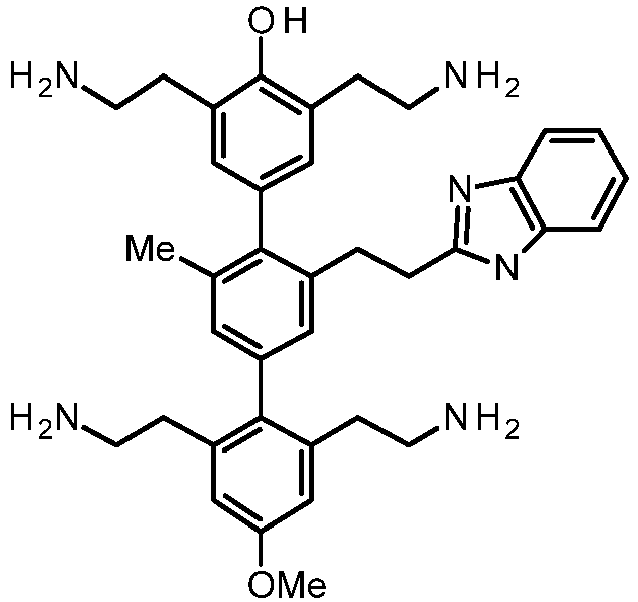
- 2,3",5",6-tetrakis(2-aminoethyl)-3',5'-bis(fluoromethyl)-[1,1':4',1 "-terphenyl]-4,4"-diol

- In an additional aspect of the invention, a compound of formula (I) is useful for the treatment and/or prevention of a disease in a mammal, such as a human.
- In another aspect of the invention, there is provided a pharmaceutical composition comprising: (a) a therapeutically efficacious amount of a compound of formula (I); and (b) a pharmaceutically acceptable excipient, for use in the treatment or prevention of a disease in a mammal, such as a human.
- The use of a compound of formula (I) or a pharmaceutical composition comprising a compound of formula (I) for specifically binding to internal loop IIB of the RRE of the HIV-1 virus RNA is disclosed.
- The use of a compound of formula (I) or a pharmaceutical composition comprising a compound of formula (I) for inhibiting the interaction between RRE and the HIV-1 protein Rev is disclosed.
- The use of a compound of formula (I) or a pharmaceutical composition comprising a compound of formula (I) for inhibiting transcription mediated by the HIV-1 LTR promoter is disclosed.
- The use of a compound of formula (I) or a pharmaceutical composition comprising a compound of formula (I) for blocking HIV-1 replication in vivo is disclosed.
- The use of a compound of formula (I) or a pharmaceutical composition comprising a compound of formula (I) for inhibiting gram-positive and gram-negative bacteria and preventing and/or treating bacterial infections is disclosed.
- A compound of Formula (I) or pharmaceutical composition comprising said compound can be used for preventing and/or treating HIV-1 infections and related diseases including, but not limited to, infections caused by other RNA viruses such as HIV-2 and other retroviruses, the virus of severe acute respiratory syndrome and other coronaviruses, hepatitis C virus, yellow fever virus, dengue virus, West Nile virus and other flaviviruses, poliovirus and other picornaviruses, influenza viruses and other orthomyxoviruses, the Ebola virus and other filoviruses, human parainfluenza virus and other paramyxoviruses, and rotavirus and other reoviruses; infectious or chronic diseases where these compounds may be used to modulate the function of RNA internal loops such as those present in human telomerases or the mRNAs of human oncogenes such as I-myc (relevant for the treatment of various cancer types including neuroblastoma amongst others), in the ribosomal subunits and riboswitches of bacteria (relevant for the treatment or prevention of infections caused by bacteria such as Staphilococcus aureus, Mycobacterium tuberculosis, Streptococcus pneumoniae, Streptococcus pyogenes, Haemophilus influenza, Neisseria meningitides or Pseudomonas aeruginosa amongst others) or in functional regions of viral RNA molecules such as the internal ribosome entry site or the 3'X domain of the hepatitis C virus (relevant for the treatment of diseases caused by this and other RNA viruses); infectious or chronic diseases responsive to inhibition of DNA transcription, such as inhibition of transcription promoted by the HIV-1 LTR (relevant for the treatment of HIV infections), or inhibition of transcription modulated by human transcription factors such as NF-κB, STAT factors or HMG-1 amongst others (relevant for the treatment of variety of human cancers, including prostate cancer, ovarian cancer, breast cancer, head and neck cancer, multiple myeloma and renal cell cancer); and infectious or chronic diseases where the compounds of the invention can be used as agonists or inhibitors of α-helical proteins in interaction with other biomolecules, such as the c-myc transcription factor in interaction with DNA and proteins like Max (relevant for the treatment of various cancer types including Burkitt lymphoma and colon or prostate cancer amongst others), Ap-1 and Sp-1 factors and steroid receptors in interaction with DNA (relevant for the treatment of hepatocarcinoma amongst other cancers) or the Rev and Gag proteins in interaction with the HIV-1 virus packaging signal RNA, or the Rev protein in interaction with other Rev monomers (relevant for the treatment of HIV infections). Other diseases where these compounds can be used as agonists or inhibitors of α-helical proteins in interaction with other biomolecules may also include for example herpes simplex virus infections, hypertension, psoriasis, asthma, autoimmune diseases including lupus (lupus erythematosus), multiple sclerosis and rheumatoid arthritis, fibromyalgia, neuronal disorders such as epilepsy, and neurodegenerative diseases including Alzheimer's disease and Parkinson's disease, among others.
- Compounds according to the present invention may be used as agonists or antagonists in binding assays, and as analytical agents, among other uses.
- The synthesis of the compounds of formula (I) represents another aspect of the invention. Compounds of the general formula (I) may be prepared by any suitable method known in the art and/or by the processes described below. It will be appreciated that where a particular stereoisomer of formula (I) is required, the synthetic processes described herein may be used with the appropriate homochiral starting material and/or isomers maybe resolved from mixtures using conventional separation techniques (eg. HPLC).
- The compounds according to the invention may be prepared by sequential C-C bond formation via the palladium catalysed Suzuki coupling of halides, aryltriflates and boronic esters of the bilaterally substituted A, B and C rings. In this method, R1, R2, R5, and R6 of the final molecule of formula (I) are introduced by the halide derivatives of A and C and R3 and R4 are introduced by the boronic ester of B.
- The present invention is intended to encompass all pharmaceutically acceptable ionized forms (e.g. salts) and solvates (e.g. hydrates) of the compounds under Formula I regardless of whether such forms and solvates are specified, as it is well known in the art that pharmaceutical agents in an ionized or solvated form may be used.
- It will be appreciated that the compounds according to the invention can contain asymmetrically substituted carbon atoms. The presence of one or more asymmetric centres in a compound of formula I can give rise to stereoisomers and in each case the invention is to be understood to extend to all such stereoisomers, including enantiomers and diastereomers, and mixtures including racemic and non-racemic mixtures thereof, which may be obtained by methods known to those skilled in the art.
- The compounds of Formula I may form organic and inorganic salts, for example, with inorganic or organic acids, e.g. hydrochloric acid, hydrobromic acid, fumaric acid, tartaric acid, citric acid, sulfuric acid, maleic acid, acetic acid, succinic acid, benzoic acid, palmitic acid, dodecanoic acid and acidic amino acids, such as glutamic acid, alkali metal hydroxides, e.g. sodium hydroxide, with amino acids, e.g., lysine or arginine. The salts formed with compounds under Formula I provided that they are pharmaceutically acceptable may be used in the present invention. Such salts and corresponding solvates also fall within the scope of the present invention.
- A variety of routes of administration of the compounds and compositions of the present invention are possible including, but not necessarily limited to parenteral (e.g., intravenous, intra-arterial, intramuscular, subcutaneous injection), oral (e.g., dietary or by inhalation), topical, nasal, vaginal, rectal, or via slow release micro-carriers, depending on the condition to be treated. Oral, parenteral and intravenous are preferred modes of administration. Vaginal administration, for example, with a vaginal gel formulation is also preferred. The formulation of the compounds of the present invention to be administered will vary according to the route of administration selected (e.g., solution, emulsion, gel, aerosol, capsule). Further dosage forms according to the present invention are, for example, solutions, suspensions, ointments, creams, pastes, gels, tinctures, lip-sticks, drops, syrups, aerosols and sprays.
- A suitable composition of the present invention comprising the compound or compounds of Formula I can be prepared in a physiologically acceptable vehicle or carrier and can contain optional adjuvant and preservatives. For solutions or emulsions, suitable carriers include, for example, aqueous or alcoholic/aqueous solutions, emulsions or suspensions, including saline and buffered media, sterile water, creams, ointments, lotions, oils, pastes and solid carriers. Parenteral vehicles can include sodium chloride solution, Ringer's dextrose, dextrose and sodium chloride, lactated Ringer's or fixed oils. Intravenous vehicles can include various additives, preservatives, or fluid, nutrient or electrolyte replenishers (See Remington's Pharmaceutical Science, 16th Edition, Mack, Ed. (1980)).
- Preferred compositions for parenteral administration are under the form of solutions, suspensions, emulsions, dispersions and lyophilized compositions of the compounds of the invention, preferably in the form of isotonic aqueous solutions, dispersions, emulsions or suspensions. These compositions are preferably sterile, either being processed in a sterile environment during their whole preparation process or by being sterilized in the end of said process. Furthermore, their manufacture is usually carried out under sterile conditions, as is the filling, for example, into ampoules or vials, and the sealing of the containers. These compositions may be ready to apply or be presented under solid form (for example as a lyophilizate) requiring reconstitution prior application.
- Parenteral compositions according to the present invention may comprise excipients, for example vehicles, stabilizers (reducing agents, anti-oxidants and/or sequestering agents), buffering agents, preservatives, isotonising agents, emulsifiers, solubilisers, viscosity increasing agents, and/or bulking agents and are prepared by conventional processes well known to those knowledgeable of the art.
- A preferred route of administration is oral. Pharmaceutical oral compositions in solid form (tablets, soft capsules, hard capsules or any other) according to the present invention comprise excipients, provided they are compatible with the active ingredient of the composition, including, but not limited to, diluents, binders, disintegrants, surfactants, glidants, lubricants, antioxidants or free radicals sequestrants, coating components, opacifiers or plasticisers.
- If a solid composition in the form of tablets is prepared, the compound of the present invention can be mixed with a pharmaceutical vehicle, examples of which include silica, starch, lactose, magnesium stearate and talc. The tablets can be coated with sucrose or another appropriate substance or they can be treated so as to have a sustained or delayed activity and so as to release a predetermined amount of active ingredient continuously. Gelatin capsules can be obtained by mixing the active ingredient with a diluent and incorporating the resulting mixture into soft or hard gelatin capsules. A syrup or elixir can contain the active ingredient in conjunction with a sweetener, an antiseptic (e.g. methylparaben and/or propylparaben), a flavouring, and an appropriate color. Water-dispersible powders or granules can contain the active ingredient mixed with dispersants or wetting agents or with suspending agents such as, polyvinylpyrrolidone, as well as with sweeteners or taste correctors.
- The term "pharmaceutically acceptable carrier" as used in the present invention includes any solvent, dispersion media, coatings, isotonic and absorption delaying agents, which are compatible with the activity of the compounds and are physiologically acceptable to the subject.
- "Effective amount" as used in the present invention includes the amount of the compound or a pharmaceutically acceptable salt thereof, ester, or solvate thereof which allows it to perform its intended function, i.e., treatment of HIV-1 infections and other diseases. Other diseases include, but are not limited to diseases caused by other RNA viruses and by gram-positive and gram-negative bacteria, infectious or chronic diseases responsive to inhibition of DNA transcription, or infectious or chronic diseases where these compounds may be used to modulate the function of RNA internal loops, or as agonists or inhibitors of α-helical proteins in interaction with other biomolecules.
- A therapeutically effective amount of the active substance of the present invention can be administered by an appropriate route in a single dose or multiple doses. The therapeutically effective amount will depend upon a number of factors, including biological activity, mode of administration, frequency of treatment, type of concurrent treatment, if any, age, body weight, sex, general health, severity of the condition to be treated, as well as appropriate pharmacokinetic properties. One skilled in the art can determine the appropriate dosage based on the above factors.
- The compounds of the invention may be administered initially in a suitable dosage that may be adjusted as required, depending on the clinical response. In general, satisfactory results may be obtained when the compounds of the invention are administered to a human at an approximate daily dosage (measured as the solid form) of about 0.05 to 100 mg/Kg of body weight. An approximate preferred dose ranges between about 0.1 and 50 mg/Kg/day, more preferably between about 1 - 20mg/Kg/day.
- The compound can be administered in the form of pharmaceutical compositions comprising the compound once a day or at different times within the day, prophylactically or therapeutically, preferably in an amount effective against HIV-1 infection or the related disease, to a mammal, for example a human, requiring such treatment. In the case of an individual having a body weight of about 75 kg, the daily dose of the mixture administered is from approximately 0.004 g to approximately 7.5 g, preferably from approximately 0.075 g to approximately 0.150g, of a compound of Formula I or a pharmaceutically acceptable salt, ester, or solvate thereof.
- The pharmaceutical compositions of the present invention can comprise from 0.01% to 100% by weight of a mixture of a compound of formula I, typically from approximately 0.05% to approximately 80%.
- The pharmaceutical compositions of the present invention may, if desired, be formulated so as to provide an immediate or modified release of the active ingredient after administration to the patient.
- Tipically, unit dose administration forms according to the present invention can comprise from approximately 0.05% to approximately 80% of the compound of formula I.
- Unit dose forms according to the present invention refer to, for example, coated and uncoated tablets, microcapsules, soft and hard capsules, pellets, powdered doses, ampoules, vials and suppositories.
- The present invention relates especially to the use of a compound of formula I or a pharmaceutical acceptable salt, ester, and/or solvate, as such or in the form of a pharmaceutical formulation with at least one pharmaceutically acceptable carrier for the therapeutic and also prophylactic treatment of HIV-1 infections and other diseases. Other diseases include, but are not limited to, diseases caused by other RNA viruses and by gram-positive and gram-negative bacteria, infectious or chronic diseases responsive to inhibition of DNA transcription, or infectious or chronic diseases where these compounds may be used to modulate the function of RNA internal loops, or as agonists or inhibitors of α-helical proteins in interaction with other biomolecules.
- Based on the three-dimensional structure of Rev34-50 bound to internal loop IIB of the RRE(7) (
Figure 1a ), design of organic ligands mimicking the three-dimensional distribution of the Rev34-50 helix side chains in its complex with the loop was aimed. In this respect, some reports had shown that tris-ortho-substituted p-terphenyl molecules could mimic one face of a α-helical peptide by adopting a staggered conformation that reproduced the angular orientation of three α-helix side chains, and that some of these molecules were able to inhibit protein-protein interactions(15). For the purpose of the present invention it was envisioned that introduction of substituents on both sides of a p-terphenyl scaffold would ensure a 360° side-chain projection similar to that observed in the IIB-Rev34-50 complex, where two thirds of the α-helix are sorrounded by RNA. An in silico conformational analysis of an hexakis-ortho-substituted p-terphenyl model molecule confirmed this prediction: while the ortho orientation of the substituents induced a staggered conformation, the presence of substituents on both sides of the rings ensured a broad side-chain projection in space. The hypothesis that these molecules might selectively bind to the RRE loop by mimicking the Rev34-50 α-helix was supported by docking p-biphenyl and p-terphenyl ligands containing different substitution patterns into the RRE structure(7) (PDB codes 1 ETF and 1 ETG). As expected, the best results were obtained for hexakis-ortho-substituted p-terphenyl molecules (compounds under Formula I) whose binding poses approximately reproduced the orientation of Rev34-50 in its complex with the RRE. After testing several possibilities for the lateral substituents in additional calculations, it was found that 2-amino-ethyl chains were synthetically-accessible and well suited to interact with the sugar-phosphate backbone of the RRE internal loop. - On the basis of the structure-based computational predictions, applicants set out to synthesize p-biphenyl and p-terphenyl molecules with bilateral substitutions on the benzene rings, which correspond to compounds of Formula I. The syntheses were based on sequential palladium-based Suzuki couplings (16-18) of aryl halides and aryl triflates with aryl boronic esters, as shown in the following scheme:

- Preferred compounds of the invention were prepared according to the following scheme:

- The following group of tetrakis (2-aminoethyl) 1-1' byphenyls where the 2-aminoethyl side-chains occupied bilateral 3,5 and 2',6' (JB-398), 2,6 and 2',6' (SC-30), and 3,5 and 3',5' (JB-391) positions was first generated:

JB-391: 3,3',5,5'-tetrakis(2-aminoethyl)-[1,1'-biphenyl]-4,4'-diol JB-398: 2',3,5,6'-tetrakis(2-aminoethyl)-4'-methoxy-[1,1'-biphenyl]-4-ol SC-30: 2,2',2",2'"-(4,4'-dimethoxy-[1,1'-biphenyl]-2,2',6,6'-tetrayl)tetraethanamine - The 2' and 6' (ortho) 2-aminoethyl chains of JB-398 induce the adoption by this biphenyl of a staggered conformation, similar to that adopted by the 3,2',2"-tris-substituted p-terphenyls that behave as α-helix mimics(15). The steric hindrance is maximized in SC-30, where all four 2-aminoethyl chains occupy ortho positions relative to the carbons joining the two benzene rings. In contrast, the bilateral 2-aminoethyl chains of JB-391 are meta, so that this molecule can adopt a planar conformation.
- The following terphenyl molecules were synthesized according to the method previously described:


JB-399: 2",3,5,6"-tetrakis(2-aminoethyl)-4"-methoxy-[1,1':4',1"-terphenyl]-4-ol IIS-358: 2",3,5,6"-tetrakis(2-aminoethyl)-2',4"-dimethoxy-[1,1':4',1"-terphenyl]-4-ol IIS-311: 2,2',2",2"'-(4"-(benzyloxy)-3',4-dimethoxy-[1,1':4',1"-terphenyl]-2,3",5",6-tetrayl)tetraethanamine IIS-478: 2,2',2",2"'-(3',4-dimethoxy-4"-((4-(trifluoromethyl)benzyl)oxy)-[1,1':4',1 "-terphenyl]-2,3",5",6-tetrayl)tetraethanamine IIS-530: 2,2',2",2"'-(4"-(cyclohexylmethoxy)-3',4-dimethoxy-[1,1':4',1"-terphenyl]-2,3",5",6-tetrayl)tetraethanamine IIS-420: 2",3,5,6"-tetrakis(2-aminoethyl)-4"-methoxy-2',6'-dimethyl-[1,1':4',1"-terphenyl]-4-ol IIS-375: 2,2',2",2"'-(4"-(benzyloxy)-4-methoxy-3',5'-dimethyl-[1,1':4',1"-terphenyl]-2,3",5",6-tetrayl)tetraethanamine IIS-792: 2",3,5,6"-tetrakis(2-aminoethyl)-2'-ethyl-4"-methoxy-[1,1':4',1"-terphenyl]-4-ol IIS-758: 2,2',2",2"'-(4"-(benzyloxy)-3'-ethyl-4-methoxy-[1,1':4',"-terphenyl]-2,3",5",6-tetrayl)tetraethanamine IIS-806: 2",3,5,6"-tetrakis(2-aminoethyl)-2',6'-diethyl-4"-methoxy-[1,1':4',1"-terphenyl]-4-ol IIS-711: 2,2',2",2"'-(4"-(benzyloxy)-3',5'-diethyl-4-methoxy-[1,1':4',1 "-terphenyl]-2,3",5",6-tetrayl)tetraethanamine - The first terphenyl molecule (JB-399) contained four 2-aminoethyl side-chains occupying the 3,5 and 2",6" bilateral positions of the two terminal benzene rings and lacked substituents in the central ring. In this case, a staggered conformation is expected for the 4'-1" bond joining the second and third benzenes, but not for the other one. The second series of similar 3,5,2",6" tetrakis (2-aminoethyl) terphenyls contained a single methoxy (IIS-358, IIS-311, IIS-478 and IIS-530) or ethyl (IIS-792 and IIS-771) substituent in the 2' position of the central ring. These terphenyls will adopt a staggered conformation around both benzene-benzene bonds, and contained different groups in the para carbon of the first ring: 4-hydroxyl (IIS-358 and IIS-792), 4-benzyl (IIS-311 and IIS-758), 4-p-fluoro-bencyl (IIS-478) or 4-cyclohexyl (IIS-530). The third series of 3,5,2",6" tetrakis (2-aminoethyl) terphenyls contained two methyl (IIS-420 and IIS-375) or ethyl (IIS-806 and IIS-771) groups occupying the 2' and 6' bilateral positions of the central ring, as well as 4-hydroxyl (IIS-420 and IIS-806) or 4-benzyl (IIS-375 and IIS-771) para substituents. These molecules are 3,5,2',2",6',6" hexakis-substituted p-terphenyl molecules containing bilateral groups in all three rings, and were predicted by the structure-based calculations to be the best Rev34-50 mimics.
- The interaction of these biphenyl and terphenyl compounds with the RRE RNA hairpin (SEQ. ID. No 1) was analysed using surface plasmon resonance (SPR) experiments(19). In addition to the RRE, two control RREc (SEQ. ID. No 2) and TARc (SEQ. ID. No 3) hairpins were also immobilised on the chips. In the RREc hairpin the internal loop forming the Rev high-affinity binding site is replaced with a G:G opposition, whereas in the TARc hairpin this loop is substituted with the HIV-1 Tat-binding UCU bulge(20). In this way, applicants could simultaneously assess the interaction of each ligand with RRE, RREc and TARc, obtaining important information about binding selectivity. In addition, the SPR methodology allows deduction of binding stoichiometries, which are likewise related to the specificity of the interaction between a ligand and a given RNA species. These are key considerations in the nucleic acid recognition field(4, 5, 14).
- The applicants benchmarked the SPR methodology by analysing the interaction of RRE with a TRQARRNRRRRWRERQRAAAAR peptide, hereafter called revp (SEQ ID. No. 4), as well as the RRE-binding antibiotic neomycin B, which was used as a reference. revp contains the arginine-rich Rev34-50 residue tract (TRQARRNRRRRWRERQR) forming the α-helix that is critical for interaction with the RRE(21). For the RRE-revp interaction, the binding curves were best described with a one-site model and indicated an equilibrium dissociation constant Kd of 4.2 ± 3.4 nM together with a 1:1 binding stoichiometry. This means that a single molecule of revp interacts with one high-affinity site in the RRE hairpin, formed by internal loop IIB(7). The specificity of the RRE:revp interaction was quantified by calculating the Kd(RREc)/Kd(RRE) and Kd(TARc)/Kd(RRE) ratios, which were 14.5 and 4.4, respectively. The revp Kd obtained by SPR was in very good agreement with the Kd's reported in the literature for similar peptides(22, 23). For neomycin B, the binding curves were best described with a two-site model, and we obtained an equilibrium dissociation constant Kd of 2.4 ± 1.1 µM for three molecules binding to the higher affinity site. These results also coincided well with the Kd values and binding stoichiometries previously reported in the literature(23). With Kd(RREc)/Kd(RRE) and Kd(TARc)/Kd(RRE) ratios of 0.9 and 2.3, the specificity of the RRE:neomycin interaction was rather poor, as previously reported(24).
- When the biphenyl and terphenyl ligands were evaluated with these experiments, the best results were obtained for terphenyl molecules, some of which were capable of binding to the RRE hairpin with affinities of 8 µM and binding stoichiometries of one to two molecules for the higher affinity site (
Figure 2 and Table 1). The terphenyl compounds containing a relatively polar group (methoxy) in the central benzene ring, particularly IIS-358, IIS-311 and IIS-478, gave rise to the best specificity data, with Kd(RREc)/Kd(RRE) and Kd(TARc)/Kd(RRE) ratios of up to 10.3 and 9.6, respectively (Table 1 andFigure 2 ), comparable to those obtained with the revp peptide (14.5 and 4.4). Terphenyl compounds containing a hydrophobic group (methyl or ethyl) in the central benzene and a 4-OH group showed higher affinity for the RRE hairpin.Table 1. RRE-biphenyl and RRE-terphenyl interaction parameters measured by SPR experiments at 25°C. RRE equilibrium dissociation constants (Kd), RRE binding stoichiometries (n), and RRE binding specificities relative to the control RREc and TARc hairpins, quantified as Kd(RREc)/Kd(RRE) and Kd(TARc)/Kd(RRE). compounda Kd (RRE) (M·106) ns (RRE) 

JB-398 * 31.1 ± 5.0 4.31 ± 0.3 - 3.7 SC-30 * >100 - - - JB-399b * 14.4 ± 6.8 0.71 ± 0.1 - 11.7 IIS-358 * 13.0 ± 9.0 1.12 ± 1.0 1.9 6.0 IIS-311 * 9.4 ± 5.7 1.3 2 + 0.6 4.9 3.2 IIS-478c * 14.0 ± 5.1 1.42 ± 0.4 10.3 9.6 IIS-530b * 46.2 ± 32.0 2.51 ± 1.1 1.3 4.0 IIS-792d 8.1 ± 1.8 1.31 ± 0.1 1.2 1.6 IIS-758d 16.7 ± 1.6 4.61 ± 0.2 1.3 2.0 IIS-806d 8.1 ± 1.1 2.11 ± 0.1 1.1 1.3 IIS-771d 17.6 ± 1.8 2.71 ± 0.1 1.0 1.7 *: comparative examples
aAll binding curves were fitted with either one-site or two-site binding models (indicated with s=1 or s=2 superscripts). When s=2, the Kd and n values are those of the high affinity site. The data were obtained at pH 6.3 except where indicated.
bValues determined using a ligand concentration range of 0.1-25 µM.
cValues determined at pH 7.4. Similar values of Kd, ns and Kd(RREc)/Kd(RRE) were obtained at pH 6.25: 12.1 ± 3.1 µM, 2.12 ± 0.4 molecules and 10.2, respectively.
dValues determined at pH 7.4 using a ligand concentration range of 0.1-25 µM. - The interaction between the RRE hairpin (SEQ. ID. No 1) and biphenyl and terphenyl compounds was also analysed using two-dimensional NMR spectroscopy (
Figure 3 ). These experiments were useful to examine the strength of the interactions and the location of the binding sites, and revealed significant differences among the different ligands. The biphenyl JB-398 required a high RRE:ligand molar ratio (1:6) to produce detectable changes in the RRE TOCSY spectrum (Figure 3 , bottom), whereas JB-391, SC-30 and neomycin B induced chemical shift perturbations in stem nucleotides outside the internal loop. These are indications of weak and unspecific binding, respectively. - In contrast, terphenyl molecules induced chemical shift changes in the internal loop and adjacent nucleotides only, particularly C20, U23 and C25 (
Figure 3 ), and these shifts were apparent at lower ratios. The shift variations were more pronounced for terphenyls molecules containing hydrophobic groups (methyl and ethyl) in the central benzene ring. JB-399 and the terphenyls containing a more polar group (methoxy) in the central ring, like IIS-358 and IIS-311, resulted in similar but less pronounced variations. The terphenyls that gave rise to the greatest RNA chemical shift variations and sharper complex resonances were IIS-420 and IIS-806, which contain two bilateral methyl or ethyl groups, respectively, in positions 2' and 6' of the central benzene (Figure 3 , top and middle). The RRE loop was titrated with two molar equivalents of these compounds. These results are consistent with the dissociation constants and binding stoichiometries determined by SPR experiments (Table 1). - The fact that only nucleotides located in the loop or adjacent positions are affected by the interaction clearly indicates that the terphenyl ligands selectively bind to the internal loop within the RRE hairpin (
Figure 3 ). Moreover, weak intermolecular NOEs between terphenyl hydrogens and RNA protons located in the major groove were detected in the IIS-420 and IIS-806 complexes. These contacts indicate that the interaction with the RRE loop takes place from the major groove, as is the case with Rev34-50(7), confirming that these bilaterally-substituted terphenyls ligands occupy the binding site of Rev34-50 in the RRE RNA (Figure 4 ). Examination of the NOESY spectra of the best complexes also revealed that IIS-420 and IIS-806 induce conformational changes in the RRE similar to those brought about by Rev34-50: this was indicated by a decrease in the intensity of the intraresidue H8-H1' NOE of G22: this guanine adopts a syn conformation in the unbound RRE loop that becomes anti upon both Rev34-50(25) and terphenyl ligand binding. - Using an assay based on fluorescence anisotropy, we evaluated the capacity of biphenyl and terphenyl ligands to inhibit the interaction between RRE and Rev34-50. An FITC-labelled GTRQARRNRRRRWRERQRAAAAR peptide (hereafter identified as frevp with SEQ ID. No. 5) and the RNA hairpin RRE (SEQ. ID. No 1) were used for these experiments. The results are shown in Table 2 and
Figure 5 . - This experiment was validated by measuring the IC50 and Ki values of the revp peptide and the reference antibiotic neomycin B. The Ki inhibition constant obtained for revp (4.1 ± 0.8 nM) was in excellent agreement with the Kd equilibrium dissociation constant independently determined by SPR (4.2 ± 3.4 nM). Neomycin's Ki, 2.0 ± 0.2 µM (obtained assuming that one ligand molecule is responsible for the observed frevp displacement), also coincided very well with the SPR Kd (2.4 ± 1.1 µM) and with Ki values previously reported in the literature(23).
- The terphenyl IIS-420, with an IC50 value of 6.8 µM, was the most potent inhibitor, followed by JB-399 (comparative) and other terphenyl molecules having methyl or ethyl groups in the central benzene (
Figure 5 and Table 2). Terphenyl molecules containing a single substituent in the central benzene, particularly those belonging to the more polar methoxy series, exhibited higher IC50's. The biphenyl molecules JB-391 and JB-398, with IC50 values of 7.7 and 22.1 µM respectively, were surprisingly potent in this assay. However, these molecules interact poorly with the RRE loop (e.g.Figure 3 , bottom) and it is therefore likely that they inhibit the RRE-frevp interaction through a different mechanism.Table 2. RRE- Rev 45-50 50% inhibitory concentrations of biphenyl and terphenyl molecules and neomycin B, measured by fluorescence polarization experiments at 25°Ccompound IC50 a (M·106) JB-391 * 7.7 ± 0.8 JB-398 * 22.1 ± 5.8 SC-30 * 308.7 ± 68.9 J B-399 * 23.4 ± 3.6 IIS-358 * 808.0 ± 461.7 IIS-311 * 162.2 ± 117.6 IIS-478 * 232.0 ± 32.7 IIS-530 * 75.5± 39.9 IIS-792 93.6 ± 24.4 IIS-758 78.1 ± 6.5 IIS-806 56.4 ± 13.5 IIS-771 77.2 ± 15.5 II-420 6.8 ± 0.5 IIS-375 32.2 ± 2.3 *: comparative examples
aAll IC50 values were obtained with 60 nM RRE and 10 nM frevp. The FP experiments were repeated at least two times, and the table shows the standard deviation of independent experiments except for IIS-311, IIS-358 and IIS-530, where the standard error of fitting a representative curve is indicated. No RRE-Rev45-50 inhibition was detected for thefragments 2,6-(2aminoethyl)-4-methoxy-1-bromo-benzene and 2,6-(2aminoethyl)-4-benzyloxy-1-bromo-benzene, used as controls. - The terphenyls IIS-420, IIS-375, IIS-758, IIS-771, IIS-792 and IIS-806 inhibited HIV-1 replication with no cellular toxicity, as shown in Table 3a and
Figure 6a .
Table 3. Results of cellular assays. (a) Antiviral activity in HIV-1 infection assays (EC50, NL4.3-Ren) and cellular toxicity (CC50). (b) Antiviral activity in HIV-1 transfection assays (EC50, post-integration). (c) Inhibition of Rev-mediated transport of RRE-containing RNA to the cytoplasm by the terphenyl IIS-420. In all cases, confidence intervals and R2 values are shown when possible.Table 3a compound EC 50 (µM) (NL4.3-Ren) CC50 (µM) (celular viability) Neomycin B >100 >100 JB-391 >50<100 >100 JB-398 >100 >100 SC-30 >50<100 >100 JB-399 >100 >100 IIS-358 >100 >100 IIS-311 >100 >100 IIS-478 >100 >100 IIS-530 >100 >100 IIS-792 46.3 >100 Conf. int. 95% 35.0-61.2 R2 0.7029 IIS-758 32.3 >100 Conf. int. 95% 20.6-50.5 R2 0.7704 IIS-806 64.1 >100 Conf. int. 95% 49.2-83.5 R2 0.7861 IIS-771 42.6 >100 Conf. int. 95% 32.3-56.1 R2 0.8583 II-420 3.4 >100 Conf. int.. 95% 1.7-6.9 R2 0.9712 IIS-375 24.8 >100 Conf. int. 95% 18.7-32.8 R2 0.8928 Table 3b Compound II-420 IIS-375 IIS-758 IIS-771 JB-391 EC50 post-integration (µM) 5.0 21.4 17.0 >100 >100 Conf. Int. 95% 0.7-34.0 15.3-29.9 3.6-80.7 R2 0.8648 0.9931 0.8629 Table 3c pCMV-Rev (ng)a IC50 (IIS-420, RRE-Rev) (µM) 500 >50<100 200 21.4 ± 6.3 20 10.4 ± 2.4 aThese experiments were performed with a constant concentration of pDM628 (500 ng/well) and decreasing concentrations of pCMV-Rev - IIS-420 was the most potent HIV-1 inhibitor, with an EC50 value of 3.4 µM (Table 3a). As observed in the RRE-Rev34-50 inhibition experiments in vitro, the compounds containing hydrophobic groups (methyl or ethyl) in the central benzene ring were also the most active compounds in vivo. The remaining ligands and neomycin B were not active or exhibited much weaker activities at the assay concentrations. None of the compounds showed cellular toxicity at concentrations below 100 µM (Table 3a and
Figure 6a ). - In order to evaluate the activity of the compounds in post-integration steps of the virus life cycle, we carried out an assay based on transfecting a full-length competent HIV-1 clone, where early steps of infection are bypassed and only post-integration events of the virus cycle occur. IIS-420, with an EC50 value of 5.0 µM, was the most potent compound in this assay, followed by IIS-758 and IIS-375 (Table 3b and
Figure 6b ). The EC50's of these terphenyls were similar to those obtained with the infection experiment (Table 3a), indicating that their main target was contained in transcriptional or post-transcriptional steps of the virus infectious cycle, as is the case for the RRE-Rev system. - An assay based on transfecting plasmids encoding Rev and an RRE-luciferase reporter system was carried out. The results indicated that IIS-420 inhibited Rev-mediated transport of RRE-containing RNA from the nucleus to the cytoplasm. The IC50 values ranged between 10.4 and 21.4 µM and depended on the concentration of Rev-encoding plasmid used in the assay (Table 3c and
Figure 6c ). This result clearly establishes cellular inhibition of RRE-Rev ribonucleoprotein function. - An assay based on transfecting an LTR-Luc plasmid(26) was performed to evaluate whether the terphenyls inhibited transcription mediated by the HIV-1 long terminal repeat (LTR) promoter. The terphenyls IIS-358, IIS-758 and IIS-420 inhibited transcription of the reporter gene (
Figure 6d ). - Although the available data are consistent with an antiviral effect based on RRE-Rev inhibition, these results show that bilaterally-substituted terphenyls also inhibit transcription controlled by the HIV-1 LTR promoter.
- The antibiotic activity of selected biphenyl and terphenyl compounds was performed using a conventional disk diffusion assay(27). The observed disk susceptibilities indicated that the bilaterally-substituted terphenyl IIS-420 had weak but significant activity against both gram-negative (Escherichia coli) and gram-positive (Staphilococcus aureus) bacteria. In contrast, the biphenyls JB-391 and SC-30 and the 2'-methoxy terphenyls IIS-358 and IIS-478 were inactive (Table 4). This result shows that the bilaterally-substituted compounds of the invention can be used as new antibacterial agents.
Table 4. Comparative disk susceptibility of E. coli and S. aureus to five antibiotics, the biphenyls JB-391 and SC-30, and the terphenyls IIS-478, IIS-358 and IIS-420. Compound a E. coli b,c S. aureus b,c Ampicillin 25.6 ± 1.7 38.1 ± 1.6 Tobramycin 18.8 ± 2.2 17.6 ± 0.8 Kanamycin A 22.0 ± 2.0 16.5 ± 1.1 Kanamycin B 20.0 ± 2.1 16.7 ± 1.2 Neomycin B 15.2 ± 2.1 12.8 ± 1.9 II-420 9.3 ± 0.4 9.8 ± 0.4 aThe disk potencies were 20 µg of compound in all cases.
bThe values represent the average and standard deviation of 2-10 independent experiments.
cJB-391, SC-30, IIS-478 and IIS-358 were inactive in this assay. - The pharmaceutical compositions of the present invention are prepared in a manner known per se, for example by means of conventional mixing, granulating, coating, dissolving, emulsifying or lyophilizing processes. Optionally, the manufacture of the compositions according to the present invention includes more steps such as liposomal encapsulation.
- In particular, a tablet may be made by compression and molding, optionally with one or more accessory ingredients. Compressed tablets may be prepared by compressing in a suitable machine the active compound of the present invention in a free-flowing form, e.g., a powder or granules, optionally mixed with ingredients, such as, binders, lubricants, inert diluents, surface active or dispersing agents. Molded tablets may be made by molding in a suitable machine, a mixture of the powdered active compound with any suitable carrier.
- In particular, a syrup or suspension may be made by adding the active compound of the present invention to a concentrated, aqueous solution of a sugar, e.g. sucrose, to which also any accessory ingredient may be added. Such accessory ingredients may include, flavoring, an agent to retard crystallization of the sugar or an agent to increase the solubility of any other ingredient, e.g., as a polyhydric alcohol, for example, glycerol or sorbitol.
- Formulations for rectal administration may be made with a conventional carrier, e.g., cocoa butter or Witepsol S55 (commercial registered trademark). Specific details related to particular aspects of conventional processes of galenic development can be found in Swarbrick and Boylan's "Encyclopedia of pharmaceutical technology" (1988-2001 NY, Published by M. Dekker).
- Alternatively, the compounds of the present invention may be made in liposomes or microspheres (or microparticles), such methods essentially comprising dissolving the compounds of the present invention in an aqueous solution, the appropriate phospholipids and lipids added, along with surfactants if required, and the material dialyzed or sonicated, as necessary. Liposomal encapsulation techniques are detailed in Claudio Nastruzzi's book "Lipospheres in drug targets and delivery: approaches, methods, and applications" (Boca Raton 2005, published by CRC Press) and in Lasic and Papahadjopoulos' "Lipospheres in drug targets and delivery: approaches, methods, and applications" (1998 Amsterdam, NY, Published by Elsevier).
- The invention will now be further described by the following working examples, which are preferred embodiments of the invention.
- The conformational analysis of an hexa-substituted terphenyl molecule was carried out using the Merck MMFF94s force field(28) within the MOE software package (CCG Inc.). We systematically varied the two benzene-benzene torsions by 30° intervals and minimized the potential energy of the conformers. Biphenyl and terphenyl molecules containing different substitution patterns were docked into the 1 ETF RRE structure(7) using the Dock 5.0 algorithm(29).
- In order to obtain an improved model of RRE-terphenyl complexes, subsequent docking calculations were carried out using the Autodock 3.05(30) and Gold 5.0(31) programs, guided by restraints based on intermolecular NOEs observed by NMR spectroscopy. Based on the NMR data (
Figure 3 ), the binding site of the ligands was defined around nucleotide C20. An illustrative example of these calculations is shown inFigure 4 . - The RRE RNA (SEQ ID No. 1) used in NMR spectroscopy and fluorescence polarization (FP) experiments was purchased from Dharmacon (Thermo Fisher Scientific Inc.), 2'-ACE de-protected, and purified following a procedure based on gel electrophoresis and dialysis. For the SPR experiments, 5'-biotin-RRE and two control 5'-biotin-RREc (SEQ ID No: 2) and 5'-biotin-TARc RNAs (SEQ ID No. 3) were purchased HPLC-purified from Microsynth AG and microdialyzed in HBS-EP buffer (10mM HEPES pH 7.4, 150 mM NaCl, 3mM EDTA and 0.005% (v/v) surfactant P20) prior to immobilization.
- For the fluorescence polarisation experiments (FP), we used the peptide FITC-Ahx-GTRQARRNRRRRWRERQRAAAAR-amide (SEQ ID No. 5; identified as frevp), containing an FITC fluorophore bound to the N-terminal glycine (Genscript Inc.). This peptide contains the Arg-rich Rev34-50 residue tract forming the RNA-binding α-helix of Rev(21). For benchmarking the FP and SPR experiments, a similar but unlabeled succynyl-TRQARRNRRRRWRERQRAAAAR-amide peptide (SEQ ID No. 4; identified as revp) was also purchased from Genscript Inc. Both peptides contain additional AAAAR amino acids at their C termini, shown to favour the α-helical conformation(22).
- The Surface Plasmon Resonance (SPR) experiments were carried out at 25°C with a Biacore T100 optical biosensor system, 4-channel streptavidin-derivatized Series S SA chips, and either 10 mM MES (pH 6.25), 150 mM NaCl, 1 mM EDTA and 0.005% P20 or 10 mM HEPES pH 7.4, 150 mM NaCl, 3 mM EDTA and 0.005% P20 aqueous solutions as mobile phases. After immobilizing approximately 300 response units (RU) of the RRE, RREc and TARc RNA hairpins on the chips, the compounds were injected during 10-minute periods at a flow rate of 20 µL/min and at concentrations generally ranging from 0.01 µM to 100.0 µM, and then allowed to dissociate for 10 more minutes. The RNA surfaces were regenerated with solutions containing 0.5 to 1 M NaCl and 10 to 100 mM NaOH, depending on the ligand.
- RNA-ligand SPR equilibrium dissociation constants (Kd) were determined by fitting the sensorgrams to one-site or two-site equations:


Figure 2 . - NMR spectra were acquired in temperature-calibrated
Bruker Avance 500 MHz and cryoprobe-equippedBruker Avance 600 MHz spectrometers, and analysed using Topspin 1.3 (Bruker Biospin) and Sparky 3.110(34). The RRE samples used in ligand-binding NMR experiments were previously microdialyzed in an aqueous solution containing 10 mM sodium phosphate (pH 6.0) and 0.1 mM EDTA. The interaction of these RRE samples with biphenyl and terphenyl compounds was monitored using two-dimensional TOCSY experiments recorded in D2O. Starting from free RRE, the RNA was progressively titrated with ligand until RNA:ligand molar ratios ranging from 1:2 to 1:6, depending on the observed spectral changes. The interaction between RRE and the reference antibiotic neomycin B was also monitored using a similar approach. Results are shown inFigure 3 . - The complexes of RRE with the best ligands (IIS-420, IIS-375 and IIS-806) were studied using a higher concentration of RNA (0.12 mM) and 1:1 to 1:4 RNA:terphenyl molar ratios. These systems were additionally studied using series of dqf-COSY, TOCSY and NOESY (with 100-800 ms mixing times), all with recycle delays of 2 seconds, as well as 1D saturation transfer difference experiments. All of these experiments were recorded in D2O at several temperatures (between 2 and 46°C).
- The capacity of biphenyl and terphenyl ligands to inhibit the RRE-Rev34-50 interaction in vitro was evaluated with a displacement assay based on fluorescence anisotropy. These experiments were conducted at 25 °C using 96-well plates and a Victor X5 (PerkinElmer Inc.) plate reader set up with 480 and 535 nm excitation and emission filters, respectively. The buffer used for these assays contained 30 mM HEPES (pH 6.8), 100 mM KCI, 10 mM sodium phosphate, 10 mM ammonium acetate, 10 mM guanidinium chloride, 2 mM MgCl2, 20mM NaCl, 0.5 mM EDTA and 0.001% (v/v) Triton X-100(35).
- The RRE hairpin (SEQ.
ID No 1; at a concentration of 2 or 60 nM) and frevp (SEQ ID. No. 5; 10 nM) were incubated with increasing amounts of compounds for 5 minutes. Anisotropy data were subsequently collected for 15 minutes at 5 minute intervals to ensure that full equilibration had been reached. IC50 values were calculated by fitting observed anisotropy (Aobs) to the following equation with GraphPad Prism (GraphPad Software Inc.):
- Inhibition constants (Ki) were calculated from the IC50 values using the following equation:

Figure 5 and Table 2. - Plasmids pNL4.3-Luc and pNL4.3 Ren were generated by cloning the luciferase and renilla genes, respectively, in the nef region of the proviral clone pNL4.3(36, 37). pCMV-Rev expresses Rev, and pDM628 is a Rev-dependent luciferase-based reporter plasmid in which the RRE and a luciferase-coding sequence have been cloned. In the LTR-Luc plasmid, the expression of the luciferase reporter depends on the HIV-1 LTR promoter(26).
- MT-2 cells (American Type Culture Collection, Rockville, MD) were cultured in RPMI 1640 medium containing 10% (v/v) fetal bovine serum, 2 mM I-glutamine, penicillin (50 IU/ml) and streptomycin (50 µg/ml) (all Whittaker M.A. Bio-Products). The cells were cultured at 37 °C in a 5% CO2 humidified atmosphere and split twice a week.
- Evaluation of anti-HIV-1 activity. Infectious supernatants were obtained from calcium phosphate transfection on 293T cells of plasmids pNL4.3-Luc or pNL4.3-Ren. These supernatants were used to infect cells in the presence of the compounds to evaluate. Anti-HIV activity quantification was performed 48 h post-infection. Briefly, cells were lysed with 100 µl of buffer provided by "Luciferase Assay System Kit with Reporter Lysis Buffer" (Promega, Madison, WI). Relative luminescence units (RLUs) were obtained in a luminometer (Berthold Detection Systems, Pforzheim, Germany) after the addition of substrate to cell extracts. Cellular viability was evaluated with cells similarly treated with the same concentrations of compound. After 48 h, viability was evaluated with the Cell Titer Glo (Promega) assay system following the Manufacturer's specifications. Inhibitory concentrations 50 (EC50) and
cytotoxic concentrations 50% (CC50) were calculated using the GraphPad Prism software. The results are shown in Table 3a andFigure 6a . - Transfection assays. MT-2 cells were maintained in culture without stimuli and prior to assay cells were resuspended in 350 µl of RPMI without serum and antibiotics and transfected/pulsed at 320 V, 1500 µF and maximum resistance with the plasmids at a concentration of 0.5 µg/106 cells using an Easyject plus Electroporator (Equibio, Middlesex, UK). After transfection, cells were immediately cultured in RPMI with 10% fetal calf serum, glutamine and antibiotics, treated or not with different concentrations of compound and harvested 48 h later Luciferase activity (RLUs) was measured in a luminometer.
- In the assays evaluating post-integration activity and LTR-dependent transcription, a full-length competent HIV-1 clone or an LTR-Luc plasmid, respectively, were transfected in the presence of compounds. RRE-Rev inhibition was analysed by transfecting pCMV-Rev and pDM628 plasmids. Transcripts produced upon transcription of pDM628 consisted in fragments encoding the luciferase gene and the RRE, where both elements were situated between a splicing donor and a splicing acceptor. In the presence of Rev, the RRE-Rev interaction enables export of the transcript to the cytoplasm, resulting in luciferase expression. The results of transfection assays are shown in Tables 3b and 3c and
Figures 6b ,6c and 6d . - Antibacterial activity was measured according to the Kirby-Bauer method(27). Escherichia coli (ATCC 53868) or Staphilococcus aureus (ATCC 35556) cultures were uniformly spread on agar plates. Sterilized 8mm discs were placed on the surface of the plates and impregnated with 20 µL of a 1 µg/µL compound solution. After incubation of the plates during 16-18 hours at 37°C, the diameter of the inhibition area around each disk was measured. The assay was benchmarked with the antibiotics ampicillin, tobramycin, kanamycin A, kanamycin B and neomycin B. The relative disk susceptibilities of E. coli and S. aureus to these agents were in good agreement with values reported in the literature (see e.g. (38)). The results are shown in Table 4.
- Starting
fragments Fragment 1 was prepared from commercially available 4-bromo-3,5-dimethylphenol (6). The phenolic group of 6 was alkylated with iodomethane and the resulting methyl ether was then oxidized.Carboxylic acid 8 was converted to methyl ester 9. Reduction of 9 with LiBH4 (lithium borohydride), followed by treatment with NBS (N-bromosuccinimide) and then NaCN (sodium cyanide) producedfragment 1 in good yield (Scheme 2).
- Synthesis of
fragment 2 is shown in Scheme 3. Commercially available 12 was treated with formaldehyde to give alcohol 13. Compound 13 was converted to intermediates 14a-c by selective protection of its phenol group. Bromination of derivatives 14 and a subsequent nucleophilic substitution with NaCN provided 2 as a small library of O-protected bromophenol derivatives.

- As mentioned above, the synthetic route was based on sequential Suzuki cross-coupling reactions in which various aryl boronic esters were used as coupling partner. Boronic esters 3 were commercially available except for 3d and 3e.

- Vinyl derivatives 3d and 3e were synthesized as shown in
Scheme 4. First, dialdehyde 16a was prepared from commercially available 4-bromophenol by a Duff's reaction. Both precursors 16a and 16b underwent the same synthetic pathway consisting of a protection of the phenol as benzyl group, a subsequent Wittig reaction with MePh3PBr, and final boronic ester formation catalyzed by palladium under microwave irradiation.

- With all starting materials in hand, the complementary synthesis of biphenyl
backbones combining fragments 1 and 2 (Scheme 5) was also envisioned. In this way, although a more complex terphenyl scaffold was aimed, the activity of biaryl structures was also evaluated.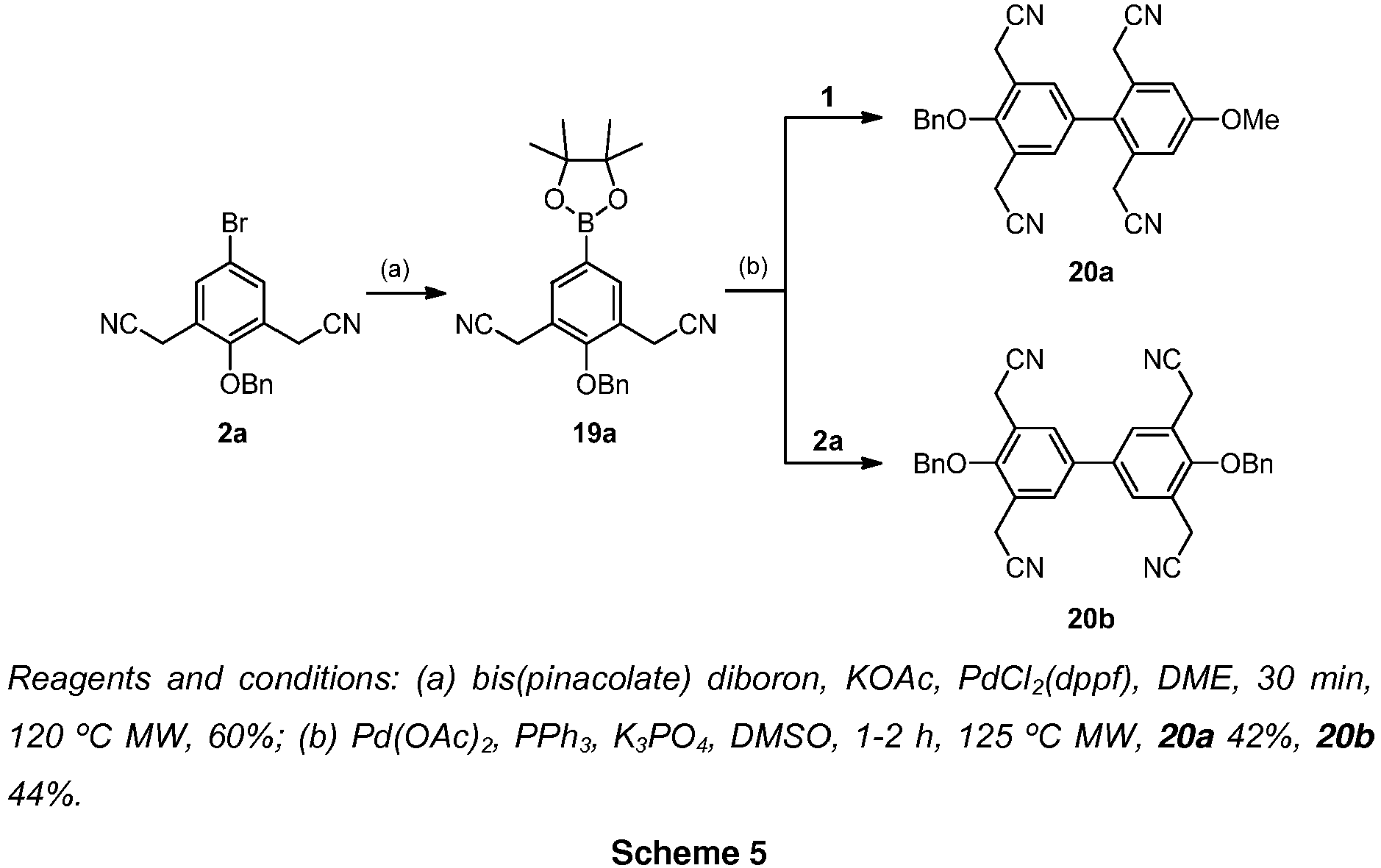
- As shown in
Scheme 5, a palladium-based cross-coupling reaction of 2a with bis(pinacolate) diboron afforded intermediate 19a. The resulting boronic ester 19a was coupled withsynthons 1 and 2a to provide biphenyls 20a and 20b respectively. Pleasingly, it was observed that the homo-coupling reaction of 1 was also feasible involving a one-pot process in which the boronic partner was formed in situ (Scheme 6).

- Next step was the treatment of nitriles 20a-c with a borane tetrahydrofurane complex solution, and then HCl 4M in dioxane to give the ammonium salts 22a-b (Scheme 7). Benzyl protected derivatives 20a-b were additionally subjected to a previous hydrogenolysis to furnish alcohols 21a-b.

- Based on the synthetic approach used, the desired
terphenyls 5 were synthesized as follows. Startingsynthon 1 was subjected to a Suzuki cross-coupling reaction with aryl boronic esters 3a-e catalyzed by palladium under optimized conditions (Scheme 8). Removal of the benzyl group of 23d-e and subsequent triflation of the phenols 23a-c and 24a-b generated 25a-e in good yields. Before couplingtriflates 25 with the correspondingboronic ester 2, the latter must be prepared separately as depicted in Scheme 9. Following the same procedure used before for 2a (R5= Ph), compounds 19b-d were synthesized by microwave-assisted Pd-catalyzed coupling reaction with bis(pinacolate) diboron.

- Next, the last Suzuki cross-coupling reaction was performed on
triflates 25 and boronic esters 19 to afford the desired terphenyl derivatives 4a-g which were converted to the correspondingammonium salt 5 by first reduction with BH3/THF followed by treatment with HCl 4M in dioxane.
- Additionally, substrates 4a-e were debenzylated under standard conditions to give deprotected ammonium salts 5h-l quantitatively, as shown in Scheme 11. In this way, an assorted library of strategically functionalized bi- and terphenyl backbones was prepared.

- Other bilaterally-substituted 1,4-linked tricyclic compounds containing rings different from benzene can be similarly prepared using sequential Suzuki-Myaura cross-coupling reactions. For example, the synthesis of 3,6-diphenyl-pirydazine compounds involves cross-couplings of commercially available 3,6-dichloropyridazine derivatives and arylboronic acids:

- A mixture of corresponding boronic ester 3a-e (1.1 equiv.), aryl halide 1 (1 equiv.) and PdCl2(dppf) (10% mol) was dissolved in MeCN:H2O (7:3) (0.15 M) and K3PO4 (3 equiv.) was added. The mixture was heated at 120°C in a microwave oven for 30 minutes. After cooling, the organic phase was decanted, washed with brine, dried over anhydrous Na2SO4, and concentrated under vacuum. The crude product was purified by flash chromatography on silica gel employing mixtures of n-hexane:EtOAc as eluents.
- The mixture of the corresponding benzylated compound 23 (1 equiv.) and Pd(OH)2 20% wt (0.5 equiv.) in ethanol (0.1 M) was stirred under hydrogen atmosphere at 10 atm for 20 hours. The mixture was filtered and washed with EtOAc. The organic phase was evaporated to afford the product 24a-b without further purification.
- To a solution of the corresponding phenol 24 (1 equiv.) in anhydrous CH2Cl2 (0.2 M) was added pyridine (2.5 equiv.) and trifluoromethanesulfonic anhydride (1.2 equiv.) dropwise at 0°C. After complete addition, the mixture was warmed to room temperature and allowed to stir for 90 minutes. The mixture was then diluted with Et2O, quenched with 10 % aq. HCl and washed successively with saturated NaHCO3, and brine. The organic phase was dried over anhydrous Na2SO4 and concentrated under vacuum to give a crude product, which was purified by column chromatography employing mixtures of n-hexane:EtOAc as eluents.
- A mixture of corresponding boronic ester 19 (1.2 equiv.), triflate 25 (1 equiv.), K3PO4 (3 equiv.) and PdCl2(dppf) (10% mol) was dissolved in MeCN:H2O (7:3) (0.15 M). The mixture was heated at 120°C in a microwave oven for 30 minutes. After cooling, the organic phase was decanted, washed with brine, dried over anhydrous Na2SO4, filtered, and concentrated under vacuum to give a crude product, which was purified by column chromatography employing mixtures of n-hexane:EtOAc as eluents.
- Nitrile compound 4 (1 equiv.) was dissolved in anhydrous THF (0.05 M), then borane THF complex solution 1 M was added (12 equiv.) and the mixture was refluxed under N2 atmosphere for 5 days. After that time, HCl 4 M in dioxane (16 equiv.) was added and the mixture was refluxed for 2 hours. The aqueous solution was washed several times with CH2Cl2 and then evaporated under vacuum. The recovered solid was dissolved in MeOH and precipitated by addition of Et2O.
- The mixture of
chlorhydrate 5a, 5b, 5c, 5d or 5e (1 equiv.) and Pd/C 10% wt (10% mol) in MeOH (0.03M) was stirred under H2 atmosphere (1 atm) for 1 hour. The mixture was filtered and washed with MeOH. The combined organic phase was evaporated to afford the final product as a white solid. No further purification was needed. -

- 2,2',2",2"'-[4"-(Benzyloxy)-4-methoxy-3',5'-dimethyl-(1,1':4',1"-terphenyl)-2,3",5",6-tetrayl]tetraethanamine chlorhydrate was synthesized following the method above starting from 4b. The crude product was obtained as a white solid (32% yield).
Rf: 0 (MeOH). 1H NMR (300 MHz, CDCl3) δ = δ 7.60-7.32 (m, 5H), 7.02 (s, 2H), 6.93 (s, 2H), 6.83 (s, 2H), 4.99 (s, 2H), 3.84 (s, 3H), 3.08-2.92 (m, 8H), 2.84-2.82 (m, 4H), 2.71-2.62 (m, 4H), 2.09 (s, 6H). 13C NMR (75 MHz, CDCl3) δ = δ 180.4, 160.4, 155.9, 141.4, 139.4, 139.3, 138.7, 137.5, 135.7, 133.7, 131.3, 130.1, 129.6, 129.3, 129.1, 129.1, 114.4, 77.0, 62.4, 55.8, 42.6, 42.4, 35.7, 32.6, 24.3, 21.2. HRMS (ESI) calcd. for C36H47N4O2 [M+H]+: 567.3699. Found: 567.3653. Melting point: >300 °C. -

- 2,2',2",2"'-[4"-(Benzyloxy)-3'-ethyl-4-methoxy-(1,1':4',1"-terphenyl)-2,3",5",6-tetrayl]tetraethanamine chlorhydrate was synthesized following the method above starting from 4c. The crude product was obtained as a white solid (43% yield).
Rf: 0 (MeOH). 1H RMN (300 MHz, D2O) δ = 7.62-7.50 (m, 5H), 7.45 (d, J = 7.7 Hz, 1H), 7.40 (s, 1H), 7.28 (s, 1H), 7.22-7.14 (m, 1H), 7.05 (s, 2H), 5.02 (s, 2H), 3.95 (s, 3H), 3.37-3.25 (m, J = 7.3 Hz, 4H), 3.21-3.01 (m, J = 16.2, 8.7 Hz, 8H), 2.93-2.79 (m, 4H), 2.72 (q, J = 15.0, 7.5 Hz, 2H), 1.14 (t, J = 7.5 Hz, 3H). 13C RMN (75 MHz, D2O) δ = 158.5, 153.9, 142.7, 139.6, 138.5, 137.8, 137.0, 136.0, 134.9, 130.8, 130.6, 130.4, 129.3, 129.2, 129.1, 127.3, 114.3, 76.6, 61.6, 55.7, 40.0, 39.8, 39.6, 31.4, 28.2, 28.0, 25.9, 15.3. HRMS (ESI) calcd. for C36H47N4O2[M+H]+: 567.3699. Found: 567.3694. Melting point: 282-286 °C. -

- 2",3,5,6"-Tetrakis(2-aminoethyl)-4"-methoxy-2',6'-dimethyl-(1,1':4',1"-terphenyl)-4-ol chlorhydrate was synthesized following the method above starting from 5b. The crude product was obtained as a white solid (99% yield).
Rf: 0 (MeOH).1H NMR (300 MHz, MeOD) δ = δ 7.13 (s, 1H), 6.86 (s, 2H), 6.75 (d, J = 3.8 Hz, 5H), 3.81 (s, 3H), 2.99 (d, J = 5.8 Hz, 4H), 2.85 (d, J = 5.8 Hz, 4H), 2.77-2.64 (m, 4H), 2.64-2.50 (m, 4H), 2.05 (s, 6H). 13C NMR (75 MHz, MeOD) δ = 160.1, 155.9, 142.1, 140.1, 139.3, 137.6, 135.9, 132.1, 131.1, 130.1, 129.0, 128.4, 114.0, 66.9, 58.3, 55.7, 43.5, 42.8, 42.7, 37.6, 35.1, 21.3, 18.4, 15.4. HRMS (ESI) calcd. for C29H41N4O2 [M+H]+: 478.3230. Found: 478.3169. Melting point: >300 °C. -

- 2",3,5,6"-Tetrakis(2-aminoethyl)-2',6'-diethyl-4"-methoxy-(1,1':4',1"-terphenyl)-4-ol chlorhydrate was synthesized following the method above starting from 5d. The crude product was obtained as a white solid (99% yield).
Rf: 0 (MeOH). 1H NMR (300 MHz, D2O) δ = 7.45 (d, J = 7.7 Hz, 1H), 7.36-7.28 (m, 3H), 7.21 (d, J = 7.7 Hz, 1H), 7.05 (s, 2H), 3.95 (s, 3H), 3.46-3.35 (m, 4H), 3.23-3.14 (m, 4H), 3.13-3.02 (m, 4H), 2.93-2.80 (m, 4H), 2.74 (q, J = 7.5 Hz, 4H), 1.15 (t, J = 7.5 Hz, 6H). 13C RMN (75 MHz, D2O) δ = 158.5, 151.3, 142.8, 139.8, 137.5, 137.0, 134.9, 130.7, 130.5, 130.4, 127.3, 125.7, 114.2, 61.6, 55.7, 49.0, 40.0, 39.6, 31.4, 28.2, 27.9, 25.8, 15.2. HRMS (ESI) calcd. for C31H45N4O2 [M+H]+: 505.3543. Found: 505.3478. Melting point: >300 °C. -

- 2",3,5,6"-Tetrakis(2-aminoethyl)-2',4"-dimethoxy-(1,1':4',1"-terphenyl)-4-ol chlorhydrate was synthesized following the method above starting from 5e. The crude product was obtained as a white solid (99% yield).
Rf: 0 (MeOH).1H NMR (300 MHz, MeOD) δ = 7.38-7.35 (m, 3H), 6.85-6.80 (m, 4H), 3.91 (s, 3H), 3.82 (s, 3H), 2.72-2.81 (m, 4H), 2.92-3.01 (m, 4H), 3.08-3.11 (m, 4H), 3.15-3.26 (m, 4H). 13C NMR (75 MHz, MeOD) δ = 161.8, 157.8, 155.9, 142.9, 142.6, 134.8, 128.5, 128.4, 127.9, 124.0, 121.9, 121.0, 112.6, 111.4, 56.8, 56.0, 42.0, 34.9, 30.1. HRMS (ESI) calcd. for C28H39N4O3 [M+H]+: 479.3022. Found: 479.2965. Melting point: >300 °C. -
- 1. Richman DD, Margolis DM, Delaney M, Greene WC, Hazuda D, Pomerantz RJ. The challenge of finding a cure for HIV infection. Science. 2009;323(5919):1304-7.
- 2. Ward CJ. New drugs for HIV-1: challenges and novel candidates. Expert Rev Anti Infect Ther. 2010;8(10):1093-5.
- 3. Sharp PA. The centrality of RNA. Cell. 2009;136(4):577-80.
- 4. Gallego J, Varani G. Targeting RNA with Small Molecule Drugs: Therapeutic Promise and Chemical Challenges. Acc Chem Res. 2001;34:836-43.
- 5. Guan L, Disney MD. Recent advances in developing small molecules targeting RNA. ACS Chem Biol. 2012;7(1):73-86.
- 6. Hermann T. Drugs targeting the ribosome. Curr Opin Struct Biol. 2005;15(3):355-66.
- 7. Battiste JL, Mao H, Rao NS, Tan R, Muhandiram DR, Kay LE, et al. a Helix-RNA Major Groove Recognition in an HIV-1 Rev Peptide-RRE RNA Complex. Science. 1996;273:1547-51.
- 8. Daugherty MD, Liu B, Frankel AD. Structural basis for cooperative RNA binding and export complex assembly by HIV Rev. Nat Struct Mol Biol. 2010;17(11):1337-42.
- 9. DiMattia MA, Watts NR, Stahl SJ, Rader C, Wingfield PT, Stuart DI, et al. Implications of the HIV-1 Rev dimer structure at 3.2 A resolution for multimeric binding to the Rev response element. Proc Natl Acad Sci USA. 2010;107(13):5810-4.
- 10. Daugherty MD, D'Orso I, Frankel AD. A solution to limited genomic capacity: using adaptable binding surfaces to assemble the functional HIV Rev oligomer on RNA. Mol Cell. 2008;31 (6):824-34.
- 11. Groom HC, Anderson EC, Lever AM. Rev: beyond nuclear export. J Gen Virol. 2009;90(Pt 6):1303-18.
- 12. Blissenbach M, Grewe B, Hoffmann B, Brandt S, Uberla K. Nuclear RNA export and packaging functions of HIV-1 Rev revisited. J Virol. 2010;84(13):6598-604.
- 13. Levin A, Hayouka Z, Friedler A, Loyter A. Nucleocytoplasmic shuttling of HIV-1 integrase is controlled by the viral Rev protein. Nucleus. 2010; 1 (2):190-201.
- 14. Thomas JR, Hergenrother PJ. Targeting RNA with small molecules. Chem Rev. 2008;108(4):1171-224.
- 15. Yin H, Lee GI, Park HS, Payne GA, Rodriguez JM, Sebti SM, et al. Terphenyl-based helical mimetics that disrupt the p53/HDM2 interaction. Angewandte Chemie-International Edition. 2005;44(18):2704-7.
- 16. Suzuki A. Carbon-carbon bonding made easy. Chem Commun. 2005(38):4759-63.
- 17. Leadbeater N. Fast, easy, clean chemistry by using water as a solvent and microwave heating: the Suzuki coupling as an illustration. Chem Commun. 2005(23):2881-902.
- 18. Nicolaou KC, Bulger PG, Sarlah D. Palladium-Catalyzed Cross-Coupling Reactions in Total Synthesis. Angew Chem Int Ed Engl. 2005;44(29):4442-89.
- 19. Tanious FA, Nguyen B, Wilson WD. Biosensor-surface plasmon resonance methods for quantitative analysis of biomolecular interactions. Methods Cell Biol. 2008;84:53-77.
- 20. Dingwall C, Ernberg I, Gait MJ, Green SM, Heaphy S, Karn J, et al. HIV-1 tat protein stimulates transcription by binding to a U-rich bulge in the stem of the TAR RNA structure. EMBO J. 1990;9(12):4145-53.
- 21. Kjems J, Calnan BJ, Frankel AD, Sharp PA. Specific binding of a basic peptide from HIV-1 Rev. EMBO J. 1992;11(3):1119-29.
- 22. Tan R, Chen L, Buettner JA, Hudson D, Frankel AD. RNA recognition by an isolated alpha helix. Cell. 1993;73(5):1031-40.
- 23. Lacourciere KA, Stivers JT, Marino JP. Mechanism of neomycin and Rev peptide binding to the Rev responsive element of HIV-1 as determined by fluorescence and NMR spectroscopy. Biochemistry. 2000;39(19):5630-41.
- 24. Hendrix M, Priestley ES, Joyce GF, Wong CH. Direct observation of aminoglycoside-RNA interactions by surface plasmon resonance. J Am Chem Soc. 1997;119(16):3641-8.
- 25. Peterson RD, Feigon J. Structural Change in Rev Responsive Element RNA of HIV-1 on Binding Rev Peptide. J Mol Biol. 1996;264:863-77.
- 26. Hazan U, Thomas D, Alcami J, Bachelerie F, Israel N, Yssel H, et al. Stimulation of a human T-cell clone with anti-CD3 or tumor necrosis factor induces NF-kappa B translocation but not .
- 27. Bauer AW, Kirby WM, Sherris JC, Turck M. Antibiotic susceptibility testing by a standardized single disk method. Am J Clin Pathol. 1966;45(4):493-6.
- 28. Halgren TA. Merck molecular force field .1. Basis, form, scope, parameterization, and performance of MMFF94. Journal of Computational Chemistry. 1996;17(5-6):490-519.
- 29. Moustakas DT, Lang PT, Pegg S, Pettersen E, Kuntz ID, Brooijmans N, et al. Development and validation of a modular, extensible docking program: .
- 30. Morris GM, Goodsell DS, Halliday RS, Huey R, Hart WE, Belew RK, et al. Automated Docking using a Lamarckian Genetic Algorithm and an Empirical Binding Free Energy Function. J Comp Chem. 1998;19:1639-62.
- 31. Verdonk ML, Cole JC, Hartshorn MJ, Murray CW, Taylor RD. Improved protein-ligand docking using GOLD. Proteins. 2003;52(4):609-23.
- 32. Nguyen B, Tanious FA, Wilson WD. Biosensor-surface plasmon resonance: quantitative analysis of small molecule-nucleic acid interactions. Methods. 2007;42(2):150-61.
- 33. Myszka DG. Improving biosensor analysis. J Mol Recognit. 1999;12(5):279-84.
- 34. Goddard TD, Kneller DG. Sparky 3.110. University of California, San Francisco, USA. 2004.
- 35. Luedtke NW, Tor Y. Fluorescence-based methods for evaluating the RNA affinity and specificity of HIV-1 Rev-RRE inhibitors. Biopolymers. 2003;70(1):103-19.
- 36. Adachi A, Gendelman HE, Koenig S, Folks T, Willey R, Rabson A, et al. Production of acquired immunodeficiency syndrome-associated retrovirus in human and nonhuman cells transfected with an infectious molecular clone. J Virol. 1986;59(2):284-91.
- 37. Garcia-Perez J, Sanchez-Palomino S, Perez-Olmeda M, Fernandez B, Alcami J. A new strategy based on recombinant viruses as a tool for assessing drug susceptibility of human .
- 38. Boyle VJ, Fancher ME, Ross RW. Rapid, modified Kirby-Bauer susceptibility test with single, high-concentration antimicrobial disks. Antimicrob Agents Chemother. 1973;3(3):418-24.
-
- <110> CENTRO DE INVESTIGACIÓN PRÍNCIPE FELIPE
INSTITUTO DE SALUD CARLOS III
UNIVERSIDAD CATÓLICA DE VALENCIA \223SAN VICENTE MÁRTIR\224
UNIVERSITAT DE VALÈNCIA - <120> NEW BILATERALLY-SUBSTITUTED TRICYCLIC COMPOUNDS FOR THE TREATMENT OF HUMAN IMMUNODEFICIENCY VIRUS TYPE-1 (HIV-1) INFECTION AND OTHER DISEASES
- <130> VIH1
- <160> 5
- <170> BiSSAP 1.2
- <210> 1
<211> 28
<212> RNA
<213> Artificial Sequence - <220>
<221> source
<222> 1..28
<223> /organism="Artificial Sequence" /note="GCUGGGCGCACUUCGGUGACGGUACAGC" /mol_type="unassigned RNA" - <400> 1
gcugggcgca cuucggugac gguacagc 28 - <210> 2
<211> 26
<212> RNA
<213> Artificial Sequence - <220>
<221> source
<222> 1..26
<223> /organism="Artificial Sequence" /note="GCUGGGCGGACUUCGGUGCGCCCAGC" /mol_type="unassigned RNA" - <400> 2
gcugggcgga cuucggugcg cccagc 26 - <210> 3
<211> 27
<212> RNA
<213> Artificial Sequence - <220>
<221> source
<222> 1..27
<223> /organism="Artificial Sequence" /note="GCUGAUCUGACACUUCGGUGUCUCAGC" /mol_type="unassigned RNA" - <400> 3
gcugaucuga cacuucggug ucucagc 27 - <210> 4
<211> 22
<212> PRT
<213> Artificial Sequence - <220>
<223> TRQARRNRRRRWRERQRAAAAR - <400> 4

- <210> 5
<211> 27
<212> PRT
<213> Artificial Sequence - <220>
<223> FITCGTRQARRNRRRRWRERQRAAAAR - <400> 5

Claims (11)
- A compound of formula (I):

whereinA, B and C are benzene,R1 and R2 are in bilateral 1,3 disubstitution relative to each other in benzene A and meta in relation to the carbon atom of A attached to benzene B; and are independently selected from optionally substituted aminomethyl, aminoethyl and aminopropyl;R3 and R4 are in bilateral 1,3 disubstitution relative to each other in benzene B and ortho in relation to the carbon atom of B attached to benzene A; and are independently selected from hydrogen, (C1-C6) alkylamide, (C1-C6) alkyl ester, (C1-C6) hydroxyalkyl, (C1-C6) haloalkyl, (C1-C6) alkoxyalkyl, (C1-C8) alkyl, provided that at least one of R3 and R4 is not hydrogen;R5 and R6 are in bilateral 1,3 disubstitution relative to each other in benzene C and ortho in relation to the carbon atom of C attached to benzene B; and are independently selected from optionally substituted aminomethyl, aminoethyl and aminopropyl;R7 and R8 are independently selected from hydrogen, halogen, hydroxyl, (C1-C10) alkoxy, (C1-C10) alkyl amine, (C1-C10) alkyl guanidine, (C1-C10) alkyl amide, (C1-C10) alkylester, (C1-C10) hydroxyalkyl, (C1-C10) alkoxyalkyl, (C1-C10) haloalkyl, (C1-C10) alkyl, aryl alkoxy and aryl ester. - A compound according to claim 1 selected from:2",3,5,6"-tetrakis(2-aminoethyl)-4"-methoxy-2',6'-dimethyl-[1,1':4',1"-terphenyl]-4-ol 2,2',2",2"'-(4"-(benzyloxy)-4-methoxy-3',5'-dimethyl-[1,1':4',1 "-terphenyl]-2,3",5",6-tetrayl)tetraethanamine2",3,5,6"-tetrakis(2-aminoethyl)-2'-ethyl-4"-methoxy-[1,1':4',1"-terphenyl]-4-ol 2,2',2",2"'-(4"-(benzyloxy)-3'-ethyl-4-methoxy-[1,1':4',1 "-terphenyl]-2,3",5",6-tetrayl)tetraethanamine2",3,5,6"-tetrakis(2-aminoethyl)-2',6'-diethyl-4"-methoxy-[1,1':4',1"-terphenyl]-4-ol 2,2',2",2"'-(4"-(benzyloxy)-3',5'-diethyl-4-methoxy-[1,1':4',1"-terphenyl]-2,3",5",6-tetrayl)tetraethanamineor a pharmaceutical salt, ester, solvate, or hydrate thereof.
- A compound according to any preceding claim for use as a medicament.
- A compound according to any preceding claim for use in the prevention and/or treatment of HIV-1 infection; infections caused by HIV-2, the virus of severe acute respiratory syndrome, hepatitis C virus, yellow fever virus, dengue virus, West Nile virus, poliovirus, influenza viruses, the Ebola virus, human parainfluenza virus, rotavirus, or by gram-positive and gram-negative bacteria; neuroblastoma, prostate cancer, ovarian cancer, breast cancer, head and neck cancer, multiple myeloma, renal cell cancer, Burkitt lymphoma, colon cancer, hepatocarcinoma; herpes simplex virus infections, hypertension, psoriasis, asthma, lupus, multiple sclerosis, rheumatoid arthritis, fibromyalgia, epilepsy, Alzheimer's disease and Parkinson disease.
- A compound for use according to claims 3 or 4 for the treatment and/or prevention of HIV-1 infections.
- A compound for use according to claims 3 or 4 for the treatment and/or prevention of bacterial infections.
- A pharmaceutical composition comprising at least one compound of formula (I) according to any of claims 1 to 2 or a pharmaceutically acceptable salt, ester, solvate or hydrate thereof and a pharmaceutically acceptable excipient.
- A pharmaceutical composition according to claim 7 for use in the prevention and/or treatment of HIV-1 infection; infections caused by HIV-2, the virus of severe acute respiratory syndrome, hepatitis C virus, yellow fever virus, dengue virus, West Nile virus, poliovirus, influenza viruses, the Ebola virus, human parainfluenza virus, rotavirus, or by gram-positive and gram-negative bacteria; neuroblastoma, prostate cancer, ovarian cancer, breast cancer, head and neck cancer, multiple myeloma, renal cell cancer, Burkitt lymphoma, colon cancer, hepatocarcinoma; herpes simplex virus infections, hypertension, psoriasis, asthma, lupus, multiple sclerosis, rheumatoid arthritis, fibromyalgia, epilepsy, Alzheimer's disease and Parkinson disease.
- A pharmaceutical composition according to claim 7 formulated for parenteral, oral, topical, nasal, vaginal or rectal delivery.
- A pharmaceutical composition for use according to claim 8 formulated for parenteral, oral, topical, nasal, vaginal or rectal delivery.
- Method for the preparation of the compounds of formula (I) as defined in any of claims 1 to 2, comprising sequential C-C bond formation via the palladium-catalysed Suzuki coupling of halides, aryl triflates and boronic esters of the bilaterally substituted A, B and C rings where R1, R2, R5, and R6 of the final molecule of formula (I) are introduced by the halide derivatives of A and C and R3 and R4 are introduced by the boronic ester of B.
Applications Claiming Priority (2)
| Application Number | Priority Date | Filing Date | Title |
|---|---|---|---|
| ES201330235A ES2489815B1 (en) | 2013-02-21 | 2013-02-21 | New hexakis-substituted p-terphenyls with bilateral groups for the treatment of human immunodeficiency virus type 1 (HIV-1) infection and other diseases |
| PCT/EP2014/053294 WO2014128198A1 (en) | 2013-02-21 | 2014-02-20 | Bilaterally-substituted tricyclic compounds for the treatment of human immunodeficiency virus type-1 (hiv-1) infection and other diseases |
Publications (2)
| Publication Number | Publication Date |
|---|---|
| EP2958887A1 EP2958887A1 (en) | 2015-12-30 |
| EP2958887B1 true EP2958887B1 (en) | 2018-03-07 |
Family
ID=50137658
Family Applications (1)
| Application Number | Title | Priority Date | Filing Date |
|---|---|---|---|
| EP14705358.1A Not-in-force EP2958887B1 (en) | 2013-02-21 | 2014-02-20 | Bilaterally-substituted tricyclic compounds for the treatment of human immunodeficiency virus type-1 (hiv-1) infection and other diseases |
Country Status (4)
| Country | Link |
|---|---|
| US (1) | US9586943B2 (en) |
| EP (1) | EP2958887B1 (en) |
| ES (2) | ES2489815B1 (en) |
| WO (1) | WO2014128198A1 (en) |
Families Citing this family (7)
| Publication number | Priority date | Publication date | Assignee | Title |
|---|---|---|---|---|
| HK1257102A1 (en) | 2015-08-21 | 2019-10-11 | Portola Pharmaceuticals, Inc. | Phenylpiperazine proprotein convertase subtilisin/kexin type 9 (pcsk9) modulators and their use |
| EP3337497B1 (en) | 2015-08-21 | 2023-07-12 | SRX Cardio, LLC | Composition and methods of use of novel phenylalanine small organic compounds to directly modulate pcsk9 protein activity |
| WO2017034990A1 (en) | 2015-08-21 | 2017-03-02 | Portola Pharmaceuticals, Inc. | Composition and methods of use of tetrahydroisoquinoline small molecules to bind and modulate pcsk9 protein activity |
| US20190119236A1 (en) | 2016-02-23 | 2019-04-25 | Portola Pharmaceuticals, Inc. | Compounds for binding proprotein convertase subtilisin/kexin type 9 (pcsk9) |
| CN110872213A (en) | 2018-08-31 | 2020-03-10 | 西安力邦肇新生物科技有限公司 | GABAA receptor allosteric enhancing compounds and their preparation and use |
| US12115154B2 (en) | 2020-12-16 | 2024-10-15 | Srx Cardio, Llc | Compounds for the modulation of proprotein convertase subtilisin/kexin type 9 (PCSK9) |
| CN113582863B (en) * | 2021-08-19 | 2023-05-26 | 沈阳农业大学 | Aminoethyl biphenyl compound and preparation method and application thereof |
Family Cites Families (8)
| Publication number | Priority date | Publication date | Assignee | Title |
|---|---|---|---|---|
| US3720690A (en) * | 1970-04-10 | 1973-03-13 | Fisons Pharmaceuticals Ltd | Pharmaceutically active bis-carboxychromone compounds |
| US6071319A (en) * | 1998-12-22 | 2000-06-06 | Chevron Chemical Company Llc | Fuel additive compositions containing aromatic esters of polyalkylphenoxyalkanols and aliphatic amines |
| DE60229059D1 (en) * | 2001-05-08 | 2008-11-06 | Univ Yale | PROTEOMIMETIC COMPOUNDS AND METHOD |
| US7579350B2 (en) * | 2005-03-11 | 2009-08-25 | The Scripps Research Institute | Scaffolds for α-helix mimicry |
| DE102007040243A1 (en) * | 2007-08-25 | 2009-02-26 | Universität des Saarlandes | 17beta-hydroxysteriod dehydrogenase type 1 inhibitors for the treatment of hormone-dependent diseases |
| JP5544775B2 (en) * | 2008-07-29 | 2014-07-09 | 住友化学株式会社 | Composition containing phosphorescent compound and light emitting device using the composition |
| WO2010083501A2 (en) | 2009-01-16 | 2010-07-22 | University Of South Florida | Alpha-helix mimetic using a 2,5-oligopyrimidine scaffold |
| US8586776B2 (en) * | 2009-11-05 | 2013-11-19 | Fibrostatin, S.L. | GPBP inhibition using Q2 peptidomimetics |
-
2013
- 2013-02-21 ES ES201330235A patent/ES2489815B1/en not_active Expired - Fee Related
-
2014
- 2014-02-20 WO PCT/EP2014/053294 patent/WO2014128198A1/en not_active Ceased
- 2014-02-20 EP EP14705358.1A patent/EP2958887B1/en not_active Not-in-force
- 2014-02-20 ES ES14705358.1T patent/ES2672218T3/en active Active
- 2014-02-20 US US14/769,298 patent/US9586943B2/en not_active Expired - Fee Related
Also Published As
| Publication number | Publication date |
|---|---|
| WO2014128198A1 (en) | 2014-08-28 |
| US9586943B2 (en) | 2017-03-07 |
| US20160108024A1 (en) | 2016-04-21 |
| EP2958887A1 (en) | 2015-12-30 |
| ES2672218T3 (en) | 2018-06-13 |
| ES2489815A1 (en) | 2014-09-02 |
| ES2489815B1 (en) | 2015-08-10 |
Similar Documents
| Publication | Publication Date | Title |
|---|---|---|
| US9586943B2 (en) | Bilaterally-substituted tricyclic compounds for the treatment of human immunodeficiency virus type-1 (HIV-1) infection and other diseases | |
| AU2019252208B2 (en) | Polycyclic carbamoylpyridone derivatives, pharmaceutical compositions and use thereof | |
| US10815208B2 (en) | Method for preparing 2-hydroxyl-4-(2, 3-disubstituted benzyloxy)-5-substituted benzaldehyde derivative | |
| ES2816178T3 (en) | Chemical molecules that inhibit the shear mechanism to treat diseases caused by splice abnormalities | |
| US10130625B2 (en) | Linked diaryl compounds with anticancer properties and methods of using the same | |
| CN101583622B (en) | Inhibitors for disrupting the interaction of ubiquitination related enzymes and uses thereof | |
| CN115867314A (en) | ways to treat cancer | |
| EP3732301A1 (en) | Methods of cancer treatment using an atr inhibitor | |
| CN108069963A (en) | Pyridopyrimidine derivatives or its salt and its preparation method, pharmaceutical composition and purposes | |
| US20230203492A1 (en) | Antisense therapeutics for betacoronavirus treatment | |
| Morales-Salazar et al. | Synthesis of bis-furyl-pyrrolo [3, 4-b] pyridin-5-ones via Ugi–Zhu reaction and in vitro activity assays against human SARS-CoV-2 and in silico studies on its main proteins | |
| JP2021502988A (en) | Use of imidazopyrimidines to modulate the human immune response | |
| CN112771048A (en) | Inhibitors of influenza virus replication and intermediates and uses thereof | |
| Desai et al. | Design, synthesis, antimicrobial activity and molecular docking studies of pyridine based thiazolidine-4-one and its 5-arylidene derivatives | |
| Burch et al. | Discovery and Development of Doravirine: An Investigational Next Generation Non-Nucleside Reverse Transcriptase Inhibitor (NNRTI) for the Treatment of HIV | |
| US20210107871A1 (en) | Biaryl sulfonamide derivative having filovirus cell entry inhibition activity | |
| TW201127834A (en) | Heterocyclic compounds having an azole group | |
| US11214564B2 (en) | Compounds with thymine skeleton for use in medicine | |
| US20250099405A1 (en) | Compositions, methods, and development of arid4b inhibitors | |
| US20240092759A1 (en) | Non-Covalent Inhibitors of the Main Protease of SARS-CoV-2 and Methods of Use | |
| WO2026025042A1 (en) | P53 targeting compounds and uses thereof | |
| TW202602870A (en) | Linezolid derivatives and applications thereof | |
| CN103570688B (en) | 2,5-diaminomethyl pyrazine compounds, its pharmaceutical composition, preparation method and purposes | |
| Bao et al. | The development of anti-HIV agents targeting APOBEC3G/Vif axis | |
| US20260132136A1 (en) | Pyrazolo[5,1-f][1,2,4]triazin-4-ones as inhibitors of NOX4 |
Legal Events
| Date | Code | Title | Description |
|---|---|---|---|
| PUAI | Public reference made under article 153(3) epc to a published international application that has entered the european phase |
Free format text: ORIGINAL CODE: 0009012 |
|
| 17P | Request for examination filed |
Effective date: 20150918 |
|
| AK | Designated contracting states |
Kind code of ref document: A1 Designated state(s): AL AT BE BG CH CY CZ DE DK EE ES FI FR GB GR HR HU IE IS IT LI LT LU LV MC MK MT NL NO PL PT RO RS SE SI SK SM TR |
|
| AX | Request for extension of the european patent |
Extension state: BA ME |
|
| DAX | Request for extension of the european patent (deleted) | ||
| STAA | Information on the status of an ep patent application or granted ep patent |
Free format text: STATUS: EXAMINATION IS IN PROGRESS |
|
| 17Q | First examination report despatched |
Effective date: 20161215 |
|
| GRAP | Despatch of communication of intention to grant a patent |
Free format text: ORIGINAL CODE: EPIDOSNIGR1 |
|
| STAA | Information on the status of an ep patent application or granted ep patent |
Free format text: STATUS: GRANT OF PATENT IS INTENDED |
|
| RIN1 | Information on inventor provided before grant (corrected) |
Inventor name: GALLEGO SALA, JOSE Inventor name: IBANEZ SANCHEZ, IGNACIO Inventor name: CANTERO CAMACHO, ANGEL Inventor name: PRADO MARTIN, SILVIA Inventor name: GONZALEZ BULNES, LUIS Inventor name: CATALAN MUNOZ, SILVIA Inventor name: FUSTERO LARDIES, SANTOS Inventor name: ALCAMI PERTEJO, JOSE Inventor name: BARRIO FERNANDEZ, PABLO |
|
| INTG | Intention to grant announced |
Effective date: 20171002 |
|
| RAP1 | Party data changed (applicant data changed or rights of an application transferred) |
Owner name: INSTITUTO DE SALUD CARLOS III Owner name: CENTRO DE INVESTIGACION PRINCIPE FELIPE Owner name: UNIVERSIDAD CATOLICA DE VALENCIA "SAN VICENTE MART Owner name: UNIVERSITAT DE VALENCIA |
|
| GRAS | Grant fee paid |
Free format text: ORIGINAL CODE: EPIDOSNIGR3 |
|
| GRAA | (expected) grant |
Free format text: ORIGINAL CODE: 0009210 |
|
| STAA | Information on the status of an ep patent application or granted ep patent |
Free format text: STATUS: THE PATENT HAS BEEN GRANTED |
|
| AK | Designated contracting states |
Kind code of ref document: B1 Designated state(s): AL AT BE BG CH CY CZ DE DK EE ES FI FR GB GR HR HU IE IS IT LI LT LU LV MC MK MT NL NO PL PT RO RS SE SI SK SM TR |
|
| REG | Reference to a national code |
Ref country code: GB Ref legal event code: FG4D |
|
| REG | Reference to a national code |
Ref country code: CH Ref legal event code: EP Ref country code: AT Ref legal event code: REF Ref document number: 976393 Country of ref document: AT Kind code of ref document: T Effective date: 20180315 |
|
| REG | Reference to a national code |
Ref country code: IE Ref legal event code: FG4D |
|
| REG | Reference to a national code |
Ref country code: DE Ref legal event code: R096 Ref document number: 602014021965 Country of ref document: DE |
|
| REG | Reference to a national code |
Ref country code: ES Ref legal event code: FG2A Ref document number: 2672218 Country of ref document: ES Kind code of ref document: T3 Effective date: 20180613 |
|
| REG | Reference to a national code |
Ref country code: NL Ref legal event code: MP Effective date: 20180307 |
|
| REG | Reference to a national code |
Ref country code: LT Ref legal event code: MG4D |
|
| PG25 | Lapsed in a contracting state [announced via postgrant information from national office to epo] |
Ref country code: HR Free format text: LAPSE BECAUSE OF FAILURE TO SUBMIT A TRANSLATION OF THE DESCRIPTION OR TO PAY THE FEE WITHIN THE PRESCRIBED TIME-LIMIT Effective date: 20180307 Ref country code: NO Free format text: LAPSE BECAUSE OF FAILURE TO SUBMIT A TRANSLATION OF THE DESCRIPTION OR TO PAY THE FEE WITHIN THE PRESCRIBED TIME-LIMIT Effective date: 20180607 Ref country code: FI Free format text: LAPSE BECAUSE OF FAILURE TO SUBMIT A TRANSLATION OF THE DESCRIPTION OR TO PAY THE FEE WITHIN THE PRESCRIBED TIME-LIMIT Effective date: 20180307 Ref country code: LT Free format text: LAPSE BECAUSE OF FAILURE TO SUBMIT A TRANSLATION OF THE DESCRIPTION OR TO PAY THE FEE WITHIN THE PRESCRIBED TIME-LIMIT Effective date: 20180307 Ref country code: CY Free format text: LAPSE BECAUSE OF FAILURE TO SUBMIT A TRANSLATION OF THE DESCRIPTION OR TO PAY THE FEE WITHIN THE PRESCRIBED TIME-LIMIT Effective date: 20180307 |
|
| REG | Reference to a national code |
Ref country code: AT Ref legal event code: MK05 Ref document number: 976393 Country of ref document: AT Kind code of ref document: T Effective date: 20180307 |
|
| PG25 | Lapsed in a contracting state [announced via postgrant information from national office to epo] |
Ref country code: LV Free format text: LAPSE BECAUSE OF FAILURE TO SUBMIT A TRANSLATION OF THE DESCRIPTION OR TO PAY THE FEE WITHIN THE PRESCRIBED TIME-LIMIT Effective date: 20180307 Ref country code: BG Free format text: LAPSE BECAUSE OF FAILURE TO SUBMIT A TRANSLATION OF THE DESCRIPTION OR TO PAY THE FEE WITHIN THE PRESCRIBED TIME-LIMIT Effective date: 20180607 Ref country code: SE Free format text: LAPSE BECAUSE OF FAILURE TO SUBMIT A TRANSLATION OF THE DESCRIPTION OR TO PAY THE FEE WITHIN THE PRESCRIBED TIME-LIMIT Effective date: 20180307 Ref country code: GR Free format text: LAPSE BECAUSE OF FAILURE TO SUBMIT A TRANSLATION OF THE DESCRIPTION OR TO PAY THE FEE WITHIN THE PRESCRIBED TIME-LIMIT Effective date: 20180608 Ref country code: RS Free format text: LAPSE BECAUSE OF FAILURE TO SUBMIT A TRANSLATION OF THE DESCRIPTION OR TO PAY THE FEE WITHIN THE PRESCRIBED TIME-LIMIT Effective date: 20180307 |
|
| PG25 | Lapsed in a contracting state [announced via postgrant information from national office to epo] |
Ref country code: RO Free format text: LAPSE BECAUSE OF FAILURE TO SUBMIT A TRANSLATION OF THE DESCRIPTION OR TO PAY THE FEE WITHIN THE PRESCRIBED TIME-LIMIT Effective date: 20180307 Ref country code: EE Free format text: LAPSE BECAUSE OF FAILURE TO SUBMIT A TRANSLATION OF THE DESCRIPTION OR TO PAY THE FEE WITHIN THE PRESCRIBED TIME-LIMIT Effective date: 20180307 Ref country code: AL Free format text: LAPSE BECAUSE OF FAILURE TO SUBMIT A TRANSLATION OF THE DESCRIPTION OR TO PAY THE FEE WITHIN THE PRESCRIBED TIME-LIMIT Effective date: 20180307 Ref country code: NL Free format text: LAPSE BECAUSE OF FAILURE TO SUBMIT A TRANSLATION OF THE DESCRIPTION OR TO PAY THE FEE WITHIN THE PRESCRIBED TIME-LIMIT Effective date: 20180307 Ref country code: PL Free format text: LAPSE BECAUSE OF FAILURE TO SUBMIT A TRANSLATION OF THE DESCRIPTION OR TO PAY THE FEE WITHIN THE PRESCRIBED TIME-LIMIT Effective date: 20180307 |
|
| PG25 | Lapsed in a contracting state [announced via postgrant information from national office to epo] |
Ref country code: AT Free format text: LAPSE BECAUSE OF FAILURE TO SUBMIT A TRANSLATION OF THE DESCRIPTION OR TO PAY THE FEE WITHIN THE PRESCRIBED TIME-LIMIT Effective date: 20180307 Ref country code: SK Free format text: LAPSE BECAUSE OF FAILURE TO SUBMIT A TRANSLATION OF THE DESCRIPTION OR TO PAY THE FEE WITHIN THE PRESCRIBED TIME-LIMIT Effective date: 20180307 Ref country code: CZ Free format text: LAPSE BECAUSE OF FAILURE TO SUBMIT A TRANSLATION OF THE DESCRIPTION OR TO PAY THE FEE WITHIN THE PRESCRIBED TIME-LIMIT Effective date: 20180307 Ref country code: SM Free format text: LAPSE BECAUSE OF FAILURE TO SUBMIT A TRANSLATION OF THE DESCRIPTION OR TO PAY THE FEE WITHIN THE PRESCRIBED TIME-LIMIT Effective date: 20180307 |
|
| REG | Reference to a national code |
Ref country code: DE Ref legal event code: R097 Ref document number: 602014021965 Country of ref document: DE |
|
| PG25 | Lapsed in a contracting state [announced via postgrant information from national office to epo] |
Ref country code: PT Free format text: LAPSE BECAUSE OF FAILURE TO SUBMIT A TRANSLATION OF THE DESCRIPTION OR TO PAY THE FEE WITHIN THE PRESCRIBED TIME-LIMIT Effective date: 20180709 |
|
| PLBE | No opposition filed within time limit |
Free format text: ORIGINAL CODE: 0009261 |
|
| STAA | Information on the status of an ep patent application or granted ep patent |
Free format text: STATUS: NO OPPOSITION FILED WITHIN TIME LIMIT |
|
| PG25 | Lapsed in a contracting state [announced via postgrant information from national office to epo] |
Ref country code: DK Free format text: LAPSE BECAUSE OF FAILURE TO SUBMIT A TRANSLATION OF THE DESCRIPTION OR TO PAY THE FEE WITHIN THE PRESCRIBED TIME-LIMIT Effective date: 20180307 |
|
| 26N | No opposition filed |
Effective date: 20181210 |
|
| PG25 | Lapsed in a contracting state [announced via postgrant information from national office to epo] |
Ref country code: IT Free format text: LAPSE BECAUSE OF FAILURE TO SUBMIT A TRANSLATION OF THE DESCRIPTION OR TO PAY THE FEE WITHIN THE PRESCRIBED TIME-LIMIT Effective date: 20180307 Ref country code: SI Free format text: LAPSE BECAUSE OF FAILURE TO SUBMIT A TRANSLATION OF THE DESCRIPTION OR TO PAY THE FEE WITHIN THE PRESCRIBED TIME-LIMIT Effective date: 20180307 |
|
| PGFP | Annual fee paid to national office [announced via postgrant information from national office to epo] |
Ref country code: GB Payment date: 20190227 Year of fee payment: 6 Ref country code: ES Payment date: 20190321 Year of fee payment: 6 Ref country code: IE Payment date: 20190227 Year of fee payment: 6 Ref country code: DE Payment date: 20190227 Year of fee payment: 6 Ref country code: CH Payment date: 20190304 Year of fee payment: 6 |
|
| PGFP | Annual fee paid to national office [announced via postgrant information from national office to epo] |
Ref country code: FR Payment date: 20190225 Year of fee payment: 6 Ref country code: BE Payment date: 20190227 Year of fee payment: 6 |
|
| PG25 | Lapsed in a contracting state [announced via postgrant information from national office to epo] |
Ref country code: MC Free format text: LAPSE BECAUSE OF FAILURE TO SUBMIT A TRANSLATION OF THE DESCRIPTION OR TO PAY THE FEE WITHIN THE PRESCRIBED TIME-LIMIT Effective date: 20180307 Ref country code: LU Free format text: LAPSE BECAUSE OF NON-PAYMENT OF DUE FEES Effective date: 20190220 |
|
| PG25 | Lapsed in a contracting state [announced via postgrant information from national office to epo] |
Ref country code: TR Free format text: LAPSE BECAUSE OF FAILURE TO SUBMIT A TRANSLATION OF THE DESCRIPTION OR TO PAY THE FEE WITHIN THE PRESCRIBED TIME-LIMIT Effective date: 20180307 |
|
| PG25 | Lapsed in a contracting state [announced via postgrant information from national office to epo] |
Ref country code: MT Free format text: LAPSE BECAUSE OF NON-PAYMENT OF DUE FEES Effective date: 20190220 |
|
| REG | Reference to a national code |
Ref country code: DE Ref legal event code: R119 Ref document number: 602014021965 Country of ref document: DE |
|
| REG | Reference to a national code |
Ref country code: CH Ref legal event code: PL |
|
| GBPC | Gb: european patent ceased through non-payment of renewal fee |
Effective date: 20200220 |
|
| REG | Reference to a national code |
Ref country code: BE Ref legal event code: MM Effective date: 20200229 |
|
| PG25 | Lapsed in a contracting state [announced via postgrant information from national office to epo] |
Ref country code: CH Free format text: LAPSE BECAUSE OF NON-PAYMENT OF DUE FEES Effective date: 20200229 Ref country code: LI Free format text: LAPSE BECAUSE OF NON-PAYMENT OF DUE FEES Effective date: 20200229 |
|
| PG25 | Lapsed in a contracting state [announced via postgrant information from national office to epo] |
Ref country code: DE Free format text: LAPSE BECAUSE OF NON-PAYMENT OF DUE FEES Effective date: 20200901 Ref country code: GB Free format text: LAPSE BECAUSE OF NON-PAYMENT OF DUE FEES Effective date: 20200220 Ref country code: FR Free format text: LAPSE BECAUSE OF NON-PAYMENT OF DUE FEES Effective date: 20200229 Ref country code: IE Free format text: LAPSE BECAUSE OF NON-PAYMENT OF DUE FEES Effective date: 20200220 |
|
| PG25 | Lapsed in a contracting state [announced via postgrant information from national office to epo] |
Ref country code: BE Free format text: LAPSE BECAUSE OF NON-PAYMENT OF DUE FEES Effective date: 20200229 |
|
| PG25 | Lapsed in a contracting state [announced via postgrant information from national office to epo] |
Ref country code: IS Free format text: LAPSE BECAUSE OF FAILURE TO SUBMIT A TRANSLATION OF THE DESCRIPTION OR TO PAY THE FEE WITHIN THE PRESCRIBED TIME-LIMIT Effective date: 20180707 |
|
| REG | Reference to a national code |
Ref country code: ES Ref legal event code: FD2A Effective date: 20210706 |
|
| PG25 | Lapsed in a contracting state [announced via postgrant information from national office to epo] |
Ref country code: HU Free format text: LAPSE BECAUSE OF FAILURE TO SUBMIT A TRANSLATION OF THE DESCRIPTION OR TO PAY THE FEE WITHIN THE PRESCRIBED TIME-LIMIT; INVALID AB INITIO Effective date: 20140220 |
|
| PG25 | Lapsed in a contracting state [announced via postgrant information from national office to epo] |
Ref country code: ES Free format text: LAPSE BECAUSE OF NON-PAYMENT OF DUE FEES Effective date: 20200221 |
|
| PG25 | Lapsed in a contracting state [announced via postgrant information from national office to epo] |
Ref country code: MK Free format text: LAPSE BECAUSE OF FAILURE TO SUBMIT A TRANSLATION OF THE DESCRIPTION OR TO PAY THE FEE WITHIN THE PRESCRIBED TIME-LIMIT Effective date: 20180307 |