EP2958172A2 - Lead-acid battery formulations containing discrete carbon nanotubes - Google Patents
Lead-acid battery formulations containing discrete carbon nanotubes Download PDFInfo
- Publication number
- EP2958172A2 EP2958172A2 EP15176139.2A EP15176139A EP2958172A2 EP 2958172 A2 EP2958172 A2 EP 2958172A2 EP 15176139 A EP15176139 A EP 15176139A EP 2958172 A2 EP2958172 A2 EP 2958172A2
- Authority
- EP
- European Patent Office
- Prior art keywords
- lead
- fiber
- mixture
- carbon
- battery
- Prior art date
- Legal status (The legal status is an assumption and is not a legal conclusion. Google has not performed a legal analysis and makes no representation as to the accuracy of the status listed.)
- Granted
Links
Images

Classifications
-
- B—PERFORMING OPERATIONS; TRANSPORTING
- B82—NANOTECHNOLOGY
- B82Y—SPECIFIC USES OR APPLICATIONS OF NANOSTRUCTURES; MEASUREMENT OR ANALYSIS OF NANOSTRUCTURES; MANUFACTURE OR TREATMENT OF NANOSTRUCTURES
- B82Y30/00—Nanotechnology for materials or surface science, e.g. nanocomposites
-
- C—CHEMISTRY; METALLURGY
- C08—ORGANIC MACROMOLECULAR COMPOUNDS; THEIR PREPARATION OR CHEMICAL WORKING-UP; COMPOSITIONS BASED THEREON
- C08K—Use of inorganic or non-macromolecular organic substances as compounding ingredients
- C08K3/00—Use of inorganic substances as compounding ingredients
- C08K3/02—Elements
- C08K3/04—Carbon
-
- C—CHEMISTRY; METALLURGY
- C08—ORGANIC MACROMOLECULAR COMPOUNDS; THEIR PREPARATION OR CHEMICAL WORKING-UP; COMPOSITIONS BASED THEREON
- C08K—Use of inorganic or non-macromolecular organic substances as compounding ingredients
- C08K3/00—Use of inorganic substances as compounding ingredients
- C08K3/02—Elements
- C08K3/04—Carbon
- C08K3/041—Carbon nanotubes
-
- C—CHEMISTRY; METALLURGY
- C08—ORGANIC MACROMOLECULAR COMPOUNDS; THEIR PREPARATION OR CHEMICAL WORKING-UP; COMPOSITIONS BASED THEREON
- C08L—COMPOSITIONS OF MACROMOLECULAR COMPOUNDS
- C08L97/00—Compositions of lignin-containing materials
- C08L97/02—Lignocellulosic material, e.g. wood, straw or bagasse
-
- H—ELECTRICITY
- H01—ELECTRIC ELEMENTS
- H01M—PROCESSES OR MEANS, e.g. BATTERIES, FOR THE DIRECT CONVERSION OF CHEMICAL ENERGY INTO ELECTRICAL ENERGY
- H01M4/00—Electrodes
- H01M4/02—Electrodes composed of, or comprising, active material
- H01M4/14—Electrodes for lead-acid accumulators
-
- H—ELECTRICITY
- H01—ELECTRIC ELEMENTS
- H01M—PROCESSES OR MEANS, e.g. BATTERIES, FOR THE DIRECT CONVERSION OF CHEMICAL ENERGY INTO ELECTRICAL ENERGY
- H01M4/00—Electrodes
- H01M4/02—Electrodes composed of, or comprising, active material
- H01M4/14—Electrodes for lead-acid accumulators
- H01M4/16—Processes of manufacture
- H01M4/20—Processes of manufacture of pasted electrodes
-
- H—ELECTRICITY
- H01—ELECTRIC ELEMENTS
- H01M—PROCESSES OR MEANS, e.g. BATTERIES, FOR THE DIRECT CONVERSION OF CHEMICAL ENERGY INTO ELECTRICAL ENERGY
- H01M4/00—Electrodes
- H01M4/02—Electrodes composed of, or comprising, active material
- H01M4/36—Selection of substances as active materials, active masses, active liquids
- H01M4/362—Composites
- H01M4/364—Composites as mixtures
-
- H—ELECTRICITY
- H01—ELECTRIC ELEMENTS
- H01M—PROCESSES OR MEANS, e.g. BATTERIES, FOR THE DIRECT CONVERSION OF CHEMICAL ENERGY INTO ELECTRICAL ENERGY
- H01M4/00—Electrodes
- H01M4/02—Electrodes composed of, or comprising, active material
- H01M4/62—Selection of inactive substances as ingredients for active masses, e.g. binders, fillers
- H01M4/624—Electric conductive fillers
-
- H—ELECTRICITY
- H01—ELECTRIC ELEMENTS
- H01M—PROCESSES OR MEANS, e.g. BATTERIES, FOR THE DIRECT CONVERSION OF CHEMICAL ENERGY INTO ELECTRICAL ENERGY
- H01M4/00—Electrodes
- H01M4/02—Electrodes composed of, or comprising, active material
- H01M4/62—Selection of inactive substances as ingredients for active masses, e.g. binders, fillers
- H01M4/624—Electric conductive fillers
- H01M4/625—Carbon or graphite
-
- H—ELECTRICITY
- H01—ELECTRIC ELEMENTS
- H01M—PROCESSES OR MEANS, e.g. BATTERIES, FOR THE DIRECT CONVERSION OF CHEMICAL ENERGY INTO ELECTRICAL ENERGY
- H01M4/00—Electrodes
- H01M4/02—Electrodes composed of, or comprising, active material
- H01M4/64—Carriers or collectors
- H01M4/66—Selection of materials
- H01M4/663—Selection of materials containing carbon or carbonaceous materials as conductive part, e.g. graphite, carbon fibres
-
- H—ELECTRICITY
- H01—ELECTRIC ELEMENTS
- H01M—PROCESSES OR MEANS, e.g. BATTERIES, FOR THE DIRECT CONVERSION OF CHEMICAL ENERGY INTO ELECTRICAL ENERGY
- H01M4/00—Electrodes
- H01M4/02—Electrodes composed of, or comprising, active material
- H01M4/64—Carriers or collectors
- H01M4/66—Selection of materials
- H01M4/665—Composites
- H01M4/667—Composites in the form of layers, e.g. coatings
-
- H—ELECTRICITY
- H01—ELECTRIC ELEMENTS
- H01M—PROCESSES OR MEANS, e.g. BATTERIES, FOR THE DIRECT CONVERSION OF CHEMICAL ENERGY INTO ELECTRICAL ENERGY
- H01M4/00—Electrodes
- H01M4/02—Electrodes composed of, or comprising, active material
- H01M4/64—Carriers or collectors
- H01M4/66—Selection of materials
- H01M4/68—Selection of materials for use in lead-acid accumulators
-
- C—CHEMISTRY; METALLURGY
- C08—ORGANIC MACROMOLECULAR COMPOUNDS; THEIR PREPARATION OR CHEMICAL WORKING-UP; COMPOSITIONS BASED THEREON
- C08K—Use of inorganic or non-macromolecular organic substances as compounding ingredients
- C08K3/00—Use of inorganic substances as compounding ingredients
- C08K3/02—Elements
- C08K3/04—Carbon
- C08K3/042—Graphene or derivatives, e.g. graphene oxides
-
- C—CHEMISTRY; METALLURGY
- C08—ORGANIC MACROMOLECULAR COMPOUNDS; THEIR PREPARATION OR CHEMICAL WORKING-UP; COMPOSITIONS BASED THEREON
- C08K—Use of inorganic or non-macromolecular organic substances as compounding ingredients
- C08K7/00—Use of ingredients characterised by shape
- C08K7/02—Fibres or whiskers
- C08K7/04—Fibres or whiskers inorganic
- C08K7/06—Elements
-
- H—ELECTRICITY
- H01—ELECTRIC ELEMENTS
- H01M—PROCESSES OR MEANS, e.g. BATTERIES, FOR THE DIRECT CONVERSION OF CHEMICAL ENERGY INTO ELECTRICAL ENERGY
- H01M2220/00—Batteries for particular applications
- H01M2220/10—Batteries in stationary systems, e.g. emergency power source in plant
-
- H—ELECTRICITY
- H01—ELECTRIC ELEMENTS
- H01M—PROCESSES OR MEANS, e.g. BATTERIES, FOR THE DIRECT CONVERSION OF CHEMICAL ENERGY INTO ELECTRICAL ENERGY
- H01M2220/00—Batteries for particular applications
- H01M2220/20—Batteries in motive systems, e.g. vehicle, ship, plane
-
- H—ELECTRICITY
- H01—ELECTRIC ELEMENTS
- H01M—PROCESSES OR MEANS, e.g. BATTERIES, FOR THE DIRECT CONVERSION OF CHEMICAL ENERGY INTO ELECTRICAL ENERGY
- H01M4/00—Electrodes
- H01M4/02—Electrodes composed of, or comprising, active material
- H01M4/62—Selection of inactive substances as ingredients for active masses, e.g. binders, fillers
- H01M4/627—Expanders for lead-acid accumulators
-
- Y—GENERAL TAGGING OF NEW TECHNOLOGICAL DEVELOPMENTS; GENERAL TAGGING OF CROSS-SECTIONAL TECHNOLOGIES SPANNING OVER SEVERAL SECTIONS OF THE IPC; TECHNICAL SUBJECTS COVERED BY FORMER USPC CROSS-REFERENCE ART COLLECTIONS [XRACs] AND DIGESTS
- Y02—TECHNOLOGIES OR APPLICATIONS FOR MITIGATION OR ADAPTATION AGAINST CLIMATE CHANGE
- Y02E—REDUCTION OF GREENHOUSE GAS [GHG] EMISSIONS, RELATED TO ENERGY GENERATION, TRANSMISSION OR DISTRIBUTION
- Y02E60/00—Enabling technologies; Technologies with a potential or indirect contribution to GHG emissions mitigation
- Y02E60/10—Energy storage using batteries
Definitions
- the invention relates to a material for a battery paste for a lead-acid battery, comprising a plurality of discrete carbon nanotube fibers, a negative electrode for an energy storage device, a composition for lead-acid battery construction comprising a plurality of discrete carbon nanotube fibers and to a process for producing a lead-acid battery material.
- the present invention is directed to novel compositions and methods for producing a lead-acid battery with discrete carbon nanotubes or mixtures of discrete carbon nanotubes and plates of graphene or oxidized graphene.
- Carbon nanotubes can be classified by the number of walls in the tube, single-wall, double wall and multiwall. Each wall of a carbon nanotube can be further classified into chiral or non-chiral forms. Carbon nanotubes are currently manufactured as agglomerated nanotube balls or bundles. Use of carbon nanotubes and graphene as enhanced performance additives in batteries is predicted to have significant utility for electric vehicles, and electrical storage in general. However, utilization of carbon nanotubes in these applications is hampered due to the general inability to reliably produce individualized carbon nanotubes.
- the performance goals of a lead-acid battery are to maximize the specific power (power per unit of weight, measured in watts per kilogram) over designated high rate discharge scenarios, and maximize battery life, not only in environmental durability but also most importantly in cycle life (number of possible charges and discharges).
- Hybrid Electric Vehicles which operate in a High Rate Partial-State-of-Charge condition. This is a punishing application which dramatically shortens the cycle life of a typical lead acid battery, and has therefore left car companies with no choice, but to go to much more expensive Nickel-Metal Hydride batteries, and experiment with Lithium ion batteries.
- a lead-acid battery will require a recharge time significantly longer than competitive batteries containing advanced materials seen in portable products.
- UPS Uninterrupted Power Supplies
- a rapid charge rate is essential to ensuring quality performance, as well as reducing the related capital expenditures for back up equipment while charging takes place on initial batteries put into service.
- Traditional methods for producing battery plates for lead-acid batteries generally involve a mixing, curing and drying operation in which the active materials in the battery paste undergo chemical and physical changes that are used to establish the chemical and physical structure and subsequent mechanical strength necessary to form the battery plate.
- materials are added to commercial paste mixing machines common in the industry in the order of lead oxide, flock, water and sulfuric acid, which are then mixed to a paste consistency.
- the flock component is a fibrous material, usually composed of polyester, nylon or acrylic fibers, which is added optionally to the paste to increase the mechanical strength of the pasted plate.
- An “expander” component is conventionally added to the negative paste consisting of a mixture of barium sulfate, carbon black and lignosulfonate that is added to the negative paste to improve the performance and cycle lifetime of the battery.
- the final paste composition is a mixture of basic lead sulfates, unreacted lead monoxide and residual free lead particles.
- Pasting is the process of making a battery plate. This paste is dispersed into a commercial automatic pasting machine of a type common in the industry, which applies the paste to a grid structure composed of a lead alloy at high speed.
- the paste plates are generally surface dried in a tunnel dryer of a type common in the industry and then either stacked in columns or placed on racks. The stacked or racked plates are then placed in curing chambers. It is very important during the entire pasting and curing operation that the paste has sufficient mechanical strength to avoid micro-crack formation and hence increased internal electrical resistance from the paste mix. A high internal electrical resistance can limit rates of discharge and charging as well as result in localized heating during charging/discharging and increased chemical degradation of the active species.
- the present invention relates to lead-acid battery comprising of a plurality of discrete carbon nanotube fibers having an aspect ratio of from about 10 to about 500 and optionally wherein the discrete carbon nanotubes are open ended.
- the carbon nanotube fibers can comprise an oxidation level from about 1 weight percent to about 15 weight percent.
- the mixture of the plurality of discrete carbon nanotubes can comprise at least one surfactant or dispersing aid, which contains a sulfate moiety.
- the composition of oxidized and discrete carbon nanotubes can be dispersed in water to make the expander material and/or the battery paste.
- a further aspect of this invention is a material for a battery paste for a lead-acid battery comprising a plurality of discrete carbon nanotubes having an aspect ratio of from about 10 to about 500, preferably from about 25 to about 250, an organic material, and optionally at least one inorganic salt, such as barium sulfate, tetra-basic lead sulfate, calcium sulfate or tin oxide, and optionally at least one non-fiber carbon moiety, such as graphite, graphene, graphene plates, functionalized graphene, oxidized or oxygenated graphene, or carbon black.
- inorganic salt such as barium sulfate, tetra-basic lead sulfate, calcium sulfate or tin oxide
- non-fiber carbon moiety such as graphite, graphene, graphene plates, functionalized graphene, oxidized or oxygenated graphene, or carbon black.
- the organic material may comprise a sulfonated polymer, preferably one selected from the group consisting of sulfonated polymers including but not limited to, lignosulfonate, sulfonated polystyrene or combinations of sulfonated polymers thereof.
- Another aspect of this invention is a process to form a lead-acid battery comprising the steps of a) selecting discrete carbon nanotube fibers having an aspect ratio of from about 10 to 500, b) selecting discrete carbon nanotube fibers having an oxidation level from 1-15% by weight, c) selecting discrete carbon nanotubes having at least a portion of open-ended tubes, d) blending the fibers with a liquid to form a liquid/fiber mixture, d) optionally combining the liquid/fiber mixture with a sulfonated polymer, f) optionally adjusting the pH to a desired level, g) optionally combining the liquid/fiber mixture with at least one surfactant, h) agitating the liquid/fiber mixture to a degree sufficient to disperse the fibers to form a liquid/dispersed fiber mixture, i) optionally combining the liquid/dispersed fiber mixture with at least one inorganic salt, j) optionally combining at least one non-fiber carbon moiety, k) optionally drying the
- a further aspect of this invention is the carbon nanotube fibers can be combined or coated with at least one conductive polymer, preferably one selected from the group consisting of polyaniline, polyphylene vinylene, polyvinylpyrollidone, polyacetylene, polythiophene, polyphenylene sulfide, their blends, copolymers, and derivatives thereof.
- at least one conductive polymer preferably one selected from the group consisting of polyaniline, polyphylene vinylene, polyvinylpyrollidone, polyacetylene, polythiophene, polyphenylene sulfide, their blends, copolymers, and derivatives thereof.
- One embodiment of this invention is a battery that has at least one layer comprising discrete carbon nanotube fibers.
- Yet another embodiment of this invention is a battery comprising discrete carbon nanotubes that exhibits at least 10% increase in ion transport at any temperature for a given electrolyte concentration compared to those batteries without carbon nanotubes at the same electrolyte concentration and temperature.
- a further embodiment of this invention is a negative electrode for an energy storage device, comprising: a current collector; a corrosion-resistant conductive coating secured to at least one face of the current collector; a sheet comprising carbon particles and carbon nanotube fibers comprising 1-15 per cent weight oxidized species and of aspect ratio of from about 10 to about 500, said sheet adhered to the corrosion-resistant conductive coating; a tab portion extending from a side of said negative electrode; optionally a lug comprising a lead or lead alloy that encapsulates the tab portion; and a optionally a cast-on strap comprising lead or lead alloy above the lug and encapsulating at least part of the lug.
- Another aspect of this invention is a lead-acid battery wherein at least one of the electrode battery pastes has a gradient of concentration of discrete carbon nanotubes through the thickness of the paste, optionally having the highest concentration of the material at the surface of the current collector or at the surface of the separator.
- a further aspect of this invention is a lead-acid battery of comprising discrete carbon nanotubes useful for vehicles equipped with energy regenerative braking systems or start-stop technology for improved fuel efficiency. Also they can be useful for uninterrupted power supplies and power smoothing.
- the specific gravity of the sulfuric acid in the mixture examples is preferably approximately 1.400 and the paste density is typically in the range of approximately 4.15-4.27 g/cc.
- the specific gravity of the sulfuric acid is preferably approximately 1.400 and the paste density is typically in the range of approximately 4.27-4.39 g/cc.
- the specific gravity of the sulfuric acid is preferably approximately 1.400 and the paste density is typically in the range of approximately 4.33-4.45 g/cc.
- the specific gravity of the sulfuric acid is preferably approximately 1.400 and the paste density is typically in the range of approximately 4.45-4.57 g/cc.
- the paste density is a measure of the composition of the paste and also of its suitability for being pasted by commercial paste mixing machines.
- the "flock” component is a fibrous material, usually composed of polyester, nylon or acrylic fibers, which is added optionally to the paste to increase the mechanical strength of the pasted plate.
- the “expander” component is conventionally a mixture of barium sulfate, carbon black and lignosulfonate that is added to the negative paste to improve the performance and life of the negative plate.
- a plurality of carbon nanotubes comprising single wall, double wall or multi wall carbon nanotube fibers having an aspect ratio of from about 10 to about 500, preferably from about 60 to about 200, and a oxidation level of from about 1 weight percent to about 15 weight percent, preferably from about 2 weight percent to about 10 weight percent.
- the oxidation level is defined as the amount by weight of oxygenated species covalently bound to the carbon nanotube.
- the thermogravimetric method for the determination of the percent weight of oxygenated species on the carbon nanotube involves taking about 5 mg of the dried oxidized carbon nanotube and heating at 5 °C/minute from room temperature to 1000 degrees centigrade in a dry nitrogen atmosphere.
- the percentage weight loss from 200 to 600 degrees centigrade is taken as the percent weight loss of oxygenated species.
- the oxygenated species can also be quantified using fourier transform infra-red spectroscopy, FTIR, particularly in the wavelength range 1730-1680 cm -1 , or by using energy dispersive x-ray measurements.
- the carbon nanotube fibers can have oxidation species comprising of carboxylic acid or derivative carbonyl containing species and are essentially discrete individual fibers, not entangled as a mass.
- the derivative carbonyl species can include ketones, quaternary amines, amides, esters, acyl halogens, monovalent metal salts and the like.
- An illustrative process for producing discrete oxidized carbon nanotubes follows: 3 liters of sulfuric acid, 97 percent sulfuric acid and 3 percent water, and 1 liter of concentrated nitric acid containing 70 percent nitric acid and 3 percent water, are added into a 10 liter temperature controlled reaction vessel fitted with a sonicator and stirrer. 40 grams of non-discrete carbon nanotubes, grade Flowtube 9000 from CNano corporation, are loaded into the reactor vessel while stirring the acid mixture and the temperature maintained at 30°C. The sonicator power is set at 130-150 watts and the reaction is continued for three hours.
- the viscous solution is transferred to a filter with a 5 micron filter mesh and much of the acid mixture removed by filtering using a 100psi pressure.
- the filter cake is washed one times with about four liters of deionized water followed by one wash of four liters of an ammonium hydroxide solution at pH greater than 9 and then about two more washes with four liters of deionized water.
- the resultant pH of the final wash is 4.5.
- a small sample of the filter cake is dried in vacuum at 100°C for four hours and a thermogravimetric analysis taken as described previously.
- the amount of oxidized species on the fiber is 8 percent weight and the average aspect ratio as determined by scanning electron microscopy to be 60.
- the discrete oxidized carbon nanotubes (CNT) in wet form are added to water to form a concentration by weight of 1 percent and the pH is adjusted to 9 using ammonium hydroxide.
- Sodium dodecylbenzene sulfonic acid and is added at a concentration 1.5 times the mass of oxidized carbon nanotubes.
- the solution is sonicated while stirring until the CNT are fully dispersed in the solution.
- Sufficient dispersion of individual tubes is defined when the UV absorption at 500 nm is above 1.2 absorption units for a concentration of 2.5 x10 -5 g CNT /ml.
- An illustrative process for producing discrete carbon nanotube/graphene compositions follows: 3 liters of sulfuric acid, 97% sulfuric acid and 3% water, and 1 liter of concentrated nitric acid containing 70% nitric acid and 30% water, are added into a 10 liter temperature controlled reaction vessel fitted with a sonicator and stirrer. 20 grams of non-discrete carbon nanotubes, grade Flowtube 9000 from CNano Corporation, and 20 grams of expanded graphite obtained from Rice University, Houston, Texas, USA are loaded into the reactor vessel while stirring the acid mixture and the temperature maintained at 25 °C. The sonicator power is set at 130-150 watts and the reaction is continued for 3 hours.
- the viscous solution is transferred to a filter with a 5 micron filter mesh and much of the acid mixture removed by filtering using about 100psi pressure.
- the filter cake is washed 1 times with 4 liters of deionized water followed by 1 wash of 4 liters of an ammonium hydroxide solution at pH > 9 and then two or more washes with 4 liters of deionized water.
- the resultant pH of the final wash is > 4.5.
- An electron micrograph will show graphene plates interspersed carbon nanotubes.
- Control 1 79.3 grams of Massicot (lead(II) oxide), is mixed with 0.634 grams of sodium sulfate and 0.793 grams of expander material (Hammond, grade 631). 9.28 grams of water is combined with a 0.397 grams of Teflon emulsion (Du Pont, grade K20) and added to the Massicot containing mixture. 17.08 grams of sulfuric acid, specific gravity 1.4, is then slowly added while mixing, and maintaining the temperature between 49 and 54 degrees centigrade. The mixture is mixed thoroughly. The density of the paste is 63.2 g/inch cubed.
- the negative active paste material is made as control 1 except that the expander material contains discrete carbon nanotubes which is made as follows. 10 grams of Hammond expander 631 which contains lignosulfonate, barium sulfate and carbon black, is added to 200 cc of deionized water. 0.25 grams of carbon nanotubes oxidized to approximately 6 % by weight, is added followed by sonication in a sonicator bath for 30 minutes. The mixture containing the carbon nanotubes is then dried to give a free flowing powder.
- the expander material contains discrete carbon nanotubes which is made as follows. 10 grams of Hammond expander 631 which contains lignosulfonate, barium sulfate and carbon black, is added to 200 cc of deionized water. 0.25 grams of carbon nanotubes oxidized to approximately 6 % by weight, is added followed by sonication in a sonicator bath for 30 minutes. The mixture containing the carbon nanotubes is then dried to give a free flowing powder.
- Control 2 75.7 grams of Red lead (lead(III) tetroxide), is mixed with 0.6056 grams of sodium sulfate. 14.83 grams of water is combined with a 0.389 grams of Teflon emulsion (Du Pont, grade K20) and added to the Massicot containing mixture. 15 grams of sulfuric acid, specific gravity 1.4, is then slowly added while mixing, and maintaining the temperature between 49 and 54 degrees centigrade. The mixture is mixed thoroughly. The density of the paste is 60.78 g/inch cubed.
- a single battery cell is constructed by evenly coating lead cathode and anode film with negative and positive paste, respectively, interspersing a glass fiber matt, then filling with sulfuric acid of specific gravity 1.12.
- the negative paste has 0.05% weight carbon nanotubes relative to the starting lead oxide.
- a single battery cell is constructed by evenly coating lead cathode and anode film with negative and positive paste, respectively, interspersing a glass fiber matt, then filling with sulfuric acid of specific gravity 1.12.
- the negative paste contains no carbon nanotubes.
- the cell of control 3 is determined to have an internal resistance of 100 ohms.
- the cell of example 2 containing the discrete carbon nanotubes is determined to have an internal resistance of 50 ohms.
- a single battery cell is constructed by evenly coating lead cathode and anode film with negative and positive paste, respectively, interspersing a glass fiber matt, then filling with sulfuric acid of specific gravity 1.12.
- the positive and negative paste has 0.16% weight carbon nanotubes relative to the starting lead oxide.
- the pastes of Example 3 are observed to be more easily handled and transferred to the lead current collector plates without breakage than Control 3.
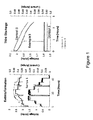
- Shown in Figure 1 is a typical current limiting first charge cycle for control 3 and Example 3. Although in each case the current profile is the same, the voltage for the Example 3 is lower, exemplifying that Example 3 with carbon nanotubes of this invention has a lower impedance than control 3. Furthermore, overvoltage which produces electrolysis of the water is avoided in example 3 compared to Control 3. Also seen in Figure 1 on discharging at a rate that would fully discharge the battery in 3 hours, the Example is seen to exhibit the benefits of a lower voltage but higher current compared to the control.
- Example 3 Shown in Figure 2 is the result of charging Example 3 and Control 3 at a constant voltage in two steps. After 2 hours the voltage was raised to 2.3 volts. Example 3 is able to absorb a much higher current than Control 3 and could be fully charged. On discharging, Example 3 gave an expected discharge profile whereas the Control 3 had deemed to have failed. The results of Example 3 are considered to be consistent with the paste having a much enhanced and more uniform conductivity.
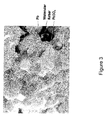
- Shown in Figure 3 is an electron micrograph of the dried anode material of Example 3 after 14 charges and discharges. On the 14 th discharge it was discharged to 1.75 volts, i.e. not fully discharged, therefore two crystal types are present, lead and lead sulfate, as illustrated in figure 3 .
- the carbon nanotubes of this invention are seen to be very well interspersed between the lead particles.
- the lead sulfate crystals are seen to incorporate the carbon nanotubes of this invention.
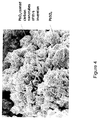
- Shown in Figure 4 is an electron micrograph of the dried cathode material of Example 3 after 14 charges and discharges. On the 14 th discharge it was discharged to 1.75 volts, i.e. not fully discharged, therefore two crystal types are present, lead dioxide and lead sulfate, as illustrated in figure 4 .
- the carbon nanotubes of this invention are seen to be incorporated within the lead dioxide and lead sulfate crystals. This illustrates that the carbon surfaces are protected by the lead dioxide or lead sulfate and so would be expected to be less prone to oxidative attack if electrolysis occurs by over voltage.
Landscapes
- Chemical & Material Sciences (AREA)
- Chemical Kinetics & Catalysis (AREA)
- Engineering & Computer Science (AREA)
- General Chemical & Material Sciences (AREA)
- Electrochemistry (AREA)
- Materials Engineering (AREA)
- Composite Materials (AREA)
- Nanotechnology (AREA)
- Organic Chemistry (AREA)
- Medicinal Chemistry (AREA)
- Polymers & Plastics (AREA)
- Health & Medical Sciences (AREA)
- Crystallography & Structural Chemistry (AREA)
- Condensed Matter Physics & Semiconductors (AREA)
- General Physics & Mathematics (AREA)
- Physics & Mathematics (AREA)
- Manufacturing & Machinery (AREA)
- Life Sciences & Earth Sciences (AREA)
- Wood Science & Technology (AREA)
- Battery Electrode And Active Subsutance (AREA)
- Carbon And Carbon Compounds (AREA)
- Cell Electrode Carriers And Collectors (AREA)
- Connection Of Batteries Or Terminals (AREA)
Abstract
Description
- The invention relates to a material for a battery paste for a lead-acid battery, comprising a plurality of discrete carbon nanotube fibers, a negative electrode for an energy storage device, a composition for lead-acid battery construction comprising a plurality of discrete carbon nanotube fibers and to a process for producing a lead-acid battery material.
- The present invention is directed to novel compositions and methods for producing a lead-acid battery with discrete carbon nanotubes or mixtures of discrete carbon nanotubes and plates of graphene or oxidized graphene.
- Carbon nanotubes can be classified by the number of walls in the tube, single-wall, double wall and multiwall. Each wall of a carbon nanotube can be further classified into chiral or non-chiral forms. Carbon nanotubes are currently manufactured as agglomerated nanotube balls or bundles. Use of carbon nanotubes and graphene as enhanced performance additives in batteries is predicted to have significant utility for electric vehicles, and electrical storage in general. However, utilization of carbon nanotubes in these applications is hampered due to the general inability to reliably produce individualized carbon nanotubes.
- The performance goals of a lead-acid battery are to maximize the specific power (power per unit of weight, measured in watts per kilogram) over designated high rate discharge scenarios, and maximize battery life, not only in environmental durability but also most importantly in cycle life (number of possible charges and discharges).
- Both corrosion (on the positive plate) and sulfation (on the negative plate) define two key failure modes of today's lead acid batteries. Regarding corrosion failures, this failure mode begins to accelerate either as temperatures rise about 70°F, and/or if the battery is left discharged. To mitigate the effects of the corrosion process, most battery companies focus their research on developing more corrosion resistant lead-alloys and grid manufacturing processes that reduce the mechanical stresses in the as-manufactured grids. Regardless of the alloy or grid fabrication process, essentially all battery manufacturers engineer battery service life based on lead alloy and grid wire cross-sectional area. Normally this engineering translates as a change in grid thickness and corresponding plate thickness. Thicker grids provide longer life, but usually sacrifice power density, cost, weight, and volume.
- Regarding sulfation failures, when a lead acid battery is left on open circuit stand, or kept in a partially, or fully discharged state for a period of time, the lead sulfate formed in the discharge reaction recrystallizes to form larger, low surface area lead sulfate crystals which are often referred to as hard lead sulfate. This low surface area, non-conductive lead sulfate blocks the conductive path needed for recharging. These crystals, especially those furthest removed from the electrode grid, are difficult to convert back into the charged lead and lead dioxide active materials. Even a well maintained battery will lose some capacity over time due to the continued growth of large lead sulfate crystals that are not entirely recharged during each recharge. These sulfate crystals, of density 6.287 g/cc, are also larger in volume by about 37% than the original paste, so they mechanically deform the plate and push material apart. The resulting expansion and deformation of the plates also causes active material to separate from the electrodes with a commensurate loss of performance. Sulfation is the main problem in recreational applications during battery storage when the season ends. Boats, motorcycles, snowmobiles lie dormant in their off-use months and, left uncharged, discharge toward a zero % state-of-charge, leading to progressive sulfation of the battery. Thus, the battery cannot be recharged anymore, is irreversibly damaged, and must be replaced.
- As users have come to know portable battery products in cell phones and laptop computers, they have correspondingly become comfortable with the process of bringing a battery down to almost no charge and then bringing it back to full, complete charge and power capabilities within hours. Traditional lead-acid batteries, because of their inherent design and active material utilization limitations, only provide relatively good cycle-life when less than about 80% of the rated capacity is removed during each discharge event in an application. A battery of this type suffers a significant decrease in the number of times it can be discharged and recharged, i.e., cycle life, when 100% of the rated capacity is consumed during a single discharge in an application. Many new products that historically used lead-acid batteries are requiring a significant jump in cycle life. The most notable examples are Hybrid Electric Vehicles, which operate in a High Rate Partial-State-of-Charge condition. This is a punishing application which dramatically shortens the cycle life of a typical lead acid battery, and has therefore left car companies with no choice, but to go to much more expensive Nickel-Metal Hydride batteries, and experiment with Lithium ion batteries.
- Typically, a lead-acid battery will require a recharge time significantly longer than competitive batteries containing advanced materials seen in portable products. A complete charging of a lead-acid battery, such as found in electric vehicles, can take from 8 to 16 hours. In the case of Uninterrupted Power Supplies (UPS), a rapid charge rate is essential to ensuring quality performance, as well as reducing the related capital expenditures for back up equipment while charging takes place on initial batteries put into service.
- Environmental conditions such as vibration can also result in degradation of a lead-acid battery due to active material separating from the cathode or anode. More vibration-resistant batteries, such as used for pleasure boats, often contain thicker electrodes or special vibration damping structures within the battery. This increases the weight and cost of the battery. Hence, an increased mechanical strength of the active material paste would be a highly desirable feature.
- Traditional methods for producing battery plates for lead-acid batteries generally involve a mixing, curing and drying operation in which the active materials in the battery paste undergo chemical and physical changes that are used to establish the chemical and physical structure and subsequent mechanical strength necessary to form the battery plate. To produce typical battery plates, materials are added to commercial paste mixing machines common in the industry in the order of lead oxide, flock, water and sulfuric acid, which are then mixed to a paste consistency. The flock component is a fibrous material, usually composed of polyester, nylon or acrylic fibers, which is added optionally to the paste to increase the mechanical strength of the pasted plate. An "expander" component is conventionally added to the negative paste consisting of a mixture of barium sulfate, carbon black and lignosulfonate that is added to the negative paste to improve the performance and cycle lifetime of the battery. During mixing, chemical reactions take place in the paste producing basic lead sulfates, the most common of which is tribasic lead sulfate. The final paste composition is a mixture of basic lead sulfates, unreacted lead monoxide and residual free lead particles. Pasting is the process of making a battery plate. This paste is dispersed into a commercial automatic pasting machine of a type common in the industry, which applies the paste to a grid structure composed of a lead alloy at high speed. The paste plates are generally surface dried in a tunnel dryer of a type common in the industry and then either stacked in columns or placed on racks. The stacked or racked plates are then placed in curing chambers. It is very important during the entire pasting and curing operation that the paste has sufficient mechanical strength to avoid micro-crack formation and hence increased internal electrical resistance from the paste mix. A high internal electrical resistance can limit rates of discharge and charging as well as result in localized heating during charging/discharging and increased chemical degradation of the active species.
- In efforts to reduce the high impedance of the battery to accelerate the formation (first charging) step, carbon black has been added to the paste. However, to properly disperse the carbon black surfactants are employed, but these surfactants create higher impedance that is difficult for the carbon black particles to reduce. Also, because there is often a region of high impedance due to the non-homogeneous contact resistance of the powders there is often applied an overvoltage which results in electrolysis of water, generating oxygen at the cathode which then rapidly degrades the carbon black. It is highly desirable to have a means to lower impedance in lead-acid batteries that can avoid overvoltage requirements for charging as well as a longer lasting conducting additive for the cathode.
- The present invention relates to lead-acid battery comprising of a plurality of discrete carbon nanotube fibers having an aspect ratio of from about 10 to about 500 and optionally wherein the discrete carbon nanotubes are open ended. The carbon nanotube fibers can comprise an oxidation level from about 1 weight percent to about 15 weight percent. The mixture of the plurality of discrete carbon nanotubes can comprise at least one surfactant or dispersing aid, which contains a sulfate moiety. The composition of oxidized and discrete carbon nanotubes can be dispersed in water to make the expander material and/or the battery paste.
- A further aspect of this invention is a material for a battery paste for a lead-acid battery comprising a plurality of discrete carbon nanotubes having an aspect ratio of from about 10 to about 500, preferably from about 25 to about 250, an organic material, and optionally at least one inorganic salt, such as barium sulfate, tetra-basic lead sulfate, calcium sulfate or tin oxide, and optionally at least one non-fiber carbon moiety, such as graphite, graphene, graphene plates, functionalized graphene, oxidized or oxygenated graphene, or carbon black. The organic material may comprise a sulfonated polymer, preferably one selected from the group consisting of sulfonated polymers including but not limited to, lignosulfonate, sulfonated polystyrene or combinations of sulfonated polymers thereof.
- Another aspect of this invention is a process to form a lead-acid battery comprising the steps of a) selecting discrete carbon nanotube fibers having an aspect ratio of from about 10 to 500, b) selecting discrete carbon nanotube fibers having an oxidation level from 1-15% by weight, c) selecting discrete carbon nanotubes having at least a portion of open-ended tubes, d) blending the fibers with a liquid to form a liquid/fiber mixture, d) optionally combining the liquid/fiber mixture with a sulfonated polymer, f) optionally adjusting the pH to a desired level, g) optionally combining the liquid/fiber mixture with at least one surfactant, h) agitating the liquid/fiber mixture to a degree sufficient to disperse the fibers to form a liquid/dispersed fiber mixture, i) optionally combining the liquid/dispersed fiber mixture with at least one inorganic salt, j) optionally combining at least one non-fiber carbon moiety, k) optionally drying the dispersed fiber mixture, and l) combining the dispersed carbon nanotube fiber/composite mixture with the lead containing components to form a battery paste mix. The agitation step h) preferably is with sonication.
- A further aspect of this invention is the carbon nanotube fibers can be combined or coated with at least one conductive polymer, preferably one selected from the group consisting of polyaniline, polyphylene vinylene, polyvinylpyrollidone, polyacetylene, polythiophene, polyphenylene sulfide, their blends, copolymers, and derivatives thereof.
- One embodiment of this invention is a battery that has at least one layer comprising discrete carbon nanotube fibers.
- Another embodiment of this invention is a battery paste comprising discrete carbon nanotubes that exhibits at least 10% improved adhesion to the electrodes such as carbon/lead and other lead or carbon type electrodes than those pastes without carbon nanotubes.
- Yet another embodiment of this invention is a battery comprising discrete carbon nanotubes that exhibits at least 10% increase in ion transport at any temperature for a given electrolyte concentration compared to those batteries without carbon nanotubes at the same electrolyte concentration and temperature.
- A further embodiment of this invention is a negative electrode for an energy storage device, comprising: a current collector; a corrosion-resistant conductive coating secured to at least one face of the current collector; a sheet comprising carbon particles and carbon nanotube fibers comprising 1-15 per cent weight oxidized species and of aspect ratio of from about 10 to about 500, said sheet adhered to the corrosion-resistant conductive coating; a tab portion extending from a side of said negative electrode; optionally a lug comprising a lead or lead alloy that encapsulates the tab portion; and a optionally a cast-on strap comprising lead or lead alloy above the lug and encapsulating at least part of the lug.
- Another aspect of this invention is a lead-acid battery wherein at least one of the electrode battery pastes has a gradient of concentration of discrete carbon nanotubes through the thickness of the paste, optionally having the highest concentration of the material at the surface of the current collector or at the surface of the separator.
- A further aspect of this invention is a lead-acid battery of comprising discrete carbon nanotubes useful for vehicles equipped with energy regenerative braking systems or start-stop technology for improved fuel efficiency. Also they can be useful for uninterrupted power supplies and power smoothing.
-
-
Figure 1 shows a charge profile at constant amperage for a lead acid battery with carbon nanotubes according to the present invention (Example 3), and without carbon nanotubes according to the present invention (Control 3); -
Figure 2 shows a charge profile at constant voltage for a lead acid battery with carbon nanotubes according to the present invention (Example 3), and without carbon nanotubes according to the present invention (Control 3). -
Figure 3 shows an electron micrograph of the dried anode material of example 3 after 14 charging and discharging cycles. -
Figure 4 shows an electron micrograph of the dried cathode material of example 3 after 14 charging and discharging cycles. - In the following description, certain details are set forth such as specific quantities, sizes, etc., so as to provide a thorough understanding of the present embodiments disclosed herein. However, it will be evident to those of ordinary skill in the art that the present disclosure may be practiced without such specific details. In many cases, details concerning such considerations and the like have been omitted inasmuch as such details are not necessary to obtain a complete understanding of the present disclosure and are within the skills of persons of ordinary skill in the relevant art.
- While most of the terms used herein will be recognizable to those of ordinary skill in the art, it should be understood, however, that when not explicitly defined, terms should be interpreted as adopting a meaning presently accepted by those of ordinary skill in the art. In cases where the construction of a term would render it meaningless or essentially meaningless, the definition should be taken from Webster's Dictionary, 3rd Edition, 2009. Definitions and/or interpretations should not be incorporated from other patent applications, patents, or publications, related or not, unless specifically stated in this specification or if the incorporation is necessary for maintaining validity. Aspect ratio is the ratio of length divided by diameter (L/D) where the selected units for length and diameter are the same, thus canceling the units when ratioed, making the aspect ratio a unitless number.
- For an automotive positive plate paste mix, the specific gravity of the sulfuric acid in the mixture examples is preferably approximately 1.400 and the paste density is typically in the range of approximately 4.15-4.27 g/cc. For the automotive negative plate paste mix, the specific gravity of the sulfuric acid is preferably approximately 1.400 and the paste density is typically in the range of approximately 4.27-4.39 g/cc. For the industrial positive plate paste mix, the specific gravity of the sulfuric acid is preferably approximately 1.400 and the paste density is typically in the range of approximately 4.33-4.45 g/cc. For the industrial negative plate paste mix the specific gravity of the sulfuric acid is preferably approximately 1.400 and the paste density is typically in the range of approximately 4.45-4.57 g/cc. The paste density is a measure of the composition of the paste and also of its suitability for being pasted by commercial paste mixing machines. The "flock" component is a fibrous material, usually composed of polyester, nylon or acrylic fibers, which is added optionally to the paste to increase the mechanical strength of the pasted plate. The "expander" component is conventionally a mixture of barium sulfate, carbon black and lignosulfonate that is added to the negative paste to improve the performance and life of the negative plate.
- In various embodiments, a plurality of carbon nanotubes is disclosed comprising single wall, double wall or multi wall carbon nanotube fibers having an aspect ratio of from about 10 to about 500, preferably from about 60 to about 200, and a oxidation level of from about 1 weight percent to about 15 weight percent, preferably from about 2 weight percent to about 10 weight percent. The oxidation level is defined as the amount by weight of oxygenated species covalently bound to the carbon nanotube. The thermogravimetric method for the determination of the percent weight of oxygenated species on the carbon nanotube involves taking about 5 mg of the dried oxidized carbon nanotube and heating at 5 °C/minute from room temperature to 1000 degrees centigrade in a dry nitrogen atmosphere. The percentage weight loss from 200 to 600 degrees centigrade is taken as the percent weight loss of oxygenated species. The oxygenated species can also be quantified using fourier transform infra-red spectroscopy, FTIR, particularly in the wavelength range 1730-1680 cm-1, or by using energy dispersive x-ray measurements.
- The carbon nanotube fibers can have oxidation species comprising of carboxylic acid or derivative carbonyl containing species and are essentially discrete individual fibers, not entangled as a mass. The derivative carbonyl species can include ketones, quaternary amines, amides, esters, acyl halogens, monovalent metal salts and the like.
- An illustrative process for producing discrete oxidized carbon nanotubes follows: 3 liters of sulfuric acid, 97 percent sulfuric acid and 3 percent water, and 1 liter of concentrated nitric acid containing 70 percent nitric acid and 3 percent water, are added into a 10 liter temperature controlled reaction vessel fitted with a sonicator and stirrer. 40 grams of non-discrete carbon nanotubes, grade Flowtube 9000 from CNano corporation, are loaded into the reactor vessel while stirring the acid mixture and the temperature maintained at 30°C. The sonicator power is set at 130-150 watts and the reaction is continued for three hours. After 3 hours the viscous solution is transferred to a filter with a 5 micron filter mesh and much of the acid mixture removed by filtering using a 100psi pressure. The filter cake is washed one times with about four liters of deionized water followed by one wash of four liters of an ammonium hydroxide solution at pH greater than 9 and then about two more washes with four liters of deionized water. The resultant pH of the final wash is 4.5. A small sample of the filter cake is dried in vacuum at 100°C for four hours and a thermogravimetric analysis taken as described previously. The amount of oxidized species on the fiber is 8 percent weight and the average aspect ratio as determined by scanning electron microscopy to be 60.
- The discrete oxidized carbon nanotubes (CNT) in wet form are added to water to form a concentration by weight of 1 percent and the pH is adjusted to 9 using ammonium hydroxide. Sodium dodecylbenzene sulfonic acid and is added at a concentration 1.5 times the mass of oxidized carbon nanotubes. The solution is sonicated while stirring until the CNT are fully dispersed in the solution. Sufficient dispersion of individual tubes is defined when the UV absorption at 500 nm is above 1.2 absorption units for a concentration of 2.5 x10⁻⁵ g CNT /ml.
- An illustrative process for producing discrete carbon nanotube/graphene compositions follows: 3 liters of sulfuric acid, 97% sulfuric acid and 3% water, and 1 liter of concentrated nitric acid containing 70% nitric acid and 30% water, are added into a 10 liter temperature controlled reaction vessel fitted with a sonicator and stirrer. 20 grams of non-discrete carbon nanotubes, grade Flowtube 9000 from CNano Corporation, and 20 grams of expanded graphite obtained from Rice University, Houston, Texas, USA are loaded into the reactor vessel while stirring the acid mixture and the temperature maintained at 25 °C. The sonicator power is set at 130-150 watts and the reaction is continued for 3 hours. After 3 hours the viscous solution is transferred to a filter with a 5 micron filter mesh and much of the acid mixture removed by filtering using about 100psi pressure. The filter cake is washed 1 times with 4 liters of deionized water followed by 1 wash of 4 liters of an ammonium hydroxide solution at pH > 9 and then two or more washes with 4 liters of deionized water. The resultant pH of the final wash is > 4.5. An electron micrograph will show graphene plates interspersed carbon nanotubes.
-
Control 1. 79.3 grams of Massicot (lead(II) oxide), is mixed with 0.634 grams of sodium sulfate and 0.793 grams of expander material (Hammond, grade 631). 9.28 grams of water is combined with a 0.397 grams of Teflon emulsion (Du Pont, grade K20) and added to the Massicot containing mixture. 17.08 grams of sulfuric acid, specific gravity 1.4, is then slowly added while mixing, and maintaining the temperature between 49 and 54 degrees centigrade. The mixture is mixed thoroughly. The density of the paste is 63.2 g/inch cubed. - The negative active paste material is made as
control 1 except that the expander material contains discrete carbon nanotubes which is made as follows. 10 grams of Hammond expander 631 which contains lignosulfonate, barium sulfate and carbon black, is added to 200 cc of deionized water. 0.25 grams of carbon nanotubes oxidized to approximately 6 % by weight, is added followed by sonication in a sonicator bath for 30 minutes. The mixture containing the carbon nanotubes is then dried to give a free flowing powder. -
Control 2. 75.7 grams of Red lead (lead(III) tetroxide), is mixed with 0.6056 grams of sodium sulfate. 14.83 grams of water is combined with a 0.389 grams of Teflon emulsion (Du Pont, grade K20) and added to the Massicot containing mixture. 15 grams of sulfuric acid, specific gravity 1.4, is then slowly added while mixing, and maintaining the temperature between 49 and 54 degrees centigrade. The mixture is mixed thoroughly. The density of the paste is 60.78 g/inch cubed. - A single battery cell is constructed by evenly coating lead cathode and anode film with negative and positive paste, respectively, interspersing a glass fiber matt, then filling with sulfuric acid of specific gravity 1.12. The negative paste has 0.05% weight carbon nanotubes relative to the starting lead oxide.
-
Control 3. A single battery cell is constructed by evenly coating lead cathode and anode film with negative and positive paste, respectively, interspersing a glass fiber matt, then filling with sulfuric acid of specific gravity 1.12. The negative paste contains no carbon nanotubes. - The cell of
control 3 is determined to have an internal resistance of 100 ohms. The cell of example 2 containing the discrete carbon nanotubes is determined to have an internal resistance of 50 ohms. - A single battery cell is constructed by evenly coating lead cathode and anode film with negative and positive paste, respectively, interspersing a glass fiber matt, then filling with sulfuric acid of specific gravity 1.12. The positive and negative paste has 0.16% weight carbon nanotubes relative to the starting lead oxide. The pastes of Example 3 are observed to be more easily handled and transferred to the lead current collector plates without breakage than
Control 3. - Shown in
Figure 1 is a typical current limiting first charge cycle forcontrol 3 and Example 3. Although in each case the current profile is the same, the voltage for the Example 3 is lower, exemplifying that Example 3 with carbon nanotubes of this invention has a lower impedance thancontrol 3. Furthermore, overvoltage which produces electrolysis of the water is avoided in example 3 compared toControl 3. Also seen inFigure 1 on discharging at a rate that would fully discharge the battery in 3 hours, the Example is seen to exhibit the benefits of a lower voltage but higher current compared to the control. - Shown in
Figure 2 is the result of charging Example 3 andControl 3 at a constant voltage in two steps. After 2 hours the voltage was raised to 2.3 volts. Example 3 is able to absorb a much higher current thanControl 3 and could be fully charged. On discharging, Example 3 gave an expected discharge profile whereas theControl 3 had deemed to have failed. The results of Example 3 are considered to be consistent with the paste having a much enhanced and more uniform conductivity. - Shown in
Figure 3 is an electron micrograph of the dried anode material of Example 3 after 14 charges and discharges. On the 14th discharge it was discharged to 1.75 volts, i.e. not fully discharged, therefore two crystal types are present, lead and lead sulfate, as illustrated infigure 3 . The carbon nanotubes of this invention are seen to be very well interspersed between the lead particles. The lead sulfate crystals are seen to incorporate the carbon nanotubes of this invention. - Shown in
Figure 4 is an electron micrograph of the dried cathode material of Example 3 after 14 charges and discharges. On the 14th discharge it was discharged to 1.75 volts, i.e. not fully discharged, therefore two crystal types are present, lead dioxide and lead sulfate, as illustrated infigure 4 . The carbon nanotubes of this invention are seen to be incorporated within the lead dioxide and lead sulfate crystals. This illustrates that the carbon surfaces are protected by the lead dioxide or lead sulfate and so would be expected to be less prone to oxidative attack if electrolysis occurs by over voltage. - The invention also includes the following numbered non-limiting embodiments:
-
Embodiment 1. A composition for lead-acid battery construction comprising:- a plurality of discrete carbon nanotube fibers, the nanotubes having an aspect ratio of about 10 to about 500;
- wherein the discrete carbon nanotubes are open ended.
-
Embodiment 2. The composition ofembodiment 1, wherein the carbon nanotube fibers have an oxidation level from about 1 weight percent to about 15 weight percent. -
Embodiment 3. The composition ofembodiment 1, further comprising at least one surfactant or dispersing aid, wherein the surfactant or dispersing aid contains a sulfate moiety. - Embodiment 4. The composition of
embodiment 1, further comprising water, wherein the nanotube fibers are dispersed in the water to form an expander material or battery paste. - Embodiment 5. The composition of
embodiment 3, wherein the surfactant or dispersing aid is a sulfonated polymer selected from the group consisting of: ligno-sulfonate, sulfonated polystyrene, and combinations thereof. -
Embodiment 6. A material for a battery paste for a lead-acid battery, comprising:- a plurality of discrete carbon nanotube fibers having an aspect ratio of about 10 to about 500;
- an organic material;
- an inorganic salt; and
- a non-fiber carbon moiety.
- Embodiment 7. The composition of
embodiment 6, wherein the inorganic salt is selected from the group consisting of: barium sulfate, lead sulfate, calcium sulfate and tin oxide. -
Embodiment 8. The composition ofembodiment 6, wherein the non-fiber carbon moiety is selected from the group consisting of: carbon black, graphite and graphene. - Embodiment 9. A process for producing a lead-acid battery material, comprising the steps of:
- (a) selecting discrete carbon nanotube fibers having an aspect ratio from 10 to 500;
- (b) selecting discrete carbon nanotube fibers having an oxidation level from 1-15% by weight;
- (c) selecting discrete carbon nanotubes having at least a portion of open-ended tubes;
- (d) blending the fibers with a liquid to form a liquid/fiber mixture;
- (e) combining the liquid/fiber mixture with a sulfonated polymer;
- (f) adjusting the pH to a desired level;
- (g) combining the liquid/fiber mixture with at least one surfactant;
- (h) agitating the liquid/fiber mixture to a degree sufficient to disperse the fibers to form a liquid/dispersed fiber mixture;
- (i) combining the liquid/dispersed fiber mixture with at least one inorganic salt to form a fiber/salt mixture;
- (j) combining a non-fiber carbon moiety with the fiber/salt mixture to form a fiber/non-fiber carbon mixture;
- (k) drying the fiber/non-fiber carbon mixture; and
- (l) combining the fiber/non-fiber carbon mixture with lead containing components to form a battery paste mix.
- Embodiment 10. A battery, comprising:
- the material of
embodiment 1.
- the material of
- Embodiment 11. The composition of
embodiment 1, further comprising conducting polymers selected from the group consisting of: polyaniline, polyphenylene vinylene, polyvinylpyrollidone, polyacetylene polythiophene, polyphenylene sulfide, and blends, copolymers, and derivatives thereof. - Embodiment 12. A battery paste, comprising:
- the material of
embodiment 1; - wherein the battery paste exhibits at least 10% improved adhesion to carbon/lead electrodes, lead electrodes, or carbon electrodes, than pastes without carbon nanotubes.
- the material of
-
Embodiment 13. A battery, comprising:- the material of
embodiment 1; - wherein the battery paste exhibits a 10% or greater increase in ion transport at any temperature for a given electrolyte concentration compared to a battery without carbon nanotubes at
- the same electrolyte concentration and temperature.
- the material of
- Embodiment 14. A negative electrode for an energy storage device,
comprising:- a current collector;
- a corrosion-resistant conductive coating secured to at least one face of the current collector;
- a sheet comprising carbon particles and carbon nanotube fibers comprising 1-15 percent by weight of oxidized species with aspect ratio of from about 10 to about 500, said sheet adhered to the corrosion-resistant conductive coating;
- a tab portion extending from a side of the negative electrode;
- a lug comprising a lead or lead alloy that encapsulates the tab portion; and
- a cast-on strap comprising lead or lead alloy above the lug and
- encapsulating at least part of the lug.
- Embodiment 15. A lead-acid battery, comprising:
- the composition of
embodiment 1; - wherein at least one electrode comprises a battery paste having a concentration gradient of the composition of
embodiment 1 through the thickness of the battery paste.
- the composition of
- Embodiment 16. The lead-acid battery of embodiment 15, wherein the highest concentration of the composition of
embodiment 1 is at the surface of the current collector or at the surface of the separator. - Embodiment 17. The use of the lead-acid battery composition of
embodiment 1 in vehicles equipped with energy regenerative braking systems or start-stop technology for improved fuel efficiency. -
Embodiment 18. The use of the lead-acid battery composition ofembodiment 1 in uninterrupted power supplies and power smoothing.
Claims (10)
- A material for a battery paste for a lead-acid battery, comprising:a plurality of discrete carbon nanotube fibers having an aspect ratio of about 10 to about 500;an organic material;an inorganic salt; anda non-fiber carbon moiety.
- The material of claim 1, wherein the carbon nanotube fibers have an oxidation level from about 1 weight percent to about 15 weight percent.
- The material of claim 1 or claim 2, wherein the inorganic salt is selected from the group consisting of: barium sulfate, lead sulfate, calcium sulfate and tin oxide.
- The material of any one of claims 1-3 wherein the non-fiber carbon moiety is selected from the group consisting of: carbon black, graphite and graphene.
- The material of any one of claims 1-4, wherein the organic material comprises a sulfonated polymer.
- A negative electrode for an energy storage device, comprising:a current collector;a corrosion-resistant conductive coating secured to at least one face of the current collector;a sheet comprising carbon particles and carbon nanotube fibers comprising 1-15 percent by weight of oxidized species with aspect ratio of from about 10 to about 500, said sheet adhered to the corrosion-resistant conductive coating;a tab portion extending from a side of the negative electrode;optionally a lug comprising a lead or lead alloy that encapsulates the tab portion; andoptionally a cast-on strap comprising lead or lead alloy above the lug andencapsulating at least part of the lug.
- The negative electrode of claim 6, comprising said lug and said cast-on strap.
- A composition for lead-acid battery construction comprising:a plurality of discrete carbon nanotube fibers, the nanotubes having an aspect ratio of about 10 to about 500;wherein the discrete carbon nanotubes are open ended.
- The composition of claim 8, wherein the carbon nanotube fibers have an oxidation level from about 1 weight percent to about 15 weight percent.
- A process for producing a lead-acid battery material, comprising the steps of:(a) selecting discrete carbon nanotube fibers having an aspect ratio from 10 to 500;(b) selecting discrete carbon nanotube fibers having an oxidation level from 1-15% by weight;(c) selecting discrete carbon nanotubes having at least a portion of open-ended tubes;(d) blending the fibers with a liquid to form a liquid/fiber mixture;(e) combining the liquid/fiber mixture with a sulfonated polymer;(f) adjusting the pH to a desired level;(g) combining the liquid/fiber mixture with at least one surfactant;(h) agitating the liquid/fiber mixture to a degree sufficient to disperse the fibers to form a liquid/dispersed fiber mixture;(i) combining the liquid/dispersed fiber mixture with at least one inorganic salt to form a fiber/salt mixture;(j) combining a non-fiber carbon moiety with the fiber/salt mixture to form a fiber/non-fiber carbon mixture;(k) drying the fiber/non-fiber carbon mixture; and(l) combining the fiber/non-fiber carbon mixture with lead containing components to form a battery paste mix.
Applications Claiming Priority (3)
| Application Number | Priority Date | Filing Date | Title |
|---|---|---|---|
| US201161500561P | 2011-06-23 | 2011-06-23 | |
| US201261638454P | 2012-04-25 | 2012-04-25 | |
| EP12731265.0A EP2724406B1 (en) | 2011-06-23 | 2012-06-21 | Lead-acid battery formulations containing discrete carbon nanotubes |
Related Parent Applications (2)
| Application Number | Title | Priority Date | Filing Date |
|---|---|---|---|
| EP12731265.0A Division EP2724406B1 (en) | 2011-06-23 | 2012-06-21 | Lead-acid battery formulations containing discrete carbon nanotubes |
| EP12731265.0A Division-Into EP2724406B1 (en) | 2011-06-23 | 2012-06-21 | Lead-acid battery formulations containing discrete carbon nanotubes |
Publications (3)
| Publication Number | Publication Date |
|---|---|
| EP2958172A2 true EP2958172A2 (en) | 2015-12-23 |
| EP2958172A3 EP2958172A3 (en) | 2016-01-13 |
| EP2958172B1 EP2958172B1 (en) | 2018-05-16 |
Family
ID=46420564
Family Applications (2)
| Application Number | Title | Priority Date | Filing Date |
|---|---|---|---|
| EP12731265.0A Active EP2724406B1 (en) | 2011-06-23 | 2012-06-21 | Lead-acid battery formulations containing discrete carbon nanotubes |
| EP15176139.2A Active EP2958172B1 (en) | 2011-06-23 | 2012-06-21 | Lead-acid battery formulations containing discrete carbon nanotubes |
Family Applications Before (1)
| Application Number | Title | Priority Date | Filing Date |
|---|---|---|---|
| EP12731265.0A Active EP2724406B1 (en) | 2011-06-23 | 2012-06-21 | Lead-acid battery formulations containing discrete carbon nanotubes |
Country Status (10)
| Country | Link |
|---|---|
| US (3) | US20140141327A1 (en) |
| EP (2) | EP2724406B1 (en) |
| JP (1) | JP6088500B2 (en) |
| KR (1) | KR101930978B1 (en) |
| CN (1) | CN103765642B (en) |
| CA (1) | CA2839700C (en) |
| ES (2) | ES2675870T3 (en) |
| SA (1) | SA112330631B1 (en) |
| TW (1) | TW201301622A (en) |
| WO (1) | WO2012177869A2 (en) |
Cited By (1)
| Publication number | Priority date | Publication date | Assignee | Title |
|---|---|---|---|---|
| US10096428B2 (en) | 2011-08-29 | 2018-10-09 | Semiconductor Energy Laboratory Co., Ltd. | Method of manufacturing positive electrode active material for lithium ion battery |
Families Citing this family (42)
| Publication number | Priority date | Publication date | Assignee | Title |
|---|---|---|---|---|
| WO2013011516A1 (en) | 2011-07-20 | 2013-01-24 | Vulcan Automotive Industries Ltd | Funcionalized carbon nanotube composite for use in lead acid battery |
| US10411236B2 (en) | 2012-04-12 | 2019-09-10 | Johns Manville | Mat made of glass fibers or polyolefin fibers used as a separator in a lead-acid battery |
| WO2014114969A1 (en) * | 2013-01-25 | 2014-07-31 | Arkema France | Method for manufacturing an electrode paste |
| CN103112846B (en) * | 2013-02-06 | 2014-12-10 | 华中科技大学 | Preparation method of graphene-carbon nanotube-nano tin dioxide three-dimensional composite material and product thereof |
| CN105051930A (en) * | 2013-03-14 | 2015-11-11 | 福尔甘汽车工业有限公司 | Process for obtaining mixtures of carbon nanotubes in solid or viscous matrices |
| WO2014151614A1 (en) * | 2013-03-15 | 2014-09-25 | Molecular Rebar Design, Llc | Composition comprising discrete carbon nanotubes |
| CN103367753B (en) * | 2013-07-25 | 2015-12-23 | 山东大学 | Lead-acid battery cathode lead plaster of a kind of graphene dispersing solution modification and preparation method thereof |
| EP3052442B1 (en) * | 2013-09-30 | 2020-02-12 | Molecular Rebar Design, LLC | High carbon nanotube content fluids |
| US10084170B2 (en) | 2013-10-03 | 2018-09-25 | Johns Manville | Pasting paper made of glass fiber nonwoven comprising carbon graphite |
| US9923196B2 (en) | 2013-10-03 | 2018-03-20 | Johns Manville | Conductive mat for battery electrode plate reinforcement and methods of use therefor |
| ES2645137T3 (en) | 2013-10-03 | 2017-12-04 | Johns Manville | New adhesive paper made of non-woven fiberglass comprising carbon graphite |
| US9685646B2 (en) | 2013-10-03 | 2017-06-20 | Johns Manville | Pasting paper made of glass fiber nonwoven comprising carbon graphite |
| TWI583043B (en) | 2014-03-31 | 2017-05-11 | 長興材料工業股份有限公司 | Electrolyte composition |
| WO2016064532A1 (en) * | 2014-10-22 | 2016-04-28 | Cabot Corporation | Carbon additives for negative electrodes |
| FR3033328A1 (en) * | 2015-03-05 | 2016-09-09 | Arkema France | LIQUID COMPOSITION OF CARBON NANOCHARGES FOR THE FORMULATIONS USED IN LEAD BATTERIES. |
| FR3033327B1 (en) * | 2015-03-05 | 2018-10-12 | Arkema France | SOLID COMPOSITION OF CARBON NANOCHARGES FOR THE FORMULATIONS USED IN LEAD BATTERIES. |
| CN105161770A (en) * | 2015-08-18 | 2015-12-16 | 超威电源有限公司 | Lead plaster additive for lead-acid storage battery, and preparation method and application therefor |
| CN105428602B (en) * | 2015-10-26 | 2019-11-15 | 东阳市琰安建筑工程有限公司 | A paste-extrusion-type production of tubular positive plate and paste and curing process |
| EP3440129B1 (en) * | 2016-04-07 | 2023-07-19 | Molecular Rebar Design LLC | Discrete carbon nanotubes with targeted oxidation levels and formulations thereof |
| WO2017177176A1 (en) | 2016-04-07 | 2017-10-12 | Molecular Rebar Design, Llc | Nanotube mediation of degradative chemicals for oil-field applications |
| CN105845940B (en) * | 2016-04-22 | 2019-02-15 | 超威电源有限公司 | Lead-acid accumulator aqueous carbon nano tube dispersion liquid and preparation method thereof, application |
| CN106207277B (en) * | 2016-06-30 | 2019-02-15 | 超威电源有限公司 | A kind of preparation method of compound carbon polymer lead-acid battery |
| JP7099450B2 (en) | 2017-04-28 | 2022-07-12 | 株式会社Gsユアサ | Lead-acid battery |
| EP3404747B1 (en) | 2017-05-17 | 2020-01-29 | INDIAN OIL CORPORATION Ltd. | Compositions for preparing expander free electrodes for lead acid battery and performance thereof |
| US11394058B2 (en) | 2017-06-02 | 2022-07-19 | Global Graphene Group, Inc. | Method of producing shape-conformable alkali metal-sulfur battery |
| EP3635805B1 (en) | 2017-06-09 | 2023-09-06 | CPS Technology Holdings LLC | Lead-acid battery |
| US11936032B2 (en) | 2017-06-09 | 2024-03-19 | Cps Technology Holdings Llc | Absorbent glass mat battery |
| JP2019186028A (en) * | 2018-04-10 | 2019-10-24 | 日立化成株式会社 | Grid and lead-acid battery |
| US12162758B2 (en) | 2018-05-22 | 2024-12-10 | Molecular Rebar Design, Llc | Lithium ion battery using high surface area nanotubes |
| US11554957B2 (en) | 2018-05-22 | 2023-01-17 | Molecular Rebar Design, Llc | Lithium ion battery using high surface area nanotubes |
| JP7759727B2 (en) * | 2018-05-22 | 2025-10-24 | モレキュラー レバー デザイン,エルエルシー | Improved lithium-ion batteries using high surface area nanotubes |
| CN108736003A (en) * | 2018-05-31 | 2018-11-02 | 深圳市瑞达电源有限公司 | A kind of cathode pole cream for lead charcoal start and stop accumulator |
| CN110970603A (en) * | 2018-09-30 | 2020-04-07 | 山东欧铂新材料有限公司 | Multifunctional activated carbon composite material for negative electrode of lead-carbon battery, preparation method of multifunctional activated carbon composite material and lead-carbon battery |
| CN113196522A (en) * | 2018-12-04 | 2021-07-30 | 卡博特公司 | Composition, electrode and lead-acid battery with low-temperature performance |
| WO2021034455A1 (en) * | 2019-08-19 | 2021-02-25 | Molecular Rebar Design, Llc | Process to control a corrosion layer |
| CN111082048B (en) * | 2019-12-16 | 2021-02-05 | 浙江绿源电动车有限公司 | Graphene lead-carbon battery positive plate lead paste and method for preparing battery by adopting same |
| CN115336045A (en) * | 2020-02-05 | 2022-11-11 | Cps科技控股有限公司 | Carbon fiber electrode and lead acid battery with reinforced active material |
| JP7216052B2 (en) * | 2020-08-20 | 2023-01-31 | プライムプラネットエナジー&ソリューションズ株式会社 | Positive electrode for secondary battery and secondary battery |
| CN112421132B (en) * | 2020-10-27 | 2023-07-28 | 盐城工学院 | Lead-acid battery repair liquid and preparation method and application thereof |
| US20240186529A1 (en) | 2021-03-30 | 2024-06-06 | Eternity Technologies Limited | Battery |
| GB202214608D0 (en) | 2022-10-04 | 2022-11-16 | Eternity Tech Limited | Battery |
| US20240343928A1 (en) * | 2023-04-13 | 2024-10-17 | Molecular Rebar Design, Llc | Coatings with Discrete Carbon Nanotubes for Energy Storage and Additive Manufacturing |
Family Cites Families (27)
| Publication number | Priority date | Publication date | Assignee | Title |
|---|---|---|---|---|
| US4324848A (en) * | 1981-01-26 | 1982-04-13 | General Electric Company | Positive electrode for lead acid battery |
| US6268081B1 (en) * | 1996-07-02 | 2001-07-31 | Ensci Inc | Battery element containing efficiency improving additives |
| US6872681B2 (en) * | 2001-05-18 | 2005-03-29 | Hyperion Catalysis International, Inc. | Modification of nanotubes oxidation with peroxygen compounds |
| AU2002357037A1 (en) * | 2001-11-30 | 2003-06-17 | The Trustees Of Boston College | Coated carbon nanotube array electrodes |
| CN1230929C (en) * | 2002-12-04 | 2005-12-07 | 中国科学院金属研究所 | Lead-acid storage battery with nano-carbon material added and preparation method thereof |
| US20040160156A1 (en) * | 2003-02-19 | 2004-08-19 | Matsushita Electric Industrial Co., Ltd. | Electrode for a battery and production method thereof |
| ES2537534T3 (en) | 2003-09-18 | 2015-06-09 | Commonwealth Scientific And Industrial Research Organisation | High performance energy storage devices |
| US20090317710A1 (en) | 2008-06-20 | 2009-12-24 | Mysticmd, Inc. | Anode, cathode, grid and current collector material for reduced weight battery and process for production thereof |
| US20060057388A1 (en) | 2004-09-10 | 2006-03-16 | Sungho Jin | Aligned and open-ended nanotube structure and method for making the same |
| JP2006128056A (en) * | 2004-11-01 | 2006-05-18 | Kazuo Tagawa | Lead-acid battery and additive for lead-acid battery |
| KR20060075473A (en) * | 2004-12-28 | 2006-07-04 | 주식회사 아트라스비엑스 | Positive Active Material Additive of Lead Acid Battery |
| JP2008098009A (en) * | 2006-10-12 | 2008-04-24 | Furukawa Battery Co Ltd:The | Cathode plate for lead-acid battery |
| CN101428783B (en) * | 2007-11-09 | 2013-08-21 | 宁波杉杉新材料科技有限公司 | Process for producing carbon nano-tube/granular carbon complex |
| CN101320800B (en) * | 2008-03-04 | 2010-06-30 | 浙江大学 | Anode material of lead accumulator and preparation method thereof |
| CN101538032B (en) * | 2008-03-20 | 2012-07-04 | 中国医学科学院基础医学研究所 | Method for preparing high-concentration stable carbon nanotube aqueous solution |
| FR2935546B1 (en) * | 2008-09-02 | 2010-09-17 | Arkema France | ELECTRODE COMPOSITE MATERIAL, BATTERY ELECTRODE CONSISTING OF SAID MATERIAL AND LITHIUM BATTERY COMPRISING SUCH AN ELECTRODE. |
| CN101368301B (en) * | 2008-09-26 | 2010-08-11 | 东华大学 | A kind of preparation method of carbon nanotube doped alumina precursor spinning sol |
| US8699207B2 (en) * | 2008-10-21 | 2014-04-15 | Brookhaven Science Associates, Llc | Electrodes synthesized from carbon nanostructures coated with a smooth and conformal metal adlayer |
| EP3021389B1 (en) * | 2008-11-18 | 2018-07-11 | Johnson Controls Technology Company | Electrical power storage devices |
| EP2228343A1 (en) * | 2009-03-13 | 2010-09-15 | Bayer MaterialScience AG | Water vapour assisted ozonolysis of carbon nanotubes |
| JP4936026B2 (en) * | 2009-04-02 | 2012-05-23 | 宇部興産株式会社 | Method for producing conductive binder |
| US20110104576A1 (en) * | 2009-10-29 | 2011-05-05 | Uchicago Argonne, Llc | Lithium-oxygen electrochemical cells and batteries |
| US20110104551A1 (en) * | 2009-11-05 | 2011-05-05 | Uchicago Argonne, Llc | Nanotube composite anode materials suitable for lithium ion battery applications |
| US9118065B2 (en) * | 2010-05-27 | 2015-08-25 | Johns Manville | Lead-oxide battery plate with nonwoven glass mat |
| JP2012133959A (en) | 2010-12-21 | 2012-07-12 | Furukawa Battery Co Ltd:The | Composite capacitor negative electrode plate for lead storage battery, and lead storage battery |
| JP2012204121A (en) * | 2011-03-25 | 2012-10-22 | Nisshinbo Holdings Inc | Electrode for electricity storage device |
| WO2013011516A1 (en) | 2011-07-20 | 2013-01-24 | Vulcan Automotive Industries Ltd | Funcionalized carbon nanotube composite for use in lead acid battery |
-
2012
- 2012-06-21 JP JP2014517160A patent/JP6088500B2/en active Active
- 2012-06-21 US US14/128,318 patent/US20140141327A1/en not_active Abandoned
- 2012-06-21 ES ES15176139.2T patent/ES2675870T3/en active Active
- 2012-06-21 CA CA2839700A patent/CA2839700C/en active Active
- 2012-06-21 CN CN201280030941.9A patent/CN103765642B/en active Active
- 2012-06-21 KR KR1020147001459A patent/KR101930978B1/en active Active
- 2012-06-21 ES ES12731265.0T patent/ES2548549T3/en active Active
- 2012-06-21 EP EP12731265.0A patent/EP2724406B1/en active Active
- 2012-06-21 WO PCT/US2012/043538 patent/WO2012177869A2/en not_active Ceased
- 2012-06-21 EP EP15176139.2A patent/EP2958172B1/en active Active
- 2012-06-21 US US13/529,792 patent/US8993161B2/en active Active
- 2012-06-23 SA SA112330631A patent/SA112330631B1/en unknown
- 2012-06-25 TW TW101122698A patent/TW201301622A/en unknown
-
2015
- 2015-03-26 US US14/670,178 patent/US9806343B2/en active Active
Non-Patent Citations (1)
| Title |
|---|
| "Webster's Dictionary", 2009 |
Cited By (1)
| Publication number | Priority date | Publication date | Assignee | Title |
|---|---|---|---|---|
| US10096428B2 (en) | 2011-08-29 | 2018-10-09 | Semiconductor Energy Laboratory Co., Ltd. | Method of manufacturing positive electrode active material for lithium ion battery |
Also Published As
| Publication number | Publication date |
|---|---|
| WO2012177869A3 (en) | 2013-12-12 |
| TW201301622A (en) | 2013-01-01 |
| US9806343B2 (en) | 2017-10-31 |
| EP2724406A2 (en) | 2014-04-30 |
| US8993161B2 (en) | 2015-03-31 |
| US20120328940A1 (en) | 2012-12-27 |
| ES2675870T3 (en) | 2018-07-13 |
| CA2839700C (en) | 2020-07-14 |
| US20150200400A1 (en) | 2015-07-16 |
| EP2724406B1 (en) | 2015-08-19 |
| KR20140051257A (en) | 2014-04-30 |
| SA112330631B1 (en) | 2016-02-28 |
| CA2839700A1 (en) | 2012-12-27 |
| ES2548549T3 (en) | 2015-10-19 |
| JP6088500B2 (en) | 2017-03-01 |
| EP2958172B1 (en) | 2018-05-16 |
| CN103765642B (en) | 2016-07-06 |
| EP2958172A3 (en) | 2016-01-13 |
| WO2012177869A2 (en) | 2012-12-27 |
| KR101930978B1 (en) | 2018-12-19 |
| US20140141327A1 (en) | 2014-05-22 |
| JP2014527682A (en) | 2014-10-16 |
| CN103765642A (en) | 2014-04-30 |
Similar Documents
| Publication | Publication Date | Title |
|---|---|---|
| EP2724406B1 (en) | Lead-acid battery formulations containing discrete carbon nanotubes | |
| CA2876494C (en) | Binders, electrolytes and separator films for energy storage and collection devices using discrete carbon nanotubes | |
| US10511016B2 (en) | Graphene-protected lead acid batteries | |
| KR101686640B1 (en) | Preparation method for Nitrogen doped graphene having a polymer coating-sulfur complexes, the prepared complexes and lithium-sulfur battery using the same | |
| EP3196964A1 (en) | Advanced graphite additive for enhanced cycle-life of deep discharge lead-acid batteries | |
| Jia et al. | Core-shell nanostructured organic redox polymer cathodes with superior performance | |
| US9912009B2 (en) | Binders, electrolytes and separator films for energy storage and collection devices using discrete carbon nanotubes | |
| EP1656709A2 (en) | A novel carbon nanotube lithium battery | |
| Kumar et al. | Effect of carbon nanotubes with varying dimensions and properties on the performance of lead acid batteries operating under high rate partial state of charge conditions | |
| Bolloju et al. | Vulcanized polyisoprene-graft-maleic anhydride as an efficient binder for silicon anodes in lithium-ion batteries | |
| Wang et al. | Hydrophilic polyaniline/graphene oxide composite promoting electron and ion transfer in positive electrode of lead-carbon battery | |
| JP2008153128A (en) | Negative electrode active material for secondary battery | |
| Choi et al. | Building Three-Dimensional Network Structures of Silicon–Graphite/Carbon Nanotube Composite Anode for High-Energy Lithium-Ion Batteries | |
| Jaiswal et al. | Two-dimensional materials in lithium-sulfur batteries | |
| Das et al. | Decoupling Kinetic and Shuttle Limitations in Li─ S Batteries Enabled by Temperature Responsive Functional Interlayer | |
| Sun et al. | Interlocking-driven and hydrogen-bond mediated molecular constraints toward high-rate and durable quinonoid polymer cathode for aqueous Zn-organic batteries | |
| PEDRO et al. | DIA MUNDIAL DOS MATERIAIS 2007 LEAD-ACID BATTERY EVOLUTION AXIS |
Legal Events
| Date | Code | Title | Description |
|---|---|---|---|
| PUAL | Search report despatched |
Free format text: ORIGINAL CODE: 0009013 |
|
| PUAI | Public reference made under article 153(3) epc to a published international application that has entered the european phase |
Free format text: ORIGINAL CODE: 0009012 |
|
| 17P | Request for examination filed |
Effective date: 20150709 |
|
| AC | Divisional application: reference to earlier application |
Ref document number: 2724406 Country of ref document: EP Kind code of ref document: P |
|
| AK | Designated contracting states |
Kind code of ref document: A2 Designated state(s): AL AT BE BG CH CY CZ DE DK EE ES FI FR GB GR HR HU IE IS IT LI LT LU LV MC MK MT NL NO PL PT RO RS SE SI SK SM TR |
|
| AK | Designated contracting states |
Kind code of ref document: A3 Designated state(s): AL AT BE BG CH CY CZ DE DK EE ES FI FR GB GR HR HU IE IS IT LI LT LU LV MC MK MT NL NO PL PT RO RS SE SI SK SM TR |
|
| RIC1 | Information provided on ipc code assigned before grant |
Ipc: H01M 4/68 20060101AFI20151207BHEP |
|
| 17Q | First examination report despatched |
Effective date: 20170606 |
|
| REG | Reference to a national code |
Ref country code: DE Ref legal event code: R079 Ref document number: 602012046521 Country of ref document: DE Free format text: PREVIOUS MAIN CLASS: H01M0004680000 Ipc: B82Y0030000000 |
|
| GRAP | Despatch of communication of intention to grant a patent |
Free format text: ORIGINAL CODE: EPIDOSNIGR1 |
|
| RIC1 | Information provided on ipc code assigned before grant |
Ipc: B82Y 30/00 20110101AFI20171031BHEP Ipc: C08K 7/06 20060101ALN20171031BHEP Ipc: C08K 3/04 20060101ALN20171031BHEP Ipc: H01M 4/36 20060101ALI20171031BHEP Ipc: H01M 4/68 20060101ALI20171031BHEP Ipc: H01M 4/20 20060101ALI20171031BHEP Ipc: H01M 4/62 20060101ALI20171031BHEP Ipc: H01M 4/14 20060101ALI20171031BHEP Ipc: H01M 4/66 20060101ALI20171031BHEP |
|
| INTG | Intention to grant announced |
Effective date: 20171206 |
|
| GRAS | Grant fee paid |
Free format text: ORIGINAL CODE: EPIDOSNIGR3 |
|
| GRAA | (expected) grant |
Free format text: ORIGINAL CODE: 0009210 |
|
| AC | Divisional application: reference to earlier application |
Ref document number: 2724406 Country of ref document: EP Kind code of ref document: P |
|
| AK | Designated contracting states |
Kind code of ref document: B1 Designated state(s): AL AT BE BG CH CY CZ DE DK EE ES FI FR GB GR HR HU IE IS IT LI LT LU LV MC MK MT NL NO PL PT RO RS SE SI SK SM TR |
|
| REG | Reference to a national code |
Ref country code: GB Ref legal event code: FG4D |
|
| REG | Reference to a national code |
Ref country code: CH Ref legal event code: EP |
|
| REG | Reference to a national code |
Ref country code: IE Ref legal event code: FG4D |
|
| REG | Reference to a national code |
Ref country code: DE Ref legal event code: R096 Ref document number: 602012046521 Country of ref document: DE |
|
| REG | Reference to a national code |
Ref country code: AT Ref legal event code: REF Ref document number: 999359 Country of ref document: AT Kind code of ref document: T Effective date: 20180615 |
|
| REG | Reference to a national code |
Ref country code: ES Ref legal event code: FG2A Ref document number: 2675870 Country of ref document: ES Kind code of ref document: T3 Effective date: 20180713 |
|
| REG | Reference to a national code |
Ref country code: SE Ref legal event code: TRGR |
|
| REG | Reference to a national code |
Ref country code: FR Ref legal event code: PLFP Year of fee payment: 7 |
|
| REG | Reference to a national code |
Ref country code: NL Ref legal event code: MP Effective date: 20180516 |
|
| REG | Reference to a national code |
Ref country code: LT Ref legal event code: MG4D |
|
| PG25 | Lapsed in a contracting state [announced via postgrant information from national office to epo] |
Ref country code: FI Free format text: LAPSE BECAUSE OF FAILURE TO SUBMIT A TRANSLATION OF THE DESCRIPTION OR TO PAY THE FEE WITHIN THE PRESCRIBED TIME-LIMIT Effective date: 20180516 Ref country code: BG Free format text: LAPSE BECAUSE OF FAILURE TO SUBMIT A TRANSLATION OF THE DESCRIPTION OR TO PAY THE FEE WITHIN THE PRESCRIBED TIME-LIMIT Effective date: 20180816 Ref country code: LT Free format text: LAPSE BECAUSE OF FAILURE TO SUBMIT A TRANSLATION OF THE DESCRIPTION OR TO PAY THE FEE WITHIN THE PRESCRIBED TIME-LIMIT Effective date: 20180516 Ref country code: NO Free format text: LAPSE BECAUSE OF FAILURE TO SUBMIT A TRANSLATION OF THE DESCRIPTION OR TO PAY THE FEE WITHIN THE PRESCRIBED TIME-LIMIT Effective date: 20180816 |
|
| PGFP | Annual fee paid to national office [announced via postgrant information from national office to epo] |
Ref country code: IE Payment date: 20180809 Year of fee payment: 7 |
|
| PG25 | Lapsed in a contracting state [announced via postgrant information from national office to epo] |
Ref country code: RS Free format text: LAPSE BECAUSE OF FAILURE TO SUBMIT A TRANSLATION OF THE DESCRIPTION OR TO PAY THE FEE WITHIN THE PRESCRIBED TIME-LIMIT Effective date: 20180516 Ref country code: HR Free format text: LAPSE BECAUSE OF FAILURE TO SUBMIT A TRANSLATION OF THE DESCRIPTION OR TO PAY THE FEE WITHIN THE PRESCRIBED TIME-LIMIT Effective date: 20180516 Ref country code: LV Free format text: LAPSE BECAUSE OF FAILURE TO SUBMIT A TRANSLATION OF THE DESCRIPTION OR TO PAY THE FEE WITHIN THE PRESCRIBED TIME-LIMIT Effective date: 20180516 Ref country code: GR Free format text: LAPSE BECAUSE OF FAILURE TO SUBMIT A TRANSLATION OF THE DESCRIPTION OR TO PAY THE FEE WITHIN THE PRESCRIBED TIME-LIMIT Effective date: 20180817 Ref country code: NL Free format text: LAPSE BECAUSE OF FAILURE TO SUBMIT A TRANSLATION OF THE DESCRIPTION OR TO PAY THE FEE WITHIN THE PRESCRIBED TIME-LIMIT Effective date: 20180516 |
|
| PGFP | Annual fee paid to national office [announced via postgrant information from national office to epo] |
Ref country code: FI Payment date: 20180927 Year of fee payment: 13 Ref country code: CH Payment date: 20180817 Year of fee payment: 7 Ref country code: BE Payment date: 20180814 Year of fee payment: 7 |
|
| REG | Reference to a national code |
Ref country code: AT Ref legal event code: MK05 Ref document number: 999359 Country of ref document: AT Kind code of ref document: T Effective date: 20180516 |
|
| PG25 | Lapsed in a contracting state [announced via postgrant information from national office to epo] |
Ref country code: DK Free format text: LAPSE BECAUSE OF FAILURE TO SUBMIT A TRANSLATION OF THE DESCRIPTION OR TO PAY THE FEE WITHIN THE PRESCRIBED TIME-LIMIT Effective date: 20180516 Ref country code: AT Free format text: LAPSE BECAUSE OF FAILURE TO SUBMIT A TRANSLATION OF THE DESCRIPTION OR TO PAY THE FEE WITHIN THE PRESCRIBED TIME-LIMIT Effective date: 20180516 Ref country code: PL Free format text: LAPSE BECAUSE OF FAILURE TO SUBMIT A TRANSLATION OF THE DESCRIPTION OR TO PAY THE FEE WITHIN THE PRESCRIBED TIME-LIMIT Effective date: 20180516 Ref country code: SK Free format text: LAPSE BECAUSE OF FAILURE TO SUBMIT A TRANSLATION OF THE DESCRIPTION OR TO PAY THE FEE WITHIN THE PRESCRIBED TIME-LIMIT Effective date: 20180516 Ref country code: RO Free format text: LAPSE BECAUSE OF FAILURE TO SUBMIT A TRANSLATION OF THE DESCRIPTION OR TO PAY THE FEE WITHIN THE PRESCRIBED TIME-LIMIT Effective date: 20180516 Ref country code: CZ Free format text: LAPSE BECAUSE OF FAILURE TO SUBMIT A TRANSLATION OF THE DESCRIPTION OR TO PAY THE FEE WITHIN THE PRESCRIBED TIME-LIMIT Effective date: 20180516 Ref country code: EE Free format text: LAPSE BECAUSE OF FAILURE TO SUBMIT A TRANSLATION OF THE DESCRIPTION OR TO PAY THE FEE WITHIN THE PRESCRIBED TIME-LIMIT Effective date: 20180516 |
|
| REG | Reference to a national code |
Ref country code: DE Ref legal event code: R097 Ref document number: 602012046521 Country of ref document: DE |
|
| PG25 | Lapsed in a contracting state [announced via postgrant information from national office to epo] |
Ref country code: SM Free format text: LAPSE BECAUSE OF FAILURE TO SUBMIT A TRANSLATION OF THE DESCRIPTION OR TO PAY THE FEE WITHIN THE PRESCRIBED TIME-LIMIT Effective date: 20180516 |
|
| PLBE | No opposition filed within time limit |
Free format text: ORIGINAL CODE: 0009261 |
|
| STAA | Information on the status of an ep patent application or granted ep patent |
Free format text: STATUS: NO OPPOSITION FILED WITHIN TIME LIMIT |
|
| PG25 | Lapsed in a contracting state [announced via postgrant information from national office to epo] |
Ref country code: LU Free format text: LAPSE BECAUSE OF NON-PAYMENT OF DUE FEES Effective date: 20180621 Ref country code: MC Free format text: LAPSE BECAUSE OF FAILURE TO SUBMIT A TRANSLATION OF THE DESCRIPTION OR TO PAY THE FEE WITHIN THE PRESCRIBED TIME-LIMIT Effective date: 20180516 |
|
| 26N | No opposition filed |
Effective date: 20190219 |
|
| PG25 | Lapsed in a contracting state [announced via postgrant information from national office to epo] |
Ref country code: SI Free format text: LAPSE BECAUSE OF FAILURE TO SUBMIT A TRANSLATION OF THE DESCRIPTION OR TO PAY THE FEE WITHIN THE PRESCRIBED TIME-LIMIT Effective date: 20180516 |
|
| PG25 | Lapsed in a contracting state [announced via postgrant information from national office to epo] |
Ref country code: AL Free format text: LAPSE BECAUSE OF FAILURE TO SUBMIT A TRANSLATION OF THE DESCRIPTION OR TO PAY THE FEE WITHIN THE PRESCRIBED TIME-LIMIT Effective date: 20180516 |
|
| REG | Reference to a national code |
Ref country code: SE Ref legal event code: EUG |
|
| PG25 | Lapsed in a contracting state [announced via postgrant information from national office to epo] |
Ref country code: MT Free format text: LAPSE BECAUSE OF NON-PAYMENT OF DUE FEES Effective date: 20180621 Ref country code: SE Free format text: LAPSE BECAUSE OF NON-PAYMENT OF DUE FEES Effective date: 20190622 |
|
| REG | Reference to a national code |
Ref country code: CH Ref legal event code: PL |
|
| REG | Reference to a national code |
Ref country code: BE Ref legal event code: MM Effective date: 20190630 |
|
| PG25 | Lapsed in a contracting state [announced via postgrant information from national office to epo] |
Ref country code: TR Free format text: LAPSE BECAUSE OF FAILURE TO SUBMIT A TRANSLATION OF THE DESCRIPTION OR TO PAY THE FEE WITHIN THE PRESCRIBED TIME-LIMIT Effective date: 20180516 |
|
| PG25 | Lapsed in a contracting state [announced via postgrant information from national office to epo] |
Ref country code: IE Free format text: LAPSE BECAUSE OF NON-PAYMENT OF DUE FEES Effective date: 20190621 |
|
| PG25 | Lapsed in a contracting state [announced via postgrant information from national office to epo] |
Ref country code: CH Free format text: LAPSE BECAUSE OF NON-PAYMENT OF DUE FEES Effective date: 20190630 Ref country code: LI Free format text: LAPSE BECAUSE OF NON-PAYMENT OF DUE FEES Effective date: 20190630 Ref country code: BE Free format text: LAPSE BECAUSE OF NON-PAYMENT OF DUE FEES Effective date: 20190630 Ref country code: PT Free format text: LAPSE BECAUSE OF FAILURE TO SUBMIT A TRANSLATION OF THE DESCRIPTION OR TO PAY THE FEE WITHIN THE PRESCRIBED TIME-LIMIT Effective date: 20180516 |
|
| PG25 | Lapsed in a contracting state [announced via postgrant information from national office to epo] |
Ref country code: HU Free format text: LAPSE BECAUSE OF FAILURE TO SUBMIT A TRANSLATION OF THE DESCRIPTION OR TO PAY THE FEE WITHIN THE PRESCRIBED TIME-LIMIT; INVALID AB INITIO Effective date: 20120621 Ref country code: CY Free format text: LAPSE BECAUSE OF FAILURE TO SUBMIT A TRANSLATION OF THE DESCRIPTION OR TO PAY THE FEE WITHIN THE PRESCRIBED TIME-LIMIT Effective date: 20180516 Ref country code: MK Free format text: LAPSE BECAUSE OF NON-PAYMENT OF DUE FEES Effective date: 20180516 |
|
| PG25 | Lapsed in a contracting state [announced via postgrant information from national office to epo] |
Ref country code: IS Free format text: LAPSE BECAUSE OF FAILURE TO SUBMIT A TRANSLATION OF THE DESCRIPTION OR TO PAY THE FEE WITHIN THE PRESCRIBED TIME-LIMIT Effective date: 20180916 |
|
| P01 | Opt-out of the competence of the unified patent court (upc) registered |
Effective date: 20230505 |
|
| PGFP | Annual fee paid to national office [announced via postgrant information from national office to epo] |
Ref country code: DE Payment date: 20250402 Year of fee payment: 14 |
|
| PGFP | Annual fee paid to national office [announced via postgrant information from national office to epo] |
Ref country code: GB Payment date: 20250401 Year of fee payment: 14 |
|
| PGFP | Annual fee paid to national office [announced via postgrant information from national office to epo] |
Ref country code: IT Payment date: 20250522 Year of fee payment: 14 |
|
| PGFP | Annual fee paid to national office [announced via postgrant information from national office to epo] |
Ref country code: FR Payment date: 20250409 Year of fee payment: 14 |
|
| PGFP | Annual fee paid to national office [announced via postgrant information from national office to epo] |
Ref country code: ES Payment date: 20250704 Year of fee payment: 14 |