EP2957562B1 - Pyrazolotriazines as inhibitors of nucleases - Google Patents
Pyrazolotriazines as inhibitors of nucleases Download PDFInfo
- Publication number
- EP2957562B1 EP2957562B1 EP14173242.0A EP14173242A EP2957562B1 EP 2957562 B1 EP2957562 B1 EP 2957562B1 EP 14173242 A EP14173242 A EP 14173242A EP 2957562 B1 EP2957562 B1 EP 2957562B1
- Authority
- EP
- European Patent Office
- Prior art keywords
- aryl
- alkyl
- heteroaryl
- cycloalkyl
- heterocyclyl
- Prior art date
- Legal status (The legal status is an assumption and is not a legal conclusion. Google has not performed a legal analysis and makes no representation as to the accuracy of the status listed.)
- Active
Links
- HRKLDUNGNIRESD-UHFFFAOYSA-N CCc1n[n]2c(N)c(-c3nc4ccccc4[n]3Cc3ccccc3)nnc2c1 Chemical compound CCc1n[n]2c(N)c(-c3nc4ccccc4[n]3Cc3ccccc3)nnc2c1 HRKLDUNGNIRESD-UHFFFAOYSA-N 0.000 description 1
- BZHCDFUPRZDMGD-UHFFFAOYSA-N Nc1c(-c2nc3ccccc3[nH]2)nnc2cc(C=O)n[n]12 Chemical compound Nc1c(-c2nc3ccccc3[nH]2)nnc2cc(C=O)n[n]12 BZHCDFUPRZDMGD-UHFFFAOYSA-N 0.000 description 1
- WPGFRHKUNZLFDA-UHFFFAOYSA-N Nc1cc(-c(cccc2)c2O)n[nH]1 Chemical compound Nc1cc(-c(cccc2)c2O)n[nH]1 WPGFRHKUNZLFDA-UHFFFAOYSA-N 0.000 description 1
Classifications
-
- C—CHEMISTRY; METALLURGY
- C07—ORGANIC CHEMISTRY
- C07D—HETEROCYCLIC COMPOUNDS
- C07D487/00—Heterocyclic compounds containing nitrogen atoms as the only ring hetero atoms in the condensed system, not provided for by groups C07D451/00 - C07D477/00
- C07D487/02—Heterocyclic compounds containing nitrogen atoms as the only ring hetero atoms in the condensed system, not provided for by groups C07D451/00 - C07D477/00 in which the condensed system contains two hetero rings
- C07D487/04—Ortho-condensed systems
-
- A—HUMAN NECESSITIES
- A61—MEDICAL OR VETERINARY SCIENCE; HYGIENE
- A61K—PREPARATIONS FOR MEDICAL, DENTAL OR TOILETRY PURPOSES
- A61K31/00—Medicinal preparations containing organic active ingredients
- A61K31/33—Heterocyclic compounds
- A61K31/395—Heterocyclic compounds having nitrogen as a ring hetero atom, e.g. guanethidine or rifamycins
- A61K31/53—Heterocyclic compounds having nitrogen as a ring hetero atom, e.g. guanethidine or rifamycins having six-membered rings with three nitrogens as the only ring hetero atoms, e.g. chlorazanil, melamine
-
- A—HUMAN NECESSITIES
- A61—MEDICAL OR VETERINARY SCIENCE; HYGIENE
- A61P—SPECIFIC THERAPEUTIC ACTIVITY OF CHEMICAL COMPOUNDS OR MEDICINAL PREPARATIONS
- A61P25/00—Drugs for disorders of the nervous system
- A61P25/28—Drugs for disorders of the nervous system for treating neurodegenerative disorders of the central nervous system, e.g. nootropic agents, cognition enhancers, drugs for treating Alzheimer's disease or other forms of dementia
-
- A—HUMAN NECESSITIES
- A61—MEDICAL OR VETERINARY SCIENCE; HYGIENE
- A61P—SPECIFIC THERAPEUTIC ACTIVITY OF CHEMICAL COMPOUNDS OR MEDICINAL PREPARATIONS
- A61P29/00—Non-central analgesic, antipyretic or antiinflammatory agents, e.g. antirheumatic agents; Non-steroidal antiinflammatory drugs [NSAID]
-
- A—HUMAN NECESSITIES
- A61—MEDICAL OR VETERINARY SCIENCE; HYGIENE
- A61P—SPECIFIC THERAPEUTIC ACTIVITY OF CHEMICAL COMPOUNDS OR MEDICINAL PREPARATIONS
- A61P35/00—Antineoplastic agents
-
- A—HUMAN NECESSITIES
- A61—MEDICAL OR VETERINARY SCIENCE; HYGIENE
- A61P—SPECIFIC THERAPEUTIC ACTIVITY OF CHEMICAL COMPOUNDS OR MEDICINAL PREPARATIONS
- A61P35/00—Antineoplastic agents
- A61P35/02—Antineoplastic agents specific for leukemia
-
- A—HUMAN NECESSITIES
- A61—MEDICAL OR VETERINARY SCIENCE; HYGIENE
- A61P—SPECIFIC THERAPEUTIC ACTIVITY OF CHEMICAL COMPOUNDS OR MEDICINAL PREPARATIONS
- A61P43/00—Drugs for specific purposes, not provided for in groups A61P1/00-A61P41/00
-
- A—HUMAN NECESSITIES
- A61—MEDICAL OR VETERINARY SCIENCE; HYGIENE
- A61P—SPECIFIC THERAPEUTIC ACTIVITY OF CHEMICAL COMPOUNDS OR MEDICINAL PREPARATIONS
- A61P7/00—Drugs for disorders of the blood or the extracellular fluid
- A61P7/06—Antianaemics
-
- A—HUMAN NECESSITIES
- A61—MEDICAL OR VETERINARY SCIENCE; HYGIENE
- A61P—SPECIFIC THERAPEUTIC ACTIVITY OF CHEMICAL COMPOUNDS OR MEDICINAL PREPARATIONS
- A61P9/00—Drugs for disorders of the cardiovascular system
-
- A—HUMAN NECESSITIES
- A61—MEDICAL OR VETERINARY SCIENCE; HYGIENE
- A61P—SPECIFIC THERAPEUTIC ACTIVITY OF CHEMICAL COMPOUNDS OR MEDICINAL PREPARATIONS
- A61P9/00—Drugs for disorders of the cardiovascular system
- A61P9/14—Vasoprotectives; Antihaemorrhoidals; Drugs for varicose therapy; Capillary stabilisers
Definitions
- the present invention relates to substituted pyrazolo[5,1-c][1,2,4]triazines as inhibitors of nucleases, regulators or modulators, pharmaceutical compositions containing the compounds, and methods of treatment using the compounds and compositions to treat diseases such as cancer and other genome instability associated diseases.
- DDR DNA damage response
- Mammalian MUS81 protein with its partners EME1 or EME2 form a heterodimeric structure-specific endonuclease that preferentially cleaves 3' flaps and replication fork intermediates ( Genes Dev. 2001, 15, 2730 .). This endonuclease has been shown to facilitate restart of stalled DNA replication forks by generating DNA double-strand breaks ( EMBO J. 2006, 25, 4921 .). MUS81 also interacts with other DNA damage repair proteins including Rad54, BLM, as well as SLX4 ( Cell 2009, 138, 78 .; Mol. Cell 2009, 35, 116 .; Cell 2009, 138, 63 .).
- MUS81 is a good target for pharmacological intervention.
- MRN MRE11-RAD50-NBS1
- NHEJ non-homologous end-joining
- PIKKs phosphatidylinositol-3' kinase-related kinases
- MRE11 is the subunit core of the MRN complex and displays 3'-5'exonuclease activity, single-stranded and DNA-hairpin endonuclease activity.
- the MRE11-RAD50 complex functions include DNA binding, bridging the ends of DSBs and their processing.
- NBS1 does not possess any enzymatic activity; its role lies in signaling and interacting with other proteins ( DNA Repair 2010, 9, 1299 .; Cell 2008, 135, 97 .).
- MRN complex The significance of MRN complex is underlined by the fact that germline mutations of MRE11, NBS1 and RAD50 cause ataxia-telangiectasia-like disease (ATLD), Nijmegen breakage syndrome (NBS) and NBS-like disorder (NBSLD), respectively ( Cell 1998, 93, 477 .; Cell, 1999, 99, 577 .; Am. J. Hum. Genet. 2009, 84, 605 ).
- ATLD ataxia-telangiectasia-like disease
- NBS Nijmegen breakage syndrome
- NBSLD NBS-like disorder
- ATLD ataxia-telangiectasia
- DSB-inducing agents chromosome fragility
- DNA damage-dependent cell-cycle arrest high predisposition to cancer
- PARP poly(ADP-ribose) polymerase
- MRE11-deficient cells are also sensitive to topoisomerase poisons, suggesting a role of MRE11 in removal of TOP1/TOP2-lessions and in stimulating an effect of topo inhibitors ( Mol. Cell. Biol. 2004, 24, 9682 .).
- triapine RNR inhibitor
- RNR inhibitor triapine
- MRE11-FEN1 PLoS Genet. 2013, 9, 1, e1003254 .
- MRE11-BRCA2 Cancer Res., 2012, 72, 2814 .
- WO 2014/081820 relates to pyrazolo[5,1-c][1,2,4]triazine derivatives as CFTR correctors (i.e., compounds effective in rescuing halide efflux in a cell) for the treament of protein folding disorders.
- the present invention provides substituted pyrazolo[5,1-c][1,2,4]triazine compounds, methods of preparing such compounds, pharmaceutical compositions comprising one or more of such compounds, methods of preparing pharmaceutical formulations comprising one or more of such compounds, and methods of treatment, prevention, inhibition or amelioration of one or more diseases associated with protein kinases using such compounds or pharmaceutical compositions.
- the present invention provides compounds represented by the structural formula ( 1 ): or a pharmaceutically acceptable salt, solvate thereof, wherein:
- R 4 is OH or NH 2 .
- Pharmaceutically acceptable salts are salts with acids or bases, or acid addition salts.
- the acids and bases can be inorganic or organic acids and bases commonly used in the art of formulation, in particular hydrochloride, hydrobromide, sulfate, bisulfate, phosphate, hydrogen phosphate, acetate, benzoate, succinate, fumarate, maleate, lactate, citrate, tartrate, gluconate, methanesulfonate, benzenesulfonate, para-toluenesulfonate, primary, secondary and tertiary amides, ammonia.
- Solvates are structures containing molecules of a solvent, in particular water (hydrates) or any other pharmaceutically acceptable solvent molecules.
- the compounds described in this invention can be prepared through the general routes described below in Schemes 1-2. Reaction of nitrile 1 with ester 2 in the presence of a base provides intermediate 3, whose cyclization with hydrazine affords aminopyrazole 4; as shown in Scheme 1.
- the position 2 can be selectively brominated, as shown in Scheme 3.
- the amino group at position 4 can be hydrolyzed or converted into chloride, as shown in Scheme 4.
- the compounds of Formula ( 1 ) act as nuclease inhibitors, in particular inhibitors of MUS81 and MRE11, and are useful in the treatment and prevention of proliferative diseases, in particular cancer, inflammation and arthritis, neurodegenerative diseases in particular Alzheimer's disease, and genomic instability associated diseases, in particular breast, colon, prostate, lung, head and neck, hepatic, ovarian, colorectal, gastric, melanoma cancers, leukemias, Nijmegen breakage syndrome and Nijmegen breakage-like syndrome, Ataxia-telangiectasia and Ataxia-telangiectasia-like disorder, and Fanconi anemia.
- proliferative diseases in particular cancer, inflammation and arthritis, neurodegenerative diseases in particular Alzheimer's disease, and genomic instability associated diseases, in particular breast, colon, prostate, lung, head and neck, hepatic, ovarian, colorectal, gastric, melanoma cancers, leukemias, Nijmegen breakage syndrome and Nijmegen break
- the present invention thus provides the compounds of formula (1) for use as medicaments. More specifically, it provides the compounds of formula (1) for use in the treatment and prevention of conditions selected from proliferative diseases, in particular cancer, inflammation and arthritis, neurodegenerative diseases in particular Alzheimer's disease, and genomic instability associated diseases, in particular breast, colon, prostate, lung, head and neck, hepatic, ovarian, colorectal, gastric, melanoma cancers, leukemias, Nijmegen breakage syndrome and Nijmegen breakage-like syndrome, Ataxia-telangiectasia and Ataxia-telangiectasia-like disorder, and Fanconi anemia.
- proliferative diseases in particular cancer, inflammation and arthritis
- neurodegenerative diseases in particular Alzheimer's disease
- genomic instability associated diseases in particular breast, colon, prostate, lung, head and neck, hepatic, ovarian, colorectal, gastric, melanoma cancers
- leukemias Nijmegen breakage syndrome and Nijmegen breakage-like
- the present invention thus provides the compounds of formula (1) for use in combination with other chemo- and radiotherapy treatment and prevention of conditions selected from proliferative diseases, in particular cancer, inflammation and arthritis, neurodegenerative diseases in particular Alzheimer's disease, and genomic instability associated diseases, in particular breast, colon, prostate, lung, head and neck, hepatic, ovarian, colorectal, gastric, melanoma cancers, leukemias, Nijmegen breakage syndrome and Nijmegen breakage-like syndrome, Ataxia-telangiectasia and Ataxia-telangiectasia-like disorder, and Fanconi anemia.
- proliferative diseases in particular cancer, inflammation and arthritis
- neurodegenerative diseases in particular Alzheimer's disease
- genomic instability associated diseases in particular breast, colon, prostate, lung, head and neck, hepatic, ovarian, colorectal, gastric, melanoma cancers
- leukemias Nijmegen breakage syndrome and Nijmegen breakage-like syndrome
- the present invention further includes pharmaceutical compositions comprising at least one compound of formula (1) and at least one pharmaceutically acceptable auxiliary compound.
- auxiliary compounds may include carriers, diluents, fillers, preservatives, stabilisers, binders, wetting agents, emulsifiers, buffers. Suitable auxiliary compounds are well known to those skilled in the art of formulation.
- the pharmaceutical compositions are prepared by known methods, in particular_mixing, dissolving.
- the present invention further provides compounds of formula 1a or pharmaceutically acceptable salts, or solvates thereof, wherein:
- the present invention provides substituted pyrazolo[5,1-c][1,2,4]triazines which are represented by structural Formula (1), or pharmaceutically acceptable salts, solvates, esters or prodrugs thereof, wherein the various moieties are as described above.
- TBDPSCl (7.7 g, 28.27 mmol) was added under N 2 to a stirred solution of methyl 2-hydroxyacetate (2.3 g, 25.7 mmol), DMAP (1.7 g, 12.5 mmol) and Et 3 N (5.1 g, 51.4 mmol) in CH 2 Cl 2 (30 mL).
- the reaction mixture was stirred at 25 °C for 16 hours.
- the precipitate was removed by filtration and the filtrate was washed by 10% aqueous HCl (2 x 75 mL), then by water (2 x 50 mL), and dried over MgSO 4 .
- the solvent was evaporated and the product was obtained as a colorless oil (8.2 g, 98%).
- TIPSOTf (0.97 ml, 3.6 mmol) was added under N 2 to a stirred solution of methyl 2-hydroxybenzoate (0.5 g, 3.2 mmol), DMAP (0.2 g, 1.6 mmol) and Et 3 N (0.9 ml, 6.6 mmol) in anhydrous THF (10 mL). The mixture was stirred at 25 °C for 18 hours, then poured into water (100 mL) and extracted with Et 2 O (3 x 50 mL). The organic extracts were dried over MgSO 4 , filtered, and the solvent was evaporated.
- n -BuLi solution in hexane (2.7 M, 0.6 ml, 1.62 mmol) was added under nitrogen to a solution of acetonitrile (93.0 mg, 2.28 mmol) in anhydrous THF (5 mL) at -78 °C.
- the reaction mixture was stirred at at -78 °C for 30 min, then a solution of compound from Preparative Example A (0.50 g, 1.52 mmol) in anhydrous THF (10 mL) was added dropwise and the mixture was stired at -78 °C for 2 hrs.
- the reaction mixture was quenched with saturated aqueous solution NH 4 Cl (10 mL) and extracted with CH 2 Cl 2 (3 x 75 mL).
- the solid was dissolved in anhydrous DMF (10 mL) and the mixture was refluxed under N 2 for 3 hrs. The solution was poured into water (100 mL), the precipitate was collected by filtration, dissolved in dioxane (10 mL) at 50 °C, and the solution was poured into water (100 mL). The precipitate was collected by filtration, washed on filter with water (10 mL), then with Et 2 O (15 mL) and dried in a vacuum to yield a yellow solid (200 mg, 70 %). MP > 250 °C.
- Product was additionally purified by column flash chromatography on silica gel (eluent: CH 2 Cl 2 : MeOH / 10 : 1).
- the product was additionally purified by column flash chromatography on silica gel (eluent: hexane/ EtOAc - 1 : 1).
- the product was additionally purified by column flash chromatography on silica gel (eluent: EtOAc/MeOH - 10 : 1).
- IC 50 values were generated for inhibition of individual nucleases, i.e., MUS81/EME1, FEN1, EXO1, and MRE11.
- concentration of compound was plotted against relative nuclease activity (in %).
- the dose-response curves were generated from inhibition data, from 5 point serial dilutions of inhibitory compounds, each in triplicate and fitted to a standard sigmoid curve.
- IC 50 values were derived by standard nonlinear regression analysis.
- DMSO dimethylsulfoxide
- DNA substrate specific for each particular enzyme without the addition of the enzyme and the compound was used.
- the positive control contained all components of the reaction, except the compound of interest. However, to compensate for solvent effects, DMSO (at a final concentration of 2.5%) was included in the reaction.
- each substrate was labeled by fluorescent dye (fluorescein), which can be detected in the gel using appropriate imaging system (FLA-9000, Fuji) with filters for particular wavelengths (excitation: 485 nm, emission: 535 nm).
- fluorescent dye fluorescein
- Oligo 1 Oligo 2
- Oligo 3 5'- AATTCGTGCAGGCATGGTAGCT -3'
- Oligo 4 5'- AGCTATGACCATGATTACGAATTGCTT -3'
- Oligo 6 5'- AATTCGTGCAGGCATGGTAGCT-3'
- the individual reactions were prepared by mixing with highly purified enzyme (MUS81/EME1 (5 nM), MRE11 (5 nM), EXO1 (5 nM) or FEN1 (10 nM); purification protocols described below), and different concentration of inhibitor (mentioned above) in corresponding reaction buffer.
- the final volume of the reaction was 20 ⁇ l.
- the reaction was initiated by addition of 5 nM of corresponding fluorescently labeled DNA substrate (3' flap for MUS81/EME1, 5' flap for MRE11 and FEN1, 3' OH for EXO1; see Figure 1) and incubated for 15 minutes at 30°C.
- the reaction was stopped and deproteinized by addition of 2 ⁇ l of stop buffer, containing 0.1% SDS and 500 ⁇ g/ml proteinase K, and incubated for additional 5 minutes at 30°C.
- the Mus81/Eme1 expression construct was a kind gift from Dr. Steve West (Cancer Research UK). Briefly, the nuclease complex was purified as follows. Lysate was prepared from 40 g of E. coli cell paste using sonication in 50 ml of lysis buffer C (50 mM Tris-HCl, pH 7.5, 10% sucrose, 10 mM EDTA, 1 mM ⁇ -mercaptoethanol, 0.01% Nonidet P-40, protease inhibitors) containing 150 mM KCl. The cleared lysate was applied sequentially onto a 20-ml Q-Sepharose and 20-ml SP-Sepharose columns (GE Healthcare).
- lysis buffer C 50 mM Tris-HCl, pH 7.5, 10% sucrose, 10 mM EDTA, 1 mM ⁇ -mercaptoethanol, 0.01% Nonidet P-40, protease inhibitors
- Proteins were eluted from the SP-Sepharose column with a 200-ml gradient from 150 to 1000 mM KCl in buffer K (20 mM K 2 HPO 4 , pH 7.5, 10% sucrose, 10 mM EDTA, 1 mM ⁇ -mercaptoethanol, 0.01% Nonidet P-40). The peak fractions were pooled and mixed with 1 ml of His-Select nickel affinity gel (Sigma) for 1 h at 4 °C. The beads were washed with 10 ml of buffer K containing 150 mM KCl and 10 mM imidazole.
- the bound proteins were eluted using 50, 150, 300, or 500 mM imidazole in buffer K containing 150 mM KCl.
- the 150, 300, and 500 mM imidazole fractions were loaded onto a 1-ml Heparin column (GE Healthcare) and proteins were eluted with a 10-ml gradient from 150 to 1000 mM KCl in buffer K. Peak fractions were pooled, loaded onto a 1-ml Mono S column (GE Healthcare), and eluted with a 10-ml gradient from 150 to 1000 mM KCl in buffer K. Pooled fractions were concentrated, flash-frozen in 5 ⁇ l aliquots and stored at -80°C.
- the Fen1 expression plasmid was a kind gift from Binghui Shen (City of Hope National Medical Center). Fen1 was expressed and purified according to the method we described elsewhere ( J. Biol. Chem. 2009, 284, 7733 .).
- E. coli cell paste 6 g were break using sonication in 30 ml of buffer C (50 mM Tris-HCl, pH 7.5, 10% sucrose, 10 mM EDTA, 1 mM dithiothreitol, 0.01% Nonidet P-40, protease inhibitors) containing 150 mM KCl.
- buffer C 50 mM Tris-HCl, pH 7.5, 10% sucrose, 10 mM EDTA, 1 mM dithiothreitol, 0.01% Nonidet P-40, protease inhibitors
- the crude lysate was clarified by centrifugation (100,000 ⁇ g, 90 min).
- the cleared lysate was applied sequentially onto a 7-ml Q-Sepharose column and a 7-ml SP-Sepharose column.
- the SP-Sepharose column was developed with a 70-ml gradient from 100 to 800 mM KCl in buffer K (20 mM K 2 HPO 4 , pH 7.5, 10% sucrose, 10 mM EDTA, 1 mM ⁇ -mercaptoethanol, 0.01% Nonidet P-40).
- the peak fractions were pooled and mixed with 0.5 ml of His-Select nickel affinity gel.
- the beads were washed with 10 column volumes of buffer K containing 150 mM KCl and 5 mM imidazole.
- the bound proteins were eluted from the affinity beads using 50, 150, 300, and 500 mM imidazole in buffer K containing 150 mM KCl.
- the 150, 300, and 500 mM imidazole fractions were pooled and further fractionated in a 0.5-ml MonoS column with a 5-ml gradient of 220 to 700 mM KCl in buffer K. Fractions with purified Fen1 were pooled, concentrated in a Vivaspin concentrator, and then stored in 5- ⁇ l aliquots at -80 °C.
- the MRE11 gene was introduced into the vector pPM271 containing the galactose-inducible hybrid GAL-PGK promoter.
- the resulting plasmid was introduced into the protease-deficient strain BJ5464 ( MAT ⁇ ura3-52 trp1 leu2 ⁇ 1 his3 ⁇ 200 pep4::HIS3 prb1 ⁇ 1.6R can1 ) .
- Cultures were grown overnight to the stationary phase in synthetic medium lacking leucine and diluted 8-fold into leucine dropout synthetic media with 3% glycerol, 3% lactic acid, and 2% galactose. After 24 h of growth at 30 °C, cells were harvested by centrifugation.
- the yeast Mre11 was purified as follows. Approximately 30g of cell pellet was lysed using cryo-mill and the powder was then resuspended in 120 ml of lysis buffer C containing 100 mM KCl followed by sonication. The lysate was clarified by centrifugation and subjected to ammonium sulfate precipitation at 0.28 g/ml. The resulting precipitate was dissolved in 50 ml of K buffer (20 mM K 2 HPO 4 , pH 7.5, 10% sucrose, 10 mM EDTA) containing 0.01% NP40, 1 mM DTT and protease inhibitors and applied to a 20 ml Q-Sepharose column.
- K buffer (20 mM K 2 HPO 4 , pH 7.5, 10% sucrose, 10 mM EDTA
- the protein was eluted in 200-ml gradient from 100-1000 mM KCl.
- the fractions containing Mre11 were pooled and loaded on a 1-ml macro-hydroxyapatite column, and eluted with a gradient of 0-400 mM KH 2 PO 4 in K buffer + 100 mM KCl.
- the peak fractions were pooled and applied onto 1-ml MonoS column, which was developed with a 10-ml KCl gradient from 100 to 1000 mM KCl.
- the fractions with purified Mre11 were pooled and concentrated in Vivaspin micro concentrator to final concentration 10 ⁇ g/ ⁇ l. Small (5 ⁇ l) aliquots were stored at -80°C.
- the plasmid for expression of human Exo1 was a kind gift from Pavel Janscak (Institute of Molecular cancer Research, University of Zurich).
- the Escherichia coli strain BL21 (RIPL) transformed with plasmid containing EXO1 fusion with Mxe-CBD self-cleaving affinity tag was induced with 0.2 mM IPTG for 16 h at 16°C.
- the cells were pelleted and stored at -80°C. All steps of purification were carried out at 0-4°C.
- the cell pellet (40 g) was resuspended in 150 ml of buffer CH (50 mM Tris-HCl, pH 8.0, 500 mM NaCl, 1 mM EDTA, 10% glycerol, 0,1% Triton X-100 and protease inhibitors), sonicated and centrifuged (100 000g, 60 min).
- Clarified supernatant was loaded onto 10-ml chitin-column (Chitin-agarose beads, New England Biolabs) pre-equilibrated with CH buffer. The column was subsequently flashed with 30 ml of CH buffer supplemented with 50 mM DTT and let overnight to induce protein cleavage. The cleaved hExo1 was eluted with 50 ml of buffer CH in 5 ml fractions.
- hExo1 fractions were loaded onto 1.0-ml MonoS column equilibrated with buffer K (20 mM K 2 HPO 4 , pH 7.5, 10% sucrose, 10 mM EDTA, 1 mM ⁇ -mercaptoethanol, 0.01% Nonidet P-40) containing 100 mM KCl and eluted with 10 ml gradient of 100-1000 mM KCl in buffer K. Peak fractions were pooled and concentrated in Vivaspin concentrator to final concentration 1 ⁇ g/ ⁇ l. Small aliquots of hExo1 protein was stored at -80°C.
- Table 2 shows IC 50 values (in ⁇ M) of different compounds for nucleases tested in our assay.
Landscapes
- Health & Medical Sciences (AREA)
- Chemical & Material Sciences (AREA)
- Organic Chemistry (AREA)
- Veterinary Medicine (AREA)
- Public Health (AREA)
- General Health & Medical Sciences (AREA)
- Animal Behavior & Ethology (AREA)
- Life Sciences & Earth Sciences (AREA)
- Medicinal Chemistry (AREA)
- Pharmacology & Pharmacy (AREA)
- General Chemical & Material Sciences (AREA)
- Chemical Kinetics & Catalysis (AREA)
- Nuclear Medicine, Radiotherapy & Molecular Imaging (AREA)
- Bioinformatics & Cheminformatics (AREA)
- Engineering & Computer Science (AREA)
- Epidemiology (AREA)
- Biomedical Technology (AREA)
- Neurosurgery (AREA)
- Cardiology (AREA)
- Heart & Thoracic Surgery (AREA)
- Neurology (AREA)
- Hematology (AREA)
- Pain & Pain Management (AREA)
- Rheumatology (AREA)
- Diabetes (AREA)
- Hospice & Palliative Care (AREA)
- Oncology (AREA)
- Vascular Medicine (AREA)
- Psychiatry (AREA)
- Pharmaceuticals Containing Other Organic And Inorganic Compounds (AREA)
- Nitrogen Condensed Heterocyclic Rings (AREA)
Description
- The present invention relates to substituted pyrazolo[5,1-c][1,2,4]triazines as inhibitors of nucleases, regulators or modulators, pharmaceutical compositions containing the compounds, and methods of treatment using the compounds and compositions to treat diseases such as cancer and other genome instability associated diseases.
- Despite intense development of new anticancer substances, the clinical treatment of most frequently diagnosed solid tumors needs to be improved and for some malignancies reasonably efficient therapies need to be developed, as they are practically non-existent. Early detection followed by surgery remains the main tool that enables significant expansion of life span for majority of patients. In most malignancies it may be necessary to modulate (preferably in a synergistic manner) several relevant biological pathways. Accordingly, the required phenotype (death of tumor cells) can be elicited by synthetic lethal modulation of properly chosen biological processes. Synthetic lethal interactions tend to form clusters; one significant network of such interactions encompasses the biological processes involved in the DNA damage/repair. Selective and efficient activity modulation of selected processes is therefore of significant importance and can lead to a new generation of modern anticancer drugs.
- Maintenance of genomic integrity ensured by multifaceted cellular DNA damage response (DDR) is a fundamental biological phenomenon shared by all organisms. On one hand, the DDR network of genome surveillance, checkpoint and repair pathways counterbalances the potentially mutagenic effects of endogenous (oxidative and replicative lesions) and exogenous (e.g. ionizing or UV radiation, cigarette smoke) DNA damaging assaults. On the other hand, modulation of selected components can be exploited in efficient treatment of malignant diseases. It is likely that optimal synthetic lethal treatments will be different for particular tumor sub-populations; this approach is therefore compatible with the concept of personalized medicine.
- Mammalian MUS81 protein with its partners EME1 or EME2 form a heterodimeric structure-specific endonuclease that preferentially cleaves 3' flaps and replication fork intermediates (Genes Dev. 2001, 15, 2730.). This endonuclease has been shown to facilitate restart of stalled DNA replication forks by generating DNA double-strand breaks (EMBO J. 2006, 25, 4921.). MUS81 also interacts with other DNA damage repair proteins including Rad54, BLM, as well as SLX4 (Cell 2009, 138, 78.; Mol. Cell 2009, 35, 116.; Cell 2009, 138, 63.). In addition, inactivation of MUS81 has been shown to result in chromosomal abnormalities and increased sensitivity to crosslinking agents (Nucleic Acids Res. 2006, 34, 880.; Science 2004, 304, 1822), indicating essential role of Mus81 in genome maintenance. Accordingly, decreased levels of MUS81 expression have been found in hepatic metastasis and correlated with poor cancer prognosis (Cancer 2008, 112, 2002). Furthermore, it has been recently shown that dual inactivation of CHK2 and MUS81 remarkably affect cancer cells (PLoS Genet. 2011, 7, e1001385.). These findings suggest that MUS81 is a good target for pharmacological intervention.
- Amongst all DNA repair processing enzymes, the MRE11-RAD50-NBS1 (MRN) complex plays an important role in preserving genomic integrity by acting as a DNA damage sensor of double strand breaks (DSB) and by promoting repair through non-homologous end-joining (NHEJ) or homologous recombination (Nature Reviews 2002, 3, 317.; Trends Biochem. Sciences 2002, 27, 410.). In response to DSB, MRN activates and recruits ATM (belonging to the phosphatidylinositol-3' kinase-related kinases (PIKKs) family) to damaged DNA sites. ATM initiates a signaling cascade leading to cell cycle arrest and DNA repair. MRE11 is the subunit core of the MRN complex and displays 3'-5'exonuclease activity, single-stranded and DNA-hairpin endonuclease activity. The MRE11-RAD50 complex functions include DNA binding, bridging the ends of DSBs and their processing. NBS1 does not possess any enzymatic activity; its role lies in signaling and interacting with other proteins (DNA Repair 2010, 9, 1299.; Cell 2008, 135, 97.). The significance of MRN complex is underlined by the fact that germline mutations of MRE11, NBS1 and RAD50 cause ataxia-telangiectasia-like disease (ATLD), Nijmegen breakage syndrome (NBS) and NBS-like disorder (NBSLD), respectively (Cell 1998, 93, 477.; Cell, 1999, 99, 577.; Am. J. Hum. Genet. 2009, 84, 605). ATLD, NBS and NBSLD have similar features as does ataxia-telangiectasia (AT), caused by mutations in the ATM gene, which include hypersensitivity to DSB-inducing agents, chromosome fragility, DNA damage-dependent cell-cycle arrest and high predisposition to cancer (Cell 1998, 93, 477.; Oncogene 2007, 26, 7749; Cell 1999, 99, 577.; Am. J. Hum. Genet. 2009, 84, 605.). In addition, depletion of MRE11 leads to sensitization to poly(ADP-ribose) polymerase (PARP) inhibition (Cancer Res. 2011, 71, 2632.). Futhermore, MRE11-deficient cells are also sensitive to topoisomerase poisons, suggesting a role of MRE11 in removal of TOP1/TOP2-lessions and in stimulating an effect of topo inhibitors (Mol. Cell. Biol. 2004, 24, 9682.). Indeed, triapine (RNR inhibitor) was recently shown to block MRN-mediated recombination and sensitize ovarian cancer cells to PARP and topo inhibitors (Mol. Cancer Res. 2014, 12, 381.; Cancer Res. 2012, 72, 2814.). Therapeutic importance of MRE11 inhibitors in modern oncology is further supported by recently reported synthetically lethal genetic interactions for MRE11-FEN1 (PLoS Genet. 2013, 9, 1, e1003254.) and MRE11-BRCA2 (Cancer Res., 2012, 72, 2814.).
-
WO 2014/081820 relates to pyrazolo[5,1-c][1,2,4]triazine derivatives as CFTR correctors (i.e., compounds effective in rescuing halide efflux in a cell) for the treament of protein folding disorders. - The present invention provides substituted pyrazolo[5,1-c][1,2,4]triazine compounds, methods of preparing such compounds, pharmaceutical compositions comprising one or more of such compounds, methods of preparing pharmaceutical formulations comprising one or more of such compounds, and methods of treatment, prevention, inhibition or amelioration of one or more diseases associated with protein kinases using such compounds or pharmaceutical compositions.
- The present invention provides compounds represented by the structural formula (1):
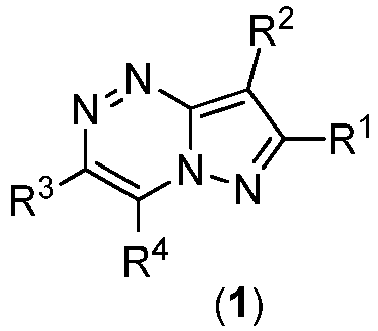
- R1 is selected from the group consisting of alkyl, aryl, arylalkyl, heteroaryl, heteroarylalkyl, optionally substituted by at least one moiety selected from F, Cl, Br, CH3, OH, =O, SH, OCH3, SCH3, CF3, OCF3, NH2, N(CH3)2, aryl, heteroaryl, alkyl, wherein aryl, heteroaryl, alkyl can optionally be further substituted by F, Cl, Br, CH3, OH, SH, OCH3, SCH3, CF3, OCF3, NH2, or N(CH3)2;
- R2 is selected from the group consisting of H; alkyl, aryl, optionally-substituted by at least one moiety selected from F, Cl, Br, CH3, OH, =O, SH, OCH3, SCH3, CF3, OCF3, NH2, N(CH3)2, -S(O2)R11, -S(O2)NR11R12; wherein R11, R12 are selected from the group consisting of H, alkyl, aryl, arylalkyl, cycloalkyl;
- R3 is heteroaryl, optionally substituted by at least one moiety selected from F, Cl, Br, CH3, OH, =O, SH, OCH3, SCH3, CF3, OCF3, NH2, N(CH3)2, aryl, heteroaryl, alkyl, wherein aryl, heteroaryl and alkyl can optionally be further substituted by F, Cl, Br, CH3, OH, =O, SH, OCH3, SCH3, CF3, OCF3, NH2, or N(CH3)2; wherein "heteroaryl" means an aromatic polycyclic ring system containing 7 to 14 carbon atoms, preferably 3 to 7 carbon atoms, most preferably 3 to 5 carbon atoms, and at least one heteroatom selected from the group consisting of nitrogen, oxygen and sulfur, or "heteroaryl" means imidazolyl;
- R4 is selected from the group consisting of F, Cl, Br, CH3, OH, =O, SH, OCH3, SCH3, CF3, OCF3, NH2, N(CH3)2.
- In this description and unless indicated otherwise, the generic substituent groups have the following meanings:
- "alkyl" means an aliphatic hydrocarbon group which may be straight or branched and contains 1 to 20 carbon atoms, preferably 1 to 12 carbon atoms, more preferably 1 to 8 carbon atoms, most preferably 1 to 6 carbon atoms in the chain. Examples of suitable alkyls are methyl, ethyl, propyl, isopropyl, butyl, isobutyl, tert-butyl, pentyl, isopentyl, hexyl;
- "aryl" means an aromatic monocyclic or polycyclic ring system containing 6 to 14 carbon atoms, preferably 6 to 10 carbon atoms. Examples of suitable aryls are phenyl and naphthyl,
- "cycloalkyl" means an aliphatic monocyclic or polycyclic ring system comprising 3 to 10 carbon atoms, preferably 5 to 7 carbon atoms. Suitable examples include cyclopentyl, cyclohexyl, cycloheptyl, 1-decalinyl, norbornyl, adamantyl;
- "heterocyclyl" means an aliphatic monocyclic or polycyclic ring system containing 3 to 10 carbon atoms, preferably 4 to 8 carbon atoms, and at least one heteroatom selected from the group consisting of nitrogen, oxygen and sulfur. Suitable examples include piperazinyl and morpholinyl;
- "heteroaryl" means an aromatic monocyclic or polycyclic ring system containing 3 to 14 carbon atoms, preferably 3 to 7 carbon atoms, most preferably 3 to 5 carbon atoms, and at least one heteroatom selected from the group consisting of nitrogen, oxygen and sulfur. Examples of suitable heteroaryls are pyridyl, pyrimidinyl, pyrazinyl, furanyl, thienyl, pyrazolyl, oxazolyl, thiazolyl, isothiazolyl, isoxazolyl, pyrrolyl, imidazolyl, indolyl, indolinolyl or imidazopyridazinyl;
- "arylalkyl" is a group aryl-alkyl, wherein aryl and alkyl are as defined herein above; "heterocyclylalkyl" is a group heterocyclyl-alkyl, wherein heterocyclyl and alkyl are as defined herein above;
- "heteroarylalkyl" is a group heteroaryl-alkyl, wherein heteroaryl and alkyl are as defined herein above.
- Preferably, R1 is selected from alkyl, aryl, optionally substituted by at least one moiety selected from aryl, heteroaryl, alkyl (wherein aryl, heteroaryl, alkyl can optionally be further substituted by F, Cl, Br, CH3, OH, SH, OCH3, SCH3, CF3, OCF3, NH2, or N(CH3)2), F, Cl, Br, CH3, OH, =O, SH, OCH3, SCH3, CF3, OCF3, NH2, N(CH3)2.
- Preferably, R4 is OH or NH2.
- Pharmaceutically acceptable salts are salts with acids or bases, or acid addition salts. The acids and bases can be inorganic or organic acids and bases commonly used in the art of formulation, in particular hydrochloride, hydrobromide, sulfate, bisulfate, phosphate, hydrogen phosphate, acetate, benzoate, succinate, fumarate, maleate, lactate, citrate, tartrate, gluconate, methanesulfonate, benzenesulfonate, para-toluenesulfonate, primary, secondary and tertiary amides, ammonia. Solvates are structures containing molecules of a solvent, in particular water (hydrates) or any other pharmaceutically acceptable solvent molecules.
- In general, the compounds described in this invention can be prepared through the general routes described below in Schemes 1-2.
Reaction of nitrile 1 with ester 2 in the presence of a base provides intermediate 3, whose cyclization with hydrazine affords aminopyrazole 4; as shown in Scheme 1.
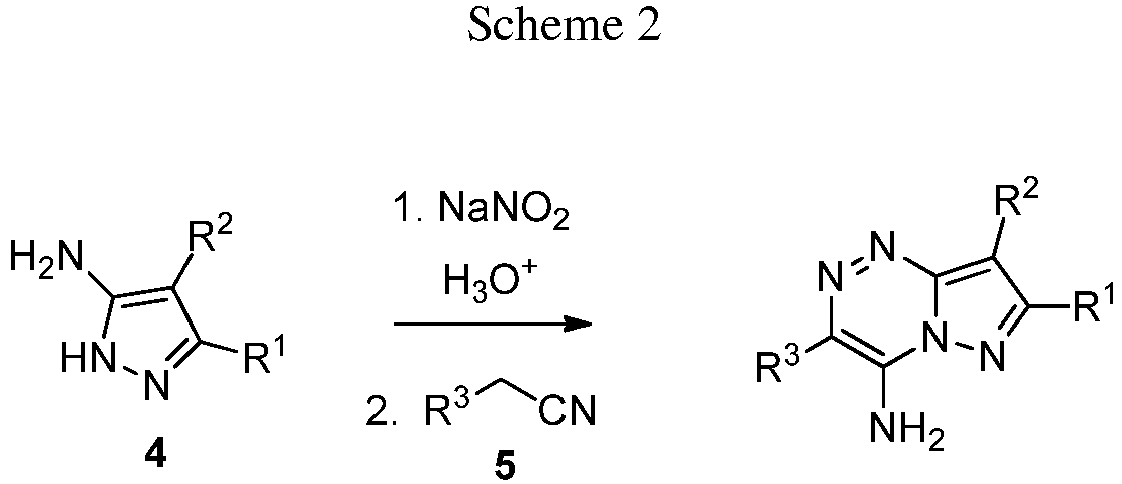
- Diazotization of aminopyrazole 4 followed by reaction with nitrile 5 yield the target pyrazolo[5,1-c][1,2,4]triazine; as depicted in Scheme 2.
- The position 2 can be selectively brominated, as shown in Scheme 3.

- The amino group at position 4 can be hydrolyzed or converted into chloride, as shown in Scheme 4.


- The compounds of Formula (1) act as nuclease inhibitors, in particular inhibitors of MUS81 and MRE11, and are useful in the treatment and prevention of proliferative diseases, in particular cancer, inflammation and arthritis, neurodegenerative diseases in particular Alzheimer's disease, and genomic instability associated diseases, in particular breast, colon, prostate, lung, head and neck, hepatic, ovarian, colorectal, gastric, melanoma cancers, leukemias, Nijmegen breakage syndrome and Nijmegen breakage-like syndrome, Ataxia-telangiectasia and Ataxia-telangiectasia-like disorder, and Fanconi anemia.
- The present invention thus provides the compounds of formula (1) for use as medicaments. More specifically, it provides the compounds of formula (1) for use in the treatment and prevention of conditions selected from proliferative diseases, in particular cancer, inflammation and arthritis, neurodegenerative diseases in particular Alzheimer's disease, and genomic instability associated diseases, in particular breast, colon, prostate, lung, head and neck, hepatic, ovarian, colorectal, gastric, melanoma cancers, leukemias, Nijmegen breakage syndrome and Nijmegen breakage-like syndrome, Ataxia-telangiectasia and Ataxia-telangiectasia-like disorder, and Fanconi anemia.
- The present invention thus provides the compounds of formula (1) for use in combination with other chemo- and radiotherapy treatment and prevention of conditions selected from proliferative diseases, in particular cancer, inflammation and arthritis, neurodegenerative diseases in particular Alzheimer's disease, and genomic instability associated diseases, in particular breast, colon, prostate, lung, head and neck, hepatic, ovarian, colorectal, gastric, melanoma cancers, leukemias, Nijmegen breakage syndrome and Nijmegen breakage-like syndrome, Ataxia-telangiectasia and Ataxia-telangiectasia-like disorder, and Fanconi anemia.
- The present invention further includes pharmaceutical compositions comprising at least one compound of formula (1) and at least one pharmaceutically acceptable auxiliary compound. The auxiliary compounds may include carriers, diluents, fillers, preservatives, stabilisers, binders, wetting agents, emulsifiers, buffers. Suitable auxiliary compounds are well known to those skilled in the art of formulation. The pharmaceutical compositions are prepared by known methods, in particular_mixing, dissolving.
- The present invention further provides compounds of formula 1a

- R1 is selected from the group consisting of H; alkyl; aryl; arylalkyl; cycloalkyl; heterocyclyl; heterocyclylalkyl; heteroaryl and heteroarylalkyl, wherein each of the alkyl, aryl, cycloalkyl, arylalkyl, heterocyclyl, heterocyclylalkyl, heteroaryl, heteroaryalkyl can be unsubstituted or optionally substituted with one or more moieties which can be the same or different, each moiety being independently selected from the group consisting of F, Cl, Br, CF3, OCF3, CN, =O, OR11, -NR11R12, -C(R11R12)pR9a, -C(R11R12)pOR9a,-C(R11R12)pSR9a, -C(O2)R11, -C(O)R11, -C(S)R11, -C(O)NR11R12, -SO3H, -SR11, S(O2)R11,-S(O2)NR11R12, -N(R11)S(O2)R12, -N(R11)C(O)R12, -C(=NOR11), -N(R9a)C(O)NR11R12, alkyl, aryl, cycloalkyl, heterocyclyl and heteroaryl, wherein alkyl, aryl, cycloalkyl, heterocyclyl, heteroaryl can optionally be further substituted by F, Cl, Br, CH3, OH, SH, OCH3, SCH3, CF3, OCF3, NH2, or N(CH3)2;
- R2 is selected from the group consisting of H; alkyl; aryl; arylalkyl; cycloalkyl; heterocyclyl; heterocyclylalkyl; heteroaryl and heteroarylalkyl, wherein each of the alkyl, aryl, cycloalkyl, arylalkyl, heterocyclyl, heterocyclylalkyl, heteroaryl, heteroaryalkyl can be unsubstituted or optionally substituted with one or more moieties which can be the same or different, each moiety being independently selected from the group consisting of F, Cl, Br, CF3, OCF3, CN, =O, OR11, -NR11R12, -C(R11R12)pR9a, -C(R11R12)pOR9a,-C(R11R12)pSR9a, -C(O2)R11, -C(O)R11, -C(S)R11, -C(O)NR11R12, -SO3H, -SR11, S(O2)R11,-S(O2)NR11R12, -N(R11)S(O2)R12, -N(R11)C(O)R12, -C(=NOR11), -N(R9a)C(O)NR11R12, alkyl, aryl, cycloalkyl, heterocyclyl and heteroaryl, wherein alkyl, aryl, cycloalkyl, heterocyclyl, heteroaryl can optionally be further substituted by F, Cl, Br, CH3, OH, SH, OCH3, SCH3, CF3, OCF3, NH2, or N(CH3)2;
- R3 is selected from the group consisting of aryl; arylalkyl; cycloalkyl; heterocyclyl; heterocyclylalkyl; heteroaryl and heteroarylalkyl, wherein each of the alkyl, aryl, cycloalkyl, arylalkyl, heterocyclyl, heterocyclylalkyl, heteroaryl, heteroaryalkyl can be unsubstituted or optionally substituted with one or more moieties which can be the same or different, each moiety being independently selected from the group consisting of F, Cl, Br, CF3, OCF3, CN, =O, OR11, -NR11R12, -C(R11R12)pR9a, -C(R11R12)pOR9a, -C(R11R12)pSR9a,-C(O2)R11, -C(O)R11, -C(S)R11, -C(O)NR11R12, -SO3H, -SR11, S(O2)R11, -S(O2)NR11R12,-N(R11)S(O2)R12, -N(R11)C(O)R12, -C(=NOR11), -N(R9a)C(O)NR11R12, alkyl, aryl, cycloalkyl, heterocyclyl and heteroaryl, wherein alkyl, aryl, cycloalkyl, heterocyclyl, heteroaryl can optionally be further substituted by F, Cl, Br, CH3, OH, SH, OCH3, SCH3, CF3, OCF3, NH2, or N(CH3)2;
- R4 is selected from the group consisting of F, Cl, Br, CH3, OH, =O, SH, OCH3, SCH3, CF3, OCF3, NH2, N(CH3)2 ;
- R9 is H, alkyl or aryl, optionally substituted by one or more substituents selected from F, Cl, Br, CH3, OH, SH, OCH3, SCH3, CF3, OCF3, NH2, N(CH3)2,
- R9a is H, alkyl or aryl, optionally substituted by one or more substituents selected from F, Cl, Br, CH3, OH, SH, OCH3, SCH3, CF3, OCF3, NH2, N(CH3)2,
- R10 is H, alkyl or aryl, optionally substituted by one or more substituents selected from F, Cl, Br, CH3, OH, SH, OCH3, SCH3, CF3, OCF3, NH2, N(CH3)2,
- R11 is selected from the group consisting of H, alkyl, aryl, arylalkyl, cycloalkyl, heterocyclyl, heterocyclylalkyl, heteroaryl, heteroarylalkyl, wherein each of the alkyl, aryl, cycloalkyl, arylalkyl, heterocyclyl, heterocyclylalkyl, heteroaryl, heteroaryalkyl can be unsusbtituted or optionally substituted with one or more moieties which can be the same or different, each moiety being independently selected from the group consisting of F, Cl, Br, CF3, OCF3, CN, =O, OR9, NR9R10 -C(R9R10)pR9a, -C(R9R10)pOR9a, -C(R9R10)pSR9a,-C(O2)R9, -C(O)R9, -C(S)R9, -C(O)NR9R10, -SO3H, -SR9, S(O2)R9, -S(O2)NR9R10,-N(R9)S(O2)R10, -N(R9)C(O)R10, -C(=NOR9), and -N(R9a)C(O)NR9R10, alkyl, aryl, cycloalkyl, heterocyclyl and heteroaryl, wherein alkyl, aryl, cycloalkyl, heterocyclyl, heteroaryl can optionally be further substituted by F, Cl, Br, CH3, OH, SH, OCH3, SCH3, CF3, OCF3, NH2, or N(CH3)2;
- R11a is selected from the group consisting of H, alkyl, aryl, arylalkyl, cycloalkyl, heterocyclyl, heterocyclylalkyl, heteroaryl, heteroarylalkyl, wherein each of the alkyl, aryl, cycloalkyl, arylalkyl, heterocyclyl, heterocyclylalkyl, heteroaryl, heteroaryalkyl can be unsusbtituted or optionally substituted with one or more moieties which can be the same or different, each moiety being independently selected from the group consisting of F, Cl, Br, CF3, OCF3, CN, =O, OR9, NR9R10 -C(R9R10)pR9a, -C(R9R10)pOR9a, -C(R9R10)pSR9a-C(O2)R9, -C(O)R9, -C(S)R9, -C(O)NR9R10, -SO3H, -SR9, S(O2)R9, -S(O2)NR9R10,-N(R9)S(O2)R10, -N(R9)C(O)R10, -C(=NOR9), and -N(R9a)C(O)NR9R10, alkyl, aryl, cycloalkyl, heterocyclyl and heteroaryl, wherein alkyl, aryl, cycloalkyl, heterocyclyl, heteroaryl can optionally be further substituted by F, Cl, Br, CH3, OH, SH, OCH3, SCH3, CF3, OCF3, NH2, or N(CH3)2;
- R12 is selected from the group consisting of H, alkyl, aryl, arylalkyl, cycloalkyl, heterocyclyl, heterocyclylalkyl, heteroaryl, heteroarylalkyl, wherein each of the alkyl, aryl, cycloalkyl, arylalkyl, heterocyclyl, heterocyclylalkyl, heteroaryl, heteroaryalkyl can be unsusbtituted or optionally substituted with one or more moieties which can be the same or different, each moiety being independently selected from the group consisting of F, Cl, Br, CF3, OCF3, CN, =O, OR9, NR9R10 -C(R9R10)pR9a, -C(R9R10)pOR9a, -C(R9R10)pSR9a,-C(O2)R9, -C(O)R9, -C(S)R9, -C(O)NR9R10, -SO3H, -SR9, S(O2)R9, -S(O2)NR9R10,-N(R9)S(O2)R10, -N(R9)C(O)R10, -C(=NOR9), and -N(R9a)C(O)NR9R10, alkyl, aryl, cycloalkyl, heterocyclyl and heteroaryl, wherein alkyl, aryl, cycloalkyl, heterocyclyl, heteroaryl can optionally be further substituted by F, Cl, Br, CH3, OH, SH, OCH3, SCH3, CF3, OCF3, NH2, or N(CH3)2;
- p is 1 to 7,
- for use in a method of treatment and/or prevention of breast, colon, prostate, lung, head and neck, hepatic, ovarian, colorectal, gastric, melanoma cancers, leukemias, Nijmegen breakage syndrome and Nijmegen breakage-like syndrome, Ataxia-telangiectasia and Ataxia-telangiectasia-like disorder, and Fanconi anemia.
- The present invention provides substituted pyrazolo[5,1-c][1,2,4]triazines which are represented by structural Formula (1), or pharmaceutically acceptable salts, solvates, esters or prodrugs thereof, wherein the various moieties are as described above.
-

- TBDPSCl (7.7 g, 28.27 mmol) was added under N2 to a stirred solution of methyl 2-hydroxyacetate (2.3 g, 25.7 mmol), DMAP (1.7 g, 12.5 mmol) and Et3N (5.1 g, 51.4 mmol) in CH2Cl2 (30 mL). The reaction mixture was stirred at 25 °C for 16 hours. The precipitate was removed by filtration and the filtrate was washed by 10% aqueous HCl (2 x 75 mL), then by water (2 x 50 mL), and dried over MgSO4. The solvent was evaporated and the product was obtained as a colorless oil (8.2 g, 98%).
1H NMR (500 MHz, CDCl3): δ 1.11 (s, 9H), 3.70 (s, 3H), 4.26 (s, 2H), 7.43 - 7.38 (m, 4H), 7.47 - 7.42 (m, 2H), 7.72 - 7.69 (m, 4H) ppm.
13C NMR (125 MHz, CDCl3): δ 19.49, 26.90, 51.48, 62.37, 128.00, 130.11, 135.81, 171.87 ppm.
HRMS calculated for C10H7NO2 [M+H]+ 174.0561, found 174.0565. -
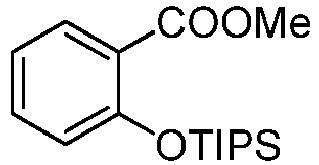
- TIPSOTf (0.97 ml, 3.6 mmol) was added under N2 to a stirred solution of methyl 2-hydroxybenzoate (0.5 g, 3.2 mmol), DMAP (0.2 g, 1.6 mmol) and Et3N (0.9 ml, 6.6 mmol) in anhydrous THF (10 mL). The mixture was stirred at 25 °C for 18 hours, then poured into water (100 mL) and extracted with Et2O (3 x 50 mL). The organic extracts were dried over MgSO4, filtered, and the solvent was evaporated. The residue was purified by flash chromatography on silica gel (eluent: hexane/EtOAc - 10:1) to yield a colorless oil (0.83 g, 82%).
1H NMR (500 MHz, CDCl3): δ 1.12 (d, 18H, J = 7.4 Hz), 1.37 - 1.27 (m, 3H), 3.87 (s, 3H), 6.88 (dd, 1H, J = 8.3, 0.8 Hz), 6.99 - 6.92 (m, 1H), 7.33 (tt, 1H, J = 11.8, 3.2 Hz), 7.73 (dd, 1H, J = 7.8, 1.8 Hz) ppm.
13C NMR (125 MHz, CDCl3): δ 13.32, 18.13, 52.00, 120.53, 120.65, 122.94, 131.72, 133.03, 155.68, 167.77 ppm.
HRMS calculated for C17H29O3Si [M+H]+ 309. 1880, found 309.1881. -
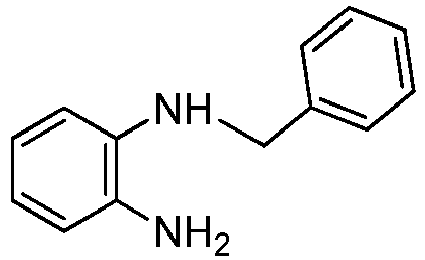
- Benzylbromide (2.7 g, 16.0 mmol) was added to a mixture o-diaminobenzene (8.0 g, 74.0 mmol) and K2CO3 (6.0 g, 44.0 mmol) in anhydrous MeOH (40 mL). The reaction mixture was stirred under N2 at 25 °C for 20 hrs, then the solvent was evaporated and the residue was purified by column flash chromatography on silica gel (eluent: hexane/EtOAc - 2 : 1) to afford a dark-red liquid (2.58 g, 81%).
1H NMR (500 MHz, CDCl3): δ 3.44 (d, 3H), 4.34 (s, 2H), 6.73 - 6.69 (m, 2H), 6.78 - 6.73 (m, 2H), 6.83 (m, 1H), 7.35 - 7.28 (m, 2H), 7.38 (t, 2H, J = 7.5 Hz), 7.43 (d, 1H, J = 7.3 Hz) ppm.
13C NMR (500 MHz, CDCl3): δ 48.89, 112.31, 116.79, 119.10, 120.96, 127.47, 128.01, 128.81, 134.43, 137.89, 139.63 ppm. -

- Ethyl 2-cyanoacetate (2.20 g, 20.0 mmol) followed by methanesulfonic acid (0.1 mL) were afdded to a solution of compound from Preparative Example C (2.58 g, 13.0 mmol) in ethyleneglycol (15 mL). The solution was refluxed for 4 hrs under N2, poured into a mixture of water (100 mL) with saturated aqueous NaHCO3 (25 mL), and extracted with EtOAc (3 x 50 mL).The organic extracts were washed with water (100 mL), brine (25 mL), then dried over MgSO4, filtered, and the solvent was evaporated. The residue was purified by flash chromatography on silica gel (eluent: hexane/EtOAc - 10:1) to yield a white crystalline solid (2.43 g, 75 %).
MP = 135.0 - 136.0 °C.
1H NMR (500 MHz, CDCl3): δ 3.93 (s, 2H), 5.46 (s, 2H), 7.12 - 7.05 (m, 2H), 7.39 - 7.30 (m, 6H), 7.91 - 7.73 (m, 1H) ppm.
13C NMR (125 MHz, CDCl3): δ 18.50, 47.68, 110.02, 114.28, 120.43, 123.24, 124.14, 126.56, 128.77, 129.57, 134.90, 136.11, 142.26, 143.49 ppm.
HRMS calculated for C16H12N3 [M-H]- 246.1037, found 246.1037. -

- A solution of 2-(4-fluorophenyl)acetonitrile (1.13 g, 8.3 mmol) in anhydrous THF (4 mL) was added under N2 to NaH (60 % suspension in mineral oil, 0.67 g, 16.7 mmol). The mixture was stirred for 20 min, then methyl propionate (0.73 g, 8.3 mmol) was added and the reaction mixture was stirred at 25 °C for additional two hours. The mixture was cooled to 0 °C and saturated aqueous solution of NH4Cl (50 mL) was added. The mixture was extracted with EtOAc (3 x 75 mL). The organic extracts were dried over MgSO4, filtered and the solvent was evaporated. The residue was purified by flash chromatography on silica gel (eluent: hexane / EtOAc - 3:1) to yield an yellow-orange oil (1.46 g, 92 %).
1H NMR (500 MHz, CDCl3): δ 1.06 (t, 2H, J = 7.2 Hz). 2.74 - 2.56 (m, 1H), 4.68 (s. 1H), 7.17 - 7.09 (m, 1H), 7.42 - 7.35 (m, 1H) ppm.
13C NMR (125 MHz, CDCl3): δ 7.79, 32.48, 49.87, 116.42, 116.88 (d, J = 22.0 Hz), 125.99 (d, J = 3.4 Hz), 130.02 (d, J = 8.3 Hz), 163.30 (d. J = 249,6 Hz), 199.41 ppm. HRMS calculated for C11H9FNO [M-H]- 190.0674, found 190.0672. - By essentially same procedure set forth in Preparative Example 1A, using methyl isobutyrate instead of methyl propionate, compound 1B given below was prepared.

- White solid.
MP = 58.5 - 59.8 °C.
1H NMR (500 MHz, CDCl3): δ 1.25 (d, 1H, J = 7.0 Hz), 3.05 (hept, 1H. J = 7.0 Hz), 4.98 (s, 1H), 7.15 - 7.10 (m, 1H), 7.31 - 7.27 (m, 1H) ppm.
13C NMR (125 MHz, CDCl3): δ 18.78, 19.04, 39.00, 48.47, 1116.41, 116.87 (d, J = 21.1 Hz), 125.90 (d, J = 3.1 Hz), 130.24 (d, J = 8.6 Hz), 163.21 (d, J = 249.6 Hz), 202.54 ppm. HRMS calculated for C12H11FNO [M-H]- 204.0830, found 204.0838. - By essentially same procedure set forth in Preparative Example 1A, using ethyl formate instead of methyl propionate, compound 1C given below was prepared in 60 % yield.

- Off-white solid.
MP = 145.0 - 146.0 °C.
1H NMR (500 MHz, DMSO-d6): δ (ppm) 7.16 - 7.21 (m, 2H), 7.20 - 7.27 (m, 2H), 7.44 (ddd, J = 6.6, 5.2, 2.1 Hz, 2H), 7.65 (s, 1H), 7.69 (ddd, J = 8.6, 5.4, 2.7 Hz, 2H), 7.97 (s, 1H), 12.14 (s, 2H).
13C NMR (125 MHz, DMSO-d6): δ (ppm) 88.51, 88.77, 115.42 (d, J = 21.7 Hz), 115.73 (d, J = 21.8 Hz), 116.72, 120.09, 126.10 (d, J = 8.1 Hz), 128.02 (d, J = 3.5 Hz), 128.43 (d, J = 8.1 Hz), 128.56 (d, J = 2.8 Hz), 157.77, 160.52 (d, J = 244.2 Hz), 160.93 (d, J = 243.4 Hz). HRMS calcd for C9H5FNO [M-H]- 162.0361, found 162.0360. -

- A solution of methyl propionate (3.82 g, 43.3 mmol) and acetonitrile (5.33 g, 130.0 mmol) in anhydrous THF (25 mL) was added under nitrogen to NaH (60 % suspension in mineral oil, 5.20 g, 130.0 mmol) and the mixture was refluxed for 4 hrs. The reaction mixture was cooled to 0 °C, quenched with saturated aqueous solution NH4Cl (100 mL), and extracted with EtOAc (3 x 75 mL). The organic extracts were dried over MgSO4, filtered and the solvent was evaporated. The residue was purified by flash chromatography on silica gel (eluent: hexane / EtOAc - 4:1) to yield a colorless liquid (3.5 g, 90%).
1H NMR (500 MHz, CDCl3): δ 1.14 (t, 3H, J = 7.2 Hz), 2.66 (q, 2H, J = 7.2 Hz), 3.46 (s, 2H) ppm.
13C NMR (125 MHz, CDCl3): δ 7.61, 31.83, 35.81, 113.99, 198.14 ppm.
HRMS calculated for C5H6NO [M-H]- 96.0455, found 96.0462. - By essentially same procedure set forth in Preparative Example 2A, using the indicated esters instead of methyl propionate, compounds given below were prepared.
-
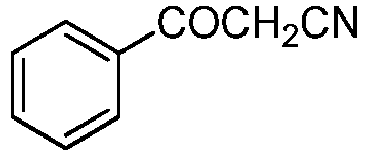
- Prepared from methyl benzoate.
- White solid.
MP = 72.0 - 73.2°C.
1H NMR (500 MHz, CDCl3): δ 4.09 (s, 2H), 7.54 (t, 2H, J = 7.80 Hz), 7.67 (t, 1H, J = 7.50 Hz), 7.93 (d, 2H, J = 7.3 Hz).
13C NMR (125 MHz, CDCl3): δ 29.56, 113.95, 128.68, 129.37, 130.36, 133.83, 134.52, 134.93, 187.29 ppm.
HRMS calculated for C9H6NO [M-H]- 144.0455, found 144.0457. -
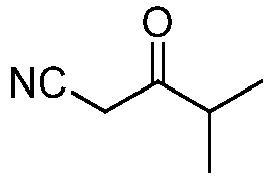
- Prepared from methyl isobutyrate.
- Pale yellow oil.
1H NMR (500 MHz, CDCl3): δ 1.19 (d, 6H, J = 6.90 Hz), 2.82 (hept, 1H, J = 6.90 Hz), 3.52 (s, 2H) ppm.
13C NMR (125 MHz, CDCl3): δ 18.05, 30.25, 40.75, 114.05, 201.30 ppm.
HRMS calculated for C6H8NO [M+H]+ 110.0611, found 110.1618. -

- Prepared from methyl pivalate.
- White solid.
MP = 67.5 - 68.4°C.
1H NMR (500 MHz, CDCl3): δ 1.20 (s, 9H), 3.63 (s, 2H) ppm.
13C NMR (125 MHz, CDCl3): δ 26.26, 27.58, 44.79, 114.24, 202.87 ppm.
HRMS calculated for C7H10NO [M-H]- 124.0768, found 124.0774. -

- Prepared from methyl 2-chlorobenzoate.
- Yellow solid.
MP = 57.0 - 58.1 °C.
1H NMR (500 MHz, CDCl3): δ 4.15 (s, 2H), 7.39 - 7.44 (m, 1H), 7.46 - 7.54 (m, 2H), 7.65 (dd, 1H, J = 7.7, 1.4 Hz) ppm; 13C NMR (500 MHz, CDCl3): δ 33.12, 113.52, 127.71, 130.64, 131.22, 131.92, 133.95, 135.93, 189.58 ppm.
HRMS calculated for C7H5ClON [M-H]- 178.0065, found 178.0067. -

- Prepared from methyl 2-methoxybenzoate.
- White solid.
MP = 88.9 - 89.7 °C.
1H NMR (500 MHz, CDCl3): δ 3.98 (s, 3H), 4.09 (s, 2H), 7.03 (d, 1H, J = 8.4), 7.09-7.05 (m, 1H), 7.65 - 7.53 (m, 1H), 7.87 (dd, 1H, J = 7.8, 1.8) ppm.
13C NMR (125 MHz, CDCl3): 34.30, 55.97, 112.01, 114.76, 121.46, 124.76, 131.60, 135.92, 159.44, 188.25 ppm.
HRMS calculated for C10H7NO2 [M-H]- 174.0561, found 174.0565. -

- Prepared from methyl ester of biphenyl-2-carboxylic acid.
- Yellow oil.
1H NMR (500 MHz, CDCl3): δ 3.21 (s, 2H), 7.40 - 7.35 (m, 2H), 7.55 - 7.45 (m, 5H), 7.66 - 7.59 (m, 2H) ppm.
13C NMR (125 MHz, CDCl3): δ 14.40, 32.32, 60.58, 113.82, 128.17, 129.09, 129.61, 130.69, 132.50, 137.60, 139.76, 141.05, 193.75 ppm.
HRMS calculated for C15H10NO [M-H]- 220.0768, found 220.0765. -

- n-BuLi solution in hexane (2.7 M, 0.6 ml, 1.62 mmol) was added under nitrogen to a solution of acetonitrile (93.0 mg, 2.28 mmol) in anhydrous THF (5 mL) at -78 °C. The reaction mixture was stirred at at -78 °C for 30 min, then a solution of compound from Preparative Example A (0.50 g, 1.52 mmol) in anhydrous THF (10 mL) was added dropwise and the mixture was stired at -78 °C for 2 hrs. The reaction mixture was quenched with saturated aqueous solution NH4Cl (10 mL) and extracted with CH2Cl2 (3 x 75 mL). The organic extracts were dried over MgSO4, filtered, and the solvent was evaporated. The residue was purified by flash chromatography on silica gel (eluent: hexane /EtOAc - 5:1) to yield a colorless oil (365 mg, 71%).
1H NMR (500 MHz, CDCl3): δ 1.13 (s, 9H), 3.74 (s, 2H), 4.28 (s, 2H), 7.46 - 7.41 (m, 4H), 7.51 - 7.47 (m, 2H), 7.66 - 7.62 (m, 4H) ppm.
13C NMR (125 MHz, CDCl3): δ 19.34, 26.95, 29.56, 69.22, 113.51, 128.35, 130.63, 131.85, 135.64, 198.30 ppm.
HRMS calculated for C20H22NO2Si [M-H]- 336.1425, found 336.1429. - By essentially same procedure set forth in Preparative Example 3A, using the indicated esters instead of compound from Preparative Example A, compounds given below were prepared.
-
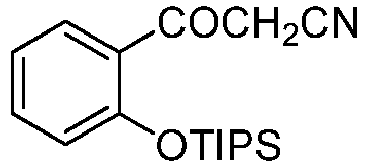
- Prepared from compound from Preparative Example B.
- Colorless oil.
1H NMR (125 MHz, CDCl3): δ 1.15 (d, 18H, J = 7.5 Hz), 1.44 - 1.34 (m, 3H), 4.15 (s, 2H), 6.92 (d, 1H, J = 8.3 Hz), 7.04 (t, 1H, J = 7.5 Hz), 7.47 - 7.39 (m, 1H), 7.74 (dd, 1H, J = 7.8, 1.8 Hz) ppm.
13C NMR (125 MHz, CDCl3): δ 13.59, 18.11, 35.46, 114.45, 119.77, 121.72, 127.35, 131.29, 135.07, 156.04, 189.26 ppm.
HRMS calculated for C18H29NO2S [M+H]+ 318.1884, found 318.1886 -

- Prepared from methyl 1-naphthoate.
- Yellow solid.
MP = 99.0 - 101.0°C.
1H NMR (500 MHz, CDCl3): δ 4.20 (s, 2H), 7.58 - 7.54 (m, 1H), 7.64 - 7.58 (m, 1H), 7.72 - 7.66 (m, 1H), 7.92 (t, 2H, J = 8.2 Hz), 8.12 (d, 1H, J = 8.2 Hz), 8.82 (d, 1H, J = 8.7 Hz) ppm.
13C NMR (125 MHz, CDCl3): δ 31.97, 114.23, 124.38, 125.84, 127.36, 128.92, 129.40, 129.70, 130.58, 131.77, 134.33, 135.41, 189.67 ppm.
HRMS calculated for C13H8NO [M-H]- 194.0611, found 194.0608. -

- To a solution of compound from Preparative Example 1A (1.4 g, 7.3 mmol) in ethanol (25 mL) were added aqueous 64% hydrazine hydrate (0.8 g, 14.6 mmol) and methanesulfonic acid (0.1 g, 0.7 mmol). The mixture was refluxed under N2 for 4 hrs, then the solvent was evaporated. Saturated aqueous NaHCO3 (100 mL) was added to the residue and the mixture was extracted with EtOAc (3 x 50 mL). The organic extracts were dried over MgSO4, filtered and the solvent was evaporated. The residue was purified by flash chromatography on silica gel (eluent: hexane / EtOAc - 1:1) to yield a white solid (365 mg, 71%).
1H NMR (500 MHz, DMSO-d6): δ 1.23 (q, 3H, J = 7.5 Hz), 2.69 (q, 2H, J = 7.5 Hz), 3.48 (s, 2H, J = 77.8 Hz), 7.27 - 7.40 (m, 2H), 7.42 - 7.52 (m, 2H), 8.51 (s, 1H) ppm.
13C NMR (125 MHz, DMSO-d6): δ 13.22, 18.36, 102.75, 115.20 (d, J = 21,2 Hz), 129.95 (d, J = 7.9 Hz), 130.25 (d, J = 2.8 Hz), 143.28, 150.55, 160.14 (d, J = 241.7 Hz) ppm. HRMS calculated for C11H11FN3 [M+H]- 204.0942, found 204.0948. - By essentially same procedure set forth in Preparative Example 4A, compounds given below were prepared.
-
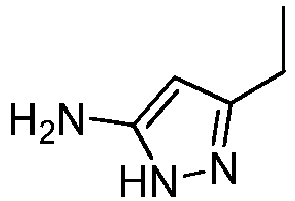
- Prepared from compound from Preparative Example 2A.
- Brown oil.
1H NMR (500 MHz, DMSO-d6): δ 1.11 (t, 3H, J = 7.57 Hz), 2.40 (q, 2H, J = 7.57 Hz), 5.18 (s, 1H)ppm.
13C NMR (125 MHz, DMSO-d6): δ 13.49, 19.15, 88.92, 146.53, 153.67 ppm.
HRMS calculated for C5H10N3 [M+H]+ 112.0869, found 112.0874. -

- Prepared from compound from Preparative Example 2B.
- White solid.
MP = 106.7 - 107.5 °C.
1H NMR (500 MHz, DMSO-d6): δ 4.78 (s, 2H), 5.75 (s, 1H), 7.25 (t, 1H, J = 7.3 Hz), 7.36 (t, 2H, J = 7.6 Hz), 7.64 (d, 2H, J = 7.3 Hz), 11.73 (s, 1H) ppm. -
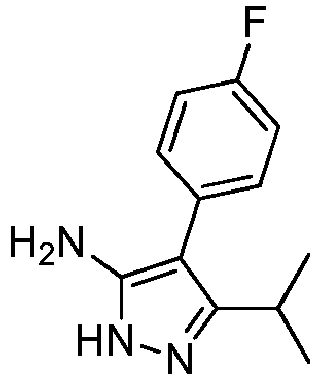
- Prepared from compound from Preparative Example 1B.
- White solid.
1H NMR (500 MHz, CDCl3): δ 1.25 (d, 1H, J = 7.0 Hz), 3.05 (hept, 1H, J = 7.0 Hz), 4.98 (s, 1H), 7.15 - 7.10 (m, 1H), 7.31 - 7.27 (m, 1H) ppm.
13C NMR (125 MHz, CDCl3): δ 22.14, 25.36, 104.54, 116.13 (d, J = 21.5 Hz), 131.32 (d, J = 8.1 Hz), 148.44, 151.66, 175.21, 162.08 (d, J = 246.9 Hz) ppm.
HRMS calculated for C5H10N3 [M+H]+ 112.0869, found 112.0874. -

- Prepared from compound from Preparative Example 2C.
- Dark brown wax.
- MP = 76.9 - 77.8 °C.
1H NMR (500 MHz, DMSO-d6): δ 1.24 (d, 6H, J = 6.90 Hz), 2.88 (hept, 1H, J = 6.90 Hz), 5.31 - 5.58 (m, 4H, J = 2.5 Hz).
13C NMR (125 MHz, DMSO-d6): δ 22.38, 26.34, 90.01, 90.06, 152.26, 154.60 ppm. HRMS calculated for C6H8NO [M+H]+ 110.0611, found 110.1618. -

- Prepared from compound from Preparative Example 2D.
- Pink solid.
MP = 77.0 - 77.5°C.
1H NMR (500 MHz, DMSO-d6): δ 1.18 (s, 9H), 4.51 (s, 2H), 5.18 (s, 1H), 10.91 (s, 2H) ppm.
13C NMR (125 MHz, DMSO-d6): δ 30.05, 30.64, 87.37, 153.31, 154.04 ppm.
HRMS calculated for C7H14N3 [M+H]+ 140.1182, found 140.1191. -
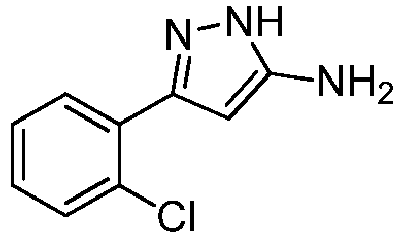
- Prepared from compound from Preparative Example 2E.
- Yellow wax.
1H NMR (500 MHz, DMSO-d6): δ 4.82 (s, 1H), 5.84 (s, 1H), 7.31 (t, 1H, J =7.6 Hz), 7.36 (t, 1H, J =7.0 Hz), 7.48 (d, 1H, J = 7.7 Hz), 7.67 (d, 1H, J = 6.0 Hz) ppm.
13C NMR (500 MHz, DMSO-d6): δ 17.57, 24.69, 59.75, 127.15, 128.82, 129.89, 130.24, 130.64, 159.06 ppm.
HRMS calculated for C9H9ClN3 [M+H]+ 194.0480, found 140.0476. -

- Prepared from compound from Preparative Example 2F.
- Colorless wax.
1H NMR (500 MHz, DMSO-d6): δ 3.85 (s, 3H), 4.54 (s, 2H), 5.88 (s, 1H), 7.03 - 6.85 (m, 1H), 7.13 - 7.02 (m, 1H), 7.27 (t, 1H, J = 7.2 Hz), 7.76 - 7.52 (m, 1H), 11.61 (d, 1H, J = 97.7 Hz) ppm.
13C NMR (500 MHz, DMSO-d6): δ 55.35, 59.70, 91.30, 110.40, 111.82, 120.49, 126.07, 127.11, 128.53, 155.62 ppm.
HRMS calculated for C10H12N3O [M+H]+ 190.0975, found 190.0977. -

- Prepared from compound from Preparative Example 3A.
- Yellow wax.
1H NMR (500 MHz, CDCl3): δ 1.00 (s, 9H), 4.54 (s, 2H), 4.65 (s, 2H), 5.34 (s, 1H), 7.40-7.50 (m, 6H), 7.61-7.69 (m, 4H), 11.27(s, 1H)ppm.
13C NMR (500 MHz, CDCl3): δ 14.03, 18.77, 20.70, 26.52, 26.57, 59.68, 127.82, 129.80, 133.00, 135.00 ppm.
HRMS calculated for C20H26N3OSi [M+H]+ 352.1840 found 352.1843. -

- Prepared from compound from Preparative Example 3B (the TIPS group was cleaved under the reaction conditions).
- Colorless wax.
1H NMR (300 MHz, CDCl3): δ 5.17 (s, 1H), 6.89 - 6.76 (m, 1H), 7.39 - 7.28 (m, 2H), 7.54 -7.42 (m, 2H), 7.65 - 7.55 (m, 1H), 7.90 (dd, 1H J = 7.7, 1.6 Hz), 12.13 - 11.37 (m, 1H) ppm. -

- Prepared from compound from Preparative Example 3C.
- White solid.
1H NMR (500 MHz, DMSO-d6): δ 4.83 (s, 2H), 5.71 (s, 1H), 7.56 - 7.51 (m, 3H), 7.60-7.56 (m, 1H), 7.90 (d, 1H, J = 8.0 Hz), 7.95 (dd, 1H, J = 6.0, 3.4 Hz), 11.75 (s, 1H) ppm; 13C NMR (125 MHz, DMSO-d6): δ 59.71, 125.41, 125.82, 126.18, 126.25, 127.77, 127.81, 128.18, 130.53, 133.46 ppm.
HRMS calculated for C13H12N3 [M+H]+ 210.1026, found 210.1028. -

- Prepared from compound from Preparative Example 2G.
- Dark brown wax.
1H NMR (500 MHz, DMSO-d6): δ 4.49 (s, 1H), 4.75 (s, 1H), 7.21 (t, 2H, J = 7.4 Hz), 7.44 - 7.25 (m, 6H), 7.58 (s, 1H), 11.42 (s, 1H)ppm.
13C NMR (125 MHz, DMSO - d6): δ 59.69, 91.00, 126.85, 127.24, 127.48, 127.91, 128.78, 128.91, 130.39, 137.80, 139.91, 141.41, 147.03 ppm.
HRMS calculated for C15H14N3 [M+H]+ 236.1182, found 236.1184. -

- Prepared from compound from Preparative Example 2G.
- Yellow solid.
MP = 150 - 152°C.
1H NMR (500 MHz, DMSO-d6): δ (ppm) 4.71 (s, 2H), 7.09 - 7.20 (m, 2H), 7.51 (dd, J = 8.7, 5.6 Hz, 2H), 7.63 (s, 1H), 11.68 (bs, 1H).
13C NMR (125 MHz, DMSO - d6): δ (ppm) 115.14 (d, J = 20.9 Hz), 127.17 (d, J = 7.4 Hz), 130.46, 159.75 (d, J = 241.4 Hz).
HRMS calcd for C9H7FN3 [M-H]- 176.0629, found 176.0627. -

- Compound from Preparative Example 4A (0.4 g, 1.95 mmol) was dissolved in EtOH (10 mL) and H2O (10 mL) and 35% aqueous HCl (0.7 mL, 7.8 mmol) was added. The solution was cooled to -10 °C and a pre-cooled (-5 °C) solution of NaNO2 (0.3 g, 3.9 mmol) in EtOH (5 mL) and H2O (5 mL) was added. The reaction mixture was stirred for 20 min., then a pre-cooled solution (- 5 °C) of KOAc (1.2 g, 11.7 mmol) plus 2-(cyanomethyl)-benzimidazole (0.36 g, 2.3 mmol) in EtOH (10 mL) and H2O (10 mL) was added. The resulting mixture was stirred at 25 °C for 3 hrs. The precipitated product was filtered and washed on filter with water (25 mL). The product was dried in a vacuum to yield a green solid, which was used directly for the next step without additional purification.
- The solid was dissolved in anhydrous DMF (10 mL) and the mixture was refluxed under N2 for 3 hrs. The solution was poured into water (100 mL), the precipitate was collected by filtration, dissolved in dioxane (10 mL) at 50 °C, and the solution was poured into water (100 mL). The precipitate was collected by filtration, washed on filter with water (10 mL), then with Et2O (15 mL) and dried in a vacuum to yield a yellow solid (200 mg, 70 %). MP > 250 °C.
1H NMR (500 MHz, DMSO-d6): δ 1.35 (t, 3H, J = 7.6 Hz), 3.05 (q, 2H, J = 7.6 Hz), 7.30 - 7.21 (m, 2H), 7.40 - 7.32 (m, 2H), 7.56 (d, 1H, J = 7.5 Hz), 7.75 (d, 1H, J = 7.6 Hz), 7.90 - 7.83 (m, 2H), 9,34 (s, 1H), 9.95 (s, 1H), 13.35 (s, 1H) ppm.
13C NMR (125 MHz, DMSO-d6): δ 13.12, 20.88, 107.27, 111.53, 115.50 (d, J = 21.5 Hz), 118.33, 119.22, 121.91, 122.95, 127.72, 130.90 (d, J = 8.1 Hz), 133.75, 138.71, 142.73, 146.35, 150.06, 158.08, 161.10 (d, J = 244.2 Hz) ppm.
HRMS calculated for C20H17FN7 [M+H]+ 374.1524, found 374.1529. - By essentially same procedure set forth in Preparative Example 5A, compounds given below were prepared.
-

- Prepared from compound from Preparative Example 4B.
- Orange solid.
MP = 136.0 - 137.5 °C.
1H NMR (500 MHz, DMSO-d6): δ 1.36 (t, 3H, J = 7.59 Hz), 2.90 (q, 2H, J = 7.64 Hz), 6.88 (s, 1H), 7.21 - 7.27 (m, 2H, J = 6.79 Hz), 7.53 (d, 1H, J 6.95 Hz), 7.73 (d, 1H, J= 7.76 Hz), 9.29 (s. 1H), 9.89 (s, 1H), 13.40 (s, 1H) ppm.
13C NMR (125 MHz, DMSO-d6): δ 13.37, 21.75, 94.53, 111.40, 118.22, 118.35, 121.76, 122.78, 133.69, 138.71, 142.65, 149.63, 150.17, 161.60 ppm.
HRMS calculated for C14H12N7 [M+H]- 278.1160, found 278.1159. -

- Prepared from compound from Preparative Example 4C.
- Slightly green solid.
MP > 250 °C.
1H NMR (500 MHz, DMSO-d6): δ 7.26 (s, 2H), 7.50 (t, 1H, J = 7.3 Hz), 7.62 - 7.54 (m, 4H), 7.75 (s, 1H), 8.19 (d, 2H, J = 7.4 Hz), 9.34 (s, 1H), 9.95 (s, 1H), 13.46 (s, 1H) ppm. 13C NMR (125 MHz, DMSO-d6): δ 93.40, 111.46, 118.32, 118.95, 121.78, 122.90, 126.60, 128.89, 129.63, 138.84, 150.04, 150.26, 156.31 ppm.
HRMS calculated for C18H14N7 [M+H]+ 328.1305, found 328.1306 -
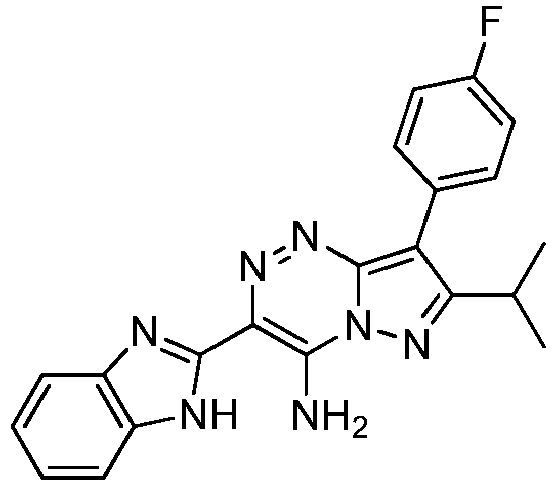
- Prepared from compound from Preparative Example 4D.
- Green-brown solid.
MP > 250 °C.
1H NMR (500 MHz, DMSO-d6): δ 1.40 (d, 6H, J = 6.9 Hz), 3.45 (hept, 1H, J - 6.9 Hz), 7.30 - 7.21 (m, 2H), 7.41 - 7.34 (m, 2H), 7.56 (d, 1H, J = 7.0 Hz), 7.83 - 7.71 (m, 3H), 9.20 (s, 1H), 9.94 (s, 1H), 13.35 (s, 1H) ppm.
13C NMR (125 MHz, DMSO-d6): δ 22.35, 26.33, 107.03, 111.46, 115.46 (d, J = 21.5 Hz), 118.26, 119.06, 121.84, 122.88, 127.63, 131.40 (d, J = 7.9 Hz), 133.72, 138.68, 148.19 (d, J = 465.7 Hz), 160.21, 160.25, 161.92, 162.15 ppm.
HRMS calculated for C21H19FN7 [M+H]+ 386.1535, found 386.1541. -

- Prepared from compound from Preparative Example 4E.
- Orange solid.
MP > 250 °C.
1H NMR (500 MHz, DMSO-d6): δ 1.39 (d, 6H, J = 6.9 Hz), 3.22 (hept, 1H. J = 13.9, 7.0 Hz), 6.91 (s, 1H), 7.32 - 7.17 (m, 2H), 7.53 (d, 1H. J = 7.2 Hz), 7.73 (d, 1H, J = 7.6 Hz), 9.22 (s, 1H), 9.88 (s, 1H), 13.40 (s. 1H) ppm.
13C NMR (125 MHz, DMSO-d6): 22.41, 28.16, 93.24, 111.39, 118.22, 118.31, 121.76, 122.79, 133.69, 138.75, 142.66, 149.56, 150.19, 165.93 ppm.
HRMS calculated for C15H15N7 [M+H]+ 294.1462, found 294,1450. -

- Prepared from compound from Preparative Example 4F.
- Yellow solid.
MP > 250 °C.
1H NMR (500 MHz, DMSO-d6): δ 1.45 (s, 9H), 6.95 (s, 1H), 7.30 - 7.18 (m, 2H), 7.53 (d, 1H, J = 7.2 Hz), 7.74 (d, 1H, J = 7.6 Hz), 9.05 (s. 1H), 9.85 (s, 1H), 13.39 (s, 1H) ppm. 13C NMR (125 MHz, DMSO-d6): 30.11, 33.72, 92.98, 111.39, 118.20, 118.22, 121.75, 122.77, 133.69, 138.71, 142.67, 149.53, 150.20, 168.62 ppm.
HRMS calculated for C16H16N7 [M+H]- 306.1473, found 306.1478. -

- Prepared from compound from Preparative Example 4G.
- Orange solid.
MP > 250 °C.
1H NMR (500 MHz, DMSO-d6): δ 7.26 (s, 2H), 7.46 (s, 1H), 7.59 - 7.52 (m, 3H), 7.71-7.64 (m, 1H), 7.76 (s, 1H), 8.07 - 7.99 (m, 1H), 9.50 (s, 1H), 10.01 (s, 1H), 13.50 (s, 1H) ppm.
13C NMR (125 MHz, DMSO-d6): δ 66.30, 97.22, 111.49, 118.33, 119.06, 121.88, 122.94, 127.39, 130.40, 130.89, 131.50, 131.97, 138.86, 142.65, 149.46, 149.95, 154.13 ppm. HRMS calculated for C7H14N3 [M+H]+ 140.1182, found 140.1191. -

- Prepared from compound from Preparative Example 4H.
- Yellow solid.
MP > 250 °C.
1H NMR (500 MHz, DMSO-d6): δ 3.99 (s, 3H), 7.14 (td, 1H, J = 7.6, 0.9 Hz), 7.30 - 7.21 (m. 3H), 7.52 - 7.46 (m, 2H), 7.55 (d, 1H, J = 7.4 Hz), 7.76 (d, 1H, J = 7.6 Hz), 8.28 (dd, 1H, J = 7.7, 1.8 Hz), 9.32 (s, 1H), 9.92 (s. 1H), 13.45 (s. 1H) ppm; 13C NMR (125 MHz, DMSO-d6): δ 55.65, 97.28, 111.46, 112.21, 118.30, 118.66, 120.04, 120.49, 121.83, 122.87, 128.88, 130.99, 133.75, 138.62, 142.73, 149.76, 150.13, 153.29, 157.45 ppm.
HRMS calculated for C19H16N7O [M+H]+ 358.1411, found 358.1412. -

- Prepared from compound from Preparative Example 4I.
- Product was additionally purified by column flash chromatography on silica gel (eluent: CH2Cl2 : MeOH / 10 : 1).
- Orange solid.
MP = 233.5 - 234.0 °C.
1H NMR (500 MHz, DMSO-d6): δ 1.07 (s, 9H), 5.02 (s, 2H), 6.97 (s, 1H), 7.29 - 7.19 (m, 2H), 7.49 - 7.43 (m, 6H), 7.54 (d, 1H, J = 7.7 Hz), 7.70 (d, 4H, J = 7.2 Hz), 7.74 (d, 1H. J = 7.7 Hz), 9.34 (s, 1H), 9.94 (s, 1H), 13.45 (s, 1H) ppm.
13C NMR (125 MHz, DMSO-d6): δ 18.81, 26.61, 60.35, 94.51, 111.45, 118.29, 118.77, 121.81, 127.44, 127.96, 129.99, 132.52, 134.42, 135.05, 138.95, 149.51, 150.00, 158.76 ppm.
HRMS calculated for C29H3ON7OSi [M+H]+ 520.2276, found 520.2273. -
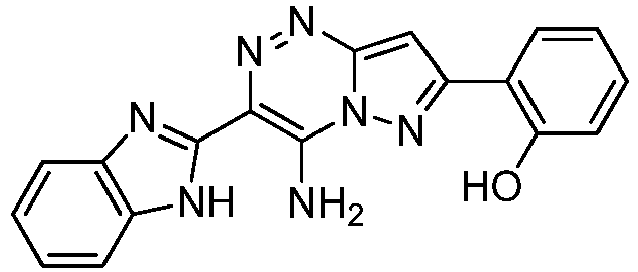
- Prepared from compound from Preparative Example 4J.
- Orange solid.
MP > 250 °C.
1H NMR (500 MHz, DMSO-d6): δ 7.03 - 6.98 (m, 1H), 7.08 - 7.04 (m, 1H), 7.30 - 7.22 (m, 2H), 7.37 - 7.32 (m, 1H), 7.58 - 7.55 (m, 2H), 7.76 (d, 1H, J = 7.5 Hz), 8.14 (dd, 1H, J = 7.8, 1.6 Hz), 9.64 (s, 1H), 9.98 (s, 1H), 10.31 (s, 1H), 13.46 (s, 1H) ppm.
13C NMR (125 MHz, DMSO-d6): δ 94.71, 111.46, 116.59, 117.12, 118.31, 119.12, 119.39, 121.82, 122.89, 128.61, 130.89, 133.75, 138.63, 142.71, 149.40, 150.01, 155.04, 155.90 ppm.
HRMS calculated for C13H10N7O [M+H]+ 280.0941, found 280.0945. -

- Prepared from compound from Preparative Example 4K.
- Red solid.
MP > 250 °C.
1H NMR (500 MHz, DMSO-d6): δ 7.44 (s, 2H), 7.58 (s, 1H), 7.65 - 7.61 (m, 2H), 7.71-7.66 (m, 2H), 7.76 (s, 1H), 7.97 (dd, 1H, J = 7.1, 1.1), 8.08 - 8.04 (m, 1H), 8.10 (d, 1H, J = 8.2), 8.71- 8.64 (m, 1H), 9.52 (s, 1H), 10.03 (s, 1H), 13.51 (s, 1H) ppm.
13C NMR (125 MHz, DMSO-d6): δ 97.25, 111.48, 114.13, 118.33, 118.97, 121.83, 122.90, 125.37, 125.83, 126.19, 127.00, 128.38, 128.41, 129.65, 129.77, 130.58, 133.44, 138.97, 142.69, 149.54, 150.08, 156.81 ppm.
HRMS calculated for C22H16N7 [M+H]+ 378.1462, found 378.1459. -

- Prepared from compound from Preparative Example 4L.
- Beige solid.
MP > 250 °C.
1H NMR (500 MHz, DMSO-d6): δ 6.11 (s, 1H), 7.25 (d, 2H, J = 4.5 Hz), 7.33 - 7.28 (m, 2H), 7.43 - 7.35 (m, 3H), 7.49 - 7.44 (m, 1H), 7.63 - 7.50 (m, 3H), 7.74 (s, 1H), 8.07-8.00 (m, 1H), 9.41 (s, 1H), 9.97 (s, 1H), 13.43 (s, 1H) ppm.
13C NMR (500 MHz, DMSO-d6): δ 96.72, 109.46, 111.43, 118.28, 118.73, 121.78, 122.86, 127.39, 127.56, 128.32, 129.19, 129.33, 130.00, 130.54, 130.63, 138.74, 140.64, 141.26, 142.61, 148.99, 149.95, 156.68 ppm.
HRMS calculated for C24H18N7 [M+H]+ 404.1618, found 404.1615. -
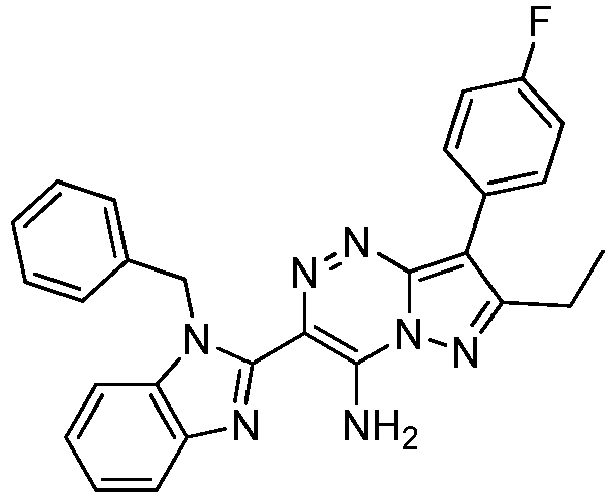
- Prepared from compound from Preparative Example 4A and Preparative Example D.
- The product was additionally purified by column flash chromatography on silica gel (eluent: hexane/ EtOAc - 1 : 1).
- Yellow solid.
MP > 250 °C.
1H NMR (500 MHz, DMSO-d6): δ 1.34 (t, 3H, J = 7.5 Hz) 3.05 (q, 2H, J = 7.5 Hz), 6.30 (s, 2H), 7.20 (d, 3H, J = 7.3 Hz), 7.27 - 7.23 (m, 2H), 7.32 - 7.28 (m, 2H), 7.36 - 7.31 (m, 2H), 7.61 - 7.55 (m, 1H), 7.86 - 7.78 (m, 3H), 9.37 (s, 1H), 10.37 (s, 1H) ppm.
13C NMR (125 MHz, DMSO-d6): δ 13.09, 20.82, 48.88, 107.13, 110.78, 115.41 (d, J = 21.4 Hz), 118.64, 120.55, 122.68, 122.95 (d, J = 67.5 Hz), 126.62, 127.12, 127.50, 128.45, 130.81 (d, J = 8.1 Hz), 135.31, 137.57, 139.52, 141.07, 145.52, 148.02, 158.00, 161.02 (d, J = 244.1 Hz) ppm.
HRMS calculated for C27H23N7F [M+H]+ 464.1993, found 464.1997. -

- Prepared from compound from Preparative Example 4B and Preparative Example D.
- The product was additionally purified by column flash chromatography on silica gel (eluent: EtOAc/MeOH - 10 : 1).
- Brown solid.
MP = 219.8 - 220.7 °C.
1H NMR (500 MHz, DMSO-d6): δ 1.35 (t, 3H, J = 7.6 Hz), 2.89 (q, 2H, J = 7.6 Hz), 6.27 (s, 2H), 6.82 (s, 1H), 7.17 - 7.22 (m, 3H), 7.23 - 7.28 (m, 2H), 7.28 - 7.33 (m, 2H), 7.56-7.67 (m, 1H), 7.85 - 7.76 (m, 1H), 9.29 (s, 1H), 10.26 (s, 1H) ppm; 13C NMR (125 MHz, DMSO - d6): δ 13.37, 21.72, 48.87, 94.41, 110.75, 118.61, 119.65, 122.65, 123.16, 126.69, 127.12, 128.43, 135.36, 137.65, 139.53, 141.04, 148.15, 148.80, 161.67 ppm.
HRMS calculated for C21H20N7 [M+H]+ 370.1775, found 370.1776. -

- Prepared from 3-aminopyrazole.
- Brown-orange solid.
MP > 250 °C (dec.).
1H NMR (500 MHz, DMSO-d6): δ (ppm) 7.06 (d, J = 2.4 Hz, 1H), 7.13 - 7.39 (m, 2H), 7.54 (d, J = 6.8 Hz, 1H), 7.75 (d, J = 6.6 Hz, 1H), 8.42 (d, J = 2.4 Hz, 1H), 9.46 (s, 1H), 9.96 (s, 1H), 13.45 (s, 1H);
13C NMR (125 MHz, DMSO-d6): δ (ppm) 96.71, 111.45, 118.30, 118.41, 121.81, 122.86, 133.71, 139.22 , 142.66, 146.07, 149.13, 150.06;
HRMS calculated for C12H8N7 [M-H]- 250.0846, found 250.0844. -

- Compound from Preparative Example 4M (0.22 g, 1.25 mmol) was dissolved in EtOH (3 mL) and H2O (3 mL) and 35% aqueous HCl (0.44 mL, 5.0 mmol) was added. The solution was cooled to -10 °C and a pre-cooled (-5 °C) solution of NaNO2 (0.17 g, 2.5 mmol) in EtOH (2 mL) and H2O (2 mL) was added. The reaction mixture was stirred for 20 min, then a pre-cooled solution (- 5 °C) of KOAc (0.74 g, 7.52 mmol) plus 2-(cyanomethyl)benzimidazole (0.24 g, 1.5 mmol) in EtOH (3 mL) and H2O (3 mL) was added. The resulting mixture was allowed to warm to 25 °C and was stirred for 3 hrs. The precipitated solid was filtered and washed on filter with cold water (20 mL). The product was dried in a vacuum to yield a yellow-grey solid, which was used directly for the next step without additional purification.
- The solid was dissolved in anhydrous DMF (3 mL) and the mixture was refluxed under N2 for 2 hrs. The solvent was evaporated. The residue was mixed with EtOAc (50 mL), washed with water (2 x 50 mL) and then with brine (2 x 50 mL). The organic phase was dried over MgSO4, filtered, and the solvent was evaporated. To the residue were added CH2Cl2 (5 mL) and diethyl ether (10 mL) and after trituration the precipitate was filtered and rinsed with cold diethyl ether (20 mL). The solid was dried in a vacuum to give a yellow solid (235 mg, 54 %).
MP > 350 °C (dec.).
1H NMR (500 MHz, DMSO-d6): δ (ppm) 7.26 (s, 2H), 7.34 (t, J = 8.9 Hz, 2H), 7.59 (s, 1H), 7.75 (s, 1H), 8.37 (dd, J = 8.8, 5.5 Hz, 2H), 8.95 (s, 1H), 9.59 (s, 1H), 10.04 (s, 1H), 13.45 (s, 1H);
13C NMR (125 MHz, DMSO - d6): δ (ppm) 108.93, 115.66 (d, J = 21.6 Hz), 119.28, 127.92 (d, J = 7.6 Hz), 139.39, 143.63, 145.05, 149.91, 160.91 (d, J = 244.7 Hz).
HRMS calculated for C18H11FN7 [M+H]+ 344.1065, found 344.1069. -

- 1M TBAF in THF (0.5 ml, 0.5 mmol) was added at 0 °C to a solution of compound from Preparative Example 51 (130.0 mg, 0.25 mmol) in THF (5 mL). The mixture was stirred at 25 °C for 2 hrs, then it was poured into water (50 mL). The crude product was collected by filtration and purified by column flash chromatography on silica gel (eluent: CH2Cl2/: 7N NH3 in MeOH - 10 : 1) to yield an orange solid (52 mg, 57 %).
MP > 250 °C.
1H NMR (500 MHz, DMSO-d6): δ 4.77 (d, 2H, J = 5.8 Hz), 5.54 (t, 1H, J = 5.8 Hz), 6.94 (s, 1H), 7.20 - 7.30 (m, 2H), 7.54 (dd, 1H, J = 6.9, 1.0 Hz), 7.73 (d, 1H. J = 7.2 Hz), 9.42 (s, 1H), 9.93 (s, 1H), 13.43 (s, 1H) ppm.
13C NMR (125 MHz, DMSO-d6): δ 57.68, 94.54, 111.44, 118.25, 118.48, 121.79, 122.83, 133.69, 138.94, 142.64, 149.51, 150.09, 160.83 ppm.
HRMS calculated for C13H12N7O [M+H]+ 282.1098, found 282.1102. -

- A mixture of compound from Preparative Example 6 (50.0 mg, 0.2 mmol) and IBX (60.0 mg, 0.22 mmol) in wet DMSO (2mL) was stirred at 50 °C for 16 hrs. The solution was poured into water (7 mL), the precipitate was collected by filtration and dried in a vacuum to yield a yellow solid (22 mg, 44 %).
MP > 250 °C.
1H NMR (500 MHz, DMSO-d6): δ 7.33 - 7.22 (m, 2H), 7.52 (s, 1H),. 7.56 (d, 1H, J = 6.7 Hz), 7.77 (d, 1H. J = 6.9 Hz), 9.88 (s, 1H), 10.17 (s, 1H), 10.26 (s, 1H), 13.55 (s, 1H) ppm. 13C NMR (125 MHz, DMSO-d6): δ 96.62, 111.59, 118.45, 119.89, 121.99, 123.14, 133.73, 139.50, 142.58, 149.59, 149.68, 153.25, 187.74 ppm.
HRMS calculated for C13H10N7O [M+H]+ 280.0941, found 280.0945. -

- Compound from preparative Example 5A (50.0 mg, 0.14 mmol) was dissolved in 23 % aqueous HCl (5 mL) and the solution was refluxed for 2 hrs. The reaction mixture was poured into water (20 mL) and neutralized by saturated aqueous solution of NaHCO3 (150 mL). The precipitate was collected by filtration, washed on filter with water (20 mL), then with Et2O (15 mL) and dried in a vacuum to yield a yellow solid (35 mg, 70 %).
MP > 250 °C.
1H NMR (500 MHz, DMSO-d6): δ 1.27 (t, 3H, J - 7.5 Hz), 2.93 (q, 2H. J - 7.5 Hz), 7.34 (q, 2H, J - 8.9 Hz), 7.46 (m, 2H), 7.78 (m, 4H), 14.12 (s, 2H) ppm; 13C NMR (125 MHz, DMSO-d6): δ 13.04, 20.72, 107.86, 113.44, 115.32 (d, J = 21.1 Hz), 119.47, 124.86, 128.04, 130.88 (d, J = 8.0 Hz), 131.11, 147.85, 148.80, 155.94, 160.96 (d. J = 244.1 Hz) ppm.
HRMS calculated for C20H16FN6O [M+H]+ 375.1364, found 375.1366. -

- Compound from Preparative Example 5B (111 mg, 0.40 mmol) was suspended in acetonitrile (8 mL) under nitrogen and the suspension was cooled to 0 °C. In a second flask NBS (84 mg, 0.47 mmol) was dissolved in acetonitrile (3 ml) and was added dropwise to the first solution. The suspension was stirred 4 h at 25 °C and was then poured to water (50 ml). A precipitated appeared in 5 min. The precipitate was filtered washed with water (10 ml) and Et2O (5 ml). The product was dried under vacuum to obtain an orange solid in a yield of 73 % (102 mg, 0.28 mol).
MP > 250 °C.
1H NMR (500 MHz, DMSO-d6): δ 1.36 (t, 3H. J = 7.59 Hz), 2.90 (q, 2H, J = 7.60 Hz), 7.22 - 7.29 (m, 2H), 7.56 (d, 1H, J = 7.64 Hz), 7.75 (d, 1H, J = 7.66 Hz), 9.54 (s, 1H), 10.09 (s, 1H), 13.40 (s, 1H) ppm.
13C NMR (125 MHz, DMSO-d6): δ 12.62, 20.53, 82.55, 111.53, 118.34, 119.68, 121.91, 123.02, 133.71, 138.88, 142.58, 145.99, 149.74, 158.48 ppm.
HRMS calculated for C14H11Br N7 [M-H]- 356.0265, found 356.0269. -

- LiCl (90 mg, 2.12 mmol) and compound from Preparative Example 5B (150 mg, 0.53 mmol) were dissolved in DMF (5 ml) at 50 °C. The solution was cooled to 0 °C, then were added SOCl2 (94 mg, 0.8 mmol) and isoamylnitrite (94 mg, 0.8 mmol). The solution was stirred 5 h at 25 °C. After completion of the reaction, the solution was poured to a saturated aqueous solution of NaHCO3 (25 ml). The product was extracted with EtOAc (3 x 25 ml). The combined organic phases were dried over MgSO4 and solvent was evaporated. The residue was purified using preparative TLC (EtOAc). A red solid was isolated in 6 % yield (10 mg, 0.04 mmol).
1H NMR (500 MHz, DMSO-d6): δ 1.46 (t, 3H, J = 7.6), 3.11 (q, 2H, J = 7.6 Hz), 7.77 (t, 1H, J = 7.6 Hz), 7.77 (t, 1H, J = 7.6 Hz), 7.85 (t, 1H, J = 7.7 Hz), 7.90 (s, 1H), 8.18 (d, 1H, J = 8.1 Hz), 8.60 (d, 1H, J = 8.1 Hz) ppm.
13C NMR (125 MHz, DMSO-d6): δ 13.83, 22.41, 102.83, 112.91, 120.68, 121.07, 125.65, 129.12, 129.18, 129.43, 136.05, 143.78, 153.62, 163.66 ppm. - In vitro assays were used for the determination of compound's IC50 values for inhibition of individual nucleases, i.e., MUS81/EME1, FEN1, EXO1, and MRE11. To generate IC50 values, concentration of compound was plotted against relative nuclease activity (in %). The dose-response curves were generated from inhibition data, from 5 point serial dilutions of inhibitory compounds, each in triplicate and fitted to a standard sigmoid curve. IC50 values were derived by standard nonlinear regression analysis.
- All tested compounds were diluted in 100% DMSO (dimethylsulfoxide) to prepare working stocks with different concentrations. To keep the DMSO concentration constant in every reaction, always 0.5 µl of the compound stock was added to the reaction buffer. The reaction buffer differs depending on the enzyme tested. Also concentration of the compounds in the reaction depends on the particular enzyme, since the inhibitory effect of the compounds vary between the enzymes. Nevertheless, always doubling dilutions in the range 200-0.8 µM was used. The compound was added as the first component in the reaction buffer, followed by the enzyme addition. Short (15 minutes) pre-incubation step followed before the reaction was initiated by addition of DNA substrate (5 nM).
- As a negative control, DNA substrate specific for each particular enzyme without the addition of the enzyme and the compound was used. The positive control contained all components of the reaction, except the compound of interest. However, to compensate for solvent effects, DMSO (at a final concentration of 2.5%) was included in the reaction.
- For this experiment we prepared short fluorescently labeled oligonucleotide-based DNA substrates with specific structures reflecting the biochemical activities of tested individual nucleases (Table 1). These substrates were prepared by annealing of synthetic oligonucleotides purchased from VBC Biotech. Composition of each substrate is indicated below the table; the corresponding oligonucleotides were combined in equimolar ratios. For visualization, each substrate was labeled by fluorescent dye (fluorescein), which can be detected in the gel using appropriate imaging system (FLA-9000, Fuji) with filters for particular wavelengths (excitation: 485 nm, emission: 535 nm).
Table 1: Oligonucleotide Sequence Oligo 1 
Oligo 2 
Oligo 3 5'- AATTCGTGCAGGCATGGTAGCT -3' Oligo 4 5'- AGCTATGACCATGATTACGAATTGCTT -3' Oligo 5 
Oligo 6 5'- AATTCGTGCAGGCATGGTAGCT-3' 
- Nuclease assays were performed in reaction buffer specific for particular enzyme: MUS81/EME1 (50 mM Tris pH= 7.5, 5 mM MgCl2, 1 mM DTT a 100 µg/ml BSA), MRE11 (30 mM Bis-Tris pH=7.0, 50 µg/ml BSA, 1 mM DTT a 250 µM MnCl2), EXO1 and FEN1 (50 mM Tris pH= 7.5, 1 mM MgCl2, 1 mM DTT a 100 µg/ml BSA). The individual reactions were prepared by mixing with highly purified enzyme (MUS81/EME1 (5 nM), MRE11 (5 nM), EXO1 (5 nM) or FEN1 (10 nM); purification protocols described below), and different concentration of inhibitor (mentioned above) in corresponding reaction buffer. The final volume of the reaction was 20 µl. After short pre-incubation (15 minutes at room temperature), the reaction was initiated by addition of 5 nM of corresponding fluorescently labeled DNA substrate (3' flap for MUS81/EME1, 5' flap for MRE11 and FEN1, 3' OH for EXO1; see Figure 1) and incubated for 15 minutes at 30°C. Next, the reaction was stopped and deproteinized by addition of 2 µl of stop buffer, containing 0.1% SDS and 500 µg/ml proteinase K, and incubated for additional 5 minutes at 30°C. Then the loading dye, containing glycerol (60% glycerol, 10 mM Tris pH=7.4, 60 mM EDTA a 0.1% Orange G), was added to each reaction (1/10 of the reaction volume), and the whole mixture was subjected to electrophoresis in 10% polyacrylamide native gel (110 V, 40 min, 1x TBE). Fluorescently labeled DNA was detected by FLA-9000 scanner (Fuji) and the result was evaluated using Multi-Gauge V3.2 software (Fuji).
- The Mus81/Eme1 expression construct was a kind gift from Dr. Steve West (Cancer Research UK). Briefly, the nuclease complex was purified as follows. Lysate was prepared from 40 g of E. coli cell paste using sonication in 50 ml of lysis buffer C (50 mM Tris-HCl, pH 7.5, 10% sucrose, 10 mM EDTA, 1 mM β-mercaptoethanol, 0.01% Nonidet P-40, protease inhibitors) containing 150 mM KCl. The cleared lysate was applied sequentially onto a 20-ml Q-Sepharose and 20-ml SP-Sepharose columns (GE Healthcare). Proteins were eluted from the SP-Sepharose column with a 200-ml gradient from 150 to 1000 mM KCl in buffer K (20 mM K2HPO4, pH 7.5, 10% sucrose, 10 mM EDTA, 1 mM β-mercaptoethanol, 0.01% Nonidet P-40). The peak fractions were pooled and mixed with 1 ml of His-Select nickel affinity gel (Sigma) for 1 h at 4 °C. The beads were washed with 10 ml of buffer K containing 150 mM KCl and 10 mM imidazole. The bound proteins were eluted using 50, 150, 300, or 500 mM imidazole in buffer K containing 150 mM KCl. The 150, 300, and 500 mM imidazole fractions were loaded onto a 1-ml Heparin column (GE Healthcare) and proteins were eluted with a 10-ml gradient from 150 to 1000 mM KCl in buffer K. Peak fractions were pooled, loaded onto a 1-ml Mono S column (GE Healthcare), and eluted with a 10-ml gradient from 150 to 1000 mM KCl in buffer K. Pooled fractions were concentrated, flash-frozen in 5µl aliquots and stored at -80°C.
- The Fen1 expression plasmid was a kind gift from Binghui Shen (City of Hope National Medical Center). Fen1 was expressed and purified according to the method we described elsewhere (J. Biol. Chem. 2009, 284, 7733.).
- Briefly, 6 g of E. coli cell paste were break using sonication in 30 ml of buffer C (50 mM Tris-HCl, pH 7.5, 10% sucrose, 10 mM EDTA, 1 mM dithiothreitol, 0.01% Nonidet P-40, protease inhibitors) containing 150 mM KCl. The crude lysate was clarified by centrifugation (100,000 × g, 90 min). The cleared lysate was applied sequentially onto a 7-ml Q-Sepharose column and a 7-ml SP-Sepharose column. The SP-Sepharose column was developed with a 70-ml gradient from 100 to 800 mM KCl in buffer K (20 mM K2HPO4, pH 7.5, 10% sucrose, 10 mM EDTA, 1 mM β-mercaptoethanol, 0.01% Nonidet P-40). The peak fractions were pooled and mixed with 0.5 ml of His-Select nickel affinity gel. The beads were washed with 10 column volumes of buffer K containing 150 mM KCl and 5 mM imidazole. The bound proteins were eluted from the affinity beads using 50, 150, 300, and 500 mM imidazole in buffer K containing 150 mM KCl. The 150, 300, and 500 mM imidazole fractions were pooled and further fractionated in a 0.5-ml MonoS column with a 5-ml gradient of 220 to 700 mM KCl in buffer K. Fractions with purified Fen1 were pooled, concentrated in a Vivaspin concentrator, and then stored in 5-µl aliquots at -80 °C.
- The MRE11 gene was introduced into the vector pPM271 containing the galactose-inducible hybrid GAL-PGK promoter. The resulting plasmid was introduced into the protease-deficient strain BJ5464 (MATα ura3-52 trp1 leu2Δ1 his3Δ200 pep4::HIS3 prb1Δ1.6R can1). Cultures were grown overnight to the stationary phase in synthetic medium lacking leucine and diluted 8-fold into leucine dropout synthetic media with 3% glycerol, 3% lactic acid, and 2% galactose. After 24 h of growth at 30 °C, cells were harvested by centrifugation.
- The yeast Mre11 was purified as follows. Approximately 30g of cell pellet was lysed using cryo-mill and the powder was then resuspended in 120 ml of lysis buffer C containing 100 mM KCl followed by sonication. The lysate was clarified by centrifugation and subjected to ammonium sulfate precipitation at 0.28 g/ml. The resulting precipitate was dissolved in 50 ml of K buffer (20 mM K2HPO4, pH 7.5, 10% sucrose, 10 mM EDTA) containing 0.01% NP40, 1 mM DTT and protease inhibitors and applied to a 20 ml Q-Sepharose column. The protein was eluted in 200-ml gradient from 100-1000 mM KCl. The fractions containing Mre11 were pooled and loaded on a 1-ml macro-hydroxyapatite column, and eluted with a gradient of 0-400 mM KH2PO4 in K buffer + 100 mM KCl. The peak fractions were pooled and applied onto 1-ml MonoS column, which was developed with a 10-ml KCl gradient from 100 to 1000 mM KCl. The fractions with purified Mre11 were pooled and concentrated in Vivaspin micro concentrator to final concentration 10 µg/µl. Small (5µl) aliquots were stored at -80°C.
- The plasmid for expression of human Exo1 was a kind gift from Pavel Janscak (Institute of Molecular cancer Research, University of Zurich).
- The Escherichia coli strain BL21 (RIPL) transformed with plasmid containing EXO1 fusion with Mxe-CBD self-cleaving affinity tag was induced with 0.2 mM IPTG for 16 h at 16°C. The cells were pelleted and stored at -80°C. All steps of purification were carried out at 0-4°C. The cell pellet (40 g) was resuspended in 150 ml of buffer CH (50 mM Tris-HCl, pH 8.0, 500 mM NaCl, 1 mM EDTA, 10% glycerol, 0,1% Triton X-100 and protease inhibitors), sonicated and centrifuged (100 000g, 60 min). Clarified supernatant was loaded onto 10-ml chitin-column (Chitin-agarose beads, New England Biolabs) pre-equilibrated with CH buffer. The column was subsequently flashed with 30 ml of CH buffer supplemented with 50 mM DTT and let overnight to induce protein cleavage. The cleaved hExo1 was eluted with 50 ml of buffer CH in 5 ml fractions. Pooled hExo1 fractions were loaded onto 1.0-ml MonoS column equilibrated with buffer K (20 mM K2HPO4, pH 7.5, 10% sucrose, 10 mM EDTA, 1 mM β-mercaptoethanol, 0.01% Nonidet P-40) containing 100 mM KCl and eluted with 10 ml gradient of 100-1000 mM KCl in buffer K. Peak fractions were pooled and concentrated in Vivaspin concentrator to final concentration 1 µg/µl. Small aliquots of hExo1 protein was stored at -80°C.
- Table 2 shows IC50 values (in µM) of different compounds for nucleases tested in our assay.
-
- A: IC50 < 10 µM
- B: IC50 < 50 µM
- C: IC50 > 50 µM
-
- <110> Masarykova univerzita
- <120> Pyrazolotriazines as inhibitors of nucleases
- <130> P1303EP00
- <140>
EP 14173242
<141> 2014-06-20 - <160> 6
- <170> PatentIn version 3.5
- <210> 1
<211> 49
<212> DNA
<213> Artificial - <220>
<223> sequence used in nuclease inhibition assay - <400> 1
agctaccatg cctgcacgaa ttaagcaatt cgtaatcatg gtcatagct 49 - <210> 2
<211> 47
<212> DNA
<213> Artificial - <220>
<223> sequence used in nuclease inhibition assay - <400> 2
agctatgacc atgattacga attgcttgga atcctgacga actgtag 47 - <210> 3
<211> 22
<212> DNA
<213> Artificial - <220>
<223> sequence used in nuclease inhibition assay - <400> 3
aattcgtgca ggcatggtag ct 22 - <210> 4
<211> 27
<212> DNA
<213> Artificial - <220>
<223> sequence used in nuclease inhibition assay - <400> 4
agctatgacc atgattacga attgctt 27 - <210> 5
<211> 42
<212> DNA
<213> Artificial - <220>
<223> sequence used in nuclease inhibition assay - <400> 5
gatgtcaagc agtcctaagg aattcgtgca ggcatggtag ct 42 - <210> 6
<211> 22
<212> DNA
<213> Artificial - <220>
<223> sequence used in nuclease inhibition assay - <400> 6
aattcgtgca ggcatggtag ct 22
| compound of Example | MUS81/EME1 | MRE11 | FEN1 | EXO1 |
| 5A | A | C | C | c |
| 8 | A | |||
| 5C | B | C | C | C |
| 5H | A | C | C | C |
| 5K | A | B | C | C |
| 5O | C | |||
| 5B | B | |||
| 5P | C | |||
| 9 | B | |||
| 5F | B | |||
| 5D | B | |||
| 5G | B | |||
| 6 | C | |||
| 5N | B | |||
| 5M | B |
Claims (6)
- Compounds represented by the structural formula (1):
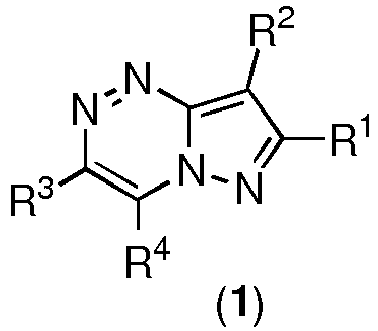 R1 is selected from the group consisting of alkyl, aryl, arylalkyl, heteroaryl, heteroarylalkyl, optionally substituted by at least one moiety selected from F, Cl, Br, CH3, OH, =O, SH, OCH3, SCH3, CF3, OCF3, NH2, N(CH3)2, aryl, heteroaryl, alkyl, wherein aryl, heteroaryl, alkyl can optionally be further substituted by F, Cl, Br, CH3, OH, SH, OCH3, SCH3, CF3, OCF3, NH2, or N(CH3)2 ;R2 is selected from the group consisting of H; alkyl, aryl, optionally-substituted by at least one moiety selected from F, Cl, Br, CH3, OH, =O, SH, OCH3, SCH3, CF3, OCF3, NH2, N(CH3)2, -S(O2)R11, -S(O2)NR11R12; wherein R11, R12 are selected from the group consisting of H, alkyl, aryl, arylalkyl, cycloalkyl;R3 is heteroaryl, optionally substituted by at least one moiety selected from F, Cl, Br, CH3, OH, =O, SH, OCH3, SCH3, CF3, OCF3, NH2, N(CH3)2, aryl, heteroaryl, alkyl, wherein aryl, heteroaryl and alkyl can optionally be further substituted by F, Cl, Br, CH3, OH, =O, SH, OCH3, SCH3, CF3, OCF3, NH2, or N(CH3)2; wherein "heteroaryl" means an aromatic polycyclic ring system containing 7 to 14 carbon atoms, preferably 3 to 7 carbon atoms, most preferably 3 to 5 carbon atoms, and at least one heteroatom selected from the group consisting of nitrogen, oxygen and sulfur, or "heteroaryl" means imidazolyl;R4 is selected from the group consisting of F, Cl, Br, CH3, OH, =O, SH, OCH3, SCH3, CF3, OCF3, NH2, N(CH3)2.
 - Compounds of formula (1) according to claim 1, wherein R1 is selected from alkyl, aryl, optionally substituted by at least one moiety selected from F, Cl, Br, CH3, OH, =O, SH, OCH3, SCH3, CF3, OCF3, NH2, N(CH3)2, aryl, heteroaryl, alkyl, wherein aryl, heteroaryl, alkyl can optionally be further substituted by F, Cl, Br, CH3, OH, SH, OCH3, SCH3, CF3, OCF3, NH2, or N(CH3)2.
- Compounds of formula (1) according to claim 1, wherein R4 is OH or NH2.
- Compounds of formula (1) according to any preceding claim for use as medicaments.
- A pharmaceutical composition comprising at least one compound of formula (1) and at least one pharmaceutically acceptable auxiliary compound.
- Compounds of formula (1a)
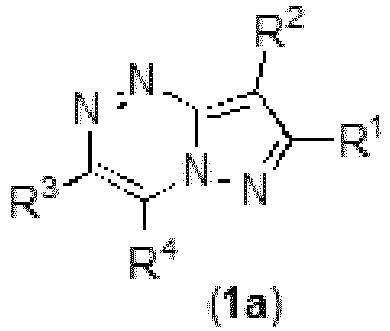 R1 is selected from the group consisting of H; alkyl; aryl; arylalkyl; cycloalkyl; heterocyclyl; heterocyclylalkyl; heteroaryl and heteroarylalkyl, wherein each of the alkyl, aryl, cycloalkyl, arylalkyl, heterocyclyl, heterocyclylalkyl, heteroaryl, heteroaryalkyl can be unsubstituted or optionally substituted with one or more moieties which can be the same or different, each moiety being independently selected from the group consisting of F, Cl, Br, CF3, OCF3, CN, =O, OR11, -NR11R12, -C(R11R12)pR9a, -C(R11R12)pOR9a,-C(R11R12)pSR9a, -C(O2)R11, -C(O)R11, -C(S)R11, -C(O)NR11R12, -SO3H, -SR11, S(O2)R11,-S(O2)NR11R12, -N(R11)S(O2)R12, -N(R11)C(O)R12, -C(=NOR11), -N(R9a)C(O)NR11R12, alkyl, aryl, cycloalkyl, heterocyclyl and heteroaryl, wherein alkyl, aryl, cycloalkyl, heterocyclyl, heteroaryl can optionally be further substituted by F, Cl, Br, CH3, OH, SH, OCH3, SCH3, CF3, OCF3, NH2, or N(CH3)2;R2 is selected from the group consisting of H; alkyl; aryl; arylalkyl; cycloalkyl; heterocyclyl; heterocyclylalkyl; heteroaryl and heteroarylalkyl, wherein each of the alkyl, aryl, cycloalkyl, arylalkyl, heterocyclyl, heterocyclylalkyl, heteroaryl, heteroaryalkyl can be unsubstituted or optionally substituted with one or more moieties which can be the same or different, each moiety being independently selected from the group consisting of F, Cl, Br, CF3, OCF3, CN, =O, OR11, -NR11R12, -C(R11R12)pR9a, -C(R11R12)pOR9a,-C(R11R12)pSR9a, -C(O2)R11, -C(O)R11, -C(S)R11, -C(O)NR11R12, -SO3H, -SR11, S(O2)R11,-S(O2)NR11R12, -N(R11)S(O2)R12, -N(R11)C(O)R12, -C(=NOR11), -N(R9a)C(O)NR11R12, alkyl, aryl, cycloalkyl, heterocyclyl and heteroaryl, wherein alkyl, aryl, cycloalkyl, heterocyclyl, heteroaryl can optionally be further substituted by F, Cl, Br, CH3, OH, SH, OCH3, SCH3, CF3, OCF3, NH2, or N(CH3)2;R3 is selected from the group consisting of aryl; arylalkyl; cycloalkyl; heterocyclyl; heterocyclylalkyl; heteroaryl and heteroarylalkyl, wherein each of the alkyl, aryl, cycloalkyl, arylalkyl, heterocyclyl, heterocyclylalkyl, heteroaryl, heteroaryalkyl can be unsubstituted or optionally substituted with one or more moieties which can be the same or different, each moiety being independently selected from the group consisting of F, Cl, Br, CF3, OCF3, CN, =O, OR11, -NR11R12, -C(R11R12)pR9a, -C(R11R12)pOR9a, -C(R11R12)pSR9a,-C(O2)R11, -C(O)R11, -C(S)R11, -C(O)NR11R12, -S03H, -SR11, S(O2)R11, -S(O2)NR11R12,-N(R11)S(O2)R12, -N(R11)C(O)R12, -C(=NOR11), -N(R9a)C(O)NR11R12, alkyl, aryl, cycloalkyl, heterocyclyl and heteroaryl, wherein alkyl, aryl, cycloalkyl, heterocyclyl, heteroaryl can optionally be further substituted by F, Cl, Br, CH3, OH, SH, OCH3, SCH3, CF3, OCF3, NH2, or N(CH3)2;R4 is selected from the group consisting of F, Cl, Br, CH3, OH, =O, SH, OCH3, SCH3, CF3, OCF3, NH2, N(CH3)2 ;R9 is H, alkyl or aryl, optionally substituted by one or more substituents selected from F, Cl, Br, CH3, OH, SH, OCH3, SCH3, CF3, OCF3, NH2, N(CH3)2,R9a is H, alkyl or aryl, optionally substituted by one or more substituents selected from F, Cl, Br, CH3, OH, SH, OCH3, SCH3, CF3, OCF3, NH2, N(CH3)2,R10 is H, alkyl or aryl, optionally substituted by one or more substituents selected from F, Cl, Br, CH3, OH, SH, OCH3, SCH3, CF3, OCF3, NH2, N(CH3)2,R11 is selected from the group consisting of H, alkyl, aryl, arylalkyl, cycloalkyl, heterocyclyl, heterocyclylalkyl, heteroaryl, heteroarylalkyl, wherein each of the alkyl, aryl, cycloalkyl, arylalkyl, heterocyclyl, heterocyclylalkyl, heteroaryl, heteroaryalkyl can be unsusbtituted or optionally substituted with one or more moieties which can be the same or different, each moiety being independently selected from the group consisting of F, Cl, Br, CF3, OCF3, CN, =O, OR9, NR9R10 -C(R9R10)pR9a, -C(R9R10)pOR9a, -C(R9R10)pSR9a,-C(O2)R9, -C(O)R9, -C(S)R9, -C(O)NR9R10, -SO3H, -SR9, S(O2)R9 -S(O2)NR9R10,-N(R9)S(O2)R10, -N(R9)C(O)R10, -C(=NOR9), and -N(R9a)C(O)NR9R10, alkyl, aryl, cycloalkyl, heterocyclyl and heteroaryl, wherein alkyl, aryl, cycloalkyl, heterocyclyl, heteroaryl can optionally be further substituted by F, Cl, Br, CH3, OH, SH, OCH3, SCH3, CF3, OCF3, NH2, or N(CH3)2;R11a is selected from the group consisting of H, alkyl, aryl, arylalkyl, cycloalkyl, heterocyclyl, heterocyclylalkyl, heteroaryl, heteroarylalkyl, wherein each of the alkyl, aryl, cycloalkyl, arylalkyl, heterocyclyl, heterocyclylalkyl, heteroaryl, heteroaryalkyl can be unsusbtituted or optionally substituted with one or more moieties which can be the same or different, each moiety being independently selected from the group consisting of F, Cl, Br, CF3, OCF3, CN, =O, OR9, NR9R10 -C(R9R10)pR9a, -C(R9R10)pOR9a, -C(R9R10)pSR9a,-C(O2)R9, -C(O)R9, -C(S)R9, -C(O)NR9R10, -SO3H, -SR9, S(O2)R9 -S(O2)NR9R10,-N(R9)S(O2)R10, -N(R9)C(O)R10, -C(=NOR9), and -N(R9a)C(O)NR9R10, alkyl, aryl, cycloalkyl, heterocyclyl and heteroaryl, wherein alkyl, aryl, cycloalkyl, heterocyclyl, heteroaryl can optionally be further substituted by F, Cl, Br, CH3, OH, SH, OCH3, SCH3, CF3, OCF3, NH2, or N(CH3)2;R12 is selected from the group consisting of H, alkyl, aryl, arylalkyl, cycloalkyl, heterocyclyl, heterocyclylalkyl, heteroaryl, heteroarylalkyl, wherein each of the alkyl, aryl, cycloalkyl, arylalkyl, heterocyclyl, heterocyclylalkyl, heteroaryl, heteroaryalkyl can be unsusbtituted or optionally substituted with one or more moieties which can be the same or different, each moiety being independently selected from the group consisting of F, Cl, Br, CF3, OCF3, CN, =O, OR9, NR9R10 -C(R9R10)pR9a, -C(R9R10)pOR9a, -C(R9R10)pSR9a,-C(O2)R9, -C(O)R9, -C(S)R9, -C(O)NR9R10, -SO3H, -SR9, S(O2)R9 -S(O2)NR9R10,-N(R9)S(O2)R10, -N(R9)C(O)R10, -C(=NOR9), and -N(R9a)C(O)NR9R10, alkyl, aryl, cycloalkyl, heterocyclyl and heteroaryl, wherein alkyl, aryl, cycloalkyl, heterocyclyl, heteroaryl can optionally be further substituted by F, Cl, Br, CH3, OH, SH, OCH3, SCH3, CF3, OCF3, NH2, or N(CH3)2;p is 1 to 7,for use in a method of treatment and/or prevention of breast, colon, prostate, lung, head and neck, hepatic, ovarian, colorectal, gastric, melanoma cancers, leukemias, Nijmegen breakage syndrome and Nijmegen breakage-like syndrome, Ataxia-telangiectasia and Ataxia-telangiectasia-like disorder, and Fanconi anemia.
Priority Applications (4)
| Application Number | Priority Date | Filing Date | Title |
|---|---|---|---|
| EP14173242.0A EP2957562B1 (en) | 2014-06-20 | 2014-06-20 | Pyrazolotriazines as inhibitors of nucleases |
| JP2017518407A JP6313906B2 (en) | 2014-06-20 | 2015-06-17 | Pyrazolotriazines as nuclease inhibitors |
| US15/316,764 US9969741B2 (en) | 2014-06-20 | 2015-06-17 | Pyrazolotriazines as inhibitors of nucleases |
| PCT/CZ2015/000063 WO2015192817A1 (en) | 2014-06-20 | 2015-06-17 | Pyrazolotriazines as inhibitors of nucleases |
Applications Claiming Priority (1)
| Application Number | Priority Date | Filing Date | Title |
|---|---|---|---|
| EP14173242.0A EP2957562B1 (en) | 2014-06-20 | 2014-06-20 | Pyrazolotriazines as inhibitors of nucleases |
Publications (2)
| Publication Number | Publication Date |
|---|---|
| EP2957562A1 EP2957562A1 (en) | 2015-12-23 |
| EP2957562B1 true EP2957562B1 (en) | 2017-12-20 |
Family
ID=50972588
Family Applications (1)
| Application Number | Title | Priority Date | Filing Date |
|---|---|---|---|
| EP14173242.0A Active EP2957562B1 (en) | 2014-06-20 | 2014-06-20 | Pyrazolotriazines as inhibitors of nucleases |
Country Status (4)
| Country | Link |
|---|---|
| US (1) | US9969741B2 (en) |
| EP (1) | EP2957562B1 (en) |
| JP (1) | JP6313906B2 (en) |
| WO (1) | WO2015192817A1 (en) |
Families Citing this family (5)
| Publication number | Priority date | Publication date | Assignee | Title |
|---|---|---|---|---|
| RU2641107C1 (en) * | 2016-10-24 | 2018-01-16 | Федеральное государственное автономное образовательное учреждение высшего образования "Уральский федеральный университет имени первого Президента России Б.Н. Ельцина" | SODIUM SALT OF 3-NITRO-4-OXO-1,4-DIHYDROPYRAZOLO[5,1-c]-1,2,4-TRIAZINE-8-CARBOXYLIC ACID, DIHYDRATE |
| WO2018170067A1 (en) * | 2017-03-14 | 2018-09-20 | Dana-Farber Cancer Institute, Inc. | Small molecule sensitization of bax activation for induction of cell death |
| CN109020814B (en) * | 2017-06-09 | 2021-06-29 | 南开大学 | A kind of polysubstituted 10-hydroxyphenanthrene and its derivative and its synthetic method |
| CA3075892C (en) | 2017-09-14 | 2024-01-23 | Daiichi Sankyo Company, Limited | Heterocyclic compounds for the treatment and/or prevention of inflammatory diseases |
| CN113185428B (en) * | 2021-05-10 | 2022-07-15 | 安徽省庆云医药股份有限公司 | Synthesis method of 4-methyl-3-oxo-valeronitrile |
Family Cites Families (3)
| Publication number | Priority date | Publication date | Assignee | Title |
|---|---|---|---|---|
| WO2007039146A1 (en) * | 2005-09-23 | 2007-04-12 | Smithkline Beecham Corporation | 4-carboxy pyrazole derivatives as anti-viral agents |
| EP2203453A1 (en) * | 2007-09-20 | 2010-07-07 | Wyeth a Corporation of the State of Delaware | Pyrazolo[5, 1-c] [1,2,4]triazines, methods for preparation and use thereof |
| EP2922852A4 (en) * | 2012-11-20 | 2016-05-25 | Discoverybiomed Inc | CFTR SMALL MOLECULE CORRECTIVES |
-
2014
- 2014-06-20 EP EP14173242.0A patent/EP2957562B1/en active Active
-
2015
- 2015-06-17 US US15/316,764 patent/US9969741B2/en active Active
- 2015-06-17 WO PCT/CZ2015/000063 patent/WO2015192817A1/en not_active Ceased
- 2015-06-17 JP JP2017518407A patent/JP6313906B2/en not_active Expired - Fee Related
Non-Patent Citations (1)
| Title |
|---|
| None * |
Also Published As
| Publication number | Publication date |
|---|---|
| EP2957562A1 (en) | 2015-12-23 |
| US9969741B2 (en) | 2018-05-15 |
| WO2015192817A1 (en) | 2015-12-23 |
| JP6313906B2 (en) | 2018-04-18 |
| JP2017519822A (en) | 2017-07-20 |
| US20170197966A1 (en) | 2017-07-13 |
Similar Documents
| Publication | Publication Date | Title |
|---|---|---|
| EP2957562B1 (en) | Pyrazolotriazines as inhibitors of nucleases | |
| KR100861829B1 (en) | Aryl useful as radiation sensitizer and chemical sensitizer, and heteroaryl urea CCH1 inhibitor | |
| EP2599771B1 (en) | Naphthalene derivative | |
| TWI527800B (en) | 1-(arylmethyl)quinazoline-2,4(1h,3h)-diones as parp inhibitors and the use thereof | |
| Huang et al. | One-pot synthesis and antiproliferative evaluation of pyrazolo [3, 4-d] pyrimidine derivatives | |
| CN106831780A (en) | New type heterocycle derivative with CDK4/6 and HDAC inhibitory activity | |
| AU2019256672B2 (en) | Substituted propanamides as inhibitors of nucleases | |
| JP2006518726A (en) | Chemical derivatives that bind very specifically to G-quadruplex DNA structures and their use as specific anti-cancer agents | |
| Alatawi et al. | Microwave irradiations toprepare novel 1, 4-dihydropyridine, pyrimidoquinoline, triazoloquinazolinone, and imidazoquinazolinonedimer analogsand their antimicrobial performances | |
| CN103626769A (en) | Substituted sulfydryl hexahydric heteroaromatic imidazole derivative and preparation method and application thereof | |
| TWI402066B (en) | Novel 1,2-disubstituted amido-anthraquinone derivatives, preparation method and application thereof | |
| KR20060123330A (en) | Amino-substituted pyridinyl metanon compounds useful for the treatment of kinase disorders | |
| de Sousa et al. | Design, synthesis and evaluation of new fluoroamodiaquine analogues | |
| WO2019201865A1 (en) | Substituted aminothiazoles as inhibitors of nucleases | |
| US9932339B2 (en) | Helquats with heteroaromatic substituents, preparation thereof, and use thereof as G-quadruplex stabilizers | |
| Khora | Synthesis and characterization of N-substituted benzimidazole derivatives and study of their antibacterial and antifungai activity. | |
| Sousa et al. | Design, Synthesis and Evaluation of New Fluoroamodiaquine Analogues | |
| CN109096178A (en) | Phenylethynyl-substituted benzenes and heterocycles for cancer treatment and applications thereof | |
| Cortes-García et al. | Synthesis of novel complex conjugated imines containing a fragment of the anticancer drug imatinib | |
| Basmadjian et al. | Revision of the Synthesis and Pharmacological Activity of a Reported Translation Inhibitor |
Legal Events
| Date | Code | Title | Description |
|---|---|---|---|
| PUAI | Public reference made under article 153(3) epc to a published international application that has entered the european phase |
Free format text: ORIGINAL CODE: 0009012 |
|
| AK | Designated contracting states |
Kind code of ref document: A1 Designated state(s): AL AT BE BG CH CY CZ DE DK EE ES FI FR GB GR HR HU IE IS IT LI LT LU LV MC MK MT NL NO PL PT RO RS SE SI SK SM TR |
|
| AX | Request for extension of the european patent |
Extension state: BA ME |
|
| 17P | Request for examination filed |
Effective date: 20160616 |
|
| 17Q | First examination report despatched |
Effective date: 20170228 |
|
| GRAP | Despatch of communication of intention to grant a patent |
Free format text: ORIGINAL CODE: EPIDOSNIGR1 |
|
| GRAS | Grant fee paid |
Free format text: ORIGINAL CODE: EPIDOSNIGR3 |
|
| INTG | Intention to grant announced |
Effective date: 20170714 |
|
| GRAJ | Information related to disapproval of communication of intention to grant by the applicant or resumption of examination proceedings by the epo deleted |
Free format text: ORIGINAL CODE: EPIDOSDIGR1 |
|
| GRAL | Information related to payment of fee for publishing/printing deleted |
Free format text: ORIGINAL CODE: EPIDOSDIGR3 |
|
| INTC | Intention to grant announced (deleted) | ||
| GRAP | Despatch of communication of intention to grant a patent |
Free format text: ORIGINAL CODE: EPIDOSNIGR1 |
|
| GRAA | (expected) grant |
Free format text: ORIGINAL CODE: 0009210 |
|
| INTG | Intention to grant announced |
Effective date: 20171024 |
|
| AK | Designated contracting states |
Kind code of ref document: B1 Designated state(s): AL AT BE BG CH CY CZ DE DK EE ES FI FR GB GR HR HU IE IS IT LI LT LU LV MC MK MT NL NO PL PT RO RS SE SI SK SM TR |
|
| REG | Reference to a national code |
Ref country code: GB Ref legal event code: FG4D |
|
| REG | Reference to a national code |
Ref country code: CH Ref legal event code: EP |
|
| REG | Reference to a national code |
Ref country code: IE Ref legal event code: FG4D |
|
| REG | Reference to a national code |
Ref country code: AT Ref legal event code: REF Ref document number: 956262 Country of ref document: AT Kind code of ref document: T Effective date: 20180115 |
|
| REG | Reference to a national code |
Ref country code: DE Ref legal event code: R096 Ref document number: 602014018658 Country of ref document: DE |
|
| REG | Reference to a national code |
Ref country code: NL Ref legal event code: MP Effective date: 20171220 |
|
| PG25 | Lapsed in a contracting state [announced via postgrant information from national office to epo] |
Ref country code: FI Free format text: LAPSE BECAUSE OF FAILURE TO SUBMIT A TRANSLATION OF THE DESCRIPTION OR TO PAY THE FEE WITHIN THE PRESCRIBED TIME-LIMIT Effective date: 20171220 Ref country code: NO Free format text: LAPSE BECAUSE OF FAILURE TO SUBMIT A TRANSLATION OF THE DESCRIPTION OR TO PAY THE FEE WITHIN THE PRESCRIBED TIME-LIMIT Effective date: 20180320 Ref country code: SE Free format text: LAPSE BECAUSE OF FAILURE TO SUBMIT A TRANSLATION OF THE DESCRIPTION OR TO PAY THE FEE WITHIN THE PRESCRIBED TIME-LIMIT Effective date: 20171220 Ref country code: LT Free format text: LAPSE BECAUSE OF FAILURE TO SUBMIT A TRANSLATION OF THE DESCRIPTION OR TO PAY THE FEE WITHIN THE PRESCRIBED TIME-LIMIT Effective date: 20171220 |
|
| REG | Reference to a national code |
Ref country code: LT Ref legal event code: MG4D |
|
| REG | Reference to a national code |
Ref country code: AT Ref legal event code: MK05 Ref document number: 956262 Country of ref document: AT Kind code of ref document: T Effective date: 20171220 |
|
| PG25 | Lapsed in a contracting state [announced via postgrant information from national office to epo] |
Ref country code: BG Free format text: LAPSE BECAUSE OF FAILURE TO SUBMIT A TRANSLATION OF THE DESCRIPTION OR TO PAY THE FEE WITHIN THE PRESCRIBED TIME-LIMIT Effective date: 20180320 Ref country code: LV Free format text: LAPSE BECAUSE OF FAILURE TO SUBMIT A TRANSLATION OF THE DESCRIPTION OR TO PAY THE FEE WITHIN THE PRESCRIBED TIME-LIMIT Effective date: 20171220 Ref country code: HR Free format text: LAPSE BECAUSE OF FAILURE TO SUBMIT A TRANSLATION OF THE DESCRIPTION OR TO PAY THE FEE WITHIN THE PRESCRIBED TIME-LIMIT Effective date: 20171220 Ref country code: RS Free format text: LAPSE BECAUSE OF FAILURE TO SUBMIT A TRANSLATION OF THE DESCRIPTION OR TO PAY THE FEE WITHIN THE PRESCRIBED TIME-LIMIT Effective date: 20171220 Ref country code: GR Free format text: LAPSE BECAUSE OF FAILURE TO SUBMIT A TRANSLATION OF THE DESCRIPTION OR TO PAY THE FEE WITHIN THE PRESCRIBED TIME-LIMIT Effective date: 20180321 |
|
| REG | Reference to a national code |
Ref country code: FR Ref legal event code: PLFP Year of fee payment: 5 |
|
| PG25 | Lapsed in a contracting state [announced via postgrant information from national office to epo] |
Ref country code: NL Free format text: LAPSE BECAUSE OF FAILURE TO SUBMIT A TRANSLATION OF THE DESCRIPTION OR TO PAY THE FEE WITHIN THE PRESCRIBED TIME-LIMIT Effective date: 20171220 |
|
| PG25 | Lapsed in a contracting state [announced via postgrant information from national office to epo] |
Ref country code: SK Free format text: LAPSE BECAUSE OF FAILURE TO SUBMIT A TRANSLATION OF THE DESCRIPTION OR TO PAY THE FEE WITHIN THE PRESCRIBED TIME-LIMIT Effective date: 20171220 Ref country code: CZ Free format text: LAPSE BECAUSE OF FAILURE TO SUBMIT A TRANSLATION OF THE DESCRIPTION OR TO PAY THE FEE WITHIN THE PRESCRIBED TIME-LIMIT Effective date: 20171220 Ref country code: ES Free format text: LAPSE BECAUSE OF FAILURE TO SUBMIT A TRANSLATION OF THE DESCRIPTION OR TO PAY THE FEE WITHIN THE PRESCRIBED TIME-LIMIT Effective date: 20171220 Ref country code: EE Free format text: LAPSE BECAUSE OF FAILURE TO SUBMIT A TRANSLATION OF THE DESCRIPTION OR TO PAY THE FEE WITHIN THE PRESCRIBED TIME-LIMIT Effective date: 20171220 Ref country code: CY Free format text: LAPSE BECAUSE OF FAILURE TO SUBMIT A TRANSLATION OF THE DESCRIPTION OR TO PAY THE FEE WITHIN THE PRESCRIBED TIME-LIMIT Effective date: 20171220 |
|
| PG25 | Lapsed in a contracting state [announced via postgrant information from national office to epo] |
Ref country code: RO Free format text: LAPSE BECAUSE OF FAILURE TO SUBMIT A TRANSLATION OF THE DESCRIPTION OR TO PAY THE FEE WITHIN THE PRESCRIBED TIME-LIMIT Effective date: 20171220 Ref country code: IS Free format text: LAPSE BECAUSE OF FAILURE TO SUBMIT A TRANSLATION OF THE DESCRIPTION OR TO PAY THE FEE WITHIN THE PRESCRIBED TIME-LIMIT Effective date: 20180420 Ref country code: PL Free format text: LAPSE BECAUSE OF FAILURE TO SUBMIT A TRANSLATION OF THE DESCRIPTION OR TO PAY THE FEE WITHIN THE PRESCRIBED TIME-LIMIT Effective date: 20171220 Ref country code: AT Free format text: LAPSE BECAUSE OF FAILURE TO SUBMIT A TRANSLATION OF THE DESCRIPTION OR TO PAY THE FEE WITHIN THE PRESCRIBED TIME-LIMIT Effective date: 20171220 Ref country code: IT Free format text: LAPSE BECAUSE OF FAILURE TO SUBMIT A TRANSLATION OF THE DESCRIPTION OR TO PAY THE FEE WITHIN THE PRESCRIBED TIME-LIMIT Effective date: 20171220 Ref country code: SM Free format text: LAPSE BECAUSE OF FAILURE TO SUBMIT A TRANSLATION OF THE DESCRIPTION OR TO PAY THE FEE WITHIN THE PRESCRIBED TIME-LIMIT Effective date: 20171220 |
|
| REG | Reference to a national code |
Ref country code: DE Ref legal event code: R097 Ref document number: 602014018658 Country of ref document: DE |
|
| PLBE | No opposition filed within time limit |
Free format text: ORIGINAL CODE: 0009261 |
|
| STAA | Information on the status of an ep patent application or granted ep patent |
Free format text: STATUS: NO OPPOSITION FILED WITHIN TIME LIMIT |
|
| 26N | No opposition filed |
Effective date: 20180921 |
|
| PG25 | Lapsed in a contracting state [announced via postgrant information from national office to epo] |
Ref country code: DK Free format text: LAPSE BECAUSE OF FAILURE TO SUBMIT A TRANSLATION OF THE DESCRIPTION OR TO PAY THE FEE WITHIN THE PRESCRIBED TIME-LIMIT Effective date: 20171220 |
|
| PG25 | Lapsed in a contracting state [announced via postgrant information from national office to epo] |
Ref country code: SI Free format text: LAPSE BECAUSE OF FAILURE TO SUBMIT A TRANSLATION OF THE DESCRIPTION OR TO PAY THE FEE WITHIN THE PRESCRIBED TIME-LIMIT Effective date: 20171220 |
|
| REG | Reference to a national code |
Ref country code: BE Ref legal event code: MM Effective date: 20180630 |
|
| REG | Reference to a national code |
Ref country code: IE Ref legal event code: MM4A |
|
| PG25 | Lapsed in a contracting state [announced via postgrant information from national office to epo] |
Ref country code: MC Free format text: LAPSE BECAUSE OF FAILURE TO SUBMIT A TRANSLATION OF THE DESCRIPTION OR TO PAY THE FEE WITHIN THE PRESCRIBED TIME-LIMIT Effective date: 20171220 Ref country code: LU Free format text: LAPSE BECAUSE OF NON-PAYMENT OF DUE FEES Effective date: 20180620 |
|
| PG25 | Lapsed in a contracting state [announced via postgrant information from national office to epo] |
Ref country code: IE Free format text: LAPSE BECAUSE OF NON-PAYMENT OF DUE FEES Effective date: 20180620 |
|
| PG25 | Lapsed in a contracting state [announced via postgrant information from national office to epo] |
Ref country code: BE Free format text: LAPSE BECAUSE OF NON-PAYMENT OF DUE FEES Effective date: 20180630 |
|
| PG25 | Lapsed in a contracting state [announced via postgrant information from national office to epo] |
Ref country code: MT Free format text: LAPSE BECAUSE OF NON-PAYMENT OF DUE FEES Effective date: 20180620 |
|
| PG25 | Lapsed in a contracting state [announced via postgrant information from national office to epo] |
Ref country code: TR Free format text: LAPSE BECAUSE OF FAILURE TO SUBMIT A TRANSLATION OF THE DESCRIPTION OR TO PAY THE FEE WITHIN THE PRESCRIBED TIME-LIMIT Effective date: 20171220 |
|
| PG25 | Lapsed in a contracting state [announced via postgrant information from national office to epo] |
Ref country code: PT Free format text: LAPSE BECAUSE OF FAILURE TO SUBMIT A TRANSLATION OF THE DESCRIPTION OR TO PAY THE FEE WITHIN THE PRESCRIBED TIME-LIMIT Effective date: 20171220 |
|
| PG25 | Lapsed in a contracting state [announced via postgrant information from national office to epo] |
Ref country code: HU Free format text: LAPSE BECAUSE OF FAILURE TO SUBMIT A TRANSLATION OF THE DESCRIPTION OR TO PAY THE FEE WITHIN THE PRESCRIBED TIME-LIMIT; INVALID AB INITIO Effective date: 20140620 Ref country code: MK Free format text: LAPSE BECAUSE OF NON-PAYMENT OF DUE FEES Effective date: 20171220 |
|
| PG25 | Lapsed in a contracting state [announced via postgrant information from national office to epo] |
Ref country code: AL Free format text: LAPSE BECAUSE OF FAILURE TO SUBMIT A TRANSLATION OF THE DESCRIPTION OR TO PAY THE FEE WITHIN THE PRESCRIBED TIME-LIMIT Effective date: 20171220 |
|
| PGFP | Annual fee paid to national office [announced via postgrant information from national office to epo] |
Ref country code: GB Payment date: 20240618 Year of fee payment: 11 |
|
| PGFP | Annual fee paid to national office [announced via postgrant information from national office to epo] |
Ref country code: DE Payment date: 20240612 Year of fee payment: 11 |
|
| PGFP | Annual fee paid to national office [announced via postgrant information from national office to epo] |
Ref country code: FR Payment date: 20240618 Year of fee payment: 11 |
|
| PGFP | Annual fee paid to national office [announced via postgrant information from national office to epo] |
Ref country code: CH Payment date: 20240701 Year of fee payment: 11 |
|
| REG | Reference to a national code |
Ref country code: DE Ref legal event code: R119 Ref document number: 602014018658 Country of ref document: DE |
|
| REG | Reference to a national code |
Ref country code: CH Ref legal event code: H13 Free format text: ST27 STATUS EVENT CODE: U-0-0-H10-H13 (AS PROVIDED BY THE NATIONAL OFFICE) Effective date: 20260127 |
|
| GBPC | Gb: european patent ceased through non-payment of renewal fee |
Effective date: 20250620 |
|
| PG25 | Lapsed in a contracting state [announced via postgrant information from national office to epo] |
Ref country code: GB Free format text: LAPSE BECAUSE OF NON-PAYMENT OF DUE FEES Effective date: 20250620 |
|
| PG25 | Lapsed in a contracting state [announced via postgrant information from national office to epo] |
Ref country code: DE Free format text: LAPSE BECAUSE OF NON-PAYMENT OF DUE FEES Effective date: 20260101 |
|
| PG25 | Lapsed in a contracting state [announced via postgrant information from national office to epo] |
Ref country code: FR Free format text: LAPSE BECAUSE OF NON-PAYMENT OF DUE FEES Effective date: 20250630 |