EP2957559A1 - Iminosydnone derivatives for conjugation and release of compounds of interest - Google Patents
Iminosydnone derivatives for conjugation and release of compounds of interest Download PDFInfo
- Publication number
- EP2957559A1 EP2957559A1 EP14305933.5A EP14305933A EP2957559A1 EP 2957559 A1 EP2957559 A1 EP 2957559A1 EP 14305933 A EP14305933 A EP 14305933A EP 2957559 A1 EP2957559 A1 EP 2957559A1
- Authority
- EP
- European Patent Office
- Prior art keywords
- group
- interest
- compound
- alkyl
- atoms
- Prior art date
- Legal status (The legal status is an assumption and is not a legal conclusion. Google has not performed a legal analysis and makes no representation as to the accuracy of the status listed.)
- Withdrawn
Links
- 0 CCC([Al][n]1nc(CCC(*)CC2)c2c1*)Cl Chemical compound CCC([Al][n]1nc(CCC(*)CC2)c2c1*)Cl 0.000 description 2
- PEEHTFAAVSWFBL-UHFFFAOYSA-N O=C(C=C1)NC1=O Chemical compound O=C(C=C1)NC1=O PEEHTFAAVSWFBL-UHFFFAOYSA-N 0.000 description 1
Images


Classifications
-
- C—CHEMISTRY; METALLURGY
- C07—ORGANIC CHEMISTRY
- C07D—HETEROCYCLIC COMPOUNDS
- C07D271/00—Heterocyclic compounds containing five-membered rings having two nitrogen atoms and one oxygen atom as the only ring hetero atoms
- C07D271/02—Heterocyclic compounds containing five-membered rings having two nitrogen atoms and one oxygen atom as the only ring hetero atoms not condensed with other rings
- C07D271/04—1,2,3-Oxadiazoles; Hydrogenated 1,2,3-oxadiazoles
-
- C—CHEMISTRY; METALLURGY
- C07—ORGANIC CHEMISTRY
- C07D—HETEROCYCLIC COMPOUNDS
- C07D231/00—Heterocyclic compounds containing 1,2-diazole or hydrogenated 1,2-diazole rings
- C07D231/54—Heterocyclic compounds containing 1,2-diazole or hydrogenated 1,2-diazole rings condensed with carbocyclic rings or ring systems
-
- C—CHEMISTRY; METALLURGY
- C07—ORGANIC CHEMISTRY
- C07D—HETEROCYCLIC COMPOUNDS
- C07D413/00—Heterocyclic compounds containing two or more hetero rings, at least one ring having nitrogen and oxygen atoms as the only ring hetero atoms
- C07D413/02—Heterocyclic compounds containing two or more hetero rings, at least one ring having nitrogen and oxygen atoms as the only ring hetero atoms containing two hetero rings
- C07D413/12—Heterocyclic compounds containing two or more hetero rings, at least one ring having nitrogen and oxygen atoms as the only ring hetero atoms containing two hetero rings linked by a chain containing hetero atoms as chain links
-
- C—CHEMISTRY; METALLURGY
- C07—ORGANIC CHEMISTRY
- C07D—HETEROCYCLIC COMPOUNDS
- C07D495/00—Heterocyclic compounds containing in the condensed system at least one hetero ring having sulfur atoms as the only ring hetero atoms
- C07D495/02—Heterocyclic compounds containing in the condensed system at least one hetero ring having sulfur atoms as the only ring hetero atoms in which the condensed system contains two hetero rings
- C07D495/04—Ortho-condensed systems
Definitions
- the present invention relates to the use of iminosydnone compounds in processes for the preparation of conjugates of two compounds of interest.
- the invention further relates to the use of said iminosydnone compounds in a process for releasing a third compound of interest.
- the invention finally relates to said new iminosydnone compounds.
- the present invention relates to the domain of click chemistry (bioorthogonal reaction) and of bioconjugation of compounds of interest.
- Five main approaches are currently available for metal-free coupling two different compounds of interest ( ⁇ and ⁇ ). These approaches are presented on the scheme below. Among these approaches only Tetrazine/Cyclooctene reaction (approach 2) has a modification that allows simultaneous coupling of two entities and release of the third compound ( Angew. Chem. Int. Ed. 2013, 52, 14112-14116 ).
- reaction of a sydnone and an alkyne could be efficiently used to perform efficient bioorthogonal reactions ( Kolodych et al. Angew. Chem. Int. Ed. 2013, 52, 12056-12060 ).
- Bioconjugation reactions and cleavage reactions are often performed in highly dilute conditions, for instance because of the low available amount of the starting biomaterial, or because the solubility of said starting biomaterial is low in the coupling and or cleavage conditions. Furthermore, a high level of bioorthogonality of these reactions is mandatory for applications in the fields of chemical biology and drug release which deal with in vivo experiments.
- ADC antibody-drug-conjugate
- the Applicant of the present invention evidenced that the use of iminosydnone derivatives affords a unique process allowing both the ligation and the release of compounds of interest with high efficiency, kinetics and bioorthogonality. These iminosydnone compounds can be advantageously used for the conjugation and the release of compounds of interest.
- a first object of the invention is a process for the preparation of a functionalized compound of interest C1 of formula (II): comprising the step of contacting the non-functionalized compound of interest C1 with an iminosydnone of formula (I): wherein F is a functional group allowing bonding to a compound of interest C1.
- Another object of the invention is a functionalized compound of interest C1 of formula (II): preferably obtained by a process of preparation according to the invention.
- Another object of the invention is a conjugate of formula (IV): wherein C1 and C2 are compounds of interest.
- Another object of the invention is a process for the preparation of a conjugate of formula (IV): comprising the step of contacting a functionalized compound of interest C1 according to the invention with C2 and/or with a derivative of C2.
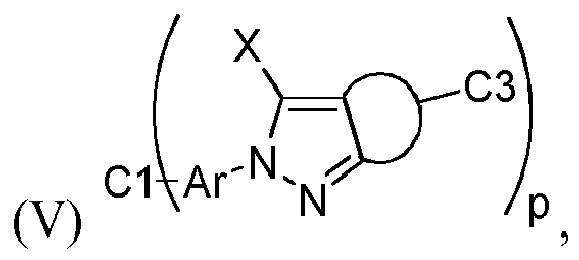
- Another object of the invention is a process for the preparation of a conjugate of formula (V): and/or for the release of a compound of interest C2 or a derivative thereof, comprising a step of contacting a compound of interest C3 comprising a strained alkyne moiety of formula (VI): with a functionalized compound of interest C1 of formula (II) or with a conjugate of formula (IV).
- Another object of the invention is a conjugate of formula (V): preferably obtained by a process of preparation according to the invention.
- a last object of the invention is an iminosydnone of formula (I): wherein
- a first object of the present invention is a process for the preparation of a functionalized compound of interest C1 of formula (II) wherein n is an integer and preferably ranges from 1 to 100, comprising the step of contacting the non-functionalized compound of interest C1 with an iminosydnone of formula (I): wherein
- a halogen atom is a chlorine, iodine, bromine or fluorine atom.
- a halogen atom is a bromine or a chlorine atom, in particular a chlorine atom.
- An alkyl group is a linear, branched or cyclic saturated hydrocarbon group comprising from 1 to 20 carbon atoms.
- the alkyl group according to the invention comprises from 1 to 10, in particular from 1 to 6, carbon atoms.
- Examples of alkyl groups comprise methyl, ethyl, propyl, isopropyl, butyl, tertbutyl, isobutyl, n-pentyl, n-hexyl and cyclohexyl groups.
- the alkenyl group according to the invention comprises from 2 to 10, in particular from 2 to 6, carbon atoms.
- alkenyl groups comprise ethylenyl, propylenyl and cyclohexenyl groups.
- alkynyl group is a linear, branched or cyclic hydrocarbon group comprising from 2 to 20 carbon atoms and comprising at least one C ⁇ C triple bond.
- the alkynyl group according to the invention comprises from 2 to 10, in particular from 2 to 9, carbon atoms.
- alkynyl groups comprise ethynyl, propynyl, octynyl, cyclooctynyl and cyclononynyl groups.
- the alkyl, alkenyl and/or alkynyl groups may be interrupted by at least one heteroatom, preferably independently selected from nitrogen, oxygen and sulphur atoms.
- the alkyl groups, alkenes and alkynes are preferably not substituted by an aryl group.
- An alkoxy group is an alkyl group, bonded to the rest of the molecule through an oxygen atom.
- a thioether group is an alkyl group, bonded to the rest of the molecule through a sulfur atom.
- An aryl diazo group is a N 2 group bonded to an aromatic group.
- a carboxyl group is a COOH group.
- a nitro group is a NO 2 group.
- An amino group is a NR 1 R 2 group, wherein R 1 and R 2 are independently selected from the group consisting of hydrogen atoms, aromatic groups and alkyl groups. In an embodiment, at least one of R 1 and R 2 is an alkyl group. Such an amino group is an alkylamino group. In an embodiment, R 1 and R 2 are both alkyl groups. Such an amino group is a dialkylaminogroup.
- an aromatic group (or an aryl) is selected from the group consisting of:
- the aromatic group is an optionally substituted phenyl group, preferably a non substituted phenyl group.
- the functional group F is a functional group allowing bonding to a compound of interest C1.
- the functional group F may be selected from the group consisting of:
- the counterion can be any ion appropriate for compensating the charge of the diazonium group, and may be easily chosen by anyone of ordinary skill in the art.
- the couterion may be selected from the group consisting of halogenates, BF 4 -, NO 3 -, HSO 4 - , PF 6 - CH 3 COO - , N(SO 2 CF 3 ) 2 - , CF 3 SO 3 - , CH 3 SO 3 - , CF 3 COO - , (CH 3 O)(H)PO 1 - and N(CN) 2 - .
- X is selected from the group consisting of a hydrogen atom and a halogen atom.
- the functional group F is in meta or para position of the phenyl group, preferably in para position.
- the functional group F can be in any position of the aromatic group.
- the functional group F is selected from the group consisting of:
- the functional group F is selected from the group consisting of a carboxylic acid COOH group, an activated ester, such as a N-hydroxysuccinimide, a N-hydrophthalimide ester, a perfluorinated ester or an acylurea, and an alkyl group substituted by at least one of these groups.
- R is not an alkyl group.
- R is an amino group.
- R is an amino or alkoxy group forming a urea or carbamate moiety respectively as disclosed above
- X is a halogen atom, preferably selected from bromine and chlorine atoms.
- a group allowing bonding to a compound of interest C2 is selected from the group consisting of: - a carboxylic acid COOH group,
- a compound of interest may be for instance a molecule, such as a fluorophore, for instance rhodamine, a group of atoms comprising at least one radioactive atom ( 14 C, 3 H, or 131 I for instance), a group of atoms of known mass (a mass tag), a ligand, a drug, a therapeutic agent, a biomolecule, such as an antibody, a protein, such as BSA (bovine serum albumin), a DNA fragment, a nanoobject, such as a nanoparticle ( ie an object or a particle of 0.1 to 1000 nm), or a support, such as a polymer.
- a fluorophore for instance rhodamine
- a group of atoms comprising at least one radioactive atom 14 C, 3 H, or 131 I for instance
- a group of atoms of known mass a mass tag
- a ligand such as an antibody, a protein, such as BSA (bovine serum
- n is from 1 to 50, preferably from 1 to 30. In a specific embodiment, n is 1.
- the contacting step of the processes according to the invention may be performed by any technique known in the art, for instance by dissolution and/or dispersion of both compounds in a solvent.
- the contacting may be performed under stirring, for instance mechanical or magnetic stirring.
- the contacting may be performed at room temperature, ie at a temperature comprised between 18 and 25°C, or at low temperature, ie at a temperature inferior to 18°C, or even at high temperature, ie at a temperature higher than 25°C, for instance comprised between 25 and 150°C.
- the process of preparation of a functionalized compound according to the invention may comprise a preliminary step of covalent bonding of a reactive group to C1, wherein the reactive group is able to react with the functional group F of the iminosydnone compound according to the invention.
- the reactive group is selected from the group consisting of :
- the reactive group is an amino group.
- racemic forms, tautomers, enantiomers, diastereoisomers, epimers, solvates and salts of the compounds according to the invention or used in the processes according to the invention are also part of the scope of the invention.
- salts may be cited acid addition salts, such as hydrochloric, hydrobromic, hydroiodic, phosphoric, and the like.
- suitable organic acids include formic, acetic, trichloroacetic, trifluoroacetic, propionic, benzoic, cinnamic, citric, fumaric, maleic, methanesulfonic and the like.
- pharmaceutically acceptable inorganic or organic acid addition salts include the pharmaceutically acceptable salts listed in J. Pharm. Sci. 1977, 66, 2 , and in Handbook of Pharmaceutical Salts: Properties, Selection, and Use edited by P. Heinrich Stahl and Camille G. Wermuth 2002 .
- Another object of the invention is a functionalized compound of interest C1 of formula (II): which may be obtained by the process according to the invention.
- Another object of the invention is a conjugate of formula (IV): wherein C1 and C2 are compounds of interest as described above and m is an integer and preferably ranges from 1 to 100. In an embodiment, m is from 1 to 50, preferably from 1 to 30. In a specific embodiment, m is 1.
- the conjugate of formula (IV) according to the invention may be prepared for instance by contacting a functionalized compound of interest of formula (II) as described above with C2 or with a derivative of C2.
- a "derivative of C2" according to the present embodiment is any chemical compound comprising a C2 moiety or a moiety that is able to reform the C2 moiety when reacting according to the present process.
- One of ordinary skill in the art is able to choose (and if necessary prepare) the appropriate derivative of C2 for obtaining the desired conjugate of formula (IV) depending on the chemical structure of C2, R and F'.
- Another object of the invention is a process for the preparation of a conjugate of formula (IV) as described above, comprising the step of contacting a functionalized compound of interest of formula (II) with C2 and/or with a derivative of C2.
- Another object of the invention is a process for the preparation of a conjugate of formula (V): wherein p is an integer preferably ranging from 1 to 100, C1 is a first compound of interest, and is a third compound of interest C3 comprising a strained alkyne moiety and/or for the release of a compound of interest C2 or a derivative thereof, comprising a step of contacting a compound of interest C3 comprising a strained alkyne moiety, preferably a strained cyclic alkyne moiety, in particular a cyclooctyne moiety, of formula (VI), with a functionalized compound of interest of formula (II) or with a conjugate of formula (IV) according to the invention.
- p is from 1 to 50, preferably from 1 to 30. In a specific embodiment, p is 1.
- the process according to the invention comprises the step of contacting a compound of interest C3 comprising a strained alkyne moiety, preferably a strained cyclic alkyne moiety, in particular a cyclooctyne moiety, of formula (VI) with a conjugate of formula (IV), and simultaneously allows the preparation of a conjugate of formula (V) and the release of a derivative of C2 of formula (VII):
- the process for the preparation of a conjugate of formula (V) may comprise a preliminary step of covalent bonding of a strained alkyne moiety to the compound of interest C3.
- Another object of the invention is a conjugate of formula (V): said conjugate being preferably obtained by the process according to the invention.
- Another object of the invention is a process for releasing a compound of interest C2 or a derivative thereof, for instance a derivative of formula (VII): comprising a step of contacting a conjugate of formula (IV): as described above with a compound comprising a strained alkyne moiety, preferably a cyclic alkyne moiety, in particular a cyclooctyne moiety, for instance BCN (bicyclononyne).
- Another object of the invention is an iminosydnone of formula (I): wherein
- the iminosydnones according to the invention are selected from the group consisting of:
- the iminosydnone compounds of the invention can be used advantageously in order to couple both compounds of interest C1 and C3 and/or release the compound of interest C2.
- C1 is a nanoobject or a biomolecule such as an antibody
- C2 is a therapeutic agent
- C3 is a fluorophore or a group of atoms comprising at least one radioactive atom comprising, or functionalized with, a strained alkyne moiety.
- the iminosydnone of the invention affords the release of the therapeutic agent and the labeling of the nanoobject or the biomolecule.
- C1 is an antibody and this embodiment leads to the release of a therapeutic agent from a therapeutic antibody and at the same time the labeling of the antibody, therefore allowing theranostic applications.
- the iminosydnones of the invention react very efficiently with strained alkynes, such as cyclic alkynes, in particular cyclooctynes.
- the coupling reaction implies the formation of a cycloadduct formed by a [3+2] cyclization turning to a stable pyrazole said cycloadduct by retro-Diels Alder reaction, triggering the release of a R-F'-NCO molecule, which in aqueous medium, for instance in water, may spontaneously evolve to R-F'-NH 2 through hydrolysis and/or decarboxylation reactions.
- the reaction with a compound according to the invention with a cycloalkyne is represented as example on the scheme below.
- the present compounds allow the efficiency of the reaction to be maintained in biological media, such as culture media, cell lysates or plasma.
- iminosydnones of the invention may be synthesized by any appropriate method known by one of ordinary skill in the art.
- the scheme below presents different synthesis routes for iminosydnones according to the invention.
- the Ar groups substituting the nitrogen atom of the iminosydnones may be substituted with a F group.
- NBS designates N-bromosuccinimide.
- Im 8 ((4-(ethoxycarbonyl)phenyl)carbamoyl)(2-(4-hydroxyphenyl)-1,2,3-oxadiazo1-2-ium-5-yl)amide.
- Figures 1 and 2 present the HPLC monitoring of the reaction between the cyclic alkyne TMTH and iminosydnones Im5 and Im 2 respectively.
- the reaction has been conducted at 100 ⁇ M in PBS buffer (pH 7.4).
- the presence of a F group on the phenyl group would clearly not affect these results.
- Table 1 below presents the kinetic constant values K for these reactions, depending on the Ar group, the R group and the X group.
- Iminosydnones Im 6, 7 and 8 are according to the invention. Table 1.
- Reactions were conducted with 100 ⁇ M of iminosydnones and 150 ⁇ M of BCN or TMTH in PBS 0.1 M (pH 7.4) containing 10% DMSO Iminosydnones Ar X R K (BCN) K (TMTH) Im1 C 6 H 5 H H no reaction n.d.
- Second order reaction rate was determined by plotting ln([A]/[B])/([A] - [B]) versus time and analyzing by linear regression (Equation). Second order rate constant corresponds to the determined slope.
- Second order rate constant corresponds to the determined slope.
- Linear regression curves for sydnones Im2, Im6 and Im7 are illustrated in figures 2 and 3 .
Landscapes
- Chemical & Material Sciences (AREA)
- Organic Chemistry (AREA)
- Pharmaceuticals Containing Other Organic And Inorganic Compounds (AREA)
- Organic Low-Molecular-Weight Compounds And Preparation Thereof (AREA)
- Medicinal Preparation (AREA)
- Heterocyclic Carbon Compounds Containing A Hetero Ring Having Nitrogen And Oxygen As The Only Ring Hetero Atoms (AREA)
Abstract
The present invention relates to the use of iminosydnone compounds in processes for the preparation of conjugates of two compounds of interest. The invention further relates to the use of said iminosydnone compounds in a process for releasing a third compound of interest. The invention finally relates to said new iminosydnone compounds.
Description
- The present invention relates to the use of iminosydnone compounds in processes for the preparation of conjugates of two compounds of interest. The invention further relates to the use of said iminosydnone compounds in a process for releasing a third compound of interest. The invention finally relates to said new iminosydnone compounds.
- The present invention relates to the domain of click chemistry (bioorthogonal reaction) and of bioconjugation of compounds of interest. Five main approaches are currently available for metal-free coupling two different compounds of interest (● and ■). These approaches are presented on the scheme below. Among these approaches only Tetrazine/Cyclooctene reaction (approach 2) has a modification that allows simultaneous coupling of two entities and release of the third compound ( Angew. Chem. Int. Ed. 2013, 52, 14112-14116).

- The inventors of the present application recently discovered that reaction of a sydnone and an alkyne could be efficiently used to perform efficient bioorthogonal reactions (Kolodych et al. Angew. Chem. Int. Ed. 2013, 52, 12056-12060).
- Bioconjugation reactions and cleavage reactions, for instance bioconjugation and cleavage reactions involving proteins, are often performed in highly dilute conditions, for instance because of the low available amount of the starting biomaterial, or because the solubility of said starting biomaterial is low in the coupling and or cleavage conditions. Furthermore, a high level of bioorthogonality of these reactions is mandatory for applications in the fields of chemical biology and drug release which deal with in vivo experiments.
- Consequently, it is important in the domain of bioorthogonal reactions to use efficient coupling and cleavable reagents allowing high yields and fast coupling and cleavage kinetics even in the presence of the plethora of chemical functionalities present in biological media. Such reactions are potentially of high interest in several areas; one of them is antibody-drug-conjugate (ADC) cleavage wherein an antibody, such as an anti-tumor antibody, and a drug, such as an anticancer drug, can be selectively released with a specific probe preferably administered in a second step.
- The Applicant of the present invention evidenced that the use of iminosydnone derivatives affords a unique process allowing both the ligation and the release of compounds of interest with high efficiency, kinetics and bioorthogonality. These iminosydnone compounds can be advantageously used for the conjugation and the release of compounds of interest.
- A first object of the invention is a process for the preparation of a functionalized compound of interest C1 of formula (II):


- Another object of the invention is a functionalized compound of interest C1 of formula (II):

- Another object of the invention is a conjugate of formula (IV):

- Another object of the invention is a process for the preparation of a conjugate of formula (IV):

- Another object of the invention is a process for the preparation of a conjugate of formula (V):


- Another object of the invention is a conjugate of formula (V):

- A last object of the invention is an iminosydnone of formula (I):

- X is selected from the group consisting of a hydrogen atom, a halogen atom, an aryl diazo group, an alkyl group, an aryl group, an alkenyl group, an alkynyl group, an alkoxy group, a thioether group and an amino group,
- F is a functional group allowing bonding to a compound of interest C1,
- F' is a carbonyl group (C=O), a sulfonyl group (SO2) or a phosphoryl group (P=O),
- R is selected from the group consisting of an alkyl group, an aryl group, an alkenyl group, an alkynyl group, an alkoxy group, a thioether group, an ether group, an amino group, optionally substituted with one or more groups allowing bonding to a compound of interest C2, and Ar is an aromatic group,
- with the proviso that, if F' is a carbonyl group (C=O) and X is a hydrogen atom, then R is not an alkyl group.
-
- Figure 1:
- HPLC monitoring of the reaction between
iminosydnone Im 5 and the cyclic alkyne TMTH. - Figure 2:
- HPLC monitoring (b) and linear regression curve (c) for the reaction of Im2 with TMTH (a).
- Figure 3:
- Linear regression curves for the reactions of iminosydnones Im6 and Im7 with TMTH.
- A first object of the present invention is a process for the preparation of a functionalized compound of interest C1 of formula (II)
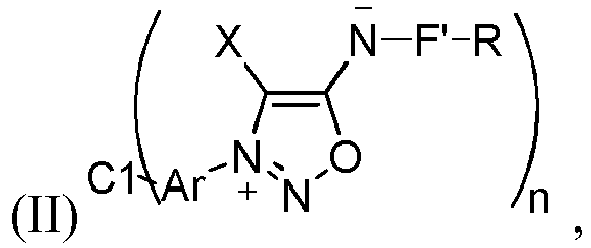

- X is selected from the group consisting of a hydrogen atom, a halogen atom, an aryl diazo group, an alkyl group, an aryl group, an alkenyl group, an alkynyl group, an alkoxy group, a thioether group and an amino group,
- F is a functional group allowing bonding to a compound of interest C1,
- F' is a carbonyl group (C=O), a sulfonyl group (SO2) or a phosphoryl group (P=O),
- R is selected from the group consisting of an alkyl group, an aryl group, an alkenyl group, an alkynyl group, an alkoxy group, a thioether group, and an amino group, optionally substituted with one or more groups allowing bonding to a compound of interest C2, and
- Ar is an aromatic group.
- A halogen atom is a chlorine, iodine, bromine or fluorine atom. Preferably, a halogen atom is a bromine or a chlorine atom, in particular a chlorine atom.
- An alkyl group is a linear, branched or cyclic saturated hydrocarbon group comprising from 1 to 20 carbon atoms. Preferably, the alkyl group according to the invention comprises from 1 to 10, in particular from 1 to 6, carbon atoms. Examples of alkyl groups comprise methyl, ethyl, propyl, isopropyl, butyl, tertbutyl, isobutyl, n-pentyl, n-hexyl and cyclohexyl groups. An alkenyl group (or an alkene) is a linear, branched or cyclic hydrocarbon group comprising from 2 to 20 carbon atoms and comprising at least one C=C double bond. Preferably, the alkenyl group according to the invention comprises from 2 to 10, in particular from 2 to 6, carbon atoms. Examples of alkenyl groups comprise ethylenyl, propylenyl and cyclohexenyl groups.
- An alkynyl group (or an alkyne) is a linear, branched or cyclic hydrocarbon group comprising from 2 to 20 carbon atoms and comprising at least one C≡C triple bond. Preferably, the alkynyl group according to the invention comprises from 2 to 10, in particular from 2 to 9, carbon atoms. Examples of alkynyl groups comprise ethynyl, propynyl, octynyl, cyclooctynyl and cyclononynyl groups.
- In specific embodiments of the present invention, the alkyl, alkenyl and/or alkynyl groups may be interrupted by at least one heteroatom, preferably independently selected from nitrogen, oxygen and sulphur atoms.
- According to the invention, the alkyl groups, alkenes and alkynes are preferably not substituted by an aryl group.
- An alkoxy group is an alkyl group, bonded to the rest of the molecule through an oxygen atom.
- A thioether group is an alkyl group, bonded to the rest of the molecule through a sulfur atom. An aryl diazo group is a N2 group bonded to an aromatic group. A carboxyl group is a COOH group. A nitro group is a NO2 group.
- An amino group is a NR1R2 group, wherein R1 and R2 are independently selected from the group consisting of hydrogen atoms, aromatic groups and alkyl groups. In an embodiment, at least one of R1 and R2 is an alkyl group. Such an amino group is an alkylamino group. In an embodiment, R1 and R2 are both alkyl groups. Such an amino group is a dialkylaminogroup.
- According to the present invention, an aromatic group (or an aryl) is selected from the group consisting of:
- a phenyl group;
- a heteroaromatic group, such as pyridine, thiophene, imidazole, thiazole, pyrazole, pyrole or furane; and
- a polyaromatic group, such as anthracene or phenanthrene;
- In an embodiment, the aromatic group is an optionally substituted phenyl group, preferably a non substituted phenyl group.
- The functional group F is a functional group allowing bonding to a compound of interest C1. For instance, the functional group F may be selected from the group consisting of:
- a carboxylic acid COOH group,
- a thiol SH group,
- a maleimide

- an activated ester, such as a N-hydroxysuccinimide, a N-hydrophthalimide ester, a perfluorinated ester or an acylurea,
- a halogen atom,
- an alkene or alkyne group, optionally interrupted by at least one heteroatom selected among O, N and S,
- an amino (-NRR') group, wherein R and R' are independently hydrogen atoms, alkyl, alkene, alkyne or aryl groups as defined above,
- a hydroxylamine (-ONH2) group,
- a hydrazine (-NH-NH2) group,
- an azido (-N3) group,
- a diazonium (-N2 +) group, optionally in presence of a counterion,
- a boronic acid -B(OR")2 group, wherein R" is a hydrogen atom or an alkyl group,
- an isocyanate (-N=C=O) or isothiocyanate (-N=C=S) group,
- a chlorosulfonyl (-SO2Cl) group,
- a -C≡C-C≡N group,
- an aldehyde CHO group,
- a ketone COR"' group, wherein R"' is an alkyl group as defined above, and
- an alkyl group substituted by at least one of the groups above.
- The counterion can be any ion appropriate for compensating the charge of the diazonium group, and may be easily chosen by anyone of ordinary skill in the art. For instance, the couterion may be selected from the group consisting of halogenates, BF4-, NO3-, HSO4 -, PF6 - CH3COO-, N(SO2CF3)2 -, CF3SO3 -, CH3SO3 -, CF3COO-, (CH3O)(H)PO1 - and N(CN)2 -.
- In an embodiment, X is selected from the group consisting of a hydrogen atom and a halogen atom.
- When Ar is an optionally substituted phenyl group, the functional group F is in meta or para position of the phenyl group, preferably in para position.
- When Ar is an optionally substituted heteroaromatic or polyaromatic group, the functional group F can be in any position of the aromatic group.
- In a preferred embodiment, the functional group F is selected from the group consisting of:
- a carboxylic acid COOH group,
- a thiol SH group,
- a maleimide

- an activated ester, such as a N-hydroxysuccinimide, a N-hydrophthalimide ester, a perfluorinated ester or an acylurea,
- an amino (-NRR') group, wherein R and R' are independently hydrogen atoms, alkyl, alkene, alkyne or aryl groups as defined above,
- a hydroxylamine (-ONH2) group,
- a hydrazine (-NH-NH2) group,
- an azido (-N3) group,
- an isocyanate (-N=C=O) or isothiocyanate (-N=C=S) group,
- a chlorosulfonyl (-SO2Cl) group,
- a -C≡C-C≡N group, and
- an alkyl group substituted by at least one of the groups above.
- In a highly preferred embodiment, the functional group F is selected from the group consisting of a carboxylic acid COOH group, an activated ester, such as a N-hydroxysuccinimide, a N-hydrophthalimide ester, a perfluorinated ester or an acylurea, and an alkyl group substituted by at least one of these groups.
- In a preferred embodiment, F' is a C=O group and R is an amino group. Preferably, the R amino group is bonded through the nitrogen atom to the C=O F' group, thus forming a urea moiety.
- In an embodiment, if F' is a C=O group and X is a hydrogen atom, then R is not an alkyl group.
- Preferably, R is an amino group.
- In another preferred embodiment, F' is a C=O group and R is an alkoxy group. Preferably, the R alkoxy group is bonded through the oxygen atom to the C=O F' group, thus forming a carbamate moiety.
- In a preferred embodiment, F' is a C=O group, R is an amino or alkoxy group forming a urea or carbamate moiety respectively as disclosed above, and X is a halogen atom, preferably selected from bromine and chlorine atoms.
- A group allowing bonding to a compound of interest C2 is selected from the group consisting of: - a carboxylic acid COOH group,
- a thiol SH group,
- a maleimide

- an activated ester, such as a N-hydroxysuccinimide, a N-hydrophthalimide ester, a perfluorinated ester or an acylurea,
- a halogen atom,
- an alkene or alkyne group, optionally interrupted by at least one heteroatom selected among O, N and S,
- an amino (-NRR') group, wherein R and R' are independently hydrogen atoms, alkyl, alkene, alkyne or aryl groups as defined above,
- a hydroxylamine (-ONH2) group,
- a hydrazine (-NH-NH2) group,
- an azido (-N3) group,
- a diazonium (-N2 +) group, optionally in presence of a counterion,
- a boronic acid -B(OR")2 group, wherein R" is a hydrogen atom or an alkyl group,
- an isocyanate (-N=C=O) or isothiocyanate (-N=C=S) group,
- a chlorosulfonyl (-SO2Cl) group,
- a -C≡C-C≡N group,
- an aldehyde CHO group,
- a ketone COR"' group, wherein R"' is an alkyl group.
In a preferred embodiment, the group allowing bonding to a compound of interest C2 is selected from the group consisting of: - a carboxylic acid COOH group, - a thiol SH group,
- a maleimide

- an activated ester, such as a N-hydroxysuccinimide, a N-hydrophthalimide ester, a perfluorinated ester or an acylurea,
- an amino (-NRR') group, wherein R and R' are independently hydrogen atoms, alkyl, alkene, alkyne or aryl groups as defined above,
- a hydroxylamine (-ONH2) group,
- a hydrazine (-NH-NH2) group,
- an azido (-N3) group,
- an isocyanate (-N=C=O) or isothiocyanate (-N=C=S) group,
- a chlorosulfonyl (-SO2Cl) group, and
- a -C≡C-C≡N group.
- A compound of interest may be for instance a molecule, such as a fluorophore, for instance rhodamine, a group of atoms comprising at least one radioactive atom (14C, 3H, or 131I for instance), a group of atoms of known mass (a mass tag), a ligand, a drug, a therapeutic agent, a biomolecule, such as an antibody, a protein, such as BSA (bovine serum albumin), a DNA fragment, a nanoobject, such as a nanoparticle (ie an object or a particle of 0.1 to 1000 nm), or a support, such as a polymer.
- In an embodiment, n is from 1 to 50, preferably from 1 to 30. In a specific embodiment, n is 1.
- The contacting step of the processes according to the invention may be performed by any technique known in the art, for instance by dissolution and/or dispersion of both compounds in a solvent. The contacting may be performed under stirring, for instance mechanical or magnetic stirring. The contacting may be performed at room temperature, ie at a temperature comprised between 18 and 25°C, or at low temperature, ie at a temperature inferior to 18°C, or even at high temperature, ie at a temperature higher than 25°C, for instance comprised between 25 and 150°C.
- The process of preparation of a functionalized compound according to the invention may comprise a preliminary step of covalent bonding of a reactive group to C1, wherein the reactive group is able to react with the functional group F of the iminosydnone compound according to the invention.
- In an embodiment, the reactive group is selected from the group consisting of :
- a carboxylic acid COOH group,
- a thiol SH group,
- a maleimide
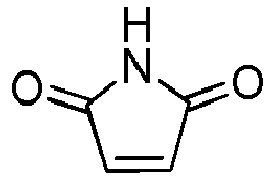
- an activated ester, such as a N-hydroxysuccinimide, a N-hydrophthalimide ester, a perfluorinated ester or an acylurea,
- a halogen atom,
- an alkene or alkyne group, optionally interrupted by at least one heteroatom selected among O, N and S,
- an amino (-NRR') group, wherein R and R' are independently hydrogen atoms, alkyl, alkene, alkyne or aryl groups as defined above,
- a hydroxylamine (-ONH2) group,
- a hydrazine (-NH-NH2) group,
- an azido (-N3) group,
- a diazonium (-N2 +) group, optionally in presence of a counterion,
- a boronic acid -B(OR")2 group, wherein R" is a hydrogen atom or an alkyl group,
- an isocyanate (-N=C=O) or isothiocyanate (-N=C=S) group,
- a chlorosulfonyl (-SO2Cl) group,
- a -C≡C-C≡N group,
- an aldehyde CHO group,
- a ketone COR"' group, wherein R'" is an alkyl group.
In a preferred embodiment, the reactive group is selected from the group consisting of: - a carboxylic acid COOH group,
- a thiol SH group,
- a maleimide

- an activated ester, such as a N-hydroxysuccinimide, a N-hydrophthalimide ester, a perfluorinated ester or an acylurea,
- an amino (-NRR') group, wherein R and R' are independently hydrogen atoms, alkyl, alkene, alkyne or aryl groups as defined above,
- a hydroxylamine (-ONH2) group,
- a hydrazine (-NH-NH2) group,
- an azido (-N3) group,
- an isocyanate (-N=C=O) or isothiocyanate (-N=C=S) group,
- a chlorosulfonyl (-SO2Cl) group, and
- a -C≡C-C≡N group.
- In a highly preferred embodiment, the reactive group is an amino group.
- The racemic forms, tautomers, enantiomers, diastereoisomers, epimers, solvates and salts of the compounds according to the invention or used in the processes according to the invention are also part of the scope of the invention.
- As examples of salts may be cited acid addition salts, such as hydrochloric, hydrobromic, hydroiodic, phosphoric, and the like. Representative examples of suitable organic acids include formic, acetic, trichloroacetic, trifluoroacetic, propionic, benzoic, cinnamic, citric, fumaric, maleic, methanesulfonic and the like. Further examples of pharmaceutically acceptable inorganic or organic acid addition salts include the pharmaceutically acceptable salts listed in J. Pharm. Sci. 1977, 66, 2, and in Handbook of Pharmaceutical Salts: Properties, Selection, and Use edited by P. Heinrich Stahl and Camille G. Wermuth 2002.
- Another object of the invention is a functionalized compound of interest C1 of formula (II):

- Another object of the invention is a conjugate of formula (IV):

- Another object of the invention is a process for the preparation of a conjugate of formula (IV) as described above, comprising the step of contacting a functionalized compound of interest of formula (II) with C2 and/or with a derivative of C2.
- Another object of the invention is a process for the preparation of a conjugate of formula (V):


- In an embodiment, p is from 1 to 50, preferably from 1 to 30. In a specific embodiment, p is 1.
- In a preferred embodiment, the process according to the invention comprises the step of contacting a compound of interest C3 comprising a strained alkyne moiety, preferably a strained cyclic alkyne moiety, in particular a cyclooctyne moiety, of formula (VI)


- The process for the preparation of a conjugate of formula (V) may comprise a preliminary step of covalent bonding of a strained alkyne moiety to the compound of interest C3.
- Another object of the invention is a conjugate of formula (V):

- Another object of the invention is a process for releasing a compound of interest C2 or a derivative thereof, for instance a derivative of formula (VII):
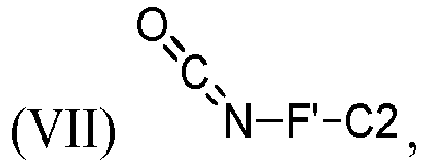

- Another object of the invention is an iminosydnone of formula (I):

- X is selected from the group consisting of a hydrogen atom, a halogen atom, an aryl diazo group, an alkyl group, an aryl group, an alkenyl group, an alkynyl group, an alkoxy group, a thioether group and an amino group,
- F is a functional group allowing bonding to a compound of interest C1,
- F' is a carbonyl group (C=O), a sulfonyl group (SO2) or a phosphoryl group (P=O),
- R is selected from the group consisting of an alkyl group, an aryl group, an alkenyl group, an alkynyl group, an alkoxy group, a thioether group, an ether group, an amino group, optionally substituted with one or more groups allowing bonding to a compound of interest C2, and
- Ar is an aromatic group,
- wherein if F' is a carbonyl group and X is a hydrogen atom, then R is not an alkyl group.
- In an embodiment, the iminosydnones according to the invention are selected from the group consisting of:
- (2-(4-hydroxyphenyl)-1,2,3-oxadiazol-2-ium-5-yl)(p-tolylcarbamoyl)amide ;
- (2-(4-carboxyphenyl)-1,2,3-oxadiazol-2-ium-5-yl)(p-tolylcarbamoyl)amide ; and
- ((4-(ethoxycarbonyl)phenyl)carbamoyl)(2-(4-hydroxyphenyl)-1,2,3-oxadiazol-2-ium-5-yl)amide.
- The iminosydnone compounds of the invention can be used advantageously in order to couple both compounds of interest C1 and C3 and/or release the compound of interest C2.
- In an embodiment, C1 is a nanoobject or a biomolecule such as an antibody, C2 is a therapeutic agent and C3 is a fluorophore or a group of atoms comprising at least one radioactive atom comprising, or functionalized with, a strained alkyne moiety. In this embodiment, the iminosydnone of the invention affords the release of the therapeutic agent and the labeling of the nanoobject or the biomolecule. In a particular embodiment, C1 is an antibody and this embodiment leads to the release of a therapeutic agent from a therapeutic antibody and at the same time the labeling of the antibody, therefore allowing theranostic applications.
- The iminosydnones of the invention react very efficiently with strained alkynes, such as cyclic alkynes, in particular cyclooctynes. The coupling reaction implies the formation of a cycloadduct formed by a [3+2] cyclization turning to a stable pyrazole said cycloadduct by retro-Diels Alder reaction, triggering the release of a R-F'-NCO molecule, which in aqueous medium, for instance in water, may spontaneously evolve to R-F'-NH2 through hydrolysis and/or decarboxylation reactions. The reaction with a compound according to the invention with a cycloalkyne is represented as example on the scheme below.

- The present compounds allow the efficiency of the reaction to be maintained in biological media, such as culture media, cell lysates or plasma.
- The iminosydnones of the invention may be synthesized by any appropriate method known by one of ordinary skill in the art.
- For instance, the scheme below presents different synthesis routes for iminosydnones according to the invention. The Ar groups substituting the nitrogen atom of the iminosydnones may be substituted with a F group. In this scheme, the term NBS designates N-bromosuccinimide.

- The following examples are provided as illustrative, and not limitative, of the present invention.
- In the following examples, the provided yields are molar yields unless specified differently.
-

- To a solution of 2-((4-hydroxyphenyl)amino)acetonitrile (2.56 g, 12 mmol) in tetrahydrofuran THF (60 mL) was added amyl nitrite (1.85 eq, 22.2 mmol). The mixture was stirred for 16h at room temperature (r.t.) and then HCl (5 mL, 4M solution in dioxane) was added. The resulting mixture was stirred for 24 h at r.t. The precipitate was collected by filtration and washed with Et2O and dried to yield pure product as a yellow solid (850 mg, 4.8 mmol, 40%).
1H NMR (400 MHz, DMSO-d6, δ ppm): 9.71 (s, 2 H), 8.48 (s, 1 H), 7.88 (d, J= 9.1 Hz, 2 H), 7.09 (d, J= 9.1 Hz, 2 H).
13C NMR (100 MHz, DMSO-d6, δ ppm): 169.1, 162.1, 124.1, 124.0, 116.6, 101.0. -

- To a solution of 4-((cyanomethyl)amino)benzoic acid (1.13 g, 6.42 mmol) in THF (60 mL) was added amyl nitrite (1.85 eq, 11.9 mmol). The mixture was stirred for 16h at r.t. and then HCl (5 mL, 4M solution in dioxane) was added. The resulting mixture was stirred for 24 h at r.t. The precipitate was collected by filtration and washed with Et2O and dried to yield pure product as a white solid (161 mg, 0.67 mmol, 10%).
1H NMR (400 MHz, DMSO-d6, δ ppm): 9.97 (br. s., 2 H), 8.73 (s, 1 H), 8.27 (d, J= 8.6 Hz, 2 H), 8.18 (d, J = 8.6 Hz, 2 H).
13C NMR (100 MHz, DMSO-d6, δ ppm): 169.4, 165.7, 135.5, 135.1, 131.0, 123.1, 102.7. -

- To a solution of p-tolyl isocyanate (47 mg, 0.351 mmol) and iminosydnone Im0-1 S (75 mg, 0.351 mmol) in THF (5 mL) was added a solution of NaHCO3 (1 eq., 30 mg, 0.35 mmol) in H2O (1 mL). The resulting solution was stirred at room temperature for 14 hours. The organic layer was separated, dried over MgSO4 and evaporated. The residue was purified by semi-preparative HPLC (MeCN/H2O gradient) to afford Im6 as a white solid (18.3 mg, 0.059 mmol, 17%).
1H NMR (400 MHz, DMSO-d6, δ ppm): 9.29 (br. s., 1 H), 8.38 (s, 1 H), 7.89 (d, J = 9.0 Hz, 2 H), 7.54 (d, J = 8.2 Hz, 2 H), 7.07 - 6.93 (m, J = 6.5, 8.5 Hz, 4 H), 2.22 (s, 3 H).
13C NMR (100 MHz, DMSO-d6, δ ppm): 172.2, 161.1, 158.8, 138.5, 129.9, 128.8, 125.3, 123.7, 117.9, 116.4, 102.1, 20.4. -

- To a solution of ethyl 4-isocyanatobenzoate (67 mg, 0.351 mmol) and iminosydnone Im0-1 (75 mg, 0.351 mmol) in THF (5 mL) was added a solution of NaHCO3 (1 eq., 30 mg, 0.35 mmol) in H2O (1 mL). The resulting solution was stirred at room temperature for 14 hours. The organic layer was separated, dried over MgSO4 and evaporated. The residue was purified by semi-preparative HPLC (MeCN/H2O gradient) to afford Im8 as a yellow solid (16.1 mg, 0.044 mmol, 13%).
1H NMR (400 MHz, DMSO-d6, δ ppm): 10.60 (br. s., 1 H), 9.82 (s, 1 H), 8.49 (s, 1 H), 7.91 (d, J= 9.0 Hz, 2 H), 7.84 (d, J= 8.8 Hz, 2 H), 7.77 (d, J= 8.8 Hz, 2 H), 7.02 (d, J= 9.0 Hz, 2 H), 4.27 (q, J = 7.0 Hz, 2 H), 1.30 (t, J= 7.0 Hz, 3 H).
13C NMR (100 MHz, DMSO-d6, δ ppm): 172.4, 165.5, 161.1, 158.6, 145.6, 130.0, 125.2, 123.7, 122.1, 117.0, 116.3, 102.6, 60.0, 14.2.
MS (ESI) m/z: 369.2 [M+H]+. -

- To a solution of p-tolyl isocyanate (15 mg, 0.113 mmol) and iminosydnone Im0-2 (27 mg, 0.113 mmol) in THF (5 mL) was added a solution of NaHCO3 (1 eq., 10 mg, 0.12 mmol) in H2O (1 mL). The resulting solution was stirred at room temperature for 14 hours. The organic layer was separated, dried over MgSO4 and evaporated. The residue was purified by semi-preparative HPLC (MeCN/H2O gradient) to afford Im 7 as a yellow solid (8.6 mg, 0.025 mmol, 22%).
1H NMR (400 MHz, DMSO-d6, δ ppm): 9.41 (br. s., 1 H), 8.69 (s, 1 H), 8.21 (s, 4 H), 7.53 (d, J = 8.1 Hz, 2 H), 7.04 (d, J = 8.1 Hz, 2 H), 2.22 (s, 3 H).
13C NMR (100 MHz, DMSO-d6, δ ppm): 171.8, 165.9, 157.9, 138.1, 136.5, 134.5, 131.0, 130.2, 128.8, 122.6, 118.1, 103.5, 20.3.
MS (ESI) m/z: 339.1 [M+H]+. - Reactions of
iminosydnone Im 2 with tetramethylthiacycloheptyne (TMTH) was carried out in PBS buffer (0.1M, pH 7.4) at 100 µM concentration of iminosydnone and 150 µM concentration of cyclooctyne TMTH using the following procedure: - To 900 µL of PBS buffer were added 10 µL of the solution of benzamide (internal standard, 100 mM in DMSO), 1 µL of the solution of iminosydnone (100 mM in DMSO) and 1.5 µL of the solution of TMTH (100 mM in DMSO). The reaction mixture was injected in HPLC and the conversion was followed by measuring the normalized iminosydnone peak area.
-
Figures 1 and2 present the HPLC monitoring of the reaction between the cyclic alkyne TMTH and iminosydnones Im5 andIm 2 respectively. The reaction has been conducted at 100 µM in PBS buffer (pH 7.4). The results indicated an almost complete reaction after 30 min proving that the reaction is fast enough to be useful for bioconjugation and release applications. The presence of a F group on the phenyl group would clearly not affect these results. One can expect similar kinetics for the iminosydnones according to the invention. - The kinetics of the coupling reaction of different iminosydnones with two cyclic alkynes was studied, according to the following scheme.

- Reactions of iminosydnones with BCN (Biclyclononyne) or TMTH were carried out in PBS/DMSO (9:1) mixtures at 100 µM concentration of sydnones and 150 µM concentration of BCN or TMTH using the following procedure:
- To 900 µL of phosphate buffered saline (PBS, 100 mM) was added 87.5 µL of DMSO, 10 µL of the solution of benzamide (internal standard, 100 mM in DMSO), 1 µL of the solution of iminosydnone (100 mM in DMSO) and 1.5 µL of the solution of BCN or TMTH (100 mM in DMSO). The reaction mixture was injected in HPLC every 30 min and the conversion was followed by measuring the normalized sydnone peak area.
- Table 1 below presents the kinetic constant values K for these reactions, depending on the Ar group, the R group and the X group. Iminosydnones Im 6, 7 and 8 are according to the invention.
Table 1. K unit is M-1.sec-1, n.d. = not determined. Reactions were conducted with 100 µM of iminosydnones and 150 µM of BCN or TMTH in PBS 0.1 M (pH 7.4) containing 10% DMSO Iminosydnones Ar X R K (BCN) K (TMTH) Im1 C6H5 H H no reaction n.d. Im2 C6H5 H CH3CO- 0.002 2.2 Im3 pCH3C6H4 H C6H5CH2CO- 0.004 n.d. Im4 pCH3C6H4 H C6H5CH2 CH2CO- 0.034 n.d. Im5 C6H5 H pCH3C6H4NHCO- 0.069 43.1 Im6 pOHC6H4 H pCH3C6H4NHCO- 0.008 4.1 Im7 pCO2HC6H4 H pCH3C6H4NHCO- 0.108 61.2 Im8 pOHC6H4 H pCO2EtC6H4NHCO- 0.008 2.5 Im9 pCH3C6H4 H C6H5CH2NHCO- 0.004 n.d. Im10 pCH3C6H4 Br C6H5CH2NHCO- 0.060 n.d. Im11 pCH3C6H4 H C6H5CH2OCO- 0.026 n.d. Im12 pCH3C6H4 Br C6H5CH2OCO- 0.150 n.d. - These results clearly show that the iminosydnones comprising a urea or a carbamate function at F' position and the iminosydnones comprising a halogen atom in position 4 afford the fastest reactions. In particular, 4-bromo-6-carbamate iminosydnones were found to react with the cyclooctyne BCN with a constant of 0.15 M-1.sec-1 which allows the reaction to proceed at concentration as low as 1 µM.
- Second order reaction rate was determined by plotting ln([A]/[B])/([A] - [B]) versus time and analyzing by linear regression (Equation). Second order rate constant corresponds to the determined slope.


- Linear regression curves for sydnones Im2, Im6 and Im7 are illustrated in
figures 2 and3 .
Claims (15)
- Process for the preparation of a functionalized compound of interest C1 of formula (II):

 X is selected from the group consisting of a hydrogen atom, a halogen atom, an aryl diazo group, an alkyl group, an aryl group, an alkenyl group, an alkynyl group, an alkoxy group, a thioether group and an amino group,F is a functional group allowing bonding to a compound of interest C1,F' is a carbonyl group (C=O), a sulfonyl group (SO2) or a phosphoryl group (P=O),R is selected from the group consisting of an alkyl group, an aryl group, an alkenyl group, an alkynyl group, an alkoxy group, a thioether group, and an amino group, optionally substituted with one or more groups allowing bonding to a compound of interest C2, andAr is an aromatic group,and wherein the alkyl, alkenyl and/or alkynyl groups may be interrupted by at least one heteroatom selected from nitrogen, oxygen and sulphur atoms.
 - Process for the preparation of a functionalized compound of interest C1 according to claim 1, wherein F is selected from the group consisting of:- a carboxylic acid COOH group,- a thiol SH group,- a maleimide
 - an activated ester,- a halogen atom,- an alkene or alkyne group, optionally interrupted by at least one heteroatom selected among O, N and S,- an amino (-NRR') group, wherein R and R' are independently hydrogen atoms, alkyl, alkene, alkyne or aryl groups,- a hydroxylamine (-ONH2) group,- a hydrazine (-NH-NH2) group,- an azido (-N3) group,- a diazonium (-N2 +) group, optionally in presence of a counterion,- a boronic acid -B(OR")2 group, wherein R" is a hydrogen atom or an alkyl group,- an isocyanate (-N=C=O) or isothiocyanate (-N=C=S) group,- a chlorosulfonyl (-SO2Cl) group,- a -C≡C-C≡N group,- an aldehyde CHO group,- a ketone COR"' group, wherein R"' is an alkyl group, and- an alkyl group substituted by at least one of said groups.
 - Process for the preparation of a functionalized compound of interest C1 according to claim 2, wherein F is selected from the group consisting of a carboxylic acid COOH group, an activated ester and an alkyl group substituted by at least one of these groups
- Process for the preparation of a functionalized compound of interest C1 according to any one of claims 1 or 3, comprising a preliminary step of covalent bonding of a reactive group to C1, wherein the reactive group is able to react with the functional group F of the iminosydnone of formula (I).
- Process for the preparation of a functionalized compound of interest C1 according to claim 4, wherein the reactive group is selected from the group consisting of :- a carboxylic acid COOH group,- a thiol SH group,- a maleimide
 - an activated ester,- a halogen atom,- an alkene or alkyne group, optionally interrupted by at least one heteroatom selected among O, N and S,- an amino (-NRR') group, wherein R and R' are independently hydrogen atoms, alkyl, alkene, alkyne or aryl groups,- a hydroxylamine (-ONH2) group,- a hydrazine (-NH-NH2) group,- an azido (-N3) group,- a diazonium (-N2 +) group, optionally in presence of a counterion,- a boronic acid -B(OR")2 group, wherein R" is a hydrogen atom or an alkyl group,- an isocyanate (-N=C=O) or isothiocyanate (-N=C=S) group,- a chlorosulfonyl (-SO2Cl) group,- a -C≡C-C≡N group,- an aldehyde CHO group,- a ketone COR'" group, wherein R"' is an alkyl group.
 - Process for the preparation of a functionalized compound of interest C1 according to claim 5, wherein the reactive group is an amino group.
- Functionalized compound of interest C1 of formula (II):
 wherein n is an integer from 1 to 100, C1 is a compound of interest selected from the group consisting of a fluorophore, a group of atoms comprising at least one radioactive atom, a group of atoms of known mass, a ligand, a drug, a therapeutic agent, a biomolecule, a DNA fragment, a nanoobject, or a support,X is selected from the group consisting of a hydrogen atom, a halogen atom, an aryl diazo group, an alkyl group, an aryl group, an alkenyl group, an alkynyl group, an alkoxy group, a thioether group and an amino group,F' is a carbonyl group (C=O), a sulfonyl group (SO2) or a phosphoryl group (P=O),R is selected from the group consisting of an alkyl group, an aryl group, an alkenyl group, an alkynyl group, an alkoxy group, a thioether group, an amino group, optionally substituted with one or more groups allowing bonding to a compound of interest C2, andAr is an aromatic group,wherein the alkyl, alkenyl and/or alkynyl groups may be interrupted by at least one heteroatom selected from nitrogen, oxygen and sulphur atoms, andwherein the functionalized compound of interest is obtained by the process of claim 2.
 - Conjugate of formula (IV):
 m is an integer from 1 to 100,C1 and C2 are compounds of interest independently selected from the group consisting of a fluorophore, a group of atoms comprising at least one radioactive atom, a group of atoms of known mass, a ligand, a drug, a therapeutic agent, a biomolecule, a DNA fragment, a nanoobject, and a support,X is selected from the group consisting of a hydrogen atom, a halogen atom, an aryl diazo group, an alkyl group, an aryl group, an alkenyl group, an alkynyl group, an alkoxy group, a thioether group and an amino group,F' is a carbonyl group (C=O), a sulfonyl group (SO2) or a phosphoryl group (P=O), Ar is an aromatic group, andwherein the alkyl, alkenyl and/or alkynyl groups may be interrupted by at least one heteroatom selected from nitrogen, oxygen and sulphur atoms.
 - Process for the preparation of a conjugate according to claim 8, comprising the step of contacting a functionalized compound of interest C1 according to claim 7 with C2 and/or with a derivative of C2, wherein C2 is a compound of interest selected from the group consisting of a fluorophore, a group of atoms comprising at least one radioactive atom, a group of atoms of known mass, a ligand, a drug, a therapeutic agent, a biomolecule, a DNA fragment, a nanoobject, and a support.
- Process for the preparation of a conjugate of formula (V):

- Process of preparation according to claim 10, wherein the process comprises a preliminary step of covalent bonding of a strained alkyne moiety to the compound of interest C3.
- Process for releasing a derivative of a compound of interest C2 of formula (VII):

- Iminosydnone of formula (I):
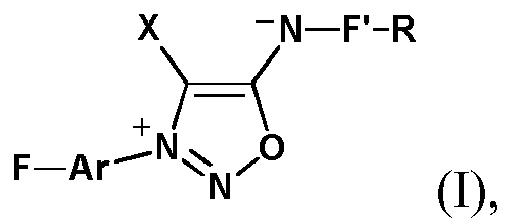 X is selected from the group consisting of a hydrogen atom, a halogen atom, an aryl diazo group, an alkyl group, an aryl group, an alkenyl group, an alkynyl group, an alkoxy group, a thioether group and an amino group,F is a functional group allowing bonding to a compound of interest C1,F' is a carbonyl group (C=O), a sulfonyl group (SO2) or a phosphoryl group (P=O),R is selected from the group consisting of an alkyl group, an aryl group, an alkenyl group, an alkynyl group, an alkoxy group, a thioether group and an amino group, optionally substituted with one or more groups allowing bonding to a compound of interest C2, andAr is an aromatic group,wherein the alkyl, alkenyl and/or alkynyl groups may be interrupted by at least one heteroatom selected from nitrogen, oxygen and sulphur atoms,with the proviso that, if F' is a carbonyl group (C=O) and X is a hydrogen atom, then R is not an alkyl group.
 - Iminosydnone according to claim 13, wherein F' is a C=O group and R is an amino group, forming a urea moiety with the F' group, and X is a halogen atom selected from chlorine and bromine.
- Iminosydnone according to claim 13, wherein the iminosydnone is selected from the group consisting of:- (2-(4-hydroxyphenyl)-1,2,3-oxadiazol-2-ium-5-yl)(p-tolylcarbamoyl)amide),- (2-(4-carboxyphenyl)-1,2,3-oxadiazol-2-ium-5-yl)(p-tolylcarbamoyl)amide, and- ((4-(ethoxycarbonyl)phenyl)carbamoyl)(2-(4-hydroxyphenyl)-1,2,3-oxadiazol-2-ium-5-yl)amide.
Priority Applications (5)
| Application Number | Priority Date | Filing Date | Title |
|---|---|---|---|
| EP14305933.5A EP2957559A1 (en) | 2014-06-18 | 2014-06-18 | Iminosydnone derivatives for conjugation and release of compounds of interest |
| EP15731028.5A EP3157906B1 (en) | 2014-06-18 | 2015-06-18 | Iminosydnone derivatives for conjugation and release of compounds of interest |
| PCT/EP2015/063755 WO2015193455A1 (en) | 2014-06-18 | 2015-06-18 | Iminosydnone derivatives for conjugation and release of compounds of interest |
| US15/319,387 US20170129863A1 (en) | 2014-06-18 | 2015-06-18 | Iminosydnone derivatives for conjugation and release of compounds of interest |
| US16/245,270 US20190144401A1 (en) | 2014-06-18 | 2019-01-11 | Iminosydnone derivatives for conjugation and release of compounds of interest |
Applications Claiming Priority (1)
| Application Number | Priority Date | Filing Date | Title |
|---|---|---|---|
| EP14305933.5A EP2957559A1 (en) | 2014-06-18 | 2014-06-18 | Iminosydnone derivatives for conjugation and release of compounds of interest |
Publications (1)
| Publication Number | Publication Date |
|---|---|
| EP2957559A1 true EP2957559A1 (en) | 2015-12-23 |
Family
ID=51062753
Family Applications (2)
| Application Number | Title | Priority Date | Filing Date |
|---|---|---|---|
| EP14305933.5A Withdrawn EP2957559A1 (en) | 2014-06-18 | 2014-06-18 | Iminosydnone derivatives for conjugation and release of compounds of interest |
| EP15731028.5A Not-in-force EP3157906B1 (en) | 2014-06-18 | 2015-06-18 | Iminosydnone derivatives for conjugation and release of compounds of interest |
Family Applications After (1)
| Application Number | Title | Priority Date | Filing Date |
|---|---|---|---|
| EP15731028.5A Not-in-force EP3157906B1 (en) | 2014-06-18 | 2015-06-18 | Iminosydnone derivatives for conjugation and release of compounds of interest |
Country Status (3)
| Country | Link |
|---|---|
| US (2) | US20170129863A1 (en) |
| EP (2) | EP2957559A1 (en) |
| WO (1) | WO2015193455A1 (en) |
Cited By (1)
| Publication number | Priority date | Publication date | Assignee | Title |
|---|---|---|---|---|
| EP4667939A1 (en) * | 2024-06-21 | 2025-12-24 | Commissariat à l'Energie Atomique et aux Energies Alternatives | Multiplex cancer cell profiling using ms-tagged probes containing an iminosydnone cleavable linker |
Families Citing this family (2)
| Publication number | Priority date | Publication date | Assignee | Title |
|---|---|---|---|---|
| CN107573518B (en) * | 2017-09-22 | 2020-10-16 | 华东师范大学 | A dual-responsive hyperbranched polymer based on multiple click chemistry and its preparation method |
| US20240230638A9 (en) * | 2021-01-27 | 2024-07-11 | Nicoya Lifesciences, Inc. | Small molecule screening assay for digital microfluidic platform |
Family Cites Families (2)
| Publication number | Priority date | Publication date | Assignee | Title |
|---|---|---|---|---|
| AU7865000A (en) * | 1999-10-06 | 2001-05-10 | 3-Dimensional Pharmaceuticals, Inc. | Fused 1-(2,6-dichloro-4-trifluoromethylphenyl)-pyrazoles, the synthesis thereof and the use thereof as pesticides |
| JP6262231B2 (en) * | 2012-08-16 | 2018-01-17 | ヤンセン ファーマシューティカ エヌ.ベー. | Cyclopentylpyrazole as an N-type calcium channel blocker |
-
2014
- 2014-06-18 EP EP14305933.5A patent/EP2957559A1/en not_active Withdrawn
-
2015
- 2015-06-18 US US15/319,387 patent/US20170129863A1/en not_active Abandoned
- 2015-06-18 WO PCT/EP2015/063755 patent/WO2015193455A1/en not_active Ceased
- 2015-06-18 EP EP15731028.5A patent/EP3157906B1/en not_active Not-in-force
-
2019
- 2019-01-11 US US16/245,270 patent/US20190144401A1/en not_active Abandoned
Non-Patent Citations (14)
| Title |
|---|
| "Handbook of Pharmaceutical Salts: Properties, Selection, and Use", 2002 |
| ANGEW. CHEM. INT. ED., vol. 52, 2013, pages 14112 - 14116 |
| BROWNE; HARRITY: "Recent developments in the chemistry of sydnones", TETRAHEDRON, vol. 66, no. 3, 16 January 2010 (2010-01-16), pages 553 - 568, XP027534268, ISSN: 0040-4020, [retrieved on 20091029] * |
| COLLECTION OF CZECHOSLOVAK CHEMICAL COMMUNICATIONS , 30(12), 4257-71., 1965 * |
| DAENIKER; DRUEY: "Heilmittelchemische Studien In Der Heterocyclischen Reihe. 36. Mitteilung. Über Sydnonimine. II. Herstellung und Eigenschaften von Sydnoniminen mit Acyl-, Carbamoyl- und Thiocarbamoyl-Substituenten am exocyclischen Stickstoffatom", HELV. CHIM. ACTA, vol. 45, no. 7, 1 January 1962 (1962-01-01), pages 2441 - 2462, XP055152550, ISSN: 0018-019X, DOI: 10.1002/hlca.19620450714 * |
| DATABASE CA [online] CHEMICAL ABSTRACTS SERVICE, COLUMBUS, OHIO, US; KAMITANI, TAKASHI ET AL.: "Sydnonimines", XP002732478, retrieved from STN Database accession no. 1971:13164 * |
| DATABASE CA [online] CHEMICAL ABSTRACTS SERVICE, COLUMBUS, OHIO, US; KAMITANI, TAKASHI ET AL: "N-Substituted-syndnonimines", XP002732480, retrieved from STN Database accession no. 1971:13160 * |
| DATABASE CA [online] CHEMICAL ABSTRACTS SERVICE, COLUMBUS, OHIO, US; KAMITANI, TAKASHI ET AL: "Sydnonimines", XP002732479, retrieved from STN Database accession no. 1971:13161 * |
| DATABASE CA [online] CHEMICAL ABSTRACTS SERVICE, COLUMBUS, OHIO, US; YASHUNSKII, V. G. ET AL: "Sydnones and sydnonimines. XXVI. Reactivity of 3-aryl-sydnonimines", XP002732477, retrieved from STN Database accession no. 1966:59381 * |
| J. PHARM. SCI., vol. 66, 1977, pages 2 |
| KOLODYCH ET AL., ANGEW. CHEM. INT. ED., vol. 52, 2013, pages 12056 - 12060 |
| KOLODYCH ET AL.: "Discovery of Chemoselective and Biocompatible Reactions Using a High-Throughput Immunoassay Screening", ANGEW. CHEM. INT. ED., vol. 52, no. 46, 7 October 2013 (2013-10-07), pages 12056 - 12060, XP055142984, ISSN: 1433-7851, DOI: 10.1002/anie.201305645 * |
| VINATIER ET AL.: "Esterase-activated chromane-sydnonimine prodrug hybrids", NITRIC OXIDE, vol. 15, no. 4, 1 December 2006 (2006-12-01), pages 363 - 369, XP024919018, ISSN: 1089-8603, [retrieved on 20061201], DOI: 10.1016/J.NIOX.2006.03.006 * |
| WALLACE; CHIN: "Strain-promoted sydnone bicyclo-[6.1.0]-nonyne cycloaddition", CHEMICAL SCIENCE, vol. 5, no. 5, 5 February 2014 (2014-02-05), pages 1742, XP055142993, ISSN: 2041-6520, DOI: 10.1039/c3sc53332h * |
Cited By (2)
| Publication number | Priority date | Publication date | Assignee | Title |
|---|---|---|---|---|
| EP4667939A1 (en) * | 2024-06-21 | 2025-12-24 | Commissariat à l'Energie Atomique et aux Energies Alternatives | Multiplex cancer cell profiling using ms-tagged probes containing an iminosydnone cleavable linker |
| WO2025262471A1 (en) * | 2024-06-21 | 2025-12-26 | Commissariat A L'energie Atomique Et Aux Energies Alternatives | Multiplex cancer cell profiling using ms-tagged probes containing an iminosydnone cleavable linker |
Also Published As
| Publication number | Publication date |
|---|---|
| EP3157906A1 (en) | 2017-04-26 |
| WO2015193455A1 (en) | 2015-12-23 |
| US20190144401A1 (en) | 2019-05-16 |
| EP3157906B1 (en) | 2019-02-27 |
| US20170129863A1 (en) | 2017-05-11 |
Similar Documents
| Publication | Publication Date | Title |
|---|---|---|
| US8236949B2 (en) | Tetrazine-based bio-orthogonal coupling reagents and methods | |
| Musiol et al. | Antifungal properties of new series of quinoline derivatives | |
| EP2922574B1 (en) | Chemically cleavable group | |
| JP5641735B2 (en) | Covalent bonding of two molecules with reverse electron demand Diels-Alder reaction | |
| KR20200013058A (en) | SSAO inhibitor | |
| CN101511782A (en) | Process for production of sulfonic acid ester | |
| Singleton et al. | Synthesis of 1, 8-diazaanthracenes as building blocks for internally functionalized aromatic oligoamide foldamers | |
| US20190144401A1 (en) | Iminosydnone derivatives for conjugation and release of compounds of interest | |
| EP4631943A1 (en) | THYROID HORMONE ß RECEPTOR AGONIST, CRYSTAL FORM, PREPARATION METHOD AND USE | |
| EP2984084B1 (en) | Highly efficient polarizing agents for dynamic nuclear polarization | |
| Xu et al. | Azilsartan piperazine salt solvate and monohydrate: preparation, crystal structure, enhanced solubility and oral bioavailability | |
| EP4509506A1 (en) | Oxadiazole compound, pharmaceutical composition comprising same, and use thereof | |
| EP3828196A1 (en) | Method for preparing antibody-drug conjugate intermediate by means of acid method and application thereof | |
| EP2944325A1 (en) | Sydnone derivatives for conjugation of compounds of interest | |
| Maramai et al. | Novel multitarget directed ligands inspired by riluzole: A serendipitous synthesis of substituted benzo [b][1, 4] thiazepines potentially useful as neuroprotective agents | |
| CN104592200A (en) | Chiral paramagnetic probe using 1,4,7,10-tetraazacyclododecane as skeleton | |
| CN117529341A (en) | Systems and methods for producing hyperpolarized materials | |
| Rosenau et al. | Sulfonium ylides derived from 2-hydroxy-benzoquinones: crystal and molecular structure and their one-step conversion into Mannich bases by amine N-oxides | |
| CN112500353A (en) | Levosimendan prodrug compound, preparation method and application thereof | |
| US20190055280A1 (en) | Transition metal-based selective functionalization of chalcogens in biomolecules | |
| Das et al. | A visible-light-mediated decarboxylative umpolung strategy to access carbamoyl/acyl fluorides in a buffer medium: expedient access to unsymmetrical ureas/amides and lysine-selective bioconjugation | |
| Gao et al. | A Strategy for Improving Blood− Brain Barrier Permeability of ChE Inhibitors Through Blood-Brain Barrier (BBB) Transporter | |
| Surpateanu et al. | New fluorescent bis‐β‐cyclodextrin‐indolizine sensor. Synthesis and sensing ability | |
| CA3007797C (en) | Water-soluble triazapyridinophane-based complexing agents and corresponding fluorescent lanthanide complexes | |
| CN118356429A (en) | Fostate-CLIPTAC degradation system and application thereof in preparation of medicines |
Legal Events
| Date | Code | Title | Description |
|---|---|---|---|
| PUAI | Public reference made under article 153(3) epc to a published international application that has entered the european phase |
Free format text: ORIGINAL CODE: 0009012 |
|
| AK | Designated contracting states |
Kind code of ref document: A1 Designated state(s): AL AT BE BG CH CY CZ DE DK EE ES FI FR GB GR HR HU IE IS IT LI LT LU LV MC MK MT NL NO PL PT RO RS SE SI SK SM TR |
|
| AX | Request for extension of the european patent |
Extension state: BA ME |
|
| STAA | Information on the status of an ep patent application or granted ep patent |
Free format text: STATUS: THE APPLICATION IS DEEMED TO BE WITHDRAWN |
|
| 18D | Application deemed to be withdrawn |
Effective date: 20160624 |