EP2956450B1 - Hydroxyindalpine derivatives and their medical use - Google Patents
Hydroxyindalpine derivatives and their medical use Download PDFInfo
- Publication number
- EP2956450B1 EP2956450B1 EP14709889.1A EP14709889A EP2956450B1 EP 2956450 B1 EP2956450 B1 EP 2956450B1 EP 14709889 A EP14709889 A EP 14709889A EP 2956450 B1 EP2956450 B1 EP 2956450B1
- Authority
- EP
- European Patent Office
- Prior art keywords
- alkyl
- compound
- formula
- use according
- pharmaceutically acceptable
- Prior art date
- Legal status (The legal status is an assumption and is not a legal conclusion. Google has not performed a legal analysis and makes no representation as to the accuracy of the status listed.)
- Not-in-force
Links
- 150000001875 compounds Chemical class 0.000 claims description 179
- 125000004178 (C1-C4) alkyl group Chemical group 0.000 claims description 81
- -1 physiostigmine Chemical compound 0.000 claims description 34
- 150000003839 salts Chemical class 0.000 claims description 34
- 208000018522 Gastrointestinal disease Diseases 0.000 claims description 29
- 239000008194 pharmaceutical composition Substances 0.000 claims description 27
- 239000012453 solvate Substances 0.000 claims description 26
- 238000000034 method Methods 0.000 claims description 25
- 230000002265 prevention Effects 0.000 claims description 17
- 208000010643 digestive system disease Diseases 0.000 claims description 16
- 208000018685 gastrointestinal system disease Diseases 0.000 claims description 16
- 239000001257 hydrogen Substances 0.000 claims description 15
- 229910052739 hydrogen Inorganic materials 0.000 claims description 15
- 239000003814 drug Substances 0.000 claims description 14
- 229910052736 halogen Inorganic materials 0.000 claims description 14
- 150000002367 halogens Chemical class 0.000 claims description 14
- 125000004435 hydrogen atom Chemical group [H]* 0.000 claims description 13
- 125000002023 trifluoromethyl group Chemical group FC(F)(F)* 0.000 claims description 13
- 206010010774 Constipation Diseases 0.000 claims description 12
- OAKJQQAXSVQMHS-UHFFFAOYSA-N Hydrazine Chemical compound NN OAKJQQAXSVQMHS-UHFFFAOYSA-N 0.000 claims description 12
- 208000024891 symptom Diseases 0.000 claims description 12
- 239000012280 lithium aluminium hydride Substances 0.000 claims description 11
- 125000001997 phenyl group Chemical group [H]C1=C([H])C([H])=C(*)C([H])=C1[H] 0.000 claims description 11
- 239000013543 active substance Substances 0.000 claims description 10
- 125000004093 cyano group Chemical group *C#N 0.000 claims description 10
- 230000008569 process Effects 0.000 claims description 10
- 239000000546 pharmaceutical excipient Substances 0.000 claims description 9
- ULGZDMOVFRHVEP-RWJQBGPGSA-N Erythromycin Chemical compound O([C@@H]1[C@@H](C)C(=O)O[C@@H]([C@@]([C@H](O)[C@@H](C)C(=O)[C@H](C)C[C@@](C)(O)[C@H](O[C@H]2[C@@H]([C@H](C[C@@H](C)O2)N(C)C)O)[C@H]1C)(C)O)CC)[C@H]1C[C@@](C)(OC)[C@@H](O)[C@H](C)O1 ULGZDMOVFRHVEP-RWJQBGPGSA-N 0.000 claims description 8
- 201000006549 dyspepsia Diseases 0.000 claims description 8
- 125000001041 indolyl group Chemical group 0.000 claims description 8
- 125000002947 alkylene group Chemical group 0.000 claims description 5
- 208000002551 irritable bowel syndrome Diseases 0.000 claims description 5
- GFRUPHOKLBPHTQ-UHFFFAOYSA-N 2-(2-cyclohexyl-2-hydroxy-1-oxo-2-phenylethoxy)ethyl-diethyl-methylammonium Chemical compound C=1C=CC=CC=1C(O)(C(=O)OCC[N+](C)(CC)CC)C1CCCCC1 GFRUPHOKLBPHTQ-UHFFFAOYSA-N 0.000 claims description 4
- MZRKHUUDDHJVHS-MOKVOYLWSA-N 3-ethyl-n-[(5s)-8-methyl-8-azabicyclo[3.2.1]octan-3-yl]-2-oxobenzimidazole-1-carboxamide Chemical compound C1C(N2C)CC[C@H]2CC1NC(=O)N1C2=CC=CC=C2N(CC)C1=O MZRKHUUDDHJVHS-MOKVOYLWSA-N 0.000 claims description 4
- PPVTTWPBNHFCAJ-XMSQKQJNSA-N 4-amino-5-chloro-2-(cyclopropylmethoxy)-n-[(1r,2r)-2-[(4-methylpiperidin-1-yl)methyl]cyclohexyl]benzamide Chemical compound C1CC(C)CCN1C[C@@H]1[C@H](NC(=O)C=2C(=CC(N)=C(Cl)C=2)OCC2CC2)CCCC1 PPVTTWPBNHFCAJ-XMSQKQJNSA-N 0.000 claims description 4
- YPELFRMCRYSPKZ-UHFFFAOYSA-N 4-amino-5-chloro-2-ethoxy-N-({4-[(4-fluorophenyl)methyl]morpholin-2-yl}methyl)benzamide Chemical compound CCOC1=CC(N)=C(Cl)C=C1C(=O)NCC1OCCN(CC=2C=CC(F)=CC=2)C1 YPELFRMCRYSPKZ-UHFFFAOYSA-N 0.000 claims description 4
- FEROPKNOYKURCJ-UHFFFAOYSA-N 4-amino-N-(1-azabicyclo[2.2.2]octan-3-yl)-5-chloro-2-methoxybenzamide Chemical compound COC1=CC(N)=C(Cl)C=C1C(=O)NC1C(CC2)CCN2C1 FEROPKNOYKURCJ-UHFFFAOYSA-N 0.000 claims description 4
- 206010000060 Abdominal distension Diseases 0.000 claims description 4
- 206010052105 Gastrointestinal hypomotility Diseases 0.000 claims description 4
- RKUNBYITZUJHSG-UHFFFAOYSA-N Hyosciamin-hydrochlorid Natural products CN1C(C2)CCC1CC2OC(=O)C(CO)C1=CC=CC=C1 RKUNBYITZUJHSG-UHFFFAOYSA-N 0.000 claims description 4
- 201000005081 Intestinal Pseudo-Obstruction Diseases 0.000 claims description 4
- QQQIECGTIMUVDS-UHFFFAOYSA-N N-[[4-[2-(dimethylamino)ethoxy]phenyl]methyl]-3,4-dimethoxybenzamide Chemical compound C1=C(OC)C(OC)=CC=C1C(=O)NCC1=CC=C(OCCN(C)C)C=C1 QQQIECGTIMUVDS-UHFFFAOYSA-N 0.000 claims description 4
- SSPCCAYAIDNNJX-UHFFFAOYSA-N [1-[2-(methanesulfonamido)ethyl]piperidin-4-yl]methyl 5-fluoro-2-methoxy-1h-indole-3-carboxylate Chemical compound COC=1NC2=CC=C(F)C=C2C=1C(=O)OCC1CCN(CCNS(C)(=O)=O)CC1 SSPCCAYAIDNNJX-UHFFFAOYSA-N 0.000 claims description 4
- 229960000845 alverine Drugs 0.000 claims description 4
- ZPFXAOWNKLFJDN-UHFFFAOYSA-N alverine Chemical compound C=1C=CC=CC=1CCCN(CC)CCCC1=CC=CC=C1 ZPFXAOWNKLFJDN-UHFFFAOYSA-N 0.000 claims description 4
- NZUPCNDJBJXXRF-UHFFFAOYSA-O bethanechol Chemical compound C[N+](C)(C)CC(C)OC(N)=O NZUPCNDJBJXXRF-UHFFFAOYSA-O 0.000 claims description 4
- 229960000910 bethanechol Drugs 0.000 claims description 4
- ZDLBNXXKDMLZMF-UHFFFAOYSA-N cinitapride Chemical compound CCOC1=CC(N)=C([N+]([O-])=O)C=C1C(=O)NC1CCN(CC2CC=CCC2)CC1 ZDLBNXXKDMLZMF-UHFFFAOYSA-N 0.000 claims description 4
- 229960003875 cinitapride Drugs 0.000 claims description 4
- 229960005132 cisapride Drugs 0.000 claims description 4
- DCSUBABJRXZOMT-IRLDBZIGSA-N cisapride Chemical compound C([C@@H]([C@@H](CC1)NC(=O)C=2C(=CC(N)=C(Cl)C=2)OC)OC)N1CCCOC1=CC=C(F)C=C1 DCSUBABJRXZOMT-IRLDBZIGSA-N 0.000 claims description 4
- DCSUBABJRXZOMT-UHFFFAOYSA-N cisapride Natural products C1CC(NC(=O)C=2C(=CC(N)=C(Cl)C=2)OC)C(OC)CN1CCCOC1=CC=C(F)C=C1 DCSUBABJRXZOMT-UHFFFAOYSA-N 0.000 claims description 4
- FGXWKSZFVQUSTL-UHFFFAOYSA-N domperidone Chemical compound C12=CC=CC=C2NC(=O)N1CCCN(CC1)CCC1N1C2=CC=C(Cl)C=C2NC1=O FGXWKSZFVQUSTL-UHFFFAOYSA-N 0.000 claims description 4
- 229960001253 domperidone Drugs 0.000 claims description 4
- 229960003276 erythromycin Drugs 0.000 claims description 4
- 229960005302 itopride Drugs 0.000 claims description 4
- 229950008874 lirexapride Drugs 0.000 claims description 4
- TTWJBBZEZQICBI-UHFFFAOYSA-N metoclopramide Chemical compound CCN(CC)CCNC(=O)C1=CC(Cl)=C(N)C=C1OC TTWJBBZEZQICBI-UHFFFAOYSA-N 0.000 claims description 4
- 229960004503 metoclopramide Drugs 0.000 claims description 4
- 229950010386 mitemcinal Drugs 0.000 claims description 4
- BELMMAAWNYFCGF-PZXAHSFZSA-N mitemcinal Chemical compound O([C@@H]1[C@@H](C)C(=O)O[C@@H]([C@@](C(=O)[C@@H](C)C2=C(C)C[C@](O2)(C)[C@H](O[C@H]2[C@@H]([C@H](C[C@@H](C)O2)N(C)C(C)C)O)[C@H]1C)(C)OC)CC)[C@H]1C[C@@](C)(OC)[C@@H](O)[C@H](C)O1 BELMMAAWNYFCGF-PZXAHSFZSA-N 0.000 claims description 4
- 229960004085 mosapride Drugs 0.000 claims description 4
- NQYXXIUVFVOJCX-XZPOUAKSSA-N n-[(1r,5s)-8-methyl-8-azabicyclo[3.2.1]octan-3-yl]-2-oxo-3-propan-2-ylbenzimidazole-1-carboxamide;hydrochloride Chemical compound Cl.C1[C@@H](N2C)CC[C@@H]2CC1NC(=O)N1C2=CC=CC=C2N(C(C)C)C1=O NQYXXIUVFVOJCX-XZPOUAKSSA-N 0.000 claims description 4
- 229960002740 oxyphenonium Drugs 0.000 claims description 4
- XQYZDYMELSJDRZ-UHFFFAOYSA-N papaverine Chemical compound C1=C(OC)C(OC)=CC=C1CC1=NC=CC2=CC(OC)=C(OC)C=C12 XQYZDYMELSJDRZ-UHFFFAOYSA-N 0.000 claims description 4
- 229960003863 prucalopride Drugs 0.000 claims description 4
- ZPMNHBXQOOVQJL-UHFFFAOYSA-N prucalopride Chemical compound C1CN(CCCOC)CCC1NC(=O)C1=CC(Cl)=C(N)C2=C1OCC2 ZPMNHBXQOOVQJL-UHFFFAOYSA-N 0.000 claims description 4
- GZSKEXSLDPEFPT-IINYFYTJSA-N renzapride Chemical compound COC1=CC(N)=C(Cl)C=C1C(=O)N[C@H]1[C@H](C2)CCC[N@]2CC1 GZSKEXSLDPEFPT-IINYFYTJSA-N 0.000 claims description 4
- 229950003039 renzapride Drugs 0.000 claims description 4
- 229960002876 tegaserod Drugs 0.000 claims description 4
- IKBKZGMPCYNSLU-RGVLZGJSSA-N tegaserod Chemical compound C1=C(OC)C=C2C(/C=N/NC(=N)NCCCCC)=CNC2=C1 IKBKZGMPCYNSLU-RGVLZGJSSA-N 0.000 claims description 4
- 229950004681 zacopride Drugs 0.000 claims description 4
- RKUNBYITZUJHSG-FXUDXRNXSA-N (S)-atropine Chemical compound C1([C@@H](CO)C(=O)O[C@H]2C[C@H]3CC[C@@H](C2)N3C)=CC=CC=C1 RKUNBYITZUJHSG-FXUDXRNXSA-N 0.000 claims description 2
- POZJNEBUHLZROM-UHFFFAOYSA-N 10-(beta-Dimethylaminopropionyl)phenothiazine Chemical compound C1=CC=C2N(C(=O)C(N(C)C)C)C3=CC=CC=C3SC2=C1 POZJNEBUHLZROM-UHFFFAOYSA-N 0.000 claims description 2
- KTHVBAZBLKXIHZ-UHFFFAOYSA-N 2,2-diphenylacetic acid (1-ethyl-3-piperidinyl) ester Chemical compound C1N(CC)CCCC1OC(=O)C(C=1C=CC=CC=1)C1=CC=CC=C1 KTHVBAZBLKXIHZ-UHFFFAOYSA-N 0.000 claims description 2
- RYOOHIUJEJZCFT-UHFFFAOYSA-N 2-[2-(diethylamino)ethylamino]-2-phenylacetic acid 3-methylbutyl ester Chemical compound CCN(CC)CCNC(C(=O)OCCC(C)C)C1=CC=CC=C1 RYOOHIUJEJZCFT-UHFFFAOYSA-N 0.000 claims description 2
- LORDFXWUHHSAQU-UHFFFAOYSA-N 3,4,5-trimethoxybenzoic acid [2-(dimethylamino)-2-phenylbutyl] ester Chemical compound C=1C=CC=CC=1C(CC)(N(C)C)COC(=O)C1=CC(OC)=C(OC)C(OC)=C1 LORDFXWUHHSAQU-UHFFFAOYSA-N 0.000 claims description 2
- VYVKHNNGDFVQGA-UHFFFAOYSA-N 3,4-dimethoxybenzoic acid 4-[ethyl-[1-(4-methoxyphenyl)propan-2-yl]amino]butyl ester Chemical compound C=1C=C(OC)C=CC=1CC(C)N(CC)CCCCOC(=O)C1=CC=C(OC)C(OC)=C1 VYVKHNNGDFVQGA-UHFFFAOYSA-N 0.000 claims description 2
- QDIYJDPBMZUZEH-UHFFFAOYSA-O 4-(1-methyl-1-piperidin-1-iumyl)-2,2-diphenylbutanamide Chemical compound C=1C=CC=CC=1C(C(N)=O)(C=1C=CC=CC=1)CC[N+]1(C)CCCCC1 QDIYJDPBMZUZEH-UHFFFAOYSA-O 0.000 claims description 2
- LCTZPQRFOZKZNK-UHFFFAOYSA-N 4-(diphenylmethylene)-1,1-dimethylpiperidin-1-ium Chemical compound C1C[N+](C)(C)CCC1=C(C=1C=CC=CC=1)C1=CC=CC=C1 LCTZPQRFOZKZNK-UHFFFAOYSA-N 0.000 claims description 2
- GIYAQDDTCWHPPL-UHFFFAOYSA-N 4-amino-5-bromo-N-[2-(diethylamino)ethyl]-2-methoxybenzamide Chemical compound CCN(CC)CCNC(=O)C1=CC(Br)=C(N)C=C1OC GIYAQDDTCWHPPL-UHFFFAOYSA-N 0.000 claims description 2
- BVPWJMCABCPUQY-UHFFFAOYSA-N 4-amino-5-chloro-2-methoxy-N-[1-(phenylmethyl)-4-piperidinyl]benzamide Chemical compound COC1=CC(N)=C(Cl)C=C1C(=O)NC1CCN(CC=2C=CC=CC=2)CC1 BVPWJMCABCPUQY-UHFFFAOYSA-N 0.000 claims description 2
- KSEYRUGYKHXGFW-UHFFFAOYSA-N 6-methoxy-N-[(1-prop-2-enyl-2-pyrrolidinyl)methyl]-2H-benzotriazole-5-carboxamide Chemical compound COC1=CC2=NNN=C2C=C1C(=O)NCC1CCCN1CC=C KSEYRUGYKHXGFW-UHFFFAOYSA-N 0.000 claims description 2
- 229930008281 A03AD01 - Papaverine Natural products 0.000 claims description 2
- 208000004998 Abdominal Pain Diseases 0.000 claims description 2
- 229930003347 Atropine Natural products 0.000 claims description 2
- LQQIVYSCPWCSSD-UHFFFAOYSA-N Benzetimide Chemical compound O=C1NC(=O)CCC1(C=1C=CC=CC=1)C1CCN(CC=2C=CC=CC=2)CC1 LQQIVYSCPWCSSD-UHFFFAOYSA-N 0.000 claims description 2
- 206010056325 Faecaloma Diseases 0.000 claims description 2
- 208000008415 Fecal Impaction Diseases 0.000 claims description 2
- ZRYHPQCHHOKSMD-UHFFFAOYSA-N Hexocyclium Chemical compound C1C[N+](C)(C)CCN1CC(O)(C=1C=CC=CC=1)C1CCCCC1 ZRYHPQCHHOKSMD-UHFFFAOYSA-N 0.000 claims description 2
- HVYGXNYMNHSBGD-UHFFFAOYSA-N Idanpramine Chemical compound C1=CC(OC)=CC=C1C1(C=2C=CC(OC)=CC=2)C(=O)N(CCN2CCCCC2)C(=O)N1 HVYGXNYMNHSBGD-UHFFFAOYSA-N 0.000 claims description 2
- 206010021518 Impaired gastric emptying Diseases 0.000 claims description 2
- JTPUMZTWMWIVPA-UHFFFAOYSA-O Isopropamide Chemical compound C=1C=CC=CC=1C(C(N)=O)(CC[N+](C)(C(C)C)C(C)C)C1=CC=CC=C1 JTPUMZTWMWIVPA-UHFFFAOYSA-O 0.000 claims description 2
- JRRNZNSGDSFFIR-UHFFFAOYSA-M Mepenzolate bromide Chemical compound [Br-].C1[N+](C)(C)CCCC1OC(=O)C(O)(C=1C=CC=CC=1)C1=CC=CC=C1 JRRNZNSGDSFFIR-UHFFFAOYSA-M 0.000 claims description 2
- GZHFODJQISUKAY-UHFFFAOYSA-N Methantheline Chemical compound C1=CC=C2C(C(=O)OCC[N+](C)(CC)CC)C3=CC=CC=C3OC2=C1 GZHFODJQISUKAY-UHFFFAOYSA-N 0.000 claims description 2
- DWODOIKZDGJOPQ-UHFFFAOYSA-N Nicofetamide Chemical compound C=1C=CN=CC=1C(=O)NC(C=1C=CC=CC=1)CC1=CC=CC=C1 DWODOIKZDGJOPQ-UHFFFAOYSA-N 0.000 claims description 2
- DUDKAZCAISNGQN-UHFFFAOYSA-N Oxyphencyclimine Chemical group CN1CCCN=C1COC(=O)C(O)(C=1C=CC=CC=1)C1CCCCC1 DUDKAZCAISNGQN-UHFFFAOYSA-N 0.000 claims description 2
- JPYHHZQJCSQRJY-UHFFFAOYSA-N Phloroglucinol Natural products CCC=CCC=CCC=CCC=CCCCCC(=O)C1=C(O)C=C(O)C=C1O JPYHHZQJCSQRJY-UHFFFAOYSA-N 0.000 claims description 2
- UCGJZJXOPSNTGZ-UHFFFAOYSA-M Prifinium bromide Chemical compound [Br-].CC1[N+](CC)(CC)CCC1=C(C=1C=CC=CC=1)C1=CC=CC=C1 UCGJZJXOPSNTGZ-UHFFFAOYSA-M 0.000 claims description 2
- VVWYOYDLCMFIEM-UHFFFAOYSA-N Propantheline Chemical compound C1=CC=C2C(C(=O)OCC[N+](C)(C(C)C)C(C)C)C3=CC=CC=C3OC2=C1 VVWYOYDLCMFIEM-UHFFFAOYSA-N 0.000 claims description 2
- IOFXEUZPIIUQAG-UHFFFAOYSA-M Tiemonium iodide Chemical compound [I-].C=1C=CSC=1C(O)(C=1C=CC=CC=1)CC[N+]1(C)CCOCC1 IOFXEUZPIIUQAG-UHFFFAOYSA-M 0.000 claims description 2
- QTSXMEPZSHLZFF-UHFFFAOYSA-M Timepidium bromide Chemical compound [Br-].C1[N+](C)(C)CC(OC)CC1=C(C=1SC=CC=1)C1=CC=CS1 QTSXMEPZSHLZFF-UHFFFAOYSA-M 0.000 claims description 2
- YPTFHLJNWSJXKG-UHFFFAOYSA-N Trepibutone Chemical compound CCOC1=CC(OCC)=C(C(=O)CCC(O)=O)C=C1OCC YPTFHLJNWSJXKG-UHFFFAOYSA-N 0.000 claims description 2
- WPUKUEMZZRVAKZ-NFBKMPQASA-N [(1r,3r)-1-ethyl-1-methylpiperidin-1-ium-3-yl] 2-hydroxy-2,2-diphenylacetate Chemical compound C1[N@@+](CC)(C)CCC[C@H]1OC(=O)C(O)(C=1C=CC=CC=1)C1=CC=CC=C1 WPUKUEMZZRVAKZ-NFBKMPQASA-N 0.000 claims description 2
- ANGKOCUUWGHLCE-HKUYNNGSSA-N [(3s)-1,1-dimethylpyrrolidin-1-ium-3-yl] (2r)-2-cyclopentyl-2-hydroxy-2-phenylacetate Chemical compound C1[N+](C)(C)CC[C@@H]1OC(=O)[C@](O)(C=1C=CC=CC=1)C1CCCC1 ANGKOCUUWGHLCE-HKUYNNGSSA-N 0.000 claims description 2
- 229960003687 alizapride Drugs 0.000 claims description 2
- 229960003550 alosetron Drugs 0.000 claims description 2
- FLZQKRKHLSUHOR-UHFFFAOYSA-N alosetron Chemical compound CC1=NC=N[C]1CN1C(=O)C(C=2C(=CC=CC=2)N2C)=C2CC1 FLZQKRKHLSUHOR-UHFFFAOYSA-N 0.000 claims description 2
- RKUNBYITZUJHSG-SPUOUPEWSA-N atropine Chemical compound O([C@H]1C[C@H]2CC[C@@H](C1)N2C)C(=O)C(CO)C1=CC=CC=C1 RKUNBYITZUJHSG-SPUOUPEWSA-N 0.000 claims description 2
- 229960000396 atropine Drugs 0.000 claims description 2
- 229950001299 benzetimide Drugs 0.000 claims description 2
- 229940065295 benzilone Drugs 0.000 claims description 2
- ZKCWITXZGWUJAV-UHFFFAOYSA-N benzilonium Chemical compound C1[N+](CC)(CC)CCC1OC(=O)C(O)(C=1C=CC=CC=1)C1=CC=CC=C1 ZKCWITXZGWUJAV-UHFFFAOYSA-N 0.000 claims description 2
- 229960003307 bevonium Drugs 0.000 claims description 2
- UHUMRJKDOOEQIG-UHFFFAOYSA-N bevonium Chemical compound C[N+]1(C)CCCCC1COC(=O)C(O)(C=1C=CC=CC=1)C1=CC=CC=C1 UHUMRJKDOOEQIG-UHFFFAOYSA-N 0.000 claims description 2
- 229960001034 bromopride Drugs 0.000 claims description 2
- YBCNXCRZPWQOBR-WVHCHWADSA-N butylscopolamine Chemical compound C1([C@@H](CO)C(=O)O[C@H]2C[C@@H]3[N+]([C@H](C2)[C@@H]2[C@H]3O2)(C)CCCC)=CC=CC=C1 YBCNXCRZPWQOBR-WVHCHWADSA-N 0.000 claims description 2
- 229960005242 camylofin Drugs 0.000 claims description 2
- 229960004484 carbachol Drugs 0.000 claims description 2
- AIXAANGOTKPUOY-UHFFFAOYSA-N carbachol Chemical compound [Cl-].C[N+](C)(C)CCOC(N)=O AIXAANGOTKPUOY-UHFFFAOYSA-N 0.000 claims description 2
- 229960003355 caroverine Drugs 0.000 claims description 2
- MSPRUJDUTKRMLM-UHFFFAOYSA-N caroverine Chemical compound O=C1N(CCN(CC)CC)C2=CC=CC=C2N=C1CC1=CC=C(OC)C=C1 MSPRUJDUTKRMLM-UHFFFAOYSA-N 0.000 claims description 2
- 229960003078 chlorbenzoxamine Drugs 0.000 claims description 2
- VEVSKUJZSMGTMM-UHFFFAOYSA-N chlorbenzoxamine Chemical compound CC1=CC=CC=C1CN1CCN(CCOC(C=2C=CC=CC=2)C=2C(=CC=CC=2)Cl)CC1 VEVSKUJZSMGTMM-UHFFFAOYSA-N 0.000 claims description 2
- NCNFDKWULDWJDS-OAHLLOKOSA-N cilansetron Chemical compound CC1=NC=CN1C[C@@H]1C(=O)C(C=2C=3N4CCCC=3C=CC=2)=C4CC1 NCNFDKWULDWJDS-OAHLLOKOSA-N 0.000 claims description 2
- 229960002099 cilansetron Drugs 0.000 claims description 2
- 229960003705 cimetropium bromide Drugs 0.000 claims description 2
- WDURTRGFUGAJHA-MMQBYREUSA-M cimetropium bromide Chemical compound [Br-].C[N+]1([C@@H]2CC(C[C@H]1[C@@H]1O[C@@H]12)OC(=O)[C@@H](CO)C=1C=CC=CC=1)CC1CC1 WDURTRGFUGAJHA-MMQBYREUSA-M 0.000 claims description 2
- 229960001791 clebopride Drugs 0.000 claims description 2
- 230000013872 defecation Effects 0.000 claims description 2
- 230000001419 dependent effect Effects 0.000 claims description 2
- CURUTKGFNZGFSE-UHFFFAOYSA-N dicyclomine Chemical compound C1CCCCC1C1(C(=O)OCCN(CC)CC)CCCCC1 CURUTKGFNZGFSE-UHFFFAOYSA-N 0.000 claims description 2
- 229960002777 dicycloverine Drugs 0.000 claims description 2
- 229960004944 difemerine Drugs 0.000 claims description 2
- WJIZVQNUJVMJAZ-UHFFFAOYSA-N difemerine Chemical compound C=1C=CC=CC=1C(O)(C(=O)OC(C)(C)CN(C)C)C1=CC=CC=C1 WJIZVQNUJVMJAZ-UHFFFAOYSA-N 0.000 claims description 2
- 229960003215 dihexyverine Drugs 0.000 claims description 2
- MNSQDVCVWNXBFQ-UHFFFAOYSA-N dihexyverine Chemical compound C1CCCCC1(C1CCCCC1)C(=O)OCCN1CCCCC1 MNSQDVCVWNXBFQ-UHFFFAOYSA-N 0.000 claims description 2
- 229960004071 diisopromine Drugs 0.000 claims description 2
- YBJKOPHEJOMRMN-UHFFFAOYSA-N diisopromine Chemical compound C=1C=CC=CC=1C(CCN(C(C)C)C(C)C)C1=CC=CC=C1 YBJKOPHEJOMRMN-UHFFFAOYSA-N 0.000 claims description 2
- 229960000242 dimethylaminopropionylphenothiazine Drugs 0.000 claims description 2
- 229960005116 diphemanil Drugs 0.000 claims description 2
- 229960002065 drotaverine Drugs 0.000 claims description 2
- OMFNSKIUKYOYRG-MOSHPQCFSA-N drotaverine Chemical compound C1=C(OCC)C(OCC)=CC=C1\C=C/1C2=CC(OCC)=C(OCC)C=C2CCN\1 OMFNSKIUKYOYRG-MOSHPQCFSA-N 0.000 claims description 2
- 229960001966 fenoverine Drugs 0.000 claims description 2
- UBAJTZKNDCEGKL-UHFFFAOYSA-N fenoverine Chemical compound C12=CC=CC=C2SC2=CC=CC=C2N1C(=O)CN1CCN(CC=2C=C3OCOC3=CC=2)CC1 UBAJTZKNDCEGKL-UHFFFAOYSA-N 0.000 claims description 2
- 229960003024 fenpiprane Drugs 0.000 claims description 2
- JXJPYHDHJZJWRI-UHFFFAOYSA-N fenpiprane Chemical compound C=1C=CC=CC=1C(C=1C=CC=CC=1)CCN1CCCCC1 JXJPYHDHJZJWRI-UHFFFAOYSA-N 0.000 claims description 2
- 229960003219 fenpiverinium Drugs 0.000 claims description 2
- 229960001651 fentonium Drugs 0.000 claims description 2
- CSYZZFNWCDOVIM-OCTNZTSRSA-N fentonium Chemical compound C[N+]1(CC(=O)C2=CC=C(C=C2)C2=CC=CC=C2)[C@H]2CC[C@@H]1C[C@@H](C2)OC(=O)[C@H](CO)C1=CC=CC=C1 CSYZZFNWCDOVIM-OCTNZTSRSA-N 0.000 claims description 2
- 208000001288 gastroparesis Diseases 0.000 claims description 2
- 229960002462 glycopyrronium bromide Drugs 0.000 claims description 2
- 229960001666 hexocyclium Drugs 0.000 claims description 2
- 229960003210 hyoscyamine Drugs 0.000 claims description 2
- 229930005342 hyoscyamine Natural products 0.000 claims description 2
- 229960004972 idanpramine Drugs 0.000 claims description 2
- XVQUOJBERHHONY-UHFFFAOYSA-N isometheptene Chemical compound CNC(C)CCC=C(C)C XVQUOJBERHHONY-UHFFFAOYSA-N 0.000 claims description 2
- 229960003046 isometheptene Drugs 0.000 claims description 2
- 229960001737 isopropamide Drugs 0.000 claims description 2
- 229960003577 mebeverine Drugs 0.000 claims description 2
- 229960003092 mepenzolate Drugs 0.000 claims description 2
- 229960001470 methantheline Drugs 0.000 claims description 2
- LZCOQTDXKCNBEE-IKIFYQGPSA-N methscopolamine Chemical compound C1([C@@H](CO)C(=O)O[C@H]2C[C@@H]3[N+]([C@H](C2)[C@@H]2[C@H]3O2)(C)C)=CC=CC=C1 LZCOQTDXKCNBEE-IKIFYQGPSA-N 0.000 claims description 2
- 229960005096 methylatropine Drugs 0.000 claims description 2
- PIPAJLPNWZMYQA-YVSFHVDLSA-N methylatropine Chemical compound C[N+]1(C)[C@@H]2CC[C@H]1C[C@@H](C2)OC(=O)[C@@H](CO)c3ccccc3 PIPAJLPNWZMYQA-YVSFHVDLSA-N 0.000 claims description 2
- 229960001383 methylscopolamine Drugs 0.000 claims description 2
- MYCMTMIGRXJNSO-UHFFFAOYSA-N moxaverine Chemical compound N=1C(CC)=CC2=CC(OC)=C(OC)C=C2C=1CC1=CC=CC=C1 MYCMTMIGRXJNSO-UHFFFAOYSA-N 0.000 claims description 2
- 229960002902 moxaverine Drugs 0.000 claims description 2
- ALWKGYPQUAPLQC-UHFFFAOYSA-N neostigmine Chemical compound CN(C)C(=O)OC1=CC=CC([N+](C)(C)C)=C1 ALWKGYPQUAPLQC-UHFFFAOYSA-N 0.000 claims description 2
- 229960003858 nicofetamide Drugs 0.000 claims description 2
- 229960000426 otilonium bromide Drugs 0.000 claims description 2
- VWZPIJGXYWHBOW-UHFFFAOYSA-N otilonium bromide Chemical compound [Br-].CCCCCCCCOC1=CC=CC=C1C(=O)NC1=CC=C(C(=O)OCC[N+](C)(CC)CC)C=C1 VWZPIJGXYWHBOW-UHFFFAOYSA-N 0.000 claims description 2
- 229960002369 oxyphencyclimine Drugs 0.000 claims description 2
- 229960001789 papaverine Drugs 0.000 claims description 2
- 229960003293 penthienate Drugs 0.000 claims description 2
- NEMLPWNINZELKP-UHFFFAOYSA-N penthienate Chemical compound C=1C=CSC=1C(O)(C(=O)OCC[N+](C)(CC)CC)C1CCCC1 NEMLPWNINZELKP-UHFFFAOYSA-N 0.000 claims description 2
- QCDYQQDYXPDABM-UHFFFAOYSA-N phloroglucinol Chemical compound OC1=CC(O)=CC(O)=C1 QCDYQQDYXPDABM-UHFFFAOYSA-N 0.000 claims description 2
- 229960001553 phloroglucinol Drugs 0.000 claims description 2
- 229960000361 pinaverium Drugs 0.000 claims description 2
- DDHUTBKXLWCZCO-UHFFFAOYSA-N pinaverium Chemical compound C1=C(OC)C(OC)=CC(Br)=C1C[N+]1(CCOCCC2C3CC(C3(C)C)CC2)CCOCC1 DDHUTBKXLWCZCO-UHFFFAOYSA-N 0.000 claims description 2
- 229960001501 pipenzolate Drugs 0.000 claims description 2
- 229960003033 piperidolate Drugs 0.000 claims description 2
- 229960005258 poldine Drugs 0.000 claims description 2
- CQRKVVAGMJJJSR-UHFFFAOYSA-N poldine Chemical compound C[N+]1(C)CCCC1COC(=O)C(O)(C=1C=CC=CC=1)C1=CC=CC=C1 CQRKVVAGMJJJSR-UHFFFAOYSA-N 0.000 claims description 2
- 229960005275 prifinium bromide Drugs 0.000 claims description 2
- 229960000697 propantheline Drugs 0.000 claims description 2
- 229960001801 proxazole Drugs 0.000 claims description 2
- OLTAWOVKGWWERU-UHFFFAOYSA-N proxazole Chemical compound C=1C=CC=CC=1C(CC)C1=NOC(CCN(CC)CC)=N1 OLTAWOVKGWWERU-UHFFFAOYSA-N 0.000 claims description 2
- 229960001538 rociverine Drugs 0.000 claims description 2
- XPYLKZZOBVLVHB-QDKIRNHSSA-N rociverine Chemical compound CCN(CC)CC(C)OC(=O)[C@H]1CCCC[C@]1(O)C1CCCCC1 XPYLKZZOBVLVHB-QDKIRNHSSA-N 0.000 claims description 2
- 229950009846 scopolamine butylbromide Drugs 0.000 claims description 2
- 229960005128 tiemonium iodide Drugs 0.000 claims description 2
- 229960003737 timepidium bromide Drugs 0.000 claims description 2
- FDBWMYOFXWMGEY-UHFFFAOYSA-N tiropramide Chemical compound C=1C=CC=CC=1C(=O)NC(C(=O)N(CCC)CCC)CC1=CC=C(OCCN(CC)CC)C=C1 FDBWMYOFXWMGEY-UHFFFAOYSA-N 0.000 claims description 2
- 229960001899 tiropramide Drugs 0.000 claims description 2
- 229960004974 trepibutone Drugs 0.000 claims description 2
- 229960003167 tridihexethyl Drugs 0.000 claims description 2
- NPRHVSBSZMAEIN-UHFFFAOYSA-N tridihexethyl Chemical group C=1C=CC=CC=1C(O)(CC[N+](CC)(CC)CC)C1CCCCC1 NPRHVSBSZMAEIN-UHFFFAOYSA-N 0.000 claims description 2
- 229960005345 trimebutine Drugs 0.000 claims description 2
- 150000002431 hydrogen Chemical group 0.000 claims 2
- UFHFLCQGNIYNRP-UHFFFAOYSA-N Hydrogen Chemical compound [H][H] UFHFLCQGNIYNRP-UHFFFAOYSA-N 0.000 claims 1
- 208000037265 diseases, disorders, signs and symptoms Diseases 0.000 description 42
- YMWUJEATGCHHMB-UHFFFAOYSA-N Dichloromethane Chemical compound ClCCl YMWUJEATGCHHMB-UHFFFAOYSA-N 0.000 description 29
- RTZKZFJDLAIYFH-UHFFFAOYSA-N Diethyl ether Chemical compound CCOCC RTZKZFJDLAIYFH-UHFFFAOYSA-N 0.000 description 28
- 230000015572 biosynthetic process Effects 0.000 description 24
- 102000005962 receptors Human genes 0.000 description 24
- 108020003175 receptors Proteins 0.000 description 24
- 238000003786 synthesis reaction Methods 0.000 description 24
- 239000000243 solution Substances 0.000 description 23
- BUNUQMSIKUGVKD-UHFFFAOYSA-N 2-(1-phenylmethoxycarbonylpiperidin-4-yl)acetic acid Chemical compound C1CC(CC(=O)O)CCN1C(=O)OCC1=CC=CC=C1 BUNUQMSIKUGVKD-UHFFFAOYSA-N 0.000 description 21
- 201000010099 disease Diseases 0.000 description 21
- 208000035475 disorder Diseases 0.000 description 21
- XLYOFNOQVPJJNP-UHFFFAOYSA-N water Substances O XLYOFNOQVPJJNP-UHFFFAOYSA-N 0.000 description 21
- LFQSCWFLJHTTHZ-UHFFFAOYSA-N Ethanol Chemical compound CCO LFQSCWFLJHTTHZ-UHFFFAOYSA-N 0.000 description 20
- 239000007787 solid Substances 0.000 description 19
- 238000006243 chemical reaction Methods 0.000 description 17
- HCIJXUFCIDLWQV-UHFFFAOYSA-N 3-(2-piperidin-4-ylethyl)-1h-indol-5-ol Chemical compound C12=CC(O)=CC=C2NC=C1CCC1CCNCC1 HCIJXUFCIDLWQV-UHFFFAOYSA-N 0.000 description 16
- 230000004044 response Effects 0.000 description 16
- KWYUFKZDYYNOTN-UHFFFAOYSA-M Potassium hydroxide Chemical compound [OH-].[K+] KWYUFKZDYYNOTN-UHFFFAOYSA-M 0.000 description 15
- HEDRZPFGACZZDS-MICDWDOJSA-N Trichloro(2H)methane Chemical compound [2H]C(Cl)(Cl)Cl HEDRZPFGACZZDS-MICDWDOJSA-N 0.000 description 14
- 230000004913 activation Effects 0.000 description 14
- 230000002496 gastric effect Effects 0.000 description 14
- 238000002360 preparation method Methods 0.000 description 14
- 230000000694 effects Effects 0.000 description 13
- 239000000203 mixture Substances 0.000 description 13
- VEXZGXHMUGYJMC-UHFFFAOYSA-N Hydrochloric acid Chemical compound Cl VEXZGXHMUGYJMC-UHFFFAOYSA-N 0.000 description 12
- 239000000651 prodrug Substances 0.000 description 12
- 229940002612 prodrug Drugs 0.000 description 12
- 229920000858 Cyclodextrin Polymers 0.000 description 11
- PSZQPESLSOKKES-UHFFFAOYSA-N benzyl 4-(2-chloro-2-oxoethyl)piperidine-1-carboxylate Chemical compound C1CC(CC(=O)Cl)CCN1C(=O)OCC1=CC=CC=C1 PSZQPESLSOKKES-UHFFFAOYSA-N 0.000 description 11
- 210000001035 gastrointestinal tract Anatomy 0.000 description 11
- NUXGUZBMDWUXSC-UHFFFAOYSA-N 1-(5-phenylmethoxy-1h-indol-3-yl)-2-piperidin-4-ylethanone;hydrochloride Chemical compound Cl.C=1NC2=CC=C(OCC=3C=CC=CC=3)C=C2C=1C(=O)CC1CCNCC1 NUXGUZBMDWUXSC-UHFFFAOYSA-N 0.000 description 10
- 238000005160 1H NMR spectroscopy Methods 0.000 description 10
- OKKJLVBELUTLKV-UHFFFAOYSA-N Methanol Chemical compound OC OKKJLVBELUTLKV-UHFFFAOYSA-N 0.000 description 10
- VYPSYNLAJGMNEJ-UHFFFAOYSA-N Silicium dioxide Chemical compound O=[Si]=O VYPSYNLAJGMNEJ-UHFFFAOYSA-N 0.000 description 10
- 239000002253 acid Substances 0.000 description 10
- 210000002569 neuron Anatomy 0.000 description 10
- QZAYGJVTTNCVMB-UHFFFAOYSA-N serotonin Chemical compound C1=C(O)C=C2C(CCN)=CNC2=C1 QZAYGJVTTNCVMB-UHFFFAOYSA-N 0.000 description 10
- 210000002784 stomach Anatomy 0.000 description 10
- 210000001519 tissue Anatomy 0.000 description 10
- XEKOWRVHYACXOJ-UHFFFAOYSA-N Ethyl acetate Chemical compound CCOC(C)=O XEKOWRVHYACXOJ-UHFFFAOYSA-N 0.000 description 9
- DNIAPMSPPWPWGF-UHFFFAOYSA-N Propylene glycol Chemical compound CC(O)CO DNIAPMSPPWPWGF-UHFFFAOYSA-N 0.000 description 9
- 239000000126 substance Substances 0.000 description 9
- LMIQERWZRIFWNZ-UHFFFAOYSA-N 5-hydroxyindole Chemical compound OC1=CC=C2NC=CC2=C1 LMIQERWZRIFWNZ-UHFFFAOYSA-N 0.000 description 8
- QTBSBXVTEAMEQO-UHFFFAOYSA-N Acetic acid Chemical compound CC(O)=O QTBSBXVTEAMEQO-UHFFFAOYSA-N 0.000 description 8
- 208000017228 Gastrointestinal motility disease Diseases 0.000 description 8
- 230000036982 action potential Effects 0.000 description 8
- 239000002585 base Substances 0.000 description 8
- 229940125898 compound 5 Drugs 0.000 description 8
- 125000002496 methyl group Chemical group [H]C([H])([H])* 0.000 description 8
- 230000002829 reductive effect Effects 0.000 description 8
- OQHDNPZTINCSOK-UHFFFAOYSA-N benzyl 4-[2-oxo-2-(5-phenylmethoxy-1h-indol-3-yl)ethyl]piperidine-1-carboxylate Chemical compound C=1NC2=CC=C(OCC=3C=CC=CC=3)C=C2C=1C(=O)CC(CC1)CCN1C(=O)OCC1=CC=CC=C1 OQHDNPZTINCSOK-UHFFFAOYSA-N 0.000 description 7
- 239000002552 dosage form Substances 0.000 description 7
- 238000004128 high performance liquid chromatography Methods 0.000 description 7
- 210000003205 muscle Anatomy 0.000 description 7
- 238000003756 stirring Methods 0.000 description 7
- 241000700199 Cavia porcellus Species 0.000 description 6
- LYCAIKOWRPUZTN-UHFFFAOYSA-N Ethylene glycol Chemical compound OCCO LYCAIKOWRPUZTN-UHFFFAOYSA-N 0.000 description 6
- 239000001116 FEMA 4028 Substances 0.000 description 6
- CSNNHWWHGAXBCP-UHFFFAOYSA-L Magnesium sulfate Chemical compound [Mg+2].[O-][S+2]([O-])([O-])[O-] CSNNHWWHGAXBCP-UHFFFAOYSA-L 0.000 description 6
- 241001465754 Metazoa Species 0.000 description 6
- ZMXDDKWLCZADIW-UHFFFAOYSA-N N,N-Dimethylformamide Chemical compound CN(C)C=O ZMXDDKWLCZADIW-UHFFFAOYSA-N 0.000 description 6
- HEMHJVSKTPXQMS-UHFFFAOYSA-M Sodium hydroxide Chemical compound [OH-].[Na+] HEMHJVSKTPXQMS-UHFFFAOYSA-M 0.000 description 6
- WYURNTSHIVDZCO-UHFFFAOYSA-N Tetrahydrofuran Chemical compound C1CCOC1 WYURNTSHIVDZCO-UHFFFAOYSA-N 0.000 description 6
- YXFVVABEGXRONW-UHFFFAOYSA-N Toluene Chemical compound CC1=CC=CC=C1 YXFVVABEGXRONW-UHFFFAOYSA-N 0.000 description 6
- 229960004853 betadex Drugs 0.000 description 6
- 230000008602 contraction Effects 0.000 description 6
- MTHSVFCYNBDYFN-UHFFFAOYSA-N diethylene glycol Chemical compound OCCOCCO MTHSVFCYNBDYFN-UHFFFAOYSA-N 0.000 description 6
- 125000001495 ethyl group Chemical group [H]C([H])([H])C([H])([H])* 0.000 description 6
- 125000002887 hydroxy group Chemical group [H]O* 0.000 description 6
- 230000001537 neural effect Effects 0.000 description 6
- CTSLXHKWHWQRSH-UHFFFAOYSA-N oxalyl chloride Chemical compound ClC(=O)C(Cl)=O CTSLXHKWHWQRSH-UHFFFAOYSA-N 0.000 description 6
- NGNBDVOYPDDBFK-UHFFFAOYSA-N 2-[2,4-di(pentan-2-yl)phenoxy]acetyl chloride Chemical compound CCCC(C)C1=CC=C(OCC(Cl)=O)C(C(C)CCC)=C1 NGNBDVOYPDDBFK-UHFFFAOYSA-N 0.000 description 5
- AUYQMCCWFNSFGV-UHFFFAOYSA-N 3-piperidin-1-ium-4-ylpropanoate Chemical compound OC(=O)CCC1CCNCC1 AUYQMCCWFNSFGV-UHFFFAOYSA-N 0.000 description 5
- 208000003098 Ganglion Cysts Diseases 0.000 description 5
- UIIMBOGNXHQVGW-UHFFFAOYSA-M Sodium bicarbonate Chemical class [Na+].OC([O-])=O UIIMBOGNXHQVGW-UHFFFAOYSA-M 0.000 description 5
- 208000005400 Synovial Cyst Diseases 0.000 description 5
- FJDQFPXHSGXQBY-UHFFFAOYSA-L caesium carbonate Chemical compound [Cs+].[Cs+].[O-]C([O-])=O FJDQFPXHSGXQBY-UHFFFAOYSA-L 0.000 description 5
- 229910052799 carbon Inorganic materials 0.000 description 5
- 229940125782 compound 2 Drugs 0.000 description 5
- 239000012043 crude product Substances 0.000 description 5
- 238000002474 experimental method Methods 0.000 description 5
- 238000007327 hydrogenolysis reaction Methods 0.000 description 5
- 230000002401 inhibitory effect Effects 0.000 description 5
- 230000001404 mediated effect Effects 0.000 description 5
- 210000005036 nerve Anatomy 0.000 description 5
- 239000000047 product Substances 0.000 description 5
- 238000000746 purification Methods 0.000 description 5
- 239000011541 reaction mixture Substances 0.000 description 5
- 239000000018 receptor agonist Substances 0.000 description 5
- 229940044601 receptor agonist Drugs 0.000 description 5
- 229940044551 receptor antagonist Drugs 0.000 description 5
- 239000002464 receptor antagonist Substances 0.000 description 5
- 239000000377 silicon dioxide Substances 0.000 description 5
- 210000000329 smooth muscle myocyte Anatomy 0.000 description 5
- 239000000725 suspension Substances 0.000 description 5
- 239000003826 tablet Substances 0.000 description 5
- 238000001644 13C nuclear magnetic resonance spectroscopy Methods 0.000 description 4
- MEKOFIRRDATTAG-UHFFFAOYSA-N 2,2,5,8-tetramethyl-3,4-dihydrochromen-6-ol Chemical compound C1CC(C)(C)OC2=C1C(C)=C(O)C=C2C MEKOFIRRDATTAG-UHFFFAOYSA-N 0.000 description 4
- NZTJJLCAFTZAGK-UHFFFAOYSA-N 3-(1-phenylmethoxycarbonylpiperidin-4-yl)propanoic acid Chemical compound C1CC(CCC(=O)O)CCN1C(=O)OCC1=CC=CC=C1 NZTJJLCAFTZAGK-UHFFFAOYSA-N 0.000 description 4
- IXFSUSNUALIXLU-UHFFFAOYSA-N 3-[4-[2-[6-(dioctylamino)naphthalen-2-yl]ethenyl]pyridin-1-ium-1-yl]propane-1-sulfonate Chemical compound C1=CC2=CC(N(CCCCCCCC)CCCCCCCC)=CC=C2C=C1C=CC1=CC=[N+](CCCS([O-])(=O)=O)C=C1 IXFSUSNUALIXLU-UHFFFAOYSA-N 0.000 description 4
- JCQLPDZCNSVBMS-UHFFFAOYSA-N 5-phenylmethoxy-1h-indole Chemical compound C=1C=C2NC=CC2=CC=1OCC1=CC=CC=C1 JCQLPDZCNSVBMS-UHFFFAOYSA-N 0.000 description 4
- 0 CC1CCN(*)CC1 Chemical compound CC1CCN(*)CC1 0.000 description 4
- 238000003747 Grignard reaction Methods 0.000 description 4
- 241000699666 Mus <mouse, genus> Species 0.000 description 4
- 238000005644 Wolff-Kishner reduction reaction Methods 0.000 description 4
- 239000000556 agonist Substances 0.000 description 4
- 150000001408 amides Chemical class 0.000 description 4
- 125000003277 amino group Chemical group 0.000 description 4
- 125000003118 aryl group Chemical group 0.000 description 4
- HSDAJNMJOMSNEV-UHFFFAOYSA-N benzyl chloroformate Chemical compound ClC(=O)OCC1=CC=CC=C1 HSDAJNMJOMSNEV-UHFFFAOYSA-N 0.000 description 4
- 229910000024 caesium carbonate Inorganic materials 0.000 description 4
- 238000001460 carbon-13 nuclear magnetic resonance spectrum Methods 0.000 description 4
- 125000002915 carbonyl group Chemical group [*:2]C([*:1])=O 0.000 description 4
- 125000003178 carboxy group Chemical group [H]OC(*)=O 0.000 description 4
- 210000000105 enteric nervous system Anatomy 0.000 description 4
- 238000009472 formulation Methods 0.000 description 4
- 239000002674 ointment Substances 0.000 description 4
- 230000001575 pathological effect Effects 0.000 description 4
- 230000036378 peristaltic reflex Effects 0.000 description 4
- 229920001223 polyethylene glycol Polymers 0.000 description 4
- 239000000843 powder Substances 0.000 description 4
- 238000000425 proton nuclear magnetic resonance spectrum Methods 0.000 description 4
- 239000002904 solvent Substances 0.000 description 4
- QFLWZFQWSBQYPS-AWRAUJHKSA-N (3S)-3-[[(2S)-2-[[(2S)-2-[5-[(3aS,6aR)-2-oxo-1,3,3a,4,6,6a-hexahydrothieno[3,4-d]imidazol-4-yl]pentanoylamino]-3-methylbutanoyl]amino]-3-(4-hydroxyphenyl)propanoyl]amino]-4-[1-bis(4-chlorophenoxy)phosphorylbutylamino]-4-oxobutanoic acid Chemical compound CCCC(NC(=O)[C@H](CC(O)=O)NC(=O)[C@H](Cc1ccc(O)cc1)NC(=O)[C@@H](NC(=O)CCCCC1SC[C@@H]2NC(=O)N[C@H]12)C(C)C)P(=O)(Oc1ccc(Cl)cc1)Oc1ccc(Cl)cc1 QFLWZFQWSBQYPS-AWRAUJHKSA-N 0.000 description 3
- XEZNGIUYQVAUSS-UHFFFAOYSA-N 18-crown-6 Chemical compound C1COCCOCCOCCOCCOCCO1 XEZNGIUYQVAUSS-UHFFFAOYSA-N 0.000 description 3
- 229940000681 5-hydroxytryptophan Drugs 0.000 description 3
- OGIGCIVIFIWWJJ-UHFFFAOYSA-N 5-phenylmethoxy-3-(3-piperidin-4-ylpropyl)-1h-indole Chemical compound C=1NC2=CC=C(OCC=3C=CC=CC=3)C=C2C=1CCCC1CCNCC1 OGIGCIVIFIWWJJ-UHFFFAOYSA-N 0.000 description 3
- CSCPPACGZOOCGX-UHFFFAOYSA-N Acetone Chemical compound CC(C)=O CSCPPACGZOOCGX-UHFFFAOYSA-N 0.000 description 3
- WEVYAHXRMPXWCK-UHFFFAOYSA-N Acetonitrile Chemical compound CC#N WEVYAHXRMPXWCK-UHFFFAOYSA-N 0.000 description 3
- WVDDGKGOMKODPV-UHFFFAOYSA-N Benzyl alcohol Chemical compound OCC1=CC=CC=C1 WVDDGKGOMKODPV-UHFFFAOYSA-N 0.000 description 3
- 241000282472 Canis lupus familiaris Species 0.000 description 3
- 241000282693 Cercopithecidae Species 0.000 description 3
- 241000283073 Equus caballus Species 0.000 description 3
- 241000282326 Felis catus Species 0.000 description 3
- 229920002153 Hydroxypropyl cellulose Polymers 0.000 description 3
- 241000124008 Mammalia Species 0.000 description 3
- HSHXDCVZWHOWCS-UHFFFAOYSA-N N'-hexadecylthiophene-2-carbohydrazide Chemical compound CCCCCCCCCCCCCCCCNNC(=O)c1cccs1 HSHXDCVZWHOWCS-UHFFFAOYSA-N 0.000 description 3
- 239000007832 Na2SO4 Substances 0.000 description 3
- 241000700159 Rattus Species 0.000 description 3
- PMZURENOXWZQFD-UHFFFAOYSA-L Sodium Sulfate Chemical compound [Na+].[Na+].[O-]S([O-])(=O)=O PMZURENOXWZQFD-UHFFFAOYSA-L 0.000 description 3
- FAPWRFPIFSIZLT-UHFFFAOYSA-M Sodium chloride Chemical class [Na+].[Cl-] FAPWRFPIFSIZLT-UHFFFAOYSA-M 0.000 description 3
- 229920002472 Starch Polymers 0.000 description 3
- ZMANZCXQSJIPKH-UHFFFAOYSA-N Triethylamine Chemical compound CCN(CC)CC ZMANZCXQSJIPKH-UHFFFAOYSA-N 0.000 description 3
- 230000004308 accommodation Effects 0.000 description 3
- 230000001270 agonistic effect Effects 0.000 description 3
- 239000007864 aqueous solution Substances 0.000 description 3
- 239000012300 argon atmosphere Substances 0.000 description 3
- AGEZXYOZHKGVCM-UHFFFAOYSA-N benzyl bromide Chemical compound BrCC1=CC=CC=C1 AGEZXYOZHKGVCM-UHFFFAOYSA-N 0.000 description 3
- 210000004027 cell Anatomy 0.000 description 3
- 238000003776 cleavage reaction Methods 0.000 description 3
- 229910052681 coesite Inorganic materials 0.000 description 3
- 239000006071 cream Substances 0.000 description 3
- 229910052906 cristobalite Inorganic materials 0.000 description 3
- 150000003983 crown ethers Chemical class 0.000 description 3
- 239000000975 dye Substances 0.000 description 3
- 239000000839 emulsion Substances 0.000 description 3
- 150000002148 esters Chemical class 0.000 description 3
- 125000001301 ethoxy group Chemical group [H]C([H])([H])C([H])([H])O* 0.000 description 3
- 238000003818 flash chromatography Methods 0.000 description 3
- 229940080345 gamma-cyclodextrin Drugs 0.000 description 3
- 210000000609 ganglia Anatomy 0.000 description 3
- 239000007903 gelatin capsule Substances 0.000 description 3
- 239000008187 granular material Substances 0.000 description 3
- 230000036541 health Effects 0.000 description 3
- 235000010977 hydroxypropyl cellulose Nutrition 0.000 description 3
- 239000001863 hydroxypropyl cellulose Substances 0.000 description 3
- 235000010979 hydroxypropyl methyl cellulose Nutrition 0.000 description 3
- 239000001866 hydroxypropyl methyl cellulose Substances 0.000 description 3
- 229920003088 hydroxypropyl methyl cellulose Polymers 0.000 description 3
- 238000003384 imaging method Methods 0.000 description 3
- 210000000936 intestine Anatomy 0.000 description 3
- 229910052943 magnesium sulfate Inorganic materials 0.000 description 3
- 239000000463 material Substances 0.000 description 3
- 210000004379 membrane Anatomy 0.000 description 3
- 239000012528 membrane Substances 0.000 description 3
- 125000000956 methoxy group Chemical group [H]C([H])([H])O* 0.000 description 3
- 125000001570 methylene group Chemical group [H]C([H])([*:1])[*:2] 0.000 description 3
- 230000010004 neural pathway Effects 0.000 description 3
- 239000003921 oil Substances 0.000 description 3
- 210000000056 organ Anatomy 0.000 description 3
- 239000012044 organic layer Substances 0.000 description 3
- 239000012074 organic phase Substances 0.000 description 3
- 230000003647 oxidation Effects 0.000 description 3
- 238000007254 oxidation reaction Methods 0.000 description 3
- 238000007911 parenteral administration Methods 0.000 description 3
- 230000008855 peristalsis Effects 0.000 description 3
- 239000003208 petroleum Substances 0.000 description 3
- 150000004060 quinone imines Chemical class 0.000 description 3
- 230000007017 scission Effects 0.000 description 3
- 229910052938 sodium sulfate Inorganic materials 0.000 description 3
- 239000008107 starch Substances 0.000 description 3
- 229940032147 starch Drugs 0.000 description 3
- 235000019698 starch Nutrition 0.000 description 3
- 230000000638 stimulation Effects 0.000 description 3
- 229910052682 stishovite Inorganic materials 0.000 description 3
- 238000007920 subcutaneous administration Methods 0.000 description 3
- 210000000470 submucous plexus Anatomy 0.000 description 3
- YLQBMQCUIZJEEH-UHFFFAOYSA-N tetrahydrofuran Natural products C=1C=COC=1 YLQBMQCUIZJEEH-UHFFFAOYSA-N 0.000 description 3
- FYSNRJHAOHDILO-UHFFFAOYSA-N thionyl chloride Chemical compound ClS(Cl)=O FYSNRJHAOHDILO-UHFFFAOYSA-N 0.000 description 3
- 230000000699 topical effect Effects 0.000 description 3
- 229910052905 tridymite Inorganic materials 0.000 description 3
- GHYOCDFICYLMRF-UTIIJYGPSA-N (2S,3R)-N-[(2S)-3-(cyclopenten-1-yl)-1-[(2R)-2-methyloxiran-2-yl]-1-oxopropan-2-yl]-3-hydroxy-3-(4-methoxyphenyl)-2-[[(2S)-2-[(2-morpholin-4-ylacetyl)amino]propanoyl]amino]propanamide Chemical compound C1(=CCCC1)C[C@@H](C(=O)[C@@]1(OC1)C)NC([C@H]([C@@H](C1=CC=C(C=C1)OC)O)NC([C@H](C)NC(CN1CCOCC1)=O)=O)=O GHYOCDFICYLMRF-UTIIJYGPSA-N 0.000 description 2
- DEQANNDTNATYII-OULOTJBUSA-N (4r,7s,10s,13r,16s,19r)-10-(4-aminobutyl)-19-[[(2r)-2-amino-3-phenylpropanoyl]amino]-16-benzyl-n-[(2r,3r)-1,3-dihydroxybutan-2-yl]-7-[(1r)-1-hydroxyethyl]-13-(1h-indol-3-ylmethyl)-6,9,12,15,18-pentaoxo-1,2-dithia-5,8,11,14,17-pentazacycloicosane-4-carboxa Chemical compound C([C@@H](N)C(=O)N[C@H]1CSSC[C@H](NC(=O)[C@H]([C@@H](C)O)NC(=O)[C@H](CCCCN)NC(=O)[C@@H](CC=2C3=CC=CC=C3NC=2)NC(=O)[C@H](CC=2C=CC=CC=2)NC1=O)C(=O)N[C@H](CO)[C@H](O)C)C1=CC=CC=C1 DEQANNDTNATYII-OULOTJBUSA-N 0.000 description 2
- KJIIRZVLFKBCNZ-UHFFFAOYSA-N 1-(5-phenylmethoxy-1h-indol-3-yl)-3-piperidin-4-ylpropan-1-one Chemical compound C=1NC2=CC=C(OCC=3C=CC=CC=3)C=C2C=1C(=O)CCC1CCNCC1 KJIIRZVLFKBCNZ-UHFFFAOYSA-N 0.000 description 2
- UNILWMWFPHPYOR-KXEYIPSPSA-M 1-[6-[2-[3-[3-[3-[2-[2-[3-[[2-[2-[[(2r)-1-[[2-[[(2r)-1-[3-[2-[2-[3-[[2-(2-amino-2-oxoethoxy)acetyl]amino]propoxy]ethoxy]ethoxy]propylamino]-3-hydroxy-1-oxopropan-2-yl]amino]-2-oxoethyl]amino]-3-[(2r)-2,3-di(hexadecanoyloxy)propyl]sulfanyl-1-oxopropan-2-yl Chemical compound O=C1C(SCCC(=O)NCCCOCCOCCOCCCNC(=O)COCC(=O)N[C@@H](CSC[C@@H](COC(=O)CCCCCCCCCCCCCCC)OC(=O)CCCCCCCCCCCCCCC)C(=O)NCC(=O)N[C@H](CO)C(=O)NCCCOCCOCCOCCCNC(=O)COCC(N)=O)CC(=O)N1CCNC(=O)CCCCCN\1C2=CC=C(S([O-])(=O)=O)C=C2CC/1=C/C=C/C=C/C1=[N+](CC)C2=CC=C(S([O-])(=O)=O)C=C2C1 UNILWMWFPHPYOR-KXEYIPSPSA-M 0.000 description 2
- JHFAEUICJHBVHB-UHFFFAOYSA-N 1h-indol-2-ol Chemical class C1=CC=C2NC(O)=CC2=C1 JHFAEUICJHBVHB-UHFFFAOYSA-N 0.000 description 2
- XIROXSOOOAZHLL-UHFFFAOYSA-N 2',3',4'-Trihydroxyacetophenone Chemical compound CC(=O)C1=CC=C(O)C(O)=C1O XIROXSOOOAZHLL-UHFFFAOYSA-N 0.000 description 2
- HZAXFHJVJLSVMW-UHFFFAOYSA-N 2-Aminoethan-1-ol Chemical compound NCCO HZAXFHJVJLSVMW-UHFFFAOYSA-N 0.000 description 2
- LDCYZAJDBXYCGN-VIFPVBQESA-N 5-hydroxy-L-tryptophan Chemical compound C1=C(O)C=C2C(C[C@H](N)C(O)=O)=CNC2=C1 LDCYZAJDBXYCGN-VIFPVBQESA-N 0.000 description 2
- KZKSUUOMMQAZAV-UHFFFAOYSA-N 5-phenylmethoxy-3-(piperidin-4-ylmethyl)-1h-indole Chemical compound C=1C=CC=CC=1COC(C=C12)=CC=C1NC=C2CC1CCNCC1 KZKSUUOMMQAZAV-UHFFFAOYSA-N 0.000 description 2
- 229920001450 Alpha-Cyclodextrin Polymers 0.000 description 2
- XKRFYHLGVUSROY-UHFFFAOYSA-N Argon Chemical compound [Ar] XKRFYHLGVUSROY-UHFFFAOYSA-N 0.000 description 2
- IJGRMHOSHXDMSA-UHFFFAOYSA-N Atomic nitrogen Chemical compound N#N IJGRMHOSHXDMSA-UHFFFAOYSA-N 0.000 description 2
- 241000283690 Bos taurus Species 0.000 description 2
- VTYYLEPIZMXCLO-UHFFFAOYSA-L Calcium carbonate Chemical compound [Ca+2].[O-]C([O-])=O VTYYLEPIZMXCLO-UHFFFAOYSA-L 0.000 description 2
- KXDHJXZQYSOELW-UHFFFAOYSA-N Carbamic acid Chemical group NC(O)=O KXDHJXZQYSOELW-UHFFFAOYSA-N 0.000 description 2
- 241000699800 Cricetinae Species 0.000 description 2
- OKKJLVBELUTLKV-MZCSYVLQSA-N Deuterated methanol Chemical compound [2H]OC([2H])([2H])[2H] OKKJLVBELUTLKV-MZCSYVLQSA-N 0.000 description 2
- IAZDPXIOMUYVGZ-UHFFFAOYSA-N Dimethylsulphoxide Chemical compound CS(C)=O IAZDPXIOMUYVGZ-UHFFFAOYSA-N 0.000 description 2
- 108010016626 Dipeptides Proteins 0.000 description 2
- WQZGKKKJIJFFOK-GASJEMHNSA-N Glucose Natural products OC[C@H]1OC(O)[C@H](O)[C@@H](O)[C@@H]1O WQZGKKKJIJFFOK-GASJEMHNSA-N 0.000 description 2
- PEDCQBHIVMGVHV-UHFFFAOYSA-N Glycerine Chemical compound OCC(O)CO PEDCQBHIVMGVHV-UHFFFAOYSA-N 0.000 description 2
- DHMQDGOQFOQNFH-UHFFFAOYSA-N Glycine Chemical compound NCC(O)=O DHMQDGOQFOQNFH-UHFFFAOYSA-N 0.000 description 2
- 241000282575 Gorilla Species 0.000 description 2
- 241000282620 Hylobates sp. Species 0.000 description 2
- GUBGYTABKSRVRQ-QKKXKWKRSA-N Lactose Natural products OC[C@H]1O[C@@H](O[C@H]2[C@H](O)[C@@H](O)C(O)O[C@@H]2CO)[C@H](O)[C@@H](O)[C@H]1O GUBGYTABKSRVRQ-QKKXKWKRSA-N 0.000 description 2
- TWRXJAOTZQYOKJ-UHFFFAOYSA-L Magnesium chloride Chemical compound [Mg+2].[Cl-].[Cl-] TWRXJAOTZQYOKJ-UHFFFAOYSA-L 0.000 description 2
- 108010016076 Octreotide Proteins 0.000 description 2
- 241000283973 Oryctolagus cuniculus Species 0.000 description 2
- MUBZPKHOEPUJKR-UHFFFAOYSA-N Oxalic acid Chemical class OC(=O)C(O)=O MUBZPKHOEPUJKR-UHFFFAOYSA-N 0.000 description 2
- 241000282577 Pan troglodytes Species 0.000 description 2
- 241001504519 Papio ursinus Species 0.000 description 2
- 241001494479 Pecora Species 0.000 description 2
- 241000282405 Pongo abelii Species 0.000 description 2
- 230000002378 acidificating effect Effects 0.000 description 2
- 230000009471 action Effects 0.000 description 2
- 230000001154 acute effect Effects 0.000 description 2
- 125000004423 acyloxy group Chemical group 0.000 description 2
- 239000000443 aerosol Substances 0.000 description 2
- 229910052783 alkali metal Inorganic materials 0.000 description 2
- 125000000217 alkyl group Chemical group 0.000 description 2
- 150000001350 alkyl halides Chemical class 0.000 description 2
- 229940043377 alpha-cyclodextrin Drugs 0.000 description 2
- 150000001412 amines Chemical class 0.000 description 2
- 229940024606 amino acid Drugs 0.000 description 2
- 238000004458 analytical method Methods 0.000 description 2
- 239000005557 antagonist Substances 0.000 description 2
- 238000003556 assay Methods 0.000 description 2
- 239000012298 atmosphere Substances 0.000 description 2
- 230000008901 benefit Effects 0.000 description 2
- VAFLWLRCPYXNKB-UHFFFAOYSA-N benzyl 4-(1-chloro-1-oxopropan-2-yl)piperidine-1-carboxylate Chemical compound C(=O)(OCC1=CC=CC=C1)N1CCC(CC1)C(C(=O)Cl)C VAFLWLRCPYXNKB-UHFFFAOYSA-N 0.000 description 2
- YYQKLKASLUFWTG-UHFFFAOYSA-N benzyl 4-[3-oxo-3-(5-phenylmethoxy-1h-indol-3-yl)propyl]piperidine-1-carboxylate Chemical compound C=1NC2=CC=C(OCC=3C=CC=CC=3)C=C2C=1C(=O)CCC(CC1)CCN1C(=O)OCC1=CC=CC=C1 YYQKLKASLUFWTG-UHFFFAOYSA-N 0.000 description 2
- 125000001797 benzyl group Chemical group [H]C1=C([H])C([H])=C(C([H])=C1[H])C([H])([H])* 0.000 description 2
- 239000011230 binding agent Substances 0.000 description 2
- 230000037396 body weight Effects 0.000 description 2
- 210000004556 brain Anatomy 0.000 description 2
- 239000011575 calcium Substances 0.000 description 2
- 239000002775 capsule Substances 0.000 description 2
- 125000004432 carbon atom Chemical group C* 0.000 description 2
- 150000001732 carboxylic acid derivatives Chemical class 0.000 description 2
- 239000003153 chemical reaction reagent Substances 0.000 description 2
- 239000003795 chemical substances by application Substances 0.000 description 2
- 238000005660 chlorination reaction Methods 0.000 description 2
- 238000004587 chromatography analysis Methods 0.000 description 2
- 239000003086 colorant Substances 0.000 description 2
- 229940125773 compound 10 Drugs 0.000 description 2
- 229940125797 compound 12 Drugs 0.000 description 2
- 238000001816 cooling Methods 0.000 description 2
- 238000002425 crystallisation Methods 0.000 description 2
- 230000008025 crystallization Effects 0.000 description 2
- 230000003111 delayed effect Effects 0.000 description 2
- ZBCBWPMODOFKDW-UHFFFAOYSA-N diethanolamine Chemical class OCCNCCO ZBCBWPMODOFKDW-UHFFFAOYSA-N 0.000 description 2
- 239000003085 diluting agent Substances 0.000 description 2
- 239000007884 disintegrant Substances 0.000 description 2
- 230000005684 electric field Effects 0.000 description 2
- 239000003480 eluent Substances 0.000 description 2
- 230000002964 excitative effect Effects 0.000 description 2
- 239000000945 filler Substances 0.000 description 2
- 239000000796 flavoring agent Substances 0.000 description 2
- 239000000499 gel Substances 0.000 description 2
- 239000008103 glucose Substances 0.000 description 2
- 230000001771 impaired effect Effects 0.000 description 2
- 239000012535 impurity Substances 0.000 description 2
- SADQVAVFGNTEOD-UHFFFAOYSA-N indalpine Chemical class C=1NC2=CC=CC=C2C=1CCC1CCNCC1 SADQVAVFGNTEOD-UHFFFAOYSA-N 0.000 description 2
- 238000001802 infusion Methods 0.000 description 2
- 230000005764 inhibitory process Effects 0.000 description 2
- 238000002347 injection Methods 0.000 description 2
- 239000007924 injection Substances 0.000 description 2
- 238000001361 intraarterial administration Methods 0.000 description 2
- 238000007918 intramuscular administration Methods 0.000 description 2
- 238000001990 intravenous administration Methods 0.000 description 2
- ZLVXBBHTMQJRSX-VMGNSXQWSA-N jdtic Chemical compound C1([C@]2(C)CCN(C[C@@H]2C)C[C@H](C(C)C)NC(=O)[C@@H]2NCC3=CC(O)=CC=C3C2)=CC=CC(O)=C1 ZLVXBBHTMQJRSX-VMGNSXQWSA-N 0.000 description 2
- 150000002576 ketones Chemical class 0.000 description 2
- 239000008101 lactose Substances 0.000 description 2
- 239000006210 lotion Substances 0.000 description 2
- 239000000314 lubricant Substances 0.000 description 2
- HQKMJHAJHXVSDF-UHFFFAOYSA-L magnesium stearate Chemical compound [Mg+2].CCCCCCCCCCCCCCCCCC([O-])=O.CCCCCCCCCCCCCCCCCC([O-])=O HQKMJHAJHXVSDF-UHFFFAOYSA-L 0.000 description 2
- NXPHGHWWQRMDIA-UHFFFAOYSA-M magnesium;carbanide;bromide Chemical compound [CH3-].[Mg+2].[Br-] NXPHGHWWQRMDIA-UHFFFAOYSA-M 0.000 description 2
- 241001515942 marmosets Species 0.000 description 2
- 239000011159 matrix material Substances 0.000 description 2
- 238000001840 matrix-assisted laser desorption--ionisation time-of-flight mass spectrometry Methods 0.000 description 2
- 239000002480 mineral oil Substances 0.000 description 2
- 235000010446 mineral oil Nutrition 0.000 description 2
- 210000004877 mucosa Anatomy 0.000 description 2
- 239000002858 neurotransmitter agent Substances 0.000 description 2
- 229910052757 nitrogen Inorganic materials 0.000 description 2
- 239000012299 nitrogen atmosphere Substances 0.000 description 2
- 229960002700 octreotide Drugs 0.000 description 2
- 230000003287 optical effect Effects 0.000 description 2
- LDCYZAJDBXYCGN-UHFFFAOYSA-N oxitriptan Natural products C1=C(O)C=C2C(CC(N)C(O)=O)=CNC2=C1 LDCYZAJDBXYCGN-UHFFFAOYSA-N 0.000 description 2
- 230000036961 partial effect Effects 0.000 description 2
- 235000019271 petrolatum Nutrition 0.000 description 2
- 125000003386 piperidinyl group Chemical group 0.000 description 2
- 239000001267 polyvinylpyrrolidone Substances 0.000 description 2
- 229920000036 polyvinylpyrrolidone Polymers 0.000 description 2
- 235000013855 polyvinylpyrrolidone Nutrition 0.000 description 2
- LPNYRYFBWFDTMA-UHFFFAOYSA-N potassium tert-butoxide Chemical compound [K+].CC(C)(C)[O-] LPNYRYFBWFDTMA-UHFFFAOYSA-N 0.000 description 2
- 239000002243 precursor Substances 0.000 description 2
- 239000002325 prokinetic agent Substances 0.000 description 2
- 230000005588 protonation Effects 0.000 description 2
- 239000000376 reactant Substances 0.000 description 2
- 230000009467 reduction Effects 0.000 description 2
- 238000006722 reduction reaction Methods 0.000 description 2
- 238000010992 reflux Methods 0.000 description 2
- 238000011894 semi-preparative HPLC Methods 0.000 description 2
- 238000000926 separation method Methods 0.000 description 2
- 210000002460 smooth muscle Anatomy 0.000 description 2
- 229910000030 sodium bicarbonate Inorganic materials 0.000 description 2
- MFRIHAYPQRLWNB-UHFFFAOYSA-N sodium tert-butoxide Chemical compound [Na+].CC(C)(C)[O-] MFRIHAYPQRLWNB-UHFFFAOYSA-N 0.000 description 2
- 239000008137 solubility enhancer Substances 0.000 description 2
- 241000894007 species Species 0.000 description 2
- 239000000829 suppository Substances 0.000 description 2
- 229940124597 therapeutic agent Drugs 0.000 description 2
- 238000002560 therapeutic procedure Methods 0.000 description 2
- JOXIMZWYDAKGHI-UHFFFAOYSA-N toluene-4-sulfonic acid Chemical compound CC1=CC=C(S(O)(=O)=O)C=C1 JOXIMZWYDAKGHI-UHFFFAOYSA-N 0.000 description 2
- VZCYOOQTPOCHFL-UHFFFAOYSA-N trans-butenedioic acid Natural products OC(=O)C=CC(O)=O VZCYOOQTPOCHFL-UHFFFAOYSA-N 0.000 description 2
- GETQZCLCWQTVFV-UHFFFAOYSA-N trimethylamine Chemical compound CN(C)C GETQZCLCWQTVFV-UHFFFAOYSA-N 0.000 description 2
- 238000005406 washing Methods 0.000 description 2
- YZOUYRAONFXZSI-SBHWVFSVSA-N (1S,3R,5R,6R,8R,10R,11R,13R,15R,16R,18R,20R,21R,23R,25R,26R,28R,30R,31S,33R,35R,36R,37S,38R,39S,40R,41S,42R,43S,44R,45S,46R,47S,48R,49S)-5,10,15,20,25,30,35-heptakis(hydroxymethyl)-37,39,40,41,42,43,44,45,46,47,48,49-dodecamethoxy-2,4,7,9,12,14,17,19,22,24,27,29,32,34-tetradecaoxaoctacyclo[31.2.2.23,6.28,11.213,16.218,21.223,26.228,31]nonatetracontane-36,38-diol Chemical compound O([C@@H]([C@H]([C@@H]1OC)OC)O[C@H]2[C@@H](O)[C@@H]([C@@H](O[C@@H]3[C@@H](CO)O[C@@H]([C@H]([C@@H]3O)OC)O[C@@H]3[C@@H](CO)O[C@@H]([C@H]([C@@H]3OC)OC)O[C@@H]3[C@@H](CO)O[C@@H]([C@H]([C@@H]3OC)OC)O[C@@H]3[C@@H](CO)O[C@@H]([C@H]([C@@H]3OC)OC)O3)O[C@@H]2CO)OC)[C@H](CO)[C@H]1O[C@@H]1[C@@H](OC)[C@H](OC)[C@H]3[C@@H](CO)O1 YZOUYRAONFXZSI-SBHWVFSVSA-N 0.000 description 1
- PCWPQSDFNIFUPO-VDQKLNDWSA-N (1S,3R,5R,6S,8R,10R,11S,13R,15R,16S,18R,20R,21S,23R,25R,26S,28R,30R,31S,33R,35R,36R,37S,38R,39S,40R,41S,42R,43S,44R,45S,46R,47S,48R,49S)-37,39,41,43,45,47,49-heptakis(2-hydroxyethoxy)-5,10,15,20,25,30,35-heptakis(hydroxymethyl)-2,4,7,9,12,14,17,19,22,24,27,29,32,34-tetradecaoxaoctacyclo[31.2.2.23,6.28,11.213,16.218,21.223,26.228,31]nonatetracontane-36,38,40,42,44,46,48-heptol Chemical compound OCCO[C@H]1[C@H](O)[C@@H]2O[C@H]3O[C@H](CO)[C@@H](O[C@H]4O[C@H](CO)[C@@H](O[C@H]5O[C@H](CO)[C@@H](O[C@H]6O[C@H](CO)[C@@H](O[C@H]7O[C@H](CO)[C@@H](O[C@H]8O[C@H](CO)[C@@H](O[C@H]1O[C@@H]2CO)[C@@H](O)[C@@H]8OCCO)[C@@H](O)[C@@H]7OCCO)[C@@H](O)[C@@H]6OCCO)[C@@H](O)[C@@H]5OCCO)[C@@H](O)[C@@H]4OCCO)[C@@H](O)[C@@H]3OCCO PCWPQSDFNIFUPO-VDQKLNDWSA-N 0.000 description 1
- CITHEXJVPOWHKC-UUWRZZSWSA-N 1,2-di-O-myristoyl-sn-glycero-3-phosphocholine Chemical compound CCCCCCCCCCCCCC(=O)OC[C@H](COP([O-])(=O)OCC[N+](C)(C)C)OC(=O)CCCCCCCCCCCCC CITHEXJVPOWHKC-UUWRZZSWSA-N 0.000 description 1
- KILNVBDSWZSGLL-KXQOOQHDSA-N 1,2-dihexadecanoyl-sn-glycero-3-phosphocholine Chemical compound CCCCCCCCCCCCCCCC(=O)OC[C@H](COP([O-])(=O)OCC[N+](C)(C)C)OC(=O)CCCCCCCCCCCCCCC KILNVBDSWZSGLL-KXQOOQHDSA-N 0.000 description 1
- NRJAVPSFFCBXDT-HUESYALOSA-N 1,2-distearoyl-sn-glycero-3-phosphocholine Chemical compound CCCCCCCCCCCCCCCCCC(=O)OC[C@H](COP([O-])(=O)OCC[N+](C)(C)C)OC(=O)CCCCCCCCCCCCCCCCC NRJAVPSFFCBXDT-HUESYALOSA-N 0.000 description 1
- ZALJFWFHQSOVRJ-UHFFFAOYSA-N 1-(5-phenylmethoxy-1h-indol-3-yl)-2-piperidin-4-ylethanone Chemical compound C=1NC2=CC=C(OCC=3C=CC=CC=3)C=C2C=1C(=O)CC1CCNCC1 ZALJFWFHQSOVRJ-UHFFFAOYSA-N 0.000 description 1
- OKMWKBLSFKFYGZ-UHFFFAOYSA-N 1-behenoylglycerol Chemical compound CCCCCCCCCCCCCCCCCCCCCC(=O)OCC(O)CO OKMWKBLSFKFYGZ-UHFFFAOYSA-N 0.000 description 1
- IIZPXYDJLKNOIY-JXPKJXOSSA-N 1-palmitoyl-2-arachidonoyl-sn-glycero-3-phosphocholine Chemical compound CCCCCCCCCCCCCCCC(=O)OC[C@H](COP([O-])(=O)OCC[N+](C)(C)C)OC(=O)CCC\C=C/C\C=C/C\C=C/C\C=C/CCCCC IIZPXYDJLKNOIY-JXPKJXOSSA-N 0.000 description 1
- BSKHPKMHTQYZBB-UHFFFAOYSA-N 2-methylpyridine Chemical class CC1=CC=CC=N1 BSKHPKMHTQYZBB-UHFFFAOYSA-N 0.000 description 1
- 229940080296 2-naphthalenesulfonate Drugs 0.000 description 1
- LEACJMVNYZDSKR-UHFFFAOYSA-N 2-octyldodecan-1-ol Chemical compound CCCCCCCCCCC(CO)CCCCCCCC LEACJMVNYZDSKR-UHFFFAOYSA-N 0.000 description 1
- YFNOTMRKVGZZNF-UHFFFAOYSA-N 2-piperidin-1-ium-4-ylacetate Chemical compound OC(=O)CC1CCNCC1 YFNOTMRKVGZZNF-UHFFFAOYSA-N 0.000 description 1
- IYDUFJOXYMLYNM-UHFFFAOYSA-N 2-piperidin-1-ium-4-ylacetic acid;chloride Chemical compound [Cl-].OC(=O)CC1CC[NH2+]CC1 IYDUFJOXYMLYNM-UHFFFAOYSA-N 0.000 description 1
- ATELRBCKSMMMSI-UHFFFAOYSA-N 3-[(1-methylpiperidin-4-yl)methyl]-5-phenylmethoxy-1h-indole Chemical compound C1CN(C)CCC1CC(C1=C2)=CNC1=CC=C2OCC1=CC=CC=C1 ATELRBCKSMMMSI-UHFFFAOYSA-N 0.000 description 1
- CDOUZKKFHVEKRI-UHFFFAOYSA-N 3-bromo-n-[(prop-2-enoylamino)methyl]propanamide Chemical compound BrCCC(=O)NCNC(=O)C=C CDOUZKKFHVEKRI-UHFFFAOYSA-N 0.000 description 1
- ZRPLANDPDWYOMZ-UHFFFAOYSA-N 3-cyclopentylpropionic acid Chemical compound OC(=O)CCC1CCCC1 ZRPLANDPDWYOMZ-UHFFFAOYSA-N 0.000 description 1
- BKADGVJTKSXKMH-UHFFFAOYSA-N 5-phenylmethoxy-3-(2-piperidin-4-ylethyl)-1h-indole Chemical compound C1CNCCC1CCC(C1=C2)=CNC1=CC=C2OCC1=CC=CC=C1 BKADGVJTKSXKMH-UHFFFAOYSA-N 0.000 description 1
- MGAIHVRJKNSDTH-UHFFFAOYSA-N 5-phenylmethoxy-3-(2-pyridin-4-ylethyl)-1h-indole Chemical compound C=1NC2=CC=C(OCC=3C=CC=CC=3)C=C2C=1CCC1=CC=NC=C1 MGAIHVRJKNSDTH-UHFFFAOYSA-N 0.000 description 1
- BPFLTJMCOZZDDK-UHFFFAOYSA-N 6-phenylmethoxy-3-(2-pyridin-4-ylethyl)-1h-indole Chemical compound C=1NC2=CC(OCC=3C=CC=CC=3)=CC=C2C=1CCC1=CC=NC=C1 BPFLTJMCOZZDDK-UHFFFAOYSA-N 0.000 description 1
- HBAQYPYDRFILMT-UHFFFAOYSA-N 8-[3-(1-cyclopropylpyrazol-4-yl)-1H-pyrazolo[4,3-d]pyrimidin-5-yl]-3-methyl-3,8-diazabicyclo[3.2.1]octan-2-one Chemical class C1(CC1)N1N=CC(=C1)C1=NNC2=C1N=C(N=C2)N1C2C(N(CC1CC2)C)=O HBAQYPYDRFILMT-UHFFFAOYSA-N 0.000 description 1
- QTBSBXVTEAMEQO-UHFFFAOYSA-M Acetate Chemical compound CC([O-])=O QTBSBXVTEAMEQO-UHFFFAOYSA-M 0.000 description 1
- GUBGYTABKSRVRQ-XLOQQCSPSA-N Alpha-Lactose Chemical compound O[C@@H]1[C@@H](O)[C@@H](O)[C@@H](CO)O[C@H]1O[C@@H]1[C@@H](CO)O[C@H](O)[C@H](O)[C@H]1O GUBGYTABKSRVRQ-XLOQQCSPSA-N 0.000 description 1
- FERIUCNNQQJTOY-UHFFFAOYSA-M Butyrate Chemical compound CCCC([O-])=O FERIUCNNQQJTOY-UHFFFAOYSA-M 0.000 description 1
- FERIUCNNQQJTOY-UHFFFAOYSA-N Butyric acid Natural products CCCC(O)=O FERIUCNNQQJTOY-UHFFFAOYSA-N 0.000 description 1
- YDEBPKGPBZTXIF-UHFFFAOYSA-N C(CC1CCNCC1)Cc1c[nH]c2cc(OCc3ccccc3)ccc12 Chemical compound C(CC1CCNCC1)Cc1c[nH]c2cc(OCc3ccccc3)ccc12 YDEBPKGPBZTXIF-UHFFFAOYSA-N 0.000 description 1
- 101150094734 CCDC89 gene Proteins 0.000 description 1
- OYPRJOBELJOOCE-UHFFFAOYSA-N Calcium Chemical compound [Ca] OYPRJOBELJOOCE-UHFFFAOYSA-N 0.000 description 1
- UXVMQQNJUSDDNG-UHFFFAOYSA-L Calcium chloride Chemical compound [Cl-].[Cl-].[Ca+2] UXVMQQNJUSDDNG-UHFFFAOYSA-L 0.000 description 1
- 241000282465 Canis Species 0.000 description 1
- 241000700198 Cavia Species 0.000 description 1
- KRKNYBCHXYNGOX-UHFFFAOYSA-K Citrate Chemical compound [O-]C(=O)CC(O)(CC([O-])=O)C([O-])=O KRKNYBCHXYNGOX-UHFFFAOYSA-K 0.000 description 1
- 102100025839 Coiled-coil domain-containing protein 89 Human genes 0.000 description 1
- 229920002785 Croscarmellose sodium Polymers 0.000 description 1
- NOTFZGFABLVTIG-UHFFFAOYSA-N Cyclohexylethyl acetate Chemical compound CC(=O)OCCC1CCCCC1 NOTFZGFABLVTIG-UHFFFAOYSA-N 0.000 description 1
- FEWJPZIEWOKRBE-JCYAYHJZSA-N Dextrotartaric acid Chemical compound OC(=O)[C@H](O)[C@@H](O)C(O)=O FEWJPZIEWOKRBE-JCYAYHJZSA-N 0.000 description 1
- XBPCUCUWBYBCDP-UHFFFAOYSA-N Dicyclohexylamine Chemical compound C1CCCCC1NC1CCCCC1 XBPCUCUWBYBCDP-UHFFFAOYSA-N 0.000 description 1
- ZAFNJMIOTHYJRJ-UHFFFAOYSA-N Diisopropyl ether Chemical compound CC(C)OC(C)C ZAFNJMIOTHYJRJ-UHFFFAOYSA-N 0.000 description 1
- PIICEJLVQHRZGT-UHFFFAOYSA-N Ethylenediamine Chemical class NCCN PIICEJLVQHRZGT-UHFFFAOYSA-N 0.000 description 1
- 241000282324 Felis Species 0.000 description 1
- VZCYOOQTPOCHFL-OWOJBTEDSA-N Fumaric acid Chemical compound OC(=O)\C=C\C(O)=O VZCYOOQTPOCHFL-OWOJBTEDSA-N 0.000 description 1
- 102000003688 G-Protein-Coupled Receptors Human genes 0.000 description 1
- 108090000045 G-Protein-Coupled Receptors Proteins 0.000 description 1
- 108010010803 Gelatin Proteins 0.000 description 1
- 239000004471 Glycine Substances 0.000 description 1
- 239000004705 High-molecular-weight polyethylene Substances 0.000 description 1
- CPELXLSAUQHCOX-UHFFFAOYSA-N Hydrogen bromide Chemical compound Br CPELXLSAUQHCOX-UHFFFAOYSA-N 0.000 description 1
- 206010021118 Hypotonia Diseases 0.000 description 1
- DGAQECJNVWCQMB-PUAWFVPOSA-M Ilexoside XXIX Chemical compound C[C@@H]1CC[C@@]2(CC[C@@]3(C(=CC[C@H]4[C@]3(CC[C@@H]5[C@@]4(CC[C@@H](C5(C)C)OS(=O)(=O)[O-])C)C)[C@@H]2[C@]1(C)O)C)C(=O)O[C@H]6[C@@H]([C@H]([C@@H]([C@H](O6)CO)O)O)O.[Na+] DGAQECJNVWCQMB-PUAWFVPOSA-M 0.000 description 1
- CKLJMWTZIZZHCS-REOHCLBHSA-N L-aspartic acid Chemical compound OC(=O)[C@@H](N)CC(O)=O CKLJMWTZIZZHCS-REOHCLBHSA-N 0.000 description 1
- KDXKERNSBIXSRK-YFKPBYRVSA-N L-lysine Chemical class NCCCC[C@H](N)C(O)=O KDXKERNSBIXSRK-YFKPBYRVSA-N 0.000 description 1
- JVTAAEKCZFNVCJ-UHFFFAOYSA-M Lactate Chemical compound CC(O)C([O-])=O JVTAAEKCZFNVCJ-UHFFFAOYSA-M 0.000 description 1
- 235000010643 Leucaena leucocephala Nutrition 0.000 description 1
- 240000007472 Leucaena leucocephala Species 0.000 description 1
- 240000003183 Manihot esculenta Species 0.000 description 1
- 235000016735 Manihot esculenta subsp esculenta Nutrition 0.000 description 1
- AFVFQIVMOAPDHO-UHFFFAOYSA-N Methanesulfonic acid Chemical compound CS(O)(=O)=O AFVFQIVMOAPDHO-UHFFFAOYSA-N 0.000 description 1
- 229920000168 Microcrystalline cellulose Polymers 0.000 description 1
- 241001529936 Murinae Species 0.000 description 1
- 241000699670 Mus sp. Species 0.000 description 1
- WHNWPMSKXPGLAX-UHFFFAOYSA-N N-Vinyl-2-pyrrolidone Chemical compound C=CN1CCCC1=O WHNWPMSKXPGLAX-UHFFFAOYSA-N 0.000 description 1
- MBBZMMPHUWSWHV-BDVNFPICSA-N N-methylglucamine Chemical class CNC[C@H](O)[C@@H](O)[C@H](O)[C@H](O)CO MBBZMMPHUWSWHV-BDVNFPICSA-N 0.000 description 1
- PVNIIMVLHYAWGP-UHFFFAOYSA-N Niacin Chemical compound OC(=O)C1=CC=CN=C1 PVNIIMVLHYAWGP-UHFFFAOYSA-N 0.000 description 1
- 241001610364 Ovula Species 0.000 description 1
- 229910019142 PO4 Inorganic materials 0.000 description 1
- 208000034424 Painful defaecation Diseases 0.000 description 1
- 239000004264 Petrolatum Substances 0.000 description 1
- NBIIXXVUZAFLBC-UHFFFAOYSA-L Phosphate ion(2-) Chemical compound OP([O-])([O-])=O NBIIXXVUZAFLBC-UHFFFAOYSA-L 0.000 description 1
- 239000002202 Polyethylene glycol Substances 0.000 description 1
- 229920001214 Polysorbate 60 Polymers 0.000 description 1
- 206010054048 Postoperative ileus Diseases 0.000 description 1
- 241000288906 Primates Species 0.000 description 1
- XBDQKXXYIPTUBI-UHFFFAOYSA-M Propionate Chemical compound CCC([O-])=O XBDQKXXYIPTUBI-UHFFFAOYSA-M 0.000 description 1
- 241000283984 Rodentia Species 0.000 description 1
- DBMJMQXJHONAFJ-UHFFFAOYSA-M Sodium laurylsulphate Chemical compound [Na+].CCCCCCCCCCCCOS([O-])(=O)=O DBMJMQXJHONAFJ-UHFFFAOYSA-M 0.000 description 1
- 244000061456 Solanum tuberosum Species 0.000 description 1
- 235000002595 Solanum tuberosum Nutrition 0.000 description 1
- HVUMOYIDDBPOLL-XWVZOOPGSA-N Sorbitan monostearate Chemical compound CCCCCCCCCCCCCCCCCC(=O)OC[C@@H](O)[C@H]1OC[C@H](O)[C@H]1O HVUMOYIDDBPOLL-XWVZOOPGSA-N 0.000 description 1
- 235000021355 Stearic acid Nutrition 0.000 description 1
- 229930006000 Sucrose Natural products 0.000 description 1
- CZMRCDWAGMRECN-UGDNZRGBSA-N Sucrose Chemical compound O[C@H]1[C@H](O)[C@@H](CO)O[C@@]1(CO)O[C@@H]1[C@H](O)[C@@H](O)[C@H](O)[C@@H](CO)O1 CZMRCDWAGMRECN-UGDNZRGBSA-N 0.000 description 1
- 241000282887 Suidae Species 0.000 description 1
- GSEJCLTVZPLZKY-UHFFFAOYSA-N Triethanolamine Chemical compound OCCN(CCO)CCO GSEJCLTVZPLZKY-UHFFFAOYSA-N 0.000 description 1
- 241000251539 Vertebrata <Metazoa> Species 0.000 description 1
- 240000008042 Zea mays Species 0.000 description 1
- 235000005824 Zea mays ssp. parviglumis Nutrition 0.000 description 1
- 235000002017 Zea mays subsp mays Nutrition 0.000 description 1
- JVFGXECLSQXABC-UHFFFAOYSA-N ac1l3obq Chemical compound O1C(C(C2O)O)C(COCC(C)O)OC2OC(C(C2O)O)C(COCC(C)O)OC2OC(C(C2O)O)C(COCC(C)O)OC2OC(C(C2O)O)C(COCC(C)O)OC2OC(C(C2O)O)C(COCC(C)O)OC2OC(C(O)C2O)C(COCC(O)C)OC2OC(C(C2O)O)C(COCC(C)O)OC2OC2C(O)C(O)C1OC2COCC(C)O JVFGXECLSQXABC-UHFFFAOYSA-N 0.000 description 1
- 230000004447 accommodation reflex Effects 0.000 description 1
- DPXJVFZANSGRMM-UHFFFAOYSA-N acetic acid;2,3,4,5,6-pentahydroxyhexanal;sodium Chemical compound [Na].CC(O)=O.OCC(O)C(O)C(O)C(O)C=O DPXJVFZANSGRMM-UHFFFAOYSA-N 0.000 description 1
- 150000008065 acid anhydrides Chemical class 0.000 description 1
- 150000007513 acids Chemical class 0.000 description 1
- 239000004480 active ingredient Substances 0.000 description 1
- 125000002015 acyclic group Chemical group 0.000 description 1
- 150000001266 acyl halides Chemical class 0.000 description 1
- 125000001931 aliphatic group Chemical group 0.000 description 1
- 150000008044 alkali metal hydroxides Chemical class 0.000 description 1
- 229910052784 alkaline earth metal Inorganic materials 0.000 description 1
- 150000003863 ammonium salts Chemical class 0.000 description 1
- 150000008064 anhydrides Chemical class 0.000 description 1
- 125000002178 anthracenyl group Chemical group C1(=CC=CC2=CC3=CC=CC=C3C=C12)* 0.000 description 1
- 239000003963 antioxidant agent Substances 0.000 description 1
- 235000006708 antioxidants Nutrition 0.000 description 1
- 239000007900 aqueous suspension Substances 0.000 description 1
- 150000001483 arginine derivatives Chemical class 0.000 description 1
- 229910052786 argon Inorganic materials 0.000 description 1
- 125000006615 aromatic heterocyclic group Chemical group 0.000 description 1
- 125000002029 aromatic hydrocarbon group Chemical group 0.000 description 1
- 125000002102 aryl alkyloxo group Chemical group 0.000 description 1
- 125000003289 ascorbyl group Chemical class [H]O[C@@]([H])(C([H])([H])O*)[C@@]1([H])OC(=O)C(O*)=C1O* 0.000 description 1
- 229940009098 aspartate Drugs 0.000 description 1
- 125000004429 atom Chemical group 0.000 description 1
- QVGXLLKOCUKJST-UHFFFAOYSA-N atomic oxygen Chemical compound [O] QVGXLLKOCUKJST-UHFFFAOYSA-N 0.000 description 1
- 230000004888 barrier function Effects 0.000 description 1
- 229940077388 benzenesulfonate Drugs 0.000 description 1
- SRSXLGNVWSONIS-UHFFFAOYSA-M benzenesulfonate Chemical compound [O-]S(=O)(=O)C1=CC=CC=C1 SRSXLGNVWSONIS-UHFFFAOYSA-M 0.000 description 1
- 229940050390 benzoate Drugs 0.000 description 1
- WPYMKLBDIGXBTP-UHFFFAOYSA-N benzoic acid Chemical compound OC(=O)C1=CC=CC=C1 WPYMKLBDIGXBTP-UHFFFAOYSA-N 0.000 description 1
- 235000019445 benzyl alcohol Nutrition 0.000 description 1
- QSRFYFHZPSGRQX-UHFFFAOYSA-N benzyl(tributyl)azanium Chemical class CCCC[N+](CCCC)(CCCC)CC1=CC=CC=C1 QSRFYFHZPSGRQX-UHFFFAOYSA-N 0.000 description 1
- VBQDSLGFSUGBBE-UHFFFAOYSA-N benzyl(triethyl)azanium Chemical class CC[N+](CC)(CC)CC1=CC=CC=C1 VBQDSLGFSUGBBE-UHFFFAOYSA-N 0.000 description 1
- YOUGRGFIHBUKRS-UHFFFAOYSA-N benzyl(trimethyl)azanium Chemical class C[N+](C)(C)CC1=CC=CC=C1 YOUGRGFIHBUKRS-UHFFFAOYSA-N 0.000 description 1
- WQZGKKKJIJFFOK-VFUOTHLCSA-N beta-D-glucose Chemical compound OC[C@H]1O[C@@H](O)[C@H](O)[C@@H](O)[C@@H]1O WQZGKKKJIJFFOK-VFUOTHLCSA-N 0.000 description 1
- 239000008280 blood Substances 0.000 description 1
- 210000004369 blood Anatomy 0.000 description 1
- 239000012267 brine Substances 0.000 description 1
- 239000006227 byproduct Substances 0.000 description 1
- 229910052791 calcium Inorganic materials 0.000 description 1
- 229910000019 calcium carbonate Inorganic materials 0.000 description 1
- 239000001110 calcium chloride Substances 0.000 description 1
- 229910001628 calcium chloride Inorganic materials 0.000 description 1
- XAAHAAMILDNBPS-UHFFFAOYSA-L calcium hydrogenphosphate dihydrate Chemical compound O.O.[Ca+2].OP([O-])([O-])=O XAAHAAMILDNBPS-UHFFFAOYSA-L 0.000 description 1
- MIOPJNTWMNEORI-UHFFFAOYSA-N camphorsulfonic acid Chemical class C1CC2(CS(O)(=O)=O)C(=O)CC1C2(C)C MIOPJNTWMNEORI-UHFFFAOYSA-N 0.000 description 1
- 150000005323 carbonate salts Chemical class 0.000 description 1
- BVKZGUZCCUSVTD-UHFFFAOYSA-N carbonic acid Chemical class OC(O)=O BVKZGUZCCUSVTD-UHFFFAOYSA-N 0.000 description 1
- 125000002843 carboxylic acid group Chemical group 0.000 description 1
- 239000000969 carrier Substances 0.000 description 1
- 238000009903 catalytic hydrogenation reaction Methods 0.000 description 1
- 150000001768 cations Chemical class 0.000 description 1
- 235000010980 cellulose Nutrition 0.000 description 1
- 229920002678 cellulose Polymers 0.000 description 1
- 239000001913 cellulose Substances 0.000 description 1
- 230000001055 chewing effect Effects 0.000 description 1
- 238000010568 chiral column chromatography Methods 0.000 description 1
- 230000001684 chronic effect Effects 0.000 description 1
- 208000014797 chronic intestinal pseudoobstruction Diseases 0.000 description 1
- 229940001468 citrate Drugs 0.000 description 1
- 210000001072 colon Anatomy 0.000 description 1
- 238000004040 coloring Methods 0.000 description 1
- 229940126214 compound 3 Drugs 0.000 description 1
- 238000013270 controlled release Methods 0.000 description 1
- 238000007796 conventional method Methods 0.000 description 1
- 229920001577 copolymer Polymers 0.000 description 1
- 235000005822 corn Nutrition 0.000 description 1
- 229960001681 croscarmellose sodium Drugs 0.000 description 1
- 235000010947 crosslinked sodium carboxy methyl cellulose Nutrition 0.000 description 1
- 239000013078 crystal Substances 0.000 description 1
- 238000009109 curative therapy Methods 0.000 description 1
- 125000004122 cyclic group Chemical group 0.000 description 1
- 229940097362 cyclodextrins Drugs 0.000 description 1
- 230000003247 decreasing effect Effects 0.000 description 1
- 239000007933 dermal patch Substances 0.000 description 1
- 238000013461 design Methods 0.000 description 1
- 230000006866 deterioration Effects 0.000 description 1
- MHDVGSVTJDSBDK-UHFFFAOYSA-N dibenzyl ether Chemical group C=1C=CC=CC=1COCC1=CC=CC=C1 MHDVGSVTJDSBDK-UHFFFAOYSA-N 0.000 description 1
- 235000019700 dicalcium phosphate Nutrition 0.000 description 1
- 229940095079 dicalcium phosphate anhydrous Drugs 0.000 description 1
- 235000005911 diet Nutrition 0.000 description 1
- 230000037213 diet Effects 0.000 description 1
- 230000001079 digestive effect Effects 0.000 description 1
- 229960003724 dimyristoylphosphatidylcholine Drugs 0.000 description 1
- 235000019329 dioctyl sodium sulphosuccinate Nutrition 0.000 description 1
- 230000008034 disappearance Effects 0.000 description 1
- 230000006806 disease prevention Effects 0.000 description 1
- 239000006185 dispersion Substances 0.000 description 1
- 239000000890 drug combination Substances 0.000 description 1
- 238000010410 dusting Methods 0.000 description 1
- 239000007938 effervescent tablet Substances 0.000 description 1
- 239000003995 emulsifying agent Substances 0.000 description 1
- 230000001804 emulsifying effect Effects 0.000 description 1
- 239000008387 emulsifying waxe Substances 0.000 description 1
- 210000005216 enteric neuron Anatomy 0.000 description 1
- 210000002322 enterochromaffin cell Anatomy 0.000 description 1
- 210000000981 epithelium Anatomy 0.000 description 1
- CCIVGXIOQKPBKL-UHFFFAOYSA-M ethanesulfonate Chemical compound CCS([O-])(=O)=O CCIVGXIOQKPBKL-UHFFFAOYSA-M 0.000 description 1
- HHFAWKCIHAUFRX-UHFFFAOYSA-N ethoxide Chemical compound CC[O-] HHFAWKCIHAUFRX-UHFFFAOYSA-N 0.000 description 1
- 125000004494 ethyl ester group Chemical group 0.000 description 1
- 230000005284 excitation Effects 0.000 description 1
- 230000029142 excretion Effects 0.000 description 1
- 239000000706 filtrate Substances 0.000 description 1
- 235000013355 food flavoring agent Nutrition 0.000 description 1
- 230000037406 food intake Effects 0.000 description 1
- 235000003599 food sweetener Nutrition 0.000 description 1
- 238000001640 fractional crystallisation Methods 0.000 description 1
- 229940050411 fumarate Drugs 0.000 description 1
- 125000000524 functional group Chemical group 0.000 description 1
- 230000005176 gastrointestinal motility Effects 0.000 description 1
- 239000008273 gelatin Substances 0.000 description 1
- 229920000159 gelatin Polymers 0.000 description 1
- 235000019322 gelatine Nutrition 0.000 description 1
- 235000011852 gelatine desserts Nutrition 0.000 description 1
- 230000002068 genetic effect Effects 0.000 description 1
- 239000011521 glass Substances 0.000 description 1
- 150000002306 glutamic acid derivatives Chemical class 0.000 description 1
- 235000011187 glycerol Nutrition 0.000 description 1
- 229940049654 glyceryl behenate Drugs 0.000 description 1
- 238000005469 granulation Methods 0.000 description 1
- 230000003179 granulation Effects 0.000 description 1
- 150000004820 halides Chemical class 0.000 description 1
- 230000035876 healing Effects 0.000 description 1
- MNWFXJYAOYHMED-UHFFFAOYSA-N heptanoic acid Chemical compound CCCCCCC(O)=O MNWFXJYAOYHMED-UHFFFAOYSA-N 0.000 description 1
- FUZZWVXGSFPDMH-UHFFFAOYSA-N hexanoic acid Chemical compound CCCCCC(O)=O FUZZWVXGSFPDMH-UHFFFAOYSA-N 0.000 description 1
- 150000004677 hydrates Chemical class 0.000 description 1
- 125000001183 hydrocarbyl group Chemical group 0.000 description 1
- 239000000017 hydrogel Substances 0.000 description 1
- XMBWDFGMSWQBCA-UHFFFAOYSA-N hydrogen iodide Chemical compound I XMBWDFGMSWQBCA-UHFFFAOYSA-N 0.000 description 1
- 229940072106 hydroxystearate Drugs 0.000 description 1
- 239000012729 immediate-release (IR) formulation Substances 0.000 description 1
- 239000007943 implant Substances 0.000 description 1
- 238000001727 in vivo Methods 0.000 description 1
- 230000000977 initiatory effect Effects 0.000 description 1
- 229910052500 inorganic mineral Inorganic materials 0.000 description 1
- 210000004495 interstitial cells of cajal Anatomy 0.000 description 1
- 230000000968 intestinal effect Effects 0.000 description 1
- 230000008991 intestinal motility Effects 0.000 description 1
- 230000003834 intracellular effect Effects 0.000 description 1
- 238000007912 intraperitoneal administration Methods 0.000 description 1
- 238000007913 intrathecal administration Methods 0.000 description 1
- INQOMBQAUSQDDS-UHFFFAOYSA-N iodomethane Chemical compound IC INQOMBQAUSQDDS-UHFFFAOYSA-N 0.000 description 1
- SUMDYPCJJOFFON-UHFFFAOYSA-N isethionic acid Chemical compound OCCS(O)(=O)=O SUMDYPCJJOFFON-UHFFFAOYSA-N 0.000 description 1
- 150000002537 isoquinolines Chemical class 0.000 description 1
- 239000010410 layer Substances 0.000 description 1
- 235000010445 lecithin Nutrition 0.000 description 1
- 239000000787 lecithin Substances 0.000 description 1
- 229940067606 lecithin Drugs 0.000 description 1
- 230000000670 limiting effect Effects 0.000 description 1
- 239000007788 liquid Substances 0.000 description 1
- 229940057995 liquid paraffin Drugs 0.000 description 1
- 239000007937 lozenge Substances 0.000 description 1
- 239000011777 magnesium Substances 0.000 description 1
- 229910001629 magnesium chloride Inorganic materials 0.000 description 1
- 159000000003 magnesium salts Chemical class 0.000 description 1
- 235000019359 magnesium stearate Nutrition 0.000 description 1
- 229940049920 malate Drugs 0.000 description 1
- VZCYOOQTPOCHFL-UPHRSURJSA-N maleic acid Chemical compound OC(=O)\C=C/C(O)=O VZCYOOQTPOCHFL-UPHRSURJSA-N 0.000 description 1
- BJEPYKJPYRNKOW-UHFFFAOYSA-N malic acid Chemical compound OC(=O)C(O)CC(O)=O BJEPYKJPYRNKOW-UHFFFAOYSA-N 0.000 description 1
- 238000004949 mass spectrometry Methods 0.000 description 1
- 238000001819 mass spectrum Methods 0.000 description 1
- 230000002503 metabolic effect Effects 0.000 description 1
- NBTOZLQBSIZIKS-UHFFFAOYSA-N methoxide Chemical compound [O-]C NBTOZLQBSIZIKS-UHFFFAOYSA-N 0.000 description 1
- 150000004702 methyl esters Chemical class 0.000 description 1
- ZUZLIXGTXQBUDC-UHFFFAOYSA-N methyltrioctylammonium Chemical class CCCCCCCC[N+](C)(CCCCCCCC)CCCCCCCC ZUZLIXGTXQBUDC-UHFFFAOYSA-N 0.000 description 1
- 239000008108 microcrystalline cellulose Substances 0.000 description 1
- 229940016286 microcrystalline cellulose Drugs 0.000 description 1
- 235000019813 microcrystalline cellulose Nutrition 0.000 description 1
- 239000011707 mineral Substances 0.000 description 1
- 150000007522 mineralic acids Chemical class 0.000 description 1
- 230000004048 modification Effects 0.000 description 1
- 238000012986 modification Methods 0.000 description 1
- 239000003068 molecular probe Substances 0.000 description 1
- 125000002950 monocyclic group Chemical group 0.000 description 1
- 230000007659 motor function Effects 0.000 description 1
- 230000004118 muscle contraction Effects 0.000 description 1
- 230000036640 muscle relaxation Effects 0.000 description 1
- ACTNHJDHMQSOGL-UHFFFAOYSA-N n',n'-dibenzylethane-1,2-diamine Chemical class C=1C=CC=CC=1CN(CCN)CC1=CC=CC=C1 ACTNHJDHMQSOGL-UHFFFAOYSA-N 0.000 description 1
- KVBGVZZKJNLNJU-UHFFFAOYSA-M naphthalene-2-sulfonate Chemical compound C1=CC=CC2=CC(S(=O)(=O)[O-])=CC=C21 KVBGVZZKJNLNJU-UHFFFAOYSA-M 0.000 description 1
- 125000001624 naphthyl group Chemical group 0.000 description 1
- 238000002610 neuroimaging Methods 0.000 description 1
- 235000001968 nicotinic acid Nutrition 0.000 description 1
- 239000011664 nicotinic acid Substances 0.000 description 1
- 150000002823 nitrates Chemical class 0.000 description 1
- 230000001883 nitrergic effect Effects 0.000 description 1
- 239000002736 nonionic surfactant Substances 0.000 description 1
- QIQXTHQIDYTFRH-UHFFFAOYSA-N octadecanoic acid Chemical compound CCCCCCCCCCCCCCCCCC(O)=O QIQXTHQIDYTFRH-UHFFFAOYSA-N 0.000 description 1
- OQCDKBAXFALNLD-UHFFFAOYSA-N octadecanoic acid Natural products CCCCCCCC(C)CCCCCCCCC(O)=O OQCDKBAXFALNLD-UHFFFAOYSA-N 0.000 description 1
- WWZKQHOCKIZLMA-UHFFFAOYSA-M octanoate Chemical compound CCCCCCCC([O-])=O WWZKQHOCKIZLMA-UHFFFAOYSA-M 0.000 description 1
- 150000007524 organic acids Chemical class 0.000 description 1
- 239000003960 organic solvent Substances 0.000 description 1
- 229940039748 oxalate Drugs 0.000 description 1
- 239000001301 oxygen Substances 0.000 description 1
- 229910052760 oxygen Inorganic materials 0.000 description 1
- 238000002638 palliative care Methods 0.000 description 1
- VLTRZXGMWDSKGL-UHFFFAOYSA-N perchloric acid Chemical class OCl(=O)(=O)=O VLTRZXGMWDSKGL-UHFFFAOYSA-N 0.000 description 1
- 230000002093 peripheral effect Effects 0.000 description 1
- 230000002572 peristaltic effect Effects 0.000 description 1
- 229940066842 petrolatum Drugs 0.000 description 1
- 239000012071 phase Substances 0.000 description 1
- ISWSIDIOOBJBQZ-UHFFFAOYSA-N phenol group Chemical group C1(=CC=CC=C1)O ISWSIDIOOBJBQZ-UHFFFAOYSA-N 0.000 description 1
- NBIIXXVUZAFLBC-UHFFFAOYSA-K phosphate Chemical compound [O-]P([O-])([O-])=O NBIIXXVUZAFLBC-UHFFFAOYSA-K 0.000 description 1
- 239000010452 phosphate Substances 0.000 description 1
- 229940067631 phospholipid Drugs 0.000 description 1
- 150000003904 phospholipids Chemical class 0.000 description 1
- 150000003013 phosphoric acid derivatives Chemical class 0.000 description 1
- 238000007539 photo-oxidation reaction Methods 0.000 description 1
- 238000000053 physical method Methods 0.000 description 1
- 230000004962 physiological condition Effects 0.000 description 1
- 230000006461 physiological response Effects 0.000 description 1
- 239000000049 pigment Substances 0.000 description 1
- 235000010482 polyoxyethylene sorbitan monooleate Nutrition 0.000 description 1
- 239000000244 polyoxyethylene sorbitan monooleate Substances 0.000 description 1
- 235000010989 polyoxyethylene sorbitan monostearate Nutrition 0.000 description 1
- 239000001818 polyoxyethylene sorbitan monostearate Substances 0.000 description 1
- 229940113124 polysorbate 60 Drugs 0.000 description 1
- 229940068968 polysorbate 80 Drugs 0.000 description 1
- 229920000053 polysorbate 80 Polymers 0.000 description 1
- 159000000001 potassium salts Chemical class 0.000 description 1
- 239000002244 precipitate Substances 0.000 description 1
- 238000001556 precipitation Methods 0.000 description 1
- 230000036316 preload Effects 0.000 description 1
- 239000003755 preservative agent Substances 0.000 description 1
- MFDFERRIHVXMIY-UHFFFAOYSA-N procaine Chemical class CCN(CC)CCOC(=O)C1=CC=C(N)C=C1 MFDFERRIHVXMIY-UHFFFAOYSA-N 0.000 description 1
- 235000013772 propylene glycol Nutrition 0.000 description 1
- 125000006239 protecting group Chemical group 0.000 description 1
- 230000002685 pulmonary effect Effects 0.000 description 1
- 150000003222 pyridines Chemical class 0.000 description 1
- 150000003242 quaternary ammonium salts Chemical class 0.000 description 1
- 150000003248 quinolines Chemical class 0.000 description 1
- 230000001105 regulatory effect Effects 0.000 description 1
- 230000002586 relaxatory effect Effects 0.000 description 1
- 238000002271 resection Methods 0.000 description 1
- YGSDEFSMJLZEOE-UHFFFAOYSA-M salicylate Chemical compound OC1=CC=CC=C1C([O-])=O YGSDEFSMJLZEOE-UHFFFAOYSA-M 0.000 description 1
- 229960001860 salicylate Drugs 0.000 description 1
- 239000012047 saturated solution Substances 0.000 description 1
- 229940076279 serotonin Drugs 0.000 description 1
- 239000000387 serotonin 5-HT4 receptor agonist Substances 0.000 description 1
- 150000004760 silicates Chemical class 0.000 description 1
- 238000009097 single-agent therapy Methods 0.000 description 1
- 239000011734 sodium Substances 0.000 description 1
- 229910052708 sodium Inorganic materials 0.000 description 1
- 239000011780 sodium chloride Substances 0.000 description 1
- 239000001509 sodium citrate Substances 0.000 description 1
- NLJMYIDDQXHKNR-UHFFFAOYSA-K sodium citrate Chemical compound O.O.[Na+].[Na+].[Na+].[O-]C(=O)CC(O)(CC([O-])=O)C([O-])=O NLJMYIDDQXHKNR-UHFFFAOYSA-K 0.000 description 1
- AJPJDKMHJJGVTQ-UHFFFAOYSA-M sodium dihydrogen phosphate Chemical compound [Na+].OP(O)([O-])=O AJPJDKMHJJGVTQ-UHFFFAOYSA-M 0.000 description 1
- 235000019333 sodium laurylsulphate Nutrition 0.000 description 1
- 229910000162 sodium phosphate Inorganic materials 0.000 description 1
- 239000008109 sodium starch glycolate Substances 0.000 description 1
- 229940079832 sodium starch glycolate Drugs 0.000 description 1
- 229920003109 sodium starch glycolate Polymers 0.000 description 1
- HPALAKNZSZLMCH-UHFFFAOYSA-M sodium;chloride;hydrate Chemical compound O.[Na+].[Cl-] HPALAKNZSZLMCH-UHFFFAOYSA-M 0.000 description 1
- 239000008247 solid mixture Substances 0.000 description 1
- 238000003797 solvolysis reaction Methods 0.000 description 1
- 235000011076 sorbitan monostearate Nutrition 0.000 description 1
- 239000001587 sorbitan monostearate Substances 0.000 description 1
- 229940035048 sorbitan monostearate Drugs 0.000 description 1
- 239000003381 stabilizer Substances 0.000 description 1
- 238000012289 standard assay Methods 0.000 description 1
- 239000007858 starting material Substances 0.000 description 1
- 239000008117 stearic acid Substances 0.000 description 1
- 230000004936 stimulating effect Effects 0.000 description 1
- 239000011550 stock solution Substances 0.000 description 1
- 125000001424 substituent group Chemical group 0.000 description 1
- 239000005720 sucrose Substances 0.000 description 1
- 150000008054 sulfonate salts Chemical class 0.000 description 1
- 150000003467 sulfuric acid derivatives Chemical class 0.000 description 1
- 239000000375 suspending agent Substances 0.000 description 1
- 238000013268 sustained release Methods 0.000 description 1
- 239000012730 sustained-release form Substances 0.000 description 1
- 239000003765 sweetening agent Substances 0.000 description 1
- 239000006188 syrup Substances 0.000 description 1
- 235000020357 syrup Nutrition 0.000 description 1
- 239000000454 talc Substances 0.000 description 1
- 229910052623 talc Inorganic materials 0.000 description 1
- 230000008685 targeting Effects 0.000 description 1
- 229940095064 tartrate Drugs 0.000 description 1
- 210000004876 tela submucosa Anatomy 0.000 description 1
- DZLFLBLQUQXARW-UHFFFAOYSA-N tetrabutylammonium Chemical class CCCC[N+](CCCC)(CCCC)CCCC DZLFLBLQUQXARW-UHFFFAOYSA-N 0.000 description 1
- MHXBHWLGRWOABW-UHFFFAOYSA-N tetradecyl octadecanoate Chemical compound CCCCCCCCCCCCCCCCCC(=O)OCCCCCCCCCCCCCC MHXBHWLGRWOABW-UHFFFAOYSA-N 0.000 description 1
- CBXCPBUEXACCNR-UHFFFAOYSA-N tetraethylammonium Chemical class CC[N+](CC)(CC)CC CBXCPBUEXACCNR-UHFFFAOYSA-N 0.000 description 1
- QEMXHQIAXOOASZ-UHFFFAOYSA-N tetramethylammonium Chemical class C[N+](C)(C)C QEMXHQIAXOOASZ-UHFFFAOYSA-N 0.000 description 1
- 238000011200 topical administration Methods 0.000 description 1
- 230000037317 transdermal delivery Effects 0.000 description 1
- 230000001052 transient effect Effects 0.000 description 1
- ODLHGICHYURWBS-LKONHMLTSA-N trappsol cyclo Chemical compound CC(O)COC[C@H]([C@H]([C@@H]([C@H]1O)O)O[C@H]2O[C@@H]([C@@H](O[C@H]3O[C@H](COCC(C)O)[C@H]([C@@H]([C@H]3O)O)O[C@H]3O[C@H](COCC(C)O)[C@H]([C@@H]([C@H]3O)O)O[C@H]3O[C@H](COCC(C)O)[C@H]([C@@H]([C@H]3O)O)O[C@H]3O[C@H](COCC(C)O)[C@H]([C@@H]([C@H]3O)O)O3)[C@H](O)[C@H]2O)COCC(O)C)O[C@@H]1O[C@H]1[C@H](O)[C@@H](O)[C@@H]3O[C@@H]1COCC(C)O ODLHGICHYURWBS-LKONHMLTSA-N 0.000 description 1
- 229960004224 tyloxapol Drugs 0.000 description 1
- MDYZKJNTKZIUSK-UHFFFAOYSA-N tyloxapol Chemical compound O=C.C1CO1.CC(C)(C)CC(C)(C)C1=CC=C(O)C=C1 MDYZKJNTKZIUSK-UHFFFAOYSA-N 0.000 description 1
- 229920001664 tyloxapol Polymers 0.000 description 1
- ZDPHROOEEOARMN-UHFFFAOYSA-N undecanoic acid Chemical compound CCCCCCCCCCC(O)=O ZDPHROOEEOARMN-UHFFFAOYSA-N 0.000 description 1
- NQPDZGIKBAWPEJ-UHFFFAOYSA-N valeric acid Chemical compound CCCCC(O)=O NQPDZGIKBAWPEJ-UHFFFAOYSA-N 0.000 description 1
- 238000012800 visualization Methods 0.000 description 1
- 239000003871 white petrolatum Substances 0.000 description 1
Images





Classifications
-
- C—CHEMISTRY; METALLURGY
- C07—ORGANIC CHEMISTRY
- C07D—HETEROCYCLIC COMPOUNDS
- C07D401/00—Heterocyclic compounds containing two or more hetero rings, having nitrogen atoms as the only ring hetero atoms, at least one ring being a six-membered ring with only one nitrogen atom
- C07D401/02—Heterocyclic compounds containing two or more hetero rings, having nitrogen atoms as the only ring hetero atoms, at least one ring being a six-membered ring with only one nitrogen atom containing two hetero rings
- C07D401/06—Heterocyclic compounds containing two or more hetero rings, having nitrogen atoms as the only ring hetero atoms, at least one ring being a six-membered ring with only one nitrogen atom containing two hetero rings linked by a carbon chain containing only aliphatic carbon atoms
-
- A—HUMAN NECESSITIES
- A61—MEDICAL OR VETERINARY SCIENCE; HYGIENE
- A61K—PREPARATIONS FOR MEDICAL, DENTAL OR TOILETRY PURPOSES
- A61K31/00—Medicinal preparations containing organic active ingredients
- A61K31/33—Heterocyclic compounds
- A61K31/395—Heterocyclic compounds having nitrogen as a ring hetero atom, e.g. guanethidine or rifamycins
- A61K31/435—Heterocyclic compounds having nitrogen as a ring hetero atom, e.g. guanethidine or rifamycins having six-membered rings with one nitrogen as the only ring hetero atom
- A61K31/44—Non condensed pyridines; Hydrogenated derivatives thereof
- A61K31/445—Non condensed piperidines, e.g. piperocaine
- A61K31/4523—Non condensed piperidines, e.g. piperocaine containing further heterocyclic ring systems
- A61K31/454—Non condensed piperidines, e.g. piperocaine containing further heterocyclic ring systems containing a five-membered ring with nitrogen as a ring hetero atom, e.g. pimozide, domperidone
-
- A—HUMAN NECESSITIES
- A61—MEDICAL OR VETERINARY SCIENCE; HYGIENE
- A61K—PREPARATIONS FOR MEDICAL, DENTAL OR TOILETRY PURPOSES
- A61K45/00—Medicinal preparations containing active ingredients not provided for in groups A61K31/00 - A61K41/00
- A61K45/06—Mixtures of active ingredients without chemical characterisation, e.g. antiphlogistics and cardiaca
-
- A—HUMAN NECESSITIES
- A61—MEDICAL OR VETERINARY SCIENCE; HYGIENE
- A61P—SPECIFIC THERAPEUTIC ACTIVITY OF CHEMICAL COMPOUNDS OR MEDICINAL PREPARATIONS
- A61P1/00—Drugs for disorders of the alimentary tract or the digestive system
Definitions
- the present invention relates to hydroxyindalpine derivatives of formula (I) as defined herein for use as a medicament, hydroxyindalpine derivatives of formula (I-1) and pharmaceutical compositions comprising these compounds, as well as their medical use, particularly in the treatment or prevention of gastrointestinal diseases/disorders, such as constipation and functional dyspepsia.
- Gastrointestinal (GI) disorders can be caused by disturbances of the transit in the gastrointestinal tract and can lead to serious health issues. Constipation, for example, is the most common digestive complaint in the USA, particularly among women and elderly people, and can cause painful defecation. Functional dyspepsia, irritable bowel syndrome, intestinal pseudo-obstruction and other gastrointestinal disorders associated with impaired gastrointestinal motility likewise affect human and animal health.
- Gut movements in the gastrointestinal tract are based on the peristaltic reflex which is controlled by the enteric nervous system (ENS) located within the gut wall.
- ENS sensors detect the stretching of the gut wall and initiate muscle contractions proximal to the stimulus and relaxations distal to the stimulus, resulting in a peristaltic wave that propagates and propels contents through the digestive tract.
- Gut movements are regulated by serotonin (i.e., 5-hydroxytryptamine or 5-HT) which is released from enterochromaffin cells in the epithelium lining the lumen of the gut and by nerves.
- 5-HT 5-hydroxytryptamine
- the effects of 5-HT are mediated by different receptors, some of which are expressed on various gastrointestinal cell types including enteric nerve cells of the ENS, smooth muscle cells and interstitial cells of Cajal.
- 5-HT 1 , 5-HT 2 , 5-HT 3 , 5-HT 4 and 5-HT 7 receptors are expressed in the gastrointestinal tract and affect gastrointestinal motor function ( Wouters MM, et al. Neurogastroenterol Motil. 2007; 19 Suppl 2:5-12 ).
- 5-HT 1P receptor A particularly important receptor in the gut is the putative peripheral 5-HT 1P receptor which has been defined pharmacologically and classified as belonging to the 5-HT 1 receptor subfamily based on its high affinity for 5-HT ( Branchek T, et al. Brain Res. 1984; 324(1):107-18 ; Gershon MD, et al. Experientia. 1985; 41(7):863-8 ).
- 5-HT 1P receptor stimulation results in an activation of enteric nerve cells ( Mawe GM, et al. Proc Natl Acad Sci USA. 1986; 83(24):9799-803 ; Michel K, et al. J Neurosci. 1997; 17(20):8009-17 ).
- the inhibition of the 5-HT 1P receptor interferes with the peristaltic reflex and, conversely, the activation of the 5-HT 1P receptor initiates peristalsis and thus improves gut transit ( Foxx-Orenstein AE, et al. Gastroenterology. 1996; 111(5):1281-90 ).
- the activation of the 5-HT 1P receptor results in a relaxation of gastric smooth muscle cells, which is mediated by the activation of nitrergic enteric nerve cells ( Michel K, et al. J Neurosci. 1997; 17(20):8009-17 ).
- the activation of the 5-HT 1P receptor thus improves gastric accommodation.
- a selective agonist of the 5-HT 1P receptor would hence promote the desirable physiological responses of both stomach and intestine to ingestion and would thereby relieve gastrointestinal complaints.
- 5-hydroxyindalpine 5-OHIP
- 6-hydroxyindalpine 6-OHIP
- 5-OHIP 5-hydroxyindalpine
- 5-HT-1P receptor Branchek T, et al. Brain Res. 1984; 324(1):107-18
- 5-OHIP has been demonstrated to accelerate peristalsis in mouse isolated colon in a concentration dependent manner and to reduce the threshold pressure required to trigger the peristaltic reflex ( Mitchell NA, et al. Neurogastroenterol Motil. 2009; 21(7):760-e48 ).
- 5-Hydroxytryptophan dipeptide 5-HT-DP or 5-HTP-DP
- N-acetyl-5-hydroxytrytophyl-5-hydroxytryptophan amide has been described as a 5-HT 1P receptor antagonist and utilized in studies of 5-HT 1P receptor modulation ( Takaki M, et al. J Neurosci. 1985; 5(7):1769-80 ).
- the preparation of 5-OHIP and 6-OHIP from 3-(4-pyridylethyl)-5-(benzyloxy)indole and 3-(4-pyridylethyl)-6-(benzyloxy)indole, respectively, in a single catalytic hydrogenation step has been described in Gueremy C, et al. J Med Chem. 1980; 23(12):1306-10 .
- the hydroxyindalpine derivatives described herein do not only have an improved chemical stability but, surprisingly, retain agonistic activity on the 5-HT 1P receptor, which makes them suitable for the treatment or prevention of gastrointestinal disorders. It is therefore an object of the present invention to provide novel hydroxyindalpine derivatives useful as 5-HT 1P receptor agonists for the treatment or prevention of gastrointestinal disorders which are particularly stable, act selectively on the 5-HT 1P receptor and can be readily synthesized.
- the present invention provides a compound of the following formula (I): or a pharmaceutically acceptable salt or solvate thereof, for use as a medicament.
- L 1 is -CH 2 - or -CH 2 CH 2 -.
- L 1 is -CH 2 -.
- L 2 is C 1-4 alkylene.
- L 2 is -CH 2 -, -CH 2 CH 2 - or -CH 2 CH 2 CH 2 -, more preferably L 2 is -CH 2 CH 2 - or -CH 2 CH 2 CH 2 -, and most preferably L 2 is -CH 2 CH 2 -.
- R 1 is phenyl which is optionally substituted with one or more (e.g., one, two, three or four; preferably one or two, more preferably one) groups independently selected from C 1-4 alkyl (e.g., methyl or ethyl), halogen, -CF 3 , -CN, -OH, -O(C 1-4 alkyl) (e.g., methoxy or ethoxy), -SH, -S(C 1-4 alkyl), -NH 2 , -NH(C 1-4 alkyl), or -N(C 1-4 alkyl)(C 1-4 alkyl).
- R 1 is phenyl (i.e., unsubstituted phenyl).
- the moiety -O-L 1 -R 1 is bound to position 5 or 6 of the indole ring of the compound of formula (I), preferably to position 5 of the indole ring.
- Each R 2 is independently selected from C 1-4 alkyl (e.g., methyl or ethyl), halogen, -CF 3 , -CN, -OH, -O(C 1-4 alkyl) (e.g., methoxy or ethoxy), -SH, -S(C 1-4 alkyl), -NH 2 , -NH(C 1-4 alkyl), or -N(C 1-4 alkyl)(C 1-4 alkyl).
- C 1-4 alkyl e.g., methyl or ethyl
- halogen e.g., methyl or ethyl
- -CF 3 e.g., methyl or ethyl
- -CN e.g., methyl or ethyl
- -OH e.g., methoxy or ethoxy
- -SH e.g., methoxy or ethoxy
- each R 2 is independently selected from C 1-4 alkyl, halogen, -CF 3 , -CN, -OH, -O(C 1-4 alkyl), -NH 2 , -NH(C 1-4 alkyl), or -N(C 1-4 alkyl)(C 1-4 alkyl).
- R 3 is selected from hydrogen, C 1-4 alkyl (e.g., methyl or ethyl), halogen, -CF 3 , -CN, -OH, -O(C 1-4 alkyl) (e.g., methoxy or ethoxy), -NH 2 , -NH(C 1-4 alkyl), or -N(C 1-4 alkyl)(C 1-4 alkyl).
- R 3 is hydrogen.
- R 4 is hydrogen or C 1-4 alkyl (e.g., methyl or ethyl). Preferably, R 4 is hydrogen.
- R 5 is hydrogen or C 1-4 alkyl (e.g., methyl or ethyl). Preferably, R 5 is hydrogen.
- n 0, 1, 2 or 3.
- n is 0 or 1. More preferably, n is 0.
- the compound of formula (I) is a compound of the following formula (II) or a pharmaceutically acceptable salt or solvate thereof:
- the present invention thus provides a compound of formula (II) or a pharmaceutically acceptable salt or solvate thereof for use as a medicament.
- L 1 is -CH 2 - or -CH 2 CH 2 -.
- L 1 is -CH 2 -.
- L 2 is -CH 2 -, -CH 2 CH 2 - or -CH 2 CH 2 CH 2 -.
- L 2 is -CH 2 CH 2 - or -CH 2 CH 2 CH 2 -, and more preferably L 2 is -CH 2 CH 2 -.
- R 1 is phenyl optionally substituted with one or more (e.g., one, two, three or four; preferably one or two, more preferably one) groups independently selected from C 1-4 alkyl, halogen, -CF 3 , -CN, -OH, -O(C 1-4 alkyl), -SH, -S(C 1-4 alkyl), -NH 2 , -NH(C 1-4 alkyl), or -N(C 1-4 alkyl)(C 1-4 alkyl).
- R 1 is phenyl (i.e., unsubstituted phenyl).
- a particularly preferred compound of formula (I) is 5-benzyloxyindalpine (5-BOIP) having the following structure: or a pharmaceutically acceptable salt or solvate thereof.
- a further particularly preferred compound of formula (I) is homo-5-benzyloxyindalpine (homo-5-BOIP) having the following structure: or a pharmaceutically acceptable salt or solvate thereof.
- a further preferred compound of formula (I) is 6-benzyloxyindalpine (6-BOIP) shown in the following: or a pharmaceutically acceptable salt or solvate thereof.
- a further preferred compound of formula (I) is homo-6-benzyloxyindalpine (homo-6-BOIP) shown in the following: or a pharmaceutically acceptable salt or solvate thereof.
- the present invention furthermore provides compounds characterized by the following formula (I-1): or a pharmaceutically acceptable salt or solvate thereof, wherein L 1 , R 1 , R 2 , R 3 , R 4 , R 5 and n have the meanings and preferred meanings as described herein above for the compound of formula (I), and further wherein L 2 is C 2-4 alkylene.
- L 2 is -CH 2 CH 2 - or -CH 2 CH 2 CH 2 -, and more preferably L 2 is -CH 2 CH 2 -.
- the compounds provided in the context of the present invention are useful as pharmaceuticals, particularly for the treatment or prevention of a gastrointestinal disease or disorder, as explained further below.
- the invention also relates to compounds of formula (II-1): or a pharmaceutically acceptable salt or solvate thereof, wherein L 1 and R 1 have the meanings and preferred meanings as described herein above for the compound of formula (II), and further wherein L 2 is -CH 2 CH 2 - or -CH 2 CH 2 CH 2 -.
- L 2 is -CH 2 CH 2 -.
- the present invention further provides the following compounds as well as pharmaceutically acceptable salts and solvates thereof:
- alkyl refers to a monovalent saturated aliphatic (i.e., non-aromatic) acyclic hydrocarbon group (i.e., a group consisting of carbon atoms and hydrogen atoms) which may be linear or branched and does not comprise any carbon-to-carbon double bond or any carbon-to-carbon triple bond.
- a "C 1-4 alkyl” denotes an alkyl group having 1 to 4 carbon atoms.
- alkylene refers to a divalent saturated aliphatic acyclic hydrocarbon group which may be linear or branched and does not comprise any carbon-to-carbon double bond or any carbon-to-carbon triple bond.
- aryl refers to a monovalent aromatic hydrocarbon group, including monocyclic as well as bridged ring and/or fused ring systems, containing at least one aromatic ring.
- Aryl may, for example, refer to phenyl, naphthyl or anthracenyl.
- halogen refers to -F, -Cl, -Br or -I, preferably to -F or -Cl.
- compounds of formula (I) exhibit agonistic activity on the 5-HT 1P receptor in a neuronal tissue assay.
- 5-benzyloxyindalpine (5-BOIP) activates human enteric nerve cells and that this activation is neutralized by a known 5-HT 1P receptor antagonist, 5-HTP-DP, as also reported in Example 4.
- the agonistic activity of the compounds of formula (I) on the 5-HT 1P receptor is particularly surprising as these compounds contain a bulky arylalkoxy group in place of the free phenolic hydroxy group which is present in the known 5-HT 1P receptor agonists 5-OHIP and 6-OHIP and thus differ markedly from 5-OHIP and 6-OHIP in their capability to undergo hydrogen bonding.
- the compounds of the present invention are useful as 5-HT 1P receptor agonists and, thus, can be used for the treatment or prevention of gastrointestinal diseases/disorders, particularly gastrointestinal motility diseases/disorders, such as constipation as well as functional dyspepsia and/or associated dyspeptic symptoms.
- gastrointestinal diseases/disorders particularly gastrointestinal motility diseases/disorders, such as constipation as well as functional dyspepsia and/or associated dyspeptic symptoms.
- Particularly advantageous are compounds of formula (I) acting selectively on the 5-HT 1P receptor.
- the compounds according to the invention furthermore have an advantageously high stability against oxidation, as discussed further below, which makes them particularly suitable as pharmaceuticals.
- the present invention provides a compound of formula (I), or a pharmaceutically acceptable salt or solvate thereof, for use as a medicament.
- the invention also relates to a pharmaceutical composition comprising a compound of formula (I-1), or a pharmaceutically acceptable salt or solvate thereof, optionally in combination with a pharmaceutically acceptable excipient.
- the invention further relates to a compound of formula (I), or a pharmaceutically acceptable salt or solvate thereof, or a pharmaceutical composition comprising any of the aforementioned entities in combination with a pharmaceutically acceptable excipient, for use in the treatment or prevention of a gastrointestinal disease or disorder, in particular a gastrointestinal motility disease or disorder.
- the invention also provides a compound of formula (I), or a pharmaceutically acceptable salt or solvate thereof, or a pharmaceutical composition comprising any of the aforementioned entities in combination with a pharmaceutically acceptable excipient, for use as a prokinetic agent or a prokinetic medicament.
- the present invention relates to a compound of formula (I), or a pharmaceutically acceptable salt or solvate thereof, or a pharmaceutical composition comprising any of the aforementioned entities optionally in combination with a pharmaceutically acceptable excipient, for use in a method of treating or preventing a gastrointestinal disease or disorder, in particular a gastrointestinal motility disease or disorder, the method comprising the administration of a therapeutically effective amount of said compound or said pharmaceutical composition to a subject in need thereof (preferably a human or a non-human animal, more preferably a human).
- the gastrointestinal disease or disorder to be treated or prevented in accordance with the present invention is preferably selected from constipation (including, e.g., acute constipation and chronic constipation, as well as slow transit constipation, idiopathic constipation, constipation due to post-operative ileus, and colonic inertia), dyspepsia (e.g., functional dyspepsia or non-ulcer dyspepsia) and/or associated dyspeptic symptoms, irritable bowel syndrome (e.g., constipation-predominant irritable bowel syndrome or IBS-C), gastroparesis, intestinal pseudo-obstruction (including, e.g., acute intestinal pseudo-obstruction and chronic intestinal pseudo-obstruction), obstructed defecation, abdominal bloating, abdominal distension, fecal impaction, or abdominal pain.
- the invention particularly relates to the treatment or prevention of constipation as well as the treatment or prevention of functional dyspep
- 5-HT 1P receptor agonists 5-hydroxyindalpine (5-OHIP) and 6-hydroxyindalpine (6-OHIP) are prone to oxidation by oxygen from the air, resulting in the corresponding quinone imine species, as illustrated in the following scheme:
- the compounds of the present invention are more stable than 5-OHIP or 6-OHIP, as they do not have a free hydroxy group with an acidic hydrogen atom bound to the indole ring.
- the formation of oxidized quinone imine species is therefore significantly decreased in the compounds of the present invention, resulting in an advantageously improved chemical stability.
- the compounds of formula (I) can, for example, be prepared according to the following general protocol, which is further illustrated in Scheme 1 below.
- the groups and variables of the compounds shown in Scheme 1, including R 1 , R 2 , R 3 , R 4 , R 5 , L 1 and n, have the same meanings or preferred meanings described herein above in connection with the compounds of formula (I).
- a hydroxyindole derivative ( 1 ) which is commercially available or can be prepared in accordance with synthetic protocols described in the literature, is alkylated with an arylalkyl halide ( 2 ) using cesium carbonate and a crown ether (e.g., 18-crown-6) to provide an arylalkyloxyindole derivative ( 3 ).
- the arylalkyloxyindole derivative ( 3 ) is then coupled in a Grignard reaction with an acid chloride ( 5 ) which can be prepared from a 1-Cbz-4-piperidinealkanoic acid ( 4 ) using a chlorination reagent, such as thionyl chloride (SOCl 2 ), to provide compound ( 6 ).
- the carboxybenzyl (Cbz) protecting group of compound ( 6 ) is removed (e.g., by treatment with concentrated HCl) to obtain compound ( 7 ).
- compound ( 7 ) can further be N-alkylated on its piperidine moiety using, e.g., an alkyl halide.
- the carbonyl group in compound ( 7 ) is transformed into a methylene group in a Wolff-Kishner reduction using hydrazine (N 2 H 4 ) and a base (e.g., KOH) to yield the desired compound ( 8 ) of formula (I) according to the invention.
- the reaction conditions in each of these steps including the reaction temperature and duration, solvents, and the molar ratio of the respective reactants, can be suitably selected, e.g., in accordance with the conditions employed in the corresponding reaction steps in Example 1.
- a process of preparing the compound of formula (I) or a pharmaceutically acceptable salt or solvate thereof comprising a step of reacting a compound of the following formula (Ia) with hydrazine and a base to obtain the compound of formula (I): wherein R 1 , R 2 , R 3 , R 4 , R 5 , L 1 and n in formula (Ia) have the same meanings or preferred meanings as the corresponding groups or variables in the compound of formula (I) as defined and described herein above.
- the present invention further relates to a process of preparing the compound of formula (I-1) or a pharmaceutically acceptable salt or solvate thereof, comprising a step of reacting a compound of formula (Ib) with hydrazine and a base to obtain the compound of formula (I-1): wherein R 1 , R 2 , R 3 , R 4 , R 5 , L 1 and n in formula (Ib) have the same meanings or preferred meanings as the corresponding groups or variables in the compound of formula (I-1) as described herein above.
- the process thus comprises a step of subjecting the compound of formula (Ia) or the compound of formula (Ib) to a Wolff-Kishner reduction by reacting it with hydrazine and a base.
- the base may, e.g., be an alkali metal hydroxide, such as potassium hydroxide or sodium hydroxide (e.g., solid KOH dissolved in diethylene glycol), or an alkali metal tert-butoxide, such as potassium tert-butoxide or sodium tert-butoxide (e.g, potassium tert-butoxide dissolved in in dimethyl sulfoxide).
- reaction conditions in this step can suitably be chosen as described for Wolff-Kishner reductions in the literature (e.g., Hutchins RO, et al. Comprehensive organic synthesis. 1991; 8:327-43 ; or Szmant HH. Angew Chem Int Ed. 1968; 7:120-8 ).
- the reaction temperature can be chosen depending on the specific base employed. For example, if potassium hydroxide dissolved in diethylene glycol is used as the base, the reaction may be conducted at a temperature of about 100°C to about 200°C, preferably at a temperature of about 150°C.
- the compound of formula (Ia) or the compound of formula (Ib) can be prepared following the synthetic protocol for compound ( 7 ) described above and illustrated in Scheme 1. Accordingly, the process of preparing the compound of formula (I) or the compound of formula (I-1) may further comprise the additional reaction steps described in the general synthetic protocol above and illustrated in Scheme 1.
- the compounds of formula (I) can also be prepared according to the following alternative protocol, which is further illustrated in Scheme 2 below.
- the groups and variables of the compounds shown in Scheme 2, including R 1 , R 2 , R 3 , R 4 , R 5 , L 1 and n, have the same meanings or preferred meanings described herein above in connection with the compounds of formula (I).
- a hydroxyindole derivative ( 1 ) which is commercially available or can be prepared in accordance with synthetic protocols described in the literature, is alkylated with an arylalkyl halide ( 2 ) using cesium carbonate and a crown ether (e.g., 18-crown-6) to provide an arylalkyloxyindole derivative ( 3 ).
- the arylalkyloxyindole derivative ( 3 ) is then coupled in a Grignard reaction with an acid chloride ( 5 ) which can be prepared from a 1-Cbz-4-piperidinealkanoic acid ( 4b ) using a chlorination reagent, such as oxalyl chloride, to provide compound ( 6 ).
- the carboxybenzyl (Cbz) protecting group of compound ( 6 ) is removed (e.g., by treatment with concentrated HCl) to obtain compound ( 7 ).
- compound ( 7 ) can further be N-alkylated on its piperidine moiety using, e.g., an alkyl halide.
- the carbonyl group in compound ( 7 ) is transformed into a methylene group in a reduction using lithium aluminum hydride (LiAlH 4 ) to yield the desired compound ( 8 ) of formula (I) according to the invention.
- the reaction conditions in each of these steps including the reaction temperature and duration, solvents, and the molar ratio of the respective reactants, can be suitably selected, e.g., in accordance with the conditions employed in the corresponding reaction steps in Example 2 or 3.
- the present invention relates to a process of preparing the compound of formula (I-1) or a pharmaceutically acceptable salt or solvate thereof, comprising a step of reacting a compound of formula (Ib) with lithium aluminum hydride (LiAlH 4 ) to obtain the compound of formula (I-1): wherein R 1 , R 2 , R 3 , R 4 , R 5 , L 1 and n in formula (Ib) have the same meanings or preferred meanings as the corresponding groups or variables in the compound of formula (I-1) as described herein above.
- LiAlH 4 lithium aluminum hydride
- the process thus comprises a step of reducing the compound of formula (Ia) or the compound of formula (Ib) by reacting it with lithium aluminum hydride (LiAlH 4 ).
- the reaction conditions in this step can suitably be chosen as described, e.g., in step (5) of Example 2.
- the compound of formula (Ia) or the compound of formula (Ib) can be prepared following the synthetic protocol for compound ( 7 ) described above and illustrated in Scheme 2. Accordingly, the process of preparing the compound of formula (I) or the compound of formula (I-1) may further comprise the additional reaction steps described in the general synthetic protocol above and illustrated in Scheme 2.
- the hydroxyindalpine derivatives of the present invention are also useful as starting materials for the preparation of the corresponding hydroxyindalpines having a free hydroxy group, such as 5-OHIP and 6-OHIP, in a simplified and convenient manner.
- a compound of formula (I-1) can be subjected to hydrogenolysis (e.g., palladium-catalyzed hydrogenolysis) in order to obtain the corresponding hydroxyindalpine having a free hydroxy group.
- hydrogenolysis e.g., palladium-catalyzed hydrogenolysis
- the compounds 5-BOIP and 6-BOIP can be subjected to hydrogenolysis in order to cleave the benzyl group comprised in these compounds and thereby provide the corresponding hydroxyindalpines 5-OHIP and 6-OHIP, respectively.
- the hydrogenolysis reaction can, e.g., be carried out using the methods for the cleavage of benzyl ether groups described in: Wuts, PGM and Greene, TW. Greene's Protective Groups in Organic Synthesis, John Wiley & Sons, 4th Edition, 2006 ; Mandal, PK et al., J Org Chem, 2007, 72:6599-601 ; or Coleman, RS et al., Synthesis, 1999, SI:1399-400 . Accordingly, described herein is also a method of preparing a hydroxyindalpine having a free hydroxy group, comprising a step of subjecting a compound of formula (I-1) to hydrogenolysis.
- the scope of the present invention embraces all pharmaceutically acceptable salt forms of the compounds of formula (I) which may be formed, e.g., by protonation of an atom carrying an electron lone pair which is susceptible to protonation, such as an amino group, with an inorganic or organic acid, or as a salt of a carboxylic acid group with a physiologically acceptable cation as they are well-known in the art.
- Exemplary base addition salts comprise, for example: alkali metal salts such as sodium or potassium salts; alkaline earth metal salts such as calcium or magnesium salts; ammonium salts; aliphatic amine salts such as trimethylamine, triethylamine, dicyclohexylamine, ethanolamine, diethanolamine, triethanolamine, procaine salts, meglumine salts, or ethylenediamine salts; aralkyl amine salts such as N,N-dibenzylethylenediamine salts, benetamine salts; heterocyclic aromatic amine salts such as pyridine salts, picoline salts, quinoline salts or isoquinoline salts; quaternary ammonium salts such as tetramethylammonium salts, tetraethylammonium salts, benzyltrimethylammonium salts, benzyltriethylammonium salts, benzyltributylammonium salts,
- Exemplary acid addition salts comprise, for example, mineral acid salts such as hydrochloride, hydrobromide, hydroiodide, sulfate salts, nitrate salts, phosphate salts (such as, e.g., phosphate, hydrogenphosphate, or dihydrogenphosphate salts), carbonate salts, hydrogencarbonate salts or perchlorate salts; organic acid salts such as acetate, propionate, butyrate, pentanoate, hexanoate, heptanoate, octanoate, cyclopentanepropionate, undecanoate, lactate, maleate, oxalate, fumarate, tartrate, malate, citrate, nicotinate, benzoate, salicylate or ascorbate salts; sulfonate salts such as methanesulfonate, ethanesulfonate, 2-hydroxyethanesulfonate, benzenesulfonate
- the scope of the invention embraces the compounds of formula (I) in any solvated form, including, e.g., solvates with water, for example hydrates, or with organic solvents such as, e.g., methanol, ethanol or acetonitrile, i.e., as a methanolate, ethanolate or acetonitrilate, respectively, or in the form of any polymorph.
- solvates with water, for example hydrates
- organic solvents such as, e.g., methanol, ethanol or acetonitrile, i.e., as a methanolate, ethanolate or acetonitrilate, respectively, or in the form of any polymorph.
- all stereoisomers of the compounds of the present invention are contemplated as part of the present invention, either in admixture or in pure or substantially pure form.
- the scope of the compounds according to the invention embraces all of the possible stereoisomers and their mixtures. It particularly embraces the racemic forms and the isolated optical isomers.
- the racemic forms can be resolved by physical methods, such as, e.g., fractional crystallization, separation or crystallization of diastereomeric derivatives or separation by chiral column chromatography.
- the individual optical isomers can be obtained from the racemates using conventional methods, such as, e.g., salt formation with an optically active acid followed by crystallization.
- prodrugs of the compounds according to the present invention are derivatives which have chemically or metabolically cleavable groups and become, by solvolysis or under physiological conditions, the compounds of the invention which are pharmaceutically active in vivo.
- Prodrugs of compounds according to the the present invention, as disclosed herein may be formed in a conventional manner with a functional group of the compounds such as, e.g., with an amino, hydroxy or carboxy group.
- the prodrug derivative form often offers advantages of solubility, tissue compatibility or delayed release in a mammalian organism (see, Bundgaard, H., Design of Prodrugs, pp. 7-9, 21-24, Elsevier, Amsterdam 1985 ).
- Prodrugs include acid derivatives well known to the person skilled in the art, such as, for example, esters prepared by reaction of the parent acidic compound with a suitable alcohol, or amides prepared by reaction of the parent acid compound with a suitable amine.
- esters prepared by reaction of the parent acidic compound with a suitable alcohol
- amides prepared by reaction of the parent acid compound with a suitable amine.
- an ester derivative prepared by reacting the carboxyl group with a suitable alcohol or an amide derivative prepared by reacting the carboxyl group with a suitable amine is exemplified as a prodrug.
- An especially preferred ester derivative as a prodrug is methylester, ethylester, n-propylester, isopropylester, n-butylester, isobutylester, tert-butylester, morpholinoethylester, N,N-diethylglycolamidoester or ⁇ -acetoxyethylester.
- a compound of the present invention has a hydroxy group
- an acyloxy derivative prepared by reacting the hydroxyl group with a suitable acylhalide or a suitable acid anhydride is exemplified as a prodrug.
- an amide derivative prepared by reacting the amino group with a suitable acid halide or a suitable mixed anhydride is exemplified as a prodrug.
- the compounds described herein may be administered as compounds per se or may be formulated as medicaments.
- the medicaments/pharmaceutical compositions may optionally comprise one or more pharmaceutically acceptable excipients, such as carriers, diluents, fillers, disintegrants, lubricating agents, binders, colorants, pigments, stabilizers, preservatives, antioxidants, or solubility enhancers.
- the pharmaceutical compositions may comprise one or more solubility enhancers, such as, e.g., poly(ethylene glycol), including poly(ethylene glycol) having a molecular weight in the range of about 200 to about 5,000 Da, ethylene glycol, propylene glycol, non-ionic surfactants, tyloxapol, polysorbate 80, macrogol-15-hydroxystearate, phospholipids, lecithin, dimyristoyl phosphatidylcholine, dipalmitoyl phosphatidylcholine, distearoyl phosphatidylcholine, cyclodextrins, hydroxyethyl- ⁇ -cyclodextrin, hydroxypropyl- ⁇ -cyclodextrin, hydroxyethyl- ⁇ -cyclodextrin, hydroxypropyl- ⁇ -cyclodextrin, dihydroxypropyl- ⁇ -cyclodextrin, glucosyl- ⁇ -cyclodextrin, glucosyl
- compositions can be formulated by techniques known to the person skilled in the art, such as the techniques published in Remington's Pharmaceutical Sciences, 20th Editi on.
- the pharmaceutical compositions can be formulated as dosage forms for oral, parenteral, such as intramuscular, intravenous, subcutaneous, intradermal, intraarterial, intracardial, rectal, nasal, topical, aerosol or vaginal administration.
- Dosage forms for oral administration include coated and uncoated tablets, soft gelatin capsules, hard gelatin capsules, lozenges, troches, solutions, emulsions, suspensions, syrups, elixirs, powders and granules for reconstitution, dispersible powders and granules, medicated gums, chewing tablets and effervescent tablets.
- Dosage forms for parenteral administration include solutions, emulsions, suspensions, dispersions and powders and granules for reconstitution. Emulsions are a preferred dosage form for parenteral administration.
- Dosage forms for rectal and vaginal administration include suppositories and ovula.
- Dosage forms for nasal administration can be administered via inhalation and insufflation, for example by a metered inhaler.
- Dosage forms for topical administration include creams, gels, ointments, salves, patches and transdermal delivery systems.
- the compounds according to the invention, or the above described pharmaceutical compositions comprising one or more compounds of formula (I), may be administered to a subject by any convenient route of administration, whether systemically/peripherally or at the site of desired action, including but not limited to one or more of: oral (e.g., as a tablet, capsule, or as an ingestible solution), topical (e.g., transdermal, intranasal, buccal, and sublingual), parenteral (e.g., using injection techniques or infusion techniques, and including, for example, by injection, e.g., subcutaneous, intradermal, intramuscular, intravenous, intraarterial, intracardiac, intrathecal, intraspinal, intracapsular, subcapsular, intraorbital, intraperitoneal, intratracheal, subcuticular, intraarticular, subarachnoid, or intrasternal by, e.g., implant of a depot, for example, subcutaneously or intramuscularly), pulmonary (e.g.
- the compounds or pharmaceutical compositions of the present invention are administered orally, e.g., in the form of tablets, capsules, ovules, elixirs, solutions or suspensions, which may further contain flavoring or coloring agents, for immediate-release, delayed-release, modified-release, sustained-release, pulsed-release or controlled-release applications.
- the tablets may contain excipients such as microcrystalline cellulose, lactose, sodium citrate, calcium carbonate, dibasic calcium phosphate and glycine, disintegrants such as starch (preferably corn, potato or tapioca starch), sodium starch glycolate, croscarmellose sodium and certain complex silicates, and granulation binders such as polyvinylpyrrolidone, hydroxypropylmethylcellulose (HPMC), hydroxypropylcellulose (HPC), sucrose, gelatin and acacia. Additionally, lubricating agents such as magnesium stearate, stearic acid, glyceryl behenate and talc may be included. Solid compositions of a similar type may also be employed as fillers in gelatin capsules.
- excipients such as microcrystalline cellulose, lactose, sodium citrate, calcium carbonate, dibasic calcium phosphate and glycine
- disintegrants such as starch (preferably corn, potato or tapioca starch), sodium starch glyco
- Preferred excipients in this regard include lactose, starch, a cellulose, or high molecular weight polyethylene glycols.
- the agent may be combined with various sweetening or flavoring agents, coloring matter or dyes, with emulsifying and/or suspending agents and with diluents such as water, ethanol, propylene glycol and glycerin, and combinations thereof.
- compositions in the form of a suppository or pessary, or it may be applied topically in the form of a gel, hydrogel, lotion, solution, cream, ointment or dusting powder.
- the compounds of the present invention may also be dermally or transdermally administered, for example, by the use of a skin patch.
- examples of such administration include one or more of: intravenously, intraarterially, intraperitoneally, intrathecally, intraventricularly, intraurethrally, intrasternally, intracardially, intracranially, intramuscularly or subcutaneously administering the compounds or pharmaceutical compositions, and/or by using infusion techniques.
- parenteral administration the compounds are best used in the form of a sterile aqueous solution which may contain other substances, for example, enough salts or glucose to make the solution isotonic with blood.
- the aqueous solutions should be suitably buffered (preferably to a pH of from 3 to 9), if necessary.
- the preparation of suitable parenteral formulations under sterile conditions is readily accomplished by standard pharmaceutical techniques well known to those skilled in the art.
- said compounds or pharmaceutical compositions can be formulated as a suitable ointment containing the active compound suspended or dissolved in, for example, a mixture with one or more of the following: mineral oil, liquid petrolatum, white petrolatum, propylene glycol, emulsifying wax and water.
- they can be formulated as a suitable lotion or cream, suspended or dissolved in, for example, a mixture of one or more of the following: mineral oil, sorbitan monostearate, a polyethylene glycol, liquid paraffin, polysorbate 60, cetyl esters wax, 2-octyldodecanol, benzyl alcohol and water.
- a physician will determine the actual dosage which will be most suitable for an individual subject.
- the specific dose level and frequency of dosage for any particular individual subject may be varied and will depend upon a variety of factors including the activity of the specific compound employed, the metabolic stability and length of action of that compound, the age, body weight, general health, sex, diet, mode and time of administration, rate of excretion, drug combination, the severity of the particular condition, and the individual subject undergoing therapy.
- a proposed, yet non-limiting dose of the compounds according to the invention for oral administration to a human may be 0.1 ⁇ g to 10 g, preferably 0.1 mg to 1 g, of the active ingredient per unit dose.
- the unit dose may be administered, for example, 1 to 4 times per day. It will be appreciated that it may be necessary to make routine variations to the dosage depending on the age and weight of the patient/subject as well as the severity of the condition to be treated. The precise dose and also the route of administration will ultimately be at the discretion of the attendant physician or veterinarian.
- the compounds of the present invention may be administered in the context of a monotherapy or in combination with one or more other pharmaceutically active agents.
- a compound of the invention When a compound of the invention is used in combination with a second pharmaceutically active agent which is active against the same disease, the dose of each compound may differ from that when the compound is used alone.
- the combination of a compound of the present invention with one or more other pharmaceutically active agents may comprise the simultaneous/concomitant administration of the pharmaceutically active agents with the compound of the invention. However, sequential/separate administration is also envisaged.
- the second pharmaceutically active agent to be administered in combination with the compound of the present invention is an agent for the treatment or prevention of a gastrointestinal disease or disorder, such as, e.g., oxyphencyclimine, camylofin, mebeverine, trimebutine, rociverine, dicycloverine, dihexyverine, difemerine, piperidolate, benzilone, glycopyrronium, oxyphenonium, penthienate, propantheline, otilonium bromide, methantheline, tridihexethyl, isopropamide, hexocyclium, poldine, mepenzolate, bevonium, pipenzolate, diphemanil, tiemonium iodide, prifinium bromide, timepidium bromide, fenpiverinium, oxyphenonium, benzetimide, carbachol, neostigmin, dimethylaminopropionylphenothia
- the second pharmaceutically active agent to be administered in combination with the compound of the invention is a 5-HT 4 agonist (such as, e.g., tegaserod, mosapride, zacopride, cisapride, renzapride, prucalopride, BIMU1, BIMU8, firexapride, GR125487, cinitapride, or metoclopramide) or any other prokinetic agent (such as, e.g., itopride, octreotide, bethanechol, domperidone, erythromycin, or mitemcinal).
- a 5-HT 4 agonist such as, e.g., tegaserod, mosapride, zacopride, cisapride, renzapride, prucalopride, BIMU1, BIMU8, firexapride, GR125487, cinitapride, or metoclopramide
- the combinations referred to above may conveniently be presented for use in the form of a pharmaceutical formulation.
- the individual components of such combinations may be administered either sequentially or simultaneously/concomitantly in separate or combined pharmaceutical formulations by any convenient route.
- administration is sequential, either the compound of the present invention or the second pharmaceutically active agent may be administered first.
- administration is simultaneous, the combination may be administered either in the same or different pharmaceutical compositions.
- the two compounds When combined in the same formulation it will be appreciated that the two compounds must be stable and compatible with each other and the other components of the formulation.
- When formulated separately they may be provided in any convenient formulation, conveniently in such manner as is known for such compounds in the art.
- the present invention relates to a compound of formula (I) or a pharmaceutically acceptable salt or solvate thereof, or a pharmaceutical composition comprising any of the aforementioned entities optionally in combination with a pharmaceutically acceptable excipient, for use in the treatment or prevention of a gastrointestinal disease or disorder, in particular a gastrointestinal motility disease or disorder, whereby the compound or the pharmaceutical composition is to be administered in combination with a further pharmaceutically active agent (such as, e.g., tegaserod, mosapride, zacopride, cisapride, renzapride, prucalopride, BIMU1, BIMU8, firexapride, GR125487, cinitapride, metoclopramide, itopride, octreotide, bethanechol, domperidone, erythromycin, or mitemcinal).
- a further pharmaceutically active agent such as, e.g., tegaserod, mosapride,
- the subject or patient may be an animal (e.g., a non-human animal), a vertebrate animal, a mammal, a rodent (e.g., a guinea pig, a hamster, a rat, a mouse), a murine (e.g., a mouse), a canine (e.g., a dog), a feline (e.g., a cat), a porcine (e.g., a pig), an equine (e.g., a horse), a primate, a simian (e.g., a monkey or ape), a monkey (e.g., a marmoset, a baboon), an ape (e.g., a gorilla, chimpanzee, orang-utan, gibbon), or a human.
- an animal e.g., a non-human animal
- a vertebrate animal e.g.,
- animal is well known in the art and can, for example, be deduced from Wehner und Gehring (1995; Thieme Verlag).
- animals are to be treated which are economically, agronomically or scientifically important.
- Scientifically important organisms include, but are not limited to, mice, rats, and rabbits.
- Non-limiting examples of agronomically important animals are sheep, cattle and pigs, while, for example, cats and dogs may be considered as economically important animals.
- the subject/patient is a mammal; more preferably, the subject/patient is a human or a non-human mammal (such as, e.g., a guinea pig, a hamster, a rat, a mouse, a rabbit, a dog, a cat, a horse, a monkey, an ape, a marmoset, a baboon, a gorilla, a chimpanzee, an orang-utan, a gibbon, a sheep, cattle, or a pig); even more preferably, the subject/patient is a human.
- a non-human mammal such as, e.g., a guinea pig, a hamster, a rat, a mouse, a rabbit, a dog, a cat, a horse, a monkey, an ape, a marmoset, a baboon, a gorilla, a chimpanzee, an or
- Treatment of a disorder or disease is well known in the art. "Treatment of a disorder or disease” implies that a disorder or disease is suspected or has been diagnosed in a patient/subject. A patient/subject suspected of suffering from a disorder or disease typically shows specific clinical and/or pathological symptoms which a skilled person can easily attribute to a specific pathological condition (i.e., diagnose a disorder or disease).
- Treatment of a disorder or disease may, for example, lead to a halt in the progression of the disorder or disease (e.g., no deterioration of symptoms) or a delay in the progression of the disorder or disease (in case the halt in progression is of a transient nature only).
- Treatment of a disorder or disease may also lead to a partial response (e.g., amelioration of symptoms) or complete response (e.g., disappearance of symptoms) of the subject/patient suffering from the disorder or disease.
- “Amelioration" of a disorder or disease may, for example, lead to a halt in the progression of the disorder or disease or a delay in the progression of the disorder or disease. Such a partial or complete response may be followed by a relapse. It is to be understood that a subject/patient may experience a broad range of responses to a treatment (e.g., the exemplary responses as described herein above).
- Treatment of a disorder or disease may, inter alia, comprise curative treatment (preferably leading to a complete response and eventually to healing of the disorder or disease) and palliative treatment (including symptomatic relief).
- prevention of a disorder or disease is well known in the art.
- a patient/subject suspected of being prone to suffer from a disorder or disease as defined herein may, in particular, benefit from a prevention of the disorder or disease.
- the subject/patient may have a susceptibility or predisposition for a disorder or disease, including but not limited to hereditary predisposition.
- Such a predisposition can be determined by standard assays, using, for example, genetic markers or phenotypic indicators.
- a disorder or disease to be prevented in accordance with the present invention has not been diagnosed or cannot be diagnosed in the patient/subject (for example, the patient/subject does not show any clinical or pathological symptoms).
- prevention comprises the use of compounds of the present invention before any clinical and/or pathological symptoms are diagnosed or determined or can be diagnosed or determined by the attending physician.
- 5-Benzyloxyindalpine ( 7 ) was synthesized in five steps, as shown in Scheme 3 below, starting from commercially available 5-hydroxyindole ( 1 ) which was first alkylated with benzylbromide using cesium carbonate and crown ether.
- the protected 5-benzyloxyindole ( 2 ) was coupled in a Grignard reaction with an acid chloride ( 4 ) derived from commercially available 1-Cbz-4-piperidineacetic acid ( 3 ). Removal of the carbamate protecting group in compound 5 was performed with concentrated HCl to provide compound 6 .
- the carbonyl group in compound 6 was transformed into a methylene group in a Wolff-Kishner reduction to yield 5-benzyloxyindalpine ( 7 ).
- indalpine compounds or their precursors When working with indalpine compounds or their precursors, it is generally recommendable to work under an inert or oxygen-free atmosphere (e.g., a nitrogen or argon atmosphere), to use degassed solutions and to store compounds as solids rather than in aqueous or basic media.
- an inert or oxygen-free atmosphere e.g., a nitrogen or argon atmosphere
- Step 2 Synthesis of benzyl 4-(2-chloro-2-oxoethyl)piperidine-1-carboxylate ( 4 )
- Step 3 Synthesis of benzyl 4-[2-(5-(benzyloxy)-1H-indol-3-yl)-2-oxoethyl]piperidine-1-carboxylate ( 5 )
- Step 4 Synthesis of 1-[5-(benzyloxy)-1H-indol-3-yl]-2-(piperidin-4-yl)ethanone ( 6 )
- 5-Benzyloxyindalpine ( 7 ) was synthesized in five steps, as shown in Scheme 4 below, starting from commercially available 2-(piperidin-4-yl)acetic acid ( 1 ), which was first protected at the (secondary) amino group with a carboxybenzyl (Cbz) protecting group.
- the resulting 2-( N -Cbz-piperidin-4-yl)acetic acid 2 was activated as a carboxylic acid chloride ( 3 ) using oxalyl chloride and subsequently coupled with commercially available 5-benzyloxyindole ( 4 ) in a Grignard reaction to provide compound 5.
- Removal of the carbamate protecting group of compound 5 was performed with 5 M HCl in dry ethanol to provide compound 6.
- 5-BOIP ( 7 ) was obtained by reducing the carbonyl group of compound 6 with LiAlH 4 .
- indalpine compounds or their precursors When working with indalpine compounds or their precursors, it is generally recommendable to work under an inert or oxygen-free atmosphere (e.g., a nitrogen or argon atmosphere), to use degassed solutions, and to store compounds as solids rather than in aqueous or basic media.
- an inert or oxygen-free atmosphere e.g., a nitrogen or argon atmosphere
- Step 1 Synthesis of 2-( N -Cbz-piperidin-4-yl)acetic acid ( 2 )
- Step 2 Synthesis of 2-( N -Cbz-piperidin-4-yl)acetic acid chloride ( 3 )
- Step 3 Synthesis of benzyl 4-[2-(5-(benzyloxy)-1H-indol-3-yl)-2-oxoethyl]piperidine-1-carboxylate ( 5 )
- Step 4 Synthesis of 1-(5-[benzyloxy]-1H-indol-3-yl)-2-(piperidin-4-yl)ethanone hydrochloride ( 6 )
- Step 5 Synthesis of 5-(benzyloxy)-3-(2-(piperidin-4-yl)ethyl)-1H-indole (5-benzyloxyindalpine, 5-BOIP) ( 7 )
- homo-5-BOIP Homo-5-benzyloxyindalpine
- 5-(benzyloxy)-3-(3-[piperidin-4-yl]propyl)-1H-indole ( 13 ) was synthesized similarly to route B described in Example 2 for 5-BOIP, starting from commercially available 3-(piperidin-4-yl)propionic acid ( 8 ) as shown in Scheme 5 below.
- Step 1 Synthesis of 3-( N -Cbz-piperidin-4-yl)propionic acid ( 9 )
- Step 2 Synthesis of 2-( N -Cbz-piperidin-4-yl)propionic acid chloride ( 10 )
- Step 3 Synthesis of benzyl 4-(3-[5-(benzyloxy)-1H-indol-3-yl]-3-oxopropyl)piperidine-1-carboxylate ( 11 )
- Step 4 Synthesis of 1-(5-[benzyloxy]-1H-indol-3-yl)-3-(piperidin-4-yl)propan-1-one ( 12 )
- Step 5 Synthesis of 5-(benzyloxy)-3-(3-[piperidin-4-yl]propyl)-1H-indole (homo-5-BOIP) ( 13 )
- Example 4 5-Benzyloxyindalpine (5-BOIP) acts as an agonist of the 5-HT 1P receptor in a neuronal tissue assay
- the human submucous plexus preparations were placed into a recording chamber which was continuously perfused at 37°C with oxygenated Krebs solution containing 117 mM NaCl, 4.7 mM KCI, 1.2 mM MgCl 2 , 1.2 mM NaH 2 PO 4 , 20 mM NaHCO 3 , 2.5 mM CaCl 2 , 11 mM glucose (pH 7.4).
- the neuroimaging set-up allowed to monitor membrane potential changes and changes in intracellular Ca 2+ [Ca] i transients in all cells of a given ganglion.
- individual ganglia were stained with the voltage-sensitive dye Di-8-ANEPPS (20 ⁇ M; Molecular Probes, Eugene, OR, USA) via intraganglionic application through a microejection pipette.
- the imaging experiments were conducted on an inverted microscope (Zeiss Axio Observer.A1; Munich, Germany) equipped with the NeuroCCD system, consisting of a fast CCD camera (80 x 80 pixels) and the Neuroplex software for data acquisition and analysis (RedShirtImaging, Decatur, GA, USA).
- a modified Cy3 filterset (545 ⁇ 15 nm excitation, 565 nm dichroic mirror, 580 nm barrier; Ahf Analysentechnik, Tübingen, Germany) was used.
- a green LED (LE T S2W, Osram, Kunststoff, Germany) was used to excite Di-8-ANEPPS.
- 5-BOIP was prepared at a stock solution of 100 mM. For controlled local application fine glass capillaries were filled with 50 ⁇ M 5-BOIP and positioned just above a ganglion. 5-BOIP was microejected for 400 ms via pressure pulse onto the ganglion. Previously performed calibration of the pressure ejection application method revealed that any substance will be diluted by a factor of 8 once it reaches the ganglion surface. Since G protein coupled receptor activation takes several seconds, the recordings were started after a period of 2 s. In preliminary experiments it was verified that there was no immediate effect of 5-BOIP that would begin with the ejection application or directly thereafter.
- 5-BOIP-DP 5-hydroxytryptophan dipeptide
- 5-BOIP when applied to the ganglia, induces action potentials and, thus, activates human enteric nerve cells, as also shown in the left section of Figure 6 .
- the activation of enteric nerve cells by 5-BOIP is almost completely inhibited in the presence of the 5-HT 1P receptor antagonist 5-HTP-DP (see the central section of Figure 6 ), while 5-BOIP freshly added after having washed out 5-HTP-DP again induces action potentials (see the right section of Figure 6 ).
- the compounds of formula (I) and in particular the compound 5-BOIP can thus be' used to promote intestinal peristalsis and thereby enhance intestinal motility. Accordingly, the compounds of the present invention are useful as therapeutic agents for the treatment or prevention of gastrointestinal diseases/disorders and, in particular, for relieving gastrointestinal symptoms. In the proximal stomach, the compounds evoke muscle relaxation, thereby improving the gastric accommodation reflex. Accordingly, the compounds of the present invention are useful as therapeutic agents for the treatment or prevention of diseases associated with an impaired gastric accommodation.
- EFS electrical field stimulations
- 5-BOIP and homo-5-BOIP were added to the organ baths at a final concentration of 10 ⁇ M. After 20 min, another EFS was applied. The responses to the EFS under control conditions and in the presence of 5-BOIP or homo-5-BOIP were analyzed later.
- 5-BOIP as well as homo-5-BOIP clearly reduced the "on contraction" in response to the EFS. Because the EFS specifically excited neuronal tissue, this reduction is interpreted as an additional activation of inhibitory neuronal pathways by 5-BOIP and homo-5-BOIP.
- the compounds of formula (I) and in particular 5-BOIP and homo-5-BOIP promote a relaxation of gastric smooth muscle cells which is mediated by the activation of inhibitory neuronal pathways in the stomach.
- the compounds of the present invention thus improve gastric accommodation and, consequently, can be used for the treatment or prevention of gastrointestinal diseases/disorders and, in particular, for relieving gastrointestinal symptoms.
Landscapes
- Health & Medical Sciences (AREA)
- Chemical & Material Sciences (AREA)
- Organic Chemistry (AREA)
- General Health & Medical Sciences (AREA)
- Veterinary Medicine (AREA)
- Pharmacology & Pharmacy (AREA)
- Life Sciences & Earth Sciences (AREA)
- Animal Behavior & Ethology (AREA)
- Medicinal Chemistry (AREA)
- Public Health (AREA)
- Epidemiology (AREA)
- Engineering & Computer Science (AREA)
- Bioinformatics & Cheminformatics (AREA)
- Chemical Kinetics & Catalysis (AREA)
- General Chemical & Material Sciences (AREA)
- Nuclear Medicine, Radiotherapy & Molecular Imaging (AREA)
- Pharmaceuticals Containing Other Organic And Inorganic Compounds (AREA)
Description
- The present invention relates to hydroxyindalpine derivatives of formula (I) as defined herein for use as a medicament, hydroxyindalpine derivatives of formula (I-1) and pharmaceutical compositions comprising these compounds, as well as their medical use, particularly in the treatment or prevention of gastrointestinal diseases/disorders, such as constipation and functional dyspepsia.
- Gastrointestinal (GI) disorders can be caused by disturbances of the transit in the gastrointestinal tract and can lead to serious health issues. Constipation, for example, is the most common digestive complaint in the USA, particularly among women and elderly people, and can cause painful defecation. Functional dyspepsia, irritable bowel syndrome, intestinal pseudo-obstruction and other gastrointestinal disorders associated with impaired gastrointestinal motility likewise affect human and animal health.
- Gut movements in the gastrointestinal tract are based on the peristaltic reflex which is controlled by the enteric nervous system (ENS) located within the gut wall. ENS sensors detect the stretching of the gut wall and initiate muscle contractions proximal to the stimulus and relaxations distal to the stimulus, resulting in a peristaltic wave that propagates and propels contents through the digestive tract. Gut movements are regulated by serotonin (i.e., 5-hydroxytryptamine or 5-HT) which is released from enterochromaffin cells in the epithelium lining the lumen of the gut and by nerves. The effects of 5-HT are mediated by different receptors, some of which are expressed on various gastrointestinal cell types including enteric nerve cells of the ENS, smooth muscle cells and interstitial cells of Cajal. In particular, 5-HT1, 5-HT2, 5-HT3, 5-HT4 and 5-HT7 receptors are expressed in the gastrointestinal tract and affect gastrointestinal motor function (Wouters MM, et al. Neurogastroenterol Motil. 2007; 19 Suppl 2:5-12).
- A particularly important receptor in the gut is the putative peripheral 5-HT1P receptor which has been defined pharmacologically and classified as belonging to the 5-HT1 receptor subfamily based on its high affinity for 5-HT (Branchek T, et al. Brain Res. 1984; 324(1):107-18; Gershon MD, et al. Experientia. 1985; 41(7):863-8). 5-HT1P receptor stimulation results in an activation of enteric nerve cells (Mawe GM, et al. Proc Natl Acad Sci USA. 1986; 83(24):9799-803; Michel K, et al. J Neurosci. 1997; 17(20):8009-17). The inhibition of the 5-HT1P receptor interferes with the peristaltic reflex and, conversely, the activation of the 5-HT1P receptor initiates peristalsis and thus improves gut transit (Foxx-Orenstein AE, et al. Gastroenterology. 1996; 111(5):1281-90). In the stomach, the activation of the 5-HT1P receptor results in a relaxation of gastric smooth muscle cells, which is mediated by the activation of nitrergic enteric nerve cells (Michel K, et al. J Neurosci. 1997; 17(20):8009-17). The activation of the 5-HT1P receptor thus improves gastric accommodation. A selective agonist of the 5-HT1P receptor would hence promote the desirable physiological responses of both stomach and intestine to ingestion and would thereby relieve gastrointestinal complaints.
- In the literature, 5-hydroxyindalpine (5-OHIP) and 6-hydroxyindalpine (6-OHIP) have been reported to act as agonists of the 5-HT1P receptor (Branchek T, et al. Brain Res. 1984; 324(1):107-18). 5-OHIP has been demonstrated to accelerate peristalsis in mouse isolated colon in a concentration dependent manner and to reduce the threshold pressure required to trigger the peristaltic reflex (Mitchell NA, et al. Neurogastroenterol Motil. 2009; 21(7):760-e48). 5-Hydroxytryptophan dipeptide (5-HT-DP or 5-HTP-DP), i.e. N-acetyl-5-hydroxytrytophyl-5-hydroxytryptophan amide, has been described as a 5-HT1P receptor antagonist and utilized in studies of 5-HT1P receptor modulation (Takaki M, et al. J Neurosci. 1985; 5(7):1769-80). The preparation of 5-OHIP and 6-OHIP from 3-(4-pyridylethyl)-5-(benzyloxy)indole and 3-(4-pyridylethyl)-6-(benzyloxy)indole, respectively, in a single catalytic hydrogenation step has been described in Gueremy C, et al. J Med Chem. 1980; 23(12):1306-10. Related compounds are further disclosed in
DE-A-2618152 . Moreover, the compound 5-(phenylmethoxy)-3-(4-piperidinylmethyl)-1H-indole has been entered in the Chemical Abstracts Services Registry under the number 101832-89-7, and the hydrogen oxalate salt of the compound 3-(N-methyl-4-piperidinylmethyl)-5-benzyloxyindole has been described as a synthetic intermediate in Friderichs E, et al. Arch Pharm (Weinheim). 1975; 308(3):209-17.
- However, no pharmaceuticals targeting the 5-HT1P receptor have been developed for the treatment of gastrointestinal disorders to date (Beattie DT, et al. Naunyn Schmiedebergs Arch Pharmacol. 2008; 377(3):181-203). Unfortunately, the known 5-HT1P receptor agonists 5-OHIP and 6-OHIP are highly susceptible to oxidation and therefore chemically instable, which severely limits their potential use as pharmaceuticals. 5-OHIP and 6-OHIP are not commercially available and are furthermore difficult to synthesize, requiring considerable efforts to obtain even low yields.
- It would thus be desirable to provide novel agonists of the 5-HT1P receptor for the medical intervention of gastrointestinal disorders, which should preferably not suffer from the above-described drawbacks associated with 5-OHIP and 6-OHIP.
- In the context of the present invention, it has been found that the hydroxyindalpine derivatives described herein do not only have an improved chemical stability but, surprisingly, retain agonistic activity on the 5-HT1P receptor, which makes them suitable for the treatment or prevention of gastrointestinal disorders. It is therefore an object of the present invention to provide novel hydroxyindalpine derivatives useful as 5-HT1P receptor agonists for the treatment or prevention of gastrointestinal disorders which are particularly stable, act selectively on the 5-HT1P receptor and can be readily synthesized.
- Accordingly, the present invention provides a compound of the following formula (I):

- L1 is -CH2- or -CH2CH2-. Preferably, L1 is -CH2-.
- L2 is C1-4 alkylene. Preferably, L2 is -CH2-, -CH2CH2- or -CH2CH2CH2-, more preferably L2 is -CH2CH2- or -CH2CH2CH2-, and most preferably L2 is -CH2CH2-.
- R1 is phenyl which is optionally substituted with one or more (e.g., one, two, three or four; preferably one or two, more preferably one) groups independently selected from C1-4 alkyl (e.g., methyl or ethyl), halogen, -CF3, -CN, -OH, -O(C1-4 alkyl) (e.g., methoxy or ethoxy), -SH, -S(C1-4 alkyl), -NH2, -NH(C1-4 alkyl), or -N(C1-4 alkyl)(C1-4 alkyl). Preferably, R1 is phenyl (i.e., unsubstituted phenyl).
- The moiety -O-L1-R1 is bound to position 5 or 6 of the indole ring of the compound of formula (I), preferably to position 5 of the indole ring.
- Each R2 is independently selected from C1-4 alkyl (e.g., methyl or ethyl), halogen, -CF3, -CN, -OH, -O(C1-4 alkyl) (e.g., methoxy or ethoxy), -SH, -S(C1-4 alkyl), -NH2, -NH(C1-4 alkyl), or -N(C1-4 alkyl)(C1-4 alkyl). Preferably, each R2 is independently selected from C1-4 alkyl, halogen, -CF3, -CN, -OH, -O(C1-4 alkyl), -NH2, -NH(C1-4 alkyl), or -N(C1-4 alkyl)(C1-4 alkyl).
- R3 is selected from hydrogen, C1-4 alkyl (e.g., methyl or ethyl), halogen, -CF3, -CN, -OH, -O(C1-4 alkyl) (e.g., methoxy or ethoxy), -NH2, -NH(C1-4 alkyl), or -N(C1-4 alkyl)(C1-4 alkyl). Preferably, R3 is hydrogen.
- R4 is hydrogen or C1-4 alkyl (e.g., methyl or ethyl). Preferably, R4 is hydrogen.
- R5 is hydrogen or C1-4 alkyl (e.g., methyl or ethyl). Preferably, R5 is hydrogen.
- n is 0, 1, 2 or 3. Preferably, n is 0 or 1. More preferably, n is 0.
- It is to be understood that, if n is 0, there are no substituents R2 on the indole moiety of the compound of formula (I), i.e. the corresponding indole ring atoms are bound to hydrogen.
- It is particularly preferred that the compound of formula (I) is a compound of the following formula (II) or a pharmaceutically acceptable salt or solvate thereof:

- The present invention thus provides a compound of formula (II) or a pharmaceutically acceptable salt or solvate thereof for use as a medicament.
- In formula (II), L1 is -CH2- or -CH2CH2-. Preferably, L1 is -CH2-.
- L2 is -CH2-, -CH2CH2- or -CH2CH2CH2-. Preferably, L2 is -CH2CH2- or -CH2CH2CH2-, and more preferably L2 is -CH2CH2-.
- R1 is phenyl optionally substituted with one or more (e.g., one, two, three or four; preferably one or two, more preferably one) groups independently selected from C1-4 alkyl, halogen, -CF3, -CN, -OH, -O(C1-4 alkyl), -SH, -S(C1-4 alkyl), -NH2, -NH(C1-4 alkyl), or -N(C1-4 alkyl)(C1-4 alkyl). Preferably, R1 is phenyl (i.e., unsubstituted phenyl).
- A particularly preferred compound of formula (I) is 5-benzyloxyindalpine (5-BOIP) having the following structure:
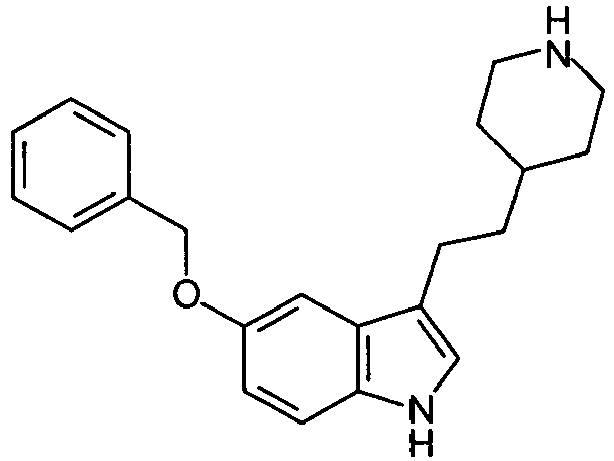
- A further particularly preferred compound of formula (I) is homo-5-benzyloxyindalpine (homo-5-BOIP) having the following structure:
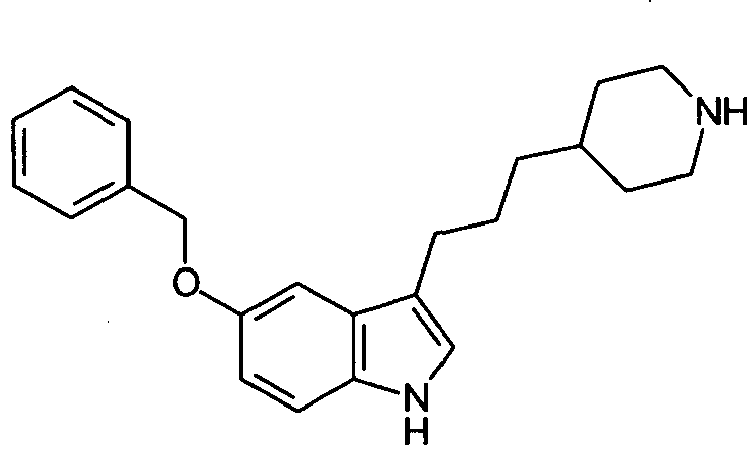
- A further preferred compound of formula (I) is 6-benzyloxyindalpine (6-BOIP) shown in the following:

- A further preferred compound of formula (I) is homo-6-benzyloxyindalpine (homo-6-BOIP) shown in the following:

- The present invention furthermore provides compounds characterized by the following formula (I-1):

- The compounds provided in the context of the present invention are useful as pharmaceuticals, particularly for the treatment or prevention of a gastrointestinal disease or disorder, as explained further below.
- The invention also relates to compounds of formula (II-1):

- The present invention further provides the following compounds as well as pharmaceutically acceptable salts and solvates thereof:


- As used herein, the term "alkyl" refers to a monovalent saturated aliphatic (i.e., non-aromatic) acyclic hydrocarbon group (i.e., a group consisting of carbon atoms and hydrogen atoms) which may be linear or branched and does not comprise any carbon-to-carbon double bond or any carbon-to-carbon triple bond. A "C1-4 alkyl" denotes an alkyl group having 1 to 4 carbon atoms.
- As used herein, the term "alkylene" refers to a divalent saturated aliphatic acyclic hydrocarbon group which may be linear or branched and does not comprise any carbon-to-carbon double bond or any carbon-to-carbon triple bond.
- As used herein, the term "aryl" refers to a monovalent aromatic hydrocarbon group, including monocyclic as well as bridged ring and/or fused ring systems, containing at least one aromatic ring. "Aryl" may, for example, refer to phenyl, naphthyl or anthracenyl.
- As used herein, the term "halogen" refers to -F, -Cl, -Br or -I, preferably to -F or -Cl.
- It has surprisingly been found that compounds of formula (I) exhibit agonistic activity on the 5-HT1P receptor in a neuronal tissue assay. In this connection, it has been demonstrated that 5-benzyloxyindalpine (5-BOIP) activates human enteric nerve cells and that this activation is neutralized by a known 5-HT1P receptor antagonist, 5-HTP-DP, as also reported in Example 4. The agonistic activity of the compounds of formula (I) on the 5-HT1P receptor is particularly surprising as these compounds contain a bulky arylalkoxy group in place of the free phenolic hydroxy group which is present in the known 5-HT1P receptor agonists 5-OHIP and 6-OHIP and thus differ markedly from 5-OHIP and 6-OHIP in their capability to undergo hydrogen bonding.
- Accordingly, the compounds of the present invention are useful as 5-HT1P receptor agonists and, thus, can be used for the treatment or prevention of gastrointestinal diseases/disorders, particularly gastrointestinal motility diseases/disorders, such as constipation as well as functional dyspepsia and/or associated dyspeptic symptoms. Particularly advantageous are compounds of formula (I) acting selectively on the 5-HT1P receptor. The compounds according to the invention furthermore have an advantageously high stability against oxidation, as discussed further below, which makes them particularly suitable as pharmaceuticals.
- Accordingly, the present invention provides a compound of formula (I), or a pharmaceutically acceptable salt or solvate thereof, for use as a medicament. The invention also relates to a pharmaceutical composition comprising a compound of formula (I-1), or a pharmaceutically acceptable salt or solvate thereof, optionally in combination with a pharmaceutically acceptable excipient.
- The invention further relates to a compound of formula (I), or a pharmaceutically acceptable salt or solvate thereof, or a pharmaceutical composition comprising any of the aforementioned entities in combination with a pharmaceutically acceptable excipient, for use in the treatment or prevention of a gastrointestinal disease or disorder, in particular a gastrointestinal motility disease or disorder. The invention also provides a compound of formula (I), or a pharmaceutically acceptable salt or solvate thereof, or a pharmaceutical composition comprising any of the aforementioned entities in combination with a pharmaceutically acceptable excipient, for use as a prokinetic agent or a prokinetic medicament.
- Moreover, the present invention relates to a compound of formula (I), or a pharmaceutically acceptable salt or solvate thereof, or a pharmaceutical composition comprising any of the aforementioned entities optionally in combination with a pharmaceutically acceptable excipient, for use in a method of treating or preventing a gastrointestinal disease or disorder, in particular a gastrointestinal motility disease or disorder, the method comprising the administration of a therapeutically effective amount of said compound or said pharmaceutical composition to a subject in need thereof (preferably a human or a non-human animal, more preferably a human).
- The gastrointestinal disease or disorder to be treated or prevented in accordance with the present invention is preferably selected from constipation (including, e.g., acute constipation and chronic constipation, as well as slow transit constipation, idiopathic constipation, constipation due to post-operative ileus, and colonic inertia), dyspepsia (e.g., functional dyspepsia or non-ulcer dyspepsia) and/or associated dyspeptic symptoms, irritable bowel syndrome (e.g., constipation-predominant irritable bowel syndrome or IBS-C), gastroparesis, intestinal pseudo-obstruction (including, e.g., acute intestinal pseudo-obstruction and chronic intestinal pseudo-obstruction), obstructed defecation, abdominal bloating, abdominal distension, fecal impaction, or abdominal pain. The invention particularly relates to the treatment or prevention of constipation as well as the treatment or prevention of functional dyspepsia and/or associated dyspeptic symptoms.
- The known 5-HT1P receptor agonists 5-hydroxyindalpine (5-OHIP) and 6-hydroxyindalpine (6-OHIP) are prone to oxidation by oxygen from the air, resulting in the corresponding quinone imine species, as illustrated in the following scheme:

- The compounds of the present invention are more stable than 5-OHIP or 6-OHIP, as they do not have a free hydroxy group with an acidic hydrogen atom bound to the indole ring. The formation of oxidized quinone imine species is therefore significantly decreased in the compounds of the present invention, resulting in an advantageously improved chemical stability.
- The improved stability of the compounds according to the invention as compared to 5-OHIP or 6-OHIP has been further confirmed by the observation that 5-BOIP retains activity even after storage for 15 months as a solid at 4°C or in solution frozen at -20°C while 5-OHIP would lose its activity under the same conditions.
- For a person skilled in the field of synthetic chemistry, various ways for the preparation of the compounds of the present invention will be readily apparent. The compounds of formula (I) can, for example, be prepared according to the following general protocol, which is further illustrated in
Scheme 1 below. The groups and variables of the compounds shown inScheme 1, including R1, R2, R3, R4, R5, L1 and n, have the same meanings or preferred meanings described herein above in connection with the compounds of formula (I). - A hydroxyindole derivative (1), which is commercially available or can be prepared in accordance with synthetic protocols described in the literature, is alkylated with an arylalkyl halide (2) using cesium carbonate and a crown ether (e.g., 18-crown-6) to provide an arylalkyloxyindole derivative (3). The arylalkyloxyindole derivative (3) is then coupled in a Grignard reaction with an acid chloride (5) which can be prepared from a 1-Cbz-4-piperidinealkanoic acid (4) using a chlorination reagent, such as thionyl chloride (SOCl2), to provide compound (6). The carboxybenzyl (Cbz) protecting group of compound (6) is removed (e.g., by treatment with concentrated HCl) to obtain compound (7). Optionally, compound (7) can further be N-alkylated on its piperidine moiety using, e.g., an alkyl halide. The carbonyl group in compound (7) is transformed into a methylene group in a Wolff-Kishner reduction using hydrazine (N2H4) and a base (e.g., KOH) to yield the desired compound (8) of formula (I) according to the invention. The reaction conditions in each of these steps, including the reaction temperature and duration, solvents, and the molar ratio of the respective reactants, can be suitably selected, e.g., in accordance with the conditions employed in the corresponding reaction steps in Example 1.

- Accordingly, described herein is also a process of preparing the compound of formula (I) or a pharmaceutically acceptable salt or solvate thereof, comprising a step of reacting a compound of the following formula (Ia) with hydrazine and a base to obtain the compound of formula (I):

- The present invention further relates to a process of preparing the compound of formula (I-1) or a pharmaceutically acceptable salt or solvate thereof, comprising a step of reacting a compound of formula (Ib) with hydrazine and a base to obtain the compound of formula (I-1):

- The process thus comprises a step of subjecting the compound of formula (Ia) or the compound of formula (Ib) to a Wolff-Kishner reduction by reacting it with hydrazine and a base. The base may, e.g., be an alkali metal hydroxide, such as potassium hydroxide or sodium hydroxide (e.g., solid KOH dissolved in diethylene glycol), or an alkali metal tert-butoxide, such as potassium tert-butoxide or sodium tert-butoxide (e.g, potassium tert-butoxide dissolved in in dimethyl sulfoxide). The reaction conditions in this step can suitably be chosen as described for Wolff-Kishner reductions in the literature (e.g., Hutchins RO, et al. Comprehensive organic synthesis. 1991; 8:327-43; or Szmant HH. Angew Chem Int Ed. 1968; 7:120-8). In particular, the reaction temperature can be chosen depending on the specific base employed. For example, if potassium hydroxide dissolved in diethylene glycol is used as the base, the reaction may be conducted at a temperature of about 100°C to about 200°C, preferably at a temperature of about 150°C. The compound of formula (Ia) or the compound of formula (Ib) can be prepared following the synthetic protocol for compound (7) described above and illustrated in
Scheme 1. Accordingly, the process of preparing the compound of formula (I) or the compound of formula (I-1) may further comprise the additional reaction steps described in the general synthetic protocol above and illustrated inScheme 1. - The compounds of formula (I) can also be prepared according to the following alternative protocol, which is further illustrated in
Scheme 2 below. The groups and variables of the compounds shown inScheme 2, including R1, R2, R3, R4, R5, L1 and n, have the same meanings or preferred meanings described herein above in connection with the compounds of formula (I). - A hydroxyindole derivative (1), which is commercially available or can be prepared in accordance with synthetic protocols described in the literature, is alkylated with an arylalkyl halide (2) using cesium carbonate and a crown ether (e.g., 18-crown-6) to provide an arylalkyloxyindole derivative (3). The arylalkyloxyindole derivative (3) is then coupled in a Grignard reaction with an acid chloride (5) which can be prepared from a 1-Cbz-4-piperidinealkanoic acid (4b) using a chlorination reagent, such as oxalyl chloride, to provide compound (6). The 1-Cbz-4-piperidinealkanoic acid (4b), in turn, can be prepared from a 4-piperidinealkanoic acid (4a) using benzyloxycarbonyl chloride (Cbz-Cl). The carboxybenzyl (Cbz) protecting group of compound (6) is removed (e.g., by treatment with concentrated HCl) to obtain compound (7). Optionally, compound (7) can further be N-alkylated on its piperidine moiety using, e.g., an alkyl halide. The carbonyl group in compound (7) is transformed into a methylene group in a reduction using lithium aluminum hydride (LiAlH4) to yield the desired compound (8) of formula (I) according to the invention. The reaction conditions in each of these steps, including the reaction temperature and duration, solvents, and the molar ratio of the respective reactants, can be suitably selected, e.g., in accordance with the conditions employed in the corresponding reaction steps in Example 2 or 3.

- Thus, described herein is also a process of preparing the compound of formula (I) or a pharmaceutically acceptable salt or solvate thereof, comprising a step of reacting a compound of the following formula (Ia) with lithium aluminum hydride (LiAlH4) to obtain the compound of formula (I):

- Moreover, the present invention relates to a process of preparing the compound of formula (I-1) or a pharmaceutically acceptable salt or solvate thereof, comprising a step of reacting a compound of formula (Ib) with lithium aluminum hydride (LiAlH4) to obtain the compound of formula (I-1):

- The process thus comprises a step of reducing the compound of formula (Ia) or the compound of formula (Ib) by reacting it with lithium aluminum hydride (LiAlH4). The reaction conditions in this step can suitably be chosen as described, e.g., in step (5) of Example 2. The compound of formula (Ia) or the compound of formula (Ib) can be prepared following the synthetic protocol for compound (7) described above and illustrated in
Scheme 2. Accordingly, the process of preparing the compound of formula (I) or the compound of formula (I-1) may further comprise the additional reaction steps described in the general synthetic protocol above and illustrated inScheme 2. - The hydroxyindalpine derivatives of the present invention are also useful as starting materials for the preparation of the corresponding hydroxyindalpines having a free hydroxy group, such as 5-OHIP and 6-OHIP, in a simplified and convenient manner. In particular, a compound of formula (I-1) can be subjected to hydrogenolysis (e.g., palladium-catalyzed hydrogenolysis) in order to obtain the corresponding hydroxyindalpine having a free hydroxy group. Thereby, an improved route of synthesis for these hydroxyindalpines is provided. The compounds 5-BOIP and 6-BOIP, for example, can be subjected to hydrogenolysis in order to cleave the benzyl group comprised in these compounds and thereby provide the corresponding hydroxyindalpines 5-OHIP and 6-OHIP, respectively. The hydrogenolysis reaction can, e.g., be carried out using the methods for the cleavage of benzyl ether groups described in: Wuts, PGM and Greene, TW. Greene's Protective Groups in Organic Synthesis, John Wiley & Sons, 4th Edition, 2006; Mandal, PK et al., J Org Chem, 2007, 72:6599-601; or Coleman, RS et al., Synthesis, 1999, SI:1399-400. Accordingly, described herein is also a method of preparing a hydroxyindalpine having a free hydroxy group, comprising a step of subjecting a compound of formula (I-1) to hydrogenolysis.
- The scope of the present invention embraces all pharmaceutically acceptable salt forms of the compounds of formula (I) which may be formed, e.g., by protonation of an atom carrying an electron lone pair which is susceptible to protonation, such as an amino group, with an inorganic or organic acid, or as a salt of a carboxylic acid group with a physiologically acceptable cation as they are well-known in the art. Exemplary base addition salts comprise, for example: alkali metal salts such as sodium or potassium salts; alkaline earth metal salts such as calcium or magnesium salts; ammonium salts; aliphatic amine salts such as trimethylamine, triethylamine, dicyclohexylamine, ethanolamine, diethanolamine, triethanolamine, procaine salts, meglumine salts, or ethylenediamine salts; aralkyl amine salts such as N,N-dibenzylethylenediamine salts, benetamine salts; heterocyclic aromatic amine salts such as pyridine salts, picoline salts, quinoline salts or isoquinoline salts; quaternary ammonium salts such as tetramethylammonium salts, tetraethylammonium salts, benzyltrimethylammonium salts, benzyltriethylammonium salts, benzyltributylammonium salts, methyltrioctylammonium salts or tetrabutylammonium salts; and basic amino acid salts such as arginine salts or lysine salts. Exemplary acid addition salts comprise, for example, mineral acid salts such as hydrochloride, hydrobromide, hydroiodide, sulfate salts, nitrate salts, phosphate salts (such as, e.g., phosphate, hydrogenphosphate, or dihydrogenphosphate salts), carbonate salts, hydrogencarbonate salts or perchlorate salts; organic acid salts such as acetate, propionate, butyrate, pentanoate, hexanoate, heptanoate, octanoate, cyclopentanepropionate, undecanoate, lactate, maleate, oxalate, fumarate, tartrate, malate, citrate, nicotinate, benzoate, salicylate or ascorbate salts; sulfonate salts such as methanesulfonate, ethanesulfonate, 2-hydroxyethanesulfonate, benzenesulfonate, p-toluenesulfonate (tosylate), 2-naphthalenesulfonate, 3-phenylsulfonate, or camphorsulfonate salts; and acidic amino acid salts such as aspartate or glutamate salts.
- Moreover, the scope of the invention embraces the compounds of formula (I) in any solvated form, including, e.g., solvates with water, for example hydrates, or with organic solvents such as, e.g., methanol, ethanol or acetonitrile, i.e., as a methanolate, ethanolate or acetonitrilate, respectively, or in the form of any polymorph.
- Furthermore, the formulae in the present specification are intended to cover all possible stereoisomers, including enantiomers and diastereomers, of the indicated compounds.
- Thus, all stereoisomers of the compounds of the present invention are contemplated as part of the present invention, either in admixture or in pure or substantially pure form. The scope of the compounds according to the invention embraces all of the possible stereoisomers and their mixtures. It particularly embraces the racemic forms and the isolated optical isomers. The racemic forms can be resolved by physical methods, such as, e.g., fractional crystallization, separation or crystallization of diastereomeric derivatives or separation by chiral column chromatography. The individual optical isomers can be obtained from the racemates using conventional methods, such as, e.g., salt formation with an optically active acid followed by crystallization.
- Described herein are also pharmaceutically acceptable prodrugs of the compounds according to the present invention. Such prodrugs are derivatives which have chemically or metabolically cleavable groups and become, by solvolysis or under physiological conditions, the compounds of the invention which are pharmaceutically active in vivo. Prodrugs of compounds according to the the present invention, as disclosed herein, may be formed in a conventional manner with a functional group of the compounds such as, e.g., with an amino, hydroxy or carboxy group. The prodrug derivative form often offers advantages of solubility, tissue compatibility or delayed release in a mammalian organism (see, Bundgaard, H., Design of Prodrugs, pp. 7-9, 21-24, Elsevier, Amsterdam 1985). Prodrugs include acid derivatives well known to the person skilled in the art, such as, for example, esters prepared by reaction of the parent acidic compound with a suitable alcohol, or amides prepared by reaction of the parent acid compound with a suitable amine. When a compound of the present invention has a carboxyl group, an ester derivative prepared by reacting the carboxyl group with a suitable alcohol or an amide derivative prepared by reacting the carboxyl group with a suitable amine is exemplified as a prodrug. An especially preferred ester derivative as a prodrug is methylester, ethylester, n-propylester, isopropylester, n-butylester, isobutylester, tert-butylester, morpholinoethylester, N,N-diethylglycolamidoester or α-acetoxyethylester. When a compound of the present invention has a hydroxy group, an acyloxy derivative prepared by reacting the hydroxyl group with a suitable acylhalide or a suitable acid anhydride is exemplified as a prodrug. An especially preferred acyloxy derivative as a prodrug is -OC(=O)-CH3, -OC(=O)-C2H5, -OC(=O)-(tert-Bu), -OC(=O)-C15H31, -OC(=O)-(m-COONa-Ph), -OC(=O)-CH2CH2COONa, -O(C=O)-CH(NH2)CH3 or -OC(=O)-CH2-N(CH3)2. When a compound of the present invention has an amino group, an amide derivative prepared by reacting the amino group with a suitable acid halide or a suitable mixed anhydride is exemplified as a prodrug. An especially preferred amide derivative as a prodrug is -NHC(=O)-(CH2)2OCH3 or -NHC(=O)-CH(NH2)CH3.
- The compounds described herein may be administered as compounds per se or may be formulated as medicaments. The medicaments/pharmaceutical compositions may optionally comprise one or more pharmaceutically acceptable excipients, such as carriers, diluents, fillers, disintegrants, lubricating agents, binders, colorants, pigments, stabilizers, preservatives, antioxidants, or solubility enhancers.
- In particular, the pharmaceutical compositions may comprise one or more solubility enhancers, such as, e.g., poly(ethylene glycol), including poly(ethylene glycol) having a molecular weight in the range of about 200 to about 5,000 Da, ethylene glycol, propylene glycol, non-ionic surfactants, tyloxapol,
polysorbate 80, macrogol-15-hydroxystearate, phospholipids, lecithin, dimyristoyl phosphatidylcholine, dipalmitoyl phosphatidylcholine, distearoyl phosphatidylcholine, cyclodextrins, hydroxyethyl-β-cyclodextrin, hydroxypropyl-β-cyclodextrin, hydroxyethyl-γ-cyclodextrin, hydroxypropyl-γ-cyclodextrin, dihydroxypropyl-β-cyclodextrin, glucosyl-α-cyclodextrin, glucosyl-β-cyclodextrin, diglucosyl-β-cyclodextrin, maltosyl-α-cyclodextrin, maltosyl-β-cyclodextrin, maltosyl-γ-cyclodextrin, maltotriosyl-β-cyclodextrin, maltotriosyl-γ-cyclodextrin, dimaltosyl-β-cyclodextrin, methyl-β-cyclodextrin, carboxyalkyl thioethers, hydroxypropyl methylcellulose, hydroxypropylcellulose, polyvinylpyrrolidone, vinyl acetate copolymers, vinyl pyrrolidone, sodium lauryl sulfate, dioctyl sodium sulfosuccinate, or any combination thereof. - The pharmaceutical compositions can be formulated by techniques known to the person skilled in the art, such as the techniques published in Remington's Pharmaceutical Sciences, 20th Edition. The pharmaceutical compositions can be formulated as dosage forms for oral, parenteral, such as intramuscular, intravenous, subcutaneous, intradermal, intraarterial, intracardial, rectal, nasal, topical, aerosol or vaginal administration. Dosage forms for oral administration include coated and uncoated tablets, soft gelatin capsules, hard gelatin capsules, lozenges, troches, solutions, emulsions, suspensions, syrups, elixirs, powders and granules for reconstitution, dispersible powders and granules, medicated gums, chewing tablets and effervescent tablets. Dosage forms for parenteral administration include solutions, emulsions, suspensions, dispersions and powders and granules for reconstitution. Emulsions are a preferred dosage form for parenteral administration. Dosage forms for rectal and vaginal administration include suppositories and ovula. Dosage forms for nasal administration can be administered via inhalation and insufflation, for example by a metered inhaler. Dosage forms for topical administration include creams, gels, ointments, salves, patches and transdermal delivery systems.
- The compounds according to the invention, or the above described pharmaceutical compositions comprising one or more compounds of formula (I), may be administered to a subject by any convenient route of administration, whether systemically/peripherally or at the site of desired action, including but not limited to one or more of: oral (e.g., as a tablet, capsule, or as an ingestible solution), topical (e.g., transdermal, intranasal, buccal, and sublingual), parenteral (e.g., using injection techniques or infusion techniques, and including, for example, by injection, e.g., subcutaneous, intradermal, intramuscular, intravenous, intraarterial, intracardiac, intrathecal, intraspinal, intracapsular, subcapsular, intraorbital, intraperitoneal, intratracheal, subcuticular, intraarticular, subarachnoid, or intrasternal by, e.g., implant of a depot, for example, subcutaneously or intramuscularly), pulmonary (e.g., by inhalation or insufflation therapy using, e.g., an aerosol, e.g., through mouth or nose), gastrointestinal, intrauterine, subcutaneous, rectal, and vaginal.
- It is particularly preferred that the compounds or pharmaceutical compositions of the present invention are administered orally, e.g., in the form of tablets, capsules, ovules, elixirs, solutions or suspensions, which may further contain flavoring or coloring agents, for immediate-release, delayed-release, modified-release, sustained-release, pulsed-release or controlled-release applications.
- The tablets may contain excipients such as microcrystalline cellulose, lactose, sodium citrate, calcium carbonate, dibasic calcium phosphate and glycine, disintegrants such as starch (preferably corn, potato or tapioca starch), sodium starch glycolate, croscarmellose sodium and certain complex silicates, and granulation binders such as polyvinylpyrrolidone, hydroxypropylmethylcellulose (HPMC), hydroxypropylcellulose (HPC), sucrose, gelatin and acacia. Additionally, lubricating agents such as magnesium stearate, stearic acid, glyceryl behenate and talc may be included. Solid compositions of a similar type may also be employed as fillers in gelatin capsules. Preferred excipients in this regard include lactose, starch, a cellulose, or high molecular weight polyethylene glycols. For aqueous suspensions and/or elixirs, the agent may be combined with various sweetening or flavoring agents, coloring matter or dyes, with emulsifying and/or suspending agents and with diluents such as water, ethanol, propylene glycol and glycerin, and combinations thereof.
- Alternatively, it may also be possible to administer said compounds or pharmaceutical compositions in the form of a suppository or pessary, or it may be applied topically in the form of a gel, hydrogel, lotion, solution, cream, ointment or dusting powder. The compounds of the present invention may also be dermally or transdermally administered, for example, by the use of a skin patch.
- If said compounds or pharmaceutical compositions are administered parenterally, then examples of such administration include one or more of: intravenously, intraarterially, intraperitoneally, intrathecally, intraventricularly, intraurethrally, intrasternally, intracardially, intracranially, intramuscularly or subcutaneously administering the compounds or pharmaceutical compositions, and/or by using infusion techniques. For parenteral administration, the compounds are best used in the form of a sterile aqueous solution which may contain other substances, for example, enough salts or glucose to make the solution isotonic with blood. The aqueous solutions should be suitably buffered (preferably to a pH of from 3 to 9), if necessary. The preparation of suitable parenteral formulations under sterile conditions is readily accomplished by standard pharmaceutical techniques well known to those skilled in the art.
- For topical application to the skin, said compounds or pharmaceutical compositions can be formulated as a suitable ointment containing the active compound suspended or dissolved in, for example, a mixture with one or more of the following: mineral oil, liquid petrolatum, white petrolatum, propylene glycol, emulsifying wax and water. Alternatively, they can be formulated as a suitable lotion or cream, suspended or dissolved in, for example, a mixture of one or more of the following: mineral oil, sorbitan monostearate, a polyethylene glycol, liquid paraffin,
polysorbate 60, cetyl esters wax, 2-octyldodecanol, benzyl alcohol and water. - Typically, a physician will determine the actual dosage which will be most suitable for an individual subject. The specific dose level and frequency of dosage for any particular individual subject may be varied and will depend upon a variety of factors including the activity of the specific compound employed, the metabolic stability and length of action of that compound, the age, body weight, general health, sex, diet, mode and time of administration, rate of excretion, drug combination, the severity of the particular condition, and the individual subject undergoing therapy.
- A proposed, yet non-limiting dose of the compounds according to the invention for oral administration to a human (of approximately 70 kg body weight) may be 0.1 µg to 10 g, preferably 0.1 mg to 1 g, of the active ingredient per unit dose. The unit dose may be administered, for example, 1 to 4 times per day. It will be appreciated that it may be necessary to make routine variations to the dosage depending on the age and weight of the patient/subject as well as the severity of the condition to be treated. The precise dose and also the route of administration will ultimately be at the discretion of the attendant physician or veterinarian.
- The compounds of the present invention may be administered in the context of a monotherapy or in combination with one or more other pharmaceutically active agents. When a compound of the invention is used in combination with a second pharmaceutically active agent which is active against the same disease, the dose of each compound may differ from that when the compound is used alone. The combination of a compound of the present invention with one or more other pharmaceutically active agents may comprise the simultaneous/concomitant administration of the pharmaceutically active agents with the compound of the invention. However, sequential/separate administration is also envisaged.
- Preferably, the second pharmaceutically active agent to be administered in combination with the compound of the present invention is an agent for the treatment or prevention of a gastrointestinal disease or disorder, such as, e.g., oxyphencyclimine, camylofin, mebeverine, trimebutine, rociverine, dicycloverine, dihexyverine, difemerine, piperidolate, benzilone, glycopyrronium, oxyphenonium, penthienate, propantheline, otilonium bromide, methantheline, tridihexethyl, isopropamide, hexocyclium, poldine, mepenzolate, bevonium, pipenzolate, diphemanil, tiemonium iodide, prifinium bromide, timepidium bromide, fenpiverinium, oxyphenonium, benzetimide, carbachol, neostigmin, dimethylaminopropionylphenothiazine, nicofetamide, tiropramide, papaverine, drotaverine, moxaverine, alosetron, tegaserod, cilansetron, prucalopride, fenpiprane, diisopromine, chlorbenzoxamine, pinaverium, fenoverine, idanpramine, proxazole, alverine, trepibutone, isometheptene, caroverine, phloroglucinol, alverine, physiostigmin, atropine, hyoscyamine, butylscopolamine, methylatropine, methylscopolamine, fentonium, cimetropium bromide, metoclopramide, cisapride, domperidone, bromopride, alizapride, clebopride, physiostigmine, mosapride, zacopride, renzapride, BIMU1, BIMU8, lirexapride, GR125487, cinitapride, itopride, bethanechol, erythromycin, or mitemcinal.
- It is particularly preferred that the second pharmaceutically active agent to be administered in combination with the compound of the invention is a 5-HT4 agonist (such as, e.g., tegaserod, mosapride, zacopride, cisapride, renzapride, prucalopride, BIMU1, BIMU8, lirexapride, GR125487, cinitapride, or metoclopramide) or any other prokinetic agent (such as, e.g., itopride, octreotide, bethanechol, domperidone, erythromycin, or mitemcinal).
- The combinations referred to above may conveniently be presented for use in the form of a pharmaceutical formulation. The individual components of such combinations may be administered either sequentially or simultaneously/concomitantly in separate or combined pharmaceutical formulations by any convenient route. When administration is sequential, either the compound of the present invention or the second pharmaceutically active agent may be administered first. When administration is simultaneous, the combination may be administered either in the same or different pharmaceutical compositions. When combined in the same formulation it will be appreciated that the two compounds must be stable and compatible with each other and the other components of the formulation. When formulated separately they may be provided in any convenient formulation, conveniently in such manner as is known for such compounds in the art.
- Accordingly, the present invention relates to a compound of formula (I) or a pharmaceutically acceptable salt or solvate thereof, or a pharmaceutical composition comprising any of the aforementioned entities optionally in combination with a pharmaceutically acceptable excipient, for use in the treatment or prevention of a gastrointestinal disease or disorder, in particular a gastrointestinal motility disease or disorder, whereby the compound or the pharmaceutical composition is to be administered in combination with a further pharmaceutically active agent (such as, e.g., tegaserod, mosapride, zacopride, cisapride, renzapride, prucalopride, BIMU1, BIMU8, lirexapride, GR125487, cinitapride, metoclopramide, itopride, octreotide, bethanechol, domperidone, erythromycin, or mitemcinal).
- The subject or patient, such as the subject in need of treatment or prevention, may be an animal (e.g., a non-human animal), a vertebrate animal, a mammal, a rodent (e.g., a guinea pig, a hamster, a rat, a mouse), a murine (e.g., a mouse), a canine (e.g., a dog), a feline (e.g., a cat), a porcine (e.g., a pig), an equine (e.g., a horse), a primate, a simian (e.g., a monkey or ape), a monkey (e.g., a marmoset, a baboon), an ape (e.g., a gorilla, chimpanzee, orang-utan, gibbon), or a human. The meaning of the terms "animal", "mammal", etc. is well known in the art and can, for example, be deduced from Wehner und Gehring (1995; Thieme Verlag). In the context of this invention, it is also envisaged that animals are to be treated which are economically, agronomically or scientifically important. Scientifically important organisms include, but are not limited to, mice, rats, and rabbits. Non-limiting examples of agronomically important animals are sheep, cattle and pigs, while, for example, cats and dogs may be considered as economically important animals. Preferably, the subject/patient is a mammal; more preferably, the subject/patient is a human or a non-human mammal (such as, e.g., a guinea pig, a hamster, a rat, a mouse, a rabbit, a dog, a cat, a horse, a monkey, an ape, a marmoset, a baboon, a gorilla, a chimpanzee, an orang-utan, a gibbon, a sheep, cattle, or a pig); even more preferably, the subject/patient is a human.
- The term "treatment of a disorder or disease" as used herein is well known in the art. "Treatment of a disorder or disease" implies that a disorder or disease is suspected or has been diagnosed in a patient/subject. A patient/subject suspected of suffering from a disorder or disease typically shows specific clinical and/or pathological symptoms which a skilled person can easily attribute to a specific pathological condition (i.e., diagnose a disorder or disease).
- "Treatment of a disorder or disease" may, for example, lead to a halt in the progression of the disorder or disease (e.g., no deterioration of symptoms) or a delay in the progression of the disorder or disease (in case the halt in progression is of a transient nature only). "Treatment of a disorder or disease" may also lead to a partial response (e.g., amelioration of symptoms) or complete response (e.g., disappearance of symptoms) of the subject/patient suffering from the disorder or disease. "Amelioration" of a disorder or disease may, for example, lead to a halt in the progression of the disorder or disease or a delay in the progression of the disorder or disease. Such a partial or complete response may be followed by a relapse. It is to be understood that a subject/patient may experience a broad range of responses to a treatment (e.g., the exemplary responses as described herein above).
- Treatment of a disorder or disease may, inter alia, comprise curative treatment (preferably leading to a complete response and eventually to healing of the disorder or disease) and palliative treatment (including symptomatic relief).
- Also the term "prevention of a disorder or disease" as used herein is well known in the art. For example, a patient/subject suspected of being prone to suffer from a disorder or disease as defined herein may, in particular, benefit from a prevention of the disorder or disease. The subject/patient may have a susceptibility or predisposition for a disorder or disease, including but not limited to hereditary predisposition. Such a predisposition can be determined by standard assays, using, for example, genetic markers or phenotypic indicators. It is to be understood that a disorder or disease to be prevented in accordance with the present invention has not been diagnosed or cannot be diagnosed in the patient/subject (for example, the patient/subject does not show any clinical or pathological symptoms). Thus, the term "prevention" comprises the use of compounds of the present invention before any clinical and/or pathological symptoms are diagnosed or determined or can be diagnosed or determined by the attending physician.
- The invention is also illustrated by the following illustrative figures. The appended figures show:
-
Figure 1 : Mass spectrum of 5-benzyloxyindalpine (MALDI-TOF; matrix: 2,3,4-trihydroxyacetophenone). The x-axis shows the mass-to-charge ratio (m/z), and the y-axis shows signal intensities ("a.u." means arbitrary units). -
Figure 2 : 1H-NMR spectrum of 5-benzyloxyindalpine (5-BOIP); see Example 2. -
Figure 3 : 13C-NMR spectrum of 5-benzyloxyindalpine (5-BOIP); see Example 2. -
Figure 4 : 1H-NMR spectrum of homo-5-benzyloxyindalpine (homo-5-BOIP); see Example 3. -
Figure 5 : 13C-NMR spectrum of homo-5-benzyloxyindalpine (homo-5-BOIP); see Example 3. -
Figure 6 : 5-Benzyloxyindalpine (referred to as "5-BOIP" or "BOIP" in the figure) activates human enteric nerve cells (see Example 4). In the upper left-hand section of the figure, the reaction of a nerve cell to the application of 5-BOIP is shown. The activation of enteric nerve cells by 5-BOIP is almost completely inhibited in the presence of the 5-HT1P receptor antagonist 5-HTP-DP, as shown in the upper central section of this figure. After washing out 5-HTP-DP, freshly added 5-BOIP again induces action potentials, as shown in the upper righthand section. The action potential (spike) frequencies are shown in the lower section of the figure as medians with 10% and 90% interquartile range (IQR). 5-BOIP induced action potentials at a frequency of 1.6 (1.0 / 2.1) Hz. This effect was almost completely blocked by the 5-HT1P receptor antagonist 5-HTP-DP, such that the action potential frequency was reduced to 0 (0 / 0.5) Hz. After washing out the antagonist 5-HTP-DP, the stimulating effect of 5-BOIP recovered and 5-BOIP again induced action potentials at a frequency of 1.0 (0.5 / 1.6) Hz. Statistically significant differences are marked with an asterisk (*) for p < 0.05. -
Figure 7 : 5-BOIP and homo-5-BOIP have effects on nerve mediated muscle responses in the guinea pig stomach (see Example 5). On the left side of the figure, the response of two circular muscle strips from the guinea pig stomach to electrical field stimulation (EFS; "el. stim.") is shown. The response consists of an initial, fast contraction ("on contraction") and a relaxation with a longer duration. The parameters for the EFS were chosen to specifically excite neuronal structures in the preparations and have no direct effects on smooth muscle. The response therefore reflects the activation of the enteric nerves and the subsequent release of excitatory and inhibitory neurotransmitters that finally act on receptors on smooth muscle cells. After the addition of 5-BOIP and homo-5-BOIP (10 µM), a second EFS evokes only a reduced "on contraction" in both preparations. This indicates an additional activation of inhibitory neuronal pathways by both substances. - The invention will now be described by reference to the following examples which are merely illustrative and are not to be construed as a limitation of the scope of the present invention. In case of conflict between the chemical structures and the corresponding chemical names indicated in the examples section, the structures depicted herein prevail.
- 5-Benzyloxyindalpine (7) was synthesized in five steps, as shown in
Scheme 3 below, starting from commercially available 5-hydroxyindole (1) which was first alkylated with benzylbromide using cesium carbonate and crown ether. The protected 5-benzyloxyindole (2) was coupled in a Grignard reaction with an acid chloride (4) derived from commercially available 1-Cbz-4-piperidineacetic acid (3). Removal of the carbamate protecting group incompound 5 was performed with concentrated HCl to provide compound 6. In a last step, the carbonyl group in compound 6 was transformed into a methylene group in a Wolff-Kishner reduction to yield 5-benzyloxyindalpine (7).
- When working with indalpine compounds or their precursors, it is generally recommendable to work under an inert or oxygen-free atmosphere (e.g., a nitrogen or argon atmosphere), to use degassed solutions and to store compounds as solids rather than in aqueous or basic media.
- Further general information can be found in: Gueremy C, et al. J Med Chem. 1980. 23(12):1306-10;
DE-A-2618152 ; Branchek TA, et al. J Neuroscience. 1988. 8:2582-95; Mitchell NA, et al. Neurogastroenterol Motil. 2009. 21(7):760-e48; Ketcha DM, et al. J Org Chem. 1985. 50(26):5451-57; Ketcha DM, et al. J Org Chem. 1989. 54(18): 4350-56; and Lunn G, et al. J Org Chem. 1986. 51:513-17. - The synthesis of 5-benzyloxyindalpine outlined above is described in detail in the following. It should be understood that, in case of conflict between the depicted structural formulae and the corresponding chemical names indicated in this Example, the depicted structures prevail.
-

- 0.5 g (3.8 mmol) 5-hydroxyindole (1) were dissolved in 5 ml acetone and mixed with 535 µl (4.5 mmol) benzylbromide (BnBr), 2.45 g (7.5 mmol) Cs2CO3 and 1.2 g (4.5 mmol) 18-crown-6 at room temperature (rt). After stirring for 2.5 to 17 h, preferably for 6 h, the mixture was diluted with water, smoothly acidified with 1 M HCl and extracted three times with CH2Cl2. The combined organic layers were dried with Na2SO4, filtered and evaporated. The crude product was purified by flash chromatography (SiO2, cyclohexane - ethyl acetate 4:1) and yielded 762 mg (3.4 mmol, 91%) of a pale yellow solid.
1H-NMR (500 MHz, CDCl3): 8.11 (br, 1 H), 7.52 (d, J=7.5 Hz, 2 H), 7.41 (t, J=7.8 Hz, 2 H), 7.37-7.30 (m, 2 H), 7.22 (d, J=2.3 Hz, 1 H), 7.21 (t, J=2.8 Hz, 1 H), 6.98 (dd, J=8.8 Hz, J=2.4 Hz, 1 H), 6.51 (br, 1 H), 5.15 (s, 2 H). -

- 502 mg (1.8 mmol) of 2-[1-(benzyloxycarbonyl)piperidin-4-yl]acetic acid (3) were dissolved in anhydrous CH2Cl2 under argon and mixed with 10 ml SOCl2. After stirring for 4 h at 80°C, the solution was directly evaporated. The residue was mixed three times with anhydrous CH2Cl2 and evaporated. The residue was further mixed three times with anhydrous toluene and evaporated in vacuo to yield 535 mg (1.8 mmol, 99%) of a white solid. The product was used in the next step without further purification.
-

- 110 mg (4.5 mmol) Mg and few crystals I2 were mixed with 10 ml dry diethyl ether (Et2O) and stirred for 10 min at 60°C under argon atmosphere. 283 µl (4.5 mmol) of CH3I in 10 ml dry Et2O were added dropwise at 60°C and the mixture was stirred for further 2.5 h at 60°C. The mixture was cooled to room temperature and 485 mg (2.2 mmol) of
compound 2 in 10 ml dry Et2O were added dropwise. After subsequent stirring for 1 h at 60°C, the solution was cooled to 0°C and 535 mg (1.8 mmol) of compound 4 in 10 ml anhydrous CH2Cl2 were added dropwise (yellow suspension). After stirring for 0.5 h at 0°C and 1 h at room temperature, the solution was diluted with water, acidified with 1 M HCl (yellow) and extracted three times with CH2Cl2. The combined organic layers were dried with Na2SO4, filtered and evaporated in vacuo. The crude yellow product was purified by flash chromatography (SiO2, CH2Cl2 - MeOH 9:1) to yield 574 mg (1.2 mmol, 66%) of a white solid.
1H-NMR (500 MHz, CDCl3): 9.84 (br, 1 H), 8.39 (d, J=3.3 Hz, 1 H), 7.95 (d, J=2.4 Hz, 1 H), 7.75 (d, J=7.3 Hz, 2 H), 7.50-7.36 (m, 10 H), 7.35-7.25 (m, 3 H), 6.98 (dd, J=8.8 Hz, J=2.5 Hz, 1 H), 5.54 (s, 2 H), 5.12 (s, 2 H), 4.62 (s, 2 H), 3.65 (d, J=12.3 Hz, 2 H), 3.10-3.00 (m, 4 H), 2.54 (q, J=13.4 Hz, 2 H), 2.02 (br, 1 H), 1.68 (d, J=13.8 Hz, 2 H) -
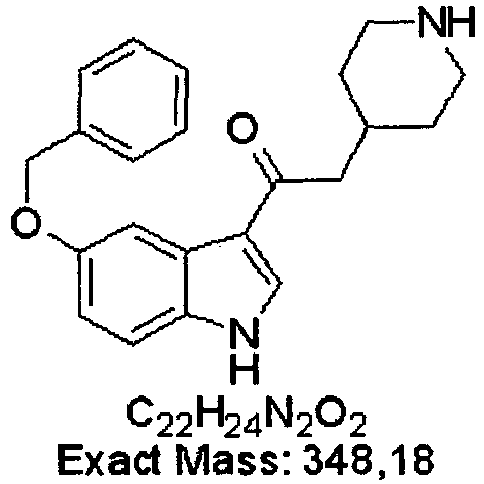
- 574 mg (1.2 mmol) of
compound 5 were dissolved in 5 ml MeOH and 5 ml HCl (37%) and stirred for 2.5 h at 80°C. The mixture was cooled to room temperature and directly evaporated in vacuo to yield 184 mg (0.5 mmol, 42%) of a slight pink solid.
1H-NMR (500 MHz, CDCl3): 7.55 (s, 1 H), 7.42 (d, J=7.3 Hz, 2 H), 7.40-7.25 (m, 5 H), 6.83 (dd, J=8.7 Hz, J=2.9 Hz, 1 H), 6.71-6.68 (m, 2 H), 5.00 (s, 2 H), 3.62 (s, 2 H), 3.50 (s, 1 H), 2.93 (d, J=10.7 Hz, 2 H), 2.59 (d, J=6.5 Hz, 2 H), 2.06 (br, 2 H), 1.64-1.52 (m, 2 H), 1.37 (q, J=9.4 Hz, 2 H) -

- 184 mg (0.5 mmol) of compound 6 were dissolved in 10 ml ethylene glycol, mixed with 2 ml N2H4·H2O and 1 g (17.8 mmol) solid KOH, and stirred for 2 h at 150°C. The solution was cooled to room temperature, diluted with water and extracted three times with ethyl acetate. The combined organic layers were dried with Na2SO4, filtered and evaporated in vacuo. The crude product was purified by flash chromatography (SiO2, CH2Cl2 - MeOH 7:3) to yield 130 mg (0.5 mmol, 95%) of a brown solid. A portion of the crude brown solid was further purified by semi-preparative HPLC (Purospher STAR, 250 x 10 mm, RP-8 select-B) to yield 20 mg of a pale brown solid.
1H-NMR (400 MHz, d4-MeOD): 7.99 (s, 1 H), 7.51-7.7.41 (m, 5 H), 7.31 (d, J=7.4 Hz, 1 H), 6.95 (dd, J=8.7 Hz, J=2.5 Hz, 1 H), 6.86 (d, J=2.5 Hz, 1 H), 4.24 (s, 2 H), 3.38 (d, J=11.9 Hz, 2 H), 3.27 (br, 2 H), 3.00 (t, J=12.2 Hz, 2 H), 2.66 (d, J=6.8 Hz, 2 H), 2.00-1.90 (br, 1H), 1.85 (d, J=15 Hz, 2 H), 1.48 (q, J=12.6 Hz, 2 H). - When 5-benzyloxyindalpine (7) thus obtained was analyzed by mass spectrometry (MALDI-TOF; matrix: 2,3,4-trihydroxyacetophenone), a mass peak at m/z 242.695 was observed, rather than the expected peak at m/z 334 (
Figure 1 ). This may be explained by the LASER-induced cleavage of the benzyl group from 5-benzyloxyindalpine and the subsequent photo-oxidation of the cleavage product, resulting in the charged and/or protonated corresponding quinone imine of 5-benzyloxyindalpine. - 5-Benzyloxyindalpine (7) was synthesized in five steps, as shown in Scheme 4 below, starting from commercially available 2-(piperidin-4-yl)acetic acid (1), which was first protected at the (secondary) amino group with a carboxybenzyl (Cbz) protecting group. The resulting 2-(N-Cbz-piperidin-4-yl)
acetic acid 2 was activated as a carboxylic acid chloride (3) using oxalyl chloride and subsequently coupled with commercially available 5-benzyloxyindole (4) in a Grignard reaction to providecompound 5. Removal of the carbamate protecting group ofcompound 5 was performed with 5 M HCl in dry ethanol to provide compound 6. In the final step, 5-BOIP (7) was obtained by reducing the carbonyl group of compound 6 with LiAlH4.
- The synthesis of 5-BOIP outlined above is described in detail in the following section.
- When working with indalpine compounds or their precursors, it is generally recommendable to work under an inert or oxygen-free atmosphere (e.g., a nitrogen or argon atmosphere), to use degassed solutions, and to store compounds as solids rather than in aqueous or basic media.
- Further general information can be found in: Gueremy C, et al. J Med Chem. 1980, 23(12);1306-10;
DE-A-2618152 ; Branchek TA, et al. J Neuroscience. 1988, 8:2582-95; Mitchell NA, et al. Neurogastroenterol Motil. 2009, 21(7):760-e48; and Leete E, et al. Canad J Chem. 1953, 31:775-84. -

- To prepare
compound 2, a procedure published inDE 4304650 A1 was followed with modifications. 3000 mg (16.7 mmol) 2-(piperidin-4-yl) acetic acid hydrochloride (Iris Biotech, Marktredwitz, Germany) was dissolved in 46 ml of a 1 M solution of NaOH in water and cooled in an ice bath. 3350 µl benzyloxycarbonyl chloride (Cbz-Cl) (23.46 mmol, 4002 mg) were added dropwise over 5 min under stirring. The reaction mixture was allowed to warm to room temperature and stirred for 16 h. The aqueous solution was washed twice with 20 ml of diethyl ether/petroleum ether 4:1 and then acidified with 4 M HCl (aq.) topH 1. The product of the reaction was extracted with3x 50 ml diisopropyl ether. The combined organic phases were dried with MgSO4 and evaporated under reduced pressure.Compound 2 was obtained as a colorless solid (4383 mg, 15.8 mmol, 95%).
1H NMR (400 MHz, Chloroform-d) δ 7.40 - 7.27 (m, 5H), 5.13 (s, 2H), 4.18 (d, J = 13.3 Hz, 2H), 2.81 (t, J = 12.8 Hz, 2H), 2.29 (d, J = 7.0 Hz, 2H), 1.96 (tp, J = 11.2, 3.5 Hz, 1H), 1.75 (d, J = 12.1 Hz, 2H), 1.30 - 1.09 (m, 2H) -

- Compound 2 (3000 mg, 10.82 mmol) was dissolved in 30 ml dry dichloromethane (DCM) at room temperature. 1831 µl (21.64 mmol, 2746 mg) oxalyl chloride were added slowly. After stirring the mixture for 30 min, 30 µl dimethylformamide (DMF) were added and stirring was continued for 2 h. Then the solvent was removed under reduced pressure. The remaining material was dried thoroughly under vacuum.
Acid chloride 3 was obtained as a colorless, slightly cloudy oil and was used without further purification. -

- A procedure for the preparation of
compound 5 can be found inDE 2618152 A1 and Gueremy C, et al. J Med Chem. 1980, 23(12):1306-10. 7935 µl of a 3 M solution of methylmagnesium bromide (MeMgBr) in diethyl ether (Et2O) was placed in a 250 ml Schlenk flask. A solution of 2416 mg (10.82 mmol) 5-benzyloxyindole (4) in 40 ml dry diethyl ether was added, and the resulting mixture was stirred for 1 h under reflux. After cooling to 0 °C in an ice bath, a solution ofacid chloride 3 in 30 ml dry toluene was added slowly. The reaction mixture was stirred for 30 min at 0 °C and then for 16 h at room temperature. The reaction mixture was diluted with DCM and 1 M HCl (aq.) until all solids were dissolved. The phases were separated and the aqueous layer was extracted twice with 20 ml DCM. The combined organic phases were washed with 2x 1 M HCl (aq.), 2x saturated NaHCO3 (aq.) and 1x saturated NaCl (aq.), dried with MgSO4, and evaporated under reduced pressure. The crude product was purified by silica chromatography (eluent petroleum ether/ethyl acetate 2:3, then 1:2).Compound 5 was obtained as a slightly yellow solid (3783 mg, 7.84 mmol, 72%).
1H NMR (400 MHz, Chloroform-d) δ 9.00 (s, 1H), 8.03 (d, J = 2.5 Hz, 1H), 7.70 (d, J = 3.1 Hz, 1H), 7.50 - 7.45 (m, 2H), 7.42 - 7.28 (m, 9H), 7.26 (d, J = 3.8 Hz, 1H), 7.00 (dd, J = 8.8, 2.5 Hz, 1H), 5.14 (s, 2H), 5.12 (s, 2H), 4.23 - 4.13 (m, 2H), 2.88 - 2.76 (m, 2H), 2.71 (d, J = 6.9 Hz, 2H), 2.21 (tp, J = 11.1, 3.4 Hz, 1H), 1.82 - 1.71 (m, 2H), 1.20 (ddt, J = 12.3, 4.2 Hz, 2H)
13C NMR (101 MHz, Chloroform-d) δ 195.19, 155.75, 155.49, 137.41, 137.01, 131.76, 131.49, 128.65- 128.61 (m), 128.11, 127.99-127.94 (m), 127.80 (m), 126.35, 118.54, 115.12, 112.39, 105.02, 70.66, 67.16), 46.22, 44.34, 33.13, 32.37
HPLC: Column Purospher RP8e 250x5 mm, gradient 10-100% ACN in H2O + 0.1% TFA in 30 min, flow rate 0.6 ml/min; tR = 24.77 min
MS: calc. [M+H]+ = 483.22783, found [M+H]+ = 483.22900 -

- A procedure for the preparation of compound 6 can be found in
DE 2618152 A1 and Gueremy C, et al. J Med Chem. 1980, 23(12):1306-10.Compound 5 was dissolved in a solution of 5 M HCl in dry ethanol (EtOH). The reaction mixture was stirred for 2 h under reflux. After cooling to room temperature, the solvent was removed under reduced pressure. The remaining material was dissolved in 5 ml EtOH. 45 ml diethyl ether was added, causing precipitation of the desired product together with small amounts of the debenzylated derivative and red-colored impurities. The precipitate was filtered off, washed with diethyl ether, and dried under vacuum. The crude product (1600 mg) was used without further purification.
HPLC: Column Purospher RP8e 250x5 mm, gradient 10-100% ACN in H2O + 0.2% AcOH in 30 min, flow rate 0.6 ml/min; tR = 11.41 min
MS: calc. [M+H]+ =349.19105, found [M+H]+ =349.19114 -

- Compound 6 (600 mg, 1.56 mmol) was suspended in 50 ml tetrahydrofuran (THF). A suspension of 296 mg (7.8 mmol) LiAlH4 in 20 ml THF was added slowly at room temperature and stirred for 1 h at 60 °C. The reaction mixture was cooled to room temperature and the reaction was quenched by slow addition of water. Solid components were filtered off. The filtrate was treated with 50 ml of a saturated solution of NaHCO3 in water and extracted 4x with DCM. The combined organic phases were washed with
1x 100 ml water and1x 100 ml brine, dried with MgSO4, and evaporated under reduced pressure. The remaining material was dissolved in EtOH and purified by semipreparative HPLC (column Purospher RP8e, 250x10 mm). 5-BOIP (7) was obtained as a slightly yellowish solid (98 mg, 29 µmol, 19% over 2 steps).
An 1H NMR spectrum and a 13C NMR spectrum of 5-BOIP (7) are shown inFigures 2 and3 , respectively.
1H NMR (400 MHz, Methanol-d4) δ 7.48 - 7.42 (m, 2H), 7.39 - 7.33 (m, 2H), 7.31 - 7.25 (m, 1H), 7.22 (d, J = 8.7 Hz, 1H), 7.05 (d, J = 2.4 Hz, 1H), 6.97 (s, 1H), 6.83 (dd, J = 8.8, 2.4 Hz, 1H), 5.08 (s, 2H), 3.15 (dt, J = 12.7, 3.2 Hz, 2H), 2.76 - 2.63 (m, 4H), 1.88 - 1.79 (m, 2H), 1.67 - 1.58 (m, 2H), 1.59 - 1.42 (m, 1H), 1.33 - 1.19 (m, 2H)
13C NMR (101 MHz, Methanol-d4) δ 153.76, 139.51, 133.74, 129.42 (2x), 129.01, 128.67, 128.63 (2x), 123.59, 116.01, 113.11, 112.82, 103.54, 72.22, 46.36, 38.15, 35.69, 32.18, 22.99
HPLC: Column Purospher RP8e 250x5 mm, gradient 10-100% ACN in H2O + 0.2% AcOH in 30 min, flow rate 0.6 ml/min; tR = 12.63 min
MS: calc. [M+H]+ =335.21179, found [M+H]+ =335.21276 - Homo-5-benzyloxyindalpine (homo-5-BOIP), i.e. 5-(benzyloxy)-3-(3-[piperidin-4-yl]propyl)-1H-indole (13), was synthesized similarly to route B described in Example 2 for 5-BOIP, starting from commercially available 3-(piperidin-4-yl)propionic acid (8) as shown in
Scheme 5 below.
-

-
Compound 9 was synthesized as described forcompound 2 instep 1 of Example 2. Starting from 1100 mg (7.00 mmol) 3-(piperidin-4-yl)propionic acid (CHESS, Mannheim, Germany),compound 9 was obtained as a colorless, highly viscous oil (1904 mg, 6.53 mmol, 93 %).
1H NMR (400 MHz, Chloroform-d) δ 7.39 - 7.27 (m, 5H), 5.13 (s, 2H), 4.25 - 4.11 (m, 2H), 2.82 - 2.68 (m, 2H), 2.37 (t, J = 7.6 Hz, 2H), 1.73 - 1.64 (m, 2H), 1.60 (q, J = 7.3 Hz, 2H), 1.53 - 1.37 (m, 1H), 1.20 - 1.05 (m, 2H) -

-
Compound 10 was synthesized as described forcompound 3 instep 2 of Example 2, starting from 1900 mg (6.53 mmol)compound 9.Compound 10 was obtained as a colorless, slightly cloudy oil and was used without further purification. -

- Compound 11 was synthesized as described for
compound 5 instep 3 of Example 2, starting from 6.53 mmolcarboxylic acid chloride 10. The crude product was purified by silica chromatography (eluent petroleum ether/ethyl acetate 1:1, then 1:2). Compound 11 was obtained as a slightly yellow solid (2815 mg, 5.67 mmol, 87%).
1H NMR (400 MHz, Chloroform-d) δ 9.33 (d, J = 3.3 Hz, 1H), 8.02 (d, J = 2.5 Hz, 1H), 7.74 (d, J = 3.1 Hz, 1H), 7.48 - 7.43 (m, 2H), 7.41 - 7.34 (m, 6H), 7.33 - 7.29 (m, 2H), 7.28 - 7.24 (m, 1H), 6.99 (dd, J = 8.9, 2.5 Hz, 1H), 5.15 (s, 2H), 5.10 (s, 2H), 4.19 - 4.15 (m, 2H), 2.85 (t, J = 7.5 Hz, 2H), 2.82 - 2.71 (m, 2H), 1.84 - 1.64 (m, 4H), 1.54 (tp, J = 10.9, 3.4 Hz, 1H), 1.15 (qd, J = 12.5, 4.3 Hz, 2H)
13C NMR (101 MHz, Chloroform-d) δ 196.31, 155.63, 155.48, 137.39, 136.98, 131.66, 131.58, 128.61 (m), 128.08, 127.96, 127.88, 127.77, 126.43, 117.65, 114.89, 112.45, 105.03, 70.65, 67.14, 44.31, 36.53, 35.56, 32.07, 31.58
HPLC: Column Purospher RP8e 250x5 mm, gradient 10-100% ACN in H2O + 0.1% TFA in 30 min, flow rate 0.6 ml/min; tR = 25.97 min
MS: calc. [M+H]+ =497.24348, found [M+H]+ = 497.24557 -

- Compound 12 was synthesized as described for compound 6 in step 4 of Example 2. Starting from 1000 mg (2.01 mmol) compound 11, 725 mg of crude compound 12 were obtained, containing small amounts of debenzylated side product and red-colored impurities.
HPLC: Column Purospher RP8e 250x5 mm, gradient 10-100% ACN in H2O + 0.2% AcOH in 30 min, flow rate 0.6 ml/min; tR = 11.94 min
MS: calc. [M+H]+ =363.20670, found [M+H]+ =363.20696 -

- Compound 13 was prepared as described for compound 7 in
step 5 of Example 2, starting from 600 mg (1.50 mmol) ketone 12. After purification by HPLC (column Purospher RP8e, 250x10 mm), compound 13 was obtained as a slightly yellow solid (isolated: 43 mg, 12.3 µmol, 8.2% over 2 steps; total yield: approx. 20%). - An 1H NMR spectrum and a 13C NMR spectrum of homo-5-BOIP (13) are shown in
Figures 4 and5 , respectively.
1H NMR (400 MHz, Chloroform-d) δ 7.52 - 7.46 (m, 2H), 7.42 - 7.36 (m, 2H), 7.35 - 7.29 (m, 1H), 7.24 (d, J = 8.8 Hz, 1H), 7.12 (d, J = 2.4 Hz, 1H), 6.96 - 6.90 (m, 2H), 5.12 (s, 2H), 3.14 (dt, J = 12.7, 3.0 Hz, 2H), 2.72 - 2.66 (m, 2H), 2.68 - 2.56 (m, 2H), 1.76 - 1.65 (m, 4H), 1.47 - 1.29 (m, 3H), 1.29 - 1.13 (m, 2H)
13C NMR (101 MHz, Chloroform-d) δ 153.07, 137.89, 131.89, 128.62 (2x), 128.03, 127.87, 127.73 (2x), 122.14, 116.64, 112.69, 111.85, 102.83, 71.21, 46.28, 36.94, 35.86, 32.71, 27.04, 25.48
HPLC: Column Purospher RP8e 250x5 mm, gradient 10-100% ACN in H2O + 0.2% AcOH in 30 min, flow rate 0.6 ml/min; tR = 13.41 min
MS: calc. [M+H]+ =349.22744, found [M+H]+ =349.22803 - The effect of 5-BOIP was tested on freshly dissected submucous plexus preparations from surgical resections of human intestine. Samples were taken from macroscopically unaffected areas. Procedures were approved by the ethics committees of the Technical University Munich (1748/07 and 2595/09). Segments were dissected in ice cold Krebs solution to obtain mucosa/submucosa preparations containing the inner submucous plexus preparations for the imaging experiments.
- In order to image the activity of enteric neurons using voltage sensitive dyes, the human submucous plexus preparations were placed into a recording chamber which was continuously perfused at 37°C with oxygenated Krebs solution containing 117 mM NaCl, 4.7 mM KCI, 1.2 mM MgCl2, 1.2 mM NaH2PO4, 20 mM NaHCO3, 2.5 mM CaCl2, 11 mM glucose (pH 7.4). The neuroimaging set-up allowed to monitor membrane potential changes and changes in intracellular Ca2+ [Ca]i transients in all cells of a given ganglion. To study membrane potential changes, individual ganglia were stained with the voltage-sensitive dye Di-8-ANEPPS (20 µM; Molecular Probes, Eugene, OR, USA) via intraganglionic application through a microejection pipette.
- The imaging experiments were conducted on an inverted microscope (Zeiss Axio Observer.A1; Munich, Germany) equipped with the NeuroCCD system, consisting of a fast CCD camera (80 x 80 pixels) and the Neuroplex software for data acquisition and analysis (RedShirtImaging, Decatur, GA, USA). To detect Di-8-ANEPPS a modified Cy3 filterset (545 ± 15 nm excitation, 565 nm dichroic mirror, 580 nm barrier; Ahf Analysentechnik, Tübingen, Germany) was used. A green LED (LE T S2W, Osram, Munich, Germany) was used to excite Di-8-ANEPPS. Visualization of the ganglia and recording of signals were done with a x100 or x40 objective (NA=1.35, Olympus, Hamburg, Germany). The imaging set-up allowed to measure relative changes in the fluorescence (ΔF/F), which is for Di-8-ANEPPS linearly related to changes in the membrane potential. Frame rate to detect action potentials was 1 kHz. The overlay of signals and ganglion images allowed the analysis of the responses of individual cells.
- 5-BOIP was prepared at a stock solution of 100 mM. For controlled local application fine glass capillaries were filled with 50 µM 5-BOIP and positioned just above a ganglion. 5-BOIP was microejected for 400 ms via pressure pulse onto the ganglion. Previously performed calibration of the pressure ejection application method revealed that any substance will be diluted by a factor of 8 once it reaches the ganglion surface. Since G protein coupled receptor activation takes several seconds, the recordings were started after a period of 2 s. In preliminary experiments it was verified that there was no immediate effect of 5-BOIP that would begin with the ejection application or directly thereafter.
- The specificity of 5-BOIP effects was tested against the 5-HT1P antagonist 5-hydroxytryptophan dipeptide (5-HTP-DP). For these experiments a control ejection of 5-BOIP was first applied and the ejection was repeated during a 20 min bath application of 10 µM 5-HTP-DP (addition to the tissue superfusing Krebs solution).
- It was found that 5-BOIP, when applied to the ganglia, induces action potentials and, thus, activates human enteric nerve cells, as also shown in the left section of
Figure 6 . The activation of enteric nerve cells by 5-BOIP is almost completely inhibited in the presence of the 5-HT1P receptor antagonist 5-HTP-DP (see the central section ofFigure 6 ), while 5-BOIP freshly added after having washed out 5-HTP-DP again induces action potentials (see the right section ofFigure 6 ). - These results indicate that 5-BOIP stimulates human enteric nerve cells by agonization of the 5-HT1P receptor which is known to play a key role in the initiation of the peristaltic reflex in the intestine. The compounds of formula (I) and in particular the compound 5-BOIP can thus be' used to promote intestinal peristalsis and thereby enhance intestinal motility. Accordingly, the compounds of the present invention are useful as therapeutic agents for the treatment or prevention of gastrointestinal diseases/disorders and, in particular, for relieving gastrointestinal symptoms. In the proximal stomach, the compounds evoke muscle relaxation, thereby improving the gastric accommodation reflex. Accordingly, the compounds of the present invention are useful as therapeutic agents for the treatment or prevention of diseases associated with an impaired gastric accommodation.
- The effects of 5-BOIP and homo-5-BOIP were tested in tissue preparations from the guinea pig stomach. After sacrificing the guinea pigs, the stomach was removed and immediately placed in ice-cold oxygenated Krebs solution. The stomach was opened along the greater curvature, thoroughly washed and pinned mucosal side up in Sylgard-coated Petri dishes. The mucosa was then carefully removed. Muscle strips (1.5 cm2) were cut parallel to the circular muscle and mounted in 25 ml organ baths where they were maintained in oxygenated Krebs solution at 37°C. One edge of each muscle strip was attached to an isometric tension transducer (PowerLab, AD Instruments, Spechbach, Germany).
- After mounting in the organ baths, tissues were equilibrated with a preload set at 15 mN for 45 min. Then, electrical field stimulations (EFS) were performed (constant current, 100 mA,
pulse frequency 10 Hz, pulse width of 0.5 ms, 10 s). With the chosen parameters for the EFS, only the neuronal tissue in the preparation was stimulated without having a direct effect on the smooth muscle. The tissues used in the experiments responded to the EFS with an initial contraction ("on contraction") followed by an inhibition of muscle contractility ("relaxation"). Since only the neuronal tissue was stimulated, this response reflects the activation of the enteric nerves and the subsequent release of excitatory and inhibitory neurotransmitters that finally act on receptors on smooth muscle cells. - After reaching stable responses to the EFS, 5-BOIP and homo-5-BOIP were added to the organ baths at a final concentration of 10 µM. After 20 min, another EFS was applied. The responses to the EFS under control conditions and in the presence of 5-BOIP or homo-5-BOIP were analyzed later.
- As shown in
Figure 7 , 5-BOIP as well as homo-5-BOIP clearly reduced the "on contraction" in response to the EFS. Because the EFS specifically excited neuronal tissue, this reduction is interpreted as an additional activation of inhibitory neuronal pathways by 5-BOIP and homo-5-BOIP. - These results indicate that the compounds of formula (I) and in particular 5-BOIP and homo-5-BOIP promote a relaxation of gastric smooth muscle cells which is mediated by the activation of inhibitory neuronal pathways in the stomach. The compounds of the present invention thus improve gastric accommodation and, consequently, can be used for the treatment or prevention of gastrointestinal diseases/disorders and, in particular, for relieving gastrointestinal symptoms.
Claims (14)
- A compound of formula (I)
 L1 is -CH2- or -CH2CH2-;L2 is C1-4 alkylene;R1 is phenyl which is optionally substituted with one or more groups independently selected from C1-4 alkyl, halogen, -CF3, -CN, -OH, -O(C1-4 alkyl), -SH, -S(C1-4 alkyl), -NH2, -NH(C1-4 alkyl), or -N(C1-4 alkyl)(C1-4 alkyl);each R2 is independently selected from C1-4 alkyl, halogen, -CF3, -CN, -OH, -O(C1-4 alkyl), -SH, -S(C1-4 alkyl), -NH2, -NH(C1-4 alkyl), or -N(C1-4 alkyl)(C1-4 alkyl);R3 is selected from hydrogen, C1-4 alkyl, halogen, -CF3, -CN, -OH, -O(C1-4 alkyl), -NH2, -NH(C1-4 alkyl), or -N(C1-4 alkyl)(C1-4 alkyl);R4 is hydrogen or C1-4 alkyl;R5 is hydrogen or C1-4 alkyl;the moiety -O-L1-R1 is bound to position 5 or 6 of the indole ring of the compound of formula (I); andn is 0, 1, 2 or 3;or a pharmaceutically acceptable salt or solvate thereof
for use as a medicament. - A compound of formula (I-1)
 L1 is -CH2- or -CH2CH2-;L2 is C2-4 alkylene;R1 is phenyl which is optionally substituted with one or more groups independently selected from C1-4 alkyl, halogen, -CF3, -CN, -OH, -O(C1-4 alkyl), -SH, -S(C1-4 alkyl), -NH2, -NH(C1-4 alkyl), or -N(C1-4 alkyl)(C1-4 alkyl);each R2 is independently selected from C1-4 alkyl, halogen, -CF3, -CN, -OH, -O(C1-4 alkyl), -SH, -S(C1-4 alkyl), -NH2, -NH(C1-4 alkyl),or -N(C1-4 alkyl)(C1-4 alkyl);R3 is selected from hydrogen, C1-4 alkyl, halogen, -CF3, -CN, -OH, -O(C1-4 alkyl), -NH2, -NH(C1-4 alkyl), or -N(C1-4 alkyl)(C1-4 alkyl);R4 is hydrogen or C1-4 alkyl;R5 is hydrogen or C1-4 alkyl;the moiety -O-L1-R1 is bound to position 5 or 6 of the indole ring of the compound of formula (I-1); andn is 0, 1, 2 or 3;or a pharmaceutically acceptable salt or solvate thereof.
 - The compound for use according to claim 1 or the compound of claim 2, wherein L2 is -CH2CH2- or -CH2CH2CH2-.
- The compound for use according to claim 1 or 3 or the compound of claim 2 or 3, wherein R3, R4 and R5 are each hydrogen.
- The compound for use according to any of claims 1, 3 or 4 or the compound of any of claims 2 to 4, wherein the moiety -O-L1-R1 is bound to position 5 of the indole ring of said compound.
- The compound for use according to claim 1, wherein said compound is a compound of formula (II)
 L1 is -CH2- or -CH2CH2-;L2 is -CH2-, -CH2CH2- or -CH2CH2CH2-; andR1 is phenyl optionally substituted with one or more groups independently selected from C1-4 alkyl, halogen, -CF3, -CN, -OH, -O(C1-4 alkyl), -SH, -S(C1-4 alkyl), -NH2, -NH(C1-4 alkyl), or -N(C1-4 alkyl)(C1-4 alkyl);or a pharmaceutically acceptable salt or solvate thereof.
 - The compound of claim 2, wherein said compound is a compound of formula (II-1)
 L1 is -CH2- or -CH2CH2-;L2 is -CH2CH2- or -CH2CH2CH2-; andR1 is phenyl optionally substituted with one or more groups independently selected from C1-4 alkyl, halogen, -CF3, -CN, -OH, -O(C1-4 alkyl), -SH, -S(C1-4 alkyl), -NH2, -NH(C1-4 alkyl), or -N(C1-4 alkyl)(C1-4 alkyl);or a pharmaceutically acceptable salt or solvate thereof.
 - The compound for use according to claim 1 or 6 or the compound of claim 2 or 7, wherein said compound has one of the following structures:


- A pharmaceutical composition comprising a compound as defined in claim 2 or any of its dependent claims 3 to 5, 7 or 8 and optionally a pharmaceutically acceptable excipient.
- The compound of any of claims 1 to 8 or the pharmaceutical composition of claim 9 for use in the treatment or prevention of a gastrointestinal disease or disorder.
- The compound for use according to claim 10 or the pharmaceutical composition for use according to claim 10, wherein said gastrointestinal disease or disorder is selected from constipation, dyspepsia and/or associated dyspeptic symptoms, irritable bowel syndrome, gastroparesis, intestinal pseudo-obstruction, obstructed defecation, abdominal bloating, abdominal distension, fecal impaction, or abdominal pain.
- The compound for use according to claim 10 or 11 or the pharmaceutical composition for use according to claim 10 or 11, wherein the compound or the pharmaceutical composition is to be administered in combination with a further pharmaceutically active agent.
- The compound for use according to claim 12 or the pharmaceutical composition for use according to claim 12, wherein the further pharmaceutically active agent is selected from oxyphencyclimine, camylofin, mebeverine, trimebutine, rociverine, dicycloverine, dihexyverine, difemerine, piperidolate, benzilone, glycopyrronium, oxyphenonium, penthienate, propantheline, otilonium bromide, methantheline, tridihexethyl, isopropamide, hexocyclium, poldine, mepenzolate, bevonium, pipenzolate, diphemanil, tiemonium iodide, prifinium bromide, timepidium bromide, fenpiverinium, oxyphenonium, benzetimide, carbachol, neostigmin, dimethylaminopropionylphenothiazine, nicofetamide, tiropramide, papaverine, drotaverine, moxaverine, alosetron, tegaserod, cilansetron, prucalopride, fenpiprane, diisopromine, chlorbenzoxamine, pinaverium, fenoverine, idanpramine, proxazole, alverine, trepibutone, isometheptene, caroverine, phloroglucinol, alverine, physiostigmin, atropine, hyoscyamine, butylscopolamine, methylatropine, methylscopolamine, fentonium, cimetropium bromide, metoclopramide, cisapride, domperidone, bromopride, alizapride, clebopride, physiostigmine, mosapride, zacopride, renzapride, BIMU1, BIMU8, lirexapride, GR125487, cinitapride, itopride, bethanechol, erythromycin, or mitemcinal.
- A process of preparing a compound of formula (I-1) as defined in any of claims 2 to 5, 7 or 8, the process comprising a step of reacting a compound of formula (Ib), either with hydrazine and a base or with lithium aluminum hydride, to obtain the compound of formula (I-1):

Priority Applications (1)
| Application Number | Priority Date | Filing Date | Title |
|---|---|---|---|
| EP14709889.1A EP2956450B1 (en) | 2013-02-14 | 2014-02-14 | Hydroxyindalpine derivatives and their medical use |
Applications Claiming Priority (3)
| Application Number | Priority Date | Filing Date | Title |
|---|---|---|---|
| EP13155252 | 2013-02-14 | ||
| PCT/EP2014/052946 WO2014125084A1 (en) | 2013-02-14 | 2014-02-14 | Hydroxyindalpine derivatives and their medical use |
| EP14709889.1A EP2956450B1 (en) | 2013-02-14 | 2014-02-14 | Hydroxyindalpine derivatives and their medical use |
Publications (2)
| Publication Number | Publication Date |
|---|---|
| EP2956450A1 EP2956450A1 (en) | 2015-12-23 |
| EP2956450B1 true EP2956450B1 (en) | 2018-07-25 |
Family
ID=47747437
Family Applications (1)
| Application Number | Title | Priority Date | Filing Date |
|---|---|---|---|
| EP14709889.1A Not-in-force EP2956450B1 (en) | 2013-02-14 | 2014-02-14 | Hydroxyindalpine derivatives and their medical use |
Country Status (3)
| Country | Link |
|---|---|
| US (1) | US9637471B2 (en) |
| EP (1) | EP2956450B1 (en) |
| WO (1) | WO2014125084A1 (en) |
Families Citing this family (3)
| Publication number | Priority date | Publication date | Assignee | Title |
|---|---|---|---|---|
| US10474604B2 (en) * | 2016-04-01 | 2019-11-12 | Intel Corporation | Transmitting universal serial bus (USB) data over alternate mode connection |
| CN109678780A (en) * | 2017-10-19 | 2019-04-26 | 中国石油化工股份有限公司 | A method of preparing 3- alkyl-indol derivative |
| WO2022010352A1 (en) * | 2020-07-10 | 2022-01-13 | Rijksuniversiteit Groningen | 5-hydroxyindole and analogs thereof as stimulants of gut motility |
Family Cites Families (2)
| Publication number | Priority date | Publication date | Assignee | Title |
|---|---|---|---|---|
| FR2334358A1 (en) | 1975-12-12 | 1977-07-08 | Sogeras | NEW DRUGS DERIVED FROM INDOLE |
| DE4304650A1 (en) | 1993-02-16 | 1994-08-18 | Thomae Gmbh Dr K | Condensed 5-membered heterocycles, processes for their preparation and pharmaceutical compositions containing them |
-
2014
- 2014-02-14 WO PCT/EP2014/052946 patent/WO2014125084A1/en not_active Ceased
- 2014-02-14 EP EP14709889.1A patent/EP2956450B1/en not_active Not-in-force
- 2014-02-14 US US14/768,037 patent/US9637471B2/en not_active Expired - Fee Related
Non-Patent Citations (1)
| Title |
|---|
| DATABASE REGISTRY [online] CHEMICAL ABSTRACTS SERVICE, COLUMBUS, OHIO, US; 4 May 1986 (1986-05-04), Database accession no. 101832-89-7 * |
Also Published As
| Publication number | Publication date |
|---|---|
| US9637471B2 (en) | 2017-05-02 |
| EP2956450A1 (en) | 2015-12-23 |
| US20150376164A1 (en) | 2015-12-31 |
| WO2014125084A1 (en) | 2014-08-21 |
Similar Documents
| Publication | Publication Date | Title |
|---|---|---|
| KR101991326B1 (en) | Opioid Receptor Ligands and Methods of Using and Making Same | |
| TWI586666B (en) | Tetrahydrocarboline Derivatives (2) | |
| EA007008B1 (en) | Triamide-substituted indoles, benzofuranes and benzothiophenes as inhibitors of microsomal triglyceride transfer protein (mtr) and/or apolipoprotein b (apo b) secretion | |
| ES2227500T3 (en) | (S) -4-AMINO.5-CHLORO-2-METOXI-N- (1- (1- (2-TETRAHYDROFURIL-CARBON) -4-PIPERIDINILMETIL) -4-PIPERIDINIL) BENZAMINE FOR THE TREATMENT OF MOTILITY DISORDERS GASTROINTESTINAL. | |
| CN108366997A (en) | Methods of treating hyperalgesia | |
| RS51888B (en) | N- (PHENYL (PIPERIDIN-2-IL) METHYL) BENZAMIDE DERIVATIVES, THEIR PREPARATION AND THEIR APPLICATION IN THERAPY | |
| US20190169175A1 (en) | Novel pyridinium compounds | |
| US9637471B2 (en) | Hydroxyindalpine derivatives and their medical use | |
| WO2020244462A1 (en) | Indole derivatives and pharmaceutical use thereof | |
| JP2008515982A (en) | Ophthalmic composition for treating ocular hypertension | |
| CN116327950A (en) | Use of a composition for the treatment of neuropsychiatric symptoms of neurodegenerative diseases | |
| HU227119B1 (en) | Indole and benzimidazole carboxylic acid amide derivatives and pharmaceutical compositions containing them | |
| WO2002096875A1 (en) | 4-hydroxpiperidine derivative with analgetic activity | |
| KR102743295B1 (en) | CFTR modulators and methods of use thereof | |
| CN102015697A (en) | Amide derivative and pharmaceutical composition containing the amide derivative | |
| US20130338116A1 (en) | Compounds and methods for the treatment of pain and other diseases | |
| JP2008515973A (en) | Ophthalmic composition for treating ocular hypertension | |
| WO2023225601A2 (en) | Ripk2 and nod inhibitors | |
| WO2023133457A1 (en) | Novel kalirin inhibitors for regulation of synaptic plasticity and neuropathic pain treatment | |
| WO2005016331A1 (en) | Therapeutic agent for neuropathic pain containing n-(benzoyl)amino acid derivative as active ingredient | |
| WO1998013364A1 (en) | 2-(3-piperidyl)-1,2,3,4-tetrahydroisoquinoline derivatives or medicinal compositions thereof | |
| JP3522767B6 (en) | Copper agonist and its pharmacological preparations | |
| WO2012161173A1 (en) | Substituted amide compound | |
| HK1233638A1 (en) | Compositions and methods for treating neurodegenerative diseases | |
| HK1242203A1 (en) | Methods for treating post traumatic stress disorder |
Legal Events
| Date | Code | Title | Description |
|---|---|---|---|
| PUAI | Public reference made under article 153(3) epc to a published international application that has entered the european phase |
Free format text: ORIGINAL CODE: 0009012 |
|
| 17P | Request for examination filed |
Effective date: 20150914 |
|
| AK | Designated contracting states |
Kind code of ref document: A1 Designated state(s): AL AT BE BG CH CY CZ DE DK EE ES FI FR GB GR HR HU IE IS IT LI LT LU LV MC MK MT NL NO PL PT RO RS SE SI SK SM TR |
|
| AX | Request for extension of the european patent |
Extension state: BA ME |
|
| DAX | Request for extension of the european patent (deleted) | ||
| 17Q | First examination report despatched |
Effective date: 20160701 |
|
| STAA | Information on the status of an ep patent application or granted ep patent |
Free format text: STATUS: EXAMINATION IS IN PROGRESS |
|
| GRAP | Despatch of communication of intention to grant a patent |
Free format text: ORIGINAL CODE: EPIDOSNIGR1 |
|
| STAA | Information on the status of an ep patent application or granted ep patent |
Free format text: STATUS: GRANT OF PATENT IS INTENDED |
|
| INTG | Intention to grant announced |
Effective date: 20170824 |
|
| GRAJ | Information related to disapproval of communication of intention to grant by the applicant or resumption of examination proceedings by the epo deleted |
Free format text: ORIGINAL CODE: EPIDOSDIGR1 |
|
| STAA | Information on the status of an ep patent application or granted ep patent |
Free format text: STATUS: EXAMINATION IS IN PROGRESS |
|
| GRAS | Grant fee paid |
Free format text: ORIGINAL CODE: EPIDOSNIGR3 |
|
| STAA | Information on the status of an ep patent application or granted ep patent |
Free format text: STATUS: GRANT OF PATENT IS INTENDED |
|
| GRAP | Despatch of communication of intention to grant a patent |
Free format text: ORIGINAL CODE: EPIDOSNIGR1 |
|
| INTC | Intention to grant announced (deleted) | ||
| RIN1 | Information on inventor provided before grant (corrected) |
Inventor name: SCHEMANN, MICHAEL Inventor name: SKERRA, ARNE Inventor name: MUELLER, MICHAEL Inventor name: BERGER, THOMAS |
|
| INTG | Intention to grant announced |
Effective date: 20180201 |
|
| GRAA | (expected) grant |
Free format text: ORIGINAL CODE: 0009210 |
|
| STAA | Information on the status of an ep patent application or granted ep patent |
Free format text: STATUS: THE PATENT HAS BEEN GRANTED |
|
| AK | Designated contracting states |
Kind code of ref document: B1 Designated state(s): AL AT BE BG CH CY CZ DE DK EE ES FI FR GB GR HR HU IE IS IT LI LT LU LV MC MK MT NL NO PL PT RO RS SE SI SK SM TR |
|
| REG | Reference to a national code |
Ref country code: GB Ref legal event code: FG4D |
|
| REG | Reference to a national code |
Ref country code: CH Ref legal event code: EP |
|
| REG | Reference to a national code |
Ref country code: AT Ref legal event code: REF Ref document number: 1021625 Country of ref document: AT Kind code of ref document: T Effective date: 20180815 |
|
| REG | Reference to a national code |
Ref country code: IE Ref legal event code: FG4D |
|
| REG | Reference to a national code |
Ref country code: DE Ref legal event code: R096 Ref document number: 602014029076 Country of ref document: DE |
|
| REG | Reference to a national code |
Ref country code: CH Ref legal event code: NV Representative=s name: VOSSIUS AND PARTNER PATENTANWAELTE RECHTSANWAE, CH |
|
| REG | Reference to a national code |
Ref country code: NL Ref legal event code: MP Effective date: 20180725 |
|
| REG | Reference to a national code |
Ref country code: LT Ref legal event code: MG4D |
|
| PG25 | Lapsed in a contracting state [announced via postgrant information from national office to epo] |
Ref country code: NL Free format text: LAPSE BECAUSE OF FAILURE TO SUBMIT A TRANSLATION OF THE DESCRIPTION OR TO PAY THE FEE WITHIN THE PRESCRIBED TIME-LIMIT Effective date: 20180725 |
|
| REG | Reference to a national code |
Ref country code: AT Ref legal event code: MK05 Ref document number: 1021625 Country of ref document: AT Kind code of ref document: T Effective date: 20180725 |
|
| PG25 | Lapsed in a contracting state [announced via postgrant information from national office to epo] |
Ref country code: RS Free format text: LAPSE BECAUSE OF FAILURE TO SUBMIT A TRANSLATION OF THE DESCRIPTION OR TO PAY THE FEE WITHIN THE PRESCRIBED TIME-LIMIT Effective date: 20180725 Ref country code: PL Free format text: LAPSE BECAUSE OF FAILURE TO SUBMIT A TRANSLATION OF THE DESCRIPTION OR TO PAY THE FEE WITHIN THE PRESCRIBED TIME-LIMIT Effective date: 20180725 Ref country code: LT Free format text: LAPSE BECAUSE OF FAILURE TO SUBMIT A TRANSLATION OF THE DESCRIPTION OR TO PAY THE FEE WITHIN THE PRESCRIBED TIME-LIMIT Effective date: 20180725 Ref country code: IS Free format text: LAPSE BECAUSE OF FAILURE TO SUBMIT A TRANSLATION OF THE DESCRIPTION OR TO PAY THE FEE WITHIN THE PRESCRIBED TIME-LIMIT Effective date: 20181125 Ref country code: AT Free format text: LAPSE BECAUSE OF FAILURE TO SUBMIT A TRANSLATION OF THE DESCRIPTION OR TO PAY THE FEE WITHIN THE PRESCRIBED TIME-LIMIT Effective date: 20180725 Ref country code: GR Free format text: LAPSE BECAUSE OF FAILURE TO SUBMIT A TRANSLATION OF THE DESCRIPTION OR TO PAY THE FEE WITHIN THE PRESCRIBED TIME-LIMIT Effective date: 20181026 Ref country code: FI Free format text: LAPSE BECAUSE OF FAILURE TO SUBMIT A TRANSLATION OF THE DESCRIPTION OR TO PAY THE FEE WITHIN THE PRESCRIBED TIME-LIMIT Effective date: 20180725 Ref country code: SE Free format text: LAPSE BECAUSE OF FAILURE TO SUBMIT A TRANSLATION OF THE DESCRIPTION OR TO PAY THE FEE WITHIN THE PRESCRIBED TIME-LIMIT Effective date: 20180725 Ref country code: NO Free format text: LAPSE BECAUSE OF FAILURE TO SUBMIT A TRANSLATION OF THE DESCRIPTION OR TO PAY THE FEE WITHIN THE PRESCRIBED TIME-LIMIT Effective date: 20181025 Ref country code: BG Free format text: LAPSE BECAUSE OF FAILURE TO SUBMIT A TRANSLATION OF THE DESCRIPTION OR TO PAY THE FEE WITHIN THE PRESCRIBED TIME-LIMIT Effective date: 20181025 |
|
| PG25 | Lapsed in a contracting state [announced via postgrant information from national office to epo] |
Ref country code: HR Free format text: LAPSE BECAUSE OF FAILURE TO SUBMIT A TRANSLATION OF THE DESCRIPTION OR TO PAY THE FEE WITHIN THE PRESCRIBED TIME-LIMIT Effective date: 20180725 Ref country code: LV Free format text: LAPSE BECAUSE OF FAILURE TO SUBMIT A TRANSLATION OF THE DESCRIPTION OR TO PAY THE FEE WITHIN THE PRESCRIBED TIME-LIMIT Effective date: 20180725 Ref country code: AL Free format text: LAPSE BECAUSE OF FAILURE TO SUBMIT A TRANSLATION OF THE DESCRIPTION OR TO PAY THE FEE WITHIN THE PRESCRIBED TIME-LIMIT Effective date: 20180725 |
|
| REG | Reference to a national code |
Ref country code: DE Ref legal event code: R097 Ref document number: 602014029076 Country of ref document: DE |
|
| PG25 | Lapsed in a contracting state [announced via postgrant information from national office to epo] |
Ref country code: IT Free format text: LAPSE BECAUSE OF FAILURE TO SUBMIT A TRANSLATION OF THE DESCRIPTION OR TO PAY THE FEE WITHIN THE PRESCRIBED TIME-LIMIT Effective date: 20180725 Ref country code: ES Free format text: LAPSE BECAUSE OF FAILURE TO SUBMIT A TRANSLATION OF THE DESCRIPTION OR TO PAY THE FEE WITHIN THE PRESCRIBED TIME-LIMIT Effective date: 20180725 Ref country code: CZ Free format text: LAPSE BECAUSE OF FAILURE TO SUBMIT A TRANSLATION OF THE DESCRIPTION OR TO PAY THE FEE WITHIN THE PRESCRIBED TIME-LIMIT Effective date: 20180725 Ref country code: RO Free format text: LAPSE BECAUSE OF FAILURE TO SUBMIT A TRANSLATION OF THE DESCRIPTION OR TO PAY THE FEE WITHIN THE PRESCRIBED TIME-LIMIT Effective date: 20180725 Ref country code: EE Free format text: LAPSE BECAUSE OF FAILURE TO SUBMIT A TRANSLATION OF THE DESCRIPTION OR TO PAY THE FEE WITHIN THE PRESCRIBED TIME-LIMIT Effective date: 20180725 |
|
| PG25 | Lapsed in a contracting state [announced via postgrant information from national office to epo] |
Ref country code: SK Free format text: LAPSE BECAUSE OF FAILURE TO SUBMIT A TRANSLATION OF THE DESCRIPTION OR TO PAY THE FEE WITHIN THE PRESCRIBED TIME-LIMIT Effective date: 20180725 Ref country code: SM Free format text: LAPSE BECAUSE OF FAILURE TO SUBMIT A TRANSLATION OF THE DESCRIPTION OR TO PAY THE FEE WITHIN THE PRESCRIBED TIME-LIMIT Effective date: 20180725 Ref country code: DK Free format text: LAPSE BECAUSE OF FAILURE TO SUBMIT A TRANSLATION OF THE DESCRIPTION OR TO PAY THE FEE WITHIN THE PRESCRIBED TIME-LIMIT Effective date: 20180725 |
|
| PLBE | No opposition filed within time limit |
Free format text: ORIGINAL CODE: 0009261 |
|
| STAA | Information on the status of an ep patent application or granted ep patent |
Free format text: STATUS: NO OPPOSITION FILED WITHIN TIME LIMIT |
|
| 26N | No opposition filed |
Effective date: 20190426 |
|
| PG25 | Lapsed in a contracting state [announced via postgrant information from national office to epo] |
Ref country code: SI Free format text: LAPSE BECAUSE OF FAILURE TO SUBMIT A TRANSLATION OF THE DESCRIPTION OR TO PAY THE FEE WITHIN THE PRESCRIBED TIME-LIMIT Effective date: 20180725 |
|
| REG | Reference to a national code |
Ref country code: DE Ref legal event code: R119 Ref document number: 602014029076 Country of ref document: DE |
|
| REG | Reference to a national code |
Ref country code: CH Ref legal event code: PL |
|
| GBPC | Gb: european patent ceased through non-payment of renewal fee |
Effective date: 20190214 |
|
| PG25 | Lapsed in a contracting state [announced via postgrant information from national office to epo] |
Ref country code: MC Free format text: LAPSE BECAUSE OF FAILURE TO SUBMIT A TRANSLATION OF THE DESCRIPTION OR TO PAY THE FEE WITHIN THE PRESCRIBED TIME-LIMIT Effective date: 20180725 Ref country code: LU Free format text: LAPSE BECAUSE OF NON-PAYMENT OF DUE FEES Effective date: 20190214 |
|
| REG | Reference to a national code |
Ref country code: BE Ref legal event code: MM Effective date: 20190228 |
|
| REG | Reference to a national code |
Ref country code: IE Ref legal event code: MM4A |
|
| PG25 | Lapsed in a contracting state [announced via postgrant information from national office to epo] |
Ref country code: LI Free format text: LAPSE BECAUSE OF NON-PAYMENT OF DUE FEES Effective date: 20190228 Ref country code: CH Free format text: LAPSE BECAUSE OF NON-PAYMENT OF DUE FEES Effective date: 20190228 |
|
| PG25 | Lapsed in a contracting state [announced via postgrant information from national office to epo] |
Ref country code: IE Free format text: LAPSE BECAUSE OF NON-PAYMENT OF DUE FEES Effective date: 20190214 Ref country code: GB Free format text: LAPSE BECAUSE OF NON-PAYMENT OF DUE FEES Effective date: 20190214 Ref country code: DE Free format text: LAPSE BECAUSE OF NON-PAYMENT OF DUE FEES Effective date: 20190903 |
|
| PG25 | Lapsed in a contracting state [announced via postgrant information from national office to epo] |
Ref country code: BE Free format text: LAPSE BECAUSE OF NON-PAYMENT OF DUE FEES Effective date: 20190228 Ref country code: FR Free format text: LAPSE BECAUSE OF NON-PAYMENT OF DUE FEES Effective date: 20190228 |
|
| PG25 | Lapsed in a contracting state [announced via postgrant information from national office to epo] |
Ref country code: TR Free format text: LAPSE BECAUSE OF FAILURE TO SUBMIT A TRANSLATION OF THE DESCRIPTION OR TO PAY THE FEE WITHIN THE PRESCRIBED TIME-LIMIT Effective date: 20180725 |
|
| PG25 | Lapsed in a contracting state [announced via postgrant information from national office to epo] |
Ref country code: PT Free format text: LAPSE BECAUSE OF FAILURE TO SUBMIT A TRANSLATION OF THE DESCRIPTION OR TO PAY THE FEE WITHIN THE PRESCRIBED TIME-LIMIT Effective date: 20181125 Ref country code: MT Free format text: LAPSE BECAUSE OF NON-PAYMENT OF DUE FEES Effective date: 20190214 |
|
| PG25 | Lapsed in a contracting state [announced via postgrant information from national office to epo] |
Ref country code: CY Free format text: LAPSE BECAUSE OF FAILURE TO SUBMIT A TRANSLATION OF THE DESCRIPTION OR TO PAY THE FEE WITHIN THE PRESCRIBED TIME-LIMIT Effective date: 20180725 |
|
| PG25 | Lapsed in a contracting state [announced via postgrant information from national office to epo] |
Ref country code: HU Free format text: LAPSE BECAUSE OF FAILURE TO SUBMIT A TRANSLATION OF THE DESCRIPTION OR TO PAY THE FEE WITHIN THE PRESCRIBED TIME-LIMIT; INVALID AB INITIO Effective date: 20140214 |
|
| PG25 | Lapsed in a contracting state [announced via postgrant information from national office to epo] |
Ref country code: MK Free format text: LAPSE BECAUSE OF FAILURE TO SUBMIT A TRANSLATION OF THE DESCRIPTION OR TO PAY THE FEE WITHIN THE PRESCRIBED TIME-LIMIT Effective date: 20180725 |