EP2955893B1 - Network node and method of operating the network node - Google Patents
Network node and method of operating the network node Download PDFInfo
- Publication number
- EP2955893B1 EP2955893B1 EP15152227.3A EP15152227A EP2955893B1 EP 2955893 B1 EP2955893 B1 EP 2955893B1 EP 15152227 A EP15152227 A EP 15152227A EP 2955893 B1 EP2955893 B1 EP 2955893B1
- Authority
- EP
- European Patent Office
- Prior art keywords
- content name
- node
- network node
- network
- response packet
- Prior art date
- Legal status (The legal status is an assumption and is not a legal conclusion. Google has not performed a legal analysis and makes no representation as to the accuracy of the status listed.)
- Active
Links
Images








Classifications
-
- H—ELECTRICITY
- H04—ELECTRIC COMMUNICATION TECHNIQUE
- H04L—TRANSMISSION OF DIGITAL INFORMATION, e.g. TELEGRAPHIC COMMUNICATION
- H04L69/00—Network arrangements, protocols or services independent of the application payload and not provided for in the other groups of this subclass
- H04L69/22—Parsing or analysis of headers
-
- H—ELECTRICITY
- H04—ELECTRIC COMMUNICATION TECHNIQUE
- H04L—TRANSMISSION OF DIGITAL INFORMATION, e.g. TELEGRAPHIC COMMUNICATION
- H04L45/00—Routing or path finding of packets in data switching networks
- H04L45/74—Address processing for routing
- H04L45/745—Address table lookup; Address filtering
-
- H—ELECTRICITY
- H04—ELECTRIC COMMUNICATION TECHNIQUE
- H04L—TRANSMISSION OF DIGITAL INFORMATION, e.g. TELEGRAPHIC COMMUNICATION
- H04L63/00—Network architectures or network communication protocols for network security
- H04L63/04—Network architectures or network communication protocols for network security for providing a confidential data exchange among entities communicating through data packet networks
- H04L63/0428—Network architectures or network communication protocols for network security for providing a confidential data exchange among entities communicating through data packet networks wherein the data content is protected, e.g. by encrypting or encapsulating the payload
-
- H—ELECTRICITY
- H04—ELECTRIC COMMUNICATION TECHNIQUE
- H04L—TRANSMISSION OF DIGITAL INFORMATION, e.g. TELEGRAPHIC COMMUNICATION
- H04L63/00—Network architectures or network communication protocols for network security
- H04L63/06—Network architectures or network communication protocols for network security for supporting key management in a packet data network
- H04L63/065—Network architectures or network communication protocols for network security for supporting key management in a packet data network for group communications
-
- H—ELECTRICITY
- H04—ELECTRIC COMMUNICATION TECHNIQUE
- H04L—TRANSMISSION OF DIGITAL INFORMATION, e.g. TELEGRAPHIC COMMUNICATION
- H04L63/00—Network architectures or network communication protocols for network security
- H04L63/10—Network architectures or network communication protocols for network security for controlling access to devices or network resources
-
- H—ELECTRICITY
- H04—ELECTRIC COMMUNICATION TECHNIQUE
- H04L—TRANSMISSION OF DIGITAL INFORMATION, e.g. TELEGRAPHIC COMMUNICATION
- H04L63/00—Network architectures or network communication protocols for network security
- H04L63/16—Implementing security features at a particular protocol layer
- H04L63/168—Implementing security features at a particular protocol layer above the transport layer
-
- H—ELECTRICITY
- H04—ELECTRIC COMMUNICATION TECHNIQUE
- H04L—TRANSMISSION OF DIGITAL INFORMATION, e.g. TELEGRAPHIC COMMUNICATION
- H04L67/00—Network arrangements or protocols for supporting network services or applications
- H04L67/50—Network services
- H04L67/60—Scheduling or organising the servicing of application requests, e.g. requests for application data transmissions using the analysis and optimisation of the required network resources
- H04L67/63—Routing a service request depending on the request content or context
Definitions
- the following description relates to a network node and a method of operating the network node.
- IP voice-over-Internet protocol
- IPTV IP television
- a future Internet environment may require a novel design of a content-centric architecture rather than an existing host-centric architecture. For example, achieving an optimal performance may not be ensured based on the existing host-centric architecture in a future Internet environment in which emphasis is placed on content search and content access.
- the content-centric Internet architecture includes a structure in which a network packet is transmitted based on a content name.
- US 2009/0285209 A1 discloses a proxy server, which links a content centric network and a IP network.
- a method of operating a network node includes receiving a response packet including an encoded content name; decoding the encoded content name; and transmitting the response packet based on the decoded content name.
- the encoded content name may be encoded based on a predetermined condition; the network node may satisfy the predetermined condition; and the decoding may include decoding the encoded content name based on the predetermined condition.
- the predetermined condition may be set by a network node configured to generate the response packet to limit a network range in which transmission of the response packet is allowed.
- the encoded content name may be encoded based on an attribute rule including at least one attribute.
- the at least one attribute may include either one or both of domain information; and interface information.
- the attribute rule may be associated with an access authority with respect to content included in the response packet.
- the decoding may include decoding the encoded content name based on an attribute of the network node.
- the decoding may include decoding the encoded content name in response to the attribute of the network node satisfying an attribute rule used in the encoding of the encoded content name.
- the attribute of the network node may include either one or both of domain information of the network node; and interface information of the network node.
- the encoded content name may be encoded using an attribute rule, a public key, and a content name.
- the decoding may include decoding the encoded content name using at least one secret key corresponding to an attribute of the network node.
- the method may further include performing certification on a certificate authority; and receiving, from the certificate authority, the at least one secret key corresponding to the attribute of the network node; and the at least one secret key corresponding to the attribute of the network node may be one of a plurality of secret keys generated by the certificate authority corresponding to a single public key.
- the transmitting of the response packet may include extracting request information corresponding to the decoded content name from pre-stored request information; and transmitting the response packet based on the extracted request information.
- the method may further include receiving a request packet; decoding at least some of encoded content names included in pre-stored response packets; extracting a response packet corresponding to a content name included in the request packet based on the decoded content names; and transmitting the extracted response packet in response to the request packet.
- the method may further include receiving a request packet; extracting a content corresponding to a content name included in the request packet from pre-stored contents; encoding the content name; generating a response packet including the encoded content name and the extracted content; and transmitting the generated response packet in response to the request packet.
- the encoding may include encoding the content name using an attribute rule, a public key, and the content name.
- the public key may correspond to a plurality of secret keys; and the encoded content name may be decoded by at least one secret key corresponding to an attribute that satisfies the attribute rule.
- the method may further include receiving a request packet; determining whether a content corresponding to a content name included in the request packet is present among pre-stored contents; decoding at least some of encoded content names included in pre-stored response packets; determining whether a response packet corresponding to the content name included in the request packet is present among the pre-stored response packets based on the decoded content names; storing request information based on a result of the determining being that the content corresponding to the content name and the response packet corresponding to the content name are absent; and transmitting the request packet to a network.
- a non-transitory computer-readable storage medium stores a program including instructions to cause a computer to perform the method described above.
- a network node in another general aspect, includes a receiver configured to receive a response packet including an encoded content name; a decoder configured to decode the encoded content name; and a transmitter configured to transmit the response packet based on the decoded content name.
- a method of operating a network node includes receiving a response packet including an encoded content name; determining whether another network node is authorized to receive the response packet based on the encoded content name; not transmitting the response packet to the other network node in response to a result of the determining being that the other network node is not authorized to receive the response packet; and transmitting the response packet to the other network node in response to a result of the determining being that the other network node is authorized to receive the response packet.
- the determining may include attempting to decode the encoded content name based on information relating to the other network node; determining that the network node is not authorized to receive the response packet in response to a result of the attempting being that the encoded content name cannot be decoded; and determining that the network node is authorized to receive the response packet in response to a result of the attempting being that the encoded content name is decoded.
- the transmitting may include transmitting the response packet to the other network node based on the decoded content name.
- the information related to the other network node may include information on an interface of the network node via which the response packet is to be transmitted to the other network node.
- the information related to the other network node may include network domain information of the other network node.
- FIG. 1 illustrates an example of a network system 100.
- the network system 100 includes a plurality of network nodes connected to a network 140.
- Each of the plurality of network nodes is a network device or network equipment that participates in packet transmission via the network 140, for example, a router.
- each of the network nodes will be referred to as a "node" for ease of description.
- a network packet in the network system 100 is routed or forwarded based on a content name.
- the network packet may be a request packet or a response packet.
- the request packet is generated by a node requesting content
- the response packet is generated by a node initially providing the requested content.
- the node initially providing the requested content may be a node from which the requested content originates.
- content refers to a general content file, and also includes all types of contents, for example, a list of content names or a name of a network domain in which content is stored.
- the request packet and the response packet include a content name.
- the request packet and the response packet in the network system 100 are routed or forwarded based on the content name.
- routing or forwarding will be referred to as "transmission”.
- the network system 100 includes a first node 110, a second node 120, and a third node 130.
- the first node 110 is a node requesting content, and will also be referred to as a "request node".
- the first node 110 requests content from the network 140 using the content name. For example, the first node 110 generates a request packet including the content name.
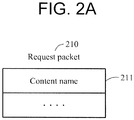
- FIG. 2A illustrates an example of a request packet.
- a request packet 210 includes a content name 211.
- the first node 110 transmits the request packet to the network 140 in as shown by the arrow number.
- the request packet transmitted by the first node 110 is transmitted to the second node 120 via the network 140 in as shown by the arrow number 2.
- the second node 120 receives the request packet from the network 140, and identifies the content name included in the request packet.
- the second node 120 determines whether content corresponding to the content name is stored in the second node 120. In this example, the second node 120 does not store the content corresponding to the content name, so the second node 120 transmits the request packet to the network 140 based on the content name in as shown by the arrow number 3.
- the second node 120 will be also referred to as an "intermediate node".
- the request packet transmitted by the second node 120 is transmitted to the third node 130 via the network 140 in as shown by the arrow number 4.
- the third node 130 receives the request packet from the network 140, and identifies the content name included in the request packet.
- the third node 130 determines whether content corresponding to the content name is stored in the third node 130. In this example, the third node 130 stores the content corresponding to the content name, so the third node 130 generates a response packet using the content corresponding to the content name.
- the third node 130 will be also referred to as a "generation node".
- the third node 130 encodes the content name, and includes the encoded content name in the response packet.
- routing or forwarding of the response packet may be controlled by encoding the content name included in the response packet because the network packet is routed or forwarded based on the content name included in the network packet.
- the third node 130 encodes the content name based on a predetermined condition.
- decoding the encoded content name is limited to a node that satisfies the predetermined condition.
- the predetermined condition is set by the third node 130.
- the predetermined condition is set by the third node 130 to limit a network range in which transmission of the response packet is allowed.
- the network range may include a domain range such as "samsung.com/sait". A node that wishes to transmit the response packet exceeding the network range set by the third node 130 cannot decode the encoded content name included in the response packet.
- a node that wishes to transmit the response packet to "samsung.com/sait/ip_group” or “samsung.com/sait/invention_group”, which belongs to "samsung.com/sait” can decode the encoded content name included in the response packet. When the encoded content name cannot be decoded, the content name cannot identified. When the content name cannot be identified, the response packet cannot be transmitted in the network system 100.
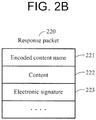
- FIG. 2B illustrates an example of a response packet.
- a response packet 220 includes an encoded content name 221 and content 222.
- the content 222 may also be encoded in a manner similar to the encoded content name 221.
- the response packet 220 further includes an electronic signature 223.
- the electronic signature 223 is information that verifies a generation node initially providing the content 222 and indicates that the generation node has signed the content 222.
- the third node 130 transmits the response packet to the network 140 in response to the request packet in as shown by the arrow number 5.
- the response packet is transmitted in a sequence reverse to a sequence in a path through which the request packet was transmitted.
- the response packet transmitted by the third node 130 is transmitted to the second node 120 via the network 140 in as shown by the arrow number 6.
- the second node 120 receives the response packet from the network 140, and determines whether the encoded content name included in the response packet can be decoded. When the encoded content name cannot be decoded, the second node 120 cannot transmit the response packet to the network 140. When the encoded content name can be decoded, the second node 120 transmits the response packet to the network 140 based on the decoded content name in as shown by the arrow number 7. The response packet transmitted by the second node 120 is transmitted to the first node 110 via the network 140 in as shown by the arrow number 8.
- FIG. 3 illustrates another example of a network system.
- a fourth node 150 for example, a new request node appearing subsequent to a scenario of FIG. 1 , transmits a request packet to the network 140 in as shown by the arrow number 9.
- the fourth node 150 requests content initially provided by the third node 130, for example, the generation node in the scenario of FIG. 1 .
- the request packet transmitted by the fourth node 150 is transmitted to the second node 120 via the network 140 in as shown by the arrow number 10.
- the second node 120 receives the request packet from the network 140, and identifies the content name included in the request packet.
- the second node 120 determines whether the second node 120 stores content corresponding to the content name.
- the second node 120 decodes at least some of encoded content names included in pre-stored response packets.
- the second node 120 determines whether any of the decoded content names correspond to the content name included in the request packet.
- the second node 120 stores the response packet received in as shown by the arrow number 6 in the scenario of FIG. 1 .
- the second node 120 detects this stored response packet as corresponding to the content name included in the request packet.
- the second node 120 transmits the detected response packet to the network 140 in response to the request packet in as shown by the arrow number 11.
- the response packet transmitted by the second node 120 is transmitted to the fourth node 150 via the network 140 in as shown by the arrow number 12.
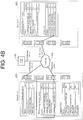
- FIGS. 4A through 4C illustrate an example of a content-centric networking (CCN) system.
- Nodes, a request packet, and a response packet used in the CCN system are defined in the following Table 1.
- Requester Node requesting content Generator: Node initially providing content
- Container Node containing content
- Responder Generic term for generator and container
- INTEREST packet Request packet generated by requester including content name
- DATA packet Response packet generated by responder including content
- the INTEREST packet includes a name of requested content, a selector indicating a preference with respect to content and responder filtering information, and nonce, which is a predetermined value for detecting duplicate reception of the INTEREST packet.
- the content name is provided in a form of a uniform resource identifier (URI).
- the DATA packet includes a content name, an electronic signature of the content, a signature algorithm, generator information, a key storage directory server, and packet expiration information.
- the requester specifies a desired content name in the INTEREST packet, and broadcasts the INTEREST packet.
- the container or the generator that receives the INTEREST packet verifies the content name inside the INTEREST packet, and when content corresponding to the content name is stored in the container or generator, responds by transmitting a DATA packet including the content.
- a first node 410 is a requester
- a third node 430 is a generator
- a request packet is an INTEREST packet
- a response packet is a DATA packet.
- a second node 420 serves as a container subsequent to receiving a response packet.
- a structure of a content name used in the CCN system is provided in a hierarchical structure in a manner similar to a structure of an IP address.
- the content name includes a plurality of components, for example, information on a server address, a content name, and a content version in a manner similar to the IP address including a network address and an identification (ID) address.
- ID identification
- a network packet is routed based on a longest prefix matching scheme.
- longest prefix matching is performed using a content name in a manner dissimilar to an IP network system in which the longest prefix matching is performed using an IP address.
- prefix refers to a domain name to which content belongs.
- the prefix is provided in a hierarchical name structure, such as a URL.
- Storages defines in the following Table 2 are employed for the longest prefix matching in each node.
- Pending Interest Table Content name and requesting face are included. Interface that receives request packet from requester is stored for use in forwarding response packet to requester.
- Contents Store Temporary storage of content in network node. Encoded content name and response packet are included. Response packet is received from responder, and is stored for a greatest possible duration of time subsequent to transmitting response packet to requester for content caching.
- Repository Content storage in network node. Content name and content are included.
- the first node 410 transmits a request packet including a content name to the network 440 in as shown by the arrow number 1.
- the request packet is "lnterest://samsung.com/sait/secu.icon”.
- the request packet transmitted by the first node 410 is transmitted to the second node 420 via the network 440 in as shown by the arrow number 2.
- the second node 420 receives the request packet via the network 440.
- the second node 420 receives the request packet via an input interface of "face 3".
- face refers to an interface used for transmission and reception of a network packet.
- the second node 420 verifies whether the content name included in the request packet is stored in the CS of the second node 420.
- the second node 420 decodes at least some of encoded content names stored in the CS, and determines whether a response packet corresponding to the content name included in the request packet is stored in the CS based on the decoded content names.
- the second node 420 verifies whether content corresponding to the content name included in the request packet is stored in a repository (not shown).
- a repository refers to a storage device, for example, a hard disk drive (HDD) or a solid state drive (SSD).
- the second node 420 stores, in a PIT, the content name included in the request packet and the interface via which the request packet was received. For example, the second node 420 stores "/samsung.com/sait/secu.icon" and "face 3". As will be described below, values stored in the PIT are used to transmit the response packet to the first node 410 that transmitted the request packet.
- the second node 420 selects an interface to forward the request packet with reference to an FIB.
- the second node 420 detects a network domain name from network domain names stored in the FIB by looking up a longest prefix matching the content name included in the request packet.
- the second node 420 selects an interface corresponding to the detected network domain name. For example, the second node 420 detects "/samsung.com/sait", which is a longest prefix match with "samsung.com/sait/secu.icon” among “/samsung.com/sait", “korea.gov/education", and "/samsung.com” stored in the FIB.
- the second node 420 selects an interface, for example, "face 1", corresponding to the detected "/samsung.com/sait”.
- the second node 420 transmits the request packet using the selected interface in as shown by the arrow number 3.
- the second node 420 transmits the request packet using an output interface of the selected interface "face 1".
- the request packet transmitted by the second node 420 is transmitted to the third node 430 via the network 440 in as shown by the arrow number 4.
- a plurality of intermediate nodes between the second node 420 and the third node 430 may forward the request packet.
- the plurality of intermediate nodes operate in a manner that is the same as or similar to the second node 420, and thus a repeated description will be omitted for conciseness.
- the third node 430 receives the request packet from the network 440. For example, the third node 430 receives the request packet via an input interface of "face 2". The third node 430 verifies whether the content name included in the request packet is stored in a CS (not shown). The third node 430 decodes at least some of the encoded content names stored in the CS, and determines whether a response packet corresponding to the content name included in the request packet is stored in the CS based on the decoded content names. The third node 430 verifies whether content corresponding to the content name is stored in a repository.
- the third node 430 When the content is stored in the repository, the third node 430 generates a response packet.
- the third node 430 encodes the content name. For example, the third node 430 sets a condition of limiting a network range in which transmission of the response packet is allowed, and encodes the content name based on the set condition.
- the third node 430 includes the encoded content name in the response packet.
- the third node 430 includes the content in the response packet.
- the third node 430 includes a segment of the content in the response packet obtained by dividing the content into segments.
- the third node 430 transmits the response packet via an output interface of a face via which the response packet was received in as shown by the arrow number 5. For example, the third node 430 transmits the response packet via an output interface of "face 2".
- the response packet transmitted by the third node 430 is transmitted to the second node 420 via the network 440 in as shown by the arrow number 6.
- the second node 420 receives the response packet from the network 440.
- the second node 420 receives the response packet via an input interface of "face 1".
- "face 1" is the face that was used by the second node 420 to forward the request packet in as shown by the arrow number 3 in FIG. 4A .
- the second node 420 stores the received response packet.
- the second node 420 stores an encoded content name and content included in the response packet in the CS.
- a form of the encoded content name and the content to be stored in the CS may include various modifications.
- the second node 420 decodes the encoded content name included in the response packet.
- the second node 420 detects an element corresponding to the decoded content name from elements stored in the PIT.
- the second node 420 transmits the response packet based on interface information of the detected element in as shown by the arrow number 7. For example, the second node 420 decodes the encoded content name included in the response packet, and detects "/samsung.com/sait/secu.icon" stored in the PIT. In this example, the second node 420 transmits the response packet using "face 3" stored corresponding to "/samsung.com/sait/secu.icon".
- the second node 420 decodes the encoded content name based on the interface information.
- the second node 420 uses an interface as an input of a decoding algorithm.
- the second node 420 uses a parameter (in) that denotes an input interface as an input of the decoding algorithm.
- the second node 420 uses a parameter (out) that denotes an output interface as an input of the decoding algorithm.
- the second node 420 uses an index of a face and an interface as an input of a decoding algorithm.
- the second node 420 uses a parameter (face 1, in) that denotes the input interface of "face 1" as an input of the decoding algorithm.
- the second node 420 uses a parameter (face 3, out) that denotes an output interface of "face 3" as an input of the decoding algorithm.
- the second node 420 manages information of a network domain to which each face is connected.
- the second node 420 manages information of a network domain connected to "face 1" and information of a network domain connected to "face 2".
- the second node 420 uses the information of the network domain connected to the face and a type of an interface as an input of a decoding algorithm.
- the second node 420 uses (network domain information of face 1, in) that denotes an input from the network domain connected to "face 1" as an input of the decoding algorithm.
- the second node 420 uses (network domain information of face 3, out) that denotes an output to a network domain connected to "face 3" as an input of the decoding algorithm.
- An encoded content name may or may not be able to be decoded based on interface information that is input.
- the second node 420 processes the response packet via a corresponding interface.
- the second node 420 does not process the response packet via the corresponding interface.
- the response packet When the encoded content name included in the response packet is successfully decoded by the second node 420, the response packet is transmitted to the network 440 in as shown by the arrow number 7.
- the response packet transmitted by the second node 420 is transmitted to the first node 410 via the network 440 in as shown by the arrow number 8.
- a fourth node 450 is a new requester.
- the fourth node 450 transmits a request packet including a content name in as shown by the arrow number 9.
- the request packet is "Interest://samsung.com/sait/secu.icon".
- the request packet transmitted by the fourth node 450 is transmitted to the second node 420 via the network 440 in as shown by the arrow number 10.
- the second node 420 receives the request packet via the network 440. For example, the second node 420 receives the request packet via the input interface of "face 2". The second node 420 verifies whether the content name included in the request packet is stored in the CS. The second node 420 decodes at least some of encoded content names stored in the CS, and determines whether a response packet corresponding to the content name included in the request packet is stored in the CS based on the decoded content names.
- the second node 420 decodes the encoded content names stored in the CS.
- the second node 420 detects an element corresponding to the content name included in the request packet among elements stored in the CS. For example, the second node 420 detects "/samsung.com/sait/secu.icon (encrypted)"corresponding to the content name included in the request packet from the CS. In this example, the second node 420 transmits a response packet corresponding to the detected "/samsung.com/sait/secu.icon (encrypted)" in response to the request packet.
- the second node 420 decodes an encoded content name based on interface information.
- the second node 420 uses an interface as an input of a decoding algorithm.
- the second node 420 uses a parameter (in) that denotes an input interface as an input of the decoding algorithm.
- the second node 420 uses a parameter (out) that denotes an output interface as an input of the decoding algorithm.
- the second node 420 uses an index of a face and an interface as an input of a decoding algorithm.
- the second node 420 uses a parameter (face 1, in) that denotes the input interface of "face 1" as an input of the decoding algorithm.
- the second node 420 uses a parameter (face 3, out) that denotes an output interface of "face 3" as an input of the decoding algorithm.
- the second node 420 manages information of a network domain to which each face is connected.
- the second node 420 manages information of a network domain connected to "face 1" and information of a network domain connected to "face 2".
- the second node 420 uses the information of the network domain connected to the face and a type of an interface as an input of the decoding algorithm.
- the second node 420 uses (network domain information of face 1, in) that denotes an input from a network domain connected to "face 1" as an input of the decoding algorithm.
- the second node 420 uses (network domain information of face 3, out) that denotes an output to a network domain connect to "face 3" as an input of the decoding algorithm.
- An encoded content name may or may not be able to be decoded based on interface information that is input.
- the second node 420 detects a corresponding element from the CS, and processes a response packet via a corresponding interface.
- the second node 420 does not detect the corresponding element from the CS, and does not process the response packet via the corresponding interface.
- the response packet is transmitted to the network 440 in as shown by the arrow number 11.
- the response packet transmitted by the second node 420 is transmitted to the fourth node 450 via the network 440 in as shown by the arrow number 12.
- FIG. 5 illustrates an example of an encoding/decoding algorithm used in a network system 500.
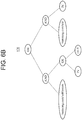
- FIGS. 6A and 6B illustrate an example of an attribute rule.
- the network system 500 includes a plurality of nodes 510, 520, and 530 connected to a network 540.
- the node 510 encodes a content name based on an attribute rule.
- the attribute rule is generated based on a group of attribute information of an object and an access structure of an attribute.
- the access structure determines whether access is authorized with respect to a given attribute group.
- the node 510 generates the attribute rule. For example, the node 510 sets the group of attribute information and the access structure.
- the attribute rule is generated in a form of a tree.
- the attribute rule is generated in a form of a tree 600.
- Each leaf node of the tree 600 includes an attribute.
- the attribute is associated with a network node.
- the attribute includes domain information associated with a network node, interface information associated with a network node, a department associated with a network node, an area associated with a network node, a management level associated with a network node, a name associated with a network node, and a time associated with a network node.
- the attribute is associated with content.
- the attribute includes a validity period of the content.
- Intermediate nodes of the tree 600 represent a logic operation or a condition of leaf nodes.
- intermediate nodes of the tree 600 correspond to an "AND operation", an "OR operation”, or "satisfy more than k number among n number”.
- An attribute of having a variable length may be included in the attribute rule as needed.
- the attribute rule also has a variable length.
- domain information has a variable length, such as "/samsung.com/sait”, “/samsung.com/sait/comm”, or "/samsung.com/sait/comm/kim”.
- variable length attribute is converted to a fixed length to enable the attribute rule to have a fixed length.
- the domain information is converted to the fixed length by hashing.
- a result of the hashing has a fixed length
- the attribute rule includes the result of the hashing having the fixed length rather than the domain information having the variable length.
- a content name encoded based on an attribute rule is transmitted from the node 510 to a node 520 and/or a node 530 via the network 540.
- the node 520 and/or the node 530 decodes the content name encoded based on the attribute of the node 520 and/or the node 530.
- Each attribute of the node 520 and the node 530 is an attribute group.
- the encoded content name is decoded.
- the encoded content name cannot be decoded.
- the attribute rule used in the encoding of the encoded content name is represented by a tree 610.
- the tree 610, 610 which represents an attribute rule of ⁇ "/samsung.com/sait/comm” AND (IN OR OUT) ⁇ OR ⁇ "/samsung.com/sait” AND IN ⁇ .
- the first attribute group of the node 520 When a first attribute group of the node 520 is assumed to be ⁇ "/samsung.com/sait/comm", OUT ⁇ , and a second attribute group of the node 530 is ⁇ "/samsung.com/sait", OUT ⁇ , the first attribute group of the node 520 satisfies the attribute rule represented by the tree 610.
- the node 520 can decode a content name encoded based on the first attribute group.
- the second attribute group of the node 530 does not satisfy the attribute rule represented by the tree 610.
- the node 530 cannot decode a content name encoded based on the second attribute group.
- FIGS. 7 through 10 illustrate examples of a scenario to which the aforementioned examples are applied.
- a content name 700 includes a plurality of components.
- the content name 700 includes a domain name 711, a file name 712, and file version information and segmentation information 713.
- the domain name 711 and the file name 712 are classified as name components 721, and the file version information and segmentation information 713 is classified as information components 722.
- the plurality of components have a hierarchical structure that can be employed as routing information for a content request and a content response.
- the content name 700 is applied to a name-based network system, such as a CCN system or a named data networking (NDN) system.
- a name-based network system such as a CCN system or a named data networking (NDN) system.
- an interest packet 810 is transmitted from a high-level network domain to a low-level network domain.
- Network nodes include a domain router responsible for packet transmission between network domains.
- Each of the network nodes has a name indicating a network domain corresponding to each of the network nodes. For example, a node 822 corresponds to "/samsung.com”, a node 823 corresponds to "/samsung.com/sait”, a node 824 corresponds to "/samsung.com/sait/comm”, and a node 825 corresponds to "/samsung.com/sait/comm/kim”.
- a content name requested by the interest packet 810 is "samsung.com/sait/comm/kim/key.info".
- the interest packet 810 is transmitted from a node that requests content to the node 822 corresponding to "/samsung.com” via the Internet 821.
- the interest packet 810 transmitted to the node 822 is transmitted to a node corresponding to the low-level network domain in a sequence.
- the interest packet 810 is transmitted from the node 822 to the node 823 corresponding to "/samsung.com/sait”, then to the node 824 corresponding to "/samsung.com/sait/comm”, and then to the node 825 corresponding to "/samsung.com/sait/comm/kim” in a sequence.
- the interest packet 810 cannot be transmitted to a node 826 corresponding to "/samsung.com/dmc" because the interest packet 810 is transmitted based on the content name "samsung.com/sait/comm/kim/key.info".
- the node 825 verifies that content requested from the interest packet 810 is stored in the node 825.
- the node 825 generates a data packet 830 using the content requested from the interest packet 810.
- the data packet 830 is transmitted from the low-level network domain to the high-level network domain.
- the data packet 830 is transmitted in a sequence from the node 825 corresponding to "/samsung.com/sait/comm/kim", then to the node 824 corresponding to"/samsung.com/sait/comm”, then to the node 823 corresponding to"/samsung.com/sait", then to the node 822 corresponding to "/samsung.com”, and then to the Internet 821.
- the data packet 830 is transmitted to the node requesting the content after passing through the Internet 821.
- the node 825 encodes a content name required for routing or forwarding the data packet 830.
- the content name is encoded so that a node that attempts to transmit the data packet 830 to an untrustworthy network domain cannot identify the content name.
- the untrustworthy network domain is a network domain to which transmission of content is unauthorized.
- the node that attempts to transmit the data packet 830 to the untrustworthy network domain cannot decode the encoded content name. Accordingly, a data packet is controlled so that the data packet cannot transmitted to an unauthorized node.
- transmission of content to an unintended network domain is prevented by a predetermined router transmitting the data packet 830 using a content name.
- the content name is encoded, and a router that forwards a data packet to a trustworthy network domain is allowed to decode the encoded content name.
- Content is shared within a limited network domain.
- a range of a trustworthy network domain is explicitly or implicitly designated by encoding a content name.
- the encoded content name is decoded, and at least one router that forwards a data packet including content exists.
- an attribute-based encryption scheme is adopted. For example, a content name is encoded based on an attribute rule with respect to a target authority authorized to have a content access. When an attribute of a predetermined user satisfies an attribute rule used in encoding an encoded content name, the encoded content name is decoded.
- a name of a network router for example, a network domain name represented by a network router, is used as an attribute for encoding.
- a content name is encoded, at least one network domain to which content is transmitted is designated. Accordingly, when there are a plurality of routers that are authorized to access the content, a single encoded content name is generated, and a content name need not be encoded a number of times corresponding to a number of authorized routers. Thus, scalability may be enhanced.
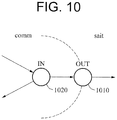
- a node corresponding to each network domain includes an external router 1010 that forwards a received packet to a high-level network or an external network, and an internal router 1020 that forwards a received packet to a low-level network or an internal network.
- the external router 1010 and the internal router 1020 may be physically or logically divided.
- the external router 1010 has an attribute of interface information corresponding to the outside, and the internal router 1020 has an attribute of interface information corresponding to the inside.
- the external router 1010 has a "/samsung.com/sait/comm (out)” attribute
- the internal router 1020 has a "/samsung.com/sait/comm (in)” attribute.
- Transmission of a data packet is controlled using interface information assigned to a router of a network domain.
- a high-level or external network is a network to which content transmission is limited
- a low-level or internal network is a network to which content access is authorized.
- an attribute rule used for encoding of a content name includes the interface information corresponding to the low-level or internal network, rather than the interface information corresponding to the high-level or external network. Accordingly, in one example, there is provided technology for preventing transmission of a data packet to an external network.
- the node 825 encodes a content name to allow content to be public limited to a "sait" domain 832, corresponding to an interest packet that requests "/samsung.com/sait/comm/kim/key.info".
- the node 825 encodes the content name using an attribute rule 831 limited to the "sait" domain 832.
- the attribute rule 831 is designated to be an internal router of a "sait" domain router, or an internal router and an external router of a "comm” domain router, or an internal router and an external router of a "kim” domain router.
- the data packet 830 including the encoded content name is transmitted limited to the aforementioned routers. Accordingly, content included in the data packet 830 is shared only within the "sait" domain 832.
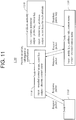
- FIG. 11 illustrate an example of a key distribution system 1100.
- the key distribution system 1100 includes a plurality of nodes 1110, 1120, and 1130 and a certificate authority 1140.
- the certificate authority 1140 generates a public key "PK” and a master key “MK” using a security parameter k.
- security parameter refers to a parameter used in a mathematical calculation to generate a public key and a master key, for example, including a bilinear group, a prime number, a generator, and a random number.
- the public key is used in encoding a content name.
- the certificate authority 1140 distributes the public key to the plurality of nodes in the key distribution system 1100.
- the certificate authority 1140 manages a plurality of attributes. For example, the certificate authority 1140 manages an attribute group including a plurality of attributes of the plurality of nodes in the key distribution system 1100. The certificate authority 1140 generates secret keys for the plurality of attributes included in the attribute group. For example, the certificate authority 1140 generates a secret key for each of the plurality of attributes using a master key. The plurality of generated secret keys corresponds to a single public key.
- the secret keys are used to decode an encoded content name.
- the certificate authority 1140 performs certification requested by a node included in the key distribution system 1100, and provides, to a corresponding node, secret keys corresponding to attributes of the certified node.
- the certificate authority 1140 is referred to as a trustworthy key generation authority.
- a user is assigned at least one secret key corresponding to an access authority.
- the user decodes an encoded content name of a data packet to which an access is authorized because the data packet is encoded based on an attribute in the key distribution system 1110.
- the node 1110 transmits a request packet via a network.
- the request packet is transmitted to the node 1130 after passing through the node 1120.
- the node 1130 encodes a content name using a public key distributed by the certificate authority 1140.
- the node 1130 designates an attribute rule, and encodes the content name using the designated attribute rule and the public key.
- a response packet including the encoded content name is transmitted to the node 1120 via the network.
- the node 1120 performs certification on the certificate authority 1140, and receives, from the certificate authority 1140, secret keys corresponding to attributes of the node 1120.
- the node 1120 decodes the encoded content name using the secret keys provided through the certification.
- the encoded content name is decoded.
- the encoded content name cannot be decoded.
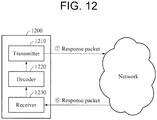
- FIG. 12 illustrates an example of a network node 1200.
- the network node 1200 includes a transmitter 1210, a decoder 1220, and a receiver 1230.
- the receiver 1230 receives a response packet including an encoded content name in as shown by the arrow number 6.
- the decoder 1220 decodes the encoded content name, and the transmitter 1230 transmits the response packet based on the decoded content name in as shown by the arrow number 7.
- the encoded content name is encoded based on a predetermined condition, and decoded in a network node that satisfies the predetermined condition.
- the predetermined condition is set by a network node that generates the response packet.
- the predetermined condition is set to limit a network range in which transmission of the response packet is allowed.
- the encoded content name is encoded based on an attribute rule including at least one attribute.
- the at least one attribute includes either one or both of domain information and interface information.
- the attribute rule is associated with an access authority with respect to content included in the response packet.
- the attribute rule is generated by a logic operation or a condition with respect to the at least one attribute.
- the decoder 1220 decodes the encoded content name based on an attribute of the network node 1200.
- the attribute of the network node satisfies an attribute rule used in the encoding of the encoded content name
- the encoded content name is decoded.
- the attribute of the network node includes either one or both of domain information of the network node and interface information of the network node.
- the encoded content name is encoded using an attribute rule, a public key, and a content name.
- the decoder 1220 decodes the encoded content name using at least one secret key corresponding to the attribute of the network node.
- the network node 1220 may further include a certifier to perform certification on a certificate authority.
- the receiver 1230 receives, from the certificate authority, at least one secret key corresponding to an attribute of a network node from a plurality of secret keys generated corresponding to a single public key.
- the transmitter 1210 extracts request information corresponding to a decoded content name from pre-stored request information, and transmits a response packet based on the extracted request information.
- the network node 1200 may further include an extractor to decode at least some of encoded content names included in pre-stored response packets, and extract a response packet corresponding to a content name included in a request packet from the pre-stored packets based on the decoded content names.
- the receiver 1230 receives the request packet, and the transmitter 1210 transmits the response packet in response to the request packet.
- the network node 1200 may further include an extractor configured to extract content corresponding to a content name included in a request packet from pre-stored contents, an encoder configured to encode a content name, and a generator configured to generate a response packet including the content name encoded by the encoder and the extracted content.
- an extractor configured to extract content corresponding to a content name included in a request packet from pre-stored contents
- an encoder configured to encode a content name
- a generator configured to generate a response packet including the content name encoded by the encoder and the extracted content.
- the receiver 1230 receives the request packet, and the transmitter 1210 transmits the response packet in response to the request packet.
- the encoder encodes a content name using an attribute rule, a public key, and a content name.
- the public key corresponds to a plurality of secret keys, and the content name encoded by the encoder is decoded by at least one secret key corresponding to an attribute that satisfies an attribute rule.
- the network node 1200 may further include a first determiner configured to determine whether content corresponding to a content name included in a request packet is present among pre-stored contents, a second determiner configured to decode at least some of encoded content names included in pre-stored response packets, and determine whether a response packet corresponding to a content name included in a request packet is present among the pre-stored response packets based on the decoded content names, and a storage configured to store request information based on a determination that content corresponding to a content name and a response packet corresponding to the content name are absent from the pre-stored contents and the pre-stored response packets.
- the receiver 1230 receives a request packet
- the transmitter 1210 transmits the request packet to a network based on a determination that content corresponding to a content name and a response packet corresponding to the content name are absent.
- FIG. 13 illustrates an example of a method of operating a network node.
- the method of operating the network includes receiving 1310 a response packet including an encoded content name, decoding 1320 the encoded content name, and transmitting 1330 the response packet based on the decoded content name.
- technology is provided to determine whether to transmit content based on predetermined conditions in lieu of unconditionally responding, by a node including content to respond with, in a name-based network such as a CCN system. Also, technology is provided to enable access control during content transmission to protect the content.
- technology is provided to enforce a security policy during routing by encoding a content name.
- Technology is also provide to encode a content name based on an attribute-based encryption scheme in which attributes are designated to be a domain name and a role of a router. Additionally, technology is provided to determine whether to transmit a data packet based on whether a content name can be decoded in a domain router.
- the nodes 110, 120, 130, 150, 410, 420, 430, 450, 510, 520, 530, 821-826, 1110, 1120, 1130, and 1200 in FIGS. 1 , 3 , 4A , 4B , 4C , 5 , 8 , 9 , 11 , and 12 , the external router 1010 and the internal router 1020 in FIG. 10 , the certificate authority in FIG. 11 , and the transmitter 1210, the decoder 1220, and the received 1230 that perform the various operations described with respect to FIGS. 1-13 may be implemented using one or more hardware components, one or more software components, or a combination of one or more hardware components and one or more software components.
- a hardware component may be, for example, a physical device that physically performs one or more operations, but is not limited thereto.
- hardware components include resistors, capacitors, inductors, power supplies, frequency generators, operational amplifiers, power amplifiers, low-pass filters, high-pass filters, band-pass filters, analog-to-digital converters, digital-to-analog converters, and processing devices.
- a software component may be implemented, for example, by a processing device controlled by software or instructions to perform one or more operations, but is not limited thereto.
- a computer, controller, or other control device may cause the processing device to run the software or execute the instructions.
- One software component may be implemented by one processing device, or two or more software components may be implemented by one processing device, or one software component may be implemented by two or more processing devices, or two or more software components may be implemented by two or more processing devices.
- a processing device may be implemented using one or more general-purpose or special-purpose computers, such as, for example, a processor, a controller and an arithmetic logic unit, a digital signal processor, a microcomputer, a field-programmable array, a programmable logic unit, a microprocessor, or any other device capable of running software or executing instructions.
- the processing device may run an operating system (OS), and may run one or more software applications that operate under the OS.
- the processing device may access, store, manipulate, process, and create data when running the software or executing the instructions.
- OS operating system
- the singular term "processing device" may be used in the description, but one of ordinary skill in the art will appreciate that a processing device may include multiple processing elements and multiple types of processing elements.
- a processing device may include one or more processors, or one or more processors and one or more controllers.
- different processing configurations are possible, such as parallel processors or multi-core processors.
- a processing device configured to implement a software component to perform an operation A may include a processor programmed to run software or execute instructions to control the processor to perform operation A.
- a processing device configured to implement a software component to perform an operation A, an operation B, and an operation C may have various configurations, such as, for example, a processor configured to implement a software component to perform operations A, B, and C; a first processor configured to implement a software component to perform operation A, and a second processor configured to implement a software component to perform operations B and C; a first processor configured to implement a software component to perform operations A and B, and a second processor configured to implement a software component to perform operation C; a first processor configured to implement a software component to perform operation A, a second processor configured to implement a software component to perform operation B, and a third processor configured to implement a software component to perform operation C; a first processor configured to implement a software component to perform operations A, B, and C, and a second processor configured to implement a software component to perform operations A, B
- Software or instructions for controlling a processing device to implement a software component may include a computer program, a piece of code, an instruction, or some combination thereof, for independently or collectively instructing or configuring the processing device to perform one or more desired operations.
- the software or instructions may include machine code that may be directly executed by the processing device, such as machine code produced by a compiler, and/or higher-level code that may be executed by the processing device using an interpreter.
- the software or instructions and any associated data, data files, and data structures may be embodied permanently or temporarily in any type of machine, component, physical or virtual equipment, computer storage medium or device, or a propagated signal wave capable of providing instructions or data to or being interpreted by the processing device.
- the software or instructions and any associated data, data files, and data structures also may be distributed over network-coupled computer systems so that the software or instructions and any associated data, data files, and data structures are stored and executed in a distributed fashion.
- the software or instructions and any associated data, data files, and data structures may be recorded, stored, or fixed in one or more non-transitory computer-readable storage media.
- a non-transitory computer-readable storage medium may be any data storage device that is capable of storing the software or instructions and any associated data, data files, and data structures so that they can be read by a computer system or processing device.
- Examples of a non-transitory computer-readable storage medium include read-only memory (ROM), random-access memory (RAM), flash memory, CD-ROMs, CD-Rs, CD+Rs, CD-RWs, CD+RWs, DVD-ROMs, DVD-Rs, DVD+Rs, DVD-RWs, DVD+RWs, DVD-RAMs, BD-ROMs, BD-Rs, BD-R LTHs, BD-REs, magnetic tapes, floppy disks, magneto-optical data storage devices, optical data storage devices, hard disks, solid-state disks, or any other non-transitory computer-readable storage medium known to one of ordinary skill in the art.
- ROM read-only memory
- RAM random-access memory
- flash memory CD-ROMs, CD-Rs, CD+Rs, CD-RWs, CD+RWs, DVD-ROMs, DVD-Rs, DVD+Rs, DVD-RWs, DVD+RWs, DVD-RAMs, BD
Landscapes
- Engineering & Computer Science (AREA)
- Computer Security & Cryptography (AREA)
- Computer Networks & Wireless Communication (AREA)
- Signal Processing (AREA)
- Computer Hardware Design (AREA)
- Computing Systems (AREA)
- General Engineering & Computer Science (AREA)
- Data Exchanges In Wide-Area Networks (AREA)
- Mobile Radio Communication Systems (AREA)
Description
- The following description relates to a network node and a method of operating the network node.
- With a recent widespread use of a smart phone, a voice-over-Internet protocol (VoIP), and an IP television (IPTV), a value of the Internet is rapidly gaining momentum in all fields of society. This growth in Internet services may arise from a functional independence of an IP layer. The IP layer in a transmission control protocol (TCP)/IP stack provides transparency between a high-level layer and a low-level layer.
- However, a future Internet environment may require a novel design of a content-centric architecture rather than an existing host-centric architecture. For example, achieving an optimal performance may not be ensured based on the existing host-centric architecture in a future Internet environment in which emphasis is placed on content search and content access.
- In recent times, a new content-centric Internet architecture is experiencing a surge in research activity. The content-centric Internet architecture includes a structure in which a network packet is transmitted based on a content name.
US 2009/0285209 A1 discloses a proxy server, which links a content centric network and a IP network. - This Summary is provided to introduce a selection of concepts in a simplified form that are further described below in the Detailed Description. This Summary is not intended to identify key features or essential features of the claimed subject matter, nor is it intended to be used as an aid in determining the scope of the claimed subject matter.
- In one general aspect, a method of operating a network node includes receiving a response packet including an encoded content name; decoding the encoded content name; and transmitting the response packet based on the decoded content name.
- The encoded content name may be encoded based on a predetermined condition; the network node may satisfy the predetermined condition; and the decoding may include decoding the encoded content name based on the predetermined condition.
- The predetermined condition may be set by a network node configured to generate the response packet to limit a network range in which transmission of the response packet is allowed.
- The encoded content name may be encoded based on an attribute rule including at least one attribute.
- The at least one attribute may include either one or both of domain information; and interface information.
- The attribute rule may be associated with an access authority with respect to content included in the response packet.
- The decoding may include decoding the encoded content name based on an attribute of the network node.
- The decoding may include decoding the encoded content name in response to the attribute of the network node satisfying an attribute rule used in the encoding of the encoded content name.
- The attribute of the network node may include either one or both of domain information of the network node; and interface information of the network node.
- The encoded content name may be encoded using an attribute rule, a public key, and a content name.
- The decoding may include decoding the encoded content name using at least one secret key corresponding to an attribute of the network node.
- The method may further include performing certification on a certificate authority; and receiving, from the certificate authority, the at least one secret key corresponding to the attribute of the network node; and the at least one secret key corresponding to the attribute of the network node may be one of a plurality of secret keys generated by the certificate authority corresponding to a single public key.
- The transmitting of the response packet may include extracting request information corresponding to the decoded content name from pre-stored request information; and transmitting the response packet based on the extracted request information.
- The method may further include receiving a request packet; decoding at least some of encoded content names included in pre-stored response packets; extracting a response packet corresponding to a content name included in the request packet based on the decoded content names; and transmitting the extracted response packet in response to the request packet.
- The method may further include receiving a request packet; extracting a content corresponding to a content name included in the request packet from pre-stored contents; encoding the content name; generating a response packet including the encoded content name and the extracted content; and transmitting the generated response packet in response to the request packet.
- The encoding may include encoding the content name using an attribute rule, a public key, and the content name.
- The public key may correspond to a plurality of secret keys; and the encoded content name may be decoded by at least one secret key corresponding to an attribute that satisfies the attribute rule.
- The method may further include receiving a request packet; determining whether a content corresponding to a content name included in the request packet is present among pre-stored contents; decoding at least some of encoded content names included in pre-stored response packets; determining whether a response packet corresponding to the content name included in the request packet is present among the pre-stored response packets based on the decoded content names; storing request information based on a result of the determining being that the content corresponding to the content name and the response packet corresponding to the content name are absent; and transmitting the request packet to a network.
- In another general aspect, a non-transitory computer-readable storage medium stores a program including instructions to cause a computer to perform the method described above.
- In another general aspect, a network node includes a receiver configured to receive a response packet including an encoded content name; a decoder configured to decode the encoded content name; and a transmitter configured to transmit the response packet based on the decoded content name.
- In another general aspect, a method of operating a network node includes receiving a response packet including an encoded content name; determining whether another network node is authorized to receive the response packet based on the encoded content name; not transmitting the response packet to the other network node in response to a result of the determining being that the other network node is not authorized to receive the response packet; and transmitting the response packet to the other network node in response to a result of the determining being that the other network node is authorized to receive the response packet.
- The determining may include attempting to decode the encoded content name based on information relating to the other network node; determining that the network node is not authorized to receive the response packet in response to a result of the attempting being that the encoded content name cannot be decoded; and determining that the network node is authorized to receive the response packet in response to a result of the attempting being that the encoded content name is decoded.
- The transmitting may include transmitting the response packet to the other network node based on the decoded content name.
- The information related to the other network node may include information on an interface of the network node via which the response packet is to be transmitted to the other network node.
- The information related to the other network node may include network domain information of the other network node.
- Other features and aspects will be apparent from the following detailed description, the drawings, and the claims. The invention is defined by the appended claims.
-
-
FIG. 1 illustrates an example of a network system. -
FIG. 2A illustrates an example of a request packet. -
FIG. 2B illustrates an example of a response packet. -
FIG. 3 illustrates another example of a network system. -
FIGS. 4A through 4C illustrate an example of a content-centric networking (CCN) system. -
FIG. 5 illustrates an example of an encoding/decoding algorithm used in a network system. -
FIGS. 6A and6B illustrate an example of an attribute rule. -
FIGS. 7 through 10 illustrate an example of a scenario. -
FIG. 11 illustrates an example of a key distribution system. -
FIG. 12 illustrates an example of a network node. -
FIG. 13 illustrates an example of a method of operating a network node. - The following detailed description is provided to assist the reader in gaining a comprehensive understanding of the methods, apparatuses, and/or systems described herein. However, various changes, modifications, and equivalents of the methods, apparatuses, and/or systems described herein will be apparent to one of ordinary skill in the art. The sequences of operations described herein are merely examples, and are not limited to those set forth herein, but may be changed as will be apparent to one of ordinary skill in the art, with the exception of operations necessarily occurring in a certain order. Also, descriptions of functions and constructions that are well known to one of ordinary skill in the art may be omitted for increased clarity and conciseness.
- Throughout the drawings and the detailed description, the same reference numerals refer to the same elements. The drawings may not be to scale, and the relative size, proportions, and depiction of elements in the drawings may be exaggerated for clarity, illustration, and convenience.
- The features described herein may be embodied in different forms, and are not to be construed as being limited to the examples described herein. Rather, the examples described herein have been provided so that this disclosure will be thorough and complete, and will convey the full scope of the disclosure to one of ordinary skill in the art. The examples to be discussed hereinafter may be applied to a network routing method or a network forwarding method.
-
FIG. 1 illustrates an example of anetwork system 100. Referring toFIG. 1 , thenetwork system 100 includes a plurality of network nodes connected to anetwork 140. Each of the plurality of network nodes is a network device or network equipment that participates in packet transmission via thenetwork 140, for example, a router. Hereinafter, each of the network nodes will be referred to as a "node" for ease of description. - A network packet in the
network system 100 is routed or forwarded based on a content name. The network packet may be a request packet or a response packet. The request packet is generated by a node requesting content, and the response packet is generated by a node initially providing the requested content. The node initially providing the requested content may be a node from which the requested content originates. Hereinafter, the term "content" refers to a general content file, and also includes all types of contents, for example, a list of content names or a name of a network domain in which content is stored. - The request packet and the response packet include a content name. The request packet and the response packet in the
network system 100 are routed or forwarded based on the content name. Hereinafter, routing or forwarding will be referred to as "transmission". - The
network system 100 includes afirst node 110, asecond node 120, and athird node 130. Thefirst node 110 is a node requesting content, and will also be referred to as a "request node". Thefirst node 110 requests content from thenetwork 140 using the content name. For example, thefirst node 110 generates a request packet including the content name. -
FIG. 2A illustrates an example of a request packet. Referring toFIG. 2A , arequest packet 210 includes acontent name 211. - The
first node 110 transmits the request packet to thenetwork 140 in as shown by the arrow number. - The request packet transmitted by the
first node 110 is transmitted to thesecond node 120 via thenetwork 140 in as shown by thearrow number 2. Thesecond node 120 receives the request packet from thenetwork 140, and identifies the content name included in the request packet. Thesecond node 120 determines whether content corresponding to the content name is stored in thesecond node 120. In this example, thesecond node 120 does not store the content corresponding to the content name, so thesecond node 120 transmits the request packet to thenetwork 140 based on the content name in as shown by thearrow number 3. Thesecond node 120 will be also referred to as an "intermediate node". - The request packet transmitted by the
second node 120 is transmitted to thethird node 130 via thenetwork 140 in as shown by thearrow number 4. Thethird node 130 receives the request packet from thenetwork 140, and identifies the content name included in the request packet. Thethird node 130 determines whether content corresponding to the content name is stored in thethird node 130. In this example, thethird node 130 stores the content corresponding to the content name, so thethird node 130 generates a response packet using the content corresponding to the content name. Thethird node 130 will be also referred to as a "generation node". - The
third node 130 encodes the content name, and includes the encoded content name in the response packet. In thenetwork system 100, routing or forwarding of the response packet may be controlled by encoding the content name included in the response packet because the network packet is routed or forwarded based on the content name included in the network packet. - For example, the
third node 130 encodes the content name based on a predetermined condition. In this example, decoding the encoded content name is limited to a node that satisfies the predetermined condition. The predetermined condition is set by thethird node 130. The predetermined condition is set by thethird node 130 to limit a network range in which transmission of the response packet is allowed. For example, the network range may include a domain range such as "samsung.com/sait". A node that wishes to transmit the response packet exceeding the network range set by thethird node 130 cannot decode the encoded content name included in the response packet. For example, a node that wishes to transmit the response packet to "samsung.com/dmc" or "samsung.com",_which exceeds "samsung.com/sait", cannot decode the encoded content name included in the response packet. As another example, a node that wishes to transmit the response packet to "samsung.com/sait/ip_group" or "samsung.com/sait/invention_group", which belongs to "samsung.com/sait", can decode the encoded content name included in the response packet. When the encoded content name cannot be decoded, the content name cannot identified. When the content name cannot be identified, the response packet cannot be transmitted in thenetwork system 100. -
FIG. 2B illustrates an example of a response packet. Referring toFIG. 2B , aresponse packet 220 includes an encodedcontent name 221 andcontent 222. Thecontent 222 may also be encoded in a manner similar to the encodedcontent name 221. Theresponse packet 220 further includes anelectronic signature 223. Theelectronic signature 223 is information that verifies a generation node initially providing thecontent 222 and indicates that the generation node has signed thecontent 222. - The
third node 130 transmits the response packet to thenetwork 140 in response to the request packet in as shown by thearrow number 5. The response packet is transmitted in a sequence reverse to a sequence in a path through which the request packet was transmitted. The response packet transmitted by thethird node 130 is transmitted to thesecond node 120 via thenetwork 140 in as shown by thearrow number 6. - The
second node 120 receives the response packet from thenetwork 140, and determines whether the encoded content name included in the response packet can be decoded. When the encoded content name cannot be decoded, thesecond node 120 cannot transmit the response packet to thenetwork 140. When the encoded content name can be decoded, thesecond node 120 transmits the response packet to thenetwork 140 based on the decoded content name in as shown by thearrow number 7. The response packet transmitted by thesecond node 120 is transmitted to thefirst node 110 via thenetwork 140 in as shown by thearrow number 8. -
FIG. 3 illustrates another example of a network system. Referring toFIG. 3 , afourth node 150, for example, a new request node appearing subsequent to a scenario ofFIG. 1 , transmits a request packet to thenetwork 140 in as shown by thearrow number 9. Thefourth node 150 requests content initially provided by thethird node 130, for example, the generation node in the scenario ofFIG. 1 . - The request packet transmitted by the
fourth node 150 is transmitted to thesecond node 120 via thenetwork 140 in as shown by thearrow number 10. Thesecond node 120 receives the request packet from thenetwork 140, and identifies the content name included in the request packet. Thesecond node 120 determines whether thesecond node 120 stores content corresponding to the content name. Thesecond node 120 decodes at least some of encoded content names included in pre-stored response packets. Thesecond node 120 determines whether any of the decoded content names correspond to the content name included in the request packet. - The
second node 120 stores the response packet received in as shown by thearrow number 6 in the scenario ofFIG. 1 . In this example, thesecond node 120 detects this stored response packet as corresponding to the content name included in the request packet. Thesecond node 120 transmits the detected response packet to thenetwork 140 in response to the request packet in as shown by thearrow number 11. The response packet transmitted by thesecond node 120 is transmitted to thefourth node 150 via thenetwork 140 in as shown by thearrow number 12. -
FIGS. 4A through 4C illustrate an example of a content-centric networking (CCN) system. Nodes, a request packet, and a response packet used in the CCN system are defined in the following Table 1.[Table 1] Requester: Node requesting content Generator: Node initially providing content Container: Node containing content Responder: Generic term for generator and container INTEREST packet: Request packet generated by requester including content name DATA packet: Response packet generated by responder including content - The INTEREST packet includes a name of requested content, a selector indicating a preference with respect to content and responder filtering information, and nonce, which is a predetermined value for detecting duplicate reception of the INTEREST packet. The content name is provided in a form of a uniform resource identifier (URI). The DATA packet includes a content name, an electronic signature of the content, a signature algorithm, generator information, a key storage directory server, and packet expiration information.
- The requester specifies a desired content name in the INTEREST packet, and broadcasts the INTEREST packet. The container or the generator that receives the INTEREST packet verifies the content name inside the INTEREST packet, and when content corresponding to the content name is stored in the container or generator, responds by transmitting a DATA packet including the content.
- Referring to
FIG. 4A , afirst node 410 is a requester, athird node 430 is a generator, a request packet is an INTEREST packet, and a response packet is a DATA packet. Asecond node 420 serves as a container subsequent to receiving a response packet. - A structure of a content name used in the CCN system is provided in a hierarchical structure in a manner similar to a structure of an IP address. The content name includes a plurality of components, for example, information on a server address, a content name, and a content version in a manner similar to the IP address including a network address and an identification (ID) address.
- In the CCN system, a network packet is routed based on a longest prefix matching scheme. In the CCN system, longest prefix matching is performed using a content name in a manner dissimilar to an IP network system in which the longest prefix matching is performed using an IP address. As used herein, the term "prefix" refers to a domain name to which content belongs. For example, the prefix is provided in a hierarchical name structure, such as a URL. Storages defines in the following Table 2 are employed for the longest prefix matching in each node.
[Table 2] Forwarding Information Base (FIB): Prefix of content name and interface list are included. Subsequent interface is specified in manner similar to IP address network. Plurality of interfaces are specified in manner dissimilar to IP address network. Pending Interest Table (PIT): Content name and requesting face are included. Interface that receives request packet from requester is stored for use in forwarding response packet to requester. Contents Store (CS): Temporary storage of content in network node. Encoded content name and response packet are included. Response packet is received from responder, and is stored for a greatest possible duration of time subsequent to transmitting response packet to requester for content caching. Repository: Content storage in network node. Content name and content are included. - The
first node 410 transmits a request packet including a content name to thenetwork 440 in as shown by thearrow number 1. For example, the request packet is "lnterest://samsung.com/sait/secu.icon". The request packet transmitted by thefirst node 410 is transmitted to thesecond node 420 via thenetwork 440 in as shown by thearrow number 2. - The
second node 420 receives the request packet via thenetwork 440. For example, thesecond node 420 receives the request packet via an input interface of "face 3". As used herein, the term "face" refers to an interface used for transmission and reception of a network packet. - The
second node 420 verifies whether the content name included in the request packet is stored in the CS of thesecond node 420. Thesecond node 420 decodes at least some of encoded content names stored in the CS, and determines whether a response packet corresponding to the content name included in the request packet is stored in the CS based on the decoded content names. - The
second node 420 verifies whether content corresponding to the content name included in the request packet is stored in a repository (not shown). As used herein, the term "repository" refers to a storage device, for example, a hard disk drive (HDD) or a solid state drive (SSD). - When the response packet is not stored in the CS and the content is not stored in the repository, the
second node 420 stores, in a PIT, the content name included in the request packet and the interface via which the request packet was received. For example, thesecond node 420 stores "/samsung.com/sait/secu.icon" and "face 3". As will be described below, values stored in the PIT are used to transmit the response packet to thefirst node 410 that transmitted the request packet. - The
second node 420 selects an interface to forward the request packet with reference to an FIB. Thesecond node 420 detects a network domain name from network domain names stored in the FIB by looking up a longest prefix matching the content name included in the request packet. Thesecond node 420 selects an interface corresponding to the detected network domain name. For example, thesecond node 420 detects "/samsung.com/sait", which is a longest prefix match with "samsung.com/sait/secu.icon" among "/samsung.com/sait", "korea.gov/education", and "/samsung.com" stored in the FIB. Thesecond node 420 selects an interface, for example, "face 1", corresponding to the detected "/samsung.com/sait". - The
second node 420 transmits the request packet using the selected interface in as shown by thearrow number 3. For example, thesecond node 420 transmits the request packet using an output interface of the selected interface "face 1". The request packet transmitted by thesecond node 420 is transmitted to thethird node 430 via thenetwork 440 in as shown by thearrow number 4. For example, a plurality of intermediate nodes between thesecond node 420 and thethird node 430 may forward the request packet. The plurality of intermediate nodes operate in a manner that is the same as or similar to thesecond node 420, and thus a repeated description will be omitted for conciseness. - The
third node 430 receives the request packet from thenetwork 440. For example, thethird node 430 receives the request packet via an input interface of "face 2". Thethird node 430 verifies whether the content name included in the request packet is stored in a CS (not shown). Thethird node 430 decodes at least some of the encoded content names stored in the CS, and determines whether a response packet corresponding to the content name included in the request packet is stored in the CS based on the decoded content names. Thethird node 430 verifies whether content corresponding to the content name is stored in a repository. - When the content is stored in the repository, the
third node 430 generates a response packet. Thethird node 430 encodes the content name. For example, thethird node 430 sets a condition of limiting a network range in which transmission of the response packet is allowed, and encodes the content name based on the set condition. Thethird node 430 includes the encoded content name in the response packet. - The
third node 430 includes the content in the response packet. For example, thethird node 430 includes a segment of the content in the response packet obtained by dividing the content into segments. - The
third node 430 transmits the response packet via an output interface of a face via which the response packet was received in as shown by thearrow number 5. For example, thethird node 430 transmits the response packet via an output interface of "face 2". - Referring to
FIG. 4B , the response packet transmitted by thethird node 430 is transmitted to thesecond node 420 via thenetwork 440 in as shown by thearrow number 6. Thesecond node 420 receives the response packet from thenetwork 440. For example, thesecond node 420 receives the response packet via an input interface of "face 1". In this example, "face 1" is the face that was used by thesecond node 420 to forward the request packet in as shown by thearrow number 3 inFIG. 4A . - The
second node 420 stores the received response packet. For example, thesecond node 420 stores an encoded content name and content included in the response packet in the CS. A form of the encoded content name and the content to be stored in the CS may include various modifications. - The
second node 420 decodes the encoded content name included in the response packet. Thesecond node 420 detects an element corresponding to the decoded content name from elements stored in the PIT. Thesecond node 420 transmits the response packet based on interface information of the detected element in as shown by thearrow number 7. For example, thesecond node 420 decodes the encoded content name included in the response packet, and detects "/samsung.com/sait/secu.icon" stored in the PIT. In this example, thesecond node 420 transmits the response packet using "face 3" stored corresponding to "/samsung.com/sait/secu.icon". - The
second node 420 decodes the encoded content name based on the interface information. In one example, thesecond node 420 uses an interface as an input of a decoding algorithm. By way of example, thesecond node 420 uses a parameter (in) that denotes an input interface as an input of the decoding algorithm. Alternatively, thesecond node 420 uses a parameter (out) that denotes an output interface as an input of the decoding algorithm. - In another example, the
second node 420 uses an index of a face and an interface as an input of a decoding algorithm. By way of example, thesecond node 420 uses a parameter (face 1, in) that denotes the input interface of "face 1" as an input of the decoding algorithm. Alternatively, thesecond node 420 uses a parameter (face 3, out) that denotes an output interface of "face 3" as an input of the decoding algorithm. - In another example, the
second node 420 manages information of a network domain to which each face is connected. By way of example, thesecond node 420 manages information of a network domain connected to "face 1" and information of a network domain connected to "face 2". Thesecond node 420 uses the information of the network domain connected to the face and a type of an interface as an input of a decoding algorithm. By way of example, thesecond node 420 uses (network domain information offace 1, in) that denotes an input from the network domain connected to "face 1" as an input of the decoding algorithm. Alternatively, thesecond node 420 uses (network domain information offace 3, out) that denotes an output to a network domain connected to "face 3" as an input of the decoding algorithm. - An encoded content name may or may not be able to be decoded based on interface information that is input. When the encoded content name can be decoded by the input interface information, the
second node 420 processes the response packet via a corresponding interface. When the encoded content name cannot be decoded by the input interface information, thesecond node 420 does not process the response packet via the corresponding interface. - When the encoded content name included in the response packet is successfully decoded by the
second node 420, the response packet is transmitted to thenetwork 440 in as shown by thearrow number 7. The response packet transmitted by thesecond node 420 is transmitted to thefirst node 410 via thenetwork 440 in as shown by thearrow number 8. - Referring to
FIG. 4C , afourth node 450 is a new requester. Thefourth node 450 transmits a request packet including a content name in as shown by thearrow number 9. For example, the request packet is "Interest://samsung.com/sait/secu.icon". The request packet transmitted by thefourth node 450 is transmitted to thesecond node 420 via thenetwork 440 in as shown by thearrow number 10. - The
second node 420 receives the request packet via thenetwork 440. For example, thesecond node 420 receives the request packet via the input interface of "face 2". Thesecond node 420 verifies whether the content name included in the request packet is stored in the CS. Thesecond node 420 decodes at least some of encoded content names stored in the CS, and determines whether a response packet corresponding to the content name included in the request packet is stored in the CS based on the decoded content names. - The
second node 420 decodes the encoded content names stored in the CS. Thesecond node 420 detects an element corresponding to the content name included in the request packet among elements stored in the CS. For example, thesecond node 420 detects "/samsung.com/sait/secu.icon (encrypted)"corresponding to the content name included in the request packet from the CS. In this example, thesecond node 420 transmits a response packet corresponding to the detected "/samsung.com/sait/secu.icon (encrypted)" in response to the request packet. - The
second node 420 decodes an encoded content name based on interface information. In one example, thesecond node 420 uses an interface as an input of a decoding algorithm. By way of example, thesecond node 420 uses a parameter (in) that denotes an input interface as an input of the decoding algorithm. Alternatively, thesecond node 420 uses a parameter (out) that denotes an output interface as an input of the decoding algorithm. - In another example, the
second node 420 uses an index of a face and an interface as an input of a decoding algorithm. By way of example, thesecond node 420 uses a parameter (face 1, in) that denotes the input interface of "face 1" as an input of the decoding algorithm. Alternatively, thesecond node 420 uses a parameter (face 3, out) that denotes an output interface of "face 3" as an input of the decoding algorithm. - In another example, the
second node 420 manages information of a network domain to which each face is connected. By way of example, thesecond node 420 manages information of a network domain connected to "face 1" and information of a network domain connected to "face 2". Thesecond node 420 uses the information of the network domain connected to the face and a type of an interface as an input of the decoding algorithm. By way of example, thesecond node 420 uses (network domain information offace 1, in) that denotes an input from a network domain connected to "face 1" as an input of the decoding algorithm. Alternatively, thesecond node 420 uses (network domain information offace 3, out) that denotes an output to a network domain connect to "face 3" as an input of the decoding algorithm. - An encoded content name may or may not be able to be decoded based on interface information that is input. When the encoded content name can be decoded by the input interface information, the
second node 420 detects a corresponding element from the CS, and processes a response packet via a corresponding interface. When the encoded content name cannot be decoded by the input interface information, thesecond node 420 does not detect the corresponding element from the CS, and does not process the response packet via the corresponding interface. - When the element corresponding to the content name included in the request packet is successfully detected by the
second node 420 among elements included in the CS, the response packet is transmitted to thenetwork 440 in as shown by thearrow number 11. The response packet transmitted by thesecond node 420 is transmitted to thefourth node 450 via thenetwork 440 in as shown by thearrow number 12. -
FIG. 5 illustrates an example of an encoding/decoding algorithm used in anetwork system 500.FIGS. 6A and6B illustrate an example of an attribute rule. - Referring to
FIG. 5 , thenetwork system 500 includes a plurality ofnodes network 540. Thenode 510 encodes a content name based on an attribute rule. The attribute rule is generated based on a group of attribute information of an object and an access structure of an attribute. The access structure determines whether access is authorized with respect to a given attribute group. Thenode 510 generates the attribute rule. For example, thenode 510 sets the group of attribute information and the access structure. The attribute rule is generated in a form of a tree. - For example, referring to
FIG. 6A , the attribute rule is generated in a form of atree 600. Each leaf node of thetree 600 includes an attribute. The attribute is associated with a network node. For example, the attribute includes domain information associated with a network node, interface information associated with a network node, a department associated with a network node, an area associated with a network node, a management level associated with a network node, a name associated with a network node, and a time associated with a network node. Alternatively, the attribute is associated with content. For example, the attribute includes a validity period of the content. - Intermediate nodes of the
tree 600 represent a logic operation or a condition of leaf nodes. For example, intermediate nodes of thetree 600 correspond to an "AND operation", an "OR operation", or "satisfy more than k number among n number". - An attribute of having a variable length may be included in the attribute rule as needed. In this example, the attribute rule also has a variable length. For example, domain information has a variable length, such as "/samsung.com/sait", "/samsung.com/sait/comm", or "/samsung.com/sait/comm/kim".
- The variable length attribute is converted to a fixed length to enable the attribute rule to have a fixed length. For example, the domain information is converted to the fixed length by hashing. In this example, a result of the hashing has a fixed length, and the attribute rule includes the result of the hashing having the fixed length rather than the domain information having the variable length.
- A content name encoded based on an attribute rule is transmitted from the
node 510 to anode 520 and/or anode 530 via thenetwork 540. Thenode 520 and/or thenode 530 decodes the content name encoded based on the attribute of thenode 520 and/or thenode 530. Each attribute of thenode 520 and thenode 530 is an attribute group. When each attribute of thenode 520 and thenode 530 satisfies the attribute rule used in encoding of the encoded content name, the encoded content name is decoded. When each attribute of thenode 520 and thenode 530 does not satisfy the attribute rule used in the encoding of the encoded content name, the encoded content name cannot be decoded. - For example, referring to
FIG. 6B , the attribute rule used in the encoding of the encoded content name is represented by atree 610. Thetree - When a first attribute group of the
node 520 is assumed to be {"/samsung.com/sait/comm", OUT}, and a second attribute group of thenode 530 is {"/samsung.com/sait", OUT}, the first attribute group of thenode 520 satisfies the attribute rule represented by thetree 610. Thenode 520 can decode a content name encoded based on the first attribute group. Conversely, the second attribute group of thenode 530 does not satisfy the attribute rule represented by thetree 610. Thus, thenode 530 cannot decode a content name encoded based on the second attribute group. -
FIGS. 7 through 10 illustrate examples of a scenario to which the aforementioned examples are applied. - Referring to
FIG. 7 , acontent name 700 includes a plurality of components. For example, thecontent name 700 includes adomain name 711, afile name 712, and file version information andsegmentation information 713. In this example, thedomain name 711 and thefile name 712 are classified asname components 721, and the file version information andsegmentation information 713 is classified as information components 722. The plurality of components have a hierarchical structure that can be employed as routing information for a content request and a content response. For example, thecontent name 700 is applied to a name-based network system, such as a CCN system or a named data networking (NDN) system. - Referring to
FIG. 8 , aninterest packet 810 is transmitted from a high-level network domain to a low-level network domain. Network nodes include a domain router responsible for packet transmission between network domains. Each of the network nodes has a name indicating a network domain corresponding to each of the network nodes. For example, anode 822 corresponds to "/samsung.com", anode 823 corresponds to "/samsung.com/sait", anode 824 corresponds to "/samsung.com/sait/comm", and anode 825 corresponds to "/samsung.com/sait/comm/kim". - A content name requested by the
interest packet 810 is "samsung.com/sait/comm/kim/key.info". For example, theinterest packet 810 is transmitted from a node that requests content to thenode 822 corresponding to "/samsung.com" via theInternet 821. - When content corresponding to the content name "samsung.com/sait/comm/kim/key.info" has not distributed to a network, the
interest packet 810 transmitted to thenode 822 is transmitted to a node corresponding to the low-level network domain in a sequence. For example, theinterest packet 810 is transmitted from thenode 822 to thenode 823 corresponding to "/samsung.com/sait", then to thenode 824 corresponding to "/samsung.com/sait/comm", and then to thenode 825 corresponding to "/samsung.com/sait/comm/kim" in a sequence. Theinterest packet 810 cannot be transmitted to anode 826 corresponding to "/samsung.com/dmc" because theinterest packet 810 is transmitted based on the content name "samsung.com/sait/comm/kim/key.info". - The
node 825 verifies that content requested from theinterest packet 810 is stored in thenode 825. Thenode 825 generates adata packet 830 using the content requested from theinterest packet 810. - The
data packet 830 is transmitted from the low-level network domain to the high-level network domain. For example, thedata packet 830 is transmitted in a sequence from thenode 825 corresponding to "/samsung.com/sait/comm/kim", then to thenode 824 corresponding to"/samsung.com/sait/comm", then to thenode 823 corresponding to"/samsung.com/sait", then to thenode 822 corresponding to "/samsung.com", and then to theInternet 821. Thedata packet 830 is transmitted to the node requesting the content after passing through theInternet 821. - Referring to
FIG. 9 , thenode 825 encodes a content name required for routing or forwarding thedata packet 830. The content name is encoded so that a node that attempts to transmit thedata packet 830 to an untrustworthy network domain cannot identify the content name. The untrustworthy network domain is a network domain to which transmission of content is unauthorized. - The node that attempts to transmit the
data packet 830 to the untrustworthy network domain cannot decode the encoded content name. Accordingly, a data packet is controlled so that the data packet cannot transmitted to an unauthorized node. - In one example, transmission of content to an unintended network domain is prevented by a predetermined router transmitting the
data packet 830 using a content name. The content name is encoded, and a router that forwards a data packet to a trustworthy network domain is allowed to decode the encoded content name. Content is shared within a limited network domain. - In one example, a range of a trustworthy network domain is explicitly or implicitly designated by encoding a content name. In this example, the encoded content name is decoded, and at least one router that forwards a data packet including content exists.
- In one example, an attribute-based encryption scheme is adopted. For example, a content name is encoded based on an attribute rule with respect to a target authority authorized to have a content access. When an attribute of a predetermined user satisfies an attribute rule used in encoding an encoded content name, the encoded content name is decoded.
- A name of a network router, for example, a network domain name represented by a network router, is used as an attribute for encoding. When a content name is encoded, at least one network domain to which content is transmitted is designated. Accordingly, when there are a plurality of routers that are authorized to access the content, a single encoded content name is generated, and a content name need not be encoded a number of times corresponding to a number of authorized routers. Thus, scalability may be enhanced.
- Referring to
FIG. 10 , a node corresponding to each network domain includes anexternal router 1010 that forwards a received packet to a high-level network or an external network, and aninternal router 1020 that forwards a received packet to a low-level network or an internal network. Theexternal router 1010 and theinternal router 1020 may be physically or logically divided. - The
external router 1010 has an attribute of interface information corresponding to the outside, and theinternal router 1020 has an attribute of interface information corresponding to the inside. For example, theexternal router 1010 has a "/samsung.com/sait/comm (out)" attribute, and theinternal router 1020 has a "/samsung.com/sait/comm (in)" attribute. - Transmission of a data packet is controlled using interface information assigned to a router of a network domain. For example, a high-level or external network is a network to which content transmission is limited, and a low-level or internal network is a network to which content access is authorized. In this example, an attribute rule used for encoding of a content name includes the interface information corresponding to the low-level or internal network, rather than the interface information corresponding to the high-level or external network. Accordingly, in one example, there is provided technology for preventing transmission of a data packet to an external network.
- Referring again to
FIG. 9 , thenode 825 encodes a content name to allow content to be public limited to a "sait"domain 832, corresponding to an interest packet that requests "/samsung.com/sait/comm/kim/key.info". For example, thenode 825 encodes the content name using anattribute rule 831 limited to the "sait"domain 832. - The
attribute rule 831 is designated to be an internal router of a "sait" domain router, or an internal router and an external router of a "comm" domain router, or an internal router and an external router of a "kim" domain router. Thedata packet 830 including the encoded content name is transmitted limited to the aforementioned routers. Accordingly, content included in thedata packet 830 is shared only within the "sait"domain 832. -
FIG. 11 illustrate an example of akey distribution system 1100. - Referring to
FIG. 11 , thekey distribution system 1100 includes a plurality ofnodes certificate authority 1140. - The
certificate authority 1140 generates a public key "PK" and a master key "MK" using a security parameter k. As used herein, the term "security parameter" refers to a parameter used in a mathematical calculation to generate a public key and a master key, for example, including a bilinear group, a prime number, a generator, and a random number. The public key is used in encoding a content name. Thecertificate authority 1140 distributes the public key to the plurality of nodes in thekey distribution system 1100. - The
certificate authority 1140 manages a plurality of attributes. For example, thecertificate authority 1140 manages an attribute group including a plurality of attributes of the plurality of nodes in thekey distribution system 1100. Thecertificate authority 1140 generates secret keys for the plurality of attributes included in the attribute group. For example, thecertificate authority 1140 generates a secret key for each of the plurality of attributes using a master key. The plurality of generated secret keys corresponds to a single public key. - The secret keys are used to decode an encoded content name. The
certificate authority 1140 performs certification requested by a node included in thekey distribution system 1100, and provides, to a corresponding node, secret keys corresponding to attributes of the certified node. Thecertificate authority 1140 is referred to as a trustworthy key generation authority. - In the
key distribution system 1100, a user is assigned at least one secret key corresponding to an access authority. The user decodes an encoded content name of a data packet to which an access is authorized because the data packet is encoded based on an attribute in thekey distribution system 1110. - Assuming that the
node 1110 is a request node, thenode 1120 is an intermediate node, and thenode 1130 is a generation node, thenode 1110 transmits a request packet via a network. The request packet is transmitted to thenode 1130 after passing through thenode 1120. - The
node 1130 encodes a content name using a public key distributed by thecertificate authority 1140. For example, thenode 1130 designates an attribute rule, and encodes the content name using the designated attribute rule and the public key. - A response packet including the encoded content name is transmitted to the
node 1120 via the network. Thenode 1120 performs certification on thecertificate authority 1140, and receives, from thecertificate authority 1140, secret keys corresponding to attributes of thenode 1120. Thenode 1120 decodes the encoded content name using the secret keys provided through the certification. When the attributes corresponding to the secret keys of thenode 1120 satisfy the attribute rule used in the encoding of the encoded content name, the encoded content name is decoded. When the attributes corresponding to the secret keys of thenode 1120 do not satisfy the attribute rule used in the encoding of the encoded content name, the encoded content name cannot be decoded. -
FIG. 12 illustrates an example of anetwork node 1200. Referring toFIG. 12 , thenetwork node 1200 includes atransmitter 1210, adecoder 1220, and areceiver 1230. - The
receiver 1230 receives a response packet including an encoded content name in as shown by thearrow number 6. Thedecoder 1220 decodes the encoded content name, and thetransmitter 1230 transmits the response packet based on the decoded content name in as shown by thearrow number 7. - The encoded content name is encoded based on a predetermined condition, and decoded in a network node that satisfies the predetermined condition. The predetermined condition is set by a network node that generates the response packet. The predetermined condition is set to limit a network range in which transmission of the response packet is allowed.
- The encoded content name is encoded based on an attribute rule including at least one attribute. The at least one attribute includes either one or both of domain information and interface information. The attribute rule is associated with an access authority with respect to content included in the response packet. The attribute rule is generated by a logic operation or a condition with respect to the at least one attribute.
- The
decoder 1220 decodes the encoded content name based on an attribute of thenetwork node 1200. When the attribute of the network node satisfies an attribute rule used in the encoding of the encoded content name, the encoded content name is decoded. The attribute of the network node includes either one or both of domain information of the network node and interface information of the network node. The encoded content name is encoded using an attribute rule, a public key, and a content name. - The
decoder 1220 decodes the encoded content name using at least one secret key corresponding to the attribute of the network node. Thenetwork node 1220 may further include a certifier to perform certification on a certificate authority. Thereceiver 1230 receives, from the certificate authority, at least one secret key corresponding to an attribute of a network node from a plurality of secret keys generated corresponding to a single public key. - The
transmitter 1210 extracts request information corresponding to a decoded content name from pre-stored request information, and transmits a response packet based on the extracted request information. Thenetwork node 1200 may further include an extractor to decode at least some of encoded content names included in pre-stored response packets, and extract a response packet corresponding to a content name included in a request packet from the pre-stored packets based on the decoded content names. In this example, thereceiver 1230 receives the request packet, and thetransmitter 1210 transmits the response packet in response to the request packet. - The
network node 1200 may further include an extractor configured to extract content corresponding to a content name included in a request packet from pre-stored contents, an encoder configured to encode a content name, and a generator configured to generate a response packet including the content name encoded by the encoder and the extracted content. In this example thereceiver 1230 receives the request packet, and thetransmitter 1210 transmits the response packet in response to the request packet. - The encoder encodes a content name using an attribute rule, a public key, and a content name. The public key corresponds to a plurality of secret keys, and the content name encoded by the encoder is decoded by at least one secret key corresponding to an attribute that satisfies an attribute rule.
- The
network node 1200 may further include a first determiner configured to determine whether content corresponding to a content name included in a request packet is present among pre-stored contents, a second determiner configured to decode at least some of encoded content names included in pre-stored response packets, and determine whether a response packet corresponding to a content name included in a request packet is present among the pre-stored response packets based on the decoded content names, and a storage configured to store request information based on a determination that content corresponding to a content name and a response packet corresponding to the content name are absent from the pre-stored contents and the pre-stored response packets. In this example, thereceiver 1230 receives a request packet, and thetransmitter 1210 transmits the request packet to a network based on a determination that content corresponding to a content name and a response packet corresponding to the content name are absent. -
FIG. 13 illustrates an example of a method of operating a network node. Referring toFIG. 13 , the method of operating the network includes receiving 1310 a response packet including an encoded content name, decoding 1320 the encoded content name, and transmitting 1330 the response packet based on the decoded content name. - For descriptions of any operations omitted in
FIG. 13 , reference may be made to analogous features described with respect toFIGS. 1 through 12 . - In one example, it is possible to prevent transmission of content or a data packet to an untrustworthy network domain in a name-based network in which a network packet is routed and forwarded based on a content name or a data name.
- In another example, technology is provided to determine whether to transmit content based on predetermined conditions in lieu of unconditionally responding, by a node including content to respond with, in a name-based network such as a CCN system. Also, technology is provided to enable access control during content transmission to protect the content.
- In another example, it is possible to avoid a waste of network resources and reduce a risk of potential exposure of content by preventing transmission of content included in a data packet to an unauthorized user. Also, it is possible to prevent exposure of a content name including information of a content generator to an unauthorized user.
- In another example, it is possible to prevent content from being transmitted, irrespective of routing policy information, to a node in which a content request occurs by providing a protection function with respect to a content name itself.
- In another example, it is possible to protect a content name including vital information of a content generator, and limit, based on a cryptographic scheme, a function of a router to prohibit content transmission to an untrustworthy network domain in a name-based network.
- In another example, technology is provided to enforce a security policy during routing by encoding a content name. Technology is also provide to encode a content name based on an attribute-based encryption scheme in which attributes are designated to be a domain name and a role of a router. Additionally, technology is provided to determine whether to transmit a data packet based on whether a content name can be decoded in a domain router.
- The
nodes FIGS. 1 ,3 ,4A ,4B ,4C ,5 ,8 ,9 ,11 , and12 , theexternal router 1010 and theinternal router 1020 inFIG. 10 , the certificate authority inFIG. 11 , and thetransmitter 1210, thedecoder 1220, and the received 1230 that perform the various operations described with respect toFIGS. 1-13 may be implemented using one or more hardware components, one or more software components, or a combination of one or more hardware components and one or more software components. - A hardware component may be, for example, a physical device that physically performs one or more operations, but is not limited thereto. Examples of hardware components include resistors, capacitors, inductors, power supplies, frequency generators, operational amplifiers, power amplifiers, low-pass filters, high-pass filters, band-pass filters, analog-to-digital converters, digital-to-analog converters, and processing devices.
- A software component may be implemented, for example, by a processing device controlled by software or instructions to perform one or more operations, but is not limited thereto. A computer, controller, or other control device may cause the processing device to run the software or execute the instructions. One software component may be implemented by one processing device, or two or more software components may be implemented by one processing device, or one software component may be implemented by two or more processing devices, or two or more software components may be implemented by two or more processing devices.
- A processing device may be implemented using one or more general-purpose or special-purpose computers, such as, for example, a processor, a controller and an arithmetic logic unit, a digital signal processor, a microcomputer, a field-programmable array, a programmable logic unit, a microprocessor, or any other device capable of running software or executing instructions. The processing device may run an operating system (OS), and may run one or more software applications that operate under the OS. The processing device may access, store, manipulate, process, and create data when running the software or executing the instructions. For simplicity, the singular term "processing device" may be used in the description, but one of ordinary skill in the art will appreciate that a processing device may include multiple processing elements and multiple types of processing elements. For example, a processing device may include one or more processors, or one or more processors and one or more controllers. In addition, different processing configurations are possible, such as parallel processors or multi-core processors.
- A processing device configured to implement a software component to perform an operation A may include a processor programmed to run software or execute instructions to control the processor to perform operation A. In addition, a processing device configured to implement a software component to perform an operation A, an operation B, and an operation C may have various configurations, such as, for example, a processor configured to implement a software component to perform operations A, B, and C; a first processor configured to implement a software component to perform operation A, and a second processor configured to implement a software component to perform operations B and C; a first processor configured to implement a software component to perform operations A and B, and a second processor configured to implement a software component to perform operation C; a first processor configured to implement a software component to perform operation A, a second processor configured to implement a software component to perform operation B, and a third processor configured to implement a software component to perform operation C; a first processor configured to implement a software component to perform operations A, B, and C, and a second processor configured to implement a software component to perform operations A, B, and C, or any other configuration of one or more processors each implementing one or more of operations A, B, and C. Although these examples refer to three operations A, B, C, the number of operations that may implemented is not limited to three, but may be any number of operations required to achieve a desired result or perform a desired task.
- Software or instructions for controlling a processing device to implement a software component may include a computer program, a piece of code, an instruction, or some combination thereof, for independently or collectively instructing or configuring the processing device to perform one or more desired operations. The software or instructions may include machine code that may be directly executed by the processing device, such as machine code produced by a compiler, and/or higher-level code that may be executed by the processing device using an interpreter. The software or instructions and any associated data, data files, and data structures may be embodied permanently or temporarily in any type of machine, component, physical or virtual equipment, computer storage medium or device, or a propagated signal wave capable of providing instructions or data to or being interpreted by the processing device. The software or instructions and any associated data, data files, and data structures also may be distributed over network-coupled computer systems so that the software or instructions and any associated data, data files, and data structures are stored and executed in a distributed fashion.
- Functional programs, codes, and code segments for implementing the examples disclosed herein can be easily constructed by a programmer skilled in the art to which the examples pertain based on the drawings and their corresponding descriptions as provided herein.
- For example, the software or instructions and any associated data, data files, and data structures may be recorded, stored, or fixed in one or more non-transitory computer-readable storage media. A non-transitory computer-readable storage medium may be any data storage device that is capable of storing the software or instructions and any associated data, data files, and data structures so that they can be read by a computer system or processing device. Examples of a non-transitory computer-readable storage medium include read-only memory (ROM), random-access memory (RAM), flash memory, CD-ROMs, CD-Rs, CD+Rs, CD-RWs, CD+RWs, DVD-ROMs, DVD-Rs, DVD+Rs, DVD-RWs, DVD+RWs, DVD-RAMs, BD-ROMs, BD-Rs, BD-R LTHs, BD-REs, magnetic tapes, floppy disks, magneto-optical data storage devices, optical data storage devices, hard disks, solid-state disks, or any other non-transitory computer-readable storage medium known to one of ordinary skill in the art.
- While this disclosure includes examples, it will be apparent to one of ordinary skill in the art that various changes in form and details may be made in these examples without departing from the scope of the claims. Suitable results may be achieved if the described techniques are performed in a different order, and/or if components in a described system, architecture, device, or circuit are combined in a different manner, and/or replaced or supplemented by other components or their equivalents. Therefore, the scope of the disclosure is defined not by the detailed description, but by the claims.
Claims (11)
- A method of operating a network node (420) in a network (440), the method comprising:receiving via the network (440), by the network node (420), a request packet including a content name;verifying, by the network node (420), whether the content name included in the request packet is stored in a list at the network node (420);receiving, by the network node (420), a response packet from the network (440) comprising an encoded content name, wherein the encoded content name is encoded based on a predetermined condition, the predetermined condition being set by another network node (430) which generates the response packet to limit a network range in which transmission of the response packet is allowed;storing, by the network node (420), the received response packet in a list;determining, by the network node (420), whether the encoded content name in the received response packet can be decoded so that the network node (420) satisfies the predetermined condition and if the encoded content name in the response packet can be decoded transmitting to the network (440), by the network node (420), the response packet based on the decoded content name,wherein the determining, by the network node (420), comprises:decoding, by the network node (420), the encoded content name via a decoding algorithm, using the domain information of a domain connected to an interface of the network node (420) and the interface information of the interface of the network node (420) as an input of the decoding algorithm,wherein the predetermined condition comprises at least one domain information and at least one interface information of at least one network node in which the transmission of the response packet is allowed, andwherein the transmission of the response packet is conducted via the interface whose domain information and interface information are used for decoding the content name, if the decoded content name is stored in the list at the network node (420).
- The method of claim 1, wherein the decoding comprises decoding the encoded content name based on an attribute of the network node (420).
- The method of claim 2, wherein the decoding comprises decoding the encoded content name in response to the attribute of the network node (420) satisfying an attribute rule used in the encoding of the encoded content name, or
wherein the attribute of the network node (420) comprises either one or both of domain information of the network node (420); and interface information of the network node (420). - The method of one of claims 1 to 3, wherein the encoded content name is encoded using an attribute rule, a public key, and a content name.
- The method of one of claims 1 to 4, wherein the decoding comprises decoding the encoded content name using at least one secret key corresponding to an attribute of the network node (420), and/or wherein the method further comprises:performing certification on a certificate authority; andreceiving, from the certificate authority, the at least one secret key corresponding to the attribute of the network node (420);wherein the at least one secret key corresponding to the attribute of the network node (420) is one of a plurality of secret keys generated by the certificate authority corresponding to a single public key.
- The method of one of claims 1 to 5, wherein the transmitting of the response packet comprises:extracting request information corresponding to the decoded content name from pre-stored request information; andtransmitting the response packet based on the extracted request information.
- The method of one of claims 1 to 6, further comprising:receiving a request packet;decoding at least some of encoded content names included in pre-stored response packets;extracting a response packet corresponding to a content name included in the request packet based on the decoded content names; andtransmitting the extracted response packet in response to the request packet;or further comprising:receiving a request packet;extracting a content corresponding to a content name included in the request packet from pre-stored contents;encoding the content name;generating a response packet comprising the encoded content name and the extracted content; andtransmitting the generated response packet in response to the request packet.
- The method of claim 7, wherein the encoding comprises encoding the content name using an attribute rule, a public key, and the content name, and/or
wherein the public key corresponds to a plurality of secret keys; and
the encoded content name is decoded by at least one secret key corresponding to an attribute that satisfies the attribute rule. - The method of one of claims 1 to 8, further comprising:receiving a request packet;determining whether a content corresponding to a content name included in the request packet is present among pre-stored contents;decoding at least some of encoded content names included in pre-stored response packets;determining whether a response packet corresponding to the content name included in the request packet is present among the pre-stored response packets based on the decoded content names;storing request information based on a result of the determining being that the content corresponding to the content name and the response packet corresponding to the content name are absent; andtransmitting the request packet to the network (440).
- A network system comprising a network (440), at least a network node (420, 1200) and another network node (430);
wherein the network node (420, 1200) is configured to receive a request packet including a content name from the network (440);
wherein the network node (420, 1200) is configured to verify whether the content name included in the request packet is stored in a list at the network node (420, 1200);
the network node (420, 1200) comprising:a receiver (1230);a decoder (1220);a transmitter (1210);wherein the receiver (1230) is configured to receive a response packet from the network (440) comprising an encoded content name wherein the encoded content name is encoded based on a predetermined condition, the predetermined condition being set by the other network node (430) which is configured to generate the response packet to limit a network range in which transmission of the response packet is allowed;wherein the the network node (420) is configured to store the received response packet in the list;wherein the network node (430) is configured to determine, whether the encoded content name in the received response packet can be decoded so that the network node (420) satisfies the predetermined condition and if the encoded content name in the response packet can be decoded the transmittter (1210) is configured to transmit to the network (440) the response packet based on the decoded content name,wherein the network node (420) is configured to determine comprises:the decoder (1220) is configured to decode the encoded content name via a decoding algorithm, using the domain information of a domain connected to an interface of the network node (420) and the interface information of the interface of the network node (420) as an input of the decoding algorithm ,wherein the predetermined condition comprises at least one domain information and at least one interface information of at least one network node in which the transmission of the response packet is allowed, andwherein the transmitter (1210) is configured to conduct the transmission of the response packet via the interface whose domain information and interface information are used by the decoder (1220) for decoding the content name, if the decoded content name is stored in the list at the network node (420). - A non-transitory computer-readable storage medium storing a program comprising instructions to cause a computer to perform the method of one of claims 1 to 9.
Applications Claiming Priority (1)
| Application Number | Priority Date | Filing Date | Title |
|---|---|---|---|
| KR1020140069961A KR102185350B1 (en) | 2014-06-10 | 2014-06-10 | Network node and method for operating the network node |
Publications (2)
| Publication Number | Publication Date |
|---|---|
| EP2955893A1 EP2955893A1 (en) | 2015-12-16 |
| EP2955893B1 true EP2955893B1 (en) | 2020-03-04 |
Family
ID=52394157
Family Applications (1)
| Application Number | Title | Priority Date | Filing Date |
|---|---|---|---|
| EP15152227.3A Active EP2955893B1 (en) | 2014-06-10 | 2015-01-23 | Network node and method of operating the network node |
Country Status (5)
| Country | Link |
|---|---|
| US (1) | US9774708B2 (en) |
| EP (1) | EP2955893B1 (en) |
| JP (1) | JP6612030B2 (en) |
| KR (1) | KR102185350B1 (en) |
| CN (1) | CN105282130B (en) |
Families Citing this family (55)
| Publication number | Priority date | Publication date | Assignee | Title |
|---|---|---|---|---|
| US8028090B2 (en) | 2008-11-17 | 2011-09-27 | Amazon Technologies, Inc. | Request routing utilizing client location information |
| US7991910B2 (en) | 2008-11-17 | 2011-08-02 | Amazon Technologies, Inc. | Updating routing information based on client location |
| US8601090B1 (en) | 2008-03-31 | 2013-12-03 | Amazon Technologies, Inc. | Network resource identification |
| US7970820B1 (en) | 2008-03-31 | 2011-06-28 | Amazon Technologies, Inc. | Locality based content distribution |
| US7962597B2 (en) | 2008-03-31 | 2011-06-14 | Amazon Technologies, Inc. | Request routing based on class |
| US8321568B2 (en) | 2008-03-31 | 2012-11-27 | Amazon Technologies, Inc. | Content management |
| US8447831B1 (en) | 2008-03-31 | 2013-05-21 | Amazon Technologies, Inc. | Incentive driven content delivery |
| US8606996B2 (en) | 2008-03-31 | 2013-12-10 | Amazon Technologies, Inc. | Cache optimization |
| US9407681B1 (en) | 2010-09-28 | 2016-08-02 | Amazon Technologies, Inc. | Latency measurement in resource requests |
| US8412823B1 (en) | 2009-03-27 | 2013-04-02 | Amazon Technologies, Inc. | Managing tracking information entries in resource cache components |
| US8688837B1 (en) | 2009-03-27 | 2014-04-01 | Amazon Technologies, Inc. | Dynamically translating resource identifiers for request routing using popularity information |
| US8782236B1 (en) | 2009-06-16 | 2014-07-15 | Amazon Technologies, Inc. | Managing resources using resource expiration data |
| US8397073B1 (en) | 2009-09-04 | 2013-03-12 | Amazon Technologies, Inc. | Managing secure content in a content delivery network |
| US9495338B1 (en) | 2010-01-28 | 2016-11-15 | Amazon Technologies, Inc. | Content distribution network |
| US9003035B1 (en) | 2010-09-28 | 2015-04-07 | Amazon Technologies, Inc. | Point of presence management in request routing |
| US9712484B1 (en) | 2010-09-28 | 2017-07-18 | Amazon Technologies, Inc. | Managing request routing information utilizing client identifiers |
| US8468247B1 (en) | 2010-09-28 | 2013-06-18 | Amazon Technologies, Inc. | Point of presence management in request routing |
| US10958501B1 (en) | 2010-09-28 | 2021-03-23 | Amazon Technologies, Inc. | Request routing information based on client IP groupings |
| US8452874B2 (en) | 2010-11-22 | 2013-05-28 | Amazon Technologies, Inc. | Request routing processing |
| US10467042B1 (en) | 2011-04-27 | 2019-11-05 | Amazon Technologies, Inc. | Optimized deployment based upon customer locality |
| US10623408B1 (en) | 2012-04-02 | 2020-04-14 | Amazon Technologies, Inc. | Context sensitive object management |
| US9154551B1 (en) | 2012-06-11 | 2015-10-06 | Amazon Technologies, Inc. | Processing DNS queries to identify pre-processing information |
| US9323577B2 (en) | 2012-09-20 | 2016-04-26 | Amazon Technologies, Inc. | Automated profiling of resource usage |
| US10205698B1 (en) | 2012-12-19 | 2019-02-12 | Amazon Technologies, Inc. | Source-dependent address resolution |
| US10097448B1 (en) | 2014-12-18 | 2018-10-09 | Amazon Technologies, Inc. | Routing mode and point-of-presence selection service |
| US10225326B1 (en) | 2015-03-23 | 2019-03-05 | Amazon Technologies, Inc. | Point of presence based data uploading |
| US9819567B1 (en) | 2015-03-30 | 2017-11-14 | Amazon Technologies, Inc. | Traffic surge management for points of presence |
| US9832141B1 (en) | 2015-05-13 | 2017-11-28 | Amazon Technologies, Inc. | Routing based request correlation |
| US10701038B2 (en) * | 2015-07-27 | 2020-06-30 | Cisco Technology, Inc. | Content negotiation in a content centric network |
| US10270878B1 (en) | 2015-11-10 | 2019-04-23 | Amazon Technologies, Inc. | Routing for origin-facing points of presence |
| US10356209B2 (en) * | 2015-11-30 | 2019-07-16 | Futurewei Technologies, Inc. | System and method to support context-aware content requests in information centric networks |
| US10348639B2 (en) | 2015-12-18 | 2019-07-09 | Amazon Technologies, Inc. | Use of virtual endpoints to improve data transmission rates |
| US10043016B2 (en) | 2016-02-29 | 2018-08-07 | Cisco Technology, Inc. | Method and system for name encryption agreement in a content centric network |
| US10129360B2 (en) * | 2016-03-28 | 2018-11-13 | The Boeing Company | Unified data networking across heterogeneous networks |
| US10075551B1 (en) | 2016-06-06 | 2018-09-11 | Amazon Technologies, Inc. | Request management for hierarchical cache |
| US10110694B1 (en) | 2016-06-29 | 2018-10-23 | Amazon Technologies, Inc. | Adaptive transfer rate for retrieving content from a server |
| US9992086B1 (en) | 2016-08-23 | 2018-06-05 | Amazon Technologies, Inc. | External health checking of virtual private cloud network environments |
| US10033691B1 (en) | 2016-08-24 | 2018-07-24 | Amazon Technologies, Inc. | Adaptive resolution of domain name requests in virtual private cloud network environments |
| CN109716310A (en) * | 2016-09-21 | 2019-05-03 | 凯迪迪爱通信技术有限公司 | Server unit, transmitting device and program for content distribution system |
| US10616250B2 (en) * | 2016-10-05 | 2020-04-07 | Amazon Technologies, Inc. | Network addresses with encoded DNS-level information |
| US10831549B1 (en) | 2016-12-27 | 2020-11-10 | Amazon Technologies, Inc. | Multi-region request-driven code execution system |
| US10372499B1 (en) | 2016-12-27 | 2019-08-06 | Amazon Technologies, Inc. | Efficient region selection system for executing request-driven code |
| US10938884B1 (en) | 2017-01-30 | 2021-03-02 | Amazon Technologies, Inc. | Origin server cloaking using virtual private cloud network environments |
| US10503613B1 (en) | 2017-04-21 | 2019-12-10 | Amazon Technologies, Inc. | Efficient serving of resources during server unavailability |
| US11075987B1 (en) | 2017-06-12 | 2021-07-27 | Amazon Technologies, Inc. | Load estimating content delivery network |
| US10447648B2 (en) | 2017-06-19 | 2019-10-15 | Amazon Technologies, Inc. | Assignment of a POP to a DNS resolver based on volume of communications over a link between client devices and the POP |
| US10742593B1 (en) | 2017-09-25 | 2020-08-11 | Amazon Technologies, Inc. | Hybrid content request routing system |
| US10592578B1 (en) | 2018-03-07 | 2020-03-17 | Amazon Technologies, Inc. | Predictive content push-enabled content delivery network |
| US11316662B2 (en) * | 2018-07-30 | 2022-04-26 | Koninklijke Philips N.V. | Method and apparatus for policy hiding on ciphertext-policy attribute-based encryption |
| US11036876B2 (en) * | 2018-08-20 | 2021-06-15 | Cisco Technology, Inc. | Attribute-based encryption for microservices |
| US10862852B1 (en) | 2018-11-16 | 2020-12-08 | Amazon Technologies, Inc. | Resolution of domain name requests in heterogeneous network environments |
| US11025747B1 (en) | 2018-12-12 | 2021-06-01 | Amazon Technologies, Inc. | Content request pattern-based routing system |
| KR102650733B1 (en) | 2021-11-15 | 2024-03-26 | 한국전자통신연구원 | Method for protecting data for information centric in-network computing and system using the same |
| CN115348066B (en) * | 2022-08-05 | 2023-03-28 | 昆仑数智科技有限责任公司 | Data encryption transmission method and device, electronic equipment and storage medium |
| KR102713293B1 (en) * | 2023-08-30 | 2024-10-11 | 주식회사 아이오코드 | Gateway system and method for protecting security data |
Family Cites Families (28)
| Publication number | Priority date | Publication date | Assignee | Title |
|---|---|---|---|---|
| US9456054B2 (en) * | 2008-05-16 | 2016-09-27 | Palo Alto Research Center Incorporated | Controlling the spread of interests and content in a content centric network |
| US8386622B2 (en) | 2008-05-16 | 2013-02-26 | Palo Alto Research Center Incorporated | Method and apparatus for facilitating communication in a content centric network |
| US8165118B2 (en) * | 2008-05-19 | 2012-04-24 | Palo Alto Research Center Incorporated | Voice over content centric networks |
| KR101688857B1 (en) | 2010-05-13 | 2016-12-23 | 삼성전자주식회사 | Terminal for contents centric network and method of communication for terminal and herb in contents centric network(ccn) |
| KR20120020344A (en) * | 2010-08-30 | 2012-03-08 | 삼성전자주식회사 | Terminal, intermediate node and method of commnication thereof |
| KR20120054839A (en) | 2010-11-22 | 2012-05-31 | 삼성전자주식회사 | Method and apparatus for controlling access to data based on layer |
| US8863227B2 (en) * | 2011-01-05 | 2014-10-14 | Futurewei Technologies, Inc. | Method and apparatus to create and manage a differentiated security framework for content oriented networks |
| KR101798402B1 (en) * | 2011-06-02 | 2017-12-22 | 삼성전자주식회사 | A communication method and an apparatus for contents requester and contents provider in a network based on a hierarchical name structure |
| KR101715080B1 (en) * | 2011-06-09 | 2017-03-13 | 삼성전자주식회사 | Node apparatus and method that prevent overflow of pending Interest table in network system of name base |
| KR101889761B1 (en) | 2011-06-09 | 2018-09-21 | 삼성전자주식회사 | Network apparatus based contents name and method for protecting contents |
| KR20120137726A (en) | 2011-06-13 | 2012-12-24 | 삼성전자주식회사 | A transmission node and a receiver node of a contents centric network and a communination method thereof |
| KR20130008325A (en) * | 2011-07-12 | 2013-01-22 | 삼성전자주식회사 | A communication method of content owner, middle node and content requester in a contents centric network |
| KR20130031660A (en) * | 2011-09-21 | 2013-03-29 | 삼성전자주식회사 | Network apparatus based contents name and method for generate and authenticate contents name |
| KR20130048032A (en) | 2011-11-01 | 2013-05-09 | 한국전자통신연구원 | Routing method in content-centric network |
| WO2013086276A1 (en) * | 2011-12-09 | 2013-06-13 | Huawei Technologies, Co., Ltd. | Method for network coding packets in content-centric networking based networks |
| KR101913313B1 (en) * | 2011-12-28 | 2018-10-31 | 삼성전자주식회사 | A implementation method of contents centric network in a gateway using internet protocol based networks and a gateway thereof |
| KR20130080626A (en) | 2012-01-05 | 2013-07-15 | 삼성전자주식회사 | A routing method between domains for content centric network and the content centric network |
| WO2013143137A1 (en) * | 2012-03-31 | 2013-10-03 | France Telecom Research & Development Beijing Company Limited | Content centric m2m system |
| CN102638405B (en) * | 2012-04-12 | 2014-09-03 | 清华大学 | Routing method of content-centric network strategy layer |
| EP2909964B1 (en) * | 2012-10-17 | 2019-04-24 | Nokia Technologies Oy | Method and apparatus for providing secure communications based on trust evaluations in a distributed manner |
| KR20140067337A (en) * | 2012-11-26 | 2014-06-05 | 삼성전자주식회사 | System for encryting content name |
| KR102100710B1 (en) * | 2012-11-26 | 2020-04-16 | 삼성전자주식회사 | Method for transmitting packet of node and content owner in content centric network |
| WO2014083739A1 (en) * | 2012-11-28 | 2014-06-05 | パナソニック株式会社 | Receiving terminal and receiving method |
| CN104219125B (en) * | 2013-05-31 | 2017-12-05 | 华为技术有限公司 | Method, device and system for forwarding message in information-centric network ICN |
| WO2014194523A1 (en) * | 2013-06-08 | 2014-12-11 | 华为技术有限公司 | Route forwarding method, apparatus and system |
| US9531679B2 (en) * | 2014-02-06 | 2016-12-27 | Palo Alto Research Center Incorporated | Content-based transport security for distributed producers |
| US9203885B2 (en) * | 2014-04-28 | 2015-12-01 | Palo Alto Research Center Incorporated | Method and apparatus for exchanging bidirectional streams over a content centric network |
| US9455835B2 (en) * | 2014-05-23 | 2016-09-27 | Palo Alto Research Center Incorporated | System and method for circular link resolution with hash-based names in content-centric networks |
-
2014
- 2014-06-10 KR KR1020140069961A patent/KR102185350B1/en active Active
-
2015
- 2015-01-23 EP EP15152227.3A patent/EP2955893B1/en active Active
- 2015-02-03 JP JP2015019645A patent/JP6612030B2/en active Active
- 2015-02-04 CN CN201510058249.2A patent/CN105282130B/en active Active
- 2015-04-23 US US14/694,804 patent/US9774708B2/en active Active
Non-Patent Citations (1)
| Title |
|---|
| None * |
Also Published As
| Publication number | Publication date |
|---|---|
| JP6612030B2 (en) | 2019-11-27 |
| CN105282130A (en) | 2016-01-27 |
| KR102185350B1 (en) | 2020-12-01 |
| US9774708B2 (en) | 2017-09-26 |
| US20150358436A1 (en) | 2015-12-10 |
| CN105282130B (en) | 2019-10-25 |
| JP2015233269A (en) | 2015-12-24 |
| EP2955893A1 (en) | 2015-12-16 |
| KR20150141362A (en) | 2015-12-18 |
Similar Documents
| Publication | Publication Date | Title |
|---|---|---|
| US9774708B2 (en) | Network node and method of operating the network node | |
| US11330008B2 (en) | Network addresses with encoded DNS-level information | |
| US11570203B2 (en) | Edge network-based account protection service | |
| Do et al. | A data exfiltration and remote exploitation attack on consumer 3D printers | |
| CN111030996B (en) | A method and device for accessing resources | |
| RU2661757C2 (en) | Cashing of encrypted content | |
| US20150326539A1 (en) | Increased communication security | |
| WO2014139444A1 (en) | Augmenting name/prefix based routing protocols with trust anchor in information-centric networks | |
| US9680818B2 (en) | Method and apparatus for bulk authentication and load balancing of networked appliances | |
| US9426148B2 (en) | Increased communication security | |
| US20250219870A1 (en) | Providing a split-configuration virtual private network | |
| US20170214661A1 (en) | Method and system for interest encryption in a content centric network | |
| WO2017192456A1 (en) | Schematized access control in a content centric network | |
| US11398908B2 (en) | Methods and apparatus to deconflict malware or content remediation | |
| US10129025B2 (en) | Binding data to a network in the presence of an entity with revocation capabilities | |
| EP4018615B1 (en) | Methods and apparatus to deconflict malware or content remediation | |
| CN112995111A (en) | Block chain-based Internet of things security detection method, equipment, system and medium | |
| Kang | Efficient botnet herding within the Tor network | |
| JP2017092755A (en) | Unified threat management device and virus detection method for unified threat management device | |
| Tyagi et al. | Effective data storage security with efficient computing in cloud | |
| HK40104623A (en) | Privacy-preserving domain name service (dns) | |
| Gayathri et al. | Secure shell transfer through malicious nodes from peer to peer |
Legal Events
| Date | Code | Title | Description |
|---|---|---|---|
| PUAI | Public reference made under article 153(3) epc to a published international application that has entered the european phase |
Free format text: ORIGINAL CODE: 0009012 |
|
| AK | Designated contracting states |
Kind code of ref document: A1 Designated state(s): AL AT BE BG CH CY CZ DE DK EE ES FI FR GB GR HR HU IE IS IT LI LT LU LV MC MK MT NL NO PL PT RO RS SE SI SK SM TR |
|
| AX | Request for extension of the european patent |
Extension state: BA ME |
|
| 17P | Request for examination filed |
Effective date: 20160601 |
|
| RBV | Designated contracting states (corrected) |
Designated state(s): AL AT BE BG CH CY CZ DE DK EE ES FI FR GB GR HR HU IE IS IT LI LT LU LV MC MK MT NL NO PL PT RO RS SE SI SK SM TR |
|
| 17Q | First examination report despatched |
Effective date: 20160801 |
|
| STAA | Information on the status of an ep patent application or granted ep patent |
Free format text: STATUS: EXAMINATION IS IN PROGRESS |
|
| GRAP | Despatch of communication of intention to grant a patent |
Free format text: ORIGINAL CODE: EPIDOSNIGR1 |
|
| STAA | Information on the status of an ep patent application or granted ep patent |
Free format text: STATUS: GRANT OF PATENT IS INTENDED |
|
| RIC1 | Information provided on ipc code assigned before grant |
Ipc: H04L 29/08 20060101ALN20190910BHEP Ipc: H04L 29/06 20060101AFI20190910BHEP |
|
| INTG | Intention to grant announced |
Effective date: 20191001 |
|
| RIN1 | Information on inventor provided before grant (corrected) |
Inventor name: JANG, MYEONGWUK Inventor name: KIM, EUNAH Inventor name: SEO, SEOGCHUNG Inventor name: HYUN, SANGWON |
|
| GRAS | Grant fee paid |
Free format text: ORIGINAL CODE: EPIDOSNIGR3 |
|
| GRAA | (expected) grant |
Free format text: ORIGINAL CODE: 0009210 |
|
| STAA | Information on the status of an ep patent application or granted ep patent |
Free format text: STATUS: THE PATENT HAS BEEN GRANTED |
|
| AK | Designated contracting states |
Kind code of ref document: B1 Designated state(s): AL AT BE BG CH CY CZ DE DK EE ES FI FR GB GR HR HU IE IS IT LI LT LU LV MC MK MT NL NO PL PT RO RS SE SI SK SM TR |
|
| REG | Reference to a national code |
Ref country code: GB Ref legal event code: FG4D |
|
| REG | Reference to a national code |
Ref country code: CH Ref legal event code: EP |
|
| REG | Reference to a national code |
Ref country code: AT Ref legal event code: REF Ref document number: 1241715 Country of ref document: AT Kind code of ref document: T Effective date: 20200315 |
|
| REG | Reference to a national code |
Ref country code: DE Ref legal event code: R096 Ref document number: 602015048016 Country of ref document: DE |
|
| REG | Reference to a national code |
Ref country code: IE Ref legal event code: FG4D |
|
| PG25 | Lapsed in a contracting state [announced via postgrant information from national office to epo] |
Ref country code: RS Free format text: LAPSE BECAUSE OF FAILURE TO SUBMIT A TRANSLATION OF THE DESCRIPTION OR TO PAY THE FEE WITHIN THE PRESCRIBED TIME-LIMIT Effective date: 20200304 Ref country code: NO Free format text: LAPSE BECAUSE OF FAILURE TO SUBMIT A TRANSLATION OF THE DESCRIPTION OR TO PAY THE FEE WITHIN THE PRESCRIBED TIME-LIMIT Effective date: 20200604 Ref country code: FI Free format text: LAPSE BECAUSE OF FAILURE TO SUBMIT A TRANSLATION OF THE DESCRIPTION OR TO PAY THE FEE WITHIN THE PRESCRIBED TIME-LIMIT Effective date: 20200304 |
|
| REG | Reference to a national code |
Ref country code: NL Ref legal event code: MP Effective date: 20200304 |
|
| PG25 | Lapsed in a contracting state [announced via postgrant information from national office to epo] |
Ref country code: BG Free format text: LAPSE BECAUSE OF FAILURE TO SUBMIT A TRANSLATION OF THE DESCRIPTION OR TO PAY THE FEE WITHIN THE PRESCRIBED TIME-LIMIT Effective date: 20200604 Ref country code: SE Free format text: LAPSE BECAUSE OF FAILURE TO SUBMIT A TRANSLATION OF THE DESCRIPTION OR TO PAY THE FEE WITHIN THE PRESCRIBED TIME-LIMIT Effective date: 20200304 Ref country code: LV Free format text: LAPSE BECAUSE OF FAILURE TO SUBMIT A TRANSLATION OF THE DESCRIPTION OR TO PAY THE FEE WITHIN THE PRESCRIBED TIME-LIMIT Effective date: 20200304 Ref country code: HR Free format text: LAPSE BECAUSE OF FAILURE TO SUBMIT A TRANSLATION OF THE DESCRIPTION OR TO PAY THE FEE WITHIN THE PRESCRIBED TIME-LIMIT Effective date: 20200304 Ref country code: GR Free format text: LAPSE BECAUSE OF FAILURE TO SUBMIT A TRANSLATION OF THE DESCRIPTION OR TO PAY THE FEE WITHIN THE PRESCRIBED TIME-LIMIT Effective date: 20200605 |
|
| REG | Reference to a national code |
Ref country code: LT Ref legal event code: MG4D |
|
| PG25 | Lapsed in a contracting state [announced via postgrant information from national office to epo] |
Ref country code: NL Free format text: LAPSE BECAUSE OF FAILURE TO SUBMIT A TRANSLATION OF THE DESCRIPTION OR TO PAY THE FEE WITHIN THE PRESCRIBED TIME-LIMIT Effective date: 20200304 |
|
| PG25 | Lapsed in a contracting state [announced via postgrant information from national office to epo] |
Ref country code: IS Free format text: LAPSE BECAUSE OF FAILURE TO SUBMIT A TRANSLATION OF THE DESCRIPTION OR TO PAY THE FEE WITHIN THE PRESCRIBED TIME-LIMIT Effective date: 20200704 Ref country code: SK Free format text: LAPSE BECAUSE OF FAILURE TO SUBMIT A TRANSLATION OF THE DESCRIPTION OR TO PAY THE FEE WITHIN THE PRESCRIBED TIME-LIMIT Effective date: 20200304 Ref country code: EE Free format text: LAPSE BECAUSE OF FAILURE TO SUBMIT A TRANSLATION OF THE DESCRIPTION OR TO PAY THE FEE WITHIN THE PRESCRIBED TIME-LIMIT Effective date: 20200304 Ref country code: LT Free format text: LAPSE BECAUSE OF FAILURE TO SUBMIT A TRANSLATION OF THE DESCRIPTION OR TO PAY THE FEE WITHIN THE PRESCRIBED TIME-LIMIT Effective date: 20200304 Ref country code: SM Free format text: LAPSE BECAUSE OF FAILURE TO SUBMIT A TRANSLATION OF THE DESCRIPTION OR TO PAY THE FEE WITHIN THE PRESCRIBED TIME-LIMIT Effective date: 20200304 Ref country code: PT Free format text: LAPSE BECAUSE OF FAILURE TO SUBMIT A TRANSLATION OF THE DESCRIPTION OR TO PAY THE FEE WITHIN THE PRESCRIBED TIME-LIMIT Effective date: 20200729 Ref country code: RO Free format text: LAPSE BECAUSE OF FAILURE TO SUBMIT A TRANSLATION OF THE DESCRIPTION OR TO PAY THE FEE WITHIN THE PRESCRIBED TIME-LIMIT Effective date: 20200304 Ref country code: ES Free format text: LAPSE BECAUSE OF FAILURE TO SUBMIT A TRANSLATION OF THE DESCRIPTION OR TO PAY THE FEE WITHIN THE PRESCRIBED TIME-LIMIT Effective date: 20200304 Ref country code: CZ Free format text: LAPSE BECAUSE OF FAILURE TO SUBMIT A TRANSLATION OF THE DESCRIPTION OR TO PAY THE FEE WITHIN THE PRESCRIBED TIME-LIMIT Effective date: 20200304 |
|
| REG | Reference to a national code |
Ref country code: AT Ref legal event code: MK05 Ref document number: 1241715 Country of ref document: AT Kind code of ref document: T Effective date: 20200304 |
|
| REG | Reference to a national code |
Ref country code: DE Ref legal event code: R097 Ref document number: 602015048016 Country of ref document: DE |
|
| PLBE | No opposition filed within time limit |
Free format text: ORIGINAL CODE: 0009261 |
|
| STAA | Information on the status of an ep patent application or granted ep patent |
Free format text: STATUS: NO OPPOSITION FILED WITHIN TIME LIMIT |
|
| PG25 | Lapsed in a contracting state [announced via postgrant information from national office to epo] |
Ref country code: AT Free format text: LAPSE BECAUSE OF FAILURE TO SUBMIT A TRANSLATION OF THE DESCRIPTION OR TO PAY THE FEE WITHIN THE PRESCRIBED TIME-LIMIT Effective date: 20200304 Ref country code: IT Free format text: LAPSE BECAUSE OF FAILURE TO SUBMIT A TRANSLATION OF THE DESCRIPTION OR TO PAY THE FEE WITHIN THE PRESCRIBED TIME-LIMIT Effective date: 20200304 Ref country code: DK Free format text: LAPSE BECAUSE OF FAILURE TO SUBMIT A TRANSLATION OF THE DESCRIPTION OR TO PAY THE FEE WITHIN THE PRESCRIBED TIME-LIMIT Effective date: 20200304 |
|
| 26N | No opposition filed |
Effective date: 20201207 |
|
| PG25 | Lapsed in a contracting state [announced via postgrant information from national office to epo] |
Ref country code: SI Free format text: LAPSE BECAUSE OF FAILURE TO SUBMIT A TRANSLATION OF THE DESCRIPTION OR TO PAY THE FEE WITHIN THE PRESCRIBED TIME-LIMIT Effective date: 20200304 Ref country code: PL Free format text: LAPSE BECAUSE OF FAILURE TO SUBMIT A TRANSLATION OF THE DESCRIPTION OR TO PAY THE FEE WITHIN THE PRESCRIBED TIME-LIMIT Effective date: 20200304 |
|
| PG25 | Lapsed in a contracting state [announced via postgrant information from national office to epo] |
Ref country code: MC Free format text: LAPSE BECAUSE OF FAILURE TO SUBMIT A TRANSLATION OF THE DESCRIPTION OR TO PAY THE FEE WITHIN THE PRESCRIBED TIME-LIMIT Effective date: 20200304 |
|
| REG | Reference to a national code |
Ref country code: CH Ref legal event code: PL |
|
| PG25 | Lapsed in a contracting state [announced via postgrant information from national office to epo] |
Ref country code: LU Free format text: LAPSE BECAUSE OF NON-PAYMENT OF DUE FEES Effective date: 20210123 |
|
| REG | Reference to a national code |
Ref country code: BE Ref legal event code: MM Effective date: 20210131 |
|
| REG | Reference to a national code |
Ref country code: DE Ref legal event code: R079 Ref document number: 602015048016 Country of ref document: DE Free format text: PREVIOUS MAIN CLASS: H04L0029060000 Ipc: H04L0065000000 |
|
| PG25 | Lapsed in a contracting state [announced via postgrant information from national office to epo] |
Ref country code: CH Free format text: LAPSE BECAUSE OF NON-PAYMENT OF DUE FEES Effective date: 20210131 Ref country code: LI Free format text: LAPSE BECAUSE OF NON-PAYMENT OF DUE FEES Effective date: 20210131 |
|
| PG25 | Lapsed in a contracting state [announced via postgrant information from national office to epo] |
Ref country code: IE Free format text: LAPSE BECAUSE OF NON-PAYMENT OF DUE FEES Effective date: 20210123 |
|
| PG25 | Lapsed in a contracting state [announced via postgrant information from national office to epo] |
Ref country code: BE Free format text: LAPSE BECAUSE OF NON-PAYMENT OF DUE FEES Effective date: 20210131 |
|
| PG25 | Lapsed in a contracting state [announced via postgrant information from national office to epo] |
Ref country code: HU Free format text: LAPSE BECAUSE OF FAILURE TO SUBMIT A TRANSLATION OF THE DESCRIPTION OR TO PAY THE FEE WITHIN THE PRESCRIBED TIME-LIMIT; INVALID AB INITIO Effective date: 20150123 |
|
| PG25 | Lapsed in a contracting state [announced via postgrant information from national office to epo] |
Ref country code: CY Free format text: LAPSE BECAUSE OF FAILURE TO SUBMIT A TRANSLATION OF THE DESCRIPTION OR TO PAY THE FEE WITHIN THE PRESCRIBED TIME-LIMIT Effective date: 20200304 |
|
| P01 | Opt-out of the competence of the unified patent court (upc) registered |
Effective date: 20230530 |
|
| PG25 | Lapsed in a contracting state [announced via postgrant information from national office to epo] |
Ref country code: MK Free format text: LAPSE BECAUSE OF FAILURE TO SUBMIT A TRANSLATION OF THE DESCRIPTION OR TO PAY THE FEE WITHIN THE PRESCRIBED TIME-LIMIT Effective date: 20200304 |
|
| PG25 | Lapsed in a contracting state [announced via postgrant information from national office to epo] |
Ref country code: MT Free format text: LAPSE BECAUSE OF FAILURE TO SUBMIT A TRANSLATION OF THE DESCRIPTION OR TO PAY THE FEE WITHIN THE PRESCRIBED TIME-LIMIT Effective date: 20200304 |
|
| PG25 | Lapsed in a contracting state [announced via postgrant information from national office to epo] |
Ref country code: TR Free format text: LAPSE BECAUSE OF FAILURE TO SUBMIT A TRANSLATION OF THE DESCRIPTION OR TO PAY THE FEE WITHIN THE PRESCRIBED TIME-LIMIT Effective date: 20200304 |
|
| PGFP | Annual fee paid to national office [announced via postgrant information from national office to epo] |
Ref country code: GB Payment date: 20251211 Year of fee payment: 12 |
|
| PGFP | Annual fee paid to national office [announced via postgrant information from national office to epo] |
Ref country code: FR Payment date: 20251222 Year of fee payment: 12 |
|
| PGFP | Annual fee paid to national office [announced via postgrant information from national office to epo] |
Ref country code: DE Payment date: 20251216 Year of fee payment: 12 |