EP2953387A1 - Method and system for bidirectional communications via a bluetooth low energy advertise link - Google Patents
Method and system for bidirectional communications via a bluetooth low energy advertise link Download PDFInfo
- Publication number
- EP2953387A1 EP2953387A1 EP15164103.2A EP15164103A EP2953387A1 EP 2953387 A1 EP2953387 A1 EP 2953387A1 EP 15164103 A EP15164103 A EP 15164103A EP 2953387 A1 EP2953387 A1 EP 2953387A1
- Authority
- EP
- European Patent Office
- Prior art keywords
- advertising
- ble
- ble device
- mode
- advertising packet
- Prior art date
- Legal status (The legal status is an assumption and is not a legal conclusion. Google has not performed a legal analysis and makes no representation as to the accuracy of the status listed.)
- Granted
Links
Images


Classifications
-
- H—ELECTRICITY
- H04—ELECTRIC COMMUNICATION TECHNIQUE
- H04W—WIRELESS COMMUNICATION NETWORKS
- H04W48/00—Access restriction; Network selection; Access point selection
- H04W48/08—Access restriction or access information delivery, e.g. discovery data delivery
- H04W48/10—Access restriction or access information delivery, e.g. discovery data delivery using broadcasted information
-
- H—ELECTRICITY
- H04—ELECTRIC COMMUNICATION TECHNIQUE
- H04W—WIRELESS COMMUNICATION NETWORKS
- H04W4/00—Services specially adapted for wireless communication networks; Facilities therefor
- H04W4/80—Services using short range communication, e.g. near-field communication [NFC], radio-frequency identification [RFID] or low energy communication
-
- H—ELECTRICITY
- H04—ELECTRIC COMMUNICATION TECHNIQUE
- H04W—WIRELESS COMMUNICATION NETWORKS
- H04W76/00—Connection management
- H04W76/10—Connection setup
- H04W76/14—Direct-mode setup
-
- H—ELECTRICITY
- H04—ELECTRIC COMMUNICATION TECHNIQUE
- H04W—WIRELESS COMMUNICATION NETWORKS
- H04W8/00—Network data management
- H04W8/005—Discovery of network devices, e.g. terminals
-
- H—ELECTRICITY
- H04—ELECTRIC COMMUNICATION TECHNIQUE
- H04W—WIRELESS COMMUNICATION NETWORKS
- H04W84/00—Network topologies
- H04W84/18—Self-organising networks, e.g. ad-hoc networks or sensor networks
Definitions
- the present invention relates to the field of wireless communication between wireless communication devices.
- the invention relates to a method, to a system as well as to a computer program for Bluetooth Low Energy communication and/or data transmission.
- Bluetooth Low Energy is a wireless personal area network technology designed and marketed by the Bluetooth Special Interest Group aimed at novel applications, in particular for the fields of healthcare, fitness, security and home entertainment. Compared to 'classic' or 'conventional' Bluetooth' BLE is intended to provide considerably reduced power consumption and cost while maintaining a similar communication range.
- BLE devices With classic BLE systems at least a pair of BLE devices, one of which denoted as a peripheral and the other one of which denoted as a hub, are able to establish a communication link.
- the peripheral device advertises or broadcasts while the hub scans. Once the hub identifies a suitable peripheral device it requests a connection, pairs with the peripheral device and takes control over the peripheral device. At that time, the peripheral device stops advertising and communication becomes 'closed' so that communication is solely established between the hub and the peripheral device.
- a complete BLE firmware stack and hardware must be implemented for both BLE devices.
- the communication takes place point-to-point. It is only visible to the hub and to the connected peripheral device.
- Bluetooth Low Energy communication may also be established by a different mode, namely by non-connectable undirected advertising, in short 'advertising mode'.
- the peripheral device only and exclusively advertises and is unwilling and/or unable to pair or to connect with the hub device.
- a drawback of this communication protocol is that there is no way for the peripheral device to get knowledge whether a broadcast packet or message has been correctly received by a hub device. Moreover, the peripheral device does not get any information as to which of a multiplicity of available hub devices actually received or processed the previously broadcast packet or message.
- Another drawback is that the peripheral device is unable to get and to process any feedback or instructions by way of which its further broadcasting behavior could be modified.
- the peripheral is unable to receive programming or re-programming instructions wirelessly, e.g. at power up or in situ. It may never act as a hub or as a receiver.
- the invention further aims to provide a respective computer program and a wireless communication system that is implementable on the basis of low cost and space saving hardware components.
- the invention relates to a method of wireless communication between at least two Bluetooth Low Energy (BLE) devices.
- the method comprises the steps of switching a first BLE device into a scanning mode and switching a second BLE device into an advertising mode.
- the second BLE device is broadcasting a first advertising packet, typically in a non-connectable undirected advertising mode.
- one of the at least two BLE devices acts as a hub or receiver while the other one of the BLE devices acts and behaves like a peripheral device as they are commonly known and implemented for the non-connectable undirected advertising mode.
- the second BLE device After the second BLE device has broadcast the first advertising packet the second BLE device is switched into the scanning mode.
- the first BLE device which is still in scanning mode, just receives the first advertising packet that was broadcast from the second BLE device.
- the first BLE device After the first BLE device has received the first advertising packet also the first BLE device switches from the scanning mode into the advertising mode. In this way first and second BLE devices swap roles. After such role swapping it is then the first BLE device that broadcasts a second advertising packet, which is receivable and which is actually received by the second BLE device.
- first and second BLE devices alternately swap roles and their broadcasting and receiving function between the scanning mode and the advertising mode.
- the two devices remain substantially disconnected and may operate according to the non-connectable undirected advertising protocol with the exception that first and second BLE devices frequently swap roles.
- a peripheral device may receive a feedback from a hub, that for instance a broadcast packet has been received.
- a wireless programming or re-programming as well as various modifications of at least one BLE device can be implemented in response to such a role swapping and feedback of communication. From a hardware point of view comparatively low cost and space saving BLE devices and components can be used without the need of implementing a complete BLE stack.
- At least one of the first and second BLE devices switches from the scanning mode into the advertising mode in response to receive an advertising packet.
- switching from scanning mode into advertising mode can be triggered by receiving and/or processing of an advertising packet.
- the device remains in a default mode, which is either a scanning mode or an advertising mode. In this way, a controlled switching scheme can be implemented. It can be prevented that both of the at least two BLE devices remain or get stuck in a common mode, such like the scanning mode or the advertising mode.
- At least one of the first and second BLE devices switches from the advertising mode into the scanning mode after broadcasting an advertising packet.
- first and second BLE devices are able to communicate via advertising packets in a wireless way the second BLE device is switched from the advertising mode into the scanning mode after broadcasting of the first advertising packet while the first BLE device switches from the scanning mode into the advertising mode and advertises or broadcasts a second advertising packet in response to receive the first advertising packet previously broadcast by the second BLE device.
- First and second BLE devices have then swapped roles and continue with broadcasting advertising packets and scanning for and receiving respective advertising packets. Since the BLE devices switches between scanning and advertising modes every time an advertising packet has been broadcast and any time an advertising packet has been received or processed the at least two BLE devices are oppositely or alternately switched. One of the two BLE devices is or remains in scanning mode while the other one of the at least two BLE devices is or remains in advertising mode at least for a predefined period of time.
- switching between advertising mode and scanning mode is delayed for a predefined time interval after receiving or broadcasting of an advertising packet.
- Implementing at least a short delay between receiving or broadcasting of an advertising packet and a subsequent or precedent switching of a mode is beneficial in order to assert that one of the at least two BLE devices is in scanning mode before the other one of the at least two BLE devices actually broadcasts or transmits an advertising packet.
- the second advertising packet contains an acknowledgement that the first advertising packet has been received and/or processed by the first BLE device.
- the second BLE device receives a feedback that a previously submitted first advertising packet has been safely received and/or processed by the first BLE device.
- other generic or situation-dependent information may be included into the second advertising packet.
- the second BLE device may become enabled to modify its further broadcasting and/or packet receiving behavior. It is for instance conceivable that a returning second advertising packet is indicative to the second BLE device to broadcast a modified first advertising packet containing further bits of information or payload to be processed by the first BLE device. Hence, in response to receive and/or to process the first advertising packet the first BLE device may request another or a further, e.g. a modified first or even a third advertising packet from the second BLE device that differs from the first advertising packet.
- At least one of the first and second advertising packets contains a key indicator that is processed by at least one of first and second BLE devices to stop communicating and to switch into a default mode.
- the default mode is either the scanning mode or the advertising mode.
- the first BLE device may be switched into scanning mode and per default, the second BLE device may be switched into advertising mode.
- the key indicator By means of the key indicator the communication between first and second BLE devices can be terminated.
- the key indicator may be generated and implemented into the first or second advertising packet, depending on the specific type of communication and data transmitting interaction between first and second BLE devices.
- the second BLE device executes at least one modification action in response to receive the second advertising packet from the first BLE device.
- the second BLE device e.g. acting per default as a peripheral device can be dynamically reconfigured or reprogrammed on behalf of the feedback received from the first BLE device in form of the second advertising packet.
- the first BLE device may also induce or trigger a different broadcasting behavior of the second BLE device.
- the second BLE device may become subject to a reconfiguration, hence to a reprogramming or similar actions, like over-the air programming.
- At least one of the first and second BLE devices switches into a default mode or aborts communication when a predefined idle time has lapsed after broadcasting of a first or second advertising packet without having received a second or first advertising packet in response.
- the communication system consisting of at least the first and second BLE devices can be kept intact even if first and second BLE devices are mutually out of reach. Otherwise and in situations wherein a first advertising packet broadcast by the second BLE device cannot be received or processed by the first BLE device, the second BLE device per definition switches into the scanning mode while the first BLE device also remains in scanning mode.
- the second BLE device that already switched into the scanning mode returns to the advertising mode. It will then repeatedly submit and broadcast a respective first advertising packet, which, when received by the first BLE device leads to a respective response of the first BLE device in the form of the second advertising packet.
- At least one of first and second BLE devices comprises a single state-machine, which is driven time division multiplexed. Any or all BLE devices involved in a respective wireless communication system may be driven time division multiplexed. During a first time interval, respective BLE devices are driven in scanning mode and in a subsequent time interval respective BLE devices are driven in advertising mode; or vice versa. Implementation of a single state-machine is rather cost efficient and low power consuming. Especially for mobile and battery-driven BLE devices, implementation of such a single state-machine is rather beneficial.
- the state-machine representing the actual status of the respective BLE device may switch between the advertising mode and the scanning mode.
- At least one of the first and second BLE devices comprises a multi-state-machine, with at least a first and a second state-machine.
- the first state-machine is activated or is activatable exclusively for the advertising mode and the second state-machine is activated or activatable exclusively for the scanning mode.
- respective state-machines are typically deactivated so that only one of the state-machines is active at any specific time while the other state-machine(s) is/are deactivated.
- the overall behavior of the BLE device is then governed by activation or deactivation of first and/or second state-machine without the need of modifying the respective state-machine or configuration of the respective BLE device's hardware or software implementation.
- Respective single or multi-state-machines may be implemented purely on the basis on a software implementation, on the basis of a hardware implementation or on the basis of software and hardware particularly adapted for the bi-directional non-connectable undirected advertising communication mode according to the present invention.
- the invention equally applies to a computer program to establish wireless communication between at least two Bluetooth Low Energy (BLE) devices.
- the computer program comprises a programmable means for switching a first BLE device into a scanning mode.
- the computer program further comprises a programmable means for switching a second BLE device into an advertising mode and for broadcasting a first advertising packet from the second BLE device.
- the computer program further comprises a programmable means for switching the second BLE device into the scanning mode and further comprises a programmable means for receiving the first advertising packet through the first BLE device.
- the computer program comprises a programmable means for switching the first BLE device into the advertising mode and for broadcasting a second advertising packet from the first BLE device, typically in response to receiving and/or processing of the first advertising packet by the first BLE device.
- the computer program may equally run on first and second BLE devices.
- the computer program is able and configured to implement the above described method of wireless communication on the basis of at least two Bluetooth Low Energy devices. Consequently, all features, properties and advantages as described in connection with the above mentioned method equally apply to the computer program; and vice versa.
- the invention also relates to a wireless communication system comprising at least two Bluetooth Low Energy (BLE) devices. Both BLE devices are alternately switchable between a scanning mode and an advertising mode. A first BLE device is switchable into the scanning mode, in which the first BLE device is able to receive a first advertising packet. In addition, a second BLE device is switchable into an advertising mode, in which the second BLE device is able to broadcast the first advertising packet.
- BLE Bluetooth Low Energy
- the first BLE device is switchable into the advertising mode after having received the first advertising packet.
- the first BLE device is able to broadcast a second advertising packet, typically in response to receiving and/or processing the first advertising packet.
- the second BLE device is switchable into the scanning mode after having broadcast the first advertising packet. In the scanning mode, the second BLE device is able to receive the second advertising packet. In this way, the second BLE device initially acting as a peripheral device receives feedback from the first BLE device, initially acting as a hub.
- the first and second BLE devices swap roles.
- the first BLE device initially acting as a hub switches into broadcasting mode and becomes a peripheral device while the second BLE device, initially acting as a peripheral device switches into the scanning mode and operates as a hub.
- the wireless communication system is particularly adapted and designed to implement the above described method of wireless communication. Consequently, all features, effects and benefits described in connection with the method equally apply to the communication system, and vice versa.
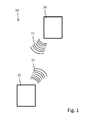
- a wireless communication system 10 is schematically illustrated.
- the communication system may comprise a plurality of BLE devices 20, 30, alternately acting as peripherals or hubs.
- a first BLE device 20 may initially act as a hub and may per default operate in a scanning mode SM.
- the second BLE device 30 may per default act as a peripheral and may, per default, switch into an advertising mode AM.
- the first BLE device 20 is in scanning mode SM while the second BLE device 30 is in advertising mode AM.
- the second BLE device 30 may switch into the scanning mode SM.
- the first BLE device 20 may process the first advertising packet 31. Thereafter or even before processing of the first advertising packet 31 takes place, the first BLE device 20 switches from the scanning mode SM into the advertising mode AM.
- both BLE devices 20, 30 upon broadcasting and/or receiving of the first advertising packet 31 swap or switch roles.
- the first BLE device 20 that acts as a peripheral device. Consequently, the first BLE device 20 generates and broadcasts a second advertising packet 21 that is receivable and processable by the second BLE device 30.
- the second BLE device 30 initially acting as a peripheral receives feedback from the first BLE device 20, which initially acts as a hub.
- the second advertising packet 21 that is typically broadcast in response to the first advertising packet 31 may be indicative to the second BLE device 30 to modify its further or ongoing behavior.
- feedback can be provided to the second BLE device 30 to behave and/or to communicate with the first BLE device 20 according to the first BLE device's 20 request.
- the broadcasting behavior of the initial peripheral i.e. of the first BLE device 20 can be dynamically adapted to the generic or specific requirements or characteristics of the first BLE device 20 without the necessity of establishing a point-to-point communication between first and second BLE devices 20, 30.
- neither of first or second BLE devices 20, 30 requires implementation of a complete BLE stack.
- the hardware and software requirements for implementation of first and second BLE devices 20, 30 can be kept on a rather low, cost- and energy-saving level.
- first and second BLE devices 20, 30 are illustrated.
- the first BLE device 20 is in scanning mode and actually scans for packets advertised by the second BLE device 30, which is in advertising mode AM, accordingly. Every time the first BLE device 20 receives an advertising packet 31 from the second BLE device 30 the first BLE device 20 switches from the scanning mode SM into the advertising mode AM. In the same way and after having broadcast a first advertising packet 31 also the second BLE device 30 switches from the advertising mode AM into the scanning mode SM.
- the first BLE device 20 which acts as a peripheral and broadcasts a second advertising packet 21, which is accordingly received by the second BLE device 30. Thereafter, the procedure starts from the beginning.
- the first BLE device 20 is switched back into scanning mode SM and the second BLE device 30 is switched back into the advertising mode.
- the illustrated procedure continues until one of the first and/or second BLE devices 20, 30 generates a respective advertising packet 21, 31 that contains a key indicator indicating termination or end of a communication.
- a key indicator is interpreted in scanning mode SM of first and/or second BLE devices 20, 30 to stop communication and to return into a default mode.
- a sequence of switching, broadcasting and receiving steps is schematically illustrated.
- a first step 100 the first, or local, device 20 is switched or has been switched into scanning mode SM.
- the respective device starts scanning.
- a second, or remote, BLE device 30 starts advertising. Consequently, the second device 30 is already in a respective advertising mode.
- the second device 30 After having broadcast (e.g. a first advertising packet) the second device 30 immediately stops advertising in step 104 and switches into the scanning mode SM in a subsequent step 106.
- the local, or first, BLE device 20 receives the first advertising packet previously broadcast by the second device in step 102.
- the local, or first, BLE device 20 switches in step 110 into an advertising mode AM. Thereafter, or concurrently with the switching into advertising mode, the first BLE device typically processes the received first advertising packet and starts advertising itself a second advertising packet in step 112. After broadcasting the second advertising packet in step 112, the first BLE device 20 stops advertising in step 114 and switches back into the scanning mode SM in a subsequent step 116. In the meantime, simultaneously, previously or thereafter, the second BLE device 30 receives the second advertising packet and generates again a first advertising packed to be received by the first BLE device 20 when in scanning mode SM. In other words, the procedure jumps back to step 100 so that the loop of steps 100-116 is executed repeatedly. The loop of steps 100-116 continues until at least one of first and second BLE devices 20, 30 receives a key indicator that is processed to stop or to abort communication between first and second BLE devices.
- FIG 4 a rather simple block diagram of a first embodiment of a first BLE device 20 is illustrated.
- the BLE device 20 is implemented as a single state-machine. It comprises a transceiver 22, a processor 24 as well as a storage element 26.
- the processor 24 acts as a single state-machine controller and drives the transceiver 22 in a time multiplexed scheme.
- the processor 24 actually switches the BLE device 20 between a scanning mode SM, in which the transceiver actually behaves like an antenna to receive advertising packets 31 broadcast by a different BLE device 30.
- advertising mode AM the transceiver 22 is able to broadcast a second advertising packet 21 that is to be received and processed by some other BLE device 30.
- FIG. 5 a different implementation of a BLE device 30 is illustrated.
- This BLE device 30 is comprised of two different state-machines 35, 37. Both state-machines 35, 37 comprise or represent different states or modes of the BLE device 30.
- the BLE device 30 generally has a transceiver 32, a processor 34 as well as a storage element 36.
- the two state-machines 35, 37 are represented by substantially identical components.
- state-machine 37 is comprised of a transceiver 32', a processor 34' and a storage element 36'.
- transceiver 32', processor 34' and storage 36' just represent different states or different configurations of transceiver 32, processor 34 and/or storage 36.
- the two transceivers 32, 32' of the two different state-machines 35, 37 persistently act either as a signal-receiving entity or as a signal-broadcasting entity.
- the transceiver 32 is able to broadcast first advertising packets 31 while the transceiver 32' is able to receive second advertising packets 21 from different BLE devices 20.
- the two state-machines 35, 37 are alternately and oppositely activated or deactivated so that only one of the two state-machines 35, 37 is active at any given time.
- the switching between first and second state-machines 35, 37 is controllable by a respective state-machine controller 38.
- the method of wireless communication and the wireless communication system can be based on and already provided with rather simple, low cost and low power consumption hardware components. Power consumption of respective BLE devices 20, 30 can therefore be effectively reduced.
Landscapes
- Engineering & Computer Science (AREA)
- Computer Networks & Wireless Communication (AREA)
- Signal Processing (AREA)
- Databases & Information Systems (AREA)
- Computer Security & Cryptography (AREA)
- Mobile Radio Communication Systems (AREA)
Abstract
- switching a first BLE device (20) into a scanning mode (SM),
- switching a second BLE device (30) into an advertising mode (AM), and broadcasting a first advertising packet (31) from the second BLE device,
- switching the second BLE device (30) into the scanning mode (SM),
- receiving the first advertising packet (31) by first BLE device (20), and
- switching the first BLE device (20) into the advertising mode (AM), and broadcasting a second advertising packet (21) from the first BLE device (30).
Description
- The present invention relates to the field of wireless communication between wireless communication devices. In particular the invention relates to a method, to a system as well as to a computer program for Bluetooth Low Energy communication and/or data transmission.
- Bluetooth Low Energy (BLE) is a wireless personal area network technology designed and marketed by the Bluetooth Special Interest Group aimed at novel applications, in particular for the fields of healthcare, fitness, security and home entertainment. Compared to 'classic' or 'conventional' Bluetooth' BLE is intended to provide considerably reduced power consumption and cost while maintaining a similar communication range.
- With classic BLE systems at least a pair of BLE devices, one of which denoted as a peripheral and the other one of which denoted as a hub, are able to establish a communication link. Typically, the peripheral device advertises or broadcasts while the hub scans. Once the hub identifies a suitable peripheral device it requests a connection, pairs with the peripheral device and takes control over the peripheral device. At that time, the peripheral device stops advertising and communication becomes 'closed' so that communication is solely established between the hub and the peripheral device. For implementation of such a standard method, a complete BLE firmware stack and hardware must be implemented for both BLE devices. In addition, once the communication between the pair of BLE devices has been established the communication takes place point-to-point. It is only visible to the hub and to the connected peripheral device.
- Bluetooth Low Energy communication may also be established by a different mode, namely by non-connectable undirected advertising, in short 'advertising mode'. There, the peripheral device only and exclusively advertises and is unwilling and/or unable to pair or to connect with the hub device. A drawback of this communication protocol is that there is no way for the peripheral device to get knowledge whether a broadcast packet or message has been correctly received by a hub device. Moreover, the peripheral device does not get any information as to which of a multiplicity of available hub devices actually received or processed the previously broadcast packet or message. Another drawback is that the peripheral device is unable to get and to process any feedback or instructions by way of which its further broadcasting behavior could be modified. In addition, the peripheral is unable to receive programming or re-programming instructions wirelessly, e.g. at power up or in situ. It may never act as a hub or as a receiver.
- It is therefore an object of the present invention to provide an improved method of wireless communication between at least two Bluetooth Low Energy devices by way of which a bi-directional communication can be established without the need of implementing a complete BLE stack. The invention further aims to provide a respective computer program and a wireless communication system that is implementable on the basis of low cost and space saving hardware components.
- According to a first aspect the invention relates to a method of wireless communication between at least two Bluetooth Low Energy (BLE) devices. The method comprises the steps of switching a first BLE device into a scanning mode and switching a second BLE device into an advertising mode. When in advertising mode, the second BLE device is broadcasting a first advertising packet, typically in a non-connectable undirected advertising mode. In this initial or default configuration one of the at least two BLE devices acts as a hub or receiver while the other one of the BLE devices acts and behaves like a peripheral device as they are commonly known and implemented for the non-connectable undirected advertising mode.
- After the second BLE device has broadcast the first advertising packet the second BLE device is switched into the scanning mode. The first BLE device, which is still in scanning mode, just receives the first advertising packet that was broadcast from the second BLE device. After the first BLE device has received the first advertising packet also the first BLE device switches from the scanning mode into the advertising mode. In this way first and second BLE devices swap roles. After such role swapping it is then the first BLE device that broadcasts a second advertising packet, which is receivable and which is actually received by the second BLE device.
- Typically, first and second BLE devices alternately swap roles and their broadcasting and receiving function between the scanning mode and the advertising mode. The two devices remain substantially disconnected and may operate according to the non-connectable undirected advertising protocol with the exception that first and second BLE devices frequently swap roles. In this way, a peripheral device may receive a feedback from a hub, that for instance a broadcast packet has been received. Moreover, with the role swapping of first and second BLE devices a wireless programming or re-programming as well as various modifications of at least one BLE device can be implemented in response to such a role swapping and feedback of communication. From a hardware point of view comparatively low cost and space saving BLE devices and components can be used without the need of implementing a complete BLE stack.
- According to an embodiment, at least one of the first and second BLE devices switches from the scanning mode into the advertising mode in response to receive an advertising packet. Hence, switching from scanning mode into advertising mode can be triggered by receiving and/or processing of an advertising packet. As long as a respective BLE device does not receive an advertising packet, the device remains in a default mode, which is either a scanning mode or an advertising mode. In this way, a controlled switching scheme can be implemented. It can be prevented that both of the at least two BLE devices remain or get stuck in a common mode, such like the scanning mode or the advertising mode.
- According to another embodiment, at least one of the first and second BLE devices switches from the advertising mode into the scanning mode after broadcasting an advertising packet.
- In this way also a controlled switching behavior of the advertising BLE device can be implemented. Given a situation in which first and second BLE devices are able to communicate via advertising packets in a wireless way the second BLE device is switched from the advertising mode into the scanning mode after broadcasting of the first advertising packet while the first BLE device switches from the scanning mode into the advertising mode and advertises or broadcasts a second advertising packet in response to receive the first advertising packet previously broadcast by the second BLE device. First and second BLE devices have then swapped roles and continue with broadcasting advertising packets and scanning for and receiving respective advertising packets. Since the BLE devices switches between scanning and advertising modes every time an advertising packet has been broadcast and any time an advertising packet has been received or processed the at least two BLE devices are oppositely or alternately switched. One of the two BLE devices is or remains in scanning mode while the other one of the at least two BLE devices is or remains in advertising mode at least for a predefined period of time.
- According to a further embodiment, switching between advertising mode and scanning mode is delayed for a predefined time interval after receiving or broadcasting of an advertising packet. Implementing at least a short delay between receiving or broadcasting of an advertising packet and a subsequent or precedent switching of a mode is beneficial in order to assert that one of the at least two BLE devices is in scanning mode before the other one of the at least two BLE devices actually broadcasts or transmits an advertising packet.
- According to a further embodiment, the second advertising packet contains an acknowledgement that the first advertising packet has been received and/or processed by the first BLE device. In this way and upon receipt of the second advertising packet the second BLE device receives a feedback that a previously submitted first advertising packet has been safely received and/or processed by the first BLE device. Apart from an acknowledgement or in an alternative embodiment also other generic or situation-dependent information may be included into the second advertising packet.
- In this way, the second BLE device may become enabled to modify its further broadcasting and/or packet receiving behavior. It is for instance conceivable that a returning second advertising packet is indicative to the second BLE device to broadcast a modified first advertising packet containing further bits of information or payload to be processed by the first BLE device. Hence, in response to receive and/or to process the first advertising packet the first BLE device may request another or a further, e.g. a modified first or even a third advertising packet from the second BLE device that differs from the first advertising packet.
- According to another embodiment, at least one of the first and second advertising packets contains a key indicator that is processed by at least one of first and second BLE devices to stop communicating and to switch into a default mode. The default mode is either the scanning mode or the advertising mode. Per default, the first BLE device may be switched into scanning mode and per default, the second BLE device may be switched into advertising mode. By means of the key indicator the communication between first and second BLE devices can be terminated. The key indicator may be generated and implemented into the first or second advertising packet, depending on the specific type of communication and data transmitting interaction between first and second BLE devices.
- According to another embodiment, the second BLE device executes at least one modification action in response to receive the second advertising packet from the first BLE device. In this way and in response to a feedback of the first BLE device, the second BLE device, e.g. acting per default as a peripheral device can be dynamically reconfigured or reprogrammed on behalf of the feedback received from the first BLE device in form of the second advertising packet. In addition or alternatively, the first BLE device may also induce or trigger a different broadcasting behavior of the second BLE device. In response to the feedback from the first BLE device the second BLE device may become subject to a reconfiguration, hence to a reprogramming or similar actions, like over-the air programming.
- Following a further embodiment, at least one of the first and second BLE devices switches into a default mode or aborts communication when a predefined idle time has lapsed after broadcasting of a first or second advertising packet without having received a second or first advertising packet in response. In this way, the communication system consisting of at least the first and second BLE devices can be kept intact even if first and second BLE devices are mutually out of reach. Otherwise and in situations wherein a first advertising packet broadcast by the second BLE device cannot be received or processed by the first BLE device, the second BLE device per definition switches into the scanning mode while the first BLE device also remains in scanning mode. If the first BLE device does not respond within the predefined idle time after the first advertising packet has been broadcast by the second BLE device the second BLE device that already switched into the scanning mode returns to the advertising mode. It will then repeatedly submit and broadcast a respective first advertising packet, which, when received by the first BLE device leads to a respective response of the first BLE device in the form of the second advertising packet.
- According to another embodiment at least one of first and second BLE devices comprises a single state-machine, which is driven time division multiplexed. Any or all BLE devices involved in a respective wireless communication system may be driven time division multiplexed. During a first time interval, respective BLE devices are driven in scanning mode and in a subsequent time interval respective BLE devices are driven in advertising mode; or vice versa. Implementation of a single state-machine is rather cost efficient and low power consuming. Especially for mobile and battery-driven BLE devices, implementation of such a single state-machine is rather beneficial.
- In this way, the state-machine, representing the actual status of the respective BLE device may switch between the advertising mode and the scanning mode.
- According to another embodiment, at least one of the first and second BLE devices comprises a multi-state-machine, with at least a first and a second state-machine. There, the first state-machine is activated or is activatable exclusively for the advertising mode and the second state-machine is activated or activatable exclusively for the scanning mode. When not activated, respective state-machines are typically deactivated so that only one of the state-machines is active at any specific time while the other state-machine(s) is/are deactivated.
- The overall behavior of the BLE device is then governed by activation or deactivation of first and/or second state-machine without the need of modifying the respective state-machine or configuration of the respective BLE device's hardware or software implementation.
- Respective single or multi-state-machines may be implemented purely on the basis on a software implementation, on the basis of a hardware implementation or on the basis of software and hardware particularly adapted for the bi-directional non-connectable undirected advertising communication mode according to the present invention.
- In another aspect, the invention equally applies to a computer program to establish wireless communication between at least two Bluetooth Low Energy (BLE) devices. The computer program comprises a programmable means for switching a first BLE device into a scanning mode. The computer program further comprises a programmable means for switching a second BLE device into an advertising mode and for broadcasting a first advertising packet from the second BLE device. The computer program further comprises a programmable means for switching the second BLE device into the scanning mode and further comprises a programmable means for receiving the first advertising packet through the first BLE device. In addition, the computer program comprises a programmable means for switching the first BLE device into the advertising mode and for broadcasting a second advertising packet from the first BLE device, typically in response to receiving and/or processing of the first advertising packet by the first BLE device.
- In general, the computer program may equally run on first and second BLE devices. Moreover, the computer program is able and configured to implement the above described method of wireless communication on the basis of at least two Bluetooth Low Energy devices. Consequently, all features, properties and advantages as described in connection with the above mentioned method equally apply to the computer program; and vice versa.
- In still another aspect the invention also relates to a wireless communication system comprising at least two Bluetooth Low Energy (BLE) devices. Both BLE devices are alternately switchable between a scanning mode and an advertising mode. A first BLE device is switchable into the scanning mode, in which the first BLE device is able to receive a first advertising packet. In addition, a second BLE device is switchable into an advertising mode, in which the second BLE device is able to broadcast the first advertising packet.
- The first BLE device is switchable into the advertising mode after having received the first advertising packet. In said advertising mode the first BLE device is able to broadcast a second advertising packet, typically in response to receiving and/or processing the first advertising packet. The second BLE device is switchable into the scanning mode after having broadcast the first advertising packet. In the scanning mode, the second BLE device is able to receive the second advertising packet. In this way, the second BLE device initially acting as a peripheral device receives feedback from the first BLE device, initially acting as a hub.
- After having broadcast and received a first advertising packet, respectively the first and second BLE devices swap roles. The first BLE device initially acting as a hub switches into broadcasting mode and becomes a peripheral device while the second BLE device, initially acting as a peripheral device switches into the scanning mode and operates as a hub.
- The wireless communication system is particularly adapted and designed to implement the above described method of wireless communication. Consequently, all features, effects and benefits described in connection with the method equally apply to the communication system, and vice versa.
- In the following, an embodiment of the present invention is described by making reference to the drawings, in which:
-
Figure 1 schematically shows a block diagram of a first and a second BLE device according to the present invention; -
Figure 2 shows a first flowchart of the behavior of first and second BLE devices for establishing a wireless communication; -
Figure 3 shows a further flowchart of the method of wireless communication; -
Figure 4 is illustrative of a single state-machine implementation of a BLE device; and -
Figure 5 is indicative of a multi-state-machine of a BLE device. - In
Figure 1 , awireless communication system 10 is schematically illustrated. The communication system may comprise a plurality ofBLE devices - In the illustrated embodiment only two of a plurality of mutually interacting and data exchanging first and
second BLE devices Figure 1 , afirst BLE device 20 may initially act as a hub and may per default operate in a scanning mode SM. Thesecond BLE device 30 may per default act as a peripheral and may, per default, switch into an advertising mode AM. In an initial configuration thefirst BLE device 20 is in scanning mode SM while thesecond BLE device 30 is in advertising mode AM. In this configuration, it is thesecond BLE device 30 that broadcasts afirst advertising packet 31 which is receivable and processable by thefirst BLE device 20. - After having broadcast the
first advertising packet 31 thesecond BLE device 30 may switch into the scanning mode SM. In response to receive thefirst advertising packet 31 from thesecond BLE device 30 thefirst BLE device 20 may process thefirst advertising packet 31. Thereafter or even before processing of thefirst advertising packet 31 takes place, thefirst BLE device 20 switches from the scanning mode SM into the advertising mode AM. - Hence, both
BLE devices first advertising packet 31 swap or switch roles. In the further procedure of the method, it is then thefirst BLE device 20 that acts as a peripheral device. Consequently, thefirst BLE device 20 generates and broadcasts asecond advertising packet 21 that is receivable and processable by thesecond BLE device 30. In this way, thesecond BLE device 30 initially acting as a peripheral receives feedback from thefirst BLE device 20, which initially acts as a hub. - The
second advertising packet 21 that is typically broadcast in response to thefirst advertising packet 31 may be indicative to thesecond BLE device 30 to modify its further or ongoing behavior. By means of thesecond advertising packet 21, feedback can be provided to thesecond BLE device 30 to behave and/or to communicate with thefirst BLE device 20 according to the first BLE device's 20 request. - In this way, the broadcasting behavior of the initial peripheral, i.e. of the
first BLE device 20 can be dynamically adapted to the generic or specific requirements or characteristics of thefirst BLE device 20 without the necessity of establishing a point-to-point communication between first andsecond BLE devices second BLE devices second BLE devices - In
Figure 2 , the alternate scanning and advertising modes of first andsecond BLE devices Figure 2 , thefirst BLE device 20 is in scanning mode and actually scans for packets advertised by thesecond BLE device 30, which is in advertising mode AM, accordingly. Every time thefirst BLE device 20 receives anadvertising packet 31 from thesecond BLE device 30 thefirst BLE device 20 switches from the scanning mode SM into the advertising mode AM. In the same way and after having broadcast afirst advertising packet 31 also thesecond BLE device 30 switches from the advertising mode AM into the scanning mode SM. - After having swapped roles, it is then that the
first BLE device 20, which acts as a peripheral and broadcasts asecond advertising packet 21, which is accordingly received by thesecond BLE device 30. Thereafter, the procedure starts from the beginning. Thefirst BLE device 20 is switched back into scanning mode SM and thesecond BLE device 30 is switched back into the advertising mode. The illustrated procedure continues until one of the first and/orsecond BLE devices respective advertising packet second BLE devices - In the flowchart of
Figure 3 , a sequence of switching, broadcasting and receiving steps is schematically illustrated. In afirst step 100 the first, or local,device 20 is switched or has been switched into scanning mode SM. The respective device starts scanning. Thereafter, or simultaneously with the scanning of thefirst device 20 instep 102, a second, or remote,BLE device 30 starts advertising. Consequently, thesecond device 30 is already in a respective advertising mode. After having broadcast (e.g. a first advertising packet) thesecond device 30 immediately stops advertising instep 104 and switches into the scanning mode SM in asubsequent step 106. Instep 108 the local, or first,BLE device 20 receives the first advertising packet previously broadcast by the second device instep 102. - In response to receiving the first advertising packet, the local, or first,
BLE device 20 switches instep 110 into an advertising mode AM. Thereafter, or concurrently with the switching into advertising mode, the first BLE device typically processes the received first advertising packet and starts advertising itself a second advertising packet instep 112. After broadcasting the second advertising packet instep 112, thefirst BLE device 20 stops advertising instep 114 and switches back into the scanning mode SM in asubsequent step 116. In the meantime, simultaneously, previously or thereafter, thesecond BLE device 30 receives the second advertising packet and generates again a first advertising packed to be received by thefirst BLE device 20 when in scanning mode SM. In other words, the procedure jumps back to step 100 so that the loop of steps 100-116 is executed repeatedly. The loop of steps 100-116 continues until at least one of first andsecond BLE devices - In
Figure 4 , a rather simple block diagram of a first embodiment of afirst BLE device 20 is illustrated. TheBLE device 20 is implemented as a single state-machine. It comprises a transceiver 22, aprocessor 24 as well as astorage element 26. Theprocessor 24 acts as a single state-machine controller and drives the transceiver 22 in a time multiplexed scheme. Theprocessor 24 actually switches theBLE device 20 between a scanning mode SM, in which the transceiver actually behaves like an antenna to receiveadvertising packets 31 broadcast by adifferent BLE device 30. When switched in advertising mode AM, the transceiver 22 is able to broadcast asecond advertising packet 21 that is to be received and processed by someother BLE device 30. - In
Figure 5 , a different implementation of aBLE device 30 is illustrated. ThisBLE device 30 is comprised of two different state-machines machines BLE device 30. TheBLE device 30 generally has atransceiver 32, aprocessor 34 as well as astorage element 36. The two state-machines machine 35, state-machine 37 is comprised of a transceiver 32', a processor 34' and a storage element 36'. Here, transceiver 32', processor 34' and storage 36' just represent different states or different configurations oftransceiver 32,processor 34 and/orstorage 36. - As illustrated in
Figure 5 , the twotransceivers 32, 32' of the two different state-machines transceiver 32 is able to broadcastfirst advertising packets 31 while the transceiver 32' is able to receivesecond advertising packets 21 fromdifferent BLE devices 20. The two state-machines machines machines - In general, the method of wireless communication and the wireless communication system can be based on and already provided with rather simple, low cost and low power consumption hardware components. Power consumption of
respective BLE devices
Claims (12)
- Method of wireless communication between at least two Bluetooth Low Energy (BLE) devices (20, 30), comprising the steps of:- switching a first BLE device (20) into a scanning mode,- switching a second BLE device (30) into an advertising mode, and broadcasting a first advertising packet (31) from the second BLE device (30),- receiving the first advertising packet (31) by the first BLE device (20),- switching the second BLE device (30) into the scanning mode,- switching the first BLE device (20) into the advertising mode, and broadcasting a second advertising packet (21) from the first BLE device (20).
- Method according to claim 1, characterized in that at least one of the first and second BLE devices (20, 30) switches from the scanning mode into the advertising mode in response to receive an advertising packet.
- Method according to claim 1, characterized in that at least one of the first and second BLE devices (20, 30) switches from the advertising mode into the scanning mode after broadcasting an advertising packet.
- Method according to claim 2, characterized in that switching between advertising mode and scanning mode is delayed for a predefined time interval after receiving or broadcasting of an advertising packet.
- Method according to claim 1, characterized in that the second advertising packet (21) contains an acknowledgement that the first advertising packet (31) has been received and/or processed by the first BLE device (20).
- Method according to claim 1, characterized in that at least one of the first and second advertising packets (31, 21) contains a key indicator that is processed by at least one of first and second BLE devices (20, 30) to stop communicating and to switch into a default mode, which is either the scanning mode or the advertising mode.
- Method according to claim 1, characterized in that the second BLE device (30) executes at least one modification action in response to receive the second advertising packet (21) from the first BLE device (20).
- Method according to claim 1, characterized in that at least one of the first and second BLE devices (20, 30) switches into a default mode or aborts communication when a predefined idle time has lapsed after broadcasting of a first or second advertising packet (31, 21) without having received a second or first advertising packet (21, 31) in response.
- Method according to claim 1, characterized in that at least one of first and second BLE devices (20, 30) is comprised of a single state-machine which is driven time division multiplexed.
- Method according to claim 1, characterized in that at least one of the first and second BLE devices (20, 30) is comprised of a multi-state-machine with at least a first and a second state-machine, in that the first state machine is activated for the advertising mode, and in that the second state-machine is activated for the scanning mode, or vice versa.
- Computer program to establish wireless communication between at least two Bluetooth Low Energy (BLE) devices (20, 30), the computer program comprising:- program means for switching a first BLE device (20) into a scanning mode,- program means for switching a second BLE device (30) into an advertising mode and for broadcasting a first advertising packet (31) from the second BLE device (30),- program means for switching the second BLE device (30) into the scanning mode,- program means for receiving the first advertising packet (31) through the first BLE device (20), and- program means for switching the first BLE device (20) into the advertising mode and for broadcasting a second advertising packet (21) from the first BLE device (20).
- Wireless communication system (10) comprising at least two Bluetooth Low Energy (BLE) devices (20, 30) that are both switchable between a scanning mode and an advertising mode, wherein- a first BLE device (20) is switchable into the scanning mode, in which the first BLE device (20) is able to receive a first advertising packet (31),- a second BLE device (30) is switchable into an advertising mode, in which the second BLE device (30) is able to broadcast the first advertising packet (31),- wherein the first BLE device (20) is switchable into the advertising mode (AM) after having received the first advertising packet (31), in which advertising mode the first BLE device (20) is able to broadcast a second advertising packet (21), and- wherein the second BLE device (30) is switchable onto the scanning mode after having broadcast the first advertising packet (31), in which scanning mode the second BLE device (30) is able to receive the second advertising packet (21).
Applications Claiming Priority (1)
| Application Number | Priority Date | Filing Date | Title |
|---|---|---|---|
| US14/298,453 US9420407B2 (en) | 2014-06-06 | 2014-06-06 | Method and system for bidirectional communications via a bluetooth low energy advertise link |
Publications (2)
| Publication Number | Publication Date |
|---|---|
| EP2953387A1 true EP2953387A1 (en) | 2015-12-09 |
| EP2953387B1 EP2953387B1 (en) | 2018-10-31 |
Family
ID=53002522
Family Applications (1)
| Application Number | Title | Priority Date | Filing Date |
|---|---|---|---|
| EP15164103.2A Active EP2953387B1 (en) | 2014-06-06 | 2015-04-17 | Method and system for bidirectional communications via a bluetooth low energy advertise link |
Country Status (3)
| Country | Link |
|---|---|
| US (1) | US9420407B2 (en) |
| EP (1) | EP2953387B1 (en) |
| KR (1) | KR101706852B1 (en) |
Cited By (1)
| Publication number | Priority date | Publication date | Assignee | Title |
|---|---|---|---|---|
| CN107770762A (en) * | 2017-11-20 | 2018-03-06 | 飞天诚信科技股份有限公司 | A kind of method and device for establishing bluetooth connection |
Families Citing this family (24)
| Publication number | Priority date | Publication date | Assignee | Title |
|---|---|---|---|---|
| CN107409433B (en) * | 2015-02-26 | 2020-09-15 | 瑞典爱立信有限公司 | Energy efficient BLE mesh initialization and operation |
| US9852102B2 (en) * | 2015-04-15 | 2017-12-26 | Hand Held Products, Inc. | System for exchanging information between wireless peripherals and back-end systems via a peripheral hub |
| EP3357266B1 (en) * | 2015-09-30 | 2020-10-28 | Google LLC | Systems, devices, and methods for simulataneously exchanging messages between a low-energy radio device and multiple communication devices |
| US10313861B2 (en) * | 2016-09-15 | 2019-06-04 | WiSilica Inc. | Wireless control of multiple actor devices by multiple controller devices with communication security |
| WO2018067064A1 (en) * | 2016-10-08 | 2018-04-12 | Ospicon Systems Pte Ltd | Bi-directional communication system for logistic tracking |
| US9959434B1 (en) | 2016-10-08 | 2018-05-01 | Ospicon Systems Pte Ltd | Bi-directional communication system for logistic tracking |
| KR101901671B1 (en) * | 2017-01-06 | 2018-09-27 | (주)비콘테크놀로지 | System for connecting classic bluetooth using bluetooth low energy in bluetooth dual mode, and method thereof |
| KR101863692B1 (en) * | 2017-01-10 | 2018-07-04 | 제이씨스퀘어주식회사 | Method and system for access authentication based on code recognition and near field wireless conmmunication between terminals, and smart shopping method for the same |
| CN107135467B (en) * | 2017-04-28 | 2020-12-11 | 成都新橙北斗智联有限公司 | A duplex mode BLE application system and method |
| GB201707050D0 (en) * | 2017-05-03 | 2017-06-14 | British American Tobacco Investments Ltd | Data communication |
| US10039057B1 (en) * | 2017-06-06 | 2018-07-31 | Hong Kong Applied Science And Technology Research Institute Co., Ltd. | Optimized deployment of BLE network and power efficient and secure management of data exchange between BLE devices |
| GB201722278D0 (en) | 2017-12-29 | 2018-02-14 | British American Tobacco Investments Ltd | Device identification and method |
| GB201722241D0 (en) | 2017-12-29 | 2018-02-14 | British American Tobacco Investments Ltd | Data capture across devices |
| GB201801146D0 (en) | 2018-01-24 | 2018-03-07 | Nicoventures Trading Ltd | Aerosol source for a vapour provision system |
| CN110407043B (en) | 2018-04-26 | 2023-01-13 | 奥的斯电梯公司 | Communication for elevator service requests |
| EP3672296A1 (en) * | 2018-12-20 | 2020-06-24 | Baintex Technologies, S.L. | Method of communication by advertisement in a network under the ble protocol |
| US10812958B2 (en) * | 2019-01-16 | 2020-10-20 | Samsung Electronics Co., Ltd. | Bluetooth low energy (BLE) device transmitting BLE advertising data, and method of transmitting BLE advertising data |
| US11716176B2 (en) | 2019-06-21 | 2023-08-01 | Carrier Corporation | Method and system for broadcasting data in wireless network |
| CN113382393B (en) * | 2020-02-25 | 2024-05-03 | 炬芯科技股份有限公司 | Bluetooth connection method and device, storage medium and electronic equipment |
| US11082809B1 (en) * | 2020-06-18 | 2021-08-03 | Apple Inc. | Many-to-many communication techniques for mobile devices |
| EP4336873B1 (en) * | 2021-07-12 | 2025-02-12 | Huawei Technologies Co., Ltd. | Bluetooth connection method and apparatus |
| JP7691132B2 (en) * | 2022-05-31 | 2025-06-11 | サイレックス・テクノロジー株式会社 | COMMUNICATION DEVICE, COMMUNICATION SYSTEM, AND CONTROL METHOD |
| CN115134792A (en) * | 2022-05-31 | 2022-09-30 | 深圳市有方科技股份有限公司 | Bluetooth communication method and related product |
| WO2025038233A1 (en) * | 2023-08-11 | 2025-02-20 | Apple Inc. | Techniques for managing pairing procedures between computing devices and accessory computing devices |
Citations (5)
| Publication number | Priority date | Publication date | Assignee | Title |
|---|---|---|---|---|
| US20070141985A1 (en) * | 2005-12-21 | 2007-06-21 | Jukka Parkkinen | Method for closing a communication link |
| US20120052802A1 (en) * | 2010-08-24 | 2012-03-01 | Nokia Corporation | Advertisement of an existing wireless connection |
| EP2605552A2 (en) * | 2011-12-13 | 2013-06-19 | Samsung Electronics Co., Ltd | Method and apparatus for managing device discovery in wireless system |
| WO2013149380A1 (en) * | 2012-04-05 | 2013-10-10 | Nokia Corporation | Method, apparatus, and computer program product for data distribution in wireless networks |
| WO2013177792A1 (en) * | 2012-06-01 | 2013-12-05 | Nokia Corporation | Method, apparatus, and computer program product for adaptive device discovery in wireless networks |
Family Cites Families (7)
| Publication number | Priority date | Publication date | Assignee | Title |
|---|---|---|---|---|
| US7072697B2 (en) * | 2002-10-22 | 2006-07-04 | Nokia Corporation | Method and device for transponder aided wake-up of a low power radio device by a wake-up event |
| US20120196534A1 (en) * | 2011-02-01 | 2012-08-02 | Nokia Corporation | Method, apparatus, and computer program product for broadcasting in short-range communication |
| KR102057196B1 (en) * | 2012-09-18 | 2019-12-18 | 삼성전자주식회사 | Method and system for transmitting information, device and computer readable recording medium thereof |
| US9210520B2 (en) * | 2012-12-17 | 2015-12-08 | Starkey Laboratories, Inc. | Ear to ear communication using wireless low energy transport |
| KR102144046B1 (en) * | 2013-10-17 | 2020-08-13 | 삼성전자주식회사 | Method and apparatus for connection between electronic devices |
| US8989053B1 (en) * | 2013-11-29 | 2015-03-24 | Fedex Corporate Services, Inc. | Association management in a wireless node network |
| US9668294B2 (en) * | 2014-01-14 | 2017-05-30 | Qualcomm Incorporated | Method and apparatus for bluetooth low energy suspend and resume |
-
2014
- 2014-06-06 US US14/298,453 patent/US9420407B2/en active Active
-
2015
- 2015-04-17 EP EP15164103.2A patent/EP2953387B1/en active Active
- 2015-06-05 KR KR1020150079720A patent/KR101706852B1/en active Active
Patent Citations (5)
| Publication number | Priority date | Publication date | Assignee | Title |
|---|---|---|---|---|
| US20070141985A1 (en) * | 2005-12-21 | 2007-06-21 | Jukka Parkkinen | Method for closing a communication link |
| US20120052802A1 (en) * | 2010-08-24 | 2012-03-01 | Nokia Corporation | Advertisement of an existing wireless connection |
| EP2605552A2 (en) * | 2011-12-13 | 2013-06-19 | Samsung Electronics Co., Ltd | Method and apparatus for managing device discovery in wireless system |
| WO2013149380A1 (en) * | 2012-04-05 | 2013-10-10 | Nokia Corporation | Method, apparatus, and computer program product for data distribution in wireless networks |
| WO2013177792A1 (en) * | 2012-06-01 | 2013-12-05 | Nokia Corporation | Method, apparatus, and computer program product for adaptive device discovery in wireless networks |
Cited By (2)
| Publication number | Priority date | Publication date | Assignee | Title |
|---|---|---|---|---|
| CN107770762A (en) * | 2017-11-20 | 2018-03-06 | 飞天诚信科技股份有限公司 | A kind of method and device for establishing bluetooth connection |
| CN107770762B (en) * | 2017-11-20 | 2020-05-19 | 飞天诚信科技股份有限公司 | Method and device for establishing Bluetooth connection |
Also Published As
| Publication number | Publication date |
|---|---|
| EP2953387B1 (en) | 2018-10-31 |
| KR20150140584A (en) | 2015-12-16 |
| KR101706852B1 (en) | 2017-02-14 |
| US20150358759A1 (en) | 2015-12-10 |
| US9420407B2 (en) | 2016-08-16 |
Similar Documents
| Publication | Publication Date | Title |
|---|---|---|
| EP2953387B1 (en) | Method and system for bidirectional communications via a bluetooth low energy advertise link | |
| JP6010622B2 (en) | Wireless data communication between master and slave devices | |
| KR102118402B1 (en) | Method and apparatus for saving power of user equipment in wireless communication system supporing device to device communication | |
| CN104137439B (en) | Equity finds | |
| EP2465306B1 (en) | Device, system and method of power management in a wireless area network | |
| US20160095047A1 (en) | Bluetooth low energy beacon device and advertising method | |
| US9743411B2 (en) | Control method of frequency band switching and wireless communication apparatus | |
| CN112399644A (en) | Discontinuous receiving method, related device and system | |
| CN116134767A (en) | Configuring Sidelink Hybrid Automatic Repeat Request | |
| US20150351114A1 (en) | Real-time peer-to-peer communications in an environment that includes a restricted channel | |
| KR20220051362A (en) | Sidelink discontinuous transmission method, reception method, apparatus and terminal equipment | |
| EP3011779A1 (en) | Low energy wireless proximity pairing | |
| JP2004015558A5 (en) | ||
| EP2922314B1 (en) | A method and technical equipment for short range data transmission | |
| US8837339B2 (en) | Access point and control method thereof | |
| CN110191449B (en) | Communication mode switching method, device, storage medium, processor and system | |
| KR102942328B1 (en) | Method and device for a terminal to enter sleep mode in NR V2X | |
| US20150173021A1 (en) | Apparatus and method for controlling transmission of sensor data on media access control (mac) layer of wireless sensor network | |
| EP4128962B1 (en) | Using a stop indication for physical uplink shared channel transmission | |
| KR20140104382A (en) | Method and apparatus for performining a communication in a wireless communication system | |
| CN112350925A (en) | Gateway control method, device, system, electronic equipment and storage medium | |
| CN111971999A (en) | Support for reception-limited user equipment in wireless environments | |
| US20240032142A1 (en) | Sidelink transmission method and apparatus | |
| CN109640304B (en) | Method for improving low-power-consumption Bluetooth connection stability | |
| KR101909129B1 (en) | Method and apparatus for controlling zigbee device |
Legal Events
| Date | Code | Title | Description |
|---|---|---|---|
| PUAI | Public reference made under article 153(3) epc to a published international application that has entered the european phase |
Free format text: ORIGINAL CODE: 0009012 |
|
| AK | Designated contracting states |
Kind code of ref document: A1 Designated state(s): AL AT BE BG CH CY CZ DE DK EE ES FI FR GB GR HR HU IE IS IT LI LT LU LV MC MK MT NL NO PL PT RO RS SE SI SK SM TR |
|
| AX | Request for extension of the european patent |
Extension state: BA ME |
|
| 17P | Request for examination filed |
Effective date: 20160609 |
|
| RBV | Designated contracting states (corrected) |
Designated state(s): AL AT BE BG CH CY CZ DE DK EE ES FI FR GB GR HR HU IE IS IT LI LT LU LV MC MK MT NL NO PL PT RO RS SE SI SK SM TR |
|
| RIC1 | Information provided on ipc code assigned before grant |
Ipc: H04W 76/14 20180101ALI20180517BHEP Ipc: H04W 4/80 20180101ALI20180517BHEP Ipc: H04W 84/18 20090101ALN20180517BHEP Ipc: H04W 8/00 20090101AFI20180517BHEP |
|
| RIC1 | Information provided on ipc code assigned before grant |
Ipc: H04W 84/18 20090101ALN20180522BHEP Ipc: H04W 4/80 20180101ALI20180522BHEP Ipc: H04W 76/14 20180101ALI20180522BHEP Ipc: H04W 8/00 20090101AFI20180522BHEP |
|
| GRAP | Despatch of communication of intention to grant a patent |
Free format text: ORIGINAL CODE: EPIDOSNIGR1 |
|
| STAA | Information on the status of an ep patent application or granted ep patent |
Free format text: STATUS: GRANT OF PATENT IS INTENDED |
|
| RIC1 | Information provided on ipc code assigned before grant |
Ipc: H04W 8/00 20090101AFI20180605BHEP Ipc: H04W 4/80 20180101ALI20180605BHEP Ipc: H04W 84/18 20090101ALN20180605BHEP Ipc: H04W 76/14 20180101ALI20180605BHEP |
|
| INTG | Intention to grant announced |
Effective date: 20180629 |
|
| GRAS | Grant fee paid |
Free format text: ORIGINAL CODE: EPIDOSNIGR3 |
|
| GRAA | (expected) grant |
Free format text: ORIGINAL CODE: 0009210 |
|
| STAA | Information on the status of an ep patent application or granted ep patent |
Free format text: STATUS: THE PATENT HAS BEEN GRANTED |
|
| AK | Designated contracting states |
Kind code of ref document: B1 Designated state(s): AL AT BE BG CH CY CZ DE DK EE ES FI FR GB GR HR HU IE IS IT LI LT LU LV MC MK MT NL NO PL PT RO RS SE SI SK SM TR |
|
| REG | Reference to a national code |
Ref country code: CH Ref legal event code: EP Ref country code: GB Ref legal event code: FG4D |
|
| REG | Reference to a national code |
Ref country code: AT Ref legal event code: REF Ref document number: 1060868 Country of ref document: AT Kind code of ref document: T Effective date: 20181115 |
|
| REG | Reference to a national code |
Ref country code: DE Ref legal event code: R096 Ref document number: 602015018958 Country of ref document: DE |
|
| REG | Reference to a national code |
Ref country code: IE Ref legal event code: FG4D |
|
| REG | Reference to a national code |
Ref country code: NL Ref legal event code: MP Effective date: 20181031 |
|
| REG | Reference to a national code |
Ref country code: LT Ref legal event code: MG4D |
|
| REG | Reference to a national code |
Ref country code: AT Ref legal event code: MK05 Ref document number: 1060868 Country of ref document: AT Kind code of ref document: T Effective date: 20181031 |
|
| PG25 | Lapsed in a contracting state [announced via postgrant information from national office to epo] |
Ref country code: FI Free format text: LAPSE BECAUSE OF FAILURE TO SUBMIT A TRANSLATION OF THE DESCRIPTION OR TO PAY THE FEE WITHIN THE PRESCRIBED TIME-LIMIT Effective date: 20181031 Ref country code: NO Free format text: LAPSE BECAUSE OF FAILURE TO SUBMIT A TRANSLATION OF THE DESCRIPTION OR TO PAY THE FEE WITHIN THE PRESCRIBED TIME-LIMIT Effective date: 20190131 Ref country code: IS Free format text: LAPSE BECAUSE OF FAILURE TO SUBMIT A TRANSLATION OF THE DESCRIPTION OR TO PAY THE FEE WITHIN THE PRESCRIBED TIME-LIMIT Effective date: 20190228 Ref country code: ES Free format text: LAPSE BECAUSE OF FAILURE TO SUBMIT A TRANSLATION OF THE DESCRIPTION OR TO PAY THE FEE WITHIN THE PRESCRIBED TIME-LIMIT Effective date: 20181031 Ref country code: AT Free format text: LAPSE BECAUSE OF FAILURE TO SUBMIT A TRANSLATION OF THE DESCRIPTION OR TO PAY THE FEE WITHIN THE PRESCRIBED TIME-LIMIT Effective date: 20181031 Ref country code: LV Free format text: LAPSE BECAUSE OF FAILURE TO SUBMIT A TRANSLATION OF THE DESCRIPTION OR TO PAY THE FEE WITHIN THE PRESCRIBED TIME-LIMIT Effective date: 20181031 Ref country code: LT Free format text: LAPSE BECAUSE OF FAILURE TO SUBMIT A TRANSLATION OF THE DESCRIPTION OR TO PAY THE FEE WITHIN THE PRESCRIBED TIME-LIMIT Effective date: 20181031 Ref country code: PL Free format text: LAPSE BECAUSE OF FAILURE TO SUBMIT A TRANSLATION OF THE DESCRIPTION OR TO PAY THE FEE WITHIN THE PRESCRIBED TIME-LIMIT Effective date: 20181031 Ref country code: HR Free format text: LAPSE BECAUSE OF FAILURE TO SUBMIT A TRANSLATION OF THE DESCRIPTION OR TO PAY THE FEE WITHIN THE PRESCRIBED TIME-LIMIT Effective date: 20181031 Ref country code: BG Free format text: LAPSE BECAUSE OF FAILURE TO SUBMIT A TRANSLATION OF THE DESCRIPTION OR TO PAY THE FEE WITHIN THE PRESCRIBED TIME-LIMIT Effective date: 20190131 |
|
| PG25 | Lapsed in a contracting state [announced via postgrant information from national office to epo] |
Ref country code: AL Free format text: LAPSE BECAUSE OF FAILURE TO SUBMIT A TRANSLATION OF THE DESCRIPTION OR TO PAY THE FEE WITHIN THE PRESCRIBED TIME-LIMIT Effective date: 20181031 Ref country code: NL Free format text: LAPSE BECAUSE OF FAILURE TO SUBMIT A TRANSLATION OF THE DESCRIPTION OR TO PAY THE FEE WITHIN THE PRESCRIBED TIME-LIMIT Effective date: 20181031 Ref country code: SE Free format text: LAPSE BECAUSE OF FAILURE TO SUBMIT A TRANSLATION OF THE DESCRIPTION OR TO PAY THE FEE WITHIN THE PRESCRIBED TIME-LIMIT Effective date: 20181031 Ref country code: GR Free format text: LAPSE BECAUSE OF FAILURE TO SUBMIT A TRANSLATION OF THE DESCRIPTION OR TO PAY THE FEE WITHIN THE PRESCRIBED TIME-LIMIT Effective date: 20190201 Ref country code: PT Free format text: LAPSE BECAUSE OF FAILURE TO SUBMIT A TRANSLATION OF THE DESCRIPTION OR TO PAY THE FEE WITHIN THE PRESCRIBED TIME-LIMIT Effective date: 20190301 Ref country code: RS Free format text: LAPSE BECAUSE OF FAILURE TO SUBMIT A TRANSLATION OF THE DESCRIPTION OR TO PAY THE FEE WITHIN THE PRESCRIBED TIME-LIMIT Effective date: 20181031 |
|
| PG25 | Lapsed in a contracting state [announced via postgrant information from national office to epo] |
Ref country code: IT Free format text: LAPSE BECAUSE OF FAILURE TO SUBMIT A TRANSLATION OF THE DESCRIPTION OR TO PAY THE FEE WITHIN THE PRESCRIBED TIME-LIMIT Effective date: 20181031 Ref country code: CZ Free format text: LAPSE BECAUSE OF FAILURE TO SUBMIT A TRANSLATION OF THE DESCRIPTION OR TO PAY THE FEE WITHIN THE PRESCRIBED TIME-LIMIT Effective date: 20181031 Ref country code: DK Free format text: LAPSE BECAUSE OF FAILURE TO SUBMIT A TRANSLATION OF THE DESCRIPTION OR TO PAY THE FEE WITHIN THE PRESCRIBED TIME-LIMIT Effective date: 20181031 |
|
| REG | Reference to a national code |
Ref country code: DE Ref legal event code: R097 Ref document number: 602015018958 Country of ref document: DE |
|
| PG25 | Lapsed in a contracting state [announced via postgrant information from national office to epo] |
Ref country code: SM Free format text: LAPSE BECAUSE OF FAILURE TO SUBMIT A TRANSLATION OF THE DESCRIPTION OR TO PAY THE FEE WITHIN THE PRESCRIBED TIME-LIMIT Effective date: 20181031 Ref country code: EE Free format text: LAPSE BECAUSE OF FAILURE TO SUBMIT A TRANSLATION OF THE DESCRIPTION OR TO PAY THE FEE WITHIN THE PRESCRIBED TIME-LIMIT Effective date: 20181031 Ref country code: SK Free format text: LAPSE BECAUSE OF FAILURE TO SUBMIT A TRANSLATION OF THE DESCRIPTION OR TO PAY THE FEE WITHIN THE PRESCRIBED TIME-LIMIT Effective date: 20181031 Ref country code: RO Free format text: LAPSE BECAUSE OF FAILURE TO SUBMIT A TRANSLATION OF THE DESCRIPTION OR TO PAY THE FEE WITHIN THE PRESCRIBED TIME-LIMIT Effective date: 20181031 |
|
| PLBE | No opposition filed within time limit |
Free format text: ORIGINAL CODE: 0009261 |
|
| STAA | Information on the status of an ep patent application or granted ep patent |
Free format text: STATUS: NO OPPOSITION FILED WITHIN TIME LIMIT |
|
| 26N | No opposition filed |
Effective date: 20190801 |
|
| PG25 | Lapsed in a contracting state [announced via postgrant information from national office to epo] |
Ref country code: SI Free format text: LAPSE BECAUSE OF FAILURE TO SUBMIT A TRANSLATION OF THE DESCRIPTION OR TO PAY THE FEE WITHIN THE PRESCRIBED TIME-LIMIT Effective date: 20181031 |
|
| REG | Reference to a national code |
Ref country code: BE Ref legal event code: MM Effective date: 20190430 |
|
| GBPC | Gb: european patent ceased through non-payment of renewal fee |
Effective date: 20190417 |
|
| PG25 | Lapsed in a contracting state [announced via postgrant information from national office to epo] |
Ref country code: LU Free format text: LAPSE BECAUSE OF NON-PAYMENT OF DUE FEES Effective date: 20190417 Ref country code: MC Free format text: LAPSE BECAUSE OF FAILURE TO SUBMIT A TRANSLATION OF THE DESCRIPTION OR TO PAY THE FEE WITHIN THE PRESCRIBED TIME-LIMIT Effective date: 20181031 |
|
| PG25 | Lapsed in a contracting state [announced via postgrant information from national office to epo] |
Ref country code: GB Free format text: LAPSE BECAUSE OF NON-PAYMENT OF DUE FEES Effective date: 20190417 |
|
| PG25 | Lapsed in a contracting state [announced via postgrant information from national office to epo] |
Ref country code: BE Free format text: LAPSE BECAUSE OF NON-PAYMENT OF DUE FEES Effective date: 20190430 |
|
| PG25 | Lapsed in a contracting state [announced via postgrant information from national office to epo] |
Ref country code: TR Free format text: LAPSE BECAUSE OF FAILURE TO SUBMIT A TRANSLATION OF THE DESCRIPTION OR TO PAY THE FEE WITHIN THE PRESCRIBED TIME-LIMIT Effective date: 20181031 |
|
| PG25 | Lapsed in a contracting state [announced via postgrant information from national office to epo] |
Ref country code: IE Free format text: LAPSE BECAUSE OF NON-PAYMENT OF DUE FEES Effective date: 20190417 |
|
| PG25 | Lapsed in a contracting state [announced via postgrant information from national office to epo] |
Ref country code: CY Free format text: LAPSE BECAUSE OF FAILURE TO SUBMIT A TRANSLATION OF THE DESCRIPTION OR TO PAY THE FEE WITHIN THE PRESCRIBED TIME-LIMIT Effective date: 20181031 |
|
| PG25 | Lapsed in a contracting state [announced via postgrant information from national office to epo] |
Ref country code: HU Free format text: LAPSE BECAUSE OF FAILURE TO SUBMIT A TRANSLATION OF THE DESCRIPTION OR TO PAY THE FEE WITHIN THE PRESCRIBED TIME-LIMIT; INVALID AB INITIO Effective date: 20150417 Ref country code: MT Free format text: LAPSE BECAUSE OF FAILURE TO SUBMIT A TRANSLATION OF THE DESCRIPTION OR TO PAY THE FEE WITHIN THE PRESCRIBED TIME-LIMIT Effective date: 20181031 |
|
| PG25 | Lapsed in a contracting state [announced via postgrant information from national office to epo] |
Ref country code: MK Free format text: LAPSE BECAUSE OF FAILURE TO SUBMIT A TRANSLATION OF THE DESCRIPTION OR TO PAY THE FEE WITHIN THE PRESCRIBED TIME-LIMIT Effective date: 20181031 |
|
| P01 | Opt-out of the competence of the unified patent court (upc) registered |
Effective date: 20230611 |
|
| PGFP | Annual fee paid to national office [announced via postgrant information from national office to epo] |
Ref country code: DE Payment date: 20250319 Year of fee payment: 11 |
|
| PGFP | Annual fee paid to national office [announced via postgrant information from national office to epo] |
Ref country code: CH Payment date: 20250501 Year of fee payment: 11 |
|
| PGFP | Annual fee paid to national office [announced via postgrant information from national office to epo] |
Ref country code: FR Payment date: 20260319 Year of fee payment: 12 |
|
| REG | Reference to a national code |
Ref country code: CH Ref legal event code: U11 Free format text: ST27 STATUS EVENT CODE: U-0-0-U10-U11 (AS PROVIDED BY THE NATIONAL OFFICE) Effective date: 20260501 |