EP2951949B1 - Modified sm2 elliptic curve signature algorithm supporting message recovery - Google Patents
Modified sm2 elliptic curve signature algorithm supporting message recovery Download PDFInfo
- Publication number
- EP2951949B1 EP2951949B1 EP13704309.7A EP13704309A EP2951949B1 EP 2951949 B1 EP2951949 B1 EP 2951949B1 EP 13704309 A EP13704309 A EP 13704309A EP 2951949 B1 EP2951949 B1 EP 2951949B1
- Authority
- EP
- European Patent Office
- Prior art keywords
- key
- message
- hash value
- signature
- ciphertext
- Prior art date
- Legal status (The legal status is an assumption and is not a legal conclusion. Google has not performed a legal analysis and makes no representation as to the accuracy of the status listed.)
- Active
Links
Images



Classifications
-
- H—ELECTRICITY
- H04—ELECTRIC COMMUNICATION TECHNIQUE
- H04L—TRANSMISSION OF DIGITAL INFORMATION, e.g. TELEGRAPHIC COMMUNICATION
- H04L9/00—Cryptographic mechanisms or cryptographic arrangements for secret or secure communications; Network security protocols
- H04L9/30—Public key, i.e. encryption algorithm being computationally infeasible to invert or user's encryption keys not requiring secrecy
- H04L9/3066—Public key, i.e. encryption algorithm being computationally infeasible to invert or user's encryption keys not requiring secrecy involving algebraic varieties, e.g. elliptic or hyper-elliptic curves
-
- H—ELECTRICITY
- H04—ELECTRIC COMMUNICATION TECHNIQUE
- H04L—TRANSMISSION OF DIGITAL INFORMATION, e.g. TELEGRAPHIC COMMUNICATION
- H04L9/00—Cryptographic mechanisms or cryptographic arrangements for secret or secure communications; Network security protocols
- H04L9/32—Cryptographic mechanisms or cryptographic arrangements for secret or secure communications; Network security protocols including means for verifying the identity or authority of a user of the system or for message authentication, e.g. authorization, entity authentication, data integrity or data verification, non-repudiation, key authentication or verification of credentials
- H04L9/3247—Cryptographic mechanisms or cryptographic arrangements for secret or secure communications; Network security protocols including means for verifying the identity or authority of a user of the system or for message authentication, e.g. authorization, entity authentication, data integrity or data verification, non-repudiation, key authentication or verification of credentials involving digital signatures
Definitions
- One embodiment of the computer may be used by the transmitting entity 101, to process the modified ECSA encryption signature algorithm of unit 105 in the CPU 500, and another embodiment of the computer may be used by the receiving entity to process the modified ECSA decryption algorithm 111.
- the network controller 506 may be used to establish a communication channel between the two parties, possibly through the network 109.
- the general purpose storage controller 524 connects the storage medium disk 504 with communication bus 526, which may be an ISA, EISA, VESA, PCI, or similar, for interconnecting all of the components of the computer.
- communication bus 526 may be an ISA, EISA, VESA, PCI, or similar, for interconnecting all of the components of the computer.
- a description of the general features and functionality of the display 510, keyboard and/or mouse 514, as well as the display controller 508, storage controller 524, network controller 506, sound controller 520, and general purpose I/O interface 512 is omitted herein for brevity as these features are known.
Landscapes
- Engineering & Computer Science (AREA)
- Computer Security & Cryptography (AREA)
- Computer Networks & Wireless Communication (AREA)
- Signal Processing (AREA)
- Theoretical Computer Science (AREA)
- General Physics & Mathematics (AREA)
- Algebra (AREA)
- Mathematical Analysis (AREA)
- Mathematical Optimization (AREA)
- Mathematical Physics (AREA)
- Pure & Applied Mathematics (AREA)
- Physics & Mathematics (AREA)
- Computing Systems (AREA)
- Storage Device Security (AREA)
Description
- The present disclosure is directed to a method by which the Chinese State Encryption Management Bureau's SM2 Elliptic Curve Signature Algorithm is modified to a signature scheme that offers partial message recovery, and lowers the signature size for a given cryptographic strength.
- Signature schemes are designed to be the digital equivalent of handwritten signatures. They are used to provide authentication, data-integrity, and non-repudiation. A signature scheme has a signer A, who intends to send a message M, to one or more recipients in an authentic manner. Signature schemes primarily include four basic algorithms: parameter generation or setup, key generation, signature generation, and signature verification.
- A digital signature provides integrity and authenticity for messages, and is the only security service specified by the Near Field Communication (NFC) forum. The goal is to avoid tampering with a message (integrity) and to have some sort of proof that the message was authenticated or "digitally signed" by a trusted part (authenticity).
- Given that digital signatures can provide integrity, authenticity, and confidentiality, they are extremely versatile and can accommodate almost any application scenario. There are two well known digital signature schemes that have withstood the test of time. The RSA scheme, which is based on the problem of factoring larger integers, and elliptic curve cryptography (EEC), which is based on the intractability of computing discrete logarithms for elliptic curve groups.
- The Chinese State Encryption Management Bureau (SEMB) published a series of elliptic curve cryptographic algorithms called the SM2 Elliptic Curve Signature Algorithm (SM2-ECSA). The SM2-ECSA digital signature scheme is similar to the Nyberg-Rueppel digital signature scheme described in IEEE 1363-2000, sections 7.2.5 and 7.2.6. A variant of the Nyberg-Rueppel digital signature scheme known as the Elliptic Curve Pinstov-Vanstone Signature (ECPVS) scheme is also standardized in ANSI X9.92.
WO 2009/030021 relates to an improvement of ECPVS where message recovery is restricted to a specified entity. The SM2-ECSA digital signature scheme differs from the Nyberg-Rueppel scheme by a modification of the signature generation formula. It deviates from traditional signature schemes in the inclusion of other information of the user. This other information of the user is incorporated into the message being signed. The SM2-ECSA specification fails to name this other information of the user, and so for the sake of simplicity it is referred to herein as the identity hash value. - The SM2-ECSA digital signature scheme setup is consistent with other digital signature schemes. However, the SM2 adds to the traditional digital signature schemes in regards to distinguished identifiers and the creation of the identity hash value. The SM2-ECSA digital signature algorithm uses additional information, the so-called distinguishing identifiers, as well as elliptic curve parameters and the public key of the signer. The agreement on how these are to be formed is part of a scheme setup and requires as input the curve parameters, an identifier of the signer, a base point G of the elliptic curve, and a public key of the signer PA. The algorithm also assumes a consistently agreed upon hash function as specified in the scheme setup.
- According to a first aspect there is provided a digital signature generation method for a transmitting-entity according to claim 1.
- In a second aspect there is provided a digital signature verification method for a receiving-entity according to claim 6.
- In further aspects, there are provided apparatus according to each of claims 9 and 10; as well non-transitory computer-readable media having stored thereon respective programs that when executed by a computer cause the computer to execute the steps of claims 11 or 12.
- A more complete appreciation of the embodiments described therein, and many of the attendant advantages thereof will be readily obtained as the same becomes better understood by reference to the following detailed description when considered in connection with the accompanying drawings, wherein:
-
FIG. 1 depicts a system diagram of the encryption and decryption process of the modified SM2-ECSA process; -
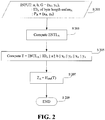
FIG. 2 depicts the steps taken to derive the identity hash value; -
FIG. 3 depicts the modified SM2-ECSA signature primitive algorithm used to create a digital signature at the transmitting-entity; -
FIG. 4 depicts the modified SM2-ECSA verification primitive to verify and recover a part of the signed message at the receiving-entity; and -
FIG. 5 shows a block diagram of a computer according to exemplary embodiments. - In the present embodiments, a modification to the SM2 Elliptic Curve Signature Algorithm is presented to create a variant that provides partial message recovery. Further, the modified algorithm also lowers the signature size for a given cryptographic strength, which it achieves by modifying the signature generation primitive to compute a key derived from an ephemeral signing key and a multiple of the signer's private key. This is based upon the verification routine being capable of recovering the public signing ephemeral key summed with a multiple of the signer's public key.
- The present disclosure describes the modified SM2 Elliptic Curve Signature Algorithm, which provides partial message recovery and lowers the signature size for a given cryptographic strength. In general, for a given encryption scheme with a security strength denoted by S, the signature size of the encryption scheme is 4*S. The modified SM2 Elliptic Curve Signature Algorithm can reduce this signature size to as much as 2*S. Specifically, the modified SM2 Elliptic Curve Signature Algorithm achieves a 50% reduction in the signature size as compared to traditional encryption algorithms. Signature schemes such as the SM2-ECSA are designed to be the digital equivalent of handwritten signatures. They are used to provide authentication of data, and the signature scheme incorporates a signer A who intends or is challenged to send a particular message M, to one or more recipients in an authentic fashion.
- A digital signature is a value produced by the message sender to bind the message data to the sender's identity and provide a means of verifying the integrity of the message to detect tampering. The modified SM2-ECSA algorithm uses the private key of the sender to create an encrypted version of the plain text. Sender A's public key along with the identity hash value is used to verify the signature by the recipient. Digital signatures are used to ensure the message recipient that the message originated from the identified sender and that the message contents have not been altered since they have been signed by the sender. The public key can be distributed openly to encrypt messages and to verify digital signatures, but the private key should be carefully guarded by its owner. This is necessary because the private key is used to prove the identity of the certificate subject and to decrypt messages that are intended for that subject.
- In what follows, the system diagram of the encryption and decryption process of the modified ECSA algorithm and its scheme setup is described. Next, the signature primitive algorithm used by the transmitting-entity for generating digital signatures is explained. Finally, the verification primitive algorithm used by the receiving-entity for verifying the signed message is described.
-
FIG. 1 depicts a system diagram of the encryption (on the transmitting-entity side) and decryption process (on the receiving-entity side) that employs the modified ECSA algorithm. User A (101) uses its private key denoted by dA (102) to encrypt the message of the plain text (103) in the signature primitive encryption algorithm (105) to create an enciphered text (107). The enciphered text (107), on transmission through a communication medium (109) is then received by the receiving-entity, user B (115). Note that the communication medium (109) can be a wireless or wired medium, ranging from a single point-to-point link, or a local/wide area communication network. The decryption of enciphered text (107) takes place in the decryption unit (111), wherein the modified SM2-ECSA verification primitive verifies the original signed message. The key used for decryption in (104) is A's public key (denoted by PA) and the identity hash value (ZA, to be described later) of the alleged signer A. In doing so, the original plain text (103) is replicated (113) to be delivered in an authentic manner to the recipient, user B. - A basic description of the modified SM2-ECSA algorithm, including the scheme setup, key generation, identity hash value generation, the signature primitive algorithm, and the signature verification algorithm is now presented.
- The modified SM2-ECSA algorithm contains a preamble that indicates other elements of a traditional setup that must be agreed upon. The cryptographic components for an elliptic field Fp, wherein p is a prime number can be defined as follows:
- (1) The elliptic curve parameters comprise of a tuple (p, a, b, G, n, h) wherein p is an integer specifying the finite field Fp; a, b are the field elements; G is the base point; n is the order of G, and h is the cofactor of n. Note that when p=2m , an irreducible polynomial determines and reduces the elements of the field F2 m where the two elements a, b ∈ Fp define an equation of an elliptic curve E[Fp ], with a base point G=(xG, yG) of order n. Note that an elliptic curve domain parameter tuple for a field defined for the binary case can be described in a similar manner.
- (2) The hash functions are H 256 and H v.
- (3) An agreement on how the identity hash value is to be derived.
- Note that the SM2-ECSA scheme setup is consistent with digital signature schemes, but adds to those setup schemes with respect to the distinguished identifiers and the creation of the identity hash value. The key generation phase generates entity A's key pair, which includes a private key of user A (dA) and the public key of user A (PA). Note that PA = dAG = (xA, yA).
-
FIG. 2 illustrates the steps taken in the modified SM2-ECSA algorithm to derive the identity hash value (ZA) of the signer (user A). - In step S201, ZA is computed using the elliptic curve parameters (a, b, G), the public key (PA) of the signer, and a distinguishing identifier, IDA, of byte-length represented by entlen A .
- In step S203, a two-byte string formed from the integer entlen A and represented as ENTLA is computed.
- In step S205, a byte string T is computed as follows:

- In step S207, the identity hash value (ZA) is computed as the hash function H 256(T).
-
FIG. 3 illustrates the modified SM2-ECSA signature primitive algorithm used by the transmitting-entity. - In step S301, the input to the algorithm includes A's private key (dA), a message M=N∥V, and the identity hash value (ZA) of the signer. Note that N and V are the hidden and visible parts of the message respectively.
- In step S303, an ephemeral key pair (k, Q) is generated.
- In step S305, the integer conversion of the x-coordinate of Q, denoted by xQ is computed.
- In step S307, an encryption key (Ke) is computed as follows:

- In step S309, the ciphertext c is computed as follows:

- In step S311, the cofactor h is computed as a hash value of the concatenation of the parameters: identity hash value, ciphertext, and the visible part of the message. Specifically, the cofactor is computed as follows:

- Note that the Hash function should be such that it could incorporate additional input information.
- In step S313, the cofactor h is converted to an integer e.
- In step S315, r, the signature component value is computed as follows:

- In step S317, the process checks if r is equal to zero. If so, the algorithm loops back to step S303, wherein a new ephemeral key pair is generated. If r≠0 in step S317, the algorithm proceeds to step S319, in which the process checks if the value of r+k is equal to m. If so, the algorithm once again loops back to step S303 to generate a new ephemeral key pair (k, Q). Otherwise, the algorithm proceeds to step S321, in which the signature key, s, is computed as follows:

- In step S323, a final check is made to determine if s is equal to zero. If so, the process returns to step S303 to generate a new ephemeral key pair. Otherwise if s is not equal to zero, the algorithm outputs the value of s and c to be used to sign the message M as s, c∥V.
- Next, the SM2-ECSA verification primitive algorithm (used by the receiving-entity) which is implemented in
block 111 on the recipient side is described. - As shown in
FIG. 4 , in step S401 the signed message s, c∥V, the public key PA, and the identity hash value ZA are inputs to the algorithm. - In step S403, the cofactor h, is computed with the same hash function as that used in the signature generation scheme and additional input information as follows:

- In step S405, h is converted to its integer value represented by parameter e.
- In
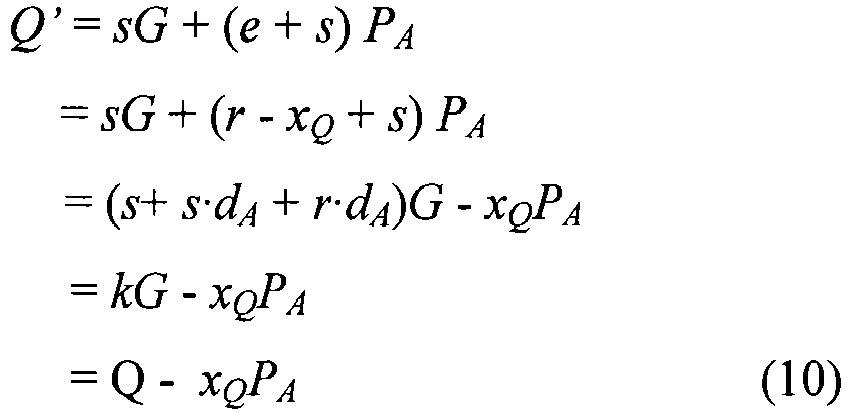
step 407, Q' is computed as follows:
- In step S409, Ke'=KDF(Q') is computed. Note that in computing Ke', the same key derivation function used in the signature generation algorithm is used, including the same additional information.
- In step S411, the hidden message encoded in the signature, N', is computed as follows:

- In step S413, a check is made to determine if N' contains redundancy. If so, in step S415, N' is declared valid and the process ends successfully. If N' does not contain the necessary redundancy in step S417 N' is declared invalid, and in step S419, a NULL is returned and the process ends.
- The correctness of the above embodiments is illustrated by showing that the derived value Q' in the verification primitive is equal to the computed value Q-xQPA in the signature primitive:
- In the above embodiments the proposed SM2 modified elliptic curve signature algorithm provides partial message recovery and lowers the signature size for a given cryptographic strength. The embodiments achieve this by modifying the signature generation parameter to compute a key derived from the ephemeral signing key and a multiple of the signer's public key. The disclosed embodiments are based on the verification described above, specifically by recovering the public signing ephemeral key summed with the multiple of the signer's public key. It should be noted, however, that the strict concatenation into the hash function in the signature and verification primitive can be relaxed to be any input of the three variables c, ZA, and V, as long as it is done the same way in the signing and verifying steps.
- The signature and the verification algorithms described above can be implemented in
units FIG. 1 respectively, by one or more computers and/or one or more specialized circuits. A hardware description of such a computer is described with reference toFIG. 5 . - In
FIG. 5 the computer includes aCPU 500 which may perform the processes described above. - The process data and instructions may be stored in
memory 502. These processes and instructions may also be stored on astorage medium disk 504 such as a hard drive (HDD) or portable storage medium or may be stored remotely. Further, the claimed advancements are not limited by the form of the computer-readable media on which the instructions of the inventive process are stored. For example, the instructions may be stored on CDs, DVDs, in FLASH memory, RAM, ROM, PROM, EPROM, EEPROM, hard disk or any other information processing device with which the computer communicates, such as a server. - Further, the claimed advancements may be provided as a utility application, background daemon, or component of an operating system, or combination thereof, executing in conjunction with
CPU 500 and an operating system such asMicrosoft Windows 7, UNIX, Solaris, LINUX, Apple MAC-OS and other systems known to those skilled in the art. -
CPU 500 may be a Xenon or Core processor from Intel of America or an Opteron processor from AMD of America, or may be other processor types that would be recognized by one of ordinary skill in the art. Alternatively, theCPU 500 may be implemented on an FPGA, ASIC, PLD or using discrete logic circuits, as one of ordinary skill in the art would recognize. Further,CPU 500 may be implemented as multiple processors cooperatively working in parallel to perform the instructions of the inventive processes described above. - The computer in FIG. 6 also includes a
network controller 506, such as an Intel Ethernet PRO network interface card from Intel Corporation of America, for interfacing with network 599. As can be appreciated, the network 599 can be a public network, such as the Internet, or a private network such as an LAN or WAN network, or any combination thereof and can also include PSTN or ISDN sub-networks. The network 599 can also be wired, such as an Ethernet network, or can be wireless such as a cellular network including EDGE, 3G and 4G wireless cellular systems. The wireless network can also be WiFi, Bluetooth, or any other wireless form of communication that is known. - One embodiment of the computer may be used by the transmitting
entity 101, to process the modified ECSA encryption signature algorithm ofunit 105 in theCPU 500, and another embodiment of the computer may be used by the receiving entity to process the modifiedECSA decryption algorithm 111. Thenetwork controller 506 may be used to establish a communication channel between the two parties, possibly through thenetwork 109. - The computer further includes a
display controller 508, such as a NVIDIA GeForce GTX or Quadro graphics adaptor from NVIDIA Corporation of America for interfacing withdisplay 510, such as a Hewlett Packard HPL2445w LCD monitor. A general purpose I/O interface 512 interfaces with a keyboard and/ormouse 514 as well as atouch screen panel 516 on or separate fromdisplay 510. General purpose I/O interface also connects to a variety ofperipherals 518 including printers and scanners, such as an OfficeJet or DeskJet from Hewlett Packard. - A
sound controller 520 is also provided in the computer, such as Sound Blaster X-Fi Titanium from Creative, to interface with speakers/microphone 522 thereby providing sounds and/or music. The speakers/microphone 522 can also be used to accept dictated words as commands for controlling the computer or for providing location and/or property information with respect to the target property. - The general
purpose storage controller 524 connects thestorage medium disk 504 with communication bus 526, which may be an ISA, EISA, VESA, PCI, or similar, for interconnecting all of the components of the computer. A description of the general features and functionality of thedisplay 510, keyboard and/ormouse 514, as well as thedisplay controller 508,storage controller 524,network controller 506,sound controller 520, and general purpose I/O interface 512 is omitted herein for brevity as these features are known. - In the above description, any processes, descriptions or blocks in flowcharts should be understood to represent modules, segments, or portions of code that include one or more executable instructions for implementing specific logical functions or steps in the process, and alternate implementations are included within the scope of the exemplary embodiments of the present advancements in which functions may be executed out of order from that shown or discussed, including substantially concurrently or in reverse order, depending upon the functionality involved, as would be understood by those skilled in the art.
- While certain embodiments have been described, these embodiments have been presented by way of example only, and are not intended to limit the scope of the inventions. Indeed, the novel methods, apparatuses and systems described herein may be embodied in a variety of other forms; furthermore, various omissions, substitutions and changes in the form of the methods, apparatuses and systems described herein may be made without departing from the scope of the claims.
Claims (11)
- A digital signature generation method for a transmitting-entity, comprising:partitioning a message to be transmitted into a first portion (N) and a second portion (V);generating an ephemeral secret, k, and a corresponding ephemeral key, Q; calculating an encryption key (Ke) based on the generated ephemeral key (Q) and a public key of the transmitting entity, PA, by the equation:
 computing a hash value (h) by applying a first hash function to a concatenation of an identity hash value (ZA), the computed ciphertext (c), and the second portion (V) of the message;calculating a signature keys by the equation:
 outputting an enciphered message that includes the calculated signature key (s), the computed ciphertext (c), and the second portion (V) of the message.
 - The digital signature generation method of claim 1, further comprising:
calculating the identity hash value byforming a two-byte string of a distinguishing identifier;forming a byte string of the distinguishing identifier, the public key, and a set of elliptic curve parameters; andcomputing the identity hash value by applying a second hash function to the byte string. - The digital signature generation method of claim 1, wherein the step of calculating the ciphertext, c, comprises calculating c by the equation:

- The digital signature generation method of claim 1, wherein the step of calculating the hash value, h, comprises calculating h by the equation:

- A digital signature verification method for a receiving-entity, comprising:receiving an enciphered message that includes a signature key (s), a ciphertext (c), and a second portion (V) of a message;computing a hash value (h) by applying a first hash function to a concatenation of an identity hash value (ZA), the received ciphertext (c), and the received second portion (V) of the message;computing an ephemeral key (Q') based on a public key (PA), the received signature key (s), and the computed hash value (h) by the equation:
 computing a decryption key (Ke') based on the computed ephemeral key (Q'); calculating a first portion (N') of the message by decrypting the received ciphertext (c) using the computed decryption key (Ke'); andchecking that the calculated first portion of the message has necessary redundancy to verify the message.
 - The digital signature verification method of claim 5, wherein the step of computing the decryption key, Ke', comprises calculating the decryption key by the equation:

- The digital signature verification method of claim 5, wherein the step of computing the first portion of the message, N', comprises calculating the first portion by the equation:

- A digital signature generation apparatus, comprising: a processor configured to:partition a message to be transmitted into a first portion (N) and a second portion (V);generate an ephemeral secret, k, and a corresponding ephemeral key, Q;calculate an encryption key (Ke) based on the generated ephemeral key (Q) and a public key of the transmitting entity, PA, by the equation: Ke = KDF(Q-xQPA), wherein KDF is a key derivation function and xQ is an integer conversion of the x-coordinate of the ephemeral public key Q;compute a ciphertext (c) by encrypting the first portion (N) of the message using the calculated encryption key (Ke);compute a hash value (h) by applying a first hash function to a concatenation of an identity hash value (ZA), the computed ciphertext (c), and the second portion (V) of the message;calculate a signature keys by the equation:

 output an enciphered message that includes the calculated signature key (s), the computed ciphertext (c), and the second portion (V) of the message.
 - A digital signature verification apparatus, comprising: a processor configured to:receive an enciphered message that includes a signature keys, a ciphertext (c), and a second portion (V) of a message;compute a hash value (h) by applying a first hash function to a concatenation of an identity hash value (ZA), the received ciphertext (c), and the received second portion (V) of the message;compute an ephemeral key (Q') based on a public key (PA), the received signature key (s), and the computed hash value (h) by the equation:
 compute a decryption key (Ke') based on the computed ephemeral key (Q');calculate a first portion (N') of the message by decrypting the received ciphertext (c) using the computed decryption key (Ke'); andcheck that the calculated first portion of the message has necessary redundancy to verify the message.
 - A computer-readable medium having stored thereon a program that when executed by a computer causes the computer to execute the steps of the method of claim 1.
- A computer-readable medium having stored thereon a program that when executed by a computer causes the computer to execute the steps of the method of claim 5.
Applications Claiming Priority (1)
| Application Number | Priority Date | Filing Date | Title |
|---|---|---|---|
| PCT/US2013/023627 WO2014120121A1 (en) | 2013-01-29 | 2013-01-29 | Modified sm2 elliptic curve signature algorithm supporting message recovery |
Publications (2)
| Publication Number | Publication Date |
|---|---|
| EP2951949A1 EP2951949A1 (en) | 2015-12-09 |
| EP2951949B1 true EP2951949B1 (en) | 2018-08-15 |
Family
ID=47714568
Family Applications (1)
| Application Number | Title | Priority Date | Filing Date |
|---|---|---|---|
| EP13704309.7A Active EP2951949B1 (en) | 2013-01-29 | 2013-01-29 | Modified sm2 elliptic curve signature algorithm supporting message recovery |
Country Status (2)
| Country | Link |
|---|---|
| EP (1) | EP2951949B1 (en) |
| WO (1) | WO2014120121A1 (en) |
Families Citing this family (26)
| Publication number | Priority date | Publication date | Assignee | Title |
|---|---|---|---|---|
| CN106850198B (en) * | 2017-01-16 | 2019-10-25 | 武汉理工大学 | SM2 digital signature generation method and system based on multi-device collaboration |
| CN107104793B (en) * | 2017-04-12 | 2019-10-25 | 武汉理工大学 | A digital signature generation method and system |
| CN107124274B (en) * | 2017-05-18 | 2019-10-25 | 深圳奥联信息安全技术有限公司 | Digital signature method and device based on SM2 |
| US11416852B1 (en) | 2017-12-15 | 2022-08-16 | Worldpay, Llc | Systems and methods for generating and transmitting electronic transaction account information messages |
| CN108055136A (en) * | 2017-12-22 | 2018-05-18 | 上海众人网络安全技术有限公司 | Endorsement method, device, computer equipment and storage medium based on elliptic curve |
| CN109245903B (en) * | 2018-09-29 | 2021-10-01 | 北京信安世纪科技股份有限公司 | Signature method and device for cooperatively generating SM2 algorithm by two parties and storage medium |
| CN109246129B (en) * | 2018-10-12 | 2020-12-25 | 天津赢达信科技有限公司 | SM2 collaborative signature method and system capable of verifying client identity |
| CN109547199B (en) * | 2018-11-19 | 2021-07-02 | 武汉大学 | A method for multi-party joint generation of SM2 digital signature |
| CN111030823A (en) * | 2019-10-24 | 2020-04-17 | 梁胤豪 | Ultra-lightweight multi-signature data processing method and system and Internet of things platform |
| CN111130786A (en) * | 2019-10-25 | 2020-05-08 | 武汉大学 | A multi-party collaborative SM2 key generation and ciphertext decryption method and medium |
| CN110601841B (en) * | 2019-11-01 | 2022-06-14 | 成都卫士通信息产业股份有限公司 | SM2 collaborative signature and decryption method and device |
| US10673637B1 (en) * | 2019-11-19 | 2020-06-02 | Quantum Information Security, LLC | Polymorphic digital security and methods of use thereof |
| CN110932868B (en) * | 2019-11-27 | 2022-04-15 | 浪潮商用机器有限公司 | Data signature method, system and device |
| CN112887097A (en) * | 2019-11-29 | 2021-06-01 | 航天信息股份有限公司 | Signature method based on SM2 elliptic curve, related device and storage medium |
| CN111740837B (en) * | 2020-05-18 | 2023-07-07 | 三未信安科技股份有限公司 | SM 9-based distributed signature method and system |
| CN112118111B (en) * | 2020-09-04 | 2023-10-13 | 中国科学院大学 | An SM2 digital signature method suitable for threshold calculation |
| CN112968773B (en) * | 2021-01-29 | 2023-11-07 | 北京无字天书科技有限公司 | Key authorization entrusting system and method of SM2 collaborative signature system |
| CN114900284A (en) * | 2021-03-29 | 2022-08-12 | 北京融蚁科技有限公司 | Method for generating SM2 key based on mnemonic words |
| CN112926983A (en) * | 2021-04-13 | 2021-06-08 | 无锡井通网络科技有限公司 | Block chain-based deposit certificate transaction encryption system and method |
| CN114915396B (en) * | 2022-04-11 | 2024-04-19 | 中国人民解放军海军工程大学 | Hopping key digital communication encryption system and method based on national encryption algorithm |
| CN114978536B (en) * | 2022-05-16 | 2024-01-30 | 福建凯特信息安全技术有限公司 | Multi-party joint signature method and system based on SM2 algorithm |
| CN115314213B (en) * | 2022-06-17 | 2024-10-15 | 安徽科大国创软件科技有限公司 | A digital certificate implementation method based on hardware-accelerated national encryption algorithm |
| CN116015679B (en) * | 2022-12-20 | 2024-04-30 | 浪潮云信息技术股份公司 | Government cloud multi-cloud management authentication system based on SM2 digital signature |
| CN116455577B (en) * | 2023-03-30 | 2025-08-01 | 武汉大学 | SM2 signature-based efficient dual authentication signature generation and verification method and system |
| CN116743505B (en) * | 2023-08-14 | 2023-10-20 | 上海特高信息技术有限公司 | Safety transmission encryption method based on national secret |
| CN117041961B (en) * | 2023-09-05 | 2024-06-11 | 北京电子科技学院 | Vehicle networking terminal authentication method and system based on SM2 certificateless |
Family Cites Families (1)
| Publication number | Priority date | Publication date | Assignee | Title |
|---|---|---|---|---|
| CA2698000C (en) * | 2007-09-04 | 2015-10-27 | Blackberry Limited | Signatures with confidential message recovery |
-
2013
- 2013-01-29 EP EP13704309.7A patent/EP2951949B1/en active Active
- 2013-01-29 WO PCT/US2013/023627 patent/WO2014120121A1/en not_active Ceased
Non-Patent Citations (1)
| Title |
|---|
| None * |
Also Published As
| Publication number | Publication date |
|---|---|
| EP2951949A1 (en) | 2015-12-09 |
| WO2014120121A1 (en) | 2014-08-07 |
Similar Documents
| Publication | Publication Date | Title |
|---|---|---|
| US8971528B2 (en) | Modified elliptic curve signature algorithm for message recovery | |
| WO2014120121A1 (en) | Modified sm2 elliptic curve signature algorithm supporting message recovery | |
| US9698993B2 (en) | Hashing prefix-free values in a signature scheme | |
| US8995656B2 (en) | Multiple hashing in a cryptographic scheme | |
| US9049022B2 (en) | Hashing prefix-free values in a certificate scheme | |
| US20120096274A1 (en) | Authenticated encryption for digital signatures with message recovery | |
| WO2021042685A1 (en) | Transaction method, device, and system employing blockchain | |
| EP2442483A2 (en) | Elliptic curve Pinstov Vanstone signature scheme with authenticated message recovery | |
| GB2487503A (en) | Authentication of digital files and associated identities using biometric information | |
| WO2009030021A1 (en) | Signatures with confidential message recovery | |
| Roy | A survey on digital signatures and its applications | |
| Tanwar et al. | Efficient and secure multiple digital signature to prevent forgery based on ECC | |
| EP4385168A1 (en) | Generating digital signature shares | |
| CN106972924A (en) | Encryption, decryption, Electronic Signature, the method and device for verifying stamped signature | |
| WO2022022924A1 (en) | Generating shared private keys | |
| CN107947939A (en) | Support the PDF endorsement methods and system of SM3 cryptographic Hash algorithm and SM2 Digital Signature Algorithms | |
| Kumar et al. | An efficient implementation of digital signature algorithm with SRNN public key cryptography | |
| CN109921896A (en) | A kind of label decryption method, system, equipment and computer readable storage medium | |
| CN117837127A (en) | Generate a digital signature | |
| Bashir | Analysis and improvement of some signcryption schemes based on elliptic curve | |
| CN111723405A (en) | Decentralized multiple digital signature/electronic signature method | |
| KR102474628B1 (en) | Method for signcrytion using functional signature and computing device for executing the method | |
| CN114186286A (en) | Random factor and hybrid encryption based directional signature method | |
| Prokopenko et al. | The Improvement of Digital Signature Algorithm Based on Elliptic Curve Cryptography | |
| Zhang et al. | Security Analysis of a Convertible Multiauthenticated Encryption Scheme |
Legal Events
| Date | Code | Title | Description |
|---|---|---|---|
| PUAI | Public reference made under article 153(3) epc to a published international application that has entered the european phase |
Free format text: ORIGINAL CODE: 0009012 |
|
| 17P | Request for examination filed |
Effective date: 20150708 |
|
| AK | Designated contracting states |
Kind code of ref document: A1 Designated state(s): AL AT BE BG CH CY CZ DE DK EE ES FI FR GB GR HR HU IE IS IT LI LT LU LV MC MK MT NL NO PL PT RO RS SE SI SK SM TR |
|
| AX | Request for extension of the european patent |
Extension state: BA ME |
|
| DAX | Request for extension of the european patent (deleted) | ||
| GRAP | Despatch of communication of intention to grant a patent |
Free format text: ORIGINAL CODE: EPIDOSNIGR1 |
|
| STAA | Information on the status of an ep patent application or granted ep patent |
Free format text: STATUS: GRANT OF PATENT IS INTENDED |
|
| INTG | Intention to grant announced |
Effective date: 20180321 |
|
| GRAS | Grant fee paid |
Free format text: ORIGINAL CODE: EPIDOSNIGR3 |
|
| GRAA | (expected) grant |
Free format text: ORIGINAL CODE: 0009210 |
|
| STAA | Information on the status of an ep patent application or granted ep patent |
Free format text: STATUS: THE PATENT HAS BEEN GRANTED |
|
| AK | Designated contracting states |
Kind code of ref document: B1 Designated state(s): AL AT BE BG CH CY CZ DE DK EE ES FI FR GB GR HR HU IE IS IT LI LT LU LV MC MK MT NL NO PL PT RO RS SE SI SK SM TR |
|
| REG | Reference to a national code |
Ref country code: CH Ref legal event code: EP Ref country code: GB Ref legal event code: FG4D Ref country code: AT Ref legal event code: REF Ref document number: 1031032 Country of ref document: AT Kind code of ref document: T Effective date: 20180815 |
|
| REG | Reference to a national code |
Ref country code: IE Ref legal event code: FG4D |
|
| REG | Reference to a national code |
Ref country code: DE Ref legal event code: R096 Ref document number: 602013041979 Country of ref document: DE |
|
| REG | Reference to a national code |
Ref country code: NL Ref legal event code: MP Effective date: 20180815 |
|
| REG | Reference to a national code |
Ref country code: LT Ref legal event code: MG4D |
|
| REG | Reference to a national code |
Ref country code: AT Ref legal event code: MK05 Ref document number: 1031032 Country of ref document: AT Kind code of ref document: T Effective date: 20180815 |
|
| PG25 | Lapsed in a contracting state [announced via postgrant information from national office to epo] |
Ref country code: BG Free format text: LAPSE BECAUSE OF FAILURE TO SUBMIT A TRANSLATION OF THE DESCRIPTION OR TO PAY THE FEE WITHIN THE PRESCRIBED TIME-LIMIT Effective date: 20181115 Ref country code: AT Free format text: LAPSE BECAUSE OF FAILURE TO SUBMIT A TRANSLATION OF THE DESCRIPTION OR TO PAY THE FEE WITHIN THE PRESCRIBED TIME-LIMIT Effective date: 20180815 Ref country code: SE Free format text: LAPSE BECAUSE OF FAILURE TO SUBMIT A TRANSLATION OF THE DESCRIPTION OR TO PAY THE FEE WITHIN THE PRESCRIBED TIME-LIMIT Effective date: 20180815 Ref country code: GR Free format text: LAPSE BECAUSE OF FAILURE TO SUBMIT A TRANSLATION OF THE DESCRIPTION OR TO PAY THE FEE WITHIN THE PRESCRIBED TIME-LIMIT Effective date: 20181116 Ref country code: RS Free format text: LAPSE BECAUSE OF FAILURE TO SUBMIT A TRANSLATION OF THE DESCRIPTION OR TO PAY THE FEE WITHIN THE PRESCRIBED TIME-LIMIT Effective date: 20180815 Ref country code: NO Free format text: LAPSE BECAUSE OF FAILURE TO SUBMIT A TRANSLATION OF THE DESCRIPTION OR TO PAY THE FEE WITHIN THE PRESCRIBED TIME-LIMIT Effective date: 20181115 Ref country code: IS Free format text: LAPSE BECAUSE OF FAILURE TO SUBMIT A TRANSLATION OF THE DESCRIPTION OR TO PAY THE FEE WITHIN THE PRESCRIBED TIME-LIMIT Effective date: 20181215 Ref country code: LT Free format text: LAPSE BECAUSE OF FAILURE TO SUBMIT A TRANSLATION OF THE DESCRIPTION OR TO PAY THE FEE WITHIN THE PRESCRIBED TIME-LIMIT Effective date: 20180815 Ref country code: NL Free format text: LAPSE BECAUSE OF FAILURE TO SUBMIT A TRANSLATION OF THE DESCRIPTION OR TO PAY THE FEE WITHIN THE PRESCRIBED TIME-LIMIT Effective date: 20180815 Ref country code: FI Free format text: LAPSE BECAUSE OF FAILURE TO SUBMIT A TRANSLATION OF THE DESCRIPTION OR TO PAY THE FEE WITHIN THE PRESCRIBED TIME-LIMIT Effective date: 20180815 |
|
| PG25 | Lapsed in a contracting state [announced via postgrant information from national office to epo] |
Ref country code: LV Free format text: LAPSE BECAUSE OF FAILURE TO SUBMIT A TRANSLATION OF THE DESCRIPTION OR TO PAY THE FEE WITHIN THE PRESCRIBED TIME-LIMIT Effective date: 20180815 Ref country code: AL Free format text: LAPSE BECAUSE OF FAILURE TO SUBMIT A TRANSLATION OF THE DESCRIPTION OR TO PAY THE FEE WITHIN THE PRESCRIBED TIME-LIMIT Effective date: 20180815 Ref country code: HR Free format text: LAPSE BECAUSE OF FAILURE TO SUBMIT A TRANSLATION OF THE DESCRIPTION OR TO PAY THE FEE WITHIN THE PRESCRIBED TIME-LIMIT Effective date: 20180815 |
|
| PG25 | Lapsed in a contracting state [announced via postgrant information from national office to epo] |
Ref country code: IT Free format text: LAPSE BECAUSE OF FAILURE TO SUBMIT A TRANSLATION OF THE DESCRIPTION OR TO PAY THE FEE WITHIN THE PRESCRIBED TIME-LIMIT Effective date: 20180815 Ref country code: EE Free format text: LAPSE BECAUSE OF FAILURE TO SUBMIT A TRANSLATION OF THE DESCRIPTION OR TO PAY THE FEE WITHIN THE PRESCRIBED TIME-LIMIT Effective date: 20180815 Ref country code: ES Free format text: LAPSE BECAUSE OF FAILURE TO SUBMIT A TRANSLATION OF THE DESCRIPTION OR TO PAY THE FEE WITHIN THE PRESCRIBED TIME-LIMIT Effective date: 20180815 Ref country code: PL Free format text: LAPSE BECAUSE OF FAILURE TO SUBMIT A TRANSLATION OF THE DESCRIPTION OR TO PAY THE FEE WITHIN THE PRESCRIBED TIME-LIMIT Effective date: 20180815 Ref country code: CZ Free format text: LAPSE BECAUSE OF FAILURE TO SUBMIT A TRANSLATION OF THE DESCRIPTION OR TO PAY THE FEE WITHIN THE PRESCRIBED TIME-LIMIT Effective date: 20180815 Ref country code: RO Free format text: LAPSE BECAUSE OF FAILURE TO SUBMIT A TRANSLATION OF THE DESCRIPTION OR TO PAY THE FEE WITHIN THE PRESCRIBED TIME-LIMIT Effective date: 20180815 |
|
| REG | Reference to a national code |
Ref country code: DE Ref legal event code: R097 Ref document number: 602013041979 Country of ref document: DE |
|
| PG25 | Lapsed in a contracting state [announced via postgrant information from national office to epo] |
Ref country code: DK Free format text: LAPSE BECAUSE OF FAILURE TO SUBMIT A TRANSLATION OF THE DESCRIPTION OR TO PAY THE FEE WITHIN THE PRESCRIBED TIME-LIMIT Effective date: 20180815 Ref country code: SM Free format text: LAPSE BECAUSE OF FAILURE TO SUBMIT A TRANSLATION OF THE DESCRIPTION OR TO PAY THE FEE WITHIN THE PRESCRIBED TIME-LIMIT Effective date: 20180815 Ref country code: SK Free format text: LAPSE BECAUSE OF FAILURE TO SUBMIT A TRANSLATION OF THE DESCRIPTION OR TO PAY THE FEE WITHIN THE PRESCRIBED TIME-LIMIT Effective date: 20180815 |
|
| PLBE | No opposition filed within time limit |
Free format text: ORIGINAL CODE: 0009261 |
|
| STAA | Information on the status of an ep patent application or granted ep patent |
Free format text: STATUS: NO OPPOSITION FILED WITHIN TIME LIMIT |
|
| 26N | No opposition filed |
Effective date: 20190516 |
|
| PG25 | Lapsed in a contracting state [announced via postgrant information from national office to epo] |
Ref country code: MC Free format text: LAPSE BECAUSE OF FAILURE TO SUBMIT A TRANSLATION OF THE DESCRIPTION OR TO PAY THE FEE WITHIN THE PRESCRIBED TIME-LIMIT Effective date: 20180815 Ref country code: SI Free format text: LAPSE BECAUSE OF FAILURE TO SUBMIT A TRANSLATION OF THE DESCRIPTION OR TO PAY THE FEE WITHIN THE PRESCRIBED TIME-LIMIT Effective date: 20180815 |
|
| REG | Reference to a national code |
Ref country code: CH Ref legal event code: PL |
|
| PG25 | Lapsed in a contracting state [announced via postgrant information from national office to epo] |
Ref country code: LU Free format text: LAPSE BECAUSE OF NON-PAYMENT OF DUE FEES Effective date: 20190129 |
|
| REG | Reference to a national code |
Ref country code: BE Ref legal event code: MM Effective date: 20190131 |
|
| REG | Reference to a national code |
Ref country code: IE Ref legal event code: MM4A |
|
| PG25 | Lapsed in a contracting state [announced via postgrant information from national office to epo] |
Ref country code: BE Free format text: LAPSE BECAUSE OF NON-PAYMENT OF DUE FEES Effective date: 20190131 |
|
| REG | Reference to a national code |
Ref country code: DE Ref legal event code: R081 Ref document number: 602013041979 Country of ref document: DE Owner name: BLACKBERRY LIMITED, WATERLOO, CA Free format text: FORMER OWNER: CERTICOM CORP., MISSISSAUGA, ONTARIO, CA |
|
| PG25 | Lapsed in a contracting state [announced via postgrant information from national office to epo] |
Ref country code: LI Free format text: LAPSE BECAUSE OF NON-PAYMENT OF DUE FEES Effective date: 20190131 Ref country code: CH Free format text: LAPSE BECAUSE OF NON-PAYMENT OF DUE FEES Effective date: 20190131 |
|
| PG25 | Lapsed in a contracting state [announced via postgrant information from national office to epo] |
Ref country code: IE Free format text: LAPSE BECAUSE OF NON-PAYMENT OF DUE FEES Effective date: 20190129 |
|
| REG | Reference to a national code |
Ref country code: GB Ref legal event code: 732E Free format text: REGISTERED BETWEEN 20200206 AND 20200212 |
|
| PG25 | Lapsed in a contracting state [announced via postgrant information from national office to epo] |
Ref country code: TR Free format text: LAPSE BECAUSE OF FAILURE TO SUBMIT A TRANSLATION OF THE DESCRIPTION OR TO PAY THE FEE WITHIN THE PRESCRIBED TIME-LIMIT Effective date: 20180815 |
|
| PG25 | Lapsed in a contracting state [announced via postgrant information from national office to epo] |
Ref country code: PT Free format text: LAPSE BECAUSE OF FAILURE TO SUBMIT A TRANSLATION OF THE DESCRIPTION OR TO PAY THE FEE WITHIN THE PRESCRIBED TIME-LIMIT Effective date: 20181215 Ref country code: MT Free format text: LAPSE BECAUSE OF NON-PAYMENT OF DUE FEES Effective date: 20190129 |
|
| PG25 | Lapsed in a contracting state [announced via postgrant information from national office to epo] |
Ref country code: CY Free format text: LAPSE BECAUSE OF FAILURE TO SUBMIT A TRANSLATION OF THE DESCRIPTION OR TO PAY THE FEE WITHIN THE PRESCRIBED TIME-LIMIT Effective date: 20180815 |
|
| PG25 | Lapsed in a contracting state [announced via postgrant information from national office to epo] |
Ref country code: HU Free format text: LAPSE BECAUSE OF FAILURE TO SUBMIT A TRANSLATION OF THE DESCRIPTION OR TO PAY THE FEE WITHIN THE PRESCRIBED TIME-LIMIT; INVALID AB INITIO Effective date: 20130129 |
|
| PG25 | Lapsed in a contracting state [announced via postgrant information from national office to epo] |
Ref country code: MK Free format text: LAPSE BECAUSE OF FAILURE TO SUBMIT A TRANSLATION OF THE DESCRIPTION OR TO PAY THE FEE WITHIN THE PRESCRIBED TIME-LIMIT Effective date: 20180815 |
|
| REG | Reference to a national code |
Ref country code: DE Ref legal event code: R081 Ref document number: 602013041979 Country of ref document: DE Owner name: MALIKIE INNOVATIONS LTD., IE Free format text: FORMER OWNER: BLACKBERRY LIMITED, WATERLOO, ONTARIO, CA |
|
| REG | Reference to a national code |
Ref country code: GB Ref legal event code: 732E Free format text: REGISTERED BETWEEN 20240530 AND 20240605 |
|
| PGFP | Annual fee paid to national office [announced via postgrant information from national office to epo] |
Ref country code: GB Payment date: 20260126 Year of fee payment: 14 |
|
| PGFP | Annual fee paid to national office [announced via postgrant information from national office to epo] |
Ref country code: DE Payment date: 20260127 Year of fee payment: 14 |
|
| PGFP | Annual fee paid to national office [announced via postgrant information from national office to epo] |
Ref country code: FR Payment date: 20260126 Year of fee payment: 14 |