EP2950243A1 - Réservation des places - Google Patents
Réservation des places Download PDFInfo
- Publication number
- EP2950243A1 EP2950243A1 EP14290157.8A EP14290157A EP2950243A1 EP 2950243 A1 EP2950243 A1 EP 2950243A1 EP 14290157 A EP14290157 A EP 14290157A EP 2950243 A1 EP2950243 A1 EP 2950243A1
- Authority
- EP
- European Patent Office
- Prior art keywords
- vertices
- group
- seat
- passengers
- vertex
- Prior art date
- Legal status (The legal status is an assumption and is not a legal conclusion. Google has not performed a legal analysis and makes no representation as to the accuracy of the status listed.)
- Ceased
Links
Images




Classifications
-
- G—PHYSICS
- G06—COMPUTING OR CALCULATING; COUNTING
- G06Q—INFORMATION AND COMMUNICATION TECHNOLOGY [ICT] SPECIALLY ADAPTED FOR ADMINISTRATIVE, COMMERCIAL, FINANCIAL, MANAGERIAL OR SUPERVISORY PURPOSES; SYSTEMS OR METHODS SPECIALLY ADAPTED FOR ADMINISTRATIVE, COMMERCIAL, FINANCIAL, MANAGERIAL OR SUPERVISORY PURPOSES, NOT OTHERWISE PROVIDED FOR
- G06Q50/00—Information and communication technology [ICT] specially adapted for implementation of business processes of specific business sectors, e.g. utilities or tourism
- G06Q50/10—Services
-
- G—PHYSICS
- G06—COMPUTING OR CALCULATING; COUNTING
- G06Q—INFORMATION AND COMMUNICATION TECHNOLOGY [ICT] SPECIALLY ADAPTED FOR ADMINISTRATIVE, COMMERCIAL, FINANCIAL, MANAGERIAL OR SUPERVISORY PURPOSES; SYSTEMS OR METHODS SPECIALLY ADAPTED FOR ADMINISTRATIVE, COMMERCIAL, FINANCIAL, MANAGERIAL OR SUPERVISORY PURPOSES, NOT OTHERWISE PROVIDED FOR
- G06Q10/00—Administration; Management
- G06Q10/02—Reservations, e.g. for tickets, services or events
- G06Q10/028—Reservations, e.g. for tickets, services or events for seating or spaces in a venue
- G06Q10/0283—Reservations, e.g. for tickets, services or events for seating or spaces in a venue for travel seating
-
- G—PHYSICS
- G06—COMPUTING OR CALCULATING; COUNTING
- G06Q—INFORMATION AND COMMUNICATION TECHNOLOGY [ICT] SPECIALLY ADAPTED FOR ADMINISTRATIVE, COMMERCIAL, FINANCIAL, MANAGERIAL OR SUPERVISORY PURPOSES; SYSTEMS OR METHODS SPECIALLY ADAPTED FOR ADMINISTRATIVE, COMMERCIAL, FINANCIAL, MANAGERIAL OR SUPERVISORY PURPOSES, NOT OTHERWISE PROVIDED FOR
- G06Q10/00—Administration; Management
- G06Q10/40—Business processes related to social networking or social networking services
- G06Q10/42—Determination of affinities or common interests between users
-
- G—PHYSICS
- G06—COMPUTING OR CALCULATING; COUNTING
- G06Q—INFORMATION AND COMMUNICATION TECHNOLOGY [ICT] SPECIALLY ADAPTED FOR ADMINISTRATIVE, COMMERCIAL, FINANCIAL, MANAGERIAL OR SUPERVISORY PURPOSES; SYSTEMS OR METHODS SPECIALLY ADAPTED FOR ADMINISTRATIVE, COMMERCIAL, FINANCIAL, MANAGERIAL OR SUPERVISORY PURPOSES, NOT OTHERWISE PROVIDED FOR
- G06Q10/00—Administration; Management
- G06Q10/40—Business processes related to social networking or social networking services
- G06Q10/48—Business processes related to social networking or social networking services using social graphs
-
- G—PHYSICS
- G06—COMPUTING OR CALCULATING; COUNTING
- G06Q—INFORMATION AND COMMUNICATION TECHNOLOGY [ICT] SPECIALLY ADAPTED FOR ADMINISTRATIVE, COMMERCIAL, FINANCIAL, MANAGERIAL OR SUPERVISORY PURPOSES; SYSTEMS OR METHODS SPECIALLY ADAPTED FOR ADMINISTRATIVE, COMMERCIAL, FINANCIAL, MANAGERIAL OR SUPERVISORY PURPOSES, NOT OTHERWISE PROVIDED FOR
- G06Q50/00—Information and communication technology [ICT] specially adapted for implementation of business processes of specific business sectors, e.g. utilities or tourism
- G06Q50/40—Business processes related to the transportation industry
Definitions
- the invention relates to seat assignment for passengers of passenger-transport vehicles, a computer system programmed to carry out a seat assignment method, and a corresponding computer program.
- passengers that travel together also buy their tickets together and may choose the option for a group reservation. Having made a group reservation, they are connected by a reservation link that normally assures they are seated next to each other.
- a method of assigning seats to passengers of a passenger-transport vehicle wherein given social relations between passengers are used in the seat assignment.
- the passengers who have a social network relation with at least one of the other passengers and the social network relations of said passengers correspond to at least one graph with vertices and edges, wherein the passengers correspond to vertices of the graph and the social-network relations correspond to edges of the graph.
- the method is carried out by means of a computer and comprises:
- a computer system programmed to assign seats to passengers of a passenger-transport vehicle, wherein given social relations between passengers are used in the seat assignment.
- the passengers who have a social network relation with at least one of the other passengers and the social network relations of said passengers correspond to at least one graph with vertices and edges, wherein the passengers correspond to vertices of the graph and the social-network relations correspond to edges of the graph.
- the computer system is programmed to:
- a computer program for assigning seats to passengers of a passenger-transport vehicle, wherein given social relations between passengers are used in the seat assignment.
- the passengers who have a social network relation with at least one of the other passengers and the social network relations of said passengers correspond to at least one graph with vertices and edges, wherein the passengers correspond to vertices of the graph and the social-network relations correspond to edges of the graph.
- the computer program causes a computer to:
- Seat assignment is the act of assigning seats of a vehicle to a group of passengers in which an individual, unoccupied seat is assigned to each passenger. This seat assignment may be performed for various passenger-transport vehicles, such as airplanes, railways, ships and/or buses. In the seat assignment procedure described herein social network relations of passengers to other passengers are taken into account. These social network relations between the passengers may include relationships on online communication platforms, such as online platforms relating to career, information or entertainment issues.
- the allocation of seats to passengers can be represented by a logic representation of passengers and social network relations between them in the form of at least one graph with vertices and edges.
- the method described herein may be applied to each of the disjoint graphs, separately.
- Each of those disjoint graphs comprises only vertices that are connected to at least one other vertex of that graph.
- the passengers are represented by the vertices of the graph, and the social relations between the passengers are represented by the edges of the graph.
- the subdivision of the graph into groups of vertices, i.e. groups of passengers, is performed in such a way that a group contains only vertices, which are connected via edges, i.e. relations, to each other vertex in that group. Additionally, only vertices which have fewer than a given maximum number of connections to other vertices of the graph are included in a group.
- Vertices that possess at least the maximum number of connections to other vertices may be referred to as popular passengers.
- the maximum number of relations to other passengers, defining a popular passenger may be dependent on various parameters, such as the total number of vertices in the graph or on the highest number of connections a single vertex has to other vertices in the graph.
- all passengers having a number of connections equal to or fewer than the maximum number of connections that defines a popular passenger may be referred to as non-popular passengers.
- the lower limit of connections of a vertex that defines a popular passenger might be set to five, for example.
- the groups of vertices i.e. groups of passengers, are chosen in such a way that the number of broken connections resulting from the subdividing, is minimized. This minimizing may, for example, be done by calculating the number of broken relations for each conceivable subdivision of the graph, respecting all given constraints mentioned below, and choosing the subdivision that causes the fewest broken relationships. Following the subdivision, vertices which have not yet been included into a group, are added to groups in order to include every vertex into any one of the groups it has a connection to.
- a group has a connection to a vertex and vice versa if at least one vertex within the group has a connection to this non-included vertex.
- breaking a relation means cutting an edge in the graph corresponding to that relation. After seat assignment, those broken relations may result in (former) related passengers being seated spatially apart from each other.
- cut edges of the graph i.e. the broken relations, are still available for further evaluation. Thus, the passengers are still correlated even though some of their relations may have been broken during the subdivision of the graph.
- the present method with its sequential seat assignment to those groups has a complexity related to n (i.e. it is of the order O(n)), wherein n is the total number of passengers to be seated, i.e. the number of vertices in the graph representing the passengers and the relations between them.
- n is the total number of passengers to be seated, i.e. the number of vertices in the graph representing the passengers and the relations between them.
- the present method requires less processing time, or processing power, than an all-possible-combination approach to seat allocation.
- many seats of a passenger-transport vehicle e.g. an airplane
- many seats of a passenger-transport vehicle are allocated to passengers who travel in groups formed by a reservation-link resulting from a prior booking, indicating that those passengers belong together.
- a reservation-link resulting from a prior booking
- passengers with a reservation link are not mapped onto the graph as vertices and therefore the method of seat assignment described herein is not applied to them.
- the size of groups formed by the subdivision of the graph as described above is limited to two or three vertices, i.e. passengers, per group.
- groups consisting of three vertices will be the preferred outcome of the subdivision of the graph.
- each vertex is connected to each other vertex of the group.
- trio Such a group consisting of three vertices, where each vertex is connected to each other vertex of the group is, further referred to as trio.
- one of the non-included vertices of the graph may have more connections to a certain group than to any of the other groups formed by the subdivision of the graph.
- the above-mentioned vertex may be added to the group it has the highest number of connections to.
- groups containing different numbers of vertices may be formed, and some vertices may have not been assigned to a group.
- one group may consist of two vertices
- another group may consist of three vertices or more and there could still be some non-included vertices.
- One of these non-included vertices could be connected to a group of three vertices and to a group of two vertices.
- a vertex that has not yet been assigned to a group is added to the group which contains the smallest number of vertices and has at least one connection to that vertex.
- the number of connections a non-included vertex has to individual groups formed by the subdivision of the graph differs. This vertex is added to the group to which the vertex has the highest number of connections. Thus, the number of broken connections between vertices, i.e. the relations between passengers, is minimized
- the number of seats in a row may be limited, e.g. the number of seats in an airplane seat row is restricted by the size of the fuselage.
- the number of vertices per group may have a given upper limit which has to be chosen according to the type and size of the vehicle. Not applying this limit the formation of oversized groups could lead to a split of these groups, as described below, during the seat assignment, since there would not be enough seating space to place the passengers in those groups in a coherent seat configuration.
- the total number of connections to other vertices in the graph is taken into account to determine the chronological order, in which the non-included vertices with fewer than the given maximum number of connections to other vertices, i.e. non-popular passengers, are added to groups.
- the addition of those non-included vertices to groups is sequenced by their number of total connections in the graph, processing the vertex with the highest total number of connections in the graph first.
- the previously disregarded vertices with more than the given maximum number of connections to other vertices in the graph, i.e. popular passengers may be considered to determine the chronological order in which the non-included vertices are added to groups and therefore may be chosen first during this adding process.
- groups formed by the subdivision of the graph, that are connected to non-included vertices may have the same group size, which is smaller than the given maximum group size, i.e. the maximum number of vertices per group.
- still other manifestations of a graph may contain a first non-included vertex with an identical number of connections to at least two groups and at least one other non-included-vertex that is connected to any of those groups. The number of identical connections the first non-included vertex has to those groups is also the highest number of connections this vertex has to any group in the graph. In such a case the total number of connections of a group to the non-included vertices is considered.
- a group-mark number may be created for each group as a criterion defining which group is the most suitable one for a non-included vertex.
- the group-mark number can be calculated as follows: total number of connections of a group to all non-included vertices minus the number of connections a group has to popular passengers minus the number of connections a group has to the first non included vertex.
- the first non-included vertex is added to the group that has the smallest group-mark number with respect to that first non-included vertex.
- the previously disregarded vertices with more than the given maximum number of connections to other vertices in the graph, i.e. popular passengers may be included in the adding process described above.
- vertices after the subdivision of the graph and the adding of vertices into groups, there may still be at least two vertices that have not been added to a group one of these vertices may correspond to a previously excluded vertex that has more than a given maximum number of connections to other vertices in the graph, i.e. a popular passenger. In such a case a new group is created that contains those at least two non-included vertices. When forming such a group, the given maximum group size mentioned above may be exceeded.
- the number of vertices in a group might exceed the number of seats in the largest available link-seat-configuration by at least two. In that case each of those unoccupied seats is allocated to a vertex, i.e. a passenger, of the group until all previously unassigned seats in the link-seat-configuration are assigned. All vertices, i.e. the passengers, that have still not been assigned a seat, constitute a new group of vertices, which is referred to as a remainder-group. Provided another unoccupied link-seat-configuration exists with at least the number of seats that equals the number of vertices in the remainder-group, each of those unoccupied seats is allocated to a vertex, i.e.
- the largest unoccupied link-seat-configuration available is chosen.
- Each of those unoccupied seats is allocated to a vertex, i.e. a passenger, of the remainder-group, until all previously unassigned seats in the largest available unoccupied link-seat-configuration are assigned. All vertices, i.e.
- residual-remainder-group a new group of vertices, which is referred to as residual-remainder-group.
- residual-remainder-group Provided another available link-seat-configuration, exists with at least the number of unoccupied seats that equals the number of vertices in the residual-remainder-group, each of those unoccupied seats is allocated to a vertex, i.e. a passenger, of the residual-remainder-group until all vertices of the residual-remainder-group have been assigned a seat.
- the activities mentioned above may be carried out repeatedly by a computer, until a seat of any number of link-seat-configurations has been assigned to each vertex of the group, i.e. each passenger of the group.
- the number of vertices in a group, a remainder-group or a residual-remainder-group might exceed the number of unoccupied seats in the largest link-seat-configuration by exactly one.
- an unoccupied seat of the next smaller available link-seat-configuration is assigned to each vertex, i.e. each passenger, in the group or remainder-group, until each unoccupied seat of the next smaller available link-seat-configuration has been assigned.
- the vertices which have not been assigned an unoccupied seat of the next-smaller available link-seat-configuration constitute a rest-group of vertices.
- all the activities comprised in the method of assigning seats are performed automatically by means of a computer system, e.g. the computer system described herein.
- Some embodiments relate to a computer system for producing a seat assignment of a vehicle.
- the computer system is programmed with a computer program which may be stored on a non-transitory computer-readable storage medium of the computer system, for example a magnetic or optical data disk.
- the computer program has instructions which, when executed on the computer, cause one or more of the methods described herein to be carried out.
- the instructions cause the computer to produce a seat assignment of a vehicle, wherein given social network relations between passengers are used in the seat assignment, the passengers having a social network relation with at least one of the other passengers and the social network relations of said passengers corresponding to a graph with vertices and edges, wherein the passengers correspond to the vertices of the graph and the social-network relations correspond to the edges of the graph, the graph covering vertices connected to at least one other vertex in the graph, by:
- the description herein relates to a method, a computer system and a computer program for assigning seats of a vehicle, taking into account the relationships between passengers to be seated.
- a computer By means of a computer a multitude of vehicle passengers is subdivided into groups of related passengers. Thereafter, seats are assigned to said groups of passengers. If there are not enough unoccupied adjacent seats to seat such a group together, a split of said group is performed. This split is performed in such a way that at least two related passengers in said group are seated adjacent to each other.
- the computer program is in the form of computer program instructions stored on a non-transitory computer-readable storage medium.
- the method of assigning seats defined by the activities indicated in the method claims may not always result in the best conceivable group distribution.
- a vertex i.e. a passenger
- a vertex may be added to a group it has not the most connections to, or more connections than necessary may be broken.
- a vertex i.e. a passenger
- a single, isolated seat may be assigned to the passenger corresponding to that vertex.
- the method of splitting groups indicated in the method claims will also assign unoccupied single seats to passengers, disregarding the constraint that no passenger should be assigned a seat separated from other passengers having a relation to him or her, in order to seat all the passengers in the vehicle.
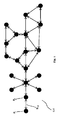
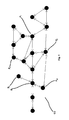
- the exemplary Fig. 1 illustrates a manifestation of a graph G1, representing passengers and social relations between the passengers.
- the graph G1 consists of 19 vertices and 26 edges, corresponding to passengers and relations, respectively.
- P 1 and P 2 correspond to two different passengers and R 12 to a social relation between those passengers.
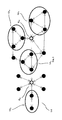
- popular passengers P P1 , P P2 shown as white circles in Fig. 2 , are determined. As mentioned above popular passengers have more than a given maximum number of relations to other passengers.
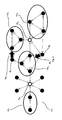
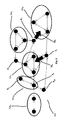
- the maximum number defining a popular passenger is set to four. These popular passengers are disregarded during the subsequent subdivision of graph G1, illustrated by Fig. 3 and 4 . Carrying out the activities illustrated by Fig. 3 , the graph is subdivided into four groups. Additionally, the maximum group size is set to four passengers in this embodiment. In order to break as few relations as possible, the groups Gr 2 , Gr 3 and Gr 4 containing three passengers and another group Gr 1 containing two passengers are chosen. Those groups Gr 1 , Gr 2 , Gr 3 and Gr 4 only contain passengers, who have relations to each of the other passengers they are grouped with. Following the formation of groups of passengers, i.e.
- the non-included passengers P 3 and P 4 who are non popular passengers, are added to an appropriate group. Since P 4 has the highest number of relations among the non-included non-popular passengers, P 4 is prioritized for the adding process.
- Each group P 4 is connected to has an identical group size of three passengers, which is below the maximum group size.
- P 4 has two relations to Gr 2 and only one relation to Gr 3 . Therefore Gr 2 rather than Gr 3 is the more appropriate group for P 4 . Indeed choosing Gr 3 for the adding of P 4 would break two relations between Gr 2 and P 4 , whereas choosing Gr 2 would break only one relation, namely the relation between Gr 3 and P 4 .
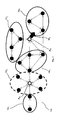
- a new group Gr 5 is formed, consisting of P P1 and all passengers, who are only connected to this popular passenger.
- P P2 is the last remaining passenger not yet included into a group, a group for P P2 is chosen accordingly.
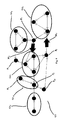
- the popular passenger P P2 has relations to the three groups: Gr 2 , Gr 3 and Gr 4 . Since Gr 2 and Gr 4 have already reached the maximum number of passengers per group, the only feasible adding procedure M 3 is applied to P P2 , in accordance with the described embodiment of the claimed method, as illustrated by Fig. 5 .
- Fig. 6 illustrates a different manifestation of a graph G2, representing passengers and social relations between the passengers.
- the graph G2 consists of 17 vertices and 24 edges, corresponding to passengers and relations, respectively.
- the maximum number defining a popular passenger is set to four, as in the exemplary embodiment discussed above. As no passenger of G2 has more relations to other passengers of that graph than this given maximum number, there are no popular passengers in that manifestation of the graph G2.
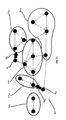
- the maximum group size is set to four passengers per group. Carrying out the activities illustrated by Fig. 7 , the graph is subdivided into five groups.
- These groups Gr 6 , Gr 7 , Gr 8 , Gr 9 and Gr 10 are chosen during the subdivision in such a way that each of those groups contains only passengers, who have relations to the other passengers they are grouped with. In order to break as few relations as possible, the groups Gr 7 , Gr 8 and Gr 9 containing three passengers and two groups Gr 6 and Gr 10 containing two passengers are chosen. As P 8 , and P 10 do not have a relation to each other and are only connected via P 9 , forming a group out of P 8 , P 9 and P 10 is prohibited during this subdivision activity, since the formation of a group in this activity requires each passenger to be related to each other passenger in the group to be formed.
- the non-included passengers P 5 , P 6 , P 7 and P 10 are added to an appropriate group, as illustrated by Fig. 8 to Fig.11 . Since P 6 and P 7 have an equal number of relations, which is the highest number of relations among the non-included passengers, the sequence in which P 6 and P 7 are processed can be chosen arbitrarily.
- vertex P 6 is chosen first, it is added to group Gr 7 , as shown in Fig. 8 , since Gr 7 is the group the vertex P 6 has the most connections to and therefore is the most appropriate group for P 6 .
- vertex P 6 is added to group Gr 7 by the adding process M 4 , as illustrated by Fig. 8 .
- Gr 7 would also be the most appropriate group for P 7 , as a result of the addition of P 6 it has already reached the given maximum group size and is therefore not accessible for P 7 . Since the two remaining adding options for vertex P 7 , groups Gr 8 and Gr 9 , are equivalent, another decision criterion is implemented.
- vertex P 7 is chosen first, it is added to group Gr 7 , as shown in Fig. 9 , since Gr 7 is the group that vertex P 7 has the most connections to and therefore is the most appropriate group for P 7 .
- vertex P 7 is added to group Gr 7 by adding process M 6 , as illustrated by Fig. 9 .
- Gr 7 would also be the most appropriate group for P 6 , as a result of the addition of P 7 it has already reached the given maximum group size and is therefore not accessible for P 6 . Since only one adding option for vertex P 6 remains, it is added to group Gr 8 by adding process M 7 .
- Fig. 10 and Fig. 11 illustrate two different outcomes depending on the sequence of the adding processes of P 6 and P 7 .
- Fig. 10 corresponds to P 6 being chosen first for the adding process
- Fig. 11 corresponds to P 7 being chosen first for the adding process.
- the number of passengers in a group 12.1 may exceed the number of unoccupied seats in the largest available link-seat-configuration.
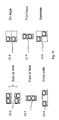
- a link-seat-configuration might be made up of any combination of unoccupied side by side 13.1, face to face 13.2, cross aisle 13.3, on edge 13.4, front to back 13.5 or slantwise 13.6 seat conjunctions, as illustrated by Fig. 13 .
- the group 12.1 is split in order to prevent a passenger of the group 12.1 from being seated alone, i.e. separated from the rest of his group 12.1. This split of the group 12.1 divides that group 12.1 into not necessarily equal subgroups for the seat assignment.
- the number of vertices in a group 12.1 might exceed the number of unoccupied seats in the largest link-seat-configuration by exactly one.
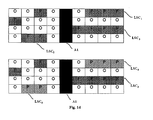
- a group of five passengers 12.1 could have been formed and three unoccupied link-seat-configurations are available: one with four free side-by-side seats LSC 3 , another one with three free side-by-side seats LSC 1 and still another one with two free side-by-side seats LSC 2 , as illustrated in Fig. 14 .
- This figure shows the exemplary arrangement of partially occupied seating space of a vehicle, separated by an aisle A1, illustrating this arrangement before and after seats are assigned to a group of five passengers.
- the illustrated boxes represent seats of a vehicle, each box corresponding to a seat.
- the seats are designated as free, passenger of group and already occupied, by the letters F, P, and O, respectively.
- the condition 12.2 is indeed fulfilled. Therefore the next smaller available link-seat-configuration LSC 1 is chosen, which in this case contains three unoccupied seats, as illustrated by Fig. 14 . Now two passengers of the group 12.1 remain without an assigned seat. Thus a remainder group out of these two passengers is formed, as a result of the activity 12.4. As illustrated by Fig. 14 , a link-seat-configuration containing exactly two seats LSC 2 is available, thus the condition 12.6 is fulfilled for the remainder group and seats of the link-seat-configuration LSC 2 are assigned to the passengers of the remainder group.
- the number of vertices in a group 12.1 might exceed the number of unoccupied seats in the largest link-seat-configuration by at least two.
- a group of seven passengers 12.1 could have been formed and three unoccupied link-seat-configurations are available: one with three free side-by-side seats LSC 6 , another one with two free side-by-side seats LSC 7 and still another one with two free side-by-side seats LSC 8 , as illustrated by Fig. 15 .
- This figure shows the exemplary arrangement of partially occupied seating space of a vehicle, separated by an aisle A2, illustrating this arrangement before and after seats are assigned to a group of seven passengers.
- the illustrated boxes represent seats of a vehicle, each box corresponding to a seat.
- the seats are designated as free, passenger of group and already occupied, by the letters F, P, and O, respectively. Since none of the link-seat-configurations illustrated by Fig. 15 provides enough free seating space to assign seats to the entire seven-passenger-group 12.1 a split of that group 12.1 has to be performed.
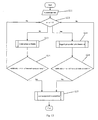
- the method of assigning seats defined by the activities indicated in the method claims will apply the successive activities 12.2, 12.4 and 12.6, sketched in the flow chart illustrated by Fig. 12 , to the seven-passenger-group 12.1.
- activity 12.2 a request is made, whether the condition that the number of passengers in the group to be seated 12.1 exceeds the number of seats in the largest available link-seat-configuration by exactly one is fulfilled. Since the number of passengers in the group 12.1 is seven and the largest available link-seat-configuration LSC 6 contains only three seats, the number of passengers in the group 12.1 exceeds the number of seats in LSC 6 by four and, therefore, the condition 12.2 is not fulfilled.
- the largest available link-seat-configuration LSC 6 is chosen, which in this case contains three unoccupied seats, as illustrated by Fig. 15 .
- Now four passengers of the group 12.1 remain without an assigned seat.
- a remainder group of these four passengers is formed, as a result of the activity 12.3.
- there are two different link-seat-configurations LSC 7 and LSC 8 available, each with two seats.
- the number of passengers in the remainder group exceeds the number of seats in the largest available link-seat-configuration again by more than one; in this case by two.
- the next smaller available link-seat-configuration is chosen 12.3.
- LSC 7 and LSC 8 are both the next smaller available link-seat-configuration, one of them is arbitrarily chosen for the seat assignment. Assuming LSC 7 has been chosen, two passengers of the remainder group are assigned a seat of LSC 7 .
- the residual-remainder group formed as a result of this iteration of activity 12.3 does not fulfill condition 12.2, as the difference between the number of passengers in the residual-remainder group and the number of seats in the largest available link seat configuration LSC 8 is zero.
- the condition 12.6 is fulfilled, since the remaining link-seat-configuration LSC 8 contains exactly the two seats necessary to seat the residual-remainder group of two passengers.
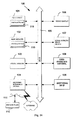
- Fig. 16 is a diagrammatic representation of an exemplary computer system 100 arranged to execute a set of instructions, to cause it to perform any of the methodologies used for a seat assignment and/or an optional split of a group formed during this seat assignment, as described herein.
- the computer system 100 includes a processor 101, a main memory 102 and a network interface 104. It further includes a static memory 103, e.g. non-removable flash and/or solid state drive and/or a removable Micro or Mini SD card, which permanently stores the software enabling the computer system 100 to execute its functions. Furthermore, it may include a display 106, a user interface control module 108 and/or an alpha-numeric and cursor input device 107.
- I/O interfaces 109 such as card reader and USB interfaces may be present.
- the software programmed to carry out the method of assigning seats discussed herein is stored on the static memory 103; in other embodiments external databases, e.g. databases containing social network relation data, are used. The method of assigning seats discussed herein is performed via the network interface device 104.
- process data resides in the main memory 102 and/or the processor 101.
- the software 110 may further be transmitted or received as a propagated signal 111 through the network interface device 104 from/to a software server within a local area network or the Internet.
Landscapes
- Business, Economics & Management (AREA)
- Engineering & Computer Science (AREA)
- Tourism & Hospitality (AREA)
- Strategic Management (AREA)
- Theoretical Computer Science (AREA)
- Marketing (AREA)
- Human Resources & Organizations (AREA)
- General Physics & Mathematics (AREA)
- General Business, Economics & Management (AREA)
- Economics (AREA)
- Physics & Mathematics (AREA)
- Entrepreneurship & Innovation (AREA)
- Quality & Reliability (AREA)
- Operations Research (AREA)
- Health & Medical Sciences (AREA)
- General Health & Medical Sciences (AREA)
- Primary Health Care (AREA)
- Development Economics (AREA)
- Management, Administration, Business Operations System, And Electronic Commerce (AREA)
Priority Applications (2)
| Application Number | Priority Date | Filing Date | Title |
|---|---|---|---|
| EP14290157.8A EP2950243A1 (fr) | 2014-05-30 | 2014-05-30 | Réservation des places |
| PCT/EP2015/001087 WO2015180840A1 (fr) | 2014-05-30 | 2015-05-27 | Attribution de sièges |
Applications Claiming Priority (1)
| Application Number | Priority Date | Filing Date | Title |
|---|---|---|---|
| EP14290157.8A EP2950243A1 (fr) | 2014-05-30 | 2014-05-30 | Réservation des places |
Publications (1)
| Publication Number | Publication Date |
|---|---|
| EP2950243A1 true EP2950243A1 (fr) | 2015-12-02 |
Family
ID=51136395
Family Applications (1)
| Application Number | Title | Priority Date | Filing Date |
|---|---|---|---|
| EP14290157.8A Ceased EP2950243A1 (fr) | 2014-05-30 | 2014-05-30 | Réservation des places |
Country Status (1)
| Country | Link |
|---|---|
| EP (1) | EP2950243A1 (fr) |
Cited By (1)
| Publication number | Priority date | Publication date | Assignee | Title |
|---|---|---|---|---|
| CN114898893A (zh) * | 2022-05-09 | 2022-08-12 | 中南大学 | 一种降低铁路疫情传播风险的席位分配方法 |
-
2014
- 2014-05-30 EP EP14290157.8A patent/EP2950243A1/fr not_active Ceased
Non-Patent Citations (1)
| Title |
|---|
| No relevant documents disclosed * |
Cited By (1)
| Publication number | Priority date | Publication date | Assignee | Title |
|---|---|---|---|---|
| CN114898893A (zh) * | 2022-05-09 | 2022-08-12 | 中南大学 | 一种降低铁路疫情传播风险的席位分配方法 |
Similar Documents
| Publication | Publication Date | Title |
|---|---|---|
| WO2021004468A1 (fr) | Procédé et appareil d'attribution de sièges de cabine sur un vol | |
| CN102725768A (zh) | 飞机乘客的座位分配 | |
| CN110334827B (zh) | 一种飞机座位预留方法及系统 | |
| CN106781708B (zh) | 一种终端管制区的航线规划方法及装置 | |
| Schultz et al. | Boarding on the critical path of the turnaround | |
| US12055916B2 (en) | Production line scheduling method, production line system and non-temporary computer readable medium | |
| US10991057B2 (en) | Systems and methods for rescheduling airline passengers | |
| CN104345974A (zh) | 对输入数据记录集执行基于集成模型的预测的方法和系统 | |
| US20160039539A1 (en) | Methods and apparatus for aircraft boarding | |
| US20150347928A1 (en) | Seat assignment | |
| Schönberger | Scheduling constraints in dial-a-ride problems with transfers: a metaheuristic approach incorporating a cross-route scheduling procedure with postponement opportunities | |
| CN110175794A (zh) | 物流配送信息数据获取方法、装置及计算机可读存储介质 | |
| CN103634236B (zh) | 用于在运营网络中针对选定环境分配网络资源的方法 | |
| US8117051B2 (en) | Method for determining the number of available transport seats in a computerized reservation system | |
| Jarrah et al. | The problem of generating crew bidlines | |
| Su et al. | An enhanced heuristic for the team orienteering problem with time windows considering multiple deliverymen: X. Su | |
| WO2015180840A1 (fr) | Attribution de sièges | |
| US8069069B2 (en) | Method for loading flight schedule modifications | |
| Murray et al. | A branch‐and‐bound‐based solution approach for dynamic rerouting of airborne platforms | |
| CN118657335A (zh) | 一种机场地服多车库车辆调度方法、装置、设备及介质 | |
| Kobbaey et al. | A comparative evaluation of airplane boarding strategies with a novel method for sustainable air travel | |
| KR101977119B1 (ko) | 차 커버링 배열을 이용한 데이터 분산 저장 장치 및 방법 | |
| US20030216948A1 (en) | Method and program for processing seat reservation cancellations | |
| US20150269509A1 (en) | Schedule generation device, schedule generation method, and storage medium | |
| Gupta et al. | Human Performance in Solving Multi-UAV Over-Constrained Dynamic Vehicle Routing Problems |
Legal Events
| Date | Code | Title | Description |
|---|---|---|---|
| 17P | Request for examination filed |
Effective date: 20150521 |
|
| AK | Designated contracting states |
Kind code of ref document: A1 Designated state(s): AL AT BE BG CH CY CZ DE DK EE ES FI FR GB GR HR HU IE IS IT LI LT LU LV MC MK MT NL NO PL PT RO RS SE SI SK SM TR |
|
| AX | Request for extension of the european patent |
Extension state: BA ME |
|
| PUAI | Public reference made under article 153(3) epc to a published international application that has entered the european phase |
Free format text: ORIGINAL CODE: 0009012 |
|
| STAA | Information on the status of an ep patent application or granted ep patent |
Free format text: STATUS: THE APPLICATION HAS BEEN REFUSED |
|
| 18R | Application refused |
Effective date: 20160523 |