EP2947789A1 - Satellite communication system with time-multiplexed communication from spot beam defined sub-regions - Google Patents
Satellite communication system with time-multiplexed communication from spot beam defined sub-regions Download PDFInfo
- Publication number
- EP2947789A1 EP2947789A1 EP15164383.0A EP15164383A EP2947789A1 EP 2947789 A1 EP2947789 A1 EP 2947789A1 EP 15164383 A EP15164383 A EP 15164383A EP 2947789 A1 EP2947789 A1 EP 2947789A1
- Authority
- EP
- European Patent Office
- Prior art keywords
- satellite
- sub
- ground station
- regions
- region
- Prior art date
- Legal status (The legal status is an assumption and is not a legal conclusion. Google has not performed a legal analysis and makes no representation as to the accuracy of the status listed.)
- Withdrawn
Links
- 230000008054 signal transmission Effects 0.000 abstract description 2
- 241000237970 Conus <genus> Species 0.000 abstract 1
- 238000010586 diagram Methods 0.000 description 1
- 238000000034 method Methods 0.000 description 1
- 238000001228 spectrum Methods 0.000 description 1
Images

Classifications
-
- H—ELECTRICITY
- H04—ELECTRIC COMMUNICATION TECHNIQUE
- H04B—TRANSMISSION
- H04B7/00—Radio transmission systems, i.e. using radiation field
- H04B7/14—Relay systems
- H04B7/15—Active relay systems
- H04B7/185—Space-based or airborne stations; Stations for satellite systems
- H04B7/1851—Systems using a satellite or space-based relay
- H04B7/18513—Transmission in a satellite or space-based system
-
- H—ELECTRICITY
- H04—ELECTRIC COMMUNICATION TECHNIQUE
- H04B—TRANSMISSION
- H04B7/00—Radio transmission systems, i.e. using radiation field
- H04B7/14—Relay systems
- H04B7/15—Active relay systems
- H04B7/185—Space-based or airborne stations; Stations for satellite systems
- H04B7/1851—Systems using a satellite or space-based relay
- H04B7/18515—Transmission equipment in satellites or space-based relays
-
- H—ELECTRICITY
- H04—ELECTRIC COMMUNICATION TECHNIQUE
- H04B—TRANSMISSION
- H04B7/00—Radio transmission systems, i.e. using radiation field
- H04B7/14—Relay systems
- H04B7/15—Active relay systems
- H04B7/204—Multiple access
- H04B7/2046—SS-TDMA, TDMA satellite switching
-
- H—ELECTRICITY
- H04—ELECTRIC COMMUNICATION TECHNIQUE
- H04W—WIRELESS COMMUNICATION NETWORKS
- H04W64/00—Locating users or terminals or network equipment for network management purposes, e.g. mobility management
- H04W64/003—Locating users or terminals or network equipment for network management purposes, e.g. mobility management locating network equipment
Definitions
- This disclosure generally relates to a terrestrial/satellite communication system, and more particularly relates to a ground station configured to determine a location of the ground station, and transmit a signal to the satellite during a time-interval assigned to the location in order to time-multiplex communication from spot beam defined sub-regions.
- Terrestrial/Satellite communication systems with various protocols and standards to optimize desired two-way communication services have been proposed.
- ETSI European Telecommunications Standards Institute
- E-SSA Enhanced Spread Spectrum Aloha
- Aloha is a term used to describe communications where ground transceivers can transmit a message at any time and then check to see if the message was received by a satellite transceiver or satellite system. If too many ground transceivers send messages at the same time, 'message collisions' may occur, and the satellite transceiver may not detect the message.
- Some satellite communication systems use an antenna array to selectively communicate with transceivers in various sub-regions of the region of the earth 'viewed' by the antenna array. It has been proposed that adjacent sub-regions use three distinct communication frequencies to separate communications from adjacent sub-regions. However, this undesirably reduces the communication bandwidth of each sub-region.
- the ground stations time-multiplex the transmission of signals from various ground stations to the satellite based on which sub-region of the larger region (e.g. the continental United States or CONUS) that the ground station resides.
- the time multiplexing is such that ground stations in one region are not transmitting signals to the satellite during the same time interval as ground stations in adjacent sub-regions. In this way, a larger number of ground stations in the larger region that can transmit signals to the satellite without a substantial increase in the occurrences of collisions.
- a communication system includes a satellite and a ground station.
- the satellite is configured to preferentially receive signals from each of a plurality of sub-regions within a region of communication of the satellite.
- the ground station is configured to determine a location of the ground station, determine in which of the sub-regions that the ground station resides based on the location, and transmit a signal to the satellite during a time-interval assigned to the sub-region.
- a ground station of communication system in another embodiment, includes a satellite configured to preferentially receive signals from each of a plurality of sub-regions within a region of communication of the satellite.
- the ground station includes a global position device, a memory device, a processor, and a transmitter.
- the global position device is operable to determine a location of the ground station.
- the memory device is operable to store and recall boundaries of the sub-regions.
- the processor is configured to determine in which of the sub-regions the ground station resides based on the location.
- the transmitter is operable to transmit a signal to the satellite during a time-interval assigned to the sub-region.
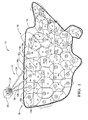
- Fig. 1 illustrates a non-limiting example of a terrestrial/satellite communication system, hereafter the system 10.
- the system 10 includes a satellite 20 that is configured to preferentially receive signals 12 from each of a plurality of sub-regions 16 within a region 14 of communication of the satellite 20.
- preferentially receive means that the satellite 20 is able to operate (i.e. focus) an antenna array 24 to selectively or preferentially receive, for example, a second signal 12b from a second sub-region 16b while ignoring or suppressing signals from adjacent sub-regions such as a first signal 12a from a first sub-region 16a, and a third signal 12c from a third sub-region 16c.
- the antenna array 24 is operable to define a plurality of spot beams that preferentially receive signals 12 from each of the plurality of sub-regions 16.
- the satellite 20 may also broadcast a common signal across the entire region, or broadcast distinct signals to each of the sub-regions 16, or a combination thereof using, for example, hierarchical modulation.
- hierarchical modulation is known, and is commonly used to simultaneously transmit two separate data-streams.
- the two data-streams may be, for example, a high priority data stream based on high priority content and a low priority data stream based on low priority content.
- the region 14 is illustrated as the continental United States (CONUS). However, other regions such as Europe, or a larger region such as most of the North America continent are contemplated. In this non-limiting example, the region 14 corresponding to the CONUS is divided into thirty-one sub-regions.
- the system 10 is generally configured to manage or control communications between the satellite 20 and a plurality of ground stations 18, such as a first ground station 18a in the first sub-region 16a, a second ground station 18b in the second sub-region 16b, and a third ground station 18c in the third sub-region 16c.
- ground stations include transceivers installed in a vehicles such as automobiles, trucks, trains, or aircraft, or a hand held device operated by a pedestrian, or a transceiver installed in a residence or other building such as a business or place of commerce.
- the advantages of the system 10 and the ground stations 18 described herein are especially useful when the ground station is in motion, particularly when transitioning from one sub-region into another sub-region as indicated by the arrow on the first ground station 18a.
- the system 10 may also include a base station (not shown) that may generally operate the satellite 20.
- the satellite 20 may merely be a repeater for a base signal from the base station. It should be appreciated that signal processing or other actions described herein that are attributed to the satellite 20 may also be attributed to the base station.
- the satellite 20 itself may perform some of the signal processing described herein, and may determine information that is sent to the ground stations 18, where the information sent is determined by the satellite 20 independent of information sent via the base signal from the base station.
- Each of the sub-regions 16 includes a circled 1, 2, or 3 that indicates which of three distinct time intervals is assigned to each of the sub-regions 16, which indicates which of three distinct time intervals that a ground station within a particular sub-region is authorized to transmit a signal 12 to the satellite 20.
- the arrangement of the boundaries that define each of the sub-regions 16 is such that no two sub-regions assigned the same time interval are adjacent. In other words, there are no adjacent sub-regions assigned the same time interval that share a portion of the border that defines the sub-region.
- the spot beams from the antenna array 24 can readily distinguish signals from each of the sub-regions 16 that are assigned the same time interval even though the ground stations 18 in each of these shared time interval sub-regions is transmitting at the same carrier frequency.
- Fig. 2 illustrates a non-limiting example of any one of the ground stations 18 (e.g. 18a, 18b, or 18c).
- the ground station 18 is generally configured to determine a location of the ground station.
- the ground station may include or be equipped with a global position device 30 operable to determine the location of the ground station 18.
- the global position device may include an integrated circuit chip set and a suitable antenna to receive and process signals from satellites that are part of a global positioning system, as will be recognized by those in the art.
- the ground station is able to self-determine the location (e.g. latitude and longitude) of the ground station 18, so does not need to rely on the satellite 20 to determine the location of the ground station 18.
- the ground station 18 is also generally configured to determine in which of the sub-regions 16 that the ground station 18 resides based on the location. Accordingly, the ground station may include a memory device 32 operable to store and recall the boundaries of the sub-regions 16. The boundaries of the sub-regions 16 may be preprogrammed into the memory device 32 when the ground station is manufactured, and may be periodically updated by, for example, a programming signal (not shown) from the satellite 20, or an internet connection, or other means known to those in the electronics arts.
- the ground station 18 may also include a processor 34 configured to determine in which of the sub-regions 16 that the ground station 18 resides based on the location determined by the global position device 30. That is, the processor 34 may receive the location from the global position device 30, and determine in which of the sub-regions 16 that the ground station 18 resides by recalling the boundaries of the sub-regions 16 from the memory device 32. This allows the ground station 18 to autonomously determine which of the time intervals that the ground station is authorized to transmit a signal 12 to the satellite 20.
- the ground station 18 may also include a transmitter 36 able to transmit the signal 12 to the satellite 20 during a time-interval assigned to the sub-region 16.
- the ground station 18 may also include a receiver 38 configured to receive broadcast signals from the satellite 20 which may include a time reference signal 40 that the processor 34 can use to determine when the time interval begins and ends, during which the ground station 18 is authorized to transmit the signal 12.
- the ground station 18 may receive a time reference signal from the global position device 30, as will be recognized by those in the art.
- a communication system (the system 10) and a ground station 18 for the system 10 is provided.
- the ground station 18 is configured to determine the location of the ground station so that the ground station 18 can determine when (i.e. during which time interval) the ground station 18 is authorized to transmit the signal 12 to the satellite 20. Having predetermined time intervals that various ground stations in such a system are authorized helps to prevent signal interference or 'signal collisions' that may prevent a ground station from reliably communicating with the satellite 20. By organizing the time intervals relative to the sub-regions 16, the ground stations 18 are able to communicate using the full bandwidth authorized to the system 10, as opposed to restricting the bandwidth and not coordinating the times during which various ground stations are authorized to transmit signals.
Landscapes
- Engineering & Computer Science (AREA)
- Computer Networks & Wireless Communication (AREA)
- Signal Processing (AREA)
- Physics & Mathematics (AREA)
- Astronomy & Astrophysics (AREA)
- Aviation & Aerospace Engineering (AREA)
- General Physics & Mathematics (AREA)
- Mobile Radio Communication Systems (AREA)
- Radio Relay Systems (AREA)
Abstract
A communication system (10) includes a satellite (20) and a ground station (18). The satellite (20) is configured to preferentially receive signals (12) from each of a plurality of sub-regions (16) within a region (14) of communication of the satellite (20). The ground station (18) is configured to determine a location of the ground station (18), determine in which of the sub-regions (16) that the ground station (18) resides based on the location, and transmit a signal (12) to the satellite (20) during a time-interval assigned to the sub-region (16). The ground stations (18) time-multiplex the transmission of signals (12) from various ground stations (18) to the satellite (20) based on which sub-region (16) of the larger region (14) (e.g. the continental United States or CONUS) that the ground station (18) resides. The time multiplexing is such that ground stations (18) in one region (14) are not transmitting signals (12) to the satellite (20) during the same time interval as ground stations (18) in adjacent sub-regions (16).
Description
- This disclosure generally relates to a terrestrial/satellite communication system, and more particularly relates to a ground station configured to determine a location of the ground station, and transmit a signal to the satellite during a time-interval assigned to the location in order to time-multiplex communication from spot beam defined sub-regions.
- Terrestrial/Satellite communication systems with various protocols and standards to optimize desired two-way communication services have been proposed. For example, the European Telecommunications Standards Institute (ETSI) has proposed an Enhanced Spread Spectrum Aloha (E-SSA) protocol or standard that uses iterative processing to maximize the number of ground transceivers that can transmit to a satellite transceiver or satellite system at any given time. Aloha is a term used to describe communications where ground transceivers can transmit a message at any time and then check to see if the message was received by a satellite transceiver or satellite system. If too many ground transceivers send messages at the same time, 'message collisions' may occur, and the satellite transceiver may not detect the message.
- Some satellite communication systems use an antenna array to selectively communicate with transceivers in various sub-regions of the region of the earth 'viewed' by the antenna array. It has been proposed that adjacent sub-regions use three distinct communication frequencies to separate communications from adjacent sub-regions. However, this undesirably reduces the communication bandwidth of each sub-region.
- Described herein are a communication system and a ground station for the communication system. The ground stations time-multiplex the transmission of signals from various ground stations to the satellite based on which sub-region of the larger region (e.g. the continental United States or CONUS) that the ground station resides. The time multiplexing is such that ground stations in one region are not transmitting signals to the satellite during the same time interval as ground stations in adjacent sub-regions. In this way, a larger number of ground stations in the larger region that can transmit signals to the satellite without a substantial increase in the occurrences of collisions.
- In accordance with one embodiment, a communication system is provided. The communication system includes a satellite and a ground station. The satellite is configured to preferentially receive signals from each of a plurality of sub-regions within a region of communication of the satellite. The ground station is configured to determine a location of the ground station, determine in which of the sub-regions that the ground station resides based on the location, and transmit a signal to the satellite during a time-interval assigned to the sub-region.
- In another embodiment, a ground station of communication system is provided. The system includes a satellite configured to preferentially receive signals from each of a plurality of sub-regions within a region of communication of the satellite. The ground station includes a global position device, a memory device, a processor, and a transmitter. The global position device is operable to determine a location of the ground station. The memory device is operable to store and recall boundaries of the sub-regions. The processor is configured to determine in which of the sub-regions the ground station resides based on the location. The transmitter is operable to transmit a signal to the satellite during a time-interval assigned to the sub-region.
- Further features and advantages will appear more clearly on a reading of the following detailed description of the preferred embodiment, which is given by way of non-limiting example only and with reference to the accompanying drawings.
- The present invention will now be described, by way of example with reference to the accompanying drawings, in which:
-
Fig. 1 is a perspective view of a terrestrial/satellite communication system in accordance with one embodiment; and -
Fig. 2 is a block diagram of a ground station of the system ofFig. 1 in accordance with one embodiment. -
Fig. 1 illustrates a non-limiting example of a terrestrial/satellite communication system, hereafter thesystem 10. Thesystem 10 includes asatellite 20 that is configured to preferentially receivesignals 12 from each of a plurality ofsub-regions 16 within aregion 14 of communication of thesatellite 20. As used herein, preferentially receive means that thesatellite 20 is able to operate (i.e. focus) anantenna array 24 to selectively or preferentially receive, for example, asecond signal 12b from asecond sub-region 16b while ignoring or suppressing signals from adjacent sub-regions such as afirst signal 12a from afirst sub-region 16a, and athird signal 12c from athird sub-region 16c. In other words, theantenna array 24 is operable to define a plurality of spot beams that preferentially receivesignals 12 from each of the plurality ofsub-regions 16. - Operation of the
antenna array 24 in this manner is sometimes referred to as spot beam forming, where the spot beams of the antenna array determine the borders or boundaries of thesub-regions 16. Thesatellite 20 may also broadcast a common signal across the entire region, or broadcast distinct signals to each of thesub-regions 16, or a combination thereof using, for example, hierarchical modulation. In general, hierarchical modulation is known, and is commonly used to simultaneously transmit two separate data-streams. The two data-streams may be, for example, a high priority data stream based on high priority content and a low priority data stream based on low priority content. In this non-limiting example theregion 14 is illustrated as the continental United States (CONUS). However, other regions such as Europe, or a larger region such as most of the North America continent are contemplated. In this non-limiting example, theregion 14 corresponding to the CONUS is divided into thirty-one sub-regions. - The
system 10 is generally configured to manage or control communications between thesatellite 20 and a plurality ofground stations 18, such as afirst ground station 18a in thefirst sub-region 16a, asecond ground station 18b in thesecond sub-region 16b, and athird ground station 18c in thethird sub-region 16c. Non-limiting examples of ground stations include transceivers installed in a vehicles such as automobiles, trucks, trains, or aircraft, or a hand held device operated by a pedestrian, or a transceiver installed in a residence or other building such as a business or place of commerce. As will become apparent in the description that follows, the advantages of thesystem 10 and theground stations 18 described herein are especially useful when the ground station is in motion, particularly when transitioning from one sub-region into another sub-region as indicated by the arrow on thefirst ground station 18a. - The
system 10 may also include a base station (not shown) that may generally operate thesatellite 20. By way of example and not limitation, thesatellite 20 may merely be a repeater for a base signal from the base station. It should be appreciated that signal processing or other actions described herein that are attributed to thesatellite 20 may also be attributed to the base station. Alternatively, thesatellite 20 itself may perform some of the signal processing described herein, and may determine information that is sent to theground stations 18, where the information sent is determined by thesatellite 20 independent of information sent via the base signal from the base station. - Each of the
sub-regions 16 includes a circled 1, 2, or 3 that indicates which of three distinct time intervals is assigned to each of thesub-regions 16, which indicates which of three distinct time intervals that a ground station within a particular sub-region is authorized to transmit asignal 12 to thesatellite 20. As can be seen inFig. 1 , the arrangement of the boundaries that define each of thesub-regions 16 is such that no two sub-regions assigned the same time interval are adjacent. In other words, there are no adjacent sub-regions assigned the same time interval that share a portion of the border that defines the sub-region. As such, the spot beams from theantenna array 24 can readily distinguish signals from each of thesub-regions 16 that are assigned the same time interval even though theground stations 18 in each of these shared time interval sub-regions is transmitting at the same carrier frequency. -
Fig. 2 illustrates a non-limiting example of any one of the ground stations 18 (e.g. 18a, 18b, or 18c). Theground station 18 is generally configured to determine a location of the ground station. As such, the ground station may include or be equipped with aglobal position device 30 operable to determine the location of theground station 18. The global position device may include an integrated circuit chip set and a suitable antenna to receive and process signals from satellites that are part of a global positioning system, as will be recognized by those in the art. By equipping theground station 18 with a theglobal position device 30, the ground station is able to self-determine the location (e.g. latitude and longitude) of theground station 18, so does not need to rely on thesatellite 20 to determine the location of theground station 18. - The
ground station 18 is also generally configured to determine in which of thesub-regions 16 that theground station 18 resides based on the location. Accordingly, the ground station may include amemory device 32 operable to store and recall the boundaries of thesub-regions 16. The boundaries of thesub-regions 16 may be preprogrammed into thememory device 32 when the ground station is manufactured, and may be periodically updated by, for example, a programming signal (not shown) from thesatellite 20, or an internet connection, or other means known to those in the electronics arts. - The
ground station 18 may also include aprocessor 34 configured to determine in which of thesub-regions 16 that theground station 18 resides based on the location determined by theglobal position device 30. That is, theprocessor 34 may receive the location from theglobal position device 30, and determine in which of thesub-regions 16 that theground station 18 resides by recalling the boundaries of thesub-regions 16 from thememory device 32. This allows theground station 18 to autonomously determine which of the time intervals that the ground station is authorized to transmit asignal 12 to thesatellite 20. - In order to transmit a
signal 12 to thesatellite 20, theground station 18 may also include atransmitter 36 able to transmit thesignal 12 to thesatellite 20 during a time-interval assigned to thesub-region 16. Theground station 18 may also include areceiver 38 configured to receive broadcast signals from thesatellite 20 which may include atime reference signal 40 that theprocessor 34 can use to determine when the time interval begins and ends, during which theground station 18 is authorized to transmit thesignal 12. Alternatively, theground station 18 may receive a time reference signal from theglobal position device 30, as will be recognized by those in the art. - Accordingly, a communication system (the system 10) and a
ground station 18 for thesystem 10 is provided. Theground station 18 is configured to determine the location of the ground station so that theground station 18 can determine when (i.e. during which time interval) theground station 18 is authorized to transmit thesignal 12 to thesatellite 20. Having predetermined time intervals that various ground stations in such a system are authorized helps to prevent signal interference or 'signal collisions' that may prevent a ground station from reliably communicating with thesatellite 20. By organizing the time intervals relative to thesub-regions 16, theground stations 18 are able to communicate using the full bandwidth authorized to thesystem 10, as opposed to restricting the bandwidth and not coordinating the times during which various ground stations are authorized to transmit signals. - While this invention has been described in terms of the preferred embodiments thereof, it is not intended to be so limited, but rather only to the extent set forth in the claims that follow.
Claims (7)
- A communication system (10) comprising:a satellite (20) configured to preferentially receive signals (12) from each of a plurality of sub-regions (16) within a region (14) of communication of the satellite (20); anda ground station (18) configured to determine a location of the ground station (18), determine in which of the sub-regions (16) that the ground station (18) resides based on the location, and transmit a signal (12) to the satellite (20) during a time-interval assigned to the sub-region (16).
- The system (10) in accordance with claim 1, wherein the satellite (20) includes an antenna array (24) operable to define a plurality of spot beams that preferentially receive signals (12) from each of the plurality of sub-regions (16).
- The system (10) in accordance with claim 1, wherein the ground station (18) includes a global position device (30) operable to determine a location of the ground station (18).
- The system (10) in accordance with claim 1, wherein the ground station (18) includes a memory device (32) operable to store and recall boundaries of the sub-regions (16).
- The system (10) in accordance with claim 1, wherein the time interval is determined based on a time reference signal (40) broadcasted by the satellite (20).
- A ground station (18) of communication system (10), wherein the system (10) includes a satellite (20) configured to preferentially receive signals (12) from each of a plurality of sub-regions (16) within a region (14) of communication of the satellite (20), said ground station (18) comprising:a global position device (30) operable to determine a location of the ground station (18);a memory device (32) operable to store and recall boundaries of the sub-regions (16);a processor (34) configured to determine in which of the sub-regions (16) the ground station (18) resides based on the location; anda transmitter (36) operable to transmit a signal (12) to the satellite (20) during a time-interval assigned to the sub-region (16).
- The ground station (18) in accordance with claim 6, wherein the ground station (18) further comprises a receiver (38) operable to receive a time reference signal (40) broadcasted by the satellite (20), wherein the processer is further configured to determine the time interval based on the time reference signal (40).
Applications Claiming Priority (1)
| Application Number | Priority Date | Filing Date | Title |
|---|---|---|---|
| US14/281,935 US20150341109A1 (en) | 2014-05-20 | 2014-05-20 | Satellite communication system with time-multiplexed communication from spot beam defined sub-regions |
Publications (1)
| Publication Number | Publication Date |
|---|---|
| EP2947789A1 true EP2947789A1 (en) | 2015-11-25 |
Family
ID=53175268
Family Applications (1)
| Application Number | Title | Priority Date | Filing Date |
|---|---|---|---|
| EP15164383.0A Withdrawn EP2947789A1 (en) | 2014-05-20 | 2015-04-21 | Satellite communication system with time-multiplexed communication from spot beam defined sub-regions |
Country Status (2)
| Country | Link |
|---|---|
| US (1) | US20150341109A1 (en) |
| EP (1) | EP2947789A1 (en) |
Cited By (2)
| Publication number | Priority date | Publication date | Assignee | Title |
|---|---|---|---|---|
| EP3737003A1 (en) * | 2019-05-07 | 2020-11-11 | Contec Co., Ltd. | System, apparatus and method for managing satellite operation service |
| WO2021133538A1 (en) * | 2019-12-27 | 2021-07-01 | Hughes Network Systems, Llc | Satellite beam determination |
Families Citing this family (4)
| Publication number | Priority date | Publication date | Assignee | Title |
|---|---|---|---|---|
| US11374650B2 (en) * | 2016-05-27 | 2022-06-28 | Viasat, Inc. | Position-based access to satellite networks for satellite terminals |
| CN108683601B (en) * | 2018-06-06 | 2021-08-24 | 千寻位置网络有限公司 | Satellite-based broadcast data current limiting method and device and data broadcasting system |
| CN113315562B (en) * | 2020-02-27 | 2025-08-12 | 华为技术有限公司 | Communication method, device and system |
| CN114884563B (en) * | 2022-05-06 | 2024-09-13 | 阿里巴巴(中国)有限公司 | Time window determining method and device |
Citations (3)
| Publication number | Priority date | Publication date | Assignee | Title |
|---|---|---|---|---|
| GB2321831A (en) * | 1994-07-22 | 1998-08-05 | Int Mobile Satellite Org | Satellite Communication Method and Apparatus |
| US6115371A (en) * | 1999-01-28 | 2000-09-05 | International Business Machines Corporation | Satellite uplink separation using time multiplexed global positioning system cell location beacon system |
| WO2014026228A1 (en) * | 2012-08-14 | 2014-02-20 | University Of South Australia | Channel allocation in a communication system |
-
2014
- 2014-05-20 US US14/281,935 patent/US20150341109A1/en not_active Abandoned
-
2015
- 2015-04-21 EP EP15164383.0A patent/EP2947789A1/en not_active Withdrawn
Patent Citations (3)
| Publication number | Priority date | Publication date | Assignee | Title |
|---|---|---|---|---|
| GB2321831A (en) * | 1994-07-22 | 1998-08-05 | Int Mobile Satellite Org | Satellite Communication Method and Apparatus |
| US6115371A (en) * | 1999-01-28 | 2000-09-05 | International Business Machines Corporation | Satellite uplink separation using time multiplexed global positioning system cell location beacon system |
| WO2014026228A1 (en) * | 2012-08-14 | 2014-02-20 | University Of South Australia | Channel allocation in a communication system |
Cited By (4)
| Publication number | Priority date | Publication date | Assignee | Title |
|---|---|---|---|---|
| EP3737003A1 (en) * | 2019-05-07 | 2020-11-11 | Contec Co., Ltd. | System, apparatus and method for managing satellite operation service |
| CN113243088A (en) * | 2019-05-07 | 2021-08-10 | 株式会社协同创新技术 | Satellite operation service management system, satellite operation service management device, and satellite operation service management method |
| WO2021133538A1 (en) * | 2019-12-27 | 2021-07-01 | Hughes Network Systems, Llc | Satellite beam determination |
| US11711137B2 (en) | 2019-12-27 | 2023-07-25 | Hughes Network Systems Llc | Satellite beam determination |
Also Published As
| Publication number | Publication date |
|---|---|
| US20150341109A1 (en) | 2015-11-26 |
Similar Documents
| Publication | Publication Date | Title |
|---|---|---|
| US20150341109A1 (en) | Satellite communication system with time-multiplexed communication from spot beam defined sub-regions | |
| EP2847887B1 (en) | Doppler shift correction sub-system for communication device | |
| EP2875456B1 (en) | Air-to-ground wireless deconfliction from ground-to-ground cellular communication | |
| Ertürk et al. | Requirements and technologies towards uam: Communication, navigation, and surveillance | |
| US20090197595A1 (en) | Use of alternate communication networks to complement an ad-hoc mobile node to mobile node communication network | |
| KR20190095903A (en) | Method for data communication between at least two participants of a wireless communication system, corresponding control unit and vehicle equipped with a control unit as well as computer program | |
| CN116171550B (en) | Method, apparatus and computer readable medium for sidelink resource selection | |
| US10838069B2 (en) | Method to increase positioning accuracy of global navigation satellite systems by integration of correction service with a mobile communication network | |
| US20180009526A1 (en) | System and method for establishing a wireless connection using a self-positionable wireless device | |
| JP4735180B2 (en) | Wireless communication device | |
| US20240243462A1 (en) | Vehicle-mounted antenna system | |
| US10999808B2 (en) | Synchronization-dependent transmission for vehicle to anything communication | |
| KR102537192B1 (en) | Self-driving vehicle and its control method | |
| US12187427B2 (en) | Retransmission of signals using aerial vehicles | |
| US20230238704A1 (en) | Antenna system mounted on vehicle | |
| US20020004401A1 (en) | Method for enhancing the reliability and efficiency of aeronautical data communications networks using synchronization data transmitted by VHF data link mode 4 aircraft stations | |
| US11032682B2 (en) | Method and apparatus for communication between vehicles and apparatus for using the same | |
| EP4080928B1 (en) | WIRELESS COMMUNICATION DEVICE, WIRELESS COMMUNICATION SYSTEM, CONTROL CIRCUIT, STORAGE MEDIUM AND WIRELESS COMMUNICATION METHOD | |
| US11627588B2 (en) | Base station, communication system, communication method, and non-transitory storing medium | |
| KR102071810B1 (en) | Method for transmitting message in v2v communication system | |
| US12282105B2 (en) | Vehicle and control method thereof | |
| US8971297B2 (en) | Broadcasting method, access control apparatus, and terminal apparatus | |
| US20210360721A1 (en) | Dual Mode Vehicle to Vehicle Communications | |
| EP3439331B1 (en) | Method, communication system and computer readable medium to transmit messages between a pluralities of user equipment | |
| US9042809B2 (en) | Satellite communication having distinct low priority information broadcast into adjacent sub-regions |
Legal Events
| Date | Code | Title | Description |
|---|---|---|---|
| PUAI | Public reference made under article 153(3) epc to a published international application that has entered the european phase |
Free format text: ORIGINAL CODE: 0009012 |
|
| AK | Designated contracting states |
Kind code of ref document: A1 Designated state(s): AL AT BE BG CH CY CZ DE DK EE ES FI FR GB GR HR HU IE IS IT LI LT LU LV MC MK MT NL NO PL PT RO RS SE SI SK SM TR |
|
| AX | Request for extension of the european patent |
Extension state: BA ME |
|
| STAA | Information on the status of an ep patent application or granted ep patent |
Free format text: STATUS: THE APPLICATION IS DEEMED TO BE WITHDRAWN |
|
| 18D | Application deemed to be withdrawn |
Effective date: 20160526 |