EP2947531A1 - High authority stability and control augmentation system - Google Patents
High authority stability and control augmentation system Download PDFInfo
- Publication number
- EP2947531A1 EP2947531A1 EP14196198.7A EP14196198A EP2947531A1 EP 2947531 A1 EP2947531 A1 EP 2947531A1 EP 14196198 A EP14196198 A EP 14196198A EP 2947531 A1 EP2947531 A1 EP 2947531A1
- Authority
- EP
- European Patent Office
- Prior art keywords
- actuator
- processor
- failure
- commands
- flight control
- Prior art date
- Legal status (The legal status is an assumption and is not a legal conclusion. Google has not performed a legal analysis and makes no representation as to the accuracy of the status listed.)
- Granted
Links
Images


Classifications
-
- G—PHYSICS
- G05—CONTROLLING; REGULATING
- G05D—SYSTEMS FOR CONTROLLING OR REGULATING NON-ELECTRIC VARIABLES
- G05D1/00—Control of position, course, altitude or attitude of land, water, air or space vehicles, e.g. using automatic pilots
- G05D1/08—Control of attitude, i.e. control of roll, pitch, or yaw
- G05D1/0808—Control of attitude, i.e. control of roll, pitch, or yaw specially adapted for aircraft
- G05D1/0816—Control of attitude, i.e. control of roll, pitch, or yaw specially adapted for aircraft to ensure stability
- G05D1/0833—Control of attitude, i.e. control of roll, pitch, or yaw specially adapted for aircraft to ensure stability using limited authority control
-
- G—PHYSICS
- G05—CONTROLLING; REGULATING
- G05D—SYSTEMS FOR CONTROLLING OR REGULATING NON-ELECTRIC VARIABLES
- G05D1/00—Control of position, course, altitude or attitude of land, water, air or space vehicles, e.g. using automatic pilots
- G05D1/0055—Control of position, course, altitude or attitude of land, water, air or space vehicles, e.g. using automatic pilots with safety arrangements
- G05D1/0077—Control of position, course, altitude or attitude of land, water, air or space vehicles, e.g. using automatic pilots with safety arrangements using redundant signals or controls
-
- B—PERFORMING OPERATIONS; TRANSPORTING
- B64—AIRCRAFT; AVIATION; COSMONAUTICS
- B64C—AEROPLANES; HELICOPTERS
- B64C13/00—Control systems or transmitting systems for actuating flying-control surfaces, lift-increasing flaps, air brakes, or spoilers
- B64C13/24—Transmitting means
- B64C13/26—Transmitting means without power amplification or where power amplification is irrelevant
- B64C13/28—Transmitting means without power amplification or where power amplification is irrelevant mechanical
- B64C13/341—Transmitting means without power amplification or where power amplification is irrelevant mechanical having duplication or stand-by provisions
-
- B—PERFORMING OPERATIONS; TRANSPORTING
- B64—AIRCRAFT; AVIATION; COSMONAUTICS
- B64C—AEROPLANES; HELICOPTERS
- B64C27/00—Rotorcraft; Rotors peculiar thereto
- B64C27/54—Mechanisms for controlling blade adjustment or movement relative to rotor head, e.g. lag-lead movement
- B64C27/58—Transmitting means, e.g. interrelated with initiating means or means acting on blades
Definitions
- the present application relates generally to flight control systems, and more specifically, to an aircraft flight control system for allowing an augmentation system to have higher authorities, for example up to full authority, on an aircraft that has a mechanical flight control system.
- SCAS Stability and Control Augmentation Systems
- a rotary aircraft comprises:
- the system and method of the present application overcomes the abovementioned limitations commonly associated with conventional SCAS actuators.
- the system improves optionally manned aircraft by fixing the input controls and using the SCAS with high authority to control the aircraft in flight. Further description and illustration of the high authority stability and control system and method is provided in the figures and disclosure below.
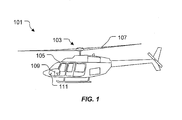
- Figure 1 shows a rotary aircraft utilizing the flight control system of the present application.
- Figure 1 shows a side view of a helicopter 101.
- helicopter 101 the control system is easily and readily adaptable for use with other types of rotary aircraft, i.e., helicopter 101, operating at various speeds and with or without a fixed lateral cyclic control.
- Helicopter 101 comprises a rotary system 103 carried by a fuselage 105.
- One or more rotor blades 107 operably associated with rotary system 103 provide flight for helicopter 101 and are controlled with a plurality of controllers within fuselage 105.
- a pilot can manipulate the cyclic controller 109 for changing the pitch angle of rotor blades 107, thus providing lateral and longitudinal flight direction, and/or manipulate pedals 111 for controlling yaw direction.
- Helicopter 101 includes a dual Automatic Flight Control System (AFCS).
- AFCS Automatic Flight Control System
- the high authority stability and control augmentation system 203 allows for significantly enhanced aircraft automation by allowing an augmentation system to have higher authorities (up to full authority) on an aircraft that has a mechanical flight control system.
- the high authority stability and control augmentation system 203 is comprised of a first flight control computer (FCC) 205, a second FCC 207, a first actuator 209 typically a SCAS actuator, a second actuator 211 typically a SCAS actuator, and a flight control actuator 213.
- FCC flight control computer
- a second FCC 207 As typical between FCC's the first FCC 205 is in communication with the second FCC 207.
- First actuator 209 is summed with second actuator 211 which both are summed with input 215.
- input 215 is from the pilot input into the controls, such as lateral or longitudinal cyclic controls 109; however other upstream inputs to the aircraft control axis, such as trim actuators are contemplated by this application.
- each axis of control requires a dual system (System 1 and System 2) 203 and that for clarity sake only a single axis of controls is shown.
- each system (1 and 2) at least in regard to flight critical functionality such as rate sensor inputs, processing, and output monitoring, may be dual and self-checking.
- First actuator 209 is dual commanded from the first FCC 205 by a first command 217a and a second command 217b each being sourced from one of two self checking processors within the first FCC 205.
- First actuator 209 is smart and also self checking and therefore can compare the first command 217a to the second command 217b and can use other means to otherwise monitor the health of the commanding FCCs outputs.
- first actuator 209 provides dual status and positional feedback 219 to the second FCC 207.
- the second FCC 207 receiving the failed status 219 from the first actuator 209 and utilizing the last known position information 219, may command the second actuator 211 to a different position to mitigate the failed position of the first actuator 209 so that the control input 215 retains sufficient control authority of the aircraft.
- Second actuator 211 is dual commanded 221 from the second FCC 207.
- Second actuator 211 provides dual status and positional feedback 223 to the first FCC 205.
- Inputs 225 to first FCC 205 and to second FCC 207 are comprised of typical inputs to FCCs such as: positional information from the controls via displacement transducers; attitudes and attitude rates; pitch rates; airframe accelerations; airspeed; engine parameters; rotor parameters; and transmission parameters.
- the first FCC 205 compensates for the failed second actuator 211.
- the first FCC 205 includes a first processor 235 and a second processor 239.
- First processor 235 provides the first command 217a to the first actuator 209
- the second processor 239 provides the second command 217b to the first actuator 209.
- the two processors compare their respective interpretations of inputs 225 and computed outputs 217a and 217b. Any disagreement, will force SCAS actuator 1 to fail fixed. In one embodiment, this can be accomplished by sending commands that are recognized by the first actuator 209 as commands to fail fixed.
- the SCAS actuators are SMART and compare the first command to the second command.
- the FCCs control the position of the SCAS actuators directly and status and position feedback to the other system is therefore sourced from the FCCs. In such case, the internal redundant configuration of the SCAS actuators would be accomplished within the redundant configuration of the FCCs.
- each processor 235 and 239 Located inside each processor 235 and 239 are a first set of computational algorithms 253, a second set of computational algorithms 257, limits 261, and a summation 265.
- computational algorithms 253 are software based however in an alternative embodiment computational algorithms 253 are comprised of analog hardware monitoring and responding to inputs 225. Limits 225 are grouped into trusted inputs and into un-trusted input.
- the first computational algorithms 253 utilize input type 225a or trusted inputs.
- Input type 225a consists of inputs that are monitored sufficiently and robustly enough to guarantee the validity of the data supplied to the first computational algorithm 253. Examples of monitored inputs 225a include attitude rates and pitch rates.
- First computational algorithm 253 determines a part of the actuator command 217a dependent upon the specific input from the input type 225a. For example the first computational algorithm 253 adjusts the actuator command 217a based upon a falling attitude rate. Input types 225b or un-trusted inputs are inputs that are not necessarily reliable and are supplied to the second set of computational algorithms 257. An example of an unreliable input 225b may be airspeed. Second computational algorithm 257 determines a part of the actuator command 217a dependent upon the specific input from the input type 225b. Limits 261, limit the contribution of the output of the second set of computational algorithms 257 to the actuator commands 217a and 217b.
- Limit 261 is configured to limit the unreliable input 225b to a magnitude that has been determined safe for the helicopter 101 were it to be incorrect data.
- limits to inputs 225b may exist prior to computational algorithms 257.
- additional computational algorithms may exist at the output of the summing element 265. It is the appropriate combination of these two classes of inputs 225a and 225b that allow the system 203 the advantages resulting from higher authority while maintaining safety.
- the remaining system When the actuator in one system fails as a fixed position, the remaining system, based on the status and position feedback from the failed system, may configure new position command limits such that any subsequent failure in the remaining system would result in a net position in which the sum of both actuator positions is within a range sufficient for the pilot or other upstream input to retain sufficient control of the aircraft.
- the remaining system Upon detection of the first failure, the remaining system may act to command the unfailed actuator to within the newly established limits if necessary to accomplish the objective.
- the system and method described herein solves the limitation of limited automatic control authority by incorporating feedback, mitigation algorithms, and computation limiting to a traditional mechanically limited dual system.
Landscapes
- Engineering & Computer Science (AREA)
- Aviation & Aerospace Engineering (AREA)
- Automation & Control Theory (AREA)
- Mechanical Engineering (AREA)
- Radar, Positioning & Navigation (AREA)
- Remote Sensing (AREA)
- Physics & Mathematics (AREA)
- General Physics & Mathematics (AREA)
- Computer Security & Cryptography (AREA)
- Feedback Control In General (AREA)
- Safety Devices In Control Systems (AREA)
Abstract
Description
- The present application relates generally to flight control systems, and more specifically, to an aircraft flight control system for allowing an augmentation system to have higher authorities, for example up to full authority, on an aircraft that has a mechanical flight control system.
- Previous attempts to provide higher authority on Stability and Control Augmentation Systems (SCAS) have relied upon mechanical limits. For example, some SCAS actuators are mechanically limited in authority to mitigate the effects of a failure resulting in actuator seizure or undesired motion. Other SCAS actuators use spring mechanisms to center the SCAS actuators upon a failure. Actuator authority is limited mechanically to mitigate the effects of undesired motion resulting from a failure including the sudden recentering which will result if a failure occurs while the actuator is working near its extreme position. None of the previous attempts provide high authority.
- Aspects of the inventions are defined in the claims.
- In some embodiments a rotary aircraft, comprises:
- a fuselage;
- a rotary system carried by the fuselage;
- a control input;
- a first flight control computer carried by the fuselage;
- a second flight control computer carried by the fuselage;
- a first actuator commanded by the first flight control computer;
- a second actuator commanded by the second flight control computer; and
- a third actuator;
- The novel features believed characteristic of the embodiments of the present application are set forth in the appended claims. However, the embodiments themselves, as well as a preferred mode of use, and further objectives and advantages thereof, will best be understood by reference to the following detailed description when read in conjunction with the accompanying drawings, wherein:
-
Figure 1 is a side view of a rotary aircraft; -
Figure 2 is a schematic of the high authority stability and control augmentation system according to the preferred embodiment of the present application; -
Figure 3a is a schematic of the flight control system according to the preferred embodiment of the present application; and -
Figure 3b is a schematic of the processor according to the preferred embodiment of the present application. - While the system and method of the present application are susceptible to various modifications and alternative forms, specific embodiments thereof have been shown by way of example in the drawings and are herein described in detail. It should be understood, however, that the description herein of specific embodiments is not intended to limit the invention to the particular embodiment disclosed, but on the contrary, the intention is to cover all modifications, equivalents, and alternatives falling within the scope of the process of the present application as defined by the appended claims.
- The system and method of the present application overcomes the abovementioned limitations commonly associated with conventional SCAS actuators. The system improves optionally manned aircraft by fixing the input controls and using the SCAS with high authority to control the aircraft in flight. Further description and illustration of the high authority stability and control system and method is provided in the figures and disclosure below.
- It will of course be appreciated that in the development of any actual embodiment, numerous implementation-specific decisions will be made to achieve the developer's specific goals, such as compliance with system-related and business-related constraints, which will vary from one implementation to another. Moreover, it will be appreciated that such a development effort might be complex and time-consuming, but would nevertheless be a routine undertaking for those of ordinary skill in the art having the benefit of this disclosure.
- The system and method of the present application will be understood, both as to its structure and operation, from the accompanying drawings, taken in conjunction with the accompanying description. Several embodiments of the system are presented herein. It should be understood that various components, parts, and features of the different embodiments may be combined together and/or interchanged with one another, all of which are within the scope of the present application, even though not all variations and particular embodiments are shown in the drawings. It should also be understood that the mixing and matching of features, elements, and/or functions between various embodiments is expressly contemplated herein so that one of ordinary skill in the art would appreciate from this disclosure that the features, elements, and/or functions of one embodiment may be incorporated into another embodiment as appropriate, unless described otherwise.
- Referring now to the drawings,
Figure 1 shows a rotary aircraft utilizing the flight control system of the present application.Figure 1 shows a side view of ahelicopter 101. However, it will be appreciated that the control system is easily and readily adaptable for use with other types of rotary aircraft, i.e.,helicopter 101, operating at various speeds and with or without a fixed lateral cyclic control. -
Helicopter 101 comprises arotary system 103 carried by afuselage 105. One ormore rotor blades 107 operably associated withrotary system 103 provide flight forhelicopter 101 and are controlled with a plurality of controllers withinfuselage 105. For example, during flight a pilot can manipulate thecyclic controller 109 for changing the pitch angle ofrotor blades 107, thus providing lateral and longitudinal flight direction, and/or manipulatepedals 111 for controlling yaw direction.Helicopter 101 includes a dual Automatic Flight Control System (AFCS). - For ease of description, some of the required systems and devices operably associated with the present control system are not shown, i.e., sensors, connectors, power sources, mounting supports, circuitry, software, and so forth, in order to clearly depict the novel features of the system. However, it should be understood that the system of the present application is operably associated with these and other required systems and devices for operation, as conventionally known in the art, although not shown in the drawings.
- Referring now also to
Figure 2 in the drawings, a schematic of a high authority stability andcontrol augmentation system 203 is shown. The high authority stability andcontrol augmentation system 203 allows for significantly enhanced aircraft automation by allowing an augmentation system to have higher authorities (up to full authority) on an aircraft that has a mechanical flight control system. The high authority stability andcontrol augmentation system 203 is comprised of a first flight control computer (FCC) 205, a second FCC 207, afirst actuator 209 typically a SCAS actuator, asecond actuator 211 typically a SCAS actuator, and aflight control actuator 213. As typical between FCC's the first FCC 205 is in communication with the second FCC 207. -
First actuator 209 is summed withsecond actuator 211 which both are summed withinput 215. Preferably,input 215 is from the pilot input into the controls, such as lateral or longitudinalcyclic controls 109; however other upstream inputs to the aircraft control axis, such as trim actuators are contemplated by this application. It should be apparent that each axis of control requires a dual system (System 1 and System 2) 203 and that for clarity sake only a single axis of controls is shown. Furthermore, each system (1 and 2), at least in regard to flight critical functionality such as rate sensor inputs, processing, and output monitoring, may be dual and self-checking. Any disagreement within either system can allow that system to shut down its associated SCAS actuator and therefore no single failure would result in erroneous movement of the SCAS actuator. Rather, single failures within either system would result in the SCAS actuator associated with the failed system holding fixed in position.First actuator 209 is dual commanded from the first FCC 205 by afirst command 217a and asecond command 217b each being sourced from one of two self checking processors within the first FCC 205.First actuator 209 is smart and also self checking and therefore can compare thefirst command 217a to thesecond command 217b and can use other means to otherwise monitor the health of the commanding FCCs outputs. In one embodiment,first actuator 209 provides dual status andpositional feedback 219 to the second FCC 207. While comparingfirst command 217a to thesecond command 217b, if thefirst actuator 209 senses a significant disagreement between thefirst command 217a and thesecond command 217b or any other indication of failures of the commanding FCC such as lack of command updates, theactuator 209 fails itself fixed in place. If thefirst actuator 209 fails fixed in place the second FCC 207 may then compensate for the fixed position of thefirst actuator 209 by changing its commands tosecond actuator 211. For example, as long as thefirst actuator 209 is working properly thestatus signals 219 are held to a high voltage. If thefirst actuator 209 fails thestatus signals 219 are driven low. Thesecond FCC 207 receiving the failedstatus 219 from thefirst actuator 209 and utilizing the last knownposition information 219, may command thesecond actuator 211 to a different position to mitigate the failed position of thefirst actuator 209 so that thecontrol input 215 retains sufficient control authority of the aircraft.Second actuator 211 is dual commanded 221 from thesecond FCC 207.Second actuator 211 provides dual status andpositional feedback 223 to thefirst FCC 205.Inputs 225 tofirst FCC 205 and tosecond FCC 207 are comprised of typical inputs to FCCs such as: positional information from the controls via displacement transducers; attitudes and attitude rates; pitch rates; airframe accelerations; airspeed; engine parameters; rotor parameters; and transmission parameters. Similarly to above, if thesecond actuator 211 fails, thefirst FCC 205 then compensates for the failedsecond actuator 211. - Referring now also to
Figure 3a in the drawings, a schematic of animproved FCC 205 having a high authority stability andcontrol augmentation system 203 is illustrated. Thefirst FCC 205 includes afirst processor 235 and asecond processor 239.First processor 235 provides thefirst command 217a to thefirst actuator 209, and thesecond processor 239 provides thesecond command 217b to thefirst actuator 209. The two processors compare their respective interpretations ofinputs 225 andcomputed outputs SCAS actuator 1 to fail fixed. In one embodiment, this can be accomplished by sending commands that are recognized by thefirst actuator 209 as commands to fail fixed. - In the preferred embodiment the SCAS actuators are SMART and compare the first command to the second command. In an alternative embodiment the FCCs control the position of the SCAS actuators directly and status and position feedback to the other system is therefore sourced from the FCCs. In such case, the internal redundant configuration of the SCAS actuators would be accomplished within the redundant configuration of the FCCs.
- Referring now also to
Figure 3b in the drawings, a schematic of the algorithms implemented within eachprocessor processor computational algorithms 253, a second set ofcomputational algorithms 257,limits 261, and asummation 265. Preferablycomputational algorithms 253 are software based however in an alternative embodimentcomputational algorithms 253 are comprised of analog hardware monitoring and responding toinputs 225.Limits 225 are grouped into trusted inputs and into un-trusted input. The firstcomputational algorithms 253 utilizeinput type 225a or trusted inputs.Input type 225a consists of inputs that are monitored sufficiently and robustly enough to guarantee the validity of the data supplied to the firstcomputational algorithm 253. Examples of monitoredinputs 225a include attitude rates and pitch rates. Firstcomputational algorithm 253 determines a part of theactuator command 217a dependent upon the specific input from theinput type 225a. For example the firstcomputational algorithm 253 adjusts theactuator command 217a based upon a falling attitude rate.Input types 225b or un-trusted inputs are inputs that are not necessarily reliable and are supplied to the second set ofcomputational algorithms 257. An example of anunreliable input 225b may be airspeed. Secondcomputational algorithm 257 determines a part of theactuator command 217a dependent upon the specific input from theinput type 225b.Limits 261, limit the contribution of the output of the second set ofcomputational algorithms 257 to the actuator commands 217a and 217b. Limit 261 is configured to limit theunreliable input 225b to a magnitude that has been determined safe for thehelicopter 101 were it to be incorrect data. In another embodiment, limits toinputs 225b may exist prior tocomputational algorithms 257. In yet another embodiment, additional computational algorithms may exist at the output of the summingelement 265. It is the appropriate combination of these two classes ofinputs system 203 the advantages resulting from higher authority while maintaining safety. - When the actuator in one system fails as a fixed position, the remaining system, based on the status and position feedback from the failed system, may configure new position command limits such that any subsequent failure in the remaining system would result in a net position in which the sum of both actuator positions is within a range sufficient for the pilot or other upstream input to retain sufficient control of the aircraft. Upon detection of the first failure, the remaining system may act to command the unfailed actuator to within the newly established limits if necessary to accomplish the objective.
- The system and method described herein solves the limitation of limited automatic control authority by incorporating feedback, mitigation algorithms, and computation limiting to a traditional mechanically limited dual system.
- It is apparent that a system and method with significant advantages has been described and illustrated. The particular embodiments disclosed above are illustrative only, as the embodiments may be modified and practiced in different but equivalent manners apparent to those skilled in the art having the benefit of the teachings herein. It is therefore evident that the particular embodiments disclosed above may be altered or modified, and all such variations are considered within the scope of the application. Accordingly, the protection sought herein is as set forth in the description. Although the present embodiments are shown above, they are not limited to just these embodiments, but are amenable to various changes and modifications without departing from the scope of the invention, as defined by the appended claims.
Claims (15)
- A rotary aircraft, comprising:a fuselage;a rotary system carried by the fuselage;a control input;a first flight control computer carried by the fuselage;a second flight control computer carried by the fuselage;a first actuator commanded by the first flight control computer;a second actuator commanded by the second flight control computer; anda third actuator;wherein an output of the first actuator is summed with an output of the second actuator and summed with the control input for manipulating the rotary system in a first axis by controlling the third actuator.
- The rotary aircraft according to claim 1, further comprising:a feedback loop from the second actuator to the first flight control computer;
wherein the first actuator compensates for a failure in the second actuator. - The rotary aircraft according to claim 2, wherein the second actuator is failed in a fixed position.
- The rotary aircraft according to claim 1 or claim 2 or claim 3, further comprising:a feedback loop from the first actuator to the second flight control computer;wherein the second actuator compensates for a failure in the first actuator.
- The rotary aircraft according to claim 4, wherein the first actuator is failed in a fixed position.
- The rotary aircraft according to claim 1 or any of claims 2 to 5, the first flight control computer comprising:a first processor for commanding the first actuator; anda second processor for commanding the first actuator;wherein the first actuator compares commands from the first processor to commands from the second processor to find a failure.
- The rotary aircraft according to claim 1 or any of claims 2 to 6, the second flight control computer comprising:a first processor for commanding the second actuator; anda second processor for commanding the second actuator;wherein the second actuator compares commands from the first processor to commands from the second processor to find a failure.
- The rotary aircraft according to claim 7, wherein the first actuator compensates for the failure in the second actuator; or
wherein the second actuator compensates for the failure in the first actuator. - A flight control system for an aircraft, comprising:a first actuator;a first flight control computer having;a first processor for commanding the first actuator; anda second processor for commanding the first actuator;wherein the first actuator compares commands from the first processor to commands from the second processor to find a first failure;a second actuator; anda second flight control computer having;a first processor for commanding the second actuator; and
a second processor for commanding the second actuator;wherein the second actuator compares commands from the first processor to commands from the second processor to find a second failure. - The flight control system according to claim 9, further comprising:a feedback loop from the second actuator to the first flight control computer, and/ora feedback loop from the first actuator to the second flight control computer.
- A method for increasing the authority of a stability and control augmentation system, comprising:providing a first actuator;grouping robust inputs into a first group of inputs;grouping non-robust inputs into a second group of inputs;processing the first group of inputs into trusted commands for the actuator;processing the second group of inputs into un-trusted commands for the actuator;providing a set of limits for the un-trusted commands;limiting the contribution of the un-trusted commands based on the set of limits to form limited un-trusted commands; andsumming the trusted commands with the limited un-trusted commands.
- The method for increasing the authority of a stability and control augmentation system according to claim 11, further comprising:monitoring the first actuator for a first actuator failure;providing a second actuator;adjusting the second actuator to compensate for the first actuator failure;
andfixing the first actuator in place in response to the first actuator failure. - The method for increasing the authority of a stability and control augmentation system according to claim 12, further comprising:monitoring the second actuator for a second actuator failure;adjusting the first actuator to compensate for the second actuator failure;
andfixing the second actuator in place in response to the second actuator failure. - The method for increasing the authority of a stability and control augmentation system according to claim 11 or claim 12 or claim 13, wherein the non-robust inputs are unreliable.
- The method for increasing the authority of a stability and control augmentation system according to claim 11 or any of claims 12 to 14, wherein the robust inputs are monitored.
Priority Applications (1)
| Application Number | Priority Date | Filing Date | Title |
|---|---|---|---|
| EP17155735.8A EP3182240B1 (en) | 2014-05-21 | 2014-12-04 | Method for increasing authority of a scas |
Applications Claiming Priority (1)
| Application Number | Priority Date | Filing Date | Title |
|---|---|---|---|
| US14/284,045 US9870004B2 (en) | 2014-05-21 | 2014-05-21 | High authority stability and control augmentation system |
Related Child Applications (1)
| Application Number | Title | Priority Date | Filing Date |
|---|---|---|---|
| EP17155735.8A Division EP3182240B1 (en) | 2014-05-21 | 2014-12-04 | Method for increasing authority of a scas |
Publications (2)
| Publication Number | Publication Date |
|---|---|
| EP2947531A1 true EP2947531A1 (en) | 2015-11-25 |
| EP2947531B1 EP2947531B1 (en) | 2017-03-01 |
Family
ID=52003634
Family Applications (2)
| Application Number | Title | Priority Date | Filing Date |
|---|---|---|---|
| EP17155735.8A Active EP3182240B1 (en) | 2014-05-21 | 2014-12-04 | Method for increasing authority of a scas |
| EP14196198.7A Active EP2947531B1 (en) | 2014-05-21 | 2014-12-04 | High authority stability and control augmentation system |
Family Applications Before (1)
| Application Number | Title | Priority Date | Filing Date |
|---|---|---|---|
| EP17155735.8A Active EP3182240B1 (en) | 2014-05-21 | 2014-12-04 | Method for increasing authority of a scas |
Country Status (2)
| Country | Link |
|---|---|
| US (2) | US9870004B2 (en) |
| EP (2) | EP3182240B1 (en) |
Cited By (4)
| Publication number | Priority date | Publication date | Assignee | Title |
|---|---|---|---|---|
| US20150239551A1 (en) * | 2014-02-27 | 2015-08-27 | Goodrich Actuation Systems Sas | Stability and Control Augmentation System |
| CN107526290A (en) * | 2016-06-20 | 2017-12-29 | 罗伯特·博世有限公司 | The method used to run the controller |
| EP3428758A1 (en) * | 2017-07-11 | 2019-01-16 | Bell Helicopter Textron Inc. | Fbw rotorcraft control with redundant processors using state comparison |
| CN112046783A (en) * | 2020-07-31 | 2020-12-08 | 苏州千诚锐创机器人科技有限公司 | Flight control method and system of three-IMU redundancy technology |
Families Citing this family (5)
| Publication number | Priority date | Publication date | Assignee | Title |
|---|---|---|---|---|
| US9885250B2 (en) * | 2015-10-23 | 2018-02-06 | United Technologies Corporation | Autonomous engine health management system |
| US10940945B2 (en) | 2017-10-30 | 2021-03-09 | Bell Helicopter Textron Inc. | Rotorcraft anti-torque system |
| US11433997B2 (en) | 2017-10-30 | 2022-09-06 | Textron Innovations Inc. | Rotorcraft anti-torque systems and methods therefor |
| US12570393B2 (en) | 2021-11-17 | 2026-03-10 | Microtecnica S.R.L. | Stability and control augmentation system actuator |
| EP4194334A1 (en) | 2021-12-08 | 2023-06-14 | Microtecnica S.r.l. | Stability and control augmentation system |
Citations (2)
| Publication number | Priority date | Publication date | Assignee | Title |
|---|---|---|---|---|
| US3733039A (en) * | 1971-05-20 | 1973-05-15 | United Aircraft Corp | Feel augmentation control system for helicopters |
| EP1037130A2 (en) * | 1999-03-12 | 2000-09-20 | Advanced Technology Institute of Commuter-Helicopter, Ltd. | Flight control apparatus for helicopters |
Family Cites Families (11)
| Publication number | Priority date | Publication date | Assignee | Title |
|---|---|---|---|---|
| US4887214A (en) | 1987-10-27 | 1989-12-12 | The Boeing Company | Flight control system employing two dual controllers operating a dual actuator |
| US5189620A (en) * | 1989-10-06 | 1993-02-23 | United Technologies Corporation | Control system for gas turbine helicopter engines and the like |
| US5678786A (en) * | 1995-12-06 | 1997-10-21 | Mcdonnell Douglas Helicopter Co. | Reconfigurable helicopter flight control system |
| WO2007018652A1 (en) | 2005-08-05 | 2007-02-15 | Honeywell International, Inc. | Distributed and recoverable digital control system |
| JP2009523658A (en) | 2006-01-17 | 2009-06-25 | ガルフストリーム・エアロスペース・コーポレイション | Apparatus and method for backup control of a distributed flight control system |
| US7438259B1 (en) * | 2006-08-16 | 2008-10-21 | Piasecki Aircraft Corporation | Compound aircraft control system and method |
| US7840316B2 (en) | 2007-12-17 | 2010-11-23 | Honeywell International Inc. | Limited authority and full authority mode fly-by-wire flight control surface actuation control system |
| US8523102B2 (en) | 2008-10-03 | 2013-09-03 | Textron Innovations Inc. | Method and apparatus for aircraft sensor and actuator failure protection using reconfigurable flight control laws |
| US8070091B2 (en) * | 2008-10-08 | 2011-12-06 | Honeywell International Inc. | Electromechanical actuation system and method |
| KR20110132370A (en) * | 2009-02-10 | 2011-12-07 | 씨비이 글로벌 홀딩스, 인크. | Nonlinear Actuator System and Method |
| JP5590955B2 (en) * | 2010-04-26 | 2014-09-17 | ナブテスコ株式会社 | Actuator control system |
-
2014
- 2014-05-21 US US14/284,045 patent/US9870004B2/en active Active
- 2014-12-04 EP EP17155735.8A patent/EP3182240B1/en active Active
- 2014-12-04 EP EP14196198.7A patent/EP2947531B1/en active Active
-
2018
- 2018-01-16 US US15/872,651 patent/US10712752B2/en active Active
Patent Citations (2)
| Publication number | Priority date | Publication date | Assignee | Title |
|---|---|---|---|---|
| US3733039A (en) * | 1971-05-20 | 1973-05-15 | United Aircraft Corp | Feel augmentation control system for helicopters |
| EP1037130A2 (en) * | 1999-03-12 | 2000-09-20 | Advanced Technology Institute of Commuter-Helicopter, Ltd. | Flight control apparatus for helicopters |
Cited By (9)
| Publication number | Priority date | Publication date | Assignee | Title |
|---|---|---|---|---|
| US20150239551A1 (en) * | 2014-02-27 | 2015-08-27 | Goodrich Actuation Systems Sas | Stability and Control Augmentation System |
| US10037040B2 (en) * | 2014-02-27 | 2018-07-31 | Goodrich Actuation Systems Sas | Stability and control augmentation system |
| CN107526290A (en) * | 2016-06-20 | 2017-12-29 | 罗伯特·博世有限公司 | The method used to run the controller |
| CN107526290B (en) * | 2016-06-20 | 2022-05-31 | 罗伯特·博世有限公司 | Method for operating a controller |
| EP3428758A1 (en) * | 2017-07-11 | 2019-01-16 | Bell Helicopter Textron Inc. | Fbw rotorcraft control with redundant processors using state comparison |
| CN109240073A (en) * | 2017-07-11 | 2019-01-18 | 贝尔直升机德事隆公司 | Rotary aircraft with the redundant processor that use state compares |
| US10377470B2 (en) | 2017-07-11 | 2019-08-13 | Bell Helicopter Textron Inc. | Rotorcraft with redundant processors using state comparison |
| CN109240073B (en) * | 2017-07-11 | 2022-05-10 | 贝尔直升机德事隆公司 | Rotary aircraft with redundant processors using state comparison |
| CN112046783A (en) * | 2020-07-31 | 2020-12-08 | 苏州千诚锐创机器人科技有限公司 | Flight control method and system of three-IMU redundancy technology |
Also Published As
| Publication number | Publication date |
|---|---|
| US20150338854A1 (en) | 2015-11-26 |
| US9870004B2 (en) | 2018-01-16 |
| EP3182240A2 (en) | 2017-06-21 |
| US20180157275A1 (en) | 2018-06-07 |
| US10712752B2 (en) | 2020-07-14 |
| EP2947531B1 (en) | 2017-03-01 |
| EP3182240B1 (en) | 2021-09-01 |
| EP3182240A3 (en) | 2017-09-13 |
Similar Documents
| Publication | Publication Date | Title |
|---|---|---|
| US10712752B2 (en) | High authority stability and control augmentation system | |
| EP3428758B1 (en) | Fbw rotorcraft control using state comparison calculated by redundant processors | |
| EP3715991B1 (en) | Method for monitoring the pilot control trim of a rotorcraft and detecting a trim failure | |
| US10124889B2 (en) | Tail rotor failure recovery controller | |
| US11599111B2 (en) | Reverse tactile cue for rotorcraft rotor overspeed protection | |
| CN116069066A (en) | Distributed Flight Control System | |
| CN110879605A (en) | Trapped Stop Monitor for Collective and Periodic Pitch Rods | |
| EP3379257A1 (en) | Combined airspeed and inertial data for rotorcraft longitudinal control | |
| CN110580050A (en) | Systems and methods for altitude control of rotorcraft | |
| CN108732919B (en) | Flight control computer for aircraft | |
| EP3599160B1 (en) | System and method for rotorcraft flight control | |
| US20070033195A1 (en) | Monitoring system and methods for a distributed and recoverable digital control system | |
| EP2810872A1 (en) | System and method for maximizing aircraft safe landing capability during one engine inoperative operation | |
| EP3627271B1 (en) | System and method for controlling rotorcraft | |
| EP4406834A1 (en) | Aircraft actuator verification system and method | |
| EP4006317B1 (en) | Modeling and integrating aircraft engine installation deltas | |
| US11203414B2 (en) | Controlling an aircraft based on detecting and mitigating fatiguing conditions and aircraft damage conditions | |
| EP3575914B1 (en) | Device and method for automated descend-to-hover flight mode | |
| US20190163179A1 (en) | Method of controlling at least one actuator for controlling an aircraft, an associated control system, and a corresponding aircraft | |
| US12371153B2 (en) | Error monitors for collective and cyclic sticks | |
| US20220219810A1 (en) | Systems and methods for protecting flight control systems | |
| US20180022449A1 (en) | Rotor swashplate actuator position synchronization | |
| EP3453611A1 (en) | Automatic envelope limiting based on detected hydraulic failures |
Legal Events
| Date | Code | Title | Description |
|---|---|---|---|
| PUAI | Public reference made under article 153(3) epc to a published international application that has entered the european phase |
Free format text: ORIGINAL CODE: 0009012 |
|
| 17P | Request for examination filed |
Effective date: 20141204 |
|
| AK | Designated contracting states |
Kind code of ref document: A1 Designated state(s): AL AT BE BG CH CY CZ DE DK EE ES FI FR GB GR HR HU IE IS IT LI LT LU LV MC MK MT NL NO PL PT RO RS SE SI SK SM TR |
|
| AX | Request for extension of the european patent |
Extension state: BA ME |
|
| REG | Reference to a national code |
Ref country code: DE Ref legal event code: R079 Ref document number: 602014007091 Country of ref document: DE Free format text: PREVIOUS MAIN CLASS: G05D0001000000 Ipc: G05D0001080000 |
|
| GRAP | Despatch of communication of intention to grant a patent |
Free format text: ORIGINAL CODE: EPIDOSNIGR1 |
|
| STAA | Information on the status of an ep patent application or granted ep patent |
Free format text: STATUS: GRANT OF PATENT IS INTENDED |
|
| INTG | Intention to grant announced |
Effective date: 20161201 |
|
| RIC1 | Information provided on ipc code assigned before grant |
Ipc: G05D 1/00 20060101ALI20161121BHEP Ipc: G05D 1/08 20060101AFI20161121BHEP |
|
| GRAS | Grant fee paid |
Free format text: ORIGINAL CODE: EPIDOSNIGR3 |
|
| GRAA | (expected) grant |
Free format text: ORIGINAL CODE: 0009210 |
|
| STAA | Information on the status of an ep patent application or granted ep patent |
Free format text: STATUS: THE PATENT HAS BEEN GRANTED |
|
| AK | Designated contracting states |
Kind code of ref document: B1 Designated state(s): AL AT BE BG CH CY CZ DE DK EE ES FI FR GB GR HR HU IE IS IT LI LT LU LV MC MK MT NL NO PL PT RO RS SE SI SK SM TR |
|
| REG | Reference to a national code |
Ref country code: GB Ref legal event code: FG4D |
|
| REG | Reference to a national code |
Ref country code: CH Ref legal event code: EP Ref country code: AT Ref legal event code: REF Ref document number: 872065 Country of ref document: AT Kind code of ref document: T Effective date: 20170315 |
|
| REG | Reference to a national code |
Ref country code: IE Ref legal event code: FG4D |
|
| REG | Reference to a national code |
Ref country code: DE Ref legal event code: R096 Ref document number: 602014007091 Country of ref document: DE |
|
| REG | Reference to a national code |
Ref country code: NL Ref legal event code: MP Effective date: 20170301 |
|
| REG | Reference to a national code |
Ref country code: LT Ref legal event code: MG4D |
|
| REG | Reference to a national code |
Ref country code: AT Ref legal event code: MK05 Ref document number: 872065 Country of ref document: AT Kind code of ref document: T Effective date: 20170301 |
|
| PG25 | Lapsed in a contracting state [announced via postgrant information from national office to epo] |
Ref country code: HR Free format text: LAPSE BECAUSE OF FAILURE TO SUBMIT A TRANSLATION OF THE DESCRIPTION OR TO PAY THE FEE WITHIN THE PRESCRIBED TIME-LIMIT Effective date: 20170301 Ref country code: LT Free format text: LAPSE BECAUSE OF FAILURE TO SUBMIT A TRANSLATION OF THE DESCRIPTION OR TO PAY THE FEE WITHIN THE PRESCRIBED TIME-LIMIT Effective date: 20170301 Ref country code: NO Free format text: LAPSE BECAUSE OF FAILURE TO SUBMIT A TRANSLATION OF THE DESCRIPTION OR TO PAY THE FEE WITHIN THE PRESCRIBED TIME-LIMIT Effective date: 20170601 Ref country code: GR Free format text: LAPSE BECAUSE OF FAILURE TO SUBMIT A TRANSLATION OF THE DESCRIPTION OR TO PAY THE FEE WITHIN THE PRESCRIBED TIME-LIMIT Effective date: 20170602 Ref country code: FI Free format text: LAPSE BECAUSE OF FAILURE TO SUBMIT A TRANSLATION OF THE DESCRIPTION OR TO PAY THE FEE WITHIN THE PRESCRIBED TIME-LIMIT Effective date: 20170301 |
|
| PG25 | Lapsed in a contracting state [announced via postgrant information from national office to epo] |
Ref country code: AT Free format text: LAPSE BECAUSE OF FAILURE TO SUBMIT A TRANSLATION OF THE DESCRIPTION OR TO PAY THE FEE WITHIN THE PRESCRIBED TIME-LIMIT Effective date: 20170301 Ref country code: BG Free format text: LAPSE BECAUSE OF FAILURE TO SUBMIT A TRANSLATION OF THE DESCRIPTION OR TO PAY THE FEE WITHIN THE PRESCRIBED TIME-LIMIT Effective date: 20170601 Ref country code: RS Free format text: LAPSE BECAUSE OF FAILURE TO SUBMIT A TRANSLATION OF THE DESCRIPTION OR TO PAY THE FEE WITHIN THE PRESCRIBED TIME-LIMIT Effective date: 20170301 Ref country code: ES Free format text: LAPSE BECAUSE OF FAILURE TO SUBMIT A TRANSLATION OF THE DESCRIPTION OR TO PAY THE FEE WITHIN THE PRESCRIBED TIME-LIMIT Effective date: 20170301 Ref country code: SE Free format text: LAPSE BECAUSE OF FAILURE TO SUBMIT A TRANSLATION OF THE DESCRIPTION OR TO PAY THE FEE WITHIN THE PRESCRIBED TIME-LIMIT Effective date: 20170301 Ref country code: LV Free format text: LAPSE BECAUSE OF FAILURE TO SUBMIT A TRANSLATION OF THE DESCRIPTION OR TO PAY THE FEE WITHIN THE PRESCRIBED TIME-LIMIT Effective date: 20170301 |
|
| PG25 | Lapsed in a contracting state [announced via postgrant information from national office to epo] |
Ref country code: NL Free format text: LAPSE BECAUSE OF FAILURE TO SUBMIT A TRANSLATION OF THE DESCRIPTION OR TO PAY THE FEE WITHIN THE PRESCRIBED TIME-LIMIT Effective date: 20170301 |
|
| PG25 | Lapsed in a contracting state [announced via postgrant information from national office to epo] |
Ref country code: CZ Free format text: LAPSE BECAUSE OF FAILURE TO SUBMIT A TRANSLATION OF THE DESCRIPTION OR TO PAY THE FEE WITHIN THE PRESCRIBED TIME-LIMIT Effective date: 20170301 Ref country code: RO Free format text: LAPSE BECAUSE OF FAILURE TO SUBMIT A TRANSLATION OF THE DESCRIPTION OR TO PAY THE FEE WITHIN THE PRESCRIBED TIME-LIMIT Effective date: 20170301 Ref country code: EE Free format text: LAPSE BECAUSE OF FAILURE TO SUBMIT A TRANSLATION OF THE DESCRIPTION OR TO PAY THE FEE WITHIN THE PRESCRIBED TIME-LIMIT Effective date: 20170301 Ref country code: SK Free format text: LAPSE BECAUSE OF FAILURE TO SUBMIT A TRANSLATION OF THE DESCRIPTION OR TO PAY THE FEE WITHIN THE PRESCRIBED TIME-LIMIT Effective date: 20170301 |
|
| PG25 | Lapsed in a contracting state [announced via postgrant information from national office to epo] |
Ref country code: SM Free format text: LAPSE BECAUSE OF FAILURE TO SUBMIT A TRANSLATION OF THE DESCRIPTION OR TO PAY THE FEE WITHIN THE PRESCRIBED TIME-LIMIT Effective date: 20170301 Ref country code: IS Free format text: LAPSE BECAUSE OF FAILURE TO SUBMIT A TRANSLATION OF THE DESCRIPTION OR TO PAY THE FEE WITHIN THE PRESCRIBED TIME-LIMIT Effective date: 20170701 Ref country code: PL Free format text: LAPSE BECAUSE OF FAILURE TO SUBMIT A TRANSLATION OF THE DESCRIPTION OR TO PAY THE FEE WITHIN THE PRESCRIBED TIME-LIMIT Effective date: 20170301 Ref country code: PT Free format text: LAPSE BECAUSE OF FAILURE TO SUBMIT A TRANSLATION OF THE DESCRIPTION OR TO PAY THE FEE WITHIN THE PRESCRIBED TIME-LIMIT Effective date: 20170703 |
|
| REG | Reference to a national code |
Ref country code: DE Ref legal event code: R097 Ref document number: 602014007091 Country of ref document: DE |
|
| REG | Reference to a national code |
Ref country code: FR Ref legal event code: PLFP Year of fee payment: 4 |
|
| PLBE | No opposition filed within time limit |
Free format text: ORIGINAL CODE: 0009261 |
|
| STAA | Information on the status of an ep patent application or granted ep patent |
Free format text: STATUS: NO OPPOSITION FILED WITHIN TIME LIMIT |
|
| PG25 | Lapsed in a contracting state [announced via postgrant information from national office to epo] |
Ref country code: DK Free format text: LAPSE BECAUSE OF FAILURE TO SUBMIT A TRANSLATION OF THE DESCRIPTION OR TO PAY THE FEE WITHIN THE PRESCRIBED TIME-LIMIT Effective date: 20170301 |
|
| 26N | No opposition filed |
Effective date: 20171204 |
|
| PG25 | Lapsed in a contracting state [announced via postgrant information from national office to epo] |
Ref country code: SI Free format text: LAPSE BECAUSE OF FAILURE TO SUBMIT A TRANSLATION OF THE DESCRIPTION OR TO PAY THE FEE WITHIN THE PRESCRIBED TIME-LIMIT Effective date: 20170301 |
|
| REG | Reference to a national code |
Ref country code: CH Ref legal event code: PL |
|
| REG | Reference to a national code |
Ref country code: IE Ref legal event code: MM4A |
|
| PG25 | Lapsed in a contracting state [announced via postgrant information from national office to epo] |
Ref country code: LU Free format text: LAPSE BECAUSE OF NON-PAYMENT OF DUE FEES Effective date: 20171204 Ref country code: MT Free format text: LAPSE BECAUSE OF NON-PAYMENT OF DUE FEES Effective date: 20171204 |
|
| REG | Reference to a national code |
Ref country code: BE Ref legal event code: MM Effective date: 20171231 |
|
| PG25 | Lapsed in a contracting state [announced via postgrant information from national office to epo] |
Ref country code: IE Free format text: LAPSE BECAUSE OF NON-PAYMENT OF DUE FEES Effective date: 20171204 |
|
| PG25 | Lapsed in a contracting state [announced via postgrant information from national office to epo] |
Ref country code: CH Free format text: LAPSE BECAUSE OF NON-PAYMENT OF DUE FEES Effective date: 20171231 Ref country code: LI Free format text: LAPSE BECAUSE OF NON-PAYMENT OF DUE FEES Effective date: 20171231 Ref country code: BE Free format text: LAPSE BECAUSE OF NON-PAYMENT OF DUE FEES Effective date: 20171231 |
|
| PG25 | Lapsed in a contracting state [announced via postgrant information from national office to epo] |
Ref country code: HU Free format text: LAPSE BECAUSE OF FAILURE TO SUBMIT A TRANSLATION OF THE DESCRIPTION OR TO PAY THE FEE WITHIN THE PRESCRIBED TIME-LIMIT; INVALID AB INITIO Effective date: 20141204 Ref country code: MC Free format text: LAPSE BECAUSE OF FAILURE TO SUBMIT A TRANSLATION OF THE DESCRIPTION OR TO PAY THE FEE WITHIN THE PRESCRIBED TIME-LIMIT Effective date: 20170301 |
|
| PG25 | Lapsed in a contracting state [announced via postgrant information from national office to epo] |
Ref country code: CY Free format text: LAPSE BECAUSE OF FAILURE TO SUBMIT A TRANSLATION OF THE DESCRIPTION OR TO PAY THE FEE WITHIN THE PRESCRIBED TIME-LIMIT Effective date: 20170301 |
|
| PG25 | Lapsed in a contracting state [announced via postgrant information from national office to epo] |
Ref country code: MK Free format text: LAPSE BECAUSE OF FAILURE TO SUBMIT A TRANSLATION OF THE DESCRIPTION OR TO PAY THE FEE WITHIN THE PRESCRIBED TIME-LIMIT Effective date: 20170301 |
|
| PG25 | Lapsed in a contracting state [announced via postgrant information from national office to epo] |
Ref country code: TR Free format text: LAPSE BECAUSE OF FAILURE TO SUBMIT A TRANSLATION OF THE DESCRIPTION OR TO PAY THE FEE WITHIN THE PRESCRIBED TIME-LIMIT Effective date: 20170301 |
|
| PG25 | Lapsed in a contracting state [announced via postgrant information from national office to epo] |
Ref country code: AL Free format text: LAPSE BECAUSE OF FAILURE TO SUBMIT A TRANSLATION OF THE DESCRIPTION OR TO PAY THE FEE WITHIN THE PRESCRIBED TIME-LIMIT Effective date: 20170301 |
|
| P01 | Opt-out of the competence of the unified patent court (upc) registered |
Effective date: 20230602 |
|
| REG | Reference to a national code |
Ref country code: DE Ref legal event code: R079 Ref document number: 602014007091 Country of ref document: DE Free format text: PREVIOUS MAIN CLASS: G05D0001080000 Ipc: G05D0001490000 |
|
| PGFP | Annual fee paid to national office [announced via postgrant information from national office to epo] |
Ref country code: GB Payment date: 20251229 Year of fee payment: 12 |
|
| PGFP | Annual fee paid to national office [announced via postgrant information from national office to epo] |
Ref country code: IT Payment date: 20251219 Year of fee payment: 12 |
|
| PGFP | Annual fee paid to national office [announced via postgrant information from national office to epo] |
Ref country code: FR Payment date: 20251226 Year of fee payment: 12 |
|
| PGFP | Annual fee paid to national office [announced via postgrant information from national office to epo] |
Ref country code: DE Payment date: 20251229 Year of fee payment: 12 |