EP2945909B1 - A core-shell catalyst comprising a mixed metal oxide material of tin and titanium - Google Patents
A core-shell catalyst comprising a mixed metal oxide material of tin and titanium Download PDFInfo
- Publication number
- EP2945909B1 EP2945909B1 EP14700773.6A EP14700773A EP2945909B1 EP 2945909 B1 EP2945909 B1 EP 2945909B1 EP 14700773 A EP14700773 A EP 14700773A EP 2945909 B1 EP2945909 B1 EP 2945909B1
- Authority
- EP
- European Patent Office
- Prior art keywords
- core
- tin
- catalyst
- platinum
- shell
- Prior art date
- Legal status (The legal status is an assumption and is not a legal conclusion. Google has not performed a legal analysis and makes no representation as to the accuracy of the status listed.)
- Not-in-force
Links
- ATJFFYVFTNAWJD-UHFFFAOYSA-N Tin Chemical compound [Sn] ATJFFYVFTNAWJD-UHFFFAOYSA-N 0.000 title claims description 59
- 239000003054 catalyst Substances 0.000 title claims description 57
- 239000000463 material Substances 0.000 title claims description 43
- 239000011258 core-shell material Substances 0.000 title claims description 37
- 229910003455 mixed metal oxide Inorganic materials 0.000 title claims description 16
- 239000010936 titanium Substances 0.000 title claims description 14
- 229910052719 titanium Inorganic materials 0.000 title claims description 13
- RTAQQCXQSZGOHL-UHFFFAOYSA-N Titanium Chemical compound [Ti] RTAQQCXQSZGOHL-UHFFFAOYSA-N 0.000 title claims description 11
- BASFCYQUMIYNBI-UHFFFAOYSA-N platinum Chemical compound [Pt] BASFCYQUMIYNBI-UHFFFAOYSA-N 0.000 claims description 165
- GWEVSGVZZGPLCZ-UHFFFAOYSA-N Titan oxide Chemical compound O=[Ti]=O GWEVSGVZZGPLCZ-UHFFFAOYSA-N 0.000 claims description 102
- 229910052718 tin Inorganic materials 0.000 claims description 79
- 229910052697 platinum Inorganic materials 0.000 claims description 61
- OGIDPMRJRNCKJF-UHFFFAOYSA-N titanium oxide Inorganic materials [Ti]=O OGIDPMRJRNCKJF-UHFFFAOYSA-N 0.000 claims description 40
- 239000000446 fuel Substances 0.000 claims description 25
- 238000000034 method Methods 0.000 claims description 18
- 229910052751 metal Inorganic materials 0.000 claims description 15
- 239000002184 metal Substances 0.000 claims description 14
- 239000010410 layer Substances 0.000 claims description 12
- 239000007771 core particle Substances 0.000 claims description 11
- 229910001260 Pt alloy Inorganic materials 0.000 claims description 7
- 230000003197 catalytic effect Effects 0.000 claims description 6
- 239000002356 single layer Substances 0.000 claims description 4
- QVGXLLKOCUKJST-UHFFFAOYSA-N atomic oxygen Chemical compound [O] QVGXLLKOCUKJST-UHFFFAOYSA-N 0.000 description 54
- 239000001301 oxygen Substances 0.000 description 54
- 229910052760 oxygen Inorganic materials 0.000 description 54
- 238000006722 reduction reaction Methods 0.000 description 50
- 230000001351 cycling effect Effects 0.000 description 26
- 210000004027 cell Anatomy 0.000 description 23
- 238000002474 experimental method Methods 0.000 description 22
- 239000010408 film Substances 0.000 description 19
- 239000000203 mixture Substances 0.000 description 19
- 230000000694 effects Effects 0.000 description 18
- 239000002245 particle Substances 0.000 description 17
- 238000011068 loading method Methods 0.000 description 14
- XOLBLPGZBRYERU-UHFFFAOYSA-N tin dioxide Chemical compound O=[Sn]=O XOLBLPGZBRYERU-UHFFFAOYSA-N 0.000 description 13
- 239000010409 thin film Substances 0.000 description 12
- 230000007423 decrease Effects 0.000 description 10
- 230000005587 bubbling Effects 0.000 description 9
- OKTJSMMVPCPJKN-UHFFFAOYSA-N Carbon Chemical compound [C] OKTJSMMVPCPJKN-UHFFFAOYSA-N 0.000 description 8
- 229910052799 carbon Inorganic materials 0.000 description 8
- 238000005259 measurement Methods 0.000 description 8
- 150000004706 metal oxides Chemical class 0.000 description 8
- VLTRZXGMWDSKGL-UHFFFAOYSA-N perchloric acid Chemical compound OCl(=O)(=O)=O VLTRZXGMWDSKGL-UHFFFAOYSA-N 0.000 description 8
- 239000000243 solution Substances 0.000 description 8
- 239000000758 substrate Substances 0.000 description 8
- XUIMIQQOPSSXEZ-UHFFFAOYSA-N Silicon Chemical compound [Si] XUIMIQQOPSSXEZ-UHFFFAOYSA-N 0.000 description 7
- 238000002441 X-ray diffraction Methods 0.000 description 7
- 238000000151 deposition Methods 0.000 description 7
- 229910044991 metal oxide Inorganic materials 0.000 description 7
- 229910052710 silicon Inorganic materials 0.000 description 7
- 239000010703 silicon Substances 0.000 description 7
- QAOWNCQODCNURD-UHFFFAOYSA-N Sulfuric acid Chemical compound OS(O)(=O)=O QAOWNCQODCNURD-UHFFFAOYSA-N 0.000 description 6
- 239000002253 acid Substances 0.000 description 6
- 239000011162 core material Substances 0.000 description 6
- 238000012216 screening Methods 0.000 description 6
- 239000011257 shell material Substances 0.000 description 6
- 235000012431 wafers Nutrition 0.000 description 6
- 230000010757 Reduction Activity Effects 0.000 description 5
- 238000003491 array Methods 0.000 description 5
- 125000004429 atom Chemical group 0.000 description 5
- 230000003247 decreasing effect Effects 0.000 description 5
- 230000008021 deposition Effects 0.000 description 5
- 238000001095 inductively coupled plasma mass spectrometry Methods 0.000 description 5
- 230000002829 reductive effect Effects 0.000 description 5
- 238000004832 voltammetry Methods 0.000 description 5
- LFQSCWFLJHTTHZ-UHFFFAOYSA-N Ethanol Chemical compound CCO LFQSCWFLJHTTHZ-UHFFFAOYSA-N 0.000 description 4
- MCMNRKCIXSYSNV-UHFFFAOYSA-N Zirconium dioxide Chemical compound O=[Zr]=O MCMNRKCIXSYSNV-UHFFFAOYSA-N 0.000 description 4
- 230000006911 nucleation Effects 0.000 description 4
- 238000010899 nucleation Methods 0.000 description 4
- 230000003647 oxidation Effects 0.000 description 4
- 238000007254 oxidation reaction Methods 0.000 description 4
- 229920006395 saturated elastomer Polymers 0.000 description 4
- 238000009736 wetting Methods 0.000 description 4
- UFHFLCQGNIYNRP-UHFFFAOYSA-N Hydrogen Chemical compound [H][H] UFHFLCQGNIYNRP-UHFFFAOYSA-N 0.000 description 3
- KWYUFKZDYYNOTN-UHFFFAOYSA-M Potassium hydroxide Chemical compound [OH-].[K+] KWYUFKZDYYNOTN-UHFFFAOYSA-M 0.000 description 3
- 229910003087 TiOx Inorganic materials 0.000 description 3
- 230000002378 acidificating effect Effects 0.000 description 3
- 238000004458 analytical method Methods 0.000 description 3
- 239000002131 composite material Substances 0.000 description 3
- 239000003792 electrolyte Substances 0.000 description 3
- 239000001257 hydrogen Substances 0.000 description 3
- 229910052739 hydrogen Inorganic materials 0.000 description 3
- 150000002739 metals Chemical class 0.000 description 3
- 238000005240 physical vapour deposition Methods 0.000 description 3
- HLLICFJUWSZHRJ-UHFFFAOYSA-N tioxidazole Chemical compound CCCOC1=CC=C2N=C(NC(=O)OC)SC2=C1 HLLICFJUWSZHRJ-UHFFFAOYSA-N 0.000 description 3
- XKRFYHLGVUSROY-UHFFFAOYSA-N Argon Chemical compound [Ar] XKRFYHLGVUSROY-UHFFFAOYSA-N 0.000 description 2
- 238000003917 TEM image Methods 0.000 description 2
- 238000004630 atomic force microscopy Methods 0.000 description 2
- 230000015572 biosynthetic process Effects 0.000 description 2
- 238000010586 diagram Methods 0.000 description 2
- 239000007789 gas Substances 0.000 description 2
- 239000011521 glass Substances 0.000 description 2
- 229910052737 gold Inorganic materials 0.000 description 2
- 239000010931 gold Substances 0.000 description 2
- 238000010438 heat treatment Methods 0.000 description 2
- 230000001590 oxidative effect Effects 0.000 description 2
- 239000005518 polymer electrolyte Substances 0.000 description 2
- 238000002360 preparation method Methods 0.000 description 2
- 230000000717 retained effect Effects 0.000 description 2
- 239000012047 saturated solution Substances 0.000 description 2
- 241000894007 species Species 0.000 description 2
- 238000013112 stability test Methods 0.000 description 2
- 238000012360 testing method Methods 0.000 description 2
- DOBUSJIVSSJEDA-UHFFFAOYSA-L 1,3-dioxa-2$l^{6}-thia-4-mercuracyclobutane 2,2-dioxide Chemical compound [Hg+2].[O-]S([O-])(=O)=O DOBUSJIVSSJEDA-UHFFFAOYSA-L 0.000 description 1
- MYMOFIZGZYHOMD-UHFFFAOYSA-N Dioxygen Chemical compound O=O MYMOFIZGZYHOMD-UHFFFAOYSA-N 0.000 description 1
- 241000463291 Elga Species 0.000 description 1
- 229910008598 TixSn1−xO2 Inorganic materials 0.000 description 1
- 238000000137 annealing Methods 0.000 description 1
- 238000013459 approach Methods 0.000 description 1
- 229910052786 argon Inorganic materials 0.000 description 1
- 239000010953 base metal Substances 0.000 description 1
- 238000011088 calibration curve Methods 0.000 description 1
- 230000015556 catabolic process Effects 0.000 description 1
- 238000012512 characterization method Methods 0.000 description 1
- 238000006243 chemical reaction Methods 0.000 description 1
- 230000007797 corrosion Effects 0.000 description 1
- 238000005260 corrosion Methods 0.000 description 1
- 239000013078 crystal Substances 0.000 description 1
- 238000002484 cyclic voltammetry Methods 0.000 description 1
- 230000006378 damage Effects 0.000 description 1
- 230000007547 defect Effects 0.000 description 1
- 238000006731 degradation reaction Methods 0.000 description 1
- 238000013461 design Methods 0.000 description 1
- 230000001066 destructive effect Effects 0.000 description 1
- 229910001882 dioxygen Inorganic materials 0.000 description 1
- 239000006185 dispersion Substances 0.000 description 1
- 238000004090 dissolution Methods 0.000 description 1
- 239000010411 electrocatalyst Substances 0.000 description 1
- 238000002848 electrochemical method Methods 0.000 description 1
- 238000002149 energy-dispersive X-ray emission spectroscopy Methods 0.000 description 1
- 238000009472 formulation Methods 0.000 description 1
- PCHJSUWPFVWCPO-UHFFFAOYSA-N gold Chemical compound [Au] PCHJSUWPFVWCPO-UHFFFAOYSA-N 0.000 description 1
- 238000009616 inductively coupled plasma Methods 0.000 description 1
- 150000002500 ions Chemical class 0.000 description 1
- 238000000608 laser ablation Methods 0.000 description 1
- 238000000095 laser ablation inductively coupled plasma mass spectrometry Methods 0.000 description 1
- 230000000670 limiting effect Effects 0.000 description 1
- 239000012528 membrane Substances 0.000 description 1
- QSHDDOUJBYECFT-UHFFFAOYSA-N mercury Chemical compound [Hg] QSHDDOUJBYECFT-UHFFFAOYSA-N 0.000 description 1
- 229910052753 mercury Inorganic materials 0.000 description 1
- 239000002105 nanoparticle Substances 0.000 description 1
- 230000003287 optical effect Effects 0.000 description 1
- 239000007800 oxidant agent Substances 0.000 description 1
- MUMZUERVLWJKNR-UHFFFAOYSA-N oxoplatinum Chemical compound [Pt]=O MUMZUERVLWJKNR-UHFFFAOYSA-N 0.000 description 1
- 125000004430 oxygen atom Chemical group O* 0.000 description 1
- 229910052763 palladium Inorganic materials 0.000 description 1
- 229910003446 platinum oxide Inorganic materials 0.000 description 1
- 239000000843 powder Substances 0.000 description 1
- 239000010970 precious metal Substances 0.000 description 1
- 239000002243 precursor Substances 0.000 description 1
- 239000010453 quartz Substances 0.000 description 1
- 230000005855 radiation Effects 0.000 description 1
- 230000002441 reversible effect Effects 0.000 description 1
- VYPSYNLAJGMNEJ-UHFFFAOYSA-N silicon dioxide Inorganic materials O=[Si]=O VYPSYNLAJGMNEJ-UHFFFAOYSA-N 0.000 description 1
- 238000012430 stability testing Methods 0.000 description 1
- 238000012916 structural analysis Methods 0.000 description 1
- 239000000126 substance Substances 0.000 description 1
- 238000003786 synthesis reaction Methods 0.000 description 1
- 229910001887 tin oxide Inorganic materials 0.000 description 1
- OBBXFSIWZVFYJR-UHFFFAOYSA-L tin(2+);sulfate Chemical compound [Sn+2].[O-]S([O-])(=O)=O OBBXFSIWZVFYJR-UHFFFAOYSA-L 0.000 description 1
- 238000004627 transmission electron microscopy Methods 0.000 description 1
- 229910021642 ultra pure water Inorganic materials 0.000 description 1
- 239000012498 ultrapure water Substances 0.000 description 1
- 230000004393 visual impairment Effects 0.000 description 1
Images



Classifications
-
- H—ELECTRICITY
- H01—ELECTRIC ELEMENTS
- H01M—PROCESSES OR MEANS, e.g. BATTERIES, FOR THE DIRECT CONVERSION OF CHEMICAL ENERGY INTO ELECTRICAL ENERGY
- H01M4/00—Electrodes
- H01M4/86—Inert electrodes with catalytic activity, e.g. for fuel cells
- H01M4/90—Selection of catalytic material
- H01M4/92—Metals of platinum group
- H01M4/921—Alloys or mixtures with metallic elements
-
- B—PERFORMING OPERATIONS; TRANSPORTING
- B82—NANOTECHNOLOGY
- B82Y—SPECIFIC USES OR APPLICATIONS OF NANOSTRUCTURES; MEASUREMENT OR ANALYSIS OF NANOSTRUCTURES; MANUFACTURE OR TREATMENT OF NANOSTRUCTURES
- B82Y30/00—Nanotechnology for materials or surface science, e.g. nanocomposites
-
- C—CHEMISTRY; METALLURGY
- C01—INORGANIC CHEMISTRY
- C01G—COMPOUNDS CONTAINING METALS NOT COVERED BY SUBCLASSES C01D OR C01F
- C01G23/00—Compounds of titanium
-
- C—CHEMISTRY; METALLURGY
- C01—INORGANIC CHEMISTRY
- C01G—COMPOUNDS CONTAINING METALS NOT COVERED BY SUBCLASSES C01D OR C01F
- C01G23/00—Compounds of titanium
- C01G23/04—Oxides; Hydroxides
- C01G23/047—Titanium dioxide
- C01G23/07—Producing by vapour phase processes, e.g. halide oxidation
-
- H—ELECTRICITY
- H01—ELECTRIC ELEMENTS
- H01M—PROCESSES OR MEANS, e.g. BATTERIES, FOR THE DIRECT CONVERSION OF CHEMICAL ENERGY INTO ELECTRICAL ENERGY
- H01M4/00—Electrodes
- H01M4/86—Inert electrodes with catalytic activity, e.g. for fuel cells
- H01M4/88—Processes of manufacture
- H01M4/8825—Methods for deposition of the catalytic active composition
-
- H—ELECTRICITY
- H01—ELECTRIC ELEMENTS
- H01M—PROCESSES OR MEANS, e.g. BATTERIES, FOR THE DIRECT CONVERSION OF CHEMICAL ENERGY INTO ELECTRICAL ENERGY
- H01M4/00—Electrodes
- H01M4/86—Inert electrodes with catalytic activity, e.g. for fuel cells
- H01M4/90—Selection of catalytic material
- H01M4/9016—Oxides, hydroxides or oxygenated metallic salts
-
- H—ELECTRICITY
- H01—ELECTRIC ELEMENTS
- H01M—PROCESSES OR MEANS, e.g. BATTERIES, FOR THE DIRECT CONVERSION OF CHEMICAL ENERGY INTO ELECTRICAL ENERGY
- H01M4/00—Electrodes
- H01M4/86—Inert electrodes with catalytic activity, e.g. for fuel cells
- H01M4/90—Selection of catalytic material
- H01M4/92—Metals of platinum group
- H01M4/925—Metals of platinum group supported on carriers, e.g. powder carriers
-
- C—CHEMISTRY; METALLURGY
- C01—INORGANIC CHEMISTRY
- C01P—INDEXING SCHEME RELATING TO STRUCTURAL AND PHYSICAL ASPECTS OF SOLID INORGANIC COMPOUNDS
- C01P2002/00—Crystal-structural characteristics
- C01P2002/30—Three-dimensional structures
-
- C—CHEMISTRY; METALLURGY
- C01—INORGANIC CHEMISTRY
- C01P—INDEXING SCHEME RELATING TO STRUCTURAL AND PHYSICAL ASPECTS OF SOLID INORGANIC COMPOUNDS
- C01P2002/00—Crystal-structural characteristics
- C01P2002/50—Solid solutions
-
- C—CHEMISTRY; METALLURGY
- C01—INORGANIC CHEMISTRY
- C01P—INDEXING SCHEME RELATING TO STRUCTURAL AND PHYSICAL ASPECTS OF SOLID INORGANIC COMPOUNDS
- C01P2002/00—Crystal-structural characteristics
- C01P2002/70—Crystal-structural characteristics defined by measured X-ray, neutron or electron diffraction data
- C01P2002/72—Crystal-structural characteristics defined by measured X-ray, neutron or electron diffraction data by d-values or two theta-values, e.g. as X-ray diagram
-
- C—CHEMISTRY; METALLURGY
- C01—INORGANIC CHEMISTRY
- C01P—INDEXING SCHEME RELATING TO STRUCTURAL AND PHYSICAL ASPECTS OF SOLID INORGANIC COMPOUNDS
- C01P2004/00—Particle morphology
- C01P2004/01—Particle morphology depicted by an image
- C01P2004/04—Particle morphology depicted by an image obtained by TEM, STEM, STM or AFM
-
- C—CHEMISTRY; METALLURGY
- C01—INORGANIC CHEMISTRY
- C01P—INDEXING SCHEME RELATING TO STRUCTURAL AND PHYSICAL ASPECTS OF SOLID INORGANIC COMPOUNDS
- C01P2004/00—Particle morphology
- C01P2004/60—Particles characterised by their size
- C01P2004/64—Nanometer sized, i.e. from 1-100 nanometer
-
- C—CHEMISTRY; METALLURGY
- C01—INORGANIC CHEMISTRY
- C01P—INDEXING SCHEME RELATING TO STRUCTURAL AND PHYSICAL ASPECTS OF SOLID INORGANIC COMPOUNDS
- C01P2004/00—Particle morphology
- C01P2004/80—Particles consisting of a mixture of two or more inorganic phases
-
- C—CHEMISTRY; METALLURGY
- C01—INORGANIC CHEMISTRY
- C01P—INDEXING SCHEME RELATING TO STRUCTURAL AND PHYSICAL ASPECTS OF SOLID INORGANIC COMPOUNDS
- C01P2006/00—Physical properties of inorganic compounds
- C01P2006/40—Electric properties
-
- Y—GENERAL TAGGING OF NEW TECHNOLOGICAL DEVELOPMENTS; GENERAL TAGGING OF CROSS-SECTIONAL TECHNOLOGIES SPANNING OVER SEVERAL SECTIONS OF THE IPC; TECHNICAL SUBJECTS COVERED BY FORMER USPC CROSS-REFERENCE ART COLLECTIONS [XRACs] AND DIGESTS
- Y02—TECHNOLOGIES OR APPLICATIONS FOR MITIGATION OR ADAPTATION AGAINST CLIMATE CHANGE
- Y02E—REDUCTION OF GREENHOUSE GAS [GHG] EMISSIONS, RELATED TO ENERGY GENERATION, TRANSMISSION OR DISTRIBUTION
- Y02E60/00—Enabling technologies; Technologies with a potential or indirect contribution to GHG emissions mitigation
- Y02E60/30—Hydrogen technology
- Y02E60/50—Fuel cells
Definitions
- the present invention relates to materials for use in a fuel cell and particularly to core-shell composite materials for use in a fuel cell.
- a fuel cell comprises an anode for oxidation of a fuel and a cathode where an oxidising agent, such as oxygen, is reduced. Ions are transported between the two electrodes by means of an electrolyte. Fuel supplied to the cell is oxidised at the anode, releasing electrons which pass through an external circuit to the cathode, where they are consumed during reduction of the oxidising species.
- a polymer electrolyte membrane fuel cell PEMFC
- the fuel is usually hydrogen and the oxidising species is usually oxygen.
- a polymer electrolyte allows protons to flow from the anode to the cathode.
- Platinum-containing catalysts are one of the most efficient catalysts for facilitating the oxygen reduction reaction (ORR) at the cathode of a fuel cell. Platinum, however, is a costly material and so methods for reducing the quantity of platinum required for an effective fuel cell are highly sought-after.
- ORR oxygen reduction reaction
- platinum is dispersed over a carbon support to increase the surface area of the platinum, relative to its mass. A maximum in mass activity is produced with a platinum particle size of approximately 3-4 nm [References 1-4].
- oxygen reduction activity is also sharply reduced, limiting advantages that can be achieved by dispersion.
- An additional disadvantage with the system is that the carbon support can become oxidised under fuel cell operating conditions. This oxidation leads to degradation of the catalyst, which limits the lifetime of the fuel cell [5].
- Metal oxides have previously been investigated for use as fuel cell catalyst supports [6-18]. Metal oxides are less prone to oxidative corrosion than carbon, and can, therefore, be more stable in a fuel cell environment.
- the use of metal oxides as supports for fuel cell catalysts and methods of synthesising suitable oxides has been described in, for example, US2009/0065738A1 , US2006/0263675 , US7,704,918B2 , US2007/0037041A1 , WO2008/025751 and WO2009/152003 [14-18].
- Core-shell catalysts with Pt as the shell material are reported in the literature [17-28].
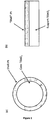
- a core-shell structure is represented schematically in Figure 1 .
- Many of the systems described in the literature contain a precious metal core, such as Au or Pd [19-22, 24-26, 28]. Consequently, although there is a potential reduction in the quantity of platinum required to produce an effective catalyst, use of another expensive metal within the core, keeps costs high.
- Other reported core materials include base metals (Cu [27], for example), which are more cost-effective than platinum, but likely to be unstable in a fuel cell.
- Adzic et al [17, 18] disclose a core-shell type structure with a NaWO 3 core.
- WO2008/025751 [29] discloses a Pt-coated zirconia and cerium-doped zirconia core-shell system.
- WO2009/041543 discloses a composite metal oxide containing titanium and tin.
- a catalyst support comprising such a composite metal oxide is not disclosed in these documents.
- the present invention seeks to provide materials for core-shell catalysts, which have a high specific activity for oxygen reduction at low loadings of platinum, i.e., a high activity per unit mass of platinum. It is a further aim to provide catalyst supports which are stable both in an electrochemical environment and under warm acidic conditions.
- the present invention is based on the determination that a support material based on tin-doped titanium oxide provides for improved wetting of platinum that has been applied to the surface of the oxide.
- the materials of the present invention allow more complete platinum films to be achieved at lower platinum loadings, compared to support materials comprising titanium oxide (also known as titania) only.
- the inventors have identified a correlation between the quantity of tin in a titanium oxide support and the loading of platinum required to achieve bulk platinum-like activity.
- the inventors have also found that the crystalline structure of titanium oxide has an effect on the amount of platinum required to achieve bulk platinum-like activity for the oxygen reduction reaction.
- the present invention provides a core-shell catalyst comprising a mixed metal oxide material of tin and titanium and a catalyst, wherein the mixed metal oxide material is formed as a core particle having a diameter of from 10-50 nm, and wherein the catalyst is applied as a shell on the core particle.
- the material comprises an oxide of titanium doped with tin.
- the metal content of the material comprises at least approximately 15 atomic % tin and not more than approximately 80 atomic % titanium. More preferably, the material comprises between 24 and 28 atomic % tin (on a metal basis) and between 72 and 76 atomic % titanium.
- the titanium oxide is in a crystalline form.
- the particle has a diameter of 10-50 nm, more preferably 10-25 mn.
- the catalyst comprises or consists of platinum or platinum alloy.
- the catalyst comprises one monolayer (ML) or more of platinum or platinum alloy. Even more preferably, the catalyst comprises 1.5 ML or more of platinum or platinum alloy.
- the catalysts comprises 20 ML or fewer of platinum or platinum alloy, more preferably 15 ML or fewer, most preferably 10 ML or fewer.
- the catalyst is applied to the mixed metal oxide material in a thickness of from 1 to 5 ML; more preferably 1.5 to 5.
- a method of producing a core-shell catalyst comprising forming a core particle as defined above; and forming a catalytic shell layer comprising at least one monolayer of catalyst on the core particle.
- the method comprises forming a catalytic layer of from 1 to 5 ML of catalyst; more preferably 1.5 ML or more.
- a further aspect of the present invention provides a core-shell catalyst for a fuel cell, the catalyst comprising a mixed metal oxide material as described above.
- the present invention also provides a fuel cell comprising a core-shell catalyst as described above.
- a yet further aspect of the present invention provides use of a core-shell catalyst as described above in a fuel cell.
- ML monolayer
- mixed metal oxide indicates an oxide of a mixture of metals; a mixture of metal oxides; or a combination thereof.
- TiSnO x mixed metal oxide materials of tin and titanium by the formulation TiSnO x . It will be appreciated that this is not a chemical formula indicating any specific stoichiometry, but merely a shorthand indication of the elemental composition of the material.
- the inventors have identified the loading of platinum at which bulk platinum like oxygen reduction behaviour is achieved for tin-doped anatase titanium oxide. It will be appreciated that the tin atoms disrupt the original anatase crystal structure of the titanium oxide. Bulk platinum like oxygen reduction behaviour is believed to occur when discrete particles of platinum coalesce to form layers (i.e. in a core-shell structure).
- Thin film models of core-shell catalysts for the oxygen reduction reaction in PEM fuel cells were synthesised with metal oxide cores and a platinum catalyst shell.
- Metal oxides offer a stable alternative to carbon supports (which are prone to oxidative destruction) and therefore increase the lifetime of fuel cells.
- the present inventors have produced thin film models of core-shell structures with a TiSnO x core and a platinum shell, which have the same (or similar) activity for oxygen reduction as bulk platinum.
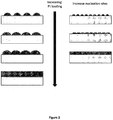
- the tin can help to create defects on the surface of the mixed metal oxide and cause more sites for nucleation of a metal overlayer. Addition of tin therefore causes smaller particles of platinum to be formed and leads to a more complete film at a lower equivalent thickness (or loading) of metal (as illustrated in Figure 2 ).
- a film of platinum, compared to discrete particles, can approach the oxygen reduction activity of bulk platinum since a significant number of platinum atoms will be in contact.
- d crit The amount of tin added to the titanium oxide which has been treated under the conditions necessary to form the anatase form prior to introduction of tin doping atoms, was shown to have a significant effect on the minimum thickness required to achieve the same overpotential for the oxygen reduction reaction as bulk platinum (defined as d crit ).
- d crit increases, i.e. higher loadings of Pt are required than on un-doped titanium oxide to achieve bulk Pt like behaviour.
- d crit was lowered to approximately 3.2 ML equivalent thickness of platinum.
- the overpotential was only slightly higher than that for bulk platinum. This performance at high tin loadings was retained after stability cycling and the tin doped titanium oxide was shown to be stable in a warm acidic environment to approximately 28 at.% (based on the total metal content, ie., excluding oxygen content).
- Thin film samples were deposited using a high-throughput PVD (Physical Vapour Deposition) system to model core-shell structures. Thin film models of the core-shell system are schematically represented in Figure 2 . The PVD system is described in detail elsewhere [31].
- a range of oxide samples were synthesised onto different substrates including silicon wafers, quartz wafers and electrochemical arrays (10x10 arrays of gold contact pads, as represented in Figure 3 ). Titanium was deposited from an electron gun (E-gun) source and tin was deposited from a Knudsen cell (K-cell) source. TiSnO x samples were prepared in the presence of molecular oxygen at a pressure of approximately 666.6 x 10 -6 Pa. Thin-film oxides were heated in a tube furnace at 450 °C under a flow of oxygen for 6 hours. These conditions allowed the anatase structure of the un-doped titanium oxide to form.
- E-gun electron gun
- K-cell Knudsen cell
- Platinum was deposited onto the pre-deposited oxide thin films from an E-gun source. During deposition, the oxide substrates were heated to 200 °C in order to dehydroxylate the surface. A shutter was moved during deposition to allow different equivalent thicknesses of platinum to be deposited onto different fields. The deposition procedures allowed for a varying oxide composition of the support in one direction and a varying amount of platinum in the other orthogonal direction. The amount of platinum deposited was calibrated by depositing thicker films onto silicon substrates and measuring the thickness of the films by AFM (Atomic Force Microscopy). A calibration curve against deposition time was then produced.
- AFM Anamic Force Microscopy
- composition of the oxide films was determined using a Laser Ablation Inductively Coupled Plasma Mass Spectrometer (LA-ICP-MS, New Wave 213 nm laser & Perkin Elmer Elan 9000). This method provides the relative composition of the metallic elements, but is not capable of measuring the oxygen concentration. Since the ICP-MS measurements are destructive, composition measurements were made on samples deposited onto silicon wafers. The same deposition conditions were used to deposit onto equivalent electrochemical arrays.
- LA-ICP-MS Laser Ablation Inductively Coupled Plasma Mass Spectrometer
- X-Ray diffraction (XRD) patterns were obtained using the Bruker D8 Discover diffractometer, having a high-precision, two-circle goniometer with independent stepper motors and optical encoders for the Theta and 2 Theta circles.
- the D8 diffractometer system was equipped with a GADDS detector operating at 45 kV and 0.65 mA.
- a high intensity X-ray I ⁇ S Incoatec source (with Cu K ⁇ radiation) was incorporated allowing high intensity and collimated X-rays to be localised on thin film materials, providing an efficient high throughput structural analysis. This analysis was carried out on oxide films deposited onto Si substrates.
- Photographs of the samples were obtained after 0, 2, 4, 6 and 24 hours. ICP-MS was also carried out on the samples before and after this testing.
- High-throughput electrochemical screening equipment enables electrochemical experiments on 100 independently addressable electrodes arranged in a 10 x 10 array in a parallel screening mode. This system has been described in detail elsewhere [2, 32].
- the geometric areas of the individual working electrodes on the electrochemical array are 1.0 mm 2 .
- the design of the cell and socket assembly provides a clean electrochemical environment with control of the temperature during experiments.
- the temperature was maintained at 25°C and a mercury/mercury sulphate (MMSE) reference electrode was used.
- the potential of the MMSE was measured ⁇ s .
- a hydrogen reference electrode prior to screening experiments and all potentials are quoted ⁇ s .
- RHE reversible hydrogen electrode
- a Pt mesh counter electrode was used, in a glass compartment separated from the working electrode compartment by a glass frit.
- Various sweep rates were used for different experiments which are outlined in Table 1.
- the electrolyte used for all experiments was 0.5 M HClO 4 prepared from concentrated HClO 4 (double distilled, GFS) and ultrapure water (ELGA, 18 M ⁇ cm).
- Example 5 Anatase and amorphous titanium oxide
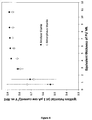
- Figure 4 shows the potential at which 1 ⁇ A raw current is reached (the threshold value used to measure the ignition or onset potential) during the oxygen reduction slow cycling experiment.
- An ignition or onset potential is defined as the potential at which the absolute value of the current starts to increase from the background (double layer) level in a cyclic voltammetry experiment, indicating that an oxidation or reduction reaction is taking place at that potential. Cycling was at 20 mV s -1 in oxygenated 0.5 M HClO 4 for various equivalent thicknesses of Pt. Average results were taken across an array row for identical Pt equivalent thicknesses for Pt supported on amorphous and anatase titanium oxide. The ignition potential gives a measure of the onset potential of the oxygen reduction reaction (the higher the onset potential the more active the catalyst for the oxygen reduction reaction).
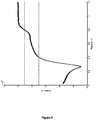
- Figure 6 shows the voltammetry for one electrode during the oxygen reduction reaction with 0.7 ML, equivalent thickness of Pt supported on amorphous titanium oxide.
- the two currents at which ignition potentials have been measured are indicated by grey lines.
- Two reduction features are seen, a small feature with a high onset potential and a larger feature with a low onset potential. These two features are probably due to inhomogeneity within the sample, i.e. some large islands of platinum leading to a high ignition potential and some smaller discrete particles leading to the lower ignition potential.
- the ignition potential measured at 1 ⁇ A raw current gives an indication of the onset of the first reduction feature and the ignition potential measured at 3 ⁇ A raw current gives an indication of the onset of the second reduction feature.
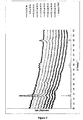
- FIG. 7 shows the XRD patterns obtained from films of TiSnO x with varying Sn content deposited onto a silicon substrate after heating in the furnace. As the amount of Sn in the film increases, the peaks associated with the anatase TiO 2 structure appear to decrease in intensity, suggesting that the Sn disrupts the anatase structure. No obvious broadening of the main peak for anatase is seen, suggesting that the crystallite size is not significantly disrupted. On the points with the highest Sn content (e.g.
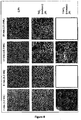
- Figure 8 shows TEM images for several equivalent thicknesses of Pt on carbon, anatase titanium oxide and tin-doped anatase titanium oxide (approximately 28.1 at.% Sn). Comparing the behaviour on anatase TiO x with that on carbon, it would appear that the islands formed on the oxide surface are larger than those on carbon. This might suggest that Pt wets the TiO x anatase surface better than it wets the carbon surface, since the islands are probably agglomerated small particles. On the annealed TiSnO x surface, it was difficult to image the ultra-thin films since oxide appears to roughen on annealing and the contrast of the deposited films versus the rough surface is very difficult to distinguish. This suggests that the films wet the surface very well on these tin-doped materials.
- Figure 9 shows the ignition potentials (potential at which 1 ⁇ A raw current is reached in the second negative going cycle of the oxygen reduction slow cycling experiment) for several of the arrays. Electrodes with high ignition potentials show the best activity for the oxygen reduction reaction (ORR).
- the critical thickness (d crit ) is the equivalent thickness of Pt below which the ignition potential starts to shift to lower potential (i.e. away from bulk Pt like behaviour).
- d crit is -4.7-5.5 ML (monolayers or atomic layers).
- the d crit value initially increases with increasing tin, suggesting a decrease in activity for oxygen reduction.
- FIG. 10 shows the equivalent ignition potential plots to Figure 9 after stability cycling. On electrodes with no or low tin content the ignition potential has decreased for electrodes with lower equivalent thicknesses of Pt. However, on electrodes with high tin content (above approximately 24 at.% Sn), the ignition potentials remained fairly constant before and after stability cycling.
- Figure 11 shows a comparison of oxygen reduction slow cycling voltammetry (the second negative going cycle) for several different equivalent thicknesses of Pt on electrodes with high (37.3 at.% Sn), low (6.2 at.% Sn) and no tin in the supporting titanium oxide before stability cycling.
- the oxygen reduction voltammetry appeared to remain the same until an equivalent thickness of 4.7 ML, where the oxygen reduction wave shifted to a slightly lower potential (suggesting an increase in the overpotential for the reaction i.e. a lower ignition potential).
- the reduction wave shifted to lower potentials with a further decrease in equivalent thickness of Pt.
- Figure 12 shows the oxygen reduction voltammetry (the second negative going cycle of the oxygen reduction slow cycling experiment) after stability cycling for different equivalent thicknesses of Pt supported on titanium oxide with high (37.3 at.% Sn), low (6.2 at.% Sn) and no tin content.
- the electrodes with a high tin content in the support material very little change was seen in the voltammetry before and after stability cycling.
- electrodes with a low tin content in the support material electrodes with higher overpotentials than bulk platinum for the oxygen reduction reaction before stability cycling shifted to an even higher overpotential (i.e. the reduction wave shifted to lower potential).
- the d crit value shifted to between 6.3 and 7.9 ML.
- the negative shift of the oxygen reduction feature with decreasing equivalent thickness of Pt has been observed before on platinum supported on oxide supports. It is thought to be associated with increased irreversibility of platinum oxide formation and when Pt starts to break up into small islands and particles [7, 34]. Increased overpotentials for the ORR after stability cycling are probably associated with restructuring of the Pt films on the surface of the oxide.
- Acid stability tests were carried out on the crystalline TiSnO x materials for the composition range of interest (-0-40 at.% Sn).
- the samples were immersed in 200 mL of 0.1 M H 2 SO 4 at 80°C for a period of 24 hours. Photographs of the samples were obtained after 0, 2, 4, 6 and 24 hours. Images of the screened samples are shown in Figure 13 . It can be seen that the first two samples were stable throughout the entire course of the experiment. However, for the sample which has the highest level of Sn content, the first 3-4 fields (highest tin) showed some sign of change of the material. This corresponds to a tin content (on a metals basis) greater than -32 at.%.
- ICP-MS measurements were performed before and after the acid exposure to see if any compositional change could be observed due to preferential dissolution of one element versus another.
- Particles of titania doped with tin were synthesised using the method described by Darr et al. ( US 2013136687 A1 ), using the apparatus described therein and precursors of Titanium oxysulphate [29.9% Ti as TiO 2 , ⁇ 17 wt% free H 2 SO 4 ], Tin(II) sulphate [97%] and Potassium hydroxide [>86%].
- the materials formed were measured by Energy Dispersive X-Ray spectroscopy (EDX) (using a Tescan Vega 3 LMU Scanning Electron Microscope (SEM) fitted with an Energy Dispersive X-Ray (EDX) detector (Oxford Instruments X-Max 50, 50 mm 2 large area SDD detector)). As shown in table 2 below in which compositions are quoted as atomic percentages of tin on a metals basis (i.e. excluding oxygen), this confirmed that the level of tin doping was close to the target levels. Table 2.
- the materials described in the present application are readily scaled up from the model thin film samples to bulk core shell powder materials using known techniques, such as those described in US2010/0197490 , US2007/0031722 , US2009/0117257 , US2006/0263675 and CN 101455970 .
- core particles produced according to example 7 could easily be coated with Pt using methods similar to those described in lines 5-10 of page 9 of WO2013/013704 , to form a core-shell structure suitable for use as an electrocatalyst within a fuel cell.
- preparation of the materials is not limited to these methods.
- the ignition potential for the oxygen reduction reaction initially remains constant. However below a certain critical thickness (d crit ) the ignition potential starts to decrease (i.e. the over potential for the oxygen reduction reaction starts to increase, and the electrodes become less active for the oxygen reduction reaction).
- the ignition potential is similar to a bulk platinum electrode. This suggests a core-shell model structure, where enough Pt atoms are in contact to behave as the bulk metal. When the ignition potential starts to decrease this is due to the platinum film starting to break up into discrete particles.
- the anatase form of titanium oxide allows the loading of platinum to be reduced further than on amorphous titanium oxide before the oxygen reduction behaviour shifts away from the bulk behaviour. This occurs below approximately 5 ML equivalent thickness of Pt.
- d crit the critical minimum thickness at which bulk Pt like activity is achieved
- d crit the critical minimum thickness at which bulk Pt like activity is achieved
- tin content reaches approximately 24 at.% (on a metal basis)
- bulk platinum like oxygen reduction activity is seen down to approximately 3.2 ML equivalent thickness of Pt and is only slightly altered at 1.6 ML.
- tin doping helps to increase the wetting of the platinum on the surface of the oxide allowing more complete films of platinum to be produced down to these reduced loadings (i.e. a core-shell structure).
- the activity of the electrodes with above 24 at.% Sn doping is retained after limited accelerated stability cycling, suggesting that the platinum does not restructure under electrochemical control.
- the stability of the materials described in this application is such as to render them effective for use in a fuel cell.
Landscapes
- Chemical & Material Sciences (AREA)
- Engineering & Computer Science (AREA)
- Organic Chemistry (AREA)
- Materials Engineering (AREA)
- Electrochemistry (AREA)
- General Chemical & Material Sciences (AREA)
- Chemical Kinetics & Catalysis (AREA)
- Inorganic Chemistry (AREA)
- Geology (AREA)
- General Life Sciences & Earth Sciences (AREA)
- Nanotechnology (AREA)
- Life Sciences & Earth Sciences (AREA)
- Environmental & Geological Engineering (AREA)
- Condensed Matter Physics & Semiconductors (AREA)
- Crystallography & Structural Chemistry (AREA)
- General Physics & Mathematics (AREA)
- Composite Materials (AREA)
- Physics & Mathematics (AREA)
- Manufacturing & Machinery (AREA)
- Catalysts (AREA)
- Inert Electrodes (AREA)
- Inorganic Compounds Of Heavy Metals (AREA)
Description
- The present invention relates to materials for use in a fuel cell and particularly to core-shell composite materials for use in a fuel cell.
- A fuel cell comprises an anode for oxidation of a fuel and a cathode where an oxidising agent, such as oxygen, is reduced. Ions are transported between the two electrodes by means of an electrolyte. Fuel supplied to the cell is oxidised at the anode, releasing electrons which pass through an external circuit to the cathode, where they are consumed during reduction of the oxidising species. In a polymer electrolyte membrane fuel cell (PEMFC), the fuel is usually hydrogen and the oxidising species is usually oxygen. A polymer electrolyte allows protons to flow from the anode to the cathode.
- Platinum-containing catalysts are one of the most efficient catalysts for facilitating the oxygen reduction reaction (ORR) at the cathode of a fuel cell. Platinum, however, is a costly material and so methods for reducing the quantity of platinum required for an effective fuel cell are highly sought-after. Traditionally, platinum is dispersed over a carbon support to increase the surface area of the platinum, relative to its mass. A maximum in mass activity is produced with a platinum particle size of approximately 3-4 nm [References 1-4]. In this system, if the particle size of platinum is further reduced, oxygen reduction activity is also sharply reduced, limiting advantages that can be achieved by dispersion. An additional disadvantage with the system is that the carbon support can become oxidised under fuel cell operating conditions. This oxidation leads to degradation of the catalyst, which limits the lifetime of the fuel cell [5].
- Metal oxides have previously been investigated for use as fuel cell catalyst supports [6-18]. Metal oxides are less prone to oxidative corrosion than carbon, and can, therefore, be more stable in a fuel cell environment. The use of metal oxides as supports for fuel cell catalysts and methods of synthesising suitable oxides has been described in, for example,
US2009/0065738A1 ,US2006/0263675 ,US7,704,918B2 ,US2007/0037041A1 ,WO2008/025751 andWO2009/152003 [14-18]. - Core-shell catalysts with Pt as the shell material are reported in the literature [17-28]. A core-shell structure is represented schematically in
Figure 1 . Many of the systems described in the literature contain a precious metal core, such as Au or Pd [19-22, 24-26, 28]. Consequently, although there is a potential reduction in the quantity of platinum required to produce an effective catalyst, use of another expensive metal within the core, keeps costs high. Other reported core materials include base metals (Cu [27], for example), which are more cost-effective than platinum, but likely to be unstable in a fuel cell. Adzic et al [17, 18] disclose a core-shell type structure with a NaWO3 core.WO2008/025751 [29] discloses a Pt-coated zirconia and cerium-doped zirconia core-shell system. - There is a report in the literature illustrating the use of tin oxide as a core support material for a platinum catalyst shell for use in a direct ethanol fuel cell [24]. This system shows good activity for ethanol oxidation. However, there is no evidence in the literature to suggest that the catalyst is stable, either with continued cycling or in an acid environment. It has previously been demonstrated that SnO2 has an inherent conductivity because it readily forms oxygen vacancies [19].
-
WO2009/041543 discloses a composite metal oxide containing titanium and tin.US2007/0264492 discloses TixSn1-xO2 nanoparticles, wherein x preferably satisfies the relationship of 0.1<=x<=0.99, more preferably 0.1<=x<=0.8, and still more preferably 0.1<=x<=0.6. A catalyst support comprising such a composite metal oxide is not disclosed in these documents. - The present invention seeks to provide materials for core-shell catalysts, which have a high specific activity for oxygen reduction at low loadings of platinum, i.e., a high activity per unit mass of platinum. It is a further aim to provide catalyst supports which are stable both in an electrochemical environment and under warm acidic conditions.
- The present invention is based on the determination that a support material based on tin-doped titanium oxide provides for improved wetting of platinum that has been applied to the surface of the oxide. The materials of the present invention allow more complete platinum films to be achieved at lower platinum loadings, compared to support materials comprising titanium oxide (also known as titania) only.
- The inventors have identified a correlation between the quantity of tin in a titanium oxide support and the loading of platinum required to achieve bulk platinum-like activity.
- The inventors have also found that the crystalline structure of titanium oxide has an effect on the amount of platinum required to achieve bulk platinum-like activity for the oxygen reduction reaction.
- In its broadest aspect, the present invention provides a core-shell catalyst comprising a mixed metal oxide material of tin and titanium and a catalyst, wherein the mixed metal oxide material is formed as a core particle having a diameter of from 10-50 nm, and wherein the catalyst is applied as a shell on the core particle.
- Preferably, the material comprises an oxide of titanium doped with tin.
- In a preferred embodiment, the metal content of the material comprises at least approximately 15 atomic % tin and not more than approximately 80 atomic % titanium. More preferably, the material comprises between 24 and 28 atomic % tin (on a metal basis) and between 72 and 76 atomic % titanium.
- Advantageously, the titanium oxide is in a crystalline form.
- Preferably, the particle has a diameter of 10-50 nm, more preferably 10-25 mn.
- Preferably, the catalyst comprises or consists of platinum or platinum alloy.
- Preferably, the catalyst comprises one monolayer (ML) or more of platinum or platinum alloy. Even more preferably, the catalyst comprises 1.5 ML or more of platinum or platinum alloy.
- Preferably, the catalysts comprises 20 ML or fewer of platinum or platinum alloy, more preferably 15 ML or fewer, most preferably 10 ML or fewer.
- Preferably, the catalyst is applied to the mixed metal oxide material in a thickness of from 1 to 5 ML; more preferably 1.5 to 5.
- According to another aspect of the present invention, there is provided a method of producing a core-shell catalyst, the method comprising forming a core particle as defined above; and forming a catalytic shell layer comprising at least one monolayer of catalyst on the core particle.
- More preferably, the method comprises forming a catalytic layer of from 1 to 5 ML of catalyst; more preferably 1.5 ML or more.
- A further aspect of the present invention provides a core-shell catalyst for a fuel cell, the catalyst comprising a mixed metal oxide material as described above.
- The present invention also provides a fuel cell comprising a core-shell catalyst as described above.
- A yet further aspect of the present invention provides use of a core-shell catalyst as described above in a fuel cell.
- The term monolayer (ML) as used herein is used to mean the equivalent amount of catalytic material which would form a uniform layer of 1 atom thickness on a flat surface. It will be appreciated that, in practice, a surface of the mixed metal oxide is unlikely to be perfectly atomically flat. Accordingly, it will be understood that a 1 ML layer of catalyst on the mixed metal oxide substrate will have areas where there are a plurality of catalyst atoms in a layer and areas where there are no atoms of catalyst.
- As used herein, the term mixed metal oxide indicates an oxide of a mixture of metals; a mixture of metal oxides; or a combination thereof.
-
Figure 1 is a schematic cross-section of a core-shell structure and an equivalent layer structure used to model the core shell particle behaviour; -
Figure 2 is a schematic representation of particle growth and nucleation onto supports with a low number of nucleation sites and an increased number of nucleation sites; -
Figure 3 is a schematic view of an electrochemical array substrate; -
Figure 4 is a chart illustrating the potential at which 1 µA raw current is reached during the oxygen reduction slow cycling experiment for Pt supported on amorphous and anatase titanium oxide. Error bars are plus and minus one standard deviation; -
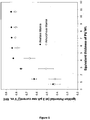
Figure 5 is a chart illustrating the potential at which 3 µA raw current is reached during the oxygen reduction slow cycling experiment for amorphous and anatase titanium oxide. Error bars are plus and minus one standard deviation; -
Figure 6 is a chart illustrating example O2 reduction slow cycling CV for 0.7 ML of Pt supported on amorphous TiOx indicating the two different potentials where ignition potentials have been compared; -
Figure 7 is a chart illustrating XRD of TiSnOx films deposited on silicon wafers deposited at room temperature and heated for 6 hours at 450 °C with varying Sn content (also included for reference a standard anatase TiO2 XRD pattern); -
Figure 8 shows TEM images for various equivalent thicknesses of Pt on carbon, anatase titanium oxide and tin doped anatase titanium oxide; -
Figure 9 is a chart illustrating ignition potential (the potential at which 1 µA raw current is reached) for the oxygen reduction reaction (the second negative going cycle at 20 mVs-1 in O2 saturated 0.5 M HClO4) for Pt supported on tin-doped titanium oxide (atomic percentages of tin are shown along the bottom of the diagram) before stability cycling; -
Figure 10 is a chart illustrating ignition potential (the potential at which 1 µA raw current is reached) for the oxygen reduction reaction (the second negative going cycle at 20 mVs-1 in O2 saturated 0.5 M HClO4) for Pt supported on tin doped titanium oxide (atomic percentages of tin are shown along the bottom of the diagram) after stability cycling; -
Figure 11 is a chart illustrating the second negative going cycle of the oxygen reduction slow cycling experiment (in O2 saturated 0.5 M HClO4 at 20 mVs-1) for selected TiSnOx compositions with varying Pt equivalent thickness before stability cycling; -
Figure 12 is a chart illustrating the second negative going cycle of the oxygen reduction slow cycling experiment (in O2 saturated 0.5 M HClO4 at 20 mVs-1) for selected TiSnOx compositions with varying Pt equivalent thickness after stability cycling; -
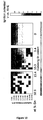
Figure 13 shows images of TiSnOx samples (deposited on silicon wafers) with varying Sn content after exposure to 0.1 M H2SO4 for 0, 2, 4, 6 and 24 hours at 80 °C; -
Figure 14 is a chart illustrating a comparison of the tin content (measured by ICP-MS) of tin doped titanium oxide samples deposited on silicon wafers before and after 24 hours exposure to 0.1 M H2SO4 at 80 °C; and -
Figure 15 is a chart illustrating XRD measurements of tin doped titania particles with varying tin content compared to a standard anatase titania reference. - For ease of reference, we will refer to mixed metal oxide materials of tin and titanium by the formulation TiSnOx. It will be appreciated that this is not a chemical formula indicating any specific stoichiometry, but merely a shorthand indication of the elemental composition of the material.
- The inventors have identified the loading of platinum at which bulk platinum like oxygen reduction behaviour is achieved for tin-doped anatase titanium oxide. It will be appreciated that the tin atoms disrupt the original anatase crystal structure of the titanium oxide. Bulk platinum like oxygen reduction behaviour is believed to occur when discrete particles of platinum coalesce to form layers (i.e. in a core-shell structure).
- Thin film models of core-shell catalysts for the oxygen reduction reaction in PEM fuel cells were synthesised with metal oxide cores and a platinum catalyst shell. Metal oxides offer a stable alternative to carbon supports (which are prone to oxidative destruction) and therefore increase the lifetime of fuel cells.
- As described below, the present inventors have produced thin film models of core-shell structures with a TiSnOx core and a platinum shell, which have the same (or similar) activity for oxygen reduction as bulk platinum. In addition to increased conductivity, it appears that the tin can help to create defects on the surface of the mixed metal oxide and cause more sites for nucleation of a metal overlayer. Addition of tin therefore causes smaller particles of platinum to be formed and leads to a more complete film at a lower equivalent thickness (or loading) of metal (as illustrated in
Figure 2 ). A film of platinum, compared to discrete particles, can approach the oxygen reduction activity of bulk platinum since a significant number of platinum atoms will be in contact. - The experiments below also show that when a titanium oxide support is crystallised (to form specifically the anatase form), an overpotential for the oxygen reduction reaction equivalent to that of bulk platinum is achieved at a lower equivalent thickness of platinum than on the amorphous support.
- The amount of tin added to the titanium oxide which has been treated under the conditions necessary to form the anatase form prior to introduction of tin doping atoms, was shown to have a significant effect on the minimum thickness required to achieve the same overpotential for the oxygen reduction reaction as bulk platinum (defined as dcrit). At low tin doping, dcrit increases, i.e. higher loadings of Pt are required than on un-doped titanium oxide to achieve bulk Pt like behaviour. However, at a higher tin content, above approximately 24 atomic % (at.% on a metal basis), dcrit was lowered to approximately 3.2 ML equivalent thickness of platinum. At 1.6 ML equivalent thickness, the overpotential was only slightly higher than that for bulk platinum. This performance at high tin loadings was retained after stability cycling and the tin doped titanium oxide was shown to be stable in a warm acidic environment to approximately 28 at.% (based on the total metal content, ie., excluding oxygen content).
- Thin film samples were deposited using a high-throughput PVD (Physical Vapour Deposition) system to model core-shell structures. Thin film models of the core-shell system are schematically represented in
Figure 2 . The PVD system is described in detail elsewhere [31]. A range of oxide samples were synthesised onto different substrates including silicon wafers, quartz wafers and electrochemical arrays (10x10 arrays of gold contact pads, as represented inFigure 3 ). Titanium was deposited from an electron gun (E-gun) source and tin was deposited from a Knudsen cell (K-cell) source. TiSnOx samples were prepared in the presence of molecular oxygen at a pressure of approximately 666.6 x 10⁻⁶ Pa. Thin-film oxides were heated in a tube furnace at 450 °C under a flow of oxygen for 6 hours. These conditions allowed the anatase structure of the un-doped titanium oxide to form. - Platinum was deposited onto the pre-deposited oxide thin films from an E-gun source. During deposition, the oxide substrates were heated to 200 °C in order to dehydroxylate the surface. A shutter was moved during deposition to allow different equivalent thicknesses of platinum to be deposited onto different fields. The deposition procedures allowed for a varying oxide composition of the support in one direction and a varying amount of platinum in the other orthogonal direction. The amount of platinum deposited was calibrated by depositing thicker films onto silicon substrates and measuring the thickness of the films by AFM (Atomic Force Microscopy). A calibration curve against deposition time was then produced.
- The composition of the oxide films was determined using a Laser Ablation Inductively Coupled Plasma Mass Spectrometer (LA-ICP-MS, New Wave 213 nm laser & Perkin Elmer Elan 9000). This method provides the relative composition of the metallic elements, but is not capable of measuring the oxygen concentration. Since the ICP-MS measurements are destructive, composition measurements were made on samples deposited onto silicon wafers. The same deposition conditions were used to deposit onto equivalent electrochemical arrays.
- X-Ray diffraction (XRD) patterns were obtained using the Bruker D8 Discover diffractometer, having a high-precision, two-circle goniometer with independent stepper motors and optical encoders for the Theta and 2 Theta circles. The D8 diffractometer system was equipped with a GADDS detector operating at 45 kV and 0.65 mA. A high intensity X-ray IµS Incoatec source (with Cu Kα radiation) was incorporated allowing high intensity and collimated X-rays to be localised on thin film materials, providing an efficient high throughput structural analysis. This analysis was carried out on oxide films deposited onto Si substrates.
- Stability tests were carried out on the oxide films deposited on Si substrates. The samples were immersed in 200 mL of 0.1 M H2SO4 at 80°C for a period of 24 hours.
- Photographs of the samples were obtained after 0, 2, 4, 6 and 24 hours. ICP-MS was also carried out on the samples before and after this testing.
- Transmission Electron Microscopy measurements were performed using a JEOL JEM-3010 TEM with an accelerating voltage of 300 kV. All images were at a magnification of x200,000. The scale bars illustrated in the figures represent a length of 20 nm. The samples were prepared for analysis by depositing various thicknesses of Pt onto fresh carbon coated TEM grids (for comparison with the oxide materials), and oxide covered TEM windows which had previously been treated at 450 °C in oxygen for 6 hours.
- High-throughput electrochemical screening equipment enables electrochemical experiments on 100 independently addressable electrodes arranged in a 10 x 10 array in a parallel screening mode. This system has been described in detail elsewhere [2, 32]. The geometric areas of the individual working electrodes on the electrochemical array are 1.0 mm2.
- The design of the cell and socket assembly provides a clean electrochemical environment with control of the temperature during experiments. In the experiments described, the temperature was maintained at 25°C and a mercury/mercury sulphate (MMSE) reference electrode was used. The potential of the MMSE was measured νs. a hydrogen reference electrode prior to screening experiments and all potentials are quoted νs. the reversible hydrogen electrode (RHE). A Pt mesh counter electrode was used, in a glass compartment separated from the working electrode compartment by a glass frit. Various sweep rates were used for different experiments which are outlined in Table 1.
- The electrolyte used for all experiments was 0.5 M HClO4 prepared from concentrated HClO4 (double distilled, GFS) and ultrapure water (ELGA, 18 MΩ cm).
- The gases used (Ar, O2 and CO) were of the highest commercially available purity (Air Products). Unless stated otherwise, experiments were performed under an atmosphere of argon. Oxygen reduction experiments were performed under an atmosphere of O2. During potential step measurements, oxygen was bubbled through the electrolyte. Unless noted otherwise, the maximum potential applied to the electrodes was 1.2 V νs. RHE. The screening procedure carried out on each array is outlined in Table 1.
Table 1: Electrochemical screening procedure. Experiment Gas Potential limits / V νs. RHE Sweep rate / mV s-1 Bubbling Ar 20min 3 CVs in deoxygenated solution Ar above solution 0.025-1.200 100 O2 saturation Bubbling Ar 60s At 1.000 Bubbling O 2 10 minAt 1.000 O2 reduction steps Bubbling O2 in solution Step from 1.00 to 0.60 and back to 1.00 in 50 mV increments every 90 s 3 CVs in O2 saturated solution O2 above solution 0.025-1.200 5 Bubbling Ar 20 min200 CVs stability testing Ar above solution 0.025-1.200 100 Bubbling with O2 for 20 min At 1.000 3 CVs in O2 saturated solution O2 above solution 0.025-1.200 5 O2 reduction steps Bubbling O2 in solution Step from 1.00 to 0.60 and back to 1.00 in 50 mV increments every 90 s Bubbling CO 15 min At 0.075 Bubbling Ar 20 minAt 0.075 CO stripping Ar above solution 0.025-1.200 100 - To compare amorphous and crystalline titanium oxide as a support for Pt, separate electrochemical arrays were synthesised. The deposited titanium oxide was amorphous. The titanium oxide was then crystallised by heating in a tube furnace at 450°C for 6 hours under a flow of oxygen. XRD confirmed the titanium oxide had been crystallised in the anatase form.
-
Figure 4 shows the potential at which 1 µA raw current is reached (the threshold value used to measure the ignition or onset potential) during the oxygen reduction slow cycling experiment. An ignition or onset potential is defined as the potential at which the absolute value of the current starts to increase from the background (double layer) level in a cyclic voltammetry experiment, indicating that an oxidation or reduction reaction is taking place at that potential. Cycling was at 20 mV s-1 in oxygenated 0.5 M HClO4 for various equivalent thicknesses of Pt. Average results were taken across an array row for identical Pt equivalent thicknesses for Pt supported on amorphous and anatase titanium oxide. The ignition potential gives a measure of the onset potential of the oxygen reduction reaction (the higher the onset potential the more active the catalyst for the oxygen reduction reaction). - At high equivalent thicknesses of Pt, the ignition potential remained fairly constant with decreasing equivalent thickness of Pt. The ignition potential was similar for both support materials. However, between 5 and 6 ML (monolayers) equivalent thickness of Pt, the ignition potential starts to decrease on both support materials. The effect on the amorphous material is more significant. Below 5 ML, for both supports, the ignition potential decreases further. On the amorphous titanium oxide at low equivalent thicknesses there is a large amount of scatter in the data.
Figure 5 shows the potential at which 3 µA raw current is reached in the oxygen reduction slow cycling experiment for the same set of data. At 3 µA, it is clear that the reduction wave shifted more significantly negative on the amorphous support, suggesting that the anatase support provides better wetting for the platinum and therefore higher activity down to a lower equivalent thickness (and therefore loading) of Pt. -
Figure 6 shows the voltammetry for one electrode during the oxygen reduction reaction with 0.7 ML, equivalent thickness of Pt supported on amorphous titanium oxide. The two currents at which ignition potentials have been measured are indicated by grey lines. Two reduction features are seen, a small feature with a high onset potential and a larger feature with a low onset potential. These two features are probably due to inhomogeneity within the sample, i.e. some large islands of platinum leading to a high ignition potential and some smaller discrete particles leading to the lower ignition potential. The ignition potential measured at 1 µA raw current gives an indication of the onset of the first reduction feature and the ignition potential measured at 3 µA raw current gives an indication of the onset of the second reduction feature. - These results suggest that the platinum shows slightly better wetting on the anatase titanium oxide allowing bulk platinum like oxygen reduction activity to a lower equivalent thickness than on amorphous titanium oxide.
- The TiSnOx films were deposited at room temperature and then heated to 450 °C for 6 hours under a flow of oxygen in a tube furnace. These conditions were found to form the anatase phase of TiO2.
Figure 7 shows the XRD patterns obtained from films of TiSnOx with varying Sn content deposited onto a silicon substrate after heating in the furnace. As the amount of Sn in the film increases, the peaks associated with the anatase TiO2 structure appear to decrease in intensity, suggesting that the Sn disrupts the anatase structure. No obvious broadening of the main peak for anatase is seen, suggesting that the crystallite size is not significantly disrupted. On the points with the highest Sn content (e.g. at 46.9 at.% Sn) some broad peaks at approximately 2θ=26.6° and 2θ=33.9° are seen. These probably relate to the (110) and (101) planes of cassiterite SnO2 respectively (which is a rutile structure) [33]. As indicated above, atomic percentage values given are on the total metal content. That is to say, 46.9 at% Sn indicates 53.1 at% Ti. The exact stoichiometry including oxygen atoms is undefined but is at or close to stoichiometric, thereby maintains oxide properties. -
Figure 8 shows TEM images for several equivalent thicknesses of Pt on carbon, anatase titanium oxide and tin-doped anatase titanium oxide (approximately 28.1 at.% Sn). Comparing the behaviour on anatase TiOx with that on carbon, it would appear that the islands formed on the oxide surface are larger than those on carbon. This might suggest that Pt wets the TiOx anatase surface better than it wets the carbon surface, since the islands are probably agglomerated small particles. On the annealed TiSnOx surface, it was difficult to image the ultra-thin films since oxide appears to roughen on annealing and the contrast of the deposited films versus the rough surface is very difficult to distinguish. This suggests that the films wet the surface very well on these tin-doped materials. -
Figure 9 shows the ignition potentials (potential at which 1 µA raw current is reached in the second negative going cycle of the oxygen reduction slow cycling experiment) for several of the arrays. Electrodes with high ignition potentials show the best activity for the oxygen reduction reaction (ORR). The critical thickness (dcrit) is the equivalent thickness of Pt below which the ignition potential starts to shift to lower potential (i.e. away from bulk Pt like behaviour). On electrodes with no Sn doping dcrit is -4.7-5.5 ML (monolayers or atomic layers). As a small amount of tin is added to the support, the dcrit value initially increases with increasing tin, suggesting a decrease in activity for oxygen reduction. However, as further tin is added to the support material, dcrit decreases again. Bulk Pt like behaviour is seen down to low equivalent thicknesses of Pt, between 3.2 and 4.7 ML at Sn contents above approximately 24 at.% Sn. At 1.6 ML equivalent thickness (above approximately 24 at.% Sn) the ignition potential is only slightly shifted, indicating only a small loss in activity. - 200 cycles between 0.025 and 1.2 V νs. RHE were carried out on each array in Ar purged 0.5 M HClO4. After this stability cycling, further oxygen reduction experiments were performed.
Figure 10 shows the equivalent ignition potential plots toFigure 9 after stability cycling. On electrodes with no or low tin content the ignition potential has decreased for electrodes with lower equivalent thicknesses of Pt. However, on electrodes with high tin content (above approximately 24 at.% Sn), the ignition potentials remained fairly constant before and after stability cycling. -
Figure 11 shows a comparison of oxygen reduction slow cycling voltammetry (the second negative going cycle) for several different equivalent thicknesses of Pt on electrodes with high (37.3 at.% Sn), low (6.2 at.% Sn) and no tin in the supporting titanium oxide before stability cycling. On the electrodes with no tin in the support, as the equivalent thickness of Pt decreases, the oxygen reduction voltammetry appeared to remain the same until an equivalent thickness of 4.7 ML, where the oxygen reduction wave shifted to a slightly lower potential (suggesting an increase in the overpotential for the reaction i.e. a lower ignition potential). The reduction wave shifted to lower potentials with a further decrease in equivalent thickness of Pt. On the electrodes with 6.2 at.% Sn in the support, the overpotential increased for the oxygen reduction reaction between 7.9 and 10.3 ML, equivalent thickness of Pt. However, on electrodes with high tin content (37.3 at.% Sn) the overpotential increased when the equivalent thickness was decreased to 1.6 ML, suggesting the dcrit value is between 1.6 and 4.7 ML. However the shift in onset potential at 1.6 ML was only small. -
Figure 12 shows the oxygen reduction voltammetry (the second negative going cycle of the oxygen reduction slow cycling experiment) after stability cycling for different equivalent thicknesses of Pt supported on titanium oxide with high (37.3 at.% Sn), low (6.2 at.% Sn) and no tin content. For the electrodes with a high tin content in the support material, very little change was seen in the voltammetry before and after stability cycling. However, for electrodes with a low tin content in the support material, electrodes with higher overpotentials than bulk platinum for the oxygen reduction reaction before stability cycling shifted to an even higher overpotential (i.e. the reduction wave shifted to lower potential). For electrodes with un-doped titanium oxide as the support material, the dcrit value shifted to between 6.3 and 7.9 ML. The negative shift of the oxygen reduction feature with decreasing equivalent thickness of Pt has been observed before on platinum supported on oxide supports. It is thought to be associated with increased irreversibility of platinum oxide formation and when Pt starts to break up into small islands and particles [7, 34]. Increased overpotentials for the ORR after stability cycling are probably associated with restructuring of the Pt films on the surface of the oxide. - Acid stability tests were carried out on the crystalline TiSnOx materials for the composition range of interest (-0-40 at.% Sn). The samples were immersed in 200 mL of 0.1 M H2SO4 at 80°C for a period of 24 hours. Photographs of the samples were obtained after 0, 2, 4, 6 and 24 hours. Images of the screened samples are shown in
Figure 13 . It can be seen that the first two samples were stable throughout the entire course of the experiment. However, for the sample which has the highest level of Sn content, the first 3-4 fields (highest tin) showed some sign of change of the material. This corresponds to a tin content (on a metals basis) greater than -32 at.%. - In addition to determining whether there was any visible change in the samples on exposure to acid, ICP-MS measurements were performed before and after the acid exposure to see if any compositional change could be observed due to preferential dissolution of one element versus another.
- The Sn composition varied across each array. Therefore, a row of fields were investigated for each array.
Figure 14 shows a plot of the Sn content after 24 hour exposure to an acid bath versus the initial at.% Sn. It is clear that within the error of the ICP-MS measurement there was no relative loss of Sn versus Ti for values up to 28 at.% Sn. Above this value there was evidence of a slight relative loss of Sn, eventually leading to visual loss of material observed above 32 at.% Sn. - By combining the data from the electrochemical measurements of oxygen reduction activity and the acid testing it suggests that an optimum composition of approximately 24-28 at.% Sn in the titanium oxide support provides an highly active and stable catalyst.
- Particles of titania doped with tin were synthesised using the method described by Darr et al. (
US 2013136687 A1 ), using the apparatus described therein and precursors of Titanium oxysulphate [29.9% Ti as TiO2, <17 wt% free H2SO4], Tin(II) sulphate [97%] and Potassium hydroxide [>86%]. - The materials formed were measured by Energy Dispersive X-Ray spectroscopy (EDX) (using a
Tescan Vega 3 LMU Scanning Electron Microscope (SEM) fitted with an Energy Dispersive X-Ray (EDX) detector (Oxford Instruments X-Max Table 2. Nominal compositions of tin doped titania particles compared with compositions measured by EDX, Nominal Composition (Sn at.%) Actual Composition (Sn at.%) 0 0.0 18 20.2 22 22.8 26 27.2 30 33.5 34 37.6 - XRD was carried out using the same machine as for example 2 above and measurements of the samples are shown in
Figure 15 along with a standard anatase titania reference. With no tin doping (0 % Sn), peaks matching the anatase structure of titania are clearly seen, demonstrating that the method used is suitable for producing anatase titania particles. It can be seen that as the level of tin doping increases the peaks associated with anatase titania decrease in intensity, suggesting that the tin disrupts the anatase structure. Small, broad peaks at approximately 2θ= 26.6° and 2θ= 33.9° are also seen to develop as the level of tin doping increases associated with the cassiterite SnO2structure. These trends with cassiterite SnO2structure. These trends with increasing tin content are very similar to those seen with the thin film model discussed above.
These results demonstrate that it is possible to form core particles of tin doped titania, with good control of composition under conditions that would form pure anatase titania. Similar trends in crystallinity are seen to the thin film model, therefore it can be assumed that the core particles would have similar characteristics to those demonstrated by the thin film models. - The materials described in the present application are readily scaled up from the model thin film samples to bulk core shell powder materials using known techniques, such as those described in
US2010/0197490 ,US2007/0031722 ,US2009/0117257 ,US2006/0263675 andCN 101455970 . In particular, core particles produced according to example 7 could easily be coated with Pt using methods similar to those described in lines 5-10 ofpage 9 ofWO2013/013704 , to form a core-shell structure suitable for use as an electrocatalyst within a fuel cell.
Of course, preparation of the materials is not limited to these methods. - The experiments described above show that, as the loading of platinum is decreased on all of the support materials studied, the ignition potential for the oxygen reduction reaction initially remains constant. However below a certain critical thickness (dcrit) the ignition potential starts to decrease (i.e. the over potential for the oxygen reduction reaction starts to increase, and the electrodes become less active for the oxygen reduction reaction). At high loadings of platinum, the ignition potential is similar to a bulk platinum electrode. This suggests a core-shell model structure, where enough Pt atoms are in contact to behave as the bulk metal. When the ignition potential starts to decrease this is due to the platinum film starting to break up into discrete particles.
- The anatase form of titanium oxide allows the loading of platinum to be reduced further than on amorphous titanium oxide before the oxygen reduction behaviour shifts away from the bulk behaviour. This occurs below approximately 5 ML equivalent thickness of Pt.
- As tin is added to the anatase titanium oxide, initially dcrit (the critical minimum thickness at which bulk Pt like activity is achieved) increases, i.e. higher loadings of platinum are needed to achieve bulk platinum like activity. However when the tin content reaches approximately 24 at.% (on a metal basis), bulk platinum like oxygen reduction activity is seen down to approximately 3.2 ML equivalent thickness of Pt and is only slightly altered at 1.6 ML. This suggests that tin doping helps to increase the wetting of the platinum on the surface of the oxide allowing more complete films of platinum to be produced down to these reduced loadings (i.e. a core-shell structure). The activity of the electrodes with above 24 at.% Sn doping is retained after limited accelerated stability cycling, suggesting that the platinum does not restructure under electrochemical control.
- The stability of the materials described in this application is such as to render them effective for use in a fuel cell.
- Films of the tin doped titanium oxide appeared visually stable after 24 hours of exposure to 0.1 M H2SO4 at 80°C up to approximately 30 at.% Sn. Compositional analysis confirmed some loss in Sn above 28 at.% Sn. This suggests that between approximately 24 and 28 at.% Sn, core-shell catalysts can be produced which have a high activity for the oxygen reduction reaction at very low loadings of platinum, with supports that are stable both in an electrochemical environment and under acidic conditions at 80°C.
-
- 1. Peuckert, M., et al., Oxygen Reduction on Small Supported Platinum Particles. Journal of The Electrochemical Society, 1986. 133(5): p. 944-947.
- 2. Guerin, S., et al., Combinatorial Electrochemical Screening of Fuel Cell Electrocatalysts. Journal of Combinatorial Chemistry, 2003. 6(1): p. 149-158.
- 3. Gasteiger, H.A., et al., Activity benchmarks and requirements for Pt, Pt-alloy, and non-Pt oxygen reduction catalysts for PEMFCs. Applied Catalysis B: Environmental, 2005. 56(1-2): p. 9-35.
- 4. Xu, Z., et al., Effect of particle size on the activity and durability of the Pt/C electrocatalyst for proton exchange membrane fuel cells. Applied Catalysis B: Environmental, 2012. 111-112(0): p. 264-270.
- 5. de Bruijn, F.A., V.A.T. Dam, and G.J.M. Janssen, Review: Durability and Degradation Issues of PEM Fuel Cell Components. Fuel Cells, 2008. 8(1): p. 3-22.
- 6. Huang, S.-Y., et al., Development of a Titanium Dioxide-Supported Platinum Catalyst with Ultrahigh Stability for Polymer Electrolyte Membrane Fuel Cell Applications. Journal of the American Chemical Society, 2009. 131(39): p. 13898-13899.
- 7. Hayden, B.E., et al., The influence of support and particle size on the platinum catalysed oxygen reduction reaction. Physical Chemistry Chemical Physics, 2009. 11(40): p. 9141-9148.
- 8. Huang, S.-Y., P. Ganesan, and B.N. Popov, Electrocatalytic activity and stability of niobium-doped titanium oxide supported platinum catalyst for polymer electrolyte membrane fuel cells. Applied Catalysis B: Environmental, 2010. 96(1-2): p. 224-231.
- 9. Antolini, E. and E.R. Gonzalez, Ceramic materials as supports for low-temperature fuel cell catalysts. Solid State Ionics, 2009. 180(9-10): p. 746-763.
- 10. Chen, Y., et al., Atomic layer deposition assisted Pt-SnO2 hybrid catalysts on nitrogen-doped CNTs with enhanced electrocatalytic activities for low temperature fuel cells. International Journal of Hydrogen Energy, 2011. 36(17): p. 11085-11092.
- 11. Cui, X., et al., Graphitized mesoporous carbon supported Pt-SnO2 nanoparticles as a catalyst for methanol oxidation. Fuel, 2010. 89(2): p. 372-377.
- 12. Guo, D.-J. and J.-M. You, Highly catalytic activity of Pt electrocatalyst supported on sulphated SnO2/multi-walled carbon nanotube composites for methanol electro-oxidation. Journal of Power Sources, 2012. 198(0): p. 127-131.
- 13. Ye, J., et al., Preparation of Pt supported on WO3-C with enhanced catalytic activity by microwave-pyrolysis method. Journal of Power Sources, 2010. 195(9): p. 2633-2637.
- 14. Weidner, J.W. and B.L. Garcia, Electrocatalyst support and catalyst supported thereon
US 2009/0065738 A1, 2009 : United States. - 15. Cai, M., et al., Electrocatalyst Supports for Fuel Cells
US 2007/0037041 A1, 2007 : United States. - 16. Do, T.B., M. Cai, and M.S. Ruthkosky, Mesoporous electrically conductive metal oxide catalyst supports
WO 2009/152003 A2, 2009 . - 17. Adzic, R., J. Zhang, and M. Vukmirovic, Electrocatalyst for oxygen reduction with reduced platinum oxidation and dissolution rates
US 2006/0263675 A1, 2006 : United States. - 18. Adzic, R., M. Vukmirovic, and K. Sasaki, Synthesis of metal-metal oxide catalysts and electrocatalysts using a metal cation adsorption/reduction and adatom replacement by more
noble ones US 7,704918 B2, 2010 : United States. - 19. Batzill, M. and U. Diebold, The surface and materials science of tin oxide. Progress in Surface Science, 2005. 79(2-4): p. 47-154.
- 20. Hartl, K., et al., AuPt core-shell nanocatalysts with bulk Pt activity. Electrochemistry Communications, 2010. 12(11): p. 1487-1489.
- 21. Ma, Y., et al., High active PtAu/C catalyst with core-shell structure for oxygen reduction reaction. Catalysis Communications, 2010. 11(5): p. 434-437.
- 22. Sasaki, K., et al., Core-Protected Platinum Monolayer Shell High-Stability Electrocatalysts for Fuel-Cell Cathodes. Angewandte Chemie International Edition, 2010. 49(46): p. 8602-8607.
- 23. Shuangyin, W., et al., Controlled synthesis of dendritic Au@Pt core-shell nanomaterials for use as an effective fuel cell electrocatalyst. Nanotechnology, 2009. 20(2): p. 025605.
- 24. Silva, J.C.M., et al., Ethanol oxidation reactions using SnO2@Pt/C as an electrocatalyst. Applied Catalysis B: Environmental, 2010. 99(1-2): p. 265-271.
- 25. Wang, R., et al., Carbon supported Pt-shell modified PdCo-core with electrocatalyst for methanol oxidation. International Journal of Hydrogen Energy, 2010. 35(19): p. 10081-10086.
- 26. Wang, R., et al., Preparation of carbon-supported core@shell PdCu@PtRu nanoparticles for methanol oxidation. Journal of Power Sources, 2010. 195(4): p. 1099-1102.
- 27. Wang, W., et al., Pt overgrowth on carbon supported PdFe seeds in the preparation of core-shell electrocatalysts for the oxygen reduction reaction. Journal of Power Sources, 2010. 195(11): p. 3498-3503.
- 28. Wei, Z.D., et al., Electrochemically synthesized Cu/Pt core-shell catalysts on a porous carbon electrode for polymer electrolyte membrane fuel cells. Journal of Power Sources, 2008. 180(1): p. 84-91.
- 29. Wu, Y.-N., et al., High-performance core-shell PdPt@Pt/C catalysts via decorating PdPt alloy cores with Pt. Journal of Power Sources, 2009. 194(2): p. 805-810.
- 30. Lopez, M., et al., Core/Shell-type catalyst particles comprising metal or ceramic core materials and methods for their preparation,
WO2008/025751. 2008 . - 31. Guerin, S. and B.E. Hayden, Physical Vapor Deposition Method for the High-Throughput Synthesis of Solid-State Material Libraries. Journal of Combinatorial Chemistry, 2006. 8(1): p. 66-73.
- 32. Guerin, S., et al., High-Throughput Synthesis and Screening of Ternary Metal Alloys for Electrocatalysis. The Journal of Physical Chemistry B, 2006. 110(29): p. 14355-14362.
- 33. International Centre for Diffraction Data Database no. 41-1445, 2010.
- 34. Hayden, B.E., et al., The influence of Pt particle size on the surface oxidation of titanium dioxide supported platinum. Physical Chemistry Chemical Physics, 2009. 11(10): p. 1564-1570.
Claims (14)
- A core-shell catalyst comprising a mixed metal oxide material of tin and titanium and a catalyst, wherein the mixed metal oxide material is formed as a core particle having a diameter of from 10-50 nm, and wherein the catalyst is applied as a shell on the core particle.
- A core-shell catalyst as claimed in claim 1 wherein the mixed metal oxide material comprises at least approximately 15 atomic % tin, based on metal content.
- A core-shell catalyst as claimed in claim 1 or claim 2 wherein the mixed metal oxide material comprises up to 40 atomic % tin.
- A core-shell catalyst as claimed in claim 2 or 3 wherein the mixed metal oxide material comprises between 24 and 28 atomic % tin.
- A core-shell catalyst as claimed in any one of claims 1 to 4 wherein the mixed metal oxide material comprises an oxide of titanium doped with tin.
- A core-shell catalyst as claimed in claim 5 wherein the titanium oxide is the crystalline form.
- A core-shell catalyst as claimed in any one of claims 1 to 6 wherein the catalyst comprises platinum or platinum alloy.
- A core-shell catalyst as claimed in any one of claims 1 to 7, wherein the catalyst comprises at least approximately 1 ML (monolayers) of platinum or platinum alloy; preferably at least approximately 3 ML; more preferably at least approximately 1 ML and less than approximately 20 ML.
- A core-shell catalyst as claimed in any one of claims 1 to 8, wherein the catalyst comprises approximately 5 ML or fewer of platinum or platinum alloy.
- A method of producing a core-shell catalyst, the method comprising: forming a core particle as defined in any one of claims 1 to 6; and forming a catalytic shell layer comprising at least one monolayer of catalyst on the core particle.
- A method as claimed in claim 10, comprising forming a catalytic shell layer of at least approximately 3 ML of catalyst.
- A method as claimed in claim 10 or claim 11, comprising forming a catalytic layer of approximately 5 ML or fewer of catalyst.
- A fuel cell comprising a core-shell catalyst as claimed in any one of claims 1 to 9.
- Use of a core-shell catalyst as claimed in any one of claims 1 to 9 in a fuel cell.
Applications Claiming Priority (2)
| Application Number | Priority Date | Filing Date | Title |
|---|---|---|---|
| GBGB1300810.7A GB201300810D0 (en) | 2013-01-16 | 2013-01-16 | Composite Materials |
| PCT/GB2014/050118 WO2014111714A1 (en) | 2013-01-16 | 2014-01-16 | A mixed metal oxide material of tin and titanium |
Publications (2)
| Publication Number | Publication Date |
|---|---|
| EP2945909A1 EP2945909A1 (en) | 2015-11-25 |
| EP2945909B1 true EP2945909B1 (en) | 2017-10-25 |
Family
ID=47758082
Family Applications (1)
| Application Number | Title | Priority Date | Filing Date |
|---|---|---|---|
| EP14700773.6A Not-in-force EP2945909B1 (en) | 2013-01-16 | 2014-01-16 | A core-shell catalyst comprising a mixed metal oxide material of tin and titanium |
Country Status (5)
| Country | Link |
|---|---|
| US (1) | US9608278B2 (en) |
| EP (1) | EP2945909B1 (en) |
| JP (1) | JP6407167B2 (en) |
| GB (1) | GB201300810D0 (en) |
| WO (1) | WO2014111714A1 (en) |
Families Citing this family (16)
| Publication number | Priority date | Publication date | Assignee | Title |
|---|---|---|---|---|
| GB2509916A (en) | 2013-01-16 | 2014-07-23 | Ilika Technologies Ltd | A mixed metal oxide material of tantalum and titanium |
| GB2517394A (en) | 2013-01-16 | 2015-02-25 | Ilika Technologies Ltd | Composite materials |
| TWI580103B (en) * | 2016-07-27 | 2017-04-21 | 財團法人工業技術研究院 | Electrocatalyst and fuel cell employing the same |
| KR102515799B1 (en) | 2016-08-26 | 2023-03-30 | 아리엘 싸이언티픽 이노베이션스 엘티디. | Tin-based catalysts, their preparation, and fuel cells using the catalysts |
| US11691123B2 (en) | 2017-06-02 | 2023-07-04 | University Of Connecticut | Low-temperature diesel oxidation catalysts using TiO2 nanowire arrays integrated on a monolithic substrate |
| EP3638404A4 (en) | 2017-06-13 | 2021-03-10 | The Board of Trustees of the Leland Stanford Junior University | Electrochemical catalysts with enhanced catalytic activity |
| JP7086338B2 (en) * | 2017-07-25 | 2022-06-20 | 国立大学法人山梨大学 | Carrier powder and its manufacturing method, supported metal catalyst and its manufacturing method |
| KR20240166587A (en) | 2017-08-24 | 2024-11-26 | 아리엘 싸이언티픽 이노베이션스 엘티디. | Electrocatalysts, the preparation thereof, and using the same for fuel cells |
| KR102664090B1 (en) * | 2018-08-20 | 2024-05-07 | 현대자동차주식회사 | Electrodes comprising metal nanoparticles having conductive polymer-shell and conductive film, and manufacture method thereof |
| KR102312412B1 (en) * | 2018-08-23 | 2021-10-13 | 현대모비스 주식회사 | Electrode catalyst for fuel cell and manufacturing method thereof |
| US11557767B2 (en) | 2018-10-03 | 2023-01-17 | University Of Ontario Institute Of Technology | Fuel cell catalyst support based on doped titanium sub oxides |
| US12142404B2 (en) * | 2018-10-12 | 2024-11-12 | Brown University | Hard-magnet L10-CoPt nanoparticles advance fuel cell catalysis |
| US20210104752A1 (en) | 2019-10-02 | 2021-04-08 | Robert Bosch Gmbh | Catalyst support materials for fuel cells |
| EP4074416A4 (en) * | 2019-12-13 | 2023-08-16 | University of Yamanashi | Supported metal catalyst and electrochemical cell |
| JP7738275B2 (en) * | 2021-03-19 | 2025-09-12 | パナソニックIpマネジメント株式会社 | Electrode catalyst layer using electrode catalyst, membrane/electrode assembly and electrochemical device |
| KR20230161959A (en) * | 2021-03-31 | 2023-11-28 | 니끼 쇼꾸바이 카세이 가부시키가이샤 | Particles having a rutile-type crystal structure and a method for producing the same, and a method for producing a particle dispersion, a coating liquid, and a film-equipped substrate |
Family Cites Families (49)
| Publication number | Priority date | Publication date | Assignee | Title |
|---|---|---|---|---|
| DE4321555C1 (en) | 1993-06-29 | 1994-09-15 | Bayer Ag | Process for producing mixed-oxide powders for denitration catalysts |
| JP2002513670A (en) | 1998-05-06 | 2002-05-14 | シーメンス アクチエンゲゼルシヤフト | Oxidation catalyst and catalyst oxidation method |
| JP2000237588A (en) | 1999-02-18 | 2000-09-05 | Toyota Central Res & Dev Lab Inc | Method for producing catalyst carrier for exhaust gas purification |
| JP2001038206A (en) * | 1999-08-03 | 2001-02-13 | Mitsubishi Heavy Ind Ltd | Exhaust gas treatment catalyst, exhaust gas treatment method and treatment apparatus |
| JP4552098B2 (en) | 2001-01-29 | 2010-09-29 | 株式会社豊田中央研究所 | Exhaust gas purification catalyst carrier, production method thereof and catalyst |
| KR100438408B1 (en) | 2001-08-16 | 2004-07-02 | 한국과학기술원 | Method for Synthesis of Core-Shell type and Solid Solution type Metallic Alloy Nanoparticles via Transmetalation Reactions and Their Applications |
| JP4254381B2 (en) | 2003-06-27 | 2009-04-15 | 三菱化学株式会社 | Water gas reaction catalyst, carbon monoxide reduction method, and fuel cell power generation system |
| JP2005100713A (en) | 2003-09-22 | 2005-04-14 | Nissan Motor Co Ltd | Fuel cell electrode catalyst and method for producing the same |
| JP5082187B2 (en) | 2003-10-06 | 2012-11-28 | 日産自動車株式会社 | Method for producing electrode catalyst particles for polymer electrolyte fuel cell |
| JP4463522B2 (en) | 2003-10-16 | 2010-05-19 | 日揮触媒化成株式会社 | Electrode catalyst fine particles, electrode catalyst fine particle dispersion, and method for producing electrode catalyst fine particle dispersion |
| US7053021B1 (en) | 2004-04-22 | 2006-05-30 | The Research Foundation Of The State University Of New York | Core-shell synthesis of carbon-supported alloy nanoparticle catalysts |
| JP4012192B2 (en) * | 2004-11-01 | 2007-11-21 | 株式会社東芝 | Catalyst for fuel cell and fuel cell |
| US9005331B2 (en) | 2004-12-22 | 2015-04-14 | Brookhaven Science Associates, Llc | Platinum-coated non-noble metal-noble metal core-shell electrocatalysts |
| US7855021B2 (en) | 2004-12-22 | 2010-12-21 | Brookhaven Science Associates, Llc | Electrocatalysts having platium monolayers on palladium, palladium alloy, and gold alloy core-shell nanoparticles, and uses thereof |
| WO2006100987A1 (en) | 2005-03-18 | 2006-09-28 | Nippon Shokubai Co., Ltd. | Catalyst for removing oxygen and method for removing oxygen using the catalyst |
| US8062552B2 (en) | 2005-05-19 | 2011-11-22 | Brookhaven Science Associates, Llc | Electrocatalyst for oxygen reduction with reduced platinum oxidation and dissolution rates |
| US7704919B2 (en) | 2005-08-01 | 2010-04-27 | Brookhaven Science Associates, Llc | Electrocatalysts having gold monolayers on platinum nanoparticle cores, and uses thereof |
| US20070037041A1 (en) | 2005-08-12 | 2007-02-15 | Gm Global Technology Operations, Inc. | Electrocatalyst Supports for Fuel Cells |
| US20090117257A1 (en) | 2005-09-13 | 2009-05-07 | University Of South Carolina | Catalysts for Fuel Cell Applications Using Electroless Deposition |
| JP4461088B2 (en) | 2005-09-29 | 2010-05-12 | 株式会社東芝 | Fuel cell electrode, membrane electrode composite, and fuel cell |
| US7935655B2 (en) | 2005-11-04 | 2011-05-03 | Kent State University | Nanostructured core-shell electrocatalysts for fuel cells |
| JP4952051B2 (en) * | 2006-05-10 | 2012-06-13 | ソニー株式会社 | METAL OXIDE NANOPARTICLE, ITS MANUFACTURING METHOD, LIGHT EMITTING ELEMENT ASSEMBLY AND OPTICAL MATERIAL |
| US7871954B2 (en) | 2006-07-10 | 2011-01-18 | Honda Motor Co., Ltd. | Synthesis of carbon supported platinum-tungsten electrocatalysts |
| EP2059360B1 (en) | 2006-08-30 | 2019-04-17 | Umicore AG & Co. KG | Core/shell-type catalyst particles and methods for their preparation |
| US8801961B2 (en) | 2006-10-18 | 2014-08-12 | University Of South Carolina | Electrocatalyst support and catalyst supported thereon |
| KR100814880B1 (en) | 2006-11-22 | 2008-03-18 | 삼성에스디아이 주식회사 | Anode active material for lithium secondary battery, preparation method thereof and lithium secondary battery comprising same |
| US20080220296A1 (en) | 2007-01-08 | 2008-09-11 | University Of Maryland Office Of Technology Commercialization | PtRu core-shell nanoparticles for heterogeneous catalysis |
| US7994089B2 (en) | 2007-09-07 | 2011-08-09 | University Of Houston System | De-alloyed platinum nanoparticles |
| JP2009078946A (en) * | 2007-09-26 | 2009-04-16 | Fujifilm Corp | Core-shell type metal oxide particles and method for producing the same |
| US8883674B2 (en) | 2008-06-11 | 2014-11-11 | GM Global Technology Operations LLC | Mesoporous electrically conductive metal oxide catalyst supports |
| JP5736306B2 (en) | 2008-06-23 | 2015-06-17 | ブルックヘイヴン サイエンス アソシエイツ, エルエルシー | Sequential stack growth of thin films mediated by underpotential deposition |
| ITPD20080188A1 (en) | 2008-06-26 | 2009-12-27 | Univ Padova | "HAZELNUT-SHELL" ELECTROCATALIZERS BASED ON MONO / MULTI-METAL CARBONITRURES FOR LOW TEMPERATURE FUEL CELLS (PEMFC, DMFC, AFC AND PAFC) AND ELECTROLYZERS |
| US20100081563A1 (en) * | 2008-09-26 | 2010-04-01 | Andrew Edgar-Beltran | Adhesion and coating integrity of washcoats and overcoats |
| US8058204B2 (en) | 2008-10-24 | 2011-11-15 | GM Global Technology Operations LLC | Method for generating a shell of noble metal overlaid on a core of non-noble metal, and catalysts made thereby |
| CN101455970B (en) | 2008-11-19 | 2011-01-19 | 南京航空航天大学 | Preparation method of carbon supported core-shell Ni-Pt particles for direct methanol fuel cells |
| CN102459085B (en) * | 2009-05-21 | 2015-06-03 | 康奈尔大学 | Conductive metal oxide and metal nitride nanoparticles |
| WO2011065471A1 (en) | 2009-11-27 | 2011-06-03 | 国立大学法人山梨大学 | Oxide-based stable high-potential carrier for solid polymer fuel cell |
| WO2011099956A1 (en) | 2010-02-12 | 2011-08-18 | Utc Power Corporation | Platinum monolayer on alloy nanoparticles with high surface areas and methods of making |
| WO2011125195A1 (en) | 2010-04-07 | 2011-10-13 | トヨタ自動車株式会社 | Core-shell metal nanoparticles, and method for producing core-shell metal nanoparticles |
| WO2011148121A1 (en) | 2010-05-25 | 2011-12-01 | Ucl Business Plc | Co -current mixer, apparatus, reactor and method for precipitaing nanoparticles |
| DE112010005909B4 (en) | 2010-09-28 | 2020-04-02 | Toyota Jidosha Kabushiki Kaisha | Fuel cell electrocatalyst |
| JP5675255B2 (en) * | 2010-10-08 | 2015-02-25 | 国立大学法人 宮崎大学 | Method for producing fuel cell catalyst |
| CN103370130B (en) | 2011-02-03 | 2015-11-25 | 百拉得动力系统公司 | Method for preparing all-platinum monolayers on palladium-based core nanoparticles |
| US8796170B2 (en) * | 2011-02-04 | 2014-08-05 | Ford Global Technologies, Llc | Layered catalyst |
| EP2684239B1 (en) | 2011-03-11 | 2025-01-01 | Audi AG | Unitized electrode assembly with high equivalent weight ionomer |
| WO2012144974A1 (en) | 2011-04-18 | 2012-10-26 | Utc Power Corporation | Shape controlled core-shell catalysts |
| US9837668B2 (en) | 2011-07-25 | 2017-12-05 | Toyota Motor Europe Nv/Sa | Cost-effective core-shell catalyst with high electrochemical stability |
| GB2517394A (en) | 2013-01-16 | 2015-02-25 | Ilika Technologies Ltd | Composite materials |
| GB2509916A (en) | 2013-01-16 | 2014-07-23 | Ilika Technologies Ltd | A mixed metal oxide material of tantalum and titanium |
-
2013
- 2013-01-16 GB GBGB1300810.7A patent/GB201300810D0/en not_active Ceased
-
2014
- 2014-01-16 JP JP2015552143A patent/JP6407167B2/en not_active Expired - Fee Related
- 2014-01-16 WO PCT/GB2014/050118 patent/WO2014111714A1/en not_active Ceased
- 2014-01-16 US US14/653,047 patent/US9608278B2/en not_active Expired - Fee Related
- 2014-01-16 EP EP14700773.6A patent/EP2945909B1/en not_active Not-in-force
Non-Patent Citations (1)
| Title |
|---|
| None * |
Also Published As
| Publication number | Publication date |
|---|---|
| US20150333338A1 (en) | 2015-11-19 |
| WO2014111714A1 (en) | 2014-07-24 |
| EP2945909A1 (en) | 2015-11-25 |
| JP6407167B2 (en) | 2018-10-17 |
| US9608278B2 (en) | 2017-03-28 |
| GB201300810D0 (en) | 2013-02-27 |
| JP2016504191A (en) | 2016-02-12 |
Similar Documents
| Publication | Publication Date | Title |
|---|---|---|
| US9608278B2 (en) | Mixed metal oxide material of tin and titanium | |
| US9614228B2 (en) | Composite materials | |
| EP2736633B1 (en) | Cost-effective core-shell catalyst with high electrochemical stability | |
| Mintsouli et al. | Pt-Cu electrocatalysts for methanol oxidation prepared by partial galvanic replacement of Cu/carbon powder precursors | |
| Escalera-López et al. | Enhancement of the hydrogen evolution reaction from Ni-MoS2 hybrid nanoclusters | |
| Wang et al. | Surfactant stabilized Pt and Pt alloy electrocatalyst for polymer electrolyte fuel cells | |
| US11552303B2 (en) | Methods, catalysts, and supports for electrochemical devices | |
| Fiechter et al. | Surface modified ruthenium nanoparticles: structural investigation and surface analysis of a novel catalyst for oxygen reduction | |
| EP2953195A1 (en) | Solid polymer fuel cell catalyst and method for manufacturing same | |
| CN113632266A (en) | Method for preparing supported precious metal-metal alloy composite material and obtained supported precious metal-metal alloy composite material | |
| JP5382114B2 (en) | Catalyst electrode for fuel cell | |
| US9634332B2 (en) | Composite materials | |
| Sadeghi et al. | Shaping low-iridium IrRuO x electrocatalysts with structural and electronic modulation for proton exchange membrane electrolyzers | |
| Davies et al. | Stabilising oxide core—platinum shell catalysts for the oxygen reduction reaction | |
| Chu et al. | Gold-decorated platinum nanoparticles in polyelectrolyte multilayers with enhanced catalytic activity for methanol oxidation | |
| Sadeghi et al. | Suppress Ru Over‐Oxidation Through Oxygen Vacancy Engineering–Showcase With Ni‐Modified RuO2 via Molten‐Salt Synthesis | |
| US11142837B2 (en) | Electrocatalytic materials for oxygen evolution of formula A1-xBxO3-δ | |
| Wang et al. | Electrodeposition fabrication of pore-arrayed hydrogen tungsten bronze as support of platinum nanoparticles for electrocatalytic oxidation of methanol oxidation | |
| Guterman et al. | Borohydride synthesis of the Pt x-Ni/C electrocatalysts and investigation of their activity in the oxygen electroreduction reaction | |
| Maneelok et al. | Investigation of oxygen evolution reaction using a co-doped Ir/Sb-SnO 2 as electrocatalytic electrode materials. | |
| CN112166514B (en) | Catalyst system, electrode and fuel cell or electrolyser | |
| Bernsmeier | Noble metal nanoparticles supported in ordered mesoporous carbon coatings as efficient electrocatalysts for the hydrogen evolution reaction | |
| Göhl | Transition metal carbide core-platinum shell oxygen reduction catalysts: from fundamental degradation understandings to applied systems | |
| WO2014111717A1 (en) | Catalytic and composite materials | |
| Suchsland | Particle size and substrate effects in electrocatalysis |
Legal Events
| Date | Code | Title | Description |
|---|---|---|---|
| PUAI | Public reference made under article 153(3) epc to a published international application that has entered the european phase |
Free format text: ORIGINAL CODE: 0009012 |
|
| 17P | Request for examination filed |
Effective date: 20150817 |
|
| AK | Designated contracting states |
Kind code of ref document: A1 Designated state(s): AL AT BE BG CH CY CZ DE DK EE ES FI FR GB GR HR HU IE IS IT LI LT LU LV MC MK MT NL NO PL PT RO RS SE SI SK SM TR |
|
| AX | Request for extension of the european patent |
Extension state: BA ME |
|
| DAX | Request for extension of the european patent (deleted) | ||
| GRAP | Despatch of communication of intention to grant a patent |
Free format text: ORIGINAL CODE: EPIDOSNIGR1 |
|
| INTG | Intention to grant announced |
Effective date: 20160608 |
|
| STAA | Information on the status of an ep patent application or granted ep patent |
Free format text: STATUS: GRANT OF PATENT IS INTENDED |
|
| GRAJ | Information related to disapproval of communication of intention to grant by the applicant or resumption of examination proceedings by the epo deleted |
Free format text: ORIGINAL CODE: EPIDOSDIGR1 |
|
| STAA | Information on the status of an ep patent application or granted ep patent |
Free format text: STATUS: REQUEST FOR EXAMINATION WAS MADE |
|
| INTC | Intention to grant announced (deleted) | ||
| GRAP | Despatch of communication of intention to grant a patent |
Free format text: ORIGINAL CODE: EPIDOSNIGR1 |
|
| STAA | Information on the status of an ep patent application or granted ep patent |
Free format text: STATUS: GRANT OF PATENT IS INTENDED |
|
| INTG | Intention to grant announced |
Effective date: 20170217 |
|
| GRAJ | Information related to disapproval of communication of intention to grant by the applicant or resumption of examination proceedings by the epo deleted |
Free format text: ORIGINAL CODE: EPIDOSDIGR1 |
|
| STAA | Information on the status of an ep patent application or granted ep patent |
Free format text: STATUS: REQUEST FOR EXAMINATION WAS MADE |
|
| INTC | Intention to grant announced (deleted) | ||
| GRAR | Information related to intention to grant a patent recorded |
Free format text: ORIGINAL CODE: EPIDOSNIGR71 |
|
| GRAS | Grant fee paid |
Free format text: ORIGINAL CODE: EPIDOSNIGR3 |
|
| STAA | Information on the status of an ep patent application or granted ep patent |
Free format text: STATUS: GRANT OF PATENT IS INTENDED |
|
| GRAA | (expected) grant |
Free format text: ORIGINAL CODE: 0009210 |
|
| STAA | Information on the status of an ep patent application or granted ep patent |
Free format text: STATUS: THE PATENT HAS BEEN GRANTED |
|
| AK | Designated contracting states |
Kind code of ref document: B1 Designated state(s): AL AT BE BG CH CY CZ DE DK EE ES FI FR GB GR HR HU IE IS IT LI LT LU LV MC MK MT NL NO PL PT RO RS SE SI SK SM TR |
|
| INTG | Intention to grant announced |
Effective date: 20170919 |
|
| REG | Reference to a national code |
Ref country code: GB Ref legal event code: FG4D |
|
| REG | Reference to a national code |
Ref country code: CH Ref legal event code: EP |
|
| REG | Reference to a national code |
Ref country code: AT Ref legal event code: REF Ref document number: 939732 Country of ref document: AT Kind code of ref document: T Effective date: 20171115 |
|
| REG | Reference to a national code |
Ref country code: IE Ref legal event code: FG4D |
|
| REG | Reference to a national code |
Ref country code: DE Ref legal event code: R096 Ref document number: 602014016229 Country of ref document: DE |
|
| REG | Reference to a national code |
Ref country code: FR Ref legal event code: PLFP Year of fee payment: 5 |
|
| REG | Reference to a national code |
Ref country code: NL Ref legal event code: MP Effective date: 20171025 |
|
| REG | Reference to a national code |
Ref country code: LT Ref legal event code: MG4D |
|
| REG | Reference to a national code |
Ref country code: AT Ref legal event code: MK05 Ref document number: 939732 Country of ref document: AT Kind code of ref document: T Effective date: 20171025 |
|
| PG25 | Lapsed in a contracting state [announced via postgrant information from national office to epo] |
Ref country code: NL Free format text: LAPSE BECAUSE OF FAILURE TO SUBMIT A TRANSLATION OF THE DESCRIPTION OR TO PAY THE FEE WITHIN THE PRESCRIBED TIME-LIMIT Effective date: 20171025 |
|
| PG25 | Lapsed in a contracting state [announced via postgrant information from national office to epo] |
Ref country code: SE Free format text: LAPSE BECAUSE OF FAILURE TO SUBMIT A TRANSLATION OF THE DESCRIPTION OR TO PAY THE FEE WITHIN THE PRESCRIBED TIME-LIMIT Effective date: 20171025 Ref country code: ES Free format text: LAPSE BECAUSE OF FAILURE TO SUBMIT A TRANSLATION OF THE DESCRIPTION OR TO PAY THE FEE WITHIN THE PRESCRIBED TIME-LIMIT Effective date: 20171025 Ref country code: FI Free format text: LAPSE BECAUSE OF FAILURE TO SUBMIT A TRANSLATION OF THE DESCRIPTION OR TO PAY THE FEE WITHIN THE PRESCRIBED TIME-LIMIT Effective date: 20171025 Ref country code: NO Free format text: LAPSE BECAUSE OF FAILURE TO SUBMIT A TRANSLATION OF THE DESCRIPTION OR TO PAY THE FEE WITHIN THE PRESCRIBED TIME-LIMIT Effective date: 20180125 Ref country code: LT Free format text: LAPSE BECAUSE OF FAILURE TO SUBMIT A TRANSLATION OF THE DESCRIPTION OR TO PAY THE FEE WITHIN THE PRESCRIBED TIME-LIMIT Effective date: 20171025 |
|
| PG25 | Lapsed in a contracting state [announced via postgrant information from national office to epo] |
Ref country code: HR Free format text: LAPSE BECAUSE OF FAILURE TO SUBMIT A TRANSLATION OF THE DESCRIPTION OR TO PAY THE FEE WITHIN THE PRESCRIBED TIME-LIMIT Effective date: 20171025 Ref country code: BG Free format text: LAPSE BECAUSE OF FAILURE TO SUBMIT A TRANSLATION OF THE DESCRIPTION OR TO PAY THE FEE WITHIN THE PRESCRIBED TIME-LIMIT Effective date: 20180125 Ref country code: RS Free format text: LAPSE BECAUSE OF FAILURE TO SUBMIT A TRANSLATION OF THE DESCRIPTION OR TO PAY THE FEE WITHIN THE PRESCRIBED TIME-LIMIT Effective date: 20171025 Ref country code: GR Free format text: LAPSE BECAUSE OF FAILURE TO SUBMIT A TRANSLATION OF THE DESCRIPTION OR TO PAY THE FEE WITHIN THE PRESCRIBED TIME-LIMIT Effective date: 20180126 Ref country code: LV Free format text: LAPSE BECAUSE OF FAILURE TO SUBMIT A TRANSLATION OF THE DESCRIPTION OR TO PAY THE FEE WITHIN THE PRESCRIBED TIME-LIMIT Effective date: 20171025 Ref country code: IS Free format text: LAPSE BECAUSE OF FAILURE TO SUBMIT A TRANSLATION OF THE DESCRIPTION OR TO PAY THE FEE WITHIN THE PRESCRIBED TIME-LIMIT Effective date: 20180225 Ref country code: AT Free format text: LAPSE BECAUSE OF FAILURE TO SUBMIT A TRANSLATION OF THE DESCRIPTION OR TO PAY THE FEE WITHIN THE PRESCRIBED TIME-LIMIT Effective date: 20171025 |
|
| REG | Reference to a national code |
Ref country code: DE Ref legal event code: R097 Ref document number: 602014016229 Country of ref document: DE |
|
| PG25 | Lapsed in a contracting state [announced via postgrant information from national office to epo] |
Ref country code: DK Free format text: LAPSE BECAUSE OF FAILURE TO SUBMIT A TRANSLATION OF THE DESCRIPTION OR TO PAY THE FEE WITHIN THE PRESCRIBED TIME-LIMIT Effective date: 20171025 Ref country code: CZ Free format text: LAPSE BECAUSE OF FAILURE TO SUBMIT A TRANSLATION OF THE DESCRIPTION OR TO PAY THE FEE WITHIN THE PRESCRIBED TIME-LIMIT Effective date: 20171025 Ref country code: CY Free format text: LAPSE BECAUSE OF FAILURE TO SUBMIT A TRANSLATION OF THE DESCRIPTION OR TO PAY THE FEE WITHIN THE PRESCRIBED TIME-LIMIT Effective date: 20171025 Ref country code: EE Free format text: LAPSE BECAUSE OF FAILURE TO SUBMIT A TRANSLATION OF THE DESCRIPTION OR TO PAY THE FEE WITHIN THE PRESCRIBED TIME-LIMIT Effective date: 20171025 Ref country code: SK Free format text: LAPSE BECAUSE OF FAILURE TO SUBMIT A TRANSLATION OF THE DESCRIPTION OR TO PAY THE FEE WITHIN THE PRESCRIBED TIME-LIMIT Effective date: 20171025 |
|
| PG25 | Lapsed in a contracting state [announced via postgrant information from national office to epo] |
Ref country code: IT Free format text: LAPSE BECAUSE OF FAILURE TO SUBMIT A TRANSLATION OF THE DESCRIPTION OR TO PAY THE FEE WITHIN THE PRESCRIBED TIME-LIMIT Effective date: 20171025 Ref country code: RO Free format text: LAPSE BECAUSE OF FAILURE TO SUBMIT A TRANSLATION OF THE DESCRIPTION OR TO PAY THE FEE WITHIN THE PRESCRIBED TIME-LIMIT Effective date: 20171025 Ref country code: SM Free format text: LAPSE BECAUSE OF FAILURE TO SUBMIT A TRANSLATION OF THE DESCRIPTION OR TO PAY THE FEE WITHIN THE PRESCRIBED TIME-LIMIT Effective date: 20171025 Ref country code: PL Free format text: LAPSE BECAUSE OF FAILURE TO SUBMIT A TRANSLATION OF THE DESCRIPTION OR TO PAY THE FEE WITHIN THE PRESCRIBED TIME-LIMIT Effective date: 20171025 |
|
| PLBE | No opposition filed within time limit |
Free format text: ORIGINAL CODE: 0009261 |
|
| REG | Reference to a national code |
Ref country code: CH Ref legal event code: PL |
|
| STAA | Information on the status of an ep patent application or granted ep patent |
Free format text: STATUS: NO OPPOSITION FILED WITHIN TIME LIMIT |
|
| 26N | No opposition filed |
Effective date: 20180726 |
|
| PG25 | Lapsed in a contracting state [announced via postgrant information from national office to epo] |
Ref country code: LU Free format text: LAPSE BECAUSE OF NON-PAYMENT OF DUE FEES Effective date: 20180116 |
|
| REG | Reference to a national code |
Ref country code: IE Ref legal event code: MM4A |
|
| REG | Reference to a national code |
Ref country code: BE Ref legal event code: MM Effective date: 20180131 |
|
| PG25 | Lapsed in a contracting state [announced via postgrant information from national office to epo] |
Ref country code: CH Free format text: LAPSE BECAUSE OF NON-PAYMENT OF DUE FEES Effective date: 20180131 Ref country code: LI Free format text: LAPSE BECAUSE OF NON-PAYMENT OF DUE FEES Effective date: 20180131 Ref country code: BE Free format text: LAPSE BECAUSE OF NON-PAYMENT OF DUE FEES Effective date: 20180131 Ref country code: SI Free format text: LAPSE BECAUSE OF FAILURE TO SUBMIT A TRANSLATION OF THE DESCRIPTION OR TO PAY THE FEE WITHIN THE PRESCRIBED TIME-LIMIT Effective date: 20171025 |
|
| REG | Reference to a national code |
Ref country code: DE Ref legal event code: R082 Ref document number: 602014016229 Country of ref document: DE Representative=s name: AKLAW RECHTS- UND PATENTANWAELTE, DE |
|
| PG25 | Lapsed in a contracting state [announced via postgrant information from national office to epo] |
Ref country code: IE Free format text: LAPSE BECAUSE OF NON-PAYMENT OF DUE FEES Effective date: 20180116 |
|
| PG25 | Lapsed in a contracting state [announced via postgrant information from national office to epo] |
Ref country code: MC Free format text: LAPSE BECAUSE OF FAILURE TO SUBMIT A TRANSLATION OF THE DESCRIPTION OR TO PAY THE FEE WITHIN THE PRESCRIBED TIME-LIMIT Effective date: 20171025 |
|
| PG25 | Lapsed in a contracting state [announced via postgrant information from national office to epo] |
Ref country code: MT Free format text: LAPSE BECAUSE OF NON-PAYMENT OF DUE FEES Effective date: 20180116 |
|
| PG25 | Lapsed in a contracting state [announced via postgrant information from national office to epo] |
Ref country code: TR Free format text: LAPSE BECAUSE OF FAILURE TO SUBMIT A TRANSLATION OF THE DESCRIPTION OR TO PAY THE FEE WITHIN THE PRESCRIBED TIME-LIMIT Effective date: 20171025 |
|
| PG25 | Lapsed in a contracting state [announced via postgrant information from national office to epo] |
Ref country code: PT Free format text: LAPSE BECAUSE OF FAILURE TO SUBMIT A TRANSLATION OF THE DESCRIPTION OR TO PAY THE FEE WITHIN THE PRESCRIBED TIME-LIMIT Effective date: 20171025 |
|
| PG25 | Lapsed in a contracting state [announced via postgrant information from national office to epo] |
Ref country code: MK Free format text: LAPSE BECAUSE OF NON-PAYMENT OF DUE FEES Effective date: 20171025 Ref country code: HU Free format text: LAPSE BECAUSE OF FAILURE TO SUBMIT A TRANSLATION OF THE DESCRIPTION OR TO PAY THE FEE WITHIN THE PRESCRIBED TIME-LIMIT; INVALID AB INITIO Effective date: 20140116 |
|
| PG25 | Lapsed in a contracting state [announced via postgrant information from national office to epo] |
Ref country code: AL Free format text: LAPSE BECAUSE OF FAILURE TO SUBMIT A TRANSLATION OF THE DESCRIPTION OR TO PAY THE FEE WITHIN THE PRESCRIBED TIME-LIMIT Effective date: 20171025 |
|
| PGFP | Annual fee paid to national office [announced via postgrant information from national office to epo] |
Ref country code: FR Payment date: 20230120 Year of fee payment: 10 |
|
| PGFP | Annual fee paid to national office [announced via postgrant information from national office to epo] |
Ref country code: GB Payment date: 20230127 Year of fee payment: 10 Ref country code: DE Payment date: 20230127 Year of fee payment: 10 |
|
| REG | Reference to a national code |
Ref country code: DE Ref legal event code: R119 Ref document number: 602014016229 Country of ref document: DE |
|
| GBPC | Gb: european patent ceased through non-payment of renewal fee |
Effective date: 20240116 |
|
| PG25 | Lapsed in a contracting state [announced via postgrant information from national office to epo] |
Ref country code: DE Free format text: LAPSE BECAUSE OF NON-PAYMENT OF DUE FEES Effective date: 20240801 |
|
| PG25 | Lapsed in a contracting state [announced via postgrant information from national office to epo] |
Ref country code: GB Free format text: LAPSE BECAUSE OF NON-PAYMENT OF DUE FEES Effective date: 20240116 |
|
| PG25 | Lapsed in a contracting state [announced via postgrant information from national office to epo] |
Ref country code: FR Free format text: LAPSE BECAUSE OF NON-PAYMENT OF DUE FEES Effective date: 20240131 |
|
| PG25 | Lapsed in a contracting state [announced via postgrant information from national office to epo] |
Ref country code: GB Free format text: LAPSE BECAUSE OF NON-PAYMENT OF DUE FEES Effective date: 20240116 Ref country code: FR Free format text: LAPSE BECAUSE OF NON-PAYMENT OF DUE FEES Effective date: 20240131 Ref country code: DE Free format text: LAPSE BECAUSE OF NON-PAYMENT OF DUE FEES Effective date: 20240801 |