EP2945129A1 - Methods and systems for enabling a temporary user to gain temporary access to a locked space of a vehicle - Google Patents
Methods and systems for enabling a temporary user to gain temporary access to a locked space of a vehicle Download PDFInfo
- Publication number
- EP2945129A1 EP2945129A1 EP14168290.6A EP14168290A EP2945129A1 EP 2945129 A1 EP2945129 A1 EP 2945129A1 EP 14168290 A EP14168290 A EP 14168290A EP 2945129 A1 EP2945129 A1 EP 2945129A1
- Authority
- EP
- European Patent Office
- Prior art keywords
- vehicle
- message
- access
- intermediate system
- temporary
- Prior art date
- Legal status (The legal status is an assumption and is not a legal conclusion. Google has not performed a legal analysis and makes no representation as to the accuracy of the status listed.)
- Granted
Links
Images



Classifications
-
- H—ELECTRICITY
- H04—ELECTRIC COMMUNICATION TECHNIQUE
- H04W—WIRELESS COMMUNICATION NETWORKS
- H04W12/00—Security arrangements; Authentication; Protecting privacy or anonymity
- H04W12/08—Access security
-
- B—PERFORMING OPERATIONS; TRANSPORTING
- B60—VEHICLES IN GENERAL
- B60R—VEHICLES, VEHICLE FITTINGS, OR VEHICLE PARTS, NOT OTHERWISE PROVIDED FOR
- B60R25/00—Fittings or systems for preventing or indicating unauthorised use or theft of vehicles
- B60R25/20—Means to switch the anti-theft system on or off
- B60R25/2018—Central base unlocks or authorises unlocking
-
- B—PERFORMING OPERATIONS; TRANSPORTING
- B60—VEHICLES IN GENERAL
- B60R—VEHICLES, VEHICLE FITTINGS, OR VEHICLE PARTS, NOT OTHERWISE PROVIDED FOR
- B60R25/00—Fittings or systems for preventing or indicating unauthorised use or theft of vehicles
- B60R25/20—Means to switch the anti-theft system on or off
- B60R25/24—Means to switch the anti-theft system on or off using electronic identifiers containing a code not memorised by the user
-
- B—PERFORMING OPERATIONS; TRANSPORTING
- B60—VEHICLES IN GENERAL
- B60R—VEHICLES, VEHICLE FITTINGS, OR VEHICLE PARTS, NOT OTHERWISE PROVIDED FOR
- B60R25/00—Fittings or systems for preventing or indicating unauthorised use or theft of vehicles
- B60R25/20—Means to switch the anti-theft system on or off
- B60R25/24—Means to switch the anti-theft system on or off using electronic identifiers containing a code not memorised by the user
- B60R25/241—Means to switch the anti-theft system on or off using electronic identifiers containing a code not memorised by the user whereby access privileges are related to the identifiers
-
- E—FIXED CONSTRUCTIONS
- E05—LOCKS; KEYS; WINDOW OR DOOR FITTINGS; SAFES
- E05B—LOCKS; ACCESSORIES THEREFOR; HANDCUFFS
- E05B47/00—Operating or controlling locks or other fastening devices by electric or magnetic means
- E05B47/0001—Operating or controlling locks or other fastening devices by electric or magnetic means with electric actuators; Constructional features thereof
-
- E—FIXED CONSTRUCTIONS
- E05—LOCKS; KEYS; WINDOW OR DOOR FITTINGS; SAFES
- E05B—LOCKS; ACCESSORIES THEREFOR; HANDCUFFS
- E05B49/00—Electric permutation locks; Circuits therefor ; Mechanical aspects of electronic locks; Mechanical keys therefor
-
- G—PHYSICS
- G07—CHECKING-DEVICES
- G07C—TIME OR ATTENDANCE REGISTERS; REGISTERING OR INDICATING THE WORKING OF MACHINES; GENERATING RANDOM NUMBERS; VOTING OR LOTTERY APPARATUS; ARRANGEMENTS, SYSTEMS OR APPARATUS FOR CHECKING NOT PROVIDED FOR ELSEWHERE
- G07C9/00—Individual registration on entry or exit
- G07C9/00174—Electronically operated locks; Circuits therefor; Nonmechanical keys therefor, e.g. passive or active electrical keys or other data carriers without mechanical keys
- G07C9/00571—Electronically operated locks; Circuits therefor; Nonmechanical keys therefor, e.g. passive or active electrical keys or other data carriers without mechanical keys operated by interacting with a central unit
-
- H—ELECTRICITY
- H04—ELECTRIC COMMUNICATION TECHNIQUE
- H04L—TRANSMISSION OF DIGITAL INFORMATION, e.g. TELEGRAPHIC COMMUNICATION
- H04L63/00—Network architectures or network communication protocols for network security
- H04L63/10—Network architectures or network communication protocols for network security for controlling access to devices or network resources
-
- H—ELECTRICITY
- H04—ELECTRIC COMMUNICATION TECHNIQUE
- H04L—TRANSMISSION OF DIGITAL INFORMATION, e.g. TELEGRAPHIC COMMUNICATION
- H04L67/00—Network arrangements or protocols for supporting network services or applications
- H04L67/01—Protocols
- H04L67/02—Protocols based on web technology, e.g. hypertext transfer protocol [HTTP]
- H04L67/025—Protocols based on web technology, e.g. hypertext transfer protocol [HTTP] for remote control or remote monitoring of applications
-
- H—ELECTRICITY
- H04—ELECTRIC COMMUNICATION TECHNIQUE
- H04W—WIRELESS COMMUNICATION NETWORKS
- H04W4/00—Services specially adapted for wireless communication networks; Facilities therefor
- H04W4/30—Services specially adapted for particular environments, situations or purposes
- H04W4/40—Services specially adapted for particular environments, situations or purposes for vehicles, e.g. vehicle-to-pedestrians [V2P]
- H04W4/44—Services specially adapted for particular environments, situations or purposes for vehicles, e.g. vehicle-to-pedestrians [V2P] for communication between vehicles and infrastructures, e.g. vehicle-to-cloud [V2C] or vehicle-to-home [V2H]
-
- E—FIXED CONSTRUCTIONS
- E05—LOCKS; KEYS; WINDOW OR DOOR FITTINGS; SAFES
- E05B—LOCKS; ACCESSORIES THEREFOR; HANDCUFFS
- E05B47/00—Operating or controlling locks or other fastening devices by electric or magnetic means
- E05B2047/0048—Circuits, feeding, monitoring
- E05B2047/005—Opening, closing of the circuit
-
- G—PHYSICS
- G07—CHECKING-DEVICES
- G07C—TIME OR ATTENDANCE REGISTERS; REGISTERING OR INDICATING THE WORKING OF MACHINES; GENERATING RANDOM NUMBERS; VOTING OR LOTTERY APPARATUS; ARRANGEMENTS, SYSTEMS OR APPARATUS FOR CHECKING NOT PROVIDED FOR ELSEWHERE
- G07C2209/00—Indexing scheme relating to groups G07C9/00 - G07C9/38
- G07C2209/04—Access control involving a hierarchy in access rights
-
- H—ELECTRICITY
- H04—ELECTRIC COMMUNICATION TECHNIQUE
- H04W—WIRELESS COMMUNICATION NETWORKS
- H04W4/00—Services specially adapted for wireless communication networks; Facilities therefor
- H04W4/12—Messaging; Mailboxes; Announcements
- H04W4/14—Short messaging services, e.g. short message services [SMS] or unstructured supplementary service data [USSD]
-
- Y—GENERAL TAGGING OF NEW TECHNOLOGICAL DEVELOPMENTS; GENERAL TAGGING OF CROSS-SECTIONAL TECHNOLOGIES SPANNING OVER SEVERAL SECTIONS OF THE IPC; TECHNICAL SUBJECTS COVERED BY FORMER USPC CROSS-REFERENCE ART COLLECTIONS [XRACs] AND DIGESTS
- Y10—TECHNICAL SUBJECTS COVERED BY FORMER USPC
- Y10T—TECHNICAL SUBJECTS COVERED BY FORMER US CLASSIFICATION
- Y10T70/00—Locks
- Y10T70/50—Special application
- Y10T70/5889—For automotive vehicles
- Y10T70/5973—Remote control
Definitions
- the present disclosure relates to enabling a temporary user to gain temporary access to a locked space of a vehicle.
- US 8,299,895 for instance, relates to controlling access to an automobile, e.g. by means of a cellular phone. It is disclosed how the cellular phone is mated with the vehicle system and thereafter used to obtain access to the vehicle.
- the object is achieved by a method performed by an owner device associated with an owner of a vehicle, for enabling a temporary user to gain temporary access to a locked space of the vehicle.
- the vehicle is configured to communicate with an intermediate system adapted to remotely control functionality of the vehicle.
- the intermediate system is configured to receive, from a user device associated with the temporary user, a request message to open a remotely operable lock of the locked space.
- the intermediate system is further configured to, based on the request message, transmit an unlock message to the vehicle to open the lock.
- the method comprises that the owner device transmits a permission message comprising access parameters directly or indirectly to the user device.
- the access parameters are configured to be comprised in the request message to enable the lock to be unlocked based on the access parameters.
- the access conditions incorporated by the access parameters are utilized by the intermediate system as underlying conditions for the subsequent provision of the intended temporary access to the locked space. That is, since the access parameters hold access conditions dictated by e.g. the owner via the owner device, and since the access parameters are relayed to the user device via the permission message, and subsequently relayed, e.g. on initiation of the temporary user, to the intermediate system, the intermediate system may take into consideration the access conditions as defined by the access parameters in the subsequent unlocking/locking of the remotely operable lock.
- vehicle By introducing a method performed by an owner device associated with an owner of a vehicle, for enabling a temporary user to gain temporary access to a locked space of the vehicle, an approach is provided which enables for an owner of a vehicle to allow someone else, not in possession of a key thereto, a restricted and/or conditioned access to the vehicle of the owner.
- vehicle may be any arbitrary vehicle, for instance a car, truck, lorry, van, bus, tractor, military vehicle, air plane, or vessel.
- the "owner” of the vehicle is intended to be interpreted in a broad manner, likewise referring to any arbitrary person accountable for the vehicle, or a person in possession of "constant” or “continuous” access rights to remotely control, such as unlock, the vehicle.
- the "temporary user" of the vehicle is, in a similar manner, intended to be interpreted in a broad manner, likewise referring to someone to whom it is intended to provide conditional access to a locked space of the vehicle.
- the temporary user may hence refer to e.g. a family member or a friend.
- the temporary user may refer to a service provider being trusted to provide a delivered service while the vehicle is parked and locked, such as delivery of a product, e.g. a parcel, goods, dry cleaned clothes, food etc., or a delivery of service, such as e.g. a vehicle service, vehicle reconditioning or the like.
- the "temporary access” is intended to refer to the temporary user being allowed access to the locked space, which access is restricted by conditions, e.g. regarding access time frame and/or number of times being allowed access.
- the referred to "owner device” may be any arbitrary electronic unit which is capable of communicating with other units, and which is adapted to provide a software tool via which conditions for an intended provision of a temporary access to the vehicle may be dictated.
- the owner device may hence, for instance, be represented by a stationary computer or a mobile user equipment, for instance a mobile terminal or wireless terminal, a mobile phone or smart phone, a computer such as e.g. a laptop, a Personal Digital Assistant (PDA) or tablet computer, sometimes referred to as a surf plate, with wireless capability, or for example, a portable, pocket-storable, hand-held, computer-comprised mobile device.
- PDA Personal Digital Assistant
- surf plate a portable, pocket-storable, hand-held, computer-comprised mobile device.
- “associated with” is throughout this disclosure intended to be interpreted to likewise include e.g. "in possession of", “carried by”, and “used by”.
- a locked space of the vehicle may, for instance, be unlocked or locked, following instructions submitted from the intermediate system.
- Utilizing the intermediate system enables for updated instructions to override previous instructions, such as for instance cancelling of a previous instruction to allow a temporary access to the vehicle.
- the intermediate system may refer to any arbitrary assisting and/or managing system, such as a remotely located server, allowed to and adapted for remotely controlling functionality of the vehicle, such as providing access thereto.
- the intermediate system may for instance be represented by a Volvo On Call system.
- the vehicle may be adapted to communicate with the intermediate system as commonly known in the art, for instance via a wireless network.
- the intermediate system is configured to receive, from a user device associated with the temporary user, a request message to open a remotely operable lock of the locked space
- the user device may, for instance by initiation of the temporary user, be adapted to submit a request for the intermediate system to remotely open the lock of the locked space of the vehicle.
- the lock being "remotely operable" is here intended to indicate that the lock may be controlled to be unlocked or locked from a far distance, i.e. from the remotely arranged intermediate server.
- the remotely operable lock may for instance be represented by one or a combination of a vehicle door lock, trunk lock, engine hood lock, fuel lid lock or a lock to an isolated section of the vehicle, e.g.
- allowing temporary access to the engine hood, fuel lid and/or body may enable a vehicle mechanics to perform e.g. a vehicle service, vehicle reconditioning or the like.
- the temporary user may further be given access to e.g. start the engine, or access data of the vehicle.
- allowing temporary access to the body, trunk and/or isolated section may enable e.g. a family member or friend to pick up, or drop off, something in the vehicle, or e.g. a service provider to deliver a product, e.g. a parcel, goods, dry cleaned clothes, food etc. while the vehicle is parked and initially locked.
- the lock may further, according to an example, comprise - or be in communication with a unit providing - functionality which allows for detection and/or storage of events related to access given to the lock, or opening/closing of a door, hatch, lid etc. associated with the lock. Thereby, tracking of events related to the lock may be enabled.
- the referred to "user device” may be any arbitrary electronic unit which is capable of communicating with other units, and which is adapted to provide, e.g. compose, and transmit a request message to the intermediate system.
- the user device may hence, for instance, be represented by a stationary computer or a mobile user equipment, for instance a mobile terminal or wireless terminal, a mobile phone or smart phone, a computer such as e.g. a laptop, a Personal Digital Assistant (PDA) or tablet computer, sometimes referred to as a surf plate, with wireless capability, or for example, a portable, pocket-storable, hand-held, computer-comprised mobile device.
- PDA Personal Digital Assistant
- surf plate a portable, pocket-storable, hand-held, computer-comprised mobile device.
- the referred to "request message" to open the lock may be represented by any arbitrary type of message supported in the communication between the user device and the intermediate system.
- the request message may hence be comprised in a generic message format or a message of customized format, and e.g. represented by a push message.
- the intermediate system may instruct the vehicle to unlock the lock under the conditions being indicated by the content of the request message.
- the referred to "unlock message" to open the lock may be represented by any arbitrary type of message supported in the communication between the intermediate system and the vehicle.
- the unlock message may hence be comprised in a generic message format or a message of customized format, as known in the art.
- "based on” is throughout this disclosure intended to be interpreted to likewise include at least "utilizing", “considering” and “taking into account”.
- the owner device Since the owner device transmits a permission message comprising access parameters directly or indirectly to the user device, the owner device may, supposedly by initiation of the owner, submit a message to the user device indicating conditions under which temporary access the locked space may be allowed. Thereby, access conditions for the intended specific temporary access at hand may be dictated as suitable or preferred by the owner.
- the referred to "access parameters" may be represented by any arbitrary parameters indicating conditions of the intended provision of temporary access, relating for instance to access timing and vehicle identity.
- the "permission message" may be transmitted directly from the owner device to the user device, or, alternatively, for instance indirectly via the intermediate system to the user device.
- the permission message may, in the latter case, to some extent be amended in the intermediate system to suit a possible differing communication format between the intermediate system and the user device, as compared to the communication format between the owner device and the intermediate system.
- the permission message may, should it be routed via the intermediate system, be amended in the intermediate system to comprise a subset of the content of the permission message, or amended to comprise an extension thereof prior to being transmitted to the user device.
- the "permission message” may be represented by any arbitrary type of message supported in the communication between the owner device and the user device, and possible the intermediate system.
- the permission message may hence be comprised in a generic message format or a message of customized format, and e.g. represented by a push message.
- the owner device is e.g. a smart phone provided with a vehicle control application, i.e. an "app", such as e.g. the commonly known Volvo On Call app, enabling control of functionality of the vehicle via the intermediate system.
- the vehicle control app may be adapted to provide the owner device, and subsequently the owner, with a software tool via which conditions for an intended provision of a temporary access to the vehicle may be dictated, which conditions subsequently may be embedded in a permission message and submitted to the user device.
- the access parameters are configured to be comprised in the request message to enable the lock to be unlocked based on the access parameters
- the access conditions incorporated by the access parameters which descend from the permission message dictated and transmitted from the owner device, are utilized by the intermediate server as underlying conditions for the subsequent provision of temporary access to the locked space. That is, since the access parameters hold access conditions dictated by e.g. the owner via the owner device, and since the access parameters are relayed to the user device via the permission message, and subsequently relayed, e.g. on initiation of the temporary user, to the intermediate system, the intermediate system may take into consideration the access conditions as defined by the access parameters in the subsequent unlocking/locking of the lock.
- an owner of a vehicle may, via an owner device, dictate access conditions for a temporary user, which access conditions are submitted, via the user device, to the temporary user, which access conditions subsequently may be submitted to the intermediate system to thereby constitute a basis for the provision of the temporary access of the locked space as provided by the intermediate system.
- the permission message may comprise a user selectable web link connecting to the remote intermediate system, which web link is adapted to, upon being selected, initiate the request message to be transmitted to the intermediate system.
- a web interface associated with the web link provides a means for the temporary user to instruct the intermediate system to follow through on the enabling of the intended temporary access. That is, transmission of the request message may here be represented by the web link being selected and subsequently the intended temporary access being confirmed, supposedly by the temporary user, via the web interface.
- the referred to "web link” may for instance be represented by a http address.
- the web link "connecting to the intermediate system” may indicate an input port to the intermediate system.
- the permission message may be comprised in at least one Short Message Service, SMS, message, at least one email and/or a corresponding type of message.
- SMS Short Message Service
- a generic, commonly implemented message format may be utilized for submission of the permission message.
- corresponding type may refer to a message of a generic format, or a message of a customized format.
- the access parameters may comprise one or several of vehicle identification parameters, time frame parameters, location parameters, and/or recurrence parameters.
- vehicle identification parameters may comprise parameters indicating the identity of the vehicle in question
- time frame parameters may comprise parameters indicating for instance a temporary access start time and/or end time, a temporary access duration restriction, and/or a temporary access time window.
- location parameters may comprise parameters indicating a vehicle location restriction, i.e.
- currence parameters may comprise parameters indicating a number of times temporary access is allowed. Further parameters, such as e.g. identity of the owner, are likewise feasible.
- the owner device may transmit a verification message to the intermediate system, which verification message comprises verification parameters corresponding to the access parameters.
- the unlock message is adapted to additionally be based on the verification message, to enable the lock to be unlocked additionally based on the verification parameters.
- the unlock message being adapted to "additionally be based on” the verification parameters, and the lock being enabled to be unlocked “additionally based on” the verification parameters, is here hence intended to indicate that the intermediate system takes the verification parameters into account in addition to the access parameters.
- the referred to "verification message” may be represented by any arbitrary type of message supported in the communication between the owner device and the intermediate system.
- the verification message may hence be comprised in a generic message format or a message of customized format, as known in the art.
- the verification message may be comprised in at least one Short Message Service, SMS, message, at least one email and/or a corresponding type of message, such as for instance a message of a generic format or a message of a customized format according to which the owner device may communicate with the intermediate system.
- the referred to "verification parameters" may be represented by any arbitrary parameters indicating conditions of the intended provision of temporary access. That is, the verification parameters may comprise one or several of vehicle identification parameters, time frame parameters, location parameters, and/or recurrence parameters. Furthermore, the verification parameters may comprise a subset of the access parameters, and/or further parameters applicable to indicate the framing of the intended, subsequent, temporary access provision.
- the verification parameters "corresponding to” the access parameters is here intended to be interpreted to likewise include e.g. "being associated with”, “being similar to”, and “comprising a subset or an extension of”.
- the locked space may be one or a combination of a body, a trunk, an engine hood, a fuel lid and/or an isolated section of the vehicle.
- different parts of the vehicle which respectively are provided with one or several remotely operable locks, may come in question for the temporary access.
- the locked space being a "body" of the vehicle is here intended to indicate the passenger compartment of the vehicle, i.e. the interior of the vehicle, to which access may be restricted by one or several vehicle doors.
- the locked space being an "isolated section" of the vehicle may refer to e.g. a separate compartment comprised in the vehicle, through which the interior body of the vehicle cannot be reached.
- the object is achieved by a method performed by a user device associated with a temporary user, for enabling the temporary user to gain temporary access to a locked space of a vehicle.
- the vehicle is configured to communicate with an intermediate system adapted to remotely control functionality of the vehicle.
- the intermediate system is configured to transmit an unlock message to the vehicle to open a remotely operable lock of the locked space.
- the method comprises that the user device receives a permission message directly or indirectly from an owner device associated with an owner of the vehicle, which permission message comprises access parameters.
- the user device furthermore transmits a request message to open the lock, to the intermediate system.
- the request message comprises the access parameters, whereby the unlock message is adapted to be based on the request message to enable the lock to be unlocked based on the access parameters.
- the unlock message may further be adapted to additionally be based on a verification message configured to be transmitted from the owner device to the intermediate system.
- the verification message comprises verification parameters corresponding to the access parameters, wherein the lock is enabled to be unlocked additionally based on the verifications parameters.
- the permission message may comprise a user selectable web link connecting to the remote intermediate system, wherein transmitting the request message comprises the web link being selected.
- the permission message may be comprised in at least one Short Message Service, SMS, message, at least one email and/or a corresponding type of message.
- the access parameters may comprise one or several of vehicle identification parameters, time frame parameters, location parameters, and/or recurrence parameters.
- the locked space may be one or a combination of a body, a trunk, an engine hood, a fuel lid and/or an isolated section of the vehicle.
- the object is achieved by a method performed by an intermediate system adapted to remotely control functionality of a vehicle, for enabling a temporary user to gain temporary access to a locked space of the vehicle.
- the intermediate system is configured to directly or indirectly communicate with an owner device associated with an owner of the vehicle.
- the owner device is configured to transmit a permission message comprising access parameters directly or indirectly to a user device associated with the temporary user.
- the method comprises that the intermediate system receives a request message to open a remotely operable lock of the locked space from the user device, which request message comprises the access parameters.
- the intermediate system furthermore transmits, based on the request message, an unlock message to the vehicle to open the lock, whereby the lock is enabled to be unlocked based on the access parameters.
- the permission message may comprise a user selectable web link connecting to the remote intermediate system.
- the web link is adapted to, upon being selected, initiate the request message to be transmitted to the intermediate system.
- the intermediate system may further receive a verification message from the owner device, which verification message comprises verification parameters corresponding to the access parameters.
- the unlock message is adapted to additionally be based on the verification message, to enable the lock to be unlocked additionally based on the verification parameters.
- the permission message may be comprised in at least one Short Message Service, SMS, message, at least one email and/or a corresponding type of message.
- the access parameters may comprise one or several of vehicle identification parameters, time frame parameters, location parameters, and/or recurrence parameters.
- the locked space may be one or a combination of a body, a trunk, an engine hood, a fuel lid and/or an isolated section of the vehicle.
- the object is achieved by a method performed by a temporary access system comprising an owner device, a user device and an intermediate system, for enabling a temporary user to gain temporary access to a locked space of a vehicle.
- the temporary access system performs the actions of the owner device discussed in the foregoing, the actions of the previously discussed user device, and the actions of the intermediate system discussed in the foregoing.
- the object is achieved by an owner device adapted to be associated with an owner of a vehicle, for enabling a temporary user to gain temporary access to a locked space of the vehicle.
- the vehicle is configured to communicate with an intermediate system adapted to remotely control functionality of the vehicle.
- the intermediate system is configured to receive, from a user device associated with the temporary user, a request message to open a remotely operable lock of the locked space and further configured to, based on the request message, transmit an unlock message to the vehicle to open the lock.
- the owner device comprises an owner transmitting unit adapted for transmitting a permission message comprising access parameters directly or indirectly to the user device.
- the access parameters are configured to be comprised in the request message to enable the lock to be unlocked based on the access parameters.
- the object is achieved by a user device adapted to be associated with a temporary user, for enabling the temporary user to gain temporary access to a locked space of a vehicle.
- the vehicle is configured to communicate with an intermediate system adapted to remotely control functionality of the vehicle.
- the intermediate system is configured to transmit an unlock message to the vehicle to open a remotely operable lock of the locked space.
- the user device comprises a user receiving unit adapted for receiving a permission message directly or indirectly from an owner device associated with an owner of the vehicle, which permission message comprises access parameters.
- the user device further comprises a user transmitting unit adapted for transmitting a request message to open the lock, to the remote intermediate system, wherein the request message comprises the access parameters.
- the unlock message is adapted to be based on the request message to enable the lock to be unlocked based on the access parameters.
- an intermediate system adapted to remotely control functionality of a vehicle, for enabling a temporary user to gain temporary access to a locked space of the vehicle.
- the intermediate system is configured to directly or indirectly communicate with an owner device associated with an owner of the vehicle.
- the owner device is configured to transmit a permission message comprising access parameters directly or indirectly to a user device associated with the temporary user.
- the intermediate system comprises an intermediate receiving unit adapted for receiving a request message to open a remotely operable lock of the locked space from the user device, which request message comprises the access parameters.
- the intermediate system further comprises an intermediate transmitting unit adapted for transmitting, based on the request message, an unlock message to the vehicle to open the lock, whereby the lock is enabled to be unlocked based on the access parameters.
- the object is achieved by a temporary access system adapted for enabling a temporary user to gain temporary access to a locked space of a vehicle.
- the temporary access system comprises the owner device discussed in the foregoing, the previously discussed user device, and the intermediate system discussed in the foregoing.
- the object is achieved by a vehicle comprising a remotely operable lock of a locked space of the vehicle, which vehicle is adapted for enabling a temporary user to gain temporary access to the locked space.
- the vehicle is configured to communicate with an intermediate system adapted to remotely control functionality of the vehicle.
- the intermediate system is configured to directly or indirectly communicate with an owner device associated with an owner of the vehicle.
- the owner device is adapted for transmitting a permission message comprising access parameters directly or indirectly to a user device associated with the temporary user
- the user device is adapted for transmitting a request message to open the lock, to the remote intermediate system, which request message is configured to comprise the access parameters.
- the vehicle is adapted to receive, from the intermediate system, based on the request message, an unlock message to open the lock, whereby the lock is enabled to be unlocked based on the access parameters.
- access conditions incorporated by access parameters which descend from a permission message dictated and transmitted from an owner device to a user device and subsequently to an intermediate system in a request message, may be utilized by the intermediate system as underlying conditions for a subsequent provision of temporary access to the locked space.
- FIG. 1a there is depicted an exemplifying temporary access system 100 for enabling a temporary user to gain temporary access to a locked space of a vehicle, according to embodiments of the disclosure.
- a vehicle 1, here a car there is depicted a vehicle 1, here a car.
- the vehicle 1 comprises a remotely operable lock 111 of a locked space 11 of the vehicle 1.
- the locked space 11 is here represented by the interior space of the vehicle 1 itself, i.e. the body of the vehicle 1. According to alternative embodiments, however, the locked space 11 may be represented by one or a combination of the body, a trunk, an engine hood, a fuel lid and/or an isolated section of the vehicle 1.
- the remotely operable lock 111 is here represented by one, or several, of the door locks of the vehicle 1.
- the vehicle 1 is adapted for enabling a temporary user 3 to gain temporary access to the locked space 11.
- the temporary user 3 is represented by a person whom may be given access to the locked space 11, here to the interior space of the vehicle 1, during a restricted period of time.
- the vehicle 1 is further configured to communicate with an intermediate system 41 adapted to remotely control functionality of the vehicle 1.
- the intermediate system 41 is according to the embodiment of Figure 1 a represented by an adapted management and/or assisting system, such as e.g. Volvo On Call.
- the intermediate system 41 is configured to directly or indirectly communicate with an owner device 21 associated with an owner 2 of the vehicle 1.
- the owner 2 is here represented by a person having "continuous", rather than temporary, access to the vehicle, and the owner device 21 is her represented by an adapted smart phone.
- the owner device 21 has, according to the embodiment of Figure 1a , installed thereon functionality such as a vehicle control application, i.e. an "app”, such as e.g. a Volvo On Call app, enabling control of functionality of the vehicle 1 by communicating with the intermediate system 41.
- the owner device 21 is adapted for transmitting a permission message 2121 comprising access parameters directly or indirectly to a user device 31 associated with the temporary user 3.
- the permission message 2121 may be comprised in at least one Short Message Service, SMS, message, at least one email and/or a corresponding type of message.
- a corresponding type of message may for instance be a message of a generic format, or a message of a customized format according to which the owner device 21 may communicate with the user device 31.
- the permission message 2121 is represented by an SMS, which may be generated by the owner 2 selecting settings via the vehicle control app, and which subsequently may lead to giving the temporary user 3 temporary access to the vehicle 1.
- the access parameters of the illustrated embodiment comprise one or several of vehicle identification parameters, time frame parameters, location parameters, and/or recurrence parameters.
- the user device 31 is here represented by a smart phone having functionality enabling for communication with other electronic devices.
- the user device 31 is adapted for transmitting a request message 3121 to open the lock 111, to the remote intermediate system 41, which request message 3121 is configured to comprise the access parameters.
- the intermediate system 41 is configured to receive the request message 3121.
- the request message 3121 may be comprised in at least one Short Message Service, SMS, message, at least one email and/or a corresponding type of message, such as for instance a message of a generic format or a message of a customized format according to which the user device 31 may communicate with the intermediate system 41.
- the permission message 2121 comprises a user selectable web link connecting to the remote intermediate system 41, which web link is adapted to, upon being selected, initiate the request message 3121 to be transmitted to the intermediate system 41.
- the temporary user 3 may, by selecting, on the user device 31, the web linked incorporated in the permission message 3121, be redirected to e.g.
- the request message 3121 may hence here be represented by the temporary user 3, subsequent being redirected to the web interface, selecting an option provided by the web interface to carry out opening of the lock 111, as dictated by the access parameters.
- the vehicle 1 is adapted to receive, from the intermediate system 41, based on the request message 3121, an unlock message 4121 to open the lock 111, whereby the lock 111 is enabled to be unlocked based on the access parameters.
- the intermediate system 41 is configured to, based on the request message 3121, transmit the unlock message 4121 to the vehicle 1 to open the lock 111.
- the unlock message 4121 may be comprised in at least one Short Message Service, SMS, message, at least one email and/or a corresponding type of message, such as for instance a message of a generic format or a message of a customized format according to which the intermediate system 41 may communicate with the vehicle 1.
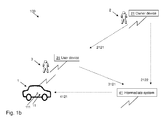
- Figure 1 b illustrates an exemplifying temporary access system for enabling a temporary user to gain temporary access to a locked space of a vehicle, according to alternative embodiments of the disclosure.
- the embodiment of Figure 1b is similar to that of Figure 1a , with the difference of an additional optional verification message 2122 provided by the owner device 21 to the intermediate system 41.
- the owner device 21 is configured to transmit a verification message 2122 to the intermediate system 41, which verification message 2122 comprises verification parameters corresponding to the access parameters, whereby the unlock message 4121 is adapted to additionally be based on the verification message 2122, to enable the lock 111 to be unlocked additionally based on the verification parameters.
- the intermediate system 41 is configured to receive the verification message 2122 from the owner device 21.
- the verification message 2122 may be comprised in at least one Short Message Service, SMS, message, at least one email and/or a corresponding type of message, such as for instance a message of a generic format or a message of a customized format according to which the owner device 21 may communicate with the intermediate system 41.
- the verification parameters may, in a similar manner to the access parameters, comprise one or several of vehicle identification parameters, time frame parameters, location parameters, and/or recurrence parameters.
- the verification parameters may comprise a subset of the access parameters, and/or further parameters applicable to indicate the framing of the intended, subsequent, temporary access provision.
- Figure 1c illustrates an exemplifying temporary access system for enabling a temporary user to gain temporary access to a locked space of a vehicle, according to yet other embodiments of the disclosure.
- the embodiment of Figure 1c is similar to that of Figure 1a , with the difference being an alternative optional communication path of the permission message 2121 from the owner device 21 to the user device 31.
- the permission message 2121 of Figure 1 a is adapted to be transmitted via the intermediate system 41.
- the permission message 2121 is hence represented by a first message 2123 submitted from the owner device 21 to the intermediate system 41, and a second message 4122 submitted from the intermediate system 41 to the vehicle 1.
- the second message 4122 is here essentially identical to the first message 2123; however, according to alternative embodiments, the second message 4122 may comprise a subset of the first message 2123, and/or be expanded to comprise further parameters applicable to indicate the framing of the intended temporary access.
- the temporary access system 100 is adapted for enabling the temporary user 3 to gain temporary access to the locked space 11 of the vehicle 1, and comprises the owner device 21, the user device 31 and the intermediate system 41.
- the temporary access system 100 may further optionally comprise the remotely operable lock 111.
- the owner device 21 comprises an owner transmitting unit 212 adapted for transmitting the permission message 2121 comprising the access parameters directly or indirectly to the user device 31.
- the embodiments herein for enabling the temporary user 3 to gain temporary access to the locked space 11 of the vehicle 1 may be implemented through one or more processors, such as a processor 213, here denoted CPU, together with computer program code for performing the functions and actions of the embodiments herein.
- Said program code may also be provided as a computer program product, for instance in the form of a data carrier carrying computer program code for performing the embodiments herein when being loaded into the owner device 21.
- One such carrier may be in the form of a CD ROM disc. It is however feasible with other data carriers such as a memory stick.
- the computer program code may furthermore be provided as pure program code on a server and downloaded to the owner device 21.
- the owner device 21 may further comprise a memory 214 comprising one or more memory units.
- the memory 214 may be arranged to be used to store e.g. information, and further to store data, configurations, schedulings, and applications, to perform the methods herein when being executed in the owner device 21.
- the owner transmitting unit 212, the processor 213, and the memory 214 may for instance be implemented in one or several arbitrary electronic devices having communication capabilities.
- the owner transmitting unit 212 described above, and which will be described in more detail later on in this description may refer to a combination of analog and digital circuits, and/or one or more processors configured with software and/or firmware, e.g.
- processors such as the processor 213 perform as will be described in more detail later on.
- processors may be included in a single ASIC (Application-Specific Integrated Circuitry), or several processors and various digital hardware may be distributed among several separate components, whether individually packaged or assembled into a SoC (System-on-a-Chip).
- SoC System-on-a-Chip
- the user device 31 comprises a user receiving unit 311 adapted for receiving the permission message 2121 directly or indirectly from the owner device 21, and a user transmitting unit 312 adapted for transmitting the request message 3121 to open the lock 111 to the remote intermediate system 41.
- the embodiments herein for enabling the temporary user 3 to gain temporary access to the locked space 11 of the vehicle 1 may be implemented through one or more processors, such as a processor 313, here denoted CPU, together with computer program code for performing the functions and actions of the embodiments herein.
- Said program code may also be provided as a computer program product, for instance in the form of a data carrier carrying computer program code for performing the embodiments herein when being loaded into the user device 31.
- One such carrier may be in the form of a CD ROM disc. It is however feasible with other data carriers such as a memory stick.
- the computer program code may furthermore be provided as pure program code on a server and downloaded to the user device 31.
- the user device 31 may further comprise a memory 314 comprising one or more memory units.
- the memory 314 may be arranged to be used to store e.g. information, and further to store data, configurations, schedulings, and applications, to perform the methods herein when being executed in the user device 31.
- the user receiving unit 311 and the user transmitting unit 312, the processor 313, and the memory 314 may for instance be implemented in one or several arbitrary electronic devices having communication capabilities.
- the user receiving unit 311 and the user transmitting unit 312 described above, and which will be described in more detail later on in this description may refer to a combination of analog and digital circuits, and/or one or more processors configured with software and/or firmware, e.g.
- processors such as the processor 313 perform as will be described in more detail later on.
- processors may be included in a single ASIC (Application-Specific Integrated Circuitry), or several processors and various digital hardware may be distributed among several separate components, whether individually packaged or assembled into a SoC (System-on-a-Chip).
- SoC System-on-a-Chip
- the intermediate system 41 comprises an intermediate receiving unit 411 adapted for receiving the request message 3121 to open the remotely operable lock 111 from the user device 31, and an intermediate transmitting unit 412 adapted for transmitting, based on the request message 3121, the unlock message 4121 to the vehicle 1 to open the lock 111.
- the embodiments herein for enabling the temporary user 3 to gain temporary access to the locked space 11 of the vehicle 1 may be implemented through one or more processors, such as a processor 413, here denoted CPU, together with computer program code for performing the functions and actions of the embodiments herein.
- Said program code may also be provided as a computer program product, for instance in the form of a data carrier carrying computer program code for performing the embodiments herein when being loaded into the intermediate system 41.
- One such carrier may be in the form of a CD ROM disc. It is however feasible with other data carriers such as a memory stick.
- the computer program code may furthermore be provided as pure program code on a server and downloaded to the intermediate system 41.
- the intermediate system 41 may further comprise a memory 414 comprising one or more memory units.
- the memory 414 may be arranged to be used to store e.g. information, and further to store data, configurations, schedulings, and applications, to perform the methods herein when being executed in the intermediate system 41.
- the intermediate receiving unit 411 and the intermediate transmitting unit 412, the processor 413, and the memory 414 may for instance be implemented in a management and/or assisting system adapted to remotely control functionality of the vehicle 1.
- intermediate receiving unit 411 and the intermediate transmitting unit 412 described above may refer to a combination of analog and digital circuits, and/or one or more processors configured with software and/or firmware, e.g. stored in a memory such as the memory 414, that when executed by the one or more processors such as the processor 413 perform as will be described in more detail later on.
- processors may be included in a single ASIC (Application-Specific Integrated Circuitry), or several processors and various digital hardware may be distributed among several separate components, whether individually packaged or assembled into a SoC (System-on-a-Chip).
- Figure 3 is a flowchart depicting an exemplifying method performed by the owner device 21 associated with the owner 2 of the vehicle 1, for enabling the temporary user 3 to gain temporary access to the locked space 11 of the vehicle 1, according to embodiments of the disclosure.
- the exemplifying method which may be continuously repeated, comprises the following actions discussed with support from Figures 1 and 2 . The actions may be taken in any suitable order, or even simultaneously.
- the vehicle 1 is configured to communicate with the intermediate system 41 adapted to remotely control functionality of the vehicle 1.
- the intermediate system 41 is configured to receive, from the user device 31 associated with the temporary user 3, the request message 3121 to open the remotely operable lock 111 of the locked space 11 and further configured to, based on the request message 3121, transmit the unlock message 4121 to the vehicle 1 to open the lock 111.
- the locked space 11 is one or a combination of a body, a trunk, an engine hood, a fuel lid and/or an isolated section of the vehicle 1.
- the owner device 21 transmits, by means of the owner transmitting unit 212, the permission message 2121 comprising access parameters directly or indirectly to the user device 31, wherein the access parameters are configured to be comprised in the request message 3121 to enable the lock 111 to be unlocked based on the access parameters.
- the permission message 2121 comprises a user selectable web link connecting to the remote intermediate system 41, which web link is adapted to, upon being selected, initiate the request message 3121 to be transmitted to the intermediate system 41.
- the permission message 2121 may be comprised in at least one Short Message Service, SMS, message, at least one email and/or a corresponding type of message.
- the access parameters comprise one or several of vehicle identification parameters, time frame parameters, location parameters, and/or recurrence parameters.
- the owner device 21 transmits, e.g. by means of the owner transmitting unit 212, the verification message 2122 to the intermediate system 41, which verification message 2122 comprises the verification parameters corresponding to the access parameters.
- the unlock message 4121 is adapted to additionally be based on the verification message 2122, to enable the lock 111 to be unlocked additionally based on the verification parameters.
- Figure 4 is a flowchart depicting an exemplifying method performed by the user device 31 associated with the temporary user 3, for enabling the temporary user 3 to gain temporary access to the locked space 11 of the vehicle 1, according to embodiments of the disclosure.
- the exemplifying method which may be continuously repeated, comprises the following actions discussed with support from Figures 1 and 2 .
- the vehicle 1 is configured to communicate with the intermediate system 41 adapted to remotely control functionality of the vehicle 1.
- the intermediate system 41 is configured to transmit the unlock message 4121 to the vehicle 1 to open the remotely operable lock 111 of the locked space 11.
- the locked space 11 is one or a combination of a body, a trunk, an engine hood, a fuel lid and/or an isolated section of the vehicle 1.
- the user device 31 receives, by means of the user receiving unit 311, the permission message 2121 directly or indirectly from the owner device 21 associated with the owner 2 of the vehicle 1, which permission message 2121 comprises the access parameters.
- the permission message 2121 may be comprised in at least one Short Message Service, SMS, message, at least one email and/or a corresponding type of message.
- the access parameters comprise one or several of vehicle identification parameters, time frame parameters, location parameters, and/or recurrence parameters.
- the user device 31 transmits, by means of the user transmitting unit 312, the request message 3121 to open the lock 111, to the intermediate system 41.
- the request message 4121 comprises the access parameters.
- the unlock message 4121 is adapted to be based on the request message 3121 to enable the lock 111 to be unlocked based on the access parameters.
- the permission message 2121 comprises a user selectable web link connecting to the remote intermediate system 41, wherein the Action 1005 of transmitting the request message 3121 comprises the web link being selected.
- the unlock message 4121 is further adapted to additionally be based on the verification message 2122 configured to be transmitted 1002 from the owner device 21 to the intermediate system 41.
- the verification message 2122 comprises the verification parameters corresponding to the access parameters, wherein the lock 111 is enabled to be unlocked additionally based on the verifications parameters.
- Figure 5 is a flowchart depicting an exemplifying method performed by the intermediate system 41 adapted to remotely control functionality of the vehicle 1, for enabling the temporary user 3 to gain temporary access to the locked space 11 of the vehicle 1, according to embodiments of the disclosure.
- the exemplifying method which may be continuously repeated, comprises the following actions discussed with support from Figures 1 and 2 .
- the actions may be taken in any suitable order, or even simultaneously, such as Actions 1003 and 1006.
- the intermediate system 41 is configured to directly or indirectly communicate with the owner device 21 associated with the owner 2 of the vehicle 1.
- the owner device 21 is configured to transmit the permission message 2121 comprising the access parameters directly or indirectly to the user device 31 associated with the temporary user 3.
- the permission message 2121 may be comprised in at least one Short Message Service, SMS, message, at least one email and/or a corresponding type of message.
- the access parameters comprise one or several of vehicle identification parameters, time frame parameters, location parameters, and/or recurrence parameters.
- the locked space 11 is one or a combination of a body, a trunk, an engine hood, a fuel lid and/or an isolated section of the vehicle 1.
- the intermediate system 41 receives, e.g. by means of the intermediate receiving unit 411, the verification message 2122 from the owner device 21.
- the verification message 2122 comprises the verification parameters corresponding to the access parameters.
- the unlock message 4121 is adapted to additionally be based on the verification message 2122, to enable the lock 111 to be unlocked additionally based on the verification parameters.
- the intermediate system 41 receives, by means of the intermediate receiving unit 411, the request message 3121 to open the remotely operable lock 111 of the locked space 11, from the user device 31, which request message 3121 comprises the access parameters.
- the permission message 2121 comprises a user selectable web link connecting to the remote intermediate system 4, which web link is adapted to, upon being selected, initiate the request message 3121 to be transmitted to the intermediate system 41.
- the intermediate system 41 transmits, based on the request message 3121, by means of the intermediate transmitting unit 412, the unlock message 4121 to the vehicle 1 to open the lock 111, wherein the lock 111 is enabled to be unlocked based on the access parameters.
- Figure 6 is a flowchart depicting an exemplifying method performed by the temporary access system 100, for enabling the temporary user 3 to gain temporary access to the locked space 11 of the vehicle 1, according to embodiments of the disclosure.
- the actions of Figure 6 reflect the intertwined actions of the owner device 21, user device 31 and intermediate system 41, and thus correspond to Actions 1001 and 1003 of the owner device 21 as described in Figure 3 , Actions 1004 and 1005 of the user device 31 as described in Figure 4 , and Actions 1003, 1006 and 1007 of the intermediate system 41 as described in Figure 5 .
- the exemplifying method which may be continuously repeated, hence comprises the following actions, which may be taken in any suitable order, or even simultaneously, such as e.g. Actions 1001' and 1002', and/or Actions 1003' and 1004'.
- the owner device 21 transmits, by means of the owner transmitting unit 212, the permission message 2121 comprising access parameters directly or indirectly to the user device 31.
- the owner device 21 transmits the verification message 2122 to the intermediate system 41, which verification message 2122 comprises the verification parameters corresponding to the access parameters.
- the intermediate system 41 receives, e.g. by means of the intermediate receiving unit 411, the verification message 2122 from the owner device 21.
- the user device 31 receives, by means of the user receiving unit 311, the permission message 2121 directly or indirectly from the owner device 21.
- the user device 31 transmits, by means of the user transmitting unit 312, the request message 3121 to open the lock 111, to the intermediate system 41.
- the request message 4121 comprises the access parameters.
- the permission message 2121 comprises a user selectable web link connecting to the remote intermediate system 41, wherein the Action 1005' of transmitting the request message 3121 comprises the web link being selected.
- the intermediate system 41 receives, by means of the intermediate receiving unit 411, the request message 3121 to open the lock 111, from the user device 31.
- the intermediate system 41 transmits, based on the request message 3121, by means of the intermediate transmitting unit 412, the unlock message 4121 to the vehicle 1 to open the lock 111, wherein the lock 111 is enabled to be unlocked based on the access parameters.
- the unlock message 4121 is adapted to additionally be based on the verification message 2122, to enable the lock 111 to be unlocked additionally based on the verification parameters.
- Figure 7 illustrates an exemplifying signal flow diagram of the temporary access system 100 according to embodiments of the disclosure.
- Scenario (a) of Figure 7 reflects the embodiment illustrated in Figure 1a , and with support from Figure 6 thus depicts the owner device 21 transmitting 1001' the permission message 2121 to the user device 31, the user device 31 transmitting 1005' the request message 3121 to the intermediate system 41, and the intermediate system 41 transmitting 1007' the unlock message 4121 to the vehicle 1.
- Scenario (b) of Figure 7 reflects the embodiment illustrated in Figure 1b , and with support from Figure 6 thus depicts the owner device 21 transmitting 1001' the permission message 2121 to the user device 31, the owner device 21 transmitting 1002' the optional verification message 2122, the user device 31 transmitting 1005' the request message 3121 to the intermediate system 41, and the intermediate system 41 transmitting 1007' the unlock message 4121 to the vehicle 1.
- Scenario (c) of Figure 7 reflects the embodiment illustrated in Figure 1c , and with support from Figure 6 thus depicts the owner device 21 transmitting 1001' the permission message 2121 to the user device 31 via the intermediate system 41, hence the permission message 2121 being represented by the first message 2123 and the second message 4122. Accordingly, there is depicted the owner device 21 transmitting the first message 2123 to the intermediate system 41, and the intermediate system 41 transmitting the second message 4122 to the user device 31. There is furthermore depicted the user device 31 transmitting 1005' the request message 3121 to the intermediate system 41, and the intermediate system 41 transmitting 1007' the unlock message 4121 to the vehicle 1.
- access conditions incorporated by access parameters which descend from a permission message 2121 dictated and transmitted from an owner device 21 to a user device 31 and subsequently to an intermediate system 41 in a request message 3121, may be utilized by the intermediate system 41 as underlying conditions for a subsequent provision of temporary access to the locked space 11.
Landscapes
- Engineering & Computer Science (AREA)
- Computer Networks & Wireless Communication (AREA)
- Signal Processing (AREA)
- Computer Security & Cryptography (AREA)
- Mechanical Engineering (AREA)
- Physics & Mathematics (AREA)
- General Physics & Mathematics (AREA)
- Computer Hardware Design (AREA)
- Computing Systems (AREA)
- General Engineering & Computer Science (AREA)
- Lock And Its Accessories (AREA)
- Telephonic Communication Services (AREA)
Abstract
Description
- The present disclosure relates to enabling a temporary user to gain temporary access to a locked space of a vehicle.
- Every now and then, the situation occurs when an owner of a vehicle, or at least a person in possession of a conventional or electronic key thereto, is in need of allowing someone else not in possession of such a key, access to the vehicle. Such a scenario may, for instance, arise if a family member or friend needs to pick up, or drop off, something in the vehicle. Another example may be a service provider of a delivered service, such as delivery of a product, e.g. a parcel, goods, dry cleaned clothes, food etc., or delivery of a service, such as a vehicle service, vehicle reconditioning or the like, while the vehicle is parked and locked. Traditionally, the vehicle owner would have to provide the temporary user of the vehicle with a conventional or electronic vehicle key to enable the access thereto. In recent years, however, solutions have been developed which enable access to the vehicle through other means.
-
US 8,299,895 , for instance, relates to controlling access to an automobile, e.g. by means of a cellular phone. It is disclosed how the cellular phone is mated with the vehicle system and thereafter used to obtain access to the vehicle. - However, although
US 8,299,895 suggests a limited function key for a cellular phone for temporary use, and thereby alleviates hassle related to lending a conventional or electronic vehicle key to a temporary user, there still remains uncertainties associated with providing temporary access to the vehicle to a temporary user. - It is therefore an object of embodiments herein to provide an improved approach of enabling a temporary user to gain temporary access to a vehicle.
- According to a first aspect of embodiments herein, the object is achieved by a method performed by an owner device associated with an owner of a vehicle, for enabling a temporary user to gain temporary access to a locked space of the vehicle. The vehicle is configured to communicate with an intermediate system adapted to remotely control functionality of the vehicle. The intermediate system is configured to receive, from a user device associated with the temporary user, a request message to open a remotely operable lock of the locked space. The intermediate system is further configured to, based on the request message, transmit an unlock message to the vehicle to open the lock. The method comprises that the owner device transmits a permission message comprising access parameters directly or indirectly to the user device. The access parameters are configured to be comprised in the request message to enable the lock to be unlocked based on the access parameters.
- Thereby, the access conditions incorporated by the access parameters, which descend from the permission message dictated and transmitted from the owner device to the user device and subsequently to the intermediate system in the request message, are utilized by the intermediate system as underlying conditions for the subsequent provision of the intended temporary access to the locked space. That is, since the access parameters hold access conditions dictated by e.g. the owner via the owner device, and since the access parameters are relayed to the user device via the permission message, and subsequently relayed, e.g. on initiation of the temporary user, to the intermediate system, the intermediate system may take into consideration the access conditions as defined by the access parameters in the subsequent unlocking/locking of the remotely operable lock.
- Accordingly, there is provided a solution according to which uncertainties commonly associated with allowing a temporary user temporary access to a vehicle, are alleviated.
- Furthermore, an approach is suggested according to which the owner may set up his or her own access conditions as considered suitable for the specific intended temporary access in question.
- For that reason, there is provided an improved approach of enabling a temporary user to gain temporary access to a vehicle.
- The technical features and corresponding advantages of the above mentioned method will be discussed in further detail in the following.
- By introducing a method performed by an owner device associated with an owner of a vehicle, for enabling a temporary user to gain temporary access to a locked space of the vehicle, an approach is provided which enables for an owner of a vehicle to allow someone else, not in possession of a key thereto, a restricted and/or conditioned access to the vehicle of the owner. The referred to "vehicle" may be any arbitrary vehicle, for instance a car, truck, lorry, van, bus, tractor, military vehicle, air plane, or vessel. Furthermore, the "owner" of the vehicle is intended to be interpreted in a broad manner, likewise referring to any arbitrary person accountable for the vehicle, or a person in possession of "constant" or "continuous" access rights to remotely control, such as unlock, the vehicle.
- The "temporary user" of the vehicle is, in a similar manner, intended to be interpreted in a broad manner, likewise referring to someone to whom it is intended to provide conditional access to a locked space of the vehicle. The temporary user may hence refer to e.g. a family member or a friend. Additionally or alternatively, the temporary user may refer to a service provider being trusted to provide a delivered service while the vehicle is parked and locked, such as delivery of a product, e.g. a parcel, goods, dry cleaned clothes, food etc., or a delivery of service, such as e.g. a vehicle service, vehicle reconditioning or the like. Furthermore, the "temporary access" is intended to refer to the temporary user being allowed access to the locked space, which access is restricted by conditions, e.g. regarding access time frame and/or number of times being allowed access.
- The referred to "owner device" may be any arbitrary electronic unit which is capable of communicating with other units, and which is adapted to provide a software tool via which conditions for an intended provision of a temporary access to the vehicle may be dictated. The owner device may hence, for instance, be represented by a stationary computer or a mobile user equipment, for instance a mobile terminal or wireless terminal, a mobile phone or smart phone, a computer such as e.g. a laptop, a Personal Digital Assistant (PDA) or tablet computer, sometimes referred to as a surf plate, with wireless capability, or for example, a portable, pocket-storable, hand-held, computer-comprised mobile device. Furthermore, "associated with" is throughout this disclosure intended to be interpreted to likewise include e.g. "in possession of", "carried by", and "used by".
- Since the vehicle is configured to communicate with an intermediate system adapted to remotely control functionality of the vehicle, a locked space of the vehicle may, for instance, be unlocked or locked, following instructions submitted from the intermediate system. Utilizing the intermediate system enables for updated instructions to override previous instructions, such as for instance cancelling of a previous instruction to allow a temporary access to the vehicle. The intermediate system may refer to any arbitrary assisting and/or managing system, such as a remotely located server, allowed to and adapted for remotely controlling functionality of the vehicle, such as providing access thereto. The intermediate system may for instance be represented by a Volvo On Call system. The vehicle may be adapted to communicate with the intermediate system as commonly known in the art, for instance via a wireless network.
- Since the intermediate system is configured to receive, from a user device associated with the temporary user, a request message to open a remotely operable lock of the locked space, the user device may, for instance by initiation of the temporary user, be adapted to submit a request for the intermediate system to remotely open the lock of the locked space of the vehicle. By the lock being "remotely operable" is here intended to indicate that the lock may be controlled to be unlocked or locked from a far distance, i.e. from the remotely arranged intermediate server. The remotely operable lock may for instance be represented by one or a combination of a vehicle door lock, trunk lock, engine hood lock, fuel lid lock or a lock to an isolated section of the vehicle, e.g. a separate compartment through which the interior body of the vehicle may not be reached. For instance, allowing temporary access to the engine hood, fuel lid and/or body may enable a vehicle mechanics to perform e.g. a vehicle service, vehicle reconditioning or the like. In addition thereto, subsequent being allowed access to the locked space, the temporary user may further be given access to e.g. start the engine, or access data of the vehicle. Similarly, allowing temporary access to the body, trunk and/or isolated section may enable e.g. a family member or friend to pick up, or drop off, something in the vehicle, or e.g. a service provider to deliver a product, e.g. a parcel, goods, dry cleaned clothes, food etc. while the vehicle is parked and initially locked.
- The lock may further, according to an example, comprise - or be in communication with a unit providing - functionality which allows for detection and/or storage of events related to access given to the lock, or opening/closing of a door, hatch, lid etc. associated with the lock. Thereby, tracking of events related to the lock may be enabled.
- The referred to "user device" may be any arbitrary electronic unit which is capable of communicating with other units, and which is adapted to provide, e.g. compose, and transmit a request message to the intermediate system. The user device may hence, for instance, be represented by a stationary computer or a mobile user equipment, for instance a mobile terminal or wireless terminal, a mobile phone or smart phone, a computer such as e.g. a laptop, a Personal Digital Assistant (PDA) or tablet computer, sometimes referred to as a surf plate, with wireless capability, or for example, a portable, pocket-storable, hand-held, computer-comprised mobile device. Furthermore, as previously indicated, "associated with" is throughout this disclosure intended to be interpreted in a broad manner, likewise including e.g. "in possession of", "carried by", and "used by".
- The referred to "request message" to open the lock may be represented by any arbitrary type of message supported in the communication between the user device and the intermediate system. The request message may hence be comprised in a generic message format or a message of customized format, and e.g. represented by a push message.
- Since the intermediate system is further configured to, based on the request message, transmit an unlock message to the vehicle to open the lock, the intermediate system may instruct the vehicle to unlock the lock under the conditions being indicated by the content of the request message. The referred to "unlock message" to open the lock may be represented by any arbitrary type of message supported in the communication between the intermediate system and the vehicle. The unlock message may hence be comprised in a generic message format or a message of customized format, as known in the art. Furthermore, "based on" is throughout this disclosure intended to be interpreted to likewise include at least "utilizing", "considering" and "taking into account".
- Since the owner device transmits a permission message comprising access parameters directly or indirectly to the user device, the owner device may, supposedly by initiation of the owner, submit a message to the user device indicating conditions under which temporary access the locked space may be allowed. Thereby, access conditions for the intended specific temporary access at hand may be dictated as suitable or preferred by the owner. The referred to "access parameters" may be represented by any arbitrary parameters indicating conditions of the intended provision of temporary access, relating for instance to access timing and vehicle identity.
- The "permission message" may be transmitted directly from the owner device to the user device, or, alternatively, for instance indirectly via the intermediate system to the user device. The permission message may, in the latter case, to some extent be amended in the intermediate system to suit a possible differing communication format between the intermediate system and the user device, as compared to the communication format between the owner device and the intermediate system. Furthermore, the permission message may, should it be routed via the intermediate system, be amended in the intermediate system to comprise a subset of the content of the permission message, or amended to comprise an extension thereof prior to being transmitted to the user device.
- Furthermore, the "permission message" may be represented by any arbitrary type of message supported in the communication between the owner device and the user device, and possible the intermediate system. The permission message may hence be comprised in a generic message format or a message of customized format, and e.g. represented by a push message. According to one example, the owner device is e.g. a smart phone provided with a vehicle control application, i.e. an "app", such as e.g. the commonly known Volvo On Call app, enabling control of functionality of the vehicle via the intermediate system. The vehicle control app may be adapted to provide the owner device, and subsequently the owner, with a software tool via which conditions for an intended provision of a temporary access to the vehicle may be dictated, which conditions subsequently may be embedded in a permission message and submitted to the user device.
- Since the access parameters are configured to be comprised in the request message to enable the lock to be unlocked based on the access parameters, the access conditions incorporated by the access parameters, which descend from the permission message dictated and transmitted from the owner device, are utilized by the intermediate server as underlying conditions for the subsequent provision of temporary access to the locked space. That is, since the access parameters hold access conditions dictated by e.g. the owner via the owner device, and since the access parameters are relayed to the user device via the permission message, and subsequently relayed, e.g. on initiation of the temporary user, to the intermediate system, the intermediate system may take into consideration the access conditions as defined by the access parameters in the subsequent unlocking/locking of the lock. Accordingly, an owner of a vehicle may, via an owner device, dictate access conditions for a temporary user, which access conditions are submitted, via the user device, to the temporary user, which access conditions subsequently may be submitted to the intermediate system to thereby constitute a basis for the provision of the temporary access of the locked space as provided by the intermediate system.
- According to an embodiment, the permission message may comprise a user selectable web link connecting to the remote intermediate system, which web link is adapted to, upon being selected, initiate the request message to be transmitted to the intermediate system. Thereby, when the web link is selected, supposedly by the temporary user, a web interface associated with the web link provides a means for the temporary user to instruct the intermediate system to follow through on the enabling of the intended temporary access. That is, transmission of the request message may here be represented by the web link being selected and subsequently the intended temporary access being confirmed, supposedly by the temporary user, via the web interface. The referred to "web link" may for instance be represented by a http address. Furthermore, the web link "connecting to the intermediate system" may indicate an input port to the intermediate system.
- According to one embodiment, the permission message may be comprised in at least one Short Message Service, SMS, message, at least one email and/or a corresponding type of message. Thereby, a generic, commonly implemented message format may be utilized for submission of the permission message. The referred to "corresponding type" may refer to a message of a generic format, or a message of a customized format.
- According to another embodiment, the access parameters may comprise one or several of vehicle identification parameters, time frame parameters, location parameters, and/or recurrence parameters. Thereby, access conditions in terms of vehicle identification parameters, time frame parameters, location parameters, and/or recurrence parameters for the intended specific temporary access may be dictated as suitable or preferred by the owner. "Vehicle identification parameters" may comprise parameters indicating the identity of the vehicle in question, whereas "time frame parameters" may comprise parameters indicating for instance a temporary access start time and/or end time, a temporary access duration restriction, and/or a temporary access time window. Furthermore, "location parameters" may comprise parameters indicating a vehicle location restriction, i.e. that the vehicle in question may need to be located in a specific area for allowing temporary access, or a corresponding temporary user location restriction, whereas "recurrence parameters" may comprise parameters indicating a number of times temporary access is allowed. Further parameters, such as e.g. identity of the owner, are likewise feasible.
- According to yet another embodiment, the owner device may transmit a verification message to the intermediate system, which verification message comprises verification parameters corresponding to the access parameters. The unlock message is adapted to additionally be based on the verification message, to enable the lock to be unlocked additionally based on the verification parameters. Thereby, by the owner device submitting a verification message to the intermediate system, in addition to submitting the permission message to the user device, the intermediate system is enabled to consider the verification parameters of the verification message prior to following through on the requested temporary access. Accordingly, the intermediate system may perform an additional safety check in comparing the verification parameters to the access parameters.
- The unlock message being adapted to "additionally be based on" the verification parameters, and the lock being enabled to be unlocked "additionally based on" the verification parameters, is here hence intended to indicate that the intermediate system takes the verification parameters into account in addition to the access parameters.
- The referred to "verification message" may be represented by any arbitrary type of message supported in the communication between the owner device and the intermediate system. The verification message may hence be comprised in a generic message format or a message of customized format, as known in the art. The verification message may be comprised in at least one Short Message Service, SMS, message, at least one email and/or a corresponding type of message, such as for instance a message of a generic format or a message of a customized format according to which the owner device may communicate with the intermediate system.
- Furthermore, the referred to "verification parameters" may be represented by any arbitrary parameters indicating conditions of the intended provision of temporary access. That is, the verification parameters may comprise one or several of vehicle identification parameters, time frame parameters, location parameters, and/or recurrence parameters. Furthermore, the verification parameters may comprise a subset of the access parameters, and/or further parameters applicable to indicate the framing of the intended, subsequent, temporary access provision. The verification parameters "corresponding to" the access parameters, is here intended to be interpreted to likewise include e.g. "being associated with", "being similar to", and "comprising a subset or an extension of".
- According to yet another embodiment, the locked space may be one or a combination of a body, a trunk, an engine hood, a fuel lid and/or an isolated section of the vehicle. Thereby, different parts of the vehicle, which respectively are provided with one or several remotely operable locks, may come in question for the temporary access. The locked space being a "body" of the vehicle is here intended to indicate the passenger compartment of the vehicle, i.e. the interior of the vehicle, to which access may be restricted by one or several vehicle doors. The locked space being an "isolated section" of the vehicle may refer to e.g. a separate compartment comprised in the vehicle, through which the interior body of the vehicle cannot be reached.
- According to a second aspect of embodiments herein, the object is achieved by a method performed by a user device associated with a temporary user, for enabling the temporary user to gain temporary access to a locked space of a vehicle. The vehicle is configured to communicate with an intermediate system adapted to remotely control functionality of the vehicle. The intermediate system is configured to transmit an unlock message to the vehicle to open a remotely operable lock of the locked space. The method comprises that the user device receives a permission message directly or indirectly from an owner device associated with an owner of the vehicle, which permission message comprises access parameters. The user device furthermore transmits a request message to open the lock, to the intermediate system. The request message comprises the access parameters, whereby the unlock message is adapted to be based on the request message to enable the lock to be unlocked based on the access parameters.
- According to an embodiment, the unlock message may further be adapted to additionally be based on a verification message configured to be transmitted from the owner device to the intermediate system. The verification message comprises verification parameters corresponding to the access parameters, wherein the lock is enabled to be unlocked additionally based on the verifications parameters.
- According to yet another embodiment, the permission message may comprise a user selectable web link connecting to the remote intermediate system, wherein transmitting the request message comprises the web link being selected.
- According to one embodiment, the permission message may be comprised in at least one Short Message Service, SMS, message, at least one email and/or a corresponding type of message.
- According to another embodiment, the access parameters may comprise one or several of vehicle identification parameters, time frame parameters, location parameters, and/or recurrence parameters.
- According to yet another embodiment, the locked space may be one or a combination of a body, a trunk, an engine hood, a fuel lid and/or an isolated section of the vehicle.
- Similar advantages as those mentioned in the foregoing in relation to the first aspect correspondingly apply to the second aspect, why these advantages are not further discussed.
- According to a third aspect of embodiments herein, the object is achieved by a method performed by an intermediate system adapted to remotely control functionality of a vehicle, for enabling a temporary user to gain temporary access to a locked space of the vehicle. The intermediate system is configured to directly or indirectly communicate with an owner device associated with an owner of the vehicle. The owner device is configured to transmit a permission message comprising access parameters directly or indirectly to a user device associated with the temporary user. The method comprises that the intermediate system receives a request message to open a remotely operable lock of the locked space from the user device, which request message comprises the access parameters. The intermediate system furthermore transmits, based on the request message, an unlock message to the vehicle to open the lock, whereby the lock is enabled to be unlocked based on the access parameters.
- According to an embodiment, the permission message may comprise a user selectable web link connecting to the remote intermediate system. The web link is adapted to, upon being selected, initiate the request message to be transmitted to the intermediate system.
- According to another embodiment, the intermediate system may further receive a verification message from the owner device, which verification message comprises verification parameters corresponding to the access parameters. The unlock message is adapted to additionally be based on the verification message, to enable the lock to be unlocked additionally based on the verification parameters.
- According to one embodiment, the permission message may be comprised in at least one Short Message Service, SMS, message, at least one email and/or a corresponding type of message.
- According to another embodiment, the access parameters may comprise one or several of vehicle identification parameters, time frame parameters, location parameters, and/or recurrence parameters.
- According to yet another embodiment, the locked space may be one or a combination of a body, a trunk, an engine hood, a fuel lid and/or an isolated section of the vehicle.
- Yet again, similar advantages as those mentioned in the foregoing in relation to the first aspect correspondingly apply to the third aspect, why these advantages are not further discussed.
- According to a fourth aspect of embodiments herein, the object is achieved by a method performed by a temporary access system comprising an owner device, a user device and an intermediate system, for enabling a temporary user to gain temporary access to a locked space of a vehicle. The temporary access system performs the actions of the owner device discussed in the foregoing, the actions of the previously discussed user device, and the actions of the intermediate system discussed in the foregoing. Once more, similar advantages as those mentioned in the foregoing in relation to the first aspect correspondingly apply to the fourth aspect, why these advantages are not further discussed.
- According to a fifth aspect of embodiments herein, the object is achieved by an owner device adapted to be associated with an owner of a vehicle, for enabling a temporary user to gain temporary access to a locked space of the vehicle. The vehicle is configured to communicate with an intermediate system adapted to remotely control functionality of the vehicle. The intermediate system is configured to receive, from a user device associated with the temporary user, a request message to open a remotely operable lock of the locked space and further configured to, based on the request message, transmit an unlock message to the vehicle to open the lock. The owner device comprises an owner transmitting unit adapted for transmitting a permission message comprising access parameters directly or indirectly to the user device. The access parameters are configured to be comprised in the request message to enable the lock to be unlocked based on the access parameters. Again, similar advantages as those mentioned in the foregoing in relation to the first aspect correspondingly apply to the fifth aspect, why these advantages are not further discussed.
- According to a sixth aspect of embodiments herein, the object is achieved by a user device adapted to be associated with a temporary user, for enabling the temporary user to gain temporary access to a locked space of a vehicle. The vehicle is configured to communicate with an intermediate system adapted to remotely control functionality of the vehicle. The intermediate system is configured to transmit an unlock message to the vehicle to open a remotely operable lock of the locked space. The user device comprises a user receiving unit adapted for receiving a permission message directly or indirectly from an owner device associated with an owner of the vehicle, which permission message comprises access parameters. The user device further comprises a user transmitting unit adapted for transmitting a request message to open the lock, to the remote intermediate system, wherein the request message comprises the access parameters. The unlock message is adapted to be based on the request message to enable the lock to be unlocked based on the access parameters. Once more, similar advantages as those mentioned in the foregoing in relation to the first aspect correspondingly apply to the sixth aspect, why these advantages are not further discussed.
- According to a seventh aspect of embodiments herein, the object is achieved by an intermediate system adapted to remotely control functionality of a vehicle, for enabling a temporary user to gain temporary access to a locked space of the vehicle. The intermediate system is configured to directly or indirectly communicate with an owner device associated with an owner of the vehicle. The owner device is configured to transmit a permission message comprising access parameters directly or indirectly to a user device associated with the temporary user. The intermediate system comprises an intermediate receiving unit adapted for receiving a request message to open a remotely operable lock of the locked space from the user device, which request message comprises the access parameters. The intermediate system further comprises an intermediate transmitting unit adapted for transmitting, based on the request message, an unlock message to the vehicle to open the lock, whereby the lock is enabled to be unlocked based on the access parameters. Yet again, similar advantages as those mentioned in the foregoing in relation to the first aspect correspondingly apply to the seventh aspect, why these advantages are not further discussed.
- According to an eight aspect of embodiments herein, the object is achieved by a temporary access system adapted for enabling a temporary user to gain temporary access to a locked space of a vehicle. The temporary access system comprises the owner device discussed in the foregoing, the previously discussed user device, and the intermediate system discussed in the foregoing. Once more, similar advantages as those mentioned in the foregoing in relation to the first aspect correspondingly apply to the eight aspect, why these advantages are not further discussed.
- According to a ninth aspect of embodiments herein, the object is achieved by a vehicle comprising a remotely operable lock of a locked space of the vehicle, which vehicle is adapted for enabling a temporary user to gain temporary access to the locked space. The vehicle is configured to communicate with an intermediate system adapted to remotely control functionality of the vehicle. The intermediate system is configured to directly or indirectly communicate with an owner device associated with an owner of the vehicle. The owner device is adapted for transmitting a permission message comprising access parameters directly or indirectly to a user device associated with the temporary user The user device is adapted for transmitting a request message to open the lock, to the remote intermediate system, which request message is configured to comprise the access parameters. The vehicle is adapted to receive, from the intermediate system, based on the request message, an unlock message to open the lock, whereby the lock is enabled to be unlocked based on the access parameters. Yet again, similar advantages as those mentioned in the foregoing in relation to the first aspect correspondingly apply to the ninth aspect, why these advantages are not further discussed.
- The various aspects of the non-limiting embodiments of the invention, including particular features and advantages, will be readily understood from the following detailed description and the accompanying drawings, in which:
-
Figure 1a illustrates an exemplifying temporary access system for enabling a temporary user to gain temporary access to a locked space of a vehicle, according to embodiments of the disclosure; -
Figure 1 b illustrates an exemplifying temporary access system for enabling a temporary user to gain temporary access to a locked space of a vehicle, according to alternative embodiments of the disclosure; -
Figure 1c illustrates an exemplifying temporary access system for enabling a temporary user to gain temporary access to a locked space of a vehicle, according to yet other embodiments of the disclosure; -
Figure 2 is a schematic block diagram illustrating a temporary access system according to embodiments of the disclosure; -
Figure 3 is a flowchart depicting an exemplifying method performed by an electronic owner device associated with an owner of a vehicle, for enabling a temporary user to gain temporary access to a locked space of the vehicle, according to embodiments of the disclosure; -
Figure 4 is a flowchart depicting an exemplifying method performed by an electronic user device associated with a temporary user, for enabling the temporary user to gain temporary access to a locked space of a vehicle, according to embodiments of the disclosure; -
Figure 5 is a flowchart depicting an exemplifying method performed by an electronic intermediate system adapted to remotely control functionality of a vehicle, for enabling a temporary user to gain temporary access to a locked space of the vehicle, according to embodiments of the disclosure; -
Figure 6 is a flowchart depicting an exemplifying method performed by a temporary access system, for enabling a temporary user to gain temporary access to a locked space of a vehicle, according to embodiments of the disclosure; and -
Figure 7 illustrates an exemplifying signal flow diagram of a temporary access system according to embodiments of the disclosure. - The non-limiting embodiments of the present disclosure will now be described more fully hereinafter with reference to the accompanying drawings, in which currently preferred embodiments of the disclosure are shown. This disclosure may, however, be embodied in many different forms and should not be construed as limited to the embodiments set forth herein. Like reference characters refer to like elements throughout. Dashed lines of some boxes in the figures indicate that these units or actions are optional and not mandatory.
- In the following, according to embodiments herein which relate to enabling a temporary user to gain temporary access to a locked space of a vehicle, there will be disclosed how access conditions incorporated by access parameters, which descend from a permission message dictated and transmitted from an owner device to a user device and subsequently to an intermediate system in a request message, may be utilized by the intermediate system as underlying conditions for a subsequent provision of temporary access to the locked space.
- Referring now to the figures and
Figure 1a in particular, there is depicted an exemplifyingtemporary access system 100 for enabling a temporary user to gain temporary access to a locked space of a vehicle, according to embodiments of the disclosure. - In the illustrated embodiment of
Figure 1a , there is depicted avehicle 1, here a car. Thevehicle 1 comprises a remotelyoperable lock 111 of a lockedspace 11 of thevehicle 1. The lockedspace 11 is here represented by the interior space of thevehicle 1 itself, i.e. the body of thevehicle 1. According to alternative embodiments, however, the lockedspace 11 may be represented by one or a combination of the body, a trunk, an engine hood, a fuel lid and/or an isolated section of thevehicle 1. The remotelyoperable lock 111 is here represented by one, or several, of the door locks of thevehicle 1. - The
vehicle 1 is adapted for enabling atemporary user 3 to gain temporary access to the lockedspace 11. Thetemporary user 3 is represented by a person whom may be given access to the lockedspace 11, here to the interior space of thevehicle 1, during a restricted period of time. Thevehicle 1 is further configured to communicate with anintermediate system 41 adapted to remotely control functionality of thevehicle 1. Theintermediate system 41 is according to the embodiment ofFigure 1 a represented by an adapted management and/or assisting system, such as e.g. Volvo On Call. - Furthermore, the
intermediate system 41 is configured to directly or indirectly communicate with anowner device 21 associated with anowner 2 of thevehicle 1. Theowner 2 is here represented by a person having "continuous", rather than temporary, access to the vehicle, and theowner device 21 is her represented by an adapted smart phone. Theowner device 21 has, according to the embodiment ofFigure 1a , installed thereon functionality such as a vehicle control application, i.e. an "app", such as e.g. a Volvo On Call app, enabling control of functionality of thevehicle 1 by communicating with theintermediate system 41. - The
owner device 21 is adapted for transmitting apermission message 2121 comprising access parameters directly or indirectly to a user device 31 associated with thetemporary user 3. Thepermission message 2121 may be comprised in at least one Short Message Service, SMS, message, at least one email and/or a corresponding type of message. A corresponding type of message may for instance be a message of a generic format, or a message of a customized format according to which theowner device 21 may communicate with the user device 31. Here, thepermission message 2121 is represented by an SMS, which may be generated by theowner 2 selecting settings via the vehicle control app, and which subsequently may lead to giving thetemporary user 3 temporary access to thevehicle 1. The access parameters of the illustrated embodiment comprise one or several of vehicle identification parameters, time frame parameters, location parameters, and/or recurrence parameters. - The user device 31 is here represented by a smart phone having functionality enabling for communication with other electronic devices. The user device 31 is adapted for transmitting a
request message 3121 to open thelock 111, to the remoteintermediate system 41, whichrequest message 3121 is configured to comprise the access parameters. Correspondingly, theintermediate system 41 is configured to receive therequest message 3121. - The
request message 3121 may be comprised in at least one Short Message Service, SMS, message, at least one email and/or a corresponding type of message, such as for instance a message of a generic format or a message of a customized format according to which the user device 31 may communicate with theintermediate system 41. However, according to the embodiment ofFigure 1a , thepermission message 2121 comprises a user selectable web link connecting to the remoteintermediate system 41, which web link is adapted to, upon being selected, initiate therequest message 3121 to be transmitted to theintermediate system 41. Thus, in the shown embodiment, thetemporary user 3 may, by selecting, on the user device 31, the web linked incorporated in thepermission message 3121, be redirected to e.g. a web interface associated with theintermediate system 41, via which web interface thetemporary user 3 may confirm to theintermediate system 41 the request for the intended temporary access. Therequest message 3121 may hence here be represented by thetemporary user 3, subsequent being redirected to the web interface, selecting an option provided by the web interface to carry out opening of thelock 111, as dictated by the access parameters. - Furthermore, the
vehicle 1 is adapted to receive, from theintermediate system 41, based on therequest message 3121, anunlock message 4121 to open thelock 111, whereby thelock 111 is enabled to be unlocked based on the access parameters. Correspondingly, theintermediate system 41 is configured to, based on therequest message 3121, transmit theunlock message 4121 to thevehicle 1 to open thelock 111. Theunlock message 4121 may be comprised in at least one Short Message Service, SMS, message, at least one email and/or a corresponding type of message, such as for instance a message of a generic format or a message of a customized format according to which theintermediate system 41 may communicate with thevehicle 1. -
Figure 1 b illustrates an exemplifying temporary access system for enabling a temporary user to gain temporary access to a locked space of a vehicle, according to alternative embodiments of the disclosure. The embodiment ofFigure 1b is similar to that ofFigure 1a , with the difference of an additionaloptional verification message 2122 provided by theowner device 21 to theintermediate system 41. - That is, the
owner device 21 is configured to transmit averification message 2122 to theintermediate system 41, whichverification message 2122 comprises verification parameters corresponding to the access parameters, whereby theunlock message 4121 is adapted to additionally be based on theverification message 2122, to enable thelock 111 to be unlocked additionally based on the verification parameters. Correspondingly, theintermediate system 41 is configured to receive theverification message 2122 from theowner device 21. - The
verification message 2122 may be comprised in at least one Short Message Service, SMS, message, at least one email and/or a corresponding type of message, such as for instance a message of a generic format or a message of a customized format according to which theowner device 21 may communicate with theintermediate system 41. Furthermore, the verification parameters may, in a similar manner to the access parameters, comprise one or several of vehicle identification parameters, time frame parameters, location parameters, and/or recurrence parameters. Furthermore, the verification parameters may comprise a subset of the access parameters, and/or further parameters applicable to indicate the framing of the intended, subsequent, temporary access provision. -
Figure 1c illustrates an exemplifying temporary access system for enabling a temporary user to gain temporary access to a locked space of a vehicle, according to yet other embodiments of the disclosure. The embodiment ofFigure 1c is similar to that ofFigure 1a , with the difference being an alternative optional communication path of thepermission message 2121 from theowner device 21 to the user device 31. - That is, in the embodiment of
Figure 1c , thepermission message 2121 ofFigure 1 a is adapted to be transmitted via theintermediate system 41. Thepermission message 2121 is hence represented by afirst message 2123 submitted from theowner device 21 to theintermediate system 41, and asecond message 4122 submitted from theintermediate system 41 to thevehicle 1. Thesecond message 4122 is here essentially identical to thefirst message 2123; however, according to alternative embodiments, thesecond message 4122 may comprise a subset of thefirst message 2123, and/or be expanded to comprise further parameters applicable to indicate the framing of the intended temporary access. - As further shown in
Figure 2 , which depicts a schematic block diagram illustrating the exemplifyingtemporary access system 100 according to embodiments of the disclosure, thetemporary access system 100 is adapted for enabling thetemporary user 3 to gain temporary access to the lockedspace 11 of thevehicle 1, and comprises theowner device 21, the user device 31 and theintermediate system 41. Thetemporary access system 100 may further optionally comprise the remotelyoperable lock 111. - The
owner device 21 comprises anowner transmitting unit 212 adapted for transmitting thepermission message 2121 comprising the access parameters directly or indirectly to the user device 31. Furthermore, the embodiments herein for enabling thetemporary user 3 to gain temporary access to the lockedspace 11 of thevehicle 1, may be implemented through one or more processors, such as aprocessor 213, here denoted CPU, together with computer program code for performing the functions and actions of the embodiments herein. Said program code may also be provided as a computer program product, for instance in the form of a data carrier carrying computer program code for performing the embodiments herein when being loaded into theowner device 21. One such carrier may be in the form of a CD ROM disc. It is however feasible with other data carriers such as a memory stick. The computer program code may furthermore be provided as pure program code on a server and downloaded to theowner device 21. - The
owner device 21 may further comprise amemory 214 comprising one or more memory units. Thememory 214 may be arranged to be used to store e.g. information, and further to store data, configurations, schedulings, and applications, to perform the methods herein when being executed in theowner device 21. Furthermore, theowner transmitting unit 212, theprocessor 213, and thememory 214 may for instance be implemented in one or several arbitrary electronic devices having communication capabilities. Those skilled in the art will also appreciate that theowner transmitting unit 212 described above, and which will be described in more detail later on in this description, may refer to a combination of analog and digital circuits, and/or one or more processors configured with software and/or firmware, e.g. stored in a memory such as thememory 214, that when executed by the one or more processors such as theprocessor 213 perform as will be described in more detail later on. One or more of these processors, as well as the other digital hardware, may be included in a single ASIC (Application-Specific Integrated Circuitry), or several processors and various digital hardware may be distributed among several separate components, whether individually packaged or assembled into a SoC (System-on-a-Chip). - The user device 31 comprises a user receiving unit 311 adapted for receiving the
permission message 2121 directly or indirectly from theowner device 21, and a user transmitting unit 312 adapted for transmitting therequest message 3121 to open thelock 111 to the remoteintermediate system 41. Furthermore, the embodiments herein for enabling thetemporary user 3 to gain temporary access to the lockedspace 11 of thevehicle 1, may be implemented through one or more processors, such as aprocessor 313, here denoted CPU, together with computer program code for performing the functions and actions of the embodiments herein. Said program code may also be provided as a computer program product, for instance in the form of a data carrier carrying computer program code for performing the embodiments herein when being loaded into the user device 31. One such carrier may be in the form of a CD ROM disc. It is however feasible with other data carriers such as a memory stick. The computer program code may furthermore be provided as pure program code on a server and downloaded to the user device 31. - The user device 31 may further comprise a
memory 314 comprising one or more memory units. Thememory 314 may be arranged to be used to store e.g. information, and further to store data, configurations, schedulings, and applications, to perform the methods herein when being executed in the user device 31. Furthermore, the user receiving unit 311 and the user transmitting unit 312, theprocessor 313, and thememory 314 may for instance be implemented in one or several arbitrary electronic devices having communication capabilities. Those skilled in the art will also appreciate that the user receiving unit 311 and the user transmitting unit 312 described above, and which will be described in more detail later on in this description, may refer to a combination of analog and digital circuits, and/or one or more processors configured with software and/or firmware, e.g. stored in a memory such as thememory 314, that when executed by the one or more processors such as theprocessor 313 perform as will be described in more detail later on. One or more of these processors, as well as the other digital hardware, may be included in a single ASIC (Application-Specific Integrated Circuitry), or several processors and various digital hardware may be distributed among several separate components, whether individually packaged or assembled into a SoC (System-on-a-Chip). - The
intermediate system 41 comprises anintermediate receiving unit 411 adapted for receiving therequest message 3121 to open the remotelyoperable lock 111 from the user device 31, and anintermediate transmitting unit 412 adapted for transmitting, based on therequest message 3121, theunlock message 4121 to thevehicle 1 to open thelock 111. Furthermore, the embodiments herein for enabling thetemporary user 3 to gain temporary access to the lockedspace 11 of thevehicle 1, may be implemented through one or more processors, such as aprocessor 413, here denoted CPU, together with computer program code for performing the functions and actions of the embodiments herein. Said program code may also be provided as a computer program product, for instance in the form of a data carrier carrying computer program code for performing the embodiments herein when being loaded into theintermediate system 41. One such carrier may be in the form of a CD ROM disc. It is however feasible with other data carriers such as a memory stick. The computer program code may furthermore be provided as pure program code on a server and downloaded to theintermediate system 41. - The
intermediate system 41 may further comprise amemory 414 comprising one or more memory units. Thememory 414 may be arranged to be used to store e.g. information, and further to store data, configurations, schedulings, and applications, to perform the methods herein when being executed in theintermediate system 41. Furthermore, theintermediate receiving unit 411 and theintermediate transmitting unit 412, theprocessor 413, and thememory 414 may for instance be implemented in a management and/or assisting system adapted to remotely control functionality of thevehicle 1. Those skilled in the art will also appreciate that theintermediate receiving unit 411 and theintermediate transmitting unit 412 described above, and which will be described in more detail later on in this description, may refer to a combination of analog and digital circuits, and/or one or more processors configured with software and/or firmware, e.g. stored in a memory such as thememory 414, that when executed by the one or more processors such as theprocessor 413 perform as will be described in more detail later on. One or more of these processors, as well as the other digital hardware, may be included in a single ASIC (Application-Specific Integrated Circuitry), or several processors and various digital hardware may be distributed among several separate components, whether individually packaged or assembled into a SoC (System-on-a-Chip). -
Figure 3 is a flowchart depicting an exemplifying method performed by theowner device 21 associated with theowner 2 of thevehicle 1, for enabling thetemporary user 3 to gain temporary access to the lockedspace 11 of thevehicle 1, according to embodiments of the disclosure. The exemplifying method, which may be continuously repeated, comprises the following actions discussed with support fromFigures 1 and2 . The actions may be taken in any suitable order, or even simultaneously. - The
vehicle 1 is configured to communicate with theintermediate system 41 adapted to remotely control functionality of thevehicle 1. Theintermediate system 41 is configured to receive, from the user device 31 associated with thetemporary user 3, therequest message 3121 to open the remotelyoperable lock 111 of the lockedspace 11 and further configured to, based on therequest message 3121, transmit theunlock message 4121 to thevehicle 1 to open thelock 111. - Optionally, the locked
space 11 is one or a combination of a body, a trunk, an engine hood, a fuel lid and/or an isolated section of thevehicle 1. - In
Action 1001, theowner device 21 transmits, by means of theowner transmitting unit 212, thepermission message 2121 comprising access parameters directly or indirectly to the user device 31, wherein the access parameters are configured to be comprised in therequest message 3121 to enable thelock 111 to be unlocked based on the access parameters. - Optionally, the
permission message 2121 comprises a user selectable web link connecting to the remoteintermediate system 41, which web link is adapted to, upon being selected, initiate therequest message 3121 to be transmitted to theintermediate system 41. - The
permission message 2121 may be comprised in at least one Short Message Service, SMS, message, at least one email and/or a corresponding type of message. - Optionally, the access parameters comprise one or several of vehicle identification parameters, time frame parameters, location parameters, and/or recurrence parameters.
- In
optional Action 1002, theowner device 21 transmits, e.g. by means of theowner transmitting unit 212, theverification message 2122 to theintermediate system 41, whichverification message 2122 comprises the verification parameters corresponding to the access parameters. Theunlock message 4121 is adapted to additionally be based on theverification message 2122, to enable thelock 111 to be unlocked additionally based on the verification parameters. -
Figure 4 is a flowchart depicting an exemplifying method performed by the user device 31 associated with thetemporary user 3, for enabling thetemporary user 3 to gain temporary access to the lockedspace 11 of thevehicle 1, according to embodiments of the disclosure. The exemplifying method, which may be continuously repeated, comprises the following actions discussed with support fromFigures 1 and2 . - The
vehicle 1 is configured to communicate with theintermediate system 41 adapted to remotely control functionality of thevehicle 1. Theintermediate system 41 is configured to transmit theunlock message 4121 to thevehicle 1 to open the remotelyoperable lock 111 of the lockedspace 11. - Optionally, the locked
space 11 is one or a combination of a body, a trunk, an engine hood, a fuel lid and/or an isolated section of thevehicle 1. - In
Action 1004, the user device 31 receives, by means of the user receiving unit 311, thepermission message 2121 directly or indirectly from theowner device 21 associated with theowner 2 of thevehicle 1, whichpermission message 2121 comprises the access parameters. - The
permission message 2121 may be comprised in at least one Short Message Service, SMS, message, at least one email and/or a corresponding type of message. - Optionally, the access parameters comprise one or several of vehicle identification parameters, time frame parameters, location parameters, and/or recurrence parameters.
- In
Action 1005, the user device 31 transmits, by means of the user transmitting unit 312, therequest message 3121 to open thelock 111, to theintermediate system 41. Therequest message 4121 comprises the access parameters. Theunlock message 4121 is adapted to be based on therequest message 3121 to enable thelock 111 to be unlocked based on the access parameters. - Optionally, the
permission message 2121 comprises a user selectable web link connecting to the remoteintermediate system 41, wherein theAction 1005 of transmitting therequest message 3121 comprises the web link being selected. - Optionally, the
unlock message 4121 is further adapted to additionally be based on theverification message 2122 configured to be transmitted 1002 from theowner device 21 to theintermediate system 41. Theverification message 2122 comprises the verification parameters corresponding to the access parameters, wherein thelock 111 is enabled to be unlocked additionally based on the verifications parameters. -
Figure 5 is a flowchart depicting an exemplifying method performed by theintermediate system 41 adapted to remotely control functionality of thevehicle 1, for enabling thetemporary user 3 to gain temporary access to the lockedspace 11 of thevehicle 1, according to embodiments of the disclosure. The exemplifying method, which may be continuously repeated, comprises the following actions discussed with support fromFigures 1 and2 . The actions may be taken in any suitable order, or even simultaneously, such asActions - The
intermediate system 41 is configured to directly or indirectly communicate with theowner device 21 associated with theowner 2 of thevehicle 1. Theowner device 21 is configured to transmit thepermission message 2121 comprising the access parameters directly or indirectly to the user device 31 associated with thetemporary user 3. - The
permission message 2121 may be comprised in at least one Short Message Service, SMS, message, at least one email and/or a corresponding type of message. - Optionally, the access parameters comprise one or several of vehicle identification parameters, time frame parameters, location parameters, and/or recurrence parameters.
- Optionally, the locked
space 11 is one or a combination of a body, a trunk, an engine hood, a fuel lid and/or an isolated section of thevehicle 1. - In
optional Action 1003, which may be performed followingAction 1002 of theowner device 21 transmitting theverification message 2122, theintermediate system 41 receives, e.g. by means of theintermediate receiving unit 411, theverification message 2122 from theowner device 21. Theverification message 2122 comprises the verification parameters corresponding to the access parameters. Theunlock message 4121 is adapted to additionally be based on theverification message 2122, to enable thelock 111 to be unlocked additionally based on the verification parameters. - In
Action 1006, theintermediate system 41 receives, by means of theintermediate receiving unit 411, therequest message 3121 to open the remotelyoperable lock 111 of the lockedspace 11, from the user device 31, whichrequest message 3121 comprises the access parameters. - Optionally, the
permission message 2121 comprises a user selectable web link connecting to the remote intermediate system 4, which web link is adapted to, upon being selected, initiate therequest message 3121 to be transmitted to theintermediate system 41. - In
Action 1007, theintermediate system 41 transmits, based on therequest message 3121, by means of theintermediate transmitting unit 412, theunlock message 4121 to thevehicle 1 to open thelock 111, wherein thelock 111 is enabled to be unlocked based on the access parameters. -
Figure 6 is a flowchart depicting an exemplifying method performed by thetemporary access system 100, for enabling thetemporary user 3 to gain temporary access to the lockedspace 11 of thevehicle 1, according to embodiments of the disclosure. The actions ofFigure 6 reflect the intertwined actions of theowner device 21, user device 31 andintermediate system 41, and thus correspond toActions owner device 21 as described inFigure 3 ,Actions Figure 4 , andActions intermediate system 41 as described inFigure 5 . The exemplifying method, which may be continuously repeated, hence comprises the following actions, which may be taken in any suitable order, or even simultaneously, such as e.g. Actions 1001' and 1002', and/or Actions 1003' and 1004'. - In Action 1001', the
owner device 21 transmits, by means of theowner transmitting unit 212, thepermission message 2121 comprising access parameters directly or indirectly to the user device 31. - In optional Action 1002', the
owner device 21 transmits theverification message 2122 to theintermediate system 41, whichverification message 2122 comprises the verification parameters corresponding to the access parameters. - In optional Action 1003', the
intermediate system 41 receives, e.g. by means of theintermediate receiving unit 411, theverification message 2122 from theowner device 21. - In Action 1004', the user device 31 receives, by means of the user receiving unit 311, the
permission message 2121 directly or indirectly from theowner device 21. - In Action 1005', the user device 31 transmits, by means of the user transmitting unit 312, the
request message 3121 to open thelock 111, to theintermediate system 41. Therequest message 4121 comprises the access parameters. - Optionally, the
permission message 2121 comprises a user selectable web link connecting to the remoteintermediate system 41, wherein the Action 1005' of transmitting therequest message 3121 comprises the web link being selected. - In Action 1006', the
intermediate system 41 receives, by means of theintermediate receiving unit 411, therequest message 3121 to open thelock 111, from the user device 31. - In Action 1007', the
intermediate system 41 transmits, based on therequest message 3121, by means of theintermediate transmitting unit 412, theunlock message 4121 to thevehicle 1 to open thelock 111, wherein thelock 111 is enabled to be unlocked based on the access parameters. - Optionally, the
unlock message 4121 is adapted to additionally be based on theverification message 2122, to enable thelock 111 to be unlocked additionally based on the verification parameters. -
Figure 7 illustrates an exemplifying signal flow diagram of thetemporary access system 100 according to embodiments of the disclosure. - Scenario (a) of
Figure 7 reflects the embodiment illustrated inFigure 1a , and with support fromFigure 6 thus depicts theowner device 21 transmitting 1001' thepermission message 2121 to the user device 31, the user device 31 transmitting 1005' therequest message 3121 to theintermediate system 41, and theintermediate system 41 transmitting 1007' theunlock message 4121 to thevehicle 1. - Scenario (b) of
Figure 7 reflects the embodiment illustrated inFigure 1b , and with support fromFigure 6 thus depicts theowner device 21 transmitting 1001' thepermission message 2121 to the user device 31, theowner device 21 transmitting 1002' theoptional verification message 2122, the user device 31 transmitting 1005' therequest message 3121 to theintermediate system 41, and theintermediate system 41 transmitting 1007' theunlock message 4121 to thevehicle 1. - Scenario (c) of
Figure 7 reflects the embodiment illustrated inFigure 1c , and with support fromFigure 6 thus depicts theowner device 21 transmitting 1001' thepermission message 2121 to the user device 31 via theintermediate system 41, hence thepermission message 2121 being represented by thefirst message 2123 and thesecond message 4122. Accordingly, there is depicted theowner device 21 transmitting thefirst message 2123 to theintermediate system 41, and theintermediate system 41 transmitting thesecond message 4122 to the user device 31. There is furthermore depicted the user device 31 transmitting 1005' therequest message 3121 to theintermediate system 41, and theintermediate system 41 transmitting 1007' theunlock message 4121 to thevehicle 1. - Consequently, according to the enabling of a
temporary user 3 to gain temporary access to a lockedspace 11 of avehicle 1 as described in the foregoing, access conditions incorporated by access parameters, which descend from apermission message 2121 dictated and transmitted from anowner device 21 to a user device 31 and subsequently to anintermediate system 41 in arequest message 3121, may be utilized by theintermediate system 41 as underlying conditions for a subsequent provision of temporary access to the lockedspace 11. - The person skilled in the art realizes that the present disclosure by no means is limited to the preferred embodiments described above. On the contrary, many modifications and variations are possible within the scope of the appended claims. It should furthermore be noted that the drawings not necessarily are to scale and the dimensions of certain features may have been exaggerated for the sake of clarity. Emphasis is instead placed upon illustrating the principle of the embodiments herein. Additionally, in the claims, the word "comprising" does not exclude other elements or steps, and the indefinite article "a" or "an" does not exclude a plurality.
Claims (18)
- A method performed by an owner device (21) associated with an owner (2) of a vehicle (1), for enabling a temporary user (3) to gain temporary access to a locked space (11) of said vehicle (1), said vehicle (1) being configured to communicate with an intermediate system (41) adapted to remotely control functionality of said vehicle (1), said intermediate system (41) being configured to receive, from a user device (31) associated with said temporary user (3), a request message (3121) to open a remotely operable lock (111) of said locked space (11) and further configured to, based on said request message (3121), transmit an unlock message (4121) to said vehicle (1) to open said lock (111), said method comprising:transmitting (1001) a permission message (2121) comprising access parameters directly or indirectly to said user device (31), wherein said access parameters are configured to be comprised in said request message (3121) to enable said lock (111) to be unlocked based on said access parameters.
- The method according to claim 1, wherein said permission message (2121) comprises a user selectable web link connecting to said remote intermediate system (41), said web link being adapted to, upon being selected, initiate said request message (3121) to be transmitted to said intermediate system (41).
- The method according to claim 1 or 2, further comprising:transmitting (1002) a verification message (2122) to said intermediate system (41), said verification message (2122) comprising verification parameters corresponding to said access parameters, said unlock message (4121) being adapted to additionally be based on said verification message (2122), to enable said lock (111) to be unlocked additionally based on said verification parameters.
- A method performed by a user device (31) associated with a temporary user (3), for enabling said temporary user (3) to gain temporary access to a locked space (11) of a vehicle (1), said vehicle (1) being configured to communicate with an intermediate system (41) adapted to remotely control functionality of said vehicle (1), said intermediate system (41) being configured to transmit an unlock message (4121) to said vehicle (1) to open a remotely operable lock (111) of said locked space (11), said method comprising:receiving (1004) a permission message (2121) directly or indirectly from an owner device (21) associated with an owner (2) of said vehicle (1), said permission message (2121) comprising access parameters; andtransmitting (1005) a request message (3121) to open said lock (111), to said intermediate system (41), wherein said request message (3121) comprises said access parameters, said unlock message (4121) being adapted to be based on said request message (3121) to enable said lock (111) to be unlocked based on said access parameters.
- The method according to claim 4, wherein said unlock message (4121) further is adapted to additionally be based on a verification message (2122) configured to be transmitted (1002) from said owner device (21) to said intermediate system (41), said verification message (2122) comprising verification parameters corresponding to said access parameters, wherein said lock (111) is enabled to be unlocked additionally based on said verifications parameters.
- The method according to claim 4 or 5, wherein said permission message (2121) comprises a user selectable web link connecting to said remote intermediate system (41), said transmitting (1005) the request message (3121) comprising said web link being selected.
- A method performed by an intermediate system (41) adapted to remotely control functionality of a vehicle (1), for enabling a temporary user (3) to gain temporary access to a locked space (11) of said vehicle (1), said intermediate system (41) being configured to directly or indirectly communicate with an owner device (21) associated with an owner (2) of said vehicle (1), said owner device (21) being configured to transmit (1007) a permission message (2121) comprising access parameters directly or indirectly to a user device (31) associated with said temporary user (3), said method comprising:receiving (1006) a request message (3121) to open a remotely operable lock (111) of said locked space (11) from said user device (31), said request message (3121) comprising said access parameters; andtransmitting (1007), based on said request message (3121) an unlock message (4121) to said vehicle (1) to open said lock (111), wherein said lock (111) is enabled to be unlocked based on said access parameters.
- The method according to claim 7, wherein said permission message (2121) comprises a user selectable web link connecting to said remote intermediate system (41), said web link being adapted to, upon being selected, initiate said request message (3121) to be transmitted to said intermediate system (41).
- The method according to claim 7 or 8, further comprising:receiving (1003) a verification message (2122) from said owner device (21), said verification message (2122) comprising verification parameters corresponding to said access parameters, wherein said unlock message (4121) is adapted to additionally be based on said verification message (2122), to enable said lock (111) to be unlocked additionally based on said verification parameters.
- A method performed by a temporary access system (100) for enabling a temporary user (3) to gain temporary access to a locked space (11) of a vehicle (1), said method comprising:the actions (1001, 1002, 1001', 1002') of the owner device (21) according to any one of claims 1 to 3;the actions (1004, 1005, 1004', 1005') of the user device (31) according to any one of claims 4 to 6; andthe actions (1003, 1006, 1007, 1003', 1006', 1007') of the intermediate system (41) according to any one of claims 7 to 9.
- The method according to any one of the preceding claims, wherein said permission message (2121) is comprised in at least one Short Message Service, SMS, message, at least one email and/or a corresponding type of message.
- The method according to any one of the preceding claims, wherein said access parameters comprise one or several of vehicle identification parameters, time frame parameters, location parameters, and/or recurrence parameters.
- The method according to any one of the preceding claims, wherein said locked space (11) is one or a combination of a body, a trunk, an engine hood, a fuel lid and/or an isolated section of said vehicle (1).
- An owner device (21) adapted to be associated with an owner (2) of a vehicle (1), for enabling a temporary user (3) to gain temporary access to a locked space (11) of said vehicle (1), said vehicle (1) being configured to communicate with an intermediate system (41) adapted to remotely control functionality of said vehicle (1), said intermediate system (41) being configured to receive, from a user device (31) associated with said temporary user, a request message (3121) to open a remotely operable lock (111) of said locked space (11) and further configured to, based on said request message (3121), transmit an unlock message (4121) to said vehicle (1) to open said lock (111), said owner device (21) comprising:an owner transmitting unit (212) adapted for transmitting (1001) a permission message (2121) comprising access parameters directly or indirectly to said user device (31), wherein said access parameters are configured to be comprised in said request message (3121) to enable said lock (111) to be unlocked based on said access parameters.
- A user device (31) adapted to be associated with a temporary user (3), for enabling said temporary user (3) to gain temporary access to a locked space (11) of a vehicle (1), said vehicle (1) being configured to communicate with an intermediate system (41) adapted to remotely control functionality of said vehicle (1), said intermediate system (41) being configured to transmit an unlock message (4121) to said vehicle (1) to open a remotely operable lock (111) of said locked space (11), said user device (31) comprising:a user receiving unit (311) adapted for receiving (1004) a permission message (2121) directly or indirectly from an owner device (21) associated with an owner (2) of said vehicle (1), said permission message (2121) comprising access parameters; anda user transmitting unit (312) adapted for transmitting (1005) a request message (3121) to open said lock (111), to said remote intermediate system (41), wherein said request message (3121) comprises said access parameters, said unlock message (4121) being adapted to be based on said request message (3121) to enable said lock (111) to be unlocked based on said access parameters.
- An intermediate system (41) adapted to remotely control functionality of a vehicle (1), for enabling a temporary user (3) to gain temporary access to a locked space (11) of said vehicle (1), said intermediate system (41) being configured to directly or indirectly communicate with an owner device (21) associated with an owner (2) of said vehicle (1), said owner device (21) being configured to transmit (1007) a permission message (2121) comprising access parameters directly or indirectly to a user device (31) associated with said temporary user (3), said intermediate system (41) comprising:an intermediate receiving unit (411) adapted for receiving (1006) a request message (3121) to open a remotely operable lock (111) of said locked space (11) from said user device (31), said request message (3121) comprising said access parameters; andan intermediate transmitting unit (412) adapted for transmitting (1007), based on said request message (3121), an unlock message (4121) to said vehicle (1) to open said lock (111), wherein said lock (111) is enabled to be unlocked based on said access parameters.
- A temporary access system (100) adapted for enabling a temporary user (3) to gain temporary access to a locked space (11) of a vehicle (1), said temporary access system (100) comprising:the owner device (21) according to claim 14;the user device (31) according to claim 15; andthe intermediate system (41) according to claim 16.
- A vehicle (1) comprising a remotely operable lock (111) of a locked space (11) of said vehicle (1), which vehicle (1) is adapted for enabling a temporary user (3) to gain temporary access to said locked space (11), said vehicle (1) being configured to communicate with an intermediate system (41) adapted to remotely control functionality of said vehicle (1), said intermediate system (41) being configured to directly or indirectly communicate with an owner device (21) associated with an owner (2) of said vehicle (1), said owner device (21) being adapted for transmitting (1001) a permission message (2121) comprising access parameters directly or indirectly to a user device (31) associated with said temporary user (3), said user device (31) being adapted for transmitting (1005) a request message (3121) to open said lock (111), to said remote intermediate system (41), said request message (3121) being configured to comprise said access parameters,
said vehicle (1) being adapted to receive, from said intermediate system (41), based on said request message (3121), an unlock message (4121) to open said lock (111), wherein said lock (111) is enabled to be unlocked based on said access parameters.
Priority Applications (4)
| Application Number | Priority Date | Filing Date | Title |
|---|---|---|---|
| EP14168290.6A EP2945129B1 (en) | 2014-05-14 | 2014-05-14 | Methods and systems for enabling a temporary user to gain temporary access to a locked space of a vehicle |
| US14/706,034 US9858737B2 (en) | 2014-05-14 | 2015-05-07 | Methods and systems for enabling a temporary user to gain temporary access to a locked space of a vehicle |
| CN201510227817.7A CN105083216B (en) | 2014-05-14 | 2015-05-07 | Method and system for enabling a casual user to gain temporary access to a locked space of a vehicle |
| PCT/EP2015/060588 WO2015173299A1 (en) | 2014-05-14 | 2015-05-13 | Methods and systems for enabling a temporary user to gain temporary access to a locked space of a vehicle |
Applications Claiming Priority (1)
| Application Number | Priority Date | Filing Date | Title |
|---|---|---|---|
| EP14168290.6A EP2945129B1 (en) | 2014-05-14 | 2014-05-14 | Methods and systems for enabling a temporary user to gain temporary access to a locked space of a vehicle |
Publications (2)
| Publication Number | Publication Date |
|---|---|
| EP2945129A1 true EP2945129A1 (en) | 2015-11-18 |
| EP2945129B1 EP2945129B1 (en) | 2019-10-02 |
Family
ID=50731940
Family Applications (1)
| Application Number | Title | Priority Date | Filing Date |
|---|---|---|---|
| EP14168290.6A Active EP2945129B1 (en) | 2014-05-14 | 2014-05-14 | Methods and systems for enabling a temporary user to gain temporary access to a locked space of a vehicle |
Country Status (4)
| Country | Link |
|---|---|
| US (1) | US9858737B2 (en) |
| EP (1) | EP2945129B1 (en) |
| CN (1) | CN105083216B (en) |
| WO (1) | WO2015173299A1 (en) |
Cited By (3)
| Publication number | Priority date | Publication date | Assignee | Title |
|---|---|---|---|---|
| CN106375941A (en) * | 2016-09-18 | 2017-02-01 | 广州小鹏汽车科技有限公司 | Intelligent automobile unlocking method and system |
| WO2017207641A1 (en) * | 2016-06-03 | 2017-12-07 | Volkswagen Aktiengesellschaft | Apparatus, system and method for dynamic identification and key managemement for vehicle access |
| WO2018104065A1 (en) * | 2016-12-05 | 2018-06-14 | Audi Ag | Method for operating a motor vehicle locking system for a motor vehicle, and central server device for a motor vehicle |
Families Citing this family (47)
| Publication number | Priority date | Publication date | Assignee | Title |
|---|---|---|---|---|
| US10255736B2 (en) * | 2014-04-18 | 2019-04-09 | Ademco Inc. | System and method to access/restrict a security system for temporary users using a mobile application |
| US9685012B2 (en) * | 2014-08-20 | 2017-06-20 | Gate Labs Inc. | Access management and resource sharing platform based on biometric identity |
| US20170032303A1 (en) * | 2015-07-30 | 2017-02-02 | Espresa, Inc. | Platform for boarding a vendor at a workplace |
| US10044710B2 (en) | 2016-02-22 | 2018-08-07 | Bpip Limited Liability Company | Device and method for validating a user using an intelligent voice print |
| FR3048320B1 (en) * | 2016-02-29 | 2019-05-31 | Dura Operating, Llc | METHOD AND SYSTEM FOR EXCHANGE OF DATA BETWEEN USERS OF A VEHICLE |
| WO2018038700A1 (en) * | 2016-08-22 | 2018-03-01 | Ford Global Technologies, Llc | Vehicle access authorization |
| CN106394487B (en) * | 2016-08-31 | 2022-03-22 | 长城汽车股份有限公司 | Virtual key authorization method, server and authorization system |
| US10501053B2 (en) | 2016-10-10 | 2019-12-10 | Honda Motor Co., Ltd. | System and method for providing access to a vehicle and enabling data off-boarding |
| EP3549076A4 (en) * | 2016-12-01 | 2020-04-08 | Ford Global Technologies, LLC | Unattended parcel delivery service |
| CA3044613C (en) * | 2016-12-06 | 2025-05-20 | Assa Abloy Ab | Providing access to a lock for a service provider |
| WO2018104384A1 (en) * | 2016-12-06 | 2018-06-14 | Assa Abloy Ab | Providing access to a lock by service consumer device |
| EP3425946A1 (en) * | 2017-07-04 | 2019-01-09 | Gemalto Sa | A method for granting access to a service provided by a connected device |
| US10664800B2 (en) | 2017-10-02 | 2020-05-26 | Andrew Lee | Parcel delivery system and method |
| JP7020064B2 (en) | 2017-11-06 | 2022-02-16 | トヨタ自動車株式会社 | Delivery support device, delivery support method, delivery support program |
| JP6904220B2 (en) | 2017-11-06 | 2021-07-14 | トヨタ自動車株式会社 | Delivery support device, delivery support method, delivery support program |
| KR102487151B1 (en) * | 2017-11-10 | 2023-01-11 | 현대자동차주식회사 | Vehicle and control method thereof |
| US10507796B2 (en) * | 2017-11-21 | 2019-12-17 | Ford Global Technologies, Llc | Method and apparatus for wireless valet key configuration and relay |
| JP6950497B2 (en) * | 2017-11-29 | 2021-10-13 | トヨタ自動車株式会社 | Relay device and its control method |
| JP7021526B2 (en) * | 2017-12-13 | 2022-02-17 | トヨタ自動車株式会社 | Server equipment, trunk share system, information processing method, and information processing program |
| JP7013868B2 (en) * | 2017-12-28 | 2022-02-01 | トヨタ自動車株式会社 | Trunk share system, information processing device, information processing method, and information processing program |
| JP6958349B2 (en) * | 2017-12-28 | 2021-11-02 | トヨタ自動車株式会社 | Trunk sharing system, information processing method, and information processing program |
| JP7059631B2 (en) | 2017-12-28 | 2022-04-26 | トヨタ自動車株式会社 | Car sharing system and car sharing method |
| JP7013867B2 (en) | 2017-12-28 | 2022-02-01 | トヨタ自動車株式会社 | Delivery system, information processing device, information processing method, and information processing program |
| JP7205057B2 (en) | 2017-12-28 | 2023-01-17 | トヨタ自動車株式会社 | Information system, information processing device, information processing method and program |
| JP6954141B2 (en) * | 2018-01-16 | 2021-10-27 | トヨタ自動車株式会社 | Electronic key system and electronic key management device |
| JP7098102B2 (en) * | 2018-02-22 | 2022-07-11 | トヨタ自動車株式会社 | Server equipment and service provision system |
| US10210689B1 (en) | 2018-03-05 | 2019-02-19 | General Motors Llc | System and method for the temporary deactivation of an appliance control device |
| CN108734825A (en) * | 2018-03-30 | 2018-11-02 | 斑马网络技术有限公司 | Vehicle resources manage systems and management method |
| US11777936B2 (en) | 2018-06-11 | 2023-10-03 | Apple Inc. | Friend key sharing |
| CN108944794A (en) * | 2018-06-29 | 2018-12-07 | 笠众实业有限公司 | Intelligent electronic key system for vehicle |
| CN109639815A (en) * | 2018-12-26 | 2019-04-16 | 北京筑梦园科技有限公司 | A kind of car clothing control method, mobile terminal, device, control system and vehicle |
| DE102019206135A1 (en) * | 2019-04-29 | 2020-10-29 | Volkswagen Aktiengesellschaft | Device, method and computer program for connecting an accessory device in a vehicle and device, method and computer program for a server |
| US10789800B1 (en) | 2019-05-24 | 2020-09-29 | Ademco Inc. | Systems and methods for authorizing transmission of commands and signals to an access control device or a control panel device |
| US10832509B1 (en) | 2019-05-24 | 2020-11-10 | Ademco Inc. | Systems and methods of a doorbell device initiating a state change of an access control device and/or a control panel responsive to two-factor authentication |
| US10857977B1 (en) | 2019-08-01 | 2020-12-08 | Voxx International Corporation | Vehicle control system and mobile device used as vehicle key fob |
| US10919490B1 (en) * | 2019-10-08 | 2021-02-16 | Ford Global Technologies, Llc | Sustained neutral operation of vehicles |
| US11069169B2 (en) | 2019-10-16 | 2021-07-20 | Alex Jen Huang | System and method for remotely controlling locks on depositories |
| US20210207967A1 (en) * | 2020-01-05 | 2021-07-08 | Voxx International Corporation | Sharing vehicle access by using mobile device messaging |
| US12304424B2 (en) | 2020-03-27 | 2025-05-20 | Toyota Connected North America, Inc. | Vehicle systems for dynamic crowdsourced delivery |
| US11537701B2 (en) | 2020-04-01 | 2022-12-27 | Toyota Motor North America, Inc. | Transport related n-factor authentication |
| DE102020113152A1 (en) * | 2020-05-14 | 2021-11-18 | Bayerische Motoren Werke Aktiengesellschaft | Access control to a vehicle function |
| US12455949B2 (en) | 2021-01-22 | 2025-10-28 | Resideo Llc | Enhanced sequential biometric verification |
| US11373470B1 (en) * | 2021-04-12 | 2022-06-28 | Toyota Motor Engineering & Manufacturing North America, Inc. | Systems and methods for unlocking a digital lock |
| US11661031B2 (en) * | 2021-09-29 | 2023-05-30 | Capital One Services, Llc | System for managing access to a vehicle by a service provider that is to provide a service associated with the vehicle |
| DE102023122272A1 (en) | 2023-08-21 | 2025-02-27 | Audi Aktiengesellschaft | Method and device for performing a function in a motor vehicle and motor vehicle |
| JP2026011935A (en) * | 2024-07-12 | 2026-01-23 | トヨタ自動車株式会社 | Management system, management server, vehicle management device, and device |
| JP2026011936A (en) * | 2024-07-12 | 2026-01-23 | トヨタ自動車株式会社 | Management system, management server, vehicle management device, and device |
Citations (6)
| Publication number | Priority date | Publication date | Assignee | Title |
|---|---|---|---|---|
| GB2402840A (en) * | 2003-06-10 | 2004-12-15 | Guy Frank Howard Walker | Mobile with wireless key entry system |
| US20100201482A1 (en) * | 2009-02-10 | 2010-08-12 | William Benjamin Robertson | System and method for accessing a structure using a mobile device |
| US20110112969A1 (en) * | 2009-10-30 | 2011-05-12 | Gettaround, Inc. | Vehicle access control services and platform |
| US8299895B2 (en) | 2008-01-22 | 2012-10-30 | Harris Technology, Llc | Cellular phone entry techniques |
| US20130099892A1 (en) * | 2011-10-20 | 2013-04-25 | Apple Inc. | Accessing a vehicle using portable devices |
| US20140002236A1 (en) * | 2010-12-02 | 2014-01-02 | Viscount Security Systems Inc. | Door Lock, System and Method for Remotely Controlled Access |
Family Cites Families (3)
| Publication number | Priority date | Publication date | Assignee | Title |
|---|---|---|---|---|
| FR2965434B1 (en) * | 2010-09-28 | 2015-12-11 | Valeo Securite Habitacle | METHOD OF PAIRING A MOBILE TELEPHONE WITH A MOTOR VEHICLE AND LOCKING / UNLOCKING ASSEMBLY |
| WO2014146186A1 (en) * | 2013-03-22 | 2014-09-25 | Keyfree Technologies Inc. | Managing access to a restricted area |
| US20150348178A1 (en) * | 2014-05-30 | 2015-12-03 | Verizon Patent And Licensing Inc. | Method and System for Renting and Sub-Renting Vehicles |
-
2014
- 2014-05-14 EP EP14168290.6A patent/EP2945129B1/en active Active
-
2015
- 2015-05-07 US US14/706,034 patent/US9858737B2/en active Active
- 2015-05-07 CN CN201510227817.7A patent/CN105083216B/en active Active
- 2015-05-13 WO PCT/EP2015/060588 patent/WO2015173299A1/en not_active Ceased
Patent Citations (6)
| Publication number | Priority date | Publication date | Assignee | Title |
|---|---|---|---|---|
| GB2402840A (en) * | 2003-06-10 | 2004-12-15 | Guy Frank Howard Walker | Mobile with wireless key entry system |
| US8299895B2 (en) | 2008-01-22 | 2012-10-30 | Harris Technology, Llc | Cellular phone entry techniques |
| US20100201482A1 (en) * | 2009-02-10 | 2010-08-12 | William Benjamin Robertson | System and method for accessing a structure using a mobile device |
| US20110112969A1 (en) * | 2009-10-30 | 2011-05-12 | Gettaround, Inc. | Vehicle access control services and platform |
| US20140002236A1 (en) * | 2010-12-02 | 2014-01-02 | Viscount Security Systems Inc. | Door Lock, System and Method for Remotely Controlled Access |
| US20130099892A1 (en) * | 2011-10-20 | 2013-04-25 | Apple Inc. | Accessing a vehicle using portable devices |
Cited By (6)
| Publication number | Priority date | Publication date | Assignee | Title |
|---|---|---|---|---|
| WO2017207641A1 (en) * | 2016-06-03 | 2017-12-07 | Volkswagen Aktiengesellschaft | Apparatus, system and method for dynamic identification and key managemement for vehicle access |
| CN109195840A (en) * | 2016-06-03 | 2019-01-11 | 大众汽车有限公司 | The equipment, system and method for vehicle access and function control are carried out using mancarried device |
| CN106375941A (en) * | 2016-09-18 | 2017-02-01 | 广州小鹏汽车科技有限公司 | Intelligent automobile unlocking method and system |
| CN106375941B (en) * | 2016-09-18 | 2021-04-13 | 广州小鹏汽车科技有限公司 | Intelligent unlocking method and system for automobile |
| WO2018104065A1 (en) * | 2016-12-05 | 2018-06-14 | Audi Ag | Method for operating a motor vehicle locking system for a motor vehicle, and central server device for a motor vehicle |
| US10614648B2 (en) | 2016-12-05 | 2020-04-07 | Audi Ag | Method for operating a motor vehicle locking system for a motor vehicle, and central server device for a motor vehicle |
Also Published As
| Publication number | Publication date |
|---|---|
| US9858737B2 (en) | 2018-01-02 |
| CN105083216B (en) | 2019-04-23 |
| US20150332531A1 (en) | 2015-11-19 |
| CN105083216A (en) | 2015-11-25 |
| WO2015173299A1 (en) | 2015-11-19 |
| EP2945129B1 (en) | 2019-10-02 |
Similar Documents
| Publication | Publication Date | Title |
|---|---|---|
| EP2945129B1 (en) | Methods and systems for enabling a temporary user to gain temporary access to a locked space of a vehicle | |
| CN103029680B (en) | For controlling method and control device into motor vehicles | |
| US10964138B2 (en) | System and method for secure package delivery | |
| US20160342943A1 (en) | Method and apparatus for causing of unlocking and locking of at least one door of a vehicle for a delivery | |
| US10559148B2 (en) | Service support device, service support method, and non-transitory computer-readable recording medium | |
| US11538300B2 (en) | Authentication information issuing apparatus, delivery system and authentication information issuing method | |
| CN110191434A (en) | Vehicle safety | |
| KR102287561B1 (en) | How to operate a car locking system for a car and a central server device for the car | |
| CN104973015A (en) | Remotely programmed keyless vehicle entry system | |
| JP2006193919A (en) | Vehicle with remote control system and remote control device | |
| US10723275B2 (en) | Secure access to storage devices within vehicle cargo compartments | |
| US11390247B2 (en) | Motor vehicle entry and/or starting system | |
| CN114140914B (en) | Delivery assistance device, delivery assistance method and computer medium | |
| US20210207967A1 (en) | Sharing vehicle access by using mobile device messaging | |
| US11151817B2 (en) | Reducing latency in a passive entry system of a vehicle | |
| JP2019112140A (en) | Locking system and method for locking container | |
| US20230098720A1 (en) | Information processing device, information processing method, vehicle, transmission method, and storage medium | |
| US10592457B2 (en) | Universal transponder interface with a databus docking station | |
| CN111818006A (en) | Vehicle selection apparatus, vehicle selection method, and computer-readable recording medium | |
| KR20190032581A (en) | A method and key device for operating at least one function of an automobile by means of a portable key device | |
| WO2020226053A1 (en) | Relay device, program, relay method, and vehicle open-close device control system | |
| JP6760209B2 (en) | Car sharing system | |
| EP4159555B1 (en) | Updating vehicle ownership authorizations | |
| CN117746533A (en) | Delivery method and system for shipments | |
| JP6424098B2 (en) | Equipment control system |
Legal Events
| Date | Code | Title | Description |
|---|---|---|---|
| PUAI | Public reference made under article 153(3) epc to a published international application that has entered the european phase |
Free format text: ORIGINAL CODE: 0009012 |
|
| AK | Designated contracting states |
Kind code of ref document: A1 Designated state(s): AL AT BE BG CH CY CZ DE DK EE ES FI FR GB GR HR HU IE IS IT LI LT LU LV MC MK MT NL NO PL PT RO RS SE SI SK SM TR |
|
| AX | Request for extension of the european patent |
Extension state: BA ME |
|
| 17P | Request for examination filed |
Effective date: 20160518 |
|
| RBV | Designated contracting states (corrected) |
Designated state(s): AL AT BE BG CH CY CZ DE DK EE ES FI FR GB GR HR HU IE IS IT LI LT LU LV MC MK MT NL NO PL PT RO RS SE SI SK SM TR |
|
| STAA | Information on the status of an ep patent application or granted ep patent |
Free format text: STATUS: EXAMINATION IS IN PROGRESS |
|
| 17Q | First examination report despatched |
Effective date: 20170314 |
|
| GRAP | Despatch of communication of intention to grant a patent |
Free format text: ORIGINAL CODE: EPIDOSNIGR1 |
|
| STAA | Information on the status of an ep patent application or granted ep patent |
Free format text: STATUS: GRANT OF PATENT IS INTENDED |
|
| INTG | Intention to grant announced |
Effective date: 20190517 |
|
| GRAS | Grant fee paid |
Free format text: ORIGINAL CODE: EPIDOSNIGR3 |
|
| GRAA | (expected) grant |
Free format text: ORIGINAL CODE: 0009210 |
|
| STAA | Information on the status of an ep patent application or granted ep patent |
Free format text: STATUS: THE PATENT HAS BEEN GRANTED |
|
| AK | Designated contracting states |
Kind code of ref document: B1 Designated state(s): AL AT BE BG CH CY CZ DE DK EE ES FI FR GB GR HR HU IE IS IT LI LT LU LV MC MK MT NL NO PL PT RO RS SE SI SK SM TR |
|
| REG | Reference to a national code |
Ref country code: GB Ref legal event code: FG4D |
|
| REG | Reference to a national code |
Ref country code: CH Ref legal event code: EP Ref country code: AT Ref legal event code: REF Ref document number: 1187027 Country of ref document: AT Kind code of ref document: T Effective date: 20191015 |
|
| REG | Reference to a national code |
Ref country code: DE Ref legal event code: R096 Ref document number: 602014054460 Country of ref document: DE |
|
| REG | Reference to a national code |
Ref country code: IE Ref legal event code: FG4D |
|
| REG | Reference to a national code |
Ref country code: NL Ref legal event code: MP Effective date: 20191002 |
|
| REG | Reference to a national code |
Ref country code: LT Ref legal event code: MG4D |
|
| REG | Reference to a national code |
Ref country code: AT Ref legal event code: MK05 Ref document number: 1187027 Country of ref document: AT Kind code of ref document: T Effective date: 20191002 |
|
| PG25 | Lapsed in a contracting state [announced via postgrant information from national office to epo] |
Ref country code: ES Free format text: LAPSE BECAUSE OF FAILURE TO SUBMIT A TRANSLATION OF THE DESCRIPTION OR TO PAY THE FEE WITHIN THE PRESCRIBED TIME-LIMIT Effective date: 20191002 Ref country code: SE Free format text: LAPSE BECAUSE OF FAILURE TO SUBMIT A TRANSLATION OF THE DESCRIPTION OR TO PAY THE FEE WITHIN THE PRESCRIBED TIME-LIMIT Effective date: 20191002 Ref country code: LV Free format text: LAPSE BECAUSE OF FAILURE TO SUBMIT A TRANSLATION OF THE DESCRIPTION OR TO PAY THE FEE WITHIN THE PRESCRIBED TIME-LIMIT Effective date: 20191002 Ref country code: NL Free format text: LAPSE BECAUSE OF FAILURE TO SUBMIT A TRANSLATION OF THE DESCRIPTION OR TO PAY THE FEE WITHIN THE PRESCRIBED TIME-LIMIT Effective date: 20191002 Ref country code: PL Free format text: LAPSE BECAUSE OF FAILURE TO SUBMIT A TRANSLATION OF THE DESCRIPTION OR TO PAY THE FEE WITHIN THE PRESCRIBED TIME-LIMIT Effective date: 20191002 Ref country code: LT Free format text: LAPSE BECAUSE OF FAILURE TO SUBMIT A TRANSLATION OF THE DESCRIPTION OR TO PAY THE FEE WITHIN THE PRESCRIBED TIME-LIMIT Effective date: 20191002 Ref country code: BG Free format text: LAPSE BECAUSE OF FAILURE TO SUBMIT A TRANSLATION OF THE DESCRIPTION OR TO PAY THE FEE WITHIN THE PRESCRIBED TIME-LIMIT Effective date: 20200102 Ref country code: FI Free format text: LAPSE BECAUSE OF FAILURE TO SUBMIT A TRANSLATION OF THE DESCRIPTION OR TO PAY THE FEE WITHIN THE PRESCRIBED TIME-LIMIT Effective date: 20191002 Ref country code: GR Free format text: LAPSE BECAUSE OF FAILURE TO SUBMIT A TRANSLATION OF THE DESCRIPTION OR TO PAY THE FEE WITHIN THE PRESCRIBED TIME-LIMIT Effective date: 20200103 Ref country code: NO Free format text: LAPSE BECAUSE OF FAILURE TO SUBMIT A TRANSLATION OF THE DESCRIPTION OR TO PAY THE FEE WITHIN THE PRESCRIBED TIME-LIMIT Effective date: 20200102 Ref country code: AT Free format text: LAPSE BECAUSE OF FAILURE TO SUBMIT A TRANSLATION OF THE DESCRIPTION OR TO PAY THE FEE WITHIN THE PRESCRIBED TIME-LIMIT Effective date: 20191002 Ref country code: PT Free format text: LAPSE BECAUSE OF FAILURE TO SUBMIT A TRANSLATION OF THE DESCRIPTION OR TO PAY THE FEE WITHIN THE PRESCRIBED TIME-LIMIT Effective date: 20200203 |
|
| PG25 | Lapsed in a contracting state [announced via postgrant information from national office to epo] |
Ref country code: RS Free format text: LAPSE BECAUSE OF FAILURE TO SUBMIT A TRANSLATION OF THE DESCRIPTION OR TO PAY THE FEE WITHIN THE PRESCRIBED TIME-LIMIT Effective date: 20191002 Ref country code: IS Free format text: LAPSE BECAUSE OF FAILURE TO SUBMIT A TRANSLATION OF THE DESCRIPTION OR TO PAY THE FEE WITHIN THE PRESCRIBED TIME-LIMIT Effective date: 20200224 Ref country code: CZ Free format text: LAPSE BECAUSE OF FAILURE TO SUBMIT A TRANSLATION OF THE DESCRIPTION OR TO PAY THE FEE WITHIN THE PRESCRIBED TIME-LIMIT Effective date: 20191002 Ref country code: HR Free format text: LAPSE BECAUSE OF FAILURE TO SUBMIT A TRANSLATION OF THE DESCRIPTION OR TO PAY THE FEE WITHIN THE PRESCRIBED TIME-LIMIT Effective date: 20191002 |
|
| PG25 | Lapsed in a contracting state [announced via postgrant information from national office to epo] |
Ref country code: AL Free format text: LAPSE BECAUSE OF FAILURE TO SUBMIT A TRANSLATION OF THE DESCRIPTION OR TO PAY THE FEE WITHIN THE PRESCRIBED TIME-LIMIT Effective date: 20191002 |
|
| REG | Reference to a national code |
Ref country code: DE Ref legal event code: R097 Ref document number: 602014054460 Country of ref document: DE |
|
| PG2D | Information on lapse in contracting state deleted |
Ref country code: IS |
|
| PG25 | Lapsed in a contracting state [announced via postgrant information from national office to epo] |
Ref country code: EE Free format text: LAPSE BECAUSE OF FAILURE TO SUBMIT A TRANSLATION OF THE DESCRIPTION OR TO PAY THE FEE WITHIN THE PRESCRIBED TIME-LIMIT Effective date: 20191002 Ref country code: DK Free format text: LAPSE BECAUSE OF FAILURE TO SUBMIT A TRANSLATION OF THE DESCRIPTION OR TO PAY THE FEE WITHIN THE PRESCRIBED TIME-LIMIT Effective date: 20191002 Ref country code: RO Free format text: LAPSE BECAUSE OF FAILURE TO SUBMIT A TRANSLATION OF THE DESCRIPTION OR TO PAY THE FEE WITHIN THE PRESCRIBED TIME-LIMIT Effective date: 20191002 Ref country code: IS Free format text: LAPSE BECAUSE OF FAILURE TO SUBMIT A TRANSLATION OF THE DESCRIPTION OR TO PAY THE FEE WITHIN THE PRESCRIBED TIME-LIMIT Effective date: 20200202 |
|
| PLBE | No opposition filed within time limit |
Free format text: ORIGINAL CODE: 0009261 |
|
| STAA | Information on the status of an ep patent application or granted ep patent |
Free format text: STATUS: NO OPPOSITION FILED WITHIN TIME LIMIT |
|
| PG25 | Lapsed in a contracting state [announced via postgrant information from national office to epo] |
Ref country code: SM Free format text: LAPSE BECAUSE OF FAILURE TO SUBMIT A TRANSLATION OF THE DESCRIPTION OR TO PAY THE FEE WITHIN THE PRESCRIBED TIME-LIMIT Effective date: 20191002 Ref country code: SK Free format text: LAPSE BECAUSE OF FAILURE TO SUBMIT A TRANSLATION OF THE DESCRIPTION OR TO PAY THE FEE WITHIN THE PRESCRIBED TIME-LIMIT Effective date: 20191002 |
|
| 26N | No opposition filed |
Effective date: 20200703 |
|
| PG25 | Lapsed in a contracting state [announced via postgrant information from national office to epo] |
Ref country code: SI Free format text: LAPSE BECAUSE OF FAILURE TO SUBMIT A TRANSLATION OF THE DESCRIPTION OR TO PAY THE FEE WITHIN THE PRESCRIBED TIME-LIMIT Effective date: 20191002 |
|
| PG25 | Lapsed in a contracting state [announced via postgrant information from national office to epo] |
Ref country code: CH Free format text: LAPSE BECAUSE OF NON-PAYMENT OF DUE FEES Effective date: 20200531 Ref country code: LI Free format text: LAPSE BECAUSE OF NON-PAYMENT OF DUE FEES Effective date: 20200531 Ref country code: MC Free format text: LAPSE BECAUSE OF FAILURE TO SUBMIT A TRANSLATION OF THE DESCRIPTION OR TO PAY THE FEE WITHIN THE PRESCRIBED TIME-LIMIT Effective date: 20191002 |
|
| REG | Reference to a national code |
Ref country code: BE Ref legal event code: MM Effective date: 20200531 |
|
| GBPC | Gb: european patent ceased through non-payment of renewal fee |
Effective date: 20200514 |
|
| PG25 | Lapsed in a contracting state [announced via postgrant information from national office to epo] |
Ref country code: LU Free format text: LAPSE BECAUSE OF NON-PAYMENT OF DUE FEES Effective date: 20200514 |
|
| PG25 | Lapsed in a contracting state [announced via postgrant information from national office to epo] |
Ref country code: IE Free format text: LAPSE BECAUSE OF NON-PAYMENT OF DUE FEES Effective date: 20200514 Ref country code: GB Free format text: LAPSE BECAUSE OF NON-PAYMENT OF DUE FEES Effective date: 20200514 |
|
| PG25 | Lapsed in a contracting state [announced via postgrant information from national office to epo] |
Ref country code: BE Free format text: LAPSE BECAUSE OF NON-PAYMENT OF DUE FEES Effective date: 20200531 |
|
| PG25 | Lapsed in a contracting state [announced via postgrant information from national office to epo] |
Ref country code: TR Free format text: LAPSE BECAUSE OF FAILURE TO SUBMIT A TRANSLATION OF THE DESCRIPTION OR TO PAY THE FEE WITHIN THE PRESCRIBED TIME-LIMIT Effective date: 20191002 Ref country code: MT Free format text: LAPSE BECAUSE OF FAILURE TO SUBMIT A TRANSLATION OF THE DESCRIPTION OR TO PAY THE FEE WITHIN THE PRESCRIBED TIME-LIMIT Effective date: 20191002 Ref country code: CY Free format text: LAPSE BECAUSE OF FAILURE TO SUBMIT A TRANSLATION OF THE DESCRIPTION OR TO PAY THE FEE WITHIN THE PRESCRIBED TIME-LIMIT Effective date: 20191002 |
|
| PG25 | Lapsed in a contracting state [announced via postgrant information from national office to epo] |
Ref country code: MK Free format text: LAPSE BECAUSE OF FAILURE TO SUBMIT A TRANSLATION OF THE DESCRIPTION OR TO PAY THE FEE WITHIN THE PRESCRIBED TIME-LIMIT Effective date: 20191002 |
|
| P01 | Opt-out of the competence of the unified patent court (upc) registered |
Effective date: 20231212 |
|
| PGFP | Annual fee paid to national office [announced via postgrant information from national office to epo] |
Ref country code: DE Payment date: 20250423 Year of fee payment: 12 |
|
| PGFP | Annual fee paid to national office [announced via postgrant information from national office to epo] |
Ref country code: IT Payment date: 20250423 Year of fee payment: 12 |
|
| PGFP | Annual fee paid to national office [announced via postgrant information from national office to epo] |
Ref country code: FR Payment date: 20250423 Year of fee payment: 12 |