EP2944635A1 - Pyrazole linked benzimidazole conjugates and a process for preparation thereof - Google Patents
Pyrazole linked benzimidazole conjugates and a process for preparation thereof Download PDFInfo
- Publication number
- EP2944635A1 EP2944635A1 EP15167182.3A EP15167182A EP2944635A1 EP 2944635 A1 EP2944635 A1 EP 2944635A1 EP 15167182 A EP15167182 A EP 15167182A EP 2944635 A1 EP2944635 A1 EP 2944635A1
- Authority
- EP
- European Patent Office
- Prior art keywords
- benzo
- pyrazol
- imidazole
- fluoro
- chloro
- Prior art date
- Legal status (The legal status is an assumption and is not a legal conclusion. Google has not performed a legal analysis and makes no representation as to the accuracy of the status listed.)
- Granted
Links
- ONPYLZWJQSKXDC-UHFFFAOYSA-N COc1ccc(-c2n[nH]c(-c3nc(cccc4)c4[nH]3)c2)c(F)c1 Chemical compound COc1ccc(-c2n[nH]c(-c3nc(cccc4)c4[nH]3)c2)c(F)c1 ONPYLZWJQSKXDC-UHFFFAOYSA-N 0.000 description 2
- DZINBHVIZBFAOV-UHFFFAOYSA-N Cc(cc1)ccc1-c1n[nH]c(-c2nc(cccc3)c3[nH]2)c1 Chemical compound Cc(cc1)ccc1-c1n[nH]c(-c2nc(cccc3)c3[nH]2)c1 DZINBHVIZBFAOV-UHFFFAOYSA-N 0.000 description 2
- PQXNGMJYPBXOFB-UHFFFAOYSA-N Clc(ccc(-c1n[nH]c(-c2nc(cccc3)c3[nH]2)c1)c1)c1Cl Chemical compound Clc(ccc(-c1n[nH]c(-c2nc(cccc3)c3[nH]2)c1)c1)c1Cl PQXNGMJYPBXOFB-UHFFFAOYSA-N 0.000 description 2
- 0 *c1c(*)c(*)c(-c2n[n]c(-c3nc(cccc4)c4[n]3)c2)c(*)c1* Chemical compound *c1c(*)c(*)c(-c2n[n]c(-c3nc(cccc4)c4[n]3)c2)c(*)c1* 0.000 description 1
- AZURPOZXYBJXNV-UHFFFAOYSA-N COc1cc(-c2n[nH]c(-c3nc(cc(c(F)c4)Cl)c4[nH]3)c2)cc(OC)c1 Chemical compound COc1cc(-c2n[nH]c(-c3nc(cc(c(F)c4)Cl)c4[nH]3)c2)cc(OC)c1 AZURPOZXYBJXNV-UHFFFAOYSA-N 0.000 description 1
- BDAGZBUIKLJQAQ-UHFFFAOYSA-N COc1cc(-c2n[nH]c(-c3nc(cccc4)c4[nH]3)c2)cc(OC)c1OC Chemical compound COc1cc(-c2n[nH]c(-c3nc(cccc4)c4[nH]3)c2)cc(OC)c1OC BDAGZBUIKLJQAQ-UHFFFAOYSA-N 0.000 description 1
- KPLLWULRVIQNKQ-UHFFFAOYSA-N COc1ccc(-c2n[nH]c(-c3nc(cc(c(F)c4)Cl)c4[nH]3)c2)c(OC)c1 Chemical compound COc1ccc(-c2n[nH]c(-c3nc(cc(c(F)c4)Cl)c4[nH]3)c2)c(OC)c1 KPLLWULRVIQNKQ-UHFFFAOYSA-N 0.000 description 1
- HWTIPBWNTRCWOA-UHFFFAOYSA-N Cc(cc1)c(C)cc1-c1n[nH]c(-c2nc(cccc3)c3[nH]2)c1 Chemical compound Cc(cc1)c(C)cc1-c1n[nH]c(-c2nc(cccc3)c3[nH]2)c1 HWTIPBWNTRCWOA-UHFFFAOYSA-N 0.000 description 1
- JTGXKDJCRMEPRG-UHFFFAOYSA-N Clc(cc1)cc2c1[nH]c(-c1cc(-c(cc3)cc(Cl)c3Cl)n[nH]1)n2 Chemical compound Clc(cc1)cc2c1[nH]c(-c1cc(-c(cc3)cc(Cl)c3Cl)n[nH]1)n2 JTGXKDJCRMEPRG-UHFFFAOYSA-N 0.000 description 1
- HBUNHLHVFCJLBR-UHFFFAOYSA-N Fc(ccc(-c1n[nH]c(-c2nc(cccc3)c3[nH]2)c1)c1)c1F Chemical compound Fc(ccc(-c1n[nH]c(-c2nc(cccc3)c3[nH]2)c1)c1)c1F HBUNHLHVFCJLBR-UHFFFAOYSA-N 0.000 description 1
Classifications
-
- C—CHEMISTRY; METALLURGY
- C07—ORGANIC CHEMISTRY
- C07D—HETEROCYCLIC COMPOUNDS
- C07D403/00—Heterocyclic compounds containing two or more hetero rings, having nitrogen atoms as the only ring hetero atoms, not provided for by group C07D401/00
- C07D403/02—Heterocyclic compounds containing two or more hetero rings, having nitrogen atoms as the only ring hetero atoms, not provided for by group C07D401/00 containing two hetero rings
- C07D403/04—Heterocyclic compounds containing two or more hetero rings, having nitrogen atoms as the only ring hetero atoms, not provided for by group C07D401/00 containing two hetero rings directly linked by a ring-member-to-ring-member bond
-
- A—HUMAN NECESSITIES
- A61—MEDICAL OR VETERINARY SCIENCE; HYGIENE
- A61P—SPECIFIC THERAPEUTIC ACTIVITY OF CHEMICAL COMPOUNDS OR MEDICINAL PREPARATIONS
- A61P35/00—Antineoplastic agents
-
- C—CHEMISTRY; METALLURGY
- C07—ORGANIC CHEMISTRY
- C07D—HETEROCYCLIC COMPOUNDS
- C07D405/00—Heterocyclic compounds containing both one or more hetero rings having oxygen atoms as the only ring hetero atoms, and one or more rings having nitrogen as the only ring hetero atom
- C07D405/14—Heterocyclic compounds containing both one or more hetero rings having oxygen atoms as the only ring hetero atoms, and one or more rings having nitrogen as the only ring hetero atom containing three or more hetero rings
Definitions
- the present invention relates to pyrazole linked benzimidazole conjugates of formula A.
- the present invention also relates to the process for synthesis of compounds of formula 1. More particularly the present invention relates to the biological evaluation of these compounds as potential anticancer agents.
- R 1 ,R 2 ,R 3 ,R 4 ,R 5 [H, Cl, F, CH 3 , OCH 3 , 3,4(OCH 2 O)]
- X 1 [H, Br, Cl, F, CH 3 , OCH 3 , CH 3 , NO 2 , CF 3 ]
- X 2 [H, Br, Cl, F, CH 3 , CF 3 ]
- Microtubules are dynamic polymers of ⁇ and ⁇ -tubulin present in the Eukaryotic cells that play an important role in most of the fundamental cellular processes such as cell division, motility, transport, and maintenance of cell shape.
- Colchicines (S1), combretastatin (S2) nocodazole (S3) and podophyllotoxins (S4) are the distinguished compounds that inhibit microtubule assembly by binding at colchicine binding site of the tubulin.
- Benzimidazole scaffold is the most privileged structure in the field of medicinal chemistry and this residue is a constituent of vitamin B12 that further supports its potential for their development as therapeutic agents.
- microtubule-binding agents in compare to other categories of anticancer drugs, is their exceptional structural complexity and diversity, which provides many possibilities for new scaffold design. Recently many studies suggested that combination chemotherapy with the drugs that could work by different mechanism. Therefore, conjugates of pyrazole and benzimidazole have been designed to evaluate anticancer activity that could be beneficial for the treatment of cancer.
- the main object of the present invention is to provide pyrazole linked benzimidazole conjugates of formula 1.
- Yet another pyrazole linked benzimidazole conjugates of formula 1 provide a process for the preparation of pyrazole-benzimidazole conjugates.
- Still another object of the present invention is to evaluate the biological potential of these compounds as potential anticancer agents
- the present invention provides some new pyrazole-benzimidazole conjugates of formulae A.
- R 1 ,R 2 ,R 3 ,R 4 ,R 5 [H, Cl, F, CH 3 , OCH 3 , 3,4(OCH 2 O)]
- X 1 [H, Br, Cl, F, CH 3 , OCH 3 , CH 3 , NO 2 , CF 3 ]
- X 2 [H, Br, Cl, F, CH 3 , CF 3 ]
- the new pyrazole linked benzimidazole conjugates of formula A is represented by the compounds of formulae 6a-14a, 6b-14b, 6c-14c, 6d-14d, 6e-14e, 6f-14f, 6g-14g, 6h-14h, 6i-14i, 6j-14j, 6k-14k, 6l-14l, 6m-14m, 6n-14n.
- X 1 [H, Br, Cl, F, CH 3 , OCH 3 , CH 3 , NO 2 , CF 3
- X 2 [H, Br, Cl, F, CH 3 , CF 3 ]
- the compounds possess anticancer activity against cell lines selected from the group consisting of leukemia, non-small cell lung cancer, colon cancer, CNS cancer, melanoma, ovarian cancer, renal cancer, prostate cancer and breast cancer.
- water immiscible solvent may be selected from the group consisting of ethyl acetate or chloroform or dichloromethane.
- the desired products pyrazole linked benzimidazole conjugates (6a-14a to 6n-14n) present in the invention have been prepared using literature method ( A. Kamal, MK. Reddy, TB. Shaik, Rajender, YV. Srikanth, VS. Reddy, GB. Kumar, SV. Kalivendi. Synthesis of terphenyl benzimidazoles as tubulin polymerization inhibitors. Eur. J. Med. Chem. 2012, 50, 9-17 ).
- the key intermediates 3-substituted phenyl-1H-pyrazole-5-carbaldehydes 5(a-n) were prepared in four sequential steps using literature method ( Y. Yamazaki, K. Tanaka, B. Nicholson, G.
- the present invention relates to 2-(3-phenyl-1H-pyrazol-5-yl)-substituted-1H-benzo[d]imidazoles (6a-14a) 2-(3-(4-methoxyphenyl)-1H-pyrazol-5-yl)-substituted-1H-benzo[d]imidazoles (6b-14b) 2-(3-(3,4-dimethoxyphenyl)-1H-pyrazol-5-yl)- substituted-1 H-benzo[d]imidazoles (6c-14c) 2-(3-(3,5-dimethoxyphenyl)-1H-pyrazol-5-yl)- substituted-1H-benzo[d]imidazoles (6d-14d) 2-(3-(2,4-dimethoxyphenyl)-1H-pyrazol-5-yl)- substituted-1H-benzo[d]imidazoles (6e-14e) 2-(3-(3,4,5-trimethoxyphenyl)-1
- X 1 [H, Br, Cl, F, CH 3 , OCH 3 , CH 3 , NO 2 , CF 3 ]
- X 2 [H, Br, Cl, F, CH 3 , CF 3 ]
- Cytotoxic activity The human cancer cell line assays for some representative compounds were carried out at the National Cancer Institute, Marryland, USA.
- the pyrazole linked benzimidazole conjugates (6f, 6g, 7g, 8f, 9f and 10f) have been tested against fifty six human tumor cell lines derived from nine cancer types (leukemia, non-small cell lung cancer, colon cancer, CNS cancer, melanoma, ovarian cancer, renal cancer, prostate cancer and breast cancer) as per the NCl protocol.
- dose response curves for individual cell lines have been measured at a minimum of five concentrations at 10 fold dilutions.
- a protocol of 48 h continuous drug exposure has been used, and a sulforhodamine B (SRB) protein assay was used to estimate cell viability or growth.
- SRB sulforhodamine B
- GI50 50% cell growth inhibition
- TGI total cell growth inhibition
- LC50 50% growth
- Lethal concentration 50% cell death
- the compounds 6f, 6g, 7g, 8f, 9f and 10f has been evaluated for their in vitro cytotoxicity in fifty six cell lines from nine human cancer types of leukemia (K-562, SR), lung (Hop-62, NCI-H226, NCI-H522), colon (HCT-116, HCT-15, HCC-2998), CNS (SF-539), melanoma (SK-MEL-5, UACC-62, M14), ovarian (IGROV1), renal (A498), prostate (PC3) breast (BT-549, MDA-MB-435, HS578T)origin. The results are expressed as percent of cell growth determined relative to that of untreated control cells (Table 2).
- the compounds 6f, 6g, 7g, 8f, 9f and 10f exhibited a broad spectrum of anticancer activity against fifty six cell lines in nine cell panels, with GI50 value range of 0.34-1 out. Particularly, the compounds 8f and 9f were more potent than the compounds 6f, 6g, 7g and 10f against all the cell lines tested.
- the GI50 values for the compound 6f against leukemia RPMI-8226 cell line were 1.20 ⁇ M. In the non-small cell lung cancer panel, the growth of NCI-H226 and NCI-H522 cell lines were affected by compound 6f with GI50 values as 1.14 and 1.84 ⁇ M, respectively.
- the GI50 values for the compound 6f against melanoma cancer cell line SK-MEL-5 was 1.34 ⁇ M. whereas the Ovarian cancer cell line OVCAR-4 and OVCAR-5 were affected by the compound 6f with GI50 value of 1.26 ⁇ M and 1.30 ⁇ M respectively.
- the breast cancer cells such as T-47D were also affected by the compound 6f with GI50 value 1.11 ⁇ M.
- the GI50 values for compound 6g against leukemia RPMI-8226 cell line was 1.14 ⁇ M.
- the cell line SNB-75 was affected by 6g with GI50 value 1.01 ⁇ M and the GI50 values for the compound 6g against renal cancer cell line TK-10 is 1.09 ⁇ M.
- the growth of SK-MEL-5 and UACC-254 cell lines were affected by compound 7g with GI50 values as 1.46 and 1.02 ⁇ M, respectively.
- the cell line OVCAR-4 growth was affected by 7g with GI50 value 1.37 ⁇ M.
- the GI50 values for the compound 8f against leukemia RPMI-8226 cell line was 1.65 ⁇ M.
- the growth of cell lines OVCAR-4 and OVCAR-5 were affected by compound 8f with GI50 values 1.38 and 1.21 ⁇ M, respectively.
- the GI50 values for the compound 9f against leukemia RPMI-8226, MOLT-4 and CCRF-CEM were 0.64, 0.73 and 1.29 ⁇ M respectively.
- the growth of NCI-H226, NCI-H23 and NCI-H522 cell lines were affected by compound 9f with GI50 values as 0.46, 1.34 and 1.21 ⁇ M respectively.
- the GI50 values for the compounds 9f against melanoma cancer, the growth of SK-MEL-5 and UACC-62 cell lines were 4.62 and 1.12 ⁇ M, respectively.
- the GI50 values for the compound 9f against ovarian OVCAR-4 and OVCAR-8 were 1.24 and 1.15 ⁇ M, respectively.
- the Prostate cancer cell line PC-3 was affected by the compound 9f with GI 50 value1.03 ⁇ M.
- the breast cancer cell lines BT-549, T-47D and MDA-MB-468 were affected by the compound 9f with GI 50 values 0.89, 0.34 and 0.38 ⁇ M, respectively.
- the GI50 values for the compound 10f against leukemia RPMI-8226 cell line was 1.75 ⁇ M. Overall the compound 9f exhibited potential growth inhibitory activity against breast cancer and leukemia cell lies.
- the mean graph midpoint values of Log10 TGI and Log10 LC50 as well as Log10 GI50 for compounds 6f, 6g, 7g, 8f, 9f and 10f is listed in Table-3. As demonstrated by mean graph pattern, compounds7e, 8e, 10e, 11e, 12e, 13e and 8f exhibited an interesting profile of activity and selectivity for various cell lines.
- the mean graph mid points of Log10 TGI and Log10 LC50 have shown similar pattern to the Iog10 GI50 mean graph mid points. Table-3.
- Log10 GI50, Log10 TGI and Log10 LC50 mean graphs midpoints(MG_MID) of in vitro cytotoxicity data for the compound 6f, 6g, 7g, 8f, 9f and 10f against human tumor cell lines.
Landscapes
- Chemical & Material Sciences (AREA)
- Organic Chemistry (AREA)
- Health & Medical Sciences (AREA)
- Chemical Kinetics & Catalysis (AREA)
- General Chemical & Material Sciences (AREA)
- Medicinal Chemistry (AREA)
- Nuclear Medicine, Radiotherapy & Molecular Imaging (AREA)
- Pharmacology & Pharmacy (AREA)
- Life Sciences & Earth Sciences (AREA)
- Animal Behavior & Ethology (AREA)
- General Health & Medical Sciences (AREA)
- Public Health (AREA)
- Veterinary Medicine (AREA)
- Plural Heterocyclic Compounds (AREA)
- Pharmaceuticals Containing Other Organic And Inorganic Compounds (AREA)
Abstract

R1,R2,R3,R4,R5
= [H, Cl, F, CH3, OCH3, 3,4(OCH2O)]
X1
= [H, Br, Cl, F, CH3, OCH3, CH3, NO2, CF3]
X2
= [H, Br, Cl, F, CH3, CF3]
Description
- The present invention relates to pyrazole linked benzimidazole conjugates of formula A. The present invention also relates to the process for synthesis of compounds of formula 1. More particularly the present invention relates to the biological evaluation of these compounds as potential anticancer agents.

R1,R2,R3,R4,R5 = [H, Cl, F, CH3, OCH3, 3,4(OCH2O)]
X1 = [H, Br, Cl, F, CH3, OCH3, CH3, NO2, CF3]
X2 = [H, Br, Cl, F, CH3, CF3] - Microtubules are dynamic polymers of α and β-tubulin present in the Eukaryotic cells that play an important role in most of the fundamental cellular processes such as cell division, motility, transport, and maintenance of cell shape. Colchicines (S1), combretastatin (S2) nocodazole (S3) and podophyllotoxins (S4) are the distinguished compounds that inhibit microtubule assembly by binding at colchicine binding site of the tubulin. Benzimidazole scaffold is the most privileged structure in the field of medicinal chemistry and this residue is a constituent of vitamin B12 that further supports its potential for their development as therapeutic agents. Recently high-throughput virtual screening was performed wherein 2-aryl benzimidazoles were identified as multi-target EGFR, VEGFR-2 and PDGFR inhibitors with improved therapeutic efficacies. (Li Y, Tan C, Gao C, Zhang C, Luan X, Chen X, Liu H, Chen Y, Jiang Y. Discovery of benzimidazole derivatives as novel multi-target EGFR, VEGFR-2 and PDGFR kinase inhibitors. Bioorg. Med. Chem. 2011 19, (15), 4529-4535). A recent report suggests that terphenyl benzimidazoles inhibit the tubulin polymerization with arrest in G2/M phase of cell cycle. (Kamal A, Reddy MK, Shaik TB, Rajender, Srikanth YV, Reddy VS, Kumar GB, Kalivendi SV. Synthesis of terphenyl benzimidazoles as tubulin polymerization inhibitors. Eur. J. Med. Chem, 2012, 50, 9-17). On other hand the pyrazole derivatives received considerable attention owing to their diverse chemotherapeutic potentials including versatile antineoplastic activities and some pyrazoles have been developed as antitumor and antiproliferative agents, they exert anticancer activity by inhibiting different types of enzymes that play major role in cell division. (El-Dakdouki MH, Adamski N, Foster L, Hacker MP, Erhardt PW. Hypoxia activated prodrugs of a 9-aza-anthrapyrazole derivative that has promising anticancer activity. J. Med. Chem. 2011, 54, (23), 8224-8227). Moreover tri and tetra substituted pyrazole derivates have been proved to have potent anticancer action due to the inhibition of p38α MAP kinase ( Abu Thaher B, Arnsmann M, Totzke F, Ehlert JE, Kubbutat MH, Schächtele C, Zimmermann MO, Koch P, Boeckler FM, Laufer SA. Tri- and tetrasubstituted pyrazole derivates: regioisomerism switches activity from p38MAP kinase to important cancer kinases. J. Med. Chem. 2012, 55, (2), 961-965). Many reports suggest that methoxy substituents of combretastatin play a major role in the tubulin depolymerisation process by binding at colchicine binding site, thus incorporating such a component has been utilized extensively to design the pharmacophore that target tubulin (Congiu C, Onnis V, Vesci L, Castorina M, Pisano C. Synthesis and in vitro antitumor activity of new 4,5-dihydropyrazole derivatives. Bioorg. Med. Chem. 2010, 18, (17), 6238-6248). The exceptional feature of microtubule-binding agents, in compare to other categories of anticancer drugs, is their incredible structural complexity and diversity, which provides many possibilities for new scaffold design. Recently many studies suggested that combination chemotherapy with the drugs that could work by different mechanism. Therefore, conjugates of pyrazole and benzimidazole have been designed to evaluate anticancer activity that could be beneficial for the treatment of cancer.


- The main object of the present invention is to provide pyrazole linked benzimidazole conjugates of formula 1.
- Yet another pyrazole linked benzimidazole conjugates of formula 1 provide a process for the preparation of pyrazole-benzimidazole conjugates.
- Still another object of the present invention is to evaluate the biological potential of these compounds as potential anticancer agents
- Accordingly, the present invention provides some new pyrazole-benzimidazole conjugates of formulae A.

R1,R2,R3,R4,R5 = [H, Cl, F, CH3, OCH3, 3,4(OCH2O)]
X1 = [H, Br, Cl, F, CH3, OCH3, CH3, NO2, CF3]
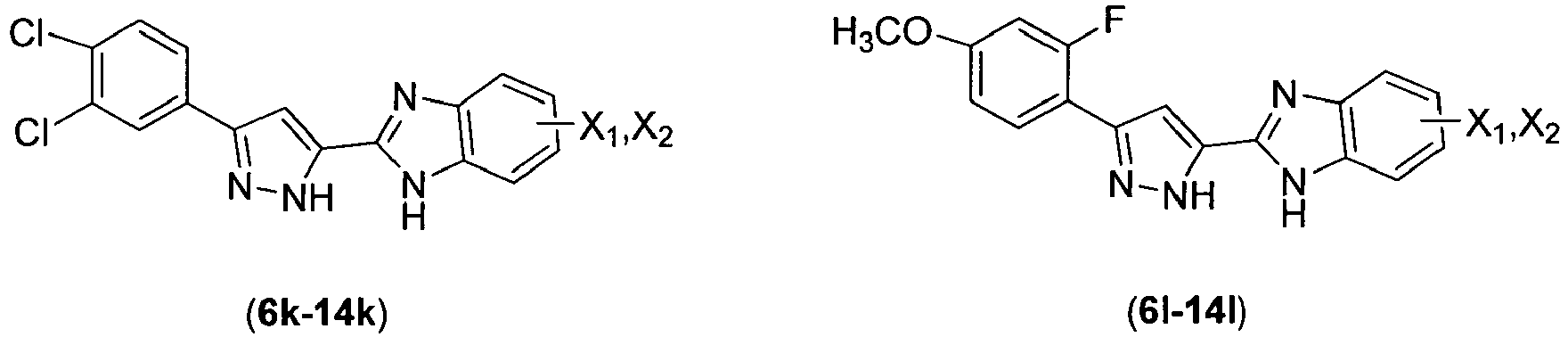
X2 = [H, Br, Cl, F, CH3, CF3] - In an embodiment of the present invention the new pyrazole linked benzimidazole conjugates of formula A is represented by the compounds of formulae 6a-14a, 6b-14b, 6c-14c, 6d-14d, 6e-14e, 6f-14f, 6g-14g, 6h-14h, 6i-14i, 6j-14j, 6k-14k, 6l-14l, 6m-14m, 6n-14n.


X1 = [H, Br, Cl, F, CH3, OCH3, CH3, NO2, CF3]
X2 = [H, Br, Cl, F, CH3, CF3] - In yet another embodiment the pyrazole linked benzimidazole conjugates are represented by the group of the following compounds:
- 2-(3-phenyl-1H-pyrazol-5-yl)-1H-benzo[d]imidazole (6a)
- 2-(3-(4-methoxyphenyl)-1H-pyrazol-5-yl)-1H-benzo[d]imidazole (6b)
- 2-(3-(3,4-dimethoxyphenyl)-1H-pyrazol-5-yl)-1H-benzo[d]imidazole (6c)
- 2-(3-(3,5-dimethoxyphenyl)-1H-pyrazol-5-yl)-1H-benzo[d]imidazole (6d)
- 2-(3-(2,4-dimethoxyphenyl)-1H-pyrazol-5-yl)-1H-benzo[d]imidazole (6e)
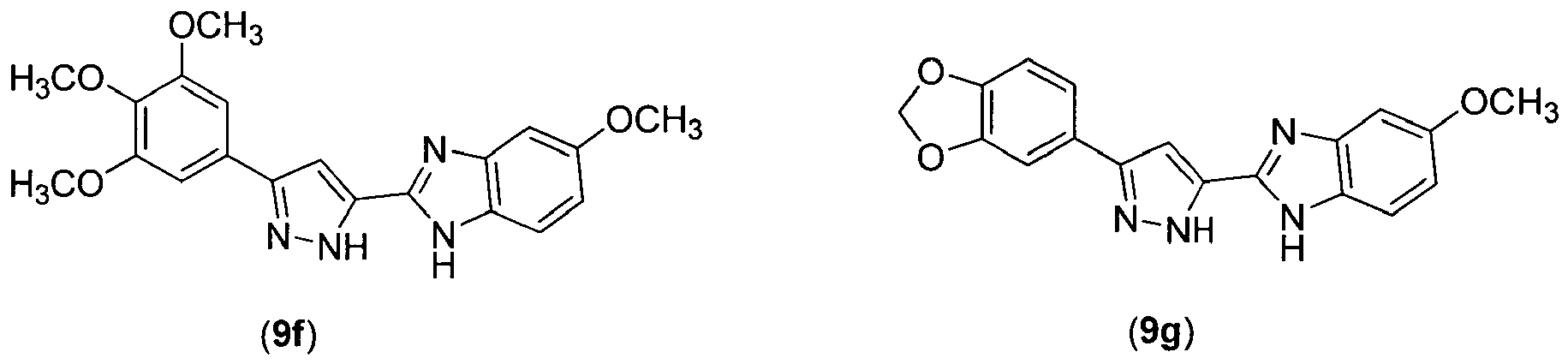
- 2-(3-(3,4,5-trimethoxyphenyl)-1H-pyrazol-5-yl)-1H-benzo[d]imidazole (6f)
- 2-(3-(benzo[d][1,3]dioxol-5-yl)-1H-pyrazol-5-yl)-1H-benzo[d]imidazole (6g)
- 2-(3-(4-fluorophenyl)-1H-pyrazol-5-yl)-1H-benzo[d]imidazole (6h)
- 2-(3-(3,4-difluorophenyl)-1H-pyrazol-5-yl)-1H-benzo[d]imidazole (6i)
- 2-(3-(4-chlorophenyl)-1H-pyrazol-5-yl)-1H-benzo[d]imidazole (6j)
- 2-(3-(3,4-dichlorophenyl)-1H-pyrazol-5-yl)-1H-benzo[d]imidazole (6k)
- 2-(3-(2-fluoro-4-methoxyphenyl)-1H-pyrazol-5-yl)-1H-benzo[d]imidazole (6l)
- 2-(3-p-tolyl-1H-pyrazol-5-yl)-1H-benzo[d]imidazole (6m)
- 2-(3-(3,4-dimethylphenyl)-1H-pyrazol-5-yl)-1H-benzo[d]imidazole (6n)
- 5-fluoro-2-(3-phenyl-1 H-pyrazol-5-yl)-1H-benzo[d]imidazole (7a)
- 5-fluoro-2-(3-(4-methoxyphenyl)-1H-pyrazol-5-yl)-1H-benzo[d]imidazole (7b)
- 2-(3-(3,4-dimethoxyphenyl)-1H-pyrazol-5-yl)-5-fluoro-1H-benzo[d]imidazole (7c)
- 2-(3-(3,5-dimethoxyphenyl)-1H-pyrazol-5-yl)-5-fluoro-1H-benzo[d]imidazole (7d)
- 2-(3-(2,4-dimethoxyphenyl)-1H-pyrazol-5-yl)-5-fluoro-1H-benzo[d]imidazole (7e)
- 5-fluoro-2-(3-(3,4,5-trimethoxyphenyl)-1H-pyrazol-5-yl)-1H-benzo[d]imidazole (7f)
- 2-(3-(benzo[d][1,3]dioxol-5-yl)-1H-pyrazol-5-yl)-5-fluoro-1H-benzo[d]imidazole (7g)
- 5-fluoro-2-(3-(4-fluorophenyl)-1H-pyrazol-5-yl)-1H-benzo[d]imidazole (7h)
- 2-(3-(3,4-difluorophenyl)-1H-pyrazol-5-yl)-5-fluoro-1H-benzo[d]imidazole (7i)
- 2-(3-(4-chlorophenyl)-1H-pyrazol-5-yl)-5-fluoro-1H-benzo[d]imidazole (7j)
- 2-(3-(3,4-dichlorophenyl)-1H-pyrazol-5-yl)-5-fluoro-1H-benzo[d]imidazole (7k)
- 5-fluoro-2-(3-(2-fluoro-4-methoxyphenyl)-1H-pyrazol-5-yl)-1H-benzo[d]imidazole (7l)
- 5-fluoro-2-(3-p-tolyl-1H-pyrazol-5-yl)-1H-benzo[d]imidazole (7m)
- 2-(3-(3,4-dimethylphenyl)-1H-pyrazol-5-yl)-5-fluoro-1H-benzo[d]imidazole (7n)
- 5-chloro-2-(3-phenyl-1H-pyrazol-5-yl)-1H-benzo[d]imidazole (8a)
- 5-chloro-2-(3-(4-methoxyphenyl)-1H-pyrazol-5-yl)-1H-benzo[d]imidazole (8b)
- 5-chloro-2-(3-(3,4-dimethoxyphenyl)-1H-pyrazol-5-yl)-1H-benzo[d]imidazole (8c)
- 5-chloro-2-(3-(3,5-dimethoxyphenyl)-1H-pyrazol-5-yl)-1H-benzo[d]imidazole (8d)
- 5-chloro-2-(3-(2,4-dimethoxyphenyl)-1H-pyrazol-5-yl)-1H-benzo[d]imidazole (8e)
- 5-chloro-2-(3-(3,4,5-trimethoxyphenyl)-1H-pyrazol-5-yl)-1H-benzo[d]imidazole (8f)
- 2-(3-(benzo[d][1,3]dioxol-5-yl)-1H-pyrazol-5-yl)-5-chloro-1H-benzo[d]imidazole (8g)
- 5-chloro-2-(3-(4-fluorophenyl)-1H-pyrazol-5-yl)-1H-benzo[d]imidazole (8h)
- 5-chloro-2-(3-(3,4-difluorophenyl)-1H-pyrazol-5-yl)-1H-benzo[d]imidazole (8i)
- 5-chloro-2-(3-(4-chlorophenyl)-1H-pyrazol-5-yl)-1H-benzo[d]imidazole (8j)
- 5-chloro-2-(3-(3,4-dichlorophenyl)-1H-pyrazol-5-yl)-1H-benzo[d]imidazole (8k)
- 5-chloro-2-(3-(2-fluoro-4-methoxyphenyl)-1H-pyrazol-5-yl)-1H-benzo[d]imidazole (8l)
- 5-chloro-2-(3-p-tolyl-1H-pyrazol-5-yl)-1H-benzo[d]imidazole (8m)
- 5-chloro-2-(3-(3,4-dimethylphenyl)-1H-pyrazol-5-yl)-1H-benzo[d]imidazole (8n)
- 5-methoxy-2-(3-phenyl-1H-pyrazol-5-yl)-1H-benzo[d]imidazole (9a)
- 5-methoxy-2-(3-(4-methoxyphenyl)-1H-pyrazol-5-yl)-1H-benzo[d]imidazole (9b)
- 2-(3-(3,4-dimethoxyphenyl)-1H-pyrazol-5-yl)-5-methoxy-1H-benzo[d]imidazole (9c)
- 2-(3-(3,5-dimethoxyphenyl)-1H-pyrazol-5-yl)-5-methoxy-1H-benzo[d]imidazole (9d)
- 2-(3-(2,4-dimethoxyphenyl)-1H-pyrazol-5-yl)-5-methoxy-1H-benzo[d]imidazole (9e)
- 5-methoxy-2-(3-(3,4,5-trimethoxyphenyl)-1H-pyrazol-5-yl)-1H-benzo[d]imidazole (9f)
- 2-(3-(benzo[d][1,3]dioxol-5-yl)-1H-pyrazol-5-yl)-5-methoxy-1H-benzo[d]imidazole (9g)
- 2-(3-(4-fluorophenyl)-1H-pyrazol-5-yl)-5-methoxy-1H-benzo[d]imidazole (9h)
- 2-(3-(3,4-difluorophenyl)-1H-pyrazol-5-yl)-5-methoxy-1H-benzo[d]imidazole (9i)
- 2-(3-(4-chlorophenyl)-1H-pyrazol-5-yl)-5-methoxy-1H-benzo[d]imidazole (9j)
- 2-(3-(3,4-dichlorophenyl)-1H-pyrazol-5-yl)-5-methoxy-1H-benzo[d]imidazole (9k)
- 2-(3-(2-fluoro-4-methoxyphenyl)-1H-pyrazol-5-yl)-5-methoxy-1H-benzo[d]imidazole (9l)
- 5-methoxy-2-(3-p-tolyl-1H-pyrazol-5-yl)-1H-benzo[d]imidazole (9m)
- 2-(3-(3,4-dimethylphenyl)-1H-pyrazol-5-yl)-5-methoxy-1H-benzo[d]imidazole (9n)
- 5,6-dichloro-2-(3-phenyl-1H-pyrazol-5-yl)-1H-benzo[d]imidazole (10a)
- 5,6-dichloro-2-(3-(4-methoxyphenyl)-1H-pyrazol-5-yl)-1H-benzo[d]imidazole (10b)
- 5,6-dichloro-2-(3-(3,4-dimethoxyphenyl)-1H-pyrazol-5-yl)-1H-benzo[d]imidazole (10c)
- 5,6-dichloro-2-(3-(3,5-dimethoxyphenyl)-1H-pyrazol-5-yl)-1H-benzo[d]imidazole (10d)
- 5,6-dichloro-2-(3-(2,4-dimethoxyphenyl)-1H-pyrazol-5-yl)-1H-benzo[d]imidazole (10e)
- 5,6-dichloro-2-(3-(3,4,5-trimethoxyphenyl)-1H-pyrazol-5-yl)-1H-benzo[d]imidazole (10f)
- 2-(3-(benzo[d][1,3]dioxol-5-yl)-1H-pyrazol-5-yl)-5,6-dichloro-1H-benzo[d]imidazole (10g)
- 5,6-dichloro-2-(3-(4-fluorophenyl)-1H-pyrazol-5-yl)-1H-benzo[d]imidazole (10h)
- 5,6-dichloro-2-(3-(3,4-difluorophenyl)-1H-pyrazol-5-yl)-1H-benzo[d]imidazole (10i)
- 5,6-dichloro-2-(3-(4-chlorophenyl)-1H-pyrazol-5-yl)-1H-benzo[d]imidazole (10j)
- 5,6-dichloro-2-(3-(3,4-dichlorophenyl)-1H-pyrazol-5-yl)-1H-benzo[d]imidazole (10k)
- 5,6-dichloro-2-(3-(2-fluoro-4-methoxyphenyl)-1H-pyrazol-5-yl)-1H-benzo[d]imidazole (10l)
- 5,6-dichloro-2-(3-p-tolyl-1H-pyrazol-5-yl)-1H-benzo[d]imidazole (10m)
- 5,6-dichloro-2-(3-(3,4-dimethylphenyl)-1H-pyrazol-5-yl)-1H-benzo[d]imidazole (10n)
- 2-(3-phenyl-1H-pyrazol-5-yl)-5-(trifluoromethyl)-1H-benzo[d]imidazole (11a)
- 2-(3-(4-methoxyphenyl)-1H-pyrazol-5-yl)-5-(trifluoromethyl)-1H-benzo[d]imidazole (11b)
- 2-(3-(3,4-dimethoxyphenyl)-1H-pyrazol-5-yl)-5-(trifluoromethyl)-1H-benzo[d]imidazole (11c)
- 2-(3-(3,5-dimethoxyphenyl)-1H-pyrazol-5-yl)-5-(trifluoromethyl)-1H-benzo[d]imidazole (11d)
- 2-(3-(2,4-dimethoxyphenyl)-1H-pyrazol-5-yl)-5-(trifluoromethyl)-1H-benzo[d]imidazole (11e)
- 5-(trifluoromethyl)-2-(3-(3,4,5-trimethoxyphenyl)-1H-pyrazol-5-yl)-1H-benzo[d]imidazole (11f)
- 2-(3-(benzo[d][1,3]dioxol-5-yl)-1H-pyrazol-5-yl)-5-(trifluoromethyl)-1H-benzo[d]imidazole (11g)
- 2-(3-(4-fluorophenyl)-1H-pyrazol-5-yl)-5-(trifluoromethyl)-1H-benzo[d]imidazole (11h)
- 2-(3-(3,4-difluorophenyl)-1H-pyrazol-5-yl)-5-(trifluoromethyl)-1H-benzo[d]imidazole(11i)
- 2-(3-(4-chlorophenyl)-1H-pyrazol-5-yl)-5-(trifluoromethyl)-1H-benzo[d]imidazole (11j)
- 2-(3-(3,4-dichlorophenyl)-1H-pyrazol-5-yl)-5-(trifluoromethyl)-1H-benzo[d]imidazole (11k)
- 2-(3-(2-fluoro-4-methoxyphenyl)-1H-pyrazol-5-yl)-5-(trifluoromethyl)-1H-benzo[d]imidazole (11l)
- 2-(3-p-tolyl-1H-pyrazol-5-yl)-5-(trifluoromethyl)-1H-benzo[d]imidazole (11m)
- 2-(3-(3,4-dimethylphenyl)-1H-pyrazol-5-yl)-5-(trifluoromethyl)-1H-benzo[d]imidazole (11 n)
- 5-nitro-2-(3-phenyl-1H-pyrazol-5-yl)-1H-benzo[d]imidazole (12a)
- 2-(3-(4-methoxyphenyl)-1H-pyrazol-5-yl)-5-nitro-1H-benzo[d]imidazole (12b)
- 2-(3-(3,4-dimethoxyphenyl)-1H-pyrazol-5-yl)-5-nitro-1H-benzo[d]imidazole (12c)
- 2-(3-(3,5-dimethoxyphenyl)-1H-pyrazol-5-yl)-5-nitro-1H-benzo[d]imidazole (12d)
- 2-(3-(2,4-dimethoxyphenyl)-1H-pyrazol-5-yl)-5-nitro-1H-benzo[d]imidazole (12e)
- 5-nitro-2-(3-(3,4,5-trimethoxyphenyl)-1H-pyrazol-5-yl)-1H-benzo[d]imidazole (12f)
- 2-(3-(benzo[d][1,3]dioxol-5-yl)-1H-pyrazol-5-yl)-5-nitro-1H-benzo[d]imidazole (12g)
- 2-(3-(4-fluorophenyl)-1H-pyrazol-5-yl)-5-nitro-1H-benzo[d]imidazole (12h)
- 2-(3-(3,4-difluorophenyl)-1H-pyrazol-5-yl)-5-nitro-1H-benzo[d]imidazole (12i)
- 2-(3-(4-chlorophenyl)-1H-pyrazol-5-yl)-5-nitro-1H-benzo[d]imidazole (12j)
- 2-(3-(3,4-dichlorophenyl)-1H-pyrazol-5-yl)-5-nitro-1H-benzo[d]imidazole (12k)
- 2-(3-(2-fluoro-4-methoxyphenyl)-1H-pyrazol-5-yl)-5-nitro-1H-benzo[d]imidazole (12l)
- 5-nitro-2-(3-p-tolyl-1H-pyrazol-5-yl)-1H-benzo[d]imidazole (12m)
- 2-(3-(3,4-dimethylphenyl)-1H-pyrazol-5-yl)-5-nitro-1H-benzo[d]imidazole (12n)
- 5-chloro-6-fluoro-2-(3-phenyl-1H-pyrazol-5-yl)-1H-benzo[d]imidazole (13a)
- 5-chloro-6-fluoro-2-(3-(4-methoxyphenyl)-1H-pyrazol-5-yl)-1H-benzo[d]imidazole (13b)
- 5-chloro-2-(3-(3,4-dimethoxyphenyl)-1H-pyrazol-5-yl)-6-fluoro-1H-benzo[d]imidazole (13c)
- 5-chloro-2-(3-(3,5-dimethoxyphenyl)-1H-pyrazol-5-yl)-6-fluoro-1H-benzo[d]imidazole (13d)
- 5-chloro-2-(3-(2,4-dimethoxyphenyl)-1H-pyrazol-5-yl)-6-fluoro-1H-benzo[d]imidazole (13e)
- 5-chloro-6-fluoro-2-(3-(3,4,5-trimethoxyphenyl)-1H-pyrazol-5-yl)-1H-benzo[d]imidazole (13f)
- 2-(3-(benzo[d][1,3]dioxol-5-yl)-1H-pyrazol-5-yl)-5-chloro-6-fluoro-1 H-benzo[d]imidazole (13g)
- 5-chloro-6-fluoro-2-(3-(4-fluorophenyl)-1H-pyrazol-5-yl)-1H-benzo[d]imidazole (13h)
- 5-chloro-2-(3-(3,4-difluorophenyl)-1H-pyrazol-5-yl)-6-fluoro-1H-benzo[d]imidazole (13i)
- 5-chloro-2-(3-(4-chlorophenyl)-1H-pyrazol-5-yl)-6-fluoro-1H-benzo[d]imidazole (13j)
- 6-chloro-2-(3-(3,4-dichlorophenyl)-1H-pyrazol-5-yl)-5-fluoro-1H-benzo[d]imidazole (13k)
- 6-chloro-5-fluoro-2-(3-(2-fluoro-4-methoxyphenyl)-1H-pyrazol-5-yl)-1H-benzo[d]imidazole (13l)
- 6-chloro-5-fluoro-2-(3-p-tolyl-1H-pyrazol-5-yl)-1H-benzo[d]imidazole (13m)
- 6-chloro-2-(3-(3,4-dimethylphenyl)-1H-pyrazol-5-yl)-5-fluoro-1H-benzo[d]imidazole (13n)
- 6-bromo-2-(3-phenyl-1H-pyrazol-5-yl)-5-(trifluoromethyl)-l H-benzo[d]imidazole (14a)
- 6-bromo-2-(3-(4-methoxyphenyl)-1H-pyrazol-5-yl)-5-(trifluoromethyl)-1H-benzo[d]imidazole (14b)
- 6-bromo-2-(3-(3,4-dimethoxyphenyl)-1H-pyrazol-5-yl)-5-(trifluoromethyl)-1H-benzo[d]imidazole (14c)
- 6-bromo-2-(3-(3,5-dimethoxyphenyl)-1H-pyrazol-5-yl)-5-(trifluoromethyl)-1H-benzo[d]imidazole (14d)
- 6-bromo-2-(3-(2,4-dimethoxyphenyl)-1H-pyrazol-5-yl)-5-(trifluoromethyl)-1H-benzo[d]imidazole (14e)
- 6-bromo-5-(trifluoromethyl)-2-(3-(3,4,5-trimethoxyphenyl)-1H-pyrazol-5-yl)-1H-benzo[d]imidazole14f)
- 2-(3-(benzo[d][1,3]dioxol-5-yl)-1H-pyrazol-5-yl)-6-bromo-5-(trifluoromethyl)-1H-benzo[d]imidazole (14g)
- 6-bromo-2-(3-(4-fluorophenyl)-1H-pyrazol-5-yl)-5-(trifluoromethyl)-1H-benzo[d]imidazole (14h) 6-bromo-2-(3-(3,4-difluorophenyl)-1H-pyrazol-5-yl)-5-(trifluoromethyl)-1H-benzo[d]imidazole (14i)
- 6-bromo-2-(3-(4-chlorophenyl)-1H-pyrazol-5-yl)-5-(trifluoromethyl)-1H-benzo[d]imidazole (14j)
- 6-bromo-2-(3-(3,4-dichlorophenyl)-1H-pyrazol-5-yl)-5-(trifluoromethyl)-1H-benzo[d]imidazole (14k)
- 6-bromo-2-(3-(2-fluoro-4-methoxyphenyl)-1H-pyrazol-5-yl)-5-(trifluoromethyl)-1H-benzo[d]imidazole (14l)
- 6-bromo-2-(3-p-tolyl-1H-pyrazol-5-yl)-5-(trifluoromethyl)-1H-benzo[d]imidazole (14m)
- 6-bromo-2-(3-(3,4-dimethylphenyl)-1H-pyrazol-5-yl)-5-(trifluoromethyl)-1H-benzo[d]imidazole (14n)
- In an embodiment of the invention wherein compound is having anticancerous activity.
- In another embodiment of the invention wherein the compounds possess anticancer activity against cell lines selected from the group consisting of leukemia, non-small cell lung cancer, colon cancer, CNS cancer, melanoma, ovarian cancer, renal cancer, prostate cancer and breast cancer.
- The present invention also provides a process for the preparation of pyrazole linked benzimidazole conjugates of formulae A

R1,R2,R3,R4,R5 = [H, Cl, F, CH3, OCH3, 3,4(OCH2O)]
X1 = [H, Br, Cl, F, CH3, OCH3, CH3, NO2, CF3]
X2 = [H, Br, Cl, F, CH3, CF3] - (a) the said process comprises of reacting 3-aryl-1 H-pyrazole-5-carbaldehydes of formula (5a-n).

with a compound selected from a group consisting of formulae 1, 2, 3, 4, 5, 6, 7, 8, 9 and 10

- In an embodiment of the invention wherein the water immiscible solvent may be selected from the group consisting of ethyl acetate or chloroform or dichloromethane.
- The desired products pyrazole linked benzimidazole conjugates (6a-14a to 6n-14n) present in the invention have been prepared using literature method (A. Kamal, MK. Reddy, TB. Shaik, Rajender, YV. Srikanth, VS. Reddy, GB. Kumar, SV. Kalivendi. Synthesis of terphenyl benzimidazoles as tubulin polymerization inhibitors. Eur. J. Med. Chem. 2012, 50, 9-17). The key intermediates 3-substituted phenyl-1H-pyrazole-5-carbaldehydes 5(a-n) were prepared in four sequential steps using literature method (Y. Yamazaki, K. Tanaka, B. Nicholson, G. Deyanat-Yazdi, B. Potts, T. Yoshida, A. Oda, T. Kitagawa, S. Orikasa, Y. Kiso, H. Yasui, M. Akamatsu, T. Chinen, T. Usui, Y. Shinozaki, F. Yakushiji, BR. Miller, S. Neuteboom, M. Palladino, K. Kanoh, GK. Lloyd, Y. Hayashi Synthesis and structure-activity relationship study of antimicrotubule agents phenylahistin derivatives with a didehydropiperazine-2,5-dione structure. J. Med. Chem. 2012, 55, 1056-1071). The crucial intermediates for the preparation of precursors 3-phenyl-1H-pyrazole-5-carbaldehydes of formulae 5(a-n) are ethyl 3-phenyl-1H-pyrazole-5-carboxylates 4(a-n) have been prepared using literature methods (A. Kamal, J.R. Tamboli, M.V. Vishnuvardhan, S.F. Adil, V.L. Nayak, S. Ramakrishna. Synthesis and anticancer activity of heteroaromatic linked 4β-amid podophyllotoxins as apoptotic inducing agents Bioorg. Med. Chem. Lett. 2013, 23, 273-280. S. Sidique, R. Ardecky, Y. Su, S. Narisawa, B. Brown, J.L. Millán, E. Sergienko, N.D. Cosford. Design and synthesis of pyrazole derivatives as potent and selective inhibitors of tissue-nonspecific alkaline phosphatase (TNAP). Bioorg .Med. Chem. Lett. 2009, 19 222-225)
- These pyrazole-benzimidazole conjugates have shown promising anticancer activity in various cell lines. The molecules synthesized are of immense biological significance. This resulted in design and synthesis of new congeners as illustrated in scheme 1 which comprises: oxidative cyclization of o-phenylenediamines of formulae 1, 2, 3, 4, 5, 6, 7, 8, 9, 10 and 3-phenyl-1H-pyrazole-5-carbaldehydes of formulae 5(a-n) and the compounds of formulae a, b, c, d, f, g, h, l, j, k, l, m, n, o, p for the compounds (6a-14a to 6n-14n).
- 1. Stirring the reaction mixtures at a temperature of 85 °C for 3-4 h to obtain the compounds (6a-14a to 6n-14n)
- 2. Synthesis of pyrazole linked benzimidazole conjugates
- 3. Purification by column chromatography using different solvents like ethyl acetate, hexane
- The Synthesis of pyrazole-benzimidazole conjugates described in the present invention are outlined in Scheme 1. The final step has been carried by oxidative cyclization of o-phenylenediamines of formulae 1, 2, 3, 4, 5, 6, 7, 8, 9, 10 and 3-phenyl-1H-pyrazole-5-carbaldehydes of formulae 5(a-n) with sodium metabisulphite in ethanol/methanol solvent system at a temperature of 85 °C for 3-4 h. The key intermediates 3-substituted phenyl-1H-pyrazole-5-carbaldehydes 5(a-n) was prepared in four sequential steps. Initially substituted acetophenones 1(a-n) reacted with diethyl oxalate in the presence of sodium ethanolate in ethanol yielded ethyl 2,4-dioxo-4-(substituted phenyl)butanoates 2(a-n). This was further cyclised with NH2-NH2.2HCl in ethanol to produce ethyl 3-substituted phenyl-1H-pyrazole-5-carboxylates 3(a-n) in good yields. The obtained carboxylates were reduced to (3-substitutedphenyl-1 H-pyrazol-5-yl) methanols 4(a-n) by LiAlH4/THF. These were selectively oxidized to 3-substituted phenyl-1 H-pyrazole-5-carbaldehydes by IBX in DMSO.
- Each 3-substituted phenyl-1H-pyrazole-5-carbaldehydes (5a-n) (1.0 mmol) were added to substituted o-phenylenediamines (1-10) (1.0 mmol) in ethanol (10 mL). A catalytic amount of Na2S2O5 (5 mg) was also charged to the reaction mixture and stirred at a temperature of 85 °C for 3-4 h. The reaction progress was monitored by TLC. After completion of reaction the reaction mixture cooled to room temperature and added water (100 mL) followed by extracted with ethyl acetate (3 X 30 mL). The organic layers were washed with water, brine solution and dried over anhydrous Na2SO4. Evaporation of the solvent under vacuum yielded the crude product that was further purified by column chromatography using ethyl acetate/hexane solvent system.

X1 = [H, Br, Cl, F, CH3, OCH3, CH3, NO2, CF3]
X2 = [H, Br, Cl, F, CH3, CF3] - Reagents and conditions : (i) NaOEt, EtOH, 4h, 0°C-rt, (85-90%); (ii) NH2-NH2.2HCl, EtOH, 3 h, reflux, (72-79%); (iii) LiAlH4, THF, 1-2 h, 0°C-rt, (70-80%); (iv) IBX, dry DMSO, 1 h, rt, (80-90%); (v) Na2S2O5, EtOH, o-phenylenediamines, 3-4 h, rt, (70-80%)

X1 = [H, Br, Cl, F, CH3, OCH3, CH3, NO2, CF3]
X2 = [H, Br, Cl, F, CH3, CF3] - More particularly the present invention relates to
2-(3-phenyl-1H-pyrazol-5-yl)-substituted-1H-benzo[d]imidazoles (6a-14a)
2-(3-(4-methoxyphenyl)-1H-pyrazol-5-yl)-substituted-1H-benzo[d]imidazoles (6b-14b)
2-(3-(3,4-dimethoxyphenyl)-1H-pyrazol-5-yl)- substituted-1 H-benzo[d]imidazoles (6c-14c)
2-(3-(3,5-dimethoxyphenyl)-1H-pyrazol-5-yl)- substituted-1H-benzo[d]imidazoles (6d-14d)
2-(3-(2,4-dimethoxyphenyl)-1H-pyrazol-5-yl)- substituted-1H-benzo[d]imidazoles (6e-14e)
2-(3-(3,4,5-trimethoxyphenyl)-1H-pyrazol-5-yl)- substituted-1 H-benzo[d]imidazoles (6f-14f)
2-(3-(benzo[d][1,3]dioxol-5-yl)-1H-pyrazol-5-yl)- substituted-1 H-benzo[d]imidazoles (6g-14g)
2-(3-(4-fluorophenyl)-1H-pyrazol-5-yl)-substituted-1H-benzo[d]imidazoles (6h-14h)
2-(3-(3,4-difluorophenyl)-1H-pyrazol-5-yl)- substituted-1H-benzo[d]imidazoles (6i-14i)
2-(3-(4-chlorophenyl)-1H-pyrazol-5-yl)- substituted-1 H-benzo[d]imidazoles (6j-14j)
2-(3-(3,4-dichlorophenyl)-1H-pyrazol-5-yl)- substituted-1 H-benzo[d]imidazoles (6k-14k)
2-(3-(2-fluoro-4-methoxyphenyl)-1H-pyrazol-5-yl)- substituted-1 H-benzo[d]imidazoles (6l-14l)
2-(3-p-tolyl-1H-pyrazol-5-yl)- substituted-1 H-benzo[d]imidazoles (6m-14m)
2-(3-(3,4-dimethylphenyl)-1H-pyrazol-5-yl)- substituted-1 H-benzo[d]imidazoles (6n-14n) - The compounds so synthesized are useful as anticancer (anti-tumor) agents. The structural formulae of these compounds are given below.



X1 = [H, Br, Cl, F, CH3, OCH3, CH3, NO2, CF3]
X2 = [H, Br, Cl, F, CH3, CF3] - The following examples are given by way of illustration and therefore should not be construed to the present limit of the scope of invention
- 3-(4-methoxyphenyl)-1H-pyrazole-5-carbaldehyde (5b) (202 mg, 1.0 mmol) in ethanol (10 mL) was added o-phenylenediamine (1) (108 mg, 1.0 mmol) and catalytic amount of Na2S2O5 (5 mg). The reaction mixture was stirred at a temperature of 85 °C for 3 h and the completion of reaction was confirmed by TLC. This reaction mixture was cooled to room temperature (28°C) and extracted with ethyl acetate (3 X 30 mL). The combined organic layers were washed with water, brine solution and dried over anhydrous Na2SO4. Evaporation of the solvent under vacuum yielded the crude product that was further purified by column chromatography using ethyl acetate/hexane to afford the pure compound of 2-(3-(4-methoxyphenyl)-1H-pyrazol-5-yl)-1 H-benzo[d]imidazole (6b) (266 mg, 78% yield).
1H NMR (CDCl3+DMSO): 3.88 (s, 3H, OCH3), 6.99 (d, 2H, ArH, J=8.3Hz), 7.17-7.29 (m, 3H, ArH) 7.53(s, 1H, ArH), 7.63 (s, 1H, ArH), 7.72 (d, 2H, ArH, J=8.1 Hz)ppm. FABMS: 291 [M+H]+. - 3-(3,4-dimethoxyphenyl)-1H-pyrazole-5-carbaldehyde (5c) (232 mg, 1.0mmol) in ethanol (10 mL) was added o-phenylenediamine (1) (150 mg, 1.0 mmol) and catalytic amount of Na2S2O5 (5 mg). The reaction mixture was stirred at a temperature of 85 °C for 3 h and the completion of reaction was confirmed by TLC. This reaction mixture was cooled to room temperature (30°C) and extracted with ethyl acetate (3 X 30 mL). The combined organic layers were washed with water, brine solution and dried over anhydrous Na2SO4. Evaporation of the solvent under vacuum yielded the crude product that was further purified by column chromatography using ethyl acetate/hexane to afford the pure compound of 2-(3-(3,4-dimethoxyphenyl)-1H-pyrazol-5-yl)-1 H-benzo[d]imidazole (6c) (255 mg, 79.5% yield).
1 H NMR (CDCl3+DMSO): 3.91 (s, 3H, OCH3), 3.94 (s, 3H, OCH3) 6.97 (d, 1H, ArH, J=8.7Hz), 7.18-7.24 (m, 3H, ArH) 7.4(s, 1H, ArH), 7.58-7.68 (m, 2H, ArH)ppm. FABMS: 321[M+H]+. - 3-(3,4,5-trimethoxyphenyl)-1H-pyrazole-5-carbaldehyde(5f) (262 mg, 1.0mmol) in ethanol (10 mL) was added o-phenylenediamine (1) (150 mg, 1.0 mmol) and catalytic amount of Na2S2O5 (5 mg). The reaction mixture was stirred at a temperature of 85 °C for 4 h and the completion of reaction was confirmed by TLC. This reaction mixture was cooled to room temperature (30°C) and extracted with ethyl acetate (3 X 30 mL). The combined organic layers were washed with water, brine solution and dried over anhydrous Na2SO4. Evaporation of the solvent under vacuum yielded the crude product that was further purified by column chromatography using ethyl acetate/hexane to afford the pure compound of 2-(3-(3,4,5-trimethoxyphenyl)-1H-pyrazol-5-yl)-1H-benzo[d]imidazole (6f) (259 mg, 54% yield).
1H NMR (CDCl3+DMSO): 3.76 (s, 6H, OCH3), 3.84 (s, 3H, OCH3) 6.84 (s, 2H, ArH), 7.13-7.28 (m, 3H, ArH) 7.59 (s, 2H, ArH)ppm. FABMS: 351[M+H]+. - 3-(benzo[d][1,3]dioxol-5-yl)-1H-pyrazole-5-carbaldehyde (5g) (216 mg, 1.0mmol) in ethanol (10 mL) was added o-phenylenediamine (1) (150 mg, 1.0 mmol) and catalytic amount of Na2S2O5 (5 mg). The reaction mixture was stirred at a temperature of 85 °C for 3 h and the completion of reaction was confirmed by TLC. This reaction mixture was cooled to room temperature (30°C) and extracted with ethyl acetate (3 X 30 mL). The combined organic layers were washed with water, brine solution and dried over anhydrous Na2SO4. Evaporation of the solvent under vacuum yielded the crude product that was further purified by column chromatography using ethyl acetate/hexane to afford the pure compound of 2-(3-(benzo[d][1,3]dioxol-5-yl)-1H-pyrazol-5-yl)-1H-benzo[d]imidazole (6g) (210 mg, 53.3% yield).
1H NMR (CDCl3+DMSO): 6.03 (s, 2H, OCH2O), 6.90 (d, 1H, ArH, J=7.9Hz), 7.16 (s, 1H, ArH), 7.18-7.24 (m, 3H, ArH) 7.30 (s, 1H, ArH), 7.57-7.67 (m, 4H, ArH)ppm. FABMS: 305[M+H]+. - 3-(4-methoxyphenyl)-1H-pyrazole-5-carbaldehyde (5b) (202 mg, 1.0 mmol) in ethanol (10 mL) was added 4-fluorobenzene-1,2-diamine (2) (126 mg, 1.0 mmol) and catalytic amount of Na2S2O5 (5 mg). The reaction mixture was stirred at a temperature of 85 °C for 3 h and the completion of reaction was confirmed by TLC. This reaction mixture was cooled to room temperature (33°C) and extracted with ethyl acetate (3 X 30 mL). The combined organic layers were washed with water, brine solution and dried over anhydrous Na2SO4. Evaporation of the solvent under vacuum yielded the crude product that was further purified by column chromatography using ethyl acetate/hexane to afford the pure compound of 5-fluoro-2-(3-(4-methoxyphenyl)-1 H-pyrazol-5-yl)-1H-benzo[d]imidazole (7b) (236 mg, 76.7% yield).
1H NMR (CDCl3+DMSO): 3.86 (s, 3H, OCH3) 6.98 (d, 1H, ArH, J=8.8Hz), 7.16 (s, 1H, ArH), 7.47-7.58 (m, 3H, ArH ) 7.71 (d, 2H, ArH, J=7.7Hz )ppm. FABMS: 309[M+H]+. - 3-(3,4,5-trimethoxyphenyl)-1H-pyrazole-5-carbaldehyde(5f) (262 mg, 1.0mmol) in ethanol (10 mL) was added 4-fluorobenzene-1,2-diamine (2) (126 mg, 1.0 mmol) and catalytic amount of Na2S2O5 (5 mg). The reaction mixture was stirred at a temperature of 85 °C for 4 h and the completion of reaction was confirmed by TLC. This reaction mixture was cooled to room temperature (28°C) and extracted with ethyl acetate (3 X 30 mL). The combined organic layers were washed with water, brine solution and dried over anhydrous Na2SO4. Evaporation of the solvent under vacuum yielded the crude product that was further purified by column chromatography using ethyl acetate/hexane to afford the pure compound of 2-(3-(benzo[d][1,3]dioxol-5-yl)-1H-pyrazol-5-yl)-5-fluoro-1H-benzo[d]imidazole (7g) (257 mg, 80% yield).
1H NMR (CDCl3+DMSO): 6.03 (s, 2H, OCH2O), 6.89 (d, 1H, ArH, J=8.1Hz), 7.12 (s, 1H, ArH), 7.23-7.33 (m, 2H, ArH) 7.61 (d, 2H, ArH, J=8.1Hz)ppm. FABMS: 305[M+H]+. - 3-(3,4,5-trimethoxyphenyl)-1H-pyrazole-5-carbaldehyde (5f) (262 mg, 1.0mmol) in ethanol (10 mL) was added 4-chlorobenzene-1,2-diamine (3) (142.9 mg, 1.0 mmol) and catalytic amount of Na2S2O5 (5 mg). The reaction mixture was stirred at a temperature of 85 °C for 4 h and the completion of reaction was confirmed by TLC. This reaction mixture was cooled to room temperature (30°C) and extracted with ethyl acetate (3 X 30 mL). The combined organic layers were washed with water, brine solution and dried over anhydrous Na2SO4. Evaporation of the solvent under vacuum yielded the crude product that was further purified by column chromatography using ethyl acetate/hexane to afford the pure compound of 5-chloro-2-(3-(3,4,5-trimethoxyphenyl)-1H-pyrazol-5-yl)-1H-benzo[d]imidazole (8f) (291 mg, 76% yield).
1H NMR (CDCl3+DMSO): 3.85 (s, 3H, OCH3), 3.94 (s, 6H, OCH3) 7.08 (s, 2H, ArH), 7.18 (d, 1H, ArH, J=8.6Hz) 7.24 (s, 2H, ArH), 7.50-7.62 (m, 1H, ArH) 7.64 (s, 1H, ArH)ppm. FABMS: 385[M+H]+ - 3-(3,4,5-trimethoxyphenyl)-1H-pyrazole-5-carbaldehyde(5f) (262 mg, 1.0mmol) in ethanol (10 mL) was added 4-methoxybenzene-1,2-diamine (4) (138 mg, 1.0 mmol) and catalytic amount of Na2S2O5 (5 mg). The reaction mixture was stirred at a temperature of 85 °C for 4 h and the completion of reaction was confirmed by TLC. This reaction mixture was cooled to room temperature (35°C) and extracted with ethyl acetate (3 X 30 mL). The combined organic layers were washed with water, brine solution and dried over anhydrous Na2SO4. Evaporation of the solvent under vacuum yielded the crude product that was further purified by column chromatography using ethyl acetate/hexane to afford the pure compound of 5-methoxy-2-(3-(,4,5-trimethoxyphenyl)-1H-pyrazol-5-yl)-1H-benzo[d]imidazole (9f) (292 mg, 77 yield).
1H NMR (CDCl3+DMSO): 3.87 (s, 6H, OCH3), 3.93 (s, 6H, OCH3) 6.82-6.92 (m, 1H, ArH) 7.06 (s, 2H, ArH), 7.23 (s, 1H, ArH) 7.50 (s, 1H, ArH)ppm. FABMS: 381[M+H]+. - 3-(4-methoxyphenyl)-1H-pyrazole-5-carbaldehyde (5b) (202 mg, 1.0 mmol) in ethanol (10 mL) was added 4,5-dichlorobenzene-1,2-diamine (5) (177 mg, 1.0 mmol) and catalytic amount of Na2S2O5 (5 mg). The reaction mixture was stirred at a temperature of 85 °C for 3 h and the completion of reaction was confirmed by TLC. This reaction mixture was cooled to room temperature (30°C) and extracted with ethyl acetate (3 X 30 mL). The combined organic layers were washed with water, brine solution and dried over anhydrous Na2SO4. Evaporation of the solvent under vacuum yielded the crude product that was further purified by column chromatography using ethyl acetate/hexane to afford the pure compound of 5,6-dichloro-2-(3-(4-methoxyphenyl)-1H-pyrazol-5-yl)-1H-benzo[d]imidazole (10b) (270 mg, 75.4% yield).
1H NMR (CDCl3+DMSO): 3.86 (s, 3H, OCH3), 6.98 (d, 2H, ArH, J=8.4 Hz) 7.15 (s, 1H, ArH) 7.53 (s, 2H, ArH), 7.70 (d, 2H, ArH, J = 7.4 Hz) ppm. FABMS: 418[M+H]+. - 3-(4-methoxyphenyl)-1H-pyrazole-5-carbaldehyde (5b) (202 mg, 1.0 mmol) in ethanol (10 mL) was added 4,5-dichlorobenzene-1,2-diamine (5) (177 mg, 1.0 mmol) and catalytic amount of Na2S2O5 (5 mg). The reaction mixture was stirred at a temperature of 85 °C for 4 h and the completion of reaction was confirmed by TLC. This reaction mixture was cooled to room temperature (33°C) and extracted with ethyl acetate (3 X 30 mL). The combined organic layers were washed with water, brine solution and dried over anhydrous Na2SO4. Evaporation of the solvent under vacuum yielded the crude product that was further purified by column chromatography using ethyl acetate/hexane to afford the pure compound of5,6-dichloro-2-(3-(3,4,5-trimethoxyphenyl)-1H-pyrazol-5-yl)-1H-benzo[d]imidazole (10f) (330 mg, 79% yield).
1H NMR (CDCl3+DMSO): 3.84 (s, 3H, OCH3), 3.93 (s, 6H, OCH3) 7.07 (s, 2H, ArH) 7.23 (s, 1H, ArH) 7.70 (s, 2H, ArH)ppm. FABMS: 418[M+H]+. - Cytotoxic activity: The human cancer cell line assays for some representative compounds were carried out at the National Cancer Institute, Marryland, USA.
- The pyrazole linked benzimidazole conjugates (6f, 6g, 7g, 8f, 9f and 10f) have been tested against fifty six human tumor cell lines derived from nine cancer types (leukemia, non-small cell lung cancer, colon cancer, CNS cancer, melanoma, ovarian cancer, renal cancer, prostate cancer and breast cancer) as per the NCl protocol. For each compound, dose response curves for individual cell lines have been measured at a minimum of five concentrations at 10 fold dilutions. A protocol of 48 h continuous drug exposure has been used, and a sulforhodamine B (SRB) protein assay was used to estimate cell viability or growth. Nocodazole was used as standard and the Log10 GI50 values have been reported in the table 1. The concentration for 50% cell growth inhibition (GI50) (Growth Inhibition) total cell growth inhibition (TGI, 0% growth) (Total Growth Inhibition), and 50% cell death (LC50, 50% growth) (Lethal concentration) values were tabulated (Table-1). DMSO used as control to calculate the values of GI50, LC50, TGI. The compounds 6f, 6g, 7g, 8f, 9f and 10f has been evaluated for their in vitro cytotoxicity in fifty six cell lines from nine human cancer types of leukemia (K-562, SR), lung (Hop-62, NCI-H226, NCI-H522), colon (HCT-116, HCT-15, HCC-2998), CNS (SF-539), melanoma (SK-MEL-5, UACC-62, M14), ovarian (IGROV1), renal (A498), prostate (PC3) breast (BT-549, MDA-MB-435, HS578T)origin. The results are expressed as percent of cell growth determined relative to that of untreated control cells (Table 2). The representative compounds 6f, 6g, 7g, 8f, 9f and 10f showed significant anticancer activity against some cancer cell lines.
Table-1. Log10 GI50 (concentration in mol/L causing 50% growth inhibition) values for pyrazolebenzimidazole conjugates (6f, 6g, 7g, 8f, 9f and 10f) Log10 GI50 Cell Lines 6f 6g 7g 8f 9f 10f Nocodazole Leukemia -5.64 -5.60 -5.53 -5.61 -5.90 -5.56 -7.91 Non-small-cell -5.34 -5.83 -5.53 -7.69 lung -5.62 -5.27 -5.56 Colon -5.32 -5.39 -5.27 -5.40 -5.64 -5.44 -7.75 CNS -5.28 -5.37 -5.20 -5.43 -5.61 -5.45 -7.64 Melanoma -5.68 -5.52 -5.34 -5.61 -5.88 -5.55 -7.65 Ovarian -5.49 -5.36 -5.21 -5.45 -5.69 -5.35 -6.84 Renal -5.58 -5.69 -5.34 -5.50 -5.65 -5.45 -6.97 Prostate -5.54 -5.29 -5.25 -5.54 -5.81 -5.52 -7.84 Breast Cancer -5.65 -5.47 -5.44 -5.59 -5.94 -5.50 -6.81 - The compounds 6f, 6g, 7g, 8f, 9f and 10f exhibited a broad spectrum of anticancer activity against fifty six cell lines in nine cell panels, with GI50 value range of 0.34-1 out. Particularly, the compounds 8f and 9f were more potent than the compounds 6f, 6g, 7g and 10f against all the cell lines tested. In detail, the GI50 values for the compound 6f against leukemia RPMI-8226 cell line were 1.20 µM. In the non-small cell lung cancer panel, the growth of NCI-H226 and NCI-H522 cell lines were affected by compound 6f with GI50 values as 1.14 and 1.84 µM, respectively. The GI50 values for the compound 6f against melanoma cancer cell line SK-MEL-5 was 1.34 µM. whereas the Ovarian cancer cell line OVCAR-4 and OVCAR-5 were affected by the compound 6f with GI50 value of 1.26 µM and 1.30 µM respectively. The breast cancer cells such as T-47D were also affected by the compound 6f with GI50 value 1.11 µM. The GI50 values for compound 6g against leukemia RPMI-8226 cell line was 1.14 µM. In the CNS cancer panel the cell line SNB-75 was affected by 6g with GI50 value 1.01 µM and the GI50 values for the compound 6g against renal cancer cell line TK-10 is 1.09 µM. In the melanoma cancer panel, the growth of SK-MEL-5 and UACC-254 cell lines were affected by compound 7g with GI50 values as 1.46 and 1.02 µM, respectively. The GI50 values for the compound 7g against leukemia RPMI-8226 1.09 µM. whereas in the ovarian cancer panel the cell line OVCAR-4 growth was affected by 7g with GI50 value 1.37 µM. The GI50 values for the compound 8f against leukemia RPMI-8226 cell line was 1.65 µM. In the ovarian cancer panel, the growth of cell lines OVCAR-4 and OVCAR-5 were affected by compound 8f with GI50 values 1.38 and 1.21 µM, respectively. The GI50 values for the compound 9f against leukemia RPMI-8226, MOLT-4 and CCRF-CEM were 0.64, 0.73 and 1.29 µM respectively. In the non-small cell lung cancer panel, the growth of NCI-H226, NCI-H23 and NCI-H522 cell lines were affected by compound 9f with GI50 values as 0.46, 1.34 and 1.21 µM respectively. The GI50 values for the compounds 9f against melanoma cancer, the growth of SK-MEL-5 and UACC-62 cell lines were 4.62 and 1.12 µM, respectively. The GI50 values for the compound 9f against ovarian OVCAR-4 and OVCAR-8 were 1.24 and 1.15 µM, respectively. The Prostate cancer cell line PC-3 was affected by the compound 9f with GI 50 value1.03 µM. The breast cancer cell lines BT-549, T-47D and MDA-MB-468 were affected by the compound 9f with GI 50 values 0.89, 0.34 and 0.38 µM, respectively. The GI50 values for the compound 10f against leukemia RPMI-8226 cell line was 1.75 µM. Overall the compound 9f exhibited potential growth inhibitory activity against breast cancer and leukemia cell lies.
- Compounds 6f, 6g, 7g, 8f, 9f and 10f exhibited activity against fifty six cell lines in nine cancer cell panels with GI50 values of <10µm. In vitro cytotoxicity of compounds 6f, 6g, 7g, 8f, 9f and 10f in the selected cancer cell lines has been illustrated in Table 2.
Table 2. Cytotoxicity of compounds 6f, 6g, 7g, 8f, 9f and 10f in a panel of fifty six cancer cell lines. Cancer panel/cell GI50 values (µM) line 6f 6g 7g 8f 9f 10f Leukemia CCRF-CEM 2.12 2.52 2.65 2.48 1.29 2.35 HL-60(TB) 2.54 2.27 2.74 2.49 1.69 3.34 K-562 3.08 3.83 4.81 3.04 2.01 3.30 MOLT-4 2.13 2.68 3.14 2.02 0.73 2.49 RPMI-8226 1.20 1.14 1.09 1.65 0.64 1.75 SR 3.32 3.37 4.95 3.32 1.74 3.89 Non-small cell lung A549/ATCC 2.43 4.23 3.53 2.96 1.63 2.87 HOP-62 3.54 8.46 8.54 3.11 2.02 3.43 HOP92 NT NT NT NT NT NT NCI-H226 1.14 4.42 4.21 1.88 0.46 2.29 NCI-H23 2.26 4.47 8.84 2.73 1.34 3.40 NCIH322M 2.85 6.29 6.88 3.65 2.47 3.29 NCI-H460 3.64 4.57 6.06 3.65 2.64 3.33 NCI-H522 1.87 1.98 2.56 1.90 1.21 2.02 Colon COLO-205 3.98 4.78 8.11 3.18 1.61 3.77 HCC-2998 7.10 3.74 5.37 5.98 3.03 4.47 HCT-116 3.15 6.36 4.50 3.45 1.81 2.78 HCT-15 3.43 3.86 3.73 2.90 2.50 2.89 HT29 7.16 3.66 5.77 4.14 2.76 3.42 KM12 3.15 1.75 2.96 3.45 1.70 3.56 SW-620 7.73 5.87 9.34 4.99 2.89 4.47 CNS SF-268 6.43 4.77 6.05 3.60 2.74 3.95 SF-295 3.13 3.24 4.20 2.35 1.62 3.04 SF-539 5.11 2.71 2.90 4.66 2.42 3.28 SNB-19 1.78 5.92 10.0 7.25 2.98 5.47 SNB-75 2.83 1.01 2.80 2.71 2.23 3.12 U251 3.73 2.37 2.78 3.38 2.90 2.97 Melanoma LOX IMVI NT NT NT NT NT NT MALME-3M 1.95 2.33 2.75 2.58 1.74 2.70 M14 2.57 2.19 4.17 2.92 1.66 3.57 MDA-MB-435 2.35 3.12 5.43 3.30 1.49 3.78 SK-MEL-2 NT NT NT NT NT NT SK-MEL-28 2.72 4.85 8.87 2.42 1.90 3.07 SK-MEL-5 1.34 1.53 1.46 1.62 0.46 1.56 UACC-257 2.10 6.00 1.02 2.60 1.67 3.77 UACC-62 1.64 3.08 4.77 1.97 1.12 1.94 Ovarian IGROV1 2.34 3.66 3.67 3.42 1.90 3.86 OVCAR-3 4.00 3.21 5.32 3.50 2.05 4.05 OVCAR-4 1.26 2.16 1.37 1.38 1.24 2.21 OVCAR-5 1.30 1.49 6.44 1.21 3.03 7.08 OVCAR-8 2.35 3.97 3.43 2.26 1.15 2.51 NCI/ADR-RES 2.88 4.08 4.43 3.16 2.91 3.25 SK-OV-3 3.48 4.98 1.24 4.47 2.83 1.73 Renal 786-0 3.66 4.58 7.13 5.32 2.92 4.09 A498 1.51 1.70 4.66 2.10 2.23 4.21 ACHN 2.77 4.33 3.64 2.96 2.63 3.54 CAKI-1 2.24 2.74 2.71 2.80 1.79 3.81 RXF 393 1.77 2.36 3.02 3.26 2.49 3.17 SN12C 3.91 3.73 4.95 3.06 2.06 3.05 TK-10 4.07 1.09 1.30 3.52 2.21 4.61 UO-31 2.21 3.98 2.93 2.64 1.57 2.47 Prostate PC-3 2.10 3.64 3.78 2.47 1.03 2.20 DU-145 3.90 7.27 8.24 3.27 2.29 4.16 Breast MCF7 2.79 3.78 3.53 2.17 2.15 2.79 MDA-MB-231/ATCC 3.22 4.12 2.22 3.94 2.87 4.14 HS 578T 6.89 3.80 9.53 3.58 2.89 4.53 BT-549 1.80 2.12 2.16 2.54 0.89 2.84 T-47D 1.11 3.32 3.21 1.58 0.34 1.87 MDA-MB-435 0.93 3.57 4.14 2.33 0.38 3.49 *NT=not tested - The mean graph midpoint values of Log10 TGI and Log10 LC50 as well as Log10 GI50 for compounds 6f, 6g, 7g, 8f, 9f and 10f is listed in Table-3. As demonstrated by mean graph pattern, compounds7e, 8e, 10e, 11e, 12e, 13e and 8f exhibited an interesting profile of activity and selectivity for various cell lines. The mean graph mid points of Log10 TGI and Log10 LC50 have shown similar pattern to the Iog10 GI50 mean graph mid points.
Table-3. Log10 GI50, Log10 TGI and Log10 LC50 mean graphs midpoints(MG_MID) of in vitro cytotoxicity data for the compound 6f, 6g, 7g, 8f, 9f and 10f against human tumor cell lines. Compound Log10 GI50 Log10 TGI Log10 LC50 6f -5.54 -4.83 -4.2 6g -5.43 -4.75 -4.25 7g -5.32 -4.19 -4.03 8f -5.52 -4.93 -4.34 9f -5.77 -5.17 -4.53 10f -5.48 -4.88 -4.26 - Since pyrazole and benzimidazole moieties individually contribute remarkable functions in the field of medicinal chemistry, our efforts projected towards the synthesis of pyrazole linked benzimidazole conjugates as single molecular scaffold. All the conjugates achieved pure and good yields by column chromatography using ethyl acetate and hexane solvent system. The conjugates present in this invention displayed remarkable anticancer potentials against a panel of 60 cancer cell lines. Some of the conjugates like 6f, 6g, 7g, 8f, 9f and 10f demonstrated pronounced activities in most of the cells investigated especially in breast cancer cells.
- 1. The present invention provides some new pyrazole linked benzimidazole conjugates useful as antitumor agents.
- 2. It also provides a process for the preparation of novel pyrazole linked benzimidazole conjugates

Claims (8)
- A pyrazole linked benzimidazole conjugates of formula A and its salts thereof

X1 = [H, Br, Cl, F, CH3, OCH3, CH3, NO2, CF3]
X2 = [H, Br, Cl, F, CH3, CF3] - A compound as claimed in claim1, wherein the pyrazole linked benzimidazole conjugates of formula A is represented by the compounds of formulae 6a-14a, 6b-14b, 6c-14c, 6d-14d, 6e-14e, 6f-14f, 6g-14g, 6h-14h, 6i-14i, 6j-14j, 6k-14k, 6l-14l, 6m-14m, 6n-14n wherein the representative structures are:




- A compound as claimed in claim 1 wherein the representative structures of the compounds are as follows.


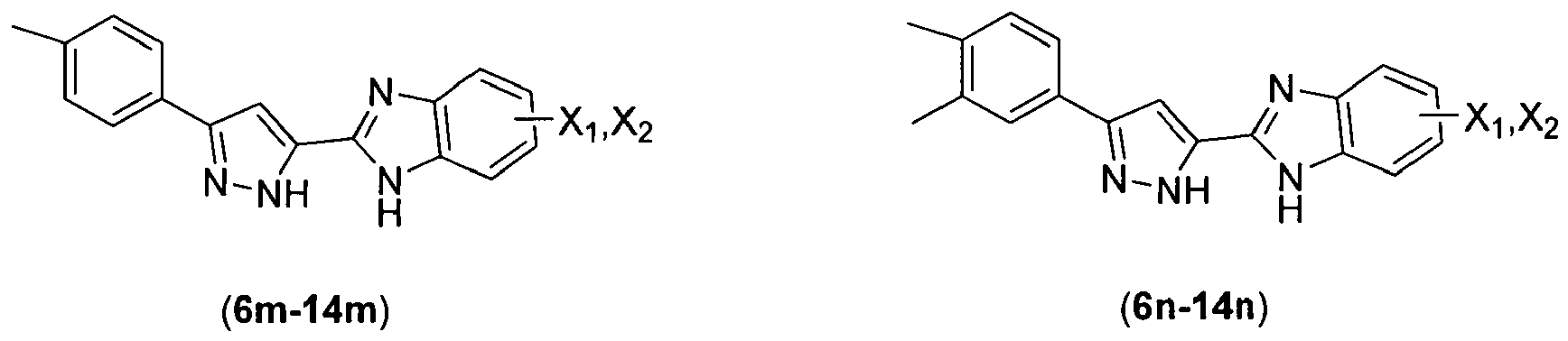
X1 = [H, Br, Cl, F, CH3, OCH3, CH3, NO2, CF3]
X2 = [H, Br, Cl, F, CH3, CF3] - A compound as claimed in claim 1 wherein pyrazole linked benzimidazole conjugates is represented by the group of the following compounds:2-(3-phenyl-1H-pyrazol-5-yl)-1H-benzo[d]imidazole (6a)2-(3-(4-methoxyphenyl)-1H-pyrazol-5-yl)-1H-benzo[d]imidazole (6b)2-(3-(3,4-dimethoxyphenyl)-1H-pyrazol-5-yl)-1H-benzo[d]imidazole (6c)2-(3-(3,5-dimethoxyphenyl)-1H-pyrazol-5-yl)-1H-benzo[d]imidazole (6d)2-(3-(2,4-dimethoxyphenyl)-1H-pyrazol-5-yl)-1H-benzo[d]imidazole (6e)2-(3-(3,4,5-trimethoxyphenyl)-1H-pyrazol-5-yl)-1H-benzo[d]imidazole (6f)2-(3-(benzo[d][1,3]dioxol-5-yl)-1H-pyrazol-5-yl)-1H-benzo[d]imidazole (6g)2-(3-(4-fluorophenyl)-1H-pyrazol-5-yl)-1H-benzo[d]imidazole (6h)2-(3-(3,4-difluorophenyl)-1H-pyrazol-5-yl)-1H-benzo[d]imidazole (6i)2-(3-(4-chlorophenyl)-1H-pyrazol-5-yl)-1H-benzo[d]imidazole (6j)2-(3-(3,4-dichlorophenyl)-1H-pyrazol-5-yl)-1H-benzo[d]imidazole (6k)2-(3-(2-fluoro-4-methoxyphenyl)-1H-pyrazol-5-yl)-1H-benzo[d]imidazole (6l)2-(3-p-tolyl-1H-pyrazol-5-yl)-1H-benzo[d]imidazole (6m)2-(3-(3,4-dimethylphenyl)-1H-pyrazol-5-yl)-1H-benzo[d]imidazole (6n)5-fluoro-2-(3-phenyl-1H-pyrazol-5-yl)-1H-benzo[d]imidazole (7a)5-fluoro-2-(3-(4-methoxyphenyl)-1H-pyrazol-5-yl)-1H-benzo[d]imidazole (7b)2-(3-(3,4-dimethoxyphenyl)-1H-pyrazol-5-yl)-5-fluoro-1H-benzo[d]imidazole (7c)2-(3-(3,5-dimethoxyphenyl)-1H-pyrazol-5-yl)-5-fluoro-1 H-benzo[d]imidazole (7d)2-(3-(2,4-dimethoxyphenyl)-1H-pyrazol-5-yl)-5-fluoro-1H-benzo[d]imidazole (7e)5-fluoro-2-(3-(3,4,5-trimethoxyphenyl)-1H-pyrazol-5-yl)-1H-benzo[d]imidazole (7f)2-(3-(benzo[d][1,3]dioxol-5-yl)-1H-pyrazol-5-yl)-5-fluoro-1H-benzo[d]imidazole (7g)5-fluoro-2-(3-(4-fluorophenyl)-1H-pyrazol-5-yl)-1H-benzo[d]imidazole (7h)2-(3-(3,4-difluorophenyl)-1H-pyrazol-5-yl)-5-fluoro-1H-benzo[d]imidazole (7i)2-(3-(4-chlorophenyl)-1H-pyrazol-5-yl)-5-fluoro-1H-benzo[d]imidazole (7j)2-(3-(3,4-dichlorophenyl)-1H-pyrazol-5-yl)-5-fluoro-1H-benzo[d]imidazole (7k)5-fluoro-2-(3-(2-fluoro-4-methoxyphenyl)-1H-pyrazol-5-yl)-1H-benzo[d]imidazole (7l)5-fluoro-2-(3-p-tolyl-1H-pyrazol-5-yl)-1H-benzo[d]imidazole (7m)2-(3-(3,4-dimethylphenyl)-1H-pyrazol-5-yl)-5-fluoro-1H-benzo[d]imidazole (7n)5-chloro-2-(3-phenyl-1H-pyrazol-5-yl)-1H-benzo[d]imidazole (8a)5-chloro-2-(3-(4-methoxyphenyl)-1H-pyrazol-5-yl)-1H-benzo[d]imidazole (8b)5-chloro-2-(3-(3,4-dimethoxyphenyl)-1H-pyrazol-5-yl)-1H-benzo[d]imidazole (8c)5-chloro-2-(3-(3,5-dimethoxyphenyl)-1H-pyrazol-5-yl)-1H-benzo[d]imidazole (8d)5-chloro-2-(3-(2,4-dimethoxyphenyl)-1H-pyrazol-5-yl)-1H-benzo[d]imidazole (8e)5-chloro-2-(3-(3,4,5-trimethoxyphenyl)-1H-pyrazol-5-yl)-1H-benzo[d]imidazole (8f)2-(3-(benzo[d][1,3]dioxol-5-yl)-1H-pyrazol-5-yl)-5-chloro-1H-benzo[d]imidazole (8g)5-chloro-2-(3-(4-fluorophenyl)-1H-pyrazol-5-yl)-1H-benzo[d]imidazole (8h)5-chloro-2-(3-(3,4-difluorophenyl)-1H-pyrazol-5-yl)-1H-benzo[d]imidazole (8i)5-chloro-2-(3-(4-chlorophenyl)-1H-pyrazol-5-yl)-1H-benzo[d]imidazole (8j)5-chloro-2-(3-(3,4-dichlorophenyl)-1H-pyrazol-5-yl)-1H-benzo[d]imidazole (8k)5-chloro-2-(3-(2-fluoro-4-methoxyphenyl)-1H-pyrazol-5-yl)-1H-benzo[d]imidazole (8l)5-chloro-2-(3-p-tolyl-1H-pyrazol-5-yl)-1H-benzo[d]imidazole (8m)5-chloro-2-(3-(3,4-dimethylphenyl)-1H-pyrazol-5-yl)-1H-benzo[d]imidazole (8n)5-methoxy-2-(3-phenyl-1H-pyrazol-5-yl)-1H-benzo[d]imidazole (9a)5-methoxy-2-(3-(4-methoxyphenyl)-1H-pyrazol-5-yl)-1H-benzo[d]imidazole (9b)2-(3-(3,4-dimethoxyphenyl)-1H-pyrazol-5-yl)-5-methoxy-1H-benzo[d]imidazole (9c)2-(3-(3,5-dimethoxyphenyl)-1H-pyrazol-5-yl)-5-methoxy-1H-benzo[d]imidazole (9d)2-(3-(2,4-dimethoxyphenyl)-1H-pyrazol-5-yl)-5-methoxy-1H-benzo[d]imidazole (9e)5-methoxy-2-(3-(3,4,5-trimethoxyphenyl)-1H-pyrazol-5-yl)-1H-benzo[d]imidazole (9f)2-(3-(benzo[d][1,3]dioxol-5-yl)-1H-pyrazol-5-yl)-5-methoxy-1H-benzo[d]imidazole (9g)2-(3-(4-fluorophenyl)-1H-pyrazol-5-yl)-5-methoxy-1H-benzo[d]imidazole (9h)2-(3-(3,4-difluorophenyl)-1H-pyrazol-5-yl)-5-methoxy-1H-benzo[d]imidazole (9i)2-(3-(4-chlorophenyl)-1H-pyrazol-5-yl)-5-methoxy-1H-benzo[d]imidazole (9j)2-(3-(3,4-dichlorophenyl)-1H-pyrazol-5-yl)-5-methoxy-1H-benzo[d]imidazole (9k)2-(3-(2-fluoro-4-methoxyphenyl)-1H-pyrazol-5-yl)-5-methoxy-1H-benzo[d]imidazole (9l)5-methoxy-2-(3-p-tolyl-1H-pyrazol-5-yl)-1H-benzo[d]imidazole (9m)2-(3-(3,4-dimethylphenyl)-1H-pyrazol-5-yl)-5-methoxy-1H-benzo[d]imidazole (9n)5,6-dichloro-2-(3-phenyl-1H-pyrazol-5-yl)-1H-benzo[d]imidazole (10a)5,6-dichloro-2-(3-(4-methoxyphenyl)-1H-pyrazol-5-yl)-1H-benzo[d]imidazole (10b)5,6-dichloro-2-(3-(3,4-dimethoxyphenyl)-1H-pyrazol-5-yl)-1H-benzo[d]imidazole (10c)5,6-dichloro-2-(3-(3,5-dimethoxyphenyl)-1H-pyrazol-5-yl)-1H-benzo[d]imidazole (10d)5,6-dichloro-2-(3-(2,4-dimethoxyphenyl)-1H-pyrazol-5-yl)-1H-benzo[d]imidazole (10e)5,6-dichloro-2-(3-(3,4,5-trimethoxyphenyl)-1H-pyrazol-5-yl)-1H-benzo[d]imidazole (10f)2-(3-(benzo[d][1,3]dioxol-5-yl)-1H-pyrazol-5-yl)-5,6-dichloro-1H-benzo[d]imidazole (10g)5,6-dichloro-2-(3-(4-fluorophenyl)-1H-pyrazol-5-yl)-1H-benzo[d]imidazole (10h)5,6-dichloro-2-(3-(3,4-difluorophenyl)-1H-pyrazol-5-yl)-1H-benzo[d]imidazole (10i)5,6-dichloro-2-(3-(4-chlorophenyl)-1H-pyrazol-5-yl)-1H-benzo[d]imidazole (10j)5,6-dichloro-2-(3-(3,4-dichlorophenyl)-1H-pyrazol-5-yl)-1H-benzo[d]imidazole (10k)5,6-dichloro-2-(3-(2-fluoro-4-methoxyphenyl)-1H-pyrazol-5-yl)-1H-benzo[d]imidazole (10l)5,6-dichloro-2-(3-p-tolyl-1H-pyrazol-5-yl)-1H-benzo[d]imidazole (10m)5,6-dichloro-2-(3-(3,4-dimethylphenyl)-1H-pyrazol-5-yl)-1H-benzo[d]imidazole (10n)2-(3-phenyl-1H-pyrazol-5-yl)-5-(trifluoromethyl)-1H-benzo[d]imidazole (11a)2-(3-(4-methoxyphenyl)-1H-pyrazol-5-yl)-5-(trifluoromethyl)-1H-benzo[d]imidazole (11b)2-(3-(3,4-dimethoxyphenyl)-1H-pyrazol-5-yl)-5-(trifluoromethyl)-1H-benzo[d]imidazole (11c)2-(3-(3,5-dimethoxyphenyl)-1H-pyrazol-5-yl)-5-(trifluoromethyl)-1H-benzo[d]imidazole (11d)2-(3-(2,4-dimethoxyphenyl)-1H-pyrazol-5-yl)-5-(trifluoromethyl)-1H-benzo[d]imidazole (11e)5-(trifluoromethyl)-2-(3-(3,4,5-trimethoxyphenyl)-1H-pyrazol-5-yl)-1H-benzo[d]imidazole (11f)2-(3-(benzo[d][1,3]dioxol-5-yl)-1H-pyrazol-5-yl)-5-(trifluoromethyl)-1H-benzo[d]imidazole (11g)2-(3-(4-fluorophenyl)-1H-pyrazol-5-yl)-5-(trifluoromethyl)-1H-benzo[d]imidazole (11 h)2-(3-(3,4-difluorophenyl)-1H-pyrazol-5-yl)-5-(trifluoromethyl)-1H-benzo[d]imidazole (11i)2-(3-(4-chlorophenyl)-1H-pyrazol-5-yl)-5-(trifluoromethyl)-1H-benzo[d]imidazole (11j)2-(3-(3,4-dichlorophenyl)-1H-pyrazol-5-yl)-5-(trifluoromethyl)-1H-benzo[d]imidazole (11k)2-(3-(2-fluoro-4-methoxyphenyl)-1H-pyrazol-5-yl)-5-(trifluoromethyl)-1H-benzo[d]imidazole (11l)2-(3-p-tolyl-1H-pyrazol-5-yl)-5-(trifluoromethyl)-1H-benzo[d]imidazole (11m)2-(3-(3,4-dimethylphenyl)-1H-pyrazol-5-yl)-5-(trifluoromethyl)-1H-benzo[d]imidazole (11 n)5-nitro-2-(3-phenyl-1H-pyrazol-5-yl)-1H-benzo[d]imidazole (12a)2-(3-(4-methoxyphenyl)-1H-pyrazol-5-yl)-5-nitro-1H-benzo[d]imidazole (12b)2-(3-(3,4-dimethoxyphenyl)-1H-pyrazol-5-yl)-5-nitro-1H-benzo[d]imidazole (12c)2-(3-(3,5-dimethoxyphenyl)-1H-pyrazol-5-yl)-5-nitro-1H-benzo[d]imidazole (12d)2-(3-(2,4-dimethoxyphenyl)-1H-pyrazol-5-yl)-5-nitro-1H-benzo[d]imidazole (12e)5-nitro-2-(3-(3,4,5-trimethoxyphenyl)-1H-pyrazol-5-yl)-1H-benzo[d]imidazole (12f)2-(3-(benzo[d][1,3]dioxol-5-yl)-1H-pyrazol-5-yl)-5-nitro-1H-benzo[d]imidazole (12g)2-(3-(4-fluorophenyl)-1H-pyrazol-5-yl)-5-nitro-1H-benzo[d]imidazole (12h)2-(3-(3,4-difluorophenyl)-1H-pyrazol-5-yl)-5-nitro-1H-benzo[d]imidazole (12i)2-(3-(4-chlorophenyl)-1H-pyrazol-5-yl)-5-nitro-1H-benzo[d]imidazole (12j)2-(3-(3,4-dichlorophenyl)-1H-pyrazol-5-yl)-5-nitro-1H-benzo[d]imidazole (12k)2-(3-(2-fluoro-4-methoxyphenyl)-1H-pyrazol-5-yl)-5-nitro-1H-benzo[d]imidazole (121)5-nitro-2-(3-p-tolyl-1H-pyrazol-5-yl)-1H-benzo[d]imidazole (12m)2-(3-(3,4-dimethylphenyl)-1H-pyrazol-5-yl)-5-nitro-1H-benzo[d]imidazole (12n)5-chloro-6-fluoro-2-(3-phenyl-1H-pyrazol-5-yl)-1H-benzo[d]imidazole (13a)5-chloro-6-fluoro-2-(3-(4-methoxyphenyl)-1H-pyrazol-5-yl)-1H-benzo[d]imidazole (13b)5-chloro-2-(3-(3,4-dimethoxyphenyl)-1H-pyrazol-5-yl)-6-fluoro-1H-benzo[d]imidazole (13c)5-chloro-2-(3-(3,5-dimethoxyphenyl)-1H-pyrazol-5-yl)-6-fluoro-1H-benzo[d]imidazole (13d)5-chloro-2-(3-(2,4-dimethoxyphenyl)-1H-pyrazol-5-yl)-6-fluoro-1H-benzo[d]imidazole (13e)5-chloro-6-fluoro-2-(3-(3,4,5-trimethoxyphenyl)-1H-pyrazol-5-yl)-1H-benzo[d]imidazole (13f)2-(3-(benzo[d][1,3]dioxol-5-yl)-1H-pyrazol-5-yl)-5-chloro-6-fluoro-1H-benzo[d]imidazole (13g)5-chloro-6-fluoro-2-(3-(4-fluorophenyl)-1H-pyrazol-5-yl)-1H-benzo[d]imidazole (13h)5-chloro-2-(3-(3,4-difluorophenyl)-1H-pyrazol-5-yl)-6-fluoro-1 H-benzo[d]imidazole (13i)5-chloro-2-(3-(4-chlorophenyl)-1H-pyrazol-5-yl)-6-fluoro-1H-benzo[d]imidazole (13j)6-chloro-2-(3-(3,4-dichlorophenyl)-1H-pyrazol-5-yl)-5-fluoro-1H-benzo[d]imidazole (13k)6-chloro-5-fluoro-2-(3-(2-fluoro-4-methoxyphenyl)-1H-pyrazol-5-yl)-1H-benzo[d]imidazole (131)6-chloro-5-fluoro-2-(3-p-tolyl-1H-pyrazol-5-yl)-1H-benzo[d]imidazole (13m)6-chloro-2-(3-(3,4-dimethylphenyl)-1H-pyrazol-5-yl)-5-fluoro-1H-benzo[d]imidazole (13n)6-bromo-2-(3-phenyl-1H-pyrazol-5-yl)-5-(trifluoromethyl)-1H-benzo[d]imidazole (14a)6-bromo-2-(3-(4-methoxyphenyl)-1H-pyrazol-5-yl)-5-(trifluoromethyl)-1H-benzo[d]imidazole (14b)6-bromo-2-(3-(3,4-dimethoxyphenyl)-1H-pyrazol-5-yl)-5-(trifluoromethyl)-1H-benzo[d]imidazole (14c)6-bromo-2-(3-(3,5-dimethoxyphenyl)-1H-pyrazol-5-yl)-5-(trifluoromethyl)-1H-benzo[d]imidazole (14d)6-bromo-2-(3-(2,4-dimethoxyphenyl)-1H-pyrazol-5-yl)-5-(trifluoromethyl)-1H-benzo[d]imidazole (14e)6-bromo-5-(trifluoromethyl)-2-(3-(3,4,5-trimethoxyphenyl)-1H-pyrazol-5-yl)-1H-benzo[d]imidazole2-(3-(benzo[d][1,3]dioxol-5-yl)-1H-pyrazol-5-yl)-6-bromo-5-(trifluoromethyl)-1H-benzo[d]imidazole (14g)6-bromo-2-(3-(4-fluorophenyl)-1H-pyrazol-5-yl)-5-(trifluoromethyl)-1H-benzo[d]imidazole (14h)6-bromo-2-(3-(3,4-difluorophenyl)-1H-pyrazol-5-yl)-5-(trifluoromethyl)-1H-benzo[d]imidazole (14i)6-bromo-2-(3-(4-chlorophenyl)-1H-pyrazol-5-yl)-5-(trifluoromethyl)-1H-benzo[d]imidazole (14j)6-bromo-2-(3-(3,4-dichlorophenyl)-1H-pyrazol-5-yl)-5-(trifluoromethyl)-1H-benzo[d]imidazole (14k)6-bromo-2-(3-(2-fluoro-4-methoxyphenyl)-1H-pyrazol-5-yl)-5-(trifluoromethyl)-1H-benzo[d]imidazole (14l)6-bromo-2-(3-p-tolyl-1H-pyrazol-5-yl)-5-(trifluoromethyl)-1H-benzo[d]imidazole (14m)6-bromo-2-(3-(3,4-dimethylphenyl)-1H-pyrazol-5-yl)-5-(trifluoromethyl)-1H-benzo[d]imidazole (14n)
- A compound as claimed in claim 1 wherein the compounds are having anticancerous activity.
- A compound as claimed in claim 1 wherein the compounds possess anticancer activity against cell lines selected from the group consisting of leukemia, non-small cell lung cancer, colon cancer, CNS cancer, melanoma, ovarian cancer, renal cancer, prostate cancer and breast cancer.
- A process for the preparation of pyrazole linked benzimidazole conjugates of formulae A,

R1,R2,R3,R4,R5 = [H, Cl, F, CH3, OCH3, 3,4(OCH2O)]
X1 = [H, Br, Cl, F, CH3, OCH3, CH3, NO2, CF3]
X2 = [H, Br, Cl, F, CH3, CF3]
the said process comprises of reacting 3-aryl-1 H-pyrazole-5-carbaldehydes of formula (5a-n).
with a compound selected from a group consisting of formulae 1, 2, 3, 4, 5, 6, 7, 8, 9 and 10


- The process as claimed in claim 8, wherein the water immiscible solvent is selected from the group consisting of ethyl acetate or chloroform or dichloromethane.
Applications Claiming Priority (1)
| Application Number | Priority Date | Filing Date | Title |
|---|---|---|---|
| IN1295DE2014 | 2014-05-15 |
Publications (2)
| Publication Number | Publication Date |
|---|---|
| EP2944635A1 true EP2944635A1 (en) | 2015-11-18 |
| EP2944635B1 EP2944635B1 (en) | 2018-11-28 |
Family
ID=53052765
Family Applications (1)
| Application Number | Title | Priority Date | Filing Date |
|---|---|---|---|
| EP15167182.3A Active EP2944635B1 (en) | 2014-05-15 | 2015-05-11 | Pyrazole linked benzimidazole conjugates and a process for preparation thereof |
Country Status (2)
| Country | Link |
|---|---|
| US (1) | US9951049B2 (en) |
| EP (1) | EP2944635B1 (en) |
Families Citing this family (1)
| Publication number | Priority date | Publication date | Assignee | Title |
|---|---|---|---|---|
| EP3456700A1 (en) | 2013-10-18 | 2019-03-20 | Deutsches Krebsforschungszentrum | Labeled inhibitors of prostate specific membrane antigen (psma), their use as imaging agents and pharmaceutical agents for the treatment of prostate cancer |
Citations (2)
| Publication number | Priority date | Publication date | Assignee | Title |
|---|---|---|---|---|
| WO2006033943A2 (en) * | 2004-09-17 | 2006-03-30 | Exelixis, Inc | Pyrazole kinase modulators and methods of use |
| US20130338112A1 (en) * | 2005-07-25 | 2013-12-19 | Synta Pharmaceuticals Corp. | Compounds for the treatment of proliferative disorders |
Family Cites Families (3)
| Publication number | Priority date | Publication date | Assignee | Title |
|---|---|---|---|---|
| CH648038A5 (en) * | 1981-01-19 | 1985-02-28 | Sandoz Ag | 7-((carboxymethoxyimino)-1h-pyrazol-3-yl-acetyl)amino-3-desacetoxy-3-(1-methyl-1h-tetrazol-5-yl-thio)cephalosporansaeure and salts, method for production and use. |
| US4495195A (en) * | 1982-11-01 | 1985-01-22 | Eli Lilly And Company | Xanthine oxidase inhibiting 3(5)-phenyl-substituted-5(3)-pyrazole-carboxylic acid derivatives, compositions, and methods of use |
| WO2014134306A1 (en) * | 2013-03-01 | 2014-09-04 | Zalicus Pharmaceuticals, Ltd. | Heterocyclic inhibitors of the sodium channel |
-
2015
- 2015-05-11 EP EP15167182.3A patent/EP2944635B1/en active Active
- 2015-05-12 US US14/709,663 patent/US9951049B2/en active Active
Patent Citations (2)
| Publication number | Priority date | Publication date | Assignee | Title |
|---|---|---|---|---|
| WO2006033943A2 (en) * | 2004-09-17 | 2006-03-30 | Exelixis, Inc | Pyrazole kinase modulators and methods of use |
| US20130338112A1 (en) * | 2005-07-25 | 2013-12-19 | Synta Pharmaceuticals Corp. | Compounds for the treatment of proliferative disorders |
Non-Patent Citations (10)
| Title |
|---|
| A. KAMAL; J.R. TAMBOLI; M.V. VISHNUVARDHAN; S.F. ADIL; V.L. NAYAK; S. RAMAKRISHNA: "Synthesis and anticancer activity of heteroaromatic linked 413-arnido podophyllotoxins as apoptotic inducing agents", BIOORG. MED. CHEM. LETT., vol. 23, 2013, pages 273 - 280, XP028961574, DOI: doi:10.1016/j.bmcl.2012.10.099 |
| A. KAMAL; MK. REDDY; TB. SHAIK; RAJENDER, YV. SRIKANTH; VS. REDDY; GB. KUMAR; SV. KALIVENDI: "Synthesis of terphenyl benzimidazoles as tubulin polymerization inhibitors", EUR. J. MED. CHEM., vol. 50, 2012, pages 9 - 17, XP028471818, DOI: doi:10.1016/j.ejmech.2012.01.004 |
| ABU THAHER B; AMSMANN M; TOTZKE F; EHLERT JE; KUBBUTAT MH; SCHÄCHTELE C; ZIMMERMANN MO; KOCH P; BOECKLER FM; LAUFER SA: "Tri- and tetrasubstituted pyrazole derivates: regioisomerism switches activity from p38MAP kinase to important cancer kinases", J. MED. CHEM., vol. 55, no. 2, 2012, pages 961 - 965, XP055053721, DOI: doi:10.1021/jm201391u |
| CONGIU C; ONNIS V; VESCI L; CASTORINA M; PISANO C: "Synthesis and in vitro antitumor activity of new 4,5-dihydropyrazole derivatives", BIOORG. MED. CHEM., vol. 18, no. 17, 2010, pages 6238 - 6248, XP027218809 |
| EL-DAKDOUKI MH; ADAMSKI N; FOSTER L; HACKER MP; ERHARDT PW: "Hypoxia activated prodrugs of a 9-aza-anthrapyrazole derivative that has promising anticancer activity", J. MED. CHEM., vol. 54, no. 23, 2011, pages 8224 - 8227 |
| KAMAL A; REDDY MK; SHAIK TB; RAJENDER, SRIKANTH YV; REDDY VS; KUMAR GB; KALIVENDI SV: "Synthesis of terphenyl benzimidazoles as tubulin polymerization inhibitors", EUR. J. MED. CHEM, vol. 50, 2012, pages 9 - 17, XP028471818, DOI: doi:10.1016/j.ejmech.2012.01.004 |
| KAMAL AHMED ET AL: "Synthesis of arylpyrazole linked benzimidazole conjugates as potential microtubule disruptors", BIOORGANIC & MEDICINAL CHEMISTRY, vol. 23, no. 5, 8 January 2015 (2015-01-08), pages 1082 - 1095, XP029199009, ISSN: 0968-0896, DOI: 10.1016/J.BMC.2015.01.004 * |
| LI Y; TAN C; GAO C; ZHANG C; LUAN X; CHEN X; LIU H; CHEN Y; JIANG Y: "Discovery of benzimidazole derivatives as novel multi-target EGFR, VEGFR-2 and PDGFR kinase inhibitors", BIOORG. MED. CHEM., vol. 19, no. 15, 2011, pages 4529 - 4535, XP028241214, DOI: doi:10.1016/j.bmc.2011.06.022 |
| S. SIDIQUE; R. ARDECKY; Y. SU; S. NARISAWA; B. BROWN; J.L. MILLÁN; E. SERGIENKO; N.D. COSFORD: "Design and synthesis of pyrazole derivatives as potent and selective inhibitors of tissue-nonspecific alkaline phosphatase (TNAP", BIOORG .MED. CHEM. LETT., vol. 19, 2009, pages 222 - 225, XP025816911, DOI: doi:10.1016/j.bmcl.2008.10.107 |
| Y. YAMAZAKI; K. TANAKA; B. NICHOLSON; G. DEYANAT-YAZDI; B. POTTS; T. YOSHIDA; A. ODA; T. KITAGAWA; S. ORIKASA; Y. KISO: "Synthesis and structure-activity relationship study of antimicrotubule agents phenylahistin derivatives with a didehydropiperazine-2,5-dione structure", J. MED. CHEM., vol. 55, 2012, pages 1056 - 1071, XP055346201, DOI: doi:10.1021/jm2009088 |
Also Published As
| Publication number | Publication date |
|---|---|
| US9951049B2 (en) | 2018-04-24 |
| US20150329527A1 (en) | 2015-11-19 |
| EP2944635B1 (en) | 2018-11-28 |
Similar Documents
| Publication | Publication Date | Title |
|---|---|---|
| Abonia et al. | Synthesis of novel 1, 2, 5-trisubstituted benzimidazoles as potential antitumor agents | |
| Zarranz et al. | Synthesis and anticancer activity evaluation of new 2-alkylcarbonyl and 2-benzoyl-3-trifluoromethyl-quinoxaline 1, 4-di-N-oxide derivatives | |
| Sławiński et al. | Carbonic anhydrase inhibitors. Synthesis of heterocyclic 4-substituted pyridine-3-sulfonamide derivatives and their inhibition of the human cytosolic isozymes I and II and transmembrane tumor-associated isozymes IX and XII | |
| Shaharyar et al. | Pyrazoline bearing benzimidazoles: Search for anticancer agent | |
| Noolvi et al. | 2, 6-Disubstituted imidazo [2, 1-b][1, 3, 4] thiadiazoles: Search for anticancer agents | |
| Kamal et al. | Synthesis of a new class of 2-anilino substituted nicotinyl arylsulfonylhydrazides as potential anticancer and antibacterial agents | |
| Kamal et al. | Synthesis and anti-cancer activity of chalcone linked imidazolones | |
| Chen et al. | Synthesis and anticancer evaluation of certain 4-anilinofuro [2, 3-b] quinoline and 4-anilinofuro [3, 2-c] quinoline derivatives | |
| Parrino et al. | Aza-isoindolo and isoindolo-azaquinoxaline derivatives with antiproliferative activity | |
| Gali et al. | One-pot multicomponent synthesis of indole incorporated thiazolylcoumarins and their antibacterial, anticancer and DNA cleavage studies | |
| Rao et al. | Synthesis and biological evaluation of imidazopyridinyl-1, 3, 4-oxadiazole conjugates as apoptosis inducers and topoisomerase IIα inhibitors | |
| Brzozowski et al. | Synthesis and antitumor activity of novel 2-amino-4-(3, 5, 5-trimethyl-2-pyrazolino)-1, 3, 5-triazine derivatives | |
| Verma et al. | Synthesis, in vitro evaluation and molecular modelling of naphthalimide analogue as anticancer agents | |
| Mahmoud et al. | Design, synthesis, and antiproliferative activity of new indole/1, 2, 4‐triazole/chalcone hybrids as EGFR and/or c‐MET inhibitors | |
| Singh et al. | Facile synthesis of C6‐substituted benz [4, 5] imidazo [1, 2‐a] quinoxaline derivatives and their anticancer evaluation | |
| Micale et al. | Synthesis and antitumor activity of 1, 3-benzodioxole derivatives | |
| Husain et al. | Benzimidazole: A valuable insight into the recent advances and biological activities | |
| US9951049B2 (en) | Pyrazole linked benzimidazole conjugates and a process for preparation thereof | |
| Kamal et al. | Synthesis and evaluation of N-((1-benzyl-1H-1, 2, 3-triazol-4-yl) methyl) nicotinamides as potential anticancer agents that inhibit tubulin polymerization | |
| Pinna et al. | Chromophore-modified bis-benzo [g] indole carboxamides: synthesis and antiproliferative activity of bis-benzo [g] indazole-3-carboxamides and related dimers | |
| Palani et al. | Exploring the Pharmacological Profiles of Benzimidazole Derivatives: A Comprehensive Review | |
| Ismail et al. | Anticancer evaluation of novel 1, 3, 4-trisubstituted pyrazole candidates bearing different nitrogenous heterocyclic Moieties | |
| Penthala et al. | Synthesis and in vitro screening of novel N-benzyl aplysinopsin analogs as potential anticancer agents | |
| Polovkovych et al. | Synthesis of New Schiff Bases and Polycyclic Fused Thiopyranothiazoles Containing 4, 6‐Dichloro‐1, 3, 5‐Triazine Moiety | |
| Cebeci et al. | Conventional and microwave irradiated synthesis, biological activity evaluation of highly substituted indole-triazole hybrids |
Legal Events
| Date | Code | Title | Description |
|---|---|---|---|
| PUAI | Public reference made under article 153(3) epc to a published international application that has entered the european phase |
Free format text: ORIGINAL CODE: 0009012 |
|
| AK | Designated contracting states |
Kind code of ref document: A1 Designated state(s): AL AT BE BG CH CY CZ DE DK EE ES FI FR GB GR HR HU IE IS IT LI LT LU LV MC MK MT NL NO PL PT RO RS SE SI SK SM TR |
|
| AX | Request for extension of the european patent |
Extension state: BA ME |
|
| 17P | Request for examination filed |
Effective date: 20160518 |
|
| RBV | Designated contracting states (corrected) |
Designated state(s): AL AT BE BG CH CY CZ DE DK EE ES FI FR GB GR HR HU IE IS IT LI LT LU LV MC MK MT NL NO PL PT RO RS SE SI SK SM TR |
|
| STAA | Information on the status of an ep patent application or granted ep patent |
Free format text: STATUS: EXAMINATION IS IN PROGRESS |
|
| 17Q | First examination report despatched |
Effective date: 20161209 |
|
| GRAP | Despatch of communication of intention to grant a patent |
Free format text: ORIGINAL CODE: EPIDOSNIGR1 |
|
| STAA | Information on the status of an ep patent application or granted ep patent |
Free format text: STATUS: GRANT OF PATENT IS INTENDED |
|
| INTG | Intention to grant announced |
Effective date: 20180606 |
|
| GRAS | Grant fee paid |
Free format text: ORIGINAL CODE: EPIDOSNIGR3 |
|
| GRAA | (expected) grant |
Free format text: ORIGINAL CODE: 0009210 |
|
| STAA | Information on the status of an ep patent application or granted ep patent |
Free format text: STATUS: THE PATENT HAS BEEN GRANTED |
|
| AK | Designated contracting states |
Kind code of ref document: B1 Designated state(s): AL AT BE BG CH CY CZ DE DK EE ES FI FR GB GR HR HU IE IS IT LI LT LU LV MC MK MT NL NO PL PT RO RS SE SI SK SM TR |
|
| REG | Reference to a national code |
Ref country code: CH Ref legal event code: EP |
|
| REG | Reference to a national code |
Ref country code: AT Ref legal event code: REF Ref document number: 1070070 Country of ref document: AT Kind code of ref document: T Effective date: 20181215 |
|
| REG | Reference to a national code |
Ref country code: DE Ref legal event code: R096 Ref document number: 602015020273 Country of ref document: DE |
|
| REG | Reference to a national code |
Ref country code: IE Ref legal event code: FG4D |
|
| REG | Reference to a national code |
Ref country code: NL Ref legal event code: MP Effective date: 20181128 |
|
| REG | Reference to a national code |
Ref country code: LT Ref legal event code: MG4D |
|
| REG | Reference to a national code |
Ref country code: AT Ref legal event code: MK05 Ref document number: 1070070 Country of ref document: AT Kind code of ref document: T Effective date: 20181128 |
|
| PG25 | Lapsed in a contracting state [announced via postgrant information from national office to epo] |
Ref country code: FI Free format text: LAPSE BECAUSE OF FAILURE TO SUBMIT A TRANSLATION OF THE DESCRIPTION OR TO PAY THE FEE WITHIN THE PRESCRIBED TIME-LIMIT Effective date: 20181128 Ref country code: BG Free format text: LAPSE BECAUSE OF FAILURE TO SUBMIT A TRANSLATION OF THE DESCRIPTION OR TO PAY THE FEE WITHIN THE PRESCRIBED TIME-LIMIT Effective date: 20190228 Ref country code: HR Free format text: LAPSE BECAUSE OF FAILURE TO SUBMIT A TRANSLATION OF THE DESCRIPTION OR TO PAY THE FEE WITHIN THE PRESCRIBED TIME-LIMIT Effective date: 20181128 Ref country code: LV Free format text: LAPSE BECAUSE OF FAILURE TO SUBMIT A TRANSLATION OF THE DESCRIPTION OR TO PAY THE FEE WITHIN THE PRESCRIBED TIME-LIMIT Effective date: 20181128 Ref country code: ES Free format text: LAPSE BECAUSE OF FAILURE TO SUBMIT A TRANSLATION OF THE DESCRIPTION OR TO PAY THE FEE WITHIN THE PRESCRIBED TIME-LIMIT Effective date: 20181128 Ref country code: AT Free format text: LAPSE BECAUSE OF FAILURE TO SUBMIT A TRANSLATION OF THE DESCRIPTION OR TO PAY THE FEE WITHIN THE PRESCRIBED TIME-LIMIT Effective date: 20181128 Ref country code: LT Free format text: LAPSE BECAUSE OF FAILURE TO SUBMIT A TRANSLATION OF THE DESCRIPTION OR TO PAY THE FEE WITHIN THE PRESCRIBED TIME-LIMIT Effective date: 20181128 Ref country code: NO Free format text: LAPSE BECAUSE OF FAILURE TO SUBMIT A TRANSLATION OF THE DESCRIPTION OR TO PAY THE FEE WITHIN THE PRESCRIBED TIME-LIMIT Effective date: 20190228 Ref country code: IS Free format text: LAPSE BECAUSE OF FAILURE TO SUBMIT A TRANSLATION OF THE DESCRIPTION OR TO PAY THE FEE WITHIN THE PRESCRIBED TIME-LIMIT Effective date: 20190328 |
|
| PG25 | Lapsed in a contracting state [announced via postgrant information from national office to epo] |
Ref country code: GR Free format text: LAPSE BECAUSE OF FAILURE TO SUBMIT A TRANSLATION OF THE DESCRIPTION OR TO PAY THE FEE WITHIN THE PRESCRIBED TIME-LIMIT Effective date: 20190301 Ref country code: PT Free format text: LAPSE BECAUSE OF FAILURE TO SUBMIT A TRANSLATION OF THE DESCRIPTION OR TO PAY THE FEE WITHIN THE PRESCRIBED TIME-LIMIT Effective date: 20190328 Ref country code: RS Free format text: LAPSE BECAUSE OF FAILURE TO SUBMIT A TRANSLATION OF THE DESCRIPTION OR TO PAY THE FEE WITHIN THE PRESCRIBED TIME-LIMIT Effective date: 20181128 Ref country code: AL Free format text: LAPSE BECAUSE OF FAILURE TO SUBMIT A TRANSLATION OF THE DESCRIPTION OR TO PAY THE FEE WITHIN THE PRESCRIBED TIME-LIMIT Effective date: 20181128 Ref country code: SE Free format text: LAPSE BECAUSE OF FAILURE TO SUBMIT A TRANSLATION OF THE DESCRIPTION OR TO PAY THE FEE WITHIN THE PRESCRIBED TIME-LIMIT Effective date: 20181128 |
|
| PG25 | Lapsed in a contracting state [announced via postgrant information from national office to epo] |
Ref country code: NL Free format text: LAPSE BECAUSE OF FAILURE TO SUBMIT A TRANSLATION OF THE DESCRIPTION OR TO PAY THE FEE WITHIN THE PRESCRIBED TIME-LIMIT Effective date: 20181128 |
|
| PG25 | Lapsed in a contracting state [announced via postgrant information from national office to epo] |
Ref country code: IT Free format text: LAPSE BECAUSE OF FAILURE TO SUBMIT A TRANSLATION OF THE DESCRIPTION OR TO PAY THE FEE WITHIN THE PRESCRIBED TIME-LIMIT Effective date: 20181128 Ref country code: CZ Free format text: LAPSE BECAUSE OF FAILURE TO SUBMIT A TRANSLATION OF THE DESCRIPTION OR TO PAY THE FEE WITHIN THE PRESCRIBED TIME-LIMIT Effective date: 20181128 Ref country code: DK Free format text: LAPSE BECAUSE OF FAILURE TO SUBMIT A TRANSLATION OF THE DESCRIPTION OR TO PAY THE FEE WITHIN THE PRESCRIBED TIME-LIMIT Effective date: 20181128 Ref country code: PL Free format text: LAPSE BECAUSE OF FAILURE TO SUBMIT A TRANSLATION OF THE DESCRIPTION OR TO PAY THE FEE WITHIN THE PRESCRIBED TIME-LIMIT Effective date: 20181128 |
|
| REG | Reference to a national code |
Ref country code: DE Ref legal event code: R097 Ref document number: 602015020273 Country of ref document: DE |
|
| PG25 | Lapsed in a contracting state [announced via postgrant information from national office to epo] |
Ref country code: EE Free format text: LAPSE BECAUSE OF FAILURE TO SUBMIT A TRANSLATION OF THE DESCRIPTION OR TO PAY THE FEE WITHIN THE PRESCRIBED TIME-LIMIT Effective date: 20181128 Ref country code: SM Free format text: LAPSE BECAUSE OF FAILURE TO SUBMIT A TRANSLATION OF THE DESCRIPTION OR TO PAY THE FEE WITHIN THE PRESCRIBED TIME-LIMIT Effective date: 20181128 Ref country code: SK Free format text: LAPSE BECAUSE OF FAILURE TO SUBMIT A TRANSLATION OF THE DESCRIPTION OR TO PAY THE FEE WITHIN THE PRESCRIBED TIME-LIMIT Effective date: 20181128 Ref country code: RO Free format text: LAPSE BECAUSE OF FAILURE TO SUBMIT A TRANSLATION OF THE DESCRIPTION OR TO PAY THE FEE WITHIN THE PRESCRIBED TIME-LIMIT Effective date: 20181128 |
|
| PLBE | No opposition filed within time limit |
Free format text: ORIGINAL CODE: 0009261 |
|
| STAA | Information on the status of an ep patent application or granted ep patent |
Free format text: STATUS: NO OPPOSITION FILED WITHIN TIME LIMIT |
|
| PG25 | Lapsed in a contracting state [announced via postgrant information from national office to epo] |
Ref country code: SI Free format text: LAPSE BECAUSE OF FAILURE TO SUBMIT A TRANSLATION OF THE DESCRIPTION OR TO PAY THE FEE WITHIN THE PRESCRIBED TIME-LIMIT Effective date: 20181128 |
|
| 26N | No opposition filed |
Effective date: 20190829 |
|
| REG | Reference to a national code |
Ref country code: CH Ref legal event code: PL |
|
| PG25 | Lapsed in a contracting state [announced via postgrant information from national office to epo] |
Ref country code: MC Free format text: LAPSE BECAUSE OF FAILURE TO SUBMIT A TRANSLATION OF THE DESCRIPTION OR TO PAY THE FEE WITHIN THE PRESCRIBED TIME-LIMIT Effective date: 20181128 Ref country code: LI Free format text: LAPSE BECAUSE OF NON-PAYMENT OF DUE FEES Effective date: 20190531 Ref country code: CH Free format text: LAPSE BECAUSE OF NON-PAYMENT OF DUE FEES Effective date: 20190531 |
|
| REG | Reference to a national code |
Ref country code: BE Ref legal event code: MM Effective date: 20190531 |
|
| PG25 | Lapsed in a contracting state [announced via postgrant information from national office to epo] |
Ref country code: LU Free format text: LAPSE BECAUSE OF NON-PAYMENT OF DUE FEES Effective date: 20190511 |
|
| PG25 | Lapsed in a contracting state [announced via postgrant information from national office to epo] |
Ref country code: TR Free format text: LAPSE BECAUSE OF FAILURE TO SUBMIT A TRANSLATION OF THE DESCRIPTION OR TO PAY THE FEE WITHIN THE PRESCRIBED TIME-LIMIT Effective date: 20181128 |
|
| PG25 | Lapsed in a contracting state [announced via postgrant information from national office to epo] |
Ref country code: IE Free format text: LAPSE BECAUSE OF NON-PAYMENT OF DUE FEES Effective date: 20190511 |
|
| PG25 | Lapsed in a contracting state [announced via postgrant information from national office to epo] |
Ref country code: BE Free format text: LAPSE BECAUSE OF NON-PAYMENT OF DUE FEES Effective date: 20190531 |
|
| PG25 | Lapsed in a contracting state [announced via postgrant information from national office to epo] |
Ref country code: CY Free format text: LAPSE BECAUSE OF FAILURE TO SUBMIT A TRANSLATION OF THE DESCRIPTION OR TO PAY THE FEE WITHIN THE PRESCRIBED TIME-LIMIT Effective date: 20181128 |
|
| PG25 | Lapsed in a contracting state [announced via postgrant information from national office to epo] |
Ref country code: HU Free format text: LAPSE BECAUSE OF FAILURE TO SUBMIT A TRANSLATION OF THE DESCRIPTION OR TO PAY THE FEE WITHIN THE PRESCRIBED TIME-LIMIT; INVALID AB INITIO Effective date: 20150511 Ref country code: MT Free format text: LAPSE BECAUSE OF FAILURE TO SUBMIT A TRANSLATION OF THE DESCRIPTION OR TO PAY THE FEE WITHIN THE PRESCRIBED TIME-LIMIT Effective date: 20181128 |
|
| PG25 | Lapsed in a contracting state [announced via postgrant information from national office to epo] |
Ref country code: MK Free format text: LAPSE BECAUSE OF FAILURE TO SUBMIT A TRANSLATION OF THE DESCRIPTION OR TO PAY THE FEE WITHIN THE PRESCRIBED TIME-LIMIT Effective date: 20181128 |
|
| P01 | Opt-out of the competence of the unified patent court (upc) registered |
Effective date: 20230529 |
|
| PGFP | Annual fee paid to national office [announced via postgrant information from national office to epo] |
Ref country code: DE Payment date: 20250626 Year of fee payment: 11 |
|
| PGFP | Annual fee paid to national office [announced via postgrant information from national office to epo] |
Ref country code: GB Payment date: 20250519 Year of fee payment: 11 |
|
| PGFP | Annual fee paid to national office [announced via postgrant information from national office to epo] |
Ref country code: FR Payment date: 20250528 Year of fee payment: 11 |