EP2944627A1 - Nanometersized metal salen complex compounds, their preparation and their use as systemic antitumor agents - Google Patents
Nanometersized metal salen complex compounds, their preparation and their use as systemic antitumor agents Download PDFInfo
- Publication number
- EP2944627A1 EP2944627A1 EP15168720.9A EP15168720A EP2944627A1 EP 2944627 A1 EP2944627 A1 EP 2944627A1 EP 15168720 A EP15168720 A EP 15168720A EP 2944627 A1 EP2944627 A1 EP 2944627A1
- Authority
- EP
- European Patent Office
- Prior art keywords
- metal
- salen complex
- complex compound
- grain size
- salen
- Prior art date
- Legal status (The legal status is an assumption and is not a legal conclusion. Google has not performed a legal analysis and makes no representation as to the accuracy of the status listed.)
- Granted
Links
- 0 *C(C(C=C1)O)C=C1[N+]([O-])=O Chemical compound *C(C(C=C1)O)C=C1[N+]([O-])=O 0.000 description 2
Images
Classifications
-
- A—HUMAN NECESSITIES
- A61—MEDICAL OR VETERINARY SCIENCE; HYGIENE
- A61K—PREPARATIONS FOR MEDICAL, DENTAL OR TOILETRY PURPOSES
- A61K31/00—Medicinal preparations containing organic active ingredients
- A61K31/28—Compounds containing heavy metals
-
- A—HUMAN NECESSITIES
- A61—MEDICAL OR VETERINARY SCIENCE; HYGIENE
- A61K—PREPARATIONS FOR MEDICAL, DENTAL OR TOILETRY PURPOSES
- A61K9/00—Medicinal preparations characterised by special physical form
- A61K9/0002—Galenical forms characterised by the drug release technique; Application systems commanded by energy
- A61K9/0009—Galenical forms characterised by the drug release technique; Application systems commanded by energy involving or responsive to electricity, magnetism or acoustic waves; Galenical aspects of sonophoresis, iontophoresis, electroporation or electroosmosis
-
- A—HUMAN NECESSITIES
- A61—MEDICAL OR VETERINARY SCIENCE; HYGIENE
- A61K—PREPARATIONS FOR MEDICAL, DENTAL OR TOILETRY PURPOSES
- A61K9/00—Medicinal preparations characterised by special physical form
- A61K9/0012—Galenical forms characterised by the site of application
- A61K9/0019—Injectable compositions; Intramuscular, intravenous, arterial, subcutaneous administration; Compositions to be administered through the skin in an invasive manner
-
- A—HUMAN NECESSITIES
- A61—MEDICAL OR VETERINARY SCIENCE; HYGIENE
- A61K—PREPARATIONS FOR MEDICAL, DENTAL OR TOILETRY PURPOSES
- A61K9/00—Medicinal preparations characterised by special physical form
- A61K9/48—Preparations in capsules, e.g. of gelatin, of chocolate
- A61K9/50—Microcapsules having a gas, liquid or semi-solid filling; Solid microparticles or pellets surrounded by a distinct coating layer, e.g. coated microspheres, coated drug crystals
- A61K9/5094—Microcapsules containing magnetic carrier material, e.g. ferrite for drug targeting
-
- A—HUMAN NECESSITIES
- A61—MEDICAL OR VETERINARY SCIENCE; HYGIENE
- A61P—SPECIFIC THERAPEUTIC ACTIVITY OF CHEMICAL COMPOUNDS OR MEDICINAL PREPARATIONS
- A61P35/00—Antineoplastic agents
-
- C—CHEMISTRY; METALLURGY
- C07—ORGANIC CHEMISTRY
- C07C—ACYCLIC OR CARBOCYCLIC COMPOUNDS
- C07C251/00—Compounds containing nitrogen atoms doubly-bound to a carbon skeleton
- C07C251/02—Compounds containing nitrogen atoms doubly-bound to a carbon skeleton containing imino groups
- C07C251/24—Compounds containing nitrogen atoms doubly-bound to a carbon skeleton containing imino groups having carbon atoms of imino groups bound to carbon atoms of six-membered aromatic rings
-
- C—CHEMISTRY; METALLURGY
- C07—ORGANIC CHEMISTRY
- C07F—ACYCLIC, CARBOCYCLIC OR HETEROCYCLIC COMPOUNDS CONTAINING ELEMENTS OTHER THAN CARBON, HYDROGEN, HALOGEN, OXYGEN, NITROGEN, SULFUR, SELENIUM OR TELLURIUM
- C07F15/00—Compounds containing elements of Groups 8, 9, 10 or 18 of the Periodic Table
- C07F15/02—Iron compounds
- C07F15/025—Iron compounds without a metal-carbon linkage
-
- Y—GENERAL TAGGING OF NEW TECHNOLOGICAL DEVELOPMENTS; GENERAL TAGGING OF CROSS-SECTIONAL TECHNOLOGIES SPANNING OVER SEVERAL SECTIONS OF THE IPC; TECHNICAL SUBJECTS COVERED BY FORMER USPC CROSS-REFERENCE ART COLLECTIONS [XRACs] AND DIGESTS
- Y10—TECHNICAL SUBJECTS COVERED BY FORMER USPC
- Y10T—TECHNICAL SUBJECTS COVERED BY FORMER US CLASSIFICATION
- Y10T428/00—Stock material or miscellaneous articles
- Y10T428/29—Coated or structually defined flake, particle, cell, strand, strand portion, rod, filament, macroscopic fiber or mass thereof
- Y10T428/2982—Particulate matter [e.g., sphere, flake, etc.]
Definitions
- the present invention relates to a metal-salen complex compound and a method for producing the metal-salen complex compound.
- the metal-salen complex compound has magnetic properties, and is used, for example, in magnetic materials and magnetic drugs.
- a drug when administered into a living body, it reaches an affected site and exerts its pharmacological effects at that affected site, thereby exerting its therapeutic effects. On the other hand, it will not be therapeutic if the drug reaches tissues other than the affected site (that is, normal tissues).
- a technique to guide the drug to the affected site is called drug delivery, which has been actively studied and developed in recent years.
- This drug delivery has at least two advantages.
- One advantage is that a sufficiently high drug concentration may be obtained at the affected tissue. Pharmacological effects will not be seen unless the drug concentration at the affected site is a constant value or more. The therapeutic effects cannot be expected if the concentration is low.
- the second advantage is that the drug is guided to only the affected tissue and, therefore, adverse reactions to normal tissues may be inhibited.
- antitumor agents inhibit the cell growth of cancer cells which divide actively, so that the antitumor agents will also inhibit the cell growth of even the normal tissues in which cells divide actively, such as the bone marrow, the hair roots, or the gastrointestinal mucosa.
- cancer patients to whom the antitumor agents are administered suffer adverse reactions such as anemia, hair loss, and vomiting. Since such adverse reactions impose heavy burdens on the patients, the dosage needs to be limited, thereby causing a problem of incapability to sufficiently obtain the pharmacological effects of the antitumor agents.
- Alkylation antineoplastic agent among such antineoplastic agents is a generic term for antitumor agents having the ability to combine an alkyl group (-CH 2 -CH 2 -) with, for example, a nucleic acid protein.
- DNA is alkylated and DNA replication is inhibited, causing cell death. This action works regardless of cell cycles, also works on cells of the Go period, has a strong effect on cells which grow actively, and tends to damage, for example, the bone marrow, the gastrointestinal mucosa, the germ cells, or the hair roots.
- antimetabolite antineoplastic agents are compounds having structures similar to those of nucleic acids or metabolites in a protein synthesis process, impairs cells by, for example, inhibiting synthesis of the nucleic acids, and specifically acts on the cells in mitotic phase.
- antitumor antibiotics are chemical substances produced by microorganisms, have actions such as DNA synthesis inhibition and DNA strand breaking, and exhibit antitumor activity.
- microtubule inhibitors have antitumor effects by directly acting on microtubules that serve important roles to maintain normal functions of cells, for example, by forming spindles during cell division, placing intracellular organelles, and transporting substances.
- the microtubule inhibitors act on, for example, cells which divide actively, and nerve cells.
- platinum preparations inhibit DNA synthesis by forming DNA strands, interchain bonds, or DNA-protein bonds.
- Cisplatin is a representative drug, but it causes severe nephropathy and requires a large amount of fluid replacement.
- parahormone antineoplastic agents are effective against hormone-dependent tumors.
- Female hormones or antiandrogens are administered to an androgen-dependent prostate cancer.
- molecular target drugs are used for treatments targeted at molecules that correspond to molecular biological characteristics specific to each malignant tumor.
- topoisomerase inhibitors are enzymes for temporarily generating breaks in DNA, and changing the number of tangles of DNA strands.
- Topoisomerase inhibitor I is an enzyme that generates breaks in one strand of a circular DNA, lets the other strand pass, and then closes the breaks; and topoisomerase inhibitor II is an enzyme that temporarily breaks both the two strands of the circular DNA, lets the other two DNA strands pass between the former two strands, and reconnects the broken strands.
- nonspecific immunopotentiators inhibit cancer cell growth by activating the immune system.
- An example of a specific method for drug delivery is the use of a carrier. This is to load the carrier, which tends to concentrate on the affected site, with the drug, and have the carrier carry the drug to the affected site.
- a promising candidate for the carrier is a magnetic substance, and a method of attaching the carrier which is a magnetic substance, to the drug, and allowing the carrier to be accumulated at the affected site with a magnetic field is proposed (see, for example, Japanese Patent Application Laid-Open Publication No. 2001-10978 ).
- the inventors of the present invention suggested a local therapeutic drug in which side chains for giving positive or negative spin charge density are bonded to a basic skeleton of an organic compound, and the local therapeutic drug in its entirety is suitably guided with an external magnetic field by sharing magnetism; and when the local therapeutic drug is applied to a human body or an animal, the local therapeutic drug is retained in the region where a magnetic field is applied locally by a magnetic field outside the body and medicinal effects that the local therapeutic drug originally possess, are exerted on the above region ( WO 2008/001851 ).
- This therapeutic drug is auto-magnetic and does not rely on magnetic substance carriers.
- the publication discloses an iron-salen complex compound as one such drug.
- Japanese Patent Application Laid-Open Publication No. 2009-173631 discloses anti-tumor agents containing iron-salen complex compounds.
- the inventors of the present application have proposed various medicines capable of binding, for example, medicinal molecules to a metal salen complex, and guiding them to a target region of an individual with a magnetic field ( WO 2010/058280 ).
- the grain size of a metal-salen complex is preferably of a grain size that is applicable to a living body as a medicine without clogging the capillaries, and that may be guided to a target region with a magnetic field.
- the usability of the metal-salen complex may be further improved if the dynamics of the metal-salen complex can be controlled, such as by inducing the metal-salen complex to be retained in the affected tissue with a magnetic field after local application to the affected tissue.
- the first object of the present invention is to provide a metal-salen complex compound which is controlled to have an appropriate crystal grain size.
- the second object of the present invention is to provide a metal-salen complex compound that can be locally applied to a target region such as an affected tissue.
- the third object of the present invention is to provide a metal-salen complex compound having a grain size capable of being guided to the target region with a magnetic field even when the metal-salen complex compound is systemically applied to a living body as a medicine.
- the fourth object of the present invention is to provide a method for producing these metal-salen complex compounds.
- the crystal grain size of the metal-salen complex compound according to the present invention is confined to a crystal grain size that will not clog the capillaries of humans or animals, and the metal-salen complex compound according to the present invention is characterized by the ability to control the dynamics with an external magnetic field.
- the crystal grain size of the metal-salen complex compound of the present invention is desirably 8 ⁇ m or less; preferably 1 ⁇ m or more to 8 ⁇ m or less; more preferably 1 ⁇ m or more to 5 ⁇ m or less, and even more preferably 1 ⁇ m or more to 3 ⁇ m or less.
- the metal-salen complex compound is auto-magnetic, and is capable of being retained in the affected site with an external magnetic field after, for example, local application to an affected site.
- the grain size of the metal-salen complex compound is less than 1 ⁇ m, the magnetism which allows the metal-salen complex compound to be retained locally with an external magnetic field declines, and it is possible that the metal-salen complex compound may leak into capillaries outside the target affected tissue, from the target affected tissue.
- the minimum crystal grain size of the metal-salen complex compound is desirably 1 ⁇ m.
- the percentage of metal-salen complex compounds with a crystal grain size of 1 ⁇ m or more to 3 ⁇ m or less, is preferably 70% or more.
- the crystal size of the metal-salen complex is of 1 ⁇ m or less so that the metal-salen complex compounds may pass through a large number of capillaries, and the percentage of the metal-salen complex compounds with a crystal grain size of 100 nm or more to 500 nm or less is preferably 70% or more.
- the grain size of the metal-salen complex compound exceeds 1 ⁇ m, it is possible that the metal-salen complex compound may not be able to pass through the capillaries.
- the grain size of the metal-salen complex compound is less than 100 nm, the ferromagnetism required for magnetic guidance cannot be obtained sufficiently.
- the grain size exceeds 500 nm the metal-salen complex compound may not pass through the capillaries with ease.
- the percentage of particles with a grain size of 100 nm or more to 500 nm or less is less than 70%, the proportion of the grains where the properties for passing through the capillaries is insufficient increases.
- the grain size is preferably 200 nm or more to 400 nm or less, the grain size is even more preferably 250 nm or more to 350 nm or less.
- the metal-salen complex compound of the present invention generally refers to metal complexes with salen as the ligand, and also includes derivative substitutions and derivatives of metal complexes.
- the structural formula of the metal-salen complex compound is as indicated below in Formula (I).
- Each of "a” to “h” may represent hydrogen, or at least one of “a” to “h” may be substituted with functional groups/substituents other than hydrogen.
- Derivatives of the metal-salen complex compound of the present invention includes metal-salen complex compounds or their derivative substitutions bound to functional molecules such as medicinal molecules, enzymes, and antibodies, as in, for example, WO 2010/058280 .
- the disclosure made in the publication is incorporated in the specification of the present application by reference in its entirety.
- the derivative of the metal-salen complex compound in complex with a medicinal molecule is useful as a carrier for guiding or localizing the medicinal molecules at the target affected tissue.
- M represents Fe, Cr, Mn, Co, Ni, Mo, Ru, Rh, Pd, W, Re, Os, Ir, Pt, Nd, Sm, Eu, or Gd.
- Preferred embodiments of locally applying the metal-salen complex compound of the present invention to the affected tissue of a human body or an animal involves an arterial injection into an artery in the vicinity of the affected tissue, or an injection into the affected tissue itself.
- Publicly known embodiments such as ointments, lotions, or adhesive skin patches may be adopted as other embodiments of local application.
- Embodiments of systemically applying the metal-salen complex compound involve an intravenous injection and/or an infusion injection. Typical prescription examples of injections and infusions of the metal-salen complex compound involve physiological saline as a solvent, and suspensions or opalizers may be used.
- the metal-salen complex compound of the present invention is preferably used as an anti-tumor agent, as disclosed in the above prior art.
- Other uses include use as a carrier for drug delivery of the medicinal molecule by binding the metal-salen complex compound to another medicinal molecule as mentioned above, and furthermore, use as an MRI diagnostic agent.
- the metal-salen complex compound of the present invention When applying the metal-salen complex compound of the present invention to an individual (a human or an animal), by providing a magnetic field (500 mT to 1 T (1,000 mT)) to a target region where the affected organ or the affected tissue is present, the metal-salen complex compound may be guided to or retained at the target affected region at least while magnetism is provided.
- a magnetic field 500 mT to 1 T (1,000 mT)
- a metal-salen complex compound which is controlled to have an appropriate crystal grain size may be provided. Furthermore, according to the present invention, a metal-salen complex compound that can be locally applied to a target region such as an affected tissue may be provided. Further still, the present invention can provide a metal-salen complex compound having a grain size capable of being guided to the target region with a magnetic field even when the metal-salen complex compound is systemically applied to a living body as a medicine. Furthermore, the present invention can provide a method for producing these metal-salen complex compounds.
- a salen ligand (N,N'-Bis(salicylidene)ethylenediamine) and its derivatives are synthesized by a dehydration condensation reaction of derivatives of salicylaldehyde and ethylenediamine that correspond to a salen ligand (N,N'-Bis(salicylidene)ethylenediamine) and its derivatives. After the resulting ligand becomes a derivative of phenoxide ion, or by causing the obtained ligand to react with a metal ion under basic conditions, a metal-salen complex is obtained. Details are described hereinafter.
- Compound 7 (8.2 g, 16 mmol) and triethylamine (22 ml, 160 mmol) were introduced into anhydrous methanol (50 ml), and a solution where FeCl 3 (2.7 g, 16 mmol) has been added to 10 ml of methanol, were mixed under a nitrogen atmosphere. Upon mixing the solution in a nitrogen atmosphere for 1 hour at room temperature, a brown compound was obtained. The resulting compound was heated to 80°C, and was then slowly cooled (for example, 10 hours to 12 hours) by, for example, air cooling to room temperature. The solution was filtered, and the crystal residue was allowed to dry in a vacuum.
- metal chlorides other than iron such as MCl 3
- metal chlorides other than iron such as MCl 3
- MCl 3 metal chlorides other than iron
- a Mn-salen complex, a Cr-salen complex, and a Co-salen complex which are not iron-salen complex compounds, possess magnetic properties that allow the Mn-salen complex, the Cr-salen complex, and the Co-salen complex to be guided with an external magnetic field is as disclosed in Japanese Patent Application No. 2009-177112 filed by the same applicants as those of the present application.
- Japanese Patent Application Laid-Open Publication No. 2009-173631 metals such as an iron-salen complex compound have anti-tumor effects.
- the disclosure made in these prior applications is incorporated in the present application by reference in its entirety.
- the grain size of the crystal grain after recrystallization is measured. First, approximately 2 g of crystals are weighed, and the crystals are ground in a mortar for approximately 30 minutes. The ground crystals are collected, weighed again, the dilute amount of the solvent (physiological saline) is determined, and the crystals are diluted with the solvent with the foregoing dilute amount. The concentration of crystal grains at this time is 20 mM.
- the solution is then poured into a tube, 20 ml of a solvent is then poured into the tube, and is pulverized by ultrasonic treatment. This treatment is applied while stirring until the grains can longer be seen with the naked eye.
- the solution is diluted to the precise dilute amount (the actual concentration to be injected intravenously: 9.25 mM), and is filtered using a 40- ⁇ m cell strainer (BD Falcon).
- the grain size of crystal grains obtained as a result of filtration was measured using electron microscope images.
- the apparatus used, and for example, the conditions are as follows.
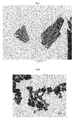
- FIG. 1 is a photograph of representative samples taken with an electron microscope. From this, the presence of crystals with a grain size exceeding 1 ⁇ m can be observed, and the percentage of particles with a grain size of 1 ⁇ m or more to 3 ⁇ m or less is 70% or more (proportion of the incidence of the number of particles) can be observed. The crystals were needle-like in form.
- Ferromagnetism in crystals of a grain size obtained in Example I-1 was verified. Measurement of the magnetic field-magnetization curve using Quantum Design MPMS7, gave hysteresis loops characteristic of ferromagnetic substances at - 268°C to 37°C, revealing that the crystals of a grain size obtained in Example I-1 are ferromagnetic substances.
- a melanoma cell (clone M3) was cultured in a round Petri dish, and iron salens were sprinkled evenly.
- a button magnet with a magnetic flux density of 240 mT was then placed under the Petri dish for 24 hours. As a result, killing of melanoma cells was observed along the edges of the button magnet.
- VX2 Rabbit-derived squamous cell carcinomas
- cooling was performed by slowly cooling "(for example, 10 hours to 12 hours) by, for example, air cooling to room temperature" in Step 7 of Example I-1
- cooling is performed by rapid cooling (cooling rate: 10-30°C/min) by, for example, water cooling with water of room temperature or ice water in the present example. All other procedures are the same as the procedures in Example I.
- the number of samples to be measured is 436. All other procedures for measurement are the same as the procedures in Example I-2.
- the crystal grain size of each sample was measured twice. The resulting average grain size was 300 nm, while the standard deviation was 300.
- FIG. 2 is a photograph of representative samples taken with an electron microscope.
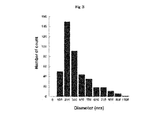
- FIG. 3 shows grain size distribution. From FIG. 3 , the percentage of particles with a grain size of 1 ⁇ m or less, and a grain size of 100 nm or more to 500 nm or less is 70% or more can be observed. The crystals were needle-like in form.
- Example II-1 Ferromagnetism in crystals of a grain size obtained in Example II-1 was verified by the same method as the method in Example I-2.
- the effects on melanoma cells are the same as the effects found in Example I-2.
- Iron-salen complexes obtained in Example II-1 does not clog capillaries. Even administration into the tail vein of a mouse, of a solution with a concentration of 9.25 mM in which iron salens are dissolved in physiological saline, does not bring about clogging of the blood vessels. Administration into the tail vein of a mouse, of a solution containing iron-salen complex compounds having a crystal grain size of 10 ⁇ m (dissolved in physiological saline, concentration of 9.25 mM), clearly brought about clogging of the blood vessels in the lung five seconds later.
- crystal grain size is the diameter of crystals, and may also be a value obtained mathematically or statistically such as by calculating the average value or the standard deviation of each grain size of the plurality of particles of the metal-salen complex compounds.
- magnetic medicine refers to the metal-salen complex compound itself, the derivative substitutions of the metal-salen complex, or its derivatives as described above.
- the magnetic medicine contains salen complex compounds that are active ingredients, at a concentration sufficient to exert pharmacological effects such as antitumor effects.
Landscapes
- Health & Medical Sciences (AREA)
- Chemical & Material Sciences (AREA)
- Organic Chemistry (AREA)
- Public Health (AREA)
- Medicinal Chemistry (AREA)
- Veterinary Medicine (AREA)
- Pharmacology & Pharmacy (AREA)
- Life Sciences & Earth Sciences (AREA)
- Animal Behavior & Ethology (AREA)
- General Health & Medical Sciences (AREA)
- Epidemiology (AREA)
- Engineering & Computer Science (AREA)
- Bioinformatics & Cheminformatics (AREA)
- Dermatology (AREA)
- Nuclear Medicine, Radiotherapy & Molecular Imaging (AREA)
- General Chemical & Material Sciences (AREA)
- Chemical Kinetics & Catalysis (AREA)
- Pharmaceuticals Containing Other Organic And Inorganic Compounds (AREA)
- Acyclic And Carbocyclic Compounds In Medicinal Compositions (AREA)
- Medicinal Preparation (AREA)
- Medicines That Contain Protein Lipid Enzymes And Other Medicines (AREA)
Abstract

M is Fe, Cr, Mn, Co, Ni, Mo, Ru, Rh, Pd, W, Re, Os, Ir, Pt, Nd, Sm, Eu, or Gd.
Description
- The present invention relates to a metal-salen complex compound and a method for producing the metal-salen complex compound. The metal-salen complex compound has magnetic properties, and is used, for example, in magnetic materials and magnetic drugs.
- Generally, when a drug is administered into a living body, it reaches an affected site and exerts its pharmacological effects at that affected site, thereby exerting its therapeutic effects. On the other hand, it will not be therapeutic if the drug reaches tissues other than the affected site (that is, normal tissues).
- Therefore, how to efficiently guide the drug to the affected site is important. A technique to guide the drug to the affected site is called drug delivery, which has been actively studied and developed in recent years. This drug delivery has at least two advantages. One advantage is that a sufficiently high drug concentration may be obtained at the affected tissue. Pharmacological effects will not be seen unless the drug concentration at the affected site is a constant value or more. The therapeutic effects cannot be expected if the concentration is low.
- The second advantage is that the drug is guided to only the affected tissue and, therefore, adverse reactions to normal tissues may be inhibited.
- Such drug delivery is most effective for cancer treatments by antitumor agents. Most antitumor agents inhibit the cell growth of cancer cells which divide actively, so that the antitumor agents will also inhibit the cell growth of even the normal tissues in which cells divide actively, such as the bone marrow, the hair roots, or the gastrointestinal mucosa.
- Therefore, cancer patients to whom the antitumor agents are administered suffer adverse reactions such as anemia, hair loss, and vomiting. Since such adverse reactions impose heavy burdens on the patients, the dosage needs to be limited, thereby causing a problem of incapability to sufficiently obtain the pharmacological effects of the antitumor agents.
- Alkylation antineoplastic agent among such antineoplastic agents is a generic term for antitumor agents having the ability to combine an alkyl group (-CH2-CH2-) with, for example, a nucleic acid protein. DNA is alkylated and DNA replication is inhibited, causing cell death. This action works regardless of cell cycles, also works on cells of the Go period, has a strong effect on cells which grow actively, and tends to damage, for example, the bone marrow, the gastrointestinal mucosa, the germ cells, or the hair roots.
- Moreover, antimetabolite antineoplastic agents are compounds having structures similar to those of nucleic acids or metabolites in a protein synthesis process, impairs cells by, for example, inhibiting synthesis of the nucleic acids, and specifically acts on the cells in mitotic phase.
- Furthermore, antitumor antibiotics are chemical substances produced by microorganisms, have actions such as DNA synthesis inhibition and DNA strand breaking, and exhibit antitumor activity.
- Also, microtubule inhibitors have antitumor effects by directly acting on microtubules that serve important roles to maintain normal functions of cells, for example, by forming spindles during cell division, placing intracellular organelles, and transporting substances. The microtubule inhibitors act on, for example, cells which divide actively, and nerve cells.
- Moreover, platinum preparations inhibit DNA synthesis by forming DNA strands, interchain bonds, or DNA-protein bonds. Cisplatin is a representative drug, but it causes severe nephropathy and requires a large amount of fluid replacement.
- Furthermore, parahormone antineoplastic agents are effective against hormone-dependent tumors. Female hormones or antiandrogens are administered to an androgen-dependent prostate cancer.
- Also, molecular target drugs are used for treatments targeted at molecules that correspond to molecular biological characteristics specific to each malignant tumor.
- Moreover, topoisomerase inhibitors are enzymes for temporarily generating breaks in DNA, and changing the number of tangles of DNA strands. Topoisomerase inhibitor I is an enzyme that generates breaks in one strand of a circular DNA, lets the other strand pass, and then closes the breaks; and topoisomerase inhibitor II is an enzyme that temporarily breaks both the two strands of the circular DNA, lets the other two DNA strands pass between the former two strands, and reconnects the broken strands.
- Furthermore, nonspecific immunopotentiators inhibit cancer cell growth by activating the immune system.
- An example of a specific method for drug delivery is the use of a carrier. This is to load the carrier, which tends to concentrate on the affected site, with the drug, and have the carrier carry the drug to the affected site.
- A promising candidate for the carrier is a magnetic substance, and a method of attaching the carrier which is a magnetic substance, to the drug, and allowing the carrier to be accumulated at the affected site with a magnetic field is proposed (see, for example, Japanese Patent Application Laid-Open Publication No.
2001-10978 - However, when using the magnetic substance carrier as a carrier, it has been found that it is difficult to orally administer the magnetic substance carrier, carrier molecules are generally giant, and there are technical problems in the binding strength and affinity between the carrier and the drug molecules; and it has been difficult to put the magnetic substance carrier to practical use in the first place.
- Therefore, the inventors of the present invention suggested a local therapeutic drug in which side chains for giving positive or negative spin charge density are bonded to a basic skeleton of an organic compound, and the local therapeutic drug in its entirety is suitably guided with an external magnetic field by sharing magnetism; and when the local therapeutic drug is applied to a human body or an animal, the local therapeutic drug is retained in the region where a magnetic field is applied locally by a magnetic field outside the body and medicinal effects that the local therapeutic drug originally possess, are exerted on the above region (
WO 2008/001851 ). This therapeutic drug is auto-magnetic and does not rely on magnetic substance carriers. The publication discloses an iron-salen complex compound as one such drug. Japanese Patent Application Laid-Open Publication No.2009-173631 - Furthermore, the inventors of the present application have proposed various medicines capable of binding, for example, medicinal molecules to a metal salen complex, and guiding them to a target region of an individual with a magnetic field (
WO 2010/058280 ). -
- Patent Document 1: Japanese Patent Application Laid-Open Publication No.
2001-10978 - Patent Document 2:
WO 2008/001851 - Patent Document 3:
Japanese Patent Application Laid-Open Publication No. 2009-173631 - Patent Document 4:
WO 2010/058280 - When the grain size of a metal-salen complex is small, a required magnetism cannot be exerted. On the other hand, when the grain size of the metal-salen complex is large, the metal-salen complex cannot pass through capillaries. Thus, the grain size of a metal-salen complex is preferably of a grain size that is applicable to a living body as a medicine without clogging the capillaries, and that may be guided to a target region with a magnetic field.
- On the other hand, even if the crystal grain size of the metal-salen complex is of a crystal grain size that leads to difficulty in passing through the capillaries, the usability of the metal-salen complex may be further improved if the dynamics of the metal-salen complex can be controlled, such as by inducing the metal-salen complex to be retained in the affected tissue with a magnetic field after local application to the affected tissue.
- The first object of the present invention is to provide a metal-salen complex compound which is controlled to have an appropriate crystal grain size. In addition, the second object of the present invention is to provide a metal-salen complex compound that can be locally applied to a target region such as an affected tissue. Furthermore, the third object of the present invention is to provide a metal-salen complex compound having a grain size capable of being guided to the target region with a magnetic field even when the metal-salen complex compound is systemically applied to a living body as a medicine. Further still, the fourth object of the present invention is to provide a method for producing these metal-salen complex compounds.
- To achieve the above objects, the crystal grain size of the metal-salen complex compound according to the present invention is confined to a crystal grain size that will not clog the capillaries of humans or animals, and the metal-salen complex compound according to the present invention is characterized by the ability to control the dynamics with an external magnetic field. Considering that the diameter of capillaries are 8 µm to 20 µm, and the grain size of erythrocytes that pass through the capillaries is approximately 8 µm, and the grain size of leukocytes that pass through the capillaries is approximately 8 to 20 µm, the crystal grain size of the metal-salen complex compound of the present invention is desirably 8 µm or less; preferably 1 µm or more to 8 µm or less; more preferably 1 µm or more to 5 µm or less, and even more preferably 1 µm or more to 3 µm or less. The metal-salen complex compound is auto-magnetic, and is capable of being retained in the affected site with an external magnetic field after, for example, local application to an affected site.
- When the grain size of the metal-salen complex compound is less than 1 µm, the magnetism which allows the metal-salen complex compound to be retained locally with an external magnetic field declines, and it is possible that the metal-salen complex compound may leak into capillaries outside the target affected tissue, from the target affected tissue. Thus, when the metal-salen complex compound is locally applied to the affected site, the minimum crystal grain size of the metal-salen complex compound is desirably 1 µm. The percentage of metal-salen complex compounds with a crystal grain size of 1 µm or more to 3 µm or less, is preferably 70% or more.
- For the metal-salen complex compound to reach the affected site by systemic application, and for the metal-salen complex compound to be retained in the affected site with a magnetic field, the crystal size of the metal-salen complex is of 1 µm or less so that the metal-salen complex compounds may pass through a large number of capillaries, and the percentage of the metal-salen complex compounds with a crystal grain size of 100 nm or more to 500 nm or less is preferably 70% or more.
- When the grain size of the metal-salen complex compound exceeds 1 µm, it is possible that the metal-salen complex compound may not be able to pass through the capillaries. When the grain size of the metal-salen complex compound is less than 100 nm, the ferromagnetism required for magnetic guidance cannot be obtained sufficiently. On the other hand, when the grain size exceeds 500 nm, the metal-salen complex compound may not pass through the capillaries with ease. When the percentage of particles with a grain size of 100 nm or more to 500 nm or less, is less than 70%, the proportion of the grains where the properties for passing through the capillaries is insufficient increases. The grain size is preferably 200 nm or more to 400 nm or less, the grain size is even more preferably 250 nm or more to 350 nm or less.
- The metal-salen complex compound of the present invention generally refers to metal complexes with salen as the ligand, and also includes derivative substitutions and derivatives of metal complexes. The structural formula of the metal-salen complex compound is as indicated below in Formula (I). Each of "a" to "h" may represent hydrogen, or at least one of "a" to "h" may be substituted with functional groups/substituents other than hydrogen.
- Derivatives of the metal-salen complex compound of the present invention includes metal-salen complex compounds or their derivative substitutions bound to functional molecules such as medicinal molecules, enzymes, and antibodies, as in, for example,
WO 2010/058280 . The disclosure made in the publication is incorporated in the specification of the present application by reference in its entirety. The derivative of the metal-salen complex compound in complex with a medicinal molecule is useful as a carrier for guiding or localizing the medicinal molecules at the target affected tissue.
- In Formula (I), "M" represents Fe, Cr, Mn, Co, Ni, Mo, Ru, Rh, Pd, W, Re, Os, Ir, Pt, Nd, Sm, Eu, or Gd.
- Preferred embodiments of locally applying the metal-salen complex compound of the present invention to the affected tissue of a human body or an animal involves an arterial injection into an artery in the vicinity of the affected tissue, or an injection into the affected tissue itself. Publicly known embodiments such as ointments, lotions, or adhesive skin patches may be adopted as other embodiments of local application. Embodiments of systemically applying the metal-salen complex compound involve an intravenous injection and/or an infusion injection. Typical prescription examples of injections and infusions of the metal-salen complex compound involve physiological saline as a solvent, and suspensions or opalizers may be used. The metal-salen complex compound of the present invention is preferably used as an anti-tumor agent, as disclosed in the above prior art. Other uses include use as a carrier for drug delivery of the medicinal molecule by binding the metal-salen complex compound to another medicinal molecule as mentioned above, and furthermore, use as an MRI diagnostic agent.
- When applying the metal-salen complex compound of the present invention to an individual (a human or an animal), by providing a magnetic field (500 mT to 1 T (1,000 mT)) to a target region where the affected organ or the affected tissue is present, the metal-salen complex compound may be guided to or retained at the target affected region at least while magnetism is provided.
- As described above, according to the present invention, a metal-salen complex compound which is controlled to have an appropriate crystal grain size may be provided. Furthermore, according to the present invention, a metal-salen complex compound that can be locally applied to a target region such as an affected tissue may be provided. Further still, the present invention can provide a metal-salen complex compound having a grain size capable of being guided to the target region with a magnetic field even when the metal-salen complex compound is systemically applied to a living body as a medicine. Furthermore, the present invention can provide a method for producing these metal-salen complex compounds.
-
- [
FIG. 1 ]
FIG. 1 is a photograph taken with a transmission electron microscope, of iron-salen complex compounds in which the crystal grain size is coarse (the long side exceeding 1 µm), according to an example (Example I) of the present invention. - [
FIG. 2 ]
FIG. 2 is a photograph taken with an electron microscope of crystals of iron-salen complex compounds according to an example (Example II) of the present invention. - [
FIG. 3 ]
FIG. 3 is a chart showing grain size distribution of crystals of iron-salen complex compounds according to an example (Example II) of the present invention. - A salen ligand (N,N'-Bis(salicylidene)ethylenediamine) and its derivatives are synthesized by a dehydration condensation reaction of derivatives of salicylaldehyde and ethylenediamine that correspond to a salen ligand (N,N'-Bis(salicylidene)ethylenediamine) and its derivatives. After the resulting ligand becomes a derivative of phenoxide ion, or by causing the obtained ligand to react with a metal ion under basic conditions, a metal-salen complex is obtained. Details are described hereinafter.
-

-

- Compound 2 (17 g, 0.10 mol), acetic anhydride (200 ml), and H2SO4 (in small quantities) were stirred for 1 hour at room temperature. The resulting solution was mixed for 0.5 hour in ice water (2 L) to bring about hydrolysis. Upon filtering and drying the resulting solution in the atmosphere, white powder was obtained. Upon recrystallizing the powder using a solution containing ethyl acetate, 24 g of Compound 3 (76% yield) in the form of white crystals was obtained.
-

- A mixture of Compound 3 (24 g, 77 mmol), methanol (500 ml), and carbon (2.4 g) carrying 10% palladium was reduced overnight in a 1.5 atm hydrogen reducing atmosphere. After reduction has been completed, the product was filtered, allowing Compound 4 (21 g) in the form of brown oil to be synthesized.
-

- Compound 4 (21 g, 75 mmol) and di(tert-butyl)dicarbonate (18 g, 82 mmol) were stirred overnight in anhydrous dichloromethane (DCM) (200 ml) in a nitrogen atmosphere. After allowing the resulting solution to evaporate in a vacuum, the resulting solution was dissolved in methanol (100 ml). Sodium hydroxide (15 g, 374 mmol) and water (50 ml) were then added, and the solution was brought to reflux for 5 hours. The solution was then cooled, filtered, washed with water, and allowed to dry in a vacuum, thereby giving a brown compound. The resulting compound was processed twice by flash chromatography using silica gel, thereby giving 10 g of Compound 6 (58% yield).
-

- Compound 6 (10 g, 42 mmol) was introduced into 400 ml of anhydrous ethanol, was brought to reflux while heated, and several drops of ethylenediamine (1.3 g, 21 mmol) were added to 20 ml of anhydrous ethanol while stirring for 0.5 hour. Next, the mixed solution was introduced into a container containing ice, where the mixed solution was cooled and stirred for 15 minutes. The mixed solution was then washed with 200 ml of ethanol, filtered, and dried in a vacuum, allowing 8.5 g of Compound 7 (salen) to be synthesized (82% yield).
-

- Compound 7 (8.2 g, 16 mmol) and triethylamine (22 ml, 160 mmol) were introduced into anhydrous methanol (50 ml), and a solution where FeCl3 (2.7 g, 16 mmol) has been added to 10 ml of methanol, were mixed under a nitrogen atmosphere. Upon mixing the solution in a nitrogen atmosphere for 1 hour at room temperature, a brown compound was obtained. The resulting compound was heated to 80°C, and was then slowly cooled (for example, 10 hours to 12 hours) by, for example, air cooling to room temperature. The solution was filtered, and the crystal residue was allowed to dry in a vacuum. The resulting crystal was washed with 400 ml of dichloromethane twice, and with a basic solution (tetrahydrofuran) twice, and was dried with Na2SO4, and was allowed to further dry in a vacuum, thereby giving Complex A (an iron-salen complex compound (where all of "a" to "h" represent H). This compound was recrystallized in a solution of diethyl ether and paraffin, and measurements of the crystal by high-performance liquid chromatography revealed 5.7 g of Complex A (62% yield) with a purity of 95% or more. Recrystallization is carried out under similar slow cooling conditions as described above. The reaction in Step 7 may also be carried out under heating. Heating of the resulting compound is not required in this case.
- When a metal complex other than an iron-salen complex compound is used, metal chlorides other than iron, such as MCl3, may be used in place of FeCl3. The fact that a Mn-salen complex, a Cr-salen complex, and a Co-salen complex which are not iron-salen complex compounds, possess magnetic properties that allow the Mn-salen complex, the Cr-salen complex, and the Co-salen complex to be guided with an external magnetic field, is as disclosed in Japanese Patent Application No.
2009-177112 2009-173631 - Next, the grain size of the crystal grain after recrystallization is measured. First, approximately 2 g of crystals are weighed, and the crystals are ground in a mortar for approximately 30 minutes. The ground crystals are collected, weighed again, the dilute amount of the solvent (physiological saline) is determined, and the crystals are diluted with the solvent with the foregoing dilute amount. The concentration of crystal grains at this time is 20 mM.
- Thereafter, 50 ml of the solution is then poured into a tube, 20 ml of a solvent is then poured into the tube, and is pulverized by ultrasonic treatment. This treatment is applied while stirring until the grains can longer be seen with the naked eye. Next, the solution is diluted to the precise dilute amount (the actual concentration to be injected intravenously: 9.25 mM), and is filtered using a 40-µm cell strainer (BD Falcon).
- The grain size of crystal grains obtained as a result of filtration was measured using electron microscope images. The apparatus used, and for example, the conditions are as follows.
- Apparatus: Transmission electron microscope (manufactured by Hitachi, H-7100 FA)
- Conditions: Accelerating voltage of 100 kV
- Sample preparation: Dispersion method (after grinding the crystals in a mortar, pure water was added, and dispersed on the grid by TEM) Grain size distribution measurement software: Image-Pro Plus (Media Cybernetics, MD, U.S.A.)
- Target for measurement: Traced images of the molecules of the iron-salen complex compound in TEM photographs
- Crystallization and recrystallization were carried out by air cooling, and measurement of the grain size was made (number of samples: 140). The resulting average grain size was 450 nm, while the standard deviation was 360.
FIG. 1 is a photograph of representative samples taken with an electron microscope. From this, the presence of crystals with a grain size exceeding 1 µm can be observed, and the percentage of particles with a grain size of 1 µm or more to 3 µm or less is 70% or more (proportion of the incidence of the number of particles) can be observed. The crystals were needle-like in form. - Ferromagnetism in crystals of a grain size obtained in Example I-1 was verified. Measurement of the magnetic field-magnetization curve using Quantum Design MPMS7, gave hysteresis loops characteristic of ferromagnetic substances at - 268°C to 37°C, revealing that the crystals of a grain size obtained in Example I-1 are ferromagnetic substances.
- Next, a melanoma cell (clone M3) was cultured in a round Petri dish, and iron salens were sprinkled evenly. A button magnet with a magnetic flux density of 240 mT was then placed under the Petri dish for 24 hours. As a result, killing of melanoma cells was observed along the edges of the button magnet.
- Rabbit-derived squamous cell carcinomas (VX2) were transplanted into the femoral region of a rabbit, and engraftment was reached 2 to 3 weeks thereafter. Next, the iron-salen complex compounds that have been observed using a transmission electron microscope, in which the grain size was coarse, with a grain size of 1,500 nm (1.5 µm), were diluted to a concentration of 100 µm with physiological saline, and a volume of 5 mg/kg was injected arterially using a catheter. Arterial injection into an artery in the femoral region was performed. This procedure conforms to the procedure detailed in Japan Radiological Society 50(4), 426-428, 1990. Seven days following the initiation of administration of the above volume, it has been observed that, while the tumor volume of a group in which the iron-salen complex compounds had not been injected arterially, revealed to be approximately twice as large as the initial tumor volume, the tumor volume of a group in which the iron-salen complex compounds had been injected arterially, was reduced to 20% of the tumor volume before treatment. When arterial injection is performed, the iron-salen complexes were retained in the affected site by a permanent magnet with a magnetic flux density of 600 mT so that the drug does not leak into other organs. Cell slices of the affect site revealed that the iron-salen complexes were retained in cancer tissues. Prussian blue (ferric hexacyanoferrate and hydrochloric acid) manufactured by Sigma was used for staining.
- While cooling was performed by slowly cooling "(for example, 10 hours to 12 hours) by, for example, air cooling to room temperature" in Step 7 of Example I-1, cooling is performed by rapid cooling (cooling rate: 10-30°C/min) by, for example, water cooling with water of room temperature or ice water in the present example. All other procedures are the same as the procedures in Example I.
- The number of samples to be measured is 436. All other procedures for measurement are the same as the procedures in Example I-2. The crystal grain size of each sample was measured twice. The resulting average grain size was 300 nm, while the standard deviation was 300.
FIG. 2 is a photograph of representative samples taken with an electron microscope.FIG. 3 shows grain size distribution. FromFIG. 3 , the percentage of particles with a grain size of 1 µm or less, and a grain size of 100 nm or more to 500 nm or less is 70% or more can be observed. The crystals were needle-like in form. - Ferromagnetism in crystals of a grain size obtained in Example II-1 was verified by the same method as the method in Example I-2. The effects on melanoma cells are the same as the effects found in Example I-2.
- Iron-salen complexes obtained in Example II-1 does not clog capillaries. Even administration into the tail vein of a mouse, of a solution with a concentration of 9.25 mM in which iron salens are dissolved in physiological saline, does not bring about clogging of the blood vessels. Administration into the tail vein of a mouse, of a solution containing iron-salen complex compounds having a crystal grain size of 10 µm (dissolved in physiological saline, concentration of 9.25 mM), clearly brought about clogging of the blood vessels in the lung five seconds later.
- Measurement of the magnetic field-magnetization curve using Quantum Design MPMS7, gave hysteresis loops characteristic of superparamagnetic substances at - 268°C to 37°C, revealing that the iron-salen complexes with a grain size of approximately 50 nm are superparamagnetic substances.
- While preferred embodiments have been described in the foregoing specification, the same results can be obtained with metal-salen complex compounds other than iron. In addition, "crystal grain size" is the diameter of crystals, and may also be a value obtained mathematically or statistically such as by calculating the average value or the standard deviation of each grain size of the plurality of particles of the metal-salen complex compounds. In the present invention, magnetic medicine refers to the metal-salen complex compound itself, the derivative substitutions of the metal-salen complex, or its derivatives as described above. The magnetic medicine contains salen complex compounds that are active ingredients, at a concentration sufficient to exert pharmacological effects such as antitumor effects.
-
- [Clause 1] A metal-salen complex compound having a crystal grain size of 8 µm or less.
- [Clause 2] The metal-salen complex compound according to clause 1, wherein the crystal grain size is 1 µm or more.
- [Clause 3] The metal-salen complex compound according to clause 1,
wherein a percentage of 1 µm or less in the crystal grain size, and 100 nm or more to 500 nm or less in crystal grain size, is 70% or more. - [Clause 4] The metal-salen complex compound according to one of clauses 1 to 3,
containing a compound of Structural Formula (I) below.
M is Fe, Cr, Mn, Co, Ni, Mo, Ru, Rh, Pd, W, Re, Os, Ir, Pt, Nd, Sm, Eu, or Gd. - [Clause 5] A magnetic medicine containing a metal-salen complex compound according to one of clauses 1 to 3, to be provided to an affected tissue of a living body with an external magnetic field after application to the living body.
- [Clause 6] The magnetic medicine containing a metal-salen complex compound according to clause 2, to be locally applied to an affected tissue of a living body, and to be retained in the affected tissue with an external magnetic field.
- [Clause 7] The magnetic medicine containing a metal-salen complex compound according to clause 3, to be guided to an affected tissue of the living body with an external magnetic field after systemic application to a living body.
- [Clause 8] The magnetic medicine according to one of clauses 5 to 7, having an antitumor effect.
- [Clause 9] A method for producing a metal-salen complex compound comprising:
- crystallizing a metal-salen complex compound under a rapid cooling condition.
- [Clause 10] The method for producing the metal-salen complex compound according to clause 9, further comprising:
- allowing salen to react with a metal compound, and then obtaining a crystal particle of the metal-salen complex by rapidly cooling a heated reactant.
Claims (7)
- A metal-salen complex compound having a crystal grain diameter as measured with transmission electron microscopy of 1 µm or less, wherein the percentage of the metal-salen complex compound with a crystal grain diameter of 100 nm or more to 500 nm or less is 70% or more.
- The metal-salen complex compound according to claim 1, containing a compound of Structural Formula (I) below.

M is Fe, Cr, Mn, Co, Ni, Mo, Ru, Rh, Pd, W, Re, Os, Ir, Pt, Nd, Sm, Eu, or Gd. - A magnetic composition containing a metal-salen complex compound according to claim 1 or claim 2, for use in a method of treatment, the method comprising providing the composition to an affected tissue of a living body with an external magnetic field after application to the living body.
- The magnetic composition containing a metal-salen complex compound according to claim 1 or claim 2, for use in a method of treatment, the method comprising guiding the composition an affected tissue of the living body with an external magnetic field after systemic application to a living body.
- The magnetic composition according to claim 3 or claim 4, having an antitumor effect.
- A method for producing a metal-salen complex compound according to claim 1 or claim 2, comprising:crystallizing a metal-salen complex compound under a cooling rate of 10 to 30°C/min.
- The method for producing the metal-salen complex compound according to claim 6, further comprising:allowing salen to react with a metal compound, and then obtaining a crystal particle of the metal-salen complex by cooling a heated reactant at a cooling rate of 10 to 30°C/min.
Applications Claiming Priority (4)
| Application Number | Priority Date | Filing Date | Title |
|---|---|---|---|
| JP2010285075A JP2012131737A (en) | 2010-12-21 | 2010-12-21 | Metal-salen complex compound and production method therefor |
| JP2011040233A JP2012176905A (en) | 2011-02-25 | 2011-02-25 | Metal-salen complex compound |
| EP11850943.9A EP2657223B1 (en) | 2010-12-21 | 2011-12-21 | Metal-salen complex compound and production method for same |
| PCT/JP2011/079630 WO2012086683A1 (en) | 2010-12-21 | 2011-12-21 | Metal-salen complex compound and production method for same |
Related Parent Applications (2)
| Application Number | Title | Priority Date | Filing Date |
|---|---|---|---|
| EP11850943.9A Division EP2657223B1 (en) | 2010-12-21 | 2011-12-21 | Metal-salen complex compound and production method for same |
| EP11850943.9A Division-Into EP2657223B1 (en) | 2010-12-21 | 2011-12-21 | Metal-salen complex compound and production method for same |
Publications (2)
| Publication Number | Publication Date |
|---|---|
| EP2944627A1 true EP2944627A1 (en) | 2015-11-18 |
| EP2944627B1 EP2944627B1 (en) | 2021-01-27 |
Family
ID=46313951
Family Applications (2)
| Application Number | Title | Priority Date | Filing Date |
|---|---|---|---|
| EP11850943.9A Active EP2657223B1 (en) | 2010-12-21 | 2011-12-21 | Metal-salen complex compound and production method for same |
| EP15168720.9A Active EP2944627B1 (en) | 2010-12-21 | 2011-12-21 | Nanometersized metal salen complex compounds, their preparation and their use as systemic antitumor agents |
Family Applications Before (1)
| Application Number | Title | Priority Date | Filing Date |
|---|---|---|---|
| EP11850943.9A Active EP2657223B1 (en) | 2010-12-21 | 2011-12-21 | Metal-salen complex compound and production method for same |
Country Status (6)
| Country | Link |
|---|---|
| US (1) | US9005757B2 (en) |
| EP (2) | EP2657223B1 (en) |
| CN (1) | CN103517895A (en) |
| RU (1) | RU2546663C2 (en) |
| SG (1) | SG192062A1 (en) |
| WO (1) | WO2012086683A1 (en) |
Families Citing this family (10)
| Publication number | Priority date | Publication date | Assignee | Title |
|---|---|---|---|---|
| US20090169484A1 (en) * | 2007-12-28 | 2009-07-02 | Ihi Corporation | Iron-salen complex |
| CN103517895A (en) | 2010-12-21 | 2014-01-15 | 株式会社Ihi | Metal-salen complex compound and production method for same |
| JP2012167067A (en) * | 2011-02-15 | 2012-09-06 | Ihi Corp | Auto-magnetic metal salen complex compound |
| JP5873656B2 (en) * | 2011-06-13 | 2016-03-01 | 株式会社Ihi | Metal salen complex compounds, local anesthetics and antineoplastic agents |
| JP6017766B2 (en) | 2011-07-26 | 2016-11-02 | 株式会社Ihi | Novel anticancer agent of metal salen complex compound |
| JP5694549B2 (en) * | 2011-10-06 | 2015-04-01 | 株式会社Ihi | Liquid |
| JP6046338B2 (en) * | 2011-10-27 | 2016-12-14 | 株式会社Ihi | Radical inhibitor |
| JP6280305B2 (en) | 2013-02-05 | 2018-02-14 | 株式会社Ihi | Magnetic medicine |
| WO2015146294A1 (en) * | 2014-03-28 | 2015-10-01 | 国立大学法人九州大学 | Transesterification reaction by means of iron catalyst |
| US12325715B2 (en) | 2018-12-07 | 2025-06-10 | The Regents Of The University Of California | Fluorous metal chelates compositions |
Citations (11)
| Publication number | Priority date | Publication date | Assignee | Title |
|---|---|---|---|---|
| JPS4991089A (en) * | 1972-12-30 | 1974-08-30 | ||
| JP2001010978A (en) | 1993-01-29 | 2001-01-16 | Ferx Inc | Magnetic response composition for transporting bio-active substance |
| WO2006133354A2 (en) * | 2005-06-08 | 2006-12-14 | University Of Kansas | Methods for producing nanoparticulate metal complexes and altering nanoparticle morphology |
| WO2008001851A1 (en) | 2006-06-28 | 2008-01-03 | Ihi Corporation | Drug, drug induction device, magnetic detector and method of designing drug |
| US20090169484A1 (en) * | 2007-12-28 | 2009-07-02 | Ihi Corporation | Iron-salen complex |
| JP2009177112A (en) | 2008-01-28 | 2009-08-06 | Alti Electronics Co Ltd | Light emitting diode package |
| JP2009196913A (en) * | 2008-02-20 | 2009-09-03 | Ihi Corp | Medicine having magnetism, guiding system for medicine and magnetism-detecting system |
| US20100089236A1 (en) * | 2008-10-14 | 2010-04-15 | Bala Subramaniam | Oxygen Binding of Nanoparticulate Metal Complexes |
| WO2010058280A1 (en) | 2008-11-20 | 2010-05-27 | 株式会社Ihi | Auto magnetic metal salen complex compound |
| WO2011135784A1 (en) * | 2010-04-28 | 2011-11-03 | 株式会社Ihi | Anti-brain-tumor drug |
| WO2011151978A1 (en) * | 2010-06-01 | 2011-12-08 | 株式会社Ihi | Fluorescent dye material and use thereof |
Family Cites Families (7)
| Publication number | Priority date | Publication date | Assignee | Title |
|---|---|---|---|---|
| US5403834A (en) * | 1992-12-07 | 1995-04-04 | Eukarion, Inc. | Synthetic catalytic free radical scavengers useful as antioxidants for prevention and therapy of disease |
| US6200547B1 (en) | 1994-01-26 | 2001-03-13 | Ferx Incorporated | Magnetically responsive compositions for carrying biologically active substances and methods of production and use |
| JP4707937B2 (en) | 2003-02-28 | 2011-06-22 | ホソカワミクロン株式会社 | Method for producing drug-containing composite particles and transpulmonary preparation |
| US7809773B2 (en) * | 2007-12-21 | 2010-10-05 | Yahoo! Inc. | Comment filters for real-time multimedia broadcast sessions |
| CN102791323B (en) * | 2009-12-25 | 2014-10-15 | 株式会社Ihi | Drug delivery control device using magnets |
| US9603940B2 (en) * | 2010-04-06 | 2017-03-28 | Ihi Corporation | Metal salen complex derivative and process for production thereof |
| CN103517895A (en) | 2010-12-21 | 2014-01-15 | 株式会社Ihi | Metal-salen complex compound and production method for same |
-
2011
- 2011-12-21 CN CN201180068119.7A patent/CN103517895A/en active Pending
- 2011-12-21 US US13/996,288 patent/US9005757B2/en active Active
- 2011-12-21 SG SG2013055520A patent/SG192062A1/en unknown
- 2011-12-21 EP EP11850943.9A patent/EP2657223B1/en active Active
- 2011-12-21 EP EP15168720.9A patent/EP2944627B1/en active Active
- 2011-12-21 WO PCT/JP2011/079630 patent/WO2012086683A1/en not_active Ceased
- 2011-12-21 RU RU2013133683/04A patent/RU2546663C2/en active
Patent Citations (15)
| Publication number | Priority date | Publication date | Assignee | Title |
|---|---|---|---|---|
| JPS4991089A (en) * | 1972-12-30 | 1974-08-30 | ||
| JP2001010978A (en) | 1993-01-29 | 2001-01-16 | Ferx Inc | Magnetic response composition for transporting bio-active substance |
| WO2006133354A2 (en) * | 2005-06-08 | 2006-12-14 | University Of Kansas | Methods for producing nanoparticulate metal complexes and altering nanoparticle morphology |
| WO2008001851A1 (en) | 2006-06-28 | 2008-01-03 | Ihi Corporation | Drug, drug induction device, magnetic detector and method of designing drug |
| JP2009173631A (en) | 2007-12-28 | 2009-08-06 | Ihi Corp | Iron salen complex |
| US20090169484A1 (en) * | 2007-12-28 | 2009-07-02 | Ihi Corporation | Iron-salen complex |
| JP2009177112A (en) | 2008-01-28 | 2009-08-06 | Alti Electronics Co Ltd | Light emitting diode package |
| JP2009196913A (en) * | 2008-02-20 | 2009-09-03 | Ihi Corp | Medicine having magnetism, guiding system for medicine and magnetism-detecting system |
| US20100089236A1 (en) * | 2008-10-14 | 2010-04-15 | Bala Subramaniam | Oxygen Binding of Nanoparticulate Metal Complexes |
| WO2010058280A1 (en) | 2008-11-20 | 2010-05-27 | 株式会社Ihi | Auto magnetic metal salen complex compound |
| EP2357166A1 (en) * | 2008-11-20 | 2011-08-17 | IHI Corporation | Auto magnetic metal salen complex compound |
| WO2011135784A1 (en) * | 2010-04-28 | 2011-11-03 | 株式会社Ihi | Anti-brain-tumor drug |
| EP2564852A1 (en) * | 2010-04-28 | 2013-03-06 | IHI Corporation | Anti-brain-tumor drug |
| WO2011151978A1 (en) * | 2010-06-01 | 2011-12-08 | 株式会社Ihi | Fluorescent dye material and use thereof |
| EP2578643A1 (en) * | 2010-06-01 | 2013-04-10 | IHI Corporation | Fluorescent dye material and use thereof |
Non-Patent Citations (3)
| Title |
|---|
| CHAD A. JOHNSON ET AL: "Nanoparticulate Metal Complexes Prepared with Compressed Carbon Dioxide: Correlation of Particle Morphology with Precursor Structure", JOURNAL OF THE AMERICAN CHEMICAL SOCIETY, vol. 127, no. 27, 18 June 2005 (2005-06-18), pages 9698 - 9699, XP055118285, ISSN: 0002-7863, DOI: 10.1021/ja052040e * |
| DATABASE CA [online] CHEMICAL ABSTRACTS SERVICE, COLUMBUS, OHIO, US; NAKAMURA, SHUZO: "Oxygen absorbent", XP002745606, retrieved from STN Database accession no. 1975:158292 * |
| JAPAN RADIOLOGICAL SOCIETY, vol. 50, no. 4, 1990, pages 426 - 428 |
Also Published As
| Publication number | Publication date |
|---|---|
| RU2546663C2 (en) | 2015-04-10 |
| RU2013133683A (en) | 2015-01-27 |
| EP2657223A4 (en) | 2014-12-24 |
| EP2657223B1 (en) | 2017-06-28 |
| WO2012086683A1 (en) | 2012-06-28 |
| EP2944627B1 (en) | 2021-01-27 |
| CN103517895A (en) | 2014-01-15 |
| EP2657223A1 (en) | 2013-10-30 |
| SG192062A1 (en) | 2013-08-30 |
| US20140011032A1 (en) | 2014-01-09 |
| US9005757B2 (en) | 2015-04-14 |
Similar Documents
| Publication | Publication Date | Title |
|---|---|---|
| EP2944627B1 (en) | Nanometersized metal salen complex compounds, their preparation and their use as systemic antitumor agents | |
| EP2357166B1 (en) | Auto magnetic metal salen complex compound | |
| EP2682384A1 (en) | Auto-magnetic metal salen complex compound | |
| US10034851B2 (en) | Metal-salen complex compound, local anesthetic and antineoplastic drug | |
| EP2738157B1 (en) | Auto-magnetic metal salen complex compound | |
| US9282923B2 (en) | Fluorochrome material and method for using the same | |
| CN104383543B (en) | Chiral nanometer selenium material load siRNA is preparing the application of antineoplastic | |
| EP3199152B1 (en) | Anti-cancer agent and method for killing cancer cells | |
| JP2012131737A (en) | Metal-salen complex compound and production method therefor | |
| CN113024450B (en) | Dithio-methyl cobalt (III) complex and preparation method and application thereof | |
| JP2012176905A (en) | Metal-salen complex compound | |
| JP2009256233A (en) | Medicine having magnetism, guiding system of medicine and device for detecting magnetism | |
| JP2009256232A (en) | Medicine having magnetism, guiding system of medicine and device for detecting magnetism | |
| JP2015143197A (en) | novel metal salen complex compound |
Legal Events
| Date | Code | Title | Description |
|---|---|---|---|
| PUAI | Public reference made under article 153(3) epc to a published international application that has entered the european phase |
Free format text: ORIGINAL CODE: 0009012 |
|
| 17P | Request for examination filed |
Effective date: 20150603 |
|
| AC | Divisional application: reference to earlier application |
Ref document number: 2657223 Country of ref document: EP Kind code of ref document: P |
|
| AK | Designated contracting states |
Kind code of ref document: A1 Designated state(s): AL AT BE BG CH CY CZ DE DK EE ES FI FR GB GR HR HU IE IS IT LI LT LU LV MC MK MT NL NO PL PT RO RS SE SI SK SM TR |
|
| STAA | Information on the status of an ep patent application or granted ep patent |
Free format text: STATUS: EXAMINATION IS IN PROGRESS |
|
| 17Q | First examination report despatched |
Effective date: 20180329 |
|
| GRAP | Despatch of communication of intention to grant a patent |
Free format text: ORIGINAL CODE: EPIDOSNIGR1 |
|
| STAA | Information on the status of an ep patent application or granted ep patent |
Free format text: STATUS: GRANT OF PATENT IS INTENDED |
|
| INTG | Intention to grant announced |
Effective date: 20200127 |
|
| GRAJ | Information related to disapproval of communication of intention to grant by the applicant or resumption of examination proceedings by the epo deleted |
Free format text: ORIGINAL CODE: EPIDOSDIGR1 |
|
| STAA | Information on the status of an ep patent application or granted ep patent |
Free format text: STATUS: EXAMINATION IS IN PROGRESS |
|
| INTC | Intention to grant announced (deleted) | ||
| GRAP | Despatch of communication of intention to grant a patent |
Free format text: ORIGINAL CODE: EPIDOSNIGR1 |
|
| STAA | Information on the status of an ep patent application or granted ep patent |
Free format text: STATUS: GRANT OF PATENT IS INTENDED |
|
| INTG | Intention to grant announced |
Effective date: 20200717 |
|
| GRAS | Grant fee paid |
Free format text: ORIGINAL CODE: EPIDOSNIGR3 |
|
| GRAA | (expected) grant |
Free format text: ORIGINAL CODE: 0009210 |
|
| STAA | Information on the status of an ep patent application or granted ep patent |
Free format text: STATUS: THE PATENT HAS BEEN GRANTED |
|
| AC | Divisional application: reference to earlier application |
Ref document number: 2657223 Country of ref document: EP Kind code of ref document: P |
|
| AK | Designated contracting states |
Kind code of ref document: B1 Designated state(s): AL AT BE BG CH CY CZ DE DK EE ES FI FR GB GR HR HU IE IS IT LI LT LU LV MC MK MT NL NO PL PT RO RS SE SI SK SM TR |
|
| REG | Reference to a national code |
Ref country code: GB Ref legal event code: FG4D |
|
| REG | Reference to a national code |
Ref country code: CH Ref legal event code: EP |
|
| REG | Reference to a national code |
Ref country code: AT Ref legal event code: REF Ref document number: 1358239 Country of ref document: AT Kind code of ref document: T Effective date: 20210215 |
|
| REG | Reference to a national code |
Ref country code: IE Ref legal event code: FG4D |
|
| REG | Reference to a national code |
Ref country code: DE Ref legal event code: R096 Ref document number: 602011070084 Country of ref document: DE |
|
| REG | Reference to a national code |
Ref country code: NL Ref legal event code: MP Effective date: 20210127 |
|
| REG | Reference to a national code |
Ref country code: LT Ref legal event code: MG9D |
|
| REG | Reference to a national code |
Ref country code: AT Ref legal event code: MK05 Ref document number: 1358239 Country of ref document: AT Kind code of ref document: T Effective date: 20210127 |
|
| PG25 | Lapsed in a contracting state [announced via postgrant information from national office to epo] |
Ref country code: FI Free format text: LAPSE BECAUSE OF FAILURE TO SUBMIT A TRANSLATION OF THE DESCRIPTION OR TO PAY THE FEE WITHIN THE PRESCRIBED TIME-LIMIT Effective date: 20210127 Ref country code: GR Free format text: LAPSE BECAUSE OF FAILURE TO SUBMIT A TRANSLATION OF THE DESCRIPTION OR TO PAY THE FEE WITHIN THE PRESCRIBED TIME-LIMIT Effective date: 20210428 Ref country code: HR Free format text: LAPSE BECAUSE OF FAILURE TO SUBMIT A TRANSLATION OF THE DESCRIPTION OR TO PAY THE FEE WITHIN THE PRESCRIBED TIME-LIMIT Effective date: 20210127 Ref country code: LT Free format text: LAPSE BECAUSE OF FAILURE TO SUBMIT A TRANSLATION OF THE DESCRIPTION OR TO PAY THE FEE WITHIN THE PRESCRIBED TIME-LIMIT Effective date: 20210127 Ref country code: PT Free format text: LAPSE BECAUSE OF FAILURE TO SUBMIT A TRANSLATION OF THE DESCRIPTION OR TO PAY THE FEE WITHIN THE PRESCRIBED TIME-LIMIT Effective date: 20210527 Ref country code: NL Free format text: LAPSE BECAUSE OF FAILURE TO SUBMIT A TRANSLATION OF THE DESCRIPTION OR TO PAY THE FEE WITHIN THE PRESCRIBED TIME-LIMIT Effective date: 20210127 Ref country code: NO Free format text: LAPSE BECAUSE OF FAILURE TO SUBMIT A TRANSLATION OF THE DESCRIPTION OR TO PAY THE FEE WITHIN THE PRESCRIBED TIME-LIMIT Effective date: 20210427 Ref country code: BG Free format text: LAPSE BECAUSE OF FAILURE TO SUBMIT A TRANSLATION OF THE DESCRIPTION OR TO PAY THE FEE WITHIN THE PRESCRIBED TIME-LIMIT Effective date: 20210427 |
|
| PG25 | Lapsed in a contracting state [announced via postgrant information from national office to epo] |
Ref country code: AT Free format text: LAPSE BECAUSE OF FAILURE TO SUBMIT A TRANSLATION OF THE DESCRIPTION OR TO PAY THE FEE WITHIN THE PRESCRIBED TIME-LIMIT Effective date: 20210127 Ref country code: RS Free format text: LAPSE BECAUSE OF FAILURE TO SUBMIT A TRANSLATION OF THE DESCRIPTION OR TO PAY THE FEE WITHIN THE PRESCRIBED TIME-LIMIT Effective date: 20210127 Ref country code: LV Free format text: LAPSE BECAUSE OF FAILURE TO SUBMIT A TRANSLATION OF THE DESCRIPTION OR TO PAY THE FEE WITHIN THE PRESCRIBED TIME-LIMIT Effective date: 20210127 Ref country code: PL Free format text: LAPSE BECAUSE OF FAILURE TO SUBMIT A TRANSLATION OF THE DESCRIPTION OR TO PAY THE FEE WITHIN THE PRESCRIBED TIME-LIMIT Effective date: 20210127 Ref country code: SE Free format text: LAPSE BECAUSE OF FAILURE TO SUBMIT A TRANSLATION OF THE DESCRIPTION OR TO PAY THE FEE WITHIN THE PRESCRIBED TIME-LIMIT Effective date: 20210127 |
|
| PG25 | Lapsed in a contracting state [announced via postgrant information from national office to epo] |
Ref country code: IS Free format text: LAPSE BECAUSE OF FAILURE TO SUBMIT A TRANSLATION OF THE DESCRIPTION OR TO PAY THE FEE WITHIN THE PRESCRIBED TIME-LIMIT Effective date: 20210527 |
|
| REG | Reference to a national code |
Ref country code: DE Ref legal event code: R097 Ref document number: 602011070084 Country of ref document: DE |
|
| PG25 | Lapsed in a contracting state [announced via postgrant information from national office to epo] |
Ref country code: EE Free format text: LAPSE BECAUSE OF FAILURE TO SUBMIT A TRANSLATION OF THE DESCRIPTION OR TO PAY THE FEE WITHIN THE PRESCRIBED TIME-LIMIT Effective date: 20210127 Ref country code: CZ Free format text: LAPSE BECAUSE OF FAILURE TO SUBMIT A TRANSLATION OF THE DESCRIPTION OR TO PAY THE FEE WITHIN THE PRESCRIBED TIME-LIMIT Effective date: 20210127 Ref country code: SM Free format text: LAPSE BECAUSE OF FAILURE TO SUBMIT A TRANSLATION OF THE DESCRIPTION OR TO PAY THE FEE WITHIN THE PRESCRIBED TIME-LIMIT Effective date: 20210127 |
|
| PG25 | Lapsed in a contracting state [announced via postgrant information from national office to epo] |
Ref country code: SK Free format text: LAPSE BECAUSE OF FAILURE TO SUBMIT A TRANSLATION OF THE DESCRIPTION OR TO PAY THE FEE WITHIN THE PRESCRIBED TIME-LIMIT Effective date: 20210127 Ref country code: RO Free format text: LAPSE BECAUSE OF FAILURE TO SUBMIT A TRANSLATION OF THE DESCRIPTION OR TO PAY THE FEE WITHIN THE PRESCRIBED TIME-LIMIT Effective date: 20210127 Ref country code: DK Free format text: LAPSE BECAUSE OF FAILURE TO SUBMIT A TRANSLATION OF THE DESCRIPTION OR TO PAY THE FEE WITHIN THE PRESCRIBED TIME-LIMIT Effective date: 20210127 Ref country code: ES Free format text: LAPSE BECAUSE OF FAILURE TO SUBMIT A TRANSLATION OF THE DESCRIPTION OR TO PAY THE FEE WITHIN THE PRESCRIBED TIME-LIMIT Effective date: 20210127 |
|
| PLBE | No opposition filed within time limit |
Free format text: ORIGINAL CODE: 0009261 |
|
| STAA | Information on the status of an ep patent application or granted ep patent |
Free format text: STATUS: NO OPPOSITION FILED WITHIN TIME LIMIT |
|
| 26N | No opposition filed |
Effective date: 20211028 |
|
| PG25 | Lapsed in a contracting state [announced via postgrant information from national office to epo] |
Ref country code: AL Free format text: LAPSE BECAUSE OF FAILURE TO SUBMIT A TRANSLATION OF THE DESCRIPTION OR TO PAY THE FEE WITHIN THE PRESCRIBED TIME-LIMIT Effective date: 20210127 |
|
| PG25 | Lapsed in a contracting state [announced via postgrant information from national office to epo] |
Ref country code: SI Free format text: LAPSE BECAUSE OF FAILURE TO SUBMIT A TRANSLATION OF THE DESCRIPTION OR TO PAY THE FEE WITHIN THE PRESCRIBED TIME-LIMIT Effective date: 20210127 |
|
| PG25 | Lapsed in a contracting state [announced via postgrant information from national office to epo] |
Ref country code: IT Free format text: LAPSE BECAUSE OF FAILURE TO SUBMIT A TRANSLATION OF THE DESCRIPTION OR TO PAY THE FEE WITHIN THE PRESCRIBED TIME-LIMIT Effective date: 20210127 |
|
| PG25 | Lapsed in a contracting state [announced via postgrant information from national office to epo] |
Ref country code: IS Free format text: LAPSE BECAUSE OF FAILURE TO SUBMIT A TRANSLATION OF THE DESCRIPTION OR TO PAY THE FEE WITHIN THE PRESCRIBED TIME-LIMIT Effective date: 20210527 |
|
| PG25 | Lapsed in a contracting state [announced via postgrant information from national office to epo] |
Ref country code: MC Free format text: LAPSE BECAUSE OF FAILURE TO SUBMIT A TRANSLATION OF THE DESCRIPTION OR TO PAY THE FEE WITHIN THE PRESCRIBED TIME-LIMIT Effective date: 20210127 |
|
| REG | Reference to a national code |
Ref country code: CH Ref legal event code: PL |
|
| REG | Reference to a national code |
Ref country code: BE Ref legal event code: MM Effective date: 20211231 |
|
| PG25 | Lapsed in a contracting state [announced via postgrant information from national office to epo] |
Ref country code: LU Free format text: LAPSE BECAUSE OF NON-PAYMENT OF DUE FEES Effective date: 20211221 Ref country code: IE Free format text: LAPSE BECAUSE OF NON-PAYMENT OF DUE FEES Effective date: 20211221 |
|
| PG25 | Lapsed in a contracting state [announced via postgrant information from national office to epo] |
Ref country code: BE Free format text: LAPSE BECAUSE OF NON-PAYMENT OF DUE FEES Effective date: 20211231 |
|
| PG25 | Lapsed in a contracting state [announced via postgrant information from national office to epo] |
Ref country code: LI Free format text: LAPSE BECAUSE OF NON-PAYMENT OF DUE FEES Effective date: 20211231 Ref country code: CH Free format text: LAPSE BECAUSE OF NON-PAYMENT OF DUE FEES Effective date: 20211231 |
|
| PG25 | Lapsed in a contracting state [announced via postgrant information from national office to epo] |
Ref country code: HU Free format text: LAPSE BECAUSE OF FAILURE TO SUBMIT A TRANSLATION OF THE DESCRIPTION OR TO PAY THE FEE WITHIN THE PRESCRIBED TIME-LIMIT; INVALID AB INITIO Effective date: 20111221 Ref country code: CY Free format text: LAPSE BECAUSE OF FAILURE TO SUBMIT A TRANSLATION OF THE DESCRIPTION OR TO PAY THE FEE WITHIN THE PRESCRIBED TIME-LIMIT Effective date: 20210127 |
|
| PG25 | Lapsed in a contracting state [announced via postgrant information from national office to epo] |
Ref country code: MK Free format text: LAPSE BECAUSE OF FAILURE TO SUBMIT A TRANSLATION OF THE DESCRIPTION OR TO PAY THE FEE WITHIN THE PRESCRIBED TIME-LIMIT Effective date: 20210127 |
|
| PG25 | Lapsed in a contracting state [announced via postgrant information from national office to epo] |
Ref country code: MT Free format text: LAPSE BECAUSE OF FAILURE TO SUBMIT A TRANSLATION OF THE DESCRIPTION OR TO PAY THE FEE WITHIN THE PRESCRIBED TIME-LIMIT Effective date: 20210127 |
|
| PG25 | Lapsed in a contracting state [announced via postgrant information from national office to epo] |
Ref country code: TR Free format text: LAPSE BECAUSE OF FAILURE TO SUBMIT A TRANSLATION OF THE DESCRIPTION OR TO PAY THE FEE WITHIN THE PRESCRIBED TIME-LIMIT Effective date: 20210127 |
|
| PGFP | Annual fee paid to national office [announced via postgrant information from national office to epo] |
Ref country code: DE Payment date: 20251028 Year of fee payment: 15 |
|
| PGFP | Annual fee paid to national office [announced via postgrant information from national office to epo] |
Ref country code: GB Payment date: 20251030 Year of fee payment: 15 |
|
| PGFP | Annual fee paid to national office [announced via postgrant information from national office to epo] |
Ref country code: FR Payment date: 20251110 Year of fee payment: 15 |