EP2943474B1 - Biaryl- or heterocyclic biaryl-substituted cyclohexene derivative compounds as cetp inhibitors - Google Patents
Biaryl- or heterocyclic biaryl-substituted cyclohexene derivative compounds as cetp inhibitors Download PDFInfo
- Publication number
- EP2943474B1 EP2943474B1 EP14746389.7A EP14746389A EP2943474B1 EP 2943474 B1 EP2943474 B1 EP 2943474B1 EP 14746389 A EP14746389 A EP 14746389A EP 2943474 B1 EP2943474 B1 EP 2943474B1
- Authority
- EP
- European Patent Office
- Prior art keywords
- methyl
- trifluoromethyl
- enyl
- phenyl
- bis
- Prior art date
- Legal status (The legal status is an assumption and is not a legal conclusion. Google has not performed a legal analysis and makes no representation as to the accuracy of the status listed.)
- Active
Links
- KDOHJAWWFDGAFK-YRVHBCJASA-N C[C@@H]([C@@H](c1cc(C(F)(F)F)cc(C(F)(F)F)c1)O1)N(CC(CC(C)(C)CC2)=C2C(C=C(CC2)c(cc3)ccc3C(O)=O)=C2F)C1=O Chemical compound C[C@@H]([C@@H](c1cc(C(F)(F)F)cc(C(F)(F)F)c1)O1)N(CC(CC(C)(C)CC2)=C2C(C=C(CC2)c(cc3)ccc3C(O)=O)=C2F)C1=O KDOHJAWWFDGAFK-YRVHBCJASA-N 0.000 description 1
- QXJGRYOLPUKEAO-DRKIFQHWSA-N C[C@@H]([C@@H](c1cc(C(F)(F)F)cc(C(F)(F)F)c1)O1)N(CC(CC(C)(C)CC2)=C2c(cc(c(C(F)(F)F)c2)-c(c(Cl)c3)ccc3C(OC)=O)c2OC)C1=O Chemical compound C[C@@H]([C@@H](c1cc(C(F)(F)F)cc(C(F)(F)F)c1)O1)N(CC(CC(C)(C)CC2)=C2c(cc(c(C(F)(F)F)c2)-c(c(Cl)c3)ccc3C(OC)=O)c2OC)C1=O QXJGRYOLPUKEAO-DRKIFQHWSA-N 0.000 description 1
- QPRDTVUMNSKVOT-ZOKDDAQRSA-N C[C@@H]([C@@H](c1cc(C(F)(F)F)cc(C(F)(F)F)c1)O1)N(CC(CC(C)(C)CC2)=C2c(cc(c(C(F)(F)F)c2)-c(c(F)c3)ccc3C(O)=O)c2OC)C1=O Chemical compound C[C@@H]([C@@H](c1cc(C(F)(F)F)cc(C(F)(F)F)c1)O1)N(CC(CC(C)(C)CC2)=C2c(cc(c(C(F)(F)F)c2)-c(c(F)c3)ccc3C(O)=O)c2OC)C1=O QPRDTVUMNSKVOT-ZOKDDAQRSA-N 0.000 description 1
- IJDVTJSGYRQPRK-DRKIFQHWSA-N C[C@@H]([C@@H](c1cc(C(F)(F)F)cc(C(F)(F)F)c1)O1)N(CC(CC(C)(C)CC2)=C2c(cc(c(C(F)(F)F)c2)-c(cc3)cc(Cl)c3C(OC)=O)c2OC)C1=O Chemical compound C[C@@H]([C@@H](c1cc(C(F)(F)F)cc(C(F)(F)F)c1)O1)N(CC(CC(C)(C)CC2)=C2c(cc(c(C(F)(F)F)c2)-c(cc3)cc(Cl)c3C(OC)=O)c2OC)C1=O IJDVTJSGYRQPRK-DRKIFQHWSA-N 0.000 description 1
- IPBJSJXKPOWMDL-GTJUCTONSA-N C[C@@H]([C@@H](c1cc(C(F)(F)F)cc(C(F)(F)F)c1)O1)N(CC(CC(C)(C)CC2)=C2c(cc(c(C(F)(F)F)c2)-c(cc3)cc(OC)c3C(OC)=O)c2OC)C1=O Chemical compound C[C@@H]([C@@H](c1cc(C(F)(F)F)cc(C(F)(F)F)c1)O1)N(CC(CC(C)(C)CC2)=C2c(cc(c(C(F)(F)F)c2)-c(cc3)cc(OC)c3C(OC)=O)c2OC)C1=O IPBJSJXKPOWMDL-GTJUCTONSA-N 0.000 description 1
- LJNLOXFAJIBKKX-ZOKDDAQRSA-N C[C@@H]([C@@H](c1cc(C(F)(F)F)cc(C(F)(F)F)c1)O1)N(CC(CC(C)(C)CC2)=C2c(cc(cc2)-c(c(F)cc(C(O)=O)c3)c3F)c2OC)C1=O Chemical compound C[C@@H]([C@@H](c1cc(C(F)(F)F)cc(C(F)(F)F)c1)O1)N(CC(CC(C)(C)CC2)=C2c(cc(cc2)-c(c(F)cc(C(O)=O)c3)c3F)c2OC)C1=O LJNLOXFAJIBKKX-ZOKDDAQRSA-N 0.000 description 1
- SUSMOOSYGMJWFW-GEFUHLBYSA-N C[C@@H]([C@@H](c1cc(C(F)(F)F)cc(C(F)(F)F)c1)O1)N(CC(CC(C)(C)CC2)=C2c(cc(cc2)-c(cc3)c(C)cc3C(O)=O)c2OC)C1=O Chemical compound C[C@@H]([C@@H](c1cc(C(F)(F)F)cc(C(F)(F)F)c1)O1)N(CC(CC(C)(C)CC2)=C2c(cc(cc2)-c(cc3)c(C)cc3C(O)=O)c2OC)C1=O SUSMOOSYGMJWFW-GEFUHLBYSA-N 0.000 description 1
- GPKLHCQRZBNRHT-RQZFFVEVSA-N C[C@@H]([C@@H](c1cc(C(F)(F)F)cc(C(F)(F)F)c1)O1)N(CC(CC(C)(C)CC2)=C2c(cc(cc2)-c(cc3)cc(OC)c3C(O)=O)c2OC)C1=O Chemical compound C[C@@H]([C@@H](c1cc(C(F)(F)F)cc(C(F)(F)F)c1)O1)N(CC(CC(C)(C)CC2)=C2c(cc(cc2)-c(cc3)cc(OC)c3C(O)=O)c2OC)C1=O GPKLHCQRZBNRHT-RQZFFVEVSA-N 0.000 description 1
- OCGPVGXQMOJEMC-ADKRDUOOSA-N C[C@@H]([C@@H](c1cc(C(F)(F)F)cc(C(F)(F)F)c1)O1)N(CC(CC(C)(C)CC2)=C2c(cc(cc2)-c(ccc(C(O)=O)c3)c3Cl)c2F)C1=O Chemical compound C[C@@H]([C@@H](c1cc(C(F)(F)F)cc(C(F)(F)F)c1)O1)N(CC(CC(C)(C)CC2)=C2c(cc(cc2)-c(ccc(C(O)=O)c3)c3Cl)c2F)C1=O OCGPVGXQMOJEMC-ADKRDUOOSA-N 0.000 description 1
- SNGYHAOMLZLTMV-ADSBAMQRSA-N C[C@@H]([C@@H](c1cc(C(F)(F)F)cc(C(F)(F)F)c1)O1)N(CC(CC(C)(C)CC2)=C2c(cc(cc2)-c3cc(C)c(C(O)=O)nc3)c2OC)C1=O Chemical compound C[C@@H]([C@@H](c1cc(C(F)(F)F)cc(C(F)(F)F)c1)O1)N(CC(CC(C)(C)CC2)=C2c(cc(cc2)-c3cc(C)c(C(O)=O)nc3)c2OC)C1=O SNGYHAOMLZLTMV-ADSBAMQRSA-N 0.000 description 1
- NUYNGWCWKPUVTR-YRVHBCJASA-N C[C@@H]([C@@H](c1cc(C(F)(F)F)cc(C(F)(F)F)c1)O1)N(CC(CC(C)(C)CC2)=C2c(cc(cn2)-c(ccc(C(OC)=O)c3)c3Cl)c2OC)C1=O Chemical compound C[C@@H]([C@@H](c1cc(C(F)(F)F)cc(C(F)(F)F)c1)O1)N(CC(CC(C)(C)CC2)=C2c(cc(cn2)-c(ccc(C(OC)=O)c3)c3Cl)c2OC)C1=O NUYNGWCWKPUVTR-YRVHBCJASA-N 0.000 description 1
- FCJCXSBLVCBDJE-ADKRDUOOSA-N C[C@@H]([C@@H](c1cc(C(F)(F)F)cc(C(F)(F)F)c1)O1)N(CC(CC(C)(C)CC2)=C2c(cc(cn2)-c(ccc(C(OC)=O)c3F)c3F)c2OC)C1=O Chemical compound C[C@@H]([C@@H](c1cc(C(F)(F)F)cc(C(F)(F)F)c1)O1)N(CC(CC(C)(C)CC2)=C2c(cc(cn2)-c(ccc(C(OC)=O)c3F)c3F)c2OC)C1=O FCJCXSBLVCBDJE-ADKRDUOOSA-N 0.000 description 1
- IFPDZSSHVUDUOL-PBYQXAPXSA-N C[C@@H]([C@@H](c1cc(C(F)(F)F)cc(C(F)(F)F)c1)O1)N(CC(CC(C)(C)CC2)=C2c(cc2-c(cc3)c(C(F)(F)F)cc3C(OC)=O)ccc2F)C1=O Chemical compound C[C@@H]([C@@H](c1cc(C(F)(F)F)cc(C(F)(F)F)c1)O1)N(CC(CC(C)(C)CC2)=C2c(cc2-c(cc3)c(C(F)(F)F)cc3C(OC)=O)ccc2F)C1=O IFPDZSSHVUDUOL-PBYQXAPXSA-N 0.000 description 1
- ATUMEVZMELDQMM-ADKRDUOOSA-N C[C@@H]([C@@H](c1cc(C(F)(F)F)cc(C(F)(F)F)c1)O1)N(CC(CC(C)(C)CC2)=C2c(nc(cc2)-c(ccc(C(O)=O)c3)c3Cl)c2OC)C1=O Chemical compound C[C@@H]([C@@H](c1cc(C(F)(F)F)cc(C(F)(F)F)c1)O1)N(CC(CC(C)(C)CC2)=C2c(nc(cc2)-c(ccc(C(O)=O)c3)c3Cl)c2OC)C1=O ATUMEVZMELDQMM-ADKRDUOOSA-N 0.000 description 1
- MJEGUUXLLYBZHB-WRGVRERRSA-N C[C@@H]([C@@H](c1cc(C(F)(F)F)cc(C(F)(F)F)c1)O1)N(CC(CC(C)(C)CC2)=C2c2cc(-c(cc3)c(C)cc3C(O)=O)ccc2)C1=O Chemical compound C[C@@H]([C@@H](c1cc(C(F)(F)F)cc(C(F)(F)F)c1)O1)N(CC(CC(C)(C)CC2)=C2c2cc(-c(cc3)c(C)cc3C(O)=O)ccc2)C1=O MJEGUUXLLYBZHB-WRGVRERRSA-N 0.000 description 1
- YMJRLMCICGLYGA-YRVHBCJASA-N C[C@@H]([C@@H](c1cc(C(F)(F)F)cc(C(F)(F)F)c1)O1)N(CC(CC(C)(C)CC2)=C2c2cc(F)cc(-c(cc3)ccc3C(O)=O)c2)C1=O Chemical compound C[C@@H]([C@@H](c1cc(C(F)(F)F)cc(C(F)(F)F)c1)O1)N(CC(CC(C)(C)CC2)=C2c2cc(F)cc(-c(cc3)ccc3C(O)=O)c2)C1=O YMJRLMCICGLYGA-YRVHBCJASA-N 0.000 description 1
- RQBHCPATCLNGCY-ADSBAMQRSA-N C[C@@H]([C@@H](c1cc(C(F)(F)F)cc(C(F)(F)F)c1)O1)N(CC(CC(C)(C)CC2)=C2c2cccc(-c(ccc(C(OC)=O)c3)c3F)c2)C1=O Chemical compound C[C@@H]([C@@H](c1cc(C(F)(F)F)cc(C(F)(F)F)c1)O1)N(CC(CC(C)(C)CC2)=C2c2cccc(-c(ccc(C(OC)=O)c3)c3F)c2)C1=O RQBHCPATCLNGCY-ADSBAMQRSA-N 0.000 description 1
Classifications
-
- C—CHEMISTRY; METALLURGY
- C07—ORGANIC CHEMISTRY
- C07D—HETEROCYCLIC COMPOUNDS
- C07D263/00—Heterocyclic compounds containing 1,3-oxazole or hydrogenated 1,3-oxazole rings
- C07D263/02—Heterocyclic compounds containing 1,3-oxazole or hydrogenated 1,3-oxazole rings not condensed with other rings
- C07D263/08—Heterocyclic compounds containing 1,3-oxazole or hydrogenated 1,3-oxazole rings not condensed with other rings having one double bond between ring members or between a ring member and a non-ring member
- C07D263/16—Heterocyclic compounds containing 1,3-oxazole or hydrogenated 1,3-oxazole rings not condensed with other rings having one double bond between ring members or between a ring member and a non-ring member with hetero atoms or with carbon atoms having three bonds to hetero atoms with at the most one bond to halogen, e.g. ester or nitrile radicals, directly attached to ring carbon atoms
- C07D263/18—Oxygen atoms
- C07D263/20—Oxygen atoms attached in position 2
- C07D263/22—Oxygen atoms attached in position 2 with only hydrogen atoms or radicals containing only hydrogen and carbon atoms, directly attached to other ring carbon atoms
-
- A—HUMAN NECESSITIES
- A61—MEDICAL OR VETERINARY SCIENCE; HYGIENE
- A61K—PREPARATIONS FOR MEDICAL, DENTAL OR TOILETRY PURPOSES
- A61K31/00—Medicinal preparations containing organic active ingredients
- A61K31/33—Heterocyclic compounds
- A61K31/395—Heterocyclic compounds having nitrogen as a ring hetero atom, e.g. guanethidine or rifamycins
- A61K31/41—Heterocyclic compounds having nitrogen as a ring hetero atom, e.g. guanethidine or rifamycins having five-membered rings with two or more ring hetero atoms, at least one of which being nitrogen, e.g. tetrazole
- A61K31/42—Oxazoles
- A61K31/421—1,3-Oxazoles, e.g. pemoline, trimethadione
-
- A—HUMAN NECESSITIES
- A61—MEDICAL OR VETERINARY SCIENCE; HYGIENE
- A61K—PREPARATIONS FOR MEDICAL, DENTAL OR TOILETRY PURPOSES
- A61K31/00—Medicinal preparations containing organic active ingredients
- A61K31/33—Heterocyclic compounds
- A61K31/395—Heterocyclic compounds having nitrogen as a ring hetero atom, e.g. guanethidine or rifamycins
- A61K31/435—Heterocyclic compounds having nitrogen as a ring hetero atom, e.g. guanethidine or rifamycins having six-membered rings with one nitrogen as the only ring hetero atom
- A61K31/44—Non condensed pyridines; Hydrogenated derivatives thereof
- A61K31/4427—Non condensed pyridines; Hydrogenated derivatives thereof containing further heterocyclic ring systems
- A61K31/443—Non condensed pyridines; Hydrogenated derivatives thereof containing further heterocyclic ring systems containing a five-membered ring with oxygen as a ring hetero atom
-
- A—HUMAN NECESSITIES
- A61—MEDICAL OR VETERINARY SCIENCE; HYGIENE
- A61K—PREPARATIONS FOR MEDICAL, DENTAL OR TOILETRY PURPOSES
- A61K31/00—Medicinal preparations containing organic active ingredients
- A61K31/33—Heterocyclic compounds
- A61K31/395—Heterocyclic compounds having nitrogen as a ring hetero atom, e.g. guanethidine or rifamycins
- A61K31/495—Heterocyclic compounds having nitrogen as a ring hetero atom, e.g. guanethidine or rifamycins having six-membered rings with two or more nitrogen atoms as the only ring heteroatoms, e.g. piperazine or tetrazines
- A61K31/505—Pyrimidines; Hydrogenated pyrimidines, e.g. trimethoprim
- A61K31/506—Pyrimidines; Hydrogenated pyrimidines, e.g. trimethoprim not condensed and containing further heterocyclic rings
-
- A—HUMAN NECESSITIES
- A61—MEDICAL OR VETERINARY SCIENCE; HYGIENE
- A61P—SPECIFIC THERAPEUTIC ACTIVITY OF CHEMICAL COMPOUNDS OR MEDICINAL PREPARATIONS
- A61P3/00—Drugs for disorders of the metabolism
- A61P3/06—Antihyperlipidemics
-
- A—HUMAN NECESSITIES
- A61—MEDICAL OR VETERINARY SCIENCE; HYGIENE
- A61P—SPECIFIC THERAPEUTIC ACTIVITY OF CHEMICAL COMPOUNDS OR MEDICINAL PREPARATIONS
- A61P9/00—Drugs for disorders of the cardiovascular system
-
- A—HUMAN NECESSITIES
- A61—MEDICAL OR VETERINARY SCIENCE; HYGIENE
- A61P—SPECIFIC THERAPEUTIC ACTIVITY OF CHEMICAL COMPOUNDS OR MEDICINAL PREPARATIONS
- A61P9/00—Drugs for disorders of the cardiovascular system
- A61P9/10—Drugs for disorders of the cardiovascular system for treating ischaemic or atherosclerotic diseases, e.g. antianginal drugs, coronary vasodilators, drugs for myocardial infarction, retinopathy, cerebrovascula insufficiency, renal arteriosclerosis
-
- C—CHEMISTRY; METALLURGY
- C07—ORGANIC CHEMISTRY
- C07D—HETEROCYCLIC COMPOUNDS
- C07D263/00—Heterocyclic compounds containing 1,3-oxazole or hydrogenated 1,3-oxazole rings
- C07D263/02—Heterocyclic compounds containing 1,3-oxazole or hydrogenated 1,3-oxazole rings not condensed with other rings
- C07D263/08—Heterocyclic compounds containing 1,3-oxazole or hydrogenated 1,3-oxazole rings not condensed with other rings having one double bond between ring members or between a ring member and a non-ring member
-
- C—CHEMISTRY; METALLURGY
- C07—ORGANIC CHEMISTRY
- C07D—HETEROCYCLIC COMPOUNDS
- C07D263/00—Heterocyclic compounds containing 1,3-oxazole or hydrogenated 1,3-oxazole rings
- C07D263/02—Heterocyclic compounds containing 1,3-oxazole or hydrogenated 1,3-oxazole rings not condensed with other rings
- C07D263/08—Heterocyclic compounds containing 1,3-oxazole or hydrogenated 1,3-oxazole rings not condensed with other rings having one double bond between ring members or between a ring member and a non-ring member
- C07D263/16—Heterocyclic compounds containing 1,3-oxazole or hydrogenated 1,3-oxazole rings not condensed with other rings having one double bond between ring members or between a ring member and a non-ring member with hetero atoms or with carbon atoms having three bonds to hetero atoms with at the most one bond to halogen, e.g. ester or nitrile radicals, directly attached to ring carbon atoms
- C07D263/18—Oxygen atoms
-
- C—CHEMISTRY; METALLURGY
- C07—ORGANIC CHEMISTRY
- C07D—HETEROCYCLIC COMPOUNDS
- C07D263/00—Heterocyclic compounds containing 1,3-oxazole or hydrogenated 1,3-oxazole rings
- C07D263/02—Heterocyclic compounds containing 1,3-oxazole or hydrogenated 1,3-oxazole rings not condensed with other rings
- C07D263/08—Heterocyclic compounds containing 1,3-oxazole or hydrogenated 1,3-oxazole rings not condensed with other rings having one double bond between ring members or between a ring member and a non-ring member
- C07D263/16—Heterocyclic compounds containing 1,3-oxazole or hydrogenated 1,3-oxazole rings not condensed with other rings having one double bond between ring members or between a ring member and a non-ring member with hetero atoms or with carbon atoms having three bonds to hetero atoms with at the most one bond to halogen, e.g. ester or nitrile radicals, directly attached to ring carbon atoms
- C07D263/18—Oxygen atoms
- C07D263/20—Oxygen atoms attached in position 2
- C07D263/24—Oxygen atoms attached in position 2 with hydrocarbon radicals, substituted by oxygen atoms, attached to other ring carbon atoms
-
- C—CHEMISTRY; METALLURGY
- C07—ORGANIC CHEMISTRY
- C07D—HETEROCYCLIC COMPOUNDS
- C07D413/00—Heterocyclic compounds containing two or more hetero rings, at least one ring having nitrogen and oxygen atoms as the only ring hetero atoms
- C07D413/02—Heterocyclic compounds containing two or more hetero rings, at least one ring having nitrogen and oxygen atoms as the only ring hetero atoms containing two hetero rings
- C07D413/08—Heterocyclic compounds containing two or more hetero rings, at least one ring having nitrogen and oxygen atoms as the only ring hetero atoms containing two hetero rings linked by a carbon chain containing alicyclic rings
-
- C—CHEMISTRY; METALLURGY
- C07—ORGANIC CHEMISTRY
- C07D—HETEROCYCLIC COMPOUNDS
- C07D413/00—Heterocyclic compounds containing two or more hetero rings, at least one ring having nitrogen and oxygen atoms as the only ring hetero atoms
- C07D413/02—Heterocyclic compounds containing two or more hetero rings, at least one ring having nitrogen and oxygen atoms as the only ring hetero atoms containing two hetero rings
- C07D413/10—Heterocyclic compounds containing two or more hetero rings, at least one ring having nitrogen and oxygen atoms as the only ring hetero atoms containing two hetero rings linked by a carbon chain containing aromatic rings
Definitions
- the present invention relates to novel biaryl- or heterocyclic biaryl-substituted cyclohexene derivative compounds, and more particularly to novel biaryl- or heterocyclic biaryl-substituted cyclohexene derivatives having CETP inhibitory activity, stereoisomers thereof, pharmaceutically acceptable salts thereof, the use for preparing pharmaceutical compositions, pharmaceutical compositions comprising the same, these compositions for use in methods of treating diseases and methods for preparing novel biaryl- or heterocyclic biaryl-substituted cyclohexene derivatives.
- Dyslipidemia generally refers to high blood cholesterol levels and is asymptomatic. However, dyslipidemia is a very serious condition, because it causes angina pectoris, myocardial infarction and arteriosclerosis.
- Statins drugs that are commonly used to treat hyperlipidemia, exhibit therapeutic effects mainly by lowering LDL-C, but their effects on the prevention of cardiovascular diseases are still very insufficient.
- LDL-C low-density lipoprotein cholesterol
- HDL-C high-density lipoprotein cholesterol
- drugs that are used to increase HDL-C levels the most effective drug is Niacin. However, this drug needs to be taken in relatively large doses and causes side effects such as facial flushing ( Taylor et al., Circulation, 2004, 110, 3512-3517 ).
- CETP cholesterol ester transfer protein
- CETP inhibitors developed to date include Torcetrapib (International Patent Publication No. WO 02/088085 ), Anacetrapib (International Patent Publication No. WO 2006/014357 ) and Evacetrapib ( US Patent Publication No. 2010/0331309 ), which are structurally similar to each other.
- Dalcetrapib International Patent Publication No. WO 98/35937
- a benzenethiol derivative is known as a CETP inhibitor.
- Torcetrapib causes an increase in blood pressure and an increase in mortality rate, and thus was stopped phase III clinical trial. It was reported that such side effects occur because Torcetrapib increases the levels of hormones, such as aldosterone and corticosterone, associated with an elevation in blood pressure, and increases the thickness of the vascular wall to cause inflammation, thus increasing mortality rate ( Forrest et al, British Journal of Pharmacology, 2008, 1-9 ).
- Another object of the present invention is to provide pharmaceutical compositions comprising novel biaryl- or heterocyclic biaryl-substituted cyclohexene derivatives, which have less side effects and can effectively inhibit CETP, stereoisomers thereof, or pharmaceutically acceptable salts thereof.
- Still another object of the present invention is to provide the use of the above compounds, stereoisomers or pharmaceutically acceptable salts for preparing pharmaceutical compositions, and said compositions for use in methods of treating diseases and methods for preparing the above compounds, stereoisomers or pharmaceutically acceptable salts.
- Preferred examples of the compounds of formula I are as follows: No. Name of compound 553 methyl 3'-(2-(((4S,5R)-5-(3,5-bis(trifluoromethyl)phenyl)-4-methyl-2-oxooxazolidin-3-yl)methyl)-4,4-dimethylcyclohex-1-enyl)-4'-methoxy-2-methylbiphenyl-4-carboxylate 554 3'-(2-(((4S,5R)-5-(3,5-bis(trifluoromethyl)phenyl)-4-methyl-2-oxooxazolidin-3-yl)methyl)-4,4-dimethylcyclohex-1-enyl)-4'-methoxy-2-methylbiphenyl-4-carboxylic acid 555 methyl 4-(3-(2-(((4S,5R)-5-(3,5-bis(trifluoromethyl)phenyl)-4-methyl-2-oxooxazolidin-3
- compositions comprising novel CETP inhibitor compounds
- the present invention provides pharmaceutical compositions comprising the compounds of formula I, stereoisomers thereof, or pharmaceutically acceptable salts thereof, together with pharmaceutically acceptable carriers.
- the carriers that are used in the present invention may be those that are conventionally used in the art, and examples thereof include, but are not limited to, sugar, starch, microcrystalline cellulose, lactose (lactose hydrate), glucose, di-mannitol, alginate, alkaline earth metal salts, clay, polyethylene glycol, anhydrous dibasic calcium phosphate, or mixtures thereof.
- the pharmaceutical compositions may contain additives such as binders, disintegrants, lubricants, pH-adjusting agents, antioxidants, and the like.
- binders examples include, but are not limited to, starch, microcrystalline cellulose, highly dispersed silica, mannitol, di-mannitol, sucrose, lactose hydrate, polyethylene glycol, polyvinylpyrrolidone (povidone), polyvinylpyrrolidone copolymer (copovidone), hypromellose, hydroxypropyl cellulose, natural gum, synthetic gum, copovidone, gelatin, or mixtures thereof.
- disintegrants examples include, but are not limited to, starches or modified starches such as sodium starch glyconate, maize starch, potato starch or pregelatinized starch; clays such as bentonite, montmorillonite, or veegum; celluloses such as microcrystalline cellulose, hydroxypropylcellulose or carboxymethylcellulose; algins such as sodium alginate or alginic acid; crosslinked celluloses such as croscarmellose sodium; gums such as guar gum or xanthan gum; crosslinked polymers such as crosslinked polyvinylpyrrolidone (crospovidone); effervescent formulations such as sodium bicarbonate or citric acid; or mixtures thereof.
- starches or modified starches such as sodium starch glyconate, maize starch, potato starch or pregelatinized starch
- clays such as bentonite, montmorillonite, or veegum
- celluloses such as microcrystalline cellulose, hydroxypropylcellulose or carboxy
- lubricants examples include, but are not limited to, talc, stearic acid, magnesium stearate, calcium stearate, sodium lauryl sulfate, hydrogenated vegetable oil, sodium benzoate, sodium stearyl fumarate, glyceryl behenate, glyceryl monooleate, glyceryl monostearate, glyceryl palmitostearate, colloidal silicon dioxide, or mixtures thereof.
- pH-adjusting agents examples include, but are not limited to, acidifying agents such as acetic acid, adipic acid, ascorbic acid, sodium ascorbate, sodium etherate, malic acid, succinic acid, tartaric acid, fumaric acid or citric acid, and basifying agents such as precipitated calcium carbonate, ammonia water, meglumine, sodium carbonate, magnesium oxide, magnesium carbonate, sodium citrate, or tribasic calcium phosphate.
- acidifying agents such as acetic acid, adipic acid, ascorbic acid, sodium ascorbate, sodium etherate, malic acid, succinic acid, tartaric acid, fumaric acid or citric acid
- basifying agents such as precipitated calcium carbonate, ammonia water, meglumine, sodium carbonate, magnesium oxide, magnesium carbonate, sodium citrate, or tribasic calcium phosphate.
- antioxidants examples include, but are not limited to, dibutyl hydroxytoluene, butylated hydroxyanisole, tocopherol acetate, tocopherol, propyl gallate, sodium hydrogen sulfite, sodium pyrosulfite, and the like.
- the compounds of formula I according to the present invention exhibit the effect of inhibiting CETP activity to increase high-density lipoprotein cholesterol (HDL-C) levels and reduce low-density lipoprotein cholesterol (LDL-C) levels.
- pharmaceutical compositions containing the compounds of formula I according to the present invention, stereoisomers thereof, or pharmaceutically acceptable salts thereof can be used for the prevention or treatment of dyslipidemia or dyslipidemia-related vascular diseases.
- the dyslipidemia-related vascular diseases may include angina pectoris, myocardial infarction, and atherosclerosis.
- the present invention also provides compositions for use in a method for preventing or treating dyslipidemia or dyslipidemia-related vascular diseases, the method comprising administering a composition, which contains the compound of formula I as an active ingredient, to a subject in need thereof.
- composition that is used in the method for preventing or treating dyslipidemia or dyslipidemia-related vascular diseases includes the pharmaceutical composition described in the specification.
- the subject in the prevention or treatment method as disclosed herein includes mammals, particularly humans.
- the compounds of formula I according to the present invention can be prepared according to methods described in various literatures, but are not limited thereto.
- R 1 , R 2 , R 3 , R 4 , R 5 , R 6 , R 7 , A 1 , A 2 , A 3 and B are each as defined in formula I.
- X, Y, Z and Q may each independently be halogen, and the halogen is preferably chloride (-Cl) or bromide (-Br).
- a compound of formula III as a starting material may be reacted with phosphorus tribromide (PBr 3 ) or phosphorous oxychloride (POCl 3 ) in dimethylformamide (DMF) [Vilsmeier reaction] to prepare a halogenated compound of formula IV.
- PBr 3 phosphorus tribromide
- POCl 3 phosphorous oxychloride
- DMF dimethylformamide
- methylene chloride may be used as a solvent, and the reaction temperature is 0 ⁇ 70 ⁇ , and preferably 0 ⁇ 45 ⁇ .
- the prepared compound of formula IV may be reacted with a compound of formula V according to the Suzuki reaction ( Morris, G. A., et al., Tetrahedron Lett., 2001, 42, 2093 ) or the Ullman reaction ( Martin G. Banwell et al. Org. Lett. 2004, 6, 2741 ) to prepare a compound of formula VI.
- a solvent that is used in the Suzuki reaction or the Ullman reaction is dimethoxyethane (DME), dimethylsulfoxide (DMSO), water, or a mixture thereof, and the reaction temperature is 80 ⁇ 150 ⁇ , and preferably 80 ⁇ 100 ⁇ .
- the prepared compound of formula VI may be subjected to reductive amination with a compound of formula VII to prepare a compound of formula VIII.
- the compound of formula VII that is used in the reductive amination reaction can be prepared with reference to the literature (International Patent Publication No. WO 2006/014357 ; Jingjun Yin et al., J. Org. Chem. 2006, 840 ).
- the prepared compound of formula VIII may be subjected to cyclization with triphosgene to prepare a desired compound of formula II.
- the Suzuki or Ullman reaction step and the reductive amination / cyclization reaction step are not limited to the above-described order and may be carried out in a reverse order.
- the prepared compound of formula II may be subjected to the Suzuki reaction according to the following reaction scheme 2 to prepare a compound of formula I.
- Reaction scheme 3 above shows a general process for synthesizing compounds 553, 554, 559, 560, 561, 564, 565, 567, 568, 569, 579, 580, 581, 582, 590, 591, 592, 593, 599, 600, 601, 602, 665 and 666 of the present invention, and other compounds of the present invention can also be prepared according to reaction scheme 3 above.
- R 1 , R 4 , R 5 , R 6 , R 7 and B are each as defined above, and Q may be or
- the prepared compounds 5a and 5b are reacted with triphosgene to synthesize compounds 6a and 6b, which are then subjected to the Suzuki reaction with various boronic acid derivatives in the presence of a palladium catalyst, thereby synthesizing ester compounds 553, 559, 560, 564, 567, 569, 579, 580, 590, 591, 599, 600 and 665.
- these ester compounds may be hydrolyzed with lithium hydroxide to obtain desired carboxylic acid compounds 554, 561, 565, 568, 581, 582, 592, 593, 601, 602 and 666.
- Reaction scheme 4 above shows a general process for synthesizing compounds 555, 556, 557, 558, 583, 584, 585, 586, 587, 588, 595 and 596 of the present invention, and other compounds can also be prepared according to reaction scheme 4.
- R 4 , R 7 and B are each as defined above, and Q may be
- the obtained compound 11 is reacted with compound 4 prepared according to a known method, thereby preparing compound 12.
- the prepared compound 12 is reacted with triphosgene to synthesize compound 13, which is then subjected to the Suzuki reaction with various boronic acid derivatives in the presence of a palladium catalyst to synthesize ester compounds 555, 556, 583, 585, 587 and 595.
- the ester compounds may be hydrolyzed with lithium hydroxide to obtain desired carboxylic acid compounds 557, 558, 584, 586, 588 and 596.
- Reaction scheme 5 above shows a general process for synthesizing compounds 603, 604, 610, 617, 625, 626, 628, 629, 673, 674, 675, 676, 677, 678, 763 and 764 of the present invention, and other compounds of the present invention can also be synthesized according to reaction scheme 5.
- R 3 , R 4 , R 7 , B, A 2 and A 3 are each as defined above, and Q may be
- Reaction scheme 6 above shows a general process for synthesizing compounds 572, 573, 574, 575, 630, 631, 657, 658, 659, 660, 661, 662, 663 and 664 of the present invention, and other compounds of the present invention can also be prepared according to reaction scheme 6.
- R 4 , R 7 and B are each as defined above, and Q may be
- Compound 20 as a starting material is subjected to the Suzuki reaction with compound 8 to prepare compound 21, which is then subjected to an oxidation/reduction reaction to synthesize compound 22.
- the obtained compound 22 is reacted with compound 4 prepared according to a known method, thereby preparing compound 23.
- the prepared compound 23 is reacted with triphosgene to synthesize compound 24, which is then hydrogenated in the presence of a nickel catalyst to synthesize compound 25, which is then subjected to the Sandmeyer reaction to synthesize iodine-containing compound 26.
- the synthesized compound 26 is subjected to the Suzuki reaction with various boronic acid derivatives in the presence of a palladium catalyst to synthesize ester compounds 572, 573, 630, 657, 658, 659 and 660.
- the ester compounds may be hydrolyzed with lithium hydroxide to obtain desired carboxylic acid compounds 574, 575, 631, 661, 662, 663 and 664.
- Reaction scheme 7 above shows a general process for synthesizing compounds 644, 645, 646, 647, 652, 653, 654, 655 and 656 of the present invention, and other compounds of the present invention can also be synthesized according to reaction scheme 7.
- R 4 , R 7 and B are each as defined above, and Q may be
- Reaction scheme 8 above shows a general process for synthesizing compounds 621, 622, 636, 637, 696 and 697 of the present invention, and other compounds of the present invention can also be synthesized according to reaction scheme 8.
- R 4 and R 7 are each as defined above, and Q may be
- 2-bromo-6-iodo-3-methoxypyridine as a starting material is subjected to the Suzuki reaction with various boronic acid derivatives to synthesize compounds 33a to 33c.
- the synthesized compounds are subjected to the Suzuki reaction with compound 17, synthesized as shown in reaction scheme 5, in the presence of a palladium catalyst, to synthesize ester compounds 621, 696 and 697, which may then be hydrolyzed with lithium hydroxide to obtain desired carboxylic acid compounds 622, 636 and 637.
- Reaction scheme 9 above shows a general process for synthesizing compounds 577 and 578 of the present invention, and other compounds of the present invention can also be prepared according to reaction scheme 9.
- Compound 583 as a starting material is subjected to the Suzuki reaction with propen-2-ylboronic acid in the presence of a palladium catalyst to synthesize compound 35.
- the synthesized compound is hydrogenated in the presence of a palladium catalyst to obtain ester compound 577, which may then be hydrolyzed with lithium hydroxide to obtain desired carboxylic acid compound 578.
- Reaction scheme 10 above shows a general process synthesizing compounds 605, 606, 607, 608, 609, 611, 612, 613, 614, 615, 616, 619, 620, 632, 633, 638, 639, 683 and 684 of the present invention, and other compounds of the present invention can also be prepared according to reaction scheme 10.
- R 4 , R 5 , R 6 , R 7 , B and A 2 are each as defined above, and Q may be
- Compound 36 as a starting material is reacted with N-iodosuccinimide in a sulfuric acid solvent to synthesize compounds 37a and 37b , which are then subjected to the Ullman reaction ( Martin G. Banwell et al. Org. Lett. 2004, 6, 2741 ) with compound 1 to synthesize compounds 38a and 38b .
- the synthesized compounds 38a and 38b are subjected to a reductive amination reaction with compound 4 prepared according to a known method, thereby synthesizing compounds 39a and 39b .
- the synthesized compounds 39a and 39b are reacted with triphosgene to synthesize compounds 40a and 40b .
- the synthesized compounds 40a and 40b are hydrogenated in the presence of a nickel catalyst to synthesize compounds 41a and 41b , which are then subjected to the Sandmeyer reaction to synthesize iodine-containing compounds 42a and 42b .
- the synthesized compounds 42a and 42b are subjected to the Suzuki reaction with various boronic acid derivatives in the presence of a palladium catalyst to synthesize ester compounds 605 , 606 , 607 , 608 , 609 , 619 , 638 , 639 and 683 .
- the ester compounds may be hydrolyzed with lithium hydroxide to obtain desired carboxylic acid compounds 612 , 613 , 614 , 615 , 616 , 620 , 632 , 633 and 684 .
- Compound 611 is converted to a desired carboxylic acid compound by the Suzuki reaction.
- Reaction scheme 11 above shows a general process for synthesizing compounds of 594 , 597 , 667 , 668 , 692 , 693 , 694 , 695 , 699 , 700 , 701 , 702 , 703 , 704 , 708 , 709 , 714 , 716 , 726 and 727 of the present invention, and other compounds of the present invention can also be prepared according to reaction scheme 11.
- R 3 , R 4 , R 7 , A 1 and A 2 are each as defined above, and Y, Z and Q may each independently be halogen,
- Reaction scheme 12 above shows a general process for synthesizing compound 618 of the present invention, and other compounds of the present invention can also be prepared according to reaction scheme 12.
- 4-methoxyphenylboronic acid as a starting material is subjected to the Suzuki reaction with methyl 4-bromo-3-(trifluoromethyl)benzoate in the presence of a palladium catalyst to synthesize compound 48 , which is then reacted with iodine and silver sulfate to synthesize compound 49 .
- the synthesized compound 49 is subjected to the Suzuki reaction in the presence of a palladium catalyst to synthesize pinacolate compound 50 , which is then subjected to the Suzuki reaction with compound 16 in the presence of a palladium catalyst to synthesize ester compound 51 .
- the ester compound may be hydrolyzed with lithium hydroxide to obtain desired carboxylic acid compound 618 .
- Reaction scheme 13 above shows a general process for synthesizing compounds 648 , 649 , 650 and 651 of the present invention, and other compounds of the present invention can also be prepared according to reaction scheme 13.
- Compound 52 as a starting material is subjected to the Suzuki reaction with compound 8 in the presence of a palladium catalyst to synthesize compounds 53a and 53b , which are than subjected to an oxidation/reduction reaction to synthesize aldehyde compounds 54a and 54b .
- the synthesized compounds 54a and 54b are reacted with compound 4 prepared according to a known method, thereby preparing compounds 55a and 55b .
- the synthesized compounds 55a and 55b are reacted with triphosgene to synthesize compounds 56a and 56b , which are then subjected to the Suzuki reaction with boronic acid to synthesize ester compounds 648 and 649 .
- ester compounds may be hydrolyzed with lithium hydroxide to obtain desired carboxylic acid compounds 650 and 651 .
- Reaction scheme 14 above shows a general process for synthesizing compounds 642 , 643 , 728 , 729 , 738 and 739 of the present invention, and other compounds of the present invention can also be prepared according to reaction scheme 14.
- R 3 , R 4 and R 7 are each as defined above, and Q may be
- Compound 58 as a starting material is subjected to the Sandmeyer reaction to synthesize iodine-containing compound 59 , which is then subjected to the Suzuki reaction with boronic acid compound 59 in the presence of a palladium catalyst to synthesize ester compounds 642 , 728 and 738.
- the ester compounds may be hydrolyzed with lithium hydroxide to obtained desired carboxylic acid compounds 643 , 729 and 739 .
- Reaction scheme 15 above shows a general process for synthesizing compounds 670 , 671 , 672 , 679 , 680 , 681 , 686 , 687 , 688 , 689 , 690 , 691 , 722 , 723 , 724 , 725 , 743 , 744 , 745 , 746 , 747 and 748 of the present invention, and other compounds of the present invention can also be prepared according to reaction scheme 15.
- R 3 , R 4 , R 7 , A 1 and A 2 are each as defined above, and Q may be
- Compound 16 synthesized according to a known method is subjected to the Suzuki reaction with various boronic acid derivatives ( 61 ) in the presence of a palladium catalyst to synthesize compounds 62a to 62d , which are then subjected to the Suzuki reaction with various boronic acid derivatives ( 63 ) in the presence of a palladium catalyst to synthesize ester compounds 670 , 671 , 672 , 686 , 688 , 690 , 724 , 725 , 743 , 745 and 747 .
- the ester compounds may be hydrolyzed with lithium hydroxide to obtain desired carboxylic acid compounds 679 , 680 , 681 , 687 , 689 , 691 , 722 , 723 , 744 , 746 and 748 .
- Reaction scheme 16 above shows a general process for synthesizing compounds 682 , 740 , 741 , 742 , 754 , 755 , 756 , 757 and 758 of the present invention, and other compounds of the present invention can also be prepared according to reaction scheme 16.
- reaction scheme 16 starting materials, conditions, R 3 , R 4 , A 2 and are as defined above.
- Reaction scheme 17 above shows a general process for synthesizing compounds 718 , 719 and 720 of the present invention, and other compounds of the present invention can also be prepared according to reaction scheme 17.
- Compound 65 as a starting material is subjected to a reduction reaction to synthesize alcohol compound 66 .
- the obtained compound 66 is subjected to the Suzuki reaction with boronic acid to synthesize ester compound 67 , which is then reacted with thionyl chloride to synthesize chlorinated compound 68 .
- the synthesized compound 68 is reacted with compounds 69 , 71 and 73 , prepared according to a known method (International Patent Publication No. WO 2007/081571 ), in the presence of sodium hydride, to synthesize compounds 70 , 72 and 74 .
- the synthesized compounds 70 , 72 and 74 may be hydrolyzed with lithium hydroxide to obtain desired carboxylic acid compounds 718 , 719 and 720 .
- Reaction scheme 18 above shows a general process for synthesizing compounds 705 and 706 of the present invention, and other compounds of the present invention can also be prepared according to reaction scheme 18.
- Compound 3b is reacted with compound 75 , prepared according to a known method (International Patent Publication No. WO 2010/056849 ), to prepare compound 76 .
- the prepared compound 76 is reacted with triphosgene to synthesize compound 77 , which is then subjected to the Suzuki reaction with boronic acid compound 57 in the presence of a palladium catalyst to synthesize ester compound 705 .
- the ester compound may be hydrolyzed with lithium hydroxide to obtain desired carboxylic acid compound 706 .
- the biaryl- or heterocyclic biaryl-substituted cyclohexene derivative compounds of formula I may contain one or more asymmetric carbon atoms, and thus can be present as racemates, racemic mixtures, single enantiomers, diastereomeric mixtures, and single diastereomers.
- Such stereoisomers for example, biaryl- or heterocyclic biaryl-substituted cyclohexene derivative compounds of formula I, can be separated by column chromatography or HPLC.
- stereoisomers of the compounds of formula I can be stereospecifically synthesized using optically pure starting materials or reagents having a known configuration.
- the compounds of formula I according to the present invention may be used in the form of pharmaceutically acceptable salts derived from inorganic or organic acids, and preferred cations for the salts include sodium, potassium, magnesium, calcium, zinc or tetrabutyl ammonium.
- Novel biaryl- or heterocyclic biaryl-substituted cyclohexene derivative compounds according to the present invention, stereoisomers thereof, or pharmaceutically acceptable salts thereof, have less side effects and exhibit the effect of effectively inhibiting CETP.
- Novel biaryl- or heterocyclic biaryl-substituted cyclohexene derivative compounds according to the present invention, stereoisomers thereof, or pharmaceutically acceptable salts thereof, can be used for the prevention or treatment of dyslipidemia or dyslipidemia-related diseases.
- Stating material 567 (50 mg, 0.07 mmol) was dissolved in dioxane (4 mL), and a solution of lithium hydroxide monohydrate (16 mg, 0.37 mmol) in water (1 mL) was added dropwise thereto, followed by stirring overnight at 50 °C. After completion of the reaction, the reaction mixture was cooled to room temperature, diluted with ethyl acetate, and then washed with water, saturated ammonium chloride and brine. The organic layer was dried with anhydrous magnesium sulfate, filtered, and then concentrated under reduced pressure to remove the solvent.
- reaction mixture was cooled to room temperature, diluted with ethyl acetate, and then washed with water and brine.
- the organic layer was dried with anhydrous magnesium sulfate, filtered, and then concentrated under reduce pressure to remove the solvent.
- reaction mixture was cooled to room temperature, diluted with ethyl acetate, and then washed with water and brine.
- the organic layer was dried with anhydrous magnesium sulfate, filtered, and then concentrated under reduced pressure to remove the solvent.
- Staring material 600 13 mg, 0.02 mmol
- lithium hydroxide monohydrate (2 mg, 0.09 mmol) were dissolved in dioxane (3 mL)/water (1 mL) at room temperature and stirred overnight at 50 °C.
- a solution of 1 M hydrochloric acid was added dropwise to the reaction mixture until a pH of 6.5 was reached, after which water was poured into the reaction mixture and the reaction mixture was extracted with ethyl acetate. The organic layer was washed with brine, dried with anhydrous magnesium sulfate, filtered, and then concentrated under reduced pressure to remove the solvent.
- reaction mixture was extracted with ethyl acetate, and the organic layer was dried with anhydrous magnesium sulfate, filtered, and then concentrated under reduced pressure to remove the solvent, thereby obtaining compound 557 (28 mg, 79%) as a white solid.
- the alcohol compound (0.17 g, 0.68 mmol) prepared as described above was dissolved in methylene chloride (10 mL), and DMP (0.43 g, 1.02 mmol) was added dropwise thereto.
- the reaction mixture was stirred at room temperature for 3 hours, diluted with ethyl acetate, and then washed with brine.
- the organic layer was dried with anhydrous magnesium sulfate, filtered, and then concentrated under reduced pressure to remove the solvent.
- the alcohol compound (0.29 g, 1.06 mmol) was dissolved in methylene chloride (10 mL), and Dess-Martin periodinane (DMP) (0.68 g, 1.60 mmol) was added dropwise thereto.
- DMP Dess-Martin periodinane
- the reaction mixture was stirred overnight at room temperature, diluted with ethyl acetate, and then washed with brine.
- the organic layer was dried with anhydrous magnesium sulfate, filtered, and then concentrated under reduced pressure to remove the solvent.
- reaction mixture was cooled to room temperature, and water was added thereto, followed by extraction with ethyl acetate.
- the organic layer was dried with anhydrous magnesium sulfate to remove, and then concentrated under reduced pressure.
- reaction mixture was cooled to room temperature, diluted with ethyl acetate, and then washed with water and brine.
- the organic layer was dried with anhydrous magnesium sulfate, filtered, and then concentrated under reduced pressure to remove the solvent.
- cholesteryl ester donor to be used in the test, radiolabeled recombinant HDL containing [ 3 H]-cholesteryl oleate (GE healthcare, TRK886, 3.5 ⁇ Ci/mg of apoA-1) and apoA-1 was synthesized. Then, rHDL-agarose having the recombinant HDL immobilized thereon by CNBr-activated Sepharose 4B (Amersham Biosciences, Sweden) resin was used in the test.
- CNBr-activated Sepharose 4B Amersham Biosciences, Sweden
- cholesteryl ester transfer test As a protein source for cholesteryl ester transfer, plasma from healthy persons was used, and as a cholesteryl ester receptor, LDL from healthy persons was used. Samples were treated with each test compound to final concentrations of 16, 80, 400, 2000 and 10000 nM and analyzed in duplicate. For the cholesteryl ester transfer test, 20 ⁇ l of plasma, 50 ⁇ l of LDL (0.25 mg/ml) and 50 ⁇ l of rHDL-agarose (0.25 mg/ml) were added, and a solution containing a test compound was added, followed by reaction at 37 ⁇ ..
- the biaryl- or heterocyclic biaryl-substituted cyclohexene compounds show excellent abilities to inhibit cholesterol transfer.
- test animals were acclimated for 1 week before use in the test.
- the test animals were divided according to body weight into several groups, each consisting of 5-8 animals, and were then administered orally with a dose of 3 mg/kg.
- a solvent control and a CETP inhibitor were dissolved in imwitor 742 : tween 80 (1:1) and administered orally for 5 days, and at 4 hours after the final administration, blood was collected from the heart.
- the collected blood was centrifuged at 3000 rpm for 15 minutes, and the separated serum was measured for HDL-Cholesterol (Biosystem) and LDL-Cholesterol (Biosystem) using a biochemical analysis instrument (ILab 300 plus, Instrumentation Laboratory).
- the biaryl- or heterocyclic biaryl-substituted cyclohexene compounds show excellent effects of increasing HDL-c and reducing LDL-c.
- the cell line H295R was purchased from ATCC (CRL-2128) and cultured in DMEM/F-12 medium (1% ITS, 2.5% Nu-serum). The H295R cell line was dispensed into a 24-well plate at a cell density of 1x10 5 /well, and stabilized for 24 hours, after which the cells were starved for 24 hours using serum-free DMEM/F-12.
- the cells were treated with each of 100 nM of torcetrapib and 1 ⁇ M of test compounds 554, 557, 574, 584, 586, 593, 618, 643, 650, 661, 681 and 695.
- the supernatant was taken and stored at -20 ⁇ .
- the supernatant stored at -20 ⁇ was thawed, and the amounts of aldosterone and cortisol secreted from the cells were measured using an aldosterone EIA kit (Cayman-10004377) and cortisol EIA kit (Cayman-500360).
Landscapes
- Chemical & Material Sciences (AREA)
- Organic Chemistry (AREA)
- Health & Medical Sciences (AREA)
- Medicinal Chemistry (AREA)
- Pharmacology & Pharmacy (AREA)
- Life Sciences & Earth Sciences (AREA)
- Animal Behavior & Ethology (AREA)
- General Health & Medical Sciences (AREA)
- Public Health (AREA)
- Veterinary Medicine (AREA)
- Bioinformatics & Cheminformatics (AREA)
- Engineering & Computer Science (AREA)
- Nuclear Medicine, Radiotherapy & Molecular Imaging (AREA)
- Epidemiology (AREA)
- Chemical Kinetics & Catalysis (AREA)
- General Chemical & Material Sciences (AREA)
- Heart & Thoracic Surgery (AREA)
- Cardiology (AREA)
- Urology & Nephrology (AREA)
- Obesity (AREA)
- Vascular Medicine (AREA)
- Hematology (AREA)
- Diabetes (AREA)
- Pharmaceuticals Containing Other Organic And Inorganic Compounds (AREA)
- Plural Heterocyclic Compounds (AREA)
- Heterocyclic Carbon Compounds Containing A Hetero Ring Having Nitrogen And Oxygen As The Only Ring Hetero Atoms (AREA)
- Pyridine Compounds (AREA)
Description
- The present invention relates to novel biaryl- or heterocyclic biaryl-substituted cyclohexene derivative compounds, and more particularly to novel biaryl- or heterocyclic biaryl-substituted cyclohexene derivatives having CETP inhibitory activity, stereoisomers thereof, pharmaceutically acceptable salts thereof, the use for preparing pharmaceutical compositions, pharmaceutical compositions comprising the same, these compositions for use in methods of treating diseases and methods for preparing novel biaryl- or heterocyclic biaryl-substituted cyclohexene derivatives.
- Dyslipidemia generally refers to high blood cholesterol levels and is asymptomatic. However, dyslipidemia is a very serious condition, because it causes angina pectoris, myocardial infarction and arteriosclerosis. Statins, drugs that are commonly used to treat hyperlipidemia, exhibit therapeutic effects mainly by lowering LDL-C, but their effects on the prevention of cardiovascular diseases are still very insufficient. A recent study reported that not only lowering low-density lipoprotein cholesterol (LDL-C) levels, but also increasing high-density lipoprotein cholesterol (HDL-C) levels is very effective in preventing cardiovascular diseases (Goldbourt et al., 1997, 17, 107-113). Among drugs that are used to increase HDL-C levels, the most effective drug is Niacin. However, this drug needs to be taken in relatively large doses and causes side effects such as facial flushing (Taylor et al., Circulation, 2004, 110, 3512-3517).
- Meanwhile, cholesterol ester transfer protein (CETP) is a protein that participates in reverse cholesterol transport (the transport of cholesterol from peripheral tissue to the liver). When CETP is inhibited, HDL-C levels can be effectively increased, thus preventing cardiovascular diseases. Accordingly, the development of compounds capable of inhibiting CETP activity is very important (Barter et al., Arterioscler Thromb Vase Biol, 2003, 23, 160-167).
- CETP inhibitors developed to date include Torcetrapib (International Patent Publication No.
WO 02/088085 WO 2006/014357 ) and Evacetrapib (US Patent Publication No. 2010/0331309 ), which are structurally similar to each other. In addition, Dalcetrapib (International Patent Publication No.WO 98/35937 - However, among these CETP inhibitors, Torcetrapib (Pfizer) causes an increase in blood pressure and an increase in mortality rate, and thus was stopped phase III clinical trial. It was reported that such side effects occur because Torcetrapib increases the levels of hormones, such as aldosterone and corticosterone, associated with an elevation in blood pressure, and increases the thickness of the vascular wall to cause inflammation, thus increasing mortality rate (Forrest et al, British Journal of Pharmacology, 2008, 1-9).
- The other CETP inhibitor Dalcetrapib (Roche) was also stopped in phase III clinical trial, and it is known that Dalcetrapib does not have the side effects of Torcetrapib, but has insufficient effects (Alyse S Goldberg et al, Drug Design Development and Therapy, 2012, 6, 251-259).
- Recently, the results of phase III DEFINE trial(Determining the Efficacy and Tolerability of CETP Inhibition with Anacetrapib)) for Anacetrapib (Merck) indicated that, in the case of patients administered with Anacetrapib, the HDL-c level increased by 138% and the LDL-c level decreased by 40% (Philip Barter et al, The New England Journal of Medicine, 2010, 363, 2406-2415). Based on such results, Merck has performed clinical trials on about 30,000 persons in order to examine whether administration of Anacetrapib ameliorate cardiovascular diseases (ClinicalTrials.gov, NCT01252953).
- In addition, the results of phase II clinical trials for Evacetrapib (Lilly) showed that Evacetrapib increases HDL-c levels in a dose-dependent manner and does not cause side effects such blood pressure elevation. Recently, Evacetrapib entered phase III clinical trials on 10,000 persons (ClinicalTrials.gov, NCT01687998).
- Efforts have been made to develop novel CETP inhibitors having more advantages over CETP inhibitors developed to date or CETP inhibitors being developed. Such advantages may include excellent efficacy, reduced off-target effects, increased bioavailability, reduced food effects, etc.
- It is an object of the present invention to provide novel biaryl- or heterocyclic biaryl-substituted cyclohexene derivative compounds, stereoisomers thereof, or pharmaceutically acceptable salts thereof.
- Another object of the present invention is to provide pharmaceutical compositions comprising novel biaryl- or heterocyclic biaryl-substituted cyclohexene derivatives, which have less side effects and can effectively inhibit CETP, stereoisomers thereof, or pharmaceutically acceptable salts thereof.
- Still another object of the present invention is to provide the use of the above compounds, stereoisomers or pharmaceutically acceptable salts for preparing pharmaceutical compositions, and said compositions for use in methods of treating diseases and methods for preparing the above compounds, stereoisomers or pharmaceutically acceptable salts.
- In accordance with a first embodiment of the present invention, there are provided novel biaryl- or heterocyclic biaryl-substituted cyclohexene derivative compounds of the following formula I, stereoisomers thereof, or pharmaceutically acceptable salts thereof:

- R1 is -H or -C1-C3 alkyl;
- R2 is -H, halogen or -C1-C3 alkyl;
- R3, R4, R5 and R6 are each independently -H, halogen, -NO2, -C1-C3 alkyl, or -OC1-C3 alkyl;
- R7 is -H, - (C=O) OR8, or

- R8 is -H or -C1-C3 alkyl;
- R11 and R12 are each independently -H or -C1-C3 alkyl or may form a 4- to 6-membered non-aromatic ring, wherein the non-aromatic ring may contain 0 to 2 N or O heteroatoms, and one or more -H in the non-aromatic ring may substituted with halogen or -OH;
- A1, A2 and A3 are each independently N or CR9, wherein if A2 or A3 is N, A1 is CR9;
- R9 is -H, halogen, -C1-C3 alkyl or -OC1-C3 alkyl;
- B is N or CR10;
- R10 is -H, halogen, -C1-C3 alkyl, -OC1-C3 alkyl, -(C=O)OR8, or

- B is CR10, and R10 is -(C=O)OR8 or


- In accordance with a second embodiment of the present invention, there are provided compounds of formula I, stereoisomers thereof, or pharmaceutically acceptable salts thereof, wherein
- R1 is -H or -CH3;
- R2 is -F or -CF3;
- R3, R4, R5 and R6 are each independently -H, -F, -Cl, -NO2, -CH3, -CH(CH3)2, -CF3 or -OCH3;
- R7 is -H, - (C=O)OR8, or

- R8 is -H, -CH3 or -CH2CH3;
- R11 and R12 are each independently -H, -CH3 or -CH2CH3 or may form 4- to 6-membered non-aromatic ring, wherein the non-aromatic ring may contain 0 to 2 N or O heteroatoms, and one or more -H atoms in the non-aromatic ring may be substituted with -F or - OH;
- A1, A2 and A3 are each independently N or CR9, wherein if A2 or A3 is N, A1 is CR9;
- R9 is -H, -F, -Cl, -CH3, -CF3 or -OCH3;
- B is N or CR10;
- R10 is -H, -F, -Cl, -CH3, -OCH3, -CO2H, -CO2CH3, -CO2CH2CH3, or


- In accordance with a third embodiment of the present invention, there are provided compounds of formula I, stereoisomers thereof, or pharmaceutically acceptable salts thereof, wherein
- R1 is -CH3;
- R2 is -CF3;
- R3 is -H, -F, -Cl or -OCH3;
- R4 is -H, -F, -Cl, -CH3, -CH(CH3)2, -CF3 or -OCH3;
- R5 is -H, -F or -Cl;
- R6 is -H;
- R7 is -H, -(C=O)OH,

- A1, A2 and A3 are each independently N or CR9, wherein if A2 or A3 is N, A1 is CR9;
- R9 is -H, -F, -CH3, -CF3 or -OCH3;
- B is CR10;
- R10 is -H, -F or -CO2CH3;
- In accordance with a forth embodiment of the present invention, there are provided compounds of formula I, stereoisomers thereof, or pharmaceutically acceptable salts thereof, wherein
- R3 is -H, -F or -OCH3;
- R4 is -H, -F, -Cl, -CH3 or -CF3;
- R5 is -H or -F;
- R7 is - (C=O)OH;
- A1 is N or CR9;
- A2 and A3 are each independently CR9;
- R9 is -H or -F; and
- B is CH.
- Preferred examples of the compounds of formula I are as follows:
No. Name of compound 553 methyl 3'-(2-(((4S,5R)-5-(3,5-bis(trifluoromethyl)phenyl)-4-methyl-2-oxooxazolidin-3-yl)methyl)-4,4-dimethylcyclohex-1-enyl)-4'-methoxy-2-methylbiphenyl-4-carboxylate 554 3'-(2-(((4S,5R)-5-(3,5-bis(trifluoromethyl)phenyl)-4-methyl-2-oxooxazolidin-3-yl)methyl)-4,4-dimethylcyclohex-1-enyl)-4'-methoxy-2-methylbiphenyl-4-carboxylic acid 555 methyl 4-(3-(2-(((4S,5R)-5-(3,5-bis(trifluoromethyl)phenyl)-4-methyl-2-oxooxazolidin-3-yl)methyl)-4,4-dimethylcyclohex-1-enyl)-2-methoxypyridin-5-yl)-3-methylbenzoate 556 methyl 4-(3-(2-(((4S,5R)-5-(3,5-bis(trifluoromethyl)phenyl)-4-methyl-2-oxooxazolidin-3-yl)methyl)-4,4-dimethylcyclohex-1-enyl)-2-methoxypyridin-5-yl)benzoate 557 4-(3-(2-(((4S,5R)-5-(3,5-bis(trifluoromethyl)phenyl)-4-methyl-2-oxooxazolidin-3-yl)methyl)-4,4-dimethylcyclohex-1-enyl)-2-methoxypyridin-5-yl)-3-methylbenzoic acid 558 4-(3-(2-(((4S,5R)-5-(3,5-bis(trifluoromethyl)phenyl)-4-methyl-2-oxooxazolidin-3-yl)methyl)-4,4-dimethylcyclohex-1-enyl)-2-methoxypyridin-5-yl)benzoic acid 559 methyl 3'-(2-(((4S,5R)-5-(3,5-bis(trifluoromethyl)phenyl)-4-methyl-2-oxooxazolidin-3-yl)methyl)-4,4-dimethylcyclohex-1-enyl)-4'-methoxybiphenyl-4-carboxylate 560 methyl 3'-(2-(((4S,5R)-5-(3,5-bis(trifluoromethyl)phenyl)-4-methyl-2-oxooxazolidin-3-yl)methyl)-4,4-dimethylcyclohex-1-enyl)-2-fluoro-4'-methoxybiphenyl-4-carboxylate 561 3'-(2-(((4S,5R)-5-(3,5-bis(trifluoromethyl)phenyl)-4-methyl-2-oxooxazolidin-3-yl)methyl)-4,4-dimethylcyclohex-1-enyl)-2-fluoro-4'-methoxybiphenyl-4-carboxylic acid 564 methyl 5-(3-(2-(((4S,5R)-5-(3,5-bis(trifluoromethyl)phenyl)-4-methyl-2-oxooxazolidin-3-yl)methyl)-4,4-dimethylcyclohex-1-enyl)-4-methoxyphenyl)picolinate 565 3'-(2-(((4S,5R)-5-(3,5-bis(trifluoromethyl)phenyl)-4-methyl-2-oxooxazolidin-3-yl)methyl)-4,4-dimethylcyclohex-1-enyl)-4'-methoxybiphenyl-4-carboxylic acid 567 methyl 3'-(2-(((4S,5R)-5-(3,5-bis(trifluoromethyl)phenyl)-4-methyl-2-oxooxazolidin-3-yl)methyl)-4,4-dimethylcyclohex-1-enyl)-4'-methoxybiphenyl-3-carboxylate 568 3'-(2-(((4S,5R)-5-(3,5-bis(trifluoromethyl)phenyl)-4-methyl-2-oxooxazolidin-3-yl)methyl)-4,4-dimethylcyclohex-1-enyl)-4'-methoxybiphenyl-3-carboxylic acid 569 methyl 3'-(2-(((4S,5R)-5-(3,5-bis(trifluoromethyl)phenyl)-4-methyl-2-oxooxazolidin-3-yl)methyl)-4,4-dimethylcyclohex-1-enyl)-4'-methoxy-2-nitrobiphenyl-4-carboxylate 572 methyl 5'-(2-(((4S,5R)-5-(3,5-bis(trifluoromethyl)phenyl)-4-methyl-2-oxooxazolidin-3-yl)methyl)-4,4-dimethylcyclohex-1-enyl)-2'-fluoro-4'-methoxy-2-methylbiphenyl-4-carboxylate 573 methyl 5'-(2-(((4S,5R)-5-(3,5-bis(trifluoromethyl)phenyl)-4-methyl-2-oxooxazolidin-3-yl)methyl)-4,4-dimethylcyclohex-1-enyl)-2'-fluoro-4'-methoxybiphenyl-4-carboxylate 574 5'-(2-(((4S,5R)-5-(3,5-bis(trifluoromethyl)phenyl)-4-methyl-2-oxooxazolidin-3-yl)methyl)-4,4-dimethylcyclohex-1-enyl)-2'-fluoro-4'-methoxy-2-methylbiphenyl-4-carboxylic acid 575 5'-(2-(((4S,5R)-5-(3,5-bis(trifluoromethyl)phenyl)-4-methyl-2-oxooxazolidin-3-yl)methyl)-4,4-dimethylcyclohex-1-enyl)-2'-fluoro-4'-methoxybiphenyl-4-carboxylic acid 577 methyl 4-(3-(2-(((4S,5R)-5-(3,5-bis(trifluoromethyl)phenyl)-4-methyl-2-oxooxazolidin-3-yl)methyl)-4,4-dimethylcyclohex-1-enyl)-2-methoxypyridin-5-yl)-3-isopropylbenzoate 578 4-(3-(2-(((4S,5R)-5-(3,5-bis(trifluoromethyl)phenyl)-4-methyl-2-oxooxazolidin-3-yl)methyl)-4,4-dimethylcyclohex-1-enyl)-2-methoxypyridin-5-yl)-3-isopropylbenzoic acid 579 methyl 3'-(2-(((4S,5R)-5-(3,5-bis(trifluoromethyl)phenyl)-4-methyl-2-oxooxazolidin-3-yl)methyl)cyclohex-1-enyl)-4'-methoxy-2-methylbiphenyl-4-carboxylate 580 methyl 3'-(2-(((4S,5R)-5-(3,5-bis(trifluoromethyl)phenyl)-4-methyl-2-oxooxazolidin-3-yl)methyl)cyclohex-1-enyl)-2-fluoro-4'-methoxybiphenyl-4-carboxylate 581 3'-(2-(((4S,5R)-5-(3,5-bis(trifluoromethyl)phenyl)-4-methyl-2-oxooxazolidin-3-yl)methyl)cyclohex-1-enyl)-4'-methoxy-2-methylbiphenyl-4-carboxylic acid 582 3'-(2-(((4S,5R)-5-(3,5-bis(trifluoromethyl)phenyl)-4-methyl-2-oxooxazolidin-3-yl)methyl)cyclohex-1-enyl)-2-fluoro-4'-methoxybiphenyl-4-carboxylic acid 583 methyl 4-(3-(2-(((4S,5R)-5-(3,5-bis(trifluoromethyl)phenyl)-4-methyl-2-oxooxazolidin-3-yl)methyl)-4,4-dimethylcyclohex-1-enyl)-2-methoxypyridin-5-yl)-3-chlorobenzoate 584 4-(3-(2-(((4S,5R)-5-(3,5-bis(trifluoromethyl)phenyl)-4-methyl-2-oxooxazolidin-3-yl)methyl)-4,4-dimethylcyclohex-1-enyl)-2-methoxypyridin-5-yl)-3-chlorobenzoic acid 585 methyl 4-(3-(2-(((4S,5R)-5-(3,5-bis(trifluoromethyl)phenyl)-4-methyl-2-oxooxazolidin-3-yl)methyl)-4,4-dimethylcyclohex-1-enyl)-2-methoxypyridin-5-yl)-3-fluorobenzoate 586 4-(3-(2-(((4S,5R)-5-(3,5-bis(trifluoromethyl)phenyl)-4-methyl-2-oxooxazolidin-3-yl)methyl)-4,4-dimethylcyclohex-1-enyl)-2-methoxypyridin-5-yl)-3-fluorobenzoic acid 587 methyl 3-(3-(2-(((4S,5R)-5-(3,5-bis(trifluoromethyl)phenyl)-4-methyl-2-oxooxazolidin-3-yl)methyl)-4,4-dimethylcyclohex-1-enyl)-2-methoxypyridin-5-yl)benzoate 588 3-(3-(2-(((4S,5R)-5-(3,5-bis(trifluoromethyl)phenyl)-4-methyl-2-oxooxazolidin-3-yl)methyl)-4,4-dimethylcyclohex-1-enyl)-2-methoxypyridin-5-yl)benzoic acid 590 methyl 3'-(2-(((4S,5R)-5-(3,5-bis(trifluoromethyl)phenyl)-4-methyl-2-oxooxazolidin-3-yl)methyl)-4,4-dimethylcyclohex-1-enyl)-2,3-difluoro-4'-methoxybiphenyl-4-carboxylate 591 methyl 3'-(2-(((4S,5R)-5-(3,5-bis(trifluoromethyl)phenyl)-4-methyl-2-oxooxazolidin-3-yl)methyl)-4,4-dimethylcyclohex-1-enyl)-2,6-difluoro-4'-methoxybiphenyl-4-carboxylate 592 3'-(2-(((4S,5R)-5-(3,5-bis(trifluoromethyl)phenyl)-4-methyl-2-oxooxazolidin-3-yl)methyl)-4,4-dimethylcyclohex-1-enyl)-2,3-difluoro-4'-methoxybiphenyl-4-carboxylic acid 593 3'-(2-(((4S,5R)-5-(3,5-bis(trifluoromethyl)phenyl)-4-methyl-2-oxooxazolidin-3-yl)methyl)-4,4-dimethylcyclohex-1-enyl)-2,6-difluoro-4'-methoxybiphenyl-4-carboxylic acid 594 methyl 3'-(2-(((4S,5R)-5-(3,5-bis(trifluoromethyl)phenyl)-4-methyl-2-oxooxazolidin-3-yl)methyl)-4,4-dimethylcyclohex-1-enyl)-2,4'-dimethoxybiphenyl-4-carboxylate 595 methyl 4-(3-(2-(((4S,5R)-5-(3,5-bis(trifluoromethyl)phenyl)-4-methyl-2-oxooxazolidin-3-yl)methyl)-4,4-dimethylcyclohex-1-enyl)-2-methoxypyridin-5-yl)-2,3-difluorobenzoate 596 4-(3-(2-(((4S,5R)-5-(3,5-bis(trifluoromethyl)phenyl)-4-methyl-2-oxooxazolidin-3-yl)methyl)-4,4-dimethylcyclohex-1-enyl)-2-methoxypyridin-5-yl)-2,3-difluorobenzoic acid 597 3'-(2-(((4S,5R)-5-(3,5-bis(trifluoromethyl)phenyl)-4-methyl-2-oxooxazolidin-3-yl)methyl)-4,4-dimethylcyclohex-1-enyl)-2,4'-dimethoxybiphenyl-4-carboxylic acid 599 methyl 3'-(2-(((4S,5R)-5-(3,5-bis(trifluoromethyl)phenyl)-4-methyl-2-oxooxazolidin-3-yl)methyl)-4,4-dimethylcyclohex-1-enyl)-3,4'-dimethoxybiphenyl-4-carboxylate 600 methyl 5-(3-(2-(((4S,5R)-5-(3,5-bis(trifluoromethyl)phenyl)-4-methyl-2-oxooxazolidin-3-yl)methyl)-4,4-dimethylcyclohex-1-enyl)-4-methoxyphenyl)-3-methylpicolinate 601 3'-(2-(((4S,5R)-5-(3,5-bis(trifluoromethyl)phenyl)-4-methyl-2-oxooxazolidin-3-yl)methyl)-4,4-dimethylcyclohex-1-enyl)-3,4'-dimethoxybiphenyl-4-carboxylic acid 602 5-(3-(2-(((4S,5R)-5-(3,5-bis(trifluoromethyl)phenyl)-4-methyl-2-oxooxazolidin-3-yl)methyl)-4,4-dimethylcyclohex-1-enyl)-4-methoxyphenyl)-3-methylpicolinic acid 603 methyl 4-(4-(2-(((4S,5R)-5-(3,5-bis(trifluoromethyl)phenyl)-4-methyl-2-oxooxazolidin-3-yl)methyl)-4,4-dimethylcyclohex-1-enyl)-5-methoxypyrimidin-2-yl)-3-methylbenzoate 604 4-(4-(2-(((4S,5R)-5-(3,5-bis(trifluoromethyl)phenyl)-4-methyl-2-oxooxazolidin-3-yl)methyl)-4,4-dimethylcyclohex-1-enyl)-5-methoxypyrimidin-2-yl)-3-methylbenzoic acid 605 methyl 5'-(2-(((4S,5R)-5-(3,5-bis(trifluoromethyl)phenyl)-4-methyl-2-oxooxazolidin-3-yl)methyl)-4,4-dimethylcyclohex-1-enyl)-4'-methoxy-2'-(trifluoromethyl)biphenyl-4-carboxylate 606 methyl 5'-(2-(((4S,5R)-5-(3,5-bis(trifluoromethyl)phenyl)-4-methyl-2-oxooxazolidin-3-yl)methyl)-4,4-dimethylcyclohex-1-enyl)-2-fluoro-4'-methoxy-2'-(trifluoromethyl)biphenyl-4-carboxylate 607 ethyl 5'-(2-(((4S,5R)-5-(3,5-bis(trifluoromethyl)phenyl)-4-methyl-2-oxooxazolidin-3-yl)methyl)-4,4-dimethylcyclohex-1-enyl)-3-fluoro-4'-methoxy-2'-(trifluoromethyl)biphenyl-4-carboxylate 608 methyl 5'-(2-(((4S,5R)-5-(3,5-bis(trifluoromethyl)phenyl)-4-methyl-2-oxooxazolidin-3-yl)methyl)-4,4-dimethylcyclohex-1-enyl)-2-chloro-4'-methoxy-2'-(trifluoromethyl)biphenyl-4-carboxylate 609 methyl 5'-(2-(((4S,5R)-5-(3,5-bis(trifluoromethyl)phenyl)-4-methyl-2-oxooxazolidin-3-yl)methyl)-4,4-dimethylcyclohex-1-enyl)-4'-methoxy-2-methyl-2'-(trifluoromethyl)biphenyl-4-carboxylate 610 methyl 4-(4-(2-(((4S,5R)-5-(3,5-bis(trifluoromethyl)phenyl)-4-methyl-2-oxooxazolidin-3-yl)methyl)-4,4-dimethylcyclohex-1-enyl)-5-methoxypyrimidin-2-yl)-3-fluorobenzoate 611 5-(5-(2-(((4S,5R)-5-(3,5-bis(trifluoromethyl)phenyl)-4-methyl-2-oxooxazolidin-3-yl)methyl)-4,4-dimethylcyclohex-1-enyl)-4-methoxy-2-(trifluoromethyl)phenyl)-3-fluoropicolinic acid 612 5'-(2-(((4S,5R)-5-(3,5-bis(trifluoromethyl)phenyl)-4-methyl-2-oxooxazolidin-3-yl)methyl)-4,4-dimethylcyclohex-1-enyl)-4'-methoxy-2'-(trifluoromethyl)biphenyl-4-carboxylic acid 613 5'-(2-(((4S,5R)-5-(3,5-bis(trifluoromethyl)phenyl)-4-methyl-2-oxooxazolidin-3-yl)methyl)-4,4-dimethylcyclohex-1-enyl)-2-fluoro-4'-methoxy-2'-(trifluoromethyl)biphenyl-4-carboxylic acid 614 5'-(2-(((4S,5R)-5-(3,5-bis(trifluoromethyl)phenyl)-4-methyl-2-oxooxazolidin-3-yl)methyl)-4,4-dimethylcyclohex-1-enyl)-3-fluoro-4'-methoxy-2'-(trifluoromethyl)biphenyl-4-carboxylic acid 615 5'-(2-(((4S,5R)-5-(3,5-bis(trifluoromethyl)phenyl)-4-methyl-2-oxooxazolidin-3-yl)methyl)-4,4-dimethylcyclohex-1-enyl)-2-chloro-4'-methoxy-2'-(trifluoromethyl)biphenyl-4-carboxylic acid 616 5'-(2-(((4S,5R)-5-(3,5-bis(trifluoromethyl)phenyl)-4-methyl-2-oxooxazolidin-3-yl)methyl)-4,4-dimethylcyclohex-1-enyl)-4'-methoxy-2-methyl-2'-(trifluoromethyl)biphenyl-4-carboxylic acid 617 4-(4-(2-(((4S,5R)-5-(3,5-bis(trifluoromethyl)phenyl)-4-methyl-2-oxooxazolidin-3-yl)methyl)-4,4-dimethylcyclohex-1-enyl)-5-methoxypyrimidin-2-yl)-3-fluorobenzoic acid 618 3'-(2-(((4S,5R)-5-(3,5-bis(trifluoromethyl)phenyl)-4-methyl-2-oxooxazolidin-3-yl)methyl)-4,4-dimethylcyclohex-1-enyl)-4'-methoxy-2-(trifluoromethyl)biphenyl-4-carboxylic acid 619 methyl 5'-(2-(((4S,5R)-5-(3,5-bis(trifluoromethyl)phenyl)-4-methyl-2-oxooxazolidin-3-yl)methyl)-4,4-dimethylcyclohex-1-enyl)-4'-methoxy-2'-methylbiphenyl-4-carboxylate 620 5'-(2-(((4S,5R)-5-(3,5-bis(trifluoromethyl)phenyl)-4-methyl-2-oxooxazolidin-3-yl)methyl)-4,4-dimethylcyclohex-1-enyl)-4'-methoxy-2'-methylbiphenyl-4-carboxylic acid 621 methyl 4-(2-(2-(((4S,5R)-5-(3,5-bis(trifluoromethyl)phenyl)-4-methyl-2-oxooxazolidin-3-yl)methyl)-4,4-dimethylcyclohex-1-enyl)-3-methoxypyridin-6-yl)-3-methylbenzoate 622 4-(2-(2-(((4S,5R)-5-(3,5-bis(trifluoromethyl)phenyl)-4-methyl-2-oxooxazolidin-3-yl)methyl)-4,4-dimethylcyclohex-1-enyl)-3-methoxypyridin-6-yl)-3-methylbenzoic acid 625 methyl 4-(4-(2-(((4S,5R)-5-(3,5-bis(trifluoromethyl)phenyl)-4-methyl-2-oxooxazolidin-3-yl)methyl)-4,4-dimethylcyclohex-1-enyl)-5-methoxypyrimidin-2-yl)benzoate 626 ethyl 4-(4-(2-(((4S,5R)-5-(3,5-bis(trifluoromethyl)phenyl)-4-methyl-2-oxooxazolidin-3-yl)methyl)-4,4-dimethylcyclohex-1-enyl)-5-methoxypyrimidin-2-yl)-2-fluorobenzoate 628 4-(4-(2-(((4S,5R)-5-(3,5-bis(trifluoromethyl)phenyl)-4-methyl-2-oxooxazolidin-3-yl)methyl)-4,4-dimethylcyclohex-1-enyl)-5-methoxypyrimidin-2-yl)benzoic acid 629 4-(4-(2-(((4S,5R)-5-(3,5-bis(trifluoromethyl)phenyl)-4-methyl-2-oxooxazolidin-3-yl)methyl)-4,4-dimethylcyclohex-1-enyl)-5-methoxypyrimidin-2-yl)-2-fluorobenzoic acid 630 methyl 5'-(2-(((4S,5R)-5-(3,5-bis(trifluoromethyl)phenyl)-4-methyl-2-oxooxazolidin-3-yl)methyl)-4,4-dimethylcyclohex-1-enyl)-2-chloro-2'-fluoro-4'-methoxybiphenyl-4-carboxylate 631 5'-(2-(((4S,5R)-5-(3,5-bis(trifluoromethyl)phenyl)-4-methyl-2-oxooxazolidin-3-yl)methyl)-4,4-dimethylcyclohex-1-enyl)-2-chloro-2'-fluoro-4'-methoxybiphenyl-4-carboxylic acid 632 5'-(2-(((4S,5R)-5-(3,5-bis(trifluoromethyl)phenyl)-4-methyl-2-oxooxazolidin-3-yl)methyl)-4,4-dimethylcyclohex-1-enyl)-3-chloro-4'-methoxy-2'-(trifluoromethyl)biphenyl-4-carboxylic acid 633 5'-(2-(((4S,5R)-5-(3,5-bis(trifluoromethyl)phenyl)-4-methyl-2-oxooxazolidin-3-yl)methyl)-4,4-dimethylcyclohex-1-enyl)-3,4'-dimethoxy-2'-(trifluoromethyl)biphenyl-4-carboxylic acid 636 4-(2-(2-(((4S,5R)-5-(3,5-bis(trifluoromethyl)phenyl)-4-methyl-2-oxooxazolidin-3-yl)methyl)-4,4-dimethylcyclohex-1-enyl)-3-methoxypyridin-6-yl)-3-chlorobenzoic acid 637 4-(2-(2-(((4S,5R)-5-(3,5-bis(trifluoromethyl)phenyl)-4-methyl-2-oxooxazolidin-3-yl)methyl)-4,4-dimethylcyclohex-1-enyl)-3-methoxypyridin-6-yl)-3-fluorobenzoic acid 638 methyl 5'-(2-(((4S,5R)-5-(3,5-bis(trifluoromethyl)phenyl)-4-methyl-2-oxooxazolidin-3-yl)methyl)-4,4-dimethylcyclohex-1-enyl)-3-chloro-4'-methoxy-2'-(trifluoromethyl)biphenyl-4-carboxylate 639 methyl 5'-(2-(((4S,5R)-5-(3,5-bis(trifluoromethyl)phenyl)-4-methyl-2-oxooxazolidin-3-yl)methyl)-4,4-dimethylcyclohex-1-enyl)-3,4'-dimethoxy-2'-(trifluoromethyl)biphenyl-4-carboxylate 642 methyl 3'-(2-(((4S,5R)-5-(3,5-bis(trifluoromethyl)phenyl)-4-methyl-2-oxooxazolidin-3-yl)methyl)-4,4-dimethylcyclohex-1-enyl)-2-chloro-4'-methoxybiphenyl-4-carboxylate 643 3'-(2-(((4S,5R)-5-(3,5-bis(trifluoromethyl)phenyl)-4-methyl-2-oxooxazolidin-3-yl)methyl)-4,4-dimethylcyclohex-1-enyl)-2-chloro-4'-methoxybiphenyl-4-carboxylic acid 644 4-(4-(2-(((4S,5R)-5-(3,5-bis(trifluoromethyl)phenyl)-4-methyl-2-oxooxazolidin-3-yl)methyl)-4,4-dimethylcyclohex-1-enyl)-5-methoxypyridin-2-yl)benzoic acid 645 4-(4-(2-(((4S,5R)-5-(3,5-bis(trifluoromethyl)phenyl)-4-methyl-2-oxooxazolidin-3-yl)methyl)-4,4-dimethylcyclohex-1-enyl)-5-methoxypyridin-2-yl)-3-methylbenzoic acid 646 4-(4-(2-(((4S,5R)-5-(3,5-bis(trifluoromethyl)phenyl)-4-methyl-2-oxooxazolidin-3-yl)methyl)-4,4-dimethylcyclohex-1-enyl)-5-methoxypyridin-2-yl)-3-fluorobenzoic acid 647 4-(4-(2-(((4S,5R)-5-(3,5-bis(trifluoromethyl)phenyl)-4-methyl-2-oxooxazolidin-3-yl)methyl)-4,4-dimethylcyclohex-1-enyl)-5-methoxypyridin-2-yl)-3-chlorobenzoic acid 648 methyl 3'-(2-(((4S,5R)-5-(3,5-bis(trifluoromethyl)phenyl)-4-methyl-2-oxooxazolidin-3-yl)methyl)-4,4-dimethylcyclohex-1-enyl)-5'-fluoro-2-methylbiphenyl-4-carboxylate 649 methyl 3'-(2-(((4S,5R)-5-(3,5-bis(trifluoromethyl)phenyl)-4-methyl-2-oxooxazolidin-3-yl)methyl)-4,4-dimethylcyclohex-1-enyl)-2-methylbiphenyl-4-carboxylate 650 3'-(2-(((4S,5R)-5-(3,5-bis(trifluoromethyl)phenyl)-4-methyl-2-oxooxazolidin-3-yl)methyl)-4,4-dimethylcyclohex-1-enyl)-5'-fluoro-2-methylbiphenyl-4-carboxylic acid 651 3'-(2-(((4S,5R)-5-(3,5-bis(trifluoromethyl)phenyl)-4-methyl-2-oxooxazolidin-3-yl)methyl)-4,4-dimethylcyclohex-1-enyl)-2-methylbiphenyl-4-carboxylic acid 652 methyl 4-(4-(2-(((4S,5R)-5-(3,5-bis(trifluoromethyl)phenyl)-4-methyl-2-oxooxazolidin-3-yl)methyl)-4,4-dimethylcyclohex-1-enyl)-5-methoxypyridin-2-yl)benzoate 653 methyl 4-(4-(2-(((4S,5R)-5-(3,5-bis(trifluoromethyl)phenyl)-4-methyl-2-oxooxazolidin-3-yl)methyl)-4,4-dimethylcyclohex-1-enyl)-5-methoxypyridin-2-yl)-3-methylbenzoate 654 methyl 4-(4-(2-(((4S,5R)-5-(3,5-bis(trifluoromethyl)phenyl)-4-methyl-2-oxooxazolidin-3-yl)methyl)-4,4-dimethylcyclohex-1-enyl)-5-methoxypyridin-2-yl)-3-fluorobenzoate 655 methyl 4-(4-(2-(((4S,5R)-5-(3,5-bis(trifluoromethyl)phenyl)-4-methyl-2-oxooxazolidin-3-yl)methyl)-4,4-dimethylcyclohex-1-enyl)-5-methoxypyridin-2-yl)-3-chlorobenzoate 656 methyl 4-(4-(2-(((4S,5R)-5-(3,5-bis(trifluoromethyl)phenyl)-4-methyl-2-oxooxazolidin-3-yl)methyl)-4,4-dimethylcyclohex-1-enyl)-5-methoxypyridin-2-yl)-2,3-difluorobenzoate 657 methyl 5'-(2-(((4S,5R)-5-(3,5-bis(trifluoromethyl)phenyl)-4-methyl-2-oxooxazolidin-3-yl)methyl)-4,4-dimethylcyclohex-1-enyl)-2,2'-difluoro-4'-methoxybiphenyl-4-carboxylate 658 ethyl 5'-(2-(((4S,5R)-5-(3,5-bis(trifluoromethyl)phenyl)-4-methyl-2-oxooxazolidin-3-yl)methyl)-4,4-dimethylcyclohex-1-enyl)-2',3-difluoro-4'-methoxybiphenyl-4-carboxylate 659 methyl 5'-(2-(((4S,5R)-5-(3,5-bis(trifluoromethyl)phenyl)-4-methyl-2-oxooxazolidin-3-yl)methyl)-4,4-dimethylcyclohex-1-enyl)-2'-fluoro-3,4'-dimethoxybiphenyl-4-carboxylate 660 methyl 5'-(2-(((4S,5R)-5-(3,5-bis(trifluoromethyl)phenyl)-4-methyl-2-oxooxazolidin-3-yl)methyl)-4,4-dimethylcyclohex-1-enyl)-2,2',3-trifluoro-4'-methoxybiphenyl-4-carboxylate 661 5'-(2-(((4S,5R)-5-(3,5-bis(trifluoromethyl)phenyl)-4-methyl-2-oxooxazolidin-3-yl)methyl)-4,4-dimethylcyclohex-1-enyl)-2,2'-difluoro-4'-methoxybiphenyl-4-carboxylic acid 662 5'-(2-(((4S,5R)-5-(3,5-bis(trifluoromethyl)phenyl)-4-methyl-2-oxooxazolidin-3-yl)methyl)-4,4-dimethylcyclohex-1-enyl)-2',3-difluoro-4'-methoxybiphenyl-4-carboxylic acid 663 5'-(2-(((4S,5R)-5-(3,5-bis(trifluoromethyl)phenyl)-4-methyl-2-oxooxazolidin-3-yl)methyl)-4,4-dimethylcyclohex-1-enyl)-2'-fluoro-3,4'-dimethoxybiphenyl-4-carboxylic acid 664 5'-(2-(((4S,5R)-5-(3,5-bis(trifluoromethyl)phenyl)-4-methyl-2-oxooxazolidin-3-yl)methyl)-4,4-dimethylcyclohex-1-enyl)-2,2',3-trifluoro-4'-methoxybiphenyl-4-carboxylic acid 665 methyl 5-(3-(2-(((4S,5R)-5-(3,5-bis(trifluoromethyl)phenyl)-4-methyl-2-oxooxazolidin-3-yl)methyl)-4,4-dimethylcyclohex-1-enyl)-4-methoxyphenyl)-6-methylpicolinate 666 5-(3-(2-(((4S,5R)-5-(3,5-bis(trifluoromethyl)phenyl)-4-methyl-2-oxooxazolidin-3-yl)methyl)-4,4-dimethylcyclohex-1-enyl)-4-methoxyphenyl)-6-methylpicolinic acid 667 methyl 3'-(2-(((4S,5R)-5-(3,5-bis(trifluoromethyl)phenyl)-4-methyl-2-oxooxazolidin-3-yl)methyl)-4,4-dimethylcyclohex-1-enyl)-5'-fluoro-2-(trifluoromethyl)biphenyl-4-carboxylate 668 3'-(2-(((4S,5R)-5-(3,5-bis(trifluoromethyl)phenyl)-4-methyl-2-oxooxazolidin-3-yl)methyl)-4,4-dimethylcyclohex-1-enyl)-5'-fluoro-2-(trifluoromethyl)biphenyl-4-carboxylic acid 670 methyl 5'-(2-(((4S,5R)-5-(3,5-bis(trifluoromethyl)phenyl)-4-methyl-2-oxooxazolidin-3-yl)methyl)-4,4-dimethylcyclohex-1-enyl)-2'-fluorobiphenyl-4-carboxylate 671 methyl 5'-(2-(((4S,5R)-5-(3,5-bis(trifluoromethyl)phenyl)-4-methyl-2-oxooxazolidin-3-yl)methyl)-4,4-dimethylcyclohex-1-enyl)-2,2'-difluorobiphenyl-4-carboxylate 672 methyl 5'-(2-(((4S,5R)-5-(3,5-bis(trifluoromethyl)phenyl)-4-methyl-2-oxooxazolidin-3-yl)methyl)-4,4-dimethylcyclohex-1-enyl)-2'-fluoro-2-methylbiphenyl-4-carboxylate 673 methyl 5'-(2-(((4S,5R)-5-(3,5-bis(trifluoromethyl)phenyl)-4-methyl-2-oxooxazolidin-3-yl)methyl)-4,4-dimethylcyclohex-1-enyl)-2'-methylbiphenyl-4-carboxylate 674 methyl 5'-(2-(((4S,5R)-5-(3,5-bis(trifluoromethyl)phenyl)-4-methyl-2-oxooxazolidin-3-yl)methyl)-4,4-dimethylcyclohex-1-enyl)-2,2'-dimethylbiphenyl-4-carboxylate 675 methyl 5'-(2-(((4S,5R)-5-(3,5-bis(trifluoromethyl)phenyl)-4-methyl-2-oxooxazolidin-3-yl)methyl)-4,4-dimethylcyclohex-1-enyl)-2-fluoro-2'-methylbiphenyl-4-carboxylate 676 5'-(2-(((4S,5R)-5-(3,5-bis(trifluoromethyl)phenyl)-4-methyl-2-oxooxazolidin-3-yl)methyl)-4,4-dimethylcyclohex-1-enyl)-2'-methylbiphenyl-4-carboxylic acid 677 5'-(2-(((4S,5R)-5-(3,5-bis(trifluoromethyl)phenyl)-4-methyl-2-oxooxazolidin-3-yl)methyl)-4,4-dimethylcyclohex-1-enyl)-2,2'-dimethylbiphenyl-4-carboxylic acid 678 5'-(2-(((4S,5R)-5-(3,5-bis(trifluoromethyl)phenyl)-4-methyl-2-oxooxazolidin-3-yl)methyl)-4,4-dimethylcyclohex-1-enyl)-2-fluoro-2'-methylbiphenyl-4-carboxylic acid 679 5'-(2-(((4S,5R)-5-(3,5-bis(trifluoromethyl)phenyl)-4-methyl-2-oxooxazolidin-3-yl)methyl)-4,4-dimethylcyclohex-1-enyl)-2'-fluorobiphenyl-4-carboxylic acid 680 5'-(2-(((4S,5R)-5-(3,5-bis(trifluoromethyl)phenyl)-4-methyl-2-oxooxazolidin-3-yl)methyl)-4,4-dimethylcyclohex-1-enyl)-2,2'-difluorobiphenyl-4-carboxylic acid 681 5'-(2-(((4S,5R)-5-(3,5-bis(trifluoromethyl)phenyl)-4-methyl-2-oxooxazolidin-3-yl)methyl)-4,4-dimethylcyclohex-1-enyl)-2'-fluoro-2-methylbiphenyl-4-carboxylic acid 682 3'-(2-(((4S,5R)-5-(3,5-bis(trifluoromethyl)phenyl)-4-methyl-2-oxooxazolidin-3-yl)methyl)-4,4-dimethylcyclohex-1-enyl)-4'-methoxy-2-methylbiphenyl-4-carboxamide 683 methyl 5'-(2-(((4S,5R)-5-(3,5-bis(trifluoromethyl)phenyl)-4-methyl-2-oxooxazolidin-3-yl)methyl)-4,4-dimethylcyclohex-1-enyl)-4'-methoxy-2,2'-dimethylbiphenyl-4-carboxylate 684 5'-(2-(((4S,5R)-5-(3,5-bis(trifluoromethyl)phenyl)-4-methyl-2-oxooxazolidin-3-yl)methyl)-4,4-dimethylcyclohex-1-enyl)-4'-methoxy-2,2'-dimethylbiphenyl-4-carboxylic acid 686 methyl 3'-(2-(((4S,5R)-5-(3,5-bis(trifluoromethyl)phenyl)-4-methyl-2-oxooxazolidin-3-yl)methyl)-4,4-dimethylcyclohex-1-enyl)-5'-methoxybiphenyl-4-carboxylate 687 3'-(2-(((4S,5R)-5-(3,5-bis(trifluoromethyl)phenyl)-4-methyl-2-oxooxazolidin-3-yl)methyl)-4,4-dimethylcyclohex-1-enyl)-5'-methoxybiphenyl-4-carboxylic acid 688 methyl 3'-(2-(((4S,5R)-5-(3,5-bis(trifluoromethyl)phenyl)-4-methyl-2-oxooxazolidin-3-yl)methyl)-4,4-dimethylcyclohex-1-enyl)-5'-methoxy-2-methylbiphenyl-4-carboxylate 689 3'-(2-(((4S,5R)-5-(3,5-bis(trifluoromethyl)phenyl)-4-methyl-2-oxooxazolidin-3-yl)methyl)-4,4-dimethylcyclohex-1-enyl)-5'-methoxy-2-methylbiphenyl-4-carboxylic acid 690 methyl 3'-(2-(((4S,5R)-5-(3,5-bis(trifluoromethyl)phenyl)-4-methyl-2-oxooxazolidin-3-yl)methyl)-4,4-dimethylcyclohex-1-enyl)-2-fluoro-5'-methoxybiphenyl-4-carboxylate 691 3'-(2-(((4S,5R)-5-(3,5-bis(trifluoromethyl)phenyl)-4-methyl-2-oxooxazolidin-3-yl)methyl)-4,4-dimethylcyclohex-1-enyl)-2-fluoro-5'-methoxybiphenyl-4-carboxylic acid 692 methyl 3'-(2-(((4S,5R)-5-(3,5-bis(trifluoromethyl)phenyl)-4-methyl-2-oxooxazolidin-3-yl)methyl)-4,4-dimethylcyclohex-1-enyl)-4'-fluoro-2-methylbiphenyl-4-carboxylate 693 methyl 3'-(2-(((4S,5R)-5-(3,5-bis(trifluoromethyl)phenyl)-4-methyl-2-oxooxazolidin-3-yl)methyl)-4,4-dimethylcyclohex-1-enyl)-4'-fluoro-2-(trifluoromethyl)biphenyl-4-carboxylate 694 3'-(2-(((4S,5R)-5-(3,5-bis(trifluoromethyl)phenyl)-4-methyl-2-oxooxazolidin-3-yl)methyl)-4,4-dimethylcyclohex-1-enyl)-4'-fluoro-2-methylbiphenyl-4-carboxylic acid 695 3'-(2-(((4S,5R)-5-(3,5-bis(trifluoromethyl)phenyl)-4-methyl-2-oxooxazolidin-3-yl)methyl)-4,4-dimethylcyclohex-1-enyl)-4'-fluoro-2-(trifluoromethyl)biphenyl-4-carboxylic acid 696 methyl 4-(2-(2-(((4S,5R)-5-(3,5-bis(trifluoromethyl)phenyl)-4-methyl-2-oxooxazolidin-3-yl)methyl)-4,4-dimethylcyclohex-1-enyl)-3-methoxypyridin-6-yl)-3-fluorobenzoate 697 methyl 4-(2-(2-(((4S,5R)-5-(3,5-bis(trifluoromethyl)phenyl)-4-methyl-2-oxooxazolidin-3-yl)methyl)-4,4-dimethylcyclohex-1-enyl)-3-methoxypyridin-6-yl)-3-chlorobenzoate 699 methyl 3'-(2-(((4S,5R)-5-(3,5-bis(trifluoromethyl)phenyl)-4-methyl-2-oxooxazolidin-3-yl)methyl)-4,4-dimethylcyclohex-1-enyl)-2,5'-difluorobiphenyl-4-carboxylate 700 methyl 3'-(2-(((4S,5R)-5-(3,5-bis(trifluoromethyl)phenyl)-4-methyl-2-oxooxazolidin-3-yl)methyl)-4,4-dimethylcyclohex-1-enyl)-5'-fluorobiphenyl-4-carboxylate 701 methyl 3'-(2-(((4S,5R)-5-(3,5-bis(trifluoromethyl)phenyl)-4-methyl-2-oxooxazolidin-3-yl)methyl)-4,4-dimethylcyclohex-1-enyl)-2-fluorobiphenyl-4-carboxylate 702 3'-(2-(((4S,5R)-5-(3,5-bis(trifluoromethyl)phenyl)-4-methyl-2-oxooxazolidin-3-yl)methyl)-4,4-dimethylcyclohex-1-enyl)-2,5'-difluorobiphenyl-4-carboxylic acid 703 3'-(2-(((4S,5R)-5-(3,5-bis(trifluoromethyl)phenyl)-4-methyl-2-oxooxazolidin-3-yl)methyl)-4,4-dimethylcyclohex-1-enyl)-5'-fluorobiphenyl-4-carboxylic acid 704 3'-(2-(((4S,5R)-5-(3,5-bis(trifluoromethyl)phenyl)-4-methyl-2-oxooxazolidin-3-yl)methyl)-4,4-dimethylcyclohex-1-enyl)-2-fluorobiphenyl-4-carboxylic acid 705 methyl 3'-(2-(((4S,5R)-5-(3,5-difluorophenyl)-4-methyl-2-oxooxazolidin-3-yl)methyl)-4,4-dimethylcyclohex-1-enyl)-4'-methoxy-2-methylbiphenyl-4-carboxylate 706 3'-(2-(((4S,5R)-5-(3,5-difluorophenyl)-4-methyl-2-oxooxazolidin-3-yl)methyl)-4,4-dimethylcyclohex-1-enyl)-4'-methoxy-2-methylbiphenyl-4-carboxylic acid 708 methyl 3'-(2-(((4S,5R)-5-(3,5-bis(trifluoromethyl)phenyl)-4-methyl-2-oxooxazolidin-3-yl)methyl)-4,4-dimethylcyclohex-1-enyl)-4'-fluorobiphenyl-4-carboxylate 709 3'-(2-(((4S,5R)-5-(3,5-bis(trifluoromethyl)phenyl)-4-methyl-2-oxooxazolidin-3-yl)methyl)-4,4-dimethylcyclohex-1-enyl)-4'-fluorobiphenyl-4-carboxylic acid 714 methyl 4-(4-(2-(((4S,5R)-5-(3,5-bis(trifluoromethyl)phenyl)-4-methyl-2-oxooxazolidin-3-yl)methyl)-4,4-dimethylcyclohex-1-enyl)pyridin-2-yl)-3-methylbenzoate 716 4-(4-(2-(((4S,5R)-5-(3,5-bis(trifluoromethyl)phenyl)-4-methyl-2-oxooxazolidin-3-yl)methyl)-4,4-dimethylcyclohex-1-enyl)pyridin-2-yl)-3-methylbenzoic acid 718 3'-(2-(((4S,5S)-5-(3,5-bis(trifluoromethyl)phenyl)-4-methyl-2-oxooxazolidin-3-yl)methyl)-4,4-dimethylcyclohex-1-enyl)-4'-methoxy-2-methylbiphenyl-4-carboxylic acid 719 3'-(2-(((4R,5S)-5-(3,5-bis(trifluoromethyl)phenyl)-4-methyl-2-oxooxazolidin-3-yl)methyl)-4,4-dimethylcyclohex-1-enyl)-4'-methoxy-2-methylbiphenyl-4-carboxylic acid 720 3'-(2-(((4R,5R)-5-(3,5-bis(trifluoromethyl)phenyl)-4-methyl-2-oxooxazolidin-3-yl)methyl)-4,4-dimethylcyclohex-1-enyl)-4'-methoxy-2-methylbiphenyl-4-carboxylic acid 722 3'-(2-(((4S,5R)-5-(3,5-bis(trifluoromethyl)phenyl)-4-methyl-2-oxooxazolidin-3-yl)methyl)-4,4-dimethylcyclohex-1-enyl)-2,4'-difluorobiphenyl-4-carboxylic acid 723 5'-(2-(((4S,5R)-5-(3,5-bis(trifluoromethyl)phenyl)-4-methyl-2-oxooxazolidin-3-yl)methyl)-4,4-dimethylcyclohex-1-enyl)-2'-fluoro-2-(trifluoromethyl)biphenyl-4-carboxylic acid 724 methyl 3'-(2-(((4S,5R)-5-(3,5-bis(trifluoromethyl)phenyl)-4-methyl-2-oxooxazolidin-3-yl)methyl)-4,4-dimethylcyclohex-1-enyl)-2,4'-difluorobiphenyl-4-carboxylate 725 methyl 5'-(2-(((4S,5R)-5-(3,5-bis(trifluoromethyl)phenyl)-4-methyl-2-oxooxazolidin-3-yl)methyl)-4,4-dimethylcyclohex-1-enyl)-2'-fluoro-2-(trifluoromethyl)biphenyl-4-carboxylate 726 methyl 3'-(2-(((4S,5R)-5-(3,5-bis(trifluoromethyl)phenyl)-4-methyl-2-oxooxazolidin-3-yl)methyl)-4,4-dimethylcyclohex-1-enyl)-4'-chloro-2-methylbiphenyl-4-carboxylate 727 3'-(2-(((4S,5R)-5-(3,5-bis(trifluoromethyl)phenyl)-4-methyl-2-oxooxazolidin-3-yl)methyl)-4,4-dimethylcyclohex-1-enyl)-4'-chloro-2-methylbiphenyl-4-carboxylic acid 728 methyl 3'-(2-(((4S,5R)-5-(3,5-bis(trifluoromethyl)phenyl)-4-methyl-2-oxooxazolidin-3-yl)methyl)-4,4-dimethylcyclohex-1-enyl)-4'-chloro-2-(trifluoromethyl)biphenyl-4-carboxylate 729 3'-(2-(((4S,5R)-5-(3,5-bis(trifluoromethyl)phenyl)-4-methyl-2-oxooxazolidin-3-yl)methyl)-4,4-dimethylcyclohex-1-enyl)-4'-chloro-2-(trifluoromethyl)biphenyl-4-carboxylic acid 738 methyl 3'-(2-(((4S,5R)-5-(3,5-bis(trifluoromethyl)phenyl)-4-methyl-2-oxooxazolidin-3-yl)methyl)-4,4-dimethylcyclohex-1-enyl)-2-chloro-4'-fluorobiphenyl-4-carboxylate 739 3'-(2-(((4S,5R)-5-(3,5-bis(trifluoromethyl)phenyl)-4-methyl-2-oxooxazolidin-3-yl)methyl)-4,4-dimethylcyclohex-1-enyl)-2-chloro-4'-fluorobiphenyl-4-carboxylic acid 740 3'-(2-(((4S,5R)-5-(3,5-bis(trifluoromethyl)phenyl)-4-methyl-2-oxooxazolidin-3-yl)methyl)-4,4-dimethylcyclohex-1-enyl)-2-chloro-4'-methoxybiphenyl-4-carboxamide 741 5'-(2-(((4S,5R)-5-(3,5-bis(trifluoromethyl)phenyl)-4-methyl-2-oxooxazolidin-3-yl)methyl)-4,4-dimethylcyclohex-1-enyl)-2'-fluoro-2-methylbiphenyl-4-carboxamide 742 3'-(2-(((4S,5R)-5-(3,5-bis(trifluoromethyl)phenyl)-4-methyl-2-oxooxazolidin-3-yl)methyl)-4,4-dimethylcyclohex-1-enyl)-4'-fluoro-2-(trifluoromethyl)biphenyl-4-carboxamide 743 methyl 3'-(2-(((4S,5R)-5-(3,5-bis(trifluoromethyl)phenyl)-4-methyl-2-oxooxazolidin-3-yl)methyl)-4,4-dimethylcyclohex-1-enyl)-2-methyl-5'-(trifluoromethyl)biphenyl-4-carboxylate 744 3'-(2-(((4S,5R)-5-(3,5-bis(trifluoromethyl)phenyl)-4-methyl-2-oxooxazolidin-3-yl)methyl)-4,4-dimethylcyclohex-1-enyl)-2-methyl-5'-(trifluoromethyl)biphenyl-4-carboxylic acid 745 methyl 3'-(2-(((4S,5R)-5-(3,5-bis(trifluoromethyl)phenyl)-4-methyl-2-oxooxazolidin-3-yl)methyl)-4,4-dimethylcyclohex-1-enyl)-5'-(trifluoromethyl)biphenyl-4-carboxylate 746 3'-(2-(((4S,5R)-5-(3,5-bis(trifluoromethyl)phenyl)-4-methyl-2-oxooxazolidin-3-yl)methyl)-4,4-dimethylcyclohex-1-enyl)-5'-(trifluoromethyl)biphenyl-4-carboxylic acid 747 methyl 3'-(2-(((4S,5R)-5-(3,5-bis(trifluoromethyl)phenyl)-4-methyl-2-oxooxazolidin-3-yl)methyl)-4,4-dimethylcyclohex-1-enyl)-2-fluoro-5'-(trifluoromethyl)biphenyl-4-carboxylate 748 3'-(2-(((4S,5R)-5-(3,5-bis(trifluoromethyl)phenyl)-4-methyl-2-oxooxazolidin-3-yl)methyl)-4,4-dimethylcyclohex-1-enyl)-2-fluoro-5'-(trifluoromethyl)biphenyl-4-carboxylic acid 754 (4S,5R)-5-(3,5-bis(trifluoromethyl)phenyl)-3-((2-(4'-(3,3-difluoroazetidine-1-carbonyl)-4-fluoro-2'-(trifluoromethyl)biphenyl-3-yl)-4,4-dimethylcyclohex-1-enyl)methyl)-4-methyloxazolidin-2-one 755 (4S,5R)-5-(3,5-bis(trifluoromethyl)phenyl)-3-((2-(4-fluoro-4'-(3-hydroxyazetidine-1-carbonyl)-2'-(trifluoromethyl)biphenyl-3-yl)-4,4-dimethylcyclohex-1-enyl)methyl)-4-methyloxazolidin-2-one 756 3'-(2-(((4S,5R)-5-(3,5-bis(trifluoromethyl)phenyl)-4-methyl-2-oxooxazolidin-3-yl)methyl)-4,4-dimethylcyclohex-1-enyl)-N-ethyl-4'-fluoro-2-(trifluoromethyl)biphenyl-4-carboxamide 757 3'-(2-(((4S,5R)-5-(3,5-bis(trifluoromethyl)phenyl)-4-methyl-2-oxooxazolidin-3-yl)methyl)-4,4-dimethylcyclohex-1-enyl)-N-ethyl-4'-fluoro-N-methyl-2-(trifluoromethyl)biphenyl-4-carboxamide 758 (4S,5R)-5-(3,5-bis(trifluoromethyl)phenyl)-3-((2-(4-fluoro-4'-(morpholine-4-carbonyl)-2'-(trifluoromethyl)biphenyl-3-yl)-4,4-dimethylcyclohex-1-enyl)methyl)-4-methyloxazolidin-2-one 763 methyl 4-(2-(2-(((4S,5R)-5-(3,5-bis(trifluoromethyl)phenyl)-4-methyl-2-oxooxazolidin-3-yl)methyl)-4,4-dimethylcyclohex-1-enyl)-3-methoxypyridin-6-yl)-3-(trifluoromethyl)benzoate 764 4-(2-(2-(((4S,5R)-5-(3,5-bis(trifluoromethyl)phenyl)-4-methyl-2-oxooxazolidin-3-yl)methyl)-4,4-dimethylcyclohex-1-enyl)-3-methoxypyridin-6-yl)-3-(trifluoromethyl)benzoic acid - The present invention provides pharmaceutical compositions comprising the compounds of formula I, stereoisomers thereof, or pharmaceutically acceptable salts thereof, together with pharmaceutically acceptable carriers.
- The carriers that are used in the present invention may be those that are conventionally used in the art, and examples thereof include, but are not limited to, sugar, starch, microcrystalline cellulose, lactose (lactose hydrate), glucose, di-mannitol, alginate, alkaline earth metal salts, clay, polyethylene glycol, anhydrous dibasic calcium phosphate, or mixtures thereof.
- Further, according to another embodiment of the present invention, the pharmaceutical compositions may contain additives such as binders, disintegrants, lubricants, pH-adjusting agents, antioxidants, and the like.
- Examples of the binders that may be used in the present invention include, but are not limited to, starch, microcrystalline cellulose, highly dispersed silica, mannitol, di-mannitol, sucrose, lactose hydrate, polyethylene glycol, polyvinylpyrrolidone (povidone), polyvinylpyrrolidone copolymer (copovidone), hypromellose, hydroxypropyl cellulose, natural gum, synthetic gum, copovidone, gelatin, or mixtures thereof.
- Examples of the disintegrants that may be used in the present invention include, but are not limited to, starches or modified starches such as sodium starch glyconate, maize starch, potato starch or pregelatinized starch; clays such as bentonite, montmorillonite, or veegum; celluloses such as microcrystalline cellulose, hydroxypropylcellulose or carboxymethylcellulose; algins such as sodium alginate or alginic acid; crosslinked celluloses such as croscarmellose sodium; gums such as guar gum or xanthan gum; crosslinked polymers such as crosslinked polyvinylpyrrolidone (crospovidone); effervescent formulations such as sodium bicarbonate or citric acid; or mixtures thereof.
- Examples of the lubricants that may be used in the present invention include, but are not limited to, talc, stearic acid, magnesium stearate, calcium stearate, sodium lauryl sulfate, hydrogenated vegetable oil, sodium benzoate, sodium stearyl fumarate, glyceryl behenate, glyceryl monooleate, glyceryl monostearate, glyceryl palmitostearate, colloidal silicon dioxide, or mixtures thereof.
- Examples of the pH-adjusting agents that may be used in the present invention include, but are not limited to, acidifying agents such as acetic acid, adipic acid, ascorbic acid, sodium ascorbate, sodium etherate, malic acid, succinic acid, tartaric acid, fumaric acid or citric acid, and basifying agents such as precipitated calcium carbonate, ammonia water, meglumine, sodium carbonate, magnesium oxide, magnesium carbonate, sodium citrate, or tribasic calcium phosphate.
- Examples of the antioxidants that may be used in the present invention include, but are not limited to, dibutyl hydroxytoluene, butylated hydroxyanisole, tocopherol acetate, tocopherol, propyl gallate, sodium hydrogen sulfite, sodium pyrosulfite, and the like.
- The compounds of formula I according to the present invention exhibit the effect of inhibiting CETP activity to increase high-density lipoprotein cholesterol (HDL-C) levels and reduce low-density lipoprotein cholesterol (LDL-C) levels. Thus, pharmaceutical compositions containing the compounds of formula I according to the present invention, stereoisomers thereof, or pharmaceutically acceptable salts thereof, can be used for the prevention or treatment of dyslipidemia or dyslipidemia-related vascular diseases.
- The dyslipidemia-related vascular diseases may include angina pectoris, myocardial infarction, and atherosclerosis.
- The present invention also provides compositions for use in a method for preventing or treating dyslipidemia or dyslipidemia-related vascular diseases, the method comprising administering a composition, which contains the compound of formula I as an active ingredient, to a subject in need thereof.
- The composition that is used in the method for preventing or treating dyslipidemia or dyslipidemia-related vascular diseases includes the pharmaceutical composition described in the specification.
- In addition, the subject in the prevention or treatment method as disclosed herein includes mammals, particularly humans.
- The compounds of formula I according to the present invention can be prepared according to methods described in various literatures, but are not limited thereto.
- Hereinafter, methods for preparing the compounds of formula I will be described in detail with reference to the following reaction schemes 1 and 2.


- First, a compound of formula III as a starting material may be reacted with phosphorus tribromide (PBr3) or phosphorous oxychloride (POCl3) in dimethylformamide (DMF) [Vilsmeier reaction] to prepare a halogenated compound of formula IV.
- In the Vilsmeier reaction, methylene chloride may be used as a solvent, and the reaction temperature is 0∼70 □, and preferably 0∼45 □.
- The prepared compound of formula IV may be reacted with a compound of formula V according to the Suzuki reaction (Morris, G. A., et al., Tetrahedron Lett., 2001, 42, 2093) or the Ullman reaction (Martin G. Banwell et al. Org. Lett. 2004, 6, 2741) to prepare a compound of formula VI.
- A solvent that is used in the Suzuki reaction or the Ullman reaction is dimethoxyethane (DME), dimethylsulfoxide (DMSO), water, or a mixture thereof, and the reaction temperature is 80∼150 □, and preferably 80∼100 □.
- The prepared compound of formula VI may be subjected to reductive amination with a compound of formula VII to prepare a compound of formula VIII. The compound of formula VII that is used in the reductive amination reaction can be prepared with reference to the literature (International Patent Publication No.
WO 2006/014357 ; Jingjun Yin et al., J. Org. Chem. 2006, 840). - The prepared compound of formula VIII may be subjected to cyclization with triphosgene to prepare a desired compound of formula II.
- The Suzuki or Ullman reaction step and the reductive amination / cyclization reaction step are not limited to the above-described order and may be carried out in a reverse order.
- The prepared compound of formula II may be subjected to the Suzuki reaction according to the following reaction scheme 2 to prepare a compound of formula I.

- The compound of formula I according to the present invention can be prepared according to reaction schemes 1 and 2 above, and compounds of more specific examples of the present invention can be prepared according to the following reaction schemes 3 to 18.


Compounds R1 R4 R5 R6 R7 B 553 CH3 CH3 H H CO2CH3 CH 554 CH3 CH3 H H CO2H CH 559 CH3 H H H CO2CH3 CH 565 CH3 H H H CO2H CH 560 CH3 F H H CO2CH3 CH 561 CH3 F H H CO2H CH 564 CH3 H H H CO2CH3 N 567 CH3 H H H H CCO2CH3 568 CH3 H H H H CCO2H 569 CH3 NO2 H H CO2CH3 CH 579 H CH3 H H CO2CH3 CH 581 H CH3 H H CO2H CH 580 H F H H CO2CH3 CH 582 H F H H CO2H CH 590 CH3 F H H CO2CH3 CF 592 CH3 F H H CO2H CF 591 CH3 F F H CO2CH3 CH 593 CH3 F F H CO2H CH 599 CH3 H H H CO2CH3 COCH3 601 CH3 H H H CO2H COCH3 600 CH3 H H CH3 CO2CH3 N 602 CH3 H H CH3 CO2H N 665 CH3 CH3 H H CO2CH3 N 666 CH3 CH3 H H CO2H N - Reaction scheme 3 above shows a general process for synthesizing compounds 553, 554, 559, 560, 561, 564, 565, 567, 568, 569, 579, 580, 581, 582, 590, 591, 592, 593, 599, 600, 601, 602, 665 and 666 of the present invention, and other compounds of the present invention can also be prepared according to reaction scheme 3 above. In the above reaction scheme, R1, R4, R5, R6, R7 and B are each as defined above, and Q may be


- Compound 1 synthesized according to a known method is subjected to the Suzuki reaction with 5-chloro-2-methoxyphenylboronic acid in the presence of a palladium catalyst to synthesize compounds 3a and 3b, which are then reacted with compound 4 prepared according to a method described in the literature (International Patent Publication No.
WO 2006/014357 A1 ; Jingjun Yin et al., J. Org. Chem. 2006, 840), thereby preparing compounds 5a and 5b. The prepared compounds 5a and 5b are reacted with triphosgene to synthesize compounds 6a and 6b, which are then subjected to the Suzuki reaction with various boronic acid derivatives in the presence of a palladium catalyst, thereby synthesizing ester compounds 553, 559, 560, 564, 567, 569, 579, 580, 590, 591, 599, 600 and 665. In addition, these ester compounds may be hydrolyzed with lithium hydroxide to obtain desired carboxylic acid compounds 554, 561, 565, 568, 581, 582, 592, 593, 601, 602 and 666.

Compounds R4 R7 B 555 CH3 CO2CH3 CH 557 CH3 CO2H CH 556 H CO2CH3 CH 558 H CO2H CH 583 Cl CO2CH3 CH 584 Cl CO2H CH 585 F CO2CH3 CH 586 F CO2H CH 587 H H CCO2CH3 588 H H CCO2H 595 F CO2CH3 CF 596 F CO2H CF - Reaction scheme 4 above shows a general process for synthesizing compounds 555, 556, 557, 558, 583, 584, 585, 586, 587, 588, 595 and 596 of the present invention, and other compounds can also be prepared according to reaction scheme 4. In reaction scheme 4, R4, R7 and B are each as defined above, and Q may be

- Compound 8 synthesized according to a known method is subjected to the Suzuki reaction with 5-bromo-3-iodo-2-methoxypyridine (9) in the presence of a palladium catalyst to synthesize compound 10, which is then subjected to an oxidation/reduction reaction to synthesize compound 11.
- The obtained compound 11 is reacted with compound 4 prepared according to a known method, thereby preparing compound 12. The prepared compound 12 is reacted with triphosgene to synthesize compound 13, which is then subjected to the Suzuki reaction with various boronic acid derivatives in the presence of a palladium catalyst to synthesize ester compounds 555, 556, 583, 585, 587 and 595. The ester compounds may be hydrolyzed with lithium hydroxide to obtain desired carboxylic acid compounds 557, 558, 584, 586, 588 and 596.


Compounds R3 R4 R7 B A2 A3 603 OCH3 CH3 CO2CH3 CH N N 604 OCH3 CH3 CO2H CH N N 610 OCH3 F CO2CH3 CH N N 617 OCH3 F CO2H CH N N 625 OCH3 H CO2CH3 CH N N 628 OCH3 H CO2H CH N N 626 OCH3 H CO2CH2CH3 CF N N 629 OCH3 H CO2H CF N N 673 H H CO2CH3 CH CCH3 CH 676 H H CO2H CH CCH3 CH 674 H CH3 CO2CH3 CH CCH3 CH 677 H CH3 CO2H CH CCH3 CH 675 H F CO2CH3 CH CCH3 CH 678 H F CO2H CH CCH3 CH 763 OCH3 CF3 CO2CH3 CH CH N 764 OCH3 CF3 CO2H CH CH N - Reaction scheme 5 above shows a general process for synthesizing compounds 603, 604, 610, 617, 625, 626, 628, 629, 673, 674, 675, 676, 677, 678, 763 and 764 of the present invention, and other compounds of the present invention can also be synthesized according to reaction scheme 5. In reaction scheme 5, R3, R4, R7, B, A2 and A3 are each as defined above, and Q may be

- Compound 1 synthesized according to a known method is reacted with compound 4 to synthesize compound 15, which is then reacted with triphosgene to synthesize compound 16, which is then subjected to Suzuki reaction with various boronic acid derivatives in the presence of a palladium catalyst to synthesize pinacolate compound 17, which is then subjected to the Suzuki reaction with various boronic acid derivatives in the presence of a palladium catalyst to synthesize ester compounds 603, 610, 625, 626, 673, 674, 675 and 763. The ester compounds may be hydrolyzed with lithium hydroxide to obtain desired carboxylic acid compounds 604, 617, 628, 629, 676, 677, 678 and 764.

Compounds R4 R7 B 572 CH3 CO2CH3 CH 574 CH3 CO2H CH 573 H CO2CH3 CH 575 H CO2H CH 630 Cl CO2CH3 CH 631 Cl CO2H CH 657 F CO2CH3 CH 661 F CO2H CH 658 H CO2CH2CH3 CF 662 H CO2H CF 659 H CO2CH3 COCH3 663 H CO2H COCH3 660 F CO2CH3 CF 664 F CO2H CF - Reaction scheme 6 above shows a general process for synthesizing compounds 572, 573, 574, 575, 630, 631, 657, 658, 659, 660, 661, 662, 663 and 664 of the present invention, and other compounds of the present invention can also be prepared according to reaction scheme 6. In reaction scheme 6, R4, R7 and B are each as defined above, and Q may be

- Compound 20 as a starting material is subjected to the Suzuki reaction with compound 8 to prepare compound 21, which is then subjected to an oxidation/reduction reaction to synthesize compound 22. The obtained compound 22 is reacted with compound 4 prepared according to a known method, thereby preparing compound 23. The prepared compound 23 is reacted with triphosgene to synthesize compound 24, which is then hydrogenated in the presence of a nickel catalyst to synthesize compound 25, which is then subjected to the Sandmeyer reaction to synthesize iodine-containing compound 26. The synthesized compound 26 is subjected to the Suzuki reaction with various boronic acid derivatives in the presence of a palladium catalyst to synthesize ester compounds 572, 573, 630, 657, 658, 659 and 660. The ester compounds may be hydrolyzed with lithium hydroxide to obtain desired carboxylic acid compounds 574, 575, 631, 661, 662, 663 and 664.

Compounds R4 R7 B 652 H CO2CH3 CH 644 H CO2H CH 653 CH3 CO2CH3 CH 645 CH3 CO2H CH 654 F CO2CH3 CH 646 F CO2H CH 655 Cl CO2CH3 CH 647 Cl CO2H CH 656 F CO2CH3 CF - Reaction scheme 7 above shows a general process for synthesizing compounds 644, 645, 646, 647, 652, 653, 654, 655 and 656 of the present invention, and other compounds of the present invention can also be synthesized according to reaction scheme 7. In reaction scheme 7, R4, R7 and B are each as defined above, and Q may be

- Compound 1 synthesized according to a known method is subjected to the Suzuki reaction with 2-bromo-5-methoxypyridin-4-ylboronic acid in the presence of a palladium catalyst to synthesize compound 29, which is then reacted with compound 4 prepared according to a known method, thereby preparing compound 30. The prepared compound 30 is reacted with triphosgene to synthesize compound 31, which is then subjected to the Suzuki reaction with various boronic acid derivatives in the presence of a palladium catalyst to synthesize ester compounds 652, 653, 654, 655 and 656. The ester compounds may be hydrolyzed with lithium hydroxide to obtain desired carboxylic acid compounds 644, 645, 646 and 647.

Compounds R4 R7 621 CH3 CO2CH3 622 CH3 CO2H 696 F CO2CH3 637 F CO2H 697 Cl CO2CH3 636 Cl CO2H - Reaction scheme 8 above shows a general process for synthesizing compounds 621, 622, 636, 637, 696 and 697 of the present invention, and other compounds of the present invention can also be synthesized according to reaction scheme 8. In reaction scheme 8, R4 and R7 are each as defined above, and Q may be

- 2-bromo-6-iodo-3-methoxypyridine as a starting material is subjected to the Suzuki reaction with various boronic acid derivatives to synthesize compounds 33a to 33c. The synthesized compounds are subjected to the Suzuki reaction with compound 17, synthesized as shown in reaction scheme 5, in the presence of a palladium catalyst, to synthesize ester compounds 621, 696 and 697, which may then be hydrolyzed with lithium hydroxide to obtain desired carboxylic acid compounds 622, 636 and 637.


- Reaction scheme 9 above shows a general process for synthesizing compounds 577 and 578 of the present invention, and other compounds of the present invention can also be prepared according to reaction scheme 9.
- Compound 583 as a starting material is subjected to the Suzuki reaction with propen-2-ylboronic acid in the presence of a palladium catalyst to synthesize compound 35. The synthesized compound is hydrogenated in the presence of a palladium catalyst to obtain ester compound 577, which may then be hydrolyzed with lithium hydroxide to obtain desired carboxylic acid compound 578.

Compounds R4 R5 R6 R7 A2 B 605 H H H CO2CH3 CCF3 CH 612 H H H CO2H CCF3 CH 606 F H H CO2CH3 CCF3 CH 613 F H H CO2H CCF3 CH 607 H H H CO2Et CCF3 CF 614 H H H CO2H CCF3 CF 608 Cl H H CO2CH3 CCF3 CH 615 Cl H H CO2H CCF3 CH 609 CH3 H H CO2CH3 CCF3 CH 616 CH3 H H CO2H CCF3 CH 611 H H F CO2H CCF3 N 619 H H H CO2CH3 CCH3 CH 620 H H H CO2H CCH3 CH 638 H H H CO2CH3 CCF3 CCl 632 H H H CO2H CCF3 CCl 639 H H H CO2CH3 CCF3 COCH3 633 H H H CO2H CCF3 COCH3 683 CH3 H H CO2CH3 CCH3 CH 684 CH3 H H CO2H CCH3 CH - Reaction scheme 10 above shows a general process synthesizing compounds 605, 606, 607, 608, 609, 611, 612, 613, 614, 615, 616, 619, 620, 632, 633, 638, 639, 683 and 684 of the present invention, and other compounds of the present invention can also be prepared according to reaction scheme 10. In reaction scheme 10, R4, R5, R6, R7, B and A2 are each as defined above, and Q may be

- Compound 36 as a starting material is reacted with N-iodosuccinimide in a sulfuric acid solvent to synthesize compounds 37a and 37b, which are then subjected to the Ullman reaction (Martin G. Banwell et al. Org. Lett. 2004, 6, 2741) with compound 1 to synthesize compounds 38a and 38b. The synthesized compounds 38a and 38b are subjected to a reductive amination reaction with compound 4 prepared according to a known method, thereby synthesizing compounds 39a and 39b. The synthesized compounds 39a and 39b are reacted with triphosgene to synthesize compounds 40a and 40b. The synthesized compounds 40a and 40b are hydrogenated in the presence of a nickel catalyst to synthesize compounds 41a and 41b, which are then subjected to the Sandmeyer reaction to synthesize iodine-containing compounds 42a and 42b. The synthesized compounds 42a and 42b are subjected to the Suzuki reaction with various boronic acid derivatives in the presence of a palladium catalyst to synthesize ester compounds 605, 606, 607, 608, 609, 619, 638, 639 and 683. The ester compounds may be hydrolyzed with lithium hydroxide to obtain desired carboxylic acid compounds 612, 613, 614, 615, 616, 620, 632, 633 and 684. Compound 611 is converted to a desired carboxylic acid compound by the Suzuki reaction.


Compounds R3 R4 R7 A1 A2 594 OCH3 OCH3 CO2CH3 CH CH 597 OCH3 OCH3 CO2H CH CH 667 H CF3 CO2CH3 CF CH 668 H CF3 CO2H CF CH 692 F CH3 CO2CH3 CH CH 694 F CH3 CO2H CH CH 693 F CF3 CO2CH3 CH CH 695 F CF3 CO2H CH CH 699 H F CO2CH3 CF CH 702 H F CO2H CF CH 700 H H CO2CH3 CF CH 703 H H CO2H CF CH 701 H F CO2CH3 CH CH 704 H F CO2H CH CH 708 F H CO2CH3 CH CH 709 F H CO2H CH CH 714 H CH3 CO2CH3 CH N 716 H CH3 CO2H CH N 726 Cl CH3 CO2CH3 CH CH 727 Cl CH3 CO2H CH CH - Reaction scheme 11 above shows a general process for synthesizing compounds of 594, 597, 667, 668, 692, 693, 694, 695, 699, 700, 701, 702, 703, 704, 708, 709, 714, 716, 726 and 727 of the present invention, and other compounds of the present invention can also be prepared according to reaction scheme 11. In reaction scheme 11, R3, R4, R7, A1 and A2 are each as defined above, and Y, Z and Q may each independently be halogen,

- Compound 43 as a starting material is subjected to the Suzuki reaction with compound 44 in the presence of a palladium catalyst to synthesize compound 45, which is then subjected to the Suzuki reaction with compound 17 to synthesize ester compounds 594, 667, 692, 693, 699, 700, 701, 708, 714 and 726. The ester compounds may be hydrolyzed with lithium hydroxide to obtain desired carboxylic acid compounds 597, 668, 694, 695, 702, 703, 704, 709, 716 and 727.


- Reaction scheme 12 above shows a general process for synthesizing compound 618 of the present invention, and other compounds of the present invention can also be prepared according to reaction scheme 12.
- 4-methoxyphenylboronic acid as a starting material is subjected to the Suzuki reaction with methyl 4-bromo-3-(trifluoromethyl)benzoate in the presence of a palladium catalyst to synthesize compound 48, which is then reacted with iodine and silver sulfate to synthesize compound 49. The synthesized compound 49 is subjected to the Suzuki reaction in the presence of a palladium catalyst to synthesize pinacolate compound 50, which is then subjected to the Suzuki reaction with compound 16 in the presence of a palladium catalyst to synthesize ester compound 51. The ester compound may be hydrolyzed with lithium hydroxide to obtain desired carboxylic acid compound 618.

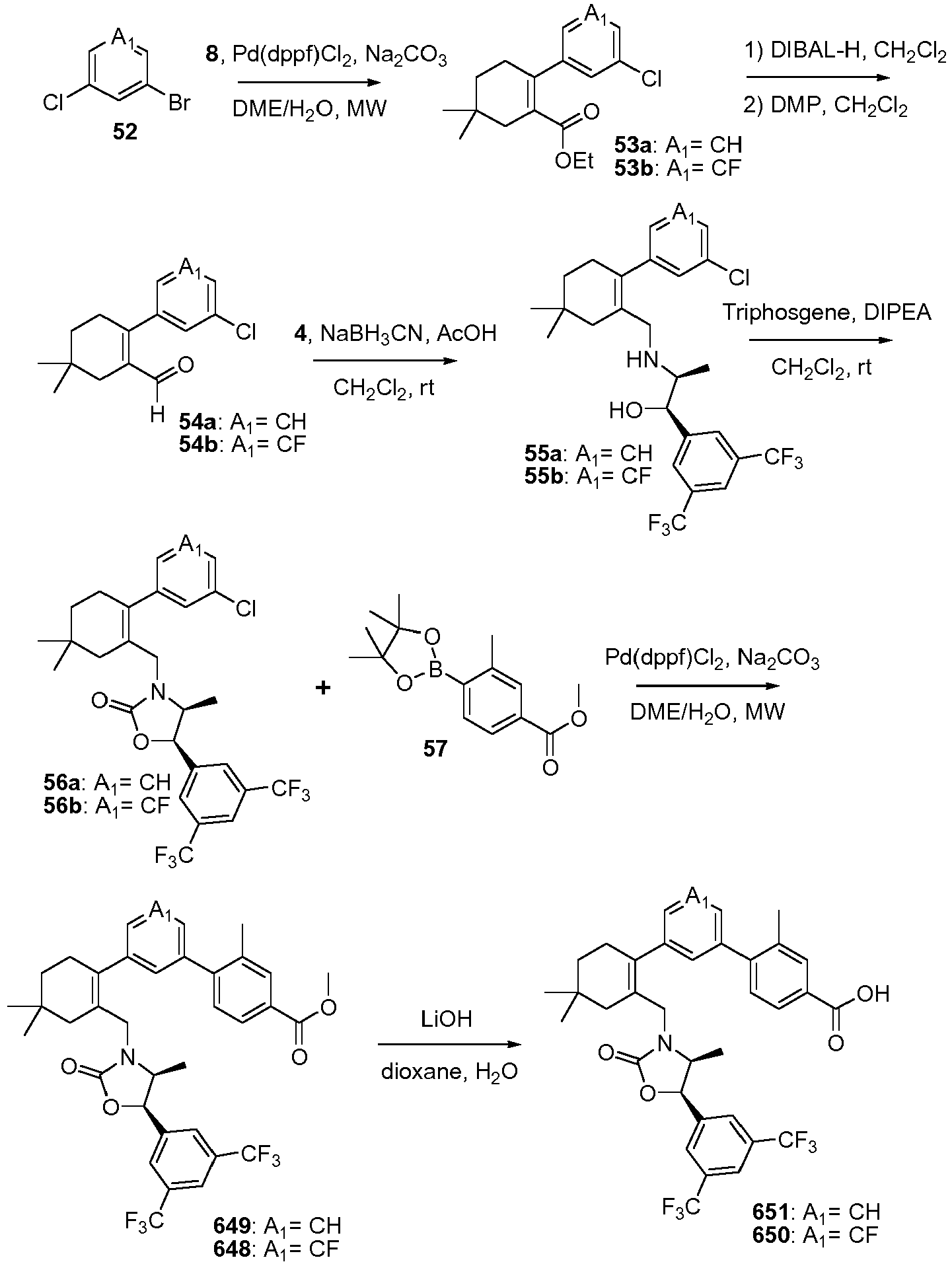
- Reaction scheme 13 above shows a general process for synthesizing compounds 648, 649, 650 and 651 of the present invention, and other compounds of the present invention can also be prepared according to reaction scheme 13.
- Compound 52 as a starting material is subjected to the Suzuki reaction with compound 8 in the presence of a palladium catalyst to synthesize compounds 53a and 53b, which are than subjected to an oxidation/reduction reaction to synthesize aldehyde compounds 54a and 54b. The synthesized compounds 54a and 54b are reacted with compound 4 prepared according to a known method, thereby preparing compounds 55a and 55b. The synthesized compounds 55a and 55b are reacted with triphosgene to synthesize compounds 56a and 56b, which are then subjected to the Suzuki reaction with boronic acid to synthesize ester compounds 648 and 649. The ester compounds may be hydrolyzed with lithium hydroxide to obtain desired carboxylic acid compounds 650 and 651.


Compounds R3 R4 R7 642 OCH3 Cl CO2CH3 643 OCH3 Cl CO2H 728 Cl CF3 CO2CH3 729 Cl CF3 CO2H 738 F Cl CO2CH3 739 F Cl CO2H - Reaction scheme 14 above shows a general process for synthesizing compounds 642, 643, 728, 729, 738 and 739 of the present invention, and other compounds of the present invention can also be prepared according to reaction scheme 14. In reaction scheme 14, R3, R4 and R7 are each as defined above, and Q may be

- Compound 58 as a starting material is subjected to the Sandmeyer reaction to synthesize iodine-containing compound 59, which is then subjected to the Suzuki reaction with boronic acid compound 59 in the presence of a palladium catalyst to synthesize ester compounds 642, 728 and 738. The ester compounds may be hydrolyzed with lithium hydroxide to obtained desired carboxylic acid compounds 643, 729 and 739.
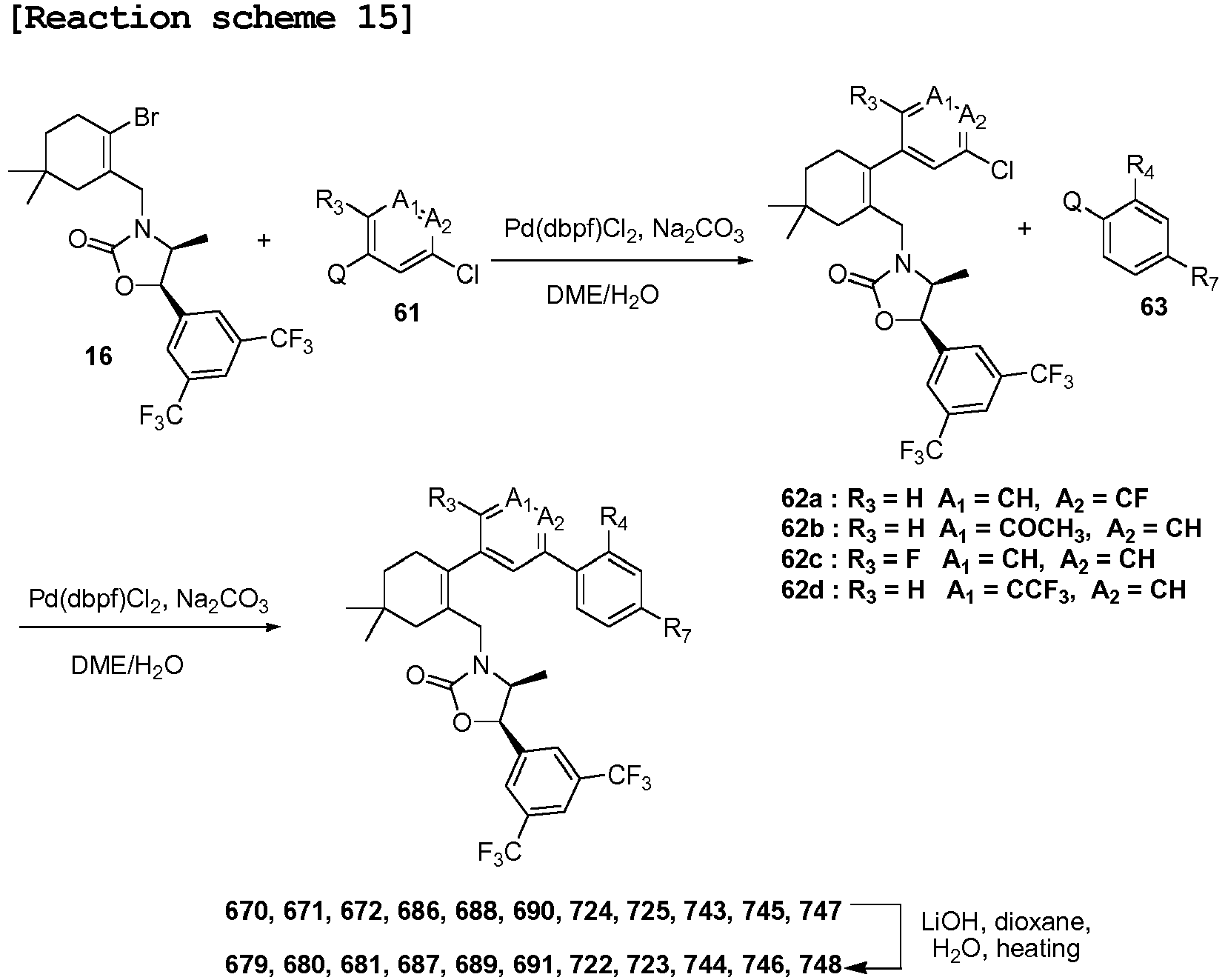
Compounds R3 R4 R7 A1 A2 670 H H CO2CH3 CH CF 679 H H CO2H CH CF 671 H F CO2CH3 CH CF 680 H F CO2H CH CF 672 H CH3 CO2CH3 CH CF 681 H CH3 CO2H CH CF 686 H H CO2CH3 COCH3 CH 687 H H CO2H COCH3 CH 688 H CH3 CO2CH3 COCH3 CH 689 H CH3 CO2H COCH3 CH 690 H F CO2CH3 COCH3 CH 691 H F CO2H COCH3 CH 724 F F CO2CH3 CH CH 722 F F CO2H CH CH 725 H CF3 CO2CH3 CH CF 723 H CF3 CO2H CH CF 743 H CH3 CO2CH3 CCF3 CH 744 H CH3 CO2H CCF3 CH 745 H H CO2CH3 CCF3 CH 746 H H CO2H CCF3 CH 747 H F CO2CH3 CCF3 CH 748 H F CO2H CCF3 CH - Reaction scheme 15 above shows a general process for synthesizing compounds 670, 671, 672, 679, 680, 681, 686, 687, 688, 689, 690, 691, 722, 723, 724, 725, 743, 744, 745, 746, 747 and 748 of the present invention, and other compounds of the present invention can also be prepared according to reaction scheme 15. In reaction scheme 15, R3, R4, R7, A1 and A2 are each as defined above, and Q may be

- Compound 16 synthesized according to a known method is subjected to the Suzuki reaction with various boronic acid derivatives (61) in the presence of a palladium catalyst to synthesize compounds 62a to 62d, which are then subjected to the Suzuki reaction with various boronic acid derivatives (63) in the presence of a palladium catalyst to synthesize ester compounds 670, 671, 672, 686, 688, 690, 724, 725, 743, 745 and 747. The ester compounds may be hydrolyzed with lithium hydroxide to obtain desired carboxylic acid compounds 679, 680, 681, 687, 689, 691, 722, 723, 744, 746 and 748.
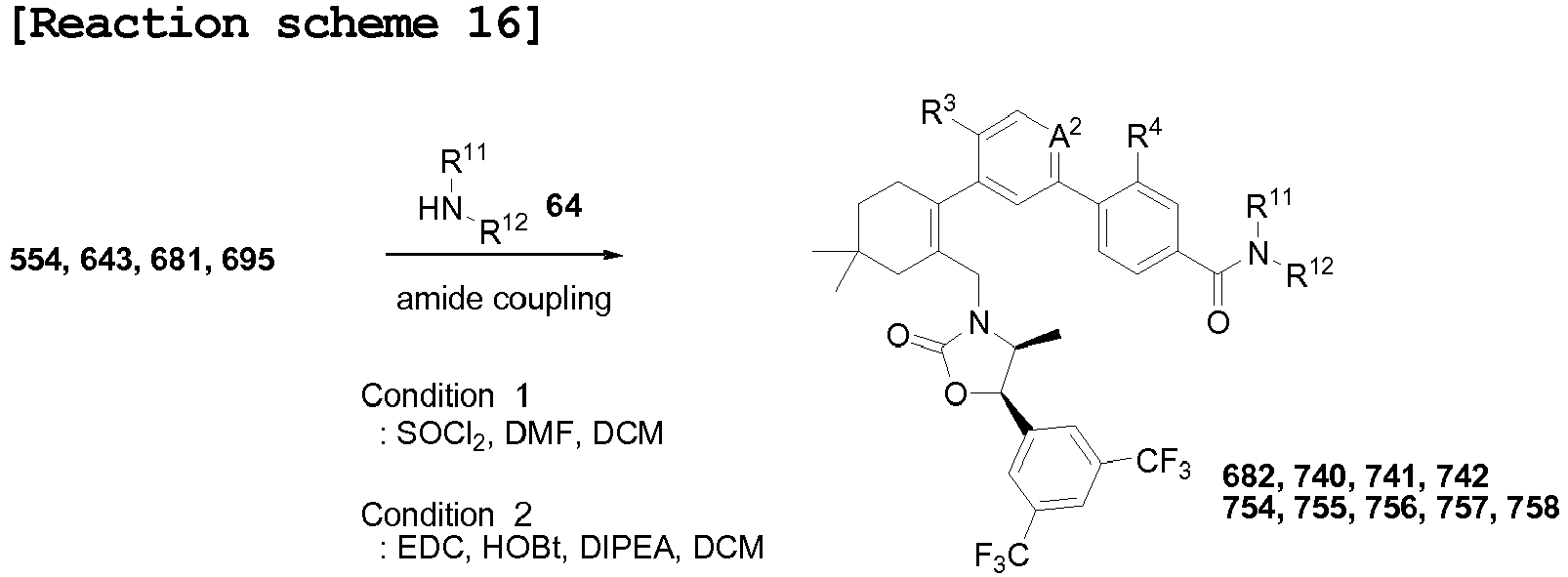
Compounds Stating material Condition R3 R4 A2 
682 554 1 OCH3 CH3 CH NH2 740 643 1 OCH3 Cl CH NH2 741 681 1 H CH3 CF NH2 742 695 1 F CF3 CH NH2 754 695 2 F CF3 CH 
755 695 2 F CF3 CH 
756 695 2 F CF3 CH 
757 695 2 F CF3 CH 
758 695 2 F CF3 CH 
- Reaction scheme 16 above shows a general process for synthesizing compounds 682, 740, 741, 742, 754, 755, 756, 757 and 758 of the present invention, and other compounds of the present invention can also be prepared according to reaction scheme 16. In reaction scheme 16, starting materials, conditions, R3, R4, A2 and

- Compounds 554, 643, 681 and 695 that are starting materials are converted to compounds 682, 740, 741 and 742 using thionyl chloride, dimethylformamide, and ammonia water. In addition, compound 695 as a starting material is reacted with compound 64 and EDC to synthesize 754, 755, 756, 757 and 758.


- Reaction scheme 17 above shows a general process for synthesizing compounds 718, 719 and 720 of the present invention, and other compounds of the present invention can also be prepared according to reaction scheme 17.
- Compound 65 as a starting material is subjected to a reduction reaction to synthesize alcohol compound 66. The obtained compound 66 is subjected to the Suzuki reaction with boronic acid to synthesize ester compound 67, which is then reacted with thionyl chloride to synthesize chlorinated compound 68. The synthesized compound 68 is reacted with compounds 69, 71 and 73, prepared according to a known method (International Patent Publication No.
WO 2007/081571 ), in the presence of sodium hydride, to synthesize compounds 70, 72 and 74. The synthesized compounds 70, 72 and 74 may be hydrolyzed with lithium hydroxide to obtain desired carboxylic acid compounds 718, 719 and 720.

- Reaction scheme 18 above shows a general process for synthesizing compounds 705 and 706 of the present invention, and other compounds of the present invention can also be prepared according to reaction scheme 18.
- Compound 3b is reacted with compound 75, prepared according to a known method (International Patent Publication No.
WO 2010/056849 ), to prepare compound 76. The prepared compound 76 is reacted with triphosgene to synthesize compound 77, which is then subjected to the Suzuki reaction with boronic acid compound 57 in the presence of a palladium catalyst to synthesize ester compound 705. The ester compound may be hydrolyzed with lithium hydroxide to obtain desired carboxylic acid compound 706. - The biaryl- or heterocyclic biaryl-substituted cyclohexene derivative compounds of formula I may contain one or more asymmetric carbon atoms, and thus can be present as racemates, racemic mixtures, single enantiomers, diastereomeric mixtures, and single diastereomers. Such stereoisomers, for example, biaryl- or heterocyclic biaryl-substituted cyclohexene derivative compounds of formula I, can be separated by column chromatography or HPLC. Alternatively, stereoisomers of the compounds of formula I can be stereospecifically synthesized using optically pure starting materials or reagents having a known configuration.
- In the present invention, some compounds are observed as atropisomers (rotamers) in NMR spectra. Single atropisomers and mixtures thereof are included in the scope of the compounds of the present invention.
- The compounds of formula I according to the present invention may be used in the form of pharmaceutically acceptable salts derived from inorganic or organic acids, and preferred cations for the salts include sodium, potassium, magnesium, calcium, zinc or tetrabutyl ammonium.
- Novel biaryl- or heterocyclic biaryl-substituted cyclohexene derivative compounds according to the present invention, stereoisomers thereof, or pharmaceutically acceptable salts thereof, have less side effects and exhibit the effect of effectively inhibiting CETP.
- Novel biaryl- or heterocyclic biaryl-substituted cyclohexene derivative compounds according to the present invention, stereoisomers thereof, or pharmaceutically acceptable salts thereof, can be used for the prevention or treatment of dyslipidemia or dyslipidemia-related diseases.
- Hereinafter, the present invention will be described in further detail with reference to examples, preparation examples and experimental examples. It is to be understood, however, that these examples are for illustrative purposes only and are not intended to limit the scope of the present invention.
- Starting material 1 (3.5 g, 20.3 mmol), compound 2 (4.2 g, 22.3 mmol), sodium carbonate (6.4 g, 60.8 mmol) and Pd(dbpf)Cl2 (0.7 g, 1.0 mmol) were dissolved in dimethoxyethane (3 mL)/water (1 mL) at room temperature, and the reaction mixture was stirred at 100 □ for 18 hours. Then, water was poured into the reaction mixture and extracted with ethyl acetate. The organic layer was dried with anhydrous magnesium sulfate, and then concentrated under reduced pressure to remove the solvent. The residue was purified by MPLC (SiO2, EtOAc/hexane = 0% ∼ 5%) to obtain compound 3b (3.2 g, 56.6%) as yellow oil.
- Starting material 3b (3.1 g, 11.1 mmol), compound 4 (3.5 g, 12.2 mmol) and acetic acid (0.7 mL, 12.2 mmol) were dissolved in methylene chloride (20 mL), and the reaction mixture was stirred at the same temperature for 1 hour, and then sodium cyanoborohydride (NaBH3CN) (0.8 g, 12.2 mmol) was added thereto at room temperature, followed by stirring at the same temperature for 3 hours. Then, aqueous solution of saturated sodium bicarbonate was poured into the reaction mixture, which was then extracted with ethyl acetate. The organic layer was dried with anhydrous magnesium sulfate to remove water, and then concentrated under reduced pressure to remove the solvent. The residue was purified by MPLC (SiO2, EtOAc/hexane = 0% ∼ 20%) to obtain compound 5b (3.5 g, 57.2%) as yellow oil.
- Starting material 5a (0.8 g, 1.65 mmol) and 5-chloro-2-methoxyphenylboronic acid (0.37 g, 2.0 mmol) were dissolved in dimethoxyethane/water (v/v = 3:1, 1 mL), and then degassed. Then, Pd(dbpf)Cl2 (54 mg, 0.08 mmol) and sodium carbonate (0.35 g , 3.3 mmol) were added to the reaction mixture, which was then stirred with microwave irradiation at 120 □ for 30 minutes. After completion of the reaction, the reaction mixture was cooled to room temperature, diluted with ethyl acetate, and then washed with water and brine. The organic layer was dried with anhydrous magnesium sulfate, filtered, and then concentrated under reduced pressure to remove the solvent. The residue was purified by MPLC (SiO2 40 g, hexane/EtOAc = 10% ∼ 20%) to obtain compound 6a (0.68 g, 75%) as brown oil.
- Starting material 5b (3.5 g, 6.4 mmol) and diisopropylethylamine (3.3 mL, 19.1 mmol) were dissolved in methylene chloride (200 mL) at room temperature, and the reaction mixture was cooled to 0 □, and triphosgene (1.9 g, 6.4 mmol) was slowly added thereto. The reaction mixture was warmed to room temperature and stirred for 3 hours. Then, water was poured into the reaction mixture and the reaction mixture was extracted with ethyl acetate. The organic layer was washed with aqueous solution of saturated sodium bicarbonate, dried with anhydrous magnesium sulfate, and then concentrated under reduced pressure to remove the solvent. The residue was purified by MPLC (SiO2, EtOAc/hexane = 0% ∼ 20%) to obtain compound 6b (3.0 g, 81.8%) as a white foam solid.
- Starting material 6b (0.53 g, 0.92 mmol), boronic acid 7 (0.38 g, 1.38 mmol), Pd(dbpf)Cl2 (0.03 g, 0.05 mmol) and sodium carbonate (0.29 g, 2.76 mmol) were dissolved in dimethoxyethane/water (v/v = 3:1, 1.2 mL), and the reaction mixture was stirred with microwave irradiation at 120 □ for 30 minutes. After completion of the reaction, the reaction mixture was cooled to room temperature, diluted with ethyl acetate and then washed with water. The organic layer was dried with anhydrous magnesium sulfate, filtered, and then concentrated under reduced pressure to remove the solvent. The residue was purified by MPLC (SiO2, EtOAc/hexane = 0% ∼ 10%) to obtain compound 553 (0.3 g, 47.3%) as a white foam solid.
1H NMR(400 MHz, CDCl3); 1:1.3 atropisomeric mixture; δ 7.94-7.82 (m, 3H), 7.73 (d, 2H, J=11.2Hz), 7.27-7.17 (m, 2H), 6.96-6.89 (m, 2H), 5.62-5.59 (m, 1H), 4.05-3.91 (m, 5H), 3.83-3.79 (m, 3H), 3.67-3.50 (m, 1H), 2.60-2.10 (m, 5H), 2.00-1.90 (m, 2H), 1.51-1.47 (m, 2H), 1.07-0.89 (m, 6H), 0.44-0.35 (m, 3H)
MS (ESI) m/z 690.2 (M+ + H). - Starting material 553 (2.4 g, 3.48 mmol) and lithium hydroxide monohydrate (0.44 g, 10.44 mmol) were dissolved in dioxane (0.8 mL)/water (0.2 mL), and then stirred at 50 °C for 4 hours. 1M hydrochloric acid was poured into the reaction mixture and extracted with ethyl acetate, and the resulting organic layer was washed with brine, after which it was dried with anhydrous magnesium sulfate, filtered, and then concentrated under reduced pressure to remove the solvent. The residue was purified by MPLC (SiO2, EtOAc/hexane = 0% ∼ 20%) to obtain compound 554 (1.8 g, 76.6%) as a white foam solid.
1H NMR(400 MHz, CDCl3); 1:1.30 atropisomeric mixture; δ 8.02-7.75 (m, 3H), 7.75 (d, 2H, J=10.8Hz), 7.31-7.19 (m, 2H), 6.98-6.90 (m, 2H), 5.64-5.61 (m, 1H), 4.15-3.91 (m, 2H), 3.84 (d, 3H, J=10.3Hz), 3.68-3.52 (m, 1H), 2.60-2.01 (m, 5H), 2.00-1.93 (m, 2H), 1.54-1.46 (m, 2H), 1.07-0.88 (m, 6H), 0.45-0.37 (m, 3H)
MS (ESI) m/z 676.2 (M+ + H). - Starting material 6b (0.15 g, 0.26 mmol) and 4-(methoxycarbonyl)phenylboronic acid (94 mg, 0.52 mmol) were added to dimethoxyethane/water (v/v = 3:1, 1 mL), and then degassed. Pd(dbpf)Cl2 (17 mg, 0.03 mmol) and sodium carbonate (55 mg, 0.52 mmol) were added to the reaction mixture, which was then stirred with microwave irradiation at 120 °C for 30 minutes. After completion of the reaction, the reaction mixture was cooled to room temperature, diluted with ethyl acetate and then washed with water and brine. The organic layer was dried with anhydrous magnesium sulfate, filtered, and then concentrated under reduced pressure to remove the solvent. The residue was purified by MPLC (SiO2, EtOAc/hexane = 0% ∼ 10% → CH2Cl2 100%) to obtain compound 559 (89 mg, 51%) as a white solid.
1H NMR(400 MHz, CDCl3); 1:1.3 atropisomeric mixture; δ 8.08-8.02 (m, 2H), 7.84 (br s, 1H), 7.73 (br s, 2H), 7.60-7.58 (m, 1H), 7.54-7.48 (m, 2H), 7.25-7.24 (m, 1H), 6.97-6.90 (m, 1H), 5.60-5.56 (m, 1H), 4.09-3.98 (m, 2H), 3.93 (d, 3H, J=7.0Hz), 3.81 (d, 3H, J=7.0Hz), 3.64-3.47 (m, 1H), 2.60-2.04 (br m, 2H), 2.02-1.93 (br m, 2H), 1.54-1.47 (m, 2H), 1.27-1.24 (m, 6H), 0.42-0.34 (m, 3H)
MS (ESI) m/z 676.2 (M+ + H). - Starting material 6b (0.1 g, 0.17 mmol) and 2-fluoro-4-(methoxycarbonyl)phenylboronic acid (69 mg, 0.35 mmol) were dissolved in dimethoxyethane/water (v/v = 3:1, 0.8 mL), and then degassed. Pd(dbpf)Cl2 (11 mg, 0.02 mmol) and sodium carbonate (37 mg, 0.35 mmol) were added to the reaction mixture, which was then stirred with microwave irradiation at 120 °C for 30 minutes. After completion of the reaction, the reaction mixture was cooled to room temperature, diluted with ethyl acetate, and then washed with water and brine. The organic layer was dried with anhydrous magnesium sulfate, filtered, and then concentration under reduced pressure to remove the solvent. The residue was purified by MPLC (SiO2, EtOAc/hexane = 10% ∼ 30%) to obtain compound 560 (63 mg, 52%) as colorless oil.
1H NMR(400 MHz, CDCl3); 1:1.3 atropisomeric mixture; δ 7.87-7.82 (m, 2H), 7.79-7.70 (m, 3H), 7.48-7.40 (m, 2H), 7.25-7.20 (m, 1H), 6.96, 6.92 (2d, 1H, J=8.6Hz), 5.61, 5.54 (2d, 1H, J=8.0 Hz), 4.02-3.92 (m, 5H), 3.81 (d, 3H, J=7.0Hz), 3.66-3.45 (m, 1H), 2.60-2.02 (br m, 2H), 2.01-1.92 (br m, 2H), 1.52-1.48 (m, 2H), 1.05-1.01 (m, 6H), 0.37 (2d, 3H, J=6.5Hz)
MS (ESI) m/z 694.2 (M+ + H). - Starting material 560 (60 mg, 0.09 mmol) was dissolved in dioxane (4 mL), and a solution of lithium hydroxide monohydrate (18 mg, 0.43 mmol) in water (1 mL) was added dropwise thereto. Then, the reaction mixture was stirred overnight at 50 °C. After completion of the reaction, the reaction mixture was cooled to room temperature, diluted with ethyl acetate, and then washed with water, saturated ammonium chloride and brine. The organic layer was dried with anhydrous magnesium sulfate, filtered, and then concentrated under reduced pressure to remove the solvent. The residue was purified by MPLC (SiO2, CH3OH/CH2Cl2 = 0% ∼ 10%) to obtain compound 561 (27 mg, 46%) as a yellow solid.
1H NMR(400 MHz, CDCl3); δ 7.95-7.90 (m, 1H), 7.87-7.80 (m, 2H), 7.74 (d, 2H, J=7.0Hz), 7.53-7.42 (m, 2H), 7.28-7.23 (m, 1H), 6.98, 6.94 (2d, 1H, J=8.6Hz), 5.62, 5.55 (2d, 1H, J=8.0Hz), 4.05-3.92 (m, 2H), 3.83-3.80 (m, 3H), 3.71-3.46 (m, 1H), 2.28-2.03 (br m, 2H), 2.02-1.93 (br m, 2H), 1.53-1.47 (m, 2H), 1.06-1.02 (m, 6H), 0.39, 0.37 (2d, 3H, J=6.5Hz)
MS (ESI) m/z 680.2 (M+ + H). - Starting material 6b (0.1 g, 0.17 mmol) and methyl 5-(4,4,5,5-tetramethyl-1,3,2-dioxaborolan-2-yl)picolinate (78 mg, 0.3 mmol) were dissolved in dimethoxyethane/water (v/v = 3:1, 1 mL), followed by degassing. Pd(dbpf)Cl2 (11 mg, 0.02 mmol) and sodium carbonate (37 mg, 0.35 mmol) were added to the reaction mixture, which was then stirred with microwave irradiation at 120 °C for 30 minutes. After completion of the reaction, the reaction mixture was cooled to room temperature, diluted with ethyl acetate, and then washed with water and brine. The organic layer was dried with anhydrous magnesium sulfate, filtered, and then concentrated under reduced pressure to remove the solvent. The residue was purified by MPLC (SiO2, EtOAc/hexane = 20% ∼ 50%) to obtain compound 564 (14 mg, 12%) as yellow oil.
1H NMR(400 MHz, CDCl3); 1:1.3 atropisomeric mixture; δ 8.89, 8.82 (2d, 1H, J=2.2 Hz), 8.17, 8.13 (2d, 1H, J=8.1Hz), 7.97-7.91 (m, 1H), 7.85 (s, 1H), 7.71 (d, 2H, J=7.0Hz), 7.53-7.50 (m, 1H), 7.23 (d, 1H, J=7.0Hz), 7.01-6.95 (m, 1H), 5.61-5.58 (m, 1H), 4.04-3.96 (m, 5H), 3.82 (d, 3H, J=7.0Hz), 3.61-3.43 (m, 1H), 2.60-1.96 (br m, 2H), 1.94-1.92 (br m, 2H), 1.53-1.48 (br m, 2H), 1.07-1.01 (m, 6H), 0.45-0.36 (m, 3H)
MS (ESI) m/z 677.2 (M+ + H). - Starting material 559 (68 mg, 0.1 mmol) was dissolved in dioxane (4 mL), and a solution of lithium hydroxide monohydrate (21 mg, 0.5 mmol) in water (1 mL) was added dropwise thereto, followed by stirring overnight at 50 °C. After completion of the reaction, the reaction mixture was cooled to room temperature, diluted with ethyl acetate, and then washed with saturated ammonium chloride and brine. The organic layer was dried with anhydrous magnesium sulfate, filtered, and then concentrated under reduced pressure to remove the solvent. The residue was purified by MPLC (SiO2, EtOAc/hexane = 30% ∼ 50%) to obtain compound 565 (34 mg, 51%) as a white solid.
1H NMR(400 MHz, CDCl3); 1:1.4 atropisomeric mixture; δ 8.15, 8.11 (2d, 2H, J=8.2Hz), 7.85 (br s, 1H), 7.72 (br s, 2H), 7.64 (d, 1H, J=8.2Hz), 7.57 (d, 1H, J=8.2Hz), 7.54-7.50 (m, 1H), 7.27-7.26 (m, 1H), 6.97, 6.93 (2d, 1H, J=8.6Hz), 5.61-5.57 (m, 1H), 4.06-3.91 (m, 2H), 3.82 (d, 3H, J=7.0Hz), 3.65-3.48 (m, 1H), 2.55-1.99 (br m, 2H), 1.96-1.90 (br m, 2H), 1.55-1.46 (m, 2H), 1.07-1.02 (m, 6H), 0.43-0.36 (m, 3H)
MS (ESI) m/z 662.2 (M+ + H). - Starting material 6b (80 mg, 0.14 mmol) and 3-(methoxycarbonyl)phenylboronic acid (38 mg, 0.21 mmol) were dissolved in dimethoxyethane/water (v/v = 4:1, 0.5 mL), followed by degassing. Pd(dbpf)Cl2 (9 mg, 0.01 mmol) and sodium carbonate (29 mg, 0.28 mmol) were added to the reaction mixture, which was then stirred with microwave irradiation at 120 °C for 30 minutes. After completion of the reaction, the reaction mixture was cooled to room temperature, diluted with ethyl acetate, and then washed with water and brine. The organic layer was dried with anhydrous magnesium sulfate, filtered, and then concentrated under reduced pressure to remove the solvent. The residue was purified by MPLC (SiO2, EtOAc/hexane = 10% ∼ 15%) to obtain compound 567 (75 mg, 80%) as colorless oil.
1H NMR(400 MHz, CDCl3); 1:1.4 atropisomeric mixture; δ 8.20-8.13 (m, 1H), 7.98-7.92 (m, 1H), 7.84 (d, 1H, J=6.8Hz), 7.72-7.65 (m, 3H), 7.50-7.42 (m, 2H), 7.24 (dd, 1H, J=5.4, 2.4Hz), 6.96, 6.91 (2d, 1H, J=8.6Hz), 5.63-5.56 (m, 1H), 4.03-3.89 (m, 5H), 3.81, 3.79 (2s, 3H), 3.65-3.46 (m, 1H), 2.16-1.93 (br m, 2H), 1.98-1.63 (br m, 2H), 1.50-1.45 (m, 2H), 1.06-1.02 (m, 6H), 0.42-0.35 (m, 3H)
MS (ESI) m/z 676.2 (M+ + H). - Stating material 567 (50 mg, 0.07 mmol) was dissolved in dioxane (4 mL), and a solution of lithium hydroxide monohydrate (16 mg, 0.37 mmol) in water (1 mL) was added dropwise thereto, followed by stirring overnight at 50 °C. After completion of the reaction, the reaction mixture was cooled to room temperature, diluted with ethyl acetate, and then washed with water, saturated ammonium chloride and brine. The organic layer was dried with anhydrous magnesium sulfate, filtered, and then concentrated under reduced pressure to remove the solvent. The residue was purified by MPLC (SiO2, EtOAc/hexane = 10% ∼ 70%) to obtain compound 568 (40 mg, 82%) as a white solid.
1H NMR(400 MHz, CDCl3); 1:1.4 atropisomeric mixture; δ 8.27-8.21 (m, 1H), 8.06-8.01 (m, 1H), 7.84-7.72 (m, 4H), 7.54-7.47 (m, 2H), 7.26-7.22 (m, 1H), 6.97, 6.92 (2d, 1H, J=8.5Hz), 5.63-5.56 (m, 1H), 4.06-3.93 (m, 2H), 3.82, 3.80 (2S, 3H), 3.66-3.47 (m, 1H), 2.56-2.04 (br m, 2H), 2.00-1.90 (br m, 2H), 1.57-1.47 (m, 2H), 1.07-0.98 (m, 6H), 0.42-0.36 (m, 3H)
MS (ESI) m/z 662.2 (M+ + H). - Starting material 6b (0.13 g, 0.23 mmol) and 4-(methoxycarbonyl)-2-nitrophenylboronic acid (76 mg, 0.34 mmol) were dissolved in dimethoxyethane/water (v/v = 3:1, 0.5 mL), followed by degassing. Pd(dbpf)Cl2 (7 mg, 0.01 mmol) and sodium carbonate (48 mg, 0.45 mmol) were added to the reaction mixture, which was then stirred with microwave irradiation at 120 °C for 30 minutes. After completion of the reaction, the reaction mixture was cooled to room temperature, diluted with ethyl acetate, and then washed with water and brine. The organic layer was dried with anhydrous magnesium sulfate, filtered, and then concentrated under reduced pressure to remove the solvent. The residue was purified by MPLC (SiO2, EtOAc/hexane = 5% ∼ 50%) to obtain compound 569 (15 mg, 9%) as yellow oil.
1H NMR(400 MHz, CDCl3); δ 8.45, 8.40 (2d, 1H, J=1.6Hz), 8.24-8.17 (m, 1H), 7.85-7.79 (m, 1H), 7.75-7.71 (m, 2H), 7.53, 7.47 (2d, 1H, J=8.0Hz), 7.23-7.20 (m, 1H), 6.97-6.92 (m, 2H), 5.59 (d, 1H, J=8.0Hz), 4.02-3.97 (m, 4H), 3.85-3.71 (m, 4H), 3.69-3.49 (m, 1H), 2.55-2.20 (m, 2H), 1.96-1.85 (m, 2H), 1.50-1.43 (m, 2H), 1.04-0.98 (m, 6H), 0.43-0.39 (m, 3H)
MS (ESI) m/z 721.1 (M+ + H). - Starting material 6a (0.1 g, 0.18 mmol) and methyl 3-methyl-4-(4,4,5,5-tetramethyl-1,3,2-dioxaborolan-2-yl)benzoate (55 mg, 0.2 mmol) were dissolved in dimethoxyethane/water (v/v = 4:1, 0.3 mL), followed by degassing. Pd(dbpf)Cl2 (6 mg, 0.009 mmol) and sodium carbonate (39 mg, 0.37 mmol) were added to the reaction mixture, which was then stirred with microwave irradiation at 120 °C for 15 minutes. After completion of the reaction, the reaction mixture was cooled to room temperature, diluted with ethyl acetate, and then washed with water and brine. The organic layer was dried with anhydrous magnesium sulfate, filtered, and then concentrated under reduce pressure to remove the solvent. The residue was purified by MPLC (SiO2, EtOAc/hexane = 10% ∼ 20%) to obtain compound 579 (50 mg, 41%) as colorless oil.
1H NMR(400 MHz, CDCl3); 1:1.3 atropisomeric mixture; δ 7.90-7.81 (m, 3H), 7.72 (d, 2H, J=13.4Hz), 7.24-7.16 (m, 2H), 6.97-6.87 (m, 2H), 5.62-5.57 (m, 1H), 4.09-3.90 (m, 5H), 3.82, 3.79 (2s, 3H), 3.65-3.49 (m, 1H), 2.57-2.09 (m, 7H), 1.79-1.74 (br m, 4H), 0.43-0.36 (m, 3H)
MS (ESI) m/z 662.2 (M+ + H). - Starting material 6a (0.1 g, 0.18 mmol) and 2-fluoro-4-(methoxycarbonyl)phenylboronic acid (54 mg, 0.27 mmol) were dissolved in dimethoxyethane/water (v/v = 4:1, 0.3 mL), followed by degassing. Pd(dbpf)Cl2 (6 mg, 0.009 mmol) and sodium carbonate (39 mg, 0.37 mmol) were added to the reaction mixture, which was then stirred with microwave irradiation at 120 °C for 15 minutes. After completion of the reaction, the reaction mixture was cooled to room temperature, diluted with ethyl acetate, and then washed with water and brine. The organic layer was dried with anhydrous magnesium sulfate, filtered, and then concentrated under reduced pressure to remove the solvent. The residue was purified by MPLC (SiO2, EtOAc/hexane = 10% ∼ 20%) to obtain compound 580 (50 mg, 41%) as brown oil.
1H NMR(400 MHz, CDCl3); 1:1.1 atropisomeric mixture; δ 7.87-7.73 (m, 5H), 7.51-7.40 (m, 2H), 7.27-7.23 (m, 1H), 6.98-6.91 (m, 1H), 5.61, 5.54 (2d, 1H, J=8.0Hz), 4.03-3.90 (m, 5H), 3.83, 3.80 (2s, 3H), 3.66-3.45 (m, 1H), 2.42-2.11 (br m, 4H), 1.82-1.74 (br m, 4H), 0.41-0.34 (m, 3H)
MS (ESI) m/z 666.2 (M+ + H). - Starting material 579 (46 mg, 0.07 mmol) was dissolved in dioxane (4 mL), and a solution of lithium hydroxide monohydrate (15 mg, 0.35 mmol) in water (1 mL) was added dropwise thereto, followed by stirring at 50 °C for 3 hours. After completion of the reaction, the reaction mixture was cooled to room temperature, diluted with ethyl acetate, and then washed with water, saturated ammonium chloride and brine. The organic layer was dried with anhydrous magnesium sulfate, filtered, and then concentrated under reduced pressure to remove the solvent. The residue was purified by MPLC (SiO2, EtOAc/hexane = 20% ∼ 50%) to obtain compound 581 (21 mg, 47%) as a white solid.
1H NMR(400 MHz, CDCl3); 1:1.4 atropisomeric mixture; δ 7.97-7.90 (m, 2H), 7.85 (s, 1H), 7.73 (d, 2H, J=13.0Hz), 7.30-7.18 (m, 2H), 6.99-6.89 (m, 2H), 5.63-5.58 (m, 1H), 4.06-3.85 (m, 2H), 3.83-3.79 (m, 3H), 3.66-3.50 (m, 1H), 2.46-2.04 (m, 7H), 1.81-1.74 (br m, 4H), 0.44, 0.38 (2d, 3H, J=6.5Hz)
MS (ESI) m/z 648.2 (M+ + H). - Starting material 580 (45 mg, 0.07 mmol) was dissolved in dioxane (2 mL), and a solution of lithium hydroxide monohydrate (14 mg, 0.34 mmol) in water (0.5 mL) was added dropwise thereto, followed by stirring at 50 °C for 3 hours. After completion of the reaction, the reaction mixture was cooled to room temperature, diluted with ethyl acetate, and then washed with water, saturated ammonium chloride and brine. The organic layer was dried with anhydrous magnesium sulfate, filtered, and then concentrated under reduced pressure to remove the solvent. The residue was purified by MPLC (SiO2, EtOAc/hexane = 20% ∼ 50%) to obtain compound 582 (10 mg, 23%) as a yellow solid.
1H NMR(400 MHz, CDCl3); 1:1.1 atropisomeric mixture; δ 7.92-7.78 (m, 3H), 7.73 (s, 2H), 7.51-7.32 (m, 2H), 7.28-7.09 (m, 1H), 6.98-6.92 (m, 1H), 5.62-5.53 (m, 1H), 4.03-3.89 (m, 2H), 3.92-3.79 (m, 3H), 3.66-3.46 (m, 1H), 2.43-2.17 (br m, 4H), 1.80-1.74 (br m, 4H), 0.42-0.35 (m, 3H)
MS (ESI) m/z 650.2 (M+ - H). - Starting material 6b (0.105 g, 0.18 mmol) and 2,3-difluoro-4-(methoxycarbonyl)phenylboronic acid (51 mg, 0.24 mmol) were dissolved in dimethoxyethane/water (v/v = 3:1, 0.4 mL), and then degassed. Pd(dbpf)Cl2 (6 mg, 0.009 mmol) and sodium carbonate (39 mg, 0.37 mmol) were added to the reaction mixture, which was then stirred with microwave irradiation at 120 °C for 20 minutes. After completion of the reaction, the reaction mixture was cooled to room temperature, diluted with ethyl acetate, and then washed with water and brine. The organic layer was dried with anhydrous magnesium sulfate, filtered, and then concentrated under reduced pressure to remove the solvent. The residue was purified by MPLC (SiO2, EtOAc/hexane = 10% ∼ 15%) to obtain compound 590 (28 mg, 22%) as colorless oil.
1H NMR(400 MHz, CDCl3); δ 7.85 (s, 1H), 7.75-7.69 (m, 3H), 7.47-7.40 (m, 1H), 7.25-7.16 (m, 2H), 6.97, 6.93 (2d, 1H, J=8.6Hz), 5.62-5.55 (m, 1H), 4.02-3.92 (m, 5H), 3.82 (d, 3H, J=10.0Hz), 3.64-3.44 (m, 1H), 2.58-1.98 (br m, 2H), 1.96-1.90 (br m, 2H), 1.54-1.42 (m, 2H), 1.05-1.01 (m, 6H), 0.42-0.37 (m, 3H)
MS (ESI) m/z 712.2 (M+ + H). - Starting material 6b (0.31 g, 0.53 mmol) and methyl 3,5-difluoro-4-(4,4,5,5-tetramethyl-1,3,2-dioxaborolan-2-yl)benzoate (0.19 g, 0.64 mmol) were dissolved in dimethoxyethane/water (v/v = 3:1, 0.6 mL), followed by degassing. Pd(dbpf)Cl2 (17 mg, 0.03 mmol) and sodium carbonate (0.11 g, 1.06 mmol) were added to the reaction mixture, which was then stirred with microwave irradiation at 120 °C for 30 minutes. After completion of the reaction, the reaction mixture was cooled to room temperature, diluted with ethyl acetate, and then washed with water and brine. The organic layer was dried with anhydrous magnesium sulfate, filtered, and then concentrated under reduced pressure to remove the solvent. The residue was purified by MPLC (SiO2, EtOAc/hexane = 10% ∼ 15%) to obtain compound 591 (31 mg, 8%) as yellow oil.
1H NMR(400 MHz, CDCl3); 1:1.1 atropisomeric mixture; δ 7.84 (s, 1H), 7.73 (d, 2H, J=6.7Hz), 7.63, 7.60 (2d, 2H, J=7.5Hz), 7.39-7.34 (m, 1H), 7.13-7.12 (m, 1H), 6.98-6.92 (m, 1H), 5.62-5.52 (m, 1H), 4.00-3.87 (m, 5H), 3.82 (d, 3H, J=7.6Hz), 3.68-3.45 (m, 1H), 2.60-2.20 (br m, 2H), 2.04-1.94 (br m, 2H), 1.53-1.43 (m, 2H), 1.06-1.00 (m, 6H), 0.38-0.32 (m, 3H)
MS (ESI) m/z 712.3 (M+ + H). - Starting material 590 (25 mg, 0.04 mmol) was dissolved in dioxane (2 mL), and a solution of lithium hydroxide monohydrate (7 mg, 0.18 mmol) in water (0.5 mL) was added dropwise thereto, followed by stirring at 50 °C for 4 hours. After completion of the reaction, the reaction mixture was cooled to room temperature, diluted with ethyl acetate, and then washed with water, saturated ammonium chloride and brine. The organic layer was dried with anhydrous magnesium sulfate, filtered, and then concentrated under reduced pressure to remove the solvent. The residue was purified by MPLC (SiO2, EtOAc/hexane = 10% ∼ 60%) to obtain compound 592 (15 mg, 61%) as a yellow solid.
1H NMR(400 MHz, CDCl3); δ 7.92-7.76 (m, 2H), 7.73 (br s, 2H), 7.54-7.42 (m, 1H), 7.22-7.17 (m, 2H), 6.99, 6.95 (2d, 1H, J=8.6Hz), 5.66-5.58 (m, 1H), 4.03-3.92 (m, 2H), 3.84-3.80 (m, 3H), 3.65-3.45 (m, 1H), 2.60-2.04 (br m, 2H), 1.96-1.93 (br m, 2H), 1.54-1.46 (m, 2H), 1.06-1.02 (m, 6H), 0.41-0.38 (m, 3H)
MS (ESI) m/z 698.2 (M+ + H). - Starting material 591 (31 mg, 0.04 mmol) was dissolved in dioxane (2 mL), and a solution of lithium hydroxide monohydrate (9 mg, 0.22 mmol) in water (0.5 mL) was added dropwise thereto, followed by stirring at 50 °C for 6 hours. After completion of the reaction, the reaction mixture was cooled to room temperature, diluted with ethyl acetate, and then washed with water, saturated ammonium chloride and brine. The organic layer was dried with anhydrous magnesium sulfate, filtered, and then concentrated under reduced pressure to remove the solvent. The residue was purified by MPLC (SiO2, EtOAc/hexane = 10% ∼ 70%) to obtain compound 593 (10 mg, 33%) as a white solid.
1H NMR(400 MHz, CDCl3); 1:1.2 atropisomeric mixture; δ 7.85 (s, 1H), 7.74 (d, 2H, J=6.8Hz), 7.70-7.65 (m, 2H), 7.40-7.36 (m, 1H), 7.15 (d, 1H, J=5.0Hz), 6.99-6.93 (m, 1H), 5.63-5.53 (m, 1H), 4.01-3.90 (m, 2H), 3.83-3.79 (m, 3H), 3.67, 3.47 (2d, 1H, J=14.8Hz), 2.60-2.13 (br m, 2H), 2.04-1.94 (br m, 2H), 1.52-1.46 (m, 2H), 1.05-1.00 (m, 6H), 0.39-0.33 (m, 3H)
MS (ESI) m/z 698.2 (M+ + H). - Starting material 6b (0.08 g, 0.13 mmol), methyl 2-methoxy-4-(4,4,5,5-tetramethyl-1,3,2-dioxaborolan-2-yl)benzoate (0.06 g, 0.2 mmol), Pd(dbpf)Cl2 (8.0 mg, 0.01 mmol) and sodium carbonate (0.04 g, 0.39 mmol) were dissolved in dimethoxyethane (3 mL)/water (1 mL) and heated by microwave irradiation at 120 °C for 30 minutes. After completion of the reaction, the reaction mixture was cooled to room temperature, diluted with ethyl acetate, and then washed with brine. The organic layer was dried with anhydrous magnesium sulfate, filtered, and then concentrated under reduced pressure to remove the solvent. The residue was purified by MPLC (SiO2, hexane/EtOAc = 10% ∼ 50%) to obtain compound 599 (64 mg, 69.7%) as colorless oil.
1H NMR(400 MHz, CDCl3); atropisomeric mixture; δ 7.88-7.80 (m, 2H), 7.71 (2s, 2H), 7.47 (2t, 1H, J=2.6Hz), 7.21 (t, 1H, J=2.0Hz), 7.15-7.04 (m, 2H), 6.93 (2d, 1H, J=8.6Hz), 5.58 (2d, 1H, J=4.4Hz), 4.02-3.79 (m, 11H), 3.56 (2d, 1H, J=14.6Hz), 2.56-1.94 (m, 4H), 1.51 (m, 2H), 1.04 (2d, 6H, J=12.3Hz), 0.40(2d, 3H, J=6.6Hz)
MS (ESI) m/z 706.2 (M+ + H). - Starting material 6b (0.08 g, 0.14 mmol), methyl 3-methyl-5-(4,4,5,5-tetramethyl-1,3,2-dioxaborolan-2-yl)picolinate (0.06 g, 0.21 mmol), Pd(dbpf)Cl2 (9.0 mg, 0.01 mmol) and sodium carbonate (0.05 g, 0.43 mmol) were dissolved in dimethoxyethane (3 mL)/water (1 mL) and heated by microwave irradiation at 120 °C for 30 minutes. After completion of the reaction, the reaction mixture was cooled to room temperature, diluted with ethyl acetate, and then washed with brine. The organic layer was dried with anhydrous magnesium sulfate, filtered, and then concentrated under reduced pressure to remove the solvent. The residue was purified by MPLC (SiO2, hexane/EtOAc = 10% ∼ 50%) to obtain compound 600 (15 mg, 15.3%) as colorless oil.
1H NMR(400 MHz, CDCl3); atropisomeric mixture; δ 8.67 (2d, 1H, J=2.1Hz), 7.85 (s, 1H), 7.72-7.66 (m, 3H), 7.52-7.47 (m, 1H), 7.21 (d, 1H, J=2.4Hz), 6.97 (2d, 1H, J=8.6Hz), 5.59 (d, 1H, J=8.1Hz), 4.06-3.91 (m, 5H), 3.87 (2s, 3H), 3.54 (2d, 1H, J=13.5Hz), 2.65 (2s, 3H), 2.54-1.93 (m, 4H), 1.51 (m, 2H), 1.05 (2d, 6H, J=15.9Hz), 0.41 (2d, 3H, J=6.6Hz)
MS (ESI) m/z 691.2 (M+ + H). - Starting material 599 (0.06 g, 0.08 mmol) and lithium hydroxide monohydrate (0.01 g, 0.41 mmol) were dissolved in dioxane (3 mL)/water (1 mL) at room temperature and stirred overnight at 50 °C. After completion of the reaction, a solution of 1 M hydrochloric acid was added dropwise to the reaction mixture until a pH of 6.5 was reached, after which water was poured into the reaction mixture and the reaction mixture was extracted with ethyl acetate. The organic layer was washed with brine, dried with anhydrous magnesium sulfate, filtered, and then concentrated under reduced pressure to remove the solvent. The residue was purified by preparative TLC (SiO2, hexane/EtOAc = 0% ∼ 30%) to obtain compound 601 (30 mg, 52.9%) as colorless oil.
1H NMR(400 MHz, CDCl3); atropisomeric mixture; δ 8.17 (2d, 1H, J=8.20Hz), 7.85 (s, 1H), 7.71 (2s, 2H), 7.49 (2t, 1H, J=2.6Hz), 7.30-7.21 (m, 2H), 7.15 (2s, 1H), 6.95 (2d, 1H, J=8.6Hz), 5.57 (2d, 1H, J=8.1Hz), 4.12 (2s, 3H), 4.05-3.93 (m, 2H), 3.81 (2s, 3H), 3.54 (2d, 1H, J=14.6Hz), 2.55-1.93 (m, 4H), 1.51 (m, 2H), 1.04 (2d, 6H, J=12.2Hz), 0.42 (2d, 3H, J=6.5Hz)
MS (ESI) m/z 692.3 (M+ + H). - Staring material 600 (13 mg, 0.02 mmol) and lithium hydroxide monohydrate (2 mg, 0.09 mmol) were dissolved in dioxane (3 mL)/water (1 mL) at room temperature and stirred overnight at 50 °C. After completion of the reaction, a solution of 1 M hydrochloric acid was added dropwise to the reaction mixture until a pH of 6.5 was reached, after which water was poured into the reaction mixture and the reaction mixture was extracted with ethyl acetate. The organic layer was washed with brine, dried with anhydrous magnesium sulfate, filtered, and then concentrated under reduced pressure to remove the solvent. The residue was purified by preparative TLC (SiO2, hexane/EtOAc = 0% ∼ 30%) to obtain compound 602 (2.5 mg, 23.6%) as colorless oil.
MS (ESI) m/z 677.3 (M+ + H) - Starting material 6b (0.190 g, 0.686 mmol), boronic acid 7 (0.474 g, 0.823 mmol), Pd(dbpf)Cl2 (0.022 g, 0.034 mmol) and sodium carbonate (0.218 g, 2.057 mmol) were dissolved in dimethoxyethane (0.9 mL)/water (0.3 mL) and heated by microwave irradiation at 120 °C for 30 minutes. Then, the reaction mixture was cooled to room temperature, after which water was poured into the reaction mixture and the reaction mixture was extracted with ethyl acetate. The organic layer was dried with anhydrous magnesium sulfate to remove water, and then concentrated under reduced pressure. The residue was purified by MPLC (SiO2, EtOAc/hexane = 0% ∼ 100%) to obtain desired compound 665 (0.160 g, 33.8 %) as clear oil.
1H NMR (400 MHz, CDCl3); δ 8.00 (2d, 1H, J=7.9Hz), 7.86 (s, 1H), 7.73 (2s, 2H), 7.61 (2d, 1H, J=7.9Hz), 7.23 (m, 1H), 6.97 (m, 2H), 5.61 (2d, 1H, J=8.2Hz), 4.06-3.95 (m, 5H), 3.94 (2s, 3H), 3.56 (2d, 1H, J=14.7Hz), 2.59 (2s, 3H), 2.20-2.00 (m, 2H), 1.95-1.92 (m, 2H), 1.52 (m, 2H), 1.07-0.97 (m, 6H), 0.29 (m, 3H)
MS (ESI) m/z 691.2 (M+ + H). - Starting material 665 (0.160 g, 0.232 mmol) and lithium hydroxide monohydrate (0.029 g, 0.695 mmol) were dissolved in dioxane (8 ml)/water (2 ml) at room temperature, and the reaction mixture was stirred for 16 hours at the same temperature. 1M hydrochloric acid was added to the reaction mixture and the reaction mixture was extracted with ethyl acetate. The organic layer was washed with brine, dried with anhydrous magnesium sulfate to remove water, and then concentrated under reduced pressure. The residue was purified by MPLC (SiO2, EtOAc/hexane = 0% ∼ 100%) to obtain desired compound 666 (0.020 g, 12.8 %) as a white foam solid.
1H NMR (400 MHz, CDCl3); δ 8.00 (m, 5H), 7.22 (m, 1H), 7.08 (m, 2H), 5.80 (m, 1H), 4.20 (m, 1H), 3.82 (m, 4H), 3.60 (m, 1H), 2.6 (m, 3H), 2.40-1.80 (m, 4H), 1.45 (m, 2H), 1.0 (m, 6H), 0.4 (m, 3H)
MS (ESI) m/z 677.2 (M+ + H). - Starting material 8 (1.14 g, 3.70 mmol), 5-bromo-3-iodo-2-methoxypyridine (1.40 g, 4.44 mmol), Pd(PPh3)4 (0.85 g, 0.74 mmol) and cesium carbonate (2.41 g, 7.40 mmol) were dissolved in dioxane/water (v/v 9:1, 10 mL), and then reacted by microwave irradiation at 120 °C for 30 minutes. After completion of the reaction, the reaction mixture was cooled to room temperature, diluted with ethyl acetate, and then washed with a saturated ammonium chloride solution. The organic layer was dried with anhydrous magnesium sulfate, filtered, and then concentrated under reduced pressure to remove the solvent. The residue was purified by MPLC (SiO2, EtOAc/hexane = 1:9) to obtain compound 10 (0.37 g, 27%) as colorless oil.
MS (ESI) m/z 368.0 (M+ + H). - Starting material 10 (0.32 g, 0.87 mmol) was dissolved in tetrahydrofuran (THF) (10 mL), and lithium aluminum hydride (1.73 mL, 1.73 mmol) was added dropwise thereto at 0 °C, followed by stirring at 0 °C for 1 hour. Water was added dropwise to stop the reaction, and the reaction mixture was extracted with ethyl acetate. The organic layer was dried with anhydrous magnesium sulfate, filtered, and then concentrated under reduced pressure to remove the solvent. The residue was purified by MPLC (SiO2, EtOAc/hexane = 10%) to obtain an alcohol compound (0.17 g, 61%) as colorless oil. The obtained alcohol compound (0.17 g, 0.53 mmol) was dissolved in methylene chloride (5 mL), and then DMP (0.25 g, 0.58 mmol) was slowly added dropwise thereto at 0 °C, followed by stirring at room temperature for 30 minutes. After completion of the reaction, the reaction mixture was diluted with methylene chloride, and then washed with water. The organic solvent was dried with anhydrous magnesium sulfate, filtered, and then concentrated under reduced pressure to remove the solvent. The residue was purified by MPLC (SiO2, EtOAc/hexane = 10%) to aldehyde obtain 11 (0.12 g, 71%) as colorless oil.
MS (ESI) m/z 324.0 (M+ + H). - Starting material 11 (0.12 g, 0.36 mmol), amino alcohol compound 4 (0.12 g, 0.43 mmol) and sodium cyanoborohydride (26.7 mg, 0.43 mmol) were dissolved in methylene chloride (5 mL), and acetic acid (0.02 mL, 0.43 mmol) was slowly added dropwise thereto at room temperature. The reaction mixture was stirred at room temperature for 2 hours, diluted with methylene chloride, and then washed with water. The organic layer was dried with anhydrous magnesium sulfate, filtered, and then concentrated under reduced pressure to remove the solvent. The obtained product (197 mg, 93.3%) was used in the next reaction.
MS (ESI) m/z 595.2 (M+ + H). - Starting material 12 (0.2 g, 0.33 mmol) and triphosgene (0.12 g, 0.4 mmol) were dissolved in methylene chloride (5 mL), and diisopropylethylamine (0.35 mL, 2.0 mmol) was slowly added dropwise thereto. The reaction mixture was stirred at room temperature for 1 hour, diluted with methylene chloride, and then washed with water. The organic solvent was dried with anhydrous magnesium sulfate, filtered, and then concentrated under reduced pressure to remove the solvent. The residue was purified by MPLC (SiO2, EtOAc/hexane = 10%) to obtain compound 13 (0.15 g, 73%) as colorless oil.
MS (ESI) m/z 621.1 (M+ + H). - Starting material 13 (0.07 g, 0.11 mmol), 2-methyl-4-methoxycarbonylphenylboronic acid, pinacol ester (0.04 g, 0.13 mmol), Pd(dbpf)Cl2 (4 mg, 0.005 mmol) and sodium carbonate (0.03 g, 0.32 mmol) were dissolved in dimethoxyethane/water (v/v = 3:1, 1.6 mL), and the reaction mixture was stirred with microwave irradiation at 120 °C for 30 minutes. After completion of the reaction, the reaction mixture was cooled to room temperature, diluted with ethyl acetate, and then washed with water and brine. The organic layer was dried with anhydrous magnesium sulfate, filtered, and then concentrated under reduced pressure to remove the solvent. The residue was purified by MPLC (SiO2, EtOAc/hexane = 1:4) to obtain compound 555 (42 mg, 56%) as a white solid.
1H NMR(400 MHz, CDCl3); 1:1.5 atropisomeric mixture; δ 8.06-8.04 (m, 1H), 7.96-7.86 (m, 3H), 7.74-7.71 (m, 2H), 7.31-7.19 (m, 2H), 5.64 (d, 0.6H, J=7.7Hz), 5.57 (d, 0.4H, J=7.7Hz), 4.07-4.00 (m, 2H), 3.98-3.92 (m, 6H), 3.59-3.51 (m, 1H), 2.58-2.03 (m, 5H), 1.98-1.87 (m, 2H), 1.57-1.43 (m, 2H), 1.06-1.00 (m, 6H), 0.51 (d, 1.2H, J=6.3Hz), 0.36 (d, 1.8H, J=6.3Hz)
MS (ESI) m/z 691.2 (M+ + H). - Starting material 13 (0.06 g, 0.1 mmol), 4-methoxycarbonylphenylboronic acid (0.02 g, 0.12 mmol), Pd(dbpf)Cl2 (3 mg, 0.005 mmol) and sodium carbonate (0.03 g, 0.3 mmol) were dissolved in dimethoxyethane/water (v/v = 3:1, 1.6 mL), and then stirred with microwave irradiation at 120 °C for 30 minutes. After completion of the reaction, the reaction mixture was cooled to room temperature, diluted with ethyl acetate, and then washed with water and brine. The organic layer was dried with anhydrous magnesium sulfate, filtered, and then concentrated under reduced pressure to remove the solvent. The residue was purified by MPLC (SiO2, EtOAc/hexane = 1:4) to obtain compound 556 (12 mg, 18%) as a white solid.
1H NMR(400 MHz, CDCl3); 1:1.6 atropisomeric mixture; δ 8.37-8.35 (m, 1H), 8.16-8.11 (m, 2H), 7.88-7.87 (m, 1H), 7.74-7.72 (m, 2H), 7.61-7.54 (m, 3H), 5.64 (d, 0.6H, J=8.2Hz), 5.57 (d, 0.4H, J=8.2Hz), 4.10-4.03 (m, 2H), 3.99-3.94 (m, 6H), 3.58-3.52 (m, 1H), 2.58-2.18 (m, 2H), 2.02-1.98 (m, 2H), 1.60-1.48 (m, 2H), 1.08-1.02 (m, 6H), 0.53 (d, 1.2H, J=6.4Hz), 0.39 (d, 1.8H, J=6.4Hz)
MS (ESI) m/z 677.2 (M+ + H). - Starting material 555 (36 mg, 0.05 mmol) was dissolved in dioxane (0.4 mL), and a solution of lithium hydroxide monohydrate (0.01 g, 0.26 mmol) in water (0.1 mL) was added dropwise thereto. The reaction mixture was stirred overnight at 50 °C. After completion of the reaction, the reaction mixture was cooled to room temperature, and a solution of 1M hydrochloric acid solution was added dropwise thereto until a pH of 2 was reached. Then, the reaction mixture was extracted with ethyl acetate, and the organic layer was dried with anhydrous magnesium sulfate, filtered, and then concentrated under reduced pressure to remove the solvent, thereby obtaining compound 557 (28 mg, 79%) as a white solid.
1H NMR(400 MHz, CDCl3); 1:1.6 atropisomeric mixture; δ 8.08-8.07 (m, 1H), 8.02-7.92 (m, 2H), 7.87-7.86 (m, 1H), 7.74-7.71 (m, 2H), 7.31-7.25 (m, 2H), 5.64 (d, 0.6H, J=8.2Hz), 5.57 (d, 0.4H, J=8.2Hz), 4.07-3.92 (m, 5H), 3.59-3.51 (m, 1H), 2.59-2.04 (m, 5H), 1.99-1.88 (m, 2H), 1.58-1.45 (m, 2H), 1.07-1.01 (m, 6H), 0.52 (d, 1.2H, J=6.5Hz), 0.38 (d, 1.8H, J=6.5Hz)
MS (ESI) m/z 677.2 (M+ + H). - Starting material 556 (10 mg, 0.02 mmol) was dissolved in dioxane (0.4 mL), and a solution of lithium hydroxide monohydrate (3 mg, 0.07 mmol) in water (0.1 mL) was added dropwise thereto. The reaction mixture was stirred overnight at 50 °C. After completion of the reaction, the reaction mixture was cooled to room temperature, and a solution of 1M hydrochloric acid was added dropwise thereto until a pH of 2 was reached. Then, the reaction mixture was extracted with ethyl acetate, and the organic layer was dried with anhydrous magnesium sulfate, filtered, and then concentrated under reduced pressure to remove the solvent, thereby obtaining compound 558 (8 mg, 77%) as a white solid.
1H NMR(400 MHz, CDCl3); 1:1.6 atropisomeric mixture; δ 8.31-8.29 (m, 1H), 8.11-8.06 (m, 2H), 7.80-7.79 (m, 1H), 7.74-7.72 (m, 2H), 7.66-7.50 (m, 3H), 5.58-5.48 (m, 1H), 3.99-3.95 (m, 2H), 3.92-3.87 (m, 3H), 3.51-3.44 (m, 1H), 2.51-2.04 (m, 2H), 1.90-1.88 (m, 2H), 1.49-1.44 (m, 2H), 1.01-0.95 (m, 6H), 0.46 (d, 1.1H, J=6.5Hz), 0.39 (d, 1.9H, J=6.5Hz)
MS (ESI) m/z 663.2 (M+ + H). - Starting material 13 (0.15 g, 0.24 mmol), boronic acid 14 (0.06 g, 0.27 mmol), Pd(dbpf)Cl2 (8.0 mg, 0.01 mmol) and sodium carbonate (0.05 g, 0.48 mmol) were dissolved in dimethoxyethane/water (v/v = 3:1, 4 mL), and then stirred with microwave irradiation at 120 °C for 30 minutes. After completion of the reaction, the reaction mixture was cooled to room temperature, diluted with ethyl acetate, and then washed with water and brine. The organic layer was dried with anhydrous magnesium sulfate, filtered, and then concentrated under reduced pressure to remove the solvent. The residue was purified by MPLC (SiO2, EtOAc/hexane = 0% ∼ 20%) to obtain compound 583 (0.12 g, 68.7%) as colorless oil.
1H NMR(400 MHz, CDCl3); atropisomeric mixture; δ 8.13-8.16 (m, 2H), 7.95-8.00 (m, 1H), 7.87 (s, 1H), 7.74 (d, 2H, J=6.6Hz), 7.37-7.47 (m, 2H), 5.59-5.64 (m, 1H), 3.84-4.06 (m, 8H), 3.53-3.66 (m, 1H), 2.00-2.56 (m, 2H), 2.00-1.97 (m, 2H), 1.50-1.55 (m, 2H), 1.02-1.07 (m, 6H), 0.52 (d, 1.3H, J=6.6Hz), 0.36 (d, 1.7H, J=6.6Hz)
MS (ESI) m/z 710.2 (M+ + H). - Starting material 583 (0.07 g, 0.10 mmol) and anhydrous lithium hydroxide (12 mg, 0.49 mmol) were dissolved in dioxane/water (v/v = 4:1, 1.25 mL), and then stirred overnight at 40 °C. After completion of the reaction, the reaction mixture was cooled to room temperature, diluted with ethyl acetate, and then washed with 1M hydrochloric acid solution and brine. The organic layer was dried with anhydrous magnesium sulfate, filtered, and then concentrated under reduced pressure to remove the solvent. The residue was purified by MPLC (SiO2, EtOAc/hexane = 0% ∼ 50%) to obtain compound 584 (2 mg, 2.5%) as colorless oil.
1H NMR(400 MHz, CDCl3); atropisomeric mixture; δ 8.16-8.23 (m, 2H), 8.02-8.07 (m, 1H), 7.87 (s, 1H), 7.74 (d, 2H, J=9.0Hz), 7.41-7.49 (m, 2H), 5.65 (d, 0.6H, J=8.2Hz), 5.59 (d, 0.4H, J=8.3Hz), 3.93-4.06 (m, 5H) , 3.65 (d, 0.6H, J=14.6Hz), 3.57 (d, 0.4H, J=15.0Hz), 2.05-2.60 (m, 2H), 1.96-1.98 (m, 2H), 1.51-1.57 (m, 2H), 1.02-1.08 (m, 6H), 0.53 (d, 1.2H, J=6.6Hz), 0.38 (d, 1.8H , J=6.6Hz)
MS (ESI) m/z 697.1 (M+ + H). - Starting material 13 (0.15 g, 0.24 mmol), boronic acid 14 (0.05 g, 0.27 mmol), Pd(dbpf)Cl2 (8.0 mg, 0.01 mmol) and sodium carbonate (0.05 g, 0.48 mmol) were dissolved in dimethoxyethane/water (v/v = 3:1, 4 mL), and the reaction mixture was stirred with microwave irradiation at 120 °C for 30 minutes. After completion of the reaction, the reaction mixture was cooled to room temperature, diluted with ethyl acetate, and then washed with water and brine. The organic layer was dried with anhydrous magnesium sulfate, filtered, and then concentrated under reduced pressure to remove the solvent. The residue was purified by MPLC (SiO2, EtOAc/hexane = 0% ∼ 20%) to obtain compound 585 (0.14 g, 82.9%) as colorless oil.
1H NMR(400 MHz, CDCl3); atropisomeric mixture; δ 8.27-8.30 (m, 1H), 7.81-7.92 (m, 3H), 7.80 (s, 2H), 7.56-7.45 (m, 2H), 5.59-5.63 (m, 1H), 3.94-4.14 (m, 8H), 3.48-3.62 (m, 1H), 2.05-2.53 (m, 2H), 1.97 (m, 2H), 1.48-1.52 (m, 2H), 1.03-1.07 (m, 6H), 0.48 (d, 1.3H, J=6.6Hz), 0.37 (d, 1.7H, J=6.5Hz)
MS (ESI) m/z 694.2 (M+ + H). - Starting material 585 (0.06 g, 0.09 mmol) and anhydrous lithium hydroxide (11 mg, 0.46 mmol) were dissolved in dioxane/water (v/v = 4:1, 1.25 mL), and then stirred overnight at 40 °C. After completion of the reaction, the reaction mixture was cooled to room temperature, diluted with ethyl acetate, and then washed with 1M hydrochloric acid solution and brine. The organic layer was dried with anhydrous magnesium sulfate, filtered, and then concentrated under reduced pressure to remove the solvent. The residue was purified by MPLC (SiO2, EtOAc/hexane = 0% ∼ 50%) to obtain compound 586 (15 mg, 23.9%) as colorless oil.
1H NMR(400 MHz, CDCl3); atropisomeric mixture; δ 8.30-8.32 (s, 1H), 7.90-7.99 (m, 1H), 7.83-7.87 (m, 2H), 7.75 (s, 2H), 7.51-7.58 (m, 2H), 5.60-5.64 (m, 1H), 3.95-4.05 (m, 5H), 3.50-3.62 (m, 1H), 2.00-2.60 (m, 2H), 1.97 (s, 2H), 1.50-1.54 (m, 2H), 1.03-1.08 (m, 6H), 0.49 (d, 1.3H, J=6.5Hz), 0.41 (d, 1.7H, J=6.5Hz)
MS (ESI) m/z 681.2 (M+ + H). - Starting material 13 (0.14 g, 0.22 mmol), boronic acid 14 (0.04 g, 0.24 mmol), Pd(dbpf)Cl2 (7.0 mg, 0.01 mmol) and sodium carbonate (0.05 g, 0.43 mmol) were dissolved in dimethoxyethane/water (v/v = 3:1, 4 mL), and the reaction mixture was stirred with microwave irradiation at 120 °C for 20 minutes. After completion of the reaction, the reaction mixture was cooled to room temperature, diluted with ethyl acetate, and then washed with water and brine. The organic layer was dried with anhydrous magnesium sulfate, filtered, and then concentrated under reduced pressure to remove the solvent. The residue was purified by MPLC (SiO2, EtOAc/hexane = 0% ∼ 20%) to obtain compound 587 (0.12 g, 79.7%) as colorless oil.
1H NMR(400 MHz, CDCl3); atropisomeric mixture; δ 8.33-8.34 (m, 1H), 8.14-8.20 (m, 1H), 8.01-8.05 (m, 1H), 7.99 (s, 1H), 7.68-7.87 (m, 3H), 7.48-7.56 (m, 2H), 5.58-5.65 (m, 1H), 3.99-4.14 (m, 2H), 3.96-3.97 (m, 3H), 3.92-3.93 (m, 3H), 3.50-3.60 (m, 1H), 2.00-2.60 (m, 2H), 1.96-1.98 (m, 2H), 1.51-1.58 (m, 2H), 1.03-1.08 (m, 6H), 0.37-0.52 (m, 3H)
MS (ESI) m/z 677.2 (M+ + H). - Starting material 587 (0.08 g, 0.11 mmol) and anhydrous lithium hydroxide (14 mg, 0.57 mmol) were dissolved in dioxane/water (v/v = 4:1, 1.25 mL), and then stirred overnight at 40 °C. After completion of the reaction, the reaction mixture was cooled to room temperature, diluted with ethyl acetate, and then washed with 1M hydrochloric acid solution and brine. The organic layer was dried with anhydrous magnesium sulfate, filtered, and then concentrated under reduced pressure to remove the solvent. The residue was purified by MPLC (SiO2, EtOAc/hexane = 0% ∼ 50%) to obtain compound 588 (10 mg, 13.3%) as colorless oil.
1H NMR(400 MHz, CDCl3); atropisomeric mixture; δ 8.35-8.37 (m, 1H), 8.21-8.26 (m, 1H), 8.07-8.12 (m, 1H), 7.85-7.87 (m, 1H), 7.73-7.79 (m, 3H), 7.52-7.59 (m, 2H), 5.65 (d, 0.6H, J=8.1Hz), 5.60 (d, 0.4H, J=8.2Hz), 3.96-4.09 (m, 5H), 3.51-3.60 (m, 1H), 2.21-2.58 (m, 2H), 2.05 (s, 2H), 1.50-1.58 (m, 2H), 1.00-1.08 (m, 6H), 0.53 (d, 1.1H, J=6.6Hz), 0.39 (d, 1.9H, J=6.5Hz)
MS (ESI) m/z 663.2 (M+ + H). - Starting material 13 (6 mg, 0.009 mmol), difluorophenyl pinacol ester (3 mg, 0.01 mmol), Pd(dbpf)Cl2 (0.3 mg) and sodium carbonate (3.0 mg, 0.03 mmol) were dissolved in dimethoxyethane/water (v/v = 3:1, 2 mL), and the reaction mixture was stirred with microwave irradiation at 120 °C for 30 minutes. After completion of the reaction, the reaction mixture was cooled to room temperature, diluted with ethyl acetate, and then washed with water and saturated ammonium chloride solution. The organic layer was dried with anhydrous magnesium sulfate, filtered, and then concentrated under reduced pressure to remove the solvent. The residue was purified by MPLC (SiO2, EtOAc/hexane = 10% ∼ 20%) to obtain compound 595 (6 mg, 91.8%) as a solid.
1H NMR(400 MHz, CDCl3); 1:1.3 atropisomeric mixture; δ 8.29-8.27 (m, 1H), 7.86 (s, 1H), 7.79-7.74 (m, 1H), 7.73 (brs, 2H), 7.54-7.49 (m, 1H), 7.25-7.18 (m, 1H), 5.62-5.57 (m, 1H), 4.04-3.90 (m, 8H), 3.58-3.46 (m, 1H), 2.55-1.99 (m, 2H), 1.69-1.68 (m, 2H), 1.56-1.48 (m, 2H), 1.06-1.01 (m, 6H), 0.49 (d, 1.3H, J=6.5Hz), 0.39 (d, 1.7H, J=6.5 Hz)
MS (ESI) m/z 713.2 (M+ + H). - Starting material 595 (5.0 mg, 0.007 mmol) and lithium hydroxide monohydrate (1 mg, 0.04 mmol) were dissolved in dioxane/water (v/v = 3:1, 0.8 mL), and then stirred overnight at 50 °C. After completion of the reaction, the reaction mixture was cooled to room temperature, and 1M hydrochloric acid solution was added dropwise thereto until a pH of 2 was reached, followed by extraction with ethyl acetate. The organic layer was washed with water, dried with anhydrous magnesium sulfate, filtered, and then concentrated under reduced pressure to remove the solvent, thereby obtaining compound 596 (1.4 mg, 28.6%) as a solid.
1H NMR(400 MHz, CDCl3); 1:1.4 atropisomeric mixture; δ 8.30-8.29 (m, 1H), 7.86-7.79 (m, 2H), 7.73-7.72 (m, 2H), 7.55-7.52 (m, 1H), 7.33-7.21 (m, 1H), 5.63-5.57 (m, 1H), 4.07-3.94 (m, 5H), 3.57 (d, 0.5H, J=14.7Hz), 3.49 (d, 0.5H, J=14.7Hz), 2.55-2.04 (m, 2H), 1.96-1.95 (m, 2H), 1.54-1.46 (m, 2H), 1.06-1.01 (m, 6H), 0.50 (d, 1.2H, J=6.6Hz), 0.40 (d, 1.8H, J=6.6Hz)
MS (ESI) m/z 699.1 (M+ + H). - Starting material 17 (0.21 g, 0.37 mmol), 2,4-dichloro-5-methoxypyrimidine 18 (0.07 g, 0.37 mmol), sodium carbonate (0.09 g, 0.86 mmol) and Pd(dppf)Cl2 (3.0 mg, 0.004 mmol) were dissolved in dimethoxyethane/water (v/v = 3:1, 4 mL), and the reaction mixture was stirred with microwave irradiation at 120 °C for 40 minutes. After completion of the reaction, the reaction mixture was cooled to room temperature, poured into water and extracted with ethyl acetate. The organic layer was washed with brine, dried with anhydrous magnesium sulfate, and then concentrated under reduced pressure to remove the solvent. The residue was purified by preparative TLC (SiO2, hexane/EtOAc = 3:1) to obtain compound 19 (43 mg, 20%) as colorless oil.
1H NMR (400 MHz, CDCl3) ; δ 8.20 (s, 1H), 7.87 (s, 1H), 7.75 (s, 1H), 5.53 (d, 1H, J=8.0Hz), 4.11 (m, 2H), 3.92 (s, 3H), 3.32 (d, 1H, J=15.1Hz), 2.31 (m, 2H), 1.96 (s, 2H), 1.51 (t, 2H, J=6.4Hz), 1.02 (d, 6H, J=9.4Hz), 0.57 (d, 3H, J=6.6Hz)
MS (ESI) m/z 578.1 (M+ + H). - Starting material 19 (0.04 g, 0.074 mmol), boronic acid pinacol ester 14 (0.03 g, 0.09 mmol), sodium carbonate (0.02 g, 0.17 mmol) and Pd(dppf)Cl2 (3.0 mg, 0.004 mmol) were dissolved in dimethoxyethane/water (v/v = 3:1, 4 mL), and the reaction mixture was stirred with microwave irradiation at 120 °C for 30 minutes. After completion of the reaction, the reaction mixture was cooled to room temperature, poured into water and extracted with ethyl acetate. The organic layer was washed with brine, dried with anhydrous magnesium sulfate, and then concentrated under reduced pressure to remove the solvent. The residue was purified by MPLC (SiO2, hexane/EtOAc = 10% ∼ 50%) to obtain compound 603 (27 mg, 52.5%) as colorless oil.
1H NMR (400 MHz, CDCl3) ; δ 8.45 (s, 1H), 7.93-7.76 (m, 4H), 7.61 (s, 2H), 5.40 (d, 1H, J=8.0Hz), 4.09 (m, 1H), 4.00 (m, 1H), 3.97 (s, 3H), 3.92 (s, 3H), 3.39 (d, 1H, J=15.1Hz), 2.52 (s, 3H), 2.39 (m, 2H), 2.01 (s, 2H), 1.54 (t, 2H, J=6.4Hz), 1.03 (d, 6H, J=9.3Hz), 0.35 (d, 3H, J=6.5Hz)
MS (ESI) m/z 692.2 (M+ + H). - Starting material 603 (0.03 g, 0.04 mmol) and lithium hydroxide monohydrate (5.0 mg, 0.2 mmol) were dissolved in dioxane/water (v/v = 3:1, 4 mL), and then stirred overnight at 50 °C. After completion of the reaction, the reaction mixture was cooled to room temperature, diluted with ethyl acetate, and then washed with water and brine. The organic layer was dried with anhydrous magnesium sulfate, filtered, and then concentrated under reduced pressure to remove the solvent. The residue was purified by preparative TLC (SiO2, CH2Cl2/CH3OH = 20:1) to obtain compound 604 (17 mg, 64.3%) as colorless oil.
1H NMR(400 MHz, CDCl3) ; δ 8.48 (s, 1H), 8.0 (s, 1H), 7.95 (d, 1H, J=8.6Hz), 7.82 (s, 1H), 7.79 (d, 1H, J=8.1Hz), 7.62 (s, 2H), 5.41 (d, 1H, J=7.8Hz), 4.13-3.98 (m, 5H), 3.41 (d, 1H, J=15.1Hz), 2.54-2.34 (m, 5H), 1.98 (s, 2H), 1.55 (t, 2H, J=6.2Hz), 1.04 (d, 6H, J=9.8Hz), 0.37 (d, 3H, J=6.4Hz)
MS (ESI) m/z 678.2 (M+ + H). - Starting material 19 (0.05 g, 0.09 mmol), boronic acid pinacol ester 14 (0.02 g, 0.1 mmol), sodium carbonate (0.02 g, 0.2 mmol) and Pd(dppf)Cl2 (4.0 mg, 0.004 mmol) were dissolved in dimethoxyethane/water (v/v = 3:1, 4 mL), and the reaction mixture was stirred with microwave irradiation at 120 °C for 30 minutes. After completion of the reaction, the reaction mixture was cooled to room temperature, poured into water, and extracted with ethyl acetate. The organic layer was washed with brine, dried with anhydrous magnesium sulfate, and then concentrated under reduced pressure to remove the solvent. The residue was purified by preparative TLC (SiO2, hexane/EtOAc = 1:1) to obtain compound 610 (3.3 mg, 5.5%) as colorless oil.
MS (ESI) m/z 696.2 (M+ + H). - Starting material 610 (0.04 g, 0.06 mmol) and lithium hydroxide monohydrate (8.0 mg, 0.32 mmol) were dissolved in dioxane/water (v/v = 3:1, 4 mL), and then stirred overnight at 50 °C. After completion of the reaction, the reaction mixture was cooled to room temperature, and 1M hydrochloric acid solution was added dropwise thereto until a pH of 6 was reached. Then, the reaction mixture was diluted with ethyl acetate, and then washed with water and brine. The organic layer was dried with anhydrous magnesium sulfate, filtered, and then concentrated under reduced pressure to remove the solvent. The residue was purified by preparative TLC (SiO2, hexane/EtOAc = 1:2) to obtain compound 617 (26 mg, 60.3%) as colorless oil.
MS (ESI) m/z 682.3 (M+ + H). - Starting material 19 (0.06 g, 0.1 mmol), phenylboronic acid (0.02 g, 0.12 mmol), Pd(dbpf)Cl2 (3.0 mg, 0.005 mmol) and sodium carbonate (0.03 g, 0.3 mmol) were dissolved in dimethoxyethane/water (v/v = 3:1, 0.5 mL), and the reaction mixture was stirred with microwave irradiation at 120 °C for 30 minutes. After completion of the reaction, the reaction mixture was cooled to room temperature, diluted with ethyl acetate, and then washed with water and saturated ammonium chloride. The organic layer was dried with anhydrous magnesium sulfate, filtered, and then concentrated under reduced pressure to remove the solvent. The residue was purified by MPLC (SiO2, EtOAc/hexane = 30%) to obtain compound 625 (36 mg, 53.9%) as a solid.
1H NMR (400 MHz, CDCl3) ; δ 8.42 (s, 1H), 8.42-8.38 (m, 2H), 8.09-8.07 (m, 2H), 7.82-7.81 (m, 1H), 7.62-7.61 (m, 2H), 5.42-5.40 (m, 1H), 4.09-4.05 (m, 2H), 3.96 (s, 3H), 3.93 (s, 3H), 3.40 (d, 1H, J=15.1Hz), 2.48-2.30 (m, 2H), 2.01-1.99 (m, 2H), 1.56-1.49 (m, 2H), 1.07 (s, 3H), 1.04 (s, 3H), 0.41 (d, 3H, J=6.4Hz)
MS (ESI) m/z 678.2 (M+ + H). - Starting material 19 (0.06 g, 0.1 mmol), 3-fluorophenyl boronic acid (0.03 g, 0.12 mmol), Pd(dbpf)Cl2 (3.0 mg, 0.005 mmol) and sodium carbonate (0.03 g, 0.3 mmol) were dissolved in dimethoxyethane/water (v/v = 3:1, 0.5 mL), and the reaction mixture was stirred with microwave irradiation at 120 °C for 30 minutes. After completion of the reaction, the reaction mixture was cooled to room temperature, diluted with ethyl acetate, and then washed with water and saturated ammonium chloride. The organic layer was dried with anhydrous magnesium sulfate, filtered, and then concentrated under reduced pressure to remove the solvent. The residue was purified by MPLC (SiO2, EtOAc/hexane = 30%) to obtain compound 626 (59 mg, 84.3%) as a solid.
1H NMR(400 MHz, CDCl3); 1:1.2 atropisomeric mixture; δ 8.41 (s, 0.6H), 8.20 (s, 0.4H), 8.16 (dd, 1H, J=8.2Hz, 1.6Hz), 8.10 (dd, 1H, J=12.2Hz, 1.5Hz), 7.99-7.95 (m, 1H), 7.86-7.64 (m, 3H), 5.53 (d, 0.4H, J=8.0Hz), 5.44-5.42 (m, 0.6H), 5.53 (q, 1.3H, J=7.1Hz), 4.13 (q, 0.7H, J=7.1Hz), 4.11-4.04 (m, 2H), 3.96 (s, 1.8H), 3.92 (s, 1.2H), 3.38 (d, 0.6H, J=15.1Hz), 3.32 (d, 0.4H, J=15.1Hz), 2.38-2.30 (m, 2H), 1.99-1.96 (m, 2H), 1.56-1.54 (m, 2H), 1.52-1.49 (m, 1H), 1.41 (t, 2H, J=7.1Hz), 1.07-1.01 (m, 6H), 0.57 (d, 1.3H, J=6.5Hz), 0.37 (d, 1.7H, J=6.5Hz)
MS (ESI) m/z 710.2 (M+ + H). - Starting material 625 (0.03 g, 0.05 mmol) and lithium hydroxide monohydrate (10 mg, 0.2 mmol) were dissolved in dioxane/water (v/v = 4:1, 0.5 mL), and then stirred overnight at 45 °C. After completion of the reaction, the reaction mixture was cooled to room temperature, and 1M hydrochloric acid solution was added dropwise thereto until a pH of 2 was reached, followed by extraction with ethyl acetate. The organic layer was washed with water, dried with anhydrous magnesium sulfate, filtered, and then concentrated under reduced pressure to remove the solvent. The residue was purified by MPLC (SiO2, CH3OH / CH2Cl2 = 10%) to obtain compound 628 (15 mg, 49.7%) as a solid.
1H NMR(400 MHz, CDCl3) ; δ 8.44 (s, 1H), 8.43 (d, 2H, J=8.4Hz), 8.17 (d, 2H, J=8.4Hz), 7.82 (brs, 1H), 7.63 (brs, 2H), 5.41 (d, 1H, J=7.6Hz), 4.13-4.03 (m, 2H), 3.97 (s, 3H), 3.41 (d, 1H, J=14.8Hz), 2.45-2.32 (m, 2H), 2.00-1.99 (m, 2H), 1.58-1.55 (m, 2H), 1.08 (s, 3H), 1.04 (s, 3H), 0.43 (d, 3H, J=6.5Hz)
MS (ESI) m/z 664.2 (M+ + H). - Starting material 626 (0.06 g, 0.08 mmol) and lithium hydroxide monohydrate (16 mg, 0.39 mmol) were dissolved in dioxane/water (v/v = 4:1, 0.5 mL), and then stirred overnight at 45 °C. After completion of the reaction, the reaction mixture was cooled to room temperature, and 1M hydrochloric acid solution was added dropwise thereto until a pH of 2 was reached, followed by extraction with ethyl acetate. The organic layer was washed with water, dried with anhydrous magnesium sulfate, filtered, and then concentrated under reduced pressure to remove the solvent. The residue was purified by MPLC (SiO2, CH3OH/CH2Cl2 = 10%) to obtain compound 629 (22 mg, 41.6%) as a solid.
1H NMR(400 MHz, CDCl3) ; δ 8.44 (s, 1H), 8.20-8.18 (m, 1H), 8.15-8.12 (m, 1H), 8.09-8.05 (m, 1H), 7.82 (brs, 1H), 7.65 (brs, 2H), 5.45 (d, 1H, J=7.2Hz), 4.10-4.02 (m, 2H), 3.98 (s, 3H), 3.42-3.38 (m, 1H), 2.44-2.31 (m, 2H), 2.00-1.99 (m, 2H), 1.57-1.54 (m, 2H), 1.08 (s, 3H), 1.04 (s, 3H), 0.45 (d, 3H, J=6.3Hz)
MS (ESI) m/z 682.2 (M+ + H). - Starting material 19 (0.090 g, 0.161 mmol), 4-(methoxycarbonyl)phenylboronic acid (0.038 g, 0.209 mmol), Pd(dbpf)Cl2 (0.005 g, 0.008 mmol) and sodium carbonate (0.051 g, 0.482 mmol) were dissolved in dimethoxyethane/water (v/v = 3:1, 1 ml) and heated by microwave irradiation at 120 °C for 30 minutes. Then, the reaction mixture was cooled to room temperature, and water was poured into the reaction mixture, which was then extracted with ethyl acetate. The organic layer was washed with aqueous solution of saturated ammonium chloride, dried with anhydrous magnesium sulfate, and then concentrated under reduced pressure. The residue was purified by MPLC (SiO2, EtOAc/hexane = 5% ∼ 10%) to obtain compound 673 (0.052 g, 49.0 %) as a white solid.
1H NMR(400 MHz, CDCl3); atropisomeric mixture; δ 8.07-8.04 (m, 2H), 7.85 (s, 1H), 7.71 (s, 2H), 7.33-7.31 (m, 2H), 7.22 (d, 1H, J=7.8Hz), 7.01 (dd, 1H, J=7.7, 1.9Hz), 6.94 (d, 1H, J=1.8Hz), 5.58 (d, 1H, J=8.2Hz), 4.06-4.02 (m, 1H), 3.94 (s, 3H), 3.91-3.87 (m, 1H), 3.75 (d, 1H, J=14.7Hz), 2.44-2.36 (m, 2H), 2.21 (s, 3H), 1.95-1.91 (m, 2H), 1.49 (t, 2H, J=6.5Hz), 1.02 (s, 3H), 0.99 (s, 3H), 0.39 (d, 3H, J=6.6Hz)
MS (ESI) m/z 660.2 (M+ + H). - Starting material 19 (0.090 g, 0.161 mmol), 4-(methoxycarbonyl)2-methylphenylboronic acid (0.058 g, 0.209 mmol), Pd(dbpf)Cl2 (0.005 g, 0.008 mmol) and sodium carbonate (0.051 g, 0.482 mmol) were dissolved in dimethoxyethane/water (v/v = 3:1, 1 ml) and heated by microwave irradiation at 120 °C for 30 minutes. Then, the reaction mixture was cooled to room temperature, and water was poured into the reaction mixture, which was then extracted with ethyl acetate. The organic layer was washed with aqueous solution of saturated ammonium chloride, dried with anhydrous magnesium sulfate to remove water, and then concentrated under reduced pressure. The residue was purified by MPLC (SiO2, EtOAc/hexane = 10%) to obtain compound 674 (0.053 g, 49.2 %) as a white solid.
1H NMR(400 MHz, CDCl3); atropisomeric mixture; δ 7.94-7.91 (m, 1H), 7.89-7.83 (m, 2H), 7.72 (m, 2H), 7.22 (dd, 1H, J=7.8, 2.7Hz), 7.15 (d, 0.5H, J=7.8Hz), 7.07 (d, 0.5H, J=7.9Hz), 7.02-6.98 (m, 1H), 6.82 (dd, 1H, J=6.8, 1.8Hz), 5.60 (d, 1H, J=8.2Hz), 4.06-4.00 (m, 1H), 3.92 (s, 3H), 3.91-3.85 (m, 1H), 3.82-3.74 (m, 1H), 2.43-2.25 (m, 2H), 2.07-2.04 (m, 3H), 1.99-1.98 (m, 3H), 1.94-1.90 (m, 2H), 1.49-1.46 (m, 2H), 1.02-0.98 (m, 6H), 0.39-0.35 (m, 3H)
MS (ESI) m/z 674.2 (M+ + H). - Starting material 19 (0.090 g, 0.161 mmol), 2-fluoro-4-(methoxycarbonyl)phenylboronic acid (0.059 g, 0.209 mmol), Pd(dbpf)Cl2 (0.005 g, 0.008 mmol) and sodium carbonate (0.051 g, 0.482 mmol) were dissolved in dimethoxyethane/water (v/v = 3:1, 1 ml) and heated by microwave irradiation at 120 °C for 30 minutes. Then, the reaction mixture was cooled to room temperature, and water was poured into the reaction mixture, which was then extracted with ethyl acetate. The organic layer was washed with aqueous solution of saturated ammonium chloride, dried with anhydrous magnesium sulfate, and then concentrated under reduced pressure. The residue was purified by MPLC (SiO2, EtOAc/hexane = 10%) to obtain compound 675 (0.034 g, 31.1 %) as a white solid.
1H NMR(400 MHz, CDCl3); atropisomeric mixture; δ 7.88-7.85 (m, 2H), 7.77 (dd, 1H, J=10.0, 1.5Hz), 7.72 (s, 2H), 7.30-7.23 (m, 2H), 7.06 (dd, 1H, J=7.7, 1.8Hz), 7.95 (d, 1H, J=1.5Hz), 5.56 (d, 1H, J=8.1Hz), 4.04-4.00 (m, 1H), 3.95 (s, 3H), 3.90-3.83 (m, 1H), 3.76 (d, 1H, J=14.8Hz), 2.45-2.36 (m, 2H), 2.14 (s, 3H), 1.96-1.92 (m, 2H), 1.50-1.47 (m, 2H), 1.02 (s, 3H), 0.99 (s, 3H), 0.35 (d, 3H, J=6.5Hz)
MS (ESI) m/z 678.2 (M+ + H). - Starting material 673 (0.048 g, 0.074 mmol) and lithium hydroxide monohydrate (0.016 g, 0.372 mmol) were dissolved in dioxane/water (v/v = 4:1, 1 ml) at 50 °C, and the reaction mixture was stirred at the same temperature for 4 hours. The reaction mixture was concentrated, and water was poured into the reaction mixture, which was then extracted with ethyl acetate. The organic layer was washed with aqueous solution of 1M hydrochloric acid, dried with anhydrous magnesium sulfate, and then concentrated under reduced pressure. The residue was purified by MPLC (SiO2, CH3OH/CH2Cl2 = 2%) to obtain compound 676 (0.033 g, 69.2 %) as a white solid.
1H NMR(400 MHz, CDCl3) ; atropisomeric mixture; δ 8.14 (d, 2H, J=8.3Hz), 7.85 (s, 1H), 7.72 (s, 2H), 7.37 (d, 2H, J=8.4Hz), 7.24 (d, 1H, J=8.0Hz), 7.02 (dd, 1H, J=7.7, 1.8Hz), 6.96 (d, 1H, J=1.7Hz), 5.59 (d, 1H, J=8.2Hz), 4.04-4.00 (m, 1H), 3.95-3.88 (m, 1H), 3.77-3.74 (m, 1H), 2.43-2.27 (m, 2H), 2.23 (s, 3H), 1.95-1.91 (m, 2H), 1.51-1.48 (m, 2H), 1.03 (s, 3H), 0.99 (s, 3H), 0.40 (d, 3H, J=6.6Hz)
MS (ESI) m/z 646.2 (M+ + H). - Starting material 674 (0.053 g, 0.079 mmol) and lithium hydroxide monohydrate (0.017 g, 0.396 mmol) were dissolved in dioxane/water (v/v = 4:1, 1 ml) at 50 °C, and the reaction mixture was stirred at the same temperature for 4 hours. The reaction mixture was concentrated, and water was poured into the reaction mixture, which was then extracted with ethyl acetate. The organic layer was washed with aqueous solution of 1M hydrochloric acid, dried with anhydrous magnesium sulfate, and then concentrated under reduced pressure. The residue was purified by MPLC (SiO2, CH3OH/CH2Cl2 = 5%) to obtain compound 677 (0.037 g, 71.3 %) as a white solid.
1H NMR(400 MHz, CDCl3); atropisomeric mixture; δ 8.01-7.98 (m, 1H), 7.97-7.91 (m, 1H), 7.86 (s, 1H), 7.72 (s, 2H), 7.24-7.21 (m, 1H), 7.20 (d, 0.5H, J=7.8Hz), 7.11 (d, 0.5H, J=7.7Hz), 7.04-6.99 (m, 1H), 6.83 (dd, 1H, J=6.5, 1.8Hz), 5.60 (d, 1H, J=8.3Hz), 4.03-4.01 (m, 1H), 3.91-3.82 (m, 1H), 3.78-3.74 (m, 1H), 2.45-2.28 (m, 2H), 2.10 (s, 1.5H), 2.04 (s, 1.5H), 2.01-2.00 (m, 3H), 1.95-1.91 (m, 2H), 1.50-1.47 (m, 2H), 1.02 (s, 3H), 0.99 (s, 3H), 0.40-0.36 (m, 3H)
MS (ESI) m/z 660.2 (M+ + H). - Starting material 675 (0.030 g, 0.044 mmol) and lithium hydroxide monohydrate (0.009 g, 0.221 mmol) were dissolved in dioxane/water (v/v = 4:1, 1 ml) at 50 °C, and the reaction mixture was stirred at the same temperature for 4 hours. The reaction mixture was concentrated, and water was poured into the reaction mixture, which was then extracted with ethyl acetate. The organic layer was washed with aqueous solution of 1M hydrochloric acid, dried with anhydrous magnesium sulfate, and then concentrated under reduced pressure. The residue was purified by MPLC (SiO2, CH3OH/CH2Cl2 = 5%) to obtain compound 678 (0.022 g, 74.9 %) as a white solid.
1H NMR(400 MHz, CDCl3); atropisomeric mixture; δ 7.95-7.93 (m, 1H), 7.85-7.80 (m, 2H), 7.72 (s, 2H), 7.35-7.31 (m, 1H), 7.26-7.25 (m, 1H), 7.07 (dd, 1H, J=7.7, 1.8Hz), 6.96 (d, 1H, J=1.4Hz), 5.57 (d, 1H , J=8.1Hz), 4.05-4.01(m, 1H), 3.91-3.84(m, 1H), 3.79-3.75(m, 1H), 2.43-2.25 (m, 2H), 2.16 (s, 3H), 1.95-1.94 (m, 2H), 1.50-1.47 (m, 2H), 1.02 (s, 3H), 0.99 (s, 3H), 0.36 (d, 3H, J=6.5Hz)
MS (ESI) m/z 664.2 (M+ + H). - Starting material 19 (0.100 g, 0.173 mmol), methyl-4-(4,4,5,5-tetramethyl-1,3,2-dioxaborolan-2-yl)-3-(trifluoromethyl)benzoate compound (0.086 g, 0.260 mmol), potassium acetate (0.049 g, 0.520 mmol) and Pd(dbpf)Cl2 (0.006 g, 0.009 mmol) were added to N,N-dimethylformamide (0.8 mL)/water (0.4 mL) and heated by microwave irradiation at 120 °C for 20 minutes, and then the temperature was lowered to room temperature to stop the reaction. Water was poured into the reaction mixture, which was then extracted with ethyl acetate. The organic layer was dried with anhydrous magnesium sulfate to remove water, filtered, and then concentrated under pressure. The residue was purified by MPLC (SiO2, EtOAc/hexane = 0% ∼ 20%) to obtain desired compound 763 (0.020 g, 15.5 %) as a brown solid.
1H NMR(400 MHz, CDCl3) ; δ 8.42 (s, 1H), 8.22 (d, 1H, J=6.9Hz), 7.84 (s, 1H), 7.68 (m, 2H), 7.54 (m, 1H), 7.34-7.29 (m, 2H), 5.58 (m, 1H), 4.12-4.05 (m, 2H), 3.98 (s, 3H), 3.91 (s, 3H), 3.40 (m, 1H), 2.47-2.33 (m, 2H), 1.95 (m, 2H), 1.55 (t, 2H, J=6.3Hz), 1.06 (d, 6H, J=6.6Hz), 0.32 (m, 3H)
MS (ESI) m/z 745.1 (M+ + H). - Starting material 763 (0.010 g, 0.014 mmol) and lithium hydroxide monohydrate (0.006 g, 0.144 mmol) were dissolved in 1,4-dioxane (4 mL)/water (1 mL) at room temperature, and the reaction mixture was stirred at the same temperature for 16 hours. An aqueous solution of 1M hydrochloric acid was poured into the reaction mixture, which was then extracted with ethyl acetate. The organic layer was washed, dried with anhydrous magnesium sulfate, filtered, and then concentrated under reduced pressure. The residue was purified by MPLC (SiO2, EtOAc/hexane = 20% ∼ 50%) to obtain compound 764 (0.005 g, 47.6 %) as a white solid.
1H NMR(400 MHz, CDCl3) ; δ 8.41 (s, 1H), 8.19 (d, 1H, J=8.0Hz), 7.84 (s, 1H), 7.72 (s, 2H), 7.54 (d, 1H, J=7.8Hz), 7.37-7.29 (m, 2H), 5.55 (m, 1H), 4.12-4.05 (m, 2H), 3.90 (s, 3H), 3.47-3.43 (m, 1H), 2.60-2.23 (m, 2H), 1.98 (m, 2H), 1.55 (m, 2H), 1.06 (m, 6H), 0.32 (m, 3H)
MS (ESI) m/z 731.1 (M+ + H). - Starting material 22 (0.2 g, 0.65 mmol), aminoalcohol compound 4 (0.2 g, 0.78 mmol) and sodium cyanoborohydride (49 mg, 0.78 mmol) were dissolved in methylene chloride (10 mL), and acetic acid (0.05 mL, 0.78 mmol) was slowly added dropwise thereto at room temperature. The reaction mixture was stirred at room temperature for 1 hour, diluted with methylene chloride, and then washed with water. The organic layer was dried with anhydrous magnesium sulfate, filtered, and then concentrated under reduced pressure to remove the solvent. The obtained compound 23 (369 mg, 98%) as a white solid was used in the next reaction.
MS (ESI) m/z 579.2 (M+ + H). - Starting material 23 (0.37 g, 0.64 mmol) and triphosgene (0.23 g, 0.77 mmol) were dissolved in methylene chloride (10 mL), and diisopropylethylamine (0.67 mL, 3.83 mmol) was slowly added dropwise thereto. The reaction mixture was stirred at room temperature for 1 hour, diluted with methylene chloride, and then washed with water. The organic layer was dried with anhydrous magnesium sulfate, filtered, and then concentrated under reduced pressure to remove the solvent. The residue was purified by MPLC (SiO2 12g, EtOAc/hexane = 10%) to obtain compound 24 (0.29 g, 75%) as a yellow solid.
MS (ESI) m/z 605.1 (M+ + H). - Starting material 24 (0.29 g, 0.47 mmol) was dissolved in methanol (3 mL), and Raney Ni (1 spoon) was added dropwise thereto, and the reaction mixture was hydrogenated overnight. After completion of the reaction, the reaction mixture was filtered through celite under reduced pressure, and then concentrated under reduced pressure to remove the solvent. The obtained yellow solid compound 25 (0.27 g, 103.3%) was used in the next reaction.
MS (ESI) m/z 575.3 (M+ + H). - Starting material 25 (0.28 g, 0.48 mmol) was dissolved in acetonitrile (5 mL), and para-toluenesulfonic acid monohydrate (0.27 g, 1.4 mmol) and a solution of sodium nitrite (0.03 g, 0.5 mmol) in water (2 mL) were sequentially added dropwise thereto, followed by stirring at room temperature for 2 hours. Potassium iodide (0.09 g, 0.53 mmol) was added dropwise to the reaction mixture, which was then stirred at room temperature for 1 hour. After completion of the reaction, the reaction mixture was diluted with ethyl acetate, and then washed with water and sodium thiosulfate solution. The organic layer was dried with anhydrous magnesium sulfate, filtered, and then concentrated under reduced pressure to remove the solvent. The residue was purified by MPLC (SiO2, EtOAc/hexane = 1:9) to obtain compound 26 (0.17 g, 51%).
MS (ESI) m/z 686.1 (M+ + H). - Starting material 26 (0.05 g, 0.07 mmol), 2-methyl-4-methoxycarbonylphenylboronic acid pinacol ester (0.02 g, 0.09 mmol), Pd(dbpf)Cl2 (2.4 mg, 0.004 mmol) and sodium carbonate (23.2 mg, 0.22 mmol) were dissolved in dimethoxyethane/water (v/v = 3:1, 1 mL), and then stirred with microwave irradiation at 120 °C for 30 minutes. After completion of the reaction, the reaction mixture was cooled to room temperature, diluted with ethyl acetate, and then washed with water and saturated ammonium chloride solution. The organic layer was dried with anhydrous magnesium sulfate, filtered, and then concentrated under reduced pressure to remove the solvent. The residue was purified by MPLC (SiO2, EtOAc/hexane = 1:4) to obtain compound 572 (28 mg, 55%) as a solid.
1H NMR(400 MHz, CDCl3); 1:1.2 atropisomeric mixture; δ 7.94-7.83 (m, 3H), 7.74-7.71 (m, 2H), 7.23-7.12 (m, 1H), 6.86-6.82 (m, 1H), 6.70-6.64 (m, 1H), 5.62-5.59 (m, 1H), 4.04-3.86 (m, 5H), 3.78 (s, 1.4H), 3.75 (s, 1.6H), 3.63-3.45 (m, 1H), 2.52-2.04 (m, 5H), 1.97-1.85 (m, 2H), 1.55-1.42 (m, 2H), 1.05-0.98 (m, 6H), 0.45 (d, 1.4H, J=6.5Hz), 0.39 (d, 1.6H, J=6.5Hz)
MS (ESI) m/z 708.2 (M+ + H). - Starting material 26 (0.05 g, 0.07 mmol), 4-methoxycarbonylphenylboronic acid (0.02 g, 0.09 mmol), Pd(dbpf)Cl2 (2.4 mg, 0.004 mmol) and sodium carbonate (23.2 mg, 0.22 mmol) were dissolved in dimethoxyethane/water (v/v = 3:1, 1 mL), and then stirred with microwave irradiation at 120 °C for 30 minutes. After completion of the reaction, the reaction mixture was cooled to room temperature, diluted with ethyl acetate, and then washed with water and saturated ammonium chloride solution. The organic layer was dried with anhydrous magnesium sulfate, filtered, and then concentrated under reduced pressure to remove the solvent. The residue was purified by MPLC (SiO2, EtOAc/hexane = 1:4) to obtain compound 573 (17 mg, 33%) as a solid.
1H NMR(400 MHz, CDCl3); 1:1.3 atropisomeric mixture; δ 8.09-8.01 (m, 2H), 7.86 (brs, 1H), 7.72-7.71 (m, 2H), 7.58-7.50 (m, 2H), 7.08-7.05 (m, 1H), 6.72-6.66 (m, 1H), 5.61-5.58 (m, 1H), 4.04-3.97 (m, 2H), 3.93-3.92 (m, 3H), 3.81-3.78 (m, 3H), 3.62-3.46 (m, 1H), 2.17-2.04 (m, 2H), 1.97-1.87 (m, 2H), 1.55-1.43 (m, 2H), 1.05-1.00 (m, 6H), 0.45 (d, 1.3H, J=6.5Hz), 0.40 (d, 1.7H, J=6.5Hz)
MS (ESI) m/z 694.2 (M+ + H). - Starting material 572 (23 mg, 0.03 mmol) was dissolved in dioxane (1 mL), and a solution of lithium hydroxide monohydrate (6.8 mg, 0.16 mmol) in water (1 mL) was added dropwise thereto, followed by stirring overnight at 50 °C. After completion of the reaction, the reaction mixture was cooled to room temperature, and 1M hydrochloric acid solution was added dropwise thereto until a pH of 2 was reached, followed by extraction with ethyl acetate. The organic layer was washed with water, dried with anhydrous magnesium sulfate, filtered, and then concentrated under reduced pressure, thereby obtaining compound 574 (19 mg, 83%) as a solid.
1H NMR(400 MHz, CDCl3); 1:1.2 atropisomeric mixture; δ 8.01-7.98 (m, 1H), 7.97-7.90 (m, 1H), 7.87-7.86 (m, 1H), 7.74-7.71 (m, 2H), 7.28 (d, 0.6H, J=7.9Hz), 7.19 (d, 0.4H, J=7.9Hz), 6.85 (t, 1H, J=8.2Hz), 6.71-6.65 (m, 1H), 5.63-5.59 (m, 1H), 4.03-3.89 (m, 2H), 3.82 (s, 1.4H), 3.78 (s, 1.6H), 3.64-3.46 (m, 1H), 2.53-2.09 (m, 5H), 1.97-1.85 (m, 2H), 1.53-1.42 (m, 2H), 1.05-0.99 (m, 6H), 0.46 (d, 1.4H, J=6.5Hz), 0.40 (d, 1.6H, J=6.5Hz)
MS (ESI) m/z 694.2 (M+ + H). - Starting material 573 (23 mg, 0.03 mmol) was dissolved in dioxane (1 mL), a solution of lithium hydroxide monohydrate (6.8 mg, 0.16 mmol) in water (1 mL) was added dropwise thereto, followed by stirring overnight at 50 °C. After completion of the reaction, the reaction mixture was cooled to room temperature, and 1M hydrochloric acid solution was added dropwise thereto until a pH of 2 was reached, followed by extraction with ethyl acetate. The organic layer was washed with water, dried with anhydrous magnesium sulfate, filtered, and then concentrated under reduced pressure, thereby obtaining compound 575 (7 mg, 62%) as a solid.
1H NMR(400 MHz, CDCl3); 1:1.3 atropisomeric mixture; δ 8.16-8.10 (m, 2H), 7.86-7.85 (m, 1H), 7.73-7.71 (m, 2H), 7.62-7.53 (m, 2H), 7.08 (dd, 1H, J=8.9Hz, 1.5Hz), 6.74-6.67 (m, 1H), 5.61 (dd, 1H, J=8.2, 2.8Hz), 4.03-3.92 (m, 2H), 3.81-3.78 (m, 3H), 3.63-3.46 (m, 1H), 2.51-2.04 (m, 2H), 1.98-1.92 (m, 2H), 1.54-1.42 (m, 2H), 1.05-1.01 (m, 6H), 0.46 (d, 1.3H, J=6.5Hz), 0.41 (d, 1.7H, J=6.5Hz)
MS (ESI) m/z 680.2 (M+ + H). - Starting material 26 (0.10 g, 0.14 mmol), methyl 3-chloro-4-(4,4,5,5-tetramethyl-1,3,2-dioxaborolan-2-yl)benzoate (0.04 g, 0.17 mmol), Pd(dppf)Cl2 (6.0 mg, 0.007 mmol) and sodium carbonate (34 mg, 0.32 mmol) were dissolved in dimethoxyethane/water (v/v = 3:1, 4 mL), and then stirred with microwave irradiation at 120 °C for 30 minutes. After completion of the reaction, the reaction mixture was cooled to room temperature, diluted with ethyl acetate, and then washed with water and brine. The organic layer was dried with anhydrous magnesium sulfate, filtered, and then concentrated under reduced pressure to remove the solvent. The residue was purified by preparative TLC (SiO2, hexane/EtOAc = 4:1) to obtain compound 630 (39 mg, 39%) as colorless oil.
1H NMR(400 MHz, CDCl3) ; atropisomeric mixture; δ 8.12 (2d, 1H, J=1.6Hz), 7.94 (2dd, 1H, J=8.0, 1.7Hz), 7.86 (s, 1H), 7.72 (2s, 2H), 7.36 (2d, 1H, J=8.0Hz), 6.93 (2d, 1H, J=2.0Hz), 6.69 (2d, 1H, J=11.6Hz), 5.60 (2d, 1H, J=3.6Hz), 4.04-3.88 (m, 5H), 3.80 (2s, 3H), 3.49 (2d, 1H, J=14.6Hz), 2.56-1.89 (m, 4H), 1.49 (m, 2H), 1.01 (2d, 6H, J=11.2Hz), 0.42 (2d, 3H, J=6.6Hz)
MS (ESI) m/z 728.2 (M+ + H). - Starting material 630 (25 mg, 0.03 mmol) and lithium hydroxide monohydrate (4 mg, 0.17 mmol) were dissolved in dioxane/water (v/v = 3:1, 4 mL), and then stirred overnight at 45 °C. After completion of the reaction, the reaction mixture was cooled to room temperature, diluted with ethyl acetate, and then washed with water. The organic layer was dried with anhydrous magnesium sulfate, filtered, and then concentrated under reduced pressure to remove the solvent. The residue was purified by preparative TLC (SiO2, hexane/EtOAc = 1:2) to obtain compound 631 (13 mg, 53%) as colorless oil.
1H NMR(400 MHz, CDCl3) ; atropisomeric mixture; δ 8.19 (2d, 1H, J=1.5Hz), 8.01 (2dd, 1H, J=8.0, 1.5Hz), 7.87 (s, 1H), 7.72 (2s, 2H), 7.40 (2d, 1H, J=8.0Hz), 6.95 (2d, 1H, J=2.8Hz), 6.70 (2d, 1H, J=11.7Hz), 5.60 (2d, 1H, J=4.1Hz), 4.05-3.85 (m, 2H), 3.81 (2s, 3H), 3.57 (2d, 1H, J=14.BHz), 2.54-1.87 (m, 4H), 1.48 (m, 2H), 1.01 (2d, 6H, J=11.1Hz), 0.43 (2d, 3H, J=6.5Hz)
MS (ESI) m/z 714.2 (M+ + H). - Starting material 26 (0.100 g, 0.146 mmol), methyl-3-fluoro-4-(4,4,5,5-tetramethyl-1,3,2-dioxaborolan-2-yl)benzoate (27, 0.049 g, 0.175 mmol), Pd(dbpf)Cl2 (0.005 g, 0.007 mmol) and sodium carbonate (0.046 g, 0.438 mmol) were added to dimethoxyethane/water (v/v = 3:1, 1 ml) and heated by microwave irradiation at 120 °C for 20 minutes. Then, the temperature was lowered to room temperature, and water was poured into the reaction mixture, which was then extracted with ethyl acetate. The organic layer was washed with aqueous solution of saturated ammonium chloride, dried with anhydrous magnesium sulfate, and then concentrated under reduced pressure. The residue was purified by MPLC (SiO2, EtOAc/hexane = 20%) to obtain compound 657 (0.049 g, 47.2 %) as a white solid.
1H NMR(400 MHz, CDCl3); atropisomeric mixture; δ 7.88-7.83 (m, 2H), 7.81-7.74 (m, 3H), 7.44-7.40 (m, 1H), 7.05-7.00 (m, 1H), 6.74-6.67 (m, 1H), 5.62-5.56 (m, 1H), 4.01-3.92 (m, 5H), 3.81 (s, 1.5H), 3.78 (s, 1.5H), 3.63 (d, 0.5H, J=14.7Hz), 3.46 (d, 0.5H, J=14.8Hz), 2.52-2.03 (m, 2H), 1.96-1.90 (m, 2H), 1.49-1.47 (m, 2H), 1.04-0.99 (m, 6H), 0.42-0.40 (m, 3H)
MS (ESI) m/z 712.3 (M+ + H). - Starting material 26 (0.050 g, 0.073 mmol), 4-(ethoxycarbonyl)-3-fluorophenyl boronic acid (0.019 g, 0.088 mmol), Pd(dbpf)Cl2 (0.002 g, 0.004 mmol) and sodium carbonate (0.023 g, 0.219 mmol) were added to dimethoxyethane/water (v/v = 3:1, 0.5 ml) and heated by microwave irradiation at 120 °C for 20 minutes. Then, the temperature was lowered to room temperature, and water was poured into the reaction mixture, which was then extracted with ethyl acetate. The organic layer was washed with aqueous solution of saturated ammonium chloride, dried with anhydrous magnesium sulfate, and then concentrated under reduced pressure. The residue was purified by MPLC (SiO2, EtOAc/hexane = 20 %) to obtain compound 658 (0.021 g, 39.7 %) as a white solid.
1H NMR(400 MHz, CDCl3); 1:1.31 atropisomeric mixture; δ 7.99-7.91 (m, 1H), 7.86-7.85 (m, 1H), 7.72-7.71 (m, 2H), 7.35-7.21 (m, 2H), 7.06 (d, 1H, J=8.9Hz), 6.72-6.66 (m, 1H), 5.61 (dd, 1H, J=8.1, 3.3Hz), 4.43-4.36 (m, 2H), 4.02-3.91 (m, 2H), 3.81-3.78 (m, 3H), 3.58 (d, 0.5H, J=14.6Hz), 3.46 (d, 0.5H, J=15.0Hz), 2.48-2.04 (m, 2H), 1.97-1.87 (m, 2H), 1.50-1.45 (m, 2H), 1.41-1.37 (m, 3H), 1.05-1.00 (m, 6H), 0.45 (d, 1.3H, J=6.6Hz), 0.41 (d, 1.7H, J=6.4Hz)
MS (ESI) m/z 726.3 (M+ + H). - Starting material 26 (0.100 g, 0.146 mmol), methyl-2-methoxy-4-(4,4,5,5,-tetramethyl-1,3,2-dioxaborolan-2-yl)benzoate (0.051 g, 0.175 mmol), Pd(dbpf)Cl2 (0.005 g, 0.007 mmol) and sodium carbonate (0.046 g, 0.438 mmol) were added to dimethoxyethane/water (v/v = 3:1, 1 ml) and heated by microwave irradiation at 120 °C for 20 minutes. Then, the temperature was lowered to room temperature, and water was poured into the reaction mixture, which was then extracted with ethyl acetate. The organic layer was washed with aqueous solution of saturated ammonium chloride, dried with anhydrous magnesium sulfate, and then concentrated under reduced pressure. The residue was purified by MPLC (SiO2, EtOAc/hexane = 20%) to obtain compound 659 (0.047 g, 44.5 %) as a white solid.
1H NMR(400 MHz, CDCl3); 1:1.36 atropisomeric mixture; δ 7.86-7.80 (m, 2H), 7.72-7.71 (m, 2H), 7.11-6.98 (m, 3H), 6.72-6.65 (m, 1H), 5.61-5.58 (m, 1H), 4.03-3.89 (m, 8H), 3.81-3.77 (m, 3H), 3.60 (d, 0.5H, J=14.6Hz), 3.48 (d, 0.5H, J=15.0Hz), 2.50-2.03 (m, 2H), 1.99-1.87 (m, 2H), 1.52-1.47 (m, 2H), 1.05-1.00 (m, 6H), 0.47 (d, 1.3H, J=6.6Hz), 0.41 (d, 1.7H, J=6.5Hz).
MS (ESI) m/z 724.3 (M+ + H). - Starting material 26 (0.100 g, 0.146 mmol), 2,3-difluoro-4-(methoxycarbonyl)phenylboronic acid (0.038 g, 0.175 mmol), Pd(dbpf)Cl2 (0.005 g, 0.007 mmol) and sodium carbonate (0.046 g, 0.438 mmol) were added to dimethoxyethane/water (v/v = 3:1, 1 ml) and heated by microwave irradiation at 120 °C for 20 minutes. Then, the temperature was lowered to room temperature, and water was poured into the reaction mixture, which was then extracted with ethyl acetate. The organic layer was washed with aqueous solution of saturated ammonium chloride, dried with anhydrous magnesium sulfate, and then concentrated under reduced pressure. The residue was purified by MPLC (SiO2, EtOAc/hexane = 20 %) to obtain compound 660 (0.031 g, 29.1 %) as a white solid.
1H NMR(400 MHz, CDCl3); atropisomeric mixture; δ 7.86-7.85 (m, 1H), 7.74-7.70 (m, 3H), 7.22-7.12 (m, 1H), 7.04-7.00 (m, 1H), 6.75-6.68 (m, 1H), 5.62-5.57 (m, 1H), 3.99-3.95 (m, 5H), 3.82-3.79 (m, 3H), 3.61 (d, 0.5H, J=14.8Hz), 3.45 (d, 0.5H, J=14.9Hz), 2.51-2.06 (m, 2H), 1.99-1.87 (m, 2H), 1.49-1.47 (m, 2H), 1.04-0.99 (m, 6H), 0.44-0.41 (m, 3H)
MS (ESI) m/z 730.3 (M+ + H). - Starting material 657 (0.046 g, 0.064 mmol) and lithium hydroxide monohydrate (0.013 g, 0.320 mmol) were dissolved in dioxane/water (v/v = 4:1, 1 ml) at 50 °C, and the reaction mixture was stirred overnight at the same temperature. Then, the reaction mixture was concentrated, and water was added thereto, followed by extraction with ethyl acetate. The organic layer was washed with aqueous solution of 1M hydrochloric acid, dried with anhydrous magnesium sulfate, and then concentrated under reduced pressure, thereby obtaining compound 661 (0.035 g, 78.7 %) as a white solid.
1H NMR(400 MHz, CDCl3); atropisomeric mixture; δ 7.95-7.80 (m, 3H), 7.74-7.73 (m, 2H), 7.48-7.44 (m, 1H), 7.07-7.02 (m, 1H), 6.75-6.69 (m, 1H), 5.62-5.57 (m, 1H), 4.00-3.94 (m, 2H), 3.82 (s, 1.5H), 3.79 (s, 1.5H), 3.63 (d, 0.6H, J=15.1Hz), 3.47 (d, 0.4H, J=14.9Hz), 2.50-2.05 (m, 2H), 1.95-1.91 (m, 2H), 1.50-1.48 (m, 2H), 1.05-1.00 (m, 6H), 0.43-0.41 (m, 3H)
MS (ESI) m/z 698.2 (M+ + H). - Starting material 658 (0.021 g, 0.029 mmol) and lithium hydroxide monohydrate (0.006 g, 0.145 mmol) were dissolved in dioxane/water (v/v = 4:1, 1 ml) at 50 °C, and the reaction mixture was stirred overnight at the same temperature. Then, the reaction mixture was concentrated, and water was added thereto, followed by extraction with ethyl acetate. The organic layer was washed with aqueous solution of 1M hydrochloric acid, dried with anhydrous magnesium sulfate, and then concentrated under reduced pressure, thereby obtaining compound 662 (0.016 g, 80.2 %) as a white solid.
1H NMR(400 MHz, CDCl3); 1:1.38 atropisomeric mixture; δ 8.08-8.02 (m, 1H), 7.86-7.85 (m, 1H), 7.73-7.71 (m, 2H), 7.39-7.29 (m, 2H), 7.09-7.07 (m, 1H), 6.74-6.67 (m, 1H), 5.62-5.60 (m, 1H), 4.02-3.97 (m, 2H), 3.82-3.78 (m, 3H), 3.59 (d, 0.6H, J=14.4Hz), 3.46 (d, 0.4H, J=15.4Hz), 2.50-2.05 (m, 2H), 1.94-1.92 (m, 2H), 1.50-1.47 (m, 2H), 1.05-1.00 (m, 6H), 0.46 (d, 1.3H, J=6.5Hz), 0.42 (d, 1.7H, J=6.5Hz)
MS (ESI) m/z 698.2 (M+ + H). - Starting material 659 (0.043 g, 0.059 mmol) and lithium hydroxide monohydrate (0.012 g, 0.297 mmol) were dissolved in dioxane/water (v/v = 4:1, 1 ml) at 50 °C, and the reaction mixture was stirred overnight at the same temperature. Then, the reaction mixture was concentrated, and water was added thereto, followed by extraction with ethyl acetate. The organic layer was washed with aqueous solution of 1M hydrochloric acid, dried with anhydrous magnesium sulfate, and then concentrated under reduced pressure, thereby obtaining compound 663 (0.017 g, 40.8 %) as a white solid.
1H NMR(400 MHz, CDCl3); 1:1.44 atropisomeric mixture; δ 8.23-8.16 (m, 1H), 7.87-7.86 (m, 1H), 7.73-7.70 (m, 2H), 7.24-7.07 (m, 3H), 6.74-6.67 (m, 1H), 5.63-5.60 (m, 1H), 4.12-4.08 (m, 3H), 4.02-3.95 (m, 2H), 3.82-3.79 (m, 3H), 3.58-3.46 (m, 1H), 2.50-2.04 (m, 2H), 1.94-1.92 (m, 2H), 1.51-1.49 (m, 2H), 1.06-1.00 (m, 6H), 0.49 (d, 1.2H, J=6.6Hz), 0.43 (d, 1.8H, J=6.6Hz)
MS (ESI) m/z 710.2 (M+ + H). - Starting material 660 (0.026 g, 0.036 mmol) and lithium hydroxide monohydrate (0.007 g, 0.178 mmol) were dissolved in dioxane/water (v/v = 4:1, 1 ml) at 50 °C, and the reaction mixture was stirred overnight at the same temperature. Then, the reaction mixture was concentrated, and water was added thereto, followed by extraction with ethyl acetate. The organic layer was washed with aqueous solution of 1M hydrochloric acid, dried with anhydrous magnesium sulfate, and then concentrated under reduced pressure, thereby obtaining compound 664 (0.023 g, 89.9 %) as a white solid.
1H NMR(400 MHz, CDCl3); atropisomeric mixture; δ 7.86-7.73 (m, 4H), 7.22-7.18 (m, 1H), 7.06-7.01 (m, 1H), 6.76-6.69 (m, 1H), 5.63-5.58 (m, 1H), 4.03-3.91 (m, 2H), 3.83-3.80 (m, 3H), 3.61 (d, 0.5H, J=14.8Hz), 3.46 (d, 0.5H, J=15.0Hz), 2.50-2.05 (m, 2H), 1.95-1.91 (m, 2H), 1.51-1.46 (m, 2H), 1.05-1.00 (m, 6H), 0.45-0.42 (m, 3H)
MS (ESI) m/z 716.2 (M+ + H). - Starting material 1 (0.05 g, 0.22 mmol), boronic acid 28 (0.07 g, 0.22 mmol), Pd (PPh3)4 (0.03 g, 0.03 mmol) and cesium carbonate (0.14 g, 0.43 mmol) were dissolved in dimethylformamide/water (v/v = 2:1, 3 mL), and then stirred at 80 °C for 3 hours. After completion of the reaction, the reaction mixture was cooled to room temperature, diluted with ethyl acetate, and then washed with water and brine. The organic layer was dried with anhydrous magnesium sulfate, filtered, and then concentrated under reduced pressure to remove the solvent. The residue was purified by MPLC (SiO2, EtOAc/hexane = 0% ∼ 15%) to obtain compound 29 (0.06 g, 75.8%) as colorless oil.
- Starting material 29 (0.68 g, 2.09 mmol), aminoalcohol compound 4 (0.51 g, 2.09 mmol) and acetic acid (0.14 mL, 2.30 mmol) were dissolved in methylene chloride (5 mL), and then stirred at room temperature for 30 minutes, and sodium cyanoborohydride (0.14 g, 2.30 mmol) was added dropwise thereto, followed by stirring for 2 hours. After completion of the reaction, the reaction mixture was diluted with methylene chloride, and then washed with water and brine. The organic layer was dried with anhydrous magnesium sulfate, filtered, and then concentrated under reduced pressure to remove the solvent. The residue was purified by MPLC (SiO2, CH3OH/CH2Cl2 = 0% ∼ 10%) to obtain compound 30 (1.06 g, 85.3%) as colorless oil.
- Starting material 30 (1.06 g, 1.78 mmol) was dissolved in methylene chloride (10 mL), and diisopropylethylamine (1.38 mL, 10.68 mmol) was added dropwise thereto at 0 °C, followed by stirring for 30 minutes. Then, triphosgene (0.79 g, 2.67 mmol) was added dropwise to the reaction mixture, followed by stirring for 2 hours. After completion of the reaction, the reaction mixture was diluted with methylene chloride, and then washed with water and brine. The organic layer was dried with anhydrous magnesium sulfate, filtered, and then concentrated under reduced pressure to remove the solvent. The residue was purified by MPLC (SiO2, EtOAc/hexane = 0% ∼ 30%) to obtain compound 31 (0.6 g, 54.2%) as colorless oil.
- Starting material 31 (0.07 g, 0.11 mmol), boronic acid 26 (0.02 g, 0.12 mmol), Pd(dbpf)Cl2 (3.7 mg, 0.006 mmol) and sodium carbonate (24 mg, 0.23 mmol) were dissolved in dimethoxyethane/water (v/v 4:1, 1.25 mL), and then stirred with microwave irradiation at 120 °C for 15 minutes. After completion of the reaction, the reaction mixture was cooled to room temperature, diluted with ethyl acetate, and then washed with water and brine. The organic layer was dried with anhydrous magnesium sulfate, filtered, and then concentrated under reduced pressure to remove the solvent. The residue was purified by MPLC (SiO2, EtOAc/hexane = 0% ∼ 20%) to obtain compound 652 (35 mg, 45.9%) as colorless oil.
1H NMR(400 MHz, CDCl3) ; atropisomeric mixture; δ 8.35 (d, 1H, J=13.7Hz), 8.01-8.09 (m, 2H), 7.94-8.01 (m, 2H), 7.85 (s, 1H), 7.71 (s, 2H), 7.44 (s, 1H), 5.59-5.63 (m, 1H), 3.95-4.04 (m, 2H), 3.86-3.94 (m, 6H), 3.46-3.57 (m, 1H), 2.00-2.60 (m, 2H), 1.96 (s, 2H), 1.50-1.56 (m, 2H), 1.01-1.12 (m, 6H), 0.42-0.49 (m, 3H)
MS (ESI) m/z 677.2 (M+ + H). - Starting material 652 (0.04 g, 0.05 mmol) and lithium hydroxide monohydrate (6 mg, 0.27 mmol) were dissolved in dioxane/water (v/v = 4:1, 1.25 mL), and then stirred at 50 °C for 8 hours. After completion of the reaction, the reaction mixture was cooled to room temperature, diluted with ethyl acetate, and then washed with 1M hydrochloric acid solution and brine. The organic layer was dried with anhydrous magnesium sulfate, filtered, and then concentrated under reduced pressure to remove the solvent. The residue was purified by MPLC (SiO2, EtOAc/hexane = 0% ∼ 50%) to obtain compound 644 (20 mg, 56.7%) as a white foam solid.
1H NMR(400 MHz, CDCl3); atropisomeric mixture; δ 8.39-8.44 (m, 1H), 8.23-8.30 (m, 2H), 8.04-8.17 (m, 2H), 7.87 (s, 1H), 7.60-7.80 (m, 2H), 7.47-7.52 (m, 2H), 5.60-5.67 (m, 1H), 3.50-3.59 (m, 5H), 2.00-2.60 (m, 2H), 1.80-2.00 (m, 2H), 1.20-1.40 (m, 2H), 1.00-1.20 (m, 6H), 0.45-0.60 (m, 3H)
MS (ESI) m/z 663.2 (M+ + H). - Starting material 31 (0.07 g, 0.11 mmol), boronic acid 26 (0.03 g, 0.12 mmol) , Pd(dbpf)Cl2 (4.0 mg, 0.006 mmol) and sodium carbonate (24 mg, 0.23 mmol) were added to dimethoxyethane/water (v/v 4:1, 1.25 mL), and then stirred with microwave irradiation at 120 °C for 15 minutes. After completion of the reaction, the reaction mixture was cooled to room temperature, diluted with ethyl acetate, and then washed with water and brine. The organic layer was dried with anhydrous magnesium sulfate, filtered, and then concentrated under reduced pressure to remove the solvent. The residue was purified by MPLC (SiO2, EtOAc/hexane = 0% ∼ 20%) to obtain compound 653 (51 mg, 65.6%) as colorless oil.
1H NMR(400 MHz, CDCl3) ; atropisomeric mixture; δ 8.35 (d, 1H, J=11.9Hz), 7.86-7.95 (m, 3H), 7.69-7.74 (m, 2H), 7.44 (d, 0.5H, J=7.9Hz), 7.35 (d, 0.5H, J=8.0Hz), 7.07 (s, 1H), 5.60-5.63 (m, 1H), 3.87-4.02 (m, 8H), 3.58 (d, 0.5H, J=14.8Hz), 3.49 (d, 0.5H, J=15.1Hz), 2.00-2.60 (m, 5H), 1.94-1.95 (m, 2H), 1.52-1.56 (m, 2H), 1.01-1.06 (m, 6H), 0.42-0.48 (m, 3H)
MS (ESI) m/z 691.2 (M+ + H). - Starting material 653 (0.05 g, 0.07 mmol) and lithium hydroxide monohydrate (8 mg, 0.34 mmol) were dissolved in dioxane/water (v/v = 4:1, 1.25 mL), and then stirred at 50 °C for 8 hours. After completion of the reaction, the reaction mixture was cooled to room temperature, diluted with ethyl acetate, and then washed with 1M hydrochloric acid solution and brine. The organic layer was dried with anhydrous magnesium sulfate, filtered, and then concentrated under reduced pressure to remove the solvent. The residue was purified by MPLC (SiO2, EtOAc/hexane = 0% ∼ 50%) to obtain compound 645 (20 mg, 43.4%) as a white foam solid.
1H NMR(400 MHz, CDCl3) ; atropisomeric mixture; δ 8.42 (d, 1H, J=7.9Hz), 7.92-7.98 (m, 2H), 7.88 (s, 1H), 7.74 (d, 2H, J=6.4Hz), 7.44 (dd, 1H, J=27.4, 5.8Hz), 7.10 (s, 1H), 5.61-5.64 (m, 1H), 3.94-4.07 (m, 5H), 3.48-3.67 (m, 1H), 2.19-2.60 (m, 5H), 1.80-2.01 (m, 2H), 1.50-1.60 (m, 2H), 0.82-1.05 (m, 6H), 0.33-0.50 (m, 3H)
MS (ESI) m/z 677.2 (M+ + H). - Starting material 31 (0.07 g, 0.11 mmol), boronic acid 26 (0.04 g, 0.12 mmol) , Pd(dbpf)Cl2 (4.0 mg, 0.006 mmol) and sodium carbonate (24 mg, 0.23 mmol) were added to dimethoxyethane/water (v/v 4:1, 1.25 mL), and then stirred with microwave irradiation at 120 °C for 15 minutes. After completion of the reaction, the reaction mixture was cooled to room temperature, diluted with ethyl acetate, and then washed with water and brine. The organic layer was dried with anhydrous magnesium sulfate, filtered, and then concentrated under reduced pressure to remove the solvent. The residue was purified by MPLC (SiO2, EtOAc/hexane = 0% ∼ 20%) to obtain compound 654 (61 mg, 78%) as colorless oil.
1H NMR(400 MHz, CDCl3) ; atropisomeric mixture; δ 8.39 (d, 1H, J=10.5Hz), 8.01-8.06 (m, 1H), 7.88-7.92 (m, 1H), 7.85 (s, 1H), 7.71-7.82 (m, 3H), 7.50-7.52 (m, 1H), 5.65 (d, 0.5H, J=8.0Hz), 5.55 (d, 0.5H, J=8.0Hz), 3.93-4.05 (m, 8H), 3.62 (d, 0.5H, J=15.0Hz), 3.41 (d, 0.5H, J=15.0Hz), 2.00-2.60 (m, 2H), 1.92-1.96 (m, 2H), 1.46-1.55 (m, 2H), 1.02-1.05 (m, 6H), 0.47 (d, 1.5H, J=6.5Hz), 0.40 (d, 1.5H, J=6.5Hz)
MS (ESI) m/z 695.2 (M+ + H). - Starting material 654 (0.05 g, 0.07 mmol) and lithium hydroxide monohydrate (8 mg, 0.35 mmol) were dissolved in dioxane/water (v/v = 4:1, 1.25 mL), and then stirred at 50 °C for 8 hours. After completion of the reaction, the reaction mixture was cooled to room temperature, diluted with ethyl acetate, and then washed with 1M hydrochloric acid solution and brine. The organic layer was dried with anhydrous magnesium sulfate, filtered, and then concentrated under reduced pressure to remove the solvent. The residue was purified by MPLC (SiO2, EtOAc/hexane = 0% ∼ 50%) to obtain compound 646 (20 mg, 41.7%) as a white foam solid.
1H NMR(400 MHz, CDCl3) ; atropisomeric mixture; δ 8.48 (d, 1H, J=6.4Hz), 7.95-8.05 (m, 2H), 7.81-7.89 (m, 2H), 7.75 (d, 2H, J=5.9Hz), 7.52-7.54 (m, 1H), 5.66 (d, 0.5H, J=6.0Hz), 5.57 (d, 0.5H, J=6.1Hz), 3.96-4.07 (m, 5H), 3.64 (d, 0.5H, J=11.2Hz), 3.43 (d, 0.5H, J=11.3Hz), 2.00-2.60 (m, 2H), 1.93-1.98 (m, 2H), 1.50-1.60 (m, 2H), 1.03-1.07 (m, 6H), 0.42-0.50 (m, 3H)
MS (ESI) m/z 681.2 (M+ + H). - Starting material 31 (0.07 g, 0.11 mmol), boronic acid 26 (0.03 g, 0.12 mmol), Pd(dbpf)Cl2 (4.0 mg, 0.006 mmol) and sodium carbonate (24 mg, 0.23 mmol) were added to dimethoxyethane/water (v/v 4:1, 1.25 mL), and then stirred with microwave irradiation at 120 °C for 15 minutes. After completion of the reaction, the reaction mixture was cooled to room temperature, diluted with ethyl acetate, and then washed with water and brine. The organic layer was dried with anhydrous magnesium sulfate, filtered, and then concentrated under reduced pressure to remove the solvent. The residue was purified by MPLC (SiO2, EtOAc/hexane = 0% ∼ 30%) to obtain compound 655 (40 mg, 49.9%) as colorless oil.
1H NMR(400 MHz, CDCl3) ; atropisomeric mixture; δ 8.34 (m, 1H), 8.10-8.14 (m, 1H), 7.96-8.02 (m, 1H), 7.87 (s, 1H), 7.63-7.73 (m, 3H), 7.37-7.39 (m, 1H), 5.59-5.63 (m, 1H), 3.91-4.02 (m, 8H), 3.47-3.67 (m, 1H), 2.00-2.60 (m, 2H), 1.97 (s, 2H), 1.50-1.53 (m, 2H), 1.00-1.07 (m, 6H), 0.42-0.48 (m, 3H)
MS (ESI) m/z 711.2 (M+ + H). - Starting material 655 (0.03 g, 0.04 mmol) and lithium hydroxide monohydrate (5 mg, 0.20 mmol) were dissolved in dioxane/water (v/v = 4:1, 1.25 mL), and then stirred at 50 °C for 8 hours. After completion of the reaction, the reaction mixture was cooled to room temperature, diluted with ethyl acetate, and then washed with 1M hydrochloric acid solution and brine. The organic layer was dried with anhydrous magnesium sulfate, filtered, and then concentrated under reduced pressure to remove the solvent. The residue was purified by MPLC (SiO2, EtOAc/hexane = 0% ∼ 50%) to obtain compound 647 (10 mg, 35.2%) as white foam solid.
1H NMR(400 MHz, CDCl3); atropisomeric mixture; δ 8.40-8.48 (m, 1H), 8.14-8.17 (m, 1H), 8.01-8.06 (m, 1H), 7.86-7.87 (m, 1H), 7.62-7.74 (m, 3H), 7.34-7.40 (m, 1H), 5.58-5.62 (m, 1H), 3.90-4.05 (m, 5H), 3.49-3.69 (m, 1H), 2.00-2.60 (m, 2H), 1.97 (s, 2H), 1.20-1.30 (m, 2H), 1.01-1.06 (m, 6H), 0.43-0.48 (m, 3H)
MS (ESI) m/z 697.1 (M+ + H). - Starting material 30 (0.070 g, 0.113 mmol), 2,3-difluoro-4-(methoxycarbonyl)phenyl boronic acid compound (0.027 g, 0.124 mmol), Pd(di-t-Bupf)Cl2 (0.004 g, 0.006 mmol) and sodium carbonate (0.024 g, 0.225 mmol) were added to dimethoxyethane (1 mL)/water (0.25 mL) and heated by microwave irradiation at 120 °C for 20 minutes. Then, the temperature was lowered to room temperature, and water was poured into the reaction mixture, which was then extracted with ethyl acetate. The organic layer was washed with brine, dried with anhydrous magnesium sulfate, and then concentrated under reduced pressure. The concentrate was purified by column chromatography (SiO2, EtOAc/hexane = 0% ∼ 20%) to obtain desired compound 656 (0.0410 g, 49.8%) as brown oil.
1H NMR(400 MHz, CDCl3); 1:1 atropisomeric mixture; δ 8.39 (d, 1 H, J=9.9Hz), 7.73-7.86 (m, 5H), 7.52 (dd, 1H, J=6.8, 2.2Hz), 5.66 (d, 0.54H, J=8.1Hz), 5.57 (d, 0.46H, J=8.1Hz), 3.94-4.07 (m, 8H), 3.61 (d, 0.46H, J=14.1Hz), 3.40 (d, 0.56H, J=15.0Hz), 2.13-2.43 (m, 2H), 1.96 (s, 2H), 1.47-1.55 (m, 2H), 1.20-1.06 (m, 6H), 0.42-0.48 (m, 3H)
MS (ESI) m/z 713.2 (M+ + H). - Starting material 32 (0.2 g, 0.64 mmol) and boronic acid pinacol ester (0.18 g, 0.64 mmol) were added to dimethoxyethane/water (v/v = 3:1, 0.4 mL), and then degassed. Pd(dbpf)Cl2 (26 mg, 0.03 mmol) and sodium carbonate (0.14 g, 1.27 mmol) were added thereto, and the mixture was stirred with microwave irradiation at 120 °C for 20 minutes. After completion of the reaction, the reaction mixture was cooled to room temperature, diluted with ethyl acetate, and then washed with water and brine. The organic layer was dried with anhydrous magnesium sulfate, filtered, and then concentrated under reduced pressure to remove the solvent. The residue was purified by MPLC (SiO2, EtOAc/hexane = 10% ∼ 15%) to obtain compound 33a (80 mg, 37%) as a white solid.
1H NMR(400 MHz, CDCl3) ; δ 7.94 (s, 1H), 7.91-7.89 (m, 1H), 7.46 (d, 1H, J=7.9Hz), 7.36 (d, 1H, J=8.2Hz), 7.23 (d, 1H, J=8.3Hz), 3.97 (s, 3H), 3.93 (s, 3H), 2.42 (s, 3H)
MS (ESI) m/z 336.0, 338.0 (M, M+ + 2H). - Starting material 32 (0.1 g, 0.32 mmol) and 2-fluoro-4-(methoxycarbonyl)phenylboronic acid (70 mg, 0.35 mmol) were added to dimethoxyethane/water (v/v = 3:1, 0.4 mL), and then degassed. Pd(dbpf)Cl2 (10 mg, 0.02 mmol) and sodium carbonate (68 mg, 0.64 mmol) were added thereto, and the mixture was stirred with microwave irradiation at 120 °C for 20 minutes. After completion of the reaction, the reaction mixture was cooled to room temperature, diluted with ethyl acetate, and then washed with water and brine. The organic layer was dried with anhydrous magnesium sulfate, filtered, and then concentrated under reduced pressure to remove the solvent. The residue was purified by MPLC (SiO2, EtOAc/hexane = 5% ∼ 20%) to obtain compound 33b (70 mg, 65%) as a white solid.
1H NMR(400 MHz, CDCl3) ; δ 8.15 (t, 1H, J=8.0Hz), 7.91-7.78 (m, 3H), 7.22 (d, 1H, J=8.5Hz), 3.98-3.94 (m, 6H)
MS (ESI) m/z 340.0, 342.0 (M, M+ + 2H). - Starting material 32 (0.1 mg, 0.32 mmol) and 2-chloro-4-(methoxycarbonyl)phenylboronic acid (68 mg, 0.32 mmol) were added to dimethoxyethane/water (v/v = 3:1, 0.4 mL), and then degassed. Pd(dbpf)Cl2 (10 mg, 0.02 mmol) and sodium carbonate (68 mg, 0.64 mmol) were added thereto, and the mixture was stirred with microwave irradiation at 120 °C for 20 minutes. After completion of the reaction, the reaction mixture was cooled to room temperature, diluted with ethyl acetate, and then washed with water and brine. The organic layer was dried with anhydrous magnesium sulfate, filtered, and then concentrated under reduced pressure to remove the solvent. The residue was purified by MPLC (SiO2, EtOAc/hexane = 5% ∼ 15%) to obtain compound 33c (33 mg, 29%) as a white solid.
1H NMR(400 MHz, CDCl3) ; δ 8.13 (d, 1H, J=1.6Hz), 7.99 (dd, 1H, J=8.0, 1.6Hz), 7.74-7.68 (m, 2H), 7.24 (d, 1H, J=8.4Hz), 3.98 (s, 3H), 3.94 (s, 3H)
MS (ESI) m/z 356.0, 358.0 (M, M+ + 2H). - Starting material 17 (0.1 mg, 0.18 mmol) and methyl 4-(6-bromo-5-methoxypyridin-2-yl)-3-methylbenzoate (78 mg, 0.23 mmol) were added to dimethoxyethane/water (v/v = 3:1, 0.4 mL), and then degassed. Pd(dbpf)Cl2 (7 mg, 0.009 mmol) and sodium carbonate (38 mg, 0.36 mmol) were added thereto, and the mixture was stirred with microwave irradiation at 120 °C for 20 minutes. After completion of the reaction, the reaction mixture was cooled to room temperature, diluted with ethyl acetate, and then washed with water and brine. The organic layer was dried with anhydrous magnesium sulfate, filtered, and then concentrated under reduced pressure to remove the solvent. The residue was purified by MPLC (SiO2, EtOAc/hexane = 20%) to obtain compound 621 (26 mg, 21%) as a white solid.
1H NMR(400 MHz, CDCl3); δ 7.92 (s, 1H), 7.86-7.81 (m, 2H), 7.60 (s, 2H), 7.35 (d, 1H, J=7.9Hz), 7.28 (d, 1H, J=8.5Hz), 7.24 (d, 1H, J=7.0Hz), 5.38 (br s, 1H), 4.08-3.95 (m, 2H), 3.91 (s, 3H), 3.86 (s, 3H), 3.41-3.36 (m, 1H), 2.48-2.32 (m, 5H), 1.99-1.90 (br m, 2H), 1.53 (t, 2H, J=6.4Hz), 1.04 (d, 6H, J=7.0Hz), 0.29 (br m, 3H)
MS (ESI) m/z 691.2 (M+ + H). - Starting material 621 (24 mg, 0.04 mmol) was dissolved in dioxane (1 mL), and a solution of lithium hydroxide monohydrate (7 mg, 0.17 mmol) in water (0.25 mL) was added dropwise thereto, followed by stirring overnight at 50 °C. After completion of the reaction, the reaction mixture was cooled to room temperature, diluted with ethyl acetate, and then washed with water, saturated ammonium chloride and brine. The organic layer was dried with anhydrous magnesium sulfate, filtered, and then concentrated under reduced pressure to remove the solvent. The residue was purified by preparative TLC (EtOAc/hexane = 33%) to obtain compound 622 (12 mg, 51%) as a white solid.
1H NMR(400 MHz, CDCl3) ; δ 7.95 (s, 1H), 7.89 (d, 1H, J=7.0Hz), 7.81 (s, 1H), 7.65 (s, 2H), 7.60-7.27 (m, 3H), 5.60-5.33 (br m, 1H), 4.17-4.01 (m, 2H), 3.92 (s, 3H), 3.44-3.38 (m, 1H), 2.51-2.23 (m, 5H), 1.95-1.91 (br m, 2H), 1.60-1.47 (br m, 2H), 4.01 (d, 6H, J=7.0Hz), 0.31 (br s, 3H)
MS (ESI) m/z 677.2 (M+ + H). - Starting material 17 (56 mg, 0.09 mmol) and methyl 4-(6-bromo-5-methoxypyridin-2-yl)-3-fluorobenzoate (33 mg, 0.1 mmol) were added to dimethoxyethane/water (v/v = 3:1, 0.4 mL), and then degassed. Pd(dbpf)Cl2 (4 mg, 0.004 mmol) and sodium carbonate (19 mg, 0.18 mmol) were added thereto, and the mixture was stirred with microwave irradiation at 120 °C for 20 minutes. After completion of the reaction, the reaction mixture was cooled to room temperature, diluted with ethyl acetate, and then washed with water and brine. The organic layer was dried with anhydrous magnesium sulfate, filtered, and then concentrated under reduced pressure to remove the solvent. The residue was purified by MPLC (SiO2, EtOAc/hexane = 10% ∼ 20%) to obtain compound 696 (9 mg, 15%) as yellow oil.
1H NMR(400 MHz, CDCl3) ; δ 8.03-7.99 (m, 1H), 7.87-7.73 (m, 4H), 7.62 (br s, 2H), 7.24-7.22 (m, 1H), 5.39 (br s, 1H), 4.08-3.96 (br m, 2H), 3.94-3.82 (m, 6H), 3.42-3.38 (br m, 1H), 2.45-2.32 (br m, 2H), 2.01-1.93 (br m, 2H), 1.56-1.53 (m, 2H), 1.04 (d, 6H, J=7.0Hz), 0.30 (br s, 3H)
MS (ESI) m/z 695.2 (M+ + H). - Starting material 696 (9 mg, 0.01 mmol) was dissolved in dioxane (1 mL), and a solution of lithium hydroxide monohydrate (3 mg, 0.07 mmol) in water (0.25 mL) was added dropwise thereto, followed by stirring at 50 °C for 2 hours. After completion of the reaction, the reaction mixture was cooled to room temperature, diluted with ethyl acetate, and then washed with water, saturated ammonium chloride and brine. The organic layer was dried with anhydrous magnesium sulfate, filtered, and then concentrated under reduced pressure to remove the solvent. The residue was purified by preparative TLC (EtOAc/hexane = 35% → CH3OH/CH2Cl2 = 5%) to obtain compound 637 (6 mg, 68%) as colorless oil.
1H NMR(400 MHz, CDCl3) ; δ 8.05 (t, 1H, J=7.8Hz), 7.93 (dd, 1H, J=8.1, 1.4Hz), 7.84-7.80 (m, 2H), 7.77-7.74 (m, 1H), 7.51 (s, 2H), 7.26-7.24 (m, 1H), 5.52-5.21 (br m, 1H), 4.13-4.02 (m, 2H), 3.87 (s, 3H), 3.42-3.37 (m, 1H), 2.46-2.26 (br m, 2H), 2.01-1.88 (br m, 2H), 1.55 (t, 2H, J=6.5Hz), 1.06 (d, 6H, J=7.0Hz), 0.40-0.20 (br m, 3H)
MS (ESI) m/z 681.2 (M+ + H). - Starting material 17 (56 mg, 0.09 mmol) and methyl 4-(6-bromo-5-methoxypyridin-2-yl)-3-chlorobenzoate (35 mg, 0.1 mmol) were added to dimethoxyethane/water (v/v = 3:1, 0.4 mL), and then degassed. Pd(dbpf)Cl2 (4 mg, 0.004 mmol) and sodium carbonate (19 mg, 0.18 mmol) were added thereto, and the mixture was stirred with microwave irradiation at 120 °C for 20 minutes. After completion of the reaction, the reaction mixture was cooled to room temperature, diluted with ethyl acetate, and then washed with water and brine. The organic layer was dried with anhydrous magnesium sulfate, filtered, and then concentrated under reduced pressure to remove the solvent. The residue was purified by MPLC (SiO2, EtOAc/hexane = 10% ∼ 20%) to obtain compound 697 (9 mg, 14%) as oil.
1H NMR(400 MHz, CDCl3) ; δ 8.09 (m, 1H), 7.96-7.94 (m, 1H), 7.81 (s, 1H), 7.67-7.54 (m, 4H), 7.23 (s, 1H), 5.40 (br s, 1H), 4.11-3.84 (m, 8H), 3.43-3.39 (br m, 1H), 2.44-2.35 (m, 2H), 2.00-1.93 (m, 2H), 1.55-1.52 (m, 2H), 1.09-1.03 (m, 6H), 0.31-0.30 (br m, 3H)
MS (ESI) m/z 711.1 (M+ + H). - Starting material 697 (9 mg, 0.01 mmol) was dissolved in dioxane (1 mL), and a solution of lithium hydroxide monohydrate (3 mg, 0.06 mmol) in water (0.25 mL) was added dropwise thereto, followed by stirring at 50 °C for 2 hours. After completion of the reaction, the reaction mixture was cooled to room temperature, diluted with ethyl acetate, and then washed with water, saturated ammonium chloride and brine. The organic layer was dried with anhydrous magnesium sulfate, filtered, and then concentrated under reduced pressure to remove the solvent. The residue was purified by preparative TLC (EtOAc/hexane = 35% → CH3OH/CH2Cl2 = 5%) to obtain compound 636 (4 mg, 45%) as colorless oil.
1H NMR(400 MHz, CDCl3) ; δ 8.13 (d, 1H, J=7.0Hz), 7.97 (dd, 1H, J=8.0, 1.6Hz), 7.81 (s, 1H), 7.65 (s, 2H), 7.61-7.55 (m, 2H), 7.27 (d, 1H, J=7.0Hz), 5.44-5.26 (br m, 1H), 4.14-3.98 (m, 2H), 3.88 (s, 3H), 3.43-3.40 (m, 1H), 2.52-2.35 (br m, 2H), 1.96-1.90 (br m, 2H), 1.56-1.52 (m, 2H), 1.04 (d, 6H, J=7.0Hz), 0.35-0.30 (m, 3H)
MS (ESI) m/z 697.2 (M+ + H). - Starting material compound 583 (0.1 g, 0.14 mmol) and propan-2-ylboronic acid (47 mg, 0.28 mmol) were added to dimethoxyethane/water (v/v = 4:1, 0.5 mL), followed by degassing. Pd(dbpf)Cl2 (9 mg, 0.01 mmol) and sodium carbonate (30 mg, 0.28 mmol) were added thereto, and the mixture was stirred with microwave irradiation at 120 °C for 30 minutes. After completion of the reaction, the reaction mixture was cooled to room temperature, diluted with ethyl acetate, and then washed with water and brine. The organic layer was dried with anhydrous magnesium sulfate, filtered, and then concentrated under reduced pressure to remove the solvent. The residue was purified by MPLC (SiO2, EtOAc/hexane = 5% ∼ 15%) to obtain compound 35 (48 mg, 48%) as brown oil.
1H NMR(400 MHz, CDCl3); 1:1.9 atropisomeric mixture; δ 8.15-8.11 (m, 1H), 7.99-7.94 (m, 2H), 7.86 (br s, 1H), 7.74-7.71 (br m, 2H), 7.38-7.28 (m, 2H), 5.64-5.56 (m, 1H), 5.16-5.13 (m, 1H), 4.99-4.96 (m, 1H), 4.04-3.96 (m, 2H), 3.95-3.91 (m, 6H), 3.58-3.55 (m, 1H), 2.60-2.17 (br m, 2H), 1.98-1.95 (br m, 2H), 1.71 (d, 3H, J=8.7Hz), 1.53-1.45 (m, 2H), 1.06-0.99 (m, 6H), 0.51-0.31 (m, 3H)
MS (ESI) m/z 717.2 (M+ + H). - Starting material 35 (41 mg, 0.06 mmol) was dissolved in ethanol (3 mL), and 5% palladium/carbon (4 mg) was added dropwise thereto, followed by hydrogenation overnight. After completion of the reaction, the reaction mixture was filtered through celite under reduced pressure to remove palladium, and then concentrated under reduced pressure to remove the solvent. The residue was purified by MPLC (SiO2, EtOAc/hexane = 10% ∼ 20%) to obtain compound 577 (41 mg, 100%) as colorless oil.
1H NMR(400 MHz, CDCl3); 1:1.5 atropisomeric mixture; δ 8.06, 8.04 (2d, 1H, J=1.6Hz), 8.01-8.00 (m, 1H), 7.88-7.82 (m, 2 H), 7.74-7.71 (br m, 2H), 7.24-7.13 (m, 2H), 5.65-5.57 (m, 1H), 4.07-3.88 (m, 8H), 3.59-3.49 (m, 1H), 3.03-2.94 (m, 1H), 2.58-2.07 (br m, 2H), 1.94-1.66 (br m, 2H), 1.55-1.38 (m, 2H), 1.20-1.11 (m, 6H), 1.06-0.94 (m, 6H), 0.50, 0.36 (2d, 3H, J=6.5Hz)
MS (ESI) m/z 719.2 (M+ + H). - Starting material 577 (36 mg, 0.05 mmol) was dissolved in dioxane (2 mL), and a solution of lithium hydroxide monohydrate (11 mg, 0.25 mmol) in water (0.5 mL) was added dropwise thereto, followed by stirring overnight at 50 °C. After completion of the reaction, the reaction mixture was cooled to room temperature, diluted with ethyl acetate, and then washed with water, saturated ammonium chloride and brine. The organic layer was dried with anhydrous magnesium sulfate, filtered, and then concentrated under reduced pressure to remove the solvent. The residue was purified by MPLC (SiO2, EtOAc/hexane = 10% ∼ 70%) to obtain compound 578 (26 mg, 74%) as a white solid.
1H NMR(400 MHz, CDCl3); 1:1.5 atropisomeric mixture; δ 8.14-8.12 (m, 1H), 8.04-8.03 (m, 1H), 7.96-7.90 (m, 2H), 7.87 (s, 1H), 7.74 (d, 2H, J=11.4Hz), 7.24-7.17 (m, 1H), 5.66-5.58 (m, 1H), 4.06-3.90 (m, 5H), 3.60-3.42 (m, 1H), 3.05-2.97 (m, 1H), 2.60-2.07 (br m, 2H), 1.95-1.92 (br m, 2H), 1.55-1.47 (m, 2H), 1.23-1.13 (m, 6H), 1.06-1.00 (m, 6H), 0.52-0.37 (m, 3H)
MS (ESI) m/z 705.2 (M+ + H). - Starting material 37a (2.7 g, 9.2 mmol), compound 1 (2.0 g, 9.2 mmol), Pd2dba3 (0.42 g, 0.46 mmol) and copper (2.93 g, 46.1 mmol) were dissolved in dimethylsulfoxide (20 mL), and then stirred at 80°C for 16 hours. After completion of the reaction, the reaction mixture was cooled to room temperature, diluted with ethyl acetate, and then washed with water and brine. The residue was purified by MPLC (SiO2, EtOAc/hexane = 0% ∼ 25%) to obtain compound 38a (0.7 g, 25%) as yellow oil.
- Starting material 37b (2.65 g, 7.64 mmol), compound 1 (1.66 g, 7.64 mmol), Pd2dba3 (0.35 g, 0.38 mmol) and copper (2.43 g, 38.2 mmol) were dissolved in dimethylsulfoxide (10 mL), and then stirred overnight at 80 °C. After completion of the reaction, the reaction mixture was cooled to room temperature, diluted with ethyl acetate, and then washed with water and brine. The residue was purified by MPLC (SiO2, hexane/EtOAc = 10% ∼ 60%) to obtain compound 38b (1.6 g, 59.4%) as a gray solid.
- Starting material 38a (0.7 g, 2.31 mmol), aminoalcohol compound 4 (0.66 g, 2.31 mmol) and acetic acid (0.16 mL, 2.54 mmol) were dissolved in methylene chloride (10 mL), and then stirred at room temperature for 30 minutes. Then, sodium cyanoborohydride (0.16 g, 2.54 mmol) was added to the reaction mixture, and water was added thereto, followed by extraction with methylene chloride. The organic layer was washed with brine, dried with anhydrous magnesium sulfate, and then concentrated under reduced pressure to remove the solvent. The residue was purified by MPLC (SiO2, CH3OH/CH2Cl2 = 0% ∼ 10%) to obtain compound 39a (0.98 g, 74.0%) as yellow oil.
- Starting material 38b (1.6 g, 5.3 mmol) and aminoalcohol compound 4 (1.8 g) were dissolved in methylene chloride (10 mL), and acetic acid (0.3 mL) and sodium cyanoborohydride (0.4 g) were added thereto at the same temperature. The mixture was stirred at the same temperature for 5 hours, and water was added thereto, followed by extraction with ethyl acetate. The organic layer was washed with brine, dried with anhydrous magnesium sulfate to remove water, and then concentrated under reduced pressure to remove the solvent. The residue was purified by MPLC (SiO2, EtOAc/hexane = 20% ∼ 70%) to obtain compound 39b (1.9 g, 57.9%) as colorless oil.
- Starting material 39a (0.98 g, 1.71 mmol) was dissolved in methylene chloride (10 mL), and diisopropylethylamine (1.32 g, 10.2 mmol) was added dropwise thereto at 0 °C, followed by stirring for 30 minutes. Then, triphosgene (0.76 g, 2.56 mmol) was slowly added dropwise to the mixture, followed by stirring at the same temperature for 2 hours. After completion of the reaction, water was added to the reaction mixture, followed by extraction with methylene chloride. The organic layer was washed with brine, dried with anhydrous magnesium sulfate, and then concentrated under reduced pressure to remove the solvent. The residue was purified by MPLC (SiO2, EtOAc/hexane = 0% ∼ 30%) to obtain compound 40a (0.6 g, 58.5%) as colorless oil.
- Starting material 39b (1.9 g, 3.3 mmol) was dissolved in methylene chloride (5 mL), and diisopropylethylamine (3.5 mL) and triphosgene (0.6 g) were slowly added dropwise thereto at 0 °C, followed by stirring at room temperature for 3 hours. After completion of the reaction, the reaction mixture was diluted with ethyl acetate, and then washed with water and brine. The residue was dried with anhydrous magnesium sulfate, filtered, and then concentrated under reduced pressure to remove the solvent. The residue was purified by MPLC (SiO2, EtOAc/hexane = 15% ∼ 50%) to obtain compound 40b (0.9 g, 41.9%) as colorless oil.
- Starting material 40a (0.6 g, 1.0 mmol) was dissolved in methanol (10 mL), and Raney nickel (small amount) was added dropwise thereto, followed by hydrogenation at room temperature for 2 hours. After completion of the reaction, the reaction mixture was filtered through celite to remove a solid compound, and then concentrated under reduced pressure to remove the solvent. The residue was purified by MPLC (SiO2, EtOAc/hexane = 0% ∼ 30%) to obtain compound 41a (0.41 g, 71.9%) as a yellow solid.
- Starting material 40b (0.9 g, 1.38 mmol) was dissolved in methanol (5 mL), and Raney nickel (3 mL) was added dropwise thereto, followed by hydrogenation overnight at room temperature. After completion of the reaction, the reaction mixture was filtered through celite to remove a solid compound, and then concentrated under reduced pressure to remove the solvent. The residue was diluted with ethyl acetate, washed with water and brine, dried with anhydrous magnesium sulfate, filtered, and then concentrated under reduced pressure to remove the solvent. The residue was purified by MPLC (SiO2, hexane/EtOAc = 20%∼60%) to obtain compound 41b (0.7 g, 91.5%) as a white foam solid.
- Starting material 41a (0.4 g, 0.70 mmol) was dissolved in acetonitrile (20 mL), and then para-toluenesulfonic acid monohydrate (0.4 g, 2.1 mmol) and a solution of sodium nitrite (0.05 g, 0.74 mmol) in water (2 mL) were sequentially slowly added dropwise thereto, followed by stirring at room temperature for 2 hours. Then, potassium iodide (0.13 g, 0.77 mmol) was added dropwise thereto, followed by stirring at room temperature for 1 hour. After completion of the reaction, the reaction mixture was diluted with ethyl acetate, and then washed with water and sodium thiosulfate solution. The organic layer was dried with anhydrous magnesium sulfate, filtered, and then concentrated under reduced pressure to remove the solvent. The residue was purified by MPLC (SiO2, EtOAc/hexane = 0% ∼ 20%) to obtain compound 42a (0.18 g, 37.7%) as colorless oil.
- Starting material 41b (0.7 g, 1.12 mmol) was dissolved in acetonitrile (15 mL), and then para-toluenesulfonic acid monohydrate (0.64 g) and a solution of sodium nitrite (0.08 g) in water (2 mL) were sequentially slowly added dropwise thereto, followed by stirring at room temperature for 1 hour. Then, potassium iodide (0.2 g) was added dropwise thereto, followed by stirring overnight at room temperature. After completion of the reaction, the reaction mixture was diluted with ethyl acetate, and then washed with water and sodium thiosulfate solution. The organic layer was dried with anhydrous magnesium sulfate, filtered, and then concentrated under reduced pressure to remove the solvent. The residue was purified by MPLC (SiO2, hexane/EtOAc = 10 - 50%) to obtain compound 42b (0.48 g, 58.2%) as colorless oil.
- Starting material 42b (0.06 g, 0.08 mmol), boronic acid 7 (0.02 g, 0.1 mmol), Pd(dppf)Cl2 (3.0 mg, 0.004 mmol) and sodium carbonate (0.02 g, 0.18 mmol) were dissolved in dimethoxyethane/water (v/v = 3:1, 4 mL), and then stirred with microwave irradiation at 120 °C for 30 minutes. After completion of the reaction, the reaction mixture was cooled to room temperature, diluted with ethyl acetate, and then washed with water and brine. The organic layer was dried with anhydrous magnesium sulfate, filtered, and then concentrated under reduced pressure to remove the solvent. The residue was purified by preparative TLC (SiO2, hexane/EtOAc = 4:1) to obtain compound 605 (24 mg, 40.9%) as colorless oil.
MS (ESI) m/z 744.2 (M+ + H). - Starting material 42b (0.06 g, 0.08 mmol), boronic acid 7 (0.02 g, 0.1 mmol), Pd(dppf)Cl2 (3.0 mg, 0.004 mmol) and sodium carbonate (0.02 g, 0.18 mmol) were dissolved in dimethoxyethane/water (v/v = 3:1, 4 mL), and then stirred with microwave irradiation at 120 °C for 30 minutes. After completion of the reaction, the reaction mixture was cooled to room temperature, diluted with ethyl acetate, and then washed with water and brine. The organic layer was dried with anhydrous magnesium sulfate, filtered, and then concentrated under reduced pressure to remove the solvent. The residue was purified by preparative TLC (SiO2, hexane/EtOAc = 4:1) to obtain compound 606 (14 mg, 23.3%) as colorless oil.
MS (ESI) m/z 762.2 (M+ + H). - Starting material 42b (0.06 g, 0.08 mmol), boronic acid 7 (0.02 g, 0.1 mmol), Pd(dppf)Cl2 (3.0 mg, 0.004 mmol) and sodium carbonate (0.02 g, 0.18 mmol) were dissolved in dimethoxyethane/water (v/v = 3:1, 4 mL), and then stirred with microwave irradiation at 120 °C for 30 minutes. After completion of the reaction, the reaction mixture was cooled to room temperature, diluted with ethyl acetate, and then washed with water and brine. The organic layer was dried with anhydrous magnesium sulfate, filtered, and then concentrated under reduced pressure to remove the solvent. The residue was purified by preparative TLC (SiO2, hexane/EtOAc = 4:1) to obtain compound 607 (21 mg, 34.3%) as colorless oil.
MS (ESI) m/z 776.2 (M+ + H). - Starting material 42b (0.06 g, 0.08 mmol), boronic acid 7 (0.02 g, 0.1 mmol), Pd(dppf)Cl2 (3.0 mg, 0.004 mmol) and sodium carbonate (0.02 g, 0.18 mmol) were dissolved in dimethoxyethane/water (v/v = 3:1, 4 mL), and then stirred with microwave irradiation at 120 °C for 30 minutes. After completion of the reaction, the reaction mixture was cooled to room temperature, diluted with ethyl acetate, and then washed with water and brine. The organic layer was dried with anhydrous magnesium sulfate, filtered, and then concentrated under reduced pressure to remove the solvent. The residue was purified by preparative TLC (SiO2, hexane/EtOAc = 4:1) to obtain compound 608 (14 mg, 22.9%) as colorless oil.
MS (ESI) m/z 778.1 (M+ + H). - Starting material 42b (0.06 g, 0.08 mmol), boronic acid 7 (0.03 g, 0.1 mmol), Pd(dppf)Cl2 (3.0 mg, 0.004 mmol) and sodium carbonate (0.02 g, 0.18 mmol) were dissolved in dimethoxyethane/water (v/v = 3:1, 4 mL), and then stirred with microwave irradiation at 120 °C for 30 minutes. After completion of the reaction, the reaction mixture was cooled to room temperature, diluted with ethyl acetate, and then washed with water and brine. The organic layer was dried with anhydrous magnesium sulfate, filtered, and then concentrated under reduced pressure to remove the solvent. The residue was purified by preparative TLC (SiO2, hexane/EtOAc = 4:1) to obtain compound 609 (27 mg, 45.2%) as colorless oil.
MS (ESI) m/z 758.2 (M+ + H) . - Starting material 42b (0.06 g, 0.08 mmol), boronic acid 7 (0.03 g, 0.1 mmol), Pd(dppf)Cl2 (3.0 mg, 0.004 mmol) and sodium carbonate (0.02 g, 0.18 mmol) were dissolved in dimethoxyethane/water (v/v = 3:1, 4 mL), and then stirred with microwave irradiation at 120 °C for 30 minutes. After completion of the reaction, the reaction mixture was cooled to room temperature, diluted with ethyl acetate, and then washed with water and brine. The organic layer was dried with anhydrous magnesium sulfate, filtered, and then concentrated under reduced pressure to remove the solvent. The residue was purified by preparative TLC (SiO2, CH2Cl2/CH3OH = 15:1) to obtain compound 611 (2.1 mg, 3.4%) as colorless oil.
MS (ESI) m/z 749.1 (M+ + H). - Starting material 605 (0.02 g, 0.03 mmol) and lithium hydroxide monohydrate (3.0 mg, 0.13 mmol) were dissolved in dioxane/water (v/v = 3:1, 4 mL), and then stirred overnight at 50 °C. After completion of the reaction, the reaction mixture was cooled to room temperature, and 1M hydrochloric acid solution was added dropwise thereto until a pH of 6.0 was reached. The reaction mixture was diluted with ethyl acetate, and then washed with brine. The organic layer was dried with anhydrous magnesium sulfate, filtered, and then concentrated under reduced pressure to remove the solvent. The residue was purified by preparative TLC (SiO2, hexane/EtOAc = 1:1) to obtain compound 612 (10 mg, 53.6%) as colorless oil.
1H NMR(400 MHz, CDCl3) ; atropisomeric mixture; δ 7.90 (2d, 2H, J=8.4Hz), 7.67 (s, 1H), 7.53 (2s, 2H), 7.16 (2d, 2H, J=8.1Hz), 7.0 (2s, 1H), 6.75 (s, 1H), 5.41 (t, 1H, J=8.3Hz), 3.85-3.65 (m, 5H), 3.30 (2d, 1H, J=14.4Hz), 2.49-1.66 (m, 4H), 1.46 (m, 2H), 0.82 (3s, 6H), 0.25 (2d, 3H, J=6.5Hz)
MS (ESI) m/z 730.3 (M+ + H). - Starting material 606 (0.01 g, 0.02 mmol) and lithium hydroxide monohydrate (2.0 mg, 0.09 mmol) were dissolved in dioxane/water (v/v = 3:1, 4 mL), and then stirred overnight at 50 °C. After completion of the reaction, the reaction mixture was cooled to room temperature, and 1M hydrochloric acid solution was added dropwise thereto until a pH of 6.0 was reached. The reaction mixture was diluted with ethyl acetate, and then washed with brine. The organic layer was dried with anhydrous magnesium sulfate, filtered, and then concentrated under reduced pressure to remove the solvent. The residue was purified by preparative TLC (SiO2, hexane/EtOAc = 1:1) to obtain compound 613 (9 mg, 62.7%) as colorless oil.
1H NMR(400 MHz, CDCl3); atropisomeric mixture; δ 7.98-7.73 (m, 5H), 7.39-7.22 (m, 3H), 6.98 (2s, 1H), 5.59 (m, 1H), 4.04-3.87 (m, 5H), 3.42 (2s, 1H), 2.45-1.89 (m, 4H), 1.48 (m, 2H), 1.01 (t, 6H, J=14.1Hz), 0.43 (d, 3H, J=6.4Hz)
MS (ESI) m/z 749.2 (M+ + H). - Starting material 607 (0.02 g, 0.03 mmol) and lithium hydroxide monohydrate (3.0 mg, 0.13 mmol) were dissolved in dioxane/water (v/v = 3:1, 4 mL), and then stirred overnight at 50 °C. After completion of the reaction, the reaction mixture was cooled to room temperature, and 1M hydrochloric acid solution was added dropwise thereto until a pH of 6.0 was reached. The reaction mixture was diluted with ethyl acetate, and then washed with brine. The organic layer was dried with anhydrous magnesium sulfate, filtered, and then concentrated under reduced pressure to remove the solvent. The residue was purified by preparative TLC (SiO2, hexane/EtOAc = 1:1) to obtain compound 614 (8 mg, 41.5%) as colorless oil.
1H NMR(400 MHz, CDCl3); atropisomeric mixture; δ 7.96 (m, 1H), 7.89 (s, 1H), 7.72 (2s, 2H), 7.23-6.94 (m, 4H), 5.61 (t, 1H, J=8.4Hz), 4.04-3.85 (m, 5H), 3.47 (2d, 1H, J=15.1Hz), 2.45-1.89 (m, 4H), 1.49 (m, 2H), 1.01 (2d, 6H, J=14.8Hz), 0.49 (2d, 3H, J=6.6Hz)
MS (ESI) m/z 748.2 (M+ + H). - Starting material 608 (0.01 g, 0.02 mmol) and lithium hydroxide monohydrate (2.0 mg, 0.08 mmol) were dissolved in dioxane/water (v/v = 3:1, 4 mL), and then stirred overnight at 50 °C. After completion of the reaction, the reaction mixture was cooled to room temperature, and 1M hydrochloric acid solution was added dropwise thereto until a pH of 6.0 was reached. The reaction mixture was diluted with ethyl acetate, and then washed with brine. The organic layer was dried with anhydrous magnesium sulfate, filtered, and then concentrated under reduced pressure to remove the solvent. The residue was purified by preparative TLC (SiO2, hexane/EtOAc = 1:1) to obtain compound 615 (9 mg, 71.3%) as colorless oil.
1H NMR(400 MHz, CDCl3); atropisomeric mixture; δ 8.16-7.66 (m, 5H), 7.38 (t, 1H, J=11.8Hz), 7.26 (2s, 1H), 6.95 (2s, 1H), 5.63 (m, 1H), 4.05-3.85 (m, 5H), 3.71-3.39 (m, 1H), 2.54-1.89 (m, 4H), 1.49 (m, 2H), 0.96 (m, 6H), 0.43 (m, 3H)
MS (ESI) m/z 762.2 (M+ - H). - Starting material 609 (0.03 g, 0.03 mmol) and lithium hydroxide monohydrate (4.0 mg, 0.17 mmol) were dissolved in dioxane/water (v/v = 3:1, 4 mL), and then stirred overnight at 50 D.. After completion of the reaction, the reaction mixture was cooled to room temperature, and 1M hydrochloric acid solution was added dropwise thereto until a pH of 6.0 was reached. The reaction mixture was diluted with ethyl acetate, and then washed with brine. The organic layer was dried with anhydrous magnesium sulfate, filtered, and then concentrated under reduced pressure to remove the solvent. The residue was purified by preparative TLC (SiO2, hexane/EtOAc = 1:1) to obtain compound 616 (16 mg, 65.2%) as colorless oil.
1H NMR(400 MHz, CDCl3); atropisomeric mixture; δ 7.99-7.84 (m, 3H), 7.74-7.71 (m, 2H), 7.22 (m, 2H), 7.06-6.84 (m, 1H), 5.62 (m, 1H), 4.13-3.92 (m, 2H), 3.87 (4s, 3H), 3.59-3.39 (m, 1H), 2.53-1.85 (m, 7H), 1.46 (m, 2H), 1.01 (m, 6H), 0.44 (m, 3H)
MS (ESI) m/z 744.3 (M+ + H). - Starting material 42a (0.05 g, 0.07 mmol), boronic acid 7 (14 mg, 0.08 mmol), Pd(dppf)Cl2 (2.0 mg, 0.003 mmol) and sodium carbonate (15 mg, 0.14 mmol) were dissolved in dimethoxyethane/water (v/v = 3:1, 1.3 mL), and then stirred with microwave irradiation at 120 □ for 15 minutes. After completion of the reaction, the reaction mixture was cooled to room temperature, diluted with ethyl acetate, and then washed with water and brine. The organic layer was dried with anhydrous magnesium sulfate, filtered, and then concentrated under reduced pressure to remove the solvent. The residue was purified by MPLC (SiO2, EtOAc/hexane = 0% ∼ 30%) to obtain compound 619 (18 mg, 38.6%) as colorless oil.
1H NMR(400 MHz, CDCl3); atropisomeric mixture; δ 8.01-8.08 (m, 2H), 7.86 (s, 1H), 7.73 (d, 2H, J=10.1Hz), 7.27-7.37 (m, 2H), 6.85 (d, 1H, J=4.2Hz), 6.76 (d, 1H, J=19.4Hz), 5.58-5.62 (m, 1H), 3.93-4.01 (m, 5H), 3.80 (d, 3H, J=13.7Hz), 3.66 (d, 0.6H, J=13.7Hz), 3.51 (d, 0.4H, J=14.6Hz), 2.00-2.60 (m, 5H), 1.90-1.98 (m, 2H), 1.43-1.54 (m, 2H), 1.00-1.06 (m, 6H), 0.38-0.44 (m, 3H)
MS (ESI) m/z 690.2 (M+ + H). - Starting material 619 (0.02 g, 0.02 mmol) and lithium hydroxide monohydrate (3.0 mg, 0.11 mmol) were dissolved in dioxane/water (v/v = 5:1, 0.6 mL), and then stirred overnight at 50 °C . After completion of the reaction, the reaction mixture was cooled to room temperature, diluted with ethyl acetate, and then washed with 1M hydrochloric acid solution and brine. The organic layer was dried with anhydrous magnesium sulfate, filtered, and then concentrated under reduced pressure to remove the solvent. The residue was purified by MPLC (SiO2, EtOAc/hexane = 0% ∼ 50%) to obtain compound 620 (9 mg, 61.2%) as colorless oil.
1H NMR(400 MHz, CDCl3); atropisomeric mixture; δ 8.09 (m, 2H), 7.87 (s, 1H), 7.74 (d, 2H, J=9.7Hz), 7.41 (d, 1H, J=8.3Hz), 7.32 (d, 1H, J=8.3Hz), 6.86 (d, 1H, J=5.0Hz), 6.77 (d, 1H, J=19.3Hz), 5.59-5.62 (m, 1H), 3.89-4.07 (m, 2H), 3.78-3.82 (m, 3H), 3.49-3.68 (m, 1H), 2.00-2.60 (m, 5H), 1.86-1.98 (m, 2H), 1.43-1.54 (m, 2H), 0.96-1.06 (m, 6H), 0.39-0.45 (m, 3H)
MS (ESI) m/z 676.2 (M+ + H) . - Starting material 42b (0.06 g, 0.08 mmol), boronic acid 7 (0.04 g, 0.12 mmol), Pd (dppf) Cl2 (3.0 mg, 0.004 mmol) and sodium carbonate (0.03 g, 0.24 mmol) were dissolved in dimethoxyethane/water (v/v = 3:1, 4 mL), and then stirred with microwave irradiation at 120 □ for 30 minutes. After completion of the reaction, the reaction mixture was cooled to room temperature, diluted with ethyl acetate, and then washed with water and brine. The organic layer was dried with anhydrous magnesium sulfate, filtered, and then concentrated under reduced pressure to remove the solvent. The residue was purified by preparative TLC (SiO2, hexane/EtOAc = 4:1) to obtain compound 638 (15 mg, 25.7%) as colorless oil.
1H NMR(400 MHz, CDCl3); atropisomeric mixture; δ 7.86-7.80 (m, 2H), 7.72 (2s, 2H), 7.36 (2d, 1H, J=1.6Hz), 7 .24-7 .16 (m, 2H), 6.92 (d, 1H, J=1.1Hz), 5.61 (t, 1H, J=7.9Hz), 4.04-3.84 (m, 8H), 3.47(2d, 1H, J=14.5Hz), 2.51-1.89 (m, 4H), 1.49 (m, 2H), 1.01 (2d, 6H, J=14.0Hz), 0.46 (2d, 3H, J=6.6Hz)
MS (ESI) m/z 778.1 (M+ + H). - Starting material 42b (0.06 g, 0.08 mmol), boronic acid 7 (0.03 g, 0.1 mmol), Pd(dppf)Cl2 (3.0 mg, 0.004 mmol) and sodium carbonate (0.02 g, 0.19 mmol) were dissolved in dimethoxyethane/water (v/v = 3:1, 4 mL), and then stirred with microwave irradiation at 120 □ for 30 minutes. After completion of the reaction, the reaction mixture was cooled to room temperature, diluted with ethyl acetate, and then washed with water and brine. The organic layer was dried with anhydrous magnesium sulfate, filtered, and then concentrated under reduced pressure to remove the solvent. The residue was purified by preparative TLC (SiO2, hexane/EtOAc = 4:1) to obtain compound 639 (11 mg, 20.3%) as colorless oil.
1H NMR(400 MHz, CDCl3); atropisomeric mixture; δ 7.87 (s, 1H), 7.79 (2d, 1H, J=7.8Hz), 7.72 (2s, 2H), 7.18 (2s, 1H), 6. 96-6. 79 (m, 3H), 5.60 (2d, 1H, J=8.2Hz), 4.05-3.83 (m, 11H), 3.48 (2d, 1H, J=14.7Hz), 2.49-1.89 (m, 4H), 1.49 (m, 2H), 1.01 (2d, 6H, J=15.0Hz), 0.46 (2d, 3H, J=6.6Hz)
MS (ESI) m/z 774.2 (M+ + H). - Starting material 638 (0.02 g, 0.02 mmol) and lithium hydroxide monohydrate (2.0 mg, 0.1 mmol) were dissolved in dioxane/water (v/v = 3:1, 4 mL), and then stirred overnight at 45 D.. After completion of the reaction, the reaction mixture was cooled to room temperature, and 1M hydrochloric acid solution was added dropwise thereto until a pH of 6.0 was reached. The reaction mixture was diluted with ethyl acetate, and then washed with brine. The organic layer was dried with anhydrous magnesium sulfate, filtered, and then concentrated under reduced pressure to remove the solvent. The residue was purified by preparative TLC (SiO2, hexane/EtOAc =1:2) to obtain compound 632 (4 mg, 27.2%) as colorless oil.
1H NMR(400 MHz, CDCl3) ; atropisomeric mixture; δ 7.99 (2d, 1H, J=8.0Hz), 7.87 (s, 1H), 7.73 (2s, 2H), 7.39 (2d, 1H, J=1.5Hz), 7.31-7.19 (m, 2H), 6.94 (2s, 1H), 5.62 (t, 1H, J=8.1Hz), 4.04-3.89 (m, 2H), 3.83 (2s, 3H), 3.48 (2d, 1H, J=14.6Hz), 2.49-1.86 (m, 4H), 1.48 (m, 2H), 1.01 (2d, 6H, J=14.0Hz), 0.46 (2d, 3H, J=6.6Hz)
MS (ESI) m/z 764.1 (M+ + H). - Starting material 639 (9.0 mg, 0.01 mmol) and lithium hydroxide monohydrate (1.0 mg, 0.06 mmol) were dissolved in dioxane/water (v/v = 3:1, 4 mL), and then stirred overnight at 45 □.. After completion of the reaction, the reaction mixture was cooled to room temperature, and 1M hydrochloric acid solution was added dropwise thereto until a pH of 6.0 was reached. The reaction mixture was diluted with ethyl acetate, and then washed with brine. The organic layer was dried with anhydrous magnesium sulfate, filtered, and then concentrated under reduced pressure to remove the solvent. The residue was purified by preparative TLC (SiO2, hexane/EtOAc = 1:2) to obtain compound 633 (7 mg, 73.6%) as colorless oil.
1H NMR(400 MHz, CDCl3) ; atropisomeric mixture; δ 8.18 (2d, 1H, J=8.2Hz), 7.85 (s, 1H), 7.71 (2s, 2H), 7.23 (2s, 1H), 7.09-6.97 (m, 3H), 5.60 (2d, 1H, J=8.1Hz), 4.13 (2s, 3H), 4.01 (m, 2H), 3.81 (2s, 3H), 3.47 (2d, 1H, J=14.6Hz), 2.55-1.93 (m, 4H), 1.52 (m, 2H), 1.04 (2d, 6H, J=12.2Hz), 0.42 (2d, 3H, J=6.5Hz)
MS (ESI) m/z 760.2 (M+ + H). - Starting material 42a (0.080 g, 0.117 mmol), methyl 3-methyl-4-(4,4,5,5-tetramethyl-1,3,2-dioxaborolan-2-yl)benzoate (0.036 g, 0.129 mmol), Pd(di-t-Bupf)Cl2 (0.004 g, 0.006 mmol) and sodium carbonate (0.025 g, 0.235 mmol) were added to dimethoxyethane (1 mL)/water (0.3 mL) and heated by microwave irradiation at 120 □ for 15 minutes. Then, the reaction mixture was cooled to room temperature, and water was added thereto, followed by extraction with ethyl acetate. The organic layer was washed with brine, dried with anhydrous magnesium sulfate, and then concentrated under reduced pressure. The concentrate was purified by column chromatography (SiO2, EtOAc/hexane = 0% ∼ 15%) to obtain compound 683 (0.025 g, 30.3 %) as colorless oil.
1H NMR(400 MHz, CDCl3); 1:1 atropisomeric mixture; δ 7.94 (s, 1H), 7.87-7.88 (m, 2H), 7.72-7.75 (m, 2H), 6.95-7.18 (m, 1H), 6.68-6.78 (m, 2H), 5.60-5.64 (m, 1H), 3.87-4.06 (m, 2H), 3.91-3.93 (m, 3H), 3.77-3.81 (m, 3H), 3.48-3.64 (m, 1H), 2.20-2.60 (m, 2H), 2.01-2.18 (m, 6H), 1.87-1.98 (m, 2H), 1.42-1.52 (m, 2H), 0.96-1.05 (m, 6H), 0.32-0.46 (m, 3H)
MS (ESI) m/z 704.2 (M+ + H). - Starting material 683 (0.025 g, 0.036 mmol) and anhydrous lithium hydroxide (0.004 g, 0.178 mmol) were dissolved in dioxane (1 mL)/water (0.25 mL) at 50 °C, and the reaction mixture was stirred at the same temperature for 8 hours. Then, an aqueous solution of 1M hydrochloric acid was added to the reaction mixture, followed by extraction with ethyl acetate. The organic layer was washed with brine, dried with anhydrous magnesium sulfate, and then concentrated under reduced pressure. The concentrate was purified by column chromatography (SiO2, EtOAc/hexane = 0% ∼ 50%) to obtain desired compound 684 (0.011 g, 44.9 %) as a white foam solid.
1H NMR(400 MHz, CDCl3) ; 1:1 atropisomeric mixture; δ 7.94-8.02 (m, 2H), 7.87 (s, 1H), 7.74 (d, 1H, J=9.6Hz), 7.00-7.23 (m, 1H), 6.69-6.79 (m, 2H), 5.61-5.63 (m, 1H), 3.88-4.02 (m, 2H), 3.78-3.82 (m, 3H), 3.50-3.36 (m, 1H), 2.20-2.60 (m, 2H), 2.03-2.18 (m, 6H), 1.87-1.94 (m, 2H), 1.40-1.60 (m, 2H), 0.96-1.06 (m, 6H), 0.33-0.47 (m, 3H)
MS (ESI) m/z 690.3 (M+ + H). - Starting material 17 (50 mg, 0.09 mmol) and methyl 5'-chloro-2,4'-dimethoxybiphenyl-4-carboxylate 45 (36 mg, 0.12 mmol) were dissolved in dimethoxyethane/water (v/v = 3:1, 0.4 mL), followed by degassing. Then, Pd(dbpf)Cl2 (13 mg, 0.02 mmol) and sodium carbonate (87 mg, 0.83 mmol) were added dropwise to the reaction mixture, and the mixture was stirred with microwave irradiation at 120 □ for 20 minutes. After completion of the reaction, the reaction mixture was cooled to room temperature, diluted with ethyl acetate, and then washed with water and brine. The organic layer was dried with anhydrous magnesium sulfate, filtered, and then concentrated under reduced pressure to remove the solvent. The residue was purified by MPLC (SiO2, EtOAc/hexane = 10% ∼ 30%) to obtain compound 594 (15 mg, 24%) as colorless oil.
MS (ESI) m/z 706.2 (M+ + H). - Starting material 594 (13 mg, 0.02 mmol) was dissolved in dioxane (1 mL), and a solution of lithium hydroxide monohydrate (4 mg, 0.09 mmol) in water (0.25 mL) was added dropwise thereto, followed by stirring at 50 □ for 3 hours. After completion of the reaction, the reaction mixture was cooled to room temperature, diluted with ethyl acetate, and then washed with water, saturated ammonium chloride and brine. The organic layer was dried with anhydrous magnesium sulfate, filtered, and then concentrated under reduced pressure to remove the solvent. The residue was purified by preparative TLC (hexane/EtOAc = 50%) to obtain compound 597 (5 mg, 39%) as a yellow solid.
1H NMR(400 MHz, CDCl3); 1:1.6 atropisomeric mixture; δ 7.85-7.83 (br m, 1H), 7.79-7.72 (m, 3H), 7.66-7.62 (m, 1H), 7.45-7.42 (m, 1H), 7.38-7.28 (m, 1H), 7.20-7.17 (m, 1H), 6.92-6.87 (m, 1H), 5.60-5.55 (m, 1H), 4.01-3.79 (m, 8H), 3.72-3.53 (m, 1H), 2.57-2.02 (br m, 2H), 1.99-1.94 (br m, 2H), 1.50-1.41 (m, 2H), 1.06-1.01 (m, 6H), 0.44-0.34 (m, 3H)
MS (ESI) m/z 692.2 (M+ + H). - Starting material 17 (0.26 g, 0.47 mmol), methyl 3'-chloro-5'-fluoro-2-(trifluoromethyl)biphenyl-4-carboxylate (0.13 g, 0.39 mmol), sodium carbonate (0.11 g, 1.02 mmol) and Pd(dppf)Cl2 (12.7 mg, 0.02 mmol) were dissolved in dimethoxyethane/water (v/v = 3:1, 12 mL), and then stirred with microwave irradiation at 120 □ for 30 minutes. After completion of the reaction, the reaction mixture was cooled to room temperature, and water was added thereto, followed by extraction with ethyl acetate. The organic layer was washed with brine, dried with anhydrous magnesium sulfate, filtered, and then concentrated under reduced pressure to remove the solvent. The residue was purified by MPLC (SiO2 hexane/EtOAc = 5% ∼ 20%) to obtain compound 667 (0.31 g, 100%) as colorless oil.
1H NMR(400 MHz, CDCl3) ; atropisomeric mixture; δ 8.41 (2d, 1H, J=1.5Hz), 8.21 (dd, 1H, J=8.0, 1.3Hz), 7.88-7.71 (m, 4H), 7.39 (d, 1H, J=8.0Hz), 6.95-6.86 (m, 2H), 5.67-5.59 (m, 1H), 4.12-3.98 (m, 4H), 3.87 (m, 1H), 3.63 (2d, 1H, J=14.7Hz), 2.38-2.08 (m, 2H), 1.95, 1.76 (2s, 2H), 1.50, 1.35 (2t, 2H, J=6.4Hz), 1.05-0.88 (m, 6H), 0.74, 0.41 (2d, 3H, J=6.6Hz)
MS (ESI) m/z 732.2 (M+ + H). - Starting material 667 (0.05 g, 0.07 mmol) and anhydrous lithium hydroxide (8.2 mg, 0.34 mmol) were dissolved in dioxane/water (v/v = 4:1, 4.0 mL), and then stirred at 50 □ for 12 hours. After completion of the reaction, the reaction mixture was cooled to room temperature, and 1M hydrochloric acid solution was added dropwise thereto until a pH of 2 was reached. Then, the reaction mixture was extracted with ethyl acetate, and then washed with brine. The organic layer was washed with brine, dried with anhydrous magnesium sulfate, filtered, and then concentrated under reduced pressure to remove the solvent. The residue was purified by preparative TLC (SiO2, hexane/EtOAc = 1:2) to obtain compound 668 (17 mg, 34%) as colorless oil.
1H NMR(400 MHz, CDCl3) ; δ 8.47 (s, 1H), 8.27 (d, 1H, J=7.7Hz), 7.86 (s, 1H), 7.74 (s, 2H), 7.42 (d, 1H, J=7.9Hz), 6.94-6.87 (m, 3H), 5.61 (d, 1H, J=8.1Hz), 4.04 (d, 1H, J=14.8Hz), 3.88 (m, 1H), 3.77 (d, 1H, J=14.8Hz), 2.34 (m, 2H), 1.95 (s, 2H), 1.50 (t, 2H, J=6.2Hz), 1.01 (d, 6H, J=16.3Hz), 0.41 (d, 3H, J=6.6Hz)
MS (ESI) m/z 718.2 (M+ + H). - Starting material 17 (0.050 g, 0.089 mmol), methyl 3'-chloro-4'-fluoro-2-methyl-[1,1'-biphenyl]-4-carboxylate (0.023 g, 0.081 mmol), Pd(dbpf)Cl2 (0.003 g, 0.004 mmol) and sodium carbonate (0.019 g, 0.178 mmol) were added to dimethoxyethane/water (v/v = 3/1, 0.5 mL) and stirred with microwave irradiation at 120 □ for 30 minutes. After completion of the reaction, the reaction mixture was cooled to room temperature, diluted with ethyl acetate, and then washed with water and brine. The organic layer was dried with anhydrous magnesium sulfate, filtered, and then concentrated under reduced pressure to remove the solvent. The residue was purified by preparative TLC (SiO2, EtOAc/hexane = 14%) to obtain compound 692 (0.053 g, 97%) as a white foam solid.
1H NMR(400 MHz, CDCl3) ; δ 7.92-7.86 (m, 3H), 7.76-7.72 (m, 2H), 7.26-7.17 (m, 2H), 7.11-7.01 (m, 2H), 5.66-5.59 (m, 1H), 4.08-3.91 (m, 5H), 3.64-3.61 (m, 1H), 2.50-2.24 (m, 5H), 1.97 (s, 2H), 1.55-1.49 (m, 2H), 1.06-1.01 (m, 6H), 0.46-0.42 (m, 3H)
MS (ESI) m/z 678.1 (M+ + H). - Starting material 692 (0.053 g, 0.078 mmol) and lithium hydroxide monohydrate (0.016 g, 0.392 mmol) were dissolved in dioxane/water (v/v = 4:1, 1.0 mL), and then stirred at 50 □ for 4 hours. After completion of the reaction, the reaction mixture was cooled to room temperature, concentrated under reduced pressure to remove the solvent, and then diluted with ethyl acetate, and 1M hydrochloric acid solution was added dropwise thereto until a pH of 2 was reached, followed by washing with water. The organic layer was dried with anhydrous magnesium sulfate, filtered, and then concentrated under reduced pressure to remove the solvent. The residue was purified by preparative TLC (SiO2, CH3OH/CH2Cl2 = 10%) to obtain compound 694 (0.031 g, 59%) as colorless oil.
1H NMR(400 MHz, CDCl3) ; δ 8.02-7.96 (m, 2H), 7.86-7.77 (m, 3H), 7.31-7.20 (m, 2H), 7.19-7.03 (m, 2H), 5.67-5.60 (m, 1H), 4.13-4.01 (m, 2H), 3.65-3.62 (m, 1H), 2.53-2.22 (m, 5H), 1.98 (s, 2H), 1.56-1.49 (m, 2H), 1.07-1.00 (m, 6H), 0.48-0.44 (m, 3H)
MS (ESI) m/z 664.2 (M+ + H). - Starting material 17 (0.050 g, 0.089 mmol), methyl 3'-chloro-4'-fluoro-2-(trifluoromethyl)-[1,1'-biphenyl]-4-carboxylate (0.027 g, 0.081 mmol), Pd(dbpf)Cl2 (0.003 g, 0.004 mmol) and sodium carbonate (0.019 g, 0.178 mmol) were added to dimethoxyethane/water (v/v = 3/1, 0.5 mL) and stirred with microwave irradiation at 120 □ for 30 minutes. After completion of the reaction, the reaction mixture was cooled to room temperature, diluted with ethyl acetate, and then washed with water and brine. The organic layer was dried with anhydrous magnesium sulfate, filtered, and then concentrated under reduced pressure to remove the solvent. The residue was purified by preparative TLC (SiO2, EtOAc/hexane = 14%) to obtain compound 693 (0.036 g, 61%) as a pale yellow foam solid.
1H NMR(400 MHz, CDCl3) ; δ 8.43 (d, 1H, J=5.3Hz), 8.23 (t, 1H, J=8.9Hz), 7.88 (s, 1H), 7.78-7.74 (m, 2H), 7.42 (dd, 1H, J=19.7, 8.0Hz), 7.23-7.21 (m, 1H), 7.17-7.06 (m, 2H), 5.67-5.61 (m, 1H), 4.15-3.91 (m, 5H), 3.68-3.60 (m, 1H), 2.50-2.19 (m, 2H), 2.06-1.94 (m, 2H), 1.59-1.49 (m, 2H), 1.08-1.02 (m, 6H), 0.48-0.41 (m, 3H)
MS (ESI) m/z 732.1 (M+ + H). - Starting material 693 (0.036 g, 0.050 mmol) and lithium hydroxide monohydrate (0.010 g, 0.248 mmol) were dissolved in dioxane/water (v/v = 4:1, 1.0 mL), and then stirred at 50 □ for 4 hours. After completion of the reaction, the reaction mixture was cooled to room temperature, concentrated under reduced pressure to remove the solvent, and then diluted with ethyl acetate, and 1M hydrochloric acid solution was added dropwise thereto until a pH of 2 was reached, followed by washing with water. The organic layer was dried with anhydrous magnesium sulfate, filtered, and then concentrated under reduced pressure to remove the solvent. The residue was purified by preparative TLC (SiO2, CH3OH/CH2Cl2 = 10%) to obtain compound 695 (0.018 g, 51%) as a white foam solid.
1H NMR(400 MHz, CDCl3) ; δ 8.51 (d, 1H, J=4.6Hz), 8.31 (t, 1H, J=8.5Hz), 7.89 (s, 1H), 7.78 (d, 2H, J=15.4Hz), 7.47 (dd, 1H, J=18.9, 8.0Hz), 7.24 (s, 1H), 7.19-7.08 (m, 2H), 5.70-5.63 (m, 1H), 4.16-3.92 (m, 2H), 3.69-3.62 (m, 1H), 2.56-2.18 (m, 2H), 2.06-1.95 (m, 2H), 1.61-1.50 (m, 2H), 1.08-1.03 (m, 6H), 0.45-0.39 (m, 3H)
MS (ESI) m/z 718.1 (M+ + H). - Starting material 17 (0.16 g, 0.28 mmol), methyl 3'-chloro-2,5'-difluorobiphenyl-4-carboxylate (0.06 g, 0.23 mmol), sodium carbonate (0.06 g, 0.6 mmol) and Pd(dppf)Cl2 (7.5 mg, 0.01 mmol) were dissolved in dimethoxyethane/water (v/v = 3:1, 4 mL), and then stired with microwave irradiation at 120 □ for 30 minutes. After completion, the reaction mixture was cooled to room temperature, and water was added thereto, followed by extraction with ethyl acetate. The organic layer was washed with brine, dried with anhydrous magnesium sulfate, filtered, and then concentrated under reduced pressure to remove the solvent. The residue was purified by MPLC (SiO2 hexane/EtOAc = 5% ∼ 30%) to obtain compound 699 (67 mg, 56.7%) as colorless oil.
1H NMR(400 MHz, CDCl3); atropisomeric mixture; δ 7.89-7.73 (m, 4H), 7.49-7.42 (m, 2H), 7.17-7.10 (m, 2H), 6.89-6.86 (m, 1H), 5.68-5.55 (m, 1H), 4.12-3.90 (m, 5H), 3.62 (2d, 1H, J=14.9Hz), 2.37-2.07 (m, 2H), 1.97, 1.76 (2s, 2H), 1.51, 1.34 (2t, 2H, J=6.4Hz), 1.06-0.94 (m, 6H), 0.37 (2d, 3H, J=6.5Hz)
MS (ESI) m/z 682.2 (M+ + H). - Starting material 699 (0.02 g, 0.03 mmol) and anhydrous lithium hydroxide (3.3 mg, 0.14 mmol) were dissolved in dioxane/water (v/v = 4:1, 1.25 mL), and then stirred at 45 □ for 12 hours. After completion of the reaction, the reaction mixture was cooled to room temperature, and 1M hydrochloric acid solution was added dropwise thereto until a pH of 2 was reached. Next, the reaction mixture was extracted with ethyl acetate, and then washed with brine. The organic layer was dried with anhydrous magnesium sulfate, filtered, and then concentrated under reduced pressure to remove the solvent. The residue was purified by preparative TLC (SiO2, hexane/EtOAc = 1:2) to obtain compound 702 (11 mg, 59.1%) as colorless oil.
1H NMR(400 MHz, CDCl3) ; δ 8.01-7.88 (m, 3H), 7.74 (s, 2H), 7.52 (m, 1H), 7.21-7.12 (m, 2H), 6.90 (m, 1H), 5.59 (d, 1H, J=6.8Hz), 4.07 (d, 1H, J=15.0Hz), 3.96 (m, 1H), 3.81 (d, 1H, J=14.9Hz), 2.26 (m, 2H), 1.93 (s, 2H), 1.47 (m, 2H), 1.04 (d, 6H, J=12.9Hz), 0.46 (d, 3H, J=6.7Hz)
MS (ESI) m/z 669.1 (M+ + H). - Starting material 17 (0.14 g, 0.25 mmol), methyl 3'-chloro-5'-fluorobiphenyl-4-carboxylate (0.05 g, 0.2 mmol), sodium carbonate (56.2 mg, 0.5 mmol) and Pd(dppf)Cl2 (6.6 mg, 0.01 mmol) were dissolved in dimethoxyethane/water (v/v = 3:1, 4 mL), and then stirred with microwave irradiation at 120 □ for 30 minutes. After completion, the reaction mixture was cooled to room temperature, poured into water, and extracted with ethyl acetate. The organic layer was washed with brine, dried with anhydrous magnesium sulfate, filtered, and then concentrated under reduced pressure to remove the solvent. The residue was purified by MPLC (SiO2, hexane/EtOAc = 5% ∼ 30%) to obtain compound 700 (88 mg, 65%) as colorless oil.
1H NMR(400 MHz, CDCl3) ; δ 8.09 (m, 2H), 7.85 (s, 1H), 7.71 (s, 2H), 7.59 (m, 2H), 7.21 (m, 1H), 7.13 (t, 1H, J=1.5Hz), 6.84 (m, 1H), 5.60 (d, 1H, J=8.1Hz), 4.07 (d, 1H, J=12.9Hz), 3.94 (m, 4H), 3.73 (d, 1H, J=14.9Hz), 2.33 (m, 2H), 2.04 (m, 2H), 1.52 (t, 2H, J=6.4Hz), 1.03 (d, 6H, J=15.4Hz), 0.43 (d, 3H, J=6.6Hz)
MS (ESI) m/z 664.2 (M+ + H). - Starting material 700 (0.02 g, 0.04 mmol) and anhydrous lithium hydroxide (4.3 mg, 0.18 mmol) were dissolved in dioxane/water (v/v = 4:1, 1.25 mL), and then stirred at 45 □ for 12 hours. After completion of the reaction, the reaction mixture was cooled to room temperature, and 1M hydrochloric acid solution was added dropwise thereto until a pH of 2 was reached. Next, the reaction mixture was extracted with ethyl acetate, and then washed with brine. The organic layer was dried with anhydrous magnesium sulfate, filtered, and then concentrated under reduced pressure to remove the solvent. The residue was purified by preparative TLC (SiO2, hexane/EtOAc = 1:2) to obtain compound 703 (15 mg, 63.8%) as colorless oil.
1H NMR(400 MHz, CDCl3) ; δ 8.16 (d, 2H, J=4.1Hz), 7.85 (s, 1H), 7.72 (s, 2H), 7.59 (d, 2H, J=11.5Hz), 7.21-7.13 (m, 2H), 6.85 (m, 1H), 5.61 (d, 1H, J=8.2Hz), 4.09 (d, 1H, J=14.9Hz), 3.94 (m, 1H), 3.73 (d, 1H, J=14.9Hz), 2.36 (m, 2H), 2.01 (m, 2H), 1.52 (t, 2H, J=6.2Hz), 1.04 (d, 6H, J=15.6Hz), 0.43 (d, 3H, J=6.5Hz)
MS (ESI) m/z 650.1 (M+ + H). - Starting material 17 (0.16 g, 0.28 mmol), methyl 3'-chloro-2-fluorobiphenyl-4-carboxylate (0.06 g, 0.2 mmol), sodium carbonate (63.5 mg, 0.6 mmol) and Pd(dppf)Cl2 (7.5 mg, 0.01 mmol) were dissolved in dimethoxyethane/water (v/v = 3:1, 4 mL), and then stirred with microwave irradiation at 120 □ for 30 minutes. After completion, the reaction mixture was cooled to room temperature, poured into water, and extracted with ethyl acetate. The organic layer was washed with brine, dried with anhydrous magnesium sulfate, filtered, and then concentrated under reduced pressure to remove the solvent. The residue was purified by MPLC (SiO2, hexane/EtOAc = 5% ∼ 30%) to obtain compound 701 (64 mg, 41.8%) as colorless oil.
1H NMR(400 MHz, CDCl3) ; δ 7.88 (2d, 1H, J=1.6Hz), 7.84 (s, 1H), 7.79 (2d, 1H, J=1.5Hz), 7.73 (s, 2H), 7.50-7.42 (m, 3H), 7.32 (s, 1H), 7.15 (m, 1H), 5.56 (d, 1H, J=8.1Hz), 4.04 (d, 1H, J=14.8Hz), 3.94-3.89 (m, 4H), 3.75 (d, 1H, J=14.8Hz), 2.38 (m, 2H), 1.97 (s, 2H), 1.51 (t, 2H, J=6.4Hz), 1.03 (d, 6H, J=12.9Hz), 0.33 (d, 3H, J=6.5Hz)
MS (ESI) m/z 664.1 (M+ + H). - Starting material 701 (0.02 g, 0.04 mmol) and anhydrous lithium hydroxide (4.3 mg, 0.18 mmol) were dissolved in dioxane/water (v/v = 4:1, 1.25 mL), and then stirred at 45 □ for 12 hours. After completion of the reaction, the reaction mixture was cooled to room temperature, and 1M hydrochloric acid solution was added dropwise thereto until a pH of 2 was reached. Next, the reaction mixture was extracted with ethyl acetate, and then washed with brine. The organic layer was dried with anhydrous magnesium sulfate, filtered, and then concentrated under reduced pressure to remove the solvent. The residue was purified by preparative TLC (SiO2, hexane/EtOAc = 1:2) to obtain compound 704 (7 mg, 29.8%) as colorless oil.
1H NMR (400 MHz, CDCl3) ; δ 7.95(dd, 1H, J=8.0, 1.6Hz), 7.88-7.86 (m, 3H), 7.73 (s, 2H), 7.53 (t, 1H, J=7.8Hz), 7.44 (m, 2H), 7.34 (s, 1H), 7.18 (m, 1H), 5.57 (d, 1H, J=8.1Hz), 4.06 (d, 1H, J=15.0Hz), 3.93 (m, 1H), 3.76 (d, 1H, J=14.9Hz), 2.42 (m, 2H), 2.00 (m, 2H), 1.52 (t, 2H, J=6.3Hz), 1.04 (d, 6H, J=12.9Hz), 0.29 (d, 3H, J=6.6Hz)
MS (ESI) m/z 650.2 (M+ + H). - Starting material 17 (0.050 g, 0.089 mmol), methyl 3'-chloro-4'-fluoro-[1,1'-biphenyl]-4-carboxylate (0.021 g, 0.081 mmol), Pd(dbpf)Cl2 (0.003 g, 0.004 mmol) and sodium carbonate (0.019 g, 0.178 mmol) were dissolved in dimethoxyethane/water (v/v = 3/1, 1.0 mL) and stirred with microwave irradiation at 120 □ for 30 minutes. After completion of the reaction, the reaction mixture was cooled to room temperature, diluted with ethyl acetate, and then washed with water and brine. The organic layer was dried with anhydrous magnesium sulfate, filtered, and then concentrated under reduced pressure to remove the solvent. The residue was purified by MPLC (SiO2, EtOAc/hexane = 0% ∼ 20%) to obtain compound 708 (0.028 g, 51%) as colorless oil.
1H NMR(400 MHz, CDCl3) ; δ 8.10-8.02 (m, 2H), 7.85 (s, 1H), 7.73 (d, 2H, J=12.2 Hz), 7.57 (dd, 2H, J=20.1, 8.2Hz), 7.51-7.47 (m, 1H), 7.32-7.30 (m, 1H), 7.18-7.09 (m, 1H), 5.64-5.58 (m, 1H), 4.07-3.97 (m, 2H), 3.94-3.92 (m, 3H), 3.63-3.57 (m, 1H), 2.50-2.20 (m, 2H), 1.99-1.98 (m, 2H), 1.58-1.51 (m, 2H), 1.09-1.01 (m, 6H), 0.44 (t, 3H, J=7.2Hz)
MS (ESI) m/z 664.3 (M+ + H). - Starting material 708 (0.012 g, 0.019 mmol) and lithium hydroxide monohydrate (0.004 g, 0.093 mmol) were dissolved in dioxane/water (v/v = 4:1, 1.0 mL), and then stirred at 50 □ for 4 hours. After completion of the reaction, the reaction mixture was cooled to room temperature, concentrated under reduced pressure to remove the solvent, and then diluted with ethyl acetate, and 1M hydrochloric acid solution was added dropwise thereto until a pH of 2 was reached, followed by washing with water. The organic layer was dried with anhydrous magnesium sulfate, filtered, and then concentrated under reduced pressure to remove the solvent. The residue was purified by preparative TLC (SiO2, EtOAc/hexane = 50%) to obtain compound 709 (0.008 g, 64%) as colorless liquid.
1H NMR(400 MHz, CDCl3) ; δ 8.21-8.15 (m, 2H), 7.86 (s, 1H), 7.73 (d, 2H, J=12.6Hz), 7.61 (dd, 2H, J=20.0, 8.4Hz), 7.53-7.49 (m, 1H), 7.35-7.31 (m, 1H), 7.20-7.11 (m, 1H), 5.65-5.58 (m, 1H), 4.10-3.93 (m, 2H), 3.63-3.59 (m, 1H), 2.52-2.21 (m, 2H), 1.94 (s, 2H), 1.59-1.53 (m, 2H), 1.08-1.03 (m, 6H), 0.48-0.43 (m, 3H)
MS (ESI) m/z 650.2 (M+ + H). - Starting material 17 (0.056 g, 0.099 mmol), methyl 4-(4-chloropyridin-2-yl)-3-methylbenzoate (0.026 g, 0.099 mmol), sodium carbonate (0.032 g, 0.298 mmol) and Pd(dbpf)Cl2 (0.003 g, 0.005 mmol) were added to dimethoxyethane (0.9 mL)/water (0.3 mL) and heated by microwave irradiation at 120 □ for 30 minutes. Then, the reaction mixture was cooled to room temperature, and water was added thereto, followed by extraction with ethyl acetate. The organic layer was dried with anhydrous magnesium sulfate, and then concentrated under reduced pressure. The residue was purified by MPLC (SiO2, EtOAc/hexane = 0% ∼ 50%) to obtain desired compound 714 (0.020 g, 30.5 %) as clear oil.
1H NMR(400 MHz, CDCl3) ; δ 8.66 (d, 1H, J=4.8Hz), 7.94-7.85 (m, 3H), 7.70 (s, 2H), 7.41 (d, 1H, J=8.0Hz), 7.18 (s, 1H), 7.07 (m, 1H), 5.60 (d, 1H, J=7.6Hz), 4.08-4.04 (m, 1H), 3.91 (s, 4H), 3.70(m, 1H), 2.45-2.20 (m, 5H), 1.95 (m, 2H), 1.51 (m, 2H), 1.25 (m, 2H), 1.01 (d, 6H, J=14.8Hz), 0.43 (d, 3H, J=6.0Hz)
MS (ESI) m/z 661.1 (M+ + H). - Starting material 714 (0.020 g, 0.030 mmol) and lithium hydroxide monohydrate (0.025 g, 0.605 mmol) were dissolved in dioxane (8 mL)/water (2 mL) at room temperature, and the reaction mixture was stirred at the same temperature for 16 hours. Then, 1M hydrochloric acid was added to the reaction mixture, followed by extraction with ethyl acetate. The organic layer was dried with anhydrous magnesium sulfate, and then concentrated under reduced pressure. The residue was purified by MPLC (SiO2, EtOAc/hexane = 0% ∼ 100%) to obtain desired compound 716 (0.012 g, 61.3 %) as a white foam solid.
1H NMR(400 MHz, CDCl3) ; δ 8.72 (m, 1H), 7.97-7.81 (m, 3H), 7.66 (s, 2H), 7.45-7.14 (m, 3H), 5.58 (m, 1H), 3.97-3.91 (m, 2H), 3.61-3.54 (m, 1H), 2.36 (s, 3H), 2.28-2.09 (m, 2H), 1.91 (m, 2H), 1.50 (m, 2H), 1.01 (m, 6H), 0.46 (m, 3H)
MS (ESI) m/z 647.2 (M+ + H). - Starting material 17 (0.150 g, 0.267 mmol), methyl 3'-bromo-4'-chloro-2-methylbiphenyl-4-carboxylate (
WO 2007/79186 A2
1H NMR(400 MHz, CDCl3) ; δ 7.97-7.73 (m, 5H), 7.46 (m, 1H), 7.18 (m, 2H), 7.05 (m, 1H), 5.67 (m, 1H), 4.15 (m, 2H), 3.95 (m, 3H), 3.55 (m, 1H), 2.60-2.35 (m, 2H), 2.30-2.26 (m, 3H), 2.00-1.90 (m, 2H), 1.57-1.45 (m, 2H), 1.00-0.91 (m, 6H), 0.50-0.46 (m, 3H)
MS (ESI) m/z 694.1 (M+ + H). - Starting material 726 (0.020 g, 0.029 mmol) and lithium hydroxide monohydrate (0.012 g, 0.288 mmol) were dissolved in dioxane (4 mL)/water (1 mL) at room temperature, and the reaction mixture was stirred at the same temperature for 16 hours. Then, 1M hydrochloric acid was added to the reaction mixture, followed by extraction with ethyl acetate. The organic layer was dried with anhydrous magnesium sulfate, and then concentrated under reduced pressure. The concentrate was purified by PTLC to obtain desired compound 727 (0.010 g, 51.0 %) as a white foam solid.
1H NMR(400 MHz, CDCl3) ; δ 8.04-7.94 (m, 2H), 7.89 (m, 1H), 7.78-7.74 (m, 2H), 7.50-7.44 (m, 1H), 7.33-7.18 (m, 2H), 7.08 (m, 1H), 5.67 (2d, 1H, J=8.1Hz), 4.17-3.95 (m, 2H), 3.53 (2d, 1H, J=14.8Hz), 2.60-2.35 (m, 2H), 2.33-2.29 (m, 3H), 1.98 (m, 2H), 1.60-1.50 (m, 2H), 1.11-1.04 (m, 6H), 0.50 (2d, 3H, J=5.0Hz)
MS (ESI) m/z 680.1 (M+ + H). - Starting material 4-methoxyboronic acid 46 (0.32 g, 2.12 mmol), methyl 4-bromo-3-(trifluoromethyl)benzoate 47 (0.6 g, 2.12 mmol), Pd(dppf)Cl2 (0.07 g, 0.11 mmol) and sodium carbonate (0.45 g, 4.24 mmol) were dissolved in dimethoxyethane/water (v/v = 4:1, 5 mL), and then stirred with microwave irradiation at 120 □ for 30 minutes. After completion of the reaction, the reaction mixture was cooled to room temperature, diluted with ethyl acetate, and then washed with water and brine. The organic layer was dried with anhydrous magnesium sulfate, filtered, and then concentrated under reduced pressure to remove the solvent. The residue was purified by MPLC (SiO2 12 g, EtOAc/hexane = 0% ∼ 15%) to obtain compound 48 (0.46 g, 70%) as colorless oil.
- Starting material 48 (0.46 g, 1.48 mmol), iodine (0.41 g, 1.63 mmol) and silver sulfate (0.51 g, 1.63 mmol) were dissolved in methanol (10 mL), and then stirred at room temperature for 2 hours. After completion of the reaction, the reaction mixture was diluted with ethyl acetate, and then washed with saturated sodium thiosulfate solution and brine. The organic layer was dried with anhydrous magnesium sulfate, filtered, and then concentrated under reduced pressure to remove the solvent. The residue was purified by MPLC (SiO2 EtOAc/hexane = 0% ∼ 15%) to obtain compound 49 (0.25 g, 39.1%) as a white solid.
- Starting material 49 (0.253 g, 0.580 mmol), bis(pinacolate)diboron (0.22 g, 0.87 mmol), Pd(dppf)Cl2 (0.02 g, 0.03 mmol) and sodium carbonate (0.18 g, 1.74 mmol) were dissolved in dimethylsulfoxide (10 mL), and then stirred at 80 □ for 8 hours. After completion of the reaction, the reaction mixture was cooled to room temperature, diluted with ethyl acetate, and then washed with water and brine. The organic layer was dried with anhydrous magnesium sulfate, filtered, and then concentrated under reduced pressure to remove the solvent. The residue was purified by MPLC (SiO2, EtOAc/hexane = 0% ∼ 25%) to obtain compound 50 (75 mg, 29.6%) as colorless oil.
- Starting material 50 (75 mg, 0.17 mmol), compound 16 (0.09 g, 0.17 mmol), Pd(dbpf)Cl2 (6.0 mg, 0.009 mmol) and sodium carbonate (36 mg, 0.34 mmol) were dissolved in dimethoxyethane/water (v/v = 4:1, 1.25 mL), and then stirred at 80 □ for 3 hours. After completion of the reaction, the reaction mixture was cooled to room temperature, diluted with ethyl acetate, and then washed with water and brine. The organic layer was dried with anhydrous magnesium sulfate, filtered, and then concentrated under reduced pressure to remove the solvent. The residue was purified by MPLC (SiO2, EtOAc / hexane = 0% ∼ 30%) to obtain compound 51 (0.4 g, 31.3%) as colorless oil.
- Starting material 51 (0.04 g, 0.06 mmol) and anhydrous lithium hydroxide (7.0 mg, 0.29 mmol) were dissolved in dioxane/water (v/v = 4:1, 1.25 mL), and then stirred at 50 □ for 8 hours. After completion of the reaction, the reaction mixture was cooled to room temperature, diluted with ethyl acetate, and then washed with 1M hydrochloric acid solution and brine. The organic layer was dried with anhydrous magnesium sulfate, filtered, and then concentrated under reduced pressure to remove the solvent. The residue was purified by MPLC (SiO2, EtOAc/hexane = 0% ∼ 50%) to obtain compound 618 (20 mg, 47.4%) as colorless oil.
1H NMR(400 MHz, CDCl3); 2:3 atropisomeric mixture; δ 8.50 (d, 0.6H, J=1.1Hz), 8.48 (d, 0.4H, J=1.1Hz), 8.29 (dd, 0.6H, J=6.0, 1.2Hz), 8.26 (dd, 0.4H, J=6.0, 1.2Hz), 7.88 (s, 1H), 7.77 - 7.74 (m, 2H), 7.49 (d, 0.6H, J=6.0Hz), 7.42 (d, 0.4H, J=6.0Hz), 7.24 (d, 0.4H, J=1.6Hz), 7.22 (d, 0.6H, J=1.6Hz), 7.03-6.99 (m, 1H), 6.96 (d, 0.4H, J=8.6Hz), 6.92 (d, 0.6H, J=8.6Hz), 5.66-5.62(m, 1H), 4.07-3.90 (m, 2H), 3.86-3.84 (m, 3H), 3.69 (d, 0.6H, J=10.9Hz), 3.54 (d, 0.4H, J=11.2Hz), 2.60-2.02 (br m, 2H), 1.98-1.90 (br m, 2H), 1.58-1.45 (br m, 2H), 1.08-1.01 (m, 6H), 0.45 (d, 1.2H, J=4.9Hz), 0.35 (d, 1.8H, J=4.9Hz)
MS (ESI) m/z 730.1 (M+ + H). - Starting material 52 (0.31 g, 1.01 mmol), compound 8 (0.12 mL, 1.0 mmol), Pd(dppf)Cl2 (0.04 g, 0.05 mmol) and sodium carbonate (0.27 g, 2.5 mmol) were dissolved in dimethoxyethane/water (v/v = 3:1, 12 mL), and then stirred with microwave irradiation at 120 □ for 30 minutes. After completion of the reaction, the reaction mixture was cooled to room temperature, diluted with ethyl acetate, and then washed with water and brine. The organic layer was dried with anhydrous magnesium sulfate, filtered, and then concentrated under reduced pressure to remove the solvent. The residue was purified by MPLC (SiO2, EtOAc/hexane = 5%) to obtain compound 53a (0.25 g, 84.9%) as colorless oil.
1H NMR (400 MHz, CDCl3) ; δ 7.22 (m, 2H), 7.12 (dd, 1H, J=2.6, 1.6Hz), 7.00 (m, 1H), 3.89 (q, 2H, J=7.2Hz), 2.37 (m, 2H), 2.21 (t, 2H, J=2.4Hz), 1.49 (t, 2H, J=6.4Hz), 1.01 (s, 6H), 0.89 (t, 3H, J=7.2Hz). - Starting material 52 (0.51 g, 1.66 mmol), compound 8 (0.20 mL, 1.62 mmol), Pd(dppf)Cl2 (0.07 g, 0.08 mmol) and sodium carbonate (0.44 g, 4.14 mmol) were dissolved in dimethoxyethane/water (v/v = 3:1, 12 mL), and then stirred with microwave irradiation at 120 □ for 30 minutes. After completion of the reaction, the reaction mixture was cooled to room temperature, diluted with ethyl acetate, and then washed with water and brine. The organic layer was dried with anhydrous magnesium sulfate, filtered, and then concentrated under reduced pressure to remove the solvent. The residue was purified by MPLC (SiO2, EtOAc/hexane = 5% ∼ 35%) to obtain compound 53b (0.37 g, 71.9%) as colorless oil.
1H NMR(400 MHz, CDCl3) ; δ 6.97 (m, 1H), 6.91 (d, 1H, J=1.4Hz), 6.75 (m, 1H), 3.93 (q, 2H, J=7.2Hz), 2.34 (m, 2H), 2.20 (t, 2H, J=2.4Hz), 1.48 (t, 2H, J=6.4Hz), 0.99 (s, 6H), 0.93 (t, 3H, J=7.2Hz). - Starting material 53a (0.25 g, 1.0 mmol) was dissolved in tetrahydrofuran (10 mL), and lithium aluminum hydride (2.6 mL) was added dropwise thereto at 0 □, followed by stirring overnight at room temperature. After completion of the reaction, the reaction mixture was diluted with ethyl acetate, and then washed with brine. The organic layer was dried with anhydrous magnesium sulfate, filtered, and then concentrated under reduced pressure to remove the solvent, thereby obtaining an alcohol compound (0.17 g, 79.4%) as colorless oil, which was then used in the next reaction without any additional purification.
- The alcohol compound (0.17 g, 0.68 mmol) prepared as described above was dissolved in methylene chloride (10 mL), and DMP (0.43 g, 1.02 mmol) was added dropwise thereto. The reaction mixture was stirred at room temperature for 3 hours, diluted with ethyl acetate, and then washed with brine. The organic layer was dried with anhydrous magnesium sulfate, filtered, and then concentrated under reduced pressure to remove the solvent. The residue was purified by MPLC (SiO2, EtOAc/hexane = 5% ∼ 20%) to obtain compound 54a (0.13 g, 74.7%) as colorless oil.
- Starting material 53b (0.31 g, 1.0 mmol) was dissolved in tetrahydrofuran (10 mL), and lithium aluminum hydride (1.5 mL) was added dropwise thereto at 0 □, followed by stirring at room temperature for 5 hours. After completion of the reaction, the reaction mixture was diluted with ethyl acetate, and then washed with brine. The organic layer was dried with anhydrous magnesium sulfate, filtered, and then concentrated under reduced pressure to remove the solvent, thereby obtaining an alcohol compound (0.29 g, 100%) as colorless oil, which was then used in the next reaction without any additional purification.
- The alcohol compound (0.29 g, 1.06 mmol) was dissolved in methylene chloride (10 mL), and Dess-Martin periodinane (DMP) (0.68 g, 1.60 mmol) was added dropwise thereto. The reaction mixture was stirred overnight at room temperature, diluted with ethyl acetate, and then washed with brine. The organic layer was dried with anhydrous magnesium sulfate, filtered, and then concentrated under reduced pressure to remove the solvent. The residue was purified by MPLC (SiO2, EtOAc/hexane = 5% ∼ 25%) to obtain compound 54b (0.15 g, 53%) as yellow oil.
1H NMR(400 MHz, CDCl3) ; δ 9.52 (s, 1H), 7.11 (m, 1H), 7.03 (m, 1H), 6.88 (m, 1H), 2.51 (m, 2H), 2.15 (t, 2H, J=2.1Hz), 1.54 (t, 2H, J=6.4Hz), 0.99 (s, 6H). - Starting material 54a (0.13 g, 0.51 mmol), aminoalcohol compound 4 (0.17 g) and acetic acid (0.03 mL) were dissolved in methylene chloride (10 mL), and sodium cyanoborohydride (33.5 mg) was added dropwise thereto at room temperature, followed by stirring overnight. After completion of the reaction, the reaction mixture was diluted with ethyl acetate, and then washed with water and brine. The organic layer was dried with anhydrous magnesium sulfate, filtered, and then concentrated under reduced pressure to remove the solvent, thereby obtaining compound 55a (0.28 g, 100%) as colorless oil without additional purification.
- Starting material 54b (0.15 g, 0.55 mmol), aminoalcohol compound 4 (0.19 g) and acetic acid (0.03 mL) were dissolved in methylene chloride (10 mL), and sodium cyanoborohydride (36.2 mg) was added dropwise thereto at room temperature, followed by stirring for 3 hours. After completion of the reaction, the reaction mixture was diluted with ethyl acetate, and then washed with water and brine. The organic layer was dried with anhydrous magnesium sulfate, filtered, and then concentrated under reduced pressure to remove the solvent, thereby obtaining compound 55b (0.33 g, 100%) as yellow oil without additional purification.
- Starting material 55a (0.28 g, 0.54 mmol) was dissolved in methylene chloride (5 mL), and diisopropylethylamine (0.56 mL) and triphosgene (0.1 g) were added thereto, followed by stirring overnight. After completion of the reaction, the reaction mixture was diluted with ethyl acetate, and then washed with water and brine. The organic layer was dried with anhydrous magnesium sulfate, filtered, and then concentrated under reduced pressure to remove the solvent. The residue was purified by MPLC (SiO2, EtOAc/hexane = 5% ∼ 20%) to obtain compound 56a (0.19 g, 63.3%) as colorless oil.
1H NMR(400 MHz, CDCl3) ; δ 7.85 (s, 1H), 7.73 (s, 2H), 7.25-7.20 (m, 2H), 7.09 (t, 1H, J=1.8Hz), 6.98 (dt, 1H, J=7.0, 1.6Hz), 5.59 (d, 1H, J=8.2Hz), 4.01 (d, 1H, J=14.8Hz), 3.89 (m, 1H), 3.64 (d, 1H, J=14.8Hz), 2.37-2.25 (m, 2H), 1.93 (s, 2H), 1.49 (t, 2H, J=6.4Hz), 1.00 (m, 6H), 0.39 (d, 3H, J=6.6Hz)
MS (ESI) m/z 546.1 (M+ + H). - Starting material 55b (0.33 g, 0.61 mmol) was dissolved in methylene chloride (5 mL), and diisopropylethylamine (0.64 mL) and triphosgene (0.1 g) were added thereto, followed by stirring overnight. After completion of the reaction, the reaction mixture was diluted with ethyl acetate, and then washed with water and brine. The organic layer was dried with anhydrous magnesium sulfate, filtered, and then concentrated under reduced pressure to remove the solvent. The residue was purified by MPLC (SiO2, EtOAc/hexane = 5% ∼ 20%) to obtain compound 56b (0.17 g, 48.9%) as colorless oil.
1H NMR(400 MHz, CDCl3) ; δ 7.86 (s, 1H), 7.74 (s, 2H), 6.99 (dt, 1H, J=8.4, 2.1Hz), 6.89 (t, 1H, J=1.4Hz), 6.73 (m, 1H), 5.61 (d, 1H, J=8.1Hz), 4.03 (d, 1H, J=14.9Hz), 3.91 (m, 1H), 3.63 (d, 1H, J=14.9Hz), 2.32-2.24 (m, 2H), 1.93 (s, 2H), 1.49 (t, 2H, J=6.5Hz), 1.01 (2s, 6H), 0.45 (d, 3H, J=6.6Hz). - Starting material 56a (0.13 g, 0.24 mmol), boronic acid pinacol ester 57 (0.08 g, 0.29 mmol), Pd(dbpf)Cl2 (8.0 mg, 0.01 mmol) and sodium carbonate (0.06 g, 0.57 mmol) were dissolved in dimethoxyethane/water (v/v = 3:1, 4 mL), and then stirred with microwave irradiation at 120 □ for 30 minutes. After completion of the reaction, the reaction mixture was cooled to room temperature, diluted with ethyl acetate, and then washed with water and brine. The organic layer was dried with anhydrous magnesium sulfate, filtered, and then concentrated under reduced pressure to remove the solvent. The residue was purified by MPLC (SiO2, EtOAc/hexane = 5% ∼ 30%) to obtain compound 649 (15 mg, 9.5%) as colorless oil.
MS (ESI) m/z 660.3 (M+ + H). - Starting material 56b (0.07 g, 0.13 mmol), boronic acid pinacol ester 57 (0.04 g, 0.15 mmol), Pd(dbpf)Cl2 (4.0 mg, 0.006 mmol) and sodium carbonate (0.03 g, 0.3 mmol) were dissolved in dimethoxyethane/water (v/v = 3:1, 4 mL), and then stirred with microwave irradiation at 120 □ for 30 minutes. After completion of the reaction, the reaction mixture was cooled to room temperature, diluted with ethyl acetate, and then washed with water and brine. The organic layer was dried with anhydrous magnesium sulfate, filtered, and then concentrated under reduced pressure to remove the solvent. The residue was purified by preparative TLC (SiO2, hexane/EtOAc = 1:4) to obtain compound 648 (21 mg, 24.6%) as colorless oil.
1H NMR(400 MHz, CDCl3) ; δ 7.94 (s, 1H), 7.88-7.87 (m, 2H), 7.73 (s, 2H), 7.21 (d, 1H, J=8.0Hz), 6.92 (dt, 1H, J=6.9, 2.2Hz), 6.84-6.82 (m, 2H), 5.61 (d, 1H, J=8.1Hz), 4.06 (d, 1H, J=14.6Hz), 3.93-3.90 (m, 4H), 3.74 (d, 1H, J=14.8Hz), 2.38-2.27 (m, 5H), 1.95 (s, 2H), 1.51 (t, 2H, J=6.5Hz), 1.03, 1.00 (2s, 6H), 0.42 (d, 3H, J=6.6Hz)
MS (ESI) m/z 678.2 (M+ + H). - Starting material 649 (0.02 g, 0.02 mmol) and lithium hydroxide monohydrate (3.0 mg, 0.11 mmol) were dissolved in dioxane/water (v/v = 3:1, 4 mL), and then stirred overnight at 45 □. After completion of the reaction, the reaction mixture was cooled to room temperature, diluted with ethyl acetate, and then washed with water and brine. The organic layer was dried with anhydrous magnesium sulfate, filtered, and then concentrated under reduced pressure to remove the solvent. The residue was purified by preparative TLC (SiO2, hexane/EtOAc = 1:2) to obtain compound 651 (6.4 mg, 40.9%) as colorless oil.
1H NMR(400 MHz, CDCl3) ; δ 8.00 (s, 1H), 7.94 (d, 1H, J=8.0Hz), 7.85 (s, 1H), 7.72 (s, 2H), 7.39 (t, 1H, J=7.6Hz), 7.22 (m, 2H), 7.11 (d, 1H, J=7.6Hz), 7.00 (s, 1H), 5.59 (d, 1H, J=8.0Hz), 4.06 (d, 1H, J=14.6Hz), 3.78 (m, 1H), 3.77 (d, 1H, J=14.7Hz), 2.46-2.27 (m, 5H), 1.95 (s, 2H), 1.51 (t, 2H, J=6.2Hz), 1.04, 1.01 (2s, 6H), 0.37 (d, 3H, J=6.5Hz)
MS (ESI) m/z 646.2 (M+ + H). - Starting material 648 (0.02 g, 0.03 mmol) and lithium hydroxide monohydrate (4.0 mg, 0.15 mmol) were dissolved in dioxane/water (v/v = 3:1, 4 mL), and then stirred overnight at 45 °C. After completion of the reaction, the reaction mixture was cooled to room temperature, diluted with ethyl acetate, and then washed with water and brine. The organic layer was dried with anhydrous magnesium sulfate, filtered, and then concentrated under reduced pressure to remove the solvent. The residue was purified by preparative TLC (SiO2, hexane/EtOAc = 1:2) to obtain compound 650 (5.5 mg, 30.6%) as colorless oil.
1H NMR(400 MHz, CDCl3) ; δ 8.00 (s, 1H), 7.94 (d, 1H, J=8.0Hz), 7.86 (s, 1H), 7.73 (s, 2H), 7.23 (s, 1H), 6.92-6.83 (m, 3H), 5.61 (d, 1H, J=8.0Hz), 4.07 (d, 1H, J=14.8Hz), 3.92 (m, 1H), 3.75 (d, 1H, J=14.7Hz), 2.43-2.28 (m, 5H), 1.90 (s, 2H), 1.51 (t, 2H, J=6.4Hz), 1.04, 1.00 (2s, 6H), 0.43 (d, 3H, J=6.6Hz)
MS (ESI) m/z 664.2 (M+ + H). - Starting material 59 (0.26 g, 0.39 mmol), boronic acid 60 (0.09 g, 0.43 mmol), Pd(dbpf)Cl2 (13 mg, 0.02 mmol) and sodium carbonate (0.12 g, 1.17 mmol) were dissolved in dimethoxyethane/water (v/v = 3:1, 4 mL), and then stirred with microwave irradiation at 120 □ for 30 minutes. After completion of the reaction, the reaction mixture was cooled to room temperature, diluted with ethyl acetate, and then washed with water and brine. The organic layer was dried with anhydrous magnesium sulfate, filtered, and then concentrated under reduced pressure to remove the solvent. The residue was purified by MPLC (SiO2, EtOAc/hexane = 20%) to obtain compound 642 (0.12 g, 41.6%) as a white solid.
1H NMR(400 MHz, CDCl3); 1:1.40 atropisomeric mixture; δ 8.14 (d, 0.6H, J=1.6Hz), 8.10 (d, 0.4H, J=1.6Hz), 7.96 (dd, 0.6H, J=8.0, 1.7Hz), 7.92 (dd, 0.4H, J=8.0, 1.7Hz), 7.86-7.85 (m, 1H), 7.74-7.71 (m, 2H), 7.41-7.30 (m, 2H), 7.13-7.11 (m, 1H), 6.96 (d, 0.4H, J=8.5Hz), 6.92 (d, 0.6H, J=8.5Hz), 5.59 (d, 1H, J=8.1Hz), 4.00-3.89 (m, 5H), 3.84-3.81 (m, 3H), 3.70 (d, 0.6H, J=14.7Hz), 3.53 (d, 0.4H, J=14.7Hz), 2.58-2.05 (m, 2H), 1.95-1.93 (m, 2H), 1.55-1.45 (m, 2H), 1.07-1.02 (m, 6H), 1.42 (d, 1.2H, J=6.5Hz), 0.36 (d, 1.8H, J=6.5Hz)
MS (ESI) m/z 710.1 (M+ + H). - Starting material 642 (0.02 g, 0.03 mmol) and lithium hydroxide monohydrate (6.0 mg, 0.14 mmol) were dissolved in dioxane/water (v/v = 4:1, 0.5 mL), and then stirred overnight at 45 □. After completion of the reaction, the reaction mixture was cooled to room temperature, concentrated under reduced pressure to remove the solvent, and then diluted with ethyl acetate, and 1M hydrochloric acid solution was added dropwise thereto until a pH of 2 was reached, followed by washing with water. The organic layer was dried with anhydrous magnesium sulfate, filtered, and then concentrated under reduced pressure to remove the solvent. The residue was purified by MPLC (SiO2, CH2Cl2/CH3OH = 5%) to obtain compound 643 (19 mg, 95.9%) as a white solid.
1H NMR(400 MHz, CDCl3) ; 1:1.4 atropisomeric mixture; δ 8.19 (d, 0.6H, J=1.6Hz), 8.16 (d, 0.4H, J=1.6Hz), 8.01 (dd, 0.6H, J=8.0, 1.7Hz), 7.98 (dd, 0.4H, J=8.0, 1.7Hz), 7.85-7.84 (m, 1H), 7.73-7.71 (m, 2H), 7.43 (d, 0.6H, J=8.0Hz), 7.37 (d, 0.4H, J=8.0Hz), 7.34-7.31 (m, 1H), 7.13-7.11 (m, 1H), 6.96 (d, 0.4H, J=8.6Hz), 6.92 (d, 0.6H, J=8.6Hz), 5.59 (d, 1H, J=8.1Hz), 4.04-3.89 (m, 2H), 3.83-3.81 (m, 3H), 3.67-3.50 (m, 1H), 2.52-2.03 (m, 2H), 1.99-1.92 (m, 2H), 1.54-1.45 (m, 2H), 1.06-1.01 (m, 6H), 0.42 (d, 1.2H, J=6.5Hz), 0.36 (d, 1.8H, J=6.5 Hz)
MS (ESI) m/z 696.1 (M+ + H). - (4S,5R)-5-(3,5-bis(trifluoromethyl)phenyl)-3-((2-(2-chloro-5-iodophenyl)-5,5-dimethylcyclohex-1-enyl)methyl)-4-oxooxazolidin-2-one (0.030 g, 0.045 mmol), methyl-4-(4,4,5,5-tetramethyl-1,3,2-dioxaborolan-2-yl)-3-(trifluoromethyl)benzoate (0.015 g, 0.045 mmol), Pd(PPh3)2Cl2 (0.002 g, 0.002 mmol) and sodium carbonate (0.014 g, 0.134 mmol) were added to dimethylformamide (0.8 mL)/water (0.4 mL) and heated by microwave irradiation at 90 □ for 20 minutes. Then, the reaction mixture was cooled to room temperature, and water was added thereto, followed by extraction with ethyl acetate. The organic layer was dried with anhydrous magnesium sulfate to remove, and then concentrated under reduced pressure. The residue was purified by MPLC (SiO2, EtOAc/hexane = 0% ∼ 20%) to obtain observed compound 728 (0.025 g, 76.5 %) in an impure form.
1H NMR(400 MHz, CDCl3) ; δ 8.51 (m, 1H), 8.33 (m, 1H), 7.88 (s, 1H), 7.78-7.75 (m, 2H), 7.50-7.41 (m, 2H), 7.22-7.19 (m, 1H), 7.12-7.09 (m, 1H), 5.68 (m, 1H), 4.17-3.93 (m, 5H), 3.60-3.46 (m, 1H), 2.60-2.35 (m, 2H), 1.98 (m, 2H), 1.60-1.45 (m, 2H), 1.12-1.02 (m, 6H), 0.50 (m, 3H)
MS (ESI) m/z 748.1 (M+ + H). - Starting material 728 (0.018 g, 0.024 mmol) and lithium hydroxide monohydrate (0.010 g, 0.241 mmol) were dissolved in dioxane (4 mL)/water (1 mL) at room temperature, and the reaction mixture was stirred at the same temperature for 16 hours. Then, 1M hydrochloric acid was added to the reaction mixture, followed by extraction with ethyl acetate. The organic layer was dried with anhydrous magnesium sulfate, filtered, and then concentrated under reduced pressure to remove the solvent. The concentrate was purified and concentrated by PTLC to obtain desired compound 729 (0.010 g, 56.6 %) as a white foam solid.
1H NMR(400 MHz, CDCl3) ; δ 8.44 (m, 1H), 8.23 (m, 1H), 7.88 (m, 1H), 7.78-7.74 (m, 2H), 7.40 (m, 2H), 7.20-7.18 (m, 1H), 7.10-7.07 (m, 1H), 5.67 (2d, 1H, J=7.8Hz), 4.15-3.93 (m, 2H), 3.54 (2d, 1H, J=14.9Hz), 2.60-2.35 (m, 2H), 1.58 (m, 2H), 1.58-1.49 (m, 2H), 1.10-1.03 (m, 6H), 0.50 (m, 3H)
MS (ESI) m/z 734.1 (M+ + H). - (4S,5R)-5-(3,5-bis(trifluoromethyl)phenyl)-3-((2'-fluoro-5'-iodo-4,4-dimethyl-3,4,5,6-tetrahydro-[1,1'-biphenyl]-2-yl)methyl)-4-methyloxazolidin-2-one (0.067 g, 0.102 mmol), (2-chloro-4-(methoxycarbonyl)phenyl)boronic acid (0.024 g, 0.112 mmol), Pd(dbpf)Cl2 (0.007 g, 0.010 mmol) and potassium acetate (0.001 g, 0.307 mmol) were added to dimethylformamide/water (v/v = 2/1, 0.6 mL) and stirred with microwave irradiation at 120 □ for 20 minutes. After completion of the reaction, the reaction mixture was cooled to room temperature, diluted with ethyl acetate, and then washed with water and brine. The organic layer was dried with anhydrous magnesium sulfate, filtered, and then concentrated under reduced pressure to remove the solvent. The residue was purified by preparative TLC (SiO2, EtOAc/hexane = 20%) to obtain compound 738 (0.024 g, 34%) as colorless oil.
1H NMR(400 MHz, CDCl3) ; δ 8.15 (dd, 1H, J=11.9, 1.2Hz), 8.00-7.95 (m, 1H), 7.88 (s, 1H), 7.76 (d, 2H, J=15.5Hz), 7.43-7.31 (m, 2H), 7.23-7.11 (m, 2H), 5.67-5.60 (m, 1H), 4.07-3.92 (m, 5H), 3.71-3.61 (m, 1H), 2.55-2.19 (m, 2H), 2.04-1.96 (m, 2H), 1.59-1.50 (m, 2H), 1.09-1.04 (m, 6H), 0.47-0.43 (m, 3H)
MS (ESI) m/z 698.1 (M+ + H). - Starting material 738 (0.024 g, 0.035 mmol) and lithium hydroxide monohydrate (0.007 g, 0.174 mmol) were dissolved in dioxane/water (v/v = 4:1, 1.0 mL), and then stirred at room temperature for 4 hours. After completion of the reaction, the reaction mixture was cooled to room temperature and concentrated under reduced pressure to remove the solvent, after which it was diluted with ethyl acetate, and 1M hydrochloric acid solution was added dropwise thereto until a pH of 2 was reached, followed by washing with water. The organic layer was dried with anhydrous magnesium sulfate, filtered, and then concentrated under reduced pressure to remove the solvent. The residue was purified by preparative TLC (SiO2, CH3OH/CH2Cl2 = 5%) to obtain compound 739 (0.016 g, 67%) as a white foam solid.
1H NMR(400 MHz, CDCl3) ; δ 8.24-8.21 (m, 1H), 8.07-8.03 (m, 1H), 7.89 (s, 1H), 7.76 (d, 2H, J=15.5Hz), 7.44 (dd, 1H, J=18.5, 8.0Hz), 7.37-7.33 (m, 1H), 7.24-7.13 (m, 2H), 5.68-5.61 (m, 1H), 4.12-3.93 (m, 2H), 3.72-3.62 (m, 1H), 2.51-2.21 (m, 2H), 2.04-1.96 (m, 2H), 1.58-1.52 (m, 2H), 1.09-1.04 (m, 6H), 0.49-0.44 (m, 3H)
MS (ESI) m/z 684.1 (M+ + H). - Starting material 16 (0.500 g, 0.972 mmol), (3-chloro-4-fluorophenyl)boronic acid (0.186 g, 1.069 mmol), Pd(dbpf)Cl2 (0.032 g, 0.049 mmol) and sodium carbonate (0.227 g, 2.139 mmol) were added to dimethoxyethane/water (v/v = 3/1, 1.0 mL) and stirred with microwave irradiation at 120 □ for 30 minutes. After completion of the reaction, the reaction mixture was cooled to room temperature, diluted with ethyl acetate, and then washed with water and brine. The organic layer was dried with anhydrous magnesium sulfate, filtered, and then concentrated under reduced pressure to remove the solvent. The residue was purified by MPLC (SiO2, EtOAc/hexane = 0% ∼ 20%) to obtain compound 62a (0.455 g, 83%) as a pale yellow foam solid.
- Starting material 16 (0.500 g, 2.682 mmol), 3-chloro-5-methoxyphenyl boronic acid (1.380 g, 2.682 mmol), Pd(di-t-Bupf)Cl2 (0.087 g, 0.134 mmol) and sodium carbonate (0.569 g, 5.365 mmol) were added to dimethoxyethane (6 mL)/water (2 mL) and heated by microwave irradiation at 120 □ for 15 minutes. Then, the reaction mixture was cooled to room temperature, and water was added thereto, followed by extraction with ethyl acetate. The organic layer was washed with brine and dried with anhydrous magnesium sulfate, followed by concentration under reduced pressure. The residue was purified and concentrated by MPLC (SiO2, EtOAc/hexane = 0% ∼ 15%) to obtain desired compound 62b (0.900 g, 58.3 %) as a brown foam solid.
- Starting material 16 (0.300 g, 0.583 mmol), 5-chloro-2-fluorophenylboronic acid (0.153 g, 0.875 mmol), Pd(dbpf)Cl2 (0.019 g, 0.029 mmol) and Na2CO3 (0.185 g, 1.750 mmol) were added to dimethoxyethane (0.9 mL)/water (0.3 mL) and stirred with microwave irradiation at 120 □ for 20 minutes. Then, the reaction mixture was cooled to room temperature, and water was added thereto, followed by extraction with ethyl acetate. The organic layer was dried with anhydrous magnesium sulfate, followed by concentration under reduced pressure. The residue was purified and concentrated by MPLC (SiO2, cartridge; EtOAc/hexane = 0% ∼ 10%) to obtain compound 62c (0.250 g, 76.0 %) as brown oil.
- Starting material 16 (0.500 g, 0.972 mmol), 3-chloro-5-(trifluoromethyl)phenylboronic acid (0.327 g, 1.458 mmol), Pd(PPh3)2Cl2 (0.034 g, 0.049 mmol) and sodium carbonate (0.309 g, 2.917 mmol) were added to dimethylformamide (2 mL)/water (1 mL) and heated by microwave irradiation at 100 □ for 20 minutes. Then, the reaction mixture was cooled to room temperature, and water was added thereto, followed by extraction with ethyl acetate. The organic layer was dried with anhydrous magnesium sulfate, followed by concentration under reduced pressure. The residue was purified by MPLC (SiO2, EtOAc/hexane = 0% ∼ 20%) to obtain desired compound 62d (0.380 g, 63.7 %) as colorless oil.
- Compound 62a (0.100 g, 0.177 mmol), (4-(methoxycarbonyl)phenyl)boronic acid (0.048 g, 0.266 mmol), Pd(dbpf)Cl2 (0.006 g, 0.009 mmol) and sodium carbonate (0.056 g, 0.532 mmol) were added to dimethoxyethane/water (v/v = 3/1, 1.0 mL) and stirred with microwave irradiation at 120 □ for 30 minutes. After completion of the reaction, the reaction mixture was cooled to room temperature, diluted with ethyl acetate, and then washed with water and brine. The organic layer was dried with anhydrous magnesium sulfate, filtered, and then concentrated under reduced pressure to remove the solvent. The residue was purified by MPLC(SiO2, EtOAc/hexane = 0% ∼ 10%) to obtain compound 670 (0.087 g, 74%) as pale yellow oil.
1H NMR(400 MHz, CDCl3) ; δ 8.09 (d, 2H, J=6.7Hz), 7.86 (s, 1H), 7.72 (s, 2H), 7.57 (dd, 2H, J=8.4, 1.4Hz), 7.18-7.06 (m, 3H), 5.60 (d, 1H, J=8.0Hz), 4.07 (d, 1H, J=15.5Hz), 3.95-3.90 (m, 4H), 3.72 (d, 1H, J=15.0Hz), 2.43-2.25 (m, 2H), 1.94 (s, 2H), 1.51 (t, 2H, J=6.4Hz), 1.03 (d, 6H, J=15.7Hz), 0.41 (d, 3H, J=6.6Hz)
MS (ESI) m/z 664.1 (M+ + H). - Starting material 670 (0.078 g, 0.117 mmol) and lithium hydroxide monohydrate (0.025 g, 0.587 mmol) were dissolved in dioxane/water (v/v = 4:1, 1.0 mL), and then stirred at 50 □ for 4 hours. After completion of the reaction, the reaction mixture was cooled to room temperature, concentrated under reduced pressure to remove the solvent, and then diluted with ethyl acetate, and 1M hydrochloric acid solution was added dropwise thereto until a pH of 2 was reached, followed by washing with water. The organic layer was dried with anhydrous magnesium sulfate, filtered, and then concentrated under reduced pressure to remove the solvent. The residue was purified by preparative TLC (SiO2, CH3OH/CH2Cl2 = 5%) to obtain compound 679 (0.024 g, 31%) as white oil.
1H NMR(400 MHz, CDCl3) ; δ 8.02-8.00 (m, 3H), 7.93 (s, 2H), 7.52 (d, 2H, J=7.5Hz), 7.29 (d, 1H, J=6.9Hz), 7.18 (d, 2H, J=8.2Hz), 5.82 (d, 1H, J=8.3Hz), 4.18-4.14 (m, 1H), 3.99 (d, 1H, J=14.6Hz), 3.77 (d, 1H, J=14.7Hz), 2.47-2.31 (m, 2H), 2.04-1.92 (m, 2H), 1.58-1.52 (m, 2H), 1.05 (d, 6H, J=22.6Hz), 0.44 (d, 3H, J=6.5Hz)
MS (ESI) m/z 650.1 (M+ + H). - Compound 62a (0.100 g, 0.177 mmol), methyl 3-fluoro-4-(4,4,5,5-tetramethyl-1,3,2-dioxaborolan-2-yl)benzoate (0.075 g, 0.266 mmol), Pd(dbpf)Cl2 (0.006 g, 0.009 mmol) and sodium carbonate (0.056 g, 0.532 mmol) were added to dimethoxyethane/water (v/v = 3/1, 1.0 mL) and stirred with microwave irradiation at 120 □ for 30 minutes. After completion of the reaction, the reaction mixture was cooled to room temperature, diluted with ethyl acetate, and then washed with water and brine. The organic layer was dried with anhydrous magnesium sulfate, filtered, and then concentrated under reduced pressure to remove the solvent. The residue was purified by MPLC (SiO2, EtOAc/hexane = 0% ∼ 10%) to obtain compound 671 (0.039 g, 33%) as colorless oil.
1H NMR(400 MHz, CDCl3) ; δ 7.90-7.77 (m, 3H), 7.73 (s, 2H), 7.47-7.45 (m, 1H), 7.16-7.13 (m, 3H), 5.59 (d, 1H, J=8.1Hz), 4.08 (d, 1H, J=11.1Hz), 3.95 (s, 3H), 3.90-3.88 (m, 1H), 3.73 (d, 1H, J=14.8Hz), 2.42-2.24 (m, 2H), 1.96 (s, 2H), 1.50 (t, 2H, J=6.5Hz), 1.02 (d, 6H, J=13.9Hz), 0.38 (d, 3H, J=5.4Hz)
MS (ESI) m/z 682.1 (M+ + H). - Compound 671 (0.029 g, 0.042 mmol) and lithium hydroxide monohydrate (0.009 g, 0.211 mmol) were dissolved in dioxane/water (v/v = 4:1, 1.0 mL), and then stirred at 50 □ for 4 hours. After completion of the reaction, the reaction mixture was cooled to room temperature, concentrated under reduced pressure to remove the solvent, and then diluted with ethyl acetate, and 1M hydrochloric acid solution was added dropwise thereto until a pH of 2 was reached, followed by washing with water. The organic layer was dried with anhydrous magnesium sulfate, filtered, and then concentrated under reduced pressure to remove the solvent. The residue was purified by preparative TLC (SiO2, CH3OH/CH2Cl2 = 5%) to obtain compound 680 (0.011 g, 38%) as colorless oil.
1H NMR(400 MHz, CDCl3) ; δ 7.97-7.87 (m, 3H), 7.74 (s, 2H), 7.50 (t, 1H, J=7.3Hz), 7.16 (d, 3H, J=7.5Hz), 5.59 (d, 1H, J=8.1Hz), 4.06 (d, 1H, J=14.9Hz), 3.93-3.89 (m, 1H), 3.74 (d, 1H, J=14.7Hz), 2.43-2.26 (m, 2H), 1.96 (s, 2H), 1.51 (t, 2H, J=6.4Hz), 1.02 (d, 6H, J=13.7Hz), 0.40 (d, 3H, J=6.6Hz)
MS (ESI) m/z 668.1 (M+ + H). - Compound 62a (0.100 g, 0.177 mmol), methyl 3-methyl-4-(4,4,5,5-tetramethyl-1,3,2-dioxaborolan-2-yl)benzoate (0.073 g, 0.266 mmol), Pd(dbpf)Cl2 (0.006 g, 0.009 mmol) and sodium carbonate (0.056 g, 0.532 mmol) were added to dimethoxyethane/water (v/v = 3/1, 1.0 mL) and stirred with microwave irradiation at 120 □ for 30 minutes. After completion of the reaction, the reaction mixture was cooled to room temperature, diluted with ethyl acetate, and then washed with water and brine. The organic layer was dried with anhydrous magnesium sulfate, filtered, and then concentrated under reduced pressure to remove the solvent. The residue was purified by MPLC (SiO2, EtOAc/hexane = 0% ∼ 10%) to obtain compound as 672 (0.073 g, 61%) as colorless oil.
1H NMR(400 MHz, CDCl3) ; δ 7.95-7.87 (m, 3H), 7.73 (s, 2H), 7.23 (d, 1H, J=7.9Hz), 7.11 (d, 2H, J=8.2Hz), 6.98 (d, 1H, J=7.2Hz), 5.62 (d, 1H, J=8.2Hz), 4.06 (d, 1H, J=14.8Hz), 3.93 (s, 3H), 3.92-3.88 (m, 1H), 3.74 (d, 1H, J=14.7Hz), 2.43-2.28 (m, 2H), 2.20 (s, 3H), 1.94 (s, 2H), 1.50 (t, 2H, J=6.5Hz), 1.02 (d, 6H, J=14.6Hz), 0.41 (d, 3H, J=6.6Hz)
MS (ESI) m/z 678.1 (M+ + H). - Compound 672 (0.100 g, 0.148 mmol) and lithium hydroxide monohydrate (0.031 g, 0.738 mmol) were dissolved in dioxane/water (v/v = 4:1, 1.0 mL), and then stirred at 50 □ for 4 hours. After completion of the reaction, the reaction mixture was cooled to room temperature, concentrated under reduced pressure to remove the solvent, and then diluted with ethyl acetate, and 1M hydrochloric acid solution was added dropwise thereto until a pH of 2 was reached, followed by washing with water. The organic layer was dried with anhydrous magnesium sulfate, filtered, and then concentrated under reduced pressure to remove the solvent. The residue was purified by preparative TLC (SiO2, CH3OH/CH2Cl2 = 5%) to obtain compound 681 (0.024 g, 25%) as colorless oil.
1H NMR(400 MHz, CDCl3) ; δ 8.03-7.96 (m, 2H), 7.87 (s, 1H), 7.73 (s, 2H), 7.27 (d, 1H, J=1.3Hz), 7.12 (dd, 2H, J=7.3, 1.0Hz), 6.99 (d, 1H, J=7.2Hz), 5.62 (d, 1H, J=8.1Hz), 4.07 (d, 1H, J=15.2Hz), 3.95-3.90 (m, 1H), 3.75 (d, 1H, J=14.7Hz), 2.42-2.28 (m, 2H), 2.23 (s, 3H), 1.95 (s, 2H), 1.51 (t, 2H, J=6.5Hz), 1.02 (d, 6H, J=14.7Hz), 0.42 (d, 3H, J=6.5 Hz)
MS (ESI) m/z 664.2 (M+ + H). - Starting material 62b (0.100 g, 0.174 mmol), 4-(methoxycarbonyl)phenylboronic acid (0.034 g, 0.191 mmol), Pd(di-t-Bupf)Cl2 (0.006 g, 0.009 mmol) and sodium carbonate (0.037 g, 0.347 mmol) were added to dimethoxyethane (1 mL)/water (0.3 mL) and heated by microwave irradiation at 120 □ for 15 minutes. Then, the reaction mixture was cooled to room temperature, and water was added thereto, followed by extraction with ethyl acetate. The organic layer was washed with brine, dried with anhydrous magnesium sulfate, and then concentrated under reduced pressure. The residue was purified and concentrated by MPLC (SiO2, EtOAc/hexane = 0% ∼ 20%) to obtain compound 686 (0.100 g, 85.2 %) as colorless oil.
1H NMR(400 MHz, CDCl3) ; δ 8.10 (d, 2H, J=1.5Hz), 7.85 (s, 1H), 7.72 (s, 2H), 7.61 (d, 2H, J=7.7Hz), 7.02 (s, 1H), 6.92 (s, 1H), 6.67 (s, 1H), 5.60 (d, 1H, J=6.1Hz), 3.90-4.06 (m, 2H), 3.94 (s, 3H), 3.85 (s, 3H), 3.77 (d, 1H, J=11.1Hz), 2.05-2.45 (m, 2H), 1.95-2.00 (m, 2H), 1.52 (t, 2H, J=4.8Hz), 1.01-1.06 (m, 6H), 0.43 (d, 3H, J=4.9Hz)
MS (ESI) m/z 676.2 (M+ + H). - Starting material 686 (0.100 g, 0.148 mmol) and anhydrous lithium hydroxide (0.018 g, 0.740 mmol) were dissolved in dioxane (1 mL)/water (0.25 mL) at 50 □, and the reaction mixture was stirred at the same temperature for 8 hours. Then, an aqueous solution of 1M hydrochloric acid was added to the reaction mixture, followed by extraction with ethyl acetate. The organic layer was washed with brine, dried with anhydrous magnesium sulfate, and then concentrated under reduced pressure. The residue was purified and concentrated by MPLC (SiO2, EtOAc/hexane = 0% ∼ 35%) to obtain desired compound 687 (0.045 g, 46.0 %) as colorless oil.
1H NMR(400 MHz, CDCl3) ; δ 7.98-8.00 (m, 3H), 7.92 (s, 2H), 7.58 (d, 2H, J=6.2Hz), 7.09 (s, 1H), 7.00 (s, 1H), 6.71 (s, 1H), 5.80 (d, 1H, J=6.2Hz), 4.15-4.20 (m, 1H), 3.99 (d, 1H, J=11.1Hz), 3.79-3.84 (m, 4H), 2.33-2.49 (m, 2H), 1.98 (dd, 2H, J=28.5, 12.5Hz), 1.50-1.60 (m, 2H), 1.00 (d, 6H, J=11.2Hz), 0.44 (d, 3H, J=4.9Hz)
MS (ESI) m/z 662.2 (M+ + H). - Starting material 62b (0.100 g, 0.174 mmol), methyl 3-methyl-4-(4,4,5,5-tetramethyl-1,3,2-dioxaborolan-2-yl)benzoate (0.072 g, 0.260 mmol), Pd(di-t-Bupf)Cl2 (0.006 g, 0.009 mmol) and sodium carbonate (0.037 g, 0.347 mmol) were added to dimethoxyethane (1 mL)/water (0.3 mL) and heated by microwave irradiation at 120 □ for 15 minutes. Then, the reaction mixture was cooled to room temperature, and water was added thereto, followed by extraction with ethyl acetate. The organic layer was washed with brine, dried with anhydrous magnesium sulfate, and then concentrated under reduced pressure. The residue was purified by MPLC (SiO2, ethyl acetate/hexane = 0% ∼ 20%) to obtain desired compound 688 (0.070 g, 58.5 %) as colorless oil.
1H NMR(400 MHz, CDCl3) ; δ 7.93 (s, 1H), 7.86-7.88 (m, 2H), 7.74 (s, 2H), 7.23 (d, 1H, J=6.0Hz), 6.72 (s, 1H), 6.62-6.64 (m, 2H), 5.61 (d, 1H, J=6.1Hz), 4.05-4.10 (m, 1H), 3.78-3.93 (m, 8H), 2.20-2.50 (m, 5H), 1.94 (s, 2H), 1.51 (t, 2H, J=4.9Hz), 1.02 (d, 6H, J=10.6Hz), 0.43 (d, 3H, J=4.9 Hz)
MS (ESI) m/z 690.2 (M+ + H). - Compound 688 (0.072 g, 0.104 mmol) and anhydrous lithium hydroxide (0.013 g, 0.522 mmol) were dissolved in dioxane (1 mL)/water (0.25 mL) at 50 □, and the reaction mixture was stirred at the same temperature for 8 hours. Then, an aqueous solution of 1M hydrochloric acid was added to the reaction mixture, followed by extraction with ethyl acetate. The organic layer was washed with brine, dried with anhydrous magnesium sulfate, and then concentrated under reduced pressure. The residue was purified and concentrated by MPLC (SiO2, EtOAc/hexane = 0% ∼ 35%) to obtain compound 689 (0.035 g, 49.6 %) as colorless oil.
1H NMR(400 MHz, CDCl3) ; δ 8.01 (s, 1H), 7.95 (d, 1H, J=6.0Hz), 7.87 (s, 1H), 7.73 (s, 2H), 7.26-7.28 (m, 1H), 6.73 (s, 1H), 6.65 (d, 2H, J=5.1Hz), 5.61 (d, 1H, J=8.1Hz), 4.08 (d, 1H, J=10.7Hz), 3.90-3.96 (m, 1H), 3.82 (s, 3H), 3.50-3.77 (m, 1H), 2.20-2.50 (m, 5H), 1.95 (s, 2H), 1.52 (t, 2H, J=4.7Hz), 1.03 (d, 6H, J=13.8Hz), 0.38 (d, 3H, J=6.4Hz)
MS (ESI) m/z 676.2 (M+ + H). - Starting material 62b (0.100 g, 0.174 mmol), methyl 3-fluoro-4-(4,4,5,5-tetramethyl-1,3,2-dioxaborolan-2-yl)benzoate (0.073 g, 0.260 mmol), Pd(di-t-Bupf)Cl2 (0.006 g, 0.009 mmol) and sodium carbonate (0.037 g, 0.347 mmol) were added to dimethoxyethane (1 mL)/water (0.3 mL) and heated by microwave irradiation at 120 □ for 15 minutes. Then, the reaction mixture was cooled to room temperature, and water was added thereto, followed by extraction with ethyl acetate. The organic layer was washed with brine, dried with anhydrous magnesium sulfate, and then concentrated under reduced pressure. The residue was purified and concentrated by MPLC (SiO2, EtOAc/hexane = 0% ∼ 20%) to obtain desired compound 690 (0.060 g, 49.8 %) as colorless oil.
1H NMR(400 MHz, CDCl3); δ 7.85-7.88 (m, 2H), 7.76 (d, 1H, J=13.4Hz), 7.73 (s, 2H), 7.40-7.47 (m, 1H), 6.95 (s, 1H), 6.89 (s, 1H), 6.66 (s, 1H), 5.55-5.60 (m, 1H), 3.95-4.10 (m, 2H), 3.96 (s, 3H), 3.83 (s, 3H), 3.75-3.79 (m, 1H), 2.20-2.50 (m, 2H), 1.96 (s, 2H), 1.40-1.60 (m, 2H), 1.03 (d, 6H, J=12.8Hz), 0.40 (d, 3H, J=6.8Hz)
MS (ESI) m/z 694.2 (M+ + H). - Starting material 690 (0.062 g, 0.089 mmol) and anhydrous lithium hydroxide (0.011 g, 0.447 mmol) were dissolved in dioxane (1 mL)/water (0.25 mL) at 50 □, and the reaction mixture was stirred at the same temperature for 8 hours. Then, an aqueous solution of 1M hydrochloric acid was added to the reaction mixture, followed by extraction with ethyl acetate. The organic layer was washed with brine, dried with anhydrous magnesium sulfate, and then concentrated under reduced pressure. The residue was purified and concentrated by MPLC (SiO2, EtOAc/hexane = 0% ∼ 35%) to obtain desired compound 691 (0.010 g, 16.5 %) as a brown foam solid.
1H NMR(400 MHz, CDCl3) ; δ 7.98 (s, 1H), 7.92 (s, 2H), 7.80 (d, 1H, J=9.1Hz), 7.70 (d, 1H, J=11.9Hz), 7.44 (t, 1H, J=7.9Hz), 7.00 (s, 1H), 6.93 (s, 1H), 6.74 (s, 1H), 5.80 (d, 1H, J=8.2Hz), 4.11-4.18 (m, 1H), 3.98 (d, 1H, J=14.8Hz), 3.78-3.83 (m, 4H), 2.16-2.47 (m, 2H), 1.90-2.04 (m, 2H), 1.50-1.60 (m, 2H), 1.08,1.03 (2s, 6H), 0.43 (d, 3H, J=6.5Hz)
MS (ESI) m/z 680.2 (M+ + H). - Starting material 62c (0.240 g, 0.426 mmol), (2-fluoro-4-(methoxycarbonyl)phenyl)boronic acid (0.093 g, 0.468 mmol), Pd(dbpf)Cl2 (0.014 g, 0.021 mmol) and sodium carbonate (0.099 g, 0.936 mmol) were added to dimethoxyethane/water (v/v = 3/1, 2.0 mL) and stirred with microwave irradiation at 120 □ for 30 minutes. After completion of the reaction, the reaction mixture was cooled to room temperature, diluted with ethyl acetate, and then washed with water and brine. The organic layer was dried with anhydrous magnesium sulfate, filtered, and then concentrated under reduced pressure to remove the solvent. The residue was purified by MPLC (SiO2, EtOAc/hexane = 0% ∼ 20%) to obtain compound 724 (0.149 g, 51%) as a white foam solid.
1H NMR(400 MHz, CDCl3); δ 7.92-7.88 (m, 2H), 7.85-7.77 (m, 3H), 7.54-7.44 (m, 2H), 7.33 (dd, 1H, J=16.2, 7.0Hz), 7.22-7.13 (m, 1H), 5.65-5.62 (m, 1H), 4.12-4.01 (m, 2H), 3.97 (s, 3H), 3.68-3.57 (m, 1H), 2.53-2.20 (m, 2H), 2.01 (s, 2H), 1.60-1.54 (m, 2H), 1.09-1.05 (m, 6H), 0.47-0.40 (m, 3H)
MS (ESI) m/z 682 (M+ + H). - Starting material 724 (0.126 g, 0.185 mmol) and lithium hydroxide monohydrate (0.039 g, 0.926 mmol) were dissolved in dioxane/water (v/v = 4:1, 2.0 mL), and then stirred at 50 □ for 2 hours. After completion of the reaction, the reaction mixture was cooled to room temperature, concentrated under reduced pressure to remove the solvent, and then diluted with ethyl acetate, and 1M HCl solution was added dropwise thereto until a pH of 2 was reached, followed by washing with water. The organic layer was dried with anhydrous magnesium sulfate, filtered, and then concentrated under reduced pressure to remove the solvent. The residue was purified by MPLC (SiO2, EtOAc/hexane = 0% ∼ 30%) to obtain compound 722 (0.093 g, 75%) as a white foam solid.
1H NMR(400 MHz, CDCl3); δ 8.00-7.96 (m, 1H), 7.92-7.86 (m, 2H), 7.78 (s, 2H), 7.59-7.46 (m, 2H), 7.38-7.32 (m, 1H), 7.24-7.15 (m, 1H), 5.67-5.63 (m, 1H), 4.12-3.96 (m, 2H), 3.69-3.58 (m, 1H), 2.53-2.22 (m, 2H), 2.01 (s, 2H), 1.60-1.52 (m, 2H), 1.10-1.05 (m, 6H), 0.49-0.42 (m, 3H)
MS (ESI) m/z 668.2 (M+ + H). - Compound 62a (0.140 g, 0.248 mmol), methyl 4-(4,4,5,5-tetramethyl-1,3,2-dioxaborolan-2-yl)-3-(trifluoromethyl)benzoate (0.090 g, 0.273 mmol), Pd(dbpf)Cl2 (0.008 g, 0.012 mmol) and sodium carbonate (0.058 g, 0.546 mmol) were added to dimethylformamide/water (v/v = 2/1, 1.0 mL) and stirred with microwave irradiation at 120 □ for 5 minutes. After completion of the reaction, the reaction mixture was cooled to room temperature, diluted with ethyl acetate, and then washed with water and brine. The organic layer was dried with anhydrous magnesium sulfate, filtered, and then concentrated under reduced pressure to remove the solvent. The residue was purified by MPLC (SiO2, EtOAc/hexane = 0% ∼ 10%) to obtain compound 725 (0.086 g, 47%) as yellow oil.
1H NMR(400 MHz, CDCl3); δ 8.47 (d, 1H, J=7.1Hz), 8.27 (t, 1H, J=8.6Hz), 7.89 (d, 1H, J=4.7Hz), 7.74 (d, 2H, J=9.4Hz), 7.53 (t, 1H, J=7.9Hz), 7.16-7.12 (m, 2H), 7.09-7.03 (m, 1H), 5.64-5.59 (m, 1H), 4.09-4.00 (m, 4H), 3.96-3.85 (m, 1H), 3.81-3.70 (m, 1H), 2.44-2.31 (m, 2H), 1.97 (s, 2H), 1.52-1.50 (m, 2H), 1.06-1.00 (m, 6H), 0.45-0.37 (m, 3H)
MS (ESI) m/z 732.1 (M+ + H). - Compound 725 (0.086 g, 0.118 mmol) and lithium hydroxide monohydrate (0.025 g, 0.588 mmol) were dissolved in dioxane/water (v/v = 4:1, 1.0 mL), and then stirred at 50 □ for 4 hours. After completion of the reaction, the reaction mixture was cooled to room temperature, concentrated under reduced pressure to remove the solvent, and then diluted with ethyl acetate, and 1M HCl solution was added dropwise thereto until a pH of 2 was reached, followed by washing with water. The organic layer was dried with anhydrous magnesium sulfate, filtered, and then concentrated under reduced pressure to remove the solvent. The residue was purified by preparative TLC (SiO2, CH3OH/CH2Cl2 = 5%) to obtain compound 723 (0.027 g, 32%) as a white foam solid.
1H NMR(400 MHz, CDCl3); δ 8.55 (d, 1H, J=7.2Hz), 8.35 (t, 1H, J=8.5Hz), 7.89 (d, 1H, J=4.4Hz), 7.75 (d, 2H, J=10.0Hz), 7.58 (t, 1H, J=7.8Hz), 7.26-7.12 (m, 2H), 7.10-7.04 (m, 1H), 5.66-5.62 (m, 1H), 4.11-4.07 (m, 1H), 3.98-3.87 (m, 1H), 3.82-3.71 (m, 1H), 2.44-2.28 (m, 2H), 1.98 (s, 2H), 1.53-1.52 (m, 2H), 1.06-1.01 (m, 6H), 0.46-0.41 (m, 3H)
MS (ESI) m/z 718.1 (M+ + H). - Compound 63d (0.100 g, 0.163 mmol), methyl 6-methyl-5-(4,4,5,5-tetramethyl-1,3,2-dioxaborolan-2-yl)benzoate (0.090 g, 0.326 mmol), sodium carbonate (0.052 g, 0.489 mmol) and Pd(dbpf)Cl2 (0.005 g, 0.008 mmol) were added to dimethylformamide (0.8 mL)/water (0.4 mL) and heated by microwave irradiation at 100 □ for 20 minutes. Then, the reaction mixture was cooled to room temperature, and water was added thereto, followed by extraction with ethyl acetate. The organic layer was dried with anhydrous magnesium sulfate, and then concentrated under reduced pressure. The residue was purified by MPLC (SiO2, EtOAc/hexane = 0% ∼ 20%) to obtain desired compound 743 (0.075 g, 63.3%) as a white foam solid.
1H NMR (400 MHz, CDCl3); δ 7.98 (s, 1H), 7.93 (dd, 1H, J=7.7, 1.5Hz), 7.89 (s, 1H), 7.74 (s, 2H), 7.50 (s, 1H), 7.38 (s, 1H), 7.27-7.25 (m, 2H), 5.63 (d, 1H, J=8.1Hz), 4.11-3.92 (m, 5H), 3.67 (d, 1H, J=14.9Hz), 2.53-2.29 (m, 5H), 1.99 (m, 2H), 1.29 (m, 2H), 1.05 (m, 6H), 0.42 (d, 3H, J=6.6Hz)
MS (ESI) m/z 728.2 (M+ + H). - Starting material 743 (0.070 g, 0.096 mmol) and lithium hydroxide monohydrate (0.040 g, 0.962 mmol) were dissolved in 1,4-dioxane (8 mL)/water (2 mL) at room temperature, and the reaction mixture was stirred at the same temperature for 16 hours. Water was added to the reaction mixture, followed by extraction with ethyl acetate. The organic layer was dried with anhydrous magnesium sulfate to remove water, after which it was filtered and concentrated under reduced pressure. The residue was purified by MPLC (SiO2, EtOAc/hexane = 10% ∼ 50%) to obtain desired compound 744 (0.046 g, 67.0 %) as colorless oil.
1H NMR (400 MHz, CDCl3); δ 8.06 (s, 1H), 8.01 (dd, 1H, J=7.9, 1.5Hz), 7.89 (s, 1H), 7.75 (s, 2H), 7.51 (s, 1H), 7.40 (s, 1H), 7.32-7.29 (m, 2H), 5.64 (d, 1H, J=7.9Hz), 4.11 (d, 1H, J=14.9Hz), 3.96 (t, 1H, J=7.2Hz), 3.68 (d, 1H, J=14.9Hz), 2.50-2.31 (m, 5H), 1.99 (s, 2H), 1.56 (t, 2H, J=6.4Hz), 1.06 (d, 6H, J=15.5Hz), 0.44 (d, 3H, J=6.5Hz)
MS (ESI) m/z 714.1 (M+ + H). - Starting material 6d (0.050 g, 0.081 mmol), methyl-4-(4,4,5,5-tetramethyl-1,3,2-dioxaborlan-2-yl)benzoate (0.043 g, 0.163 mmol), sodium carbonate (0.026 g, 0.244 mmol) and Pd(dbpf)Cl2 (0.003 g, 0.004 mmol) were added to dimethylformamide (0.8 mL)/water (0.4 mL) and stirred with microwave irradiation at 100 □ for 20 minutes. Then, the reaction mixture was cooled to room temperature, and water was added thereto, followed by extraction with ethyl acetate. The organic layer was dried with anhydrous magnesium sulfate to remove water, and then concentrated under reduced pressure. The residue was purified by MPLC (SiO2, EtOAc/hexane = 0% ∼ 20%) to obtain desired compound 745 (0.050 g, 86.0 %) as a white foam solid.
1H NMR (400 MHz, CDCl3); δ 8.13 (m, 2H), 7.88 (m, 1H), 7.77-7.74 (m, 3H), 7.67-7.63 (m, 2H), 7.56 (s, 1H), 7.28 (m, 1H), 5.63 (d, 1H, J=7.7Hz), 4.13 (m, 1H), 3.97 (m, 4H), 3.66 (d, 1H, J=14.9Hz), 2.47-2.33 (m, 2H), 2.00 (s, 2H), 1.57 (t, 2H, J=6.2Hz), 1.07 (d, 6H, J=14.6Hz), 0.44 (d, 3H, J=6.3Hz)
MS (ESI) m/z 714.2 (M+ + H). - Starting material 745 (0.045 g, 0.063 mmol) and lithium hydroxide monohydrate (0.026 g, 0.631 mmol) were dissolved in 1,4-dioxane (8 mL)/water (2 mL) at room temperature, and the reaction mixture was stirred at the same temperature for 16 hours. Water was added to the reaction mixture, followed by extraction with ethyl acetate. The organic layer was dried with anhydrous magnesium sulfate to remove water, after which it was filtered and concentrated under reduced pressure. The residue was purified and concentrated by MPLC (SiO2, EtOAc/hexane = 10% ∼ 50%) to obtain desired compound 746 (0.021 g, 47.6 %) as colorless oil.
1H NMR (400 MHz, CDCl3); δ 8.23 (dd, 2H, J=6.7, 1.8Hz), 7.88 (s, 1H), 7.79 (s, 1H), 7.74 (s, 2H), 7.71 (dd, 2H, J=6.7, 1.8Hz), 7.57 (s, 1H), 7.41 (s, 1H), 5.62 (d, 1H, J=8.1Hz), 4.14-3.93 (m, 2H), 3.67-3.63 (m, 1H), 2.48-2.34 (m, 2H), 2.00 (s, 2H), 1.57 (t, 2H, J=6.4Hz), 1.08 (d, 6H, J=14.1Hz), 0.44 (m, 3H)
MS (ESI) m/z 700.1 (M+ + H). - Starting material 63d (0.050 g, 0.081 mmol), methyl 6-fluoro-4-(4,4,5,5-tetramethyl-1,3,2-dioxaborolan-2-yl)benzoate (0.046 g, 0.163 mmol), sodium carbonate (0.026 g, 0.244 mmol) and Pd(dbpf)Cl2 (0.003 g, 0.004 mmol) were added to dimethylformamide (0.8 mL)/water (0.4 mL) and heated by microwave irradiation at 100 □ for 20 minutes. Then, the reaction mixture was cooled to room temperature, and water was added thereto, followed by extraction with ethyl acetate. The organic layer was dried with anhydrous magnesium sulfate, and then concentrated under reduced pressure. The residue was purified by MPLC (SiO2, EtOAc/hexane = 0% ∼ 20%) to obtain desired compound 747 (0.058 g, 97.3 %) as a white foam solid.
1H NMR(400 MHz, CDCl3); δ 7.95-7.82 (m, 3H), 7.75-7,71 (m, 3H), 7.55-7.51 (m, 2H), 7.42 (s, 1H), 5.59 (d, 1H, J=20.0Hz), 4.09 (d, 1H, J=14.9Hz), 3.97 (s, 4H), 3.68 (d, 1H, J=14.9Hz), 2.42-2.36 (m, 2H), 2.00 (s, 2H), 1.55 (t, 2H, J=6.4Hz), 1.08-1.04 (m, 6H), 0.41 (d, 3H, J=6.4Hz)
MS (ESI) m/z 732.1 (M+ + H). - Starting material 747 (0.044 g, 0.060 mmol) and lithium hydroxide monohydrate (0.025 g, 0.601 mmol) were dissolved in 1,4-dioxane (8 mL)/water (2 mL) at room temperature, and the reaction mixture was stirred at the same temperature for 16 hours. Water was added to the reaction mixture, followed by extraction with ethyl acetate. The organic layer was dried with anhydrous magnesium sulfate, after which it was filtered and concentrated under reduced pressure. The residue was purified and concentrated by MPLC (SiO2, EtOAc/hexane = 10% ∼ 50%) to obtain desired compound 748 (0.030 g, 69.5 %) as colorless oil.
1H NMR (400 MHz, CDCl3); δ 8.02 (dd, 1H, J=8.0, 1.5Hz), 7.92 (dd, 1H, J=10.8, 1.4Hz), 7.88 (s, 1H), 7.76-7.73 (m, 3H), 7.60-7.54 (m, 2H), 7.44 (s, 1H), 5.63 (d, 1H, J=7.8Hz), 4.12-3.93 (m, 2H), 3.70 (m, 1H), 2.47-2.33 (m, 2H), 2.01 (s, 2H), 1.56 (t, 2H, J=6.3Hz), 1.07 (d, 6H, J=14.0Hz), 0.41 (m, 3H)
MS (ESI) m/z 718.1 (M+ + H). - Starting material 554 (1.370 g, 2.028 mmol), thionyl chloride (0.221 mL, 3.041 mmol) and dimethylformamide (0.156 mL, 2.028 mmol) were added to dichloromethane (30 ml), and the reaction mixture was heated under reflux for 4 hours, after which it was cooled to room temperature, and then concentrated under reduced pressure. The reaction mixture was dissolved in tetrahydrofuran (30 ml), and 2-3 drops of ammonia water was added thereto, followed by stirring for 5 minutes. Water was added to the reaction mixture, followed by extraction with ethyl acetate. The organic layer was washed with saturated brine and dried with anhydrous magnesium sulfate, followed by concentration under reduced pressure. The residue was purified by MPLC (SiO2, CH3OH/CH2Cl2 = 0% ∼ 5%) to obtain compound 682(1.180 g, 86.3 %) as a white solid.
1H NMR(400 MHz, CDCl3); 1:1.40 atropisomeric mixture; δ 7.85 (s, 1H), 7.73-7.70 (m, 3H), 7.64-7.61 (m, 1H), 7.27-7.15 (m, 2H), 6.94-6.87 (m, 2H), 6.10 (brs, 1H), 5.62 (brs, 1H), 5.61-5.57 (m, 1H), 4.01-3.92 (m, 2H), 3.82 (s, 1.3H), 3.79 (s, 1.7H), 3.64 (d, 0.6H, J=14.5Hz), 3.51 (d, 0.4H, J=14.8Hz), 2.56-2.06 (m, 5H), 1.98-1.86 (m, 2H), 1.56-1.46 (m, 2H), 1.05-1.00 (m, 6H), 0.42 (d, 1.3H, J=6.6Hz), 0.35 (d, 1.7H, J=6.5Hz)
MS (ESI) m/z 675.2 (M+ + H). - Starting material 643 (0.01 g, 0.014 mmol), thionyl chloride (0.002 mL, 0.022 mmol) and dimethylformamide (0.001 g, 0.007 mmol) were dissolved in methylene chloride (3 mL) at room temperature, and the reaction mixture was heated under reflux for 5 hours. Then, ammonia water was added to the reaction mixture at room temperature, followed by stirring at the same temperature for 16 hours. Water was added to the reaction mixture, followed by extraction with ethyl acetate. The organic layer was washed with brine and dried with anhydrous magnesium sulfate, after which it was filtered and concentrated under reduced pressure. The residue was purified and concentrated by MPLC (SiO2, EtOAc/hexane = 0% ∼ 50%) to obtain desired compound 740 (0.006 g, 60.1 %) as colorless oil.
1H NMR(400 MHz, CDCl3); δ 7.95-7.91 (m, 1H), 7.87 (s, 1H), 7.80 (m, 3H), 7.44-7.31 (m, 2H), 7.13 (m, 1H), 6.95 (2d, 1H, J=8.6Hz), 6.20-5.80 (m, 2H), 5.61 (2d, 1H, J=5.5Hz), 4.10-3.90 (m, 2H), 3.84 (2s, 3H), 3.72-3.50 (m, 1H), 2.60-2.20 (m, 2H), 1.96 (m, 2H), 1.60-1.40 (m, 2H), 1.10-1.02 (m, 6H), 0.40 (2d, 3H, J=6.6Hz)
MS (ESI) m/z 695.1 (M+ + H). - Starting material 681 (0.010 g, 0.014 mmol), thionyl chloride (0.002 mL, 0.022 mmol) and dimethylformamide (0.001 g, 0.007 mmol) were dissolved in methylene chloride (3 mL) at room temperature, and the reaction mixture was heated under reflux for 5 hours. Then, ammonia water was added to the reaction mixture at room temperature, followed by stirring at the same temperature for 16 hours. Water was added to the reaction mixture, followed by extraction with ethyl acetate. The organic layer was washed with brne and dried with anhydrous magnesium sulfate, after which it was filtered and concentrated under reduced pressure. The residue was purified and concentrated by MPLC (SiO2, EtOAc/hexane = 0% ∼ 50%) to obtain desired compound 741 (0.007 g, 70.1 %) as colorless oil.
1H NMR(400 MHz, CDCl3); δ 7.88 (s, 1H), 7.76 (m, 3H), 7.67 (m, 1H), 7.27 (m, 1H), 7.12 (m, 2H), 6.98 (m, 1H), 6.26-5.80 (m, 2H), 5.64 (d, 1H, J=-8.1Hz), 4.10-3.87 (m, 2H), 3.75 (d, 1H, J=14.7Hz), 2.23-2.20 (m, 5H), 1.91 (m, 2H), 1.53 (t, 2H, J=6.5Hz), 1.00 (m, 6H), 0.43 (d, 3H, J=6.5Hz)
MS (ESI) m/z 663.2 (M+ + H). - Starting material 695 (0.010 g, 0.014 mmol), thionyl chloride (0.002 mL, 0.021 mmol) and dimethylformamide (0.001 g, 0.007 mmol) were dissolved in methylene chloride (3 mL) at room temperature, and the reaction mixture was heated under reflux for 5 hours. Then, ammonia water was added to the reaction mixture at room temperature, followed by stirring at the same temperature for 16 hours. Water was added to the reaction mixture, followed by extraction with ethyl acetate. The organic layer was washed with brine and dried with anhydrous magnesium sulfate, after which it was filtered and concentrated under reduced pressure. The residue was purified and concentrated by MPLC (SiO2, EtOAc/hexane = 0% ∼ 50%) to obtain desired compound 742 (0.008 g, 80.1 %) as colorless oil.
1H NMR(400 MHz, CDCl3); δ 8.21 (s, 1H), 8.03 (m, 1H), 7.88 (s, 1H), 7.78-7.74 (m, 1H), 7.47-7.40 (m, 2H), 7.21-7.05 (m, 3H), 6.98 (m, 1H), 6.30-5.75 (m, 2H), 5.64 (2d, 1H, J=7.9Hz), 4.10-3.82 (m, 2H), 3.80 (m, 1H), 2.53-2.26 (m, 2H), 2.00 (m, 2H), 1.53 (m, 2H), 1.05 (m, 6H), 0.44 (2d, 1H, J=6.3Hz)
MS (ESI) m/z 717.1 (M+ + H). - Compound 695 (0.072 g, 0.100 mmol), 3,3-difluoroazetidine hydrochloride (0.014 g, 0.110 mmol), EDC (0.038 g, 0.201 mmol) and HOBt (0.027 g, 0.201 mmol) were dissolved in methylene chloride (1 mL) at room temperature, and diisopropylethylamine (0.088 mL, 0.502 mmol) was added to the reaction mixture, followed by stirring overnight at the same temperature. Water was added to the reaction mixture, which was then extracted with methylene chloride. The extract was filtered through a plastic filter to remove the solid residue and the aqueous layer, followed by concentration under reduced pressure. The residue was purified by preparative TLC (SiO2, EtOAc/hexane = 33%) to obtain compound 754 (0.062 g, 78%) as a white foam solid.
1H NMR(400 MHz, CDCl3); δ 8.04 (s, 1H), 7.89-7.82 (m, 2H), 7.78-7.74 (m, 2H), 7.47-7.41 (m, 1H), 7.23-7.20 (m, 1H), 7.18-7.05 (m, 2H), 5.68-5.60 (m, 1H), 4.65-4.59 (m, 4H), 4.13-3.90 (m, 2H), 3.66-3.60 (m, 1H), 2.55-2.19 (m, 2H), 2.04-1.94 (m, 2H), 1.56-1.51 (m, 2H), 1.08-1.03 (m, 6H), 0.49-0.41 (m, 3H)
MS (ESI) m/z 793.1 (M+ + H). - Compound 695 (0.072 g, 0.100 mmol), azetion-3-ol hydrochloride (0.012 g, 0.110 mmol), EDC (0.038 g, 0.201 mmol) and HOBt (0.027 g, 0.201 mmol) were dissolved in methylene chloride (1 mL) at room temperature, and diisopropylethylamine (0.088 mL, 0.502 mmol) was added to the reaction mixture, followed by stirring overnight at the same temperature. Water was added to the reaction mixture, which was then extracted with methylene chloride. The extract was filtered through a plastic filter to remove the solid residue and the aqueous layer, followed by concentration under reduced pressure. The residue was purified by preparative TLC (SiO2, EtOAc/hexane = 33%) to obtain compound 755 (0.012 g, 16 %) as a white foam solid.
1H NMR(400 MHz, CDCl3); δ 8.44-8.24 (m, 1H), 8.06-7.89 (m, 2H), 7.84-7.74 (m, 2H), 7.50-7.39 (m, 1H), 7.22-7.21 (m, 1H), 7.10-7.05 (m, 2H), 5.68-5.60 (m, 1H), 4.83-4.75 (m, 1H), 4.51-4.43 (m, 1H), 4.12-3.90 (m, 2H), 3.67-3.60 (m, 1H), 2.55-2.19 (m, 2H), 2.04-1.94 (m, 2H), 1.72-1.51 (m, 5H), 1.08-1.03 (m, 6H), 0.49-0.41 (m, 3H)
MS (ESI) m/z Not detected (M+ + H) . - Compound 695 (0.072 g, 0.100 mmol), ethylamine (0.005 g, 0.110 mmol), EDC (0.038 g, 0.201 mmol) and HOBt (0.027 g, 0.201 mmol) were dissolved in methylene chloride (1 mL) at room temperature, and diisopropylethylamine (0.088 mL, 0.502 mmol) was added to the reaction mixture, followed by stirring overnight at the same temperature. Water was added to the reaction mixture, which was then extracted with methylene chloride. The extract was filtered through a plastic filter to remove the solid residue and the aqueous layer, followed by concentration under reduced pressure. The residue was purified by preparative TLC (SiO2, EtOAc/hexane = 33%) to obtain compound 756 (0.055 g, 74 %) as a white foam solid.
1H NMR(400 MHz, CDCl3); δ 8.14 (s, 1H), 7.98 (dd, 1H, J=14.9, 7.9Hz), 7.88 (s, 1H), 7.76 (d, 2H, J=14.2Hz), 7.40 (dd, 1H, J=20.0, 8.0Hz), 7.22-7.19 (m, 1H), 7.16-7.02 (m, 2H), 6.39-6.28 (m, 1H), 5.67-5.61 (m, 1H), 4.11-3.89 (m, 2H), 3.67-3.53 (m, 3H), 2.55-2.19 (m, 2H), 2.04-1.94 (m, 2H), 1.60-1.47 (m, 2H), 1.33-1.28 (m, 3H), 1.08-1.02 (m, 6H), 0.47-0.40 (m, 3H)
MS (ESI) m/z 745.1 (M+ + H). - Compound 695 (0.072 g, 0.100 mmol), N-methylethylamine (0.009 mL, 0.110 mmol), EDC (0.038 g, 0.201 mmol) and HOBt (0.027 g, 0.201 mmol) were dissolved in methylene chloride (1 mL) at room temperature, and diisopropylethylamine (0.088 mL, 0.502 mmol) was added to the reaction mixture, followed by stirring overnight at the same temperature. Water was added to the reaction mixture, which was then extracted with methylene chloride. The extract was filtered through a plastic filter to remove the solid residue and the aqueous layer, followed by concentration under reduced pressure. The residue was purified by preparative TLC (SiO2, EtOAc/hexane = 33%) to obtain compound 757 (0.048 g, 64%) as a white foam solid.
1H NMR(400 MHz, CDCl3); δ 7.89 (s, 1H), 7.80-7.75 (m, 3H), 7.63-7.59 (m, 1H), 7.37 (dd, 1H, J=20.0, 7.7Hz), 7.21-7.20 (m, 1H), 7.16-7.04 (m, 2H), 5.67-5.61 (m, 1H), 4.13-3.89 (m, 2H), 3.68-3.61 (m, 2H), 3.35-3.34 (m, 1H), 3.13-3.01 (m, 3H), 2.55-2.16 (m, 2H), 2.04-1.94 (m, 2H), 1.59-1.48 (m, 2H), 1.30-1.21 (m, 3H), 1.08-1.03 (m, 6H), 0.48-0.41 (m, 3H)
MS (ESI) m/z 759.2 (M+ + H). - Compound 695 (0.072 g, 0.100 mmol), morpholine (0.010 mL, 0.110 mmol), EDC (0.038 g, 0.201 mmol) and HOBt (0.027 g, 0.201 mmol) were dissolved in methylene chloride (1 mL) at room temperature, and diisopropylethylamine (0.088 mL, 0.502 mmol) was added to the reaction mixture, followed by stirring overnight at the same temperature. Water was added to the reaction mixture, which was then extracted with methylene chloride. The extract was filtered through a plastic filter to remove the solid residue and the aqueous layer, followed by concentration under reduced pressure. The residue was purified by preparative TLC (SiO2, EtOAc/hexane = 33%) to obtain compound 758 (0.066 g, 83%) as a white foam solid.
1H NMR(400 MHz, CDCl3); δ 7.59 (s, 1H), 7.78 (t, 3H, J=14.9Hz), 7.62(t, 1H, J=9.0Hz), 7.39 (dd, 1H, J=17.9, 7.8Hz), 7.23-7.19 (m, 1H), 7.17-7.03 (m, 2H), 5.67-5.60 (m, 1H), 4.13-3.89 (m, 2H), 3.83-3.51 (m, 9H), 2.55-2.18 (m, 2H), 2.04-1.94 (m, 2H), 1.59-1.49 (m, 2H), 1.08-1.05 (m, 6H), 0.48-0.41 (m, 3H)
MS (ESI) m/z 787.2 (M+ + H). - Starting material 65 (0.560 g, 2.009 mmol) was dissolved in THF (20 mL) at 0 □, and LAH (1.00M solution in THF, 4.018 mL, 4.018 mmol) was added to the reaction mixture at the same temperature, followed by stirring for 1 hour. Then, 1M hydrochloric acid was added to the reaction mixture, followed by extraction with ethyl acetate. The organic layer was dried with anhydrous magnesium sulfate, and then concentrated under reduced pressure. The residue was purified by MPLC (SiO2, EtOAc/hexane = 0% ∼ 20%) to obtain desired compound 66 (0.350 g, 62.1 %) as colorless oil.
- Starting material 66 (0.500 g, 1.781 mmol), compound 57 (0.983 g, 3.561 mmol), sodium carbonate (0.566 g, 5.342 mmol) and Pd(dbpf)Cl2 (0.058 g, 0.089 mmol) were added to dimethoxymethane (1.2 mL)/water (0.4 mL) and heated by microwave irradiation at 120 □ for 20 minutes. Then, the reaction mixture was cooled to room temperature, and water was added thereto, followed by extraction with ethyl acetate. The organic layer was dried with anhydrous magnesium sulfate, and then concentrated under reduced pressure. The residue was purified by MPLC (SiO2, EtOAc/hexane = 0% ∼ 20%) to obtain compound 67 (0.250 g, 35.6 %) as colorless oil.
- Starting material 67 (0.250 g, 0.634 mmol) and thionyl chloride (0.069 mL, 0.951 mmol) were dissolved in dimethylformamide (10 mL) at 0 □, and the reaction mixture was stirred at the same temperature for 3 hours. Then, water was added to the reaction mixture, followed by extraction with ethyl acetate. The organic layer was dried with anhydrous magnesium sulfate, and then concentrated under reduced pressure. The residue was purified by MPLC (SiO2, EtOAc/hexane = 0% ∼ 100%) to obtain compound 68 (0.190 g, 72.6 %) as colorless oil.
- Starting material 68 (0.044 g, 0.107 mmol) and compound 69 (0.033 g, 0.107 mmol) were dissolved in dimethylformamide (10 ml), and sodium hydride (0.003 g, 0.107 mmol) was added to the reaction mixture at 0 □, followed by stirring at the same temperature for 3 hours. Then, water was added to the reaction mixture, followed by extraction with ethyl acetate. The organic layer was dried with anhydrous magnesium sulfate, and then concentrated under reduced pressure. The residue was purified by MPLC (SiO2, EtOAc/hexane = 0% ∼ 100%) to obtain compound 70 (0.030 g, 40.8 %) as a white foam solid.
- Starting material 68 (0.080 g, 0.194 mmol) and compound 71 (0.061 g, 0.194 mmol) were dissolved in dimethylformamide (10 mL), and sodium hydride (0.005 g, 0.194 mmol) was added to the reaction mixture at 0 □, followed by stirring at the same temperature for 3 hours. Then, water was added to the reaction mixture, followed by extraction with ethyl acetate. The organic layer was dried with anhydrous magnesium sulfate, and then concentrated under reduced pressure. The residue was purified by MPLC (SiO2, EtOAc/hexane = 0% ∼ 20%) to obtain compound 72 (0.030 g, 22.5 %) as a white foam solid.
- Starting material 68 (0.090 g, 0.218 mmol) and compound 73 (0.048 g, 0.153 mmol) were dissolved in dimethylformamide (10 mL), and the reaction mixture was cooled to 0 □. Sodium hydride (0.005 g, 0.218 mmol) was added to the reaction mixture, followed by stirring room temperature for 2 hours. Then, water was added to the reaction mixture, followed by extraction with ethyl acetate. The organic layer was dried with anhydrous magnesium sulfate, and then concentrated under reduced pressure. The residue was purified by MPLC (SiO2, EtOAc/hexane = 0% ∼ 20%) to obtain compound 74 (0.035 g, 23.3 %) as a white foam solid.
- Starting material 70 (0.030 g, 0.043 mmol) and lithium hydroxide monohydrate (0.037 g, 0.870 mmol) were dissolved in dioxane (8 mL)/water (2 mL) at room temperature, and the reaction mixture was stirred at the same temperature for 16 hours. Then, 1M hydrochloric acid was added to the reaction mixture, followed by extraction with ethyl acetate. The organic layer was dried with anhydrous magnesium sulfate, and then concentrated under reduced pressure. The residue was purified by MPLC (SiO2, EtOAc/hexane = 0% ∼ 100%) to obtain desired compound 718 (0.025 g, 85.1 %) as a white foam solid.
1H NMR(400 MHz, CDCl3); δ 8.03-7.75 (m, 4H), 7.30-7.18 (m, 2H), 6.92 (m, 2H), 4.98 (2d, 1H, J=5.6Hz), 4.00-3.88 (m, 1H), 3.80-3.74 (m, 3H), 3.70-3.31 (m, 2H), 2.45-2.12 (m, 4H), 2.32-2.29 (m, 3H), 2.22-2.12 (m, 1H), 2.00-1.83 (m, 2H), 1.57-1.23 (m, 4H), 1.09-1.00 (m, 3H), 0.98-0.60 (m, 6H)
MS (ESI) m/z 676.2 (M+ + H). - Starting material 72 (0.030 g, 0.043 mmol) and lithium hydroxide monohydrate (0.037 g, 0.870 mmol) were dissolved in dioxane (8 mL)/water (2 mL) at room temperature, and the reaction mixture was stirred at the same temperature for 16 hours. Then, 1M hydrochloric acid was added to the reaction mixture, followed by extraction with ethyl acetate. The organic layer was dried with anhydrous magnesium sulfate, and then concentrated under reduced pressure. The residue was purified by MPLC (SiO2, EtOAc/hexane = 0% ∼ 100%) to obtain desired compound 719 (0.025 g, 85.1 %) as a white foam solid.
1H NMR(400 MHz, CDCl3); δ 7.99-7.69 (m, 5H), 7.29-7.16 (m, 2H), 6.92 (m, 2H), 5.59 (m, 1H), 4.06-3.87 (m, 2H), 3.81-3.78 (m, 3H), 3.65-3.48 (m, 1H), 2.55-2.06 (m, 5H), 1.93 (m, 2H), 1.55-1.42 (m, 2H), 1.04-1.99 (m, 6H), 0.38 (2d, 3H, J=6.6Hz)
MS (ESI) m/z 676.2 (M+ + H). - Starting material 74 (0.030 g, 0.043 mmol) and lithium hydroxide monohydrate (0.037 g, 0.870 mmol) were dissolved in dioxane (8 mL)/water (2 mL) at room temperature, and the reaction mixture was stirred at the same temperature for 16 hours. Then, 1M hydrochloric acid was added to the reaction mixture, followed by extraction with ethyl acetate. The organic layer was dried with anhydrous magnesium sulfate, and then concentrated under reduced pressure. The residue was purified by MPLC (SiO2, EtOAc/hexane = 0% ∼ 100%) to obtain desired compound 720 (0.028 g, 95.3 %) as a white foam solid.
1H NMR(400 MHz, CDCl3); δ 8.03-7.75 (m, 5H), 7.30-7.18 (m, 2H), 6.92 (m, 2H), 4.98 (2d, 1H, J=5.6Hz), 4.00-3.88 (m, 1H), 3.80-3.74 (m, 3H), 3.70-3.31 (m, 2H), 2.45-2.12 (m, 4H), 2.00-1.83 (m, 2H), 1.57-1.23 (m, 4H), 1.09-1.00 (m, 3H), 0.98-0.60 (m, 6H)
MS (ESI) m/z 676.2 (M+ + H). - Starting material 3b (0.500 g, 1.794 mmol), compound 75 (0.353 g, 1.883 mmol), sodium cyanoborohydride (0.135 g, 2.152 mmol) and acetic acid (0.123 mL, 2.152 mmol) were dissolved in dichloromethane (10 ml) at room temperature, and the reaction mixture was stirred for 2 hours at room temperature. Then, an aqueous solution of saturated sodium bicarbonate was added to the reaction mixture, followed by extraction with ethyl acetate. The organic layer was washed with aqueous solution of saturated sodium bicarbonate and dried with anhydrous magnesium sulfate, followed by concentration under reduced pressure. The residue was purified by MPLC (SiO2, EtOAc/hexane = 5% ∼ 10%) to obtain compound 76 (0.182 g, 22.6 %) as colorless oil.
MS (ESI) m/z 450.2 (M+ + H). - Starting material 76 (0.182 g, 0.331 mmol) and diisopropylethylamine (0.347 mL, 1.986 mmol) were dissolved in dichloromethane (5 ml), and triphosgene (0.118 g, 0.397 mmol) was added thereto at room temperature, followed by stirring at the same temperature for 30 minutes. Then, an aqueous solution of saturated sodium bicarbonate was added to the reaction mixture, followed by extraction with ethyl acetate. The organic layer was washed with aqueous solution of saturated sodium bicarbonate and dried with anhydrous magnesium sulfate, followed by concentration under reduced pressure. The residue was purified by MPLC (SiO2, EtOAc/hexane = 5% ∼ 10%) to obtain compound 77 (0.142 g, 90.2 %) as a white solid.
MS (ESI) m/z 476.1 (M+ + H). - Starting material 77 (0.138 g, 0.290 mmol), compound 57 (0.073 g, 0.377 mmol), Pd(dbpf)Cl2 (0.009 g, 0.014 mmol) and sodium carbonate (0.092 g, 0.870 mmol) were added to dimethoxyethane/water (v/v = 3:1, 2 ml) and heated by microwave irradiation at 120 □ for 30 minutes. Then, the reaction mixture was cooled to room temperature, and water was added thereto, followed by extraction with ethyl acetate. The organic layer was washed with aqueous solution of saturated sodium bicarbonate and dried with anhydrous magnesium sulfate, followed by concentration under reduced pressure. The residue was purified by MPLC (SiO2, EtOAc/hexane = 10% ∼ 20%) to obtain compound 705 (0.110 g, 64.6 %) as a white solid.
1H NMR(400 MHz, CDCl3); 1:1.31 atropisomeric mixture; δ 7.93-7.82 (m, 2H), 7.26-7.15 (m, 2H), 6.93-6.87 (m, 2H), 6.82-6.74 (m, 3H), 5.46-5.41 (m, 1H), 3.98-3.84 (m, 5H), 3.81-3.79 (m, 3H), 3.61 (d, 0.6H, J=14.5Hz), 3.47 (d, 0.4H, J=15.1Hz), 2.56-2.04 (m, 5H), 1.97-1.84 (m, 2H), 1.52-1.42 (m, 2H), 1.06-0.99 (m, 6H), 0.45 (d, 1.3H, J=6.5Hz), 0.39 (d, 1.7H, J=6.5Hz)
MS (ESI) m/z 590.2 (M+ + H). - Starting material 705 (0.103 g, 0.175 mmol) and lithium hydroxide monohydrate (0.037 g, 0.874 mmol) were dissolved in dioxane/water (v/v = 4:1, 2 ml) at 45 □, and the reaction mixture was stirred overnight at the same temperature. Then, the reaction mixture was concentrated, and water was added thereto, followed by extraction with ethyl acetate. The organic layer was washed with aqueous solution of 1M hydrochloric acid and dried with anhydrous magnesium sulfate, followed by concentration under reduced pressure. The residue was purified by MPLC (SiO2, CH3OH/CH2Cl2 = 5%) to obtain compound 706 (0.051 g, 50.7 %) as a white solid.
1H NMR(400 MHz, CDCl3); 1:1.35 atropisomeric mixture; δ 8.05-7.91 (m, 2H), 7.31-7.17 (m, 2H), 6.94-6.89 (m, 2H), 6.81-6.74 (m, 3H), 5.47-5.42 (m, 1H), 4.03-3.80 (m, 5H), 3.62 (d, 0.6H, J=14.6Hz), 3.47 (d, 0.4H, J=15.0Hz), 2.56-2.09 (m, 5H), 1.99-1.84 (m, 2H), 1.53-1.44 (m, 2H), 1.04-0.87 (m, 6H), 0.46 (d, 1.3H, J=6.6Hz), 0.40 (d, 1.7H, J=6.5Hz)
MS (ESI) m/z 576.3 (M+ + H). - The structural formulas of compounds 553 to 764 prepared as described above are shown in Tables 1 to 29 below.
[Table 1] Compound Structure Compound Structure 553 
554 
555 
556 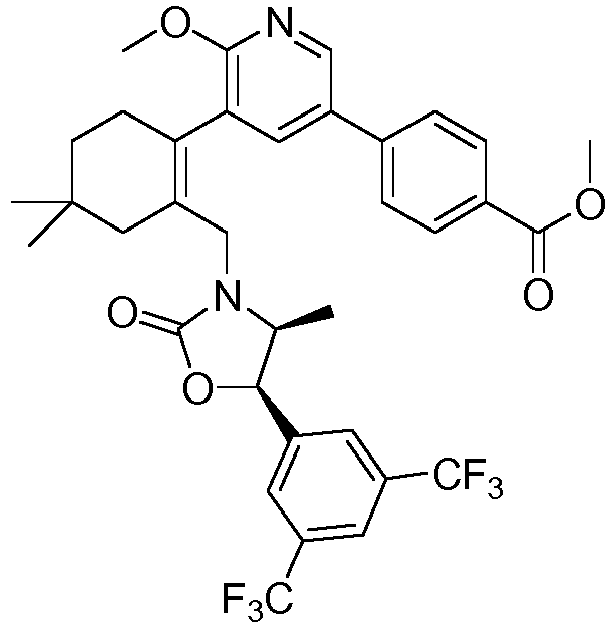
557 
558 
[Table 2] Compound Structure Compound Structure 559 
560 
561 
564 
565 
567 
[Table 3] Compound Structure Compound Structure 568 
569 
572 
573 
574 
575 
[Table 4] Compound Structure Compound Structure 577 
578 
579 
580 
581 
582 
[Table 5] Compound Structure Compound Structure 583 
584 
585 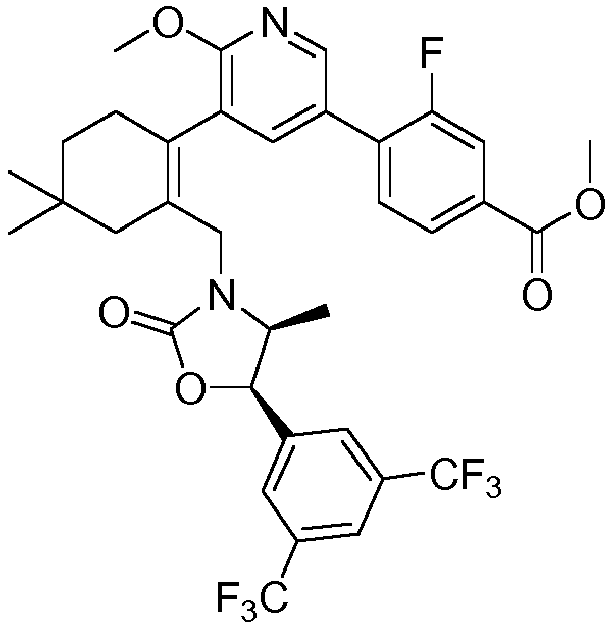
586 
587 
588 
[Table 6] Compound Structure Compound Structure 590 
591 
592 
593 
594 
595 
[Table 7] Compound Structure Compound Structure 596 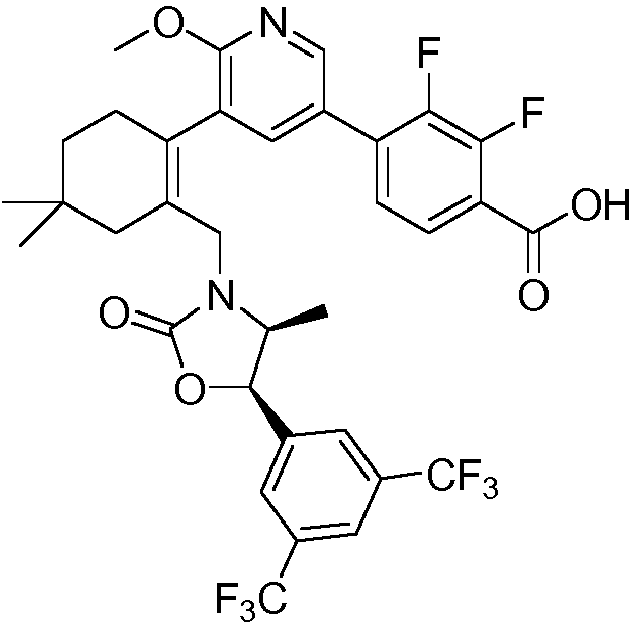
597 
599 
600 
601 
602 
[Table 8] Compound Structure Compound Structure 603 
604 
605 
606 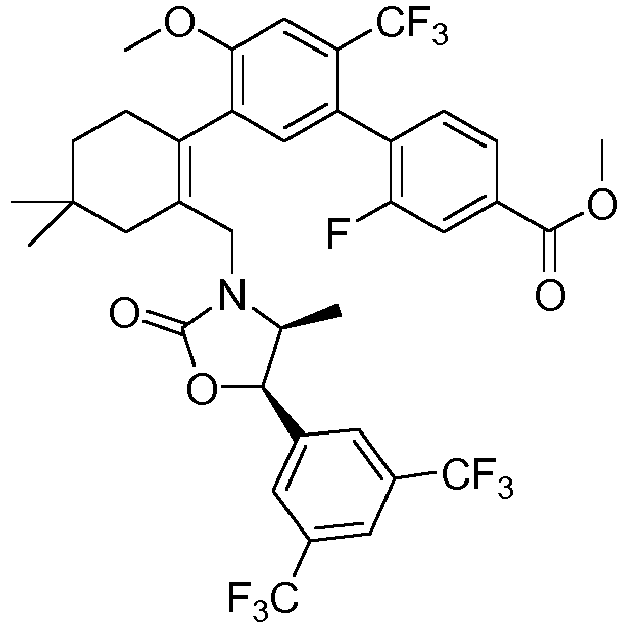
607 
608 
[Table 9] Compound Structure Compound Structure 609 
610 
611 
612 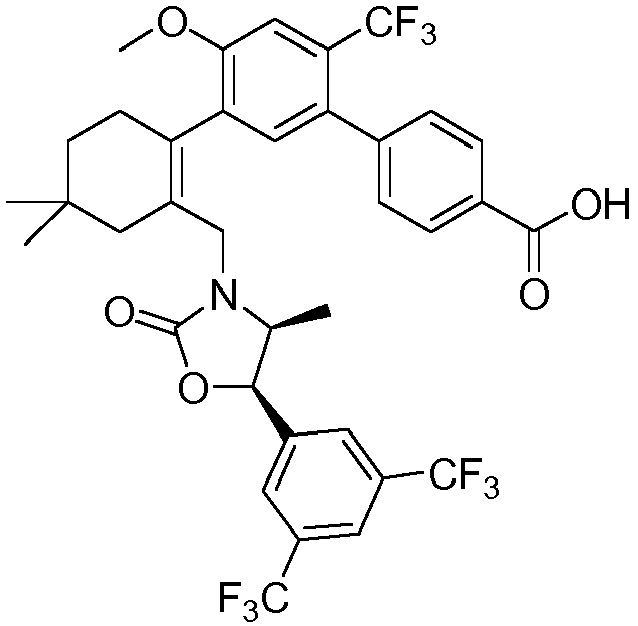
613 
614 
[Table 10] Compound Structure Compound Structure 615 
616 
617 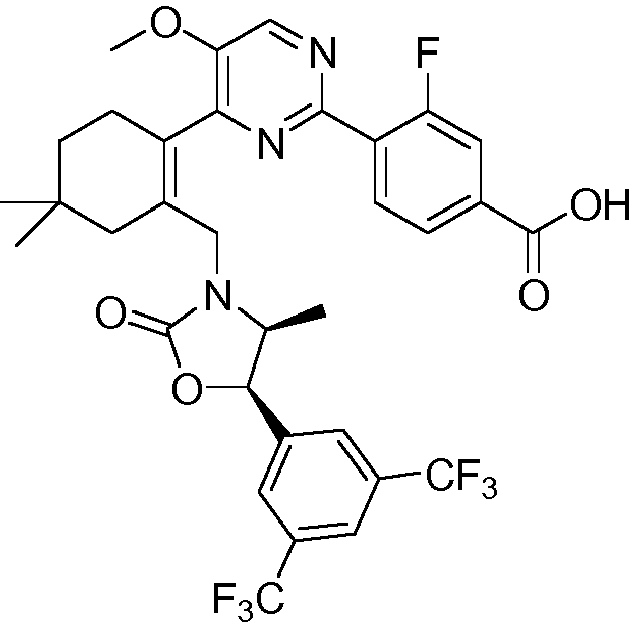
618 
619 
620 
[Table 11] Compound Structure Compound Structure 621 
622 
625 
626 
628 
629 
[Table 12] Compound Structure Compound Structure 630 
631 
632 
633 
636 
637 
[Table 13] Compound Structure Compound Structure 638 
639 
642 
643 
644 
645 
[Table 14] Compound Structure Compound Structure 646 
647 
648 
649 
650 
651 
[Table 15] Compound Structure Compound Structure 652 
653 
654 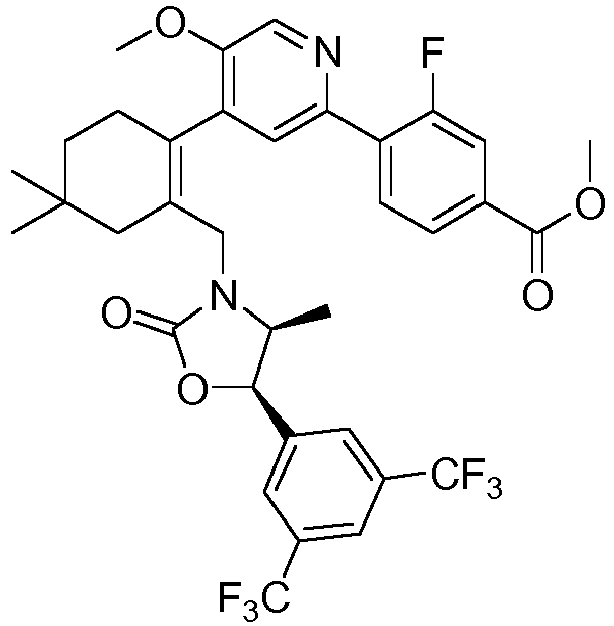
655 
656 
657 
[Table 16] Compound Structure Compound Structure 658 
659 
660 
661 
662 
663 
[Table 17] Compound Structure Compound Structure 664 
665 
666 
667 
668 
670 
[Table 18] Compound Structure Compound Structure 671 
672 
673 
674 
675 
676 
[Table 19] Compound Structure Compound Structure 677 
678 
679 
680 
681 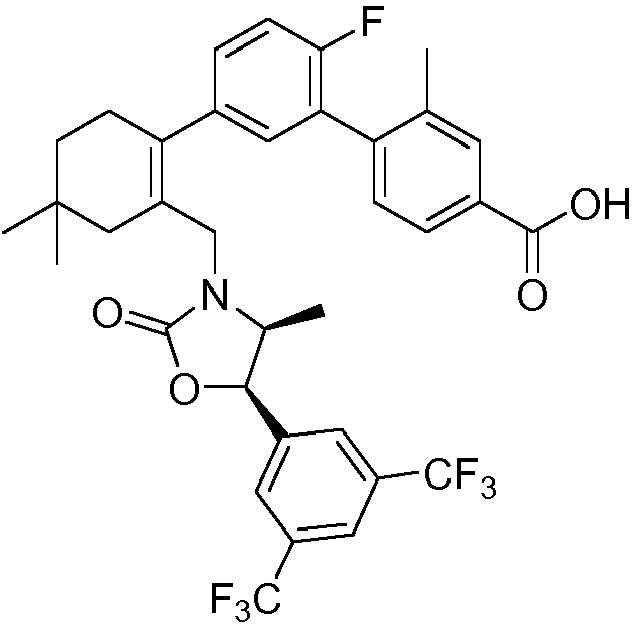
682 
[Table 20] Compound Structure Compound Structure 683 
684 
686 
687 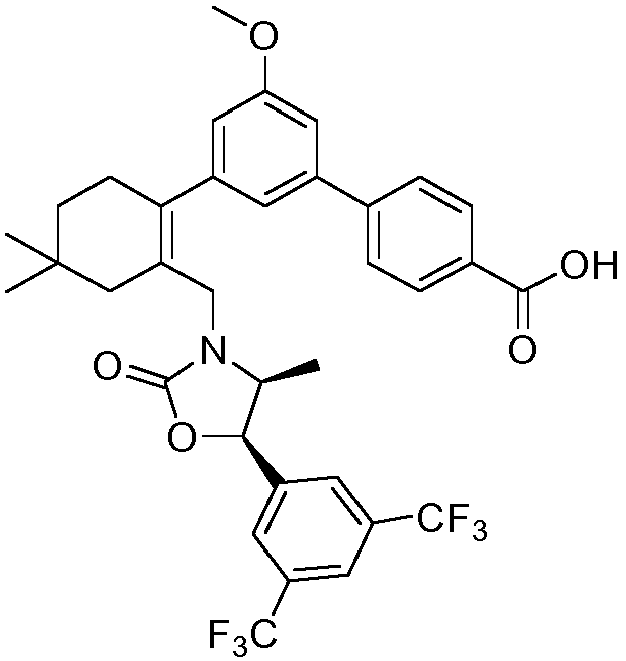
688 
689 
[Table 21] Compound Structure Compound Structure 690 
691 
692 
693 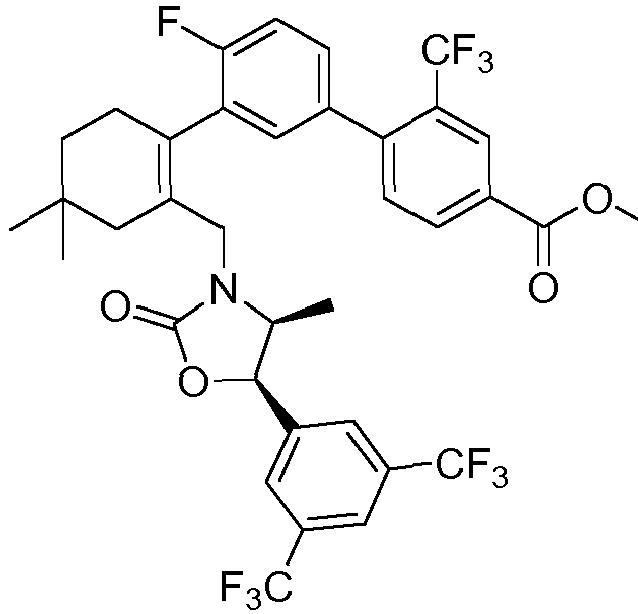
694 
695 
[Table 22] Compound Structure Compound Structure 696 
697 
699 
700 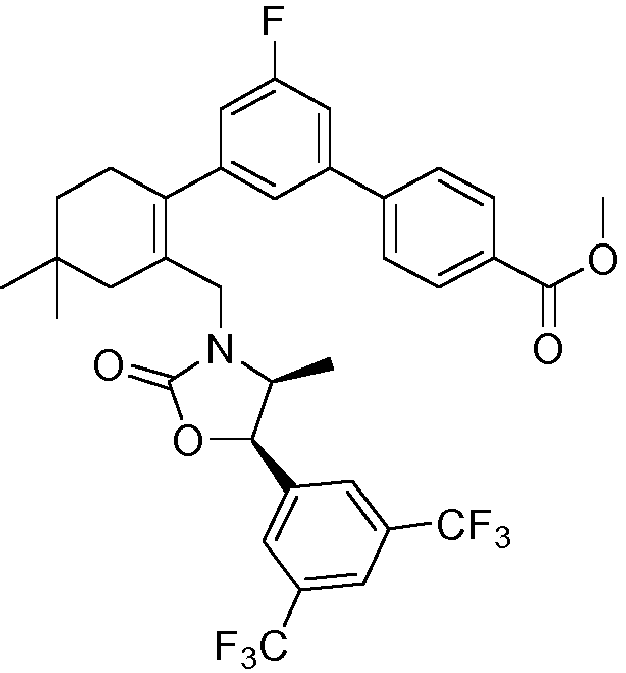
701 
702 
[Table 23] Compound Structure Compound Structure 703 
704 
705 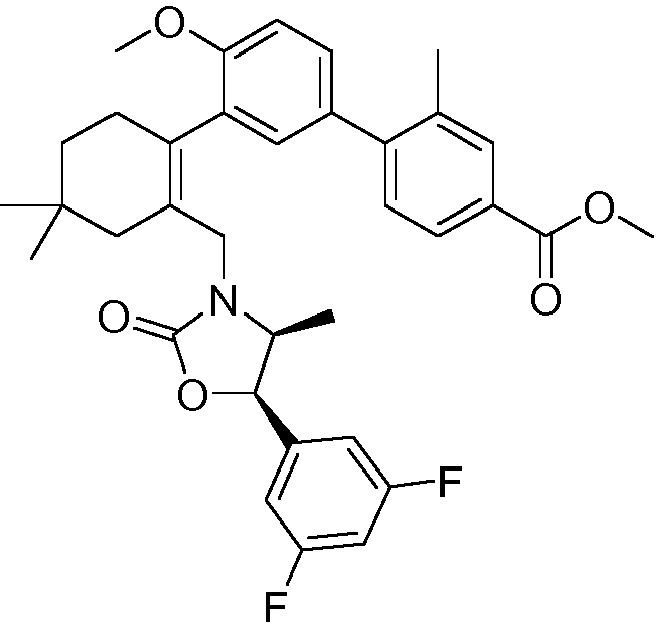
706 
708 
709 
[Table 24] Compound Structure Compound Structure 714 
716 
718 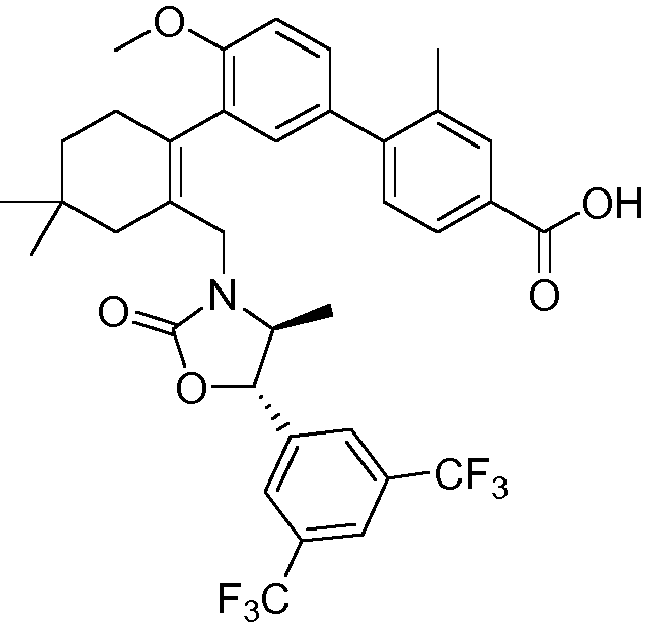
719 
720 
722 
[Table 25] Compound Structure Compound Structure 723 
724 
725 
726 
727 
728 
[Table 26] Compound Structure Compound Structure 729 
738 
739 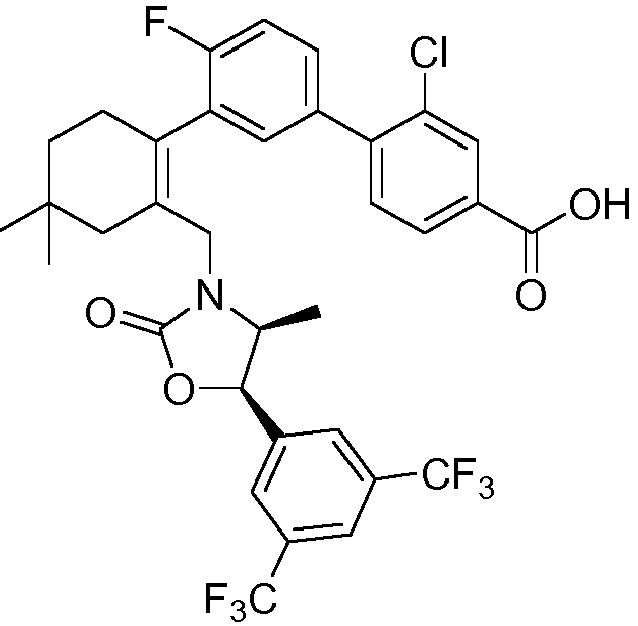
740 
741 
742 
[Table 27] Compound Structure Compound Structure 743 
744 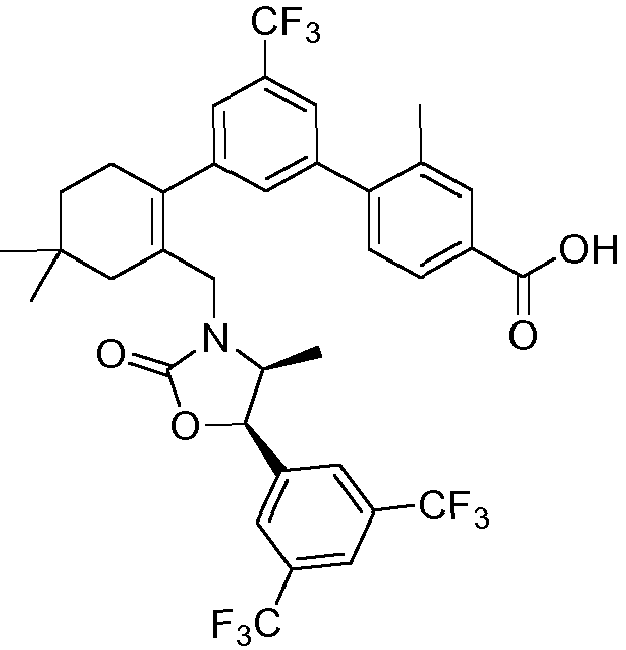
745 
746 
747 
748 
[Table 28] Compound Structure Compound Structure 754 
755 
756 
757 
758 
763 
[Table 29] Compound Structure Compound Structure 764 
- In the present invention, in order to test the preventive or therapeutic effects of the compounds of formula I against arteriosclerosis and hyperlipidemia and the safety of the compounds, comparative tests were performed using previously developed compounds as a control group.
- To construct a cholesteryl ester donor to be used in the test, radiolabeled recombinant HDL containing [3H]-cholesteryl oleate (GE healthcare, TRK886, 3.5 µCi/mg of apoA-1) and apoA-1 was synthesized. Then, rHDL-agarose having the recombinant HDL immobilized thereon by CNBr-activated Sepharose 4B (Amersham Biosciences, Sweden) resin was used in the test.
- As a protein source for cholesteryl ester transfer, plasma from healthy persons was used, and as a cholesteryl ester receptor, LDL from healthy persons was used. Samples were treated with each test compound to final concentrations of 16, 80, 400, 2000 and 10000 nM and analyzed in duplicate. For the cholesteryl ester transfer test, 20 µℓ of plasma, 50 µℓ of LDL (0.25 mg/ml) and 50 µℓ of rHDL-agarose (0.25 mg/ml) were added, and a solution containing a test compound was added, followed by reaction at 37 □.. Then, centrifugation was performed at 4 □ for 3 minutes to stop the reaction, and 150 µℓ of the supernatant was taken and transferred to a 96-well plate for radioactivity measurement, and the radioactivity of the plate was measured with a beta-ray detector.
- The ratio of [3H]-cholesteryl oleate from HDL to LDL was calculated and used as a result value, and from the result value, IC50 value was calculated using GraphPad Prism 5.0.
[Table 30] Cholesteryl ester transfer test Compound IC50 (nM) Compound IC50 (nM) 554 5.8 620 11.6 555 28.4 631 1.9 557 5.4 643 7.3 561 23.2 650 11.9 567 56.6 651 10.7 572 15.0 661 2.5 574 3.9 668 5.0 575 14.6 677 15.9 578 12.6 681 6.6 584 5.3 684 1.9 586 13.0 689 24.3 592 8.4 695 6.4 593 1.5 723 9.6 596 17.9 727 11.4 597 50.2 729 7.5 612 6.9 739 20.3 613 9.1 748 15.9 614 27.0 756 5.9 615 12.3 758 7.1 616 7.6 764 8.9 618 1.6 - As can be seen from the cholesteryl ester transfer test results in Table 30 above, the biaryl- or heterocyclic biaryl-substituted cyclohexene compounds show excellent abilities to inhibit cholesterol transfer.
- In this test, 8-week-old male golden Syrian hamsters were used. The breeding room was maintained at constant temperature and constant humidity and a 12-hr light/12-hr dark cycle. The animals were allowed access to feed and water ad libitum.
- The test animals were acclimated for 1 week before use in the test. The test animals were divided according to body weight into several groups, each consisting of 5-8 animals, and were then administered orally with a dose of 3 mg/kg. A solvent control and a CETP inhibitor were dissolved in imwitor 742 : tween 80 (1:1) and administered orally for 5 days, and at 4 hours after the final administration, blood was collected from the heart. The collected blood was centrifuged at 3000 rpm for 15 minutes, and the separated serum was measured for HDL-Cholesterol (Biosystem) and LDL-Cholesterol (Biosystem) using a biochemical analysis instrument (ILab 300 plus, Instrumentation Laboratory).
- All test results were expressed as Mean±SEM, and to evaluate the effect of each test group, each test group was compared with the control group using one-way ANOVA test (Dunnett's test, p <0.001).
[Table 31] Measurement of increase in HDL-c and decrease in LDL-c in blood of hamsters Compound Increase in HDL-c (%) Decrease in LDL-c (%) 554 72 42 557 77 39 574 41 36 584 46 40 586 37 34 593 61 29 618 65 26 631 56 30 643 68 17 650 50 24 661 53 20 668 44 16 681 25 29 695 71 35 - As can be seen from the measurement of the increase in the HDL-c in the blood of hamsters in Table 31 above, the biaryl- or heterocyclic biaryl-substituted cyclohexene compounds show excellent effects of increasing HDL-c and reducing LDL-c.
- The results of ILLUMINATE regarding the results of phase III clinical trials for the first CETP inhibitor torcetrapib (Pfizer) indicated that morbidity rate and mortality rate in patients administered with a combination of torcetrapib and atorvastatin increase compared to those in patients administered with atorvastatin alone. Indeed, the secretion of hormones from human adrenal cortical tumor cells was evaluated using torcetrapib, and as a result, it was found that torcetrapib increased the secretion of aldosterone and cortisol that are blood pressure-increasing hormones (Endocrinology, 2009, 150(5), 2211-2219). Based on this, the secretion of blood pressure-increasing hormones from human adrenal cortical tumor cells was evaluated. The cell line H295R was purchased from ATCC (CRL-2128) and cultured in DMEM/F-12 medium (1% ITS, 2.5% Nu-serum). The H295R cell line was dispensed into a 24-well plate at a cell density of 1x10⁵/well, and stabilized for 24 hours, after which the cells were starved for 24 hours using serum-free DMEM/F-12. Then, the cells were treated with each of 100 nM of torcetrapib and 1 µM of test compounds 554, 557, 574, 584, 586, 593, 618, 643, 650, 661, 681 and 695. At 24 hours after treatment with the drug or the compound, the supernatant was taken and stored at -20 □. The supernatant stored at -20 □ was thawed, and the amounts of aldosterone and cortisol secreted from the cells were measured using an aldosterone EIA kit (Cayman-10004377) and cortisol EIA kit (Cayman-500360).
- All test results were expressed as Mean±SEM, and to evaluate the effect of each test group, each test group was compared with the control group using one-way ANOVA test (Dunnett's test, p <0.001).
[Table 32] Evaluation of secretion of blood pressure-related hormones (treated with 1 µM of compound) Compound Aldosterone (fold, vs con.) Cortisol (fold, vs con.) 554 0.90 0.93 557 0.96 1.01 574 1.13 1.32 584 0.95 0.92 586 0.99 1.10 593 1.14 0.75 618 0.73 1.09 643 0.72 0.81 650 0.80 0.82 661 0.80 0.68 681 0.83 0.76 695 0.67 0.89 Torcetrapib 1.21∼2.25 2.08∼3.77 - From the test results for the secretion of blood pressure-related hormones aldosterone and cortisol in Table 32 above, it can be seen that the control compound torcetrapib increased the secretion of the two hormones, but the biaryl- or heterocyclic biaryl-substituted cyclohexene compounds of the present invention did not influence the secretion of aldosterone and cortisol, which have a connection with blood pressure-related side effects. Thus, it can be seen that the compounds of the present invention does not cause increased blood pressure and side effects related to increased blood pressure.
Claims (10)
- Biaryl- or heterocyclic biaryl-substituted cyclohexene derivative compounds of the following formula I, stereoisomers thereof, or pharmaceutically acceptable salts thereof:
 R1 is -H or -C1-C3 alkyl;R2 is -H, halogen or -C1-C3 alkyl;R3, R4, R5 and R6 are each independently -H, halogen, -NO2, -C1-C3 alkyl, or -OC1-C3 alkyl;R7 is -H, -(C=O)OR8, or
 R8 is -H or -C1-C3 alkyl;R11 and R12 are each independently -H or -C1-C3 alkyl or may form a 4- to 6-membered non-aromatic ring, wherein the non-aromatic ring may contain 0 to 2 N or O heteroatoms, and one or more -H in the non-aromatic ring may substituted with halogen or - OH;A1, A2 and A3 are each independently N or CR9, wherein if A2 or A3 is N, A1 is CR9;R9 is -H, halogen, -C1-C3 alkyl or -OC1-C3 alkyl;B is N or CR10;R10 is -H, halogen, -C1-C3 alkyl, -OC1-C3 alkyl, -(C=O)OR8, or
 and if R7 is not -H, R10 cannot be -(C=O)OR8 or
- The compounds, stereoisomers thereof or pharmaceutically acceptable salts thereof according to claim 1, wherein
R1 is -H or -CH3;
R2 is -F or -CF3;
R3, R4, R5 and R6 are each independently -H, -F, -Cl, -NO2, -CH3, -CH(CH3)2, -CF3 or -OCH3;
R7 is -H, -(C=O)OR8, or
R11 and R12 are each independently -H, -CH3 or -CH2CH3 or may form 4- to 6-membered non-aromatic ring, wherein the non-aromatic ring may contain 0 to 2 N or O heteroatoms, and one or more -H atoms in the non-aromatic ring may be substituted with -F or -OH;
A1, A2 and A3 are each independently N or CR9, wherein if A2 or A3 is N, A1 is CR9;
R9 is -H, -F, -Cl, -CH3, -CF3 or -OCH3;
B is Nor CR10;
R10 is -H, -F, -Cl, -CH3, -OCH3, -CO2H, -CO2CH3, -CO2CH2CH3, or


- The compounds, stereoisomers thereof or pharmaceutically acceptable salts thereof according to claim 2, wherein
R1 is -CH3;
R2 is -CF3;
R3 is -H, -F, -Cl or -OCH3;
R4 is -H, -F, -Cl, -CH3, -CH(CH3)2, -CF3 or -OCH3; R5 is -H, -F or -Cl;
R6 is -H;
R7 is -H, -(C=O)OH,
R9 is -H, -F, -CH3, -CF3 or -OCH3;
B is CR10;
R10 is -H, -F or -CO2CH3;
provided that if R7 is -H, B is CR10, and R10 is -CO2CH3, and R7 is not -H, R10 is not - CO2CH3. - The compounds, stereoisomers thereof or pharmaceutically acceptable salts thereof according to claim 3, wherein
R3 is -H, -F or -OCH3;
R4 is -H, -F, -Cl, -CH3 or -CF3;
R5 is -H or -F;
R7 is -(C=O)OH;
A1 is N or CR9;
A2 and A3 are each independently CR9;
R9 is -H or -F; and
B is CH. - The compounds, stereoisomers thereof or pharmaceutically acceptable salts thereof according to claim 1, wherein the compounds are selected from the group consisting of the following compounds:
No. Name of compound 553 methyl 3'-(2-(((4S,5R)-5-(3,5-bis(trifluoromethyl)phenyl)-4-methyl-2-oxooxazolidin-3-yl)methyl)-4,4-dimethylcyclohex-1-enyl)-4'-methoxy-2-methylbiphenyl-4-carboxylate 554 3'-(2-(((4S,5R)-5-(3,5-bis(trifluoromethyl)phenyl)-4-methyl-2-oxooxazolidin-3-yl)methyl)-4,4-dimethylcyclohex-1-enyl)-4'-methoxy-2-methylbiphenyl-4-carboxylic acid 555 methyl 4-(3-(2-(((4S,5R)-5-(3,5-bis(trifluoromethyl)phenyl)-4-methyl-2-oxooxazolidin-3-yl)methyl)-4,4-dimethylcyclohex-1-enyl)-2-methoxypyridin-5-yl)-3-methylbenzoate 556 methyl 4-(3-(2-(((4S,5R)-5-(3,5-bis(trifluoromethyl)phenyl)-4-methyl-2-oxooxazolidin-3-yl)methyl)-4,4-dimethylcyclohex-1-enyl)-2-methoxypyridin-5-yl)benzoate 557 4-(3-(2-(((4S,5R)-5-(3,5-bis(trifluoromethyl)phenyl)-4-methyl-2-oxooxazolidin-3-yl)methyl)-4,4-dimethylcyclohex-1-enyl)-2-methoxypyridin-5-yl)-3-methylbenzoic acid 558 4-(3-(2-(((4S,5R)-5-(3,5-bis(trifluoromethyl)phenyl)-4-methyl-2-oxooxazolidin-3-yl)methyl)-4,4-dimethylcyclohex-1-enyl)-2-methoxypyridin-5-yl)benzoic acid 559 methyl 3'-(2-(((4S,5R)-5-(3,5-bis(trifluoromethyl)phenyl)-4-methyl-2-oxooxazolidin-3-yl)methyl)-4,4-dimethylcyclohex-1-enyl)-4'-methoxybiphenyl-4-carboxylate 560 methyl 3'-(2-(((4S,5R)-5-(3,5-bis(trifluoromethyl)phenyl)-4-methyl-2-oxooxazolidin-3-yl)methyl)-4,4-dimethylcyclohex-1-enyl)-2-fluoro-4'-methoxybiphenyl-4-carboxylate 561 3'-(2-(((4S,5R)-5-(3,5-bis(trifluoromethyl)phenyl)-4-methyl-2-oxooxazolidin-3-yl)methyl)-4,4-dimethylcyclohex-1-enyl)-2-fluoro-4'-methoxybiphenyl-4-carboxylic acid 564 methyl 5-(3-(2-(((4S,5R)-5-(3,5-bis(trifluoromethyl)phenyl)-4-methyl-2-oxooxazolidin-3-yl)methyl)-4,4-dimethylcyclohex-1-enyl)-4-methoxyphenyl)picolinate 565 3'-(2-(((4S,5R)-5-(3,5-bis(trifluoromethyl)phenyl)-4-methyl-2-oxooxazolidin-3-yl)methyl)-4,4-dimethylcyclohex-1-enyl)-4'-methoxybiphenyl-4-carboxylic acid 567 methyl 3'-(2-(((4S,5R)-5-(3,5-bis(trifluoromethyl)phenyl)-4-methyl-2-oxooxazolidin-3-yl)methyl)-4,4-dimethylcyclohex-1-enyl)-4'-methoxybiphenyl-3-carboxylate 568 3'-(2-(((4S,5R)-5-(3,5-bis(trifluoromethyl)phenyl)-4-methyl-2-oxooxazolidin-3-yl)methyl)-4,4-dimethylcyclohex-1-enyl)-4'-methoxybiphenyl-3-carboxylic acid 569 methyl 3'-(2-(((4S,5R)-5-(3,5-bis(trifluoromethyl)phenyl)-4-methyl-2-oxooxazolidin-3-yl)methyl)-4,4-dimethylcyclohex-1-enyl)-4'-methoxy-2-nitrobiphenyl-4-carboxylate 572 methyl 5'-(2-(((4S,5R)-5-(3,5-bis(trifluoromethyl)phenyl)-4-methyl-2-oxooxazolidin-3-yl)methyl)-4,4-dimethylcyclohex-1-enyl)-2'-fluoro-4'-methoxy-2-methylbiphenyl-4-carboxylate 573 methyl 5'-(2-(((4S,5R)-5-(3,5-bis(trifluoromethyl)phenyl)-4-methyl-2-oxooxazolidin-3-yl)methyl)-4,4-dimethylcyclohex-1-enyl)-2'-fluoro-4'-methoxybiphenyl-4-carboxylate 574 5'-(2-(((4S,5R)-5-(3,5-bis(trifluoromethyl)phenyl)-4-methyl-2-oxooxazolidin-3-yl)methyl)-4,4-dimethylcyclohex-1-enyl)-2'-fluoro-4'-methoxy-2-methylbiphenyl-4-carboxylic acid 575 5'-(2-(((4S,5R)-5-(3,5-bis(trifluoromethyl)phenyl)-4-methyl-2-oxooxazolidin-3-yl)methyl)-4,4-dimethylcyclohex-1-enyl)-2'-fluoro-4'-methoxybiphenyl-4-carboxylic acid 577 methyl 4-(3-(2-(((4S,5R)-5-(3,5-bis(trifluoromethyl)phenyl)-4-methyl-2-oxooxazolidin-3-yl)methyl)-4,4-dimethylcyclohex-1-enyl)-2-methoxypyridin-5-yl)-3-isopropylbenzoate 578 4-(3-(2-(((4S,5R)-5-(3,5-bis(trifluoromethyl)phenyl)-4-methyl-2-oxooxazolidin-3-yl)methyl)-4,4-dimethylcyclohex-1-enyl)-2-methoxypyridin-5-yl)-3-isopropylbenzoic acid 579 methyl 3'-(2-(((4S,5R)-5-(3,5-bis(trifluoromethyl)phenyl)-4-methyl-2-oxooxazolidin-3-yl)methyl)cyclohex-1-enyl)-4'-methoxy-2-methylbiphenyl-4-carboxylate 580 methyl 3'-(2-(((4S,5R)-5-(3,5-bis(trifluoromethyl)phenyl)-4-methyl-2-oxooxazolidin-3-yl)methyl)cyclohex-1-enyl)-2-fluoro-4'-methoxybiphenyl-4-carboxylate 581 3'-(2-(((4S,5R)-5-(3,5-bis(trifluoromethyl)phenyl)-4-methyl-2-oxooxazolidin-3-yl)methyl)cyclohex-1-enyl)-4'-methoxy-2-methylbiphenyl-4-carboxylic acid 582 3'-(2-(((4S,5R)-5-(3,5-bis(trifluoromethyl)phenyl)-4-methyl-2-oxooxazolidin-3-yl)methyl)cyclohcx-1-enyl)-2-fluoro-4'-methoxybiphenyl-4-carboxylic acid 583 methyl 4-(3-(2-(((4S,5R)-5-(3,5-bis(trifluoromethyl)phenyl)-4-methyl-2-oxooxazolidin-3-yl)methyl)-4,4-dimethylcyclohex-1-enyl)-2-methoxypyridin-5-yl)-3-chlorobenzoate 584 4-(3-(2-(((4S,5R)-5-(3,5-bis(trifluoromethyl)phenyl)-4-methyl-2-oxooxazolidin-3-yl)methyl)-4,4-dimethylcyclohex-1-enyl)-2-methoxypyridin-5-yl)-3-chlorobenzoic acid 585 methyl 4-(3-(2-(((4S,5R)-5-(3,5-bis(trifluoromethyl)phenyl)-4-methyl-2-oxooxazolidin-3-yl)methyl)-4,4-dimethylcyclohex-1-enyl)-2-methoxypyridin-5-yl)-3-fluorobenzoate 586 4-(3-(2-(((4S,5R)-5-(3,5-bis(trifluoromethyl)phenyl)-4-methyl-2-oxooxazolidin-3-yl)methyl)-4,4-dimethylcyclohex-1-enyl)-2-methoxypyridin-5-yl)-3-fluorobenzoic acid 587 methyl 3-(3-(2-(((4S,5R)-5-(3,5-bis(trifluoromethyl)phenyl)-4-methyl-2-oxooxazolidin-3-yl)methyl)-4,4-dimethylcyclohex-1-enyl)-2-methoxypyridin-5-yl)benzoate 588 3-(3-(2-(((4S,5R)-5-(3,5-bis(trifluoromethyl)phenyl)-4-methyl-2-oxooxazolidin-3-yl)methyl)-4,4-dimethylcyclohex-1-enyl)-2-methoxypyridin-5-yl)benzoic acid 590 methyl 3'-(2-(((4S,5R)-5-(3,5-bis(trifluoromethyl)phenyl)-4-methyl-2-oxooxazolidin-3-yl)methyl)-4,4-dimethylcyclohex-1-enyl)-2,3-difluoro-4'-methoxybiphenyl-4-carboxylate 591 methyl 3'-(2-(((4S,5R)-5-(3,5-bis(trifluoromethyl)phenyl)-4-methyl-2-oxooxazolidin-3-yl)methyl)-4,4-dimethylcyclohex-1-enyl)-2,6-difluoro-4'-methoxybiphenyl-4-carboxylate 592 3'-(2-(((4S,5R)-5-(3,5-bis(trifluoromethyl)phenyl)-4-methyl-2-oxooxazolidin-3-yl)methyl)-4,4-dimethylcyclohex-1-enyl)-2,3-difluoro-4'-methoxybiphenyl-4-carboxylic acid 593 3'-(2-(((4S,5R)-5-(3,5-bis(trifluoromethyl)phenyl)-4-methyl-2-oxooxazolidin-3-yl)methyl)-4,4-dimethylcyclohex-1-enyl)-2,6-difluoro-4'-methoxybiphenyl-4-carboxylic acid 594 methyl 3'-(2-(((4S,5R)-5-(3,5-bis(trifluoromethyl)phenyl)-4-methyl-2-oxooxazolidin-3-yl)methyl)-4,4-dimethylcyclohex-1-enyl)-2,4'-dimethoxybiphenyl-4-carboxylate 595 methyl 4-(3-(2-(((4S,5R)-5-(3,5-bis(trifluoromethyl)phenyl)-4-methyl-2-oxooxazolidin-3-yl)methyl)-4,4-dimethylcyclohex-1-enyl)-2-methoxypyridin-5-yl)-2,3-difluorobenzoate 596 4-(3-(2-(((4S,5R)-5-(3,5-bis(trifluoromethyl)phenyl)-4-methyl-2-oxooxazolidin-3-yl)methyl)-4,4-dimethylcyclohex-1-enyl)-2-methoxypyridin-5-yl)-2,3-difluorobenzoic acid 597 3'-(2-(((4S,5R)-5-(3,5-bis(trifluoromethyl)phenyl)-4-methyl-2-oxooxazolidin-3-yl)methyl)-4,4-dimethylcyclohex-1-enyl)-2,4'-dimethoxybiphenyl-4-carboxylic acid 599 methyl 3'-(2-(((4S,5R)-5-(3,5-bis(trifluoromethyl)phenyl)-4-methyl-2-oxooxazolidin-3-yl)methyl)-4,4-dimethylcyclohex-1-enyl)-3,4'-dimethoxybiphenyl-4-carboxylate 600 methyl 5-(3-(2-(((4S,5R)-5-(3,5-bis(trifluoromethyl)phenyl)-4-methyl-2-oxooxazolidin-3-yl)methyl)-4,4-dimethylcyclohex-1-enyl)-4-methoxyphenyl)-3-methylpicolinate 601 3'-(2-(((4S,5R)-5-(3,5-bis(trifluoromethyl)phenyl)-4-methyl-2-oxooxazolidin-3-yl)methyl)-4,4-dimethylcyclohex-1-enyl)-3,4'-dimethoxybiphenyl-4-carboxylic acid 602 5-(3-(2-(((4S,5R)-5-(3,5-bis(trifluoromethyl)phenyl)-4-methyl-2-oxooxazolidin-3-yl)methyl)-4,4-dimethylcyclohex-1-enyl)-4-methoxyphenyl)-3-methylpicolinic acid 603 methyl 4-(4-(2-(((4S,5R)-5-(3,5-bis(trifluoromethyl)phenyl)-4-methyl-2-oxooxazolidin-3-yl)methyl)-4,4-dimethylcyclohex-1-enyl)-5-methoxypyrimidin-2-yl)-3-methylbenzoate 604 4-(4-(2-(((4S,5R)-5-(3,5-bis(trifluoromethyl)phenyl)-4-methyl-2-oxooxazolidin-3-yl)methyl)-4,4-dimethylcyclohex-1-enyl)-5-methoxypyrimidin-2-yl)-3-methylbenzoic acid 605 methyl 5'-(2-(((4S,5R)-5-(3,5-bis(trifluoromethyl)phenyl)-4-methyl-2-oxooxazolidin-3-yl)methyl)-4,4-dimethylcyclohex-1-enyl)-4'-methoxy-2'-(trifluoromethyl)biphenyl-4-carboxylate 606 methyl 5'-(2-(((4S,5R)-5-(3,5-bis(trifluoromethyl)phenyl)-4-methyl-2-oxooxazolidin-3-yl)methyl)-4,4-dimethylcyclohex-1-enyl)-2-fluoro-4'-methoxy-2'-(trifluoromethyl)biphenyl-4-carboxylate 607 ethyl 5'-(2-(((4S,5R)-5-(3,5-bis(trifluoromethyl)phenyl)-4-methyl-2-oxooxazolidin-3-yl)methyl)-4,4-dimethylcyclohex-1-enyl)-3-fluoro-4'-methoxy-2'-(trifluoromethyl)biphenyl-4-carboxylate 608 methyl 5'-(2-(((4S,5R)-5-(3,5-bis(trifluoromethyl)phenyl)-4-methyl-2-oxooxazolidin-3-yl)methyl)-4,4-dimethylcyclohex-1-enyl)-2-chloro-4'-methoxy-2'-(trifluoromethyl)biphenyl-4-carboxylate 609 methyl 5'-(2-(((4S,5R)-5-(3,5-bis(trifluoromethyl)phenyl)-4-methyl-2-oxooxazolidin-3-yl)methyl)-4,4-dimethylcyclohex-1-enyl)-4'-methoxy-2-methyl-2'-(trifluoromethyl)biphenyl-4-carboxylate 610 methyl 4-(4-(2-(((4S,5R)-5-(3,5-bis(trifluoromethyl)phenyl)-4-methyl-2-oxooxazolidin-3-yl)methyl)-4,4-dimethylcyclohex-1-enyl)-5-methoxypyrimidin-2-yl)-3-fluorobenzoate 611 5-(5-(2-(((4S,5R)-5-(3,5-bis(trifluoromethyl)phenyl)-4-methyl-2-oxooxazolidin-3-yl)methyl)-4,4-dimethylcyclohex-1-enyl)-4-methoxy-2-(trifluoromethyl)phenyl)-3-fluoropicolinic acid 612 5'-(2-(((4S,5R)-5-(3,5-bis(trifluoromethyl)phenyl)-4-methyl-2-oxooxazolidin-3-yl)methyl)-4,4-dimethylcyclohex-1-enyl)-4'-methoxy-2'-(trifluoromethyl)biphenyl-4-carboxylic acid 613 5'-(2-(((4S,5R)-5-(3,5-bis(trifluoromethyl)phenyl)-4-methyl-2-oxooxazolidin-3-yl)methyl)-4,4-dimethylcyclohex-1-enyl)-2-fluoro-4'-methoxy-2'-(trifluoromethyl)biphenyl-4-carboxylic acid 614 5'-(2-(((4S,5R)-5-(3,5-bis(trifluoromethyl)phenyl)-4-methyl-2-oxooxazolidin-3-yl)methyl)-4,4-dimethylcyclohex-1-enyl)-3-fluoro-4'-methoxy-2'-(trifluoromethyl)biphenyl-4-carboxylic acid 615 5'-(2-(((4S,5R)-5-(3,5-bis(trifluoromethyl)phenyl)-4-methyl-2-oxooxazolidin-3-yl)methyl)-4,4-dimethylcyclohex-1-enyl)-2-chloro-4'-methoxy-2'-(trifluoromethyl)biphenyl-4-carboxylic acid 616 5'-(2-(((4S,5R)-5-(3,5-bis(trifluoromethyl)phenyl)-4-methyl-2-oxooxazolidin-3-yl)methyl)-4,4-dimethylcyclohex-1-enyl)-4'-methoxy-2-methyl-2'-(trifluoromethyl)biphenyl-4-carboxylic acid 617 4-(4-(2-(((4S,5R)-5-(3,5-bis(trifluoromethyl)phenyl)-4-methyl-2-oxooxazolidin-3-yl)methyl)-4,4-dimethylcyclohex-1-enyl)-5-methoxypyrimidin-2-yl)-3-fluorobenzoic acid 618 3'-(2-(((4S,5R)-5-(3,5-bis(trifluoromethyl)phenyl)-4-methyl-2-oxooxazolidin-3-yl)methyl)-4,4-dimethylcyclohex-1-enyl)-4'-methoxy-2-(trifluoromethyl)biphenyl-4-carboxylic acid 619 methyl 5'-(2-(((4S,5R)-5-(3,5-bis(trifluoromethyl)phenyl)-4-methyl-2-oxooxazolidin-3-yl)methyl)-4,4-dimethylcyclohex-1-enyl)-4'-methoxy-2'-methylbiphenyl-4-carboxylate 620 5'-(2-(((4S,5R)-5-(3,5-bis(trifluoromethyl)phenyl)-4-methyl-2-oxooxazolidin-3-yl)methyl)-4,4-dimethylcyclohex-1-enyl)-4'-methoxy-2'-methylbiphenyl-4-carboxylic acid 621 methyl 4-(2-(2-(((4S,5R)-5-(3,5-bis(trifluoromethyl)phenyl)-4-methyl-2-oxooxazolidin-3-yl)methyl)-4,4-dimethylcyclohex-1-enyl)-3-methoxypyridin-6-yl)-3-methylbenzoate 622 4-(2-(2-(((4S,5R)-5-(3,5-bis(trifluoromethyl)phenyl)-4-methyl-2-oxooxazolidin-3-yl)methyl)-4,4-dimethylcyclohex-1-enyl)-3-methoxypyridin-6-yl)-3-methylbenzoic acid 625 methyl 4-(4-(2-(((4S,5R)-5-(3,5-bis(trifluoromethyl)phenyl)-4-methyl-2-oxooxazolidin-3-yl)methyl)-4,4-dimethylcyclohex-1-enyl)-5-methoxypyrimidin-2-yl)benzoate 626 ethyl 4-(4-(2-(((4S,5R)-5-(3,5-bis(trifluoromethyl)phenyl)-4-methyl-2-oxooxazolidin-3-yl)methyl)-4,4-dimethylcyclohex-1-enyl)-5-methoxypyrimidin-2-yl)-2-fluorobenzoate 628 4-(4-(2-(((4S,5R)-5-(3,5-bis(trifluoromethyl)phenyl)-4-methyl-2-oxooxazolidin-3-yl)methyl)-4,4-dimethylcyclohex-1-enyl)-5-methoxypyrimidin-2-yl)benzoic acid 629 4-(4-(2-(((4S,5R)-5-(3,5-bis(trifluoromethyl)phenyl)-4-methyl-2-oxooxazolidin-3-yl)methyl)-4,4-dimethylcyclohex-1-enyl)-5-methoxypyrimidin-2-yl)-2-fluorobenzoic acid 630 methyl 5'-(2-(((4S,5R)-5-(3,5-bis(trifluoromethyl)phenyl)-4-methyl-2-oxooxazolidin-3-yl)methyl)-4,4-dimethylcyclohex-1-enyl)-2-chloro-2'-fluoro-4'-methoxybiphenyl-4-carboxylate 631 5'-(2-(((4S,5R)-5-(3,5-bis(trifluoromethyl)phenyl)-4-methyl-2-oxooxazolidin-3-yl)methyl)-4,4-dimethylcyclohex-1-enyl)-2-chloro-2'-fluoro-4'-methoxybiphenyl-4-carboxylic acid 632 5'-(2-(((4S,5R)-5-(3,5-bis(trifluoromethyl)phenyl)-4-methyl-2-oxooxazolidin-3-yl)methyl)-4,4-dimethylcyclohex-1-enyl)-3-chloro-4'-methoxy-2'-(trifluoromethyl)biphenyl-4-carboxylic acid 633 5'-(2-(((4S,5R)-5-(3,5-bis(trifluoromethyl)phenyl)-4-methyl-2-oxooxazolidin-3-yl)methyl)-4,4-dimethylcyclohex-1-enyl)-3,4'-dimethoxy-2'-(trifluoromethyl)biphenyl-4-carboxylic acid 636 4-(2-(2-(((4S,5R)-5-(3,5-bis(trifluoromethyl)phenyl)-4-methyl-2-oxooxazolidin-3-yl)methyl)-4,4-dimethylcyclohex-1-enyl)-3-methoxypyridin-6-yl)-3-chlorobenzoic acid 637 4-(2-(2-(((4S,5R)-5-(3,5-bis(trifluoromethyl)phenyl)-4-methyl-2-oxooxazolidin-3-yl)methyl)-4,4-dimethylcyclohex-1-enyl)-3-methoxypyridin-6-yl)-3-fluorobenzoic acid 638 methyl 5'-(2-(((4S,5R)-5-(3,5-bis(trifluoromethyl)phenyl)-4-methyl-2-oxooxazolidin-3-yl)methyl)-4,4-dimethylcyclohex-1-enyl)-3-chloro-4'-methoxy-2'-(trifluoromethyl)biphenyl-4-carboxylate 639 methyl 5'-(2-(((4S,5R)-5-(3,5-bis(trifluoromethyl)phenyl)-4-methyl-2-oxooxazolidin-3-yl)methyl)-4,4-dimethylcyclohex-1-enyl)-3,4'-dimethoxy-2'-(trifluoromethyl)biphenyl-4-carboxylate 642 methyl 3'-(2-(((4S,5R)-5-(3,5-bis(trifluoromethyl)phenyl)-4-methyl-2-oxooxazolidin-3-yl)methyl)-4,4-dimethylcyclohex-1-enyl)-2-chloro-4'-methoxybiphenyl-4-carboxylate 643 3'-(2-(((4S,5R)-5-(3,5-bis(trifluoromethyl)phenyl)-4-methyl-2-oxooxazolidin-3-yl)methyl)-4,4-dimethylcyclohex-1-enyl)-2-chloro-4'-methoxybiphenyl-4-carboxylic acid 644 4-(4-(2-(((4S,5R)-5-(3,5-bis(trifluoromethyl)phenyl)-4-methyl-2-oxooxazolidin-3-yl)methyl)-4,4-dimethylcyclohex-1-enyl)-5-methoxypyridin-2-yl)benzoic acid 645 4-(4-(2-(((4S,5R)-5-(3,5-bis(trifluoromethyl)phenyl)-4-methyl-2-oxooxazolidin-3-yl)methyl)-4,4-dimethylcyclohex-1-enyl)-5-methoxypyridin-2-yl)-3-methylbenzoic acid 646 4-(4-(2-(((4S,5R)-5-(3,5-bis(trifluoromethyl)phenyl)-4-methyl-2-oxooxazolidin-3-yl)methyl)-4,4-dimethylcyclohex-1-enyl)-5-methoxypyridin-2-yl)-3-fluorobenzoic acid 647 4-(4-(2-(((4S,5R)-5-(3,5-bis(trifluoromethyl)phenyl)-4-methyl-2-oxooxazolidin-3-yl)methyl)-4,4-dimethylcyclohex-1-enyl)-5-methoxypyridin-2-yl)-3-chlorobenzoic acid 648 methyl 3'-(2-(((4S,5R)-5-(3,5-bis(trifluoromethyl)phenyl)-4-methyl-2-oxooxazolidin-3-yl)methyl)-4,4-dimethylcyclohex-1-enyl)-5'-fluoro-2-methylbiphenyl-4-carboxylate 649 methyl 3'-(2-(((4S,5R)-5-(3,5-bis(trifluoromethyl)phenyl)-4-methyl-2-oxooxazolidin-3-yl)methyl)-4,4-dimethylcyclohex-1-enyl)-2-methylbiphenyl-4-carboxylate 650 3'-(2-(((4S,5R)-5-(3,5-bis(trifluoromethyl)phenyl)-4-methyl-2-oxooxazolidin-3-yl)methyl)-4,4-dimethylcyclohex-1-enyl)-5'-fluoro-2-methylbiphenyl-4-carboxylic acid 651 3'-(2-(((4S,5R)-5-(3,5-bis(trifluoromethyl)phenyl)-4-methyl-2-oxooxazolidin-3-yl)methyl)-4,4-dimethylcyclohex-1-enyl)-2-methylbiphenyl-4-carboxylic acid 652 methyl 4-(4-(2-(((4S,5R)-5-(3,5-bis(trifluoromethyl)phenyl)-4-methyl-2-oxooxazolidin-3-yl)methyl)-4,4-dimethylcyclohex-1-enyl)-5-methoxypyridin-2-yl)benzoate 653 methyl 4-(4-(2-(((4S,5R)-5-(3,5-bis(trifluoromethyl)phenyl)-4-methyl-2-oxooxazolidin-3-yl)methyl)-4,4-dimethylcyclohex-1-enyl)-5-methoxypyridin-2-yl)-3-methylbenzoate 654 methyl 4-(4-(2-(((4S,5R)-5-(3,5-bis(trifluoromethyl)phenyl)-4-methyl-2-oxooxazolidin-3-yl)methyl)-4,4-dimethylcyclohex-1-enyl)-5-methoxypyridin-2-yl)-3-fluorobenzoate 655 methyl 4-(4-(2-(((4S,5R)-5-(3,5-bis(trifluoromethyl)phenyl)-4-methyl-2-oxooxazolidin-3-yl)methyl)-4,4-dimethylcyclohex-1-enyl)-5-methoxypyridin-2-yl)-3-chlorobenzoate 656 methyl 4-(4-(2-(((4S,5R)-5-(3,5-bis(trifluoromethyl)phenyl)-4-methyl-2-oxooxazolidin-3-yl)methyl)-4,4-dimethylcyclohex-1-enyl)-5-methoxypyridin-2-yl)-2,3-difluorobenzoate 657 methyl 5'-(2-(((4S,5R)-5-(3,5-bis(trifluoromethyl)phenyl)-4-methyl-2-oxooxazolidin-3-yl)methyl)-4,4-dimethylcyclohex-1-enyl)-2,2'-difluoro-4'-methoxybiphenyl-4-carboxylate 658 ethyl 5'-(2-(((4S,5R)-5-(3,5-bis(trifluoromethyl)phenyl)-4-methyl-2-oxooxazolidin-3-yl)methyl)-4,4-dimethylcyclohex-1-enyl)-2',3-difluoro-4'-methoxybiphenyl-4-carboxylate 659 methyl 5'-(2-(((4S,5R)-5-(3,5-bis(trifluoromethyl)phenyl)-4-methyl-2-oxooxazolidin-3-yl)methyl)-4,4-dimethylcyclohex-1-enyl)-2'-fluoro-3,4'-dimethoxybiphenyl-4-carboxylate 660 methyl 5'-(2-(((4S,5R)-5-(3,5-bis(trifluoromethyl)phenyl)-4-methyl-2-oxooxazolidin-3-yl)methyl)-4,4-dimethylcyclohex-1-enyl)-2,2',3-trifluoro-4'-methoxybiphenyl-4-carboxylate 661 5'-(2-(((4S,5R)-5-(3,5-bis(trifluoromethyl)phenyl)-4-methyl-2-oxooxazolidin-3-yl)methyl)-4,4-dimethylcyclohex-1-enyl)-2,2'-difluoro-4'-methoxybiphenyl-4-carboxylic acid 662 5'-(2-(((4S,5R)-5-(3,5-bis(trifluoromethyl)phenyl)-4-methyl-2-oxooxazolidin-3-yl)methyl)-4,4-dimethylcyclohex-1-enyl)-2',3-difluoro-4'-methoxybiphenyl-4-carboxylic acid 663 5'-(2-(((4S,5R)-5-(3,5-bis(trifluoromethyl)phenyl)-4-methyl-2-oxooxazolidin-3-yl)methyl)-4,4-dimethylcyclohex-1-enyl)-2'-fluoro-3,4'-dimethoxybiphenyl-4-carboxylic acid 664 5'-(2-(((4S,5R)-5-(3,5-bis(trifluoromethyl)phenyl)-4-methyl-2-oxooxazolidin-3-yl)methyl)-4,4-dimethylcyclohex-1-enyl)-2,2',3-trifluoro-4'-methoxybiphenyl-4-carboxylic acid 665 methyl 5-(3-(2-(((4S,5R)-5-(3,5-bis(trifluoromethyl)phenyl)-4-methyl-2-oxooxazolidin-3-yl)methyl)-4,4-dimethylcyclohex-1-enyl)-4-methoxyphenyl)-6-methylpicolinate 666 5-(3-(2-(((4S,5R)-5-(3,5-bis(trifluoromethyl)phenyl)-4-methyl-2-oxooxazolidin-3-yl)methyl)-4,4-dimethylcyclohex-1-enyl)-4-methoxyphenyl)-6-methylpicolinic acid 667 methyl 3'-(2-(((4S,5R)-5-(3,5-bis(trifluoromethyl)phenyl)-4-methyl-2-oxooxazolidin-3-yl)methyl)-4,4-dimethylcyclohex-1-enyl)-5'-fluoro-2-(trifluoromethyl)biphenyl-4-carboxylate 668 3'-(2-(((4S,5R)-5-(3,5-bis(trifluoromethyl)phenyl)-4-methyl-2-oxooxazolidin-3-yl)methyl)-4,4-dimethylcyclohex-1-enyl)-5'-fluoro-2-(trifluoromethyl)biphenyl-4-carboxylic acid 670 methyl 5'-(2-(((4S,5R)-5-(3,5-bis(trifluoromethyl)phenyl)-4-methyl-2-oxooxazolidin-3-yl)methyl)-4,4-dimethylcyclohex-1-enyl)-2'-fluorobiphenyl-4-carboxylate 671 methyl 5'-(2-(((4S,5R)-5-(3,5-bis(trifluoromethyl)phenyl)-4-methyl-2-oxooxazolidin-3-yl)methyl)-4,4-dimethylcyclohex-1-enyl)-2,2'-difluorobiphenyl-4-carboxylate 672 methyl 5'-(2-(((4S,5R)-5-(3,5-bis(trifluoromethyl)phenyl)-4-methyl-2-oxooxazolidin-3-yl)methyl)-4,4-dimethylcyclohex-1-enyl)-2'-fluoro-2-methylbiphenyl-4-carboxylate 673 methyl 5'-(2-(((4S,5R)-5-(3,5-bis(trifluoromethyl)phenyl)-4-methyl-2-oxooxazolidin-3-yl)methyl)-4,4-dimethylcyclohex-1-enyl)-2'-methylbiphenyl-4-carboxylate 674 methyl 5'-(2-(((4S,5R)-5-(3,5-bis(trifluoromethyl)phenyl)-4-methyl-2-oxooxazolidin-3-yl)methyl)-4,4-dimethylcyclohex-1-enyl)-2,2'-dimethylbiphenyl-4-carboxylate 675 methyl 5'-(2-(((4S,5R)-5-(3,5-bis(trifluoromethyl)phenyl)-4-methyl-2-oxooxazolidin-3-yl)methyl)-4,4-dimethylcyclohex-1-enyl)-2-fluoro-2'-methylbiphenyl-4-carboxylate 676 5'-(2-(((4S,5R)-5-(3,5-bis(trifluoromethyl)phenyl)-4-methyl-2-oxooxazolidin-3-yl)methyl)-4,4-dimethylcyclohex-1-enyl)-2'-methylbiphenyl-4-carboxylic acid 677 5'-(2-(((4S,5R)-5-(3,5-bis(trifluoromethyl)phenyl)-4-methyl-2-oxooxazolidin-3-yl)methyl)-4,4-dimethylcyclohex-1-enyl)-2,2'-dimethylbiphenyl-4-carboxylic acid 678 5'-(2-(((4S,5R)-5-(3,5-bis(trifluoromethyl)phenyl)-4-methyl-2-oxooxazolidin-3-yl)methyl)-4,4-dimethylcyclohex-1-enyl)-2-fluoro-2'-methylbiphenyl-4-carboxylic acid 679 5'-(2-(((4S,5R)-5-(3,5-bis(trifluoromethyl)phenyl)-4-methyl-2-oxooxazolidin-3-yl)methyl)-4,4-dimethylcyclohex-1-enyl)-2'-fluorobiphenyl-4-carboxylic acid 680 5'-(2-(((4S,5R)-5-(3,5-bis(trifluoromethyl)phenyl)-4-methyl-2-oxooxazolidin-3-yl)methyl)-4,4-dimethylcyclohex-1-enyl)-2,2'-difluorobiphenyl-4-carboxylic acid 681 5'-(2-(((4S,5R)-5-(3,5-bis(trifluoromethyl)phenyl)-4-methyl-2-oxooxazolidin-3-yl)methyl)-4,4-dimethylcyclohex-1-enyl)-2'-fluoro-2-methylbiphenyl-4-carboxylic acid 682 3'-(2-(((4S,5R)-5-(3,5-bis(trifluoromethyl)phenyl)-4-methyl-2-oxooxazolidin-3-yl)methyl)-4,4-dimethylcyclohex-1-enyl)-4'-methoxy-2-methylbiphenyl-4-carboxamide 683 methyl 5'-(2-(((4S,5R)-5-(3,5-bis(trifluoromethyl)phenyl)-4-methyl-2-oxooxazolidin-3-yl)methyl)-4,4-dimethylcyclohex-1-enyl)-4'-methoxy-2,2'-dimethylbiphenyl-4-carboxylate 684 5'-(2-(((4S,5R)-5-(3,5-bis(trifluoromethyl)phenyl)-4-methyl-2-oxooxazolidin-3-yl)methyl)-4,4-dimethylcyclohex-1-enyl)-4'-methoxy-2,2'-dimethylbiphenyl-4-carboxylic acid 686 methyl 3'-(2-(((4S,5R)-5-(3,5-bis(trifluoromethyl)phenyl)-4-methyl-2-oxooxazolidin-3-yl)methyl)-4,4-dimethylcyclohex-1-enyl)-5'-methoxybiphenyl-4-carboxylate 687 3'-(2-(((4S,5R)-5-(3,5-bis(trifluoromethyl)phenyl)-4-methyl-2-oxooxazolidin-3-yl)methyl)-4,4-dimethylcyclohex-1-enyl)-5'-methoxybiphenyl-4-carboxylic acid 688 methyl 3'-(2-(((4S,5R)-5-(3,5-bis(trifluoromethyl)phenyl)-4-methyl-2-oxooxazolidin-3-yl)methyl)-4,4-dimethylcyclohex-1-enyl)-5'-methoxy-2-methylbiphenyl-4-carboxylate 689 3'-(2-(((4S,5R)-5-(3,5-bis(trifluoromethyl)phenyl)-4-methyl-2-oxooxazolidin-3-yl)methyl)-4,4-dimethylcyclohex-1-enyl)-5'-methoxy-2-methylbiphenyl-4-carboxylic acid 690 methyl 3'-(2-(((4S,5R)-5-(3,5-bis(trifluoromethyl)phenyl)-4-methyl-2-oxooxazolidin-3-yl)methyl)-4,4-dimethylcyclohex-1-enyl)-2-fluoro-5'-methoxybiphenyl-4-carboxylate 691 3'-(2-(((4S,5R)-5-(3,5-bis(trifluoromethyl)phenyl)-4-methyl-2-oxooxazolidin-3-yl)methyl)-4,4-dimethylcyclohex-1-enyl)-2-fluoro-5'-methoxybiphenyl-4-carboxylic acid 692 methyl 3'-(2-(((4S,5R)-5-(3,5-bis(trifluoromethyl)phenyl)-4-methyl-2-oxooxazolidin-3-yl)methyl)-4,4-dimethylcyclohex-1-enyl)-4'-fluoro-2-methylbiphenyl-4-carboxylate 693 methyl 3'-(2-(((4S,5R)-5-(3,5-bis(trifluoromethyl)phenyl)-4-methyl-2-oxooxazolidin-3-yl)methyl)-4,4-dimethylcyclohex-1-enyl)-4'-fluoro-2-(trifluoromethyl)biphenyl-4-carboxylate 694 3'-(2-(((4S,5R)-5-(3,5-bis(trifluoromethyl)phenyl)-4-methyl-2-oxooxazolidin-3-yl)methyl)-4,4-dimethylcyclohex-1-enyl)-4'-fluoro-2-methylbiphenyl-4-carboxylic acid 695 3'-(2-(((4S,5R)-5-(3,5-bis(trifluoromethyl)phenyl)-4-methyl-2-oxooxazolidin-3-yl)methyl)-4,4-dimethylcyclohex-1-enyl)-4'-fluoro-2-(trifluoromethyl)biphenyl-4-carboxylic acid 696 methyl 4-(2-(2-(((4S,5R)-5-(3,5-bis(trifluoromethyl)phenyl)-4-methyl-2-oxooxazolidin-3-yl)methyl)-4,4-dimethylcyclohex-1-enyl)-3-methoxypyridin-6-yl)-3-fluorobenzoate 697 methyl 4-(2-(2-(((4S,5R)-5-(3,5-bis(trifluoromethyl)phenyl)-4-methyl-2-oxooxazolidin-3-yl)methyl)-4,4-dimethylcyclohex-1-enyl)-3-methoxypyridin-6-yl)-3-chlorobenzoate 699 methyl 3'-(2-(((4S,5R)-5-(3,5-bis(trifluoromethyl)phenyl)-4-methyl-2-oxooxazolidin-3-yl)methyl)-4,4-dimethylcyclohex-1-enyl)-2,5'-difluorobiphenyl-4-carboxylate 700 methyl 3'-(2-(((4S,5R)-5-(3,5-bis(trifluoromethyl)phenyl)-4-methyl-2-oxooxazolidin-3-yl)methyl)-4,4-dimethylcyclohex-1-enyl)-5'-fluorobiphenyl-4-carboxylate 701 methyl 3'-(2-(((4S,5R)-5-(3,5-bis(trifluoromethyl)phenyl)-4-methyl-2-oxooxazolidin-3-yl)methyl)-4,4-dimethylcyclohex-1-enyl)-2-fluorobiphenyl-4-carboxylate 702 3'-(2-(((4S,5R)-5-(3,5-bis(trifluoromethyl)phenyl)-4-methyl-2-oxooxazolidin-3-yl)methyl)-4,4-dimethylcyclohex-1-enyl)-2,5'-difluorobiphenyl-4-carboxylic acid 703 3'-(2-(((4S,5R)-5-(3,5-bis(trifluoromethyl)phenyl)-4-methyl-2-oxooxazolidin-3-yl)methyl)-4,4-dimethylcyclohex-1-enyl)-5'-fluorobiphenyl-4-carboxylic acid 704 3'-(2-(((4S,5R)-5-(3,5-bis(trifluoromethyl)phenyl)-4-methyl-2-oxooxazolidin-3-yl)methyl)-4,4-dimethylcyclohex-1-enyl)-2-fluorobiphenyl-4-carboxylic acid 705 methyl 3'-(2-(((4S,5R)-5-(3,5-difluorophenyl)-4-methyl-2-oxooxazolidin-3-yl)methyl)-4,4-dimethylcyclohex-1-enyl)-4'-methoxy-2-methylbiphenyl-4-carboxylate 706 3'-(2-(((4S,5R)-5-(3,5-difluorophenyl)-4-methyl-2-oxooxazolidin-3-yl)methyl)-4,4-dimethylcyclohex-1-enyl)-4'-methoxy-2-methylbiphenyl-4-carboxylic acid 708 methyl 3'-(2-(((4S,5R)-5-(3,5-bis(trifluoromethyl)phenyl)-4-methyl-2-oxooxazolidin-3-yl)methyl)-4,4-dimethylcyclohex-1-enyl)-4'-fluorobiphenyl-4-carboxylate 709 3'-(2-(((4S,5R)-5-(3,5-bis(trifluoromethyl)phenyl)-4-methyl-2-oxooxazolidin-3-yl)methyl)-4,4-dimethylcyclohex-1-enyl)-4'-fluorobiphenyl-4-carboxylic acid 714 methyl 4-(4-(2-(((4S,5R)-5-(3,5-bis(trifluoromethyl)phenyl)-4-methyl-2-oxooxazolidin-3-yl)methyl)-4,4-dimethylcyclohex-1-enyl)pyridin-2-yl)-3-methylbenzoate 716 4-(4-(2-(((4S,5R)-5-(3,5-bis(trifluoromethyl)phenyl)-4-methyl-2-oxooxazolidin-3-yl)methyl)-4,4-dimethylcyclohex-1-enyl)pyridin-2-yl)-3-methylbenzoic acid 718 3'-(2-(((4S,5S)-5-(3,5-bis(trifluoromethyl)phenyl)-4-methyl-2-oxooxazolidin-3-yl)methyl)-4,4-dimethylcyclohex-1-enyl)-4'-methoxy-2-methylbiphenyl-4-carboxylic acid 719 3'-(2-(((4R,5S)-5-(3,5-bis(trifluoromethyl)phenyl)-4-methyl-2-oxooxazolidin-3-yl)methyl)-4,4-dimethylcyclohex-1-enyl)-4'-methoxy-2-methylbiphenyl-4-carboxylic acid 720 3'-(2-(((4R,5R)-5-(3,5-bis(trifluoromethyl)phenyl)-4-methyl-2-oxooxazolidin-3-yl)methyl)-4,4-dimethylcyclohex-1-enyl)-4'-methoxy-2-methylbiphenyl-4-carboxylic acid 722 3'-(2-(((4S,5R)-5-(3,5-bis(trifluoromethyl)phenyl)-4-methyl-2-oxooxazolidin-3-yl)methyl)-4,4-dimethylcyclohex-1-enyl)-2,4'-difluorobiphenyl-4-carboxylic acid 723 5'-(2-(((4S,5R)-5-(3,5-bis(trifluoromethyl)phenyl)-4-methyl-2-oxooxazolidin-3-yl)methyl)-4,4-dimethylcyclohex-1-enyl)-2'-fluoro-2-(trifluoromethyl)biphenyl-4-carboxylic acid 724 methyl 3'-(2-(((4S,5R)-5-(3,5-bis(trifluoromethyl)phenyl)-4-methyl-2-oxooxazolidin-3-yl)methyl)-4,4-dimethylcyclohex-1-enyl)-2,4'-difluorobiphenyl-4-carboxylate 725 methyl 5'-(2-(((4S,5R)-5-(3,5-bis(trifluoromethyl)phenyl)-4-methyl-2-oxooxazolidin-3-yl)methyl)-4,4-dimethylcyclohex-1-enyl)-2'-fluoro-2-(trifluoromethyl)biphenyl-4-carboxylate 726 methyl 3'-(2-(((4S,5R)-5-(3,5-bis(trifluoromethyl)phenyl)-4-methyl-2-oxooxazolidin-3-yl)methyl)-4,4-dimethylcyclohex-1-enyl)-4'-chloro-2-methylbiphenyl-4-carboxylate 727 3'-(2-(((4S,5R)-5-(3,5-bis(trifluoromethyl)phenyl)-4-methyl-2-oxooxazolidin-3-yl)methyl)-4,4-dimethylcyclohex-1-enyl)-4'-chloro-2-methylbiphenyl-4-carboxylic acid 728 methyl 3'-(2-(((4S,5R)-5-(3,5-bis(trifluoromethyl)phenyl)-4-methyl-2-oxooxazolidin-3-yl)methyl)-4,4-dimethylcyclohex-1-enyl)-4'-chloro-2-(trifluoromethyl)biphenyl-4-carboxylate 729 3'-(2-(((4S,5R)-5-(3,5-bis(trifluoromethyl)phenyl)-4-methyl-2-oxooxazolidin-3-yl)methyl)-4,4-dimethylcyclohex-1-enyl)-4'-chloro-2-(trifluoromethyl)biphenyl-4-carboxylic acid 738 methyl 3'-(2-(((4S,5R)-5-(3,5-bis(trifluoromethyl)phenyl)-4-methyl-2-oxooxazolidin-3-yl)methyl)-4,4-dimethylcyclohex-1-enyl)-2-chloro-4'-fluorobiphenyl-4-carboxylate 739 3'-(2-(((4S,5R)-5-(3,5-bis(trifluoromethyl)phenyl)-4-methyl-2-oxooxazolidin-3-yl)methyl)-4,4-dimethylcyclohex-1-enyl)-2-chloro-4'-fluorobiphenyl-4-carboxylic acid 740 3'-(2-(((4S,5R)-5-(3,5-bis(trifluoromethyl)phenyl)-4-methyl-2-oxooxazolidin-3-yl)methyl)-4,4-dimethylcyclohex-1-enyl)-2-chloro-4'-methoxybiphenyl-4-carboxamide 741 5'-(2-(((4S,5R)-5-(3,5-bis(trifluoromethyl)phenyl)-4-methyl-2-oxooxazolidin-3-yl)methyl)-4,4-dimethylcyclohex-1-enyl)-2'-fluoro-2-methylbiphenyl-4-carboxamide 742 3'-(2-(((4S,5R)-5-(3,5-bis(trifluoromethyl)phenyl)-4-methyl-2-oxooxazolidin-3-yl)methyl)-4,4-dimethylcyclohex-1-enyl)-4'-fluoro-2-(trifluoromethyl)biphenyl-4-carboxamide 743 methyl 3'-(2-(((4S,5R)-5-(3,5-bis(trifluoromethyl)phenyl)-4-methyl-2-oxooxazolidin-3-yl)methyl)-4,4-dimethylcyclohex-1-enyl)-2-methyl-5'-(trifluoromethyl)biphenyl-4-carboxylate 744 3'-(2-(((4S,5R)-5-(3,5-bis(trifluoromethyl)phenyl)-4-methyl-2-oxooxazolidin-3-yl)methyl)-4,4-dimethylcyclohex-1-enyl)-2-methyl-5'-(trifluoromethyl)biphenyl-4-carboxylic acid 745 methyl 3'-(2-(((4S,5R)-5-(3,5-bis(trifluoromethyl)phenyl)-4-methyl-2-oxooxazolidin-3-yl)methyl)-4,4-dimethylcyclohex-1-enyl)-5'-(trifluoromethyl)biphenyl-4-carboxylate 746 3'-(2-(((4S,5R)-5-(3,5-bis(trifluoromethyl)phenyl)-4-methyl-2-oxooxazolidin-3-yl)methyl)-4,4-dimethylcyclohex-1-enyl)-5'-(trifluoromethyl)biphenyl-4-carboxylic acid 747 methyl 3'-(2-(((4S,5R)-5-(3,5-bis(trifluoromethyl)phenyl)-4-methyl-2-oxooxazolidin-3-yl)methyl)-4,4-dimethylcyclohex-1-enyl)-2-fluoro-5'-(trifluoromethyl)biphenyl-4-carboxylate 748 3'-(2-(((4S,5R)-5-(3,5-bis(trifluoromethyl)phenyl)-4-methyl-2-oxooxazolidin-3-yl)methyl)-4,4-dimethylcyclohex-1-enyl)-2-fluoro-5'-(trifluoromethyl)biphenyl-4-carboxylic acid 754 (4S,5R)-5-(3,5-bis(trifluoromethyl)phenyl)-3-((2-(4'-(3,3-difluoroazetidine-1-carbonyl)-4-fluoro-2'-(trifluoromethyl)biphenyl-3-yl)-4,4-dimethylcyclohex-1-enyl)methyl)-4-methyloxazolidin-2-one 755 (4S,5R)-5-(3,5-bis(trifluoromethyl)phenyl)-3-((2-(4-fluoro-4'-(3-hydroxyazetidine-1-carbonyl)-2'-(trifluoromethyl)biphenyl-3-yl)-4,4-dimethylcyclohex-1-enyl)methyl)-4-methyloxazolidin-2-one 756 3'-(2-(((4S,5R)-5-(3,5-bis(trifluoromethyl)phenyl)-4-methyl-2-oxooxazolidin-3-yl)methyl)-4,4-dimethylcyclohex-1-enyl)-N-ethyl-4'-fluoro-2-(trifluoromethyl)biphenyl-4-carboxamide 757 3'-(2-(((4S,5R)-5-(3,5-bis(trifluoromethyl)phenyl)-4-methyl-2-oxooxazolidin-3-yl)methyl)-4,4-dimethylcyclohex-1-enyl)-N-ethyl-4'-fluoro-N-methyl-2-(trifluoromethyl)biphenyl-4-carboxamide 758 (4S,5R)-5-(3,5-bis(trifluoromethyl)phenyl)-3-((2-(4-fluoro-4'-(morpholine-4-carbonyl)-2'-(trifluoromethyl)biphenyl-3-yl)-4,4-dimethylcyclohex-1-enyl)methyl)-4-methyloxazolidin-2-one 763 methyl 4-(2-(2-(((4S,5R)-5-(3,5-bis(trifluoromethyl)phenyl)-4-methyl-2-oxooxazolidin-3-yl)methyl)-4,4-dimethylcyclohex-1-enyl)-3-methoxypyridin-6-yl)-3-(trifluoromethyl)benzoate 764 4-(2-(2-(((4S,5R)-5-(3,5-bis(trifluoromethyl)phenyl)-4-methyl-2-oxooxazolidin-3-yl)methyl)-4,4-dimethylcyclohex-1-enyl)-3-methoxypyridin-6-yl)-3-(trifluoromethyl)benzoic acid - The compounds, stereoisomers thereof or pharmaceutically acceptable salts thereof according to claim 5, wherein the compounds are selected from the group consisting of the following compounds:
No. Name of compound 554 3'-(2-(((4S,5R)-5-(3,5-bis(trifluoromethyl)phenyl)-4-methyl-2-oxooxazolidin-3-yl)methyl)-4,4-dimethylcyclohex-1-enyl)-4'-methoxy-2-methylbiphenyl-4-carboxylic acid 555 methyl 4-(3-(2-(((4S,5R)-5-(3,5-bis(trifluoromethyl)phenyl)-4-methyl-2-oxooxazolidin-3-yl)methyl)-4,4-dimethylcyclohex-1-enyl)-2-methoxypyridin-5-yl)-3-methylbenzoate 557 4-(3-(2-(((4S,5R)-5-(3,5-bis(trifluoromethyl)phenyl)-4-methyl-2-oxooxazolidin-3-yl)methyl)-4,4-dimethylcyclohex-1-enyl)-2-methoxypyridin-5-yl)-3-methylbenzoic acid 561 3'-(2-(((4S,5R)-5-(3,5-bis(trifluoromethyl)phenyl)-4-methyl-2-oxooxazolidin-3-yl)methyl)-4,4-dimethylcyclohex-1-enyl)-2-fluoro-4'-methoxybiphenyl-4-carboxylic acid 567 methyl 3'-(2-(((4S,5R)-5-(3,5-bis(trifluoromethyl)phenyl)-4-methyl-2-oxooxazolidin-3-yl)methyl)-4,4-dimethylcyclohex-1-enyl)-4'-methoxybiphenyl-3-carboxylate 572 methyl 5'-(2-(((4S,5R)-5-(3,5-bis(trifluoromethyl)phenyl)-4-methyl-2-oxooxazolidin-3-yl)methyl)-4,4-dimethylcyclohex-1-enyl)-2'-fluoro-4'-methoxy-2-methylbiphenyl-4-carboxylate 574 5'-(2-(((4S,5R)-5-(3,5-bis(trifluoromethyl)phenyl)-4-methyl-2-oxooxazolidin-3-yl)methyl)-4,4-dimethylcyclohex-1-enyl)-2'-fluoro-4'-methoxy-2-methylbiphenyl-4-carboxylic acid 575 5'-(2-(((4S,5R)-5-(3,5-bis(trifluoromethyl)phenyl)-4-methyl-2-oxooxazolidin-3-yl)methyl)-4,4-dimethylcyclohex-1-enyl)-2'-fluoro-4'-methoxybiphenyl-4-carboxylic acid 578 4-(3-(2-(((4S,5R)-5-(3,5-bis(trifluoromethyl)phenyl)-4-methyl-2-oxooxazolidin-3-yl)methyl)-4,4-dimethylcyclohex-1-enyl)-2-methoxypyridin-5-yl)-3-isopropylbenzoic acid 584 4-(3 -(2-(((4S, 5R)-5 -(3,5 -bis(trifluoromethyl)phenyl)-4-methyl-2-oxooxazolidin-3-yl)methyl)-4,4-dimethylcyclohex-1-enyl)-2-methoxypyridin-5-yl)-3-chlorobenzoic acid 586 4-(3-(2-(((4S,5R)-5-(3,5-bis(trifluoromethyl)phenyl)-4-methyl-2-oxooxazolidin-3-yl)methyl)-4,4-dimethylcyclohex-1-enyl)-2-methoxypyridin-5-yl)-3-fluorobenzoic acid 592 3'-(2-(((4S,5R)-5-(3,5-bis(trifluoromethyl)phenyl)-4-methyl-2-oxooxazolidin-3-yl)methyl)-4,4-dimethylcyclohex-1-enyl)-2,3-difluoro-4'-methoxybiphenyl-4-carboxylic acid 593 3'-(2-(((4S,5R)-5-(3,5-bis(trifluoromethyl)phenyl)-4-methyl-2-oxooxazolidin-3-yl)methyl)-4,4-dimethylcyclohex-1-enyl)-2,6-difluoro-4'-methoxybiphenyl-4-carboxylic acid 596 4-(3-(2-(((4S,5R)-5-(3,5-bis(trifluoromethyl)phenyl)-4-methyl-2-oxooxazolidin-3-yl)methyl)-4,4-dimethylcyclohex-1-enyl)-2-methoxypyridin-5-yl)-2,3-difluorobenzoic acid 597 3'-(2-(((4S,5R)-5-(3,5-bis(trifluoromethyl)phenyl)-4-methyl-2-oxooxazolidin-3-yl)methyl)-4,4-dimethylcyclohex-1-enyl)-2,4'-dimethoxybiphenyl-4-carboxylic acid 612 5'-(2-(((4S,5R)-5-(3,5-bis(trifluoromethyl)phenyl)-4-methyl-2-oxooxazolidin-3-yl)methyl)-4,4-dimethylcyclohex-1-enyl)-4'-methoxy-2'-(trifluoromethyl)biphenyl-4-carboxylic acid 613 5'-(2-(((4S,5R)-5-(3,5-bis(trifluoromethyl)phenyl)-4-methyl-2-oxooxazolidin-3-yl)methyl)-4,4-dimethylcyclohex-1-enyl)-2-fluoro-4'-methoxy-2'-(trifluoromethyl)biphenyl-4-carboxylic acid 614 5'-(2-(((4S,5R)-5-(3,5-bis(trifluoromethyl)phenyl)-4-methyl-2-oxooxazolidin-3-yl)methyl)-4,4-dimethylcyclohex-1-enyl)-3-fluoro-4'-methoxy-2'-(trifluoromethyl)biphenyl-4-carboxylic acid 615 5'-(2-(((4S,5R)-5-(3,5-bis(trifluoromethyl)phenyl)-4-methyl-2-oxooxazolidin-3-yl)methyl)-4,4-dimethylcyclohex-1-enyl)-2-chloro-4'-methoxy-2'-(trifluoromethyl)biphenyl-4-carboxylic acid 616 5'-(2-(((4S,5R)-5-(3,5-bis(trifluoromethyl)phenyl)-4-methyl-2-oxooxazolidin-3-yl)methyl)-4,4-dimethylcyclohex-1-enyl)-4'-methoxy-2-methyl-2'-(trifluoromethyl)biphenyl-4-carboxylic acid 618 3'-(2-(((4S,5R)-5-(3,5-bis(trifluoromethyl)phenyl)-4-methyl-2-oxooxazolidin-3-yl)methyl)-4,4-dimethylcyclohex-1-enyl)-4'-methoxy-2-(trifluoromethyl)biphenyl-4-carboxylic acid 620 5'-(2-(((4S,5R)-5-(3,5-bis(trifluoromethyl)phenyl)-4-methyl-2-oxooxazolidin-3-yl)methyl)-4,4-dimethylcyclohex-1-enyl)-4'-methoxy-2'-methylbiphenyl-4-carboxylic acid 631 5'-(2-(((4S,5R)-5-(3,5-bis(trifluoromethyl)phenyl)-4-methyl-2-oxooxazolidin-3-yl)methyl)-4,4-dimethylcyclohex-1-enyl)-2-chloro-2'-fluoro-4'-methoxybiphenyl-4-carboxylic acid 643 3'-(2-(((4S,5R)-5-(3,5-bis(trifluoromethyl)phenyl)-4-methyl-2-oxooxazolidin-3-yl)methyl)-4,4-dimethylcyclohex-1-enyl)-2-chloro-4'-methoxybiphenyl-4-carboxylic acid 650 3'-(2-(((4S,5R)-5-(3,5-bis(trifluoromethyl)phenyl)-4-methyl-2-oxooxazolidin-3-yl)methyl)-4,4-dimethylcyclohex-1-enyl)-5'-fluoro-2-methylbiphenyl-4-carboxylic acid 651 3'-(2-(((4S,5R)-5-(3,5-bis(trifluoromethyl)phenyl)-4-methyl-2-oxooxazolidin-3-yl)methyl)-4,4-dimethylcyclohex-1-enyl)-2-methylbiphenyl-4-carboxylic acid 661 5'-(2-(((4S,5R)-5-(3,5-bis(trifluoromethyl)phenyl)-4-methyl-2-oxooxazolidin-3-yl)methyl)-4,4-dimethylcyclohex-1-enyl)-2,2'-difluoro-4'-methoxybiphenyl-4-carboxylic acid 668 3'-(2-(((4S,5R)-5-(3,5-bis(trifluoromethyl)phenyl)-4-methyl-2-oxooxazolidin-3-yl)methyl)-4,4-dimethylcyclohex-1-enyl)-5'-fluoro-2-(trifluoromethyl)biphenyl-4-carboxylic acid 677 5'-(2-(((4S,5R)-5-(3,5-bis(trifluoromethyl)phenyl)-4-methyl-2-oxooxazolidin-3-yl)methyl)-4,4-dimethylcyclohex-1-enyl)-2,2'-dimethylbiphenyl-4-carboxylic acid 681 5'-(2-(((4S,5R)-5-(3,5-bis(trifluoromethyl)phenyl)-4-methyl-2-oxooxazolidin-3-yl)methyl)-4,4-dimethylcyclohex-1-enyl)-2'-fluoro-2-methylbiphenyl-4-carboxylic acid 684 5'-(2-(((4S,5R)-5-(3,5-bis(trifluoromethyl)phenyl)-4-methyl-2-oxooxazolidin-3-yl)methyl)-4,4-dimethylcyclohex-1-enyl)-4'-methoxy-2,2'-dimethylbiphenyl-4-carboxylic acid 689 3'-(2-(((4S,5R)-5-(3,5-bis(trifluoromethyl)phenyl)-4-methyl-2-oxooxazolidin-3-yl)methyl)-4,4-dimethylcyclohex-1-enyl)-5'-methoxy-2-methylbiphenyl-4-carboxylic acid 695 3'-(2-(((4S,5R)-5-(3,5-bis(trifluoromethyl)phenyl)-4-methyl-2-oxooxazolidin-3-yl)methyl)-4,4-dimethylcyclohex-1-enyl)-4'-fluoro-2-(trifluoromethyl)biphenyl-4-carboxylic acid 723 5'-(2-(((4S,5R)-5-(3,5-bis(trifluoromethyl)phenyl)-4-methyl-2-oxooxazolidin-3-yl)methyl)-4,4-dimethylcyclohex-1-enyl)-2'-fluoro-2-(trifluoromethyl)biphenyl-4-carboxylic acid 727 3'-(2-(((4S,5R)-5-(3,5-bis(trifluoromethyl)phenyl)-4-methyl-2-oxooxazolidin-3-yl)methyl)-4,4-dimethylcyclohex-1-enyl)-4'-chloro-2-methylbiphenyl-4-carboxylic acid 729 3'-(2-(((4S,5R)-5-(3,5-bis(trifluoromethyl)phenyl)-4-methyl-2-oxooxazolidin-3-yl)methyl)-4,4-dimethylcyclohex-1-enyl)-4'-chloro-2-(trifluoromethyl)biphenyl-4-carboxylic acid 739 3'-(2-(((4S,5R)-5-(3,5-bis(trifluoromethyl)phenyl)-4-methyl-2-oxooxazolidin-3-yl)methyl)-4,4-dimethylcyclohex-1-enyl)-2-chloro-4'-fluorobiphenyl-4-carboxylic acid 748 3'-(2-(((4S,5R)-5-(3,5-bis(trifluoromethyl)phenyl)-4-methyl-2-oxooxazolidin-3-yl)methyl)-4,4-dimethylcyclohex-1-enyl)-2-fluoro-5'-(trifluoromethyl)biphenyl-4-carboxylic acid 756 3'-(2-(((4S,5R)-5-(3,5-bis(trifluoromethyl)phenyl)-4-methyl-2-oxooxazolidin-3-yl)methyl)-4,4-dimethylcyclohex-1-enyl)-N-ethyl-4'-fluoro-2-(trifluoromethyl)biphenyl-4-carboxamide 758 (4S,5R)-5-(3,5-bis(trifluoromethyl)phenyl)-3-((2-(4-fluoro-4'-(morpholine-4-carbonyl)-2'-(trifluoromethyl)biphenyl-3-yl)-4,4-dimethylcyclohex-1-enyl)methyl)-4-methyloxazolidin-2-one 764 4-(2-(2-(((4S,5R)-5-(3,5-bis(trifluoromethyl)phenyl)-4-methyl-2-oxooxazolidin-3-yl)methyl)-4,4-dimethylcyclohex-1-enyl)-3-methoxypyridin-6-yl)-3-(trifluoromethyl)benzoic acid - The compounds, stereoisomers thereof or pharmaceutically acceptable salts thereof according to claim 6, wherein the compounds are selected from the group consisting of the following compounds:
No. Name of compound 554 3'-(2-(((4S,5R)-5-(3,5-bis(trifluoromethyl)phenyl)-4-methyl-2-oxooxazolidin-3-yl)methyl)-4,4-dimethylcyclohex-1-enyl)-4'-methoxy-2-methylbiphenyl-4-carboxylic acid 557 4-(3-(2-(((4S,5R)-5-(3,5-bis(trifluoromethyl)phenyl)-4-methyl-2-oxooxazolidin-3-yl)methyl)-4,4-dimethylcyclohex-1-enyl)-2-methoxypyridin-5-yl)-3-methylbenzoic acid 574 5'-(2-(((4S,5R)-5-(3,5-bis(trifluoromethyl)phenyl)-4-methyl-2-oxooxazolidin-3-yl)methyl)-4,4-dimethylcyclohex-1-enyl)-2'-fluoro-4'-methoxy-2-methylbiphenyl-4-carboxylic acid 584 4-(3-(2-(((4S,5R)-5-(3,5-bis(trifluoromethyl)phenyl)-4-methyl-2-oxooxazolidin-3-yl)methyl)-4,4-dimethylcyclohex-1-enyl)-2-methoxypyridin-5-yl)-3-chlorobenzoic acid 586 4-(3-(2-(((4S,5R)-5-(3,5-bis(trifluoromethyl)phenyl)-4-methyl-2-oxooxazolidin-3-yl)methyl)-4,4-dimethylcyclohex-1-enyl)-2-methoxypyridin-5-yl)-3-fluorobenzoic acid 593 3'-(2-(((4S,5R)-5-(3,5-bis(trifluoromethyl)phenyl)-4-methyl-2-oxooxazolidin-3-yl)methyl)-4,4-dimethylcyclohex-1-enyl)-2,6-difluoro-4'-methoxybiphenyl-4-carboxylic acid 618 3'-(2-(((4S,5R)-5-(3,5-bis(trifluoromethyl)phenyl)-4-methyl-2-oxooxazolidin-3-yl)methyl)-4,4-dimethylcyclohex-1-enyl)-4'-methoxy-2-(trifluoromethyl)biphenyl-4-carboxylic acid 631 5'-(2-(((4S,5R)-5-(3,5-bis(trifluoromethyl)phenyl)-4-methyl-2-oxooxazolidin-3-yl)methyl)-4,4-dimethylcyclohex-1-enyl)-2-chloro-2'-fluoro-4'-methoxybiphenyl-4-carboxylic acid 643 3'-(2-(((4S,5R)-5-(3,5-bis(trifluoromethyl)phenyl)-4-methyl-2-oxooxazolidin-3-yl)methyl)-4,4-dimethylcyclohex-1-enyl)-2-chloro-4'-methoxybiphenyl-4-carboxylic acid 650 3'-(2-(((4S,5R)-5-(3,5-bis(trifluoromethyl)phenyl)-4-methyl-2-oxooxazolidin-3-yl)methyl)-4,4-dimethylcyclohex-1-enyl)-5'-fluoro-2-methylbiphenyl-4-carboxylic acid 661 5'-(2-(((4S,5R)-5-(3,5-bis(trifluoromethyl)phenyl)-4-methyl-2-oxooxazolidin-3-yl)methyl)-4,4-dimethylcyclohex-1-enyl)-2,2'-difluoro-4'-methoxybiphenyl-4-carboxylic acid 668 3'-(2-(((4S,5R)-5-(3,5-bis(trifluoromethyl)phenyl)-4-methyl-2-oxooxazolidin-3-yl)methyl)-4,4-dimethylcyclohex-1-enyl)-5'-fluoro-2-(trifluoromethyl)biphenyl-4-carboxylic acid 681 5'-(2-(((4S,5R)-5-(3,5-bis(trifluoromethyl)phenyl)-4-methyl-2-oxooxazolidin-3-yl)methyl)-4,4-dimethylcyclohex-1-enyl)-2'-fluoro-2-methylbiphenyl-4-carboxylic acid 695 3'-(2-(((4S,5R)-5-(3,5-bis(trifluoromethyl)phenyl)-4-methyl-2-oxooxazolidin-3-yl)methyl)-4,4-dimethylcyclohex-1-enyl)-4'-fluoro-2-(trifluoromethyl)biphenyl-4-carboxylic acid - Pharmaceutical compositions comprising compounds of formula I, stereoisomers thereof or pharmaceutically acceptable salts thereof according to any one of claims 1 to 7 together with pharmaceutically acceptable carriers.
- The pharmaceutical compositions of claim 8, wherein the compositions comprise, as active ingredients, compounds of formula I, stereoisomers thereof or pharmaceutically acceptable salts thereof, and are used for prevention or treatment of dyslipidemia or dyslipidemia-related diseases, including angina pectoris, myocardial infarction or arteriosclerosis.
- Use of compositions comprising, as active ingredients, compounds of formula I, stereoisomers thereof or pharmaceutically acceptable salts thereof according to any one of claims 1 to 7, for preparation of medicaments for preventing or treating dyslipidemia or dyslipidemia-related diseases, including angina pectoris, myocardial infarction or arteriosclerosis.
Priority Applications (2)
| Application Number | Priority Date | Filing Date | Title |
|---|---|---|---|
| HRP20171102TT HRP20171102T1 (en) | 2013-01-31 | 2014-01-29 | BIARYL-OR HETEROCYCLIC BIARYL-SUBSTITUTED COMPOUNDS OF CYCLOHEXEN DERIVATIVES AS CETP INHIBITORS |
| PL14746389T PL2943474T3 (en) | 2013-01-31 | 2014-01-29 | Biaryl- or heterocyclic biaryl-substituted cyclohexene derivative compounds as cetp inhibitors |
Applications Claiming Priority (2)
| Application Number | Priority Date | Filing Date | Title |
|---|---|---|---|
| KR20130011206 | 2013-01-31 | ||
| PCT/KR2014/000889 WO2014119947A1 (en) | 2013-01-31 | 2014-01-29 | Biaryl- or heterocyclic biaryl-substituted cyclohexene derivative compounds as cetp inhibitors |
Publications (3)
| Publication Number | Publication Date |
|---|---|
| EP2943474A1 EP2943474A1 (en) | 2015-11-18 |
| EP2943474A4 EP2943474A4 (en) | 2016-06-15 |
| EP2943474B1 true EP2943474B1 (en) | 2017-07-05 |
Family
ID=51745409
Family Applications (1)
| Application Number | Title | Priority Date | Filing Date |
|---|---|---|---|
| EP14746389.7A Active EP2943474B1 (en) | 2013-01-31 | 2014-01-29 | Biaryl- or heterocyclic biaryl-substituted cyclohexene derivative compounds as cetp inhibitors |
Country Status (19)
| Country | Link |
|---|---|
| US (1) | US9493430B2 (en) |
| EP (1) | EP2943474B1 (en) |
| JP (1) | JP6166385B2 (en) |
| KR (1) | KR101592280B1 (en) |
| CN (1) | CN105143193B (en) |
| AU (1) | AU2014213125B2 (en) |
| BR (1) | BR112015018442B1 (en) |
| CA (1) | CA2891710C (en) |
| DK (1) | DK2943474T3 (en) |
| ES (1) | ES2642172T3 (en) |
| HR (1) | HRP20171102T1 (en) |
| HU (1) | HUE033790T2 (en) |
| MX (1) | MX372868B (en) |
| NZ (1) | NZ708079A (en) |
| PH (1) | PH12015501223B1 (en) |
| PL (1) | PL2943474T3 (en) |
| PT (1) | PT2943474T (en) |
| RU (1) | RU2627361C2 (en) |
| WO (1) | WO2014119947A1 (en) |
Families Citing this family (5)
| Publication number | Priority date | Publication date | Assignee | Title |
|---|---|---|---|---|
| KR101494594B1 (en) | 2011-08-30 | 2015-02-23 | 주식회사 종근당 | Sustained-release lipid pre-concentrate of pharmacologically active substance and pharmaceutical composition comprising the same |
| KR101586791B1 (en) | 2012-12-28 | 2016-01-19 | 주식회사 종근당 | Sustained-release lipid pre-concentrate of GnRH analogues and pharmaceutical composition comprising the same |
| AU2014213125B2 (en) | 2013-01-31 | 2016-06-02 | Chong Kun Dang Pharmaceutical Corp. | Biaryl- or heterocyclic biaryl-substituted cyclohexene derivative compounds as CETP inhibitors |
| KR101601035B1 (en) | 2013-02-28 | 2016-03-08 | 주식회사 종근당 | Composition for gene delivery comprising chitosan and liquid crystal formation material |
| CN107304174B (en) * | 2016-04-21 | 2019-05-10 | 沈阳药科大学 | N,N-disubstituted cycloalkenyl methylamine derivatives, preparation method and application thereof |
Family Cites Families (21)
| Publication number | Priority date | Publication date | Assignee | Title |
|---|---|---|---|---|
| JP2894445B2 (en) | 1997-02-12 | 1999-05-24 | 日本たばこ産業株式会社 | Compounds effective as CETP activity inhibitors |
| CA2445623A1 (en) | 2001-04-30 | 2002-11-07 | Pfizer Products Inc. | Methods for preparing cetp inhibitors |
| DOP2005000123A (en) | 2004-07-02 | 2011-07-15 | Merck Sharp & Dohme | CETP INHIBITORS |
| WO2007081569A2 (en) | 2005-12-30 | 2007-07-19 | Merck & Co., Inc. | Cetp inhibitors |
| US7781426B2 (en) | 2005-12-30 | 2010-08-24 | Merck Sharp & Dohme Corp. | CETP inhibitors |
| JP5040036B2 (en) * | 2005-12-30 | 2012-10-03 | メルク・シャープ・エンド・ドーム・コーポレイション | 1,3-Oxazolidin-2-one derivatives useful as CETP inhibitors |
| WO2008082567A1 (en) | 2006-12-29 | 2008-07-10 | Merck & Co., Inc. | Process for synthesizing a cetp inhibitor |
| JP5503663B2 (en) | 2008-11-13 | 2014-05-28 | メルク・シャープ・アンド・ドーム・コーポレーション | Gamma secretase modulator |
| TWI450896B (en) | 2009-06-30 | 2014-09-01 | Lilly Co Eli | Trans-4-[[(5s)-5-[[[3,5-bis(trifluoromethyl)phenyl]methyl](2-methyl-2h-tetrazol-5-yl)amino]-2,3,4,5-tetrahydro-7,9-dimethyl-1h-1-benzazepin-1-yl]methyl]-cyclohexanecarboxylic acid |
| CA2814846A1 (en) * | 2010-10-29 | 2012-05-03 | Merck Sharp & Dohme Corp. | Cyclic amine substituted oxazolidinone cetp inhibitor |
| PH12013501829A1 (en) * | 2011-04-12 | 2015-10-23 | Chong Kun Dang Pharmaceutical Corp | Cycloalkenyl aryl derivatives for cetp inhibitor |
| KR101494594B1 (en) | 2011-08-30 | 2015-02-23 | 주식회사 종근당 | Sustained-release lipid pre-concentrate of pharmacologically active substance and pharmaceutical composition comprising the same |
| JO3210B1 (en) * | 2011-10-28 | 2018-03-08 | Merck Sharp & Dohme | Fusible inhibitor of the cholesterolester transporter oxazolidinone octahedral |
| KR101383324B1 (en) | 2011-11-10 | 2014-04-28 | 주식회사 종근당 | Novel composition for gene delivery |
| WO2013165854A1 (en) * | 2012-05-02 | 2013-11-07 | Merck Sharp & Dohme Corp. | Cyclic amine substituted heterocyclic cetp inhibitors |
| EP2934518B1 (en) * | 2012-12-19 | 2020-02-19 | Merck Sharp & Dohme Corp. | Spirocyclic cetp inhibitors |
| KR101586789B1 (en) | 2012-12-28 | 2016-01-19 | 주식회사 종근당 | Sustained-release lipid pre-concentrate of cationic pharmacologically active substance and pharmaceutical composition comprising the same |
| KR101586791B1 (en) | 2012-12-28 | 2016-01-19 | 주식회사 종근당 | Sustained-release lipid pre-concentrate of GnRH analogues and pharmaceutical composition comprising the same |
| KR101586790B1 (en) | 2012-12-28 | 2016-01-19 | 주식회사 종근당 | Sustained-release lipid pre-concentrate of anionic pharmacologically active substances and pharmaceutical composition comprising the same |
| AU2014213125B2 (en) | 2013-01-31 | 2016-06-02 | Chong Kun Dang Pharmaceutical Corp. | Biaryl- or heterocyclic biaryl-substituted cyclohexene derivative compounds as CETP inhibitors |
| KR101329646B1 (en) | 2013-05-02 | 2013-11-14 | 주식회사 지니스 | Targeting-enhancing anticancer nanoparticles and preparation method the same |
-
2014
- 2014-01-29 AU AU2014213125A patent/AU2014213125B2/en active Active
- 2014-01-29 HU HUE14746389A patent/HUE033790T2/en unknown
- 2014-01-29 JP JP2015555913A patent/JP6166385B2/en active Active
- 2014-01-29 PL PL14746389T patent/PL2943474T3/en unknown
- 2014-01-29 EP EP14746389.7A patent/EP2943474B1/en active Active
- 2014-01-29 CA CA2891710A patent/CA2891710C/en active Active
- 2014-01-29 KR KR1020140011555A patent/KR101592280B1/en active Active
- 2014-01-29 CN CN201480006696.7A patent/CN105143193B/en active Active
- 2014-01-29 HR HRP20171102TT patent/HRP20171102T1/en unknown
- 2014-01-29 BR BR112015018442-1A patent/BR112015018442B1/en active IP Right Grant
- 2014-01-29 RU RU2015135369A patent/RU2627361C2/en active
- 2014-01-29 PT PT147463897T patent/PT2943474T/en unknown
- 2014-01-29 WO PCT/KR2014/000889 patent/WO2014119947A1/en not_active Ceased
- 2014-01-29 ES ES14746389.7T patent/ES2642172T3/en active Active
- 2014-01-29 MX MX2015009851A patent/MX372868B/en active IP Right Grant
- 2014-01-29 US US14/651,211 patent/US9493430B2/en active Active
- 2014-01-29 DK DK14746389.7T patent/DK2943474T3/en active
- 2014-01-29 NZ NZ708079A patent/NZ708079A/en unknown
-
2015
- 2015-06-01 PH PH12015501223A patent/PH12015501223B1/en unknown
Also Published As
| Publication number | Publication date |
|---|---|
| RU2015135369A (en) | 2017-03-06 |
| ES2642172T3 (en) | 2017-11-15 |
| MX2015009851A (en) | 2015-10-14 |
| PH12015501223A1 (en) | 2015-08-17 |
| BR112015018442B1 (en) | 2022-09-06 |
| US20160237046A9 (en) | 2016-08-18 |
| RU2627361C2 (en) | 2017-08-07 |
| MX372868B (en) | 2020-07-07 |
| HRP20171102T1 (en) | 2017-10-20 |
| JP6166385B2 (en) | 2017-07-19 |
| PL2943474T3 (en) | 2017-12-29 |
| BR112015018442A2 (en) | 2017-07-18 |
| KR20140098710A (en) | 2014-08-08 |
| WO2014119947A1 (en) | 2014-08-07 |
| JP2016506950A (en) | 2016-03-07 |
| US20150322023A1 (en) | 2015-11-12 |
| AU2014213125B2 (en) | 2016-06-02 |
| AU2014213125A1 (en) | 2015-09-17 |
| EP2943474A1 (en) | 2015-11-18 |
| CN105143193A (en) | 2015-12-09 |
| US9493430B2 (en) | 2016-11-15 |
| PH12015501223B1 (en) | 2019-03-27 |
| DK2943474T3 (en) | 2017-08-21 |
| NZ708079A (en) | 2016-07-29 |
| CA2891710C (en) | 2017-08-01 |
| EP2943474A4 (en) | 2016-06-15 |
| HUE033790T2 (en) | 2017-12-28 |
| CN105143193B (en) | 2017-12-15 |
| PT2943474T (en) | 2017-08-08 |
| CA2891710A1 (en) | 2014-08-07 |
| KR101592280B1 (en) | 2016-02-05 |
Similar Documents
| Publication | Publication Date | Title |
|---|---|---|
| EP2947073B1 (en) | Fused ring analogues of anti-fibrotic agents | |
| EP1988091B1 (en) | Tricyclic compounds | |
| KR101396606B1 (en) | NOVEL THYROID HORMONE β RECEPTOR AGONIST | |
| JP5820056B2 (en) | Cycloalkenyl aryl derivatives as CETP inhibitors | |
| CN110678450B (en) | Isoxazole derivatives as nuclear receptor agonists and uses thereof | |
| RU2662817C2 (en) | Dicarboxylic acid compound | |
| US9708277B2 (en) | Inhibitors of cholesterol ester transfer protein | |
| US9493430B2 (en) | Biaryl- or heterocyclic biaryl-substituted cyclohexene derivative compounds as CETP inhibitors | |
| EP3048103A1 (en) | Immune adjustment compound, use thereof and pharmaceutical composition comprising same | |
| TWI924915B (en) | Deuterated compounds | |
| EA026989B1 (en) | Substituted bisphenyl butanoic acid derivatives as nep inhibitors with improved in vivo efficacy | |
| JPH02229168A (en) | Pyrazolone derivative | |
| HK1254800A1 (en) | 2,3,4,5-tetrahydropyridin-6-amine derivatives | |
| KR100994687B1 (en) | Novel pyrrolo [3,2-b] pyridine derivatives or pharmaceutically acceptable salts thereof, preparation methods thereof, and pharmaceutical compositions for preventing or treating melanoma containing the same as active ingredients | |
| TW202535345A (en) | 10,11-difluoro-12-((2-fluoro-4-iodophenyl)amino)-5,6-dihydroxy- 4,5,6,7-tetrahydro-1h-spiro[benzo[b][1,5,4]oxathiazecine-3,1'- cyclopropane] 2,2-dioxide stereoisomers, and compositions comprising and methods of using the same | |
| HK40017121B (en) | An isoxazole derivatives as nuclear receptor agonists and used thereof | |
| HK1217480B (en) | Fused ring analogues of anti-fibrotic agents | |
| HK1141023A (en) | Tricyclic compounds |
Legal Events
| Date | Code | Title | Description |
|---|---|---|---|
| PUAI | Public reference made under article 153(3) epc to a published international application that has entered the european phase |
Free format text: ORIGINAL CODE: 0009012 |
|
| 17P | Request for examination filed |
Effective date: 20150811 |
|
| AK | Designated contracting states |
Kind code of ref document: A1 Designated state(s): AL AT BE BG CH CY CZ DE DK EE ES FI FR GB GR HR HU IE IS IT LI LT LU LV MC MK MT NL NO PL PT RO RS SE SI SK SM TR |
|
| AX | Request for extension of the european patent |
Extension state: BA ME |
|
| DAX | Request for extension of the european patent (deleted) | ||
| A4 | Supplementary search report drawn up and despatched |
Effective date: 20160518 |
|
| RIC1 | Information provided on ipc code assigned before grant |
Ipc: A61P 9/00 20060101ALI20160511BHEP Ipc: C07D 263/08 20060101ALI20160511BHEP Ipc: A61K 31/421 20060101ALI20160511BHEP Ipc: C07D 263/18 20060101AFI20160511BHEP Ipc: C07D 413/10 20060101ALI20160511BHEP |
|
| GRAP | Despatch of communication of intention to grant a patent |
Free format text: ORIGINAL CODE: EPIDOSNIGR1 |
|
| INTG | Intention to grant announced |
Effective date: 20170125 |
|
| GRAS | Grant fee paid |
Free format text: ORIGINAL CODE: EPIDOSNIGR3 |
|
| GRAA | (expected) grant |
Free format text: ORIGINAL CODE: 0009210 |
|
| AK | Designated contracting states |
Kind code of ref document: B1 Designated state(s): AL AT BE BG CH CY CZ DE DK EE ES FI FR GB GR HR HU IE IS IT LI LT LU LV MC MK MT NL NO PL PT RO RS SE SI SK SM TR |
|
| REG | Reference to a national code |
Ref country code: GB Ref legal event code: FG4D |
|
| REG | Reference to a national code |
Ref country code: CH Ref legal event code: EP |
|
| REG | Reference to a national code |
Ref country code: AT Ref legal event code: REF Ref document number: 906516 Country of ref document: AT Kind code of ref document: T Effective date: 20170715 |
|
| REG | Reference to a national code |
Ref country code: HR Ref legal event code: TUEP Ref document number: P20171102 Country of ref document: HR |
|
| REG | Reference to a national code |
Ref country code: IE Ref legal event code: FG4D |
|
| REG | Reference to a national code |
Ref country code: RO Ref legal event code: EPE |
|
| REG | Reference to a national code |
Ref country code: PT Ref legal event code: SC4A Ref document number: 2943474 Country of ref document: PT Date of ref document: 20170808 Kind code of ref document: T Free format text: AVAILABILITY OF NATIONAL TRANSLATION Effective date: 20170801 |
|
| REG | Reference to a national code |
Ref country code: DE Ref legal event code: R096 Ref document number: 602014011526 Country of ref document: DE |
|
| REG | Reference to a national code |
Ref country code: NL Ref legal event code: FP |
|
| REG | Reference to a national code |
Ref country code: DK Ref legal event code: T3 Effective date: 20170818 |
|
| REG | Reference to a national code |
Ref country code: SE Ref legal event code: TRGR |
|
| REG | Reference to a national code |
Ref country code: NO Ref legal event code: T2 Effective date: 20170705 |
|
| REG | Reference to a national code |
Ref country code: HR Ref legal event code: T1PR Ref document number: P20171102 Country of ref document: HR |
|
| REG | Reference to a national code |
Ref country code: ES Ref legal event code: FG2A Ref document number: 2642172 Country of ref document: ES Kind code of ref document: T3 Effective date: 20171115 |
|
| REG | Reference to a national code |
Ref country code: LT Ref legal event code: MG4D |
|
| REG | Reference to a national code |
Ref country code: HU Ref legal event code: AG4A Ref document number: E033790 Country of ref document: HU |
|
| REG | Reference to a national code |
Ref country code: FR Ref legal event code: PLFP Year of fee payment: 5 |
|
| PG25 | Lapsed in a contracting state [announced via postgrant information from national office to epo] |
Ref country code: LT Free format text: LAPSE BECAUSE OF FAILURE TO SUBMIT A TRANSLATION OF THE DESCRIPTION OR TO PAY THE FEE WITHIN THE PRESCRIBED TIME-LIMIT Effective date: 20170705 |
|
| REG | Reference to a national code |
Ref country code: GR Ref legal event code: EP Ref document number: 20170402143 Country of ref document: GR Effective date: 20180119 |
|
| PG25 | Lapsed in a contracting state [announced via postgrant information from national office to epo] |
Ref country code: RS Free format text: LAPSE BECAUSE OF FAILURE TO SUBMIT A TRANSLATION OF THE DESCRIPTION OR TO PAY THE FEE WITHIN THE PRESCRIBED TIME-LIMIT Effective date: 20170705 Ref country code: LV Free format text: LAPSE BECAUSE OF FAILURE TO SUBMIT A TRANSLATION OF THE DESCRIPTION OR TO PAY THE FEE WITHIN THE PRESCRIBED TIME-LIMIT Effective date: 20170705 |
|
| REG | Reference to a national code |
Ref country code: DE Ref legal event code: R097 Ref document number: 602014011526 Country of ref document: DE |
|
| PLBE | No opposition filed within time limit |
Free format text: ORIGINAL CODE: 0009261 |
|
| STAA | Information on the status of an ep patent application or granted ep patent |
Free format text: STATUS: NO OPPOSITION FILED WITHIN TIME LIMIT |
|
| PG25 | Lapsed in a contracting state [announced via postgrant information from national office to epo] |
Ref country code: SM Free format text: LAPSE BECAUSE OF FAILURE TO SUBMIT A TRANSLATION OF THE DESCRIPTION OR TO PAY THE FEE WITHIN THE PRESCRIBED TIME-LIMIT Effective date: 20170705 Ref country code: SK Free format text: LAPSE BECAUSE OF FAILURE TO SUBMIT A TRANSLATION OF THE DESCRIPTION OR TO PAY THE FEE WITHIN THE PRESCRIBED TIME-LIMIT Effective date: 20170705 Ref country code: EE Free format text: LAPSE BECAUSE OF FAILURE TO SUBMIT A TRANSLATION OF THE DESCRIPTION OR TO PAY THE FEE WITHIN THE PRESCRIBED TIME-LIMIT Effective date: 20170705 |
|
| 26N | No opposition filed |
Effective date: 20180406 |
|
| PG25 | Lapsed in a contracting state [announced via postgrant information from national office to epo] |
Ref country code: SI Free format text: LAPSE BECAUSE OF FAILURE TO SUBMIT A TRANSLATION OF THE DESCRIPTION OR TO PAY THE FEE WITHIN THE PRESCRIBED TIME-LIMIT Effective date: 20170705 |
|
| REG | Reference to a national code |
Ref country code: HR Ref legal event code: ODRP Ref document number: P20171102 Country of ref document: HR Payment date: 20190122 Year of fee payment: 6 |
|
| PG25 | Lapsed in a contracting state [announced via postgrant information from national office to epo] |
Ref country code: MT Free format text: LAPSE BECAUSE OF NON-PAYMENT OF DUE FEES Effective date: 20180129 |
|
| REG | Reference to a national code |
Ref country code: HR Ref legal event code: ODRP Ref document number: P20171102 Country of ref document: HR Payment date: 20191230 Year of fee payment: 7 |
|
| PG25 | Lapsed in a contracting state [announced via postgrant information from national office to epo] |
Ref country code: CY Free format text: LAPSE BECAUSE OF FAILURE TO SUBMIT A TRANSLATION OF THE DESCRIPTION OR TO PAY THE FEE WITHIN THE PRESCRIBED TIME-LIMIT Effective date: 20170705 Ref country code: MK Free format text: LAPSE BECAUSE OF NON-PAYMENT OF DUE FEES Effective date: 20170705 |
|
| PG25 | Lapsed in a contracting state [announced via postgrant information from national office to epo] |
Ref country code: AL Free format text: LAPSE BECAUSE OF FAILURE TO SUBMIT A TRANSLATION OF THE DESCRIPTION OR TO PAY THE FEE WITHIN THE PRESCRIBED TIME-LIMIT Effective date: 20170705 |
|
| REG | Reference to a national code |
Ref country code: HR Ref legal event code: ODRP Ref document number: P20171102 Country of ref document: HR Payment date: 20201228 Year of fee payment: 8 |
|
| REG | Reference to a national code |
Ref country code: AT Ref legal event code: UEP Ref document number: 906516 Country of ref document: AT Kind code of ref document: T Effective date: 20170705 |
|
| REG | Reference to a national code |
Ref country code: HR Ref legal event code: ODRP Ref document number: P20171102 Country of ref document: HR Payment date: 20211227 Year of fee payment: 9 |
|
| REG | Reference to a national code |
Ref country code: HR Ref legal event code: ODRP Ref document number: P20171102 Country of ref document: HR Payment date: 20230104 Year of fee payment: 10 |
|
| P01 | Opt-out of the competence of the unified patent court (upc) registered |
Effective date: 20230519 |
|
| REG | Reference to a national code |
Ref country code: HR Ref legal event code: ODRP Ref document number: P20171102 Country of ref document: HR Payment date: 20231225 Year of fee payment: 11 |
|
| REG | Reference to a national code |
Ref country code: HR Ref legal event code: ODRP Ref document number: P20171102 Country of ref document: HR Payment date: 20241227 Year of fee payment: 12 |
|
| PGFP | Annual fee paid to national office [announced via postgrant information from national office to epo] |
Ref country code: IS Payment date: 20251229 Year of fee payment: 13 |
|
| PGFP | Annual fee paid to national office [announced via postgrant information from national office to epo] |
Ref country code: GB Payment date: 20251222 Year of fee payment: 13 |
|
| PGFP | Annual fee paid to national office [announced via postgrant information from national office to epo] |
Ref country code: NO Payment date: 20251223 Year of fee payment: 13 Ref country code: MC Payment date: 20251223 Year of fee payment: 13 |
|
| PGFP | Annual fee paid to national office [announced via postgrant information from national office to epo] |
Ref country code: PT Payment date: 20251222 Year of fee payment: 13 |
|
| PGFP | Annual fee paid to national office [announced via postgrant information from national office to epo] |
Ref country code: FI Payment date: 20251222 Year of fee payment: 13 Ref country code: DK Payment date: 20251223 Year of fee payment: 13 |
|
| PGFP | Annual fee paid to national office [announced via postgrant information from national office to epo] |
Ref country code: LU Payment date: 20251223 Year of fee payment: 13 Ref country code: HR Payment date: 20251222 Year of fee payment: 13 Ref country code: FR Payment date: 20251223 Year of fee payment: 13 Ref country code: NL Payment date: 20251223 Year of fee payment: 13 |
|
| PGFP | Annual fee paid to national office [announced via postgrant information from national office to epo] |
Ref country code: GR Payment date: 20251222 Year of fee payment: 13 Ref country code: BE Payment date: 20251229 Year of fee payment: 13 |
|
| PGFP | Annual fee paid to national office [announced via postgrant information from national office to epo] |
Ref country code: SE Payment date: 20251223 Year of fee payment: 13 |
|
| PGFP | Annual fee paid to national office [announced via postgrant information from national office to epo] |
Ref country code: CZ Payment date: 20251223 Year of fee payment: 13 Ref country code: IE Payment date: 20251223 Year of fee payment: 13 |
|
| PGFP | Annual fee paid to national office [announced via postgrant information from national office to epo] |
Ref country code: PL Payment date: 20251229 Year of fee payment: 13 |
|
| PGFP | Annual fee paid to national office [announced via postgrant information from national office to epo] |
Ref country code: BG Payment date: 20251223 Year of fee payment: 13 |
|
| PGFP | Annual fee paid to national office [announced via postgrant information from national office to epo] |
Ref country code: RO Payment date: 20251229 Year of fee payment: 13 |
|
| REG | Reference to a national code |
Ref country code: HR Ref legal event code: ODRP Ref document number: P20171102 Country of ref document: HR Payment date: 20251222 Year of fee payment: 13 |
|
| REG | Reference to a national code |
Ref country code: CH Ref legal event code: U11 Free format text: ST27 STATUS EVENT CODE: U-0-0-U10-U11 (AS PROVIDED BY THE NATIONAL OFFICE) Effective date: 20260201 |
|
| PGFP | Annual fee paid to national office [announced via postgrant information from national office to epo] |
Ref country code: HU Payment date: 20260129 Year of fee payment: 13 |
|
| PGFP | Annual fee paid to national office [announced via postgrant information from national office to epo] |
Ref country code: ES Payment date: 20260212 Year of fee payment: 13 |
|
| PGFP | Annual fee paid to national office [announced via postgrant information from national office to epo] |
Ref country code: DE Payment date: 20251222 Year of fee payment: 13 |
|
| PGFP | Annual fee paid to national office [announced via postgrant information from national office to epo] |
Ref country code: AT Payment date: 20251222 Year of fee payment: 13 |
|
| PGFP | Annual fee paid to national office [announced via postgrant information from national office to epo] |
Ref country code: IT Payment date: 20251223 Year of fee payment: 13 |
|
| PGFP | Annual fee paid to national office [announced via postgrant information from national office to epo] |
Ref country code: TR Payment date: 20260108 Year of fee payment: 13 |
|
| PGFP | Annual fee paid to national office [announced via postgrant information from national office to epo] |
Ref country code: CH Payment date: 20260201 Year of fee payment: 13 |