EP2941418B1 - N1-cyclic amine-n5-substituted biguanide derivatives, methods of preparing the same and pharmaceutical composition comprising the same - Google Patents
N1-cyclic amine-n5-substituted biguanide derivatives, methods of preparing the same and pharmaceutical composition comprising the same Download PDFInfo
- Publication number
- EP2941418B1 EP2941418B1 EP14748929.8A EP14748929A EP2941418B1 EP 2941418 B1 EP2941418 B1 EP 2941418B1 EP 14748929 A EP14748929 A EP 14748929A EP 2941418 B1 EP2941418 B1 EP 2941418B1
- Authority
- EP
- European Patent Office
- Prior art keywords
- phenyl
- biguanide
- methyl
- acid
- phenyl biguanide
- Prior art date
- Legal status (The legal status is an assumption and is not a legal conclusion. Google has not performed a legal analysis and makes no representation as to the accuracy of the status listed.)
- Active
Links
- 0 CC*=CCN(C1NC1CN*)C=C Chemical compound CC*=CCN(C1NC1CN*)C=C 0.000 description 8
Classifications
-
- C—CHEMISTRY; METALLURGY
- C07—ORGANIC CHEMISTRY
- C07D—HETEROCYCLIC COMPOUNDS
- C07D211/00—Heterocyclic compounds containing hydrogenated pyridine rings, not condensed with other rings
- C07D211/04—Heterocyclic compounds containing hydrogenated pyridine rings, not condensed with other rings with only hydrogen or carbon atoms directly attached to the ring nitrogen atom
- C07D211/68—Heterocyclic compounds containing hydrogenated pyridine rings, not condensed with other rings with only hydrogen or carbon atoms directly attached to the ring nitrogen atom having one double bond between ring members or between a ring member and a non-ring member
- C07D211/70—Heterocyclic compounds containing hydrogenated pyridine rings, not condensed with other rings with only hydrogen or carbon atoms directly attached to the ring nitrogen atom having one double bond between ring members or between a ring member and a non-ring member with only hydrogen atoms, hydrocarbon or substituted hydrocarbon radicals, directly attached to ring carbon atoms
-
- C—CHEMISTRY; METALLURGY
- C07—ORGANIC CHEMISTRY
- C07D—HETEROCYCLIC COMPOUNDS
- C07D207/00—Heterocyclic compounds containing five-membered rings not condensed with other rings, with one nitrogen atom as the only ring hetero atom
- C07D207/02—Heterocyclic compounds containing five-membered rings not condensed with other rings, with one nitrogen atom as the only ring hetero atom with only hydrogen or carbon atoms directly attached to the ring nitrogen atom
- C07D207/18—Heterocyclic compounds containing five-membered rings not condensed with other rings, with one nitrogen atom as the only ring hetero atom with only hydrogen or carbon atoms directly attached to the ring nitrogen atom having one double bond between ring members or between a ring member and a non-ring member
- C07D207/20—Heterocyclic compounds containing five-membered rings not condensed with other rings, with one nitrogen atom as the only ring hetero atom with only hydrogen or carbon atoms directly attached to the ring nitrogen atom having one double bond between ring members or between a ring member and a non-ring member with only hydrogen atoms, hydrocarbon or substituted hydrocarbon radicals, directly attached to ring carbon atoms
-
- C—CHEMISTRY; METALLURGY
- C07—ORGANIC CHEMISTRY
- C07D—HETEROCYCLIC COMPOUNDS
- C07D211/00—Heterocyclic compounds containing hydrogenated pyridine rings, not condensed with other rings
- C07D211/04—Heterocyclic compounds containing hydrogenated pyridine rings, not condensed with other rings with only hydrogen or carbon atoms directly attached to the ring nitrogen atom
- C07D211/06—Heterocyclic compounds containing hydrogenated pyridine rings, not condensed with other rings with only hydrogen or carbon atoms directly attached to the ring nitrogen atom having no double bonds between ring members or between ring members and non-ring members
- C07D211/08—Heterocyclic compounds containing hydrogenated pyridine rings, not condensed with other rings with only hydrogen or carbon atoms directly attached to the ring nitrogen atom having no double bonds between ring members or between ring members and non-ring members with hydrocarbon or substituted hydrocarbon radicals directly attached to ring carbon atoms
- C07D211/10—Heterocyclic compounds containing hydrogenated pyridine rings, not condensed with other rings with only hydrogen or carbon atoms directly attached to the ring nitrogen atom having no double bonds between ring members or between ring members and non-ring members with hydrocarbon or substituted hydrocarbon radicals directly attached to ring carbon atoms with radicals containing only carbon and hydrogen atoms attached to ring carbon atoms
- C07D211/14—Heterocyclic compounds containing hydrogenated pyridine rings, not condensed with other rings with only hydrogen or carbon atoms directly attached to the ring nitrogen atom having no double bonds between ring members or between ring members and non-ring members with hydrocarbon or substituted hydrocarbon radicals directly attached to ring carbon atoms with radicals containing only carbon and hydrogen atoms attached to ring carbon atoms with hydrocarbon or substituted hydrocarbon radicals attached to the ring nitrogen atom
-
- C—CHEMISTRY; METALLURGY
- C07—ORGANIC CHEMISTRY
- C07D—HETEROCYCLIC COMPOUNDS
- C07D211/00—Heterocyclic compounds containing hydrogenated pyridine rings, not condensed with other rings
- C07D211/04—Heterocyclic compounds containing hydrogenated pyridine rings, not condensed with other rings with only hydrogen or carbon atoms directly attached to the ring nitrogen atom
- C07D211/06—Heterocyclic compounds containing hydrogenated pyridine rings, not condensed with other rings with only hydrogen or carbon atoms directly attached to the ring nitrogen atom having no double bonds between ring members or between ring members and non-ring members
- C07D211/08—Heterocyclic compounds containing hydrogenated pyridine rings, not condensed with other rings with only hydrogen or carbon atoms directly attached to the ring nitrogen atom having no double bonds between ring members or between ring members and non-ring members with hydrocarbon or substituted hydrocarbon radicals directly attached to ring carbon atoms
- C07D211/10—Heterocyclic compounds containing hydrogenated pyridine rings, not condensed with other rings with only hydrogen or carbon atoms directly attached to the ring nitrogen atom having no double bonds between ring members or between ring members and non-ring members with hydrocarbon or substituted hydrocarbon radicals directly attached to ring carbon atoms with radicals containing only carbon and hydrogen atoms attached to ring carbon atoms
- C07D211/16—Heterocyclic compounds containing hydrogenated pyridine rings, not condensed with other rings with only hydrogen or carbon atoms directly attached to the ring nitrogen atom having no double bonds between ring members or between ring members and non-ring members with hydrocarbon or substituted hydrocarbon radicals directly attached to ring carbon atoms with radicals containing only carbon and hydrogen atoms attached to ring carbon atoms with acylated ring nitrogen atom
Definitions
- the present invention relates to an N1-cyclic amine-N5-substituted biguanide derivative that inhibits cancer cell proliferation, cancer metastasis and cancer recurrence by activation of AMPK, even when administered in a small dose compared with conventional drugs, and that exhibits excellent therapeutic effects, a method of preparing the same, and a pharmaceutical composition including the N1-cyclic amine-N5-substituted biguanide derivative as an active ingredient.
- AMPK AMP-activated protein kinases
- AMPK is an enzyme that functions to regulate a metabolic pathway so as to maintain balance between supply of nutrients and demand for energy, and thus maintain energy homeostasis in cells and the whole body.
- AMPK is activated as a ratio of AMP/ATP in the cells increases due to a hypoxemic state or glucose deficiency.
- the activated AMPK induces fatty acid oxidation to produce a larger amount of ATP and inhibits anabolisms requiring the use of ATP.
- AMPK inhibits proliferation of cancer cells and kills the cancer cells by regulating energy metabolism in the cancer cells as well as in normal cells.
- AMPK activated in the cancer cells shows anticancer activities by phosphorylating mTORC1, p53, fatty acid synthase and the like to regulate the cell cycle, cell polarity, autophagy, apoptosis, etc.
- Metformin has been used to treat insulin-independent diabetes mellitus (i.e., type II diabetes mellitus) since, among oral therapeutic agents for treating diabetes mellitus, it is most effective at lowering blood glucose, does not cause hypoglycemia or hyperin-sulinemia and can prevent complications.
- metformin has been extensively researched. Also, it was reported that metformin activates AMP-activated protein kinase (AMPK) by inhibiting the action of complex 1 of the electron transport system in mitochondria to obstruct intracellular generation of energy, and inhibits activation of the mTOR/S6K1 signaling pathway in which proteins essential for survival are produced to obstruct proliferation of cancer cells and tumor growth ( Mol. Cancer Ther.
- AMPK AMP-activated protein kinase
- metformin has received considerable attention as an anticancer agent for regulating cancer cell metabolism. Also, an epidemiological survey confirmed that the incidence of cancer and mortality by cancer were lower for patients treated with metformin ( BMJ.330: 1304-1305 (2005 )).
- the cancer stem cells refer to cancer cells that have self-regeneration or differentiation activities which are characteristically innate to stem cells.
- the cancer stem cells are present in the cancer tissues at a content of 0.2% or less, and are characterized by their slow proliferation. Since many anticancer agents developed so far target cancer cells that proliferate rapidly, the cancer stem cells are resistant to conventional anticancer therapy when cancer stem cells are treated with the anticancer agents, thereby causing poor prognoses. On the other hand, it was reported that metformin prevents the recurrence of cancer as it selectively acts only on cancer stem cells among breast cancer cells and removes the cancer stem cells ( Cancer Res.
- metformin prevents the metastasis of cancer by interfering with the motility and invasion of the cancer since it inhibits the expression of Snail1, Slug, Twist, ZEB1/2 and TGF-b, which are transcription factors associated with the epithelial-to-mesenchymal transition (EMT) and promotes the expression of E-cadherin to prevent cancer cells from leading to the EMT ( Cell Cycle 10: 7, 1144-1151 (2011 ), Cell Cycle 9: 18, 3807-3814 (2010 ), Cell Cycle 9: 22, 4461-4468 (2010 )).
- EMT epithelial-to-mesenchymal transition
- GB-A-599,714 discloses biguanidine derivatives and their application as antimalarial agents.
- the present invention is directed to providing a novel biguanide derivative that is highly effective at inhibiting proliferation of cancer cells, cancer metastasis and cancer recurrence, even when administered in a small dose compared with conventional drugs, or a pharmaceutically acceptable salt thereof, and a method of preparing the same.
- N1-cyclic amine-N5-substituted biguanide derivative compound represented by the following Formula 1, or a pharmaceutically acceptable salt thereof:
- R 1 and R 2 are taken together with nitrogen to which they are attached to form C 3-6 heterocycloalkene having 4 to 7 ring atoms; or piperidinyl, which is substituted with C 1-4 alkyl in at least one position thereof; and R 3 is hydrogen; C 1-6 alkyl; phenyl; or C 1-4 alkyl substituted with phenyl, wherein the C 3-6 heterocycloalkene is independently unsubstituted or substituted with at least one substituent selected from the group consisting of halogen, hydroxy and C 1-6 alkyl, and the phenyl is unsubstituted or substituted with at least one non-hydrogen substituent selected from the group consisting of halogen, hydroxy, C 1-6 alkyl, C 1-6 alkoxy, C 1-6 haloalkyl, and C 1-6 haloalkoxy.
- a substituted group refers to a group in which at least one hydrogen atom is replaced with at least one non-hydrogen atom group, provided that the group satisfies the valence electron requirements and forms a chemically stable compound from the substitution. Unless explicitly described as unsubstituted in this specification, it should be understood that all substituents will be unsubstituted or substituted with another substituent.
- the substituents R 1 to R 3 on the biguanide derivative according to the present invention may each be re-substituted with at least one of the above-defined substituents.
- halogen or halo- refers to fluoro, chloro, bromo, and iodo.
- hydroxy refers to -OH.
- alkyl refers to a linear and branched saturated hydrocarbon group generally having a specified number of carbon atoms (for example, 1 to 12 carbon atoms).
- alkyl group include, without limitation, methyl, ethyl, n-propyl, i-propyl, n-butyl, s-butyl, i-butyl, t-butyl, pent-1-yl, pent-2-yl, pent-3-yl, 3-methylbut-1-yl, 3-methylbut-2-yl, 2-methylbut-2-yl, 2,2,2-trimethyleth-1-yl, n-hexyl, n-heptyl, and n-octyl, etc.
- the alkyl may be attached to a parent group or a substrate at any ring atom, unless the attachment would violate the valence electron requirements.
- the alkyl group may include at least one non-hydrogen substituent unless the substitution would violate the valence electron requirements.
- the term haloalkyl refers to an alkyl group in which at least one hydrogen atom of the alkyl group is substituted with halogen.
- group such as -CH 2 (halo) -CH(halo) 2 or C(halo) 3 is formed.
- haloalkyl group include, without limitation, trifluoromethyl, trichloromethyl, tribromomethyl, and triiodomethyl.
- alkoxy refers to alkyl-O-, provided that the alkyl is the same as defined above.
- examples of the alkoxy group include, without limitation, methoxy, ethoxy, n-propoxy, i-propoxy, n-butoxy, s-butoxy, t-butoxy, n-pentoxy, s-pentoxy, etc.
- the alkoxy may be attached to a parent group or a substrate at any ring atom, unless the attachment would violate the valence electron requirements.
- the alkoxy group may include at least one non-hydrogen substituent unless the attachment would violate the valence electron requirements.
- haloalkoxy refers to an alkoxy group in which at least one hydrogen atom of the alkoxy group is substituted with halogen.
- group such as -O-CH 2 (halo), -O-CH(halo) 2 or -O-C(halo) 3 is formed.
- haloalkoxy group include, without limitation, trifluo-romethoxy, trichloromethoxy, tribromomethoxy, and triiodomethoxy, etc.
- cycloalkene refers to a saturated monocyclic and polycyclic hydrocarbon ring generally having the specified number of carbon atoms (for example, C 3-8 cycloalkene refers to cycloalkene group having 3, 4, 5, 6, 7 or 8 carbon atoms as ring members).
- the cycloalkene may be attached to a parent or substrate at any ring atom, unless the attachment would violate the valence electron requirements.
- the cycloalkene group may include at least one non-hydrogen substituent unless the substitution would violate the valence electron requirements.
- heterocycloalkene refers to an unsaturated non-aromatic monocyclic and polycyclic hydrocarbon ring in which at least one of ring members in the cycloalkene is composed of elements rather than carbon, including heteroatoms, for example, nitrogen, oxygen or sulfur.
- the heterocycloalkene may be attached to a parent or substrate at any ring atom, unless the attachment would violate the valence electron requirements.
- the heterocycloalkene group may include at least one non-hydrogen substituent unless the attachment would violate the valence electron requirements.
- heterocycloalkene group examples include, without limitation, dihydroazetine, dihydropyrrole, dihydropyridine, tetrahydropyridine, dihydroazepine, tetrahydroazepine, etc.
- cycloalkyl refers to a saturated monocyclic and dicyclic hydrocarbon ring generally having the specified number of carbon atoms included in a ring (that is, C 3-8 cycloalkyl refers to cycloalkyl group having 3, 4, 5, 6, 7 or 8 carbon atoms as ring members).
- the cycloalkyl may be attached to a parent or substrate at any ring atom, unless the attachment would violate the valence electron requirements.
- the cycloalkyl group may include at least one non-hydrogen substituent unless the substitution would violate the valence electron requirements.
- heterocycloalkyl refers to a monocyclic and dicyclic hydrocarbon ring in which at least one of ring system atoms in the cycloalkyl is composed of elements rather than carbon, including heteroatoms, that is, nitrogen, oxygen or sulfur.
- the heterocycloalkyl may be attached to a parent or substrate at any ring atom, unless the attachment would violate the valence electron requirements.
- the heterocycloalkyl group may include at least one non-hydrogen substituent unless the substitution would violate valence electron requirements.
- heterocycloalkyl group examples include, without limitation, aziridine, azetidine, imidazolyl, pyrrolyl, pyrrolidinyl, piperidyl, morpholinyl, piperazinyl, azepanyl, indolyl, indolinyl, etc.
- R 1 and R 2 may be taken together with nitrogen to which they are attached to form C 4-5 heterocycloalkene having 5 to 6 ring atoms or C 4-5 heterocycloalkyl having 5 to 6 ring atoms or piperidinyl, which is substituted with C 1-4 alkyl in at least one position thereof; and R 3 may be hydrogen; C 1-6 alkyl; phenyl; or C 1-4 alkyl substituted with a phenyl, wherein the C 4-5 heterocycloalkene is unsubstituted or substituted with C 1-6 alkyl, the C 4-5 heterocycloalkyl is substituted with 1 to 4 C 1-6 alkyl groups, and the phenyl is unsubstituted or substituted with at least one non-hydrogen substituent selected from the group consisting of halogen, hydroxy, C 1-6 alkyl, C 1-6 alkoxy, C 1-6 haloalkyl, and C 1-6 haloalkoxy.
- R 1 and R 2 may be taken together with nitrogen to which they are attached to form C 4-5 heterocycloalkene having 5 to 6 ring atoms or piperidinyl, which is substituted with one or two C 1-2 alkyl groups.
- R 3 may be hydrogen; C 1-6 alkyl; phenyl; or C 1-2 alkyl substituted with phenyl, wherein the C 4-5 heterocycloalkene is unsubstituted or substituted with C 1-2 alkyl and the phenyl is unsubstituted or substituted with at least one non-hydrogen substituent selected from the group consisting of halogen, C 1-2 alkoxy, C 1-2 haloalkyl, and C 1-2 haloalkoxy.
- R 1 and R 2 may be taken together with nitrogen to which they are attached to form C 3-6 heterocycloalkene selected from the group consisting of dihydroazetinyl; dihydropyrrolinyl; dihydropyridinyl; and tetrahydropyridinyl, or R 1 and R 2 may be taken together with nitrogen to which they are attached to form piperidinyl, which is substituted with C 1-4 alkyl in at least one position thereof; and R 3 may be hydrogen; C 1-6 alkyl; phenyl; or C 1-4 alkyl substituted with phenyl, wherein the C 3-6 heterocycloalkene is unsubstituted or substituted with C 1-6 alkyl, , and the phenyl is unsubstituted or substituted with at least one non-hydrogen substituent selected from the group consisting of halogen, hydroxy, C 1-6 alkyl, C 1-6 alkoxy, C 1-6 haloalkyl
- R 1 and R 2 may be taken together with nitrogen to which they are attached to form dihydropyrrolinyl or tetrahydropyridinyl which is unsubstituted or substituted with C 1-4 alkyl, or R 1 and R 2 may be taken together with nitrogen to which they are attached to form piperidinyl which is substituted with C 1-4 alkyl in at least one position thereof, and R 3 may be hydrogen; C 1-6 alkyl; phenyl; or C 1-4 alkyl substituted with phenyl, wherein the phenyl is unsubstituted or substituted with at least one non-hydrogen substituent selected from the group consisting of halogen, C 1-4 alkoxy, C 1-4 haloalkyl, and C 1-4 haloalkoxy.
- R 1 and R 2 may be taken together with nitrogen to which they are attached to form dihydropyrrolinyl or tetrahydropyridinyl which is unsubstituted or substituted with C 1-2 alkyl, or R 1 and R 2 may be taken together with nitrogen to which they are attached to form piperidinyl or pyrrolidinyl substituted with one or two C 1-2 alkyl groups, and R 3 may be hydrogen; C 3-6 alkyl; phenyl; or C 1-2 alkyl substituted with phenyl, wherein the phenyl is unsubstituted or substituted with at least one non-hydrogen substituent selected from the group consisting of halogen, C 1-2 alkoxy, C 1-2 haloalkyl, and C 1-2 haloalkoxy.
- R 1 and R 2 may be taken together with nitrogen to which they are attached to form dihydropyrrolinyl or tetrahydropyridinyl which is unsubstituted or substituted with methyl, or R 1 and R 2 may be taken together with nitrogen to which they are attached to form piperidine, and R 3 may be hydrogen; butyl; propyl; hexyl; phenyl; or methyl substituted with phenyl, wherein the piperidine is substituted with one or two methyl groups in at least one of positions 2, 3, 5 and 6, and the phenyl is unsubstituted or substituted with at least one non-hydrogen substituent selected from the group consisting of halogen, methoxy, trihalomethyl, and tri-halomethoxy.
- the compound of Formula 1 may include
- a pharmaceutically acceptable salt of the compound of Formula 1 according to the present invention may be an acid addition salt formed using an organic acid or an inorganic acid.
- the organic acid may include formic acid, acetic acid, propionic acid, lactic acid, butyric acid, isobutyric acid, trifluoroacetic acid, malic acid, maleic acid, malonic acid, fumaric acid, succinic acid, succinic acid monoamide, glutamic acid, tartaric acid, oxalic acid, citric acid, glycolic acid, glucuronic acid, ascorbic acid, benzoic acid, phthalic acid, salicylic acid, anthranilic acid, dichloroacetic acid, aminooxy acetic acid, benzensulfonic acid, 4-toluenesulfonic acid and methanesulfonic acid; and the inorganic acid may include, for example, hydrochloric acid, hydrobromic acid, sulfuric acid, phosphoric acid, nitric acid, carbonic acid;
- the above-described acid addition salt may be prepared by a typical method of preparing a salt, including a) directly mixing the compound of Formula 1 and an acid, b) dissolving one of the compound and an acid in a solvent or a hydrated solvent and mixing the resulting solution, or c) mixing the compound of Formula 1 and the acid in the presence of a solvent or a hydrated solvent.
- the pharmaceutically acceptable salt of the compound represented by Formula 1 may be a salt of an acid selected from the group consisting of formic acid, acetic acid, propionic acid, lactic acid, butyric acid, isobutyric acid, trifluoroacetic acid, malic acid, maleic acid, malonic acid, fumaric acid, succinic acid, succinic acid monoamide, glutamic acid, tartaric acid, oxalic acid, citric acid, glycolic acid, glucuronic acid, ascorbic acid, benzoic acid, phthalic acid, salicylic acid, anthranilic acid, benzensulfonic acid, p-toluenesulfonic acid, methanesulfonic acid, dichloroacetic acid, aminooxy acetic acid, hydrochloric acid, hydrobromic acid, sulfuric acid, phosphoric acid, nitric acid, carbonic acid, and boric acid.
- an acid selected from the group consisting of formic acid, acetic acid, prop
- the compound of Formula 1 according to the present invention may be prepared by several methods.
- R 1 , R 2 and R 3 are the same as defined in Formula 1.
- the preparation method may be illustrated in the following Scheme 1, and will be described by operations, as follows.
- the cyanoguanidine compound of Formula 3 used as an intermediate may be obtained by reacting the cyclic amine of Formula 2 with a dicyanamide such as sodium or potassium dicyanamide in an organic solvent in the presence of an acid. Then, the compound of Formula 1 may be obtained by refluxing the obtained cyanoguanidine compound of Formula 3 with the compound of Formula 4 in an organic solvent.
- a dicyanamide such as sodium or potassium dicyanamide
- An amount of the dicyanamide used for preparation of the cyanoguanidine compound of Formula 3 is equivalent to approximately 1 to 3 moles with respect to the compound of Formula 2, and an amount of the acid used is equivalent to approximately 1 to 2 moles with respect to the compound of Formula 2.
- methanol, ethanol, propanol, butanol, pentanol, acetonitrile, benzene, toluene, 1,4-dioxane, N,N-dimethylamide, and the like may be, for example, used as the organic solvent, and hydrochloric acid, sulfuric acid, nitric acid, hydrobromic acid, 4-toluenesulfonic acid, and the like may be, used as the acid.
- the reaction temperature of the compound of Formula 2 and the dicyanamide may be in a range of 60 to 140°C, and the reaction time may be in a range of 3 to 24 hours.
- an amount of the compound of Formula 4 is equivalent to approximately 1 to 2 moles with respect to the compound of Formula 3
- an amount of the acid is equivalent to approximately 1 to 2 moles with respect to the compound of Formula 3.
- the organic solvent used in reaction of the compound of Formula 3 and the compound of Formula 4 may include methanol, ethanol, propanol, butanol, pentanol, acetonitrile, benzene, toluene, 1,4-dioxane, N,N-dimethylamide, and the like
- the acid may, for example, include hydrochloric acid, sulfuric acid, nitric acid, hydrobromic acid, 4-toluenesulfonic acid, and the like.
- the reaction temperature may be in a range of a reflux temperature of the solvent used (i.e., 120 to 140°C for butanol), and the reaction time may be in a range of 6 to 24 hours.
- the resulting reaction solution is filtered. Thereafter, a pH of the filtered reaction solution may be controlled to approximately 4 to 5 using an acid such as, hydrochloric acid. Then, the resulting reaction solution may be concentrated and purified to yield the compound of Formula 1 or a pharmaceutically acceptable salt thereof according to the present invention.
- the compound of Formula 1 or the pharmaceutically acceptable salt thereof produced in this way may be useful in performing anticancer treatment including inhibition of cancer metastasis and cancer recurrence by AMPK activation, even when administered in a small dose compared with conventional drugs, as will be confirmed in the following Examples.
- the present invention provides a medicine including the compound of Formula 1 or the pharmaceutically acceptable salt thereof as an active ingredient.
- Another aspect of the present invention provides a pharmaceutical composition for preventing or treating a cancer, which includes the compound of Formula 1 or the pharmaceutically acceptable salt thereof as an active ingredient, the use of the compound of Formula 1 or the pharmaceutically acceptable salt thereof to prepare a medicine for preventing or treating the disease, and a method of preventing or treating the disease including administering a therapeutically effective amount of the compound of Formula 1 or the pharmaceutically acceptable salt thereof to a subject.
- the pharmaceutical composition of the present invention includes at least one pharmaceutically acceptable carrier in addition to the active ingredient.
- pharmaceutically acceptable carrier refers to a known pharmaceutically acceptable excipient, which is useful to formulate a pharmaceutically active compound for administration, and is substantially non-toxic and non-sensitive under the conditions used. An exact ratio of the excipient is determined by standard pharmaceutical practice, as well as solubility, chemical characteristics and selected route for administration of the active compound.
- the pharmaceutical composition of the present invention may be formulated in a form suitable for a desired administration method using a suitable and physiologically available adjuvant such as an excipient, a disintegrating agent, a sweetening agent, a binder, a coating agent, a swelling agent, a lubricating agent, a glossing agent, a flavoring agent, or the like.
- a suitable and physiologically available adjuvant such as an excipient, a disintegrating agent, a sweetening agent, a binder, a coating agent, a swelling agent, a lubricating agent, a glossing agent, a flavoring agent, or the like.
- the pharmaceutical composition may be formulated as a tablet, a capsule, a pill, a granule, a powder, an injection or a liquid, but the present invention is not limited thereto.
- the formulation and the pharmaceutically acceptable carrier of the pharmaceutical composition may be properly selected according to the techniques known in the related art, and, for example, may be selected with reference to the following documents: ( Urquhart et al., Lancet, 16:367, 1980 ); ( Lieberman et al., PHARMACEUTICAL DOSAGE FORMS-DISPERSE SYSTEMS, 2nd ed., vol.
- the pharmaceutical composition may be used together with a second drug.
- the term second drug refers to another pharmaceutically active ingredient in addition to the biguanide derivative according to the present invention.
- the compound of Formula 1 or the pharmaceutically acceptable salt thereof according to the present invention may be used to treat a variety of diseases, as described above.
- the compound of Formula 1 or the pharmaceutically acceptable salt thereof according to the present invention may be used together with a second drug for effectively treating respective diseases.
- the second drug may be an anticancer agent, an anti-hyperglycemic agent, an anti-obesity agent, etc., which includes an active ingredient different from the compound of Formula 1 or the pharmaceutically acceptable salt thereof.
- the compound of Formula 1 or the pharmaceutically acceptable salt thereof according to the present invention and the second drug are able to be administered in the same manner, the compound of Formula 1 or the pharmaceutically acceptable salt thereof may be formulated together with the second drug to be provided in the form of a composite preparation.
- the term subject refers to a warm-blooded animal such as a mammal with a specific condition, disorder or disease.
- the subject may be a human, an orangutan, a chimpanzee, a mouse, a rat, a dog, a cow, a chicken, a pig, a goat, a sheep, etc., but the present invention is not limited thereto.
- treating includes relieving a symptom, temporarily or permanently eliminating causes of the symptom, and preventing or hindering occurrence of the symptom or progression of the above-described condition, disorder or disease, but the present invention is not limited thereto.
- an effective amount of the active ingredient of the pharmaceutical composition according to the present invention refers to an amount required to treat a disease. Therefore, the effective amount of the active ingredient may be adjusted according to various factors such as kinds and severity of a disease, kinds and contents of an active ingredient and other ingredients included in the composition, kinds of a formulation, age, body weight, general medical conditions, sex and diet of a patient, duration and route of administration, a release rate of the composition, treatment duration, and the number of drugs used together.
- the compound of Formula 1 may be administered in a total dose of 50 to 3,000 mg/kg when administered once to several times a day.
- the N1-cyclic amine-N5-substituted biguanide derivative of Formula 1 according to the present invention can be highly useful in treating a cancer since the N1-cyclic amine-N5-substituted biguanide derivative of Formula 1 has an effect of inhibiting cancer cell proliferation, cancer metastasis and recurrence even when administered in a small dose compared with conventional drugs.
- 2,5-Dihydropyrrole hydrochloride (0.75 g, 7.104 mmol) and sodium dicyanamide (0.63 g, 7.104 mmol) were dissolved in a butanol (20 mL) solution, and then stirred for 3 hours under reflux. After completion of the reaction was confirmed, sodium chloride formed by filtering the reaction mixture was removed, and the filtrate was then concentrated at a reduced pressure. The concentrate was dissolved in methanol (2 mL), and ethyl acetate (5 mL) was then added thereto, and stirred at room temperature for an hour. The formed solid was filtered and the filtrate was washed with ethyl acetate (2x20 mL).
- a white solid target compound (2.23 g, 59.2%) was prepared in the same manner as in Example 1, except that 1,2,3,6-tetrahydropyridine was used instead of the 2,5-dihydropyrrole hydrochloride used in Example 1.
- 1 H NMR 600 MHz, CD 3 OD
- a white solid target compound (3.12 g, 83%) was prepared in the same manner as in Example 1, except that 3-methyl-2,5-dihydropyrrole was used instead of the 2,5-dihydropyrrole hydrochloride used in Example 1.
- 1 H NMR 600 MHz, CD 3 OD
- 4.80 m, 2H
- 4.10 m, 2H
- 7.16 s, 3H
- Target compounds of the following Examples 5 to 61 were prepared in the same manner as in Example 4, except that the cyanoguanidine and amine compounds synthesized in Examples 2 and 3, which corresponded to the target compounds, were used respectively instead of the N1-2,5-dihydropyrrole cyanoguanidine synthesized in Example 1 and the (4-trifluoromethoxy)phenylamine used in Example 4.
- a white solid target compound (1.0 g, 37%) was prepared in the same manner as in Example 62, except that N1-(2-methyl)piperidine was used instead of the N1-(3-methyl)piperidine used in Example 62.
- 1 H NMR 600 MHz, CD 3 OD
- ⁇ 3.98 (m, 2H) 2.85 (m, 1H), 2.53 (m, 1H), 1.82 (m, 1H), 1.71 (m, 1H), 1.59 (m, 1H), 1.48 (m, 1H), 1.91 (s, 3H)
- a white solid target compound (0.75 g, 47.2%) was prepared in the same manner as in Example 62, except that N1-(2,6-dimethyl)piperidine was used instead of the N1-(3-methyl)piperidine used in Example 62.
- 1 H NMR 600 MHz, CD 3 OD
- Target compounds of the following Examples 66 to 98 were prepared in the same manner as in Example 65, except that the cyanoguanidine and amine compounds synthesized in Examples 63 and 64, which corresponded to the target compounds, were used respectively instead of the N1-(3-methyl)piperidine cyanoguanidine synthesized in Example 62 and the (3-trifluoromethyl)benzylamine used in Example 65.
- MCF7 cells derived from human breast cancer cells purchased from the Korean Cell Line Bank (KCLB) were used, and AMPK activation effects of the biguanide derivatives were confirmed using an AMPK [pT172] ELISA kit (Invitrogen, Catalog No. KHO0651).
- MCF7 cells were cultured in a DMEM medium supplemented with 10% fatal bovine serum (commercially available from Gibco Life Technologies (US)). Thereafter, the cultured MCF7 cells were put into a 6-well plate with approximately 5x10 5 cells per well, and cultured in an incubator supplied with 5% CO 2 . Culture media were treated with the derivatives synthesized in the Examples at concentrations of 5, 10 and 50 u M, and then cultured for 24 hours. Metformin was used as the control, and the culture media were treated with 0.05, 0.5, 1, 2, 5 and 10 mM metformin and then tested in the same manner as described for the derivatives synthesized in the Examples.
- the cells were lysed according to a method presented in the operation manual of the AMPK [pT172] ELISA kit, and 20 ⁇ g of a cell lysate was then yielded through protein assay. Thereafter, the AMPK activation effect was obtained by determining a degree of phosphorylation of a 172 nd threonine residue (Thr172) of the AMPK ⁇ from the cell lysate according to the method presented in the operation manual of the AMPK [pT172] ELISA kit.
- a degree of AMPK activation by the biguanide derivatives was exhibited as a degree of AMPK ⁇ phosphorylation in cells cultured in the presence of the compounds synthesized in the Examples with respect to a degree of AMPK ⁇ phosphorylation in cells cultured without treatment with the biguanide derivatives.
- a curve graph showing AMPK activation according to the concentration of the treated compounds was plotted based on the obtained AMPK activation results, and a concentration (activation concentration 150, AC150) value of a compound whose AMPK activation reached 150% was calculated using a GraphPad Prism 5.0 program.
- degrees of AMPK activation when the concentrations of the treated biguanide derivatives of Examples 4 to 61 were 10 ⁇ M and 50 ⁇ M are listed in the following Table 1
- degrees of AMPK activation when the concentrations of the treated biguanide derivatives of Examples 65 to 98 were 5 ⁇ M to 10 ⁇ M are listed in the following Table 2.
- HCT116 cells derived from human colorectal cancer were used, and an effect of inhibiting cancer cell proliferation of the biguanide derivative was confirmed by measuring a concentration value (cell growth inhibition concentration, GIC50) at which cell growth was inhibited by 50% using a 3-(4,5-dimethylthiazol-2-yl)-2,5-diphenyltetrazolium bromide (MTT) reagent.
- GIC50 cell growth inhibition concentration
- HCT116 cells purchased from the KCLB
- a DMEM medium supplemented with 10% fatal bovine serum (commercially available from Gibco Life Technologies (US)) for 16 hours so that approximately 5,000 cells were counted in each well.
- the culture media were treated with 100 ⁇ M, 25 ⁇ M, 6.25 ⁇ M, 1.56 ⁇ M or 0.39 ⁇ M of the compound, and then cultured for 48 hours.
- MTT commercially available from AMRESCO (US) was added to the culture media which were then cultured for another 3 hours.
- DMSO dimethyl sulfoxide
- a ratio of a living cell count on a well plate treated with the compounds synthesized in the Examples to a cell count cultured on a well plate not treated with the compound was indicated as cell viability (%) according to the concentration of each treated compound.
- the cell viability (%) was used to plot a cell viability curve graph and calculate a concentration (GIC50) value of the compound at which the growth was inhibited by 50%, thereby confirming the inhibition effect of cancer cell proliferation.
- Examples 4 to 61 the cell growth inhibitions (%) when the concentration of the treated biguanide derivative and metformin as the control was 100 ⁇ M (Examples 4 to 61) is listed in the following Table 3, and the cell growth inhibitions (%) when the concentration of the treated biguanide derivative and metformin as the control was 25 ⁇ M (Examples 65 to 98) are listed in the following Table 4.
Landscapes
- Chemical & Material Sciences (AREA)
- Organic Chemistry (AREA)
- Pharmaceuticals Containing Other Organic And Inorganic Compounds (AREA)
Description
- The present invention relates to an N1-cyclic amine-N5-substituted biguanide derivative that inhibits cancer cell proliferation, cancer metastasis and cancer recurrence by activation of AMPK, even when administered in a small dose compared with conventional drugs, and that exhibits excellent therapeutic effects, a method of preparing the same, and a pharmaceutical composition including the N1-cyclic amine-N5-substituted biguanide derivative as an active ingredient.
- AMPK (AMP-activated protein kinases) is an enzyme that functions to regulate a metabolic pathway so as to maintain balance between supply of nutrients and demand for energy, and thus maintain energy homeostasis in cells and the whole body. AMPK is activated as a ratio of AMP/ATP in the cells increases due to a hypoxemic state or glucose deficiency. The activated AMPK induces fatty acid oxidation to produce a larger amount of ATP and inhibits anabolisms requiring the use of ATP. AMPK inhibits proliferation of cancer cells and kills the cancer cells by regulating energy metabolism in the cancer cells as well as in normal cells. AMPK activated in the cancer cells shows anticancer activities by phosphorylating mTORC1, p53, fatty acid synthase and the like to regulate the cell cycle, cell polarity, autophagy, apoptosis, etc.
- Metformin has been used to treat insulin-independent diabetes mellitus (i.e., type II diabetes mellitus) since, among oral therapeutic agents for treating diabetes mellitus, it is most effective at lowering blood glucose, does not cause hypoglycemia or hyperin-sulinemia and can prevent complications. In recent years, metformin has been extensively researched. Also, it was reported that metformin activates AMP-activated protein kinase (AMPK) by inhibiting the action of complex 1 of the electron transport system in mitochondria to obstruct intracellular generation of energy, and inhibits activation of the mTOR/S6K1 signaling pathway in which proteins essential for survival are produced to obstruct proliferation of cancer cells and tumor growth (Mol. Cancer Ther. 9(5): 1092-1099 (2010)). Consequently, metformin has received considerable attention as an anticancer agent for regulating cancer cell metabolism. Also, an epidemiological survey confirmed that the incidence of cancer and mortality by cancer were lower for patients treated with metformin (BMJ.330: 1304-1305 (2005)).
- Meanwhile, there is increasing clinical evidence indicating that cancer stem cells take part in recurrence and metastasis of cancer. The cancer stem cells refer to cancer cells that have self-regeneration or differentiation activities which are characteristically innate to stem cells. The cancer stem cells are present in the cancer tissues at a content of 0.2% or less, and are characterized by their slow proliferation. Since many anticancer agents developed so far target cancer cells that proliferate rapidly, the cancer stem cells are resistant to conventional anticancer therapy when cancer stem cells are treated with the anticancer agents, thereby causing poor prognoses. On the other hand, it was reported that metformin prevents the recurrence of cancer as it selectively acts only on cancer stem cells among breast cancer cells and removes the cancer stem cells (Cancer Res. 69(19): 7507-11 (2009)). Also, it was found that metformin prevents the metastasis of cancer by interfering with the motility and invasion of the cancer since it inhibits the expression of Snail1, Slug, Twist, ZEB1/2 and TGF-b, which are transcription factors associated with the epithelial-to-mesenchymal transition (EMT) and promotes the expression of E-cadherin to prevent cancer cells from leading to the EMT (Cell Cycle 10: 7, 1144-1151 (2011), Cell Cycle 9: 18, 3807-3814 (2010), Cell Cycle 9: 22, 4461-4468 (2010)).
- For these reasons, there is need for a biguanide-based substance that exhibits better pharmacological action than conventional metformin and has improved physio-chemical properties.
-
GB-A-599,714 - The present invention is directed to providing a novel biguanide derivative that is highly effective at inhibiting proliferation of cancer cells, cancer metastasis and cancer recurrence, even when administered in a small dose compared with conventional drugs, or a pharmaceutically acceptable salt thereof, and a method of preparing the same.
- One aspect of the present invention provides an N1-cyclic amine-N5-substituted biguanide derivative compound represented by the following Formula 1, or a pharmaceutically acceptable salt thereof:
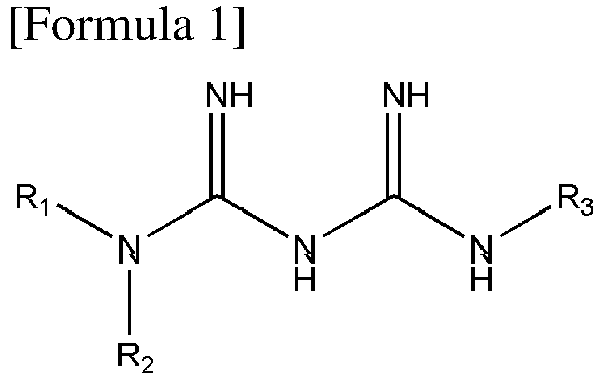
- In Formula 1, R1 and R2 are taken together with nitrogen to which they are attached to form C3-6 heterocycloalkene having 4 to 7 ring atoms; or piperidinyl, which is substituted with C1-4 alkyl in at least one position thereof; and
R3 is hydrogen; C1-6 alkyl; phenyl; or C1-4 alkyl substituted with phenyl, wherein the C3-6 heterocycloalkene is independently unsubstituted or substituted with at least one substituent selected from the group consisting of halogen, hydroxy and C1-6 alkyl, and the phenyl is unsubstituted or substituted with at least one non-hydrogen substituent selected from the group consisting of halogen, hydroxy, C1-6 alkyl, C1-6 alkoxy, C1-6 haloalkyl, and C1-6 haloalkoxy. - In this specification, a substituted group refers to a group in which at least one hydrogen atom is replaced with at least one non-hydrogen atom group, provided that the group satisfies the valence electron requirements and forms a chemically stable compound from the substitution. Unless explicitly described as unsubstituted in this specification, it should be understood that all substituents will be unsubstituted or substituted with another substituent. The substituents R1 to R3 on the biguanide derivative according to the present invention may each be re-substituted with at least one of the above-defined substituents.
- The term halogen or halo- refers to fluoro, chloro, bromo, and iodo.
- The term hydroxy refers to -OH.
- The term alkyl refers to a linear and branched saturated hydrocarbon group generally having a specified number of carbon atoms (for example, 1 to 12 carbon atoms). Examples of the alkyl group include, without limitation, methyl, ethyl, n-propyl, i-propyl, n-butyl, s-butyl, i-butyl, t-butyl, pent-1-yl, pent-2-yl, pent-3-yl, 3-methylbut-1-yl, 3-methylbut-2-yl, 2-methylbut-2-yl, 2,2,2-trimethyleth-1-yl, n-hexyl, n-heptyl, and n-octyl, etc. The alkyl may be attached to a parent group or a substrate at any ring atom, unless the attachment would violate the valence electron requirements. Likewise, the alkyl group may include at least one non-hydrogen substituent unless the substitution would violate the valence electron requirements. For example, the term haloalkyl refers to an alkyl group in which at least one hydrogen atom of the alkyl group is substituted with halogen. For example, when at least one hydrogen atom of methyl group is substituted with halogen, group such as -CH2(halo) -CH(halo)2 or C(halo)3 is formed. Examples of the term haloalkyl group include, without limitation, trifluoromethyl, trichloromethyl, tribromomethyl, and triiodomethyl.
- The term alkoxy refers to alkyl-O-, provided that the alkyl is the same as defined above. Examples of the alkoxy group include, without limitation, methoxy, ethoxy, n-propoxy, i-propoxy, n-butoxy, s-butoxy, t-butoxy, n-pentoxy, s-pentoxy, etc. The alkoxy may be attached to a parent group or a substrate at any ring atom, unless the attachment would violate the valence electron requirements. Likewise, the alkoxy group may include at least one non-hydrogen substituent unless the attachment would violate the valence electron requirements. For example, the term haloalkoxy refers to an alkoxy group in which at least one hydrogen atom of the alkoxy group is substituted with halogen. For example, when at least one hydrogen atom of methoxy group is substituted with halogen, group such as -O-CH2(halo), -O-CH(halo)2 or -O-C(halo)3 is formed. Examples of the term haloalkoxy group include, without limitation, trifluo-romethoxy, trichloromethoxy, tribromomethoxy, and triiodomethoxy, etc.
- The term cycloalkene refers to a saturated monocyclic and polycyclic hydrocarbon ring generally having the specified number of carbon atoms (for example, C3-8 cycloalkene refers to cycloalkene group having 3, 4, 5, 6, 7 or 8 carbon atoms as ring members). The cycloalkene may be attached to a parent or substrate at any ring atom, unless the attachment would violate the valence electron requirements. Likewise, the cycloalkene group may include at least one non-hydrogen substituent unless the substitution would violate the valence electron requirements.
- The term heterocycloalkene refers to an unsaturated non-aromatic monocyclic and polycyclic hydrocarbon ring in which at least one of ring members in the cycloalkene is composed of elements rather than carbon, including heteroatoms, for example, nitrogen, oxygen or sulfur. The heterocycloalkene may be attached to a parent or substrate at any ring atom, unless the attachment would violate the valence electron requirements. Likewise, the heterocycloalkene group may include at least one non-hydrogen substituent unless the attachment would violate the valence electron requirements. Examples of the heterocycloalkene group include, without limitation, dihydroazetine, dihydropyrrole, dihydropyridine, tetrahydropyridine, dihydroazepine, tetrahydroazepine, etc.
- The term cycloalkyl refers to a saturated monocyclic and dicyclic hydrocarbon ring generally having the specified number of carbon atoms included in a ring (that is, C3-8 cycloalkyl refers to cycloalkyl group having 3, 4, 5, 6, 7 or 8 carbon atoms as ring members). The cycloalkyl may be attached to a parent or substrate at any ring atom, unless the attachment would violate the valence electron requirements. Likewise, the cycloalkyl group may include at least one non-hydrogen substituent unless the substitution would violate the valence electron requirements.
- The term heterocycloalkyl refers to a monocyclic and dicyclic hydrocarbon ring in which at least one of ring system atoms in the cycloalkyl is composed of elements rather than carbon, including heteroatoms, that is, nitrogen, oxygen or sulfur. The heterocycloalkyl may be attached to a parent or substrate at any ring atom, unless the attachment would violate the valence electron requirements. Likewise, the heterocycloalkyl group may include at least one non-hydrogen substituent unless the substitution would violate valence electron requirements. Examples of the heterocycloalkyl group include, without limitation, aziridine, azetidine, imidazolyl, pyrrolyl, pyrrolidinyl, piperidyl, morpholinyl, piperazinyl, azepanyl, indolyl, indolinyl, etc.
- According to one exemplary embodiment, R1 and R2 may be taken together with nitrogen to which they are attached to form C4-5 heterocycloalkene having 5 to 6 ring atoms or C4-5 heterocycloalkyl having 5 to 6 ring atoms or piperidinyl, which is substituted with C1-4 alkyl in at least one position thereof; and
R3 may be hydrogen; C1-6 alkyl; phenyl; or C1-4 alkyl substituted with a phenyl,
wherein the C4-5 heterocycloalkene is unsubstituted or substituted with C1-6 alkyl,
the C4-5 heterocycloalkyl is substituted with 1 to 4 C1-6 alkyl groups, and
the phenyl is unsubstituted or substituted with at least one non-hydrogen substituent selected from the group consisting of halogen, hydroxy, C1-6 alkyl, C1-6 alkoxy, C1-6 haloalkyl, and C1-6 haloalkoxy. - According to another exemplary embodiment, R1 and R2 may be taken together with nitrogen to which they are attached to form C4-5 heterocycloalkene having 5 to 6 ring atoms or piperidinyl, which is substituted with one or two C1-2 alkyl groups.
- R3 may be hydrogen; C1-6 alkyl; phenyl; or C1-2 alkyl substituted with phenyl,
wherein the C4-5 heterocycloalkene is unsubstituted or substituted with C1-2 alkyl and
the phenyl is unsubstituted or substituted with at least one non-hydrogen substituent selected from the group consisting of halogen, C1-2 alkoxy, C1-2 haloalkyl, and C1-2 haloalkoxy. - According to still another exemplary embodiment, R1 and R2 may be taken together with nitrogen to which they are attached to form C3-6 heterocycloalkene selected from the group consisting of dihydroazetinyl; dihydropyrrolinyl; dihydropyridinyl; and tetrahydropyridinyl, or R1 and R2 may be taken together with nitrogen to which they are attached to form piperidinyl, which is substituted with C1-4 alkyl in at least one position thereof;
and
R3 may be hydrogen; C1-6 alkyl; phenyl; or C1-4 alkyl substituted with phenyl,
wherein the C3-6 heterocycloalkene is unsubstituted or substituted with C1-6 alkyl,
, and
the phenyl is unsubstituted or substituted with at least one non-hydrogen substituent selected from the group consisting of halogen, hydroxy, C1-6 alkyl, C1-6 alkoxy, C1-6 haloalkyl, and C1-6 haloalkoxy. - According to still another exemplary embodiment, R1 and R2 may be taken together with nitrogen to which they are attached to form dihydropyrrolinyl or tetrahydropyridinyl which is unsubstituted or substituted with C1-4 alkyl, or R1 and R2 may be taken together with nitrogen to which they are attached to form piperidinyl which is substituted with C1-4 alkyl in at least one position thereof, and
R3 may be hydrogen; C1-6 alkyl; phenyl; or C1-4 alkyl substituted with phenyl,
wherein the phenyl is unsubstituted or substituted with at least one non-hydrogen substituent selected from the group consisting of halogen, C1-4 alkoxy, C1-4 haloalkyl, and C1-4 haloalkoxy. - According to still another exemplary embodiment, R1 and R2 may be taken together with nitrogen to which they are attached to form dihydropyrrolinyl or tetrahydropyridinyl which is unsubstituted or substituted with C1-2 alkyl, or R1 and R2 may be taken together with nitrogen to which they are attached to form piperidinyl or pyrrolidinyl substituted with one or two C1-2 alkyl groups, and
R3 may be hydrogen; C3-6 alkyl; phenyl; or C1-2 alkyl substituted with phenyl,
wherein the phenyl is unsubstituted or substituted with at least one non-hydrogen substituent selected from the group consisting of halogen, C1-2 alkoxy, C1-2 haloalkyl, and C1-2 haloalkoxy. - According to yet another exemplary embodiment, R1 and R2 may be taken together with nitrogen to which they are attached to form dihydropyrrolinyl or tetrahydropyridinyl which is unsubstituted or substituted with methyl, or R1 and R2 may be taken together with nitrogen to which they are attached to form piperidine, and
R3 may be hydrogen; butyl; propyl; hexyl; phenyl; or methyl substituted with phenyl,
wherein the piperidine is substituted with one or two methyl groups in at least one of positions 2, 3, 5 and 6, and
the phenyl is unsubstituted or substituted with at least one non-hydrogen substituent selected from the group consisting of halogen, methoxy, trihalomethyl, and tri-halomethoxy. - According to one exemplary embodiment, the compound of Formula 1 may include
- N1-1,2-dihydropyrrole-N5-(4-trifluoromethoxy)phenyl biguanide;
- N1-1,2-dihydropyrrole-N5-(4-trifluoromethyl)phenyl biguanide;
- N1 -1,2-dihydropyrrole-N5-(3-trifluoromethyl)phenyl biguanide;
- N1-1,2-dihydropyrrole-N5-(4-fluoro)phenyl biguanide;
- N1-1,2-dihydropyrrole-N5-(4-chloro)phenyl biguanide;
- N1-1,2-dihydropyrrole-N5-(4-bromo)phenyl biguanide;
- N1-1,2-dihydropyrrole-N5-(3-chloro,4-trifluoromethoxy)phenyl biguanide;
- N1-1,2,3,6-tetrahydropyridine-N5-(3-chloro,4-trifluoromethoxy)phenyl biguanide;
- N1-1,2-dihydropyrrole-N5-(3-trifluoromethyl)benzyl biguanide;
- N1-1,2-dihydropyrrole-N5-(4-trifluoromethyl)benzyl biguanide;
- N1-1,2-dihydropyrrole-N5-(3-trifluoromethoxy)benzyl biguanide;
- N1-(3-methyl)-1,2-dihydropyrrole-N5-(4-trifluoromethoxy)phenyl biguanide;
- N1-(3-methyl)-1,2-dihydropyrrole-N5-(4-trifluoromethyl)phenyl biguanide;
- N1-(3-methyl)-1,2-dihydropyrrole-N5-(4-chloro)phenyl biguanide;
- N1-(3-methyl)-1,2-dihydropyrrole-N5-(4-chloro, 3-trifluoromethyl)phenyl biguanide;
- N 1-(3-methyl)-1,2-dihydropyrrole-N5-(3-trifluoromethyl)phenyl biguanide;
- N1-(3-methyl)-1,2-dihydropyrrole-N5-(4-fluoro)phenyl biguanide;
- N1-(3-methyl)-1,2-dihydropyrrole-N5-(4-bromo)phenyl biguanide;
- N1-(3-methyl)-1,2-dihydropyrrole-N5-(4-methoxy)phenyl biguanide;
- N1-(3-methyl)-1,2-dihydropyrrole-N5-(3,4-dimethoxy)phenyl biguanide;
- N1-(3-methyl)-1,2-dihydropyrrole-N5-(4-trifluoromethoxy)benzyl biguanide;
- N1-(3-methyl)-1,2-dihydropyrrole-N5-(3-trifluoromethoxy)phenyl biguanide;
- N1-(3-methyl)-1,2-dihydropyrrole-N5-(4-trifluoromethyl)benzyl biguanide;
- N1-(3-methyl)-1,2-dihydropyrrole-N5-(4-chloro,3-trifluoromethyl)benzyl biguanide;
- N1-1,2,3,6-tetrahydropyridine-N5-(4-trifluoromethoxy)phenyl biguanide;
- N1-1,2,3,6-tetrahydropyridine-N5-(4-trifluoromethyl)phenyl biguanide;
- N1-1,2,3,6-tetrahydropyridine-N5-(3-trifluoromethoxy)phenyl biguanide;
- N1-1,2,3,6-tetrahydropyridine-N5-(3-trifluoromethyl)phenyl biguanide;
- N1-1,2,3,6-tetrahydropyridine-N5-(4-fluoro, 3-trifluoromethyl)phenyl biguanide;
- N1-1,2,3,6-tetrahydropyridine-N5-(4-chloro, 3-trifluoromethoxy)phenyl biguanide;
- N1-1,2,3,6-tetrahydropyridine-N5-(3-fluoro,4-trifluoromethoxy)phenyl biguanide;
- N1-1,2,3,6-tetrahydropyridine-N5-(4-chloro)phenyl biguanide;
- N1-1,2,3,6-tetrahydropyridine-N5-(4-bromo)phenyl biguanide;
- N1-1,2,3,6-tetrahydropyridine-N5-(4-fluoro)phenyl biguanide;
- N1-1,2,3,6-tetrahydropyridine-N5-(3,5-dimethoxy)phenyl biguanide;
- N1-1,2,3,6-tetrahydropyridine-N5-phenyl biguanide;
- N1-1,2,3,6-tetrahydropyridine-NS-(4-methoxy)phenyl biguanide;
- N1-1,2,3,6-tetrahydropyridine-N5-(3-methoxy)phenyl biguanide;
- N1-1,2-dihydropyrrole-N5-(4-methoxy)phenyl biguanide;
- N1-1,2-dihydropyrrole-N5-(3-methoxy)phenyl biguanide;
- N1-1,2-dihydropyrrole-N5-phenyl biguanide;
- N1-1,2-dihydropyrrole-N5-(3,5-dimethoxy)phenyl biguanide;
- N1 -1,2-dihydropyrrole-N5-(4-fluoro, 3-trifluoromethyl)phenyl biguanide;
- N1 -1,2-dihydropyrrole-N5-(3-fluoro, 4-trifluoromethyl)phenyl biguanide;
- N1-1,2,3,6-tetrahydropyridine-N5-(4-methyl)phenyl biguanide;
- N1-1,2,3,6-tetrahydropyridine-N5-(3-methyl)phenyl biguanide;
- N1-1,2-dihydropyrrole-N5-(4-methyl)phenyl biguanide;
- N1-1,2-dihydropyrrole-N5-(3-methyl)phenyl biguanide;
- N1-1,2-dihydropyrrole-N5-(3-trifluoromethoxy)phenyl biguanide;
- N1-1,2,3,6-tetrahydropyridine-N5-hexyl biguanide;
- N1-1,2,3,6-tetrahydropyridine-N5-(4-trifluoromethoxy)benzyl biguanide;
- N1-1,2,3,6-tetrahydropyridine-N5-(3-trifluoromethoxy)benzyl biguanide;
- N1-1,2,3,6-tetrahydropyridine-N5-(4-trifluoromethyl)benzyl biguanide;
- N1-1,2,3,6-tetrahydropyridine-N5-(3-trifluoromethyl)benzyl biguanide;
- N1-1,2,3,6-tetrahydropyridine-N5-(4-chloro, 3-trifluoromethyl)benzyl biguanide;
- N1-1,2,3,6-tetrahydropyridine-N5-butyl biguanide;
- N1-1,2,3,6-tetrahydropyridine-N5-propyl biguanide; N1-1,2,3,6-tetrahydropyridine biguanide; N1-(3-methyl)piperidine-N5-(3-trifluoromethyl)benzyl biguanide;
- N1-(3-methyl)piperidine-N5-(4-chloro)benzyl biguanide;
- N1-(3-methyl)piperidine-N5-(4-fluoro)phenyl biguanide;
- N1-(3-methyl)piperidine-N5-(4-bromo)phenyl biguanide;
- N1-(3-methyl)piperidine-N5-(4-chloro, 3-trifluoromethyl)phenyl biguanide;
- N1-(3-methyl)piperidine-N5-(3-fluoro, 4-trifluoromethyl)phenyl biguanide;
- N1-(3-methyl)piperidine-N5-(4-fluoro, 3-trifluoromethyl)phenyl biguanide;
- N1-(2-methyl)piperidine-N5-(4-trifluoromethoxy)phenyl biguanide;
- N1-(2-methyl)piperidine-N5-(3-trifluoromethoxy)phenyl biguanide;
- N1-(2-methyl)piperidine-N5-(4-trifluoromethyl)phenyl biguanide;
- N1-(3-methyl)piperidine-N5-(3-fluoro, 4-trifluoromethoxy)phenyl biguanide;
- N1-(2-methyl)piperidine-N5-(3-fluoro, 4-trifluoromethoxy)phenyl biguanide;
- N1-(2-methyl)piperidine-N5-(4-chloro)phenyl biguanide;
- N1-(2-methyl)piperidine-N5-(4-fluoro, 3-trifluoromethyl)phenyl biguanide;
- N1-(2-methyl)piperidine-N5-(3-trifluoromethyl)phenyl biguanide;
- N1-(2-methyl)piperidine-N5-(4-chloro, 3-trifluoromethyl)phenyl biguanide;
- N1-(3-methyl)piperidine-N5-(4-trifluoromethyl)phenyl biguanide;
- N1-(3-methyl)piperidine-N5-(4-trifluoromethoxy)phenyl biguanide;
- N1-(3-methyl)piperidine-N5-(3-trifluoromethoxy)phenyl biguanide;
- N1-(3-methyl)piperidine-N5-(4-trifluoromethoxy)benzyl biguanide;
- N1-(3-methyl)piperidine-N5-(4-fluoro, 3-trifluoromethyl)phenyl biguanide;
- N1-(3-methyl)piperidine-N5-(4-trifluoromethyl)benzyl biguanide;
- N1-(3-methyl)piperidine-N5-(4-chloro)phenyl biguanide;
- N1-(3-methyl)piperidine-N5-(3-trifluoromethyl)phenyl biguanide;
- N1-(2,6-dimethyl)piperidine-N5-(4-trifluoromethoxy)phenyl biguanide;
- N1-(2,6-dimethyl)piperidine-N5-(3-trifluoromethoxy)phenyl biguanide;
- N1-(2,6-dimethyl)piperidine-N5-(4-trifluoromethyl)phenyl biguanide;
- N1-(2,6-dimethyl)piperidine-N5-(3-trifluoromethyl)phenyl biguanide;
- N1-(2,6-dimethyl)piperidine-N5-(4-fluoro, 3-trifluoromethyl)phenyl biguanide;
- N1-(2,6-dimethyl)piperidine-N5-(4-chloro, 3-trifluoromethyl)phenyl biguanide;
- N1-(2,6-dimethyl)piperidine-N5-(3-fluoro, 4-trifluoromethoxy)phenyl biguanide;
- N1-(2,6-dimethyl)piperidine-N5-(4-chloro)phenyl biguanide;
- N1-(2,6-dimethyl)piperidine-N5-(4-bromo)phenyl biguanide; or
- N1-(2,6-dimethyl)piperidine-N5-(4-fluoro)phenyl biguanide.
- Meanwhile, a pharmaceutically acceptable salt of the compound of Formula 1 according to the present invention may be an acid addition salt formed using an organic acid or an inorganic acid. For example, the organic acid may include formic acid, acetic acid, propionic acid, lactic acid, butyric acid, isobutyric acid, trifluoroacetic acid, malic acid, maleic acid, malonic acid, fumaric acid, succinic acid, succinic acid monoamide, glutamic acid, tartaric acid, oxalic acid, citric acid, glycolic acid, glucuronic acid, ascorbic acid, benzoic acid, phthalic acid, salicylic acid, anthranilic acid, dichloroacetic acid, aminooxy acetic acid, benzensulfonic acid, 4-toluenesulfonic acid and methanesulfonic acid; and the inorganic acid may include, for example, hydrochloric acid, hydrobromic acid, sulfuric acid, phosphoric acid, nitric acid, carbonic acid and boric acid. For example, the above-described acid addition salt may be prepared by a typical method of preparing a salt, including a) directly mixing the compound of Formula 1 and an acid, b) dissolving one of the compound and an acid in a solvent or a hydrated solvent and mixing the resulting solution, or c) mixing the compound of Formula 1 and the acid in the presence of a solvent or a hydrated solvent.
- According to one exemplary embodiment, the pharmaceutically acceptable salt of the compound represented by Formula 1 may be a salt of an acid selected from the group consisting of formic acid, acetic acid, propionic acid, lactic acid, butyric acid, isobutyric acid, trifluoroacetic acid, malic acid, maleic acid, malonic acid, fumaric acid, succinic acid, succinic acid monoamide, glutamic acid, tartaric acid, oxalic acid, citric acid, glycolic acid, glucuronic acid, ascorbic acid, benzoic acid, phthalic acid, salicylic acid, anthranilic acid, benzensulfonic acid, p-toluenesulfonic acid, methanesulfonic acid, dichloroacetic acid, aminooxy acetic acid, hydrochloric acid, hydrobromic acid, sulfuric acid, phosphoric acid, nitric acid, carbonic acid, and boric acid.
- The compound of Formula 1 according to the present invention may be prepared by several methods.
- According to one exemplary embodiment, there is provided a method of preparing a compound represented by the following Formula 1, which includes reacting a compound of the following Formula 2 with a dicyanamide in an organic solvent to obtain a compound of the following Formula 3; and reacting the compound of the following Formula 3 with a compound of the following Formula 4 in an organic solvent to obtain the compound of the following Formula 1:


- In Formulas 1 to 4, R1, R2 and R3 are the same as defined in Formula 1.
- For example, the preparation method may be illustrated in the following Scheme 1, and will be described by operations, as follows.

- In the method of preparing the compound of Formula 1, the cyanoguanidine compound of Formula 3 used as an intermediate may be obtained by reacting the cyclic amine of Formula 2 with a dicyanamide such as sodium or potassium dicyanamide in an organic solvent in the presence of an acid. Then, the compound of Formula 1 may be obtained by refluxing the obtained cyanoguanidine compound of Formula 3 with the compound of Formula 4 in an organic solvent.
- An amount of the dicyanamide used for preparation of the cyanoguanidine compound of Formula 3 is equivalent to approximately 1 to 3 moles with respect to the compound of Formula 2, and an amount of the acid used is equivalent to approximately 1 to 2 moles with respect to the compound of Formula 2. Upon preparation of the compound of Formula 2, methanol, ethanol, propanol, butanol, pentanol, acetonitrile, benzene, toluene, 1,4-dioxane, N,N-dimethylamide, and the like may be, for example, used as the organic solvent, and hydrochloric acid, sulfuric acid, nitric acid, hydrobromic acid, 4-toluenesulfonic acid, and the like may be, used as the acid. The reaction temperature of the compound of Formula 2 and the dicyanamide may be in a range of 60 to 140°C, and the reaction time may be in a range of 3 to 24 hours.
- After the cyanoguanidine compound of Formula 3 obtained above is dissolved in an organic solvent, the compound of Formula 4 and an acid are added, and then stirred under reflux. In this case, an amount of the compound of Formula 4 is equivalent to approximately 1 to 2 moles with respect to the compound of Formula 3, and an amount of the acid is equivalent to approximately 1 to 2 moles with respect to the compound of Formula 3. For example, the organic solvent used in reaction of the compound of Formula 3 and the compound of Formula 4 may include methanol, ethanol, propanol, butanol, pentanol, acetonitrile, benzene, toluene, 1,4-dioxane, N,N-dimethylamide, and the like, and the acid may, for example, include hydrochloric acid, sulfuric acid, nitric acid, hydrobromic acid, 4-toluenesulfonic acid, and the like. In this case, the reaction temperature may be in a range of a reflux temperature of the solvent used (i.e., 120 to 140°C for butanol), and the reaction time may be in a range of 6 to 24 hours. When the reaction is completed, the resulting reaction solution is filtered. Thereafter, a pH of the filtered reaction solution may be controlled to approximately 4 to 5 using an acid such as, hydrochloric acid. Then, the resulting reaction solution may be concentrated and purified to yield the compound of Formula 1 or a pharmaceutically acceptable salt thereof according to the present invention.
- The compound of Formula 1 or the pharmaceutically acceptable salt thereof produced in this way may be useful in performing anticancer treatment including inhibition of cancer metastasis and cancer recurrence by AMPK activation, even when administered in a small dose compared with conventional drugs, as will be confirmed in the following Examples.
- Therefore, the present invention provides a medicine including the compound of Formula 1 or the pharmaceutically acceptable salt thereof as an active ingredient.
- Another aspect of the present invention provides a pharmaceutical composition for preventing or treating a cancer, which includes the compound of Formula 1 or the pharmaceutically acceptable salt thereof as an active ingredient, the use of the compound of Formula 1 or the pharmaceutically acceptable salt thereof to prepare a medicine for preventing or treating the disease, and a method of preventing or treating the disease including administering a therapeutically effective amount of the compound of Formula 1 or the pharmaceutically acceptable salt thereof to a subject.
- The pharmaceutical composition of the present invention includes at least one pharmaceutically acceptable carrier in addition to the active ingredient. As used in this specification, the term pharmaceutically acceptable carrier refers to a known pharmaceutically acceptable excipient, which is useful to formulate a pharmaceutically active compound for administration, and is substantially non-toxic and non-sensitive under the conditions used. An exact ratio of the excipient is determined by standard pharmaceutical practice, as well as solubility, chemical characteristics and selected route for administration of the active compound.
- The pharmaceutical composition of the present invention may be formulated in a form suitable for a desired administration method using a suitable and physiologically available adjuvant such as an excipient, a disintegrating agent, a sweetening agent, a binder, a coating agent, a swelling agent, a lubricating agent, a glossing agent, a flavoring agent, or the like.
- The pharmaceutical composition may be formulated as a tablet, a capsule, a pill, a granule, a powder, an injection or a liquid, but the present invention is not limited thereto.
- The formulation and the pharmaceutically acceptable carrier of the pharmaceutical composition may be properly selected according to the techniques known in the related art, and, for example, may be selected with reference to the following documents: (Urquhart et al., Lancet, 16:367, 1980); (Lieberman et al., PHARMACEUTICAL DOSAGE FORMS-DISPERSE SYSTEMS, 2nd ed., vol. 3, 1998); (Ansel et al., PHARMACEUTICAL DOSAGE FORMS & DRUG DELIVERY SYSTEMS, 7th ed., 2000); (Martindale, THE EXTRA PHARMACOPEIA, 31st ed.); (Remington's PHARMACEUTICAL SCIENCES, 16th-20th editions); (THE PHARMACOLOGICAL BASIS OF THERAPEUTICS, Goodman and Gilman, eds., 9th ed., 1996); and (Wilson and Gisvolds' TEXTBOOK OF ORGANIC MEDICINAL AND PHARMACEUTICAL CHEMISTRY, Delgado and Remers, eds., 10th ed., 1998). Also, principals of formulating a pharmaceutical composition may be described, for example, with reference to the following documents: (Platt, Clin Lab Med, 7:289-99, 1987); (Aulton, PHARMACEUTICS: THE SCIENCE OF DOSAGE FORM DESIGN, Churchill Livingstone, NY, 1988); (EXTEMPORANEOUS ORAL LIQUID DOSAGE PREPARATIONS, CSHP, 1998); and (Drug Dosage, J Kans Med Soc, 70(1):30-32, 1969).
- According to one exemplary embodiment, the pharmaceutical composition may be used together with a second drug.
- According to the present invention, the term second drug refers to another pharmaceutically active ingredient in addition to the biguanide derivative according to the present invention. The compound of Formula 1 or the pharmaceutically acceptable salt thereof according to the present invention may be used to treat a variety of diseases, as described above. As a result, the compound of Formula 1 or the pharmaceutically acceptable salt thereof according to the present invention may be used together with a second drug for effectively treating respective diseases. For example, the second drug may be an anticancer agent, an anti-hyperglycemic agent, an anti-obesity agent, etc., which includes an active ingredient different from the compound of Formula 1 or the pharmaceutically acceptable salt thereof.
- When the compound of Formula 1 or the pharmaceutically acceptable salt thereof according to the present invention and the second drug are able to be administered in the same manner, the compound of Formula 1 or the pharmaceutically acceptable salt thereof may be formulated together with the second drug to be provided in the form of a composite preparation.
- Meanwhile, according to the present invention, the term subject refers to a warm-blooded animal such as a mammal with a specific condition, disorder or disease. For example, the subject may be a human, an orangutan, a chimpanzee, a mouse, a rat, a dog, a cow, a chicken, a pig, a goat, a sheep, etc., but the present invention is not limited thereto.
- Also, the term treating includes relieving a symptom, temporarily or permanently eliminating causes of the symptom, and preventing or hindering occurrence of the symptom or progression of the above-described condition, disorder or disease, but the present invention is not limited thereto.
- An effective amount of the active ingredient of the pharmaceutical composition according to the present invention refers to an amount required to treat a disease. Therefore, the effective amount of the active ingredient may be adjusted according to various factors such as kinds and severity of a disease, kinds and contents of an active ingredient and other ingredients included in the composition, kinds of a formulation, age, body weight, general medical conditions, sex and diet of a patient, duration and route of administration, a release rate of the composition, treatment duration, and the number of drugs used together. In the case of adults, for example, the compound of Formula 1 may be administered in a total dose of 50 to 3,000 mg/kg when administered once to several times a day.
- The N1-cyclic amine-N5-substituted biguanide derivative of Formula 1 according to the present invention can be highly useful in treating a cancer since the N1-cyclic amine-N5-substituted biguanide derivative of Formula 1 has an effect of inhibiting cancer cell proliferation, cancer metastasis and recurrence even when administered in a small dose compared with conventional drugs.
- The advantages and features of the present invention and the method of revealing them will be explicit from the following examples described in detail. However, it is to be distinctly understood that the present invention is not limited thereto but may be otherwise variously embodied and practiced. It is obvious that the following examples are to complete the disclosure of the invention and to indicate the scope of the present invention to a skilled artisan completely, and the present invention will be defined only by the scope of the claims.
-

- 2,5-Dihydropyrrole hydrochloride (0.75 g, 7.104 mmol) and sodium dicyanamide (0.63 g, 7.104 mmol) were dissolved in a butanol (20 mL) solution, and then stirred for 3 hours under reflux. After completion of the reaction was confirmed, sodium chloride formed by filtering the reaction mixture was removed, and the filtrate was then concentrated at a reduced pressure. The concentrate was dissolved in methanol (2 mL), and ethyl acetate (5 mL) was then added thereto, and stirred at room temperature for an hour. The formed solid was filtered and the filtrate was washed with ethyl acetate (2x20 mL). The filtrate was dried at a reduced pressure to obtain a white solid target compound (0.90 g, 93%).
1H NMR (600 MHz, CD3OD) δ 5.89 (m, 2H), 4.16 (m, 4H); LC-MS m/z 137.2 [M+1]+ -

- A white solid target compound (2.23 g, 59.2%) was prepared in the same manner as in Example 1, except that 1,2,3,6-tetrahydropyridine was used instead of the 2,5-dihydropyrrole hydrochloride used in Example 1.
1H NMR (600 MHz, CD3OD) δ 5.90 (d, 1H), 5.69 (d, 1H), 3.93 (t, 2H), 3.59(t, 2H), 2.18 (m, 2H); LC-MS m/z 151.2 [M+1]+ -
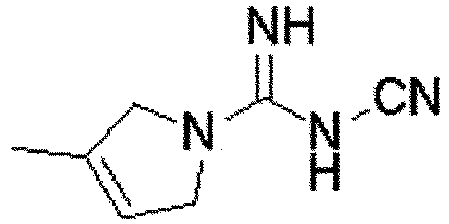
- A white solid target compound (3.12 g, 83%) was prepared in the same manner as in Example 1, except that 3-methyl-2,5-dihydropyrrole was used instead of the 2,5-dihydropyrrole hydrochloride used in Example 1.
1H NMR (600 MHz, CD3OD) δ 5.45 (br s, 1H), 4.80 (m, 2H), 4.10 (m, 2H) 7.16 (s, 3H); LC-MS m/z 151.2 [M+1]+ -

- (4-Trifluoromethoxy)phenylamine (390 mg, 2.20 mmol) was dissolved in a butanol (10 mL) solution at room temperature, and concentrated hydrochloric acid (0.18 mL, 2.20 mmol) was added to the resulting solution, and then stirred for 30 minutes. The N1-2,5-dihydropyrrole cyanoguanidine (300 mg, 2.20 mmol) obtained in Example 1 was added to the reaction mixture, and then stirred for an hour under reflux. The reaction mixture was stirred at room temperature for an hour, and the formed solid was filtered. Then, the filtrate was dried at a reduced pressure to obtain a white solid target compound (265 mg, 34%).
1H NMR (600 MHz, CD3OD) δ 3.94 (m, 2H), 3.71 (m, 2H), 3.47 (m, 1H), 3.34 (s, 3H), 2.90 (m, 1H), 2.57 (m, 1H), 1.71 (m, 10H), 1.18 (m, 1H), 0.89 (s, 3H); LC-MS m/ z 282.2 [M+1]+; mp 172-174°C - Target compounds of the following Examples 5 to 61 were prepared in the same manner as in Example 4, except that the cyanoguanidine and amine compounds synthesized in Examples 2 and 3, which corresponded to the target compounds, were used respectively instead of the N1-2,5-dihydropyrrole cyanoguanidine synthesized in Example 1 and the (4-trifluoromethoxy)phenylamine used in Example 4.
-

- 1H NMR (600 MHz, CD3OD) δ 7.58 (m, 4H), 5.91 (m, 2H), 4.27 (m, 4H); LC-MS m/z 298.2 [M+1]+; mp 254-256°C
-

- 1H NMR (600 MHz, CD3OD) δ 7.79 (m, 1H), 7.56 (m, 1H), 7.46 (m, 1H), 7.34 (m, 1H), 5.91 (s, 2H), 4.20 (m, 4H); LC-MS m/z 298.2 [M+1]+; mp 276-278°C
-

- 1H NMR (600 MHz, CD3OD) δ 7.33 (m, 2H), 7.04 (m, 2H), 5.90 (m, 2H), 4.17 (m, 4H); LC-MS m/z 248.2 [M+1]+; mp 263-265°C
-
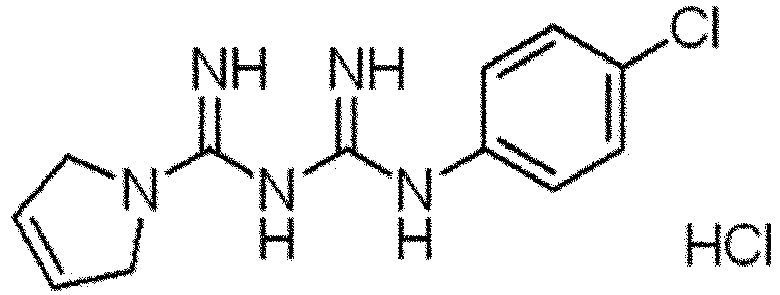
- 1H NMR (600 MHz, CD3OD) δ 7.29 (m, 4H), 5.90 (m, 2H), 4.20 (m, 4H); LC-MS m/z 264.2 [M+1]+; mp 264-266°C
-

- 1H NMR (600 MHz, CD3OD) δ 7.42 (m, 2H), 7.30 (m, 2H), 5.90 (m, 2H), 4.24 (m, 4H); LC-MS m/z 309.0 [M+1]+; mp 263-265°C
-
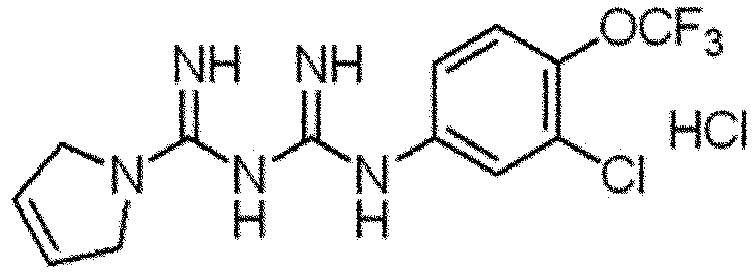
- 1H NMR (600 MHz, CD3OD) δ 7.79 (m, 1H), 7.42 (m, 2H), 5.99 (m, 2H), 4.30 (m, 4H); LC-MS m/z 348.2 [M+1]+; mp 270-272°C
-

- 1H NMR (600 MHz, CD3OD) δ 7.70 (m, 1H), 7.33 (m, 2H), 5.94 (m, 1H), 5.73 (m, 1H), 3.99 (m, 2H), 3.63 (m, 2H), 2.23 (m, 2H); LC-MS m/z 362.2 [M+1]+; mp 250-252°C
-

- 1H NMR (600 MHz, CD3OD) δ 7.70 (m, 4H), 5.89 (m, 2H), 4.52 (m, 2H), 4.23 (m, 4H); LC-MS m/z 312.2 [M+1]+; mp 156-158°C
-

- 1H NMR (600 MHz, CD3OD) δ 7.45 (m, 2H), 7.62 (m, 2H), 5.86 (m, 2H), 4.19 (m, 2H), 4.13 (m, 4H); LC-MS m/z 312.2 [M+1]+; mp 268-270°C
-

- 1H NMR (600 MHz, CD3OD) δ 7.33 (m, 4H), 5.88 (m, 2H), 4.47 (s, 2H), 4.18 (m, 4H); LC-MS m/z 328.2 [M+1]+; mp 218-220°C
-

- 1H NMR (600 MHz, CD3OD)δ 7.41 (m, 2H), 7.16 (m, 2H), 5.46 (m, 1H), 4.10 (m, 3H), 1.77 (m, 3H); LC-MS m/z 328.2 [M+1]+; mp 279-281°C
-
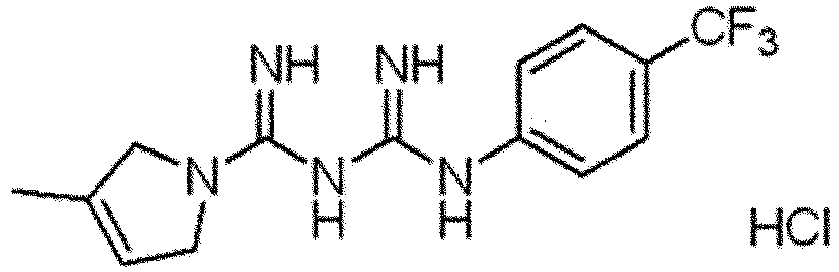
- 1H NMR (600 MHz, CD3OD) δ 7.62 (m, 4H), 5.56 (m, 1H), 4.21 (m, 4H), 1.87 (m, 3H); LC-MS m/z 312.2 [M+1]+; mp 272-274°C
-
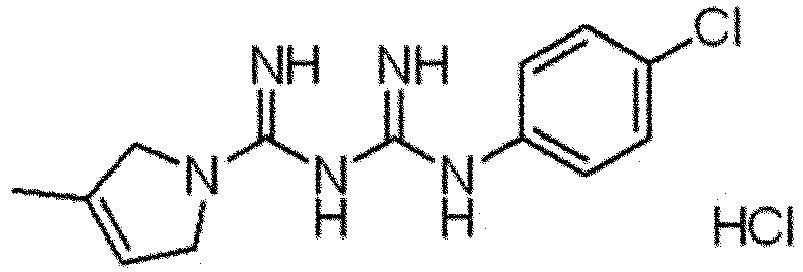
- 1H NMR (600 MHz, CD3OD) δ 7.36 (m, 2H), 7.29 (m, 2H), 5.50 (m, 1H), 4.13 (m, 4H), 1.80 (m, 3H); LC-MS m/z 278.2 [M+1]+; mp 264-268°C
-

- 1H NMR (600 MHz, CD3OD) δ 7.92 (m, 1H), 7.58 (m, 1H), 7.50 (m, 1H), 5.51 (s, 1H), 4.17 (m, 4H), 1.82 (m, 3H); LC-MS m/z 346.2 [M+1]+; mp 274-276°C
-

- 1H NMR (600 MHz, CD3OD) δ 7.80 (m, 1H), 7.57 (m, 1H), 7.42 (m, 1H), 7.34 (m, 1H), 5.51 (m, 1H), 4.15 (m, 4H), 1.81 (m, 3H); LC-MS m/z 312.2 [M+1]+; mp 282-284°C
-

- 1H NMR (600 MHz, CD3OD) δ 7.34 (m, 2H), 7.04 (m, 2H), 5.50 (m, 1H), 4.12 (m, 4H), 1.80 (m, 3H); LC-MS m/z 262.1 [M+1]+; mp 270-272°C
-
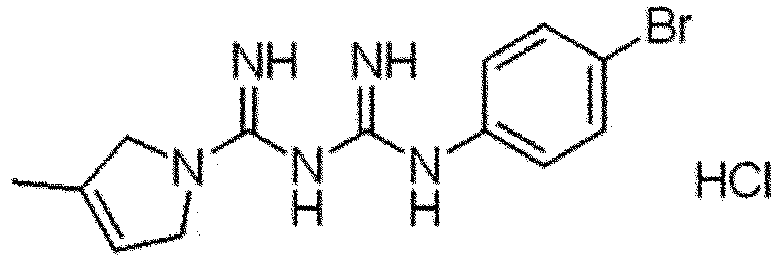
- 1H NMR (600 MHz, CD3OD) δ 7.45 (m, 2H), 7.33 (m, 2H), 5.52 (m, 1H), 4.16 (m, 4H), 1.83 (m, 3H); LC-MS m/z 323.0 [M+1]+; mp 272-274°C
-

- 1H NMR (600 MHz, CD3OD) δ 7.24 (m, 2H), 6.87 (m, 2H), 5.48 (s, 1H), 3.32 (s, 3H), 1.78 (m, 3H); LC-MS m/z 274.2 [M+1]+; mp 263-265°C
-

- 1H NMR (600 MHz, CD3OD) δ 6.58 (m, 2H), 6.26 (m, 1H), 5.52 (m, 1H), 4.18 (m, 4H), 3.30 (s, 3H), 1.83 (m, 3H); LC-MS m/z 304.2 [M+1]+; mp 261-263°C
-

- 1H NMR (600 MHz, CD3OD) δ 7.59 (m, 1H), 7.43 (m, 2H), 7.35 (m, 1H), 7.25 (m, 1H), 5.46 (m, 1H), 4.43 (m, 2H), 4.15 (m, 2H), 1.81 (m, 3H); LC-MS m/z 342.2 [M+1] +; mp 184-186°C
-

- 1H NMR (600 MHz, CD3OD) δ 7.59 (m, 1H), 7.46 (m, 2H), 7.23 (m, 1H), 5.88 (s, 1H), 4.45 (m, 2H), 4.16 (m, 2H), 1.83 (m, 3H); LC-MS m/z 328.2 [M+1]+; mp 263-265°C
-

- 1H NMR (600 MHz, CD3OD) δ 7.74 (m, 1H), 7.64 (m, 2H), 7.51 (m, 1H), 5.56 (s, 1H), 4.48 (s, 2H), 4.19 (m, 4H), 1.83 (m, 3H); LC-MS m/z 326.2 [M+1]+; mp 267-269°C
-

- 1H NMR (600 MHz, CD3OD) δ 7.61 (m, 1H), 7.59 (m, 2H), 7.51 (m, 1H), 5.59 (s, 1H), 4.48 (s, 2H), 4.26 (m, 4H), 1.85 (s, 3H); LC-MS m/z 326.2 [M+1]+; mp 230-232°C
-

- 1H NMR (600 MHz, CD3OD) δ 7.46 (d, 2H), 7.24 (d, 2H), 5.95 (m, 1H), 5.74 (m, 1H), 4.00 (s, 2H), 3.64 (t, 2H), 2.23 (s, 2H); LC-MS m/z 328.1 [M+1]+
-

- 1H NMR (600 MHz, CD3OD) δ 7.59 (m, 4H), 5.96 (m, 1H), 5.75 (m, 1H), 4.01 (s, 2H), 3.65 (t, 2H), 2.25 (s, 2H); LC-MS m/z 312.2 [M+1]+
-

- 1H NMR (600 MHz, CD3OD) δ 7.82 (s, 1H), 7.57 (d, 1H), 7.49 (t, 1H), 7.38 (d, 1H), 5.97 (m, 1H), 5.74 (m, 1H), 4.01 (s, 2H), 3.65 (t, 2H), 2.24 (s, 2H)
-

- 1H NMR (600 MHz, CD3OD) δ 7.82 (s, 1H), 7.57 (d, 1H), 7.49 (t, 1H), 7.37 (d, 1H), 5.95 (m, 1H), 5.74 (m, 1H), 4.01 (s, 2H), 3.65 (t, 2H), 2.24 (s, 2H); LC-MS m/z 312.2 [M+1]+
-

- 1H NMR (600 MHz, CD3OD) δ 7.80 (m, 1H), 7.60 (m, 1H), 7.28 (t, 1H), 5.95 (m, 1H), 5.73 (m, 1H), 4.00 (s, 2H), 3.64 (t, 2H), 2.23 (s, 2H); LC-MS m/z 330.2 [M+1]+
-

- 1H NMR (600 MHz, CD3OD) δ 7.93 (m, 1H), 7.59 (m, 1H), 7.53 (d, 1H), 5.96 (m, 1H), 5.74 (m, 1H), 4.01 (s, 2H), 3.65 (t, 2H), 2.24 (s, 2H); LC-MS m/z 346.0 [M+1]+
-

- 1H NMR (600 MHz, CD3OD) δ 7.56 (m, 1H), 7.34 (t, 1H), 7.16 (m, 1H), 5.97 (m, 1H), 5.74 (m, 1H), 4.01 (s, 2H), 3.65 (t, 2H), 2.25 (s, 2H); LC-MS m/z 346.2 [M+1]+
-

- 1H NMR (600 MHz, CD3OD) δ 7.37 (d, 2H), 7.31 (d, 2H), 5.97 (m, 1H), 5.74 (m, 1H), 3.99 (s, 2H), 3.63 (t, 2H), 2.23 (s, 2H); LC-MS m/z 278.2 [M+1]+
-

- 1H NMR (600 MHz, CD3OD) δ 7.45 (d, 2H), 7.30 (d, 2H), 5.97 (m, 1H), 5.74 (m, 1H), 3.99 (s, 2H), 3.63 (t, 2H), 2.23 (s, 2H); LC-MS m/z 323.0 [M+1]+
-

- 1H NMR (600 MHz, CD3OD) δ 7.35 (d, 2H), 7.07 (d, 2H), 5.94 (m, 1H), 5.72 (m, 1H), 3.97 (s, 2H), 3.62 (t, 2H), 2.23 (s, 2H); LC-MS m/z 262.2 [M+1]+
-

- 1H NMR (600 MHz, CD3OD) δ 6.56 (d, 2H), 6.27 (t, 1H), 5.96 (m, 1H), 5.74 (m, 1H), 4.00 (s, 2H), 3.76 (s, 6H), 3.64 (t, 2H), 2.23 (s, 2H); LC-MS m/z 304.2 [M+1]+
-

- 1H NMR (600 MHz, CD3OD) δ 7.33 (m, 4H), 7.13 (m, 1H), 5.94 (m, 1H), 5.73 (m, 1H), 3.98 (s, 2H), 3.63 (t, 2H), 2.22 (s, 2H); LC-MS m/z 244.2 [M+1]+
-

- 1H NMR (600 MHz, CD3OD) δ 7.23 (d, 2H), 6.91 (d, 2H) 5.93 (m, 1H), 5.72 (m, 1H), 3.96 (s, 2H), 3.78 (s, 3H), 3.61 (t, 2H), 2.21 (s, 2H); LC-MS m/z 274.2 [M+1]+
-

- 1H NMR (600 MHz, CD3OD) δ 7.22 (t, 1H), 7.00 (t, 1H), 6.88 (m, 1H), 6.71 (m, 1H), 5.95 (m, 1H), 5.74 (m, 1H), 3.99 (s, 2H), 3.77 (s, 3H), 3.64 (t, 2H), 2.23 (s, 2H); LC-MS m/z 274.2 [M+1]+
-

- 1H NMR (600 MHz, CD3OD) δ 7.25 (d, 2H), 6.91 (d, 2H), 5.92 (s, 2H), 4.22 (d, 4H), 3.78 (s, 3H); LC-MS m/z 260.2 [M+1]+
-
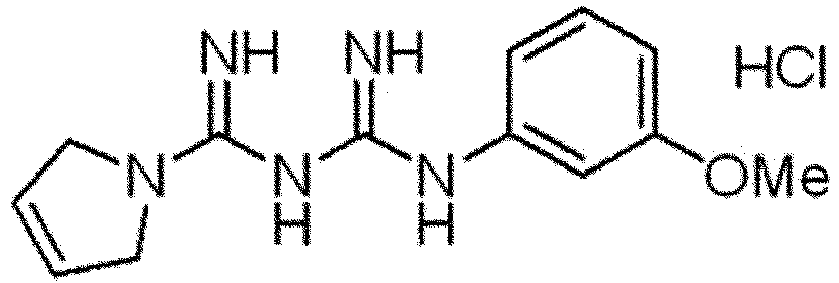
- 1H NMR (600 MHz, CD3OD) δ 7.22 (t, 1H), 7.03 (t, 1H), 6.91 (m, 1H), 6.71 (m, 1H), 5.93 (s, 2H), 4.29 (d, 4H), 3.77 (s, 3H); LC-MS m/z 260.2 [M+1]+
-

- 1H NMR (600 MHz, CD3OD) δ 7.37 (m, 4H), 7.12 (t, 1H), 5.93 (s, 2H), 4.27 (d, 4H); LC-MS m/z 230.2 [M+1]+
-

- 1H NMR (600 MHz, CD3OD) δ 6.58 (d, 2H), 6.27 (t, 1H), 5.93 (m, 1H), 4.30 (d, 4H), 3.75 (s, 6H); LC-MS m/z 290.2 [M+1]+
-

- 1H NMR (600 MHz, CD3OD) δ 7.82 (m, 1H), 7.64 (m, 1H), 7.29 (t, 1H), 5.94 (s, 2H), 4.26 (d, 4H); LC-MS m/z 316.2 [M+1]+
-

- 1H NMR (600 MHz, CD3OD) δ 7.21 (m, 2H), 7.15 (d, 2H), 5.94 (m, 1H), 5.73 (m, 1H), 3.97 (s, 2H), 3.62 (t, 2H), 2.30 (s, 3H), 2.22 (s, 2H); LC-MS m/z 316.2 [M+1]+
-

- 1H NMR (600 MHz, CD3OD) δ 7.21 (m, 2H), 7.15 (d, 2H), 5.94 (m, 1H), 5.73 (m, 1H), 3.97 (s, 2H), 3.62 (t, 2H), 2.30 (s, 3H), 2.22 (s, 2H); LC-MS m/z 258.2 [M+1]+
-

- 1H NMR (600 MHz, CD3OD) δ 7.21 (m, 3H), 6.96 (d, 2H), 5.95 (m, 1H), 5.73 (m, 1H), 3.98 (s, 2H), 3.63 (t, 2H), 2.32 (s, 3H), 2.22 (s, 2H); LC-MS m/z 258.2 [M+1]+
-

- 1H NMR (600 MHz, CD3OD) δ 7.24 (d, 2H), 7.15 (d, 2H), 5.92 (s, 2H), 4.26 (d, 4H), 2.31 (s, 3H); LC-MS m/z 244.2 [M+1]+
-

- 1H NMR (600 MHz, CD3OD) δ 7.17 (m, 3H), 6.96 (d, 1H), 5.93 (s, 2H), 4.27 (d, 4H), 2.32 (s, 3H); LC-MS m/z 244.2 [M+1]+
-

- 1H NMR (600 MHz, CD3OD) δ 7.83 (s, 1H), 7.61 (d, 1H), 7.49 (t, 1H), 7.38 (d, 1H), 5.94 (s, 2H), 4.28 (d, 4H)
-

- 1H NMR (600 MHz, CD3OD) δ 5.93 (m, 1H), 5.72 (m, 1H), 3.98 (m, 2H), 3.63 (t, 2H), 3.20 (t, 2H), 2.23 (t, 2H), 1.70-1.33 (m, 8H), 0.91 (t, 3H); LC-MS m/z 252.4 [M+1]+
-

- 1H NMR (600 MHz, CD3OD) δ 7.43 (d, 2H), 7.25 (d, 2H), 5.91 (m, 1H), 5.68 (m, 1H), 4.43 (s, 2H), 3.90 (m, 2H), 3.52 (t, 2H), 2.16 (s, 2H); LC-MS m/z 342.2 [M+1]+
-
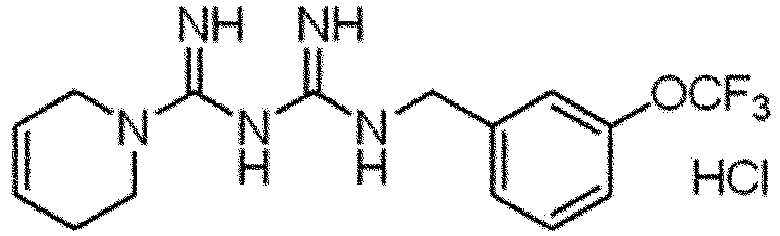
- 1H NMR (600 MHz, CD3OD) δ 7.43 (t, 1H), 7.33 (d, 1H), 7.25 (s, 1H), 7.18 (d, 1H), 5.91 (m, 1H), 5.68 (m, 1H), 4.45 (s, 2H), 3.90 (t, 2H), 3.52 (t, 2H), 2.15 (s, 2H); LC-MS m/z 342.2 [M+1]+
-

- 1H NMR (600 MHz, CD3OD) δ 7.64 (d, 2H), 7.52 (d, 2H), 5.91 (m, 1H), 5.67 (m, 1H), 4.49 (s, 2H), 3.89 (t, 2H), 3.51 (t, 2H), 2.14 (s, 2H); LC-MS m/z 326.2 [M+1]+
-

- 1H NMR (600 MHz, CD3OD) δ 7.64 (s, 1H), 7.56 (m, 3H), 5.91 (m, 1H), 5.67 (m, 1H), 4.48 (s, 2H), 3.89 (t, 2H), 3.51 (t, 2H), 2.15 (s, 2H); LC-MS m/z 326.2 [M+1]+
-

- 1H NMR (600 MHz, CD3OD) δ 7.74 (s, 1H), 7.56 (m, 2H), 5.91 (m, 1H), 5.68 (m, 1H), 4.45 (s, 2H), 3.89 (t, 2H), 3.51 (t, 2H), 2.15 (s, 2H); LC-MS m/z 360.2 [M+1]+
-

- 1H NMR (600 MHz, CD3OD) δ 5.94 (m, 1H), 5.73 (m, 1H), 4.19 (t, 1H), 3.98 (m, 2H), 3.64 (t, 2H), 3.20 (t, 1H), 2.23 (t, 2H), 1.70-1.37 (m, 4H), 0.95 (m, 3H); LC-MS m/z 224.2 [M+1]+
-

- 1H NMR (600 MHz, CD3OD) δ 5.94 (m, 1H), 5.73 (m, 1H), 3.97 (m, 2H), 3.62 (t, 2H), 3.16 (t, 2H), 2.23 (t, 2H), 1.58(m, 2H), 0.95 (m, 3H); LC-MS m/z 210.2 [M+1]+
-

- 1H NMR (600 MHz, CD3OD) δ 5.97 (m, 1H), 5.77 (m, 1H), 3.98 (m, 2H), 3.64 (m, 2H), 2.40 (m, 1H), 2.23 (m, 1H); LC-MS m/z 168.2 [M+1]+
-

- Concentrated hydrochloric acid (0.9 mL, 0.010 mol) was added to a butanol (10 mL) solution containing 3-methylpiperidine (1.00 g, 0.010 mol), and stirred at 0°C for 30 minutes. Sodium dicyanamide (0.99 g, 0.011 mol) was added to the mixed solution, and the resulting reaction mixture was stirred for 24 hours under reflux.
- After completion of the reaction was confirmed, sodium chloride formed by filtering the reaction mixture was removed, and the filtrate was then concentrated at a reduced pressure. Ethyl acetate (10 mL) was then added to the concentrate, and stirred at room temperature for an hour. The formed solid was filtered, and the filtrate was washed with ethyl acetate (2x20 mL). The filtrate was dried at a reduced pressure to obtain a white solid target compound (1.34 g, 80.0%).
1H NMR (600 MHz, CD3OD) δ 3.97 (m, 2H), 2.85 (m, 1H), 2.52 (m, 1H), 1.84 -1.45 (m, 4H), 1.17 (m, 1H), 0.92 (d, 3H) -

- A white solid target compound (1.0 g, 37%) was prepared in the same manner as in Example 62, except that N1-(2-methyl)piperidine was used instead of the N1-(3-methyl)piperidine used in Example 62.
1H NMR (600 MHz, CD3OD) δ 3.98 (m, 2H), 2.85 (m, 1H), 2.53 (m, 1H), 1.82 (m, 1H), 1.71 (m, 1H), 1.59 (m, 1H), 1.48 (m, 1H), 1.91 (s, 3H); LC-MS m/z 167.2 [M+1]+ -

- A white solid target compound (0.75 g, 47.2%) was prepared in the same manner as in Example 62, except that N1-(2,6-dimethyl)piperidine was used instead of the N1-(3-methyl)piperidine used in Example 62.
1H NMR (600 MHz, CD3OD) δ 4.31 (s, 2H), 1.85 (m, 1H), 1.70 (m, 4H), 1.50 (m, 1H), 1.48 (d, 6H); LC-MS m/z 181.2 [M+1]+ -

- Concentrated hydrochloric acid (0.24 mL, 2.71 mmol) was added to a butanol (10 mL) solution containing (3-trifluoromethyl)benzylamine (0.28 mL, 1.99 mmol) at room temperature, and then stirred for 30 minutes. The N1-(3-methyl)piperidine cyanoguanidine (300 mg, 1.81 mmol) obtained in Example 1 was added to the reaction mixture, and then stirred for 2 hours under reflux. The reaction mixture was concentrated at a reduced pressure, and ethyl acetate (3 mL) was added to the concentrated reaction mixture. The formed solid was filtered, and the filtrate was then dried at a reduced pressure to obtain a white solid target compound (0.37 g, 54.7%).
1H NMR (600 MHz, CD3OD) δ 7.63 (m, 1H), 7.55 (m, 3H), 4.47 (s, 2H), 3.85 (dd, 2H), 2.86 (t, 1H), 2.54 (m, 1H), 1.80 (m, 1H), 1.67 (m, 1H), 1.56 (m, 1H), 1.47 (m, 1H), 1.17 (q, 1H), 0.85 (d, 3H); LC-MS m/z 342.2 [M+1]+ - Target compounds of the following Examples 66 to 98 were prepared in the same manner as in Example 65, except that the cyanoguanidine and amine compounds synthesized in Examples 63 and 64, which corresponded to the target compounds, were used respectively instead of the N1-(3-methyl)piperidine cyanoguanidine synthesized in Example 62 and the (3-trifluoromethyl)benzylamine used in Example 65.
-

- 1H NMR (600 MHz, CD3OD) δ 7.28 (m, 4H), 4.29 (m, 2H), 3.82 (m, 2H), 2.81 (m, 1H), 2.51 (m, 1H), 1.57 (m, 4H), 1.15 (m, 1H) 0.84 (m, 3H); LC-MS m/z 308.2 [M+1] +; mp 256-258°C
-

- 1H NMR (600 MHz, CD3OD) δ 7.40 (m, 4H), 4.29 (m, 2H), 3.89 (m, 2H), 2.94 (m, 1H), 2.67 (m, 1H), 1.70 (m, 4H), 1.18 (m, 1H) 0.87 (m, 3H); LC-MS m/z 278.2 [M+1] +; mp 265-267°C
-

- 1H NMR (600 MHz, CD3OD) δ 7.36 (m, 2H), 7.06 (m, 2H), 3.89 (m, 2H), 2.89 (m, 1H), 2.61 (m, 1H), 1.66 (m, 4H), 1.17 (m, 1H), 0.86 (m, 3H); LC-MS m/z 339.2 [M+1] +; mp 252-254°C
-

- 1H NMR (600 MHz, CD3OD) δ 7.93 (m, 1H), 7.51 (m, 2H), 3.92 (m, 2H), 2.99 (m, 1H), 2.69 (m, 1H), 1.86 (m, 1H), 1.73 (m, 2H), 1.56 (m, 1H), 1.20 (m, 1H), 0.91 (m, 3H); LC-MS m/z 362.2 [M+1]+; mp 230-232°C
-

- 1H NMR (600 MHz, CD3OD) δ 7.57 (m, 2H), 7.21 (m, 1H), 3.92 (m, 2H), 3.00 (m, 1H), 2.72 (m, 1H), 1.88 (m, 1H), 1.71 (m, 3H), 1.24 (m, 1H), 0.91 (m, 3H); LC-MS m/ z 346.2 [M+1]+; mp 228-230°C
-

- 1H NMR (600 MHz, CD3OD) δ 7.85 (m, 2H), 7.60 (m, 1H), 7.29 (t, J = 9.6Hz, 1H), 3.93 (m, 2H), 3.02 (m, 1H), 2.70 (m, 1H), 1.88 (m, 1H), 1.77 (m, 2H), 1.58 (m, 1H), 1.25 (m, 1H), 0.95 (m, 3H); LC-MS m/z 346.2 [M+1]+; mp 243-245°C
-

- 1H NMR (600 MHz, CD3OD) δ 7.42 (m, 2H), 7.20 (m, 2H), 4.35 (m, 1H), 3.88 (m, 1H), 3.06 (m, 1H), 1.71 (m, 3H), 1.59 (m, 2H), 1.48 (m, 1H), 1.22 (s, 3H); LC-MS m/z 344.2 [M+1]+; mp 250-252°C
-

- 1H NMR (600 MHz, CD3OD) δ 7.52 (m, 1H), 7.37 (m, 1H), 7.25 (m, 1H), 6.96 (m, 1H), 4.41 (m, 1H), 3.91 (m, 1H), 3.13 (m, 1H), 1.74 (m, 3H), 1.64 (m, 2H), 1.51 (m, 1H) 1.26 (m, 3H); LC-MS m/z 344.2 [M+1]+; mp 246-248°C
-

- 1H NMR (600 MHz, CD3OD) δ 7.56 (m, 4H), 4.37 (m, 1H), 3.91 (m, 1H), 3.12 (m, 1H), 1.73 (m, 3H), 1.61 (m, 2H), 1.52 (m, 1H) 1.24 (m, 3H); LC-MS m/z 329.2 [M+1] +; mp 252-254°C
-

- 1H NMR (600 MHz, CD3OD) δ 7.50 (m, 1H), 7.23 (m, 1H), 7.08 (m, 1H), 2.85 (m, 2H), 2.63 (m, 1H), 1.79 (m, 1H), 1.67 (m, 3H), 1.58 (m, 1H), 1.17 (m, 1H), 0.86 (m, 3H); LC-MS m/z 362.2 [M+1]+; mp 243-245°C
-

- 1H NMR (600 MHz, CD3OD) δ 7.58 (m, 1H), 7.36 (m, 1H), 7.16 (m, 1H), 4.41 (m, 1H), 3.92 (m, 1H), 3.16 (m, 1H), 1.70 (m, 6H) 1.29 (m, 3H); LC-MS m/z 362.0 [M+1] +; mp 241-243°C
-

- 1H NMR (600 MHz, CD3OD) δ 7.30 (m, 4H), 4.36 (m, 1H), 3.89 (m, 1H), 3.10 (m, 1H), 1.61 (m, 5H), 1.49 (m, 1H), 1.25 (m, 3H); LC-MS m/z 294.0 [M+1]+; mp 251-253°C
-

- 1H NMR (600 MHz, CD3OD) δ 7.84 (m, 1H), 7.56 (m, 1H), 7.28 (m, 1H), 4.39 (m, 1H), 3.90 (m, 1H), 3.13 (m, 1H), 1.73 (m, 5H), 1.51 (m, 1H), 1.25 (m, 3H); LC-MS m/ z 346.0 [M+1]+; mp 251-253°C
-
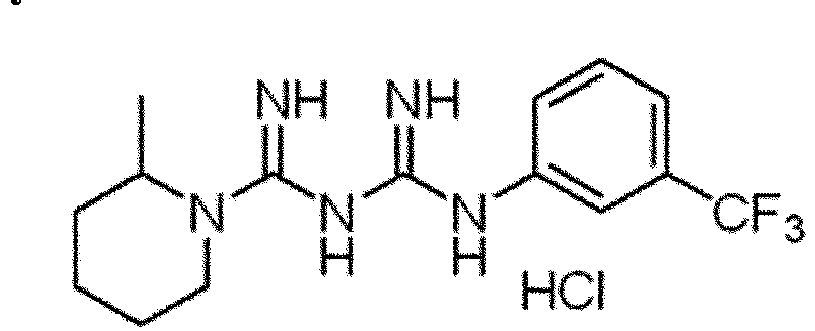
- 1H NMR (600 MHz, CD3OD) δ 7.83 (m, 1H), 7.48 (m, 2H), 7.32 (m, 1H), 4.39 (m, 1H), 3.92 (m, 1H), 3.13 (m, 1H), 1.73 (m, 6H), 1.20 (m, 3H); LC-MS m/z 328.2 [M+1] +; mp 249-251°C
-

- 1H NMR (600 MHz, CD3OD) δ 7.83 (m, 1H), 7.95 (m, 1H), 7.51 (m, 2H), 4.38 (m, 1H), 3.91 (m, 1H), 3.12 (m, 1H), 1.60 (m, 6H), 1.20 (m, 3H); LC-MS m/z 362.3 [M+1] +; mp 316-318°C
-

- 1H NMR (600 MHz, CD3OD) δ 7.61 (s, 4H), 3.98 (d, 2H), 3.04 (t, 1H), 2.74 (t, 1H), 1.91 (m, 1H), 1.81-1.73 (m, 2H), 1.63 (m, 1H), 1.27 (q, 1H), 0.98 (d, 3H); LC-MS m/z 328.2 [M+1]+
-
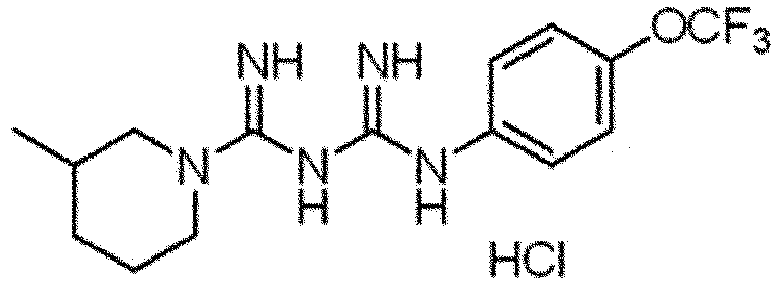
- 1H NMR (600 MHz, CD3OD) δ 7.46 (m, 2H), 7.22 (m, 2H), 3.94 (d, 2H), 2.97 (t, 1H), 2.67 (t, 1H), 1.86 (m, 1H), 1.76-1.66 (m, 2H), 1.55 (m, 1H), 1.23 (q, 1H), 0.93 (d, 3H); LC-MS m/z 344.2 [M+1]+
-

- 1H NMR (600 MHz, CD3OD) δ 7.54 (s, 1H), 7.38 (t, 1H), 7.26 (d, 1H), 6.98 (d, 1H), 3.97 (s, 2H), 3.00 (s, 1H), 2.70 (t, 1H), 1.88 (m, 1H), 1.78-1.71 (m, 2H), 1.59 (m, 1H), 1.24 (q, 1H), 0.91 (d, 3H); LC-MS m/z 344.2 [M+1]+
-

- 1H NMR (600 MHz, CD3OD) δ 7.42 (d, 2H), 7.25 (d, 2H), 4.41 (s, 2H), 3.84 (dd, 2H), 2.85 (t, 1H), 2.52 (t, 1H), 1.82 (m, 1H), 1.66-1.55 (m, 2H), 1.47 (m, 1H), 1.16 (q, 1H), 0.84 (d, 3H); LC-MS m/z 358.2 [M+1]+
-

- 1H NMR (600 MHz, CD3OD) δ 7.84 (dd, 1H), 7.58 (dt, 1H), 7.29 (t, 1H), 3.95 (s, 2H), 2.99 (s, 1H), 2.96 (t, 1H), 1.88 (m, 1H), 1.77 (m, 1H), 1.69 (m, 1H), 1.57 (m, 1H), 1.24 (q, 1H), 0.94 (d, 3H); LC-MS m/z 346.2 [M+1]+
-

- 1H NMR (600 MHz, CD3OD) δ 7.64 (d, 2H), 7.51 (d, 2H), 4.47 (s, 2H), 3.84 (dd, 2H), 2.85 (t, 1H), 2.52 (t, 1H), 1.82 (m, 1H), 1.66 (m, 1H), 1.55 (m, 1H), 1.47 (m, 1H), 1.17 (q, 1H), 0.84 (d, 3H); LC-MS m/z 342.2 [M+1]+
-

- 1H NMR (600 MHz, CD3OD) δ 7.35 (m, 4H), 3.96 (m, 2H), 3.00 (m, 1H), 2.67 (m, 1H), 1.89 (m, 1H), 1.68 (m, 3H) 1.24 (m, 1H), 0.94 (m, 3H); LC-MS m/z 294.2 [M+1] +; mp 252-254°C
-

- 1H NMR (600 MHz, CD3OD) δ 7.86 (m, 1H), 7.55 (d, 1H), 7.48 t, 1H), 7.37 (d, 1H), 3.97 (s, 2H), 3.01 (t, 1H), 2.71 (t, 1H), 1.89 (m, 1H), 1.77(m, 1H), 1.70 (m, 1H), 1.59 (m, 1H), 1.25 (q, 1H), 0.94 (d, 3H); LC-MS m/z 328.2 [M+1]+
-
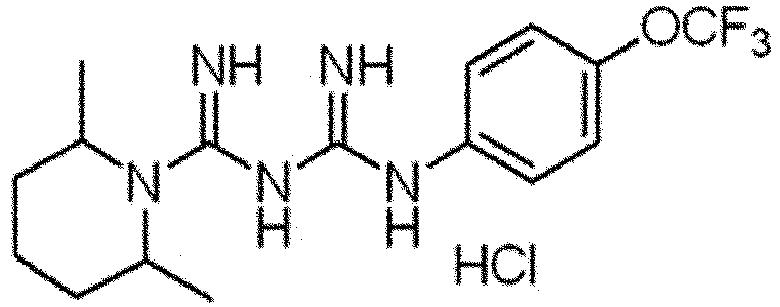
- 1H NMR (600 MHz, CD3OD) δ 7.46 (d, 2H), 7.23 (d, 2H), 4.60-4.10 (br s, 2H), 1.90-1.51 (m, 6H), 1.30 (s, 6H); LC-MS m/z 358.4 [M+1]+
-

- 1H NMR (600 MHz, CD3OD) δ 7.54 (s, 1H), 7.37 (t, 1H), 7.25 (d, 1H), 6.97 (d, 1H), 4.60-4.10 (br s, 2H), 1.91-1.52 (m, 6H), 1.31 (s, 6H); LC-MS m/z 358.4 [M+1]+
-

- 1H NMR (600 MHz, CD3OD) δ 7.58 (s, 4H), 4.60-4.10 (br s, 2H), 1.93-1.52 (m, 6H), 1.32 (s, 6H); LC-MS m/z 342.4 [M+1]+
-

- 1H NMR (600 MHz, CD3OD) δ 7.87 (s, 1H), 7.54 (d, 1H), 7.48 (t, 1H), 7.36 (d, 1H), 4.60-4.10 (br s, 2H), 1.93-1.52 (m, 6H), 1.37 (s, 6H); LC-MS m/z 342.4 [M+1]+
-

- 1H NMR (600 MHz, CD3OD) δ 7.83 (, d, 1H), 7.57 (m, 1H), 7.28 (t, 1H), 4.60-4.10 (br s, 2H), 1.93-1.51 (m, 6H), 1.30 (s, 6H); LC-MS m/z 360.4 [M+1]+
-

- 1H NMR (600 MHz, CD3OD) δ 7.96 (s, 1H), 7.54 (m, 2H), 4.60-4.10 (br s, 2H), 1.93-1.52 (m, 6H), 1.31 (s, 6H); LC-MS m/z 376.4 [M+1]+
-

- 1H NMR (600 MHz, CD3OD) δ 7.56 (d, 1H), 7.33 (t, 1H), 7.15 (d, 1H), 4.60-4.10 (br s, 2H), 1.93-1.52 (m, 6H), 1.32 (s, 6H); LC-MS m/z 376.4 [M+1]+
-

- 1H NMR (600 MHz, CD3OD) δ 7.36 (m, 2H), 7.30 (m, 2H), 4.60-4.10 (br s, 2H), 1.92-1.51 (m, 6H), 1.30 (s, 6H); LC-MS m/z 308.2, 310.2 [M+1]+
-

- 1H NMR (600 MHz, CD3OD) δ 7.45 (d, 2H), 7.31 (d, 2H), 4.60-4.10 (br s, 2H), 1.93-1.51 (m, 6H), 1.30 (s, 6H); LC-MS m/z 353.2 [M+1]+
-

- 1H NMR (600 MHz, CD3OD) δ 7.37 (m, 2H), 7.05 (m, 2H), 4.60-4.10 (br s, 2H), 1.88-1.50 (m, 6H), 1.29 (s, 6H); LC-MS m/z 292.1 [M+1]+
- The compounds synthesized by the methods described in the examples of the present invention were evaluated for effects of AMPK activation and inhibition of cancer cell proliferation according to methods described in the following Experimental Examples.
- MCF7 cells derived from human breast cancer cells (purchased from the Korean Cell Line Bank (KCLB)) were used, and AMPK activation effects of the biguanide derivatives were confirmed using an AMPK [pT172] ELISA kit (Invitrogen, Catalog No. KHO0651).
- MCF7 cells were cultured in a DMEM medium supplemented with 10% fatal bovine serum (commercially available from Gibco Life Technologies (US)). Thereafter, the cultured MCF7 cells were put into a 6-well plate with approximately 5x10⁵ cells per well, and cultured in an incubator supplied with 5% CO2. Culture media were treated with the derivatives synthesized in the Examples at concentrations of 5, 10 and 50 u M, and then cultured for 24 hours. Metformin was used as the control, and the culture media were treated with 0.05, 0.5, 1, 2, 5 and 10 mM metformin and then tested in the same manner as described for the derivatives synthesized in the Examples. Subsequently, the cells were lysed according to a method presented in the operation manual of the AMPK [pT172] ELISA kit, and 20µg of a cell lysate was then yielded through protein assay. Thereafter, the AMPK activation effect was obtained by determining a degree of phosphorylation of a 172nd threonine residue (Thr172) of the AMPKα from the cell lysate according to the method presented in the operation manual of the AMPK [pT172] ELISA kit. A degree of AMPK activation by the biguanide derivatives was exhibited as a degree of AMPKα phosphorylation in cells cultured in the presence of the compounds synthesized in the Examples with respect to a degree of AMPKα phosphorylation in cells cultured without treatment with the biguanide derivatives. A curve graph showing AMPK activation according to the concentration of the treated compounds was plotted based on the obtained AMPK activation results, and a concentration (activation concentration 150, AC150) value of a compound whose AMPK activation reached 150% was calculated using a GraphPad Prism 5.0 program. Similarly, degrees of AMPK activation when the concentrations of the treated biguanide derivatives of Examples 4 to 61 were 10µM and 50µM are listed in the following Table 1, and degrees of AMPK activation when the concentrations of the treated biguanide derivatives of Examples 65 to 98 were 5µM to 10µM are listed in the following Table 2. Some of the compounds were not measurable for AMPK activation due to cytotoxicity when the concentrations of the treated compounds were 50µM.
-
[Table 1] Example AMPK activation effect (%) AC150 (µM) 10 µM 50 µM Metformin 188.3 ND 130 4 5.0 201 584 5 2.8 235 223 6 >50 124 136 7 >50 94 109 8 8.3 139 515 9 9.0 169 371 10 1.4 408 - 11 1.4 637 - 12 13.8 97 357 13 9.0 135 462 14 8.4 1.51 507 15 1.6 554 - 16 1-7 398 - 17 4-7 208 - 18 0.81 - - 19 1.5 306 - 20 38.3 83 172 21 11.9 156 - 22 24.5 116 209 23 213 57 279 24 53 200 421 25 2.2 376 - 26 0.68 443 358 27 13.5 119 316 28 0.15 732 - 29 1.3 551 - 30 0.53 703 - 31 1.8 391 - 32 0.62 837 - 33 0.79 992 - 34 0.29 925 - 35 2.4 314 - 36 0.87 568 - 37 4.2 187 522 38 >50 97 117 39 67.2 96 138 40 37.8 122 163 41 22.4 125 201 42 14.7 157 210 43 4.7 200 466 44 1.7 289 577 45 4.8 202 299 46 1.6 448 - 47 1.0 758 - 48 4.9 178 691 49 1.9 319 917 50 1.4 317 440 51 3.1 241 409 52 2.7 352 - 53 2.3 311 589 54 0.87 545 650 55 2.1 389 608 56 2.1 389 671 57 2.7 279 579 58 1.8 500 - 59 16.6 104 283 60 12.4 108 338 61 >50 123 132 -
[Table 2] Example AMPK activation effect (%) AC150 (µM) 5 µM 10 µM Metformin 188.3 130 (at 50 µM) 65 2.8 147 274 66 6.2 101 204 67 1.6 258 427 68 13.7 52 136 69 1.2 307 650 70 0.9 365 602 71 1.6 259 430 72 2.0 210 386 73 2.0 215 384 74 2.0 199 410 75 3.9 133 259 76 1.7 242 375 77 4.5 154 212 78 0.5 425 565 79 1.9 177 515 80 1.1 334 590 81 1.9 224 396 82 0.5 401 474 83 0.5 352 398 84 1.1 317 555 85 0.7 345 436 86 2.3 147 330 87 1.9 219 297 88 0.7 327 399 89 4.7 153 198 90 0.8 281 317 91 5.6 108 214 92 0.8 324 417 93 2.0 190 422 94 1.1 328 643 95 3.1 130 326 96 1.8 240 395 97 4.2 143 233 98 2.8 239 244 - HCT116 cells derived from human colorectal cancer were used, and an effect of inhibiting cancer cell proliferation of the biguanide derivative was confirmed by measuring a concentration value (cell growth inhibition concentration, GIC50) at which cell growth was inhibited by 50% using a 3-(4,5-dimethylthiazol-2-yl)-2,5-diphenyltetrazolium bromide (MTT) reagent.
- First, HCT116 cells (purchased from the KCLB) were put on a 96-well plate and cultured in a DMEM medium supplemented with 10% fatal bovine serum (commercially available from Gibco Life Technologies (US)) for 16 hours so that approximately 5,000 cells were counted in each well. Subsequently, to obtain the GIC50 value of each compound, the culture media were treated with 100µM, 25µM, 6.25µM, 1.56µM or 0.39µM of the compound, and then cultured for 48 hours. In order to determine whether the cells survived after treatment with the compounds, MTT (commercially available from AMRESCO (US)) was added to the culture media which were then cultured for another 3 hours. Formed formazane crystals were dissolved using dimethyl sulfoxide (DMSO) and the absorbance of the resulting solution was measured at 560 nm. After the 48-hour culture, a ratio of a living cell count on a well plate treated with the compounds synthesized in the Examples to a cell count cultured on a well plate not treated with the compound was indicated as cell viability (%) according to the concentration of each treated compound. The cell viability (%) was used to plot a cell viability curve graph and calculate a concentration (GIC50) value of the compound at which the growth was inhibited by 50%, thereby confirming the inhibition effect of cancer cell proliferation. Also, the cell growth inhibitions (%) when the concentration of the treated biguanide derivative and metformin as the control was 100µM (Examples 4 to 61) is listed in the following Table 3, and the cell growth inhibitions (%) when the concentration of the treated biguanide derivative and metformin as the control was 25µM (Examples 65 to 98) are listed in the following Table 4.
-
[Table 3] Examples Effect of inhibition on cancer cell growth GI50 (µM) Cell growth inhibition (%) at 100 µM Metformin 2172 6.5 (at 100 µM) 4 19.1 99.7 5 18.0 99.7 6 12.9 99.6 7 >100 19.8 8 42.8 99.1 9 28.8 99.5 10 8.3 97.9 11 3.0 98.0 12 84.8 53.8 13 77.1 57.8 14 17.5 98.8 15 10.1 99.2 16 10.8 99.3 17 13.9 99.7 18 2.6 99.5 19 9.1 99.6 20 54.8 93.1 21 10.4 99.4 22 18.6 37.1 23 89.9 29.5 24 33.9 99.0 25 4.9 96.6 26 8.2 96.7 27 33.5 96.6 28 8.4 100.5 29 9.5 100.4 30 7.5 99.7 31 7.8 99.5 32 7.9 99.4 33 3.7 99.4 34 6.6 99.4 35 18.4 99.1 36 11.2 99.0 37 135.0 45.3 38 108.5 47.8 39 123.7 39.8 40 >100 37.4 41 88.2 55.9 42 >100 14.0 43 114.4 44.9 43 114.4 44.9 44 >100 27.8 45 107.2 47.2 46 12.0 100.1 47 10.8 100.0 48 42.5 97 6 49 57.0 91.8 50 116.8 46.0 51 102.5 48.7 52 15.4 100.1 53 43.7 97.9 54 14.6 98.1 55 22.8 97.9 56 26.9 97.7 57 26.9 97.8 58 7.9 98.4 59 141.4 44.5 60 99.8 50.1 61 >100 10.5 -
[Table 4] Examples Effect of inhibition on cancer cell growth GI50 (µM) Cell growth inhibition (%) at 25 µM Metformin 2172 6.5 (at 100 µM) 65 18.3 66.7 66 18.5 67.4 67 9.2 100.2 68 45.3 29.4 69 1.9 100.5 70 3.9 100.5 71 5.7 100.4 72 8.0 100.3 73 6.7 100.3 74 8.7 100.4 75 9.3 100.3 76 5.8 100.4 77 11.3 100.2 78 7.0 100.3 79 9.4 98.9 80 6.8 99.7 81 7.7 100.3 82 7.0 100.3 83 6.8 100.2 84 10.4 97.0 85 7.1 100.2 86 27.6 49.0 87 10.0 100.1 88 6.6 100.4 89 6.2 100.4 90 3.2 100.4 91 11.4 100.4 92 7.5 100.4 93 3.0 100.3 94 2.8 100.5 95 2.9 100.6 96 10.4 100.6 97 9.1 100.5 98 45.4 28.2
Claims (14)
- A compound of following Formula 1 or a pharmaceutically acceptable salt thereof:
 wherein R1 and R2 are taken together with nitrogen to which they are attached to form C3-6 heterocycloalkene having 4 to 7 ring atoms; or piperidinyl, which is substituted with C1-4 alkyl in at least one position thereof; andR3 is hydrogen; C1-6 alkyl; phenyl; or C1-4 alkyl substituted with phenyl,wherein the C3-6 heterocycloalkene is unsubstituted or substituted with at least one substituent selected from the group consisting of halogen, hydroxy and C1-6 alkyl,the phenyl is unsubstituted or substituted with at least one non-hydrogen substituent selected from the group consisting of halogen, hydroxy, C1-6 alkyl, C1-6 alkoxy, C1-6 haloalkyl, and C1-6 haloalkoxy.
 - The compound of Formula 1 or the pharmaceutically acceptable salt thereof of claim 1,
wherein R1 and R2 are taken together with nitrogen to which they are attached to form C4-5 heterocycloalkene having 5 to 6 ring atoms or piperidinyl, which is substituted with C1-4 alkyl in at least one position thereof; and
R3 is hydrogen; C1-6 alkyl; phenyl; or C1-2 alkyl substituted with phenyl,
wherein the C4-5 heterocycloalkene is unsubstituted or substituted with C1-6 alkyl, and
the phenyl is unsubstituted or substituted with at least one non-hydrogen substituent selected from the group consisting of halogen, hydroxy, C1-6 alkyl, C1-6 alkoxy, C1-6 haloalkyl, and C1-6 haloalkoxy. - The compound of Formula 1 or the pharmaceutically acceptable salt thereof of claim 1,
wherein R1 and R2 are taken together with nitrogen to which they are attached to form C4-5 heterocycloalkene having 5 to 6 ring atoms or piperidinyl, which is substituted with one or two C1-2 alkyl groups; and
R3 is hydrogen; C1-6 alkyl; phenyl; or C1-2 alkyl substituted with phenyl,
wherein the C4-5 heterocycloalkene is unsubstituted or substituted with C1-2 alkyl, and
the phenyl is unsubstituted or substituted with at least one non-hydrogen substituent selected from the group consisting of halogen, C1-2 alkoxy, C1-2 haloalkyl, and C1-2 haloalkoxy. - The compound of Formula 1 or the pharmaceutically acceptable salt thereof of
claim 1,
wherein R1 and R2 are taken together with nitrogen to which they are attached to form C3-6 heterocycloalkene selected from the group consisting of dihydroazetinyl; dihydropyrrolinyl; dihydropyridinyl; and tetrahydropyridinyl, or R1 and R2 are taken together with nitrogen to which they are attached to form piperidinyl, which is substituted with C1-4 alkyl in at least one position thereof; and
R3 is hydrogen; C1-6 alkyl; phenyl; or C1-4 alkyl substituted with phenyl,
wherein the C3-6 heterocycloalkene is unsubstituted or substituted with C1-6 alkyl, and
the phenyl is unsubstituted or substituted with at least one non-hydrogen substituent selected from the group consisting of halogen, hydroxy, C1-6 alkyl, C1-6 alkoxy, C1-6 haloalkyl, and C1-6 haloalkoxy. - The compound of Formula 1 or the pharmaceutically acceptable salt thereof of
claim 1,
wherein R1 and R2 are taken together with nitrogen to which they are attached to form dihydropyrrolinyl or tetrahydropyridinyl which is unsubstituted or substituted with C1-4 alkyl, or R1 and R2 are taken together with nitrogen to which they are attached to form piperidinyl which is substituted with C1-4 alkyl in at least one position thereof; and
R3 is hydrogen; C1-6 alkyl; phenyl; or C1-4 alkyl substituted with phenyl,
wherein the phenyl is unsubstituted or substituted with at least one non-hydrogen substituent selected from the group consisting of halogen, C1-4 alkoxy, C1-4 haloalkyl, and C1-4 haloalkoxy. - The compound of Formula 1 or the pharmaceutically acceptable salt thereof of
claim 1,
wherein R1 and R2 are taken together with nitrogen to which they are attached to form dihydropyrrolinyl or tetrahydropyridinyl which is unsubstituted or substituted with C1-2 alkyl, or R1 and R2 are taken together with nitrogen to which they are attached to form piperidinyl which is substituted with one or two C1-2 alkyl groups; and
R3 is hydrogen; C3-6 alkyl; phenyl; or C1-2 alkyl substituted with phenyl,
wherein the phenyl is unsubstituted or substituted with at least one non-hydrogen substituent selected from the group consisting of halogen, C1-2 alkoxy, C1-2 haloalkyl, and C1-2 haloalkoxy. - The compound of Formula 1 or the pharmaceutically acceptable salt thereof of
claim 1,
wherein R1 and R2 are taken together with nitrogen to which they are attached to form dihydropyrrolinyl or tetrahydropyridinyl which is unsubstituted or substituted with methyl, or R1 and R2 are taken together with nitrogen to which they are attached to form piperidine; and
R3 is hydrogen; butyl; propyl; hexyl; phenyl; or methyl substituted with phenyl,
wherein the piperidine is substituted with one or two methyl groups in at least one of positions 2, 3, 5 and 6, and
the phenyl is unsubstituted or substituted with at least one non-hydrogen substituent selected from the group consisting of halogen, methoxy, trihalomethyl, and trihalomethoxy. - The compound of Formula 1 or the pharmaceutically acceptable salt thereof of
claim 1, wherein the compound of Formula 1 isN1-1,2-dihydropyrrole-N5-(4-trifluoromethoxy)phenyl biguanide;N1-1,2-dihydropyrrole-N5-(4-trifluoromethyl)phenyl biguanide;N1-1,2-dihydropyrrole-N5-(3-trifluoromethyl)phenyl biguanide;N1-1,2-dihydropyrrole-N5-(4-fluoro)phenyl biguanide;N1-1,2-dihydropyrrole-N5-(4-chloro)phenyl biguanide;N1-1,2-dihydropyrrole-N5-(4-bromo)phenyl biguanide;N1-1,2-dihydropyrrole-N5-(3-chloro, 4-trifluoromethoxy)phenyl biguanide;N1-1,2,3 ,6-tetrahydropyridine-N5-(3-chloro, 4-trifluoromethoxy)phenyl biguanide;N1-1,2-dihydropyrrole-N5-(3-trifluoromethyl)benzyl biguanide;N1-1,2-dihydropyrrole-N5-(4-trifluoromethyl)benzyl biguanide;N1-1,2-dihydropyrrole-N5-(3-trifluoromethoxy)benzyl biguanide;N1-(3-methyl)-1,2-dihydropyrrole-N5-(4-trifluoromethoxy)phenyl biguanide;N1-(3-methyl)-1,2-dihydropyrrole-N5-(4-trifluoromethyl)phenyl biguanide;N1-(3-methyl)-1,2-dihydropyrrole-N5-(4-chloro)phenyl biguanide;N1-(3-methyl)-1,2-dihydropyrrole-N5-(4-chloro, 3-trifluoromethyl)phenyl biguanide;N1-(3-methyl)-1,2-dihydropyrrole-N5-(3-trifluoromethyl)phenyl biguanide;N1-(3-methyl)-1,2-dihydropyrrole-N5-(4-fluoro)phenyl biguanide;N1-(3-methyl)-1,2-dihydropyrrole-N5-(4-bromo)phenyl biguanide;N1-(3-methyl)-1,2-dihydropyrrole-N5-(4-methoxy)phenyl biguanide;N1-(3-methyl)-1,2-dihydropyrrole-N5-(3,4-dimethoxy)phenyl biguanide;N1-(3-methyl)-1,2-dihydropyrrole-N5-(4-trifluoromethoxy)benzyl biguanide;Nl-(3-methyl)-1,2-dihydropyrrole-N5-(3-trifluoromethoxy)phenyl biguanide;N1-(3-methyl)-1,2-dihydropyrrole-N5-(4-trifluoromethyl)benzyl biguanide;N1-(3-methyl)-1,2-dihydropyrrole-N5-(4-chloro, 3-trifluoromethyl)benzyl biguanide;N1-1,2,3,6-tetrahydropyridine-N5-(4-trifluoromethoxy)phenyl biguanide;N1-1,2,3,6-tetrahydropyridine-N5-(4-trifluoromethyl)phenyl biguanide;N1-1,2,3,6-tetrahydropyridine-N5-(3-trifluoromethoxy)phenyl biguanide;N1-1,2,3,6-tetrahydropyridine-N5-(3-trifluoromethyl)phenyl biguanide;N1-1,2,3,6-tetrahydropyridine-N5-(4-fluoro, 3-trifluoromethyl)phenyl biguanide;N1-1,2,3,6-tetrahydropyridine-N5-(4-chloro, 3-trifluoromethoxy)phenyl biguanide;N1-1,2,3,6-tetrahydropyridine-N5-(3-fluoro,4-trifluoromethoxy)phenyl biguanide;N1-1,2,3,6-tetrahydropyridine-N5-(4-chloro)phenyl biguanide;N1-1,2,3,6-tetrahydropyridine-N5-(4-bromo)phenyl biguanide;N1-1,2,3,6-tetrahydropyridine-N5-(4-fluoro)phenyl biguanide;N1-1,2,3,6-tetrahydropyridine-N5-(3,5-dimethoxy)phenyl biguanide;N1-1,2,3,6-tetrahydropyridine-N5-phenyl biguanide;N1-1,2,3,6-tetrahydropyridine-N5-(4-methoxy)phenyl biguanide;N1-1,2,3,6-tetrahydropyridine-N5-(3-methoxy)phenyl biguanide;N1-1,2-dihydropyrrole-N5-(4-methoxy)phenyl biguanide;N1-1,2-dihydropyrrole-N5-(3-methoxy)phenyl biguanide;N1-1,2-dihydropyrrole-N5-phenyl biguanide;N1-1,2-dihydropyrrole-N5-(3,5-dimethoxy)phenyl biguanide;N1-1,2-dihydropyrrole-N5-(4-fluoro, 3-trifluoromethyl)phenyl biguanide;N1-1,2-dihydropyrrole-N5-(3-fluoro, 4-trifluoromethyl)phenyl biguanide;N1-1,2,3,6-tetrahydropyridine-N5-(4-methyl)phenyl biguanide;N1-1,2,3,6-tetrahydropyridine-N5-(3-methyl)phenyl biguanide;N1-1,2-dihydropyrrole-N5-(4-methyl)phenyl biguanide;N1-1,2-dihydropyrrole-N5-(3-methyl)phenyl biguanide;N1-1,2-dihydropyrrole-N5-(3-trifluoromethoxy)phenyl biguanide;N1-1,2,3,6-tetrahydropyridine-N5-hexyl biguanide;N1-1,2,3,6-tetrahydropyridine-N5-(4-trifluoromethoxy)benzyl biguanide;N1-1,2,3,6-tetrahydropyridine-N5-(3-trifluoromethoxy)benzyl biguanide;N1-1,2,3,6-tetrahydropyridine-N5-(4-trifluoromethyl)benzyl biguanide;N1-1,2,3,6-tetrahydropyridine-N5-(3-trifluoromethyl)benzyl biguanide;N1-1,2,3,6-tetrahydropyridine-N5-(4-chloro, 3-trifluoromethyl)benzyl biguanide;N1-1,2,3,6-tetrahydropyridine-N5-butyl biguanide;N1-1,2,3,6-tetrahydropyridine-N5-propyl biguanide;N1-1,2,3,6-tetrahydropyridine biguanide;N1-(3-methyl)piperidine-N5-(3-trifluoromethyl)benzyl biguanide;Nl-(3-methyl)piperidine-N5-(4-chloro)benzyl biguanide;Nl-(3-methyl)piperidine-N5-(4-fluoro)phenyl biguanide;N1-(3-methyl)piperidine-N5-(4-bromo)phenyl biguanide;N1-(3-methyl)piperidine-N5-(4-chloro, 3-trifluoromethyl)phenyl biguanide;N1-(3-methyl)piperidine-N5-(3-fluoro, 4-trifluoromethyl)phenyl biguanide;Nl-(3-methyl)piperidine-N5-(4-fluoro, 3-trifluoromethyl)phenyl biguanide;N1-(2-methyl)piperidine-N5-(4-trifluoromethoxy)phenyl biguanide;N1-(2-methyl)piperidine-N5-(3-trifluoromethoxy)phenyl biguanide;N1-(2-methyl)piperidine-N5-(4-trifluoromethyl)phenyl biguanide;N1-(3-methyl)piperidine-N5-(3-fluoro, 4-trifluoromethoxy)phenyl biguanide;N1-(2-methyl)piperidine-N5-(3-fluoro, 4-trifluoromethoxy)phenyl biguanide;N1-(2-methyl)piperidine-N5-(4-chloro)phenyl biguanide;N1-(2-methyl)piperidine-N5-(4-fluoro, 3-trifluoromethyl)phenyl biguanide;N1-(2-methyl)piperidine-N5-(3-trifluoromethyl)phenyl biguanide;N1-(2-methyl)piperidine-N5-(4-chloro, 3-trifluoromethyl)phenyl biguanide;N1-(3-methyl)piperidine-N5-(4-trifluoromethyl)phenyl biguanide;N1-(3-methyl)piperidine-N5-(4-trifluoromethoxy)phenyl biguanide;Nl-(3-methyl)piperidine-N5-(3-trifluoromethoxy)phenyl biguanide;N1-(3-methyl)piperidine-N5-(4-trifluoromethoxy)benzyl biguanide;N1-(3-methyl)piperidine-N5-(4-fluoro, 3-trifluoromethyl)phenyl biguanide;N1-(3-methyl)piperidine-N5-(4-trifluoromethyl)benzyl biguanide;N1-(3-methyl)piperidine-N5-(4-chloro)phenyl biguanide;N1-(3-methyl)piperidine-N5-(3-trifluoromethyl)phenyl biguanide;N1-(2,6-dimethyl)piperidine-N5-(4-trifluoromethoxy)phenyl biguanide;N1-(2,6-dimethyl)piperidine-N5-(3-trifluoromethoxy)phenyl biguanide;N1-(2,6-dimethyl)piperidine-N5-(4-trifluoromethyl)phenyl biguanide;N1-(2,6-dimethyl)piperidine-N5-(3-trifluoromethyl)phenyl biguanide;N1-(2,6-dimethyl)piperidine-N5-(4-fluoro, 3-trifluoromethyl)phenyl biguanide;N1-(2,6-dimethyl)piperidine-N5-(4-chloro, 3 -trifluoromethyl)phenyl biguanide;N1-(2,6-dimethyl)piperidine-N5-(3-fluoro, 4-trifluoromethoxy)phenyl biguanide;N1-(2,6-dimethyl)piperidine-N5-(4-chloro)phenyl biguanide;N1-(2,6-dimethyl)piperidine-N5-(4-bromo)phenyl biguanide; andN1-(2,6-dimethyl)-N5-(4-fluoro)phenyl biguanide. - The compound of Formula 1 or the pharmaceutically acceptable salt thereof of claim 1,
wherein the pharmaceutically acceptable salt is a salt with an acid selected from the group consisting of formic acid, acetic acid, propionic acid, lactic acid, butyric acid, isobutyric acid, trifluoroacetic acid, malic acid, maleic acid, malonic acid, fumaric acid, succinic acid, succinic acid monoamide, glutamic acid, tartaric acid, oxalic acid, citric acid, glycolic acid, glucuronic acid, ascorbic acid, benzoic acid, phthalic acid, salicylic acid, anthranilic acid, benzensulfonic acid, p-toluenesulfonic acid, methanesulfonic acid, dichloroacetic acid, aminooxy acetic acid, hydrochloric acid, hydrobromic acid, sulfuric acid, phosphoric acid, nitric acid, carbonic acid, and boric acid. - A method of preparing a compound of following Formula 1, comprising:reacting a compound of the following Formula 2 with a dicyanamide in an organic solvent to obtain a compound of the following Formula 3; andreacting the compound of the following Formula 3 with a compound of Formula 4 in an organic solvent to obtain the compound of the following Formula 1:
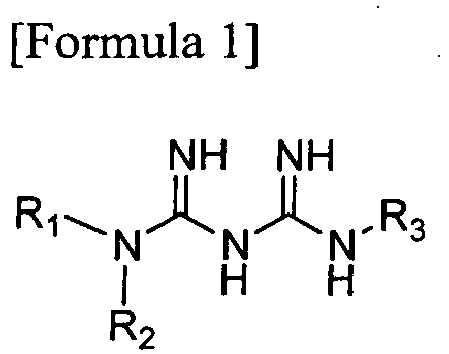
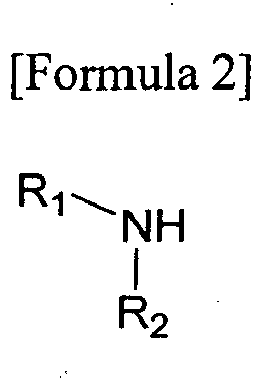

 wherein R1 and R2 are taken together with nitrogen to which they are attached to form C3-6 heterocycloalkene having 4 to 7 ring atoms or piperidinyl, which is substituted with C1-4 alkyl in at least one position thereof; andR3 is hydrogen; C1-6 alkyl; phenyl; or C1-4 alkyl substituted with phenyl,wherein the C3-6 heterocycloalkene is unsubstituted or substituted with at least one substituent selected from the group consisting of halogen, hydroxyl, and C1-6 alkyl, andthe phenyl is unsubstituted or substituted with at least one non-hydrogen substituent selected from the group consisting of halogen, hydroxy, C1-6 alkyl, C1-6 alkoxy, C1-6 haloalkyl, and C1-6 haloalkoxy.
 - A pharmaceutical composition for use in preventing or treating a cancer, comprising the compound of Formula 1 or the pharmaceutically acceptable salt thereof defined in any one of claims 1 to 9 as an active ingredient.
- The pharmaceutical composition for use of claim 11, wherein the treatment of the cancer includes inhibition of recurrence or metastasis of cancer.
- The pharmaceutical composition for use of claim 11, wherein the cancer is a disease selected from the group consisting of uterine cancer, breast cancer, gastric cancer, brain cancer, rectal cancer, colorectal cancer, lung cancer, skin cancer, blood cancer, pancreatic cancer, prostate cancer, and liver cancer.
- The pharmaceutical composition for use of claim 11, wherein the pharmaceutical composition is formulated as a tablet, a capsule, a pill, a granule, a powder, an injection or a liquid.
Applications Claiming Priority (3)
| Application Number | Priority Date | Filing Date | Title |
|---|---|---|---|
| KR1020130014175A KR102034899B1 (en) | 2013-02-07 | 2013-02-07 | N1-cyclic amine-n5-substituted biguanide derivatives, methods of preparing the same and pharmaceutical composition comprising the same |
| KR1020130014176A KR102072245B1 (en) | 2013-02-07 | 2013-02-07 | N1-cyclic amine-n5-substituted biguanide derivatives, methods of preparing the same and pharmaceutical composition comprising the same |
| PCT/KR2014/001006 WO2014123364A1 (en) | 2013-02-07 | 2014-02-06 | N1-cyclic amine-n5-substituted biguanide derivatives, methods of preparing the same and pharmaceutical composition comprising the same |
Publications (3)
| Publication Number | Publication Date |
|---|---|
| EP2941418A1 EP2941418A1 (en) | 2015-11-11 |
| EP2941418A4 EP2941418A4 (en) | 2016-10-26 |
| EP2941418B1 true EP2941418B1 (en) | 2020-04-29 |
Family
ID=51299911
Family Applications (1)
| Application Number | Title | Priority Date | Filing Date |
|---|---|---|---|
| EP14748929.8A Active EP2941418B1 (en) | 2013-02-07 | 2014-02-06 | N1-cyclic amine-n5-substituted biguanide derivatives, methods of preparing the same and pharmaceutical composition comprising the same |
Country Status (4)
| Country | Link |
|---|---|
| US (2) | US9884821B2 (en) |
| EP (1) | EP2941418B1 (en) |
| ES (1) | ES2797574T3 (en) |
| WO (1) | WO2014123364A1 (en) |
Families Citing this family (6)
| Publication number | Priority date | Publication date | Assignee | Title |
|---|---|---|---|---|
| WO2014123364A1 (en) * | 2013-02-07 | 2014-08-14 | Hanall Biopharma Co., Ltd. | N1-cyclic amine-n5-substituted biguanide derivatives, methods of preparing the same and pharmaceutical composition comprising the same |
| KR102216701B1 (en) * | 2014-11-20 | 2021-02-18 | 이뮤노메트테라퓨틱스 인코포레이티드 | Biguanide compounds and use thereof |
| WO2016175357A1 (en) | 2015-04-30 | 2016-11-03 | Immunomet Therapeutics Inc. | Guanidine compounds and use thereof |
| KR20180087189A (en) * | 2017-01-24 | 2018-08-01 | 연세대학교 산학협력단 | Pharmaceutical composition for preventing or treating inflammatory disease, autoimmune disease, or combination thereof and method using the same |
| WO2019233982A1 (en) | 2018-06-05 | 2019-12-12 | Institut Curie | Compounds with biguanidyl radical and uses thereof |
| EP4247352A1 (en) | 2020-11-18 | 2023-09-27 | Institut Curie | Dimers of biguanidines and their therapeutic uses |
Family Cites Families (21)
| Publication number | Priority date | Publication date | Assignee | Title |
|---|---|---|---|---|
| US2467371A (en) * | 1944-05-10 | 1949-04-19 | Ici Ltd | Biguanide derivatives |
| GB599714A (en) | 1945-10-08 | 1948-03-18 | Robert De Brath Ashworth | Manufacture of biguanide derivatives |
| US3960949A (en) | 1971-04-02 | 1976-06-01 | Schering Aktiengesellschaft | 1,2-Biguanides |
| GB1485315A (en) * | 1975-01-16 | 1977-09-08 | Aron Soc Nouv Exploit Lab | Biguanides process for their preparation and applications thereof |
| US5100919A (en) * | 1984-03-19 | 1992-03-31 | The Rockefeller University | Biguanides and derivatives thereof as inhibitors of advanced glycosylation of a target protein |
| US7622117B2 (en) | 2002-04-17 | 2009-11-24 | Dynamis Therapeutics, Inc. | 3-deoxyglucosone and skin |
| EP1753861A4 (en) | 2004-02-17 | 2010-03-10 | Dynamis Therapeutics Inc | Fructoseamine 3 kinase and the formation of collagen and elastin |
| KR20110007985A (en) * | 2009-07-17 | 2011-01-25 | 한올바이오파마주식회사 | Butyrate of N, N-dimethyl imidodicarbonimidic diamide, preparation method thereof, pharmaceutical composition comprising the same and complex preparation comprising the same |
| EP2522653A4 (en) * | 2010-01-06 | 2013-06-12 | Hanall Biopharma Co Ltd | Biguanide derivative, a preparation method thereof and a pharmaceutical composition containing the biguanide derivative as an active ingredient |
| US20140235558A1 (en) * | 2010-06-15 | 2014-08-21 | Hanall Biopharma Co., Ltd. | Pharmaceutical composition having activity of anticancer |
| KR101275258B1 (en) * | 2010-06-15 | 2013-06-17 | 한올바이오파마주식회사 | Pharmaceutical composition having activity of anticancer |
| EP2742020B1 (en) | 2011-08-08 | 2017-10-25 | Immunomet Therapeutics Inc. | N1-cyclic amine-n5-substituted biguanide derivatives, methods of preparing the same and pharmaceutical composition comprising the same |
| KR101425061B1 (en) | 2011-08-08 | 2014-08-06 | 한올바이오파마주식회사 | N1-cyclic amine-n5-substituted phenyl biguanide derivatives, methods of preparing the same and pharmaceutical composition comprising the same |
| CA2913736A1 (en) * | 2012-06-11 | 2013-12-19 | The Regents Of The University Of California | Compounds and methods of treating cancer |
| WO2014123364A1 (en) * | 2013-02-07 | 2014-08-14 | Hanall Biopharma Co., Ltd. | N1-cyclic amine-n5-substituted biguanide derivatives, methods of preparing the same and pharmaceutical composition comprising the same |
| KR102088001B1 (en) * | 2013-05-23 | 2020-03-12 | 이뮤노메트테라퓨틱스 인코포레이티드 | Pharmaceutical composition comprising n1-cyclic amine-n5-substituted biguanide derivatives as an ingredient for preventing or treating fibrosis |
| KR102192726B1 (en) * | 2013-11-04 | 2020-12-18 | 이뮤노메트테라퓨틱스 인코포레이티드 | Biguanide compounds and use thereof |
| KR102061390B1 (en) * | 2014-04-17 | 2019-12-31 | 이뮤노메트테라퓨틱스 인코포레이티드 | Guanidine compounds and use thereof |
| KR102216701B1 (en) * | 2014-11-20 | 2021-02-18 | 이뮤노메트테라퓨틱스 인코포레이티드 | Biguanide compounds and use thereof |
| WO2016175357A1 (en) * | 2015-04-30 | 2016-11-03 | Immunomet Therapeutics Inc. | Guanidine compounds and use thereof |
| KR102253478B1 (en) * | 2015-05-13 | 2021-05-20 | 이뮤노메트테라퓨틱스 인코포레이티드 | Pharmaceutical composition comprising a biguanide derivative as an active ingredient for preventing or treating glioblastoma |
-
2014
- 2014-02-06 WO PCT/KR2014/001006 patent/WO2014123364A1/en not_active Ceased
- 2014-02-06 ES ES14748929T patent/ES2797574T3/en active Active
- 2014-02-06 EP EP14748929.8A patent/EP2941418B1/en active Active
- 2014-02-06 US US14/766,203 patent/US9884821B2/en active Active
-
2017
- 2017-12-14 US US15/841,971 patent/US10252996B2/en active Active
Non-Patent Citations (1)
| Title |
|---|
| None * |
Also Published As
| Publication number | Publication date |
|---|---|
| US20180105494A1 (en) | 2018-04-19 |
| US10252996B2 (en) | 2019-04-09 |
| WO2014123364A1 (en) | 2014-08-14 |
| US20150368198A1 (en) | 2015-12-24 |
| ES2797574T3 (en) | 2020-12-02 |
| EP2941418A1 (en) | 2015-11-11 |
| EP2941418A4 (en) | 2016-10-26 |
| US9884821B2 (en) | 2018-02-06 |
Similar Documents
| Publication | Publication Date | Title |
|---|---|---|
| EP2742019B1 (en) | N1-cyclic amine-n5-substituted phenyl biguanide derivatives and pharmaceutical composition comprising the same | |
| US10252996B2 (en) | N1-cyclic amine-N5-substituted biguanide derivatives, methods of preparing the same and pharmaceutical composition comprising the same | |
| EP2742020B1 (en) | N1-cyclic amine-n5-substituted biguanide derivatives, methods of preparing the same and pharmaceutical composition comprising the same | |
| EP3222614B1 (en) | Biguanide compound and use thereof | |
| HUE028391T2 (en) | Carbonylated (aza)cyclohexanes as dopamine d3 receptor ligands | |
| EP3168214B1 (en) | Substituted 2-thioxo-imidazolidin-4-ones and spiro analogues thereof, active anti-cancer ingredient, pharmaceutical composition, medicinal preparation, method for treating prostate cancer | |
| JP2017538676A (en) | Small molecule inhibitors of mitochondrial permeability transition pore (mtPTP) | |
| WO2022192730A1 (en) | Compositions and methods for treating polycythemia | |
| KR20150023880A (en) | N-[4-(Quinolin-4-yloxy)cyclohexyl(methyl)](hetero)arylcarboxamides as androgen receptor antagonists, production and use thereof as medicinal products | |
| EP4074697B1 (en) | Novel adamantane derivatives as inhibitors of focal adhesion kinase | |
| KR101424667B1 (en) | N1-cyclic amine-n2-substituted biguanide derivatives, methods of preparing the same and pharmaceutical composition comprising the same | |
| EP2142518B1 (en) | 3,4-dihydroquinazoline derivatives | |
| KR102034899B1 (en) | N1-cyclic amine-n5-substituted biguanide derivatives, methods of preparing the same and pharmaceutical composition comprising the same | |
| KR102072245B1 (en) | N1-cyclic amine-n5-substituted biguanide derivatives, methods of preparing the same and pharmaceutical composition comprising the same | |
| IE43620B1 (en) | N-aralkyl-2-amino-propanamides, methods for their preparation and compositions containing them | |
| RS51687B (en) | CRYSTAL FORMS 4- [2-4- (4-METHYLPHENYLSULPHANYL) PHENYL] PIPERIDINE WITH COMBINED INHIBITION OF SEROTONIN AND NOREPINEPHRINE REASPORPTION FOR TREATMENT OF NEUROPATIC PAIN | |
| EP2357171A1 (en) | Piperidine derivative, piperazine derivative and agent for treatment of disease involving central nervous system disorders | |
| KR20150051016A (en) | Guanidine compounds and use thereof |
Legal Events
| Date | Code | Title | Description |
|---|---|---|---|
| PUAI | Public reference made under article 153(3) epc to a published international application that has entered the european phase |
Free format text: ORIGINAL CODE: 0009012 |
|
| 17P | Request for examination filed |
Effective date: 20150807 |
|
| AK | Designated contracting states |
Kind code of ref document: A1 Designated state(s): AL AT BE BG CH CY CZ DE DK EE ES FI FR GB GR HR HU IE IS IT LI LT LU LV MC MK MT NL NO PL PT RO RS SE SI SK SM TR |
|
| AX | Request for extension of the european patent |
Extension state: BA ME |
|
| DAX | Request for extension of the european patent (deleted) | ||
| RAP1 | Party data changed (applicant data changed or rights of an application transferred) |
Owner name: IMMUNOMET THERAPEUTICS INC. |
|
| A4 | Supplementary search report drawn up and despatched |
Effective date: 20160928 |
|
| RAP1 | Party data changed (applicant data changed or rights of an application transferred) |
Owner name: IMMUNOMET THERAPEUTICS INC. |
|
| RIC1 | Information provided on ipc code assigned before grant |
Ipc: A61K 31/155 20060101ALI20160922BHEP Ipc: C07D 211/16 20060101ALI20160922BHEP Ipc: C07C 279/26 20060101AFI20160922BHEP Ipc: C07D 211/14 20060101ALI20160922BHEP Ipc: C07D 211/70 20060101ALI20160922BHEP Ipc: C07D 207/20 20060101ALI20160922BHEP Ipc: C07C 277/02 20060101ALI20160922BHEP |
|
| RIC1 | Information provided on ipc code assigned before grant |
Ipc: C07C 279/26 20060101AFI20190523BHEP Ipc: C07D 207/20 20060101ALI20190523BHEP Ipc: C07D 211/70 20060101ALI20190523BHEP Ipc: C07D 211/16 20060101ALI20190523BHEP Ipc: C07D 211/14 20060101ALI20190523BHEP Ipc: A61K 31/155 20060101ALI20190523BHEP Ipc: C07C 277/02 20060101ALI20190523BHEP |
|
| GRAP | Despatch of communication of intention to grant a patent |
Free format text: ORIGINAL CODE: EPIDOSNIGR1 |
|
| STAA | Information on the status of an ep patent application or granted ep patent |
Free format text: STATUS: GRANT OF PATENT IS INTENDED |
|
| INTG | Intention to grant announced |
Effective date: 20190702 |
|
| GRAJ | Information related to disapproval of communication of intention to grant by the applicant or resumption of examination proceedings by the epo deleted |
Free format text: ORIGINAL CODE: EPIDOSDIGR1 |
|
| STAA | Information on the status of an ep patent application or granted ep patent |
Free format text: STATUS: REQUEST FOR EXAMINATION WAS MADE |
|
| GRAP | Despatch of communication of intention to grant a patent |
Free format text: ORIGINAL CODE: EPIDOSNIGR1 |
|
| STAA | Information on the status of an ep patent application or granted ep patent |
Free format text: STATUS: GRANT OF PATENT IS INTENDED |
|
| INTC | Intention to grant announced (deleted) | ||
| INTG | Intention to grant announced |
Effective date: 20191107 |
|
| GRAS | Grant fee paid |
Free format text: ORIGINAL CODE: EPIDOSNIGR3 |
|
| GRAA | (expected) grant |
Free format text: ORIGINAL CODE: 0009210 |
|
| STAA | Information on the status of an ep patent application or granted ep patent |
Free format text: STATUS: THE PATENT HAS BEEN GRANTED |
|
| AK | Designated contracting states |
Kind code of ref document: B1 Designated state(s): AL AT BE BG CH CY CZ DE DK EE ES FI FR GB GR HR HU IE IS IT LI LT LU LV MC MK MT NL NO PL PT RO RS SE SI SK SM TR |
|
| REG | Reference to a national code |
Ref country code: GB Ref legal event code: FG4D |
|
| REG | Reference to a national code |
Ref country code: CH Ref legal event code: EP |
|
| REG | Reference to a national code |
Ref country code: AT Ref legal event code: REF Ref document number: 1263087 Country of ref document: AT Kind code of ref document: T Effective date: 20200515 |
|
| REG | Reference to a national code |
Ref country code: DE Ref legal event code: R096 Ref document number: 602014064523 Country of ref document: DE |
|
| REG | Reference to a national code |
Ref country code: IE Ref legal event code: FG4D |
|
| REG | Reference to a national code |
Ref country code: NL Ref legal event code: FP |
|
| REG | Reference to a national code |
Ref country code: LT Ref legal event code: MG4D |
|
| PG25 | Lapsed in a contracting state [announced via postgrant information from national office to epo] |
Ref country code: LT Free format text: LAPSE BECAUSE OF FAILURE TO SUBMIT A TRANSLATION OF THE DESCRIPTION OR TO PAY THE FEE WITHIN THE PRESCRIBED TIME-LIMIT Effective date: 20200429 Ref country code: SE Free format text: LAPSE BECAUSE OF FAILURE TO SUBMIT A TRANSLATION OF THE DESCRIPTION OR TO PAY THE FEE WITHIN THE PRESCRIBED TIME-LIMIT Effective date: 20200429 Ref country code: IS Free format text: LAPSE BECAUSE OF FAILURE TO SUBMIT A TRANSLATION OF THE DESCRIPTION OR TO PAY THE FEE WITHIN THE PRESCRIBED TIME-LIMIT Effective date: 20200829 Ref country code: NO Free format text: LAPSE BECAUSE OF FAILURE TO SUBMIT A TRANSLATION OF THE DESCRIPTION OR TO PAY THE FEE WITHIN THE PRESCRIBED TIME-LIMIT Effective date: 20200729 Ref country code: FI Free format text: LAPSE BECAUSE OF FAILURE TO SUBMIT A TRANSLATION OF THE DESCRIPTION OR TO PAY THE FEE WITHIN THE PRESCRIBED TIME-LIMIT Effective date: 20200429 Ref country code: GR Free format text: LAPSE BECAUSE OF FAILURE TO SUBMIT A TRANSLATION OF THE DESCRIPTION OR TO PAY THE FEE WITHIN THE PRESCRIBED TIME-LIMIT Effective date: 20200730 Ref country code: PT Free format text: LAPSE BECAUSE OF FAILURE TO SUBMIT A TRANSLATION OF THE DESCRIPTION OR TO PAY THE FEE WITHIN THE PRESCRIBED TIME-LIMIT Effective date: 20200831 |
|
| REG | Reference to a national code |
Ref country code: AT Ref legal event code: MK05 Ref document number: 1263087 Country of ref document: AT Kind code of ref document: T Effective date: 20200429 |
|
| PG25 | Lapsed in a contracting state [announced via postgrant information from national office to epo] |
Ref country code: HR Free format text: LAPSE BECAUSE OF FAILURE TO SUBMIT A TRANSLATION OF THE DESCRIPTION OR TO PAY THE FEE WITHIN THE PRESCRIBED TIME-LIMIT Effective date: 20200429 Ref country code: RS Free format text: LAPSE BECAUSE OF FAILURE TO SUBMIT A TRANSLATION OF THE DESCRIPTION OR TO PAY THE FEE WITHIN THE PRESCRIBED TIME-LIMIT Effective date: 20200429 Ref country code: LV Free format text: LAPSE BECAUSE OF FAILURE TO SUBMIT A TRANSLATION OF THE DESCRIPTION OR TO PAY THE FEE WITHIN THE PRESCRIBED TIME-LIMIT Effective date: 20200429 Ref country code: BG Free format text: LAPSE BECAUSE OF FAILURE TO SUBMIT A TRANSLATION OF THE DESCRIPTION OR TO PAY THE FEE WITHIN THE PRESCRIBED TIME-LIMIT Effective date: 20200729 |
|
| REG | Reference to a national code |
Ref country code: ES Ref legal event code: FG2A Ref document number: 2797574 Country of ref document: ES Kind code of ref document: T3 Effective date: 20201202 |
|
| PG25 | Lapsed in a contracting state [announced via postgrant information from national office to epo] |
Ref country code: AL Free format text: LAPSE BECAUSE OF FAILURE TO SUBMIT A TRANSLATION OF THE DESCRIPTION OR TO PAY THE FEE WITHIN THE PRESCRIBED TIME-LIMIT Effective date: 20200429 |
|
| PG25 | Lapsed in a contracting state [announced via postgrant information from national office to epo] |
Ref country code: CZ Free format text: LAPSE BECAUSE OF FAILURE TO SUBMIT A TRANSLATION OF THE DESCRIPTION OR TO PAY THE FEE WITHIN THE PRESCRIBED TIME-LIMIT Effective date: 20200429 Ref country code: RO Free format text: LAPSE BECAUSE OF FAILURE TO SUBMIT A TRANSLATION OF THE DESCRIPTION OR TO PAY THE FEE WITHIN THE PRESCRIBED TIME-LIMIT Effective date: 20200429 Ref country code: EE Free format text: LAPSE BECAUSE OF FAILURE TO SUBMIT A TRANSLATION OF THE DESCRIPTION OR TO PAY THE FEE WITHIN THE PRESCRIBED TIME-LIMIT Effective date: 20200429 Ref country code: AT Free format text: LAPSE BECAUSE OF FAILURE TO SUBMIT A TRANSLATION OF THE DESCRIPTION OR TO PAY THE FEE WITHIN THE PRESCRIBED TIME-LIMIT Effective date: 20200429 Ref country code: SM Free format text: LAPSE BECAUSE OF FAILURE TO SUBMIT A TRANSLATION OF THE DESCRIPTION OR TO PAY THE FEE WITHIN THE PRESCRIBED TIME-LIMIT Effective date: 20200429 Ref country code: DK Free format text: LAPSE BECAUSE OF FAILURE TO SUBMIT A TRANSLATION OF THE DESCRIPTION OR TO PAY THE FEE WITHIN THE PRESCRIBED TIME-LIMIT Effective date: 20200429 |
|
| REG | Reference to a national code |
Ref country code: DE Ref legal event code: R097 Ref document number: 602014064523 Country of ref document: DE |
|
| PG25 | Lapsed in a contracting state [announced via postgrant information from national office to epo] |
Ref country code: SK Free format text: LAPSE BECAUSE OF FAILURE TO SUBMIT A TRANSLATION OF THE DESCRIPTION OR TO PAY THE FEE WITHIN THE PRESCRIBED TIME-LIMIT Effective date: 20200429 Ref country code: PL Free format text: LAPSE BECAUSE OF FAILURE TO SUBMIT A TRANSLATION OF THE DESCRIPTION OR TO PAY THE FEE WITHIN THE PRESCRIBED TIME-LIMIT Effective date: 20200429 |
|
| PLBE | No opposition filed within time limit |
Free format text: ORIGINAL CODE: 0009261 |
|
| STAA | Information on the status of an ep patent application or granted ep patent |
Free format text: STATUS: NO OPPOSITION FILED WITHIN TIME LIMIT |
|
| 26N | No opposition filed |
Effective date: 20210201 |
|
| PG25 | Lapsed in a contracting state [announced via postgrant information from national office to epo] |
Ref country code: SI Free format text: LAPSE BECAUSE OF FAILURE TO SUBMIT A TRANSLATION OF THE DESCRIPTION OR TO PAY THE FEE WITHIN THE PRESCRIBED TIME-LIMIT Effective date: 20200429 |
|
| PG25 | Lapsed in a contracting state [announced via postgrant information from national office to epo] |
Ref country code: MC Free format text: LAPSE BECAUSE OF FAILURE TO SUBMIT A TRANSLATION OF THE DESCRIPTION OR TO PAY THE FEE WITHIN THE PRESCRIBED TIME-LIMIT Effective date: 20200429 |
|
| REG | Reference to a national code |
Ref country code: BE Ref legal event code: MM Effective date: 20210228 |
|
| PG25 | Lapsed in a contracting state [announced via postgrant information from national office to epo] |
Ref country code: LU Free format text: LAPSE BECAUSE OF NON-PAYMENT OF DUE FEES Effective date: 20210206 |
|
| PG25 | Lapsed in a contracting state [announced via postgrant information from national office to epo] |
Ref country code: IE Free format text: LAPSE BECAUSE OF NON-PAYMENT OF DUE FEES Effective date: 20210206 |
|
| PG25 | Lapsed in a contracting state [announced via postgrant information from national office to epo] |
Ref country code: BE Free format text: LAPSE BECAUSE OF NON-PAYMENT OF DUE FEES Effective date: 20210228 |
|
| PG25 | Lapsed in a contracting state [announced via postgrant information from national office to epo] |
Ref country code: HU Free format text: LAPSE BECAUSE OF FAILURE TO SUBMIT A TRANSLATION OF THE DESCRIPTION OR TO PAY THE FEE WITHIN THE PRESCRIBED TIME-LIMIT; INVALID AB INITIO Effective date: 20140206 |
|
| P01 | Opt-out of the competence of the unified patent court (upc) registered |
Effective date: 20230502 |
|
| PG25 | Lapsed in a contracting state [announced via postgrant information from national office to epo] |
Ref country code: CY Free format text: LAPSE BECAUSE OF FAILURE TO SUBMIT A TRANSLATION OF THE DESCRIPTION OR TO PAY THE FEE WITHIN THE PRESCRIBED TIME-LIMIT Effective date: 20200429 |
|
| PG25 | Lapsed in a contracting state [announced via postgrant information from national office to epo] |
Ref country code: MK Free format text: LAPSE BECAUSE OF FAILURE TO SUBMIT A TRANSLATION OF THE DESCRIPTION OR TO PAY THE FEE WITHIN THE PRESCRIBED TIME-LIMIT Effective date: 20200429 |
|
| PG25 | Lapsed in a contracting state [announced via postgrant information from national office to epo] |
Ref country code: MT Free format text: LAPSE BECAUSE OF FAILURE TO SUBMIT A TRANSLATION OF THE DESCRIPTION OR TO PAY THE FEE WITHIN THE PRESCRIBED TIME-LIMIT Effective date: 20200429 |
|
| PG25 | Lapsed in a contracting state [announced via postgrant information from national office to epo] |
Ref country code: TR Free format text: LAPSE BECAUSE OF FAILURE TO SUBMIT A TRANSLATION OF THE DESCRIPTION OR TO PAY THE FEE WITHIN THE PRESCRIBED TIME-LIMIT Effective date: 20200429 |
|
| REG | Reference to a national code |
Ref country code: CH Ref legal event code: U11 Free format text: ST27 STATUS EVENT CODE: U-0-0-U10-U11 (AS PROVIDED BY THE NATIONAL OFFICE) Effective date: 20260301 |
|
| PGFP | Annual fee paid to national office [announced via postgrant information from national office to epo] |
Ref country code: NL Payment date: 20260226 Year of fee payment: 13 |
|
| PGFP | Annual fee paid to national office [announced via postgrant information from national office to epo] |
Ref country code: GB Payment date: 20260227 Year of fee payment: 13 |
|
| PGFP | Annual fee paid to national office [announced via postgrant information from national office to epo] |
Ref country code: ES Payment date: 20260302 Year of fee payment: 13 |
|
| PGFP | Annual fee paid to national office [announced via postgrant information from national office to epo] |
Ref country code: DE Payment date: 20260227 Year of fee payment: 13 |
|
| PGFP | Annual fee paid to national office [announced via postgrant information from national office to epo] |
Ref country code: IT Payment date: 20260219 Year of fee payment: 13 |
|
| PGFP | Annual fee paid to national office [announced via postgrant information from national office to epo] |
Ref country code: FR Payment date: 20260225 Year of fee payment: 13 |
|
| PGFP | Annual fee paid to national office [announced via postgrant information from national office to epo] |
Ref country code: CH Payment date: 20260301 Year of fee payment: 13 |