EP2940908A1 - Method for simulating an electronic system based on a model comprising nonlinear blocks - Google Patents
Method for simulating an electronic system based on a model comprising nonlinear blocks Download PDFInfo
- Publication number
- EP2940908A1 EP2940908A1 EP14305632.3A EP14305632A EP2940908A1 EP 2940908 A1 EP2940908 A1 EP 2940908A1 EP 14305632 A EP14305632 A EP 14305632A EP 2940908 A1 EP2940908 A1 EP 2940908A1
- Authority
- EP
- European Patent Office
- Prior art keywords
- signals
- block
- signal
- ranging
- electronic system
- Prior art date
- Legal status (The legal status is an assumption and is not a legal conclusion. Google has not performed a legal analysis and makes no representation as to the accuracy of the status listed.)
- Withdrawn
Links
Images


Classifications
-
- H—ELECTRICITY
- H04—ELECTRIC COMMUNICATION TECHNIQUE
- H04B—TRANSMISSION
- H04B17/00—Monitoring; Testing
- H04B17/30—Monitoring; Testing of propagation channels
- H04B17/391—Modelling the propagation channel
- H04B17/3912—Simulation models, e.g. distribution of spectral power density or received signal strength indicator [RSSI] for a given geographic region
-
- G—PHYSICS
- G06—COMPUTING OR CALCULATING; COUNTING
- G06F—ELECTRIC DIGITAL DATA PROCESSING
- G06F30/00—Computer-aided design [CAD]
- G06F30/30—Circuit design
- G06F30/36—Circuit design at the analogue level
- G06F30/367—Design verification, e.g. using simulation, simulation program with integrated circuit emphasis [SPICE], direct methods or relaxation methods
Definitions
- the invention generally relates to computerized simulation of an electronic system, such as a radiofrequency transmitter or receiver, based on a model of such an electronic system, comprising one or more nonlinear blocks.
- the nonlinearities have different orders, which add complexities.
- System simulators like ADS (developed by Agilent Technologies, now Keysight Technologies) and Spectre RF (developed by Cadence), are very efficient but they are time and memory consuming and most scenarios involving out-of-band blocking signals are extremely difficult to simulate.
- Nonlinearities of the blocks are modelled with polynomial function and traditional parameters such as gain, NF, IP2, IP3, P1dB, Psat are used to characterize the electronic system.
- each term y k (t) produces k + N - 1 k ⁇ 2 k - 1 bandpass signals.
- the output signal y(t) can be decomposed into a new set of bandpass signals which can be used as input signals for a next nonlinear block.
- One aim of the invention is to provide a method for simulating an electronic system which necessitates a lower number of calculations and operations so as to save time and resources.
- the invention provides a method for simulating an electronic system based on a model of the electronic system comprising at least one nonlinear block, said block receiving an input signal x(t) and generating an output signal y(t) as a K-order polynomial of signal x(t), K being higher or equal to 2, said method comprising steps of :
- Step c allows minimizing the number of computing operations for determining the elementary signals of the sets [X ⁇ (k) ]. Indeed, the operations carried out for computing each k order elementary signal use results of the operations carried out at the previous iteration for computing the k-1 order elementary signals.
- the proposed method enables mathematically tracking noise and nonlinear interference contributions of each block of the model. In particular, it allows identifying input signals components generating noise and nonlinear interferences in the output signals.
- the coefficients a k may be computed as a function of specified parameters of the electronic system, such as gain, IP2, IP3, P1dB, Psat parameters.
- the electronic system may be a telecommunication system, such as a radiofrequency receiver or transmitter.
- the receiver or transmitter may be adapted to process modulated signals for radiocommunication systems.
- the model comprises at least two nonlinear blocks, including a first block and a second block, and steps c and d are applied to the second block using a number P of output bandpass signals from the first block as input bandpass signals for the second block.
- the method may comprise a step of selecting P signals having an amplitude higher than a predefined threshold amongst the M output signals of the first block or having a special interest, the P selected signals constituting the input signals for the second block.
- the model may also comprise a linear block modeled with a frequency response H(f), said block receiving an input signal X(f) and generating an output signal Y(f) as a linear function of X(f)) and H(f).
- a k th order of nonlinearities for a given signal means that the given signal is issued from a product of k band-pass input signals x i (t). Consequently, in the frequency domain, it means that the given signal is issued from a convolution product of k input signals X i (f).
- the invention applies to electronic systems in general, in so far as the electronic systems comprise nonlinear blocks. More precisely, the invention finds a useful application when it is needed to identify sources of distortions, noises and interferences. Tracking of nonlinearities is a major stake.
- the invention applies particularly to telecommunication system, such as radiofrequency receiver or transmitter.
- said receiver or transmitter is adapted to process modulated signals for radiocommunication systems such as 3G or 4G signals.
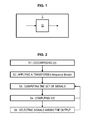
- FIG.1 shows a representation of a model of an electronic system 1, comprising a nonlinear block 10.
- Said nonlinear block 10 receives an input signal x(t) and transmits an output signal y(t).
- K is assumed to be higher or equal to 2.
- said coefficients a k are computed as a function of said parameters such as gain, IP2, IP3, P1dB, Psat.
- each x i (t) is defined as a band limited signal centered around a predefined frequency f i being anywhere on the frequency spectrum, including zero. This is a broader definition that an usual bandpass signal which generally has to satisfy the condition of a bandwidth much smaller than the frequency f i .
- the model of the electronic system is stored in a digital memory and a simulation of the electronic system based on the model is carried out by a computer which is programmed for executing the steps illustrated on FIG. 2 .
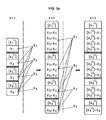
- FIG. 2 is a diagram illustrating different steps of a method according to a possible embodiment of the invention.
- the input signal is decomposed into said N elementary band pass signals x i (t), ..., x N (t).
- a second step S2 conversion of the input signal x(t) into the frequency domain is applied. Any kind of transformation from time-to frequency-domain can be applied, as long as information on the phase of the signal is preserved. Preferably, a Fourier transform is applied. As for the rest of the description, it will be referred to a Fourier transform for clarity sake.
- the input signal x(t) is converted into X(f), and the N elementary bandpass signals x i (t) are converted into X i (f).
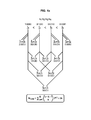
- step S3 signal sets [X ⁇ (k) ] are computed as follows.
- the set [X 2 (2) ] is comprised of X 2 (f)*X 2 (f), X 3 (f)*X 2 (f) and X 4 (f)*X 2 (f).
- This set [X 2 (2) ] does not include X 2 (f)*X 1 (f) which has already been calculated and included in the set [X 1 ( 2 )] as X 1 (f)*X 2 (f).
- each set [X ⁇ (k) ] is computed from signals taken from previously computed sets [xj (k-1) ], with j ⁇ i.
- signals generated from lower nonlinearities orders are used to compute the signals generated from a higher order, thus avoiding redundancy in computing operations.
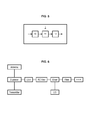
- FIG. 4a illustrates the generation of the frequencies after mixing signals, in case of four bandpass input signals and a second order of nonlinearity.
- FIG. 4b shows the construction of said sets of frequencies related to their set of signals of FIG. 3a .
- Y(f) is computed as a linear combination of signals from all the sets [X ⁇ (k) ], with 1 ⁇ i ⁇ N and 1 ⁇ k ⁇ K, from equation [4], by taking into account the multinomial coefficient k k 1 , ... , k N and the a k coefficients.
- Y(f) is not obtained through a transform into the frequency domain from y(t) but thanks to the evaluation of the sets [X i (f) (k) ]. Therefore, step S4 does not incorporate a time to frequency transform calculation even if step S4 enables to obtain the output Y(f) in the frequency domain.
- the output signal Y(f) is expressed as a sum of bandpass signals, say M bandpass signals, centered on a frequency which belongs to its respective set of frequencies.
- FIG. 5 is a schematic representation of an electronic system comprising two nonlinear blocks and one linear block. More precisely, the model of the electronic system 1 illustrated on FIG. 5 comprises a first nonlinear block 10, a second nonlinear block 11 and a third linear block 12.
- the nonlinear block 10 is identical to the nonlinear block 10 of FIG. 1 .
- the nonlinear block 11 is modelled in the same way, with its own coefficients a k .
- Blocks 10 and 11 are connected together so that the output signal Y(f) of block 10 is input into the next block 11.
- the M output bandpass signals from the first nonlinear block 10 becomes M input bandpass signals for the second nonlinear block 11
- the third and fourth steps S3 and S4 of the method of the invention are directly applied to block 11.
- a fifth step S5 the M output bandpass signals generated by the first block 10 are filtered so as to select only a reduced number of signals amongst the M output signals. This fifth step allows further limiting the number of computing operations.
- signals are filtered according to a predefined threshold or a special criterion (for instance by selecting particular signals of interest).
- step S5 consists in selecting all the signals having an intensity or a frequency above or below a predefined threshold.
- the special criterion is determined by the nature of the signal of interest, which can have low levels of amplitude.
- Blocks 11 and 12 are connected together so that the output signal Y(f) from block 11 is input into the next block 12.
- the P output bandpass signals from the second nonlinear block 11 becomes P input bandpass signals for the linear block 12.
- Said linear block 12 is modelled with its frequency response H(f).
- the output signal Y(f) of the linear block 12 is a linear function of the input signal X(f) and H(f). Consequently, the P input bandpass signals are turned into P output bandpass signals by the linear block 12.
- the linear block 12 does not interfere with the proposed method.
- a linear block 12 models a filter, which can be represented by its frequency response, said filter being limited in a certain range of frequencies.
- FIG.6 is a schematic representation of a receiver modelled as several blocks.
- the antenna is considered as a source generating the useful received signal and all the interfering signals (in-band and out-of-band blockers) that may appear in real wireless applications.
- the duplexer and the RF (radiofrequency) filter may be modeled as selective frequency attenuators if the RF filtering specifications must be determined or by the transfer function of bandpass filters already designed.
- the LNA Low Noise Amplifier
- the mixer is composed of three cascaded blocks: an input nonlinearity followed by an ideal multiplier and output nonlinearity.
- the local oscillator can generate a sinusoidal signal and its harmonics and phase noise with a frequency profile based on an already designed circuit or a new circuit that should be designed.
- the filter at the end of the chain is considered as a low-pass filter assuming a direct conversion (homodyne) receiver.
- the transmitter is a nonlinear block used to model the leakage of the relatively high power transmitter in a full duplex transceiver.
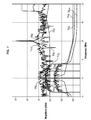
- FIG.7 is a diagram showing output signals obtained by applying an intermodulation test to the receiver of FIG. 6 .
- the intermodulation test measures the capacity of the receiver to reject intermodulation products resulting from two unwanted signals inside the interest band.
- Sig 1 is the useful signal and 9 other signals with a significant interfering contribution can be observed.
- the signal Sig 2 results from third order non-linearity of the LNA on two intermediate interfering signals; signals Sig 6 and Sig 7 spread over the useful signal Sig1 because of the LO phase noise; signals Sig 8 , Sig 9 , and Sig 10 represent the LO phase noise associated to signals Sig 3 , Sig 4 and Sig 5 respectively.
- the phase noise of the LO introduces significant amount of interference.
- the invention thus enables to identify the sources of non-linearity interference.
Landscapes
- Engineering & Computer Science (AREA)
- Computer Hardware Design (AREA)
- Physics & Mathematics (AREA)
- Theoretical Computer Science (AREA)
- General Engineering & Computer Science (AREA)
- Geometry (AREA)
- Evolutionary Computation (AREA)
- General Physics & Mathematics (AREA)
- Microelectronics & Electronic Packaging (AREA)
- Spectroscopy & Molecular Physics (AREA)
- Electromagnetism (AREA)
- Computer Networks & Wireless Communication (AREA)
- Signal Processing (AREA)
- Mobile Radio Communication Systems (AREA)
Abstract
The invention relates to a method for simulating an electronic system based on a model of the electronic system comprising at least one nonlinear block, said block receiving an input signal x(t) and generating an output signal y(t) as a K-order polynomial of signal x(t), K being higher or equal to 2, said method comprising steps of :
a- (S1) decomposing the input signal x(t) into a number N of band-pass input signals, such that x(t) = x1(t)+x2(t)+...+xN(t), each band-pass input signal xi(t) being centered on a frequency fi,
b- (S2) computing of a Fourier transform Xi(f) for each band-pass input signals xi(t),
c- (S3) for k ranging from 2 to K, computing a set [Xi (k)] of k-order signals, by convolving the signal Xi(f) with each k-1th order signal of the set [Xj (k-1)], j ranging from i to N, starting from [Xj (1)] = Xj(f)(1) = Xj(f),
d- (S4) computing the output signal Y(f) as a linear combination of signals of the sets [Xi (k)], i ranging from 1 to N, k ranging from 1 to K, Y(f) being y(t) expressed in the frequency domain.
a- (S1) decomposing the input signal x(t) into a number N of band-pass input signals, such that x(t) = x1(t)+x2(t)+...+xN(t), each band-pass input signal xi(t) being centered on a frequency fi,
b- (S2) computing of a Fourier transform Xi(f) for each band-pass input signals xi(t),
c- (S3) for k ranging from 2 to K, computing a set [Xi (k)] of k-order signals, by convolving the signal Xi(f) with each k-1th order signal of the set [Xj (k-1)], j ranging from i to N, starting from [Xj (1)] = Xj(f)(1) = Xj(f),
d- (S4) computing the output signal Y(f) as a linear combination of signals of the sets [Xi (k)], i ranging from 1 to N, k ranging from 1 to K, Y(f) being y(t) expressed in the frequency domain.
Description
- The invention generally relates to computerized simulation of an electronic system, such as a radiofrequency transmitter or receiver, based on a model of such an electronic system, comprising one or more nonlinear blocks.
- The efforts of the electronic industry and amongst others the telecommunication industry are directed towards three main directions: 1) reducing size, power consumption and cost, 2) providing higher bit rate, 3) exploiting more efficiently the precious and limited spectrum resources in the case of a wireless technology.
- Understanding the environment of electronic systems helps designers to achieving optimal performances. In particular, optimizing transmitters or receivers is an inherent process of compromises between linearity and noise requirements.
- In an electronic system, it is generally hard to find the origin of certain signals generated by some blocks or components. In order to limit distortion or noise and find the best optimum, it is necessary to be able to precisely estimate the impact of each block on the signal of interest.
- The case of bandpass signals is at the heart of the challenge.
- Tracking mathematically all the nonlinear contributions of one block is a complex task. And with more than one block in cascade, the difficulty of the task exponentially increases.
- Moreover, according to a given model, the nonlinearities have different orders, which add complexities.
- Much of the modelling and simulation is run towards Excel calculation sheets to derive the specifications of the electronic system and to distribute them among its blocks using traditional system parameters (for the telecommunication: Gain, NF (Noise Figure), IP2 (second order interception point), IP3 (third order interception point), P1dB (1 dB compression point), Psat...
- One- and two-tone tests are applied to accomplish this simulation phase. Nevertheless, the equations are only valid in case of continuous wave signals being processed.
- System simulators, like ADS (developed by Agilent Technologies, now Keysight Technologies) and Spectre RF (developed by Cadence), are very efficient but they are time and memory consuming and most scenarios involving out-of-band blocking signals are extremely difficult to simulate.
- Besides, some of system simulators are not able to compute separately the contributions of all types of interferences, such contributions being necessary to determine the performance of each block in the whole chain.
- Other simulators operating in the frequency domain, as Genesys-Spectrasys from Agilent, are more adapted to dimension the electronic system. But they cannot handle bandpass modulated signals.
- Being able to evaluate the impact of nonlinearities on a signal and identifying the origin of distortions, noises, and interferences, is a noticing breakthrough in the field of electronic systems and especially the telecommunication systems.
- Mazen Abi Hussein and Corinne Berland have developed an advanced analytical method for simulating an electronic system.
- As mentioned previously the most difficult task in such a development is to keep mathematical signal traceability when several signals are processed through cascaded blocks, especially through two or more nonlinear blocks. Nonlinearities of the blocks are modelled with polynomial function and traditional parameters such as gain, NF, IP2, IP3, P1dB, Psat are used to characterize the electronic system.
- Among all nonlinear models, power series or polynomial models are the most widely used to simulate nonlinear systems, as they constitute a good compromise between complexity and accuracy. In case of "memoryless" systems, the output signal y(t) of a nonlinear block can be expressed as a function of the input signal x(t)as:

ak coefficients being real constants that can be determined experimentally on the real electronic system and K being a polynomial order of the block. - The input signal x(t) can be decomposed into a sum of a number N of passband signals:

each band-pass input signal xi(t) being centered on a predetermined frequency fi. - Combining equations [1] and [2], and rewriting y(t), after a mathematical treatment, as

- it can be shown that each term yk(t) produces

- Therefore, the output signal y(t) can be decomposed into a new set of bandpass signals which can be used as input signals for a next nonlinear block.
- Performing simulations in time domain using the above equation [3] can be computationally expensive since the number of bandpass signals generated increases exponentionnally with one block to the other, especially when high orders of nonlinearities are considered. Then, to lower the complexity, simulations are carried out in the frequency domain. The equivalent-frequency expression of the previous equation [3] is:

where
- According to equation [4], an important number of convolution products between the Xi(f) has to be run. As a consequence, the simulation process may be resource- and time-consuming.
- One aim of the invention is to provide a method for simulating an electronic system which necessitates a lower number of calculations and operations so as to save time and resources.
- To that aim, the invention provides a method for simulating an electronic system based on a model of the electronic system comprising at least one nonlinear block, said block receiving an input signal x(t) and generating an output signal y(t) as a K-order polynomial of signal x(t), K being higher or equal to 2, said method comprising steps of :
- a- decomposing the input signal x(t) into a number N of band-pass input signals, such that x(t) = x1(t)+x2(t)+...+xN(t), each band-pass input signal xi(t) being centered on a frequency fi,
- b- computing of a transform Xi(f) into the frequency domain for each band-pass input signals xi(t),
- c- for k ranging from 2 to K, computing a set [X¡(k)] of k-order signals, by convolving the signal Xi(f) with each (k-1)-order signal of the set [Xj (k-1)], j ranging from i to N, starting from [Xj (1)]=Xj(f),
- d- computing the output signal Y(f) as a linear combination of signals of the sets [X¡ (k)], i ranging from 1 to N, k ranging from 1 to K, Y(f) being y(t) expressed in the frequency domain.
- Step c allows minimizing the number of computing operations for determining the elementary signals of the sets [X¡(k)]. Indeed, the operations carried out for computing each k order elementary signal use results of the operations carried out at the previous iteration for computing the k-1 order elementary signals.
- Moreover, as the signal obtained at the output of each block is expressed as a sum of bandpass signals, the proposed method enables mathematically tracking noise and nonlinear interference contributions of each block of the model. In particular, it allows identifying input signals components generating noise and nonlinear interferences in the output signals.
- According to one embodiment of the invention, each signal of the set [X¡ (k)] is centered on one corresponding frequency of a set of frequencies [fi (k)], i ranging from 1 to N, k ranging from 1 to K, and the transform Y(f) of the output signal y(t) into the frequency domain is a linear combination of a number M of bandpass signals of the sets [X¡(k)], the set of frequencies [fi (k)] being equal to [fj (t-1)]±f¡, j ranging from i to N, i ranging from 1 to N, k ranging from 2 to K, starting from [f¡(1)]= f¡(1)= fi,
- According to one embodiment of the invention, the polynomial is defined as

- The coefficients ak may be computed as a function of specified parameters of the electronic system, such as gain, IP2, IP3, P1dB, Psat parameters.
- The electronic system may be a telecommunication system, such as a radiofrequency receiver or transmitter.
- The receiver or transmitter may be adapted to process modulated signals for radiocommunication systems.
- According to one embodiment of the invention, the model comprises at least two nonlinear blocks, including a first block and a second block, and steps c and d are applied to the second block using a number P of output bandpass signals from the first block as input bandpass signals for the second block.
- In particular, the method may comprise a step of selecting P signals having an amplitude higher than a predefined threshold amongst the M output signals of the first block or having a special interest, the P selected signals constituting the input signals for the second block.
- The model may also comprise a linear block modeled with a frequency response H(f), said block receiving an input signal X(f) and generating an output signal Y(f) as a linear function of X(f)) and H(f).
- The invention will be described with reference to the drawings, in which:
-
FIG.1 is a schematic representation of an electronic system comprising a single nonlinear block. -
FIG.2 is a diagram illustrating different steps of a method according to a possible embodiment of the invention. -
FIG.3a is a graphical representation of the signal sets, as implemented, with N=4 input bandpass signals and a third order nonlinearity (K=3). -
FIG.3b is a schematic representation of the step c) of the method. -
FIG. 4a is a representation of the frequencies of bandpass signals generated from a second order nonlinearity (K=2), with N=4 bandpass signals at the input. -
FIG. 4b is a graphical representation of the frequency sets as implemented, with N=4 input bandpass signals and a third order nonlinearity (K=3). -
FIG.5 is a schematic representation of an electronic system comprising two nonlinear blocks and one linear block. -
FIG.6 is a schematic representation of a receiver comprising several blocks. -
FIG. 7 is a diagram showing output signals from an intermodulation test. - A kth order of nonlinearities for a given signal means that the given signal is issued from a product of k band-pass input signals xi(t). Consequently, in the frequency domain, it means that the given signal is issued from a convolution product of k input signals Xi(f).
- For clarity reason, a "mixing" between two signals means hereby a convolution product.
- The invention applies to electronic systems in general, in so far as the electronic systems comprise nonlinear blocks. More precisely, the invention finds a useful application when it is needed to identify sources of distortions, noises and interferences. Tracking of nonlinearities is a major stake.
- The invention applies particularly to telecommunication system, such as radiofrequency receiver or transmitter. Besides, said receiver or transmitter is adapted to process modulated signals for radiocommunication systems such as 3G or 4G signals.
-
FIG.1 shows a representation of a model of anelectronic system 1, comprising anonlinear block 10. Saidnonlinear block 10 receives an input signal x(t) and transmits an output signal y(t). - Said
nonlinear block 10 is modelled as a K order polynomial function, which means that the output signal y(t) of saidnonlinear block 10 can be expressed as
electronic system 1. For a nonlinear block, K is assumed to be higher or equal to 2. - Typically, said coefficients ak are computed as a function of said parameters such as gain, IP2, IP3, P1dB, Psat.
- The input signal x(t) is modelled as a sum of a number N elementary bandpass signals as x(t) = xi(t) + ... + xN(t). Without any loss of generality, each xi(t) is defined as a band limited signal centered around a predefined frequency fi being anywhere on the frequency spectrum, including zero. This is a broader definition that an usual bandpass signal which generally has to satisfy the condition of a bandwidth much smaller than the frequency fi.
- The model of the electronic system is stored in a digital memory and a simulation of the electronic system based on the model is carried out by a computer which is programmed for executing the steps illustrated on
FIG. 2 . -
FIG. 2 is a diagram illustrating different steps of a method according to a possible embodiment of the invention. - According to a first step S1, the input signal is decomposed into said N elementary band pass signals xi(t), ..., xN(t).
- According to a second step S2, conversion of the input signal x(t) into the frequency domain is applied. Any kind of transformation from time-to frequency-domain can be applied, as long as information on the phase of the signal is preserved. Preferably, a Fourier transform is applied. As for the rest of the description, it will be referred to a Fourier transform for clarity sake. The input signal x(t) is converted into X(f), and the N elementary bandpass signals xi(t) are converted into Xi(f).
- The output signal y(t) is given, under its Fourier transform expression Y(f), by:

- According to step S3, signal sets [X¡(k)] are computed as follows.
- As illustrated on
FIG. 3a , each signal set [X¡(k)] is computed as a set of kth order signals by mixing Xi(f) with each signal of each set [X¡(k-1)], ..., [XN (f)(k-1)], k ranging from 2 to K and the sets being initialized by [X1 (1)] = [X1 (1)] = X1(f), ..., [XN (1)] = XN(f). -
FIG. 3a is a graphical representation of the signal sets computed for a number N=4 of input bandpass signals, and a third order nonlinearity (K=3). - For instance, it can be seen that the set [X2 (2)] is comprised of X2(f)*X2(f), X3(f)*X2(f) and X4(f)*X2(f). This set [X2 (2)] does not include X2(f)*X1(f) which has already been calculated and included in the set [X1(2)] as X1(f)*X2(f).
- The fact that each set [X¡(k)] is computed from signals taken from previously computed sets [xj(k-1)], with j≧i. In other words, signals generated from lower nonlinearities orders are used to compute the signals generated from a higher order, thus avoiding redundancy in computing operations.
- As illustrated on
FIG. 3b , computation of the sets [X¡(k)] starts from k=2 and i=1 and comprises calculating all the Xj(f)*X1(f) for j=1,...,N, then all the Xj(f)*X2(f) for j=2,...,N until Xj(f)*XN(f) for j=N. All the signal sets [X¡ (2)], i=1,... N, are thus calculated. Then, the next order sets is calculated by all the [Xj (2)] * Xi(f), for j=1,...N, and then [Xj (2)] X2(f), for j=2,...N, until [Xj (2)] XN(f), for j=N. At the Kth order, the signal sets calculated are [xj (K-1)] * X1(f), for j=1,...N, until [Xj (K-1)] *XN (f), for j=N. Thus, the computation of the [X¡ (k)] ends at k=K and i=N. - In other words, at the kth order of nonlinearity, every input signal Xi (f), i=1,...,N is mixed with all signals with a k-1th order of nonlinearity resulting from a previous mixing of Xi(f),...XN(f).
- We also denote the set of frequencies corresponding to [X¡ (k)] by [fi (k)] .
- When mixing two signals, for example say X1(f) and X2(f), centered on frequencies f1 and f2 respectively, the result is two bandpass signals centered on frequencies |f1±f2|, even if f1 and/or f2 is equal to zero.
- Thus, the sets of frequencies are known and set [fi (k)] is equal to [fj (k-1)]±fi, j ranging from i to N, i ranging from 1 to N, k ranging from 1 to K, starting from [f¡(1)]=f¡.
-
FIG. 4a illustrates the generation of the frequencies after mixing signals, in case of four bandpass input signals and a second order of nonlinearity.FIG. 4b shows the construction of said sets of frequencies related to their set of signals ofFIG. 3a . - According to a fourth step S4, Y(f) is computed as a linear combination of signals from all the sets [X¡(k)], with 1≤i≤N and 1≤k≤K, from equation [4], by taking into account the multinomial
coefficient 
- The output signal Y(f) is expressed as a sum of bandpass signals, say M bandpass signals, centered on a frequency which belongs to its respective set of frequencies.
-
FIG. 5 is a schematic representation of an electronic system comprising two nonlinear blocks and one linear block. More precisely, the model of theelectronic system 1 illustrated onFIG. 5 comprises a firstnonlinear block 10, a secondnonlinear block 11 and a thirdlinear block 12. - The
nonlinear block 10 is identical to thenonlinear block 10 ofFIG. 1 . Thenonlinear block 11 is modelled in the same way, with its own coefficients ak. -
Blocks block 10 is input into thenext block 11. The M output bandpass signals from the firstnonlinear block 10 becomes M input bandpass signals for the secondnonlinear block 11 - As the output signal Y(f) of the
first block 10 is a sum of the M output bandpass signals, the third and fourth steps S3 and S4 of the method of the invention are directly applied to block 11. - Besides, according to a fifth step S5, the M output bandpass signals generated by the
first block 10 are filtered so as to select only a reduced number of signals amongst the M output signals. This fifth step allows further limiting the number of computing operations. - Typically, signals are filtered according to a predefined threshold or a special criterion (for instance by selecting particular signals of interest).
- According to a first possibility, step S5 consists in selecting all the signals having an intensity or a frequency above or below a predefined threshold.
- According to a second possibility, the special criterion is determined by the nature of the signal of interest, which can have low levels of amplitude.
-
Blocks block 11 is input into thenext block 12. The P output bandpass signals from the secondnonlinear block 11 becomes P input bandpass signals for thelinear block 12. Saidlinear block 12 is modelled with its frequency response H(f). - By definition, the output signal Y(f) of the
linear block 12 is a linear function of the input signal X(f) and H(f). Consequently, the P input bandpass signals are turned into P output bandpass signals by thelinear block 12. - As a consequence, the
linear block 12 does not interfere with the proposed method. - Typically, a
linear block 12 models a filter, which can be represented by its frequency response, said filter being limited in a certain range of frequencies. -
FIG.6 is a schematic representation of a receiver modelled as several blocks. The antenna is considered as a source generating the useful received signal and all the interfering signals (in-band and out-of-band blockers) that may appear in real wireless applications. The duplexer and the RF (radiofrequency) filter may be modeled as selective frequency attenuators if the RF filtering specifications must be determined or by the transfer function of bandpass filters already designed. The LNA (Low Noise Amplifier) can be modeled as a nonlinear system. The mixer is composed of three cascaded blocks: an input nonlinearity followed by an ideal multiplier and output nonlinearity. The local oscillator can generate a sinusoidal signal and its harmonics and phase noise with a frequency profile based on an already designed circuit or a new circuit that should be designed. The filter at the end of the chain is considered as a low-pass filter assuming a direct conversion (homodyne) receiver. The transmitter is a nonlinear block used to model the leakage of the relatively high power transmitter in a full duplex transceiver. -
FIG.7 is a diagram showing output signals obtained by applying an intermodulation test to the receiver ofFIG. 6 . The intermodulation test measures the capacity of the receiver to reject intermodulation products resulting from two unwanted signals inside the interest band. - Sig1 is the useful signal and 9 other signals with a significant interfering contribution can be observed. For example, the signal Sig2 results from third order non-linearity of the LNA on two intermediate interfering signals; signals Sig6 and Sig7 spread over the useful signal Sig1 because of the LO phase noise; signals Sig8, Sig9, and Sig10 represent the LO phase noise associated to signals Sig3, Sig4 and Sig5 respectively. When interfering signals appear close to the useful signal Sig1, the phase noise of the LO introduces significant amount of interference.
- The invention thus enables to identify the sources of non-linearity interference.
Claims (10)
- A method for simulating an electronic system based on a model of the electronic system comprising at least one nonlinear block, said block receiving an input signal x(t) and generating an output signal y(t) as a K-order polynomial of signal x(t), K being higher or equal to 2, said method comprising steps of :a- (S1) decomposing the input signal x(t) into a number N of band-pass input signals, such that x(t) = x1(t)+x2(t)+...+xN(t), each band-pass input signal xi(t) being centered on a frequency fi,b- (S2) computing of a transform Xi(f) into the frequency domain for each band-pass input signal xi(t),c- (S3) for k ranging from 2 to K, computing a set [X¡ (k)] of k-order signals, by convolving the signal Xi(f) with each k-1th order signal of the set [xj (k-1)],j ranging from i to N, starting from [xj (1)]= Xj (1)=Xj(f),d- (S4) computing the output signal Y(f) as a linear combination of signals of the sets [X¡(k)], i ranging from 1 to N, k ranging from 1 to K, Y(f) being y(t) expressed in the frequency domain.
- The method according to claim 1, wherein each signal of the set [X¡ (k)] is centered on one corresponding frequency of a set of frequencies [fi (k)], i ranging from 1 to N, k ranging from 1 to K, and the Fourier transform Y(f) of the output signal y(t) is a linear combination of a number M of bandpass signals of the sets [X¡(k)], the set of frequencies [fi (k)] being equal to [fj (t-1)]±f¡, j ranging from i to N, i ranging from 1 to N, k ranging from 2 to K, starting from [f¡(1)]= f¡(1)= fi.
- The method according to one of claims 1 and 2, wherein the polynomial is defined as

- The method according to claim 3, wherein said coefficients ak are computed as a function of specified parameters of the electronic system, such as gain, IP2, IP3, P1dB and Psat parameters.
- The method according to claim 1, wherein the transform to the frequency domain is a Fourier transform.
- The method according to any of the preceding claims, wherein said electronic system is a telecommunication system, such as a radiofrequency receiver or transmitter.
- The method according to claim 6, wherein said receiver or transmitter is adapted to process modulated signals for radiocommunication systems.
- The method according to one of claims 1 to 7, wherein the model comprises at least two nonlinear blocks, including a first block and a second block, and wherein steps c and d are applied to the second block using a number M of output bandpass signals from the first block as input bandpass signals for the second block.
- The method according to claim 8, comprising a step of selecting signals having an amplitude higher than a predefined threshold amongst the M output signals of the first block or having a special interest, the selected signals constituting the input signals for the second block.
- The method according to one of claims 8 and 9, wherein the model further comprises a linear block modeled with a frequency response H(f), said block receiving an input signal X(f) and generating an output signal Y(f) as a linear function of X(f) and H(f).
Priority Applications (1)
| Application Number | Priority Date | Filing Date | Title |
|---|---|---|---|
| EP14305632.3A EP2940908A1 (en) | 2014-04-28 | 2014-04-28 | Method for simulating an electronic system based on a model comprising nonlinear blocks |
Applications Claiming Priority (1)
| Application Number | Priority Date | Filing Date | Title |
|---|---|---|---|
| EP14305632.3A EP2940908A1 (en) | 2014-04-28 | 2014-04-28 | Method for simulating an electronic system based on a model comprising nonlinear blocks |
Publications (1)
| Publication Number | Publication Date |
|---|---|
| EP2940908A1 true EP2940908A1 (en) | 2015-11-04 |
Family
ID=50774799
Family Applications (1)
| Application Number | Title | Priority Date | Filing Date |
|---|---|---|---|
| EP14305632.3A Withdrawn EP2940908A1 (en) | 2014-04-28 | 2014-04-28 | Method for simulating an electronic system based on a model comprising nonlinear blocks |
Country Status (1)
| Country | Link |
|---|---|
| EP (1) | EP2940908A1 (en) |
-
2014
- 2014-04-28 EP EP14305632.3A patent/EP2940908A1/en not_active Withdrawn
Non-Patent Citations (2)
| Title |
|---|
| KHALED M. GHARAIBEH: "Nonlinear distortion in wireless systems - Chapters 3,4", NONLINEAR DISTORTION IN WIRELESS SYSTEMS: MODELING AND SIMULATION WITH MATLAB, 6 December 2011 (2011-12-06), XP055135725, ISBN: 978-1-11-996173-4, Retrieved from the Internet <URL:http://onlinelibrary.wiley.com/book/10.1002/9781119961734> [retrieved on 20140821], DOI: 10.1002/9781119961734 * |
| SCHNEIDER K W ET AL: "EFFICIENT SIMULATION OF MULTICARRIER DIGITAL COMMUNICATION SYSTEMS IN NONLINEAR CHANNEL ENVIRONMENTS", IEEE JOURNAL ON SELECTED AREAS IN COMMUNICATIONS, IEEE SERVICE CENTER, PISCATAWAY, US, vol. 11, no. 3, 1 April 1993 (1993-04-01), pages 328 - 339, XP000377956, ISSN: 0733-8716, DOI: 10.1109/49.219548 * |
Similar Documents
| Publication | Publication Date | Title |
|---|---|---|
| US20140362949A1 (en) | Reduced bandwidth digital predistortion | |
| CN104580044A (en) | Pre-distortion processing method and system | |
| US20190028131A1 (en) | Compact model nonlinear compensation of bandlimited receiver systems | |
| Paireder et al. | Spline-based adaptive cancellation of even-order intermodulation distortions in LTE-A/5G RF transceivers | |
| Tripathi et al. | Power amplifier linearization in the presence of crosstalk and measurement noise in MIMO system | |
| US10409930B2 (en) | Techniques for improving swept sine analyses | |
| Corlay | A new method for the identification of a wiener-hammerstein model in a communication context | |
| CN118233031A (en) | A method for predicting the output spectrum of nonlinear and linear cascade systems in radio frequency links | |
| Landin et al. | RF PA modeling considering odd-even and odd order polynomials | |
| Bershad et al. | Stochastic analysis of the LMS algorithm for cyclostationary colored Gaussian and non-Gaussian inputs | |
| CN113472459B (en) | A Comprehensive Testing and Modeling Platform for Nonlinear Effects of Receiver RF Links | |
| US11881620B2 (en) | Method for decoupling signals in transceiver systems | |
| Giri et al. | Non-linear modeling of radio frequency impairments in software defined radio (sdr) | |
| Zeidan et al. | Phase-aware multitone digital signal based test for RF receivers | |
| German et al. | A multi-fidelity modelling approach for cosite interference analysis | |
| Viswanath et al. | IF estimation using higher order TFRs | |
| Sinkevich | Worst-case models of RF front-end nonlinearity for discrete nonlinear analysis of electromagnetic compatibility | |
| US9077300B1 (en) | Predistortion circuit with concave characteristic | |
| US20160233873A1 (en) | Device and method for converting analog information | |
| CN108427032A (en) | Inversion method when a kind of spectral decomposition method and frequency | |
| Constantinescu et al. | Large signal analysis of RF circuits–an overview | |
| US20060264187A1 (en) | Method for determining a model for an electrical network and use of the method | |
| Abi-Hussein et al. | Novel simulation approach for 3G W-CDMA receivers | |
| US20070033000A1 (en) | Efficient non-iterative frequency domain method and system for nonlinear analysis | |
| Dooley et al. | Behavioural modelling of rf power amplifiers using modified volterra series in the time domain |
Legal Events
| Date | Code | Title | Description |
|---|---|---|---|
| PUAI | Public reference made under article 153(3) epc to a published international application that has entered the european phase |
Free format text: ORIGINAL CODE: 0009012 |
|
| AK | Designated contracting states |
Kind code of ref document: A1 Designated state(s): AL AT BE BG CH CY CZ DE DK EE ES FI FR GB GR HR HU IE IS IT LI LT LU LV MC MK MT NL NO PL PT RO RS SE SI SK SM TR |
|
| AX | Request for extension of the european patent |
Extension state: BA ME |
|
| STAA | Information on the status of an ep patent application or granted ep patent |
Free format text: STATUS: THE APPLICATION IS DEEMED TO BE WITHDRAWN |
|
| 18D | Application deemed to be withdrawn |
Effective date: 20160505 |