EP2940470A1 - Apparatus and method for testing multi-function and drug response of centrifugal microfluidics-based platelets - Google Patents
Apparatus and method for testing multi-function and drug response of centrifugal microfluidics-based platelets Download PDFInfo
- Publication number
- EP2940470A1 EP2940470A1 EP13868176.2A EP13868176A EP2940470A1 EP 2940470 A1 EP2940470 A1 EP 2940470A1 EP 13868176 A EP13868176 A EP 13868176A EP 2940470 A1 EP2940470 A1 EP 2940470A1
- Authority
- EP
- European Patent Office
- Prior art keywords
- blood sample
- platelet
- drug
- disk
- sample
- Prior art date
- Legal status (The legal status is an assumption and is not a legal conclusion. Google has not performed a legal analysis and makes no representation as to the accuracy of the status listed.)
- Granted
Links
Images

Classifications
-
- G—PHYSICS
- G01—MEASURING; TESTING
- G01N—INVESTIGATING OR ANALYSING MATERIALS BY DETERMINING THEIR CHEMICAL OR PHYSICAL PROPERTIES
- G01N33/00—Investigating or analysing materials by specific methods not covered by groups G01N1/00 - G01N31/00
- G01N33/48—Biological material, e.g. blood, urine; Haemocytometers
- G01N33/50—Chemical analysis of biological material, e.g. blood, urine; Testing involving biospecific ligand binding methods; Immunological testing
- G01N33/5005—Chemical analysis of biological material, e.g. blood, urine; Testing involving biospecific ligand binding methods; Immunological testing involving human or animal cells
- G01N33/5008—Chemical analysis of biological material, e.g. blood, urine; Testing involving biospecific ligand binding methods; Immunological testing involving human or animal cells for testing or evaluating the effect of chemical or biological compounds, e.g. drugs, cosmetics
- G01N33/502—Chemical analysis of biological material, e.g. blood, urine; Testing involving biospecific ligand binding methods; Immunological testing involving human or animal cells for testing or evaluating the effect of chemical or biological compounds, e.g. drugs, cosmetics for testing non-proliferative effects
- G01N33/5029—Chemical analysis of biological material, e.g. blood, urine; Testing involving biospecific ligand binding methods; Immunological testing involving human or animal cells for testing or evaluating the effect of chemical or biological compounds, e.g. drugs, cosmetics for testing non-proliferative effects on cell motility
-
- G—PHYSICS
- G01—MEASURING; TESTING
- G01N—INVESTIGATING OR ANALYSING MATERIALS BY DETERMINING THEIR CHEMICAL OR PHYSICAL PROPERTIES
- G01N33/00—Investigating or analysing materials by specific methods not covered by groups G01N1/00 - G01N31/00
- G01N33/48—Biological material, e.g. blood, urine; Haemocytometers
- G01N33/483—Physical analysis of biological material
- G01N33/487—Physical analysis of biological material of liquid biological material
- G01N33/49—Blood
-
- B—PERFORMING OPERATIONS; TRANSPORTING
- B01—PHYSICAL OR CHEMICAL PROCESSES OR APPARATUS IN GENERAL
- B01F—MIXING, e.g. DISSOLVING, EMULSIFYING OR DISPERSING
- B01F33/00—Other mixers; Mixing plants; Combinations of mixers
- B01F33/30—Micromixers
-
- B—PERFORMING OPERATIONS; TRANSPORTING
- B01—PHYSICAL OR CHEMICAL PROCESSES OR APPARATUS IN GENERAL
- B01F—MIXING, e.g. DISSOLVING, EMULSIFYING OR DISPERSING
- B01F33/00—Other mixers; Mixing plants; Combinations of mixers
- B01F33/45—Magnetic mixers; Mixers with magnetically driven stirrers
- B01F33/452—Magnetic mixers; Mixers with magnetically driven stirrers using independent floating stirring elements
-
- B—PERFORMING OPERATIONS; TRANSPORTING
- B01—PHYSICAL OR CHEMICAL PROCESSES OR APPARATUS IN GENERAL
- B01F—MIXING, e.g. DISSOLVING, EMULSIFYING OR DISPERSING
- B01F35/00—Accessories for mixers; Auxiliary operations or auxiliary devices; Parts or details of general application
- B01F35/71—Feed mechanisms
- B01F35/717—Feed mechanisms characterised by the means for feeding the components to the mixer
- B01F35/71725—Feed mechanisms characterised by the means for feeding the components to the mixer using centrifugal forces
-
- B—PERFORMING OPERATIONS; TRANSPORTING
- B01—PHYSICAL OR CHEMICAL PROCESSES OR APPARATUS IN GENERAL
- B01L—CHEMICAL OR PHYSICAL LABORATORY APPARATUS FOR GENERAL USE
- B01L3/00—Containers or dishes for laboratory use, e.g. laboratory glassware; Droppers
- B01L3/50—Containers for the purpose of retaining a material to be analysed, e.g. test tubes
- B01L3/502—Containers for the purpose of retaining a material to be analysed, e.g. test tubes with fluid transport, e.g. in multi-compartment structures
- B01L3/5027—Containers for the purpose of retaining a material to be analysed, e.g. test tubes with fluid transport, e.g. in multi-compartment structures by integrated microfluidic structures, i.e. dimensions of channels and chambers are such that surface tension forces are important, e.g. lab-on-a-chip
- B01L3/502746—Containers for the purpose of retaining a material to be analysed, e.g. test tubes with fluid transport, e.g. in multi-compartment structures by integrated microfluidic structures, i.e. dimensions of channels and chambers are such that surface tension forces are important, e.g. lab-on-a-chip characterised by the means for controlling flow resistance, e.g. flow controllers, baffles or throttle valves
-
- G—PHYSICS
- G01—MEASURING; TESTING
- G01N—INVESTIGATING OR ANALYSING MATERIALS BY DETERMINING THEIR CHEMICAL OR PHYSICAL PROPERTIES
- G01N33/00—Investigating or analysing materials by specific methods not covered by groups G01N1/00 - G01N31/00
- G01N33/15—Medicinal preparations ; Physical properties thereof, e.g. dissolubility
-
- G—PHYSICS
- G01—MEASURING; TESTING
- G01N—INVESTIGATING OR ANALYSING MATERIALS BY DETERMINING THEIR CHEMICAL OR PHYSICAL PROPERTIES
- G01N33/00—Investigating or analysing materials by specific methods not covered by groups G01N1/00 - G01N31/00
- G01N33/48—Biological material, e.g. blood, urine; Haemocytometers
- G01N33/483—Physical analysis of biological material
- G01N33/487—Physical analysis of biological material of liquid biological material
- G01N33/49—Blood
- G01N33/491—Blood by separating the blood components
-
- G—PHYSICS
- G01—MEASURING; TESTING
- G01N—INVESTIGATING OR ANALYSING MATERIALS BY DETERMINING THEIR CHEMICAL OR PHYSICAL PROPERTIES
- G01N33/00—Investigating or analysing materials by specific methods not covered by groups G01N1/00 - G01N31/00
- G01N33/48—Biological material, e.g. blood, urine; Haemocytometers
- G01N33/50—Chemical analysis of biological material, e.g. blood, urine; Testing involving biospecific ligand binding methods; Immunological testing
- G01N33/5005—Chemical analysis of biological material, e.g. blood, urine; Testing involving biospecific ligand binding methods; Immunological testing involving human or animal cells
- G01N33/5008—Chemical analysis of biological material, e.g. blood, urine; Testing involving biospecific ligand binding methods; Immunological testing involving human or animal cells for testing or evaluating the effect of chemical or biological compounds, e.g. drugs, cosmetics
- G01N33/5044—Chemical analysis of biological material, e.g. blood, urine; Testing involving biospecific ligand binding methods; Immunological testing involving human or animal cells for testing or evaluating the effect of chemical or biological compounds, e.g. drugs, cosmetics involving specific cell types
-
- G—PHYSICS
- G01—MEASURING; TESTING
- G01N—INVESTIGATING OR ANALYSING MATERIALS BY DETERMINING THEIR CHEMICAL OR PHYSICAL PROPERTIES
- G01N35/00—Automatic analysis not limited to methods or materials provided for in any single one of groups G01N1/00 - G01N33/00; Handling materials therefor
- G01N35/08—Automatic analysis not limited to methods or materials provided for in any single one of groups G01N1/00 - G01N33/00; Handling materials therefor using a stream of discrete samples flowing along a tube system, e.g. flow injection analysis
-
- B—PERFORMING OPERATIONS; TRANSPORTING
- B01—PHYSICAL OR CHEMICAL PROCESSES OR APPARATUS IN GENERAL
- B01L—CHEMICAL OR PHYSICAL LABORATORY APPARATUS FOR GENERAL USE
- B01L2300/00—Additional constructional details
- B01L2300/08—Geometry, shape and general structure
- B01L2300/0803—Disc shape
-
- B—PERFORMING OPERATIONS; TRANSPORTING
- B01—PHYSICAL OR CHEMICAL PROCESSES OR APPARATUS IN GENERAL
- B01L—CHEMICAL OR PHYSICAL LABORATORY APPARATUS FOR GENERAL USE
- B01L2300/00—Additional constructional details
- B01L2300/08—Geometry, shape and general structure
- B01L2300/0861—Configuration of multiple channels and/or chambers in a single devices
- B01L2300/087—Multiple sequential chambers
-
- B—PERFORMING OPERATIONS; TRANSPORTING
- B01—PHYSICAL OR CHEMICAL PROCESSES OR APPARATUS IN GENERAL
- B01L—CHEMICAL OR PHYSICAL LABORATORY APPARATUS FOR GENERAL USE
- B01L2300/00—Additional constructional details
- B01L2300/08—Geometry, shape and general structure
- B01L2300/0861—Configuration of multiple channels and/or chambers in a single devices
- B01L2300/0883—Serpentine channels
-
- B—PERFORMING OPERATIONS; TRANSPORTING
- B01—PHYSICAL OR CHEMICAL PROCESSES OR APPARATUS IN GENERAL
- B01L—CHEMICAL OR PHYSICAL LABORATORY APPARATUS FOR GENERAL USE
- B01L2400/00—Moving or stopping fluids
- B01L2400/04—Moving fluids with specific forces or mechanical means
- B01L2400/0403—Moving fluids with specific forces or mechanical means specific forces
- B01L2400/0409—Moving fluids with specific forces or mechanical means specific forces centrifugal forces
-
- B—PERFORMING OPERATIONS; TRANSPORTING
- B01—PHYSICAL OR CHEMICAL PROCESSES OR APPARATUS IN GENERAL
- B01L—CHEMICAL OR PHYSICAL LABORATORY APPARATUS FOR GENERAL USE
- B01L2400/00—Moving or stopping fluids
- B01L2400/06—Valves, specific forms thereof
- B01L2400/0677—Valves, specific forms thereof phase change valves; Meltable, freezing, dissolvable plugs; Destructible barriers
-
- G—PHYSICS
- G01—MEASURING; TESTING
- G01N—INVESTIGATING OR ANALYSING MATERIALS BY DETERMINING THEIR CHEMICAL OR PHYSICAL PROPERTIES
- G01N35/00—Automatic analysis not limited to methods or materials provided for in any single one of groups G01N1/00 - G01N33/00; Handling materials therefor
- G01N2035/00178—Special arrangements of analysers
- G01N2035/00237—Handling microquantities of analyte, e.g. microvalves, capillary networks
-
- G—PHYSICS
- G01—MEASURING; TESTING
- G01N—INVESTIGATING OR ANALYSING MATERIALS BY DETERMINING THEIR CHEMICAL OR PHYSICAL PROPERTIES
- G01N35/00—Automatic analysis not limited to methods or materials provided for in any single one of groups G01N1/00 - G01N33/00; Handling materials therefor
- G01N35/00029—Automatic analysis not limited to methods or materials provided for in any single one of groups G01N1/00 - G01N33/00; Handling materials therefor provided with flat sample substrates, e.g. slides
- G01N35/00069—Automatic analysis not limited to methods or materials provided for in any single one of groups G01N1/00 - G01N33/00; Handling materials therefor provided with flat sample substrates, e.g. slides whereby the sample substrate is of the bio-disk type, i.e. having the format of an optical disk
Definitions
- the invention relates to an apparatus and method for testing drug response of a platelet and in particular to an apparatus and method for testing a multifunction and a drug response of a platelet based on a centrifugal microfluidics such that various test can be carried out automatically with a small amount of blood using microfluidics on a disposable rotating disk for early diagnosis of thrombotic ischemia and bleeders' disease.
- Thrombosis is the formation of a hemostasis or a blood clot inside a blood vessel.
- Thrombosis in coronary artery of the heart or cerebrovascular part causes a heart attack or cerebral infarction.
- Thrombosis referred to as silent killer is becoming the main cause of death for our contemporaries.
- the problem is that thrombosis or bleeding disease is not caused by genetic defect only and cause thereof is not discovered clearly.
- thrombosis prevalence rate is fast increasing due to genetic defect and acquired factors. Therefore, an apparatus and method have been required to make a quantitative test for thrombosis or bleeding disease and to carry out an early diagnosis and prognosis decision.
- a platelet function test is an important test to discern bleeding disorders which are caused by a congenital or acquired disorder of platelet function in case of the bleeding disorders having no numerical platelet disorder. Also, this platelet function test is being used to examine an increase of hemorrhage tendency or a drug-tolerance which is caused by antiplatelet agent used for the treatment or prevention of cardiovascular disorders.
- an inner material in the endothelioid such as collagen is exposed to the blood and a platelet is attached to the material and is activated. Attachment mechanism of platelet has different characteristics depending on blood flow conditions.
- vWF von Willebrand factor
- an attached platelet induces an aggregation by attracting the same kind of platelet and leads to hemostasis. Then, hemostasis is reinforced by fibrin.
- platelet is not always favorable, but can produce adverse effect in a certain flow condition or situation. For example, when the blood vessel wall became narrow locally by artery hardening, a platelet passing through this narrow part is exposed to a high shear ratio and is activated, and then adhesion and aggregation occurs in the rear of the narrow part and leads to thrombosis which blocks the blood vessel.
- a platelet and vWF are activated by the size of a blood flow, i.e., a shear stress the flow, thereby leading to the increase of an adhesive property and the generation of hemostasis. It is known that the shear stress required for the activation of a platelet or vWF is at least 8 Pa and the shear rate is at least 5,0001/s.
- various devices are suggested and developed for an early diagnosis and prognosis test of hemostasis or bleeding disease and they can be divided into an electric method, an optical method, a time measuring method to stop bleeding, etc., based on the measuring sensor.
- a bleeding time (BT) method was developed about 100 years ago which measures a bleeding time and is still being used for a screening test of a platelet function.
- BT bleeding time
- a current platelet function test has problems such as a difficult standardization, a low diagnostic validity and a use of invasive technique and therefore an objectified measuring method to measure a platelet function has been required.
- a platelet function analyzer (e.g.: PFA-100) which is being used to measure a platelet function.
- PFA-100 a platelet function analyzer
- This analyzer uses a feature that a platelet is aggregated by activated vWF in a high shear rate.
- vWF vWF
- a platelet aggregates in an orifice coated by ADP or epinephrine together with collagen and then time by which the orifice is blocked is measure by pressure, flow rate, etc.
- This platelet function test strictly depends on the function of vWF.
- This test has disadvantages that the test depends on hematocrit (Hct) and an antiplatelet test such as a test using aspirin or clopidogrel is not possible. Also, disadvantageously, two step tests are required for the function test of platelet and cost for the test is increasing.
- vWF vWF
- PFA-100 uses a method for making blood flow at high speed in a long capillary tube.
- this method requires a large quantity of blood.
- vWF is not activated at the center of the capillary tube where a shear rate is minimum while vWF is activated near the tube wall where a shear rate is maximum, thereby a repeatability of test results is not guaranteed.
- IMPACT of Diamed Co., Ltd. Uses a rotation-type Couette flow in the form of Cone-Plate.
- a uniform shear stress is applied to the blood contained therein and an attachment degree of platelet is measured when a high shear stress is applied.
- this method has a disadvantage that it depends too much on the concentration and function of fibrinogen and vWF.
- Verify-NOW uses a method to measure an aggregation degree of platelet by a turbidity using a optical sensor.
- an agonist is mixed with blood and then a microbead on which collagen is coated is reacted so that a platelet in the blood is aggregated. Then, turbidity is measured over time. The frequency of use this method is being increased recently, but this method still has disadvantages of prior methods to measure a turbidity.
- An object of the present invention is to solve the above problems and the present invention provides an apparatus and method for testing multifunction and drug-response of a platelet based on a centrifugal microfluidics by which it is possible to make a multiple test including early diagnosis and prognosis of bleeding disease and thrombosis with a single test, thereby saving test costs and increasing a repeatability and an accuracy of test.
- Another object of the present invention is to provide an apparatus and method for testing multifunction and drug-response of a platelet based on a centrifugal microfluidics by which a closure time of a blood flow can be measured automatically.
- the invention provides an apparatus for testing a multifunction and a drug response of a platelet based on a centrifugal microfluidics comprising: a rotatable disk; a sample chamber which is located in the center of the disk and which contains a blood sample therein; stirring chambers which are connected to the sample chamber in a radial direction, respectively and which induce a shear flow in the blood sample; microchannels which are connected to the stirring chambers and in which aggregation and adhesion of a platelet occur during a migration of the blood sample; and waste sample chambers to receive the blood sample which passed the microchannels.
- the apparatus according to the invention further comprises a measuring part which is installed on the disk and which measures a migration distance of the blood sample.
- a stirrer is rotatably installed in the stirring chamber.
- the stirrer is shaped in the form chosen from a straight cylindrical bar, a cross cylindrical bar and a circular plate.
- a drug which activates or inactivates an aggregation of a platelet is contained in the stirrer in a liquid or solid state.
- the drug is at least one agonist chosen from collagen, adenosine diphosphate (ADP) and epinephrine.
- the drug is at least one antagonist chosen from aspirin, P2Y1 receptor antagonist and P2Y12 receptor antagonist.
- the P2Y1 receptor antagonist is at least one chosen from MRS 2179, MRS 2279, MRS 2500, A2P5P, A3P5P and A3P5PS.
- the P2Y12 receptor antagonist is at least one chosen from clopidogrel, ticlopidine, prasugrel, AR-C67085MX, cangrelor, C1330-7, MRS 2395 and 2-methylthioadenosine-5'-monophosphate.
- a minimum shear rate in the shear flow generated by the stirrer is at least 5,000 (s -1 ) or a minimum shear stress is at least 8 Pa.
- a center and both sides of the stirrer are open and the open portion is provided with a seal.
- the seal is a phase-change material or an aqueous membrane.
- phase-change material is paraffin wax and the aqueous membrane is starch.
- a microfluidic valve is installed in the front part of the microchannel to control the flow of the blood sample.
- the microchannel is shaped in the form of at least one of a straight line, a curve or a zigzag, or the combination thereof.
- a plurality of the intermediate chambers is formed at a plurality of points in the straight channel.
- the microchannel is provided with a plurality of expansion parts which are relatively wide.
- the invention provides an apparatus for testing a multifunction and a drug response of a platelet based on a centrifugal microfluidics comprising: a rotatable disk; stirring chambers which are arranged on the center of the disk circumferentially, which contain a blood sample, respectively and which induce shear flow in the blood sample; microchannels which are connected to the stirring chambers and in which aggregation and adhesion of a platelet occur during a migration of the blood sample; and waste sample chambers to receive the blood sample which passed through the microchannels.
- the invention provides a method for testing a multifunction and a drug response of a platelet based on a centrifugal microfluidics comprising the following steps: introducing a blood sample; entering the blood sample into a stirring chamber and discharging a drug into the stirring chamber by the rotation of a stirrer in the stirring chamber; rotating a disk on which a stirring chamber is installed; migrating the blood sample through a microchannel and stopping the blood sample by an aggregation of a platelet; and stopping the disk and measuring a migration degree of the blood sample.
- the invention provides a method for testing a multifunction and a drug response of a platelet based on a centrifugal microfluidics comprising the following steps: introducing a blood sample; rotating a disk into which the blood sample was introduced; migrating the blood sample discharged through a microchannel and stopping the blood sample by an aggregation of a platelet; and stopping the disk and measuring a migration degree of the blood sample.
- a driving device to migrate blood such as a vacuum pump, etc., is not needed, but is replaced with the use of a centrifugal force.
- elements which will be in contact with blood can be made of disposable and be discarded after use. Therefore, it is easy to use and avoid a blood-borne infection.
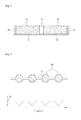
- Fig. 1 shows an arrangement of an apparatus for testing multi-function and drug response of a platelet based on a centrifugal microfluidics according to one embodiment of the invention.
- Fig. 2 shows a process of the blood sample according to one embodiment of the invention.
- Fig. 3 shows an inner part of a stirrer according to one embodiment of the invention.
- the apparatus for testing multi-function and drug response of platelet based on a centrifugal microfluidics comprises a rotatable disk 10; a sample chamber 20 which is located at the center of the disk and which contains a blood sample therein; stirring chambers 30 which are connected to the sample chamber in a radial direction, respectively and which introduce a shear flow in the blood sample; microchannels 40 which are connected to the stirring chambers 30 and in which adhesion and aggregation of platelet occur; and waste sample chambers 24 which receive the blood sample which passed through the microchannels 40.
- the microchannel 40 may have a cross section which is in the form of a polygon such as a rectangle, a circle or an oval.
- a cross section of a square the length of a side may be in the range of 1 to 1,000 ⁇ m, preferably 10 to 200 ⁇ m, more preferably 20 to 50 ⁇ m.
- the diameter may have the same dimension range as above.
- the blood sample migrates in a radial direction by a centrifugal force.
- the migration distance of the sample differs depending on the aggregation and adhesion of a platelet and the relative aggregation and adhesion of a platelet are measured by the difference of the migration distances.
- Fig. 1 represents one embodiment of the invention.
- a plurality of stirring chambers 30 is disposed circumferentially with respect to one blood sample chamber 10.
- Each stirring chamber 30 contains a specific test drug and various tests for a drug response can be performed with a single test.
- the measurement of the migration distance of a blood sample is carried out by a measuring part 50 disposed on the disk 10.
- the measuring part 50 may be configured as a micro camera to obtain and analyze an image or may be configured as the combination of sensors such as a photodiode sensor and LED at a specific location to measure the migration distance of a blood sample
- a blood sample is supplied to the sample chamber 20 and then the blood sample is introduced into the stirring chamber 30 by means of a connection channel 22.
- a microfluidic valve 42 is installed in the front part of the microchannel 40. Then, the blood sample is introduced into a waste sample chamber 24 through the microchannel 40.
- a stirrer 32 is rotatably installed in the stirring chamber 30 to stir the blood sample.
- the stirrer 32 may rotate in a non-contact manner such as a magnetic force and may effectively generate a stirring and a shear flow by the control of rpm.
- the stirrer 32 may have various shapes such as a straight cylindrical bar which is being used generally, a cross cylindrical bar or a circular plate, etc.
- a stirring as well as a shear flow depending on rpm occur in the stirring chamber 30.
- the shear flow can be an intermittent shear flow for a straight cylindrical bar or can be a continuous shear flow for a circular plate.
- the stirrer 32 can be made of a thin metal such that it can be magnetized by the magnetic force of a separate a stir-inducing device (not shown) and be influenced without a mechanical connection.
- the diameter or thickness of the stirrer 32 may be half of the depth of the stirring chamber 30 and the length or diameter of the stirrer 32 may be 80 to 90 % of the diameter of the stirring chamber 30.
- the drug 34 to activate or inactivate the aggregation of a platelet is stored in the stirrer 34 in a liquid state or a solid state. That is, the stirrer 32 can be hollow and the drug in liquid form or in particle powder form can be stored in the stirrer 34.
- the center and both sides of the stirrer 32 are open and the open portion is provided with a seal 36.
- the seal 36 can be a phase-change material such as paraffin wax or an aqueous membrane such as starch. Paraffin wax changes a phase from solid to liquid when it is exposed to a predetermined temperature and the sealing of the stirrer 32 is removed. At this time, the drug 34 in the stirrer 32 is discharged into the stirring chamber 30 by a centrifugal force. Also, starch melts easily when it is exposed to blood and the sealing is removed so that the drug 34 is discharged into the stirring chamber 30.
- the application of a laser or an electromagnetic wave to the seal 36 causes the phase-change material to be heated and melt away, so that the seal is removed.
- the rotation of the stirrer 32 to facilitate the melting in the blood causes the seal to be removed so that the drug 34 in the stirrer 34 is discharged.
- a centrifugal force by the rotation of the stirrer 32 can be a main driving force.
- the minimum shear rate by the rotation of the stirrer 32 is at least 5,000 (s -1 ) or that the minimum shear stress is at least 8 Pa. Also, it is preferable that the time for which the blood sample is exposed to the shear flow field is at least 30 seconds. This is to achieve a sufficient activation of a platelet and von Willebrand factor (vWF) by using the shear rate.
- vWF von Willebrand factor
- the drug 34 which is filled in the stirrer 32 may be an agonist which activates aggregation of a platelet such as adenosine diphosphate (ADP), epinephrine, etc., an antagonist which deactivates aggregation or adhesion of a platelet, or the combination thereof.
- ADP adenosine diphosphate
- epinephrine epinephrine
- the drug 34 can be filled in the stirrer 32 in the form of liquid and liquid and in the form of liquid and solid, respectively and it can be divided into separate spaces and stored therein. Moreover, when the drug 34 is filled in the form of solid only, fine particles can be mixed each other and stored.
- the drug 34 is discharged from the stirrer 32 and then is introduced into a blood sample, the drug is mixed uniformly by the rotation of the stirrer 32 and a platelet response by the drug 34 occurs.
- the drug is an agonist, the aggregation of a platelet is facilitated such that big aggregates are formed.
- the rotating device (not shown) connected to the disk 10 which comprises the stirring chamber 30, the microchannel 40, etc. begins to rotate gradually and rotates at a predetermined rpm.
- the blood sample contained in the stirring chamber 30 tries to be discharged in a radial direction by a centrifugal force.
- the stirring chamber is clogged with a seal 36 such as a phase-change material and therefore, the flow is prevented.
- heat is transferred to the phase-change material by means of an electromagnetic wave, a laser or other heating means, a flow path is opened and then the blood sample migrates in a radial direction.
- a mixing of the drug 34 and a shear stirring are completed, the microfluidic valve 42 is opened and the disk 10 rotates. At this time, a force is applied to blood sample in a radial direction by a centrifugal force of the rotation and the blood sample migrates along the microchannel 40.
- a migration speed of the blood sample which reacted with the drug 34 differs depending on the aggregation degree of a platelet and hence, a migration distance differs. Based on these features, a drug-response test for a platelet is carried out.
- the intermediate chamber 44 is formed at a plurality of points in the straight channel. The intermediate chamber 44 decreases a flow rate of the blood sample to induce aggregation of a platelet and facilitates the clogging of the aggregated platelet when the aggregated platelet enters into the microchannel 40 again.
- the blood migration degree can be determined depending on the drug-response degree of blood. That is, the blood sample which responds well to an agonist forms a number of big platelet aggregates and this aggregates cause a substantial flow resistance to the microchannel 40 to decrease the migration ratio of the blood to control group.
- the blood sample which does not respond well to an agonist has a low degree of platelet aggregation and thus the migration distance of blood can be increased significantly such that the blood sample can migrate to the lower course by a centrifugal force.
- the migration degree of blood sample which is mixed with a drug 34 can be compared with the migration distance of control group to measure the migration ratio.
- microchannel 40 is located downstream from the stirring chamber 30 and the microchannel is arranged in a radial direction in the form of a straight line, a curve or a zigzag, or the combination thereof, as shown in Fig. 1 .
- the microchannel 40 can be arranged in the form of a straight line channel.
- the microchannel is provided with an expansion part 46 which is relatively wide to decrease the flow rate of blood sample and to increase the aggregation and adhesion of a platelet. If the expansion part 46 is arranged appropriately in the middle of the microchannel, the blood sample will have features that it migrates with a pulsed pressure and a shear stress and the flow in the body can be simulated.
- the microchannel 40 connected to the expansion part 46 may describe a stenosis in the blood vessel.
- the expansion part 46 has a surface on which an agonist is coated to increase the adhesion of a platelet such that the migration degree of blood can be discriminated more easily.
- the blood sample which passed through the microchannel 40 is collected at the waste sample chamber 24.
- an agonist such as collagen, ADP, epinephrine, etc. may be used to facilitate the adhesion of a platelet, or an antagonist such as aspirin, P2Y1 receptor antagonist, P2Y12 receptor antagonist, etc. may be used to interrupt or restrain the aggregation of a platelet.
- P2Y1 receptor antagonist may be chosen from at least one of MRS 2179, MRS 2279, MRS 2500, A2P5P, A3P5P, A3P5PS, etc.
- P2Y12 receptor antagonist may be chosen from at least one of clopidogrel, ticlopidine, prasugrel, AR-C67085MX, cangrelor, C1330-7, MRS 2395, 2-methylthioadenosine-5'-monophosphate, etc.
- the aggregation function of the platelet and the resistance to the drugs can be measured by the test apparatus according to the invention.
- blood from a normal person or a taker who took aspirin and clopidogrel is collected in citrated tubes. Then, 50 to 100 microliter of whole blood is taken and is reacted at 37°C for 10 to 30 minutes using optimum concentration of ADP, prostaglandin E, fibrinogen and arachidonic acid, respectively. After the reaction, blood is migrated in the microchannel by the application of a centrifugal force. If the function of platelet is normal, the flow path in the microchannel is clogged in a short time and then the flow is stopped or the migration distance is short. On the contrary, if the function of platelet is abnormal, the time for clogging is lengthened or the migration distance is increased compared to when the function of a platelet is normal.
- the aggregation function of platelet is decreased. Therefore, the flow path in the microchannel is not clogged easily so that the clogging time is increased and the migration distance is also increased. Since a normal person reacts to the drug well, the clogging time is short. If the ratio of the clogging time is decreased remarkably compared to a normal person, it is determined to be the drug tolerance to aspirin and clopidogrel.
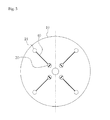
- Fig. 5 shows an arrangement of an apparatus for testing a multi-function and a drug response of a platelet based on a centrifugal microfluidics according to another embodiment of the present invention.
- the stirring chamber 30 also functions as a sample chamber to contain blood sample. That is, the stirring chamber in this embodiment is configured to act as both the sample chamber 20 and the stirring chamber 30 in Fig. 1 .
- the number of the stirring chamber 30 is not limited to four as shown in the figure.
- a plurality of stirring chambers 30 and microchannels 40 having the same number of the stirring chambers can be provided to enable a test for a plurality of blood samples.
- a plurality of stirring chambers 30 can be arranged circumferentially on the center of the disk 10 and blood samples introduced into each stirring chamber 30 can migrate radially, respectively.
- microchannel 40 may have at least one of a straight shape, a curved shape, zigzags shape, etc., or the combination thereof.
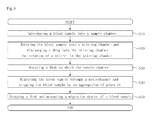
- Fig. 6 is a flow diagram of a method for testing a multi-function and a drug response of a platelet based on a centrifugal microfluidics according to one embodiment of the present invention.
- a tester introduces a blood sample collected by venipuncture into the sample chamber 20 (S10). Then, the blood sample is introduced into a stirring chamber 30 through the connection channel 22 connected to the sample chamber 20 and the stirrer 32 in the stirring chamber 30 rotates by an electromagnetic force such that the drug 34 in the stirrer 32 is discharged and is mixed with the blood sample (S20).
- the fast rotation at a specific rpm enables the activation of platelet and von Willebrand factor (vWF). If not for the mechanical activation test, the rotation can be carried out at a predetermined speed during a predetermined time for the purpose of stirring the drug and the blood sample.
- vWF von Willebrand factor
- the disk 10 on which the sample chamber 20 is installed rotates (S30). Thereafter, if the microfluidic valve 42 is opened, the blood sample migrates downstream through the microchannel 40.
- the migration rate and distance differ depending on the aggregation degree and the adhesion degree and the blood sample stops or migrates to the end (S40).
- the disk 10 stops and the migration degree of the sample is measured by a measuring part 50 such as a video device, a light source and a light-detecting sensor, etc. (S50).
- a measuring part 50 such as a video device, a light source and a light-detecting sensor, etc.
- a platelet can be activated with a high shear flow of blood by a centrifugal force.
- the rotation speed is increased to a predetermined value while the microfluidic valve 42 is being closed after the blood sample is introduced. Thereafter, if the microfluidic valve 42 is opened, a high shear flow occurs through the microchannel 40.
- a platelet which is activated therethrough reacts to a drug such as an agonist which is coated on the expansion part 46 or a specific portion. This reaction causes the aggregation and adhesion which results in the interruption of the progress of flow.
- a drug response test can be carried out by the migration ratio of the sample flow, the time to reach the end of the microchannel 40, etc.
Landscapes
- Health & Medical Sciences (AREA)
- Life Sciences & Earth Sciences (AREA)
- Chemical & Material Sciences (AREA)
- Engineering & Computer Science (AREA)
- Biomedical Technology (AREA)
- Hematology (AREA)
- Immunology (AREA)
- Physics & Mathematics (AREA)
- General Health & Medical Sciences (AREA)
- Analytical Chemistry (AREA)
- Molecular Biology (AREA)
- Chemical Kinetics & Catalysis (AREA)
- Urology & Nephrology (AREA)
- Pathology (AREA)
- Biochemistry (AREA)
- General Physics & Mathematics (AREA)
- Food Science & Technology (AREA)
- Medicinal Chemistry (AREA)
- Cell Biology (AREA)
- Biophysics (AREA)
- Bioinformatics & Cheminformatics (AREA)
- Ecology (AREA)
- Microbiology (AREA)
- Tropical Medicine & Parasitology (AREA)
- Biotechnology (AREA)
- Toxicology (AREA)
- Dispersion Chemistry (AREA)
- Clinical Laboratory Science (AREA)
- Pharmacology & Pharmacy (AREA)
- Investigating Or Analysing Biological Materials (AREA)
- Automatic Analysis And Handling Materials Therefor (AREA)
Abstract
Description
- The invention relates to an apparatus and method for testing drug response of a platelet and in particular to an apparatus and method for testing a multifunction and a drug response of a platelet based on a centrifugal microfluidics such that various test can be carried out automatically with a small amount of blood using microfluidics on a disposable rotating disk for early diagnosis of thrombotic ischemia and bleeders' disease.
- Thrombosis is the formation of a hemostasis or a blood clot inside a blood vessel. Thrombosis in coronary artery of the heart or cerebrovascular part causes a heart attack or cerebral infarction. Thrombosis referred to as silent killer is becoming the main cause of death for our contemporaries. The problem is that thrombosis or bleeding disease is not caused by genetic defect only and cause thereof is not discovered clearly.
- More seriously, thrombosis prevalence rate is fast increasing due to genetic defect and acquired factors. Therefore, an apparatus and method have been required to make a quantitative test for thrombosis or bleeding disease and to carry out an early diagnosis and prognosis decision.
- There are many factors which play roles in hemostasis at vascular injury sites. All of biochemical and biological mechanism of each factor play a critical role and hemostasis of a platelet plays the most crucial role. A platelet is not attached to the arterial walls at no injury sites, but biochemical and biological mechanism is activated at vascular injury sites, thereby hemostasis is achieved regardless of flow conditions.
- Many method and devices have been developed to subdivide and test a platelet function. A platelet function test is an important test to discern bleeding disorders which are caused by a congenital or acquired disorder of platelet function in case of the bleeding disorders having no numerical platelet disorder. Also, this platelet function test is being used to examine an increase of hemorrhage tendency or a drug-tolerance which is caused by antiplatelet agent used for the treatment or prevention of cardiovascular disorders.
- If there is an injury at endothelioid cells in the blood vessel, an inner material in the endothelioid such as collagen is exposed to the blood and a platelet is attached to the material and is activated. Attachment mechanism of platelet has different characteristics depending on blood flow conditions.
- In particular, if a blood flow rate is high in the artery and a shear stress applied to the blood vessel wall is high, platelet is not attached to the inner membrane of the blood vessel easily. In this condition, von Willebrand factor (vWF) is activated and is easily attached to the wall of the blood vessel and a platelet is attached to the wall of the blood vessel by vWF. Of course, it is known that a glycoproteic receptor complex such as GPIb-IX-V which is contained in the platelet cell membrane induces the reaction with vWF, leading to the attachment.
- As such, an attached platelet induces an aggregation by attracting the same kind of platelet and leads to hemostasis. Then, hemostasis is reinforced by fibrin.
- However, the function of platelet is not always favorable, but can produce adverse effect in a certain flow condition or situation. For example, when the blood vessel wall became narrow locally by artery hardening, a platelet passing through this narrow part is exposed to a high shear ratio and is activated, and then adhesion and aggregation occurs in the rear of the narrow part and leads to thrombosis which blocks the blood vessel.
- As explained above, a platelet and vWF are activated by the size of a blood flow, i.e., a shear stress the flow, thereby leading to the increase of an adhesive property and the generation of hemostasis. It is known that the shear stress required for the activation of a platelet or vWF is at least 8 Pa and the shear rate is at least 5,0001/s.
- As such, various devices are suggested and developed for an early diagnosis and prognosis test of hemostasis or bleeding disease and they can be divided into an electric method, an optical method, a time measuring method to stop bleeding, etc., based on the measuring sensor.
- A bleeding time (BT) method was developed about 100 years ago which measures a bleeding time and is still being used for a screening test of a platelet function. However, a current platelet function test has problems such as a difficult standardization, a low diagnostic validity and a use of invasive technique and therefore an objectified measuring method to measure a platelet function has been required.
- To solve the problems, a platelet function analyzer (e.g.: PFA-100) is developed which is being used to measure a platelet function. This analyzer uses a feature that a platelet is aggregated by activated vWF in a high shear rate. To measure this feature, after whole blood flows in a long capillary tube, a platelet aggregates in an orifice coated by ADP or epinephrine together with collagen and then time by which the orifice is blocked is measure by pressure, flow rate, etc.
- This platelet function test strictly depends on the function of vWF. This test has disadvantages that the test depends on hematocrit (Hct) and an antiplatelet test such as a test using aspirin or clopidogrel is not possible. Also, disadvantageously, two step tests are required for the function test of platelet and cost for the test is increasing.
- In particular, to activate vWF, a blood sample must be exposed for a predetermined time with a high shear rate. For this, PFA-100 uses a method for making blood flow at high speed in a long capillary tube. However, disadvantageously, this method requires a large quantity of blood. Also, it is a disadvantage that vWF is not activated at the center of the capillary tube where a shear rate is minimum while vWF is activated near the tube wall where a shear rate is maximum, thereby a repeatability of test results is not guaranteed.
- IMPACT of Diamed Co., Ltd. Uses a rotation-type Couette flow in the form of Cone-Plate. In this method, a uniform shear stress is applied to the blood contained therein and an attachment degree of platelet is measured when a high shear stress is applied. Like PFA-100, this method has a disadvantage that it depends too much on the concentration and function of fibrinogen and vWF.
- Verify-NOW (Accumetrics) uses a method to measure an aggregation degree of platelet by a turbidity using a optical sensor. In this method, an agonist is mixed with blood and then a microbead on which collagen is coated is reacted so that a platelet in the blood is aggregated. Then, turbidity is measured over time. The frequency of use this method is being increased recently, but this method still has disadvantages of prior methods to measure a turbidity.
- An object of the present invention is to solve the above problems and the present invention provides an apparatus and method for testing multifunction and drug-response of a platelet based on a centrifugal microfluidics by which it is possible to make a multiple test including early diagnosis and prognosis of bleeding disease and thrombosis with a single test, thereby saving test costs and increasing a repeatability and an accuracy of test.
- Another object of the present invention is to provide an apparatus and method for testing multifunction and drug-response of a platelet based on a centrifugal microfluidics by which a closure time of a blood flow can be measured automatically.
- To achieve the above object, the invention provides an apparatus for testing a multifunction and a drug response of a platelet based on a centrifugal microfluidics comprising: a rotatable disk; a sample chamber which is located in the center of the disk and which contains a blood sample therein; stirring chambers which are connected to the sample chamber in a radial direction, respectively and which induce a shear flow in the blood sample; microchannels which are connected to the stirring chambers and in which aggregation and adhesion of a platelet occur during a migration of the blood sample; and waste sample chambers to receive the blood sample which passed the microchannels.
- The apparatus according to the invention further comprises a measuring part which is installed on the disk and which measures a migration distance of the blood sample.
- A stirrer is rotatably installed in the stirring chamber.
- The stirrer is shaped in the form chosen from a straight cylindrical bar, a cross cylindrical bar and a circular plate.
- A drug which activates or inactivates an aggregation of a platelet is contained in the stirrer in a liquid or solid state.
- The drug is at least one agonist chosen from collagen, adenosine diphosphate (ADP) and epinephrine.
- The drug is at least one antagonist chosen from aspirin, P2Y1 receptor antagonist and P2Y12 receptor antagonist.
- The P2Y1 receptor antagonist is at least one chosen from MRS 2179, MRS 2279, MRS 2500, A2P5P, A3P5P and A3P5PS.
- The P2Y12 receptor antagonist is at least one chosen from clopidogrel, ticlopidine, prasugrel, AR-C67085MX, cangrelor, C1330-7, MRS 2395 and 2-methylthioadenosine-5'-monophosphate.
- A minimum shear rate in the shear flow generated by the stirrer is at least 5,000 (s-1) or a minimum shear stress is at least 8 Pa.
- A center and both sides of the stirrer are open and the open portion is provided with a seal.
- The seal is a phase-change material or an aqueous membrane.
- The phase-change material is paraffin wax and the aqueous membrane is starch.
- A microfluidic valve is installed in the front part of the microchannel to control the flow of the blood sample.
- The microchannel is shaped in the form of at least one of a straight line, a curve or a zigzag, or the combination thereof.
- A plurality of the intermediate chambers is formed at a plurality of points in the straight channel.
- The microchannel is provided with a plurality of expansion parts which are relatively wide.
- Also, the invention provides an apparatus for testing a multifunction and a drug response of a platelet based on a centrifugal microfluidics comprising: a rotatable disk; stirring chambers which are arranged on the center of the disk circumferentially, which contain a blood sample, respectively and which induce shear flow in the blood sample; microchannels which are connected to the stirring chambers and in which aggregation and adhesion of a platelet occur during a migration of the blood sample; and waste sample chambers to receive the blood sample which passed through the microchannels.
- Further, the invention provides a method for testing a multifunction and a drug response of a platelet based on a centrifugal microfluidics comprising the following steps: introducing a blood sample; entering the blood sample into a stirring chamber and discharging a drug into the stirring chamber by the rotation of a stirrer in the stirring chamber; rotating a disk on which a stirring chamber is installed; migrating the blood sample through a microchannel and stopping the blood sample by an aggregation of a platelet; and stopping the disk and measuring a migration degree of the blood sample.
- Moreover, the invention provides a method for testing a multifunction and a drug response of a platelet based on a centrifugal microfluidics comprising the following steps: introducing a blood sample; rotating a disk into which the blood sample was introduced; migrating the blood sample discharged through a microchannel and stopping the blood sample by an aggregation of a platelet; and stopping the disk and measuring a migration degree of the blood sample.
- According to the invention, it is possible to make a single test for a large quantity of blood sample through a plurality of channels quickly.
- Also, with a single test only, it is possible to make a multiple test regarding a complex platelet function by performing a multiple drug tests for a single blood sample in a plurality of channels, thereby saving time and cost for a test.
- Further, a driving device to migrate blood such as a vacuum pump, etc., is not needed, but is replaced with the use of a centrifugal force.
- Further, elements which will be in contact with blood can be made of disposable and be discarded after use. Therefore, it is easy to use and avoid a blood-borne infection.
- Further, it is easy to make a bulk test by means of a system having a short measuring time and enabling a simultaneous test on various samples.
-
-
Fig. 1 shows an apparatus for testing a multi-function and a drug response of a platelet based on a centrifugal microfluidics according to one embodiment of the present invention. -
Fig. 2 shows a process of a blood sample according to one embodiment of the present invention. -
Fig. 3 shows an inner part of a stirrer according to one embodiment of the present invention. -
Fig. 4 shows another example of a microchannel and its flow pressure distribution according to one embodiment of the present invention. -
Fig. 5 shows an apparatus for testing a multi-function and a drug response of a platelet based on a centrifugal microfluidics according to another embodiment of the present invention. -
Fig. 6 is a flow diagram of a method for testing a multi-function and a drug response of a platelet based on a centrifugal microfluidics according to one embodiment of the present invention. - Hereinafter, an embodiment of an apparatus for testing multi-function and drug response of platelet based on a centrifugal microfluidics according to the invention will be described in detail referring to the attached drawings.
-
Fig. 1 shows an arrangement of an apparatus for testing multi-function and drug response of a platelet based on a centrifugal microfluidics according to one embodiment of the invention.Fig. 2 shows a process of the blood sample according to one embodiment of the invention.Fig. 3 shows an inner part of a stirrer according to one embodiment of the invention. - As shown in the figures, the apparatus for testing multi-function and drug response of platelet based on a centrifugal microfluidics according to the invention comprises a
rotatable disk 10; asample chamber 20 which is located at the center of the disk and which contains a blood sample therein; stirringchambers 30 which are connected to the sample chamber in a radial direction, respectively and which introduce a shear flow in the blood sample; microchannels 40 which are connected to the stirringchambers 30 and in which adhesion and aggregation of platelet occur; andwaste sample chambers 24 which receive the blood sample which passed through themicrochannels 40. - The
microchannel 40 may have a cross section which is in the form of a polygon such as a rectangle, a circle or an oval. For example, in case of a cross section of a square, the length of a side may be in the range of 1 to 1,000 µm, preferably 10 to 200 µm, more preferably 20 to 50 µm. In case of a cross section of a circle, the diameter may have the same dimension range as above. - In one embodiment, when the
disk 10 which is disposable rotates, the blood sample migrates in a radial direction by a centrifugal force. In this case, the migration distance of the sample differs depending on the aggregation and adhesion of a platelet and the relative aggregation and adhesion of a platelet are measured by the difference of the migration distances. -
Fig. 1 represents one embodiment of the invention. A plurality of stirringchambers 30 is disposed circumferentially with respect to oneblood sample chamber 10. Each stirringchamber 30 contains a specific test drug and various tests for a drug response can be performed with a single test. Here, the measurement of the migration distance of a blood sample is carried out by a measuringpart 50 disposed on thedisk 10. The measuringpart 50 may be configured as a micro camera to obtain and analyze an image or may be configured as the combination of sensors such as a photodiode sensor and LED at a specific location to measure the migration distance of a blood sample - Referring to
Fig. 2 , a blood sample is supplied to thesample chamber 20 and then the blood sample is introduced into the stirringchamber 30 by means of aconnection channel 22. Here, to prevent the blood sample from migrating downstream, amicrofluidic valve 42 is installed in the front part of themicrochannel 40. Then, the blood sample is introduced into awaste sample chamber 24 through themicrochannel 40. - Referring to
Fig. 3 , astirrer 32 is rotatably installed in the stirringchamber 30 to stir the blood sample. Thestirrer 32 may rotate in a non-contact manner such as a magnetic force and may effectively generate a stirring and a shear flow by the control of rpm. - Also, the
stirrer 32 may have various shapes such as a straight cylindrical bar which is being used generally, a cross cylindrical bar or a circular plate, etc. When thestirrer 32 rotates by a non-contact force, a stirring as well as a shear flow depending on rpm occur in the stirringchamber 30. The shear flow can be an intermittent shear flow for a straight cylindrical bar or can be a continuous shear flow for a circular plate. For example, thestirrer 32 can be made of a thin metal such that it can be magnetized by the magnetic force of a separate a stir-inducing device (not shown) and be influenced without a mechanical connection. - Preferably, the diameter or thickness of the
stirrer 32 may be half of the depth of the stirringchamber 30 and the length or diameter of thestirrer 32 may be 80 to 90 % of the diameter of the stirringchamber 30. - Meanwhile, the
drug 34 to activate or inactivate the aggregation of a platelet is stored in thestirrer 34 in a liquid state or a solid state. That is, thestirrer 32 can be hollow and the drug in liquid form or in particle powder form can be stored in thestirrer 34. - In one example, for the
stirrer 32 in the form of a straight cylindrical bar, the center and both sides of thestirrer 32 are open and the open portion is provided with aseal 36. Preferably, theseal 36 can be a phase-change material such as paraffin wax or an aqueous membrane such as starch. Paraffin wax changes a phase from solid to liquid when it is exposed to a predetermined temperature and the sealing of thestirrer 32 is removed. At this time, thedrug 34 in thestirrer 32 is discharged into the stirringchamber 30 by a centrifugal force. Also, starch melts easily when it is exposed to blood and the sealing is removed so that thedrug 34 is discharged into the stirringchamber 30. - Also, in case that the
seal 36 of the phase-change material is used, the application of a laser or an electromagnetic wave to theseal 36 causes the phase-change material to be heated and melt away, so that the seal is removed. Further, in case that theseal 36 of the aqueous membrane is used, the rotation of thestirrer 32 to facilitate the melting in the blood causes the seal to be removed so that thedrug 34 in thestirrer 34 is discharged. As such, regarding the discharge of thedrug 34, a centrifugal force by the rotation of thestirrer 32 can be a main driving force. - To test whether a platelet is activated by a mechanical force, it is preferable that the minimum shear rate by the rotation of the
stirrer 32 is at least 5,000 (s-1) or that the minimum shear stress is at least 8 Pa. Also, it is preferable that the time for which the blood sample is exposed to the shear flow field is at least 30 seconds. This is to achieve a sufficient activation of a platelet and von Willebrand factor (vWF) by using the shear rate. - The
drug 34 which is filled in thestirrer 32 may be an agonist which activates aggregation of a platelet such as adenosine diphosphate (ADP), epinephrine, etc., an antagonist which deactivates aggregation or adhesion of a platelet, or the combination thereof. - Also, the
drug 34 can be filled in thestirrer 32 in the form of liquid and liquid and in the form of liquid and solid, respectively and it can be divided into separate spaces and stored therein. Moreover, when thedrug 34 is filled in the form of solid only, fine particles can be mixed each other and stored. - As such, if the
drug 34 is discharged from thestirrer 32 and then is introduced into a blood sample, the drug is mixed uniformly by the rotation of thestirrer 32 and a platelet response by thedrug 34 occurs. In particular, if the drug is an agonist, the aggregation of a platelet is facilitated such that big aggregates are formed. - If the mixing of the
drug 34 and the blood sample is completed by thestirrer 32, the rotating device (not shown) connected to thedisk 10 which comprises the stirringchamber 30, themicrochannel 40, etc. begins to rotate gradually and rotates at a predetermined rpm. Here, the blood sample contained in the stirringchamber 30 tries to be discharged in a radial direction by a centrifugal force. But, the stirring chamber is clogged with aseal 36 such as a phase-change material and therefore, the flow is prevented. However, if heat is transferred to the phase-change material by means of an electromagnetic wave, a laser or other heating means, a flow path is opened and then the blood sample migrates in a radial direction. - Turning to
Figs. 1 and 2 , when a mixing of thedrug 34 and a shear stirring are completed, themicrofluidic valve 42 is opened and thedisk 10 rotates. At this time, a force is applied to blood sample in a radial direction by a centrifugal force of the rotation and the blood sample migrates along themicrochannel 40. Here, a migration speed of the blood sample which reacted with thedrug 34 differs depending on the aggregation degree of a platelet and hence, a migration distance differs. Based on these features, a drug-response test for a platelet is carried out. - The progress of the blood sample is stopped in the
microchannel 40 by the aggregation of a platelet. At this time, a migration ratio of the blood sample can be measured relatively. Also, in another example for themicrochannel 40, as shown inFig. 1 , theintermediate chamber 44 is formed at a plurality of points in the straight channel. Theintermediate chamber 44 decreases a flow rate of the blood sample to induce aggregation of a platelet and facilitates the clogging of the aggregated platelet when the aggregated platelet enters into themicrochannel 40 again. - In the
microchannel 40 which is connected to the stirringchamber 30 and which comprises a plurality ofintermediate chambers 44, the blood migration degree can be determined depending on the drug-response degree of blood. That is, the blood sample which responds well to an agonist forms a number of big platelet aggregates and this aggregates cause a substantial flow resistance to themicrochannel 40 to decrease the migration ratio of the blood to control group. However, the blood sample which does not respond well to an agonist has a low degree of platelet aggregation and thus the migration distance of blood can be increased significantly such that the blood sample can migrate to the lower course by a centrifugal force. As such, the migration degree of blood sample which is mixed with adrug 34 can be compared with the migration distance of control group to measure the migration ratio. - Further, the
microchannel 40 is located downstream from the stirringchamber 30 and the microchannel is arranged in a radial direction in the form of a straight line, a curve or a zigzag, or the combination thereof, as shown inFig. 1 . - The
microchannel 40 can be arranged in the form of a straight line channel. Alternatively, referring toFig. 4 , the microchannel is provided with anexpansion part 46 which is relatively wide to decrease the flow rate of blood sample and to increase the aggregation and adhesion of a platelet. If theexpansion part 46 is arranged appropriately in the middle of the microchannel, the blood sample will have features that it migrates with a pulsed pressure and a shear stress and the flow in the body can be simulated. Themicrochannel 40 connected to theexpansion part 46 may describe a stenosis in the blood vessel. - Also, the
expansion part 46 has a surface on which an agonist is coated to increase the adhesion of a platelet such that the migration degree of blood can be discriminated more easily. The blood sample which passed through themicrochannel 40 is collected at thewaste sample chamber 24. - Regarding the drug, an agonist such as collagen, ADP, epinephrine, etc. may be used to facilitate the adhesion of a platelet, or an antagonist such as aspirin, P2Y1 receptor antagonist, P2Y12 receptor antagonist, etc. may be used to interrupt or restrain the aggregation of a platelet.
- P2Y1 receptor antagonist may be chosen from at least one of MRS 2179, MRS 2279, MRS 2500, A2P5P, A3P5P, A3P5PS, etc. P2Y12 receptor antagonist may be chosen from at least one of clopidogrel, ticlopidine, prasugrel, AR-C67085MX, cangrelor, C1330-7, MRS 2395, 2-methylthioadenosine-5'-monophosphate, etc.
- In particular, for a taker who took the above drugs, the aggregation function of the platelet and the resistance to the drugs can be measured by the test apparatus according to the invention.
- For the measurement of the function of the platelet, blood from a normal person or a taker who took aspirin and clopidogrel is collected in citrated tubes. Then, 50 to 100 microliter of whole blood is taken and is reacted at 37°C for 10 to 30 minutes using optimum concentration of ADP, prostaglandin E, fibrinogen and arachidonic acid, respectively. After the reaction, blood is migrated in the microchannel by the application of a centrifugal force. If the function of platelet is normal, the flow path in the microchannel is clogged in a short time and then the flow is stopped or the migration distance is short. On the contrary, if the function of platelet is abnormal, the time for clogging is lengthened or the migration distance is increased compared to when the function of a platelet is normal.
- Regarding the test of a drug tolerance, in particular when aspirin, clopidogrel, ticlopidine, etc is taken, the aggregation function of platelet is decreased. Therefore, the flow path in the microchannel is not clogged easily so that the clogging time is increased and the migration distance is also increased. Since a normal person reacts to the drug well, the clogging time is short. If the ratio of the clogging time is decreased remarkably compared to a normal person, it is determined to be the drug tolerance to aspirin and clopidogrel.
- Hereinafter, an apparatus for testing a multi-function and a drug response of platelet based on a centrifugal microfluidics according to another embodiment of the present invention will be described.
-
Fig. 5 shows an arrangement of an apparatus for testing a multi-function and a drug response of a platelet based on a centrifugal microfluidics according to another embodiment of the present invention. - Referring to the figure, in the embodiment, it is advantageous that the test for four different blood samples can be carried out with a single test by introducing four different blood samples into a
single disk 10. In the embodiment, the stirringchamber 30 also functions as a sample chamber to contain blood sample. That is, the stirring chamber in this embodiment is configured to act as both thesample chamber 20 and the stirringchamber 30 inFig. 1 . The number of the stirringchamber 30 is not limited to four as shown in the figure. For example, a plurality of stirringchambers 30 andmicrochannels 40 having the same number of the stirring chambers can be provided to enable a test for a plurality of blood samples. Here, a plurality of stirringchambers 30 can be arranged circumferentially on the center of thedisk 10 and blood samples introduced into each stirringchamber 30 can migrate radially, respectively. - Further, the
microchannel 40 may have at least one of a straight shape, a curved shape, zigzags shape, etc., or the combination thereof. - Hereinafter, a method for testing a multi-function and a drug response of a platelet based on a centrifugal microfluidics having the above feature will be described in detail.
-
Fig. 6 is a flow diagram of a method for testing a multi-function and a drug response of a platelet based on a centrifugal microfluidics according to one embodiment of the present invention. - As shown in the figure, a tester introduces a blood sample collected by venipuncture into the sample chamber 20 (S10). Then, the blood sample is introduced into a stirring
chamber 30 through theconnection channel 22 connected to thesample chamber 20 and thestirrer 32 in the stirringchamber 30 rotates by an electromagnetic force such that thedrug 34 in thestirrer 32 is discharged and is mixed with the blood sample (S20). - Here, in case of an activation test by a mechanical stimulus to a platelet, the fast rotation at a specific rpm enables the activation of platelet and von Willebrand factor (vWF). If not for the mechanical activation test, the rotation can be carried out at a predetermined speed during a predetermined time for the purpose of stirring the drug and the blood sample.
- Then, the
disk 10 on which thesample chamber 20 is installed rotates (S30). Thereafter, if themicrofluidic valve 42 is opened, the blood sample migrates downstream through themicrochannel 40. The migration rate and distance differ depending on the aggregation degree and the adhesion degree and the blood sample stops or migrates to the end (S40). - Then, the
disk 10 stops and the migration degree of the sample is measured by a measuringpart 50 such as a video device, a light source and a light-detecting sensor, etc. (S50). - As a method of activating a platelet by applying a shear stress to the blood sample, besides the method of generating a shear flow by the rotation of the stirrer, a platelet can be activated with a high shear flow of blood by a centrifugal force. In more detail, the rotation speed is increased to a predetermined value while the
microfluidic valve 42 is being closed after the blood sample is introduced. Thereafter, if themicrofluidic valve 42 is opened, a high shear flow occurs through themicrochannel 40. A platelet which is activated therethrough reacts to a drug such as an agonist which is coated on theexpansion part 46 or a specific portion. This reaction causes the aggregation and adhesion which results in the interruption of the progress of flow. Here, a drug response test can be carried out by the migration ratio of the sample flow, the time to reach the end of themicrochannel 40, etc. - The scope of the present invention is not limited to the above described embodiments and is determined by the accompanying claims. It is apparent that various variations or modifications can be made within the scope of the claims by those skilled in the art.
-
- 10:
- disk
- 20:
- sample chamber
- 22:
- connection channel
- 30:
- stirring chamber
- 32:
- stirrer
- 34:
- drug
- 36:
- seal
- 40:
- microchannel
- 42:
- microfluidic valve
- 44:
- intermittent chamber
- 46:
- expansion part
- 50:
- measuring part
Claims (20)
- An apparatus for testing a multifunction and a drug response of a platelet based on a centrifugal microfluidics comprising:a rotatable disk;a sample chamber which is located in the center of the disk and which contains a blood sample therein;stirring chambers which are connected to the sample chamber in a radial direction, respectively and which induce a shear flow in the blood sample;microchannels which are connected to the stirring chambers and in which aggregation and adhesion of a platelet occur during a migration of the blood sample; andwaste sample chambers to receive the blood sample which passed the microchannels.
- The apparatus according to Claim 1, further comprising a measuring part which is installed on the disk and which measures a migration distance of the blood sample.
- The apparatus according to Claim 1, wherein a stirrer is rotatably installed in the stirring chamber.
- The apparatus according to Claim 3, wherein the stirrer is shaped in the form chosen from a straight cylindrical bar, a cross cylindrical bar and a circular plate.
- The apparatus according to Claim 3, wherein a drug which activates or inactivates aggregation of a platelet is contained in the stirrer in a liquid or solid state.
- The apparatus according to Claim 5, wherein the drug is at least one agonist chosen from collagen, adenosine diphosphate (ADP) and epinephrine.
- The apparatus according to Claim 5, wherein the drug is at least one antagonist chosen from aspirin, P2Y1 receptor antagonist and P2Y12 receptor antagonist.
- The apparatus according to Claim 7, wherein the P2Y1 receptor antagonist is at least one chosen from MRS 2179, MRS 2279, MRS 2500, A2P5P, A3P5P and A3P5PS.
- The apparatus according to Claim 7, wherein the P2Y12 receptor antagonist is at least one chosen from clopidogrel, ticlopidine, prasugrel, AR-C67085MX, cangrelor, C1330-7, MRS 2395 and 2-methylthioadenosine-5'-monophosphate.
- The apparatus according to Claim 3, wherein a minimum shear rate in the shear flow generated by the stirrer is at least 5,000 (s-1) or a minimum shear stress is at least 8 Pa.
- The apparatus according to Claim 3, wherein a center and both sides of the stirrer are open and the open portion is provided with a seal.
- The apparatus according to Claim 11, wherein the seal is a phase-change material or an aqueous membrane.
- The apparatus according to Claim 12, wherein the phase-change material is a paraffin wax and the aqueous membrane is a starch.
- The apparatus according to Claim 1, wherein a microfluidic valve is installed in the front part of the microchannel to control the flow of the blood sample.
- The apparatus according to Claim 1, wherein the microchannel is shaped in the form of at least one of a straight line, a curve or a zigzag, or the combination thereof.
- The apparatus according to Claim 1, wherein a plurality of the intermediate chambers are formed at a plurality of points in the straight channel.
- The apparatus according to Claim 1, wherein the microchannel is provided with a plurality of expansion parts which are relatively wide.
- An apparatus for testing a multifunction and a drug response of a platelet based on a centrifugal microfluidics comprising:a rotatable disk;stirring chambers which are arranged on the center of the disk circumferentially, which contain a blood sample, respectively and which induce a shear flow in the blood sample;microchannels which are connected to the stirring chambers and in which aggregation and adhesion of a platelet occur during a migration of the blood sample; andwaste sample chambers to receive the blood sample which passed through the microchannels.
- A method for testing a multifunction and a drug response of a platelet based on a centrifugal microfluidics comprising the following steps:introducing a blood sample;entering the blood sample into a stirring chamber and discharging a drug into the stirring chamber by the rotation of a stirrer in the stirring chamber;rotating a disk on which a stirring chamber is installed;migrating the blood sample through a microchannel and stopping the blood sample by an aggregation of a platelet; andstopping the disk and measuring a migration degree of the blood sample.
- A method for testing a multifunction and a drug response of a platelet based on a centrifugal microfluidics comprising the following steps:introducing a blood sample;rotating a disk into which the blood sample was introduced;migrating the blood sample discharged through a microchannel and stopping the blood sample by an aggregation of a platelet; andstopping the disk and measuring a migration degree of the blood sample.
Priority Applications (1)
| Application Number | Priority Date | Filing Date | Title |
|---|---|---|---|
| HRP20200832TT HRP20200832T1 (en) | 2012-12-31 | 2013-12-27 | Apparatus for testing platelet aggregation in response to a drug |
Applications Claiming Priority (2)
| Application Number | Priority Date | Filing Date | Title |
|---|---|---|---|
| KR1020120158117A KR101497193B1 (en) | 2012-12-31 | 2012-12-31 | Apparatus and method for monitoring platelet function and drug response using centrifugation-based microfluidics |
| PCT/KR2013/012289 WO2014104807A1 (en) | 2012-12-31 | 2013-12-27 | Apparatus and method for testing multi-function and drug response of centrifugal microfluidics-based platelets |
Publications (3)
| Publication Number | Publication Date |
|---|---|
| EP2940470A1 true EP2940470A1 (en) | 2015-11-04 |
| EP2940470A4 EP2940470A4 (en) | 2017-03-29 |
| EP2940470B1 EP2940470B1 (en) | 2020-03-25 |
Family
ID=51021748
Family Applications (1)
| Application Number | Title | Priority Date | Filing Date |
|---|---|---|---|
| EP13868176.2A Active EP2940470B1 (en) | 2012-12-31 | 2013-12-27 | Apparatus for testing platelet aggregation in response to a drug |
Country Status (9)
| Country | Link |
|---|---|
| US (1) | US9927425B2 (en) |
| EP (1) | EP2940470B1 (en) |
| JP (1) | JP6091649B2 (en) |
| KR (1) | KR101497193B1 (en) |
| CN (1) | CN104884954B (en) |
| ES (1) | ES2792926T3 (en) |
| HR (1) | HRP20200832T1 (en) |
| HU (1) | HUE050792T2 (en) |
| WO (1) | WO2014104807A1 (en) |
Cited By (4)
| Publication number | Priority date | Publication date | Assignee | Title |
|---|---|---|---|---|
| CN111068799A (en) * | 2018-10-18 | 2020-04-28 | 浙江达普生物科技有限公司 | Microfluidic pathways for droplet generation and their applications |
| US11511278B2 (en) | 2017-12-28 | 2022-11-29 | Stmicroelectronics S.R.L. | Solid reagent containment unit, in particular for a portable microfluidic device for sample preparation and molecule analysis |
| US11717825B2 (en) | 2017-12-28 | 2023-08-08 | Stmicroelectronics S.R.L. | Magnetically controllable valve and portable microfluidic device having a magnetically controllable valve, in particular cartridge for sample preparation and molecule analysis |
| US12017222B2 (en) | 2017-12-28 | 2024-06-25 | Stmicroelectronics S.R.L. | Analysis unit for a transportable microfluidic device, in particular for sample preparation and molecule analysis |
Families Citing this family (12)
| Publication number | Priority date | Publication date | Assignee | Title |
|---|---|---|---|---|
| CN205280728U (en) * | 2015-12-31 | 2016-06-01 | 深圳市贝沃德克生物技术研究院有限公司 | Serum mark detecting system |
| WO2017123266A1 (en) * | 2016-01-16 | 2017-07-20 | Hewlett-Packard Development Company, L.P. | Blood characteristic measurement |
| KR101868961B1 (en) | 2016-06-21 | 2018-06-19 | 울산과학기술원 | Microfluidic devices |
| CN106442081A (en) * | 2016-09-30 | 2017-02-22 | 北京本立科技有限公司 | Bubble-free liquid core waveguide tube liquid feeding device based on centrifuging |
| US11278897B2 (en) | 2017-12-28 | 2022-03-22 | Stmicroelectronics S.R.L. | Cartridge for sample preparation and molecule analysis, cartridge control machine, sample preparation system and method using the cartridge |
| US11491489B2 (en) | 2017-12-28 | 2022-11-08 | Stmicroelectronics S.R.L. | Microfluidic connector group, microfluidic device and manufacturing process thereof, in particular for a cartridge for sample preparation and molecule analysis |
| CN109603642A (en) * | 2019-01-08 | 2019-04-12 | 东莞职业技术学院 | Water-based ink processing diluting device |
| CN112526152A (en) * | 2020-11-16 | 2021-03-19 | 石家庄禾柏生物技术股份有限公司 | Liquid time delay structure |
| CN115166224B (en) * | 2021-04-06 | 2024-01-02 | 清华大学 | Microfluidic chip, platelet function detection device and method |
| CN113702655A (en) * | 2021-09-28 | 2021-11-26 | 美高怡生生物技术(北京)有限公司 | Platelet function testing device, kit and application thereof |
| CN113877645A (en) * | 2021-10-29 | 2022-01-04 | 深圳迈瑞动物医疗科技有限公司 | Micro-fluidic chip |
| KR20230116635A (en) | 2022-01-28 | 2023-08-04 | 인천재능대학교산학협력단 | Microfluidic device-based apparatus and method for pretreating biofluidic sample |
Family Cites Families (23)
| Publication number | Priority date | Publication date | Assignee | Title |
|---|---|---|---|---|
| GB1337344A (en) * | 1970-10-29 | 1973-11-14 | Clarke N | Method and apparatus for measuring the clumping of platelets in whole blood |
| US3854324A (en) * | 1971-10-27 | 1974-12-17 | T Altshuler | Blood clotting time and strength measuring system |
| FR2383444A1 (en) * | 1977-03-11 | 1978-10-06 | Laborgeraete Analysensyst Gmbh | MEASURING BLOOD COAGULATION TIME |
| US5302348A (en) * | 1992-12-10 | 1994-04-12 | Itc Corporation | Blood coagulation time test apparatus and method |
| US5447440A (en) * | 1993-10-28 | 1995-09-05 | I-Stat Corporation | Apparatus for assaying viscosity changes in fluid samples and method of conducting same |
| US6438498B1 (en) * | 2000-02-10 | 2002-08-20 | I-Stat Corporation | System, method and computer implemented process for assaying coagulation in fluid samples |
| US7192560B2 (en) * | 2001-12-20 | 2007-03-20 | 3M Innovative Properties Company | Methods and devices for removal of organic molecules from biological mixtures using anion exchange |
| US7261861B2 (en) * | 2003-04-24 | 2007-08-28 | Haemoscope Corporation | Hemostasis analyzer and method |
| US20070054405A1 (en) * | 2003-10-23 | 2007-03-08 | Ortho-Clinical Diagnostics, Inc. | Patient sample classification based upon low angle light scattering |
| JP2009528509A (en) * | 2006-01-31 | 2009-08-06 | ユニバーシティ オブ シカゴ | Method and apparatus for assaying blood coagulation |
| KR101343034B1 (en) * | 2006-09-05 | 2013-12-18 | 삼성전자 주식회사 | Centrifugal microfluidic device for target protein detection and microfluidic system comprising the same |
| WO2008070324A2 (en) | 2006-10-25 | 2008-06-12 | Placor, Inc. | Methods and devices for monitoring platelet function |
| JP2008185564A (en) * | 2007-01-31 | 2008-08-14 | Fujimori Kogyo Co Ltd | Blood coagulation test method and blood coagulation test device |
| US8425840B2 (en) * | 2007-11-26 | 2013-04-23 | Fujimori Kogyo Co., Ltd. | Microchip and blood monitoring device |
| US8486333B2 (en) * | 2008-02-04 | 2013-07-16 | Micropoint Biosciences, Inc. | Centrifugal fluid analyzer rotor |
| US20100028207A1 (en) * | 2008-07-16 | 2010-02-04 | International Technidyne Corporation | Cuvette-based apparatus for blood coagulation measurement and testing |
| AU2009280612B2 (en) * | 2008-08-11 | 2014-11-13 | Fujimori Kogyo Co., Ltd. | Blood-platelet test method and blood-platelet test device |
| KR20110056168A (en) * | 2009-11-20 | 2011-05-26 | 삼성전자주식회사 | Microfluidic device, light irradiation device, microfluidic system including the same and driving method thereof |
| US8796031B2 (en) * | 2010-02-10 | 2014-08-05 | Fujimori Kogyo Co., Ltd. | Microchip for platelet examination and platelet examination device using same |
| US8486349B2 (en) * | 2010-03-12 | 2013-07-16 | Colorado School Of Mines | Microfluidic flow assay for measuring hemostatic phenotypes |
| EP2500095A1 (en) * | 2011-03-15 | 2012-09-19 | Siemens Healthcare Diagnostics Products GmbH | Method and devices for determining the platelet function in a centrifugal analyser |
| KR101193566B1 (en) * | 2011-08-10 | 2012-10-22 | 고려대학교 산학협력단 | Apparatus of platelet multi-function analysis based on micro-chip |
| KR20130080307A (en) * | 2012-01-04 | 2013-07-12 | 삼성전자주식회사 | Microfluidic apparatus comprising rotatable disc-type body, and method for separating target material and amplifying nucleic acid using the same |
-
2012
- 2012-12-31 KR KR1020120158117A patent/KR101497193B1/en not_active Expired - Fee Related
-
2013
- 2013-12-27 EP EP13868176.2A patent/EP2940470B1/en active Active
- 2013-12-27 JP JP2015547873A patent/JP6091649B2/en active Active
- 2013-12-27 WO PCT/KR2013/012289 patent/WO2014104807A1/en not_active Ceased
- 2013-12-27 US US14/758,291 patent/US9927425B2/en active Active
- 2013-12-27 HU HUE13868176A patent/HUE050792T2/en unknown
- 2013-12-27 HR HRP20200832TT patent/HRP20200832T1/en unknown
- 2013-12-27 ES ES13868176T patent/ES2792926T3/en active Active
- 2013-12-27 CN CN201380068809.1A patent/CN104884954B/en active Active
Cited By (6)
| Publication number | Priority date | Publication date | Assignee | Title |
|---|---|---|---|---|
| US11511278B2 (en) | 2017-12-28 | 2022-11-29 | Stmicroelectronics S.R.L. | Solid reagent containment unit, in particular for a portable microfluidic device for sample preparation and molecule analysis |
| US11717825B2 (en) | 2017-12-28 | 2023-08-08 | Stmicroelectronics S.R.L. | Magnetically controllable valve and portable microfluidic device having a magnetically controllable valve, in particular cartridge for sample preparation and molecule analysis |
| US12017222B2 (en) | 2017-12-28 | 2024-06-25 | Stmicroelectronics S.R.L. | Analysis unit for a transportable microfluidic device, in particular for sample preparation and molecule analysis |
| US12508591B2 (en) | 2017-12-28 | 2025-12-30 | Stmicroelectronics S.R.L. | Solid reagent containment unit, in particular for a transportable microfluidic device for sample preparation and molecule analysis |
| CN111068799A (en) * | 2018-10-18 | 2020-04-28 | 浙江达普生物科技有限公司 | Microfluidic pathways for droplet generation and their applications |
| CN111068799B (en) * | 2018-10-18 | 2021-03-23 | 浙江达普生物科技有限公司 | Microfluidic channel for generating droplets and use thereof |
Also Published As
| Publication number | Publication date |
|---|---|
| ES2792926T3 (en) | 2020-11-12 |
| CN104884954B (en) | 2018-07-24 |
| KR101497193B1 (en) | 2015-03-03 |
| CN104884954A (en) | 2015-09-02 |
| US9927425B2 (en) | 2018-03-27 |
| JP2016503161A (en) | 2016-02-01 |
| HRP20200832T1 (en) | 2020-08-07 |
| JP6091649B2 (en) | 2017-03-08 |
| HUE050792T2 (en) | 2021-01-28 |
| US20150355167A1 (en) | 2015-12-10 |
| KR20140092496A (en) | 2014-07-24 |
| WO2014104807A1 (en) | 2014-07-03 |
| EP2940470B1 (en) | 2020-03-25 |
| EP2940470A4 (en) | 2017-03-29 |
Similar Documents
| Publication | Publication Date | Title |
|---|---|---|
| US9927425B2 (en) | Apparatus and method for testing multi-function and drug response of centrifugal microfluidic-based platelets | |
| EP2352025B1 (en) | Blood-platelet test method | |
| US9983220B2 (en) | Apparatus and method for platelet function and drug response testing based on microfluidic chip | |
| JP5977825B2 (en) | Microchip-based platelet complex function tester | |
| KR101749796B1 (en) | Platelet test chip | |
| JP2010518371A (en) | Diagnostic composition and use thereof in measurement of coagulation properties of test fluids | |
| US8559007B2 (en) | Systems for measuring properties of a physiological fluid suspension | |
| US8772040B2 (en) | Apparatus and method of platelet multi-function analysis, and micro stirring chip | |
| US11998911B2 (en) | Microfluidic thromboelastometry instrument | |
| KR101888239B1 (en) | Apparatus for testing of platelet using blockage phenomenon | |
| CN215004989U (en) | A microfluidic chip and platelet function detection device | |
| CN113702649A (en) | Microfluid biochip for measuring blood coagulation time | |
| Cheadle et al. | Design and development of a unit-use cartridge for coagulation testing in whole blood | |
| CN109839349B (en) | Device and method for detecting liquid phase change |
Legal Events
| Date | Code | Title | Description |
|---|---|---|---|
| PUAI | Public reference made under article 153(3) epc to a published international application that has entered the european phase |
Free format text: ORIGINAL CODE: 0009012 |
|
| 17P | Request for examination filed |
Effective date: 20150731 |
|
| AK | Designated contracting states |
Kind code of ref document: A1 Designated state(s): AL AT BE BG CH CY CZ DE DK EE ES FI FR GB GR HR HU IE IS IT LI LT LU LV MC MK MT NL NO PL PT RO RS SE SI SK SM TR |
|
| AX | Request for extension of the european patent |
Extension state: BA ME |
|
| DAX | Request for extension of the european patent (deleted) | ||
| A4 | Supplementary search report drawn up and despatched |
Effective date: 20170224 |
|
| RIC1 | Information provided on ipc code assigned before grant |
Ipc: B01L 3/00 20060101ALI20170220BHEP Ipc: G01N 33/15 20060101ALI20170220BHEP Ipc: G01N 35/00 20060101ALI20170220BHEP Ipc: G01N 35/08 20060101ALI20170220BHEP Ipc: B01F 15/02 20060101ALI20170220BHEP Ipc: G01N 33/49 20060101AFI20170220BHEP Ipc: B01F 13/08 20060101ALI20170220BHEP Ipc: B01F 13/00 20060101ALI20170220BHEP Ipc: G01N 33/50 20060101ALI20170220BHEP |
|
| STAA | Information on the status of an ep patent application or granted ep patent |
Free format text: STATUS: EXAMINATION IS IN PROGRESS |
|
| 17Q | First examination report despatched |
Effective date: 20180813 |
|
| GRAP | Despatch of communication of intention to grant a patent |
Free format text: ORIGINAL CODE: EPIDOSNIGR1 |
|
| STAA | Information on the status of an ep patent application or granted ep patent |
Free format text: STATUS: GRANT OF PATENT IS INTENDED |
|
| INTG | Intention to grant announced |
Effective date: 20191015 |
|
| GRAS | Grant fee paid |
Free format text: ORIGINAL CODE: EPIDOSNIGR3 |
|
| GRAA | (expected) grant |
Free format text: ORIGINAL CODE: 0009210 |
|
| STAA | Information on the status of an ep patent application or granted ep patent |
Free format text: STATUS: THE PATENT HAS BEEN GRANTED |
|
| AK | Designated contracting states |
Kind code of ref document: B1 Designated state(s): AL AT BE BG CH CY CZ DE DK EE ES FI FR GB GR HR HU IE IS IT LI LT LU LV MC MK MT NL NO PL PT RO RS SE SI SK SM TR |
|
| REG | Reference to a national code |
Ref country code: GB Ref legal event code: FG4D |
|
| REG | Reference to a national code |
Ref country code: DE Ref legal event code: R096 Ref document number: 602013067298 Country of ref document: DE |
|
| REG | Reference to a national code |
Ref country code: AT Ref legal event code: REF Ref document number: 1249138 Country of ref document: AT Kind code of ref document: T Effective date: 20200415 Ref country code: IE Ref legal event code: FG4D |
|
| REG | Reference to a national code |
Ref country code: HR Ref legal event code: TUEP Ref document number: P20200832T Country of ref document: HR |
|
| REG | Reference to a national code |
Ref country code: CH Ref legal event code: NV Representative=s name: E. BLUM AND CO. AG PATENT- UND MARKENANWAELTE , CH |
|
| REG | Reference to a national code |
Ref country code: NL Ref legal event code: FP |
|
| REG | Reference to a national code |
Ref country code: SE Ref legal event code: TRGR |
|
| PG25 | Lapsed in a contracting state [announced via postgrant information from national office to epo] |
Ref country code: NO Free format text: LAPSE BECAUSE OF FAILURE TO SUBMIT A TRANSLATION OF THE DESCRIPTION OR TO PAY THE FEE WITHIN THE PRESCRIBED TIME-LIMIT Effective date: 20200625 Ref country code: RS Free format text: LAPSE BECAUSE OF FAILURE TO SUBMIT A TRANSLATION OF THE DESCRIPTION OR TO PAY THE FEE WITHIN THE PRESCRIBED TIME-LIMIT Effective date: 20200325 Ref country code: FI Free format text: LAPSE BECAUSE OF FAILURE TO SUBMIT A TRANSLATION OF THE DESCRIPTION OR TO PAY THE FEE WITHIN THE PRESCRIBED TIME-LIMIT Effective date: 20200325 |
|
| REG | Reference to a national code |
Ref country code: HR Ref legal event code: T1PR Ref document number: P20200832 Country of ref document: HR |
|
| PG25 | Lapsed in a contracting state [announced via postgrant information from national office to epo] |
Ref country code: BG Free format text: LAPSE BECAUSE OF FAILURE TO SUBMIT A TRANSLATION OF THE DESCRIPTION OR TO PAY THE FEE WITHIN THE PRESCRIBED TIME-LIMIT Effective date: 20200625 Ref country code: GR Free format text: LAPSE BECAUSE OF FAILURE TO SUBMIT A TRANSLATION OF THE DESCRIPTION OR TO PAY THE FEE WITHIN THE PRESCRIBED TIME-LIMIT Effective date: 20200626 |
|
| REG | Reference to a national code |
Ref country code: LT Ref legal event code: MG4D |
|
| PG25 | Lapsed in a contracting state [announced via postgrant information from national office to epo] |
Ref country code: EE Free format text: LAPSE BECAUSE OF FAILURE TO SUBMIT A TRANSLATION OF THE DESCRIPTION OR TO PAY THE FEE WITHIN THE PRESCRIBED TIME-LIMIT Effective date: 20200325 Ref country code: SM Free format text: LAPSE BECAUSE OF FAILURE TO SUBMIT A TRANSLATION OF THE DESCRIPTION OR TO PAY THE FEE WITHIN THE PRESCRIBED TIME-LIMIT Effective date: 20200325 Ref country code: PT Free format text: LAPSE BECAUSE OF FAILURE TO SUBMIT A TRANSLATION OF THE DESCRIPTION OR TO PAY THE FEE WITHIN THE PRESCRIBED TIME-LIMIT Effective date: 20200818 Ref country code: LT Free format text: LAPSE BECAUSE OF FAILURE TO SUBMIT A TRANSLATION OF THE DESCRIPTION OR TO PAY THE FEE WITHIN THE PRESCRIBED TIME-LIMIT Effective date: 20200325 Ref country code: SK Free format text: LAPSE BECAUSE OF FAILURE TO SUBMIT A TRANSLATION OF THE DESCRIPTION OR TO PAY THE FEE WITHIN THE PRESCRIBED TIME-LIMIT Effective date: 20200325 Ref country code: CZ Free format text: LAPSE BECAUSE OF FAILURE TO SUBMIT A TRANSLATION OF THE DESCRIPTION OR TO PAY THE FEE WITHIN THE PRESCRIBED TIME-LIMIT Effective date: 20200325 Ref country code: RO Free format text: LAPSE BECAUSE OF FAILURE TO SUBMIT A TRANSLATION OF THE DESCRIPTION OR TO PAY THE FEE WITHIN THE PRESCRIBED TIME-LIMIT Effective date: 20200325 Ref country code: IS Free format text: LAPSE BECAUSE OF FAILURE TO SUBMIT A TRANSLATION OF THE DESCRIPTION OR TO PAY THE FEE WITHIN THE PRESCRIBED TIME-LIMIT Effective date: 20200725 |
|
| REG | Reference to a national code |
Ref country code: ES Ref legal event code: FG2A Ref document number: 2792926 Country of ref document: ES Kind code of ref document: T3 Effective date: 20201112 |
|
| REG | Reference to a national code |
Ref country code: AT Ref legal event code: MK05 Ref document number: 1249138 Country of ref document: AT Kind code of ref document: T Effective date: 20200325 |
|
| REG | Reference to a national code |
Ref country code: DE Ref legal event code: R097 Ref document number: 602013067298 Country of ref document: DE |
|
| REG | Reference to a national code |
Ref country code: HU Ref legal event code: AG4A Ref document number: E050792 Country of ref document: HU |
|
| PG25 | Lapsed in a contracting state [announced via postgrant information from national office to epo] |
Ref country code: DK Free format text: LAPSE BECAUSE OF FAILURE TO SUBMIT A TRANSLATION OF THE DESCRIPTION OR TO PAY THE FEE WITHIN THE PRESCRIBED TIME-LIMIT Effective date: 20200325 Ref country code: AT Free format text: LAPSE BECAUSE OF FAILURE TO SUBMIT A TRANSLATION OF THE DESCRIPTION OR TO PAY THE FEE WITHIN THE PRESCRIBED TIME-LIMIT Effective date: 20200325 |
|
| PLBE | No opposition filed within time limit |
Free format text: ORIGINAL CODE: 0009261 |
|
| STAA | Information on the status of an ep patent application or granted ep patent |
Free format text: STATUS: NO OPPOSITION FILED WITHIN TIME LIMIT |
|
| PG25 | Lapsed in a contracting state [announced via postgrant information from national office to epo] |
Ref country code: PL Free format text: LAPSE BECAUSE OF FAILURE TO SUBMIT A TRANSLATION OF THE DESCRIPTION OR TO PAY THE FEE WITHIN THE PRESCRIBED TIME-LIMIT Effective date: 20200325 |
|
| REG | Reference to a national code |
Ref country code: DE Ref legal event code: R082 Ref document number: 602013067298 Country of ref document: DE Representative=s name: SCHEELE JAEGER WETZEL PATENTANWAELTE PARTNERSC, DE Ref country code: DE Ref legal event code: R082 Ref document number: 602013067298 Country of ref document: DE Representative=s name: SCHEELE WETZEL PATENTANWAELTE PARTNERSCHAFTSGE, DE Ref country code: DE Ref legal event code: R082 Ref document number: 602013067298 Country of ref document: DE Representative=s name: SCHEELE WETZEL PATENTANWAELTE, DE Ref country code: DE Ref legal event code: R082 Ref document number: 602013067298 Country of ref document: DE Representative=s name: IMPULS LEGAL PARTG MBB, DE Ref country code: DE Ref legal event code: R082 Ref document number: 602013067298 Country of ref document: DE Representative=s name: SCHEELE JAEGER PATENTANWAELTE PARTG MBB, DE |
|
| 26N | No opposition filed |
Effective date: 20210112 |
|
| PG25 | Lapsed in a contracting state [announced via postgrant information from national office to epo] |
Ref country code: SI Free format text: LAPSE BECAUSE OF FAILURE TO SUBMIT A TRANSLATION OF THE DESCRIPTION OR TO PAY THE FEE WITHIN THE PRESCRIBED TIME-LIMIT Effective date: 20200325 |
|
| REG | Reference to a national code |
Ref country code: HR Ref legal event code: PBON Ref document number: P20200832 Country of ref document: HR Effective date: 20201227 |
|
| REG | Reference to a national code |
Ref country code: CH Ref legal event code: PL |
|
| REG | Reference to a national code |
Ref country code: SE Ref legal event code: EUG |
|
| REG | Reference to a national code |
Ref country code: NL Ref legal event code: MM Effective date: 20210101 |
|
| PG25 | Lapsed in a contracting state [announced via postgrant information from national office to epo] |
Ref country code: MC Free format text: LAPSE BECAUSE OF FAILURE TO SUBMIT A TRANSLATION OF THE DESCRIPTION OR TO PAY THE FEE WITHIN THE PRESCRIBED TIME-LIMIT Effective date: 20200325 |
|
| REG | Reference to a national code |
Ref country code: BE Ref legal event code: MM Effective date: 20201231 |
|
| PG25 | Lapsed in a contracting state [announced via postgrant information from national office to epo] |
Ref country code: NL Free format text: LAPSE BECAUSE OF NON-PAYMENT OF DUE FEES Effective date: 20210101 |
|
| PG25 | Lapsed in a contracting state [announced via postgrant information from national office to epo] |
Ref country code: LU Free format text: LAPSE BECAUSE OF NON-PAYMENT OF DUE FEES Effective date: 20201227 Ref country code: HR Free format text: LAPSE BECAUSE OF NON-PAYMENT OF DUE FEES Effective date: 20201227 Ref country code: IE Free format text: LAPSE BECAUSE OF NON-PAYMENT OF DUE FEES Effective date: 20201227 Ref country code: HU Free format text: LAPSE BECAUSE OF NON-PAYMENT OF DUE FEES Effective date: 20201228 |
|
| PG25 | Lapsed in a contracting state [announced via postgrant information from national office to epo] |
Ref country code: SE Free format text: LAPSE BECAUSE OF NON-PAYMENT OF DUE FEES Effective date: 20201228 Ref country code: CH Free format text: LAPSE BECAUSE OF NON-PAYMENT OF DUE FEES Effective date: 20201231 Ref country code: LI Free format text: LAPSE BECAUSE OF NON-PAYMENT OF DUE FEES Effective date: 20201231 |
|
| PG25 | Lapsed in a contracting state [announced via postgrant information from national office to epo] |
Ref country code: TR Free format text: LAPSE BECAUSE OF FAILURE TO SUBMIT A TRANSLATION OF THE DESCRIPTION OR TO PAY THE FEE WITHIN THE PRESCRIBED TIME-LIMIT Effective date: 20200325 Ref country code: MT Free format text: LAPSE BECAUSE OF FAILURE TO SUBMIT A TRANSLATION OF THE DESCRIPTION OR TO PAY THE FEE WITHIN THE PRESCRIBED TIME-LIMIT Effective date: 20200325 Ref country code: CY Free format text: LAPSE BECAUSE OF FAILURE TO SUBMIT A TRANSLATION OF THE DESCRIPTION OR TO PAY THE FEE WITHIN THE PRESCRIBED TIME-LIMIT Effective date: 20200325 |
|
| PG25 | Lapsed in a contracting state [announced via postgrant information from national office to epo] |
Ref country code: MK Free format text: LAPSE BECAUSE OF FAILURE TO SUBMIT A TRANSLATION OF THE DESCRIPTION OR TO PAY THE FEE WITHIN THE PRESCRIBED TIME-LIMIT Effective date: 20200325 Ref country code: AL Free format text: LAPSE BECAUSE OF FAILURE TO SUBMIT A TRANSLATION OF THE DESCRIPTION OR TO PAY THE FEE WITHIN THE PRESCRIBED TIME-LIMIT Effective date: 20200325 |
|
| PG25 | Lapsed in a contracting state [announced via postgrant information from national office to epo] |
Ref country code: LV Free format text: LAPSE BECAUSE OF NON-PAYMENT OF DUE FEES Effective date: 20201227 Ref country code: BE Free format text: LAPSE BECAUSE OF NON-PAYMENT OF DUE FEES Effective date: 20201231 |
|
| REG | Reference to a national code |
Ref country code: DE Ref legal event code: R082 Ref document number: 602013067298 Country of ref document: DE Representative=s name: IMPULS LEGAL PARTG MBB, DE Ref country code: DE Ref legal event code: R082 Ref document number: 602013067298 Country of ref document: DE Representative=s name: SCHEELE JAEGER PATENTANWAELTE PARTG MBB, DE |
|
| REG | Reference to a national code |
Ref country code: DE Ref legal event code: R082 Ref document number: 602013067298 Country of ref document: DE Representative=s name: IMPULS LEGAL PARTG MBB, DE |
|
| PGFP | Annual fee paid to national office [announced via postgrant information from national office to epo] |
Ref country code: DE Payment date: 20250313 Year of fee payment: 12 |
|
| PGFP | Annual fee paid to national office [announced via postgrant information from national office to epo] |
Ref country code: FR Payment date: 20250313 Year of fee payment: 12 |
|
| PGFP | Annual fee paid to national office [announced via postgrant information from national office to epo] |
Ref country code: IT Payment date: 20250317 Year of fee payment: 12 Ref country code: GB Payment date: 20250313 Year of fee payment: 12 |
|
| PGFP | Annual fee paid to national office [announced via postgrant information from national office to epo] |
Ref country code: ES Payment date: 20260113 Year of fee payment: 13 |