EP2940079A1 - Non-aqueous dispersions of a conductive polymer - Google Patents
Non-aqueous dispersions of a conductive polymer Download PDFInfo
- Publication number
- EP2940079A1 EP2940079A1 EP14166514.1A EP14166514A EP2940079A1 EP 2940079 A1 EP2940079 A1 EP 2940079A1 EP 14166514 A EP14166514 A EP 14166514A EP 2940079 A1 EP2940079 A1 EP 2940079A1
- Authority
- EP
- European Patent Office
- Prior art keywords
- substituted
- group
- unsubstituted
- dispersion
- acetal
- Prior art date
- Legal status (The legal status is an assumption and is not a legal conclusion. Google has not performed a legal analysis and makes no representation as to the accuracy of the status listed.)
- Granted
Links
Classifications
-
- H—ELECTRICITY
- H01—ELECTRIC ELEMENTS
- H01B—CABLES; CONDUCTORS; INSULATORS; SELECTION OF MATERIALS FOR THEIR CONDUCTIVE, INSULATING OR DIELECTRIC PROPERTIES
- H01B1/00—Conductors or conductive bodies characterised by the conductive materials; Selection of materials as conductors
- H01B1/06—Conductors or conductive bodies characterised by the conductive materials; Selection of materials as conductors mainly consisting of other non-metallic substances
- H01B1/12—Conductors or conductive bodies characterised by the conductive materials; Selection of materials as conductors mainly consisting of other non-metallic substances organic substances
- H01B1/124—Intrinsically conductive polymers
- H01B1/127—Intrinsically conductive polymers comprising five-membered aromatic rings in the main chain, e.g. polypyrroles, polythiophenes
-
- C—CHEMISTRY; METALLURGY
- C08—ORGANIC MACROMOLECULAR COMPOUNDS; THEIR PREPARATION OR CHEMICAL WORKING-UP; COMPOSITIONS BASED THEREON
- C08K—Use of inorganic or non-macromolecular organic substances as compounding ingredients
- C08K5/00—Use of organic ingredients
- C08K5/04—Oxygen-containing compounds
- C08K5/10—Esters; Ether-esters
-
- C—CHEMISTRY; METALLURGY
- C09—DYES; PAINTS; POLISHES; NATURAL RESINS; ADHESIVES; COMPOSITIONS NOT OTHERWISE PROVIDED FOR; APPLICATIONS OF MATERIALS NOT OTHERWISE PROVIDED FOR
- C09D—COATING COMPOSITIONS, e.g. PAINTS, VARNISHES OR LACQUERS; FILLING PASTES; CHEMICAL PAINT OR INK REMOVERS; INKS; CORRECTING FLUIDS; WOODSTAINS; PASTES OR SOLIDS FOR COLOURING OR PRINTING; USE OF MATERIALS THEREFOR
- C09D5/00—Coating compositions, e.g. paints, varnishes or lacquers, characterised by their physical nature or the effects produced; Filling pastes
- C09D5/24—Electrically-conducting paints
-
- C—CHEMISTRY; METALLURGY
- C08—ORGANIC MACROMOLECULAR COMPOUNDS; THEIR PREPARATION OR CHEMICAL WORKING-UP; COMPOSITIONS BASED THEREON
- C08G—MACROMOLECULAR COMPOUNDS OBTAINED OTHERWISE THAN BY REACTIONS ONLY INVOLVING UNSATURATED CARBON-TO-CARBON BONDS
- C08G61/00—Macromolecular compounds obtained by reactions forming a carbon-to-carbon link in the main chain of the macromolecule
- C08G61/12—Macromolecular compounds containing atoms other than carbon in the main chain of the macromolecule
- C08G61/122—Macromolecular compounds containing atoms other than carbon in the main chain of the macromolecule derived from five- or six-membered heterocyclic compounds, other than imides
- C08G61/123—Macromolecular compounds containing atoms other than carbon in the main chain of the macromolecule derived from five- or six-membered heterocyclic compounds, other than imides derived from five-membered heterocyclic compounds
- C08G61/126—Macromolecular compounds containing atoms other than carbon in the main chain of the macromolecule derived from five- or six-membered heterocyclic compounds, other than imides derived from five-membered heterocyclic compounds with a five-membered ring containing one sulfur atom in the ring
-
- C—CHEMISTRY; METALLURGY
- C08—ORGANIC MACROMOLECULAR COMPOUNDS; THEIR PREPARATION OR CHEMICAL WORKING-UP; COMPOSITIONS BASED THEREON
- C08L—COMPOSITIONS OF MACROMOLECULAR COMPOUNDS
- C08L101/00—Compositions of unspecified macromolecular compounds
-
- C—CHEMISTRY; METALLURGY
- C08—ORGANIC MACROMOLECULAR COMPOUNDS; THEIR PREPARATION OR CHEMICAL WORKING-UP; COMPOSITIONS BASED THEREON
- C08L—COMPOSITIONS OF MACROMOLECULAR COMPOUNDS
- C08L35/00—Compositions of homopolymers or copolymers of compounds having one or more unsaturated aliphatic radicals, each having only one carbon-to-carbon double bond, and at least one being terminated by a carboxyl radical, and containing at least one other carboxyl radical in the molecule, or of salts, anhydrides, esters, amides, imides or nitriles thereof; Compositions of derivatives of such polymers
- C08L35/06—Copolymers with vinyl aromatic monomers
-
- C—CHEMISTRY; METALLURGY
- C08—ORGANIC MACROMOLECULAR COMPOUNDS; THEIR PREPARATION OR CHEMICAL WORKING-UP; COMPOSITIONS BASED THEREON
- C08L—COMPOSITIONS OF MACROMOLECULAR COMPOUNDS
- C08L65/00—Compositions of macromolecular compounds obtained by reactions forming a carbon-to-carbon link in the main chain; Compositions of derivatives of such polymers
-
- C—CHEMISTRY; METALLURGY
- C09—DYES; PAINTS; POLISHES; NATURAL RESINS; ADHESIVES; COMPOSITIONS NOT OTHERWISE PROVIDED FOR; APPLICATIONS OF MATERIALS NOT OTHERWISE PROVIDED FOR
- C09D—COATING COMPOSITIONS, e.g. PAINTS, VARNISHES OR LACQUERS; FILLING PASTES; CHEMICAL PAINT OR INK REMOVERS; INKS; CORRECTING FLUIDS; WOODSTAINS; PASTES OR SOLIDS FOR COLOURING OR PRINTING; USE OF MATERIALS THEREFOR
- C09D181/00—Coating compositions based on macromolecular compounds obtained by reactions forming in the main chain of the macromolecule a linkage containing sulfur, with or without nitrogen, oxygen, or carbon only; Coating compositions based on polysulfones; Coating compositions based on derivatives of such polymers
- C09D181/02—Polythioethers; Polythioether-ethers
-
- C—CHEMISTRY; METALLURGY
- C09—DYES; PAINTS; POLISHES; NATURAL RESINS; ADHESIVES; COMPOSITIONS NOT OTHERWISE PROVIDED FOR; APPLICATIONS OF MATERIALS NOT OTHERWISE PROVIDED FOR
- C09D—COATING COMPOSITIONS, e.g. PAINTS, VARNISHES OR LACQUERS; FILLING PASTES; CHEMICAL PAINT OR INK REMOVERS; INKS; CORRECTING FLUIDS; WOODSTAINS; PASTES OR SOLIDS FOR COLOURING OR PRINTING; USE OF MATERIALS THEREFOR
- C09D7/00—Features of coating compositions, not provided for in group C09D5/00; Processes for incorporating ingredients in coating compositions
- C09D7/40—Additives
- C09D7/60—Additives non-macromolecular
- C09D7/63—Additives non-macromolecular organic
-
- H—ELECTRICITY
- H01—ELECTRIC ELEMENTS
- H01B—CABLES; CONDUCTORS; INSULATORS; SELECTION OF MATERIALS FOR THEIR CONDUCTIVE, INSULATING OR DIELECTRIC PROPERTIES
- H01B1/00—Conductors or conductive bodies characterised by the conductive materials; Selection of materials as conductors
- H01B1/06—Conductors or conductive bodies characterised by the conductive materials; Selection of materials as conductors mainly consisting of other non-metallic substances
- H01B1/12—Conductors or conductive bodies characterised by the conductive materials; Selection of materials as conductors mainly consisting of other non-metallic substances organic substances
- H01B1/122—Ionic conductors
-
- H—ELECTRICITY
- H10—SEMICONDUCTOR DEVICES; ELECTRIC SOLID-STATE DEVICES NOT OTHERWISE PROVIDED FOR
- H10K—ORGANIC ELECTRIC SOLID-STATE DEVICES
- H10K71/00—Manufacture or treatment specially adapted for the organic devices covered by this subclass
- H10K71/10—Deposition of organic active material
- H10K71/12—Deposition of organic active material using liquid deposition, e.g. spin coating
-
- H—ELECTRICITY
- H10—SEMICONDUCTOR DEVICES; ELECTRIC SOLID-STATE DEVICES NOT OTHERWISE PROVIDED FOR
- H10K—ORGANIC ELECTRIC SOLID-STATE DEVICES
- H10K85/00—Organic materials used in the body or electrodes of devices covered by this subclass
- H10K85/10—Organic polymers or oligomers
- H10K85/111—Organic polymers or oligomers comprising aromatic, heteroaromatic, or aryl chains, e.g. polyaniline, polyphenylene or polyphenylene vinylene
- H10K85/113—Heteroaromatic compounds comprising sulfur or selene, e.g. polythiophene
-
- C—CHEMISTRY; METALLURGY
- C08—ORGANIC MACROMOLECULAR COMPOUNDS; THEIR PREPARATION OR CHEMICAL WORKING-UP; COMPOSITIONS BASED THEREON
- C08G—MACROMOLECULAR COMPOUNDS OBTAINED OTHERWISE THAN BY REACTIONS ONLY INVOLVING UNSATURATED CARBON-TO-CARBON BONDS
- C08G2261/00—Macromolecular compounds obtained by reactions forming a carbon-to-carbon link in the main chain of the macromolecule
- C08G2261/30—Monomer units or repeat units incorporating structural elements in the main chain
- C08G2261/32—Monomer units or repeat units incorporating structural elements in the main chain incorporating heteroaromatic structural elements in the main chain
- C08G2261/322—Monomer units or repeat units incorporating structural elements in the main chain incorporating heteroaromatic structural elements in the main chain non-condensed
- C08G2261/3223—Monomer units or repeat units incorporating structural elements in the main chain incorporating heteroaromatic structural elements in the main chain non-condensed containing one or more sulfur atoms as the only heteroatom, e.g. thiophene
-
- C—CHEMISTRY; METALLURGY
- C08—ORGANIC MACROMOLECULAR COMPOUNDS; THEIR PREPARATION OR CHEMICAL WORKING-UP; COMPOSITIONS BASED THEREON
- C08G—MACROMOLECULAR COMPOUNDS OBTAINED OTHERWISE THAN BY REACTIONS ONLY INVOLVING UNSATURATED CARBON-TO-CARBON BONDS
- C08G2261/00—Macromolecular compounds obtained by reactions forming a carbon-to-carbon link in the main chain of the macromolecule
- C08G2261/70—Post-treatment
- C08G2261/79—Post-treatment doping
- C08G2261/794—Post-treatment doping with polymeric dopants
-
- C—CHEMISTRY; METALLURGY
- C08—ORGANIC MACROMOLECULAR COMPOUNDS; THEIR PREPARATION OR CHEMICAL WORKING-UP; COMPOSITIONS BASED THEREON
- C08G—MACROMOLECULAR COMPOUNDS OBTAINED OTHERWISE THAN BY REACTIONS ONLY INVOLVING UNSATURATED CARBON-TO-CARBON BONDS
- C08G2261/00—Macromolecular compounds obtained by reactions forming a carbon-to-carbon link in the main chain of the macromolecule
- C08G2261/90—Applications
- C08G2261/91—Photovoltaic applications
-
- C—CHEMISTRY; METALLURGY
- C08—ORGANIC MACROMOLECULAR COMPOUNDS; THEIR PREPARATION OR CHEMICAL WORKING-UP; COMPOSITIONS BASED THEREON
- C08G—MACROMOLECULAR COMPOUNDS OBTAINED OTHERWISE THAN BY REACTIONS ONLY INVOLVING UNSATURATED CARBON-TO-CARBON BONDS
- C08G2261/00—Macromolecular compounds obtained by reactions forming a carbon-to-carbon link in the main chain of the macromolecule
- C08G2261/90—Applications
- C08G2261/92—TFT applications
-
- C—CHEMISTRY; METALLURGY
- C08—ORGANIC MACROMOLECULAR COMPOUNDS; THEIR PREPARATION OR CHEMICAL WORKING-UP; COMPOSITIONS BASED THEREON
- C08G—MACROMOLECULAR COMPOUNDS OBTAINED OTHERWISE THAN BY REACTIONS ONLY INVOLVING UNSATURATED CARBON-TO-CARBON BONDS
- C08G2261/00—Macromolecular compounds obtained by reactions forming a carbon-to-carbon link in the main chain of the macromolecule
- C08G2261/90—Applications
- C08G2261/95—Use in organic luminescent diodes
-
- C—CHEMISTRY; METALLURGY
- C08—ORGANIC MACROMOLECULAR COMPOUNDS; THEIR PREPARATION OR CHEMICAL WORKING-UP; COMPOSITIONS BASED THEREON
- C08L—COMPOSITIONS OF MACROMOLECULAR COMPOUNDS
- C08L2201/00—Properties
- C08L2201/56—Non-aqueous solutions or dispersions
-
- C—CHEMISTRY; METALLURGY
- C08—ORGANIC MACROMOLECULAR COMPOUNDS; THEIR PREPARATION OR CHEMICAL WORKING-UP; COMPOSITIONS BASED THEREON
- C08L—COMPOSITIONS OF MACROMOLECULAR COMPOUNDS
- C08L2203/00—Applications
- C08L2203/20—Applications use in electrical or conductive gadgets
- C08L2203/204—Applications use in electrical or conductive gadgets use in solar cells
-
- Y—GENERAL TAGGING OF NEW TECHNOLOGICAL DEVELOPMENTS; GENERAL TAGGING OF CROSS-SECTIONAL TECHNOLOGIES SPANNING OVER SEVERAL SECTIONS OF THE IPC; TECHNICAL SUBJECTS COVERED BY FORMER USPC CROSS-REFERENCE ART COLLECTIONS [XRACs] AND DIGESTS
- Y02—TECHNOLOGIES OR APPLICATIONS FOR MITIGATION OR ADAPTATION AGAINST CLIMATE CHANGE
- Y02E—REDUCTION OF GREENHOUSE GAS [GHG] EMISSIONS, RELATED TO ENERGY GENERATION, TRANSMISSION OR DISTRIBUTION
- Y02E10/00—Energy generation through renewable energy sources
- Y02E10/50—Photovoltaic [PV] energy
- Y02E10/549—Organic PV cells
Definitions
- the present invention relates to a dispersion of a conductive polymer, in particular a polymer or copolymer of a substituted or unsubstituted thiophene, and a polyanion in a non-aqueous dispersion medium.
- the present invention also relates to a method of preparing such a dispersion from a freeze dried composition comprising a conductive polymer, in particular a polymer or copolymer of a substituted or unsubstituted thiophene, and a polyanion.
- aqueous dispersions of a latex comprising a polyanion and a polymer or copolymer of a substituted or unsubstituted thiophene
- the solid content of the aqueous dispersions is limited to only a few percent, due to production reasons such as the need for ultrafiltration, the viscosity of the dispersion etc.
- dispersions are often erroneously referred to as solutions due to the very small particle size, i.e. 20 to 50 nm, of the polythiophene/polyanion latex. Shipment of such dilute dispersions is expensive and cumbersome in view of the high volume and weight associated therewith.
- PEDOT i.e. poly(3,4-ethylenedioxythiophene) in combination with PSS (PSS as used in the present disclosure stands for poly(styrene sulfonic acid) or poly(styrene sulfonate)
- PSS poly(styrene sulfonic acid) or poly(styrene sulfonate)
- aqueous dispersion of approximately 1 wt% of PEDOT/PSS.
- many potential applications for PEDOT/PSS require a non-aqueous dispersion in which the concentration of water is as low as possible, while retaining or increasing the concentration of thiophene polymers or co-polymers.
- Various methods such as e.g.
- EP-A 1801143 discloses a coating solution or dispersion comprising a redispersible or soluble product obtainable as a dry product or as a paste by freeze drying an aqueous dispersion of a latex comprising a polyanion and a polymer or copolymer of a substituted or unsubstituted thiophene.
- the water content of the coating solution or dispersion may be less than 12 wt %, preferably less than 6 wt % relative to the total weight of the dispersion.
- a non-aqueous dispersion of a polymer or copolymer of a substituted or unsubstituted thiophene and a polyanion may have a negative influence on the conductivity of coatings obtained from such dispersions.
- conductive polymers for example OLED, OPV, Dye Sensitized Solar Cells (DSSC) and also solar cells based on Perovskites
- the presence of a minor amount of water may have a detrimental effect on the performance and lifetime of the devices.
- It is another object of the present invention to provide a method of preparing such a substantially water free dispersion from a freeze dried composition comprising a conductive polymer, in particular a polymer or copolymer of a substituted or unsubstituted thiophene, and a polyanion.
- alkyl means all variants possible for each number of carbon atoms in the alkyl group such as but not limited to methyl; ethyl; for three carbon atoms: n-propyl and isopropyl; for four carbon atoms: n-butyl, isobutyl and tertiary-butyl; for five carbon atoms: n-pentyl, 1,1-dimethyl-propyl, 2,2-dimethylpropyl and 2-methyl-butyl; etc.
- alkoxy means all variants possible for each number of carbon atoms in the alkoxy group such as but not limited to methoxy; ethoxy; for three carbon atoms: n-propoxy and isopropoxy; for four carbon atoms: n-butoxy, isobutoxy and tertiary-butoxy; etc.
- a substituted or unsubstituted alkyl group is preferably a C 1 to C 6 -alkyl group.
- a substituted or unsubstituted alkenyl group is preferably a C 1 to C 6 -alkenyl group.
- a substituted or unsubstituted alkynyl group is preferably a C 1 to C 6 -alkynyl group.
- a substituted or unsubstituted aralkyl group is preferably a phenyl or naphthyl group including one, two, three or more C 1 to C 6 -alkyl groups.
- a substituted or unsubstituted aryl group is preferably a phenyl group or naphthyl group
- a substituted or unsubstituted heteroaryl group is preferably a five- or six-membered ring substituted by one, two or three oxygen atoms, nitrogen atoms, sulphur atoms, selenium atoms or combinations thereof.
- substituted in e.g. substituted alkyl group means that the alkyl group may be substituted by other atoms than the atoms normally present in such a group, i.e. carbon and hydrogen.
- a substituted alkyl group may include a halogen atom or a thiol group.
- An unsubstituted alkyl group contains only carbon and hydrogen atoms.
- a substituted alkyl group, a substituted alkenyl group, a substituted alkynyl group, a substituted aralkyl group, a substituted aryl, a substituted heteroaryl and a substituted heterocyclic group are preferably substituted by one or more substituents selected from the group consisting of methyl, ethyl, n-propyl, isopropyl, n-butyl, 1-isobutyl, 2-isobutyl and tertiary-butyl, acid, ester, amide, ether, thioether, ketone, aldehyde, sulfoxide, sulfone, sulfonate ester, sulphonamide, -Cl, -Br, -I, -OH, -SH, -CN, COOH and -NO 2 .
- solvent generally water
- the freeze-drying process is enabled by the ability of solid materials such as ice to sublime (change directly into a gas without passing through a liquid phase) under the right conditions.
- acid sensitive functional group means a functional group that reacts in an acid medium with for example water.
- the dispersion of a conductive polymer and a polyanion in a non-aquoues medium further comprises a compound having an acid sensitive functional group selected from the group consisting of a ketal, an acetal, an aminal, a hemi-ketal, a hemi-acetal, a hemi-aminal, a thioacetal, an amide acetal, an orthoester, an orthoether, an enolester, an enolether, and an enolamine.
- the dispersion may comprise further ingredients to optimize the dispersion stability, for example surfactants and/or dispersants, or to optimize its properties in function of the application for which the dispersion is used.
- the dispersion contains less than 2.0 wt %, preferably less than 1.0 wt%, more preferably less than 0.1 wt%, most preferably less than 0.01 wt% of water, relative to the total weight of the dispersion. Such a dispersion is also referred to as a substantially water free dispersion.
- the compound having an acid sensitive functional group is selected from the group consisting of a ketal, an acetal, an aminal, a hemi-ketal, a hemi-acetal, a hemi-aminal, a thioacetal, an amide acetal, an orthoester, an orthoether, an enolester, an enolether, and an enolamine.
- the compound having an acid sensitive functional group is preferably selected from the group consisting of a ketal, an acetal, and an orthoester.
- a particularly preferred compound having an acid sensitive functional group is an orthoester.
- Preferred orthoesters are those according to Formula I, wherein
- Ra, Rb, Rc and Rd are substituted or unsubstituted C1-C6 alkyl groups.
- Highly preferred orthoesters according to Formula I are trimethyl orthoacetate, triethyl orthoacetate, trimethyl orthopropionate, and triethyl orthopropionate.
- orthoester that may be used in the present invention are those according to Formula II, wherein Rd has the same meaning as in Formula I.
- the amount of the compound having an acid sensitive functional group is preferably sufficient to remove substantially all the water present in the dispersion. More preferably an excess of the compound having an acid sensitive functional group relative to the water present in the dispersion is used.
- the amount of the compound having an acid sensitive functional group is preferably from 0.5 to 5 wt %, more preferably from 1.0 to 2.5 wt % relative to the total weight of the dispersion.
- compounds having an acid sensitive functional group are used, which form upon reaction with water volatile compounds, such as for example alchols, esters or ketones, which may be removed at moderate temperatures.
- water volatile compounds such as for example alchols, esters or ketones
- both the compounds having an acid sensitive functional group and their reaction products may be substantially removed at moderate temperatures during the preparation of the devices in which the dispersions are used to avoid any contamination resulting in inferior properties of such devices.
- the compounds having an acid sensitive functional group and their reaction products preferably have a boiling point at atmospheric pressure below 200°C, more preferably below 150°C, most preferably below 100°C.
- Preferred reaction products are for example methanol, ethanol, ethylacetate, or acetone.
- triethyl orthoacetate forms ethanol and ethylacetate upon reaction with water
- 2,2-dimethoxypropane forms acetone and methanol upon reaction with water.
- the compound having an acid sensitive functional group and its reaction products do not substantially influence the performance of coatings obtained from the conductive dispersions.
- the compounds preferably do not adversible influence the conductivity, the optical properties such as Haze or visual transmittance, or the physical and chemical properties of such coatings.
- polyanions suitable for use in the freeze-dried composition of the present invention are those disclosed in EP-A 440957 . These polyanions are for instance formed from polyacids or can be added as a salt of the corresponding polyacids, e.g. an alkali salt.
- the polyanion is the anion of a polymeric carboxylic acid, such as poly(acrylic acid), poly(methacrylic acid) and poly(maleic acid), or of a polymeric sulphonic acid, such as poly(styrene sulphonic acid) or poly(vinyl sulphonic acid).
- a polymeric carboxylic acid such as poly(acrylic acid), poly(methacrylic acid) and poly(maleic acid)
- a polymeric sulphonic acid such as poly(styrene sulphonic acid) or poly(vinyl sulphonic acid).
- These polycarboxylic acids and polysulphonic acids can also be copolymers of vinylcarboxylic acids and/or vinylsulphonic acids with other polymerizable monomers, e.g. acrylic acid esters, methacrylic acid esters and styrene.
- the polyanion is the anion of poly(styrene sulphonic acid) or of copolymers thereof with styrene. In a most preferred embodiment of the present invention, the polyanion is poly(styrenesulfonate).
- the molecular weight of these polyanion forming polyacids is preferably between 1000 and 2x10 6 g/mol or more, more preferably between 2000 and 5x10 5 g/mol.
- polyacids or their alkali salts are commercially available and can be prepared according to the known methods, e.g. as described in Houben-Weyl, Methoden der Organische Chemie, Bd. E20 Makromolekulare Stoffe, Mol 2, (1987), pp. 1141.
- Conductive polymers that may be used are disclosed in for example Conducting Polymers, Fundamentals and Applications: A Practical Approach (Prasanna Chandrasekhar), Conducting Polymers: A New Era in Electrochemistry (György Inzelt), Handbook of Organic Conductive Molecules and Polymers: Conductive polymers : synthesis and electrical properties (Hari Singh Nalwa), Conjugated Polymers: Theory, Synthesis, Properties, and Characterization (Terje A. Skotheim, John Reynolds), PEDOT: Principles and Applications of an Intrinsically Conductive Polymer (Andreas Elschner et al.).
- Examples of such conductive polymers are polythiophenes, polyanilines, polypyrroles, and polyacetylene.
- the conductive polymer is preferably a polymer or copolymer of a substituted or unsubstituted thiophene.
- the thiophene is substituted in at least one of the 3- or 4-positions with a substituent selected from the group consisting of an optionally substituted C 1-10 alkoxy group, an optionally substituted C 1-10 alkyl group, and an optionally substituted aryl group, or the 3- and 4- positions are linked with an optionally substituted oxy-C 1-4 alkylene-oxy group.
- alkyl, oxy-alkylene-oxy, cylcloalkylene and alkylene groups may be unsubstituted or may optionally be substituted with 1, 2, 3, 4 or 5 substituent(s) independently selected from the group consisting of phenyl, fluoro, chloro, bromo, iodo, methoxy, ethoxy, propoxy, isopropoxy, butoxy, sec-butoxy, tert-butoxy, nitro, cyano and hydroxy.
- alkoxy groups may be unsubstituted or may optionally be substituted with 1, 2, 3, 4 or 5 substituent(s) independently selected from the group consisting of phenyl, fluoro, chloro, bromo, iodo, nitro, cyano and hydroxy.
- polymer of a substituted thiophene is represented by Formula II wherein
- R1 and R2 independently represent an unsubstituted ethylene group, an unsubstituted methylene group, an optionally alkyl-substituted methylene group, an optionally C 1-12 alkyl- or phenyl-substituted ethylene group, an unsubstituted 1,3-propylene group or an unsubstituted 1,2-cyclohexylene group.
- the polymer or copolymer of a substituted thiophene is a polymer or copolymer of a 3,4-dialkoxy-thiophene in which the two alkoxy groups together form an optionally substituted oxy-alkylene-oxy bridge selected from the group consisting of: 3,4-methylenedioxy-thiophene, 3,4-methylenedioxythiophene derivatives, 3,4-ethylenedioxythiophene, 3,4-ethylene-dioxythiophene derivatives, 3,4-propylenedioxythiophene, 3,4-propylenedioxy-thiophene derivatives, 3,4-butylene-dioxythiophene and 3,4-butylenedioxy-thiophene derivatives and copolymers therewith.
- the polymer or copolymer of a substituted thiophene is a polymer or copolymer of a 3,4-dialkoxy-thiophene in which the two alkoxy groups together form an oxy-alkylene-oxy bridge substituted with a substituent selected from the group consisting of alkyl, alkoxy, alkyloxyalkyl, carboxy, alkylsulfonato and carboxy ester groups.
- the polymer of a substituted thiophene is a poly(3,4-dialkoxy-thiophene) in which the two alkoxy groups together form an optionally substituted oxy-alkylene-oxy bridge which is an unsubstituted 1,2-ethylene group, an unsubstituted methylene group, an optionally alkyl-substituted methylene group, an optionally C1-12 alkyl- or phenyl-substituted 1,2-ethylene group, an unsubstituted 1,3-propylene group or an unsubstituted 1,2-cyclohexylene group.
- the surfactants are preferably anionic or non-ionic.
- Preferred surfactants are for example those disclosed in WO2002/00759 in particular MARLONTM A365, AKYPOTM , ARKOPALTM N060 , ZONYLTMFSO HOSTAPALTM B, ARKOPONTM, MERSOLATTM or CAPSTONE®.
- surfactants are those available under the tradename TRITON® X from Dow Chemicals, those under the tradename DYNOLTM from Air Products, and the fluorsurfactants from Chemguard and Synperonic®.
- Preferred dispersants are polyoxyethylene alkylamines such as disclosed in for example JP2012-132026 .
- dispersants are hydrophilic glycol ethers, commercially available under the tradename DowanolTM from Dow Chemicals such as for example Dowanol EPh.
- Other preferred dispersants are the Dysperbyk®, EthylanTM, SolsperseTM, TilosperseTM, ServoxylTM, SurfynolTM, HypermerTM, SokolanTM, or LupasolTM dispersants.
- the non-aqueous medium is preferably selected from alcohols, esters, ketones, aldehydes, ethers, or mixtures thereof.
- the non-aqueous medium is preferably selected from the group consisting of ethanol, acetone, methyl ethyl ketone (MEK), ethylacetate, isopropylalcohol (IPA), toluene, butylacetate, propylacetate, and mixtures thereof.
- the dispersion may further comprise other ingredients, depending on the application for which the dispersion will be used.
- the viscosity of the dispersion may be adapted to the method used to apply the dispersion on a substrate, i.e. the coating and/or printing method.
- the viscosity is preferably between 3000 and 400000 mPa.s, more preferably between 5000 and 100000 mPa.s, most preferably between 10000 and 50000 mPa.s.
- the viscosity is preferably between 50 and 3000 mPa.s, more preferably between 200 and 1000 mPa.s, most preferably between 300 and 500 mPas.s.
- the viscosity is preferably between 1 and 50 mPa.s, more preferably between 5 and 30 mPa.s, most preferably between 7 and 15 mPa.s.
- the viscosities referred to above are measured at a shear rate of 1/s at temperature between 20 and 25°C (for example with an AR2000 Rheometer from Texas Instruments).
- the viscosity may be optimized by adding a binder and/or a thickener.
- Binders that may be used are polyvinylacetate, polycarbamate, polyvinyl butyral, polyacrylic acid ester, polyacrylic acid amide, polymethacrylic acid ester, polymethacrylic acid amide, polystyrene, polyacrylonitrile, polyvinylchloride, polyvinylpyrrolidine, polybutadiene, polyisoprene, polyethers, polyurethanes, polyamides, polyimides, polysulphones, silicones, epoxy resins, styrene/acrylate copolymers, vinylacetate/acrylate copolymers, ethylene/vinyl acetate copolymers, polyvinyl alcohols, and cellulose.
- binders are Carbopol® Aqua 30, a latex of a copolymer of acrylic acid and ethyl acrylate from Lubrizol; Klucel® L, hydroxypropylcellluclose from Hercules, or DispercollTM U VP KA 8481, a polyester urethane copolymer dispersion from Bayer.
- the dispersion may also comprise a conductivity enhancing agent.
- Preferred conductivity enhancing agents are e.g. N-methyl-2-pyrrolidone, 2-pyrrolidone, 1,3-dimethyl-2-imidazolidone, N,N,N,N' -tetramethylurea, formamide, dimethylformamide and N,N-dimethylacetamide.
- sugar or sugar derivatives such as arabinose, saccharose, glucose, fructose and lactose, or di- or polyalcohols such as sorbitol, xylitol, mannitol, mannose, galactose, sorbose, gluconic acid, ethylene glycol, di- or tri(ethylene glycol), 1,1,1-trimethylol-propane, 1,3-propanediol, 1-,2-propanediol, 1,5-pentanediol, 1,2,3-propanetriol, 1,2,4-butanetriol, 1,2,6-hexanetriol, or aromatic di- or polyalcohols such as resorcinol.
- sugar or sugar derivatives such as arabinose, saccharose, glucose, fructose and lactose
- di- or polyalcohols such as sorbitol, xylitol, mannitol, mannose, galactose,
- Particularly preferred conductivity enhancing agents for use in the freeze-dried composition, ink or aqueous or organic solvent solution or dispersion, according to the present invention are: N-methyl-pyrrolidinone and diethylene glycol.
- the dispersion may also comprise adhesion promoting compounds to optimize the adhesion of coatings or patterns obtained with the dispersion on various substrates.
- Preferred adhesion promoting compounds are organosilane compounds, in particular alkoxysilane compounds such as methyltrimethoxysilane, methyltriethoxysilane, dimethyldimethoxysilane, propyltrimethoxysilane, isobutyltrimethoxysilane, phenyltrimethoxysilane, n-octyltriethoxysilane, or glycidoxypropyl trimethyloxysilane all available from Dow Corning.
- the above desribed polythiophene is preferably prepared in the presence of a polyanion as described above. Such a preferred preparation method is described in EP-A-440 957 and corresponding US5300575 .
- polythiophene may proceed in the presence of polymeric polyanion compounds, such as polystyrenesulfonic acid by oxidative polymerisation of 3,4-dialkoxythiophenes or 3,4-alkylene-dioxythiophenes according to Formula IV: wherein R1 and R2 have the same meaning as R1 and R2 in Formula III.
- polymeric polyanion compounds such as polystyrenesulfonic acid by oxidative polymerisation of 3,4-dialkoxythiophenes or 3,4-alkylene-dioxythiophenes according to Formula IV: wherein R1 and R2 have the same meaning as R1 and R2 in Formula III.
- the dispersion is preferably prepared starting from a freeze-dried composition comprising a polymer or copolymer of a substituted or unsubstituted thiophene and a polyanion.
- a preferred freeze-drying method is disclosed in EP-A 1309646 .
- the first step in freeze-drying a product is to convert it into a frozen state.
- the solvent e.g. water
- the solvent e.g. water
- the formation of ice crystals results in a separation of the solutes and the solvent.
- the ice crystals are removed by sublimation under vacuum conditions. While the sublimation or primary drying process removes most of the water from the frozen matrix, there can still be a substantial amount, for example more than 5 wt %, of water present in the freeze-dried composition. That remaining water may be removed by desorption.
- Products freeze-dried at room temperature typically have a water content of 15 to 20% by weight. Further drying of the freeze-dried product in a vacuum drying cupboard at 110°C and a drying cupboard at 110°C may results in products which are more difficult to disperse.
- the freeze-dried composition may be present in the form of a dry, spongy, woolly powder, a concentrated dispersion or a paste. In a particulcar preferred embodiment the freeze-dried composition is present as pellets.
- the freeze-dried compositon may contain, in addition to the conductive polymer and the polyanion a surfactant and/or dispersant.
- the method according to the present invention of preparing a substantially water free dispersion of a conductive polymer and a polyanion comprises the steps of:
- a surfactant and/or a dispersant as described above are also added to prepare the dispersion.
- the amount of the surfactant and/or the dispersant is preferably between 0.05 and 10 wt %, more preferably between 0.1 and 5.0 wt %, most preferably between 0.5 and 2.5 wt % relative to the total weight of the dispersion.
- the amount of the freeze dried composition comprising a conductive polymer and a polyanion is preferably between 0.05 and 10 wt %, more preferably between 0.1 and 5.0 wt %, most preferably between 0.5 and 2.5 wt % relative to the total weight of the dispersion.
- non-aqueous dispersion To prepare the non-aqueous dispersion, well known dispersion technologies and devices may be used. Good results, i.e. homogeneous dispersions, were obtained with dissolvers from Disperlux, with Ultra-Turrax® systems from IKA.
- ball-milling and bead-milling devices may be used to obtain homogeneous non-aqeous dispersions. Good results were also obtained with a microfluidizer® from Microfluidics.
- the amount of water present in the freeze dried composition, or in the redispersed freeze dried composition may be determined to optimize the amount of the compound having an acid sensitive funcitonal group. Preferably an excess of the compound having an acid sensitive functional group relative to the water present in the dispersion is used.
- the amount of the compound having an acid sensitive functional group is preferably from 0.5 to 5 wt %, more preferably from 1.0 to 2.5 wt % relative to the total weight of the dispersion.
- Conductive layers or patterns may be obtained by applying the dispersion according to the present invention on a substrate.
- the conductive layers or patterns are prepared by a method comprising the steps of applying the dispersion as defined above on a substrate followed by a drying step.
- the conductive layers or patterns may be applied by inkjet printing or by any conventional printing technique such as flexography, offset, gravure or screen printing or by any conventional coating technique such as spray coating, blade coating, or slot die coating.
- the conductive layers or patterns may be used in various electronic devices or parts of such electronic devices as for example OLED, OPV, Dye Sensitized Solar Cell (DSSC) or a solar cell based on Perovskites.
- OLED organic light-emitting diode
- OPV OPV
- DSSC Dye Sensitized Solar Cell
- Perovskites a solar cell based on Perovskites.
- the surface resistance SER was measured using a two point probe method.
- VLT Visual Light Transmission
- the transmittance of the samples was measured by means of a Haze-Gard plus Byk-Gardner.
- DISP-02 was prepared by adding at room temperature 1.34 g of TEOA to 1.3 g of DISP-01 under stirring for a few minutes.
- DISP-03 to DISP-11 were prepared by first bubbling N 2 through 100 g of DISP-01 in a vessel for 30 minutes. Then, after adding the compounds of Table 2 the vessels were sealed and the resulting dispersions stirred for another 60 minutes.
Landscapes
- Chemical & Material Sciences (AREA)
- Organic Chemistry (AREA)
- Engineering & Computer Science (AREA)
- Chemical Kinetics & Catalysis (AREA)
- Medicinal Chemistry (AREA)
- Polymers & Plastics (AREA)
- Health & Medical Sciences (AREA)
- Materials Engineering (AREA)
- Wood Science & Technology (AREA)
- Life Sciences & Earth Sciences (AREA)
- Physics & Mathematics (AREA)
- Spectroscopy & Molecular Physics (AREA)
- Manufacturing & Machinery (AREA)
- Compositions Of Macromolecular Compounds (AREA)
- Conductive Materials (AREA)
- Photovoltaic Devices (AREA)
- Polyoxymethylene Polymers And Polymers With Carbon-To-Carbon Bonds (AREA)
Abstract
Description
- The present invention relates to a dispersion of a conductive polymer, in particular a polymer or copolymer of a substituted or unsubstituted thiophene, and a polyanion in a non-aqueous dispersion medium. The present invention also relates to a method of preparing such a dispersion from a freeze dried composition comprising a conductive polymer, in particular a polymer or copolymer of a substituted or unsubstituted thiophene, and a polyanion.
- The preparation of polythiophenes and dispersions thereof for use in antistatic coatings has been described in the literature e.g.' Handbook of Organic Conductive Molecules and Polymers' , ed. H.S. Nalwa, J. Wiley & Sons, 1997. Polythiophenes have conductive properties.
- In large scale methods for preparing aqueous dispersions of a latex comprising a polyanion and a polymer or copolymer of a substituted or unsubstituted thiophene, the solid content of the aqueous dispersions is limited to only a few percent, due to production reasons such as the need for ultrafiltration, the viscosity of the dispersion etc. It should be noted that such dispersions are often erroneously referred to as solutions due to the very small particle size, i.e. 20 to 50 nm, of the polythiophene/polyanion latex. Shipment of such dilute dispersions is expensive and cumbersome in view of the high volume and weight associated therewith.
- For instance, PEDOT, i.e. poly(3,4-ethylenedioxythiophene) in combination with PSS (PSS as used in the present disclosure stands for poly(styrene sulfonic acid) or poly(styrene sulfonate)), is produced industrially as an aqueous dispersion of approximately 1 wt% of PEDOT/PSS. However many potential applications for PEDOT/PSS require a non-aqueous dispersion in which the concentration of water is as low as possible, while retaining or increasing the concentration of thiophene polymers or co-polymers. Various methods such as e.g. simple evaporation of the water (
WO99/34371 WO02/42352 WO 02/072660 WO 03/087222 WO 03/48228 WO 03/048229 -
EP-A 1801143 discloses a coating solution or dispersion comprising a redispersible or soluble product obtainable as a dry product or as a paste by freeze drying an aqueous dispersion of a latex comprising a polyanion and a polymer or copolymer of a substituted or unsubstituted thiophene. The water content of the coating solution or dispersion may be less than 12 wt %, preferably less than 6 wt % relative to the total weight of the dispersion. - The presence of water in a non-aqueous dispersion of a polymer or copolymer of a substituted or unsubstituted thiophene and a polyanion may have a negative influence on the conductivity of coatings obtained from such dispersions. Also, in some applications wherein conductive polymers may be used, for example OLED, OPV, Dye Sensitized Solar Cells (DSSC) and also solar cells based on Perovskites, the presence of a minor amount of water may have a detrimental effect on the performance and lifetime of the devices.
- It is an object of the present invention to provide a substantially water free dispersion of a conductive polymer, in particular a polymer or copolymer of a substituted or unsubstituted thiophene, and a polyanion in a non-aqueous dispersion medium of which the optical and conductive properties of coatings or patterns obtained thereof remain at a sufficient level.
- It is another object of the present invention to provide a method of preparing such a substantially water free dispersion from a freeze dried composition comprising a conductive polymer, in particular a polymer or copolymer of a substituted or unsubstituted thiophene, and a polyanion.
- The term " alkyl" means all variants possible for each number of carbon atoms in the alkyl group such as but not limited to methyl; ethyl; for three carbon atoms: n-propyl and isopropyl; for four carbon atoms: n-butyl, isobutyl and tertiary-butyl; for five carbon atoms: n-pentyl, 1,1-dimethyl-propyl, 2,2-dimethylpropyl and 2-methyl-butyl; etc.
- The term " alkoxy" means all variants possible for each number of carbon atoms in the alkoxy group such as but not limited to methoxy; ethoxy; for three carbon atoms: n-propoxy and isopropoxy; for four carbon atoms: n-butoxy, isobutoxy and tertiary-butoxy; etc.
- Unless otherwise specified a substituted or unsubstituted alkyl group is preferably a C1 to C6-alkyl group.
- Unless otherwise specified a substituted or unsubstituted alkenyl group is preferably a C1 to C6-alkenyl group.
- Unless otherwise specified a substituted or unsubstituted alkynyl group is preferably a C1 to C6-alkynyl group.
- Unless otherwise specified a substituted or unsubstituted aralkyl group is preferably a phenyl or naphthyl group including one, two, three or more C1 to C6-alkyl groups.
- Unless otherwise specified a substituted or unsubstituted aryl group is preferably a phenyl group or naphthyl group
- Unless otherwise specified a substituted or unsubstituted heteroaryl group is preferably a five- or six-membered ring substituted by one, two or three oxygen atoms, nitrogen atoms, sulphur atoms, selenium atoms or combinations thereof.
- The term " substituted" , in e.g. substituted alkyl group means that the alkyl group may be substituted by other atoms than the atoms normally present in such a group, i.e. carbon and hydrogen. For example, a substituted alkyl group may include a halogen atom or a thiol group. An unsubstituted alkyl group contains only carbon and hydrogen atoms.
- Unless otherwise specified a substituted alkyl group, a substituted alkenyl group, a substituted alkynyl group, a substituted aralkyl group, a substituted aryl, a substituted heteroaryl and a substituted heterocyclic group are preferably substituted by one or more substituents selected from the group consisting of methyl, ethyl, n-propyl, isopropyl, n-butyl, 1-isobutyl, 2-isobutyl and tertiary-butyl, acid, ester, amide, ether, thioether, ketone, aldehyde, sulfoxide, sulfone, sulfonate ester, sulphonamide, -Cl, -Br, -I, -OH, -SH, -CN, COOH and -NO2.
- The term " Freeze-drying" as used herein means a lyophilization process in which a substance is first frozen and then the quantity of solvent (generally water) is reduced, first by sublimation (= primary drying process) and then by desorption (= secondary drying process) until the temperature of the shelves becomes equal to the atmospheric temperature in the freeze dryer. The freeze-drying process is enabled by the ability of solid materials such as ice to sublime (change directly into a gas without passing through a liquid phase) under the right conditions.
- The term " acid sensitive functional group" as used herein means a functional group that reacts in an acid medium with for example water.
- The dispersion of a conductive polymer and a polyanion in a non-aquoues medium according to the present invention further comprises a compound having an acid sensitive functional group selected from the group consisting of a ketal, an acetal, an aminal, a hemi-ketal, a hemi-acetal, a hemi-aminal, a thioacetal, an amide acetal, an orthoester, an orthoether, an enolester, an enolether, and an enolamine.
- The dispersion may comprise further ingredients to optimize the dispersion stability, for example surfactants and/or dispersants, or to optimize its properties in function of the application for which the dispersion is used.
- The dispersion contains less than 2.0 wt %, preferably less than 1.0 wt%, more preferably less than 0.1 wt%, most preferably less than 0.01 wt% of water, relative to the total weight of the dispersion. Such a dispersion is also referred to as a substantially water free dispersion.
- The compound having an acid sensitive functional group is selected from the group consisting of a ketal, an acetal, an aminal, a hemi-ketal, a hemi-acetal, a hemi-aminal, a thioacetal, an amide acetal, an orthoester, an orthoether, an enolester, an enolether, and an enolamine.
- The compound having an acid sensitive functional group is preferably selected from the group consisting of a ketal, an acetal, and an orthoester.
- A particularly preferred compound having an acid sensitive functional group is an orthoester.
- Preferred orthoesters are those according to Formula I,

- Ra, Rb, Rc independently represent a substituted or unsubstituted alkyl group, a substituted or unsubstituted alkenyl group, a substituted or unsubstituted alkynyl group, a substituted or unsubstituted aralkyl group, a substituted or unsubstituted aryl group, a substituted or unsubstituted heteroaryl group or a substituted or unsubstituted heterocyclic group;
- Rd represents a hydrogen, a substituted or unsubstituted alkyl group, a substituted or unsubstituted alkenyl group, a substituted or unsubstituted alkynyl group, a substituted or unsubstituted aralkyl group, a substituted or unsubstituted aryl group, a substituted or unsubstituted heteroaryl group or a substituted or unsubstituted heterocyclic group; or
- Ra together with Rb or Rc may represent the necessary atoms to form a substituted or unsubstituted ring; or
- Rb together with Rc may represent the necessary atoms to form a substituted or unsubstituted ring; or
- Rd together with Ra, Rb or Rc may represent the necessary atoms to form a substituted or unsubstituted ring.
- Preferably Ra, Rb, Rc and Rd are substituted or unsubstituted C1-C6 alkyl groups.
- Highly preferred orthoesters according to Formula I are trimethyl orthoacetate, triethyl orthoacetate, trimethyl orthopropionate, and triethyl orthopropionate.
- Another example of an orthoester that may be used in the present invention are those according to Formula II,
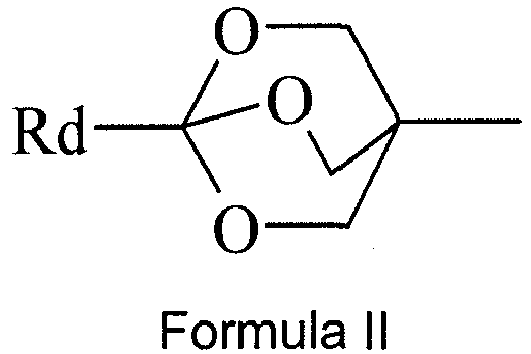
- Compounds according to Formula II are referred to as compounds comprising an " OBO protecting group" (4-methyl-2,6,7-trioxa-bicyclo[2.2.2]octan-1-yl) which is formed by the action of (3-methyloxetan-3-yl)methanol on activated carboxylic acids in the presence of Lewis acids and was developed by Elias James Corey.
- The amount of the compound having an acid sensitive functional group is preferably sufficient to remove substantially all the water present in the dispersion. More preferably an excess of the compound having an acid sensitive functional group relative to the water present in the dispersion is used. The amount of the compound having an acid sensitive functional group is preferably from 0.5 to 5 wt %, more preferably from 1.0 to 2.5 wt % relative to the total weight of the dispersion.
- Preferably compounds having an acid sensitive functional group are used, which form upon reaction with water volatile compounds, such as for example alchols, esters or ketones, which may be removed at moderate temperatures. Preferably both the compounds having an acid sensitive functional group and their reaction products may be substantially removed at moderate temperatures during the preparation of the devices in which the dispersions are used to avoid any contamination resulting in inferior properties of such devices.
- The compounds having an acid sensitive functional group and their reaction products preferably have a boiling point at atmospheric pressure below 200°C, more preferably below 150°C, most preferably below 100°C. Preferred reaction products are for example methanol, ethanol, ethylacetate, or acetone. For example triethyl orthoacetate forms ethanol and ethylacetate upon reaction with water; 2,2-dimethoxypropane forms acetone and methanol upon reaction with water.
- Preferably the compound having an acid sensitive functional group and its reaction products do not substantially influence the performance of coatings obtained from the conductive dispersions. The compounds preferably do not adversible influence the conductivity, the optical properties such as Haze or visual transmittance, or the physical and chemical properties of such coatings.
- Examples of polyanions suitable for use in the freeze-dried composition of the present invention are those disclosed in
EP-A 440957 - In a preferred embodiment of the present invention, the polyanion is the anion of a polymeric carboxylic acid, such as poly(acrylic acid), poly(methacrylic acid) and poly(maleic acid), or of a polymeric sulphonic acid, such as poly(styrene sulphonic acid) or poly(vinyl sulphonic acid). These polycarboxylic acids and polysulphonic acids can also be copolymers of vinylcarboxylic acids and/or vinylsulphonic acids with other polymerizable monomers, e.g. acrylic acid esters, methacrylic acid esters and styrene.
- In a more preferred embodiment of the present invention, the polyanion is the anion of poly(styrene sulphonic acid) or of copolymers thereof with styrene. In a most preferred embodiment of the present invention, the polyanion is poly(styrenesulfonate).
- The molecular weight of these polyanion forming polyacids is preferably between 1000 and 2x10⁶ g/mol or more, more preferably between 2000 and 5x10⁵ g/mol.
- These polyacids or their alkali salts are commercially available and can be prepared according to the known methods, e.g. as described in Houben-Weyl, Methoden der Organische Chemie, Bd. E20 Makromolekulare Stoffe, Teil 2, (1987), pp. 1141.
- Conductive polymers that may be used are disclosed in for example Conducting Polymers, Fundamentals and Applications: A Practical Approach (Prasanna Chandrasekhar), Conducting Polymers: A New Era in Electrochemistry (György Inzelt), Handbook of Organic Conductive Molecules and Polymers: Conductive polymers : synthesis and electrical properties (Hari Singh Nalwa), Conjugated Polymers: Theory, Synthesis, Properties, and Characterization (Terje A. Skotheim, John Reynolds), PEDOT: Principles and Applications of an Intrinsically Conductive Polymer (Andreas Elschner et al.).
- Examples of such conductive polymers are polythiophenes, polyanilines, polypyrroles, and polyacetylene.
- The conductive polymer is preferably a polymer or copolymer of a substituted or unsubstituted thiophene.
- According to an embodiment of the present invention, the thiophene is substituted in at least one of the 3- or 4-positions with a substituent selected from the group consisting of an optionally substituted C1-10 alkoxy group, an optionally substituted C1-10 alkyl group, and an optionally substituted aryl group, or the 3- and 4- positions are linked with an optionally substituted oxy-C1-4 alkylene-oxy group.
- The aforementioned alkyl, oxy-alkylene-oxy, cylcloalkylene and alkylene groups may be unsubstituted or may optionally be substituted with 1, 2, 3, 4 or 5 substituent(s) independently selected from the group consisting of phenyl, fluoro, chloro, bromo, iodo, methoxy, ethoxy, propoxy, isopropoxy, butoxy, sec-butoxy, tert-butoxy, nitro, cyano and hydroxy.
- The aforementioned alkoxy groups may be unsubstituted or may optionally be substituted with 1, 2, 3, 4 or 5 substituent(s) independently selected from the group consisting of phenyl, fluoro, chloro, bromo, iodo, nitro, cyano and hydroxy.
- In a preferred embodiment of the present invention the polymer of a substituted thiophene is represented by Formula II

- 1 < n ≤ 10 000;
- R1 and R2 independently represents hydrogen, a substituted or unsubstituted C1-C4 alkyl group, or together form a substituted or unsubstituted C1-C4 alkylene group or a substituted or unsubstituted C3-C10 cycloalkylene group.
- In a preferred embodiment 2 < n ≤ 5 000.
- In another preferred embodiment R1 and R2 independently represent an unsubstituted ethylene group, an unsubstituted methylene group, an optionally alkyl-substituted methylene group, an optionally C1-12 alkyl- or phenyl-substituted ethylene group, an unsubstituted 1,3-propylene group or an unsubstituted 1,2-cyclohexylene group.
- In another embodiment of the present invention, the polymer or copolymer of a substituted thiophene is a polymer or copolymer of a 3,4-dialkoxy-thiophene in which the two alkoxy groups together form an optionally substituted oxy-alkylene-oxy bridge selected from the group consisting of: 3,4-methylenedioxy-thiophene, 3,4-methylenedioxythiophene derivatives, 3,4-ethylenedioxythiophene, 3,4-ethylene-dioxythiophene derivatives, 3,4-propylenedioxythiophene, 3,4-propylenedioxy-thiophene derivatives, 3,4-butylene-dioxythiophene and 3,4-butylenedioxy-thiophene derivatives and copolymers therewith.
- In yet another embodiment of the present invention, the polymer or copolymer of a substituted thiophene is a polymer or copolymer of a 3,4-dialkoxy-thiophene in which the two alkoxy groups together form an oxy-alkylene-oxy bridge substituted with a substituent selected from the group consisting of alkyl, alkoxy, alkyloxyalkyl, carboxy, alkylsulfonato and carboxy ester groups.
- In yet another embodiment of the present invention, the polymer of a substituted thiophene is a poly(3,4-dialkoxy-thiophene) in which the two alkoxy groups together form an optionally substituted oxy-alkylene-oxy bridge which is an unsubstituted 1,2-ethylene group, an unsubstituted methylene group, an optionally alkyl-substituted methylene group, an optionally C1-12 alkyl- or phenyl-substituted 1,2-ethylene group, an unsubstituted 1,3-propylene group or an unsubstituted 1,2-cyclohexylene group.
- Such polymers are disclosed in Handbook of Oligo- and Polythiophenes Edited by D. Fichou, Wiley-VCH, Weinheim (1999); by L. Groenendaal et al. in Advanced Materials, volume 12, pages 481-494 (2000); L. J. Kloeppner et al. in Polymer Preprints, volume 40(2), page 792 (1999); P. Schottland et al. in Synthetic Metals, volume 101, pages 7-8 (1999); and D. M. Welsh et al. in Polymer Preprints, volume 38(2), page 320 (1997).
- The surfactants are preferably anionic or non-ionic.
- Preferred surfactants are for example those disclosed in
WO2002/00759 - Other preferred surfactants are those available under the tradename TRITON® X from Dow Chemicals, those under the tradename DYNOL™ from Air Products, and the fluorsurfactants from Chemguard and Synperonic®.
- Preferred dispersants are polyoxyethylene alkylamines such as disclosed in for example
JP2012-132026 - Other preferred dispersants are hydrophilic glycol ethers, commercially available under the tradename Dowanol™ from Dow Chemicals such as for example Dowanol EPh. Other preferred dispersants are the Dysperbyk®, Ethylan™, Solsperse™, Tilosperse™, Servoxyl™, Surfynol™, Hypermer™, Sokolan™, or Lupasol™ dispersants.
- The non-aqueous medium is preferably selected from alcohols, esters, ketones, aldehydes, ethers, or mixtures thereof.
- The non-aqueous medium is preferably selected from the group consisting of ethanol, acetone, methyl ethyl ketone (MEK), ethylacetate, isopropylalcohol (IPA), toluene, butylacetate, propylacetate, and mixtures thereof.
- The dispersion may further comprise other ingredients, depending on the application for which the dispersion will be used.
- For example the viscosity of the dispersion may be adapted to the method used to apply the dispersion on a substrate, i.e. the coating and/or printing method.
- When used as a screen printing ink, the viscosity is preferably between 3000 and 400000 mPa.s, more preferably between 5000 and 100000 mPa.s, most preferably between 10000 and 50000 mPa.s.
- When used as a flexographic or gravure ink, the viscosity is preferably between 50 and 3000 mPa.s, more preferably between 200 and 1000 mPa.s, most preferably between 300 and 500 mPas.s.
- When used as an inkjet ink, the viscosity is preferably between 1 and 50 mPa.s, more preferably between 5 and 30 mPa.s, most preferably between 7 and 15 mPa.s.
- The viscosities referred to above are measured at a shear rate of 1/s at temperature between 20 and 25°C (for example with an AR2000 Rheometer from Texas Instruments).
- The viscosity may be optimized by adding a binder and/or a thickener. Binders that may be used are polyvinylacetate, polycarbamate, polyvinyl butyral, polyacrylic acid ester, polyacrylic acid amide, polymethacrylic acid ester, polymethacrylic acid amide, polystyrene, polyacrylonitrile, polyvinylchloride, polyvinylpyrrolidine, polybutadiene, polyisoprene, polyethers, polyurethanes, polyamides, polyimides, polysulphones, silicones, epoxy resins, styrene/acrylate copolymers, vinylacetate/acrylate copolymers, ethylene/vinyl acetate copolymers, polyvinyl alcohols, and cellulose.
- Particularly preferred binders are Carbopol® Aqua 30, a latex of a copolymer of acrylic acid and ethyl acrylate from Lubrizol; Klucel® L, hydroxypropylcellluclose from Hercules, or Dispercoll™ U VP KA 8481, a polyester urethane copolymer dispersion from Bayer.
- The dispersion may also comprise a conductivity enhancing agent.
- Suitable conductivity enhancing agents are a linear, branched or cyclic aliphatic C2-20 hydrocarbon or an unsubstituted or substituted aromatic C6-14 hydrocarbon, preferably an unsubstituted or substituted aromatic C6, 10 or 14 hydrocarbon, or a pyran or a furan, said conductivity enhancing agent comprising at least two hydroxy groups or at least one - C(=O)-X or-C(=O)-NYZ group, wherein X denotes -OH and Y and Z independently of one another each represent H or alkyl; or a heterocyclic compound containing at least one lactam group.
- Preferred conductivity enhancing agents are e.g. N-methyl-2-pyrrolidone, 2-pyrrolidone, 1,3-dimethyl-2-imidazolidone, N,N,N,N' -tetramethylurea, formamide, dimethylformamide and N,N-dimethylacetamide. Preferred examples are sugar or sugar derivatives such as arabinose, saccharose, glucose, fructose and lactose, or di- or polyalcohols such as sorbitol, xylitol, mannitol, mannose, galactose, sorbose, gluconic acid, ethylene glycol, di- or tri(ethylene glycol), 1,1,1-trimethylol-propane, 1,3-propanediol, 1-,2-propanediol, 1,5-pentanediol, 1,2,3-propanetriol, 1,2,4-butanetriol, 1,2,6-hexanetriol, or aromatic di- or polyalcohols such as resorcinol.
- Particularly preferred conductivity enhancing agents for use in the freeze-dried composition, ink or aqueous or organic solvent solution or dispersion, according to the present invention are: N-methyl-pyrrolidinone and diethylene glycol.
- The dispersion may also comprise adhesion promoting compounds to optimize the adhesion of coatings or patterns obtained with the dispersion on various substrates. Preferred adhesion promoting compounds are organosilane compounds, in particular alkoxysilane compounds such as methyltrimethoxysilane, methyltriethoxysilane, dimethyldimethoxysilane, propyltrimethoxysilane, isobutyltrimethoxysilane, phenyltrimethoxysilane, n-octyltriethoxysilane, or glycidoxypropyl trimethyloxysilane all available from Dow Corning.
- The above desribed polythiophene is preferably prepared in the presence of a polyanion as described above. Such a preferred preparation method is described in
EP-A-440 957 US5300575 . - Basically the preparation of polythiophene may proceed in the presence of polymeric polyanion compounds, such as polystyrenesulfonic acid by oxidative polymerisation of 3,4-dialkoxythiophenes or 3,4-alkylene-dioxythiophenes according to Formula IV:

- The dispersion is preferably prepared starting from a freeze-dried composition comprising a polymer or copolymer of a substituted or unsubstituted thiophene and a polyanion.
- A preferred freeze-drying method is disclosed in
EP-A 1309646 . - The first step in freeze-drying a product is to convert it into a frozen state. During the freezing process the solvent (e.g. water) is preferably crystallized. In the case of water, the formation of ice crystals results in a separation of the solutes and the solvent. Then the ice crystals are removed by sublimation under vacuum conditions. While the sublimation or primary drying process removes most of the water from the frozen matrix, there can still be a substantial amount, for example more than 5 wt %, of water present in the freeze-dried composition. That remaining water may be removed by desorption. Products freeze-dried at room temperature typically have a water content of 15 to 20% by weight. Further drying of the freeze-dried product in a vacuum drying cupboard at 110°C and a drying cupboard at 110°C may results in products which are more difficult to disperse.
- The freeze-dried composition may be present in the form of a dry, spongy, woolly powder, a concentrated dispersion or a paste. In a particulcar preferred embodiment the freeze-dried composition is present as pellets.
- The freeze-dried compositon may contain, in addition to the conductive polymer and the polyanion a surfactant and/or dispersant.
- The method according to the present invention of preparing a substantially water free dispersion of a conductive polymer and a polyanion comprises the steps of:
- redispersing a freeze dried composition comprising a conductive polymer and a polyanion in a non-aqueous medium;
- adding a compound having an acid sensitive functional group selected from the group consisting of a ketal, an acetal, an aminal, a hemi-ketal, a hemi-acetal, a hemi-aminal, a thioacetal, an amide acetal, an orthoester, an orthoether, an enolester, an enolether, and an enolamine.
- Preferably a surfactant and/or a dispersant as described above are also added to prepare the dispersion. The amount of the surfactant and/or the dispersant is preferably between 0.05 and 10 wt %, more preferably between 0.1 and 5.0 wt %, most preferably between 0.5 and 2.5 wt % relative to the total weight of the dispersion.
- The amount of the freeze dried composition comprising a conductive polymer and a polyanion is preferably between 0.05 and 10 wt %, more preferably between 0.1 and 5.0 wt %, most preferably between 0.5 and 2.5 wt % relative to the total weight of the dispersion.
- To prepare the non-aqueous dispersion, well known dispersion technologies and devices may be used. Good results, i.e. homogeneous dispersions, were obtained with dissolvers from Disperlux, with Ultra-Turrax® systems from IKA.
- Also ball-milling and bead-milling devices may be used to obtain homogeneous non-aqeous dispersions. Good results were also obtained with a microfluidizer® from Microfluidics.
- The amount of water present in the freeze dried composition, or in the redispersed freeze dried composition, may be determined to optimize the amount of the compound having an acid sensitive funcitonal group. Preferably an excess of the compound having an acid sensitive functional group relative to the water present in the dispersion is used.
- The amount of the compound having an acid sensitive functional group is preferably from 0.5 to 5 wt %, more preferably from 1.0 to 2.5 wt % relative to the total weight of the dispersion.
- Conductive layers or patterns may be obtained by applying the dispersion according to the present invention on a substrate.
- The conductive layers or patterns are prepared by a method comprising the steps of applying the dispersion as defined above on a substrate followed by a drying step.
- The conductive layers or patterns may be applied by inkjet printing or by any conventional printing technique such as flexography, offset, gravure or screen printing or by any conventional coating technique such as spray coating, blade coating, or slot die coating.
- The conductive layers or patterns may be used in various electronic devices or parts of such electronic devices as for example OLED, OPV, Dye Sensitized Solar Cell (DSSC) or a solar cell based on Perovskites.
- All materials used in the following examples were readily available from standard sources such as ALDRICH CHEMICAL Co. (Belgium) and ACROS (Belgium) unless otherwise specified. The water used was deionized water.
Ethomeen C25: commercially available from AKZO NOBEL.
Orgacon Dry Pellets: commercially available from Agfa Gevaert NV.
Hydranal® Composite 5: commercially available fropm Sigma-Aldrich.
DMP: 2,2-dimethoxypropane commercially available from Sigma-Aldrich.
TEOA: triethyl orthoacetate commercially available from Sigma-Aldrich.
TMOA: trimethyl orthoacetate commercially available from Sigma-Aldrich. - A volumetric Karl Fischer titration was used to determine the water content of the dispersion. Hydranal® Composite 5 was used as Karl Fischer reagent.
- The surface resistance SER was measured using a two point probe method.
- The haziness of the samples was measured by means of a Haze-Gard plus from Byk-Gardner.
- The transmittance of the samples was measured by means of a Haze-Gard plus Byk-Gardner.
- 392g of isopropanol (Acros, 99+ extra pure), was disposed in a stainless steel vessel. Subsequently 4g of a polymeric dispersing agent (ethomeen C25) was added and stirred until complete dissolution. Finally, 4g of Orgacon Dry pellets were added while stirring the mixture. The obtained mixture was then submitted to a Disperlux high shear treatment during 30 minutes. Finally, a finishing step was performed via a Netzsch milling process during 54 minutes resulting in the dispersion DISP-01.
- DISP-02 was prepared by adding at room temperature 1.34 g of TEOA to 1.3 g of DISP-01 under stirring for a few minutes.
- The water content of DISP-01 and DISP-02, measured as described above, is shown in Table 1.
Table 1 Sample H2O content (wt %) DISP-01 1.01 DISP-02 < 0.04* * below the detection limit of the method used - It is clear from Table 1 that the addition of a compound having an acid sensitive functional group according to the present invention, such as triethyl orthoacetate, results in a substantially water free dispersion of PEDOT/PSS in a non-aqueous medium.
- DISP-03 to DISP-11 were prepared by first bubbling N2 through 100 g of DISP-01 in a vessel for 30 minutes. Then, after adding the compounds of Table 2 the vessels were sealed and the resulting dispersions stirred for another 60 minutes.
- The dispersions were then coated on a (subbed) PET support (thickness = 125 µm) with a bar coater at a wet coating thickness of 40 µm and dried at 130 °C for 6 minutes.
- The VLT, HAZE and SER, measured as described above are given in Table 2.
Table 2 Sample SCA* [SCA] wt %** % VLT % HAZE SER (kΩ/□) DISP-03 DMP 1.0 79.43 9.91 0.910 DISP-04 DMP 3.0 81.40 8.75 1.000 DISP-05 DMP 5.0 80.97 10.30 0.931 DISP-06 TEOA 1.0 80.20 7.94 0.873 DISP-07 TEOA 3.0 81.10 7.27 1.073 DISP-08 TEOA 5.0 81.27 8.08 1.173 DISP-09 TMOA 1.0 81.20 6.57 0.974 DISP-10 TMOA 3.0 81.43 8.61 0.981 DISP-11 TMOA 5.0 80.83 10.15 0.859 DISP-01 - - 78 6.52 0.780 * compound having acid sensitive functional group.
** % relative to the total weight of the dispersion - It is clear from the results shown in Table 2 that adding a compound having an acid sensitive functional group according to the present invention to a non-aqueous dispersion of PEDOT/PSS does not have a significantly negative influence on the electrical and optical properties of coatings obtained with the dispersions.
Claims (15)
- A dispersion of a conductive polymer and a polyanion in a non-aqueous medium further comprising a compound having an acid sensitive functional group selected from the group consisting of a ketal, an acetal, an aminal, a hemi-ketal, a hemi-acetal, a hemi-aminal, a thioacetal, an amide acetal, an orthoester, an orthoether, an enolester, an enolether, and an enolamine.
- The dispersion according to claim 1 wherein the compound having an acid sensitive functional group is selected from the group consisting of a ketal, an acetal and an orthoester.
- The dispersion according to claims 1 or 2 wherein the compound having an acid sensitive functional group is an orthoester according to Formula I,
 Ra, Rb, Rc independently represent a substituted or unsubstituted alkyl group, a substituted or unsubstituted alkenyl group, a substituted or unsubstituted alkynyl group, a substituted or unsubstituted aralkyl group, a substituted or unsubstituted aryl group, a substituted or unsubstituted heteroaryl group or a substituted or unsubstituted heterocyclic group;Rd represents a hydrogen, a substituted or unsubstituted alkyl group, a substituted or unsubstituted alkenyl group, a substituted or unsubstituted alkynyl group, a substituted or unsubstituted aralkyl group, a substituted or unsubstituted aryl group, a substituted or unsubstituted heteroaryl group or a substituted or unsubstituted heterocyclic group; orRa together with Rb or Rc may represent the necessary atoms to form a substituted or unsubstituted ring; orRb together with Rc may represent the necessary atoms to form a substituted or unsubstituted ring; orRd together with Ra, Rb or Rc may represent the necessary atoms to form a substituted or unsubstituted ring.
 - The dispersion according to claim 3 wherein Ra, Rb, Rb and Rd are substituted or unsubstituted C1-C6 alkyl groups.
- The dispersion according to any of the preceding claims wherein the compound having an acid sensitive functional group forms upon reaction with water reaction products having a boiling point Bp at atmospheric pressure below 200 °C.
- The dispersion according to any of the preceding claims wherein the conductive polymer is a polymer or copolymer of a substituted or unsubstituted thiophene.
- The dispersion according to claim 6 wherein the polymer of a substituted or unsubstituted thiophene is represented by Formula III,
 1 < n ≤ 10 000;R1 and R2 independently represents hydrogen, a substituted or unsubstituted C1-C4 alkyl group, or together form a substituted or unsubstituted C1-C4 alkylene group or a substituted or unsubstituted C3-C10 cycloalkylene group.
 - The dispersion according to any of the preceding claims wherein the polyanion is poly(styrenesulfonate).
- The dispersion according to any of the preceding claims wherein the non-aqueous medium is selected from the group consisting of ethanol, acetone, methyl ethyl ketone (MEK), ethylacetate, isopropylalcohol (IPA), toluene, butylacetate, propylacetate, and mixtures thereof.
- The dispersion according to any of the preceding claims further comprising a polyoxyethylene alkylamine dispersant.
- A method for preparing a substantially water free dispersion of a conductive polymer and a polyanion comprising the steps of:- redispersing a freeze dried composition comprising a conductive polymer and a polyanion in an non-aqueous medium;- adding a compound having an acid sensitive functional group selected from the group consisting of a ketal, an acetal, an aminal, a hemi-ketal, a hemi-acetal, a hemi-aminal, a thioacetal, an amide acetal, an orthoester, an orthoether, an enolester, an enolether, and an enolamine.
- The method according to claim 11 wherein the amount of the compound having an acid sensitive functional group is from 0.5 to 5.0 wt % relative to the total weight of the dispersion.
- A coating or pattern obtained by applying a dispersion as defined in any of the claims 1 to 10 on a substrate.
- An electronic device comprising the coating or pattern as defined in claim 13.
- The electronic device according to claim 14 being an OLED, OPV, Dye Sensitized Solar Cell (DSSC) or a solar cell based on Perovskites.
Priority Applications (6)
| Application Number | Priority Date | Filing Date | Title |
|---|---|---|---|
| EP14166514.1A EP2940079B1 (en) | 2014-04-30 | 2014-04-30 | Non-aqueous dispersions of a conductive polymer |
| CN201580023057.6A CN106232740B (en) | 2014-04-30 | 2015-04-27 | The non-aqueous dispersions of conducting polymer |
| JP2016562224A JP6383008B2 (en) | 2014-04-30 | 2015-04-27 | Non-aqueous dispersion of conductive polymer |
| KR1020167031588A KR101854411B1 (en) | 2014-04-30 | 2015-04-27 | Non-aqueous dispersions of a conductive polymer |
| US15/307,018 US10607746B2 (en) | 2014-04-30 | 2015-04-27 | Non-aqueous dispersions of a conductive polymer |
| PCT/EP2015/059074 WO2015165849A1 (en) | 2014-04-30 | 2015-04-27 | Non-aqueous dispersions of a conductive polymer |
Applications Claiming Priority (1)
| Application Number | Priority Date | Filing Date | Title |
|---|---|---|---|
| EP14166514.1A EP2940079B1 (en) | 2014-04-30 | 2014-04-30 | Non-aqueous dispersions of a conductive polymer |
Publications (2)
| Publication Number | Publication Date |
|---|---|
| EP2940079A1 true EP2940079A1 (en) | 2015-11-04 |
| EP2940079B1 EP2940079B1 (en) | 2017-08-23 |
Family
ID=50555114
Family Applications (1)
| Application Number | Title | Priority Date | Filing Date |
|---|---|---|---|
| EP14166514.1A Active EP2940079B1 (en) | 2014-04-30 | 2014-04-30 | Non-aqueous dispersions of a conductive polymer |
Country Status (6)
| Country | Link |
|---|---|
| US (1) | US10607746B2 (en) |
| EP (1) | EP2940079B1 (en) |
| JP (1) | JP6383008B2 (en) |
| KR (1) | KR101854411B1 (en) |
| CN (1) | CN106232740B (en) |
| WO (1) | WO2015165849A1 (en) |
Families Citing this family (1)
| Publication number | Priority date | Publication date | Assignee | Title |
|---|---|---|---|---|
| CN112105173B (en) * | 2020-09-21 | 2022-01-18 | 广东硕成科技有限公司 | Carbon nano composition for soft board hole metallization and preparation method thereof |
Citations (12)
| Publication number | Priority date | Publication date | Assignee | Title |
|---|---|---|---|---|
| EP0440957A2 (en) | 1990-02-08 | 1991-08-14 | Bayer Ag | New polythiophene dispersions, their preparation and their use |
| WO1999034371A1 (en) | 1997-12-23 | 1999-07-08 | Bayer Aktiengesellschaft | Screen printing paste for producing electrically conductive coatings |
| WO2002000759A1 (en) | 2000-06-26 | 2002-01-03 | Agfa-Gevaert | Redispersible latex comprising a polythiophene |
| WO2002042352A2 (en) | 2000-11-22 | 2002-05-30 | Bayer Aktiengesellschaft | Dispersible polymer powders |
| WO2002072660A1 (en) | 2001-03-12 | 2002-09-19 | Bayer Aktiengesellschaft | Novel polythiophene dispersions |
| WO2003048228A1 (en) | 2001-12-04 | 2003-06-12 | Agfa-Gevaert | Composition containing a polymer or copolymer of a 3,4-dialkoxythiophene and non-aqueous solvent |
| WO2003048229A1 (en) | 2001-12-04 | 2003-06-12 | Agfa-Gevaert | Composition containing a polymer or copolymer of a 3,4-dialkoxythiophene and non-aqueous solvent |
| US20030193042A1 (en) * | 2002-01-22 | 2003-10-16 | Pin Go | Mixtures comprising thiophene/anion dispersions and certain additives for producing coatings exhibiting improved conductivity, and methods related thereto |
| WO2003087222A1 (en) | 2002-04-08 | 2003-10-23 | Elecon, Inc. | Conductive polymer compositions exhibiting n-type conduction |
| EP2020430A1 (en) * | 2007-08-01 | 2009-02-04 | United Technologies Corporation | Conversion coatings with conductive additives, processes for applying same and their coated articles |
| JP2011208016A (en) * | 2009-03-31 | 2011-10-20 | Arakawa Chem Ind Co Ltd | Electroconductive polymer/dopant dispersion, electroconductive composition and electroconductive film |
| JP2012132026A (en) | 2006-07-18 | 2012-07-12 | Arakawa Chem Ind Co Ltd | Method for producing electroconductive polymer/dopant complex organic solvent dispersion |
Family Cites Families (11)
| Publication number | Priority date | Publication date | Assignee | Title |
|---|---|---|---|---|
| JPS60139694A (en) * | 1983-12-27 | 1985-07-24 | Tokuyama Soda Co Ltd | Bicycloorthoester compound and production thereof |
| JPH0623801B2 (en) * | 1984-02-13 | 1994-03-30 | セイコーエプソン株式会社 | Synthetic resin lens |
| DE3804521A1 (en) * | 1988-02-13 | 1989-08-24 | Hoechst Ag | ELECTRICALLY CONDUCTIVE COATING MEASUREMENT, METHOD FOR THEIR PRODUCTION AND THEIR USE |
| EP0340421B1 (en) * | 1988-03-16 | 1993-11-10 | Nitto Chemical Industry Co., Ltd. | Conducting varnish composition |
| JPH0747700B2 (en) * | 1988-10-06 | 1995-05-24 | 日東化学工業株式会社 | Conductive varnish composition |
| JP2002154184A (en) * | 2000-08-07 | 2002-05-28 | Jsr Corp | Transparent conductive sheet |
| CA2344842C (en) * | 2001-04-23 | 2007-08-21 | Pason Systems Corp. | Combustible gas measurement apparatus and method |
| DE102008023008A1 (en) * | 2008-05-09 | 2009-11-12 | H.C. Starck Gmbh | Novel polythiophene-polyanion complexes in non-polar organic solvents |
| CN101684214B (en) * | 2008-09-26 | 2014-01-08 | 昆山海斯电子有限公司 | Nanoparticle conductive ink and preparation method thereof |
| JP5560003B2 (en) * | 2009-08-03 | 2014-07-23 | 信越ポリマー株式会社 | Conductive polymer solution and method for producing the same |
| JP5787735B2 (en) * | 2011-06-09 | 2015-09-30 | 三井化学株式会社 | Crosslinkable rubber composition and cross-linked rubber molding |
-
2014
- 2014-04-30 EP EP14166514.1A patent/EP2940079B1/en active Active
-
2015
- 2015-04-27 CN CN201580023057.6A patent/CN106232740B/en active Active
- 2015-04-27 JP JP2016562224A patent/JP6383008B2/en active Active
- 2015-04-27 US US15/307,018 patent/US10607746B2/en active Active
- 2015-04-27 WO PCT/EP2015/059074 patent/WO2015165849A1/en not_active Ceased
- 2015-04-27 KR KR1020167031588A patent/KR101854411B1/en active Active
Patent Citations (15)
| Publication number | Priority date | Publication date | Assignee | Title |
|---|---|---|---|---|
| EP0440957A2 (en) | 1990-02-08 | 1991-08-14 | Bayer Ag | New polythiophene dispersions, their preparation and their use |
| US5300575A (en) | 1990-02-08 | 1994-04-05 | Bayer Aktiengesellschaft | Polythiophene dispersions, their production and their use |
| WO1999034371A1 (en) | 1997-12-23 | 1999-07-08 | Bayer Aktiengesellschaft | Screen printing paste for producing electrically conductive coatings |
| EP1309646A1 (en) | 2000-06-26 | 2003-05-14 | Agfa-Gevaert | Redispersible latex comprising a polythiophene |
| WO2002000759A1 (en) | 2000-06-26 | 2002-01-03 | Agfa-Gevaert | Redispersible latex comprising a polythiophene |
| EP1801143A1 (en) | 2000-06-26 | 2007-06-27 | Agfa-Gevaert | Redispersible latex comprising a polythiophene |
| WO2002042352A2 (en) | 2000-11-22 | 2002-05-30 | Bayer Aktiengesellschaft | Dispersible polymer powders |
| WO2002072660A1 (en) | 2001-03-12 | 2002-09-19 | Bayer Aktiengesellschaft | Novel polythiophene dispersions |
| WO2003048228A1 (en) | 2001-12-04 | 2003-06-12 | Agfa-Gevaert | Composition containing a polymer or copolymer of a 3,4-dialkoxythiophene and non-aqueous solvent |
| WO2003048229A1 (en) | 2001-12-04 | 2003-06-12 | Agfa-Gevaert | Composition containing a polymer or copolymer of a 3,4-dialkoxythiophene and non-aqueous solvent |
| US20030193042A1 (en) * | 2002-01-22 | 2003-10-16 | Pin Go | Mixtures comprising thiophene/anion dispersions and certain additives for producing coatings exhibiting improved conductivity, and methods related thereto |
| WO2003087222A1 (en) | 2002-04-08 | 2003-10-23 | Elecon, Inc. | Conductive polymer compositions exhibiting n-type conduction |
| JP2012132026A (en) | 2006-07-18 | 2012-07-12 | Arakawa Chem Ind Co Ltd | Method for producing electroconductive polymer/dopant complex organic solvent dispersion |
| EP2020430A1 (en) * | 2007-08-01 | 2009-02-04 | United Technologies Corporation | Conversion coatings with conductive additives, processes for applying same and their coated articles |
| JP2011208016A (en) * | 2009-03-31 | 2011-10-20 | Arakawa Chem Ind Co Ltd | Electroconductive polymer/dopant dispersion, electroconductive composition and electroconductive film |
Non-Patent Citations (12)
| Title |
|---|
| "Handbook of Oligo- and Polythiophenes", 1999, WILEY-VCH |
| "Handbook of Organic Conductive Molecules and Polymers", 1997, J. WILEY & SONS |
| ANDREAS ELSCHNER, PEDOT: PRINCIPLES AND APPLICATIONS OF AN INTRINSICALLY CONDUCTIVE POLYMER |
| D. M. WELSH ET AL., POLYMER PREPRINTS, vol. 38, no. 2, 1997, pages 320 |
| GY6RGY INZELT, CONDUCTING POLYMERS: A NEW ERA IN ELECTROCHEMISTRY |
| HARI SINGH NALWA: "Handbook of Organic Conductive Molecules and Polymers: Conductive polymers : synthesis and electrical properties" |
| HOUBEN-WEYL: "Methoden der Organische Chemie", MAKROMOLEKULARE STOFFE, vol. E20, no. 2, 1987, pages 1141 |
| L. GROENENDAAL ET AL., ADVANCED MATERIALS, vol. 12, 2000, pages 481 - 494 |
| L. J. KLOEPPNER ET AL., POLYMER PREPRINTS, vol. 40, no. 2, 1999, pages 792 |
| P. SCHOTTLAND ET AL., SYNTHETIC METALS, vol. 101, 1999, pages 7 - 8 |
| PRASANNA CHANDRASEKHAR, CONDUCTING POLYMERS, FUNDAMENTALS AND APPLICATIONS: A PRACTICAL APPROACH |
| TERJE A. SKOTHEIM; JOHN REYNOLDS, CONJUGATED POLYMERS: THEORY, SYNTHESIS, PROPERTIES, AND CHARACTERIZATION |
Also Published As
| Publication number | Publication date |
|---|---|
| WO2015165849A1 (en) | 2015-11-05 |
| EP2940079B1 (en) | 2017-08-23 |
| US10607746B2 (en) | 2020-03-31 |
| US20170047141A1 (en) | 2017-02-16 |
| CN106232740A (en) | 2016-12-14 |
| JP2017513980A (en) | 2017-06-01 |
| JP6383008B2 (en) | 2018-08-29 |
| KR101854411B1 (en) | 2018-06-08 |
| CN106232740B (en) | 2018-10-09 |
| KR20160145688A (en) | 2016-12-20 |
Similar Documents
| Publication | Publication Date | Title |
|---|---|---|
| JP5014553B2 (en) | Redispersible latex containing polythiophene | |
| US6632472B2 (en) | Redispersable latex comprising a polythiophene | |
| JP4049744B2 (en) | Process for producing aqueous or non-aqueous solution or dispersion of polythiophene or thiophene copolymer | |
| US8663505B2 (en) | Process for producing conducting polymers | |
| KR101921346B1 (en) | Composition for heat-curable conductive coatings, optical film and protective film | |
| KR101285162B1 (en) | Conducting polymer ink composition and organic solar cell comprising the same | |
| WO2015071794A1 (en) | Method of manufacturing surface-treated transparent conductive polymer thin film, and transparent electrode manufactured using same | |
| EP3287499A1 (en) | A metallic nanoparticle dispersion | |
| EP2940079B1 (en) | Non-aqueous dispersions of a conductive polymer | |
| EP3389896B1 (en) | A metallic nanoparticle dispersion | |
| JP6182815B2 (en) | Conductive polymer membrane | |
| US11887747B2 (en) | Acqueous composition comprising a conductive polymer and use thereof | |
| US20180148593A1 (en) | A metallic nanoparticle dispersion | |
| TWI810328B (en) | Liquid compositions comprising particles of a conductive polymer and an organic solvent forming an azeotrope with water | |
| JP7739926B2 (en) | Conductive polymer composition and conductive polymer film | |
| JP2025082150A (en) | Conductive polymer composition and use thereof | |
| JP2010046931A (en) | Method of forming conductive coating film |
Legal Events
| Date | Code | Title | Description |
|---|---|---|---|
| PUAI | Public reference made under article 153(3) epc to a published international application that has entered the european phase |
Free format text: ORIGINAL CODE: 0009012 |
|
| AK | Designated contracting states |
Kind code of ref document: A1 Designated state(s): AL AT BE BG CH CY CZ DE DK EE ES FI FR GB GR HR HU IE IS IT LI LT LU LV MC MK MT NL NO PL PT RO RS SE SI SK SM TR |
|
| AX | Request for extension of the european patent |
Extension state: BA ME |
|
| 17P | Request for examination filed |
Effective date: 20160504 |
|
| RBV | Designated contracting states (corrected) |
Designated state(s): AL AT BE BG CH CY CZ DE DK EE ES FI FR GB GR HR HU IE IS IT LI LT LU LV MC MK MT NL NO PL PT RO RS SE SI SK SM TR |
|
| 17Q | First examination report despatched |
Effective date: 20160603 |
|
| GRAP | Despatch of communication of intention to grant a patent |
Free format text: ORIGINAL CODE: EPIDOSNIGR1 |
|
| INTG | Intention to grant announced |
Effective date: 20161025 |
|
| GRAJ | Information related to disapproval of communication of intention to grant by the applicant or resumption of examination proceedings by the epo deleted |
Free format text: ORIGINAL CODE: EPIDOSDIGR1 |
|
| GRAP | Despatch of communication of intention to grant a patent |
Free format text: ORIGINAL CODE: EPIDOSNIGR1 |
|
| INTC | Intention to grant announced (deleted) | ||
| INTG | Intention to grant announced |
Effective date: 20170329 |
|
| GRAS | Grant fee paid |
Free format text: ORIGINAL CODE: EPIDOSNIGR3 |
|
| GRAA | (expected) grant |
Free format text: ORIGINAL CODE: 0009210 |
|
| AK | Designated contracting states |
Kind code of ref document: B1 Designated state(s): AL AT BE BG CH CY CZ DE DK EE ES FI FR GB GR HR HU IE IS IT LI LT LU LV MC MK MT NL NO PL PT RO RS SE SI SK SM TR |
|
| REG | Reference to a national code |
Ref country code: GB Ref legal event code: FG4D |
|
| REG | Reference to a national code |
Ref country code: CH Ref legal event code: EP |
|
| REG | Reference to a national code |
Ref country code: NL Ref legal event code: FP |
|
| REG | Reference to a national code |
Ref country code: AT Ref legal event code: REF Ref document number: 921295 Country of ref document: AT Kind code of ref document: T Effective date: 20170915 |
|
| REG | Reference to a national code |
Ref country code: IE Ref legal event code: FG4D |
|
| REG | Reference to a national code |
Ref country code: DE Ref legal event code: R096 Ref document number: 602014013380 Country of ref document: DE |
|
| REG | Reference to a national code |
Ref country code: LT Ref legal event code: MG4D |
|
| REG | Reference to a national code |
Ref country code: AT Ref legal event code: MK05 Ref document number: 921295 Country of ref document: AT Kind code of ref document: T Effective date: 20170823 |
|
| PG25 | Lapsed in a contracting state [announced via postgrant information from national office to epo] |
Ref country code: LT Free format text: LAPSE BECAUSE OF FAILURE TO SUBMIT A TRANSLATION OF THE DESCRIPTION OR TO PAY THE FEE WITHIN THE PRESCRIBED TIME-LIMIT Effective date: 20170823 Ref country code: AT Free format text: LAPSE BECAUSE OF FAILURE TO SUBMIT A TRANSLATION OF THE DESCRIPTION OR TO PAY THE FEE WITHIN THE PRESCRIBED TIME-LIMIT Effective date: 20170823 Ref country code: NO Free format text: LAPSE BECAUSE OF FAILURE TO SUBMIT A TRANSLATION OF THE DESCRIPTION OR TO PAY THE FEE WITHIN THE PRESCRIBED TIME-LIMIT Effective date: 20171123 Ref country code: FI Free format text: LAPSE BECAUSE OF FAILURE TO SUBMIT A TRANSLATION OF THE DESCRIPTION OR TO PAY THE FEE WITHIN THE PRESCRIBED TIME-LIMIT Effective date: 20170823 Ref country code: HR Free format text: LAPSE BECAUSE OF FAILURE TO SUBMIT A TRANSLATION OF THE DESCRIPTION OR TO PAY THE FEE WITHIN THE PRESCRIBED TIME-LIMIT Effective date: 20170823 Ref country code: SE Free format text: LAPSE BECAUSE OF FAILURE TO SUBMIT A TRANSLATION OF THE DESCRIPTION OR TO PAY THE FEE WITHIN THE PRESCRIBED TIME-LIMIT Effective date: 20170823 |
|
| REG | Reference to a national code |
Ref country code: FR Ref legal event code: PLFP Year of fee payment: 5 |
|
| PG25 | Lapsed in a contracting state [announced via postgrant information from national office to epo] |
Ref country code: RS Free format text: LAPSE BECAUSE OF FAILURE TO SUBMIT A TRANSLATION OF THE DESCRIPTION OR TO PAY THE FEE WITHIN THE PRESCRIBED TIME-LIMIT Effective date: 20170823 Ref country code: GR Free format text: LAPSE BECAUSE OF FAILURE TO SUBMIT A TRANSLATION OF THE DESCRIPTION OR TO PAY THE FEE WITHIN THE PRESCRIBED TIME-LIMIT Effective date: 20171124 Ref country code: BG Free format text: LAPSE BECAUSE OF FAILURE TO SUBMIT A TRANSLATION OF THE DESCRIPTION OR TO PAY THE FEE WITHIN THE PRESCRIBED TIME-LIMIT Effective date: 20171123 Ref country code: ES Free format text: LAPSE BECAUSE OF FAILURE TO SUBMIT A TRANSLATION OF THE DESCRIPTION OR TO PAY THE FEE WITHIN THE PRESCRIBED TIME-LIMIT Effective date: 20170823 Ref country code: IS Free format text: LAPSE BECAUSE OF FAILURE TO SUBMIT A TRANSLATION OF THE DESCRIPTION OR TO PAY THE FEE WITHIN THE PRESCRIBED TIME-LIMIT Effective date: 20171223 Ref country code: LV Free format text: LAPSE BECAUSE OF FAILURE TO SUBMIT A TRANSLATION OF THE DESCRIPTION OR TO PAY THE FEE WITHIN THE PRESCRIBED TIME-LIMIT Effective date: 20170823 Ref country code: PL Free format text: LAPSE BECAUSE OF FAILURE TO SUBMIT A TRANSLATION OF THE DESCRIPTION OR TO PAY THE FEE WITHIN THE PRESCRIBED TIME-LIMIT Effective date: 20170823 |
|
| PG25 | Lapsed in a contracting state [announced via postgrant information from national office to epo] |
Ref country code: CZ Free format text: LAPSE BECAUSE OF FAILURE TO SUBMIT A TRANSLATION OF THE DESCRIPTION OR TO PAY THE FEE WITHIN THE PRESCRIBED TIME-LIMIT Effective date: 20170823 Ref country code: RO Free format text: LAPSE BECAUSE OF FAILURE TO SUBMIT A TRANSLATION OF THE DESCRIPTION OR TO PAY THE FEE WITHIN THE PRESCRIBED TIME-LIMIT Effective date: 20170823 Ref country code: DK Free format text: LAPSE BECAUSE OF FAILURE TO SUBMIT A TRANSLATION OF THE DESCRIPTION OR TO PAY THE FEE WITHIN THE PRESCRIBED TIME-LIMIT Effective date: 20170823 |
|
| REG | Reference to a national code |
Ref country code: DE Ref legal event code: R097 Ref document number: 602014013380 Country of ref document: DE |
|
| PG25 | Lapsed in a contracting state [announced via postgrant information from national office to epo] |
Ref country code: EE Free format text: LAPSE BECAUSE OF FAILURE TO SUBMIT A TRANSLATION OF THE DESCRIPTION OR TO PAY THE FEE WITHIN THE PRESCRIBED TIME-LIMIT Effective date: 20170823 Ref country code: IT Free format text: LAPSE BECAUSE OF FAILURE TO SUBMIT A TRANSLATION OF THE DESCRIPTION OR TO PAY THE FEE WITHIN THE PRESCRIBED TIME-LIMIT Effective date: 20170823 Ref country code: SK Free format text: LAPSE BECAUSE OF FAILURE TO SUBMIT A TRANSLATION OF THE DESCRIPTION OR TO PAY THE FEE WITHIN THE PRESCRIBED TIME-LIMIT Effective date: 20170823 Ref country code: SM Free format text: LAPSE BECAUSE OF FAILURE TO SUBMIT A TRANSLATION OF THE DESCRIPTION OR TO PAY THE FEE WITHIN THE PRESCRIBED TIME-LIMIT Effective date: 20170823 |
|
| PLBE | No opposition filed within time limit |
Free format text: ORIGINAL CODE: 0009261 |
|
| STAA | Information on the status of an ep patent application or granted ep patent |
Free format text: STATUS: NO OPPOSITION FILED WITHIN TIME LIMIT |
|
| 26N | No opposition filed |
Effective date: 20180524 |
|
| PG25 | Lapsed in a contracting state [announced via postgrant information from national office to epo] |
Ref country code: SI Free format text: LAPSE BECAUSE OF FAILURE TO SUBMIT A TRANSLATION OF THE DESCRIPTION OR TO PAY THE FEE WITHIN THE PRESCRIBED TIME-LIMIT Effective date: 20170823 |
|
| PG25 | Lapsed in a contracting state [announced via postgrant information from national office to epo] |
Ref country code: MC Free format text: LAPSE BECAUSE OF FAILURE TO SUBMIT A TRANSLATION OF THE DESCRIPTION OR TO PAY THE FEE WITHIN THE PRESCRIBED TIME-LIMIT Effective date: 20170823 |
|
| REG | Reference to a national code |
Ref country code: CH Ref legal event code: PL |
|
| REG | Reference to a national code |
Ref country code: IE Ref legal event code: MM4A |
|
| PG25 | Lapsed in a contracting state [announced via postgrant information from national office to epo] |
Ref country code: LU Free format text: LAPSE BECAUSE OF NON-PAYMENT OF DUE FEES Effective date: 20180430 |
|
| PG25 | Lapsed in a contracting state [announced via postgrant information from national office to epo] |
Ref country code: CH Free format text: LAPSE BECAUSE OF NON-PAYMENT OF DUE FEES Effective date: 20180430 Ref country code: LI Free format text: LAPSE BECAUSE OF NON-PAYMENT OF DUE FEES Effective date: 20180430 |
|
| PG25 | Lapsed in a contracting state [announced via postgrant information from national office to epo] |
Ref country code: IE Free format text: LAPSE BECAUSE OF NON-PAYMENT OF DUE FEES Effective date: 20180430 |
|
| PG25 | Lapsed in a contracting state [announced via postgrant information from national office to epo] |
Ref country code: MT Free format text: LAPSE BECAUSE OF NON-PAYMENT OF DUE FEES Effective date: 20180430 |
|
| PG25 | Lapsed in a contracting state [announced via postgrant information from national office to epo] |
Ref country code: TR Free format text: LAPSE BECAUSE OF FAILURE TO SUBMIT A TRANSLATION OF THE DESCRIPTION OR TO PAY THE FEE WITHIN THE PRESCRIBED TIME-LIMIT Effective date: 20170823 |
|
| PG25 | Lapsed in a contracting state [announced via postgrant information from national office to epo] |
Ref country code: PT Free format text: LAPSE BECAUSE OF FAILURE TO SUBMIT A TRANSLATION OF THE DESCRIPTION OR TO PAY THE FEE WITHIN THE PRESCRIBED TIME-LIMIT Effective date: 20170823 |
|
| PG25 | Lapsed in a contracting state [announced via postgrant information from national office to epo] |
Ref country code: MK Free format text: LAPSE BECAUSE OF NON-PAYMENT OF DUE FEES Effective date: 20170823 Ref country code: CY Free format text: LAPSE BECAUSE OF FAILURE TO SUBMIT A TRANSLATION OF THE DESCRIPTION OR TO PAY THE FEE WITHIN THE PRESCRIBED TIME-LIMIT Effective date: 20170823 Ref country code: HU Free format text: LAPSE BECAUSE OF FAILURE TO SUBMIT A TRANSLATION OF THE DESCRIPTION OR TO PAY THE FEE WITHIN THE PRESCRIBED TIME-LIMIT; INVALID AB INITIO Effective date: 20140430 |
|
| PG25 | Lapsed in a contracting state [announced via postgrant information from national office to epo] |
Ref country code: AL Free format text: LAPSE BECAUSE OF FAILURE TO SUBMIT A TRANSLATION OF THE DESCRIPTION OR TO PAY THE FEE WITHIN THE PRESCRIBED TIME-LIMIT Effective date: 20170823 |
|
| PGFP | Annual fee paid to national office [announced via postgrant information from national office to epo] |
Ref country code: DE Payment date: 20250113 Year of fee payment: 12 |
|
| PGFP | Annual fee paid to national office [announced via postgrant information from national office to epo] |
Ref country code: GB Payment date: 20260313 Year of fee payment: 13 |
|
| PGFP | Annual fee paid to national office [announced via postgrant information from national office to epo] |
Ref country code: BE Payment date: 20260226 Year of fee payment: 13 |
|
| PGFP | Annual fee paid to national office [announced via postgrant information from national office to epo] |
Ref country code: NL Payment date: 20260313 Year of fee payment: 13 |
|
| PGFP | Annual fee paid to national office [announced via postgrant information from national office to epo] |
Ref country code: FR Payment date: 20260306 Year of fee payment: 13 |