EP2937465A1 - Pneumatic fender - Google Patents
Pneumatic fender Download PDFInfo
- Publication number
- EP2937465A1 EP2937465A1 EP13863745.9A EP13863745A EP2937465A1 EP 2937465 A1 EP2937465 A1 EP 2937465A1 EP 13863745 A EP13863745 A EP 13863745A EP 2937465 A1 EP2937465 A1 EP 2937465A1
- Authority
- EP
- European Patent Office
- Prior art keywords
- fiber reinforcing
- reinforcing layers
- twisted
- pneumatic fender
- warp
- Prior art date
- Legal status (The legal status is an assumption and is not a legal conclusion. Google has not performed a legal analysis and makes no representation as to the accuracy of the status listed.)
- Withdrawn
Links
Images
Classifications
-
- B—PERFORMING OPERATIONS; TRANSPORTING
- B63—SHIPS OR OTHER WATERBORNE VESSELS; RELATED EQUIPMENT
- B63B—SHIPS OR OTHER WATERBORNE VESSELS; EQUIPMENT FOR SHIPPING
- B63B59/00—Hull protection specially adapted for vessels; Cleaning devices specially adapted for vessels
- B63B59/02—Fenders integral with waterborne vessels or specially adapted therefor, e.g. fenders forming part of the hull or incorporated in the hull; Rubbing-strakes
-
- B—PERFORMING OPERATIONS; TRANSPORTING
- B32—LAYERED PRODUCTS
- B32B—LAYERED PRODUCTS, i.e. PRODUCTS BUILT-UP OF STRATA OF FLAT OR NON-FLAT, e.g. CELLULAR OR HONEYCOMB, FORM
- B32B1/00—Layered products having a non-planar shape
-
- B—PERFORMING OPERATIONS; TRANSPORTING
- B32—LAYERED PRODUCTS
- B32B—LAYERED PRODUCTS, i.e. PRODUCTS BUILT-UP OF STRATA OF FLAT OR NON-FLAT, e.g. CELLULAR OR HONEYCOMB, FORM
- B32B1/00—Layered products having a non-planar shape
- B32B1/08—Tubular products
-
- B—PERFORMING OPERATIONS; TRANSPORTING
- B32—LAYERED PRODUCTS
- B32B—LAYERED PRODUCTS, i.e. PRODUCTS BUILT-UP OF STRATA OF FLAT OR NON-FLAT, e.g. CELLULAR OR HONEYCOMB, FORM
- B32B25/00—Layered products comprising a layer of natural or synthetic rubber
-
- B—PERFORMING OPERATIONS; TRANSPORTING
- B32—LAYERED PRODUCTS
- B32B—LAYERED PRODUCTS, i.e. PRODUCTS BUILT-UP OF STRATA OF FLAT OR NON-FLAT, e.g. CELLULAR OR HONEYCOMB, FORM
- B32B25/00—Layered products comprising a layer of natural or synthetic rubber
- B32B25/02—Layered products comprising a layer of natural or synthetic rubber with fibres or particles being present as additives in the layer
-
- B—PERFORMING OPERATIONS; TRANSPORTING
- B32—LAYERED PRODUCTS
- B32B—LAYERED PRODUCTS, i.e. PRODUCTS BUILT-UP OF STRATA OF FLAT OR NON-FLAT, e.g. CELLULAR OR HONEYCOMB, FORM
- B32B25/00—Layered products comprising a layer of natural or synthetic rubber
- B32B25/04—Layered products comprising a layer of natural or synthetic rubber comprising rubber as the main or only constituent of a layer, which is next to another layer of the same or of a different material
-
- B—PERFORMING OPERATIONS; TRANSPORTING
- B32—LAYERED PRODUCTS
- B32B—LAYERED PRODUCTS, i.e. PRODUCTS BUILT-UP OF STRATA OF FLAT OR NON-FLAT, e.g. CELLULAR OR HONEYCOMB, FORM
- B32B25/00—Layered products comprising a layer of natural or synthetic rubber
- B32B25/04—Layered products comprising a layer of natural or synthetic rubber comprising rubber as the main or only constituent of a layer, which is next to another layer of the same or of a different material
- B32B25/08—Layered products comprising a layer of natural or synthetic rubber comprising rubber as the main or only constituent of a layer, which is next to another layer of the same or of a different material of synthetic resin
-
- B—PERFORMING OPERATIONS; TRANSPORTING
- B32—LAYERED PRODUCTS
- B32B—LAYERED PRODUCTS, i.e. PRODUCTS BUILT-UP OF STRATA OF FLAT OR NON-FLAT, e.g. CELLULAR OR HONEYCOMB, FORM
- B32B25/00—Layered products comprising a layer of natural or synthetic rubber
- B32B25/10—Layered products comprising a layer of natural or synthetic rubber next to a fibrous or filamentary layer
-
- B—PERFORMING OPERATIONS; TRANSPORTING
- B32—LAYERED PRODUCTS
- B32B—LAYERED PRODUCTS, i.e. PRODUCTS BUILT-UP OF STRATA OF FLAT OR NON-FLAT, e.g. CELLULAR OR HONEYCOMB, FORM
- B32B25/00—Layered products comprising a layer of natural or synthetic rubber
- B32B25/14—Layered products comprising a layer of natural or synthetic rubber comprising synthetic rubber copolymers
-
- B—PERFORMING OPERATIONS; TRANSPORTING
- B32—LAYERED PRODUCTS
- B32B—LAYERED PRODUCTS, i.e. PRODUCTS BUILT-UP OF STRATA OF FLAT OR NON-FLAT, e.g. CELLULAR OR HONEYCOMB, FORM
- B32B27/00—Layered products comprising a layer of synthetic resin
-
- B—PERFORMING OPERATIONS; TRANSPORTING
- B32—LAYERED PRODUCTS
- B32B—LAYERED PRODUCTS, i.e. PRODUCTS BUILT-UP OF STRATA OF FLAT OR NON-FLAT, e.g. CELLULAR OR HONEYCOMB, FORM
- B32B27/00—Layered products comprising a layer of synthetic resin
- B32B27/06—Layered products comprising a layer of synthetic resin as the main or only constituent of a layer, which is next to another layer of the same or of a different material
-
- B—PERFORMING OPERATIONS; TRANSPORTING
- B32—LAYERED PRODUCTS
- B32B—LAYERED PRODUCTS, i.e. PRODUCTS BUILT-UP OF STRATA OF FLAT OR NON-FLAT, e.g. CELLULAR OR HONEYCOMB, FORM
- B32B27/00—Layered products comprising a layer of synthetic resin
- B32B27/12—Layered products comprising a layer of synthetic resin next to a fibrous or filamentary layer
-
- B—PERFORMING OPERATIONS; TRANSPORTING
- B32—LAYERED PRODUCTS
- B32B—LAYERED PRODUCTS, i.e. PRODUCTS BUILT-UP OF STRATA OF FLAT OR NON-FLAT, e.g. CELLULAR OR HONEYCOMB, FORM
- B32B27/00—Layered products comprising a layer of synthetic resin
- B32B27/28—Layered products comprising a layer of synthetic resin comprising synthetic resins not wholly covered by any one of the sub-groups B32B27/30 - B32B27/42
-
- B—PERFORMING OPERATIONS; TRANSPORTING
- B32—LAYERED PRODUCTS
- B32B—LAYERED PRODUCTS, i.e. PRODUCTS BUILT-UP OF STRATA OF FLAT OR NON-FLAT, e.g. CELLULAR OR HONEYCOMB, FORM
- B32B3/00—Layered products comprising a layer with external or internal discontinuities or unevennesses, or a layer of non-planar shape; Layered products comprising a layer having particular features of form
-
- B—PERFORMING OPERATIONS; TRANSPORTING
- B32—LAYERED PRODUCTS
- B32B—LAYERED PRODUCTS, i.e. PRODUCTS BUILT-UP OF STRATA OF FLAT OR NON-FLAT, e.g. CELLULAR OR HONEYCOMB, FORM
- B32B3/00—Layered products comprising a layer with external or internal discontinuities or unevennesses, or a layer of non-planar shape; Layered products comprising a layer having particular features of form
- B32B3/02—Layered products comprising a layer with external or internal discontinuities or unevennesses, or a layer of non-planar shape; Layered products comprising a layer having particular features of form characterised by features of form at particular places, e.g. in edge regions
-
- B—PERFORMING OPERATIONS; TRANSPORTING
- B32—LAYERED PRODUCTS
- B32B—LAYERED PRODUCTS, i.e. PRODUCTS BUILT-UP OF STRATA OF FLAT OR NON-FLAT, e.g. CELLULAR OR HONEYCOMB, FORM
- B32B5/00—Layered products characterised by the non- homogeneity or physical structure, i.e. comprising a fibrous, filamentary, particulate or foam layer; Layered products characterised by having a layer differing constitutionally or physically in different parts
-
- B—PERFORMING OPERATIONS; TRANSPORTING
- B32—LAYERED PRODUCTS
- B32B—LAYERED PRODUCTS, i.e. PRODUCTS BUILT-UP OF STRATA OF FLAT OR NON-FLAT, e.g. CELLULAR OR HONEYCOMB, FORM
- B32B5/00—Layered products characterised by the non- homogeneity or physical structure, i.e. comprising a fibrous, filamentary, particulate or foam layer; Layered products characterised by having a layer differing constitutionally or physically in different parts
- B32B5/02—Layered products characterised by the non- homogeneity or physical structure, i.e. comprising a fibrous, filamentary, particulate or foam layer; Layered products characterised by having a layer differing constitutionally or physically in different parts characterised by structural features of a fibrous or filamentary layer
-
- B—PERFORMING OPERATIONS; TRANSPORTING
- B32—LAYERED PRODUCTS
- B32B—LAYERED PRODUCTS, i.e. PRODUCTS BUILT-UP OF STRATA OF FLAT OR NON-FLAT, e.g. CELLULAR OR HONEYCOMB, FORM
- B32B5/00—Layered products characterised by the non- homogeneity or physical structure, i.e. comprising a fibrous, filamentary, particulate or foam layer; Layered products characterised by having a layer differing constitutionally or physically in different parts
- B32B5/02—Layered products characterised by the non- homogeneity or physical structure, i.e. comprising a fibrous, filamentary, particulate or foam layer; Layered products characterised by having a layer differing constitutionally or physically in different parts characterised by structural features of a fibrous or filamentary layer
- B32B5/022—Non-woven fabric
-
- B—PERFORMING OPERATIONS; TRANSPORTING
- B32—LAYERED PRODUCTS
- B32B—LAYERED PRODUCTS, i.e. PRODUCTS BUILT-UP OF STRATA OF FLAT OR NON-FLAT, e.g. CELLULAR OR HONEYCOMB, FORM
- B32B5/00—Layered products characterised by the non- homogeneity or physical structure, i.e. comprising a fibrous, filamentary, particulate or foam layer; Layered products characterised by having a layer differing constitutionally or physically in different parts
- B32B5/02—Layered products characterised by the non- homogeneity or physical structure, i.e. comprising a fibrous, filamentary, particulate or foam layer; Layered products characterised by having a layer differing constitutionally or physically in different parts characterised by structural features of a fibrous or filamentary layer
- B32B5/04—Layered products characterised by the non- homogeneity or physical structure, i.e. comprising a fibrous, filamentary, particulate or foam layer; Layered products characterised by having a layer differing constitutionally or physically in different parts characterised by structural features of a fibrous or filamentary layer characterised by a layer being specifically extensible by reason of its structure or arrangement, e.g. by reason of the chemical nature of the fibres or filaments
-
- B—PERFORMING OPERATIONS; TRANSPORTING
- B32—LAYERED PRODUCTS
- B32B—LAYERED PRODUCTS, i.e. PRODUCTS BUILT-UP OF STRATA OF FLAT OR NON-FLAT, e.g. CELLULAR OR HONEYCOMB, FORM
- B32B5/00—Layered products characterised by the non- homogeneity or physical structure, i.e. comprising a fibrous, filamentary, particulate or foam layer; Layered products characterised by having a layer differing constitutionally or physically in different parts
- B32B5/02—Layered products characterised by the non- homogeneity or physical structure, i.e. comprising a fibrous, filamentary, particulate or foam layer; Layered products characterised by having a layer differing constitutionally or physically in different parts characterised by structural features of a fibrous or filamentary layer
- B32B5/06—Layered products characterised by the non- homogeneity or physical structure, i.e. comprising a fibrous, filamentary, particulate or foam layer; Layered products characterised by having a layer differing constitutionally or physically in different parts characterised by structural features of a fibrous or filamentary layer characterised by a fibrous or filamentary layer mechanically connected, e.g. by needling to another layer, e.g. of fibres, of paper
-
- B—PERFORMING OPERATIONS; TRANSPORTING
- B32—LAYERED PRODUCTS
- B32B—LAYERED PRODUCTS, i.e. PRODUCTS BUILT-UP OF STRATA OF FLAT OR NON-FLAT, e.g. CELLULAR OR HONEYCOMB, FORM
- B32B5/00—Layered products characterised by the non- homogeneity or physical structure, i.e. comprising a fibrous, filamentary, particulate or foam layer; Layered products characterised by having a layer differing constitutionally or physically in different parts
- B32B5/02—Layered products characterised by the non- homogeneity or physical structure, i.e. comprising a fibrous, filamentary, particulate or foam layer; Layered products characterised by having a layer differing constitutionally or physically in different parts characterised by structural features of a fibrous or filamentary layer
- B32B5/10—Layered products characterised by the non- homogeneity or physical structure, i.e. comprising a fibrous, filamentary, particulate or foam layer; Layered products characterised by having a layer differing constitutionally or physically in different parts characterised by structural features of a fibrous or filamentary layer characterised by a fibrous or filamentary layer reinforced with filaments
-
- B—PERFORMING OPERATIONS; TRANSPORTING
- B32—LAYERED PRODUCTS
- B32B—LAYERED PRODUCTS, i.e. PRODUCTS BUILT-UP OF STRATA OF FLAT OR NON-FLAT, e.g. CELLULAR OR HONEYCOMB, FORM
- B32B5/00—Layered products characterised by the non- homogeneity or physical structure, i.e. comprising a fibrous, filamentary, particulate or foam layer; Layered products characterised by having a layer differing constitutionally or physically in different parts
- B32B5/02—Layered products characterised by the non- homogeneity or physical structure, i.e. comprising a fibrous, filamentary, particulate or foam layer; Layered products characterised by having a layer differing constitutionally or physically in different parts characterised by structural features of a fibrous or filamentary layer
- B32B5/12—Layered products characterised by the non- homogeneity or physical structure, i.e. comprising a fibrous, filamentary, particulate or foam layer; Layered products characterised by having a layer differing constitutionally or physically in different parts characterised by structural features of a fibrous or filamentary layer characterised by the relative arrangement of fibres or filaments of different layers, e.g. the fibres or filaments being parallel or perpendicular to each other
-
- B—PERFORMING OPERATIONS; TRANSPORTING
- B32—LAYERED PRODUCTS
- B32B—LAYERED PRODUCTS, i.e. PRODUCTS BUILT-UP OF STRATA OF FLAT OR NON-FLAT, e.g. CELLULAR OR HONEYCOMB, FORM
- B32B5/00—Layered products characterised by the non- homogeneity or physical structure, i.e. comprising a fibrous, filamentary, particulate or foam layer; Layered products characterised by having a layer differing constitutionally or physically in different parts
- B32B5/22—Layered products characterised by the non- homogeneity or physical structure, i.e. comprising a fibrous, filamentary, particulate or foam layer; Layered products characterised by having a layer differing constitutionally or physically in different parts characterised by the presence of two or more layers which are next to each other and are fibrous, filamentary, formed of particles or foamed
-
- B—PERFORMING OPERATIONS; TRANSPORTING
- B32—LAYERED PRODUCTS
- B32B—LAYERED PRODUCTS, i.e. PRODUCTS BUILT-UP OF STRATA OF FLAT OR NON-FLAT, e.g. CELLULAR OR HONEYCOMB, FORM
- B32B7/00—Layered products characterised by the relation between layers; Layered products characterised by the relative orientation of features between layers, or by the relative values of a measurable parameter between layers, i.e. products comprising layers having different physical, chemical or physicochemical properties; Layered products characterised by the interconnection of layers
-
- B—PERFORMING OPERATIONS; TRANSPORTING
- B32—LAYERED PRODUCTS
- B32B—LAYERED PRODUCTS, i.e. PRODUCTS BUILT-UP OF STRATA OF FLAT OR NON-FLAT, e.g. CELLULAR OR HONEYCOMB, FORM
- B32B7/00—Layered products characterised by the relation between layers; Layered products characterised by the relative orientation of features between layers, or by the relative values of a measurable parameter between layers, i.e. products comprising layers having different physical, chemical or physicochemical properties; Layered products characterised by the interconnection of layers
- B32B7/04—Interconnection of layers
-
- B—PERFORMING OPERATIONS; TRANSPORTING
- B32—LAYERED PRODUCTS
- B32B—LAYERED PRODUCTS, i.e. PRODUCTS BUILT-UP OF STRATA OF FLAT OR NON-FLAT, e.g. CELLULAR OR HONEYCOMB, FORM
- B32B7/00—Layered products characterised by the relation between layers; Layered products characterised by the relative orientation of features between layers, or by the relative values of a measurable parameter between layers, i.e. products comprising layers having different physical, chemical or physicochemical properties; Layered products characterised by the interconnection of layers
- B32B7/04—Interconnection of layers
- B32B7/10—Interconnection of layers at least one layer having inter-reactive properties
-
- D—TEXTILES; PAPER
- D02—YARNS; MECHANICAL FINISHING OF YARNS OR ROPES; WARPING OR BEAMING
- D02G—CRIMPING OR CURLING FIBRES, FILAMENTS, THREADS, OR YARNS; YARNS OR THREADS
- D02G3/00—Yarns or threads, e.g. fancy yarns; Processes or apparatus for the production thereof, not otherwise provided for
- D02G3/44—Yarns or threads characterised by the purpose for which they are designed
- D02G3/447—Yarns or threads for specific use in general industrial applications, e.g. as filters or reinforcement
-
- B—PERFORMING OPERATIONS; TRANSPORTING
- B32—LAYERED PRODUCTS
- B32B—LAYERED PRODUCTS, i.e. PRODUCTS BUILT-UP OF STRATA OF FLAT OR NON-FLAT, e.g. CELLULAR OR HONEYCOMB, FORM
- B32B2250/00—Layers arrangement
-
- B—PERFORMING OPERATIONS; TRANSPORTING
- B32—LAYERED PRODUCTS
- B32B—LAYERED PRODUCTS, i.e. PRODUCTS BUILT-UP OF STRATA OF FLAT OR NON-FLAT, e.g. CELLULAR OR HONEYCOMB, FORM
- B32B2262/00—Composition or structural features of fibres which form a fibrous or filamentary layer or are present as additives
-
- B—PERFORMING OPERATIONS; TRANSPORTING
- B32—LAYERED PRODUCTS
- B32B—LAYERED PRODUCTS, i.e. PRODUCTS BUILT-UP OF STRATA OF FLAT OR NON-FLAT, e.g. CELLULAR OR HONEYCOMB, FORM
- B32B2262/00—Composition or structural features of fibres which form a fibrous or filamentary layer or are present as additives
- B32B2262/02—Synthetic macromolecular fibres
-
- B—PERFORMING OPERATIONS; TRANSPORTING
- B32—LAYERED PRODUCTS
- B32B—LAYERED PRODUCTS, i.e. PRODUCTS BUILT-UP OF STRATA OF FLAT OR NON-FLAT, e.g. CELLULAR OR HONEYCOMB, FORM
- B32B2262/00—Composition or structural features of fibres which form a fibrous or filamentary layer or are present as additives
- B32B2262/02—Synthetic macromolecular fibres
- B32B2262/0207—Elastomeric fibres
-
- B—PERFORMING OPERATIONS; TRANSPORTING
- B32—LAYERED PRODUCTS
- B32B—LAYERED PRODUCTS, i.e. PRODUCTS BUILT-UP OF STRATA OF FLAT OR NON-FLAT, e.g. CELLULAR OR HONEYCOMB, FORM
- B32B2262/00—Composition or structural features of fibres which form a fibrous or filamentary layer or are present as additives
- B32B2262/02—Synthetic macromolecular fibres
- B32B2262/0276—Polyester fibres
-
- B—PERFORMING OPERATIONS; TRANSPORTING
- B32—LAYERED PRODUCTS
- B32B—LAYERED PRODUCTS, i.e. PRODUCTS BUILT-UP OF STRATA OF FLAT OR NON-FLAT, e.g. CELLULAR OR HONEYCOMB, FORM
- B32B2262/00—Composition or structural features of fibres which form a fibrous or filamentary layer or are present as additives
- B32B2262/02—Synthetic macromolecular fibres
- B32B2262/0276—Polyester fibres
- B32B2262/0284—Polyethylene terephthalate [PET] or polybutylene terephthalate [PBT]
-
- B—PERFORMING OPERATIONS; TRANSPORTING
- B32—LAYERED PRODUCTS
- B32B—LAYERED PRODUCTS, i.e. PRODUCTS BUILT-UP OF STRATA OF FLAT OR NON-FLAT, e.g. CELLULAR OR HONEYCOMB, FORM
- B32B2307/00—Properties of the layers or laminate
- B32B2307/30—Properties of the layers or laminate having particular thermal properties
-
- B—PERFORMING OPERATIONS; TRANSPORTING
- B32—LAYERED PRODUCTS
- B32B—LAYERED PRODUCTS, i.e. PRODUCTS BUILT-UP OF STRATA OF FLAT OR NON-FLAT, e.g. CELLULAR OR HONEYCOMB, FORM
- B32B2307/00—Properties of the layers or laminate
- B32B2307/30—Properties of the layers or laminate having particular thermal properties
- B32B2307/306—Resistant to heat
-
- B—PERFORMING OPERATIONS; TRANSPORTING
- B32—LAYERED PRODUCTS
- B32B—LAYERED PRODUCTS, i.e. PRODUCTS BUILT-UP OF STRATA OF FLAT OR NON-FLAT, e.g. CELLULAR OR HONEYCOMB, FORM
- B32B2307/00—Properties of the layers or laminate
- B32B2307/50—Properties of the layers or laminate having particular mechanical properties
- B32B2307/51—Elastic
-
- B—PERFORMING OPERATIONS; TRANSPORTING
- B32—LAYERED PRODUCTS
- B32B—LAYERED PRODUCTS, i.e. PRODUCTS BUILT-UP OF STRATA OF FLAT OR NON-FLAT, e.g. CELLULAR OR HONEYCOMB, FORM
- B32B2307/00—Properties of the layers or laminate
- B32B2307/50—Properties of the layers or laminate having particular mechanical properties
- B32B2307/514—Oriented
-
- B—PERFORMING OPERATIONS; TRANSPORTING
- B32—LAYERED PRODUCTS
- B32B—LAYERED PRODUCTS, i.e. PRODUCTS BUILT-UP OF STRATA OF FLAT OR NON-FLAT, e.g. CELLULAR OR HONEYCOMB, FORM
- B32B2307/00—Properties of the layers or laminate
- B32B2307/50—Properties of the layers or laminate having particular mechanical properties
- B32B2307/54—Yield strength; Tensile strength
-
- B—PERFORMING OPERATIONS; TRANSPORTING
- B32—LAYERED PRODUCTS
- B32B—LAYERED PRODUCTS, i.e. PRODUCTS BUILT-UP OF STRATA OF FLAT OR NON-FLAT, e.g. CELLULAR OR HONEYCOMB, FORM
- B32B2307/00—Properties of the layers or laminate
- B32B2307/50—Properties of the layers or laminate having particular mechanical properties
- B32B2307/552—Fatigue strength
-
- B—PERFORMING OPERATIONS; TRANSPORTING
- B32—LAYERED PRODUCTS
- B32B—LAYERED PRODUCTS, i.e. PRODUCTS BUILT-UP OF STRATA OF FLAT OR NON-FLAT, e.g. CELLULAR OR HONEYCOMB, FORM
- B32B2307/00—Properties of the layers or laminate
- B32B2307/50—Properties of the layers or laminate having particular mechanical properties
- B32B2307/558—Impact strength, toughness
-
- B—PERFORMING OPERATIONS; TRANSPORTING
- B32—LAYERED PRODUCTS
- B32B—LAYERED PRODUCTS, i.e. PRODUCTS BUILT-UP OF STRATA OF FLAT OR NON-FLAT, e.g. CELLULAR OR HONEYCOMB, FORM
- B32B2307/00—Properties of the layers or laminate
- B32B2307/50—Properties of the layers or laminate having particular mechanical properties
- B32B2307/56—Damping, energy absorption
-
- B—PERFORMING OPERATIONS; TRANSPORTING
- B32—LAYERED PRODUCTS
- B32B—LAYERED PRODUCTS, i.e. PRODUCTS BUILT-UP OF STRATA OF FLAT OR NON-FLAT, e.g. CELLULAR OR HONEYCOMB, FORM
- B32B2307/00—Properties of the layers or laminate
- B32B2307/70—Other properties
- B32B2307/732—Dimensional properties
-
- B—PERFORMING OPERATIONS; TRANSPORTING
- B32—LAYERED PRODUCTS
- B32B—LAYERED PRODUCTS, i.e. PRODUCTS BUILT-UP OF STRATA OF FLAT OR NON-FLAT, e.g. CELLULAR OR HONEYCOMB, FORM
- B32B2597/00—Tubular articles, e.g. hoses, pipes
-
- B—PERFORMING OPERATIONS; TRANSPORTING
- B32—LAYERED PRODUCTS
- B32B—LAYERED PRODUCTS, i.e. PRODUCTS BUILT-UP OF STRATA OF FLAT OR NON-FLAT, e.g. CELLULAR OR HONEYCOMB, FORM
- B32B2605/00—Vehicles
-
- D—TEXTILES; PAPER
- D10—INDEXING SCHEME ASSOCIATED WITH SUBLASSES OF SECTION D, RELATING TO TEXTILES
- D10B—INDEXING SCHEME ASSOCIATED WITH SUBLASSES OF SECTION D, RELATING TO TEXTILES
- D10B2331/00—Fibres made from polymers obtained otherwise than by reactions only involving carbon-to-carbon unsaturated bonds, e.g. polycondensation products
- D10B2331/04—Fibres made from polymers obtained otherwise than by reactions only involving carbon-to-carbon unsaturated bonds, e.g. polycondensation products polyesters, e.g. polyethylene terephthalate [PET]
-
- D—TEXTILES; PAPER
- D10—INDEXING SCHEME ASSOCIATED WITH SUBLASSES OF SECTION D, RELATING TO TEXTILES
- D10B—INDEXING SCHEME ASSOCIATED WITH SUBLASSES OF SECTION D, RELATING TO TEXTILES
- D10B2505/00—Industrial
- D10B2505/02—Reinforcing materials; Prepregs
Definitions
- the present invention relates to a pneumatic fender, and particularly relates to a pneumatic fender which has fiber reinforcing layers unlikely to deteriorate even with steam vulcanization, is superior in fatigue resistance, and can withstand practical use under harsh conditions.
- twisted cords formed from low-cost PET (polyethylene terephthalate) fibers somewhat high in strength and elongation and with excellent dimensional stability are used in the fiber reinforcing layers of pneumatic fenders.
- PET polyethylene terephthalate
- pneumatic fenders are manufactured by steam vulcanization inside of a vulcanizing oven.
- the PET fibers are likely to deteriorate due to amines contained in vulcanization accelerators and other chemicals in rubber, there are problems that deterioration thereof is further promoted when steam vulcanization is performed, tensile strength is reduced, and adhesion to rubber is reduced.
- PEN (polyethylene-2,6-naphthalate) fibers are known to be fibers which are unlikely to deteriorate even with steam vulcanization, and have superior rubber adhesion and dimensional stability compared to PET fibers, but there is a problem that break elongation is small and fatigue resistance is inferior due to the molecular chains of the PEN fibers being rigid compared to that of PET fibers.
- Pneumatic fenders experience extremely strong pressure and large deformation when boats and ships come alongside each other, so the fiber cords in the fiber reinforcing layers require large elongation in order to withstand this deformation. In addition, fatigue resistance is also regarded as important as the strong pressure and large deformation occurs repeatedly.
- conventional PEN fibers have not previously satisfied the critical performance requirements of fiber reinforcing layers in pneumatic fenders, their practical use has not been possible.
- PEN fibers with enlarged elongation have been proposed (see Patent Document 1), but while twisted cords made with the PEN fibers proposed in this Patent Document have had high elongation, they have lacked sufficient tensile strength. Hence, the practical use of these PEN fibers in the fiber reinforcing layers of pneumatic fenders has not been possible.
- Patent Document 1 Japanese Unexamined Patent Application Publication No. 2008-208504A
- An object of the present invention is to provide a pneumatic fender which has fiber reinforcing layers unlikely to deteriorate even with steam vulcanization, is superior in fatigue resistance, and can withstand practical use under harsh conditions.
- the pneumatic fender of the present invention comprises at least one layer of fiber reinforcing layer embedded between an inner surface rubber layer and an outer surface rubber layer, wherein the warp of at least one layer of the fiber reinforcing layer is constituted by twisted cords formed from PEN fibers, the tensile strength of the twisted cords is 210 N or greater, the break elongation is from 14% to 20% both inclusive, and the intermediate elongation at 67 N tension is 3% or less.
- the PEN fiber of the present invention is a fiber containing polyethylene-2,6-naphthalate as the main component.
- the warp of at least one layer of the fiber reinforcing layer used in the pneumatic fender is constituted by twisted cords formed from PEN fibers, so in comparison to conventional twisted cords formed from PET fibers, it is possible to suppress deterioration due to steam vulcanization, which is advantageous in preventing reduction of tensile strength and adhesion to rubber.
- the tensile strength of the twisted cords is 210 N or greater, the break elongation is from 14% to 20% both inclusive, and the intermediate elongation at 67 N tension is 3% or less, it is possible to ensure superior fatigue resistance, and withstand practical use under harsh conditions.
- the fiber reinforcing layers may have, for example, a cord fabric structure comprising a plurality of twisted cords laid out in parallel.
- the cord fabric structure reduces interference between the warp and weft, and this is advantageous in improving the durability of the fiber reinforcing layers.
- the twisted cord may have, for example, a ply structure comprising two or three twisted PEN fibers. This is advantageous in improving fatigue resistance.
- the fiber reinforcing layers are constituted by three layers or more, and, out of these fiber reinforcing layers, the warp of at least the fiber reinforcing layers disposed on the innermost peripheral side and the outermost peripheral side, where the stress generated is relatively large, may be constituted by twisted cords formed from PEN fibers. Thereby, conventional twisted cord formed from PET fibers may be used for the other fiber reinforcing layers to reduce manufacturing costs.
- a mouthpiece 4 is provided on one of mirror portions 3 covering both ends of a cylindrical body portion 2.
- a plurality of fiber reinforcing layers 7 is embedded between the inner surface rubber layer 5 and outer surface rubber layer 6. At least one layer of fiber reinforcing layers 7 is provided, and the number of layers is determined by the size or the like of the pneumatic fender 1.
- the plurality of fiber reinforcing layers 7 is disposed so that the warp 8 is inclined at a predetermined bias angle with respect to the axial direction.
- the bias angle of the warp 8 is symmetric with respect to the axial direction.
- each of the fiber reinforcing layers 7 has cord fabric structure with warp 8 and weft 11.
- the fiber reinforcing layers 7 can have a flat weave structure, but a cord fabric structure can reduce interference between the warp 7 and weft 11, and this is advantageous in improving the durability of the fiber reinforcing layers 7.
- the weaving density of the warp 8 in the cord fabric structure is about from 30 to 70 cords/5 cm and the weaving density of the weft 11 is about from 2 to 8 cords/5 cm.
- the warp 8 has the special specifications as described below.
- Weft 11 formed of, for example, polyester, polyketone, aramid, vinylon, nylon and other various synthetic fibers may be used.
- the warp 8 is constituted by twisted cords 9 formed from PEN fiber filament yarn 10.
- a twisted cord 9 is constituted by primarily twisting two filament yarn 10 in the same direction, and then finally twisting the primary twisted filament yarn 10 together in the reverse direction.
- This twisted cord 9 may obtain excellent fatigue resistance compared to single twist structures in which one or a plurality of filament yarn is laid out and twisted in one direction only.
- the primary twist and final twist may have different twist counts, but to obtain stability, the count is preferably the same or approximately the same.
- the fineness of the twisted cord 9 is about from 1000 to 2000 dtex, and the intertwined filament yarn 10 is about two or three yarns.
- the tensile strength of the twisted cords 9 is 210 N or greater, the break elongation is from 14% to 20% both inclusive, and the intermediate elongation at 67 N tension is 3% or less.
- the tensile strength of the twisted cords 9 is less than 210 N, then the tensile strength of the fiber reinforcing layers 7 will be low, and the reinforcing performance as the reinforcing layers will be insufficient. This means that the number layers of fiber reinforcing layers 7 to be laminated will need to be increased, which is disadvantageous in terms of reducing the weight and cost of the pneumatic fender 1.
- the upper limit of the tensile strength of the twisted cords 9 is about 400 N.
- the break elongation of the twisted cords 9 is less than 14%, it will be difficult for the pneumatic fender 1 to withstand large deformations from being strongly pressed when boats or ships come alongside each other, and fatigue resistance under harsh conditions will be insufficient.
- the tensile strength of the twisted cords 9 is greater than 20%, then the intermediate elongation will also enlarge, and the elongation of the pneumatic fender 1 when placed in water will be too much. Thus, it is difficult to meet the standards stipulated by ISO described below.
- the intermediate elongation at 67 N tension of the twisted cords 9 is greater than 3%, then it is difficult to suppress the elongation of the pneumatic fender 1 within standards in the water pressure test stipulated in clause 9.5 of ISO17357. This means that the number of layers of the fiber reinforcing layers 7 to be laminated will need to be increased in order to meet standards, which is disadvantageous for reducing the weight and cost of the pneumatic fender 1. In addition, if the intermediate elongation exceeds 3%, then the dimensional stability of the fiber reinforcing layers is reduced.
- a pneumatic fender 1 superior in fatigue resistance and able to withstand practical use under harsh conditions may be obtained by meeting all of the following conditions: the tensile strength of the twisted cords 9 of 210 N or greater, the break elongation of from 14% to 20% both inclusive, and the intermediate elongation at 67 N tension of 3% or less. If any of these conditions is not satisfied, it will not be possible to obtain the pneumatic fender 1 that is an object of the invention. In addition, it is possible to suppress increases in the number of layers of the fiber reinforcing layers 7 to be laminated, which is advantageous in reducing the weight and cost of the pneumatic fender 1.
- the warp 8 which is the main member of the fiber reinforcing layer 7 is constituted by twisted cords 9 formed from PEN fibers, so compared to conventional PET fibers, it is possible to suppress deterioration due to steam vulcanization. This is advantageous in preventing reduction of the tensile strength and adhesion to rubber of the fiber reinforcing layers 7 (twisted cords 9).
- a resorcin-formalin-latex (RFL) based adhesive is used, then the adhesion between the fiber reinforcing layers 7 using PEN fibers and rubber is further improved.
- the warp 8 of all of the fiber reinforcing layers 7 is constituted by twisted cords 9 formed from PEN fiber filament yarn 10, but preferably, all of the fiber reinforcing layers 7 are constituted by PEN fiber. Furthermore, if the fiber reinforcing layers 7 are formed from a plurality of layers, then the warp 8 of at least one layer of the fiber reinforcing layers 7 may be constituted by twisted cords 9 formed from PEN fiber filament yarn 10.
- the fiber reinforcing layers 7 are constituted by three layers or more, out of these fiber reinforcing layers 7, the warp 8 of the fiber reinforcing layers 7 disposed on the innermost peripheral side and the outermost peripheral side may be constituted by twisted cords 9 formed from PEN fiber filament yarn 10.
- fiber reinforcing layers 7 with the specifications described above are utilized only for one layer of the fiber reinforcing layers 7 on the innermost peripheral side and one layer of the fiber reinforcing layers 7 on the outermost peripheral side.
- at least the fiber reinforcing layers 7 disposed on the innermost peripheral side and the outermost peripheral side may be the fiber reinforcing layers 7 with the specifications described above.
- the fiber reinforcing layers 7 interposed between fiber reinforcing layers 7 on the innermost peripheral side and the outermost peripheral side are relatively unlikely to be affected by steam vulcanization, so conventional fiber reinforcing layers constituted by twisted cords formed from PET fibers may be used for the fiber reinforcing layers 7 disposed between fiber reinforcing layers 7 on the innermost peripheral side and the outermost peripheral side.
- inexpensive PET fibers may be used to reduce manufacturing costs.
- a fiber reinforcing layer with a structure formed from 10 types of cord fabric (warp weaving density: 50 cords/5 cm, weft weaving density: 5 cords/cm) was produced using individual twisted cords for the warp constituting the fiber reinforcing layer with different specifications shown in Table 1.
- the twist coefficient K in Table 1 is as described above.
- the cord characteristics are values that have been measured based on JIS L1017.
- test sample pneumatic fenders with only the fiber reinforcing layers being different (Working Examples 1 to 5, Comparative Examples 1 to 5) were produced, and each of the test samples was subjected to the burst pressure test, fatigue resistance test, and water pressure test as described below.
- the test samples were 3.3 m in outer diameter and 6.5 m in length, and the number of layers of the fiber reinforcing layers to be laminated was six plies.
- each of the fiber reinforcing layers (Working Examples 1 to 5, Comparative Examples 1 to 5) was subjected to the rubber adhesion test as described below.
- the test results are as shown in Table 1.
Landscapes
- Engineering & Computer Science (AREA)
- Mechanical Engineering (AREA)
- Textile Engineering (AREA)
- Ocean & Marine Engineering (AREA)
- Combustion & Propulsion (AREA)
- Chemical & Material Sciences (AREA)
- Yarns And Mechanical Finishing Of Yarns Or Ropes (AREA)
- Laminated Bodies (AREA)
- General Engineering & Computer Science (AREA)
- Civil Engineering (AREA)
- Structural Engineering (AREA)
- Environmental & Geological Engineering (AREA)
- Ropes Or Cables (AREA)
Abstract
Description
- The present invention relates to a pneumatic fender, and particularly relates to a pneumatic fender which has fiber reinforcing layers unlikely to deteriorate even with steam vulcanization, is superior in fatigue resistance, and can withstand practical use under harsh conditions.
- Conventionally, twisted cords formed from low-cost PET (polyethylene terephthalate) fibers somewhat high in strength and elongation and with excellent dimensional stability are used in the fiber reinforcing layers of pneumatic fenders. However, unlike tires and other rubber products which are pressed with a bladder within a mold and vulcanized at a predetermined temperature and pressure, pneumatic fenders are manufactured by steam vulcanization inside of a vulcanizing oven. Thus, since the PET fibers are likely to deteriorate due to amines contained in vulcanization accelerators and other chemicals in rubber, there are problems that deterioration thereof is further promoted when steam vulcanization is performed, tensile strength is reduced, and adhesion to rubber is reduced.
- PEN (polyethylene-2,6-naphthalate) fibers are known to be fibers which are unlikely to deteriorate even with steam vulcanization, and have superior rubber adhesion and dimensional stability compared to PET fibers, but there is a problem that break elongation is small and fatigue resistance is inferior due to the molecular chains of the PEN fibers being rigid compared to that of PET fibers. Pneumatic fenders experience extremely strong pressure and large deformation when boats and ships come alongside each other, so the fiber cords in the fiber reinforcing layers require large elongation in order to withstand this deformation. In addition, fatigue resistance is also regarded as important as the strong pressure and large deformation occurs repeatedly. Thus, as conventional PEN fibers have not previously satisfied the critical performance requirements of fiber reinforcing layers in pneumatic fenders, their practical use has not been possible.
- PEN fibers with enlarged elongation have been proposed (see Patent Document 1), but while twisted cords made with the PEN fibers proposed in this Patent Document have had high elongation, they have lacked sufficient tensile strength. Hence, the practical use of these PEN fibers in the fiber reinforcing layers of pneumatic fenders has not been possible.
- Patent Document 1: Japanese Unexamined Patent Application Publication No.
2008-208504A - An object of the present invention is to provide a pneumatic fender which has fiber reinforcing layers unlikely to deteriorate even with steam vulcanization, is superior in fatigue resistance, and can withstand practical use under harsh conditions.
- In order to achieve the above object, the pneumatic fender of the present invention comprises at least one layer of fiber reinforcing layer embedded between an inner surface rubber layer and an outer surface rubber layer, wherein the warp of at least one layer of the fiber reinforcing layer is constituted by twisted cords formed from PEN fibers, the tensile strength of the twisted cords is 210 N or greater, the break elongation is from 14% to 20% both inclusive, and the intermediate elongation at 67 N tension is 3% or less.
- The PEN fiber of the present invention is a fiber containing polyethylene-2,6-naphthalate as the main component.
- In accordance with the present invention, the warp of at least one layer of the fiber reinforcing layer used in the pneumatic fender is constituted by twisted cords formed from PEN fibers, so in comparison to conventional twisted cords formed from PET fibers, it is possible to suppress deterioration due to steam vulcanization, which is advantageous in preventing reduction of tensile strength and adhesion to rubber.
- Moreover, since the tensile strength of the twisted cords is 210 N or greater, the break elongation is from 14% to 20% both inclusive, and the intermediate elongation at 67 N tension is 3% or less, it is possible to ensure superior fatigue resistance, and withstand practical use under harsh conditions.
- The fiber reinforcing layers may have, for example, a cord fabric structure comprising a plurality of twisted cords laid out in parallel. The cord fabric structure reduces interference between the warp and weft, and this is advantageous in improving the durability of the fiber reinforcing layers.
- The twisted cord may have, for example, a ply structure comprising two or three twisted PEN fibers. This is advantageous in improving fatigue resistance.
- The fiber reinforcing layers are constituted by three layers or more, and, out of these fiber reinforcing layers, the warp of at least the fiber reinforcing layers disposed on the innermost peripheral side and the outermost peripheral side, where the stress generated is relatively large, may be constituted by twisted cords formed from PEN fibers. Thereby, conventional twisted cord formed from PET fibers may be used for the other fiber reinforcing layers to reduce manufacturing costs.
-
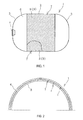
- FIG. 1
- is a partial cutout side view illustrating an internal structure of a pneumatic fender of the present invention.
- FIG. 2
- is a transverse cross sectional view of the top half of the pneumatic fender in
FIG. 1 . - FIG. 3
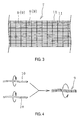
- is an explanatory view illustrating fiber reinforcing layers in the present invention.
- FIG. 4
- is an explanatory view illustrating twisted cords in
FIG. 3 . - In the
pneumatic fender 1 in the embodiment illustrated inFIG. 1 and FIG. 2 , amouthpiece 4 is provided on one ofmirror portions 3 covering both ends of acylindrical body portion 2. In thebody portion 2 andmirror portions 3, a plurality offiber reinforcing layers 7 is embedded between the innersurface rubber layer 5 and outersurface rubber layer 6. At least one layer offiber reinforcing layers 7 is provided, and the number of layers is determined by the size or the like of thepneumatic fender 1. - In the
body portion 2, the plurality offiber reinforcing layers 7 is disposed so that thewarp 8 is inclined at a predetermined bias angle with respect to the axial direction. In the top and bottom adjacently layeredfiber reinforcing layers 7, the bias angle of thewarp 8 is symmetric with respect to the axial direction. - As illustrated in
FIG. 3 , each of thefiber reinforcing layers 7 has cord fabric structure withwarp 8 andweft 11. Thefiber reinforcing layers 7 can have a flat weave structure, but a cord fabric structure can reduce interference between thewarp 7 andweft 11, and this is advantageous in improving the durability of thefiber reinforcing layers 7. The weaving density of thewarp 8 in the cord fabric structure is about from 30 to 70 cords/5 cm and the weaving density of theweft 11 is about from 2 to 8 cords/5 cm. - In the present invention, the
warp 8 has the special specifications as described below.Weft 11 formed of, for example, polyester, polyketone, aramid, vinylon, nylon and other various synthetic fibers may be used. - As illustrated in
FIG. 4 , thewarp 8 is constituted bytwisted cords 9 formed from PENfiber filament yarn 10. In this embodiment, atwisted cord 9 is constituted by primarily twisting twofilament yarn 10 in the same direction, and then finally twisting the primarytwisted filament yarn 10 together in the reverse direction. - This twisted cord 9 (warp 8) may obtain excellent fatigue resistance compared to single twist structures in which one or a plurality of filament yarn is laid out and twisted in one direction only. The primary twist and final twist may have different twist counts, but to obtain stability, the count is preferably the same or approximately the same. In consideration of tensile strength, flexibility, and the like, the fineness of the
twisted cord 9 is about from 1000 to 2000 dtex, and the intertwinedfilament yarn 10 is about two or three yarns. - The primary twist count and final twist count are preferably twist counts wherein the twist coefficient K regulated in the formula (1) below is about from 1300 to 2500 both inclusive. If the twist coefficient K is less than 1300, sufficient durability is not ensured, and if greater than 2500, strength is insufficient.

- T: Cord final twist count (twists/10 cm)
- D: Cord total fineness (dtex)
- The tensile strength of the
twisted cords 9 is 210 N or greater, the break elongation is from 14% to 20% both inclusive, and the intermediate elongation at 67 N tension is 3% or less. - If the tensile strength of the
twisted cords 9 is less than 210 N, then the tensile strength of thefiber reinforcing layers 7 will be low, and the reinforcing performance as the reinforcing layers will be insufficient. This means that the number layers offiber reinforcing layers 7 to be laminated will need to be increased, which is disadvantageous in terms of reducing the weight and cost of thepneumatic fender 1. The upper limit of the tensile strength of thetwisted cords 9 is about 400 N. - If the break elongation of the
twisted cords 9 is less than 14%, it will be difficult for thepneumatic fender 1 to withstand large deformations from being strongly pressed when boats or ships come alongside each other, and fatigue resistance under harsh conditions will be insufficient. On the other hand, if the tensile strength of thetwisted cords 9 is greater than 20%, then the intermediate elongation will also enlarge, and the elongation of thepneumatic fender 1 when placed in water will be too much. Thus, it is difficult to meet the standards stipulated by ISO described below. - If the intermediate elongation at 67 N tension of the
twisted cords 9 is greater than 3%, then it is difficult to suppress the elongation of thepneumatic fender 1 within standards in the water pressure test stipulated in clause 9.5 of ISO17357. This means that the number of layers of thefiber reinforcing layers 7 to be laminated will need to be increased in order to meet standards, which is disadvantageous for reducing the weight and cost of thepneumatic fender 1. In addition, if the intermediate elongation exceeds 3%, then the dimensional stability of the fiber reinforcing layers is reduced. - Thus, a
pneumatic fender 1 superior in fatigue resistance and able to withstand practical use under harsh conditions may be obtained by meeting all of the following conditions: the tensile strength of thetwisted cords 9 of 210 N or greater, the break elongation of from 14% to 20% both inclusive, and the intermediate elongation at 67 N tension of 3% or less. If any of these conditions is not satisfied, it will not be possible to obtain thepneumatic fender 1 that is an object of the invention. In addition, it is possible to suppress increases in the number of layers of thefiber reinforcing layers 7 to be laminated, which is advantageous in reducing the weight and cost of thepneumatic fender 1. - The
warp 8 which is the main member of thefiber reinforcing layer 7 is constituted bytwisted cords 9 formed from PEN fibers, so compared to conventional PET fibers, it is possible to suppress deterioration due to steam vulcanization. This is advantageous in preventing reduction of the tensile strength and adhesion to rubber of the fiber reinforcing layers 7 (twisted cords 9). For example, if a resorcin-formalin-latex (RFL) based adhesive is used, then the adhesion between thefiber reinforcing layers 7 using PEN fibers and rubber is further improved. - In the embodiment, the
warp 8 of all of thefiber reinforcing layers 7 is constituted bytwisted cords 9 formed from PENfiber filament yarn 10, but preferably, all of thefiber reinforcing layers 7 are constituted by PEN fiber. Furthermore, if thefiber reinforcing layers 7 are formed from a plurality of layers, then thewarp 8 of at least one layer of thefiber reinforcing layers 7 may be constituted bytwisted cords 9 formed from PENfiber filament yarn 10. For example, if thefiber reinforcing layers 7 are constituted by three layers or more, out of thesefiber reinforcing layers 7, thewarp 8 of thefiber reinforcing layers 7 disposed on the innermost peripheral side and the outermost peripheral side may be constituted bytwisted cords 9 formed from PENfiber filament yarn 10. - Relatively large stress tends to be generated at the
fiber reinforcing layers 7 on the innermost peripheral side and outermost peripheral side of thepneumatic fender 1, out of thefiber reinforcing layers 7, when boats and ships come alongside each other. Therefore,fiber reinforcing layers 7 with the specifications described above are utilized only for one layer of thefiber reinforcing layers 7 on the innermost peripheral side and one layer of thefiber reinforcing layers 7 on the outermost peripheral side. Alternatively, at least thefiber reinforcing layers 7 disposed on the innermost peripheral side and the outermost peripheral side may be thefiber reinforcing layers 7 with the specifications described above. - The
fiber reinforcing layers 7 interposed betweenfiber reinforcing layers 7 on the innermost peripheral side and the outermost peripheral side are relatively unlikely to be affected by steam vulcanization, so conventional fiber reinforcing layers constituted by twisted cords formed from PET fibers may be used for thefiber reinforcing layers 7 disposed betweenfiber reinforcing layers 7 on the innermost peripheral side and the outermost peripheral side. Thus, inexpensive PET fibers may be used to reduce manufacturing costs. - A fiber reinforcing layer with a structure formed from 10 types of cord fabric (warp weaving density: 50 cords/5 cm, weft weaving density: 5 cords/cm) was produced using individual twisted cords for the warp constituting the fiber reinforcing layer with different specifications shown in Table 1. The twist coefficient K in Table 1 is as described above. The cord characteristics are values that have been measured based on JIS L1017.
- Using the produced fiber reinforcing layers, test sample pneumatic fenders with only the fiber reinforcing layers being different (Working Examples 1 to 5, Comparative Examples 1 to 5) were produced, and each of the test samples was subjected to the burst pressure test, fatigue resistance test, and water pressure test as described below. The test samples were 3.3 m in outer diameter and 6.5 m in length, and the number of layers of the fiber reinforcing layers to be laminated was six plies.
- In addition, each of the fiber reinforcing layers (Working Examples 1 to 5, Comparative Examples 1 to 5) was subjected to the rubber adhesion test as described below. The test results are as shown in Table 1.
- This test was performed based on the test method stipulated in ISO 17357. The interiors of test samples were pressurized, and then the pressurizing pressure when the test samples had burst was measured. If the burst pressure was 525 kPa or greater, then it was at a level that could withstand practical use.
- This test was performed based on the test method stipulated in clause 8.4 of ISO 17357. Test samples with an air pressure of 50 kPa were repeatedly subjected to compressive deformation of 60% of diameter 3,000 times, and then the degree of the damage to the fiber reinforcing layers was evaluated. The case of the degree of the damage being within the permissible range for withstanding practical use was indicated with a "○", the case of the degree of the damage being outside the permissible range and not withstand practical use and was indicated with an "x".
- This test is stipulated by clause 9.5 of ISO 17357. The elongation of test samples of pneumatic fenders was measured when the test samples were subjected to a water pressure load of 100 N. If the measured elongation was 10% or less, then the test sample passed the water pressure test and was indicated with a "○". If it was greater than 10%, then it failed and was indicated with an "x".
- Each of the fiber reinforcing layers, and rubber commonly used in pneumatic fenders (natural SBR rubber) were subjected to steam vulcanization under the same conditions, and the adhesion was evaluated. As the evaluation method, measurement of peel strength was performed based upon the test method stipulated in JIS K6256-1. If the peel strength was 110 N/inch or greater, then the adhesion was excellent and indicated with a "○". If it was less than 110 N/inch, then the adhesion was poor and indicated with an "×".
[Table 1-1] WORKING EXAMPLES 1 2 3 4 5 MATERIAL PEN ← ← ← ← Cord structure Fineness (dtex) 1670 ← ← ← ← Twist count (cords) 2 ← ← 3 ← Twist coefficient K 2300 ← ← 1500 ← Cord properties Strength (N/cords) 223 220 218 312 330 Breaking elongation (%) 16.8 14.2 19.5 16.2 14.0 67N intermediate elongation (%) 2.5 2.2 2.7 2.5 2.1 Product evaluation Burst pressure (kPa) 550 550 525 750 760 Rubber adhesion ○ ○ ○ ○ ○ Fatigue resistance ○ ○ ○ ○ ○ Water pressure test ○ ○ ○ ○ ○ [Table 1-2] Comparative Examples 1 2 3 4 5 MATERIAL PET PEN ← Nylon 66 Aramid Cord structure Fineness (dtex) 1670 ← ← 1400 1670 Twist count (cords) 2 ← 3 2 ← Twist coefficient K 2300 ← ← ← ← Cord properties Strength (N/cords) 220 225 315 238 450 Breaking elongation (%) 17.0 10.5 11.0 20.0 6.0 67N intermediate elongation (%) 3.6 1.5 2.0 5.0 2.6 Product evaluation Burst pressure (kPa) 500 525 750 600 800 Rubber adhesion Δ ○ ○ ⊚ × Fatigue resistance ○ × × ○ × Water pressure test Δ ○ ○ × ○ - It can be seen from Table 1 that a constant level was ensured for all results in Working Examples 1 to 5: burst pressure, fatigue resistance, water pressure test, and rubber adhesion, and samples could withstand practical use under harsh conditions.
-
- 1
- Pneumatic fender
- 2
- Body portion
- 3
- Mirror portion
- 4
- Mouthpiece
- 5
- Inner surface rubber layer
- 6
- Outer surface rubber layer
- 7
- Fiber reinforcing layer
- 8
- Warp
- 9
- Twisted cord
- 10
- PEN fiber (filament yarn)
- 11
- Weft
Claims (4)
- A pneumatic fender, comprising:at least one layer of fiber reinforcing layers embedded between an inner surface rubber layer and an outer surface rubber layer;a warp of the at least one layer of the fiber reinforcing layers being constituted by twisted cords formed from PEN fibers, tensile strength of the twisted cords being 210 N or greater, break elongation being from 14% to 20% both inclusive, and intermediate elongation at 67 N tension being 3% or less.
- The pneumatic fender according to claim 1, wherein
the fiber reinforcing layers have a cord fabric structure in which a plurality of twisted cords is laid out in parallel. - The pneumatic fender according to claim 1 or 2, wherein
the twisted cord has a ply structure in which two or three PEN fibers are twisted. - The pneumatic fender according to any one of claims 1 to 3, wherein
the fiber reinforcing layers are constituted by three layers or more, and, out of these fiber reinforcing layers, the warp of at least the fiber reinforcing layers disposed on the innermost peripheral side and the outermost peripheral side is constituted by twisted cords formed from PEN fibers.
Applications Claiming Priority (2)
| Application Number | Priority Date | Filing Date | Title |
|---|---|---|---|
| JP2012277990A JP5790637B2 (en) | 2012-12-20 | 2012-12-20 | Pneumatic fender |
| PCT/JP2013/083831 WO2014098106A1 (en) | 2012-12-20 | 2013-12-18 | Pneumatic fender |
Publications (2)
| Publication Number | Publication Date |
|---|---|
| EP2937465A1 true EP2937465A1 (en) | 2015-10-28 |
| EP2937465A4 EP2937465A4 (en) | 2016-06-08 |
Family
ID=50978431
Family Applications (1)
| Application Number | Title | Priority Date | Filing Date |
|---|---|---|---|
| EP13863745.9A Withdrawn EP2937465A4 (en) | 2012-12-20 | 2013-12-18 | Pneumatic fender |
Country Status (6)
| Country | Link |
|---|---|
| US (1) | US20160194064A1 (en) |
| EP (1) | EP2937465A4 (en) |
| JP (1) | JP5790637B2 (en) |
| KR (2) | KR20150067404A (en) |
| CN (1) | CN104838070B (en) |
| WO (1) | WO2014098106A1 (en) |
Families Citing this family (6)
| Publication number | Priority date | Publication date | Assignee | Title |
|---|---|---|---|---|
| WO2018084122A1 (en) * | 2016-11-07 | 2018-05-11 | 株式会社ブリヂストン | Hydraulic actuator |
| JP6928105B2 (en) * | 2017-10-30 | 2021-09-01 | 株式会社ブリヂストン | Pneumatic actuator |
| JP7180386B2 (en) * | 2019-01-09 | 2022-11-30 | 横浜ゴム株式会社 | pneumatic fender |
| JP7180397B2 (en) * | 2019-01-16 | 2022-11-30 | 横浜ゴム株式会社 | Pneumatic fender and its manufacturing method |
| JP2024027678A (en) | 2022-08-18 | 2024-03-01 | 横浜ゴム株式会社 | Rubber products and their manufacturing method |
| US20250304216A1 (en) * | 2024-04-02 | 2025-10-02 | Samuel Ingram | Automatic Submersible Water Sports Course System |
Family Cites Families (21)
| Publication number | Priority date | Publication date | Assignee | Title |
|---|---|---|---|---|
| US3125979A (en) * | 1964-03-24 | Ship fender | ||
| US3063400A (en) * | 1960-08-17 | 1962-11-13 | Yokohama Rubber Co Ltd | Floating ship fender |
| US4054476A (en) * | 1975-12-22 | 1977-10-18 | The Yokohama Rubber Co., Ltd. | Method and apparatus for fabricating non-vulcanized pneumatic rubber fenders |
| JPS5928689B2 (en) * | 1978-03-03 | 1984-07-14 | 株式会社ブリヂストン | Pneumatic fencing material with cylindrical body as impact receiving surface |
| US4843994A (en) * | 1987-08-13 | 1989-07-04 | Wilson Jeffery D | Boat fender cover and hanger assembly |
| US6713610B1 (en) * | 1990-01-12 | 2004-03-30 | Raju Kucherlapati | Human antibodies derived from immunized xenomice |
| JP2510745B2 (en) * | 1990-02-02 | 1996-06-26 | 株式会社クラレ | Easy dyeing high strength polyester composite fiber |
| US6631748B1 (en) * | 1998-07-06 | 2003-10-14 | The Goodyear Tire & Rubber Company | Sidewall with insert construction for runflat tire |
| US20040089577A1 (en) * | 1999-06-02 | 2004-05-13 | Peter Kancsar | Blister pack |
| JP4259730B2 (en) * | 2000-06-07 | 2009-04-30 | 横浜ゴム株式会社 | Protective material for fenders |
| KR101066826B1 (en) * | 2001-07-09 | 2011-09-23 | 헨리 케이 오베르메이어 | Quantity control gates and their actuators |
| CN1292920C (en) * | 2001-12-28 | 2007-01-03 | 株式会社金阳社 | Rubber blanket for offset printing |
| JP2004332892A (en) * | 2003-05-12 | 2004-11-25 | Tokai Rubber Ind Ltd | Fiber reinforced hose |
| US20040261928A1 (en) * | 2003-06-27 | 2004-12-30 | Imhoff Serge Julien Auguste | Polyester cords and their use in runflat tires |
| TWI285228B (en) * | 2003-07-08 | 2007-08-11 | Teijin Techno Products Ltd | Synthetic fiber tire cord fabric for reinforcing rubber and pneumatic tire using the same |
| JP4909527B2 (en) * | 2005-04-13 | 2012-04-04 | 横浜ゴム株式会社 | How to fold a pneumatic fender |
| JP5029031B2 (en) * | 2007-01-23 | 2012-09-19 | 横浜ゴム株式会社 | Rubber composition for fenders and fenders |
| JP4928308B2 (en) * | 2007-02-28 | 2012-05-09 | 帝人ファイバー株式会社 | Polyethylene naphthalate fiber for industrial materials and production method thereof |
| KR100935649B1 (en) * | 2007-11-26 | 2010-01-07 | 주식회사 일청엔지니어링 | Manufacturing method of pneumatic polyurea insect repellent |
| JP5565434B2 (en) * | 2012-04-27 | 2014-08-06 | 横浜ゴム株式会社 | Pneumatic fender |
| JP6136556B2 (en) * | 2013-05-10 | 2017-05-31 | 横浜ゴム株式会社 | Vertical pneumatic fender |
-
2012
- 2012-12-20 JP JP2012277990A patent/JP5790637B2/en not_active Expired - Fee Related
-
2013
- 2013-12-18 KR KR1020157015004A patent/KR20150067404A/en not_active Ceased
- 2013-12-18 EP EP13863745.9A patent/EP2937465A4/en not_active Withdrawn
- 2013-12-18 KR KR1020167007042A patent/KR20160036633A/en not_active Abandoned
- 2013-12-18 CN CN201380062780.6A patent/CN104838070B/en not_active Expired - Fee Related
- 2013-12-18 US US14/654,492 patent/US20160194064A1/en not_active Abandoned
- 2013-12-18 WO PCT/JP2013/083831 patent/WO2014098106A1/en not_active Ceased
Also Published As
| Publication number | Publication date |
|---|---|
| JP2014121806A (en) | 2014-07-03 |
| WO2014098106A1 (en) | 2014-06-26 |
| US20160194064A1 (en) | 2016-07-07 |
| KR20160036633A (en) | 2016-04-04 |
| EP2937465A4 (en) | 2016-06-08 |
| CN104838070B (en) | 2016-10-05 |
| CN104838070A (en) | 2015-08-12 |
| KR20150067404A (en) | 2015-06-17 |
| JP5790637B2 (en) | 2015-10-07 |
Similar Documents
| Publication | Publication Date | Title |
|---|---|---|
| EP2937465A1 (en) | Pneumatic fender | |
| US20110240199A1 (en) | Pneumatic tire for vehicles | |
| EP3196343B1 (en) | Hybrid cord and tire using the same | |
| EP2261059B1 (en) | Pneumatic tire with an overlay reinforcement | |
| EP2380756A1 (en) | Carcass ply for a pneumatic tire | |
| EP2890571B1 (en) | A tire reinforcement material | |
| EP2380754A2 (en) | Hybrid cord in a belt ply for a pneumatic tire | |
| US20160288577A1 (en) | Hybrid reinforcement | |
| WO2014060822A2 (en) | A tire cord fabric | |
| US20150041039A1 (en) | Pneumatic tire with a reinforced flipper or chipper | |
| US20140345772A1 (en) | Overlay ply for a pneumatic tire | |
| US20030155060A1 (en) | Tire with a protective crown ply made of very high twist aramid fiber | |
| US20120067487A1 (en) | Tires with high strength reinforcement | |
| TR201802931T1 (en) | One Fold Twisted Overhead Reinforcement Hybrid Yarn | |
| US20120067491A1 (en) | Tires with high strength reinforcement | |
| EP2380755B1 (en) | Overlay ply covering the belt ply for a pneumatic tire | |
| EP2857732B1 (en) | Marine hose | |
| KR20110026558A (en) | Fibrous fabric for cap ply of pneumatic tires and pneumatic tires using the same | |
| US20100166993A1 (en) | Reinforcement layer made of hybrid cords for elastomeric products | |
| RU2741993C1 (en) | Reinforcing layer for items from elastomer material and pneumatic tires of vehicle | |
| EP4574423A1 (en) | Rubber product and production method therefor | |
| KR20100000767A (en) | Hybrid pbo cord for carcass ply | |
| KR20060102982A (en) | Hybrid fiber cord for cap ply of pneumatic tire | |
| US20120067490A1 (en) | Tires with high strength reinforcement | |
| US20120067488A1 (en) | Tires with high strength reinforcement |
Legal Events
| Date | Code | Title | Description |
|---|---|---|---|
| PUAI | Public reference made under article 153(3) epc to a published international application that has entered the european phase |
Free format text: ORIGINAL CODE: 0009012 |
|
| 17P | Request for examination filed |
Effective date: 20150717 |
|
| AK | Designated contracting states |
Kind code of ref document: A1 Designated state(s): AL AT BE BG CH CY CZ DE DK EE ES FI FR GB GR HR HU IE IS IT LI LT LU LV MC MK MT NL NO PL PT RO RS SE SI SK SM TR |
|
| AX | Request for extension of the european patent |
Extension state: BA ME |
|
| DAX | Request for extension of the european patent (deleted) | ||
| A4 | Supplementary search report drawn up and despatched |
Effective date: 20160509 |
|
| STAA | Information on the status of an ep patent application or granted ep patent |
Free format text: STATUS: EXAMINATION IS IN PROGRESS |
|
| 17Q | First examination report despatched |
Effective date: 20170331 |
|
| STAA | Information on the status of an ep patent application or granted ep patent |
Free format text: STATUS: THE APPLICATION IS DEEMED TO BE WITHDRAWN |
|
| 18D | Application deemed to be withdrawn |
Effective date: 20170811 |