EP2937348B1 - Process for the preparation of a compound used as mineralocorticoid receptor antagonist - Google Patents
Process for the preparation of a compound used as mineralocorticoid receptor antagonist Download PDFInfo
- Publication number
- EP2937348B1 EP2937348B1 EP13864994.2A EP13864994A EP2937348B1 EP 2937348 B1 EP2937348 B1 EP 2937348B1 EP 13864994 A EP13864994 A EP 13864994A EP 2937348 B1 EP2937348 B1 EP 2937348B1
- Authority
- EP
- European Patent Office
- Prior art keywords
- chloro
- produce
- pyrazolo
- tetrahydro
- cyclopentyl
- Prior art date
- Legal status (The legal status is an assumption and is not a legal conclusion. Google has not performed a legal analysis and makes no representation as to the accuracy of the status listed.)
- Active
Links
- WSKHPIAPGYUBSW-ZUQPMPHSSA-N CCCc(cc(cc1)N2N=C3c4ccc(C(O)=O)nc4CC(C4)C34[C@@H]2C2CCCC2)c1C#N Chemical compound CCCc(cc(cc1)N2N=C3c4ccc(C(O)=O)nc4CC(C4)C34[C@@H]2C2CCCC2)c1C#N WSKHPIAPGYUBSW-ZUQPMPHSSA-N 0.000 description 1
- ZCHSWEDBXUVGSA-ZXHDLPGQSA-N CCCc(cc(cc1)N[C@@H](C2CCCC2)[C@@H](CCc2c3ccc(C(N(CC4)CCC4O)=O)n2)/C3=N\C)c1C#N Chemical compound CCCc(cc(cc1)N[C@@H](C2CCCC2)[C@@H](CCc2c3ccc(C(N(CC4)CCC4O)=O)n2)/C3=N\C)c1C#N ZCHSWEDBXUVGSA-ZXHDLPGQSA-N 0.000 description 1
Images


Classifications
-
- C—CHEMISTRY; METALLURGY
- C07—ORGANIC CHEMISTRY
- C07D—HETEROCYCLIC COMPOUNDS
- C07D471/00—Heterocyclic compounds containing nitrogen atoms as the only ring hetero atoms in the condensed system, at least one ring being a six-membered ring with one nitrogen atom, not provided for by groups C07D451/00 - C07D463/00
- C07D471/02—Heterocyclic compounds containing nitrogen atoms as the only ring hetero atoms in the condensed system, at least one ring being a six-membered ring with one nitrogen atom, not provided for by groups C07D451/00 - C07D463/00 in which the condensed system contains two hetero rings
- C07D471/04—Ortho-condensed systems
-
- A—HUMAN NECESSITIES
- A61—MEDICAL OR VETERINARY SCIENCE; HYGIENE
- A61K—PREPARATIONS FOR MEDICAL, DENTAL OR TOILETRY PURPOSES
- A61K31/00—Medicinal preparations containing organic active ingredients
- A61K31/33—Heterocyclic compounds
- A61K31/395—Heterocyclic compounds having nitrogen as a ring hetero atom, e.g. guanethidine or rifamycins
- A61K31/435—Heterocyclic compounds having nitrogen as a ring hetero atom, e.g. guanethidine or rifamycins having six-membered rings with one nitrogen as the only ring hetero atom
- A61K31/47—Quinolines; Isoquinolines
- A61K31/4738—Quinolines; Isoquinolines ortho- or peri-condensed with heterocyclic ring systems
- A61K31/4745—Quinolines; Isoquinolines ortho- or peri-condensed with heterocyclic ring systems condensed with ring systems having nitrogen as a ring hetero atom, e.g. phenantrolines
-
- A—HUMAN NECESSITIES
- A61—MEDICAL OR VETERINARY SCIENCE; HYGIENE
- A61P—SPECIFIC THERAPEUTIC ACTIVITY OF CHEMICAL COMPOUNDS OR MEDICINAL PREPARATIONS
- A61P13/00—Drugs for disorders of the urinary system
- A61P13/12—Drugs for disorders of the urinary system of the kidneys
-
- A—HUMAN NECESSITIES
- A61—MEDICAL OR VETERINARY SCIENCE; HYGIENE
- A61P—SPECIFIC THERAPEUTIC ACTIVITY OF CHEMICAL COMPOUNDS OR MEDICINAL PREPARATIONS
- A61P25/00—Drugs for disorders of the nervous system
-
- A—HUMAN NECESSITIES
- A61—MEDICAL OR VETERINARY SCIENCE; HYGIENE
- A61P—SPECIFIC THERAPEUTIC ACTIVITY OF CHEMICAL COMPOUNDS OR MEDICINAL PREPARATIONS
- A61P29/00—Non-central analgesic, antipyretic or antiinflammatory agents, e.g. antirheumatic agents; Non-steroidal antiinflammatory drugs [NSAID]
-
- A—HUMAN NECESSITIES
- A61—MEDICAL OR VETERINARY SCIENCE; HYGIENE
- A61P—SPECIFIC THERAPEUTIC ACTIVITY OF CHEMICAL COMPOUNDS OR MEDICINAL PREPARATIONS
- A61P5/00—Drugs for disorders of the endocrine system
- A61P5/38—Drugs for disorders of the endocrine system of the suprarenal hormones
- A61P5/40—Mineralocorticosteroids, e.g. aldosterone; Drugs increasing or potentiating the activity of mineralocorticosteroids
-
- A—HUMAN NECESSITIES
- A61—MEDICAL OR VETERINARY SCIENCE; HYGIENE
- A61P—SPECIFIC THERAPEUTIC ACTIVITY OF CHEMICAL COMPOUNDS OR MEDICINAL PREPARATIONS
- A61P7/00—Drugs for disorders of the blood or the extracellular fluid
-
- A—HUMAN NECESSITIES
- A61—MEDICAL OR VETERINARY SCIENCE; HYGIENE
- A61P—SPECIFIC THERAPEUTIC ACTIVITY OF CHEMICAL COMPOUNDS OR MEDICINAL PREPARATIONS
- A61P9/00—Drugs for disorders of the cardiovascular system
-
- A—HUMAN NECESSITIES
- A61—MEDICAL OR VETERINARY SCIENCE; HYGIENE
- A61P—SPECIFIC THERAPEUTIC ACTIVITY OF CHEMICAL COMPOUNDS OR MEDICINAL PREPARATIONS
- A61P9/00—Drugs for disorders of the cardiovascular system
- A61P9/04—Inotropic agents, i.e. stimulants of cardiac contraction; Drugs for heart failure
-
- A—HUMAN NECESSITIES
- A61—MEDICAL OR VETERINARY SCIENCE; HYGIENE
- A61P—SPECIFIC THERAPEUTIC ACTIVITY OF CHEMICAL COMPOUNDS OR MEDICINAL PREPARATIONS
- A61P9/00—Drugs for disorders of the cardiovascular system
- A61P9/06—Antiarrhythmics
-
- A—HUMAN NECESSITIES
- A61—MEDICAL OR VETERINARY SCIENCE; HYGIENE
- A61P—SPECIFIC THERAPEUTIC ACTIVITY OF CHEMICAL COMPOUNDS OR MEDICINAL PREPARATIONS
- A61P9/00—Drugs for disorders of the cardiovascular system
- A61P9/10—Drugs for disorders of the cardiovascular system for treating ischaemic or atherosclerotic diseases, e.g. antianginal drugs, coronary vasodilators, drugs for myocardial infarction, retinopathy, cerebrovascula insufficiency, renal arteriosclerosis
-
- A—HUMAN NECESSITIES
- A61—MEDICAL OR VETERINARY SCIENCE; HYGIENE
- A61P—SPECIFIC THERAPEUTIC ACTIVITY OF CHEMICAL COMPOUNDS OR MEDICINAL PREPARATIONS
- A61P9/00—Drugs for disorders of the cardiovascular system
- A61P9/12—Antihypertensives
-
- C—CHEMISTRY; METALLURGY
- C07—ORGANIC CHEMISTRY
- C07C—ACYCLIC OR CARBOCYCLIC COMPOUNDS
- C07C255/00—Carboxylic acid nitriles
- C07C255/49—Carboxylic acid nitriles having cyano groups bound to carbon atoms of six-membered aromatic rings of a carbon skeleton
- C07C255/50—Carboxylic acid nitriles having cyano groups bound to carbon atoms of six-membered aromatic rings of a carbon skeleton to carbon atoms of non-condensed six-membered aromatic rings
-
- C—CHEMISTRY; METALLURGY
- C07—ORGANIC CHEMISTRY
- C07D—HETEROCYCLIC COMPOUNDS
- C07D215/00—Heterocyclic compounds containing quinoline or hydrogenated quinoline ring systems
- C07D215/02—Heterocyclic compounds containing quinoline or hydrogenated quinoline ring systems having no bond between the ring nitrogen atom and a non-ring member or having only hydrogen atoms or carbon atoms directly attached to the ring nitrogen atom
- C07D215/16—Heterocyclic compounds containing quinoline or hydrogenated quinoline ring systems having no bond between the ring nitrogen atom and a non-ring member or having only hydrogen atoms or carbon atoms directly attached to the ring nitrogen atom with hetero atoms or with carbon atoms having three bonds to hetero atoms with at the most one bond to halogen, e.g. ester or nitrile radicals, directly attached to ring carbon atoms
- C07D215/20—Oxygen atoms
-
- C—CHEMISTRY; METALLURGY
- C07—ORGANIC CHEMISTRY
- C07D—HETEROCYCLIC COMPOUNDS
- C07D215/00—Heterocyclic compounds containing quinoline or hydrogenated quinoline ring systems
- C07D215/02—Heterocyclic compounds containing quinoline or hydrogenated quinoline ring systems having no bond between the ring nitrogen atom and a non-ring member or having only hydrogen atoms or carbon atoms directly attached to the ring nitrogen atom
- C07D215/16—Heterocyclic compounds containing quinoline or hydrogenated quinoline ring systems having no bond between the ring nitrogen atom and a non-ring member or having only hydrogen atoms or carbon atoms directly attached to the ring nitrogen atom with hetero atoms or with carbon atoms having three bonds to hetero atoms with at the most one bond to halogen, e.g. ester or nitrile radicals, directly attached to ring carbon atoms
- C07D215/48—Carbon atoms having three bonds to hetero atoms with at the most one bond to halogen
-
- C—CHEMISTRY; METALLURGY
- C07—ORGANIC CHEMISTRY
- C07D—HETEROCYCLIC COMPOUNDS
- C07D215/00—Heterocyclic compounds containing quinoline or hydrogenated quinoline ring systems
- C07D215/58—Heterocyclic compounds containing quinoline or hydrogenated quinoline ring systems with hetero atoms directly attached to the ring nitrogen atom
- C07D215/60—N-oxides
-
- C—CHEMISTRY; METALLURGY
- C07—ORGANIC CHEMISTRY
- C07B—GENERAL METHODS OF ORGANIC CHEMISTRY; APPARATUS THEREFOR
- C07B2200/00—Indexing scheme relating to specific properties of organic compounds
- C07B2200/13—Crystalline forms, e.g. polymorphs
Definitions
- the present invention belongs to the field of pharmaceutical technology. More specifically, the present invention relates to a method for preparing a compound as mineralocorticoid receptor antagonist.
- Aldosterone is a mineralocorticoid hormone synthesized at the adrenal cortex, and can bind to the mineralocorticoid receptor and activate the receptor to promote the conservation of sodium and the excretion of potassium. It may have an important role in keeping the electrolyte balance and changing the structure and function of endothelial cells, vascular smooth muscle cells and fibroblasts on the arterial wall as well as the arterial adventitia and the matrix on its media.
- the high level of aldosterone may result in the abnormal activation of the mineralocorticoid receptor, which can cause the electrolyte imbalance, the blood vessel injury, the fibrosis and the like, and result in the cardiovascular disease such as hypertension, the injury to the organ such as kidney, heart and brain, the endocrine disturbance and the like.
- a drug that blocks the binding of aldosterone and the mineralocorticoid receptor by competitively binding to the mineralocorticoid receptor can therefore inhibit the aldosterone-mediated injury and reduce the occurrence of the above mentioned disease.
- the compound represented by Formula (1) 2-chloro-4-[(3S,3aR)-3-cyclopentyl-7-(4-hydroxypiperidin-1-carbonyl)-3,3a,4,5-tetrahydro-2H-pyrazolo[3,4-f]quinolin-2-yl]benzonitrile, as disclosed in the application WO2012022121 , is an aldosterone receptor antagonist, which can selectively bind to the mineralocorticoid receptor, and has a lower affinity to the glucocorticoid and the androgen receptor.
- WO2012022121 discloses a process for preparing the compound represented by formula (1), which is obtained by chirally resolving the racemic mixture containing the compound represented by formula (1) following by the rotary-evaporation to dryness. The obtained compound is in the amorphous form.
- the compound of formula (1) has two chiral centers.
- those skilled in the art will resolve the racemic mixture.
- the racemic mixture containing the compound represented by formula (1) is firstly obtained, and then resolved to obtain the compound represented by formula (1), which makes it difficult to produce the compound represented by formula (1) in a GMP standard plant, resulting in the difficulty in the industrialization and the higher production cost.
- the present inventors have performed the resolution step in advance so that it can be easy to produce the compound represented by formula (1) in a GMP standard workshop and the industrialization can be smoothly accomplished.
- the object of the present invention is to provide a process for preparing the compound of Formula (1).
- a process for preparing crystal forms of the compound of Formula (1) and a method for converting any one of crystal forms into another crystal form are described herein.
- crystal forms of the compound of Formula (1) for treating and/or preventing kidney injury or cardiovascular disease including heart injury, hypertension, heart failure, myocardial infarction, angina pectoris, cardiac hypertrophy, myocarditis, fibrosis of heart and blood vessel, baroceptor dysfunction or arrhythmia
- crystal forms of the compound of Formula (1) in manufacture of a medicament for treating and/or preventing kidney injury or cardiovascular disease including heart injury, hypertension, heart failure, myocardial infarction, angina pectoris, cardiac hypertrophy, myocarditis, fibrosis of heart and blood vessel, baroceptor dysfunction or arrhythmia
- Crystal form of the compound represented by formula (I) is disclosed herein, which is characterized by having an X-ray powder diffraction pattern comprising the following characteristic peaks expressed by 2 ⁇ degree, when measured using CuKa radiation:
- Crystal form of the compound represented by formula (I) is disclosed herein, which is characterized by having an X-ray powder diffraction pattern comprising the following characteristic peaks expressed by 2 ⁇ degree, when measured using CuKa radiation:
- Crystal Form I of the compound represented by formula (1), as described above, may be prepared by placing the compound 2-chloro-4-[(3S,3aR)-3-cyclopentyl-7-(4-hydroxypiperidin-1-carbonyl)-3,3a,4,5-tetrahydro-2H-pyrazolo[3,4-f]quinolin-2-yl]benzonitrile in an anhydrous lower alcohol, acetonitrile, a mixture of ethyl acetate and ethanol, a mixture of methanol and tetrahydrofuran, or a mixture of acetonitrile and acetone, heating the resulting solution until it becomes clear, then cooling the resulting solution to separate out a solid, and filtering and drying the separated solid to produce Crystal Form I; or dissolving the compound 2-chloro-4-[(3S,3aR)-3-cyclopentyl-7-(4-hydroxypiperidin-1-carbonyl)-3,3a,4,5-tetrahydro-2H
- Crystal Form III of the compound represented by formula (1), as described above, may be prepared by placing the compound 2-chloro-4-[(3S,3aR)-3-cyclopentyl-7-(4-hydroxypiperidin-1-carbonyl)-3,3a,4,5-tetrahydro-2H-pyrazolo[3,4-f]quinolin-2-yl]benzonitrile in a lower alcohol to dissolve it, then adding the resulting solution dropwisely to water, and filtering the resulting mixture to produce the resulting Crystal Form III; or washing the compound 2-chloro-4-[(3S,3aR)-3-cyclopentyl-7-(4-hydroxypiperidin-1-carbonyl)-3,3a,4,5-tetrahydro-2H-pyrazolo[3,4-f]quinolin-2-yl]benzonitrile with a mixture of water and acetonitrile, and filtering the resulting mixture to produce the resulting Crystal Form III.
- Crystal Form II of the compound represented by formula (1), as described above, may be prepared by placing the compound 2-chloro-4-[(3S,3aR)-3-cyclopentyl-7-(4-hydroxypiperidin-1-carbonyl)-3,3a,4,5-tetrahydro-2H-pyrazolo[3,4-f]quinolin-2-yl]benzonitrile in a lower alcohol to dissolve it, then adding the resulting solution dropwisely to water, and filtering the resulting mixture to produce the resulting Crystal Form III; or washing the compound 2-chloro-4-[(3S,3aR)-3-cyclopentyl-7-(4-hydroxypiperidin-1-carbonyl)-3,3a,4,5-tetrahydro-2H-pyrazolo[3,4-f]quinolin-2-yl]benzonitrile with a mixture of water and acetonitrile, and filtering the resulting mixture to produce the resulting Crystal Form III; then drying the resulting Crystal Form III under vacuum to produce Crystal
- lower alcohol refers to methanol, ethanol, or n-propanol.
- a pharmaceutical composition is disclosed herein, which is characterized in that said pharmaceutical composition contains the above described crystal form of the compound represented by formula (1), and a pharmaceutically acceptable carrier, wherein said crystal form comprises Crystal Forms I, II and III or a combination thereof.
- This pharmaceutical composition is not part of the present invention.
- a pharmaceutical composition containing Crystal Forms I, II and III of the compound represented by formula (1) or a combination thereof is also disclosed herein.
- Said pharmaceutical composition can also contain a pharmaceutically acceptable carrier, such as excipient, binder, humidifier, disintegrant, thickener and the like. This pharmaceutical composition is not part of the present invention.
- Said cardiovascular disease may comprise heart injury, hypertension, heart failure, myocardial infarction, angina pectoris, cardiac hypertrophy, myocarditis, fibrosis of heart and blood vessel, baroceptor dysfunction or arrhythmia.
- a method of treating and/or preventing kidney injury or cardiovascular disease comprises administrating a subject in need thereof a therapeutically effective amount of the above described crystal form of the compound represented by formula (1), wherein said crystal form comprises Crystal Forms I, II, III or a combination thereof. This method is not part of the present invention.
- Said cardiovascular disease may comprise heart injury, hypertension, heart failure, myocardial infarction, angina pectoris, cardiac hypertrophy, myocarditis, fibrosis of heart and blood vessel, baroceptor dysfunction or arrhythmia.
- crystal form of the compound represented by formula (1) for treating and/or preventing kidney injury or cardiovascular disease is disclosed herein, wherein said crystal form comprises Crystal Forms I, II, III or a combination thereof. This is not part of the present invention.
- Said cardiovascular disease may comprise heart injury, hypertension, heart failure, myocardial infarction, angina pectoris, cardiac hypertrophy, myocarditis, fibrosis of heart and blood vessel, baroceptor dysfunction or arrhythmia.
- Crystal Forms I, II and III and the amorphous form of the compound represented by formula (1) can be converted with each other under a certain condition.
- the present disclosure also provides the conversion among Crystal Form I, Crystal Form II, Crystal Form III and the amorphous form.
- the amorphous form can be recrystallized in anhydrous ethanol to produce Crystal Form I; Crystal Forms I, II and III or a combination thereof can be dissolved in a lower alcohol as solvent, and then rotary-evaporated to dryness to produce the amorphous form;
- the crude 5-oxo-5,6,7,8-tetrahydroquinoline (7.4kg) was charged to a 100L reaction vessel.
- Dichloromethane was added to the reaction vessel to the total volume of 50L.
- the resulting mixture was cooled to -10°C.
- Metachloroperbenzoic acid 13kg was added in batches. Then the mixture was stirred for 20 hours at room temperature.
- the reaction mixture was then filtered by suction. The filter cake was washed with dichloromethane twice and combined with the filtrate.
- the organic solution was washed with a saturated sodium thiosulfate solution to such a level that the potassium iodide starch test paper no more showed blue and dried with anhydrous sodium sulfate to produce a solution (50L), which was not further treated and directly used for the next step.
- Ethyl 2-(3-chloro-4-cyanophenyl)-3 -cyclopentyl-3,3 a,4,5-tetrahydro-2H-pyrazolo[3,4-f]quinoline-7-carboxylate was resolved with SFC (supercritical fluid chromatograph) to produce two isomers.
- the first component obtained by separation and collection was (3S,3aR)-ethyl 2-(3-chloro-4-cyanophenyl)-3-cyclopentyl-3,3a,4,5-tetrahydro-2H-pyrazolo[3,4-f]quinoline-7-carboxylate;
- Example 2 The compound represented by formula (1) (200mg) as prepared in Example 1 was added to a 100mL round-bottom flask. Ethyl acetate (10mL) was added. The mixture was heated to 78°C under reflux. Then ethanol (0.5mL) was added, and the mixture was stirred at 80°C. The resulting solution was slowly cooled to room temperature. After 2 days, the resulting mixture was filtered to produce Crystal Form I.
- Example 1 The compound represented by formula (1) (100mg) as prepared in Example 1 was put in a 100mL round-bottom flask. Acetone (3mL) was added, and the compound was dissolved. To the resulting mixture was dropwisely added n-heptane (20mL), and a solid separated out. The resulting mixture was filtered to produce Crystal Form I.
- Crystal Form III as prepared in Example 8 was dried for 12 hours under vacuum at room temperature to produce Crystal Form II.
- the X-ray powder diffraction (XRD) spectrum of Crystal Form II was shown in Fig. 2 , and its main parameters were as follows: 2 ⁇ angle d value Strength Unit: degree (°) Unit: angstrom Unit: % 3.574 24.70236 4.9 4.451 19.83656 56.2 7.515 11.75417 5.7 8.478 10.42104 28.0 9.002 9.81527 44.9 10.638 8.30970 23.2 12.216 7.23974 32.2 13.542 6.53344 20.0 14.049 6.29880 38.1 14.607 6.05934 90.9 16.422 5.39356 31.3 17.123 5.17422 26.2 17.992 4.92615 56.8 18.695 4.74270 57.7 19.873 4.46396 100.0 21.230 4.18168 68.6 22.819 3.89399 28.9 24.589 3.61751 60.0 25.769 3.45445 26
- Crystal Form I of the compound represented by formula (1) Crystal Form I was prepared according to Example 2.
- High humidity test Crystal Form I of the compound represented by formula (1) was laid on a dry and clean watch glass, and kept at 25°C under a relative humidity of 90% ⁇ 5% for 10 days. Samples were taken respectively on Day 5 and Day 10. The contents of the relevant substance and the compound represented by formula (1) in the sample were measured, and compared with the contents of those in the sample taken on Day 0.
- the content of the compound represented by formula (1) was measured by using an external standard method in accordance with the High Performance Liquid Chromatography in Chinese Pharmacopoeia, Appendix V D, Edition 2010 .
- the content of the relevant substance was measured by using an area normalization method in accordance with the High Performance Liquid Chromatography in Chinese Pharmacopoeia, Appendix V D, Edition 2010 .
- Table 1 The investigation results of the influencing factor tests for Crystal Form I of the compound represented by formula (1) Conditions Day Content of the compound represented by formula (1) (%) Content of the relevant substance (%) 0 99.5 0.54 60°C-(1) 5 98.9 0.82 10 98.1 0.97 60°C-(2) 5 99.7 0.58 10 99.0 0.60 RH90% ⁇ 5% 5 99.1 0.56 10 99.0 0.56 4500Lx ⁇ 500Lx 5 98.1 1.2 10 97.0 2.0
- Crystal Form I of the compound represented by formula (1) investigated the stability of Crystal Form I of the compound represented by formula (1). It could be clear from the investigation results that the contents of the relevant substance and the compound represented by formula (1) in Crystal Form I of the compound represented by formula (1) substantially did not change at a high temperature, at a high humidity and under an illumination condition. Crystal form I was superior to the amorphous form in the stability, which showed that Crystal Form I of the compound represented by formula (1) had a relatively high stability that was suitable for drug manufacture, storage and transport and was favorable for ensuring the validity and the safety in the drug use.
- Crystal Form II of the compound represented by formula (1) Crystal Form II was prepared according to Example 4.
- High humidity test Crystal Form II of the compound represented by formula (1) was laid on a dry and clean watch glass, and kept at 25°C under a relative humidity of 90% ⁇ 5% for 10 days. Sample was taken respectively on Day 10. The contents of the relevant substance and the compound represented by formula (1) in the sample were measured, and compared with the contents of those in the sample taken on Day 0.
- the content of the compound represented by formula (1) was measured by using an external standard method in accordance with the High Performance Liquid Chromatography in Chinese Pharmacopoeia, Appendix V D, Edition 2010 .
- the content of the relevant substance was measured by using an area normalization method in accordance with the High Performance Liquid Chromatography in Chinese Pharmacopoeia, Appendix V D, Edition 2010 .
- Table 2 The investigation results of the influencing factor tests for Crystal Form II of the compound represented by formula (1) Condition Day Content of the compound represented by formula (1) (%) Content of the relevant substance (%) 0 96.2 2.6 60°C-1 10 96.2 2.8 60°C-(2) 10 97.1 2.7 RH90% ⁇ 5% 10 96.9 2.6 5000Lx ⁇ 500Lx 10 95.5 2.8
- Crystal Form II of the compound represented by formula (1) investigated the stability of Crystal Form II of the compound represented by formula (1). It could be clear from the investigation results that the contents of the relevant substance and the compound represented by formula (1) in Crystal Form II of the compound represented by formula (1) substantially did not change at a high temperature, at a high humidity and under an illumination condition. Crystal form II was superior to the amorphous form in the stability, which showed that Crystal Form II of the compound represented by formula (1) had a relatively high stability that was suitable for drug manufacture, storage and transport and was favorable for ensuring the validity and the safety in the drug use.
- the solid dispersion of Crystal Form I was formulated with a suitable amount of sterile water for injection into suspensions having concentrations of 0.03, 0.10, 0.30, and 1.00 mg/mL. The suspension was prepared before use every day.
- Animal group and model Experiment animals: male Dahl/ss rats of SPF (specific pathogen free)-grade, 8-9 weeks, purchased via Vital River Laboratories from HARLAN LABORATORIES, INC. After one week normal quarantine, rats in good sign and condition were used in the experiment.
- the blood pressures of rats were monitored twice by the tail-cuff blood pressure measurement so that the rats could accommodate the blood pressure monitoring operation.
- the blood pressures of rats were monitored once before starting the experiment and used as the basic blood pressures before administration.
- the rats were randomly divided into groups according to the measured blood pressures before administration.
- the model was established by feeding the rats with a high salt chow (AIN-93G experiment animal feed containing 4% NaCl) for 42 days, in which the rats were freely accessible to food and water. And rats in control group were fed with a low-sodium chow.
- the rats in the treatment groups with Crystal Form I were respectively administrated with Crystal Form I in a dosage of 0.3, 1, 3, and 10 mg/kg/day. Rats in treatment groups were dosed orally via gavage twice a day by 5mL/kg. The rats in the model group and in the normal control were administrated with the same volume of sterile water for injection.
- Blood pressure (systolic blood pressure, abbreviated as SBP) measurement The blood pressure was measured once each week for six weeks. The blood pressure changes were analyzed for each group.
- kidney injury was scored and semi-quantitatively analyzed based on hematoxylin-eosin (HE) stain.
- HE hematoxylin-eosin
- Kidney and heart protections According to the kidney injury scores, the treatment groups with Crystal Form I showed a remarkable prevention from the increase in the kidney injury score (Table 4). Compared with the model group, Crystal Form I significantly decreased the left ventricular wall thickness (Table 4). Table 4: Protection for kidney injury and heart injury Group Kidney injury scores (Mean ⁇ SD) left ventricular wall thickness (cm, mean ⁇ SD) Normal control 0.93 ⁇ 0.079 0.401 ⁇ 0.014 Model group 2.05 ⁇ 0.091* 0.410 ⁇ 0.026 Crystal Form I 0.3 mg/kg/day 2.02 ⁇ 0.268* 0.392 ⁇ 0.024 Crystal Form I 1 mg/kg/day 1.25 ⁇ 0.428# 0.383 ⁇ 0.017# Crystal Form I 3 mg/kg/day 1.84 ⁇ 0.596* 0.381 ⁇ 0.026# Crystal Form I 10 mg/kg/day 1.71 ⁇ 0.719* 0.383 ⁇ 0.019# *p ⁇ 0.05, compared with normal control; #p ⁇ 0.05, compared with model group.
- Kidney injury scores (Mean ⁇ SD) left ventricular wall thickness (cm, mean ⁇ SD
- Crystal Form I showed remarkable depressurization effect and kidney injury protection.
Landscapes
- Chemical & Material Sciences (AREA)
- Organic Chemistry (AREA)
- Health & Medical Sciences (AREA)
- Bioinformatics & Cheminformatics (AREA)
- Engineering & Computer Science (AREA)
- Life Sciences & Earth Sciences (AREA)
- Veterinary Medicine (AREA)
- Public Health (AREA)
- General Health & Medical Sciences (AREA)
- Medicinal Chemistry (AREA)
- Animal Behavior & Ethology (AREA)
- Pharmacology & Pharmacy (AREA)
- General Chemical & Material Sciences (AREA)
- Nuclear Medicine, Radiotherapy & Molecular Imaging (AREA)
- Chemical Kinetics & Catalysis (AREA)
- Cardiology (AREA)
- Heart & Thoracic Surgery (AREA)
- Diabetes (AREA)
- Urology & Nephrology (AREA)
- Epidemiology (AREA)
- Hospice & Palliative Care (AREA)
- Vascular Medicine (AREA)
- Hematology (AREA)
- Pain & Pain Management (AREA)
- Rheumatology (AREA)
- Biomedical Technology (AREA)
- Neurology (AREA)
- Neurosurgery (AREA)
- Endocrinology (AREA)
- Pharmaceuticals Containing Other Organic And Inorganic Compounds (AREA)
- Nitrogen Condensed Heterocyclic Rings (AREA)
Description
- The present invention belongs to the field of pharmaceutical technology. More specifically, the present invention relates to a method for preparing a compound as mineralocorticoid receptor antagonist.
- Aldosterone is a mineralocorticoid hormone synthesized at the adrenal cortex, and can bind to the mineralocorticoid receptor and activate the receptor to promote the conservation of sodium and the excretion of potassium. It may have an important role in keeping the electrolyte balance and changing the structure and function of endothelial cells, vascular smooth muscle cells and fibroblasts on the arterial wall as well as the arterial adventitia and the matrix on its media. The high level of aldosterone may result in the abnormal activation of the mineralocorticoid receptor, which can cause the electrolyte imbalance, the blood vessel injury, the fibrosis and the like, and result in the cardiovascular disease such as hypertension, the injury to the organ such as kidney, heart and brain, the endocrine disturbance and the like. A drug that blocks the binding of aldosterone and the mineralocorticoid receptor by competitively binding to the mineralocorticoid receptor can therefore inhibit the aldosterone-mediated injury and reduce the occurrence of the above mentioned disease.
- The compound represented by Formula (1), 2-chloro-4-[(3S,3aR)-3-cyclopentyl-7-(4-hydroxypiperidin-1-carbonyl)-3,3a,4,5-tetrahydro-2H-pyrazolo[3,4-f]quinolin-2-yl]benzonitrile, as disclosed in the application
WO2012022121 , is an aldosterone receptor antagonist, which can selectively bind to the mineralocorticoid receptor, and has a lower affinity to the glucocorticoid and the androgen receptor.
-
WO2012022121 discloses a process for preparing the compound represented by formula (1), which is obtained by chirally resolving the racemic mixture containing the compound represented by formula (1) following by the rotary-evaporation to dryness. The obtained compound is in the amorphous form. - The compound of formula (1) has two chiral centers. In order to obtain a single isomer, those skilled in the art will resolve the racemic mixture. According to
WO2012022121 , the racemic mixture containing the compound represented by formula (1) is firstly obtained, and then resolved to obtain the compound represented by formula (1), which makes it difficult to produce the compound represented by formula (1) in a GMP standard plant, resulting in the difficulty in the industrialization and the higher production cost. - The study on the crystal form is very important in the drug development. Different crystal forms of a compound will result in the difference in the property such as the stability and the solubility. Therefore, the present inventors have conducted many researches on the crystal form of the compound represented by formula (1), and identified and found some useful crystal forms of the compound of Formula (1).
- In the preparation of the compound of Formula (1), the present inventors have performed the resolution step in advance so that it can be easy to produce the compound represented by formula (1) in a GMP standard workshop and the industrialization can be smoothly accomplished.
- Crystal forms of the compound of Formula (1) are described herein.
- The object of the present invention is to provide a process for preparing the compound of Formula (1).
- A process for preparing crystal forms of the compound of Formula (1) and a method for converting any one of crystal forms into another crystal form are described herein.
- Use of crystal forms of the compound of Formula (1) for treating and/or preventing kidney injury or cardiovascular disease (including heart injury, hypertension, heart failure, myocardial infarction, angina pectoris, cardiac hypertrophy, myocarditis, fibrosis of heart and blood vessel, baroceptor dysfunction or arrhythmia), and use of crystal forms of the compound of Formula (1) in manufacture of a medicament for treating and/or preventing kidney injury or cardiovascular disease (including heart injury, hypertension, heart failure, myocardial infarction, angina pectoris, cardiac hypertrophy, myocarditis, fibrosis of heart and blood vessel, baroceptor dysfunction or arrhythmia) are described herein.
- Crystal form of a compound represented by formula (1), 2-chloro-4-[(3S,3aR)-3-cyclopentyl-7-(4-hydroxypiperidin-1-carbonyl)-3,3a,4,5-tetrahydro-2H-pyrazolo[3,4-f]quinolin-2-yl]benzonitrile

- Crystal Form I: 14.8°±0.2°, 17.4°±0.2°, 19.4°±0.2°, 19.8°±0.2°;
- Crystal Form II: 14.6°±0.2°, 19.9°±0.2°, 21.2°±0.2°, 24.6°±0.2°;
- Crystal Form III: 15.3°±0.2°, 19.5°±0.2°, 20.5°±0.2°, 25.0°±0.2° (not part of the present invention).
- Crystal form of the compound represented by formula (I) is disclosed herein, which is characterized by having an X-ray powder diffraction pattern comprising the following characteristic peaks expressed by 2θ degree, when measured using CuKa radiation:
- Crystal Form I: 14.8°±0.2°, 16.9°±0.2°, 17.4°±0.2°, 19.4°±0.2°, 19.8°±0.2°, 26.2°±0.2°;
- Crystal Form II: 14.6°±0.2°, 18.0°±0.2°, 18.7°±0.2°, 19.9°±0.2°, 21.2°±0.2°, 24.6°±0.2°;
- Crystal Form III: 10.0°±0.2°, 15.3°±0.2°, 15.8°±0.2°, 19.5°±0.2°, 20.5°±0.2°, 25.0°±0.2° (not part of the present invention).
- Crystal form of the compound represented by formula (I) is disclosed herein, which is characterized by having an X-ray powder diffraction pattern comprising the following characteristic peaks expressed by 2θ degree, when measured using CuKa radiation:
- Crystal Form I: 9.8°±0.2°, 12.9°±0.2°, 14.8°±0.2°, 15.4°±0.2°, 16.9°±0.2°, 17.4°±0.2°, 19.4°±0.2°, 19.8°±0.2°, 22.6°±0.2°, 26.2°±0.2°;
- Crystal Form II: 4.5°±0.2°, 9.0°±0.2°, 12.2°±0.2°, 14.0°±0.2°, 14.6°±0.2°, 18.0°±0.2°, 18.7°±0.2°, 19.9°±0.2°, 21.2°±0.2°, 24.6°±0.2°;
- Crystal Form III: 3.8°±0.2°, 10.0°±0.2°, 15.3°±0.2°, 15.8°±0.2°, 17.9°±0.2°, 19.5°±0.2°, 20.5°±0.2°, 25.0°±0.2°, 26.0°±0.2°, 27.2°±0.2° (not part of the present invention).
- The technical solutions according to the present invention are as follows:
- 1. A process for preparing a compound represented by formula (1), 2-chloro-4-[(3S,3aR)-3-cyclopentyl-7-(4-hydroxypiperidin-1-carbonyl)-3,3a,4,5-tetrahydro-2H-pyrazolo[3,4-f]quinolin-2-yl]benzonitrile,

- (9) Chirally resolving ethyl 2-(3-chloro-4-cyanophenyl)-3-cyclopentyl-3,3a,4,5-tetrahydro-2H-pyrazolo[3,4-f]quinoline-7-carboxylate to produce (3S,3aR)-ethyl 2-(3-chloro-4-cyanophenyl)-3-cyclopentyl-3,3a,4,5-tetrahydro-2H-pyrazolo[3,4-f]quinoline-7-carboxylate;
- (10) Hydrolyzing (3S,3aR)-ethyl 2-(3-chloro-4-cyanophenyl)-3-cyclopentyl-3,3a,4,5-tetrahydro-2H-pyrazolo[3,4-f]quinoline-7-carboxylate to produce (3S,3aR)-2-(3-chloro-4-cyanophenyl)-3-cyclopentyl-3,3a,4,5-tetrahydro-2H-pyrazolo[3,4-f]quinoline-7-carboxylic acid;
- (11) Subjecting (3S,3aR)-2-(3-chloro-4-cyanophenyl)-3-cyclopentyl-3,3a,4,5-tetrahydro-2H-pyrazolo[3,4-f]quinoline-7-carboxylic acid and 4-hydroxypiperidine to a condensation reaction to produce the compound represented by formula (1).
- 2. The process of
Solution 1, further comprising one of the following steps:- placing the compound represented by formula (1) obtained in the step (11) in an anhydrous lower alcohol, acetonitrile, a mixed solvent of ethyl acetate and ethanol, a mixed solvent of methanol and tetrahydrofuran, or a mixed solvent of acetonitrile and acetone, heating the resulting solution until it becomes clear, then cooling the resulting solution to separate out a solid, and filtering and drying the separated solid; or
- placing the compound represented by formula (1) obtained in the step (11) in a lower alcohol to dissolve it, then adding the resulting solution dropwisely to water, filtering the resulting mixture, and optionally drying the filtered substance under vacuum; or
- washing the compound represented by formula (1) obtained in the step (11) with a mixed solution of water and acetonitrile, filtering the resulting mixture, and optionally drying the filtered substance under vacuum; or
- dissolving the compound represented by formula (1) obtained in the step (11) in acetone, adding the resulting solution dropwisely to n-heptane, and filtering the resulting mixture.
- 2-1. The process according to
Solution
(8) Subjecting (E)-ethyl 6-cyclopentylmethylene-5-oxo-5,6,7,8-tetrahydroquinoline-2-carboxylate and 2-chloro-4-hydrazinobenzonitrile hydrochloride to a condensation reaction to produce ethyl 2-(3-chloro-4-cyanophenyl)-3-cyclopentyl-3,3a,4,5-tetrahydro-2H-pyrazolo[3,4-f]quinoline-7-carboxylate. - 2-2. The process according to Solution 2-1, further comprising the step (7) immediately before the step (8):
(7) Subjecting 2-chloro-4-hydrazinobenzonitrile and hydrochloric acid to a salt forming reaction to produce 2-chloro-4-hydrazinobenzonitrile hydrochloride. - 2-3. The process according to Solution 2-2, further comprising the step (6) immediately before the step (7):
(6) Subjecting 2-chloro-4-fluorobenzonitrile and hydrazine hydrate to a substitution reaction to produce 2-chloro-4-hydrazinobenzonitrile. - 2-4. The process according to Solution 2-3, further comprising the step (5) immediately before the step (6):
(5) Subjecting ethyl 5-oxo-5,6,7,8-tetrahydroquinoline-2-carboxylate and cyclopentanecarbaldehyde to a condensation reaction to produce (E)-ethyl 6-cyclopentylmethylene-5-oxo-5,6,7,8-tetrahydroquinoline-2-carboxylate. - 2-5. The process according to Solution 2-4, further comprising the step (4) immediately before the step (5):
(4) Subjecting 5-oxo-5,6,7,8-tetrahydroquinoline-2-carbonitrile to hydrolysis and esterification reactions to produce ethyl 5-oxo-5,6,7,8-tetrahydroquinoline-2-carboxylate. - 2-6. The process according to Solution 2-5, further comprising the step (3) immediately before the step (4):
(3) Subjecting 5-oxo-5,6,7,8-tetrahydroquinoline-N-oxide, N,N-dimethylcarbamic chloride, and trimethylsilylcyanide to a substitution reaction to produce 5-oxo-5,6,7,8-tetrahydroquinoline-2-carbonitrile. - 2-7. The process according to Solution 2-6, further comprising the step (2) immediately before the step (3):
(2) Subjecting 5-oxo-5,6,7,8-tetrahydroquinoline to an oxidation reaction to produce 5-oxo-5,6,7,8-tetrahydroquinoline-N-oxide. - 2-8. The process according to Solution 2-7, further comprising the step (1) immediately before the step (2):
(1) Subjecting 1,3-cyclohexanedione, ammonium acetate and acrolein to condensation and addition reactions to produce 5-oxo-5,6,7,8-tetrahydroquinoline. - Crystal Form I of the compound represented by formula (1), as described above, may be prepared by placing the compound 2-chloro-4-[(3S,3aR)-3-cyclopentyl-7-(4-hydroxypiperidin-1-carbonyl)-3,3a,4,5-tetrahydro-2H-pyrazolo[3,4-f]quinolin-2-yl]benzonitrile in an anhydrous lower alcohol, acetonitrile, a mixture of ethyl acetate and ethanol, a mixture of methanol and tetrahydrofuran, or a mixture of acetonitrile and acetone, heating the resulting solution until it becomes clear, then cooling the resulting solution to separate out a solid, and filtering and drying the separated solid to produce Crystal Form I; or dissolving the compound 2-chloro-4-[(3S,3aR)-3-cyclopentyl-7-(4-hydroxypiperidin-1-carbonyl)-3,3a,4,5-tetrahydro-2H-pyrazolo[3,4-f]quinolin-2-yl]benzonitrile in acetone, adding the resulting solution dropwisely to n-heptane, and filtering the resulting mixture to produce Crystal Form I.
- Crystal Form III of the compound represented by formula (1), as described above, may be prepared by placing the compound 2-chloro-4-[(3S,3aR)-3-cyclopentyl-7-(4-hydroxypiperidin-1-carbonyl)-3,3a,4,5-tetrahydro-2H-pyrazolo[3,4-f]quinolin-2-yl]benzonitrile in a lower alcohol to dissolve it, then adding the resulting solution dropwisely to water, and filtering the resulting mixture to produce the resulting Crystal Form III; or washing the compound 2-chloro-4-[(3S,3aR)-3-cyclopentyl-7-(4-hydroxypiperidin-1-carbonyl)-3,3a,4,5-tetrahydro-2H-pyrazolo[3,4-f]quinolin-2-yl]benzonitrile with a mixture of water and acetonitrile, and filtering the resulting mixture to produce the resulting Crystal Form III.
- Crystal Form II of the compound represented by formula (1), as described above, may be prepared by placing the compound 2-chloro-4-[(3S,3aR)-3-cyclopentyl-7-(4-hydroxypiperidin-1-carbonyl)-3,3a,4,5-tetrahydro-2H-pyrazolo[3,4-f]quinolin-2-yl]benzonitrile in a lower alcohol to dissolve it, then adding the resulting solution dropwisely to water, and filtering the resulting mixture to produce the resulting Crystal Form III; or washing the compound 2-chloro-4-[(3S,3aR)-3-cyclopentyl-7-(4-hydroxypiperidin-1-carbonyl)-3,3a,4,5-tetrahydro-2H-pyrazolo[3,4-f]quinolin-2-yl]benzonitrile with a mixture of water and acetonitrile, and filtering the resulting mixture to produce the resulting Crystal Form III; then drying the resulting Crystal Form III under vacuum to produce Crystal Form II.
- According to the present invention, the term "lower alcohol" refers to methanol, ethanol, or n-propanol.
- A pharmaceutical composition is disclosed herein, which is characterized in that said pharmaceutical composition contains the above described crystal form of the compound represented by formula (1), and a pharmaceutically acceptable carrier, wherein said crystal form comprises Crystal Forms I, II and III or a combination thereof. This pharmaceutical composition is not part of the present invention.
- A pharmaceutical composition containing Crystal Forms I, II and III of the compound represented by formula (1) or a combination thereof is also disclosed herein. Said pharmaceutical composition can also contain a pharmaceutically acceptable carrier, such as excipient, binder, humidifier, disintegrant, thickener and the like. This pharmaceutical composition is not part of the present invention.
- Use of the above described crystal form of the compound represented by formula (1) in manufacture of a medicament for treating and/or preventing kidney injury or cardiovascular disease, wherein said crystal form comprises Crystal Forms I, II, III or a combination thereof, is disclosed herein. This use is not part of the present invention.
- Said cardiovascular disease may comprise heart injury, hypertension, heart failure, myocardial infarction, angina pectoris, cardiac hypertrophy, myocarditis, fibrosis of heart and blood vessel, baroceptor dysfunction or arrhythmia.
- A method of treating and/or preventing kidney injury or cardiovascular disease is disclosed herein, wherein said method comprises administrating a subject in need thereof a therapeutically effective amount of the above described crystal form of the compound represented by formula (1), wherein said crystal form comprises Crystal Forms I, II, III or a combination thereof. This method is not part of the present invention.
- Said cardiovascular disease may comprise heart injury, hypertension, heart failure, myocardial infarction, angina pectoris, cardiac hypertrophy, myocarditis, fibrosis of heart and blood vessel, baroceptor dysfunction or arrhythmia.
- The above described crystal form of the compound represented by formula (1) for treating and/or preventing kidney injury or cardiovascular disease is disclosed herein, wherein said crystal form comprises Crystal Forms I, II, III or a combination thereof. This is not part of the present invention.
- Said cardiovascular disease may comprise heart injury, hypertension, heart failure, myocardial infarction, angina pectoris, cardiac hypertrophy, myocarditis, fibrosis of heart and blood vessel, baroceptor dysfunction or arrhythmia.
- Crystal Forms I, II and III and the amorphous form of the compound represented by formula (1) can be converted with each other under a certain condition. The present disclosure also provides the conversion among Crystal Form I, Crystal Form II, Crystal Form III and the amorphous form.
- The amorphous form can be recrystallized in anhydrous ethanol to produce Crystal Form I; Crystal Forms I, II and III or a combination thereof can be dissolved in a lower alcohol as solvent, and then rotary-evaporated to dryness to produce the amorphous form;
- Crystal Form II can be recrystallized in anhydrous ethanol to produce Crystal Form I; The amorphous form can be dissolved in methanol, and the resulting solution is then added dropwisely to water to produce Crystal Form III;
- Crystal Form III can be dried at room temperature to produce Crystal Form II;
- Crystal Form I can be washed with a system of acetonitrile and water to produce Crystal Form III; and
- Crystal Form III can be recrystallized in anhydrous ethanol to produce Crystal Form I.
-
-
Figure 1 : the XRD spectrum for Crystal Form I of the compound of Formula (1); -
Figure 2 : the XRD spectrum for Crystal Form II of the compound of Formula (1); -
Figure 3 : the XRD spectrum for Crystal Form III of the compound of Formula (1); -
Figure 4 : the conversion relation among Crystal Form I, Crystal Form II, Crystal Form III and the amorphous form of the compound of Formula (1), wherein:- 1. Being recrystallized with ethanol;
- 2. Being dissolved in a lower alcohol and then rotary-evaporated to dryness;
- 3. Being dissolved in methanol, and then separated out with the addition of water;
- 4. Being dissolved in a lower alcohol and then rotary-evaporated to dryness;
- 5. Being dissolved in a lower alcohol and then rotary-evaporated to dryness;
- 6. Being recrystallized with ethanol;
- 7. Being washed with acetonitrile/water;
- 8. Being recrystallized with ethanol;
- 9. Being dried at room temperature.
- The present invention will be illustrated in details by the following embodiments in form of Examples.
-

-

- Two reactions were conducted in parallel:
To a 100L reaction vessel was added toluene (45L), and then added 1,3-cyclohexanedione (15kg) under stirring. The resulting mixture was heated until the solid was dissolved. To the resulting solution was added ammonium acetate (24kg). The resulting mixture was heated to reflux for 12 hours, and cooled to 0°C. To the resulting mixture was slowly added a total of 15kg of acrolein in batches. The mixture was slowly warmed to reflux, reacted for 12 hours, cooled, and separated into layers. The lower layer was washed with toluene twice (5L×2). The organic layers were combined and concentrated to dryness to give a total of 7.4kg of crude 5-oxo-5,6,7,8-tetrahydroquinoline as a black liquid, yield: 18.8%. -


- The crude 5-oxo-5,6,7,8-tetrahydroquinoline (7.4kg) was charged to a 100L reaction vessel. Dichloromethane was added to the reaction vessel to the total volume of 50L. The resulting mixture was cooled to -10°C. Metachloroperbenzoic acid (13kg) was added in batches. Then the mixture was stirred for 20 hours at room temperature. The reaction mixture was then filtered by suction. The filter cake was washed with dichloromethane twice and combined with the filtrate. The organic solution was washed with a saturated sodium thiosulfate solution to such a level that the potassium iodide starch test paper no more showed blue and dried with anhydrous sodium sulfate to produce a solution (50L), which was not further treated and directly used for the next step.
-

- To a 100L reaction vessel was added the above solution of 5-oxo-5,6,7,8-tetrahydroquinoline-N-oxide (50L), then added trimethylsilylcyanide (10kg), and then slowly added N,N-dimethylcarbamic chloride (11kg). The reaction mixture was stirred at room temperature for 48 hours. A saturated aqueous sodium hydroxide solution was slowly added in batch to adjust the pH to 8-9. The resulting mixture was separated into layers, and extracted. The aqueous phase was extracted with dichloromethane for three times (8L×3). The organic phases were combined, and washed with water once (20L). The resulting organic phase was dried over anhydrous sodium sulfate, filtered, and concentrated under reduced pressure to give a red-black liquid (about 8L). The liquid was cooled and crystallized with ethanol to produce 5-oxo-5,6,7,8-tetrahydroquinoline-2-carbonitrile (930g), yield: 10.7% (calculated based on the starting material of 5-oxo-5,6,7,8-tetrahydroquinoline).
-

- Three reactions were conducted in parallel:
To a 2L round-bottom flask were added anhydrous ethanol (800mL) and 5-oxo-5,6,7,8-tetrahydroquinoline-2-carbonitrile (280g). Then, concentrated hydrochloric acid (400mL) was added in an ice bath. The mixture was warmed and stirred for 16 hours under reflux. The reaction mixture was then cooled, and concentrated. After adding anhydrous ethanol (1L), the resulting mixture was cooled to 0°C. After adding dropwisely thionyl chloride (200mL), the resulting mixture was warmed and stirred for 10 hours under reflux. The reaction mixture was concentrated and the residue was dissolved in dichloromethane. The resulting solution was adjusted with a sodium bicarbonate solution to pH >7, and separated into layers. The aqueous phase was extracted with dichloromethane for three times. The organic phases were combined, dried, concentrated to give ethyl 5-oxo-5,6,7,8-tetrahydroquinoline-2-carboxylate (875 g) altogether, yield: 8.18%. -

- Three reactions were conducted in parallel:
To a 2L single-necked bottle were added ethyl 5-oxo-5,6,7,8-tetrahydroquinoline-2-carboxylate (291g) and ethanol (450mL). Under -20°C, cyclopentanecarbaldehyde (213mL) was further added, and the resulting mixture was stirred for 10 minutes, then pyrrolidine (110mL) was slowly added. Under nitrogen protection and protection from light, the reaction was stirred for 8 hours at room temperature. The solution was kept by stand at -20°C for 2 hours, and filtered. The obtained solid was washed with cooled ethanol and dried to give (E)-ethyl 6-cyclopentylmethylene-5-oxo-5,6,7,8-tetrahydroquinoline-2-carboxylate (862g), yield: 72.3%. -

- To a 100L reaction vessel were added ethanol (40L) and 2-chloro-4-fluorobenzonitrile (7kg). Then hydrazine hydrate (4 L) was added. The resulting mixture was heated to reflux for 5 hours, then cooled, and subjected to centrifugal filtration. The resulting solid was introduced into a 100L reaction vessel. Anhydrous ethanol (40L) was added, and then concentrated hydrochloric acid (7.5L) was slowly added. The resulting mixture was heated to reflux for 2 hours, subjected to centrifugal filtration, and dried to produce 2-chloro-4-hydrazinobenzonitrile hydrochloride (7kg), yield: 76.2%.
-

- Fours reactions were conducted in parallel:
To a 2L single-necked bottle were added (E)-ethyl 6-cyclopentylmethylene-5-oxo-5,6,7,8-tetrahydroquinoline-2-carboxylate (215.5g), 2-chloro-4-hydrazinobenzonitrile hydrochloride (191g) and ethanol (900mL). Under nitrogen protection and protection from light, the reaction was heated to reflux for 9 hours at 80°C, cooled to room temperature, kept by stand under -20°C for 2 hours, and filtered. The resulting solid was washed with cooled ethanol and diethyl ether respectively, and dried to produce ethyl 2-(3-chloro-4-cyanophenyl)-3-cyclopentyl-3,3a,4,5-tetrahydro-2H-pyrazolo[3,4-f]quinoline-7-carboxylate (1026g) , yield: 79.3%. -

- Ethyl 2-(3-chloro-4-cyanophenyl)-3 -cyclopentyl-3,3 a,4,5-tetrahydro-2H-pyrazolo[3,4-f]quinoline-7-carboxylate was resolved with SFC (supercritical fluid chromatograph) to produce two isomers. The first component obtained by separation and collection was (3S,3aR)-ethyl 2-(3-chloro-4-cyanophenyl)-3-cyclopentyl-3,3a,4,5-tetrahydro-2H-pyrazolo[3,4-f]quinoline-7-carboxylate;
The resolution conditions: - Instrument: SFC (Novasep 30-50)
- Preparation column: Chiralpak IA, 20 µm, 5×25 cm
- Mobile phase: Phase A was supercritical CO2, Phase B was dichloromethane :tetrahydrofuran:diethanolamine=50:50:0.1(vol:vol:vol), A:B=50:50(vol:vol) Flow rate: 150 g/min
- Detection wavelength: 465 nm
- Sample preparation: ethyl 2-(3-chloro-4-cyanophenyl)-3-cyclopentyl-3,3a,4,5-tetrahydro-2H-pyrazolo[3,4-f]quinoline-7-carboxylate (1025g) was ultrasonically dissolved in dichloromethane. The resulting mixture was filtered to produce a sample solution (about 50 mg/mL).
- The sample solution was resolved with SFC, and the first isomer with an appearance of peak was collected, i.e. (3S,3aR)-ethyl 2-(3-chloro-4-cyanophenyl)-3-cyclopentyl-3,3a,4,5-tetrahydro-2H-pyrazolo[3,4-f]quinoline-7-carboxylate (601.58g).
-

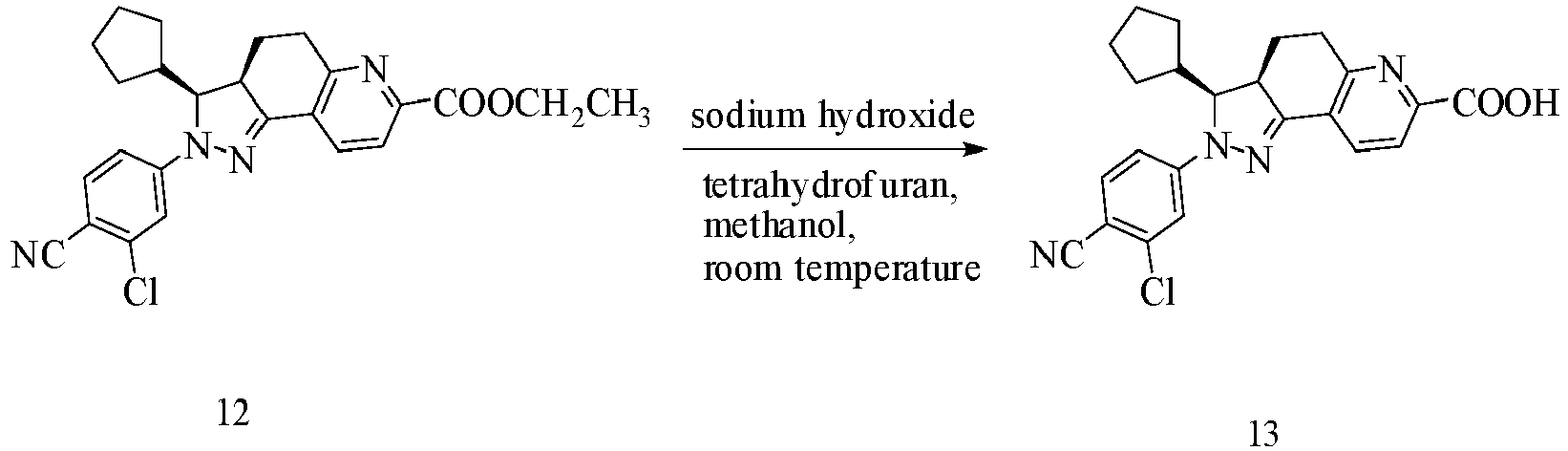
- To a 20L reaction vessel were added (3S,3aR)-ethyl 2-(3-chloro-4-cyanophenyl)-3-cyclopentyl-3,3a,4,5-tetrahydro-2H-pyrazolo[3,4-f]quinoline-7-carboxylate (1066g), tetrahydrofuran (4L) and methanol (2L). The mixture was stirred at -10°C for 10 minutes, and a solution (1.2L) of sodium hydroxide (192g) in water was slowly added thereto. The resulting mixture was stirred at room temperature for 4 hours, and a half of the solvent was removed under vacuum. The reaction mixture was adjusted with dilute hydrochloric acid to pH 3-4, and filtered by suction. The solid was washed with cooled methanol and diethyl ether respectively and dried to produce (3S,3aR)-2-(3-chloro-4-cyanophenyl)-3-cyclopentyl-3,3a,4,5-tetrahydro-2H-pyrazolo[3,4-f]quinoline-7-carboxylic acid (867g), yield: 86.7%.
-

- To a 5L reaction vessel were added (3S,3aR)-2-(3-chloro-4-cyanophenyl)-3-cyclopentyl-3,3a,4,5-tetrahydro-2H-pyrazolo[3,4-f]quinoline-7-carboxylic acid (380g), dichloromethane (900mL) and N,N-dimethylformamide (360mL). Triethylamine (380mL) was further added under stirring. The mixture was cooled to -10°C, and further stirred for 10 minutes. A solution (700mL) of 4-hydroxypiperidine (137g) in dichloromethane was added. The resulting mixture was stirred for 5 minutes. 2-(7-aza-1H-benzotriazole-1-yl)-1,1,3,3-tetramethyluronium hexafluorophosphate (HATU) (380g) was added, and the reaction was conducted at room temperature for 3 hours. Then, 2-(7-aza-1H-benzotriazole-1-yl)-1,1,3,3-tetramethyluronium hexafluorophosphate (50g) was additionally added, and the reaction was conducted for 1 hour. The solvent was removed under vacuum. The residue was dropwisely added to a 10-fold amount of water, and a solid was separated out. The solid was dissolved in dichloromethane (2L), and washed with water (2L) once. The aqueous phase was extracted with dichloromethane (500mL) once. The organic phases were combined, dried and concentrated to dryness to produce a solid of Formula (1) (290g), yield: 63.7%.
- 1H-NMR (CDCl3, 400 MHz): δ 8.375-8.395 (1H, d), 7.423-7.474 (2H, m), 7.264-7.276 (1H, d), 6.968-6.995 (1H, dd), 4.641-4.678 (1H, dd), 4.17-4.21 (1H, m), 3.99 (1H, s), 3.76-3.79 (1H, m), 3.515 (1H, m), 3.41-3.44 (1H, m), 3.230-3.322 (2H, m), 2.995 (1H, m), 2.321-2.352 (1H, m), 2.10-2.15 (2H, m), 1.978-2.089 (2H, m), 1.863-1.895 (1H, m), 1.758-1.777 (1H, m), 1.433-1.663 (7H, m), 1.221-1.352 (2H, m).
- The compound represented by formula (1) (1g) as prepared in Example 1 was added in anhydrous ethanol (3mL). The mixture was heated to 80°C until the solution became clear. Then the mixture was slowly cooled to room temperature. The solid was filtered, and washed with anhydrous ethanol for three times. The resulting solid was dried at 60°C under vacuum for 12 hours to produce Crystal Form I. The X-ray powder diffraction (XRD) spectrum of Crystal Form I was shown in
Fig. 1 , and its main parameters were as follows:2θ angle d value Strength Unit: degree (°) Unit: angstrom Unit: % 3.423 25.79197 2.2 4.571 19.31406 2.9 5.664 15.58973 3.1 8.343 10.58992 4.1 9.703 910809 47.6 10.764 8.21218 18.1 11.137 7.93840 16.5 12.122 7.29549 30.8 12.785 6.91833 48.9 14.690 6.02527 77.8 15.331 5.77476 39.2 16.834 5.26232 56.3 17.310 5.11893 100.0 17.987 4.92761 19.5 19.342 4.58548 71.7 19.639 4.51659 97.6 20.769 4.27346 11.5 21.191 4.18935 12.5 22.439 3.95900 40.0 23.159 3.83756 9.0 24.498 3.63081 21.9 26.103 3.41101 524 27.586 3.23093 20.4 29.564 3.01911 20.6 30.956 2.88642 12.0 31.954 2.79856 4.2 33.085 2.70537 4.9 33.516 2.67160 8.5 35.260 2.54333 4.0 35.946 2.49634 8.2 36.464 2.46209 9.4 37.729 2.38237 4.2 39.509 2.27904 6.2 40.615 2.21951 6.2 41.018 2.19865 6.8 42.503 2.12517 5.0 42.828 2.10982 6.0 44.139 2.05012 4.3 - The compound represented by formula (1) (146mg) as prepared in Example 1 was dissolved in acetonitrile (50mL) at 80°C. The resulting mixture was then slowly cooled to room temperature, stirred overnight, and filtered to produce Crystal Form I.
- The compound represented by formula (1) (200mg) as prepared in Example 1 was added to a 100mL round-bottom flask. Ethyl acetate (10mL) was added. The mixture was heated to 78°C under reflux. Then ethanol (0.5mL) was added, and the mixture was stirred at 80°C. The resulting solution was slowly cooled to room temperature. After 2 days, the resulting mixture was filtered to produce Crystal Form I.
- The compound represented by formula (1) (100mg) as prepared in Example 1 was put in a 100mL round-bottom flask. Acetone (3mL) was added, and the compound was dissolved. To the resulting mixture was dropwisely added n-heptane (20mL), and a solid separated out. The resulting mixture was filtered to produce Crystal Form I.
- The compound represented by formula (1) (100mg) as prepared in Example 1 was added to a 100mL round-bottom flask. A mixed solvent (0.5mL, methanol:tetrahydrofuran=1:1) was added. The resulting mixture was heated to 60°C. Then the mixture was slowly cooled to room temperature, and a solid separated out. The resulting mixture was filtered to produce Crystal Form I.
- The compound represented by formula (1) (100mg) as prepared in Example 1 was added to a 100mL round-bottom flask. A mixed solvent (3.5mL, acetonitrile : acetone =1:1) was added to the round-bottom flask. The mixture was dissolved under heating at 60°C and stirring, then slowly cooled to room temperature to separate out a solid. The resulting mixture was filtered to produce Crystal Form I
- The compound represented by formula (1) (200mg) as prepared in Example 1 was added to methanol (4mL). The compound was dissolved at 80°C. The resulting solution was added dropwisely into water (40mL). The resulting mixture was filtered to produce Crystal Form III. The X-ray powder diffraction (XRD) spectrum of Crystal Form III was shown in
Fig. 3 , and its main parameters were as follows:2θ angle d value Strength Unit: degree (°) Unit: angstrom Unit: % 3.845 22.96100 44.0 6.712 13.15849 5.8 7.697 11.47721 9.4 9.023 9.79324 8.1 9.970 8.86513 56.2 11.600 7.62276 17.7 12.610 7.01426 14.0 14.179 6.24137 23.1 15.266 5.79922 855 15.804 5.60313 49.9 16.834 5.26242 37.2 17.664 5.01696 39.5 19.455 455904 100.0 20.552 4.31804 85.1 21.124 4.20247 14.3 22.123 4.01479 274 22.972 3.86842 31.8 24.109 3.68836 33.2 25.055 3.55133 77.9 26.033 3.42005 46.2 27.241 3.27104 47.3 28.408 3.13930 17.9 29.946 2.98146 19.7 30.949 2.88708 17.5 32.306 2.76887 21.4 32.997 2.71244 125 33.935 2.63952 14.0 34.882 2.57004 18.4 35.381 2.53492 11.6 36.952 2.43069 13.1 38.563 2.33273 10.5 39.280 2.29184 12.5 40.396 2.23102 132 41.806 2.15901 12.4 - The compound represented by formula (1) (100mg) as prepared in Example 1 was added to a 10mL centrifuge tube. A mixed solution (8mL, water:acetonitrile=10:1) was added to the centrifuge tube, and stirred. The resulting mixture was filtered to produce Crystal Form III.
- Crystal Form III as prepared in Example 8 was dried for 12 hours under vacuum at room temperature to produce Crystal Form II. The X-ray powder diffraction (XRD) spectrum of Crystal Form II was shown in
Fig. 2 , and its main parameters were as follows:2θ angle d value Strength Unit: degree (°) Unit: angstrom Unit: % 3.574 24.70236 4.9 4.451 19.83656 56.2 7.515 11.75417 5.7 8.478 10.42104 28.0 9.002 9.81527 44.9 10.638 8.30970 23.2 12.216 7.23974 32.2 13.542 6.53344 20.0 14.049 6.29880 38.1 14.607 6.05934 90.9 16.422 5.39356 31.3 17.123 5.17422 26.2 17.992 4.92615 56.8 18.695 4.74270 57.7 19.873 4.46396 100.0 21.230 4.18168 68.6 22.819 3.89399 28.9 24.589 3.61751 60.0 25.769 3.45445 26.8 26.520 3 35833 31.3 27.023 3.29690 28.0 28.447 3.13509 21.9 30.037 2.97262 10.2 30.853 2.89580 6.8 32.143 2.78249 7.7 6.2 34.206 2.61925 5.7 35.439 2.53088 6.6 36.144 248317 6.6 39.188 2.29700 4.9 40.726 2.21373 6.5 42.424 2.12895 6.2 43.393 2.08364 - The following assays are not according to the invention and are present for illustration purposes only.
- Sample:
Crystal Form I of the compound represented by formula (1): Crystal Form I was prepared according to Example 2. - High temperature tests:
- (1) Crystal Form I of the compound represented by formula (1) was laid on a dry and clean watch glass, and kept at 60°C for 10 days. Samples were taken respectively on
Day 5 andDay 10. The contents of the relevant substance and the compound represented by formula (1) in the sample were measured, and compared with the contents of those in the sample taken onDay 0; - (2) Crystal Form I of the compound represented by formula (1) was packaged and sealed with a low-density polyethylene bag for pharmaceutical use in the inner layer and with a polyester/aluminum/polyethylene composite film for pharmaceutical package in the outer layer, and kept at 60°C for 10 days. Samples were taken respectively on
Day 5 andDay 10. The contents of the relevant substance and the compound represented by formula (1) in the sample were measured, and compared with the contents of those in the sample taken onDay 0. - High humidity test: Crystal Form I of the compound represented by formula (1) was laid on a dry and clean watch glass, and kept at 25°C under a relative humidity of 90%±5% for 10 days. Samples were taken respectively on
Day 5 andDay 10. The contents of the relevant substance and the compound represented by formula (1) in the sample were measured, and compared with the contents of those in the sample taken onDay 0. - Photostability Test: Crystal Form I of the compound represented by formula (1) was laid on a dry and clean watch glass, and kept at an illuminance of 4500Lx±500Lx in an illumination box for 10 days. Samples were taken respectively on
Day 5 andDay 10. The contents of the relevant substance and the compound represented by formula (1) in the sample were measured, and compared with the contents of those in the sample taken onDay 0. - The content of the compound represented by formula (1) was measured by using an external standard method in accordance with the High Performance Liquid Chromatography in Chinese Pharmacopoeia, Appendix V D, Edition 2010.
- The content of the relevant substance was measured by using an area normalization method in accordance with the High Performance Liquid Chromatography in Chinese Pharmacopoeia, Appendix V D, Edition 2010.
- Test results were shown in Table 1.
Table 1: The investigation results of the influencing factor tests for Crystal Form I of the compound represented by formula (1) Conditions Day Content of the compound represented by formula (1) (%) Content of the relevant substance (%) 0 99.5 0.54 60°C-(1) 5 98.9 0.82 10 98.1 0.97 60°C-(2) 5 99.7 0.58 10 99.0 0.60 RH90%±5% 5 99.1 0.56 10 99.0 0.56 4500Lx± 500Lx 5 98.1 1.2 10 97.0 2.0 - The present inventors investigated the stability of Crystal Form I of the compound represented by formula (1). It could be clear from the investigation results that the contents of the relevant substance and the compound represented by formula (1) in Crystal Form I of the compound represented by formula (1) substantially did not change at a high temperature, at a high humidity and under an illumination condition. Crystal form I was superior to the amorphous form in the stability, which showed that Crystal Form I of the compound represented by formula (1) had a relatively high stability that was suitable for drug manufacture, storage and transport and was favorable for ensuring the validity and the safety in the drug use.
- Sample:
Crystal Form II of the compound represented by formula (1): Crystal Form II was prepared according to Example 4. - High temperature tests:
- (1) Crystal Form II of the compound represented by formula (1) was laid on a dry and clean watch glass, and kept at 60°C for 10 days. Sample was taken on
Day 10. The contents of the relevant substance and the compound represented by formula (1) in the sample were measured, and compared with the contents of those in the sample taken onDay 0; - (2) Crystal Form II of the compound represented by formula (1) was packaged and sealed with a low-density polyethylene bag for pharmaceutical use in the inner layer and with a polyester/aluminum/polyethylene composite film for pharmaceutical package in the outer layer, and kept at 60°C for 10 days. Sample was taken on
Day 10. The contents of the relevant substance and the compound represented by formula (1) in the sample were measured, and compared with the contents of those in the sample taken onDay 0. - High humidity test: Crystal Form II of the compound represented by formula (1) was laid on a dry and clean watch glass, and kept at 25°C under a relative humidity of 90%±5% for 10 days. Sample was taken respectively on
Day 10. The contents of the relevant substance and the compound represented by formula (1) in the sample were measured, and compared with the contents of those in the sample taken onDay 0. - Photostability Test: Crystal Form II of the compound represented by formula (1) was laid on a dry and clean watch glass, and kept at an illuminance of 5000Lx±500Lx in an illumination box for 10 days. Sample was taken on
Day 10. The contents of the relevant substance and the compound represented by formula (1) in the sample were measured, and compared with the contents of those in the sample taken onDay 0. - The content of the compound represented by formula (1) was measured by using an external standard method in accordance with the High Performance Liquid Chromatography in Chinese Pharmacopoeia, Appendix V D, Edition 2010.
- The content of the relevant substance was measured by using an area normalization method in accordance with the High Performance Liquid Chromatography in Chinese Pharmacopoeia, Appendix V D, Edition 2010.
- Test results were shown in Table 2.
Table 2: The investigation results of the influencing factor tests for Crystal Form II of the compound represented by formula (1) Condition Day Content of the compound represented by formula (1) (%) Content of the relevant substance (%) 0 96.2 2.6 60°C-① 10 96.2 2.8 60°C-(2) 10 97.1 2.7 RH90%±5% 10 96.9 2.6 5000Lx± 500Lx 10 95.5 2.8 - The present inventors investigated the stability of Crystal Form II of the compound represented by formula (1). It could be clear from the investigation results that the contents of the relevant substance and the compound represented by formula (1) in Crystal Form II of the compound represented by formula (1) substantially did not change at a high temperature, at a high humidity and under an illumination condition. Crystal form II was superior to the amorphous form in the stability, which showed that Crystal Form II of the compound represented by formula (1) had a relatively high stability that was suitable for drug manufacture, storage and transport and was favorable for ensuring the validity and the safety in the drug use.
- Organ protection and depressurization effect of Crystal Form I on the high salt induced Dahl salt sensitive (Dahl/SS) rats
- Sample and sample preparation:
The solid dispersion of Crystal Form I (Crystal Form I:PVPK30=1:8(w/w)): the solid dispersion of Crystal Form I was formulated with a suitable amount of sterile water for injection into suspensions having concentrations of 0.03, 0.10, 0.30, and 1.00 mg/mL. The suspension was prepared before use every day. - Animal group and model:
Experiment animals: male Dahl/ss rats of SPF (specific pathogen free)-grade, 8-9 weeks, purchased via Vital River Laboratories from HARLAN LABORATORIES, INC. After one week normal quarantine, rats in good sign and condition were used in the experiment. - Dahl/ss rats were randomly divided into six groups according to the blood pressure measurement before administration:
- Normal control (n=10),
- Model group (4%NaCl, n=12),
- The treatment group with 0.3 mg/kg/day (n=11),
- The treatment group with 1 mg/kg/day (n=11),
- The treatment group with 3 mg/kg/day (n=11),
- The treatment group with 10 mg/kg/day (n=11),
- n is the rat number.
- Experiment method:
The in vivo pharmacodynamic activity of Crystal Form I was evaluated by the hypertension and kidney injury Dahl/ss rat's model. - One week before the experiment, the blood pressures of rats were monitored twice by the tail-cuff blood pressure measurement so that the rats could accommodate the blood pressure monitoring operation. The blood pressures of rats were monitored once before starting the experiment and used as the basic blood pressures before administration. The rats were randomly divided into groups according to the measured blood pressures before administration. The model was established by feeding the rats with a high salt chow (AIN-93G experiment animal feed containing 4% NaCl) for 42 days, in which the rats were freely accessible to food and water. And rats in control group were fed with a low-sodium chow.
- The rats in the treatment groups with Crystal Form I were respectively administrated with Crystal Form I in a dosage of 0.3, 1, 3, and 10 mg/kg/day. Rats in treatment groups were dosed orally via gavage twice a day by 5mL/kg. The rats in the model group and in the normal control were administrated with the same volume of sterile water for injection.
- Blood pressure (systolic blood pressure, abbreviated as SBP) measurement: The blood pressure was measured once each week for six weeks. The blood pressure changes were analyzed for each group.
- The pathological examinations for kidney and heart: After the experiment, the rats were killed in a painless manner. The heart and the bilateral kidneys were collected for histopathology analysis. Kidney injury was scored and semi-quantitatively analyzed based on hematoxylin-eosin (HE) stain. The heart injury was analyzed by the measurement of left ventricular wall thickness.
- Experiment result:
Depressurization effect: it could be seen that Crystal Form I showed a significant depressurization effect in the model and presented a certain dose-dependent relationship (Table 3).Table 3: SBP (mmHg, mean±SD) Group Before Administration After Administration (on 41th day) Normal control 139.3±13.4 149.4±9.6 Model group 139.9±10.7 183.0±12.8* Crystal Form I of the present compound 0.3 mg/kg/day 140.8±9.6 166.5±10.2*# Crystal Form I of the present compound 1 mg/kg/day140.9±9.5 148.7±9.6# Crystal Form I of the present compound 3 mg/kg/day141.0±9.4 141.6±8.0# Crystal Form I of the present compound 10 mg/kg/day141.2±9.2 141.2±9.6# *p<0.05, compared with normal control; #p<0.05, compared with model group. - Kidney and heart protections: According to the kidney injury scores, the treatment groups with Crystal Form I showed a remarkable prevention from the increase in the kidney injury score (Table 4). Compared with the model group, Crystal Form I significantly decreased the left ventricular wall thickness (Table 4).
Table 4: Protection for kidney injury and heart injury Group Kidney injury scores (Mean±SD) left ventricular wall thickness (cm, mean±SD) Normal control 0.93±0.079 0.401±0.014 Model group 2.05±0.091* 0.410±0.026 Crystal Form I 0.3 mg/kg/day 2.02±0.268* 0.392±0.024 Crystal Form I 1 mg/kg/day 1.25±0.428# 0.383±0.017# Crystal Form I 3 mg/kg/day 1.84±0.596* 0.381±0.026# Crystal Form I 10 mg/kg/day 1.71±0.719* 0.383±0.019# *p<0.05, compared with normal control; #p<0.05, compared with model group. - In the hypertension and nephrosis models of the high salt induced Dhal/ss rats, Crystal Form I showed remarkable depressurization effect and kidney injury protection.
Claims (3)
- A process for preparing a compound represented by formula (1), 2-chloro-4-[(3S,3aR)-3-cyclopentyl-7-(4-hydroxypiperidin-1-carbonyl)-3,3a,4,5-tetrahydro-2H-pyrazolo[3,4-f]quinolin-2-yl]benzonitrile,
 (9) Chirally resolving ethyl 2-(3-chloro-4-cyanophenyl)-3-cyclopentyl-3,3a,4,5-tetrahydro-2H-pyrazolo[3,4-f]quinoline-7-carboxylate to produce (3S,3aR)-ethyl 2-(3-chloro-4-cyanophenyl)-3-cyclopentyl-3,3a,4,5-tetrahydro-2H-pyrazolo[3,4-f]quinoline-7-carboxylate;(10) Hydrolyzing (3S,3aR)-ethyl 2-(3-chloro-4-cyanophenyl)-3-cyclopentyl-3,3a,4,5-tetrahydro-2H-pyrazolo[3,4-f]quinoline-7-carboxylate to produce (3S,3aR)-2-(3-chloro-4-cyanophenyl)-3-cyclopentyl-3,3a,4,5-tetrahydro-2H-pyrazolo[3,4-f]quinoline-7-carboxylic acid;(11) Subjecting (3S,3aR)-2-(3-chloro-4-cyanophenyl)-3-cyclopentyl-3,3a,4,5-tetrahydro-2H-pyrazolo[3,4-f]quinoline-7-carboxylic acid and 4-hydroxypiperidine to a condensation reaction to produce the compound represented by formula (1).
 - The process of claim 1, which is characterized by comprising the steps of:(1) Subjecting 1,3-cyclohexanedione, ammonium acetate and acrolein to condensation and addition reactions to produce 5-oxo-5,6,7,8-tetrahydroquinoline;(2) Subjecting 5-oxo-5,6,7,8-tetrahydroquinoline to an oxidation reaction to produce 5-oxo-5,6,7,8-tetrahydroquinoline-N-oxide;(3) Subjecting 5-oxo-5,6,7,8-tetrahydroquinoline-N-oxide, N,N-dimethylcarbamic chloride, and trimethylsilylcyanide to a substitution reaction to produce 5-oxo-5,6,7,8-tetrahydroquinoline-2-carbonitrile;(4) Subjecting 5-oxo-5,6,7,8-tetrahydroquinoline-2-carbonitrile to hydrolysis and esterification reactions to produce ethyl 5-oxo-5,6,7,8-tetrahydroquinoline-2-carboxylate;(5) Subjecting ethyl 5-oxo-5,6,7,8-tetrahydroquinoline-2-carboxylate and cyclopentanecarbaldehyde to a condensation reaction to produce (E)-ethyl 6-cyclopentylmethylene-5-oxo-5,6,7,8-tetrahydroquinoline-2-carboxylate;(6) Subjecting 2-chloro-4-fluorobenzonitrile and hydrazine hydrate to a substitution reaction to produce 2-chloro-4-hydrazinobenzonitrile;(7) Subjecting 2-chloro-4-hydrazinobenzonitrile and hydrochloric acid to a salt forming reaction to produce 2-chloro-4-hydrazinobenzonitrile hydrochloride;(8) Subjecting (E)-ethyl 6-cyclopentylmethylene-5-oxo-5,6,7,8-tetrahydroquinoline-2-carboxylate and 2-chloro-4-hydrazinobenzonitrile hydrochloride to a condensation reaction to produce ethyl 2-(3-chloro-4-cyanophenyl)-3-cyclopentyl-3,3a,4,5-tetrahydro-2H-pyrazolo[3,4-f]quinoline-7-carboxylate;(9) Chirally resolving ethyl 2-(3-chloro-4-cyanophenyl)-3-cyclopentyl-3,3a,4,5-tetrahydro-2H-pyrazolo[3,4-f]quinoline-7-carboxylate to produce (3S,3aR)-ethyl 2-(3-chloro-4-cyanophenyl)-3-cyclopentyl-3,3a,4,5-tetrahydro-2H-pyrazolo[3,4-f]quinoline-7-carboxylate;(10)Hydrolyzing (3S,3aR)-ethyl 2-(3-chloro-4-cyanophenyl)-3-cyclopentyl-3,3a,4,5-tetrahydro-2H-pyrazolo[3,4-f]quinoline-7-carboxylate to produce (3S,3aR)-2-(3-chloro-4-cyanophenyl)-3-cyclopentyl-3,3a,4,5-tetrahydro-2H-pyrazolo[3,4-f]quinoline-7-carboxylic acid;(11)Subjecting (3S,3aR)-2-(3-chloro-4-cyanophenyl)-3-cyclopentyl-3,3a,4,5-tetrahydro-2H-pyrazolo[3,4-f]quinoline-7-carboxylic acid and 4-hydroxypiperidine to a condensation reaction to produce the compound represented by formula (1).
- The process of claim 1 or 2, comprising one of the following steps:placing the compound represented by formula (1) obtained in the step (11) in an anhydrous lower alcohol selected from methanol, ethanol and n-propanol, acetonitrile, a mixed solvent of ethyl acetate and ethanol, a mixed solvent of methanol and tetrahydrofuran, or a mixed solvent of acetonitrile and acetone, heating the resulting solution until it becomes clear, then cooling the resulting solution to separate out a solid, and filtering and drying the separated solid; orplacing the compound represented by formula (1) obtained in the step (11) in a lower alcohol selected from methanol, ethanol and n-propanol to dissolve it, then adding the resulting solution dropwisely to water, filtering the resulting mixture, and optionally drying the filtered substance under vacuum; orwashing the compound represented by formula (1) obtained in the step (11) with a mixed solution of water and acetonitrile, filtering the resulting mixture, and optionally drying the filtered substance under vacuum; ordissolving the compound represented by formula (1) obtained in the step (11) in acetone, adding the resulting solution dropwisely to n-heptane, and filtering the resulting mixture.
Priority Applications (1)
| Application Number | Priority Date | Filing Date | Title |
|---|---|---|---|
| EP21194531.6A EP3954688A1 (en) | 2012-12-22 | 2013-12-23 | Crystal forms of compound used as mineralocorticoid receptor antagonist and methods for their preparation |
Applications Claiming Priority (2)
| Application Number | Priority Date | Filing Date | Title |
|---|---|---|---|
| CN201210563636 | 2012-12-22 | ||
| PCT/CN2013/090252 WO2014094664A1 (en) | 2012-12-22 | 2013-12-23 | Crystal form of compound used as mineralocorticoid receptor antagonist and preparation method therefor |
Related Child Applications (1)
| Application Number | Title | Priority Date | Filing Date |
|---|---|---|---|
| EP21194531.6A Division EP3954688A1 (en) | 2012-12-22 | 2013-12-23 | Crystal forms of compound used as mineralocorticoid receptor antagonist and methods for their preparation |
Publications (3)
| Publication Number | Publication Date |
|---|---|
| EP2937348A1 EP2937348A1 (en) | 2015-10-28 |
| EP2937348A4 EP2937348A4 (en) | 2016-09-07 |
| EP2937348B1 true EP2937348B1 (en) | 2021-09-08 |
Family
ID=50977609
Family Applications (2)
| Application Number | Title | Priority Date | Filing Date |
|---|---|---|---|
| EP13864994.2A Active EP2937348B1 (en) | 2012-12-22 | 2013-12-23 | Process for the preparation of a compound used as mineralocorticoid receptor antagonist |
| EP21194531.6A Withdrawn EP3954688A1 (en) | 2012-12-22 | 2013-12-23 | Crystal forms of compound used as mineralocorticoid receptor antagonist and methods for their preparation |
Family Applications After (1)
| Application Number | Title | Priority Date | Filing Date |
|---|---|---|---|
| EP21194531.6A Withdrawn EP3954688A1 (en) | 2012-12-22 | 2013-12-23 | Crystal forms of compound used as mineralocorticoid receptor antagonist and methods for their preparation |
Country Status (16)
| Country | Link |
|---|---|
| US (1) | US9809589B2 (en) |
| EP (2) | EP2937348B1 (en) |
| JP (6) | JP2016503041A (en) |
| KR (1) | KR101737883B1 (en) |
| CN (1) | CN105026391B (en) |
| AU (1) | AU2013362400B2 (en) |
| BR (1) | BR112015014839B1 (en) |
| CA (1) | CA2895968C (en) |
| ES (1) | ES2897496T3 (en) |
| IL (1) | IL239581B (en) |
| MX (1) | MX360889B (en) |
| NZ (1) | NZ709361A (en) |
| RU (1) | RU2622105C2 (en) |
| SG (1) | SG11201504928XA (en) |
| WO (1) | WO2014094664A1 (en) |
| ZA (1) | ZA201504485B (en) |
Families Citing this family (3)
| Publication number | Priority date | Publication date | Assignee | Title |
|---|---|---|---|---|
| EP2937348B1 (en) * | 2012-12-22 | 2021-09-08 | Kbp Biosciences Pte. Ltd. | Process for the preparation of a compound used as mineralocorticoid receptor antagonist |
| MX391602B (en) * | 2016-09-24 | 2025-03-21 | Novo Nordisk As | Pharmaceutical composition comprising mineralocorticoid receptor antagonist and use thereof |
| BR112021017276A2 (en) * | 2019-03-01 | 2021-11-09 | Kbp Biosciences Co Ltd | Method for preparing tricyclic compound and intermediate thereof |
Family Cites Families (13)
| Publication number | Priority date | Publication date | Assignee | Title |
|---|---|---|---|---|
| JPS5245716B1 (en) * | 1970-07-10 | 1977-11-17 | ||
| CN85101404A (en) * | 1985-05-16 | 1987-01-17 | 帝人株式会社 | The production process of cephalosporins derivatives |
| JPH04235188A (en) * | 1990-06-19 | 1992-08-24 | Takeda Chem Ind Ltd | Crystal of penem compound, production thereof and antimicrobial agent |
| DE4235133A1 (en) * | 1992-10-19 | 1994-04-21 | Bayer Ag | Crystalline (R) - (-) - 2-cycloheptyl-N-methylsulfonyl- [4- (2-quinolinyl-methoxy) phenyl] acetamide |
| JP3623531B2 (en) * | 1993-06-07 | 2005-02-23 | ビーエーエスエフ アクチェンゲゼルシャフト | Process for producing crystalline L-ascorbic acid-2-phosphate magnesium salt |
| DE69719698T2 (en) * | 1996-06-28 | 2003-10-23 | Koninklijke Philips Electronics N.V., Eindhoven | METHOD AND DEVICE FOR TRANSMITTING TELETEXT PAGES |
| WO1998009969A1 (en) * | 1996-09-05 | 1998-03-12 | Astra Pharmaceuticals Ltd. | Novel aryl-pyridazines |
| US7081456B2 (en) | 2002-11-22 | 2006-07-25 | Active Biotech Ab | Immunomodulatory compounds |
| EP2210889A1 (en) * | 2005-03-21 | 2010-07-28 | Eisai R&D Management Co., Ltd. | Process for producing pyrimidine compound |
| DE102007054497B3 (en) * | 2007-11-13 | 2009-07-23 | Sanofi-Aventis Deutschland Gmbh | Novel crystalline diphenylazetidinone hydrates and process for their preparation |
| CN102372710A (en) * | 2010-08-18 | 2012-03-14 | 山东轩竹医药科技有限公司 | Fused cyclic compound being taken as mineral corticoid recept antagonist |
| HRP20151263T1 (en) * | 2010-09-30 | 2015-12-18 | Toyama Chemical Co., Ltd. | Sodium salt of 6-fluoro-3-hydroxy-2-pyrazine carboxamide |
| EP2937348B1 (en) * | 2012-12-22 | 2021-09-08 | Kbp Biosciences Pte. Ltd. | Process for the preparation of a compound used as mineralocorticoid receptor antagonist |
-
2013
- 2013-12-23 EP EP13864994.2A patent/EP2937348B1/en active Active
- 2013-12-23 SG SG11201504928XA patent/SG11201504928XA/en unknown
- 2013-12-23 KR KR1020157019924A patent/KR101737883B1/en not_active Expired - Fee Related
- 2013-12-23 EP EP21194531.6A patent/EP3954688A1/en not_active Withdrawn
- 2013-12-23 CA CA2895968A patent/CA2895968C/en active Active
- 2013-12-23 AU AU2013362400A patent/AU2013362400B2/en active Active
- 2013-12-23 MX MX2015008193A patent/MX360889B/en active IP Right Grant
- 2013-12-23 US US14/653,933 patent/US9809589B2/en not_active Expired - Fee Related
- 2013-12-23 JP JP2015548180A patent/JP2016503041A/en active Pending
- 2013-12-23 RU RU2015130222A patent/RU2622105C2/en active
- 2013-12-23 WO PCT/CN2013/090252 patent/WO2014094664A1/en not_active Ceased
- 2013-12-23 BR BR112015014839-5A patent/BR112015014839B1/en active IP Right Grant
- 2013-12-23 CN CN201380066871.7A patent/CN105026391B/en active Active
- 2013-12-23 ES ES13864994T patent/ES2897496T3/en active Active
- 2013-12-23 NZ NZ709361A patent/NZ709361A/en unknown
-
2015
- 2015-06-22 ZA ZA2015/04485A patent/ZA201504485B/en unknown
- 2015-06-22 IL IL239581A patent/IL239581B/en active IP Right Grant
-
2017
- 2017-07-04 JP JP2017131078A patent/JP2017165787A/en active Pending
-
2019
- 2019-02-05 JP JP2019018876A patent/JP2019065057A/en active Pending
-
2020
- 2020-04-16 JP JP2020073415A patent/JP6986197B6/en active Active
-
2021
- 2021-11-02 JP JP2021179425A patent/JP2022009922A/en not_active Withdrawn
-
2023
- 2023-11-17 JP JP2023195879A patent/JP2024009114A/en not_active Withdrawn
Also Published As
Similar Documents
| Publication | Publication Date | Title |
|---|---|---|
| US20090264438A1 (en) | Polymorphic forms of imatinib mesylate and processes for preparation of novel crystalline forms as well as amorphous and form alpha | |
| KR20170033684A (en) | Crystalline form of linagliptin and preparation method thereof | |
| WO2016004704A1 (en) | Gastrodin production process | |
| JP2024009114A (en) | Crystalline forms of compounds as mineralocorticoid receptor antagonists and methods for their preparation | |
| CN112638873A (en) | Refining method of indocyanine green | |
| US20210395197A1 (en) | Crystalline form of sofpironium bromide and preparation method thereof | |
| HK40062778A (en) | Crystal forms of compound used as mineralocorticoid receptor antagonist and methods for their preparation | |
| HK1212676B (en) | Process for the preparation of a compound used as mineralocorticoid receptor antagonist | |
| CN105153167B (en) | A kind of ticagrelor crystallization and the pharmaceutical composition containing the crystallization | |
| CN104402815B (en) | Control method of piperaquine phosphate impurity | |
| CN100390172C (en) | A kind of crystal form of dolasetron mesylate and preparation method thereof | |
| CN105111195A (en) | Tacrine-bifendate heterocomplex as well as preparation method and application thereof | |
| CN119912357B (en) | α-p-Aminobenzylidene-5,6-dimethoxy-1-indanone derivatives, their preparation methods and applications | |
| CN103864758B (en) | The pharmaceutical composition of Azelnidipine dihydrate and ε crystal-form substances thereof and application | |
| CN107663198A (en) | Olmesartan medoxomil and its production and use | |
| CN103864757B (en) | The preparation method of Azelnidipine ε crystal-form substances | |
| JPH02503432A (en) | Imidazol-2-yl-derivative of bicyclic compound that lowers blood fat and its production method | |
| CN103319457B (en) | The preparation method of Azelnidipine γ crystal formation | |
| CN116396305A (en) | A crystal form of a fused ring derivative, its preparation method and its application | |
| CN112851595A (en) | Plexafu crystal form D, plexafu intermediate crystal form S and preparation method and application thereof | |
| HK1217019B (en) | Crystal form of compound used as mineralocorticoid receptor antagonist and preparation method therefor | |
| JPH0390086A (en) | Racemic and optically active dehydrocycloclausen amide in form of plus-or minus-enantiomer and method for preparation of its derivative |
Legal Events
| Date | Code | Title | Description |
|---|---|---|---|
| PUAI | Public reference made under article 153(3) epc to a published international application that has entered the european phase |
Free format text: ORIGINAL CODE: 0009012 |
|
| 17P | Request for examination filed |
Effective date: 20150722 |
|
| AK | Designated contracting states |
Kind code of ref document: A1 Designated state(s): AL AT BE BG CH CY CZ DE DK EE ES FI FR GB GR HR HU IE IS IT LI LT LU LV MC MK MT NL NO PL PT RO RS SE SI SK SM TR |
|
| AX | Request for extension of the european patent |
Extension state: BA ME |
|
| DAX | Request for extension of the european patent (deleted) | ||
| REG | Reference to a national code |
Ref country code: HK Ref legal event code: DE Ref document number: 1212676 Country of ref document: HK |
|
| A4 | Supplementary search report drawn up and despatched |
Effective date: 20160809 |
|
| RIC1 | Information provided on ipc code assigned before grant |
Ipc: A61P 29/00 20060101ALI20160803BHEP Ipc: A61P 5/40 20060101ALI20160803BHEP Ipc: A61P 9/06 20060101ALI20160803BHEP Ipc: A61P 7/00 20060101ALI20160803BHEP Ipc: A61K 31/4745 20060101ALI20160803BHEP Ipc: A61P 13/12 20060101ALI20160803BHEP Ipc: A61P 25/00 20060101ALI20160803BHEP Ipc: A61P 9/00 20060101ALI20160803BHEP Ipc: A61P 9/12 20060101ALI20160803BHEP Ipc: C07D 471/04 20060101AFI20160803BHEP Ipc: A61P 9/04 20060101ALI20160803BHEP Ipc: A61P 9/10 20060101ALI20160803BHEP |
|
| STAA | Information on the status of an ep patent application or granted ep patent |
Free format text: STATUS: EXAMINATION IS IN PROGRESS |
|
| 17Q | First examination report despatched |
Effective date: 20190211 |
|
| GRAP | Despatch of communication of intention to grant a patent |
Free format text: ORIGINAL CODE: EPIDOSNIGR1 |
|
| STAA | Information on the status of an ep patent application or granted ep patent |
Free format text: STATUS: GRANT OF PATENT IS INTENDED |
|
| INTG | Intention to grant announced |
Effective date: 20210517 |
|
| RAP1 | Party data changed (applicant data changed or rights of an application transferred) |
Owner name: KBP BIOSCIENCES PTE. LTD. |
|
| GRAS | Grant fee paid |
Free format text: ORIGINAL CODE: EPIDOSNIGR3 |
|
| GRAA | (expected) grant |
Free format text: ORIGINAL CODE: 0009210 |
|
| STAA | Information on the status of an ep patent application or granted ep patent |
Free format text: STATUS: THE PATENT HAS BEEN GRANTED |
|
| AK | Designated contracting states |
Kind code of ref document: B1 Designated state(s): AL AT BE BG CH CY CZ DE DK EE ES FI FR GB GR HR HU IE IS IT LI LT LU LV MC MK MT NL NO PL PT RO RS SE SI SK SM TR |
|
| REG | Reference to a national code |
Ref country code: GB Ref legal event code: FG4D |
|
| REG | Reference to a national code |
Ref country code: CH Ref legal event code: EP Ref country code: AT Ref legal event code: REF Ref document number: 1428507 Country of ref document: AT Kind code of ref document: T Effective date: 20210915 |
|
| REG | Reference to a national code |
Ref country code: DE Ref legal event code: R096 Ref document number: 602013079212 Country of ref document: DE |
|
| REG | Reference to a national code |
Ref country code: IE Ref legal event code: FG4D |
|
| REG | Reference to a national code |
Ref country code: LT Ref legal event code: MG9D |
|
| REG | Reference to a national code |
Ref country code: NL Ref legal event code: MP Effective date: 20210908 |
|
| PG25 | Lapsed in a contracting state [announced via postgrant information from national office to epo] |
Ref country code: BG Free format text: LAPSE BECAUSE OF FAILURE TO SUBMIT A TRANSLATION OF THE DESCRIPTION OR TO PAY THE FEE WITHIN THE PRESCRIBED TIME-LIMIT Effective date: 20211208 Ref country code: LT Free format text: LAPSE BECAUSE OF FAILURE TO SUBMIT A TRANSLATION OF THE DESCRIPTION OR TO PAY THE FEE WITHIN THE PRESCRIBED TIME-LIMIT Effective date: 20210908 Ref country code: NO Free format text: LAPSE BECAUSE OF FAILURE TO SUBMIT A TRANSLATION OF THE DESCRIPTION OR TO PAY THE FEE WITHIN THE PRESCRIBED TIME-LIMIT Effective date: 20211208 Ref country code: FI Free format text: LAPSE BECAUSE OF FAILURE TO SUBMIT A TRANSLATION OF THE DESCRIPTION OR TO PAY THE FEE WITHIN THE PRESCRIBED TIME-LIMIT Effective date: 20210908 Ref country code: HR Free format text: LAPSE BECAUSE OF FAILURE TO SUBMIT A TRANSLATION OF THE DESCRIPTION OR TO PAY THE FEE WITHIN THE PRESCRIBED TIME-LIMIT Effective date: 20210908 Ref country code: RS Free format text: LAPSE BECAUSE OF FAILURE TO SUBMIT A TRANSLATION OF THE DESCRIPTION OR TO PAY THE FEE WITHIN THE PRESCRIBED TIME-LIMIT Effective date: 20210908 Ref country code: SE Free format text: LAPSE BECAUSE OF FAILURE TO SUBMIT A TRANSLATION OF THE DESCRIPTION OR TO PAY THE FEE WITHIN THE PRESCRIBED TIME-LIMIT Effective date: 20210908 |
|
| REG | Reference to a national code |
Ref country code: AT Ref legal event code: MK05 Ref document number: 1428507 Country of ref document: AT Kind code of ref document: T Effective date: 20210908 |
|
| PG25 | Lapsed in a contracting state [announced via postgrant information from national office to epo] |
Ref country code: LV Free format text: LAPSE BECAUSE OF FAILURE TO SUBMIT A TRANSLATION OF THE DESCRIPTION OR TO PAY THE FEE WITHIN THE PRESCRIBED TIME-LIMIT Effective date: 20210908 Ref country code: GR Free format text: LAPSE BECAUSE OF FAILURE TO SUBMIT A TRANSLATION OF THE DESCRIPTION OR TO PAY THE FEE WITHIN THE PRESCRIBED TIME-LIMIT Effective date: 20211209 |
|
| REG | Reference to a national code |
Ref country code: ES Ref legal event code: FG2A Ref document number: 2897496 Country of ref document: ES Kind code of ref document: T3 Effective date: 20220301 |
|
| PG25 | Lapsed in a contracting state [announced via postgrant information from national office to epo] |
Ref country code: AT Free format text: LAPSE BECAUSE OF FAILURE TO SUBMIT A TRANSLATION OF THE DESCRIPTION OR TO PAY THE FEE WITHIN THE PRESCRIBED TIME-LIMIT Effective date: 20210908 |
|
| PG25 | Lapsed in a contracting state [announced via postgrant information from national office to epo] |
Ref country code: IS Free format text: LAPSE BECAUSE OF FAILURE TO SUBMIT A TRANSLATION OF THE DESCRIPTION OR TO PAY THE FEE WITHIN THE PRESCRIBED TIME-LIMIT Effective date: 20220108 Ref country code: SM Free format text: LAPSE BECAUSE OF FAILURE TO SUBMIT A TRANSLATION OF THE DESCRIPTION OR TO PAY THE FEE WITHIN THE PRESCRIBED TIME-LIMIT Effective date: 20210908 Ref country code: SK Free format text: LAPSE BECAUSE OF FAILURE TO SUBMIT A TRANSLATION OF THE DESCRIPTION OR TO PAY THE FEE WITHIN THE PRESCRIBED TIME-LIMIT Effective date: 20210908 Ref country code: RO Free format text: LAPSE BECAUSE OF FAILURE TO SUBMIT A TRANSLATION OF THE DESCRIPTION OR TO PAY THE FEE WITHIN THE PRESCRIBED TIME-LIMIT Effective date: 20210908 Ref country code: PT Free format text: LAPSE BECAUSE OF FAILURE TO SUBMIT A TRANSLATION OF THE DESCRIPTION OR TO PAY THE FEE WITHIN THE PRESCRIBED TIME-LIMIT Effective date: 20220110 Ref country code: PL Free format text: LAPSE BECAUSE OF FAILURE TO SUBMIT A TRANSLATION OF THE DESCRIPTION OR TO PAY THE FEE WITHIN THE PRESCRIBED TIME-LIMIT Effective date: 20210908 Ref country code: NL Free format text: LAPSE BECAUSE OF FAILURE TO SUBMIT A TRANSLATION OF THE DESCRIPTION OR TO PAY THE FEE WITHIN THE PRESCRIBED TIME-LIMIT Effective date: 20210908 Ref country code: EE Free format text: LAPSE BECAUSE OF FAILURE TO SUBMIT A TRANSLATION OF THE DESCRIPTION OR TO PAY THE FEE WITHIN THE PRESCRIBED TIME-LIMIT Effective date: 20210908 Ref country code: CZ Free format text: LAPSE BECAUSE OF FAILURE TO SUBMIT A TRANSLATION OF THE DESCRIPTION OR TO PAY THE FEE WITHIN THE PRESCRIBED TIME-LIMIT Effective date: 20210908 Ref country code: AL Free format text: LAPSE BECAUSE OF FAILURE TO SUBMIT A TRANSLATION OF THE DESCRIPTION OR TO PAY THE FEE WITHIN THE PRESCRIBED TIME-LIMIT Effective date: 20210908 |
|
| REG | Reference to a national code |
Ref country code: DE Ref legal event code: R097 Ref document number: 602013079212 Country of ref document: DE |
|
| PLBE | No opposition filed within time limit |
Free format text: ORIGINAL CODE: 0009261 |
|
| STAA | Information on the status of an ep patent application or granted ep patent |
Free format text: STATUS: NO OPPOSITION FILED WITHIN TIME LIMIT |
|
| PG25 | Lapsed in a contracting state [announced via postgrant information from national office to epo] |
Ref country code: MC Free format text: LAPSE BECAUSE OF FAILURE TO SUBMIT A TRANSLATION OF THE DESCRIPTION OR TO PAY THE FEE WITHIN THE PRESCRIBED TIME-LIMIT Effective date: 20210908 Ref country code: DK Free format text: LAPSE BECAUSE OF FAILURE TO SUBMIT A TRANSLATION OF THE DESCRIPTION OR TO PAY THE FEE WITHIN THE PRESCRIBED TIME-LIMIT Effective date: 20210908 |
|
| REG | Reference to a national code |
Ref country code: CH Ref legal event code: PL |
|
| 26N | No opposition filed |
Effective date: 20220609 |
|
| PG25 | Lapsed in a contracting state [announced via postgrant information from national office to epo] |
Ref country code: SI Free format text: LAPSE BECAUSE OF FAILURE TO SUBMIT A TRANSLATION OF THE DESCRIPTION OR TO PAY THE FEE WITHIN THE PRESCRIBED TIME-LIMIT Effective date: 20210908 |
|
| REG | Reference to a national code |
Ref country code: BE Ref legal event code: MM Effective date: 20211231 |
|
| PG25 | Lapsed in a contracting state [announced via postgrant information from national office to epo] |
Ref country code: LU Free format text: LAPSE BECAUSE OF NON-PAYMENT OF DUE FEES Effective date: 20211223 Ref country code: IE Free format text: LAPSE BECAUSE OF NON-PAYMENT OF DUE FEES Effective date: 20211223 |
|
| PG25 | Lapsed in a contracting state [announced via postgrant information from national office to epo] |
Ref country code: BE Free format text: LAPSE BECAUSE OF NON-PAYMENT OF DUE FEES Effective date: 20211231 |
|
| PG25 | Lapsed in a contracting state [announced via postgrant information from national office to epo] |
Ref country code: LI Free format text: LAPSE BECAUSE OF NON-PAYMENT OF DUE FEES Effective date: 20211231 Ref country code: CH Free format text: LAPSE BECAUSE OF NON-PAYMENT OF DUE FEES Effective date: 20211231 |
|
| PG25 | Lapsed in a contracting state [announced via postgrant information from national office to epo] |
Ref country code: HU Free format text: LAPSE BECAUSE OF FAILURE TO SUBMIT A TRANSLATION OF THE DESCRIPTION OR TO PAY THE FEE WITHIN THE PRESCRIBED TIME-LIMIT; INVALID AB INITIO Effective date: 20131223 |
|
| PG25 | Lapsed in a contracting state [announced via postgrant information from national office to epo] |
Ref country code: CY Free format text: LAPSE BECAUSE OF FAILURE TO SUBMIT A TRANSLATION OF THE DESCRIPTION OR TO PAY THE FEE WITHIN THE PRESCRIBED TIME-LIMIT Effective date: 20210908 |
|
| P01 | Opt-out of the competence of the unified patent court (upc) registered |
Effective date: 20230526 |
|
| PG25 | Lapsed in a contracting state [announced via postgrant information from national office to epo] |
Ref country code: MK Free format text: LAPSE BECAUSE OF FAILURE TO SUBMIT A TRANSLATION OF THE DESCRIPTION OR TO PAY THE FEE WITHIN THE PRESCRIBED TIME-LIMIT Effective date: 20210908 |
|
| REG | Reference to a national code |
Ref country code: DE Ref legal event code: R081 Ref document number: 602013079212 Country of ref document: DE Owner name: NOVO NORDISK A/S, DK Free format text: FORMER OWNER: KBP BIOSCIENCES PTE. LTD., SINGAPUR, SG |
|
| PG25 | Lapsed in a contracting state [announced via postgrant information from national office to epo] |
Ref country code: TR Free format text: LAPSE BECAUSE OF FAILURE TO SUBMIT A TRANSLATION OF THE DESCRIPTION OR TO PAY THE FEE WITHIN THE PRESCRIBED TIME-LIMIT Effective date: 20210908 |
|
| REG | Reference to a national code |
Ref country code: GB Ref legal event code: 732E Free format text: REGISTERED BETWEEN 20240815 AND 20240821 |
|
| PG25 | Lapsed in a contracting state [announced via postgrant information from national office to epo] |
Ref country code: MT Free format text: LAPSE BECAUSE OF FAILURE TO SUBMIT A TRANSLATION OF THE DESCRIPTION OR TO PAY THE FEE WITHIN THE PRESCRIBED TIME-LIMIT Effective date: 20210908 |
|
| REG | Reference to a national code |
Ref country code: ES Ref legal event code: PC2A Owner name: NOVO NORDISK A/S Effective date: 20241004 |
|
| PGFP | Annual fee paid to national office [announced via postgrant information from national office to epo] |
Ref country code: DE Payment date: 20241121 Year of fee payment: 12 |
|
| PGFP | Annual fee paid to national office [announced via postgrant information from national office to epo] |
Ref country code: GB Payment date: 20241122 Year of fee payment: 12 |
|
| PGFP | Annual fee paid to national office [announced via postgrant information from national office to epo] |
Ref country code: FR Payment date: 20241121 Year of fee payment: 12 |
|
| PGFP | Annual fee paid to national office [announced via postgrant information from national office to epo] |
Ref country code: IT Payment date: 20241121 Year of fee payment: 12 |
|
| PGFP | Annual fee paid to national office [announced via postgrant information from national office to epo] |
Ref country code: ES Payment date: 20250102 Year of fee payment: 12 |