EP2934710B1 - Client rendering of latency sensitive game features - Google Patents
Client rendering of latency sensitive game features Download PDFInfo
- Publication number
- EP2934710B1 EP2934710B1 EP13824701.0A EP13824701A EP2934710B1 EP 2934710 B1 EP2934710 B1 EP 2934710B1 EP 13824701 A EP13824701 A EP 13824701A EP 2934710 B1 EP2934710 B1 EP 2934710B1
- Authority
- EP
- European Patent Office
- Prior art keywords
- game
- client
- server
- rendered
- video game
- Prior art date
- Legal status (The legal status is an assumption and is not a legal conclusion. Google has not performed a legal analysis and makes no representation as to the accuracy of the status listed.)
- Not-in-force
Links
Images




Classifications
-
- A—HUMAN NECESSITIES
- A63—SPORTS; GAMES; AMUSEMENTS
- A63F—CARD, BOARD, OR ROULETTE GAMES; INDOOR GAMES USING SMALL MOVING PLAYING BODIES; VIDEO GAMES; GAMES NOT OTHERWISE PROVIDED FOR
- A63F13/00—Video games, i.e. games using an electronically generated display having two or more dimensions
- A63F13/30—Interconnection arrangements between game servers and game devices; Interconnection arrangements between game devices; Interconnection arrangements between game servers
- A63F13/35—Details of game servers
- A63F13/355—Performing operations on behalf of clients with restricted processing capabilities, e.g. servers transform changing game scene into an encoded video stream for transmitting to a mobile phone or a thin client
-
- A—HUMAN NECESSITIES
- A63—SPORTS; GAMES; AMUSEMENTS
- A63F—CARD, BOARD, OR ROULETTE GAMES; INDOOR GAMES USING SMALL MOVING PLAYING BODIES; VIDEO GAMES; GAMES NOT OTHERWISE PROVIDED FOR
- A63F13/00—Video games, i.e. games using an electronically generated display having two or more dimensions
-
- A—HUMAN NECESSITIES
- A63—SPORTS; GAMES; AMUSEMENTS
- A63F—CARD, BOARD, OR ROULETTE GAMES; INDOOR GAMES USING SMALL MOVING PLAYING BODIES; VIDEO GAMES; GAMES NOT OTHERWISE PROVIDED FOR
- A63F13/00—Video games, i.e. games using an electronically generated display having two or more dimensions
- A63F13/25—Output arrangements for video game devices
-
- A—HUMAN NECESSITIES
- A63—SPORTS; GAMES; AMUSEMENTS
- A63F—CARD, BOARD, OR ROULETTE GAMES; INDOOR GAMES USING SMALL MOVING PLAYING BODIES; VIDEO GAMES; GAMES NOT OTHERWISE PROVIDED FOR
- A63F13/00—Video games, i.e. games using an electronically generated display having two or more dimensions
- A63F13/30—Interconnection arrangements between game servers and game devices; Interconnection arrangements between game devices; Interconnection arrangements between game servers
- A63F13/35—Details of game servers
- A63F13/358—Adapting the game course according to the network or server load, e.g. for reducing latency due to different connection speeds between clients
-
- A—HUMAN NECESSITIES
- A63—SPORTS; GAMES; AMUSEMENTS
- A63F—CARD, BOARD, OR ROULETTE GAMES; INDOOR GAMES USING SMALL MOVING PLAYING BODIES; VIDEO GAMES; GAMES NOT OTHERWISE PROVIDED FOR
- A63F2300/00—Features of games using an electronically generated display having two or more dimensions, e.g. on a television screen, showing representations related to the game
- A63F2300/10—Features of games using an electronically generated display having two or more dimensions, e.g. on a television screen, showing representations related to the game characterized by input arrangements for converting player-generated signals into game device control signals
- A63F2300/1087—Features of games using an electronically generated display having two or more dimensions, e.g. on a television screen, showing representations related to the game characterized by input arrangements for converting player-generated signals into game device control signals comprising photodetecting means, e.g. a camera
-
- A—HUMAN NECESSITIES
- A63—SPORTS; GAMES; AMUSEMENTS
- A63F—CARD, BOARD, OR ROULETTE GAMES; INDOOR GAMES USING SMALL MOVING PLAYING BODIES; VIDEO GAMES; GAMES NOT OTHERWISE PROVIDED FOR
- A63F2300/00—Features of games using an electronically generated display having two or more dimensions, e.g. on a television screen, showing representations related to the game
- A63F2300/50—Features of games using an electronically generated display having two or more dimensions, e.g. on a television screen, showing representations related to the game characterized by details of game servers
- A63F2300/53—Features of games using an electronically generated display having two or more dimensions, e.g. on a television screen, showing representations related to the game characterized by details of game servers details of basic data processing
- A63F2300/534—Features of games using an electronically generated display having two or more dimensions, e.g. on a television screen, showing representations related to the game characterized by details of game servers details of basic data processing for network load management, e.g. bandwidth optimization, latency reduction
-
- A—HUMAN NECESSITIES
- A63—SPORTS; GAMES; AMUSEMENTS
- A63F—CARD, BOARD, OR ROULETTE GAMES; INDOOR GAMES USING SMALL MOVING PLAYING BODIES; VIDEO GAMES; GAMES NOT OTHERWISE PROVIDED FOR
- A63F2300/00—Features of games using an electronically generated display having two or more dimensions, e.g. on a television screen, showing representations related to the game
- A63F2300/50—Features of games using an electronically generated display having two or more dimensions, e.g. on a television screen, showing representations related to the game characterized by details of game servers
- A63F2300/53—Features of games using an electronically generated display having two or more dimensions, e.g. on a television screen, showing representations related to the game characterized by details of game servers details of basic data processing
- A63F2300/538—Features of games using an electronically generated display having two or more dimensions, e.g. on a television screen, showing representations related to the game characterized by details of game servers details of basic data processing for performing operations on behalf of the game client, e.g. rendering
-
- A—HUMAN NECESSITIES
- A63—SPORTS; GAMES; AMUSEMENTS
- A63F—CARD, BOARD, OR ROULETTE GAMES; INDOOR GAMES USING SMALL MOVING PLAYING BODIES; VIDEO GAMES; GAMES NOT OTHERWISE PROVIDED FOR
- A63F2300/00—Features of games using an electronically generated display having two or more dimensions, e.g. on a television screen, showing representations related to the game
- A63F2300/60—Methods for processing data by generating or executing the game program
- A63F2300/69—Involving elements of the real world in the game world, e.g. measurement in live races, real video
Definitions
- Video games may use controllers that generate rich data streams.
- a depth camera may be used to generate a control signal for a video game.
- a depth camera generates a three-dimensional image of the space viewed by the camera.
- Other rich data streams include video and audio data. Player movement within the three-dimensional image may be detected and interpreted, perhaps in conjunction with other input data, to manipulate a video game.
- WO2005061068 teaches that interactive video may involve user controlled characters. Additional interaction in broadcast interactive video may be provided by using video objects and detecting any coincidence between a user controlled character and the video objects. If coincidence is detected, an event may be triggered. Such an event may involve device control of the user controlled character.
- WO9932990 teaches a software agent is a functional part of a user-interactive software application running on a data processing system.
- the agent creates a user-perceptible effect in order to mask latency present in delivery of data to the user.
- the agent creates the effect employing cinematographic techniques.
- EP2340877 teaches an rich input sensor device having direct access to an IP-based network, in particular to the Internet, for transmitting sensor signals or data derived thereof as user-related input data via the IP-based network to a remote computing device or server, preferably to a cloud of servers, which then process these input data for controlling the running entertainment program.
- Embodiments of the present invention split game processing and rendering between a client and a game server.
- a rendered video game image is received from a game server and combined with a rendered image generated by the game client to form a single video game image that is presented to a user.
- Game play may be controlled using a rich sensory input, such audio data conveying speech and three-dimensional image data generated by a depth camera, or other device capable of generating three-dimensional image data.
- the three-dimensional image data describes the shape, size, and orientation of objects present in a play space.
- the play space is the area in which players are present and viewed by the input device.
- latency sensitive features are the only features processed on the client and rendered on the client. For example, an avatar that moves in response to user actions captured in the three-dimensional image data may be rendered on the client while the rest of the video game image is rendered on the server.
- latency sensitive game features such as manipulation of real or virtual game objects that move in response to a user's movements, may also be rendered on the client. For example, if an avatar is holding a baseball bat, the baseball bat held by the avatar may also be rendered by the client.
- multiple avatars or game features directly linked to the multiple players may be client rendered.
- the other player's avatars are rendered on the server.
- Embodiments of the present invention split game processing and rendering between a client and a game server.
- a rendered video game image is received from a game server and combined with a rendered image generated by the game client to form a single video game image that is presented to a user.
- Game play may be controlled using a rich sensory input, such audio data conveying speech and three-dimensional image data generated by a depth camera, or other device capable of generating three-dimensional image data.
- the three-dimensional image data describes the shape, size, and orientation of objects present in a play space.
- the play space is the area in which players are present and viewed by the input device.
- latency sensitive features are the only features processed on the client and rendered on the client. For example, an avatar that moves in response to user actions captured in the three-dimensional image data may be rendered on the client while the rest of the video game image is rendered on the server.
- latency sensitive game features such as manipulation of real or virtual game objects that move in response to a user's movements, may also be rendered on the client. For example, if an avatar is holding a baseball bat, the baseball bat held by the avatar may also be rendered by the client.
- multiple avatars or game features directly linked to the multiple players may be client rendered.
- the other player's avatars are rendered on the server.
- Embodiments of the present invention split game processing and rendering between a client and a game server.
- a rendered video game image is received from a game server and combined with a rendered image generated by the game client to form a single video game image that is presented to a user.
- Game play may be controlled using a rich sensory input, such audio data conveying speech and three-dimensional image data generated by a depth camera, or other device capable of generating three-dimensional image data.
- the three-dimensional image data describes the shape, size, and orientation of objects present in a play space.
- the play space is the area in which players are present and viewed by the input device.
- latency sensitive features are the only features processed on the client and rendered on the client. For example, an avatar that moves in response to user actions captured in the three-dimensional image data may be rendered on the client while the rest of the video game image is rendered on the server.
- latency sensitive game features such as manipulation of real or virtual game objects that move in response to a user's movements, may also be rendered on the client. For example, if an avatar is holding a baseball bat, the baseball bat held by the avatar may also be rendered by the client.
- multiple avatars or game features directly linked to the multiple players may be client rendered.
- the other player's avatars are rendered on the server.
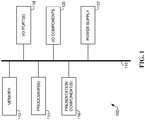
- computing device 100 an exemplary operating environment for implementing embodiments of the invention is shown and designated generally as computing device 100.
- Computing device 100 is but one example of a suitable computing environment and is not intended to suggest any limitation as to the scope of use or functionality of the invention. Neither should the computing device 100 be interpreted as having any dependency or requirement relating to any one or combination of components illustrated.
- the invention may be described in the general context of computer code or machine-useable instructions, including computer-executable instructions such as program components, being executed by a computer or other machine, such as a personal data assistant or other handheld device.
- program components including routines, programs, objects, components, data structures, and the like, refer to code that performs particular tasks, or implements particular abstract data types.
- Embodiments of the invention may be practiced in a variety of system configurations, including handheld devices, consumer electronics, general-purpose computers, specialty computing devices, etc.
- Embodiments of the invention may also be practiced in distributed computing environments where tasks are performed by remote-processing devices that are linked through a communications network.
- computing device 100 includes a bus 110 that directly or indirectly couples the following devices: memory 112, one or more processors 114, one or more presentation components 116, input/output (I/O) ports 118, I/O components 120, and an illustrative power supply 122.
- Bus 110 represents what may be one or more busses (such as an address bus, data bus, or combination thereof).
- FIG. 1 is merely illustrative of an exemplary computing device that can be used in connection with one or more embodiments of the invention. Distinction is not made between such categories as “workstation,” “server,” “laptop,” “handheld device,” etc., as all are contemplated within the scope of FIG. 1 and reference to "computer” or "computing device.”
- Computer-readable media can be any available media that can be accessed by computing device 100 and includes both volatile and nonvolatile media, removable and non-removable media.
- Computer-readable media may comprise computer storage media and communication media.
- Computer storage media includes both volatile and nonvolatile, removable and non-removable media implemented in any method or technology for storage of information such as computer-readable instructions, data structures, program modules or other data.
- Computer storage media includes RAM, ROM, EEPROM, flash memory or other memory technology, CD-ROM, digital versatile disks (DVD) or other optical disk storage, magnetic cassettes, magnetic tape, magnetic disk storage or other magnetic storage devices. Computer storage media does not comprise a propagated data signal.
- Communication media typically embodies computer-readable instructions, data structures, program modules or other data in a modulated data signal such as a carrier wave or other transport mechanism and includes any information delivery media.
- modulated data signal means a signal that has one or more of its characteristics set or changed in such a manner as to encode information in the signal.
- communication media includes wired media such as a wired network or direct-wired connection, and wireless media such as acoustic, RF, infrared and other wireless media. Combinations of any of the above should also be included within the scope of computer-readable media.
- Memory 112 includes computer-storage media in the form of volatile and/or nonvolatile memory.
- the memory 112 may be removable, nonremovable, or a combination thereof.
- Exemplary memory includes solid-state memory, hard drives, optical-disc drives, etc.
- Computing device 100 includes one or more processors 114 that read data from various entities such as bus 110, memory 112 or I/O components 120.
- Presentation component(s) 116 present data indications to a user or other device.
- Exemplary presentation components 116 include a display device, speaker, printing component, vibrating component, etc.
- I/O ports 118 allow computing device 100 to be logically coupled to other devices including I/O components 120, some of which may be built in.
- Illustrative I/O components 120 include a microphone, joystick, game pad, satellite dish, scanner, printer, wireless device, etc.
- the online gaming environment 200 comprises various game clients connected through a network 220 to a game service 230.
- Exemplary game clients include a game console 210, a tablet 212, and a personal computer 214. Use of other game clients, such as smart phones and televisions, are also possible.
- the game console 210 may have one or more game controllers communicatively coupled to it.
- the tablet 212 may act as an input device for a game console 210 or a personal computer 214.
- the tablet 212 is a stand-alone game client.
- Network 220 may be a wide area network, such as the Internet.
- the controllers associated with game console 210 include game pad 231, tablet 232, headset 236, and depth camera 234.
- a game console may be associated with control devices that generate both a rich data stream and a basic data stream. Individual controllers are capable of generating different kinds of data streams and a single controller could generate both a rich data stream and an basic data stream.
- the game pad 231 may be capable of generating basic control signals, such as those generated by button selections and joystick movement. Movement data such as that generated by accelerometers and gyros within the game pad 231 may be examples of rich sensory data. In some implementations, the movement data is not considered a rich sensory data.
- the classification of an input stream as rich or basic depends on the latency caused to the game by uploading the full control stream. Factors such as available bandwidth and client capabilities may affect the classification.
- a data stream that adds more than 80ms of roundtrip latency during communication to a game server is classified as rich.
- Roundtrip latency refers to the total delay between the user providing an input, such as pushing a button, and seeing the result (e.g., avatar movement) of the input on the display.
- the term latency refers to roundtrip latency.
- the terms latency and roundtrip latency are used interchangeably.
- the 80ms of latency is in addition to latency added by baseline processing on the client and server. Different games may establish different latency standards. Further, different game features may have different latency tolerance.
- Embodiments of the present invention may make a contextual determination of what constitutes a rich data stream for a particular game, under particular circumstances.
- Each game may have a roundtrip latency-sensitivity rating.
- the roundtrip latency-sensitive rating may be determined from user feedback collected from test groups, or through another method, and associated with the game.
- the latency sensitivity rating may be different for different game features or the same for the entire game. For example, avatar movement may be given a different sensitivity rating than background movement.
- the rich or basic classification for each input stream may be determined by identifying the latency sensitivity rating for the present game, determining available bandwidth, and determining client and server processing capabilities. The various factors may be combined to determine latency created for the control stream. If it is less than the latency sensitivity rating then the control stream is basic, if greater than the latency sensitivity rating then rich.
- the latency associated with a control stream is determined experimentally using a test control input and test game response. The measured latency is used to determine whether the control is basic or rich.
- control When the control is determined to be rich via experimentation or calculation, then client side preprocessing of the control stream may be used. Various preprocessing methods are described in more detail subsequently. If the control is basic, then it is uploaded without being transformed to a reduced control input, but it may still be processed according to various transport protocols and other processing involved in communicating the control signal to the server. This other processing occurs to both preprocessed and unprocessed control signals.
- a feature may be latency sensitive regardless of the control input.
- avatar movement may be latency sensitive regardless of the whether the avatar is controlled using a depth camera or joystick.
- the tablet 232 can be both a game controller and a game client. Tablet 232 is shown coupled directly to the game console 210, but the connection could be indirect through the Internet or a subnet.
- the game service 230 helps make a connection between the tablet 232 and the game console.
- the game service 230 may associate devices when the devices log in using the same identification or identification codes that are linked. Users may also ask that devices be linked through the game service 230 for use as input or companion devices.
- the tablet 232 is capable of generating numerous control streams and may also serve as a display output mechanism. In addition to being a primary display, the tablet 232 could provide supplemental game information different from, but related to information shown on a primary display coupled to the game console 210, or simply be a control surface.
- the input streams generated by the tablet 232 include video and picture data, audio data, movement data, touch screen data, and keyboard input data.
- the depth camera 234 generates three-dimensional image data used as a control input.
- the depth camera 234 may use infrared camera to determine a depth, or distance from the camera for each pixel captured. Stereoscopic depth cameras are also possible.
- the depth camera 234 may capture a color video stream or picture.
- the depth camera 234 may have several image gathering components. For example, the depth camera 234 may have multiple cameras.
- the depth camera 234 may be used to create user interface though which the user makes gestures and speaks audio commands to control game. The user may have no other controller. In other embodiments, the depth camera 234 may be used in combination with other control input.
- the headset 236, captures audio input from a player and the player's surroundings and may also act as an output device if it is coupled with a headphone or other speaker.
- Game service 230 may comprise multiple computing devices communicatively coupled to each other.
- the game service 230 is implemented using one or more server farms.
- the server farms may be spread out across various geographic regions including cities throughout the world.
- the game clients may connect to the closest server farms.
- Embodiments of the present invention are not limited to this setup.
- the game service 230 allows the game to be executed within the computing devices provided by the game service 230.
- a communication session between the game service and game clients carries input traffic to the game service 230 and returns a rendered game image.
- a computing device that is part of the game service executes the video game code using a control stream generated by input devices associated with the various game clients.
- the rendered video game is then communicated over the network to the game client where the rendered game is output for display.
- the gaming environment 300 includes a game client 310 communicatively coupled to a game server 340 through a network 330.
- the network may be the Internet.
- the game client 310 is connected to a first game input device 312, a second game input device 314, and a display 316.
- Exemplary game input devices include game pads, keyboards, a mouse, a touch pad, a touch screen, movement aware devices (e.g., accelerometer and/or gyroscope equipped devices), a microphone for receiving voice commands, a depth camera, a video camera, and a trackball.
- the display 316 is capable of displaying video game content.
- the display 316 may be a television or computer screen.
- the display 316 is a touch screen integrated with the game client 310.
- the game client 310 is a computing device that is able to execute video games.
- the game client 310 could be a tablet or a laptop computer.
- the game client 310 is a game console and the display 316 is a remote display communicatively coupled to the game console.
- the game client 310 includes an operating environment 320, a video composite component 321, a game execution environment 322, a game data store 324, a game-specific preprocessing component 326, and a generic pre-processing component 328.
- the operating environment 320 may be provided by an operating system that manages the hardware and provides services to application running on the game client 310.
- the operating environment may allocate client resources to different applications as part of the pre-processing and other functions.
- the game data store 324 stores downloaded games and partially downloaded games. Games may be downloaded in playable blocks. To play a game, the game may need to be loaded from the game data store 324 into active memory associated with the game execution environment 322.
- the game data store 324 may also store player progress files.
- the game-specific preprocessing component 326 processes a rich controller input to generate a reduced controller input.
- the reduced controller input can take many forms and can vary depending on the type of rich controller input involved.
- the reduced controller input generated by the client may take the form of skeletal tracking data, a reduction to surfaces, a reduction to geometry, deltas, compressed imagery, and a reduction to bounding boxes. Each of these will be described in more detail subsequently, but they all result in control data comprising less data to communicate to the controller.
- the reduced controller input is communicated over network 330 to the game execution environment 348 on the game server 340.
- the reduced controller input is used as an input that controls the game in progress.
- the game-specific preprocessing 326 is specific to the particular game being executed. While the steps may be similar to the generic preprocessing described subsequently, a part of the game-specific processing is specific to a particular game.
- the code may be game specific to generate an output in a form that is consumable to the particular game. In other words, game specific code may be used to generate a compatible control signal. In other cases, the game specific code does something unique that other games do not do.
- the game-specific preprocessing generates a control input that is specific to the game.
- a hand gesture could be interpreted to mean move the avatar right or to pick up an object in a first game, but something different in a second game.
- the reduced controller input would simply be a movement command instead of the three-dimensional image data.
- Interpreting three-dimensional image data to recognize a gesture and form a movement command is a transformation of one type of input data (depth data) to a second type (movement). Taking this one-step further, the movement data or depth data could be converted to a control command, such as "throw ball" or "pause game.” This is described as transformation to control.
- relevant control data is separated from irrelevant control data, but does not change form.
- reduced controller input could be a portion of the three-dimensional image around an object of interest, such as a player's face or hand, without the rest of the three-dimensional image data. Isolating a portion of image data (3D or 2D) is described as a reduction to a bounding box.
- the reduced controller input could be a unique game command or a common game command described in a game specific way, such as use of game specific slang.
- the game-specific preprocessing component 326 is extracted or based on a video game originally written to be processed entirely on the client side. In this manner, the part of the video game that processes the rich controller inputs is separated and put on the client side and the commands for other game functions are sent up to the execution part of the game, which resides on the server 340. In this case, there may be a need to reconcile data that would have otherwise been processed instantaneously within the game execution environment on a client.
- the signal reconciliation component 346 explained in more detail subsequently, may perform this reconciliation.
- the generic preprocessing 328 preprocesses the rich data input in a way that is applicable to or consumable by multiple games.
- the reduced controller input generated by the generic preprocessing component 328 is communicated over network 330 to the game execution environment 348 where it may be used to manipulate the game in progress.
- the examples of generic preprocessing steps include skeletal tracking, deltas, reduction to services, reduction to geometry, reduction to bounding boxes, and three-dimensional image compression.
- the generic processing could be a speech-to-text translation. For example, the user could speak the word "pause" and the generic preprocessing could send a command to pause the game.
- the game execution environment 322 comprises the gaming resources on the client 310 uses to execute instances of a game or part of a game. In some embodiments, the client 310 does not include a game execution embodiment or the computing resources to execute the full game.
- the game execution environment 322 comprises active memory along with computing and video processing.
- the game execution environment 322 receives gaming controls and causes the game to be manipulated and progressed according to its programming. In one embodiment, the game execution environment 322 outputs a rendered video stream that is communicated to a display device.
- the game execution environment 322 outputs only code related to latency sensitive game features. Latency sensitive features of a game may be designated by a game developer and may also be dynamically determined. In one embodiment, the game service 340 communicates game code needed to execute only the latency sensitive features. The execution environment 322 may not have resources or the code to execute the entire game. The game execution environment 322 may execute part of a game to generate game images that are combined by the video composite component 321 with rendered images received from the game server 340.
- the video composite component 321 merges rendered video game images received from the game server 340 with rendered video game images rendered by the client 310 to form a single image that is output to display 316.
- the video composite component may perform scaling and other functions to generate a video output that is appropriate.
- the game server 340 comprises a connection manager 342, a player profile data store 344, a signal reconciliation component 346, a game execution environment 348, a game data store 350, and a game manager 352. Though depicted as a single box, the game server 340 could be a server farm that comprises numerous machines, or even several server farms.
- the connection manager 342 builds a connection between the client 310 and the server 340.
- the connection manager 342 may also provide various authentication mechanisms to make sure that the user is authorized to access the game service provided by the server 340.
- the connection manager 342 may also analyze the bandwidth available within a connection and provide this information to components as needed. For example, the resolution of the video game image may be reduced to accommodate limited bandwidth.
- the player profile data store 344 may work in conjunction with the connection manager 342 to build and store player information.
- Part of the player profile may comprise demographic and financial information such as a player's name, address and credit card information or other mechanism for paying for or purchasing games and experiences provided by the game service.
- the player profile data store 344 may store a player's progress within an individual game. As a player progresses through a game, the player's score and access to game levels may be stored. Further, the player profile data store 344 may store information about individual player preferences such as language preferences. Information regarding a player's game client and speed of the network connection may also be stored and utilized to optimize the gaming experience. For example, in one embodiment, when a geographically proximate server farm is busy, players with higher latency Internet connections may be preferentially connected to proximate server farms while players with lower latency connections may be connected to server farms that are further away. In this way, the players with the network connections that are best able to handle the additional latency are connected to server farms that create additional latency because of their location.
- the player profile data store 344 may also store a usage history for the individual player.
- a player's history of purchasing games, sampling games, or playing games through a game service that does not require the purchase of the games may be stored.
- the usage information may be analyzed to suggest games of interest to an individual player.
- the purchase history may include games that are not purchased through the game service.
- the purchase history may be augmented by the player entering in a key from a game purchased in a retail store. In some embodiments, the player may then have access to that game both on their game client 310 and through the game service.
- the game execution environment 348 comprises the gaming resources on the game server 340 uses to execute instances of a game or part of a game.
- the game execution environment 348 comprises active memory along with computing and video processing.
- the game execution environment 348 receives control signals from the game client 310 and causes the game to be manipulated and progress according to its programming.
- the game execution environment 348 outputs a rendered video stream that is communicated to the game client.
- the game execution environment 322 outputs game geometry, or other representations, which may be combined with local objects on the gaming client to render the gaming video.
- the game execution environment 322 may execute part of a game to generate game images that are communicated to the game client 310 for combination with rendered images generated by the game client 310.
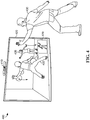
- the depth camera 410 has a view of the player 430.
- a depth camera 410 generates three-dimensional image data that is able to capture the player's 430 movement. In this case, the player 430 is moving their left arm up and down.
- a game console or game server receives the input from the depth camera 410 and uses it to manipulate the avatar 422 shown on display 420. As can be seen, the movements of the avatar 422 interact with virtual objects 424 and a second player 426. A different person connected to the same game session through the game server may control the second player 426.
- the virtual objects 424 are balls. The user's movements are able to form a control input when captured by the depth camera 410.
- FIG. 4 also includes a picture-in-picture (“PIP") image 470 of the player 430.
- PIP picture-in-picture
- This may be a standard video image captured by the depth camera 410 or some other camera.
- the PIP image may be rendered on the client without sending the image to the game server because PIP may be latency sensitive.
- the rendered images include server rendered image 510, client rendered avatar 520, and client rendered picture-in-picture 530. These three rendered images are composited together to form the image shown previously in FIG. 4 .
- the rendered images generated by the server may also be sent with depth buffer data in addition to colored image data.
- the depth buffer data is used to order the client rendered images and the server rendered images during the composite process.
- the client may render an avatar that is partially obscured by an object rendered by a server when the images are composited.
- the depth data is used to composite the images in the correct depth order.
- the server rendered image 510 includes both foreground and background images that are non-latency sensitive in the illustrated game.
- the server rendered image 510 includes the background area 528, virtual game objects 524, and remote player avatar 526.
- Virtual game objects 524 are manipulated based on actions taken by the player locally and the second player remotely. As mentioned previously, both players are participating in the same game using different input devices. The game is being executed in a remote server's game execution environment.
- the avatar 522 is rendered by the client. Delays in avatar 522 movement that might result if the avatar was rendered by the server can lessen the enjoyment of the game. Note that the avatar 522 and the virtual objects 524 are both manipulated as a result of control input received at the client. At least part of the control input is sent to the server and at least part of the control input is consumed by the client. In one embodiment, the entire control input is sent to the server and the entire control input is consumed by the client, but only to execute and render designated game features.
- the picture-in-picture 530 is also rendered by the client.
- the video image is not communicated to the server along with the other controller input. If the video image is communicated to the server, it is also consumed by the client to generate the PIP image. As mentioned, the three rendered images are composited to form a single video game image that is output to the user.
- the remote gaming environment 600 includes an input device 610, a game client 620, a network 630, a game server 640, and a display 650.
- the input device 610 generates a rich data signal, such as three-dimensional image or video data. Other examples of rich data streams have been described previously.
- the game client 620 may be a game console or other computing device.
- Network 630 may be similar to network 330 described previously and may include the Internet.
- Game server 640 may be similar to game server 340 described previously.
- Game server 640 executes a video game that has been manipulated in response to control signals received from the game client 620.
- the display 650 may be a television, monitor, or other display integrated into a computing device such as a slate or smart phone. In embodiments of the invention, the display 650 may be integrated into the game client 620.
- the game client 620 may be a slate or laptop computer that has an integrated display.
- the input device 610 may also be integrated into the game client 620 in some embodiments of the present invention.
- a game client could have a depth camera integrated into the body of the game client 620.
- the input device 610 generates a rich data signal that is sent to a signal management component 622 on the game client 620.
- the rich data signal may be three-dimensional image data generated by a three-dimensional capture device.
- the signal management component 622 directs all, or portions, of the control signal to the appropriate destinations.
- the signal management component 622 may also perform various preprocessing on the data signal to prepare it for consumption by the client rendering component 624 or the game server 640.
- the signal management component 622 sends at least part of the signal, preprocessed or otherwise, through network 630 to the game server 640.
- the game server 640 consumes the signal to manipulate an ongoing game session and to render a video game image. Roughly simultaneously the signal management component 622 communicates at least part of the video game input signal to the client rendering component 624.
- the client rendering component 624 is indicated as a single component. However, a the client rendering component 624 may be part of a game execution environment or be related to other components not shown that execute part of the game in response to the signal.
- the client rendering component 624 generates a client rendered video game image that is different than the server-rendered video game image generated based on the same or similar signals.
- the client rendering component 624 generates images of a particular game feature that is latency sensitive or more convenient to render on the client 620.
- the client may need environmental geometry describing the playing environment surrounding the player's avatar in order to calculate appropriate movements. For example, the game client 620 would need to know the avatar is standing in front of a wall, and not move the avatar forward in response to a move forward instruction. The avatar may similarly navigate around objects, fall, leap, or perform other actions depending on environmental conditions.
- the code on the game client 620 is able to determine avatar movements that are appropriate for the environmental conditions, including other player locations, and game factors, such as player power level. For example, an instruction to jump would not be followed by the client if the present game state indicated the player lacked the present ability to jump.
- the game server 640 may periodically send game state information to the client 620 for use in the client side game code.
- the game state information may include environmental geometry describing land, objects, and other players.
- the client does not track the overall game progress, track game points, scores, etc.
- the game client 620 may render an avatar moving the left arm, but not have awareness whether or not the arm contacted a ball or whether the resulting ball movement scored a point.
- the client may ultimately output a composite image showing the arm hitting the ball, but the game code may not know other game information beyond what is needed to render the avatar changes, or other latency sensitive features.
- the rendered video game image from the game server 640 and the client rendering component 624 are both received by the video composite component 626.
- the video composite component forms a single video game image that is output to the display 650.
- FIG. 7 a method 700 of playing a video game using rich sensory data as a control input in a server based gaming environment is shown, in accordance with an embodiment of the present invention.
- the server based gaming environment may be similar to the remote gaming environment described previously with reference to FIG. 3 .
- a game client receives rich sensory input locally and communicates all or part of this information to a game server that executes the game and generates a video game image.
- data rich control input is received as a video game input control at the game client.
- the data rich control input may be generated by a depth camera that reflects the size and shape of objects in a volume of space in view of the camera.
- the data rich control input may be speech data received by a microphone or movement data captured by an accelerometer or gyroscope equipped device.
- the input device may integrated into the game client, such as a camera or microphone integrated into a slate or personal computer.
- the input device may be located nearby and communicatively coupled to the game client via a wired or wireless connection. Received by the game client does not need to mean the input is received from an external device. Received by the game client could mean generated by the game client and received by a component on the game client, such as signal component 622 or client rendering component 624, described previously, or a combination of components within a game execution environment that handles game function on the game client..
- an integrated video game image is generated at the client by combining rendered video game images generated in response to the data rich control input that are received from a game server with video game images rendered by the game client in response to the data rich control input.
- a single video game image is created by combining a video game image rendered by the game server with a video game image rendered by the game client.
- the images rendered by the game server and those rendered by the game client are different.
- the two images do not have features in common. For example, a first avatar is only present in the client-rendered video game image and is not present in the server rendered image. Similarly, game objects or a second player may be rendered in the server generated image and not be present in the client rendered image.
- the client generated image is a picture-in-picture video generated based on the data rich control input or additional input data comprising color video.
- the picture-in-picture is a green screen image showing the player in isolation from background and surrounding objects.
- the client only renders latency sensitive features.
- Latency sensitive features may vary from game to game. Latency sensitive features are those where a player will experience a degraded game experience when the video game appearance does not change in response to control input within a latency threshold.
- the latency threshold for each game or game feature may be determined by developers and associated with the game.
- game features are latency sensitive if more than a 50 ms delay causes game play degradation.
- code used to render an image of the latency sensitive feature is communicated to the game client.
- the latency sensitive game feature may be defined narrowly. For example, a first movement of the avatar may be latency sensitive, while a second movement, which is different is not. For example, jumping may be latency sensitive while walking is not.
- the client side game code may first interpret the game control input and determine whether a latency sensitive game feature is manipulated by the control input. When a latency sensitive game feature is manipulated then it may be rendered by the client. When no latency sensitive game features are manipulated the entire image may be server rendered and client code would not render any images. For example, when the control input opens a menu that pauses the game, the entire menu navigation may be server rendered.
- avatar appendages e.g., hands, arms, legs, feet, and head
- the client would only render images of the appendages to be combined with a server rendered image that includes the avatar body.
- the list of latency sensitive game features rendered by the game client may change as conditions change. For example, as network conditions slow and latency created by the network increases, additional features may be rendered by the client. When network conditions slow, it may take longer for control input to be communicated to the game service and a rendered image to be communicated back to the game client.
- the total transaction time taken to perform this exchange of information may be monitored during a game session and compared against each game features latency threshold. The game client may do this comparison or the game server. When the total transaction time exceeds a latency threshold for a game feature then the client will begin rendering that game feature. When the total transaction time falls below the latency threshold then the game feature may again be rendered by the server. In this way, rendering of certain game features may migrate between the client and server depending on network conditions and latency thresholds associated with the game features.
- the server may also monitor network conditions and send an explicit instruction to the game client to begin rendering a particular feature.
- Method 800 for playing a video game using data rich control input as a control input is shown, in accordance with an embodiment of the present invention.
- Method 800 may be executed in a remote gaming environment similar to the one described previously with reference to FIG. 3 .
- data rich control input is received at a game client.
- the input device may integrated into the game client, such as a camera or microphone integrated into a slate or personal computer.
- the input device may be located nearby and communicatively coupled to the game client via a wired or wireless connection.
- Received by the game client does not need to mean the input is received from an external device.
- Received by the game client could mean generated by the game client and received by a component on the game client, such as signal component 622 or client rendering component 624, described previously, or a combination of components within a game execution environment that handles game function on the game client..
- part of the data rich control input is processed locally at the game client to generate a rendered video game feature.
- the processing may be done using game specific code running on the game client.
- Game specific code is code associated with the game running on a game server that is not capable of executing an entire game but is capable of generating certain images that is combinable with an image of the overall game being executed at a game server.
- a rendered video game image is received at the game client from a game server on which the video game is running.
- the rendered video game feature is composited with the rendered video game image to form a final rendered video.
- the rendered video is output to a display device.
- Method 900 for playing a video game using three-dimensional image data as a control input is shown, in accordance with an embodiment of the present invention.
- Method 900 may be executed in a remote gaming environment similar to the one described previously with reference to FIG. 3 .
- three-dimensional image data depicting an action performed by a player is received at a game server.
- the three-dimensional image data depicts an action performed by a player located with the game client.
- the input device may integrated into the game client, such as a camera or microphone integrated into a slate or personal computer.
- the input device may be located nearby and communicatively coupled to the game client via a wired or wireless connection. "Received" by the game client does not need to mean the input is received from an external device. Received by the game client could mean generated by the game client and received by a component on the game client, such as signal component 622 or client rendering component 624, described previously, or a combination of components within a game execution environment that handles game function on the game client.
- game state information is updated based on an interpretation of the three-dimensional image data.
- part of the three-dimensional image data is processed at the game server to generate a server-rendered video game image.
- the server-rendered video game image is not a complete image of the video game.
- One or more game features are rendered by the game client and combined with the server-rendered video game image to generate a video game image shown to a user.
- a server rendered video game image is communicated to the game client from a game server on which the video game is running.
Landscapes
- Engineering & Computer Science (AREA)
- Multimedia (AREA)
- Processing Or Creating Images (AREA)
Description
- Video games may use controllers that generate rich data streams. For example, a depth camera may be used to generate a control signal for a video game. A depth camera generates a three-dimensional image of the space viewed by the camera. Other rich data streams include video and audio data. Player movement within the three-dimensional image may be detected and interpreted, perhaps in conjunction with other input data, to manipulate a video game.
-
WO2005061068 teaches that interactive video may involve user controlled characters. Additional interaction in broadcast interactive video may be provided by using video objects and detecting any coincidence between a user controlled character and the video objects. If coincidence is detected, an event may be triggered. Such an event may involve device control of the user controlled character. -
WO9932990 -
EP2340877 teaches an rich input sensor device having direct access to an IP-based network, in particular to the Internet, for transmitting sensor signals or data derived thereof as user-related input data via the IP-based network to a remote computing device or server, preferably to a cloud of servers, which then process these input data for controlling the running entertainment program. - According to aspects of the present invention there is provided a method and media as defined in the accompanying claims.
- This summary is provided to introduce a selection of concepts in a simplified form that are further described below in the detailed description. This summary is not intended to identify key features or essential features of the claimed subject matter, nor is it intended to be used in isolation as an aid in determining the scope of the claimed subject matter.
- Embodiments of the present invention split game processing and rendering between a client and a game server. A rendered video game image is received from a game server and combined with a rendered image generated by the game client to form a single video game image that is presented to a user. Game play may be controlled using a rich sensory input, such audio data conveying speech and three-dimensional image data generated by a depth camera, or other device capable of generating three-dimensional image data. The three-dimensional image data describes the shape, size, and orientation of objects present in a play space. The play space is the area in which players are present and viewed by the input device.
- The rich sensory input is received by a client device and then communicated to a game server, potentially with some preprocessing, and is also consumed locally on the client, at least in part. In one embodiment, latency sensitive features are the only features processed on the client and rendered on the client. For example, an avatar that moves in response to user actions captured in the three-dimensional image data may be rendered on the client while the rest of the video game image is rendered on the server. In addition to an avatar, latency sensitive game features, such as manipulation of real or virtual game objects that move in response to a user's movements, may also be rendered on the client. For example, if an avatar is holding a baseball bat, the baseball bat held by the avatar may also be rendered by the client. Where multiple players are located in view of the control input device, multiple avatars or game features directly linked to the multiple players may be client rendered. In a remote multi-game player setting where other players are connected via a network and are not in the same geographic location or play space, then the other player's avatars are rendered on the server.
- Embodiments of the invention are described in detail below with reference to the attached drawing figures, wherein:
-
FIG. 1 is a block diagram of an exemplary computing environment suitable for implementing embodiments of the invention; -
FIG. 2 is a diagram of online gaming environment, in accordance with an embodiment of the present invention; -
FIG. 3 is a diagram of a remote gaming computing environment, in accordance with an embodiment of the present invention; -
FIG. 4 is a diagram of a gaming interface generated using a rich data stream, in accordance with an embodiment of the present invention; -
FIG. 5 is diagram illustrating compositing three rendered images are illustrated, in accordance with an embodiment of the present invention; -
FIG. 6 is a diagram illustrating data flow through a split rendering process, in accordance with an embodiment of the present invention; -
FIG. 7 is a flow chart showing a method of enabling game play over a remote connection using a data rich input device, in accordance with an embodiment of the present invention; -
FIG. 8 is a flow chart showing a method of enabling game play over a remote connection using a data rich input device, in accordance with an embodiment of the present invention; and -
FIG. 9 is a flow chart showing a method of enabling game play over a remote connection using a data rich input device, in accordance with an embodiment of the present invention. - The subject matter of embodiments of the invention is described with specificity herein to meet statutory requirements. However, the description itself is not intended to limit the scope of this patent. Rather, the inventors have contemplated that the claimed subject matter might also be embodied in other ways, to include different steps or combinations of steps similar to the ones described in this document, in conjunction with other present or future technologies. Moreover, although the terms "step" and/or "block" may be used herein to connote different elements of methods employed, the terms should not be interpreted as implying any particular order among or between various steps herein disclosed unless and except when the order of individual steps is explicitly described.
- Embodiments of the present invention split game processing and rendering between a client and a game server. A rendered video game image is received from a game server and combined with a rendered image generated by the game client to form a single video game image that is presented to a user. Game play may be controlled using a rich sensory input, such audio data conveying speech and three-dimensional image data generated by a depth camera, or other device capable of generating three-dimensional image data. The three-dimensional image data describes the shape, size, and orientation of objects present in a play space. The play space is the area in which players are present and viewed by the input device.
- The rich sensory input is received by a client device and then communicated to a game server, potentially with some preprocessing, and is also consumed locally on the client, at least in part. In one embodiment, latency sensitive features are the only features processed on the client and rendered on the client. For example, an avatar that moves in response to user actions captured in the three-dimensional image data may be rendered on the client while the rest of the video game image is rendered on the server. In addition to an avatar, latency sensitive game features, such as manipulation of real or virtual game objects that move in response to a user's movements, may also be rendered on the client. For example, if an avatar is holding a baseball bat, the baseball bat held by the avatar may also be rendered by the client. Where multiple players are located in view of the control input device, multiple avatars or game features directly linked to the multiple players may be client rendered. In a remote multi-game player setting where other players are connected via a network and are not in the same geographic location or play space, then the other player's avatars are rendered on the server.
- Embodiments of the present invention split game processing and rendering between a client and a game server. A rendered video game image is received from a game server and combined with a rendered image generated by the game client to form a single video game image that is presented to a user. Game play may be controlled using a rich sensory input, such audio data conveying speech and three-dimensional image data generated by a depth camera, or other device capable of generating three-dimensional image data. The three-dimensional image data describes the shape, size, and orientation of objects present in a play space. The play space is the area in which players are present and viewed by the input device.
- The rich sensory input is received by a client device and then communicated to a game server, potentially with some preprocessing, and is also consumed locally on the client, at least in part. In one embodiment, latency sensitive features are the only features processed on the client and rendered on the client. For example, an avatar that moves in response to user actions captured in the three-dimensional image data may be rendered on the client while the rest of the video game image is rendered on the server. In addition to an avatar, latency sensitive game features, such as manipulation of real or virtual game objects that move in response to a user's movements, may also be rendered on the client. For example, if an avatar is holding a baseball bat, the baseball bat held by the avatar may also be rendered by the client. Where multiple players are located in view of the control input device, multiple avatars or game features directly linked to the multiple players may be client rendered. In a remote multi-game player setting where other players are connected via a network and are not in the same geographic location or play space, then the other player's avatars are rendered on the server.
- Having briefly described an overview of embodiments of the invention, an exemplary operating environment suitable for use in implementing embodiments of the invention is described below.
- Referring to the drawings in general, and initially to
FIG. 1 in particular, an exemplary operating environment for implementing embodiments of the invention is shown and designated generally as computing device 100. Computing device 100 is but one example of a suitable computing environment and is not intended to suggest any limitation as to the scope of use or functionality of the invention. Neither should the computing device 100 be interpreted as having any dependency or requirement relating to any one or combination of components illustrated. - The invention may be described in the general context of computer code or machine-useable instructions, including computer-executable instructions such as program components, being executed by a computer or other machine, such as a personal data assistant or other handheld device. Generally, program components, including routines, programs, objects, components, data structures, and the like, refer to code that performs particular tasks, or implements particular abstract data types. Embodiments of the invention may be practiced in a variety of system configurations, including handheld devices, consumer electronics, general-purpose computers, specialty computing devices, etc. Embodiments of the invention may also be practiced in distributed computing environments where tasks are performed by remote-processing devices that are linked through a communications network.
- With continued reference to
FIG. 1 , computing device 100 includes abus 110 that directly or indirectly couples the following devices:memory 112, one ormore processors 114, one ormore presentation components 116, input/output (I/O)ports 118, I/O components 120, and anillustrative power supply 122.Bus 110 represents what may be one or more busses (such as an address bus, data bus, or combination thereof). Although the various blocks ofFIG. 1 are shown with lines for the sake of clarity, in reality, delineating various components is not so clear, and metaphorically, the lines would more accurately be grey and fuzzy. For example, one may consider a presentation component such as a display device to be an I/O component 120. Also, processors have memory. The inventors hereof recognize that such is the nature of the art, and reiterate that the diagram ofFIG. 1 is merely illustrative of an exemplary computing device that can be used in connection with one or more embodiments of the invention. Distinction is not made between such categories as "workstation," "server," "laptop," "handheld device," etc., as all are contemplated within the scope ofFIG. 1 and reference to "computer" or "computing device." - Computing device 100 typically includes a variety of computer-readable media. Computer-readable media can be any available media that can be accessed by computing device 100 and includes both volatile and nonvolatile media, removable and non-removable media. By way of example, and not limitation, computer-readable media may comprise computer storage media and communication media. Computer storage media includes both volatile and nonvolatile, removable and non-removable media implemented in any method or technology for storage of information such as computer-readable instructions, data structures, program modules or other data.
- Computer storage media includes RAM, ROM, EEPROM, flash memory or other memory technology, CD-ROM, digital versatile disks (DVD) or other optical disk storage, magnetic cassettes, magnetic tape, magnetic disk storage or other magnetic storage devices. Computer storage media does not comprise a propagated data signal.
- Communication media typically embodies computer-readable instructions, data structures, program modules or other data in a modulated data signal such as a carrier wave or other transport mechanism and includes any information delivery media. The term "modulated data signal" means a signal that has one or more of its characteristics set or changed in such a manner as to encode information in the signal. By way of example, and not limitation, communication media includes wired media such as a wired network or direct-wired connection, and wireless media such as acoustic, RF, infrared and other wireless media. Combinations of any of the above should also be included within the scope of computer-readable media.
-
Memory 112 includes computer-storage media in the form of volatile and/or nonvolatile memory. Thememory 112 may be removable, nonremovable, or a combination thereof. Exemplary memory includes solid-state memory, hard drives, optical-disc drives, etc. Computing device 100 includes one ormore processors 114 that read data from various entities such asbus 110,memory 112 or I/O components 120. Presentation component(s) 116 present data indications to a user or other device.Exemplary presentation components 116 include a display device, speaker, printing component, vibrating component, etc. I/O ports 118 allow computing device 100 to be logically coupled to other devices including I/O components 120, some of which may be built in. Illustrative I/O components 120 include a microphone, joystick, game pad, satellite dish, scanner, printer, wireless device, etc. - Turning now to
FIG. 2 , anonline gaming environment 200 is shown, in accordance with an embodiment of the present invention. Theonline gaming environment 200 comprises various game clients connected through anetwork 220 to agame service 230. Exemplary game clients include agame console 210, atablet 212, and apersonal computer 214. Use of other game clients, such as smart phones and televisions, are also possible. Thegame console 210 may have one or more game controllers communicatively coupled to it. In one embodiment, thetablet 212 may act as an input device for agame console 210 or apersonal computer 214. In another embodiment, thetablet 212 is a stand-alone game client.Network 220 may be a wide area network, such as the Internet. - The controllers associated with
game console 210 includegame pad 231,tablet 232,headset 236, anddepth camera 234. A game console may be associated with control devices that generate both a rich data stream and a basic data stream. Individual controllers are capable of generating different kinds of data streams and a single controller could generate both a rich data stream and an basic data stream. - The
game pad 231 may be capable of generating basic control signals, such as those generated by button selections and joystick movement. Movement data such as that generated by accelerometers and gyros within thegame pad 231 may be examples of rich sensory data. In some implementations, the movement data is not considered a rich sensory data. - The classification of an input stream as rich or basic depends on the latency caused to the game by uploading the full control stream. Factors such as available bandwidth and client capabilities may affect the classification. In one embodiment, a data stream that adds more than 80ms of roundtrip latency during communication to a game server is classified as rich. Roundtrip latency refers to the total delay between the user providing an input, such as pushing a button, and seeing the result (e.g., avatar movement) of the input on the display. Unless otherwise specified in this disclosure, the term latency refers to roundtrip latency. Thus, the terms latency and roundtrip latency are used interchangeably. The 80ms of latency is in addition to latency added by baseline processing on the client and server. Different games may establish different latency standards. Further, different game features may have different latency tolerance.
- Embodiments of the present invention may make a contextual determination of what constitutes a rich data stream for a particular game, under particular circumstances. Each game may have a roundtrip latency-sensitivity rating. The roundtrip latency-sensitive rating may be determined from user feedback collected from test groups, or through another method, and associated with the game. The latency sensitivity rating may be different for different game features or the same for the entire game. For example, avatar movement may be given a different sensitivity rating than background movement.
- The rich or basic classification for each input stream may be determined by identifying the latency sensitivity rating for the present game, determining available bandwidth, and determining client and server processing capabilities. The various factors may be combined to determine latency created for the control stream. If it is less than the latency sensitivity rating then the control stream is basic, if greater than the latency sensitivity rating then rich.
- In an embodiment, the latency associated with a control stream is determined experimentally using a test control input and test game response. The measured latency is used to determine whether the control is basic or rich.
- When the control is determined to be rich via experimentation or calculation, then client side preprocessing of the control stream may be used. Various preprocessing methods are described in more detail subsequently. If the control is basic, then it is uploaded without being transformed to a reduced control input, but it may still be processed according to various transport protocols and other processing involved in communicating the control signal to the server. This other processing occurs to both preprocessed and unprocessed control signals.
- When certain features are latency sensitive, then those features may be rendered on the client and combined with rendered images received from the server. A feature may be latency sensitive regardless of the control input. For example, avatar movement may be latency sensitive regardless of the whether the avatar is controlled using a depth camera or joystick.
- The
tablet 232 can be both a game controller and a game client.Tablet 232 is shown coupled directly to thegame console 210, but the connection could be indirect through the Internet or a subnet. In one embodiment, thegame service 230 helps make a connection between thetablet 232 and the game console. Thegame service 230 may associate devices when the devices log in using the same identification or identification codes that are linked. Users may also ask that devices be linked through thegame service 230 for use as input or companion devices. Thetablet 232 is capable of generating numerous control streams and may also serve as a display output mechanism. In addition to being a primary display, thetablet 232 could provide supplemental game information different from, but related to information shown on a primary display coupled to thegame console 210, or simply be a control surface. The input streams generated by thetablet 232 include video and picture data, audio data, movement data, touch screen data, and keyboard input data. - The
depth camera 234 generates three-dimensional image data used as a control input. Thedepth camera 234 may use infrared camera to determine a depth, or distance from the camera for each pixel captured. Stereoscopic depth cameras are also possible. In addition, thedepth camera 234 may capture a color video stream or picture. Thedepth camera 234 may have several image gathering components. For example, thedepth camera 234 may have multiple cameras. Thedepth camera 234 may be used to create user interface though which the user makes gestures and speaks audio commands to control game. The user may have no other controller. In other embodiments, thedepth camera 234 may be used in combination with other control input. - The
headset 236, captures audio input from a player and the player's surroundings and may also act as an output device if it is coupled with a headphone or other speaker. -
Game service 230 may comprise multiple computing devices communicatively coupled to each other. In one embodiment, thegame service 230 is implemented using one or more server farms. The server farms may be spread out across various geographic regions including cities throughout the world. In this scenario, the game clients may connect to the closest server farms. Embodiments of the present invention are not limited to this setup. - The
game service 230 allows the game to be executed within the computing devices provided by thegame service 230. A communication session between the game service and game clients carries input traffic to thegame service 230 and returns a rendered game image. In this embodiment, a computing device that is part of the game service executes the video game code using a control stream generated by input devices associated with the various game clients. The rendered video game is then communicated over the network to the game client where the rendered game is output for display. - Turning now to
FIG. 3 , aremote gaming environment 300 using rich input control data is shown, in accordance with an embodiment of the present invention. Thegaming environment 300 includes agame client 310 communicatively coupled to agame server 340 through anetwork 330. In one embodiment, the network may be the Internet. Thegame client 310 is connected to a firstgame input device 312, a secondgame input device 314, and adisplay 316. Exemplary game input devices include game pads, keyboards, a mouse, a touch pad, a touch screen, movement aware devices (e.g., accelerometer and/or gyroscope equipped devices), a microphone for receiving voice commands, a depth camera, a video camera, and a trackball. Embodiments of the present invention are not limited to these input devices. Thedisplay 316 is capable of displaying video game content. For example, thedisplay 316 may be a television or computer screen. In another embodiment, thedisplay 316 is a touch screen integrated with thegame client 310. - The
game client 310 is a computing device that is able to execute video games. Thegame client 310 could be a tablet or a laptop computer. In another embodiment, thegame client 310 is a game console and thedisplay 316 is a remote display communicatively coupled to the game console. Thegame client 310 includes an operatingenvironment 320, avideo composite component 321, agame execution environment 322, agame data store 324, a game-specific preprocessing component 326, and ageneric pre-processing component 328. - The operating
environment 320 may be provided by an operating system that manages the hardware and provides services to application running on thegame client 310. The operating environment may allocate client resources to different applications as part of the pre-processing and other functions. - The
game data store 324 stores downloaded games and partially downloaded games. Games may be downloaded in playable blocks. To play a game, the game may need to be loaded from thegame data store 324 into active memory associated with thegame execution environment 322. Thegame data store 324 may also store player progress files. - The game-
specific preprocessing component 326 processes a rich controller input to generate a reduced controller input. The reduced controller input can take many forms and can vary depending on the type of rich controller input involved. - When the rich control input is three-dimensional image data, the reduced controller input generated by the client may take the form of skeletal tracking data, a reduction to surfaces, a reduction to geometry, deltas, compressed imagery, and a reduction to bounding boxes. Each of these will be described in more detail subsequently, but they all result in control data comprising less data to communicate to the controller. The reduced controller input is communicated over
network 330 to thegame execution environment 348 on thegame server 340. The reduced controller input is used as an input that controls the game in progress. - The game-
specific preprocessing 326 is specific to the particular game being executed. While the steps may be similar to the generic preprocessing described subsequently, a part of the game-specific processing is specific to a particular game. The code may be game specific to generate an output in a form that is consumable to the particular game. In other words, game specific code may be used to generate a compatible control signal. In other cases, the game specific code does something unique that other games do not do. - In one embodiment, the game-specific preprocessing generates a control input that is specific to the game. For example, a hand gesture could be interpreted to mean move the avatar right or to pick up an object in a first game, but something different in a second game. In this case, the reduced controller input would simply be a movement command instead of the three-dimensional image data. Interpreting three-dimensional image data to recognize a gesture and form a movement command is a transformation of one type of input data (depth data) to a second type (movement). Taking this one-step further, the movement data or depth data could be converted to a control command, such as "throw ball" or "pause game." This is described as transformation to control. In other embodiments, relevant control data is separated from irrelevant control data, but does not change form. For example, reduced controller input could be a portion of the three-dimensional image around an object of interest, such as a player's face or hand, without the rest of the three-dimensional image data. Isolating a portion of image data (3D or 2D) is described as a reduction to a bounding box. In the game-specific preprocessing of audio commands, the reduced controller input could be a unique game command or a common game command described in a game specific way, such as use of game specific slang.
- In one embodiment, the game-
specific preprocessing component 326 is extracted or based on a video game originally written to be processed entirely on the client side. In this manner, the part of the video game that processes the rich controller inputs is separated and put on the client side and the commands for other game functions are sent up to the execution part of the game, which resides on theserver 340. In this case, there may be a need to reconcile data that would have otherwise been processed instantaneously within the game execution environment on a client. The signal reconciliation component 346, explained in more detail subsequently, may perform this reconciliation. - The
generic preprocessing 328 preprocesses the rich data input in a way that is applicable to or consumable by multiple games. The reduced controller input generated by thegeneric preprocessing component 328 is communicated overnetwork 330 to thegame execution environment 348 where it may be used to manipulate the game in progress. The examples of generic preprocessing steps include skeletal tracking, deltas, reduction to services, reduction to geometry, reduction to bounding boxes, and three-dimensional image compression. When the rich data input includes audio signals the generic processing could be a speech-to-text translation. For example, the user could speak the word "pause" and the generic preprocessing could send a command to pause the game. - The
game execution environment 322 comprises the gaming resources on theclient 310 uses to execute instances of a game or part of a game. In some embodiments, theclient 310 does not include a game execution embodiment or the computing resources to execute the full game. Thegame execution environment 322 comprises active memory along with computing and video processing. Thegame execution environment 322 receives gaming controls and causes the game to be manipulated and progressed according to its programming. In one embodiment, thegame execution environment 322 outputs a rendered video stream that is communicated to a display device. - In other embodiments, the
game execution environment 322 outputs only code related to latency sensitive game features. Latency sensitive features of a game may be designated by a game developer and may also be dynamically determined. In one embodiment, thegame service 340 communicates game code needed to execute only the latency sensitive features. Theexecution environment 322 may not have resources or the code to execute the entire game. Thegame execution environment 322 may execute part of a game to generate game images that are combined by thevideo composite component 321 with rendered images received from thegame server 340. - The
video composite component 321 merges rendered video game images received from thegame server 340 with rendered video game images rendered by theclient 310 to form a single image that is output to display 316. The video composite component may perform scaling and other functions to generate a video output that is appropriate. - The
game server 340 comprises aconnection manager 342, a playerprofile data store 344, a signal reconciliation component 346, agame execution environment 348, agame data store 350, and agame manager 352. Though depicted as a single box, thegame server 340 could be a server farm that comprises numerous machines, or even several server farms. - The
connection manager 342 builds a connection between theclient 310 and theserver 340. Theconnection manager 342 may also provide various authentication mechanisms to make sure that the user is authorized to access the game service provided by theserver 340. Theconnection manager 342 may also analyze the bandwidth available within a connection and provide this information to components as needed. For example, the resolution of the video game image may be reduced to accommodate limited bandwidth. - The player
profile data store 344 may work in conjunction with theconnection manager 342 to build and store player information. Part of the player profile may comprise demographic and financial information such as a player's name, address and credit card information or other mechanism for paying for or purchasing games and experiences provided by the game service. - In addition, the player
profile data store 344 may store a player's progress within an individual game. As a player progresses through a game, the player's score and access to game levels may be stored. Further, the playerprofile data store 344 may store information about individual player preferences such as language preferences. Information regarding a player's game client and speed of the network connection may also be stored and utilized to optimize the gaming experience. For example, in one embodiment, when a geographically proximate server farm is busy, players with higher latency Internet connections may be preferentially connected to proximate server farms while players with lower latency connections may be connected to server farms that are further away. In this way, the players with the network connections that are best able to handle the additional latency are connected to server farms that create additional latency because of their location. - The player
profile data store 344 may also store a usage history for the individual player. A player's history of purchasing games, sampling games, or playing games through a game service that does not require the purchase of the games may be stored. The usage information may be analyzed to suggest games of interest to an individual player. In one embodiment, the purchase history may include games that are not purchased through the game service. For example, the purchase history may be augmented by the player entering in a key from a game purchased in a retail store. In some embodiments, the player may then have access to that game both on theirgame client 310 and through the game service. - The
game execution environment 348 comprises the gaming resources on thegame server 340 uses to execute instances of a game or part of a game. Thegame execution environment 348 comprises active memory along with computing and video processing. Thegame execution environment 348 receives control signals from thegame client 310 and causes the game to be manipulated and progress according to its programming. In one embodiment, thegame execution environment 348 outputs a rendered video stream that is communicated to the game client. In other embodiments, thegame execution environment 322 outputs game geometry, or other representations, which may be combined with local objects on the gaming client to render the gaming video. Thegame execution environment 322 may execute part of a game to generate game images that are communicated to thegame client 310 for combination with rendered images generated by thegame client 310. - Turning now to
FIG. 4 , an exemplary depth camera interface is shown, in accordance with an embodiment of the present invention. Thedepth camera 410 has a view of theplayer 430. Adepth camera 410 generates three-dimensional image data that is able to capture the player's 430 movement. In this case, theplayer 430 is moving their left arm up and down. A game console or game server receives the input from thedepth camera 410 and uses it to manipulate theavatar 422 shown ondisplay 420. As can be seen, the movements of theavatar 422 interact withvirtual objects 424 and asecond player 426. A different person connected to the same game session through the game server may control thesecond player 426. Thevirtual objects 424 are balls. The user's movements are able to form a control input when captured by thedepth camera 410. -
FIG. 4 also includes a picture-in-picture ("PIP")image 470 of theplayer 430. This may be a standard video image captured by thedepth camera 410 or some other camera. The PIP image may be rendered on the client without sending the image to the game server because PIP may be latency sensitive. - Turning now to
FIG. 5 , three rendered images are illustrated, in accordance with an embodiment of the present invention. The rendered images include server renderedimage 510, client renderedavatar 520, and client rendered picture-in-picture 530. These three rendered images are composited together to form the image shown previously inFIG. 4 . The rendered images generated by the server may also be sent with depth buffer data in addition to colored image data. The depth buffer data is used to order the client rendered images and the server rendered images during the composite process. For example, the client may render an avatar that is partially obscured by an object rendered by a server when the images are composited. The depth data is used to composite the images in the correct depth order. The server renderedimage 510 includes both foreground and background images that are non-latency sensitive in the illustrated game. The server renderedimage 510 includes thebackground area 528, virtual game objects 524, andremote player avatar 526. Virtual game objects 524 are manipulated based on actions taken by the player locally and the second player remotely. As mentioned previously, both players are participating in the same game using different input devices. The game is being executed in a remote server's game execution environment. - The
avatar 522 is rendered by the client. Delays inavatar 522 movement that might result if the avatar was rendered by the server can lessen the enjoyment of the game. Note that theavatar 522 and thevirtual objects 524 are both manipulated as a result of control input received at the client. At least part of the control input is sent to the server and at least part of the control input is consumed by the client. In one embodiment, the entire control input is sent to the server and the entire control input is consumed by the client, but only to execute and render designated game features. - The picture-in-
picture 530 is also rendered by the client. In one embodiment, the video image is not communicated to the server along with the other controller input. If the video image is communicated to the server, it is also consumed by the client to generate the PIP image. As mentioned, the three rendered images are composited to form a single video game image that is output to the user. - Turning now to
FIG. 6 , data flow through a possible embodiment of the present invention is illustrated. Theremote gaming environment 600 includes aninput device 610, agame client 620, anetwork 630, agame server 640, and adisplay 650. Theinput device 610 generates a rich data signal, such as three-dimensional image or video data. Other examples of rich data streams have been described previously. Thegame client 620 may be a game console or other computing device.Network 630 may be similar tonetwork 330 described previously and may include the Internet.Game server 640 may be similar togame server 340 described previously. -
Game server 640 executes a video game that has been manipulated in response to control signals received from thegame client 620. Thedisplay 650 may be a television, monitor, or other display integrated into a computing device such as a slate or smart phone. In embodiments of the invention, thedisplay 650 may be integrated into thegame client 620. For example, thegame client 620 may be a slate or laptop computer that has an integrated display. It should be mentioned that theinput device 610 may also be integrated into thegame client 620 in some embodiments of the present invention. For example, a game client could have a depth camera integrated into the body of thegame client 620. - Initially, the
input device 610 generates a rich data signal that is sent to asignal management component 622 on thegame client 620. The rich data signal may be three-dimensional image data generated by a three-dimensional capture device. Thesignal management component 622 directs all, or portions, of the control signal to the appropriate destinations. Thesignal management component 622 may also perform various preprocessing on the data signal to prepare it for consumption by theclient rendering component 624 or thegame server 640. - The
signal management component 622 sends at least part of the signal, preprocessed or otherwise, throughnetwork 630 to thegame server 640. Thegame server 640 consumes the signal to manipulate an ongoing game session and to render a video game image. Roughly simultaneously thesignal management component 622 communicates at least part of the video game input signal to theclient rendering component 624. For the sake of simplicity, theclient rendering component 624 is indicated as a single component. However, a theclient rendering component 624 may be part of a game execution environment or be related to other components not shown that execute part of the game in response to the signal. - The
client rendering component 624 generates a client rendered video game image that is different than the server-rendered video game image generated based on the same or similar signals. Generally, theclient rendering component 624 generates images of a particular game feature that is latency sensitive or more convenient to render on theclient 620. In order to render the image, at least part of the video game must be executable on theclient 620. Further, the client may need environmental geometry describing the playing environment surrounding the player's avatar in order to calculate appropriate movements. For example, thegame client 620 would need to know the avatar is standing in front of a wall, and not move the avatar forward in response to a move forward instruction. The avatar may similarly navigate around objects, fall, leap, or perform other actions depending on environmental conditions. The code on thegame client 620 is able to determine avatar movements that are appropriate for the environmental conditions, including other player locations, and game factors, such as player power level. For example, an instruction to jump would not be followed by the client if the present game state indicated the player lacked the present ability to jump. - The
game server 640 may periodically send game state information to theclient 620 for use in the client side game code. The game state information may include environmental geometry describing land, objects, and other players. In one embodiment, the client does not track the overall game progress, track game points, scores, etc. For example, thegame client 620 may render an avatar moving the left arm, but not have awareness whether or not the arm contacted a ball or whether the resulting ball movement scored a point. The client may ultimately output a composite image showing the arm hitting the ball, but the game code may not know other game information beyond what is needed to render the avatar changes, or other latency sensitive features. - The rendered video game image from the
game server 640 and theclient rendering component 624 are both received by thevideo composite component 626. The video composite component forms a single video game image that is output to thedisplay 650. - Turning now to
FIG. 7 , amethod 700 of playing a video game using rich sensory data as a control input in a server based gaming environment is shown, in accordance with an embodiment of the present invention. The server based gaming environment may be similar to the remote gaming environment described previously with reference toFIG. 3 . In general, a game client receives rich sensory input locally and communicates all or part of this information to a game server that executes the game and generates a video game image. - At
step 710, data rich control input is received as a video game input control at the game client. The data rich control input may be generated by a depth camera that reflects the size and shape of objects in a volume of space in view of the camera. The data rich control input may be speech data received by a microphone or movement data captured by an accelerometer or gyroscope equipped device. The input device may integrated into the game client, such as a camera or microphone integrated into a slate or personal computer. The input device may be located nearby and communicatively coupled to the game client via a wired or wireless connection. Received by the game client does not need to mean the input is received from an external device. Received by the game client could mean generated by the game client and received by a component on the game client, such assignal component 622 orclient rendering component 624, described previously, or a combination of components within a game execution environment that handles game function on the game client.. - At
step 720, an integrated video game image is generated at the client by combining rendered video game images generated in response to the data rich control input that are received from a game server with video game images rendered by the game client in response to the data rich control input. Thus, a single video game image is created by combining a video game image rendered by the game server with a video game image rendered by the game client. The images rendered by the game server and those rendered by the game client are different. In one embodiment, the two images do not have features in common. For example, a first avatar is only present in the client-rendered video game image and is not present in the server rendered image. Similarly, game objects or a second player may be rendered in the server generated image and not be present in the client rendered image. - In one embodiment, the client generated image is a picture-in-picture video generated based on the data rich control input or additional input data comprising color video. In one embodiment, the picture-in-picture is a green screen image showing the player in isolation from background and surrounding objects.
- In one embodiment, the client only renders latency sensitive features. Latency sensitive features may vary from game to game. Latency sensitive features are those where a player will experience a degraded game experience when the video game appearance does not change in response to control input within a latency threshold. The latency threshold for each game or game feature may be determined by developers and associated with the game. In one embodiment, game features are latency sensitive if more than a 50 ms delay causes game play degradation. In one embodiment, code used to render an image of the latency sensitive feature is communicated to the game client.
- The latency sensitive game feature may be defined narrowly. For example, a first movement of the avatar may be latency sensitive, while a second movement, which is different is not. For example, jumping may be latency sensitive while walking is not. The client side game code may first interpret the game control input and determine whether a latency sensitive game feature is manipulated by the control input. When a latency sensitive game feature is manipulated then it may be rendered by the client. When no latency sensitive game features are manipulated the entire image may be server rendered and client code would not render any images. For example, when the control input opens a menu that pauses the game, the entire menu navigation may be server rendered.
- In another example, avatar appendages (e.g., hands, arms, legs, feet, and head) are latency sensitive, while the rest of the body is not. In this case, the client would only render images of the appendages to be combined with a server rendered image that includes the avatar body.
- The list of latency sensitive game features rendered by the game client may change as conditions change. For example, as network conditions slow and latency created by the network increases, additional features may be rendered by the client. When network conditions slow, it may take longer for control input to be communicated to the game service and a rendered image to be communicated back to the game client. The total transaction time taken to perform this exchange of information may be monitored during a game session and compared against each game features latency threshold. The game client may do this comparison or the game server. When the total transaction time exceeds a latency threshold for a game feature then the client will begin rendering that game feature. When the total transaction time falls below the latency threshold then the game feature may again be rendered by the server. In this way, rendering of certain game features may migrate between the client and server depending on network conditions and latency thresholds associated with the game features. The server may also monitor network conditions and send an explicit instruction to the game client to begin rendering a particular feature.
- Turning now to
FIG. 8 , amethod 800 for playing a video game using data rich control input as a control input is shown, in accordance with an embodiment of the present invention.Method 800 may be executed in a remote gaming environment similar to the one described previously with reference toFIG. 3 . - At
step 810, data rich control input is received at a game client. The input device may integrated into the game client, such as a camera or microphone integrated into a slate or personal computer. The input device may be located nearby and communicatively coupled to the game client via a wired or wireless connection. Received by the game client does not need to mean the input is received from an external device. Received by the game client could mean generated by the game client and received by a component on the game client, such assignal component 622 orclient rendering component 624, described previously, or a combination of components within a game execution environment that handles game function on the game client.. - At
step 820, part of the data rich control input is processed locally at the game client to generate a rendered video game feature. The processing may be done using game specific code running on the game client. Game specific code is code associated with the game running on a game server that is not capable of executing an entire game but is capable of generating certain images that is combinable with an image of the overall game being executed at a game server. - At
step 830, a rendered video game image is received at the game client from a game server on which the video game is running. Atstep 840, the rendered video game feature is composited with the rendered video game image to form a final rendered video. Atstep 850, the rendered video is output to a display device. - Turning now to
FIG. 9 , amethod 900 for playing a video game using three-dimensional image data as a control input is shown, in accordance with an embodiment of the present invention.Method 900 may be executed in a remote gaming environment similar to the one described previously with reference toFIG. 3 . - At
step 910, three-dimensional image data depicting an action performed by a player is received at a game server. The three-dimensional image data depicts an action performed by a player located with the game client. The input device may integrated into the game client, such as a camera or microphone integrated into a slate or personal computer. The input device may be located nearby and communicatively coupled to the game client via a wired or wireless connection. "Received" by the game client does not need to mean the input is received from an external device. Received by the game client could mean generated by the game client and received by a component on the game client, such assignal component 622 orclient rendering component 624, described previously, or a combination of components within a game execution environment that handles game function on the game client. - At
step 920, game state information is updated based on an interpretation of the three-dimensional image data. Atstep 930, part of the three-dimensional image data is processed at the game server to generate a server-rendered video game image. The server-rendered video game image is not a complete image of the video game. One or more game features are rendered by the game client and combined with the server-rendered video game image to generate a video game image shown to a user. - At
step 940, a server rendered video game image is communicated to the game client from a game server on which the video game is running.
Claims (13)
- One or more computer-storage media having computer executable instructions embodied thereon that when executed by a computing device perform a method (700) of playing a video game using three-dimensional image data as a control input in a server based gaming environment, the method comprising:receiving (71 0), at a game client, three-dimensional image data as a video game control input;process, at the game client, the three-dimensional image data input to generate a basic control input;communicate through a communications network the basic control input from the game client over the computer network to a game server on which the video game is running;process, at the game client, part of the three-dimensional image data input to generate a client-rendered video game feature;receive, through the communications network over the computer network at the game client, a server-rendered video game image from the game server on which the video game is running, the server-rendered video game image being generated in response to a change in game state caused by the basic control input;generating (720), at the game client, a composite video game image by combining the server-rendered video game image generated by the game server in response to the three-dimensional image data input with the client-rendered video game feature; andoutput the rendered composite video to a display device;wherein a roundtrip duration is processed to determine if the rendered image is generated at the client or server based on a latency sensitivity rating.
- The media of claim 1, wherein the latency sensitivity rating is determined based on available bandwidth and client and server processing capabilities.
- The media of claim 1 or claim 2, wherein the game client only renders latency sensitive game features.
- The media of any preceding claim, wherein the client-rendered video game feature is an avatar for a player using the game client.
- The media of any preceding claim, wherein the game server does not render an avatar for a player using the game client.
- The media of any preceding claim, wherein the client-rendered video game feature is generated by game code that is downloaded from the game server upon initiation of a game session.
- A method (800) for playing a video game using three-dimensional data as a control input, the method comprising;receiving (810), at a game client, the three-dimensional data as a video game control input;processing (820), at the game client, the three-dimensional image data input to generate a basic control input;receiving (830), at the game client, through a communications network, a server-rendered video game image from a game server on which the video game is running, the server-rendered video game image being generated in response to a change in game state caused by the basic control input;compositing (840) by combining the server-rendered video game image generated by the game server in response to the three-dimensional image data input with the client-rendered video game feature a rendered composite video;outputting (850) the rendered composite video to a display device;further comprising processing a roundtrip duration to determine if the rendered image is composited at the client or server based on a latency sensitivity rating.
- The method of claim 7, further comprising processing the latency sensitivity rating based on available bandwidth and client and server processing capabilities.
- The method (800) of claim 7 or claim 8, wherein the processing is performed by game-specific code.
- The method (800) of any one of claims 7 to 9, wherein the client-rendered video game feature is an avatar image responding to a user action detected in the data rich input.
- The method (800) of any one of claim 7 to 10, wherein the client-rendered video game feature is a perspective change initiated in response to detecting a user action in the data rich input that is mapped to a perspective change instruction.
- The method (800) of claim 11, wherein the perspective change is a scene rotation.
- The method (800) of any one of claim 7 to 12, wherein the client-rendered video game feature is a video of the player shown as a picture-in-picture in combination with game scenes.
Applications Claiming Priority (2)
| Application Number | Priority Date | Filing Date | Title |
|---|---|---|---|
| US13/723,498 US9717982B2 (en) | 2012-12-21 | 2012-12-21 | Client rendering of latency sensitive game features |
| PCT/US2013/076918 WO2014100583A1 (en) | 2012-12-21 | 2013-12-20 | Client rendering of latency sensitive game features |
Publications (2)
| Publication Number | Publication Date |
|---|---|
| EP2934710A1 EP2934710A1 (en) | 2015-10-28 |
| EP2934710B1 true EP2934710B1 (en) | 2019-12-11 |
Family
ID=50029209
Family Applications (1)
| Application Number | Title | Priority Date | Filing Date |
|---|---|---|---|
| EP13824701.0A Not-in-force EP2934710B1 (en) | 2012-12-21 | 2013-12-20 | Client rendering of latency sensitive game features |
Country Status (4)
| Country | Link |
|---|---|
| US (1) | US9717982B2 (en) |
| EP (1) | EP2934710B1 (en) |
| CN (1) | CN105050671B (en) |
| WO (1) | WO2014100583A1 (en) |
Cited By (2)
| Publication number | Priority date | Publication date | Assignee | Title |
|---|---|---|---|---|
| EP4564822A1 (en) * | 2023-11-28 | 2025-06-04 | Sony Interactive Entertainment Europe Limited | Hybrid pre and post processing |
| WO2026072867A1 (en) * | 2024-09-30 | 2026-04-02 | Adeia Guides Inc. | Systems and methods for distributing processing tasks for providing a media asset |
Families Citing this family (37)
| Publication number | Priority date | Publication date | Assignee | Title |
|---|---|---|---|---|
| US10058778B2 (en) * | 2007-12-05 | 2018-08-28 | Sony Interactive Entertainment America Llc | Video compression system and method for reducing the effects of packet loss over a communication channel |
| US8977776B1 (en) * | 2012-06-18 | 2015-03-10 | Amazon Technologies, Inc. | Content streaming with bandwidth management |
| US8961302B2 (en) | 2012-07-20 | 2015-02-24 | Microsoft Technology Licensing, Llc | Game browsing |
| US9717982B2 (en) | 2012-12-21 | 2017-08-01 | Microsoft Technology Licensing, Llc | Client rendering of latency sensitive game features |
| US9526980B2 (en) | 2012-12-21 | 2016-12-27 | Microsoft Technology Licensing, Llc | Client side processing of game controller input |
| US9564102B2 (en) | 2013-03-14 | 2017-02-07 | Microsoft Technology Licensing, Llc | Client side processing of player movement in a remote gaming environment |
| US9694277B2 (en) * | 2013-03-14 | 2017-07-04 | Microsoft Technology Licensing, Llc | Client side processing of character interactions in a remote gaming environment |
| US20140292803A1 (en) * | 2013-03-29 | 2014-10-02 | Nvidia Corporation | System, method, and computer program product for generating mixed video and three-dimensional data to reduce streaming bandwidth |
| JP6153450B2 (en) * | 2013-10-30 | 2017-06-28 | 株式会社ソニー・インタラクティブエンタテインメント | Information processing system and information processing apparatus |
| US20150134302A1 (en) | 2013-11-14 | 2015-05-14 | Jatin Chhugani | 3-dimensional digital garment creation from planar garment photographs |
| EP3089113A4 (en) * | 2013-12-26 | 2017-11-15 | Kabushiki Kaisha Square Enix (also trading as "Square Enix Co., Ltd." | Rendering system, control method, program, and recording medium |
| US10366439B2 (en) | 2013-12-27 | 2019-07-30 | Ebay Inc. | Regional item reccomendations |
| US20150189012A1 (en) * | 2014-01-02 | 2015-07-02 | Nvidia Corporation | Wireless display synchronization for mobile devices using buffer locking |
| US10298668B2 (en) * | 2014-03-24 | 2019-05-21 | Square Enix Co., Ltd. | Interactive system, terminal apparatus, server apparatus, control method, program, and recording medium |
| US11045730B1 (en) * | 2014-09-17 | 2021-06-29 | Wayne Goldman | Systems and methods for IoT enabled arcade games |
| US20160092956A1 (en) | 2014-09-30 | 2016-03-31 | Jonathan Su | Garment size mapping |
| US9894185B2 (en) * | 2014-12-16 | 2018-02-13 | Software Ag | System and method for condition-based application logic shifting between a client and a server |
| CN105096373B (en) * | 2015-06-30 | 2020-04-28 | 华为技术有限公司 | Media content rendering method, user equipment and system |
| CN105468358B (en) * | 2015-11-17 | 2019-11-05 | 腾讯科技(深圳)有限公司 | A kind of data processing method and device of moving game |
| US10218793B2 (en) * | 2016-06-13 | 2019-02-26 | Disney Enterprises, Inc. | System and method for rendering views of a virtual space |
| US10471353B2 (en) * | 2016-06-30 | 2019-11-12 | Sony Interactive Entertainment America Llc | Using HMD camera touch button to render images of a user captured during game play |
| WO2018183778A1 (en) * | 2017-03-30 | 2018-10-04 | Magic Leap, Inc. | Centralized rendering |
| CN113709439B (en) * | 2017-04-11 | 2024-05-14 | 杜比实验室特许公司 | Method, device and system for rendering visual objects |
| KR101897704B1 (en) * | 2017-09-25 | 2018-10-29 | 넷마블 주식회사 | Apparatus and method for providing game service |
| US10580187B2 (en) | 2018-05-01 | 2020-03-03 | Enas TARAWNEH | System and method for rendering of an animated avatar |
| GB2574650A (en) * | 2018-06-14 | 2019-12-18 | Sony Interactive Entertainment Inc | System and method for generating an input signal |
| CN118301383A (en) | 2019-02-25 | 2024-07-05 | 谷歌有限责任公司 | Variable endpoint user interface rendering |
| US10926177B2 (en) * | 2019-03-15 | 2021-02-23 | Sony Interactive Entertainment Inc. | Systems and methods for predicting states by using a distributed game engine |
| US10937220B2 (en) | 2019-04-22 | 2021-03-02 | Disney Enterprises, Inc. | Animation streaming for media interaction |
| GB2585479B (en) * | 2019-05-10 | 2024-01-31 | Victor Kennedy Roderick | Reduction of the effects of latency for extended reality experiences |
| US11033813B2 (en) * | 2019-06-07 | 2021-06-15 | Microsoft Technology Licensing, Llc | Latency erasure |
| CN110227260A (en) * | 2019-08-07 | 2019-09-13 | 南昌黑鲨科技有限公司 | Cloud game accelerated method, device, readable storage medium storing program for executing and computer equipment |
| US11297116B2 (en) | 2019-12-04 | 2022-04-05 | Roblox Corporation | Hybrid streaming |
| CN111402353B (en) * | 2020-03-11 | 2020-12-25 | 浙江大学 | Cloud-end drawing calculation method based on self-adaptive virtualization drawing production line |
| CN112090084B (en) * | 2020-11-23 | 2021-02-09 | 成都完美时空网络技术有限公司 | Object rendering method and device, storage medium and electronic equipment |
| US12075018B2 (en) | 2021-04-21 | 2024-08-27 | Microsoft Technology Licensing, Llc | Distributed virtual reality |
| CN115463412B (en) * | 2022-08-12 | 2025-05-09 | 乐相科技有限公司 | A display processing method and device for cloud games |
Citations (1)
| Publication number | Priority date | Publication date | Assignee | Title |
|---|---|---|---|---|
| WO2012107739A2 (en) * | 2011-02-08 | 2012-08-16 | MUSTAFA, Awais I | Method and system for providing video game content |
Family Cites Families (77)
| Publication number | Priority date | Publication date | Assignee | Title |
|---|---|---|---|---|
| US5838909A (en) | 1996-05-23 | 1998-11-17 | Sandcastle, Inc. | Reducing latency when synchronizing access to a multi-user database over a network |
| US6758755B2 (en) | 1996-11-14 | 2004-07-06 | Arcade Planet, Inc. | Prize redemption system for games executed over a wide area network |
| US6038599A (en) | 1997-04-23 | 2000-03-14 | Mpath Interactive, Inc. | Latency server and matchmaker |
| US6356288B1 (en) | 1997-12-22 | 2002-03-12 | U.S. Philips Corporation | Diversion agent uses cinematographic techniques to mask latency |
| US6415317B1 (en) | 1999-10-01 | 2002-07-02 | Joshua Michael Yelon | Software system for reducing the appearance of latency in a multi-user environment |
| US6377257B1 (en) | 1999-10-04 | 2002-04-23 | International Business Machines Corporation | Methods and apparatus for delivering 3D graphics in a networked environment |
| AU1593401A (en) | 1999-11-16 | 2001-05-30 | Sony Electronics Inc. | System and method for leveraging data into a game platform |
| US6884172B1 (en) | 2000-10-25 | 2005-04-26 | Ngame Limited | Electronic game system |
| US7587520B1 (en) | 2001-01-24 | 2009-09-08 | 3Dlabs Inc. Ltd. | Image display system with visual server |
| US6475090B2 (en) | 2001-03-29 | 2002-11-05 | Koninklijke Philips Electronics N.V. | Compensating for network latency in a multi-player game |
| US7580972B2 (en) | 2001-12-12 | 2009-08-25 | Valve Corporation | Method and system for controlling bandwidth on client and server |
| US7277946B2 (en) | 2002-06-28 | 2007-10-02 | Microsoft Corporation | Distributed session listing and content discovery |
| US7603406B2 (en) | 2002-07-25 | 2009-10-13 | Sony Corporation | System and method for wireless software download and remote transaction settlement |
| US20040030882A1 (en) | 2002-08-08 | 2004-02-12 | Forman George Henry | Managed application pre-launching |
| US20040082388A1 (en) | 2002-10-23 | 2004-04-29 | Simsek Burc A. | Apparatus and method for incorporation of external digital or analog information in computer and console gaming environments |
| US20090118019A1 (en) | 2002-12-10 | 2009-05-07 | Onlive, Inc. | System for streaming databases serving real-time applications used through streaming interactive video |
| US9032465B2 (en) | 2002-12-10 | 2015-05-12 | Ol2, Inc. | Method for multicasting views of real-time streaming interactive video |
| US20040135805A1 (en) | 2003-01-10 | 2004-07-15 | Gottsacker Neal F. | Document composition system and method |
| US7076616B2 (en) | 2003-03-24 | 2006-07-11 | Sony Corporation | Application pre-launch to reduce user interface latency |
| JP3632963B2 (en) | 2003-05-29 | 2005-03-30 | コナミ株式会社 | Network battle type terminal device, method and program |
| WO2005061068A1 (en) | 2003-12-19 | 2005-07-07 | Koninklijke Philips Electronics N.V. | Interactive video |
| KR100475881B1 (en) | 2004-04-08 | 2005-03-14 | 엔에이치엔(주) | Internet game service system for randomly allocating gmae channels according to user behavior patterns and method thereof |
| KR101252609B1 (en) | 2004-08-31 | 2013-04-09 | 쿠니히로 시이나 | Push-type telecommunications accompanied by a telephone call |
| US20060135258A1 (en) | 2004-12-17 | 2006-06-22 | Nokia Corporation | System, network entity, client and method for facilitating fairness in a multiplayer game |
| EP1869599A2 (en) | 2005-03-21 | 2007-12-26 | Yosef Mizrahi | Method, system and computer-readable code for providing a computer gaming service |
| WO2006124922A2 (en) | 2005-05-17 | 2006-11-23 | Super Computer International | Collaborative online gaming system and method |
| US9566522B2 (en) | 2005-05-27 | 2017-02-14 | Nokia Technologies Oy | Device, method, and computer program product for customizing game functionality using images |
| KR100610689B1 (en) * | 2005-06-24 | 2006-08-09 | 엔에이치엔(주) | How to insert a video on a 3D screen and a recording medium therefor |
| US20110157196A1 (en) | 2005-08-16 | 2011-06-30 | Exent Technologies, Ltd. | Remote gaming features |
| US7889669B2 (en) | 2005-09-26 | 2011-02-15 | Alcatel Lucent | Equalized network latency for multi-player gaming |
| US20070093297A1 (en) | 2005-10-26 | 2007-04-26 | Waterleaf Ltd. | On-line, real-time game playing with search facility |
| US20070173325A1 (en) | 2006-01-20 | 2007-07-26 | Microsoft Corporation | Join in-progress on-line game session |
| US8403757B2 (en) | 2006-04-13 | 2013-03-26 | Yosef Mizrachi | Method and apparatus for providing gaming services and for handling video content |
| US8888592B1 (en) | 2009-06-01 | 2014-11-18 | Sony Computer Entertainment America Llc | Voice overlay |
| US8087017B1 (en) | 2007-04-09 | 2011-12-27 | Moka5, Inc. | Trace-assisted prefetching of virtual machines in a distributed system |
| WO2009039418A1 (en) | 2007-09-21 | 2009-03-26 | Sony Computer Entertainment Inc. | Network delivery of entertainment software |
| US8979647B2 (en) | 2007-10-26 | 2015-03-17 | Microsoft Technology Licensing, Llc | Method of providing player status and ability to join games |
| US9142097B2 (en) | 2007-10-26 | 2015-09-22 | Igt | Gaming system and method for providing play of local first game and remote second game |
| JP4408929B2 (en) | 2007-11-22 | 2010-02-03 | 株式会社スクウェア・エニックス | Online game system |
| US9211473B2 (en) | 2008-12-15 | 2015-12-15 | Sony Computer Entertainment America Llc | Program mode transition |
| US8968087B1 (en) | 2009-06-01 | 2015-03-03 | Sony Computer Entertainment America Llc | Video game overlay |
| US8613673B2 (en) | 2008-12-15 | 2013-12-24 | Sony Computer Entertainment America Llc | Intelligent game loading |
| US20090215538A1 (en) | 2008-02-22 | 2009-08-27 | Samuel Jew | Method for dynamically synchronizing computer network latency |
| US20090247295A1 (en) | 2008-03-31 | 2009-10-01 | Weldon Marcus K | Network-Based Methods and Apparatus for Rendering Images to an End User |
| US8264493B2 (en) | 2008-05-12 | 2012-09-11 | Playcast Media Systems, Ltd. | Method and system for optimized streaming game server |
| US8926435B2 (en) | 2008-12-15 | 2015-01-06 | Sony Computer Entertainment America Llc | Dual-mode program execution |
| US8444490B2 (en) | 2008-12-15 | 2013-05-21 | Tetris Online, Inc. | Interactive asynchronous game offline play architecture |
| US8430755B2 (en) | 2008-12-15 | 2013-04-30 | Tetris Online, Inc. | Interactive asynchronous game play architecture |
| US20100199231A1 (en) | 2009-01-30 | 2010-08-05 | Microsoft Corporation | Predictive determination |
| US8719336B2 (en) | 2009-02-03 | 2014-05-06 | Microsoft Corporation | Method and apparatus for thwarting traffic analysis in online games |
| US8151199B2 (en) | 2009-02-09 | 2012-04-03 | AltEgo, LLC | Computational delivery system for avatar and background game content |
| US9723319B1 (en) | 2009-06-01 | 2017-08-01 | Sony Interactive Entertainment America Llc | Differentiation for achieving buffered decoding and bufferless decoding |
| KR101168108B1 (en) * | 2009-06-23 | 2012-07-25 | 엔에이치엔(주) | Method for advertisement using the on line game, and record media recoded program for implement thereof |
| US20110025689A1 (en) | 2009-07-29 | 2011-02-03 | Microsoft Corporation | Auto-Generating A Visual Representation |
| US20110055135A1 (en) | 2009-08-26 | 2011-03-03 | International Business Machines Corporation | Deferred Teleportation or Relocation in Virtual Worlds |
| US8743130B2 (en) * | 2009-08-28 | 2014-06-03 | Zynga Inc. | Apparatuses, methods and systems for a distributed object renderer |
| EP2319597A1 (en) | 2009-10-13 | 2011-05-11 | Crytek GmbH | A system of providing data for entertaining presentations to at least one audience |
| US8313377B2 (en) | 2009-10-14 | 2012-11-20 | Sony Computer Entertainment America Llc | Playing browser based games with alternative controls and interfaces |
| US8325187B2 (en) | 2009-10-22 | 2012-12-04 | Samsung Electronics Co., Ltd. | Method and device for real time 3D navigation in panoramic images and cylindrical spaces |
| US20110162004A1 (en) | 2009-12-30 | 2011-06-30 | Cevat Yerli | Sensor device for a computer-controlled video entertainment system |
| US9486701B2 (en) | 2009-12-30 | 2016-11-08 | Crytek Gmbh | Computer-controlled video entertainment system |
| US9400695B2 (en) | 2010-02-26 | 2016-07-26 | Microsoft Technology Licensing, Llc | Low latency rendering of objects |
| EP2365470A1 (en) | 2010-03-09 | 2011-09-14 | Crytek GmbH | A multi-user computer-controlled advertisement presentation system and a method of providing user and advertisement related data |
| US20110250969A1 (en) | 2010-04-07 | 2011-10-13 | Marcel Van Os | Systems and methods for providing a game center having player specific achievement data |
| US8366526B2 (en) | 2010-04-16 | 2013-02-05 | Disney Enterprises, Inc. | Power play game mechanics |
| KR102126910B1 (en) | 2010-09-13 | 2020-06-25 | 소니 인터랙티브 엔터테인먼트 아메리카 엘엘씨 | Add-on Management |
| US8668582B1 (en) * | 2010-09-17 | 2014-03-11 | Amazon Technologies, Inc. | Accommodating latency in a server-based application |
| US20120079095A1 (en) | 2010-09-24 | 2012-03-29 | Amazon Technologies, Inc. | Cloud-based device synchronization |
| JP5076132B1 (en) | 2011-05-25 | 2012-11-21 | 株式会社スクウェア・エニックス・ホールディングス | Drawing control apparatus, control method therefor, program, recording medium, drawing server, and drawing system |
| US8823745B2 (en) | 2011-06-02 | 2014-09-02 | Yoostar Entertainment Group, Inc. | Image processing based on depth information and color data of a scene |
| US8850075B2 (en) | 2011-07-06 | 2014-09-30 | Microsoft Corporation | Predictive, multi-layer caching architectures |
| US8176437B1 (en) | 2011-07-18 | 2012-05-08 | Google Inc. | Responsiveness for application launch |
| US9250966B2 (en) | 2011-08-11 | 2016-02-02 | Otoy, Inc. | Crowd-sourced video rendering system |
| US9864632B2 (en) | 2011-08-17 | 2018-01-09 | Open Invention Network, Llc | System and method for transfer of an application state between devices |
| US20130225287A1 (en) | 2012-02-28 | 2013-08-29 | Zynga Inc. | Synchronous and asynchronous game modes |
| US8661491B1 (en) | 2012-08-02 | 2014-02-25 | Ericsson Television Inc. | Methods using base content and additive content and related client devices and network server devices |
| US9717982B2 (en) | 2012-12-21 | 2017-08-01 | Microsoft Technology Licensing, Llc | Client rendering of latency sensitive game features |
-
2012
- 2012-12-21 US US13/723,498 patent/US9717982B2/en not_active Expired - Fee Related
-
2013
- 2013-12-20 WO PCT/US2013/076918 patent/WO2014100583A1/en not_active Ceased
- 2013-12-20 CN CN201380066879.3A patent/CN105050671B/en not_active Expired - Fee Related
- 2013-12-20 EP EP13824701.0A patent/EP2934710B1/en not_active Not-in-force
Patent Citations (1)
| Publication number | Priority date | Publication date | Assignee | Title |
|---|---|---|---|---|
| WO2012107739A2 (en) * | 2011-02-08 | 2012-08-16 | MUSTAFA, Awais I | Method and system for providing video game content |
Cited By (2)
| Publication number | Priority date | Publication date | Assignee | Title |
|---|---|---|---|---|
| EP4564822A1 (en) * | 2023-11-28 | 2025-06-04 | Sony Interactive Entertainment Europe Limited | Hybrid pre and post processing |
| WO2026072867A1 (en) * | 2024-09-30 | 2026-04-02 | Adeia Guides Inc. | Systems and methods for distributing processing tasks for providing a media asset |
Also Published As
| Publication number | Publication date |
|---|---|
| EP2934710A1 (en) | 2015-10-28 |
| CN105050671A (en) | 2015-11-11 |
| US9717982B2 (en) | 2017-08-01 |
| US20140179421A1 (en) | 2014-06-26 |
| CN105050671B (en) | 2018-01-02 |
| WO2014100583A1 (en) | 2014-06-26 |
Similar Documents
| Publication | Publication Date | Title |
|---|---|---|
| US9717982B2 (en) | Client rendering of latency sensitive game features | |
| EP2969081B1 (en) | Client side processing of player movement in a remote gaming environment | |
| US10159901B2 (en) | Client side processing of character interactions in a remote gaming environment | |
| US10369462B2 (en) | Client side processing of game controller input | |
| US11724204B2 (en) | In-game location based game play companion application | |
| US10870060B2 (en) | Method and system for accessing previously stored game play via video recording as executed on a game cloud system | |
| JP7503122B2 (en) | Method and system for directing user attention to a location-based gameplay companion application - Patents.com | |
| EP3469802B1 (en) | In-game location based game play companion application | |
| US11644678B1 (en) | Barometric pressure sensor arrays for detecting presence and motion of objects for tracking or triggering a response | |
| US12300221B2 (en) | Methods for examining game context for determining a user's voice commands | |
| EP3469801B1 (en) | Generating challenges using a location based game play companion applicaiton |
Legal Events
| Date | Code | Title | Description |
|---|---|---|---|
| PUAI | Public reference made under article 153(3) epc to a published international application that has entered the european phase |
Free format text: ORIGINAL CODE: 0009012 |
|
| 17P | Request for examination filed |
Effective date: 20150622 |
|
| AK | Designated contracting states |
Kind code of ref document: A1 Designated state(s): AL AT BE BG CH CY CZ DE DK EE ES FI FR GB GR HR HU IE IS IT LI LT LU LV MC MK MT NL NO PL PT RO RS SE SI SK SM TR |
|
| AX | Request for extension of the european patent |
Extension state: BA ME |
|
| DAX | Request for extension of the european patent (deleted) | ||
| STAA | Information on the status of an ep patent application or granted ep patent |
Free format text: STATUS: EXAMINATION IS IN PROGRESS |
|
| 17Q | First examination report despatched |
Effective date: 20180130 |
|
| REG | Reference to a national code |
Ref country code: DE Ref legal event code: R079 Ref document number: 602013063957 Country of ref document: DE Free format text: PREVIOUS MAIN CLASS: A63F0013300000 Ipc: A63F0013355000 |
|
| RIC1 | Information provided on ipc code assigned before grant |
Ipc: A63F 13/355 20140101AFI20190418BHEP Ipc: A63F 13/358 20140101ALI20190418BHEP |
|
| GRAP | Despatch of communication of intention to grant a patent |
Free format text: ORIGINAL CODE: EPIDOSNIGR1 |
|
| STAA | Information on the status of an ep patent application or granted ep patent |
Free format text: STATUS: GRANT OF PATENT IS INTENDED |
|
| INTG | Intention to grant announced |
Effective date: 20190708 |
|
| GRAS | Grant fee paid |
Free format text: ORIGINAL CODE: EPIDOSNIGR3 |
|
| GRAA | (expected) grant |
Free format text: ORIGINAL CODE: 0009210 |
|
| STAA | Information on the status of an ep patent application or granted ep patent |
Free format text: STATUS: THE PATENT HAS BEEN GRANTED |
|
| AK | Designated contracting states |
Kind code of ref document: B1 Designated state(s): AL AT BE BG CH CY CZ DE DK EE ES FI FR GB GR HR HU IE IS IT LI LT LU LV MC MK MT NL NO PL PT RO RS SE SI SK SM TR |
|
| REG | Reference to a national code |
Ref country code: GB Ref legal event code: FG4D |
|
| REG | Reference to a national code |
Ref country code: CH Ref legal event code: EP |
|
| REG | Reference to a national code |
Ref country code: AT Ref legal event code: REF Ref document number: 1211608 Country of ref document: AT Kind code of ref document: T Effective date: 20191215 |
|
| REG | Reference to a national code |
Ref country code: DE Ref legal event code: R096 Ref document number: 602013063957 Country of ref document: DE |
|
| REG | Reference to a national code |
Ref country code: IE Ref legal event code: FG4D |
|
| REG | Reference to a national code |
Ref country code: NL Ref legal event code: MP Effective date: 20191211 |
|
| REG | Reference to a national code |
Ref country code: LT Ref legal event code: MG4D |
|
| PG25 | Lapsed in a contracting state [announced via postgrant information from national office to epo] |
Ref country code: LT Free format text: LAPSE BECAUSE OF FAILURE TO SUBMIT A TRANSLATION OF THE DESCRIPTION OR TO PAY THE FEE WITHIN THE PRESCRIBED TIME-LIMIT Effective date: 20191211 Ref country code: SE Free format text: LAPSE BECAUSE OF FAILURE TO SUBMIT A TRANSLATION OF THE DESCRIPTION OR TO PAY THE FEE WITHIN THE PRESCRIBED TIME-LIMIT Effective date: 20191211 Ref country code: LV Free format text: LAPSE BECAUSE OF FAILURE TO SUBMIT A TRANSLATION OF THE DESCRIPTION OR TO PAY THE FEE WITHIN THE PRESCRIBED TIME-LIMIT Effective date: 20191211 Ref country code: GR Free format text: LAPSE BECAUSE OF FAILURE TO SUBMIT A TRANSLATION OF THE DESCRIPTION OR TO PAY THE FEE WITHIN THE PRESCRIBED TIME-LIMIT Effective date: 20200312 Ref country code: NO Free format text: LAPSE BECAUSE OF FAILURE TO SUBMIT A TRANSLATION OF THE DESCRIPTION OR TO PAY THE FEE WITHIN THE PRESCRIBED TIME-LIMIT Effective date: 20200311 Ref country code: BG Free format text: LAPSE BECAUSE OF FAILURE TO SUBMIT A TRANSLATION OF THE DESCRIPTION OR TO PAY THE FEE WITHIN THE PRESCRIBED TIME-LIMIT Effective date: 20200311 Ref country code: FI Free format text: LAPSE BECAUSE OF FAILURE TO SUBMIT A TRANSLATION OF THE DESCRIPTION OR TO PAY THE FEE WITHIN THE PRESCRIBED TIME-LIMIT Effective date: 20191211 |
|
| PG25 | Lapsed in a contracting state [announced via postgrant information from national office to epo] |
Ref country code: RS Free format text: LAPSE BECAUSE OF FAILURE TO SUBMIT A TRANSLATION OF THE DESCRIPTION OR TO PAY THE FEE WITHIN THE PRESCRIBED TIME-LIMIT Effective date: 20191211 Ref country code: HR Free format text: LAPSE BECAUSE OF FAILURE TO SUBMIT A TRANSLATION OF THE DESCRIPTION OR TO PAY THE FEE WITHIN THE PRESCRIBED TIME-LIMIT Effective date: 20191211 |
|
| PG25 | Lapsed in a contracting state [announced via postgrant information from national office to epo] |
Ref country code: AL Free format text: LAPSE BECAUSE OF FAILURE TO SUBMIT A TRANSLATION OF THE DESCRIPTION OR TO PAY THE FEE WITHIN THE PRESCRIBED TIME-LIMIT Effective date: 20191211 |
|
| PG25 | Lapsed in a contracting state [announced via postgrant information from national office to epo] |
Ref country code: EE Free format text: LAPSE BECAUSE OF FAILURE TO SUBMIT A TRANSLATION OF THE DESCRIPTION OR TO PAY THE FEE WITHIN THE PRESCRIBED TIME-LIMIT Effective date: 20191211 Ref country code: PT Free format text: LAPSE BECAUSE OF FAILURE TO SUBMIT A TRANSLATION OF THE DESCRIPTION OR TO PAY THE FEE WITHIN THE PRESCRIBED TIME-LIMIT Effective date: 20200506 Ref country code: ES Free format text: LAPSE BECAUSE OF FAILURE TO SUBMIT A TRANSLATION OF THE DESCRIPTION OR TO PAY THE FEE WITHIN THE PRESCRIBED TIME-LIMIT Effective date: 20191211 Ref country code: CZ Free format text: LAPSE BECAUSE OF FAILURE TO SUBMIT A TRANSLATION OF THE DESCRIPTION OR TO PAY THE FEE WITHIN THE PRESCRIBED TIME-LIMIT Effective date: 20191211 Ref country code: NL Free format text: LAPSE BECAUSE OF FAILURE TO SUBMIT A TRANSLATION OF THE DESCRIPTION OR TO PAY THE FEE WITHIN THE PRESCRIBED TIME-LIMIT Effective date: 20191211 Ref country code: RO Free format text: LAPSE BECAUSE OF FAILURE TO SUBMIT A TRANSLATION OF THE DESCRIPTION OR TO PAY THE FEE WITHIN THE PRESCRIBED TIME-LIMIT Effective date: 20191211 |
|
| REG | Reference to a national code |
Ref country code: CH Ref legal event code: PL |
|
| REG | Reference to a national code |
Ref country code: BE Ref legal event code: MM Effective date: 20191231 |
|
| PG25 | Lapsed in a contracting state [announced via postgrant information from national office to epo] |
Ref country code: SM Free format text: LAPSE BECAUSE OF FAILURE TO SUBMIT A TRANSLATION OF THE DESCRIPTION OR TO PAY THE FEE WITHIN THE PRESCRIBED TIME-LIMIT Effective date: 20191211 Ref country code: IS Free format text: LAPSE BECAUSE OF FAILURE TO SUBMIT A TRANSLATION OF THE DESCRIPTION OR TO PAY THE FEE WITHIN THE PRESCRIBED TIME-LIMIT Effective date: 20200411 Ref country code: SK Free format text: LAPSE BECAUSE OF FAILURE TO SUBMIT A TRANSLATION OF THE DESCRIPTION OR TO PAY THE FEE WITHIN THE PRESCRIBED TIME-LIMIT Effective date: 20191211 |
|
| REG | Reference to a national code |
Ref country code: DE Ref legal event code: R097 Ref document number: 602013063957 Country of ref document: DE |
|
| PG25 | Lapsed in a contracting state [announced via postgrant information from national office to epo] |
Ref country code: MC Free format text: LAPSE BECAUSE OF FAILURE TO SUBMIT A TRANSLATION OF THE DESCRIPTION OR TO PAY THE FEE WITHIN THE PRESCRIBED TIME-LIMIT Effective date: 20191211 |
|
| REG | Reference to a national code |
Ref country code: AT Ref legal event code: MK05 Ref document number: 1211608 Country of ref document: AT Kind code of ref document: T Effective date: 20191211 |
|
| PLBE | No opposition filed within time limit |
Free format text: ORIGINAL CODE: 0009261 |
|
| STAA | Information on the status of an ep patent application or granted ep patent |
Free format text: STATUS: NO OPPOSITION FILED WITHIN TIME LIMIT |
|
| PG25 | Lapsed in a contracting state [announced via postgrant information from national office to epo] |
Ref country code: IE Free format text: LAPSE BECAUSE OF NON-PAYMENT OF DUE FEES Effective date: 20191220 Ref country code: LU Free format text: LAPSE BECAUSE OF NON-PAYMENT OF DUE FEES Effective date: 20191220 Ref country code: DK Free format text: LAPSE BECAUSE OF FAILURE TO SUBMIT A TRANSLATION OF THE DESCRIPTION OR TO PAY THE FEE WITHIN THE PRESCRIBED TIME-LIMIT Effective date: 20191211 |
|
| 26N | No opposition filed |
Effective date: 20200914 |
|
| PG25 | Lapsed in a contracting state [announced via postgrant information from national office to epo] |
Ref country code: CH Free format text: LAPSE BECAUSE OF NON-PAYMENT OF DUE FEES Effective date: 20191231 Ref country code: LI Free format text: LAPSE BECAUSE OF NON-PAYMENT OF DUE FEES Effective date: 20191231 Ref country code: PL Free format text: LAPSE BECAUSE OF FAILURE TO SUBMIT A TRANSLATION OF THE DESCRIPTION OR TO PAY THE FEE WITHIN THE PRESCRIBED TIME-LIMIT Effective date: 20191211 Ref country code: SI Free format text: LAPSE BECAUSE OF FAILURE TO SUBMIT A TRANSLATION OF THE DESCRIPTION OR TO PAY THE FEE WITHIN THE PRESCRIBED TIME-LIMIT Effective date: 20191211 Ref country code: BE Free format text: LAPSE BECAUSE OF NON-PAYMENT OF DUE FEES Effective date: 20191231 Ref country code: AT Free format text: LAPSE BECAUSE OF FAILURE TO SUBMIT A TRANSLATION OF THE DESCRIPTION OR TO PAY THE FEE WITHIN THE PRESCRIBED TIME-LIMIT Effective date: 20191211 |
|
| PG25 | Lapsed in a contracting state [announced via postgrant information from national office to epo] |
Ref country code: IT Free format text: LAPSE BECAUSE OF FAILURE TO SUBMIT A TRANSLATION OF THE DESCRIPTION OR TO PAY THE FEE WITHIN THE PRESCRIBED TIME-LIMIT Effective date: 20191211 |
|
| PG25 | Lapsed in a contracting state [announced via postgrant information from national office to epo] |
Ref country code: CY Free format text: LAPSE BECAUSE OF FAILURE TO SUBMIT A TRANSLATION OF THE DESCRIPTION OR TO PAY THE FEE WITHIN THE PRESCRIBED TIME-LIMIT Effective date: 20191211 |
|
| PG25 | Lapsed in a contracting state [announced via postgrant information from national office to epo] |
Ref country code: HU Free format text: LAPSE BECAUSE OF FAILURE TO SUBMIT A TRANSLATION OF THE DESCRIPTION OR TO PAY THE FEE WITHIN THE PRESCRIBED TIME-LIMIT; INVALID AB INITIO Effective date: 20131220 Ref country code: MT Free format text: LAPSE BECAUSE OF FAILURE TO SUBMIT A TRANSLATION OF THE DESCRIPTION OR TO PAY THE FEE WITHIN THE PRESCRIBED TIME-LIMIT Effective date: 20191211 |
|
| PG25 | Lapsed in a contracting state [announced via postgrant information from national office to epo] |
Ref country code: TR Free format text: LAPSE BECAUSE OF FAILURE TO SUBMIT A TRANSLATION OF THE DESCRIPTION OR TO PAY THE FEE WITHIN THE PRESCRIBED TIME-LIMIT Effective date: 20191211 |
|
| PG25 | Lapsed in a contracting state [announced via postgrant information from national office to epo] |
Ref country code: MK Free format text: LAPSE BECAUSE OF FAILURE TO SUBMIT A TRANSLATION OF THE DESCRIPTION OR TO PAY THE FEE WITHIN THE PRESCRIBED TIME-LIMIT Effective date: 20191211 |
|
| P01 | Opt-out of the competence of the unified patent court (upc) registered |
Effective date: 20230501 |
|
| PGFP | Annual fee paid to national office [announced via postgrant information from national office to epo] |
Ref country code: GB Payment date: 20231121 Year of fee payment: 11 |
|
| PGFP | Annual fee paid to national office [announced via postgrant information from national office to epo] |
Ref country code: FR Payment date: 20231122 Year of fee payment: 11 Ref country code: DE Payment date: 20231121 Year of fee payment: 11 |
|
| REG | Reference to a national code |
Ref country code: DE Ref legal event code: R119 Ref document number: 602013063957 Country of ref document: DE |
|
| GBPC | Gb: european patent ceased through non-payment of renewal fee |
Effective date: 20241220 |
|
| PG25 | Lapsed in a contracting state [announced via postgrant information from national office to epo] |
Ref country code: DE Free format text: LAPSE BECAUSE OF NON-PAYMENT OF DUE FEES Effective date: 20250701 |
|
| PG25 | Lapsed in a contracting state [announced via postgrant information from national office to epo] |
Ref country code: GB Free format text: LAPSE BECAUSE OF NON-PAYMENT OF DUE FEES Effective date: 20241220 |
|
| PG25 | Lapsed in a contracting state [announced via postgrant information from national office to epo] |
Ref country code: FR Free format text: LAPSE BECAUSE OF NON-PAYMENT OF DUE FEES Effective date: 20241231 |