EP2934415B1 - Saugfähiger artikel mit erhöhtem komfort - Google Patents
Saugfähiger artikel mit erhöhtem komfort Download PDFInfo
- Publication number
- EP2934415B1 EP2934415B1 EP12890405.9A EP12890405A EP2934415B1 EP 2934415 B1 EP2934415 B1 EP 2934415B1 EP 12890405 A EP12890405 A EP 12890405A EP 2934415 B1 EP2934415 B1 EP 2934415B1
- Authority
- EP
- European Patent Office
- Prior art keywords
- liquid
- absorbent
- foam
- layer
- receiving
- Prior art date
- Legal status (The legal status is an assumption and is not a legal conclusion. Google has not performed a legal analysis and makes no representation as to the accuracy of the status listed.)
- Not-in-force
Links
- 239000002250 absorbent Substances 0.000 title claims description 144
- 230000002745 absorbent Effects 0.000 title claims description 40
- 239000006260 foam Substances 0.000 claims description 115
- 239000000463 material Substances 0.000 claims description 95
- 238000000034 method Methods 0.000 claims description 56
- 238000005452 bending Methods 0.000 claims description 43
- 238000010521 absorption reaction Methods 0.000 claims description 15
- 229920005830 Polyurethane Foam Polymers 0.000 claims description 12
- 239000011496 polyurethane foam Substances 0.000 claims description 12
- 230000035699 permeability Effects 0.000 claims description 10
- 230000007704 transition Effects 0.000 claims description 10
- 206010021639 Incontinence Diseases 0.000 claims description 5
- 230000001012 protector Effects 0.000 claims description 5
- 229920000877 Melamine resin Polymers 0.000 claims description 4
- FHVDTGUDJYJELY-UHFFFAOYSA-N 6-{[2-carboxy-4,5-dihydroxy-6-(phosphanyloxy)oxan-3-yl]oxy}-4,5-dihydroxy-3-phosphanyloxane-2-carboxylic acid Chemical compound O1C(C(O)=O)C(P)C(O)C(O)C1OC1C(C(O)=O)OC(OP)C(O)C1O FHVDTGUDJYJELY-UHFFFAOYSA-N 0.000 claims description 3
- NIXOWILDQLNWCW-UHFFFAOYSA-M Acrylate Chemical compound [O-]C(=O)C=C NIXOWILDQLNWCW-UHFFFAOYSA-M 0.000 claims description 3
- 229920002134 Carboxymethyl cellulose Polymers 0.000 claims description 3
- 229920001661 Chitosan Polymers 0.000 claims description 3
- 239000004593 Epoxy Substances 0.000 claims description 3
- AEMRFAOFKBGASW-UHFFFAOYSA-N Glycolic acid Polymers OCC(O)=O AEMRFAOFKBGASW-UHFFFAOYSA-N 0.000 claims description 3
- 229920000954 Polyglycolide Polymers 0.000 claims description 3
- 239000004793 Polystyrene Substances 0.000 claims description 3
- 239000004372 Polyvinyl alcohol Substances 0.000 claims description 3
- 229920000297 Rayon Polymers 0.000 claims description 3
- 229920002323 Silicone foam Polymers 0.000 claims description 3
- 229920002472 Starch Polymers 0.000 claims description 3
- 229940072056 alginate Drugs 0.000 claims description 3
- 229920000615 alginic acid Polymers 0.000 claims description 3
- 235000010443 alginic acid Nutrition 0.000 claims description 3
- 229920001821 foam rubber Polymers 0.000 claims description 3
- IVJISJACKSSFGE-UHFFFAOYSA-N formaldehyde;1,3,5-triazine-2,4,6-triamine Chemical compound O=C.NC1=NC(N)=NC(N)=N1 IVJISJACKSSFGE-UHFFFAOYSA-N 0.000 claims description 3
- 239000004632 polycaprolactone Substances 0.000 claims description 3
- 229920001610 polycaprolactone Polymers 0.000 claims description 3
- ODGAOXROABLFNM-UHFFFAOYSA-N polynoxylin Chemical compound O=C.NC(N)=O ODGAOXROABLFNM-UHFFFAOYSA-N 0.000 claims description 3
- 229920000098 polyolefin Polymers 0.000 claims description 3
- 229920002223 polystyrene Polymers 0.000 claims description 3
- 229920002451 polyvinyl alcohol Polymers 0.000 claims description 3
- 239000013514 silicone foam Substances 0.000 claims description 3
- 239000008107 starch Substances 0.000 claims description 3
- 235000019698 starch Nutrition 0.000 claims description 3
- 239000004639 urea-formaldehyde foam Substances 0.000 claims description 3
- 239000010410 layer Substances 0.000 description 188
- 230000006835 compression Effects 0.000 description 15
- 238000007906 compression Methods 0.000 description 15
- 229920002678 cellulose Polymers 0.000 description 12
- 239000001913 cellulose Substances 0.000 description 12
- 239000006261 foam material Substances 0.000 description 11
- 210000002414 leg Anatomy 0.000 description 10
- 239000007788 liquid Substances 0.000 description 8
- 238000005259 measurement Methods 0.000 description 8
- 210000003205 muscle Anatomy 0.000 description 8
- 230000008901 benefit Effects 0.000 description 6
- 230000000694 effects Effects 0.000 description 6
- 239000000853 adhesive Substances 0.000 description 4
- 210000004013 groin Anatomy 0.000 description 4
- 229920003023 plastic Polymers 0.000 description 4
- 239000004033 plastic Substances 0.000 description 4
- 229910000831 Steel Inorganic materials 0.000 description 3
- 230000001070 adhesive effect Effects 0.000 description 3
- 239000011230 binding agent Substances 0.000 description 3
- 239000003292 glue Substances 0.000 description 3
- 238000004519 manufacturing process Methods 0.000 description 3
- 239000002245 particle Substances 0.000 description 3
- 239000010959 steel Substances 0.000 description 3
- 210000000689 upper leg Anatomy 0.000 description 3
- 238000004026 adhesive bonding Methods 0.000 description 2
- 229920001971 elastomer Polymers 0.000 description 2
- 238000004049 embossing Methods 0.000 description 2
- 238000005516 engineering process Methods 0.000 description 2
- 239000000835 fiber Substances 0.000 description 2
- 239000002657 fibrous material Substances 0.000 description 2
- 230000033001 locomotion Effects 0.000 description 2
- 230000002175 menstrual effect Effects 0.000 description 2
- 239000002985 plastic film Substances 0.000 description 2
- 229920006255 plastic film Polymers 0.000 description 2
- 229920002635 polyurethane Polymers 0.000 description 2
- 239000004814 polyurethane Substances 0.000 description 2
- 238000009958 sewing Methods 0.000 description 2
- 238000007493 shaping process Methods 0.000 description 2
- 238000002604 ultrasonography Methods 0.000 description 2
- 238000003466 welding Methods 0.000 description 2
- SMZOUWXMTYCWNB-UHFFFAOYSA-N 2-(2-methoxy-5-methylphenyl)ethanamine Chemical compound COC1=CC=C(C)C=C1CCN SMZOUWXMTYCWNB-UHFFFAOYSA-N 0.000 description 1
- NIXOWILDQLNWCW-UHFFFAOYSA-N 2-Propenoic acid Natural products OC(=O)C=C NIXOWILDQLNWCW-UHFFFAOYSA-N 0.000 description 1
- 102100031260 Acyl-coenzyme A thioesterase THEM4 Human genes 0.000 description 1
- 229920005838 Basotect® W Polymers 0.000 description 1
- 229920003043 Cellulose fiber Polymers 0.000 description 1
- 101000638510 Homo sapiens Acyl-coenzyme A thioesterase THEM4 Proteins 0.000 description 1
- QAOWNCQODCNURD-UHFFFAOYSA-L Sulfate Chemical compound [O-]S([O-])(=O)=O QAOWNCQODCNURD-UHFFFAOYSA-L 0.000 description 1
- MUMGGOZAMZWBJJ-DYKIIFRCSA-N Testostosterone Chemical compound O=C1CC[C@]2(C)[C@H]3CC[C@](C)([C@H](CC4)O)[C@@H]4[C@@H]3CCC2=C1 MUMGGOZAMZWBJJ-DYKIIFRCSA-N 0.000 description 1
- 230000006978 adaptation Effects 0.000 description 1
- 210000003484 anatomy Anatomy 0.000 description 1
- 230000001580 bacterial effect Effects 0.000 description 1
- 230000005540 biological transmission Effects 0.000 description 1
- 230000015572 biosynthetic process Effects 0.000 description 1
- 230000037237 body shape Effects 0.000 description 1
- 238000004364 calculation method Methods 0.000 description 1
- 238000003490 calendering Methods 0.000 description 1
- 238000000576 coating method Methods 0.000 description 1
- 239000003086 colorant Substances 0.000 description 1
- 230000001143 conditioned effect Effects 0.000 description 1
- 230000001419 dependent effect Effects 0.000 description 1
- 239000005038 ethylene vinyl acetate Substances 0.000 description 1
- 239000012530 fluid Substances 0.000 description 1
- 210000004392 genitalia Anatomy 0.000 description 1
- -1 i.e. Substances 0.000 description 1
- 239000012948 isocyanate Substances 0.000 description 1
- 150000002513 isocyanates Chemical class 0.000 description 1
- JDSHMPZPIAZGSV-UHFFFAOYSA-N melamine Chemical compound NC1=NC(N)=NC(N)=N1 JDSHMPZPIAZGSV-UHFFFAOYSA-N 0.000 description 1
- 238000002844 melting Methods 0.000 description 1
- 230000008018 melting Effects 0.000 description 1
- 210000004197 pelvis Anatomy 0.000 description 1
- 230000035515 penetration Effects 0.000 description 1
- 229920001200 poly(ethylene-vinyl acetate) Polymers 0.000 description 1
- 229920005862 polyol Polymers 0.000 description 1
- 150000003077 polyols Chemical class 0.000 description 1
- 229920001296 polysiloxane Polymers 0.000 description 1
- 230000008569 process Effects 0.000 description 1
- 239000011241 protective layer Substances 0.000 description 1
- 230000005855 radiation Effects 0.000 description 1
- 239000000126 substance Substances 0.000 description 1
- 229910021653 sulphate ion Inorganic materials 0.000 description 1
- 210000001519 tissue Anatomy 0.000 description 1
- 238000011282 treatment Methods 0.000 description 1
Images


Classifications
-
- A—HUMAN NECESSITIES
- A61—MEDICAL OR VETERINARY SCIENCE; HYGIENE
- A61F—FILTERS IMPLANTABLE INTO BLOOD VESSELS; PROSTHESES; DEVICES PROVIDING PATENCY TO, OR PREVENTING COLLAPSING OF, TUBULAR STRUCTURES OF THE BODY, e.g. STENTS; ORTHOPAEDIC, NURSING OR CONTRACEPTIVE DEVICES; FOMENTATION; TREATMENT OR PROTECTION OF EYES OR EARS; BANDAGES, DRESSINGS OR ABSORBENT PADS; FIRST-AID KITS
- A61F13/00—Bandages or dressings; Absorbent pads
- A61F13/15—Absorbent pads, e.g. sanitary towels, swabs or tampons for external or internal application to the body; Supporting or fastening means therefor; Tampon applicators
- A61F13/53—Absorbent pads, e.g. sanitary towels, swabs or tampons for external or internal application to the body; Supporting or fastening means therefor; Tampon applicators characterised by the absorbing medium
- A61F13/534—Absorbent pads, e.g. sanitary towels, swabs or tampons for external or internal application to the body; Supporting or fastening means therefor; Tampon applicators characterised by the absorbing medium having an inhomogeneous composition through the thickness of the pad
- A61F13/535—Absorbent pads, e.g. sanitary towels, swabs or tampons for external or internal application to the body; Supporting or fastening means therefor; Tampon applicators characterised by the absorbing medium having an inhomogeneous composition through the thickness of the pad inhomogeneous in the plane of the pad, e.g. core absorbent layers being of different sizes
-
- A—HUMAN NECESSITIES
- A61—MEDICAL OR VETERINARY SCIENCE; HYGIENE
- A61F—FILTERS IMPLANTABLE INTO BLOOD VESSELS; PROSTHESES; DEVICES PROVIDING PATENCY TO, OR PREVENTING COLLAPSING OF, TUBULAR STRUCTURES OF THE BODY, e.g. STENTS; ORTHOPAEDIC, NURSING OR CONTRACEPTIVE DEVICES; FOMENTATION; TREATMENT OR PROTECTION OF EYES OR EARS; BANDAGES, DRESSINGS OR ABSORBENT PADS; FIRST-AID KITS
- A61F13/00—Bandages or dressings; Absorbent pads
- A61F13/15—Absorbent pads, e.g. sanitary towels, swabs or tampons for external or internal application to the body; Supporting or fastening means therefor; Tampon applicators
- A61F13/45—Absorbent pads, e.g. sanitary towels, swabs or tampons for external or internal application to the body; Supporting or fastening means therefor; Tampon applicators characterised by the shape
- A61F13/47—Sanitary towels, incontinence pads or napkins
-
- A—HUMAN NECESSITIES
- A61—MEDICAL OR VETERINARY SCIENCE; HYGIENE
- A61F—FILTERS IMPLANTABLE INTO BLOOD VESSELS; PROSTHESES; DEVICES PROVIDING PATENCY TO, OR PREVENTING COLLAPSING OF, TUBULAR STRUCTURES OF THE BODY, e.g. STENTS; ORTHOPAEDIC, NURSING OR CONTRACEPTIVE DEVICES; FOMENTATION; TREATMENT OR PROTECTION OF EYES OR EARS; BANDAGES, DRESSINGS OR ABSORBENT PADS; FIRST-AID KITS
- A61F13/00—Bandages or dressings; Absorbent pads
- A61F13/15—Absorbent pads, e.g. sanitary towels, swabs or tampons for external or internal application to the body; Supporting or fastening means therefor; Tampon applicators
- A61F13/45—Absorbent pads, e.g. sanitary towels, swabs or tampons for external or internal application to the body; Supporting or fastening means therefor; Tampon applicators characterised by the shape
- A61F13/47—Sanitary towels, incontinence pads or napkins
- A61F13/4702—Sanitary towels, incontinence pads or napkins having a reinforcing member
-
- A—HUMAN NECESSITIES
- A61—MEDICAL OR VETERINARY SCIENCE; HYGIENE
- A61F—FILTERS IMPLANTABLE INTO BLOOD VESSELS; PROSTHESES; DEVICES PROVIDING PATENCY TO, OR PREVENTING COLLAPSING OF, TUBULAR STRUCTURES OF THE BODY, e.g. STENTS; ORTHOPAEDIC, NURSING OR CONTRACEPTIVE DEVICES; FOMENTATION; TREATMENT OR PROTECTION OF EYES OR EARS; BANDAGES, DRESSINGS OR ABSORBENT PADS; FIRST-AID KITS
- A61F13/00—Bandages or dressings; Absorbent pads
- A61F13/15—Absorbent pads, e.g. sanitary towels, swabs or tampons for external or internal application to the body; Supporting or fastening means therefor; Tampon applicators
- A61F13/45—Absorbent pads, e.g. sanitary towels, swabs or tampons for external or internal application to the body; Supporting or fastening means therefor; Tampon applicators characterised by the shape
- A61F13/47—Sanitary towels, incontinence pads or napkins
- A61F13/475—Sanitary towels, incontinence pads or napkins characterised by edge leakage prevention means
-
- A—HUMAN NECESSITIES
- A61—MEDICAL OR VETERINARY SCIENCE; HYGIENE
- A61F—FILTERS IMPLANTABLE INTO BLOOD VESSELS; PROSTHESES; DEVICES PROVIDING PATENCY TO, OR PREVENTING COLLAPSING OF, TUBULAR STRUCTURES OF THE BODY, e.g. STENTS; ORTHOPAEDIC, NURSING OR CONTRACEPTIVE DEVICES; FOMENTATION; TREATMENT OR PROTECTION OF EYES OR EARS; BANDAGES, DRESSINGS OR ABSORBENT PADS; FIRST-AID KITS
- A61F13/00—Bandages or dressings; Absorbent pads
- A61F13/15—Absorbent pads, e.g. sanitary towels, swabs or tampons for external or internal application to the body; Supporting or fastening means therefor; Tampon applicators
- A61F13/53—Absorbent pads, e.g. sanitary towels, swabs or tampons for external or internal application to the body; Supporting or fastening means therefor; Tampon applicators characterised by the absorbing medium
- A61F13/534—Absorbent pads, e.g. sanitary towels, swabs or tampons for external or internal application to the body; Supporting or fastening means therefor; Tampon applicators characterised by the absorbing medium having an inhomogeneous composition through the thickness of the pad
- A61F13/537—Absorbent pads, e.g. sanitary towels, swabs or tampons for external or internal application to the body; Supporting or fastening means therefor; Tampon applicators characterised by the absorbing medium having an inhomogeneous composition through the thickness of the pad characterised by a layer facilitating or inhibiting flow in one direction or plane, e.g. a wicking layer
-
- A—HUMAN NECESSITIES
- A61—MEDICAL OR VETERINARY SCIENCE; HYGIENE
- A61F—FILTERS IMPLANTABLE INTO BLOOD VESSELS; PROSTHESES; DEVICES PROVIDING PATENCY TO, OR PREVENTING COLLAPSING OF, TUBULAR STRUCTURES OF THE BODY, e.g. STENTS; ORTHOPAEDIC, NURSING OR CONTRACEPTIVE DEVICES; FOMENTATION; TREATMENT OR PROTECTION OF EYES OR EARS; BANDAGES, DRESSINGS OR ABSORBENT PADS; FIRST-AID KITS
- A61F13/00—Bandages or dressings; Absorbent pads
- A61F13/15—Absorbent pads, e.g. sanitary towels, swabs or tampons for external or internal application to the body; Supporting or fastening means therefor; Tampon applicators
- A61F13/53—Absorbent pads, e.g. sanitary towels, swabs or tampons for external or internal application to the body; Supporting or fastening means therefor; Tampon applicators characterised by the absorbing medium
-
- A—HUMAN NECESSITIES
- A61—MEDICAL OR VETERINARY SCIENCE; HYGIENE
- A61F—FILTERS IMPLANTABLE INTO BLOOD VESSELS; PROSTHESES; DEVICES PROVIDING PATENCY TO, OR PREVENTING COLLAPSING OF, TUBULAR STRUCTURES OF THE BODY, e.g. STENTS; ORTHOPAEDIC, NURSING OR CONTRACEPTIVE DEVICES; FOMENTATION; TREATMENT OR PROTECTION OF EYES OR EARS; BANDAGES, DRESSINGS OR ABSORBENT PADS; FIRST-AID KITS
- A61F13/00—Bandages or dressings; Absorbent pads
- A61F13/15—Absorbent pads, e.g. sanitary towels, swabs or tampons for external or internal application to the body; Supporting or fastening means therefor; Tampon applicators
- A61F13/15203—Properties of the article, e.g. stiffness or absorbency
- A61F2013/15284—Properties of the article, e.g. stiffness or absorbency characterized by quantifiable properties
-
- A—HUMAN NECESSITIES
- A61—MEDICAL OR VETERINARY SCIENCE; HYGIENE
- A61F—FILTERS IMPLANTABLE INTO BLOOD VESSELS; PROSTHESES; DEVICES PROVIDING PATENCY TO, OR PREVENTING COLLAPSING OF, TUBULAR STRUCTURES OF THE BODY, e.g. STENTS; ORTHOPAEDIC, NURSING OR CONTRACEPTIVE DEVICES; FOMENTATION; TREATMENT OR PROTECTION OF EYES OR EARS; BANDAGES, DRESSINGS OR ABSORBENT PADS; FIRST-AID KITS
- A61F13/00—Bandages or dressings; Absorbent pads
- A61F13/15—Absorbent pads, e.g. sanitary towels, swabs or tampons for external or internal application to the body; Supporting or fastening means therefor; Tampon applicators
- A61F13/15203—Properties of the article, e.g. stiffness or absorbency
- A61F2013/15284—Properties of the article, e.g. stiffness or absorbency characterized by quantifiable properties
- A61F2013/15357—Stiffness, e.g. Taber rigidity
-
- A—HUMAN NECESSITIES
- A61—MEDICAL OR VETERINARY SCIENCE; HYGIENE
- A61F—FILTERS IMPLANTABLE INTO BLOOD VESSELS; PROSTHESES; DEVICES PROVIDING PATENCY TO, OR PREVENTING COLLAPSING OF, TUBULAR STRUCTURES OF THE BODY, e.g. STENTS; ORTHOPAEDIC, NURSING OR CONTRACEPTIVE DEVICES; FOMENTATION; TREATMENT OR PROTECTION OF EYES OR EARS; BANDAGES, DRESSINGS OR ABSORBENT PADS; FIRST-AID KITS
- A61F13/00—Bandages or dressings; Absorbent pads
- A61F13/15—Absorbent pads, e.g. sanitary towels, swabs or tampons for external or internal application to the body; Supporting or fastening means therefor; Tampon applicators
- A61F13/15203—Properties of the article, e.g. stiffness or absorbency
- A61F2013/15284—Properties of the article, e.g. stiffness or absorbency characterized by quantifiable properties
- A61F2013/15365—Dimensions
-
- A—HUMAN NECESSITIES
- A61—MEDICAL OR VETERINARY SCIENCE; HYGIENE
- A61F—FILTERS IMPLANTABLE INTO BLOOD VESSELS; PROSTHESES; DEVICES PROVIDING PATENCY TO, OR PREVENTING COLLAPSING OF, TUBULAR STRUCTURES OF THE BODY, e.g. STENTS; ORTHOPAEDIC, NURSING OR CONTRACEPTIVE DEVICES; FOMENTATION; TREATMENT OR PROTECTION OF EYES OR EARS; BANDAGES, DRESSINGS OR ABSORBENT PADS; FIRST-AID KITS
- A61F13/00—Bandages or dressings; Absorbent pads
- A61F13/15—Absorbent pads, e.g. sanitary towels, swabs or tampons for external or internal application to the body; Supporting or fastening means therefor; Tampon applicators
- A61F13/15203—Properties of the article, e.g. stiffness or absorbency
- A61F2013/15284—Properties of the article, e.g. stiffness or absorbency characterized by quantifiable properties
- A61F2013/15544—Permeability
- A61F2013/15552—Air permeability
-
- A—HUMAN NECESSITIES
- A61—MEDICAL OR VETERINARY SCIENCE; HYGIENE
- A61F—FILTERS IMPLANTABLE INTO BLOOD VESSELS; PROSTHESES; DEVICES PROVIDING PATENCY TO, OR PREVENTING COLLAPSING OF, TUBULAR STRUCTURES OF THE BODY, e.g. STENTS; ORTHOPAEDIC, NURSING OR CONTRACEPTIVE DEVICES; FOMENTATION; TREATMENT OR PROTECTION OF EYES OR EARS; BANDAGES, DRESSINGS OR ABSORBENT PADS; FIRST-AID KITS
- A61F13/00—Bandages or dressings; Absorbent pads
- A61F13/15—Absorbent pads, e.g. sanitary towels, swabs or tampons for external or internal application to the body; Supporting or fastening means therefor; Tampon applicators
- A61F13/45—Absorbent pads, e.g. sanitary towels, swabs or tampons for external or internal application to the body; Supporting or fastening means therefor; Tampon applicators characterised by the shape
- A61F13/47—Sanitary towels, incontinence pads or napkins
- A61F2013/4708—Panty-liner
-
- A—HUMAN NECESSITIES
- A61—MEDICAL OR VETERINARY SCIENCE; HYGIENE
- A61F—FILTERS IMPLANTABLE INTO BLOOD VESSELS; PROSTHESES; DEVICES PROVIDING PATENCY TO, OR PREVENTING COLLAPSING OF, TUBULAR STRUCTURES OF THE BODY, e.g. STENTS; ORTHOPAEDIC, NURSING OR CONTRACEPTIVE DEVICES; FOMENTATION; TREATMENT OR PROTECTION OF EYES OR EARS; BANDAGES, DRESSINGS OR ABSORBENT PADS; FIRST-AID KITS
- A61F13/00—Bandages or dressings; Absorbent pads
- A61F13/15—Absorbent pads, e.g. sanitary towels, swabs or tampons for external or internal application to the body; Supporting or fastening means therefor; Tampon applicators
- A61F13/53—Absorbent pads, e.g. sanitary towels, swabs or tampons for external or internal application to the body; Supporting or fastening means therefor; Tampon applicators characterised by the absorbing medium
- A61F2013/530802—Absorbent pads, e.g. sanitary towels, swabs or tampons for external or internal application to the body; Supporting or fastening means therefor; Tampon applicators characterised by the absorbing medium characterized by the foam or sponge other than superabsorbent
- A61F2013/53081—Absorbent pads, e.g. sanitary towels, swabs or tampons for external or internal application to the body; Supporting or fastening means therefor; Tampon applicators characterised by the absorbing medium characterized by the foam or sponge other than superabsorbent with special pore dimension or arrangement
- A61F2013/530817—Absorbent pads, e.g. sanitary towels, swabs or tampons for external or internal application to the body; Supporting or fastening means therefor; Tampon applicators characterised by the absorbing medium characterized by the foam or sponge other than superabsorbent with special pore dimension or arrangement being open cells
Definitions
- the invention relates to an absorbent product such as a sanitary napkin, panty liner or an incontinence protector with a plane extension comprising a longitudinal direction, a transverse direction and a thickness direction, wherein the product comprises an absorption body, which absorption body comprises in its thickness direction a liquid-receiving, open-cell foam layer and a liquid-absorbent fibrous layer, wherein the liquid-receiving open-cell foam layer and the liquid-absorbent layer comprise two opposite, longitudinal side edges extending in the longitudinal direction and two opposite transverse edges extending in the transverse direction.
- a common problem associated with absorbent products of this type is that the product deforms during use since the product is pressed together between the user's thighs. This can bring it about that folds occur in an uncontrolled manner in the product. The folds bring it about that channels can form on the product surface and that the liquid runs out past the product's side edges and creates leakage. Furthermore, the compression of the product entails that the surface accessible for receiving liquid is reduced, whereby the risk that liquid ends up next to the product increases.
- the problem that undesired folds form commonly occurs, for example, when using airlaid, cellulose-based absorbent layers.
- stiffening elements have the goal of retaining the shape of the product during use and of controlling the deformation in such a manner as to prevent the development of leakage.
- the stiffening elements can be substantially two-dimensional, three-dimensional or initially substantially two-dimensional but when the product is used they expand and form a three-dimensional structure.
- the skin in a user's crotch is relatively sensitive and a problem with using absorbent products with stiffening elements is that they can scrape the user's skin, for example, when the user moves. Furthermore, it is essential that the absorbent product is experienced to be reliable and that the user trusts that the product will function well as well as being soft and discreet to wear.
- a product made in accordance with the invention is distinguished principally in that the liquid-receiving, open-cell foam layer has a total surface in the plane extension of the product that covers the entire surface of the liquid-absorbent, fibrous layer in the plane extension and that each of the longitudinally extending side edges of the liquid-receiving, open-cell foam layer extends at least along a part of its length outside of each of the longitudinally running side edges of the liquid-absorbent, fibrous layer, and that the liquid-receiving, open-cell foam layer has an air permeability that is greater than 200 m 3 /m 2 /min and an opacity greater than 35%, and that the liquid-absorbent, fibrous layer has a bending stiffness greater than 2.0 newtons according to the modified Circular Bend Procedure method.
- liquid-absorbent layer has a bending stiffness greater than 2.0 newtons is that this creates a relatively stiff and stable product, so that that the liquid-absorbent layer also functions as a stiffening element.
- the bending stiffness brings it about that the product does not become so limp and that it cannot readily shrink together and create undesired folds in the crotch area.
- each longitudinal side edge of the liquid-receiving, open-cell foam layer extends at least along a part of its length outside of each longitudinally running side edge of the liquid-absorbent, fibrous layer, and that the liquid-receiving, open-cell foam layer has an air permeability that is greater than 200 m 3 /m 2 /min.
- the liquid-receiving foam layer is an open-cell, flexible and pliable structure and the foam's pliability and flexibility reduces the risk of scrapes on account of the stiff edge parts on the liquid-absorbent, fibrous layer.
- liquid-receiving layers of airlaid, cellulose-based layers and liquid-receiving layers of non-woven material do not have the ability to reduce the negative effect of the stiff edges which a stiff cellulose-based absorption layer causes.
- Flexible foam materials can spring back, i.e., return to substantially their original shape after having been exposed to outer loading. Flexible foam materials also have a padding effect such that the foam material lines the stiff edges and creates a soft distancing element between the user's skin and the stiff edges of the liquid-absorbent layer.
- liquid-receiving foam layer is open-celled and in this manner retains a good liquid-receiving ability.
- the liquid-receiving foam layer is an open-cell, continuous structure. Since the foam layer is a continuous structure, it exhibits good pliability and the ability to spring back following outer loading.
- fibre-and/or filament-based liquid-receiving layers consist of manifold discrete fibres and/or filaments that are often intermittently connected together to each other. However, the points where they are connected together do not create a continuous structure such as is created with a material formed by foam. Fibre- and/or filament-based layers therefore do not have as good an ability to spring back and resume their original form after an outer loading.
- Liquid-receiving open-cell and flexible foam layers have a good ability to resume their original form in all directions after an outer loading. The pliability and the ability to spring back of the foam also brings it about that there is less risk for folds to be produced or that the layer shrinks in comparison to layers based on fibres and/or filaments.
- the liquid-receiving, open-cell foam layer consists of polyolefin-based foam, polystyrene-based foam, PVC foam, polyvinyl alcohol foam, acrylate foam, for example, manufactured according to HIPE technology, polyurethane foam, epoxy foam, latex foam, urea-formaldehyde foam, melamine-formaldehyde foam, silicone foam, viscose foam, carboxymethyl cellulose (CMC) foam, starch form, chitosan foam, alginate foam, polyactide foam, polyglycolide foam and polycaprolactone foam.
- CMC carboxymethyl cellulose
- the surface of the liquid-absorbent layer in the plane extension can have local differences in the bending stiffness. However, it is important that the bending stiffness over any area of the surface of the liquid-absorbent layer is greater than 2.0 newtons, i.e., the liquid-absorbent layer falls within claim 1 since the bending stiffness is greater than 2.0 newtons in accordance with the modified Circular Bend Procedure method in any area of the liquid-absorbent layer.
- the surface of the liquid-absorbent layer in the plane extension has at least two different areas with a bending stiffness that is greater than 2.0 newtons according to the modified Circular Bend Procedure method. It comprises the fact that the surface, that has a bending stiffness that is greater than 2.0 newtons according to the modified Circular Bend Procedure method, should be able to be measured on two different areas on the surface of the liquid-absorbent layer, which two areas can be located adjacent to one another or be placed separated from one another.
- the liquid-absorbent layer has a bending stiffness that is greater than 2.0 newtons according to the modified Circular Bend Procedure method over its entire surface.
- liquid-receiving, open-cell foam layer has an opacity that is greater than 35%, it turned out that the user experiences the product as more pleasing than a product that has liquid-receiving layers that are not as opaque, for example, fibre layers of airy, non-woven material. It is also important that the user finds before using the product that it is a reliable and aesthetically pleasing product. Due to the fact that the liquid-receiving layer has an opacity that is greater than 35%, the difference in size of the layers in the absorption body is not seen as distinctly, which gives a more reliable impression of the product even before use.
- liquid-receiving, open-cell foam layer has an opacity greater than 50%.
- each longitudinal side edge of the liquid-receiving foam layer extends at least 5.0 millimetres outside of each longitudinally running side edge of the liquid-absorbent layer.
- the width of the surface of the liquid-receiving foam material in the longitudinal direction of the product extending outside of the surface of the underlying liquid-absorbent layer should be adapted in such a manner that a good flexibility is obtained. It turned out that the width on each longitudinally running side edge of the liquid-receiving foam layer extending outside of the underlying absorbent layer is preferably between 5-15 mm.
- the flexible foam material has a padding effect such that the foam material lines the stiff edges. In order to obtain a good padding effect it turned out that this distance, 5-15 mm, is optimal.
- the ability of the foam material to spring back, i.e., to return to substantially its original form after having been exposed to outer loading is also an important property.
- the foam material has the ability to regain its original form in all directions, not only in the direction of the thickness of the material.
- each longitudinally running side edge of the open-cell, liquid-receiving foam layer extends outside of each longitudinally running side edge of the liquid-absorbent, fibrous layer along its entire length.
- the total surface of the open-cell, liquid-receiving layer in its plane extension is at least 1.7 times as great as the total surface of the liquid-absorbent, fibrous layer in the plane extension of the product. It turned out that the total surface of the liquid-receiving layer in its plane extension should be at least 1.7 times as great as the surface of the liquid-absorbent layer in order to obtain a product with optimal airiness.
- the total surface of the liquid-absorbent, fibrous layer does not need to be equally great, which brings it about that for such products it can be advantageous if the total surface of the liquid-receiving foam layer in its plane extension is at least 2.0 times as great as the total surface of the liquid-absorbent, fibrous layer in the plane extension of the product.
- the open-cell, liquid-receiving foam layer has an opacity that is greater than 35%, the difference in size on the layers is not seen as clearly, which makes the product more aesthetically pleasing and gives the product a more reliable impression. Therefore, a high opacity of the liquid-receiving layer is especially advantageous for products with a large difference of the surface between the liquid-receiving layer and the liquid-absorbent layer.
- the open-cell liquid-receiving foam layer has an air permeability that is at least 300 m 3 /m 2 /min. Such an air-permeable open-cell liquid-receiving foam layer reduces the risk that the product is experienced as tight and uncomfortable.
- the liquid-absorbent fibrous layer has a bending stiffness that is greater than 3.0 newtons according to the modified Circular Bend Procedure method.
- the liquid-absorbent layer falls within this embodiment since the bending stiffness is greater than 3.0 newtons according to the modified Circular Bend Procedure method in any area of the liquid-absorbent fibrous layer, i.e. in at least one area of the liquid-absorbent fibrous layer.
- the liquid-absorbent fibrous layer has a bending stiffness that is greater than 4.0 newtons according to the modified Circular Bend Procedure method.
- the liquid-absorbent layer falls within this embodiment since the bending stiffness is greater than 4.0 newtons according to the modified Circular Bend Procedure method in any area of the liquid-absorbent fibrous layer, i.e. in at least one area of the liquid-absorbent fibrous layer.
- the open-cell liquid-receiving foam layer has a bending stiffness that is less than 0.3 newtons according to the modified Circular Bend Procedure method.
- the liquid-receiving open-cell foam layer falls within this embodiment since the bending stiffness is less than 0.3 newtons according to the modified Circular Bend Procedure method in any area of the liquid-receiving open-cell foam layer, i.e. in at least one area of the liquid-receiving open-cell foam layer.
- the open-cell liquid-receiving foam layer has a bending stiffness that is less than 0.25 newtons according to the modified Circular Bend Procedure method.
- the liquid-receiving layer falls within this embodiment since the bending stiffness is less than 0.25 newtons according to the modified Circular Bend Procedure method in any area of the liquid-receiving layer, i.e. in at least one area of the liquid-receiving layer.
- the absorbent product comprises a liquid-permeable surface material and a backsheet that is liquid-tight, wherein the absorption body is arranged between the liquid-permeable surface material and the liquid-tight backsheet, and that the liquid-receiving foam layer is placed against the liquid-permeable surface material and the liquid-absorbent, fibrous layer is placed against the liquid-tight backsheet.
- the absorbent product does not have a separate liquid-permeable surface material.
- the liquid-receiving layer is placed closest to the user when the product is being used and thus the surface closest to the user consists of a flexible foam.
- the liquid-absorbent, fibrous layer extends preferably in the longitudinal direction of the product over the crotch part and at least in part over the front part.
- the liquid-absorbent, fibrous layer preferably has a width (M) which is less than 40 mm.
- M the width of the liquid-absorbent, fibrous layer diverge in the front part of the product in the direction from the crotch part to at least a little over the front part.
- the width (M) is preferably between 25-40 mm, and more preferably between 30-35 mm. The narrowest point between the user's legs is where the muscle group passes that has its origin on the inside of the bottom of the pelvis and its attachment along the thigh.
- This muscle group consists of the muscles adductor brevis, adductor longus and adductor magnus. Measurements show that the distance in the user's crotch area between this adductor muscle group on the left and right side is surprisingly similar for all people and is around 30 mm. Since the liquid-absorbent layer of the product is constructed in a relatively stiff fibrous material, the width of the crotch part on the liquid-absorbent layer, at least in the area that is to pass between the muscle groups of each leg, should not exceed 40 mm, therefore. A width (M) that is less than 40 mm also reduces the risk of undesirable fold formation in the liquid-absorbent, fibrous layer.
- the absorbent product according to the invention is a sanitary napkin, a panty liner or an incontinence protector.
- the product can be provided with a fastening element for fastening the product in a pair of pants.
- Suitable fastening elements are adhesive, for example, Velcro fastening surfaces, friction coatings or the like.
- the fastening element can also comprise side tabs or wings. Such side tabs or wings are folded around the crotch of the pants and attached to the pants or to one another.
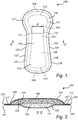
- the sanitary napkin 100 shown in the figures 1 and 2 is elongated with a longitudinal direction and a transverse direction.
- the sanitary napkin 100 comprises a liquid-permeable surface material 101 arranged on the top side of the sanitary napkin, i.e., the side of the sanitary napkin intended to be turned toward a user during use, a liquid-tight backsheet 102, and an absorption body 103 arranged between the surface material 101 and the backsheet 102.
- the absorption body 103 comprises a liquid-receiving, open-cell foam layer 104 placed against the liquid-permeable surface material 101 and a liquid-absorbent fibrous layer 105 placed against the liquid-tight backsheet 102, whereby the liquid-receiving, open-cell foam layer 104 comprises two opposing, longitudinally running side edges 106, 107 extending in the longitudinal direction and two opposing transverse edges 108, 109 extending in the transverse direction, and the liquid-absorbent, fibrous layer 105 comprises two opposing longitudinally running side edges 110, 111 extending in the longitudinal direction, and two opposing transverse edges 112, 113 extending in the transverse direction.
- the liquid-receiving, open-cell foam layer 104 has a total surface in the plane extension of the product that covers the entire surface of the liquid-absorbent, fibrous layer 105 in its plane extension, and each longitudinally running side edge 106, 107 of the liquid-receiving foam layer 104 extends at least along a part of its length outside of each longitudinally running side edge 110, 111 of the liquid-absorbent, fibrous layer. Furthermore, the liquid-receiving open-cell foam layer 104 has a permeability to air that is greater than 200 m 3 /m 2 /min and an opacity that is greater than 35%. The liquid-absorbent, fibrous layer 105 has a bending stiffness that is greater than 3.0 newtons.
- the surface material 101 and the backsheet 102 have substantially the same plane form as the absorption body 103 but have a somewhat greater extension in the plane, as a result of which they form a projecting edge 117 around the entire periphery of the absorption body 103.
- Cover layers 102, 103 are mutually connected inside the projecting edge 117, for example, by gluing, sewing or welding with heat or ultrasound.
- the sanitary napkin in figure 1 is formed with a front part 114, a back part 115 and an intermediate crotch part 116.
- the front part 114 has a rounded form and is wider than the crotch part 116. It turned out that all users have a critical area between the groins where the distance between the muscles running down on the inside of the thighs is approximately 30-35 mm. The width of the sanitary pad in the crotch area is limited in front by this distance between the muscle sinews right in front of the users' groins.
- the liquid-absorbent layer 105 has a distance M that does not exceed 40 mm and preferably is 30-35 mm.
- the reason it is the width of the liquid-absorbent layer 105 in the crotch part 116 of the product which is most important is that it is this layer that contributes to the product's stiffness.
- the width of the liquid-absorbent, fibrous layer 105, that also functions as a stiffening element can continuously increase to a magnitude of size 1.5 times the width M.
- a relatively narrow distance M, at least on the liquid-absorbent layer 105, is also an advantage from the viewpoint of fastening, since a sanitary pad where the difference in width between the front part 114 and the width of the narrowest part on the crotch part 116 is large, yields a good fastening effect against the user's legs and prevents the sanitary pad from gliding backwards during use.
- the liquid-permeable surface material 101 suitably consists of a conventional liquid-permeable material. Examples of suitable materials are perforated plastic films, non-woven materials, plastic nets or the like.
- the liquid-tight backsheet 102 is a conventional type and can thus consist of any liquid-tight material suitable for the purpose.
- examples of such materials are various types of thin plastic films or non-woven materials treated to resist the penetration of liquid, for example, by being coated with plastic, wax or the like. Even other treatments such as heat calendering for melting a material that was permeable in the beginning to a mainly liquid-tight layer can be used.
- the liquid-tight backsheet 103 can consist of a liquid-tight surface on absorption body 103. In order to produce an airy product, it is common to use liquid-tight backsheet material that is breathable, i.e., has a good air permeability.
- the liquid-tight backsheet material preferably consists of a breathable material.
- breathable materials are perforated films, microporous films, macroporous films, nanoporous films, monolithic films, fibrous non-woven ones and their laminates.
- a liquid-absorbent, fibrous layer 105 with a high absorption capacity and a good capacity for transporting liquid is the fibrous material described in WO 94/10953 and WO 94/10956 .
- These materials are present in the form of dry-formed fibre layers with a high density and stiffness and are used directly in an absorbent product without being defibrated at first.
- the stiffening and absorbent element can also be made from a laminate of several non-woven layers or tissue layers that are mutually fixed for increased stiffness and that have highly absorbent particles between individual layers. The fixing of the individual layers to each other can take place with binding agents such as adhesive or melted fibres. The highly absorbent particles can also contribute to the bonding.
- the stiffness is controlled by selecting the number of layers and the amount of binding agent used and by the selection of highly absorbent material and how its adhesive capacity is utilized.
- liquid-absorbent layer is one or more layers of airlaid cellulose layers. This can be prefabricated material which is supplied in roll form for being then cut out in a suitable size, or alternatively the liquid-absorbent layer can be mat-formed and formed in-line during the manufacture itself of the absorbent product.
- compression lines/compression zones there are areas that are compressed at a higher bending stiffness than the surrounding areas.
- a further compression can take place in combination with the compression of the liquid-absorbent layer.
- a pattern compression can take place in a separate step after the flat compression.
- the compression of the liquid-absorbent, fibrous layer can be made in several ways.
- An example of a common process is one that is called "high-density compression" (HDC), that is described in detail in EP-B-1427658 .
- HDC high-density compression
- the compression can be made in two to three steps that include a preliminary compression and thereafter a compression in one or two steps. It is also possible to perform the compression in one step.
- the surface of the liquid-absorbent layer in plane extension can exhibit local differences in bending stiffness. However, it is essential that the bending stiffness over one area on the surface of the liquid-absorbent layer is greater than 2.0 newtons, i.e., the liquid-absorbent layer falls within claim 1 if the bending stiffness is greater than 2.0 newtons according to the modified Circular Bend Procedure method in any area of the liquid-absorbent layer.
- the surface of the liquid-absorbent layer in its plane extension comprises at least two different areas with a bending stiffness that is greater than 2.0 newtons according to the modified bending stiffness method. It comprises the fact that the surface that has a bending stiffness greater than 2.0 newtons according to the modified Circular Bend Procedure method should be able to be measured on two different areas on the surface of the liquid-absorbent layer, which two areas can be adjacent to one another or can be placed at a distance from one another.
- the liquid-absorbent layer preferably has a bending stiffness greater than 2.0 newtons according to the modified Circular Bend Procedure method over the entire liquid-absorbent layer. According to this embodiment no area on the liquid-absorbent layer may have a bending stiffness that is 2.0 newtons or lower when measured according to the modified Circular Bend Procedure method.
- a suitable liquid-receiving, open-cell foam layer 104 is polyurethane foam.
- Polyurethane is a two-component product consisting of polyol and isocyanate that are mixed to polyurethane foam.
- Polyurethane has either open or closed cells.
- polyurethane foam is used with open cells.
- Polyurethane foam can have different stiffness and for our purpose flexible foams are used.
- the liquid-receiving foam is flexible with a low bending stiffness and springs back well, i.e., after being loaded the foam returns to substantially its original form.
- the liquid-receiving, open-cell foam layer consists of polyolefin-based foam, polystyrene-based foam, PVC foam, polyvinyl alcohol foam, acrylate foam, for example, manufactured according to HIPE technology, polyurethane foam, epoxy foam, latex foam, urea-formaldehyde foam, melamine-formaldehyde foam, silicone foam, viscose foam, carboxymethyl cellulose (CMC) foam, starch foam, chitosan foam, alginate foam, polyactide foam, polyglycolide foam and polycaprolactone foam.
- CMC carboxymethyl cellulose
- a fastening element in the form of a rectangular area extending in the longitudinal direction and consisting of self-adhesive glue is arranged on the outside of the liquid-tight backsheet layer.
- the fastening element is protected in a conventional manner, for example, by being covered by a protective layer of paper or plastic treated with silicone, or is embossed so that it can be readily separated from the glue when the sanitary napkin is to be used.
- the glue can obviously be alternatively arranged in any pattern suitable for the purpose such as a plurality of longitudinally running strands, an entire covering, arranged in areas only at the front part and/or the back part or the like.
- other types of fastening elements can be used such as friction covering, press studs, clamps, fastening flaps or the like.
- FIG. 3 shows a transverse section of an alternative embodiment of the sanitary napkin 100 in accordance with the invention.
- the liquid-receiving foam layer 104 has a total surface in the plane extension of the product that is substantially the same as the surface of the liquid-permeable surface material 101 and substantially the same as the surface of the liquid-tight backsheet material 102.
- the liquid-permeable surface material 101 comprises two opposing, longitudinally running side edges 124, 125 extending in the longitudinal direction and the liquid-tight backsheet material 102 comprises two opposing longitudinally running side edges 126, 127 extending in the longitudinal direction.
- the two opposing longitudinal side edges 106, 107 of the open-cell, liquid-receiving foam layer 104 which side edges extend in the longitudinal direction, coincide substantially with the longitudinally running side edges 124, 125 of the liquid-permeable surface material and the longitudinally running side edges 126, 127 of the liquid-tight backsheet material.
- the surface material 101, backsheet material 102 and the liquid-receiving foam layer 104 comprise a projecting edge 117 around the entire periphery of the liquid-absorbent, fibrous layer 105.
- Cover layers 102, 103 and the liquid-receiving foam layer 104 are mutually connected inside the projecting edge 117, for example, by gluing, sewing or welding with heat or ultrasound.
- the surface of the liquid-receiving foam layer 104 extends in its plane extension outside of each longitudinally running side edge 110, 111 of the liquid-absorbent, fibrous layer 105 and of each transversely running side edge 112, 113 of the liquid-absorbent, fibrous layer 105.
- figure 4 shows an alternative embodiment of the sanitary napkin 100 in accordance with the invention.
- Figure 4 shows the sanitary napkin from the top.
- the liquid-absorbent, fibrous layer 105 comprises a shape like a keyhole.
- the liquid-receiving foam layer 104 also has a shape like a keyhole but with a greater extension in the longitudinal direction as well as in the transverse direction than the liquid-absorbent, fibrous layer 105.
- the liquid-absorbent, fibrous layer 105 is also intended to function as a stiffening element and is designed to reduce the risk that the sanitary napkin deforms in an uncontrolled manner.
- the liquid-absorbent, fibrous layer 105 has a size, shape and stiffness that bring it about that the product retains during the entire time of use a predetermined shape and furthermore is held fast at the intended location on the user.
- the liquid-absorbent layer has a width M in the transition between the crotch part 116 and the front part 114 which width is less than 40 mm, preferably 30-35 mm. Both side edges of the front part 114 diverge in a forward direction in the product from this transition M. In this manner it is prevented that the product is shifted backwards between the user's legs.
- FIG 4 there is an angle between a line in the longitudinal direction of the product and each of the side edges of the liquid-absorbent, fibrous layer in the front part designated with ⁇ .
- ⁇ for example, in the vicinity of 90°
- the edges of the front part can scrape against the users groins and legs, thus creating discomfort for the user.
- An angle between 35-45° gives the best balance between a firm hold and comfort.
- the sanitary napkin 100 in figure 4 is formed with a crotch length adapted to the user's anatomy.
- a sanitary napkin in accordance with the invention the fact was utilized that most women have a crotch length with a size of 80-100 mm. Therefore, the liquid-absorbent, fibrous layer 105 was created with a corresponding crotch length G with the size of 70-120 mm.
- the sanitary napkin in accordance with the invention is shaped so as to be relatively stiff laterally, i.e., it is sufficiently stiff so as to not be deformed laterally and form folds.
- the liquid-absorbent, fibrous layer Since it is important that the liquid-absorbent, fibrous layer has a good absorption capacity, it is important to be able to utilize accessible space between the user's legs in the crotch.
- the width of the sanitary pad in the crotch area is limited in front by this distance between these muscle sinews right in front of the user's groins. In the direction backwards from these transition areas to the end of the crotch part the width of the liquid-absorbent, fibrous layer 105, that also functions as a stiffening element, can continuously increase to the size of 1.5 times the width M without the risk that the liquid-absorbent layer 105 scrapes the user in the crotch.
- the liquid-absorbent layer 105 extends slightly over the product's back part 115.
- the liquid-absorbent layer 105 has a recess 120 in the back part 115 and extending from its end edge and in the direction toward the crotch part 116 by means of which the product can fold along a longitudinally running line in the recess and by means of which the parts, the legs 121 and 122, that are located on both sides of the recess 120, become more flexible than the wider crotch part 116.
- This recess 120 is for obtaining a good adaptation to and pliability with the body.
- the fold which develops in the recess when the product is being used can pass into the user's posterior notch, thus offering a very good protection against leakage via the posterior notch, which type of leakage occurs when using sanitary pads when the user is lying on her back.
- the recess 120 makes it possible that these legs 121, 122 can be mutually shifted vertically during various body movements, for example, when the user is walking.
- the recess 120 is wedge-shaped and symmetrically located relative to the longitudinally running line of symmetry L of the product and forms an angle ⁇ with a magnitude of 20°. This angle can vary within broad limits but is of course dependent on the shape of the back part 115.
- the invention has been described above in connection with a sanitary napkin. It is possible, however, to utilise the invention also for panty liners and incontinence protectors.
- SAP Super-absorbent particles manufactured from cross-bound and partially neutralized acrylic acid
- the materials 1-8 in examples 12 and 13 are based on fling-dried CTMP mass with or without SAP Materials 1-8 relate to liquid-receiving layers and materials 9-13 relate to liquid-absorbent layers.
- materials 1-6 relate to liquid-receiving, open-cell foam layers and materials 7 and 8 relate to liquid-receiving, fibrous layers.
- materials 9-13 all relate to liquid-absorbent, fibrous layers.
- the material specimen to be measured is clipped out of the material layer.
- a loading pressure of 0.5 kPa is applied to the material specimen by a foot with an area of 45x45 mm and that is less than the area of the material specimen.
- the thickness of the material specimen is measured.
- the basis rate of the material sample i.e., gram/cm 2 , is weighed and calculated forward. Then, the density of the material specimen is calculated by dividing the base rate by the thickness.
- the measurements were carried out according to the EDANA method WSP 70.1.
- the apparatus used was the Textest FX 3300 from Testex Instruments.
- the apparatus measures what air permeability a material has in a defined pressure drop. We measured at a pressure drop of 200 Pa.
- the apparatus consists of a pump that sucks air through a hole and a measuring arm. The size of the hole is 20 cm 2 . The air flow through the material is measured. Result: Material Air permeability 1 34 2 164 3 222 4 462 5 333 6 438 8 117
- the value relates to the mean value from 10 measurements.
- the instrument's function was checked prior to the measurements against a standardised rubber plate that has a tightness of 104 l/m 2 /sec at 200 Pa.
- the standardised rubber plate is available as an accessory from the instrument manufacturer.
- the method for the modified Circular Bend Procedure was carried out according to a modified version of ASTM D 4032-82 (Circular Bend Procedure). The method for the modified Circular Bend Procedure is described in detail in EP 336 578 . The measuring was carried out in the same manner as described in EP 336 578 .
- the apparatus that was used is the Instron Model No 5965.
- Instron Model No 5965 is manufactured by Instron Engineering Corporation.
- the bending resistance in the material sample was measured by measuring the maximum bending stiffness.
- the maximum bending stiffness is constituted by a simultaneous deformation in several directions of a material sample, wherein one of the surfaces of the material sample becomes concave and the other surface of the material sample becomes convex.
- the method for the modified Circular Bend Procedure supplies a force value that concerns the bending resistance, i.e. simultaneous medium stiffness in all directions.
- the equipment used for the method of the modified Circular Bend Procedure is a modified Circular Bend Stiffness Tester that has the following parts:
- the nozzle has a bevelled edge that is 45 degrees to a depth of 4.75 mm.
- a pressure rod with a total length of 72.2 mm, a diameter of 6.25 mm and a spherical end with a radius of 2.97 mm was used.
- a sharp needle tip projects 0.88 mm out from the spherical end.
- the pressure rod was mounted concentrically and has the same magnitude of play in all directions. The end of the pressure rod is placed well over the plate with the circular opening.
- the liquid-receiving- respectively the liquid-absorbent material layer from five absorbent products was measured and then the average value was calculated.
- liquid-absorbent layer comprises areas with different bending stiffness, for example, an area that is more compressed than an adjacent area
- the liquid-absorbent layer falls within the scope of protection since any area has a bending stiffness that is greater than 2.0 newtons.
- the liquid-receiving foam layer comprises areas with different bending stiffness, for example, an area that is more compressed than an adjacent area
- the liquid-receiving foam layer falls in a corresponding manner within the scope of protection since any area has a bending stiffness that is lower than that which is indicated in the claim.
- liquid-receiving foam layer is separated from the liquid-absorbent layer with great care so that the material layers do not break into pieces during the separating.
- the implementation was made exactly in accordance with the description in EP 0 336 578 A1 .
- the material specimens are stamped out or cut out and have an area of 37.5 x 37.5 mm.
- the material specimens were conditioned for two hours at a temperature of 21 ⁇ 1°C and a relative air humidity of 50 ⁇ 2%.
- the pressure rod should be moved downward at a rate of 50.0 cm/min.
- Materials 1-8 are liquid-receiving layers. The result shows that layers 1-6 that are open-cell foam materials and also material 7, that is a carded through air-bound nonwoven material, have a bending stiffness that is lower than 0.30 newtons. In contrast thereto, material 8, which is a cellulose-based, multi-bound airlaid, exhibits a bending stiffness that is greater than 0.30 newtons.
- Materials 9-13 are liquid-absorbent layers that exhibit a bending stiffness greater than 2.0 newtons.
- Opacity is a concept and a magnitude in optics that is used to indicate transparency, that is, translucency. Opacity measures the degree of impenetrability for radiation through a material or transmission medium. Material that entirely lacks the ability to let light through is called opaque. The opacity was measured with a spectrophotometer with measurement in the YXY colour system (CIE 1931). The spectrophotometer used was of the brand Minolta Chroma Meter CR 300 (the y value was used) (CIE Illuminant D65). Calibration plate No. 16133079 was used as white standard background with a reflectance of 0.89. Black velvet was used as black standard background with a reflectance of 0.005.
- foam materials i.e., materials 1, 2, 3, 5 and 6 have an opacity above 35%.
- material 8, that is a carded through, air-bound non-woven material has a lower opacity, 31 %.
- Foam materials 1, 2, 3, 5 and 6, as well as fibres/filaments in materials 7 and 8 are substantially white. However, it is also possible to have the materials in the layers coloured in other colours.
Landscapes
- Health & Medical Sciences (AREA)
- Epidemiology (AREA)
- Engineering & Computer Science (AREA)
- Biomedical Technology (AREA)
- Heart & Thoracic Surgery (AREA)
- Vascular Medicine (AREA)
- Life Sciences & Earth Sciences (AREA)
- Animal Behavior & Ethology (AREA)
- General Health & Medical Sciences (AREA)
- Public Health (AREA)
- Veterinary Medicine (AREA)
- Absorbent Articles And Supports Therefor (AREA)
- Orthopedics, Nursing, And Contraception (AREA)
Claims (11)
- Saugfähiges Produkt (100) mit einer ebenen Ausdehnung, die eine Längsrichtung, eine Querrichtung und eine Dickenrichtung aufweist, wobei das Produkt einen saugfähigen Körper (103) aufweist, der saugfähige Körper (103) in seiner Dickenrichtung eine flüssigkeitsaufnehmende, offenzellige Schaumlage (104) und eine flüssigkeitsabsorbierende Faserlage (105) aufweist, die flüssigkeitsaufnehmende, offenzellige Schaumlage (104) und die flüssigkeitsabsorbierende Faserlage (105) zwei gegenüberliegende, in Längsrichtung verlaufende Seitenkanten (106, 107; 110, 111), die sich in der Längsrichtung erstrecken, und zwei gegenüberliegende Querkanten (108, 109; 112, 113) aufweist, die sich in der Querrichtung erstrecken, und das saugfähige Produkt eine Damenbinde, ein Pantyliner oder ein Inkontinenzschutz ist,
dadurch gekennzeichnet, dass die flüssigkeitsaufnehmende, offenzellige Schaumlage (104) eine Gesamtfläche in der ebenen Ausdehnung des Produkts aufweist, welche die gesamte Fläche der flüssigkeitsabsorbierenden Faserlage (105) in der ebenen Ausdehnung bedeckt, und das jede der sich in Längsrichtung erstreckenden Seitenkanten (106, 107) der flüssigkeitsaufnehmenden, offenzelligen Schaumlage (104) sich zumindest entlang eines Teils ihrer Länge außerhalb jeder der in Längsrichtung verlaufenden Seitenkanten (110, 111) der flüssigkeitsabsorbierenden Faserlage (105) erstreckt, und dass die flüssigkeitsaufnehmende, offenzellige Schaumlage (104) aus einem Schaum auf Polyolefinbasis, Schaum auf Polystyrolbasis, PVC-Schaum, Polyvinylalkoholschaum, Acrylatschaum, Polyurethanschaum, Epoxidschaum, Latexschaum, Harnstoff-Formaldehyd-Schaum, Melamin-Formaldehyd-Schaum, Silikonschaum, Viskose-Schaum, Carboxymethylcellulose-Schaum (CMC-Schaum), Stärkeschaum, Chitosanschaum, Alginatschaum, Polylactidschaum, Polyglycolidschaum oder Polycaprolactonschaum besteht und eine nach der EDANA-Methode WSP 70.1 gemessene Luftdurchlässigkeit aufweist, die größer als 200 m3/m2/min ist und eine nach der EDANA-Methode WSP 60.1 gemessene Opazität von größer als 35% aufweist, und dass die flüssigkeitsabsorbierende Faserlage (105) eine nach der modifizierten Circular-Bend-Procedure-Methode gemessene Biegesteifigkeit von größer als 2,0 N aufweist. - Saugfähiges Produkt nach Anspruch 1, bei dem sich jede in Längsrichtung verlaufende Seitenkante (106, 107) der flüssigkeitsaufnehmenden, offenzelligen Schaumlage (104) mindestens 5,0 mm außerhalb jeder in Längsrichtung verlaufenden Seitenkante (110, 111) der flüssigkeitsabsorbierenden Faserlage (105) erstreckt.
- Saugfähiges Produkt nach Anspruch 1 oder 2, bei dem sich jede in Längsrichtung verlaufende Seitenkante (106, 107) der flüssigkeitsaufnehmenden, offenzelligen Schaumlage (104) außerhalb jeder in Längsrichtung verlaufenden Seitenkante (110, 111) der flüssigkeitsabsorbierenden Faserlage (105) entlang ihrer gesamten Länge erstreckt.
- Saugfähiges Produkt nach einem der Ansprüche 1-3, bei dem die Gesamtfläche der flüssigkeitsaufnehmenden, offenzelligen Schaumlage (104) in ihrer ebenen Ausdehnung mindestens 1,7-mal größer ist als die Gesamtfläche der flüssigkeitsabsorbierenden Faserlage (105) in der ebenen Ausdehnung des Produkts.
- Saugfähiges Produkt nach Anspruch 4, bei dem die Gesamtfläche der flüssigkeitsaufnehmenden, offenzelligen Schaumlage (104) in ihrer ebenen Ausdehnung mindestens 2,0-mal größer ist als die Gesamtfläche der flüssigkeitsabsorbierenden Faserlage (105) in der ebenen Ausdehnung des Produkts.
- Saugfähiges Produkt nach einem der vorstehenden Ansprüche, bei dem die flüssigkeitsaufnehmende, offenzellige Schaumlage (104) eine Luftdurchlässigkeit aufweist, die zumindest 300 m3/m2/min beträgt.
- Saugfähiges Produkt nach einem der vorstehenden Ansprüche, bei dem die flüssigkeitsabsorbierende Faserlage (105) eine Biegesteifigkeit aufweist, die größer als 3,0 N und vorzugsweise größer als 4,0 N ist.
- Saugfähiges Produkt nach einem der vorstehenden Ansprüche, bei dem die flüssigkeitsaufnehmende, offenzellige Schaumlage (105) eine Biegesteifigkeit aufweist, die geringer als 0,3 N ist.
- Saugfähiges Produkt nach einem der vorstehenden Ansprüche, bei dem die flüssigkeitsaufnehmende, offenzellige Schaumlage (105) eine Opazität von größer als 50% aufweist.
- Saugfähiges Produkt nach einem der vorstehenden Ansprüche, wobei das Produkt ein flüssigkeitsdurchlässiges Flächenmaterial (101) und ein Rückseitenmaterial (102) aufweist, das flüssigkeitsundurchlässig ist, wobei der saugfähige Körper (103) zwischen dem flüssigkeitsdurchlässigen Flächenmaterial (101) und dem flüssigkeitsundurchlässigen Rückseitenmaterial (102) angeordnet ist und die flüssigkeitsaufnehmende, offenzellige Schaumlage (104) an dem flüssigkeitsdurchlässigen Flächenmaterial (101) platziert ist und die flüssigkeitsabsorbierende Faserlage (105) an dem flüssigkeitsundurchlässigen Rückseitenmaterial (102) platziert ist.
- Saugfähiges Produkt nach einem der vorstehenden Ansprüche, wobei das Produkt darüber hinaus einen vorderen Teil (114), einen hinteren Teil (115) und einen zwischen dem hinteren Teil und dem vorderen Teil angeordneten Schrittteil (116) aufweist, sich die flüssigkeitsabsorbierende Faserlage (105) in der Längsrichtung des Produkts über den Schrittteil (116) und zumindest einen Abschnitt über den vorderen Teil (114) erstreckt und sie eine Breite (M) in dem Übergang zwischen dem Schrittteil (116) und dem vorderen Teil (114) aufweist, wobei die Breite weniger als 40 mm ist, und die Seitenkanten der flüssigkeitsabsorbierenden Faserlage (105) in der Richtung von dem Übergang zwischen dem Schrittteil (116) und dem vorderen Teil (114) mindestens in Richtung eines Abschnitts über dem vorderen Teil (114) auseinandergehen.
Applications Claiming Priority (1)
| Application Number | Priority Date | Filing Date | Title |
|---|---|---|---|
| PCT/SE2012/051460 WO2014098677A1 (en) | 2012-12-20 | 2012-12-20 | Absorbent article with increased comfortability |
Publications (3)
| Publication Number | Publication Date |
|---|---|
| EP2934415A1 EP2934415A1 (de) | 2015-10-28 |
| EP2934415A4 EP2934415A4 (de) | 2016-08-03 |
| EP2934415B1 true EP2934415B1 (de) | 2018-04-04 |
Family
ID=50978827
Family Applications (1)
| Application Number | Title | Priority Date | Filing Date |
|---|---|---|---|
| EP12890405.9A Not-in-force EP2934415B1 (de) | 2012-12-20 | 2012-12-20 | Saugfähiger artikel mit erhöhtem komfort |
Country Status (7)
| Country | Link |
|---|---|
| US (1) | US20150328060A1 (de) |
| EP (1) | EP2934415B1 (de) |
| CN (1) | CN104869966A (de) |
| AU (1) | AU2012397330B2 (de) |
| MX (1) | MX350037B (de) |
| RU (1) | RU2624187C2 (de) |
| WO (1) | WO2014098677A1 (de) |
Families Citing this family (3)
| Publication number | Priority date | Publication date | Assignee | Title |
|---|---|---|---|---|
| US10182945B2 (en) * | 2013-10-04 | 2019-01-22 | Dristi, LLC | Hybrid dressings of hydrophilic material and polymer foam |
| EP3711736A1 (de) | 2019-03-18 | 2020-09-23 | Ontex BVBA | Absorbierende artikel mit einer anisotropen schaumerfassungsschicht |
| US12185767B2 (en) * | 2021-11-05 | 2025-01-07 | Trillium Medical Products, LLC | Infused undergarment |
Family Cites Families (30)
| Publication number | Priority date | Publication date | Assignee | Title |
|---|---|---|---|---|
| US4950264A (en) * | 1988-03-31 | 1990-08-21 | The Procter & Gamble Company | Thin, flexible sanitary napkin |
| US4988345A (en) * | 1988-05-24 | 1991-01-29 | The Procter & Gamble Company | Absorbent articles with rapid acquiring absorbent cores |
| SE508961C2 (sv) | 1992-11-17 | 1998-11-23 | Sca Hygiene Prod Ab | Absorberande struktur och absorberande alster innehållande strukturen ifråga |
| US5466513A (en) * | 1992-12-18 | 1995-11-14 | Kimberly-Clark Corporation | Multi-layer absorbent composite |
| US5454800A (en) * | 1993-05-12 | 1995-10-03 | Kimberly-Clark Corporation | Absorbent article |
| US5855572A (en) * | 1996-03-22 | 1999-01-05 | The Procter & Gamble Company | Absorbent components having a fluid acquisition zone |
| US6372952B1 (en) * | 1996-03-22 | 2002-04-16 | The Procter & Gamble Company | Absorbent components having a sustained acquisition rate capability upon absorbing multiple discharges of aqueous body fluids |
| SE514455C2 (sv) | 1996-11-15 | 2001-02-26 | Sca Hygiene Prod Ab | Absorberande alster såsom en dambinda, ett inkontinensskydd, ett trosskydd eller liknande |
| SE514462C2 (sv) | 1996-11-15 | 2001-02-26 | Sca Hygiene Prod Ab | Absorberande alster såsom en dambinda, ett inkontinensskydd, ett trosskydd eller liknande |
| SE507798C2 (sv) | 1996-11-15 | 1998-07-13 | Moelnlycke Ab | Absorberande alster med upphöjt parti |
| SE513198C2 (sv) | 1996-11-15 | 2000-07-31 | Sca Hygiene Prod Ab | Absorberande alster med hög styvhet |
| SE509537C2 (sv) * | 1997-06-24 | 1999-02-08 | Moelnlycke Ab | Absorberande alster med förbättrad kroppskontakt |
| SE518908C2 (sv) * | 2001-04-20 | 2002-12-03 | Sca Hygiene Prod Ab | Absorberande alster med förbättrad passform |
| US6945967B2 (en) * | 2001-04-20 | 2005-09-20 | Sca Hygiene Products Ab | Absorbent product with improved fit |
| JP3922895B2 (ja) * | 2001-06-29 | 2007-05-30 | ユニ・チャーム株式会社 | 生理用ナプキン |
| SE520009C2 (sv) | 2001-09-17 | 2003-05-06 | Sca Hygiene Prod Ab | Förfarande och anordning för komprimering av fiberkroppar |
| US6797858B2 (en) * | 2001-10-09 | 2004-09-28 | Paragon Trade Brands, Inc. | Padded absorbent article |
| US6852905B2 (en) | 2001-11-15 | 2005-02-08 | Paragon Trade Brands, Inc. | Fluid handling layers made from foam and absorbent articles containing same |
| US6793650B2 (en) * | 2001-12-14 | 2004-09-21 | Kimberly-Clark Worldwide, Inc. | Disposable training pant designed specifically for late stage toilet training |
| SE0104310L (sv) * | 2001-12-20 | 2003-06-21 | Sca Hygiene Prod Ab | Andningsbar absorberande artikel |
| US20040267226A1 (en) * | 2003-06-30 | 2004-12-30 | Shmuel Dabi | Absorbent article including in situ cover |
| US20050027267A1 (en) * | 2003-07-31 | 2005-02-03 | Van Dyke Wendy Lynn | Absorbent article with improved fit and free liquid intake |
| US20050131371A1 (en) * | 2003-12-10 | 2005-06-16 | Fell David A. | Fold line resistant absorbent articles |
| US20050136773A1 (en) * | 2003-12-22 | 2005-06-23 | Kimberly-Clark Worldwide, Inc. | Treated nonwoven material |
| US7608070B2 (en) * | 2004-09-30 | 2009-10-27 | Kimberly-Clark Worldwide, Inc. | Foam-based fasteners |
| WO2006093439A1 (en) * | 2005-03-02 | 2006-09-08 | Sca Hygiene Products Ab | A pant-type absorbent article |
| ES2739663T3 (es) * | 2006-04-07 | 2020-02-03 | Procter & Gamble | Artículo absorbente que tiene zonas laterales de material no tejido |
| US20080015532A1 (en) * | 2006-07-13 | 2008-01-17 | Tyco Healthcare Retail Services Ag | Absorbent article having multi fiber and density absorbent core |
| US7488310B2 (en) * | 2006-10-17 | 2009-02-10 | Mcneil-Ppc, Inc. | Sanitary napkin including a moisture sensitive stabilizing layer |
| US8409664B2 (en) * | 2010-06-28 | 2013-04-02 | The Procter & Gamble Company | Superabsorbent polymer particles coated with a hydrophilic elastomer and absorbent article comprising such particles |
-
2012
- 2012-12-20 EP EP12890405.9A patent/EP2934415B1/de not_active Not-in-force
- 2012-12-20 WO PCT/SE2012/051460 patent/WO2014098677A1/en not_active Ceased
- 2012-12-20 AU AU2012397330A patent/AU2012397330B2/en not_active Ceased
- 2012-12-20 MX MX2015007821A patent/MX350037B/es active IP Right Grant
- 2012-12-20 US US14/653,955 patent/US20150328060A1/en not_active Abandoned
- 2012-12-20 RU RU2015129479A patent/RU2624187C2/ru not_active IP Right Cessation
- 2012-12-20 CN CN201280077872.7A patent/CN104869966A/zh active Pending
Non-Patent Citations (1)
| Title |
|---|
| None * |
Also Published As
| Publication number | Publication date |
|---|---|
| AU2012397330A1 (en) | 2015-07-09 |
| RU2624187C2 (ru) | 2017-06-30 |
| MX350037B (es) | 2017-08-24 |
| US20150328060A1 (en) | 2015-11-19 |
| EP2934415A1 (de) | 2015-10-28 |
| CN104869966A (zh) | 2015-08-26 |
| WO2014098677A1 (en) | 2014-06-26 |
| EP2934415A4 (de) | 2016-08-03 |
| MX2015007821A (es) | 2015-09-10 |
| AU2012397330B2 (en) | 2016-12-22 |
| RU2015129479A (ru) | 2017-01-26 |
Similar Documents
| Publication | Publication Date | Title |
|---|---|---|
| EP2934408B1 (de) | Saugfähiger artikel | |
| EP2994084B1 (de) | Saugfähiger artikel mit doppelkern | |
| AU713142B2 (en) | Thin, curved absorbent article having elasticized edges | |
| AU2015398532B2 (en) | Absorbent product comprising foam material | |
| EP2934414B1 (de) | Saugfähiger artikel mit erhöhtem komfort | |
| US20220304867A1 (en) | Multi-piece absorbent articles and arrays thereof | |
| EP1789001B1 (de) | Drapierbare saugfägihe hygienebinde und materialien zur verwendung in drapierbaren saugfähigen hygienebinden | |
| EP2934415B1 (de) | Saugfähiger artikel mit erhöhtem komfort | |
| EP1789000B1 (de) | Drapierbare saugfägihe hygienebinde und materialien zur verwendung in drapierbaren saugfähigen hygienebinden | |
| AU2016431601B2 (en) | Absorbent product comprising foam material | |
| EP3923893B1 (de) | Hygieneartikel | |
| AU2016431602B2 (en) | Absorbent product comprising foam material |
Legal Events
| Date | Code | Title | Description |
|---|---|---|---|
| PUAI | Public reference made under article 153(3) epc to a published international application that has entered the european phase |
Free format text: ORIGINAL CODE: 0009012 |
|
| 17P | Request for examination filed |
Effective date: 20150618 |
|
| AK | Designated contracting states |
Kind code of ref document: A1 Designated state(s): AL AT BE BG CH CY CZ DE DK EE ES FI FR GB GR HR HU IE IS IT LI LT LU LV MC MK MT NL NO PL PT RO RS SE SI SK SM TR |
|
| AX | Request for extension of the european patent |
Extension state: BA ME |
|
| DAX | Request for extension of the european patent (deleted) | ||
| A4 | Supplementary search report drawn up and despatched |
Effective date: 20160630 |
|
| RIC1 | Information provided on ipc code assigned before grant |
Ipc: A61F 13/537 20060101AFI20160624BHEP Ipc: A61F 13/53 20060101ALI20160624BHEP |
|
| STAA | Information on the status of an ep patent application or granted ep patent |
Free format text: STATUS: EXAMINATION IS IN PROGRESS |
|
| 17Q | First examination report despatched |
Effective date: 20170510 |
|
| GRAP | Despatch of communication of intention to grant a patent |
Free format text: ORIGINAL CODE: EPIDOSNIGR1 |
|
| STAA | Information on the status of an ep patent application or granted ep patent |
Free format text: STATUS: GRANT OF PATENT IS INTENDED |
|
| INTG | Intention to grant announced |
Effective date: 20171025 |
|
| GRAS | Grant fee paid |
Free format text: ORIGINAL CODE: EPIDOSNIGR3 |
|
| GRAA | (expected) grant |
Free format text: ORIGINAL CODE: 0009210 |
|
| STAA | Information on the status of an ep patent application or granted ep patent |
Free format text: STATUS: THE PATENT HAS BEEN GRANTED |
|
| AK | Designated contracting states |
Kind code of ref document: B1 Designated state(s): AL AT BE BG CH CY CZ DE DK EE ES FI FR GB GR HR HU IE IS IT LI LT LU LV MC MK MT NL NO PL PT RO RS SE SI SK SM TR |
|
| RAP1 | Party data changed (applicant data changed or rights of an application transferred) |
Owner name: SCA HYGIENE PRODUCTS AB |
|
| REG | Reference to a national code |
Ref country code: GB Ref legal event code: FG4D |
|
| REG | Reference to a national code |
Ref country code: CH Ref legal event code: EP |
|
| REG | Reference to a national code |
Ref country code: AT Ref legal event code: REF Ref document number: 984782 Country of ref document: AT Kind code of ref document: T Effective date: 20180415 |
|
| REG | Reference to a national code |
Ref country code: DE Ref legal event code: R096 Ref document number: 602012044935 Country of ref document: DE |
|
| REG | Reference to a national code |
Ref country code: IE Ref legal event code: FG4D |
|
| REG | Reference to a national code |
Ref country code: NL Ref legal event code: MP Effective date: 20180404 |
|
| REG | Reference to a national code |
Ref country code: LT Ref legal event code: MG4D |
|
| PG25 | Lapsed in a contracting state [announced via postgrant information from national office to epo] |
Ref country code: NL Free format text: LAPSE BECAUSE OF FAILURE TO SUBMIT A TRANSLATION OF THE DESCRIPTION OR TO PAY THE FEE WITHIN THE PRESCRIBED TIME-LIMIT Effective date: 20180404 |
|
| PG25 | Lapsed in a contracting state [announced via postgrant information from national office to epo] |
Ref country code: NO Free format text: LAPSE BECAUSE OF FAILURE TO SUBMIT A TRANSLATION OF THE DESCRIPTION OR TO PAY THE FEE WITHIN THE PRESCRIBED TIME-LIMIT Effective date: 20180704 Ref country code: FI Free format text: LAPSE BECAUSE OF FAILURE TO SUBMIT A TRANSLATION OF THE DESCRIPTION OR TO PAY THE FEE WITHIN THE PRESCRIBED TIME-LIMIT Effective date: 20180404 Ref country code: LT Free format text: LAPSE BECAUSE OF FAILURE TO SUBMIT A TRANSLATION OF THE DESCRIPTION OR TO PAY THE FEE WITHIN THE PRESCRIBED TIME-LIMIT Effective date: 20180404 Ref country code: PL Free format text: LAPSE BECAUSE OF FAILURE TO SUBMIT A TRANSLATION OF THE DESCRIPTION OR TO PAY THE FEE WITHIN THE PRESCRIBED TIME-LIMIT Effective date: 20180404 Ref country code: ES Free format text: LAPSE BECAUSE OF FAILURE TO SUBMIT A TRANSLATION OF THE DESCRIPTION OR TO PAY THE FEE WITHIN THE PRESCRIBED TIME-LIMIT Effective date: 20180404 Ref country code: SE Free format text: LAPSE BECAUSE OF FAILURE TO SUBMIT A TRANSLATION OF THE DESCRIPTION OR TO PAY THE FEE WITHIN THE PRESCRIBED TIME-LIMIT Effective date: 20180404 Ref country code: AL Free format text: LAPSE BECAUSE OF FAILURE TO SUBMIT A TRANSLATION OF THE DESCRIPTION OR TO PAY THE FEE WITHIN THE PRESCRIBED TIME-LIMIT Effective date: 20180404 Ref country code: BG Free format text: LAPSE BECAUSE OF FAILURE TO SUBMIT A TRANSLATION OF THE DESCRIPTION OR TO PAY THE FEE WITHIN THE PRESCRIBED TIME-LIMIT Effective date: 20180704 |
|
| PG25 | Lapsed in a contracting state [announced via postgrant information from national office to epo] |
Ref country code: LV Free format text: LAPSE BECAUSE OF FAILURE TO SUBMIT A TRANSLATION OF THE DESCRIPTION OR TO PAY THE FEE WITHIN THE PRESCRIBED TIME-LIMIT Effective date: 20180404 Ref country code: RS Free format text: LAPSE BECAUSE OF FAILURE TO SUBMIT A TRANSLATION OF THE DESCRIPTION OR TO PAY THE FEE WITHIN THE PRESCRIBED TIME-LIMIT Effective date: 20180404 Ref country code: GR Free format text: LAPSE BECAUSE OF FAILURE TO SUBMIT A TRANSLATION OF THE DESCRIPTION OR TO PAY THE FEE WITHIN THE PRESCRIBED TIME-LIMIT Effective date: 20180705 Ref country code: HR Free format text: LAPSE BECAUSE OF FAILURE TO SUBMIT A TRANSLATION OF THE DESCRIPTION OR TO PAY THE FEE WITHIN THE PRESCRIBED TIME-LIMIT Effective date: 20180404 |
|
| REG | Reference to a national code |
Ref country code: AT Ref legal event code: MK05 Ref document number: 984782 Country of ref document: AT Kind code of ref document: T Effective date: 20180404 |
|
| PG25 | Lapsed in a contracting state [announced via postgrant information from national office to epo] |
Ref country code: PT Free format text: LAPSE BECAUSE OF FAILURE TO SUBMIT A TRANSLATION OF THE DESCRIPTION OR TO PAY THE FEE WITHIN THE PRESCRIBED TIME-LIMIT Effective date: 20180806 |
|
| REG | Reference to a national code |
Ref country code: DE Ref legal event code: R097 Ref document number: 602012044935 Country of ref document: DE |
|
| PG25 | Lapsed in a contracting state [announced via postgrant information from national office to epo] |
Ref country code: DK Free format text: LAPSE BECAUSE OF FAILURE TO SUBMIT A TRANSLATION OF THE DESCRIPTION OR TO PAY THE FEE WITHIN THE PRESCRIBED TIME-LIMIT Effective date: 20180404 Ref country code: EE Free format text: LAPSE BECAUSE OF FAILURE TO SUBMIT A TRANSLATION OF THE DESCRIPTION OR TO PAY THE FEE WITHIN THE PRESCRIBED TIME-LIMIT Effective date: 20180404 Ref country code: AT Free format text: LAPSE BECAUSE OF FAILURE TO SUBMIT A TRANSLATION OF THE DESCRIPTION OR TO PAY THE FEE WITHIN THE PRESCRIBED TIME-LIMIT Effective date: 20180404 Ref country code: SK Free format text: LAPSE BECAUSE OF FAILURE TO SUBMIT A TRANSLATION OF THE DESCRIPTION OR TO PAY THE FEE WITHIN THE PRESCRIBED TIME-LIMIT Effective date: 20180404 Ref country code: RO Free format text: LAPSE BECAUSE OF FAILURE TO SUBMIT A TRANSLATION OF THE DESCRIPTION OR TO PAY THE FEE WITHIN THE PRESCRIBED TIME-LIMIT Effective date: 20180404 Ref country code: CZ Free format text: LAPSE BECAUSE OF FAILURE TO SUBMIT A TRANSLATION OF THE DESCRIPTION OR TO PAY THE FEE WITHIN THE PRESCRIBED TIME-LIMIT Effective date: 20180404 |
|
| PLBE | No opposition filed within time limit |
Free format text: ORIGINAL CODE: 0009261 |
|
| STAA | Information on the status of an ep patent application or granted ep patent |
Free format text: STATUS: NO OPPOSITION FILED WITHIN TIME LIMIT |
|
| PG25 | Lapsed in a contracting state [announced via postgrant information from national office to epo] |
Ref country code: IT Free format text: LAPSE BECAUSE OF FAILURE TO SUBMIT A TRANSLATION OF THE DESCRIPTION OR TO PAY THE FEE WITHIN THE PRESCRIBED TIME-LIMIT Effective date: 20180404 Ref country code: SM Free format text: LAPSE BECAUSE OF FAILURE TO SUBMIT A TRANSLATION OF THE DESCRIPTION OR TO PAY THE FEE WITHIN THE PRESCRIBED TIME-LIMIT Effective date: 20180404 |
|
| 26N | No opposition filed |
Effective date: 20190107 |
|
| PG25 | Lapsed in a contracting state [announced via postgrant information from national office to epo] |
Ref country code: SI Free format text: LAPSE BECAUSE OF FAILURE TO SUBMIT A TRANSLATION OF THE DESCRIPTION OR TO PAY THE FEE WITHIN THE PRESCRIBED TIME-LIMIT Effective date: 20180404 |
|
| REG | Reference to a national code |
Ref country code: DE Ref legal event code: R119 Ref document number: 602012044935 Country of ref document: DE |
|
| REG | Reference to a national code |
Ref country code: CH Ref legal event code: PL |
|
| GBPC | Gb: european patent ceased through non-payment of renewal fee |
Effective date: 20181220 |
|
| PG25 | Lapsed in a contracting state [announced via postgrant information from national office to epo] |
Ref country code: LU Free format text: LAPSE BECAUSE OF NON-PAYMENT OF DUE FEES Effective date: 20181220 Ref country code: MC Free format text: LAPSE BECAUSE OF FAILURE TO SUBMIT A TRANSLATION OF THE DESCRIPTION OR TO PAY THE FEE WITHIN THE PRESCRIBED TIME-LIMIT Effective date: 20180404 |
|
| REG | Reference to a national code |
Ref country code: IE Ref legal event code: MM4A |
|
| REG | Reference to a national code |
Ref country code: BE Ref legal event code: MM Effective date: 20181231 |
|
| PG25 | Lapsed in a contracting state [announced via postgrant information from national office to epo] |
Ref country code: IE Free format text: LAPSE BECAUSE OF NON-PAYMENT OF DUE FEES Effective date: 20181220 Ref country code: FR Free format text: LAPSE BECAUSE OF NON-PAYMENT OF DUE FEES Effective date: 20181231 Ref country code: DE Free format text: LAPSE BECAUSE OF NON-PAYMENT OF DUE FEES Effective date: 20190702 |
|
| PG25 | Lapsed in a contracting state [announced via postgrant information from national office to epo] |
Ref country code: BE Free format text: LAPSE BECAUSE OF NON-PAYMENT OF DUE FEES Effective date: 20181231 |
|
| PG25 | Lapsed in a contracting state [announced via postgrant information from national office to epo] |
Ref country code: GB Free format text: LAPSE BECAUSE OF NON-PAYMENT OF DUE FEES Effective date: 20181220 Ref country code: CH Free format text: LAPSE BECAUSE OF NON-PAYMENT OF DUE FEES Effective date: 20181231 Ref country code: LI Free format text: LAPSE BECAUSE OF NON-PAYMENT OF DUE FEES Effective date: 20181231 |
|
| PG25 | Lapsed in a contracting state [announced via postgrant information from national office to epo] |
Ref country code: MT Free format text: LAPSE BECAUSE OF NON-PAYMENT OF DUE FEES Effective date: 20181220 |
|
| PG25 | Lapsed in a contracting state [announced via postgrant information from national office to epo] |
Ref country code: TR Free format text: LAPSE BECAUSE OF FAILURE TO SUBMIT A TRANSLATION OF THE DESCRIPTION OR TO PAY THE FEE WITHIN THE PRESCRIBED TIME-LIMIT Effective date: 20180404 |
|
| PG25 | Lapsed in a contracting state [announced via postgrant information from national office to epo] |
Ref country code: MK Free format text: LAPSE BECAUSE OF NON-PAYMENT OF DUE FEES Effective date: 20180404 Ref country code: CY Free format text: LAPSE BECAUSE OF FAILURE TO SUBMIT A TRANSLATION OF THE DESCRIPTION OR TO PAY THE FEE WITHIN THE PRESCRIBED TIME-LIMIT Effective date: 20180404 Ref country code: HU Free format text: LAPSE BECAUSE OF FAILURE TO SUBMIT A TRANSLATION OF THE DESCRIPTION OR TO PAY THE FEE WITHIN THE PRESCRIBED TIME-LIMIT; INVALID AB INITIO Effective date: 20121220 |
|
| PG25 | Lapsed in a contracting state [announced via postgrant information from national office to epo] |
Ref country code: IS Free format text: LAPSE BECAUSE OF FAILURE TO SUBMIT A TRANSLATION OF THE DESCRIPTION OR TO PAY THE FEE WITHIN THE PRESCRIBED TIME-LIMIT Effective date: 20180804 |