EP2933867A1 - Solid electrolyte containing ionic liquid - Google Patents
Solid electrolyte containing ionic liquid Download PDFInfo
- Publication number
- EP2933867A1 EP2933867A1 EP13862533.0A EP13862533A EP2933867A1 EP 2933867 A1 EP2933867 A1 EP 2933867A1 EP 13862533 A EP13862533 A EP 13862533A EP 2933867 A1 EP2933867 A1 EP 2933867A1
- Authority
- EP
- European Patent Office
- Prior art keywords
- solid electrolyte
- gel
- ionic liquid
- type solid
- range
- Prior art date
- Legal status (The legal status is an assumption and is not a legal conclusion. Google has not performed a legal analysis and makes no representation as to the accuracy of the status listed.)
- Granted
Links
Images


Classifications
-
- H—ELECTRICITY
- H01—ELECTRIC ELEMENTS
- H01M—PROCESSES OR MEANS, e.g. BATTERIES, FOR THE DIRECT CONVERSION OF CHEMICAL ENERGY INTO ELECTRICAL ENERGY
- H01M10/00—Secondary cells; Manufacture thereof
- H01M10/05—Accumulators with non-aqueous electrolyte
- H01M10/056—Accumulators with non-aqueous electrolyte characterised by the materials used as electrolytes, e.g. mixed inorganic/organic electrolytes
- H01M10/0564—Accumulators with non-aqueous electrolyte characterised by the materials used as electrolytes, e.g. mixed inorganic/organic electrolytes the electrolyte being constituted of organic materials only
-
- H—ELECTRICITY
- H01—ELECTRIC ELEMENTS
- H01M—PROCESSES OR MEANS, e.g. BATTERIES, FOR THE DIRECT CONVERSION OF CHEMICAL ENERGY INTO ELECTRICAL ENERGY
- H01M10/00—Secondary cells; Manufacture thereof
- H01M10/05—Accumulators with non-aqueous electrolyte
- H01M10/056—Accumulators with non-aqueous electrolyte characterised by the materials used as electrolytes, e.g. mixed inorganic/organic electrolytes
- H01M10/0564—Accumulators with non-aqueous electrolyte characterised by the materials used as electrolytes, e.g. mixed inorganic/organic electrolytes the electrolyte being constituted of organic materials only
- H01M10/0565—Polymeric materials, e.g. gel-type or solid-type
-
- H—ELECTRICITY
- H01—ELECTRIC ELEMENTS
- H01B—CABLES; CONDUCTORS; INSULATORS; SELECTION OF MATERIALS FOR THEIR CONDUCTIVE, INSULATING OR DIELECTRIC PROPERTIES
- H01B1/00—Conductors or conductive bodies characterised by the conductive materials; Selection of materials as conductors
- H01B1/06—Conductors or conductive bodies characterised by the conductive materials; Selection of materials as conductors mainly consisting of other non-metallic substances
-
- H—ELECTRICITY
- H01—ELECTRIC ELEMENTS
- H01G—CAPACITORS; CAPACITORS, RECTIFIERS, DETECTORS, SWITCHING DEVICES, LIGHT-SENSITIVE OR TEMPERATURE-SENSITIVE DEVICES OF THE ELECTROLYTIC TYPE
- H01G11/00—Hybrid capacitors, i.e. capacitors having different positive and negative electrodes; Electric double-layer [EDL] capacitors; Processes for the manufacture thereof or of parts thereof
- H01G11/54—Electrolytes
- H01G11/56—Solid electrolytes, e.g. gels; Additives therein
-
- H—ELECTRICITY
- H01—ELECTRIC ELEMENTS
- H01G—CAPACITORS; CAPACITORS, RECTIFIERS, DETECTORS, SWITCHING DEVICES, LIGHT-SENSITIVE OR TEMPERATURE-SENSITIVE DEVICES OF THE ELECTROLYTIC TYPE
- H01G9/00—Electrolytic capacitors, rectifiers, detectors, switching devices, light-sensitive or temperature-sensitive devices; Processes of their manufacture
- H01G9/004—Details
- H01G9/022—Electrolytes; Absorbents
- H01G9/025—Solid electrolytes
-
- H—ELECTRICITY
- H01—ELECTRIC ELEMENTS
- H01M—PROCESSES OR MEANS, e.g. BATTERIES, FOR THE DIRECT CONVERSION OF CHEMICAL ENERGY INTO ELECTRICAL ENERGY
- H01M10/00—Secondary cells; Manufacture thereof
- H01M10/05—Accumulators with non-aqueous electrolyte
- H01M10/052—Li-accumulators
-
- H—ELECTRICITY
- H01—ELECTRIC ELEMENTS
- H01M—PROCESSES OR MEANS, e.g. BATTERIES, FOR THE DIRECT CONVERSION OF CHEMICAL ENERGY INTO ELECTRICAL ENERGY
- H01M10/00—Secondary cells; Manufacture thereof
- H01M10/05—Accumulators with non-aqueous electrolyte
- H01M10/056—Accumulators with non-aqueous electrolyte characterised by the materials used as electrolytes, e.g. mixed inorganic/organic electrolytes
- H01M10/0564—Accumulators with non-aqueous electrolyte characterised by the materials used as electrolytes, e.g. mixed inorganic/organic electrolytes the electrolyte being constituted of organic materials only
- H01M10/0566—Liquid materials
-
- H—ELECTRICITY
- H01—ELECTRIC ELEMENTS
- H01M—PROCESSES OR MEANS, e.g. BATTERIES, FOR THE DIRECT CONVERSION OF CHEMICAL ENERGY INTO ELECTRICAL ENERGY
- H01M2300/00—Electrolytes
- H01M2300/0017—Non-aqueous electrolytes
- H01M2300/0025—Organic electrolyte
- H01M2300/0045—Room temperature molten salts comprising at least one organic ion
-
- H—ELECTRICITY
- H01—ELECTRIC ELEMENTS
- H01M—PROCESSES OR MEANS, e.g. BATTERIES, FOR THE DIRECT CONVERSION OF CHEMICAL ENERGY INTO ELECTRICAL ENERGY
- H01M2300/00—Electrolytes
- H01M2300/0017—Non-aqueous electrolytes
- H01M2300/0065—Solid electrolytes
-
- H—ELECTRICITY
- H01—ELECTRIC ELEMENTS
- H01M—PROCESSES OR MEANS, e.g. BATTERIES, FOR THE DIRECT CONVERSION OF CHEMICAL ENERGY INTO ELECTRICAL ENERGY
- H01M2300/00—Electrolytes
- H01M2300/0085—Immobilising or gelification of electrolyte
-
- H—ELECTRICITY
- H01—ELECTRIC ELEMENTS
- H01M—PROCESSES OR MEANS, e.g. BATTERIES, FOR THE DIRECT CONVERSION OF CHEMICAL ENERGY INTO ELECTRICAL ENERGY
- H01M2300/00—Electrolytes
- H01M2300/0088—Composites
- H01M2300/0091—Composites in the form of mixtures
-
- Y—GENERAL TAGGING OF NEW TECHNOLOGICAL DEVELOPMENTS; GENERAL TAGGING OF CROSS-SECTIONAL TECHNOLOGIES SPANNING OVER SEVERAL SECTIONS OF THE IPC; TECHNICAL SUBJECTS COVERED BY FORMER USPC CROSS-REFERENCE ART COLLECTIONS [XRACs] AND DIGESTS
- Y02—TECHNOLOGIES OR APPLICATIONS FOR MITIGATION OR ADAPTATION AGAINST CLIMATE CHANGE
- Y02E—REDUCTION OF GREENHOUSE GAS [GHG] EMISSIONS, RELATED TO ENERGY GENERATION, TRANSMISSION OR DISTRIBUTION
- Y02E60/00—Enabling technologies; Technologies with a potential or indirect contribution to GHG emissions mitigation
- Y02E60/10—Energy storage using batteries
-
- Y—GENERAL TAGGING OF NEW TECHNOLOGICAL DEVELOPMENTS; GENERAL TAGGING OF CROSS-SECTIONAL TECHNOLOGIES SPANNING OVER SEVERAL SECTIONS OF THE IPC; TECHNICAL SUBJECTS COVERED BY FORMER USPC CROSS-REFERENCE ART COLLECTIONS [XRACs] AND DIGESTS
- Y02—TECHNOLOGIES OR APPLICATIONS FOR MITIGATION OR ADAPTATION AGAINST CLIMATE CHANGE
- Y02E—REDUCTION OF GREENHOUSE GAS [GHG] EMISSIONS, RELATED TO ENERGY GENERATION, TRANSMISSION OR DISTRIBUTION
- Y02E60/00—Enabling technologies; Technologies with a potential or indirect contribution to GHG emissions mitigation
- Y02E60/13—Energy storage using capacitors
Definitions
- the present invention relates to a solid electrolyte which is applied to an electrochemical double layer capacitor (EDLC) or a lithium secondary battery, and provides a gel-type solid electrolyte having flexibility.
- EDLC electrochemical double layer capacitor
- the present invention relates to a solid electrolyte which is applied to an electrochemical double layer capacitor (EDLC) or a lithium secondary battery, and provides a gel-type solid electrolyte having flexibility.
- An organic electrolyte used for a lithium secondary battery or an electrochemical double layer capacitor (EDLC) has been currently widely used for a lithium ion battery or an EDLC as a liquid electrolyte in which a lithium salt such as LiPF 6 , LiBF 4 , LiN(CF 3 SO 2 ) 2 , LiClO 4 , and LiCF 3 SO 3 is dissolved in a polar non-protic organic solvent, which easily dissolves a lithium salt, and is also difficult to be electrolyzed, for example, an organic solvent such as carbonates such as ethylene carbonate and propylene carbonate, carbonic esters such as dimethyl carbonate, methyl ethyl carbonate, and diethyl carbonate, lactones such as ⁇ -butyrolactone and 3-methyl- ⁇ -valerolactone, esters such as methyl formate, methyl acetate and methyl propionate, and ethers such as 1,2-dimethoxyethane, tetrahydrofuran, and dio
- a flame retardant compound such as an electrolytic solution (the official gazette of Japanese Patent Application Laid-Open No. 2005-276517 ) including a specific fluorinated ketone in a non-protic solvent.
- an ionic liquid is a normal-temperature molten salt composed of a positive ion and a negative ion, and has characteristics such as non-volatility, flame retardancy, non-inflammability, a wide potential window, and chemical stability, and thus has drawn attention as alternative electrolytes which may solve stability problems of the organic electrolyte.
- the ionic liquid is also in a liquid state at normal temperature, and thus has a disadvantage in which processability deteriorates when the ionic liquid is applied as an electrolyte.
- the official gazette of Japanese Patent Application Laid-Open No. 2010-225511 suggests a gel-type electrolyte with improved durability, which is formed by internalizing the ionic liquid into porous particles.
- the solid electrolyte prepared by using only a porous metal oxide has no flexibility, and thus has a problem in that a product may easily break by external impact or when the solid electrolyte is applied to the product.
- the present invention has been made in an effort to provide a gel-type solid electrolyte having improved flexibility while maintaining the advantages of the existing ionic liquid, as a solid electrolyte used for a lithium ion battery or an electrochemical double layer capacitor (EDLC).
- EDLC electrochemical double layer capacitor
- the porous metal oxide includes 30 to 50 wt% of the silane compound in which 2 ⁇ x+y ⁇ 3 in Chemical Formula 1.
- the porous metal oxide is formed from a hydrolysis reaction of the silane compound of Chemical Formula 1 in the presence of an acid.
- the acid is used in a range of 1 to 50 parts by volume based on the entire silane compound of Chemical Formula 1.
- the porous metal oxide includes a structure represented by the following Chemical Formula: in the Formula, R 3 , R 4 and R 5 are each independently hydrogen, a halogen element or an alkyl group having 1 to 5 carbon atoms.
- the ionic liquid includes imidazolium, ammonium, pyrrolidinium, or piperidinium as a positive ion, and bis(fluorosulfonyl)imide, bis(fluorosulfonyl)amide, fluoroborate, or fluorophosphate as a negative ion.
- the ionic liquid is included in a range of 100 to 200 parts by weight based on 100 parts by weight of theporous metal oxide.
- the solid electrolyte includes one or more lithium salts selected from the group consisting of LiPF 6 , LiBF 4 , LiAsF 6 , LiSbF 6 , LiCF 3 SO 3 , LiC 2 F 5 SO 3 , LiC 4 F 9 SO 3 , LiN(CF 3 SO 2 )2, LiN(C 2 F 5 SO 2 ) 2 , LiC(CF 3 SO 2 ) 3 and LiPF 2 ⁇ (COO) 2 ⁇ 2 .
- the lithium salt is included in an amount of 5 to 40 wt% based on the entire solid electrolyte.
- the present invention provides a lithium secondary battery including the solid electrolyte.
- the present invention provides an electrochemical double layer capacitor including the solid electrolyte.
- the electrolyte may be advantageously used in the process of manufacturing a lithium secondary battery or an electrochemical double layer capacitor, which is intended to use the advantages of an ionic liquid.
- the present invention provides a gel-type solid electrolyte having improved flexibility while maintaining the advantages of an ionic liquid by effectively internalizing the ionic liquid into a porous metal oxide.
- the silane compound forms a silane oxide compound having a network structure by a hydrolysis reaction.
- the present invention uses a silane compound including a vinyl group in the case of 2 ⁇ x+y ⁇ 3 in Chemical Formula 1 in a hydrolysis reaction of a silane compound, as a porous metal oxide for internalizing an ionic liquid thereinto.
- the silane compound including a vinyl group is included among the silane oxide compounds to form the following structure as an example of a part of a network structure:
- the network structure is formed from a hydrolysis reaction of the silane compound of Chemical Formula 1, and in this case, a silane compound including a vinyl group is introduced into each of the middles of the structures, thereby leading to termination of the network structure. That is, when the silane compound including a vinyl group is not present, the network structure keeps being produced, and accordingly, the viscosity of a material to be obtained keeps being increased, thereby resulting in a hard state in which it is difficult to be processed.
- the vinyl group is for inducing termination of the network structure to obtain an easily processible product in a flexible state. Therefore, it is a means for forming a backbone of a flexible solid electrolyte to use a silane compound including a vinyl group in the present invention.
- the present invention provides a solid electrolyte in which an ionic liquid is internalized into a porous metal oxide obtained from a hydrolysis reaction of the silane compound represented by Chemical Formula 1.
- the porous metal oxide includes preferably 30 to 50 wt% of a silane compound including a vinyl group, that is, a silane compound in the case of 2 ⁇ x+y ⁇ 3 in Chemical Formula 1.
- the silane compound including a vinyl group is used in an amount less than the range, the effect of improving flexibility is so negligible that processability deteriorates, such as breakage in the process for using the silane compound as a solid electrolyte.
- the silane compound including a vinyl group is used in an excessive amount more than the range, gelation is not achieved at a preferred level, and accordingly, processability also deteriorates for this reason.
- the reaction is performed preferably under acidic conditions.
- the acid it is possible to use an organic acid such as formic acid, hydrochloric acid, sulfuric acid, phosphoric acid, nitric acid and acetic acid.
- the amount of these acids used is preferably in a range of 1 to 50 parts by volume based on the entire silane compound of Chemical Formula 1. These acids are used in the range because when the amount of acid used is less than the range, hydrolysis does not occur at a preferred level, and when the amount is more than the range, the viscosity of a gel-type porous metal oxide to be obtained becomes so high that it becomes difficult for the acid to be subsequently mixed with the ionic liquid.
- the solution is ultrasonicated.
- the ultrasonication may be performed under the condition of 40 KHz for 1 to 20 minutes. After the ultrasonication, the solution is cooled at 0°C to 10°C for 1 to 120 minutes.
- the ionic liquid is added so as to perform the gelation. That is, the silane compound of Chemical Formula 1 is hydrolyzed to form a porous metal oxide having a network structure, and simultaneously, impregnation of the ionic liquid occurs, thereby preparing the gel-type solid electrolyte in the present invention in a form in which the ionic liquid is included in the porous metal oxide structure.
- the ionic liquid may be used without limitation as long as the ionic liquid is an ionic material which is in a molten state at normal temperature (25°C), and includes a positive ion and a negative ion.
- the ionic liquid includes, but is not limited to, imidazolium, ammonium, pyrrolidinium or piperidinium as the positive ion, and includes, but is not limited to, bis(fluorosulfonyl)imide, bis(fluorosulfonyl)amide, fluoroborate, or fluorophosphate as the negative ion.
- the positive ion examples include alkyl ammonium such as triethyl ammonium, imidazolium such as ethyl methyl imidazolium and butyl methyl imidazolium, pyrrolidinium such as 1-methyl-1-propyl pyrrolidinium, or methyl propyl piperidinium.
- specific examples of the negative ion include bis(trifluoromethylsulfonyl)imide (TFSI), bis(pentafluoroethylsufonyl)amide (BETI), tetrafluoroborate (BF 4 ), or hexafluorophosphate (PF 6 ).
- the ionic liquid may be used alone as an electrolyte without using a separate solvent.
- the ionic liquid is included in the solid electrolyte in a range of 100 to 200 parts by weight based on 100 parts by weight of the porous metal oxide.
- the solid electrolyte of the present invention is finally obtained by drying the gelled product at normal temperature for 1 hour or more, or subjecting the gelled product to heat treatment in a temperature range of 300°C to 600°C for 5 to 10 minutes.
- the electrolyte thus obtained is a gel-type solid having improved flexibility, and thus is easily processed. Accordingly, the electrolyte thus obtained may be easily used as a solid electrolyte in the process of manufacturing a lithium secondary battery or an electrochemical double layer capacitor.
- the solid electrolyte of the present invention may additionally include one or more lithium salts selected from the group consisting of LiPF 6 , LiBF 4 , LiAsF 6 , LiSbF 6 , LiCF 3 SO 3 , LiC 2 F 5 SO 3 , LiC 4 F 9 SO 3 , LiN(CF 3 O 2 ) 2 , LiN(C 2 F 5 SO 2 ) 2 , LiC(CF 3 SO 2 ) 3 , and LiPF 2 ⁇ (COO) 2 ⁇ 2.
- the solid electrolyte including a lithium salt may be used as an electrolyte of the lithium ion battery.
- the lithium salt is included in an amount of preferably 5 to 40 wt% based on the entire solid electrolyte.
- a lithium salt when included, it is preferred that gelation for forming a solid electrolyte is performed by adding the lithium salt together with an ionic liquid to a process of introducing the ionic liquid into a reactant including a silane compound, a vinyl silane compound, and an acid. That is, the lithium salt is included together with the ionic liquid in a porous metal oxide structure.
- a gel-type solid electrolyte including a lithium salt and an ionic liquid is synthesized by dissolving the lithium salt in the ionic liquid in a glove box under the Ar atmosphere using a stirrer for 24 hours or more, and then introducing the ionic liquid, in which the lithium salt is dissolved, to the gelation process.
- the lithium salt may be used in the form of an electrolytic solution in which the lithium salt is dissolved in a solvent such as dimethyl carbonate (DMC), diethyl carbonate (DEC), methyl ethyl carbonate (MEC), ethylene carbonate (EC), propylene carbonate (PC), or a mixture thereof.
- DMC dimethyl carbonate
- DEC diethyl carbonate
- MEC methyl ethyl carbonate
- EC ethylene carbonate
- PC propylene carbonate
- TMOS tetramethoxysilane
- BMIMBF 4 butyl methyl imidazolium tetrafluoroborate
- a solid electrolyte was obtained in the same manner as in the Example, except that 2 mL of tetramethoxysilane was used instead of 1 mL of tetramethoxysilane (TMOS) and 1 mL of triethoxyvinylsilane.
- TMOS tetramethoxysilane
- a solid electrolyte 1 was inserted into a conductivity measurement cell (Swagelok cell) composed of two stainless steel electrodes 2, and conductivity was measured by performing impedance in a range from 2 ⁇ 10 -2 Hz to 10 6 Hz.
- the capacitance of an electrochemical double layer capacitor which is manufactured by applying the solid electrolytes obtained in the Example and the Comparative Example to the device as illustrated in FIG. 3 , was measured.
- a carbon nanotube (CNT) electrode formed on a stainless steel mesh was used as a working electrode 3
- a stainless steel foil was used as a counter electrode or a reference electrode 4.
- Cyclic voltammetry was used for measuring the capacitance, and the capacitance was measured in a range of 0 V to 2.7 V at a scan rate of 100 mV/s.
Landscapes
- Chemical & Material Sciences (AREA)
- Chemical Kinetics & Catalysis (AREA)
- Electrochemistry (AREA)
- Engineering & Computer Science (AREA)
- Manufacturing & Machinery (AREA)
- General Chemical & Material Sciences (AREA)
- Power Engineering (AREA)
- Inorganic Chemistry (AREA)
- Condensed Matter Physics & Semiconductors (AREA)
- General Physics & Mathematics (AREA)
- Physics & Mathematics (AREA)
- Microelectronics & Electronic Packaging (AREA)
- Dispersion Chemistry (AREA)
- Secondary Cells (AREA)
- Conductive Materials (AREA)
- Electric Double-Layer Capacitors Or The Like (AREA)
Abstract
Description
- The present invention relates to a solid electrolyte which is applied to an electrochemical double layer capacitor (EDLC) or a lithium secondary battery, and provides a gel-type solid electrolyte having flexibility.
- An organic electrolyte used for a lithium secondary battery or an electrochemical double layer capacitor (EDLC) has been currently widely used for a lithium ion battery or an EDLC as a liquid electrolyte in which a lithium salt such as LiPF6, LiBF4, LiN(CF3SO2)2, LiClO4, and LiCF3SO3 is dissolved in a polar non-protic organic solvent, which easily dissolves a lithium salt, and is also difficult to be electrolyzed, for example, an organic solvent such as carbonates such as ethylene carbonate and propylene carbonate, carbonic esters such as dimethyl carbonate, methyl ethyl carbonate, and diethyl carbonate, lactones such as γ-butyrolactone and 3-methyl-γ-valerolactone, esters such as methyl formate, methyl acetate and methyl propionate, and ethers such as 1,2-dimethoxyethane, tetrahydrofuran, and dioxolane. However, even though the organic electrolyte has high ion conductivity, the organic electrolyte has problems in the process due to low stability caused by volatility, decomposition reactions at the electrode, and the like and the liquid state.
- Among the solvents, particularly dimethyl carbonate or 1,2-dimethoxy ethane has such a low flash point that these solvents have problems in view of safety of a battery, such as a flash or an explosion caused by generation of heat at the time of overcharging or short-circuiting, and particularly, in recent years, development of a high capacitance and high output lithium secondary battery is urgently needed, and thus a problem of safety becomes increasingly an important problem to be solved. For this reason, it has been proposed to use phosphoric esters, esters or specific phosphoric ester compounds as a nonaqueous electrolytic solution (the official gazettes of Japanese Patent Application Laid-Open Nos.
2000-1995544 2001-126726 2005-276517 - Meanwhile, an ionic liquid is a normal-temperature molten salt composed of a positive ion and a negative ion, and has characteristics such as non-volatility, flame retardancy, non-inflammability, a wide potential window, and chemical stability, and thus has drawn attention as alternative electrolytes which may solve stability problems of the organic electrolyte. However, the ionic liquid is also in a liquid state at normal temperature, and thus has a disadvantage in which processability deteriorates when the ionic liquid is applied as an electrolyte.
- In order to complement the disadvantage, the official gazette of Japanese Patent Application Laid-Open No.
2010-225511 - The present invention has been made in an effort to provide a gel-type solid electrolyte having improved flexibility while maintaining the advantages of the existing ionic liquid, as a solid electrolyte used for a lithium ion battery or an electrochemical double layer capacitor (EDLC).
- The present invention provides a gel-type solid electrolyte including an ionic liquid in a porous metal oxide prepared from a silane compound represented by the following Chemical Formula 1:
[Chemical Formula 1] Si(R1)x(OR2)y(CR3=CR4R5)(4-x-y)
in the Formula, - R1 and R2 are each independently an alkyl group having 1 to 3 carbon atoms;
- R3, R4 and R5 are each independently hydrogen, a halogen element or an alkyl group having 1 to 5 carbon atoms; and
- x is an integer in the range of 0≤x≤3,
- y is an integer in the range of 1≤y≤4 and
- x+y is an integer in the range of 2≤x+y≤4.
- Preferably, the porous metal oxide includes 30 to 50 wt% of the silane compound in which 2≤x+y≤3 in Chemical Formula 1.
- Preferably, the porous metal oxide is formed from a hydrolysis reaction of the silane compound of Chemical Formula 1 in the presence of an acid.
- Preferably, the acid is used in a range of 1 to 50 parts by volume based on the entire silane compound of Chemical Formula 1.
- Preferably, the porous metal oxide includes a structure represented by the following Chemical Formula:

- Preferably, the ionic liquid includes imidazolium, ammonium, pyrrolidinium, or piperidinium as a positive ion, and bis(fluorosulfonyl)imide, bis(fluorosulfonyl)amide, fluoroborate, or fluorophosphate as a negative ion.
- Preferably, the ionic liquid is included in a range of 100 to 200 parts by weight based on 100 parts by weight of theporous metal oxide.
- Preferably, the solid electrolyte includes one or more lithium salts selected from the group consisting of LiPF6, LiBF4, LiAsF6, LiSbF6, LiCF3SO3, LiC2F5SO3, LiC4F9SO3, LiN(CF3SO2)2, LiN(C2F5SO2)2, LiC(CF3SO2)3 and LiPF2{(COO)2}2. Preferably, the lithium salt is included in an amount of 5 to 40 wt% based on the entire solid electrolyte.
- The present invention provides a lithium secondary battery including the solid electrolyte.
- The present invention provides an electrochemical double layer capacitor including the solid electrolyte.
- According to the present invention, it is possible to improve processability of an ionic liquid by providing a gel-type solid electrolyte having improved flexibility, which includes the ionic liquid. Accordingly, the electrolyte may be advantageously used in the process of manufacturing a lithium secondary battery or an electrochemical double layer capacitor, which is intended to use the advantages of an ionic liquid.
-
-
FIG. 1 illustrates a process of preparing a solid electrolyte according to an exemplary embodiment of the present invention. -
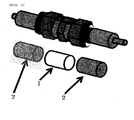
FIG. 2 illustrates a device which measures the ion conductivity of the solid electrolyte of the present invention. -
FIG. 3 illustrates a device which measures the capacitance in an electrochemical double layer capacitor to which the solid electrolyte of the present invention is applied. - The present invention provides a gel-type solid electrolyte having improved flexibility while maintaining the advantages of an ionic liquid by effectively internalizing the ionic liquid into a porous metal oxide. The porous metal oxide is prepared from a silane compound represented by the following Chemical Formula 1:
[Chemical Formula 1] Si(R1)x(OR2)y(CR3=CR4R5)(4-x-y)
in the formula, - R1 and R2 are each independently an alkyl group having 1 to 3 carbon atoms;
- R3, R4 and R5 are each independently hydrogen, a halogen element or an alkyl group having 1 to 5 carbon atoms; and
- x is an integer in the range of 0≤x≤3,
- y is an integer in the range of 1≤y≤4 and
- x+y is an integer in the range of 2≤x+y≤4.
- In general, the silane compound forms a silane oxide compound having a network structure by a hydrolysis reaction. The present invention uses a silane compound including a vinyl group in the case of 2≤x+y≤3 in Chemical Formula 1 in a hydrolysis reaction of a silane compound, as a porous metal oxide for internalizing an ionic liquid thereinto. The silane compound including a vinyl group is included among the silane oxide compounds to form the following structure as an example of a part of a network structure:

- When the process in which the porous metal oxide of the present invention is formed is reviewed in more detail, the network structure is formed from a hydrolysis reaction of the silane compound of Chemical Formula 1, and in this case, a silane compound including a vinyl group is introduced into each of the middles of the structures, thereby leading to termination of the network structure. That is, when the silane compound including a vinyl group is not present, the network structure keeps being produced, and accordingly, the viscosity of a material to be obtained keeps being increased, thereby resulting in a hard state in which it is difficult to be processed. The vinyl group is for inducing termination of the network structure to obtain an easily processible product in a flexible state. Therefore, it is a means for forming a backbone of a flexible solid electrolyte to use a silane compound including a vinyl group in the present invention.
- The present invention provides a solid electrolyte in which an ionic liquid is internalized into a porous metal oxide obtained from a hydrolysis reaction of the silane compound represented by Chemical Formula 1. In this case, in order to control the effect of improving flexibility of the solid electrolyte, the porous metal oxide includes preferably 30 to 50 wt% of a silane compound including a vinyl group, that is, a silane compound in the case of 2≤x+y≤3 in Chemical Formula 1. When the silane compound including a vinyl group is used in an amount less than the range, the effect of improving flexibility is so negligible that processability deteriorates, such as breakage in the process for using the silane compound as a solid electrolyte. In contrast, when the silane compound including a vinyl group is used in an excessive amount more than the range, gelation is not achieved at a preferred level, and accordingly, processability also deteriorates for this reason.
- For the hydrolysis reaction, the reaction is performed preferably under acidic conditions. As the acid, it is possible to use an organic acid such as formic acid, hydrochloric acid, sulfuric acid, phosphoric acid, nitric acid and acetic acid. The amount of these acids used is preferably in a range of 1 to 50 parts by volume based on the entire silane compound of Chemical Formula 1. These acids are used in the range because when the amount of acid used is less than the range, hydrolysis does not occur at a preferred level, and when the amount is more than the range, the viscosity of a gel-type porous metal oxide to be obtained becomes so high that it becomes difficult for the acid to be subsequently mixed with the ionic liquid.
- Next, in order to cause a hydrolysis to uniformly and effectively occur in a reactant including the silane compound of Chemical Formula 1 and an acid, it is preferred that the solution is ultrasonicated. The ultrasonication may be performed under the condition of 40 KHz for 1 to 20 minutes. After the ultrasonication, the solution is cooled at 0°C to 10°C for 1 to 120 minutes.
- And then, the ionic liquid is added so as to perform the gelation. That is, the silane compound of
Chemical Formula 1 is hydrolyzed to form a porous metal oxide having a network structure, and simultaneously, impregnation of the ionic liquid occurs, thereby preparing the gel-type solid electrolyte in the present invention in a form in which the ionic liquid is included in the porous metal oxide structure. - The ionic liquid may be used without limitation as long as the ionic liquid is an ionic material which is in a molten state at normal temperature (25°C), and includes a positive ion and a negative ion. The ionic liquid includes, but is not limited to, imidazolium, ammonium, pyrrolidinium or piperidinium as the positive ion, and includes, but is not limited to, bis(fluorosulfonyl)imide, bis(fluorosulfonyl)amide, fluoroborate, or fluorophosphate as the negative ion. Specific examples of the positive ion include alkyl ammonium such as triethyl ammonium, imidazolium such as ethyl methyl imidazolium and butyl methyl imidazolium, pyrrolidinium such as 1-methyl-1-propyl pyrrolidinium, or methyl propyl piperidinium. Further, specific examples of the negative ion include bis(trifluoromethylsulfonyl)imide (TFSI), bis(pentafluoroethylsufonyl)amide (BETI), tetrafluoroborate (BF4), or hexafluorophosphate (PF6).
- The ionic liquid may be used alone as an electrolyte without using a separate solvent. In addition, for ion conductivity and capacitance characteristics, it is preferred that the ionic liquid is included in the solid electrolyte in a range of 100 to 200 parts by weight based on 100 parts by weight of the porous metal oxide.
- After the gelation of the porous metal oxide and the ionic liquid, the solid electrolyte of the present invention is finally obtained by drying the gelled product at normal temperature for 1 hour or more, or subjecting the gelled product to heat treatment in a temperature range of 300°C to 600°C for 5 to 10 minutes. The electrolyte thus obtained is a gel-type solid having improved flexibility, and thus is easily processed. Accordingly, the electrolyte thus obtained may be easily used as a solid electrolyte in the process of manufacturing a lithium secondary battery or an electrochemical double layer capacitor.
- Meanwhile, the solid electrolyte of the present invention may additionally include one or more lithium salts selected from the group consisting of LiPF6, LiBF4, LiAsF6, LiSbF6, LiCF3SO3, LiC2F5SO3, LiC4F9SO3, LiN(CF3O2)2, LiN(C2F5SO2)2, LiC(CF3SO2)3, and LiPF2{(COO)2}2. The solid electrolyte including a lithium salt may be used as an electrolyte of the lithium ion battery. In this case, the lithium salt is included in an amount of preferably 5 to 40 wt% based on the entire solid electrolyte. In addition, when a lithium salt is included, it is preferred that gelation for forming a solid electrolyte is performed by adding the lithium salt together with an ionic liquid to a process of introducing the ionic liquid into a reactant including a silane compound, a vinyl silane compound, and an acid. That is, the lithium salt is included together with the ionic liquid in a porous metal oxide structure.
- Specifically, as a method of including a lithium salt, a gel-type solid electrolyte including a lithium salt and an ionic liquid is synthesized by dissolving the lithium salt in the ionic liquid in a glove box under the Ar atmosphere using a stirrer for 24 hours or more, and then introducing the ionic liquid, in which the lithium salt is dissolved, to the gelation process. Also, the lithium salt may be used in the form of an electrolytic solution in which the lithium salt is dissolved in a solvent such as dimethyl carbonate (DMC), diethyl carbonate (DEC), methyl ethyl carbonate (MEC), ethylene carbonate (EC), propylene carbonate (PC), or a mixture thereof. After the lithium salt dissolved in the solution is included in a porous metal oxide structure, the solvent is volatilized and removed in the drying or heat treatment process.
- Hereinafter, the present invention will be described in detail through Examples. However, since this is for helping to understand the present invention, it should not be understood that the present invention is limited thereto.
- As illustrated in
FIG. 1, 1 mL of 1 M formic acid was put into a cylindrical reaction vessel, and 1 mL of tetramethoxysilane (TMOS) and 1 mL of triethoxyvinylsilane were added thereto while being stirred. And then, the solution was ultrasonicated in an ultrasonic cleaner under the condition of 40 KHz for 30 minutes, and then was cooled at 5°C for 20 minutes. And then, 1 mL of butyl methyl imidazolium tetrafluoroborate (BMIMBF4) as an ionic liquid was put into the vessel, and gelation was allowed to occur. The product obtained above was dried at room temperature for 1 hour to finally obtain a gel-type solid electrolyte. - A solid electrolyte was obtained in the same manner as in the Example, except that 2 mL of tetramethoxysilane was used instead of 1 mL of tetramethoxysilane (TMOS) and 1 mL of triethoxyvinylsilane.
- With respect to the solid electrolytes obtained in the Example and the Comparative Example, ion conductivity and electric capacitance were measured.
- First, in order to measure ion conductivity, as illustrated in
FIG. 2 , asolid electrolyte 1 was inserted into a conductivity measurement cell (Swagelok cell) composed of twostainless steel electrodes 2, and conductivity was measured by performing impedance in a range from 2 × 10⁻² Hz to 106 Hz. - The measurement results are shown in the following Table 1. For comparison, ion conductivity of the ionic liquid BMIMBF4 measured in the same device and conditions is shown together.
[Table 1] Ion conductivity (mS/cm) BMIMBF4 1.70 Example 0.44 Comparative Example 0.43 - The ion conductivities of both the electrolytes in the Example and the Comparative Example were a little reduced compared to that of the ionic liquid butyl methyl imidazolium tetrafluoroborate (BMIMBF4), but exhibited ion conductivities sufficient to be used as an electrolyte.
- Next, the capacitance of an electrochemical double layer capacitor, which is manufactured by applying the solid electrolytes obtained in the Example and the Comparative Example to the device as illustrated in
FIG. 3 , was measured. A carbon nanotube (CNT) electrode formed on a stainless steel mesh was used as a workingelectrode 3, and a stainless steel foil was used as a counter electrode or areference electrode 4. Cyclic voltammetry was used for measuring the capacitance, and the capacitance was measured in a range of 0 V to 2.7 V at a scan rate of 100 mV/s. - The measurement results are shown in the following Table 2. For comparison, the capacitance of the ionic liquid BMIMBF4 measured in the same device and conditions is shown together.
[Table 2] Capacitance (F/g) BMIMBF4 30 Example 25 Comparative Example 22 - The capacitances of both the electrolytes in the Example and the Comparative Example were minimally reduced compared to that of the ionic liquid butyl methyl imidazolium tetrafluoroborate (BMIMBF4).
- In order to compare mechanical characteristics of the solid electrolytes suggested as the Example and the Comparative Example, the degree of flexibility was measured by the following method.
- First, the solid electrolytes in the Example and the Comparative Example were each manufactured into a frame with a size of 70 mm (width) × 150 mm (length) × 30 mm (thickness). And then, the center of the sample was fixed, and an angle was measured until a crack was generated by applying a force of 10 N to the sample in the same direction at both the ends of the sample.
[Table 3] Crack angle Example 40 Comparative Example 2 - It was confirmed that the electrolyte in the Comparative Example had almost no flexible properties, whereas the electrolyte in the Example had flexibility in which the sample could be bent up to 40 degrees.
Claims (11)
- A gel-type solid electrolyte comprising:an ionic liquid in a porous metal oxide prepared from a silane compound represented by the following Chemical Formula 1:
[Chemical Formula 1] Si(R1)x(OR2)y(CR3=CR4R5)(4-x-y)
Wherein R1 and R2 are each independently an alkyl group having 1 to 3 carbon atoms;R3, R4 and R5 are each independently hydrogen, a halogen element or an alkyl group having 1 to 5 carbon atoms; andx is an integer in the range of 0≤x≤3,y is an integer in the range of 1≤y≤4 andx+y is an integer in the range of 2≤x+y≤4. - The gel-type solid electrolyte of claim 1, wherein the porous metal oxide comprises 30 to 50 wt% of the silane compound in which 2≤x+y≤3 in Chemical Formula 1.
- The gel-type solid electrolyte of claim 1, wherein the porous metal oxide is formed from a hydrolysis reaction of the silane compound of Chemical Formula 1 in the presence of an acid.
- The gel-type solid electrolyte of claim 3, wherein the acid is used in a range of 1 to 50 parts by volume based on the entire silane compound of Chemical Formula 1.
- The gel-type solid electrolyte of claim 1, wherein the porous metal oxide comprises a structure represented by the following Chemical Formula:

- The gel-type solid electrolyte of claim 1, wherein the ionic liquid comprises one or more selected from the group consisting of imidazolium, ammonium, pyrrolidinium, and piperidinium as a positive ion, and one or more selected from the group consisting of bis(fluorosulfonyl)imide, bis(fluorosulfonyl)amide, fluoroborate, and fluorophosphate as a negative ion.
- The gel-type solid electrolyte of claim 1, wherein the ionic liquid is comprised in a range of 100 to 200 parts by weight based on 100 parts by weight of a porous metal oxide.
- The gel-type solid electrolyte of claim 1, further comprising: one or more lithium salts selected from the group consisting of LiPF6, LiBF4, LiAsF6, LiSbF6, LiCF3SO3, LiC2F5SO3, LiC4F9SO3, LiN(CF3SO2)2, LiN(C2F5SO2)2, LiC(CF3SO2)3, and LiPF2{(COO)2}2.
- The gel-type solid electrolyte of claim 8, wherein the lithium salt is comprised in an amount of 5 to 40 wt% based on the entire solid electrolyte.
- A lithium secondary battery comprising the solid electrolyte of any one of claims 1 to 9.
- An electrochemical double layer capacitor comprising the solid electrolyte of any one of claims 1 to 9.
Applications Claiming Priority (2)
| Application Number | Priority Date | Filing Date | Title |
|---|---|---|---|
| KR1020120144744A KR101994261B1 (en) | 2012-12-12 | 2012-12-12 | Solid electrolyte containing ionic liquid |
| PCT/KR2013/008738 WO2014092312A1 (en) | 2012-12-12 | 2013-09-30 | Solid electrolyte containing ionic liquid |
Publications (3)
| Publication Number | Publication Date |
|---|---|
| EP2933867A1 true EP2933867A1 (en) | 2015-10-21 |
| EP2933867A4 EP2933867A4 (en) | 2016-07-06 |
| EP2933867B1 EP2933867B1 (en) | 2019-01-02 |
Family
ID=50934564
Family Applications (1)
| Application Number | Title | Priority Date | Filing Date |
|---|---|---|---|
| EP13862533.0A Active EP2933867B1 (en) | 2012-12-12 | 2013-09-30 | Solid electrolyte containing ionic liquid |
Country Status (5)
| Country | Link |
|---|---|
| US (1) | US9768469B2 (en) |
| EP (1) | EP2933867B1 (en) |
| JP (1) | JP6319852B2 (en) |
| KR (1) | KR101994261B1 (en) |
| WO (1) | WO2014092312A1 (en) |
Cited By (1)
| Publication number | Priority date | Publication date | Assignee | Title |
|---|---|---|---|---|
| CN107293780A (en) * | 2017-06-01 | 2017-10-24 | 北京理工大学 | A kind of lithium battery quasi-solid electrolyte based on ionic liquid and preparation method thereof |
Families Citing this family (25)
| Publication number | Priority date | Publication date | Assignee | Title |
|---|---|---|---|---|
| US9755235B2 (en) | 2014-07-17 | 2017-09-05 | Ada Technologies, Inc. | Extreme long life, high energy density batteries and method of making and using the same |
| US20160268064A1 (en) * | 2015-03-09 | 2016-09-15 | Semiconductor Energy Laboratory Co., Ltd. | Power storage device and electronic device |
| WO2016209460A2 (en) | 2015-05-21 | 2016-12-29 | Ada Technologies, Inc. | High energy density hybrid pseudocapacitors and method of making and using the same |
| US12027661B2 (en) | 2015-06-01 | 2024-07-02 | Forge Nano Inc. | Nano-engineered coatings for anode active materials, cathode active materials, and solid-state electrolytes and methods of making batteries containing nano-engineered coatings |
| US11996564B2 (en) | 2015-06-01 | 2024-05-28 | Forge Nano Inc. | Nano-engineered coatings for anode active materials, cathode active materials, and solid-state electrolytes and methods of making batteries containing nano-engineered coatings |
| US12401042B2 (en) | 2015-06-01 | 2025-08-26 | Forge Nano Inc. | Nano-engineered coatings for anode active materials, cathode active materials, and solid-state electrolytes and methods of making batteries containing nano-engineered coatings |
| US10692659B2 (en) | 2015-07-31 | 2020-06-23 | Ada Technologies, Inc. | High energy and power electrochemical device and method of making and using same |
| KR102490866B1 (en) | 2015-10-23 | 2023-01-20 | 삼성전자주식회사 | Nonaqueous electrolyte for lithium secondary battery and lithium secondary battery employing the same |
| KR20170047656A (en) | 2015-10-23 | 2017-05-08 | 삼성전자주식회사 | Nonaqueous electrolyte for lithium secondary battery and lithium secondary battery employing the same |
| KR20170047659A (en) | 2015-10-23 | 2017-05-08 | 삼성전자주식회사 | Nonaqueous electrolyte for lithium secondary battery and lithium secondary battery employing the same |
| KR102425829B1 (en) | 2015-10-23 | 2022-07-28 | 삼성전자주식회사 | Nonaqueous electrolyte for lithium secondary battery and lithium secondary battery employing the same |
| CA3019132A1 (en) | 2016-04-01 | 2017-10-05 | NOHMs Technologies, Inc. | Modified ionic liquids containing phosphorus |
| KR102127081B1 (en) * | 2016-08-12 | 2020-06-25 | 주식회사 메디포럼제약 | Method for preparing ionic liquids for electrolytes with high ionic conductivity |
| JP6814225B2 (en) * | 2016-10-20 | 2021-01-13 | 株式会社日立製作所 | Lithium secondary battery |
| US11024846B2 (en) | 2017-03-23 | 2021-06-01 | Ada Technologies, Inc. | High energy/power density, long cycle life, safe lithium-ion battery capable of long-term deep discharge/storage near zero volt and method of making and using the same |
| WO2018197073A1 (en) | 2017-04-24 | 2018-11-01 | Imec Vzw | Solid nanocomposite electrolyte materials |
| EP3656010B1 (en) | 2017-07-17 | 2025-03-26 | Sionic Energy, Inc. | Phosphorus-containing electrolytes |
| US11710850B2 (en) | 2017-11-02 | 2023-07-25 | Imec Vzw | Solid electrolyte, electrode, power storage device, and method for producing solid electrolytes |
| EP3706226A4 (en) * | 2017-11-02 | 2020-12-16 | IMEC vzw | SOLID ELECTROLYTE, ELECTRODE, ELECTRICAL STORAGE ELEMENT, AND METHOD FOR MANUFACTURING A SOLID ELECTROLYTE |
| JP7178347B2 (en) * | 2018-06-12 | 2022-11-25 | アイメック・ヴェーゼットウェー | Solid electrolytes, electrodes and storage elements |
| KR102680032B1 (en) * | 2019-03-08 | 2024-06-28 | 주식회사 엘지에너지솔루션 | Solid electrolyte for lithium secondary battery, method for preparing the same and lithium secondary battery including the solid electrolyte |
| US11267707B2 (en) | 2019-04-16 | 2022-03-08 | Honeywell International Inc | Purification of bis(fluorosulfonyl) imide |
| CN111952551A (en) | 2019-05-17 | 2020-11-17 | 康宁股份有限公司 | Improved composite cathode for solid-state lithium-sulfur battery and preparation method thereof |
| JP7401818B2 (en) * | 2020-05-01 | 2023-12-20 | ダイキン工業株式会社 | Composites, polymer electrolytes, electrochemical devices, polymer solid-state batteries and actuators |
| KR102736615B1 (en) | 2024-05-14 | 2024-12-02 | 이대규 | 3D mapping system using multiple CCTVs |
Family Cites Families (15)
| Publication number | Priority date | Publication date | Assignee | Title |
|---|---|---|---|---|
| JP2000195544A (en) | 1998-12-25 | 2000-07-14 | Mitsui Chemicals Inc | Nonaqueous electrolyte and secondary battery using it |
| JP2001126726A (en) | 1999-10-25 | 2001-05-11 | Mitsui Chemicals Inc | Nonaqueous electrolytic secondary cell |
| JP4089246B2 (en) * | 2002-03-06 | 2008-05-28 | ダイソー株式会社 | Crosslinked polymer solid electrolyte and battery |
| US20040224233A1 (en) * | 2003-05-05 | 2004-11-11 | Show -An Chen | Method for preparation of chemically crosslinked polyacrylonitrile polymer electrolyte as separator for secondary battery |
| JP4660104B2 (en) | 2004-03-23 | 2011-03-30 | スリーエム イノベイティブ プロパティズ カンパニー | Non-aqueous mixed solvent and non-aqueous electrolyte containing the same |
| KR100793011B1 (en) * | 2007-02-16 | 2008-01-08 | 에스케이에너지 주식회사 | Manufacturing Method of Lithium Secondary Battery |
| JP2009181788A (en) | 2008-01-30 | 2009-08-13 | Sekisui Chem Co Ltd | Method for producing electrolyte membrane, electrolyte membrane, membrane-electrode assembly, and polymer electrolyte fuel cell |
| US8236446B2 (en) | 2008-03-26 | 2012-08-07 | Ada Technologies, Inc. | High performance batteries with carbon nanomaterials and ionic liquids |
| KR20110069747A (en) * | 2008-07-03 | 2011-06-23 | 보드 오브 거버너즈 포 하이어 에듀케이션, 스테이트 오브 로드아일랜드 앤드 프로비던스 플랜테이션즈 | Inhibition of Electrolyte Oxidation in Lithium Ion Batteries Using Electrolyte Additives |
| JP5359440B2 (en) * | 2009-03-25 | 2013-12-04 | コニカミノルタ株式会社 | Electrolyte and secondary battery |
| JP5329310B2 (en) * | 2009-06-10 | 2013-10-30 | 第一工業製薬株式会社 | Lithium secondary battery using ionic liquid |
| US20110076572A1 (en) | 2009-09-25 | 2011-03-31 | Khalil Amine | Non-aqueous electrolytes for electrochemical cells |
| JP2011070997A (en) * | 2009-09-28 | 2011-04-07 | Konica Minolta Holdings Inc | Electrolyte composition, and secondary battery |
| WO2012029618A1 (en) * | 2010-08-31 | 2012-03-08 | 協立化学産業株式会社 | Electroconductive composition for coating current collector of battery or electric double-layer capacitor, current collector for battery or electric double-layer capacitor, and battery and electric double-layer capacitor |
| JP2012129484A (en) * | 2010-12-16 | 2012-07-05 | Samsung Electro-Mechanics Co Ltd | Hybrid solid electrolyte membrane, method of manufacturing the same, and lithium ion capacitor comprising the same |
-
2012
- 2012-12-12 KR KR1020120144744A patent/KR101994261B1/en active Active
-
2013
- 2013-09-30 EP EP13862533.0A patent/EP2933867B1/en active Active
- 2013-09-30 WO PCT/KR2013/008738 patent/WO2014092312A1/en not_active Ceased
- 2013-09-30 JP JP2015547833A patent/JP6319852B2/en active Active
- 2013-09-30 US US14/421,055 patent/US9768469B2/en active Active
Cited By (2)
| Publication number | Priority date | Publication date | Assignee | Title |
|---|---|---|---|---|
| CN107293780A (en) * | 2017-06-01 | 2017-10-24 | 北京理工大学 | A kind of lithium battery quasi-solid electrolyte based on ionic liquid and preparation method thereof |
| CN107293780B (en) * | 2017-06-01 | 2019-08-02 | 北京理工大学 | A quasi-solid electrolyte based on ionic liquid for lithium battery and preparation method thereof |
Also Published As
| Publication number | Publication date |
|---|---|
| JP2016508279A (en) | 2016-03-17 |
| JP6319852B2 (en) | 2018-05-09 |
| KR20140076325A (en) | 2014-06-20 |
| EP2933867A4 (en) | 2016-07-06 |
| US20150194701A1 (en) | 2015-07-09 |
| US9768469B2 (en) | 2017-09-19 |
| EP2933867B1 (en) | 2019-01-02 |
| WO2014092312A1 (en) | 2014-06-19 |
| KR101994261B1 (en) | 2019-06-28 |
Similar Documents
| Publication | Publication Date | Title |
|---|---|---|
| EP2933867B1 (en) | Solid electrolyte containing ionic liquid | |
| JP5461883B2 (en) | Non-aqueous electrolyte for secondary battery and non-aqueous electrolyte secondary battery | |
| JP4645648B2 (en) | Electrolyte | |
| JP5279764B2 (en) | Quaternary ammonium salt and method for producing the same | |
| JP5725510B2 (en) | Solvent for electrolytic solution, electrolytic solution, and gel electrolyte | |
| JP4917178B2 (en) | Electrolyte material, electrolyte for lithium secondary battery, lithium secondary battery using the same, and novel lithium salt | |
| JPWO2010016521A1 (en) | Non-aqueous electrolyte, lithium secondary battery and manufacturing method thereof, and mixed non-aqueous electrolyte | |
| US9742034B2 (en) | Cyano-benzimidazole salts for electrochemical cells and method for synthesis thereof | |
| CN109346771A (en) | High-voltage electrolyte for lithium-ion battery and lithium-ion battery | |
| TWI598292B (en) | Method of producing phosphorus pentafluoride, method of producing lithium hexafluorophosphate, lithium hexafluorophosphate, non-aqueous electrolyte solution for battery, and lithium secondary battery | |
| CN115911544A (en) | A kind of non-aqueous electrolyte and lithium battery | |
| US11626620B2 (en) | Ionic liquid additive for lithium-ion battery | |
| CN104885286A (en) | Salts of N-containing heterocyclic anions as components in electrolytes | |
| CN103094614A (en) | Lithium ion battery electrolyte and lithium ion battery containing same | |
| JPH1131529A (en) | Solvent for lithium ion secondary battery | |
| KR20010040169A (en) | Complex salts for use in electrochemical cells | |
| US7820323B1 (en) | Metal borate synthesis process | |
| KR101614017B1 (en) | Method for Preparation of Ionic Liquids Containing Ether Substituted Anion and Liquid or Ionogel Electrolytes Prepared Using the Same | |
| CN110024199A (en) | Improve the ionic conductivity of the electrolyte based on imidazoles lithium salts | |
| JP4858107B2 (en) | Electrolyte | |
| CN115763983A (en) | Low-temperature lithium ion battery electrolyte | |
| KR20160060449A (en) | Novel lithium salt compounds, method for preparing same and electrolyte for secondary battery comprising same | |
| JP2010235583A (en) | Ionic liquid, electrolyte and lithium secondary battery | |
| CN114430066B (en) | Electrolyte and lithium ion battery containing same | |
| CN119481283A (en) | Electrolyte, lithium-ion battery and electrical equipment |
Legal Events
| Date | Code | Title | Description |
|---|---|---|---|
| PUAI | Public reference made under article 153(3) epc to a published international application that has entered the european phase |
Free format text: ORIGINAL CODE: 0009012 |
|
| 17P | Request for examination filed |
Effective date: 20150409 |
|
| AK | Designated contracting states |
Kind code of ref document: A1 Designated state(s): AL AT BE BG CH CY CZ DE DK EE ES FI FR GB GR HR HU IE IS IT LI LT LU LV MC MK MT NL NO PL PT RO RS SE SI SK SM TR |
|
| AX | Request for extension of the european patent |
Extension state: BA ME |
|
| RAP1 | Party data changed (applicant data changed or rights of an application transferred) |
Owner name: SAMSUNG SDI CO., LTD. |
|
| DAX | Request for extension of the european patent (deleted) | ||
| A4 | Supplementary search report drawn up and despatched |
Effective date: 20160608 |
|
| RIC1 | Information provided on ipc code assigned before grant |
Ipc: H01G 9/025 20060101ALI20160602BHEP Ipc: H01M 10/0565 20100101AFI20160602BHEP Ipc: H01M 10/052 20100101ALI20160602BHEP Ipc: H01B 1/06 20060101ALI20160602BHEP |
|
| REG | Reference to a national code |
Ref country code: DE Ref legal event code: R079 Ref document number: 602013049379 Country of ref document: DE Free format text: PREVIOUS MAIN CLASS: H01M0010056500 Ipc: H01M0010052000 |
|
| RIC1 | Information provided on ipc code assigned before grant |
Ipc: H01M 10/052 20100101AFI20180705BHEP Ipc: H01G 11/56 20130101ALI20180705BHEP Ipc: H01B 1/06 20060101ALI20180705BHEP Ipc: H01M 10/0565 20100101ALI20180705BHEP |
|
| GRAP | Despatch of communication of intention to grant a patent |
Free format text: ORIGINAL CODE: EPIDOSNIGR1 |
|
| STAA | Information on the status of an ep patent application or granted ep patent |
Free format text: STATUS: GRANT OF PATENT IS INTENDED |
|
| INTG | Intention to grant announced |
Effective date: 20180904 |
|
| GRAS | Grant fee paid |
Free format text: ORIGINAL CODE: EPIDOSNIGR3 |
|
| GRAA | (expected) grant |
Free format text: ORIGINAL CODE: 0009210 |
|
| STAA | Information on the status of an ep patent application or granted ep patent |
Free format text: STATUS: THE PATENT HAS BEEN GRANTED |
|
| AK | Designated contracting states |
Kind code of ref document: B1 Designated state(s): AL AT BE BG CH CY CZ DE DK EE ES FI FR GB GR HR HU IE IS IT LI LT LU LV MC MK MT NL NO PL PT RO RS SE SI SK SM TR |
|
| REG | Reference to a national code |
Ref country code: GB Ref legal event code: FG4D |
|
| REG | Reference to a national code |
Ref country code: CH Ref legal event code: EP Ref country code: AT Ref legal event code: REF Ref document number: 1085564 Country of ref document: AT Kind code of ref document: T Effective date: 20190115 |
|
| REG | Reference to a national code |
Ref country code: IE Ref legal event code: FG4D |
|
| REG | Reference to a national code |
Ref country code: DE Ref legal event code: R096 Ref document number: 602013049379 Country of ref document: DE |
|
| REG | Reference to a national code |
Ref country code: NL Ref legal event code: MP Effective date: 20190102 |
|
| REG | Reference to a national code |
Ref country code: LT Ref legal event code: MG4D |
|
| REG | Reference to a national code |
Ref country code: AT Ref legal event code: MK05 Ref document number: 1085564 Country of ref document: AT Kind code of ref document: T Effective date: 20190102 |
|
| PG25 | Lapsed in a contracting state [announced via postgrant information from national office to epo] |
Ref country code: NL Free format text: LAPSE BECAUSE OF FAILURE TO SUBMIT A TRANSLATION OF THE DESCRIPTION OR TO PAY THE FEE WITHIN THE PRESCRIBED TIME-LIMIT Effective date: 20190102 |
|
| PG25 | Lapsed in a contracting state [announced via postgrant information from national office to epo] |
Ref country code: SE Free format text: LAPSE BECAUSE OF FAILURE TO SUBMIT A TRANSLATION OF THE DESCRIPTION OR TO PAY THE FEE WITHIN THE PRESCRIBED TIME-LIMIT Effective date: 20190102 Ref country code: ES Free format text: LAPSE BECAUSE OF FAILURE TO SUBMIT A TRANSLATION OF THE DESCRIPTION OR TO PAY THE FEE WITHIN THE PRESCRIBED TIME-LIMIT Effective date: 20190102 Ref country code: LT Free format text: LAPSE BECAUSE OF FAILURE TO SUBMIT A TRANSLATION OF THE DESCRIPTION OR TO PAY THE FEE WITHIN THE PRESCRIBED TIME-LIMIT Effective date: 20190102 Ref country code: FI Free format text: LAPSE BECAUSE OF FAILURE TO SUBMIT A TRANSLATION OF THE DESCRIPTION OR TO PAY THE FEE WITHIN THE PRESCRIBED TIME-LIMIT Effective date: 20190102 Ref country code: PL Free format text: LAPSE BECAUSE OF FAILURE TO SUBMIT A TRANSLATION OF THE DESCRIPTION OR TO PAY THE FEE WITHIN THE PRESCRIBED TIME-LIMIT Effective date: 20190102 Ref country code: NO Free format text: LAPSE BECAUSE OF FAILURE TO SUBMIT A TRANSLATION OF THE DESCRIPTION OR TO PAY THE FEE WITHIN THE PRESCRIBED TIME-LIMIT Effective date: 20190402 Ref country code: PT Free format text: LAPSE BECAUSE OF FAILURE TO SUBMIT A TRANSLATION OF THE DESCRIPTION OR TO PAY THE FEE WITHIN THE PRESCRIBED TIME-LIMIT Effective date: 20190502 |
|
| PG25 | Lapsed in a contracting state [announced via postgrant information from national office to epo] |
Ref country code: IS Free format text: LAPSE BECAUSE OF FAILURE TO SUBMIT A TRANSLATION OF THE DESCRIPTION OR TO PAY THE FEE WITHIN THE PRESCRIBED TIME-LIMIT Effective date: 20190502 Ref country code: BG Free format text: LAPSE BECAUSE OF FAILURE TO SUBMIT A TRANSLATION OF THE DESCRIPTION OR TO PAY THE FEE WITHIN THE PRESCRIBED TIME-LIMIT Effective date: 20190402 Ref country code: GR Free format text: LAPSE BECAUSE OF FAILURE TO SUBMIT A TRANSLATION OF THE DESCRIPTION OR TO PAY THE FEE WITHIN THE PRESCRIBED TIME-LIMIT Effective date: 20190403 Ref country code: LV Free format text: LAPSE BECAUSE OF FAILURE TO SUBMIT A TRANSLATION OF THE DESCRIPTION OR TO PAY THE FEE WITHIN THE PRESCRIBED TIME-LIMIT Effective date: 20190102 Ref country code: HR Free format text: LAPSE BECAUSE OF FAILURE TO SUBMIT A TRANSLATION OF THE DESCRIPTION OR TO PAY THE FEE WITHIN THE PRESCRIBED TIME-LIMIT Effective date: 20190102 Ref country code: RS Free format text: LAPSE BECAUSE OF FAILURE TO SUBMIT A TRANSLATION OF THE DESCRIPTION OR TO PAY THE FEE WITHIN THE PRESCRIBED TIME-LIMIT Effective date: 20190102 |
|
| REG | Reference to a national code |
Ref country code: DE Ref legal event code: R097 Ref document number: 602013049379 Country of ref document: DE |
|
| PG25 | Lapsed in a contracting state [announced via postgrant information from national office to epo] |
Ref country code: CZ Free format text: LAPSE BECAUSE OF FAILURE TO SUBMIT A TRANSLATION OF THE DESCRIPTION OR TO PAY THE FEE WITHIN THE PRESCRIBED TIME-LIMIT Effective date: 20190102 Ref country code: RO Free format text: LAPSE BECAUSE OF FAILURE TO SUBMIT A TRANSLATION OF THE DESCRIPTION OR TO PAY THE FEE WITHIN THE PRESCRIBED TIME-LIMIT Effective date: 20190102 Ref country code: AL Free format text: LAPSE BECAUSE OF FAILURE TO SUBMIT A TRANSLATION OF THE DESCRIPTION OR TO PAY THE FEE WITHIN THE PRESCRIBED TIME-LIMIT Effective date: 20190102 Ref country code: EE Free format text: LAPSE BECAUSE OF FAILURE TO SUBMIT A TRANSLATION OF THE DESCRIPTION OR TO PAY THE FEE WITHIN THE PRESCRIBED TIME-LIMIT Effective date: 20190102 Ref country code: AT Free format text: LAPSE BECAUSE OF FAILURE TO SUBMIT A TRANSLATION OF THE DESCRIPTION OR TO PAY THE FEE WITHIN THE PRESCRIBED TIME-LIMIT Effective date: 20190102 Ref country code: SK Free format text: LAPSE BECAUSE OF FAILURE TO SUBMIT A TRANSLATION OF THE DESCRIPTION OR TO PAY THE FEE WITHIN THE PRESCRIBED TIME-LIMIT Effective date: 20190102 Ref country code: IT Free format text: LAPSE BECAUSE OF FAILURE TO SUBMIT A TRANSLATION OF THE DESCRIPTION OR TO PAY THE FEE WITHIN THE PRESCRIBED TIME-LIMIT Effective date: 20190102 Ref country code: DK Free format text: LAPSE BECAUSE OF FAILURE TO SUBMIT A TRANSLATION OF THE DESCRIPTION OR TO PAY THE FEE WITHIN THE PRESCRIBED TIME-LIMIT Effective date: 20190102 |
|
| PLBE | No opposition filed within time limit |
Free format text: ORIGINAL CODE: 0009261 |
|
| STAA | Information on the status of an ep patent application or granted ep patent |
Free format text: STATUS: NO OPPOSITION FILED WITHIN TIME LIMIT |
|
| PG25 | Lapsed in a contracting state [announced via postgrant information from national office to epo] |
Ref country code: SM Free format text: LAPSE BECAUSE OF FAILURE TO SUBMIT A TRANSLATION OF THE DESCRIPTION OR TO PAY THE FEE WITHIN THE PRESCRIBED TIME-LIMIT Effective date: 20190102 |
|
| 26N | No opposition filed |
Effective date: 20191003 |
|
| PG25 | Lapsed in a contracting state [announced via postgrant information from national office to epo] |
Ref country code: SI Free format text: LAPSE BECAUSE OF FAILURE TO SUBMIT A TRANSLATION OF THE DESCRIPTION OR TO PAY THE FEE WITHIN THE PRESCRIBED TIME-LIMIT Effective date: 20190102 |
|
| PG25 | Lapsed in a contracting state [announced via postgrant information from national office to epo] |
Ref country code: TR Free format text: LAPSE BECAUSE OF FAILURE TO SUBMIT A TRANSLATION OF THE DESCRIPTION OR TO PAY THE FEE WITHIN THE PRESCRIBED TIME-LIMIT Effective date: 20190102 |
|
| PG25 | Lapsed in a contracting state [announced via postgrant information from national office to epo] |
Ref country code: MC Free format text: LAPSE BECAUSE OF FAILURE TO SUBMIT A TRANSLATION OF THE DESCRIPTION OR TO PAY THE FEE WITHIN THE PRESCRIBED TIME-LIMIT Effective date: 20190102 |
|
| REG | Reference to a national code |
Ref country code: CH Ref legal event code: PL |
|
| PG25 | Lapsed in a contracting state [announced via postgrant information from national office to epo] |
Ref country code: CH Free format text: LAPSE BECAUSE OF NON-PAYMENT OF DUE FEES Effective date: 20190930 Ref country code: LU Free format text: LAPSE BECAUSE OF NON-PAYMENT OF DUE FEES Effective date: 20190930 Ref country code: LI Free format text: LAPSE BECAUSE OF NON-PAYMENT OF DUE FEES Effective date: 20190930 Ref country code: IE Free format text: LAPSE BECAUSE OF NON-PAYMENT OF DUE FEES Effective date: 20190930 |
|
| REG | Reference to a national code |
Ref country code: BE Ref legal event code: MM Effective date: 20190930 |
|
| PG25 | Lapsed in a contracting state [announced via postgrant information from national office to epo] |
Ref country code: BE Free format text: LAPSE BECAUSE OF NON-PAYMENT OF DUE FEES Effective date: 20190930 |
|
| PG25 | Lapsed in a contracting state [announced via postgrant information from national office to epo] |
Ref country code: CY Free format text: LAPSE BECAUSE OF FAILURE TO SUBMIT A TRANSLATION OF THE DESCRIPTION OR TO PAY THE FEE WITHIN THE PRESCRIBED TIME-LIMIT Effective date: 20190102 |
|
| PG25 | Lapsed in a contracting state [announced via postgrant information from national office to epo] |
Ref country code: HU Free format text: LAPSE BECAUSE OF FAILURE TO SUBMIT A TRANSLATION OF THE DESCRIPTION OR TO PAY THE FEE WITHIN THE PRESCRIBED TIME-LIMIT; INVALID AB INITIO Effective date: 20130930 Ref country code: MT Free format text: LAPSE BECAUSE OF FAILURE TO SUBMIT A TRANSLATION OF THE DESCRIPTION OR TO PAY THE FEE WITHIN THE PRESCRIBED TIME-LIMIT Effective date: 20190102 |
|
| PG25 | Lapsed in a contracting state [announced via postgrant information from national office to epo] |
Ref country code: MK Free format text: LAPSE BECAUSE OF FAILURE TO SUBMIT A TRANSLATION OF THE DESCRIPTION OR TO PAY THE FEE WITHIN THE PRESCRIBED TIME-LIMIT Effective date: 20190102 |
|
| P01 | Opt-out of the competence of the unified patent court (upc) registered |
Effective date: 20230528 |
|
| PGFP | Annual fee paid to national office [announced via postgrant information from national office to epo] |
Ref country code: DE Payment date: 20250902 Year of fee payment: 13 |
|
| PGFP | Annual fee paid to national office [announced via postgrant information from national office to epo] |
Ref country code: GB Payment date: 20250904 Year of fee payment: 13 |
|
| PGFP | Annual fee paid to national office [announced via postgrant information from national office to epo] |
Ref country code: FR Payment date: 20250908 Year of fee payment: 13 |