EP2933339A1 - Method for manufacturing butanediols, method for production of microorganisms for manufacturing butanediols, and microorganisms - Google Patents
Method for manufacturing butanediols, method for production of microorganisms for manufacturing butanediols, and microorganisms Download PDFInfo
- Publication number
- EP2933339A1 EP2933339A1 EP13861721.2A EP13861721A EP2933339A1 EP 2933339 A1 EP2933339 A1 EP 2933339A1 EP 13861721 A EP13861721 A EP 13861721A EP 2933339 A1 EP2933339 A1 EP 2933339A1
- Authority
- EP
- European Patent Office
- Prior art keywords
- coa
- gene
- microbe
- butanediol
- acyl
- Prior art date
- Legal status (The legal status is an assumption and is not a legal conclusion. Google has not performed a legal analysis and makes no representation as to the accuracy of the status listed.)
- Withdrawn
Links
- 238000004519 manufacturing process Methods 0.000 title claims abstract description 61
- CDQSJQSWAWPGKG-UHFFFAOYSA-N butane-1,1-diol Chemical class CCCC(O)O CDQSJQSWAWPGKG-UHFFFAOYSA-N 0.000 title claims abstract description 45
- 238000000034 method Methods 0.000 title claims description 66
- 244000005700 microbiome Species 0.000 title 2
- 229920001791 ((R)-3-Hydroxybutanoyl)(n-2) Polymers 0.000 claims abstract description 22
- QHHKKMYHDBRONY-RMNRSTNRSA-N 3-hydroxybutanoyl-CoA Chemical compound O[C@@H]1[C@H](OP(O)(O)=O)[C@@H](COP(O)(=O)OP(O)(=O)OCC(C)(C)[C@@H](O)C(=O)NCCC(=O)NCCSC(=O)CC(O)C)O[C@H]1N1C2=NC=NC(N)=C2N=C1 QHHKKMYHDBRONY-RMNRSTNRSA-N 0.000 claims abstract description 22
- 230000000694 effects Effects 0.000 claims abstract description 22
- 108090001018 hexadecanal dehydrogenase (acylating) Proteins 0.000 claims abstract description 14
- 238000006911 enzymatic reaction Methods 0.000 claims abstract description 10
- 108090000623 proteins and genes Proteins 0.000 claims description 113
- 241000588724 Escherichia coli Species 0.000 claims description 20
- 108010023922 Enoyl-CoA hydratase Proteins 0.000 claims description 10
- 102000011426 Enoyl-CoA hydratase Human genes 0.000 claims description 10
- 108010035023 4-hydroxybutyryl-CoA dehydratase Proteins 0.000 claims description 9
- 240000004808 Saccharomyces cerevisiae Species 0.000 claims description 9
- 108010093991 Vinylacetyl-CoA Delta-isomerase Proteins 0.000 claims description 9
- 108010055682 3-hydroxybutyryl-CoA dehydrogenase Proteins 0.000 claims description 6
- 241001112695 Clostridiales Species 0.000 claims description 6
- 241000186031 Corynebacteriaceae Species 0.000 claims description 6
- 102100039894 Hemoglobin subunit delta Human genes 0.000 claims description 6
- 102100026105 3-ketoacyl-CoA thiolase, mitochondrial Human genes 0.000 claims description 5
- 108010003902 Acetyl-CoA C-acyltransferase Proteins 0.000 claims description 5
- 230000008569 process Effects 0.000 claims description 4
- 101000782838 Arabidopsis thaliana Acyl-CoA hydrolase 2 Proteins 0.000 claims description 3
- 101150026728 tesB gene Proteins 0.000 claims description 3
- 102000004190 Enzymes Human genes 0.000 description 36
- 108090000790 Enzymes Proteins 0.000 description 36
- WERYXYBDKMZEQL-UHFFFAOYSA-N butane-1,4-diol Chemical compound OCCCCO WERYXYBDKMZEQL-UHFFFAOYSA-N 0.000 description 34
- 238000006243 chemical reaction Methods 0.000 description 34
- PUPZLCDOIYMWBV-UHFFFAOYSA-N (+/-)-1,3-Butanediol Chemical compound CC(O)CCO PUPZLCDOIYMWBV-UHFFFAOYSA-N 0.000 description 28
- WHBMMWSBFZVSSR-UHFFFAOYSA-N 3-hydroxybutyric acid Chemical compound CC(O)CC(O)=O WHBMMWSBFZVSSR-UHFFFAOYSA-N 0.000 description 20
- 239000013598 vector Substances 0.000 description 19
- 239000013612 plasmid Substances 0.000 description 15
- 239000001963 growth medium Substances 0.000 description 14
- OKTJSMMVPCPJKN-UHFFFAOYSA-N Carbon Chemical compound [C] OKTJSMMVPCPJKN-UHFFFAOYSA-N 0.000 description 11
- 239000012530 fluid Substances 0.000 description 10
- 239000012634 fragment Substances 0.000 description 10
- 230000006801 homologous recombination Effects 0.000 description 10
- 238000002744 homologous recombination Methods 0.000 description 10
- 239000000047 product Substances 0.000 description 10
- 239000000243 solution Substances 0.000 description 10
- 238000011144 upstream manufacturing Methods 0.000 description 10
- 230000001580 bacterial effect Effects 0.000 description 9
- 239000002585 base Substances 0.000 description 9
- 229910052799 carbon Inorganic materials 0.000 description 9
- 238000010367 cloning Methods 0.000 description 9
- 238000012258 culturing Methods 0.000 description 9
- 239000002994 raw material Substances 0.000 description 9
- 108020004414 DNA Proteins 0.000 description 8
- ZSLZBFCDCINBPY-ZSJPKINUSA-N acetyl-CoA Chemical compound O[C@@H]1[C@H](OP(O)(O)=O)[C@@H](COP(O)(=O)OP(O)(=O)OCC(C)(C)[C@@H](O)C(=O)NCCC(=O)NCCSC(=O)C)O[C@H]1N1C2=NC=NC(N)=C2N=C1 ZSLZBFCDCINBPY-ZSJPKINUSA-N 0.000 description 8
- 238000012217 deletion Methods 0.000 description 8
- 230000037430 deletion Effects 0.000 description 8
- 241000186226 Corynebacterium glutamicum Species 0.000 description 7
- LFQSCWFLJHTTHZ-UHFFFAOYSA-N Ethanol Chemical compound CCO LFQSCWFLJHTTHZ-UHFFFAOYSA-N 0.000 description 7
- 235000014680 Saccharomyces cerevisiae Nutrition 0.000 description 7
- 230000009467 reduction Effects 0.000 description 7
- 239000000126 substance Substances 0.000 description 7
- QTBSBXVTEAMEQO-UHFFFAOYSA-N Acetic acid Chemical compound CC(O)=O QTBSBXVTEAMEQO-UHFFFAOYSA-N 0.000 description 6
- 241000894006 Bacteria Species 0.000 description 6
- OJFDKHTZOUZBOS-CITAKDKDSA-N acetoacetyl-CoA Chemical compound O[C@@H]1[C@H](OP(O)(O)=O)[C@@H](COP(O)(=O)OP(O)(=O)OCC(C)(C)[C@@H](O)C(=O)NCCC(=O)NCCSC(=O)CC(=O)C)O[C@H]1N1C2=NC=NC(N)=C2N=C1 OJFDKHTZOUZBOS-CITAKDKDSA-N 0.000 description 6
- 150000001875 compounds Chemical class 0.000 description 6
- 230000014509 gene expression Effects 0.000 description 6
- WQZGKKKJIJFFOK-GASJEMHNSA-N Glucose Natural products OC[C@H]1OC(O)[C@H](O)[C@@H](O)[C@@H]1O WQZGKKKJIJFFOK-GASJEMHNSA-N 0.000 description 5
- WQZGKKKJIJFFOK-VFUOTHLCSA-N beta-D-glucose Chemical compound OC[C@H]1O[C@@H](O)[C@H](O)[C@@H](O)[C@@H]1O WQZGKKKJIJFFOK-VFUOTHLCSA-N 0.000 description 5
- 230000015572 biosynthetic process Effects 0.000 description 5
- 239000000284 extract Substances 0.000 description 5
- 239000008103 glucose Substances 0.000 description 5
- 230000009466 transformation Effects 0.000 description 5
- HSJKGGMUJITCBW-UHFFFAOYSA-N 3-hydroxybutanal Chemical compound CC(O)CC=O HSJKGGMUJITCBW-UHFFFAOYSA-N 0.000 description 4
- BAMBWCGEVIAQBF-CITAKDKDSA-N 4-hydroxybutyryl-CoA Chemical compound O[C@@H]1[C@H](OP(O)(O)=O)[C@@H](COP(O)(=O)OP(O)(=O)OCC(C)(C)[C@@H](O)C(=O)NCCC(=O)NCCSC(=O)CCCO)O[C@H]1N1C2=NC=NC(N)=C2N=C1 BAMBWCGEVIAQBF-CITAKDKDSA-N 0.000 description 4
- 108090000854 Oxidoreductases Proteins 0.000 description 4
- 102000004316 Oxidoreductases Human genes 0.000 description 4
- 230000000052 comparative effect Effects 0.000 description 4
- KFWWCMJSYSSPSK-PAXLJYGASA-N crotonoyl-CoA Chemical compound O[C@@H]1[C@H](OP(O)(O)=O)[C@@H](COP(O)(=O)OP(O)(=O)OCC(C)(C)[C@@H](O)C(=O)NCCC(=O)NCCSC(=O)/C=C/C)O[C@H]1N1C2=NC=NC(N)=C2N=C1 KFWWCMJSYSSPSK-PAXLJYGASA-N 0.000 description 4
- 238000006460 hydrolysis reaction Methods 0.000 description 4
- 150000007523 nucleic acids Chemical group 0.000 description 4
- 238000003752 polymerase chain reaction Methods 0.000 description 4
- 239000002028 Biomass Substances 0.000 description 3
- 241001468165 Clostridium aminobutyricum Species 0.000 description 3
- 206010059866 Drug resistance Diseases 0.000 description 3
- PEDCQBHIVMGVHV-UHFFFAOYSA-N Glycerine Chemical compound OCC(O)CO PEDCQBHIVMGVHV-UHFFFAOYSA-N 0.000 description 3
- HEMHJVSKTPXQMS-UHFFFAOYSA-M Sodium hydroxide Chemical compound [OH-].[Na+] HEMHJVSKTPXQMS-UHFFFAOYSA-M 0.000 description 3
- 230000003851 biochemical process Effects 0.000 description 3
- 210000004027 cell Anatomy 0.000 description 3
- KRKNYBCHXYNGOX-UHFFFAOYSA-N citric acid Chemical compound OC(=O)CC(O)(C(O)=O)CC(O)=O KRKNYBCHXYNGOX-UHFFFAOYSA-N 0.000 description 3
- 230000000295 complement effect Effects 0.000 description 3
- 230000006378 damage Effects 0.000 description 3
- -1 enoyl coenzyme A Chemical compound 0.000 description 3
- 230000002255 enzymatic effect Effects 0.000 description 3
- 238000004128 high performance liquid chromatography Methods 0.000 description 3
- 230000007062 hydrolysis Effects 0.000 description 3
- 230000000813 microbial effect Effects 0.000 description 3
- 230000035772 mutation Effects 0.000 description 3
- 238000000746 purification Methods 0.000 description 3
- 238000011946 reduction process Methods 0.000 description 3
- 108091008146 restriction endonucleases Proteins 0.000 description 3
- 238000000926 separation method Methods 0.000 description 3
- 241000894007 species Species 0.000 description 3
- 239000000758 substrate Substances 0.000 description 3
- QHHKKMYHDBRONY-WZZMXTMRSA-N (R)-3-hydroxybutanoyl-CoA Chemical compound O[C@@H]1[C@H](OP(O)(O)=O)[C@@H](COP(O)(=O)OP(O)(=O)OCC(C)(C)[C@@H](O)C(=O)NCCC(=O)NCCSC(=O)C[C@H](O)C)O[C@H]1N1C2=NC=NC(N)=C2N=C1 QHHKKMYHDBRONY-WZZMXTMRSA-N 0.000 description 2
- QHHKKMYHDBRONY-VKBDFPRVSA-N (S)-3-hydroxybutanoyl-CoA Chemical compound O[C@@H]1[C@H](OP(O)(O)=O)[C@@H](COP(O)(=O)OP(O)(=O)OCC(C)(C)[C@@H](O)C(=O)NCCC(=O)NCCSC(=O)C[C@@H](O)C)O[C@H]1N1C2=NC=NC(N)=C2N=C1 QHHKKMYHDBRONY-VKBDFPRVSA-N 0.000 description 2
- 108091032973 (ribonucleotides)n+m Proteins 0.000 description 2
- 102000052553 3-Hydroxyacyl CoA Dehydrogenase Human genes 0.000 description 2
- 108700020831 3-Hydroxyacyl-CoA Dehydrogenase Proteins 0.000 description 2
- 108030002854 Acetoacetyl-CoA synthases Proteins 0.000 description 2
- 241000251468 Actinopterygii Species 0.000 description 2
- 108020002663 Aldehyde Dehydrogenase Proteins 0.000 description 2
- 102000005369 Aldehyde Dehydrogenase Human genes 0.000 description 2
- QGZKDVFQNNGYKY-UHFFFAOYSA-N Ammonia Chemical compound N QGZKDVFQNNGYKY-UHFFFAOYSA-N 0.000 description 2
- IJGRMHOSHXDMSA-UHFFFAOYSA-N Atomic nitrogen Chemical compound N#N IJGRMHOSHXDMSA-UHFFFAOYSA-N 0.000 description 2
- 241000186146 Brevibacterium Species 0.000 description 2
- 241000186216 Corynebacterium Species 0.000 description 2
- 241001646716 Escherichia coli K-12 Species 0.000 description 2
- PLUBXMRUUVWRLT-UHFFFAOYSA-N Ethyl methanesulfonate Chemical compound CCOS(C)(=O)=O PLUBXMRUUVWRLT-UHFFFAOYSA-N 0.000 description 2
- 108700039691 Genetic Promoter Regions Proteins 0.000 description 2
- 244000068988 Glycine max Species 0.000 description 2
- 235000010469 Glycine max Nutrition 0.000 description 2
- CSNNHWWHGAXBCP-UHFFFAOYSA-L Magnesium sulfate Chemical compound [Mg+2].[O-][S+2]([O-])([O-])[O-] CSNNHWWHGAXBCP-UHFFFAOYSA-L 0.000 description 2
- 229910002651 NO3 Inorganic materials 0.000 description 2
- NHNBFGGVMKEFGY-UHFFFAOYSA-N Nitrate Chemical compound [O-][N+]([O-])=O NHNBFGGVMKEFGY-UHFFFAOYSA-N 0.000 description 2
- 229910019142 PO4 Inorganic materials 0.000 description 2
- 239000001888 Peptone Substances 0.000 description 2
- 108010080698 Peptones Proteins 0.000 description 2
- NBIIXXVUZAFLBC-UHFFFAOYSA-N Phosphoric acid Chemical compound OP(O)(O)=O NBIIXXVUZAFLBC-UHFFFAOYSA-N 0.000 description 2
- 229920001397 Poly-beta-hydroxybutyrate Polymers 0.000 description 2
- 229920000331 Polyhydroxybutyrate Polymers 0.000 description 2
- 241000190984 Rhodospirillum rubrum Species 0.000 description 2
- 241000235347 Schizosaccharomyces pombe Species 0.000 description 2
- FAPWRFPIFSIZLT-UHFFFAOYSA-M Sodium chloride Chemical compound [Na+].[Cl-] FAPWRFPIFSIZLT-UHFFFAOYSA-M 0.000 description 2
- QAOWNCQODCNURD-UHFFFAOYSA-N Sulfuric acid Chemical compound OS(O)(=O)=O QAOWNCQODCNURD-UHFFFAOYSA-N 0.000 description 2
- 108090000992 Transferases Proteins 0.000 description 2
- 102000004357 Transferases Human genes 0.000 description 2
- XSQUKJJJFZCRTK-UHFFFAOYSA-N Urea Chemical compound NC(N)=O XSQUKJJJFZCRTK-UHFFFAOYSA-N 0.000 description 2
- 108091000039 acetoacetyl-CoA reductase Proteins 0.000 description 2
- 230000010933 acylation Effects 0.000 description 2
- 238000005917 acylation reaction Methods 0.000 description 2
- AVKUERGKIZMTKX-NJBDSQKTSA-N ampicillin Chemical compound C1([C@@H](N)C(=O)N[C@H]2[C@H]3SC([C@@H](N3C2=O)C(O)=O)(C)C)=CC=CC=C1 AVKUERGKIZMTKX-NJBDSQKTSA-N 0.000 description 2
- 229960000723 ampicillin Drugs 0.000 description 2
- WPYMKLBDIGXBTP-UHFFFAOYSA-N benzoic acid Chemical compound OC(=O)C1=CC=CC=C1 WPYMKLBDIGXBTP-UHFFFAOYSA-N 0.000 description 2
- 239000000872 buffer Substances 0.000 description 2
- 238000005119 centrifugation Methods 0.000 description 2
- RGJOEKWQDUBAIZ-UHFFFAOYSA-N coenzime A Natural products OC1C(OP(O)(O)=O)C(COP(O)(=O)OP(O)(=O)OCC(C)(C)C(O)C(=O)NCCC(=O)NCCS)OC1N1C2=NC=NC(N)=C2N=C1 RGJOEKWQDUBAIZ-UHFFFAOYSA-N 0.000 description 2
- 239000005516 coenzyme A Substances 0.000 description 2
- 229940093530 coenzyme a Drugs 0.000 description 2
- 238000012790 confirmation Methods 0.000 description 2
- 238000000354 decomposition reaction Methods 0.000 description 2
- 230000018044 dehydration Effects 0.000 description 2
- 238000006297 dehydration reaction Methods 0.000 description 2
- KDTSHFARGAKYJN-UHFFFAOYSA-N dephosphocoenzyme A Natural products OC1C(O)C(COP(O)(=O)OP(O)(=O)OCC(C)(C)C(O)C(=O)NCCC(=O)NCCS)OC1N1C2=NC=NC(N)=C2N=C1 KDTSHFARGAKYJN-UHFFFAOYSA-N 0.000 description 2
- 238000004821 distillation Methods 0.000 description 2
- 238000004520 electroporation Methods 0.000 description 2
- 238000000605 extraction Methods 0.000 description 2
- 238000000855 fermentation Methods 0.000 description 2
- 230000004151 fermentation Effects 0.000 description 2
- 235000019688 fish Nutrition 0.000 description 2
- 235000013312 flour Nutrition 0.000 description 2
- BTCSSZJGUNDROE-UHFFFAOYSA-N gamma-aminobutyric acid Chemical compound NCCCC(O)=O BTCSSZJGUNDROE-UHFFFAOYSA-N 0.000 description 2
- 230000012010 growth Effects 0.000 description 2
- 238000009396 hybridization Methods 0.000 description 2
- 230000006872 improvement Effects 0.000 description 2
- 230000006698 induction Effects 0.000 description 2
- 230000001939 inductive effect Effects 0.000 description 2
- 238000003780 insertion Methods 0.000 description 2
- 230000037431 insertion Effects 0.000 description 2
- JVTAAEKCZFNVCJ-UHFFFAOYSA-N lactic acid Chemical compound CC(O)C(O)=O JVTAAEKCZFNVCJ-UHFFFAOYSA-N 0.000 description 2
- 231100000518 lethal Toxicity 0.000 description 2
- 230000001665 lethal effect Effects 0.000 description 2
- 235000013372 meat Nutrition 0.000 description 2
- 230000004060 metabolic process Effects 0.000 description 2
- 230000004048 modification Effects 0.000 description 2
- 238000012986 modification Methods 0.000 description 2
- 238000010369 molecular cloning Methods 0.000 description 2
- 108020004707 nucleic acids Proteins 0.000 description 2
- 102000039446 nucleic acids Human genes 0.000 description 2
- 235000019319 peptone Nutrition 0.000 description 2
- NBIIXXVUZAFLBC-UHFFFAOYSA-K phosphate Chemical compound [O-]P([O-])([O-])=O NBIIXXVUZAFLBC-UHFFFAOYSA-K 0.000 description 2
- 239000010452 phosphate Substances 0.000 description 2
- 239000002504 physiological saline solution Substances 0.000 description 2
- 229920000642 polymer Polymers 0.000 description 2
- FGIUAXJPYTZDNR-UHFFFAOYSA-N potassium nitrate Chemical compound [K+].[O-][N+]([O-])=O FGIUAXJPYTZDNR-UHFFFAOYSA-N 0.000 description 2
- 238000011084 recovery Methods 0.000 description 2
- 230000010076 replication Effects 0.000 description 2
- 150000003839 salts Chemical class 0.000 description 2
- 239000000523 sample Substances 0.000 description 2
- 238000007086 side reaction Methods 0.000 description 2
- VWDWKYIASSYTQR-UHFFFAOYSA-N sodium nitrate Chemical compound [Na+].[O-][N+]([O-])=O VWDWKYIASSYTQR-UHFFFAOYSA-N 0.000 description 2
- 239000007787 solid Substances 0.000 description 2
- 239000002904 solvent Substances 0.000 description 2
- 239000006228 supernatant Substances 0.000 description 2
- 239000000725 suspension Substances 0.000 description 2
- 238000003786 synthesis reaction Methods 0.000 description 2
- UATIGEHITDTAGF-CITAKDKDSA-N vinylacetyl-CoA Chemical compound O[C@@H]1[C@H](OP(O)(O)=O)[C@@H](COP(O)(=O)OP(O)(=O)OCC(C)(C)[C@@H](O)C(=O)NCCC(=O)NCCSC(=O)CC=C)O[C@H]1N1C2=NC=NC(N)=C2N=C1 UATIGEHITDTAGF-CITAKDKDSA-N 0.000 description 2
- XLYOFNOQVPJJNP-UHFFFAOYSA-N water Substances O XLYOFNOQVPJJNP-UHFFFAOYSA-N 0.000 description 2
- PIAOXUVIBAKVSP-UHFFFAOYSA-N γ-hydroxybutyraldehyde Chemical compound OCCCC=O PIAOXUVIBAKVSP-UHFFFAOYSA-N 0.000 description 2
- LNAZSHAWQACDHT-XIYTZBAFSA-N (2r,3r,4s,5r,6s)-4,5-dimethoxy-2-(methoxymethyl)-3-[(2s,3r,4s,5r,6r)-3,4,5-trimethoxy-6-(methoxymethyl)oxan-2-yl]oxy-6-[(2r,3r,4s,5r,6r)-4,5,6-trimethoxy-2-(methoxymethyl)oxan-3-yl]oxyoxane Chemical compound CO[C@@H]1[C@@H](OC)[C@H](OC)[C@@H](COC)O[C@H]1O[C@H]1[C@H](OC)[C@@H](OC)[C@H](O[C@H]2[C@@H]([C@@H](OC)[C@H](OC)O[C@@H]2COC)OC)O[C@@H]1COC LNAZSHAWQACDHT-XIYTZBAFSA-N 0.000 description 1
- LUEWUZLMQUOBSB-FSKGGBMCSA-N (2s,3s,4s,5s,6r)-2-[(2r,3s,4r,5r,6s)-6-[(2r,3s,4r,5s,6s)-4,5-dihydroxy-2-(hydroxymethyl)-6-[(2r,4r,5s,6r)-4,5,6-trihydroxy-2-(hydroxymethyl)oxan-3-yl]oxyoxan-3-yl]oxy-4,5-dihydroxy-2-(hydroxymethyl)oxan-3-yl]oxy-6-(hydroxymethyl)oxane-3,4,5-triol Chemical compound O[C@H]1[C@@H](O)[C@H](O)[C@@H](CO)O[C@H]1O[C@@H]1[C@@H](CO)O[C@@H](O[C@@H]2[C@H](O[C@@H](OC3[C@H](O[C@@H](O)[C@@H](O)[C@H]3O)CO)[C@@H](O)[C@H]2O)CO)[C@H](O)[C@H]1O LUEWUZLMQUOBSB-FSKGGBMCSA-N 0.000 description 1
- KJTLQQUUPVSXIM-ZCFIWIBFSA-M (R)-mevalonate Chemical compound OCC[C@](O)(C)CC([O-])=O KJTLQQUUPVSXIM-ZCFIWIBFSA-M 0.000 description 1
- 102000040650 (ribonucleotides)n+m Human genes 0.000 description 1
- 108030005660 3-hydroxybutyryl-CoA dehydratases Proteins 0.000 description 1
- FHVDTGUDJYJELY-UHFFFAOYSA-N 6-{[2-carboxy-4,5-dihydroxy-6-(phosphanyloxy)oxan-3-yl]oxy}-4,5-dihydroxy-3-phosphanyloxane-2-carboxylic acid Chemical compound O1C(C(O)=O)C(P)C(O)C(O)C1OC1C(C(O)=O)OC(OP)C(O)C1O FHVDTGUDJYJELY-UHFFFAOYSA-N 0.000 description 1
- 101710120269 Acyl-CoA thioester hydrolase YbgC Proteins 0.000 description 1
- 241000607516 Aeromonas caviae Species 0.000 description 1
- 239000004254 Ammonium phosphate Substances 0.000 description 1
- 239000005711 Benzoic acid Substances 0.000 description 1
- BHPQYMZQTOCNFJ-UHFFFAOYSA-N Calcium cation Chemical compound [Ca+2] BHPQYMZQTOCNFJ-UHFFFAOYSA-N 0.000 description 1
- 241000193401 Clostridium acetobutylicum Species 0.000 description 1
- 241000193454 Clostridium beijerinckii Species 0.000 description 1
- 241000186570 Clostridium kluyveri Species 0.000 description 1
- 241001508458 Clostridium saccharoperbutylacetonicum Species 0.000 description 1
- RGJOEKWQDUBAIZ-IBOSZNHHSA-N CoASH Chemical compound O[C@@H]1[C@H](OP(O)(O)=O)[C@@H](COP(O)(=O)OP(O)(=O)OCC(C)(C)[C@@H](O)C(=O)NCCC(=O)NCCS)O[C@H]1N1C2=NC=NC(N)=C2N=C1 RGJOEKWQDUBAIZ-IBOSZNHHSA-N 0.000 description 1
- 241001517047 Corynebacterium acetoacidophilum Species 0.000 description 1
- 241000186248 Corynebacterium callunae Species 0.000 description 1
- 241001644925 Corynebacterium efficiens Species 0.000 description 1
- KJTLQQUUPVSXIM-UHFFFAOYSA-N DL-mevalonic acid Natural products OCCC(O)(C)CC(O)=O KJTLQQUUPVSXIM-UHFFFAOYSA-N 0.000 description 1
- 229930091371 Fructose Natural products 0.000 description 1
- RFSUNEUAIZKAJO-ARQDHWQXSA-N Fructose Chemical compound OC[C@H]1O[C@](O)(CO)[C@@H](O)[C@@H]1O RFSUNEUAIZKAJO-ARQDHWQXSA-N 0.000 description 1
- 239000005715 Fructose Substances 0.000 description 1
- 229920002581 Glucomannan Polymers 0.000 description 1
- 235000014663 Kluyveromyces fragilis Nutrition 0.000 description 1
- 241001138401 Kluyveromyces lactis Species 0.000 description 1
- LTYOQGRJFJAKNA-KKIMTKSISA-N Malonyl CoA Natural products S(C(=O)CC(=O)O)CCNC(=O)CCNC(=O)[C@@H](O)C(CO[P@](=O)(O[P@](=O)(OC[C@H]1[C@@H](OP(=O)(O)O)[C@@H](O)[C@@H](n2c3ncnc(N)c3nc2)O1)O)O)(C)C LTYOQGRJFJAKNA-KKIMTKSISA-N 0.000 description 1
- 229910021380 Manganese Chloride Inorganic materials 0.000 description 1
- GLFNIEUTAYBVOC-UHFFFAOYSA-L Manganese chloride Chemical compound Cl[Mn]Cl GLFNIEUTAYBVOC-UHFFFAOYSA-L 0.000 description 1
- 241000144155 Microbacterium ammoniaphilum Species 0.000 description 1
- VZUNGTLZRAYYDE-UHFFFAOYSA-N N-methyl-N'-nitro-N-nitrosoguanidine Chemical compound O=NN(C)C(=N)N[N+]([O-])=O VZUNGTLZRAYYDE-UHFFFAOYSA-N 0.000 description 1
- 101100020663 Neurospora crassa (strain ATCC 24698 / 74-OR23-1A / CBS 708.71 / DSM 1257 / FGSC 987) ppm-1 gene Proteins 0.000 description 1
- 108090000913 Nitrate Reductases Proteins 0.000 description 1
- 108091028043 Nucleic acid sequence Proteins 0.000 description 1
- 102000008172 Palmitoyl-CoA Hydrolase Human genes 0.000 description 1
- 108010035473 Palmitoyl-CoA Hydrolase Proteins 0.000 description 1
- 229920002873 Polyethylenimine Polymers 0.000 description 1
- 239000004372 Polyvinyl alcohol Substances 0.000 description 1
- 108700008625 Reporter Genes Proteins 0.000 description 1
- 102100025541 S-acyl fatty acid synthase thioesterase, medium chain Human genes 0.000 description 1
- 244000253911 Saccharomyces fragilis Species 0.000 description 1
- 235000018368 Saccharomyces fragilis Nutrition 0.000 description 1
- 238000012300 Sequence Analysis Methods 0.000 description 1
- VYPSYNLAJGMNEJ-UHFFFAOYSA-N Silicium dioxide Chemical compound O=[Si]=O VYPSYNLAJGMNEJ-UHFFFAOYSA-N 0.000 description 1
- KDYFGRWQOYBRFD-UHFFFAOYSA-N Succinic acid Natural products OC(=O)CCC(O)=O KDYFGRWQOYBRFD-UHFFFAOYSA-N 0.000 description 1
- CZMRCDWAGMRECN-UGDNZRGBSA-N Sucrose Chemical compound O[C@H]1[C@H](O)[C@@H](CO)O[C@@]1(CO)O[C@@H]1[C@H](O)[C@@H](O)[C@H](O)[C@@H](CO)O1 CZMRCDWAGMRECN-UGDNZRGBSA-N 0.000 description 1
- 229930006000 Sucrose Natural products 0.000 description 1
- 108020005038 Terminator Codon Proteins 0.000 description 1
- 102000005488 Thioesterase Human genes 0.000 description 1
- 102000002932 Thiolase Human genes 0.000 description 1
- 108060008225 Thiolase Proteins 0.000 description 1
- LEHOTFFKMJEONL-UHFFFAOYSA-N Uric Acid Chemical compound N1C(=O)NC(=O)C2=C1NC(=O)N2 LEHOTFFKMJEONL-UHFFFAOYSA-N 0.000 description 1
- TVWHNULVHGKJHS-UHFFFAOYSA-N Uric acid Natural products N1C(=O)NC(=O)C2NC(=O)NC21 TVWHNULVHGKJHS-UHFFFAOYSA-N 0.000 description 1
- 241000700605 Viruses Species 0.000 description 1
- 241000319304 [Brevibacterium] flavum Species 0.000 description 1
- 239000002253 acid Substances 0.000 description 1
- 229940072056 alginate Drugs 0.000 description 1
- 235000010443 alginic acid Nutrition 0.000 description 1
- 229920000615 alginic acid Polymers 0.000 description 1
- 150000001338 aliphatic hydrocarbons Chemical class 0.000 description 1
- 229910052783 alkali metal Inorganic materials 0.000 description 1
- 150000001336 alkenes Chemical class 0.000 description 1
- 229910000147 aluminium phosphate Inorganic materials 0.000 description 1
- 150000001413 amino acids Chemical class 0.000 description 1
- 229910021529 ammonia Inorganic materials 0.000 description 1
- 229910000148 ammonium phosphate Inorganic materials 0.000 description 1
- 235000019289 ammonium phosphates Nutrition 0.000 description 1
- BFNBIHQBYMNNAN-UHFFFAOYSA-N ammonium sulfate Chemical compound N.N.OS(O)(=O)=O BFNBIHQBYMNNAN-UHFFFAOYSA-N 0.000 description 1
- 229910052921 ammonium sulfate Inorganic materials 0.000 description 1
- 235000011130 ammonium sulphate Nutrition 0.000 description 1
- 230000000692 anti-sense effect Effects 0.000 description 1
- 239000007864 aqueous solution Substances 0.000 description 1
- 150000004945 aromatic hydrocarbons Chemical class 0.000 description 1
- 235000010233 benzoic acid Nutrition 0.000 description 1
- 238000002306 biochemical method Methods 0.000 description 1
- KGBXLFKZBHKPEV-UHFFFAOYSA-N boric acid Chemical compound OB(O)O KGBXLFKZBHKPEV-UHFFFAOYSA-N 0.000 description 1
- 239000004327 boric acid Substances 0.000 description 1
- 239000007853 buffer solution Substances 0.000 description 1
- KDYFGRWQOYBRFD-NUQCWPJISA-N butanedioic acid Chemical compound O[14C](=O)CC[14C](O)=O KDYFGRWQOYBRFD-NUQCWPJISA-N 0.000 description 1
- VSGNNIFQASZAOI-UHFFFAOYSA-L calcium acetate Chemical compound [Ca+2].CC([O-])=O.CC([O-])=O VSGNNIFQASZAOI-UHFFFAOYSA-L 0.000 description 1
- 239000001639 calcium acetate Substances 0.000 description 1
- 235000011092 calcium acetate Nutrition 0.000 description 1
- 229960005147 calcium acetate Drugs 0.000 description 1
- 229910001424 calcium ion Inorganic materials 0.000 description 1
- 229940041514 candida albicans extract Drugs 0.000 description 1
- 239000004202 carbamide Substances 0.000 description 1
- 150000001720 carbohydrates Chemical class 0.000 description 1
- 239000000679 carrageenan Substances 0.000 description 1
- 235000010418 carrageenan Nutrition 0.000 description 1
- 229920001525 carrageenan Polymers 0.000 description 1
- 229940113118 carrageenan Drugs 0.000 description 1
- 230000003197 catalytic effect Effects 0.000 description 1
- 239000000919 ceramic Substances 0.000 description 1
- 238000012512 characterization method Methods 0.000 description 1
- 238000007385 chemical modification Methods 0.000 description 1
- 239000007795 chemical reaction product Substances 0.000 description 1
- 239000003795 chemical substances by application Substances 0.000 description 1
- 238000004587 chromatography analysis Methods 0.000 description 1
- 229910000361 cobalt sulfate Inorganic materials 0.000 description 1
- 229940044175 cobalt sulfate Drugs 0.000 description 1
- KTVIXTQDYHMGHF-UHFFFAOYSA-L cobalt(2+) sulfate Chemical compound [Co+2].[O-]S([O-])(=O)=O KTVIXTQDYHMGHF-UHFFFAOYSA-L 0.000 description 1
- 239000002299 complementary DNA Substances 0.000 description 1
- 229920001577 copolymer Polymers 0.000 description 1
- 229910000365 copper sulfate Inorganic materials 0.000 description 1
- 229960000355 copper sulfate Drugs 0.000 description 1
- ARUVKPQLZAKDPS-UHFFFAOYSA-L copper(II) sulfate Chemical compound [Cu+2].[O-][S+2]([O-])([O-])[O-] ARUVKPQLZAKDPS-UHFFFAOYSA-L 0.000 description 1
- 238000013461 design Methods 0.000 description 1
- 238000001514 detection method Methods 0.000 description 1
- MNNHAPBLZZVQHP-UHFFFAOYSA-N diammonium hydrogen phosphate Chemical compound [NH4+].[NH4+].OP([O-])([O-])=O MNNHAPBLZZVQHP-UHFFFAOYSA-N 0.000 description 1
- 235000014113 dietary fatty acids Nutrition 0.000 description 1
- 238000010790 dilution Methods 0.000 description 1
- 239000012895 dilution Substances 0.000 description 1
- 239000003480 eluent Substances 0.000 description 1
- 229920006351 engineering plastic Polymers 0.000 description 1
- 230000009088 enzymatic function Effects 0.000 description 1
- 238000002474 experimental method Methods 0.000 description 1
- 239000013604 expression vector Substances 0.000 description 1
- 239000000194 fatty acid Substances 0.000 description 1
- 229930195729 fatty acid Natural products 0.000 description 1
- 150000004665 fatty acids Chemical class 0.000 description 1
- 229960001781 ferrous sulfate Drugs 0.000 description 1
- 239000011790 ferrous sulphate Substances 0.000 description 1
- 235000003891 ferrous sulphate Nutrition 0.000 description 1
- 239000000706 filtrate Substances 0.000 description 1
- 238000005194 fractionation Methods 0.000 description 1
- 101150038180 frd gene Proteins 0.000 description 1
- 230000006870 function Effects 0.000 description 1
- 238000012224 gene deletion Methods 0.000 description 1
- 230000004545 gene duplication Effects 0.000 description 1
- 238000010363 gene targeting Methods 0.000 description 1
- 239000003365 glass fiber Substances 0.000 description 1
- 229940046240 glucomannan Drugs 0.000 description 1
- 230000002414 glycolytic effect Effects 0.000 description 1
- 229940094991 herring sperm dna Drugs 0.000 description 1
- 150000004677 hydrates Chemical class 0.000 description 1
- 239000012535 impurity Substances 0.000 description 1
- 208000015181 infectious disease Diseases 0.000 description 1
- 230000002687 intercalation Effects 0.000 description 1
- 238000009830 intercalation Methods 0.000 description 1
- 238000007852 inverse PCR Methods 0.000 description 1
- SURQXAFEQWPFPV-UHFFFAOYSA-L iron(2+) sulfate heptahydrate Chemical compound O.O.O.O.O.O.O.[Fe+2].[O-]S([O-])(=O)=O SURQXAFEQWPFPV-UHFFFAOYSA-L 0.000 description 1
- 229910000359 iron(II) sulfate Inorganic materials 0.000 description 1
- BPHPUYQFMNQIOC-NXRLNHOXSA-N isopropyl beta-D-thiogalactopyranoside Chemical compound CC(C)S[C@@H]1O[C@H](CO)[C@H](O)[C@H](O)[C@H]1O BPHPUYQFMNQIOC-NXRLNHOXSA-N 0.000 description 1
- 229940031154 kluyveromyces marxianus Drugs 0.000 description 1
- 239000004310 lactic acid Substances 0.000 description 1
- 235000014655 lactic acid Nutrition 0.000 description 1
- 159000000003 magnesium salts Chemical class 0.000 description 1
- 229910052943 magnesium sulfate Inorganic materials 0.000 description 1
- 229960003390 magnesium sulfate Drugs 0.000 description 1
- 235000019341 magnesium sulphate Nutrition 0.000 description 1
- 230000014759 maintenance of location Effects 0.000 description 1
- LTYOQGRJFJAKNA-DVVLENMVSA-N malonyl-CoA Chemical compound O[C@@H]1[C@H](OP(O)(O)=O)[C@@H](COP(O)(=O)OP(O)(=O)OCC(C)(C)[C@@H](O)C(=O)NCCC(=O)NCCSC(=O)CC(O)=O)O[C@H]1N1C2=NC=NC(N)=C2N=C1 LTYOQGRJFJAKNA-DVVLENMVSA-N 0.000 description 1
- 239000011565 manganese chloride Substances 0.000 description 1
- 235000002867 manganese chloride Nutrition 0.000 description 1
- 229940099607 manganese chloride Drugs 0.000 description 1
- 239000002609 medium Substances 0.000 description 1
- 238000005374 membrane filtration Methods 0.000 description 1
- 238000012269 metabolic engineering Methods 0.000 description 1
- 229910052751 metal Inorganic materials 0.000 description 1
- 239000002184 metal Substances 0.000 description 1
- 229920000609 methyl cellulose Polymers 0.000 description 1
- 239000001923 methylcellulose Substances 0.000 description 1
- 229960002900 methylcellulose Drugs 0.000 description 1
- 239000000203 mixture Substances 0.000 description 1
- 239000000178 monomer Substances 0.000 description 1
- 229910000402 monopotassium phosphate Inorganic materials 0.000 description 1
- 235000019796 monopotassium phosphate Nutrition 0.000 description 1
- ZQXSMRAEXCEDJD-UHFFFAOYSA-N n-ethenylformamide Chemical compound C=CNC=O ZQXSMRAEXCEDJD-UHFFFAOYSA-N 0.000 description 1
- LGQLOGILCSXPEA-UHFFFAOYSA-L nickel sulfate Chemical compound [Ni+2].[O-]S([O-])(=O)=O LGQLOGILCSXPEA-UHFFFAOYSA-L 0.000 description 1
- 229940053662 nickel sulfate Drugs 0.000 description 1
- 229910000363 nickel(II) sulfate Inorganic materials 0.000 description 1
- 229920001220 nitrocellulos Polymers 0.000 description 1
- 229910052757 nitrogen Inorganic materials 0.000 description 1
- 229910017464 nitrogen compound Inorganic materials 0.000 description 1
- 150000002830 nitrogen compounds Chemical class 0.000 description 1
- QJGQUHMNIGDVPM-UHFFFAOYSA-N nitrogen group Chemical group [N] QJGQUHMNIGDVPM-UHFFFAOYSA-N 0.000 description 1
- 230000000050 nutritive effect Effects 0.000 description 1
- JRZJOMJEPLMPRA-UHFFFAOYSA-N olefin Natural products CCCCCCCC=C JRZJOMJEPLMPRA-UHFFFAOYSA-N 0.000 description 1
- 150000002894 organic compounds Chemical class 0.000 description 1
- 239000003960 organic solvent Substances 0.000 description 1
- 239000012188 paraffin wax Substances 0.000 description 1
- 230000037361 pathway Effects 0.000 description 1
- PJNZPQUBCPKICU-UHFFFAOYSA-N phosphoric acid;potassium Chemical compound [K].OP(O)(O)=O PJNZPQUBCPKICU-UHFFFAOYSA-N 0.000 description 1
- 239000013600 plasmid vector Substances 0.000 description 1
- 229920000083 poly(allylamine) Polymers 0.000 description 1
- 239000005014 poly(hydroxyalkanoate) Substances 0.000 description 1
- 229920002401 polyacrylamide Polymers 0.000 description 1
- 229920000728 polyester Polymers 0.000 description 1
- 229920000903 polyhydroxyalkanoate Polymers 0.000 description 1
- 229920005862 polyol Polymers 0.000 description 1
- 150000003077 polyols Chemical class 0.000 description 1
- 229920002451 polyvinyl alcohol Polymers 0.000 description 1
- 239000004323 potassium nitrate Substances 0.000 description 1
- 235000010333 potassium nitrate Nutrition 0.000 description 1
- 230000035755 proliferation Effects 0.000 description 1
- 102000004169 proteins and genes Human genes 0.000 description 1
- 210000001938 protoplast Anatomy 0.000 description 1
- 230000005855 radiation Effects 0.000 description 1
- 239000011535 reaction buffer Substances 0.000 description 1
- 230000006798 recombination Effects 0.000 description 1
- 238000005215 recombination Methods 0.000 description 1
- 238000006722 reduction reaction Methods 0.000 description 1
- 230000022532 regulation of transcription, DNA-dependent Effects 0.000 description 1
- 230000008439 repair process Effects 0.000 description 1
- 230000029058 respiratory gaseous exchange Effects 0.000 description 1
- 230000004044 response Effects 0.000 description 1
- 230000000717 retained effect Effects 0.000 description 1
- 239000000741 silica gel Substances 0.000 description 1
- 229910002027 silica gel Inorganic materials 0.000 description 1
- 239000011780 sodium chloride Substances 0.000 description 1
- 239000001509 sodium citrate Substances 0.000 description 1
- NLJMYIDDQXHKNR-UHFFFAOYSA-K sodium citrate Chemical compound O.O.[Na+].[Na+].[Na+].[O-]C(=O)CC(O)(CC([O-])=O)C([O-])=O NLJMYIDDQXHKNR-UHFFFAOYSA-K 0.000 description 1
- 239000004317 sodium nitrate Substances 0.000 description 1
- 235000010344 sodium nitrate Nutrition 0.000 description 1
- 238000006467 substitution reaction Methods 0.000 description 1
- 239000005720 sucrose Substances 0.000 description 1
- 230000002194 synthesizing effect Effects 0.000 description 1
- 230000008685 targeting Effects 0.000 description 1
- 108020002982 thioesterase Proteins 0.000 description 1
- 108010032326 thioesterase II Proteins 0.000 description 1
- 238000012546 transfer Methods 0.000 description 1
- 238000006276 transfer reaction Methods 0.000 description 1
- 230000001131 transforming effect Effects 0.000 description 1
- LENZDBCJOHFCAS-UHFFFAOYSA-N tris Chemical compound OCC(N)(CO)CO LENZDBCJOHFCAS-UHFFFAOYSA-N 0.000 description 1
- 230000009452 underexpressoin Effects 0.000 description 1
- 229940116269 uric acid Drugs 0.000 description 1
- 108700026220 vif Genes Proteins 0.000 description 1
- 239000011782 vitamin Substances 0.000 description 1
- 229940088594 vitamin Drugs 0.000 description 1
- 229930003231 vitamin Natural products 0.000 description 1
- 235000013343 vitamin Nutrition 0.000 description 1
- 150000003722 vitamin derivatives Chemical class 0.000 description 1
- 238000010792 warming Methods 0.000 description 1
- 239000012138 yeast extract Substances 0.000 description 1
- NWONKYPBYAMBJT-UHFFFAOYSA-L zinc sulfate Chemical compound [Zn+2].[O-]S([O-])(=O)=O NWONKYPBYAMBJT-UHFFFAOYSA-L 0.000 description 1
- 229910000368 zinc sulfate Inorganic materials 0.000 description 1
- 229960001763 zinc sulfate Drugs 0.000 description 1
- UHVMMEOXYDMDKI-JKYCWFKZSA-L zinc;1-(5-cyanopyridin-2-yl)-3-[(1s,2s)-2-(6-fluoro-2-hydroxy-3-propanoylphenyl)cyclopropyl]urea;diacetate Chemical compound [Zn+2].CC([O-])=O.CC([O-])=O.CCC(=O)C1=CC=C(F)C([C@H]2[C@H](C2)NC(=O)NC=2N=CC(=CC=2)C#N)=C1O UHVMMEOXYDMDKI-JKYCWFKZSA-L 0.000 description 1
Images

Classifications
-
- C—CHEMISTRY; METALLURGY
- C12—BIOCHEMISTRY; BEER; SPIRITS; WINE; VINEGAR; MICROBIOLOGY; ENZYMOLOGY; MUTATION OR GENETIC ENGINEERING
- C12P—FERMENTATION OR ENZYME-USING PROCESSES TO SYNTHESISE A DESIRED CHEMICAL COMPOUND OR COMPOSITION OR TO SEPARATE OPTICAL ISOMERS FROM A RACEMIC MIXTURE
- C12P7/00—Preparation of oxygen-containing organic compounds
- C12P7/02—Preparation of oxygen-containing organic compounds containing a hydroxy group
- C12P7/04—Preparation of oxygen-containing organic compounds containing a hydroxy group acyclic
- C12P7/18—Preparation of oxygen-containing organic compounds containing a hydroxy group acyclic polyhydric
-
- C—CHEMISTRY; METALLURGY
- C12—BIOCHEMISTRY; BEER; SPIRITS; WINE; VINEGAR; MICROBIOLOGY; ENZYMOLOGY; MUTATION OR GENETIC ENGINEERING
- C12N—MICROORGANISMS OR ENZYMES; COMPOSITIONS THEREOF; PROPAGATING, PRESERVING, OR MAINTAINING MICROORGANISMS; MUTATION OR GENETIC ENGINEERING; CULTURE MEDIA
- C12N9/00—Enzymes; Proenzymes; Compositions thereof; Processes for preparing, activating, inhibiting, separating or purifying enzymes
- C12N9/0004—Oxidoreductases (1.)
- C12N9/0006—Oxidoreductases (1.) acting on CH-OH groups as donors (1.1)
-
- C—CHEMISTRY; METALLURGY
- C12—BIOCHEMISTRY; BEER; SPIRITS; WINE; VINEGAR; MICROBIOLOGY; ENZYMOLOGY; MUTATION OR GENETIC ENGINEERING
- C12N—MICROORGANISMS OR ENZYMES; COMPOSITIONS THEREOF; PROPAGATING, PRESERVING, OR MAINTAINING MICROORGANISMS; MUTATION OR GENETIC ENGINEERING; CULTURE MEDIA
- C12N9/00—Enzymes; Proenzymes; Compositions thereof; Processes for preparing, activating, inhibiting, separating or purifying enzymes
- C12N9/0004—Oxidoreductases (1.)
- C12N9/0008—Oxidoreductases (1.) acting on the aldehyde or oxo group of donors (1.2)
-
- C—CHEMISTRY; METALLURGY
- C12—BIOCHEMISTRY; BEER; SPIRITS; WINE; VINEGAR; MICROBIOLOGY; ENZYMOLOGY; MUTATION OR GENETIC ENGINEERING
- C12N—MICROORGANISMS OR ENZYMES; COMPOSITIONS THEREOF; PROPAGATING, PRESERVING, OR MAINTAINING MICROORGANISMS; MUTATION OR GENETIC ENGINEERING; CULTURE MEDIA
- C12N9/00—Enzymes; Proenzymes; Compositions thereof; Processes for preparing, activating, inhibiting, separating or purifying enzymes
- C12N9/10—Transferases (2.)
- C12N9/1025—Acyltransferases (2.3)
- C12N9/1029—Acyltransferases (2.3) transferring groups other than amino-acyl groups (2.3.1)
-
- C—CHEMISTRY; METALLURGY
- C12—BIOCHEMISTRY; BEER; SPIRITS; WINE; VINEGAR; MICROBIOLOGY; ENZYMOLOGY; MUTATION OR GENETIC ENGINEERING
- C12N—MICROORGANISMS OR ENZYMES; COMPOSITIONS THEREOF; PROPAGATING, PRESERVING, OR MAINTAINING MICROORGANISMS; MUTATION OR GENETIC ENGINEERING; CULTURE MEDIA
- C12N9/00—Enzymes; Proenzymes; Compositions thereof; Processes for preparing, activating, inhibiting, separating or purifying enzymes
- C12N9/14—Hydrolases (3)
- C12N9/16—Hydrolases (3) acting on ester bonds (3.1)
-
- C—CHEMISTRY; METALLURGY
- C12—BIOCHEMISTRY; BEER; SPIRITS; WINE; VINEGAR; MICROBIOLOGY; ENZYMOLOGY; MUTATION OR GENETIC ENGINEERING
- C12N—MICROORGANISMS OR ENZYMES; COMPOSITIONS THEREOF; PROPAGATING, PRESERVING, OR MAINTAINING MICROORGANISMS; MUTATION OR GENETIC ENGINEERING; CULTURE MEDIA
- C12N9/00—Enzymes; Proenzymes; Compositions thereof; Processes for preparing, activating, inhibiting, separating or purifying enzymes
- C12N9/88—Lyases (4.)
-
- C—CHEMISTRY; METALLURGY
- C12—BIOCHEMISTRY; BEER; SPIRITS; WINE; VINEGAR; MICROBIOLOGY; ENZYMOLOGY; MUTATION OR GENETIC ENGINEERING
- C12N—MICROORGANISMS OR ENZYMES; COMPOSITIONS THEREOF; PROPAGATING, PRESERVING, OR MAINTAINING MICROORGANISMS; MUTATION OR GENETIC ENGINEERING; CULTURE MEDIA
- C12N9/00—Enzymes; Proenzymes; Compositions thereof; Processes for preparing, activating, inhibiting, separating or purifying enzymes
- C12N9/90—Isomerases (5.)
-
- C—CHEMISTRY; METALLURGY
- C12—BIOCHEMISTRY; BEER; SPIRITS; WINE; VINEGAR; MICROBIOLOGY; ENZYMOLOGY; MUTATION OR GENETIC ENGINEERING
- C12Y—ENZYMES
- C12Y101/00—Oxidoreductases acting on the CH-OH group of donors (1.1)
- C12Y101/01—Oxidoreductases acting on the CH-OH group of donors (1.1) with NAD+ or NADP+ as acceptor (1.1.1)
- C12Y101/01035—3-Hydroxyacyl-CoA dehydrogenase (1.1.1.35)
-
- C—CHEMISTRY; METALLURGY
- C12—BIOCHEMISTRY; BEER; SPIRITS; WINE; VINEGAR; MICROBIOLOGY; ENZYMOLOGY; MUTATION OR GENETIC ENGINEERING
- C12Y—ENZYMES
- C12Y102/00—Oxidoreductases acting on the aldehyde or oxo group of donors (1.2)
- C12Y102/01—Oxidoreductases acting on the aldehyde or oxo group of donors (1.2) with NAD+ or NADP+ as acceptor (1.2.1)
- C12Y102/0101—Acetaldehyde dehydrogenase (acetylating) (1.2.1.10)
-
- C—CHEMISTRY; METALLURGY
- C12—BIOCHEMISTRY; BEER; SPIRITS; WINE; VINEGAR; MICROBIOLOGY; ENZYMOLOGY; MUTATION OR GENETIC ENGINEERING
- C12Y—ENZYMES
- C12Y203/00—Acyltransferases (2.3)
- C12Y203/01—Acyltransferases (2.3) transferring groups other than amino-acyl groups (2.3.1)
- C12Y203/01009—Acetyl-CoA C-acetyltransferase (2.3.1.9)
-
- C—CHEMISTRY; METALLURGY
- C12—BIOCHEMISTRY; BEER; SPIRITS; WINE; VINEGAR; MICROBIOLOGY; ENZYMOLOGY; MUTATION OR GENETIC ENGINEERING
- C12Y—ENZYMES
- C12Y301/00—Hydrolases acting on ester bonds (3.1)
- C12Y301/02—Thioester hydrolases (3.1.2)
- C12Y301/02002—Palmitoyl-CoA hydrolase (3.1.2.2)
-
- C—CHEMISTRY; METALLURGY
- C12—BIOCHEMISTRY; BEER; SPIRITS; WINE; VINEGAR; MICROBIOLOGY; ENZYMOLOGY; MUTATION OR GENETIC ENGINEERING
- C12Y—ENZYMES
- C12Y301/00—Hydrolases acting on ester bonds (3.1)
- C12Y301/02—Thioester hydrolases (3.1.2)
- C12Y301/0202—Acyl-CoA hydrolase (3.1.2.20)
-
- C—CHEMISTRY; METALLURGY
- C12—BIOCHEMISTRY; BEER; SPIRITS; WINE; VINEGAR; MICROBIOLOGY; ENZYMOLOGY; MUTATION OR GENETIC ENGINEERING
- C12Y—ENZYMES
- C12Y402/00—Carbon-oxygen lyases (4.2)
- C12Y402/01—Hydro-lyases (4.2.1)
- C12Y402/01017—Enoyl-CoA hydratase (4.2.1.17), i.e. crotonase
-
- C—CHEMISTRY; METALLURGY
- C12—BIOCHEMISTRY; BEER; SPIRITS; WINE; VINEGAR; MICROBIOLOGY; ENZYMOLOGY; MUTATION OR GENETIC ENGINEERING
- C12Y—ENZYMES
- C12Y503/00—Intramolecular oxidoreductases (5.3)
- C12Y503/03—Intramolecular oxidoreductases (5.3) transposing C=C bonds (5.3.3)
- C12Y503/03003—Vinylacetyl-CoA DELTA-isomerase (5.3.3.3)
Definitions
- the present invention relates to a manufacturing method for a butanediol, a fabrication method for a microbe for manufacturing a butanediol, and a microbe.
- a butanediol For a compound that is expected for raw material conversion of biomass, a butanediol is provided.
- 1,3-butanediol as a solvent and 1,4-butanediol as a synthetic raw material for a precision organic chemical product, monomer units of a polyester and an engineering plastic, or the like are widely used, and a market size thereof is large. For that reason, demand for a method of manufacturing a butanediol efficiently in a biochemical process with a renewable source such as biomass as a raw material is increased.
- Non-patent document 1 Harry Yim et al., Metabolic engineering of Escherichia coli for direct production of 1,4-butanediol, Nature Chemical Biology, 7, 445-452 (2011 ).
- the present invention includes the following.
- FIG. 1 is one example of an enzymatic system of a manufacturing method for a butanediol according to the present embodiment.
- CoA in the present specification means “coenzyme A”.
- % indicates “% by mass” unless otherwise described.
- ppm is a mass standard.
- the present embodiment includes a manufacturing method for a butanediol through 3-hydroxybutyryl-CoA that uses a microbe and includes a reduction process that is caused by an acyl-CoA reductase.
- the inventors variously studied in order to improve productivity of a butanediol. Specifically, presence of a (side reaction) enzyme system was investigated in detail that was intrinsically possessed by a host microbe and greatly influenced productivity of a butanediol. As a result, it was found that a reaction of production of 3-hydroxybutanoic acid from 3-hydroxybutyryl-CoA that is caused by an enzyme originating from a host was one of side reaction enzyme systems.
- the inventors further found that it was possible to suppress a reaction of hydrolysis from 3-hydroxybutyryl-CoA into 3-hydroxybutanoic acid by deleting or reducing an activity of a particular acyl-CoA hydratase (EC number: 3. 1. 2. -) that was used in such a biochemical manufacturing method and possessed by a host bacteria, and as a result, it was possible to increase an amount of a produced butanediol.
- a particular acyl-CoA hydratase EC number: 3. 1. 2.
- a feature of a microbe, a fabrication method for a microbe, a using method for a microbe (that is, a manufacturing method for a butanediol), an acquisition method for a manufactured butanediol, and the like, that are used in the present embodiment, will be described below.
- a host microbe that is used in the present embodiment is a microbe with a deleted or reduced activity of an acyl-CoA hydratase.
- a microbe is used as a host for manufacturing a butanediol, hydrolysis of 3-hydroxybutyryl-CoA due to an acyl-CoA hydratase to derive 3-hydroxybutanoic acid is suppressed in a manufacturing method for a butanediol through 3-hydroxybutyryl-CoA that includes a reduction process that is caused by an acyl-CoA reductase, and as a result, productivity of a butanediol is improved.
- acyl-CoA hydratase that is a target for deleting or reducing an activity thereof is not particularly limited as long as such an enzyme has an activity of decomposition of 3-hydroxybutyryl-CoA
- acyl-CoA hydratase that refers to EC number: 3. 1. 2.
- acyl-CoA hydratase that refers to EC number: 3. 1. 2. 20, and homologs thereof, and the like are provided specifically.
- acyl-CoA thioesterase thioesterase, thioesterase, thioesterase II, and the like
- an "acyl-CoA hydratase" in the present invention encompasses them.
- deletion or reduction of an activity in the present specification means that an activity of an acyl-CoA hydratase as a target is reduced into a half or less of that of a parent strain that is a target of such a modification. Due to such deletion or reduction, decomposition of 3-hydroxybutyryl-CoA is avoided and an amount of a produced butanediol is increased substantially.
- an activity of an "acyl-CoA hydratase" it is preferable for an activity of an "acyl-CoA hydratase" to be reduced a half or less as compared with that of Escherichia coli JM109 strain. It is possible to confirm "deletion or reduction" in the present embodiment as follows.
- such a host microbe is transformed with a gene that codes a series of enzymes for producing 3-hydroxybutyryl-CoA, and cultured in a culture medium that contains a carbon source that is a substrate for such an enzyme reaction, for example, glucose or the like.
- a carbon source that is a substrate for such an enzyme reaction, for example, glucose or the like.
- Produced 3-hydroxybutyryl-CoA is hydrolyzed under presence of an acyl-CoA hydratase and excreted as 3-hydroxybutanoic acid out of a bacterial body.
- Such 3-hydroxybutanoic acid is quantified by a publicly known method such as a high performance liquid chromatography (HPLC), and thereby, it is possible to evaluate "deletion or reduction" of an acyl-CoA hydratase.
- HPLC high performance liquid chromatography
- microbe that is used in the present embodiment and is a parent strain as a target for modification is a host microbe wherein it is possible to introduce therein a variety of genes as described below, and such a microbe is not particularly limited as long as it is possible to apply a gene recombination technique thereto and express an acyl-CoA hydratase that is a target for deletion or reduction of an activity thereof.
- an Escherichia coli, a yeast, a coryneform bacteria, or a clostridial bacteria is provided from the viewpoint of industrial availability.
- a yeast there is provided Saccharomyces cerevisiae, Schizosaccharomyces pombe, Kluyveromyces lactis, Kluyveromyces marxianus, or the like.
- Corynebacterium glutamicum for a coryneform bacteria, there is provided Corynebacterium glutamicum, Corynebacterium efficiens, Brevibacterium divaricatum, Brevibacterium saccharolyticum, Brevibacterium immariophilum, Brevibacterium lactofermentum, Brevibacterium roseum, Brevibacterium flavum, Brevibacterium thiogenitalis, Corynebacterium acetoacidophilum, Corynebacterium acetoglutamicum, Corynebacterium callunae, Corynebacterium lilium, Corynebacterium mellassecola, Microbacterium ammoniaphilum, or the like.
- Clostridium kluyveri Clostridium acetobutylicum, Clostridium aminobutyricum, Clostridium beijerinckii, Clostridium saccharoperbutylacetonicum, or the like.
- Escherichia coli Saccharomyces cerevisiae, Schizosaccharomyces pombe, or Corynebacterium glutamicum, because transformation thereof is easy, and it is more preferable to use an Escherichia coli.
- Escherichia coli K-12 strain or B strain and derivatives thereof for example, Escherichia coli K-12 strain or B strain and derivatives thereof, more specifically, Escherichia coli BW strain such as BW25113 strain, JM strain such as JM109 strain, MV strain such as MV1184 strain, DH strain such as DH5 ⁇ , HB101 strain, C600 strain, XL1-Blue strain, BL21 strain, and the like, and derivatives thereof.
- a method for fabrication of a host with a deleted or reduced activity of an acyl-CoA hydratase that is used in the present embodiment is not particularly limited and it is possible to execute fabrication by a known method for deleting or reducing expression of a gene that is possessed by a microbe.
- NTG N-methyl-N'-nitro-N-nitrosoguanidine
- EMS ethyl methanesulfonate
- induction of an error at a time of replication that uses an intercalation agent
- a method based on deletion or insertion of DNA induced by a transposon, phage infection, or the like or the like.
- a method of introduction of deletion or insertion into DNA that utilizes homologous recombination caused by introducing a DNA fragment that has a complementary sequence with respect to a gene thereof or a marginal region thereof, or the like, may be adopted.
- a variety of known DNA sequence analysis techniques it is possible to apply a variety of known DNA sequence analysis techniques, and additionally, it is possible to execute confirmation by analyzing substantial reduction of such an enzyme reaction product that is caused by deletion of such an enzyme.
- a gene in the present invention encompasses DNA and RNA, and preferably, is DNA.
- a vector that is linked with a gene as described previously is not particularly limited as long as it is possible to execute replication thereof in a host, and there are provided, for example, a plasmid, a phage, a cosmid, and the like, that are utilized for introduction of an exotic gene into Escherichia coli.
- a plasmid there is provided, for example, pHSG398, pUC18, pBR322, pSC101, pUC19, pUC118, pUC119, pACYC117, pBluescript II SK(+), pET17b, pETDuet-1, pACYCDuet-1, pCDFDuet-1, pRSFDuet-1, pCOLADuet-1, or the like, and for a phage, there is provided, for example, ⁇ gt10, Charon 4A, EMBL-, M13mp18, M13mp19, or the like. Some of them are commercially available and it is possible to use a commercially available product (kit) directly in accordance with, or by appropriately modifying, a procedure manual thereof.
- kit commercially available product directly in accordance with, or by appropriately modifying, a procedure manual thereof.
- an appropriate expression promoter may be connected to an inserted gene upstream thereof so that such a gene is expressed reliably.
- An expression promoter to be used is not particularly limited, and it is possible for a person skilled in the art to make an appropriate selection thereof depending on a host.
- T7 promoter lac promoter, trp promoter, trc promoter, or ⁇ -PL promoter that is utilized for expression of an exotic gene in Escherichia coli, or an Nar promoter region of a nitrate reduction gene nar GHJI operon that is derived from Escherichia coli and involved with nitrate respiration, or a promoter region of Frd gene that is a gene of a nitrate reductase of Escherichia coli.
- a method that is used for fabricating a knockout cell or the like in such a technical field such as a method (gene targeting method) that destructs a target gene by using a vector (targeting vector) that causes homologous recombination at an arbitrary position of such a gene, a method (gene trap method) that inserts a trap vector (reporter gene that does not have a promoter) at an arbitrary position of a target gene to destruct such a gene and be caused to lose a function thereof, or a method of a combination thereof.
- a method gene targeting method that destructs a target gene by using a vector (targeting vector) that causes homologous recombination at an arbitrary position of such a gene
- a method (gene trap method) that inserts a trap vector (reporter gene that does not have a promoter) at an arbitrary position of a target gene to destruct such a gene and be caused to lose a function thereof or a method of a combination thereof.
- a method that introduces a vector that expresses an antisense cDNA of a gene to be destructed or a method that introduces into a cell a vector that expresses a vector that expresses a double-stranded RNA of a gene to be destructed encompasses a virus vector, a plasmid vector, or the like, it is possible to execute fabrication thereof based on a normal gene engineering technique, for example, in accordance with a basic literature such as Sambrook, J et al., Molecular Cloning 2nd ed., 9.47 - 9.58, Cold Spring Harbor Lab. press (1989 ). Furthermore, it is also possible to cleave a commercially available vector with an arbitrary restriction enzyme and incorporate a desired gene or the like to execute semisynthesis.
- a position that causes homologous substitution or a position for inserting a trap vector is not particularly limited as long as such a position is to cause mutation that eliminates expression of a target gene to be destructed, and is preferably a transcription control region.
- a method for introduction of a vector as described previously into a host is not particularly limited, and it is possible to provide, for example, an electrical pulse method, a method that uses a calcium ion, a protoplast method, an electroporation method, or the like, that is generally utilized for introduction of a vector into Escherichia coli.
- a target gene together with a promoter is inserted into a sequence homologous to a sequence on a genome and such a nucleic acid fragment is introduced into a cell by means of electroporation to cause homologous recombination, so that it is possible to practice a method that inserts a target gene at an arbitrary position on a genome by means of homologous recombination.
- a nucleic acid fragment wherein a drug resistance gene is linked with a target gene is used in a case of introduction into a genome, it is possible to readily choose a strain wherein homologous recombination is caused.
- a target gene by means of homologous recombination in such a manner that a gene wherein a gene that is lethal on a particular condition is linked with a drug resistance gene is inserted into a genome by means of homologous recombination in a method as described above and subsequently the drug resistance gene and the gene that is lethal on a particular condition are replaced.
- a method that selects a recombinant microbe with an introduced target gene is not particularly limited, and it is preferable to be based on a technique that is capable of readily selecting only a recombinant microbe with an introduced target gene.
- a transformed microbe in the present embodiment may be used as a microbe culture bacterial body itself or a variety of forms of a culture thereof.
- a culture of a microbe in the present embodiment includes a suspension of a microbe culture bacterial body in a medium such as a culture medium or a buffer solution, a cell-free extracted fluid from a microbe culture bacterial body, and further, a product processed by concentrating, purifying, and extracting a component that catalyzes such a reaction from such a cell-free extracted fluid or the like.
- a culture of a microbe in the present embodiment further includes the above-mentioned processed product of a microbe that is fixed on a poorly soluble carrier.
- a fixation carrier there is provided a compound that forms a poorly watersoluble solid content that encloses a microbial or bacterial body as described previously or a processed product thereof, such as polyacrylamide, polyvinyl alcohol, poly-N-vinylformamide, polyallylamine, polyethyleneimine, methylcellulose, glucomannan, alginate, or carrageenan, or further a copolymer or crosslinked product thereof, or the like.
- a compound that forms a poorly watersoluble solid content that encloses a microbial or bacterial body as described previously or a processed product thereof such as polyacrylamide, polyvinyl alcohol, poly-N-vinylformamide, polyallylamine, polyethyleneimine, methylcellulose, glucomannan, alginate, or carrageenan, or further a copolymer or crosslinked product thereof, or the like.
- a compound that forms a poorly watersoluble solid content that encloses a microbial or bacterial body as described previously or
- a culture of a microbe a microbe or an extracted fluid or extracted component thereof that is held on an object that is preliminarily formed as a solid, such as activated carbon, a porous ceramic, glass fiber, a porous polymer molded object, or a nitrocellulose film.
- FIG. 1 illustrates one example of an enzyme system in a manufacturing method for a butanediol (1,3-butanediol and 1,4-butanediol) according to the present embodiment.
- a butanediol by using a culture that is expressed in a microbial body by transforming a series of genes as described previously or the like.
- a gene is inserted into an arbitrary vector individually or as a series of clusters so that a host microbe is transformed.
- An obtained transformed body is cultured in a culture medium with an appropriate carbon source, for example, glucose as a carbon source, so that each gene is expressed.
- an appropriate carbon source for example, glucose as a carbon source
- a transformed body is cultured in a culture medium so that such a gene is expressed.
- a gene is constituted under a control of a regulator disposed on a vector, an inducible substrate is added to transfer to inductive environment, and thereby, each coding gene is expressed.
- culturing in the present embodiment includes all of culturing conditions for a normal microbe culturing, and further, a culturing step means that a microbe is cultured for a period of time and a condition enough to manufacture a butanediol.
- a method for supply of 3-hydroxybutyryl-CoA in a manufacturing method for 1,3-butanediol in the present embodiment is not particularly limited and a variety of known methods are used.
- acetoacetyl-CoA is first supplied by utilizing an enzyme reaction that uses a gene that codes ⁇ -ketothiolase (EC number: 2. 3. 1. 9) that eliminates one molecule of CoA from two molecules of acetyl-CoA, under supply of acetyl-CoA that is obtained from a known reaction path such as a glycolytic system, so as to furnish acetoacetyl-CoA, or a homolog thereof. Furthermore, a gene that codes acetoacetyl-CoA synthase (EC number: 2. 3. 1.
- acetoacetyl-CoA synthase it is possible to refer to, for example, a non-patent document such as Unprecedented acetoacetyl-coenzyme A synthesizing enzyme of the thiolase superfamily involved in the mevalonate pathway., Proc. Natl. Acad. Sci., U.S.A. 107, 11265-11270 (2010 ).
- 3-hydroxybutyryl-CoA through an enzyme reaction that uses acetoacetyl-CoA reductase (EC number: 1. 1. 1. 36), 3-hydroxybutyryl-CoA dehydrogenase (EC number: 1. 1. 1. 35), 3-hydroxyacyl-CoA dehydrogenase (EC number: 1. 1. 1. 157), or a homolog thereof that catalyzes a reaction that reduces obtained acetoacetyl-CoA to furnish 3-hydroxybutyryl-CoA.
- (R)-3-hydroxybutyryl-CoA in a case where acetoacetyl-CoA reductase (EC number: 1. 1. 1.
- propionic acid-CoA transferase (EC number : 2. 8. 3. 1) is known as an enzyme that directly transforms CoA into 3-hydroxybutanoic acid. It is possible to produce 3-hydroxybutyryl-CoA by supplying 3-hydroxybutanoic acid to a microbe or a culture that includes such a microbe, under expression of a gene that codes propionic acid-CoA transferase or a homolog thereof and under supply of acetyl-CoA that is a donor for a CoA transfer reaction.
- An acyl-CoA reductase that is used in the present embodiment is not particularly limited as long as such an enzyme catalyzes a reaction that reduces 3-hydroxybutyryl-CoA to produce 3-hydroxybutanal.
- aldehyde dehydrogenase (EC number: 1. 2. 1. 10) or a homolog thereof.
- 1,3-butanediol is derived from obtained 3-hydroxybutanal by an alcohol reductase that is normally possessed by a host as described below, a gene that codes an alcohol reductase may additionally be expresses to manufacture 1,3-butanediol.
- FIG. 1 illustrates one example of an enzyme system in a manufacturing method for 1,4-butanediol in the present embodiment.
- 1,4-butanediol in accordance with the present embodiment, it is possible to derive 1,4-butanediol from 3-hydroxybutyryl-CoA that is supplied similarly to manufacturing of 1,3-butanediol as described previously, by utilizing, for example, an enzyme reaction through crotonyl-CoA and 3-hydroxybutyryl-CoA.
- An enzyme in each enzyme reaction will be described below.
- enoyl-CoA hydratase (EC number: 4. 2. 1. 17) or a homolog thereof.
- a non-patent document such as Moskowitz, G. J. and Merrick, J. M. Metabolism of poly- ⁇ -hydroxybutyrate.
- an enzyme that is used in the present embodiment and catalyzes a reaction that produces crotonyl-CoA from (R)-3-hydroxybutyryl-CoA is not particularly limited and there is provided enoyl-CoA hydratase (EC number: 4. 2. 1. 55 (3-hydroxybutyryl-CoA dehydratase) or EC number: 4. 2. 1. 119), or the like.
- enoyl-CoA hydratase EC number: 4. 2. 1. 55 (3-hydroxybutyryl-CoA dehydratase) or EC number: 4. 2. 1. 119
- a non-patent document such as Fukui, T., Shiomi, N. and Doi, Y.
- a vinylacetyl-CoA delta-isomerase that is used in the present embodiment is not particularly limited as long as such an enzyme catalyzes a reaction that transforms an olefin of crotonyl-CoA to produce vinylacetyl-CoA.
- a specific example of an enzyme that catalyzes a reaction as described above is not limited and there is provided vinylacetyl-CoA delta-isomerase (EC number: 5. 3. 3. 3) or a homolog thereof or the like.
- vinylacetyl-CoA delta-isomerase EC number: 5. 3. 3. 3
- a homolog thereof or the like it is possible to refer to, for example, a non-patent document such as Fermentation of 4-aminobutyrate by Clostridium aminobutyricum: cloning of two genes involved in the formation and dehydration of 4-hydroxybutyryl-CoA, Archives of Microbiology, 174 (3) 189 - 199 (2000 ).
- a 4-hydroxybutyryl-CoA dehydratase is not particularly limited in the present embodiment as long as such an enzyme catalyzes a reaction that hydrates vinylacetyl-CoA to produce 4-hydroxybutyryl-CoA.
- 4-hydroxybutyryl-CoA dehydratase (EC number: 4. 2. 1. 120) or a homolog thereof, or the like.
- a non-patent document such as Fermentation of 4-aminobutyrate by Clostridium aminobutyricum: cloning of two genes involved in the formation and dehydration of 4-hydroxybutyryl-CoA, Archives of Microbiology, 174 (3) 189 - 199 (2000 ).
- a case in this non-patent document relates to a multienzyme of 4-hydroxybutyryl-CoA dehydratase and vinylacetyl-CoA delta-isomerase (EC number: 5. 3. 3. 3) as described previously, and a gene that codes it.
- a gene that codes each enzyme may be used individually or a gene that codes an enzyme protein or a catalytic subunit may be used.
- An acyl-CoA reductase that is used in the present embodiment is not particularly limited as long as such an enzyme catalyzes a reaction that reduces 4-hydroxybutyryl-CoA to produce 4-hydroxybutanal.
- aldehyde dehydrogenase (EC number: 4. 2. 1. 10) or a homolog thereof.
- 1,4-butanediol is derived from obtained 4-hydroxybutanal by an alcohol reductase that is normally possessed by a host as described below, a gene that codes an alcohol reductase may additionally be expressed to manufacture 1,4-butanediol.
- a homolog in the present embodiment includes an ortholog and a paralog.
- An ortholog refers to a set of corresponding genes among species generated from a gene of a common ancestor by means of speciation and enzymes obtained from such genes.
- a paralog refers to corresponding genes among species generated by means of not speciation but gene duplication in an identical species and enzymes obtained from such genes.
- a homolog refers to genes that have an identity in sequences thereof, regardless of an ortholog or a paralog, and enzymes obtained from such genes.
- a homolog (gene) of a gene as described above refers to a gene that has a base sequence with an identity greater than or equal to 90%, preferably an identity greater than or equal to 95%, with respect to such a gene, and more preferably, a gene that is completely identical to such a gene or wherein one or several bases thereof are deleted, substituted, or added.
- a homolog gene includes a gene that hybridizes with a gene that has a base sequence complementary with a target gene on a stringent condition.
- a homology retrieval program for example, BLAST or FASTA
- PCR polymerase chain reaction
- a hybridizing condition is a condition that retention with a probe in a solution that contains 6 x SSC (a composition of 1 x SSC: 0.15 M of sodium chloride, 0.015 M of sodium citrate, pH: 7.0), 0.5% of SDS, 5 x Denhardt's solution, and 100 mg/mL of herring sperm DNA, at a constant temperature of 65 °C for 8 - 16 hours is executed to cause hybridization.
- a reaction in the present invention is most conveniently achieved in such a manner that a transformed body is cultured in a nutritive culture medium such as an LB culture medium at a temperature of 15 °C - 40 °C, desirably 18 °C - 37 °C for about 24 hours, subsequently implanted to a culture medium with a normal carbon source, for example, a carbon source that is 0.01 - 50%, desirably 0.1 - 30%, of glucose, and continuously cultured at a similar temperature for about 1 hour - 200 hours, wherein 1,3-butanediol and/or 1,4-butanediol is stored in a culture solution in such a process.
- a nutritive culture medium such as an LB culture medium at a temperature of 15 °C - 40 °C, desirably 18 °C - 37 °C for about 24 hours
- a normal carbon source for example, a carbon source that is 0.01 - 50%, desirably 0.1
- a carbon source may be added continuously or intermittently depending on consumption of a carbon source that is caused by proliferation of a bacteria or proceeding of a reaction, and in such a case, a concentration of a carbon source in a reaction fluid is not limited to one described previously.
- a saccharide such as glucose, sucrose, or fructose
- a polyol such as glycerol
- an organic substance such as ethanol, acetic acid, citric acid, succinic acid, lactic acid, benzoic acid, or a fatty acid, or an alkali metal salt thereof
- an aliphatic hydrocarbon such as an n-paraffin, an aromatic hydrocarbon, or for example, a natural organic substance such as peptone, meat extract, fish extract, soybean flour, or bran, singly or in combination thereof, at a concentration of normally 0.01% - 30%, desirably about 0.1% - 20%.
- a culture medium nitrogen source for culturing a microbe it is possible to use, for example, an inorganic nitrogen compound such as ammonium sulfate, ammonium phosphate, sodium nitrate, or potassium nitrate, a nitrogen-containing organic substance such as urea or uric acid, or a natural organic substance such as peptone, meat extract, fish extract, or soybean flour, singly or in combination thereof, at a concentration of normally 0.01%-20%, desirably about 0.1% - 10%.
- an inorganic nitrogen compound such as ammonium sulfate, ammonium phosphate, sodium nitrate, or potassium nitrate
- a nitrogen-containing organic substance such as urea or uric acid
- a natural organic substance such as peptone, meat extract, fish extract, or soybean flour
- a phosphate such as potassium dihydrogen phosphate, or a metal salt such as magnesium sulfate, ferrous sulfate, calcium acetate, manganese chloride, copper sulfate, zinc sulfate, cobalt sulfate, or nickel sulfate, as necessary, for growth of a bacteria or improvement of an enzyme activity.
- a concentration for addition thereof is different depending on a culturing condition, and normally, is 0.01% - 5% for a phosphate, 10 ppm - 1% for a magnesium salt, or about 0.1 ppm - 1,000 ppm for other compounds.
- a supply source of a vitamin, an amino acid, a nucleic acid, or the like it is possible to add, for example, about 1 ppm - 100 ppm of yeast extract, casamino acid, or a yeast nucleic acid, depending on a selected culture medium, for growth of a bacteria or improvement of an enzyme activity.
- a pH of a culture medium it is desirable to adjust a pH of a culture medium to 4.5 - 9, desirably 5 - 8. Furthermore, it is useful to fractionate from a culture solution by a method such as centrifugation or membrane filtration, and again suspend and react in water that contains a reaction raw material, physiological saline, a buffer that has a pH adjusted to be comparable to a pH for culturing and composed of phosphoric acid, acetic acid, boric acid, tris(hydroxymethyl)aminomethane, or the like, or a salt thereof, or the like, a microbial or bacterial body that is preliminarily cultured in a culture medium as described previously, in order to reduce an impurity in a reaction fluid and simplify subsequent fractionation of a product.
- a pH during a reaction is normally capable of being retained in a case where a buffer with a sufficient concentration is used, it is desirable to be execute appropriate adjustment by using sodium hydroxide, ammonia, or the like so as to provide a similar pH in a case where deviation from a pH as described above is caused by proceeding of a reaction.
- a method is preferable that adds water, physiological saline, a reaction buffer, or the like, into such a reaction fluid depending on a concentration of a product to execute continuous dilution thereof. Furthermore, at a point of time when a reaction rate is lowered, a bacteria is fractionated and a supernatant is recovered as a product solution, wherein a fractionated bacteria is again returned to a solution or suspension that contains a reaction raw material and thereby, it is possible to recover such a reaction rate. It is possible to execute such an operation continuously, or even batchwise, by using a centrifuge, a separation film, or the like.
- 1,3-butanediol and/or 1,4-butanediol is obtained at a high purity by directly executing distillation for such an extract, as well as, further executing extraction with an appropriate solvent again, executing purification that uses chromatography on silica gel or the like, or applying multistep distillation or the like thereto.
- Table 1 illustrates a summary of a relationship between a gene with a sequence number that corresponds to that of a sequence listing and an enzyme that is coded by such a gene.
- JM109 (DE3) ⁇ TesB strain wherein a CDS region of acyl-CoA thioesterase II gene (tesB) that was an acyl-CoA hydrolase was deleted from a genome of Escherichia coli JM109 (DE3) strain was prepared by using a homologous recombination method with reference to publicly-known entire genome sequence information of Escherichia coli K-12 strain.
- gene deletion based on a homologous recombination method was executed in accordance with an ordinary method with reference to a non-patent document of Experiments in Molecular Genetics, Cold Spring Harbor Laboratory press (1972 ); Matsuyama, S. and Mizushima, S., J. Bacteriol., 162, 1196 (1985 ).
- a sequence of a deleted CDS region is illustrated in sequence number 6.
- a blunt end fragment was prepared by an ordinary method in such a manner that sequences that corresponded to 15 base pairs at an upstream side and a downstream side that contained CAT at an upstream side and ATG at a downstream side of a NdeI site among multi-cloning sites of expression vector pET17b (produced by Novagen, Inc.), respectively, were added to a 5'-end side and a 3'-end side upstream and downstream a gene sequence indicated by sequence number 1, respectively. Ligation of this fragment and a fragment provided by NdeI-treating pET17b (produced by Novagen, Inc.) was executed by In-Fusion HD Cloning Kit (produced by TAKARA BIO INC.) to obtain plasmid pETBD1.
- a gene sequence indicated by sequence number 2 was inserted into an NdeI site of pET17b as a target by a method similar to that for pETBD1 to obtain plasmid pETBD2 that contained sequence 2.
- An EcoRI site positioned downstream a termination codon of sequence 1 of pETBD1 and derived from multi-cloning sites of pET17b was cleaved by a restriction enzyme treatment to prepare a ring-opened fragment of pETBD1. Then, a fragment was prepared by means of PCR such that sequences that corresponded to 15 bp at an upstream side and 15 bp at a downstream side that contained an EcoRI site of pETBD1 described previously were added upstream and downstream a region of sequence 2 of pETBD2 and a region that contained T7 promoter derived from pET17b upstream thereof. Ligation of two obtained fragments was executed by In-Fusion HD Cloning Kit to obtain plasmid pETBD1-2 that contained sequences 1 and 2.
- JM109 (DE3) ⁇ TesB strain was transformed with plasmid pETBD1-2 in accordance with an ordinary method.
- a transformed body with plasmid pETBD1-2 was acquired by a method similar to that of Reference Example 1 except that a transformation host was changed to JM109 (DE3).
- a ring-opened fragment of plasmid pETBD1-2 was prepared by means of inverse PCR wherein a target is a center of GATATC of EcoRV site derived from vector pET17b and positioned downstream of sequence 2 of pETBD1-2 prepared in Reference Example 1.
- a gene sequence indicated by sequence number 5 was inserted into an NdeI site of pET17b as a target by a method similar to that for pETBD1 to obtain plasmid pETBD5 that contained sequence 5.
- a fragment was prepared by means of PCR such that sequences that corresponded to 15 bp at an upstream side and 15 bp at a downstream side that contained an EcoRV site of pETBD1-2 described previously were added upstream and downstream a region of sequence 5 of pETBD5 and a region that contained T7 promoter derived from pET17b upstream thereof.
- a transformed body with plasmid pETBD1-2-5 was acquired by a method similar to that of Practical Example 1 except that a transformation host was changed to JM109 (DE3).
- sequences indicated by sequence number 3 that corresponded to enoyl-CoA hydratase
- sequence number 4 that corresponded to vinylacetyl-CoA delta-isomerase and 4-hydroxybutyryl-CoA dehydratase
- T7 promoter derived from pET17b were sequentially added to a downstream side of pETBD1-2-5 prepared in Practical Example 1 by using a method of In-Fusion HD Cloning Kit, to prepare plasmid pETBD1-2-5-3-4.
- a transformed body of JM109 (DE3) ⁇ TesB strain with such a plasmid was obtained in accordance with an ordinary method.
- a transformed body with plasmid pETBD1-2-5-3-4 was acquired by a method similar to that of Practical Example 2 except that a transformation host was changed to JM109 (DE3).
- a transformed body obtained in each of the respective practical examples, comparative examples, and reference examples was aerobically cultured in 5 mL of an LB culture medium that contained 100 mg/L of ampicillin at 37 °C for 12 hours.
- 0.1 mL of a culture solution was implanted to 5 mL of an LB culture medium that contained 1% of glucose, 100 mg/L of ampicillin, and 0.2 mM of IPTG and aerobically cultured at 30 °C for 48 hours.
- a supernatant of a culture solution was subjected to high performance liquid chromatography (HPLC: column; Shodex SH-1011 (produced by Showa Denko K.
- Table 2 illustrates an amount of 3-hydroxybutanoic acid, an amount of 1,3-butanediol, and/or an amount of 1,4-butanediol that were produced in a culture solution.
- a manufacturing method for a butanediol that utilizes a biochemical technique according to the present embodiment is such that an activity of a particular acyl-CoA hydratase (EC number: 3. 1. 2. -) that is possessed by a host microbe is deleted or reduced and a hydrolysis reaction from 3-hydroxybutyryl-CoA to 3-hydroxybutanoic acid is suppressed thereby. Accordingly, it is possible to improve productivity of 1,3-butanediol and/or 1,4-butanediol.
Landscapes
- Chemical & Material Sciences (AREA)
- Organic Chemistry (AREA)
- Life Sciences & Earth Sciences (AREA)
- Health & Medical Sciences (AREA)
- Engineering & Computer Science (AREA)
- Zoology (AREA)
- Wood Science & Technology (AREA)
- Bioinformatics & Cheminformatics (AREA)
- Genetics & Genomics (AREA)
- General Health & Medical Sciences (AREA)
- General Engineering & Computer Science (AREA)
- Biochemistry (AREA)
- Microbiology (AREA)
- Biotechnology (AREA)
- Biomedical Technology (AREA)
- Molecular Biology (AREA)
- Medicinal Chemistry (AREA)
- Chemical Kinetics & Catalysis (AREA)
- General Chemical & Material Sciences (AREA)
- Preparation Of Compounds By Using Micro-Organisms (AREA)
- Micro-Organisms Or Cultivation Processes Thereof (AREA)
- Enzymes And Modification Thereof (AREA)
Abstract
Description
- The present invention relates to a manufacturing method for a butanediol, a fabrication method for a microbe for manufacturing a butanediol, and a microbe.
- In recent years, attention is paid to a compound manufacturing process with a renewable source as a raw material from the viewpoint of depletion of fossil resource, a countermeasure for global warming, or the like. In particular, a so-called bio-refinery has widely been studied wherein a variety of compounds as raw materials for a polymer or compounds as raw materials for a chemical product are manufactured in biochemical processes with biomass as raw materials.
- For a compound that is expected for raw material conversion of biomass, a butanediol is provided. For example, 1,3-butanediol as a solvent and 1,4-butanediol as a synthetic raw material for a precision organic chemical product, monomer units of a polyester and an engineering plastic, or the like are widely used, and a market size thereof is large. For that reason, demand for a method of manufacturing a butanediol efficiently in a biochemical process with a renewable source such as biomass as a raw material is increased.
- For manufacturing methods for a butanediol that use a biochemical process, there are provided, for example, methods described in
patent documents document 1. -
- [Patent Document 1] Japanese Patent No.
4380704 - [Patent Document 2] International Publication No.
2008/115840 - [Non-patent document 1] Harry Yim et al., Metabolic engineering of Escherichia coli for direct production of 1,4-butanediol, Nature Chemical Biology, 7, 445-452 (2011).
- However, methods described in
patent documents document 1 are complicated processes. - Against a problem as described above, an economic manufacturing method for 1,4-butanediol is provided.
- The present invention includes the following.
- [1] A method of manufacturing a butanediol through 3-hydroxybutyryl-CoA that uses a microbe and/or a culture thereof and utilizes an enzyme reaction that is caused by an acyl-CoA reductase, wherein the microbe in the manufacturing method for a butanediol is characterized in that an activity of an acyl-CoA hydratase (EC number: 3. 1. 2. -) is deleted or reduced.
- [2] The manufacturing method for a butanediol as described in [1], wherein the acyl-CoA hydratase is an acyl-CoA hydratase classified into EC number: 3. 1. 2. 2 or EC number: 3. 1. 2. 20.
- [3] The manufacturing method for a butanediol as described in [1], wherein the microbe includes a gene that codes β-ketothiolase (EC number: 2. 3. 1. 9), a gene that codes 3-hydroxybutyryl-CoA dehydrogenase (EC number: 1. 1. 1. 35), and a gene that codes acyl-CoA reductase (EC number: 1. 2. 1. 10).
- [4] The manufacturing method for a butanediol as described in [3], wherein the microbe further includes a gene that codes enoyl-CoA hydratase (EC number: 4. 2. 1. 17), a gene that codes vinylacetyl-CoA delta-isomerase (EC number: 5. 3. 3. 3 ), and a gene that codes 4-hydroxybutyryl-CoA dehydratase (EC number: 4. 2. 1. 120).
- [5] The manufacturing method for a butanediol as described in [1], wherein the microbe is Escherichia coli, a yeast, a coryneform bacteria, or a clostridial bacteria.
- [6] The manufacturing method for a butanediol as described in [5], wherein the microbe is Escherichia coli with deleted CDS region of acyl-CoA thioesterase II gene (tesB).
- [7] A fabrication method for a microbe for manufacturing a butanediol, characterized by including a process for deleting or reducing an activity of an acyl-CoA hydratase (EC number: 3. 1. 2. -) of a microbe.
- [8] The fabrication method for a microbe for manufacturing a butanediol as described in [7], wherein the acyl-CoA hydratase is an acyl-CoA hydratase classified into EC number: 3. 1. 2. 2 or EC number: 3. 1. 2. 20.
- [9] A microbe that includes a gene that codes β-ketothiolase (EC number: 2. 3. 1. 9), a gene that codes 3-hydroxybutyryl-CoA dehydrogenase (EC number: 1. 1. 1. 35), and a gene that codes acyl-CoA reductase (EC number: 1. 2. 1. 10) and a deleted or reduced activity of an acyl-CoA hydratase (EC number: 3. 1. 2. -).
- [10] The microbe as described in [9], wherein the acyl-CoA hydratase is an acyl-CoA hydratase classified into EC number: 3. 1. 2. 2 or EC number: 3. 1. 2. 20.
- [11] The microbe as described in [9], further including a gene that codes enoyl-CoA hydratase (EC number: 4. 2. 1. 17), a gene that codes vinylacetyl-CoA delta-isomerase (EC number: 5. 3. 3. 3), and a gene that codes 4-hydroxybutyryl-CoA dehydratase (EC number: 4. 2. 1. 120).
- [12] The microbe as described in [9], wherein the microbe is Escherichia coli, a yeast, a coryneform bacteria, or a clostridial bacteria.
- It is possible to provide a selective or economic manufacturing method for a butanediol.
- [
FIG. 1] FIG. 1 is one example of an enzymatic system of a manufacturing method for a butanediol according to the present embodiment. - The present invention will be described in detail below. Here, "CoA" in the present specification means "coenzyme A". Furthermore, "%" indicates "% by mass" unless otherwise described. "ppm" is a mass standard.
- The present embodiment includes a manufacturing method for a butanediol through 3-hydroxybutyryl-CoA that uses a microbe and includes a reduction process that is caused by an acyl-CoA reductase. The inventors variously studied in order to improve productivity of a butanediol. Specifically, presence of a (side reaction) enzyme system was investigated in detail that was intrinsically possessed by a host microbe and greatly influenced productivity of a butanediol. As a result, it was found that a reaction of production of 3-hydroxybutanoic acid from 3-hydroxybutyryl-CoA that is caused by an enzyme originating from a host was one of side reaction enzyme systems. That is, it was found that a reaction of hydrolysis from 3-hydroxybutyryl-CoA into 3-hydroxybutanoic acid influenced a reduction process caused by an acyl-CoA reductase greatly, that is, production of a butanediol ultimately.
- Based on such a finding, the inventors further found that it was possible to suppress a reaction of hydrolysis from 3-hydroxybutyryl-CoA into 3-hydroxybutanoic acid by deleting or reducing an activity of a particular acyl-CoA hydratase (EC number: 3. 1. 2. -) that was used in such a biochemical manufacturing method and possessed by a host bacteria, and as a result, it was possible to increase an amount of a produced butanediol.
- A feature of a microbe, a fabrication method for a microbe, a using method for a microbe (that is, a manufacturing method for a butanediol), an acquisition method for a manufactured butanediol, and the like, that are used in the present embodiment, will be described below.
- A host microbe that is used in the present embodiment is a microbe with a deleted or reduced activity of an acyl-CoA hydratase. As such a microbe is used as a host for manufacturing a butanediol, hydrolysis of 3-hydroxybutyryl-CoA due to an acyl-CoA hydratase to derive 3-hydroxybutanoic acid is suppressed in a manufacturing method for a butanediol through 3-hydroxybutyryl-CoA that includes a reduction process that is caused by an acyl-CoA reductase, and as a result, productivity of a butanediol is improved.
- An "acyl-CoA hydratase" that is a target for deleting or reducing an activity thereof is not particularly limited as long as such an enzyme has an activity of decomposition of 3-hydroxybutyryl-CoA, and acyl-CoA hydratase that refers to EC number: 3. 1. 2. 2, acyl-CoA hydratase that refers to EC number: 3. 1. 2. 20, and homologs thereof, and the like are provided specifically. These are also commonly referred to as acyl-CoA thioesterase, thioesterase, thioesterase II, and the like, and an "acyl-CoA hydratase" in the present invention encompasses them.
- Here, "deletion or reduction" of an activity in the present specification means that an activity of an acyl-CoA hydratase as a target is reduced into a half or less of that of a parent strain that is a target of such a modification. Due to such deletion or reduction, decomposition of 3-hydroxybutyryl-CoA is avoided and an amount of a produced butanediol is increased substantially. Here, in any embodiment that uses a bacterial strain, it is preferable for an activity of an "acyl-CoA hydratase" to be reduced a half or less as compared with that of Escherichia coli JM109 strain. It is possible to confirm "deletion or reduction" in the present embodiment as follows. For example, such a host microbe is transformed with a gene that codes a series of enzymes for producing 3-hydroxybutyryl-CoA, and cultured in a culture medium that contains a carbon source that is a substrate for such an enzyme reaction, for example, glucose or the like. Produced 3-hydroxybutyryl-CoA is hydrolyzed under presence of an acyl-CoA hydratase and excreted as 3-hydroxybutanoic acid out of a bacterial body. Such 3-hydroxybutanoic acid is quantified by a publicly known method such as a high performance liquid chromatography (HPLC), and thereby, it is possible to evaluate "deletion or reduction" of an acyl-CoA hydratase.
- An example of a microbe that is used in the present embodiment and is a parent strain as a target for modification is a host microbe wherein it is possible to introduce therein a variety of genes as described below, and such a microbe is not particularly limited as long as it is possible to apply a gene recombination technique thereto and express an acyl-CoA hydratase that is a target for deletion or reduction of an activity thereof.
- For a specific example of a host microbe usable in the present embodiment, an Escherichia coli, a yeast, a coryneform bacteria, or a clostridial bacteria is provided from the viewpoint of industrial availability. For a yeast, there is provided Saccharomyces cerevisiae, Schizosaccharomyces pombe, Kluyveromyces lactis, Kluyveromyces marxianus, or the like. For a coryneform bacteria, there is provided Corynebacterium glutamicum, Corynebacterium efficiens, Brevibacterium divaricatum, Brevibacterium saccharolyticum, Brevibacterium immariophilum, Brevibacterium lactofermentum, Brevibacterium roseum, Brevibacterium flavum, Brevibacterium thiogenitalis, Corynebacterium acetoacidophilum, Corynebacterium acetoglutamicum, Corynebacterium callunae, Corynebacterium lilium, Corynebacterium mellassecola, Microbacterium ammoniaphilum, or the like. For a clostridial bacteria, there is provided Clostridium kluyveri, Clostridium acetobutylicum, Clostridium aminobutyricum, Clostridium beijerinckii, Clostridium saccharoperbutylacetonicum, or the like. Among these, it is preferable to use an Escherichia coli, Saccharomyces cerevisiae, Schizosaccharomyces pombe, or Corynebacterium glutamicum, because transformation thereof is easy, and it is more preferable to use an Escherichia coli.
- For an Escherichia coli, there are provided, for example, an Escherichia coli K-12 strain or B strain and derivatives thereof, more specifically, Escherichia coli BW strain such as BW25113 strain, JM strain such as JM109 strain, MV strain such as MV1184 strain, DH strain such as DH5α, HB101 strain, C600 strain, XL1-Blue strain, BL21 strain, and the like, and derivatives thereof.
- A method for fabrication of a host with a deleted or reduced activity of an acyl-CoA hydratase that is used in the present embodiment is not particularly limited and it is possible to execute fabrication by a known method for deleting or reducing expression of a gene that is possessed by a microbe. For a specific example thereof, there is provided chemical modification that uses N-methyl-N'-nitro-N-nitrosoguanidine (NTG), ethyl methanesulfonate (EMS), or the like, induction of an error at a time of replication that uses an intercalation agent, introduction of random mutation into DNA that uses error induction or the like in a response to repair of a physical damage that uses an ultraviolet ray, a radiation ray, or the like, a method based on deletion or insertion of DNA induced by a transposon, phage infection, or the like, or the like. Furthermore, in a case where a base sequence of an enzyme that is a target is known, a method of introduction of deletion or insertion into DNA that utilizes homologous recombination caused by introducing a DNA fragment that has a complementary sequence with respect to a gene thereof or a marginal region thereof, or the like, may be adopted. For confirmation of introduction of such mutation or an effect thereof, it is possible to apply a variety of known DNA sequence analysis techniques, and additionally, it is possible to execute confirmation by analyzing substantial reduction of such an enzyme reaction product that is caused by deletion of such an enzyme.
- It is possible to execute introduction of a gene into a host microbe by appropriately combining and using a variety of known methods, for example, a method based on a restriction enzyme / ligation, an In-Fusion cloning method, and the like, so that a gene as described above or a part thereof is linked with an appropriate vector and an obtained recombinant vector is introduced into a host in such a manner that it is possible for a target gene to be expressed. Alternatively, it is possible to insert a target gene or a part thereof at an arbitrary position on genome by means of homologous recombination. A "part" refers to a part of each gene that is capable of expressing a protein that is coded by each gene in a case of being introduced into a host. A gene in the present invention encompasses DNA and RNA, and preferably, is DNA.
- A vector that is linked with a gene as described previously is not particularly limited as long as it is possible to execute replication thereof in a host, and there are provided, for example, a plasmid, a phage, a cosmid, and the like, that are utilized for introduction of an exotic gene into Escherichia coli. For a plasmid, there is provided, for example, pHSG398, pUC18, pBR322, pSC101, pUC19, pUC118, pUC119, pACYC117, pBluescript II SK(+), pET17b, pETDuet-1, pACYCDuet-1, pCDFDuet-1, pRSFDuet-1, pCOLADuet-1, or the like, and for a phage, there is provided, for example, λgt10, Charon 4A, EMBL-, M13mp18, M13mp19, or the like. Some of them are commercially available and it is possible to use a commercially available product (kit) directly in accordance with, or by appropriately modifying, a procedure manual thereof.
- In a vector as described above, an appropriate expression promoter may be connected to an inserted gene upstream thereof so that such a gene is expressed reliably. An expression promoter to be used is not particularly limited, and it is possible for a person skilled in the art to make an appropriate selection thereof depending on a host. For example, it is also possible to utilize T7 promoter, lac promoter, trp promoter, trc promoter, or λ-PL promoter that is utilized for expression of an exotic gene in Escherichia coli, or an Nar promoter region of a nitrate reduction gene nar GHJI operon that is derived from Escherichia coli and involved with nitrate respiration, or a promoter region of Frd gene that is a gene of a nitrate reductase of Escherichia coli.
- Furthermore, depending on a case, it is also preferable to destruct an intrinsic gene of a host microbe so that such a gene is not expressed. For a method of gene destruction, it is possible to use a publicly-known method that is utilized for gene destruction in Escherichia coli. Specifically, it is possible to use a method that is used for fabricating a knockout cell or the like in such a technical field, such as a method (gene targeting method) that destructs a target gene by using a vector (targeting vector) that causes homologous recombination at an arbitrary position of such a gene, a method (gene trap method) that inserts a trap vector (reporter gene that does not have a promoter) at an arbitrary position of a target gene to destruct such a gene and be caused to lose a function thereof, or a method of a combination thereof. Furthermore, it is also possible to utilize a method that introduces a vector that expresses an antisense cDNA of a gene to be destructed or a method that introduces into a cell a vector that expresses a vector that expresses a double-stranded RNA of a gene to be destructed. Such a vector encompasses a virus vector, a plasmid vector, or the like, it is possible to execute fabrication thereof based on a normal gene engineering technique, for example, in accordance with a basic literature such as Sambrook, J et al., Molecular Cloning 2nd ed., 9.47 - 9.58, Cold Spring Harbor Lab. press (1989). Furthermore, it is also possible to cleave a commercially available vector with an arbitrary restriction enzyme and incorporate a desired gene or the like to execute semisynthesis.
- A position that causes homologous substitution or a position for inserting a trap vector is not particularly limited as long as such a position is to cause mutation that eliminates expression of a target gene to be destructed, and is preferably a transcription control region.
- Moreover, a method for introduction of a vector as described previously into a host is not particularly limited, and it is possible to provide, for example, an electrical pulse method, a method that uses a calcium ion, a protoplast method, an electroporation method, or the like, that is generally utilized for introduction of a vector into Escherichia coli.
- A target gene together with a promoter is inserted into a sequence homologous to a sequence on a genome and such a nucleic acid fragment is introduced into a cell by means of electroporation to cause homologous recombination, so that it is possible to practice a method that inserts a target gene at an arbitrary position on a genome by means of homologous recombination. As a nucleic acid fragment wherein a drug resistance gene is linked with a target gene is used in a case of introduction into a genome, it is possible to readily choose a strain wherein homologous recombination is caused. Furthermore, it is also possible to introduce a target gene by means of homologous recombination in such a manner that a gene wherein a gene that is lethal on a particular condition is linked with a drug resistance gene is inserted into a genome by means of homologous recombination in a method as described above and subsequently the drug resistance gene and the gene that is lethal on a particular condition are replaced.
- Moreover, a method that selects a recombinant microbe with an introduced target gene is not particularly limited, and it is preferable to be based on a technique that is capable of readily selecting only a recombinant microbe with an introduced target gene.
- Here, a transformed microbe in the present embodiment may be used as a microbe culture bacterial body itself or a variety of forms of a culture thereof. Specifically, a culture of a microbe in the present embodiment includes a suspension of a microbe culture bacterial body in a medium such as a culture medium or a buffer solution, a cell-free extracted fluid from a microbe culture bacterial body, and further, a product processed by concentrating, purifying, and extracting a component that catalyzes such a reaction from such a cell-free extracted fluid or the like. A culture of a microbe in the present embodiment further includes the above-mentioned processed product of a microbe that is fixed on a poorly soluble carrier. For such a fixation carrier, there is provided a compound that forms a poorly watersoluble solid content that encloses a microbial or bacterial body as described previously or a processed product thereof, such as polyacrylamide, polyvinyl alcohol, poly-N-vinylformamide, polyallylamine, polyethyleneimine, methylcellulose, glucomannan, alginate, or carrageenan, or further a copolymer or crosslinked product thereof, or the like. One kind of these may be used singly or two or more kinds thereof may be mixed and used. Furthermore, it is also possible to use, as a culture of a microbe, a microbe or an extracted fluid or extracted component thereof that is held on an object that is preliminarily formed as a solid, such as activated carbon, a porous ceramic, glass fiber, a porous polymer molded object, or a nitrocellulose film.
-
FIG. 1 illustrates one example of an enzyme system in a manufacturing method for a butanediol (1,3-butanediol and 1,4-butanediol) according to the present embodiment. In the present embodiment, it is possible to obtain a butanediol by using a culture that is expressed in a microbial body by transforming a series of genes as described previously or the like. Here, a gene is inserted into an arbitrary vector individually or as a series of clusters so that a host microbe is transformed. An obtained transformed body is cultured in a culture medium with an appropriate carbon source, for example, glucose as a carbon source, so that each gene is expressed. In a case of a gene capable of being constitutively expressed in a host, a transformed body is cultured in a culture medium so that such a gene is expressed. On the other hand, in a case where each gene is constituted under a control of a regulator disposed on a vector, an inducible substrate is added to transfer to inductive environment, and thereby, each coding gene is expressed. Here, culturing in the present embodiment includes all of culturing conditions for a normal microbe culturing, and further, a culturing step means that a microbe is cultured for a period of time and a condition enough to manufacture a butanediol. - An enzyme in each enzyme reaction will be described below.
- A method for supply of 3-hydroxybutyryl-CoA in a manufacturing method for 1,3-butanediol in the present embodiment is not particularly limited and a variety of known methods are used.
- For one example, acetoacetyl-CoA is first supplied by utilizing an enzyme reaction that uses a gene that codes β-ketothiolase (EC number: 2. 3. 1. 9) that eliminates one molecule of CoA from two molecules of acetyl-CoA, under supply of acetyl-CoA that is obtained from a known reaction path such as a glycolytic system, so as to furnish acetoacetyl-CoA, or a homolog thereof. Furthermore, a gene that codes acetoacetyl-CoA synthase (EC number: 2. 3. 1. 194) that catalyzes a reaction that irreversibly produces acetoacetyl-CoA wherein acetyl-CoA and malonyl-CoA are substrates, or a homolog thereof, may be used to supply acetoacetyl-CoA. For details of acetoacetyl-CoA synthase, it is possible to refer to, for example, a non-patent document such as Unprecedented acetoacetyl-coenzyme A synthesizing enzyme of the thiolase superfamily involved in the mevalonate pathway., Proc. Natl. Acad. Sci., U.S.A. 107, 11265-11270 (2010). Then, it is possible to obtain 3-hydroxybutyryl-CoA through an enzyme reaction that uses acetoacetyl-CoA reductase (EC number: 1. 1. 1. 36), 3-hydroxybutyryl-CoA dehydrogenase (EC number: 1. 1. 1. 35), 3-hydroxyacyl-CoA dehydrogenase (EC number: 1. 1. 1. 157), or a homolog thereof that catalyzes a reaction that reduces obtained acetoacetyl-CoA to furnish 3-hydroxybutyryl-CoA. Here, it is possible to obtain (R)-3-hydroxybutyryl-CoA in a case where acetoacetyl-CoA reductase (EC number: 1. 1. 1. 36) is used, or it is possible to obtain (S)-3-hydroxybutyryl-CoA in a case where 3-hydroxybutyryl-CoA dehydrogenase (EC number: 1. 1. 1. 35) or 3-hydroxyacyl-CoA dehydrogenase (EC number: 1. 1. 1. 157) is used.
- Furthermore, for another example, propionic acid-CoA transferase (EC number : 2. 8. 3. 1) is known as an enzyme that directly transforms CoA into 3-hydroxybutanoic acid. It is possible to produce 3-hydroxybutyryl-CoA by supplying 3-hydroxybutanoic acid to a microbe or a culture that includes such a microbe, under expression of a gene that codes propionic acid-CoA transferase or a homolog thereof and under supply of acetyl-CoA that is a donor for a CoA transfer reaction.
- An acyl-CoA reductase that is used in the present embodiment is not particularly limited as long as such an enzyme catalyzes a reaction that reduces 3-hydroxybutyryl-CoA to produce 3-hydroxybutanal.
- For a specific example of an enzyme that catalyzes a reaction as described above, there is provided aldehyde dehydrogenase (acylation) (EC number: 1. 2. 1. 10) or a homolog thereof.
- Here, although 1,3-butanediol is derived from obtained 3-hydroxybutanal by an alcohol reductase that is normally possessed by a host as described below, a gene that codes an alcohol reductase may additionally be expresses to manufacture 1,3-butanediol.
-
FIG. 1 illustrates one example of an enzyme system in a manufacturing method for 1,4-butanediol in the present embodiment. For manufacturing of 1,4-butanediol in accordance with the present embodiment, it is possible to derive 1,4-butanediol from 3-hydroxybutyryl-CoA that is supplied similarly to manufacturing of 1,3-butanediol as described previously, by utilizing, for example, an enzyme reaction through crotonyl-CoA and 3-hydroxybutyryl-CoA. An enzyme in each enzyme reaction will be described below. - For a specific example of an enzyme that is used in the present embodiment and catalyzes a reaction that dehydrates (S)-3-hydroxybutyryl-CoA to crotonyl-CoA, there is provided enoyl-CoA hydratase (EC number: 4. 2. 1. 17) or a homolog thereof. For details of an enzyme as described above, it is possible to refer to a non-patent document such as Moskowitz, G. J. and Merrick, J. M. Metabolism of poly-β-hydroxybutyrate. II. Enzymatic synthesis of D-(-)-β-hydroxybutyryl coenzyme A by an enoyl hydrase from Rhodospirillum rubrum. Biochemistry 8 (1969) 2748 - 2755.
- Furthermore, a specific example of an enzyme that is used in the present embodiment and catalyzes a reaction that produces crotonyl-CoA from (R)-3-hydroxybutyryl-CoA is not particularly limited and there is provided enoyl-CoA hydratase (EC number: 4. 2. 1. 55 (3-hydroxybutyryl-CoA dehydratase) or EC number: 4. 2. 1. 119), or the like. For details of an enzyme as described above, it is possible to refer to a non-patent document such as Fukui, T., Shiomi, N. and Doi, Y. Expression and characterization of (R)-specific enoyl coenzyme A hydratase involved in polyhydroxyalkanoate biosynthesis by Aeromonas caviae. J. Bacteriol. 180 (1998) 667 - 673 or Metabolism of poly-beta-hydroxybutyrate. II. Enzymatic synthesis of D-(-)-beta hydroxybutyryl coenzyme A by an enoyl hydrase from Rhodospirillum rubrum., Moskowitz GJ, Merrick JM. Journal Biochemistry, 8 2748 - 2755 (1969), or the like.
- A vinylacetyl-CoA delta-isomerase that is used in the present embodiment is not particularly limited as long as such an enzyme catalyzes a reaction that transforms an olefin of crotonyl-CoA to produce vinylacetyl-CoA.
- A specific example of an enzyme that catalyzes a reaction as described above is not limited and there is provided vinylacetyl-CoA delta-isomerase (EC number: 5. 3. 3. 3) or a homolog thereof or the like. For details of an enzyme as described above, it is possible to refer to, for example, a non-patent document such as Fermentation of 4-aminobutyrate by Clostridium aminobutyricum: cloning of two genes involved in the formation and dehydration of 4-hydroxybutyryl-CoA, Archives of Microbiology, 174 (3) 189 - 199 (2000).
- A 4-hydroxybutyryl-CoA dehydratase is not particularly limited in the present embodiment as long as such an enzyme catalyzes a reaction that hydrates vinylacetyl-CoA to produce 4-hydroxybutyryl-CoA.
- For a specific example of an enzyme that catalyzes a reaction as described above, there is provided 4-hydroxybutyryl-CoA dehydratase (EC number: 4. 2. 1. 120) or a homolog thereof, or the like. For details of an enzyme as described above, it is possible to refer to, for example, a non-patent document such as Fermentation of 4-aminobutyrate by Clostridium aminobutyricum: cloning of two genes involved in the formation and dehydration of 4-hydroxybutyryl-CoA, Archives of Microbiology, 174 (3) 189 - 199 (2000). Here, a case in this non-patent document relates to a multienzyme of 4-hydroxybutyryl-CoA dehydratase and vinylacetyl-CoA delta-isomerase (EC number: 5. 3. 3. 3) as described previously, and a gene that codes it. However, as long as it is possible to provide each enzyme function suitably, a gene that codes each enzyme may be used individually or a gene that codes an enzyme protein or a catalytic subunit may be used.
- An acyl-CoA reductase that is used in the present embodiment is not particularly limited as long as such an enzyme catalyzes a reaction that reduces 4-hydroxybutyryl-CoA to produce 4-hydroxybutanal.
- For a specific example of an enzyme that catalyzes a reaction as described above, there is provided aldehyde dehydrogenase (acylation) (EC number: 4. 2. 1. 10) or a homolog thereof.
- Here, although 1,4-butanediol is derived from obtained 4-hydroxybutanal by an alcohol reductase that is normally possessed by a host as described below, a gene that codes an alcohol reductase may additionally be expressed to
manufacture 1,4-butanediol. - A homolog In the present embodiment includes an ortholog and a paralog. An ortholog refers to a set of corresponding genes among species generated from a gene of a common ancestor by means of speciation and enzymes obtained from such genes. A paralog refers to corresponding genes among species generated by means of not speciation but gene duplication in an identical species and enzymes obtained from such genes. A homolog refers to genes that have an identity in sequences thereof, regardless of an ortholog or a paralog, and enzymes obtained from such genes.
- More specifically, a homolog (gene) of a gene as described above refers to a gene that has a base sequence with an identity greater than or equal to 90%, preferably an identity greater than or equal to 95%, with respect to such a gene, and more preferably, a gene that is completely identical to such a gene or wherein one or several bases thereof are deleted, substituted, or added.
- Furthermore, a homolog gene includes a gene that hybridizes with a gene that has a base sequence complementary with a target gene on a stringent condition. Specifically, it is possible to acquire a gene or an enzyme that is obtained by transformation caused by such a gene, by applying a homology retrieval program (for example, BLAST or FASTA) to a publicly-known data base, or based on an ordinary method such as hybridization or polymerase chain reaction (PCR) on a stringent condition that uses a probe that is composed of at least a portion of an identified gene (DNA that is composed of a base sequence complementary with DNA that is composed of a base sequence of such a gene). Furthermore, it is possible for a person(s) skilled in the art to execute self-design by substituting a base sequence or the like. Here, for a stringent condition referred herein, there is provided, for example, a hybridizing condition described in a non-patent document of Molecular Cloning - A LABORATORY MANUAL THIRD EDITION (Joseph Sambrook, David W. Russell., Cold Spring Harbor Laboratory Press). More specifically, a hybridizing condition is a condition that retention with a probe in a solution that contains 6 x SSC (a composition of 1 x SSC: 0.15 M of sodium chloride, 0.015 M of sodium citrate, pH: 7.0), 0.5% of SDS, 5 x Denhardt's solution, and 100 mg/mL of herring sperm DNA, at a constant temperature of 65 °C for 8 - 16 hours is executed to cause hybridization.
- For example, a reaction in the present invention is most conveniently achieved in such a manner that a transformed body is cultured in a nutritive culture medium such as an LB culture medium at a temperature of 15 °C - 40 °C, desirably 18 °C - 37 °C for about 24 hours, subsequently implanted to a culture medium with a normal carbon source, for example, a carbon source that is 0.01 - 50%, desirably 0.1 - 30%, of glucose, and continuously cultured at a similar temperature for about 1 hour - 200 hours, wherein 1,3-butanediol and/or 1,4-butanediol is stored in a culture solution in such a process. Furthermore, a carbon source may be added continuously or intermittently depending on consumption of a carbon source that is caused by proliferation of a bacteria or proceeding of a reaction, and in such a case, a concentration of a carbon source in a reaction fluid is not limited to one described previously.
- For a culture medium carbon source for culturing a microbe, it is possible to use a saccharide such as glucose, sucrose, or fructose, a polyol such as glycerol, an organic substance such as ethanol, acetic acid, citric acid, succinic acid, lactic acid, benzoic acid, or a fatty acid, or an alkali metal salt thereof, an aliphatic hydrocarbon such as an n-paraffin, an aromatic hydrocarbon, or for example, a natural organic substance such as peptone, meat extract, fish extract, soybean flour, or bran, singly or in combination thereof, at a concentration of normally 0.01% - 30%, desirably about 0.1% - 20%.
- For a culture medium nitrogen source for culturing a microbe, it is possible to use, for example, an inorganic nitrogen compound such as ammonium sulfate, ammonium phosphate, sodium nitrate, or potassium nitrate, a nitrogen-containing organic substance such as urea or uric acid, or a natural organic substance such as peptone, meat extract, fish extract, or soybean flour, singly or in combination thereof, at a concentration of normally 0.01%-20%, desirably about 0.1% - 10%.
- Moreover, it is possible to add a phosphate such as potassium dihydrogen phosphate, or a metal salt such as magnesium sulfate, ferrous sulfate, calcium acetate, manganese chloride, copper sulfate, zinc sulfate, cobalt sulfate, or nickel sulfate, as necessary, for growth of a bacteria or improvement of an enzyme activity. A concentration for addition thereof is different depending on a culturing condition, and normally, is 0.01% - 5% for a phosphate, 10 ppm - 1% for a magnesium salt, or about 0.1 ppm - 1,000 ppm for other compounds. Furthermore, for a supply source of a vitamin, an amino acid, a nucleic acid, or the like, it is possible to add, for example, about 1 ppm - 100 ppm of yeast extract, casamino acid, or a yeast nucleic acid, depending on a selected culture medium, for growth of a bacteria or improvement of an enzyme activity.
- It is desirable to adjust a pH of a culture medium to 4.5 - 9, desirably 5 - 8. Furthermore, it is useful to fractionate from a culture solution by a method such as centrifugation or membrane filtration, and again suspend and react in water that contains a reaction raw material, physiological saline, a buffer that has a pH adjusted to be comparable to a pH for culturing and composed of phosphoric acid, acetic acid, boric acid, tris(hydroxymethyl)aminomethane, or the like, or a salt thereof, or the like, a microbial or bacterial body that is preliminarily cultured in a culture medium as described previously, in order to reduce an impurity in a reaction fluid and simplify subsequent fractionation of a product. Although a pH during a reaction is normally capable of being retained in a case where a buffer with a sufficient concentration is used, it is desirable to be execute appropriate adjustment by using sodium hydroxide, ammonia, or the like so as to provide a similar pH in a case where deviation from a pH as described above is caused by proceeding of a reaction.
- In a case where 1,3-butanediol and/or 1,4-butanediol is stored in a reaction fluid and a reaction rate is lowered thereby, a method is preferable that adds water, physiological saline, a reaction buffer, or the like, into such a reaction fluid depending on a concentration of a product to execute continuous dilution thereof. Furthermore, at a point of time when a reaction rate is lowered, a bacteria is fractionated and a supernatant is recovered as a product solution, wherein a fractionated bacteria is again returned to a solution or suspension that contains a reaction raw material and thereby, it is possible to recover such a reaction rate. It is possible to execute such an operation continuously, or even batchwise, by using a centrifuge, a separation film, or the like.
- It is possible to execute separation, recovery, and purification of 1,3-butanediol and/or 1,4-butanediol produced in a reaction fluid by using separation, recovery, and purification means for a general organic compound, after a bacterial body is eliminated from such a reaction fluid by means of centrifugation at a point of time when an amount(s) of produced 1,3-butanediol and/or 1,4-butanediol reach(es) a substantial amount(s), or for such a reaction fluid directly. For example, extraction from a filtrate provided by eliminating a bacterial body and others from a culture solution is executed by using an appropriate organic solvent. 1,3-butanediol and/or 1,4-butanediol is obtained at a high purity by directly executing distillation for such an extract, as well as, further executing extraction with an appropriate solvent again, executing purification that uses chromatography on silica gel or the like, or applying multistep distillation or the like thereto.
- Next, the present invention will be described in more detail by describing practical examples.
- Table 1 illustrates a summary of a relationship between a gene with a sequence number that corresponds to that of a sequence listing and an enzyme that is coded by such a gene.


- JM109 (DE3) ΔTesB strain wherein a CDS region of acyl-CoA thioesterase II gene (tesB) that was an acyl-CoA hydrolase was deleted from a genome of Escherichia coli JM109 (DE3) strain was prepared by using a homologous recombination method with reference to publicly-known entire genome sequence information of Escherichia coli K-12 strain. Here, gene deletion based on a homologous recombination method was executed in accordance with an ordinary method with reference to a non-patent document of Experiments in Molecular Genetics, Cold Spring Harbor Laboratory press (1972); Matsuyama, S. and Mizushima, S., J. Bacteriol., 162, 1196 (1985). A sequence of a deleted CDS region is illustrated in sequence number 6.
- A blunt end fragment was prepared by an ordinary method in such a manner that sequences that corresponded to 15 base pairs at an upstream side and a downstream side that contained CAT at an upstream side and ATG at a downstream side of a NdeI site among multi-cloning sites of expression vector pET17b (produced by Novagen, Inc.), respectively, were added to a 5'-end side and a 3'-end side upstream and downstream a gene sequence indicated by
sequence number 1, respectively. Ligation of this fragment and a fragment provided by NdeI-treating pET17b (produced by Novagen, Inc.) was executed by In-Fusion HD Cloning Kit (produced by TAKARA BIO INC.) to obtain plasmid pETBD1. - A gene sequence indicated by
sequence number 2 was inserted into an NdeI site of pET17b as a target by a method similar to that for pETBD1 to obtain plasmid pETBD2 that containedsequence 2. - An EcoRI site positioned downstream a termination codon of
sequence 1 of pETBD1 and derived from multi-cloning sites of pET17b was cleaved by a restriction enzyme treatment to prepare a ring-opened fragment of pETBD1. Then, a fragment was prepared by means of PCR such that sequences that corresponded to 15 bp at an upstream side and 15 bp at a downstream side that contained an EcoRI site of pETBD1 described previously were added upstream and downstream a region ofsequence 2 of pETBD2 and a region that contained T7 promoter derived from pET17b upstream thereof. Ligation of two obtained fragments was executed by In-Fusion HD Cloning Kit to obtain plasmid pETBD1-2 that containedsequences - JM109 (DE3) ΔTesB strain was transformed with plasmid pETBD1-2 in accordance with an ordinary method.
- A transformed body with plasmid pETBD1-2 was acquired by a method similar to that of Reference Example 1 except that a transformation host was changed to JM109 (DE3).
- A ring-opened fragment of plasmid pETBD1-2 was prepared by means of inverse PCR wherein a target is a center of GATATC of EcoRV site derived from vector pET17b and positioned downstream of
sequence 2 of pETBD1-2 prepared in Reference Example 1. - A gene sequence indicated by sequence number 5 was inserted into an NdeI site of pET17b as a target by a method similar to that for pETBD1 to obtain plasmid pETBD5 that contained sequence 5.
- Then, a fragment was prepared by means of PCR such that sequences that corresponded to 15 bp at an upstream side and 15 bp at a downstream side that contained an EcoRV site of pETBD1-2 described previously were added upstream and downstream a region of sequence 5 of pETBD5 and a region that contained T7 promoter derived from pET17b upstream thereof.
- Ligation of these obtained fragments was executed by In-Fusion HD Cloning Kit to prepare plasmid pETBD1-2-5 that contained
sequences - A transformed body with plasmid pETBD1-2-5 was acquired by a method similar to that of Practical Example 1 except that a transformation host was changed to JM109 (DE3).
- Moreover, while a sequence at a downstream side of sequence 5 of pETBD1-2-5 is a target in accordance with a method similar to that of Practical Example 1, gene sequences indicated by sequence number 3 (that corresponded to enoyl-CoA hydratase) and sequence number 4 (that corresponded to vinylacetyl-CoA delta-isomerase and 4-hydroxybutyryl-CoA dehydratase), together with T7 promoter derived from pET17b, were sequentially added to a downstream side of pETBD1-2-5 prepared in Practical Example 1 by using a method of In-Fusion HD Cloning Kit, to prepare plasmid pETBD1-2-5-3-4. A transformed body of JM109 (DE3) ΔTesB strain with such a plasmid was obtained in accordance with an ordinary method.
- A transformed body with plasmid pETBD1-2-5-3-4 was acquired by a method similar to that of Practical Example 2 except that a transformation host was changed to JM109 (DE3).
- A transformed body obtained in each of the respective practical examples, comparative examples, and reference examples was aerobically cultured in 5 mL of an LB culture medium that contained 100 mg/L of ampicillin at 37 °C for 12 hours. 0.1 mL of a culture solution was implanted to 5 mL of an LB culture medium that contained 1% of glucose, 100 mg/L of ampicillin, and 0.2 mM of IPTG and aerobically cultured at 30 °C for 48 hours. A supernatant of a culture solution was subjected to high performance liquid chromatography (HPLC: column; Shodex SH-1011 (produced by Showa Denko K. K.), column temperature: 60 °C, eluent: 25 mM sulfuric acid aqueous solution, flow rate: 0.6 mL/min, detection: differential refraction detector). Table 2 illustrates an amount of 3-hydroxybutanoic acid, an amount of 1,3-butanediol, and/or an amount of 1,4-butanediol that were produced in a culture solution.


- As is clear from Table 2, a manufacturing method for a butanediol that utilizes a biochemical technique according to the present embodiment is such that an activity of a particular acyl-CoA hydratase (EC number: 3. 1. 2. -) that is possessed by a host microbe is deleted or reduced and a hydrolysis reaction from 3-hydroxybutyryl-CoA to 3-hydroxybutanoic acid is suppressed thereby. Accordingly, it is possible to improve productivity of 1,3-butanediol and/or 1,4-butanediol.
- The present application claims priority based on Japanese Patent Application No.
2012-271519 filed on December 12, 2012 2012-271519 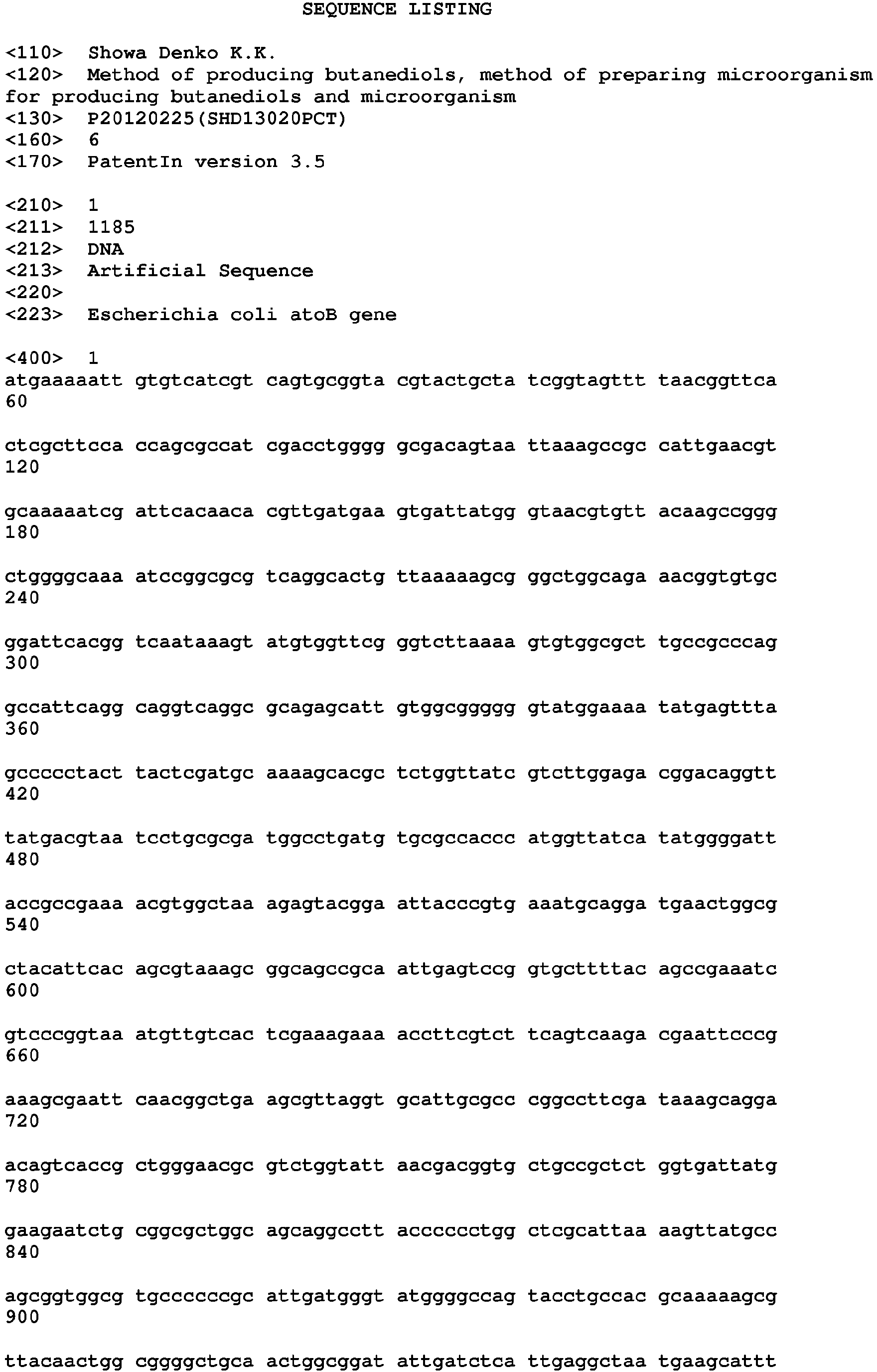


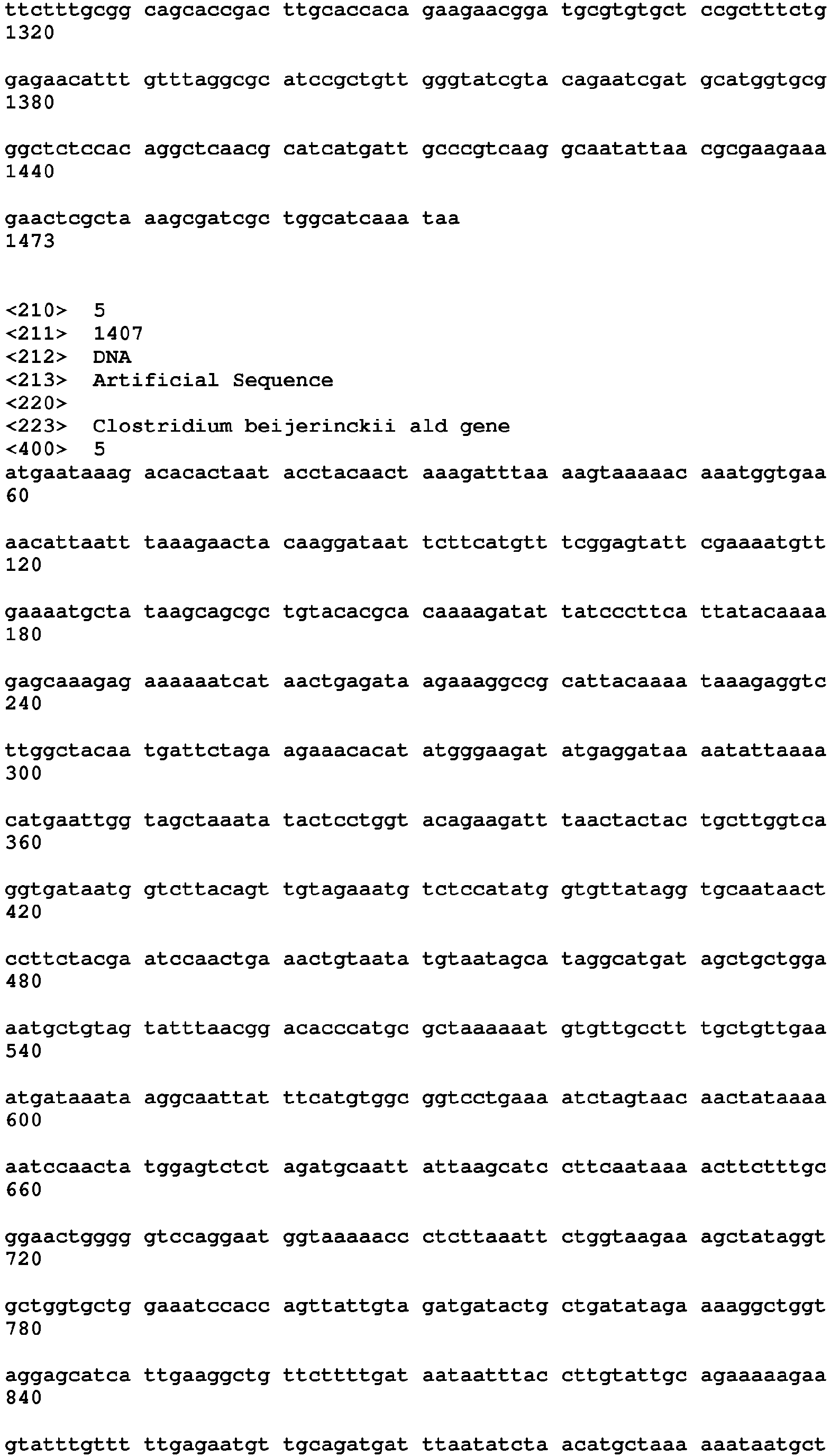


Claims (12)
- A method of manufacturing a butanediol through 3-hydroxybutyryl-CoA that uses a microbe and/or a culture thereof and utilizes an enzyme reaction that is caused by an acyl-CoA reductase, wherein the microbe in the manufacturing method for a butanediol is characterized in that an activity of an acyl-CoA hydratase (EC number: 3. 1. 2. -) is deleted or reduced.
- The manufacturing method for a butanediol as claimed in claim 1, wherein the acyl-CoA hydratase is an acyl-CoA hydratase classified into EC number: 3. 1. 2. 2 or EC number: 3. 1. 2. 20.
- The manufacturing method for a butanediol as claimed in claim 1, wherein the microbe includes a gene that codes β-ketothiolase (EC number: 2. 3. 1. 9), a gene that codes 3-hydroxybutyryl-CoA dehydrogenase (EC number: 1. 1. 1. 35), and a gene that codes acyl-CoA reductase (EC number: 1. 2. 1. 10).
- The manufacturing method for a butanediol as claimed in claim 3, wherein the microbe further includes a gene that codes enoyl-CoA hydratase (EC number: 4. 2. 1. 17), a gene that codes vinylacetyl-CoA delta-isomerase (EC number: 5. 3. 3. 3), and a gene that codes 4-hydroxybutyryl-CoA dehydratase (EC number: 4. 2. 1. 120).
- The manufacturing method for a butanediol as claimed in claim 1, wherein the microbe is Escherichia coli, a yeast, a coryneform bacteria, or a clostridial bacteria.
- The manufacturing method for a butanediol as claimed in claim 5, wherein the microbe is Escherichia coli with deleted CDS region of acyl-CoA thioesterase II gene (tesB).
- A fabrication method for a microbe for manufacturing a butanediol, characterized by including a process for deleting or reducing an activity of an acyl-CoA hydratase (EC number: 3. 1. 2. -) of a microbe.
- The fabrication method for a microbe for manufacturing a butanediol as claimed in claim 7, wherein the acyl-CoA hydratase is an acyl-CoA hydratase classified into EC number: 3. 1. 2. 2 or EC number: 3. 1. 2. 20.
- A microbe that includes a gene that codes β-ketothiolase (EC number: 2. 3. 1. 9), a gene that codes 3-hydroxybutyryl-CoA dehydrogenase (EC number: 1. 1. 1. 35), and a gene that codes acyl-CoA reductase (EC number: 1. 2. 1. 10) and a deleted or reduced activity of an acyl-CoA hydratase (EC number: 3. 1. 2. -).
- The microbe as claimed in claim 9, wherein the acyl-CoA hydratase is an acyl-CoA hydratase classified into EC number: 3. 1. 2. 2 or EC number: 3. 1. 2. 20.
- The microbe as claimed in claim 9, further including a gene that codes enoyl-CoA hydratase (EC number: 4. 2. 1. 17), a gene that codes vinylacetyl-CoA delta-isomerase (EC number: 5. 3. 3. 3), and a gene that codes 4-hydroxybutyryl-CoA dehydratase (EC number: 4. 2. 1. 120).
- The microbe as claimed in any of claim 9, wherein the microbe is Escherichia coli, a yeast, a coryneform bacteria, or a clostridial bacteria.
Applications Claiming Priority (2)
| Application Number | Priority Date | Filing Date | Title |
|---|---|---|---|
| JP2012271519 | 2012-12-12 | ||
| PCT/JP2013/082634 WO2014091991A1 (en) | 2012-12-12 | 2013-12-04 | Method for manufacturing butanediols, method for production of microorganisms for manufacturing butanediols, and microorganisms |
Publications (2)
| Publication Number | Publication Date |
|---|---|
| EP2933339A1 true EP2933339A1 (en) | 2015-10-21 |
| EP2933339A4 EP2933339A4 (en) | 2016-06-22 |
Family
ID=50934283
Family Applications (1)
| Application Number | Title | Priority Date | Filing Date |
|---|---|---|---|
| EP13861721.2A Withdrawn EP2933339A4 (en) | 2012-12-12 | 2013-12-04 | PROCESS FOR THE PRODUCTION OF BUTANEDIOLS, PROCESS FOR THE PRODUCTION OF MICROORGANISMS FOR THE MANUFACTURE OF BUTANEDIOLS, AND MICROORGANISMS |
Country Status (5)
| Country | Link |
|---|---|
| US (1) | US20150307905A1 (en) |
| EP (1) | EP2933339A4 (en) |
| JP (1) | JPWO2014091991A1 (en) |
| CN (1) | CN104838008A (en) |
| WO (1) | WO2014091991A1 (en) |
Families Citing this family (1)
| Publication number | Priority date | Publication date | Assignee | Title |
|---|---|---|---|---|
| JP7475598B2 (en) * | 2020-03-04 | 2024-04-30 | 大阪瓦斯株式会社 | Method for producing 1,3-butanediol |
Family Cites Families (6)
| Publication number | Priority date | Publication date | Assignee | Title |
|---|---|---|---|---|
| JP4380704B2 (en) | 2005-04-22 | 2009-12-09 | 三菱化学株式会社 | Biomass resource-derived polyester and method for producing the same |
| EP1752532A1 (en) * | 2005-08-09 | 2007-02-14 | Helmholtz-Zentrum für Infektionsforschung GmbH | Extracellular polyhydroxyalkanoates produced by genetically engineered microorganisms |
| JP4554585B2 (en) | 2006-11-08 | 2010-09-29 | 林田工業株式会社 | Starter mounting jig for engine test operation |
| BRPI1010581A2 (en) * | 2009-06-04 | 2016-11-08 | Genomatica Inc | microorganisms for the production of 1,4-butanediol and related methods |
| CN102753698A (en) * | 2009-12-10 | 2012-10-24 | 基因组股份公司 | Process and organism for conversion of synthesis gas or other gaseous carbon source and methanol to 1,3-butanediol |
| MY195138A (en) * | 2012-10-15 | 2023-01-11 | Genomatica Inc | Microorganisms and Methods for Production of Specific Length Fatty Alcohols and Related Compounds |
-
2013
- 2013-12-04 US US14/443,406 patent/US20150307905A1/en not_active Abandoned
- 2013-12-04 EP EP13861721.2A patent/EP2933339A4/en not_active Withdrawn
- 2013-12-04 WO PCT/JP2013/082634 patent/WO2014091991A1/en not_active Ceased
- 2013-12-04 CN CN201380064005.4A patent/CN104838008A/en active Pending
- 2013-12-04 JP JP2014552007A patent/JPWO2014091991A1/en active Pending
Also Published As
| Publication number | Publication date |
|---|---|
| CN104838008A (en) | 2015-08-12 |
| US20150307905A1 (en) | 2015-10-29 |
| WO2014091991A1 (en) | 2014-06-19 |
| EP2933339A4 (en) | 2016-06-22 |
| JPWO2014091991A1 (en) | 2017-01-12 |
Similar Documents
| Publication | Publication Date | Title |
|---|---|---|
| CN104284974B (en) | Recombinant host cells for the production of malonate | |
| US8524472B2 (en) | Method for producing 2-butanol and recombinant microorganism having 2-butanol production capacity | |
| US20190040417A1 (en) | Biological fermentation using dihydroxyacetone as a source of carbon | |
| RU2699516C2 (en) | Novel lysine decarboxylase and method of producing cadaverine using thereof | |
| JP2022140514A (en) | Aldehyde production method | |
| US20150252390A1 (en) | Manufacturing method for a butanediol | |
| US20150353962A1 (en) | Method of manufacturing 1,4-butanediol and microbe | |
| US9677096B2 (en) | Manufacturing method for 1,4-butanediol, microbe, and gene | |
| JP6054872B2 (en) | Method for producing organic acid using CoA transferase | |
| EP2924122B1 (en) | 1,4-butanediol manufacturing method and microorganism | |
| US20150307905A1 (en) | Manufacturing method for a butanediol, fabrication method for a microbe for manufacturing a butanediol, and microbe | |
| EP2927325A1 (en) | Method for producing 1,4-butanediol, and microorganism | |
| EP2899273A1 (en) | Gene, microorganism, conversion method, and production method | |
| Luo et al. | Metabolic engineering of Escherichia coli | |
| BR112017013748B1 (en) | PROCESS FOR PRODUCTION OF DIAMINE, METHOD FOR PRODUCING A POLYMER AND GENETICALLY MODIFIED MICRO-ORGANISM |
Legal Events
| Date | Code | Title | Description |
|---|---|---|---|
| PUAI | Public reference made under article 153(3) epc to a published international application that has entered the european phase |
Free format text: ORIGINAL CODE: 0009012 |
|
| 17P | Request for examination filed |
Effective date: 20150630 |
|
| AK | Designated contracting states |
Kind code of ref document: A1 Designated state(s): AL AT BE BG CH CY CZ DE DK EE ES FI FR GB GR HR HU IE IS IT LI LT LU LV MC MK MT NL NO PL PT RO RS SE SI SK SM TR |
|
| AX | Request for extension of the european patent |
Extension state: BA ME |
|
| DAX | Request for extension of the european patent (deleted) | ||
| A4 | Supplementary search report drawn up and despatched |
Effective date: 20160523 |
|
| RIC1 | Information provided on ipc code assigned before grant |
Ipc: C12N 1/21 20060101ALI20160517BHEP Ipc: C12N 9/04 20060101ALN20160517BHEP Ipc: C12P 7/18 20060101AFI20160517BHEP Ipc: C12N 1/19 20060101ALI20160517BHEP |
|
| STAA | Information on the status of an ep patent application or granted ep patent |
Free format text: STATUS: REQUEST FOR EXAMINATION WAS MADE |
|
| STAA | Information on the status of an ep patent application or granted ep patent |
Free format text: STATUS: THE APPLICATION IS DEEMED TO BE WITHDRAWN |
|
| 18D | Application deemed to be withdrawn |
Effective date: 20161220 |