EP2930166B1 - Method for preparing 3-aminomethyl-3,5,5-trimethyl cyclohexylamine - Google Patents
Method for preparing 3-aminomethyl-3,5,5-trimethyl cyclohexylamine Download PDFInfo
- Publication number
- EP2930166B1 EP2930166B1 EP12889458.1A EP12889458A EP2930166B1 EP 2930166 B1 EP2930166 B1 EP 2930166B1 EP 12889458 A EP12889458 A EP 12889458A EP 2930166 B1 EP2930166 B1 EP 2930166B1
- Authority
- EP
- European Patent Office
- Prior art keywords
- primary amine
- ipda
- ipn
- pressure
- amines
- Prior art date
- Legal status (The legal status is an assumption and is not a legal conclusion. Google has not performed a legal analysis and makes no representation as to the accuracy of the status listed.)
- Active
Links
Images

Classifications
-
- C—CHEMISTRY; METALLURGY
- C07—ORGANIC CHEMISTRY
- C07C—ACYCLIC OR CARBOCYCLIC COMPOUNDS
- C07C253/00—Preparation of carboxylic acid nitriles
- C07C253/30—Preparation of carboxylic acid nitriles by reactions not involving the formation of cyano groups
-
- C—CHEMISTRY; METALLURGY
- C07—ORGANIC CHEMISTRY
- C07C—ACYCLIC OR CARBOCYCLIC COMPOUNDS
- C07C209/00—Preparation of compounds containing amino groups bound to a carbon skeleton
- C07C209/44—Preparation of compounds containing amino groups bound to a carbon skeleton by reduction of carboxylic acids or esters thereof in presence of ammonia or amines, or by reduction of nitriles, carboxylic acid amides, imines or imino-ethers
- C07C209/48—Preparation of compounds containing amino groups bound to a carbon skeleton by reduction of carboxylic acids or esters thereof in presence of ammonia or amines, or by reduction of nitriles, carboxylic acid amides, imines or imino-ethers by reduction of nitriles
-
- C—CHEMISTRY; METALLURGY
- C07—ORGANIC CHEMISTRY
- C07C—ACYCLIC OR CARBOCYCLIC COMPOUNDS
- C07C209/00—Preparation of compounds containing amino groups bound to a carbon skeleton
- C07C209/44—Preparation of compounds containing amino groups bound to a carbon skeleton by reduction of carboxylic acids or esters thereof in presence of ammonia or amines, or by reduction of nitriles, carboxylic acid amides, imines or imino-ethers
- C07C209/52—Preparation of compounds containing amino groups bound to a carbon skeleton by reduction of carboxylic acids or esters thereof in presence of ammonia or amines, or by reduction of nitriles, carboxylic acid amides, imines or imino-ethers by reduction of imines or imino-ethers
-
- C—CHEMISTRY; METALLURGY
- C07—ORGANIC CHEMISTRY
- C07C—ACYCLIC OR CARBOCYCLIC COMPOUNDS
- C07C211/00—Compounds containing amino groups bound to a carbon skeleton
- C07C211/33—Compounds containing amino groups bound to a carbon skeleton having amino groups bound to carbon atoms of rings other than six-membered aromatic rings
- C07C211/34—Compounds containing amino groups bound to a carbon skeleton having amino groups bound to carbon atoms of rings other than six-membered aromatic rings of a saturated carbon skeleton
- C07C211/35—Compounds containing amino groups bound to a carbon skeleton having amino groups bound to carbon atoms of rings other than six-membered aromatic rings of a saturated carbon skeleton containing only non-condensed rings
-
- C—CHEMISTRY; METALLURGY
- C07—ORGANIC CHEMISTRY
- C07C—ACYCLIC OR CARBOCYCLIC COMPOUNDS
- C07C2601/00—Systems containing only non-condensed rings
- C07C2601/12—Systems containing only non-condensed rings with a six-membered ring
- C07C2601/14—The ring being saturated
Definitions
- the present invention relates to a method for preparing an aliphatic amine, and particularly relates to a method for preparing 3-aminomethyl-3,5,5-trimethyl cyclohexylamine from 3-cyano-3,5,5-trimethyl cyclohexanone.
- 3-Aminomethyl-3,5,5-trimethyl cyclohexylamine (also known as isophorone diamine (IPDA)) is a raw material for preparing 3-isocyanatomethylene-3,5,5-trimethylcyclohexyl isocyanate (also known as isophorone di-isocyanate (IPDI)), polyamide and the like, it can also be used as a curing agent for epoxy resin.
- IPDA isophorone diamine
- IPDI isophorone di-isocyanate
- IPDA is achieved as follows: reacting 3-cyano-3,5,5-trimethyl cyclohexanone (also known as isophorone nitrile, IPN) with ammonia to form 3-cyano-3,5,5-trimethyl cyclohexylimine (also known as isophorone imine, IPNI), and conducting a reductive amination reaction between IPNI and hydrogen in the presence of ammonia in a catalytic manner.
- IPN isophorone nitrile
- IPNI 3-cyano-3,5,5-trimethyl cyclohexylimine
- IPNI isophorone imine
- US3,352,913 discloses a method for preparing IPDA in which IPN reacts with ammonia and hydrogen under the action of Group VIII metal supported catalysts.
- the mole ratio of ammonia to IPN (hereinafter referred to as cyanamide ratio) is from 10 to 30, the reaction temperature is from 70°C to 130°C, and hydrogen pressure is 150 atm.
- cyanamide ratio the mole ratio of ammonia to IPN
- the reaction temperature is from 70°C to 130°C
- hydrogen pressure is 150 atm.
- a part of the unreacted IPN is also hydrogenated and formed 3-amino-3,5,5-trimethyl-cyclohexanol (IPAA) which is hardly separated from IPDA.
- the yield of this method is only 80%.
- CN101568516A discloses a method for preparing IPDA, after the imidization of IPN, the feed stream containing IPNI is reacted with hydrogen and ammonia in the presence of a hydrogenation catalyst.
- This method is characterized in that, after a portion of IPNI has been reacted, the reaction mixture is contacted with a basic compound other than ammonia and/or a basic catalyst to increase the alkalinity of the reaction mixture during the reaction.
- This method controls the occurrence of direct hydrogenation of unreacted IPN by adjusting the IPNI feed stream to be alkalinity during the reaction.
- the further addition of base will exacerbate the detaching of cyano group in IPN, generating CN - and 3,5,5-trimethyl-2-cyclohexenone.
- CN - may affect the activity of hydrogenation catalyst and shorten its life.
- the hydrogenation of 3,5,5-trimethyl-2-cyclohexenone will produce a by-product of 3,5,5-trimethyl-cyclohexanol with an undesired yield of IPDA.
- EP0394968 A1 discloses an amination of carbonyls, wherein organic compounds containing at least one carbonyl group are reductively aminated to minimize the formation of hydroxylated side product by the use of at least one of (i) an amination promoter, (ii) water removal, (iii) lower hydrogen partial pressure during the formation of an imine or enamine intermediate or (iv) primary or secondary amine reactant to form an imine or enamine intermediate.
- the objective of the present invention is to provide a novel method for preparing 3-aminomethyl-3,5,5-trimethyl cyclohexylamine (IPDA). Said method can effectively avoid the generation of the above two by-products, namely 3,5,5-trimethyl-cyclohexanol and IPAA, and then improves the yield of IPDA.
- IPDA 3-aminomethyl-3,5,5-trimethyl cyclohexylamine
- reaction route of the present invention is shown as following:
- the primary amine in step a) can be any type of primary amines, for example, it can be a fatty amine or an aromatic amine else.
- the hydrocarbonyl primary amine can be separated from IPDA and does not render side reaction with the reactants or products, it can be used in the present invention. It can be selected from, for instance, alkyl amines, cycloalkyl amines, aryl amines, arylalkyl and amines.
- the primary amine can be a mono-amine or a multi-amine else, such as a diamine.
- a primary amine can be selected from C 1-30 alkyl amines, C 3-30 cycloalkyl amines, C 6-30 aryl amines, and C 7-30 arylalkyl amines; preferably selected from C 1-10 alkyl amines, C 3-10 cycloalkyl amines, C 6-10 aryl amines, and C 7-10 arylalkyl amines.
- a primary amine can be methylamine, ethylamine, propylamine, butylamine, ethylenediamine, propylenediamine, butanediamine, pentanediamine, hexamethylenediamine, cyclopropane amine, cyclopentane amine, cyclohexane amine, aniline and benzyl amine.
- the most preferred primary amines are those being easily separated from IPDA and having low boiling points, such as methylamine, ethylamine, propylamine, butylamine, ethylenediamine, propylenediamine, butanediamine, hexamethylenediamine, and aniline.
- the primary amines having their boiling points between 110°C and 235°C are preferred.
- IPDA which does not require a separation is used, that is, the target product itself acts as a primary amine.
- the imidization reaction of IPN with the primary amine in step a) is carried out between 20°C and 150°C, preferably between 40°C and 120°C, more preferably between 50°C and 80°C.
- the imidization reaction of IPN with the primary amine in step a) can be performed under the atmospheric pressure or a reduced pressure.
- the reaction is performed under a reduced pressure.
- the reaction pressure can be 100 kPa or less, preferably 50 kPa or less, more preferably 20 kPa or less.
- the primary amine in step a) is excess, so that IPN reacts as completely as possible.
- the mole ratio of the total amino groups (-NH 2 ) in the primary amine to IPN is in the range of 1-20, preferably in the range of 1-10, more preferably in the range of 2-8.
- the excess primary amine is advantageous for the reaction, but the cost of the primary amine's recovery increases if the ratio of the primary amine is too high.
- the method used in step a) for separating water from the reaction mixture can be any known suitable method, such as adsorption, extraction, distillation, or the like.
- distillation particularly the method of distillation under a reduced pressure
- a reduced pressure is used to dehydrate.
- primary amines having their boiling points higher than that of water (100°C under a standard atmospheric pressure) should be chosen, and those having their boiling points equal to 110°C or higher are preferred.
- the boiling point of a primary amine is 235°C or less, so that it is easy to be separated from IPDA.
- the water content of the product obtained in step a) should be as low as possible, thereby facilitating the equilibrium of the imidization reaction to continuously move towards the direction of the imine products. But considering the efficiency and cost of the reaction, the water content of the resulting product should be 300 ppm or less, preferably 200 ppm or less, more preferably 100 ppm or less.
- the reaction and the separation apparatus used in step a) can be any suitable conventional apparatus, which can be selected and assembled in accordance with the practical requirements.
- they can be selected from a reactor and a fixed bed with water-absorbing agents, or a reactor and a fixed bed with a distillation/rectification device.
- a reactor apparatus with a distillation/rectification device is preferred.
- the ammonolysis catalyst used in step b) can be an acid metal oxide selected from, for example ⁇ -alumina, titania, zirconia, silica, and zeolite. ⁇ -Alumina is preferred.
- the mole ratio of said liquid ammonia to IPN used as a raw material in step a) is 5-200, preferably 10-100, more preferably 15-30.
- step b) is carried out at the temperature of 20-200°C and under the pressure of 10-30 MPa, preferably at the temperature of 50-150°C and under the pressure of 10-20 MPa, more preferably at the temperature of 80-120°C and under the pressure of 10-15 MPa.
- step b) can be carried out in a tank reactor or in a fixed bed reactor else, preferably in a fixed bed reactor.
- reactors are well-known to the person skilled in the art, so it will not go into further details herein.
- the hydrogenation catalyst in step c) can be any conventional hydrogenation catalyst, for example, a supported catalyst, such as Co/Al 2 O 3 , a Raney metal catalyst, such as Raney cobalt or Raney nickel. Raney nickel and Raney cobalt are preferred. Raney nickel is more preferred.
- the reaction conditions of step c) can be conventional conditions of performing the reductive amination reaction. Specifically, it can be performed at the temperature of 100-200°C and under the pressure of 10-30 MPa, preferably at the temperature of 100-150°C and under the pressure of 10-20 MPa, more preferably at the temperature of 120-150°C and under the pressure of 10-15 MPa.
- step c) can be carried out in any conventional rector, for example, a tank reactor, a fixed bed reactor, a fluidized bed reactor. It is preferably to perform in a tank reactor and a fixed bed reactor, more preferably in a fixed bed reactor. It will not go into further details herein.
- the mole ratio of hydrogen to IPNI is 10-100, preferably 20-80, more preferably 30-50.
- step a) When the primary amine used in step a) is IPDA, at least a portion of the final resulting IPDA is returned to step a) and acts as the primary amine to perform imidization reaction with IPN.
- the method according to the present invention further comprises step d): separating the primary amine from IPDA in the product obtained in step c) by rectification, wherein the primary amine is returned to step a) for recycling use.
- the primary amine is used to perform the imidization reaction, thereby facilitating the equilibrium of the imidization reaction to continuously move towards the direction of the imine products simply by dehydrating, so that IPN is substantially converted into an imine compound.
- the method according to the present invention avoids the cyano group of unreacted IPN being detached under the basic conditions and thereby forming 3,5,5-trimethyl-2-cyclohexenone which is further hydrogenated to 3,3,5-trimethyl-cyclohexanol, and avoids unreacted IPN being directly hydrogenated to IPAA, thus the yield is increased significantly.
- the method also avoids the trouble of separating the alcohol-type by-products from IPDA.
- the primary amine can be easily separated from IPDA after the reaction and can be substantially recovered and recycled. Particularly, as to the best embodiment in which IPDA is used as the primary amine, the operation is easier.
- Figure 1 is a schematic of the reaction system used in the method, according to an embodiment of the present invention.
- the present invention provides a novel method for preparing IPDA from IPN.
- the method of the present invention uses the primary amine and IPN to react and form corresponding imine compounds. Since the primary amine is used, water generated in the reaction can be easily removed from the reaction mixture, thereby facilitating the equilibrium of the imidization reaction to continuously move towards the direction of the imine products, and finally, IPN is substantially converted into the imine compound. Afterwards, the resulting imine products are converted into IPNI by using liquid amines, and IPDA is achieved by reductive amination.
- FIG. 1 is a schematic of the reaction system used in the method, according to an embodiment of the present invention.
- IPN and excess ammonia (1) enter reactive rectification column (2) and react, while water and the reaction mixture are separated in the rectification column.
- Water (4) is withdrawn from the top of the column, and dehydrated product (3) is drained out from the bottom of the column.
- Dehydrated product (3) mainly contains said imine compounds, unreacted primary imines and trace of water.
- the water content in dehydrated product (3) should be as low as possible, for example, 300 ppm or less, preferably 200 ppm or less, more preferably 100 ppm or less.
- step (b) dehydrated product (3) and liquid ammonia (5) together enter into an ammonolysis reactor (6) with the ammonolysis catalyst to prepare IPNI.
- the reactor can be a tank reactor, but preferably a fixed bed reactor.
- the mixture (7) containing IPNI and the primary amine which is used as the raw material in step (a) is obtained via reactions.
- step (c) the mixture (7) obtained in step (b) and hydrogen (8) together enter into the hydrogenation reactor (9) and undergo a hydrogenation reaction with obtaining IPDA mother liquid (10).
- the reaction conditions identical to conventional hydrogenation reaction of IPNI are used.
- Hydrogenation catalyst is preferably selected from Raney nickel or Raney cobalt, and Raney nickel is more preferably.
- a fixed bed reactor is used as the reactor, meanwhile, the mole ratio of hydrogen to IPNI is 10-100, preferably 20-80, more preferably 30-50.
- IPDA mother liquid (10) can be treated with any conventional separation/purification to obtain IPDA.
- IPDA and the primary amine can be separated by the rectification apparatus (not shown in Figure 1 ).
- IPNI (7) IPDN mother liquid (10) is performed on Aglient-7980 Gas Chromatography.
- the gas chromatography analysis conditions are as follows:
- This example is carried out using the reactor apparatus as shown in figure 1 .
- Reactive rectification column (2) has an inner diameter of 40 mm, a length of 1000 mm, ⁇ ring packing of 2 mm is installed inside, and a feeding port is located in the middle of the reactive rectification column.
- Reactor (6) has a length of 200 mm, an inner diameter of 25 mm, and ⁇ -alumina beads with 1 mm in diameter mounted in the reactor.
- Reactor (9) has a length of 400 mm, an inner diameter of 25 mm, and G62RS hydrogenation catalyst (from Süd-Chemie, Germany) with 1 mm in diameter mounted in the reactor.
- Step 1 from the middle of reactive rectification column (2), IPN of 165 g/h and IPDA of 510 g/h enter into the reactive rectification column which is controlled at 50 kPa via a vacuum pump, wherein the reactor temperature is about 200°C, and the temperature of the top of the column is about 81°C.
- Step 2 the product from the bottom of the rectification column and liquid ammonia enter into reactor (6) via a high pressure pump for ammonolysis reaction, wherein the feeding rate of liquid ammonia is 425 g/h, the reaction temperature is controlled at 100 ° C, and pressure is controlled at 15 MPa.
- Step 3 the product of ammonolysis is mixed with hydrogen and then entered into reactor (9) for a hydrogenation reaction, wherein the temperature of reactor (6) is controlled at 100 ° C, and in the reactor (9) the temperature is controlled at 140°C, the pressure is controlled at 15 MPa, and the hydrogen feeding rate is 100 NL/h.
- sample (3) taken from the bottom of the reactive rectification column (2) shows that the water content thereof is about 150 ppm;
- IPAA and 3,3,5-trimethyl-cyclohexanol are not detected, which belong to the main by-products in the conventional methods.
- Examples 2-4 are carried out according to the method identical to that of Example 1, except that the IPDA which is used as a primary amine in the first step is replaced by ethylene diamine, hexamethylene diamine and aniline, respectively.
- IPAA and 3,3,5-trimethyl-cyclohexanol are not detected, which belong to the main by-products in the conventional methods.
- Examples 5-7 are carried out according to the method identical to that of Example 1, except that ⁇ -alumina which is used as an ammonolysis catalyst in the second step is replaced by commercial available 1mm titania beads, silica beads, and ion exchange resin (Nankai University, D72).
- IPAA and 3,3,5-trimethyl-cyclohexanol are not detected, which belong to the main by-products in the conventional methods.
- Examples 8-10 are carried out according to the method identical to that of Example 1, except that Sud-Chemie G62RS (Germany) which is used as a hydrogenation catalyst in the third step is replaced by Raney nickel (cat-1600) supplied by Catalloy company, and Raney cobalt (GRACE-2800) and Süd-Chemie G67RS (Germany), respectively.
- Sud-Chemie G62RS Germany
- Raney nickel cat-1600 supplied by Catalloy company
- Raney cobalt GRACE-2800
- Süd-Chemie G67RS Germany
- IPAA and 3,3,5-trimethyl-cyclohexanol are not detected, which belong to the main by-products in the conventional methods.
- Examples 11-13 are carried out according to the method identical to that of Example 1, except that the reaction pressures in the second and the third steps are adjusted to 10 MPa, 12 MPa, 13 MPa, and all other conditions are the same as those in Example 1.
- IPAA and 3,3,5-trimethyl-cyclohexanol are not detected, which belong to the main by-products in the conventional methods.
- Examples 14-16 are carried out according to the method identical to that of Example 1, except that IPDA which is used as a primary amine in the first step is replaced by ethylene diamine with a feeding rate of 90 g/h, 150 g/h and 240 g/h, respectively.
- IPAA and 3,3,5-trimethyl-cyclohexanol are not detected, which belong to the main by-products in the conventional methods.
- Examples 17-19 are carried out according to the method identical to that of Example 1, except that IPDA which is used as a primary amine in the first step is replaced by ethylene diamine with the feeding rate of liquid ammonia of 255 g/h, 340 g/h and 510 g/h, respectively.
- IPAA and 3,3,5-trimethyl-cyclohexanol are not detected, which belong to the main by-products in the conventional methods.
- the product yield can be increased significantly and can substantially reach 98% by using the method of the present invention to prepare IPDA. Moreover, this method avoids the generation of by-products IPAA and 3,3,5-trimethyl-cyclohexanol, which eliminates the trouble of separating these alcohol-type by-products and IPDA which are quite difficult to be separated during the purification of products.
Landscapes
- Chemical & Material Sciences (AREA)
- Organic Chemistry (AREA)
- Chemical Kinetics & Catalysis (AREA)
- Organic Low-Molecular-Weight Compounds And Preparation Thereof (AREA)
- Low-Molecular Organic Synthesis Reactions Using Catalysts (AREA)
Description
- The present invention relates to a method for preparing an aliphatic amine, and particularly relates to a method for preparing 3-aminomethyl-3,5,5-trimethyl cyclohexylamine from 3-cyano-3,5,5-trimethyl cyclohexanone.
- 3-Aminomethyl-3,5,5-trimethyl cyclohexylamine (also known as isophorone diamine (IPDA)) is a raw material for preparing 3-isocyanatomethylene-3,5,5-trimethylcyclohexyl isocyanate (also known as isophorone di-isocyanate (IPDI)), polyamide and the like, it can also be used as a curing agent for epoxy resin.
On an industrial scale, IPDA is achieved as follows: reacting 3-cyano-3,5,5-trimethyl cyclohexanone (also known as isophorone nitrile, IPN) with ammonia to form 3-cyano-3,5,5-trimethyl cyclohexylimine (also known as isophorone imine, IPNI), and conducting a reductive amination reaction between IPNI and hydrogen in the presence of ammonia in a catalytic manner. The reaction process thereof is as following:
-
US3,352,913 discloses a method for preparing IPDA in which IPN reacts with ammonia and hydrogen under the action of Group VIII metal supported catalysts. In this method, the mole ratio of ammonia to IPN (hereinafter referred to as cyanamide ratio) is from 10 to 30, the reaction temperature is from 70°C to 130°C, and hydrogen pressure is 150 atm. Because the reaction of IPN with ammonia resulting in IPNI is a reversible reaction and IPN cannot be totally converted into IPNI, a part of the unreacted IPN is also hydrogenated and formed 3-amino-3,5,5-trimethyl-cyclohexanol (IPAA) which is hardly separated from IPDA. The yield of this method is only 80%. -
CN101568516A discloses a method for preparing IPDA, after the imidization of IPN, the feed stream containing IPNI is reacted with hydrogen and ammonia in the presence of a hydrogenation catalyst. This method is characterized in that, after a portion of IPNI has been reacted, the reaction mixture is contacted with a basic compound other than ammonia and/or a basic catalyst to increase the alkalinity of the reaction mixture during the reaction. This method controls the occurrence of direct hydrogenation of unreacted IPN by adjusting the IPNI feed stream to be alkalinity during the reaction. However, the further addition of base will exacerbate the detaching of cyano group in IPN, generating CN- and 3,5,5-trimethyl-2-cyclohexenone. CN- may affect the activity of hydrogenation catalyst and shorten its life. The hydrogenation of 3,5,5-trimethyl-2-cyclohexenone will produce a by-product of 3,5,5-trimethyl-cyclohexanol with an undesired yield of IPDA. - At present, there are defects in all industrial methods for preparing IPDA:
- 1) As the reaction of IPN with excess ammonia generating IPNI is a reversible reaction, IPN cannot be completely converted into IPNI, which results in a portion of IPN entering into the hydrogenation reaction system and being directly hydrogenated into IPAA.
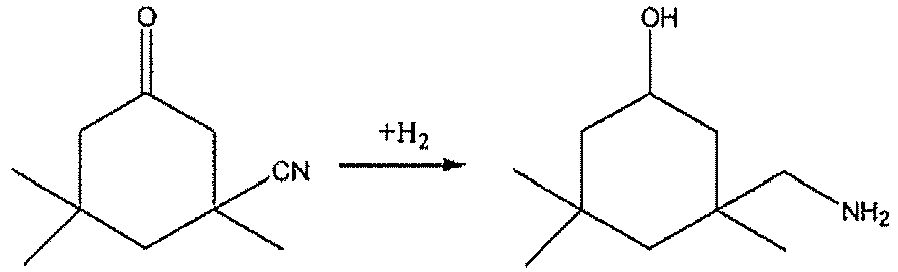
- 2) Under the basic conditions, the cyano group of IPN is extremely unstable and very easy to be detached and forms 3,5,5-trimethyl-2-cyclohexenone, while 3,5,5-trimethyl-2-cyclohexanol, which is the product of hydrogenation of 3,5,5-trimethyl-2-cyclohexenone, is an undesired product. Moreover, because the process of decyanation reaction may produce free CN-, this may lead to a decrease in the activity of hydrogenation catalyst.
- In the conventional preparation methods, the reaction of IPN with excess ammonia generates IPNI and water, while the generated water binds to the remaining ammonia which makes the reaction system show alkalinity, thus the decyanation reaction of IPN is unavoidable.

- Although the method disclosed in
CN101568516A lowers the yield ratio of IPAA by increasing
the alkalinity of IPNI reaction liquid, the addition of extra base exacerbates the decyanation reaction of IPN.EP0394968 A1 discloses an amination of carbonyls, wherein organic compounds containing at least one carbonyl group are reductively aminated to minimize the formation of hydroxylated side product by the use of at least one of (i) an amination promoter, (ii) water removal, (iii) lower hydrogen partial pressure during the formation of an imine or enamine intermediate or (iv) primary or secondary amine reactant to form an imine or enamine intermediate. - The objective of the present invention is to provide a novel method for preparing 3-aminomethyl-3,5,5-trimethyl cyclohexylamine (IPDA). Said method can effectively avoid the generation of the above two by-products, namely 3,5,5-trimethyl-cyclohexanol and IPAA, and then improves the yield of IPDA.
- The method for preparing 3-aminomethyl-3,5,5-trimethyl cyclohexylamine (IPDA) of the present invention comprises the following steps:
- a) reacting IPN with excess primary amine as well as removing generated water, so that IPN is substantially converted into imine compounds; b) in the presence of an ammonolysis catalyst, mixing the product of step a) with liquid ammonia, making the imine compounds perform ammonolysis reaction to generate IPNI and the primary amine; and c) in the presence of hydrogen and the hydrogenation catalyst, hydrogenating the obtained IPNI in step b) to obtain IPDA.
- The reaction route of the present invention is shown as following:

- According to an embodiment of the present invention, the primary amine in step a) can be any type of primary amines, for example, it can be a fatty amine or an aromatic amine else. According to an embodiment, as long as the hydrocarbonyl primary amine can be separated from IPDA and does not render side reaction with the reactants or products, it can be used in the present invention. It can be selected from, for instance, alkyl amines, cycloalkyl amines, aryl amines, arylalkyl
and amines. The primary amine can be a mono-amine or a multi-amine else, such as a diamine. Specifically, a primary amine can be selected from C1-30 alkyl amines, C3-30 cycloalkyl amines, C6-30 aryl amines, and C7-30 arylalkyl amines; preferably selected from C1-10 alkyl amines, C3-10 cycloalkyl amines, C6-10 aryl amines, and C7-10 arylalkyl amines. More specifically, a primary amine can be methylamine, ethylamine, propylamine, butylamine, ethylenediamine, propylenediamine, butanediamine, pentanediamine, hexamethylenediamine, cyclopropane amine, cyclopentane amine, cyclohexane amine, aniline and benzyl amine. The most preferred primary amines are those being easily separated from IPDA and having low boiling points, such as methylamine, ethylamine, propylamine, butylamine, ethylenediamine, propylenediamine, butanediamine, hexamethylenediamine, and aniline. - According to a more preferred embodiment of the present invention, the primary amines having their boiling points between 110°C and 235°C are preferred. In another embodiment of the present invention, which is also the most preferred embodiment, IPDA which does not require a separation is used, that is, the target product itself acts as a primary amine.
- According to an embodiment of the present invention, the imidization reaction of IPN with the primary amine in step a) is carried out between 20°C and 150°C, preferably between 40°C and 120°C, more preferably between 50°C and 80°C.
- According to an embodiment of the present invention, the imidization reaction of IPN with the primary amine in step a) can be performed under the atmospheric pressure or a reduced pressure. Preferably, the reaction is performed under a reduced pressure. The reaction pressure can be 100 kPa or less, preferably 50 kPa or less, more preferably 20 kPa or less.
- According to an embodiment of the present invention, the primary amine in step a) is excess, so that IPN reacts as completely as possible. Specifically, the mole ratio of the total amino groups (-NH2) in the primary amine to IPN is in the range of 1-20, preferably in the range of 1-10, more preferably in the range of 2-8. The excess primary amine is advantageous for the reaction, but the cost of the primary amine's recovery increases if the ratio of the primary amine is too high. According to an embodiment of the present invention, the method used in step a) for separating water from the reaction mixture can be any known suitable method, such as adsorption, extraction, distillation, or the like. Preferably, distillation, particularly the method of distillation under a reduced pressure, is used to dehydrate. The person skilled in the art should understand that, when the method of reduced pressure distillation is used, primary amines having their boiling points higher than that of water (100°C under a standard atmospheric pressure) should be chosen, and those having their boiling points equal to 110°C or higher are preferred. According to a preferred embodiment, the boiling point of a primary amine is 235°C or less, so that it is easy to be separated from IPDA.
- According to a preferred embodiment of the present invention, the water content of the product obtained in step a) should be as low as possible, thereby facilitating the equilibrium of the imidization reaction to continuously move towards the direction of the imine products. But considering the efficiency and cost of the reaction, the water content of the resulting product should be 300 ppm or less, preferably 200 ppm or less, more preferably 100 ppm or less.
- According to a preferred embodiment of the present invention, the reaction and the separation apparatus used in step a) can be any suitable conventional apparatus, which can be selected and assembled in accordance with the practical requirements. For example, they can be selected from a reactor and a fixed bed with water-absorbing agents, or a reactor and a fixed bed with a distillation/rectification device. A reactor apparatus with a distillation/rectification device is preferred. These apparatuses are well-known to the person skilled in the art, so it will not go into further details herein.
- According to an embodiment of the present invention, the ammonolysis catalyst used in step b) can be an acid metal oxide selected from, for example γ-alumina, titania, zirconia, silica, and zeolite. γ-Alumina is preferred.
- It is more advantageous to use more liquid ammonia in step b). According to an embodiment of the present invention, the mole ratio of said liquid ammonia to IPN used as a raw material in step a) is 5-200, preferably 10-100, more preferably 15-30.
- According to an embodiment of the present invention, step b) is carried out at the temperature of 20-200°C and under the pressure of 10-30 MPa, preferably at the temperature of 50-150°C and under the pressure of 10-20 MPa, more preferably at the temperature of 80-120°C and under the pressure of 10-15 MPa.
- According to the method of the present invention, step b) can be carried out in a tank reactor or in a fixed bed reactor else, preferably in a fixed bed reactor. These reactors are well-known to the person skilled in the art, so it will not go into further details herein.
- According to an embodiment of the present invention, the hydrogenation catalyst in step c) can be any conventional hydrogenation catalyst, for example, a supported catalyst, such as Co/Al2O3, a Raney metal catalyst, such as Raney cobalt or Raney nickel. Raney nickel and Raney cobalt are preferred. Raney nickel is more preferred.
- According to an embodiment of the present invention, the reaction conditions of step c) can be conventional conditions of performing the reductive amination reaction. Specifically, it can be performed at the temperature of 100-200°C and under the pressure of 10-30 MPa, preferably at the temperature of 100-150°C and under the pressure of 10-20 MPa, more preferably at the temperature of 120-150°C and under the pressure of 10-15 MPa.
- According to an embodiment of the present invention, step c) can be carried out in any conventional rector, for example, a tank reactor, a fixed bed reactor, a fluidized bed reactor. It is preferably to perform in a tank reactor and a fixed bed reactor, more preferably in a fixed bed reactor. It will not go into further details herein.
- According to a preferred embodiment of the present invention, when a fixed bed is used as a reactor, the mole ratio of hydrogen to IPNI is 10-100, preferably 20-80, more preferably 30-50.
- When the primary amine used in step a) is IPDA, at least a portion of the final resulting IPDA is returned to step a) and acts as the primary amine to perform imidization reaction with IPN.
- When the primary amine used in step a) is not IPDA, the method according to the present invention further comprises step d): separating the primary amine from IPDA in the product obtained in step c) by rectification, wherein the primary amine is returned to step a) for recycling use.
- In the method of the present invention, wherein IPN is used as the raw material to prepare IPDA, the primary amine is used to perform the imidization reaction, thereby facilitating the equilibrium of the imidization reaction to continuously move towards the direction of the imine products simply by dehydrating, so that IPN is substantially converted into an imine compound. On the one hand, the method according to the present invention avoids the cyano group of unreacted IPN being detached under the basic conditions and thereby forming 3,5,5-trimethyl-2-cyclohexenone which is further hydrogenated to 3,3,5-trimethyl-cyclohexanol, and avoids unreacted IPN being directly hydrogenated to IPAA, thus the yield is increased significantly. On the other hand, the method also avoids the trouble of separating the alcohol-type by-products from IPDA. Further, the primary amine can be easily separated from IPDA after the reaction and can be substantially recovered and recycled. Particularly, as to the best embodiment in which IPDA is used as the primary amine, the operation is easier.
-
Figure 1 is a schematic of the reaction system used in the method, according to an embodiment of the present invention. - The present invention is further described by examples with reference to the drawing.
- The present invention provides a novel method for preparing IPDA from IPN. In comparison with the method in the prior art in which ammonia and IPN are reacted to form IPNI, the method of the present invention uses the primary amine and IPN to react and form corresponding imine compounds. Since the primary amine is used, water generated in the reaction can be easily removed from the reaction mixture, thereby facilitating the equilibrium of the imidization reaction to continuously move towards the direction of the imine products, and finally, IPN is substantially converted into the imine compound. Afterwards, the resulting imine products are converted into IPNI by using liquid amines, and IPDA is achieved by reductive amination.
- The method of the present invention is further described as follows with reference to
Figure 1 Figure 1 is a schematic of the reaction system used in the method, according to an embodiment of the present invention. Firstly, in step (a), IPN and excess ammonia (1) enter reactive rectification column (2) and react, while water and the reaction mixture are separated in the rectification column. Water (4) is withdrawn from the top of the column, and dehydrated product (3) is drained out from the bottom of the column. - Dehydrated product (3) mainly contains said imine compounds, unreacted primary imines and trace of water. In order to react IPN completely, the water content in dehydrated product (3) should be as low as possible, for example, 300 ppm or less, preferably 200 ppm or less, more preferably 100 ppm or less.
- Then, in step (b), dehydrated product (3) and liquid ammonia (5) together enter into an ammonolysis reactor (6) with the ammonolysis catalyst to prepare IPNI. The reactor can be a tank reactor, but preferably a fixed bed reactor. The mixture (7) containing IPNI and the primary amine which is used as the raw material in step (a) is obtained via reactions.
- Finally, in step (c), the mixture (7) obtained in step (b) and hydrogen (8) together enter into the hydrogenation reactor (9) and undergo a hydrogenation reaction with obtaining IPDA mother liquid (10). In this step, the reaction conditions identical to conventional hydrogenation reaction of IPNI are used. Hydrogenation catalyst is preferably selected from Raney nickel or Raney cobalt, and Raney nickel is more preferably. Preferably, a fixed bed reactor is used as the reactor, meanwhile, the mole ratio of hydrogen to IPNI is 10-100, preferably 20-80, more preferably 30-50.
- The obtained IPDA mother liquid (10) can be treated with any conventional separation/purification to obtain IPDA. When the primary amine used is other than IPDA, IPDA and the primary amine can be separated by the rectification apparatus (not shown in
Figure 1 ). - The present invention is further illustrated by examples below.
- In the following examples, the quantitative analysis of IPNI (7) and IPDN mother liquid (10) is performed on Aglient-7980 Gas Chromatography. The gas chromatography analysis conditions are as follows:
- Chromatographic Column: Aglient HP-5 (Size: 30m × 0.32mm × 0.25mm)
- Inlet temperature: 280°C
- Split ratio: 30:1
- Column flow: 1.5 ml/min
- Column temperature:
- initial: 100°C
- Heating rate: 15°C/min, increasing to 260°C and maintaining at 260°C for 8 minutes
- Detector temperature: 280°C
- H2 flow: 35 ml/min
- Air flow: 350 ml/min
- This example is carried out using the reactor apparatus as shown in
figure 1 . - Reactive rectification column (2) has an inner diameter of 40 mm, a length of 1000 mm, θ ring packing of 2 mm is installed inside, and a feeding port is located in the middle of the reactive rectification column. Reactor (6) has a length of 200 mm, an inner diameter of 25 mm, and γ-alumina beads with 1 mm in diameter mounted in the reactor. Reactor (9) has a length of 400 mm, an inner diameter of 25 mm, and G62RS hydrogenation catalyst (from Süd-Chemie, Germany) with 1 mm in diameter mounted in the reactor.
-
Step 1, from the middle of reactive rectification column (2), IPN of 165 g/h and IPDA of 510 g/h enter into the reactive rectification column which is controlled at 50 kPa via a vacuum pump, wherein the reactor temperature is about 200°C, and the temperature of the top of the column is about 81°C. -
Step 2, the product from the bottom of the rectification column and liquid ammonia enter into reactor (6) via a high pressure pump for ammonolysis reaction, wherein the feeding rate of liquid ammonia is 425 g/h, the reaction temperature is controlled at 100 ° C, and pressure is controlled at 15 MPa. -
Step 3, the product of ammonolysis is mixed with hydrogen and then entered into reactor (9) for a hydrogenation reaction, wherein the temperature of reactor (6) is controlled at 100 ° C, and in the reactor (9) the temperature is controlled at 140°C, the pressure is controlled at 15 MPa, and the hydrogen feeding rate is 100 NL/h. - The analysis of sample (3) taken from the bottom of the reactive rectification column (2) shows that the water content thereof is about 150 ppm;
- The analysis of sample (10) taken from the outlet of hydrogenation reactor (9) shows that the composition of product is in Table 1 below.
Table 1: Composition of Product Content (wt%) IPDA 99.7 bi-IPDA 0.15 Others 0.15 - IPAA and 3,3,5-trimethyl-cyclohexanol are not detected, which belong to the main by-products in the conventional methods.
- After the deduction of IPDA in the starting materials, the yield of the reaction is about 98.8%. In which, the structure of bi-IPDA is shown as follows:

- Examples 2-4 are carried out according to the method identical to that of Example 1, except that the IPDA which is used as a primary amine in the first step is replaced by ethylene diamine, hexamethylene diamine and aniline, respectively.
- The products' composition of hydrogenation reaction has also been analyzed. The results are shown in Table 2 below.
Table 2 Serial Number Example 2 Example 3 Example 4 Primary amines used ethylene diamine hexamethylene diamine aniline Composition of product (wt%, after deduction of the primary amine) IPDA 98.5 98.4 98.5 Others 1.15 1.19 0.98 bi-IPDA 0.35 0.41 0.52 Actual yield of IPDA (%) 98.5 98.4 98.5 - IPAA and 3,3,5-trimethyl-cyclohexanol are not detected, which belong to the main by-products in the conventional methods.
- Examples 5-7 are carried out according to the method identical to that of Example 1, except that γ-alumina which is used as an ammonolysis catalyst in the second step is replaced by commercial available 1mm titania beads, silica beads, and ion exchange resin (Nankai University, D72).
- The products' composition of hydrogenation reaction has also been analyzed. The results are shown in Table 3 below.
Table 3 Serial Number Example 5 Example 6 Example 7 Ammonolysis catalyst titania silica D72 Composition of product (wt%, including IPDA of the primary amine) IPDA 99.59 99.53 99.62 Others 0.2 0.28 0.23 bi-IPDA 0.21 0.19 0.15 Actual yield of IPDA (%) 98.4 98.12 98.48 - IPAA and 3,3,5-trimethyl-cyclohexanol are not detected, which belong to the main by-products in the conventional methods.
- Examples 8-10 are carried out according to the method identical to that of Example 1, except that Sud-Chemie G62RS (Germany) which is used as a hydrogenation catalyst in the third step is replaced by Raney nickel (cat-1600) supplied by Catalloy company, and Raney cobalt (GRACE-2800) and Süd-Chemie G67RS (Germany), respectively.
- The products' composition of hydrogenation reaction has also been analyzed. The results are shown in Table 4 below.
Table 4 Serial Number Example 8 Example 9 Example 10 Hydrogenation catalyst Cat-1600 Grace-2786 G-67RS Composition of product (wt%, including IPDA of the primary amine) IPDA 99.60 99.57 99.60 Others 0.20 0.28 0.23 bi-IPDA 0.20 0.15 0.17 Actual yield of IPDA (%) 98.40 98.28 98.40 - IPAA and 3,3,5-trimethyl-cyclohexanol are not detected, which belong to the main by-products in the conventional methods.
- Examples 11-13 are carried out according to the method identical to that of Example 1, except that the reaction pressures in the second and the third steps are adjusted to 10 MPa, 12 MPa, 13 MPa, and all other conditions are the same as those in Example 1.
- The products' composition of hydrogenation reaction has also been analyzed. The results are shown in Table 5 below.
Table 5 Serial Number Example 11 Example 12 Example 13 Ammonolysis and hydrogenation pressure 10 12 13 Composition of product (wt%, including IPDA of the primary amine) IPDA 99.46 99.54 99.56 Others 0.30 0.27 0.24 bi-IPDA 0.24 0.19 0.20 Actual yield of IPDA (%) 97.84 98.16 98.20 - IPAA and 3,3,5-trimethyl-cyclohexanol are not detected, which belong to the main by-products in the conventional methods.
- Examples 14-16 are carried out according to the method identical to that of Example 1, except that IPDA which is used as a primary amine in the first step is replaced by ethylene diamine with a feeding rate of 90 g/h, 150 g/h and 240 g/h, respectively.
- The products' composition of hydrogenation reaction has also been analyzed. The results are shown in Table 6 below.
Table 6 Serial Number Example 14 Example 15 Example 16 Feeding rate of ethylene diamine 90 g/h 150 g/h 240 g/h Composition of product (wt%, after deduction of the primary amine) IPDA 98.3 98.5 98.6 Others 1.25 1.09 1.02 bi-IPDA 0.45 0.41 0.38 Actual yield of IPDA (%) 98.3 98.4 98.6 - IPAA and 3,3,5-trimethyl-cyclohexanol are not detected, which belong to the main by-products in the conventional methods.
- Examples 17-19 are carried out according to the method identical to that of Example 1, except that IPDA which is used as a primary amine in the first step is replaced by ethylene diamine with the feeding rate of liquid ammonia of 255 g/h, 340 g/h and 510 g/h, respectively.
- The products' composition of hydrogenation reaction has also been analyzed. The results are shown in Table 7 below.
Table 7 Serial Number Example 17 Example 18 Example 19 Feeding rate of liquid ammonia 255 g/h 340 g/h 510 g/h composition of product (wt%, after deduction of the primary amine) IPDA 98.4 98.3 98.5 Others 1.15 1.29 1.12 bi-IPDA 0.45 0.41 0.38 Actual yield of IPDA (%) 98.4 98.3 98.5 - IPAA and 3,3,5-trimethyl-cyclohexanol are not detected, which belong to the main by-products in the conventional methods.
- It can be seen from the above examples that the product yield can be increased significantly and can substantially reach 98% by using the method of the present invention to prepare IPDA. Moreover, this method avoids the generation of by-products IPAA and 3,3,5-trimethyl-cyclohexanol, which eliminates the trouble of separating these alcohol-type by-products and IPDA which are quite difficult to be separated during the purification of products.
Claims (15)
- A method for preparing 3-aminomethyl-3,5,5-trimethyl cyclohexylamine (IPDA), comprising the following steps:a) reacting 3-cyano-3,5,5-trimethyl cyclohexanone (IPN) with excess primary amine as well as removing generated water, so that IPN is substantially converted into imine compounds;b) in the presence of an ammonolysis catalyst, mixing the product of step a) with liquid ammonia, making the imine compounds perform ammonolysis reaction to generate 3-cyano-3,5,5-trimethyl cyclohexylimine (IPNI) and the primary amine, preferably, the ammonolysis catalyst used in step b) is an acid metal oxide selected from the group consisting of γ-alumina, titania, zirconia, silica, and zeolite; andc) in the presence of hydrogen and the hydrogenation catalyst, hydrogenating IPNI obtained in step b) to obtain IPDA, preferably, the hydrogenation catalyst used in step c) is selected from Raney metal catalyst, more preferably Raney cobalt or Raney nickel.
- The method according to claim 1, characterized in that the primary amine in step a) is a mono-amine or a diamine selected from the group consisting of C1-30 alkyl amines, C3-30 cycloalkyl amines, C6-30 aryl amines, and C7-30 arylalkyl amines; preferably, the primary amine is a mono-amine or a diamine selected from the group consisting of C1-10 alkyl amines, C3-10 cycloalkyl amines, C6-10 aryl amines, and C7-10 arylalkyl amines; more preferably, the primary amine is selected from the group consisting of methylamine, ethylamine, propylamine, butylamine, ethylenediamine, propylenediamine, butanediamine, hexamethylenediamine, and aniline.
- The method according to claim 2, characterized in that the primary amine is a primary amine having a boiling point between 110° C and 235°C.
- The method according to claim 1, characterized in that the primary amine in step a) is IPDA.
- The method according to any one of claims 1-4, characterized in that the mole ratio of the total amino groups (-NH2) of the primary amine to IPN in step a) is in the range of 1-20, preferably in the range of 1-10, more preferably in the range of 2-8.
- The method according to any one of claims 1-5, characterized in that water is removed by using methods of adsorption, extraction or distillation in step a), preferably, the distillation method is a method of distillation under a reduced pressure.
- The method according to claim 6, characterized in that step a) is carried out under the pressure of 100 kPa or less, preferably 50 kPa or less, more preferably 20 kPa or less.
- The method according to any one of claims 1-7, characterized in that step a) is carried out at 20-150° C, preferably 40-120°C, more preferably 50-80°C.
- The method according to any one of claims 1-8, characterized in that the water content of the product obtained in step a) is 300 ppm or less, preferably 200 ppm or less, more preferably 100 ppm or less.
- The method according to any one of claims 1-9, characterized in that the mole ratio of the liquid ammonia to IPN used as a raw material in step a) is 5-200, preferably 10-100, more preferably 15-30.
- The method according to any one of claims 1-10, characterized in that a fixed bed reactor is used in step c), wherein the mole ratio of hydrogen to isophorone imine is 10-100, preferably 20-80, more preferably 30-50.
- The method according to claim 4, characterized in that at least a portion of IPDA obtained in step c) is returned to step a) and acts as the primary amine to perform imidization reaction with IPN.
- The method according to any one of claims 1-3, characterized in that the primary amine is not IPDA, and the method further comprises step d): separating the primary amine from IPDA in the product obtained in step c) by rectification, wherein the primary amine is returned to step a) for recycling use.
- The method according to any one of claims 1-13, characterized in that step b) is carried out at the temperature of 20-200°C and under the pressure of 10-30 MPa, preferably at the temperature of 50-150°C and under the pressure of 10-20 MPa, more preferably at the temperature of 80-120°C and under the pressure of 10-15 MPa.
- The method according to any one of claims 1-14, characterized in that step c) is carried out at the temperature of 100-200°C and under the pressure of 10-30 MPa, preferably at the temperature of 100-150°C and under the pressure of 10-20 MPa, more preferably at the temperature of 120-150°C and under the pressure of 10-15 MPa.
Applications Claiming Priority (1)
| Application Number | Priority Date | Filing Date | Title |
|---|---|---|---|
| PCT/CN2012/086169 WO2014086039A1 (en) | 2012-12-07 | 2012-12-07 | Method for preparing 3-aminomethyl-3,5,5-trimethyl cyclohexylamine |
Publications (3)
| Publication Number | Publication Date |
|---|---|
| EP2930166A1 EP2930166A1 (en) | 2015-10-14 |
| EP2930166A4 EP2930166A4 (en) | 2016-01-06 |
| EP2930166B1 true EP2930166B1 (en) | 2018-06-20 |
Family
ID=50882792
Family Applications (1)
| Application Number | Title | Priority Date | Filing Date |
|---|---|---|---|
| EP12889458.1A Active EP2930166B1 (en) | 2012-12-07 | 2012-12-07 | Method for preparing 3-aminomethyl-3,5,5-trimethyl cyclohexylamine |
Country Status (6)
| Country | Link |
|---|---|
| US (1) | US9624162B2 (en) |
| EP (1) | EP2930166B1 (en) |
| JP (1) | JP6074689B2 (en) |
| KR (1) | KR101732431B1 (en) |
| RU (1) | RU2616616C2 (en) |
| WO (1) | WO2014086039A1 (en) |
Families Citing this family (8)
| Publication number | Priority date | Publication date | Assignee | Title |
|---|---|---|---|---|
| CN104974045B (en) * | 2015-05-26 | 2018-03-20 | 岳阳昌德化工实业有限公司 | A kind of method for preparing aminated compounds |
| CN107857704B (en) * | 2017-11-21 | 2020-04-10 | 万华化学集团股份有限公司 | Method for preparing 3-aminomethyl-3, 5, 5-trimethylcyclohexylamine and catalyst used in method |
| EP4294787A1 (en) | 2021-02-16 | 2023-12-27 | Basf Se | Method for manufacture of isophoronediamine |
| CN115433095B (en) * | 2021-06-01 | 2023-08-11 | 万华化学集团股份有限公司 | Cyclohexylamine derivative, preparation method, epoxy resin composition, preparation method and application |
| WO2022253610A1 (en) | 2021-06-02 | 2022-12-08 | Basf Se | Method for manufacture of isophoronediamine |
| WO2024115263A1 (en) | 2022-12-02 | 2024-06-06 | Basf Se | Method for manufacture of isophoronediamine |
| CN117069593B (en) * | 2023-08-17 | 2025-11-04 | 万华化学集团股份有限公司 | A method for manufacturing 3-aminomethyl-3,5,5-trimethylcyclohexylamine |
| WO2025078248A1 (en) | 2023-10-13 | 2025-04-17 | Basf Se | Method for manufacture of isophoronediamine |
Family Cites Families (17)
| Publication number | Priority date | Publication date | Assignee | Title |
|---|---|---|---|---|
| DE1229078B (en) * | 1961-10-18 | 1966-11-24 | Hibernia Chemie Ges Mit Beschr | Process for the preparation of 3- (aminomethyl) -3, 5, 5-trimethylcyclohexyl derivatives |
| US3356913A (en) | 1965-06-04 | 1967-12-05 | Cornell Dubilier Electric | Electrolytic capacitor with compression stressed seal cap |
| DE3011656A1 (en) | 1980-03-26 | 1981-10-01 | Chemische Werke Hüls AG, 4370 Marl | 3-Aminomethyl-3,5,5-tri:methyl-cyclohexyl:amine continuous prodn. - from 3-cyano-tri:methyl-cyclohexanone by condensing with ammonia then catalytic hydrogenation |
| KR900016106A (en) | 1989-04-25 | 1990-11-12 | 마릴린 클로스티 | Reductive Amination of Carbonylnitrile and Similar Compounds |
| BR9001892A (en) * | 1989-04-25 | 1991-07-30 | Union Carbide Chem Plastic | PROCESS FOR AMINATION OF A FOOD UNDERSTANDING ORGANIC COMPOUND AND PROCESS FOR ACTIVATING A REDUCING AMINATION CATALYST |
| US5166444A (en) | 1990-10-23 | 1992-11-24 | Degussa Ag | Bis(3-cyano-3,5,5-trimethyl-cyclohexylidene)-azine, a method of its preparation and further processing to 3-(aminomethyl)-3,5,5-trimethylcyclohexyl amine |
| EP0482347B1 (en) * | 1990-10-23 | 1993-06-09 | Degussa Aktiengesellschaft | Bis-(3-cyano-3,5,5-trimethyl-cyclohexylidene)-azine, process for its production and further processing to 3-(aminomethyl)-3,5,5-trimethyl-cyclohexylamine |
| DE4407325B4 (en) | 1994-03-04 | 2006-06-29 | Basf Ag | Process for the preparation of 3-aminomethyl-3,5,5-trimethylcyclohexylamine |
| DE19507398C1 (en) * | 1995-03-03 | 1996-09-12 | Basf Ag | Process for the preparation of 3-aminomethyl-3,5,5-trimethylcyclohexylamine |
| DE19540191C1 (en) * | 1995-10-30 | 1996-11-21 | Degussa | Prepn. of isophorone:di:amine from isophorone nitrile |
| DE19756400A1 (en) * | 1997-12-18 | 1999-06-24 | Basf Ag | Process for the preparation of 3-aminomethyl-3,5,5-trimethyl-cyclohexylamine with a cic / trans isomer ratio of at least 70/30 |
| JP2004516308A (en) * | 2000-12-23 | 2004-06-03 | デグサ アクチエンゲゼルシャフト | Method for producing primary and secondary amines by hydrogenation of nitriles and imines |
| CA2491679A1 (en) | 2002-07-09 | 2004-01-15 | Nokia Corporation | Method and system for selecting interpolation filter type in video coding |
| DE10236675A1 (en) * | 2002-08-09 | 2004-02-19 | Basf Ag | Production of isophoronediamine with a high cis content, useful e.g. in polymer production, involves making crude diamine with a low cis content, purifying and fractionating, and recycling the fraction with a low cis content |
| JP2010513396A (en) | 2006-12-22 | 2010-04-30 | ビーエーエスエフ ソシエタス・ヨーロピア | Continuous hydrogenation of 3-cyano-3,5,5-trimethyl-cyclohexylimine |
| US8501997B2 (en) * | 2008-08-25 | 2013-08-06 | Air Products And Chemicals, Inc. | Curing agent for low temperature cure applications |
| CN102307659A (en) * | 2009-02-09 | 2012-01-04 | 巴斯夫欧洲公司 | Hydrogenation catalyst and preparation and uses thereof |
-
2012
- 2012-12-07 KR KR1020157016101A patent/KR101732431B1/en active Active
- 2012-12-07 WO PCT/CN2012/086169 patent/WO2014086039A1/en not_active Ceased
- 2012-12-07 RU RU2015118247A patent/RU2616616C2/en active
- 2012-12-07 US US14/648,533 patent/US9624162B2/en active Active
- 2012-12-07 JP JP2015545627A patent/JP6074689B2/en active Active
- 2012-12-07 EP EP12889458.1A patent/EP2930166B1/en active Active
Non-Patent Citations (1)
| Title |
|---|
| None * |
Also Published As
| Publication number | Publication date |
|---|---|
| RU2616616C2 (en) | 2017-04-18 |
| JP6074689B2 (en) | 2017-02-08 |
| EP2930166A4 (en) | 2016-01-06 |
| RU2015118247A (en) | 2017-01-13 |
| JP2015537046A (en) | 2015-12-24 |
| EP2930166A1 (en) | 2015-10-14 |
| KR20150085066A (en) | 2015-07-22 |
| US20150315133A1 (en) | 2015-11-05 |
| US9624162B2 (en) | 2017-04-18 |
| WO2014086039A1 (en) | 2014-06-12 |
| KR101732431B1 (en) | 2017-05-08 |
Similar Documents
| Publication | Publication Date | Title |
|---|---|---|
| EP2930166B1 (en) | Method for preparing 3-aminomethyl-3,5,5-trimethyl cyclohexylamine | |
| EP2344445B1 (en) | A process to selectively manufacture diethylenetriamine (deta) or other desirable ethylenamines via continuous transamination of ethylenediamine (eda), and other ethyleneamines over a heterogeneous catalyst system | |
| EP1519912B1 (en) | Process for increasing the selectivity of the hydrogenation of 4,4'-diaminodiphenylmethane to 4,4'-diaminodicyclohexylmethane in the presence of an n-alkyl-4,4'-diaminodiphenylmethane | |
| US8877976B2 (en) | Process for preparing 3-aminomethyl-3,5,5-trimethylcyclohexylamine | |
| CN102976956B (en) | Method for preparing 3-aminomethyl-3,5,5-trimethyl cyclohexylamine | |
| US9035098B2 (en) | Process for the conversion of aliphatic cyclic amines to aliphatic diamines | |
| US5504254A (en) | Process for the preparation of isophoronediamine | |
| CN107428673A (en) | The method for preparing the trimethyl cyclohexylamine of 3 amino methyl 3,5,5 | |
| EP3901133A1 (en) | Method for preparing isophorone diisocyanate | |
| CN107857704B (en) | Method for preparing 3-aminomethyl-3, 5, 5-trimethylcyclohexylamine and catalyst used in method | |
| US8664444B2 (en) | Method for producing primary aliphatic amines from aldehydes | |
| CN102471231B (en) | Cycloaliphatic diamines and method of making the same | |
| CN104119233B (en) | A kind of method preparing 3-aminomethyl-3,5,5-trimethyl cyclohexylamine | |
| CN117069593A (en) | A method for manufacturing 3-aminomethyl-3,5,5-trimethylcyclohexylamine | |
| JP6242876B2 (en) | Process for producing mono-N-alkyl-piperazine | |
| CN104395281B (en) | Continuous method for producing primary aliphatic amines from aldehydes | |
| CN101208290B (en) | Method for the continuous production of an amine | |
| US8884015B2 (en) | Process for the preparation of a mono-N-alkypiperazine | |
| CN118084676A (en) | A preparation method of N,N,N',N'-tetramethyldipropylenetriamine | |
| CN120303241A (en) | Process for the manufacture of isophoronediamine | |
| HK1215018B (en) | Process for preparing 3-aminomethyl-3,5,5-trimethylcyclohexylamine |
Legal Events
| Date | Code | Title | Description |
|---|---|---|---|
| PUAI | Public reference made under article 153(3) epc to a published international application that has entered the european phase |
Free format text: ORIGINAL CODE: 0009012 |
|
| 17P | Request for examination filed |
Effective date: 20150707 |
|
| AK | Designated contracting states |
Kind code of ref document: A1 Designated state(s): AL AT BE BG CH CY CZ DE DK EE ES FI FR GB GR HR HU IE IS IT LI LT LU LV MC MK MT NL NO PL PT RO RS SE SI SK SM TR |
|
| AX | Request for extension of the european patent |
Extension state: BA ME |
|
| RA4 | Supplementary search report drawn up and despatched (corrected) |
Effective date: 20151208 |
|
| RIC1 | Information provided on ipc code assigned before grant |
Ipc: C07C 209/52 20060101ALI20151202BHEP Ipc: C07C 209/48 20060101ALI20151202BHEP Ipc: C07C 211/35 20060101AFI20151202BHEP |
|
| DAX | Request for extension of the european patent (deleted) | ||
| RAP1 | Party data changed (applicant data changed or rights of an application transferred) |
Owner name: WANHUA CHEMICAL (NINGBO) CO., LTD. Owner name: WANHUA CHEMICAL GROUP CO., LTD. |
|
| RAP1 | Party data changed (applicant data changed or rights of an application transferred) |
Owner name: WANHUA CHEMICAL GROUP CO., LTD. |
|
| GRAP | Despatch of communication of intention to grant a patent |
Free format text: ORIGINAL CODE: EPIDOSNIGR1 |
|
| INTG | Intention to grant announced |
Effective date: 20180112 |
|
| RAP1 | Party data changed (applicant data changed or rights of an application transferred) |
Owner name: WANHUA CHEMICAL (NINGBO) CO., LTD. Owner name: WANHUA CHEMICAL GROUP CO., LTD. |
|
| RAP1 | Party data changed (applicant data changed or rights of an application transferred) |
Owner name: WANHUA CHEMICAL GROUP CO., LTD. |
|
| GRAS | Grant fee paid |
Free format text: ORIGINAL CODE: EPIDOSNIGR3 |
|
| GRAA | (expected) grant |
Free format text: ORIGINAL CODE: 0009210 |
|
| AK | Designated contracting states |
Kind code of ref document: B1 Designated state(s): AL AT BE BG CH CY CZ DE DK EE ES FI FR GB GR HR HU IE IS IT LI LT LU LV MC MK MT NL NO PL PT RO RS SE SI SK SM TR |
|
| REG | Reference to a national code |
Ref country code: GB Ref legal event code: FG4D |
|
| REG | Reference to a national code |
Ref country code: IE Ref legal event code: FG4D |
|
| REG | Reference to a national code |
Ref country code: AT Ref legal event code: REF Ref document number: 1010496 Country of ref document: AT Kind code of ref document: T Effective date: 20180715 |
|
| REG | Reference to a national code |
Ref country code: DE Ref legal event code: R096 Ref document number: 602012047754 Country of ref document: DE |
|
| REG | Reference to a national code |
Ref country code: NL Ref legal event code: MP Effective date: 20180620 |
|
| PG25 | Lapsed in a contracting state [announced via postgrant information from national office to epo] |
Ref country code: LT Free format text: LAPSE BECAUSE OF FAILURE TO SUBMIT A TRANSLATION OF THE DESCRIPTION OR TO PAY THE FEE WITHIN THE PRESCRIBED TIME-LIMIT Effective date: 20180620 Ref country code: SE Free format text: LAPSE BECAUSE OF FAILURE TO SUBMIT A TRANSLATION OF THE DESCRIPTION OR TO PAY THE FEE WITHIN THE PRESCRIBED TIME-LIMIT Effective date: 20180620 Ref country code: BG Free format text: LAPSE BECAUSE OF FAILURE TO SUBMIT A TRANSLATION OF THE DESCRIPTION OR TO PAY THE FEE WITHIN THE PRESCRIBED TIME-LIMIT Effective date: 20180920 Ref country code: NO Free format text: LAPSE BECAUSE OF FAILURE TO SUBMIT A TRANSLATION OF THE DESCRIPTION OR TO PAY THE FEE WITHIN THE PRESCRIBED TIME-LIMIT Effective date: 20180920 Ref country code: FI Free format text: LAPSE BECAUSE OF FAILURE TO SUBMIT A TRANSLATION OF THE DESCRIPTION OR TO PAY THE FEE WITHIN THE PRESCRIBED TIME-LIMIT Effective date: 20180620 |
|
| REG | Reference to a national code |
Ref country code: LT Ref legal event code: MG4D |
|
| PG25 | Lapsed in a contracting state [announced via postgrant information from national office to epo] |
Ref country code: HR Free format text: LAPSE BECAUSE OF FAILURE TO SUBMIT A TRANSLATION OF THE DESCRIPTION OR TO PAY THE FEE WITHIN THE PRESCRIBED TIME-LIMIT Effective date: 20180620 Ref country code: RS Free format text: LAPSE BECAUSE OF FAILURE TO SUBMIT A TRANSLATION OF THE DESCRIPTION OR TO PAY THE FEE WITHIN THE PRESCRIBED TIME-LIMIT Effective date: 20180620 Ref country code: GR Free format text: LAPSE BECAUSE OF FAILURE TO SUBMIT A TRANSLATION OF THE DESCRIPTION OR TO PAY THE FEE WITHIN THE PRESCRIBED TIME-LIMIT Effective date: 20180921 Ref country code: LV Free format text: LAPSE BECAUSE OF FAILURE TO SUBMIT A TRANSLATION OF THE DESCRIPTION OR TO PAY THE FEE WITHIN THE PRESCRIBED TIME-LIMIT Effective date: 20180620 |
|
| REG | Reference to a national code |
Ref country code: AT Ref legal event code: MK05 Ref document number: 1010496 Country of ref document: AT Kind code of ref document: T Effective date: 20180620 |
|
| PG25 | Lapsed in a contracting state [announced via postgrant information from national office to epo] |
Ref country code: NL Free format text: LAPSE BECAUSE OF FAILURE TO SUBMIT A TRANSLATION OF THE DESCRIPTION OR TO PAY THE FEE WITHIN THE PRESCRIBED TIME-LIMIT Effective date: 20180620 |
|
| PG25 | Lapsed in a contracting state [announced via postgrant information from national office to epo] |
Ref country code: SK Free format text: LAPSE BECAUSE OF FAILURE TO SUBMIT A TRANSLATION OF THE DESCRIPTION OR TO PAY THE FEE WITHIN THE PRESCRIBED TIME-LIMIT Effective date: 20180620 Ref country code: PL Free format text: LAPSE BECAUSE OF FAILURE TO SUBMIT A TRANSLATION OF THE DESCRIPTION OR TO PAY THE FEE WITHIN THE PRESCRIBED TIME-LIMIT Effective date: 20180620 Ref country code: IS Free format text: LAPSE BECAUSE OF FAILURE TO SUBMIT A TRANSLATION OF THE DESCRIPTION OR TO PAY THE FEE WITHIN THE PRESCRIBED TIME-LIMIT Effective date: 20181020 Ref country code: CZ Free format text: LAPSE BECAUSE OF FAILURE TO SUBMIT A TRANSLATION OF THE DESCRIPTION OR TO PAY THE FEE WITHIN THE PRESCRIBED TIME-LIMIT Effective date: 20180620 Ref country code: RO Free format text: LAPSE BECAUSE OF FAILURE TO SUBMIT A TRANSLATION OF THE DESCRIPTION OR TO PAY THE FEE WITHIN THE PRESCRIBED TIME-LIMIT Effective date: 20180620 Ref country code: EE Free format text: LAPSE BECAUSE OF FAILURE TO SUBMIT A TRANSLATION OF THE DESCRIPTION OR TO PAY THE FEE WITHIN THE PRESCRIBED TIME-LIMIT Effective date: 20180620 Ref country code: AT Free format text: LAPSE BECAUSE OF FAILURE TO SUBMIT A TRANSLATION OF THE DESCRIPTION OR TO PAY THE FEE WITHIN THE PRESCRIBED TIME-LIMIT Effective date: 20180620 |
|
| PG25 | Lapsed in a contracting state [announced via postgrant information from national office to epo] |
Ref country code: SM Free format text: LAPSE BECAUSE OF FAILURE TO SUBMIT A TRANSLATION OF THE DESCRIPTION OR TO PAY THE FEE WITHIN THE PRESCRIBED TIME-LIMIT Effective date: 20180620 Ref country code: ES Free format text: LAPSE BECAUSE OF FAILURE TO SUBMIT A TRANSLATION OF THE DESCRIPTION OR TO PAY THE FEE WITHIN THE PRESCRIBED TIME-LIMIT Effective date: 20180620 |
|
| REG | Reference to a national code |
Ref country code: DE Ref legal event code: R097 Ref document number: 602012047754 Country of ref document: DE |
|
| PLBE | No opposition filed within time limit |
Free format text: ORIGINAL CODE: 0009261 |
|
| STAA | Information on the status of an ep patent application or granted ep patent |
Free format text: STATUS: NO OPPOSITION FILED WITHIN TIME LIMIT |
|
| 26N | No opposition filed |
Effective date: 20190321 |
|
| PG25 | Lapsed in a contracting state [announced via postgrant information from national office to epo] |
Ref country code: DK Free format text: LAPSE BECAUSE OF FAILURE TO SUBMIT A TRANSLATION OF THE DESCRIPTION OR TO PAY THE FEE WITHIN THE PRESCRIBED TIME-LIMIT Effective date: 20180620 |
|
| REG | Reference to a national code |
Ref country code: CH Ref legal event code: PL |
|
| GBPC | Gb: european patent ceased through non-payment of renewal fee |
Effective date: 20181207 |
|
| PG25 | Lapsed in a contracting state [announced via postgrant information from national office to epo] |
Ref country code: LU Free format text: LAPSE BECAUSE OF NON-PAYMENT OF DUE FEES Effective date: 20181207 Ref country code: SI Free format text: LAPSE BECAUSE OF FAILURE TO SUBMIT A TRANSLATION OF THE DESCRIPTION OR TO PAY THE FEE WITHIN THE PRESCRIBED TIME-LIMIT Effective date: 20180620 Ref country code: MC Free format text: LAPSE BECAUSE OF FAILURE TO SUBMIT A TRANSLATION OF THE DESCRIPTION OR TO PAY THE FEE WITHIN THE PRESCRIBED TIME-LIMIT Effective date: 20180620 |
|
| REG | Reference to a national code |
Ref country code: IE Ref legal event code: MM4A |
|
| REG | Reference to a national code |
Ref country code: BE Ref legal event code: MM Effective date: 20181231 |
|
| PG25 | Lapsed in a contracting state [announced via postgrant information from national office to epo] |
Ref country code: IE Free format text: LAPSE BECAUSE OF NON-PAYMENT OF DUE FEES Effective date: 20181207 |
|
| PG25 | Lapsed in a contracting state [announced via postgrant information from national office to epo] |
Ref country code: BE Free format text: LAPSE BECAUSE OF NON-PAYMENT OF DUE FEES Effective date: 20181231 Ref country code: AL Free format text: LAPSE BECAUSE OF FAILURE TO SUBMIT A TRANSLATION OF THE DESCRIPTION OR TO PAY THE FEE WITHIN THE PRESCRIBED TIME-LIMIT Effective date: 20180620 |
|
| PG25 | Lapsed in a contracting state [announced via postgrant information from national office to epo] |
Ref country code: LI Free format text: LAPSE BECAUSE OF NON-PAYMENT OF DUE FEES Effective date: 20181231 Ref country code: GB Free format text: LAPSE BECAUSE OF NON-PAYMENT OF DUE FEES Effective date: 20181207 Ref country code: CH Free format text: LAPSE BECAUSE OF NON-PAYMENT OF DUE FEES Effective date: 20181231 |
|
| PG25 | Lapsed in a contracting state [announced via postgrant information from national office to epo] |
Ref country code: MT Free format text: LAPSE BECAUSE OF NON-PAYMENT OF DUE FEES Effective date: 20181207 |
|
| PG25 | Lapsed in a contracting state [announced via postgrant information from national office to epo] |
Ref country code: TR Free format text: LAPSE BECAUSE OF FAILURE TO SUBMIT A TRANSLATION OF THE DESCRIPTION OR TO PAY THE FEE WITHIN THE PRESCRIBED TIME-LIMIT Effective date: 20180620 |
|
| PG25 | Lapsed in a contracting state [announced via postgrant information from national office to epo] |
Ref country code: PT Free format text: LAPSE BECAUSE OF FAILURE TO SUBMIT A TRANSLATION OF THE DESCRIPTION OR TO PAY THE FEE WITHIN THE PRESCRIBED TIME-LIMIT Effective date: 20180620 |
|
| PG25 | Lapsed in a contracting state [announced via postgrant information from national office to epo] |
Ref country code: HU Free format text: LAPSE BECAUSE OF FAILURE TO SUBMIT A TRANSLATION OF THE DESCRIPTION OR TO PAY THE FEE WITHIN THE PRESCRIBED TIME-LIMIT; INVALID AB INITIO Effective date: 20121207 Ref country code: MK Free format text: LAPSE BECAUSE OF NON-PAYMENT OF DUE FEES Effective date: 20180620 Ref country code: CY Free format text: LAPSE BECAUSE OF FAILURE TO SUBMIT A TRANSLATION OF THE DESCRIPTION OR TO PAY THE FEE WITHIN THE PRESCRIBED TIME-LIMIT Effective date: 20180620 |
|
| PGFP | Annual fee paid to national office [announced via postgrant information from national office to epo] |
Ref country code: IT Payment date: 20251209 Year of fee payment: 14 |
|
| PGFP | Annual fee paid to national office [announced via postgrant information from national office to epo] |
Ref country code: FR Payment date: 20251230 Year of fee payment: 14 |
|
| PGFP | Annual fee paid to national office [announced via postgrant information from national office to epo] |
Ref country code: DE Payment date: 20251231 Year of fee payment: 14 |