EP2929937A1 - Hydrogenation catalyst for aromatic hydrocarbon, and method for producing cyclic saturated hydrocarbon - Google Patents
Hydrogenation catalyst for aromatic hydrocarbon, and method for producing cyclic saturated hydrocarbon Download PDFInfo
- Publication number
- EP2929937A1 EP2929937A1 EP15161805.5A EP15161805A EP2929937A1 EP 2929937 A1 EP2929937 A1 EP 2929937A1 EP 15161805 A EP15161805 A EP 15161805A EP 2929937 A1 EP2929937 A1 EP 2929937A1
- Authority
- EP
- European Patent Office
- Prior art keywords
- hydrogenation catalyst
- metal element
- nickel
- active
- active metal
- Prior art date
- Legal status (The legal status is an assumption and is not a legal conclusion. Google has not performed a legal analysis and makes no representation as to the accuracy of the status listed.)
- Withdrawn
Links
Images




Classifications
-
- C—CHEMISTRY; METALLURGY
- C07—ORGANIC CHEMISTRY
- C07C—ACYCLIC OR CARBOCYCLIC COMPOUNDS
- C07C5/00—Preparation of hydrocarbons from hydrocarbons containing the same number of carbon atoms
- C07C5/02—Preparation of hydrocarbons from hydrocarbons containing the same number of carbon atoms by hydrogenation
- C07C5/10—Preparation of hydrocarbons from hydrocarbons containing the same number of carbon atoms by hydrogenation of aromatic six-membered rings
-
- B—PERFORMING OPERATIONS; TRANSPORTING
- B01—PHYSICAL OR CHEMICAL PROCESSES OR APPARATUS IN GENERAL
- B01J—CHEMICAL OR PHYSICAL PROCESSES, e.g. CATALYSIS OR COLLOID CHEMISTRY; THEIR RELEVANT APPARATUS
- B01J23/00—Catalysts comprising metals or metal oxides or hydroxides, not provided for in group B01J21/00
- B01J23/38—Catalysts comprising metals or metal oxides or hydroxides, not provided for in group B01J21/00 of noble metals
- B01J23/54—Catalysts comprising metals or metal oxides or hydroxides, not provided for in group B01J21/00 of noble metals combined with metals, oxides or hydroxides provided for in groups B01J23/02 - B01J23/36
- B01J23/56—Platinum group metals
- B01J23/62—Platinum group metals with gallium, indium, thallium, germanium, tin or lead
-
- B—PERFORMING OPERATIONS; TRANSPORTING
- B01—PHYSICAL OR CHEMICAL PROCESSES OR APPARATUS IN GENERAL
- B01J—CHEMICAL OR PHYSICAL PROCESSES, e.g. CATALYSIS OR COLLOID CHEMISTRY; THEIR RELEVANT APPARATUS
- B01J23/00—Catalysts comprising metals or metal oxides or hydroxides, not provided for in group B01J21/00
- B01J23/38—Catalysts comprising metals or metal oxides or hydroxides, not provided for in group B01J21/00 of noble metals
- B01J23/54—Catalysts comprising metals or metal oxides or hydroxides, not provided for in group B01J21/00 of noble metals combined with metals, oxides or hydroxides provided for in groups B01J23/02 - B01J23/36
- B01J23/56—Platinum group metals
- B01J23/62—Platinum group metals with gallium, indium, thallium, germanium, tin or lead
- B01J23/622—Platinum group metals with gallium, indium, thallium, germanium, tin or lead with germanium, tin or lead
- B01J23/624—Platinum group metals with gallium, indium, thallium, germanium, tin or lead with germanium, tin or lead with germanium
-
- B—PERFORMING OPERATIONS; TRANSPORTING
- B01—PHYSICAL OR CHEMICAL PROCESSES OR APPARATUS IN GENERAL
- B01J—CHEMICAL OR PHYSICAL PROCESSES, e.g. CATALYSIS OR COLLOID CHEMISTRY; THEIR RELEVANT APPARATUS
- B01J23/00—Catalysts comprising metals or metal oxides or hydroxides, not provided for in group B01J21/00
- B01J23/38—Catalysts comprising metals or metal oxides or hydroxides, not provided for in group B01J21/00 of noble metals
- B01J23/54—Catalysts comprising metals or metal oxides or hydroxides, not provided for in group B01J21/00 of noble metals combined with metals, oxides or hydroxides provided for in groups B01J23/02 - B01J23/36
- B01J23/56—Platinum group metals
- B01J23/62—Platinum group metals with gallium, indium, thallium, germanium, tin or lead
- B01J23/622—Platinum group metals with gallium, indium, thallium, germanium, tin or lead with germanium, tin or lead
- B01J23/626—Platinum group metals with gallium, indium, thallium, germanium, tin or lead with germanium, tin or lead with tin
-
- B—PERFORMING OPERATIONS; TRANSPORTING
- B01—PHYSICAL OR CHEMICAL PROCESSES OR APPARATUS IN GENERAL
- B01J—CHEMICAL OR PHYSICAL PROCESSES, e.g. CATALYSIS OR COLLOID CHEMISTRY; THEIR RELEVANT APPARATUS
- B01J23/00—Catalysts comprising metals or metal oxides or hydroxides, not provided for in group B01J21/00
- B01J23/70—Catalysts comprising metals or metal oxides or hydroxides, not provided for in group B01J21/00 of the iron group metals or copper
- B01J23/74—Iron group metals
- B01J23/755—Nickel
-
- B—PERFORMING OPERATIONS; TRANSPORTING
- B01—PHYSICAL OR CHEMICAL PROCESSES OR APPARATUS IN GENERAL
- B01J—CHEMICAL OR PHYSICAL PROCESSES, e.g. CATALYSIS OR COLLOID CHEMISTRY; THEIR RELEVANT APPARATUS
- B01J23/00—Catalysts comprising metals or metal oxides or hydroxides, not provided for in group B01J21/00
- B01J23/70—Catalysts comprising metals or metal oxides or hydroxides, not provided for in group B01J21/00 of the iron group metals or copper
- B01J23/76—Catalysts comprising metals or metal oxides or hydroxides, not provided for in group B01J21/00 of the iron group metals or copper combined with metals, oxides or hydroxides provided for in groups B01J23/02 - B01J23/36
- B01J23/825—Catalysts comprising metals or metal oxides or hydroxides, not provided for in group B01J21/00 of the iron group metals or copper combined with metals, oxides or hydroxides provided for in groups B01J23/02 - B01J23/36 with gallium, indium or thallium
-
- B—PERFORMING OPERATIONS; TRANSPORTING
- B01—PHYSICAL OR CHEMICAL PROCESSES OR APPARATUS IN GENERAL
- B01J—CHEMICAL OR PHYSICAL PROCESSES, e.g. CATALYSIS OR COLLOID CHEMISTRY; THEIR RELEVANT APPARATUS
- B01J23/00—Catalysts comprising metals or metal oxides or hydroxides, not provided for in group B01J21/00
- B01J23/70—Catalysts comprising metals or metal oxides or hydroxides, not provided for in group B01J21/00 of the iron group metals or copper
- B01J23/76—Catalysts comprising metals or metal oxides or hydroxides, not provided for in group B01J21/00 of the iron group metals or copper combined with metals, oxides or hydroxides provided for in groups B01J23/02 - B01J23/36
- B01J23/835—Catalysts comprising metals or metal oxides or hydroxides, not provided for in group B01J21/00 of the iron group metals or copper combined with metals, oxides or hydroxides provided for in groups B01J23/02 - B01J23/36 with germanium, tin or lead
-
- B—PERFORMING OPERATIONS; TRANSPORTING
- B01—PHYSICAL OR CHEMICAL PROCESSES OR APPARATUS IN GENERAL
- B01J—CHEMICAL OR PHYSICAL PROCESSES, e.g. CATALYSIS OR COLLOID CHEMISTRY; THEIR RELEVANT APPARATUS
- B01J23/00—Catalysts comprising metals or metal oxides or hydroxides, not provided for in group B01J21/00
- B01J23/70—Catalysts comprising metals or metal oxides or hydroxides, not provided for in group B01J21/00 of the iron group metals or copper
- B01J23/89—Catalysts comprising metals or metal oxides or hydroxides, not provided for in group B01J21/00 of the iron group metals or copper combined with noble metals
- B01J23/8906—Iron and noble metals
-
- B—PERFORMING OPERATIONS; TRANSPORTING
- B01—PHYSICAL OR CHEMICAL PROCESSES OR APPARATUS IN GENERAL
- B01J—CHEMICAL OR PHYSICAL PROCESSES, e.g. CATALYSIS OR COLLOID CHEMISTRY; THEIR RELEVANT APPARATUS
- B01J23/00—Catalysts comprising metals or metal oxides or hydroxides, not provided for in group B01J21/00
- B01J23/70—Catalysts comprising metals or metal oxides or hydroxides, not provided for in group B01J21/00 of the iron group metals or copper
- B01J23/89—Catalysts comprising metals or metal oxides or hydroxides, not provided for in group B01J21/00 of the iron group metals or copper combined with noble metals
- B01J23/8926—Copper and noble metals
-
- B—PERFORMING OPERATIONS; TRANSPORTING
- B01—PHYSICAL OR CHEMICAL PROCESSES OR APPARATUS IN GENERAL
- B01J—CHEMICAL OR PHYSICAL PROCESSES, e.g. CATALYSIS OR COLLOID CHEMISTRY; THEIR RELEVANT APPARATUS
- B01J35/00—Catalysts, in general, characterised by their form or physical properties
- B01J35/70—Catalysts, in general, characterised by their form or physical properties characterised by their crystalline properties, e.g. semi-crystalline
-
- B—PERFORMING OPERATIONS; TRANSPORTING
- B01—PHYSICAL OR CHEMICAL PROCESSES OR APPARATUS IN GENERAL
- B01J—CHEMICAL OR PHYSICAL PROCESSES, e.g. CATALYSIS OR COLLOID CHEMISTRY; THEIR RELEVANT APPARATUS
- B01J37/00—Processes, in general, for preparing catalysts; Processes, in general, for activation of catalysts
- B01J37/02—Impregnation, coating or precipitation
- B01J37/0201—Impregnation
- B01J37/0205—Impregnation in several steps
-
- B—PERFORMING OPERATIONS; TRANSPORTING
- B01—PHYSICAL OR CHEMICAL PROCESSES OR APPARATUS IN GENERAL
- B01J—CHEMICAL OR PHYSICAL PROCESSES, e.g. CATALYSIS OR COLLOID CHEMISTRY; THEIR RELEVANT APPARATUS
- B01J37/00—Processes, in general, for preparing catalysts; Processes, in general, for activation of catalysts
- B01J37/02—Impregnation, coating or precipitation
- B01J37/03—Precipitation; Co-precipitation
- B01J37/031—Precipitation
- B01J37/035—Precipitation on carriers
-
- B—PERFORMING OPERATIONS; TRANSPORTING
- B01—PHYSICAL OR CHEMICAL PROCESSES OR APPARATUS IN GENERAL
- B01J—CHEMICAL OR PHYSICAL PROCESSES, e.g. CATALYSIS OR COLLOID CHEMISTRY; THEIR RELEVANT APPARATUS
- B01J37/00—Processes, in general, for preparing catalysts; Processes, in general, for activation of catalysts
- B01J37/16—Reducing
- B01J37/18—Reducing with gases containing free hydrogen
-
- C—CHEMISTRY; METALLURGY
- C10—PETROLEUM, GAS OR COKE INDUSTRIES; TECHNICAL GASES CONTAINING CARBON MONOXIDE; FUELS; LUBRICANTS; PEAT
- C10G—CRACKING HYDROCARBON OILS; PRODUCTION OF LIQUID HYDROCARBON MIXTURES, e.g. BY DESTRUCTIVE HYDROGENATION, OLIGOMERISATION, POLYMERISATION; RECOVERY OF HYDROCARBON OILS FROM OIL-SHALE, OIL-SAND, OR GASES; REFINING MIXTURES MAINLY CONSISTING OF HYDROCARBONS; REFORMING OF NAPHTHA; MINERAL WAXES
- C10G45/00—Refining of hydrocarbon oils using hydrogen or hydrogen-generating compounds
- C10G45/44—Hydrogenation of the aromatic hydrocarbons
- C10G45/46—Hydrogenation of the aromatic hydrocarbons characterised by the catalyst used
- C10G45/48—Hydrogenation of the aromatic hydrocarbons characterised by the catalyst used containing nickel or cobalt metal, or compounds thereof
-
- C—CHEMISTRY; METALLURGY
- C10—PETROLEUM, GAS OR COKE INDUSTRIES; TECHNICAL GASES CONTAINING CARBON MONOXIDE; FUELS; LUBRICANTS; PEAT
- C10G—CRACKING HYDROCARBON OILS; PRODUCTION OF LIQUID HYDROCARBON MIXTURES, e.g. BY DESTRUCTIVE HYDROGENATION, OLIGOMERISATION, POLYMERISATION; RECOVERY OF HYDROCARBON OILS FROM OIL-SHALE, OIL-SAND, OR GASES; REFINING MIXTURES MAINLY CONSISTING OF HYDROCARBONS; REFORMING OF NAPHTHA; MINERAL WAXES
- C10G45/00—Refining of hydrocarbon oils using hydrogen or hydrogen-generating compounds
- C10G45/44—Hydrogenation of the aromatic hydrocarbons
- C10G45/46—Hydrogenation of the aromatic hydrocarbons characterised by the catalyst used
- C10G45/52—Hydrogenation of the aromatic hydrocarbons characterised by the catalyst used containing platinum group metals or compounds thereof
-
- B—PERFORMING OPERATIONS; TRANSPORTING
- B01—PHYSICAL OR CHEMICAL PROCESSES OR APPARATUS IN GENERAL
- B01J—CHEMICAL OR PHYSICAL PROCESSES, e.g. CATALYSIS OR COLLOID CHEMISTRY; THEIR RELEVANT APPARATUS
- B01J2235/00—Indexing scheme associated with group B01J35/00, related to the analysis techniques used to determine the catalysts form or properties
-
- B—PERFORMING OPERATIONS; TRANSPORTING
- B01—PHYSICAL OR CHEMICAL PROCESSES OR APPARATUS IN GENERAL
- B01J—CHEMICAL OR PHYSICAL PROCESSES, e.g. CATALYSIS OR COLLOID CHEMISTRY; THEIR RELEVANT APPARATUS
- B01J2235/00—Indexing scheme associated with group B01J35/00, related to the analysis techniques used to determine the catalysts form or properties
- B01J2235/15—X-ray diffraction
-
- B—PERFORMING OPERATIONS; TRANSPORTING
- B01—PHYSICAL OR CHEMICAL PROCESSES OR APPARATUS IN GENERAL
- B01J—CHEMICAL OR PHYSICAL PROCESSES, e.g. CATALYSIS OR COLLOID CHEMISTRY; THEIR RELEVANT APPARATUS
- B01J2235/00—Indexing scheme associated with group B01J35/00, related to the analysis techniques used to determine the catalysts form or properties
- B01J2235/30—Scanning electron microscopy; Transmission electron microscopy
-
- C—CHEMISTRY; METALLURGY
- C07—ORGANIC CHEMISTRY
- C07C—ACYCLIC OR CARBOCYCLIC COMPOUNDS
- C07C2523/00—Catalysts comprising metals or metal oxides or hydroxides, not provided for in group C07C2521/00
- C07C2523/08—Catalysts comprising metals or metal oxides or hydroxides, not provided for in group C07C2521/00 of gallium, indium or thallium
-
- C—CHEMISTRY; METALLURGY
- C07—ORGANIC CHEMISTRY
- C07C—ACYCLIC OR CARBOCYCLIC COMPOUNDS
- C07C2523/00—Catalysts comprising metals or metal oxides or hydroxides, not provided for in group C07C2521/00
- C07C2523/14—Catalysts comprising metals or metal oxides or hydroxides, not provided for in group C07C2521/00 of germanium, tin or lead
-
- C—CHEMISTRY; METALLURGY
- C07—ORGANIC CHEMISTRY
- C07C—ACYCLIC OR CARBOCYCLIC COMPOUNDS
- C07C2523/00—Catalysts comprising metals or metal oxides or hydroxides, not provided for in group C07C2521/00
- C07C2523/38—Catalysts comprising metals or metal oxides or hydroxides, not provided for in group C07C2521/00 of noble metals
- C07C2523/40—Catalysts comprising metals or metal oxides or hydroxides, not provided for in group C07C2521/00 of noble metals of the platinum group metals
- C07C2523/42—Platinum
-
- C—CHEMISTRY; METALLURGY
- C07—ORGANIC CHEMISTRY
- C07C—ACYCLIC OR CARBOCYCLIC COMPOUNDS
- C07C2523/00—Catalysts comprising metals or metal oxides or hydroxides, not provided for in group C07C2521/00
- C07C2523/38—Catalysts comprising metals or metal oxides or hydroxides, not provided for in group C07C2521/00 of noble metals
- C07C2523/40—Catalysts comprising metals or metal oxides or hydroxides, not provided for in group C07C2521/00 of noble metals of the platinum group metals
- C07C2523/44—Palladium
-
- C—CHEMISTRY; METALLURGY
- C07—ORGANIC CHEMISTRY
- C07C—ACYCLIC OR CARBOCYCLIC COMPOUNDS
- C07C2523/00—Catalysts comprising metals or metal oxides or hydroxides, not provided for in group C07C2521/00
- C07C2523/70—Catalysts comprising metals or metal oxides or hydroxides, not provided for in group C07C2521/00 of the iron group metals or copper
- C07C2523/72—Copper
-
- C—CHEMISTRY; METALLURGY
- C07—ORGANIC CHEMISTRY
- C07C—ACYCLIC OR CARBOCYCLIC COMPOUNDS
- C07C2523/00—Catalysts comprising metals or metal oxides or hydroxides, not provided for in group C07C2521/00
- C07C2523/70—Catalysts comprising metals or metal oxides or hydroxides, not provided for in group C07C2521/00 of the iron group metals or copper
- C07C2523/74—Iron group metals
- C07C2523/745—Iron
-
- C—CHEMISTRY; METALLURGY
- C07—ORGANIC CHEMISTRY
- C07C—ACYCLIC OR CARBOCYCLIC COMPOUNDS
- C07C2523/00—Catalysts comprising metals or metal oxides or hydroxides, not provided for in group C07C2521/00
- C07C2523/70—Catalysts comprising metals or metal oxides or hydroxides, not provided for in group C07C2521/00 of the iron group metals or copper
- C07C2523/74—Iron group metals
- C07C2523/755—Nickel
-
- C—CHEMISTRY; METALLURGY
- C07—ORGANIC CHEMISTRY
- C07C—ACYCLIC OR CARBOCYCLIC COMPOUNDS
- C07C2523/00—Catalysts comprising metals or metal oxides or hydroxides, not provided for in group C07C2521/00
- C07C2523/70—Catalysts comprising metals or metal oxides or hydroxides, not provided for in group C07C2521/00 of the iron group metals or copper
- C07C2523/76—Catalysts comprising metals or metal oxides or hydroxides, not provided for in group C07C2521/00 of the iron group metals or copper combined with metals, oxides or hydroxides provided for in groups C07C2523/02 - C07C2523/36
- C07C2523/835—Catalysts comprising metals or metal oxides or hydroxides, not provided for in group C07C2521/00 of the iron group metals or copper combined with metals, oxides or hydroxides provided for in groups C07C2523/02 - C07C2523/36 with germanium, tin or lead
-
- C—CHEMISTRY; METALLURGY
- C07—ORGANIC CHEMISTRY
- C07C—ACYCLIC OR CARBOCYCLIC COMPOUNDS
- C07C2601/00—Systems containing only non-condensed rings
- C07C2601/12—Systems containing only non-condensed rings with a six-membered ring
- C07C2601/14—The ring being saturated
Definitions
- the present invention relates to a hydrogenation catalyst for an aromatic hydrocarbons and a method for producing a cyclic saturated hydrocarbon using the same.
- the organic hydrides refer to cyclic saturated hydrocarbons capable of reversibly repeating desorption and absorption of hydrogen by a dehydrogenation reaction and a hydrogenation reaction.
- the organic hydrides are in the form a liquid under ordinary temperature and pressure, have a smaller volume than a hydrogen gas, and are less reactive and safer than a hydrogen gas. Therefore, the organic hydrides are suitable for transportation and storage as compared with a simple substance of a hydrogen gas.
- methylcyclohexane which is one of the organic hydrides
- toluene which is one of aromatic hydrocarbons
- the methylcyclohexane is transported to a hydrogen consumption place, or stored in the consumption place.
- hydrogen and toluene are generated by dehydrogenation of the methylcyclohexane.
- the thus generated hydrogen is supplied to a fuel cell.
- the toluene may be reused for generating methylcyclohexane by the hydrogenation in the hydrogen producing facilities.
- Patent Literature 1 As a hydrogenation catalyst for aromatic hydrocarbons, for example, an amorphous alloy catalyst containing nickel and aluminum as essential components is known (see Patent Literature 1).
- Patent Literature 1 JP2002-542928
- the hydrogenation reaction of an aromatic hydrocarbon is performed by using a conventional hydrogenation catalyst, however, not only hydrogenation of an aromatic site but also a carbon-carbon bond cleavage reaction such as demethylation may proceed to produce a byproduct in some cases.
- the present invention was accomplished in consideration of the above-described problem of the conventional technique, and an object is to provide a hydrogenation catalyst for an aromatic hydrocarbon capable of inhibiting generation of a byproduct and a method for producing a cyclic saturated hydrocarbon using the same.
- a hydrogenation catalyst for an aromatic hydrocarbon comprises an active component containing an active metal element and an additional element, the active metal element is one selected from the group consisting of nickel, palladium and platinum, the additional element is one selected from the group consisting of tin, germanium, gallium, copper and iron, and an X-ray diffraction spectrum of the active component has a local maximum value at a diffraction angle da different from the diffraction angle dm, where a diffraction angle of diffracted X-ray derived from a crystal structure of a simple substance m of the active metal element is dm.
- M1 and M2 may satisfy the following expression (1): 0.01 ⁇ M ⁇ 2 / M ⁇ 1 + M ⁇ 2 ⁇ 0.6 where a mole number of the active metal element contained in the active component is M1 and a mole number of the additional element contained in the active component is M2.
- the active metal element may be nickel, and the additional element may be tin.
- the hydrogenation catalyst for an aromatic hydrocarbon according to one aspect of the present invention may further comprise silica on which the active component is supported.
- a method for producing a cyclic saturated hydrocarbon according to one aspect of the present invention comprises a step of hydrogenating an aromatic hydrocarbon in the presence of the above-described hydrogenation catalyst and hydrogen.
- a hydrogenation catalyst for an aromatic hydrocarbon capable of inhibiting generation of a byproduct and a method for producing a cyclic saturated hydrocarbon using the same are provided.
- FIG. 1(b) is a schematic diagram of a surface of a conventional hydrogenation catalyst for aromatic hydrocarbons.
- the conventional hydrogenation catalyst 10 comprises, for example, one kind of active metal element 8 selected from nickel, palladium and platinum, and a support 3 on which the active metal element 8 is supported.
- the conventional hydrogenation catalyst 10 has a plurality of active sites 7 each containing the active metal element 8.
- a chemical reaction by a catalyst can be classified into a structure-insensitive reaction and a structure-sensitive reaction.
- the reaction rate is determined by merely the number of metal atoms exposed on a surface.
- the structure-insensitive reaction is a reaction not depending on the surface structure of a catalyst.
- a hydrogenation reaction of an aromatic hydrocarbon is the structure-insensitive reaction.
- the reaction rate depends on the surface structure of a catalyst.
- a carbon-carbon bond cleavage reaction such as demethylation proceeds through a mutual action between an active metal element constituting a prescribed steric structure in an active site (an active spot) of the catalyst and a carbon atom belonging to a methyl group or the like.
- the carbon-carbon bond cleavage reaction such as demethylation is the structure-sensitive reaction.
- the conventional hydrogenation catalyst 10 is used for performing, for example, a toluene hydrogenation reaction
- a hydrogenation reaction of the aromatic hydrocarbon proceeds to generate methylcyclohexane
- a carbon-carbon bond cleavage reaction proceeds to eliminate a methyl group from the methylcyclohexane so as to generate cyclohexane as a byproduct.
- the hydrogenation reaction using the conventional hydrogenation catalyst 10 not only the structure-insensitive reaction but also the structure-sensitive reaction occurs.
- the present inventors presumed that it is significant to highly disperse an active metal element in every active site constituted by an active component of a hydrogenation catalyst in order to inhibit the proceeding of a carbon-carbon bond cleavage reaction, which is a structure-sensitive reaction, resulting in accomplishing a hydrogenation catalyst of the present invention.
- a hydrogenation catalyst for an aromatic hydrocarbon comprises an active component containing an active metal element and an additional element.
- the active component may contain the active metal element and the additional element alone.
- the hydrogenation catalyst has a plurality of active sites each constituted by the active component, and an aromatic hydrocarbon is hydrogenated in each of the active sites.
- the active metal element is one selected from the group consisting of nickel, palladium and platinum. Such an active metal element has sufficient hydrogenation activity.
- the active metal element may be nickel that is excellent in the hydrogenation activity for aromatic hydrocarbons and is inexpensive and easily available.
- the additional element of the hydrogenation catalyst of the present embodiment is one selected from the group consisting of tin, germanium, gallium, copper and iron. Such an additional element can disturb the crystal structure of a simple substance of the active metal element so as to highly disperse the active metal element.
- One selected from the group consisting of tin, germanium and gallium, and tin in particular, can easily highly disperse the active metal element.
- An X-ray diffraction spectrum of the active component (or the hydrogenation catalyst) has a local maximum value at a diffraction angle da different from the diffraction angle dm, where a diffraction angle of diffracted X-ray derived from the crystal structure of the simple substance m of the active metal element is dm.
- An X-ray diffraction intensity Ia of the active component at the diffraction angle da is peculiar to the active component.
- the X-ray diffraction intensity Ia is the local maximum value in the X-ray diffraction spectrum of the active component, it is not necessarily the global maximum value in the X-ray diffraction spectrum of the active component.
- the X-ray diffraction spectrum of the active component may have a plurality of local maximum values at a plurality of diffraction angles da different from the diffraction angle dm.
- An X-ray diffraction intensity Im of the active component at the diffraction angle dm is derived from the crystal structure of the simple substance m of the active metal element that the hydrogenation catalyst can contain.
- the active component may contain the crystal of the simple substance m of the active metal element.
- the active component may not contain the crystal of the simple substance m of the active metal element.
- the X-ray diffraction intensity Ia of the active component is larger than the X-ray diffraction intensity Im of the active component, the generation of a byproduct is easily inhibited in the hydrogenation reaction of aromatic hydrocarbons using the hydrogenation catalyst.
- the range of a diffraction angle 2 ⁇ of the X-ray diffraction spectrum of the active component may be, for example, 5 to 90°. If the active component contains nickel and tin, the range of the diffraction angle 2 ⁇ of the X-ray diffraction spectrum of the active component may be, for example, 35 to 55°.
- the diffraction angle dm may be, for example, approximately 44.5° (44.51 °), and the diffraction angle da may be, for example, approximately 43° (43.5°).
- the active component contains platinum as the active metal element, the diffraction angle dm may be, for example, approximately 40.0° (39.8°).
- the active component contains palladium as the active metal element, the diffraction angle dm may be, for example, approximately 40.0° (40.3°).
- the active component contains an oxide of palladium, the diffraction angle dm may be, for example, approximately 33°.
- the X-ray diffraction intensity Ia is derived from the structure of a microcrystal of an alloy of the active component, the structure of a microcrystal of an intermetallic compound of the active component, or the structure of a microcrystal of a solid solution of the active component.
- the X-ray diffraction intensity Ia is derived from a regular structure constituted by the active component, and the active component is not always amorphous.
- the microcrystal of the alloy of the active component, the microcrystal of the intermetallic compound of the active component or the microcrystal of the solid solution of the active component is much smaller than a macro-crystal of the simple substance m.
- the X-ray diffraction spectrum of the active component having the local maximum value at the diffraction angle da different from the diffraction angle dm suggests that the macro-crystal structure of the simple substance m of the active metal element is disturbed, in each active site of the hydrogenation catalyst, by the interposition of the additional element to form the microcrystal of the alloy of the active component, the microcrystal of the intermetallic compound of the active component or the microcrystal of the solid solution of the active component, so as to disperse a large number of microcrystals in the active site.
- FIG. 1(a) is a schematic diagram illustrating a part of a surface of the hydrogenation catalyst of the present embodiment.
- the hydrogenation catalyst 1 has a plurality of active sites 6.
- Each active site 6 is constituted by the alloy, the intermetallic compound or the solid solution of the active component.
- the active metal element 2 and the additional element 4 may be exposed on the surface of the active site 6.
- the active metal element 2 may be an atom or a molecule constituting the alloy, the intermetallic compound or the solid solution.
- the additional element 4 may be an atom or a molecule constituting the alloy, the intermetallic compound or the solid solution.
- the additional element 4 intervenes between the active metal elements 2, and the active metal element 2 and the additional element 4 are highly dispersed.
- the hydrogenation catalyst having the above-described structure is used for performing, for example, a toluene hydrogenation reaction, a carbon-carbon bond cleavage reaction accompanying the hydrogenation reaction is inhibited, so as to improve selectivity of methylcyclohexane.
- a carbon-carbon bond cleavage reaction accompanying the hydrogenation reaction is inhibited, so as to improve selectivity of methylcyclohexane.
- the mole numbers M1 and M2 may satisfy the following expression (1): 0.01 ⁇ M ⁇ 2 / M ⁇ 1 + M ⁇ 2 ⁇ 0.6 where the mole number of the active metal element 2 contained in the active component is M1 and the mole number of the additional element 4 contained in the active component is M2.
- M2/(M1 + M2) is 0.01 to 0.6, the generation of a byproduct can be easily inhibited, and there is a tendency that the aromatic hydrocarbon can be easily selectively converted into a desired cyclic saturated hydrocarbon.
- M2/(M1 + M2) may be 0.05 or more, 0.1 or more, 0.13 or more, or 0.23 or more.
- M2(M1 + M2) may be 0.56 or less, or 0.40 or less.
- Each active site 6 may be constituted by a microcrystal (such as a crystal of an alloy, an intermetallic compound or a solid solution) containing the active metal element 2 and the additional element 4.
- a longest diameter of each active site 6 or a longest diameter of the microcrystal may be 2 to 50 nm. If the longest diameter of the active site 6 or the microcrystal falls in the above-described range, the generation of a byproduct is easily inhibited, and there is a tendency that the aromatic hydrocarbon can be easily selectively converted into a desired cyclic saturated hydrocarbon.
- the hydrogenation catalyst 1 may further comprise a support 5 on which the active component is supported.
- the support 5 may be, for example, silica, alumina, titania or a magnesia. Silica, which has a low thermal conductivity and can be easily controlled in the hydrogenation reaction, may be used as the support 5. It is noted that the shape of the support 5 illustrated in FIG. 1(a) is merely schematic, and the support 5 may be in the shape of, for example, a particle.
- the amount of the active metal element supported in the hydrogenation catalyst may be 5 to 60% by mass, or 5.57 to 9.61% by mass based on the total mass of the hydrogenation catalyst. If the hydrogenation catalyst further comprises the support 5, the amount of the additional element supported in the hydrogenation catalyst may be more than 0% by mass and 60% by mass or less, and may be 3.00 to 24.60% by mass based on the total mass of the hydrogenation catalyst. If the hydrogenation catalyst further comprises the support 5, the amount of the active component supported in the hydrogenation catalyst may be 5 to 70% by mass, or 9.08 to 34.21% by mass based on the total mass of the hydrogenation catalyst. Incidentally, the amount of the active metal element supported and the amount of the additional element supported can be measured by, for example, an ICP mass analysis method, an atomic absorption analysis method or the like.
- a method for producing a cyclic saturated hydrocarbon of the present embodiment comprises a step of hydrogenating an aromatic hydrocarbon in the presence of the above-described hydrogenation catalyst and hydrogen.
- the aromatic hydrocarbon to be hydrogenated by the hydrogenation catalyst of the present embodiment is not especially limited, and may be, for example, at least one selected from the group consisting of benzene, toluene, xylene, ethylbenzene, tetralin, naphthalene, methylnaphthalene and ethylnaphthalene.
- the aromatic hydrocarbon to be hydrogenated may be at least one selected from the group consisting of toluene, xylene, ethylbenzene, tetralin, methylnaphthalene and ethylnaphthalene.
- a reaction mode of the hydrogenation may be, for example, a fixed bed mode, a moving bed mode or a fluidized bed mode.
- a reaction temperature of the hydrogenation of the aromatic hydrocarbon (a temperature of the hydrogenation catalyst in the reaction) may be 150 to 350°C. If the hydrogenation of the aromatic hydrocarbon is a gas phase reaction performed under pressure of 0 to 10 MPa (gauge pressure), the amount of the aromatic hydrocarbon supplied to the hydrogenation catalyst per unit time may be 0.005 to 0.5 mL/min per 1 mL of the hydrogenation catalyst.
- a molar ratio of the hydrogen/aromatic hydrocarbon supplied to the hydrogenation catalyst may be 3 to 30.
- the hydrogenation catalyst of the present embodiment contains the active component and the support on which the active component is supported, the hydrogenation catalyst is produced by a coprecipitation method or a sequential impregnation method described below.
- an aqueous solution containing a salt of the active metal element (an active metal element solution) and an aqueous solution containing a salt of the additional element (an additional element solution) are first respectively prepared.
- the salt of the active metal element may be, for example, a water-soluble salt such as nickel sulfate or nickel nitrate. If the active metal element is palladium, the salt of the active metal element may be, for example, a water-soluble salt such as palladium nitrate or palladium chloride. If the active metal element is platinum, the salt of the active metal element may be, for example, a water-soluble salt such as chloroplatinic acid, tetraammine platinum hydroxide salt, tetraammine platinum nitrate, or bis(ethanolammonium)hexahydroxo platinate (IV).
- the active metal element solution can be prepared by, for example, adding the salt of the active metal element to water at a prescribed ratio, and mixing and stirring the resultant.
- the salt of the additional element may be, for example, a water-soluble salt such as tin sulfate or tin chloride.
- the additional element is germanium, the salt of the additional element may be, for example, a water-soluble salt such as germanium chloride.
- the additional element is gallium, the salt of the additional element may be, for example, a water-soluble salt such as gallium sulfate.
- the additional element is copper, the salt of the additional element may be, for example, a water-soluble salt such as copper nitrate or copper sulfate.
- the salt of the additional element may be, for example, a water-soluble salt such as iron nitrate or iron sulfate.
- the additional element solution can be prepared by, for example, adding the salt of the additional element to water at a prescribed ratio, and mixing and stirring the resultant.
- a mixed salt solution is prepared by mixing the active metal element solution and the additional element solution so that a molar ratio between the active metal element and the additional element to be supported on the support can be a prescribed value.
- the support is added to the mixed salt solution.
- a neutralizer is added to the mixed salt solution containing the support for coprecipitating the active metal element and the additional element on the support, so as to obtain a coprecipitate containing the active metal element, the additional element and the support.
- the neutralizer may be, for example, sodium carbonate, sodium hydroxide, aqueous ammonia or urea.
- the pH of the mixed salt solution may be adjusted to 6 to 10 by adding the neutralizer.
- the coprecipitate is dried and then heat treated to obtain a precursor of the active component.
- the coprecipitate may be washed with water before drying.
- a method for drying the coprecipitate may be, for example, vacuum drying or forced air drying.
- a heat treatment temperature for the coprecipitate may be, for example, 150 to 650°C. After forming the precursor by heat treating the coprecipitate in the air, the precursor is heated at 200 to 650°C under a hydrogen atmosphere. As a result, the precursor of the active component is reduced to generate the active component.
- the hydrogenation catalyst of the present embodiment can be obtained.
- an aqueous solution containing a salt of the active metal element (an active metal element solution) is prepared so that the active metal element to be supported on the support can attain a prescribed mole number.
- the active metal element solution is added to the support for impregnating the active metal element into the support to obtain an active metal element impregnated product.
- the salt of the active metal element may be the same as that used in the coprecipitation method.
- the active metal element impregnated product is dried and then heat treated to obtain an active metal element supported product.
- the active metal element impregnated product may be washed with water before drying.
- a method for drying the active metal element impregnated product may be, for example, the vacuum drying or the forced air drying.
- a heat treatment temperature for the active metal element impregnated product after the drying may be, for example, 150 to 650°C.
- the active metal element supported product may be obtained by heating the active metal element impregnated product at 200 to 650°C under a hydrogen atmosphere after performing the heat treatment in the air.
- An aqueous solution containing a salt of the additional element (an additional element solution) is prepared.
- the additional element solution is added to the active metal element supported product so that a molar ratio between the active metal element and the additional element to be supported on the support can be a prescribed value, and thus, the additional element is impregnated into the active metal element supported product to obtain an additional element impregnated product.
- the salt of the additional element may be the same as that used in the coprecipitation method.
- the additional element impregnated product is dried and then heat treated to obtain a precursor of the active component.
- the additional element impregnated product may be washed with water before drying.
- a method for drying the additional element impregnated product may be, for example, the vacuum drying or the forced air drying.
- a heat treatment temperature for the additional element impregnated product may be, for example, 150 to 650°C. After forming the precursor by heat treating the additional element impregnated product in the air, the precursor is heated at 200 to 650° under a hydrogen atmosphere. As a result, the precursor of the active component is reduced to generate the active component.
- the hydrogenation catalyst of the present embodiment can be obtained.
- Silica was used as a support.
- a nickel sulfate aqueous solution and a tin sulfate aqueous solution were mixed to prepare a mixed salt solution.
- a molar ratio between nickel and tin in the mixed salt solution was adjusted to 3:1.
- the silica was added to the mixed salt solution.
- a sodium carbonate aqueous solution was added as a neutralizer to adjust the pH of the mixed salt solution to 9, and thus, a coprecipitate containing nickel sulfate, tin sulfate and the support was obtained. After drying the coprecipitate, the resultant was calcined at 450°C under an air atmosphere.
- the thus obtained precursor of an active component was heat treated at 400°C under a hydrogen atmosphere to obtain a hydrogenation catalyst A-1.
- the amount of the nickel supported in the hydrogenation catalyst A-1 was 9.37% by mass based on the total mass of the hydrogenation catalyst A-1.
- the amount of the tin supported in the hydrogenation catalyst A-1 was 5.78% by mass based on the total mass of the hydrogenation catalyst A-1.
- a ratio of a mole number M2 of the tin to a total mole number (M1 + M2) of the active component of the hydrogenation catalyst A-1 (M2/(M1 + M2)) was 0.23.
- a hydrogenation catalyst A-2 was obtained in the same manner as in Example 1 except that a mixed salt solution was prepared so as to attain a molar ratio of 3:2 between the active metal element (nickel) and the additional element (tin) to be supported on silica.
- the amount of the nickel supported in the hydrogenation catalyst A-2 was 9.32% by mass based on the total mass of the hydrogenation catalyst A-2.
- the amount of the tin supported in the hydrogenation catalyst A-2 was 11.58% by mass based on the total mass of the hydrogenation catalyst A-2.
- M2/(M1 + M2) of the hydrogenation catalyst A-2 was 0.38.
- a hydrogenation catalyst A-3 was obtained in the same manner as in Example 1 except that a mixed salt solution was prepared so as to attain a molar ratio of 3:4 between nickel and tin to be supported on silica.
- the amount of the nickel supported in the hydrogenation catalyst A-3 was 9.61% by mass based on the total mass of the hydrogenation catalyst A-3.
- the amount of the tin supported in the hydrogenation catalyst A-3 was 24.60% by mass based on the total mass of the hydrogenation catalyst A-3.
- M2/(M1 + M2) of the hydrogenation catalyst A-3 was 0.56.
- a hydrogenation catalyst A-4 was obtained in the same manner as in Example 1 except that a mixed salt solution was prepared so as to attain a molar ratio of 6:1 between nickel and tin to be supported on silica.
- the amount of the nickel supported in the hydrogenation catalyst A-4 was 9.54% by mass based on the total mass of the hydrogenation catalyst A-4.
- the amount of the tin supported in the hydrogenation catalyst A-4 was 3.00% by mass based on the total mass of the hydrogenation catalyst A-4.
- M2/(M1 + M2) of the hydrogenation catalyst A-4 was 0.13.
- a hydrogenation catalyst A-5 was obtained in the same manner as in Example 1 except that the amounts of nickel and tin supported were adjusted by adjusting concentrations of a nickel salt and a tin salt in a mixed salt solution to be lower than in Example 1.
- the amount of the nickel supported in the hydrogenation catalyst A-5 was 5.57% by mass based on the total mass of the hydrogenation catalyst A-5.
- the amount of the tin supported in the hydrogenation catalyst A-5 was 3.51% by mass based on the total mass of the hydrogenation catalyst A-5.
- M2/(M1 + M2) of the hydrogenation catalyst A-5 was 0.24.
- Silica was used as a support.
- a nickel nitrate aqueous solution containing a prescribed amount of nickel based on the silica was prepared.
- the silica was impregnated with the nickel nitrate aqueous solution.
- the thus obtained nickel impregnated product was dried and then calcined at 450°C under an air atmosphere.
- the thus obtained calcined product was heat treated at 400°C under a hydrogen atmosphere to obtain a nickel supported product.
- the nickel supported product was impregnated with a tin chloride solution prepared to attain a molar ratio of 3:1 between nickel and tin to be supported on the silica.
- the thus obtained tin impregnated product was dried and then calcined at 450°C under an air atmosphere.
- the thus obtained precursor of an active component was heat treated at 400°C under a hydrogen atmosphere to obtain a hydrogenation catalyst A-6.
- the amount of the nickel supported in the hydrogenation catalyst A-6 was 8.58% by mass based on the total mass of the hydrogenation catalyst A-6.
- the amount of the tin supported in the hydrogenation catalyst A-6 was 5.73% by mass based on the total mass of the hydrogenation catalyst A-6.
- M2/(M1 + M2) of the hydrogenation catalyst A-6 was 0.25.
- a hydrogenation catalyst A-7 was obtained in the same manner as in Example 6 except that amounts of a nickel nitrate aqueous solution and a tin chloride solution were adjusted so as to attain a molar ratio of 3:2 between nickel and tin to be supported on silica.
- the amount of the nickel supported in the hydrogenation catalyst A-7 was 8.11% by mass based on the total mass of the hydrogenation catalyst A-7.
- the amount of the tin supported in the hydrogenation catalyst A-7 was 11.09% by mass based on the total mass of the hydrogenation catalyst A-7.
- M2/(M1 + M2) of the hydrogenation catalyst A-7 was 0.40.
- a hydrogenation catalyst B-1 As a hydrogenation catalyst B-1, a commercially available catalyst N-5256 manufactured by N. E. Chemcat Corporation was used. The hydrogenation catalyst B-1 was one prepared by the coprecipitation method. The amount of supported nickel in the hydrogenation catalyst B-1 was 57% by mass based on the total mass of the hydrogenation catalyst B-1. The amount of tin supported in the hydrogenation catalyst B-1 was 0% by mass based on the total mass of the hydrogenation catalyst B-1.
- Silica was used as a support.
- a nickel nitrate aqueous solution containing a prescribed amount of nickel based on the silica was prepared.
- the silica was impregnated with the nickel nitrate aqueous solution.
- the thus obtained nickel impregnated product was dried and then calcined at 450°C under an air atmosphere.
- the thus obtained precursor of an active component was heat treated at 400°C under a hydrogen atmosphere to obtain a hydrogenation catalyst B-2.
- the amount of the nickel supported in the hydrogenation catalyst B-2 was 9.74% by mass based on the total mass of the hydrogenation catalyst B-2.
- the amount of tin supported in the hydrogenation catalyst B-2 was 0% by mass based on the total mass of the hydrogenation catalyst B-2.
- Silica was used as a support.
- a nickel sulfate aqueous solution containing a prescribed amount of nickel based on the silica was prepared, and the silica was added to the nickel sulfate aqueous solution.
- a sodium carbonate aqueous solution was added as a neutralizer to adjust the pH of a mixed salt solution to 9, and thus, a precipitate containing nickel sulfate and the support was obtained.
- the precipitate was dried and then calcined at 450°C under an air atmosphere.
- the thus obtained precursor of an active component was heat treated at 400° under a hydrogen atmosphere to obtain a hydrogenation catalyst B-3.
- the amount of the nickel supported in the hydrogenation catalyst B-3 was 10% by mass based on the total mass of the hydrogenation catalyst B-3.
- the amount of tin supported in the hydrogenation catalyst B-3 was 0% by mass based on the total mass of the hydrogenation catalyst B-3.
- the XRD spectra of the hydrogenation catalysts A-1 to A-4 and the hydrogenation catalyst B-3 obtained in a range of the diffraction angle of 35 to 55° are illustrated in FIG. 2 . It was confirmed that the XRD spectrum of the hydrogenation catalyst B-3 has a local maximum value at a diffraction angle dm (of approximately 44.5°). An X-ray diffraction intensity Im of the hydrogenation catalyst B-3 at the diffraction angle dm (of approximately 44.5°) is derived from the crystal structure of a simple substance m (elemental nickel).
- the XRD spectrum of each of the hydrogenation catalysts A-1 to A-4 has a local maximum value at a diffraction angle da (of approximately 43.5°) different from the diffraction angle dm (of approximately 44.5°). It was also confirmed that an X-ray diffraction intensity Ia at the diffraction angle da (of approximately 43.5°) in the XRD spectrum of each of the hydrogenation catalysts A-1, A-2 and A-4 was larger than an X-ray diffraction intensity Im at the diffraction angle dm (of approximately 44.5°).
- the XRD spectrum of the hydrogenation catalyst A-3 has a plurality of local maximum values not only at approximately 43.5° but also at a plurality of diffraction angles da. It was confirmed that the XRD spectrum of the hydrogenation catalyst A-5 also has a local maximum value at a diffraction angle da (of approximately 43.5°) different from the diffraction angle dm (of approximately 44.5°). It was confirmed that the XRD spectrum of each of the hydrogenation catalysts A-6 and A-7 has a local maximum value at a diffraction angle da (of approximately 30.4°) different from the diffraction angle dm (of approximately 44.5°).
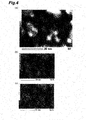
- the hydrogenation catalysts A-1 and A-2 were analyzed with a scanning transmission electron microscope as described below. Three portions on the surface of each hydrogenation catalyst were analyzed. The analysis results of the hydrogenation catalyst A-1 are illustrated in FIG. 4 to 6 . The analysis results of the hydrogenation catalyst A-2 are illustrated in FIG. 7 to 9 .
- FIG. 4(a) An image of one given portion of the hydrogenation catalyst A-1 taken by high-angle annular dark-field scanning transmission electron microscopy (HAADF-STEM) is illustrated in FIG. 4(a) .
- Results of area analysis (elemental mapping) of the portion illustrated in FIG. 4(a) are illustrated in FIG. 4(b) and 4(c) .
- FIG. 4(a), 4(b) and 4(c) illustrate the same portion of the hydrogenation catalyst A-1.
- the area analysis was performed by using an energy dispersive X-ray spectrometer (STEM-EDS) attached to the STEM.
- STEM-EDS energy dispersive X-ray spectrometer
- FIG. 5(a) An image of one portion of the hydrogenation catalyst A-1 taken by the HAADF-STEM is illustrated in FIG. 5(a) .
- the portion illustrated in FIG. 5(a) is different from the portion illustrated in FIG. 4(a) .
- Results of the area analysis (elemental mapping) of the portion illustrated in FIG. 5(a) are illustrated in FIG. 5(b) and 5(c) .
- FIG. 5(a), 5(b) and 5(c) illustrate the same portion of the hydrogenation catalyst A-1.
- a pale (white) spot in FIG. 5(a) corresponds to a place where there is an active site containing the active component (nickel and tin).
- FIG. 5(a) An image of one portion of the hydrogenation catalyst A-1 taken by the HAADF-STEM is illustrated in FIG. 5(a) .
- the portion illustrated in FIG. 5(a) is different from the portion illustrated in FIG. 4(a) .
- a pale (white) spot in FIG. 5(b) corresponds to a place where there is nickel.
- a pale (white) spot in FIG. 5(c) corresponds to a place where there is tin.
- every minute active site which the hydrogenation catalyst A-1 has is an alloy containing nickel and tin, and that atoms or molecules of the nickel and the tin are highly dispersed on the surface of the active site.
- FIG. 6(a) An image of one portion of the hydrogenation catalyst A-1 taken by the HAADF-STEM is illustrated in FIG. 6(a) .
- the portion illustrated in FIG. 6(a) is different from the portions illustrated in FIG. 4(a) and 5(a) .
- Results of the area analysis (elemental mapping) of the portion illustrated in FIG. 6(a) are illustrated in FIG. 6(b) and 6(c) .
- FIG. 6(a), 6(b) and 6(c) illustrate the same portion of the hydrogenation catalyst A-1.
- a pale (white) spot in FIG. 6(a) corresponds to a place where there is an active site containing the active component (nickel and tin).
- FIG. 6(a) An image of one portion of the hydrogenation catalyst A-1 taken by the HAADF-STEM is illustrated in FIG. 6(a) .
- the portion illustrated in FIG. 6(a) is different from the portions illustrated in FIG. 4(a) and 5(a) .
- FIG. 6(a) it was confirmed that a plurality of particulate active sites having a longest diameter smaller than 25 nm are dispersed on the surface of the hydrogenation catalyst A-1.
- a pale (white) spot in the FIG. 6(b) corresponds to a place where there is nickel.
- a pale (white) spot in FIG. 6(c) corresponds to a place where there is tin.
- every minute active site which the hydrogenation catalyst A-1 has is an alloy containing nickel and tin, and that atoms or molecules of the nickel and the tin are highly dispersed on the surface of the active site.
- FIG. 7(a) An image of one given portion of the hydrogenation catalyst A-2 taken by the HAADF-STEM is illustrated in FIG. 7(a) .
- Results of the area analysis (elemental mapping) of the portion illustrated in FIG. 7(a) are illustrated in FIG. 7(b) and 7(c) .
- FIG. 7(a), 7(b) and 7(c) illustrate the same portion of the hydrogenation catalyst A-2.
- a pale (white) spot in FIG. 7(a) corresponds to a place where there is an active site containing the active component (nickel and tin).
- FIG. 7(a) it was confirmed that a plurality of particulate active sites having a longest diameter smaller than 50 nm are dispersed on the surface of the hydrogenation catalyst A-2.
- a pale (white) spot in FIG. 7(b) corresponds to a place where there is nickel.
- a pale (white) spot in FIG. 7(c) corresponds to a place where there is tin.
- every minute active site which the hydrogenation catalyst A-2 has is an alloy containing nickel and tin, and that atoms or molecules of the nickel and the tin are highly dispersed on the surface of the active site.
- FIG. 8(a) An image of one portion of the hydrogenation catalyst A-2 taken by the HAADF-STEM is illustrated in FIG. 8(a) .
- the portion illustrated in FIG. 8(a) is different from the portion illustrated in FIG. 7(a) .
- Results of the area analysis (elemental mapping) of the portion illustrated in FIG. 8(a) are illustrated in FIG. 8(b) and 8(c) .
- FIG. 8(a), 8(b) and 8(c) illustrate the same portion of the hydrogenation catalyst A-2.
- a pale (white) spot in FIG. 8(a) corresponds to a place where there is an active site containing the active component (nickel and tin). As illustrated in FIG.
- FIG. 8(a) it was confirmed that a plurality of particulate active sites having a longest diameter smaller than 25 nm are dispersed on the surface of the hydrogenation catalyst A-2.
- a pale (white) spot in FIG. 8(b) corresponds to a place where there is nickel.
- a pale (white) spot in FIG. 8(c) corresponds to a place where there is tin.
- every minute active site which the hydrogenation catalyst A-2 has is an alloy containing nickel and tin, and that atoms or molecules of the nickel and the tin are highly dispersed on the surface of the active site.
- FIG. 9(a) An image of one portion of the hydrogenation catalyst A-2 taken by the HAADF-STEM is illustrated in FIG. 9(a) .
- the portion illustrated in FIG. 9(a) is different from the portions illustrated in FIG. 7(a) and 8(a) .
- Results of the area analysis (elemental mapping) of the portion illustrated in FIG. 9(a) are illustrated in FIG. 9(b) and 9(c) .
- FIG. 9(a), 9(b) and 9(c) illustrate the same portion of the hydrogenation catalyst A-2.
- a pale (white) spot in FIG. 9(a) corresponds to a place where there is an active site containing the active component (nickel and tin).
- FIG. 9(a) A pale (white) spot in FIG. 9(a) corresponds to a place where there is an active site containing the active component (nickel and tin).
- FIG. 9(a) it was confirmed that a plurality of particulate active sites having a longest diameter smaller than 25 nm are dispersed on the surface of the hydrogenation catalyst A-2.
- a pale (white) spot in FIG. 9(b) corresponds to a place where there is nickel.
- a pale (white) spot in FIG. 9(c) corresponds to a place where there is tin.
- every minute active site which the hydrogenation catalyst A-2 has is an alloy containing nickel and tin, and that atoms or molecules of the nickel and the tin are highly dispersed on the surface of the active site.
- a gas discharged from the reactor was collected and cooled to obtain a product oil.
- the product oil was analyzed by using a gas chromatography-flame ionization detector (GC-FID), so as to obtain a GC area (peak area) of toluene, a GC area of methylcyclohexane and a GC area of cyclohexane contained in the product oil.
- a toluene conversion rate (unit: %) defined by the following expression was calculated.
- the methylcyclohexane corresponds to a target product (an organic hydride), and the cyclohexane corresponds to a byproduct.
- Toluene conversion rate % 1 - m ⁇ 1 / m ⁇ 0 x 100 wherein m1 represents a mole number of the toluene in the product oil, which has a value on the basis of the analysis performed by using the GC-FID; and m0 represents a mole number of the toluene supplied to the reactor.
- the temperature of the hydrogenation catalyst B-1 was retained at 271°C, and the mole number of the hydrogen supplied to the reactor was adjusted to 4.5 times as large as the mole number of the toluene supplied to the reactor.
- FIG. 3 A relationship among a molar content of the tin in the active component of each of the hydrogenation catalysts A-1 to A-4 and the hydrogenation catalyst B-3, a toluene conversion rate in the hydrogenation reaction using each of these catalysts, and a cyclohexane concentration (unit: mol ppm) in the product oil is illustrated in FIG. 3 .
- each black square indicates the toluene conversion rate
- each black circle indicates the cyclohexane concentration in the product oil. It is revealed that the cyclohexane concentration is extremely low and a carbon-carbon bond cleavage reaction is inhibited when the hydrogenation catalysts A-1 to A-4 are used.
- Table 2 also when the hydrogenation catalysts A-5 to A-7 were used, it was confirmed that the cyclohexane concentration in the product oil was low.
Landscapes
- Chemical & Material Sciences (AREA)
- Organic Chemistry (AREA)
- Engineering & Computer Science (AREA)
- Chemical Kinetics & Catalysis (AREA)
- Materials Engineering (AREA)
- Oil, Petroleum & Natural Gas (AREA)
- General Chemical & Material Sciences (AREA)
- Catalysts (AREA)
- Organic Low-Molecular-Weight Compounds And Preparation Thereof (AREA)
- Low-Molecular Organic Synthesis Reactions Using Catalysts (AREA)
Abstract
A hydrogenation catalyst for an aromatic hydrocarbon capable of inhibiting generation of a byproduct is provided. A hydrogenation catalyst for an aromatic hydrocarbon according to one aspect of the present invention comprises an active component containing an active metal element and an additional element, the active metal element is one selected from the group consisting of nickel, palladium and platinum, the additional element is one selected from the group consisting of tin, germanium, gallium, copper and iron, and an X-ray diffraction spectrum of the active component has a local maximum value at a diffraction angle da different from the diffraction angle dm, where a diffraction angle of diffracted X-ray derived from a crystal structure of a simple substance m of the active metal element is dm.
Description
- The present invention relates to a hydrogenation catalyst for an aromatic hydrocarbons and a method for producing a cyclic saturated hydrocarbon using the same.
- In recent years, it is expected to use, as a power source of a vehicle or the like, a fuel cell using hydrogen having a low environmental load as a fuel. In the processes of transportation, storage and supply of hydrogen, organic hydrides such as methylcyclohexane are utilized.
- The organic hydrides refer to cyclic saturated hydrocarbons capable of reversibly repeating desorption and absorption of hydrogen by a dehydrogenation reaction and a hydrogenation reaction. The organic hydrides are in the form a liquid under ordinary temperature and pressure, have a smaller volume than a hydrogen gas, and are less reactive and safer than a hydrogen gas. Therefore, the organic hydrides are suitable for transportation and storage as compared with a simple substance of a hydrogen gas.
- For example, in hydrogen producing facilities (such as a photovoltaic power plant), methylcyclohexane, which is one of the organic hydrides, is generated through hydrogenation of toluene, which is one of aromatic hydrocarbons. The methylcyclohexane is transported to a hydrogen consumption place, or stored in the consumption place. In the consumption place, hydrogen and toluene are generated by dehydrogenation of the methylcyclohexane. The thus generated hydrogen is supplied to a fuel cell. The toluene may be reused for generating methylcyclohexane by the hydrogenation in the hydrogen producing facilities.
- As a hydrogenation catalyst for aromatic hydrocarbons, for example, an amorphous alloy catalyst containing nickel and aluminum as essential components is known (see Patent Literature 1).
- Patent Literature 1:
JP2002-542928 - If the hydrogenation reaction of an aromatic hydrocarbon is performed by using a conventional hydrogenation catalyst, however, not only hydrogenation of an aromatic site but also a carbon-carbon bond cleavage reaction such as demethylation may proceed to produce a byproduct in some cases.
- The present invention was accomplished in consideration of the above-described problem of the conventional technique, and an object is to provide a hydrogenation catalyst for an aromatic hydrocarbon capable of inhibiting generation of a byproduct and a method for producing a cyclic saturated hydrocarbon using the same.
- A hydrogenation catalyst for an aromatic hydrocarbon according to one aspect of the present invention comprises an active component containing an active metal element and an additional element, the active metal element is one selected from the group consisting of nickel, palladium and platinum, the additional element is one selected from the group consisting of tin, germanium, gallium, copper and iron, and an X-ray diffraction spectrum of the active component has a local maximum value at a diffraction angle da different from the diffraction angle dm, where a diffraction angle of diffracted X-ray derived from a crystal structure of a simple substance m of the active metal element is dm.
- In the hydrogenation catalyst for an aromatic hydrocarbon according to one aspect of the present invention, M1 and M2 may satisfy the following expression (1):

where a mole number of the active metal element contained in the active component is M1 and a mole number of the additional element contained in the active component is M2. - In the hydrogenation catalyst for an aromatic hydrocarbon according to one aspect of the present invention, the active metal element may be nickel, and the additional element may be tin.
- The hydrogenation catalyst for an aromatic hydrocarbon according to one aspect of the present invention may further comprise silica on which the active component is supported.
- A method for producing a cyclic saturated hydrocarbon according to one aspect of the present invention comprises a step of hydrogenating an aromatic hydrocarbon in the presence of the above-described hydrogenation catalyst and hydrogen.
- According to the present invention, a hydrogenation catalyst for an aromatic hydrocarbon capable of inhibiting generation of a byproduct and a method for producing a cyclic saturated hydrocarbon using the same are provided.
-
- a in
FIG. 1 (FIG. 1(a) ) is a schematic diagram illustrating a surface of a hydrogenation catalyst according to an embodiment; - b in
FIG. 1 (FIG. 1(b) ) is a schematic diagram illustrating a surface of a conventional hydrogenation catalyst; -
FIG. 2 is an X-ray diffraction (XRD) spectra of hydrogenation catalysts A-1 to A-4 and B-3 in a range of a diffraction angle of 35 to 55°; -
FIG. 3 is a graph of a molar content of tin in an active component obtained when a hydrogenation catalyst is brought into contact with toluene, a toluene conversion rate and a cyclohexane concentration in a product oil by a hydrogenation reaction; - a in
FIG. 4 (FIG. 4(a) ) is an image of the hydrogenation catalyst A-1 taken by high-angle annular dark-field scanning transmission electron microscopy (HAADF-STEM); - b in
FIG. 4 (FIG. 4(b) ) is an image of a nickel distribution in the hydrogenation catalyst A-1 ofFIG. 4(a) ; - c in
FIG. 4 (FIG. 4(c) ) is an image of a tin distribution in the hydrogenation catalyst A-1 ofFIG. 4(a) ; - a in
FIG. 5 (FIG. 5(a) ) is another image of the hydrogenation catalyst A-1 taken by the HAADF-STEM; - b in
FIG. 5 (FIG. 5(b) ) is an image of a nickel distribution in the hydrogenation catalyst A-1 ofFIG. 5(a) ; - c in
FIG. 5 (FIG. 5(c) ) is an image of a tin distribution in the hydrogenation catalyst A-1 ofFIG. 5(a) ; - a in
FIG. 6 (FIG. 6(a) ) is another image of the hydrogenation catalyst A-1 taken by the HAADF-STEM; - b in
FIG. 6 (FIG. 6(b) ) is an image of a nickel distribution in the hydrogenation catalyst A-1 ofFIG. 6(a) ; - c in
FIG. 6 (FIG. 6(c) ) is an image of a tin distribution in the hydrogenation catalyst A-1 ofFIG. 6(a) ; - a in
FIG. 7 (FIG. 7(a) ) is an image of the hydrogenation catalyst A-2 taken by the HAADF-STEM; - b in
FIG. 7 (FIG. 7(b) ) is an image of a nickel distribution in the hydrogenation catalyst A-2 ofFIG. 7(a) ; - c in
FIG. 7 (FIG. 7(c) ) is an image of a tin distribution in the hydrogenation catalyst A-2 ofFIG. 7(a) ; - a in
FIG. 8 (FIG. 8(a) ) is another image of the hydrogenation catalyst A-2 taken by the HAADF-STEM; - b in
FIG. 8 (FIG. 8(b) ) is an image of a nickel distribution in the hydrogenation catalyst A-2 ofFIG. 8(a) ; - c in
FIG. 8 (FIG. 8(c) ) is an image of a tin distribution in the hydrogenation catalyst A-2 ofFIG. 8(a) ; - a in
FIG. 9 (FIG. 9(a) ) is another image of the hydrogenation catalyst A-2 taken by the HAADF-STEM; - b in
FIG. 9 (FIG. 9(b) ) is an image of a nickel distribution in the hydrogenation catalyst A-2 ofFIG. 9(a) ; and - c in
FIG. 9 (FIG. 9(c) ) is an image of a tin distribution in the hydrogenation catalyst A-2 ofFIG. 9(a) . - A preferred embodiment of the present invention will now be described. It is noted that the present invention is not limited to the following embodiment at all.
-
FIG. 1(b) is a schematic diagram of a surface of a conventional hydrogenation catalyst for aromatic hydrocarbons. Theconventional hydrogenation catalyst 10 comprises, for example, one kind ofactive metal element 8 selected from nickel, palladium and platinum, and asupport 3 on which theactive metal element 8 is supported. Theconventional hydrogenation catalyst 10 has a plurality ofactive sites 7 each containing theactive metal element 8. - A chemical reaction by a catalyst can be classified into a structure-insensitive reaction and a structure-sensitive reaction. In the structure-insensitive reaction, the reaction rate is determined by merely the number of metal atoms exposed on a surface. In other words, the structure-insensitive reaction is a reaction not depending on the surface structure of a catalyst. A hydrogenation reaction of an aromatic hydrocarbon is the structure-insensitive reaction. On the other hand, in the structure-sensitive reaction, the reaction rate depends on the surface structure of a catalyst. For example, a carbon-carbon bond cleavage reaction such as demethylation proceeds through a mutual action between an active metal element constituting a prescribed steric structure in an active site (an active spot) of the catalyst and a carbon atom belonging to a methyl group or the like. In other words, it is presumed that the carbon-carbon bond cleavage reaction such as demethylation is the structure-sensitive reaction.
- If the
conventional hydrogenation catalyst 10 is used for performing, for example, a toluene hydrogenation reaction, a hydrogenation reaction of the aromatic hydrocarbon proceeds to generate methylcyclohexane, and in addition, a carbon-carbon bond cleavage reaction proceeds to eliminate a methyl group from the methylcyclohexane so as to generate cyclohexane as a byproduct. In other words, in the hydrogenation reaction using theconventional hydrogenation catalyst 10, not only the structure-insensitive reaction but also the structure-sensitive reaction occurs. - The present inventors presumed that it is significant to highly disperse an active metal element in every active site constituted by an active component of a hydrogenation catalyst in order to inhibit the proceeding of a carbon-carbon bond cleavage reaction, which is a structure-sensitive reaction, resulting in accomplishing a hydrogenation catalyst of the present invention.
- A hydrogenation catalyst for an aromatic hydrocarbon according to the present embodiment comprises an active component containing an active metal element and an additional element. The active component may contain the active metal element and the additional element alone. The hydrogenation catalyst has a plurality of active sites each constituted by the active component, and an aromatic hydrocarbon is hydrogenated in each of the active sites.
- The active metal element is one selected from the group consisting of nickel, palladium and platinum. Such an active metal element has sufficient hydrogenation activity. The active metal element may be nickel that is excellent in the hydrogenation activity for aromatic hydrocarbons and is inexpensive and easily available.
- The additional element of the hydrogenation catalyst of the present embodiment is one selected from the group consisting of tin, germanium, gallium, copper and iron. Such an additional element can disturb the crystal structure of a simple substance of the active metal element so as to highly disperse the active metal element. One selected from the group consisting of tin, germanium and gallium, and tin in particular, can easily highly disperse the active metal element.
- An X-ray diffraction spectrum of the active component (or the hydrogenation catalyst) has a local maximum value at a diffraction angle da different from the diffraction angle dm, where a diffraction angle of diffracted X-ray derived from the crystal structure of the simple substance m of the active metal element is dm. An X-ray diffraction intensity Ia of the active component at the diffraction angle da is peculiar to the active component. Although the X-ray diffraction intensity Ia is the local maximum value in the X-ray diffraction spectrum of the active component, it is not necessarily the global maximum value in the X-ray diffraction spectrum of the active component. The X-ray diffraction spectrum of the active component may have a plurality of local maximum values at a plurality of diffraction angles da different from the diffraction angle dm. An X-ray diffraction intensity Im of the active component at the diffraction angle dm is derived from the crystal structure of the simple substance m of the active metal element that the hydrogenation catalyst can contain. The active component may contain the crystal of the simple substance m of the active metal element. The active component may not contain the crystal of the simple substance m of the active metal element. If the X-ray diffraction intensity Ia of the active component is larger than the X-ray diffraction intensity Im of the active component, the generation of a byproduct is easily inhibited in the hydrogenation reaction of aromatic hydrocarbons using the hydrogenation catalyst. The range of a diffraction angle 2θ of the X-ray diffraction spectrum of the active component may be, for example, 5 to 90°. If the active component contains nickel and tin, the range of the diffraction angle 2θ of the X-ray diffraction spectrum of the active component may be, for example, 35 to 55°. If the active component contains nickel and tin, the diffraction angle dm may be, for example, approximately 44.5° (44.51 °), and the diffraction angle da may be, for example, approximately 43° (43.5°). If the active component contains platinum as the active metal element, the diffraction angle dm may be, for example, approximately 40.0° (39.8°). If the active component contains palladium as the active metal element, the diffraction angle dm may be, for example, approximately 40.0° (40.3°). If the active component contains an oxide of palladium, the diffraction angle dm may be, for example, approximately 33°.
- The present inventors presume that the hydrogenation catalyst having the aforementioned technical characteristics on the X-ray diffraction spectrum of the active component has the following structure:
- The X-ray diffraction intensity Ia is derived from the structure of a microcrystal of an alloy of the active component, the structure of a microcrystal of an intermetallic compound of the active component, or the structure of a microcrystal of a solid solution of the active component. In other words, the X-ray diffraction intensity Ia is derived from a regular structure constituted by the active component, and the active component is not always amorphous. The microcrystal of the alloy of the active component, the microcrystal of the intermetallic compound of the active component or the microcrystal of the solid solution of the active component is much smaller than a macro-crystal of the simple substance m. The X-ray diffraction spectrum of the active component having the local maximum value at the diffraction angle da different from the diffraction angle dm suggests that the macro-crystal structure of the simple substance m of the active metal element is disturbed, in each active site of the hydrogenation catalyst, by the interposition of the additional element to form the microcrystal of the alloy of the active component, the microcrystal of the intermetallic compound of the active component or the microcrystal of the solid solution of the active component, so as to disperse a large number of microcrystals in the active site.
-
FIG. 1(a) is a schematic diagram illustrating a part of a surface of the hydrogenation catalyst of the present embodiment. Thehydrogenation catalyst 1 has a plurality ofactive sites 6. Eachactive site 6 is constituted by the alloy, the intermetallic compound or the solid solution of the active component. Theactive metal element 2 and theadditional element 4 may be exposed on the surface of theactive site 6. Theactive metal element 2 may be an atom or a molecule constituting the alloy, the intermetallic compound or the solid solution. Theadditional element 4 may be an atom or a molecule constituting the alloy, the intermetallic compound or the solid solution. In each active site 6 (in particular, on the surface of each active site 6), theadditional element 4 intervenes between theactive metal elements 2, and theactive metal element 2 and theadditional element 4 are highly dispersed. - If the hydrogenation catalyst having the above-described structure is used for performing, for example, a toluene hydrogenation reaction, a carbon-carbon bond cleavage reaction accompanying the hydrogenation reaction is inhibited, so as to improve selectivity of methylcyclohexane. Specifically, in the hydrogenation reaction of an aromatic hydrocarbon using the hydrogenation catalyst of the present embodiment, since the structure-sensitive reaction is inhibited and the structure-insensitive reaction can easily proceed, the generation of a byproduct is inhibited, and the aromatic hydrocarbon is selectively converted into a desired cyclic saturated hydrocarbon.
- The mole numbers M1 and M2 may satisfy the following expression (1):

where the mole number of theactive metal element 2 contained in the active component is M1 and the mole number of theadditional element 4 contained in the active component is M2. - If M2/(M1 + M2) is 0.01 to 0.6, the generation of a byproduct can be easily inhibited, and there is a tendency that the aromatic hydrocarbon can be easily selectively converted into a desired cyclic saturated hydrocarbon. M2/(M1 + M2) may be 0.05 or more, 0.1 or more, 0.13 or more, or 0.23 or more. M2(M1 + M2) may be 0.56 or less, or 0.40 or less.
- Each
active site 6 may be constituted by a microcrystal (such as a crystal of an alloy, an intermetallic compound or a solid solution) containing theactive metal element 2 and theadditional element 4. A longest diameter of eachactive site 6 or a longest diameter of the microcrystal may be 2 to 50 nm. If the longest diameter of theactive site 6 or the microcrystal falls in the above-described range, the generation of a byproduct is easily inhibited, and there is a tendency that the aromatic hydrocarbon can be easily selectively converted into a desired cyclic saturated hydrocarbon. - The
hydrogenation catalyst 1 may further comprise asupport 5 on which the active component is supported. Thesupport 5 may be, for example, silica, alumina, titania or a magnesia. Silica, which has a low thermal conductivity and can be easily controlled in the hydrogenation reaction, may be used as thesupport 5. It is noted that the shape of thesupport 5 illustrated inFIG. 1(a) is merely schematic, and thesupport 5 may be in the shape of, for example, a particle. - If the hydrogenation catalyst further comprises the
support 5, the amount of the active metal element supported in the hydrogenation catalyst may be 5 to 60% by mass, or 5.57 to 9.61% by mass based on the total mass of the hydrogenation catalyst. If the hydrogenation catalyst further comprises thesupport 5, the amount of the additional element supported in the hydrogenation catalyst may be more than 0% by mass and 60% by mass or less, and may be 3.00 to 24.60% by mass based on the total mass of the hydrogenation catalyst. If the hydrogenation catalyst further comprises thesupport 5, the amount of the active component supported in the hydrogenation catalyst may be 5 to 70% by mass, or 9.08 to 34.21% by mass based on the total mass of the hydrogenation catalyst. Incidentally, the amount of the active metal element supported and the amount of the additional element supported can be measured by, for example, an ICP mass analysis method, an atomic absorption analysis method or the like. - A method for producing a cyclic saturated hydrocarbon of the present embodiment comprises a step of hydrogenating an aromatic hydrocarbon in the presence of the above-described hydrogenation catalyst and hydrogen.
- The aromatic hydrocarbon to be hydrogenated by the hydrogenation catalyst of the present embodiment is not especially limited, and may be, for example, at least one selected from the group consisting of benzene, toluene, xylene, ethylbenzene, tetralin, naphthalene, methylnaphthalene and ethylnaphthalene. Since the hydrogenation catalyst of the present embodiment can inhibit a carbon-carbon bond cleavage reaction, which is a structure-sensitive reaction, the aromatic hydrocarbon to be hydrogenated may be at least one selected from the group consisting of toluene, xylene, ethylbenzene, tetralin, methylnaphthalene and ethylnaphthalene.
- A reaction mode of the hydrogenation may be, for example, a fixed bed mode, a moving bed mode or a fluidized bed mode. A reaction temperature of the hydrogenation of the aromatic hydrocarbon (a temperature of the hydrogenation catalyst in the reaction) may be 150 to 350°C. If the hydrogenation of the aromatic hydrocarbon is a gas phase reaction performed under pressure of 0 to 10 MPa (gauge pressure), the amount of the aromatic hydrocarbon supplied to the hydrogenation catalyst per unit time may be 0.005 to 0.5 mL/min per 1 mL of the hydrogenation catalyst. A molar ratio of the hydrogen/aromatic hydrocarbon supplied to the hydrogenation catalyst may be 3 to 30.
- If the hydrogenation catalyst of the present embodiment contains the active component and the support on which the active component is supported, the hydrogenation catalyst is produced by a coprecipitation method or a sequential impregnation method described below.
- In employing the coprecipitation method, for example, an aqueous solution containing a salt of the active metal element (an active metal element solution) and an aqueous solution containing a salt of the additional element (an additional element solution) are first respectively prepared.
- If the active metal element is nickel, the salt of the active metal element may be, for example, a water-soluble salt such as nickel sulfate or nickel nitrate. If the active metal element is palladium, the salt of the active metal element may be, for example, a water-soluble salt such as palladium nitrate or palladium chloride. If the active metal element is platinum, the salt of the active metal element may be, for example, a water-soluble salt such as chloroplatinic acid, tetraammine platinum hydroxide salt, tetraammine platinum nitrate, or bis(ethanolammonium)hexahydroxo platinate (IV). The active metal element solution can be prepared by, for example, adding the salt of the active metal element to water at a prescribed ratio, and mixing and stirring the resultant.
- If the additional element is tin, the salt of the additional element may be, for example, a water-soluble salt such as tin sulfate or tin chloride. If the additional element is germanium, the salt of the additional element may be, for example, a water-soluble salt such as germanium chloride. If the additional element is gallium, the salt of the additional element may be, for example, a water-soluble salt such as gallium sulfate. If the additional element is copper, the salt of the additional element may be, for example, a water-soluble salt such as copper nitrate or copper sulfate. If the additional element is iron, the salt of the additional element may be, for example, a water-soluble salt such as iron nitrate or iron sulfate. The additional element solution can be prepared by, for example, adding the salt of the additional element to water at a prescribed ratio, and mixing and stirring the resultant.
- A mixed salt solution is prepared by mixing the active metal element solution and the additional element solution so that a molar ratio between the active metal element and the additional element to be supported on the support can be a prescribed value. The support is added to the mixed salt solution. A neutralizer is added to the mixed salt solution containing the support for coprecipitating the active metal element and the additional element on the support, so as to obtain a coprecipitate containing the active metal element, the additional element and the support. The neutralizer may be, for example, sodium carbonate, sodium hydroxide, aqueous ammonia or urea. The pH of the mixed salt solution may be adjusted to 6 to 10 by adding the neutralizer.
- The coprecipitate is dried and then heat treated to obtain a precursor of the active component. The coprecipitate may be washed with water before drying. A method for drying the coprecipitate may be, for example, vacuum drying or forced air drying. A heat treatment temperature for the coprecipitate may be, for example, 150 to 650°C. After forming the precursor by heat treating the coprecipitate in the air, the precursor is heated at 200 to 650°C under a hydrogen atmosphere. As a result, the precursor of the active component is reduced to generate the active component.
- Through the coprecipitation method described above, the hydrogenation catalyst of the present embodiment can be obtained.
- In employing the sequential impregnation method, for example, an aqueous solution containing a salt of the active metal element (an active metal element solution) is prepared so that the active metal element to be supported on the support can attain a prescribed mole number. The active metal element solution is added to the support for impregnating the active metal element into the support to obtain an active metal element impregnated product. The salt of the active metal element may be the same as that used in the coprecipitation method.
- The active metal element impregnated product is dried and then heat treated to obtain an active metal element supported product. The active metal element impregnated product may be washed with water before drying. A method for drying the active metal element impregnated product may be, for example, the vacuum drying or the forced air drying. A heat treatment temperature for the active metal element impregnated product after the drying may be, for example, 150 to 650°C. The active metal element supported product may be obtained by heating the active metal element impregnated product at 200 to 650°C under a hydrogen atmosphere after performing the heat treatment in the air.
- An aqueous solution containing a salt of the additional element (an additional element solution) is prepared. The additional element solution is added to the active metal element supported product so that a molar ratio between the active metal element and the additional element to be supported on the support can be a prescribed value, and thus, the additional element is impregnated into the active metal element supported product to obtain an additional element impregnated product. The salt of the additional element may be the same as that used in the coprecipitation method.
- The additional element impregnated product is dried and then heat treated to obtain a precursor of the active component. The additional element impregnated product may be washed with water before drying. A method for drying the additional element impregnated product may be, for example, the vacuum drying or the forced air drying. A heat treatment temperature for the additional element impregnated product may be, for example, 150 to 650°C. After forming the precursor by heat treating the additional element impregnated product in the air, the precursor is heated at 200 to 650° under a hydrogen atmosphere. As a result, the precursor of the active component is reduced to generate the active component.
- Through the sequential impregnation method described above, the hydrogenation catalyst of the present embodiment can be obtained.
- The contents of the present invention will now be described in more details with reference to examples and comparative examples, and it is noted that the present invention is not limited to the examples described below.
- Silica was used as a support. A nickel sulfate aqueous solution and a tin sulfate aqueous solution were mixed to prepare a mixed salt solution. A molar ratio between nickel and tin in the mixed salt solution was adjusted to 3:1. The silica was added to the mixed salt solution. To the mixed salt solution containing the silica, a sodium carbonate aqueous solution was added as a neutralizer to adjust the pH of the mixed salt solution to 9, and thus, a coprecipitate containing nickel sulfate, tin sulfate and the support was obtained. After drying the coprecipitate, the resultant was calcined at 450°C under an air atmosphere. The thus obtained precursor of an active component was heat treated at 400°C under a hydrogen atmosphere to obtain a hydrogenation catalyst A-1. The amount of the nickel supported in the hydrogenation catalyst A-1 was 9.37% by mass based on the total mass of the hydrogenation catalyst A-1. The amount of the tin supported in the hydrogenation catalyst A-1 was 5.78% by mass based on the total mass of the hydrogenation catalyst A-1. Besides, a ratio of a mole number M2 of the tin to a total mole number (M1 + M2) of the active component of the hydrogenation catalyst A-1 (M2/(M1 + M2)) was 0.23.
- A hydrogenation catalyst A-2 was obtained in the same manner as in Example 1 except that a mixed salt solution was prepared so as to attain a molar ratio of 3:2 between the active metal element (nickel) and the additional element (tin) to be supported on silica. The amount of the nickel supported in the hydrogenation catalyst A-2 was 9.32% by mass based on the total mass of the hydrogenation catalyst A-2. The amount of the tin supported in the hydrogenation catalyst A-2 was 11.58% by mass based on the total mass of the hydrogenation catalyst A-2. Besides, M2/(M1 + M2) of the hydrogenation catalyst A-2 was 0.38.
- A hydrogenation catalyst A-3 was obtained in the same manner as in Example 1 except that a mixed salt solution was prepared so as to attain a molar ratio of 3:4 between nickel and tin to be supported on silica. The amount of the nickel supported in the hydrogenation catalyst A-3 was 9.61% by mass based on the total mass of the hydrogenation catalyst A-3. The amount of the tin supported in the hydrogenation catalyst A-3 was 24.60% by mass based on the total mass of the hydrogenation catalyst A-3. Besides, M2/(M1 + M2) of the hydrogenation catalyst A-3 was 0.56.
- A hydrogenation catalyst A-4 was obtained in the same manner as in Example 1 except that a mixed salt solution was prepared so as to attain a molar ratio of 6:1 between nickel and tin to be supported on silica. The amount of the nickel supported in the hydrogenation catalyst A-4 was 9.54% by mass based on the total mass of the hydrogenation catalyst A-4. The amount of the tin supported in the hydrogenation catalyst A-4 was 3.00% by mass based on the total mass of the hydrogenation catalyst A-4. Besides, M2/(M1 + M2) of the hydrogenation catalyst A-4 was 0.13.
- A hydrogenation catalyst A-5 was obtained in the same manner as in Example 1 except that the amounts of nickel and tin supported were adjusted by adjusting concentrations of a nickel salt and a tin salt in a mixed salt solution to be lower than in Example 1. The amount of the nickel supported in the hydrogenation catalyst A-5 was 5.57% by mass based on the total mass of the hydrogenation catalyst A-5. The amount of the tin supported in the hydrogenation catalyst A-5 was 3.51% by mass based on the total mass of the hydrogenation catalyst A-5. Besides, M2/(M1 + M2) of the hydrogenation catalyst A-5 was 0.24.
- Silica was used as a support. First, a nickel nitrate aqueous solution containing a prescribed amount of nickel based on the silica was prepared. The silica was impregnated with the nickel nitrate aqueous solution. The thus obtained nickel impregnated product was dried and then calcined at 450°C under an air atmosphere. The thus obtained calcined product was heat treated at 400°C under a hydrogen atmosphere to obtain a nickel supported product. Subsequently, the nickel supported product was impregnated with a tin chloride solution prepared to attain a molar ratio of 3:1 between nickel and tin to be supported on the silica. The thus obtained tin impregnated product was dried and then calcined at 450°C under an air atmosphere. The thus obtained precursor of an active component was heat treated at 400°C under a hydrogen atmosphere to obtain a hydrogenation catalyst A-6.
- The amount of the nickel supported in the hydrogenation catalyst A-6 was 8.58% by mass based on the total mass of the hydrogenation catalyst A-6. The amount of the tin supported in the hydrogenation catalyst A-6 was 5.73% by mass based on the total mass of the hydrogenation catalyst A-6. Besides, M2/(M1 + M2) of the hydrogenation catalyst A-6 was 0.25.
- A hydrogenation catalyst A-7 was obtained in the same manner as in Example 6 except that amounts of a nickel nitrate aqueous solution and a tin chloride solution were adjusted so as to attain a molar ratio of 3:2 between nickel and tin to be supported on silica. The amount of the nickel supported in the hydrogenation catalyst A-7 was 8.11% by mass based on the total mass of the hydrogenation catalyst A-7. The amount of the tin supported in the hydrogenation catalyst A-7 was 11.09% by mass based on the total mass of the hydrogenation catalyst A-7. Besides, M2/(M1 + M2) of the hydrogenation catalyst A-7 was 0.40.
- As a hydrogenation catalyst B-1, a commercially available catalyst N-5256 manufactured by N. E. Chemcat Corporation was used. The hydrogenation catalyst B-1 was one prepared by the coprecipitation method. The amount of supported nickel in the hydrogenation catalyst B-1 was 57% by mass based on the total mass of the hydrogenation catalyst B-1. The amount of tin supported in the hydrogenation catalyst B-1 was 0% by mass based on the total mass of the hydrogenation catalyst B-1.
- Silica was used as a support. First, a nickel nitrate aqueous solution containing a prescribed amount of nickel based on the silica was prepared. The silica was impregnated with the nickel nitrate aqueous solution. The thus obtained nickel impregnated product was dried and then calcined at 450°C under an air atmosphere. The thus obtained precursor of an active component was heat treated at 400°C under a hydrogen atmosphere to obtain a hydrogenation catalyst B-2. The amount of the nickel supported in the hydrogenation catalyst B-2 was 9.74% by mass based on the total mass of the hydrogenation catalyst B-2. The amount of tin supported in the hydrogenation catalyst B-2 was 0% by mass based on the total mass of the hydrogenation catalyst B-2.
- Silica was used as a support. A nickel sulfate aqueous solution containing a prescribed amount of nickel based on the silica was prepared, and the silica was added to the nickel sulfate aqueous solution. To the nickel sulfate aqueous solution containing the silica, a sodium carbonate aqueous solution was added as a neutralizer to adjust the pH of a mixed salt solution to 9, and thus, a precipitate containing nickel sulfate and the support was obtained. The precipitate was dried and then calcined at 450°C under an air atmosphere. The thus obtained precursor of an active component was heat treated at 400° under a hydrogen atmosphere to obtain a hydrogenation catalyst B-3. The amount of the nickel supported in the hydrogenation catalyst B-3 was 10% by mass based on the total mass of the hydrogenation catalyst B-3. The amount of tin supported in the hydrogenation catalyst B-3 was 0% by mass based on the total mass of the hydrogenation catalyst B-3.
- XRD spectra of the hydrogenation catalysts A-1 to A-7 and the hydrogenation catalyst B-3 were respectively measured under the following conditions:
- Diffractometer: RINT 2500 (manufactured by Rigaku Corporation)
- X-ray source: CuKα (with a monochromator used)
- Tube voltage: 50 kV
- Tube current: 200 mA
- Divergence slit: 1/2°
- Scattering slit: 1/2°
- Light receiving slit: 0.15 mm
- Diffraction angle 2θ: 5 to 90°
- The XRD spectra of the hydrogenation catalysts A-1 to A-4 and the hydrogenation catalyst B-3 obtained in a range of the diffraction angle of 35 to 55° are illustrated in
FIG. 2 . It was confirmed that the XRD spectrum of the hydrogenation catalyst B-3 has a local maximum value at a diffraction angle dm (of approximately 44.5°). An X-ray diffraction intensity Im of the hydrogenation catalyst B-3 at the diffraction angle dm (of approximately 44.5°) is derived from the crystal structure of a simple substance m (elemental nickel). On the other hand, it was confirmed that the XRD spectrum of each of the hydrogenation catalysts A-1 to A-4 has a local maximum value at a diffraction angle da (of approximately 43.5°) different from the diffraction angle dm (of approximately 44.5°). It was also confirmed that an X-ray diffraction intensity Ia at the diffraction angle da (of approximately 43.5°) in the XRD spectrum of each of the hydrogenation catalysts A-1, A-2 and A-4 was larger than an X-ray diffraction intensity Im at the diffraction angle dm (of approximately 44.5°). It was confirmed that the XRD spectrum of the hydrogenation catalyst A-3 has a plurality of local maximum values not only at approximately 43.5° but also at a plurality of diffraction angles da. It was confirmed that the XRD spectrum of the hydrogenation catalyst A-5 also has a local maximum value at a diffraction angle da (of approximately 43.5°) different from the diffraction angle dm (of approximately 44.5°). It was confirmed that the XRD spectrum of each of the hydrogenation catalysts A-6 and A-7 has a local maximum value at a diffraction angle da (of approximately 30.4°) different from the diffraction angle dm (of approximately 44.5°). - The hydrogenation catalysts A-1 and A-2 were analyzed with a scanning transmission electron microscope as described below. Three portions on the surface of each hydrogenation catalyst were analyzed. The analysis results of the hydrogenation catalyst A-1 are illustrated in
FIG. 4 to 6 . The analysis results of the hydrogenation catalyst A-2 are illustrated inFIG. 7 to 9 . - An image of one given portion of the hydrogenation catalyst A-1 taken by high-angle annular dark-field scanning transmission electron microscopy (HAADF-STEM) is illustrated in
FIG. 4(a) . Results of area analysis (elemental mapping) of the portion illustrated inFIG. 4(a) are illustrated inFIG. 4(b) and 4(c) . Specifically,FIG. 4(a), 4(b) and 4(c) illustrate the same portion of the hydrogenation catalyst A-1. The area analysis was performed by using an energy dispersive X-ray spectrometer (STEM-EDS) attached to the STEM. A pale (white) spot inFIG. 4(a) corresponds to a place where there is an active site containing the active component (nickel and tin). As illustrated inFIG. 4(a) , it was confirmed that a plurality of particulate active sites having a longest diameter smaller than 20 nm are dispersed on the surface of the hydrogenation catalyst A-1. A pale (white) spot inFIG. 4(b) corresponds to a place where there is nickel. A pale (white) spot inFIG. 4(c) corresponds to a place where there is tin. As illustrated inFIG. 4(a), 4(b) and 4(c) , it was confirmed that every minute active site which the hydrogenation catalyst A-1 has is an alloy containing nickel and tin, and that atoms or molecules of the nickel and the tin are highly dispersed on the surface of the active site. - An image of one portion of the hydrogenation catalyst A-1 taken by the HAADF-STEM is illustrated in
FIG. 5(a) . The portion illustrated inFIG. 5(a) is different from the portion illustrated inFIG. 4(a) . Results of the area analysis (elemental mapping) of the portion illustrated inFIG. 5(a) are illustrated inFIG. 5(b) and 5(c) . Specifically,FIG. 5(a), 5(b) and 5(c) illustrate the same portion of the hydrogenation catalyst A-1. A pale (white) spot inFIG. 5(a) corresponds to a place where there is an active site containing the active component (nickel and tin). As illustrated inFIG. 5(a) , it was confirmed that a plurality of particulate active sites having a longest diameter smaller than 20 nm are dispersed on the surface of the hydrogenation catalyst A-1. A pale (white) spot inFIG. 5(b) corresponds to a place where there is nickel. A pale (white) spot inFIG. 5(c) corresponds to a place where there is tin. As illustrated inFIG. 5(a), 5(b) and 5(c) , it was confirmed that every minute active site which the hydrogenation catalyst A-1 has is an alloy containing nickel and tin, and that atoms or molecules of the nickel and the tin are highly dispersed on the surface of the active site. - An image of one portion of the hydrogenation catalyst A-1 taken by the HAADF-STEM is illustrated in
FIG. 6(a) . The portion illustrated inFIG. 6(a) is different from the portions illustrated inFIG. 4(a) and5(a) . Results of the area analysis (elemental mapping) of the portion illustrated inFIG. 6(a) are illustrated inFIG. 6(b) and 6(c) . Specifically,FIG. 6(a), 6(b) and 6(c) illustrate the same portion of the hydrogenation catalyst A-1. A pale (white) spot inFIG. 6(a) corresponds to a place where there is an active site containing the active component (nickel and tin). As illustrated inFIG. 6(a) , it was confirmed that a plurality of particulate active sites having a longest diameter smaller than 25 nm are dispersed on the surface of the hydrogenation catalyst A-1. A pale (white) spot in theFIG. 6(b) corresponds to a place where there is nickel. A pale (white) spot inFIG. 6(c) corresponds to a place where there is tin. As illustrated inFIG. 6(a), 6(b) and 6(c) , it was confirmed that every minute active site which the hydrogenation catalyst A-1 has is an alloy containing nickel and tin, and that atoms or molecules of the nickel and the tin are highly dispersed on the surface of the active site. - An image of one given portion of the hydrogenation catalyst A-2 taken by the HAADF-STEM is illustrated in
FIG. 7(a) . Results of the area analysis (elemental mapping) of the portion illustrated inFIG. 7(a) are illustrated inFIG. 7(b) and 7(c) . Specifically,FIG. 7(a), 7(b) and 7(c) illustrate the same portion of the hydrogenation catalyst A-2. A pale (white) spot inFIG. 7(a) corresponds to a place where there is an active site containing the active component (nickel and tin). As illustrated inFIG. 7(a) , it was confirmed that a plurality of particulate active sites having a longest diameter smaller than 50 nm are dispersed on the surface of the hydrogenation catalyst A-2. A pale (white) spot inFIG. 7(b) corresponds to a place where there is nickel. A pale (white) spot inFIG. 7(c) corresponds to a place where there is tin. As illustrated inFIG. 7(a), 7(b) and 7(c) , it was confirmed that every minute active site which the hydrogenation catalyst A-2 has is an alloy containing nickel and tin, and that atoms or molecules of the nickel and the tin are highly dispersed on the surface of the active site. - An image of one portion of the hydrogenation catalyst A-2 taken by the HAADF-STEM is illustrated in
FIG. 8(a) . The portion illustrated inFIG. 8(a) is different from the portion illustrated inFIG. 7(a) . Results of the area analysis (elemental mapping) of the portion illustrated inFIG. 8(a) are illustrated inFIG. 8(b) and 8(c) . Specifically,FIG. 8(a), 8(b) and 8(c) illustrate the same portion of the hydrogenation catalyst A-2. A pale (white) spot inFIG. 8(a) corresponds to a place where there is an active site containing the active component (nickel and tin). As illustrated inFIG. 8(a) , it was confirmed that a plurality of particulate active sites having a longest diameter smaller than 25 nm are dispersed on the surface of the hydrogenation catalyst A-2. A pale (white) spot inFIG. 8(b) corresponds to a place where there is nickel. A pale (white) spot inFIG. 8(c) corresponds to a place where there is tin. As illustrated inFIG. 8(a), 8(b) and 8(c) , it was confirmed that every minute active site which the hydrogenation catalyst A-2 has is an alloy containing nickel and tin, and that atoms or molecules of the nickel and the tin are highly dispersed on the surface of the active site. - An image of one portion of the hydrogenation catalyst A-2 taken by the HAADF-STEM is illustrated in
FIG. 9(a) . The portion illustrated inFIG. 9(a) is different from the portions illustrated inFIG. 7(a) and8(a) . Results of the area analysis (elemental mapping) of the portion illustrated inFIG. 9(a) are illustrated inFIG. 9(b) and 9(c) . Specifically,FIG. 9(a), 9(b) and 9(c) illustrate the same portion of the hydrogenation catalyst A-2. A pale (white) spot inFIG. 9(a) corresponds to a place where there is an active site containing the active component (nickel and tin). As illustrated inFIG. 9(a) , it was confirmed that a plurality of particulate active sites having a longest diameter smaller than 25 nm are dispersed on the surface of the hydrogenation catalyst A-2. A pale (white) spot inFIG. 9(b) corresponds to a place where there is nickel. A pale (white) spot inFIG. 9(c) corresponds to a place where there is tin. As illustrated inFIG. 9(a), 9(b) and 9(c) , it was confirmed that every minute active site which the hydrogenation catalyst A-2 has is an alloy containing nickel and tin, and that atoms or molecules of the nickel and the tin are highly dispersed on the surface of the active site. - Hydrogenation of toluene was performed as follows:
- Alumina, 3 mL of the hydrogenation catalyst A-1 and alumina were stacked in this order in a fixed-bed flow reactor, so as to fill the reactor with the alumina and the hydrogenation catalyst A-1. As a pretreatment, a reduction treatment of the hydrogenation catalyst with hydrogen was performed at 250°C for 1 hour. After the pretreatment, vaporized toluene and a hydrogen gas were supplied into the reactor while retaining the temperature of the hydrogenation catalyst A-1 (the temperature at the center of the catalyst layer) at 250°C. Incidentally, pressure within the reactor was adjusted to 0.18 MPa (gauge pressure). The toluene was vaporized by heating the toluene prior to the supply to the reactor at 150°C in a vaporizer. The supply rate of the toluene was adjusted to 0.1 mL/min, and the space velocity (SV) of the toluene was adjusted to 2 h-1. The mole number of the hydrogen supplied to the reactor was adjusted to six times as large as that of the toluene supplied to the reactor.
- When five hours elapsed from the start of the reaction, a gas discharged from the reactor was collected and cooled to obtain a product oil. The product oil was analyzed by using a gas chromatography-flame ionization detector (GC-FID), so as to obtain a GC area (peak area) of toluene, a GC area of methylcyclohexane and a GC area of cyclohexane contained in the product oil. On the basis of these analysis results, a toluene conversion rate (unit: %) defined by the following expression was calculated. The methylcyclohexane corresponds to a target product (an organic hydride), and the cyclohexane corresponds to a byproduct.

wherein m1 represents a mole number of the toluene in the product oil, which has a value on the basis of the analysis performed by using the GC-FID; and m0 represents a mole number of the toluene supplied to the reactor. - On the basis of the GC area of the cyclohexane contained in the product oil, a cyclohexane concentration in the product oil was calculated. The result is shown in Table 1.
- In the same manner as in the case where the hydrogenation catalyst A-1 was used, the hydrogenation of toluene was performed by using each of the hydrogenation catalysts A-2 to A-7 and the hydrogenation catalysts B-1 to B-3. No matter which of the hydrogenation catalysts of these examples and comparative examples was used, it was confirmed that methylcyclohexane was generated through the hydrogenation of toluene. The toluene conversion rate and the cyclohexane concentration in a product oil attained by using each of the hydrogenation catalysts were calculated. The results are shown in Tables 1 and 2. Incidentally, in the hydrogenation of toluene performed by using the hydrogenation catalyst B-1, the temperature of the hydrogenation catalyst B-1 was retained at 271°C, and the mole number of the hydrogen supplied to the reactor was adjusted to 4.5 times as large as the mole number of the toluene supplied to the reactor.
[Table 1] Comparative example 1 Comparative example 2 Comparative example 3 Example 1 Example 2 Example 3 Hydrogenation catalyst B-1 B-2 B-3 A-1 A-2 A-3 Active metal element Ni Ni Ni Ni Ni Ni Additional element - - - Sn Sn Sn Active metal element/additional element (Charged molar ratio) - - - 3/1 3/2 3/4 Amount of active metal element supported (mass%) 57 9.74 10 9.37 9.32 9.61 Amount of additional element supported (mass%) 0 0 0 5.78 11.58 24.60 M2/M1 - - - 0.30 0.61 1.27 M2/(M1+M2) - - - 0.23 0.38 0.56 M1/M2 - - - 3.28 1.63 0.79 Preparation method Coprecipitation Impregnation Coprecipitation Coprecipitation Coprecipitation Coprecipitation Toluene conversion rate (250°C) (%) 92.4 27.7 64.6 29.3 16.9 18.5 Cyclohexane concentration (mol ppm) 37900 139 385 11 0 0 [Table 2] Example 4 Example 5 Example 6 Example 7 Hydrogenation catalyst A-4 A-5 A-6 A-7 Active metal element Ni Ni Ni Ni Additional element Sn Sn Sn Sn Active metal element/additional element (Charged molar ratio) 6/1 3/1 3/1 3/2 Amount of active metal element supported (mass%) 9.54 5.57 8.58 8.11 Amount of additional element supported (mass%) 3.00 3.51 5.73 11.09 M2/M1 0.16 0.31 0.33 0.68 M2/(M1+M2) 0.13 0.24 0.25 0.40 M1/M2 6.43 3.21 3.03 1.48 Preparation method Coprecipitation Coprecipitation Sequential impregnation Sequential impregnation Toluene conversion rate (250°C) (%) 39.8 8.4 37.3 3.8 Cyclohexane concentration (mol ppm) 11 0 76 0 - A relationship among a molar content of the tin in the active component of each of the hydrogenation catalysts A-1 to A-4 and the hydrogenation catalyst B-3, a toluene conversion rate in the hydrogenation reaction using each of these catalysts, and a cyclohexane concentration (unit: mol ppm) in the product oil is illustrated in
FIG. 3 . InFIG. 3 , each black square indicates the toluene conversion rate, and each black circle indicates the cyclohexane concentration in the product oil. It is revealed that the cyclohexane concentration is extremely low and a carbon-carbon bond cleavage reaction is inhibited when the hydrogenation catalysts A-1 to A-4 are used. As shown in Table 2, also when the hydrogenation catalysts A-5 to A-7 were used, it was confirmed that the cyclohexane concentration in the product oil was low. - On the other hand, when the hydrogenation catalyst B-3 was used, although the toluene conversion rate was high, the cyclohexane concentration was also high. As shown in Table 1, the cyclohexane concentrations in the product oils obtained by the hydrogenation reaction using the hydrogenation catalysts B-1 and B-2 were also high.
- hydrogenation catalyst, 2, 8 ... active metal element, 4 ... additional element, 3, 5 ... support, 6, 7 ... active site, 10 ... conventional hydrogenation catalyst
Claims (5)
- A hydrogenation catalyst for an aromatic hydrocarbon, comprising an active component containing an active metal element and an additional element,
wherein the active metal element is one selected from the group consisting of nickel, palladium and platinum,
the additional element is one selected from the group consisting of tin, germanium, gallium, copper and iron, and
an X-ray diffraction spectrum of the active component has a local maximum value at a diffraction angle da different from the diffraction angle dm, where a diffraction angle of diffracted X-ray derived from a crystal structure of a simple substance m of the active metal element is dm. - The hydrogenation catalyst according to claim 1,
wherein M1 and M2 satisfy the following expression (1):
where a mole number of the active metal element contained in the active component is M1 and a mole number of the additional element contained in the active component is M2. - The hydrogenation catalyst according to claim 1 or 2, wherein the active metal element is nickel, and the additional element is tin.
- The hydrogenation catalyst according to any one of claims 1 to 3, further comprising silica on which the active component is supported.
- A method for producing a cyclic saturated hydrocarbon, comprising a step of hydrogenating an aromatic hydrocarbon in the presence of the hydrogenation catalyst according to any one of claims 1 to 4 and hydrogen.
Applications Claiming Priority (1)
| Application Number | Priority Date | Filing Date | Title |
|---|---|---|---|
| JP2014072648A JP6236344B2 (en) | 2014-03-31 | 2014-03-31 | Hydrogenation catalyst for aromatic hydrocarbon and method for producing cyclic saturated hydrocarbon |
Publications (1)
| Publication Number | Publication Date |
|---|---|
| EP2929937A1 true EP2929937A1 (en) | 2015-10-14 |
Family
ID=52780466
Family Applications (1)
| Application Number | Title | Priority Date | Filing Date |
|---|---|---|---|
| EP15161805.5A Withdrawn EP2929937A1 (en) | 2014-03-31 | 2015-03-31 | Hydrogenation catalyst for aromatic hydrocarbon, and method for producing cyclic saturated hydrocarbon |
Country Status (3)
| Country | Link |
|---|---|
| US (1) | US20150274612A1 (en) |
| EP (1) | EP2929937A1 (en) |
| JP (1) | JP6236344B2 (en) |
Families Citing this family (2)
| Publication number | Priority date | Publication date | Assignee | Title |
|---|---|---|---|---|
| KR101883993B1 (en) | 2016-09-29 | 2018-07-31 | 롯데케미칼 주식회사 | Preparation method of 1,3-cyclohexanedicarboxylic acid |
| FR3080298B1 (en) * | 2018-04-18 | 2020-07-10 | IFP Energies Nouvelles | PROCESS FOR THE PREPARATION OF A NICKEL AND COPPER-BASED BIMETALLIC CATALYST FOR HYDROGENATION OF AROMATIC COMPOUNDS |
Citations (4)
| Publication number | Priority date | Publication date | Assignee | Title |
|---|---|---|---|---|
| US3480531A (en) * | 1968-07-12 | 1969-11-25 | Chevron Res | Hydrogenation of hydrocarbons with mixed tin and nickel catalyst |
| US4251394A (en) * | 1978-08-25 | 1981-02-17 | Exxon Research & Engineering Co. | Coprecipitated copper-nickel-silica catalysts, preparation and use thereof |
| US20110166398A1 (en) * | 2009-08-17 | 2011-07-07 | IFP New Energies | PROCESS FOR PREPARING A Ni/Sn SUPPORTED CATALYST FOR THE SELECTIVE HYDROGENATION OF POLYUNSATURATED HYDROCARBONS |
| US20130184507A1 (en) * | 2006-03-15 | 2013-07-18 | Max-Planck-Gesellschaft Zur Foerderung Der Wissenschaften E. V. | Hydrogenation Process Using Catalyst Comprising Ordered Intermetallic Compound |
Family Cites Families (12)
| Publication number | Priority date | Publication date | Assignee | Title |
|---|---|---|---|---|
| US3399132A (en) * | 1966-07-28 | 1968-08-27 | Chevron Res | Hydrocaracking of hydrocarbons with a catalyst composite comprising nickel and tin associated with a porous acidic inorganic oxide carrier |
| US3535228A (en) * | 1968-09-18 | 1970-10-20 | Chevron Res | Hydrotreating catalyst and process |
| US3632500A (en) * | 1969-07-18 | 1972-01-04 | Chevron Res | Hydrocracking catalyst comprising a layered clay-type aluminosilicate component a group viii component and iron and process using said catalyst |
| US3632502A (en) * | 1969-08-06 | 1972-01-04 | Chevron Res | Hydrocracking catalyst comprising a layered clay-type crystalline aluminosilicate component a group viii component and a rare earth component and process using said catalyst |
| US3790501A (en) * | 1971-05-06 | 1974-02-05 | Phillips Petroleum Co | Oxidative dehydrogenation catalyst |
| EP1899053A1 (en) * | 2005-01-20 | 2008-03-19 | Sud-Chemie Inc. | Hydrogenation catalyst |
| EP2203250B1 (en) * | 2007-10-19 | 2015-04-08 | Shell Internationale Research Maatschappij B.V. | Catalyst for the hydrogenation of unsaturated hydrocarbons and process for its preparation |
| US8822368B2 (en) * | 2009-05-07 | 2014-09-02 | Shell Oil Company | Hydrogenation of aromatics and other unsaturated organic compounds |
| US9233899B2 (en) * | 2011-12-22 | 2016-01-12 | Celanese International Corporation | Hydrogenation catalysts having an amorphous support |
| US9024086B2 (en) * | 2012-01-06 | 2015-05-05 | Celanese International Corporation | Hydrogenation catalysts with acidic sites |
| US9126194B2 (en) * | 2012-02-29 | 2015-09-08 | Celanese International Corporation | Catalyst having support containing tin and process for manufacturing ethanol |
| US8927786B2 (en) * | 2012-03-13 | 2015-01-06 | Celanese International Corporation | Ethanol manufacturing process over catalyst having improved radial crush strength |
-
2014
- 2014-03-31 JP JP2014072648A patent/JP6236344B2/en active Active
-
2015
- 2015-03-26 US US14/669,149 patent/US20150274612A1/en not_active Abandoned
- 2015-03-31 EP EP15161805.5A patent/EP2929937A1/en not_active Withdrawn
Patent Citations (4)
| Publication number | Priority date | Publication date | Assignee | Title |
|---|---|---|---|---|
| US3480531A (en) * | 1968-07-12 | 1969-11-25 | Chevron Res | Hydrogenation of hydrocarbons with mixed tin and nickel catalyst |
| US4251394A (en) * | 1978-08-25 | 1981-02-17 | Exxon Research & Engineering Co. | Coprecipitated copper-nickel-silica catalysts, preparation and use thereof |
| US20130184507A1 (en) * | 2006-03-15 | 2013-07-18 | Max-Planck-Gesellschaft Zur Foerderung Der Wissenschaften E. V. | Hydrogenation Process Using Catalyst Comprising Ordered Intermetallic Compound |
| US20110166398A1 (en) * | 2009-08-17 | 2011-07-07 | IFP New Energies | PROCESS FOR PREPARING A Ni/Sn SUPPORTED CATALYST FOR THE SELECTIVE HYDROGENATION OF POLYUNSATURATED HYDROCARBONS |
Also Published As
| Publication number | Publication date |
|---|---|
| US20150274612A1 (en) | 2015-10-01 |
| JP6236344B2 (en) | 2017-11-22 |
| JP2015192958A (en) | 2015-11-05 |
Similar Documents
| Publication | Publication Date | Title |
|---|---|---|
| Lee et al. | Pt/CeO2 catalyst synthesized by combustion method for dehydrogenation of perhydro-dibenzyltoluene as liquid organic hydrogen carrier: Effect of pore size and metal dispersion | |
| Ma et al. | Efficient hydrogen production from ethanol steam reforming over La-modified ordered mesoporous Ni-based catalysts | |
| Echeandia et al. | Enhancement of phenol hydrodeoxygenation over Pd catalysts supported on mixed HY zeolite and Al2O3. An approach to O-removal from bio-oils | |
| Furtado et al. | Bimetallic catalysts performance during ethanol steam reforming: Influence of support materials | |
| Perret et al. | Enhanced selective nitroarene hydrogenation over Au supported on β-Mo2C and β-Mo2C/Al2O3 | |
| Prakash et al. | Role of acid solvent to prepare highly active PtSn/θ-Al2O3 catalysts in dehydrogenation of propane to propylene | |
| Cárdenas-Lizana et al. | Molybdenum nitrides: a study of synthesis variables and catalytic performance in acetylene hydrogenation | |
| He et al. | Bi-functional composite oxides M (Na, K)-Ni/La-Al2O3 catalysts for steam reforming of n-decane | |
| Jeon et al. | Aqueous phase reforming of ethylene glycol over bimetallic platinum-cobalt on ceria–zirconia mixed oxide | |
| Poole et al. | Hydrodeoxygenation of 3-pentanone over bifunctional Pt-heteropoly acid catalyst in the gas phase: Enhancing effect of gold | |
| Mohaideen et al. | Highly dispersed Ni particles on Ru/NiAl catalyst derived from layered double hydroxide for selective CO methanation | |
| EP2999537A1 (en) | Ni/cgo and ni-ru/cgo based pre-reforming catalysts formulation for methane rich gas production from diesel processing for fuel cell applications | |
| Phienluphon et al. | Ruthenium promoted cobalt catalysts prepared by an autocombustion method directly used for Fischer–Tropsch synthesis without further reduction | |
| Ruan et al. | Porous SiO2 nanosphere-supported PtCuCo trimetallic nanoparticles for highly efficient and selective furfural hydrogenation | |
| Yfanti et al. | Hydrodeoxygenation of glycerol with in situ H2 formation over Pt catalysts supported on Fe modified Al2O3: Effect of Fe loading | |
| Li et al. | Enhanced CH activation via synergistic Pd0-Pdδ+/La-Ov-Ce catalysis for ultra-stable deep dehydrogenation of N-heterocyclic LOHCs | |
| JP6792550B2 (en) | Dehydrogenation catalyst for hydrocarbons, hydrogen production system and hydrogen production method | |
| Singhania et al. | Hydrogen production from the decomposition of hydrogen iodide over nanosized nickel-oxide-zirconia catalysts prepared by solution-combustion techniques | |
| Gobara et al. | Various characteristics of Ni and Pt–Al2O3 nanocatalysts prepared by microwave method to be applied in some petrochemical processes | |
| Han et al. | Low CO content hydrogen production from oxidative steam reforming of ethanol over CuO-CeO2 catalysts at low-temperature | |
| Shoosri et al. | Bimetallic copper-and nickel-rich Cu–Ni phyllosilicate catalysts for the liquid phase selective hydrogenation of furfural to furfuryl alcohol | |
| Raguindin et al. | Enhanced hydrogenation of levulinic acid over ordered mesoporous alumina‐supported catalysts: elucidating the effect of fabrication strategy | |
| Lan et al. | Controlling hydrogenation of C= C and C= O bonds in cinnamaldehyde using Pt1/Ni and Pt1/Co single-atom alloy catalysts: H.-S. Lan et al. | |
| Zhang et al. | Influence of different NiOx phases on the catalytic performance of structure-defective ZSM-22 in the hydroisomerization of n-dodecane | |
| Mohaideen et al. | Highly efficient non-noble metal based nanostructured catalysts for selective CO methanation |
Legal Events
| Date | Code | Title | Description |
|---|---|---|---|
| PUAI | Public reference made under article 153(3) epc to a published international application that has entered the european phase |
Free format text: ORIGINAL CODE: 0009012 |
|
| AK | Designated contracting states |
Kind code of ref document: A1 Designated state(s): AL AT BE BG CH CY CZ DE DK EE ES FI FR GB GR HR HU IE IS IT LI LT LU LV MC MK MT NL NO PL PT RO RS SE SI SK SM TR |
|
| AX | Request for extension of the european patent |
Extension state: BA ME |
|
| STAA | Information on the status of an ep patent application or granted ep patent |
Free format text: STATUS: THE APPLICATION IS DEEMED TO BE WITHDRAWN |
|
| 18D | Application deemed to be withdrawn |
Effective date: 20160415 |
|
| RIN1 | Information on inventor provided before grant (corrected) |
Inventor name: FURUTA, SATOSHI Inventor name: HIRANO, YUICHIRO |