EP2929754B1 - Wireless real time media communications through the use of multiple media streams - Google Patents
Wireless real time media communications through the use of multiple media streams Download PDFInfo
- Publication number
- EP2929754B1 EP2929754B1 EP14703966.3A EP14703966A EP2929754B1 EP 2929754 B1 EP2929754 B1 EP 2929754B1 EP 14703966 A EP14703966 A EP 14703966A EP 2929754 B1 EP2929754 B1 EP 2929754B1
- Authority
- EP
- European Patent Office
- Prior art keywords
- streams
- access points
- media
- stream
- compression
- Prior art date
- Legal status (The legal status is an assumption and is not a legal conclusion. Google has not performed a legal analysis and makes no representation as to the accuracy of the status listed.)
- Not-in-force
Links
- 238000004891 communication Methods 0.000 title claims description 83
- 238000007906 compression Methods 0.000 claims description 29
- 238000000034 method Methods 0.000 claims description 25
- 230000001413 cellular effect Effects 0.000 claims description 20
- 230000005540 biological transmission Effects 0.000 claims description 11
- 230000006835 compression Effects 0.000 claims description 10
- 238000001152 differential interference contrast microscopy Methods 0.000 claims description 5
- 238000004590 computer program Methods 0.000 claims description 4
- 238000012360 testing method Methods 0.000 claims description 3
- 239000012634 fragment Substances 0.000 claims description 2
- 238000003860 storage Methods 0.000 description 16
- 230000008569 process Effects 0.000 description 9
- 238000005516 engineering process Methods 0.000 description 8
- 238000010586 diagram Methods 0.000 description 7
- 230000008901 benefit Effects 0.000 description 5
- 230000006870 function Effects 0.000 description 4
- 238000012545 processing Methods 0.000 description 4
- 230000003287 optical effect Effects 0.000 description 3
- 238000000354 decomposition reaction Methods 0.000 description 2
- 230000001419 dependent effect Effects 0.000 description 2
- 238000004519 manufacturing process Methods 0.000 description 2
- 230000006855 networking Effects 0.000 description 2
- 230000004044 response Effects 0.000 description 2
- 238000013459 approach Methods 0.000 description 1
- 230000015556 catabolic process Effects 0.000 description 1
- 230000000295 complement effect Effects 0.000 description 1
- 238000012937 correction Methods 0.000 description 1
- 238000013500 data storage Methods 0.000 description 1
- 238000006731 degradation reaction Methods 0.000 description 1
- 238000001514 detection method Methods 0.000 description 1
- 238000009826 distribution Methods 0.000 description 1
- VJYFKVYYMZPMAB-UHFFFAOYSA-N ethoprophos Chemical compound CCCSP(=O)(OCC)SCCC VJYFKVYYMZPMAB-UHFFFAOYSA-N 0.000 description 1
- 230000007246 mechanism Effects 0.000 description 1
- 230000005055 memory storage Effects 0.000 description 1
- 230000035755 proliferation Effects 0.000 description 1
- 238000009877 rendering Methods 0.000 description 1
- 238000012552 review Methods 0.000 description 1
- 230000003068 static effect Effects 0.000 description 1
- 230000007723 transport mechanism Effects 0.000 description 1
Images




Classifications
-
- H—ELECTRICITY
- H04—ELECTRIC COMMUNICATION TECHNIQUE
- H04W—WIRELESS COMMUNICATION NETWORKS
- H04W88/00—Devices specially adapted for wireless communication networks, e.g. terminals, base stations or access point devices
- H04W88/02—Terminal devices
- H04W88/06—Terminal devices adapted for operation in multiple networks or having at least two operational modes, e.g. multi-mode terminals
-
- H—ELECTRICITY
- H04—ELECTRIC COMMUNICATION TECHNIQUE
- H04W—WIRELESS COMMUNICATION NETWORKS
- H04W76/00—Connection management
- H04W76/10—Connection setup
- H04W76/15—Setup of multiple wireless link connections
-
- H—ELECTRICITY
- H04—ELECTRIC COMMUNICATION TECHNIQUE
- H04L—TRANSMISSION OF DIGITAL INFORMATION, e.g. TELEGRAPHIC COMMUNICATION
- H04L45/00—Routing or path finding of packets in data switching networks
- H04L45/24—Multipath
-
- H—ELECTRICITY
- H04—ELECTRIC COMMUNICATION TECHNIQUE
- H04W—WIRELESS COMMUNICATION NETWORKS
- H04W40/00—Communication routing or communication path finding
- H04W40/02—Communication route or path selection, e.g. power-based or shortest path routing
- H04W40/12—Communication route or path selection, e.g. power-based or shortest path routing based on transmission quality or channel quality
-
- H—ELECTRICITY
- H04—ELECTRIC COMMUNICATION TECHNIQUE
- H04W—WIRELESS COMMUNICATION NETWORKS
- H04W48/00—Access restriction; Network selection; Access point selection
- H04W48/18—Selecting a network or a communication service
-
- H—ELECTRICITY
- H04—ELECTRIC COMMUNICATION TECHNIQUE
- H04W—WIRELESS COMMUNICATION NETWORKS
- H04W48/00—Access restriction; Network selection; Access point selection
- H04W48/20—Selecting an access point
-
- Y—GENERAL TAGGING OF NEW TECHNOLOGICAL DEVELOPMENTS; GENERAL TAGGING OF CROSS-SECTIONAL TECHNOLOGIES SPANNING OVER SEVERAL SECTIONS OF THE IPC; TECHNICAL SUBJECTS COVERED BY FORMER USPC CROSS-REFERENCE ART COLLECTIONS [XRACs] AND DIGESTS
- Y02—TECHNOLOGIES OR APPLICATIONS FOR MITIGATION OR ADAPTATION AGAINST CLIMATE CHANGE
- Y02D—CLIMATE CHANGE MITIGATION TECHNOLOGIES IN INFORMATION AND COMMUNICATION TECHNOLOGIES [ICT], I.E. INFORMATION AND COMMUNICATION TECHNOLOGIES AIMING AT THE REDUCTION OF THEIR OWN ENERGY USE
- Y02D30/00—Reducing energy consumption in communication networks
- Y02D30/70—Reducing energy consumption in communication networks in wireless communication networks
Definitions
- unified communication technologies enable users to communicate over various modalities and client devices, including portable devices, through wired and wireless networks. Users are also taking advantage of additional modalities with increasing frequency. Video conferences, application or whiteboard sharing sessions are common occurrence in daily business, academic, and personal lives.
- communication devices transmit and receive data-heavy media.
- interference may become a serious concern for quality of service.
- the communication link between the user's communication device and an access point may degrade to unacceptable levels for video or similar modalities due to interference.
- US 2012/314651 discloses a communication control device including a communication path selecting unit that selects one or more wireless communication paths by which a wireless communication terminal and a processing executing device communicate with each other.
- Embodiments are directed to ensuring high quality of service for real time media communications over wired, wireless, or combination of wired and wireless networks through use of multiple media streams.
- the device may be associated to multiple access points and/or cellular base stations.
- Link qualities of each connection may be determined and a predefined number of links with best connections (or above a predefined threshold) may be selected for transmission.
- Media stream may then be compressed into multi-resolution or multi-compression streams such that each resolution (or compression stream) is transmitted over a separate access point or base station.
- the different compression streams that are available may then be combined or rendered at a wireless switch, a backend server of the cloud, or a remote client.
- the multi-compression schemes may be a function of the link quality reflected in the packet error rate, and when available it may be a function of the end-to-end delay and packet error rate at the IP level.
- a wireless communication device may be associated to multiple access points and/or cellular base stations. Link qualities of each connection may be determined and a predefined number of links with best connections (or above a predefined threshold) may be selected for transmission. Media stream may then be compressed into multi-resolution or multi-compression streams such that each resolution (or compression stream) is transmitted over a separate access point or base station to be rendered at a wireless switch, a backend server of the cloud, or a remote client.
- program modules include routines, programs, components, data structures, and other types of structures that perform particular tasks or implement particular abstract data types.
- embodiments may be practiced with other computer system configurations, including hand-held devices, multiprocessor systems, microprocessor-based or programmable consumer electronics, minicomputers, mainframe computers, and comparable hardware.
- Embodiments may also be practiced in distributed computing environments where tasks are performed by remote processing devices that are linked through a communications network.
- program modules may be located in both local and remote memory storage devices.
- Embodiments may be implemented as a computer-implemented process (method), a computing system, or as an article of manufacture, such as a computer program product or computer readable media.
- the computer program product may be a computer storage medium readable by a computer system and encoding a computer program that comprises instructions for causing a computer or computing system to perform example process(es).
- the computer-readable storage medium is a computer-readable memory device.
- the computer-readable storage medium can for example be implemented via one or more of a volatile computer memory, a non-volatile memory, a hard drive, a flash drive, a floppy disk, or a compact disk, and comparable hardware media.
- FIG. 1 illustrates an example wireless communication environment with concurrent connections, where embodiments may be implemented.
- wireless networks such as WLANs and similar configurations increasingly provide multi-modal communications that replace or complement traditional PSTN or cellular calls.
- Users may employ stationary or portable computing devices with wireless communication capability such as communication device 102 to communicate with other users on the same wireless network or on other networks (including cellular networks).
- the communications may include, but are not limited to, voice call, video communications, text messaging, email exchange, data sharing, application sharing, whiteboard sharing, and comparable ones.
- the communication link between the user's communication device and an access point may degrade to unacceptable levels for video or similar modalities due to interference, however, when user moves around or is at a location, where signal levels may be less than desirable.
- communication device 102 may communicate with the network infrastructure through an access point.
- a wireless network typically includes multiple access points, and the communication device 102 may be in communication with one or more of them (104, 106, 108, or 110) at any given time depending on signal quality, location, and other factors.
- a system may enable communication device 102 to compress its media stream (V1 116) into multi-resolution or multi-compression streams and transmit them over separate access points 104, 106, 108, and 110 as shown in diagram 100. If more access points are available than needed for the number of media streams, the communication device 102 may determine the available access points, determine the quality of communication link with each access point, and then select the ones with better link quality for the transmission.
- V1 116 media stream
- the communication device 102 may determine the available access points, determine the quality of communication link with each access point, and then select the ones with better link quality for the transmission.
- the media streams from the access points 104, 106, 108, and 110 may be combined (or rendered) at a wireless switch 112 or a server of the cloud (not shown) before being forwarded to a remote client over the Internet 114. In other embodiments, the streams may be combined at the remote client.
- Multi-compression schemes may be used as a function of the link quality reflected in the packet error rate, and when available they may be a function of the end-to-end delay and packet error rate at the IP level.
- FIG. 2 illustrates another example wireless communication environment, where multiple media streams may be transmitted over access points and/or cellular base stations.
- communication devices may be capable of utilizing multiple wireless technologies such as cellular, WLAN, near field communication (NFC), etc.
- Diagram 200 shows an example configuration, where three access points (204, 208, and 210) are available for communication to the communication device 202, as well as a cellular base station 222.
- communication device 202 may transmit its compressed media streams (V1 216) over the access points as well as the cellular base station(s).
- the media streams from the access points 204, 208, and 210, and cellular base station 222 may then be combined (or rendered) at a wireless switch 212, a server of the cloud (not shown) before being forwarded to a remote client over the Internet 214, or at the remote client, as discussed above.
- Embodiments are not limited to WLAN or cellular networks and may be employed with any wireless communication technology / protocol using the principles described herein.
- wireless communication technologies may utilize non-simultaneous reception / transmission to and from access points.
- An example of such communication protocols is frequency division multiple access (FDMA) protocols.
- FDMA frequency division multiple access
- Decomposition into multi-compression streams may be arranged such that if the receiving CODEC received S1 only (because S2 was not received for some reason), then the receiving CODEC output has a good quality media. Similarly, if the receiving CODEC receives only S2, the CODEC output may have a good quality media. If the receiving CODEC receives both streams, then the receiving CODEC output may have very high quality.
- S1 and S2 may depend on the link quality (even though both link qualities may be above a predefined threshold).
- S1 may be audio/video compression stream and S2 may be file sharing.
- S1 may be for input devices (e.g., time sensitive and access point 1 is high quality but with limited bandwidth) and S2 may be reserved for the rest of the media.
- S1 may be 4G cellular transmitting high QoS part of media and S2 may be Wi-Fi best effort part of media.
- S1 may be 4G cellular transmitting high QoS part of media compression parameters and S2 may be Wi-Fi best effort part of media compression parameters.
- the multi-compression streams may be dependent on link quality.
- end-to-end quality of the network may be available at the transmit CODEC (client side for example) and the multi-stream compression streams may be tuned according to network fingerprint (for example, in software defined networks).
- the client may query the network quality by sending test messages first.
- the test messages response to the test messages (response being quality of the network)
- streams may be generated.
- an identifier to each packet fragment may be sent on each stream.
- the identifier may be a time stamp or a sequence number.
- the combiner that is located in the cloud, switch, or client depending on the direction of the data traffic may combine the frames with matching identifiers as part of the combining to a high definition stream. Therefore, the combiner may hold and store those frames. Based on the nature of the traffic (e.g., real time requirements), the combiner may store those frames for a predefined period of time and may drop any frames from the streams that are running late.
- the combiner or codec may also deploy interpolation techniques to make up for the missing frames or to reduce the resolution / fidelity if the missing frames cannot be mitigated. If the delay on a particular link exceeds the maximum delay for the communication, it may be dropped from the communication, thereby, saving resources.
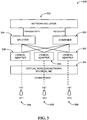
- FIG. 3 illustrates the architecture of an example client device according to some embodiments.
- a communication device capable of employing multiple stream media exchange over multiple access points may be any portable or stationary device with wireless communication capabilities and may include a notebook, a tablet, a smartphone, a vehicle mount computer, a specialized communication device, and so on.
- the media exchange may be part of a VoIP call, an online video conference, an application sharing session, a data sharing session, a media streaming session, or comparable sessions.
- a communication device or a client device may associate with multiple access points (and/or base stations) by virtue of its virtual radio stack and maintain concurrent (but not simultaneous) connection.
- the client device may determine link quality based on one or more predefined attributes such as received signal strength indicator (RSSI), packet error rate, number of repeats, etc. for each of these connections and select a number of them for transmitting (and receiving) multiple media streams.
- RSSI received signal strength indicator
- the number of selected connections may be based on a number of compressed media streams the communication device is capable of generating.
- the selection may be based on ordering the connections according to a link quality score, based on each attribute being compared to a threshold, or other factors such as user preference.
- the link quality may be computed as a combination score of two or more of the example attributes listed above and the connections ordered from the best score down with the top three links being selected for transmission.
- a user may be enabled to modify the selected links based on security, cost of connection, and similar considerations.
- the client device may decompose a media stream into multiple resolutions or compression streams and transmit each resolution through a separate access point or other network component, where the transmission decomposition and error correction may be dependent on the client-access point link quality.
- a remote client device, a wireless switch, or the cloud may be used for combining of streams (rendering).
- a client device may take advantage of virtualization of wireless network interface controller. Accordingly, a single physical network interface controller (NIC) 344 that is present in the client device may present itself as multiple NICs. Those NICs may associate and authenticate themselves to multiple access points 346, 348, and 350. As such, the NICs can have concurrent transmission and reception with the access points. To maintain connectivity, the NIC may switch rapidly between the access points, which may be on different channels, but can also be on the same channel.
- NIC network interface controller
- the client device may also include a networking layer 332, a splitter 334 on the transmit path and a combiner 336 on the receive path, and multiple logical adapters 338, 340, 342 for the virtual wireless NICs.
- the media stream may be split into multiple streams equal to the client - access point connections. The streams may be created such that when all combined provide for a good quality reception of the media.
- FIG. 4 is an example networked environment, where embodiments may be implemented.
- a communication service may also be employed in conjunction with hosted applications and services that may be implemented via software executed over one or more servers 406 or individual server 408.
- a hosted communication service or application may be a web-based service or application, a cloud based service or application, and similar ones, and communicate with client applications on individual computing devices such as a handheld computer 401, a laptop computer 402, a smart phone 403, or a tablet computer 404 ('client devices') through network(s) 410 and control a user interface presented to users.
- Such a service may enable users to interact with other users employing a variety of modalities and ensure acceptable quality of service for real time media communications over wireless networks through use of multiple media streams as discussed herein.
- Client devices 401-404 are used to access the functionality provided by the hosted service or application.
- One or more of the servers 406 or server 408 may be used to provide location determination service as discussed above.
- Relevant data may be stored in one or more data stores (e.g. data store 414), which may be managed by any one of the servers 406 or by database server 412.
- Network(s) 410 may comprise any topology of servers, clients, Internet service providers, and communication media.
- a system according to embodiments may have a static or dynamic topology.
- Network(s) 410 may include a secure network such as an enterprise network, an unsecure network such as a wireless open network, or the Internet.
- Network(s) 410 may also coordinate communication over other networks such as PSTN or cellular networks.
- Network(s) 410 provides communication between the nodes described herein.
- network(s) 410 may include wireless media such as acoustic, RF, infrared and other wireless media.
- computing devices applications, data sources, and data distribution systems may be employed to ensure acceptable quality of service for real time media communications over wireless networks through use of multiple media streams.
- networked environments discussed in FIG. 4 are for illustration purposes only. Embodiments are not limited to the example applications, modules, or processes.
- FIG. 5 and the associated discussion are intended to provide a brief, general description of a suitable computing environment in which embodiments may be implemented.
- computing device 500 may be any portable computing device with wireless communication capabilities, which may include touch and/or gesture detection capability in some examples, and include at least one processing unit 502 and system memory 504.
- Computing device 500 may also include a plurality of processing units that cooperate in executing programs.
- the system memory 504 may be volatile (such as RAM), non-volatile (such as ROM, flash memory, etc.) or some combination of the two.
- System memory 504 typically includes an operating system 505 suitable for controlling the operation of the platform, such as the WINDOWS ®, WINDOWS MOBILE®, or WINDOWS PHONE® operating systems from MICROSOFT CORPORATION of Redmond, Washington.
- the system memory 504 may also include one or more software applications such as communication application 522 and a network interface control (NIC) module 524.
- NIC network interface control
- Communication application 522 may enable communication with other devices over a wireless network through one or more modalities ensuring acceptable quality of service for real time media communications over wireless networks through use of multiple media streams by taking advantage of a virtual radio stack implementation on computing device 500 through the NIC module 524. This basic configuration is illustrated in FIG. 5 by those components within dashed line 508.
- Computing device 500 may have additional features or functionality.
- the computing device 500 may also include additional data storage devices (removable and/or non-removable) such as, for example, magnetic disks, optical disks, or tape.
- additional storage is illustrated in FIG. 5 by removable storage 509 and non-removable storage 510.
- Computer readable storage media may include volatile and nonvolatile, removable and non-removable media implemented in any method or technology for storage of information, such as computer readable instructions, data structures, program modules, or other data.
- System memory 504, removable storage 509 and non-removable storage 510 are all examples of computer readable storage media.
- Computer readable storage media includes, but is not limited to, RAM, ROM, EEPROM, flash memory or other memory technology, CD-ROM, digital versatile disks (DVD) or other optical storage, magnetic cassettes, magnetic tape, magnetic disk storage or other magnetic storage devices, or any other medium which can be used to store the desired information and which can be accessed by computing device 500. Any such computer readable storage media may be part of computing device 500.
- Computing device 500 may also have input device(s) 512 such as keyboard, mouse, pen, voice input device, touch input device, an optical capture device for detecting gestures, and comparable input devices.
- Output device(s) 514 such as a display, speakers, printer, and other types of output devices may also be included. These devices are well known in the art and need not be discussed at length here.
- Computing device 500 may also contain communication connections 516 that allow the device to communicate with other devices 518, such as over a wireless network in a distributed computing environment, a satellite link, a cellular link, and comparable mechanisms.
- Other devices 518 may include computer device(s) that execute communication applications and comparable devices.
- Communication connection(s) 516 is one example of communication media.
- Communication media can include therein computer readable instructions, data structures, program modules, or other data in a modulated data signal, such as a carrier wave or other transport mechanism, and includes any information delivery media.
- modulated data signal means a signal that has one or more of its characteristics set or changed in such a manner as to encode information in the signal.
- communication media includes wired media such as a wired network or direct-wired connection, and wireless media such as acoustic, RF, infrared and other wireless media.
- Example embodiments also include methods. These methods can be implemented in any number of ways, including the structures described in this document. One such way is by machine operations, of devices of the type described in this document.
- Another optional way is for one or more of the individual operations of the methods to be performed in conjunction with one or more human operators performing some. These human operators need not be collocated with each other, but each can be only with a machine that performs a portion of the program.
- FIG. 6 illustrates a logic flow diagram for a process of ensuring acceptable quality of service for real time media communications over wireless networks through use of multiple media streams, according to embodiments.
- Process 600 may be implemented as part of a communication application.
- Process 600 begins with optional operation 610, where a wireless communication device may be associated with one or more access points, cellular base stations, and/or similar wireless network components determining a list of available communication links.
- link quality e.g., RSSI, packet error rate, number of repeats, and comparable attributes
- a predefined number of links may be selected for transmission of media streams.
- media streams into multi-resolution or multi-compression streams may be transmitted over the selected links.
- the streams may be combined / rendered at a remote client, a server in the cloud, or a wireless switch at optional operation 650.
- process 800 is for illustration purposes. Ensuring acceptable quality of service for real time media communications over wireless networks through use of multiple media streams according to embodiments may be implemented by similar processes with fewer or additional steps, as well as in different order of operations using the principles described herein.
- Some embodiments may be implemented in a computing device that includes a communication module, a memory device, and a processor, where the processor executes a method as described above or comparable ones in conjunction with instructions stored in the memory device.
- Other embodiments may be implemented as a computer readable memory device with instructions stored thereon for executing a method as described above or similar ones. Examples of memory devices as various implementations of hardware are discussed above.
Landscapes
- Engineering & Computer Science (AREA)
- Computer Networks & Wireless Communication (AREA)
- Signal Processing (AREA)
- Mobile Radio Communication Systems (AREA)
- Databases & Information Systems (AREA)
- Computer Security & Cryptography (AREA)
- Telephonic Communication Services (AREA)
Description
- With the proliferation of computing and networking technologies, conventional communications are increasingly migrating to data networks, specifically wireless networks. For example, unified communication technologies enable users to communicate over various modalities and client devices, including portable devices, through wired and wireless networks. Users are also taking advantage of additional modalities with increasing frequency. Video conferences, application or whiteboard sharing sessions are common occurrence in daily business, academic, and personal lives.
- In facilitating video and similar communication modalities, communication devices transmit and receive data-heavy media. With increased bandwidth usage and wireless networks, interference may become a serious concern for quality of service. As the user moves around or is at a location, where signal levels may be less than desirable, the communication link between the user's communication device and an access point may degrade to unacceptable levels for video or similar modalities due to interference.
-
DE 10 2004 049705 discloses a method for operation of closely coupled wireless networks with different network technologies. -
US 2012/314651 discloses a communication control device including a communication path selecting unit that selects one or more wireless communication paths by which a wireless communication terminal and a processing executing device communicate with each other. - This summary is provided to introduce a selection of concepts in a simplified form that are further described below in the Detailed Description. This summary is not intended to exclusively identify key features or essential features of the claimed subject matter, nor is it intended as an aid in determining the scope of the claimed subject matter.
- Embodiments are directed to ensuring high quality of service for real time media communications over wired, wireless, or combination of wired and wireless networks through use of multiple media streams. Taking advantage of a virtual radio stack implementation on a wireless communication device, the device may be associated to multiple access points and/or cellular base stations. Link qualities of each connection may be determined and a predefined number of links with best connections (or above a predefined threshold) may be selected for transmission. Media stream may then be compressed into multi-resolution or multi-compression streams such that each resolution (or compression stream) is transmitted over a separate access point or base station. The different compression streams that are available may then be combined or rendered at a wireless switch, a backend server of the cloud, or a remote client. Furthermore, the multi-compression schemes may be a function of the link quality reflected in the packet error rate, and when available it may be a function of the end-to-end delay and packet error rate at the IP level.
- These and other features and advantages will be apparent from a reading of the following detailed description and a review of the associated drawings. It is to be understood that both the foregoing general description and the following detailed description are explanatory and do not restrict aspects as claimed.
-
-
FIG. 1 illustrates an example wireless communication environment with concurrent connections, where embodiments may be implemented; -
FIG. 2 illustrates another example wireless communication environment, where multiple media streams may be transmitted over access points and/or cellular base stations; -
FIG. 3 illustrates the architecture of an example client device according to some embodiments; -
FIG. 4 is a networked environment, where a system according to embodiments may be implemented; -
FIG. 5 is a block diagram of an example computing operating environment, where embodiments may be implemented; and -
FIG. 6 illustrates a logic flow diagram for a process of ensuring acceptable quality of service for real time media communications over wireless networks through use of multiple media streams, according to embodiments. - As briefly described above, a wireless communication device may be associated to multiple access points and/or cellular base stations. Link qualities of each connection may be determined and a predefined number of links with best connections (or above a predefined threshold) may be selected for transmission. Media stream may then be compressed into multi-resolution or multi-compression streams such that each resolution (or compression stream) is transmitted over a separate access point or base station to be rendered at a wireless switch, a backend server of the cloud, or a remote client.
- In the following detailed description, references are made to the accompanying drawings that form a part hereof, and in which are shown by way of illustrations specific embodiments or examples. These aspects may be combined, other aspects may be utilized, and structural changes may be made without departing from the scope of the present disclosure. The following detailed description is therefore not to be taken in the limiting sense, and the scope of the present invention is defined by the appended claims and their equivalents. While the embodiments will be described in the general context of program modules that execute in conjunction with an application program that runs on an operating system on a personal computer, those skilled in the art will recognize that aspects may also be implemented in combination with other program modules.
- Generally, program modules include routines, programs, components, data structures, and other types of structures that perform particular tasks or implement particular abstract data types. Moreover, those skilled in the art will appreciate that embodiments may be practiced with other computer system configurations, including hand-held devices, multiprocessor systems, microprocessor-based or programmable consumer electronics, minicomputers, mainframe computers, and comparable hardware. Embodiments may also be practiced in distributed computing environments where tasks are performed by remote processing devices that are linked through a communications network. In a distributed computing environment, program modules may be located in both local and remote memory storage devices.
- Embodiments may be implemented as a computer-implemented process (method), a computing system, or as an article of manufacture, such as a computer program product or computer readable media. The computer program product may be a computer storage medium readable by a computer system and encoding a computer program that comprises instructions for causing a computer or computing system to perform example process(es). The computer-readable storage medium is a computer-readable memory device. The computer-readable storage medium can for example be implemented via one or more of a volatile computer memory, a non-volatile memory, a hard drive, a flash drive, a floppy disk, or a compact disk, and comparable hardware media.
-
FIG. 1 illustrates an example wireless communication environment with concurrent connections, where embodiments may be implemented. - As mentioned above, wireless networks such as WLANs and similar configurations increasingly provide multi-modal communications that replace or complement traditional PSTN or cellular calls. Users may employ stationary or portable computing devices with wireless communication capability such as
communication device 102 to communicate with other users on the same wireless network or on other networks (including cellular networks). The communications may include, but are not limited to, voice call, video communications, text messaging, email exchange, data sharing, application sharing, whiteboard sharing, and comparable ones. - The communication link between the user's communication device and an access point may degrade to unacceptable levels for video or similar modalities due to interference, however, when user moves around or is at a location, where signal levels may be less than desirable. In a wireless network,
communication device 102 may communicate with the network infrastructure through an access point. A wireless network typically includes multiple access points, and thecommunication device 102 may be in communication with one or more of them (104, 106, 108, or 110) at any given time depending on signal quality, location, and other factors. - To address the potential degradation of media quality or performance and to enhance availability of multiple resolutions, a system according to embodiments may enable
communication device 102 to compress its media stream (V1 116) into multi-resolution or multi-compression streams and transmit them overseparate access points communication device 102 may determine the available access points, determine the quality of communication link with each access point, and then select the ones with better link quality for the transmission. - The media streams from the
access points wireless switch 112 or a server of the cloud (not shown) before being forwarded to a remote client over the Internet 114. In other embodiments, the streams may be combined at the remote client. Thus, high quality of service for real time media communications over wired, wireless, or combination of wired and wireless networks may be ensured through use of multiple media streams. Multi-compression schemes may be used as a function of the link quality reflected in the packet error rate, and when available they may be a function of the end-to-end delay and packet error rate at the IP level. -
FIG. 2 illustrates another example wireless communication environment, where multiple media streams may be transmitted over access points and/or cellular base stations. - In some cases, communication devices may be capable of utilizing multiple wireless technologies such as cellular, WLAN, near field communication (NFC), etc. Diagram 200 shows an example configuration, where three access points (204, 208, and 210) are available for communication to the
communication device 202, as well as acellular base station 222. Thus,communication device 202 may transmit its compressed media streams (V1 216) over the access points as well as the cellular base station(s). The media streams from theaccess points cellular base station 222 may then be combined (or rendered) at awireless switch 212, a server of the cloud (not shown) before being forwarded to a remote client over the Internet 214, or at the remote client, as discussed above. - Embodiments are not limited to WLAN or cellular networks and may be employed with any wireless communication technology / protocol using the principles described herein. Generally, such wireless communication technologies may utilize non-simultaneous reception / transmission to and from access points. An example of such communication protocols is frequency division multiple access (FDMA) protocols.
- Decomposition into multi-compression streams (e.g., S1 and S2 to access points AP1 and AP2) may be arranged such that if the receiving CODEC received S1 only (because S2 was not received for some reason), then the receiving CODEC output has a good quality media. Similarly, if the receiving CODEC receives only S2, the CODEC output may have a good quality media. If the receiving CODEC receives both streams, then the receiving CODEC output may have very high quality.
- Thus, S1 and S2 may depend on the link quality (even though both link qualities may be above a predefined threshold). For example, S1 may be audio/video compression stream and S2 may be file sharing. In another example, S1 may be for input devices (e.g., time sensitive and
access point 1 is high quality but with limited bandwidth) and S2 may be reserved for the rest of the media. In a further example, S1 may be 4G cellular transmitting high QoS part of media and S2 may be Wi-Fi best effort part of media. In yet another example, S1 may be 4G cellular transmitting high QoS part of media compression parameters and S2 may be Wi-Fi best effort part of media compression parameters. - As mentioned above, the multi-compression streams may be dependent on link quality. In some examples, end-to-end quality of the network may be available at the transmit CODEC (client side for example) and the multi-stream compression streams may be tuned according to network fingerprint (for example, in software defined networks). Thus, the client may query the network quality by sending test messages first. In response to the test messages (response being quality of the network), streams may be generated.
- Once the high quality media stream is split into multiple streams, an identifier to each packet fragment may be sent on each stream. The identifier may be a time stamp or a sequence number. The combiner that is located in the cloud, switch, or client depending on the direction of the data traffic may combine the frames with matching identifiers as part of the combining to a high definition stream. Therefore, the combiner may hold and store those frames. Based on the nature of the traffic (e.g., real time requirements), the combiner may store those frames for a predefined period of time and may drop any frames from the streams that are running late. The combiner or codec may also deploy interpolation techniques to make up for the missing frames or to reduce the resolution / fidelity if the missing frames cannot be mitigated. If the delay on a particular link exceeds the maximum delay for the communication, it may be dropped from the communication, thereby, saving resources.
-
FIG. 3 illustrates the architecture of an example client device according to some embodiments. - A communication device capable of employing multiple stream media exchange over multiple access points may be any portable or stationary device with wireless communication capabilities and may include a notebook, a tablet, a smartphone, a vehicle mount computer, a specialized communication device, and so on. The media exchange may be part of a VoIP call, an online video conference, an application sharing session, a data sharing session, a media streaming session, or comparable sessions.
- A communication device or a client device, as shown in diagram 300, may associate with multiple access points (and/or base stations) by virtue of its virtual radio stack and maintain concurrent (but not simultaneous) connection. The client device may determine link quality based on one or more predefined attributes such as received signal strength indicator (RSSI), packet error rate, number of repeats, etc. for each of these connections and select a number of them for transmitting (and receiving) multiple media streams. The number of selected connections may be based on a number of compressed media streams the communication device is capable of generating. The selection may be based on ordering the connections according to a link quality score, based on each attribute being compared to a threshold, or other factors such as user preference. For example, the link quality may be computed as a combination score of two or more of the example attributes listed above and the connections ordered from the best score down with the top three links being selected for transmission. In another example, a user may be enabled to modify the selected links based on security, cost of connection, and similar considerations.
- Thus, the client device may decompose a media stream into multiple resolutions or compression streams and transmit each resolution through a separate access point or other network component, where the transmission decomposition and error correction may be dependent on the client-access point link quality. A remote client device, a wireless switch, or the cloud may be used for combining of streams (rendering).
- A client device according to embodiments may take advantage of virtualization of wireless network interface controller. Accordingly, a single physical network interface controller (NIC) 344 that is present in the client device may present itself as multiple NICs. Those NICs may associate and authenticate themselves to
multiple access points - The client device may also include a
networking layer 332, asplitter 334 on the transmit path and acombiner 336 on the receive path, and multiplelogical adapters - The above discussed configurations are example configurations for illustrative purposes. Embodiments may be implemented with other configurations and approaches using the principles described herein.
-
FIG. 4 is an example networked environment, where embodiments may be implemented. In addition to locally installed applications, such ascommunication application 522 discussed below, a communication service may also be employed in conjunction with hosted applications and services that may be implemented via software executed over one ormore servers 406 orindividual server 408. A hosted communication service or application may be a web-based service or application, a cloud based service or application, and similar ones, and communicate with client applications on individual computing devices such as ahandheld computer 401, alaptop computer 402, asmart phone 403, or a tablet computer 404 ('client devices') through network(s) 410 and control a user interface presented to users. Such a service may enable users to interact with other users employing a variety of modalities and ensure acceptable quality of service for real time media communications over wireless networks through use of multiple media streams as discussed herein. - Client devices 401-404 are used to access the functionality provided by the hosted service or application. One or more of the
servers 406 orserver 408 may be used to provide location determination service as discussed above. Relevant data may be stored in one or more data stores (e.g. data store 414), which may be managed by any one of theservers 406 or bydatabase server 412. - Network(s) 410 may comprise any topology of servers, clients, Internet service providers, and communication media. A system according to embodiments may have a static or dynamic topology. Network(s) 410 may include a secure network such as an enterprise network, an unsecure network such as a wireless open network, or the Internet. Network(s) 410 may also coordinate communication over other networks such as PSTN or cellular networks. Network(s) 410 provides communication between the nodes described herein. By way of example, and not limitation, network(s) 410 may include wireless media such as acoustic, RF, infrared and other wireless media.
- Many other configurations of computing devices, applications, data sources, and data distribution systems may be employed to ensure acceptable quality of service for real time media communications over wireless networks through use of multiple media streams. Furthermore, the networked environments discussed in
FIG. 4 are for illustration purposes only. Embodiments are not limited to the example applications, modules, or processes. -
FIG. 5 and the associated discussion are intended to provide a brief, general description of a suitable computing environment in which embodiments may be implemented. With reference toFIG. 5 , a block diagram of an example computing operating environment for an application according to embodiments is illustrated, such ascomputing device 500. In a basic configuration,computing device 500 may be any portable computing device with wireless communication capabilities, which may include touch and/or gesture detection capability in some examples, and include at least oneprocessing unit 502 andsystem memory 504.Computing device 500 may also include a plurality of processing units that cooperate in executing programs. Depending on the exact configuration and type of computing device, thesystem memory 504 may be volatile (such as RAM), non-volatile (such as ROM, flash memory, etc.) or some combination of the two.System memory 504 typically includes an operating system 505 suitable for controlling the operation of the platform, such as the WINDOWS ®, WINDOWS MOBILE®, or WINDOWS PHONE® operating systems from MICROSOFT CORPORATION of Redmond, Washington. Thesystem memory 504 may also include one or more software applications such ascommunication application 522 and a network interface control (NIC)module 524. -
Communication application 522 may enable communication with other devices over a wireless network through one or more modalities ensuring acceptable quality of service for real time media communications over wireless networks through use of multiple media streams by taking advantage of a virtual radio stack implementation oncomputing device 500 through theNIC module 524. This basic configuration is illustrated inFIG. 5 by those components within dashedline 508. -
Computing device 500 may have additional features or functionality. For example, thecomputing device 500 may also include additional data storage devices (removable and/or non-removable) such as, for example, magnetic disks, optical disks, or tape. Such additional storage is illustrated inFIG. 5 byremovable storage 509 andnon-removable storage 510. Computer readable storage media may include volatile and nonvolatile, removable and non-removable media implemented in any method or technology for storage of information, such as computer readable instructions, data structures, program modules, or other data.System memory 504,removable storage 509 andnon-removable storage 510 are all examples of computer readable storage media. Computer readable storage media includes, but is not limited to, RAM, ROM, EEPROM, flash memory or other memory technology, CD-ROM, digital versatile disks (DVD) or other optical storage, magnetic cassettes, magnetic tape, magnetic disk storage or other magnetic storage devices, or any other medium which can be used to store the desired information and which can be accessed by computingdevice 500. Any such computer readable storage media may be part ofcomputing device 500.Computing device 500 may also have input device(s) 512 such as keyboard, mouse, pen, voice input device, touch input device, an optical capture device for detecting gestures, and comparable input devices. Output device(s) 514 such as a display, speakers, printer, and other types of output devices may also be included. These devices are well known in the art and need not be discussed at length here. -
Computing device 500 may also containcommunication connections 516 that allow the device to communicate withother devices 518, such as over a wireless network in a distributed computing environment, a satellite link, a cellular link, and comparable mechanisms.Other devices 518 may include computer device(s) that execute communication applications and comparable devices. Communication connection(s) 516 is one example of communication media. Communication media can include therein computer readable instructions, data structures, program modules, or other data in a modulated data signal, such as a carrier wave or other transport mechanism, and includes any information delivery media. The term "modulated data signal" means a signal that has one or more of its characteristics set or changed in such a manner as to encode information in the signal. By way of example, and not limitation, communication media includes wired media such as a wired network or direct-wired connection, and wireless media such as acoustic, RF, infrared and other wireless media. - Example embodiments also include methods. These methods can be implemented in any number of ways, including the structures described in this document. One such way is by machine operations, of devices of the type described in this document.
- Another optional way is for one or more of the individual operations of the methods to be performed in conjunction with one or more human operators performing some. These human operators need not be collocated with each other, but each can be only with a machine that performs a portion of the program.
-
FIG. 6 illustrates a logic flow diagram for a process of ensuring acceptable quality of service for real time media communications over wireless networks through use of multiple media streams, according to embodiments.Process 600 may be implemented as part of a communication application. -
Process 600 begins withoptional operation 610, where a wireless communication device may be associated with one or more access points, cellular base stations, and/or similar wireless network components determining a list of available communication links. Atoperation 620, link quality (e.g., RSSI, packet error rate, number of repeats, and comparable attributes) for each link on the list may be determined. Atoperation 630, a predefined number of links (whether they are through an access point, a cellular base station, or other network component) with best link quality may be selected for transmission of media streams. - At
operation 640, media streams into multi-resolution or multi-compression streams may be transmitted over the selected links. The streams may be combined / rendered at a remote client, a server in the cloud, or a wireless switch atoptional operation 650. - The operations included in process 800 are for illustration purposes. Ensuring acceptable quality of service for real time media communications over wireless networks through use of multiple media streams according to embodiments may be implemented by similar processes with fewer or additional steps, as well as in different order of operations using the principles described herein.
- Some embodiments may be implemented in a computing device that includes a communication module, a memory device, and a processor, where the processor executes a method as described above or comparable ones in conjunction with instructions stored in the memory device. Other embodiments may be implemented as a computer readable memory device with instructions stored thereon for executing a method as described above or similar ones. Examples of memory devices as various implementations of hardware are discussed above.
- The above specification, examples and data provide a complete description of the manufacture and use of the composition of the embodiments. Although the subject matter has been described in language specific to structural features and/or methodological acts, it is to be understood that the subject matter defined in the appended claims is not necessarily limited to the specific features or acts described above. Rather, the specific features and acts described above are disclosed as example forms of implementing the claims and embodiments.
Claims (10)
- A method executed in a computing device (500) or in a distributed computing environment for ensuring acceptable quality of service for real time media communications over wireless networks, the method comprising:determining a plurality of access points (104, 106, 108, 110) associated with one or more wireless networks;determining a link quality for each of the access points ;selecting a subset of the access points based on the respective link qualities;decomposing a media stream (116) into a number of streams, wherein the number of streams is equal to a number of access points in the subset; andtransmitting the streams to the subset of access points such that the streams are subsequently combined for use at a remote client;characterized in that the method comprises further steps of:associating and authenticating with each of the plurality of access points; andemploying a plurality of virtual radio stack adapters to maintain association and connection to the access points concurrently without simultaneous transmission or reception, and wherein the decomposing comprises compressing the media stream into one or more of multi-resolution streams and multi-compression streams.
- The method of claim 1, wherein decomposing the media stream into the streams comprises:compressing the media stream into two or more multi-resolution streams.
- The method of claim 2,wherein:at least one multi-compression stream is reserved for audio/video media and at least one other multi-compression stream is reserved for file sharing media;at least one multi-compression stream is reserved for input devices and at least one other multi-compression stream is reserved for remaining media;at least one multi-compression stream is reserved for a cellular link transmitting high quality of service part of media and at least one other multi-compression stream is reserved for remaining media; andat least one multi-compression stream is reserved for a cellular link transmitting high quality of service part of media compression parameters and at least one other multi-compression stream is reserved for Wi-Fi best effort pat of media compression parameters.
- The method of claim 1, further comprising:determining one or more available base stations;determining a link quality for each of the base stations;selecting a subset of the base stations based on the respective link qualities, wherein the number of streams is equal to the number of selected access points and base stations; andtransmitting the streams to the selected access points and base stations such that the streams are subsequently combined for use at the remote client employing an identifier associated with each packet fragment on each stream.
- The method of claim 4, wherein the base stations are cellular base stations (222).
- A computing device (500) with wireless communication capability for ensuring acceptable quality of service for real time media communications over wireless networks, the computing device comprising:a memory (504) storing instructions;one or more wireless communication modules; anda processor coupled to the memory and the communication modules, the processor executing a communication application, wherein the communication application is configured to:determine the plurality of access points (104, 106, 108, 110) associated with one or more wireless networks;determine a link quality for each of the plurality of the access points;select a subset of the access points based on the respective link qualities;decompose a media stream (116) into a number of streams, wherein the number of streams is equal to a number of access points in the subset; andcharacterized in that the computing device is further configured to:associate and authenticate with each of the plurality of access points; andtransmit the streams to the subset of access points such that the streams are subsequently combined for use at a remote client, wherein the step of decomposing comprises compressing the media stream into one or more of multi-resolution and multi-compression streams and the communication modules include a plurality of virtual radio stack adapters to maintain association and connection to a plurality of access points concurrently without simultaneous transmission or reception.
- The computing device of claim 6, wherein the virtual radio stack adapters are part of a single network interface controller (NIC) (344) that presents itself as multiple NICs to the plurality of access points to associate and authenticate.
- The computing device of claim 7, wherein the NIC is configured to switch between the selected access points during media streaming.
- A computer-readable memory comprising instructions for ensuring acceptable quality of service for real time media communications over wireless networks, the instructions causing a computer to carry out the steps of:determining a plurality of access points (104, 106, 108, 110) and base stations associated with the network;determining link quality for each of the access points;selecting a subset of the access points based on the respective link qualities;decomposing a media stream (116) into a number of streams, wherein the number of streams is equal to a number of access points in the subset; andtransmitting the streams to the subset of access points such that the streams are subsequently combined for use at a remote client,characterized in that the instructions further cause the computer to carry out the steps of:associating and authenticating with each of the plurality of access points; andemploying a plurality of virtual radio stack adapters to maintain association and connection to the access points concurrently without simultaneous transmission or reception, and wherein that the decomposing comprises compressing the media stream into one or more of multi-resolution streams and multi-compression streams.
- The computer program product of claim 9 wherein the link quality of an end-to-end quality associated with the network determined by transmitting test messages.
Applications Claiming Priority (2)
| Application Number | Priority Date | Filing Date | Title |
|---|---|---|---|
| US13/742,963 US20140201383A1 (en) | 2013-01-16 | 2013-01-16 | Distributed description over multiple links |
| PCT/US2014/011370 WO2014113342A1 (en) | 2013-01-16 | 2014-01-14 | Wireless real time media communications through the use of multiple media streams |
Publications (2)
| Publication Number | Publication Date |
|---|---|
| EP2929754A1 EP2929754A1 (en) | 2015-10-14 |
| EP2929754B1 true EP2929754B1 (en) | 2016-12-14 |
Family
ID=50073444
Family Applications (1)
| Application Number | Title | Priority Date | Filing Date |
|---|---|---|---|
| EP14703966.3A Not-in-force EP2929754B1 (en) | 2013-01-16 | 2014-01-14 | Wireless real time media communications through the use of multiple media streams |
Country Status (11)
| Country | Link |
|---|---|
| US (1) | US20140201383A1 (en) |
| EP (1) | EP2929754B1 (en) |
| JP (1) | JP2016508357A (en) |
| KR (1) | KR20150108856A (en) |
| CN (1) | CN104969657A (en) |
| AU (1) | AU2014207733A1 (en) |
| BR (1) | BR112015016474A2 (en) |
| CA (1) | CA2896615A1 (en) |
| MX (1) | MX2015009221A (en) |
| RU (1) | RU2015128625A (en) |
| WO (1) | WO2014113342A1 (en) |
Families Citing this family (22)
| Publication number | Priority date | Publication date | Assignee | Title |
|---|---|---|---|---|
| WO2014187475A1 (en) * | 2013-05-21 | 2014-11-27 | Telefonaktiebolaget L M Ericsson (Publ) | Methods and packet network devices for forwarding packet data traffic |
| KR102133012B1 (en) * | 2014-04-07 | 2020-07-10 | 삼성전자주식회사 | Media streaming method and electronic device thereof |
| EP3167676B1 (en) * | 2014-08-14 | 2021-04-07 | MediaTek Inc. | Multiple link communication |
| DE102014219686A1 (en) * | 2014-09-29 | 2016-03-31 | Bayerische Motoren Werke Aktiengesellschaft | Adapt video compression to a mobile server |
| US10728791B2 (en) * | 2014-10-27 | 2020-07-28 | General Electric Company | Wireless interface virtualization |
| EP3269118B8 (en) | 2015-03-11 | 2021-03-17 | CommScope, Inc. of North Carolina | Distributed radio access network with adaptive fronthaul |
| US10608734B2 (en) | 2015-10-22 | 2020-03-31 | Phluido, Inc. | Virtualization and orchestration of a radio access network |
| US10243837B2 (en) * | 2016-06-06 | 2019-03-26 | Argela Yazilim ve Bilisim Teknolojileri San. ve Tic. A.S. | Enabling split sessions across hybrid public safety and LTE networks |
| US10057309B2 (en) * | 2016-06-29 | 2018-08-21 | Microsoft Technology Licensing, Llc | Concurrent serving of a media stream |
| WO2018017468A1 (en) | 2016-07-18 | 2018-01-25 | Phluido, Inc. | Synchronization of radio units in radio access networks |
| CN106162560A (en) * | 2016-08-03 | 2016-11-23 | 安徽协创物联网技术有限公司 | A kind of communication resources distributor based on car networking and method |
| US10278156B2 (en) | 2016-09-19 | 2019-04-30 | At&T Intellectual Property I, L.P. | Streaming media cellular broadcast |
| US10187178B2 (en) * | 2016-10-11 | 2019-01-22 | Microsoft Technology Licensing, Llc | Dynamically partitioning media streams |
| US10656987B1 (en) * | 2017-04-26 | 2020-05-19 | EMC IP Holding Company LLC | Analysis system and method |
| US10951528B2 (en) * | 2017-07-31 | 2021-03-16 | Cisco Technology, Inc. | Network load balancing |
| WO2019066867A1 (en) * | 2017-09-28 | 2019-04-04 | Intel Corporation | Methods and apparatus to facilitate centralized multi-access point, multi-station association in a cooperative wi-fi network |
| US12016084B2 (en) | 2018-01-04 | 2024-06-18 | Commscope Technologies Llc | Management of a split physical layer in a radio area network |
| ES2795283T3 (en) * | 2018-01-26 | 2020-11-23 | Deutsche Telekom Ag | Data distribution of a data flow of a user equipment through multiple access gateways |
| US11368512B2 (en) * | 2018-08-20 | 2022-06-21 | Sony Group Corporation | Method and system for utilizing network conditions feedback for improving quality of a collaborative media production |
| CN112565481B (en) * | 2018-11-21 | 2022-04-12 | Oppo广东移动通信有限公司 | Electronic equipment, domain name query method and related product |
| US11211998B2 (en) * | 2019-04-03 | 2021-12-28 | Baylor University | Virtual wireless network |
| US12223824B2 (en) * | 2019-07-15 | 2025-02-11 | Sew-Eurodrive Gmbh & Co. Kg | Method for operating a mobile system and an alarm gateway as subscribers in a wireless network |
Family Cites Families (17)
| Publication number | Priority date | Publication date | Assignee | Title |
|---|---|---|---|---|
| US20040162037A1 (en) * | 2003-02-18 | 2004-08-19 | Eran Shpak | Multi-channel WLAN transceiver with antenna diversity |
| US7610057B2 (en) * | 2004-04-23 | 2009-10-27 | Microsoft Corporation | Selecting a wireless networking technology on a device capable of carrying out wireless network communications via multiple wireless technologies |
| DE102004049705B4 (en) * | 2004-10-12 | 2006-09-28 | Siemens Ag | Method for optimal operation of a tightly coupled wireless network with various network technologies and a corresponding device for a network element |
| US7577125B2 (en) * | 2005-07-08 | 2009-08-18 | Microsoft Corporation | Direct wireless client to client communication |
| US7433358B1 (en) * | 2005-07-08 | 2008-10-07 | Cisco Technology, Inc. | Characterization of impaired intervals in a voice over packet session using audio frame loss concealment |
| US7688788B2 (en) * | 2005-10-11 | 2010-03-30 | Microsoft Corporation | Congestion level and signal quality based estimator for bit-rate and automated load balancing for WLANS |
| US8396041B2 (en) * | 2005-11-08 | 2013-03-12 | Microsoft Corporation | Adapting a communication network to varying conditions |
| JP4993219B2 (en) * | 2006-03-01 | 2012-08-08 | 日本電気株式会社 | Communication terminal, access point switching method, and access point switching control program |
| US8189621B2 (en) * | 2006-05-12 | 2012-05-29 | Microsoft Corporation | Stack signaling to application with lack of requested bandwidth |
| US8818379B2 (en) * | 2007-09-28 | 2014-08-26 | At&T Intellectual Property I, L.P. | Methods, systems, and computer-readable media for providing multiple communication paths |
| US8363617B2 (en) * | 2008-08-27 | 2013-01-29 | Symbol Technologies, Inc. | Selecting an access point from a plurality of access points |
| US8364024B2 (en) * | 2009-02-03 | 2013-01-29 | Broadcom Corporation | Constructing video frames and synchronizing audio data in a media player from data received via a plurality of diverse protocol stack paths |
| US8942215B2 (en) * | 2010-07-15 | 2015-01-27 | Dejero Labs Inc. | System and method for transmission of data from a wireless mobile device over a multipath wireless router |
| US8739177B2 (en) * | 2010-06-21 | 2014-05-27 | Intel Corporation | Method for network interface sharing among multiple virtual machines |
| US8588844B2 (en) * | 2010-11-04 | 2013-11-19 | Extricom Ltd. | MIMO search over multiple access points |
| WO2012165814A2 (en) * | 2011-06-03 | 2012-12-06 | 에스케이 텔레콤주식회사 | Transceiving device and method for operating transceiving device |
| JP5742491B2 (en) * | 2011-06-09 | 2015-07-01 | ソニー株式会社 | Communication control device, wireless communication terminal, processing execution device, communication system, and communication control method |
-
2013
- 2013-01-16 US US13/742,963 patent/US20140201383A1/en not_active Abandoned
-
2014
- 2014-01-14 RU RU2015128625A patent/RU2015128625A/en not_active Application Discontinuation
- 2014-01-14 WO PCT/US2014/011370 patent/WO2014113342A1/en not_active Ceased
- 2014-01-14 AU AU2014207733A patent/AU2014207733A1/en not_active Abandoned
- 2014-01-14 MX MX2015009221A patent/MX2015009221A/en unknown
- 2014-01-14 JP JP2015552872A patent/JP2016508357A/en active Pending
- 2014-01-14 CA CA2896615A patent/CA2896615A1/en not_active Abandoned
- 2014-01-14 BR BR112015016474A patent/BR112015016474A2/en not_active IP Right Cessation
- 2014-01-14 KR KR1020157021225A patent/KR20150108856A/en not_active Withdrawn
- 2014-01-14 EP EP14703966.3A patent/EP2929754B1/en not_active Not-in-force
- 2014-01-14 CN CN201480005056.4A patent/CN104969657A/en active Pending
Non-Patent Citations (1)
| Title |
|---|
| None * |
Also Published As
| Publication number | Publication date |
|---|---|
| JP2016508357A (en) | 2016-03-17 |
| CN104969657A (en) | 2015-10-07 |
| AU2014207733A1 (en) | 2015-07-16 |
| MX2015009221A (en) | 2016-04-11 |
| BR112015016474A2 (en) | 2017-07-11 |
| KR20150108856A (en) | 2015-09-30 |
| US20140201383A1 (en) | 2014-07-17 |
| EP2929754A1 (en) | 2015-10-14 |
| CA2896615A1 (en) | 2014-07-24 |
| WO2014113342A1 (en) | 2014-07-24 |
| RU2015128625A (en) | 2017-01-23 |
Similar Documents
| Publication | Publication Date | Title |
|---|---|---|
| US20140201383A1 (en) | Distributed description over multiple links | |
| US11626953B2 (en) | Generating wireless reference signals in a different domain for transmission with a collapsed time-frequency grid | |
| US12082311B2 (en) | Facilitating integrated management of connected assets that utilize different technologies and that are located across disparate wireless communications networks | |
| US11006314B2 (en) | Dynamic access slice pooling and software defined network controlled capabilities | |
| US10917374B2 (en) | Techniques to visualize messaging flow | |
| US11160001B2 (en) | Control of wireless fidelity access for 5G or other next generation network | |
| US20240414505A1 (en) | Location aware assignment of resources for push to transfer (ptt) communication systems in a fifth generation (5g) network or other next generation wireless communication system | |
| US11044214B2 (en) | Multimedia file adaption across different communication platforms | |
| US10157102B2 (en) | Techniques to scan and reorganize media files to remove gaps | |
| US9882629B2 (en) | Facilitation of dual mode wireless device transmissions | |
| US20160352783A1 (en) | Partitioning Media Data | |
| US10187178B2 (en) | Dynamically partitioning media streams | |
| US20180367446A1 (en) | Dual network interface implementation in multipath networking | |
| CN112242946A (en) | Method and system for transmitting images in chunks | |
| US12040953B2 (en) | Facilitating metaverse service orchestration and hybrid software defining network control with policy enabled multiple input multiple output in advanced networks | |
| US20220368624A1 (en) | Managing changes to interdependent network elements |
Legal Events
| Date | Code | Title | Description |
|---|---|---|---|
| PUAI | Public reference made under article 153(3) epc to a published international application that has entered the european phase |
Free format text: ORIGINAL CODE: 0009012 |
|
| 17P | Request for examination filed |
Effective date: 20150708 |
|
| AK | Designated contracting states |
Kind code of ref document: A1 Designated state(s): AL AT BE BG CH CY CZ DE DK EE ES FI FR GB GR HR HU IE IS IT LI LT LU LV MC MK MT NL NO PL PT RO RS SE SI SK SM TR |
|
| AX | Request for extension of the european patent |
Extension state: BA ME |
|
| DAX | Request for extension of the european patent (deleted) | ||
| REG | Reference to a national code |
Ref country code: DE Ref legal event code: R079 Ref document number: 602014005486 Country of ref document: DE Free format text: PREVIOUS MAIN CLASS: H04W0088060000 Ipc: H04W0076020000 |
|
| GRAP | Despatch of communication of intention to grant a patent |
Free format text: ORIGINAL CODE: EPIDOSNIGR1 |
|
| RIC1 | Information provided on ipc code assigned before grant |
Ipc: H04W 40/12 20090101ALN20160629BHEP Ipc: H04L 12/707 20130101ALN20160629BHEP Ipc: H04W 48/20 20090101ALN20160629BHEP Ipc: H04W 76/02 20090101AFI20160629BHEP Ipc: H04W 88/06 20090101ALI20160629BHEP Ipc: H04W 48/18 20090101ALN20160629BHEP |
|
| INTG | Intention to grant announced |
Effective date: 20160713 |
|
| STAA | Information on the status of an ep patent application or granted ep patent |
Free format text: STATUS: GRANT OF PATENT IS INTENDED |
|
| GRAS | Grant fee paid |
Free format text: ORIGINAL CODE: EPIDOSNIGR3 |
|
| GRAA | (expected) grant |
Free format text: ORIGINAL CODE: 0009210 |
|
| STAA | Information on the status of an ep patent application or granted ep patent |
Free format text: STATUS: THE PATENT HAS BEEN GRANTED |
|
| AK | Designated contracting states |
Kind code of ref document: B1 Designated state(s): AL AT BE BG CH CY CZ DE DK EE ES FI FR GB GR HR HU IE IS IT LI LT LU LV MC MK MT NL NO PL PT RO RS SE SI SK SM TR |
|
| REG | Reference to a national code |
Ref country code: GB Ref legal event code: FG4D |
|
| REG | Reference to a national code |
Ref country code: CH Ref legal event code: EP |
|
| REG | Reference to a national code |
Ref country code: IE Ref legal event code: FG4D |
|
| REG | Reference to a national code |
Ref country code: AT Ref legal event code: REF Ref document number: 854578 Country of ref document: AT Kind code of ref document: T Effective date: 20170115 |
|
| REG | Reference to a national code |
Ref country code: DE Ref legal event code: R096 Ref document number: 602014005486 Country of ref document: DE |
|
| REG | Reference to a national code |
Ref country code: FR Ref legal event code: PLFP Year of fee payment: 4 |
|
| PG25 | Lapsed in a contracting state [announced via postgrant information from national office to epo] |
Ref country code: LV Free format text: LAPSE BECAUSE OF FAILURE TO SUBMIT A TRANSLATION OF THE DESCRIPTION OR TO PAY THE FEE WITHIN THE PRESCRIBED TIME-LIMIT Effective date: 20161214 |
|
| REG | Reference to a national code |
Ref country code: NL Ref legal event code: FP |
|
| PGFP | Annual fee paid to national office [announced via postgrant information from national office to epo] |
Ref country code: NL Payment date: 20170126 Year of fee payment: 4 |
|
| REG | Reference to a national code |
Ref country code: LT Ref legal event code: MG4D |
|
| PG25 | Lapsed in a contracting state [announced via postgrant information from national office to epo] |
Ref country code: NO Free format text: LAPSE BECAUSE OF FAILURE TO SUBMIT A TRANSLATION OF THE DESCRIPTION OR TO PAY THE FEE WITHIN THE PRESCRIBED TIME-LIMIT Effective date: 20170314 Ref country code: GR Free format text: LAPSE BECAUSE OF FAILURE TO SUBMIT A TRANSLATION OF THE DESCRIPTION OR TO PAY THE FEE WITHIN THE PRESCRIBED TIME-LIMIT Effective date: 20170315 Ref country code: SE Free format text: LAPSE BECAUSE OF FAILURE TO SUBMIT A TRANSLATION OF THE DESCRIPTION OR TO PAY THE FEE WITHIN THE PRESCRIBED TIME-LIMIT Effective date: 20161214 Ref country code: LT Free format text: LAPSE BECAUSE OF FAILURE TO SUBMIT A TRANSLATION OF THE DESCRIPTION OR TO PAY THE FEE WITHIN THE PRESCRIBED TIME-LIMIT Effective date: 20161214 |
|
| PGFP | Annual fee paid to national office [announced via postgrant information from national office to epo] |
Ref country code: FR Payment date: 20170126 Year of fee payment: 4 |
|
| REG | Reference to a national code |
Ref country code: AT Ref legal event code: MK05 Ref document number: 854578 Country of ref document: AT Kind code of ref document: T Effective date: 20161214 |
|
| PG25 | Lapsed in a contracting state [announced via postgrant information from national office to epo] |
Ref country code: BE Free format text: LAPSE BECAUSE OF NON-PAYMENT OF DUE FEES Effective date: 20170131 Ref country code: FI Free format text: LAPSE BECAUSE OF FAILURE TO SUBMIT A TRANSLATION OF THE DESCRIPTION OR TO PAY THE FEE WITHIN THE PRESCRIBED TIME-LIMIT Effective date: 20161214 Ref country code: HR Free format text: LAPSE BECAUSE OF FAILURE TO SUBMIT A TRANSLATION OF THE DESCRIPTION OR TO PAY THE FEE WITHIN THE PRESCRIBED TIME-LIMIT Effective date: 20161214 Ref country code: RS Free format text: LAPSE BECAUSE OF FAILURE TO SUBMIT A TRANSLATION OF THE DESCRIPTION OR TO PAY THE FEE WITHIN THE PRESCRIBED TIME-LIMIT Effective date: 20161214 |
|
| PG25 | Lapsed in a contracting state [announced via postgrant information from national office to epo] |
Ref country code: SK Free format text: LAPSE BECAUSE OF FAILURE TO SUBMIT A TRANSLATION OF THE DESCRIPTION OR TO PAY THE FEE WITHIN THE PRESCRIBED TIME-LIMIT Effective date: 20161214 Ref country code: CZ Free format text: LAPSE BECAUSE OF FAILURE TO SUBMIT A TRANSLATION OF THE DESCRIPTION OR TO PAY THE FEE WITHIN THE PRESCRIBED TIME-LIMIT Effective date: 20161214 Ref country code: RO Free format text: LAPSE BECAUSE OF FAILURE TO SUBMIT A TRANSLATION OF THE DESCRIPTION OR TO PAY THE FEE WITHIN THE PRESCRIBED TIME-LIMIT Effective date: 20161214 Ref country code: IS Free format text: LAPSE BECAUSE OF FAILURE TO SUBMIT A TRANSLATION OF THE DESCRIPTION OR TO PAY THE FEE WITHIN THE PRESCRIBED TIME-LIMIT Effective date: 20170414 Ref country code: EE Free format text: LAPSE BECAUSE OF FAILURE TO SUBMIT A TRANSLATION OF THE DESCRIPTION OR TO PAY THE FEE WITHIN THE PRESCRIBED TIME-LIMIT Effective date: 20161214 |
|
| PG25 | Lapsed in a contracting state [announced via postgrant information from national office to epo] |
Ref country code: AT Free format text: LAPSE BECAUSE OF FAILURE TO SUBMIT A TRANSLATION OF THE DESCRIPTION OR TO PAY THE FEE WITHIN THE PRESCRIBED TIME-LIMIT Effective date: 20161214 Ref country code: SM Free format text: LAPSE BECAUSE OF FAILURE TO SUBMIT A TRANSLATION OF THE DESCRIPTION OR TO PAY THE FEE WITHIN THE PRESCRIBED TIME-LIMIT Effective date: 20161214 Ref country code: BG Free format text: LAPSE BECAUSE OF FAILURE TO SUBMIT A TRANSLATION OF THE DESCRIPTION OR TO PAY THE FEE WITHIN THE PRESCRIBED TIME-LIMIT Effective date: 20170314 Ref country code: PT Free format text: LAPSE BECAUSE OF FAILURE TO SUBMIT A TRANSLATION OF THE DESCRIPTION OR TO PAY THE FEE WITHIN THE PRESCRIBED TIME-LIMIT Effective date: 20170414 Ref country code: PL Free format text: LAPSE BECAUSE OF FAILURE TO SUBMIT A TRANSLATION OF THE DESCRIPTION OR TO PAY THE FEE WITHIN THE PRESCRIBED TIME-LIMIT Effective date: 20161214 Ref country code: IT Free format text: LAPSE BECAUSE OF FAILURE TO SUBMIT A TRANSLATION OF THE DESCRIPTION OR TO PAY THE FEE WITHIN THE PRESCRIBED TIME-LIMIT Effective date: 20161214 Ref country code: BE Free format text: LAPSE BECAUSE OF FAILURE TO SUBMIT A TRANSLATION OF THE DESCRIPTION OR TO PAY THE FEE WITHIN THE PRESCRIBED TIME-LIMIT Effective date: 20161214 Ref country code: ES Free format text: LAPSE BECAUSE OF FAILURE TO SUBMIT A TRANSLATION OF THE DESCRIPTION OR TO PAY THE FEE WITHIN THE PRESCRIBED TIME-LIMIT Effective date: 20161214 |
|
| REG | Reference to a national code |
Ref country code: CH Ref legal event code: PL |
|
| REG | Reference to a national code |
Ref country code: DE Ref legal event code: R097 Ref document number: 602014005486 Country of ref document: DE |
|
| PG25 | Lapsed in a contracting state [announced via postgrant information from national office to epo] |
Ref country code: MC Free format text: LAPSE BECAUSE OF FAILURE TO SUBMIT A TRANSLATION OF THE DESCRIPTION OR TO PAY THE FEE WITHIN THE PRESCRIBED TIME-LIMIT Effective date: 20161214 |
|
| PLBE | No opposition filed within time limit |
Free format text: ORIGINAL CODE: 0009261 |
|
| STAA | Information on the status of an ep patent application or granted ep patent |
Free format text: STATUS: NO OPPOSITION FILED WITHIN TIME LIMIT |
|
| PG25 | Lapsed in a contracting state [announced via postgrant information from national office to epo] |
Ref country code: CH Free format text: LAPSE BECAUSE OF NON-PAYMENT OF DUE FEES Effective date: 20170131 Ref country code: LI Free format text: LAPSE BECAUSE OF NON-PAYMENT OF DUE FEES Effective date: 20170131 |
|
| REG | Reference to a national code |
Ref country code: IE Ref legal event code: MM4A |
|
| 26N | No opposition filed |
Effective date: 20170915 |
|
| REG | Reference to a national code |
Ref country code: DE Ref legal event code: R079 Ref document number: 602014005486 Country of ref document: DE Free format text: PREVIOUS MAIN CLASS: H04W0076020000 Ipc: H04W0076100000 |
|
| PG25 | Lapsed in a contracting state [announced via postgrant information from national office to epo] |
Ref country code: DK Free format text: LAPSE BECAUSE OF FAILURE TO SUBMIT A TRANSLATION OF THE DESCRIPTION OR TO PAY THE FEE WITHIN THE PRESCRIBED TIME-LIMIT Effective date: 20161214 Ref country code: LU Free format text: LAPSE BECAUSE OF NON-PAYMENT OF DUE FEES Effective date: 20170114 |
|
| PG25 | Lapsed in a contracting state [announced via postgrant information from national office to epo] |
Ref country code: SI Free format text: LAPSE BECAUSE OF FAILURE TO SUBMIT A TRANSLATION OF THE DESCRIPTION OR TO PAY THE FEE WITHIN THE PRESCRIBED TIME-LIMIT Effective date: 20161214 Ref country code: IE Free format text: LAPSE BECAUSE OF NON-PAYMENT OF DUE FEES Effective date: 20170114 |
|
| PGFP | Annual fee paid to national office [announced via postgrant information from national office to epo] |
Ref country code: DE Payment date: 20180103 Year of fee payment: 5 |
|
| REG | Reference to a national code |
Ref country code: NL Ref legal event code: MM Effective date: 20180201 |
|
| GBPC | Gb: european patent ceased through non-payment of renewal fee |
Effective date: 20180114 |
|
| PG25 | Lapsed in a contracting state [announced via postgrant information from national office to epo] |
Ref country code: MT Free format text: LAPSE BECAUSE OF NON-PAYMENT OF DUE FEES Effective date: 20170114 |
|
| PG25 | Lapsed in a contracting state [announced via postgrant information from national office to epo] |
Ref country code: FR Free format text: LAPSE BECAUSE OF NON-PAYMENT OF DUE FEES Effective date: 20180131 |
|
| REG | Reference to a national code |
Ref country code: FR Ref legal event code: ST Effective date: 20180928 |
|
| PG25 | Lapsed in a contracting state [announced via postgrant information from national office to epo] |
Ref country code: GB Free format text: LAPSE BECAUSE OF NON-PAYMENT OF DUE FEES Effective date: 20180114 Ref country code: NL Free format text: LAPSE BECAUSE OF NON-PAYMENT OF DUE FEES Effective date: 20180201 |
|
| PG25 | Lapsed in a contracting state [announced via postgrant information from national office to epo] |
Ref country code: HU Free format text: LAPSE BECAUSE OF FAILURE TO SUBMIT A TRANSLATION OF THE DESCRIPTION OR TO PAY THE FEE WITHIN THE PRESCRIBED TIME-LIMIT; INVALID AB INITIO Effective date: 20140114 |
|
| REG | Reference to a national code |
Ref country code: DE Ref legal event code: R119 Ref document number: 602014005486 Country of ref document: DE |
|
| PG25 | Lapsed in a contracting state [announced via postgrant information from national office to epo] |
Ref country code: CY Free format text: LAPSE BECAUSE OF FAILURE TO SUBMIT A TRANSLATION OF THE DESCRIPTION OR TO PAY THE FEE WITHIN THE PRESCRIBED TIME-LIMIT Effective date: 20161214 Ref country code: DE Free format text: LAPSE BECAUSE OF NON-PAYMENT OF DUE FEES Effective date: 20190801 |
|
| PG25 | Lapsed in a contracting state [announced via postgrant information from national office to epo] |
Ref country code: MK Free format text: LAPSE BECAUSE OF FAILURE TO SUBMIT A TRANSLATION OF THE DESCRIPTION OR TO PAY THE FEE WITHIN THE PRESCRIBED TIME-LIMIT Effective date: 20161214 |
|
| PG25 | Lapsed in a contracting state [announced via postgrant information from national office to epo] |
Ref country code: TR Free format text: LAPSE BECAUSE OF FAILURE TO SUBMIT A TRANSLATION OF THE DESCRIPTION OR TO PAY THE FEE WITHIN THE PRESCRIBED TIME-LIMIT Effective date: 20161214 |
|
| PG25 | Lapsed in a contracting state [announced via postgrant information from national office to epo] |
Ref country code: AL Free format text: LAPSE BECAUSE OF FAILURE TO SUBMIT A TRANSLATION OF THE DESCRIPTION OR TO PAY THE FEE WITHIN THE PRESCRIBED TIME-LIMIT Effective date: 20161214 |