EP2928885B1 - Modulators of the retinoid-related orphan receptor gamma (ror-gamma) for use in the treatment of autoimmune and inflammatory diseases - Google Patents
Modulators of the retinoid-related orphan receptor gamma (ror-gamma) for use in the treatment of autoimmune and inflammatory diseases Download PDFInfo
- Publication number
- EP2928885B1 EP2928885B1 EP13799318.4A EP13799318A EP2928885B1 EP 2928885 B1 EP2928885 B1 EP 2928885B1 EP 13799318 A EP13799318 A EP 13799318A EP 2928885 B1 EP2928885 B1 EP 2928885B1
- Authority
- EP
- European Patent Office
- Prior art keywords
- methyl
- meod
- mmol
- methylpiperazin
- fluoro
- Prior art date
- Legal status (The legal status is an assumption and is not a legal conclusion. Google has not performed a legal analysis and makes no representation as to the accuracy of the status listed.)
- Active
Links
- 0 C*c1cc(C(*)N(CC2)CC(C)N2C(*)=O)c(*)c(NC(I)=O)c1 Chemical compound C*c1cc(C(*)N(CC2)CC(C)N2C(*)=O)c(*)c(NC(I)=O)c1 0.000 description 10
- AUFDMRCUMHUGNN-HDICACEKSA-N CC(C)CC(Nc1cccc(CN(C[C@H]2C)C[C@H](C)N2C(C2CCCC2)=O)c1Cl)=O Chemical compound CC(C)CC(Nc1cccc(CN(C[C@H]2C)C[C@H](C)N2C(C2CCCC2)=O)c1Cl)=O AUFDMRCUMHUGNN-HDICACEKSA-N 0.000 description 1
- WAFGZLVEUQMJCM-CPFIQGLUSA-N C[C@@H](CN(Cc1c(C)c(NC(C(c2ccccc2)I)=O)ccc1F)CC1)N1C(C1CCCC1)=O Chemical compound C[C@@H](CN(Cc1c(C)c(NC(C(c2ccccc2)I)=O)ccc1F)CC1)N1C(C1CCCC1)=O WAFGZLVEUQMJCM-CPFIQGLUSA-N 0.000 description 1
- BDBNHGXGZAGUJW-IBGZPJMESA-N C[C@@H](CN(Cc1c(C)c(NC(COc2ccccc2)=O)cc(F)c1)CC1)N1C(C1CCCC1)=O Chemical compound C[C@@H](CN(Cc1c(C)c(NC(COc2ccccc2)=O)cc(F)c1)CC1)N1C(C1CCCC1)=O BDBNHGXGZAGUJW-IBGZPJMESA-N 0.000 description 1
- LGYHCGWLANDNQX-HNNXBMFYSA-N C[C@@H](CN(Cc1cc(Cl)cc(NC(c2cnc(C)nc2)=O)c1C)CC1)N1C(OC(C)(C)C)=O Chemical compound C[C@@H](CN(Cc1cc(Cl)cc(NC(c2cnc(C)nc2)=O)c1C)CC1)N1C(OC(C)(C)C)=O LGYHCGWLANDNQX-HNNXBMFYSA-N 0.000 description 1
- YBSNBBSHCPVEJJ-ZDUSSCGKSA-N C[C@@H](CN(Cc1cc(F)cc(N)c1C)CC1)N1C(c1cccc(F)c1)=O Chemical compound C[C@@H](CN(Cc1cc(F)cc(N)c1C)CC1)N1C(c1cccc(F)c1)=O YBSNBBSHCPVEJJ-ZDUSSCGKSA-N 0.000 description 1
- ZVMPPXJDJQEQRJ-YQHFOJDRSA-N C[C@@H](CN(Cc1cc(F)cc(NC(C(CC2)CC2F)=O)c1C)CC1)N1C(C1CCCC1)=O Chemical compound C[C@@H](CN(Cc1cc(F)cc(NC(C(CC2)CC2F)=O)c1C)CC1)N1C(C1CCCC1)=O ZVMPPXJDJQEQRJ-YQHFOJDRSA-N 0.000 description 1
- VMLNPGXNZHBOPX-VIFPVBQESA-N C[C@@H](CNCC1)N1C(C1CCCC1)=O Chemical compound C[C@@H](CNCC1)N1C(C1CCCC1)=O VMLNPGXNZHBOPX-VIFPVBQESA-N 0.000 description 1
- KSHDOCNNYQAJQZ-UHFFFAOYSA-N Nc1cccc(CN(CC2)CCN2C(C2CCCC2)=O)c1Cl Chemical compound Nc1cccc(CN(CC2)CCN2C(C2CCCC2)=O)c1Cl KSHDOCNNYQAJQZ-UHFFFAOYSA-N 0.000 description 1
- XRSUGPIWOGKMJP-UHFFFAOYSA-N OC(C(C1)CC1C(F)F)=O Chemical compound OC(C(C1)CC1C(F)F)=O XRSUGPIWOGKMJP-UHFFFAOYSA-N 0.000 description 1
- UBYYMOAWZBNTRL-UHFFFAOYSA-N OC(C12C3C1CCC23)=O Chemical compound OC(C12C3C1CCC23)=O UBYYMOAWZBNTRL-UHFFFAOYSA-N 0.000 description 1
- RDUCOWDKAANTQZ-UHFFFAOYSA-N OC(CC1)CC1C(OCc1ccccc1)=O Chemical compound OC(CC1)CC1C(OCc1ccccc1)=O RDUCOWDKAANTQZ-UHFFFAOYSA-N 0.000 description 1
Classifications
-
- C—CHEMISTRY; METALLURGY
- C07—ORGANIC CHEMISTRY
- C07D—HETEROCYCLIC COMPOUNDS
- C07D211/00—Heterocyclic compounds containing hydrogenated pyridine rings, not condensed with other rings
- C07D211/04—Heterocyclic compounds containing hydrogenated pyridine rings, not condensed with other rings with only hydrogen or carbon atoms directly attached to the ring nitrogen atom
- C07D211/06—Heterocyclic compounds containing hydrogenated pyridine rings, not condensed with other rings with only hydrogen or carbon atoms directly attached to the ring nitrogen atom having no double bonds between ring members or between ring members and non-ring members
- C07D211/08—Heterocyclic compounds containing hydrogenated pyridine rings, not condensed with other rings with only hydrogen or carbon atoms directly attached to the ring nitrogen atom having no double bonds between ring members or between ring members and non-ring members with hydrocarbon or substituted hydrocarbon radicals directly attached to ring carbon atoms
- C07D211/10—Heterocyclic compounds containing hydrogenated pyridine rings, not condensed with other rings with only hydrogen or carbon atoms directly attached to the ring nitrogen atom having no double bonds between ring members or between ring members and non-ring members with hydrocarbon or substituted hydrocarbon radicals directly attached to ring carbon atoms with radicals containing only carbon and hydrogen atoms attached to ring carbon atoms
- C07D211/16—Heterocyclic compounds containing hydrogenated pyridine rings, not condensed with other rings with only hydrogen or carbon atoms directly attached to the ring nitrogen atom having no double bonds between ring members or between ring members and non-ring members with hydrocarbon or substituted hydrocarbon radicals directly attached to ring carbon atoms with radicals containing only carbon and hydrogen atoms attached to ring carbon atoms with acylated ring nitrogen atom
-
- A—HUMAN NECESSITIES
- A61—MEDICAL OR VETERINARY SCIENCE; HYGIENE
- A61P—SPECIFIC THERAPEUTIC ACTIVITY OF CHEMICAL COMPOUNDS OR MEDICINAL PREPARATIONS
- A61P1/00—Drugs for disorders of the alimentary tract or the digestive system
- A61P1/04—Drugs for disorders of the alimentary tract or the digestive system for ulcers, gastritis or reflux esophagitis, e.g. antacids, inhibitors of acid secretion, mucosal protectants
-
- A—HUMAN NECESSITIES
- A61—MEDICAL OR VETERINARY SCIENCE; HYGIENE
- A61P—SPECIFIC THERAPEUTIC ACTIVITY OF CHEMICAL COMPOUNDS OR MEDICINAL PREPARATIONS
- A61P11/00—Drugs for disorders of the respiratory system
- A61P11/06—Antiasthmatics
-
- A—HUMAN NECESSITIES
- A61—MEDICAL OR VETERINARY SCIENCE; HYGIENE
- A61P—SPECIFIC THERAPEUTIC ACTIVITY OF CHEMICAL COMPOUNDS OR MEDICINAL PREPARATIONS
- A61P17/00—Drugs for dermatological disorders
- A61P17/06—Antipsoriatics
-
- A—HUMAN NECESSITIES
- A61—MEDICAL OR VETERINARY SCIENCE; HYGIENE
- A61P—SPECIFIC THERAPEUTIC ACTIVITY OF CHEMICAL COMPOUNDS OR MEDICINAL PREPARATIONS
- A61P19/00—Drugs for skeletal disorders
- A61P19/02—Drugs for skeletal disorders for joint disorders, e.g. arthritis, arthrosis
-
- A—HUMAN NECESSITIES
- A61—MEDICAL OR VETERINARY SCIENCE; HYGIENE
- A61P—SPECIFIC THERAPEUTIC ACTIVITY OF CHEMICAL COMPOUNDS OR MEDICINAL PREPARATIONS
- A61P25/00—Drugs for disorders of the nervous system
-
- A—HUMAN NECESSITIES
- A61—MEDICAL OR VETERINARY SCIENCE; HYGIENE
- A61P—SPECIFIC THERAPEUTIC ACTIVITY OF CHEMICAL COMPOUNDS OR MEDICINAL PREPARATIONS
- A61P29/00—Non-central analgesic, antipyretic or antiinflammatory agents, e.g. antirheumatic agents; Non-steroidal antiinflammatory drugs [NSAID]
-
- A—HUMAN NECESSITIES
- A61—MEDICAL OR VETERINARY SCIENCE; HYGIENE
- A61P—SPECIFIC THERAPEUTIC ACTIVITY OF CHEMICAL COMPOUNDS OR MEDICINAL PREPARATIONS
- A61P37/00—Drugs for immunological or allergic disorders
-
- A—HUMAN NECESSITIES
- A61—MEDICAL OR VETERINARY SCIENCE; HYGIENE
- A61P—SPECIFIC THERAPEUTIC ACTIVITY OF CHEMICAL COMPOUNDS OR MEDICINAL PREPARATIONS
- A61P37/00—Drugs for immunological or allergic disorders
- A61P37/02—Immunomodulators
-
- C—CHEMISTRY; METALLURGY
- C07—ORGANIC CHEMISTRY
- C07D—HETEROCYCLIC COMPOUNDS
- C07D241/00—Heterocyclic compounds containing 1,4-diazine or hydrogenated 1,4-diazine rings
- C07D241/02—Heterocyclic compounds containing 1,4-diazine or hydrogenated 1,4-diazine rings not condensed with other rings
- C07D241/04—Heterocyclic compounds containing 1,4-diazine or hydrogenated 1,4-diazine rings not condensed with other rings having no double bonds between ring members or between ring members and non-ring members
-
- C—CHEMISTRY; METALLURGY
- C07—ORGANIC CHEMISTRY
- C07D—HETEROCYCLIC COMPOUNDS
- C07D401/00—Heterocyclic compounds containing two or more hetero rings, having nitrogen atoms as the only ring hetero atoms, at least one ring being a six-membered ring with only one nitrogen atom
- C07D401/02—Heterocyclic compounds containing two or more hetero rings, having nitrogen atoms as the only ring hetero atoms, at least one ring being a six-membered ring with only one nitrogen atom containing two hetero rings
- C07D401/12—Heterocyclic compounds containing two or more hetero rings, having nitrogen atoms as the only ring hetero atoms, at least one ring being a six-membered ring with only one nitrogen atom containing two hetero rings linked by a chain containing hetero atoms as chain links
-
- C—CHEMISTRY; METALLURGY
- C07—ORGANIC CHEMISTRY
- C07D—HETEROCYCLIC COMPOUNDS
- C07D401/00—Heterocyclic compounds containing two or more hetero rings, having nitrogen atoms as the only ring hetero atoms, at least one ring being a six-membered ring with only one nitrogen atom
- C07D401/14—Heterocyclic compounds containing two or more hetero rings, having nitrogen atoms as the only ring hetero atoms, at least one ring being a six-membered ring with only one nitrogen atom containing three or more hetero rings
-
- C—CHEMISTRY; METALLURGY
- C07—ORGANIC CHEMISTRY
- C07D—HETEROCYCLIC COMPOUNDS
- C07D403/00—Heterocyclic compounds containing two or more hetero rings, having nitrogen atoms as the only ring hetero atoms, not provided for by group C07D401/00
- C07D403/02—Heterocyclic compounds containing two or more hetero rings, having nitrogen atoms as the only ring hetero atoms, not provided for by group C07D401/00 containing two hetero rings
- C07D403/12—Heterocyclic compounds containing two or more hetero rings, having nitrogen atoms as the only ring hetero atoms, not provided for by group C07D401/00 containing two hetero rings linked by a chain containing hetero atoms as chain links
-
- C—CHEMISTRY; METALLURGY
- C07—ORGANIC CHEMISTRY
- C07D—HETEROCYCLIC COMPOUNDS
- C07D405/00—Heterocyclic compounds containing both one or more hetero rings having oxygen atoms as the only ring hetero atoms, and one or more rings having nitrogen as the only ring hetero atom
- C07D405/02—Heterocyclic compounds containing both one or more hetero rings having oxygen atoms as the only ring hetero atoms, and one or more rings having nitrogen as the only ring hetero atom containing two hetero rings
- C07D405/12—Heterocyclic compounds containing both one or more hetero rings having oxygen atoms as the only ring hetero atoms, and one or more rings having nitrogen as the only ring hetero atom containing two hetero rings linked by a chain containing hetero atoms as chain links
-
- C—CHEMISTRY; METALLURGY
- C07—ORGANIC CHEMISTRY
- C07D—HETEROCYCLIC COMPOUNDS
- C07D407/00—Heterocyclic compounds containing two or more hetero rings, at least one ring having oxygen atoms as the only ring hetero atoms, not provided for by group C07D405/00
- C07D407/02—Heterocyclic compounds containing two or more hetero rings, at least one ring having oxygen atoms as the only ring hetero atoms, not provided for by group C07D405/00 containing two hetero rings
- C07D407/12—Heterocyclic compounds containing two or more hetero rings, at least one ring having oxygen atoms as the only ring hetero atoms, not provided for by group C07D405/00 containing two hetero rings linked by a chain containing hetero atoms as chain links
-
- C—CHEMISTRY; METALLURGY
- C07—ORGANIC CHEMISTRY
- C07D—HETEROCYCLIC COMPOUNDS
- C07D413/00—Heterocyclic compounds containing two or more hetero rings, at least one ring having nitrogen and oxygen atoms as the only ring hetero atoms
- C07D413/02—Heterocyclic compounds containing two or more hetero rings, at least one ring having nitrogen and oxygen atoms as the only ring hetero atoms containing two hetero rings
- C07D413/12—Heterocyclic compounds containing two or more hetero rings, at least one ring having nitrogen and oxygen atoms as the only ring hetero atoms containing two hetero rings linked by a chain containing hetero atoms as chain links
-
- C—CHEMISTRY; METALLURGY
- C07—ORGANIC CHEMISTRY
- C07D—HETEROCYCLIC COMPOUNDS
- C07D413/00—Heterocyclic compounds containing two or more hetero rings, at least one ring having nitrogen and oxygen atoms as the only ring hetero atoms
- C07D413/14—Heterocyclic compounds containing two or more hetero rings, at least one ring having nitrogen and oxygen atoms as the only ring hetero atoms containing three or more hetero rings
-
- C—CHEMISTRY; METALLURGY
- C07—ORGANIC CHEMISTRY
- C07D—HETEROCYCLIC COMPOUNDS
- C07D417/00—Heterocyclic compounds containing two or more hetero rings, at least one ring having nitrogen and sulfur atoms as the only ring hetero atoms, not provided for by group C07D415/00
- C07D417/02—Heterocyclic compounds containing two or more hetero rings, at least one ring having nitrogen and sulfur atoms as the only ring hetero atoms, not provided for by group C07D415/00 containing two hetero rings
- C07D417/12—Heterocyclic compounds containing two or more hetero rings, at least one ring having nitrogen and sulfur atoms as the only ring hetero atoms, not provided for by group C07D415/00 containing two hetero rings linked by a chain containing hetero atoms as chain links
-
- C—CHEMISTRY; METALLURGY
- C07—ORGANIC CHEMISTRY
- C07D—HETEROCYCLIC COMPOUNDS
- C07D417/00—Heterocyclic compounds containing two or more hetero rings, at least one ring having nitrogen and sulfur atoms as the only ring hetero atoms, not provided for by group C07D415/00
- C07D417/14—Heterocyclic compounds containing two or more hetero rings, at least one ring having nitrogen and sulfur atoms as the only ring hetero atoms, not provided for by group C07D415/00 containing three or more hetero rings
-
- C—CHEMISTRY; METALLURGY
- C07—ORGANIC CHEMISTRY
- C07D—HETEROCYCLIC COMPOUNDS
- C07D471/00—Heterocyclic compounds containing nitrogen atoms as the only ring hetero atoms in the condensed system, at least one ring being a six-membered ring with one nitrogen atom, not provided for by groups C07D451/00 - C07D463/00
- C07D471/02—Heterocyclic compounds containing nitrogen atoms as the only ring hetero atoms in the condensed system, at least one ring being a six-membered ring with one nitrogen atom, not provided for by groups C07D451/00 - C07D463/00 in which the condensed system contains two hetero rings
- C07D471/04—Ortho-condensed systems
Definitions
- the present invention relates to novel retinoid-related orphan receptor gamma (ROR ⁇ ) modulators and their use in the treatment of diseases mediated by ROR ⁇ .
- ROR ⁇ retinoid-related orphan receptor gamma
- RORs Retinoid-related orphan receptors
- the ROR family consists of three members, ROR alpha (ROR ⁇ ), ROR beta (ROR ⁇ ) and ROR gamma (ROR ⁇ ), each encoded by a separate gene (RORA, RORB and RORC, respectively).
- RORs contain four principal domains shared by the majority of nuclear receptors: an N-terminal A/B domain, a DNA-binding domain, a hinge domain, and a ligand binding domain. Each ROR gene generates several isoforms which differ only in their N-terminal A/B domain. Two isoforms of ROR ⁇ have been identified: ROR ⁇ 1 and ROR ⁇ t (also known as ROR ⁇ 2).
- ROR ⁇ is a term used to describe both ROR ⁇ 1 and/or ROR ⁇ t.
- ROR ⁇ 1 is expressed in a variety of tissues including thymus, muscle, kidney and liver
- ROR ⁇ t is exclusively expressed in the cells of the immune system.
- ROR ⁇ t has been identified as a key regulator of Th17 cell differentiation.
- Th17 cells are a subset of T helper cells which produce IL-17 and other proinflammatory cytokines.
- Th17 cells have been shown to have key functions in several mouse autoimmune disease models including experimental autoimmune encephalomyelitis (EAE) and collagen-induced arthritis (CIA).
- EAE experimental autoimmune encephalomyelitis
- CIA collagen-induced arthritis
- Th17 cells or their products have been shown to be associated with the pathology of a variety of human inflammatory and autoimmune disorders including multiple sclerosis, rheumatoid arthritis, psoriasis, Crohn's disease and asthma ( Jetten (2009) Nucl. Recept. Signal. 7: e003 ; Manel et al. (2008) Nat. Immunol. 9:641-649 ).
- the pathogenesis of chronic autoimmune diseases including multiple sclerosis and rheumatoid arthritis arises from the break in tolerance towards self-antigens and the development of auto-aggressive effector T cells infiltrating the target tissues.
- Th17 cells are one of the important drivers of the inflammatory process in tissue-specific autoimmunity ( Steinman (2008) J. Exp. Med. 205:1517-1522 ; Leung et al. (2010) Cell. Mol. Immunol. 7:182-189 ). There is evidence that Th17 cells are activated during the disease process and are responsible for recruiting other inflammatory cells types, especially neutrophils, to mediate pathology in the target tissues ( Korn et al. (2009) Annu. Rev. Immunol. 27:485-517 ).
- ROR ⁇ modulators have been disclosed in WO2012/158784 and in WO2012/139775 .
- ROR ⁇ plays in the pathogenesis of diseases, it is desirable to prepare compounds that modulate ROR ⁇ activity, which can be used in the treatment of diseases mediated by ROR ⁇ .
- the invention is directed to novel ROR ⁇ modulators and their use in the treatment of diseases mediated by ROR ⁇ . Specifically, the invention is directed to compounds according to Formula I. wherein R 1 , R 2 , R 3 , R 4 , R 5 , R 6 , R 7 , k and p are defined below, and to pharmaceutically-acceptable salts thereof.
- this invention provides for the use of the compounds of Formula (I) for the treatment of diseases mediated by ROR ⁇ .
- diseases include autoimmune or inflammatory diseases such as multiple sclerosis, rheumatoid arthritis, psoriasis, Crohn's disease and asthma.
- the invention is directed to methods of treating such diseases.
- Alkyl refers to a monovalent saturated hydrocarbon chain having the specified number of member atoms.
- C1-C6 alkyl refers to an alkyl group having from 1 to 6 member atoms.
- Alkyl groups may be optionally substituted with one or more substituent as defined herein.
- Alkyl groups may be straight or branched. Representative branched alkyl groups have one, two, or three branches.
- Alkyl includes methyl, ethyl, propyl (n-propyl and isopropyl), butyl (n-butyl, isobutyl, and t-butyl), pentyl (n-pentyl, isopentyl, and neopentyl), and hexyl.
- Alkoxy refers to the group -O-R where R is alkyl having the specified number of carbon atoms. Alkoxy includes methoxy, ethoxy and propoxy.
- Cycloalkyl refers to a saturated hydrocarbon ring having the specified number of member atoms. Cycloalkyl groups are monocyclic ring systems or are fused or bridged bicyclic ring systems. For example, C3-C7 cycloalkyl refers to a cycloalkyl group having from 3 to 7 member atoms. Cycloalkyl groups may be optionally substituted with one or more substituent as defined herein. Cycloalkyl includes cyclopropyl, cyclobutyl, cyclopentyl, and cyclohexyl.
- Enantiomeric excess or "ee” is the excess of one enantiomer over the other expressed as a percentage. As a result, since both enantiomers are present in equal amounts in a racemic mixture, the enantiomeric excess is zero (0% ee). However, if one enantiomer was enriched such that it constitutes 95% of the product, then the enantiomeric excess would be 90% ee (the amount of the enriched enantiomer, 95%, minus the amount of the other enantiomer, 5%).
- Enantiomerically pure refers to products whose enantiomeric excess is 99% ee or greater.
- Half-life refers to the time required for half of a quantity of a substance to be converted to another chemically distinct species in vitro or in vivo.
- Halo refers to the halogen radicals fluoro, chloro, bromo, and iodo.
- Heteroaryl refers to an aromatic ring containing from 1 to 4 heteroatoms as member atoms in the ring. Heteroaryl groups containing more than one heteroatom may contain different heteroatoms. Heteroaryl groups may be optionally substituted with one or more substituent as defined herein. Heteroaryl groups are monocyclic ring systems or are fused or bridged bicyclic ring systems. Monocyclic heteroaryl rings have from 5 to 7 member atoms. Bicyclic heteroaryl rings have from 7 to 11 member atoms.
- Bicyclic heteroaryl rings include those rings wherein phenyl and a monocyclic heterocycloalkyl ring are attached forming a fused, spiro, or bridged bicyclic ring system, and those rings wherein a monocyclic heteroaryl ring and a monocyclic cycloalkyl, cycloalkenyl, heterocycloalkyl, or heteroaryl ring are attached forming a fused, spiro, or bridged bicyclic ring system.
- Heteroaryl includes pyrrolyl, pyrazolyl, imidazolyl, oxazolyl, isoxazolyl, oxadiazolyl, thiazolyl, isothiazolyl, thiadiazolyl, furanyl, furazanyl, thienyl, triazolyl, pyridinyl, pyrimidinyl, pyridazinyl, pyrazinyl, triazinyl, tetrazinyl, tetrazolyl, indolyl, isoindolyl, indolizinyl, indazolyl, purinyl, quinolinyl, isoquinolinyl, quinoxalinyl, quinazolinyl, pteridinyl, cinnolinyl, benzimidazolyl, benzopyranyl, benzoxazolyl, benzisoxazolyl, benzofuranyl, iso
- Heteroatom refers to a nitrogen, sulphur, or oxygen atom.
- Heterocycloalkyl refers to a saturated or unsaturated ring containing from 1 to 4 heteroatoms as member atoms in the ring. However, heterocycloalkyl rings are not aromatic. Heterocycloalkyl groups containing more than one heteroatom may contain different heteroatoms. Heterocycloalkyl groups may be optionally substituted with one or more substituent as defined herein. Heterocycloalkyl groups are monocyclic ring systems or are fused, spiro, or bridged bicyclic ring systems. Monocyclic heterocycloalkyl rings have from 5 to 7 member atoms. Bicyclic heterocycloalkyl rings have from 7 to 11 member atoms.
- heterocycloalkyl is saturated. In other embodiments, heterocycloalkyl is unsaturated but not aromatic.
- Heterocycloalkyl includes pyrrolidinyl, tetrahydrofuranyl, dihydrofuranyl, pyranyl, tetrahydropyranyl, dihydropyranyl, tetrahydrothienyl, pyrazolidinyl, oxazolidinyl, thiazolidinyl, piperidinyl, homopiperidinyl, piperazinyl, morpholinyl, thiamorpholinyl, azepinyl, 1,3-dioxolanyl, 1,3-dioxanyl, 1,4-dioxanyl, 1,3-oxathiolanyl, 1,3-oxathianyl, 1,3-dithianyl, azetidinyl, azabicylo[3.2.1]octyl, aza
- Member atoms refers to the atom or atoms that form a chain or ring. Where more than one member atom is present in a chain and within a ring, each member atom is covalently bound to an adjacent member atom in the chain or ring. Atoms that make up a substituent group on a chain or ring are not member atoms in the chain or ring.
- Optionally substituted indicates that a group, such as alkyl, alkenyl, alkynyl, aryl, cycloalkyl, cycloalkenyl, heterocycloalkyl, or heteroaryl, may be unsubstituted, or the group may be substituted with one or more substituent as defined.
- ROR ⁇ refers to all isoforms encoded by the RORC gene which include ROR ⁇ 1 and ROR ⁇ t.
- ROR ⁇ modulator refers to a chemical compound that inhibits, either directly or indirectly, the activity of ROR ⁇ .
- ROR ⁇ modulators include antagonists and inverse agonists of ROR ⁇ .
- “Pharmaceutically acceptable” refers to those compounds, materials, compositions, and dosage forms which are, within the scope of sound medical judgment, suitable for use in contact with the tissues of human beings and animals without excessive toxicity, irritation, or other problem or complication, commensurate with a reasonable benefit/risk ratio.
- the invention relates to the compounds of Formula I, wherein R1 is heteroaryl substituted with C1-C3 alkyl. In one embodiment, this invention also relates to compounds of any of the above embodiments, wherein R1 is pyridinyl substituted with methyl. In one embodiment, this invention also relates to compounds of any of the above embodiments, wherein R1 is pyrimidinyl substituted with methyl.
- the invention relates to the compounds of Formula I, wherein R1 is phenyl substituted with one to two substituents selected from the group consisting of halo, CN and C1-C3 alkyl. In one embodiment, this invention also relates to compounds of any of the above embodiments, wherein R1 is phenyl substituted with CN, F or Cl. In one embodiment, this invention also relates to compounds of any of the above embodiments, wherein R1 is phenyl substituted with CN.
- this invention also relates to compounds of any of the above embodiments, wherein R2 is halo or C1-C3 alkyl. In one embodiment, this invention also relates to compounds of any of the above embodiments, wherein R2 is methyl.
- this invention also relates to compounds of any of the above embodiments, wherein R3 is halo. In one embodiment, this invention also relates to compounds of any of the above embodiments, wherein R3 is F. In one embodiment, this invention also relates to compounds of any of the above embodiments, wherein R3 is Cl.
- this invention also relates to compounds of any of the above embodiments, wherein k is 1.
- this invention also relates to compounds of any of the above embodiments, wherein R4 is H.
- this invention also relates to compounds of any of the above embodiments, wherein p is 0.
- this invention also relates to compounds of any of the above embodiments, wherein R7 is C3-C6 cycloalkyl optionally substituted with one or two F. In one embodiment, this invention also relates to compounds of any of the above embodiments, wherein R7 is cyclobutyl substituted with two F. In one embodiment, this invention also relates to compounds of any of the above embodiments, wherein R7 is C3-C6 cycloalkyl optionally substituted with one or two methyl. In one embodiment, this invention also relates to compounds of any of the above embodiments, wherein R7 is cyclobutyl substituted with methyl. In one embodiment, this invention also relates to compounds of any of the above embodiments, wherein R7 is cyclopentyl.
- this invention also relates to compounds of any of the above embodiments, wherein R7 is C1-C2 alkyl substituted with C3-C5 cycloalkyl. In one embodiment, this invention also relates to compounds of any of the above embodiments, wherein R7 is methyl substituted with cyclopropyl.
- the invention relates to compounds of Formula (I), wherein R1 is pyridinyl substituted with methyl, R2 is methyl, R3 is Cl, k is 1, R4 is H, R5 is methyl, p is 0, R7 is i) methyl substituted with cyclopropyl, ii) cyclopentyl, or iii) cyclobutyl substituted with methyl.
- the invention relates to compounds of Formula (I), wherein R1 is pyrimidinyl substituted with methyl, R2 is methyl, R3 is Cl or F, k is 1, R4 is H, R5 is methyl, p is 0, R7 is i) cyclopentyl or ii) cyclobutyl substituted with methyl.
- the compound of Formula I is selected from:
- the compound of Formula I is (S)-N-(5-chloro-3-((4-(2-cyclopropylacetyl)-3-methylpiperazin-1-yl)methyl)-2-methylphenyl)-6-methylnicotinamide (E184).
- the compound of Formula I is (S)-3-cyano-N-(3-((4-(cyclopentanecarbonyl)-3-methylpiperazin-1-yl)methyl)-5-fluoro-2-methylphenyl)benzamide (E66).
- the compounds according to Formula I may contain one or more asymmetric center (also referred to as a chiral center) and may, therefore, exist as individual enantiomers, diastereomers, or other stereoisomeric forms, or as mixtures thereof.
- Chiral centers such as chiral carbon atoms, may also be present in a substituent such as an alkyl group.
- the stereochemistry of a chiral center present in Formula I, or in any chemical structure illustrated herein, is not specified the structure is intended to encompass all individual stereoisomers and all mixtures thereof.
- compounds according to Formula I containing one or more chiral center may be used as racemic mixtures, enantiomerically enriched mixtures, or as enantiomerically pure individual stereoisomers.
- Individual stereoisomers of a compound according to Formula I which contain one or more asymmetric center may be resolved by methods known to those skilled in the art. For example, such resolution may be carried out (1) by formation of diastereoisomeric salts, complexes or other derivatives; (2) by selective reaction with a stereoisomer-specific reagent, for example by enzamatic oxidation or reduction; or (3) by gas-liquid or liquid chromatography in a chiral enviornment, for example, on a chiral support such as silica with a bound chiral ligand or in the presence of a chiral solvent.
- stereoisomers may be synthesized by asymmetric synthesis using optically active reagents, substrates, catalysts or solvents, or by converting one enantiomer to the other by asymmetric transformation.
- the compounds according to Formula I may also contain double bonds or other centers of geometric asymmetry. Where the stereochemistry of a center of geometric asymmetry present in Formula I, or in any chemical structure illustrated herein, is not specified, the structure is intended to encompass the trans (E) geometric isomer, the cis (Z) geometric isomer, and all mixtures thereof. Likewise, all tautomeric forms are also included in Formula I whether such tautomers exist in equilibrium or predominately in one form.
- pharmaceutically-acceptable salts refers to salts that retain the desired biological activity of the subject compound and exhibit minimal undesired toxicological effects. These pharmaceutically-acceptable salts may be prepared in situ during the final isolation and purification of the compound, or by separately reacting the purified compound in its free acid or free base form with a suitable base or acid, respectively.
- the term "compounds of the invention” means both the compounds according to Formula I and the pharmaceutically-acceptable salts thereof.
- a compound of the invention also appears herein and refers to both a compound according to Formula I and its pharmaceutically-acceptable salts.
- the invention also includes various deuterated forms of the compounds of Formula (I). Each available hydrogen atom attached to a carbon atom may be independently replaced with a deuterium atom. A person of ordinary skill in the art will know how to synthesize deuterated forms of the compounds of Formula (I). Commercially available deuterated starting materials may be employed in the preparation of deuterated forms of the compounds of Formula (I), or they may be synthesized using conventional techniques employing deuterated reagents (e.g. lithium aluminum deuteride).
- deuterated reagents e.g. lithium aluminum deuteride
- the compounds of the invention may exist in solid or liquid form. In the solid state, the compounds of the invention may exist in crystalline or noncrystalline form, or as a mixture thereof.
- pharmaceutically-acceptable solvates may be formed wherein solvent molecules are incorporated into the crystalline lattice during crystallization. Solvates may involve nonaqueous solvents such as ethanol, isopropanol, DMSO, acetic acid, ethanolamine, and ethyl acetate, or they may involve water as the solvent that is incorporated into the crystalline lattice.
- Hydrates wherein water is the solvent that is incorporated into the crystalline lattice are typically referred to as "hydrates.” Hydrates include stoichiometric hydrates as well as compositions containing vaiable amounts of water. The invention includes all such solvates.
- polymorphs may exhibit polymorphism (i.e. the capacity to occur in different crystalline structures). These different crystalline forms are typically known as "polymorphs.”
- the invention includes all such polymorphs. Polymorphs have the same chemical composition but differ in packing, geometrical arangement, and other descriptive properties of the crystalline solid state. Polymorphs, therefore, may have different physical properties such as shape, density, hardness, deformability, stability, and dissolution properties. Polymorphs typically exhibit different melting points, IR spectra, and X-ray powder diffraction patterns, which may be used for identification.
- Examples 2 to 9 were prepared using a similar procedure to that described for Example 1.
- Examples 18 and 19 were prepared using a similar procedure to that described for Example 17.
- Oxalyl chloride (0.084 mL, 0.960 mmol) was added into a mixture of 2-methylpyrimidine-5-carboxylic acid (43.1 mg, 0.312 mmol) and DMF (1.858 ⁇ L, 0.024 mmol) in DCM (10 mL) and the reaction was stirred for 1 hr (water bath). Then the mixture was concentrated to give the acid chloride. The acid chloride was added into a solution of (S)-(4-(3-amino-5-fluoro-2-methylbenzyl)-2-methylpiperazin-1-yl) (cyclopentyl)methanone (D31) (80 mg, 0.240 mmol) in pyridine (10mL).
- Examples 68-108 were prepared using a similar procedure to that described for Example 67.
- Examples 110-124 were prepared using a similar procedure to that described for Example 109.
- Examples 141-162 were prepared using a similar procedure to that described for Example 140.
- Oxalyl chloride (0.080 mL, 0.915 mmol) was added into a solution of 2-methylisonicotinic acid (86 mg, 0.629 mmol) and cat. DMF in DCM (15 mL) at 0°C. After the reaction was stired at this temperature for 1hr, the mixture was concentrated (water bath at RT) to give the acyl chloride. Then the acyl chloride was added into a solution of (S)-(4-(3-amino-5-chloro-2-methylbenzyl)-2-methylpiperazin-1-yl)(cyclopentyl)methanone (200 mg, 0.572 mmol) (D27) in pyridine (6 mL).
- the present invention provides a compound of Formula (I), or a pharmaceutically acceptable salt thereof, for use in the treatment of multiple sclerosis.
- the present invention is directed to the use of a compound of Formula (I), or a pharmaceutically acceptable salt thereof, in the manufacture of a medicament for use in the treatment of multiple sclerosis.
- Typical daily dosages may vary depending upon the particular route of administration chosen. Typical daily dosages for oral administration range from 0.1 mg to 1000 mg. Typical daily dosages for topical administration range from about 0.001% to about 10% w/w (weight percent) and preferably from about 0.01% to about 1% w/w.
- compositions of the invention may be prepared and packaged in bulk form wherein a safe and effective amount of a compound of the invention can be extracted and then given to the individual such as with powders or syrups.
- the pharmaceutical compositions of the invention may be prepared and packaged in unit dosage form wherein each physically discrete unit contains a safe and effective amount of a compound of the invention.
- the pharmaceutical compositions of the invention typically contain from 0.1 mg to 1000 mg.
- Suitable pharmaceutically-acceptable excipients include the following types of excipients: Diluents, fillers, binders, disintegrants, lubricants, glidants, granulating agents, coating agents, wetting agents, solvents, co-solvents, suspending agents, emulsifiers, sweetners, flavoring agents, flavor masking agents, coloring agents, anticaking agents, hemectants, chelating agents, plasticizers, viscosity increasing agents, antioxidants, preservatives, stabilizers, surfactants, and buffering agents.
- excipients include the following types of excipients: Diluents, fillers, binders, disintegrants, lubricants, glidants, granulating agents, coating agents, wetting agents, solvents, co-solvents, suspending agents, emulsifiers, sweetners, flavoring agents, flavor masking agents, coloring agents, anticaking agents, hemectants, chelating agents
- Skilled artisans possess the knowledge and skill in the art to enable them to select suitable pharmaceutically-acceptable excipients in appropriate amounts for use in the invention.
- resources that are available to the skilled artisan which describe pharmaceutically-acceptable excipients and may be useful in selecting suitable pharmaceutically-acceptable excipients. Examples include Remington's Pharmaceutical Sciences (Mack Publishing Company ), The Handbook of Pharmaceutical Additives (Gower Publishing Limited ), and The Handbook of Pharmaceutical Excipients (the American Pharmaceutical Association and the Pharmaceutical Press ).
Landscapes
- Chemical & Material Sciences (AREA)
- Organic Chemistry (AREA)
- Health & Medical Sciences (AREA)
- Animal Behavior & Ethology (AREA)
- Medicinal Chemistry (AREA)
- Pharmacology & Pharmacy (AREA)
- Life Sciences & Earth Sciences (AREA)
- General Health & Medical Sciences (AREA)
- Public Health (AREA)
- Veterinary Medicine (AREA)
- Chemical Kinetics & Catalysis (AREA)
- General Chemical & Material Sciences (AREA)
- Nuclear Medicine, Radiotherapy & Molecular Imaging (AREA)
- Bioinformatics & Cheminformatics (AREA)
- Engineering & Computer Science (AREA)
- Immunology (AREA)
- Pulmonology (AREA)
- Rheumatology (AREA)
- Dermatology (AREA)
- Neurology (AREA)
- Neurosurgery (AREA)
- Orthopedic Medicine & Surgery (AREA)
- Physical Education & Sports Medicine (AREA)
- Biomedical Technology (AREA)
- Pain & Pain Management (AREA)
- Pharmaceuticals Containing Other Organic And Inorganic Compounds (AREA)
- Acyclic And Carbocyclic Compounds In Medicinal Compositions (AREA)
- Plural Heterocyclic Compounds (AREA)
- Epidemiology (AREA)
- Medicines That Contain Protein Lipid Enzymes And Other Medicines (AREA)
- Nitrogen Condensed Heterocyclic Rings (AREA)
- Pyridine Compounds (AREA)
Description
- The present invention relates to novel retinoid-related orphan receptor gamma (RORγ) modulators and their use in the treatment of diseases mediated by RORγ.
- Retinoid-related orphan receptors (RORs) are transcription factors which belong to the steroid hormone nuclear receptor superfamily (Jetten & Joo (2006) Adv. Dev. Biol. 16:313-355). The ROR family consists of three members, ROR alpha (RORα), ROR beta (RORβ) and ROR gamma (RORγ), each encoded by a separate gene (RORA, RORB and RORC, respectively). RORs contain four principal domains shared by the majority of nuclear receptors: an N-terminal A/B domain, a DNA-binding domain, a hinge domain, and a ligand binding domain. Each ROR gene generates several isoforms which differ only in their N-terminal A/B domain. Two isoforms of RORγ have been identified: RORγ1 and RORγt (also known as RORγ2). RORγ is a term used to describe both RORγ1 and/or RORγt.
- While RORγ1 is expressed in a variety of tissues including thymus, muscle, kidney and liver, RORγt is exclusively expressed in the cells of the immune system. RORγt has been identified as a key regulator of Th17 cell differentiation. Th17 cells are a subset of T helper cells which produce IL-17 and other proinflammatory cytokines. Th17 cells have been shown to have key functions in several mouse autoimmune disease models including experimental autoimmune encephalomyelitis (EAE) and collagen-induced arthritis (CIA). In addition, Th17 cells or their products have been shown to be associated with the pathology of a variety of human inflammatory and autoimmune disorders including multiple sclerosis, rheumatoid arthritis, psoriasis, Crohn's disease and asthma (Jetten (2009) Nucl. Recept. Signal. 7: e003; Manel et al. (2008) Nat. Immunol. 9:641-649). The pathogenesis of chronic autoimmune diseases including multiple sclerosis and rheumatoid arthritis arises from the break in tolerance towards self-antigens and the development of auto-aggressive effector T cells infiltrating the target tissues. Studies have shown that Th17 cells are one of the important drivers of the inflammatory process in tissue-specific autoimmunity (Steinman (2008) J. Exp. Med. 205:1517-1522; Leung et al. (2010) Cell. Mol. Immunol. 7:182-189). There is evidence that Th17 cells are activated during the disease process and are responsible for recruiting other inflammatory cells types, especially neutrophils, to mediate pathology in the target tissues (Korn et al. (2009) Annu. Rev. Immunol. 27:485-517).
- RORγt plays a critical role in the pathogenic responses of Th17 cells (Ivanov et al. (2006) Cell 126:1121-1133). RORγt deficient mice show very little Th17 cells. In addition, RORγt deficiency resulted in amelioration of EAE. Further support for the role of RORγt in the pathogensis of autoimmune or inflammatory diseases can be found in the following references: Jetten & Joo (2006) Adv.Dev.Biol. 16:313-355; Meier et al. (2007) Immunity 26:643-654; Aloisi & Pujol-Borrell (2006) Nat. Rev. Immunol. 6:205-217; Jager et al. (2009) J. Immunol. 183:7169-7177; Serafini et al. (2004) Brain Pathol.14:164-174; Magliozzi et al. (2007) Brain 130:1089-1104; Barnes (2008) Nat.Rev.Immunol. 8:183-192.
- RORγ modulators have been disclosed in
WO2012/158784 and inWO2012/139775 . - In light of the role RORγ plays in the pathogenesis of diseases, it is desirable to prepare compounds that modulate RORγ activity, which can be used in the treatment of diseases mediated by RORγ.
- The invention is directed to novel RORγ modulators and their use in the treatment of diseases mediated by RORγ. Specifically, the invention is directed to compounds according to Formula I.

- In another aspect, this invention provides for the use of the compounds of Formula (I) for the treatment of diseases mediated by RORγ.Examples of such diseases include autoimmune or inflammatory diseases such as multiple sclerosis, rheumatoid arthritis, psoriasis, Crohn's disease and asthma. In yet another aspect, the invention is directed to methods of treating such diseases.
- "Alkyl" refers to a monovalent saturated hydrocarbon chain having the specified number of member atoms. For example, C1-C6 alkyl refers to an alkyl group having from 1 to 6 member atoms. Alkyl groups may be optionally substituted with one or more substituent as defined herein. Alkyl groups may be straight or branched. Representative branched alkyl groups have one, two, or three branches. Alkyl includes methyl, ethyl, propyl (n-propyl and isopropyl), butyl (n-butyl, isobutyl, and t-butyl), pentyl (n-pentyl, isopentyl, and neopentyl), and hexyl.
- "Alkoxy" refers to the group -O-R where R is alkyl having the specified number of carbon atoms. Alkoxy includes methoxy, ethoxy and propoxy.
- "Cycloalkyl" refers to a saturated hydrocarbon ring having the specified number of member atoms. Cycloalkyl groups are monocyclic ring systems or are fused or bridged bicyclic ring systems. For example, C3-C7 cycloalkyl refers to a cycloalkyl group having from 3 to 7 member atoms. Cycloalkyl groups may be optionally substituted with one or more substituent as defined herein. Cycloalkyl includes cyclopropyl, cyclobutyl, cyclopentyl, and cyclohexyl.
- "Enantiomeric excess" or "ee" is the excess of one enantiomer over the other expressed as a percentage. As a result, since both enantiomers are present in equal amounts in a racemic mixture, the enantiomeric excess is zero (0% ee). However, if one enantiomer was enriched such that it constitutes 95% of the product, then the enantiomeric excess would be 90% ee (the amount of the enriched enantiomer, 95%, minus the amount of the other enantiomer, 5%).
- "Enantiomerically pure" refers to products whose enantiomeric excess is 99% ee or greater.
- "Half-life" refers to the time required for half of a quantity of a substance to be converted to another chemically distinct species in vitro or in vivo.
- "Halo" refers to the halogen radicals fluoro, chloro, bromo, and iodo.
- "Heteroaryl" refers to an aromatic ring containing from 1 to 4 heteroatoms as member atoms in the ring. Heteroaryl groups containing more than one heteroatom may contain different heteroatoms. Heteroaryl groups may be optionally substituted with one or more substituent as defined herein. Heteroaryl groups are monocyclic ring systems or are fused or bridged bicyclic ring systems. Monocyclic heteroaryl rings have from 5 to 7 member atoms. Bicyclic heteroaryl rings have from 7 to 11 member atoms. Bicyclic heteroaryl rings include those rings wherein phenyl and a monocyclic heterocycloalkyl ring are attached forming a fused, spiro, or bridged bicyclic ring system, and those rings wherein a monocyclic heteroaryl ring and a monocyclic cycloalkyl, cycloalkenyl, heterocycloalkyl, or heteroaryl ring are attached forming a fused, spiro, or bridged bicyclic ring system. Heteroaryl includes pyrrolyl, pyrazolyl, imidazolyl, oxazolyl, isoxazolyl, oxadiazolyl, thiazolyl, isothiazolyl, thiadiazolyl, furanyl, furazanyl, thienyl, triazolyl, pyridinyl, pyrimidinyl, pyridazinyl, pyrazinyl, triazinyl, tetrazinyl, tetrazolyl, indolyl, isoindolyl, indolizinyl, indazolyl, purinyl, quinolinyl, isoquinolinyl, quinoxalinyl, quinazolinyl, pteridinyl, cinnolinyl, benzimidazolyl, benzopyranyl, benzoxazolyl, benzisoxazolyl, benzofuranyl, isobenzofuranyl, benzothiazolyl, benzisothiazolyl, benzothienyl, furopyridinyl, and naphthyridinyl.
- "Heteroatom" refers to a nitrogen, sulphur, or oxygen atom.
- "Heterocycloalkyl" refers to a saturated or unsaturated ring containing from 1 to 4 heteroatoms as member atoms in the ring. However, heterocycloalkyl rings are not aromatic. Heterocycloalkyl groups containing more than one heteroatom may contain different heteroatoms. Heterocycloalkyl groups may be optionally substituted with one or more substituent as defined herein. Heterocycloalkyl groups are monocyclic ring systems or are fused, spiro, or bridged bicyclic ring systems. Monocyclic heterocycloalkyl rings have from 5 to 7 member atoms. Bicyclic heterocycloalkyl rings have from 7 to 11 member atoms. In certain embodiments, heterocycloalkyl is saturated. In other embodiments, heterocycloalkyl is unsaturated but not aromatic. Heterocycloalkyl includes pyrrolidinyl, tetrahydrofuranyl, dihydrofuranyl, pyranyl, tetrahydropyranyl, dihydropyranyl, tetrahydrothienyl, pyrazolidinyl, oxazolidinyl, thiazolidinyl, piperidinyl, homopiperidinyl, piperazinyl, morpholinyl, thiamorpholinyl, azepinyl, 1,3-dioxolanyl, 1,3-dioxanyl, 1,4-dioxanyl, 1,3-oxathiolanyl, 1,3-oxathianyl, 1,3-dithianyl, azetidinyl, azabicylo[3.2.1]octyl, azabicylo[3.3.1]nonyl, azabicylo[4.3.0]nonyl, and oxabicylo[2.2.1]heptyl.
- "Member atoms" refers to the atom or atoms that form a chain or ring. Where more than one member atom is present in a chain and within a ring, each member atom is covalently bound to an adjacent member atom in the chain or ring. Atoms that make up a substituent group on a chain or ring are not member atoms in the chain or ring.
- "Optionally substituted" indicates that a group, such as alkyl, alkenyl, alkynyl, aryl, cycloalkyl, cycloalkenyl, heterocycloalkyl, or heteroaryl, may be unsubstituted, or the group may be substituted with one or more substituent as defined.
- "RORγ" refers to all isoforms encoded by the RORC gene which include RORγ1 and RORγt.
- "RORγ modulator" refers to a chemical compound that inhibits, either directly or indirectly, the activity of RORγ. RORγ modulators include antagonists and inverse agonists of RORγ.
- "Pharmaceutically acceptable" refers to those compounds, materials, compositions, and dosage forms which are, within the scope of sound medical judgment, suitable for use in contact with the tissues of human beings and animals without excessive toxicity, irritation, or other problem or complication, commensurate with a reasonable benefit/risk ratio.
- "Substituted" in reference to a group indicates that one or more hydrogen atom attached to a member atom within the group is replaced with a substituent selected from the group of defined substituents. It should be understood that the term "substituted" includes the implicit provision that such substitution be in accordance with the permitted valence of the substituted atom and the substituent and that the substitution results in a stable compound (i.e. one that does not spontaneously undergo transformation such as by rearrangement, cyclization, or elimination and that is sufficiently robust to survive isolation from a reaction mixture). When it is stated that a group may contain one or more substituent, one or more (as appropriate) member atom within the group may be substituted. In addition, a single member atom within the group may be substituted with more than one substituent as long as such substitution is in accordance with the permitted valence of the atom.
- The present invention provides, in a first aspect, a compound of Formula I or a pharmaceutically acceptable salt thereof.

- R1 is:
- C1-C6 alkyl;
- methyl substituted with i) C3-C5 cycloalkyl; ii) phenoxy; or iii) a phenyl and a second substituent selected from the group consisting of methyl, halo and methoxy;
- ethyl substituted with i) phenyl, said phenyl is optionally substituted with halo or methoxy, or ii) heteroaryl;
- benzyl, wherein the phenyl group of said benzyl is optionally substituted with halo, methoxy or SO2CH2CH3;
- C2 alkenyl optionally substituted with one F and one phenyl;
- C3-C7 cycloalkyl, said cycloalkyl is optionally substituted with one or two substituents selected from the group consisting of phenyl, methyl and F; or said cycloalkyl is optionally fused to a phenyl ring;
- heterocycloalkyl optionally substituted with one or two C1-C3 alkyl;
- heteroaryl optionally substituted with one to two substituents selected from the group consisting of: C1-C3 alkyl, C1-C3 alkoxy and CF3; and
- phenyl substituted with one to three substituents selected from the group consisting of:
- i) halo;
- ii) CN;
- iii) C1-C3 alkyl optionally substituted with one to three F;
- iv) C1-C3 alkoxy;
- v) (CH2)nNRaRb;
- vi) C(O)CH3; and
- vii) CH2OCH3;
- R2 is halo or C1-C3 alkyl;
- R3 is halo or methyl;
- R4 is H or methyl;
- R5 is C1-C3 alkyl;
- R6 is C1-C3 alkyl;
- R7 is selected from the group consisting of:
- C1-C7 alkyl optionally substituted with one or more substituents selected from the group consisting of halo, C3-C5 cycloalkyl and CF3;
- C3-C7 cycloalkyl optionally substituted with one or two substituents selected from the group consisting of F, CH2F, CHF2, methyl and methoxy,
- each k is 0 or 1; each p is 0 or 1; each n is 0, 1 or 2;
- each Ra is H or C1-C3 alkyl; each Rb is H or C1-C3 alkyl;
- In one embodiment of the second aspect, the invention relates to the compounds of Formula I, wherein R1 is heteroaryl substituted with C1-C3 alkyl. In one embodiment, this invention also relates to compounds of any of the above embodiments, wherein R1 is pyridinyl substituted with methyl. In one embodiment, this invention also relates to compounds of any of the above embodiments, wherein R1 is pyrimidinyl substituted with methyl.
- In one embodiment, the invention relates to the compounds of Formula I, wherein R1 is phenyl substituted with one to two substituents selected from the group consisting of halo, CN and C1-C3 alkyl. In one embodiment, this invention also relates to compounds of any of the above embodiments, wherein R1 is phenyl substituted with CN, F or Cl. In one embodiment, this invention also relates to compounds of any of the above embodiments, wherein R1 is phenyl substituted with CN.
- In one embodiment, this invention also relates to compounds of any of the above embodiments, wherein R2 is halo or C1-C3 alkyl. In one embodiment, this invention also relates to compounds of any of the above embodiments, wherein R2 is methyl.
- In one embodiment, this invention also relates to compounds of any of the above embodiments, wherein R3 is halo. In one embodiment, this invention also relates to compounds of any of the above embodiments, wherein R3 is F. In one embodiment, this invention also relates to compounds of any of the above embodiments, wherein R3 is Cl.
- In one embodiment, this invention also relates to compounds of any of the above embodiments, wherein k is 1.
- In one embodiment, this invention also relates to compounds of any of the above embodiments, wherein R4 is H.
- In one embodiment, this invention also relates to compounds of any of the above embodiments, wherein R5 is methyl.
- In one embodiment, this invention also relates to compounds of any of the above embodiments, wherein p is 0.
- In one embodiment, this invention also relates to compounds of any of the above embodiments, wherein R7 is C3-C6 cycloalkyl optionally substituted with one or two F. In one embodiment, this invention also relates to compounds of any of the above embodiments, wherein R7 is cyclobutyl substituted with two F. In one embodiment, this invention also relates to compounds of any of the above embodiments, wherein R7 is C3-C6 cycloalkyl optionally substituted with one or two methyl. In one embodiment, this invention also relates to compounds of any of the above embodiments, wherein R7 is cyclobutyl substituted with methyl. In one embodiment, this invention also relates to compounds of any of the above embodiments, wherein R7 is cyclopentyl.
- In one embodiment, this invention also relates to compounds of any of the above embodiments, wherein R7 is C1-C2 alkyl substituted with C3-C5 cycloalkyl. In one embodiment, this invention also relates to compounds of any of the above embodiments, wherein R7 is methyl substituted with cyclopropyl.
- In one embodiment, the invention relates to compounds of Formula (I), wherein R1 is pyridinyl substituted with methyl, R2 is methyl, R3 is Cl, k is 1, R4 is H, R5 is methyl, p is 0, R7 is i) methyl substituted with cyclopropyl, ii) cyclopentyl, or iii) cyclobutyl substituted with methyl.
- In another embodiment, the invention relates to compounds of Formula (I), wherein R1 is phenyl substituted with CN, R2 is methyl, R3 is F, k is 1, R4 is H, R5 is methyl, p is 0, R7 is cyclopentyl or difluorocyclobutyl.
- In yet another embodiment, the invention relates to compounds of Formula (I), wherein R1 is pyrimidinyl substituted with methyl, R2 is methyl, R3 is Cl or F, k is 1, R4 is H, R5 is methyl, p is 0, R7 is i) cyclopentyl or ii) cyclobutyl substituted with methyl.
- In one embodiment, the compound of Formula I is selected from:
- (S)-N-(3-((4-(cyclopentanecarbonyl)-3-methylpiperazin-1-yl)methyl)-5-fluoro-2-methylphenyl)-2-methylpyrimidine-5-carboxamide (E20);
- (S)-N-(5-chloro-3-((4-(cyclopentanecarbonyl)-3-methylpiperazin-1-yl)methyl)-2-methylphenyl)-6-methylnicotinamide (E62);
- (S)-3-cyano-N-(3-((4-(3,3-difluorocyclobutanecarbonyl)-3-methylpiperazin-1-yl)methyl)-5-fluoro-2-methylphenyl)benzamide, trifluoroacetic acid salt (E175);
- (S)-N-(5-chloro-3-((4-(2-cyclopropylacetyl)-3-methylpiperazin-1-yl)methyl)-2-methylphenyl)-6-methylnicotinamide (E184);
- N-(5-fluoro-2-methyl-3-(((S)-3-methyl-4-((cis)-3-methylcyclobutanecarbonyl)piperazin-1-yl)methyl)phenyl)-6-methylnicotinamide (E185);
- N-(5-fluoro-2-methyl-3-(((S)-3-methyl-4-((trans)-3-methylcyclobutanecarbonyl)piperazin-1-yl)methyl)phenyl)-6-methylnicotinamide (E186);
- N-(5-chloro-2-methyl-3-(((S)-3-methyl-4-((trans)-3-methylcyclobutanecarbonyl)piperazin-1-yl)methyl)phenyl)-6-methylnicotinamide (E188);
- N-(5-chloro-2-methyl-3-(((S)-3-methyl-4-((cis)-3-methylcyclobutanecarbonyl)piperazin-1-yl)methyl)phenyl)-6-methylnicotinamide (E189);
- N-(5-chloro-2-methyl-3-(((S)-3-methyl-4-((cis)-3-methylcyclobutanecarbonyl)piperazin-1-yl)methyl)phenyl)-2-methylpyrimidine-5-carboxamide, trifluoroacetic acid salt (E190);
- N-(5-chloro-2-methyl-3-(((S)-3-methyl-4-((trans)-3-methylcyclobutanecarbonyl)piperazin-1-yl)methyl)phenyl)-2-methylpyrimidine-5-carboxamide, trifluoroacetic acid salt (E191);
- (S)-N-(5-chloro-3-((4-(cyclopentanecarbonyl)-3-methylpiperazin-1-yl)methyl)-2-methylphenyl)-2-methylpyrimidine-5-carboxamide (E192); and
- (S)-N-(5-chloro-3-((4-(cyclopentanecarbonyl)-3-methylpiperazin-1-yl)methyl)-2-methylphenyl)-3-cyanobenzamide, trifluoroacetic acid salt (E193).
- In one embodiment, the compound of Formula I is (S)-N-(5-chloro-3-((4-(2-cyclopropylacetyl)-3-methylpiperazin-1-yl)methyl)-2-methylphenyl)-6-methylnicotinamide (E184).
- In one embodiment, the compound of Formula I is (S)-3-cyano-N-(3-((4-(cyclopentanecarbonyl)-3-methylpiperazin-1-yl)methyl)-5-fluoro-2-methylphenyl)benzamide (E66).
- The compounds according to Formula I may contain one or more asymmetric center (also referred to as a chiral center) and may, therefore, exist as individual enantiomers, diastereomers, or other stereoisomeric forms, or as mixtures thereof. Chiral centers, such as chiral carbon atoms, may also be present in a substituent such as an alkyl group. Where the stereochemistry of a chiral center present in Formula I, or in any chemical structure illustrated herein, is not specified the structure is intended to encompass all individual stereoisomers and all mixtures thereof. Thus, compounds according to Formula I containing one or more chiral center may be used as racemic mixtures, enantiomerically enriched mixtures, or as enantiomerically pure individual stereoisomers.
- Individual stereoisomers of a compound according to Formula I which contain one or more asymmetric center may be resolved by methods known to those skilled in the art. For example, such resolution may be carried out (1) by formation of diastereoisomeric salts, complexes or other derivatives; (2) by selective reaction with a stereoisomer-specific reagent, for example by enzamatic oxidation or reduction; or (3) by gas-liquid or liquid chromatography in a chiral enviornment, for example, on a chiral support such as silica with a bound chiral ligand or in the presence of a chiral solvent. The skilled artisan will appreciate that where the desired stereoisomer is converted into another chemical entity by one of the separation procedures described above, a further step is required to liberate the desired form. Alternatively, specific stereoisomers may be synthesized by asymmetric synthesis using optically active reagents, substrates, catalysts or solvents, or by converting one enantiomer to the other by asymmetric transformation.
- The compounds according to Formula I may also contain double bonds or other centers of geometric asymmetry. Where the stereochemistry of a center of geometric asymmetry present in Formula I, or in any chemical structure illustrated herein, is not specified, the structure is intended to encompass the trans (E) geometric isomer, the cis (Z) geometric isomer, and all mixtures thereof. Likewise, all tautomeric forms are also included in Formula I whether such tautomers exist in equilibrium or predominately in one form.
- In certain embodiments, compounds according to Formula I may contain an acidic functional group. In certain other embodiments, compounds according to Formula I may contain a basic functional group. Thus, the skilled artisan will appreciate that pharmaceutically-acceptable salts of the compounds according to Formula I may be prepared. Indeed, in certain embodiments of the invention, pharmaceutically-acceptable salts of the compounds according to Formula I may be preferred over the respective free base or free acid because such salts may impart greater stability or solubility to the molecule thereby facilitating formulation into a dosage form. Accordingly, the invention is further directed to the use of pharmaceutically-acceptable salts of the compounds according to Formula I.
- As used herein, the term "pharmaceutically-acceptable salts" refers to salts that retain the desired biological activity of the subject compound and exhibit minimal undesired toxicological effects. These pharmaceutically-acceptable salts may be prepared in situ during the final isolation and purification of the compound, or by separately reacting the purified compound in its free acid or free base form with a suitable base or acid, respectively.
- As used herein, the term "compounds of the invention" means both the compounds according to Formula I and the pharmaceutically-acceptable salts thereof. The term "a compound of the invention" also appears herein and refers to both a compound according to Formula I and its pharmaceutically-acceptable salts.
- The invention also includes various deuterated forms of the compounds of Formula (I). Each available hydrogen atom attached to a carbon atom may be independently replaced with a deuterium atom. A person of ordinary skill in the art will know how to synthesize deuterated forms of the compounds of Formula (I). Commercially available deuterated starting materials may be employed in the preparation of deuterated forms of the compounds of Formula (I), or they may be synthesized using conventional techniques employing deuterated reagents (e.g. lithium aluminum deuteride).
- The compounds of the invention may exist in solid or liquid form. In the solid state, the compounds of the invention may exist in crystalline or noncrystalline form, or as a mixture thereof. For compounds of the invention that are in crystalline form, the skilled artisan will appreciate that pharmaceutically-acceptable solvates may be formed wherein solvent molecules are incorporated into the crystalline lattice during crystallization. Solvates may involve nonaqueous solvents such as ethanol, isopropanol, DMSO, acetic acid, ethanolamine, and ethyl acetate, or they may involve water as the solvent that is incorporated into the crystalline lattice. Solvates wherein water is the solvent that is incorporated into the crystalline lattice are typically referred to as "hydrates." Hydrates include stoichiometric hydrates as well as compositions containing vaiable amounts of water. The invention includes all such solvates.
- The skilled artisan will further appreciate that certain compounds of the invention that exist in crystalline form, including the various solvates thereof, may exhibit polymorphism (i.e. the capacity to occur in different crystalline structures). These different crystalline forms are typically known as "polymorphs." The invention includes all such polymorphs. Polymorphs have the same chemical composition but differ in packing, geometrical arangement, and other descriptive properties of the crystalline solid state. Polymorphs, therefore, may have different physical properties such as shape, density, hardness, deformability, stability, and dissolution properties. Polymorphs typically exhibit different melting points, IR spectra, and X-ray powder diffraction patterns, which may be used for identification. The skilled artisan will appreciate that different polymorphs may be produced, for example, by changing or adjusting the reaction conditions or reagents, used in making the compound. For example, changes in temperature, pressure, or solvent may result in polymorphs. In addition, one polymorph may spontaneously convert to another polymorph under certain conditions.
- The compounds according to Formula I may be prepared using conventional organic syntheses. Suitable synthetic routes are depicted below in the following general reaction scheme.
- The skilled artisan will appreciate that if a substituent described herein is not compatible with the synthetic methods described herein, the substituent may be protected with a suitable protecting group that is stable to the reaction conditions. The protecting group may be removed at a suitable point in the reaction sequence to provide a desired intermediate or target compound. Suitable protecting groups and the methods for protecting and de-protecting different substituents using such suitable protecting groups are well known to those skilled in the art; examples of which may be found in T. Greene and P. Wuts, Protecting Groups in Chemical Synthesis (3rd ed.), John Wiley & Sons, NY (1999). In some instances, a substituent may be specifically selected to be reactive under the reaction conditions used. Under these circumstances, the reaction conditions convert the selected substituent into another substituent that is either useful as an intermediate compound or is a desired substituent in a target compound.

- Scheme 1 represents a general reaction scheme for preparing compounds of Formula I where R4 is H, and R1, R2, R3, R5, R6 and R7 are as defined above. The starting material or reagents described are either commercially available or is made from commercially available starting materials using methods known to those skilled in the art.
- Benzoic acids 1 may be reduced by BH3·THF to provide benzyl alcohol 2. Benzyl alcohol 2 can also be obtained by reduction of corresponding benzoic ester by NaBH4.Alcohol 2 may be oxidized by PCC to the corresponding aldehyde followed by reductive amination with 3 to provide nitro compound 4. Nitro compound 4 may be reduced to amine 5 which is then reacted with various acids to give final compounds of Formula I.

- Scheme 2 represents another reaction scheme for preparing compounds of Formula I where R4 is H, and R1, R2, R3, R5, R6 and R7 are as defined above. The starting material or reagents described are either commercially available or is made from commercially available starting materials using methods known to those skilled in the art.
- Benzoic acids 1 may be reduced by BH3·THF to provide benzyl alcohol 2. Benzyl alcohol 2 can also be obtained by reduction of corresponding benzoic ester by NaBH4. Alcohol 2 may be oxidized by PCC to corresponding aldehyde followed by reductive amination with 3 to provide nitro compound 4. Reduction of nitro compound 4 with Pd/C in the presence of H2 afforded the amine which may be reacted with various acids to give amide 5. The Boc protection of 5 may be removed by treatment with TFA and the resulting amine reacted with various acids to provide final compounds of Formula I.
-
- conc.
- concentrated
- DCE
- 1,2-Dichloroethane
- DCM
- dichloromethane
- DIB
- Iodobenzene diacetate
- DIPEA
- N,N-diisopropylethylamine
- DME
- 1,2-dimethoxyethane
- DMF
- N,N-dimethylformamide
- DMSO
- dimethylsulphoxide
- EDC
- N-(3-Dimethylaminopropyl)-N'-ethylcarbodiimide hydrochloride
- HATU
- O-(7-Azabenzotriazol-1-yl)-N,N,N;N'-tetramethyluronium hexafluorophosphate
- HOBt
- Hydroxybenzotriazole
- LCMS
- Liquid Chromatography Mass Spectrometry
- MDAP
- mass directed automated preparative liquid chromatography.
- MS
- mass spectrometry
- NBS
- n-bromosuccinamide
- NIS
- N-iodosuccinimide
- NMP
- N-methyl-2-pyrrolidone
- PE
- petroleum ether
- PCC
- pyridinium chlorochromate
- PG
- protecting group
- RT
- room temperature
- sat.
- saturated
- SM
- starting material
- TEA
- triethylamine
- TFA
- trifluoroacetic acid
- THF
- tetrahydrofuran
- Unless stated otherwise, all chromatography was carried out using silica columns.
-
- 1) Acidic conditions:
- Mobile phase: water containing 0.05 % TFA / acetonitrile
- Column: Agilent SB-C18 4.6 x 30 mm 1.8m
- Detection: MS and photodiode array detector (PDA)
- 2) Basic conditions:
- Mobile phase: 10mM NH4HCO3 aqueous / acetonitrile
- Column: Waters XBridge C18 4.6 x 50 mm 3.5m;
- Detection: MS and photodiode array detector (PDA)
-
- 1) Acidic conditions:
- Instrument: Waters Mass Directed Auto-purification System
- Column: Waters Sunfire Prep C18 column (5 um, 19 x 50 mm)
- Mobile phase: water containing 0.05% TFA / acetonitrile.
- 2) Basic conditions:
- Instrumnet: Mass Directed Auto-purification System
- Column: Xbridge Prep C18 column (5 um, 19 x 50 mm)
- Mobile phase: water containing 0.05% ammonia/ acetonitrile.
- In the procedures that follow, after each starting material, reference to an intermediate is typically provided. This is provided merely for assistance to the skilled chemist. The starting material may not necessarily have been prepared from the batch referred to.
-

- To a solution of methyl 2-chloro-3-nitrobenzoate (1.509 g, 7 mmol) in THF (15 mL) was added NaBH4 (1.589 g, 42.0 mmol) in one portion. The mixture was refluxed for 30 mins. Methanol (6 mL) was added into the mixture dropwise slowly, and continued stirring for overnight. Water was added into the mixture, and extracted with AcOEt, the organic phase was washed with brine, dried over anhydrous sodium sulfate, then filtered and the filtrate was concentrated in vacuo to give the title compound (1g). MS (ES): C7H6ClNO3 requires 187, found 188 (M+H+).
-

- To a mixture of (2-chloro-3-nitrophenyl)methanol (D1) (8.7 g) in DCM (300mL) was added PCC (12.35 g) and the mixture was stirred at room temperature overnight. The mixture was concentrated in vacuo. The residue was purified by column chromatography to afford the title compound (6.9g) as white solid. MS (ES): C7H4ClNO3 requires 185, found 186 (M+H+).
-

- To a solution of nitric acid (4.35 ml) in conc. sulfuric acid (10ml) was added a solution of 2-fluoro-6-methylbenzoic acid (10g, 65 mmol) in conc. sulfuric acid (40ml) at -15°C, and the mixture was stirred at 0°C for 30 mins. The reaction mixture was poured into ice water and the mixture was extracted with ethyl acetate (100ml x2). The combined organic were dried over anhydrous Na2SO4, filtered and concentrated in vacuo to afford the title compound (13.44 g) as a light yellow solid. MS (ES): C8H6FNO4 requires 199; found no mass.
-

- To a solution of 6-fluoro-2-methyl-3-nitrobenzoic acid (D3) (12.936 g, 65 mmol) in THF (200 mL) was added BH3.THF (1M, 97 Ml, 97 mmol) dropwise at 0°C in 10 mins. The reaction mixture was heated to 60°C for 4hr. The reaction mixture was cooled to 0°C, and quenched with NH4Cl (200ml). The organic layer was separated, and the aqueous layer was extracted with ethyl acetate (100ml x2). The combined organic phase was dried over sodium sulphate, filtered and concentrated to afford the crude title compound (10.951 g) as a yellow solid. MS (ES): C8H8FNO3 requires 185; found 186 (M+H+).
-

- To the solution of (6-fluoro-2-methyl-3-nitrophenyl) methanol (D4) (13.293 g, 71.8 mmol) in DCM (200 mL) was added pyridinium chlorochromate (18.57 g, 86 mmol) in portionwise. Then the mixture was stirred at RT overnight. To the mixture was added water (100ml), the organic phase was separate and the aqueous was extracted again with DCM (100ml). The combined organic was dried and concentrated to afford a crude product, which was purified by column chromatography (silica gel, eluting with petroleum ether: EtOAc =10:1) to afford the title compound (10 g) as a light yellow solid. δH (CDCl3, 400MHz):10.54(1H, s), 8.01(1H, q), 7.20(1H, t), 2.73(3H, s).
-

- 5-Fluoro-2-methylbenzoic acid (20 g) was added portion-wise to ice-cooled conc. sulfuric acid (98%, 80 mL), the mixture was stirred at 0°C until all solid dissolved, and then the mixture of nitric acid (65%, 6mL) and H2SO4 (98%, 12mL) was added portion-wise, the mixture was warmed gradually to rt and stirred at rt for 6hr. The mixture was poured into ice (500 mL), the resulting solid was collected and washed with water (100 mL), re-dissolved in ethyl acetate (200 mL) and washed with brine. The organic layer was dried over anhydrous Na2SO4 and concentrated in vacuo to afford the title compound (11g) as brown solid. MS (ES): C8H6FNO4 requires 199; found 197.9 (M-H+).
-

- 5-Chloro-2-methylbenzoic acid (8.5 g) was added portion-wise to ice-cooled conc. sulfuric acid (98%, 150 mL) and the mixture was stirred at 0°C until all solid dissolved. Nitric acid (65%, 17.1 mL) was added portion wise and the mixture was warmed gradually to rt and stirred at rt for 5h. The mixture was poured into ice (500 mL), the resulting solid was collected and washed with water (100 mL) to afford title compound (10.7g). δH (CDCl3, 400MHz): 2.47(3H, s), 8.01 (1H, s), 8.17(1H, s).
-

- A mixture of 5-fluoro-2-methyl-3-nitrobenzoic acid (D6) (11g) and BH3.THF (1N, 72 mL) was heated to 80°C for 2hr. MeOH (20ml) was added slowly to the mixture to quench the reaction, then concentrated in vacuo to remove the solvents. The residue was dissolved in DCM (50ml)) and washed with saturated NaHCO3 solution (50ml x2) and brine (50ml x2). The organic phase was dried over Na2SO4, filtered and concentrated to afford the title compound (9g) as yellow solid. MS (ES): C8H8FNO3 requires 185; found no mass.
-

- To a mixture of 5-chlorol-2-methyl-3-nitrobenzoic acid (D7) (10.7g) in THF (60ml) was added BH3.THF (1N, 99 mL) portion wise at 0°C. The mixture was warmed gradually to rt and stirred at rt for 5hr. MeOH (50ml) was added slowly to the mixture to quench the reaction, then concentrated in vacuo to remove the solvents and to afford the title compound (8.5g). δH (CDCl3, 400MHz): 2.33(3H, s), 4.73 (2H, d), 7.65 (1H, s), 7.67(1H, s).
-

- To a mixture of (5-fluoro-2-methyl-3-nitrophenyl)methanol (D8) (9 g) in DCM(100ml) was added PCC(14g) portion-wise. The mixture was stirred at rt overnight. The solvent was removed in vacuo to give a crude product, which was purified by column chromatography (silica gel, ethyl acetate/petroleum ether =1:20) to afford the title compound (5g) as pale yellow solid. MS (ES): C8H6FNO3 requires 185; found no mass.
-

- To a mixture of (5-chlorol-2-methyl-3-nitrophenyl)methanol (D9) (8.5 g) in DCM (150ml) was added PCC (10.9g) portion wise at 0°C, the mixture was warmed gradually to rt and stirred at rt overnight. The solvent was removed in vacuo to give the crude product, which was purified by column chromatography (silica gel, ethyl acetate/petroleum ether=1:20) to afford the title compound (4.8g). δH (CDCl3, 400MHz): 2.74(3H, s), 7.96 (1H, d), 8.01(1H, d), 10.34(1H, s).
- Descriptions 12 and 13 were prepared using a similar procedure to that described for D10.
D12 
MS (ES): C7H3Cl2NO3 requires 218 found 219 (M+H+). D13 
MS (ES): C7H3ClFNO3 requires 202 found 203 (M+H+). -

- To a mixture of (2R,6S)-2,6-dimethylpiperazine (4g, 35mmol) and 2-chloro-3-nitrobenzaldehyde (D2) (6.50 g, 35mmol) in DCM (150 mL) at 0°C was added sodium triacetoxyborohydride (14.85 g, 70.1 mmol) portionwise, and then stirred at RT overnight. The mixture was washed with water (50ml x2) and then sat. NaCl solution (50ml). The organic phase was dried over anhydrous Na2SO4, filtered and concentrated to leave the crude product as light yellow solid, which was purified by column chromatography (silica gel, eluting with petroleum ether:EtOAc:DCM=1:1:1) to afford the title compound (8.6g). MS (ES): C13H18ClN3O2 requires 283, found 284 (M+H+).
-

- To a mixture of (3R,SS)-1-(2-chloro-3-nitrobenzyl)-3,5-dimethylpiperazine (D14) (8.6g) and Et3N (12.67 mL) in DCM (150 mL) was added cyclopentanecarbonyl chloride (4.82 g), then stirred at 5°C overnight. The mixture was washed with water (50ml x3) and then sat. NaCl solution (50ml). The organic phase was dried over Na2SO4, filtered and concentrated in vacuo to afford the title compound (11.5 g) as a light yellow oil, MS (ES): C19H26ClN3O3 requires 379; found 380 (M+H+).
-

- The mixture of ((2R,6S)-4-(2-chloro-3-nitrobenzyl)-2,6-dimethylpiperazin-1-yl)(cyclopentyl)methanone (D15) (9 g), ammonium formate (8.60 g) and zinc (4.46 g) in methanol (75 mL) and water (75 mL) was heated to 80°C for 2hr. The solid was filtered off and the filtrate was extracted with DCM (100ml x3). The combined organics were washed with sat. NaCl solution (50ml, x2), dried over Na2SO4 and concentrated in vacuo. The residue was purified by column chromatography to afford the title compound (5.3 g) as a white solid. δH (CDCl3, 400MHz): 1.33 (d, 6H), 1.40 (s, 2H), 1.75 (m, 6H), 2.22 (s, 2H), 2.72 (m, 2H), 2.85 (m, 1H), 3.56 (s, 2H), 4.12 (s, 3H), 4.64 (s, 1H), 6.73 (d, 1H), 6.92 (d, 1 H), 7.06 (m, 1H). MS (ES): C19H28ClN3O requires 349; found 350 (M+H+).
-

- To a solution of (S)-2-methylpiperazine (500mg, 4.99mmol) in DCM (5ml) was added Et3N (1010mg, 9.98mmol) and (Boc)2O (1198mg, 5.49mmol) in DCM (3ml) dropwise. The mixture was stirred at 0°C for 2hr. DCM (10mL), H2O (5mL) and 30% NaHSO4 (10mL were added to the reaction mixture. The resulted mixture was stirred for 10min, and to the aqueous layer was added sat. Na2CO3 solution until a pH of 8 was obtained, whereupon the mixture was extracted with isopropyl alcohol:chloroform=1:3 (20ml x5). The combined organic layers were washed with sat. NaCl (5mLx1), dried over Na2SO4, filtered and concentrated to give the title compound (562mg) as a light yellow oil. MS (ES): C10H20N2O2 requires 200, found 201 (M+H+).
-

- To a solution of (S)-tert-butyl 3-methylpiperazine-1-carboxylate (D17) (15 g, 74.9 mmol) and triethylamine (31.3 mL, 225 mmol) in DCM (300 mL) stirred at room temperature under nitrogen was added cyclopentanecarbonyl chloride (12.91 g, 97 mmol) dropwise. The reaction mixture was stirred at room temperature overnight. The mixture was concentrated to give the title compound (24 g) as a yellow oil. MS (ES): C16H28N2O3 requires 296, found 297 (M+H+).
-
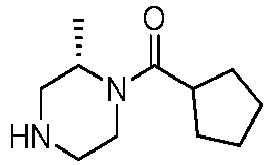
- To a solution of (S)-tert-butyl 4-(cyclopentanecarbonyl)-3-methylpiperazine-1- carboxylate (D18) (24 g, 81 mmol) in DCM (300 mL) stirred at RT was added TFA (31.2 mL, 405 mmol) slowly. The mixture was stirred at RT overnight. The reaction mixture was evaporated. Sat. KHCO3 solution (100mL) was added and extracted with EtOAc (50ml) x3). The organic layer was evaporated to give the title compound (15 g) as a yellow oil. MS (ES): C11H2ON2O requires 196, found 197 (M+H+).
-

- To a stirred solution of 2-chloro-3-nitrobenzaldehyde (D2) (10 g, 53.9 mmol) and (S)-cyclopentyl(2-methylpiperazin-1-yl)methanone (D19) (12.69 g, 64.7 mmol) in DCM (200 mL) at rt under nitrogen was added sodium triacetoxyborohydride (14.85 g, 70.1 mmol) in portion-wise. The reaction mixture was stirred at rt overnight. The mixture was concentrated to give a crude product, which was purified by column chromatography (silica gel, elution with ethyl acetate:petroleum ether=1:3) to obtain the title compound (5 g) as a yellow oil. MS (ES): C18H24ClN3O3 requires 365, found 366 (M+H+).
-
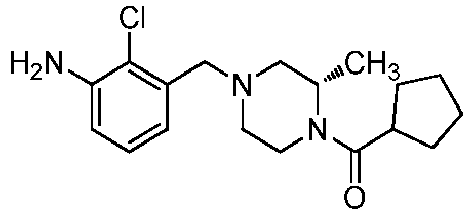
- To a solution of (S)-(4-(2-chloro-3-nitrobenzyl)-2-methylpiperazin-1-yl)(cyclopentyl)methanone (D20) (5.0 g, 13.67 mmol) and ammonium formate (6.89 g, 109 mmol) in methanol (50 mL) and water (50 mL) under nitrogen atmosphere at rt was added zinc (3.57 g, 54.7 mmol) in one portion. The solution was stirred at 80°C for 2hr.The reaction mixture was cooled to RT and filtered off. The organic layer was evaporated and the residue dissolved in ethyl acetate (100ml) and washed with saturated NaCl (100ml) to remove ammonium formate. The organic layer was evaporated to afford the title compound (4.0 g) as a brown oil. MS (ES): C18H26ClN3Orequires 335, found 336 (M+H+).
-

- A mixture of 6-fluoro-2-methyl-3-nitrobenzaldehyde (D5) (2 g) and (S)-cyclopentyl (2-methylpiperazin-1-yl)methanone (D19) (2.358 g) in DCM (30 mL) with several drops of acetic acid was stirred at rt for 1hr. Then sodium triacetoxyborohydride (6.94 g) was added and the resulting mixture was stirred overnight. The reaction was quenched with saturated NaHCO3 aqueous solution and then extracted with DCM. The organic phase was collected, dried over Na2SO4, filtered and then concentrated to afford the title compound (3.6 g). MS (ES): C19H26FN3O3 requires 363; found 364(M+H+).
- Descriptions 23-25 (D23-D25) were prepared using a similar procedure to that described for D22.
D23 
MS (ES): C18H23ClFN3O3 requires 3 83 found 3 84(M+H+) D24 
MS (ES): C18H23Cl2N3O3 requires 399 found 400 (M+H+) D25 
MS (ES): C19H26ClN3O3 requires 380 found 381 (M+H+) -

- The mixture of (S)-cyclopentyl(4-(6-fluoro-2-methyl-3-nitrobenzyl)-2-methylpiperazin-1-yl)methanone (D22) (2.1 g) and Pd/C (0.061 g) in Ethanol (30 mL) was stirred overnight under a hydrogen balloon. The Pd/C was filtered off and the filtrate concentrated to afford the title compound (1.5 g), which was used directly in the next step without further purification. MS (ES): C19H28FN3O requires 333; found 334(M+H+).
-

- To a solution of (S)-(4-(5-chloro-2-methyl-3-nitrobenzyl)-2-methylpiperazin-1-yl)(cyclopentyl)methanone (D25) (2.4 g, 6.32 mmol) in acetic Acid (40 mL) was added iron (3.53 g, 63.2 mmol) portion-wise under vigorous stirring. After addition, the resulting mixture was stirred for another 4 hr. The solid was filtered off and the cake was washed three times with EA. The filtrate was collected and the solvent was removed in vacuo. The residue was dissolved in EA and washed with aqueous Na2CO3 solution and brine. The organic layer was separated, dried over Na2SO4, giltered and solvent removed to afford the title compound (1.8 g). MS (ES): C19H28ClN3O requires 349; found 350(M+H+).
- Descriptions 28 and 29 were prepared using a similar procedure to that described for D27.
D28 
MS (ES): C18H25ClFN3O requires 353; found 354 (M+H+) D29 
MS (ES): C18H25Cl2N3O requires 369; found 370 (M+H+) -

- A mixture of 5-fluoro-2-methyl-3-nitrobenzaldehyde (D10) (4.4g) and (S)-cyclopentyl(2-methylpiperazin-1-yl)methanone (D19) (4.6 g) in anhydrous DCM(50 mL) was stirred at RT for 10 min. NaBH(OAc)3 (4.9 g) was added portion-wise and the reaction mixture was stirred at 20°C overnight. After the reaction completed, MeOH was added dropwise to quench the reaction. When the gaseous evoluation had ceased, the solvents was removed in vacuo to give a crude product, which was purified by column chromatography (silica gel, ethyl acetate/petroleum ether=1:100) to afford the title compound (7g) as yellow oil. MS (ES): C19H26FN3O3 requires 363; found 364 (M+H+).
-

- A mixture of (S)-cyclopentyl(4-(5-fluoro-2-methyl-3-nitrobenzyl)-2- methylpiperazin-1-yl)methanone (D30) (7g), HCOONH4 (1.8 g) and zinc (1.439 g, 22.01 mmol) in methanol (60 mL) and water (60mL) was stirred at 80°C for 4hr. After the reaction completed, the solvent was removed in vacuo, the residue was extracted with ethyl acetate (50 ml x4). The combined organic extract was washed with brine (100 ml), dried over anhydrous sodium sulfate and concentrated to afford the title compound (5.1g) as pale yellow oil. MS (ES): C19H28FN3Orequires 333; found 334(M+H+).
-

- To a solution of 5-fluoro-2-methyl-3-nitrobenzaldehyde (D10) (10 g, 54.6 mmol) and (S)-tert-butyl 2-methylpiperazine-1-carboxylate (12.03g, 60.1mmol)) in DCM (120 mL) was added drops of acetic acid (3.28 g, 54.6mmol) and the mixture was stirred at rt for an hour. Sodium triacetoxyhydroborate (23.15 g, 109mmol) was added to the mixture in ice-bath and the mixture was stirred at rt overnight and quenched with sat. NaHCO3 solution. The organic layer was dried with anhydrous Na2SO4, filtered and the filtrate evaporated in vacuo to give the title compound (22.17g) as a syrup. MS (ES): C18H26FN3O4 requires 367; found 368(M+H+).
-

- To a solution of (S)-tert-butyl 4-(5-fluoro-2-methyl-3-nitrobenzyl)-2-methylpiperazine-1-carboxylate (D32) (5 g, 13.61mmol) in ethanol (65mL) was added palladium (0.145 g, 1.361mmol) under H2 and the mixture was stirred at RT for 24 hr. The mixture was filtered and the filtrate evaporated in vacuo to give the title compound (4.5 g). MS (ES): C18H28FN3O2requires 337; found 338(M+H+).
-

- To a solution of (S)-tert-butyl 4-(5-fluoro-2-methyl-3-nitrobenzyl)-2-methylpiperazine-1-carboxylate (D32) (4 g, 10.89 mmol) in DCM (15 mL) was added hydrogen chloride/MeOH (27.2mL, 109mmol). The mixture was degassed and reacted under nitrogen at rt for 12 hr. The mixture was conc. to afford the title compound (3.1 g). MS (ES): C13H18FN3O2 requires 267; found 268 (M+H+).
-

- To a solution of (S)-1-(5-fluoro-2-methyl-3-nitrobenzyl)-3-methylpiperazine (D34) (1.7g, 6.36 mmol) and triethylamine (0.886mL, 6.36 mmol) in DCM (50mL) stirred under nitrogen at RT was added 3-fluorobenzoyl chloride (1.109g, 7mmol) dropwise and the reaction mixture was stirred at rt overnight. The reaction mixture was partitioned between ethyl acetate and saturated brine and the organic phase was dried over sodium sulphate, evaporated in vacuo and purified by column chromatography to give the title compound (2.4 g). MS (ES): C20H21F2N3O3 requires 389, found 390 (M+H+).
-

- The mixture of (S)-(4-(5-fluoro-2-methyl-3-nitrobenzyl)-2-methylpiperazin-1-yl)(3-fluorophenyl)methanone (D35) (2.4 g, 6.16 mmol) and Pd-C (0.066 g, 0.616 mmol) in Methanol (40 mL) stirred under hydrogen was stirred at rt overnight. The reaction mixture was evaporated in vacuo to give the title compound (2 g). MS (ES): C20H23F2N3O requires 359, found 360 (M+H+).
-

- To a solution of 2,3-dihydro-1H-inden-1-one (3.96 g, 30 mmol) in conc. sulfuric acid (25 ml, 469 mmol) stirred in air at 0°C was added potassium nitroperoxous acid (3.06 g, 30.3 mmol) in several portions over 15 mins and the reaction mixture was stirred for 1 hr at this temperature. After reaction was completed, the mixture was poured into ice-water, and extracted with AcOEt. The organic phase was washed with water and saturated NaHCO3, dried over anhydrous sodium sulfate, filtered and the filtrate was concentrated under reduced pressure to afford a crude product, which was purified by column chromatography (silica gel, eluent: AcOEt/Pet 0∼25%, v/v) to give the title compound. MS (ES): C9H7NO3 requires 177, found 178(M+H+).
-

- The title compound was prepared using a similar procedure to that described for D37 MS (ES): C9H7NO3 requires 177, found 178(M+H+).
-

- To the solution of 4-nitro-2,3-dihydro-1H-inden-1-one (D37) (0.4 g, 2.258 mmol) in ethanol (10 mL), was added sodium boronhydride (0.171 g, 4.52 mmol) and the mixture was stirred at RT for 2 hr. The mixture was quenched with aqueous NH4Cl, extracted with ethyl acetate (50 ml x2) and the organic layer was concentrated to afford the title compound (0.4 g). MS (ES): C9H9NO3 179.2 found 162 (M-OH).
-

- The title compound was prepared using a similar procedure to that described for D36 MS (ES): C9H9NO3 requires 179 found 162 (M-OH).
-

- To an ice-cold solution of 4-nitro-2,3-dihydro-1H-inden-1-ol (D39) (0.4 g, 2.232 mmol) in toluene (10 mL), was added SOCl2 (0.244 mL, 3.35 mmol) dropwise and the mixture was stirred at this temperature for 30 min followed by heating at 55°C for 1 hr. The reaction mixture was quenched with water (50 mL), extracted with ethyl acetate (50 ml x2), washed and dried. The organic layer was concentrated to afford the title compound (0.45 g). MS (ES): C9H8ClNO2 requires 197, found 198 (M+H+).
-
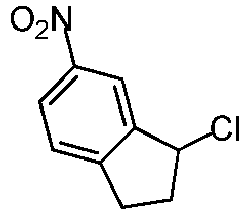
- The title compound was prepared using a similar procedure to that described for D41. MS (ES): C9H8ClNO2 requires 197 found 198 (M+H+).
-

- A mixture of 1-chloro-4-nitro-2,3-dihydro-1H-indene (D41) (0.45 g, 1.822 mmol), (S)-cyclopentyl(2-methylpiperazin-1-yl)methanone (D19) (0.715 g, 3.64 mmol) and DIPEA (0.795 mL, 4.55 mmol) in Acetonitrile (10 mL) was heated at 80°C overnight. The reaction mixture was concentrated under reduced pressure, the residue purified with column chromatography (acidic condition) to afford the title compound (0.4 g). MS (ES): C20H27N3O3 requires 357, found 358 (M+H+).
-

- The title compound was prepared using a similar procedure to that described for D43. MS (ES): C20H27N3O3 requires 357, found 358 (M+H+).
-

- The mixture of cyclopentyl((2S)-2-methyl-4-(4-nitro-2,3-dihydro-1H-inden-1-yl)piperazin-1-yl)methanone (D43) (0.4 g, 1.119 mmol) and nickel (0.066 g, 1.119 mmol) in ethanol (20 mL), was stirred under hydrogen balloon at rt for 4 hr. The reaction mixture was filtrated and the filtrate was concentrated to afford the title compound (0.35 g). MS (ESI) C20H29N3O requires: 327, found 328 (M+H+).
-

- The title compound was prepared using a similar procedure to that described for D45. MS (ESI) C20H29N3O requires: 327, found 328 (M+H+).
-

- Sodium triacetoxyborohydride (6.85g, 32.3mmol) was added into a mixture of 2-chloro-3-nitrobenzaldehyde (D2) (3 g, 16.17 mmol), (S)-tert-butyl 2-methylpiperazine-1-carboxylate (3.40g, 16.98 mmol) and AcOH (0.463 mL, 8.08 mmol) in DCM (300mL) at rt and stirred for 2 hr. LCMS confirmed that the reaction was completed and sat. NaHCO3 aqueous solution was added to the reaction mixture carefully with stirring untile pH reached approximately 8 (note: gaseous evoluation). The organic phase was separated, dried over Na2SO4, filtered and the solvent was removed. The residue was purified via column chromatography (10% EA in PE) to afford the title compound (5 g) as brown oil. MS (ESI) C17H24ClN3O4 requires: 369, found 370 (M+H+).
-

- Pd/C (0.144g, 1.352mmol) was added into a mixture of (S)-tert-butyl 4-(2-chloro-3-nitrobenzyl)-2-methylpiperazine-1-carboxylate (D47) (5g, 13.52 mmol) in ethanol (50 mL) at rt and the reaction was stirred under hydrogen overnight. The mixture was filtered through Celite and the filtrate was concentrated to give the title compound (4.5 g) as brown oil. MS (ESI) C17H26ClN3O2 requires: 339, found 340 (M+H+).
-

- Oxalyl dichloride (1.505mL, 17.78 mmol) was added into a solution of 6-methylnicotinic acid (1.301g, 9.48mmol) and cat. DMF (0.043g, 0.593 mmol) in DCM (15mL) at 0°C and the mixture was stired at 0°C for 1hr. The mixture was concentrated to give the acid chloride which was added into a solution of (S)-tert-butyl 4-(3-amino-5-fluoro-2-methylbenzyl)-2-methylpiperazine-1-carboxylate (D33) (2 g, 5.93 mmol) and pyridine (2 mL) in DCM (10 mL). The reaction was stirred at rt overnight and the mixture was purified by MDAP to give the title compound (3.18 g) as white solid. MS (ES): C25H33FN4O3 requires 456; found 457(M+H+).
-

- To a solution of (S)-tert-butyl 4-(5-fluoro-2-methyl-3-(6-methylnicotinamido)benzyl)-2-methylpiperazine-1-carboxylate (D49) (3.18 g, 6.97 mmol) in methanol (4 mL) and DCM (30 mL), 2,2,2-trifluoroacetic acid (20 mL, 269 mmol) was added and the reaction was stirred at 40°C overnight. The reaction was neutralized with solid NaHCO3. After filtration, the residue was washed with EA, the solvent was evaporated and the residue was purified by column chromatography (MeOH:DCM=1:20)) to give the title compound (1.4 g). MS (ES): C20H25FN4O requires 356; found 357(M+H+).
-

- To the solution of (S)-tert-butyl 4-(3-amino-5-fluoro-2-methylbenzyl)-2-methylpiperazine-1-carboxylate D33 (3.2 g, 9.48 mmol) in DCM (20mL) was added the solution of 3-cyanobenzoyl chloride (1.727 g, 10.43 mmol) in DCM (20 mL) dropwise at rt with stirring followed by the dropwise addition of DIPEA (4.97 mL, 28.5 mmol). The resulted reaction mixture was stirred for another 2 hr. The reaction mixture was washed withy water and brine, the organic phase separated and then solvent was evaporated in vacuo to afford (S)-tert-butyl 4-(3-(3-cyanobenzamido)-5-fluoro-2-methylbenzyl)-2-methylpiperazine-1-carboxylate (4.2 g). MS (ESI) C26H31FN4O3, requires: 466, found 467 (M+H+). To a solution of (S)-tert-butyl 4-(3-(3-cyanobenzamido)-5-fluoro-2-methylbenzyl)-2-methylpiperazine-1-carboxylate (4.2g, 9mmol) in DCM (60 mL) was added TFA (20.81mL, 270 mmol) at rt with stirring. The resulting reaction mixture was heated overnight under reflux at 50°C. The reaction was cooled to RT and quenched with saturated Na2CO3 aqueous solution carefully, adjusting the pH to around 10. The aqueous phase was separated and extracted five times with THF/ethyl acetate. All organic phases were combined and concentrated in vacuo to a volume of approximately 100 mL by rotavap, the mixture was dried over Na2SO4, filtered and the filtrate concentrated to afford the title compound (2.8 g). MS (ESI) C21H23FN4O requires: 366, found 367 (M+H+).
-

- 3-cyanobenzoyl chloride (1.267g, 7.65mmol) was added to a mixture of (S)-tert-butyl 4-(3-amino-2-chlorobenzyl)-2-methylpiperazine-1-carboxylate (D48) (2g, 5.88mmol) and pyridine (0.952mL, 11.77 mmol) in DCM (20mL) at 0°C. The reaction mixture was warmed to RT and stirred overnight. The mixture was filtered through Celite and the filtrate concentrated to give a residue that was purified using column chromatography (17% EA in PE) to give the title compound (0.8g) as brown oil. MS (ESI) C25H29ClN4O3 requires: 468, found 469 (M+H+).
-

- TFA (3.94 mL, 51.2 mmol) was added into a mixture of (S)-tert-butyl 4-(2-chloro-3-(3-cyanobenzamido)benzyl)-2-methylpiperazine-1-carboxylate (D52) (2.4 g, 5.12 mmol) in DCM (8 mL) at RT and stirred overnight. The mixture was filtered through celite and the filterate was concentrated and purified by column chromatography (40% MeOH in DCM) to give the title compound (1.8 g) as brown solid. MS (ESI) C20H21ClN4O requires: 368, found 369 (M+H+).
-

- To an ice-cold solution of cyclopent-3-enecarboxylic acid (2g, 17.84 mmol) in THF (50 mL) was added sodium hydride (0.642 g, 26.8 mmol) and stirred for 30 mins, bromomethyl benzene (4.58 g, 26.8 mmol) was added drop-wise and the mixture was allowed to warm to rt and stirring continued for 14hr. The mixture was diluted with water, extracted with EtOAc, dried and concentrated. The resulting residue was purified by chromatography to give the title compound (1.8 g) as a colorless oil. MS (ES): C13H14O2 requires 202; found 203(M+H+).
-

- To a solution of benzyl cyclopent-3-enecarboxylate (D54) (1200 mg, 5.93 mmol) in THF (60 mL) was added BH3.THF (6.53 mL, 6.53 mmol) at 0°C and the solution stirred for 30 mins. Sodium 1,2,3-dioxaboriran-3-olate tetrahydrate (3652 mg, 23.73 mmol) in water was added and stirred for 1h. The mixture was diluted with water, extracted with EtOAc, dried and concentrated to give a residue that was purified by chromatography to give the title compound (1000 mg) as a colorless oil. MS (ES): C13H16O3 requires 220; found 221 (M+H+).
-

- To a solution of benzyl 3-hydroxycyclopentanecarboxylate (D55) (1 g, 4.54 mmol) in DCM (20 mL) was added DAST (1.464 g, 9.08 mmol) at -78°C, after 6 hr, the mixture was diluted with ice water, extracted EtOAc(20mLx 2), dried, concentrated to afford the title compound D56 (800 mg) as a colorless oil. MS (ES): C13H15FO3 requires 222; found 223(M+H+).
-

- To a solution of benzyl 3-fluorocyclopentanecarboxylate (D56) (500 mg, 2.250 mmol) in Methanol (15 mL) was added Pd/C (120 mg, 0.112 mmol) and the mixture stirred for 5hr under hydrogen (30psi) at rt. The mixture was filtered and the filtrate was concentrated to give the title compound (187 mg) as a yellow oil. δH (CDCl3, 400MHz): 1.62-1.75 (m, 1H), 1.98-2.31 (m, 5H), 2.869 (s, 1H), 5.06-5.21 (m, 1H), 6.30-6.31 (s, 1H). δF (MeOD-d4 , 376MHz): -170.039. MS (ES): C6H9FO2 requires 132.1; found 113.1 (M-F).
-

- To a stirred solution of methyl 3-oxocyclobutanecarboxylate (1.28 g, 9.99 mmol) in THF (20 mL) stirred under nitrogen at -78°C was slowly added methylmagnesium bromide (1.430 g, 11.99 mmol). After complete addition, the cold bath was removed, and the reaction mixture was warmed to rt over 1hr. Aqueous saturated sodium sulfate was added and the aqueous layer was extracted with DCM. The combined organic phases were dried over sodium sulphate and evaporated in vacuo to give the title compound (1.2 g).
-

- To a solution of methyl 3-hydroxy-3-methylcyclobutanecarboxylate (D58) (1 g, 6.94 mmol) in DCM (20 mL) stirred under nitrogen at -70°C was added DAST (1.833 mL, 13.87 mmol) dropwise over 5 min. And the reaction mixture was stirred at RT for 12hr. Water was added and the aqueous phase extracted. The organic layer were washed with brine, dried over Na2SO4, flitered and concentrated to afford the title compound (700 mg).
-
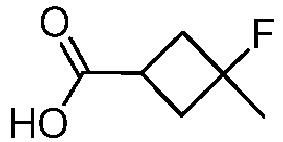
- To a solution of methyl 3-fluoro-3-methylcyclobutanecarboxylate (D59) (700 mg, 4.79 mmol) in THF (4 mL), methanol (1 mL) and water (4 mL) stirred under nitrogen at RT was added LiOH (172 mg, 7.18 mmol), the reaction mixture was stirred at rt for 2 hr. The solvent was removed, the residue was treated with conc. HCl to pH 1, extracted with DCM (5 ml x3), and the combined organic phase was washed with saturated brine 10 mL, dried over sodium sulphate and evaporated in vacuo to give the title compound (300 mg).
-

- To a solution of methyl 2-oxoacetate (2 g, 11.36 mmol) in THF (20 mL) stirred under nitrogen at -70°C was added a solution of cyclopropylmagnesium bromide (24.98 ml, 12.49 mmol) dropwise over 15 min. The reaction mixture was stirred at -20°C for 2 hr. The reaction mixture was quenched with water and extracted with ethyl acetate. The organic layer was washed with brine, dried over Na2SO4, filtered, and concentrated to give the title compound (1 g).
-

- To a solution of methyl 2-cyclopropyl-2-hydroxyacetate (D62) (1 g, 7.68 mmol) in DCM (20 mL) stirred under nitrogen at -70°C was added DAST (2.030 mL, 15.37 mmol) dropwise over 5 min and the reaction mixture was stirred at rt for 12hr. Then water was added and the mixture was extracted. The organic layer was washed with brine, dried over Na2SO4, flitered and the filtrate concentrated to afford the title compound (1 g).
-

- To a solution of methyl 2-cyclopropyl-2-fluoroacetate (D62) (1 g, 7.57 mmol) in THF (9 mL), methanol (3 mL) and water (9mL) stirred under nitrogen at RT was added LiOH (0.725g, 30.3 mmol) and the reaction mixture was stirred at rt for 2 hr. The solvent was removed, the residue was treated with conc. HCl to pH 1 and extracted with DCM (5 mL x3). The combined organic phases were washed with saturated brine 10 mL, dried over sodium sulphate and evaporated in vacuo to give the title compound (500 mg).
-

- To a solution of 2-cyclopropylacetic acid (2.14 g, 21.38 mmol) in DCM (20 mL) stirred at 20°C was added SOCl2 (2.340 mL, 32.1 mmol) and a drop of DMF as catalyst and the reaction mixture was stirred at 20°C for 2 hr. The solvent and excess SOCl2 were removed in vacuo to give the title compound (2.1 g).
-

- 2-cyclopropylacetyl chloride (D64) (2 g, 16.87 mmol) in methanol (15 mL) was stirred at 25°C for 1 hr. The reaction mixture was concentrated to give the title compound (1 g).
-

- To a solution of methyl 2-cyclopropylacetate (D62) (400 mg, 3.50 mmol) in THF (5 mL) stirred under nitrogen at -70°C was added LDA (1.752 mL, 3.50 mmol) over 5 min. MeI (0.437 mL, 7mmol) was added and the reaction mixture was stirred at rt for 12hr. The reaction mixture was quenched with water, extracted with DCM, dried over Na2SO4, filtered and concentrated to give the title compound (360 mg).
-

- To a solution of methyl 2-cyclopropylpropanoate (D66) (540 mg, 4.21 mmol) in THF (4 mL) and water (1 mL) stirred at RT was added LiOH (404 mg, 16.85 mmol) and the reaction mixture was stirred at rt for 16 hr. The solvent was removed, the residue was treated with conc. HCl to pH 1 and extracted with DCM (5 ml x3). The combined organic phases were washed with saturated brine 10 mL, dried over sodium sulphate and evaporated in vacuo to give the title compound (300 mg).
-

- To a solution of 2-cyclobutylacetic acid (1 g, 8.76 mmol) in DCM (20 mL) stirred at 20°C was added SOCl2 (0.959 mL, 13.14 mmol) and a drop of DMF as catalyst. The reaction mixture was stirred at 20°C for 2 hr. The solvent and excess SOCl2 were removed in vacuo to give the title compound (300 mg).
-

- 2-cyclobutylacetyl chloride (D68) (300 mg, 2.263 mmol) in methanol (3 mL) was stirred at 25°C for 1 hr. The reaction mixture was concentrated to give the title compound (200 mg).
-

- To a solution of methyl 2-cyclobutylacetate (D35) (200 mg, 1.560 mmol) in THF (5 mL) stirred under nitrogen at -70°C was added LDA (0.780 mL, 1.560 mmol). MeI (0.195 mL, 3.120 mmol) was then added over 5 min and then the reaction mixture was stirred at RT for 12hr. The reaction mixture was quenched with water, extracted with DCM, dried over Na2SO4, filtered and concentrated to give the title compound (120 mg).
-

- To a solution of methyl 2-cyclobutylpropanoate (D67) (80 mg, 0.563 mmol) in THF (3 mL) and water (1mL) stirred in air at RT was added solid lithium hydroxide (53.9 mg, 2.250 mmol). The reaction mixture was stirred at 26°C for 16 hr. The reaction mixture was extracted with EA, dried over Na2SO4, filtered and concentrated to give the title compound (26 mg).
-

- To a solution of ethyl 2-oxocyclopentanecarboxylate (3 g, 19.21 mmol) in methanol (30 mL) stirred in air at 0°C was added sodium borohydride (2.180 g, 57.6 mmol) portionwise and the reaction mixture was stirred at 0°C for 30 min. To this mixture was added water (10 mL) and the mixture was extracted with DCM (10 ml x3). The organic layer was dried over Na2SO4, filtered and evaporated to give the title compound (2.9 g) as colourless oil. δH (CDCl3-d1 , 400MHz): 1.26 (m, 3H), 1.65 (m, 1H), 1.75 (m, 2H), 1.95 (m, 3H), 2.65 (m, 1H), 3.08 (m, 1H), 4.18 (m, 2H), 4.42 (m, 1H).
-

- To a solution of ethyl 2-hydroxycyclopentanecarboxylate (D70) (2.9 g, 18.33 mmol) in DCM (30 mL) stirred under nitrogen at 0°Cwas added DAST (5.91 g, 36.7 mmol) dropwise and the reaction mixture was stirred at 0°C for 1 hr. This mixture was queched with sat NaHCO3, extracted with DCM (10ml x3), dried over sodium sulphate and evaporated in vacuo to give crude product that was purified by silica gel chromatography (PE:EA=100:1) to afford the title compound (450 mg). δH (CDCl3-d1 , 400MHz): 1.21 (m, 3H), 1.89 (m, 4H), 2.06 (m, 1H), 2.45 (m, 1H), 2.95 (m, 1H), 4.10 (m, 2H), 5.29 (m, 1H).
-

- To a solution of ethyl 2-fluorocyclopentanecarboxylate (D73) (400 mg, 2.497 mmol) and lithium hydroxide (524 mg, 12.49 mmol) in methanol (5 mL) stirred in air at rt was added water (5mL) and the reaction mixture was stirred at rt for 48 hr. This mixture was adjusted pH=5 with 2 N HCl and extracted with DCM (20 ml x3). The organic layer was dried over Na2SO4, filtered and evaporated to afford the title compound (280 mg) as white solid. δH (CDCl3-d1 , 400MHz): 1.76 (m, 3H), 2.15 (m, 1H), 2.50 (m, 2H), 3.00 (m, 1H), 5.25 (m, 1H).
-

- To a solution of 3-methylenecyclobutanecarbonitrile (5 g, 53.7 mmol) in ethanol (25 mL) and water (25mL) was added KOH (15.06 g, 268 mmol) and the reaction mixture was stirred at rt for 15 hr. The solvent was removed, the residue was treated with conc. HCl to pH 1, extracted with DCM (20 mL X 3), and the combined organic phases were washed with sat. brine 25 mL, dried over sodium sulphate and evaporated in vacuo to give the title compound (5.6 g) as a colorless oil. δH (CDCl3-d1 , 400MHz): 3.03 (m, 4H), 3.16 (m, 1H), 4.82 (s, 2H), 11.00 (brs, 1H).
-

- To a solution of 3-methylenecyclobutanecarboxylic acid (D75) (2 g, 17.84 mmol) in ethanol (30 mL) was added Pd/C (1 g, 9.40 mmol), the reaction mixture was stirred at rt under hydrogen for 4 hr. The reaction mixture was filtered and the filtrate was concentrated to give the title compound (1.8 g). δH (CDCl3-d1 , 400MHz): 1.10 (m, 3H), 1.85 (m, 2H), 2.30 (m, 3H), 3.00 (m, 1H), 9.50 (brs, 1H).
-

- To a solution ofbicyclo[2.2.1]hept-5-ene-2-carboxylic acid (300 mg, 2.171 mmol) in MeOH (40 mL) was added Pd/C (23.11mg, 0.022mmol) and the mixture was reacted for 16hr under hydrogen (20psi) at rt. The reaction mixture was filtered and the filtrate was concentrated to obtain the title compound (180 mg) as a white oil. LCMS C8H12O2 requires: 140.18, found 141.0 (M+H+).
-

- To a solution of benzyl 3-(hydroxymethyl)cyclobutanecarboxylate (2 g, 9.08 mmol) in DCM (20 mL) was added PCC (2.94 g, 13.62 mmol) and stirred at 26°C for 16 hr. The reaction mixture was filtered and the filtrate was concentrated to give a residue. The residue was diluted with a mixture of PE:EA=15:1 and filtered. The filtrate was concentrated to give the title compound (1.22 g). LCMS (ES): C13H14O3 requires 218; found 219(M+H+).
-

- To a solution of benzyl 3-formylcyclobutanecarboxylate D78 (1 g, 4.58 mmol) in DCM (20 mL) stirred under nitrogen at -70°C was added DAST (1.211 mL, 9.16 mmol) dropwise over 5 min and the reaction mixture was stirred at rt for 12 hr. Then water was added and the reaction mixture extracted. The organic extracts were washed with brine, dried over Na2SO4, flitered and concentrated. The residue was purified by chromatography (PE:EA=20:1) to afford the title compound. MS (ES): C13H14F2O2 requires 240; found 257(M+17+).
-

- To a solution of benzyl 3-(difluoromethyl)cyclobutanecarboxylate (D79) (210 mg, 0.874 mmol) in methanol (10 mL) stirred at rt was added nickel(II) chloride, 6H2O (623 mg, 2.62 mmol) and NaBH4 (298 mg, 7.87 mmol) and the reaction mixture was stirred at rt for 20 min. Then water was added and the pH adjusted to pH=2 with HCl. The mixture was extracted with ethyl acetate, dried over Na2SO4, filtered and concentrated to give the title compound (100 mg).
-

- To a solution of 3-methylenecyclobutanecarboxylic acid (D75) (2 g, 17.84 mmol) in ethyl acetate (10 mL) stirred at RT was added a suspension of CDI (3.18 g, 19.62 mmol) in ethyl acetate (10 mL) portionwise over 5 min and the reaction mixture was stirred at RT for about 1.5 hr. Phenylmethanol (2.315 g, 21.40 mmol) was added and stirring continued overnight. The solution was diluted with PE(20 mL), washed with water (20 mL), dried over Na2SO4 and evaporated in vacuo. The residue was purified by chromatography (PE:EA=20:1) to afford the title compound (3.4 g). MS (ES): C13H14O2 requires 202; found 203 (M+H+).
-

- To a solution of benzyl 3-methylenecyclobutanecarboxylate (D81) (3.2 g, 15.82 mmol) in THF (20 mL) stirred under nitrogen at RT was added BH3.DMS (0.751 mL, 7.91 mmol). After 1 hr, sodium perborate tetrahydrate (2.92 g, 18.99 mmol) in water was added and the reaction mixture was stirred at RT for 30 min. Then the mixture was warmed to 60°C for another 1 hr. The reaction mixture was washed with sat.NH4Cl 5 mL, extracted with DCM (5 ml x3), then washed with saturated brine 10 mL, dried over sodium sulphate and evaporated in vacuo to give the title compound (3 g). (ES): C13H16O3requires 220; found 221 (M+H+).
-
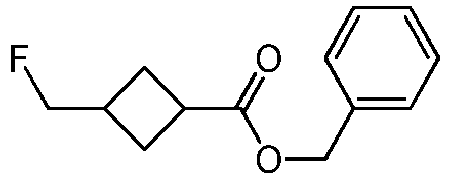
- To a solution of benzyl 3-(hydroxymethyl)cyclobutanecarboxylate (D82) (1 g, 4.54 mmol) in DCM (20 mL) stirred under nitrogen at -70°C was added DAST (1.2 mL, 9.08 mmol) dropwise over 5 mins. and the reaction mixture was stirred at rt for 12hr. Water was added and the mixture was extracted. The organic extracts were washed with brine, dried over Na2SO4, flitered and concentrated. The residue was purified by chromatography (PE:EA=20:1) to give the title compound (210 mg). MS (ES): C13H15FO2 requires 222; found 203 (M-19+).
-

- To a solution of benzyl 3-(fluoromethyl)cyclobutanecarboxylate (D80) (200 mg, 0.900 mmol) in methanol (10 mL) stirred at rt was added nickel(II) chloride, 6H2O (642 mg, 2.70 mmol) and NaBH4 (306 mg, 8.10 mmol) and the reaction mixture was stirred at rt for 20 min. Water was added and the pH was adjusted to pH=2 with HCl. The mixture was extracted with ethyl acetate, dried over Na2SO4, filtered and concentrated to afford the title compound (100 mg).
-

- To a solution of 3-oxocyclobutanecarboxylic acid (16 g, 140 mmol), methanol (4.94 g, 154 mmol) and Nl-((ethylimino)methylene)-N3,N3-dimethylpropane-1,3-diamine hydrochloride (40.3 g, 210 mmol) in DCM (200 mL) stirred under nitrogen at 0°C was added N,N-dimethylpyridin-4-amine (1.713 g, 14.02 mmol) slowly, and the reaction mixture was stirred at RT for 15 hr. The organic phase was washed with water 50 mL, extracted with DCM (50 ml x3). The organic phase was washed with 0.5 M HCl, saturated sodium bicarbonate solution and brine, dried over sodium sulphate and evaporated in vacuo to give the title compound as a colorless oil. δH (CDCL3-d1 , 400MHz): 3.28 (m, 3H), 3.43 (m, 2H), 3.74 (s, 3H).
-

- To a solution of methyl 3-oxocyclobutanecarboxylate D85 (7 g, 54.6 mmol) in methanol (100 mL) stirred under nitrogen at 0°C was added sodium tetrahydroborate (2.480 g, 65.6 mmol) slowly and the reaction mixture was stirred at 0°C for 4 hr. The organic phase was washed with saturated NH4Cl (100 mL), extracted with DCM (50 ml x3), and the combined organic phase was washed with sat. sodium bicarbonate solution (50 mL) and brine (50 mL), dried over sodium sulphate and evaporated in vacuo to give the title compound as a colorless oil. δH (CDCL3-d1 , 400MHz): 2.13 (m, 2H), 2.54 (m, 4H), 3.62 (s, 3H), 4.13 (m, 1H).
-

- To a solution of methyl 3-hydroxycyclobutanecarboxylate (1.2 g, 9.22 mmol) and N1,N1,N8,N8-tetramethylnaphthalene-1,8-diamine (7.90 g, 36.9 mmol) in DCM (20 mL) stirred under nitrogen at 0°C was added trimethyloxonium tetrafluoroborate (2.73 g, 18.44 mmol) and the reaction mixture was stirred at RT for 4 hr. The reaction mixture was quenched with water and extracted with DCM (5 ml x3). The combined organic phases were washed with 1N HCl (10 ml x3), saturated sodium bicarbonate solution 10 mL and saturated sodium bicarbonate solution (10 mL), dried over sodium sulphate and evaporated in vacuo to give the title compound as a colorless oil. δH (CDCL3-d1 , 400MHz): 2.18 (m, 2H), 2.50 (m, 2H), 2.63 (m, 1H), 3.23 (s, 3H), 3.68 (s, 3H), 3.80 (m, 1H).
-

- To a solution of methyl 3-methoxycyclobutanecarboxylate (860 mg, 5.97 mmol) in THF (6 mL), methanol (2mL) and water (6mL) stirred under nitrogen at rt was added LiOH (214 mg, 8.95 mmol) and the reaction mixture was stirred at RT for 2 hr. The solvent was removed and the residue was treated with conc. HCl to pH 1, extracted with DCM (5 ml x3), and the combined organic phase was washed with saturated brine 10 mL, dried over sodium sulphate and evaporated in vacuo to give the title compound (400 mg). δH (CDCL3-d1 , 400MHz): 2.23 (m, 2H), 2.52 (m, 2H), 2.68 (m, 1H), 3.23 (s , 3H), 3.81 (m, 1H).
-

- To a suspension of cyclopentene (3.4 g, 49.9 mmol) and rhodium(II) acetate dimer (0.044 g, 0.100 mmol) stirred under nitrogen at rt was added ethyl 2-diazoacetate (5.70 g, 49.9 mmol) dropwise over 2 hr and the reaction mixture was stirred at rt for 16 hr. The reaction mixture was diluted with DCM (100 ml), filtered, the filtrated was concentrated to give the title compound.
-

- To a suspension of crude ethyl bicyclo[3.1.0]hexane-6-carboxylate (D89) (5 g, 32.4 mmol) in methanol (30 mL) stirred in air at rt was added NaOH (3.89 g, 97 mmol) in water in one portion and the reaction mixture was stirred at rt for 3 hr. The resulting mixture was concentrated and treated with water (30 ml). The aqueous phase was washed with DCM (50 ml) and then brought to pH=3 with HCl solution. The product was then extracted with DCM (50ml x2) and the combined organic layers were dried, concentrated to give the title compound (1.5 g). 1H NMR (400MHz, DMSO) δ: 1.85 (m, 6H), 1.62 (m, 1H), 1.39 (t, J = 3.2 Hz, 1H), 1.10 (m, 1H).
-

- To a suspension of aluminum (III) lithium hydride (5.7g, 150 mmol) in dry THF (300ml) at ca. -5° was added dropwise a solution of diethyl cyclobutane-1,1-dicarboxylate (10 g, 49.9 mmol) in dry THF (100ml) and the mixture was stirred at rt overnight. The reaction was quenched with sat. Na2SO4, filtered through Celite and evaporated, the residue was purified by column chromatography (PE: EtOAc=1:1) to afford the title compound (4 g) as oil.
-

- Cyclobutane-1, 1-diyldimethanol (D91) (2 g, 17.22 mmol) in pyridine (10ml) was added to a cooled (-5°) solution of 4-methylbenzene-1-sulfonyl chloride (10 g, 52.5 mmol) in pyridine (10ml). The mixture was stirred for 3hr (<0°) and then poured into ice-water and filtered. The filtered cake was washed with water (50 ml), 5% H2SO4 (50 ml), 5% Na2CO3 (100 ml), again with water (50 ml) and finally with aqueous acetone (50 ml x 2). The resulting pale solid was dissolved in DCM (100 ml) and dried over anhydrous Na2SO4, filtered and evaporated to give a residue that was dried under vacuum at 50-6°C for 5 hr to give the title compound (12 g) as a white solid.
-

- To a solution of cyclobutane-1, 1-diylbis (methylene) bis(4-methylbenzenesulfonate) (D90) (6 g, 14.13 mmol) and diethyl malonate (9 g, 56.2 mmol) in dried p-xylene (35 mL) was added sodium (0.75 g, 32.6 mmol) and the mixture was heated to 140° and stirred overnight. After cooled to rt, the mixture was quenched with saturated NH4Cl (100 ml). Ether (50 ml) was added and filtered to remove sodium p-methylbenzene-sulfonate salt and the filtered cake was washed with ether (50 ml). The aqueous layer was extracted with ether (50ml x2). The combined organic layers were washed with brine (100 ml), dried over anhydrous Na2SO4, filtered and evaporated to leave the crude product, which was distilled under reduced pressure (1mmHg, 85 °C- 95 °C) to give the title compound as colorless oil.
-

- To a solution of diethyl spiro[3.3]heptane-2,2-dicarboxylate (D93) (1.134 g, 4.72 mmol) in anhydrous ethanol (20 mL) was added potassium hydroxide (1.18 g, 21.03mmol) and the mixture was heated to reflux for 1hr. On cooling to rt, the mixture was filtered and the cake was washed with EtOH (20 ml). The cake was dissolved in water (2ml) and cooled to ca. -5°C and 50% aqueous H2SO4 (3ml) was added dropwise. The resulting white precipitate was filtered to give the title compound (600 mg) as white solid.
-

- Spiro[3.3]heptane-2,2-dicarboxylic acid (D94) (590 mg, 3.20 mmol) was dissolved in pyridine (25mL) and the resulting solution was refluxed for 5hr. On cooling to RT, the reaction mixture was concentrated to dryness and to the residue was added 6N HCl solution with ice cooling and stirring. The mixture was concentrated to remove HCl gas at RT. The residue was extracted with ether (20 ml) and the organic layer was washed with water (30 ml) and dried over anhydrous MgSO4. The mixture was filtered and the filtrate was concentrated to give a residue which was purified by column chromatography (PE: EtOAc = 4:1) to afford the title compound (480mg) as a yellow oil. 1H NMR Spectrum (DMSO-d6) δ(ppm): 1.74(2H, m), 1.86 (2H, m), 1.98(2H, m), 2.08(2H, m), 2.13(2H, m), 2.87(1H, m), 11.94(1H, br).
-

- A solution of cyclopentanecarboxylic acid (50 g, 438 mmol), ethanol (1614 g, 35087 mmol) and sulfuric acid (859 g, 8761 mmol) was stirred at 120°C for 10 hr. The mixture was poured into water (2L). The upper layer was collected, then distilled at 125°C to give the title compound as colourless oil (34.0 g). 1H-NMR (400 MHz, CDCl3) δ ppm 1.22-1.25(t, 3H), 1.25-1.87 (m, 8H), 2.67-1.71(m,1H), 4.08-4.14 (q, 2H).
-

- To a solution of diisopropylamine (17.08 g, 169 mmol) in THF (300ml) was added n-BuLi (62 mL, 155 mmol) at -60°C. The reaction mixture was stirred for 1 hr and ethyl cyclopentanecarboxylate (D93) (20 g, 141mmol) was added. The reaction was stirred for 2 hr, then added to a soluion of N-fluoro-N-(phenylsulfonyl)benzenesulfonamide (53.2 g, 169 mmol) in THF (300 mL). The reaction mixture was stirred at -60°C overnight. The solvent was concentrated, and extracted with DCM (3x80 mL). The organic extracts were concentrated and distillled under reduced pressure to give the title compound (14.0 g). 1H-NMR (400 MHz, CDCl3) δ ppm 1.29-1.33 (t, 3H), 1.72-2.22 (m, 8H), 4.24-4.26 (q,2H).
-

- A suspension of ethyl 1-fluorocyclopentanecarboxylate (D97) (4 g, 24.97 mmol) and lithium hydroxide (0.598 g, 24.97 mmol) in THF (50 mL) and water (50 mL) was stirred at 80°C for 6 hr. The solvent was concentrated, and acidified to pH=6, then extracted with DCM (3x40mL). The organic layer was dried over Na2SO4, and concentrated to give the title compound (2.0 g). 1H-NMR (400 MHz, CDCl3) δ ppm 1.82-1.93 (m, 4H), 2.11-2.23 (m,4H).
-

- To a solution of sodium methoxide (0.731 g, 13.53 mmol) in anhydrous MeOH (10 ml), an anhydrous MeOH solution (10 ml) of methyl 3-(bromomethyl)benzoate (2 g, 8.73 mmol) was added dropwise under N2. After addition, the reaction mixture was heated at 60°C for 2 hr. When LCMS indicated that the reaction was completed, the reaction mixture was cooled down to rt and the solvent was evaporated. The residue was suspended in DCM (20 ml), poured into 1 M HCl (20 ml) and stirred vigorously. The organic layer was separated and the solvent evaporated to give a crude product, which was purified by column chromatography (24 g column, petro ether/EtOAc, 5%-40% EtOAc, 30 min) to give the title compound as pale yellow oil. 1H NMR showed some solvent. C10H12O3 180.2 found 181.1.
-

- To a solution of methyl 3-(methoxymethyl)benzoate (D99) (1.2 g, 6.66 mmol) in THF (10 mL), sodium hydroxide (0.666 g, 16.65 mmol) aqueous solution (10 mL) was added and the reaction mixture was heated for 3 hr at 50°C. LCMS showed the reaction completed. The mixture was cooled down to rt, most of the solvent was evaporated and water (15 ml) was added. The mixture was washed with DCM (5 ml) and the aqueous layer was acidified with 3M HCl to pH=1. The aqueous layer was extracted with EtOAc (20 ml x2), dried over Na2SO4 and the solvent was evaporated. The residue was dried under vacuum for 1 hr, to give the title compound (965 mg) as white solid. C9H10O3 166.2 found 167.1.
-

- A mixture of (S)-(4-(3-amino-5-fluoro-2-methylbenzyl)-2-methylpiperazin-1-yl)(cyclopentyl)methanone (D31) (200 mg, 0.6 mmol), HATU (251 mg, 0.66 mmol), (S)-1-(tert-butoxycarbonyl)pyrrolidine-3-carboxylic acid (142 mg, 0.66 mmol) and DIPEA (233 mg, 1.799 mmol) in DCM (3 mL) was stirred at RT for 80 hr. TFA (0.924 mL, 12mmol) was added and the mixture was heated at 40°C for 3 hr. The reaction mixture was concentrated in vacuo and the residue dissolved in EA, washed with aqueous NaHCO3 and brine. The organic phase was separated, dried over Na2SO4, filtered and the solvent evaporated to give the title compound (250 mg). C24H35FN4O2·C2HF3O2 430 found 431.
-
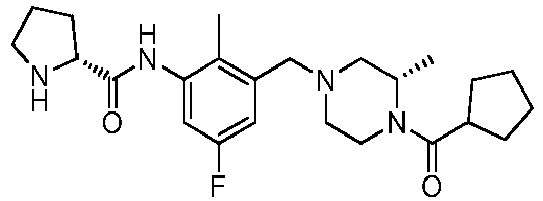
- To a solution of (S)-(4-(3-amino-5-fluoro-2-methylbenzyl)-2-methylpiperazin-1-yl)(cyclopentyl)methanone (D31) (200 mg, 0.510 mmol), (R)-1-(tert-butoxycarbonyl)pyrrolidine-2-carboxylic acid (110 mg, 0.510 mmol) and HATU (194 mg, 0.510 mmol) in DCM (3 mL) was added DIEA (0.134 mL, 0.765 mmol) and the mixture was stirred at rt for overnight. LCMS indicated the reaction was completed. The mixture was evaporated and the residue was dissolved in methanol (6 mL) and purified by MDAP to give the title compound (11 mg) as a white solid. C24H35FN4O2·C2HF3O2 430 found 431.
-

- Sodium triacetoxyborohydride (5.73 g, 27.1 mmol) was added to a mixture of 5-chloro-2-methyl-3-nitrobenzaldehyde (D11) (2.7 g, 13.53 mmol), (S)-tert-butyl 2-methylpiperazine-1-carboxylate (2.84 g, 14.20 mmol), AcOH (0.387 mL, 6.76 mmol) in DCM (300 mL). After the reaction was completed, Sat. NaHCO3 aqueous solution was added to the reaction mixture carefully with stirring until the pH reached around pH8 (no gas released). The organic phase was separated, concentrated and purified by column chromatography (10% EA in PE) to give the title compound as brown oil. MS (ES): C18H26ClN3O4 requires 383, found 384 (M+H+).
-

- Iron (7.54 g, 135 mmol) was added in to a solution of (S)-tert-butyl 4-(5-chloro-2-methyl-3-nitrobenzyl)-2-methylpiperazine-1-carboxylate (3.7 g, 9.64 mmol) in acetic acid (20 mL) at 0°C and stirred at this temperature for 5 min and then at rt for 3hr. After the reaction was complete, the reaction mixture was concentrated to remove most of the solvent. The residue was taken up in DCM (100ml) and the mixture was filtered through celite. The filterate was concentrated and the pH adjusted to about 8 by sat. NaHCO3. The mixture was extracted with DCM (30 ml x3), the organic layer was dried via Na2SO4, filtered and the filtrate was concentrated to give the title compound as brown oil. MS (ES): C18H28ClN3O2 requires 353, found 354 (M+H+).
-

- 6-Methylnicotinoyl chloride (0.933 g, 4.20 mmol) was added into a solution of (S)-tert-butyl 4-(3-amino-5-chloro-2-methylbenzyl)-2-methylpiperazine-1-carboxylate (D104) (1.35 g, 3.81 mmol) in pyridine (6 mL) at RT. After the reaction was completed, the mixture was concentrated to remove most of solvent and the residue was purified via column chromatography (15% MeOH in DCM) to give the title compound (1.86 g) as brown oil. MS (ES): C25H33ClN4O3 requires 473, found 473 (M+H+).
-

- TFA (3.03 mL, 39.3 mmol) was added to a solution of (S)-tert-butyl 4-(5-chloro-2-methyl -3-(6-methylnicotinamido)benzyl)-2-methylpiperazine-1-carboxylate (D105) (1.86 g, 3.93 mmol) in DCM (10 mL) at rt. The reaction mixture was heated to 40°C and stirred until the reaction was complete. The mixture was concentrated to remove most of solvent and the residue was purified by column chromatography (15% MeOH in DCM) to give the title compound (1.7 g) as brown oil. MS (ES): C20H25ClN4O requires 372, found 373(M+H+).
-

- POCl3 (0.743 mL, 7.97 mmol) was added to a solution of (S)-tert-butyl 4-(3-amino-5- chloro-2-methylbenzyl)-2-methylpiperazine-1-carboxylate (D104) (1.41 g, 3.98 mmol) and 2-methylpyrimidine-5-carboxylic acid (0.550 g, 3.98 mmol) in pyridine (30 mL) at 0°C and stirred at this temperature for 5 min. Then the reaction was stirred at rt for 3hr. After the reaction was complete, water (2ml) was added in batches with stirring for 2 min. The mixture was concentrated and purified by column chromatography (50% MeOH in DCM) to give the title compound (1.3 g) as brown oil. MS (ES): C24H32ClN5O3 requires 473, found 474(M+H+).
-

- TFA (2.113 mL, 27.4 mmol) was added to a solution of (S)-tert-butyl 4-(5-chloro-2-methyl-3-(2-methylpyrimidine-5-carboxamido)benzyl)-2-methylpiperazine-1-carboxylate (D107) (1.3 g, 2.74 mmol) in DCM (50 mL) and the reaction was heated to 45°C for 4hr. When the reaction was complete, the mixture was concentrated, adjusted the pH8 with sat. aqueous NaHCO3 and the layers were separated. The organic layer was concentrated and purified via column chromatography (50% MeOH in DCM) to give the title compound (860 mg) as a brown oil. MS (ES): C19H24ClN50 requires 373, found 374(M+H+).
-

- 2-chloro-3-{[(3R,5S)-4-(cyclopentylcarbonyl)-3,5-dimethyl-1-piperazinyl]methyl}aniline (60 mg, 0.171 mmol) and pyridine (0.028 mL, 0.343 mmol) were dissolved in DCM (15 mL), to this solution, 3-chlorobenzoyl chloride (36.0 mg, 0.206 mmol) was added gradually. The reaction mixture was stirred at rt for 2 hr. DCM was removed. The obtained mixture was redissolved in DMF, solid was filtered off. The filtrate was purified by MDAP to give the title compound (69 mg) as a white solid. 1H-NMR (MeOD-d4 400MHz): 7.90 (s, 1H), 7.82 (d, 1H), 7.59 (d, 1H), 7.53 (d, 1H), 7.45 (m, 2H), 7.32 (t, 1H), 4.51 (brs, 1H), 4.21 (brs, 1H), 3.81 (brs, 2H), 2.93 (m, 3H), 2.41 (brs, 2H), 1.74--1.52 (m, 8H), 1.28 (m, 6H). δF (MeOD-d4 , 376MHz): -77.1. MS (ES): C26H31Cl2N3O2 requires 487; found 488(M+H+).
- Examples 2 to 9 were prepared using a similar procedure to that described for Example 1.
- E2 N-(2-chloro-3-{[(3R,5S)-4-(cyclopentylcarbonyl)-3,5-dimethyl-1-piperazinyl]methyl}phenyl)-2-(4-chlorophenyl)acetamide, trifluoroacetic acid salt
- E3 N-(2-chloro-3-{[(3R,5S)-4-(cyclopentylcarbonyl)-3,5-dimethyl-1-piperazinyl]methyl}phenyl)-2-ethylbutanamide, trifluoroacetic acid salt
- E4 N-(2-chloro-3-{[(3R,5S)-4-(cyclopentylcarbonyl)-3,5-dimethyl-1-piperazinyl]methyl}phenyl)-8-quinolinesulfonamide, trifluoroacetic acid salt
- E5 (S)-N-(3-((4-(cyclopentanecarbonyl)-3-methylpiperazin-1-yl)methyl)-4-fluoro-2-methylphenyl)cyclopropanecarboxamide, trifluoroacetic acid salt
- E6 (S)-N-(3-((4-(cyclopentanecarbonyl)-3-methylpiperazin-1-yl)methyl)-4-fluoro-2-methylphenyl)-2-phenylacetamide, trifluoroacetic acid salt
- E7 N-(2-chloro-3-(((3S,5R)-4-(cyclopentanecarbonyl)-3,5-dimethylpiperazin-1-yl)methyl)phenyl)isobutyramide
- E8 N-(2-chloro-3-(((3S,5R)-4-(cyclopentanecarbonyl)-3,5-dimethylpiperazin-1-yl)methyl)phenyl)-3-methylbutanamide
- E9 (S)-3-cyano-N-(2,4-dichloro-3-((4-(cyclopentanecarbonyl)-3-methylpiperazin-1-yl)methyl)phenyl)benzamide
-

- Cyclopentanecarbonyl chloride (38.2 mg, 0.288 mmol) was added into a solution of (S)-(4-(3-amino-5-fluoro-2-methylbenzyl)-2-methylpiperazin-1-yl)(cyclopentyl)methanone (80 mg, 0.240 mmol) and pyridine (38.0 mg, 0.480 mmol) in DCM at RT. The reaction was stirred at RT overnight. After checked by LCMS, the reaction was completed. The mixture was concentrated and purified via MDAP to afford the title compound (43 mg, 31.3 % yield) as white solid. 1H NMR (400 MHz, MeOD-d4 ) δ 1.16-1.42 (m, 4H), 1.55-2.09 (m, 18H), 2.12-2.20 (m, 1H), 2.22 (s, 3H), 2.72 (t, 1H), 2.78-3.08 (m, 3H), 3.34-3.41 (m, 1H), 3.41-3.53 (m, 2H), 3.83 (d, 0.5H), 4.19-4.39 (m, 1H), 4.66 (brs, 0.5H), 6.97 (d, 1H), 7.05 (d, 1H). 19F NMR (376 MHz, MeOD-d4 ) δ -78.6, -119.0. MS (ESI): C25H36FN3O2 requires: 429, found 430 (M+H+).
- Examples 11 to 14 were prepared using a similar procedure to that described for Example 10.
- E11: (S)-N-(3-((4-(cyclopentanecarbonyl)-3-methylpiperazin-1-yl)methyl)-5-fluoro-2-methylphenyl)cyclohexanecarboxamide, trifluoroacetic acid salt
- E12: (S)-N-(3-((4-(cyclopentanecarbonyl)-3-methylpiperazin-1-yl)methyl)-5-fluoro-2-methylphenyl)-6-(trifluoromethyl)nicotinamide, trifluoroacetic acid salt
- E13: (S)-N-(3-((4-(cyclopentanecarbonyl)-3-methylpiperazin-1-yl)methyl)-5-fluoro-2-methylphenyl)-2,6-difluorobenzamide, trifluoroacetic acid salt
- E14: (S)-N-(3-((4-(cyclopentanecarbonyl)-3-methylpiperazin-1-yl)methyl)-5-fluoro-2-methylphenyl)-2,6-dimethylbenzamide, trifluoroacetic acid salt
-
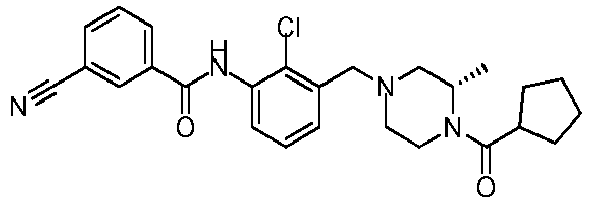
- To the solution of (S)-(4-(3-amino-2-chlorobenzyl)-2-methylpiperazin-1-yl)(cyclopentyl)methanone (100 mg, 0.298 mmol) in acetonitrile (5 mL) was added the solution of 3-cyanobenzoyl chloride (54.2 mg, 0.328 mmol) at RT. After the addtion, Na2CO3 (63.1 mg, 0.595 mmol) was added. The resulted reaction mixture was stirred overnight. Then the solid was filtered off and the filtrate was purified by MDAP to afford the title compound (27 mg). 1H-NMR (DCM-d2 , 400MHz): 1.69 (d, 2 H), 1.82 (d, 1 H), 2.04 (br. s., 2 H), 2.13 (br. s., 3 H), 2.24 (m, 2 H), 2.34 (br. s., 1 H), 2.56 (br. s., 1 H), 2.66 (d, 1 H), 3.22 (m, 1 H), 3.33 (d, 1 H), 3.44 (d, 1 H), 3.74 (br. s., 3 H), 3.84 (br. s., 1 H), 4.10 (m, 2 H), 4.29 (d, 1 H), 4.76 (m, 1 H), 5.10 (br. s., 1 H), 7.81 (t, 1 H), 7.93 (d, 1 H), 8.08 (d, 1 H), 8.17 (t, 1 H), 8.40 (d, 1 H), 8.70 (d, 1 H), 8.76 (s, 1 H). MS (ES): C26H29ClN4O2 requires 464; found 465(M+H+).
-

- To the solution of 6-methylnicotinic acid (99 mg, 0.720 mmol) and one drop of DMF in DCM (5 mL) was added oxalyl chloride (0.105 mL, 1.2 mmol) dropwise. After the addtion, the resulted mixture was stirred for another 1 hr and then the solvent was removed in vacuo. Then (S)-(4-(3-amino-5-fluoro-2-methylbenzyl)-2-methylpiperazin-1-yl)(cyclopentyl)methanone (200 mg, 0.6 mmol) and the acyl chloride was dissolved in DCM (3mL). DIPEA (0.105 mL, 0.6 mmol) was added to the above solution. The resulted solution was stirred at rt overnight. The solvent was then removed and the residue was purified by MDAP to afford the title compound (10 mg). 1H-NMR (MeOD-d4 , 400MHz): 1.29 (br. s., 2 H), 1.43 (br. s., 1 H), 1.64 (m, 5 H), 1.84 (br. s., 3 H), 2.34 (s, 3 H), 2.74 (s, 3 H), 3.05 (m, 3 H), 3.42 (m, 3 H), 4.18 (br. s., 0.5 H), 4.41 (br. s., 2 H), 4.65 (br. s., 0.5 H), 7.35 (d, 2 H), 7.73 (d, 1 H), 8.56 (d, 1 H), 9.11 (s, 1 H). δF (MeOD-d4 , 376MHz): -77.3, -116.9. MS (ES): C26H33FN4O2 requires 452; found 453(M+H+).
-

- To a suspension of picolinic acid (35.4 mg, 0.288 mmol) in dry DCM (10mL) under nitrogen, 1 drop of dry DMF followed with oxalyl chloride (0.084 mL, 0.96mmol) were added. The reaction mixture was stirred at RT for 1 hr. After that, solvents were evaporated carefully to afford the acid chloride. The acid chloride was added into a solution of (S)-(4-(3-amino-5-fluoro-2-methylbenzyl)-2-methylpiperazin-1-yl)(cyclopentyl)methanone (80 mg, 0.24mmol) and Et3N (0.067 mL, 0.48 mmol) in DCM (10mL) at RT and stirred at this temperature overnight. After checked with LCMS, the reaction was completed. The mixture was concentrated and purified with MDAP to give the title compound (16 mg, 11.47 % yield) as brown solid. 1H NMR (400 MHz, DMSO-d6 ) δ 1.07-1.40 (m, 3H), 1.42-1.92 (m, 8H), 2.33 (s, 3H), 2.89-3.03 (m, 2H), 3.07 -3.45 (m, 3H), 3.89-4.16 (m, 1H), 4.23-4.93 (m, 3H), 7.25 (brs, 1H), 7.68-7.77 (m, 1H), 7.84 (brs, 1H), 8.11 (t, 1H), 8.18 (d, 1H), 8.76 (d, 1H), 10.47 (s, 1H). 19F NMR (376 MHz, DMSO-d6 ) δ -73.4, -117.1. MS (ESI) C25H31FN4O2 requires: 438, found 439 (M+H+).
- Examples 18 and 19 were prepared using a similar procedure to that described for Example 17.
- E18: (S)-N-(3-((4-(cyclopentanecarbonyl)-3-methylpiperazin-1-yl)methyl)-5-fluoro-2-methylphenyl)nicotinamide, trifluoroacetic acid salt
- E19: (S)-N-(3-((4-(cyclopentanecarbonyl)-3-methylpiperazin-1-yl)methyl)-5-fluoro-2-methylphenyl)isonicotinamide, trifluoroacetic acid salt
-

- Oxalyl chloride (0.084 mL, 0.960 mmol) was added into a mixture of 2-methylpyrimidine-5-carboxylic acid (43.1 mg, 0.312 mmol) and DMF (1.858 µL, 0.024 mmol) in DCM (10 mL) and the reaction was stirred for 1 hr (water bath). Then the mixture was concentrated to give the acid chloride. The acid chloride was added into a solution of (S)-(4-(3-amino-5-fluoro-2-methylbenzyl)-2-methylpiperazin-1-yl) (cyclopentyl)methanone (D31) (80 mg, 0.240 mmol) in pyridine (10mL). Then the reaction was heated to 80°C under microwave for 1hr. The mixture was concentrated to remove most of the solvent and the residue was purified via MDAP to give the title compound (26.7 mg) as a solid. 1H NMR (400 MHz, MeOD-d4 ) δ1.15-1.41 (m, 3H), 1.54-2.18 (m, 11H), 2.22 (s, 3H), 2.73 (s, 3H), 2.75-3.10 (m, 4H), 3.35-3.55 (m, 3H), 3.84 (d, 0.5H), 4.32 (d, 1H), 4.66 (brs, 0.5H), 6.75 (d, 2H), 9.19 (s, 2H). 19F NMR (376 MHz, MeOD-d4 ) δ -121.3. MS (ESI) C25H32FN5O2 requires: 453, found 454 (M+H+).
- Examples 21 to 58 were prepared using a similar procedure to that described for Example 17.
- E21:(S)-N-(3-((4-(cyclopentanecarbonyl)-3-methylpiperazin-1-yl)methyl)-5-fluoro-2-methylphenyl)-2-methylnicotinamide
- E22:(S)-N-(3-((4-(cyclopentanecarbonyl)-3-methylpiperazin-1-yl)methyl)-5-fluoro-2-methylphenyl)-6-methylpicolinamide
- E23:(S)-N-(3-((4-(cyclopentanecarbonyl)-3-methylpiperazin-1-yl)methyl)-5-fluoro-2-methylphenyl)pyridazine-3-carboxamide
- E24:(S)-N-(3-((4-(cyclopentanecarbonyl)-3-methylpiperazin-1-yl)methyl)-5-fluoro-2-methylphenyl)-2,6-dimethylnicotinamide, trifluoroacetic acid salt
- E25:(S)-N-(3-((4-(cyclopentanecarbonyl)-3-methylpiperazin-1-yl)methyl)-5-fluoro-2-methylphenyl)-2-methylisonicotinamide, trifluoroacetic acid salt
- E26:(S)-N-(3-((4-(cyclopentanecarbonyl)-3-methylpiperazin-1-yl)methyl)-5-fluoro-2-methylphenyl)-2-methoxybenzamide
- E27:(S)-4-cyano-N-(3-((4-(cyclopentanecarbonyl)-3-methylpiperazin-1-yl)methyl)-5-fluoro-2-methylphenyl)benzamide, trifluoroacetic acid salt
- E28:(S)-2-cyano-N-(3-((4-(cyclopentanecarbonyl)-3-methylpiperazin-1-yl)methyl)-5-fluoro-2-methylphenyl)benzamide
- E29:(S)-3-chloro-N-(3-((4-(cyclopentanecarbonyl)-3-methylpiperazin-1-yl)methyl)-5-fluoro-2-methylphenyl)benzamide, trifluoroacetic acid salt
- E30:(S)-N-(3-((4-(cyclopentanecarbonyl)-3-methylpiperazin-1-yl)methyl)-5-fluoro-2-methylphenyl)-3,4-difluorobenzamide, trifluoroacetic acid salt
- E31:(S)-N-(3-((4-(cyclopentanecarbonyl)-3-methylpiperazin-1-yl)methyl)-5-fluoro-2-methylphenyl)-2,6-dimethylisonicotinamide, trifluoroacetic acid salt
- E32:(S)-N-(3-((4-(cyclopentanecarbonyl)-3-methylpiperazin-1-yl)methyl)-5-fluoro-2-methylphenyl)-6-methoxynicotinamide, trifluoroacetic acid salt
- E33:(S)-N-(3-((4-(cyclopentanecarbonyl)-3-methylpiperazin-1-yl)methyl)-5-fluoro-2-methylphenyl)-1-methyl-2-oxo-1,2-dihydropyridine-4-carboxamide
- E34:(S)-N-(3-((4-(cyclopentanecarbonyl)-3-methylpiperazin-1-yl)methyl)-5-fluoro-2-methylphenyl)-3-fluoro-4-methylbenzamide
- E35:(S)-N-(3-((4-(cyclopentanecarbonyl)-3-methylpiperazin-1-yl)methyl)-5-fluoro-2-methylphenyl)-6-methylpyridazine-3-carboxamide, trifluoroacetic acid salt
- E36:(S)-N-(3-((4-(cyclopentanecarbonyl)-3-methylpiperazin-1-yl)methyl)-5-fluoro-2-methylphenyl)-5-methylpyrazine-2-carboxamide
- E37:(S)-N-(3-((4-(cyclopentanecarbonyl)-3-methylpiperazin-1-yl)methyl)-5-fluoro-2-methylphenyl)-3-methylbenzamide, trifluoroacetic acid salt
- E38:(S)-N-(3-((4-(cyclopentanecarbonyl)-3-methylpiperazin-1-yl)methyl)-5-fluoro-2-methylphenyl)-2,5-dimethylbenzamide
- E39:(S)-N-(3-((4-(cyclopentanecarbonyl)-3-methylpiperazin-1-yl)methyl)-5-fluoro-2-methylphenyl)-2,3-difluorobenzamide, trifluoroacetic acid salt
- E40:(S)-N-(3-((4-(cyclopentanecarbonyl)-3-methylpiperazin-1-yl)methyl)-5-fluoro-2-methylphenyl)-2,4-difluorobenzamide
- E41:(S)-N-(3-((4-(cyclopentanecarbonyl)-3-methylpiperazin-1-yl)methyl)-5-fluoro-2-methylphenyl)-2,5-difluorobenzamide
- E42:(S)-N-(3-((4-(cyclopentanecarbonyl)-3-methylpiperazin-1-yl)methyl)-5-fluoro-2-methylphenyl)-3,5-difluorobenzamide, trifluoroacetic acid salt
- E43:(S)-N-(3-((4-(cyclopentanecarbonyl)-3-methylpiperazin-1-yl)methyl)-5-fluoro-2-methylphenyl)-3-fluoro-2-methylbenzamide, trifluoroacetic acid salt
- E44:(S)-N-(3-((4-(cyclopentanecarbonyl)-3-methylpiperazin-1-yl)methyl)-5-fluoro-2-methylphenyl)-3-fluoro-5-methylbenzamide, trifluoroacetic acid salt
- E45:(S)-N-(3-((4-(cyclopentanecarbonyl)-3-methylpiperazin-1-yl)methyl)-5-fluoro-2-methylphenyl)-5-fluoro-2-methylbenzamide, trifluoroacetic acid salt
- E46:(S)-N-(3-((4-(cyclopentanecarbonyl)-3-methylpiperazin-1-yl)methyl)-5-fluoro-2-methylphenyl)-5-fluoro-2-methylbenzamide, trifluoroacetic acid salt
- E47:(S)-N-(3-((4-(cyclopentanecarbonyl)-3-methylpiperazin-1-yl)methyl)-5-fluoro-2-methylphenyl)-2-fluoro-4-methylbenzamide
- E48:(S)-N-(3-((4-(cyclopentanecarbonyl)-3-methylpiperazin-1-yl)methyl)-5-fluoro-2-methylphenyl)-2-fluoro-5-methylbenzamide, trifluoroacetic acid salt
- E49:(S)-N-(3-((4-(cyclopentanecarbonyl)-3-methylpiperazin-1-yl)methyl)-5-fluoro-2-methylphenyl)-2,4-dimethylbenzamide, trifluoroacetic acid salt
- E50:(S)-4-cyano-N-(3-((4-(cyclopentanecarbonyl)-3-methylpiperazin-1-yl)methyl)-5-fluoro-2-methylphenyl)-2-fluorobenzamide, trifluoroacetic acid salt
- E51:(S)-N-(3-((4-(cyclopentanecarbonyl)-3-methylpiperazin-1-yl)methyl)-5-fluoro-2-methylphenyl)-3-(dimethylamino)benzamide
- E52:(S)-N-(3-((4-(cyclopentanecarbonyl)-3-methylpiperazin-1-yl)methyl)-5-fluoro-2-methylphenyl)-2,3-dimethylbenzamide
- E53:(S)-4-cyano-N-(3-((4-(cyclopentanecarbonyl)-3-methylpiperazin-1-yl)methyl)-5-fluoro-2-methylphenyl)-3-fluorobenzamide, trifluoroacetic acid salt
- E54:(S)-N-(3-((4-(cyclopentanecarbonyl)-3-methylpiperazin-1-yl)methyl)-5-fluoro-2-methylphenyl)pyrimidine-5-carboxamide
- E55:(S)-N-(3-((4-(cyclopentanecarbonyl)-3-methylpiperazin-1-yl)methyl)-5-fluoro-2-methylphenyl)imidazo[1,2-a]pyridine-2-carboxamide, trifluoroacetic acid salt
- E56:(S)-3-cyano-N-(3-((4-(cyclopentanecarbonyl)-3-methylpiperazin-1-yl)methyl)-5-fluoro-2-methylphenyl)-4-methylbenzamide, trifluoroacetic acid salt
- E57:(S)-N-(3-((4-(cyclopentanecarbonyl)-3-methylpiperazin-1-yl)methyl)-5-fluoro-2-methylphenyl)-6-ethylnicotinamide
- E58:(S)-3-cyano-N-(3-((4-(cyclopentanecarbonyl)-3-methylpiperazin-1-yl)methyl)-5-fluoro-2-methylphenyl)-4-fluorobenzamide
-

-

- To solution of 6-methylnicotinic acid (1.5 g, 10.94 mmol) in DCM (40 mL) with a few drops of DMF was added oxalyl chloride (1.596 mL, 18.23 mmol) dropwise. The resulted mixture was stirred at rt for another 2 hr. The solvent was removed to afford 6-methylnicotinoyl chloride, HCl (1.8 g), which was used directly for the following reactions. The mixture of (S)-(4-(3-amino-2-chlorobenzyl)-2-methylpiperazin-1-yl)(cyclopentyl)methanone (150 mg, 0.447 mmol), 6-methylnicotinoyl chloride, Hydrochloride (94 mg, 0.491 mmol),and DIPEA (0.156 mL, 0.893 mmol) in DCM (3 mL) was stirred at rt overnight. The mixture was purified by MDAP to afford the title compound (45 mg). 1H-NMR (MeOD-d4 , 400MHz): 1.31 (br. s., 3 H), 1.66 (m, 6 H), 1.85 (m, 3 H), 2.77 (s, 3 H), 3.04 (m, 1 H), 3.49 (d, 1 H), 3.57 (d, 2 H), 4.22 (br. s., 0.5 H), 4.61 (m, 2.5 H), 7.55 (t, 1 H), 7.68 (d, 1 H), 7.84 (d, 1 H), 7.79 (d, 1 H), 8.63 (dd, 1 H), 9.14 (s, 1 H), δF (MeOD-d4 , 376MHz): -77.2. MS (ES): C25H31ClN4O2 requires 454; found 455(M+H+).
-

- To the solution of 6-methylnicotinic acid (2 g, 14.58 mmol) in DCM (50 mL) with a few drops of DMF was added oxalyl chloride (2.55 mL, 29.2 mmol) dropwise at 0°C using ice water bath under stirring. After the addtion, the resulted reaction mixture was stirred for another 3 hr. Then the solvent was removed by rotavapor to afford 6-methylnicotinoyl chloride, hydrochloride (3.1 g), which was used directly without further purification. To the mixture of (S)-(4-(3-amino-2-chloro-5-fluorobenzyl)-2-methylpiperazin-1-yl)(cyclopentyl)methanone (200mg, 0.565 mmol) and K2CO3 (156 mg, 1.130 mmol) in acetonitrile (3 mL) was added 6-methylnicotinoyl chloride, hydrochloride (119 mg, 0.622 mmol) at rt. The resulted reaction mixture was stirred overnight.The solid was filtered off and the filtrate was purified by MDAP to afford the title compound (99 mg). 1H-NMR (MeOD-d4 , 400MHz): 1.36 (br. s., 3 H), 1.69 (m, 5 H), 1.84 (m, 3 H), 2.78 (s, 3 H), 3.04 (dt, 2 H), 3.18 (dd, 1 H), 3.39 (d, 1 H), 3.48 (d, 1 H), 4.48 (m, 2 H), 7.48 (dd, 1 H), 7.80 (m, 2 H), 8.65 (dd, 1 H), 9.14 (m, 1 H). δF (MeOD-d4 , 376MHz): -77.3, -113.9. MS (ES): C25H30ClFN4O2 requires 472; found 473(M+H+).
-

- To the solution of 6-methylnicotinic acid (2 g, 14.58 mmol) in DCM (50 mL) with a few drops of DMF was added oxalyl chloride (2.55 mL, 29.2 mmol) dropwise at 0°C using ice water bath under stirring. After the addtion, the resulted reaction mixture was stirred for another 3 hr. Then the solvent was removed by rotavapor to afford 6-methylnicotinoyl chloride, hydrochloride (3.1 g), which was used directly without further purification. To the mixture of (S)-(4-(3-amino-5-chloro-2-methylbenzyl)-2-methylpiperazin-1-yl)(cyclopentyl)methanone (200mg, 0.572 mmol) and K2CO3 (158 mg, 1.143 mmol) in acetonitrile (3 mL) was added 6-methylnicotinoyl chloride, Hydrochloride (121 mg, 0.629 mmol) at rt. The resulted reaction mixture was stirred overnight. The solid was filtered off and the filtrate was purified by MDAP to afford the title compound (62 mg). 1H-NMR (MeOD-d4 , 400MHz): 1.23 (d, 2 H), 1.35 (d, 1 H), 1.62 (d, 2 H), 1.70 (br. s., 3 H), 1.80 (br. s., 3 H), 2.07 (m, 1 H), 2.20 (m, 1 H), 2.31 (m, 3 H), 2.62 (m, 3 H), 2.72 (m, 1 H), 2.84 (d, 1 H), 3.02 (d, 1 H), 3.50 (d, 3 H), 3.84 (m, 0.5 H), 4.30 (br. s., 1 H), 4.74 (m, 0.5 H), 7.30 (m, 1 H), 7.36 (d, 1 H), 7.46 (d, 1 H), 8.26 (dd, 1 H), 9.00 (m, 1 H). MS (ES): C26H33ClN4O2 requires 468; found 469(M+H+).
-

- To a solution of 6-methylnicotinic acid (76 mg, 0.556 mmol), HOBT (102 mg, 0.668 mmol) and EDC (128 mg, 0.668 mmol) in THF (8 mL) was added (S)-(4-(3-amino-5-fluoro-2-methylbenzyl)-2-methylpiperazin-1-yl)(3-fluorophenyl)methanone (200 mg, 0.556 mmol) in one charge. The reaction mixture was stirred at rt overnight. The residue was purified by MDAP. The solvent was freeze dried to give the title compound (75 mg). 1H-NMR (MeOD-d4 , 400MHz): 1.30 (m, 4 H), 2.24 (br. s., 4 H), 2.58 (s, 5 H), 3.26 (br. s., 3 H), 4.51 (br. s., 2 H), 4.93 (br. s., 3 H), 7.24 (br. s., 4 H), 7.31 (br. s., 3 H), 7.51 (m, 3 H), 8.26 (d, 1 H), 9.04 (s, 1 H), 10.13 (br. s., 1 H). δF (MeOD-d4 , 376MHz): -110.9, -178.3. MS (ES): C27H28F2N4O2 requires 478; found 479(M+H+).
-

- To the solution of ((2S)-4-(4-amino-2,3-dihydro-1H-inden-1-yl)-2-methylpiperazin-1-yl)(cyclopentyl)methanone (100 mg, 0.305 mmol) and 6-methylnicotinic acid (41.9 mg, 0.305 mmol) in DMF (10 mL) was added DIEA (0.107 mL, 0.611 mmol), HOBt (56.1 mg, 0.366 mmol) and then EDC (70.2 mg, 0.366 mmol). The resulted mixture was stirred at RT overnight. The reaction was quenched with methanol (10 mL), and concentrated. The residue was purified by MDAP to afford the title compound (29 mg). 1H-NMR (MeOD-d4 , 400MHz): 1.35 (m, 4 H), 1.62 (br. s., 3 H), 1.70 (br. s., 3 H), 1.82 (m, 4 H), 2.60 (m, 2 H), 2.76 (m, 3 H), 2.98 (m, 4 H), 3.17 (m, 3 H), 3.40 (m, 1 H), 3.57 (br. s., 1 H), 3.67 (m, 1 H), 4.21 (br. s., 0.5 H), 4.67 (br. s., 0.5 H), 5.10 (m, 1 H), 7.46 (m, 1 H), 7.59 (d, 2 H), 7.86 (d, 1 H), 8.72 (d, 1 H), 9.17 (s, 1 H). δF (MeOD-d4 , 376MHz): -77.2. MS (ES): C27H34N4O2 requires 446; found 447(M+H+).
-

- To the solution of ((2S)-4-(6-amino-2,3-dihydro-1H-inden-1-yl)-2-methylpiperazin-1-yl)(cyclopentyl)methanone (150 mg, 0.458 mmol) and 6-methylnicotinic acid (126 mg, 0.916 mmol) in DMF (10 mL) was added DIPEA (0.160 mL, 0.916 mmol), 1H-benzo[d][1,2,3]triazol-1-ol hydrate (140 mg, 0.916 mmol) and then N1-((ethylimino)methylene)-N3,N3-dimethylpropane-1,3-diamine hydrochloride (176 mg, 0.916 mmol). The resulted mixture was stirred at RT for 4 hr. The reaction mixture was quenched with methanol (10 mL), and concentrated. The residue was purified by MDAP to afford the title compound (85 mg). 1H-NMR (DMSO-d6 , 400MHz): 1.20 (dd, 2 H), 1.35 (m, 1 H), 1.51 (br. s., 6 H), 1.71 (m, 3 H), 2.57 (m, 4 H), 2.94 (m, 6 H), 3.43 (br. s., 2 H), 4.10 (br. s., 0.5 H), 4.51 (br. s., 1 H), 4.79 (br. s., 0.5H), 5.06 (m, 1 H), 7.39 (d, 1 H), 7.50 (d, 1 H), 7.64 (m, 1 H), 8.20 (br. s., 1 H), 8.28 (d, 1 H), 9.04 (s, 1 H), 10.54 (br. s., 1 H). δF (MeOD-d4 , 376MHz): -74.3. MS (ES): C27H34N4O2 requires 446; found 447(M+H+).
-

- The mixture of (S)-(4-(3-amino-5-fluoro-2-methylbenzyl)-2-methylpiperazin-1-yl)(cyclopentyl) methanone (100 mg, 0.3 mmol), HATU (125 mg, 0.33 mmol), 3-cyanobenzoic acid (48.5 mg, 0.33 mmol)and DIPEA (116 mg, 0.9 mmol) in DCM (2mL) and DMF (2mL) was stirred at rt overnight. After most of the solvent was removed, the residue was purified by MDAP to afford the title compound (8 mg). 1H-NMR (MeOD-d4 , 400MHz): 1.25 (m, 2 H), 1.35 (m, 1 H), 1.65 (m, 6 H), 1.81 (m, 3 H), 1.91 (br. s., 1 H), 2.07 (m, 1 H), 2.20 (m, 1 H), 2.29 (s, 3 H), 2.75 (m, 1 H), 2.86 (d, 1 H), 3.00 (m, 2 H), 3.39 (m, 1 H), 3.51 (m, 2 H), 3.85 (d, 0.5 H), 4.33 (m, 1 H), 4.67 (br. s., 0.5 H), 7.10 (m, 2 H), 7.73 (t, 1 H), 7.97 (d, 1 H), 8.26 (d, 1 H), 8.33 (s, 1 H). δF (MeOD-d4 , 376MHz): -119.4. MS (ES): C27H31FN4O2 requires 462; found 463(M+H+).
-
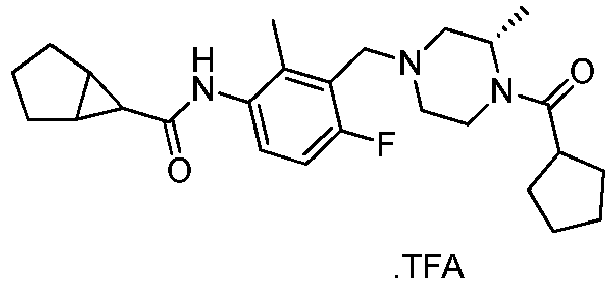
- The mixture of (S)-(4-(3-amino-6-fluoro-2-methylbenzyl)-2-methylpiperazin-1-yl)(cyclopentyl)methanone (200 mg, 0.6 mmol), HATU (251 mg, 0.66 mmol), bicyclo[3.1.0]hexane-6-carboxylic acid (76 mg, 0.6 mmol) and DIPEA (233 mg, 1.799 mmol) in DCM (3 mL) and DMF (3mL) was stirred at rt overnight. The mixture was purified by MDAP to afford the title compound (137 mg). 1H-NMR (MeOD-d4 , 400MHz):1.24 (m, 3 H), 1.41 (m., 1 H), 1.67 (m, 7 H), 1.87 (m, 9 H), 2.33 (s, 3 H), 3.04 (m, 3 H), 3.45 (t, 3 H), 4.14 (br. s., 0.5 H), 4.42 (m., 2 H), 4.62 (br. s., 0.5 H), 7.12 (t, 1 H), 7.40 (dd, 1 H). δF (MeOD-d4 , 376MHz): -77.6, -116.5. MS (ES): C26H36FN3O2 requires 441; found 442(M+H+).
- Examples 68-108 were prepared using a similar procedure to that described for Example 67.
- E 68: N-(2-chloro-3-{[(3R,5S)-4-(cyclopentylcarbonyl)-3,5-dimethyl-1-piperazinyl]methyl}phenyl)-2-[4-(ethylsulfonyl)phenyl]acetamide, trifluoroacetic acid salt
- E69: N-(2-chloro-3-{[(3R,5S)-4-(cyclopentylcarbonyl)-3,5-dimethyl-1-piperazinyl]methyl}phenyl)-2,6-difluorobenzamide
- E70: N-(3-(((S)-4-(cyclopentanecarbonyl)-3-methylpiperazin-1-yl)methyl)-4-fluoro-2-methylphenyl)-2,2-dimethylcyclopropanecarboxamide, trifluoroacetic acid salt
- E71: (S)-N-(3-((4-(cyclopentanecarbonyl)-3-methylpiperazin-1-yl)methyl)-4-fluoro-2-methylphenyl)-1-fluorocyclopentanecarboxamide, trifluoroacetic acid salt
- E72: (S)-N-(3-((4-(cyclopentanecarbonyl)-3-methylpiperazin-1-yl)methyl)-4-fluoro-2-methylphenyl)-3-phenylpropanamide, trifluoroacetic acid salt
- E73: (S)-N-(3-((4-(cyclopentanecarbonyl)-3-methylpiperazin-1-yl)methyl)-4-fluoro-2-methylphenyl)-1-phenylcyclopropanecarboxamide, trifluoroacetic acid salt
- E74: (S)-N-(3-((4-(cyclopentanecarbonyl)-3-methylpiperazin-1-yl)methyl)-4-fluoro-2-methylphenyl)-2-(2-fluorophenyl)acetamide, trifluoroacetic acid salt
- E75: (S)-N-(3-((4-(cyclopentanecarbonyl)-3-methylpiperazin-1-yl)methyl)-4-fluoro-2-methylphenyl)-2-(3-methoxyphenyl)acetamide, trifluoroacetic acid salt
- E76: (S)-N-(3-(((S)-4-(cyclopentanecarbonyl)-3-methylpiperazin-1-yl)methyl)-4-fluoro-2-methylphenyl)-2-methoxy-2-phenylacetamide, trifluoroacetic acid salt
- E77: (S)-N-(3-(((S)-4-(cyclopentanecarbonyl)-3-methylpiperazin-1-yl)methyl)-4-fluoro-2-methylphenyl)-2-phenylpropanamide, trifluoroacetic acid salt
- E78: N-(3-(((S)-4-(cyclopentanecarbonyl)-3-methylpiperazin-1-yl)methyl)-4-fluoro-2-methylphenyl)-2-fluoro-2-phenylacetamide, trifluoroacetic acid salt
- E79: trans-N-(3-(((S)-4-(cyclopentanecarbonyl)-3-methylpiperazin-1-yl)methyl)-4-fluoro-2-methylphenyl)-2-phenylcyclopropanecarboxamide, trifluoroacetic acid salt
- E80: (R)-N-(3-(((S)-4-(cyclopentanecarbonyl)-3-methylpiperazin-1-yl)methyl)-4-fluoro-2-methylphenyl)-2-methoxy-2-phenylacetamide, trifluoroacetic acid salt
- E81: (S)-N-(3-((4-(cyclopentanecarbonyl)-3-methylpiperazin-1-yl)methyl)-5-fluoro-2-methylphenyl)-3-(3-fluorophenyl)propanamide, trifluoroacetic acid salt
- E82: (S)-N-(3-((4-(cyclopentanecarbonyl)-3-methylpiperazin-1-yl)methyl)-5-fluoro-2-methylphenyl)-2,3-dihydro-1H-indene-2-carboxamide, trifluoroacetic acid salt
- E83: (S)-N-(3-((4-(cyclopentanecarbonyl)-3-methylpiperazin-1-yl)methyl)-5-fluoro-2-methylphenyl)-1-methyl-1H-pyrazole-4-carboxamide
- E84: (S)-N-(3-((4-(cyclopentanecarbonyl)-3-methylpiperazin-1-yl)methyl)-5-fluoro-2-methylphenyl)-1H-indole-2-carboxamide, trifluoroacetic acid salt
- E85: (R)-N-(3-(((S)-4-(cyclopentanecarbonyl)-3-methylpiperazin-1-yl)methyl)-4-fluoro-2-methylphenyl)-2-phenylpropanamide
- E86: N-(3-(((S)-4-(cyclopentanecarbonyl)-3-methylpiperazin-1-yl)methyl)-4-fluoro-2-methylphenyl)-3-oxabicyclo[3.1.0]hexane-6-carboxamide, trifluoroacetic acid salt
- E87: (S,Z)-N-(3-((4-(cyclopentanecarbonyl)-3-methylpiperazin-1-yl)methyl)-4-fluoro-2-methylphenyl)-2-fluoro-3-phenylacrylamide, trifluoroacetic acid salt
- E88: (S)-N-(3-((4-(cyclopentanecarbonyl)-3-methylpiperazin-1-yl)methyl)-5-fluoro-2-methylphenyl)-3-phenylpropanamide, trifluoroacetic acid salt
- E89: (S)-N-(3-((4-(cyclopentanecarbonyl)-3-methylpiperazin-1-yl)methyl)-5-fluoro-2-methylphenyl)-2-(2-fluorophenyl)acetamide, trifluoroacetic acid salt
- E90: (1S,2S)-N-(3-(((S)-4-(cyclopentanecarbonyl)-3-methylpiperazin-1-yl)methyl)-5-fluoro-2-methylphenyl)-2-phenylcyclopropanecarboxamide, trifluoroacetic acid salt
- E91: (S)-N-(3-((4-(cyclopentanecarbonyl)-3-methylpiperazin-1-yl)methyl)-5-fluoro-2-methylphenyl)-2-cyclopropylacetamide
- E92: (1S,2S)-N-(2-chloro-3-(((S)-4-(cyclopentanecarbonyl)-3-methylpiperazin-1-yl)methyl)phenyl)-2-phenylcyclopropanecarboxamide, trifluoroacetic acid salt
- E93: (S)-N-(2-chloro-3-((4-(cyclopentanecarbonyl)-3-methylpiperazin-1-yl)methyl)phenyl)-3-phenylpropanamide, trifluoroacetic acid salt
- E94: N-(2-chloro-3-(((S)-4-(cyclopentanecarbonyl)-3-methylpiperazin-1-yl)methyl)phenyl)bicyclo[3.1.0]hexane-6-carboxamide
- E95: (S)-N-(3-((4-(cyclopentanecarbonyl)-3-methylpiperazin-1-yl)methyl)-5-fluoro-2-methylphenyl)-3-(3-methoxyphenyl)propanamide, trifluoroacetic acid salt
- E96: (S)-N-(3-((4-(cyclopentanecarbonyl)-3-methylpiperazin-1-yl)methyl)-5-fluoro-2-methylphenyl)-3-(4-methoxyphenyl)propanamide, trifluoroacetic acid salt
- E97: (S)-N-(3-((4-(cyclopentanecarbonyl)-3-methylpiperazin-1-yl)methyl)-5-fluoro-2-methylphenyl)-3-(2-methoxyphenyl)propanamide, trifluoroacetic acid salt
- E98: (S)-N-(3-((4-(cyclopentanecarbonyl)-3-methylpiperazin-1-yl)methyl)-5-fluoro-2-methylphenyl)-3-(4-fluorophenyl)propanamide, trifluoroacetic acid salt
- E99:(S)-N-(3-((4-(cyclopentanecarbonyl)-3-methylpiperazin-1-yl)methyl)-5-fluoro-2-methylphenyl)-3,3-difluorocyclobutanecarboxamide, trifluoroacetic acid salt
- E100: (S)-N-(3-((4-(cyclopentanecarbonyl)-3-methylpiperazin-1-yl)methyl)-5-fluoro-2-methylphenyl)cyclopentanecarboxamide, trifluoroacetic acid salt
- E101: N-(3-(((S)-4-(cyclopentanecarbonyl)-3-methylpiperazin-1-yl)methyl)-5-fluoro-2-methylphenyl)bicyclo[3.1.0]hexane-6-carboxamide
- E102: (S)-N-(3-((4-(cyclopentanecarbonyl)-3-methylpiperazin-1-yl)methyl)-5-fluoro-2-methylphenyl)-2-phenoxyacetamide, trifluoroacetic acid salt
- E103: (S)-N-(3-((4-(cyclopentanecarbonyl)-3-methylpiperazin-1-yl)methyl)-5-fluoro-2-methylphenyl)-4-methylbenzamide
- E104: (S)-N-(3-((4-(cyclopentanecarbonyl)-3-methylpiperazin-1-yl)methyl)-5-fluoro-2-methylphenyl)benzamide, trifluoroacetic acid salt
- E105:(S)-N-(3-((4-(cyclopentanecarbonyl)-3-methylpiperazin-1-yl)methyl)-5-fluoro-2-methylphenyl)-3-(2-fluorophenyl)propanamide, trifluoroacetic acid salt
- E106:(S)-3-acetyl-N-(3-((4-(cyclopentanecarbonyl)-3-methylpiperazin-1-yl)methyl)-5-fluoro-2-methylphenyl)benzamide
- E107:(S)-N-(3-((4-(cyclopentanecarbonyl)-3-methylpiperazin-1-yl)methyl)-5-fluoro-2-methylphenyl)-3-(methoxymethyl)benzamide
- E108: N-(3-(((S)-4-(cyclopentanecarbonyl)-3-methylpiperazin-1-yl)methyl)-5-fluoro-2-methylphenyl)-3-fluorocyclopentanecarboxamide, formic acid salt
-

- (S)-(4-(3-amino-5-fluoro-2-methylbenzyl)-2-methylpiperazin-1-yl)(cyclopentyl)methanone (80 mg, 0.24 mmol) was added into a mixture of 2-fluorobenzoic acid (33.6 mg, 0.24 mmol), HATU (109 mg, 0.288 mmol) and DIPEA (93 mg, 0.720 mmol) in DMF (5 mL) at rt. The reaction was stirred at RT overnight. After checked by LCMS, the reaction was completed. The mixture was subjected to MDAP to afford the title compound (34 mg, 23.64 % yield) as white solid. 1H NMR (400 MHz, MeOD-d4 ) δ 1.18 -1.54 (m, 4H), 1.54 - 2.01 (m, 8H), 2.38 (s, 3H), 2.92 - 3.28 (m, 3H), 3.36 - 3.67 (m, 3H), 4.10 - 4.30 (m, 0.5H), 4.43 (s, 2H), 4.65 (brs, 1H), 7.27 - 7.40 (m, 3H), 7.51 (d, 1H), 7.62 (dd, 1H), 7.87 (t, 1H). 19F NMR (376 MHz, MeOD-d4 ) δ -77.2, -115.5, -116.8. MS (ESI) C26H31F2N3O2 requires: 455, found 456 (M+H+).
- Examples 110-124 were prepared using a similar procedure to that described for Example 109.
- E110:(S)-N-(3-((4-(cyclopentanecarbonyl)-3-methylpiperazin-1-yl)methyl)-5-fluoro-2-methylphenyl)-4-fluorobenzamide, trifluoroacetic acid salt
- E111:(S)-N-(3-((4-(cyclopentanecarbonyl)-3-methylpiperazin-1-yl)methyl)-5--fluoro-2-methylphenyl)-3-fluorobenzamide, trifluoroacetic acid salt
- E112:(S)-N-(3-((4-(cyclopentanecarbonyl)-3-methylpiperazin-1-yl)methyl)-5-fluoro-2-methylphenyl)-3-methoxybenzamide, trifluoroacetic acid salt
- E113:N-(3-(((S)-4-(cyclopentanecarbonyl)-3-methylpiperazin-1-yl)methyl)-5-fluoro-2-methylphenyl)tetrahydrofuran-3-carboxamide, trifluoroacetic acid salt
- E114:(S)-4-chloro-N-(3-((4-(cyclopentanecarbonyl)-3-methylpiperazin-1-yl)methyl)-5-fluoro-2-methylphenyl)-3-fluorobenzamide, trifluoroacetic acid salt
- E115:N-(3-(((S)-4-(cyclopentanecarbonyl)-3-methylpiperazin-1-yl)methyl)-5-fluoro-2-methylphenyl)tetrahydro-2H-pyran-3-carboxamide, trifluoroacetic acid salt
- E116:(R)-N-(3-(((S)-4-(cyclopentanecarbonyl)-3-methylpiperazin-1-yl)methyl)-5-fluoro-2-methylphenyl)tetrahydrofuran-3-carboxamide
- E117:(S)-N-(3-((4-(cyclopentanecarbonyl)-3-methylpiperazin-1-yl)methyl)-5-fluoro-2-methylphenyl)tetrahydro-2H-pyran-4-carboxamide
- E118:(S)-N-(3-((4-(cyclopentanecarbonyl)-3-methylpiperazin-1-yl)methyl)-5-fluoro-2-methylphenyl)-2-methylbenzamide
- E119:(S)-4-chloro-N-(3-((4-(cyclopentanecarbonyl)-3-methylpiperazin-1-yl)methyl)-5-fluoro-2-methylphenyl)benzamide
- E120:(S)-2-chloro-N-(3-((4-(cyclopentanecarbonyl)-3-methylpiperazin-1-yl)methyl)-5-fluoro-2-methylphenyl)benzamide
- E121:(S)-N-(3-((4-(cyclopentanecarbonyl)-3-methylpiperazin-1-yl)methyl)-5-fluoro-2-methylphenyl)-4-methoxybenzamide
- E122:(S)-N-(3-((4-(cyclopentanecarbonyl)-3-methylpiperazin-1-yl)methyl)-5-fluoro-2-methylphenyl)-4-fluoro-3-methylbenzamide
- E123:(S)-N-(3-((4-(cyclopentanecarbonyl)-3-methylpiperazin-1-yl)methyl)-5-fluoro-2-methylphenyl)-2-methylthiazole-5-carboxamide, trifluoroacetic acid salt
- E124:(S)-N-(3-((4-(cyclopentanecarbonyl)-3-methylpiperazin-1-yl)methyl)-5-fluoro-2-methylphenyl)-3-(difluoromethyl)benzamide, trifluoroacetic acid salt
-

- To a solution of (R)-N-(3-(((S)-4-(cyclopentanecarbonyl)-3-methylpiperazin-1-yl)methyl)-5-fluoro-2-methylphenyl)pyrrolidine-2-carboxamide (129 mg, 0.3 mmol) and formaldehyde (48.6 mg, 0.599 mmol) in DCM (30 mL) was added AcOH (8.58 µL, 0.15 mmol). After stirring at rt for half an hour, sodium triacetoxyborohydride (95 mg, 0.449 mmol) was added and the mixture was stirred at rt overnight. The mixture was quenched with water, washed with sat. NaHCO3 solution, the organic layer was dried and evaporated, the residue was purified by MDAP to give the title compound (28 mg) as a white solid. 1H-NMR (MeOD-d4 , 400MHz): 1.22 (d, 2 H), 1.35 (d, 1 H), 1.88 (m, 13 H), 2.16 (dd, 1 H), 2.26 (s, 3 H), 2.33 (m, 1 H), 2.49 (m, 4 H), 2.73 (m, 1 H), 2.82 (d, 1 H), 3.03 (m, 3 H), 3.24 (m, 1 H), 3.46 (m, 2 H), 3.81 (br. s., 0.5 H), 4.29 (br. s., 1 H), 4.66 (br. s., 0.5 H), 6.93 (dd, 1 H), 7.50 (dd, 1 H). δF (MeOD-d4 376MHz): -118.9. MS (ES): C25H37FN4O2 requires 444; found 445(M+H+).
-

- Example 126 was prepared using a similar procedure to that described for E125. 1H-NMR (MeOD-d4 , 400MHz): 1.22 (d, 2 H), 1.31 (m, 1 H), 1.61 (m, 2 H), 1.70 (br. s., 3 H), 2.04 (m, 1 H), 2.16 (m, 2 H), 2.25 (m, 4 H), 2.42 (s, 3 H), 2.73 (m, 5 H), 2.94 (t, 1 H), 3.00 (br. s., 1 H), 3.19 (quin, 1 H), 3.47 (d, 2 H), 3.83 (d, 0.5 H), 4.29 (br. s., 1 H), 4.66 (br. s., 0.5 H), 6.96 (d, 1 H), 7.18 (d, 1 H). δF (MeOD-d4 , 376MHz): -119.5. MS (ES): C25H37FN4O2 requires 444; found 445(M+H+).
-

- The mixture of 1-methyl-1H-pyrazole-3-carboxylic acid (30.3 mg, 0.24 mmol),(S)-(4-(3-amino-6-fluoro-2-methylbenzyl)-2-methylpiperazin-1-yl)(cyclopentyl)methanone (80 mg, 0.24 mmol), EDC (55.2 mg, 0.288 mmol), HOBT (44.1 mg, 0.288 mmol), in DMF (4 mL) was stirred at rt overnight. The mixture was purified by MDAP to give the title compound (50 mg). 1H-NMR (MeOD-d4 , 400MHz): 1.20 (d, 1 H), 1.33 (d, 2 H), 1.63 (m, 9 H), 1.75 (m, 2H), 2.30 (d, 3 H), 2.97(m,2H), 3.15 (s. 1 H), 3.37 (m, 3 H), 3.91 (s, 1 H), 4.08 (s., 1 H), 4.33 (br. s., 2 H), 4.52 (br.s. 1 H), 4.90 (br. s., 0.5 H),6.71 (d, 2 H), 7.09 (d, 3 H), 7.49 (d, 4 H),7.60 (d, 2 H). δF (MeOD-d4 , 376MHz): -77.1, -114.6. MS (ES): C24H32FN5O2 requires 441; found 442(M+H+).
- Examples 128-137 were prepared using a similar procedure to that described for Example 127.
- E128: (S)-N-(3-((4-(cyclopentanecarbonyl)-3-methylpiperazin-1-yl)methyl)-4-fluoro-2-methylphenyl)-6-methylnicotinamide, trifluoroacetic acid salt
- E129: (S)-N-(3-((4-(cyclopentanecarbonyl)-3-methylpiperazin-1-yl)methyl)-4-fluoro-2-methylphenyl)-2-oxo-1,2-dihydropyridine-3-carboxamide, trifluoroacetic acid salt
- E130: (S)-N-(3-((4-(cyclopentanecarbonyl)-3-methylpiperazin-1-yl)methyl)-5-fluoro-2-methylphenyl)-1-methyl-1H-pyrazole-3-carboxamide, trifluoroacetic acid salt
- E131: (S)-N-(3-((4-(cyclopentanecarbonyl)-3-methylpiperazin-1-yl)methyl)-5-fluoro-2-methylphenyl)thiazole-5-carboxamide, trifluoroacetic acid salt
- E132: (S)-N-(3-((4-(cyclopentanecarbonyl)-3-methylpiperazin-1-yl)methyl)-5-fluoro-2-methylphenyl)-5-methyloxazole-4-carboxamide, trifluoroacetic acid salt
- E133: (S)-N-(3-((4-(cyclopentanecarbonyl)-3-methylpiperazin-1-yl)methyl)-5-fluoro-2-methylphenyl)thiazole-4-carboxamide
- E134: (S)-N-(3-((4-(cyclopentanecarbonyl)-3-methylpiperazin-1-yl)methyl)-5-fluoro-2-methylphenyl)oxazole-4-carboxamide, trifluoroacetic acid salt
- E135: (S)-N-(3-((4-(cyclopentanecarbonyl)-3-methylpiperazin-1-yl)methyl)-5-fluoro-2-methylphenyl)-3-(1H-pyrazol-1-yl)propanamide, trifluoroacetic acid salt
- E136: (S)-N-(2-chloro-3-((4-(cyclopentanecarbonyl)-3-methylpiperazin-1-yl)methyl)phenyl)-1H-pyrazole-5-carboxamide, trifluoroacetic acid salt
- E137: (S)-N-(2-chloro-3-((4-(cyclopentanecarbonyl)-3-methylpiperazin-1-yl)methyl)phenyl)-2-(3-chlorophenyl)acetamide
-

- To a solution of (S)-N-(5-fluoro-2-methyl-3-((3-methylpiperazin-1-yl)methyl)phenyl)-6-methylnicotinamide (100 mg, 0.281 mmol) and 2,2-dimethylbutanoyl chloride (0.038 mL, 0.281 mmol) in DCM (5 mL) was added DIPEA (0.049 mL, 0.281 mmol). The mixture was stirred at rt for 3 hr. The mixture was washed with sat. NaHCO3 solution and brine, the organic layer was dried, evaporated and purified by MDAP to give the title compound (20 mg). 1H-NMR (MeOD-d4 , 400MHz): 0.89 (t, 3 H), 1.26 (d, 6 H), 1.34 (d, 3 H), 1.68 (m, 2 H), 2.34 (s, 3 H), 2.72 (s, 3 H), 2.97 (br. s., 1 H), 3.10 (br. s., 1 H), 3.42 (d, 2 H), 4.33 (br. s., 2 H), 4.44 (d, 1 H), 4.90 (br. s., 1 H), 7.32 (m, 2 H), 7.67 (d, 1 H), 8.50 (dd, 1 H), 9.09 (d, 1 H). δF (MeOD-d4 , 376MHz): -77.4, -117.2. MS (ES): C26H35FN4O2 requires 454; found 455(M+H+).
-

- The mixture of (S)-N-(5-fluoro-2-methyl-3-((3-methylpiperazin-1-yl)methyl)phenyl)-6-methylnicotinamide (100 mg, 0.281 mmol), 2-cyclopropylacetic acid (30.9 mg, 0.309 mmol), HATU (117 mg, 0.309 mmol) and DIPEA (0.098 mL, 0.561 mmol) in DCM (3 mL) was stirred at rt overnight. The mixture was purified by MDAP to afford the title compound (33 mg). 1H-NMR (MeOD-d4 , 400MHz): 0.19 (br. s., 2 H), 0.53 (d, 2 H), 1.00 (d, 1 H), 1.27 (m, 2 H), 1.34 (m, 2 H), 2.07 (m, 1 H), 2.25 (m, 6 H), 2.44 (dd, 1 H), 2.63 (s, 3 H), 2.75 (d, 1 H), 2.84 (br. s., 1 H), 2.99 (m, 1 H), 3.40 (t, 1 H), 3.51 (m, 2 H), 3.72 (d, 0.5 H), 4.15 (br. s., 0.5 H), 4.33 (br. s., 0.5 H), 4.69 (br. s., 0.5 H), 7.12 (d, 1 H), 7.08 (d, 1 H), 7.47 (d, 1 H), 8.27 (d, 1 H), 9.00 (s, 1 H).δF (MeOD-d4 , 376MHz): -119.4. MS (ES): C25H31FN4O2requires 438; found 439(M+H+).
-

- The mixture of (S)-N-(5-fluoro-2-methyl-3-((3-methylpiperazin-1-yl)methyl)phenyl)-6-methylnicotinamide (100 mg, 0.281 mmol), 3,3-difluorocyclobutanecarboxylic acid (42.0 mg, 0.309 mmol), HATU (117 mg, 0.309 mmol)and DIPEA (0.098 mL, 0.561 mmol) in DCM (3 mL) was stirred at rt overnight. The mixture was purified by MDAP to afford the title compound (73 mg).1H-NMR (MeOD-d4 , 400MHz): 1.32 (br. s., 3 H), 2.34 (s, 3 H), 2.87 (m, 7 H), 3.19 (br. s., 2 H), 3.27 (d, 1 H), 3.39 (d, 1 H), 3.47 (d, 1 H), 3.57 (br. s., 1 H), 3.91 (br. s., 0.5 H), 4.40 (br. s., 2 H), 4.59 (br. s., 0.5 H), 7.35 (m, 2 H), 7.81 (d, 1 H), 8.66 (d, 1 H), 9.15 (s, 1 H). δF (MeOD-d4 , 376MHz): -77.2,-84.2, -84.7, -97.5, -98.1, -116.9. MS (ES): C25H29F3N4O2 requires 474; found 475(M+H+).
- Examples 141-162 were prepared using a similar procedure to that described for Example 140.
- E141: (S)-N-(5-fluoro-2-methyl-3-((3-methyl-4-(4,4,4-trifluorobutanoyl)piperazin-1-yl)methyl)phenyl)-6-methylnicotinamide
- E142: (S)-N-(3-((4-(cyclohexanecarbonyl)-3-methylpiperazin-1-yl)methyl)-5-fluoro-2-methylphenyl)-6-methylnicotinamide, trifluoroacetic acid salt
- E143: (S)-N-(3-((4-(3,3-dimethylbutanoyl)-3-methylpiperazin-1-yl)methyl)-5-fluoro-2-methylphenyl)-6-methylnicotinamide, trifluoroacetic acid salt
- E144: (S)-N-(5-fluoro-2-methyl-3-((3-methyl-4-(3,3,3-trifluoropropanoyl)piperazin-1-yl)methyl)phenyl)-6-methylnicotinamide, trifluoroacetic acid salt
- E145: (S)-N-(5-fluoro-2-methyl-3-((3-methyl-4-(spiro[3.3]heptane-2-carbonyl)piperazin-1-yl)methyl)phenyl)-6-methylnicotinamide
- E146: (S)-N-(3-((4-butyryl-3-methylpiperazin-1-yl)methyl)-5-fluoro-2-methylphenyl)-6-methylnicotinamide
- E147:N-(5-fluoro-2-methyl-3-(((3S)-3-methyl-4-(2-methylbutanoyl)piperazin-1-yl)methyl)phenyl)-6-methylnicotinamide
- E148: (S)-N-(3-((4-(2-ethylbutanoyl)-3-methylpiperazin-1-yl)methyl)-5-fluoro-2-methylphenyl)-6-methylnicotinamide
- E149: (S)-N-(3-((4-(cyclobutanecarbonyl)-3-methylpiperazin-1-yl)methyl)-5-fluoro-2-methylphenyl)-6-methylnicotinamide
- E150: (S)-N-(5-fluoro-2-methyl-3-((3-methyl-4-pivaloylpiperazin-1-yl)methyl)phenyl)-6-methylnicotinamide
- E151:N-(3-(((3S)-4-((1S,4R)-bicyclo[2.2.1]heptane-2-carbonyl)-3-methylpiperazin-1-yl)methyl)-5-fluoro-2-methylphenyl)-6-methylnicotinamide
- E152: (S)-N-(5-fluoro-3-((4-(3-fluorocyclobutanecarbonyl)-3-methylpiperazin-1-yl)methyl)-2-methylphenyl)-6-methylnicotinamide formate
- E153: (S)-N-(3-((4-benzoyl-3-methylpiperazin-1-yl)methyl)-5-fluoro-2-methylphenyl)-6-methylnicotinamide
-
- E154: (S)-N-(5-fluoro-3-((4-(3-methoxycyclobutanecarbonyl)-3-methylpiperazin-1-yl)methyl)-2-methylphenyl)-6-methylnicotinamide
- E155: (S)-N-(5-fluoro-3-((4-(3-(fluoromethyl)cyclobutanecarbonyl)-3-methylpiperazin-1-yl)methyl)-2-methylphenyl)-6-methylnicotinamide
- E156:N-(5-fluoro-3-(((3S)-4-(2-methoxypropanoyl)-3-methylpiperazin-1-yl)methyl)-2-methylphenyl)-6-methylnicotinamide
- E157: (S)-N-(5-fluoro-2-methyl-3-((3-methyl-4-(1-methyl-1H-pyrrole-2-carbonyl)piperazin-1-yl)methyl)phenyl)-6-methylnicotinamide
- E158: (S)-N-(5-fluoro-2-methyl-3-((3-methyl-4-(thiazole-2-carbonyl)piperazin-1-yl)methyl)phenyl)-6-methylnicotinamide
- E159: (S)-N-(5-fluoro-2-methyl-3-((3-methyl-4-(thiazole-5-carbonyl)piperazin-1-yl)methyl)phenyl)-6-methylnicotinamide
- E160: (S)-N-(5-fluoro-3-((4-(furan-2-carbonyl)-3-methylpiperazin-1-yl)methyl)-2-methylphenyl)-6-methylnicotinamide
- E161: (S)-N-(5-fluoro-2-methyl-3-((3-methyl-4-(oxazole-5-carbonyl)piperazin-1-yl)methyl)phenyl)-6-methylnicotinamide
- E162: (S)-N-(5-fluoro-2-methyl-3-((3-methyl-4-(1-methyl-1H-pyrrole-3-carbonyl)piperazin-1-yl)methyl)phenyl)-6-methylnicotinamide
-

- To a solution of 2-cyclobutylacetic acid (25.6 mg, 0.224 mmol) in CH2Cl2 (2 mL) was added HATU (85 mg, 0.224 mmol), N-ethyl-N-isopropylpropan-2-amine (87 mg, 0.673 mmol), after 30 mins, (S)-N-(5-fluoro-2-methyl-3-((3-methylpiperazin-1-yl)methyl)phenyl)-6-methylnicotinamide (80 mg, 0.224 mmol) was added. Then the reaction mixture was stirred for 15hr at RT. Then water was added, and the solution was extracted with CH2Cl2 (20 mLx2). The combined organic layers were dried over MgSO4 and condensed. The obtained mixture was purified by MDAP to afford the title compound (24.5 mg) as a white solid. δH (MeOD-d4 , 400MHz): 1.20-1.33 (m, 3H), 1.69-1.76 (m, 2H), 1.82-1.90 (m, 2H), 1.98-2.01 (m, 0.5H), 2.05-2.16 (m, 3H), 2.19-2.21 (m, 0.5H), 2.272 (s, 3H), 2.41-2.48 (m, 2H), 2.56-2.61 (m, 3H), 2.62-2.65 (m, 1H), 2.68-2.74 (m, 1H), 2.82-2.84 (m, 1H), 2.89-2.92 (m, 0.5H), 3.38-3.41 (m, 0.5H), 3.48-3.49 (m, 2H), 3.65-3.79 (m, 0.5H), 4.12-4.35 (m, 1H), 4.58-4.69 (m, 0.5H), 7.04-7.11 (m, 2H), 7.45 (d, 1H), 8.24-8.26 (m, 1H), 8.98 (d, 1H). δF (MeOD-d4 , 376MHz):-119.885, MS (ES): C26H33FN4O2 requires 452; found 453 (M+H+).
-

- To a solution of 3,3-dimethylcyclobutanecarboxylic acid (21.58 mg, 0.168 mmol) in CH2Cl2 (2 mL) was added HATU (64.0 mg, 0.168 mmol), N-ethyl-N-isopropylpropan-2-amine (65.3 mg, 0.505 mmol), after 30 mins, (S)-N-(5-fluoro-2-methyl-3-((3-methylpiperazin-1-yl)methyl)phenyl)-6-methylnicotinamide (60 mg, 0.168 mmol) was added. Then the reaction mixture was stirred for 15hr at RT. Then water was added, and the solution was extracted with CH2Cl2 (20 mL x 2). The combined organic layers were dried over MgSO4 and condensed. The obtained mixture was purified by MDAP
to give the title compound (20.2 mg) as a white solid. δH (MeOD-d4 , 400MHz): 1.05-1.07 (m, 3H), 1.14-1.22 (m, 5H), 1.27-1.36 (m, 1H), 1.18-1.97 (m, 2H), 2.00-2.10 (m, 2H), 2.144 (s, 3H), 2.15-2.18 (m, 1H), 2.272 (s, 3H), 2.621 (s, 3H), 2.69-2.72 (m, 1H), 2.79-2.84 (m, 1H), 2.95-2.98 (m, 0.5H), 3.48-3.55 (m, 2H), 3.993 (s, 0.5H), 4.25-4.28 (m, 0.5H), 4.615 (s, 0.5H), 7.05-7.11 (m, 2H), 7.46 (d, 1H), 8.25-8.27 (m, 1H), 8.987 (s, 1H). δF (MeOD-d4 , 376MHz): -119.415, MS (ES): C27H35FN4O2 requires 466; found 467 (M+H+). -

- To a solution of 3-(difluoromethyl)cyclobutanecarboxylic acid (21.06 mg, 0.140 mmol) in CH2Cl2 (2 mL) was added HATU (53.3 mg, 0.140 mmol), N-ethyl-N-isopropylpropan-2-amine (54.4 mg, 0.421 mmol), after 30 mins, (S)-N-(5-fluoro-2-methyl-3-((3-methylpiperazin-1-yl)methyl)phenyl)-6-methylnicotinamide (50 mg, 0.140 mmol) was added. Then the reaction mixture was stirred for 15hr at RT. Then water was added, and the solution was extracted with CH2Cl2 (20 mL x2). The combined organic layers were dried over MgSO4 and condensed. The obtained mixture was purified by MDAP to give the title compound (8.4 mg) as a white solid. δH (MeOD-d4 , 400MHz): 1.22-1.25 (m, 2H), 1.27-1.31 (m, 1H), 1.99-2.02 (m, 1H), 2.15-2.21 (m, 2H), 2.26-2.31 (m, 3H), 2.33-2.37 (m, 2H), 2.39-2.48 (m, 1H), 2.617 (s, 3H), 2.70-2.73 (m, 1H), 2.81-2.89 (m, 1H), 2.95-2.98 (m, 0.5H), 3.45-3.48 (m, 0.5H), 3.48-3.49 (m, 1H), 3.49-3.52 (m, 2H), 3.87-3.95 (m, 0.5H), 4.26-4.30 (m, 0.5H), 4.62-4.75 (m, 2H), 5.78-6.16 (m, 1H), 7.04-7.11 (m, 2H), 7.45 (d, J= 8 Hz, 1H), 8.24-8.26 (m, 1H), 8.979 (s, 1H). δF (MeOD-d4 , 376MHz): -119.396, 125.983, 126.066. MS (ES): C26H31F3N4O2 requires 488; found 489 (M+H+).
-

- To a solution of 3-fluorocyclopentanecarboxylic acid (29.7 mg, 0.224 mmol) in CH2Cl2 (2 mL) was added HATU (85 mg, 0.224 mmol), N-ethyl-N-isopropylpropan-2-amine (87 mg, 0.673 mmol), after 30 mins, (S)-N-(5 -fluoro-2-methyl-3-((3-methylpiperazin-1-yl)methyl)phenyl)-6-methylnicotinamide (80 mg, 0.224 mmol) was added. Then the reaction mixture was stirred for 15hr at RT. Then water was added, and the solution was extracted with CH2Cl2 (20 mL x2). The combined organic layers were dried over MgSO4 and condensed. The obtained mixture was purified MDAP to give the title
compound (28.2 mg) as a white solid. δH (MeOD-d4 , 400MHz): 1.22-1.36 (m, 3H), 1.68-1.70 (m, 1H), 1.82-1.85 (m, 1H), 1.86-2.08 (m, 4H), 2.16-2.23 (m, 2H), 2.28 (s, 3H), 2.621 (s, 3H), 2.71-2.76 (m, 1H), 2.83-2.86 (m, 1H), 2.96-3.04 (m, 0.5H), 3.06-3.08 (m, 1H), 3.36-3.39 (m, 0.5H), 3.49-3.51 (m, 2H), 3.77-3.80 (m, 0.5H), 4.21-4.38 (m, 1H), 4.66-4.67 (m, 0.5H), 5.02-5.16 (m, 1H), 7.05-7.12 (m, 2H), 7.46 (d, J= 8 Hz, 1H), 8.24-8.27 (m, 1H), 8.98 (d, J= 2 Hz, 1H). δF (MeOD-d4 , 376MHz): - 119.398, -169.974. MS (ES): C26H32F2N4O2 requires 470; found 471 (M+H+). -

- The mixture of 3-fluoro-3-methylcyclobutanecarboxylic acid (20.39 mg, 0.154 mmol), (S)-N-(5-fluoro-2-methyl-3-((3-methylpiperazin-1-yl)methyl)phenyl)-6-methylnicotinamide (55 mg, 0.154 mmol), DIEA (0.054 mL, 0.309 mmol)and HATU (58.7 mg, 0.154 mmol) was stirred at 20°C for 16 hr. The reaction mixture was added water and extracted with DCM. The organic layer was dried over Na2SO4, filtered and concentrated. The residue was purified by MDAP to afford the title compound (10 mg). δH (MeOD-d4 , 400MHz): 9.02 (d, J=1.8 Hz, 1H), 8.29 (dd, J=2.4, 8.2 Hz, 1H), 7.49 (d, J=8.0 Hz, 1H), 7.18 - 7.06 (m, 2H), 4.70 - 4.55 (m, 1H), 4.37 - 3.94 (m, 1H), 3.58 - 3.40 (m, 3H), 3.06 - 2.70 (m, 3H), 2.68 - 2.35 (m, 7H), 2.31 (s, 3H), 2.24 - 2.17 (m, 1H), 2.10 - 1.98 (m, 1H), 1.48 - 1.38 (m, 3H), 1.36 - 1.24 (m, 3H).
-
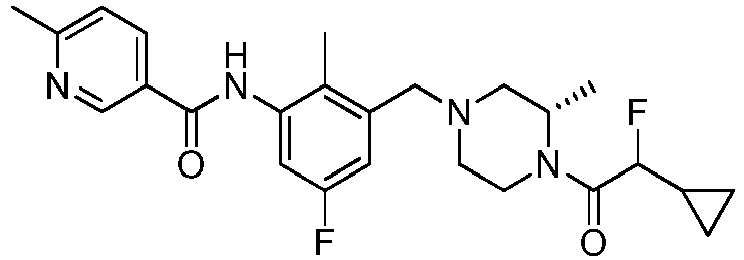
- The mixture of (S)-N-(5-fluoro-2-methyl-3-((3-methylpiperazin-1-yl)methyl)phenyl) -6-methylnicotinamide (70 mg, 0.196 mmol), 2-cyclopropyl-2-fluoroacetic acid (23.19 mg, 0.196 mmol), HATU (74.7 mg, 0.196 mmol)andN-ethyl-N- isopropylpropan-2-amine (0.069 mL, 0.393 mmol) was stirred at 20°C for 16 hr. The reaction mixture was added water and extracted with DCM. The organic layer was dried over Na2SO4, filtered and concentrated. The residue was purified by MDAP to afford the title compound (10 mg). δH (MeOD-d4 , 400MHz): 9.02 (s, 1H), 8.29 (dd, J=2.3, 8.0 Hz, 1H), 7.49 (d, J=8.0 Hz, 1H), 7.13 (ddd, J=2.8, 9.5, 12.1 Hz, 2H), 4.71-4.36 (m, 2H), 4.34-4.01 (m, 2H), 3.55 (s, 2H), 3.12-2.70 (m, 3H), 2.65 (s, 3H), 2.39-1.96 (m, 6H), 1.72 (br. s., 1H), 1.48 - 1.14 (m, 4H), 0.90 (br. s., 1H).
-

- The mixture of 2-cyclopropylpropanoic acid (D33) (17.61 mg, 0.154 mmol), (S)-N-(5-fluoro-2-methyl-3-((3-methylpiperazin-1-yl)methyl)phenyl)-6-methylnicotinamide (55 mg, 0.154 mmol), DIEA (0.054 mL, 0.309 mmol)and HATU (58.7 mg, 0.154 mmol) was stirred at 20°C for 16 hr. The reaction mixture was added water and extracted with DCM. The organic layer was dried over Na2SO4, filtered and concentrated. The residue was purified by MDAP to afford the title compound (12 mg). δH (MeOD-d4 , 400MHz): 9.02 (s, 1H), 8.29 (dd, J=2.1, 7.9 Hz, 1H), 7.49 (d, J=8.0 Hz, 1H), 7.18 - 7.06 (m, 2H), 4.64 - 3.69 (m, 1H), 3.53 (d, J=5.0 Hz, 2H), 3.06 - 2.71 (m, 3H), 2.65 (s, 3H), 2.36 - 1.91 (m, 7H), 1.46 - 1.12 (m, 6H), 1.00 (d, J=14.6 Hz, 1H), 0.61 - 0.36 (m, 2H), 0.17 (d, J=12.0 Hz, 2H).
-

- The mixture of 2-cyclobutylpropanoic acid (19.78 mg, 0.154 mmol), (S)-N-(5-fluoro-2-methyl-3-((3-methylpiperazin-1-yl)methyl)phenyl)-6-methylnicotinamide (55 mg, 0.154 mmol), DIEA (0.054 mL, 0.309 mmol) and HATU (58.7 mg, 0.154 mmol) was stirred at 20°C for 16 hr. The reaction mixture was added water and extracted with DCM. The organic layer was dried over Na2SO4, filtered and concentrated. The residue was purified by MDAP to afford the title compound (20 mg). δH (MeOD-d4 , 400MHz): 7.41-7.32 (m, 2H), 7.28-7.20 (m, 3H), 5.31-5.24 (m, 5H), 4.24 (td, J=4.1, 13.9 Hz, 2H), 3.71-3.57 (m, 4H), 3.03 (s, 6H), 2.19-1.91 (m, 5H), 1.31 (d, J=6.5 Hz, 7H).
-

- To a solution of 2-fluorocyclopentanecarboxylic acid (39.6 mg, 0.3 mmol) in DCM (2 mL) was added HATU (114 mg, 0.3 mmol) and Et3N (3 eq). The reaction mixture was stirred at rt for 3h. To this mixture was added rt (S)-(4-(3-amino-5-fluoro-2-methylbenzyl)-2-methylpiperazin-1-yl)(cyclopentyl)methanone (1 eq). This mixture was stirred at rt for 18 hr. This crude was purified by MDAP to afford the title compound (19 mg) as white solid. δH (CDC13-d1 , 400MHz): 1.26 (m, 2H), 1.42 (m, 1H), 1.75 (m, 8H), 2.02 (m, 2H), 2.26 (s, 3H), 2.56 (m, 2H), 2.67 (m, 2H), 3.30 (m, 2H), 3.50 (m, 4H), 4.25 (m, 1H), 4.47 (m, 2H), 4.65 (m, 1H), 5.00 (m, 1H), 6.78 (m, 1H), 7.27 (m, 2H). δF (MeOD-d4 , 376MHz): -70.5, -111.3. MS (ES): C25H35F2N3O2 requires 447; found 428(M-F+).
-

- To a solution of (S)-N-(5-fluoro-2-methyl-3-((3-methylpiperazin-1-yl)methyl) phenyl)-6-methylnicotinamide (100 mg, 0.281 mmol), 3-methylcyclobutanecarboxylic acid (32.0 mg, 0.281 mmol) and HATU (107 mg, 0.281 mmol) in DCM (1 mL) stirred under nitrogen at 0°C was added DIEA (0.098 mL, 0.561 mmol), then the reaction mixture was stirred at RT for 15 hr. Removed the solvent, and the residue was purified by MDAP to give the title compound (40 mg) as a white oil. δH (CDC13-d1 , 400MHz): 1.18 (m, 7H), 1.89 (m, 3H), 2.15 (m, 2H), 2.22 (m, 4H), 2.61 (m, 1H), 2.64 (s, 3H), 2.75 (m, 1H), 3.00 (m, 1H), 3.20 (m, 1H), 3.50 (m, 3H), 4.50 (m, 1H), 6.88 (d, 1H), 7.29 (d, 1H), 7.67 (d, 1H), 7.76 (s, 1H), 8.10 (dd, 2 Hz, 1H), 8.98 (d, 1H). δF (MeOD-d4 , 376MHz): -118 MS (ES): C25H35F2N3O2requires 452; found 453 (M+1+).
-

- (S)-3-cyano-N-(5-fluoro-2-methyl-3-((3-methylpiperazin-1-yl)methyl)phenyl)benzamide (200 mg, 0.546 mmol) was added into a solution of 3-fluorobenzoic acid (76 mg, 0.546 mmol). HATU (311 mg, 0.819 mmol) and DIPEA (0.286 mL, 1.637 mmol) in DMF (8 mL) at RT. The reaction was stirred at RT overnight. After checked by LCMS, the reaction was completed. The mixture was concentrated and the residue was subjected to MDAP to give the title compound (47 mg, 0.091 mmol, 16.75 % yield) as white solid. 1H NMR (400 MHz, MeOD-d4 ) δ 1.37 (d, 3H), 2.07 - 2.21 (m, 1H), 2.29 (s, 3H), 2.32 (s, 0.5H), 2.66 - 2.93 (m, 2H), 3.54 (s, 2H), 4.49 (s, 0.5H), 7.05 - 7.17 (m, 3H), 7.17 - 7.25 (m, 2H), 7.44 - 7.53 (m, 1H), 7.72 (t, 1H), 7.96 (d, 1H), 8.25 (d, 1H), 8.32 (s, 1H). 19F NMR (376 MHz, MeOD-d4 ) δ -113.7, -119.3. MS (ESI) C28H26F2N4O2 requires: 488, found 489 (M+H+).
-

- Examples 174 was prepared using a similar procedure to that described for Example 173. 1H NMR (400 MHz, MeOD-d4 ) δ 0.13-0.25 (m, 2H), 0.50-0.63 (m, 2H), 1.01 (tq, 1H), 1.35 (brs, 3H), 2.26-2.50 (m, 5H), 2.89-3.27 (m, 3H), 3.35-3.69 (m, 3H), 4.04 (brs, 0.5H), 4.38 (s, 2H), 4.44-4.70 (m, 1H), 4.89-5.07 (m, 0.5H), 7.33 (d, 2H), 7.75 (t, 1H), 7.98 (d, 1H), 8.27 (d, 1H), 8.33 (s, 1H). 19F NMR (376 MHz, MeOD-d4 ) δ -73.5, -75.4, -77.3, -117.0. MS (ESI) C26H29FN4O2 requires: 448, found 449 (M+H+).
-

- HATU (311 mg, 0.819 mmol) was added into a mixture of 3,3-difluorocyclobutanecarboxylic acid (74.3 mg, 0.546 mmol), (S)-3-cyano-N-(5-fluoro-2-methyl-3-((3-methylpiperazin-1-yl)methyl)phenyl)benzamide (200 mg, 0.546 mmol) and DIPEA (212 mg, 1.637 mmol) in N,N-Dimethylformamide (DMF) (5 mL) at RT. The reaction was stirred at RT overnight. The mixture was subjected to MDAP to afford the title compound as white solid. 1H NMR (400 MHz, MeOD-d4 ) δ 1.24-1.45 (m, 3H), 2.32 (s, 3H), 2.67-3.18 (m, 7H), 3.37 (s, 1H), 3.20-3.41 (m, 1H), 3.86 (brs, 1H), 4.13-4.42 (m, 3H), 4.55 (brs, 1H), 7.24-7.35 (m, 2H), 7.74 (t, 1H), 7.98 (d, 1H), 8.27 (d, 1H), 8.33 (s, 1H).19F NMR (376 MHz, MeOD-d4 ) δ -73.8, -75.7, -77.0, -84.24 (dd), -98.34 (dd), -121.1. MS (ESI) C26H27F3N4O2 requires: 484, found 485 (M+H+).
- Examples 176-178 were prepared using a similar procedure to that described for Example 175.
- E176: 3-cyano-N-(5-fluoro-3-(((3S)-4-(3-fluorocyclopentanecarbonyl)-3-methylpiperazin-1-yl)methyl)-2-methylphenyl)benzamide, trifluoroacetic acid salt
- E177: (S)-N-(3-((4-benzoyl-3-methylpiperazin-1-yl)methyl)-5-fluoro-2-methylphenyl)-3-cyanobenzamide (Reference Example)
- E178: (S)-3-cyano-N-(3-((4-(2-cyclobutylacetyl)-3-methylpiperazin-1-yl)methyl)-5-fluoro-2-methylphenyl)benzamide, trifluoroacetic acid salt
-

- Cyclohexanecarbonyl chloride (84 mg, 0.573 mmol) was added into a mixture of (S)-3-cyano-N-(5-fluoro-2-methyl-3-((3-methylpiperazin-1-yl)methyl)phenyl)benzamide (150mg, 0.409mmol) in Pyridine (4 mL) at RT. The reaction was stirred at RT overnight. After checked by LCMS, the reaction was completed. The mixture was subjected to MDAP to afford the title compound (14 mg, 0.028 mmol, 6.82 % yield) as white solid. 1H NMR (400 MHz, MeOD-d4 ) δ 1.13-1.60 (m, 8H), 1.60-1.86 (m, 5H), 1.92-2.26 (m, 2H), 2.29 (s, 3H), 2.53-3.02 (m, 3.5H), 3.34-3.45 (m, 0.5H), 3.45-3.58 (m, 2H), 3.79 (d, 0.5H), 4.16-4.37 (m, 1H), 4.67 (brs, 0.5H), 7.10 (ddd, 2H), 7.72 (t, 1H), 7.95 (d, 1H), 8.25 (d, 1H), 8.32 (s, 1H). 19F NMR (376 MHz, MeOD-d4 ) δ -119.2. MS (ESI) C28H33FN4O2 requires: 476, found 477 (M+H+).
-

- Cyclohexanecarboxylic acid (31.3 mg, 0.244 mmol) was added into a mixture of (S)-N-(2-chloro-3-((3-methylpiperazin-1-yl)methyl)phenyl)-3-cyanobenzamide (90mg, 0.244mmol), HATU (139mg, 0.366mmol) and DIPEA (0.128mL, 0.732mmol) in DMF (6 mL) at RT and stirred overnight. After checked by LCMS, the reaction was completed. The mixture was concentrated and the residue was subjected to MDAP to afford the title compound (29 mg, 0.058mmol, 23.57% yield) as white solid. 1H NMR (400 MHz, MeOD-d4 ) δ 1.16-1.61 (m, 9H), 1.61-1.86 (m, 5H), 1.99-2.39 (m, 2H), 2.53-3.05 (m, 3.5H), 3.36-3.48 (m, 0.5H), 3.60-3.72 (m, 2H), 3.81 (d, 0.5H), 4.23 (brs, 0.5H), 4.32 (d, 0.5H), 4.67 (brs, 0.5H), 7.37 (t, 1H), 7.50 (d, 1H), 7.64 (d, 1H), 7.74 (t, 1H), 7.97 (d, 1H), 8.27 (d, 1H), 8.33 (s, 1H). MS (ESI) C27H31ClN4O2 requires: 478, found 479 (M+H+).
- Examples 181-183 were prepared using a similar procedure to that described for Example 180.
- E181: (S)-N-(3-((4-benzoyl-3-methylpiperazin-1-yl)methyl)-2-chlorophenyl)-3-cyanobenzamide
-
- E182:(S)-N-(2-chloro-3-((4-(3-fluorobenzoyl)-3-methylpiperazin-1-yl)methyl)phenyl)-3-cyanobenzamide (Reference Example)
- E183:(S)-N-(2-chloro-3-((4-(3,3-difluorocyclobutanecarbonyl)-3-methylpiperazin-1-yl)methyl)phenyl)-3-cyanobenzamide, trifluoroacetic acid salt
-

- DIPEA (0.211 mL, 1.207 mmol) was added into a mixture of 2-cyclopropylacetic acid (40.3 mg, 0.402 mmol), (S)-N-(5-chloro-2-methyl-3-((3-methylpiperazin-1-yl)methyl)phenyl) -6-methylnicotinamide (150 mg, 0.402 mmol) and HATU (214 mg, 0.563 mmol) in DMF (6 mL) at RT. The reaction was stirred at RT overnight. After the reaction was completed, the mixture was subjected to MDAP to give the title compound (115 mg) as white solid. 1H NMR (400 MHz, MeOD-d4) δ 0.0 (m, 2 H), 0.4 (m, 2 H), 0.8 (m, 1H), 1.2 (m, 3 H), 2.2 (m, 5 H), 2.6 (s, 3 H), 2.7 (m, 1H), 2.8 (m, 1 H), 2.9 (m, 1.5 H), 3.3 (m, 2.5 H), 3.9 (m, 0.5 H), 4.3 (s, 2 H), 4.5 (m, 0.5 H), 7.4 (dd, 2 H), 7.7 (d, 1 H), 8.6 (dd, 1H), 9.0 (d, 1H). 19F NMR (376 MHz, MeOD-d4) δ -77.2. MS (ESI) C25H31ClN4O2 requires: 454, found 455 (M+H+).
- 0.337mmol) and HATU (128mg, 0.337mmol) in DCM (2 mL) stirred under nitrogen at 0°C was added DIEA (0.118 mL, 0.673 mmol), then the reaction mixture was stirred at RT for 15 hr. The solvent was removed and the residue was purified by SFC to give the title compound (100 mg). 1H NMR (400 MHz, MeOD-d4) δ ppm 1.03 (d, 3 H), 1.19 - 1.40 (m, 4 H), 1.69 - 1.92 (m, 2 H), 1.94 - 2.07 (m, 1 H), 2.18 (d, 1 H), 2.22 - 2.41 (m, 6 H), 2.63 (s, 3 H), 2.72 (d, 1 H), 2.77 - 2.89 (m, 1 H), 2.96 (t, 0.5 H), 3.07 - 3.24 (m, 1 H), 3.43 - 3.55 (m, 2 H), 3.59 (d, 0.5 H), 4.05 (brs, 0.5 H), 4.27 (d, 0.5 H), 4.62 (brs, 0.5 H), 7.09 (dd, 2 H), 7.46 (d, 1 H), 8.26 (d, 1 H), 9.00 (s, 1 H). 19F NMR (376 MHz, MeOD-d4) δ ppm -119.5. MS (ESI): C26H33FN4O2 requires: 452, found 453 (M+H+).
-

- To a solution of (S)-N-(5-fluoro-2-methyl-3-((3-methylpiperazin-1-yl)methyl)phenyl)-6-methylnicotinamide (D50) (120 mg, 0.337mmol), 3-methylcyclobutanecarboxylic acid (38.4 mg, 0.337 mmol) and HATU (128 mg, 0.337mmol) in DCM (2 mL) stirred under nitrogen at 0°C was added DIEA (0.118 mL, 0.673mmol), then the reaction mixture was stirred at RT for 15 hr. Removed the solvent and the residue was purified by SFC to give the title compound (89 mg). 1H NMR (400 MHz, MeOD-d4) δ ppm 1.11-1.20 (m, 3 H), 1.24 (d, 2 H), 1.32 (d, 2 H), 1.73-1.94 (m, 2 H), 1.96-2.09 (m, 1 H), 2.19 (dd, 1 H), 2.29 (s, 3 H), 2.31-2.52 (m, 3 H), 2.63 (s, 3 H), 2.72 (d, 1 H), 2.77-2.89 (m, 1 H), 2.97 (t, 0.5 H), 3.33 - 3.43 (m, 0.5 H), 3.44-3.57 (m, 2.5 H), 3.94 (brs, 0.5 H), 4.30 (d, 0.5 H), 4.65 (brs, 0.5 H), 7.09 (dd, 2 H), 7.46 (d, 1 H), 8.26 (d, 1 H), 9.00 (s, 1 H). 19F NMR (376 MHz, MeOD-d4) δ ppm -119.5. MS (ESI): C26H33FN4O2 requires: 452, found 453 (M+H+).
-

- Oxalyl chloride (0.080 mL, 0.915 mmol) was added into a solution of 2-methylisonicotinic acid (86 mg, 0.629 mmol) and cat. DMF in DCM (15 mL) at 0°C. After the reaction was stired at this temperature for 1hr, the mixture was concentrated (water bath at RT) to give the acyl chloride. Then the acyl chloride was added into a solution of (S)-(4-(3-amino-5-chloro-2-methylbenzyl)-2-methylpiperazin-1-yl)(cyclopentyl)methanone (200 mg, 0.572 mmol) (D27) in pyridine (6 mL). The reaction was stirred at RT overnight. After the reaction was completed, the mixture was concentrated and the residue was subjected to MDAP to give the title compound (88 mg) as white solid. 1H NMR (400 MHz, MeOD-d4) δ 1.2 (m, 3 H), 1.4-1.8 (m, 8 H), 1.8-2.0 (m, 1 H), 2.0-2.2 (m, 1 H), 2.2 (s, 3 H), 2.5 (s, 3 H), 2.6 (m, 1 H), 2.9 (m, 1.5 H), 3.0 (m, 2H), 3.3 (m, 0.5 H), 3.4 (m, 2 H), 3.7 (m, 0.5 H), 4.2 (m, 1 H), 4.6 (m, 0.5 H), 7.2 (dd, 2 H), 7.6 (d, 1 H), 7.7 (s, 1 H), 8.5 (d, 1 H). MS (ESI) C26H33ClN4O2 requires: 468, found 469 (M+H+).
-

- To a solution of (1R,3R)-3-methylcyclobutanecarboxylic acid (40.3 mg, 0.353 mmol) in DCM (5 mL), oxalyl dichloride (52.1 mg, 0.41 mmol) solution in DCM (1 mL) was added, the reaction mixture was stirred for 1.5 hr under N2. Solvent was removed and then re-dissolved with DCM (5 mL), added to a solution of (S)-N-(5-chloro-2-methyl -3-((3-methylpiperazin-1-yl)methyl)phenyl)-6-methylnicotinamide (D106) (85 mg, 0.228 mmol) and Et3N (0.127 mL, 0.912 mmol) in DCM (5 mL), the reaction mixture was stirred overnight. Solvent was removed and the residual was purified with MDAP to give the title compound (35.3 mg) as white solid. 1H NMR (400 MHz, MeOD-d4 ) δ ppm 1.16 (t, 3 H), 1.23 (d, 2 H), 1.27-1.39 (m, 3 H), 1.73-1.93 (m, 2 H), 1.95-2.09 (m, 1 H), 2.18 (dd, 1 H), 2.30 (s, 3 H), 2.33- 2.53 (m, 3 H), 2.64 (s, 3 H), 2.68-2.75 (m, 1 H), 2.76-2.88 (m, 1 H), 2.97 (t, 0.5 H), 3.44-3.56 (m, 2 H), 3.94 (brs, 0.5 H), 4.31 (d, 0.5 H), 4.65 (brs, 0.5 H), 7.30 (s, 1 H), 7.35 (d, 1 H), 7.48 (d, 1 H), 8.27 (dd, 1 H), 9.00 (s, 1 H). MS (ESI): C26H33ClN4O2 requires: 468, found 469 (M+H+).
-

- To a solution of (1s,3s)-3-methylcyclobutanecarboxylic acid (40.3 mg, 0.353 mmol) in DCM (5mL), oxalyl chloride (0.036 mL, 0.41 mmol) solution in DCM (1mL) was added, the reaction mixture was stirred for 1.5 hr under N2. Solvent was removed and then re-dissolved with DCM (5mL), added to a solution of (S)-N-(5-chloro-2-methyl -3-((3-methylpiperazin-1-yl)methyl)phenyl)-6-methylnicotinamide (D106) (85 mg, 0.228 mmol) and Et3N (0.127 mL, 0.912 mmol) in DCM (5mL), the reaction mixture was stirred overnight. Solvent was removed and the residual was purified with MDAP to give the title compound (37.1 mg) as white solid. 1H NMR (400 MHz, MeOD-d4 ) δ ppm 1.03 (d, 3 H), 1.22 (d, 2 H), 1.31 (d, 2 H), 1.66-1.91 (m, 2 H), 1.93-2.08 (m, 1 H), 2.17 (d, 1 H), 2.21-2.42 (m, 6 H), 2.63 (s, 3 H), 2.71 (d, 1 H), 2.82 (t, 1 H), 2.89-3.03 (m, 0.5 H), 3.08-3.25 (m, 1 H), 3.42-3.56 (m, 2 H), 3.59 (d, 0.5 H), 4.05 (brs, 0.5 H), 4.27 (d, 0.5 H), 4.62 (brs, 0.5 H), 7.30 (s, 1H), 7.35 (d, 1 H), 7.47 (d, 1 H), 8.27 (dd, 1 H), 9.00 (s, 1 H). MS (ESI): C26H33ClN4O2 requires: 468, found 469 (M+H+).
-

- DIPEA (0.187 mL, 1.070 mmol) was added into a solution of (S)-N-(5-chloro-2-methyl-3- ((3-methylpiperazin-1-yl)methyl)phenyl)-2-methylpyrimidine-5-carboxamide (D108) (200 mg, 0.535 mmol), (1s,3s)-3-methylcyclobutanecarboxylic acid (0.043 mL, 0.562 mmol) and HATU (285 mg, 0.749 mmol) in DMF (6 mL) at RT and then the reaction was stirred at RT overnight. After the reaction was completed, the mixture was subjected to MDAP to give the title compound (112 mg) as white solid. 1H NMR (400 MHz, MeOD-d4) δ 1.8 (m, 3 H), 2.0 (m, 3 H), 2.6 (m, 2 H), 2.9-3.2 (m, 6 H), 3.5 (s, 3 H), 3.6-4.2 (m, 5.5 H), 4.5 (m, 0.5 H), 4.8-5.5 (m, 4 H), 8.4 (s, 2 H), 10.0 (s, 2 H), 11.1 (s, 1 H). 19F NMR (376 MHz, MeOD-d4) δ -73. MS (ESI) C25H32ClN5O2 requires: 469, found 470 (M+H+).
-

- DIPEA (0.280 mL, 1.605 mmol) was added into a solution of (S)-N-(5-chloro-2-methyl -3-((3-methylpiperazin-1-yl)methyl)phenyl)-2-methylpyrimidine-5-carboxamide (D108) (300 mg, 0.802 mmol), (1r,3r)-3-methylcyclobutanecarboxylic acid (96 mg, 0.843 mmol) and HATU (427 mg, 1.123 mmol) in DMF(6 mL) at RT and the reaction was stirred at RT overnight. After the reaction was completed, the mixture was subjected to MDAP to give the title compound (107 mg) as white solid. 1H NMR (400 MHz, MeOD-d4) δ 1.9 (m, 3 H), 2.1 (m, 3 H), 2.6 (m, 2 H), 2.9-3.2 (m, 6 H), 3.5 (s, 3 H), 3.6-4.3 (m, 5.5 H), 4.5 (m, 0.5 H), 4.8-5.4 (m, 3 H), 5.6 (m, 1 H), 8.4 (s, 2 H), 10.0 (s, 2 H), 11.1 (s, 1 H). 19F NMR (376 MHz, MeOD-d4) δ -74. MS (ESI) C25H32ClN5O2 requires: 469, found 470 (M+H+).
-
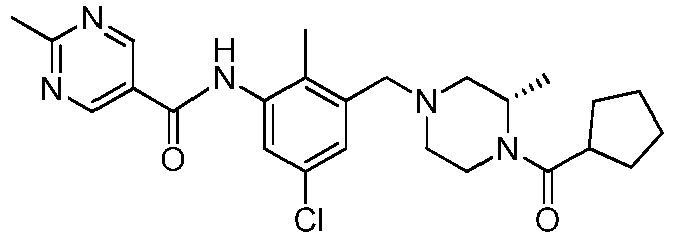
- To a solution of (S)-N-(5-chloro-2-methyl-3-((3-methylpiperazin-1-yl)methyl)phenyl)-2-methylpyrimidine-5-carboxamide (D108) (5 g, 13.37 mmol) and Et3N (7.46 mL, 53.5 mmol) in DCM (100mL) was added drop-wise cyclopentanecarbonyl chloride (2.128g, 16.05 mmol). After addition the reaction mixture was stirred at 0°C for 10min until LCMS showed that the reaction was completed. 150 mL of water was added, the organic phase was separated, dried over Na2SO4 and evaporated to leave the crude product, which was purified by column chromatography (silica gel, 200-300 mesh, PE:EA=1:2) to afford the title compound (3.5g) as white solid. LCMS: [M+H+] = 470.0 HNMR (DMSO-d6, 400MHz): 10.26 (1H, s); 9.17 (2H, s); 7.41 (1H, d); 7.27 (1H, d); 4.55 (0.5H, br); 4.19-4.22 (1H, m); 3.74-3.77 (0.5H, m); 3.41-3.49 (2H, m); 3.14-3.18 (0.5H, m), 2.89-2.93 (1H, m); 2.52-2.80 (5H, m), 2.23 (3H, s); 1.45-2.14 (10H, m); 1.10-1.35 (3H, m).
-

- Oxalyl chloride (0.068 mL, 0.772 mmol) was added dropwise to a solution of 3-cyanobenzoic acid (101 mg, 0.686 mmol) in DCM (10 mL) and the reaction mixture was stirred at 40°C for 2hr. The mixture was concentrated to give the acyl chloride which was added to a solution of (S)-(4-(3-amino-5-chloro-2-methylbenzyl)-2-methylpiperazin-1-yl)(cyclopentyl)methanone (150 mg, 0.429 mmol) (D27) in pyridine (2 mL). The reaction mixture was stirred at RT overnight. Water was added and the mixture was extracted with EtOAc. The organic layer was dried over MgSO4, filtered and concentrated. The residue was purified by MDAP to give the title compound (88 mg) as white solid. 1H NMR (400 MHz, MeOD-d4) δ 1.27-1.53 (m, 3 H) 1.56-2.00 (m, 9 H) 2.37 (s, 3 H) 2.97-3.30 (m, 3 H) 3.42-3.72 (m, 3 H) 4.24 (d, J=12.35 Hz, 0.5 H) 4.45-4.57 (m, 2 H) 4.69 (br. s., 0.5 H) 7.57-7.61 (m, 1 H) 7.64 (d, J=2.08 Hz, 1 H) 7.77 (t, J=7.83 Hz, 1 H) 8.01 (d, J=7.70 Hz, 1 H) 8.30 (d, J=7.95 Hz, 1 H) 8.36 (s, 1 H). MS (ESI) C27H31ClN4O2 requires: 478, found 479 (M+H+).
- As stated above, the compounds according to Formula I are RORγ modulators, and are useful in the treatment of diseases mediated by RORγ. The biological activities of the compounds according to Formula I can be determined using any suitable assay for determining the activity of a candidate compound as a RORγ modulator, as well as tissue and in vivo models.
- This assay is based on the knowledge that nuclear receptors interact with cofactors (transcription factors) in a ligand dependent manner. RORγ is a typical nuclear receptor in that it has an AF2 domain in the ligand binding domain (LBD) which interacts with co-activators. The sites of interaction have been mapped to the LXXLL motifs in the co-activator SRCl(2) sequences. Short peptide sequences containing the LXXLL motif mimic the behavior of full-length co-activator.
- The assay measures ligand-mediated interaction of the co-activator peptide with the purified bacterial-expressed RORγ ligand binding domain (RORγ-LBD) to indirectly assess ligand binding. RORγ has a basal level of interaction with the co-activator SRC1(2) in the absence of ligand, thus it is possible to find ligands that inhibit or enhance the RORγ/SRCl(2) interaction.
- Human RORγ Ligand Binding Domain (RORγ-LBD) was expressed in E.coli strain BL21(DE3) as an amino-terminal polyhistidine tagged fusion protein. DNA encoding this recombinant protein was sub-cloned into a modified pET21a expression vector (Novagen). A modified polyhistidine tag (MKKHHHHHHLVPRGS) was fused in frame to residues 263-518 of the human RORγ sequence.
- Approximately 50 g E. coli cell pellet was resuspended in 300 mL of lysis buffer (30 mM imidazole pH 7.0 and 150 mM NaCl). Cells were lysed by sonication and cell debris was removed by centrifugation for 30 minutes at 20,000g at 4°C. The cleared supernatant was filtered through a 0.45 uM cellulose acetate membrane filter. The clarified lysate was loaded onto a column (XK-26) packed with ProBond Nickel Chelating resin (Invitrogen), pre-equilibrated with 30 mM imidazole pH 7.0 and 150 mM NaCl. After washing to baseline absorbance with the equilibration buffer, the column was developed with a gradient from 30 to 500 mM imidazole pH 7.0. Column fractions containing the RORγ-LBD protein were pooled and concentrated to a volume of 5 mls. The concentrated protein was loaded onto a Superdex 200 column pre-equilibrated with 20 mM Tris-Cl pH 7.2 and 200 mM NaCl. The fractions containing the desired RORγ-LBD protein were pooled together.
- Purified RORγ-LBD was buffer exchanged by exhaustive dialysis [3 changes of at least 20 volumes (>8000x)] against PBS [100mM NaPhosphate, pH 8 and 150mM NaCl]. The concentration of RORγ-LBD was approximately 30uM in PBS. Five-fold molar excess of NHS-LC-Biotin (Pierce) was added in a minimal volume of PBS. This solution was incubated with occasional gentle mixing for 60 minutes at ambient RT. The modified RORγ-LBD was dialyzed against 2 buffer changes - TBS pH 8.0 containing 5mM DTT, 2mM EDTA and 2% sucrose - each at least 20 times of the volume. The modified protein was distributed into aliquots, frozen on dry ice and stored at -80°C. The biotinylated RORγ-LBD was subjected to mass spectrometric analysis to reveal the extent of modification by the biotinylation reagent. In general, approximately 95% of the protein had at least a single site of biotinylation and the overall extent of biotinylation followed a normal distribution of multiple sites ranged from one to five. A biotinylated peptide corresponding to amino acid 676 to 700 (CPSSHSSLTERHKILHRLLQEGSPS) of the co-activator steroid receptor coactivator SRC1(2) was generated using similar method.
- Preparation of Europium labeled SRC1(2) peptide: biotinylated SRC1(2) solution was prepared by adding an appropriate amount of biotinylated SRC 1 (2) from the 100uM stock solution to a buffer containing 10 mM of freshly added DTT from solid to give a final concentration of 40 nM. An appropriate amount of Europium labeled Streptavidin was then added to the biotinylated SRC1(2) solution in a tube to give a final concentration of 10 nM. The tube was inverted gently and incubated for 15 minutes at room temperature. Twenty-fold excess biotin from the 10 mM stock solution was added and the tube was inverted gently and incubated for 10 minutes at room temperature.
- Preparation of APC labeled RORγ-LBD: biotinylated RORγ-LBD solution was prepared by adding an appropriate amount of biotinylated RORγ-LBD from the stock solution to a buffer containing 10 mM of freshly added DTT from solid to give a final concentration of 40 nM. An appropriate amount of APC labeled Streptavidin was then added to the biotinylated RORγ-LBD solution in a tube to give a final concentration of 20 nM. The tube was inverted gently and incubated for 15 minutes at room temperature. Twenty-fold excess biotin from the 10 mM stock solution was then added and the tube was inverted gently and incubated for 10 minutes at room temperature.
- Equal volumes of the above-described Europium labeled SRC1(2) peptide and the APC labeled RORγ-LBD were gently mixed together to give 20nM RORγ-LBD, 10nM APC-Strepavidin, 20nM SRC1(2) and 5nM Europium-Streptavidin. The reaction mixtures were incubated for 5 minutes. Using a Thermo Combi Multidrop 384 stacker unit, 25 ul of the reaction mixtures per well was added to the 384-well assay plates containing 1ul of test compound per well in 100% DMSO. The plates were incubated for 1hr and then read on ViewLux in Lance mode for EU/APC.
- RORγ is known to bind to a CNS (conserved non-coding sequences) enhancer element in the IL17 promoter. In this assay, RORγ activity is indirectly assessed using a luciferase reporter construct which contains the human IL17 promoter having the RORγ-specific CNS enhancer element. Inhibition of RORγ activity by a compound will result in a decrease in luciferase activity of Jurkat cells transfected with the reporter construct.
- For the luciferase reporter plasmid, the 3 Kb human IL17 promoter containing the RORγ-specific CNS enhancer element was PCR amplified from human genomic DNA and cloned into a pGL4-Luc2/hygro reporter plasmid sequencially as XhoI-HindIII (1.1 Kb) and KpnI-XhoI (1.9 Kb) fragments. For the 1.1 Kb fragment, PCR was used to amplify human IL17 proximal promoter region from genomic DNA of 293T cells using primers as follows: forward primer, 5'-CTCGAGTAGAGCAGGACAGGGAGGAA-3' (XhoI site is underlined) and reverse primer, 5'-AAGCTTGGATGGATGAGTTTGTGCCT-3' (HindIII site is underlined). The 1.1 kb DNA bands were excised, purified, and inserted into pMD19-T Simple Vector (Takara). After DNA sequencing confirmation, the 1.1 kb DNA was digested with XhoI and HindIII and inserted into XhoI/HindIII sites of pGL4.31 [luc2P/GAL4UAS/Hygro] (Promega) to generate the pIL17-1kb-luc reporter construct. For the 1.9 Kb fragment, PCR was used to amplify human IL17 promoter region from genomic DNA using primers as follows: forward primer, 5'-GGTACCTGCCCTGCTCTATCCTGAGT-3' (KpnI site is underlined) and reverse primer, 5'-CTCGAGTGGTGAGTGCTGAGAGATGG-3' (XhoI site is underlined). The resulting 1.9 kb DNA bands were excised, gel purified, and cloned into a pMD19-T Simple Vector (Takara). DNA sequencing analysis revealed that there were three point mutations but none of which affected RORγ binding. The 1.9 kb DNA fragment was released by double digestion with KpnI and XhoI and inserted into pIL17-1kb-luc to generate the luciferase reporter plasmid "pIL17-3kb-CNS-luc." To overexpress RORγt, the full-length cDNA of human RORγt identical to the published sequence NM_001001523 was cloned into pcDNA3.1 at the KpnI-NotI cloning sites to generate the RORγt overexpression plasmid "CDNA3.1DhRORγ49-8".
- The luciferase reporter plasmid and the RORγt overexpression plasmid were transfected into Jurkat cell line and a stable clone was identified. The stable clone was grown in 10% dialyzed FBS in RPMI (1640) with 800ug/ml geneticin and 400ug/ml hygromecin.
- Compounds were dissolved in DMSO at three concentrations, 10mM, 400uM and 16uM, and were dispensed into 384-wells assay plate at 40nl, 12.5nl, 5nl respectively. The volume was adjusted with pure DMSO to a give a final uniform volume of 40 nl Jurkat cells described above were counted and centrifuged. The growth medium was discarded and the cells were resuspended with assay medium (phenol red free RPMI) at 1E-6/ml. Cells were added to each of the compounds in the assay plates. Cells were either untreated or treated with CD3 microbeads (Miltenyi Biotec) at 1 ul beads per 500,000 cells. Cells were culture overnight and luciferase assay (Promega) was performed. Data were collected by ViewLux (using luciferase greiner 384 setting).
- Mouse CD4+ cells were purified using the CD4+ T Cell Isolation II Kit according to manufacturer's instructions (Miltenyi Biotec). 96 well plates were pre-coated with anti-mCD3 antibody. Un-coated wells were used as controls. CD4+ Cells were resuspended in RPMI 1640 complete medium and were added to the 96-well plates. Cytokine cocktail and the compound were then added to the wells. Antibodies and cytokines (all from R&D Systems) used in the assay were selected from the following: anti-mCD3; anti-mCD28; anti-mIFNγ; anti-mIL4; mIL-6; mIL-23; mIL-1β; hTGF-β1. The culture was incubated at 37°C for 3 days and supernatants were collected for ELISA. The IL-17 ELISAs were performed according to manufacturer's instructions (R&D Systems). The results were analyzed using Prism software with non-linear regression to determine pIC50.
- The Th17 differentiation culture described above was maintained for 5 days and cells were analyzed by IL-17 and IFN-γ intracellular staining according to manufacturer's instructions (BD Biosciences).
- The data described below represents a mean pIC50 value of multiple test results if the test was performed more than once. It is understood that the data illustrated below may have reasonable variation depending on the specific conditions and procedures used by the person conducting the testing.
- All exemplified compounds except Examples 9, 16, 26, 30, 37, 59, 83-85, 93, 94, 102, 118, 129, 130, 142, 154, 156, 158, 160, 161, 165, and 167-169 were tested in the dual FRET assay described above. All tested compounds were found to have a pIC50 between 5 and 8. For instance, the compounds of Examples 20, 66, 184, 185, 186, 187, 188, 189, 190, 191, 192 and 193 had a pIC50 of approximately 7, 7.4, 6.7, 7.1, 7.1, 6.9, 7.2, 7.3, 6.8, 6.6, 6.7 and 7.2, respectively.
- All exemplified compounds except Examples 9, 12, 14, 20-26, 28, 38-62, 64, 68, 69, 82, 83, 106, 107, 111, 115-120, 122-124, 126, 138, 141-145, 152, 157-162, 164, 166-170 and 172-192 were tested in the Jurkat cell luciferase assay described above. All tested compounds except Example 36 were found to have a pIC50 between 5 and 9. For instance, Example 66 and Example 193 had a mean pIC50 of approximately 8.3 and 8.6. Example 36 was tested once and found to have a pIC50 below 5, the detection limit of the assay.
- All exemplified compounds except Examples 2-4, 7, 8, 11, 12, 14, 15, 26, 28, 48-50, 52-54, 64, 65, 68, 69, 75, 81, 86, 87, 94, 95, 105, 114-117, 122, 126, 132, 134-136, 143, 144, 146, 154, 156, 158-162, 177 and 179 were tested in the Th17 cell differentiation assay described above. All tested compounds except Example 129 were found to have a pIC50 greater than 5. For instance, the compounds of Examples 20, 66, 184, 185, 186, 187, 188, 189, 190, 191, 192 and 193 had a mean pIC50 of approximately 7.5, 9.1, 7.08, 7.68, 7.43, 8.5, 8.06, 8.29, 7.89, 7.58, 8.1 and 8.3, respectively. Example 129 was tested once and found to have a pIC50 below 5, the detection limit of the assay.
- Experimental Autoimmune Encephalomyelitis (EAE) is an animal model of multiple sclerosis. The ability of a test compound to ameliorate EAE was measured in the EAE studies. Wild-type mice of the C57BL/6 (B6) strain were obtained from Shanghai Laboratory Animal Resource Center and were maintained under pathogen-free conditions. EAE was induced by intravenous injections of 100 ng of pertussis toxin (List Biological Laboratories) and subcutaneous immunization with an emulsion composed of MOG35-55 peptide (300 µg/mouse) in PBS and an equal volume of complete Freund's adjuvant containing 5 mg/ml heat-killed Mycobacterium tuberculosis H37Ra (Difco Laboratories) on day 0, followed by another intravenous injections of 100 ng of pertussis toxin on day 2 as described previously (Wang et al. (2006) J. Clin. Invest. 116: 2434-2441). For treatment of EAE, each compound or vehicle PBS was given orally from day 0 at various doses selected from 3, 10, 30 and 100 mg/kg twice a day. Mice were scored for disease severity daily using a EAE scoring system (Wang et al. (2006) J. Clin. Invest. 116: 2434-2441): 0, no overt signs of disease; 1, limp tail or hind limb weakness but not both; 2, limptail and paraparesis (weakness, incomplete paralysis of one or two hind limbs); 3, paraplegia (complete paralysis of two hind limbs); 4, paraplegia with forelimb weakness or paralysis; and 5, moribund state or death. Clinical score data can be expressed as means ± S.E.M.
- Examples 20, 62, 175, 184 and 190-192 were tested in the EAE study at one or more of the following doses: 3, 10, 30 or 100 mg/kg. Examples 20, 175, 184 and 192 were shown to delay EAE onset and lower clinical score starting at 3, 10 or 30 mg/kg. Examples 62, 190 and 191 were shown to delay EAE onset at 30 mg/kg.
- The in vitro percutaneous study is aimed to predict the level of percutaneous penetration obtained for a compound in a topical formulation for psoriasis. This assay coupled with the intrinsic potency of the compound are used to predict the likelihood of success of a compound to engage the target. The higher the ratio of the percutaneous penetration to the intrinsic potency, the higher the ratio of local skin concentration to the intrinsic potency and therefore the higher the chance of a compound to engage the target in a topical formulation.
- The compounds were manufactured in a modified aqueous cream at pH=6.
-
Ingredients % w/w Cetostearyl alcohol 7.2 Cetomacrogol 1000 1.8 White soft paraffin 15.0 Liquid paraffin 6.0 Water 57.0 Na2HPO4 0.6 Citric Acid 0.2 Propylene Glycol 10.0 Methyl paraben 0.1 Caffeine 0.1 API#1 1.0 API#2 1.0 API#3 1.0 - The study was conducted with dermatomed abdominal human skin sourced from three skin donors using 2cm2 Franz diffusion cells. The receiving fluid consisted of Bovine serum albumin (4% w/v) in 0.1% w/v sodium azide in Phospate Buffer Saline and was heated at 37°C in order to obtain 32°C at the skin surface. The cream formulation was applied on the donor side at a 10 mg dose, i.e. 5 mg/cm2. The samples taken at the following time points: t=0, 3, 6, 9 and 24 h. The receiver samples were then assayed using a method based upon protein precipitation with acetonitrile followed by LC/MS/MS analysis. The percutaneous flux (in ng/cm2/hr) was determined using the individual API (in a multiple composition) that had permeated into the receiver compartment over 24hrs per cm2.
- As shown in the Table below, Examples 66, 163 and 164 were tested in the in vitro percutaneous study and showed an average percutaneous penetration over 24hr superior to 1ng/cm2/hr. Of the three compounds tested, Example 66 had the highest ratio of percutaneous penetration (Flux) to intrinsic potency (Th17 cell differentiation assay IC50) and thus the best chance to engage the target in a topical formulation.
Compound Flux over 24hrs (ng/cm2/hr) Th17 cell differentiation assay pIC50 Th17 cell differentiation assay IC50 (ng/mL) Flux (ng/cm2/hr) / IC50 (ng/mL) Example 163 7.73 7.6 11.4 0.68 Example 164 3.12 7.7 9.3 0.33 Example 66 3.43 9.1 0.4 9.3 - Collagen-induced arthritis (CIA) is an animal model of rheumatoid arthritis. CIA can be induced in 8-week old male DBA/1 mice via an initial intradermal (i.d.) injection of an emulsion consisting of bovine type II collagen in CFA. Mice are intraperitoneally (i.p.) injected with bovine type II collagen 21 days later to boost the immune system, resulting in chronic inflammation in both the hind and the front paws. Each compound is given to the mice at 100mg/kg twice a day starting from day 20 after the first immunization. Mice are examined for onset and severity of disease in a blinded manner. Arthritis symptoms can be graded by the following scoring system: grade 0, normal appearance; grade 1, slight erythema/ edema (1-3 digits); grade 2, erythema/ edema in more than 3 digits or mild swelling in ankle/wrist joint; grade 3, erythema/ edema in entire paw; grade 4, massive erythema/ edema of entire paw extending into proximal joints, ankylosis, loss of function. Each limb is graded, giving a maximum possible score of 16 per mouse. Clinical score data can be expressed as means ± s.e.m. Foot volume of the mice can be determined using a YLS-7B foot volume measuring instrument (Shandong Academy of Medical Science).
- The compounds of Formula (I) are modulators of RORγ and can be useful in the treatment of diseases mediated by RORγ, particularly autoimmune or inflammatory diseases. Examples of the inflammatory or autoimmune diseases of the invention include multiple sclerosis, rheumatoid arthritis, psoriasis, Crohn's disease, inflammatory bowel disease, Sjorgen's syndrome, optic neuritis, chronic obstructive pulmonary disease, asthma, type I diabetes, neuromyelitis optica, Myasthenia Gavis, uveitis, Guillain-Barre syndrome, psoriatic arthritis, Gaves' disease and allergy. Accordingly, in another aspect the invention is directed to methods of treating autoimmune and inflammatory diseases mediated by RORγ.
- In a further aspect, the present invention also provides a compound of Formula (I), or a pharmaceutically acceptable salt or solvate thereof, for use in therapy.
- In a further aspect, the present invention also provides a compound of Formula (I), or a pharmaceutically acceptable salt or solvate thereof, for use in the treatment of inflammatory and autoimmune diseases mediated by RORγ.
- In a further aspect, the present invention provides a compound of Formula (I), or a pharmaceutically acceptable salt thereof, for use in the treatment of multiple sclerosis.
- In a further aspect, the present invention provides (S)-N-(5-chloro-3-((4-(2-cyclopropylacetyl)-3 -methylpiperazin-1-yl)methyl)-2-methylphenyl)-6-methylnicotinamide (E184), or a pharmaceutically acceptable salt thereof, for use in the treatment of multiple sclerosis.
- In a further aspect, the present invention provides a compound of Formula (I), or a pharmaceutically acceptable salt thereof, for use in the treatment of psoriasis.
- In a further aspect, the present invention provides (S)-3-cyano-N-(3-((4-(cyclopentanecarbonyl)-3-methylpiperazin-1-yl)methyl)-5-fluoro-2-methylphenyl)benzamide (E66), or a pharmaceutically acceptable salt thereof, for use in the treatment of psoriasis.
- In a further aspect, the present invention is directed to the use of a compound of Formula (I), or a pharmaceutically acceptable salt thereof, in the manufacture of a medicament for use in the treatment of an inflammatory or autoimmune disease mediated by RORγ.
- In a yet further aspect, the present invention is directed to the use of a compound of Formula (I), or a pharmaceutically acceptable salt thereof, in the manufacture of a medicament for use in the treatment of multiple sclerosis.
- In a yet further aspect, the present invention is directed to the use of a compound of Formula (I), or a pharmaceutically acceptable salt thereof, in the manufacture of a medicament for use in the treatment of psoriasis.
- As used herein, "treat" in reference to a condition means: (1) to ameliorate or prevent the condition or one or more of the biological manifestations of the condition, (2) to interfere with (a) one or more points in the biological cascade that leads to or is responsible for the condition or (b) one or more of the biological manifestations of the condition, (3) to alleviate one or more of the symptoms or effects associated with the condition, or (4) to slow the progression of the condition or one or more of the biological manifestations of the condition.
- As indicated above, "treatment" of a condition includes prevention of the condition. The skilled artisan will appreciate that "prevention" is not an absolute term. In medicine, "prevention" is understood to refer to the prophylactic administration of a drug to substantially diminish the likelihood or severity of a condition or biological manifestation thereof, or to delay the onset of such condition or biological manifestation thereof.
- The compounds of the invention may be administered by any suitable route of administration, including both systemic administration and topical administration. Systemic administration includes oral administration, parenteral administration, transdermal administration, rectal administration, and administration by inhalation. Parenteral administration refers to routes of administration other than enteral, transdermal, or by inhalation, and is typically by injection or infusion. Parenteral administration includes intravenous, intramuscular, and subcutaneous injection or infusion. Inhalation refers to administration into the human lungs whether inhaled through the mouth or through the nasal passages. Topical administration includes application to the skin as well as intraocular, otic, intravaginal, and intranasal administration.
- The compounds of the invention may be administered once or according to a dosing regimen wherein a number of doses are administered at varying intervals of time for a given period of time. For example, doses may be administered one, two, three, or four times per day. Doses may be administered until the desired therapeutic effect is achieved or indefinitely to maintain the desired therapeutic effect. Suitable dosing regimens for a compound of the invention depend on the pharmacokinetic properties of that compound, such as absorption, distribution, and half-life, which can be determined by the skilled artisan. In addition, suitable dosing regimens, including the duration such regimens are administered, for a compound of the invention depend on the condition being treated, the severity of the condition being treated, the age and physical condition of the individual being treated, the medical history of the individual to be treated, the nature of concurrent therapy, the desired therapeutic effect, and like factors within the knowledge and expertise of the skilled artisan. It will be further understood by such skilled artisans that suitable dosing regimens may require adjustment given an individual's response to the dosing regimen or over time as individual needs change.
- Typical daily dosages may vary depending upon the particular route of administration chosen. Typical daily dosages for oral administration range from 0.1 mg to 1000 mg. Typical daily dosages for topical administration range from about 0.001% to about 10% w/w (weight percent) and preferably from about 0.01% to about 1% w/w.
- Additionally, the compounds of the invention may be administered as prodrugs. As used herein, a "prodrug" of a compound of the invention is a functional derivative of the compound which, upon administration to an individual, eventually liberates the compound of the invention in vivo. Administration of a compound of the invention as a prodrug may enable the skilled artisan to do one or more of the following: (a) modify the onset of the compound in vivo; (b) modify the duration of action of the compound in vivo; (c) modify the transportation or distribution of the compound in vivo; (d) modify the solubility of the compound in vivo; and (e) overcome or overcome a side effect or other difficulty encountered with the compound. Typical functional derivatives used to prepare prodrugs include modifications of the compound that are chemically or enzymatically cleaved in vivo. Such modifications, which include the preparation of phosphates, amides, esters, thioesters, carbonates, and carbamates, are well known to those skilled in the art.
- The compounds of the invention will normally, but not necessarily, be formulated into pharmaceutical compositions prior to administration to an individual. Accordingly, in another aspect the invention is directed to pharmaceutical compositions comprising a compound of the invention and one or more pharmaceutically-acceptable excipient.
- The pharmaceutical compositions of the invention may be prepared and packaged in bulk form wherein a safe and effective amount of a compound of the invention can be extracted and then given to the individual such as with powders or syrups. Alternatively, the pharmaceutical compositions of the invention may be prepared and packaged in unit dosage form wherein each physically discrete unit contains a safe and effective amount of a compound of the invention. When prepared in unit dosage form, the pharmaceutical compositions of the invention typically contain from 0.1 mg to 1000 mg.
- The pharmaceutical compositions of the invention typically contain one compound of the invention. However, in certain embodiments, the pharmaceutical compositions of the invention contain more than one compound of the invention. For example, in certain embodiments the pharmaceutical compositions of the invention contain two compounds of the invention. In addition, the pharmaceutical compositions of the invention may optionally further comprise one or more additional pharmaceutically active compounds.
- As used herein, "pharmaceutically-acceptable excipient" means a pharmaceutically acceptable material, composition or vehicle involved in giving form or consistency to the pharmaceutical composition. Each excipient must be compatible with the other ingredients of the pharmaceutical composition when commingled such that interactions which would substantially reduce the efficacy of the compound of the invention when administered to an individual and interactions which would result in pharmaceutical compositions that are not pharmaceutically acceptable are avoided. In addition, each excipient must of course be of sufficiently high purity to render it pharmaceutically-acceptable.
- The compound of the invention and the pharmaceutically-acceptable excipient or excipients will typically be formulated into a dosage form adapted for administration to the individual by the desired route of administration. For example, dosage forms include those adapted for (1) oral administration such as tablets, capsules, caplets, pills, troches, powders, syrups, elixers, suspensions, solutions, emulsions, sachets, and cachets; (2) parenteral administration such as sterile solutions, suspensions, and powders for reconstitution; (3) transdermal administration such as transdermal patches; (4) rectal administration such as suppositories; (5) inhalation such as dry powders, aerosols, suspensions, and solutions; and (6) topical administration such as creams, ointments, lotions, solutions, pastes, sprays, foams, and gels.
- Suitable pharmaceutically-acceptable excipients will vary depending upon the particular dosage form chosen. In addition, suitable pharmaceutically-acceptable excipients may be chosen for a particular function that they may serve in the composition. For example, certain pharmaceutically-acceptable excipients may be chosen for their ability to facilitate the production of uniform dosage forms. Certain pharmaceutically-acceptable excipients may be chosen for their ability to facilitate the production of stable dosage forms. Certain pharmaceutically-acceptable excipients may be chosen for their ability to facilitate the carrying or transporting of the compound or compounds of the invention once administered to the individual from one organ, or portion of the body, to another organ, or portion of the body. Certain pharmaceutically-acceptable excipients may be chosen for their ability to enhance compliance.
- Suitable pharmaceutically-acceptable excipients include the following types of excipients: Diluents, fillers, binders, disintegrants, lubricants, glidants, granulating agents, coating agents, wetting agents, solvents, co-solvents, suspending agents, emulsifiers, sweetners, flavoring agents, flavor masking agents, coloring agents, anticaking agents, hemectants, chelating agents, plasticizers, viscosity increasing agents, antioxidants, preservatives, stabilizers, surfactants, and buffering agents. The skilled artisan will appreciate that certain pharmaceutically-acceptable excipients may serve more than one function and may serve alternative functions depending on how much of the excipient is present in the formulation and what other ingredients are present in the formulation.
- Skilled artisans possess the knowledge and skill in the art to enable them to select suitable pharmaceutically-acceptable excipients in appropriate amounts for use in the invention. In addition, there are a number of resources that are available to the skilled artisan which describe pharmaceutically-acceptable excipients and may be useful in selecting suitable pharmaceutically-acceptable excipients. Examples include Remington's Pharmaceutical Sciences (Mack Publishing Company), The Handbook of Pharmaceutical Additives (Gower Publishing Limited), and The Handbook of Pharmaceutical Excipients (the American Pharmaceutical Association and the Pharmaceutical Press).
- The pharmaceutical compositions of the invention are prepared using techniques and methods known to those skilled in the art. Some of the methods commonly used in the art are described in Remington's Pharmaceutical Sciences (Mack Publishing Company).
- In one aspect, the invention is directed to a solid oral dosage form such as a tablet or capsule comprising a safe and effective amount of a compound of the invention and a diluent or filler. Suitable diluents and fillers include lactose, sucrose, dextrose, mannitol, sorbitol, starch (e.g. corn starch, potato starch, and pre-gelatinized starch), cellulose and its derivatives (e.g. microcrystalline cellulose), calcium sulfate, and dibasic calcium phosphate. The oral solid dosage form may further comprise a binder. Suitable binders include starch (e.g. corn starch, potato starch, and pre-gelatinized starch), gelatin, acacia, sodium alginate, alginic acid, tragacanth, guar gum, povidone, and cellulose and its derivatives (e.g. microcrystalline cellulose). The oral solid dosage form may further comprise a disintegrant. Suitable disintegrants include crospovidone, sodium starch glycolate, croscarmelose, alginic acid, and sodium carboxymethyl cellulose. The oral solid dosage form may further comprise a lubricant. Suitable lubricants include stearic acid, magnesuim stearate, calcium stearate, and talc.
| Example | Structure | Characterization |
| E2 |  | 1H-NMR (MeOD-d4 400MHz) 7.67 (d, 1H), 7.41 (s, 1H), 7.28 (m, 5H), 4.52 (brs, 2H), 4.19 (brs, 2H), 3.68 (s, 2H), 3.15 (brs, 2H), 2.90 (m, 3H), 1.77--1.52 (m, 8H), 1.29 (s, 6H) |
| δF (MeOD-d4 , 376MHz): -77.4. MS (ES): C27H33Cl2N3O2 requires 501; found 502(M+H+) | ||
| E3 |  | 1H-NMR (MeOD-d4 400MHz): 7.46 (d, 1H), 7.33 (d, 1H), 7.21 (t, 1H), 4.42 (s, 1H), 4.10 (s, 1H), 3.54 (s, 2H), 2.93 (m, 1H), 2.67 (m, 2H), 2.27 (m, 1H), 2.17--2.10 (m, 2H), 1.84--1.46 (m, 12H), 1.30 (s, 3H), 1.18 (s, 3H), 0.91 (t, 6H). δF (MeOD-d4 376MHz): -77.3. MS (ES): C25H38ClN3O2 requires 447; found 448(M+H+) |
| E4 |  | 1H-NMR (MeOD-d4 600MHz): 7.51 (d, 1H), 7.30 (d, 1H), 7.19 (t, 1H), 4.42 (s, 1H), 4.09 (s, 1H), 3.53 (s, 2H), 2.92 (m, 1H), 2.62 (m, 2H), 2.40 (t, 1H), 2.13 (m, 2H), 1.86--1.33 (m, 15H), 1.30--1.17 (m, 9H). δF (MeOD-d4 , 376MHz): -77.4. MS (ES): C26H38ClN3O2 requires 459; found 460(M+H+). |
| E5 |  | 1H-NMR (MeOD-d4 , 600MHz): 0.80 (m, 2 H), 0.85 (m, 2 H), 1.18 (br. s., 2 H), 1.30 (br. s., 1 H), 1.54 (m, 3 H), 1.61 (br. s., 3 H), 1.75 (m, 4 H), 2.23 (m, 3 H), 2.94 (m, 2 H), 3.04 (m, 1 H), 3.35 (m, 3 H), 4.02 (br. s., 1 H), 4.26 (br. s., 2 H), 4.50 (br. s., 1 H), 4.85 (br. s., 1 H), 7.02 (t, 1 H), 7.30 (dd, 1 H). δF (MeOD-d4 , 376MHz): -77.0, -115.3, -122.6. MS (ES): C23H32FN3O2 requires 401; found 402(M+H+). |
| E6 |  | 1H-NMR (MeOD-d4 , 400MHz): 1.27 (m, 3 H), 1.68 (m, 5 H), 1.84 (m, 3 H), 2.24 (s, 3 H), 3.07 (m, 3 H), 3.40 (t, 2 H), 3.49 (m, 1 H), 3.60 (s, 1 H), 3.74 (s, 2 H), 4.12 (br. s., 0.5 H), 4.36 (br. s., 2 H), 4.59 (br. s., 0.5 H), 7.13 (t, 1 H), 7.26 (m, 2 H), 7.38 (m, 5 H). |
| δF (MeOD-d4 , 376MHz): -76.9, -114.5, - 114.6. MS (ES): C27H34FN3O2 requires 451; found 452(M+H+). | ||
| E7 |  | HNMR (CDCl3, 400MHz): 1.26-1.33 (12H, m), 1.66-2.88 (14H, m), 3.57 (2H, s), 4.05-4.06 (1H, m), 4.62-4.63 (1H, m), 7.23-7.27 (1H, m), 7.83-7.84 (1H, m), 8.31-8.33 (1H, m). MS (ES): C23H34ClN3O2 requires 419; found 420(M+H+). |
| E8 |  | HNMR (CDCl3, 400MHz): 1.20-1.97 (11H, m), 2.11-3.28 (7H, m), 3.66 (2H, s), 3.77 (2H, s), 4.19-4.22 (1H, m), 7.29-7.60 (7H, m), 9.74 (1H, s). MS (ES): C24H34ClN3O2 requires 433; found 434(M+H+). |
| E9 |  | 1H-NMR (MeOD-d4 , 400MHz): 0.49 (m, 5 H), 0.83 (br. s., 3 H), 0.91 (br. s., 4 H), 1.04 (br. s., 3 H), 2.23 (br. s., 3 H), 3.58 (br. s., 3 H), 6.79 (d, 1 H), 6.96 (m, 2 H), 7.18 (d, 1 H), 7.46 (d, 1 H), 7.52 (s, 1 H). δF (MeOD-d4 , 376MHz): -77.4. MS (ES): C28H28Cl2N4O2 requires 498; found 499(M+H+). |
| Example | Structure | Characterization |
| E11 |  | 1H NMR (400 MHz, MeOD-d4 ) δ 1.10 - 1.35 (m, 6H), 1.38 - 1.90 (m, 16H), 2.15 (s, 3H), 2.28 - 2.45 (m, 1H), 2.87 - 3.12 (m, 4H), 3.30 - 3.48 (m, 1H), 3.85 - 4.28 (m, 3H), 4.43 (brs, 1H), 7.07 (brs, 2H). 19F NMR (376 MHz, MeOD-d4 ) δ -76.9, - 119.7. MS (ESI): C26H38FN3O2 requires: 443, found 444 (M+H+). |
| E12 |  | 1H NMR (400 MHz, MeOD-d4 ) δ 1.19 - 1.52 (m, 3H), 1.54 - 2.01 (m, 8H), 2.36 (s, 3H), 2.88 - 3.27 (m, 3H), 3.36 - 3.69 (m, 3H), 4.10 - 4.31 (m, 1H), 4.42 (s, 2H), 4.65 (brs, 1H), 7.31 - 7.45 (m, 2H), 8.01 (d, 1H), 8.58 (d, 1H), 9.26 (s, 1H). 19F NMR (376 MHz, MeOD-d4 ) δ -69.6, - 77.1, -116.9. MS (ESI): C26H30F4N4O2 requires: 506, found 507 (M+H+). |
| E13 |  | 1H NMR (400 MHz, MeOD-d4 ) δ 1.32 (brs, 3H), 1.53 - 1.97 (m, 8H), 2.38 (s, 3H), 2.88 - 3.25 (m, 3H), 3.34 - 3.70 (m, 3H), 4.19 (brs, 0.5H), 4.40 (s, 2H), 4.63 (brs, 0.5H), 7.13 (t, 2H), 7.35 (dd, 2H), 7.56 (p, 1H). 19F NMR (376 MHz, MeOD-d4 ) δ -77.0, -115.3, -116.8, -117.2. MS (ESI): C26H30F3N3O2 requires: 473, found 474 (M+H+). |
| E14 |  | 1H NMR (400 MHz, MeOD-d4 ) δ 1.13 - 1.49 (m, 3H), 1.50 - 1.96 (m, 8H), 2.36 (s, 3H), 2.44 (s, 6H), 2.49 - 3.18 (m, 5H), 3.36 - 3.55 (m, 1H), 3.62 - 4.08 (m, 3H), 4.42 (brs, 1H), 7.09 - 7.20 (m, 3H), 7.20 - 7.33 (m, 2H). 19F NMR (376 MHz, MeOD-d4 ) δ -77.0, -118.7. MS (ESI): C28H36FN3O2 requires: 465, found 466 (M+H+). |
| Example | Structure | Characterization |
| E18 |  | 1H NMR (400 MHz, MeOD-d4 ) δ 1.20 - 1.51 (m, 3H), 1.55 - 2.00 (m, 8H), 2.35 (s, 3H), 2.97 - 3.23 (m, 3H), 3.38 - 3.66 (m, 3H), 4.12 - 4.31 (m, 0.5H), 4.48 (s, 2H), 4.66 (brs, 1H), 7.38 (d, 2H), 7.68 - 7.87 (m, 1H), 8.59 (d, 1H), 8.85 (d, 1H), 9.21 (s, 1H). 19F NMR (376 MHz, MeOD-d4 ) δ -77.2, -116.8. MS (ESI) C25H31FN4O2 requires: 438, found 439 (M+H+). |
| E19 |  | 1H NMR (400 MHz, MeOD-d4 ) δ 1.23 - 1.50 (m, 3H), 1.56 - 2.01 (m, 8H), 2.35 (s, 3H), 2.93 - 3.27 (m, 3H), 3.37 - 3.69 (m, 3H), 4.13 - 4.33 (m, 0.5H), 4.45 (s, 2H), 4.65 (brs, 1H), 7.38 (d, 2H), 8.10 (d, 2H), 8.87 (d, 2H). 19F NMR (376 MHz, MeOD-d4 ) δ -78.8, -118.3. MS (ESI) C25H31FN4O2 requires: 438, found 439 (M+H+). |
| Example | Structure | Characterization |
| E21 |  | 1H NMR (400 MHz, MeOD-d4 ) δ 1.14 - 1.43 (m, 3H), 1.53 - 2.09 (m, 9H), 2.10 - 2.25 (m, 1H), 2.29 (s, 3H), 2.65 - 3.13 (m, 7H), 3.37 - 3.58 (m, 2H), 3.77 - 3.94 (m, 0.5H), 4.19 - 4.41 (m, 1H), 4.67 (brs, 0.5H), 6.88 (d, 2H), 7.33 (d, 1H), 7.94 (s, 1H), 8.42 (s, 1H). 19F NMR (376 MHz, MeOD-d4 ) δ -120.7. MS (ESI) C26H33FN4O2 requires: 452, found 453 (M+H+). |
| E22 |  | 1H NMR (400 MHz, MeOD-d4 ) δ 1.15 - 1.42 (m, 3H), 1.47 - 2.10 (m, 9H), 2.10 - 2.28 (m, 1H), 2.38 (s, 3H), 2.64 (s, 3H), 2.69 - 3.09 (m, 4H), 3.35- 3.60 (m, 3H), 3.83 (d, 0.5H), 4.22 - 4.40 (m, 1H), 4.67 (brs, 0.5H), 6.93 (dd, 1H), 7.49 (d, 1H), 7.81 (dd, 1H), 7.90 (t, 1H), 8.01 (d, 1H). 19F NMR (376 MHz, MeOD-d4 ) δ -118.5. MS (ESI) C26H33FN4O2 requires: 452, found 453 (M+H+). |
| E23 |  | 1H NMR (400 MHz, MeOD-d4 ) δ 1.18 - 1.42 (m, 3H), 1.54 - 2.26 (m, 10H), 2.35 (s, 3H), 2.71 - 3.09 (m, 4H), 3.35 - 3.58 (m, 3H), 3.78 - 3.91 (m, 0.5H), 4.23 - 4.39 (m, 1H), 4.67 (brs, 0.5H), 6.93 (d, 1H), 7.34 - 7.45 (m, 1H), 7.87 - 7.97 (m, 1H), 8.37 (d, 1H), 9.33 (d, 1H). 19F NMR (376 MHz, MeOD-d4 ) δ -121.1. MS (ESI) C24H30FN5O2 requires: 439, found 440 (M+H+). |
| E24 |  | 1H NMR (400 MHz, MeOD-d4 ) δ 1.15 - 1.53 (m, 3H), 1.54 - 1.99 (m, 8H), 2.38 (s, 3H), 2.80 (s, 3H), 2.88 (s, 3H), 2.93 - 3.24 (m, 3H), 3.34 - 3.69 (m, 3H), 4.06 - 4.27 (m, 1H), 4.36 (s, 2H), 4.62 (brs, 1H), 7.33 (dd, 1H), 7.42 - 7.52 (m, 1H), 7.79 (d, 1H), 8.57 (d, 1H). 19F NMR (376 MHz, MeOD-d4 ) δ -77.2, -116.9. MS (ESI) C27H35FN4O2 requires: 466, found 467 (M+H+). |
| E25 |  | 1H NMR (400 MHz, MeOD-d4 ) δ 1.19 - 1.52 (m, 3H), 1.54 - 1.99 (m, 8H), 2.35 (s, 3H), 2.81 (s, 3H), 2.89 - 3.28 (m, 3H), 3.35 - 3.70 (m, 3H), 4.10 - 4.30 (m, 1H), 4.41 (s, 2H), 4.64 (brs, 1H), 7.37 (d, 2H), 8.09 (d, 1H), 8.17 (s, 1H), 8.80 (d, 1H). 19F NMR (376 MHz, MeOD-d4 ) δ -77.1, - 116.8. MS (ESI) C26H33FN4O2 requires: 452, found 453 (M+H+). |
| E26 |  | 1H NMR (400 MHz, MeOD-d4 ) δ 1.11 - 1.42 (m, 3H), 1.48 - 1.87 (m, 8H), 1.87 - 2.23 (m, 2H), 2.33 (s, 3H), 2.63 - 3.08 (m, 4H), 3.35 - 3.55 (m, 2H), 3.81 (d, 0.5H), 4.07 (s, 3H), 4.18 - 4.39 (m, 1H), 4.55 - 4.72 (m, 0.5H), 6.88 (d, 1H), 7.12 (t, 1H), 7.21 (d, 1H), 7.55 (t, 1H), 7.82 (d, 1H), 8.08 (d, 1H). 19F NMR (376 MHz, MeOD-d4 ) δ -118.5. MS (ESI) C27H34FN3O3 requires: 467, found 468 (M+H+). |
| E27 |  | 1H NMR (400 MHz, MeOD-d4 ) δ 1.20 - 1.51 (m, 3H), 1.56 -1.99 (m, 8H), 2.33 (s, 3H), 2.93 - 3.26 (m, 3.5H), 3.35 - 3.63 (m, 3H), 4.19 (d, 0.5H), 4.41 (s, 2H), 4.65 (brs, 1H), 7.34 (d, 2H), 7.93 (d, 2H), 8.13 (d, 2H). 19F NMR (376 MHz, MeOD-d4 ) δ -78.8, -118.4. MS (ESI) C27H31FN4O2 requires: 462, found 463 (M+H+). |
| E28 |  | 1H NMR (400 MHz, MeOD-d4 ) δ 1.19 - 1.43 (m, 3H), 1.53 -1.98 (m, 8H), 1.98 - 2.30 (m, 5H), 2.71- 3.11 (m, 4H), 3.35 - 3.65 (m, 3H), 3.86 (d, 0.5H), 4.25 - 4.40 (m, 1H), 4.60 (s, 2H), 4.68 (brs, 0.5H), 6.99 - 7.11 (m, 1H), 7.23 - 7.41 (m, 1H), 7.78 - 7.98 (m, 3H), 8.07 - 8.17 (m, 1H). 19F NMR (376 MHz, MeOD-d4 ) δ -118.8. MS (ESI) C27H31FN4O2 requires: 462, found 463 (M+H+). |
| E29 |  | 1H NMR (400 MHz, MeOD-d4 ) δ 1.17 - 1.50 (m, 3H), 1.55 -1.98 (m, 8H), 2.31 (s, 3H), 2.69 - 3.20 (m, 4H), 3.33 - 3.63 (m, 2H), 4.03 - 4.37 (m, 2.5H), 4.58 (brs, 0.5H), 7.28 (d, 2H), 7.54 (t, 1H), 7.64 (d, 1H), 7.92 (d, 1H), 8.00 (s, 1H). 19F NMR (376 MHz, MeOD-d4 ) δ -77.0, -117.4. MS (ESI) C26H31ClFN3O2 requires: 471, found 472 (M+H+). |
| E30 |  | 1H NMR (400 MHz, MeOD-d4 ) δ 1.22 - 1.48 (m, 3H), 1.54 - 1.99 (m, 8H), 2.32 (s, 3H), 2.83 - 3.24 (m, 4H), 3.34 - 3.62 (m, 3H), 4.16 (d, 0.5H), 4.36 (brs, 2H), 4.62 (brs, 0.5H), 7.31 (t, 2H), 7.46 (q, 1H), 7.82 - 8.01 (m, 2H). 19F NMR (376 MHz, MeOD-d4 ) δ -77.2, -117.3. -134.7 (d), -139.06 (d). MS (ESI) C26H30F3N3O2 requires: 473, found 474 (M+H+). |
| E31 | 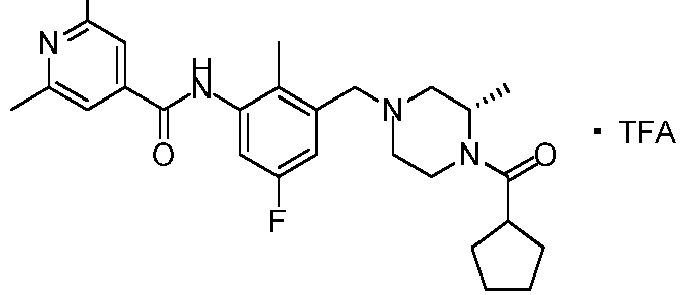 | 1H NMR (400 MHz, MeOD-d4 ) δ 1.20 - 1.50 (m, 3H), 1.56 -1.99 (m, 8H), 2.34 (s, 3H), 2.79 (s, 6H), 2.83 - 3.28 (m, 5H), 3.41 - 3.66 (m, 1H), 4.00 - 4.34 (m, 3H), 4.55 (brs, 1H), 7.24 - 7.37 (m, 2H), 8.01 (s, 2H). 19F NMR (376 MHz, MeOD-d4 ) δ -78.6, -118.9. MS (ESI) C27H35FN4O2, requires: 466, found 467 (M+H+). |
| E32 |  | 1H NMR (400 MHz, MeOD-d4 ) δ 1.23 - 1.50 (m, 3H), 1.55 - 2.00 (m, 8H), 2.32 (s, 3H), 2.88 - 3.25 (m, 3.5H), 3.34 - 3.67 (m, 3H), 4.01 (s, 3H), 4.18 (d, 0.5H), 4.39 (brs, 2H), 4.64 (brs, 1H), 6.93 (d, 1H), 7.25 - 7.37 (m, 2H), 8.23 (dd, 1H), 8.81 (d, 1H). 19F NMR (376 MHz, MeOD-d4 ) δ -77.1, -117.1. MS (ESI) C26H33FN4O3 requires: 468, found 469 (M+H+). |
| E33 |  | 1H NMR (400 MHz, MeOD-d4 ) δ 1.16 - 1.41 (m, 3H), 1.52 - 1.94 (m, 8H), 1.94 - 2.24 (m, 2H), 2.27 (s, 3H), 2.66 - 3.09 (m, 3.5H), 3.35 - 3.57 (m, 2.5H), 3.62 (s, 3H), 3.84 (d, 0.5H), 4.21 - 4.37 (m, 1H), 4.49 (s, 1H), 4.67 (brs, 0.5H), 6.76 (d, 1H), 6.97 - 7.14 (m, 3H), 7.78 (d, 1H). 19F NMR (376 MHz, MeOD-d4 ) δ -119.3. MS (ESI) C26H33FN4O3 requires: 468, found 469 (M+H+). |
| E34 |  | 1H NMR (400 MHz, MeOD-d4 ) δ 1.16 - 1.45 (m, 3H), 1.54 - 1.98 (m, 8H), 1.98 - 2.28 (m, 2H), 2.30 (s, 3H), 2.37 (s, 3H), 2.70 - 3.12 (m, 3.5H), 3.35 - 3.59 (m, 2.5H), 3.86 (d, 0.5H), 4.23 - 4.41 (m, 1H), 4.69 (brs, 0.5H), 7.05 - 7.15 (m, 2H), 7.42 (t, 1H), 7.67 (d, 1H), 7.72 (d, 1H). 19F NMR (376 MHz, MeOD-d4 ) δ - 118.6, -119.5. MS (ESI) C27H33F2N3O2 requires: 469, found 470 (M+H+). |
| E35 |  | 1H NMR (400 MHz, MeOD-d4 ) δ 1.31 (brs, 3H), 1.54 - 1.99 (m, 8H), 2.43 (s, 3H), 2.82 (s, 3H), 2.91 - 3.28 (m, 4H), 3.35 - 3.69 (m, 2.5H), 4.19 (brs, 0.5H), 4.42 (s, 2H), 4.64 (brs, 0.5H), 4.94 (brs, 0.5H), 7.26 (d, 1H), 7.82 - 7.91 (m, 2H), 8.31 (d, 1H). 19F NMR (376 MHz, MeOD-d4 ) δ -77.2, -116.4. MS (ESI) C25H32FN5O2 requires: 453, found 454 (M+H+). |
| E36 |  | 1H NMR (400 MHz, MeOD-d4 ) δ 1.16 - 1.40 (m, 4H), 1.50 - 1.94 (m, 9H), 1.94 - 2.29 (m, 3H), 2.36 (s, 3H), 2.68 (s, 3H), 2.70 - 3.10 (m, 4H), 3.35 - 3.60 (m, 3H), 3.84 (d, 0.5H), 4.20 - 4.37 (m, 1H), 4.50 (s, 1.5H), 7.00 (d, 1H), 7.63 (d, 1H), 8.65 (s, 1H), 9.21 (s, 1H). 19F NMR (376 MHz, MeOD-d4 ) δ -118.7. MS (ESI) C25H32FN5O2 requires: 453, found 454 (M+H+). |
| E37 |  | 1H NMR (400 MHz, MeOD-d4 ) δ 1.17 - 1.44 (m, 3H), 1.53 - 1.95 (m, 8H), 1.95 - 2.26 (m, 3H), 2.28 (s, 3H), 2.44 (s, 3H), 2.65 - 3.09 (m, 3H), 3.35 - 3.60 (m, 3H), 3.84 (d, 0.5H), 4.22 - 4.38 (m, 1H), 4.67 (brs, 0.5H), 7.04 (dd, 2H), 7.39 (d, 2H), 7.72 - 7.78 (m, 1H), 7.79 (s, 1H). 19F NMR (376 MHz, MeOD-d4 ) δ -76.9, - 119.8. MS (ESI) C27H34FN3O2 requires: 451, found 452 (M+H+). |
| E38 |  | 1H NMR (400 MHz, MeOD-d4 ) δ 1.16 - 1.42 (m, 3H), 1.54 - 1.94 (m, 8H), 1.94 - 2.27 (m, 2H), 2.32 (s, 3H), 2.37 (s, 3H), 2.45 (s, 3H), 2.65 - 3.08 (m, 4H), 3.33 - 3.59 (m, 3H), 3.84 (d, 0.5H), 4.20 - 4.38 (m, 1H), 4.67 (brs, 0.5H), 7.05 (d, 1H), 7.10 - 7.24 (m, 3H), 7.37 (s, 1H). 19F NMR (376 MHz, MeOD-d4 ) δ -119.4. MS (ESI) C28H36FN3O2 requires: 465, found 466 (M+H+). |
| E39 |  | 1H NMR (400 MHz, MeOD-d4 ) δ 1.18 - 1.50 (m, 3H), 1.54 - 2.01 (m, 8H), 2.36 (s, 3H), 2.56 - 3.25 (m, 5H), 3.41 - 3.63 (m, 1H), 4.11 (brs, 2.5H), 4.53 (brs, 1.5H), 7.22 (d, 1H), 7.27 - 7.37 (m, 1H), 7.41 (d, 1H), 7.45 - 7.55 (m, 1H), 7.60 (t, 1H). 19F NMR (376 MHz, MeOD-d4 ) δ - 77.2, -117.4, -139.8 (d), -141.8 (d). MS (ESI) C26H30F3N3O2 requires: 473, found 474 (M+H+). |
| E40 |  | 1H NMR (400 MHz, MeOD-d4 ) δ 1.15 - 1.44 (m, 3H), 1.51 - 1.94 (m, 8H), 1.94 - 2.28 (m, 2H), 2.32 (s, 3H), 2.67 - 3.09 (m, 4H), 3.34 - 3.60 (m, 2.5H), 3.84 (d, 0.5H), 4.21 - 4.39 (m, 1H), 4.40 - 4.72 (m, 1H), 7.04 (dd, 1H), 7.07 - 7.20 (m, 2H), 7.30 (d, 1H), 7.85 - 7.98 (m, 1H). 19F NMR (376 MHz, MeOD-d4 ) δ -106.6 (d), -110.7 (d), -119.2. MS (ESI) C26H30F3N3O2 requires: 473, found 474 (M+H+). |
| E41 |  | 1H NMR (400 MHz, MeOD-d4 ) δ 1.16 - 1.42 (m, 3H), 1.54 - 1.96 (m, 8H), 1.96 - 2.26 (m, 2H), 2.32 (s, 3H), 2.67 - 3.10 (m, 3.5H), 3.34 - 3.44 (m, 0.5H), 3.44 - 3.59 (m, 2H), 3.84 (d, 0.5H), 4.20 - 4.41 (m, 1H), 4.67 (brs, 0.5H), 7.00 - 7.10 (m, 1H), 7.25 - 7.39 (m, 3H), 7.50 - 7.61 (m, 1H). 19F NMR (376 MHz, MeOD-d4 ) δ - 119.2, -119.7 (d), -121.2 (d). MS (ESI) C26H30F3N3O2 requires: 473, found 474 (M+H+). |
| E42 |  | 1H NMR (400 MHz, MeOD-d4 ) δ 1.21 - 1.48 (m, 3H), 1.55 -1.98 (m, 8H), 2.31 (s, 3H), 2.59 - 3.27 (m, 5H), 3.42 - 3.60 (m, 1H), 4.16 (brs, 3H), 4.55 (brs, 1.5H), 4.82 - 4.97 (m, 0.5H), 7.20 - 7.30 (m, 3H), 7.56 - 7.63 (m, 2H). 19F NMR (376 MHz, MeOD-d4 ) δ -77.15, -77.18, -110.2, -117.6. MS (ESI) C26H30F3N3O2 requires: 473, found 474 (M+H+). |
| E43 |  | 1H NMR (400 MHz, MeOD-d4 ) δ 1.20 - 1.49 (m, 3H), 1.56 -1.98 (m, 8H), 2.37 (s, 3H), 2.40 (d, 3H), 2.90 - 3.25 (m, 3.5H), 3.34 - 3.64 (m, 3H), 4.19 (brs, 0.5H), 4.37 (s, 2H), 4.52 - 4.73 (m, 1H), 7.22 (t, 1H), 7.26 - 7.46 (m, 4H). 19F NMR (376 MHz, MeOD-d4 ) δ -77.2, - 117.0, -117.5. MS (ESI) C27H33F2N3O2 requires: 469, found 470 (M+H+). |
| E44 |  | 1H NMR (400 MHz, MeOD-d4 ) δ 1.20 - 1.51 (m, 3H), 1.55 - 2.01 (m, 8H), 2.32 (s, 3H), 2.46 (s, 3H), 2.79 - 3.19 (m, 3.5H), 3.34 - 3.65 (m, 2H), 4.05 - 4.39 (m, 3H), 4.49 - 4.68 (m, 1H), 4.82 - 5.03 (m, 0.5H), 7.21 (d, 1H), 7.24 - 7.32 (m, 2H), 7.50 (d, 1H), 7.64 (s, 1H). 19F NMR (376 MHz, MeOD-d4 ) δ -77.2, -115.1, - 117.4. MS (ESI) C27H33F2N3O2 requires: 469, found 470 (M+H+). |
| E45 |  | 1H NMR (400 MHz, MeOD-d4 ) δ 1.20 - 1.49 (m, 3H), 1.55 -1.99 (m, 8H), 2.36 (s, 3H), 2.47 (s, 3H), 2.75 - 3.22 (m, 3.5H), 3.35 - 3.63 (m, 2H), 4.04 - 4.40 (m, 3H), 4.44 - 4.69 (m, 2H), 4.83 - 5.05 (m, 0.5H), 7.16 (td, 1H), 7.27 (dd, 1H), 7.30 - 7.39 (m, 3H). 19F NMR (376 MHz, MeOD-d4 ) δ -77.2, -117.2, -119.0. MS (ESI) C27H33F2N3O2 requires: 469, found 470 (M+H+). |
| E46 |  | 1H NMR (400 MHz, MeOD-d4 ) δ 1.18 - 1.50 (m, 3H), 1.54 - 1.98 (m, 8H), 2.36 (s, 3H), 2.52 (s, 3H), 2.82 - 3.23 (m, 3.5H), 3.32 - 3.67 (m, 3H), 4.15 (brs, 0.5H), 4.31 (s, 2H), 4.63 (brs, 1H), 7.01 - 7.13 (m, 2H), 7.28 (dd, 1H), 7.31 - 7.39 (m, 1H), 7.63 (dd, 1H). 19F NMR (376 MHz, MeOD-d4 ) δ -77.2, -112.5, -117.3. MS (ESI) C27H33F2N3O2 requires: 469, found 470 (M+H+). |
| E47 |  | 1H NMR (400 MHz, MeOD-d4 ) δ 1.17 - 1.43 (m, 3H), 1.51 - 1.94 (m, 8H), 1.94 - 2.28 (m, 2H), 2.31 (s, 3H), 2.43 (s, 3H), 2.67 - 3.08 (m, 3.5H), 3.32 - 3.43 (m, 0.5H), 3.43 - 3.58 (m, 2H), 3.83 (d, 0.5H), 4.22 - 4.37 (m, 1H), 4.49 (brs, 0.5H), 4.67 (brs, 1H), 7.02 (dd, 1H), 7.11 (d, 1H), 7.16 (d, 1H), 7.33 (d, 1H), 7.76 (t, 1H). 19F NMR (376 MHz, MeOD-d4 ) δ -116.0, -119.2. MS (ESI) C27H33F2N3O2 requires: 469, found 470 (M+H+). |
| E48 |  | 1H NMR (400 MHz, MeOD-d4 ) δ 1.17 - 1.50 (m, 3H), 1.55 - 2.01 (m, 8H), 2.35 (s, 3H), 2.40 (s, 3H), 2.46 - 2.93 (m, 2H), 2.96 - 3.27 (m, 4H), 3.48 (brs, 1H), 3.81 - 4.22 (m, 2.5H), 4.49 (brs, 0.5H), 7.09 - 7.26 (m, 2H), 7.34 - 7.48 (m, 2H), 7.61 - 7.72 (m, 1H). 19F NMR (376 MHz, MeOD-d4 ) δ -77.0, -118.7, -120.8. MS (ESI) C27H33F2N3O2 requires: 469, found 470 (M+H+). |
| E49 |  | 1H NMR (400 MHz, MeOD-d4 ) δ 1.21 - 1.50 (m, 3H), 1.56 - 2.00 (m, 8H), 2.36 (s, 3H), 2.37 (s, 3H), 2.48 (s, 3H), 2.74 - 3.24 (m, 4H), 3.36 - 3.66 (m, 2H), 4.14 (brs, 0.5H), 4.29 (s, 2H), 4.59 (brs, 1H), 7.10 - 7.18 (m, 2H), 7.27 (d, 1H), 7.33 (d, 1H), 7.48 (d, 1H). 19F NMR (376 MHz, MeOD-d4 ) δ -77.1, -117.3. MS (ESI) C28H36FN3O2 requires: 465, found 466 |
| (M+H+). | ||
| E50 |  | 1H NMR (400 MHz, MeOD-d4 ) δ 1.33 (brs, 3H), 1.55 -1.98 (m, 8H), 2.37 (s, 3H), 2.97 - 3.30 (m, 3H), 3.37 - 3.70 (m, 3H), 4.21 (brs, 0.5H), 4.46 (s, 2H), 4.64 (brs, 0.5H), 7.34 (dd, 1H), 7.45 - 7.53 (m, 1H), 7.75 (dd, 2H), 7.98 (t, 1H). 19F NMR (376 MHz, MeOD-d4 ) δ -77.2, -113.0, - 116.6. MS (ESI) C27H30F2N4O2 requires: 480, found 481 (M+H+). |
| E51 |  | 1H NMR (400 MHz, MeOD-d4 ) δ 1.17 - 1.43 (m, 3H), 1.54 - 1.93 (m, 8H), 1.95 - 2.26 (m, 2H), 2.29 (s, 3H), 2.69 - 2.80 (m, 1H), 2.85 (d, 1H), 3.01 (s, 7H), 3.34 - 3.43 (m, 0.5H), 3.45 - 3.57 (m, 2H), 3.84 (d, 0.5H), 4.21 - 4.38 (m, 1H), 4.50 (s, 1H), 4.67 (brs, 1H), 6.98 (dd, 1H), 7.05 (dd, 1H), 7.11 (dd, 1H), 7.23 - 7.37 (m, 3H). 19F NMR (376 MHz, MeOD-d4 ) δ - 119.6. MS (ESI) C28H37FN4O2, requires: 480, found 481 (M+H+). |
| E52 |  | 1H NMR (400 MHz, MeOD-d4 ) δ 1.16 - 1.41 (m, 3H), 1.53 -1.95 (m, 8H), 1.95 - 2.26 (m, 2H), 2.32 (s, 3H), 2.35 (s, 3H), 2.40 (s, 3H), 2.68 - 3.08 (m, 3.5H), 3.34 - 3.44 (m, 0.5H), 3.44 - 3.60 (m, 2H), 3.84 (d, 0.5H), 4.23 - 4.39 (d, 1H), 4.74 (brs, 0.5H), 7.01 - 7.10 (m, 1H), 7.14 - 7.24 (m, 2H), 7.28 (d, 1H), 7.35 (d, 1H). 19F NMR (376 MHz, MeOD-d4 ) δ -119.5. MS (ESI) C28H36FN3O2 requires: 465, found 466 (M+H+). |
| E53 |  | 1H NMR (400 MHz, MeOD-d4 ) δ 1.18 - 1.50 (m, 3H), 1.53 -1.97 (m, 8H), 2.32 (s, 3H), 2.70 - 3.20 (m, 4H), 3.34 - 3.42 (m, 1H), 3.44 - 3.62 (m, 1H), 4.04 - 4.39 (m, 3H), 4.62 (brs, 1H), 7.30 (d, 2H), 7.91 - 8.00 (m, 3H). 19F NMR (376 MHz, MeOD-d4 ) δ -77.2, -108.5, -117.2. MS (ESI) C27H30F2N4O2 requires: 480, found 481 (M+H+). |
| E54 |  | 1H NMR (400 MHz, MeOD-d4 ) δ 1.17 - 1.43 (m, 3H), 1.50 - 1.96 (m, 8H), 1.96 - 2.28 (m, 2H), 2.31 (s, 3H), 2.68 - 3.09 (m, 3.5H), 3.34 - 3.45 (m, 0.5H), 3.45 - 3.61 (m, 2H), 3.85 (d, 0.5H), 4.23 - 4.38 (m, 1H), 4.49 (s, 1H), 4.68 (brs, 0.5H), 7.13 (ddd, 2H), 9.29 (s, 2H), 9.33 (s, 1H). 19F NMR (376 MHz, MeOD-d4 ) δ -119.2. MS (ESI) C24H30FN5O2 requires: 439, |
| found 440 (M+H+). | ||
| E55 |  | 1H NMR (400 MHz, MeOD-d4 ) δ 1.16 - 1.52 (m, 3H), 1.54 - 1.98 (m, 8H), 2.42 (s, 3H), 2.96 - 3.28 (m, 3H), 3.35 - 3.72 (m, 3H), 4.21 (brs, 1H), 4.44 (s, 2H), 4.68 (brs, 1H), 7.18 - 7.34 (m, 2H), 7.62 - 7.82 (m, 3H), 8.56 - 8.71 (m, 2H). 19F NMR (376 MHz, MeOD-d4 ) δ -77.2, - 77.3, -116.5. MS (ESI) C27H32FN5O2 requires: 477, found 478 (M+H+). |
| E56 |  | 1H NMR (400 MHz, MeOD-d4 ) δ 1.18 - 1.52 (m, 3H), 1.52 -1.99 (m, 8H), 2.32 (s, 3H), 2.63 (s, 3H), 2.95 - 3.26 (m, 4H), 3.35 - 3.67 (m, 3H), 4.20 (brs, 1H), 4.40 (s, 2H), 4.65 (s, 1H), 7.32 (dq, 2H), 7.61 (d, 1H), 8.15 (dd, 1H), 8.28 (d, 1H). 19F NMR (376 MHz, MeOD-d4 ) δ -77.2, - 117.0. MS (ESI) C28H33FN4O2 requires: 476, found 477 (M+H+). |
| E57 |  | 1H NMR (400 MHz, MeOD-d4 ) δ 1.16 - 1.43 (m, 6H), 1.54 - 1.95 (m, 8H), 1.95 - 2.27 (m, 2H), 2.29 (s, 3H), 2.68 - 3.10 (m, 5.5H), 3.34 - 3.44 (m, 0.5H), 3.44 - 3.59 (m, 2H), 3.84 (d, 0.5H), 4.20 - 4.39 (m, 1H), 4.67 (brs, 0.5H), 7.10 (dd, 2H), 7.47 (d, 1H), 8.29 (dd, 1H), 9.02 (s, 1H). 19F NMR (376 MHz, MeOD-d4 ) δ -119.4. MS (ESI) C27H35FN4O2 requires: 466, found 467 (M+H+). |
| E58 |  | 1H NMR (400 MHz, MeOD-d4 ) δ 1.15 - 1.43 (m, 3H), 1.53 - 1.90 (m, 8H), 1.90 - 2.25 (m, 2H), 2.29 (s, 3H), 2.68 - 3.11 (m, 3.5H), 3.33 - 3.46 (m, 0.5H), 3.46 - 3.60 (m, 2H), 3.85 (d, 0.5H), 4.22 - 4.39 (m, 1H), 4.59 (s, 0.5H), 4.67 (brs, 0.5H), 7.04 - 7.15 (m, 2H), 7.54 (t, 1H), 8.29 - 8.36 (m, 1H), 8.39 (dd, 1H). 19F NMR (376 MHz, MeOD-d4 ) δ -107.6, -121.7. MS (ESI) C27H30F2N4O2 requires: 480, found 481 (M+H+). |
| Example | Structure | Characterization |
| E68 |  | 1H-NMR (MeOD-d4 , 400MHz) 7.79 (m, 2H), 7.69 (d, 1H, J = 7.6 Hz), 7.57 (d, 2H, J = 7.6 Hz), 7.45 (d, 1H, J = 6.0 Hz), 733 (t, 1H, J = 7.8 Hz), 4.57-4.37 (m, 4H), 3.84 (s, 2H), 3.25 (brs, 2H), 3.09 (m, 3H), 2.91 (m, 2H), 1.76--1.51 (m, 8H), 1.30 (s, 6H), 1.11 (t, 3H, J = 7.4 Hz). δF (MeOD-d4 , 376MHz): - 77.3. MS (ES): C29H38ClN3O4S requires 559; found 560(M+H+). |
| E69 |  | 1H-NMR (MeOD-d4 , 400MHz) 7.76 (d, 1H), 7.45 (m, 3H), 7.01 (m, 2H), 4.55 (brs, 2H), 4.24 (brs, 2H), 3.17 (m, 3H), 2.92 (m, 2H), 1.77--1.52 (m, 8H), 1.31 (m, 6H). |
| δF (MeOD-d4 , 376MHz): -77.1, -115.0, - 116.3. MS (ES): C26H30ClF2N3O2 requires 489; found 490(M+H+). | ||
| E70 |  | 1H-NMR (MeOD-d4 , 400MHz): 0.87 (dd, 1 H), 1.13 (t, 1 H), 1.24 (m, 6 H), 1.29 (br. s., 2 H), 1.41 (m, 1H), 1.65 (m, 3 H), 1.73 (dd, 3 H), 1.85 (m, 3 H), 2.34 (s, 3 H), 3.09 (m, 3 H), 3.47 (t, 3 H), 4.16 (m., 0.5 H), 4.44 (br. s., 2 H), 4.64 (br. s., 1 H), 4.96 (m., 0.5 H), 7.14 (t, 1 H), 7.38 (dd, 1 H). δF (MeOD-d4 , 376MHz): -77.1, -114.8. MS (ES): C25H36FN3O2 requires 429; found 430(M+H+). |
| E71 |  | 1H-NMR (MeOD-d4 , 400MHz): 1.29 (br. s., 3 H), 1.64 (m, 3H), 1.72 (br. s., 2 H), 1.94 (m, 10 H), 2.14 (m, 4 H), 2.28 (dd, 1 H), 2.34 (s, 3 H), 3.03 (m, 2 H), 3.16 (m, 1 H), 3.46 (m, 3 H), 4.14 (m, 0.5 H), 4.40 (br. s., 2 H), 4.61 (br. s., 0.5 H), 7.17 (t, 1 H), 7.42 (dd, 1 H). δF (MeOD-d4 , 376MHz): -77.1, -114.3, -150.6. MS (ES): C25H35F2N3O2 requires 447; found 448(M+H+). |
| E72 |  | 1H-NMR (MeOD-d4 , 400MHz): 1.27 (br. s., 2 H), 1.40 (br. s., 1 H), 1.64 (m, 3 H), 1.72 (br. s., 2 H), 1.84 (d, 3 H), 2.15 (s, 3 H), 2.75 (m, 2 H), 3.09 (m, 4 H), 3.36 (br. s., 1 H), 3.48 (m, 1 H), 4.12 (m, 0.5 H), 4.30 (br. s., 2 H), 4.58 (br. s., 0.5 H), 7.09 (t, 1 H), 7.20 (m, 1 H), 7.28 (m, 4 H). δF (MeOD-d4 , 376MHz): - 77.0, -114.8. MS (ES): C28H36FN3O2 requires 465; found 466(M+H+). |
| E73 | 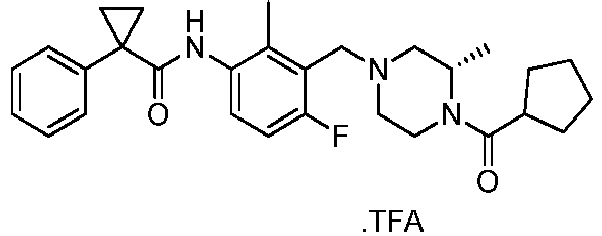 | 1H-NMR (MeOD-d4 , 400MHz): 1.24 (m, 4 H), 1.37 (br. s., 1 H), 1.62 (m, 5 H), 1.83 (br. s., 5 H), 2.14 (s, 3 H), 3.02 (br. s., 2 H), 4.23 (m, 2.5 H), 4.55 (br. s., 0.5 H), 7.08 (t, 1 H), 7.42 (m, 4 H), 7.57 (d, 2 H). δF (MeOD-d4 , 376MHz): -77.2. MS (ES): C29H36F2N3O2 |
| requires 447; found 448(M+H+). | ||
| E74 |  | 1H-NMR (MeOD-d4 , 400MHz): 1.39 (br. s., 3 H), 1.71 (br. s., 8 H), 2.32 (s, 3 H), 3.07 (m, 3 H), 3.46 (d, 3 H), 3.82 (s, 2 H), 4.12 (m, 0.5 H), 4.37 (br. s., 2 H), 4.60 (br. s., 0.5 H), 7.14 (m, 3 H), 7.32 (m, 1 H), 7.41 (m, 2 H). δF (MeOD-d4 , 376MHz): -77.3, -119.1. MS (ES): C27H33F2N3O2 requires 469; found 470(M+H+). |
| E75 |  | 1H-NMR (MeOD-d4 , 400MHz): 1.27 (br. s., 3 H), 1.63 (m, 5 H), 1.84 (m, 3 H), 2.24 (s, 3 H), 3.03 (m, 3 H), 3.45 (t, 2 H), 3.70 (m, 2 H), 3.79 (m, 3 H), 4.13 (m, 0.5H), 4.42 (br. s., 2 H), 4.64 (m, 0.5H), 6.84 (m, 1 H), 6.98 (m, 2 H), 7.14 (t, 1 H), 7.26 (m, 1 H), 7.41 (dd, 1 H). δF (MeOD-d4 , 376MHz): -79.4, -116.7. MS (ES): C28H36FN3O3 requires 481; found 482(M+H+). |
| E76 |  | 1H-NMR (MeOD-d4 , 400MHz): 1.14 (d, 2 H), 1.26 (d, 1 H), 1.72 (m, 8 H), 1.93 (m, 1 H), 2.03 (br. s., 1 H), 2.19 (m, 4 H), 2.72 (m, 2 H), 2.98 (br. s., 1 H), 3.51 (m, 5 H), 3.79 (d, 0.5 H), 4.25 (br. s., 1 H), 4.63 (br. s., 0.5 H), 4.83 (s, 1 H), 6.91 (t, 1 H), 7.20 (dd, 1 H), 7.38 (m, 3 H), 7.54 (d, 2 H). δF (MeOD-d4 , 376MHz): -77.3, -114.7. MS (ES): C28H36FN3O3 requires 481; found 482(M+H+). |
| E77 |  | 1H-NMR (MeOD-d4 , 400MHz): 1.03 (d, 2 H), 1.16 (d, 1 H), 1.44 (d, 3 H), 1.68 (d, 9 H), 2.08 (m, 4 H), 2.58 (m, 2 H), 2.88 (br. s., 1 H), 3.39 (m, 2 H), 3.78 (q, 1 H), 4.15 (br. s., 0.5H), 4.53 (m, 0.5 H), 6.80 (t, 1 H), 7.03 (dd, 1 H), 7.16 (m, 1 H), 7.25 (t, 2 H), 7.34 (d, 2 H). δF (MeOD-d4 , 376MHz): -77.3, -114.7. MS (ES): C28H36FN3O2 requires 465; found 466(M+H+). |
| E78 |  | 1H-NMR (MeOD-d4 , 400MHz): 1.04 (d, 2 H), 1.18 (m, 1 H), 1.64 (m, 9 H), 2.09 (m, 4 H), 2.64 (m, 3 H), 2.87 (m, 1 H), 3.39 (m, 2 H), 3.67 (br. s., 0.5 H), 4.15 (br. s., 1 H), 4.53 (br. s., 0.5 H), 6.78 (t, 1 H), 6.98 (m, 1 H), 7.24 (m, 0.5 H), 7.32 (m, 3 H), 7.35 (m, 0.5 H), 7.52 (d, 2 H). δF (MeOD-d4 , 376MHz): -76.9, -122.7, -168.8, -177.8, -177.9. MS (ES): C27H33F2N3O2 requires 469; found 470(M+H+). |
| E79 |  | 1H-NMR (MeOD-d4 , 400MHz): 1.29 (br. s., 2 H), 1.40 (ddd, 2 H), 1.62 (m, 6 H), 1.85 (m, 3 H), 2.15 (m, 1 H), 2.36 (s, 3 H), 2.48 (m, 1 H), 3.09 (m, 3 H), 3.46 (t, 3 H), 4.17 (d, 0.5 H), 4.44 (br. s., 2 H), 4.63 (br. s., 0.5 H), 7.18 (m, |
| 4 H), 7.30 (m, 2 H), 7.46 (dd, 1 H). δF (MeOD-d4 , 376MHz): -77.1, -114.7. MS (ES): C29H36FN3O2 requires 477; found 478(M+H+). | ||
| E80 |  | 1H-NMR (MeOD-d4 , 400MHz): 1.14 (d, 2 H), 1.26 (d, 1 H), 1.79 (m, 9 H), 2.21 (m, 4 H), 2.97 (m, 4 H) 3.49 (m, 5 H) 3.79 (d, 0.5 H), 4.27 (m, 1 H), 4.63 (br. s., 0.5 H), 4.83 (s, 1 H), 6.91 (t, 1 H), 7.20 (dd, 1 H), 7.3 (m, 3 H), 7.54 (m, 2 H). δF (MeOD-d4 , 376MHz): - 77.0, -114.0. MS (ES): C28H36FN3O3 requires 481; found 482(M+H+). |
| E81 |  | 1H-NMR (MeOD-d4 , 400MHz): 1.20 (d, 2 H), 1.33 (d, 1 H), 1.65 (m, 5 H), 1.79 (d, 2 H), 2.07 (s, 3 H), 1.95 (m, 1 H), 2.17 (m, 1 H), 2.74 (m, 4 H), 2.90 (t, 1 H), 3.03 (m, 3 H), 3.37 (m, 1 H), 3.42 (br. s., 2 H), 3.80 (br. s., 0.5 H), 4.28 (br. s., 1 H), 4.64 (br. s., 0.5 H), 6.97 (m, 4 H), 7.09 (d, 1 H), 7.28 (m, 1 H). δF (MeOD-d4 , 376MHz): -76.9, -115.6. MS (ES): C28H35F2N3O2 requires 483; found 484(M+H+). |
| E82 | 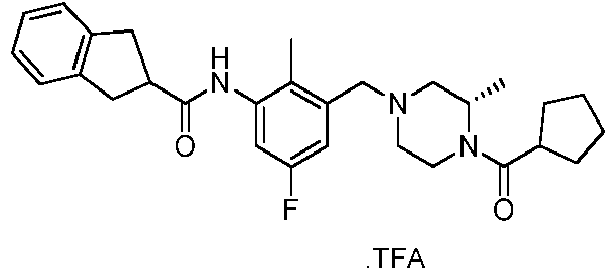 | 1H-NMR (MeOD-d4 , 400MHz): 1.22 (d, 2 H), 1.34 (d, 1 H), 1.62 (br. s., 2 H), 1.69 (br. s., 3 H), 1.79 (d, 3 H), 1.90 (br. s., 1 H), 2.03 (br. s., 1 H), 2.13 (br. s., 1 H), 2.25 (s, 3 H), 2.68 (br. s., 1 H), 2.81 (br. s., 1 H), 2.99 (br. s., 1 H), 3.25 (m, 4 H), 3.50 (m, 3 H), 3.81 (br. s., 0.5 H), 4.29 (br. s., 1 H), 4.65 (br. s., 0.5 H), 6.97 (d, 1 H), 7.12 (m, 3 H), 7.20 (d, 2 H). δF (MeOD-d4 , 376MHz): -77.3, -117.1. MS (ES): C29H36FN3O2 requires 477; found 478(M+H+). |
| E83 | 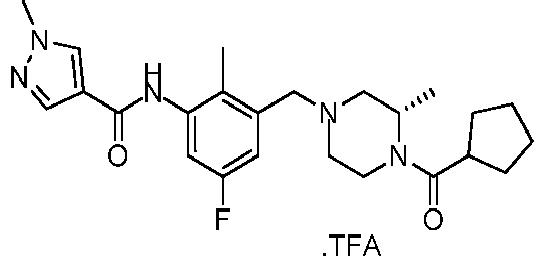 | 1H-NMR (MeOD-d4 , 400MHz): 1.05 (d, 1 H), 1.23 (d, 2 H), 1.36 (d, 1 H), 1.66 (br. s., 6 H), 1.79 (br. s., 3 H), 2.04 (s, 2 H), 2.26 (s, 3 H), 2.75 (m, 1 H), 2.85 (d, 1 H), 3.02 (d, 2 H), 3.50 (m, 2 H), 3.84 (d, 0.5 H), 3.95 (s, 3 H), 4.30 (br. s., 1 H), 4.66 (br. s., 0.5 H), 7.01 (m, 2 H), 7.99 (br. s., 1 H), 8.16 (s, 1 H). δF (MeOD-d4 , 376MHz): -119.6. MS (ES): C24H32FN5O2 requires 441; found 442(M+H+). |
| E84 | 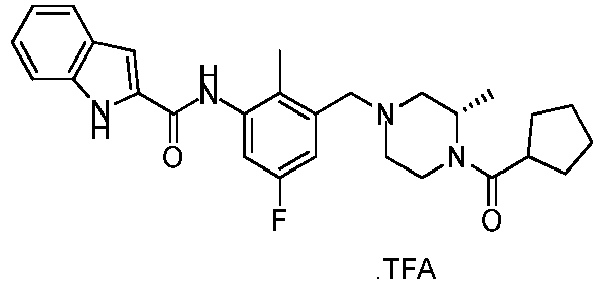 | 1H-NMR (MeOD-d4 , 400MHz): 1.25 (m, 2 H), 1.36 (m, 1 H), 1.71 (m, 9 H), 2.03 (br. s., 1 H), 2.19 (br. s., 1 H), 2.32 (s, 3 H), 2.74 (br. s., 1 H), 2.85 (d, 1 H), 3.00 (br. s., 1 H), 3.50 (br. s., 2 H), 3.81 (br. s., 0.5 H), 4.30 (br. s., 1 H), 4.49 (br. s., 1 H), 4.66 (br. s., 0.5 H), 7.08 (m, 2 H), 7.17 (d, 1 H), 7.25 (m, 2 H), 7.47 (d, 1 H), 7.65 (d, 1 H).δF (MeOD-d4 , 376MHz): - |
| 76.9, -119.5. MS (ES): C28H33FN4O2 requires 476; found 477(M+H+). | ||
| E85 |  | 1H-NMR (MeOD-d4 , 400MHz): 1.11 (d, 2 H), 1.24 (d, 1 H), 1.53 (d, 3 H), 1.68 (m, 8 H), 1.94 (m, 2 H) 2.14 (m., 4 H), 2.65 (t, 1 H), 2.74 (d, 1 H), 2.83 (t, 0.5 H), 2.97 (dt, 1 H), 3.22 (t, 0.5 H), 3.46 (m, 2 H), 3.75 (d, 0.5 H), 3.88 (q, 1 H), 4.26 (m, 1 H), 4.62 (br. s., 0.5 H), 6.88 (t, 1 H), 7.13 (m, 1 H), 7.25 (m, 1 H), 7.33 (t, 2 H), 7.43 (d, 2 H). δF (MeOD-d4 , 376MHz): -120.7. MS (ES): C28H36FN3O2 requires 465; found 466(M+H+). |
| E86 |  | 1H-NMR (MeOD-d4 , 400MHz): 1.15 (d, 2 H), 1.28 (d, 1 H), 1.65 (m, 5 H), 1.80 (m, 4 H), 1.93 (m, 1 H), 2.06 (m, 1 H), 2.20 (m, 3 H), 2.35 (m, 3 H), 2.69 (m, 1 H), 2.79 (d, 1 H), 2.87 (t, 0.5 H), 3.01 (m, 1 H), 3.28 (m, 0.5 H), 3.52 (m, 2 H), 3.79 (m, 2.5 H), 3.96 (d, 2 H), 4.28 (m, 1 H), 4.65 (br. s., 0.5 H), 6.91 (t, 1 H), 7.23 (m, 1 H). δF (MeOD-d4 , 376MHz): - 77.1, -114.2. MS (ES): C25H34FN3O3 requires 443; found 444(M+H+). |
| E87 |  | 1H-NMR (MeOD-d4 , 400MHz): 1.17 (d, 2 H), 1.29 (d, 1 H), 1.62 (m, 2 H), 1.70 (br. s., 5 H), 2.05 (br. s., 2 H), 2.20 (m, 1 H), 2.34 (s, 3 H), 2.73 (d, 1 H), 2.83 (d, 3 H), 3.00 (m, 1 H), 3.52 (m, 2 H), 3.81 (d, 0.5 H), 4.28 (m, 1 H), 4.65 (br. s., 0.5 H), 6.85 (m, 2 H), 7.04 (dd, 1 H), 7.31 (m, 1 H), 7.39 (m, 2 H), 7.66 (d, 2 H). δF (MeOD-d4 , 376MHz): -77.2, -129.2. MS (ES): C28H33F2N3O2 requires 481; found 482(M+H+). |
| E88 |  | 1H-NMR (MeOD-d4 , 400MHz): 1.21 (d, 2 H), 1.34 (d, 1 H), 1.64 (m, 6 H), 1.79 (m, 2 H), 2.06 (s, 4 H), 2.16 (m, 1 H), 2.71 (m, 3 H), 2.81 (d, 1 H), 3.02 (m, 3 H), 3.43 (br. s., 2 H), 3.81 (br. s., 0.5 H), 4.28 (br. s., 1 H), 4.65 (br. s., 0.5 H), 6.95 (m, 2 H), 7.21 (m, 1 H), 7.29 (m, 4 H). δF (MeOD-d4 , 376MHz): -77.2, - 117.3. MS (ES): C28H36FN3O2 requires 465; found 466(M+H+). |
| E89 |  | 1H-NMR (MeOD-d4 , 400MHz): 1.21 (d, 2 H), 1.34 (d, 1 H), 1.64 (m, 5 H), 1.78 (m, 3 H), 1.96 (br. s., 1 H), 2.04 (d, 1 H), 2.16 (m, 4 H), 2.71 (t, 1 H), 2.82 (d, 1 H), 3.00 (m, 1 H), 3.44 (m, 2 H), 3.80 (d, 0.5 H), 4.28 (br. s., 1 H), 4.65 (br. s., 0.5 H), 6.96 (d, 1 H), 7.08 (m, 2 H), 7.15 (m, 1 H), 7.30 (m, 1 H), 7.41 (m, 1 H). δF (MeOD-d4 , 376MHz): -77.2, -116.9, - 118.9. MS (ES): C27H33F2N3O2 requires 469; |
| found 470(M+H+). | ||
| E90 |  | 1H-NMR (MeOD-d4 , 400MHz): 1.21 (d, 2 H), 1.35 (br. s., 2 H), 1.61 (br. s., 6 H), 1.79 (m, 2 H), 2.03 (br. s., 1 H), 2.17 (m, 2 H), 2.25 (s, 3 H), 2.48 (br. s., 1 H), 2.70 (d, 1 H), 2.82 (d, 1 H), 2.98 (m, 1 H), 3.46 (br. s., 2 H), 3.81 (br. s., 0.5 H), 4.29 (br. s., 1 H), 4.65 (br. s., 0.5 H), 6.96 (d, 1 H), 7.17 (m, 4 H), 7.28 (t, 2 H). δF (MeOD-d4 , 376MHz): -77.2, -117.1. MS (ES): C29H36FN3O2 requires 477; found 478(M+H+). |
| E91 |  | 1H-NMR (MeOD-d4 , 400MHz): 0.29 (d, 2 H), 0.61 (d, 2 H), 1.15 (m, 1 H), 1.22 (d, 2 H), 1.34 (d, 1 H), 1.64 (m, 5 H), 1.84 (m, 3 H), 2.00 (m, 1 H), 2.17 (m, 1 H), 2.23 (m, 3 H), 2.31 (d, 2 H), 2.72 (m, 1 H), 2.82 (d, 1 H), 2.99 (m, 1.5 H), 3.43 (m, 2.5 H), 3.83 (d, 0.5 H), 4.31 (m, 1 H), 4.66 (br. s., 0.5 H), 6.98 (d, 1 H), 7.12 (d, 1 H). δF (MeOD-d4 , 376MHz): -119.4. MS (ES): C24H34FN3O2 requires 415; found 416(M+H+). |
| E92 |  | 1H-NMR (MeOD-d4 , 400MHz): 1.29 (br. s., 2 H), 1.42 (m, 2 H), 1.62 (m, 7 H), 1.83 (br. s., 3 H), 2.24 (br. s., 1 H), 2.51 (dt, 1 H), 3.03 (d, 2 H), 3.14 (br. s., 2 H), 3.45 (br. s., 3 H), 4.16 (m, 0.5 H), 4.43 (m, 2 H), 4.62 (br. s., 1 H), 4.98 (m, 0.5 H), 7.19 (m, 3 H), 7.29 (m, 2 H), 7.48 (m, 2 H), 7.87 (d, 1 H). δF (MeOD-d4 , 376MHz): -77.2. MS (ES): C28H34ClN3O2 requires 479; found 480(M+H+). |
| E93 |  | 1H-NMR (MeOD-d4 , 400MHz): 1.28 (br. s., 2 H), 1.43 (m, 1 H), 1.64 (m, 6 H), 1.83 (br. s., 3 H), 2.78 (m, 2 H), 3.03 (t, 5 H), 4.16 (br. s., 0.5H), 4.38 (m, 2 H), 4.60 (br. s., 1 H), 4.99 (br. s., 0.5H), 7.19 (m, 1 H), 7.28 (m, 4 H), 7.43 (t, 1 H), 7.50 (d, 1 H), 7.69 (d, 1 H). δF (MeOD-d4 , 376MHz): -77.2. MS (ES): C27H34ClN3O2 requires 467; found 468(M+H+). |
| E94 | 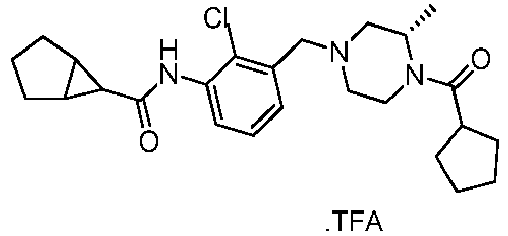 | 1H-NMR (MeOD-d4 , 400MHz): 1.25 (d, 3 H), 1.38 (d, 2 H), 1.66 (m, 6 H), 1.85 (m, 11 H), 2.11 (br. s., 1 H), 2.23 (m, 1 H), 2.75 (m, 1 H), 2.86 (br. s., 1 H), 3.02 (d, 2 H), 3.39 (br. s., 0.5 H), 3.61 (m, 2 H), 3.83 (br. s., 0.5 H), 4.30 (br. s., 1 H), 4.66 (br. s., 1 H), 7.27 (t, 1 H), 7.35 (d, 1 H), 7.66 (d, 1 H). MS (ES): C25H34ClN3O2 requires 443; found 444(M+H+). |
| E95 |  | 1H-NMR (MeOD-d4 , 400MHz): 1.21 (d, 2 H), 1.33 (m, 2 H), 1.61 (br. s., 2 H), 1.70 (br. s., 6 H), 2.07 (s, 3 H), 2.72 (t, 3 H), 2.99 (t, 4 H), 3.43 (br. s., 2 H), 3.77 (s, 3.5 H), 4.29 (m, 1 H), 4.65 (br. s., 0.5 H), 6.76 (d, 1 H), 6.85 (m, 2 H), 6.96 (m, 2 H), 7.19 (t, 1 H). δF (MeOD-d4, 376MHz): -77.2, -118.2. MS (ES): C29H38FN3O3 requires 495; found 496(M+H+). |
| E96 |  | 1H-NMR (MeOD-d4 , 400MHz): 1.29 (br. s., 3 H), 1.64 (m, 2 H), 1.72 (br. s., 3 H), 1.84 (dd, 3 H), 2.10 (s, 3 H), 2.72 (m, 2 H), 2.97 (t, 3 H), 3.03 (m, 2 H), 3.41 (br. s., 1 H), 3.76 (s, 3 H), 4.15 (m, 0.5 H), 4.31 (d, 2 H), 4.59 (br. s., 0.5 H), 6.85 (d, 2 H), 7.18 (m, 4 H). δF (MeOD-d4 , 376MHz): -77.2, -117.3. MS (ES): C29H38FN3O3 requires 495; found 496(M+H+). |
| E97 |  | 1H-NMR (MeOD-d4 , 400MHz): 1.27 (br. s., 3 H), 1.64 (m, 2 H), 1.72 (br. s., 3 H), 1.83 (m, 3 H), 2.13 (s, 3 H), 2.72 (t, 2 H), 3.02 (t, 4 H), 3.51 (br. s., 0.5 H), 3.85 (s, 3 H), 4.23 (br. s., 2 H), 4.58 (br. s., 0.5 H), 6.86 (t, 1 H), 6.95 (d, 1 H), 7.18 (m, 4 H). δF (MeOD-d4 , 376MHz): - 77.1, -117.6. MS (ES): C29H38FN3O3 requires 495; found 496(M+H+). |
| E98 |  | 1H-NMR (MeOD-d4 , 400MHz): 1.27 (br. s., 2 H), 1.39 (br. s., 1 H), 1.64 (br. s., 4 H), 1.83 (br. s., 4 H), 2.10 (s, 3 H), 2.75 (m, 2 H), 3.03 (m, 5 H), 3.52 (br. s., 1 H), 4.13 (br. s., 0.5 H), 4.27 (br. s., 2 H), 4.59 (br. s., 0.5 H), 7.02 (t, 2 H), 7.18 (t, 2 H), 7.29 (dd, 2 H). δF (MeOD-d4, 376MHz): -77.1, -117.4, -119.2. MS (ES): C28H35F2N3O2 requires 483; found 484(M+H+). |
| E99 |  | 1H-NMR (MeOD-d4 , 400MHz): 1.28 (br. s., 2 H), 1.41 (br. s., 1 H), 1.65 (m, 3 H), 1.72 (br. s., 2 H), 1.84 (m, 3 H), 2.27 (s, 3 H), 2.86 (m, 5 H), 3.03 (m, 2 H), 3.20 (m, 2 H), 3.40 (m, 2 H), 4.15 (br. s., 0.5 H), 4.35 (br. s., 2 H), 4.62 (br. s., 0.5 H), 7.25 (m, 1 H), 7.33 (dd, 1 H). δF (MeOD-d4 , 376MHz): -77.0, -83.7, -84.2, - 98.7, -99.2, -117.1. MS (ES): C24H32F3N3O2 requires 451; found 452(M+H+). |
| E100 |  | 1H-NMR (MeOD-d4 , 400MHz): 1.28 (br. s., 2 H), 1.40 (br. s., 1 H), 1.68 (m, 7 H), 1.83 (m, 8 H), 2.01 (m, 2 H), 2.26 (s, 3 H), 2.92 (quin, 1 H), 3.04 (dt, 2 H), 3.15 (br. s., 1 H), 3.37 (d, 1 H), 3.44 (d, 1 H), 3.54 (br. s., 0.5 H), 4.15 (br. s., 0.5 H), 4.36 (br. s., 2 H), 4.62 (br. s., 1 H), 7.25 (t, 2 H). δF (MeOD-d4 , 376MHz): -77.7, -117.3. MS (ES): C25H36FN3O2 requires 429; |
| found 430(M+H+). | ||
| E101 |  | 1H-NMR (MeOD-d4 , 400MHz): 1.22 (d, 3 H), 1.34 (d, 1 H), 1.62 (m, 3 H), 1.69 (br. s., 5 H), 1.86 (m, 10 H), 2.00 (m, 1 H), 2.16 (d, 1 H), 2.24 (s, 3 H), 2.72 (m, 1 H), 2.82 (d, 1 H), 2.98 (m, 2 H), 3.43 (m, 3 H), 3.83 (d, 0.5 H), 4.29 (br. s., 1 H), 4.66 (br. s., 0.5 H), 6.94 (d, 1 H), 7.12 (d, 1 H). δF (MeOD-d4 , 376MHz): -119.6. MS (ES): C26H36FN3O2 requires 441; found 442(M+H+). |
| E102 |  | 1H-NMR (MeOD-d4 , 400MHz): 1.27 (br. s., 2 H), 1.37 (br. s., 1 H), 1.64 (m, 3 H), 1.72 (br. s., 3 H), 1.83 (br. s., 4 H), 2.22 (s, 3 H), 3.04 (m, 3 H), 3.48 (br. s., 1 H), 4.23 (br. s., 3 H), 4.57 (br. s., 1 H), 7.05 (m, 3 H), 7.21 (d, 1 H), 7.34 (m, 2 H), 7.41 (d, 1 H). δF (MeOD-d4 , 376MHz): -77.3, -117.2. MS (ES): C27H34FN3O3 requires 467; found 468(M+H+). |
| E103 |  | 1H-NMR (MeOD-d4 , 400MHz): 1.24 (d, 2 H), 1.36 (d, 1 H), 1.65 (m, 6 H), 1.81 (m, 3 H), 2.02 (m, 1 H), 2.20 (m, 1 H), 2.28 (s, 3 H), 2.44 (m, 3 H), 2.77 (m, 1 H), 2.86 (d, 1 H), 3.01 (m, 2 H), 3.36 (m, 1 H), 3.50 (m, 2 H), 3.85 (d, 0.5 H), 4.32 (m, 1 H), 4.67 (br. s., 0.5 H), 7.09 (m, 2 H), 7.34 (m, 2 H), 7.87 (m, 2 H). δF (MeOD-d4 , 376MHz): -119.6. MS (ES): C27H34FN3O2 requires 451; found 452(M+H+). |
| E104 |  | 1H-NMR (MeOD-d4 , 400MHz): 1.30 (br. s., 2 H), 1.43 (br. s., 1 H), 1.65 (m, 3 H), 1.72 (br. s., 3 H), 1.85 (m, 3 H), 2.33 (s, 3 H), 3.06 (m, 3 H), 3.41 (d, 1 H), 3.48 (d, 1 H), 3.57 (br. s., 1 H), 4.17 (br. s., 0.5 H), 4.41 (br. s., 2 H), 4.64 (br. s., 0.5 H), 7.32 (d, 2 H), 7.55 (m, 2 H), 7.63 (m, 1 H), 7.99 (d, 2 H). δF (MeOD-d4 , 376MHz): -77.1, -117.1. MS (ES): C28H32FN3O2 requires 437; found 438(M+H+). |
| E105 | 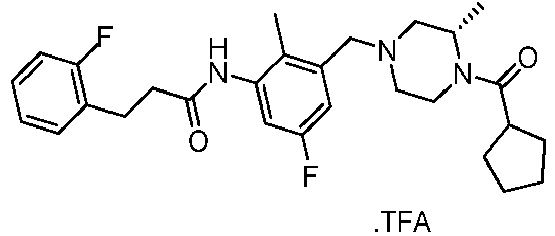 | 1H-NMR (MeOD-d4 , 400MHz): 1.27 (br. s., 2 H), 1.40 (br. s., 1 H), 1.65 (m, 3 H), 1.72 (br. s., 2 H), 1.84 (m, 3 H), 2.13 (s, 3 H), 2.77 (t, 2 H), 3.06 (m, 5 H), 3.35 (d, 1 H), 3.43 (d, 1 H), 3.48 (br. s., 1 H), 4.15 (br. s., 0.5 H), 4.33 (br. s., 2 H), 4.62 (br. s., 0.5 H), 7.09 (m, 2 H), 7.22 (m, 3 H), 7.30 (q, 1 H). δF (MeOD-d4 , 376MHz): -77.1, -117.3, -120.5. MS (ES): C28H35F2N3O2 requires 483; found 484(M+H+). |
| E106 |  | 1H-NMR (MeOD-d4 , 400MHz): 1.30 (m, 4 H), 1.61 (d, 3 H), 1.70 (br. s., 3 H), 1.80 (br. s., 3 H), 2.07 (m, 1 H), 2.20 (m, 1 H), 2.30 (s, 3 H), 2.67 (s, 3 H), 2.75 (m, 1 H), 2.86 (m, 1 H), 3.01 (m, 2 H), 3.38 (t, 1 H), 3.51 (d, 2 H), 3.84 (m, 0.5 H), 4.32 (m, 1 H), 4.67 (m, 0.5 H), 7.10 (m, 2 H), 7.67 (t, 1 H), 8.21 (m, 2 H), 8.58 (s, 1 H). δF (MeOD-d4 , 376MHz): - 115.9. MS (ES): C28H34FN3O3 requires 479; found 480(M+H+). |
| E107 |  | 1H-NMR (MeOD-d4 , 400MHz): 1.23 (d, 2 H), 1.29 (br. s., 1 H), 1.35 (d, 2 H), 1.61 (m, 3 H), 1.70 (br. s., 4 H), 1.80 (br. s., 3 H), 1.91 (m, 1 H), 2.03 (m, 1 H), 2.18 (m, 1 H), 2.28 (s, 4 H), 2.73 (m, 1 H), 2.84 (d, 1 H), 3.00 (m, 2 H), 3.40 (m, 4 H), 3.49 (br. s., 3 H), 3.82 (d, 0.5 H), 4.33 (m, 1 H), 4.54 (s, 3 H), 4.66 (br. s., 0.5 H), 7.09 (m, 3 H), 7.50 (t, 1 H), 7.57 (d, 1 H), 7.90 (d, 1 H), 7.95 (s, 1 H). δF (MeOD-d4 , 376MHz): -119.3. MS (ES): C28H36FN3O3 requires 481; found 482(M+H+). |
| E108 | 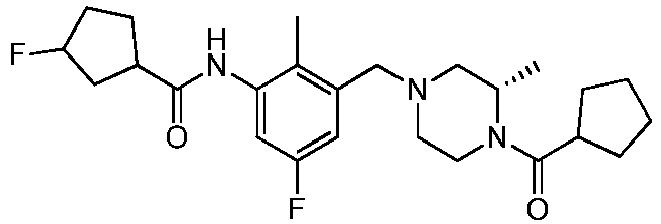 | δH (MeOD-d4 , 400MHz): 1.3 (m, 3H), 1.5-2 (m, 8H), 2.1 (m, 3H), 2.5 (s, 3H), 2.65 (m, 1H), 2.8-3.1 (m, 4H), 3.3 (s, 3H), 3.5-4.1 (m, 3H), 4.5 (m, 1H), 4.6 (m, 2H), 5.1 (m,1H), 7.1 (m, 2H), δF (MeOD-d4 , 376MHz): -121, - 75.9- -74. MS (ES): C25H35F2N3O2 requires 447; found 448 (M+H+). |
| Example | Structure | Characterization |
| E110 |  | 1H NMR (400 MHz, MeOD-d4 ) δ 1.20 - 1.52 (m, 4H), 1.53 - 2.00 (m, 9H), 2.32 (s, 3H), 2.80 - 3.26 (m, 4H), 3.35 - 3.61 (m, 3H), 4.11 - 4.24 (m, 0.5H), 4.24 - 4.49 (m, 2H), 4.53 - 4.70 (m, 1H), 7.23 - 7.35 (m, 4H), 8.00 - 8.10 (m, 2H). 19F NMR (376 MHz, MeOD-d4 ) δ -77.2, - 109.4, -117.2. MS (ESI) C26H31F2N3O2 requires: 455, found 456 (M+H+). |
| E111 |  | 1H NMR (400 MHz, MeOD-d4 ) δ 1.16 - 1.42 (m, 4H), 1.52 - 1.88 (m, 13H), 1.86 - 2.27 (m, 3H), 2.28 (s, 4H), 2.67 - 3.10 (m, 5H), 3.32 - 3.44 (m, 1H), 3.43 - 3.58 (m, 3H), 3.84 (d, 1H), 4.21 - 4.39 (m, 1H), 4.67 (s, 1H), 7.06 (t, 3H), 7.33 (d, 1H), 7.54 (q, 2H), 7.70 (d, 1H), 7.81 (d, 1H). 19F NMR (376 MHz, MeOD-d4 ) δ - 76.9, -114.4, -119.6. MS (ESI) C26H31F2N3O2 requires: 455, found 456 (M+H+). |
| E112 |  | 1H NMR (400 MHz, MeOD-d4 ) δ 1.22 - 1.52 (m, 3H), 1.56 - 2.00 (m, 8H), 2.32 (s, 3H), 2.83 - 3.26 (m, 3H), 3.34 - 3.63 (m, 3H), 3.88 (s, 3H), 4.07 - 4.26 (m, 0.5H), 4.36 (s, 2H), 4.62 (brs, 1H), 7.18 (dd, 1H), 7.26 - 7.36 (m, 2H), 7.45 (t, 1H), 7.50 - 7.59 (m, 2H). 19F NMR (376 MHz, MeOD-d4 ) δ -74.9, -76.7, -78.6, - 118.8. MS (ESI) C27H34FN3O3 requires: 467, found 468 (M+H+). |
| E113 | 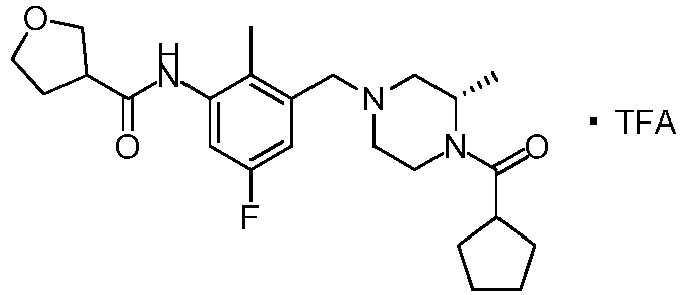 | 1H NMR (400 MHz, MeOD-d4 ) δ 1.18 - 1.42 (m, 4H), 1.55 - 2.11 (m, 8H), 2.11 - 2.28 (m, 5H), 2.67 - 2.90 (m, 2H), 2.90 - 3.08 (m, 2H), 3.22 - 3.31 (m, 3H), 3.35 - 3.57 (m, 2H), 3.79 - 3.89 (m, 1H), 3.89 - 3.98 (m, 2H), 4.05 (t, 1H), 4.23 - 4.38 (m, 1H), 4.66 (brs, 0.5H), 7.00 (d, 1H), 7.11 (dd, 1H). 19F NMR (376 MHz, MeOD-d4 ) δ -76.9, -119.5. MS (ESI) C24H34FN3O3 requires: 431, found 432 (M+H+). |
| E114 |  | 1H NMR (400 MHz, MeOD-d4 ) δ 1.20 - 1.49 (m, 3H), 1.55 - 1.99 (m, 8H), 2.32 (s, 3H), 2.68 - 3.20 (m, 4H), 3.37 - 3.60 (m, 2H), 4.05 - 4.44 (m, 3H), 4.58 (brs, 1H), 7.29 (d, 2H), 7.68 (t, 1H), 7.82 (d, 1H), 7.87 (d, 1H). 19F NMR (376 MHz, MeOD-d4 ) δ -73.7, -75.6, -77.2, -116.3, - 117.3. MS (ESI) C26H30ClF2N3O2 requires: 489, found 490 (M+H+). |
| E115 |  | 1H NMR (400 MHz, MeOD-d4 ) δ 1.28 (dd, 3H), 1.52 - 2.19 (m, 13H), 2.22 (s, 3H), 2.66 - 3.09 (m, 4H), 3.33 - 3.55 (m, 4H), 3.63 (t, 1H), 3.86 (dd, 2H), 4.04 (dd, 1H), 4.29 (s, 1H), 4.65 (s, 1H), 6.97 (d, 1H), 7.07 (d, 1H). 19F NMR (376 MHz, MeOD-d4 ) δ -73.8, -75.6, -77.0, -119.6. MS (ESI) C25H36FN3O3 requires: 445, found 446 (M+H+). |
| E116 |  | 1H NMR (400 MHz, MeOD-d4 ) δ 1.16 - 1.45 (m, 3H), 1.53 - 2.19 (m, 10H), 2.17 - 2.36 (m, 6H), 2.64 - 3.15 (m, 4H), 3.42 - 3.62 (m, 3H), 3.79 - 4.16 (m, 5H), 4.23 - 4.39 (m, 1H), 4.67 (brs, 0.5H), 6.97 (d, 1H), 7.08 (d, 1H). 19F NMR (376 MHz, MeOD-d4 ) δ -119.6. MS (ESI) C24H34FN3O3 requires: 431, found 432 (M+H+). |
| E117 |  | 1H NMR (400 MHz, MeOD-d4 ) δ 1.13 - 1.41 (m, 3H), 1.51 - 1.93 (m, 11H), 1.96 - 2.19 (m, 2H), 2.22 (s, 3H), 2.66 - 3.08 (m, 5H), 3.35 - 3.59 (m, 5H), 3.84 (d, 0.5H), 4.02 (d, 2H), 4.18 - 4.38 (m, 1H), 4.66 (brs, 0.5H), 6.98 (d, 1H), 7.05 (d, 1H). 19F NMR (376 MHz, MeOD-d4 ) δ - 119.6. MS (ESI) C25H36FN3O3 requires: 445, found 446 (M+H+). |
| E118 |  | 1H NMR (400 MHz, MeOD-d4 ) δ 1.16 - 1.48 (m, 3H), 1.51 - 1.94 (m, 8H), 1.94 - 2.28 (m, 2H), 2.32 (s, 3H), 2.50 (s, 3H), 2.68 - 3.11 (m, 4H), 3.35 - 3.61 (m, 2H), 3.84 (d, 0.5H), 4.23 - 4.40 (m, 1H), 4.56 - 4.72 (m, 1H), 7.06 (d, 1H), 7.17 (d, 1H), 7.31 (d, 2H), 7.39 (t, 1H), 7.55 (d, 1H). 19F NMR (376 MHz, MeOD-d4 ) δ -120.9. MS (ESI) C27H34FN3O2 requires: 451, found 452 (M+H+). |
| E119 |  | 1H NMR (400 MHz, MeOD-d4 ) δ 1.16 - 1.43 (m, 3H), 1.54 - 1.94 (m, 8H), 1.94 - 2.25 (m, 2H), 2.28 (s, 3H), 2.67 - 3.09 (m, 4H), 3.33 - 3.57 (m, 3H), 3.84 (d, 1H), 4.24 - 4.39 (m, 1H), 4.57 - 4.73 (m, 2H), 7.08 (t, 2H), 7.54 (d, 2H), 7.96 (d, 2H). 19F NMR (376 MHz, MeOD-d4 ) δ - 120.9. MS (ESI) C26H31ClFN3O2 requires: 471, found 472 (M+H+). |
| E120 |  | 1H NMR (400 MHz, MeOD-d4 ) δ 1.16 - 1.41 (m, 3H), 1.52 - 1.94 (m, 8H), 1.94 - 2.27 (m, 2H), 2.34 (s, 3H), 2.66 - 3.11 (m, 4H), 3.33 - 3.59 (m, 3H), 3.84 (d, 0.5H), 4.23 - 4.38 (m, 1H), 4.60 (s, 1H), 4.67 (brs, 0.5H), 7.07 (d, 1H), 7.20 (dd, 1H), 7.41 - 7.57 (m, 3H), 7.63 (d, 1H). 19F NMR (376 MHz, MeOD-d4 ) δ -119.3. MS (ESI) C26H31ClFN3O2 requires: 471, found 472 (M+H+). |
| E121 |  | 1H NMR (400 MHz, MeOD-d4 ) δ 1.20 - 1.41 (m, 3H), 1.54 - 1.94 (m, 8H), 1.94 - 2.26 (m, 2H), 2.28 (s, 3H), 2.68 - 3.10 (m, 4H), 3.35 - 3.56 (m, 3H), 3.80 - 3.86 (m, 0.5H), 3.88 (s, 3H), 4.24 - 4.38 (m, 1H), 4.62 (s, 1H), 4.67 (brs, 0.5H), 7.01 - 7.13 (m, 4H), 7.95 (d, 2H). 19F NMR (376 MHz, MeOD-d4 ) δ -119.6. MS (ESI) C27H34FN3O3 requires: 467, found 468 (M+H+). |
| E122 |  | 1H NMR (400 MHz, MeOD-d4 ) δ 1.15 - 1.43 (m, 3H), 1.55 - 1.94 (m, 8H), 1.94 - 2.26 (m, 2H), 2.28 (s, 3H), 2.36 (s, 3H), 2.69 - 2.82 (m, 1H), 2.85 (d, 1H), 2.91 - 3.10 (m, 1.5H), 3.33 - 3.45 (m, 0.5H), 3.45 - 3.59 (m, 2H), 3.84 (d, 0.5H), 4.23 - 4.37 (m, 1H), 4.49 (s, 1H), 4.67 (brs, 0.5H), 7.07 (t, 2H), 7.17 (t, 1H), 7.80 - 7.86 (m, 1H), 7.89 (d, 1H). 19F NMR (376 MHz, MeOD-d4 ) δ -114.2, -119.5. MS (ESI) C27H33F2N3O2 requires: 469, found 470 (M+H+). |
| E123 |  | 1H NMR (400 MHz, MeOD-d4 ) δ 1.19 - 1.46 (m, 3H), 1.54 - 1.98 (m, 8H), 2.31 (s, 3H), 2.77 (s, 3H), 2.81 - 3.15 (m, 4H), 3.48 (brs, 1H), 4.07 - 4.36 (m, 3H), 4.58 (brs, 1H), 7.21 - 7.32 (m, 2H), 8.32 (s, 1H). 19F NMR (376 MHz, MeOD-d4 ) δ - 73.9, -75.8, -77.3, -117.2. MS (ESI) C24H31FN4O2S requires: 458, found 459 (M+H+). |
| E124 |  | 1H NMR (400 MHz, MeOD-d4 ) δ 1.16 - 1.51 (m, 3H), 1.51-2.00 (m, 8H), 2.32 (s, 3H), 2.43 - 2.94 (m, 2H), 2.98 - 3.29 (m, 3.5H), 3.48 (brs, 1H), 4.02 (brs, 2.5H), 4.49 (brs, 1H), 6.88 (t, 1H), 7.16 - 7.32 (m, 2H), 7.64 - 7.86 (m, 2H), 8.09 - 8.25 (m, 2H). 19F NMR (376 MHz, MeOD-d4 ) δ -77.0, -112.6, -118.3. MS (ESI) C27H32F3N3O2 requires: 487, found 488 (M+H+). |
| Example | Structure | Characterization |
| E128 |  | 1H-NMR (MeOD-d 4, 400MHz): 1.17 (d, 2 H), 1.29 (d, 1 H), 1.86 (m, 9 H), 2.04 (d, 1 H), 2.23 (m, 1 H), 2.37 (s, 3 H), 2.61 (s, 3 H), 2.82 (m, 3 H), 2.99 (m, 1 H), 3.55 (m, 2 H), 3.81 (d, 0.5 H), 4.27 (br. s., 1 H), 4.65 (br. s., 0.5 H), 6.93 (t, 1 H), 7.17 (dd, 1 H), 7.41 (d, 1 H), 8.28 (dd, 1 H), 9.01 (d, 1 H). δF (MeOD-d4 , 376MHz): - 78.7, -115.1. MS (ES): C26H33FN4O2 requires 452; found 453(M+H+). |
| E129 | 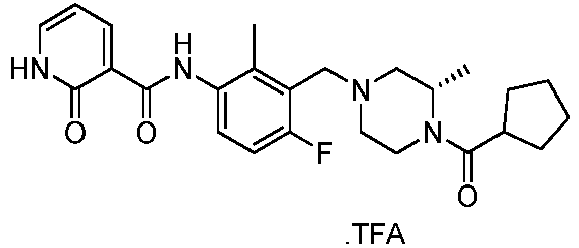 | 1H-NMR (MeOD-d4 , 400MHz): 1.17 (d, 2 H), 1.29 (d, 1 H), 1.77 (m, 11 H), 2.21 (m, 1 H), 2.51 (s, 3 H), 2.76 (m, 3 H), 2.99 (br. s., 1 H), 3.53 (m, 2 H), 3.81 (d, 0.5 H), 4.28 (br. s., 1 H), 4.65 (br. s., 0.5 H), 6.51 (dd, 1 H), 6.93 (t, 1 H), 8.00 (m, 2 H), 8.27 (d, 1 H). |
| δF (MeOD-d4 , 376MHz): -77.1, -115.9. MS (ES): C25H31FN4O3 requires 454; found 455(M+H+). | ||
| E130 |  | 1H-NMR (MeOD-d4 , 400MHz): 1.29 (br. s., 2 H), 1.40 (m, 1 H), 1.65 (m, 5 H), 1.89 (m, 4 H), 2.36 (s, 3 H), 3.05 (m, 2 H), 3.13 (m, 1 H), 3.36 (br. s., 1 H), 3.46 (m, 2 H), 4.01 (s, 3 H), 4.18 (br. s., 1 H), 4.35 (m, 2 H), 4.62 (br. s., 1 H), 6.83 (d, 1 H), 7.24 (m, 1 H), 7.61 (dd, 1 H), 7.72 (m, 1 H). δF (MeOD-d4 , 376MHz): -77.1, - 114.6. MS (ES): C24H32FN5O2 requires 441; found 442(M+H+). |
| E131 |  | 1H-NMR (MeOD-d4 , 400MHz): 1.29 (br. s., 2 H), 1.42 (br. s., 1 H), 1.65 (br. s., 5 H), 1.84 (br. s., 4 H), 2.33 (s, 3 H), 3.04 (d, 3 H), 3.38 (br. s., 4 H), 4.17 (br. s., 0.5 H), 4.40 (br. s., 2 H), 4.63 (br. s., 0.5 H), 7.33 (m, 2 H), 8.61 (s, 1 H), 9.24 (s, 1 H). δF (MeOD-d4 , 376MHz): -78.8, -118.5. MS (ES): C23H29FN4O2S requires 444; found 445 (M+H+). |
| E132 |  | 1H-NMR (MeOD-d4 , 400MHz): 1.24 (d, 2 H), 1.36 (d, 1 H), 1.70 (br. s., 8 H), 2.04 (m, 1 H), 2.14 (m, 1 H), 2.23 (s, 3 H), 2.48 (s, 3 H), 2.76 (d, 1 H), 2.86 (br. s., 1 H), 3.01 (m, 2 H), 3.46 (m, 3 H), 3.82 (br. s., 0.5 H), 4.30 (br. s., 1 H), 4.66 (br. s., 0.5 H), 6.83 (br. s., 2 H), 8.13 (s, 1 H). δF (MeOD-d4 , 376MHz): -77.2, -116.7. MS (ES): C24H31FN4O3 requires 442; found 443 (M+H+). |
| E133 |  | 1H-NMR (MeOD-d4 , 400MHz): 1.40 (m, 2 H), 1.52 (m, 1 H), 1.87 (m, 9 H), 2.18 (m, 1 H), 2.37 (m, 1 H), 2.90 (m, 1 H), 3.00 (d, 1 H), 3.16 (m, 2 H), 3.50 (m, 1 H), 3.65 (d, 2 H), 3.99 (d, 0.5 H), 4.48 (m, 1 H), 4.85 (m, 0.5 H), 4.95 (s, 2 H), 7.12 (d, 1 H), 7.83 (d, 1 H), 8.56 (br. s., 1 H), 9.25 (br. s., 1 H). |
| δF (MeOD-d4 , 376MHz): -120.5. MS (ES): C23H29FN4O2S requires 444; found 445(M+H+). | ||
| E134 |  | 1H-NMR (MeOD-d4 , 400MHz): 1.23 (d, 2 H), 1.36 (d, 1 H), 1.62 (d, 3 H), 1.70 (m, 3 H), 1.79 (m, 3 H), 2.04 (d, 1 H), 2.16 (m, 1 H), 2.31 (s, 3 H), 2.73 (d, 1 H), 2.85 (d, 1 H), 3.03 (m, 1 H), 3.37 (br. s., 1 H), 3.48 (m, 2 H), 3.82 (br. s., 0.5 H), 4.30 (br. s., 1 H), 4.67 (br. s., 0.5 H), 6.98 (d, 1 H), 7.37 (br. s., 1 H), 8.29 (s, 1 H), 8.53 (s, 1 H). δF (MeOD-d4 , 376MHz): -77.1, -116.6. MS (ES): C23H29FN4O3 requires 428; found 429(M+H+). |
| E135 |  | 1H-NMR (MeOD-d4 400MHz): 1.20 (d, 2 H), 1.33 (d, 1 H), 1.69 (m, 6 H), 1.80 (d, 3 H), 2.04 (m, 1 H), 2.66 (br. s., 1 H), 2.81 (d, 1 H), 2.97 (t, 3 H), 3.43 (s, 2 H), 3.81 (br. s., 0.5 H), 4.28 (br. s., 1 H), 4.53 (m, 2 H), 4.65 (m, 0.5 H), 6.28 (s, 1 H), 6.99 (d, 1 H), 6.94 (d, 1 H), 7.51 (s, 1 H), 7.64 (s, 1 H). δF (MeOD-d4 , 376MHz): - 78.9, -118.5. MS (ES): C25H34FN5O2 requires 455; found 456(M+H+). |
| E136 |  | 1H-NMR (MeOD-d4 , 400MHz): 1.25 (m, 2 H), 1.38 (m, 1 H), 1.70 (br. s., 8 H), 2.12 (br. s., 1 H), 2.24 (br. s., 1 H), 2.79 (br. s., 1 H), 2.91 (br. s., 1 H), 3.03 (br. s., 2 H), 3.63 (m, 2 H), 3.86 (br. s., 0.5 H), 4.31 (br. s., 1 H), 4.67 (br. s., 0.5 H), 6.78 (m, 1 H), 7.30 (m, 2 H), 7.61 (m, 1 H), 8.22 (m, 1 H). δF (MeOD-d4 , 376MHz): - 77.2. MS (ES): C22H28ClN5O2 requires 429; found 430(M+H+). |
| E137 |  | HNMR (DMSO-d6, 400MHz): 1.20-1.97 (11H, m), 2.11-3.28 (7H, m), 3.66 (2H, s), 3.77 (2H, s), 4.19-4.22 (1H, m), 7.29-7.60 (7H, m), 9.74 (1H, s). MS (ES): C26H31Cl2N4O3 requires 487; |
| found 488(M+H+). |
| Example | Structure | Characterization |
| E141 |
 |
1H-NMR (MeOD-d4 , 400MHz): 1.26 (m, 2 H), 1.36 (d, 1 H), 2.11 (d, 1 H), 2.20 (d, 1 H), 2.28 (m, 4 H), 2.50 (m, 2 H), 2.58 (br. s., 1 H), 2.63 (m, 4 H), 2.73 (m, 2 H), 2.86 (d, 1 H), 2.99 (br. s., 1 H), 3.41 (m, 1 H), 3.52 (m, 2 H), 3.70 (d, 1 H), 4.15 (br. s., 0.5 H), 4.30 (br. s., 0.5 H), 4.65 (br. s., 0.5 H), 7.12 (d, 1 H), 7.08 |
| (d, 1H), 7.47 (α, 1 H), 8.27 (d, 1 H), 9.00 (s, 1 H). δF (MeOD-d4 , 376MHz): -68.1, -119.4. MS (ES): C24H28F4N4O2 requires 480; found 481(M+H+). | ||
| E142 |
 |
1H-NMR (MeOD-d4 , 400MHz): 1.34 (m, 6 H), 1.50 (d, 1H), 1.72 (d, 2 H), 1.79 (br. s., 2 H), 2.33 (m, 3 H), 2.62 (m, 1 H), 2.75 (s, 3 H), 3.07 (m, 2 H), 3.39 (d, 1 H), 3.47 (d, 2 H), 4.13 (br. s., 0.5 H), 4.40 (br. s., 2 H), 4.60 (br. s., 0.5 H), 7.35 (d, 2 H), 7.74 (d, 1 H), 8.57 (d, 1 H), 9.12 (s, 1 H). δF (MeOD-d4 , 376MHz): - 77.2, -116.9. MS (ES): C27H35FN4O2 requires 466; found 467(M+H+). |
| E143 |
 |
1H-NMR (MeOD-d4 , 400MHz): 1.06 (s, 9 H), 1.32 (br. s., 3 H), 2.25 (d, 1 H), 2.34 (m, 3 H), 2.45 (d, 1 H) 2.77 (s, 3 H), 3.20 (br. s., 2 H), 3.41 (d, 1 H), 3.49 (d, 1 H), 4.21 (br. s., 0.5 H), 4.43 (br. s., 2 H), 4.61 (br. s., 0.5 H), 7.36 (d, 2 H), 7.79 (d, 1 H), 8.63 (d, 1 H), 9.13 (m, 1 H). δF (MeOD-d4 , 376MHz): -77.2, - 116.9. MS (ES): C26H35FN4O2 requires 454; found 455(M+H+). |
| E144 |
 |
1H-NMR (MeOD-d4 , 400MHz): 1.33 (br. s., 3 H), 2.34 (s, 3 H), 2.80 (m, 3 H), 3.17 (br. s., 2 H), 3.42 (m, 2 H), 3.55 (br. s., 3 H), 3.98 (br. s., 0.5 H), 4.37 (br. s., 2 H), 4.61 (br. s., 0.5 H), 7.34 (dd, 2 H), 7.83 (d, 1 H), 8.68 (d, 1 H), 9.15 (s, 1 H). δF (MeOD-d4 , 376MHz): - 64.2, -77.2, -117.0. MS (ES): C23H26F4N4O2 requires 466; found 467(M+H+). |
| E145 |
 |
1H-NMR (MeOD-d4 , 400MHz): 1.22 (m, 2 H), 1.31 (m, 2 H), 1.82 (d, 2 H), 1.90 (m, 2 H), 2.01 (d, 1 H), 2.08 (br. s., 2 H), 2.21 (m, 5 H), 2.28 (br. s., 3 H), 2.63 (br. s., 3 H), 2.72 (d, 1 H), 2.83 (br. s., 1 H), 3.18 (m, 1 H), 3.51 (m, 2.5 H), 4.12 (m, 1 H), 4.61 (br. s., 0.5 H), 7.11 (d, 1 H), 7.07 (d, 1 H), 7.46 (d, 1 H), 8.26 (d, 1 H), 9.00 (br. s., 1 H). δF (MeoD-d4 , 376MHz): -119.4. MS (ES): C28H35FN4O2 requires 478; found 479(M+H+). |
| E146 |
 |
δH (MeOD-d4 , 400MHz): 0.93-0.97 (m, 3H), 1.21-1.23 (m, 2H), 1.32-1.34 (m, 1H), 1.57-1.64 (m, 2H), 1.98-2.06 (m, 1H), 2.09-2.18 (m, 1H), 2.23-2.29 (m, 3H), 2.31-2.35 (m, 1H), 2.38-2.48 (m, 1H), 2.617 (s, 3H), 2.70-2.75 (m, 1H), 2.82-2.85 (m, 1H), 2.91-2.99 (m, 0.5H), 3.36-3.41 (m, 0.5H), 3.49-3.50 (m, 2H), 3.69-3.74 (m, 0.5H), 4.10-4.18 (s, 0.5H), 4.27-4.35 (m, 0.5H), 4.61-4.69 (s, 0.5H), 7.04-7.11 (m, 2H), 7.45 (d, 1H), 8.24-8.26 (m, 1H), |
| 8.98 (d, 1H). δF (MeOD-d4 , 376MHz): - 120.223, MS (ES): C24H31FN4O2requires 426; found 427 (M+H+). | ||
| E147 |
 |
δH (MeOD-d4 , 400MHz): 0.82-0.90 (m, 3H), 1.00-1.10 (m, 3H), 1.21-1.23 (m, 2H), 1.34-1.41 (m, 2H), 1.63-1.66 (m, 1H), 2.04-2.08 (m, 1H), 2.17-2.18 (m, 1H), 2.27 (s, 3H), 2.61 (s, 3H), 2.70-2.75 (m, 2H), 2.84-2.89 (m, 1H), 2.93-2.97 (m, 0.5H), 3.34-3.49 (m, 0.5H), 3.49-3.50 (m, 2H), 3.81-3.88 (m, 0.5H), 4.21-4.29 (s, 0.5H), 4.34-4.41 (m, 0.5H), 4.67-4.76 (s, 0.5H), 7.05-7.11 (m, 2H), 7.45 (d, 1H), 8.24-8.26 (m, 1H), 8.98 (d, 1H). δF (MeOD-d4 , 376MHz): -120.208, MS (ES): C25H33FN4O2 requires 440; found 441 (M+H+) |
| E148 |
 |
δH (MeOD-d4 , 400MHz): 0.80-0.85 (m, 3H), 0.85-0.92 (m, 3H), 1.23-1.25 (m, 2H), 1.34-1.36 (m, 1H), 1.43-1.60 (m, 4H), 1.96-2.11 (m, 1H), 2.15-2.23 (m, 1H), 2.27 (s, 3H), 2.65 (s, 3H), 2.66-2.72 (m, 1H), 2.72-2.76 (m, 1H), 2.85-2.88 (m, 1H), 2.93-3.11 (m, 0.5H), 3.34-3.49 (m, 0.5H), 3.49-3.50 (m, 2H), 3.91-3.98 (m, 0.5H), 4.42-4.47 (m, 1H), 4.75-4.83 (s, 0.5H), 7.05-7.11 (m, 2H), 7.45 (d, 1H), 8.24-8.27 (m, 1H), 8.98 (d, 1H). δF (MeOD-d4 , 376MHz): -119.888, MS (ES): C26H35FN4O2 requires 454; found 455 (M+H+). |
| E149 |
 |
δH (MeOD-d4 , 400MHz): 1.20-1.31 (m, 3H), 1.80-1.82 (m, 1H), 1.95-2.02 (m, 2H), 2.10-2.19 (m, 4H), 2.20-2.21 (m, 0.5H), 2.23-2.29 (m, 3H), 2.30-2.35 (m, 0.5H), 2.618 (s, 3H), 2.69-2.72 (m, 1H), 2.78-2.81 (m, 1H), 2.91-2.97 (m, 0.5H), 3.44-3.47 (m, 1H), 3.47-3.48 (m, 0.5H), 3.48-3.52 (m, 2H), 3.52-3.55 (m, 0.5H), 3.98-4.05(m, 0.5H), 4.21-4.29 (m, 0.5H), 4.57-4.68 (m, 0.5H),7.04-7.11 (m, 2H), 7.45 (d, 1H), 8.24-8.26 (m, 1H), 8.98 (d, 1H). δF (MeOD-d4 , 376MHz): -119.893 MS (ES): C25H31FN4O2 requires 438; found 439 (M+H+). |
| E150 |
 |
δH (MeOD-d4 , 400MHz): 1.20-1.30 (m, 13H), 2.03-2.06 (m, 1H), 2.17-2.21 (m, 1H), 2.275 (s, 3H), 2.618 (s, 3H), 2.70-2.73 (m, 1H), 2.81-2.84 (m, 1H), 3.486 (s, 2H), 4.12-4.18 (m, 1H), 4.585-4.587 (m, 1H), 7.04-7.11 (m, 2H), 7.45 (d, 1H), 8.24-8.27 (m, 1H), 8.98 (d, 1H). δF (MeOD-d4 , 376MHz): -119.904, MS (ES): C25H33FN4O2 requires 440; found 441 (M+H+). |
| E151 |
 |
δH (MeOD-d4 , 400MHz): 1.18-1.29 (m, 3H), 1.31-1.38 (m, 4H), 1.45-1.54 (m, 3H), 1.61-1.89 (m, 1H), 1.98-2.03 (m, 1H), 2.11-2.16 (m, 1H), 2.22-2.23 (m, 1H), 2.278 (s, 3H), 2.34-2.37 (m, 0.5H), 2.48-2.52 (m, 1H), 2.618 (s, 3H), 2.71-2.76 (m, 1H), 2.77-2.91 (m, 1H), 2.96-3.11 (m, 1H), 3.38-3.41 (m, 0.5H), 3.48-3.49 (m, 2H), 3.76-3.91 (m, 0.5H), 4.23-4.38 (m, 1H), 4.58-4.72 (m, 0.5H), 7.05-7.11 (m, 2H), 7.45 (d, 1H), 8.24-8.26 (m, 1H), 8.982 (s, 1H). δF (MeOD-d4 , 376MHz): -119.886, MS (ES): C28H35FN4O2requires 478; found 479 (M+H+) |
| E152 |
 |
δH (MeOD-d4 , 400MHz): 1.22-1.38 (m, 3H), 2.01-2.11 (m, 1H), 2.18-2.21 (m, 1H), 2.27 (s, 3H), 2.32-2.38 (m, 1H), 2.41-2.59 (m, 3H), 2.62 (s, 3H), 2.71-2.74 (m, 1H), 2.80-2.86 (m, 2H), 2.89-2.98 (m, 0.5H), 3.41-3.47 (m, 0.5H), 3.50-3.54 (m, 2H), 3.57-3.61 (m, 0.5H), 3.97-4.08 (m, 0.5H), 4.27-4.30 (m, 0.5H), 4.61-4.63 (m, 0.5H), 4.96-5.00 (m, 1H), 7.05-7.12 (m, 2H), 7.46 (d, 1H), 8.24-8.27 (m, 1H), 8.98 (s, 1H). δF (MeOD-d4 , 376MHz): -73.969, -75.848, -119.368. MS (ES): C25H30F2N4O2 requires 456; found 457 (M+H+) |
| E153 |
 |
δH (MeOD-d4 , 400MHz): 1.26-1.34 (m, 3H), 2.11-2.14 (m, 1H), 2.27-2.30 (m, 4H), 2.620 (s, 3H), 2.69-2.92 (m, 2H), 3.28-3.29 (m, 2H), 3.32-3.34 (m, 0.5H), 3.523 (s, 2H), 4.581 (s, 0.5H), 7.05-7.11 (m, 2H), 7.35-7.39 (m, 2H), 7.43-7.46 (m, 4H), 8.24-8.26 (m, 1H), 8.98 (d, 1H). δF (MeOD-d4 , 376MHz): -119.372, MS (ES): C27H29FN4O2 requires 460; found 461 (M+H+). |
| (Reference Example) | ||
| E154 |
 |
δH (MeOD-d4 , 400MHz): 1.21-1.32 (m, 3H), 1.98-2.18 (m, 4H), 2.270 (s, 3H), 2.43-2.49 (m, 2H), 2.618 (s, 3H), 2.70-2.72 (m, 1H), 2.82-2.86 (m, 2H), 2.86-2.90 (m, 0.5H), 3.211 (s, 3H), 3.48-3.58 (m, 2H), 3.59-3.62 (m, 0.5H), 3.80-3.85 (m, 1H), 4.03-4.11 (m, 0.5H), 4.25-4.32 (m, 0.5H), 4.56-4.63 (m, 1H), 7.05-7.11 (m, 2H), 7.46 (d, 1H), 8.24-8.26 (m, 1H), 8.98 (d, 1H). δF (MeOD-d4 , 376MHz): -119.425, MS (ES): C26H33FN4O3 requires 468; found 469 (M+H)+. |
| E155 |
 |
δH (MeOD-d4 , 400MHz): 1.21-1.37 (m, 3H), 1.62-1.85 (m, 1H), 1.87-2.13 (m, 4H), 2.15-2.25 (m, 2H), 2.278 (s, 3H), 2.619 (s, 3H), 2.71-2.86 (m, 2H), 2.98-3.04 (m, 0.5H), 3.42-3.48 (m, 2H), 3.49-3.50 (m, 2H), 3.81-3.87 (m, 0.5H), 4.29-4.38 (m, 1H), 4.58-4.69 (m, 1H), 5.10-5.24 (m, 1H), 7.05-7.11 (m, 2H), 7.45 (d, 1H), 8.24-8.27 (m, 1H), 8.983 (s, 1H). δF (MeOD-d4 , 376MHz): -119.396, -224.889, -224.972. MS (ES): C26H32F2N4O2 requires 470; found 471 (M+H+) |
| E156 |
 |
δH (MeOD-d4, 400MHz): 1.31-1.34 (m, 3H), 1.36-1.39 (m, 3H), 2.01-2.12 (m, 1H), 2.19-2.25 (m, 1H), 2.282 (s, 3H), 2.623 (s, 3H), 2.74-2.76 (m, 1H), 2.83-2.88 (m, 1H), 3.02-3.05 (m, 0.5H), 3.27-3.47 (m, 3H), 3.50-3.54 (m, 2H), 3.86-3.90 (m, 0.5H), 4.20-4.31 (m, 2H), 4.58-4.68 (m, 1H), 7.06-7.11 (m, 2H), 7.46 (d, 1H), 8.24-8.27 (m, 1H), 8.988 (s, 1H). δF (MeOD-d4 , 376MHz): -119.403, MS (ES): C24H31FN4O3 requires 442; found 443 (M+H+). |
| E157 |
 |
δH (MeOD-d4 , 400MHz): 1.36-1.37 (m, 3H), 2.10-2.11 (m, 0.5H), 2.12-2.14 (m, 2H), 2.25-2.26 (m, 0.5H), 2.288 (s, 3H), 2.622 (s, 3H), 2.73-2.76 (m, 1H), 2.84-2.86 (m, 1H), 3.522 (s, 2H), 3.695 (s, 3H), 4.16-4.20 (m, 1H), 4.643 (s, 1H), 6.05-6.06 (m, 1H), 6.32-6.33 (m, 1H), 6.78-6.79 (m, 1H), 7.06-7.12 (m, 2H), 7.46 (d, 1H), 8.24-8.27 (m, 1H), 8.991 (s, 1H). δF (MeOD-d4 , 376MHz): -119.399 MS (ES): C26H30FN5O2requires 463; found 464 (M+H+). |
| (Reference Example) | ||
| E158 |
 |
δH (MeOD-d4 , 400MHz): 1.45 (m, 4H), 2.15 (m, 1H), 2.29 (m, 4H), 2.62 (s, 3H), 2.75 (m, 2H), 3.55 (m, 3H), 4.56 (m, 1H), 7.11 (m, 2H), 7.44 (m, 1H), 7.8 (m, 1H), 7.95 (m, 1H), 8.25 (m, 1H), 9.05 (s, 1H). δF (MeOD-d4 , 376MHz): -119 MS (ES): C24H26FN5O2S requires 467; found 468 (M+H+). |
| (Reference Example) | ||
| E159 |
 |
δH (MeOD-d4 , 400MHz): 1.40 (m, 4H), 2.15 (m, 1H), 2.29 (m, 4H), 2.62 (s, 3H), 2.85 (m, 2H), 3.45 (m, 3H), 4.16 (m, 1H), 4.56 (m, 1H), 7.09(m,2H), 7.46 (m, 1H), 8.10 (m, 1H), 8.25 (m, 1H), 9.15 (m, 2H). δF (MeOD-d4 , 376MHz): -119 MS (ES): C24H26FN5O2S requires 467; found 468 (M+H+). |
| (Reference Example) | ||
| E160 |
 |
δH (MeOD-d4 , 400MHz): 1.40 (m, 3H), 2.15 (m, 1H), 2.29 (m, 4H), 2.62 (s, 3H), 2.75 (m, 1H), 2.90 (m, 1H), 3.50 (m, 3H), 4.30 (m, 1H), 4.65 (m, 1H), 6.50 (m, 1H), 6.98 (m, 1H), 7.10 (m, 2H), 7.47 (m, 1H), 7.65 (m, 1H), 8.25 (m, 1H), 8.98 (m, 1H).. δF (MeOD-d4 , 400MHz): -119 MS (ES): C25H27FN4O3 requires 450; found 451 (M+H+). |
| (Reference Example) | ||
| E161 |
 |
δH (MeOD-d4 , 400MHz): 1.35-1.50 (m, 3H), 2.11-2.18 (m, 1H), 2.293 (s, 3H), 2.31-2.32 (m, 1H), 2.623 (s, 3H), 2.77-2.80 (m, 1H), 2.89-2.92 (m, 1H), 3.45-3.47 (m, 1H), 3.537 (s, 2H), 4.204 (s, 1H), 4.56-4.61 (m, 1H), 7.06-7.12 (m, 2H), 7.46 (d, 1H), 7.626 (s, 1H), 8.24-8.32 (m, 2H), 8.992 (s, 1H). δF (MeOD-d4 , 376MHz): -119.368, MS (ES): C24H26FN5O3 requires 451; found 452 (M+H+). |
| (Reference Example) | ||
| E162 |
 |
δH (MeOD-d4 , 400MHz): 1.35-1.36 (m, 3H), 2.05-2.12 (m, 1H), 2.22-2.28 (m, 4H), 2.621 (s, 3H), 2.71-2.85 (m, 2H), 3.35-3.38 (m, 1H), 3.509 (s, 2H), 3.667 (s, 3H), 4.24-4.27 (m, 1H), 4.675 (s, 1H), 6.25-6.26 (m, 1H), 6.65-6.66 (m, 1H), 7.02-7.11 (m, 3H), 7.45 (d, 1H), 8.24-8.27 (m, 1H), 8.988 (s, 1H). δF (MeOD-d4 , 376MHz,: -120.211, MS (ES): C26H30FN5O2 requires 463.2; found 464.2 (M+H+). |
| (Reference Example) |
| Example | Structure | Characterization |
| E176 |  | 1H NMR (400 MHz, MeOD-d4 ) δ 1.16 - 1.44 (m, 3H), 1.65 - 2.41 (m, 11H), 2.70 - 3.16 (m, 3.5H), 3.35 - 3.46 (m, 0.5H), 3.53 (s, 2H), 3.80 (d, 0.5H), 4.16 - 4.40 (m, 1H), 5.01 - 5.07 (m, 0.5 H), 5.14-5.22 (m, 0.5H), 7.04 - 7.16 (m, 2H), 7.72 (t, 1H), 7.95 (d, 1H), 8.26 (d, 1H), 8.32 (s, 1H). 19F NMR (376 MHz, MeOD-d4 ) δ - 76.9, -119.2, -170.0 - -170.4 (m). MS (ESI) C27H30F2N4O2 requires: 480, found 481 (M+H+). |
| E177 |  | 1H NMR (400 MHz, MeOD-d4 ) δ 1.36 (d, 3H), 2.07 - 2.20 (m, 1H), 2.29 (s, 3H), 2.31 (s, 1H), 2.78 (d, 2H), 3.53 (s, 2H), 4.50 (brs, 1H), 7.09 (t, 2H), 7.32-7.53 (m, 5H), 7.72 (t, 1H), 7.95 (d, 1H), 8.25 (d, 1H), 8.32 (s, 1H). 19F NMR (376 MHz, MeOD-d4 ) δ -119.3. MS (ESI) C28H27FN4O2 requires: 470, found 471 (M+H+). |
| (Reference Example) | ||
| E178 |  | 1H NMR (400 MHz, MeOD-d4 ) δ 1.21-1.49 (m, 3H), 1.65 - 1.99 (m, 4H), 2.06 - 2.22 (m, 2H), 2.34 (s, 3H), 2.45 - 2.75 (m, 3H), 2.86 (s, 1H), 2.99 (s, 1H), 3.03 - 3.29 (m, 2H), 3.37 - 3.68 (m, 2.5H), 4.12 (brs, 0.5H), 4.40 - 4.53 (m, 2H), 7.35 (d, 2H), 7.75 (t, 1H), 7.98 (d, 1H), 8.27 (d, 1H), 8.33 (s, 1H). 19F NMR (376 MHz, MeOD-d4 ) δ -73.3, -75.2, -77.4, -116.8. MS (ESI) C27H31FN4O2 requires: 462, found 463 (M+H+). |
| Example | Structure | Characterization |
| E181 |
 |
1H NMR (400 MHz, MeOD-d4 ) δ 1.39 (s, 3H), 2.09 - 2.28 (m, 1H), 2.28 - 2.42 (m, 1H), 2.56 - 3.06 (m, 2H), 3.36 - 3.58 (m, 1H), 3.67 (s, 2H), 3.79 - 4.70 (m, 2H), 7.31 - 7.43 (m, 3H), 7.43 - 7.54 (m, 4H), 7.63 (d, 1H), 7.72 (t, 1H), 7.96 (d, 1H), 8.25 (d, 1H), 8.32 (s, 1H). MS (ESI) C27H25ClN4O2 requires: 472, found 473 (M+H+). |
| (Reference Example) | ||
| E182 |
 |
1H NMR (400 MHz, MeOD-d4 ) δ 1.39 (d, 3H), 2.12 - 2.27 (m, 1H), 2.37 (d, 1H), 2.83 (d, 2H), 3.35 - 3.60 (m, 1H), 3.61 - 3.77 (m, 2H), 3.77 - 4.72 (m, 2H), 7.12 - 7.25 (m, 3H), 7.37 (t, 1H), 7.45 - 7.53 (m, 2H), 7.64 (d, 1H), 7.73 (t, 1H), 7.97 (d, 1H), 8.26 (d, 1H), 8.33 (s, 1H). 19F NMR (376 MHz, MeOD-d4 ) δ -113.6. MS (ESI) C27H24ClFN4O2 requires: 490, found 491 (M+H+). |
| (Reference Example) | ||
| E183 |
 |
1H NMR (400 MHz, MeOD-d4 ) δ 1.13-1.41 (m, 3H), 2.58 - 3.18 (m, 7H), 3.23-3.55 (m, 3H), 3.82 (d, 1H), 4.20- 4.59 (m, 3H), 7.44 (t, 1H), 7.54 (d, 1H), 7.63-7.73 (m, 2H), 7.90 (d, 1H), 8.18 (d, 1H), 8.24 (s, 1H). 19F NMR (376 MHz, MeOD-d4 ) δ -77.0, -84.2 (dd), -98.4 (dd). MS (ESI) C25H25ClF2N4O2 requires: 486, found 487 (M+H+). |
Claims (21)
- A compound of Formula I or a pharmaceutically acceptable salt thereof
 R1 is:- C1-C6 alkyl;- methyl substituted with i) C3-C5 cycloalkyl; ii) phenoxy; or iii) a phenyl and a second substituent selected from the group consisting of: methyl, halo and methoxy;- ethyl substituted with i) phenyl, said phenyl is optionally substituted with halo or methoxy, or ii) heteroaryl;- benzyl, wherein the phenyl group of said benzyl is optionally substituted with halo, methoxy or SO2CH2CH3;- C2 alkenyl optionally substituted with one F and one phenyl;- C3-C7 cycloalkyl, said cycloalkyl is optionally substituted with one or two substituents selected from the group consisting of phenyl, methyl and F; or said cycloalkyl is optionally fused to a phenyl ring;- heterocycloalkyl optionally substituted with one or two C1-C3 alkyl;- heteroaryl optionally substituted with one to two substituents selected from the group consisting of: C1-C3 alkyl, C1-C3 alkoxy and CF3; and- phenyl substituted with one to three substituents selected from the group consisting of:i) halo;ii) CN;iii) C1-C3 alkyl optionally substituted with one to three F;iv) C1-C3 alkoxy;v) (CH2)nNRaRb;vi) C(O)CH3; andvii) CH2OCH3;R2 is halo or C1-C3 alkyl;R3 is halo or methyl;R4 is H or methyl;R5 is C1-C3 alkyl;R6 is C1-C3 alkyl;R7 is selected from the group consisting of:- C1-C7 alkyl optionally substituted with one or more substituents selected from the group consisting of halo, C3-C5 cycloalkyl and CF3;- C3-C7 cycloalkyl optionally substituted with one or two substituents selected from the group consisting of F, CH2F, CHF2, methyl and methoxy,each k is 0 or 1; each p is 0 or 1; each n is 0, 1 or 2;each Ra is H or C1-C3 alkyl; each Rb is H or C1-C3 alkyl;
 - A compound or salt according to claim 1, wherein R1 is heteroaryl substituted with C1-C3 alkyl.
- A compound or salt according to claim 1 or claim 2, wherein R1 is pyridinyl substituted with methyl.
- A compound or salt according to any of claims 1 to 3, wherein R2 is methyl.
- A compound or salt according to any of claims 1 to 4, wherein k is 1 and R3 is Cl or F.
- A compound or salt according to any of claims 1 to 5, wherein R4 is H.
- A compound or salt according to any of claims 1 to 6, wherein R5 is methyl.
- A compound or salt according to any of claims 1 to 7, wherein p is 0.
- A compound or salt according to any of claims 1 to 8, wherein R7 is C3-C6 cycloalkyl optionally substituted with one or two F or methyl.
- A compound or salt according to any of claims 1 to 9, wherein R7 is cyclobutyl substituted with methyl or two F.
- A compound or salt according to any of claims 1 to 9, wherein R7 is cyclopentyl.
- A compound or salt according to claim 1 wherein the compound is selected from:(S)-N-(3-((4-(cyclopentanecarbonyl)-3-methylpiperazin-1-yl)methyl)-5-fluoro-2-methylphenyl)-2-methylpyrimidine-5-carboxamide;(S)-N-(5-chloro-3-((4-(cyclopentanecarbonyl)-3-methylpiperazin-1-yl)methyl)-2-methylphenyl)-6-methylnicotinamide;(S)-3-cyano-N-(3-((4-(3,3-difluorocyclobutanecarbonyl)-3-methylpiperazin-1-yl)methyl)-5-fluoro-2-methylphenyl)benzamide;(S)-N-(5-chloro-3-((4-(2-cyclopropylacetyl)-3-methylpiperazin-1-yl)methyl)-2-methylphenyl)-6-methylnicotinamide;N-(5-fluoro-2-methyl-3-(((S)-3-methyl-4-((cis)-3-methylcyclobutanecarbonyl)piperazin-1-yl)methyl)phenyl)-6-methylnicotinamide;N-(5-fluoro-2-methyl-3-(((S)-3-methyl-4-((trans)-3-methylcyclobutanecarbonyl)piperazin-1-yl)methyl)phenyl)-6-methylnicotinamide;N-(5-chloro-2-methyl-3-(((S)-3-methyl-4-((trans)-3-methylcyclobutanecarbonyl)piperazin-1-yl)methyl)phenyl)-6-methylnicotinamide;N-(5-chloro-2-methyl-3-(((S)-3-methyl-4-((cis)-3-methylcyclobutanecarbonyl)piperazin-1-yl)methyl)phenyl)-6-methylnicotinamide;N-(5-chloro-2-methyl-3-(((S)-3-methyl-4-((cis)-3-methylcyclobutanecarbonyl)piperazin-1-yl)methyl)phenyl)-2-methylpyrimidine-5-carboxamide;N-(5-chloro-2-methyl-3-(((S)-3-methyl-4-((trans)-3-methylcyclobutanecarbonyl)piperazin-1-yl)methyl)phenyl)-2-methylpyrimidine-5-carboxamide; and(S)-N-(5-chloro-3-((4-(cyclopentanecarbonyl)-3-methylpiperazin-1-yl)methyl)-2-methylphenyl)-2-methylpyrimidine-5-carboxamide.
- A compound according to claim 1 which is (S)-3-cyano-N-(3-((4-(cyclopentanecarbonyl)-3-methylpiperazin-1-yl)methyl)-5-fluoro-2-methylphenyl)benzamide; or a pharmaceutically acceptable salt thereof.
- A compound according to claim 1 which is (S)-N-(5-chloro-3-((4-(cyclopentanecarbonyl)-3-methylpiperazin-1-yl)methyl)-2-methylphenyl)-6-methylnicotinamide; or a pharmaceutically acceptable salt thereof.
- (S)-N-(5-Chloro-3-((4-(cyclopentanecarbonyl)-3-methylpiperazin-1-yl)methyl)-2-methylphenyl)-6-methylnicotinamide of Formula:

- A compound according to claim 1 which is N-(5-chloro-2-methyl-3-(((S)-3-methyl-4-((cis)-3-methylcyclobutanecarbonyl)piperazin-1-yl)methyl)phenyl)-6-methylnicotinamide; or a pharmaceutically acceptable salt thereof.
- A compound according to any one of claims 1 to 16 or a pharmaceutically acceptable salt thereof for use in therapy.
- A compound according to any one of claims 1 to 16 or a pharmaceutically acceptable salt thereof for use in the treatment of psoriasis.
- (S)-N-(5-Chloro-3-((4-(cyclopentanecarbonyl)-3-methylpiperazin-1-yl)methyl)-2-methylphenyl)-6-methylnicotinamide for use in the treatment of psoriasis.
- A pharmaceutical composition which comprises the compound of Formula I according to any one of claims 1 to 16 or a pharmaceutically acceptable salt thereof and a pharmaceutically acceptable carrier or excipient.
- A pharmaceutical composition which comprises (S)-N-(5-chloro-3-((4-(cyclopentanecarbonyl)-3-methylpiperazin-1-yl)methyl)-2-methylphenyl)-6-methylnicotinamide and a pharmaceutically acceptable carrier or excipient.
Priority Applications (6)
| Application Number | Priority Date | Filing Date | Title |
|---|---|---|---|
| HRP20170638TT HRP20170638T1 (en) | 2012-12-06 | 2013-12-05 | Modulators of the retinoid-related orphan receptor gamma (ror-gamma) for use in the treatment of autoimmune and inflammatory diseases |
| SM20170281T SMT201700281T1 (en) | 2012-12-06 | 2013-12-05 | Modulators of the retinoid-related orphan receptor gamma (ror-gamma) for use in the treatment of autoimmune and inflammatory diseases |
| EP17157475.9A EP3219711A1 (en) | 2012-12-06 | 2013-12-05 | Modulators of the retinoid-related orphan receptor gamma (ror-gamma) for use in the treatment of autoimmune and inflammatory diseases |
| RS20170372A RS55875B1 (en) | 2012-12-06 | 2013-12-05 | ORPHAN GAMA RECEPTOR MODULES RETINOID ASSOCIATED (ROR-GAMA) FOR USE IN THE TREATMENT OF AUTO-IMMUNE AND INFLAMMATORY DISEASES |
| MEP-2017-117A ME02696B (en) | 2012-12-06 | 2013-12-05 | MODULATORS OF THE RETINOID-RELATED ORPHANIC RECEPTOR GAMMA (ROR-GAMMA) FOR USE IN THE TREATMENT OF AUTOIMMUNE AND INFLAMMATORY DISEASES |
| SI201330650A SI2928885T1 (en) | 2012-12-06 | 2013-12-05 | Modulators of the retinoid-related orphan receptor gamma (ror-gamma) for use in the treatment of autoimmune and inflammatory diseases |
Applications Claiming Priority (4)
| Application Number | Priority Date | Filing Date | Title |
|---|---|---|---|
| CN2012001636 | 2012-12-06 | ||
| CN2013000182 | 2013-02-25 | ||
| CN2013000803 | 2013-07-01 | ||
| PCT/EP2013/075594 WO2014086894A1 (en) | 2012-12-06 | 2013-12-05 | Modulators of the retinoid-related orphan receptor gamma (ror-gamma) for use in the treatment of autoimmune and inflammatory diseases |
Related Child Applications (1)
| Application Number | Title | Priority Date | Filing Date |
|---|---|---|---|
| EP17157475.9A Division EP3219711A1 (en) | 2012-12-06 | 2013-12-05 | Modulators of the retinoid-related orphan receptor gamma (ror-gamma) for use in the treatment of autoimmune and inflammatory diseases |
Publications (2)
| Publication Number | Publication Date |
|---|---|
| EP2928885A1 EP2928885A1 (en) | 2015-10-14 |
| EP2928885B1 true EP2928885B1 (en) | 2017-03-22 |
Family
ID=49709687
Family Applications (2)
| Application Number | Title | Priority Date | Filing Date |
|---|---|---|---|
| EP17157475.9A Withdrawn EP3219711A1 (en) | 2012-12-06 | 2013-12-05 | Modulators of the retinoid-related orphan receptor gamma (ror-gamma) for use in the treatment of autoimmune and inflammatory diseases |
| EP13799318.4A Active EP2928885B1 (en) | 2012-12-06 | 2013-12-05 | Modulators of the retinoid-related orphan receptor gamma (ror-gamma) for use in the treatment of autoimmune and inflammatory diseases |
Family Applications Before (1)
| Application Number | Title | Priority Date | Filing Date |
|---|---|---|---|
| EP17157475.9A Withdrawn EP3219711A1 (en) | 2012-12-06 | 2013-12-05 | Modulators of the retinoid-related orphan receptor gamma (ror-gamma) for use in the treatment of autoimmune and inflammatory diseases |
Country Status (33)
| Country | Link |
|---|---|
| US (1) | US10005731B2 (en) |
| EP (2) | EP3219711A1 (en) |
| JP (1) | JP6279605B2 (en) |
| KR (1) | KR20150092244A (en) |
| CN (1) | CN105121430B (en) |
| AR (1) | AR093818A1 (en) |
| AU (1) | AU2013354109B2 (en) |
| BR (1) | BR112015013137B1 (en) |
| CA (1) | CA2894016C (en) |
| CL (1) | CL2015001557A1 (en) |
| CR (1) | CR20150302A (en) |
| CY (1) | CY1118932T1 (en) |
| DK (1) | DK2928885T3 (en) |
| EA (1) | EA026437B1 (en) |
| ES (1) | ES2626390T3 (en) |
| HR (1) | HRP20170638T1 (en) |
| HU (1) | HUE033212T2 (en) |
| IL (1) | IL239082A0 (en) |
| LT (1) | LT2928885T (en) |
| ME (1) | ME02696B (en) |
| MX (1) | MX2015007180A (en) |
| PE (1) | PE20151144A1 (en) |
| PH (1) | PH12015501244A1 (en) |
| PL (1) | PL2928885T3 (en) |
| PT (1) | PT2928885T (en) |
| RS (1) | RS55875B1 (en) |
| SG (1) | SG11201504200TA (en) |
| SI (1) | SI2928885T1 (en) |
| SM (1) | SMT201700281T1 (en) |
| TW (1) | TW201427959A (en) |
| UY (1) | UY35174A (en) |
| WO (1) | WO2014086894A1 (en) |
| ZA (1) | ZA201503666B (en) |
Families Citing this family (25)
| Publication number | Priority date | Publication date | Assignee | Title |
|---|---|---|---|---|
| EP3027616B1 (en) | 2013-07-30 | 2018-01-10 | Boehringer Ingelheim International GmbH | Azaindole compounds as modulators of rorc |
| EP3527569B1 (en) | 2014-02-03 | 2021-08-25 | Vitae Pharmaceuticals, LLC | Dihydropyrrolopyridine inhibitors of ror-gamma for use in treating drye eye |
| BR112016027732B1 (en) * | 2014-05-28 | 2023-11-07 | Glaxosmithkline Intellectual Property Development Limited | GAMMA RECEPTOR MODULATOR COMPOUND, PHARMACEUTICAL COMPOSITION COMPRISING SAID COMPOUND, AS WELL AS USE THEREOF FOR THE TREATMENT OF INFLAMMATORY AND AUTOIMMUNE DISEASES MEDIATED BY RORY |
| KR20170012388A (en) | 2014-05-28 | 2017-02-02 | 글락소스미스클라인 인털렉츄얼 프로퍼티 디벨로프먼트 리미티드 | Novel compounds |
| US9868724B2 (en) * | 2014-05-28 | 2018-01-16 | Glaxosmithkline Intellectual Property Development Limited | Compounds |
| CN104292208A (en) * | 2014-09-09 | 2015-01-21 | 上海师范大学 | 7-phenyl-6,8-dioxaspiro[3.5]nonane-2-carboxylic acid and preparation method thereof |
| MA40759A (en) * | 2014-09-26 | 2017-08-01 | Pfizer | PYRROLOPYRIDINE-SUBSTITUTED BY METHYL AND TRIFLUOROMETHYL RORC2 MODULATORS AND THEIR METHODS OF USE |
| TWI675032B (en) | 2014-10-14 | 2019-10-21 | 美商維它藥物公司 | Dihydropyrrolopyridine inhibitors of ror-gamma |
| US9845308B2 (en) | 2014-11-05 | 2017-12-19 | Vitae Pharmaceuticals, Inc. | Isoindoline inhibitors of ROR-gamma |
| TW201625588A (en) * | 2014-11-05 | 2016-07-16 | 第一三共股份有限公司 | Cyclic amine derivative |
| US9663515B2 (en) | 2014-11-05 | 2017-05-30 | Vitae Pharmaceuticals, Inc. | Dihydropyrrolopyridine inhibitors of ROR-gamma |
| US10336748B2 (en) | 2015-01-30 | 2019-07-02 | Pfizer Inc. | Methyoxy-substituted pyrrolopyridine modulators of RORC2 and methods of use thereof |
| ES2856931T3 (en) | 2015-08-05 | 2021-09-28 | Vitae Pharmaceuticals Llc | ROR-gamma modulators |
| EP3868750A1 (en) * | 2015-11-20 | 2021-08-25 | Vitae Pharmaceuticals, LLC | Modulators of ror-gamma |
| TW202220968A (en) | 2016-01-29 | 2022-06-01 | 美商維它藥物有限責任公司 | Modulators of ror-gamma |
| US9481674B1 (en) | 2016-06-10 | 2016-11-01 | Vitae Pharmaceuticals, Inc. | Dihydropyrrolopyridine inhibitors of ROR-gamma |
| PT3484880T (en) * | 2016-07-13 | 2020-12-07 | Leo Pharma As | Heteroaromatic modulators of the retinoid-related orphan receptor gamma |
| CN109134476B (en) * | 2017-06-15 | 2021-03-19 | 复旦大学 | Bridged ring piperazine derivatives or salts thereof and their preparation methods and uses |
| CN110944974B (en) | 2017-07-18 | 2021-07-06 | 隆萨有限公司 | Method for preparing 5-fluoro-2-methyl-3-nitrobenzoic acid and its methyl ester |
| WO2019018975A1 (en) | 2017-07-24 | 2019-01-31 | Vitae Pharmaceuticals, Inc. | Inhibitors of ror gamma |
| MA49685A (en) | 2017-07-24 | 2021-04-14 | Vitae Pharmaceuticals Llc | MMR gamma INHIBITORS |
| CN108752185A (en) * | 2018-07-17 | 2018-11-06 | 成都道合尔医药技术有限公司 | A kind of synthetic method of the fluoro- cyclopentanecarboxylic acids of 1- |
| CN109438423A (en) * | 2018-09-12 | 2019-03-08 | 通化师范学院 | A kind of new method of the synthesis technology of lung cancer target compound AZD-3759 |
| CN110862319A (en) * | 2019-12-04 | 2020-03-06 | 深圳振强生物技术有限公司 | Preparation method of ozagrel impurity |
| WO2023232870A1 (en) | 2022-05-31 | 2023-12-07 | Immunic Ag | Rorg/rorgt modulators for the treatment of virus infections like covid-19 |
Family Cites Families (22)
| Publication number | Priority date | Publication date | Assignee | Title |
|---|---|---|---|---|
| US7790726B2 (en) | 2005-08-16 | 2010-09-07 | Chemocentryx, Inc. | Monocyclic and bicyclic compounds and methods of use |
| US20070208000A1 (en) * | 2005-12-15 | 2007-09-06 | Morgan Bradley P | Certain chemical entities, compositions and methods |
| US7825120B2 (en) * | 2005-12-15 | 2010-11-02 | Cytokinetics, Inc. | Certain substituted ((piperazin-1-ylmethyl)benzyl)ureas |
| EP1962852B1 (en) * | 2005-12-19 | 2017-01-25 | Cytokinetics, Inc. | Compounds, compositions and methods |
| WO2012028100A1 (en) | 2010-09-01 | 2012-03-08 | Glaxo Group Limited | Novel compounds |
| WO2012027965A1 (en) * | 2010-09-01 | 2012-03-08 | Glaxo Group Limited | Novel compounds |
| WO2012100732A1 (en) | 2011-01-24 | 2012-08-02 | Glaxo Group Limited | Retinoid-related orphan receptor gamma modulators, composition containing them and uses thereof |
| WO2012100734A1 (en) | 2011-01-24 | 2012-08-02 | Glaxo Group Limited | Compounds useful as retinoid-related orphan receptor gamma modulators |
| EP2511263A1 (en) * | 2011-04-14 | 2012-10-17 | Phenex Pharmaceuticals AG | Pyrrolo sulfonamide compounds for modulation of orphan nuclear receptor RAR-related orphan receptor-gamma (RORgamma, NR1F3) activity and for the treatment of chronic inflammatory and autoimmune diseases |
| WO2012145254A2 (en) | 2011-04-16 | 2012-10-26 | Board Of Regents, The University Of Texas System | Methods of using inhibitors of rorϒt to treat disease |
| EP2927217B1 (en) | 2011-04-28 | 2018-01-17 | Japan Tobacco Inc. | Amide compound and pharmaceutical application therefor |
| WO2012158784A2 (en) * | 2011-05-16 | 2012-11-22 | Theodore Mark Kamenecka | Modulators of the nuclear hormone receptor ror |
| HK1199839A1 (en) | 2011-09-09 | 2015-07-24 | New York University | Amido compounds as ror-gamma-tmodulators and uses thereof |
| GB201116641D0 (en) | 2011-09-27 | 2011-11-09 | Glaxo Group Ltd | Novel compounds |
| CN104379559B (en) | 2012-04-27 | 2016-11-09 | 葛兰素集团有限公司 | compound |
| GB201207406D0 (en) | 2012-04-27 | 2012-06-13 | Glaxo Group Ltd | Novel compounds |
| WO2013171729A2 (en) | 2013-01-08 | 2013-11-21 | Glenmark Pharmaceuticals S.A. | Aryl and heteroaryl amide compounds as rorgamat modulator |
| US10286000B2 (en) | 2013-10-25 | 2019-05-14 | St. Jude Children's Research Hospital, Inc. | Retinoid X receptor-gamma agonists and retinoid X receptor-alpha antagonists for treatment of cancer |
| CA2928537A1 (en) | 2013-10-25 | 2015-04-30 | Glaxosmithkline Llc | Novel compounds |
| KR20170012388A (en) | 2014-05-28 | 2017-02-02 | 글락소스미스클라인 인털렉츄얼 프로퍼티 디벨로프먼트 리미티드 | Novel compounds |
| US9868724B2 (en) | 2014-05-28 | 2018-01-16 | Glaxosmithkline Intellectual Property Development Limited | Compounds |
| BR112016027732B1 (en) | 2014-05-28 | 2023-11-07 | Glaxosmithkline Intellectual Property Development Limited | GAMMA RECEPTOR MODULATOR COMPOUND, PHARMACEUTICAL COMPOSITION COMPRISING SAID COMPOUND, AS WELL AS USE THEREOF FOR THE TREATMENT OF INFLAMMATORY AND AUTOIMMUNE DISEASES MEDIATED BY RORY |
-
2013
- 2013-12-05 AR ARP130104518A patent/AR093818A1/en unknown
- 2013-12-05 HU HUE13799318A patent/HUE033212T2/en unknown
- 2013-12-05 EP EP17157475.9A patent/EP3219711A1/en not_active Withdrawn
- 2013-12-05 JP JP2015546002A patent/JP6279605B2/en not_active Expired - Fee Related
- 2013-12-05 KR KR1020157017633A patent/KR20150092244A/en not_active Ceased
- 2013-12-05 SI SI201330650A patent/SI2928885T1/en unknown
- 2013-12-05 HR HRP20170638TT patent/HRP20170638T1/en unknown
- 2013-12-05 DK DK13799318.4T patent/DK2928885T3/en active
- 2013-12-05 WO PCT/EP2013/075594 patent/WO2014086894A1/en not_active Ceased
- 2013-12-05 MX MX2015007180A patent/MX2015007180A/en unknown
- 2013-12-05 CA CA2894016A patent/CA2894016C/en active Active
- 2013-12-05 UY UY0001035174A patent/UY35174A/en unknown
- 2013-12-05 EP EP13799318.4A patent/EP2928885B1/en active Active
- 2013-12-05 TW TW102144579A patent/TW201427959A/en unknown
- 2013-12-05 US US14/649,585 patent/US10005731B2/en active Active
- 2013-12-05 LT LTEP13799318.4T patent/LT2928885T/en unknown
- 2013-12-05 SG SG11201504200TA patent/SG11201504200TA/en unknown
- 2013-12-05 ES ES13799318.4T patent/ES2626390T3/en active Active
- 2013-12-05 BR BR112015013137-9A patent/BR112015013137B1/en active IP Right Grant
- 2013-12-05 AU AU2013354109A patent/AU2013354109B2/en not_active Ceased
- 2013-12-05 ME MEP-2017-117A patent/ME02696B/en unknown
- 2013-12-05 RS RS20170372A patent/RS55875B1/en unknown
- 2013-12-05 PT PT137993184T patent/PT2928885T/en unknown
- 2013-12-05 PL PL13799318T patent/PL2928885T3/en unknown
- 2013-12-05 CN CN201380070619.3A patent/CN105121430B/en active Active
- 2013-12-05 EA EA201591059A patent/EA026437B1/en not_active IP Right Cessation
- 2013-12-05 PE PE2015000712A patent/PE20151144A1/en not_active Application Discontinuation
- 2013-12-05 SM SM20170281T patent/SMT201700281T1/en unknown
-
2015
- 2015-05-22 ZA ZA2015/03666A patent/ZA201503666B/en unknown
- 2015-05-28 IL IL239082A patent/IL239082A0/en unknown
- 2015-06-02 PH PH12015501244A patent/PH12015501244A1/en unknown
- 2015-06-05 CL CL2015001557A patent/CL2015001557A1/en unknown
- 2015-06-08 CR CR20150302A patent/CR20150302A/en unknown
-
2017
- 2017-06-02 CY CY20171100587T patent/CY1118932T1/en unknown
Non-Patent Citations (1)
| Title |
|---|
| None * |
Also Published As
Similar Documents
| Publication | Publication Date | Title |
|---|---|---|
| DK2928885T3 (en) | MODULATORS OF THE RETINOID-RELATED ORPHAN RECEPTOR GAMMA (ROR-GAMMA) FOR USE IN TREATMENT OF AUTOIMMUNE AND INFLAMMATORY DISEASES | |
| EP3148975B1 (en) | Piperazine derivatives as ror-gamma modulators | |
| CA2712948A1 (en) | Phenylacetamide derivative | |
| WO2019191327A1 (en) | Ox2r compounds | |
| JP6448867B2 (en) | Isoindole compounds | |
| KR20180006450A (en) | A urea derivative or a pharmacologically acceptable salt thereof | |
| CN116806219A (en) | Hydroxy-heterocylic-carbamoyl derivatives | |
| EP3148987B1 (en) | Piperazine derivatives as ror-gamma modulators | |
| HK1214814B (en) | Modulators of the retinoid-related orphan receptor gamma (ror-gamma) for use in the treatment of autoimmune and inflammatory diseases | |
| HK1260286B (en) | Novel compounds | |
| HK1258975A1 (en) | Non-steroidal glucocorticoid receptor modulators for local drug delivery |
Legal Events
| Date | Code | Title | Description |
|---|---|---|---|
| PUAI | Public reference made under article 153(3) epc to a published international application that has entered the european phase |
Free format text: ORIGINAL CODE: 0009012 |
|
| 17P | Request for examination filed |
Effective date: 20150604 |
|
| AK | Designated contracting states |
Kind code of ref document: A1 Designated state(s): AL AT BE BG CH CY CZ DE DK EE ES FI FR GB GR HR HU IE IS IT LI LT LU LV MC MK MT NL NO PL PT RO RS SE SI SK SM TR |
|
| AX | Request for extension of the european patent |
Extension state: BA ME |
|
| GRAP | Despatch of communication of intention to grant a patent |
Free format text: ORIGINAL CODE: EPIDOSNIGR1 |
|
| INTG | Intention to grant announced |
Effective date: 20160512 |
|
| REG | Reference to a national code |
Ref country code: HK Ref legal event code: DE Ref document number: 1214814 Country of ref document: HK |
|
| GRAJ | Information related to disapproval of communication of intention to grant by the applicant or resumption of examination proceedings by the epo deleted |
Free format text: ORIGINAL CODE: EPIDOSDIGR1 |
|
| GRAP | Despatch of communication of intention to grant a patent |
Free format text: ORIGINAL CODE: EPIDOSNIGR1 |
|
| INTC | Intention to grant announced (deleted) | ||
| INTG | Intention to grant announced |
Effective date: 20160923 |
|
| GRAJ | Information related to disapproval of communication of intention to grant by the applicant or resumption of examination proceedings by the epo deleted |
Free format text: ORIGINAL CODE: EPIDOSDIGR1 |
|
| STAA | Information on the status of an ep patent application or granted ep patent |
Free format text: STATUS: REQUEST FOR EXAMINATION WAS MADE |
|
| GRAR | Information related to intention to grant a patent recorded |
Free format text: ORIGINAL CODE: EPIDOSNIGR71 |
|
| GRAS | Grant fee paid |
Free format text: ORIGINAL CODE: EPIDOSNIGR3 |
|
| STAA | Information on the status of an ep patent application or granted ep patent |
Free format text: STATUS: GRANT OF PATENT IS INTENDED |
|
| GRAA | (expected) grant |
Free format text: ORIGINAL CODE: 0009210 |
|
| STAA | Information on the status of an ep patent application or granted ep patent |
Free format text: STATUS: THE PATENT HAS BEEN GRANTED |
|
| INTC | Intention to grant announced (deleted) | ||
| AK | Designated contracting states |
Kind code of ref document: B1 Designated state(s): AL AT BE BG CH CY CZ DE DK EE ES FI FR GB GR HR HU IE IS IT LI LT LU LV MC MK MT NL NO PL PT RO RS SE SI SK SM TR |
|
| AX | Request for extension of the european patent |
Extension state: BA ME |
|
| INTG | Intention to grant announced |
Effective date: 20170213 |
|
| REG | Reference to a national code |
Ref country code: GB Ref legal event code: FG4D |
|
| REG | Reference to a national code |
Ref country code: CH Ref legal event code: EP |
|
| REG | Reference to a national code |
Ref country code: CH Ref legal event code: NV Representative=s name: E. BLUM AND CO. AG PATENT- UND MARKENANWAELTE , CH |
|
| REG | Reference to a national code |
Ref country code: AT Ref legal event code: REF Ref document number: 877611 Country of ref document: AT Kind code of ref document: T Effective date: 20170415 |
|
| REG | Reference to a national code |
Ref country code: IE Ref legal event code: FG4D |
|
| REG | Reference to a national code |
Ref country code: HR Ref legal event code: TUEP Ref document number: P20170638 Country of ref document: HR |
|
| REG | Reference to a national code |
Ref country code: NL Ref legal event code: FP |
|
| REG | Reference to a national code |
Ref country code: DE Ref legal event code: R096 Ref document number: 602013018960 Country of ref document: DE |
|
| REG | Reference to a national code |
Ref country code: DK Ref legal event code: T3 Effective date: 20170510 |
|
| REG | Reference to a national code |
Ref country code: SE Ref legal event code: TRGR |
|
| REG | Reference to a national code |
Ref country code: RO Ref legal event code: EPE |
|
| REG | Reference to a national code |
Ref country code: HR Ref legal event code: T1PR Ref document number: P20170638 Country of ref document: HR Ref country code: PT Ref legal event code: SC4A Ref document number: 2928885 Country of ref document: PT Date of ref document: 20170630 Kind code of ref document: T Free format text: AVAILABILITY OF NATIONAL TRANSLATION Effective date: 20170621 |
|
| REG | Reference to a national code |
Ref country code: NO Ref legal event code: T2 Effective date: 20170322 |
|
| REG | Reference to a national code |
Ref country code: EE Ref legal event code: FG4A Ref document number: E013761 Country of ref document: EE Effective date: 20170605 |
|
| REG | Reference to a national code |
Ref country code: ES Ref legal event code: FG2A Ref document number: 2626390 Country of ref document: ES Kind code of ref document: T3 Effective date: 20170724 |
|
| REG | Reference to a national code |
Ref country code: GR Ref legal event code: EP Ref document number: 20170401479 Country of ref document: GR Effective date: 20171023 |
|
| REG | Reference to a national code |
Ref country code: FR Ref legal event code: PLFP Year of fee payment: 5 |
|
| REG | Reference to a national code |
Ref country code: HU Ref legal event code: AG4A Ref document number: E033212 Country of ref document: HU |
|
| REG | Reference to a national code |
Ref country code: DE Ref legal event code: R097 Ref document number: 602013018960 Country of ref document: DE |
|
| PLBE | No opposition filed within time limit |
Free format text: ORIGINAL CODE: 0009261 |
|
| STAA | Information on the status of an ep patent application or granted ep patent |
Free format text: STATUS: NO OPPOSITION FILED WITHIN TIME LIMIT |
|
| 26N | No opposition filed |
Effective date: 20180102 |
|
| PGFP | Annual fee paid to national office [announced via postgrant information from national office to epo] |
Ref country code: LV Payment date: 20171130 Year of fee payment: 5 |
|
| REG | Reference to a national code |
Ref country code: HK Ref legal event code: GR Ref document number: 1214814 Country of ref document: HK |
|
| REG | Reference to a national code |
Ref country code: HR Ref legal event code: PBON Ref document number: P20170638 Country of ref document: HR Effective date: 20171205 |
|
| REG | Reference to a national code |
Ref country code: EE Ref legal event code: MM4A Ref document number: E013761 Country of ref document: EE Effective date: 20171231 |
|
| REG | Reference to a national code |
Ref country code: NO Ref legal event code: MMEP |
|
| REG | Reference to a national code |
Ref country code: DK Ref legal event code: EBP Effective date: 20171231 |
|
| PG25 | Lapsed in a contracting state [announced via postgrant information from national office to epo] |
Ref country code: CZ Free format text: LAPSE BECAUSE OF NON-PAYMENT OF DUE FEES Effective date: 20171205 Ref country code: FI Free format text: LAPSE BECAUSE OF NON-PAYMENT OF DUE FEES Effective date: 20171205 Ref country code: LT Free format text: LAPSE BECAUSE OF NON-PAYMENT OF DUE FEES Effective date: 20171205 Ref country code: HR Free format text: LAPSE BECAUSE OF NON-PAYMENT OF DUE FEES Effective date: 20171205 Ref country code: CY Free format text: LAPSE BECAUSE OF NON-PAYMENT OF DUE FEES Effective date: 20171205 |
|
| REG | Reference to a national code |
Ref country code: CH Ref legal event code: PL |
|
| REG | Reference to a national code |
Ref country code: NL Ref legal event code: MM Effective date: 20180101 |
|
| PG25 | Lapsed in a contracting state [announced via postgrant information from national office to epo] |
Ref country code: RS Free format text: LAPSE BECAUSE OF NON-PAYMENT OF DUE FEES Effective date: 20180606 Ref country code: SI Free format text: LAPSE BECAUSE OF NON-PAYMENT OF DUE FEES Effective date: 20171206 Ref country code: SE Free format text: LAPSE BECAUSE OF NON-PAYMENT OF DUE FEES Effective date: 20171206 |
|
| REG | Reference to a national code |
Ref country code: SI Ref legal event code: KO00 Effective date: 20180720 |
|
| REG | Reference to a national code |
Ref country code: IE Ref legal event code: MM4A |
|
| PG25 | Lapsed in a contracting state [announced via postgrant information from national office to epo] |
Ref country code: NL Free format text: LAPSE BECAUSE OF NON-PAYMENT OF DUE FEES Effective date: 20180101 Ref country code: LU Free format text: LAPSE BECAUSE OF NON-PAYMENT OF DUE FEES Effective date: 20171205 Ref country code: MT Free format text: LAPSE BECAUSE OF NON-PAYMENT OF DUE FEES Effective date: 20171205 |
|
| REG | Reference to a national code |
Ref country code: BE Ref legal event code: MM Effective date: 20171231 |
|
| PG25 | Lapsed in a contracting state [announced via postgrant information from national office to epo] |
Ref country code: PT Free format text: LAPSE BECAUSE OF NON-PAYMENT OF DUE FEES Effective date: 20180905 Ref country code: IE Free format text: LAPSE BECAUSE OF NON-PAYMENT OF DUE FEES Effective date: 20171205 Ref country code: RO Free format text: LAPSE BECAUSE OF NON-PAYMENT OF DUE FEES Effective date: 20170322 Ref country code: EE Free format text: LAPSE BECAUSE OF NON-PAYMENT OF DUE FEES Effective date: 20171231 Ref country code: HU Free format text: LAPSE BECAUSE OF NON-PAYMENT OF DUE FEES Effective date: 20171206 Ref country code: NO Free format text: LAPSE BECAUSE OF NON-PAYMENT OF DUE FEES Effective date: 20171231 |
|
| PG25 | Lapsed in a contracting state [announced via postgrant information from national office to epo] |
Ref country code: SK Free format text: LAPSE BECAUSE OF FAILURE TO SUBMIT A TRANSLATION OF THE DESCRIPTION OR TO PAY THE FEE WITHIN THE PRESCRIBED TIME-LIMIT Effective date: 20170323 Ref country code: BE Free format text: LAPSE BECAUSE OF NON-PAYMENT OF DUE FEES Effective date: 20171231 Ref country code: CH Free format text: LAPSE BECAUSE OF NON-PAYMENT OF DUE FEES Effective date: 20171231 Ref country code: LI Free format text: LAPSE BECAUSE OF NON-PAYMENT OF DUE FEES Effective date: 20171231 Ref country code: IS Free format text: LAPSE BECAUSE OF FAILURE TO SUBMIT A TRANSLATION OF THE DESCRIPTION OR TO PAY THE FEE WITHIN THE PRESCRIBED TIME-LIMIT Effective date: 20180731 Ref country code: SM Free format text: LAPSE BECAUSE OF NON-PAYMENT OF DUE FEES Effective date: 20180716 Ref country code: GR Free format text: LAPSE BECAUSE OF NON-PAYMENT OF DUE FEES Effective date: 20180705 |
|
| PG25 | Lapsed in a contracting state [announced via postgrant information from national office to epo] |
Ref country code: DK Free format text: LAPSE BECAUSE OF NON-PAYMENT OF DUE FEES Effective date: 20171231 Ref country code: BG Free format text: LAPSE BECAUSE OF NON-PAYMENT OF DUE FEES Effective date: 20180706 |
|
| PG25 | Lapsed in a contracting state [announced via postgrant information from national office to epo] |
Ref country code: MC Free format text: LAPSE BECAUSE OF FAILURE TO SUBMIT A TRANSLATION OF THE DESCRIPTION OR TO PAY THE FEE WITHIN THE PRESCRIBED TIME-LIMIT Effective date: 20170322 |
|
| PG25 | Lapsed in a contracting state [announced via postgrant information from national office to epo] |
Ref country code: LV Free format text: LAPSE BECAUSE OF NON-PAYMENT OF DUE FEES Effective date: 20181205 |
|
| REG | Reference to a national code |
Ref country code: AT Ref legal event code: MM01 Ref document number: 877611 Country of ref document: AT Kind code of ref document: T Effective date: 20181205 Ref country code: AT Ref legal event code: UEP Ref document number: 877611 Country of ref document: AT Kind code of ref document: T Effective date: 20170322 |
|
| PG25 | Lapsed in a contracting state [announced via postgrant information from national office to epo] |
Ref country code: PL Free format text: LAPSE BECAUSE OF NON-PAYMENT OF DUE FEES Effective date: 20171205 |
|
| PG25 | Lapsed in a contracting state [announced via postgrant information from national office to epo] |
Ref country code: AT Free format text: LAPSE BECAUSE OF NON-PAYMENT OF DUE FEES Effective date: 20181205 |
|
| PG25 | Lapsed in a contracting state [announced via postgrant information from national office to epo] |
Ref country code: AL Free format text: LAPSE BECAUSE OF NON-PAYMENT OF DUE FEES Effective date: 20171231 |
|
| PG25 | Lapsed in a contracting state [announced via postgrant information from national office to epo] |
Ref country code: TR Free format text: LAPSE BECAUSE OF NON-PAYMENT OF DUE FEES Effective date: 20171205 |
|
| PGFP | Annual fee paid to national office [announced via postgrant information from national office to epo] |
Ref country code: DE Payment date: 20241121 Year of fee payment: 12 |
|
| PGFP | Annual fee paid to national office [announced via postgrant information from national office to epo] |
Ref country code: GB Payment date: 20241122 Year of fee payment: 12 |
|
| PGFP | Annual fee paid to national office [announced via postgrant information from national office to epo] |
Ref country code: FR Payment date: 20241121 Year of fee payment: 12 |
|
| PGFP | Annual fee paid to national office [announced via postgrant information from national office to epo] |
Ref country code: ES Payment date: 20250102 Year of fee payment: 12 |
|
| PGFP | Annual fee paid to national office [announced via postgrant information from national office to epo] |
Ref country code: IT Payment date: 20241121 Year of fee payment: 12 |