EP2928382B1 - A method of an extraction of follicular cells and a device for pursuance of this method - Google Patents
A method of an extraction of follicular cells and a device for pursuance of this method Download PDFInfo
- Publication number
- EP2928382B1 EP2928382B1 EP13802526.7A EP13802526A EP2928382B1 EP 2928382 B1 EP2928382 B1 EP 2928382B1 EP 13802526 A EP13802526 A EP 13802526A EP 2928382 B1 EP2928382 B1 EP 2928382B1
- Authority
- EP
- European Patent Office
- Prior art keywords
- extraction
- hair
- follicular cells
- collet
- arbor
- Prior art date
- Legal status (The legal status is an assumption and is not a legal conclusion. Google has not performed a legal analysis and makes no representation as to the accuracy of the status listed.)
- Active
Links
Images
Classifications
-
- A—HUMAN NECESSITIES
- A61—MEDICAL OR VETERINARY SCIENCE; HYGIENE
- A61B—DIAGNOSIS; SURGERY; IDENTIFICATION
- A61B17/00—Surgical instruments, devices or methods
- A61B17/32—Surgical cutting instruments
- A61B17/322—Skin grafting apparatus
-
- A—HUMAN NECESSITIES
- A61—MEDICAL OR VETERINARY SCIENCE; HYGIENE
- A61B—DIAGNOSIS; SURGERY; IDENTIFICATION
- A61B10/00—Instruments for taking body samples for diagnostic purposes; Other methods or instruments for diagnosis, e.g. for vaccination diagnosis, sex determination or ovulation-period determination; Throat striking implements
- A61B10/02—Instruments for taking cell samples or for biopsy
-
- A—HUMAN NECESSITIES
- A61—MEDICAL OR VETERINARY SCIENCE; HYGIENE
- A61B—DIAGNOSIS; SURGERY; IDENTIFICATION
- A61B10/00—Instruments for taking body samples for diagnostic purposes; Other methods or instruments for diagnosis, e.g. for vaccination diagnosis, sex determination or ovulation-period determination; Throat striking implements
- A61B10/02—Instruments for taking cell samples or for biopsy
- A61B10/0233—Pointed or sharp biopsy instruments
- A61B10/0283—Pointed or sharp biopsy instruments with vacuum aspiration, e.g. caused by retractable plunger or by connected syringe
-
- A—HUMAN NECESSITIES
- A61—MEDICAL OR VETERINARY SCIENCE; HYGIENE
- A61B—DIAGNOSIS; SURGERY; IDENTIFICATION
- A61B10/00—Instruments for taking body samples for diagnostic purposes; Other methods or instruments for diagnosis, e.g. for vaccination diagnosis, sex determination or ovulation-period determination; Throat striking implements
- A61B10/02—Instruments for taking cell samples or for biopsy
- A61B2010/0208—Biopsy devices with actuators, e.g. with triggered spring mechanisms
-
- A—HUMAN NECESSITIES
- A61—MEDICAL OR VETERINARY SCIENCE; HYGIENE
- A61B—DIAGNOSIS; SURGERY; IDENTIFICATION
- A61B17/00—Surgical instruments, devices or methods
- A61B2017/0042—Surgical instruments, devices or methods with special provisions for gripping
- A61B2017/00424—Surgical instruments, devices or methods with special provisions for gripping ergonomic, e.g. fitting in fist
-
- A—HUMAN NECESSITIES
- A61—MEDICAL OR VETERINARY SCIENCE; HYGIENE
- A61B—DIAGNOSIS; SURGERY; IDENTIFICATION
- A61B17/00—Surgical instruments, devices or methods
- A61B2017/00743—Type of operation; Specification of treatment sites
- A61B2017/00747—Dermatology
- A61B2017/00752—Hair removal or transplantation
-
- A—HUMAN NECESSITIES
- A61—MEDICAL OR VETERINARY SCIENCE; HYGIENE
- A61B—DIAGNOSIS; SURGERY; IDENTIFICATION
- A61B17/00—Surgical instruments, devices or methods
- A61B17/32—Surgical cutting instruments
- A61B2017/320064—Surgical cutting instruments with tissue or sample retaining means
-
- A—HUMAN NECESSITIES
- A61—MEDICAL OR VETERINARY SCIENCE; HYGIENE
- A61B—DIAGNOSIS; SURGERY; IDENTIFICATION
- A61B17/00—Surgical instruments, devices or methods
- A61B17/32—Surgical cutting instruments
- A61B17/322—Skin grafting apparatus
- A61B2017/3225—Skin grafting apparatus with processing of harvested tissue
-
- A—HUMAN NECESSITIES
- A61—MEDICAL OR VETERINARY SCIENCE; HYGIENE
- A61B—DIAGNOSIS; SURGERY; IDENTIFICATION
- A61B2217/00—General characteristics of surgical instruments
- A61B2217/002—Auxiliary appliance
- A61B2217/005—Auxiliary appliance with suction drainage system
Definitions
- the invention belongs to an area of a biological material extraction used mainly in medicine, forensic and biotechnological laboratories of a basic and applied research and refers to a method of a follicular cells extraction from hair of mammals, especially from a human body, whereas a part of the invention is an extraction device for pursuance of this method.
- a human body vellus is as well as an animal hair a collection of different types of hair which mutually differentiate by its morphology and a position on the body.
- Follicular cells are cells which proximate surround root of the hair and from which the hair grows. These are the cells with specific characteristics when by the help of different microscopic, chemical and biochemical methods it is possible to obtain a lot of information.
- Follicular cells are used for example at an alopecia (baldness) studies, during a research of live primary cells with a well-preserved proliferation capacity, during different medicine examinations including a personal biodosimetry when it is possible to examine a chemotherapy efficiency or an activity of negative influences of environment.
- Follicular cells are likewise used for DNA obtaining for example for forensic, taxonomic or other purposes.
- the hair follicles extraction is at present done either by an invasive or a non-invasive way.
- the invasive way assumes a tissue excision in a proximate surrounding of a hair root and further processing of this way extracted tissue.
- An invasive operation always means an infection risk, permanent scarring, discomfort and for some types of hair, for example in case of eye lashes or eyebrows, it is a very difficult way applicable method.
- the invasive approach is only method successfully used for a hair transplantation and a whole range of specialised devices has been developed for this purpose, and these devices are described for example in the files WO2010117043 A1 and WO2005027795 A1 .
- Non-invasive methods consist in a hair extraction, including its root part, namely in the way to keep in the area of a hair root as many follicular cells as possible.
- a hair extraction including its root part, namely in the way to keep in the area of a hair root as many follicular cells as possible.
- walings or forceps Such specific tool is described for example in the file US4240435 A1 .
- a disadvantage of classical metal tweezers and forceps used especially for a selective hair removal is a hair rupture risk in the place where the hair is weakened by the grip. Yet from the gain of follicular cells point of view the minimization of the risk of a hair rupture is an important aspect.
- a further important standpoint is a control of an extraction process itself, which must proceed relatively slowly due to a gradual break away of follicular cells from a skin matrix.
- Devices known from example from the files KR100895291 B1 and FR2683127 A1 are primary designed for a cosmetic application use where is a general endeavour to carry out an extraction of the hair as fast as possible due to a pain minimization, however these solutions do not generally enable obtaining of a sufficient amount of follicular cells.
- the aim of the presented invention is to introduce a brand new non-invasive way of a follicular cells extraction and an extraction device for pursuance of this method, when the hair extraction is carried out based on a principle of a hair grip between two dovetailed cones, which this way create an extraction collet, whereas it is advantageous for an extracted material to be held in the device by which it was extracted.
- a hair extraction has to be, due to obtaining of a sufficient amount of follicular cells, minimized risk of a hair rupture in the place where the hair is weakened by the grip.
- the extraction process itself is possible to carry out also on more hair at the same time, namely in a very short time interval whereby is minimized time necessary for finding, grasping and subsequent extraction of the hair.
- a featured invention which is a method of an extraction of follicular cells based on a principle of a hair removal from a mammals skin by the help of an extraction device, when during an extraction remains preserved also the root part of the hair which is surrounded by follicular cells, where an essence of the invention is fact that at least one hair is sucked in from a skin sampling point by the help of vacuum led from the body of an extraction device into an interspace of a two-cone collet which is fixed partly to the body and partly to an arbor where is subsequently by the interspace closing between its inner cone and an outer cone by the help of an counteracting pressure of the arbor the hair grasped and afterwards extracted from the skin.
- an extraction device for an extraction of follicular cells based on a principle of a hair removal from a mammal skin when during the extraction remains preserved also the root part of the hair which is surrounded by follicular cells
- the extraction device consists of a hollow double surface collet formed by an inner cone and an outer cone and of a hollow body which is partly in the forward direction procured with a hollow nozzle, partly is equipped with a connector for vacuum supply and partly is in it set a sliding arbor, whereas in the collet is between the inner cone and the outer cone formed a free interspace, when the inner cone of the collet is fixed on the arbor and the outer cone which is procured with an inlet branch is fixed on the nozzle of the body.
- the inner cone and the outer cone of the collet are basically shape identical and are telescopically set on the extraction device to allow closing of the interspace of the collet, whereas the inlet branch of the outer cone is through the interspace of the collet and further through the nozzle, an inner cavity and the connector connected to a vacuum source.
- the body is formed in the shape of a handle, whereas is procured with an opposite way placed front case and a back case where is set the sliding arbor which is two-side led out from the body.
- the arbor is on its back end procured with a pressure stay and on its front end is equipped with a nozzle.
- the body is from the side of the front wall procured with a shaping for an easy grip for fingers and from the side of the upper wall is equipped with a shaped coracoid stay.
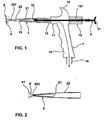
- An extraction device illustrated in fig.1 is formed by a hollow body 1 in the shape of a handle, which is procured with an opposite way placed front case 11 and a back case 12 in which is set a sliding arbor 3 two side led out from the body 1 , whereas from the front case 11 is in the forward direction led out a conical nozzle 13 and in the back case 12 is placed a pressure spring 121 .
- the pressure spring 121 is made and set in the back case 12 in the way that it prevents a spontaneous back push of the arbor 3 and thus also an inner cone 21 of a collet 2 which is fixed on a head 32 of the arbor 3 , when there is by the influence of vacuum formed a force acting on the inner cone 21 of the collet 2 .
- a front wall of the body 1 is equipped with a shaping 14 for an easy grip for fingers, an upper wall of the body 1 is equipped with a shaped coracoid stay 15 and in a lower wall of the body 1 is fixed a connector 16 of supply of a non-illustrated vacuum source.
- the arbor 3 is on its end which stands out from the back case 12 procured with a pressure stay 31 and on its opposite end with a head 32 .
- a second integral part of the extraction device is a two surface collet 2 , which consists of two practically shape identical telescopic hollow truncated cones 21 , 22 which are preferably made of a soft inert sterilized plastic material and are dimensioned in the way that the inner cone 21 is by its base fixable on the head 32 of the arbor 3 and the outer cone 22 is fixable on an outer surface of the nozzle 13 of the body 1 .
- the extraction device for use it is at first the inner cone 21 of the collet 2 slipped over on the head 32 of the arbor 2 and then is the outer cone 22 of the collet 2 slipped over on the nozzle 13 in the way that between particular cones 21 , 22 is formed a free interspace 23 , wherewith the device is prepared and ready for use.
- connection to the vacuum source is through an inlet branch 221 of the outer cone 22 sucked in air into the interspace 23 of the collet 2 and after positioning of the branch inlet 221 to a sampling point of the skin the end parts of one or more hair 4 are sucked in.
- the inner cone 21 and the outer cone 22 of the collet 2 have just right conical shape and a material of which are produced, just right softness and elasticity that it comes to locking of the inner cone 21 into the outer cone 22 and at the same time the pressure in the grasping point of the hair 4 is gentle enough not to weaken the structure of the hair 4 and not to rupture the hair 4 during its extraction from the skin 5 .
- the arbor 3 in the back case 12 of the body 1 comes through an inserted pressure spring 121 .
- the hair 4 is grasped between the outer cone 22 and the inner cone 21 and its root part 41 which is surrounded by follicular cells remains preserved during the extraction.
- the whole collet 2 or just its part, is suitable for further manipulation including fixation and storing procedures, whereas it enables to mark easily an extracted organic material with a legend or a sticker.
- a method of an extraction of follicular cells based on a principle of a hair removal from a mammal skin and an extracting device for pursuance of this method are efficient especially in biotechnological laboratories for a basic and applied research which deal with a research of alopecia, skin diseases, cancer, biodosimetry, forensic techniques and taxonomic classification of mammals.
Landscapes
- Health & Medical Sciences (AREA)
- Life Sciences & Earth Sciences (AREA)
- Surgery (AREA)
- Biomedical Technology (AREA)
- General Health & Medical Sciences (AREA)
- Heart & Thoracic Surgery (AREA)
- Medical Informatics (AREA)
- Molecular Biology (AREA)
- Veterinary Medicine (AREA)
- Animal Behavior & Ethology (AREA)
- Engineering & Computer Science (AREA)
- Public Health (AREA)
- Pathology (AREA)
- Plastic & Reconstructive Surgery (AREA)
- Transplantation (AREA)
- Nuclear Medicine, Radiotherapy & Molecular Imaging (AREA)
- Apparatus Associated With Microorganisms And Enzymes (AREA)
- Sampling And Sample Adjustment (AREA)
Description
- The invention belongs to an area of a biological material extraction used mainly in medicine, forensic and biotechnological laboratories of a basic and applied research and refers to a method of a follicular cells extraction from hair of mammals, especially from a human body, whereas a part of the invention is an extraction device for pursuance of this method.
- A human body vellus is as well as an animal hair a collection of different types of hair which mutually differentiate by its morphology and a position on the body. Follicular cells are cells which proximate surround root of the hair and from which the hair grows. These are the cells with specific characteristics when by the help of different microscopic, chemical and biochemical methods it is possible to obtain a lot of information. Follicular cells are used for example at an alopecia (baldness) studies, during a research of live primary cells with a well-preserved proliferation capacity, during different medicine examinations including a personal biodosimetry when it is possible to examine a chemotherapy efficiency or an activity of negative influences of environment. Follicular cells are likewise used for DNA obtaining for example for forensic, taxonomic or other purposes.
- The hair follicles extraction is at present done either by an invasive or a non-invasive way. The invasive way assumes a tissue excision in a proximate surrounding of a hair root and further processing of this way extracted tissue. An invasive operation always means an infection risk, permanent scarring, discomfort and for some types of hair, for example in case of eye lashes or eyebrows, it is a very difficult way applicable method. On the other side the invasive approach is only method successfully used for a hair transplantation and a whole range of specialised devices has been developed for this purpose, and these devices are described for example in the files
WO2010117043 A1 andWO2005027795 A1 . - Non-invasive methods consist in a hair extraction, including its root part, namely in the way to keep in the area of a hair root as many follicular cells as possible. To reach this it is possible to use different types of hand or electric tweezers, walings or forceps. Such specific tool is described for example in the file
US4240435 A1 . A disadvantage of classical metal tweezers and forceps used especially for a selective hair removal is a hair rupture risk in the place where the hair is weakened by the grip. Yet from the gain of follicular cells point of view the minimization of the risk of a hair rupture is an important aspect. A further important standpoint is a control of an extraction process itself, which must proceed relatively slowly due to a gradual break away of follicular cells from a skin matrix. Devices known from example from the filesKR100895291 B1 FR2683127 A1 US2001051808 A1 there is described a device which works on basis of rotating discs which meet together. Yet this device is also primarily designed for cosmetic purposes for a surface depilation therefore is largely non-selective and above all the hair is after its extraction immediately released and this significantly complicates further manipulation with this biologic material. And it is namely a subsequent manipulation with an extracted hair which is an important aspect for follicular cells processing for experimental needs. If the hair is to be subsequently manipulated it is suitable for it to be held in the device, with which it was extracted. For this purpose several devices in the form of forceps have been developed when the extracted hair is mechanically held in the extraction device. These designs of an extraction device are known for example from the filesCN2281764 Y ,CN201082171 Y . A disadvantage of mentioned devices is the fact, that they are compact and do not enable for example a separation of an extracting part, which would hold fast the hair itself and at the same time would enable its further manipulation. A device for extraction of follicular cells based on hair extraction from mammalian skin is known fromUS 2009/005765 . The device uses vacuum for suction and a mechanism for grasping the hair in the form of pincers. - The aim of the presented invention is to introduce a brand new non-invasive way of a follicular cells extraction and an extraction device for pursuance of this method, when the hair extraction is carried out based on a principle of a hair grip between two dovetailed cones, which this way create an extraction collet, whereas it is advantageous for an extracted material to be held in the device by which it was extracted. During a hair extraction has to be, due to obtaining of a sufficient amount of follicular cells, minimized risk of a hair rupture in the place where the hair is weakened by the grip. The extraction process itself is possible to carry out also on more hair at the same time, namely in a very short time interval whereby is minimized time necessary for finding, grasping and subsequent extraction of the hair.
- The mentioned goal is to a large extend met by a featured invention, which is a method of an extraction of follicular cells based on a principle of a hair removal from a mammals skin by the help of an extraction device, when during an extraction remains preserved also the root part of the hair which is surrounded by follicular cells, where an essence of the invention is fact that at least one hair is sucked in from a skin sampling point by the help of vacuum led from the body of an extraction device into an interspace of a two-cone collet which is fixed partly to the body and partly to an arbor where is subsequently by the interspace closing between its inner cone and an outer cone by the help of an counteracting pressure of the arbor the hair grasped and afterwards extracted from the skin.
- It is advantageous when an interspace closing of the collet is applied by a pressure on the arbor on whose head is set the inner cone.
- Likewise another essence of the invention is an extraction device for an extraction of follicular cells based on a principle of a hair removal from a mammal skin when during the extraction remains preserved also the root part of the hair which is surrounded by follicular cells, where the extraction device consists of a hollow double surface collet formed by an inner cone and an outer cone and of a hollow body which is partly in the forward direction procured with a hollow nozzle, partly is equipped with a connector for vacuum supply and partly is in it set a sliding arbor, whereas in the collet is between the inner cone and the outer cone formed a free interspace, when the inner cone of the collet is fixed on the arbor and the outer cone which is procured with an inlet branch is fixed on the nozzle of the body.
- In an advantageous design the inner cone and the outer cone of the collet are basically shape identical and are telescopically set on the extraction device to allow closing of the interspace of the collet, whereas the inlet branch of the outer cone is through the interspace of the collet and further through the nozzle, an inner cavity and the connector connected to a vacuum source.
- Also is advantageous when the body is formed in the shape of a handle, whereas is procured with an opposite way placed front case and a back case where is set the sliding arbor which is two-side led out from the body.
- In an optimal design is from the front case of the body led out a hollow conical nozzle in a forward direction and a pressure spring is placed in the back case.
- Furthermore is advantageous when the arbor is on its back end procured with a pressure stay and on its front end is equipped with a nozzle.
- Likewise is advantageous when the body is from the side of the front wall procured with a shaping for an easy grip for fingers and from the side of the upper wall is equipped with a shaped coracoid stay.
- With this invention is reached, in comparison with to date known solutions, a new and higher effect in that, that by the help of a collet, which consists of two dovetailed cones removable fixed on the extraction device is enabled an extraction of a sufficient amount of an organic material. It is easily enabled to grasp a hair between two conical walls of a collet in the way that the pressure of these walls on the hair is divided on an area sufficiently large to minimize hair weakening in the place of grasp. This way grasped hair can be easily extracted from the skin, whereas there is no risk of its rupture and there remains preserved even its root part which is surrounded by follicular cells. The collet is made of a soft, light, inert sterilized material, it is easy for production and at the same time enables further manipulation with an obtained organic material out of the extraction device.
- Particular examples of the invention design are simple way illustrated in enclosed drawings where,
-
fig. 1 is a lengthwise section of an extraction device -
fig. 2 is a lengthwise section of a collet with grasped hair - The drawings which illustrate featured invention and subsequently described examples of a particular design do not in any case limit protection extend mentioned in the definition yet only clarify the essence of given solution.
- An extraction device illustrated in
fig.1 is formed by a hollow body 1 in the shape of a handle, which is procured with an opposite way placedfront case 11 and aback case 12 in which is set asliding arbor 3 two side led out from the body 1, whereas from thefront case 11 is in the forward direction led out aconical nozzle 13 and in theback case 12 is placed apressure spring 121. Thepressure spring 121 is made and set in theback case 12 in the way that it prevents a spontaneous back push of thearbor 3 and thus also aninner cone 21 of acollet 2 which is fixed on ahead 32 of thearbor 3, when there is by the influence of vacuum formed a force acting on theinner cone 21 of thecollet 2. A front wall of the body 1 is equipped with a shaping 14 for an easy grip for fingers, an upper wall of the body 1 is equipped with ashaped coracoid stay 15 and in a lower wall of the body 1 is fixed aconnector 16 of supply of a non-illustrated vacuum source. Thearbor 3 is on its end which stands out from theback case 12 procured with apressure stay 31 and on its opposite end with ahead 32. A second integral part of the extraction device is a twosurface collet 2, which consists of two practically shape identical telescopic hollowtruncated cones inner cone 21 is by its base fixable on thehead 32 of thearbor 3 and theouter cone 22 is fixable on an outer surface of thenozzle 13 of the body 1. - During preparation of the extraction device for use it is at first the
inner cone 21 of thecollet 2 slipped over on thehead 32 of thearbor 2 and then is theouter cone 22 of thecollet 2 slipped over on thenozzle 13 in the way that betweenparticular cones free interspace 23, wherewith the device is prepared and ready for use. After connection to the vacuum source is through aninlet branch 221 of theouter cone 22 sucked in air into theinterspace 23 of thecollet 2 and after positioning of thebranch inlet 221 to a sampling point of the skin the end parts of one ormore hair 4 are sucked in. Afterwards is by the pressure on thestay 31 of thearbor 3 pushed theinner cone 21 of thecollet 2 to an inner surface of itsouter cone 22, wherewith comes to grasping of sucked inhair 4, which can be then, by a gentle pull of the device, extracted from the skin. Theinner cone 21 and theouter cone 22 of thecollet 2 have just right conical shape and a material of which are produced, just right softness and elasticity that it comes to locking of theinner cone 21 into theouter cone 22 and at the same time the pressure in the grasping point of thehair 4 is gentle enough not to weaken the structure of thehair 4 and not to rupture thehair 4 during its extraction from the skin 5. Thearbor 3 in theback case 12 of the body 1 comes through an insertedpressure spring 121. - As it is schematically illustrated in
fig. 2 by the help of theconical collet 2 thehair 4 is grasped between theouter cone 22 and theinner cone 21 and itsroot part 41 which is surrounded by follicular cells remains preserved during the extraction. Thewhole collet 2, or just its part, is suitable for further manipulation including fixation and storing procedures, whereas it enables to mark easily an extracted organic material with a legend or a sticker. - A method of an extraction of follicular cells based on a principle of a hair removal from a mammal skin and an extracting device for pursuance of this method are efficient especially in biotechnological laboratories for a basic and applied research which deal with a research of alopecia, skin diseases, cancer, biodosimetry, forensic techniques and taxonomic classification of mammals.
Claims (9)
- A method of extraction of follicular cells which is based on the principle of hair (4) extraction from mammalian skin (5) using an extraction device, whereby a root part (41) of the hair (4) surrounded by follicular cells remains preserved during the extraction , wherein at least one hair (4) is sucked in from a sampling point of the skin (5) by vacuum which is led from a body (1) of the extraction device into interspace (23) of a two-cone collet (2) fixed partly to the body (1) and partly to an arbor (3), and subsequently this hair (4) is grasped by closing the interspace (23) between an inner cone (21) and an outer cone (22) of said collet using counter-pressure of the arbor (3) and afterwards said hair (4) is extracted from the skin (5).
- The method of extraction of follicular cells according to claim 1, wherein the closing of the interspace (23) of the collet (2) is performed by applying pressure on the arbor (3), and wherein the inner cone (21) is embedded on the head (32) of said arbor.
- An extracting device for extraction of follicular cells which is based on the principle of hair (4) extraction from mammalian skin (5), whereby the root part (41) of the hair (4) surrounded by follicular cells remains preserved during the extraction , said extracting device consisting of a hollow body (1) which is equipped with a hollow nozzle (13) positioned in a forward direction, and with a connector (16) for supply of vacuum, characterized in that said extracting device further consists of a hollow two-cone collet (2) configured for grasping a hair formed by an inner cone (21) and an outer cone (22), and a free interspace (23) is formed between the inner cone (21) and the outer cone (22), and a sliding arbor (3) is embedded in said hollow body , wherein the inner cone (21) of the collet (2) is fixed on the arbor (3) and the outer cone (22) which is equipped with a branch inlet (221) is fixed on the nozzle (13) of the body (1).
- The extracting device for extraction of follicular cells according to claim 3, wherein the inner cone (21) and the outer cone (22) of the collet (2) are substantially shape identical and telescopically set on the extracting device to enable closure of the interspace (23) of the collet (2).
- The extracting device for extraction of follicular cells according to claims 3 and 4, wherein the branch inlet (221) of the outer cone (22) is connected to the vacuum source through the interspace (23) of the collet (2) and further through the nozzle (13), an inner cavity and the connector (16) of the body (1).
- The extracting device for extraction of follicular cells according to claims 3 to 5, wherein the body (1) is formed in the shape of a handle, whereas it is provided with a front case (11) and a back case (12) placed opposite each other, whereby the sliding arbor (3) is embedded in said cases, and led out from the body (1) on both sides.
- The extracting device for extraction of follicular cells according to claim 6, wherein the hollow conical nozzle (13) is led out in forward direction from the front case (11) of the body (1) and in the back case (12) is inserted a pressure spring (121).
- The extracting device for extraction of follicular cells according to any of claims 3 to 7, wherein the arbor (3) is on its back end provided with a pressure stay (31) and on its front end is provided with a head (32).
- The extracting device for extraction of follicular cells according to any of claims 3 to 8, wherein the body (1) is from the side of the front wall provided with a shaping (14) for an easy grip for fingers and from the side of the upper wall is equipped with a coracoid shaped stay (15).
Applications Claiming Priority (2)
| Application Number | Priority Date | Filing Date | Title |
|---|---|---|---|
| CZ2012-871A CZ304255B6 (en) | 2012-12-04 | 2012-12-04 | Method of obtaining follicular cells and sampling instrument for making the same |
| PCT/CZ2013/000152 WO2014086324A1 (en) | 2012-12-04 | 2013-11-19 | A method of an extraction of follicular cells and a device for pursuance of this method |
Publications (2)
| Publication Number | Publication Date |
|---|---|
| EP2928382A1 EP2928382A1 (en) | 2015-10-14 |
| EP2928382B1 true EP2928382B1 (en) | 2018-12-26 |
Family
ID=49752887
Family Applications (1)
| Application Number | Title | Priority Date | Filing Date |
|---|---|---|---|
| EP13802526.7A Active EP2928382B1 (en) | 2012-12-04 | 2013-11-19 | A method of an extraction of follicular cells and a device for pursuance of this method |
Country Status (4)
| Country | Link |
|---|---|
| US (1) | US9943331B2 (en) |
| EP (1) | EP2928382B1 (en) |
| CZ (1) | CZ304255B6 (en) |
| WO (1) | WO2014086324A1 (en) |
Family Cites Families (14)
| Publication number | Priority date | Publication date | Assignee | Title |
|---|---|---|---|---|
| JPS5754724Y2 (en) | 1978-10-03 | 1982-11-26 | ||
| FR2683127B1 (en) * | 1991-11-05 | 1994-02-04 | Desclaux Pierre | TWEEZERS. |
| FR2744624A1 (en) | 1996-02-12 | 1997-08-14 | Wyart Alain Rene | Device for hair micro-transplants in scalp to treat baldness |
| CN2281764Y (en) | 1996-12-26 | 1998-05-20 | 王格伟 | Dried pile forceps |
| IT1292287B1 (en) * | 1997-04-24 | 1999-01-29 | Roberto Luigi Costanzo | SURGICAL INSTRUMENT FOR AUTOLOGICAL HAIR TRANSPLANTATION. |
| FR2776180B1 (en) | 1998-03-17 | 2000-08-11 | Pascal Boudjema | DEVICE FOR IMPLANTING SMALL DIAMETER HAIR GRAFTS |
| US6585743B2 (en) | 2000-06-09 | 2003-07-01 | Moshe Dolev | Hair depilating device utilizing mechanism to spirally align coupled-tweezer elements |
| WO2005027795A1 (en) * | 2003-09-23 | 2005-03-31 | Navarro Ceballos Ramon Javier | Instrument for taking and applying human scalp grafts, comprising interchangeable square-tipped needles |
| US20080033455A1 (en) * | 2006-08-03 | 2008-02-07 | Rassman William R | Hair extraction device and method for its use |
| US8066717B2 (en) * | 2007-03-19 | 2011-11-29 | Restoration Robotics, Inc. | Device and method for harvesting and implanting follicular units |
| US8512356B2 (en) | 2007-06-26 | 2013-08-20 | Restoration Robotics, Inc. | Follicular unit harvesting tools including devices and their use for severing connective tissue |
| CN201082171Y (en) | 2007-08-17 | 2008-07-09 | 李新 | Needle holding pincers capable of not clipping thread for operation |
| KR100895291B1 (en) | 2008-10-30 | 2009-04-29 | 한밭대학교 산학협력단 | Hairpin Tweezers |
| JP2010241756A (en) * | 2009-04-08 | 2010-10-28 | Phoenix Bio:Kk | Method for recovering hair-growing ability of hair follicle and cell transplantation tool |
-
2012
- 2012-12-04 CZ CZ2012-871A patent/CZ304255B6/en unknown
-
2013
- 2013-11-19 EP EP13802526.7A patent/EP2928382B1/en active Active
- 2013-11-19 WO PCT/CZ2013/000152 patent/WO2014086324A1/en not_active Ceased
- 2013-11-19 US US14/649,785 patent/US9943331B2/en active Active
Non-Patent Citations (1)
| Title |
|---|
| None * |
Also Published As
| Publication number | Publication date |
|---|---|
| US9943331B2 (en) | 2018-04-17 |
| CZ2012871A3 (en) | 2014-01-29 |
| WO2014086324A1 (en) | 2014-06-12 |
| US20150297253A1 (en) | 2015-10-22 |
| CZ304255B6 (en) | 2014-01-29 |
| EP2928382A1 (en) | 2015-10-14 |
Similar Documents
| Publication | Publication Date | Title |
|---|---|---|
| US9005218B2 (en) | Follicular extraction method and device | |
| EP3181070B1 (en) | Devices for harvesting a skin graft | |
| US9314262B2 (en) | Follicular extraction method and device | |
| US20040092924A1 (en) | Method and device for follicular hair transplantation | |
| US20180185050A1 (en) | Dissecting punch for follicular extraction and tools and methods using same | |
| US20070213741A1 (en) | Follicular extraction punch and method | |
| KR20100003360A (en) | Follicular unit harvesting tools including devices and their use for severing connective tissue | |
| CN104114110A (en) | Hair restoration | |
| CN102821706A (en) | Follicular unit removal tool with pivoting retaining member | |
| KR200479077Y1 (en) | Hair implanting injector | |
| US9943331B2 (en) | Method of an extraction of follicular cells and a device for pursuance of this method | |
| CN104027155B (en) | Scalpel retainer | |
| KR20150000878A (en) | Methods and apparatuses harvesting, modifying and reimplantation of dermal micro-organs | |
| CN205339072U (en) | Circular cutting formula nib of pen is transplanted to electronic hair follicle of global function | |
| CN201617904U (en) | Operating forceps for removing blood stasis in nails | |
| KR20190091273A (en) | Devices with needles for the extraction of elongated hair follicles | |
| CN205913377U (en) | Novel tumor detacher | |
| US20130338534A1 (en) | Tissue extraction device | |
| CN204293207U (en) | A kind of hair transplantation cutter | |
| CN202892043U (en) | Full-functional hair transplanting device | |
| CN203001072U (en) | Shiatsu skin scratcher | |
| Bhatti et al. | Hair Transplant Surgery: Going Forward | |
| WO2016098126A2 (en) | Graft tray | |
| KR20200067684A (en) | Hair Transplantation Device | |
| TR201708871A2 (en) | Needle Apparatus For Taking Long Hair Roots |
Legal Events
| Date | Code | Title | Description |
|---|---|---|---|
| PUAI | Public reference made under article 153(3) epc to a published international application that has entered the european phase |
Free format text: ORIGINAL CODE: 0009012 |
|
| 17P | Request for examination filed |
Effective date: 20150603 |
|
| AK | Designated contracting states |
Kind code of ref document: A1 Designated state(s): AL AT BE BG CH CY CZ DE DK EE ES FI FR GB GR HR HU IE IS IT LI LT LU LV MC MK MT NL NO PL PT RO RS SE SI SK SM TR |
|
| AX | Request for extension of the european patent |
Extension state: BA ME |
|
| DAX | Request for extension of the european patent (deleted) | ||
| GRAP | Despatch of communication of intention to grant a patent |
Free format text: ORIGINAL CODE: EPIDOSNIGR1 |
|
| STAA | Information on the status of an ep patent application or granted ep patent |
Free format text: STATUS: GRANT OF PATENT IS INTENDED |
|
| RIC1 | Information provided on ipc code assigned before grant |
Ipc: A61B 17/322 20060101ALI20180618BHEP Ipc: A61B 17/00 20060101ALI20180618BHEP Ipc: A61B 10/02 20060101AFI20180618BHEP Ipc: A61B 17/32 20060101ALI20180618BHEP |
|
| INTG | Intention to grant announced |
Effective date: 20180710 |
|
| GRAS | Grant fee paid |
Free format text: ORIGINAL CODE: EPIDOSNIGR3 |
|
| GRAA | (expected) grant |
Free format text: ORIGINAL CODE: 0009210 |
|
| STAA | Information on the status of an ep patent application or granted ep patent |
Free format text: STATUS: THE PATENT HAS BEEN GRANTED |
|
| AK | Designated contracting states |
Kind code of ref document: B1 Designated state(s): AL AT BE BG CH CY CZ DE DK EE ES FI FR GB GR HR HU IE IS IT LI LT LU LV MC MK MT NL NO PL PT RO RS SE SI SK SM TR |
|
| REG | Reference to a national code |
Ref country code: GB Ref legal event code: FG4D |
|
| REG | Reference to a national code |
Ref country code: CH Ref legal event code: EP |
|
| REG | Reference to a national code |
Ref country code: AT Ref legal event code: REF Ref document number: 1080313 Country of ref document: AT Kind code of ref document: T Effective date: 20190115 |
|
| REG | Reference to a national code |
Ref country code: DE Ref legal event code: R096 Ref document number: 602013048908 Country of ref document: DE |
|
| REG | Reference to a national code |
Ref country code: IE Ref legal event code: FG4D |
|
| PG25 | Lapsed in a contracting state [announced via postgrant information from national office to epo] |
Ref country code: FI Free format text: LAPSE BECAUSE OF FAILURE TO SUBMIT A TRANSLATION OF THE DESCRIPTION OR TO PAY THE FEE WITHIN THE PRESCRIBED TIME-LIMIT Effective date: 20181226 Ref country code: LT Free format text: LAPSE BECAUSE OF FAILURE TO SUBMIT A TRANSLATION OF THE DESCRIPTION OR TO PAY THE FEE WITHIN THE PRESCRIBED TIME-LIMIT Effective date: 20181226 Ref country code: NO Free format text: LAPSE BECAUSE OF FAILURE TO SUBMIT A TRANSLATION OF THE DESCRIPTION OR TO PAY THE FEE WITHIN THE PRESCRIBED TIME-LIMIT Effective date: 20190326 Ref country code: HR Free format text: LAPSE BECAUSE OF FAILURE TO SUBMIT A TRANSLATION OF THE DESCRIPTION OR TO PAY THE FEE WITHIN THE PRESCRIBED TIME-LIMIT Effective date: 20181226 Ref country code: BG Free format text: LAPSE BECAUSE OF FAILURE TO SUBMIT A TRANSLATION OF THE DESCRIPTION OR TO PAY THE FEE WITHIN THE PRESCRIBED TIME-LIMIT Effective date: 20190326 Ref country code: LV Free format text: LAPSE BECAUSE OF FAILURE TO SUBMIT A TRANSLATION OF THE DESCRIPTION OR TO PAY THE FEE WITHIN THE PRESCRIBED TIME-LIMIT Effective date: 20181226 |
|
| REG | Reference to a national code |
Ref country code: NL Ref legal event code: MP Effective date: 20181226 |
|
| REG | Reference to a national code |
Ref country code: LT Ref legal event code: MG4D |
|
| PG25 | Lapsed in a contracting state [announced via postgrant information from national office to epo] |
Ref country code: AL Free format text: LAPSE BECAUSE OF FAILURE TO SUBMIT A TRANSLATION OF THE DESCRIPTION OR TO PAY THE FEE WITHIN THE PRESCRIBED TIME-LIMIT Effective date: 20181226 Ref country code: RS Free format text: LAPSE BECAUSE OF FAILURE TO SUBMIT A TRANSLATION OF THE DESCRIPTION OR TO PAY THE FEE WITHIN THE PRESCRIBED TIME-LIMIT Effective date: 20181226 Ref country code: GR Free format text: LAPSE BECAUSE OF FAILURE TO SUBMIT A TRANSLATION OF THE DESCRIPTION OR TO PAY THE FEE WITHIN THE PRESCRIBED TIME-LIMIT Effective date: 20190327 Ref country code: SE Free format text: LAPSE BECAUSE OF FAILURE TO SUBMIT A TRANSLATION OF THE DESCRIPTION OR TO PAY THE FEE WITHIN THE PRESCRIBED TIME-LIMIT Effective date: 20181226 |
|
| REG | Reference to a national code |
Ref country code: AT Ref legal event code: MK05 Ref document number: 1080313 Country of ref document: AT Kind code of ref document: T Effective date: 20181226 |
|
| PG25 | Lapsed in a contracting state [announced via postgrant information from national office to epo] |
Ref country code: NL Free format text: LAPSE BECAUSE OF FAILURE TO SUBMIT A TRANSLATION OF THE DESCRIPTION OR TO PAY THE FEE WITHIN THE PRESCRIBED TIME-LIMIT Effective date: 20181226 |
|
| PG25 | Lapsed in a contracting state [announced via postgrant information from national office to epo] |
Ref country code: IT Free format text: LAPSE BECAUSE OF FAILURE TO SUBMIT A TRANSLATION OF THE DESCRIPTION OR TO PAY THE FEE WITHIN THE PRESCRIBED TIME-LIMIT Effective date: 20181226 Ref country code: ES Free format text: LAPSE BECAUSE OF FAILURE TO SUBMIT A TRANSLATION OF THE DESCRIPTION OR TO PAY THE FEE WITHIN THE PRESCRIBED TIME-LIMIT Effective date: 20181226 Ref country code: PT Free format text: LAPSE BECAUSE OF FAILURE TO SUBMIT A TRANSLATION OF THE DESCRIPTION OR TO PAY THE FEE WITHIN THE PRESCRIBED TIME-LIMIT Effective date: 20190426 Ref country code: CZ Free format text: LAPSE BECAUSE OF FAILURE TO SUBMIT A TRANSLATION OF THE DESCRIPTION OR TO PAY THE FEE WITHIN THE PRESCRIBED TIME-LIMIT Effective date: 20181226 Ref country code: PL Free format text: LAPSE BECAUSE OF FAILURE TO SUBMIT A TRANSLATION OF THE DESCRIPTION OR TO PAY THE FEE WITHIN THE PRESCRIBED TIME-LIMIT Effective date: 20181226 |
|
| PG25 | Lapsed in a contracting state [announced via postgrant information from national office to epo] |
Ref country code: IS Free format text: LAPSE BECAUSE OF FAILURE TO SUBMIT A TRANSLATION OF THE DESCRIPTION OR TO PAY THE FEE WITHIN THE PRESCRIBED TIME-LIMIT Effective date: 20190426 Ref country code: SK Free format text: LAPSE BECAUSE OF FAILURE TO SUBMIT A TRANSLATION OF THE DESCRIPTION OR TO PAY THE FEE WITHIN THE PRESCRIBED TIME-LIMIT Effective date: 20181226 Ref country code: RO Free format text: LAPSE BECAUSE OF FAILURE TO SUBMIT A TRANSLATION OF THE DESCRIPTION OR TO PAY THE FEE WITHIN THE PRESCRIBED TIME-LIMIT Effective date: 20181226 Ref country code: EE Free format text: LAPSE BECAUSE OF FAILURE TO SUBMIT A TRANSLATION OF THE DESCRIPTION OR TO PAY THE FEE WITHIN THE PRESCRIBED TIME-LIMIT Effective date: 20181226 Ref country code: SM Free format text: LAPSE BECAUSE OF FAILURE TO SUBMIT A TRANSLATION OF THE DESCRIPTION OR TO PAY THE FEE WITHIN THE PRESCRIBED TIME-LIMIT Effective date: 20181226 |
|
| REG | Reference to a national code |
Ref country code: DE Ref legal event code: R097 Ref document number: 602013048908 Country of ref document: DE |
|
| PG25 | Lapsed in a contracting state [announced via postgrant information from national office to epo] |
Ref country code: AT Free format text: LAPSE BECAUSE OF FAILURE TO SUBMIT A TRANSLATION OF THE DESCRIPTION OR TO PAY THE FEE WITHIN THE PRESCRIBED TIME-LIMIT Effective date: 20181226 Ref country code: DK Free format text: LAPSE BECAUSE OF FAILURE TO SUBMIT A TRANSLATION OF THE DESCRIPTION OR TO PAY THE FEE WITHIN THE PRESCRIBED TIME-LIMIT Effective date: 20181226 |
|
| PLBE | No opposition filed within time limit |
Free format text: ORIGINAL CODE: 0009261 |
|
| STAA | Information on the status of an ep patent application or granted ep patent |
Free format text: STATUS: NO OPPOSITION FILED WITHIN TIME LIMIT |
|
| 26N | No opposition filed |
Effective date: 20190927 |
|
| PG25 | Lapsed in a contracting state [announced via postgrant information from national office to epo] |
Ref country code: SI Free format text: LAPSE BECAUSE OF FAILURE TO SUBMIT A TRANSLATION OF THE DESCRIPTION OR TO PAY THE FEE WITHIN THE PRESCRIBED TIME-LIMIT Effective date: 20181226 |
|
| PG25 | Lapsed in a contracting state [announced via postgrant information from national office to epo] |
Ref country code: TR Free format text: LAPSE BECAUSE OF FAILURE TO SUBMIT A TRANSLATION OF THE DESCRIPTION OR TO PAY THE FEE WITHIN THE PRESCRIBED TIME-LIMIT Effective date: 20181226 |
|
| PG25 | Lapsed in a contracting state [announced via postgrant information from national office to epo] |
Ref country code: CY Free format text: LAPSE BECAUSE OF FAILURE TO SUBMIT A TRANSLATION OF THE DESCRIPTION OR TO PAY THE FEE WITHIN THE PRESCRIBED TIME-LIMIT Effective date: 20181226 |
|
| PG25 | Lapsed in a contracting state [announced via postgrant information from national office to epo] |
Ref country code: HU Free format text: LAPSE BECAUSE OF FAILURE TO SUBMIT A TRANSLATION OF THE DESCRIPTION OR TO PAY THE FEE WITHIN THE PRESCRIBED TIME-LIMIT; INVALID AB INITIO Effective date: 20131119 |
|
| PG25 | Lapsed in a contracting state [announced via postgrant information from national office to epo] |
Ref country code: MK Free format text: LAPSE BECAUSE OF FAILURE TO SUBMIT A TRANSLATION OF THE DESCRIPTION OR TO PAY THE FEE WITHIN THE PRESCRIBED TIME-LIMIT Effective date: 20181226 |
|
| PGFP | Annual fee paid to national office [announced via postgrant information from national office to epo] |
Ref country code: LU Payment date: 20251127 Year of fee payment: 13 |
|
| REG | Reference to a national code |
Ref country code: CH Ref legal event code: U11 Free format text: ST27 STATUS EVENT CODE: U-0-0-U10-U11 (AS PROVIDED BY THE NATIONAL OFFICE) Effective date: 20260108 |
|
| PGFP | Annual fee paid to national office [announced via postgrant information from national office to epo] |
Ref country code: GB Payment date: 20251126 Year of fee payment: 13 |
|
| PGFP | Annual fee paid to national office [announced via postgrant information from national office to epo] |
Ref country code: MC Payment date: 20251126 Year of fee payment: 13 |
|
| PGFP | Annual fee paid to national office [announced via postgrant information from national office to epo] |
Ref country code: FR Payment date: 20251127 Year of fee payment: 13 |
|
| PGFP | Annual fee paid to national office [announced via postgrant information from national office to epo] |
Ref country code: BE Payment date: 20251127 Year of fee payment: 13 |
|
| PGFP | Annual fee paid to national office [announced via postgrant information from national office to epo] |
Ref country code: IE Payment date: 20251126 Year of fee payment: 13 |
|
| PGFP | Annual fee paid to national office [announced via postgrant information from national office to epo] |
Ref country code: MT Payment date: 20251114 Year of fee payment: 13 |
|
| PGFP | Annual fee paid to national office [announced via postgrant information from national office to epo] |
Ref country code: DE Payment date: 20251224 Year of fee payment: 13 |
|
| PGFP | Annual fee paid to national office [announced via postgrant information from national office to epo] |
Ref country code: CH Payment date: 20260108 Year of fee payment: 13 |