EP2927997A1 - High-capacity electrode active material for lithium secondary battery and lithium secondary battery using same - Google Patents
High-capacity electrode active material for lithium secondary battery and lithium secondary battery using same Download PDFInfo
- Publication number
- EP2927997A1 EP2927997A1 EP14813625.2A EP14813625A EP2927997A1 EP 2927997 A1 EP2927997 A1 EP 2927997A1 EP 14813625 A EP14813625 A EP 14813625A EP 2927997 A1 EP2927997 A1 EP 2927997A1
- Authority
- EP
- European Patent Office
- Prior art keywords
- secondary battery
- electrode active
- active material
- lithium secondary
- carbon
- Prior art date
- Legal status (The legal status is an assumption and is not a legal conclusion. Google has not performed a legal analysis and makes no representation as to the accuracy of the status listed.)
- Granted
Links
Images


Classifications
-
- H—ELECTRICITY
- H01—ELECTRIC ELEMENTS
- H01M—PROCESSES OR MEANS, e.g. BATTERIES, FOR THE DIRECT CONVERSION OF CHEMICAL ENERGY INTO ELECTRICAL ENERGY
- H01M4/00—Electrodes
- H01M4/02—Electrodes composed of, or comprising, active material
- H01M4/13—Electrodes for accumulators with non-aqueous electrolyte, e.g. for lithium-accumulators; Processes of manufacture thereof
- H01M4/133—Electrodes based on carbonaceous material, e.g. graphite-intercalation compounds or CFx
-
- H—ELECTRICITY
- H01—ELECTRIC ELEMENTS
- H01M—PROCESSES OR MEANS, e.g. BATTERIES, FOR THE DIRECT CONVERSION OF CHEMICAL ENERGY INTO ELECTRICAL ENERGY
- H01M10/00—Secondary cells; Manufacture thereof
- H01M10/05—Accumulators with non-aqueous electrolyte
- H01M10/052—Li-accumulators
-
- H—ELECTRICITY
- H01—ELECTRIC ELEMENTS
- H01M—PROCESSES OR MEANS, e.g. BATTERIES, FOR THE DIRECT CONVERSION OF CHEMICAL ENERGY INTO ELECTRICAL ENERGY
- H01M10/00—Secondary cells; Manufacture thereof
- H01M10/42—Methods or arrangements for servicing or maintenance of secondary cells or secondary half-cells
- H01M10/4235—Safety or regulating additives or arrangements in electrodes, separators or electrolyte
-
- H—ELECTRICITY
- H01—ELECTRIC ELEMENTS
- H01M—PROCESSES OR MEANS, e.g. BATTERIES, FOR THE DIRECT CONVERSION OF CHEMICAL ENERGY INTO ELECTRICAL ENERGY
- H01M4/00—Electrodes
- H01M4/02—Electrodes composed of, or comprising, active material
- H01M4/13—Electrodes for accumulators with non-aqueous electrolyte, e.g. for lithium-accumulators; Processes of manufacture thereof
- H01M4/134—Electrodes based on metals, Si or alloys
-
- H—ELECTRICITY
- H01—ELECTRIC ELEMENTS
- H01M—PROCESSES OR MEANS, e.g. BATTERIES, FOR THE DIRECT CONVERSION OF CHEMICAL ENERGY INTO ELECTRICAL ENERGY
- H01M4/00—Electrodes
- H01M4/02—Electrodes composed of, or comprising, active material
- H01M4/36—Selection of substances as active materials, active masses, active liquids
- H01M4/362—Composites
- H01M4/366—Composites as layered products
-
- H—ELECTRICITY
- H01—ELECTRIC ELEMENTS
- H01M—PROCESSES OR MEANS, e.g. BATTERIES, FOR THE DIRECT CONVERSION OF CHEMICAL ENERGY INTO ELECTRICAL ENERGY
- H01M4/00—Electrodes
- H01M4/02—Electrodes composed of, or comprising, active material
- H01M4/36—Selection of substances as active materials, active masses, active liquids
- H01M4/38—Selection of substances as active materials, active masses, active liquids of elements or alloys
-
- H—ELECTRICITY
- H01—ELECTRIC ELEMENTS
- H01M—PROCESSES OR MEANS, e.g. BATTERIES, FOR THE DIRECT CONVERSION OF CHEMICAL ENERGY INTO ELECTRICAL ENERGY
- H01M4/00—Electrodes
- H01M4/02—Electrodes composed of, or comprising, active material
- H01M4/36—Selection of substances as active materials, active masses, active liquids
- H01M4/38—Selection of substances as active materials, active masses, active liquids of elements or alloys
- H01M4/386—Silicon or alloys based on silicon
-
- H—ELECTRICITY
- H01—ELECTRIC ELEMENTS
- H01M—PROCESSES OR MEANS, e.g. BATTERIES, FOR THE DIRECT CONVERSION OF CHEMICAL ENERGY INTO ELECTRICAL ENERGY
- H01M4/00—Electrodes
- H01M4/02—Electrodes composed of, or comprising, active material
- H01M4/36—Selection of substances as active materials, active masses, active liquids
- H01M4/38—Selection of substances as active materials, active masses, active liquids of elements or alloys
- H01M4/387—Tin or alloys based on tin
-
- H—ELECTRICITY
- H01—ELECTRIC ELEMENTS
- H01M—PROCESSES OR MEANS, e.g. BATTERIES, FOR THE DIRECT CONVERSION OF CHEMICAL ENERGY INTO ELECTRICAL ENERGY
- H01M4/00—Electrodes
- H01M4/02—Electrodes composed of, or comprising, active material
- H01M4/36—Selection of substances as active materials, active masses, active liquids
- H01M4/38—Selection of substances as active materials, active masses, active liquids of elements or alloys
- H01M4/46—Alloys based on magnesium or aluminium
- H01M4/463—Aluminium based
-
- H—ELECTRICITY
- H01—ELECTRIC ELEMENTS
- H01M—PROCESSES OR MEANS, e.g. BATTERIES, FOR THE DIRECT CONVERSION OF CHEMICAL ENERGY INTO ELECTRICAL ENERGY
- H01M4/00—Electrodes
- H01M4/02—Electrodes composed of, or comprising, active material
- H01M4/36—Selection of substances as active materials, active masses, active liquids
- H01M4/58—Selection of substances as active materials, active masses, active liquids of inorganic compounds other than oxides or hydroxides, e.g. sulfides, selenides, tellurides, halogenides or LiCoFy; of polyanionic structures, e.g. phosphates, silicates or borates
- H01M4/583—Carbonaceous material, e.g. graphite-intercalation compounds or CFx
- H01M4/587—Carbonaceous material, e.g. graphite-intercalation compounds or CFx for inserting or intercalating light metals
-
- H—ELECTRICITY
- H01—ELECTRIC ELEMENTS
- H01M—PROCESSES OR MEANS, e.g. BATTERIES, FOR THE DIRECT CONVERSION OF CHEMICAL ENERGY INTO ELECTRICAL ENERGY
- H01M4/00—Electrodes
- H01M4/02—Electrodes composed of, or comprising, active material
- H01M4/62—Selection of inactive substances as ingredients for active masses, e.g. binders, fillers
-
- H—ELECTRICITY
- H01—ELECTRIC ELEMENTS
- H01M—PROCESSES OR MEANS, e.g. BATTERIES, FOR THE DIRECT CONVERSION OF CHEMICAL ENERGY INTO ELECTRICAL ENERGY
- H01M4/00—Electrodes
- H01M4/02—Electrodes composed of, or comprising, active material
- H01M4/62—Selection of inactive substances as ingredients for active masses, e.g. binders, fillers
- H01M4/624—Electric conductive fillers
- H01M4/625—Carbon or graphite
-
- H—ELECTRICITY
- H01—ELECTRIC ELEMENTS
- H01M—PROCESSES OR MEANS, e.g. BATTERIES, FOR THE DIRECT CONVERSION OF CHEMICAL ENERGY INTO ELECTRICAL ENERGY
- H01M4/00—Electrodes
- H01M4/02—Electrodes composed of, or comprising, active material
- H01M2004/021—Physical characteristics, e.g. porosity, surface area
-
- H—ELECTRICITY
- H01—ELECTRIC ELEMENTS
- H01M—PROCESSES OR MEANS, e.g. BATTERIES, FOR THE DIRECT CONVERSION OF CHEMICAL ENERGY INTO ELECTRICAL ENERGY
- H01M4/00—Electrodes
- H01M4/02—Electrodes composed of, or comprising, active material
- H01M2004/025—Electrodes composed of, or comprising, active material with shapes other than plane or cylindrical
-
- Y—GENERAL TAGGING OF NEW TECHNOLOGICAL DEVELOPMENTS; GENERAL TAGGING OF CROSS-SECTIONAL TECHNOLOGIES SPANNING OVER SEVERAL SECTIONS OF THE IPC; TECHNICAL SUBJECTS COVERED BY FORMER USPC CROSS-REFERENCE ART COLLECTIONS [XRACs] AND DIGESTS
- Y02—TECHNOLOGIES OR APPLICATIONS FOR MITIGATION OR ADAPTATION AGAINST CLIMATE CHANGE
- Y02E—REDUCTION OF GREENHOUSE GAS [GHG] EMISSIONS, RELATED TO ENERGY GENERATION, TRANSMISSION OR DISTRIBUTION
- Y02E60/00—Enabling technologies; Technologies with a potential or indirect contribution to GHG emissions mitigation
- Y02E60/10—Energy storage using batteries
Definitions
- the present disclosure relates to an electrode active material for a lithium secondary battery and a lithium secondary battery using the same, and more particularly, to a high capacity electrode active material for a lithium secondary battery comprising a third material to control a side reaction with an electrolyte solution on a surface of a second material of a nanostructure formed on a first material including a carbon material and a lithium secondary battery using the same.
- lithium secondary batteries developed in the early 1990's have received a great deal of attention due to their advantages of higher operating voltages and even higher energy densities than traditional batteries using an aqueous electrolyte solution such as Ni-MH, Ni-Cd, and PbSO 4 batteries and the like.
- a lithium secondary battery is fabricated by making an anode and a cathode using a material capable of intercalating and deintercalating lithium ions, and filling an organic electrolyte solution or a polymer electrolyte solution in between the cathode and the anode, and produces electrical energy by an oxidation/reduction reaction when the lithium ions intercalate and deintercalate on the cathode and the anode.
- carbon-based materials are primarily being used as an electrode active material for an anode of a lithium secondary battery.
- graphite has a theoretical capacity of about 372 mAh/g, and an actual realizable capacity of current commercially available graphite is from about 350 to about 360 mAh/g.
- the capacity of the carbon-based material such as graphite is insufficient for a lithium secondary battery requiring a high capacity electrode active material.
- another electrode active material is a metal such as silicon (Si) and tin (Sn) that exhibits a higher charge/discharge capacity than a carbon-based material and is electrochemically alloyable with lithium.
- a metal-based electrode active material experiences cracking and pulverization due to a large volume change involved in lithium charging/discharging, and as a consequence, a secondary battery using a metal-based electrode active material has drawbacks of a drastic capacity drop and a short cycle life during charging/discharging cycles.
- oxide of a metal for example, Si and Sn
- oxide of a metal for example, Si and Sn
- Si and Sn oxide of a metal
- oxide of a metal due to uniform distribution of nanoscale metal elements in a carbon substrate, cracking and pulverization caused by a metal-based electrode active material may be effectively controlled, but there is a problem with reduced initial efficiency by an initial irreversible reaction between metal oxide and lithium.
- the present disclosure is directed to providing a high capacity electrode active material for a lithium secondary battery that may control a side reaction with an electrolyte solution, an electrode comprising the same, and a lithium secondary battery comprising the electrode.
- an electrode active material for a lithium secondary battery including a first material including a carbon material, a second material of a nanostructure formed on the first material, the second material including at least one selected from a metal and a metalloid capable of reversibly alloying with lithium, and a third material present on a surface of at least one of the first material and the second material to control a side reaction with an electrolyte solution.
- the carbon material may be at least one selected from the group consisting of soft carbon, hard carbon, natural graphite, Kish graphite, pyrolytic carbon, mesophase pitch based carbon fiber, meso-carbon microbeads, mesophase pitches, and petroleum or coal tar pitch derived cokes.
- the second material may be any one selected from the group consisting of Si, Sn, Al, Sb, Bi, As, Ge, and Pb, or mixtures or alloys thereof.
- the second material may be made up of at least one nanostructure among a nanoparticle, a nanowire, a nanorod, and a nanotube.
- the nanoparticle may have an average diameter from 1 nm to 1,000 nm.
- the nanowire may have a horizontal cross-sectional average diameter from 1 nm to 1,000 nm and an average length from 500 nm to 50 ⁇ m.
- the third material may include any one selected from the group consisting of Si, Sn, Al, Sb, Bi, As, Ge, and Pb, or at least one selected from the group consisting of oxide or nitride thereof, carbon, and an organic material.
- the organic material may be may be any one selected from the group consisting of polyvinylidene fluoride, polyvinylidene fluoride-co-hexafluoropropylene, polyvinylidene fluoride-co-trichloroethylene, polymethylmethacrylate, polybutylacrylate, polyacrylonitrile, polyvinylpyrrolidone, polyvinylacetate, polyethylene-co-vinyl acetate, polyethylene oxide, polyacrylic acid, polyvinylalcohl, polyarylate, cellulose acetate, cellulose acetate butyrate, cellulose acetate propionate, cyanoethylpullulan, cyanoethylpolyvinylalcohol, cyanoethylcellulose, cyanoethylsucrose, pullulan, and carboxyl methyl cellulose, or mixtures thereof.
- the third material may be present only on the surface of the second material.
- the third material may have a thickness from 1 nm to 5 ⁇ m.
- the electrode active material may be an anode active material.
- an electrode for a lithium secondary battery including the electrode active material.
- a lithium secondary battery having the electrode.
- the electrode active material includes a first material including a carbon material, a second material of a nanostructure uniformly distributed on the first material, the second material including a metal or metalloid allowing repeated charge and discharge with lithium or a metal-metalloid compound, and a third material to control a side reaction with an electrolyte solution, to achieve high initial efficiency and efficiently suppress volume expansion and a continuous side reaction of an electrolyte solution caused by pulverization of an electrode active material occurring during battery charge and discharge, so an electrode active material having excellent life characteristics and a thickness control capability while maintaining high capacity characteristics of a metal-based electrode active material and a lithium secondary battery may be manufactured.
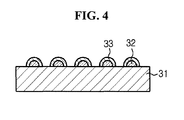
- FIGS. 1 through 4 are schematic diagrams illustrating an electrode active material according to an exemplary embodiment of the present disclosure.
- An electrode active material includes a first material including a carbon material, a second material of a nanostructure formed on the first material, the second material including at least one selected from a metal and a metalloid capable of reversibly alloying with lithium, and a third material present on a surface of at least one of the first material and the second material to control a side reaction with an electrolyte solution.
- the metal and the metalloid capable of reversibly alloying with lithium is a metal-based electrode active material, and exhibit a higher charge/discharge capacity than a carbon material.
- the metal-based electrode active material is susceptible to cracking and pulverization due to a large volume expansion involved in charging and discharging of lithium. In the end, the metal-based electrode active material suffers a drastic capacity drop and a short cycle life during charging/discharging cycles of a battery.
- the present disclosure it was intended to alleviate and effective control cracking and pulverization of the electrode active material by forming and distributing the second material on the first material including the carbon material, the second material including at least one selected from a metal and a metalloid capable of reversibly alloying with lithium, so that the second material has a nanoscale structure.
- the carbon material may include low crystalline carbon and high crystalline carbon.
- the low crystalline carbon typically includes soft carbon and hard carbon
- the high crystalline carbon typically includes high temperature baked carbon, for example, natural graphite, Kish graphite, pyrolytic carbon, mesophase pitch based carbon fiber, meso-carbon microbeads, mesophase pitches, and petroleum or coal tar pitch derived cokes.
- natural graphite and artificial graphite may be scaly or spherical, and at least two fine graphite particles may be granulated to form a secondary particle.
- the second material is in a nanostructure shape, and is formed on the first material.
- the second material is not limited to a specific material if it is a metal or metalloid capable of reacting with and reversibly alloying with lithium or a compound thereof, having a higher capacity than the first material, and able to suppress the volume change of the first material in the absence of any continuous volume expansion caused by a reaction with lithium during battery charge and discharge.
- the second material may be a mixture or alloy of metals or metalloids selected from the group consisting of groups 13 and 14 of the periodic table, and more specifically, any one selected from the group consisting of Si, Sn, Al, Sb, Bi, As, Ge, and Pb, or mixtures or alloys thereof, and their compound may include, but is not limited to, oxide, nitride, a boron compound, fluoride, phosphide, and sulfide of the metal or metalloid.
- the content of the second material may be, for example, from 1 to 70 parts by weight, from 5 to 70 parts by weight, or from 5 to 50 parts by weight based on 100 parts by weight of the first material.
- the content of the second material satisfies the range, deterioration in life characteristics caused by excessive volume expansion may be prevented while achieving a high capacity.
- the second material is formed on the first material in a nanostructure form.
- an extent of volume change occurring when the second material reacts with lithium is influenced by a size of the metal or metalloid particles included in the second material, and accordingly, through reducing the size of the metal or metalloid particles to a smaller size, that is, through a nanostructure, volume expansion caused by a reaction with lithium may be absorbed to minimize the occurrence of mechanical stresses of an electrode, thereby achieving stable charging and discharging.
- nanostructure generally represents a structure having at least two dimensions on the nanoscale, and the term “nanoscale” generally represents a dimension of less than 1 ⁇ m.
- the form of the nanostructure may include, but is not limited to, a nanoparticle, a nanowire, a nanorod, a nanotube, and the like.
- nanoparticle represents a nanostructure typically having at least two dimensions less than micron ( ⁇ 1 ⁇ m) generally in a spherical shape
- nanowire represents a nanostructure typically having at least two dimensions less than micron ( ⁇ 1 ⁇ m) generally in a cylindrical shape.
- the nanoparticle may have, for example, an average diameter from 1 nm to 1,000 nm, from 1 nm to 500 nm, or from 5 nm to 100 nm.
- the nanowire may have, for example, a horizontal cross-sectional average diameter from 1 nm to 1,000 nm, from 1 nm to 500 nm, or from 5 nm to 100 nm, and an average length from 500 nm to 50 ⁇ m, from 500 nm to 20 ⁇ m, or from 1 ⁇ m to 20 ⁇ m.
- volume expansion caused by a reaction with lithium may be absorbed to minimize the occurrence of mechanical stresses of an electrode, thereby achieving stable charging and discharging.
- the third material is formed on the surface of at least one of the first material and the second material.
- the third material serves to prevent an irreversible and very large initial capacity decrease caused by an SEI layer formed by decomposition of an electrolyte solution occurring due to electron transfer from at least one of the first material and the second material to the electrolyte solution at initial charging.
- the third material may prevent a subsequent reduction in cycle efficiency of the battery caused by a side reaction occurring due to a continuous contact of the first material and the second material with the electrolyte solution, and a phenomenon in which the resistance increases and an electrode thickness increases due to a by-product of the side reaction.
- the third material may be, for example, formed as a coating layer on the surface of at least one of the first material and the second material, and a thickness of the third material may be, for example, from 1 nm to 5 ⁇ m, from 5 nm to 5 ⁇ m, or from 5 nm to 1 ⁇ m.
- the thickness of the third material satisfies the range, a decomposition reaction of an electrolyte solution and volume expansion of an electrode active material may be efficiently suppressed and a resistance increase of an electrode may be prevented, thereby achieving smooth charging and discharging.
- the third material is not limited to a specific material if it is capable of controlling a side reaction between the first and second materials and an electrolyte solution.
- a non-limiting example of the third material may include, but is not limited to, an organic material and a metal or metalloid selected from the group consisting of groups 13 and 14 of the periodic table, more specifically, any one selected from the group consisting of Si, Sn, Al, Sb, Bi, As, Ge, and Pb, or oxide or nitride thereof, and carbon.
- the organic material is not limited to a specific if it is an organic solvent-based polymer applicable to an organic solvent such as water-soluble polymer, water-dispersible polymer, or N-methyl pyrrolidone (NMP), capable of controlling a side reaction between the first and second materials and an electrolyte solution.
- organic solvent such as water-soluble polymer, water-dispersible polymer, or N-methyl pyrrolidone (NMP), capable of controlling a side reaction between the first and second materials and an electrolyte solution.
- NMP N-methyl pyrrolidone
- the organic material may be any one selected from the group consisting of polyvinylidene fluoride, polyvinylidene fluoride-co-hexafluoropropylene, polyvinylidene fluoride-co-trichloroethylene, polymethylmethacrylate, polybutylacrylate, polyacrylonitrile, polyvinylpyrrolidone, polyvinylacetate, polyethylene-co-vinyl acetate, polyethylene oxide, polyacrylic acid, polyvinylalcohl, polyarylate, cellulose acetate, cellulose acetate butyrate, cellulose acetate propionate, cyanoethylpullulan, cyanoethylpolyvinylalcohol, cyanoethylcellulose, cyanoethylsucrose, pullulan, and carboxyl methyl cellulose, or mixtures thereof.
- the third material has no reactivity with a lithium ion or an electrolyte solution, or after reaction, may form a stable coating layer to suppress a side reaction between the first and second materials and an electrolyte solution.
- the content of the third material may be, for example, from 0.5 to 100 parts by weight, from 0.5 to 50 parts by weight, or from 1 to 20 parts by weight based on 100 parts by weight of the second material.
- a by-product may be prevented from being produced by a reaction between the second material and an electrolyte solution, so problems with a resistance increase, deterioration of cycle characteristics, and thickness expansion caused by a by-product increase may be solved.
- the nanostructure of the second material may be formed on the surface of the first material by quite various methods, but as a non-limiting example, the nanostructure may be formed using a method selected from the group consisting of chemical vapor deposition (CVD), metal-organic chemical vapor deposition (MOCVD), plasma-enhanced chemical vapor deposition (PECVD), hot wire chemical vapor deposition (HWCVD), sputtering, atomic layer deposition, electrochemical deposition, chemical solution deposition, and combinations thereof.
- CVD chemical vapor deposition
- MOCVD metal-organic chemical vapor deposition
- PECVD plasma-enhanced chemical vapor deposition
- HWCVD hot wire chemical vapor deposition
- sputtering atomic layer deposition, electrochemical deposition, chemical solution deposition, and combinations thereof.
- the nanostructure of the second material is provided by catalytic growth from the metal nanoparticles, and in this instance, the metal nanoparticles may be present in a nanoporous template, and may include a metal selected from the group consisting of gold (Au), indium (In), gallium (Ga), and iron (Fe).
- the third material is formed to exist on the surface of at least one of the first material and the second material.
- the third material may be formed to exist only on the surface of the second material, and this may be obtained by selectively forming through thermal treatment under a particular gas atmosphere such as oxygen or nitrogen.
- the third material coated on the surface of the first material may eliminate the possibility that a capacity of an active material will reduce.
- FIGS. 1 and 2 schematic diagrams illustrate electrode active materials according to an exemplary embodiment of the present invention in which third materials 3 and 13 are formed on the surfaces of both first materials 1 and 11 and second materials 2 and 12, respectively.
- FIGS. 3 and 4 schematic diagrams illustrate electrode active materials according to an exemplary embodiment of the present invention in which third materials 23 and 33 are selectively formed only on the surfaces of second materials 22 and 32 while not being formed on the surfaces of first materials 21 and 31.
- the electrode active material may be used as a cathode active material or an anode active material, preferably, an anode active material.
- the electrode active material of the present disclosure may be manufactured into a cathode or an anode by a manufacturing method generally used in the art, and using this, a lithium secondary battery including a separator interposed between the cathode and the anode and an electrolyte solution generally applied in the art may be fabricated.
- a carbon material capable of intercalating and deintercalating lithium ions, lithium metal, silicon, or tin may be generally used as an anode active material, and metal oxide having a potential for lithium less than or equal to 2 V, for example, TiO 2 and SnO 2 , may be also used.
- the carbon material may include low crystalline carbon and high crystalline carbon.
- the low crystalline carbon typically includes soft carbon and hard carbon
- the high crystalline carbon typically includes high temperature baked carbon, for example, natural graphite, Kish graphite, pyrolytic carbon, mesophase pitch based carbon fiber, meso-carbon microbeads, mesophase pitches, and petroleum or coal tar pitch derived cokes.
- the anode and the cathode may further include a binder in addition to the anode active material and the cathode active material, and the binder may include various types of polymers, for example, polyvinylidene fluoride-co-hexafluoropropylene (PVDF-co-HFP), polyvinylidenefluoride, polyacrylonitrile, polymethylmethacrylate, carboxyl methyl cellulose (CMC), and styrene-butadiene rubber (SBR).
- PVDF-co-HFP polyvinylidene fluoride-co-hexafluoropropylene
- CMC carboxyl methyl cellulose
- SBR styrene-butadiene rubber
- a lithium salt that may be included as an electrolyte is not limited to a specific type if it is generally used in an electrolyte solution for a lithium secondary battery, and an anion of the lithium salt may be, for example, any one selected from the group consisting of F - , Cl - , Br - , I - , NO 3 - , N(CN) 2 - , BF 4 - , ClO 4 - , PF 6 - , (CF 3 ) 2 PF 4 - , (CF 3 ) 3 PF 3 - , (CF 3 ) 4 PF 2 - , (CF 3 ) 5 PF - , (CF 3 ) 6 P - , CF 3 SO 3 - , CF 3 CF 2 SO 3 - , (CF 3 SO 2 ) 2 N - , (FSO 2 ) 2 N - , CF 3 , CF 3
- An organic solvent included in the electrolyte solution is not limited to a specific type if it is generally used in an electrolyte solution for a lithium secondary battery, as a typical example, any one selected from the group consisting of propylene carbonate (PC), ethylene carbonate (EC), diethyl carbonate (DEC), dimethyl carbonate (DMC), ethylmethylcarbonate (EMC), methyl propyl carbonate, dipropyl carbonate, dimethyl sulfoxide, acetonitrile, dimethoxyethane, diethoxyethane, vinylene carbonate, sulforane, gamma butyrolactone ( ⁇ -butyrolactone), propylene sulfide, and tetrahydrofuran, or mixtures thereof.
- PC propylene carbonate
- EC ethylene carbonate
- DEC diethyl carbonate
- DMC dimethyl carbonate
- EMC ethylmethylcarbonate
- methyl propyl carbonate
- a cyclic carbonate such as ethylene carbonate and propylene carbonate is a high viscosity organic solvent, and may be preferably used because it dissociates a lithium salt in an electrolyte well due to having a high dielectric constant, and a mixture of cyclic carbonate and linear carbonate with a low viscosity and a low dielectric constant such as dimethyl carbonate and diethyl carbonate at a proper mix ratio may be more preferably used because it allows an electrolyte solution having high electrical conductivity to be prepared.
- the electrolyte solution may further include an additive, such as an overcharge inhibitor, included in a general electrolyte solution.
- an additive such as an overcharge inhibitor
- the separator may use a general porous polymer film conventionally used as a separator, for example, a porous polymer film made of a polyolefin-based polymer such as an ethylene homopolymer, a propylene homopolymer, an ethylene/butene copolymer, an ethylene/hexene copolymer, and an ethylene/methacrylate copolymer, arranged singularly or in a stack, or a general porous non-woven fabric, for example, a non-woven fabric made of a glass fiber having a high melting point, a polyethyleneterephthalate fiber, and the like, however the present disclosure is not limited thereto.
- a general porous polymer film conventionally used as a separator for example, a porous polymer film made of a polyolefin-based polymer such as an ethylene homopolymer, a propylene homopolymer, an ethylene/butene copolymer, an ethylene/hexene copo
- a battery case used in the lithium secondary battery according to an aspect of the present disclosure may employ those generally used in the art, and is not limited to a specific outer shape based on the use of the battery, and the battery case may have, for example, a circular shape using a can, a prismatic shape, a pouch shape, a coin shape, and the like.
- Nanosilicon was deposited on the surface of graphite having an average diameter (D 50 ) of 30 ⁇ m using an arc plasma deposition system.
- titanium iso-propoxide [Ti(OCH(CH 3 ) 2 ) 4 ] was mixed therewith, followed by evaporation of ethanol. Subsequently, after maintaining at 60°C for 12 hours under an ambient atmosphere, titanium oxide (TiO 2 ) coating was carried out on both nanosilicon and graphite by thermal treatment at temperature of 400°C under an argon gas atmosphere, to eventually manufacture an electrode active material. In this instance, it was found that a content of titanium oxide coated on the electrode active material was 5 wt%.
- an electrode active material having a silicon oxide coating formed on the nanosilicon surface was manufactured.
- oxide is not coated on graphite, and silicon of nanosilicon bonds with oxygen to produce silicon oxide.
- an electrode active material was manufactured by the same method as Embodiment example 1-1. In this instance, it was found that a content of silicon oxide coated on the electrode active material was 1 wt%.
- an electrode active material was manufactured by the same method as Embodiment example 1-1. In this instance, it was found that a content of silicon nitride coated on the electrode active material was 1 wt%.
- Nanosilicon was deposited on the surface of graphite having an average diameter (D 50 ) of 30 ⁇ m using an arc plasma deposition system, to manufacture an electrode active material.
- An anode slurry was prepared by mixing the electrode active material manufactured through embodiment example and comparative example with carboxyl methyl cellulose (CMC) and styrene-butadiene rubber (SBR), and was coated on a copper current collector, dried, and rolled such that an electrode density is 1.6 g/cc, to manufacture an anode.
- CMC carboxyl methyl cellulose
- SBR styrene-butadiene rubber
- An electrode was manufactured by the same method as Embodiment example 2-1 except the electrode active material manufactured in Embodiment example 1-2 was used.
- An electrode was manufactured by the same method as Embodiment example 2-1 except the electrode active material manufactured in Embodiment example 1-3 was used.
- An electrode was manufactured by the same method as Embodiment example 2-1 except the electrode active material manufactured in Embodiment example 1-4 was used.
- An electrode was manufactured by the same method as Embodiment example 2-1 except the electrode active material manufactured in Comparative example 1-1 was used.
- a secondary battery was manufactured by the same method as Embodiment example 3-1 except the electrode manufactured in Embodiment example 2-2 was used as an anode.
- a secondary battery was manufactured by the same method as Embodiment example 3-1 except the electrode manufactured in Embodiment example 2-3 was used as an anode.
- a secondary battery was manufactured by the same method as Embodiment example 3-1 except the electrode manufactured in Embodiment example 2-4 was used as an anode.
- a secondary battery was manufactured by the same method as Embodiment example 3-1 except the electrode manufactured in Comparative example 2-1 was used as an anode.
- charging and discharging was performed at 0.1, and during 3 rd through 49 th cycles, charging and discharging was performed at 0.5C.
- charging and discharging was terminated in a charging state (lithium ions were put in the anode), and after disassembling, a thickness was measured and an electrode thickness change ratio was calculated.
- the secondary batteries according to Embodiment examples 3-1 through 3-4 were provided with the anode using the anode active material coated on the surface of nanosilicon and graphite composite, that is, only the surface of nanosilicon, or coated on the surface of both nanosilicon and graphite, so volume expansion of nanosilicon of the anode may be efficiently controlled and a side reaction with the electrolyte solution may be minimized, thereby improving life characteristics and reducing an electrode thickness change ratio when compared to Comparative example 3-1.
Landscapes
- Chemical & Material Sciences (AREA)
- Chemical Kinetics & Catalysis (AREA)
- Electrochemistry (AREA)
- General Chemical & Material Sciences (AREA)
- Engineering & Computer Science (AREA)
- Composite Materials (AREA)
- Materials Engineering (AREA)
- Manufacturing & Machinery (AREA)
- Inorganic Chemistry (AREA)
- Battery Electrode And Active Subsutance (AREA)
- Silicon Compounds (AREA)
Abstract
Description
- The present disclosure relates to an electrode active material for a lithium secondary battery and a lithium secondary battery using the same, and more particularly, to a high capacity electrode active material for a lithium secondary battery comprising a third material to control a side reaction with an electrolyte solution on a surface of a second material of a nanostructure formed on a first material including a carbon material and a lithium secondary battery using the same.
- The present application claims priority to Korean Patent Application No.
10-2013-0071020 - Also, the present application claims priority to Korean Patent Application No.
10-2014-0075986 - Recently, there has been growing interest in energy storage technologies. As the application fields of energy storage technologies have been extended to mobile phones, camcorders, lap-top computers and even electric cars, efforts have been increasingly made towards the research and development of electrochemical devices. In this aspect, electrochemical devices have attracted the most attention, and among them, the development of rechargeable secondary batteries has been the focus of particular interest. Recently, in the development of such batteries, research and development for new electrode and battery design is being done to improve a capacity density and specific energy.
- Among currently available secondary batteries, lithium secondary batteries developed in the early 1990's have received a great deal of attention due to their advantages of higher operating voltages and even higher energy densities than traditional batteries using an aqueous electrolyte solution such as Ni-MH, Ni-Cd, and PbSO4 batteries and the like.
- Generally, a lithium secondary battery is fabricated by making an anode and a cathode using a material capable of intercalating and deintercalating lithium ions, and filling an organic electrolyte solution or a polymer electrolyte solution in between the cathode and the anode, and produces electrical energy by an oxidation/reduction reaction when the lithium ions intercalate and deintercalate on the cathode and the anode.
- Currently, carbon-based materials are primarily being used as an electrode active material for an anode of a lithium secondary battery. Among the carbon-based materials, graphite has a theoretical capacity of about 372 mAh/g, and an actual realizable capacity of current commercially available graphite is from about 350 to about 360 mAh/g. However, the capacity of the carbon-based material such as graphite is insufficient for a lithium secondary battery requiring a high capacity electrode active material.
- To meet the demand, another electrode active material is a metal such as silicon (Si) and tin (Sn) that exhibits a higher charge/discharge capacity than a carbon-based material and is electrochemically alloyable with lithium. However, a metal-based electrode active material experiences cracking and pulverization due to a large volume change involved in lithium charging/discharging, and as a consequence, a secondary battery using a metal-based electrode active material has drawbacks of a drastic capacity drop and a short cycle life during charging/discharging cycles.
- Accordingly, attempts have been made to use oxide of a metal, for example, Si and Sn, as an electrode active material, to alleviate cracking and pulverization of an electrode active material caused by the use of a metal-based electrode active material. In the case of oxide of a metal such as Si and Sn, due to uniform distribution of nanoscale metal elements in a carbon substrate, cracking and pulverization caused by a metal-based electrode active material may be effectively controlled, but there is a problem with reduced initial efficiency by an initial irreversible reaction between metal oxide and lithium.
- To uniformly distribute a metal-based active material at a nanoscale level, studies are recently being made to grow a metal nanowire on a surface of a carbon-based material. However, cycle efficiency reduces by a continuous side reaction of a surface of a metal nanowire with an electrolyte solution, and due to its by-product, a phenomenon occurs in which resistance increases and an electrode thickness increases.
- The present disclosure is directed to providing a high capacity electrode active material for a lithium secondary battery that may control a side reaction with an electrolyte solution, an electrode comprising the same, and a lithium secondary battery comprising the electrode.
- To achieve the above object, according to an aspect of the present disclosure, there is provided an electrode active material for a lithium secondary battery including a first material including a carbon material, a second material of a nanostructure formed on the first material, the second material including at least one selected from a metal and a metalloid capable of reversibly alloying with lithium, and a third material present on a surface of at least one of the first material and the second material to control a side reaction with an electrolyte solution.
- The carbon material may be at least one selected from the group consisting of soft carbon, hard carbon, natural graphite, Kish graphite, pyrolytic carbon, mesophase pitch based carbon fiber, meso-carbon microbeads, mesophase pitches, and petroleum or coal tar pitch derived cokes.
- The second material may be any one selected from the group consisting of Si, Sn, Al, Sb, Bi, As, Ge, and Pb, or mixtures or alloys thereof.
- The second material may be made up of at least one nanostructure among a nanoparticle, a nanowire, a nanorod, and a nanotube.
- The nanoparticle may have an average diameter from 1 nm to 1,000 nm.
- The nanowire may have a horizontal cross-sectional average diameter from 1 nm to 1,000 nm and an average length from 500 nm to 50 µm.
- The third material may include any one selected from the group consisting of Si, Sn, Al, Sb, Bi, As, Ge, and Pb, or at least one selected from the group consisting of oxide or nitride thereof, carbon, and an organic material.
- In this instance, the organic material may be may be any one selected from the group consisting of polyvinylidene fluoride, polyvinylidene fluoride-co-hexafluoropropylene, polyvinylidene fluoride-co-trichloroethylene, polymethylmethacrylate, polybutylacrylate, polyacrylonitrile, polyvinylpyrrolidone, polyvinylacetate, polyethylene-co-vinyl acetate, polyethylene oxide, polyacrylic acid, polyvinylalcohl, polyarylate, cellulose acetate, cellulose acetate butyrate, cellulose acetate propionate, cyanoethylpullulan, cyanoethylpolyvinylalcohol, cyanoethylcellulose, cyanoethylsucrose, pullulan, and carboxyl methyl cellulose, or mixtures thereof.
- The third material may be present only on the surface of the second material.
- The third material may have a thickness from 1 nm to 5 µm.
- The electrode active material may be an anode active material.
- According to an aspect of the present disclosure, there is provided an electrode for a lithium secondary battery including the electrode active material.
- According to an aspect of the present disclosure, there is provided a lithium secondary battery having the electrode.
- The electrode active material according to an aspect of the present disclosure includes a first material including a carbon material, a second material of a nanostructure uniformly distributed on the first material, the second material including a metal or metalloid allowing repeated charge and discharge with lithium or a metal-metalloid compound, and a third material to control a side reaction with an electrolyte solution, to achieve high initial efficiency and efficiently suppress volume expansion and a continuous side reaction of an electrolyte solution caused by pulverization of an electrode active material occurring during battery charge and discharge, so an electrode active material having excellent life characteristics and a thickness control capability while maintaining high capacity characteristics of a metal-based electrode active material and a lithium secondary battery may be manufactured.
-
FIGS. 1 through 4 are schematic diagrams illustrating an electrode active material according to an exemplary embodiment of the present disclosure. - Hereinafter, the present disclosure will be described in detail. Prior to the description, it should be understood that the terms used in the specification and the appended claims should not be construed as limited to general and dictionary meanings, but interpreted based on the meanings and concepts corresponding to technical aspects of the present disclosure on the basis of the principle that the inventor is allowed to define terms appropriately for the best explanation.
- An electrode active material according to an aspect of the present disclosure includes a first material including a carbon material, a second material of a nanostructure formed on the first material, the second material including at least one selected from a metal and a metalloid capable of reversibly alloying with lithium, and a third material present on a surface of at least one of the first material and the second material to control a side reaction with an electrolyte solution.
- The metal and the metalloid capable of reversibly alloying with lithium is a metal-based electrode active material, and exhibit a higher charge/discharge capacity than a carbon material. However, the metal-based electrode active material is susceptible to cracking and pulverization due to a large volume expansion involved in charging and discharging of lithium. In the end, the metal-based electrode active material suffers a drastic capacity drop and a short cycle life during charging/discharging cycles of a battery.
- Thus, according to an aspect of the present disclosure, it was intended to alleviate and effective control cracking and pulverization of the electrode active material by forming and distributing the second material on the first material including the carbon material, the second material including at least one selected from a metal and a metalloid capable of reversibly alloying with lithium, so that the second material has a nanoscale structure.
- The carbon material may include low crystalline carbon and high crystalline carbon. The low crystalline carbon typically includes soft carbon and hard carbon, and the high crystalline carbon typically includes high temperature baked carbon, for example, natural graphite, Kish graphite, pyrolytic carbon, mesophase pitch based carbon fiber, meso-carbon microbeads, mesophase pitches, and petroleum or coal tar pitch derived cokes.
- In this instance, natural graphite and artificial graphite may be scaly or spherical, and at least two fine graphite particles may be granulated to form a secondary particle.
- The second material is in a nanostructure shape, and is formed on the first material.
- With the recent movement toward light weight, minimization, and multifunction of a mobile device in which a lithium secondary battery operates, a solution to satisfy a long operating time is to improve a batter energy density as a power source, but in the case of a carbon material such as graphite, because a theoretical storage capacity (LiC6) of lithium is limited to about 372 mAh/g, to overcome this problem, there is the need to introduce a material having a larger lithium storage capacity as an anode active material.
- Accordingly, the second material is not limited to a specific material if it is a metal or metalloid capable of reacting with and reversibly alloying with lithium or a compound thereof, having a higher capacity than the first material, and able to suppress the volume change of the first material in the absence of any continuous volume expansion caused by a reaction with lithium during battery charge and discharge.
- Specifically, the second material may be a mixture or alloy of metals or metalloids selected from the group consisting of
groups 13 and 14 of the periodic table, and more specifically, any one selected from the group consisting of Si, Sn, Al, Sb, Bi, As, Ge, and Pb, or mixtures or alloys thereof, and their compound may include, but is not limited to, oxide, nitride, a boron compound, fluoride, phosphide, and sulfide of the metal or metalloid. - The content of the second material may be, for example, from 1 to 70 parts by weight, from 5 to 70 parts by weight, or from 5 to 50 parts by weight based on 100 parts by weight of the first material. When the content of the second material satisfies the range, deterioration in life characteristics caused by excessive volume expansion may be prevented while achieving a high capacity.
- Meanwhile, at initial battery charging, due to an alloying reaction with lithium of the second material including a metal or metalloid capable of reacting with and reversibly alloying with lithium, cracking within particles caused by excessive volume expansion occurs, and subsequently if an additional alloying reaction lasts, a new surface is formed due to destruction caused by cracking, and as a result, a solid electrolyte interphase (SEI) layer may be newly formed on the surface due to decomposition of an electrolyte solution. In this instance, because particle cracking occurs irregularly, isolated fragments inside the particles fail to participate in an electrochemical reaction, finally leading to a capacity loss.
- Accordingly, to prevent cracking of the metal particles, according to an aspect of the present disclosure, the second material is formed on the first material in a nanostructure form.
- That is, an extent of volume change occurring when the second material reacts with lithium is influenced by a size of the metal or metalloid particles included in the second material, and accordingly, through reducing the size of the metal or metalloid particles to a smaller size, that is, through a nanostructure, volume expansion caused by a reaction with lithium may be absorbed to minimize the occurrence of mechanical stresses of an electrode, thereby achieving stable charging and discharging.
- The term "nanostructure" generally represents a structure having at least two dimensions on the nanoscale, and the term "nanoscale" generally represents a dimension of less than 1 µm.
- The form of the nanostructure may include, but is not limited to, a nanoparticle, a nanowire, a nanorod, a nanotube, and the like. For example, the term "nanoparticle" represents a nanostructure typically having at least two dimensions less than micron (< 1 µm) generally in a spherical shape, and the term "nanowire" represents a nanostructure typically having at least two dimensions less than micron (< 1 µm) generally in a cylindrical shape.
- When the nanostructure of the second material is a nanoparticle, the nanoparticle may have, for example, an average diameter from 1 nm to 1,000 nm, from 1 nm to 500 nm, or from 5 nm to 100 nm.
- When the average diameter of the nanoparticle satisfies the range, volume expansion caused by a reaction with lithium may be absorbed to minimize the occurrence of mechanical stresses of an electrode, thereby achieving stable charging and discharging.
- When the nanostructure of the second material is a nanowire, the nanowire may have, for example, a horizontal cross-sectional average diameter from 1 nm to 1,000 nm, from 1 nm to 500 nm, or from 5 nm to 100 nm, and an average length from 500 nm to 50 µm, from 500 nm to 20 µm, or from 1 µm to 20 µm.
- When the horizontal cross-sectional average diameter and the average length of the nanowire satisfy the ranges, volume expansion caused by a reaction with lithium may be absorbed to minimize the occurrence of mechanical stresses of an electrode, thereby achieving stable charging and discharging.
- Also, the third material is formed on the surface of at least one of the first material and the second material. The third material serves to prevent an irreversible and very large initial capacity decrease caused by an SEI layer formed by decomposition of an electrolyte solution occurring due to electron transfer from at least one of the first material and the second material to the electrolyte solution at initial charging. Specifically, the third material may prevent a subsequent reduction in cycle efficiency of the battery caused by a side reaction occurring due to a continuous contact of the first material and the second material with the electrolyte solution, and a phenomenon in which the resistance increases and an electrode thickness increases due to a by-product of the side reaction.
- The third material may be, for example, formed as a coating layer on the surface of at least one of the first material and the second material, and a thickness of the third material may be, for example, from 1 nm to 5 µm, from 5 nm to 5 µm, or from 5 nm to 1 µm.
- When the thickness of the third material satisfies the range, a decomposition reaction of an electrolyte solution and volume expansion of an electrode active material may be efficiently suppressed and a resistance increase of an electrode may be prevented, thereby achieving smooth charging and discharging.
- The third material is not limited to a specific material if it is capable of controlling a side reaction between the first and second materials and an electrolyte solution. A non-limiting example of the third material may include, but is not limited to, an organic material and a metal or metalloid selected from the group consisting of
groups 13 and 14 of the periodic table, more specifically, any one selected from the group consisting of Si, Sn, Al, Sb, Bi, As, Ge, and Pb, or oxide or nitride thereof, and carbon. - In this instance, the organic material is not limited to a specific if it is an organic solvent-based polymer applicable to an organic solvent such as water-soluble polymer, water-dispersible polymer, or N-methyl pyrrolidone (NMP), capable of controlling a side reaction between the first and second materials and an electrolyte solution.
- The organic material may be any one selected from the group consisting of polyvinylidene fluoride, polyvinylidene fluoride-co-hexafluoropropylene, polyvinylidene fluoride-co-trichloroethylene, polymethylmethacrylate, polybutylacrylate, polyacrylonitrile, polyvinylpyrrolidone, polyvinylacetate, polyethylene-co-vinyl acetate, polyethylene oxide, polyacrylic acid, polyvinylalcohl, polyarylate, cellulose acetate, cellulose acetate butyrate, cellulose acetate propionate, cyanoethylpullulan, cyanoethylpolyvinylalcohol, cyanoethylcellulose, cyanoethylsucrose, pullulan, and carboxyl methyl cellulose, or mixtures thereof.
- The third material has no reactivity with a lithium ion or an electrolyte solution, or after reaction, may form a stable coating layer to suppress a side reaction between the first and second materials and an electrolyte solution.
- The content of the third material may be, for example, from 0.5 to 100 parts by weight, from 0.5 to 50 parts by weight, or from 1 to 20 parts by weight based on 100 parts by weight of the second material. When the content of the third material satisfies the range, a by-product may be prevented from being produced by a reaction between the second material and an electrolyte solution, so problems with a resistance increase, deterioration of cycle characteristics, and thickness expansion caused by a by-product increase may be solved.
- A detailed description of a method for manufacturing an electrode active material according to an aspect of the present disclosure is provided as follows.
- First, the nanostructure of the second material may be formed on the surface of the first material by quite various methods, but as a non-limiting example, the nanostructure may be formed using a method selected from the group consisting of chemical vapor deposition (CVD), metal-organic chemical vapor deposition (MOCVD), plasma-enhanced chemical vapor deposition (PECVD), hot wire chemical vapor deposition (HWCVD), sputtering, atomic layer deposition, electrochemical deposition, chemical solution deposition, and combinations thereof.
- In an exemplary embodiment of the present disclosure, the nanostructure of the second material is provided by catalytic growth from the metal nanoparticles, and in this instance, the metal nanoparticles may be present in a nanoporous template, and may include a metal selected from the group consisting of gold (Au), indium (In), gallium (Ga), and iron (Fe).
- Subsequently, through chemical vapor deposition (CVD) or thermal treatment under a particular gas atmosphere (oxygen or nitrogen), the third material is formed to exist on the surface of at least one of the first material and the second material.
- In this instance, the third material may be formed to exist only on the surface of the second material, and this may be obtained by selectively forming through thermal treatment under a particular gas atmosphere such as oxygen or nitrogen.
- When the third material exists only on the surface of the second material, in addition to a unique function of the third material of preventing a by-product from being produced by a side reaction of the second material, the third material coated on the surface of the first material may eliminate the possibility that a capacity of an active material will reduce.
- Referring to
FIGS. 1 and2 , schematic diagrams illustrate electrode active materials according to an exemplary embodiment of the present invention in whichthird materials first materials 1 and 11 andsecond materials 2 and 12, respectively. - Referring to
FIGS. 3 and4 , schematic diagrams illustrate electrode active materials according to an exemplary embodiment of the present invention in whichthird materials second materials 22 and 32 while not being formed on the surfaces offirst materials - According to an aspect of the present disclosure, the electrode active material may be used as a cathode active material or an anode active material, preferably, an anode active material.
- The electrode active material of the present disclosure may be manufactured into a cathode or an anode by a manufacturing method generally used in the art, and using this, a lithium secondary battery including a separator interposed between the cathode and the anode and an electrolyte solution generally applied in the art may be fabricated.
- When the electrode active material according to an aspect of the present disclosure is used as a cathode active material, a carbon material capable of intercalating and deintercalating lithium ions, lithium metal, silicon, or tin may be generally used as an anode active material, and metal oxide having a potential for lithium less than or equal to 2 V, for example, TiO2 and SnO2, may be also used. The carbon material may include low crystalline carbon and high crystalline carbon. The low crystalline carbon typically includes soft carbon and hard carbon, and the high crystalline carbon typically includes high temperature baked carbon, for example, natural graphite, Kish graphite, pyrolytic carbon, mesophase pitch based carbon fiber, meso-carbon microbeads, mesophase pitches, and petroleum or coal tar pitch derived cokes.
- When the electrode active material according to an aspect of the present disclosure is used as an anode active material, lithium-containing transition metal oxide may be preferably used as a cathode active material, for example, any one selected from the group consisting of LiCoO2, LiNiO2, LiMnO2, LiMn2O4, Li(NiaCobMnc)O2(0<a<1, 0<b<1, 0<c<1, a+b+c=1), LiNi1-yCoyO2, LiCo1-yMnyO2, LiNi1-yMnyO2(O≤y<1), Li(NiaCobMnc)O4(0<a<2, 0<b<2, 0<c<2, a+b+c=2), LiMn2-zNizO4, LiMn2-zCozO4(0<z<2), LiCoPO4, and LiFePO4, or mixtures thereof. Also, sulfide, selenide, and halide as well as oxide may be used.
- In this instance, the anode and the cathode may further include a binder in addition to the anode active material and the cathode active material, and the binder may include various types of polymers, for example, polyvinylidene fluoride-co-hexafluoropropylene (PVDF-co-HFP), polyvinylidenefluoride, polyacrylonitrile, polymethylmethacrylate, carboxyl methyl cellulose (CMC), and styrene-butadiene rubber (SBR).
- In the electrolyte solution used in the lithium secondary battery according to an aspect of the present disclosure, a lithium salt that may be included as an electrolyte is not limited to a specific type if it is generally used in an electrolyte solution for a lithium secondary battery, and an anion of the lithium salt may be, for example, any one selected from the group consisting of F-, Cl-, Br-, I-, NO3 -, N(CN)2 -, BF4 -, ClO4 -, PF6 -, (CF3)2PF4 -, (CF3)3PF3 -, (CF3)4PF2 -, (CF3)5PF-, (CF3)6P-, CF3SO3 -, CF3CF2SO3 -, (CF3SO2)2N-, (FSO2)2N-, CF3CF2(CF3)2CO-, (CF3SO2)2CH-, (SF5)3C-, (CF3SO2)3C-, CF3(CF2)7SO3 -, CF3CO2 -, CH3CO2 -, SCN-, and (CF3CF2SO2)2N-.
- An organic solvent included in the electrolyte solution is not limited to a specific type if it is generally used in an electrolyte solution for a lithium secondary battery, as a typical example, any one selected from the group consisting of propylene carbonate (PC), ethylene carbonate (EC), diethyl carbonate (DEC), dimethyl carbonate (DMC), ethylmethylcarbonate (EMC), methyl propyl carbonate, dipropyl carbonate, dimethyl sulfoxide, acetonitrile, dimethoxyethane, diethoxyethane, vinylene carbonate, sulforane, gamma butyrolactone (γ-butyrolactone), propylene sulfide, and tetrahydrofuran, or mixtures thereof. Particularly, among the carbonate-based organic solvents, a cyclic carbonate such as ethylene carbonate and propylene carbonate is a high viscosity organic solvent, and may be preferably used because it dissociates a lithium salt in an electrolyte well due to having a high dielectric constant, and a mixture of cyclic carbonate and linear carbonate with a low viscosity and a low dielectric constant such as dimethyl carbonate and diethyl carbonate at a proper mix ratio may be more preferably used because it allows an electrolyte solution having high electrical conductivity to be prepared.
- Optionally, the electrolyte solution may further include an additive, such as an overcharge inhibitor, included in a general electrolyte solution.
- Also, the separator may use a general porous polymer film conventionally used as a separator, for example, a porous polymer film made of a polyolefin-based polymer such as an ethylene homopolymer, a propylene homopolymer, an ethylene/butene copolymer, an ethylene/hexene copolymer, and an ethylene/methacrylate copolymer, arranged singularly or in a stack, or a general porous non-woven fabric, for example, a non-woven fabric made of a glass fiber having a high melting point, a polyethyleneterephthalate fiber, and the like, however the present disclosure is not limited thereto.
- A battery case used in the lithium secondary battery according to an aspect of the present disclosure may employ those generally used in the art, and is not limited to a specific outer shape based on the use of the battery, and the battery case may have, for example, a circular shape using a can, a prismatic shape, a pouch shape, a coin shape, and the like.
- Hereinafter, the present disclosure will be described in detail through examples. The embodiments of the present disclosure, however, may take several other forms, and the scope of the present disclosure should not be construed as being limited to the following examples. The embodiments of the present disclosure are provided to more fully explain the present disclosure to those having ordinary knowledge in the art to which the present disclosure pertains.
- Nanosilicon was deposited on the surface of graphite having an average diameter (D50) of 30 µm using an arc plasma deposition system.
- As a result of inductively coupled plasma (ICP) analysis, it was found that a content of Si was 5 wt%, and it could be seen from scanning electron microscope (SEM) analysis that nanosilicon less than or equal to 50 nm was deposited on the graphite surface.
- Subsequently, carbon coating was carried out on both nanosiicon and graphite of the nanosilicon-deposited graphite at 900°C using acetylene gas, to eventually manufacture an electrode active material. In this instance, it was found that a content of carbon coated on the electrode active material was 5 wt%.
- After dispersing nanosilicon-deposited graphite in ethanol, titanium iso-propoxide [Ti(OCH(CH3)2)4] was mixed therewith, followed by evaporation of ethanol. Subsequently, after maintaining at 60°C for 12 hours under an ambient atmosphere, titanium oxide (TiO2) coating was carried out on both nanosilicon and graphite by thermal treatment at temperature of 400°C under an argon gas atmosphere, to eventually manufacture an electrode active material. In this instance, it was found that a content of titanium oxide coated on the electrode active material was 5 wt%.
- By performing thermal treatment on nanosilicon-deposited graphite at 800°C using oxygen gas of normal pressure, an electrode active material having a silicon oxide coating formed on the nanosilicon surface was manufactured. In this instance, in case in which thermal treatment is performed under an oxygen atmosphere, oxide is not coated on graphite, and silicon of nanosilicon bonds with oxygen to produce silicon oxide. Except silicon oxide coating is carried out, an electrode active material was manufactured by the same method as Embodiment example 1-1. In this instance, it was found that a content of silicon oxide coated on the electrode active material was 1 wt%.
- Except coating of silicon nitride (Si3N4) only on the surface of nanosilicon using nanosilicon-deposited graphite in a nitrogen atmosphere under conditions of 1,200°C and normal pressure, an electrode active material was manufactured by the same method as Embodiment example 1-1. In this instance, it was found that a content of silicon nitride coated on the electrode active material was 1 wt%.
- Nanosilicon was deposited on the surface of graphite having an average diameter (D50) of 30 µm using an arc plasma deposition system, to manufacture an electrode active material.
- As a result of ICP analysis, it was found that a content of Si is 5 wt%, and it could be seen from SEM analysis that nanosilicon less than or equal to 50 nm was deposited on the graphite surface.
- An anode slurry was prepared by mixing the electrode active material manufactured through embodiment example and comparative example with carboxyl methyl cellulose (CMC) and styrene-butadiene rubber (SBR), and was coated on a copper current collector, dried, and rolled such that an electrode density is 1.6 g/cc, to manufacture an anode.
- An electrode was manufactured by the same method as Embodiment example 2-1 except the electrode active material manufactured in Embodiment example 1-2 was used.
- An electrode was manufactured by the same method as Embodiment example 2-1 except the electrode active material manufactured in Embodiment example 1-3 was used.
- An electrode was manufactured by the same method as Embodiment example 2-1 except the electrode active material manufactured in Embodiment example 1-4 was used.
- An electrode was manufactured by the same method as Embodiment example 2-1 except the electrode active material manufactured in Comparative example 1-1 was used.
- After adding LiPF6 to a non-aqueous electrolyte solvent in which ethylene carbonate (EC) and diethyl carbonate (DEC) was mixed at a weight ratio of 3:7 such that a concentration of LiPF6 is 1M, 5 parts by weight of fluoro ethylene carbonate (FEC) based on the total 100 parts by weight of the non-aqueous electrolyte solvent and LiPF6 was added thereto, to eventually prepare a non-aqueous electrolyte solution.
- Subsequently, using an anode manufactured in embodiment example and comparative example as a working electrode and lithium metal as a reference electrode and a counter electrode, a coin half cell was manufactured by a general method.
- A secondary battery was manufactured by the same method as Embodiment example 3-1 except the electrode manufactured in Embodiment example 2-2 was used as an anode.
- A secondary battery was manufactured by the same method as Embodiment example 3-1 except the electrode manufactured in Embodiment example 2-3 was used as an anode.
- A secondary battery was manufactured by the same method as Embodiment example 3-1 except the electrode manufactured in Embodiment example 2-4 was used as an anode.
- A secondary battery was manufactured by the same method as Embodiment example 3-1 except the electrode manufactured in Comparative example 2-1 was used as an anode.
- Charging CC (constant current)/CV (constant voltage) (5mV/0.005C current cutoff) condition
- During initial two cycles, charging and discharging was performed at 0.1, and during 3rd through 49th cycles, charging and discharging was performed at 0.5C. At 50th cycle, charging and discharging was terminated in a charging state (lithium ions were put in the anode), and after disassembling, a thickness was measured and an electrode thickness change ratio was calculated.
Table 1 Discharge capacity (mAh/g) Initial efficiency (%) Capacity retention ratio (%) (49th discharge capacity/1st discharge capacity* 100) (At 50th charging) Electrode thickness change ratio (%) (thickness change amount/initial thickness) Embodiment example 3-1 476 91.8 97 46 Embodiment example 3-2 481 90.6 98 48 Embodiment example 3-3 472 90.9 98 43 Embodiment example 3-4 475 91.9 96 46 Comparative example 3-1 501 92.1 84 74 - It was found that the secondary batteries according to Embodiment examples 3-1 through 3-4 were provided with the anode using the anode active material coated on the surface of nanosilicon and graphite composite, that is, only the surface of nanosilicon, or coated on the surface of both nanosilicon and graphite, so volume expansion of nanosilicon of the anode may be efficiently controlled and a side reaction with the electrolyte solution may be minimized, thereby improving life characteristics and reducing an electrode thickness change ratio when compared to Comparative example 3-1.
-
- 1, 11, 21, 31:
- first material
- 2, 12, 22, 32:
- second material
- 3, 13, 23, 33:
- third material
Claims (12)
- An electrode active material for a lithium secondary battery, comprising:a first material including a carbon material;a second material of a nanostructure formed on the first material, the second material including at least one selected from a metal and a metalloid capable of reversibly alloying with lithium; anda third material present on a surface of at least one of the first material and the second material to control a side reaction with an electrolyte solution.
- The electrode active material for a lithium secondary battery according to claim 1, wherein the carbon material is at least one selected from the group consisting of soft carbon, hard carbon, natural graphite, Kish graphite, pyrolytic carbon, mesophase pitch based carbon fiber, meso-carbon microbeads, mesophase pitches, and petroleum or coal tar pitch derived cokes.
- The electrode active material for a lithium secondary battery according to claim 1, wherein the second material is any one selected from the group consisting of Si, Sn, Al, Sb, Bi, As, Ge, and Pb, or mixtures or alloys thereof.
- The electrode active material for a lithium secondary battery according to claim 1, wherein the second material is made up of at least one nanostructure among a nanoparticle, a nanowire, a nanorod, and a nanotube.
- The electrode active material for a lithium secondary battery according to claim 4, wherein the nanoparticle has an average diameter from 1 nm to 1,000 nm.
- The electrode active material for a lithium secondary battery according to claim 4, wherein the nanowire has a horizontal cross-sectional average diameter from 1 nm to 1,000 nm and an average length from 500 nm to 50 µm.
- The electrode active material for a lithium secondary battery according to claim 1, wherein the third material includes any one selected from the group consisting of Si, Sn, Al, Sb, Bi, As, Ge, and Pb, or at least one selected from the group consisting of oxide or nitride thereof, carbon, and an organic material.
- The electrode active material for a lithium secondary battery according to claim 1, wherein the third material is present only on the surface of the second material.
- The electrode active material for a lithium secondary battery according to claim 1, wherein the third material has a thickness from 1 nm to 5 µm.
- The electrode active material for a lithium secondary battery according to claim 1, wherein the electrode active material is an anode active material.
- An electrode for a lithium secondary battery comprising the electrode active material for a lithium secondary battery according to any one of claims 1 through 10.
- A lithium secondary battery comprising the electrode for a lithium secondary battery according to claim 11.
Applications Claiming Priority (2)
| Application Number | Priority Date | Filing Date | Title |
|---|---|---|---|
| KR20130071020 | 2013-06-20 | ||
| PCT/KR2014/005493 WO2014204278A1 (en) | 2013-06-20 | 2014-06-20 | High-capacity electrode active material for lithium secondary battery and lithium secondary battery using same |
Publications (3)
| Publication Number | Publication Date |
|---|---|
| EP2927997A1 true EP2927997A1 (en) | 2015-10-07 |
| EP2927997A4 EP2927997A4 (en) | 2016-07-27 |
| EP2927997B1 EP2927997B1 (en) | 2017-08-02 |
Family
ID=52676428
Family Applications (1)
| Application Number | Title | Priority Date | Filing Date |
|---|---|---|---|
| EP14813625.2A Active EP2927997B1 (en) | 2013-06-20 | 2014-06-20 | High-capacity electrode active material for lithium secondary battery and lithium secondary battery using same |
Country Status (6)
| Country | Link |
|---|---|
| US (1) | US10593930B2 (en) |
| EP (1) | EP2927997B1 (en) |
| JP (1) | JP6494598B2 (en) |
| KR (1) | KR20140147779A (en) |
| CN (1) | CN104919632B (en) |
| WO (1) | WO2014204278A1 (en) |
Cited By (1)
| Publication number | Priority date | Publication date | Assignee | Title |
|---|---|---|---|---|
| EP3324466A4 (en) * | 2016-03-24 | 2018-07-04 | LG Chem, Ltd. | Negative electrode and method for manufacturing same |
Families Citing this family (10)
| Publication number | Priority date | Publication date | Assignee | Title |
|---|---|---|---|---|
| EP3353844B1 (en) | 2015-03-27 | 2022-05-11 | Mason K. Harrup | All-inorganic solvents for electrolytes |
| KR101665099B1 (en) * | 2015-07-16 | 2016-10-12 | (주)에스제이신소재 | Anode materials for lithium rechargeable batteries including natural graphite and metal and a preparation method thereof |
| CN106299297A (en) * | 2016-09-20 | 2017-01-04 | 华中科技大学 | One is one-dimensional mixes bismuth carbon nanocoils composite and its preparation method and application |
| US10707531B1 (en) | 2016-09-27 | 2020-07-07 | New Dominion Enterprises Inc. | All-inorganic solvents for electrolytes |
| CN106299375B (en) * | 2016-09-30 | 2019-05-07 | 江苏长园华盛新能源材料有限公司 | A silicon-coated carbon fiber composite material and its preparation method and application |
| US10910653B2 (en) * | 2018-02-26 | 2021-02-02 | Graphenix Development, Inc. | Anodes for lithium-based energy storage devices |
| US20190296332A1 (en) * | 2018-03-23 | 2019-09-26 | EnPower, Inc. | Electrochemical cells having one or more multilayer electrodes |
| KR102617867B1 (en) * | 2018-07-09 | 2023-12-22 | 주식회사 엘지에너지솔루션 | Solid electrolytes for all solid state battery, methods for manufacturing the same, and all solid state battery including the same |
| KR102510295B1 (en) * | 2018-08-31 | 2023-03-15 | 주식회사 엘지에너지솔루션 | Solid electrolytes for all solid state battery, methods for manufacturing the same, and all solid state battery including the same |
| WO2022070892A1 (en) * | 2020-09-30 | 2022-04-07 | パナソニックIpマネジメント株式会社 | Negative electrode active material for secondary batteries, and secondary battery |
Family Cites Families (27)
| Publication number | Priority date | Publication date | Assignee | Title |
|---|---|---|---|---|
| JP4137350B2 (en) * | 2000-06-16 | 2008-08-20 | 三星エスディアイ株式会社 | Negative electrode material for lithium secondary battery, electrode for lithium secondary battery, lithium secondary battery, and method for producing negative electrode material for lithium secondary battery |
| US6733922B2 (en) * | 2001-03-02 | 2004-05-11 | Samsung Sdi Co., Ltd. | Carbonaceous material and lithium secondary batteries comprising same |
| US20040214085A1 (en) * | 2003-01-06 | 2004-10-28 | Kyou-Yoon Sheem | Negative active material for rechargeable lithium battery, method of preparing same, and rechargeable lithium battery |
| KR100738054B1 (en) * | 2004-12-18 | 2007-07-12 | 삼성에스디아이 주식회사 | Anode active material, manufacturing method thereof, and anode and lithium battery using same |
| GB0700074D0 (en) * | 2007-01-03 | 2007-02-07 | Danisco | process |
| KR100888685B1 (en) * | 2007-11-05 | 2009-03-13 | 주식회사 코캄 | Anode active material for core-shell type lithium secondary battery, method for manufacturing same and lithium secondary battery comprising same |
| KR101013937B1 (en) * | 2008-09-26 | 2011-02-14 | 한양대학교 산학협력단 | Anode active material for lithium secondary battery, preparation method thereof and lithium secondary battery comprising same |
| KR101105878B1 (en) * | 2008-12-02 | 2012-01-16 | 주식회사 코캄 | Core-shell negative electrode active material for lithium secondary battery, method for manufacturing same and lithium secondary battery comprising same |
| KR101558535B1 (en) * | 2008-12-02 | 2015-10-07 | 삼성전자주식회사 | Negative active material negative electrode comrprising same method of preparing negative electrodee and lithium battery |
| US8580432B2 (en) * | 2008-12-04 | 2013-11-12 | Nanotek Instruments, Inc. | Nano graphene reinforced nanocomposite particles for lithium battery electrodes |
| KR101093705B1 (en) * | 2009-04-29 | 2011-12-19 | 삼성에스디아이 주식회사 | Lithium secondary battery |
| US20140370380A9 (en) * | 2009-05-07 | 2014-12-18 | Yi Cui | Core-shell high capacity nanowires for battery electrodes |
| US20100285358A1 (en) * | 2009-05-07 | 2010-11-11 | Amprius, Inc. | Electrode Including Nanostructures for Rechargeable Cells |
| GB2470190B (en) * | 2009-05-11 | 2011-07-13 | Nexeon Ltd | A binder for lithium ion rechargeable battery cells |
| CN101986797B (en) * | 2009-05-26 | 2013-08-14 | 科卡姆有限公司 | Anode active material for lithium secondary battery, preparation method thereof, and lithium secondary battery containing same |
| US8450012B2 (en) * | 2009-05-27 | 2013-05-28 | Amprius, Inc. | Interconnected hollow nanostructures containing high capacity active materials for use in rechargeable batteries |
| US20100330419A1 (en) | 2009-06-02 | 2010-12-30 | Yi Cui | Electrospinning to fabricate battery electrodes |
| US9876221B2 (en) | 2010-05-14 | 2018-01-23 | Samsung Sdi Co., Ltd. | Negative active material for rechargeable lithium battery and rechargeable lithium battery including same |
| CN102479949B (en) * | 2010-11-30 | 2015-05-27 | 比亚迪股份有限公司 | Anode active material of lithium ion battery, preparation method thereof and lithium ion battery |
| CN102479948B (en) * | 2010-11-30 | 2015-12-02 | 比亚迪股份有限公司 | Negative active core-shell material of a kind of lithium ion battery and preparation method thereof and a kind of lithium ion battery |
| KR101308677B1 (en) * | 2011-05-31 | 2013-09-13 | 주식회사 코캄 | Lithium secondary battery |
| JP6047342B2 (en) * | 2011-08-31 | 2016-12-21 | 株式会社半導体エネルギー研究所 | Negative electrode for power storage device |
| KR101708360B1 (en) | 2011-10-05 | 2017-02-21 | 삼성에스디아이 주식회사 | Negative active material and lithium battery containing the material |
| CN103107315B (en) * | 2011-11-10 | 2016-03-30 | 北京有色金属研究总院 | A kind of nano-silicone wire/carbon composite material and preparation method thereof |
| KR20130056668A (en) * | 2011-11-22 | 2013-05-30 | 삼성전자주식회사 | Composite negative active material, method of preparing the same and lithium secondary battery comprising the same |
| JP2012084554A (en) * | 2012-02-02 | 2012-04-26 | Sony Corp | Anode, secondary battery, and method for manufacturing anode |
| US9112221B2 (en) | 2012-08-14 | 2015-08-18 | Samsung Sdi Co., Ltd. | Composite anode active material, anode and lithium battery comprising the material, and method of preparing the same |
-
2014
- 2014-06-20 WO PCT/KR2014/005493 patent/WO2014204278A1/en not_active Ceased
- 2014-06-20 KR KR20140075986A patent/KR20140147779A/en not_active Ceased
- 2014-06-20 JP JP2016513886A patent/JP6494598B2/en active Active
- 2014-06-20 EP EP14813625.2A patent/EP2927997B1/en active Active
- 2014-06-20 US US14/439,524 patent/US10593930B2/en active Active
- 2014-06-20 CN CN201480004477.5A patent/CN104919632B/en active Active
Cited By (2)
| Publication number | Priority date | Publication date | Assignee | Title |
|---|---|---|---|---|
| EP3324466A4 (en) * | 2016-03-24 | 2018-07-04 | LG Chem, Ltd. | Negative electrode and method for manufacturing same |
| US10700346B2 (en) | 2016-03-24 | 2020-06-30 | Lg Chem, Ltd. | Negative electrode and method for manufacturing same |
Also Published As
| Publication number | Publication date |
|---|---|
| CN104919632A (en) | 2015-09-16 |
| JP6494598B2 (en) | 2019-04-03 |
| EP2927997A4 (en) | 2016-07-27 |
| WO2014204278A1 (en) | 2014-12-24 |
| EP2927997B1 (en) | 2017-08-02 |
| US20150318543A1 (en) | 2015-11-05 |
| JP2016526259A (en) | 2016-09-01 |
| KR20140147779A (en) | 2014-12-30 |
| US10593930B2 (en) | 2020-03-17 |
| CN104919632B (en) | 2017-09-19 |
Similar Documents
| Publication | Publication Date | Title |
|---|---|---|
| KR102459883B1 (en) | Positive electrode for lithium secondary battery and lithium secondary battery including the same | |
| EP2927997B1 (en) | High-capacity electrode active material for lithium secondary battery and lithium secondary battery using same | |
| JP7191419B2 (en) | Positive electrode material for lithium secondary battery, positive electrode containing the same, and lithium secondary battery | |
| US10297816B2 (en) | Lithium secondary battery having improved safety and stability | |
| KR102722643B1 (en) | Positive electrode optimized for improving high-temperature life characteristics and secondary battery comprising the same | |
| KR101772737B1 (en) | Positive electrode active material for lithium secondary battery, method for preparing same, and lithium secondary battery comprising same | |
| CN110431109B (en) | Method for preparing irreversible additive, positive electrode material comprising irreversible additive, and lithium secondary battery | |
| US12107261B2 (en) | Negative electrode active material for lithium secondary battery and method for preparing the same | |
| KR20240150408A (en) | Positive electrode optimized for improving high-temperature life characteristics and secondary battery comprising the same | |
| EP3694031A1 (en) | Negative electrode active material, negative electrode comprising same negative electrode active material, and secondary battery comprising same negative electrode | |
| EP3694030A1 (en) | Negative electrode active material, negative electrode comprising same negative electrode active material, and secondary battery comprising same negative electrode | |
| US12562377B2 (en) | Composite negative electrode active material, method of preparing the same, negative electrode and secondary battery comprising the same | |
| EP3016197A1 (en) | Lithium secondary battery | |
| US20180013132A1 (en) | Method for manufacturing nonaqueous electrolyte secondary battery | |
| EP4411871A1 (en) | Anode active material for lithium secondary battery and lithium secondary battery including the same | |
| CN108075178B (en) | Lithium secondary battery and method for manufacturing same | |
| KR20160039982A (en) | Composition for preparing negative electrode, method for preparing the same, and lithium secondary battery comprising negative electrode prepared by using the same | |
| US20250087666A1 (en) | Anode for lithium secondary battery, manufacturing method for anode for lithium secondary battery, and lithium secondary battery including anode | |
| KR20200031304A (en) | Positive electrode active material for secondary battery, method for preparing the same and lithium secondary battery comprising the same | |
| KR102459882B1 (en) | Positive electrode for lithium secondary battery and lithium secondary battery including the same | |
| KR20180093593A (en) | Positive electrode active material for secondary battery and method for preparing the same | |
| KR20240101370A (en) | A method of treating surface of conductive material, and conductive material of the secondary battery obtained therefrom | |
| KR20260058964A (en) | Negative electrode for lithium secondarty battery, lithium secondarty battery, battery module and battery pack | |
| KR20240176290A (en) | Lithium secondary battery | |
| EP4560729A1 (en) | Negative electrode active material, negative electrode, secondary battery, and method for producing negative electrode active material |
Legal Events
| Date | Code | Title | Description |
|---|---|---|---|
| PUAI | Public reference made under article 153(3) epc to a published international application that has entered the european phase |
Free format text: ORIGINAL CODE: 0009012 |
|
| 17P | Request for examination filed |
Effective date: 20150629 |
|
| AK | Designated contracting states |
Kind code of ref document: A1 Designated state(s): AL AT BE BG CH CY CZ DE DK EE ES FI FR GB GR HR HU IE IS IT LI LT LU LV MC MK MT NL NO PL PT RO RS SE SI SK SM TR |
|
| AX | Request for extension of the european patent |
Extension state: BA ME |
|
| RA4 | Supplementary search report drawn up and despatched (corrected) |
Effective date: 20160628 |
|
| RIC1 | Information provided on ipc code assigned before grant |
Ipc: H01M 4/134 20100101ALI20160622BHEP Ipc: H01M 4/583 20100101ALI20160622BHEP Ipc: H01M 4/133 20100101ALI20160622BHEP Ipc: H01M 4/62 20060101ALI20160622BHEP Ipc: H01M 4/02 20060101ALN20160622BHEP Ipc: H01M 10/052 20100101ALI20160622BHEP Ipc: H01M 4/38 20060101ALI20160622BHEP Ipc: H01M 4/587 20100101AFI20160622BHEP Ipc: H01M 4/36 20060101ALI20160622BHEP |
|
| DAX | Request for extension of the european patent (deleted) | ||
| REG | Reference to a national code |
Ref country code: DE Ref legal event code: R079 Ref document number: 602014012701 Country of ref document: DE Free format text: PREVIOUS MAIN CLASS: H01M0004587000 Ipc: H01M0004134000 |
|
| GRAP | Despatch of communication of intention to grant a patent |
Free format text: ORIGINAL CODE: EPIDOSNIGR1 |
|
| RIC1 | Information provided on ipc code assigned before grant |
Ipc: H01M 4/36 20060101ALI20170410BHEP Ipc: H01M 4/62 20060101ALI20170410BHEP Ipc: H01M 10/42 20060101ALI20170410BHEP Ipc: H01M 4/38 20060101ALI20170410BHEP Ipc: H01M 10/052 20100101ALN20170410BHEP Ipc: H01M 4/134 20100101AFI20170410BHEP Ipc: H01M 4/02 20060101ALN20170410BHEP |
|
| INTG | Intention to grant announced |
Effective date: 20170508 |
|
| GRAS | Grant fee paid |
Free format text: ORIGINAL CODE: EPIDOSNIGR3 |
|
| GRAA | (expected) grant |
Free format text: ORIGINAL CODE: 0009210 |
|
| AK | Designated contracting states |
Kind code of ref document: B1 Designated state(s): AL AT BE BG CH CY CZ DE DK EE ES FI FR GB GR HR HU IE IS IT LI LT LU LV MC MK MT NL NO PL PT RO RS SE SI SK SM TR |
|
| REG | Reference to a national code |
Ref country code: CH Ref legal event code: EP Ref country code: AT Ref legal event code: REF Ref document number: 915382 Country of ref document: AT Kind code of ref document: T Effective date: 20170815 |
|
| REG | Reference to a national code |
Ref country code: IE Ref legal event code: FG4D |
|
| REG | Reference to a national code |
Ref country code: DE Ref legal event code: R096 Ref document number: 602014012701 Country of ref document: DE |
|
| REG | Reference to a national code |
Ref country code: NL Ref legal event code: MP Effective date: 20170802 |
|
| REG | Reference to a national code |
Ref country code: AT Ref legal event code: MK05 Ref document number: 915382 Country of ref document: AT Kind code of ref document: T Effective date: 20170802 |
|
| REG | Reference to a national code |
Ref country code: LT Ref legal event code: MG4D |
|
| PG25 | Lapsed in a contracting state [announced via postgrant information from national office to epo] |
Ref country code: SE Free format text: LAPSE BECAUSE OF FAILURE TO SUBMIT A TRANSLATION OF THE DESCRIPTION OR TO PAY THE FEE WITHIN THE PRESCRIBED TIME-LIMIT Effective date: 20170802 Ref country code: HR Free format text: LAPSE BECAUSE OF FAILURE TO SUBMIT A TRANSLATION OF THE DESCRIPTION OR TO PAY THE FEE WITHIN THE PRESCRIBED TIME-LIMIT Effective date: 20170802 Ref country code: FI Free format text: LAPSE BECAUSE OF FAILURE TO SUBMIT A TRANSLATION OF THE DESCRIPTION OR TO PAY THE FEE WITHIN THE PRESCRIBED TIME-LIMIT Effective date: 20170802 Ref country code: NL Free format text: LAPSE BECAUSE OF FAILURE TO SUBMIT A TRANSLATION OF THE DESCRIPTION OR TO PAY THE FEE WITHIN THE PRESCRIBED TIME-LIMIT Effective date: 20170802 Ref country code: NO Free format text: LAPSE BECAUSE OF FAILURE TO SUBMIT A TRANSLATION OF THE DESCRIPTION OR TO PAY THE FEE WITHIN THE PRESCRIBED TIME-LIMIT Effective date: 20171102 Ref country code: LT Free format text: LAPSE BECAUSE OF FAILURE TO SUBMIT A TRANSLATION OF THE DESCRIPTION OR TO PAY THE FEE WITHIN THE PRESCRIBED TIME-LIMIT Effective date: 20170802 Ref country code: AT Free format text: LAPSE BECAUSE OF FAILURE TO SUBMIT A TRANSLATION OF THE DESCRIPTION OR TO PAY THE FEE WITHIN THE PRESCRIBED TIME-LIMIT Effective date: 20170802 |
|
| PG25 | Lapsed in a contracting state [announced via postgrant information from national office to epo] |
Ref country code: ES Free format text: LAPSE BECAUSE OF FAILURE TO SUBMIT A TRANSLATION OF THE DESCRIPTION OR TO PAY THE FEE WITHIN THE PRESCRIBED TIME-LIMIT Effective date: 20170802 Ref country code: IS Free format text: LAPSE BECAUSE OF FAILURE TO SUBMIT A TRANSLATION OF THE DESCRIPTION OR TO PAY THE FEE WITHIN THE PRESCRIBED TIME-LIMIT Effective date: 20171202 Ref country code: RS Free format text: LAPSE BECAUSE OF FAILURE TO SUBMIT A TRANSLATION OF THE DESCRIPTION OR TO PAY THE FEE WITHIN THE PRESCRIBED TIME-LIMIT Effective date: 20170802 Ref country code: BG Free format text: LAPSE BECAUSE OF FAILURE TO SUBMIT A TRANSLATION OF THE DESCRIPTION OR TO PAY THE FEE WITHIN THE PRESCRIBED TIME-LIMIT Effective date: 20171102 Ref country code: GR Free format text: LAPSE BECAUSE OF FAILURE TO SUBMIT A TRANSLATION OF THE DESCRIPTION OR TO PAY THE FEE WITHIN THE PRESCRIBED TIME-LIMIT Effective date: 20171103 Ref country code: PL Free format text: LAPSE BECAUSE OF FAILURE TO SUBMIT A TRANSLATION OF THE DESCRIPTION OR TO PAY THE FEE WITHIN THE PRESCRIBED TIME-LIMIT Effective date: 20170802 Ref country code: LV Free format text: LAPSE BECAUSE OF FAILURE TO SUBMIT A TRANSLATION OF THE DESCRIPTION OR TO PAY THE FEE WITHIN THE PRESCRIBED TIME-LIMIT Effective date: 20170802 |
|
| PG25 | Lapsed in a contracting state [announced via postgrant information from national office to epo] |
Ref country code: CZ Free format text: LAPSE BECAUSE OF FAILURE TO SUBMIT A TRANSLATION OF THE DESCRIPTION OR TO PAY THE FEE WITHIN THE PRESCRIBED TIME-LIMIT Effective date: 20170802 Ref country code: RO Free format text: LAPSE BECAUSE OF FAILURE TO SUBMIT A TRANSLATION OF THE DESCRIPTION OR TO PAY THE FEE WITHIN THE PRESCRIBED TIME-LIMIT Effective date: 20170802 Ref country code: DK Free format text: LAPSE BECAUSE OF FAILURE TO SUBMIT A TRANSLATION OF THE DESCRIPTION OR TO PAY THE FEE WITHIN THE PRESCRIBED TIME-LIMIT Effective date: 20170802 |
|
| REG | Reference to a national code |
Ref country code: DE Ref legal event code: R097 Ref document number: 602014012701 Country of ref document: DE |
|
| REG | Reference to a national code |
Ref country code: FR Ref legal event code: PLFP Year of fee payment: 5 |
|
| PG25 | Lapsed in a contracting state [announced via postgrant information from national office to epo] |
Ref country code: EE Free format text: LAPSE BECAUSE OF FAILURE TO SUBMIT A TRANSLATION OF THE DESCRIPTION OR TO PAY THE FEE WITHIN THE PRESCRIBED TIME-LIMIT Effective date: 20170802 Ref country code: IT Free format text: LAPSE BECAUSE OF FAILURE TO SUBMIT A TRANSLATION OF THE DESCRIPTION OR TO PAY THE FEE WITHIN THE PRESCRIBED TIME-LIMIT Effective date: 20170802 Ref country code: SK Free format text: LAPSE BECAUSE OF FAILURE TO SUBMIT A TRANSLATION OF THE DESCRIPTION OR TO PAY THE FEE WITHIN THE PRESCRIBED TIME-LIMIT Effective date: 20170802 Ref country code: SM Free format text: LAPSE BECAUSE OF FAILURE TO SUBMIT A TRANSLATION OF THE DESCRIPTION OR TO PAY THE FEE WITHIN THE PRESCRIBED TIME-LIMIT Effective date: 20170802 |
|
| PLBE | No opposition filed within time limit |
Free format text: ORIGINAL CODE: 0009261 |
|
| STAA | Information on the status of an ep patent application or granted ep patent |
Free format text: STATUS: NO OPPOSITION FILED WITHIN TIME LIMIT |
|
| 26N | No opposition filed |
Effective date: 20180503 |
|
| PG25 | Lapsed in a contracting state [announced via postgrant information from national office to epo] |
Ref country code: SI Free format text: LAPSE BECAUSE OF FAILURE TO SUBMIT A TRANSLATION OF THE DESCRIPTION OR TO PAY THE FEE WITHIN THE PRESCRIBED TIME-LIMIT Effective date: 20170802 |
|
| REG | Reference to a national code |
Ref country code: CH Ref legal event code: PL |
|
| REG | Reference to a national code |
Ref country code: BE Ref legal event code: MM Effective date: 20180630 |
|
| REG | Reference to a national code |
Ref country code: IE Ref legal event code: MM4A |
|
| PG25 | Lapsed in a contracting state [announced via postgrant information from national office to epo] |
Ref country code: LU Free format text: LAPSE BECAUSE OF NON-PAYMENT OF DUE FEES Effective date: 20180620 Ref country code: MC Free format text: LAPSE BECAUSE OF FAILURE TO SUBMIT A TRANSLATION OF THE DESCRIPTION OR TO PAY THE FEE WITHIN THE PRESCRIBED TIME-LIMIT Effective date: 20170802 |
|
| PG25 | Lapsed in a contracting state [announced via postgrant information from national office to epo] |
Ref country code: IE Free format text: LAPSE BECAUSE OF NON-PAYMENT OF DUE FEES Effective date: 20180620 Ref country code: CH Free format text: LAPSE BECAUSE OF NON-PAYMENT OF DUE FEES Effective date: 20180630 Ref country code: LI Free format text: LAPSE BECAUSE OF NON-PAYMENT OF DUE FEES Effective date: 20180630 |
|
| PG25 | Lapsed in a contracting state [announced via postgrant information from national office to epo] |
Ref country code: BE Free format text: LAPSE BECAUSE OF NON-PAYMENT OF DUE FEES Effective date: 20180630 |
|
| PG25 | Lapsed in a contracting state [announced via postgrant information from national office to epo] |
Ref country code: MT Free format text: LAPSE BECAUSE OF NON-PAYMENT OF DUE FEES Effective date: 20180620 |
|
| PG25 | Lapsed in a contracting state [announced via postgrant information from national office to epo] |
Ref country code: TR Free format text: LAPSE BECAUSE OF FAILURE TO SUBMIT A TRANSLATION OF THE DESCRIPTION OR TO PAY THE FEE WITHIN THE PRESCRIBED TIME-LIMIT Effective date: 20170802 |
|
| PG25 | Lapsed in a contracting state [announced via postgrant information from national office to epo] |
Ref country code: PT Free format text: LAPSE BECAUSE OF FAILURE TO SUBMIT A TRANSLATION OF THE DESCRIPTION OR TO PAY THE FEE WITHIN THE PRESCRIBED TIME-LIMIT Effective date: 20170802 |
|
| PG25 | Lapsed in a contracting state [announced via postgrant information from national office to epo] |
Ref country code: HU Free format text: LAPSE BECAUSE OF FAILURE TO SUBMIT A TRANSLATION OF THE DESCRIPTION OR TO PAY THE FEE WITHIN THE PRESCRIBED TIME-LIMIT; INVALID AB INITIO Effective date: 20140620 Ref country code: CY Free format text: LAPSE BECAUSE OF FAILURE TO SUBMIT A TRANSLATION OF THE DESCRIPTION OR TO PAY THE FEE WITHIN THE PRESCRIBED TIME-LIMIT Effective date: 20170802 Ref country code: MK Free format text: LAPSE BECAUSE OF NON-PAYMENT OF DUE FEES Effective date: 20170802 |
|
| PG25 | Lapsed in a contracting state [announced via postgrant information from national office to epo] |
Ref country code: AL Free format text: LAPSE BECAUSE OF FAILURE TO SUBMIT A TRANSLATION OF THE DESCRIPTION OR TO PAY THE FEE WITHIN THE PRESCRIBED TIME-LIMIT Effective date: 20170802 |
|
| REG | Reference to a national code |
Ref country code: DE Ref legal event code: R081 Ref document number: 602014012701 Country of ref document: DE Owner name: LG ENERGY SOLUTION LTD., KR Free format text: FORMER OWNER: LG CHEM, LTD., SEOUL, KR Ref country code: DE Ref legal event code: R081 Ref document number: 602014012701 Country of ref document: DE Owner name: LG ENERGY SOLUTION, LTD., KR Free format text: FORMER OWNER: LG CHEM, LTD., SEOUL, KR |
|
| P01 | Opt-out of the competence of the unified patent court (upc) registered |
Effective date: 20230408 |
|
| REG | Reference to a national code |
Ref country code: GB Ref legal event code: 732E Free format text: REGISTERED BETWEEN 20230824 AND 20230831 |
|
| REG | Reference to a national code |
Ref country code: DE Ref legal event code: R081 Ref document number: 602014012701 Country of ref document: DE Owner name: LG ENERGY SOLUTION, LTD., KR Free format text: FORMER OWNER: LG ENERGY SOLUTION LTD., SEOUL, KR |
|
| PGFP | Annual fee paid to national office [announced via postgrant information from national office to epo] |
Ref country code: DE Payment date: 20250520 Year of fee payment: 12 |
|
| PGFP | Annual fee paid to national office [announced via postgrant information from national office to epo] |
Ref country code: GB Payment date: 20250520 Year of fee payment: 12 |
|
| PGFP | Annual fee paid to national office [announced via postgrant information from national office to epo] |
Ref country code: FR Payment date: 20250521 Year of fee payment: 12 |