EP2927236A1 - Ligand compound, catalyst system for olefin oligomerization, and method for olefin oligomerization using same - Google Patents
Ligand compound, catalyst system for olefin oligomerization, and method for olefin oligomerization using same Download PDFInfo
- Publication number
- EP2927236A1 EP2927236A1 EP14862021.4A EP14862021A EP2927236A1 EP 2927236 A1 EP2927236 A1 EP 2927236A1 EP 14862021 A EP14862021 A EP 14862021A EP 2927236 A1 EP2927236 A1 EP 2927236A1
- Authority
- EP
- European Patent Office
- Prior art keywords
- chemical formula
- alkyl
- compound according
- chromium
- aryl
- Prior art date
- Legal status (The legal status is an assumption and is not a legal conclusion. Google has not performed a legal analysis and makes no representation as to the accuracy of the status listed.)
- Withdrawn
Links
- UGDMUFAUDYVBKM-UHFFFAOYSA-N C(C(CCCC1)CC1N(P(c1ccccc1)c1ccccc1)P(c1ccccc1)c1ccccc1)[NH+]([PH-](c1ccccc1)c1ccccc1)P(c1ccccc1)c1ccccc1 Chemical compound C(C(CCCC1)CC1N(P(c1ccccc1)c1ccccc1)P(c1ccccc1)c1ccccc1)[NH+]([PH-](c1ccccc1)c1ccccc1)P(c1ccccc1)c1ccccc1 UGDMUFAUDYVBKM-UHFFFAOYSA-N 0.000 description 1
- 0 CCCC(CCCCCN(P(c1ccccc1)c1ccccc1)P(c1ccccc1)c1ccccc1)N(*)* Chemical compound CCCC(CCCCCN(P(c1ccccc1)c1ccccc1)P(c1ccccc1)c1ccccc1)N(*)* 0.000 description 1
Classifications
-
- C—CHEMISTRY; METALLURGY
- C07—ORGANIC CHEMISTRY
- C07F—ACYCLIC, CARBOCYCLIC OR HETEROCYCLIC COMPOUNDS CONTAINING ELEMENTS OTHER THAN CARBON, HYDROGEN, HALOGEN, OXYGEN, NITROGEN, SULFUR, SELENIUM OR TELLURIUM
- C07F9/00—Compounds containing elements of Groups 5 or 15 of the Periodic Table
- C07F9/02—Phosphorus compounds
- C07F9/28—Phosphorus compounds with one or more P—C bonds
- C07F9/50—Organo-phosphines
- C07F9/5018—Cycloaliphatic phosphines
-
- B—PERFORMING OPERATIONS; TRANSPORTING
- B01—PHYSICAL OR CHEMICAL PROCESSES OR APPARATUS IN GENERAL
- B01J—CHEMICAL OR PHYSICAL PROCESSES, e.g. CATALYSIS OR COLLOID CHEMISTRY; THEIR RELEVANT APPARATUS
- B01J31/00—Catalysts comprising hydrides, coordination complexes or organic compounds
- B01J31/16—Catalysts comprising hydrides, coordination complexes or organic compounds containing coordination complexes
- B01J31/18—Catalysts comprising hydrides, coordination complexes or organic compounds containing coordination complexes containing nitrogen, phosphorus, arsenic or antimony as complexing atoms, e.g. in pyridine ligands, or in resonance therewith, e.g. in isocyanide ligands C=N-R or as complexed central atoms
- B01J31/1845—Catalysts comprising hydrides, coordination complexes or organic compounds containing coordination complexes containing nitrogen, phosphorus, arsenic or antimony as complexing atoms, e.g. in pyridine ligands, or in resonance therewith, e.g. in isocyanide ligands C=N-R or as complexed central atoms the ligands containing phosphorus
- B01J31/185—Phosphites ((RO)3P), their isomeric phosphonates (R(RO)2P=O) and RO-substitution derivatives thereof
- B01J31/186—Mono- or diamide derivatives thereof
-
- B—PERFORMING OPERATIONS; TRANSPORTING
- B01—PHYSICAL OR CHEMICAL PROCESSES OR APPARATUS IN GENERAL
- B01J—CHEMICAL OR PHYSICAL PROCESSES, e.g. CATALYSIS OR COLLOID CHEMISTRY; THEIR RELEVANT APPARATUS
- B01J31/00—Catalysts comprising hydrides, coordination complexes or organic compounds
-
- B—PERFORMING OPERATIONS; TRANSPORTING
- B01—PHYSICAL OR CHEMICAL PROCESSES OR APPARATUS IN GENERAL
- B01J—CHEMICAL OR PHYSICAL PROCESSES, e.g. CATALYSIS OR COLLOID CHEMISTRY; THEIR RELEVANT APPARATUS
- B01J31/00—Catalysts comprising hydrides, coordination complexes or organic compounds
- B01J31/02—Catalysts comprising hydrides, coordination complexes or organic compounds containing organic compounds or metal hydrides
- B01J31/12—Catalysts comprising hydrides, coordination complexes or organic compounds containing organic compounds or metal hydrides containing organo-metallic compounds or metal hydrides
- B01J31/14—Catalysts comprising hydrides, coordination complexes or organic compounds containing organic compounds or metal hydrides containing organo-metallic compounds or metal hydrides of aluminium or boron
- B01J31/143—Catalysts comprising hydrides, coordination complexes or organic compounds containing organic compounds or metal hydrides containing organo-metallic compounds or metal hydrides of aluminium or boron of aluminium
-
- B—PERFORMING OPERATIONS; TRANSPORTING
- B01—PHYSICAL OR CHEMICAL PROCESSES OR APPARATUS IN GENERAL
- B01J—CHEMICAL OR PHYSICAL PROCESSES, e.g. CATALYSIS OR COLLOID CHEMISTRY; THEIR RELEVANT APPARATUS
- B01J31/00—Catalysts comprising hydrides, coordination complexes or organic compounds
- B01J31/16—Catalysts comprising hydrides, coordination complexes or organic compounds containing coordination complexes
- B01J31/18—Catalysts comprising hydrides, coordination complexes or organic compounds containing coordination complexes containing nitrogen, phosphorus, arsenic or antimony as complexing atoms, e.g. in pyridine ligands, or in resonance therewith, e.g. in isocyanide ligands C=N-R or as complexed central atoms
- B01J31/189—Catalysts comprising hydrides, coordination complexes or organic compounds containing coordination complexes containing nitrogen, phosphorus, arsenic or antimony as complexing atoms, e.g. in pyridine ligands, or in resonance therewith, e.g. in isocyanide ligands C=N-R or as complexed central atoms containing both nitrogen and phosphorus as complexing atoms, including e.g. phosphino moieties, in one at least bidentate or bridging ligand
-
- B—PERFORMING OPERATIONS; TRANSPORTING
- B01—PHYSICAL OR CHEMICAL PROCESSES OR APPARATUS IN GENERAL
- B01J—CHEMICAL OR PHYSICAL PROCESSES, e.g. CATALYSIS OR COLLOID CHEMISTRY; THEIR RELEVANT APPARATUS
- B01J31/00—Catalysts comprising hydrides, coordination complexes or organic compounds
- B01J31/16—Catalysts comprising hydrides, coordination complexes or organic compounds containing coordination complexes
- B01J31/22—Organic complexes
- B01J31/2204—Organic complexes the ligands containing oxygen or sulfur as complexing atoms
- B01J31/2208—Oxygen, e.g. acetylacetonates
- B01J31/2213—At least two complexing oxygen atoms present in an at least bidentate or bridging ligand
-
- C—CHEMISTRY; METALLURGY
- C07—ORGANIC CHEMISTRY
- C07C—ACYCLIC OR CARBOCYCLIC COMPOUNDS
- C07C2/00—Preparation of hydrocarbons from hydrocarbons containing a smaller number of carbon atoms
- C07C2/02—Preparation of hydrocarbons from hydrocarbons containing a smaller number of carbon atoms by addition between unsaturated hydrocarbons
- C07C2/04—Preparation of hydrocarbons from hydrocarbons containing a smaller number of carbon atoms by addition between unsaturated hydrocarbons by oligomerisation of well-defined unsaturated hydrocarbons without ring formation
- C07C2/06—Preparation of hydrocarbons from hydrocarbons containing a smaller number of carbon atoms by addition between unsaturated hydrocarbons by oligomerisation of well-defined unsaturated hydrocarbons without ring formation of alkenes, i.e. acyclic hydrocarbons having only one carbon-to-carbon double bond
- C07C2/08—Catalytic processes
- C07C2/26—Catalytic processes with hydrides or organic compounds
- C07C2/32—Catalytic processes with hydrides or organic compounds as complexes, e.g. acetyl-acetonates
-
- C—CHEMISTRY; METALLURGY
- C07—ORGANIC CHEMISTRY
- C07C—ACYCLIC OR CARBOCYCLIC COMPOUNDS
- C07C2/00—Preparation of hydrocarbons from hydrocarbons containing a smaller number of carbon atoms
- C07C2/02—Preparation of hydrocarbons from hydrocarbons containing a smaller number of carbon atoms by addition between unsaturated hydrocarbons
- C07C2/04—Preparation of hydrocarbons from hydrocarbons containing a smaller number of carbon atoms by addition between unsaturated hydrocarbons by oligomerisation of well-defined unsaturated hydrocarbons without ring formation
- C07C2/06—Preparation of hydrocarbons from hydrocarbons containing a smaller number of carbon atoms by addition between unsaturated hydrocarbons by oligomerisation of well-defined unsaturated hydrocarbons without ring formation of alkenes, i.e. acyclic hydrocarbons having only one carbon-to-carbon double bond
- C07C2/08—Catalytic processes
- C07C2/26—Catalytic processes with hydrides or organic compounds
- C07C2/36—Catalytic processes with hydrides or organic compounds as phosphines, arsines, stilbines or bismuthines
-
- C—CHEMISTRY; METALLURGY
- C07—ORGANIC CHEMISTRY
- C07F—ACYCLIC, CARBOCYCLIC OR HETEROCYCLIC COMPOUNDS CONTAINING ELEMENTS OTHER THAN CARBON, HYDROGEN, HALOGEN, OXYGEN, NITROGEN, SULFUR, SELENIUM OR TELLURIUM
- C07F9/00—Compounds containing elements of Groups 5 or 15 of the Periodic Table
- C07F9/02—Phosphorus compounds
- C07F9/28—Phosphorus compounds with one or more P—C bonds
- C07F9/46—Phosphinous acids [R2POH], [R2P(= O)H]: Thiophosphinous acids including[R2PSH]; [R2P(=S)H]; Aminophosphines [R2PNH2]; Derivatives thereof
-
- C—CHEMISTRY; METALLURGY
- C07—ORGANIC CHEMISTRY
- C07F—ACYCLIC, CARBOCYCLIC OR HETEROCYCLIC COMPOUNDS CONTAINING ELEMENTS OTHER THAN CARBON, HYDROGEN, HALOGEN, OXYGEN, NITROGEN, SULFUR, SELENIUM OR TELLURIUM
- C07F9/00—Compounds containing elements of Groups 5 or 15 of the Periodic Table
- C07F9/02—Phosphorus compounds
- C07F9/28—Phosphorus compounds with one or more P—C bonds
- C07F9/50—Organo-phosphines
- C07F9/5027—Polyphosphines
-
- C—CHEMISTRY; METALLURGY
- C07—ORGANIC CHEMISTRY
- C07F—ACYCLIC, CARBOCYCLIC OR HETEROCYCLIC COMPOUNDS CONTAINING ELEMENTS OTHER THAN CARBON, HYDROGEN, HALOGEN, OXYGEN, NITROGEN, SULFUR, SELENIUM OR TELLURIUM
- C07F9/00—Compounds containing elements of Groups 5 or 15 of the Periodic Table
- C07F9/02—Phosphorus compounds
- C07F9/28—Phosphorus compounds with one or more P—C bonds
- C07F9/535—Organo-phosphoranes
-
- C—CHEMISTRY; METALLURGY
- C08—ORGANIC MACROMOLECULAR COMPOUNDS; THEIR PREPARATION OR CHEMICAL WORKING-UP; COMPOSITIONS BASED THEREON
- C08F—MACROMOLECULAR COMPOUNDS OBTAINED BY REACTIONS ONLY INVOLVING CARBON-TO-CARBON UNSATURATED BONDS
- C08F4/00—Polymerisation catalysts
- C08F4/42—Metals; Metal hydrides; Metallo-organic compounds; Use thereof as catalyst precursors
-
- B—PERFORMING OPERATIONS; TRANSPORTING
- B01—PHYSICAL OR CHEMICAL PROCESSES OR APPARATUS IN GENERAL
- B01J—CHEMICAL OR PHYSICAL PROCESSES, e.g. CATALYSIS OR COLLOID CHEMISTRY; THEIR RELEVANT APPARATUS
- B01J2231/00—Catalytic reactions performed with catalysts classified in B01J31/00
- B01J2231/20—Olefin oligomerisation or telomerisation
-
- B—PERFORMING OPERATIONS; TRANSPORTING
- B01—PHYSICAL OR CHEMICAL PROCESSES OR APPARATUS IN GENERAL
- B01J—CHEMICAL OR PHYSICAL PROCESSES, e.g. CATALYSIS OR COLLOID CHEMISTRY; THEIR RELEVANT APPARATUS
- B01J2531/00—Additional information regarding catalytic systems classified in B01J31/00
- B01J2531/60—Complexes comprising metals of Group VI (VIA or VIB) as the central metal
- B01J2531/62—Chromium
-
- B—PERFORMING OPERATIONS; TRANSPORTING
- B01—PHYSICAL OR CHEMICAL PROCESSES OR APPARATUS IN GENERAL
- B01J—CHEMICAL OR PHYSICAL PROCESSES, e.g. CATALYSIS OR COLLOID CHEMISTRY; THEIR RELEVANT APPARATUS
- B01J31/00—Catalysts comprising hydrides, coordination complexes or organic compounds
- B01J31/16—Catalysts comprising hydrides, coordination complexes or organic compounds containing coordination complexes
- B01J31/24—Phosphines, i.e. phosphorus bonded to only carbon atoms, or to both carbon and hydrogen atoms, including e.g. sp2-hybridised phosphorus compounds such as phosphabenzene, phosphole or anionic phospholide ligands
- B01J31/2404—Cyclic ligands, including e.g. non-condensed polycyclic ligands, the phosphine-P atom being a ring member or a substituent on the ring
- B01J31/2409—Cyclic ligands, including e.g. non-condensed polycyclic ligands, the phosphine-P atom being a ring member or a substituent on the ring with more than one complexing phosphine-P atom
- B01J31/2414—Cyclic ligands, including e.g. non-condensed polycyclic ligands, the phosphine-P atom being a ring member or a substituent on the ring with more than one complexing phosphine-P atom comprising aliphatic or saturated rings
-
- B—PERFORMING OPERATIONS; TRANSPORTING
- B01—PHYSICAL OR CHEMICAL PROCESSES OR APPARATUS IN GENERAL
- B01J—CHEMICAL OR PHYSICAL PROCESSES, e.g. CATALYSIS OR COLLOID CHEMISTRY; THEIR RELEVANT APPARATUS
- B01J31/00—Catalysts comprising hydrides, coordination complexes or organic compounds
- B01J31/26—Catalysts comprising hydrides, coordination complexes or organic compounds containing in addition, inorganic metal compounds not provided for in groups B01J31/02 - B01J31/24
- B01J31/34—Catalysts comprising hydrides, coordination complexes or organic compounds containing in addition, inorganic metal compounds not provided for in groups B01J31/02 - B01J31/24 of chromium, molybdenum or tungsten
-
- C—CHEMISTRY; METALLURGY
- C07—ORGANIC CHEMISTRY
- C07C—ACYCLIC OR CARBOCYCLIC COMPOUNDS
- C07C2531/00—Catalysts comprising hydrides, coordination complexes or organic compounds
- C07C2531/02—Catalysts comprising hydrides, coordination complexes or organic compounds containing organic compounds or metal hydrides
- C07C2531/12—Catalysts comprising hydrides, coordination complexes or organic compounds containing organic compounds or metal hydrides containing organo-metallic compounds or metal hydrides
- C07C2531/14—Catalysts comprising hydrides, coordination complexes or organic compounds containing organic compounds or metal hydrides containing organo-metallic compounds or metal hydrides of aluminium or boron
-
- C—CHEMISTRY; METALLURGY
- C07—ORGANIC CHEMISTRY
- C07C—ACYCLIC OR CARBOCYCLIC COMPOUNDS
- C07C2531/00—Catalysts comprising hydrides, coordination complexes or organic compounds
- C07C2531/16—Catalysts comprising hydrides, coordination complexes or organic compounds containing coordination complexes
- C07C2531/18—Catalysts comprising hydrides, coordination complexes or organic compounds containing coordination complexes containing nitrogen, phosphorus, arsenic or antimony
-
- C—CHEMISTRY; METALLURGY
- C07—ORGANIC CHEMISTRY
- C07C—ACYCLIC OR CARBOCYCLIC COMPOUNDS
- C07C2531/00—Catalysts comprising hydrides, coordination complexes or organic compounds
- C07C2531/16—Catalysts comprising hydrides, coordination complexes or organic compounds containing coordination complexes
- C07C2531/22—Organic complexes
-
- C—CHEMISTRY; METALLURGY
- C07—ORGANIC CHEMISTRY
- C07C—ACYCLIC OR CARBOCYCLIC COMPOUNDS
- C07C2531/00—Catalysts comprising hydrides, coordination complexes or organic compounds
- C07C2531/16—Catalysts comprising hydrides, coordination complexes or organic compounds containing coordination complexes
- C07C2531/24—Phosphines
Definitions
- the present invention relates to a ligand compound, a catalyst system for olefin oligomerization, and a method for olefin oligomerization using the same.
- a linear alpha-olefin which is an important material used for a comonomer, a cleaner, a lubricant, a plasticizer, and the like, is commercially widely used, and particularly, 1-hexene and 1-octene are used a lot as a comonomer for controlling the density of polyethylene when preparing linear low-density polyethylene (LLDPE).
- LLDPE linear low-density polyethylene
- ethylene is copolymerized with alpha-olefin comonomers such as 1-hexene and 1-octene, so as to form a branch in a polymer backbone to control the density thereof.
- alpha-olefin comonomers such as 1-hexene and 1-octene
- alpha-olefins have a different application field or market size according to the kind, a technology for selectively producing specific olefins is commercially very important, and recently, many studies have been carried out on a chromium catalyst technology for preparing 1-hexene or 1-octene with high selectivity through selective ethylene oligomerization.
- the existing commercial preparation methods of 1-hexene or 1-octene include a SHOP process of Shell Chemical, a Ziegler process of Chevron Philips, and the like, whereby C 4-20 alpha-olefins with wide distributions can be produced.
- a chromium-based catalyst using a ligand of a General Formula (R1)(R2)X-Y-X(R3)(R4) has been suggested.
- X is phosphorous, arsenic, or antimony
- Y is a linking group such as -N(R5)-, and at least one of R1, R2, R3, and R4 has a polar or electron donating substituent.
- the present invention provides a compound represented by the following Chemical Formula 1.
- A is represented by the following Chemical Formula 2, wherein X is a C 1-20 alkylene or a C 6-14 arylene, R 1 to R 4 are independently a C 1-20 alkyl, a C 2-20 alkenyl, a C 6-14 aryl, a C 6-14 aryl substituted with a C 1-4 alkyl, a C 1-4 alkyl substituted with a C 6-14 aryl, or a C 6-14 aryl substituted with a C 1-4 alkoxy, and R 5 to R 14 are independently hydrogen, a C 1-20 alkyl, a C 2-20 alkenyl, a C 6-14 aryl, a C 6-14 aryl substituted with a C 1-4 alkyl, a C 1-4 alkyl substituted with a C 6-14 aryl, or a C 6-14 aryl substituted with a C 1-4 alkoxy.
- X is methylene or phenylene.
- R 1 to R 4 are identical to each other. More preferably, R 1 to R 4 are phenyl.
- R 5 and R 6 are hydrogen.
- R 7 and R 8 are identical to each other, and are hydrogen or methyl.
- Rg is hydrogen or iso-propyl.
- R 10 is hydrogen.
- R 11 to R 13 are hydrogen.
- R 14 is hydrogen or methyl.
- X is methylene or phenylene
- R 1 to R 4 are phenyl
- R 5 and R 6 are hydrogen
- R 7 and R 8 are identical to each other and are hydrogen or methyl
- R 9 is hydrogen or iso-propyl
- R 10 to R 13 are hydrogen
- R 14 is hydrogen or methyl.
- the compound represented by Chemical Formula 1 includes all possible optical isomers.
- the present invention provides a method for preparing a compound represented by Chemical Formula 1 as shown in the following Reaction Formula 1.
- A, X, and R 5 to R 14 are as defined above.
- the step 1 is a reaction for substituting an amine group of a starting material with an A substituent, wherein the starting material and PR 1 R 2 Cl are reacted. It is preferable that trimethylamines are reacted together, and that dichloromethane is used as a solvent.
- a compound of Chemical Formula 1 may be prepared by the step 1. If the structure of R 1 and R 2 (PR 1 R 2 ) of the substituent A is different from the structure of R 3 and R 4 (PR 3 R 4 ), the step 2 is conducted to prepare a compound represented by Chemical Formula 1. The step 2 is identical to the step 1, except using PR 3 R 4 Cl as a reactant.
- the present invention provides a catalyst system for olefin oligomerization, comprising the compound represented by Chemical Formula 1, a source of a transition metal, and a cocatalyst.
- the term 'olefin oligomerization' means polymerization of a small number of olefins.
- trimerization when three olefins are polymerized, it is referred to as trimerization
- tetramerization when four olefins are polymerized, it is referred to as tetramerization
- multimerization the process of polymerization of a small number of olefins to form low molecular weight material is generally referred to as multimerization.
- selective preparation of 1-hexene and 1-octene, main comonomers of LLDPE, from ethylene is referred to.
- a catalyst system used for olefin oligomerization comprises a source of a transition metal functioning as a main catalyst, and a cocatalyst, wherein the structure of the active catalyst may be changed according to the chemical structure of a ligand, thereby varying olefin selectivity and activity.
- the catalyst system for olefin oligomerization uses a compound represented by Chemical Formula 1 as a ligand, to selectively prepare 1-hexene and 1-octene.
- Chemical Formula 1 has two substituents A that can be coordinated to a main catalyst, has a structure wherein the substituents A in the compound are connected to a linker of a cyclohexane-X structure, and due to the flexible linker, two A substituents, which are active sites where oligomerization occurs, effectively interact to increase activity and selectivity of the catalyst.
- the source of the transition metal functions as a main catalyst, and preferably, is at least one selected from the group consisting of chromium(III)acetylacetonate, tris(tetrahydrofuran)chromium trichloride, chromium(III)-2-ethylhexanoate, chromium(III)tris(2,2,6,6-tetramethyl-3,5-heptanedionate), chromium(III)benzoylacetonate, chromium(III)hexafluoro-2,4-pentanedionate, and chromium(III)acetate hydroxide.
- the cocatalyst is an organic metal compound including a Group 13 metal, and is not specifically limited as long as it can be used for olefin multimerization in the presence of a transition metal catalyst.
- a transition metal catalyst e.g., a transition metal catalyst for olefin multimerization in the presence of a transition metal catalyst.
- at least one selected from the group consisting of the compounds represented by the following Chemical Formulae 3 to 5 may be used.
- R 15 's are independently a halogen, a C 1-20 alkyl, or a C 1-20 haloalkyl, and c is an integer equal to or greater than 2.
- E's are independently a C 6-20 aryl or a C 1-20 alkyl, wherein the C 6-20 aryl or C 1 - 20 alkyl is unsubstituted or substituted with at least one substituent selected from the group consisting of a halogen, a C 1-20 alkyl, a C 1-20 alkoxy, and a phenoxy.
- Examples of the compound represented by Chemical Formula 3 may include methylaluminoxane (MAO), ethylaluminoxane, isobutylaluminoxane, or butylaluminoxane.
- MAO methylaluminoxane
- ethylaluminoxane ethylaluminoxane
- isobutylaluminoxane isobutylaluminoxane
- butylaluminoxane examples of the compound represented by Chemical Formula 3 may include methylaluminoxane (MAO), ethylaluminoxane, isobutylaluminoxane, or butylaluminoxane.
- Examples of the compound represented by Chemical Formula 4 may include trimethylaluminum, triethylaluminum, triisobutylaluminum, tripropylaluminum, tributylaluminum, dimethylchloroaluminum, dimethylisobutylaluminum, dimethylethylaluminum, diethylchloroaluminum, triisopropylaluminum, tri-s-butylaluminum, tricyclopentylaluminum, tripentylaluminum, triisopentylaluminum, trihexylaluminum, ethyldimethylaluminum, methyldiethylaluminum, triphenylaluminum, tri-p-tollylaluminum, dimethylaluminummethoxide, dimethylaluminumethoxide, trimethylboron, triethylboron, triisobutylboron, tripropylboron or tributylboro
- Examples of the compound represented by Chemical Formula 5 may include triethylammonium tetraphenylboron, tributylammonium tetraphenylboron, trimethylammonium tetraphenylboron, tripropylammonium tetraphenylboron, trimethylammonium tetra(p-tolyl)boron, tripropylammonium tetra(p-tollyl)boron, triethylammonium tetra(o,p-dimethylphenyl)boron, trimethylammonium tetra(o,p-dimethylphenyl)boron, tributylammonium tetra(p-trifluoromethylphenyl)boron, trimethylammonium tetra(p-trifluoromethylphenyl)boron, tributylammonium tetrapentafluorophenylboron, N,N-diethylanilin
- the catalyst system for olefin oligomerization according to the present invention may have a mole ratio of the compound represented by Chemical Formula 1:source of transition metal:cocatalyst of about 1:1:1 to about 10:1:10,000, preferably about 1:1:100 to about 5:1:3,000, so as to increase selectivity to linear alpha-olefin and multimerization activity.
- the three components may be added simultaneously or sequentially in a random order in a suitable solvent in the absence or presence of monomers, and be obtained as an active catalyst.
- the active solvent may include heptane, toluene, 1-hexene, diethylether, tetrahydrofuran, acetonitrile, dichloromethane, chloroform, chlorobenzene, methanol, acetone, and the like, but is not limited thereto.
- the present invention also provides a method for preparation of olefin oligomer, comprising the step of multimerizing olefins in the presence of the catalyst system for olefin oligomerization. If the catalyst system for olefin oligomerization according to the present invention is used, a method for olefin oligomerization with improved activity and selectivity may be provided.
- the olefin may preferably be ethylene.
- the olefin oligomerization according to the present invention may be conducted as a homogeneous liquid phase reaction, a slurry reaction wherein a catalyst system is not dissolved in part or in whole, a two-phase liquid/liquid reaction, or a bulk phase reaction or a gas phase reaction wherein a product olefin acts as a main medium, in the absence or presence of an inert solvent, using the catalyst system for olefin oligomerization and a common device and contact technology, and the homogeneous liquid phase reaction is preferable.
- the olefin oligomerization may be conducted in any inert solvent that does not react with a catalyst compound and an activator.
- the suitable inert solvent may include benzene, toluene, xylene, cumene, heptane, cyclohexane, methylcyclohexane, methylcyclopentane, hexane, pentane, butane, isobutane, and the like, but is not limited thereto.
- the solvent may be treated with a small amount of alkylaluminum to remove a small amount of water or air acting as a catalyst poison, before use.
- the olefin oligomerization may be conducted at a temperature of about 5 °C to about 200 °C, preferably about 30 °C to about 150 °C. Further, the olefin oligomerization may be conducted at a pressure of about 1 bar to about 300 bar, preferably about 2 bar to about 150 bar.
- an olefin may be oligomerized with higher catalytic activity and selectivity compared to the existing catalyst system.
- a target compound was prepared by the same method as Example 1, except using 2-aminopropane (10 mmol) instead of 5-amino-1,3,3-trimethylcyclohexanemethyhlam ine.
- a 600 mL Parr reactor was prepared, vacuum was applied at 120 °C for 2 hours, the internal atmosphere was then replaced with argon, and the temperature was decreased to 45 °C.
- the mixture was stirred at 500 rpm for 2 minutes, a valve of an ethylene line adjusted to 45 bar was opened to fill the inside of the reactor with ethylene, and the mixture was stirred at 500 rpm for 15 minutes.
- the ethylene line valve then was closed, the reactor was cooled to 0 °C with a dry ice/acetone bath, non-reacted ethylene was slowly vented, and 0.5 mL of nonane (GC internal standard) was added. After stirring for 10 seconds, 2 mL of the liquid part of the reactor was taken and quenched with water, and the organic part was filtered with a PTFE syringe filter to make a GC sample. The GC sample was analyzed with GC.
Landscapes
- Chemical & Material Sciences (AREA)
- Organic Chemistry (AREA)
- Chemical Kinetics & Catalysis (AREA)
- Engineering & Computer Science (AREA)
- Materials Engineering (AREA)
- Health & Medical Sciences (AREA)
- Life Sciences & Earth Sciences (AREA)
- Biochemistry (AREA)
- General Health & Medical Sciences (AREA)
- Molecular Biology (AREA)
- Inorganic Chemistry (AREA)
- Polymers & Plastics (AREA)
- Medicinal Chemistry (AREA)
- Organic Low-Molecular-Weight Compounds And Preparation Thereof (AREA)
- Catalysts (AREA)
- Low-Molecular Organic Synthesis Reactions Using Catalysts (AREA)
Abstract
Description
- The present invention relates to a ligand compound, a catalyst system for olefin oligomerization, and a method for olefin oligomerization using the same.
- A linear alpha-olefin, which is an important material used for a comonomer, a cleaner, a lubricant, a plasticizer, and the like, is commercially widely used, and particularly, 1-hexene and 1-octene are used a lot as a comonomer for controlling the density of polyethylene when preparing linear low-density polyethylene (LLDPE).
- In the existing preparation process of LLDPE, ethylene is copolymerized with alpha-olefin comonomers such as 1-hexene and 1-octene, so as to form a branch in a polymer backbone to control the density thereof.
- Thus, there is a problem in that the cost of comonomers accounts for a large part of the production cost in the preparation of LLPDE having a high comonomer content. There have been various attempts to solve the problem.
- Further, since alpha-olefins have a different application field or market size according to the kind, a technology for selectively producing specific olefins is commercially very important, and recently, many studies have been carried out on a chromium catalyst technology for preparing 1-hexene or 1-octene with high selectivity through selective ethylene oligomerization.
- The existing commercial preparation methods of 1-hexene or 1-octene include a SHOP process of Shell Chemical, a Ziegler process of Chevron Philips, and the like, whereby C4-20 alpha-olefins with wide distributions can be produced.
- As a catalyst for trimerization of ethylene, a chromium-based catalyst using a ligand of a General Formula (R1)(R2)X-Y-X(R3)(R4) has been suggested. In the formula, X is phosphorous, arsenic, or antimony, Y is a linking group such as -N(R5)-, and at least one of R1, R2, R3, and R4 has a polar or electron donating substituent.
- Further, as a ligand that does not exhibit catalytic activity to 1-hexene under a catalytic condition, studies have been carried out on (o-ethylphenyl)2PN(Me)P(o-ethylphenyl)2, which does not have a polar substituent on at least one of R1, R2, R3, and R4 ( Chem. Commun., 2002, 858).
- However, regarding the above-explained ligand containing a heteroatom of the prior art, there is continued demand for consistently continued multimerization activity and high selectivity when preparing 1-octene or 1-hexene.
- 1. Chem. Commun., 2002, 858
- It is an object of the present invention to provide a novel ligand compound that can oligomerize olefins with high catalytic activity and selectivity, a catalyst system for olefin oligomerization comprising the same, and a method for olefin oligomerization using the same.
- The present invention provides a compound represented by the following Chemical Formula 1.

A is represented by the following Chemical Formula 2,
R1 to R4 are independently a C1-20 alkyl, a C2-20 alkenyl, a C6-14 aryl, a C6-14 aryl substituted with a C1-4 alkyl, a C1-4 alkyl substituted with a C6-14 aryl, or a C6-14 aryl substituted with a C1-4 alkoxy, and
R5 to R14 are independently hydrogen, a C1-20 alkyl, a C2-20 alkenyl, a C6-14 aryl, a C6-14 aryl substituted with a C1-4 alkyl, a C1-4 alkyl substituted with a C6-14 aryl, or a C6-14 aryl substituted with a C1-4 alkoxy. - Preferably, X is methylene or phenylene.
- Further, preferably, R1 to R4 are identical to each other. More preferably, R1 to R4 are phenyl.
- Further, preferably, R5 and R6 are hydrogen.
- Further, preferably, R7 and R8 are identical to each other, and are hydrogen or methyl.
- Further, preferably, Rg is hydrogen or iso-propyl. And preferably, R10 is hydrogen.
- Further, preferably, R11 to R13 are hydrogen.
- Further, preferably, R14 is hydrogen or methyl.
- Further, preferably, X is methylene or phenylene, R1 to R4 are phenyl, R5 and R6 are hydrogen, R7 and R8 are identical to each other and are hydrogen or methyl, R9 is hydrogen or iso-propyl, R10 to R13 are hydrogen, and R14 is hydrogen or methyl.
- Representative examples of the compound represented by Chemical Formula 1 are as follows:

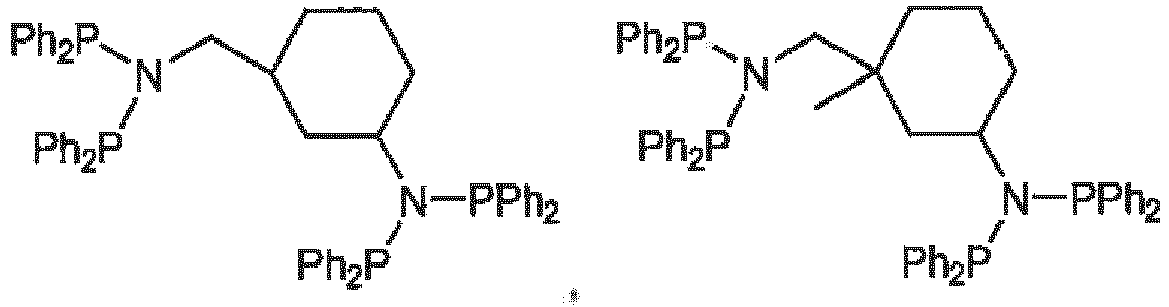

- The compound represented by Chemical Formula 1 includes all possible optical isomers.
- Further, the present invention provides a method for preparing a compound represented by Chemical Formula 1 as shown in the following Reaction Formula 1.

- In the Reaction Formula 1, A, X, and R5 to R14 are as defined above.
- The step 1 is a reaction for substituting an amine group of a starting material with an A substituent, wherein the starting material and PR1R2Cl are reacted. It is preferable that trimethylamines are reacted together, and that dichloromethane is used as a solvent.
- If the structure of R1 and R2 (PR1R2) of the substituent A is identical to the structure of R3 and R4 (PR3R4), a compound of Chemical Formula 1 may be prepared by the step 1. If the structure of R1 and R2 (PR1R2) of the substituent A is different from the structure of R3 and R4 (PR3R4), the step 2 is conducted to prepare a compound represented by Chemical Formula 1. The step 2 is identical to the step 1, except using PR3R4Cl as a reactant.
- Further, the present invention provides a catalyst system for olefin oligomerization, comprising the compound represented by Chemical Formula 1, a source of a transition metal, and a cocatalyst.
- As used herein, the term 'olefin oligomerization' means polymerization of a small number of olefins. When three olefins are polymerized, it is referred to as trimerization, when four olefins are polymerized, it is referred to as tetramerization, and the process of polymerization of a small number of olefins to form low molecular weight material is generally referred to as multimerization. Particularly, in the present invention, selective preparation of 1-hexene and 1-octene, main comonomers of LLDPE, from ethylene, is referred to.
- Selective olefin oligomerization is closely related to a catalyst system used. A catalyst system used for olefin oligomerization comprises a source of a transition metal functioning as a main catalyst, and a cocatalyst, wherein the structure of the active catalyst may be changed according to the chemical structure of a ligand, thereby varying olefin selectivity and activity.
- Thus, the catalyst system for olefin oligomerization according to the present invention uses a compound represented by Chemical Formula 1 as a ligand, to selectively prepare 1-hexene and 1-octene. Without being bound by any theory, it is judged that the compound represented by Chemical Formula 1 has two substituents A that can be coordinated to a main catalyst, has a structure wherein the substituents A in the compound are connected to a linker of a cyclohexane-X structure, and due to the flexible linker, two A substituents, which are active sites where oligomerization occurs, effectively interact to increase activity and selectivity of the catalyst.
- The source of the transition metal functions as a main catalyst, and preferably, is at least one selected from the group consisting of chromium(III)acetylacetonate, tris(tetrahydrofuran)chromium trichloride, chromium(III)-2-ethylhexanoate, chromium(III)tris(2,2,6,6-tetramethyl-3,5-heptanedionate), chromium(III)benzoylacetonate, chromium(III)hexafluoro-2,4-pentanedionate, and chromium(III)acetate hydroxide.
- The cocatalyst is an organic metal compound including a Group 13 metal, and is not specifically limited as long as it can be used for olefin multimerization in the presence of a transition metal catalyst. Specifically, as the cocatalyst, at least one selected from the group consisting of the compounds represented by the following Chemical Formulae 3 to 5 may be used.
[Chemical Formula 3] -[Al(R15)-O]c-
In Chemical Formula 3,
R15's are independently a halogen, a C1-20 alkyl, or a C1-20 haloalkyl, and
c is an integer equal to or greater than 2.
[Chemical Formula 4] D(R16)3
In Chemical Formula 4,
D is aluminum or boron,
R16 is a C1-20 alkyl or a C1-20 haloalkyl.
[Chemical Formula 5] [L-H]+[Q(E)4]-
In Chemical Formula 5,
L is a neutral Lewis base,
[L-H]+ is a Bronsted acid,
Q is Br3+ or Al3+, and - E's are independently a C6-20 aryl or a C1-20 alkyl, wherein the C6-20 aryl or C1-20 alkyl is unsubstituted or substituted with at least one substituent selected from the group consisting of a halogen, a C1-20 alkyl, a C1-20 alkoxy, and a phenoxy.
- Examples of the compound represented by Chemical Formula 3 may include methylaluminoxane (MAO), ethylaluminoxane, isobutylaluminoxane, or butylaluminoxane.
- Examples of the compound represented by Chemical Formula 4 may include trimethylaluminum, triethylaluminum, triisobutylaluminum, tripropylaluminum, tributylaluminum, dimethylchloroaluminum, dimethylisobutylaluminum, dimethylethylaluminum, diethylchloroaluminum, triisopropylaluminum, tri-s-butylaluminum, tricyclopentylaluminum, tripentylaluminum, triisopentylaluminum, trihexylaluminum, ethyldimethylaluminum, methyldiethylaluminum, triphenylaluminum, tri-p-tollylaluminum, dimethylaluminummethoxide, dimethylaluminumethoxide, trimethylboron, triethylboron, triisobutylboron, tripropylboron or tributylboron.
- Examples of the compound represented by Chemical Formula 5 may include triethylammonium tetraphenylboron, tributylammonium tetraphenylboron, trimethylammonium tetraphenylboron, tripropylammonium tetraphenylboron, trimethylammonium tetra(p-tolyl)boron, tripropylammonium tetra(p-tollyl)boron, triethylammonium tetra(o,p-dimethylphenyl)boron, trimethylammonium tetra(o,p-dimethylphenyl)boron, tributylammonium tetra(p-trifluoromethylphenyl)boron, trimethylammonium tetra(p-trifluoromethylphenyl)boron, tributylammonium tetrapentafluorophenylboron, N,N-diethylanilinium tetraphenylboron, N,N-diethylanilinium tetraphenylboron, N,N-diethylanilinium tetrapentafluorophenylboron, diethylammonium tetrapentafluorophenylboron, triphenylphosphonium tetraphenylboron, trimethylphosphonium tetraphenylboron, triethylammonium tetraphenylaluminum, tributylammonium tetraphenylaluminum, trimethylammonium tetraphenylaluminum, tripropylammonium tetraphenylaluminum, trimethylammonium tetra(p-tollyl)aluminum, tripropylammonium tetra(p-tolyl)aluminum, triethylammonium tetra(o,p-dimethylphenyl)aluminum, tributylammonium tetra(p-trifluoromethylphenyl)aluminum, trimethylammonium tetra(p-trifluoromethylphenyl)aluminum, tributylammonium tetrapentafluorophenylaluminum, N,N-diethylanilinium tetraphenylaluminum, N,N-diethylanilinium tetraphenylaluminum, N,N-diethylanilinium tetrapentafluorophenylaluminum, diethylammonium tetrapentafluorophenylaluminum, triphenylphosphonium tetraphenylaluminum, trimethylphosphonium tetraphenylaluminum, triphenylcarbonium tetraphenylboron, triphenylcarbonium tetraphenylaluminum, triphenylcarbonium tetra(p-trifluoromethylphenyl)boron, or triphenylcarbonium tetrapentafluorophenylboron.
- The catalyst system for olefin oligomerization according to the present invention may have a mole ratio of the compound represented by Chemical Formula 1:source of transition metal:cocatalyst of about 1:1:1 to about 10:1:10,000, preferably about 1:1:100 to about 5:1:3,000, so as to increase selectivity to linear alpha-olefin and multimerization activity.
- In the catalyst system for olefin oligomerization comprising the compound represented by Chemical Formula 1, a source of the transition metal, and the cocatalyst, the three components may be added simultaneously or sequentially in a random order in a suitable solvent in the absence or presence of monomers, and be obtained as an active catalyst. The active solvent may include heptane, toluene, 1-hexene, diethylether, tetrahydrofuran, acetonitrile, dichloromethane, chloroform, chlorobenzene, methanol, acetone, and the like, but is not limited thereto.
- The present invention also provides a method for preparation of olefin oligomer, comprising the step of multimerizing olefins in the presence of the catalyst system for olefin oligomerization. If the catalyst system for olefin oligomerization according to the present invention is used, a method for olefin oligomerization with improved activity and selectivity may be provided. The olefin may preferably be ethylene.
- The olefin oligomerization according to the present invention may be conducted as a homogeneous liquid phase reaction, a slurry reaction wherein a catalyst system is not dissolved in part or in whole, a two-phase liquid/liquid reaction, or a bulk phase reaction or a gas phase reaction wherein a product olefin acts as a main medium, in the absence or presence of an inert solvent, using the catalyst system for olefin oligomerization and a common device and contact technology, and the homogeneous liquid phase reaction is preferable.
- The olefin oligomerization may be conducted in any inert solvent that does not react with a catalyst compound and an activator. The suitable inert solvent may include benzene, toluene, xylene, cumene, heptane, cyclohexane, methylcyclohexane, methylcyclopentane, hexane, pentane, butane, isobutane, and the like, but is not limited thereto. Herein, the solvent may be treated with a small amount of alkylaluminum to remove a small amount of water or air acting as a catalyst poison, before use.
- The olefin oligomerization may be conducted at a temperature of about 5 °C to about 200 °C, preferably about 30 °C to about 150 °C. Further, the olefin oligomerization may be conducted at a pressure of about 1 bar to about 300 bar, preferably about 2 bar to about 150 bar.
- According to examples of the invention, it was confirmed that as a result of oligomerizing ethylene with a catalyst system using the compound represented by Chemical Formula 1 as a ligand, 1-hexene and 1-octene are selectively synthesized.
- By using a compound represented by Chemical Formula 1 according to the present invention and a catalyst system comprising the same, an olefin may be oligomerized with higher catalytic activity and selectivity compared to the existing catalyst system.
- Hereinafter, the present invention will be explained in detail with reference to the following examples. However, these examples are only to illustrate the invention, and the scope of the invention is not limited thereto.
- All the reactions were progressed using a Schlenk technique or a glove box under an argon atmosphere. The synthesized compounds were analyzed by 1H(500 MHz) and 31P(202 MHz) NMR spectra using a Varian 500 MHz spectrometer. Shift was expressed in ppm, downfield from TMS, with a residual solvent peak as a reference. A phosphorous probe was calibrated with aqueous H3PO4.
-

- Under an argon atmosphere, 5-amino-1,3,3-trimethylcyclohexanemethylamine (5 mmol) and triethylamine (3∼10 equivalents) were dissolved in dichloromethane (80 mL). While the flask was immersed in a water bath, chlorodiphenylphosphine (20 mmol) was slowly added, and the mixture was stirred overnight. The solvent was removed under vacuum, and then THF was added, the mixture was sufficiently stirred, and triethylammonium chloride salt was removed with an air-free glass filter. The solvent was removed from the filtrate to obtain a target compound.
31P NMR: 45.6 (br s), 56.2 (br s) -

- A target compound was prepared by the same method as Example 1, except using 2-aminopropane (10 mmol) instead of 5-amino-1,3,3-trimethylcyclohexanemethyhlam ine.
31P NMR: 48.4 (br s) - Under argon gas, Cr(acac)3 (17.5 mg, 0.05 mmol) and the compound prepared in the Example (0.025 mmol) were added into a flask, cyclohexane (10 mL) was added, and the mixture was stirred to prepare a 5 mM solution.
- A 600 mL Parr reactor was prepared, vacuum was applied at 120 °C for 2 hours, the internal atmosphere was then replaced with argon, and the temperature was decreased to 45 °C. Cyclohexane (270 g) and 2 mL of MMAO (isoheptane solution, Al/Cr=300) were added, and 2 mL of the 5 mM solution (10 µmol) was added into the reactor. The mixture was stirred at 500 rpm for 2 minutes, a valve of an ethylene line adjusted to 45 bar was opened to fill the inside of the reactor with ethylene, and the mixture was stirred at 500 rpm for 15 minutes. The ethylene line valve then was closed, the reactor was cooled to 0 °C with a dry ice/acetone bath, non-reacted ethylene was slowly vented, and 0.5 mL of nonane (GC internal standard) was added. After stirring for 10 seconds, 2 mL of the liquid part of the reactor was taken and quenched with water, and the organic part was filtered with a PTFE syringe filter to make a GC sample. The GC sample was analyzed with GC.
- 400 mL of ethanol/HCl (10 vol%) was added to the remaining reaction solution, and the mixture was stirred and filtered to obtain a polymer. The obtained polymer was dried overnight in a vacuum oven at 65 °C, and the weight was measured.
- The same process as Experimental Example 1 was conducted, except that in the step 2, 1 mL of the MMAO (isoheptane solution, Al/Cr=300) was used instead of 2 mL, and that 1 mL (5 µmol) of the 5 mM solution was used instead of 2 mL (10 µmol).
- The same process as Experimental Example 1 was conducted, except that in the step 2, 4 mL of MMAO (isoheptane solution, Al/Cr=1200) was used instead of 2 mL of the MMAO (isoheptane solution, Al/Cr=300), and that 1 mL (5 µmol) of the 5 mM solution was used instead of 2 mL (10 µmol).
- The same process as Experimental Example 1 was conducted, except that in the step 2, 4 mL of MMAO (isoheptane solution, Al/Cr=1200) was used instead of 2 mL of the MMAO (isoheptane solution, Al/Cr=300), 1 mL (5 µmol) of the 5 mM solution was used instead of 2 mL (10 µmol), and the process was conducted under conditions of ethylene at 60 bar and 60 °C instead of the conditions of ethylene at 45 bar and 45 °C.
- The same process as Experimental Example 1 was conducted, except that in the step 2, 70 g of cyclohexane was used instead of 270 g, 2 mL of MMAO (isoheptane solution, Al/Cr=1200) was used instead of 2 mL of the MMAO (isoheptane solution, Al/Cr=300), and 0.5 mL (2.5 µmol) of the 5 mM solution was used instead of 2 mL (10 µmol).
- The same process as Experimental Example 4 was conducted, except that tris(tetrahydrofuran)chromium trichloride (18.7 mg, 0.05 mmol) was used instead of Cr(acac)3.
- The same process as Experimental Example 4 was conducted, except that chromium(III)-2-ethylhexanoate (24.1 mg, 0.05 mmol) was used instead of Cr(acac)3.
- The same process as Experimental Example 4 was conducted, except that chromium(III)tris(2,2,6,6-tetramethyl-3,5-heptanedionate) (30.1 mg, 0.05 mmol) was used instead of Cr(acac)3.
- The same process as Experimental Example 4 was conducted, except that chromium(III)benzoylacetonate (26.8 mg, 0.05 mmol) was used instead of Cr(acac)3.
- The same process as Experimental Example 4 was conducted, except that chromium(III)hexafluoro-2,4-pentanedionate (33.7 mg, 0.05 mmol) was used instead of Cr(acac)3.
- The same process as Experimental Example 4 was conducted, except that chromium(III)acetate hydroxide (Cr3(CH3CO2)7(OH)2, 26.8 mg, 0.05 mmol) was used instead of Cr(acac)3.
- The same process as Experimental Example 1 was conducted, except that in the step 1, the compound prepared in Comparative Example 1 (0.1 mmol) was used instead of the compound prepared in Example 1, and in the step 2, 1 mL of the MMAO (isoheptane solution, Al/Cr=300) was used instead of 2 mL, and 1 mL (5 µmol) of the 5 mM solution was used instead of 2 mL (10 µmol).
- The same process as Experimental Example 1 was conducted, except that in the step 1, the compound prepared in Comparative Example 1 (0.1 mmol) was used instead of the compound prepared in Example 1, and in the step 2, 4 mL of MMAO (isoheptane solution, Al/Cr=1200) was used instead of 2 mL of the MMAO (isoheptane solution, Al/Cr=300), and 1 mL (5 µmol) of the 5 mM solution was used instead of 2 mL (10 µmol).
- The results of Experimental Examples 1 to 11 and Comparative Experimental Examples 1 and 2 are shown in the following Table 1.
[Table 1] Polyethyl ene (wt%) Selectivity (wt%) Activity (kg/mol/Cr/hr) 1-hexene 1-octene 1-C10 to 1-C40 Sum Experimental Example 1 0.2 18.8 63.9 7.9 90.6 22600 Experimental Example 2 0.17 15.0 67.7 8.5 91.2 15700 Experimental Example 3 0.03 29.5 55.2 8.7 93.4 44100 Experimental Example 4 0.03 24.5 59.9 7.5 91.9 46800 Experimental Example 5 0.55 16.8 65.9 9.7 92.4 52500 Experimental Example 6 6.05 15.9 61.5 3.3 80.7 5421 Experimental Example 7 0.36 17.2 67.8 6.6 91.6 20588 Experimental Example 8 0.20 17.1 65.6 4.8 87.5 4742 Experimental Example 9 2.60 17.4 64.7 7.2 89.3 27572 Experimental Example 10 3.37 20.5 38.4 2.3 61.2 475 Experimental Example 11 0.0 41.2 43.5 9.6 94.3 401 Comparative Experimental Example 1 0.6 12.7 67.3 6.7 86.7 1500 Comparative Experimental Example 2 0.5 11.9 68.8 5.7 86.4 4000 - As shown in the Table 1, it was confirmed that the experimental examples using the compounds according to the present invention exhibit very high multimerization activity compared to the comparative experimental examples, produce very little solid by-products, and have remarkably improved selectivity to alpha-olefins (1-hexen and 1-octene).
Claims (15)
- A compound represented by the following Chemical Formula 1:

A is represented by the following Chemical Formula 2,
R1 to R4 are independently a C1-20 alkyl, a C2-20 alkenyl, a C6-14 aryl, a C6-14 aryl substituted with a C1-4alkyl, a C1-4 alkyl substituted with a C6-14 aryl, or a C6-14 aryl substituted with a C1-4 alkoxy,
R5 to R14 are independently hydrogen, a C1-20 alkyl, a C2-20 alkenyl, a C6-14 aryl, a C6-14 aryl substituted with a C1-4 alkyl, a C1-4 alkyl substituted with a C6-14 aryl, or a C6-14 aryl substituted with a C1-4 alkoxy. - The compound according to claim 1, wherein X is methylene or phenylene.
- The compound according to claim 1, wherein R1 to R4 are identical to each other.
- The compound according to claim 1, wherein R1 to R4 are phenyl.
- The compound according to claim 1, wherein R5 and R6 are hydrogen.
- The compound according to claim 1, wherein R7 and R8 are identical to each other, and are hydrogen or methyl.
- The compound according to claim 1, wherein R9 is hydrogen or iso-propyl.
- The compound according to claim 7, wherein R10 hydrogen.
- The compound according to claim 1, wherein R11 to R13 are hydrogen.
- The compound according to claim 1, wherein R14 is hydrogen or methyl.
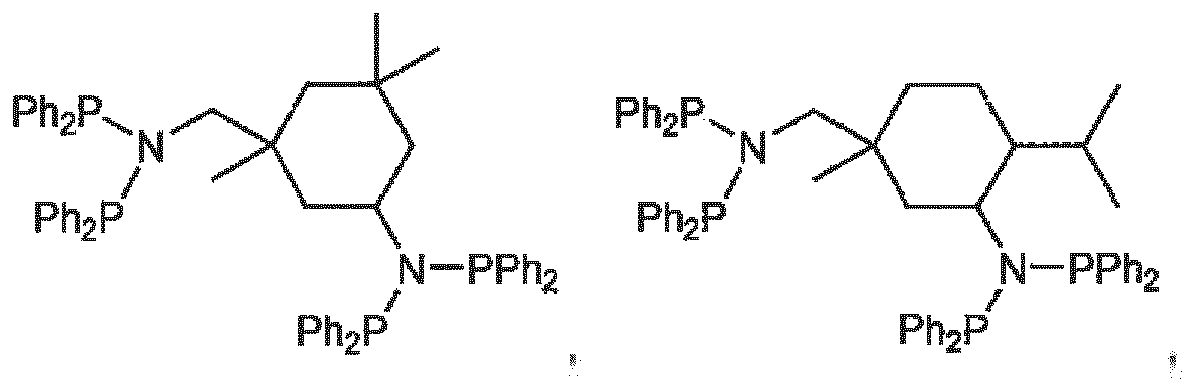
- The compound according to claim 1, wherein the compound is selected from the group consisting of the following compounds:


- A catalyst system for olefin oligomerization, comprising the compound according to any one of claims 1 to 11, a source of a transition metal, and a cocatalyst.
- The catalyst system according to claim 12, wherein the source of a transition metal is at least one selected from the group consisting of chromium(III)acetylacetonate, tris(tetrahydrofuran)chromium trichloride, chromium(III)-2-ethylhexanoate, chromium(III)tris(2,2,6,6-tetramethyl-3,5-heptanedionate), chromium(III)benzoylacetonate, chromium(III)hexafluoro-2,4-pentanedionate, and chromium(III)acetate hydroxide.
- The catalyst system according to claim 12, wherein the cocatalyst is at least one selected from the group consisting of the compounds represented by the following Chemical Formulae 3 to 5:
[Chemical Formula 3] -[Al(R15)-O]c-
in Chemical Formula 3,
R15's are independently a halogen, a C1-20 alkyl, or a C1-20 haloalkyl, and
c is an integer equal to or greater than 2,
[Chemical Formula 4] D(R16)3
in Chemical Formula 4,
D is aluminum or boron, and
R16 is a C1-20 alkyl or a C1-20 haloalkyl,
[Chemical Formula 5] [L-H]+[Q(E)4]-
in Chemical Formula 5,
L is a neutral Lewis base,
[L-H]+ is a Bronsted acid,
Q is Br3+ or Al3+, and
E's are independently a C6-20 aryl or a C1-20 alkyl, and are unsubstituted or substituted with at least one substituent selected from the group consisting of a halogen, a C1-20 alkyl, a C1-20 alkoxy, and a phenoxy. - A method for olefin oligomerization, comprising the step of oligomerizing olefins in the presence of the catalyst system for olefin oligomerization according to claim 12.
Applications Claiming Priority (3)
| Application Number | Priority Date | Filing Date | Title |
|---|---|---|---|
| KR20130139995 | 2013-11-18 | ||
| KR1020140160180A KR20150058034A (en) | 2013-11-18 | 2014-11-17 | Ligand compound, catalyst system for olefin oligomerization, and method for olefin oligomerization using the same |
| PCT/KR2014/011078 WO2015072812A1 (en) | 2013-11-18 | 2014-11-18 | Ligand compound, catalyst system for olefin oligomerization, and olefin oligomerization method using same |
Publications (2)
| Publication Number | Publication Date |
|---|---|
| EP2927236A1 true EP2927236A1 (en) | 2015-10-07 |
| EP2927236A4 EP2927236A4 (en) | 2016-07-27 |
Family
ID=53392703
Family Applications (1)
| Application Number | Title | Priority Date | Filing Date |
|---|---|---|---|
| EP14862021.4A Withdrawn EP2927236A4 (en) | 2013-11-18 | 2014-11-18 | Ligand compound, catalyst system for olefin oligomerization, and method for olefin oligomerization using same |
Country Status (6)
| Country | Link |
|---|---|
| US (1) | US9498773B2 (en) |
| EP (1) | EP2927236A4 (en) |
| JP (1) | JP5954914B2 (en) |
| KR (1) | KR20150058034A (en) |
| CN (1) | CN104955829B (en) |
| WO (1) | WO2015072812A1 (en) |
Cited By (2)
| Publication number | Priority date | Publication date | Assignee | Title |
|---|---|---|---|---|
| EP2987783A4 (en) * | 2013-11-18 | 2017-02-08 | LG Chem, Ltd. | Ligand compound, catalyst system for olefin oligomerization, and olefin oligomerization method using same |
| EP3225637B1 (en) * | 2015-05-15 | 2020-02-05 | LG Chem, Ltd. | Catalytic system for olefin oligomerization reaction and method for olefin oligomerization using same |
Families Citing this family (9)
| Publication number | Priority date | Publication date | Assignee | Title |
|---|---|---|---|---|
| KR101757369B1 (en) | 2014-12-11 | 2017-07-12 | 주식회사 엘지화학 | Ligand compound, organic chromium compound, catalyst system for oligomerization of olefins and method for oligomerization of olefins using the catalyst system |
| KR20160134464A (en) | 2015-05-15 | 2016-11-23 | 주식회사 엘지화학 | Supported hybrid catalyst system and method for olefin polymerization using the same |
| WO2016186282A1 (en) | 2015-05-15 | 2016-11-24 | 주식회사 엘지화학 | Catalytic composition and method for preparing polyolefin using same |
| WO2016195168A1 (en) * | 2015-06-01 | 2016-12-08 | 주식회사 엘지화학 | 1-octene composition |
| KR101757370B1 (en) | 2015-06-01 | 2017-07-12 | 주식회사 엘지화학 | 1-Octene composition |
| KR102058142B1 (en) | 2015-09-02 | 2019-12-20 | 주식회사 엘지화학 | Ligand compound, catalyst system for olefin oligomerization, and method for olefin oligomerization using the same |
| KR101761830B1 (en) | 2015-10-21 | 2017-07-26 | 주식회사 엘지화학 | Ligand compound, catalyst system for olefin oligomerization, and method for olefin oligomerization using the same |
| KR102545533B1 (en) | 2016-05-27 | 2023-06-21 | 에스케이이노베이션 주식회사 | Oligomerization Catalyst And Process For Preparing Ethylene Oligomer Using Thereof |
| KR102521448B1 (en) * | 2017-12-20 | 2023-04-13 | 주식회사 엘지화학 | Paraffin mixture and preparation method thereof |
Family Cites Families (13)
| Publication number | Priority date | Publication date | Assignee | Title |
|---|---|---|---|---|
| KR20060002742A (en) | 2002-12-20 | 2006-01-09 | 사솔 테크날러지 (프로프라이어터리) 리미티드 | Tetramerization of Olefin |
| CA2509700A1 (en) * | 2002-12-20 | 2004-07-08 | Sasol Technology (Pty) Limited | Tandem tetramerisation-polymerisation of olefins |
| CN101052605B (en) | 2004-06-18 | 2011-12-21 | Sasol技术股份有限公司 | Oligomerisation of olefinic compounds in an aliphatic medium |
| WO2005123884A2 (en) | 2004-06-18 | 2005-12-29 | Sasol Technology (Pty) Limited | Oligomerisation in the presence of both a tetramerisation catalyst and a further oligomerisation catalyst |
| US7259123B2 (en) | 2005-04-08 | 2007-08-21 | Shell Oil Company | Catalytic trimerization and tetramerization of olefinic monomers |
| ATE454214T1 (en) | 2005-11-21 | 2010-01-15 | Shell Int Research | CATALYTIC OLIGOMERIZATION OF OLEFINIC MONOMERS |
| CN100443178C (en) * | 2006-03-10 | 2008-12-17 | 中国石油天然气股份有限公司 | Catalyst composition for ethylene oligomerization and application thereof |
| US7378537B2 (en) * | 2006-07-25 | 2008-05-27 | Chevron Phillips Chemical Company Lp | Olefin oligomerization catalysts and methods of using same |
| CN102107146B (en) * | 2009-12-29 | 2013-10-16 | 中国石油天然气股份有限公司 | A kind of catalyst and application thereof for ethylene trimerization into hexene-1 |
| US20120172645A1 (en) * | 2010-12-29 | 2012-07-05 | Chevron Phillips Chemical Company Lp | Olefin Oligomerization catalysts and Methods of Making and Using Same |
| KR20140097335A (en) * | 2011-11-11 | 2014-08-06 | 바스프 에스이 | P-n-compounds as flame retardants |
| CN103285926A (en) * | 2012-03-01 | 2013-09-11 | 中国石油天然气股份有限公司 | A kind of catalyst composition of ethylene oligomerization and its application |
| JP6153278B2 (en) * | 2013-11-18 | 2017-06-28 | エルジー・ケム・リミテッド | Ligand compound, catalyst system for olefin oligomerization, and olefin oligomerization method using the same |
-
2014
- 2014-11-17 KR KR1020140160180A patent/KR20150058034A/en not_active Ceased
- 2014-11-18 CN CN201480005990.6A patent/CN104955829B/en active Active
- 2014-11-18 WO PCT/KR2014/011078 patent/WO2015072812A1/en not_active Ceased
- 2014-11-18 JP JP2015550348A patent/JP5954914B2/en active Active
- 2014-11-18 US US14/760,158 patent/US9498773B2/en active Active
- 2014-11-18 EP EP14862021.4A patent/EP2927236A4/en not_active Withdrawn
Cited By (2)
| Publication number | Priority date | Publication date | Assignee | Title |
|---|---|---|---|---|
| EP2987783A4 (en) * | 2013-11-18 | 2017-02-08 | LG Chem, Ltd. | Ligand compound, catalyst system for olefin oligomerization, and olefin oligomerization method using same |
| EP3225637B1 (en) * | 2015-05-15 | 2020-02-05 | LG Chem, Ltd. | Catalytic system for olefin oligomerization reaction and method for olefin oligomerization using same |
Also Published As
| Publication number | Publication date |
|---|---|
| KR20150058034A (en) | 2015-05-28 |
| US9498773B2 (en) | 2016-11-22 |
| CN104955829B (en) | 2018-03-09 |
| JP2016503815A (en) | 2016-02-08 |
| US20160045906A1 (en) | 2016-02-18 |
| JP5954914B2 (en) | 2016-07-20 |
| WO2015072812A1 (en) | 2015-05-21 |
| EP2927236A4 (en) | 2016-07-27 |
| CN104955829A (en) | 2015-09-30 |
Similar Documents
| Publication | Publication Date | Title |
|---|---|---|
| US9498773B2 (en) | Catalyst system for olefin oligomerization, and method for olefin oligomerization using the same | |
| EP3257873B1 (en) | Method for preparing oligomerization catalyst system, and oligomerization catalyst system prepared by same | |
| US9637508B2 (en) | Ligand compound, catalyst system for olefin oligomerization, and method for olefin oligomerization using the same | |
| EP3045463B1 (en) | Ligand compound, catalyst system for olefin oligomerization, and olefin oligomerization method using it | |
| EP2987797B1 (en) | Ligand compound, catalyst system for oligomerizing olefin, and method for oligomerizing olefin using same | |
| EP3231808B1 (en) | Ligand compound, catalyst system for oligomerizing, and method for olefin oligomerization using same | |
| EP2918340B1 (en) | Ligand compound, catalyst system for oligomerizing olefin, and method for oligomerizing olefin using same | |
| EP2985287B1 (en) | Ligand compound, catalyst system for olefin oligomerization, and olefin oligomerization method using same | |
| JP6524330B2 (en) | 1-octene composition | |
| EP3118227A1 (en) | 1-octene composition | |
| EP3208284B1 (en) | Ligand compound, catalyst system for olefin oligomerization, and method for oligomerizing olefins using the same | |
| KR20160110079A (en) | Catalyst system for oligomerization and method of olefin oligomerization |
Legal Events
| Date | Code | Title | Description |
|---|---|---|---|
| PUAI | Public reference made under article 153(3) epc to a published international application that has entered the european phase |
Free format text: ORIGINAL CODE: 0009012 |
|
| 17P | Request for examination filed |
Effective date: 20150629 |
|
| AK | Designated contracting states |
Kind code of ref document: A1 Designated state(s): AL AT BE BG CH CY CZ DE DK EE ES FI FR GB GR HR HU IE IS IT LI LT LU LV MC MK MT NL NO PL PT RO RS SE SI SK SM TR |
|
| AX | Request for extension of the european patent |
Extension state: BA ME |
|
| RAP1 | Party data changed (applicant data changed or rights of an application transferred) |
Owner name: LG CHEM, LTD. |
|
| RA4 | Supplementary search report drawn up and despatched (corrected) |
Effective date: 20160628 |
|
| RIC1 | Information provided on ipc code assigned before grant |
Ipc: C07C 211/54 20060101ALI20160622BHEP Ipc: C07F 9/46 20060101AFI20160622BHEP Ipc: C07C 11/02 20060101ALI20160622BHEP Ipc: C07C 2/32 20060101ALI20160622BHEP Ipc: C07C 2/36 20060101ALI20160622BHEP Ipc: C08F 4/42 20060101ALI20160622BHEP Ipc: C07C 11/107 20060101ALI20160622BHEP |
|
| DAX | Request for extension of the european patent (deleted) | ||
| 17Q | First examination report despatched |
Effective date: 20170330 |
|
| STAA | Information on the status of an ep patent application or granted ep patent |
Free format text: STATUS: THE APPLICATION IS DEEMED TO BE WITHDRAWN |
|
| 18D | Application deemed to be withdrawn |
Effective date: 20170610 |