EP2927220A1 - Method for producing cyclopentanone derivative, intermediate compound, and method for producing intermediate compound - Google Patents
Method for producing cyclopentanone derivative, intermediate compound, and method for producing intermediate compound Download PDFInfo
- Publication number
- EP2927220A1 EP2927220A1 EP13857920.6A EP13857920A EP2927220A1 EP 2927220 A1 EP2927220 A1 EP 2927220A1 EP 13857920 A EP13857920 A EP 13857920A EP 2927220 A1 EP2927220 A1 EP 2927220A1
- Authority
- EP
- European Patent Office
- Prior art keywords
- group
- carbons
- iii
- compound
- groups
- Prior art date
- Legal status (The legal status is an assumption and is not a legal conclusion. Google has not performed a legal analysis and makes no representation as to the accuracy of the status listed.)
- Withdrawn
Links
- 150000001875 compounds Chemical class 0.000 title claims abstract description 146
- 238000004519 manufacturing process Methods 0.000 title claims abstract description 53
- BGTOWKSIORTVQH-HOSYLAQJSA-N cyclopentanone Chemical class O=[13C]1CCCC1 BGTOWKSIORTVQH-HOSYLAQJSA-N 0.000 title claims abstract description 24
- 239000002253 acid Substances 0.000 claims abstract description 34
- 238000000034 method Methods 0.000 claims abstract description 16
- 125000000217 alkyl group Chemical group 0.000 claims description 33
- 125000006239 protecting group Chemical group 0.000 claims description 26
- 125000002887 hydroxy group Chemical group [H]O* 0.000 claims description 20
- 125000005843 halogen group Chemical group 0.000 claims description 19
- 230000002378 acidificating effect Effects 0.000 claims description 18
- 125000003545 alkoxy group Chemical group 0.000 claims description 17
- 125000001188 haloalkyl group Chemical group 0.000 claims description 14
- 125000002496 methyl group Chemical group [H]C([H])([H])* 0.000 claims description 14
- 125000001997 phenyl group Chemical group [H]C1=C([H])C([H])=C(*)C([H])=C1[H] 0.000 claims description 14
- 125000004438 haloalkoxy group Chemical group 0.000 claims description 11
- 125000004435 hydrogen atom Chemical group [H]* 0.000 claims description 10
- 125000000449 nitro group Chemical group [O-][N+](*)=O 0.000 claims description 9
- 125000004093 cyano group Chemical group *C#N 0.000 claims description 8
- 125000001797 benzyl group Chemical group [H]C1=C([H])C([H])=C(C([H])=C1[H])C([H])([H])* 0.000 claims description 5
- 125000001624 naphthyl group Chemical group 0.000 claims description 4
- 125000003342 alkenyl group Chemical group 0.000 claims description 3
- -1 2,2-dichloroethyl groups Chemical group 0.000 description 63
- 238000006243 chemical reaction Methods 0.000 description 20
- DHKHKXVYLBGOIT-UHFFFAOYSA-N acetaldehyde Diethyl Acetal Natural products CCOC(C)OCC DHKHKXVYLBGOIT-UHFFFAOYSA-N 0.000 description 17
- YXFVVABEGXRONW-UHFFFAOYSA-N Toluene Chemical compound CC1=CC=CC=C1 YXFVVABEGXRONW-UHFFFAOYSA-N 0.000 description 15
- VEXZGXHMUGYJMC-UHFFFAOYSA-N Hydrochloric acid Chemical compound Cl VEXZGXHMUGYJMC-UHFFFAOYSA-N 0.000 description 14
- 239000002904 solvent Substances 0.000 description 13
- WSFSSNUMVMOOMR-UHFFFAOYSA-N Formaldehyde Chemical compound O=C WSFSSNUMVMOOMR-UHFFFAOYSA-N 0.000 description 12
- QAOWNCQODCNURD-UHFFFAOYSA-N Sulfuric acid Chemical compound OS(O)(=O)=O QAOWNCQODCNURD-UHFFFAOYSA-N 0.000 description 12
- JOXIMZWYDAKGHI-UHFFFAOYSA-N toluene-4-sulfonic acid Chemical compound CC1=CC=C(S(O)(=O)=O)C=C1 JOXIMZWYDAKGHI-UHFFFAOYSA-N 0.000 description 12
- NBIIXXVUZAFLBC-UHFFFAOYSA-N Phosphoric acid Chemical compound OP(O)(O)=O NBIIXXVUZAFLBC-UHFFFAOYSA-N 0.000 description 10
- 239000000243 solution Substances 0.000 description 10
- CSCPPACGZOOCGX-UHFFFAOYSA-N Acetone Chemical compound CC(C)=O CSCPPACGZOOCGX-UHFFFAOYSA-N 0.000 description 9
- XEKOWRVHYACXOJ-UHFFFAOYSA-N Ethyl acetate Chemical compound CCOC(C)=O XEKOWRVHYACXOJ-UHFFFAOYSA-N 0.000 description 9
- VQTUBCCKSQIDNK-UHFFFAOYSA-N Isobutene Chemical compound CC(C)=C VQTUBCCKSQIDNK-UHFFFAOYSA-N 0.000 description 8
- DTQVDTLACAAQTR-UHFFFAOYSA-N Trifluoroacetic acid Chemical compound OC(=O)C(F)(F)F DTQVDTLACAAQTR-UHFFFAOYSA-N 0.000 description 8
- 150000001241 acetals Chemical class 0.000 description 8
- 150000007513 acids Chemical class 0.000 description 8
- UIIMBOGNXHQVGW-UHFFFAOYSA-M Sodium bicarbonate Chemical compound [Na+].OC([O-])=O UIIMBOGNXHQVGW-UHFFFAOYSA-M 0.000 description 7
- 230000015572 biosynthetic process Effects 0.000 description 7
- 238000003786 synthesis reaction Methods 0.000 description 7
- 125000000999 tert-butyl group Chemical group [H]C([H])([H])C(*)(C([H])([H])[H])C([H])([H])[H] 0.000 description 7
- XLYOFNOQVPJJNP-UHFFFAOYSA-N water Substances O XLYOFNOQVPJJNP-UHFFFAOYSA-N 0.000 description 7
- NRRVDQRTYGCXGC-UHFFFAOYSA-N 5-benzyl-2,2-bis(hydroxymethyl)cyclopentan-1-one Chemical class OCC1(CO)CCC(Cc2ccccc2)C1=O NRRVDQRTYGCXGC-UHFFFAOYSA-N 0.000 description 6
- QTBSBXVTEAMEQO-UHFFFAOYSA-N Acetic acid Chemical compound CC(O)=O QTBSBXVTEAMEQO-UHFFFAOYSA-N 0.000 description 6
- PMZURENOXWZQFD-UHFFFAOYSA-L Sodium Sulfate Chemical compound [Na+].[Na+].[O-]S([O-])(=O)=O PMZURENOXWZQFD-UHFFFAOYSA-L 0.000 description 6
- HEDRZPFGACZZDS-MICDWDOJSA-N Trichloro(2H)methane Chemical compound [2H]C(Cl)(Cl)Cl HEDRZPFGACZZDS-MICDWDOJSA-N 0.000 description 6
- 239000007864 aqueous solution Substances 0.000 description 6
- 239000000203 mixture Substances 0.000 description 6
- 239000012044 organic layer Substances 0.000 description 6
- KJIFKLIQANRMOU-UHFFFAOYSA-N oxidanium;4-methylbenzenesulfonate Chemical compound O.CC1=CC=C(S(O)(=O)=O)C=C1 KJIFKLIQANRMOU-UHFFFAOYSA-N 0.000 description 6
- 239000000047 product Substances 0.000 description 6
- HEWZVZIVELJPQZ-UHFFFAOYSA-N 2,2-dimethoxypropane Chemical compound COC(C)(C)OC HEWZVZIVELJPQZ-UHFFFAOYSA-N 0.000 description 5
- FAPWRFPIFSIZLT-UHFFFAOYSA-M Sodium chloride Chemical class [Na+].[Cl-] FAPWRFPIFSIZLT-UHFFFAOYSA-M 0.000 description 5
- 125000004849 alkoxymethyl group Chemical group 0.000 description 5
- 229910000147 aluminium phosphate Inorganic materials 0.000 description 5
- 125000001309 chloro group Chemical group Cl* 0.000 description 5
- 238000006114 decarboxylation reaction Methods 0.000 description 5
- 125000001495 ethyl group Chemical group [H]C([H])([H])C([H])([H])* 0.000 description 5
- 230000007062 hydrolysis Effects 0.000 description 5
- 238000006460 hydrolysis reaction Methods 0.000 description 5
- 150000007522 mineralic acids Chemical class 0.000 description 5
- 150000007524 organic acids Chemical class 0.000 description 5
- 235000005985 organic acids Nutrition 0.000 description 5
- 238000010898 silica gel chromatography Methods 0.000 description 5
- KRHYYFGTRYWZRS-UHFFFAOYSA-N Fluorane Chemical compound F KRHYYFGTRYWZRS-UHFFFAOYSA-N 0.000 description 4
- AFVFQIVMOAPDHO-UHFFFAOYSA-N Methanesulfonic acid Chemical compound CS(O)(=O)=O AFVFQIVMOAPDHO-UHFFFAOYSA-N 0.000 description 4
- 239000004480 active ingredient Substances 0.000 description 4
- WPYMKLBDIGXBTP-UHFFFAOYSA-N benzoic acid Chemical compound OC(=O)C1=CC=CC=C1 WPYMKLBDIGXBTP-UHFFFAOYSA-N 0.000 description 4
- 239000012770 industrial material Substances 0.000 description 4
- BDAGIHXWWSANSR-UHFFFAOYSA-N methanoic acid Natural products OC=O BDAGIHXWWSANSR-UHFFFAOYSA-N 0.000 description 4
- 125000004123 n-propyl group Chemical group [H]C([H])([H])C([H])([H])C([H])([H])* 0.000 description 4
- VLTRZXGMWDSKGL-UHFFFAOYSA-N perchloric acid Chemical compound OCl(=O)(=O)=O VLTRZXGMWDSKGL-UHFFFAOYSA-N 0.000 description 4
- 239000000126 substance Substances 0.000 description 4
- 238000005160 1H NMR spectroscopy Methods 0.000 description 3
- MEKOFIRRDATTAG-UHFFFAOYSA-N 2,2,5,8-tetramethyl-3,4-dihydrochromen-6-ol Chemical compound C1CC(C)(C)OC2=C1C(C)=C(O)C=C2C MEKOFIRRDATTAG-UHFFFAOYSA-N 0.000 description 3
- OKKJLVBELUTLKV-UHFFFAOYSA-N Methanol Chemical compound OC OKKJLVBELUTLKV-UHFFFAOYSA-N 0.000 description 3
- ZMXDDKWLCZADIW-UHFFFAOYSA-N N,N-Dimethylformamide Chemical compound CN(C)C=O ZMXDDKWLCZADIW-UHFFFAOYSA-N 0.000 description 3
- 239000013078 crystal Substances 0.000 description 3
- 125000001153 fluoro group Chemical group F* 0.000 description 3
- 125000000959 isobutyl group Chemical group [H]C([H])([H])C([H])(C([H])([H])[H])C([H])([H])* 0.000 description 3
- 125000001449 isopropyl group Chemical group [H]C([H])([H])C([H])(*)C([H])([H])[H] 0.000 description 3
- 125000000956 methoxy group Chemical group [H]C([H])([H])O* 0.000 description 3
- 125000004108 n-butyl group Chemical group [H]C([H])([H])C([H])([H])C([H])([H])C([H])([H])* 0.000 description 3
- 230000035484 reaction time Effects 0.000 description 3
- 125000002914 sec-butyl group Chemical group [H]C([H])([H])C([H])([H])C([H])(*)C([H])([H])[H] 0.000 description 3
- MIOPJNTWMNEORI-GMSGAONNSA-N (S)-camphorsulfonic acid Chemical compound C1C[C@@]2(CS(O)(=O)=O)C(=O)C[C@@H]1C2(C)C MIOPJNTWMNEORI-GMSGAONNSA-N 0.000 description 2
- VZSRBBMJRBPUNF-UHFFFAOYSA-N 2-(2,3-dihydro-1H-inden-2-ylamino)-N-[3-oxo-3-(2,4,6,7-tetrahydrotriazolo[4,5-c]pyridin-5-yl)propyl]pyrimidine-5-carboxamide Chemical compound C1C(CC2=CC=CC=C12)NC1=NC=C(C=N1)C(=O)NCCC(N1CC2=C(CC1)NN=N2)=O VZSRBBMJRBPUNF-UHFFFAOYSA-N 0.000 description 2
- UQPKDCMRJBEZMM-UHFFFAOYSA-N 3-[(4-chlorophenyl)methyl]-7,9-dioxaspiro[4.5]decan-4-one Chemical compound C1=CC(Cl)=CC=C1CC1C(=O)C2(COCOC2)CC1 UQPKDCMRJBEZMM-UHFFFAOYSA-N 0.000 description 2
- XGVGTFSWOQMISL-UHFFFAOYSA-N 3-[(4-chlorophenyl)methyl]-8,8-dimethyl-7,9-dioxaspiro[4.5]decan-4-one Chemical compound C1OC(C)(C)OCC11C(=O)C(CC=2C=CC(Cl)=CC=2)CC1 XGVGTFSWOQMISL-UHFFFAOYSA-N 0.000 description 2
- BMYNFMYTOJXKLE-UHFFFAOYSA-N 3-azaniumyl-2-hydroxypropanoate Chemical compound NCC(O)C(O)=O BMYNFMYTOJXKLE-UHFFFAOYSA-N 0.000 description 2
- OSWFIVFLDKOXQC-UHFFFAOYSA-N 4-(3-methoxyphenyl)aniline Chemical compound COC1=CC=CC(C=2C=CC(N)=CC=2)=C1 OSWFIVFLDKOXQC-UHFFFAOYSA-N 0.000 description 2
- RJWBTWIBUIGANW-UHFFFAOYSA-N 4-chlorobenzenesulfonic acid Chemical compound OS(=O)(=O)C1=CC=C(Cl)C=C1 RJWBTWIBUIGANW-UHFFFAOYSA-N 0.000 description 2
- FUMZCEMNEPDSSM-UHFFFAOYSA-N 5-[(4-chlorophenyl)methyl]-2,2-bis(hydroxymethyl)-1-(1,2,4-triazol-1-ylmethyl)cyclopentan-1-ol Chemical compound C1=NC=NN1CC1(O)C(CO)(CO)CCC1CC1=CC=C(Cl)C=C1 FUMZCEMNEPDSSM-UHFFFAOYSA-N 0.000 description 2
- 239000005711 Benzoic acid Substances 0.000 description 2
- 0 CC1=CC=CC(CC(*)(CCC2(C*)C*)C2=*)=C*1 Chemical compound CC1=CC=CC(CC(*)(CCC2(C*)C*)C2=*)=C*1 0.000 description 2
- OKTJSMMVPCPJKN-UHFFFAOYSA-N Carbon Chemical compound [C] OKTJSMMVPCPJKN-UHFFFAOYSA-N 0.000 description 2
- HEDRZPFGACZZDS-UHFFFAOYSA-N Chloroform Chemical compound ClC(Cl)Cl HEDRZPFGACZZDS-UHFFFAOYSA-N 0.000 description 2
- LFQSCWFLJHTTHZ-UHFFFAOYSA-N Ethanol Chemical compound CCO LFQSCWFLJHTTHZ-UHFFFAOYSA-N 0.000 description 2
- SECXISVLQFMRJM-UHFFFAOYSA-N N-Methylpyrrolidone Chemical compound CN1CCCC1=O SECXISVLQFMRJM-UHFFFAOYSA-N 0.000 description 2
- AFCARXCZXQIEQB-UHFFFAOYSA-N N-[3-oxo-3-(2,4,6,7-tetrahydrotriazolo[4,5-c]pyridin-5-yl)propyl]-2-[[3-(trifluoromethoxy)phenyl]methylamino]pyrimidine-5-carboxamide Chemical compound O=C(CCNC(=O)C=1C=NC(=NC=1)NCC1=CC(=CC=C1)OC(F)(F)F)N1CC2=C(CC1)NN=N2 AFCARXCZXQIEQB-UHFFFAOYSA-N 0.000 description 2
- GRYLNZFGIOXLOG-UHFFFAOYSA-N Nitric acid Chemical compound O[N+]([O-])=O GRYLNZFGIOXLOG-UHFFFAOYSA-N 0.000 description 2
- CDBYLPFSWZWCQE-UHFFFAOYSA-L Sodium Carbonate Chemical compound [Na+].[Na+].[O-]C([O-])=O CDBYLPFSWZWCQE-UHFFFAOYSA-L 0.000 description 2
- WYURNTSHIVDZCO-UHFFFAOYSA-N Tetrahydrofuran Chemical compound C1CCOC1 WYURNTSHIVDZCO-UHFFFAOYSA-N 0.000 description 2
- 125000004848 alkoxyethyl group Chemical group 0.000 description 2
- 150000007980 azole derivatives Chemical class 0.000 description 2
- SRSXLGNVWSONIS-UHFFFAOYSA-N benzenesulfonic acid Chemical compound OS(=O)(=O)C1=CC=CC=C1 SRSXLGNVWSONIS-UHFFFAOYSA-N 0.000 description 2
- 229940092714 benzenesulfonic acid Drugs 0.000 description 2
- 235000010233 benzoic acid Nutrition 0.000 description 2
- 125000001246 bromo group Chemical group Br* 0.000 description 2
- 229910052799 carbon Inorganic materials 0.000 description 2
- XTEGARKTQYYJKE-UHFFFAOYSA-N chloric acid Chemical compound OCl(=O)=O XTEGARKTQYYJKE-UHFFFAOYSA-N 0.000 description 2
- 229940005991 chloric acid Drugs 0.000 description 2
- 125000001511 cyclopentyl group Chemical group [H]C1([H])C([H])([H])C([H])([H])C([H])(*)C1([H])[H] 0.000 description 2
- 230000007423 decrease Effects 0.000 description 2
- 125000004786 difluoromethoxy group Chemical group [H]C(F)(F)O* 0.000 description 2
- FOBPTJZYDGNHLR-UHFFFAOYSA-N diphosphorus Chemical compound P#P FOBPTJZYDGNHLR-UHFFFAOYSA-N 0.000 description 2
- CCIVGXIOQKPBKL-UHFFFAOYSA-M ethanesulfonate Chemical compound CCS([O-])(=O)=O CCIVGXIOQKPBKL-UHFFFAOYSA-M 0.000 description 2
- 125000001301 ethoxy group Chemical group [H]C([H])([H])C([H])([H])O* 0.000 description 2
- 235000019253 formic acid Nutrition 0.000 description 2
- 229960002050 hydrofluoric acid Drugs 0.000 description 2
- XMBWDFGMSWQBCA-UHFFFAOYSA-N hydrogen iodide Chemical compound I XMBWDFGMSWQBCA-UHFFFAOYSA-N 0.000 description 2
- 229940071870 hydroiodic acid Drugs 0.000 description 2
- 125000000654 isopropylidene group Chemical group C(C)(C)=* 0.000 description 2
- 229940098779 methanesulfonic acid Drugs 0.000 description 2
- VCCWPCPYZBSBOR-UHFFFAOYSA-N methyl 1-[(4-chlorophenyl)methyl]-3,3-bis(hydroxymethyl)-2-oxocyclopentane-1-carboxylate Chemical compound C=1C=C(Cl)C=CC=1CC1(C(=O)OC)CCC(CO)(CO)C1=O VCCWPCPYZBSBOR-UHFFFAOYSA-N 0.000 description 2
- 238000006386 neutralization reaction Methods 0.000 description 2
- 229910017604 nitric acid Inorganic materials 0.000 description 2
- 238000007086 side reaction Methods 0.000 description 2
- 229910000030 sodium bicarbonate Inorganic materials 0.000 description 2
- 235000017557 sodium bicarbonate Nutrition 0.000 description 2
- PNGLEYLFMHGIQO-UHFFFAOYSA-M sodium;3-(n-ethyl-3-methoxyanilino)-2-hydroxypropane-1-sulfonate;dihydrate Chemical compound O.O.[Na+].[O-]S(=O)(=O)CC(O)CN(CC)C1=CC=CC(OC)=C1 PNGLEYLFMHGIQO-UHFFFAOYSA-M 0.000 description 2
- ITMCEJHCFYSIIV-UHFFFAOYSA-N triflic acid Chemical compound OS(=O)(=O)C(F)(F)F ITMCEJHCFYSIIV-UHFFFAOYSA-N 0.000 description 2
- 125000000876 trifluoromethoxy group Chemical group FC(F)(F)O* 0.000 description 2
- 125000002023 trifluoromethyl group Chemical group FC(F)(F)* 0.000 description 2
- KEPJZBFFLDRKSF-UHFFFAOYSA-M trimethylsulfoxonium bromide Chemical compound [Br-].C[S+](C)(C)=O KEPJZBFFLDRKSF-UHFFFAOYSA-M 0.000 description 2
- 238000005406 washing Methods 0.000 description 2
- NFLGAXVYCFJBMK-RKDXNWHRSA-N (+)-isomenthone Natural products CC(C)[C@H]1CC[C@@H](C)CC1=O NFLGAXVYCFJBMK-RKDXNWHRSA-N 0.000 description 1
- HEVMDQBCAHEHDY-UHFFFAOYSA-N (Dimethoxymethyl)benzene Chemical compound COC(OC)C1=CC=CC=C1 HEVMDQBCAHEHDY-UHFFFAOYSA-N 0.000 description 1
- DSSYKIVIOFKYAU-XCBNKYQSSA-N (R)-camphor Chemical compound C1C[C@@]2(C)C(=O)C[C@@H]1C2(C)C DSSYKIVIOFKYAU-XCBNKYQSSA-N 0.000 description 1
- 125000001478 1-chloroethyl group Chemical group [H]C([H])([H])C([H])(Cl)* 0.000 description 1
- 125000004776 1-fluoroethyl group Chemical group [H]C([H])([H])C([H])(F)* 0.000 description 1
- 125000000453 2,2,2-trichloroethyl group Chemical group [H]C([H])(*)C(Cl)(Cl)Cl 0.000 description 1
- 125000004206 2,2,2-trifluoroethyl group Chemical group [H]C([H])(*)C(F)(F)F 0.000 description 1
- 125000004778 2,2-difluoroethyl group Chemical group [H]C([H])(*)C([H])(F)F 0.000 description 1
- 125000005999 2-bromoethyl group Chemical group 0.000 description 1
- 125000001340 2-chloroethyl group Chemical group [H]C([H])(Cl)C([H])([H])* 0.000 description 1
- 125000004777 2-fluoroethyl group Chemical group [H]C([H])(F)C([H])([H])* 0.000 description 1
- 125000003903 2-propenyl group Chemical group [H]C([*])([H])C([H])=C([H])[H] 0.000 description 1
- MCIPQLOKVXSHTD-UHFFFAOYSA-N 3,3-diethoxyprop-1-ene Chemical compound CCOC(C=C)OCC MCIPQLOKVXSHTD-UHFFFAOYSA-N 0.000 description 1
- ZFJMKZGFVNGXBR-UHFFFAOYSA-N 3-[(4-chlorophenyl)methyl]-8,8-dimethyl-4-(1,2,4-triazol-1-ylmethyl)-7,9-dioxaspiro[4.5]decan-4-ol Chemical compound C1OC(C)(C)OCC11C(CN2N=CN=C2)(O)C(CC=2C=CC(Cl)=CC=2)CC1 ZFJMKZGFVNGXBR-UHFFFAOYSA-N 0.000 description 1
- NSPMIYGKQJPBQR-UHFFFAOYSA-N 4H-1,2,4-triazole Chemical compound C=1N=CNN=1 NSPMIYGKQJPBQR-UHFFFAOYSA-N 0.000 description 1
- ZCYVEMRRCGMTRW-UHFFFAOYSA-N 7553-56-2 Chemical group [I] ZCYVEMRRCGMTRW-UHFFFAOYSA-N 0.000 description 1
- QGZKDVFQNNGYKY-UHFFFAOYSA-N Ammonia Chemical compound N QGZKDVFQNNGYKY-UHFFFAOYSA-N 0.000 description 1
- NLXLAEXVIDQMFP-UHFFFAOYSA-N Ammonia chloride Chemical class [NH4+].[Cl-] NLXLAEXVIDQMFP-UHFFFAOYSA-N 0.000 description 1
- LSNNMFCWUKXFEE-UHFFFAOYSA-M Bisulfite Chemical compound OS([O-])=O LSNNMFCWUKXFEE-UHFFFAOYSA-M 0.000 description 1
- QWOJMRHUQHTCJG-UHFFFAOYSA-N CC([CH2-])=O Chemical compound CC([CH2-])=O QWOJMRHUQHTCJG-UHFFFAOYSA-N 0.000 description 1
- 241000723346 Cinnamomum camphora Species 0.000 description 1
- SJJFMIOPFJTARC-UHFFFAOYSA-N ClC1=CC=C(CC2CCC(C2=O)(CO)CO)C=C1 Chemical compound ClC1=CC=C(CC2CCC(C2=O)(CO)CO)C=C1 SJJFMIOPFJTARC-UHFFFAOYSA-N 0.000 description 1
- NFLGAXVYCFJBMK-UHFFFAOYSA-N Menthone Chemical compound CC(C)C1CCC(C)CC1=O NFLGAXVYCFJBMK-UHFFFAOYSA-N 0.000 description 1
- NIPNSKYNPDTRPC-UHFFFAOYSA-N N-[2-oxo-2-(2,4,6,7-tetrahydrotriazolo[4,5-c]pyridin-5-yl)ethyl]-2-[[3-(trifluoromethoxy)phenyl]methylamino]pyrimidine-5-carboxamide Chemical compound O=C(CNC(=O)C=1C=NC(=NC=1)NCC1=CC(=CC=C1)OC(F)(F)F)N1CC2=C(CC1)NN=N2 NIPNSKYNPDTRPC-UHFFFAOYSA-N 0.000 description 1
- ZVQOOHYFBIDMTQ-UHFFFAOYSA-N [methyl(oxido){1-[6-(trifluoromethyl)pyridin-3-yl]ethyl}-lambda(6)-sulfanylidene]cyanamide Chemical compound N#CN=S(C)(=O)C(C)C1=CC=C(C(F)(F)F)N=C1 ZVQOOHYFBIDMTQ-UHFFFAOYSA-N 0.000 description 1
- 239000003905 agrochemical Substances 0.000 description 1
- 150000001299 aldehydes Chemical class 0.000 description 1
- RWCCWEUUXYIKHB-UHFFFAOYSA-N benzophenone Chemical compound C=1C=CC=CC=1C(=O)C1=CC=CC=C1 RWCCWEUUXYIKHB-UHFFFAOYSA-N 0.000 description 1
- 239000012965 benzophenone Substances 0.000 description 1
- 239000006227 byproduct Substances 0.000 description 1
- 229960000846 camphor Drugs 0.000 description 1
- 229930008380 camphor Natural products 0.000 description 1
- 229910052801 chlorine Inorganic materials 0.000 description 1
- 239000012043 crude product Substances 0.000 description 1
- FNIATMYXUPOJRW-UHFFFAOYSA-N cyclohexylidene Chemical group [C]1CCCCC1 FNIATMYXUPOJRW-UHFFFAOYSA-N 0.000 description 1
- PWAPCRSSMCLZHG-UHFFFAOYSA-N cyclopentylidene Chemical group [C]1CCCC1 PWAPCRSSMCLZHG-UHFFFAOYSA-N 0.000 description 1
- 230000003247 decreasing effect Effects 0.000 description 1
- 125000004772 dichloromethyl group Chemical group [H]C(Cl)(Cl)* 0.000 description 1
- 125000001028 difluoromethyl group Chemical group [H]C(F)(F)* 0.000 description 1
- NKDDWNXOKDWJAK-UHFFFAOYSA-N dimethoxymethane Chemical compound COCOC NKDDWNXOKDWJAK-UHFFFAOYSA-N 0.000 description 1
- 230000000694 effects Effects 0.000 description 1
- 125000005745 ethoxymethyl group Chemical group [H]C([H])([H])C([H])([H])OC([H])([H])* 0.000 description 1
- 125000004216 fluoromethyl group Chemical group [H]C([H])(F)* 0.000 description 1
- 238000011835 investigation Methods 0.000 description 1
- WNZQDUSMALZDQF-UHFFFAOYSA-N isobenzofuranone Natural products C1=CC=C2C(=O)OCC2=C1 WNZQDUSMALZDQF-UHFFFAOYSA-N 0.000 description 1
- 150000002576 ketones Chemical class 0.000 description 1
- 229930007503 menthone Natural products 0.000 description 1
- AUHZEENZYGFFBQ-UHFFFAOYSA-N mesitylene Substances CC1=CC(C)=CC(C)=C1 AUHZEENZYGFFBQ-UHFFFAOYSA-N 0.000 description 1
- 125000004184 methoxymethyl group Chemical group [H]C([H])([H])OC([H])([H])* 0.000 description 1
- 239000002480 mineral oil Substances 0.000 description 1
- 235000010446 mineral oil Nutrition 0.000 description 1
- 238000012986 modification Methods 0.000 description 1
- 230000004048 modification Effects 0.000 description 1
- 125000003506 n-propoxy group Chemical group [H]C([H])([H])C([H])([H])C([H])([H])O* 0.000 description 1
- 238000005580 one pot reaction Methods 0.000 description 1
- 239000002994 raw material Substances 0.000 description 1
- 229910000029 sodium carbonate Inorganic materials 0.000 description 1
- 159000000000 sodium salts Chemical class 0.000 description 1
- MFRIHAYPQRLWNB-UHFFFAOYSA-N sodium tert-butoxide Chemical compound [Na+].CC(C)(C)[O-] MFRIHAYPQRLWNB-UHFFFAOYSA-N 0.000 description 1
- 239000007787 solid Substances 0.000 description 1
- YLQBMQCUIZJEEH-UHFFFAOYSA-N tetrahydrofuran Natural products C=1C=COC=1 YLQBMQCUIZJEEH-UHFFFAOYSA-N 0.000 description 1
- 125000003718 tetrahydrofuranyl group Chemical group 0.000 description 1
- 125000001412 tetrahydropyranyl group Chemical group 0.000 description 1
- 125000003866 trichloromethyl group Chemical group ClC(Cl)(Cl)* 0.000 description 1
- 125000004385 trihaloalkyl group Chemical group 0.000 description 1
- 125000004951 trihalomethoxy group Chemical group 0.000 description 1
- 239000002699 waste material Substances 0.000 description 1
Classifications
-
- C—CHEMISTRY; METALLURGY
- C07—ORGANIC CHEMISTRY
- C07D—HETEROCYCLIC COMPOUNDS
- C07D405/00—Heterocyclic compounds containing both one or more hetero rings having oxygen atoms as the only ring hetero atoms, and one or more rings having nitrogen as the only ring hetero atom
- C07D405/02—Heterocyclic compounds containing both one or more hetero rings having oxygen atoms as the only ring hetero atoms, and one or more rings having nitrogen as the only ring hetero atom containing two hetero rings
- C07D405/06—Heterocyclic compounds containing both one or more hetero rings having oxygen atoms as the only ring hetero atoms, and one or more rings having nitrogen as the only ring hetero atom containing two hetero rings linked by a carbon chain containing only aliphatic carbon atoms
-
- C—CHEMISTRY; METALLURGY
- C07—ORGANIC CHEMISTRY
- C07C—ACYCLIC OR CARBOCYCLIC COMPOUNDS
- C07C45/00—Preparation of compounds having >C = O groups bound only to carbon or hydrogen atoms; Preparation of chelates of such compounds
- C07C45/61—Preparation of compounds having >C = O groups bound only to carbon or hydrogen atoms; Preparation of chelates of such compounds by reactions not involving the formation of >C = O groups
- C07C45/64—Preparation of compounds having >C = O groups bound only to carbon or hydrogen atoms; Preparation of chelates of such compounds by reactions not involving the formation of >C = O groups by introduction of functional groups containing oxygen only in singly bound form
-
- C—CHEMISTRY; METALLURGY
- C07—ORGANIC CHEMISTRY
- C07C—ACYCLIC OR CARBOCYCLIC COMPOUNDS
- C07C45/00—Preparation of compounds having >C = O groups bound only to carbon or hydrogen atoms; Preparation of chelates of such compounds
- C07C45/61—Preparation of compounds having >C = O groups bound only to carbon or hydrogen atoms; Preparation of chelates of such compounds by reactions not involving the formation of >C = O groups
- C07C45/65—Preparation of compounds having >C = O groups bound only to carbon or hydrogen atoms; Preparation of chelates of such compounds by reactions not involving the formation of >C = O groups by splitting-off hydrogen atoms or functional groups; by hydrogenolysis of functional groups
-
- C—CHEMISTRY; METALLURGY
- C07—ORGANIC CHEMISTRY
- C07C—ACYCLIC OR CARBOCYCLIC COMPOUNDS
- C07C49/00—Ketones; Ketenes; Dimeric ketenes; Ketonic chelates
- C07C49/385—Saturated compounds containing a keto group being part of a ring
- C07C49/487—Saturated compounds containing a keto group being part of a ring containing hydroxy groups
- C07C49/493—Saturated compounds containing a keto group being part of a ring containing hydroxy groups a keto group being part of a three- to five-membered ring
-
- C—CHEMISTRY; METALLURGY
- C07—ORGANIC CHEMISTRY
- C07C—ACYCLIC OR CARBOCYCLIC COMPOUNDS
- C07C59/00—Compounds having carboxyl groups bound to acyclic carbon atoms and containing any of the groups OH, O—metal, —CHO, keto, ether, groups, groups, or groups
- C07C59/185—Saturated compounds having only one carboxyl group and containing keto groups
- C07C59/215—Saturated compounds having only one carboxyl group and containing keto groups containing singly bound oxygen containing groups
-
- C—CHEMISTRY; METALLURGY
- C07—ORGANIC CHEMISTRY
- C07C—ACYCLIC OR CARBOCYCLIC COMPOUNDS
- C07C67/00—Preparation of carboxylic acid esters
- C07C67/30—Preparation of carboxylic acid esters by modifying the acid moiety of the ester, such modification not being an introduction of an ester group
- C07C67/31—Preparation of carboxylic acid esters by modifying the acid moiety of the ester, such modification not being an introduction of an ester group by introduction of functional groups containing oxygen only in singly bound form
-
- C—CHEMISTRY; METALLURGY
- C07—ORGANIC CHEMISTRY
- C07D—HETEROCYCLIC COMPOUNDS
- C07D249/00—Heterocyclic compounds containing five-membered rings having three nitrogen atoms as the only ring hetero atoms
- C07D249/02—Heterocyclic compounds containing five-membered rings having three nitrogen atoms as the only ring hetero atoms not condensed with other rings
- C07D249/08—1,2,4-Triazoles; Hydrogenated 1,2,4-triazoles
-
- C—CHEMISTRY; METALLURGY
- C07—ORGANIC CHEMISTRY
- C07D—HETEROCYCLIC COMPOUNDS
- C07D319/00—Heterocyclic compounds containing six-membered rings having two oxygen atoms as the only ring hetero atoms
- C07D319/04—1,3-Dioxanes; Hydrogenated 1,3-dioxanes
- C07D319/08—1,3-Dioxanes; Hydrogenated 1,3-dioxanes condensed with carbocyclic rings or ring systems
Definitions
- the present invention relates to a novel production method for a cyclopentanone derivative, an intermediate compound of the cyclopentanone derivative, and a production method of the intermediate compound.
- Patent Document 1 A certain type of 2-(halogenated hydrocarbon substituted)-5-benzyl-1-azolylmethylcyclopentanol derivative is described in Patent Document 1 as a compound that can be used as an active ingredient for agricultural and horticultural chemicals, industrial material protectants, and the like.
- a method for producing a 2-benzyl-5,5-bis(hydroxymethyl)-cyclopentanone derivative having a protected hydroxy group from a 1-benzyl-2-oxocyclopentane carboxylic acid alkyl ester derivative is also described in this document as a part of a step in the production method for this derivative.
- Patent Document 1 WO/2011/070771 (published June 16, 2011 )
- the invention of the present application was conceived in light of the problem described above, and an object of the present invention is to provide a method for more efficiently producing a 2-benzyl-5,5-bis(hydroxymethyl)-cyclopentanone derivative having a protected hydroxy group, which is an intermediate compound of a compound that can be used as an active ingredient for agricultural and horticultural chemicals, industrial material protectants, and the like.
- An embodiment of the present invention is a production method for a cyclopentanone derivative represented by general formula (III) below: in formula (III), X is a halogen atom, an alkyl group having from 1 to 4 carbons, a haloalkyl group having from 1 to 4 carbons, an alkoxy group having from 1 to 4 carbons, a haloalkoxy group having from 1 to 4 carbons, a phenyl group, a cyano group, or a nitro group; m is an integer from 0 to 5; a plurality of X moieties may be the same or different when m is 2 or greater; G 1 and G 2 each represents a protecting group that dissociates under acidic conditions, G 1 and G 2 may be the same or different, and G 1 and G 2 may bond with one another to form a ring; the method comprising a step of obtaining a compound represented by general formula (II) below by reacting a compound represented by general formula (I) below with an acid: in
- Yet another embodiment of the present invention is a production method for a cyclopentanone derivative represented by general formula (III) above, wherein the hydroxy groups of the compound represented by general formula (II) above are protected by protecting groups that dissociate under acidic conditions.
- the present invention also includes the compound represented by general formula (II) above.
- the production method for a cyclopentanone derivative according to an embodiment of the present invention is a production method for a cyclopentanone derivative represented by general formula (III) below (hereafter called "compound (III)").
- X is a halogen atom, an alkyl group having from 1 to 4 carbons, a haloalkyl group having from 1 to 4 carbons, an alkoxy group having from 1 to 4 carbons, a haloalkoxy group having from 1 to 4 carbons, a phenyl group, a cyano group, or a nitro group;
- m is an integer from 0 to 5; a plurality of X moieties may be the same or different when m is 2 or greater;
- G 1 and G 2 each represents a protecting group that dissociates under acidic conditions, G 1 and G 2 may be the same or different, and G 1 and G 2 may bond with one another to form a ring;
- Compound (III) is an intermediate compound of a compound that can be suitably used as an active ingredient for agricultural and horticultural chemicals and industrial material protectants.
- X is a halogen atom, an alkyl group having from 1 to 4 carbons, a haloalkyl group having from 1 to 4 carbons, an alkoxy group having from 1 to 4 carbons, a haloalkoxy group having from 1 to 4 carbons, a phenyl group, a cyano group, or a nitro group.
- halogen atoms in X include fluorine atoms, chlorine atoms, bromine atoms, and iodine atoms. Of these, fluorine atoms, chlorine atoms, and bromine atoms are preferable, and chlorine atoms are more preferable.
- alkyl group having from 1 to 4 carbons of X include a methyl group, ethyl group, n-propyl group, isopropyl group, n-butyl group, isobutyl group, sec-butyl group, and tert-butyl group. Of these, alkyl groups having from 1 to 3 carbons are preferable, and alkyl groups having 1 or 2 carbons are more preferable. Methyl groups are even more preferable.
- the haloalkyl group having from 1 to 4 carbons in X is an alkyl group substituted with 1 or 2 or more of the same or different halogen atoms, examples of which include dichloromethyl groups, trichloromethyl groups, 2-chloroethyl groups, 1-chloroethyl groups, 2,2-dichloroethyl groups, 1,2-dichloroethyl groups, 2,2,2-trichloroethyl groups, 3-chloropropyl groups, 2,3-dichloropropyl groups, 1-chloro-1-methylethyl groups, 2-chloro-1-methylethyl groups, 2-chloropropyl groups, 4-chlorobutyl groups, fluoromethyl groups, difluoromethyl groups, trifluoromethyl groups, 2-fluoroethyl groups, 1-fluoroethyl groups, 2,2-difluoroethyl groups, 1,2-difluoroethyl groups, 2,2,2-tri
- alkoxy groups having from 1 to 4 carbons in X include methoxy groups, ethoxy groups, n-propoxy groups, and the like. Of these, alkoxy groups having from 1 to 3 carbons are preferable, and alkoxy groups having 1 or 2 carbons are more preferable. Methoxy groups are even more preferable.
- the haloalkoxy group having from 1 to 4 carbons in X is an alkoxy group substituted with 1 or 2 or more of the same or different halogen atoms, examples of which include trifluoromethoxy groups, difluoromethoxy groups, 1,1,2,2,2-pentafluoroethoxy groups, 2,2,2-tifluoroethoxy groups, and the like.
- haloalkoxy groups having from 1 to 3 carbons are preferable, and haloalkoxy groups having 1 or 2 carbons are more preferable.
- Dihalomethoxy groups and trihalomethoxy groups having 1 carbon are even more preferable.
- X is preferably a halogen atom, an alkyl group having from 1 to 3 carbons or a haloalkyl group having from 1 to 3 carbons, more preferably a halogen atom, a methyl group, a trifluoromethyl group, a trifluoromethoxy group, or a difluoromethoxy group, even more preferably a halogen atom, and particularly preferably a chlorine atom.
- m is an integer from 0 to 5.
- m is preferably an integer from 0 to 3, more preferably an integer from 0 to 2, and even more preferably 0 or 1.
- a plurality of X moieties may be the same or different from one another.
- X may be positioned at any of the positions 2 to 6 of a benzene ring.
- m is 1, a position forming 4-substituted benzyl is preferable.
- G 1 and G 2 are each a protecting group that dissociates under acidic conditions.
- G 1 and G 2 are protecting groups that protect hydroxy groups.
- G 1 and G 2 may be the same or different from one another.
- G 1 and G 2 may bond with one another to form a ring.
- G 1 and G 2 are not particularly limited as long as they dissociate under acidic conditions.
- G 1b and G 2b are each independently an alkoxymethyl group having from 1 to 4 carbons in the alkoxy moiety, an alkoxyethyl group having from 1 to 4 carbons in the alkoxy moiety, an alkyl group having from 1 to 4 carbons, an allyl group, a substituted or unsubstituted benzyl group, a substituted or unsubstituted tetrahydropyranyl group, or a substituted or unsubstituted tetrahydrofuranyl group.
- alkoxymethyl groups having from 1 to 4 carbons in the alkoxy moiety in G 1b and G 2b include methoxymethyl groups, ethoxymethyl groups, and the like.
- alkoxyethyl groups having from 1 to 4 carbons in the alkoxy moiety in G 1b and G 2b include 1-ethoxyethyl groups, 1-methyl-1-methoxyethyl groups, and the like.
- alkyl groups having from 1 to 4 carbons in G 1b and G 2b include methyl groups, ethyl groups, n-propyl groups, isopropyl groups, n-butyl groups, isobutyl groups, sec-butyl groups, and tert-butyl groups.
- examples of protecting groups when G 1 and G 2 bond with one another to form a ring include, but are not limited to, methylene acetal, ethylidene acetal, t-butylmethylidene ketal, 1-t-butylethylidene ketal, 1-phenylethylidene ketal, acrolein acetal, isopropylidene ketal (acetonide), cyclopentylidene ketal, cyclohexylidene ketal, cycloheptylidene ketal, benzylidene acetal, p-methoxybenzylidene acetal, 2,4-dimethoxybenzylidene ketal, 3,4-dimethoxybenzylidene ketal, 2-nitrobenzylidene acetal, 4-nitrobenzylidene acetal, mesitylene acetal, 1-naphthaldehyde acetal, benzophen
- compound (III) is preferably a compound represented by general formula (IIIa) below.
- Y 1 and Y 2 are each independently a hydrogen atom, an alkyl group having from 1 to 4 carbons, an alkenyl group having from 1 to 4 carbons, a phenyl group, a naphthyl group, or a benzyl group.
- the phenyl parts of the phenyl groups, naphthyl groups, and benzyl groups of Y 1 and Y 2 may be further substituted with alkyl groups having from 1 to 4 carbons such as methyl groups and ethyl groups; alkoxy groups having from 1 to 4 carbons such as methoxy groups and ethoxy groups; nitro groups; or halogen atoms such as fluorine atoms and chlorine atoms.
- Y 1 and Y 2 may bond with one another to form a ring.
- Y 1 and Y 2 are more preferably independently hydrogen atoms or alkyl groups having from 1 to 4 carbons such as methyl groups, ethyl groups, and n-propyl groups, and even more preferably independently hydrogen atoms or methyl groups. It is particularly preferable for both Y 1 and Y 2 to be methyl groups or to be hydrogen atoms.
- the production method for compound (III) of the present invention is a method comprising a step of obtaining a compound represented by general formula (II) below (hereafter called “compound (II)”) by reacting a compound represented by general formula (I) below (hereafter called “compound (I)”) with an acid (step 1).
- compound (II) a compound represented by general formula (II) below
- compound (I) a compound represented by general formula (I) below
- an acid step 1
- X and m are each the same as X and m in formula (III)
- R is an alkyl group having from 1 to 4 carbons
- X and m are each the same as X and m in formula (III).
- the other steps of the production method for compound (III) of the present invention are not particularly limited as long as the method includes step 1, but an example of a preferable production method is a method which further includes a step of obtaining compound (III) by protecting the hydroxy groups of compound (II) with protecting groups (step 2) in addition to step 1, as described in reaction scheme 1 below.
- An embodiment of the production method for compound (III) will be described below using the reaction described in reaction scheme 1 as an example.
- Step 1 is a step of obtaining compound (II) by reacting compound (I) with an acid.
- step 1 hydrolysis and decarboxylation are performed.
- R is an alkyl group having from 1 to 4 carbons.
- Specific examples of the alkyl group having from 1 to 4 carbons of R include a methyl group, ethyl group, n-propyl group, isopropyl group, n-butyl group, isobutyl group, sec-butyl group, and tert-butyl group. Of these, alkyl groups having from 1 to 3 carbons are preferable, and alkyl groups having 1 or 2 carbons are more preferable. Methyl groups are even more preferable.
- a compound produced by a publicly known method (for example, the method described in Patent Document 1) may be used as compound (I).
- acids in step 1 include inorganic acids such as hydrochloric acid, hydrobromic acid, hydroiodic acid, hydrofluoric acid, chloric acid, perchloric acid, sulfuric acid, nitric acid, phosphoric acid, hexafluorophosphoric acid, and tetrafluoroboric acid; and organic acids such as acetic acid, trifluoroacetic acid, formic acid, benzoic acid, methanesulfonic acid, ethanesulfonic acid, benzenesulfonic acid, p-toluenesulfonic acid, p-chlorobenzenesulfonic acid, trifluoromethanesulfonic acid, and camphorsulfonic acid.
- inorganic acids such as hydrochloric acid, hydrobromic acid, hydroiodic acid, hydrofluoric acid, chloric acid, perchloric acid, sulfuric acid, nitric acid, phosphoric acid, hexafluorophosphoric acid,
- the amount of acid used is, for example, from 0 times to 20 times (excluding 0 times) the molar quantity of compound (I) and is preferably from 0.001 times to 10 times the molar quantity of compound (I).
- the reaction temperature is, for example, from -20°C to 200°C and is preferably from 0°C to 150°C.
- the reaction time is, for example, from 0.1 hours to several days and is preferably from 0.5 hours to 2 days.
- the solvent used in step 1 is not particularly limited, and examples of solvents include water, toluene, and the like.
- step 1 Compound (II) obtained in step 1 is a novel compound. Therefore, the present invention also provides compound (II) and a production method for compound (II) by means of step 1.
- Step 2 is a step of obtaining compound (III) by protecting the hydroxy groups of compound (II) with protecting groups.
- the protecting groups that are introduced are protecting groups that dissociate under acidic conditions.
- G 1 and G 2 are realized by reacting a compound for introducing protecting groups with compound (II) in the presence of an acid.
- the compound for introducing protecting groups is not particularly limited as long as the compound is capable of introducing the protecting groups described above, but examples include acetone dimethyl acetal, isobutene, acetone, dialkoxymethane; and the like.
- acids in step 2 include inorganic acids such as hydrochloric acid, hydrobromic acid, hydroiodic acid, hydrofluoric acid, chloric acid, perchloric acid, sulfuric acid, nitric acid, phosphoric acid, hexafluorophosphoric acid, and tetrafluoroboric acid; organic acids such as acetic acid, trifluoroacetic acid, formic acid, benzoic acid, methanesulfonic acid, ethanesulfonic acid, benzenesulfonic acid, p-toluenesulfonic acid, p-chlorobenzenesulfonic acid, trifluoromethanesulfonic acid, and camphorsulfonic acid; and the like.
- inorganic acids such as hydrochloric acid, hydrobromic acid, hydroiodic acid, hydrofluoric acid, chloric acid, perchloric acid, sulfuric acid, nitric acid, phosphoric acid, hexafluorophospho
- step 1 and step 2 are preferably performed using the same type of acid.
- preferable acids used in both step 1 and step 2 include sulfuric acid and sulfonic acid, and the acid is more preferably p-toluene sulfonic acid.
- the amount of acid used is, for example, from 0 times to 10 times (excluding 0 times) the molar quantity of compound (I) and is preferably from 0.001 times to 5 times the molar quantity of compound (II).
- the amount of the compound used to introduce protecting groups can be set appropriately in accordance with the types of the compound, the acid used, and the compound (III), but the amount is, for example, from 0.5 times to 50 times the molar quantity of compound (II) and is preferably from 0.8 times to 10 times the molar quantity of compound (II).
- the solvent used in step 2 is not particularly limited, but examples include acetone, toluene, tetrahydrofuran, and the like.
- acids examples include inorganic acids such as hydrochloric acid, phosphoric acid (including compounds in which acidic moieties are produced by the addition of alcohol or water, such as diphosphorus pentaoxide), and sulfuric acid, and organic acids such as p-toluenesulfonic acid.
- inorganic acids such as hydrochloric acid, phosphoric acid (including compounds in which acidic moieties are produced by the addition of alcohol or water, such as diphosphorus pentaoxide), and sulfuric acid
- organic acids such as p-toluenesulfonic acid.
- Formaldehyde dialkyl acetal is preferably used in the presence of an acid in a solvent or without a solvent. It is more preferable to add a compound capable of removing alcohol that is produced (for example, diphosphorus pentaoxide).
- the amount of formaldehyde dialkyl acetal used is, for example, from 0.5 times to 50 times the molar quantity of compound (II) and is preferably from 0.8 times to 10 times the molar quantity of compound (II).
- the amount of acid used is, for example, from 0.01 times to 10 times the molar quantity of compound (II) and is preferably from 0.05 times to 5 times the molar quantity of compound (II).
- the reaction temperature is, for example, from 0°C to 250°C and is preferably from 0° to 150°C.
- the reaction time is, for example, from 0.1 hours to several days and is preferably from 0.5 hours to 2 days.
- acids examples include inorganic acids such as hydrochloric acid, phosphoric acid, and sulfuric acid, and organic acids such as p-toluenesulfonic acid and trifluoroacetic acid. It is preferable to react compound (II) and isobutene in a solvent.
- the amount of isobutene used is, for example, from 0.5 times to 100 times the molar quantity of compound (II) and is preferably from 0.8 times to 20 times the molar quantity of compound (II).
- the amount of acid used is, for example, from 0.01 times to 10 times the molar quantity of compound (II) and is preferably from 0.05 times to 5 times the molar quantity of compound (II).
- the reaction temperature is, for example, from 0°C to 200°C and is preferably from 0° to 100°C.
- the reaction time is, for example, from 0.1 hours to several days and is preferably from 0.5 hours to 2 days.
- the amount of acetone dimethyl acetal used is, for example, from 0.5 times to 50 times the molar quantity of compound (II) and is preferably from 0.8 times to 10 times the molar quantity of compound (II).
- the amount of acid used is, for example, from 0 times to 100 times (excluding 0 times) the molar quantity of compound (III) and is preferably from 0.001 times to 50 times the molar quantity of compound (III).
- Compound (III) obtained above is suitably used in the synthesis of an azole derivative, which is an active ingredient of agricultural and horticultural chemicals and industrial material protectants described in Patent Document 1.
- the specific production of an azole derivative from compound (III) can be realized in accordance with the method described in Patent Document 1.
- Compound (II) used in step 2 is a novel compound. Therefore, the present invention also provides a production method for compound (III) by means of step 2.
- reaction scheme 2 an example of a method for producing compound (III) from compound (I) is reaction scheme 2 below.
- X, m, R, G 1 , and G 2 in compounds described in reaction scheme 2 are the same as X, m, R, G 1 , and G 2 described above.
- G 1 and G 2 in the compound represented by general formula (IV) are protecting groups that dissociate under acidic conditions. Therefore, the hydrolysis and decarboxylation reactions in the step of producing compound (III) from compound (IV) is performed under basic conditions.
- compound (IV) is hydrolyzed and decarboxylated under basic conditions, the yield of compound (III) decreases due to the occurrence of side reactions involving the opening of cyclopentane rings.
- step 1 of the present invention hydrolysis and decarboxylation are performed under acidic conditions by undergoing step 1 before introducing protecting groups.
- the hydrolysis/decarboxylation it is possible to avoid reactions by which side reactions involving the opening of cyclopentane rings may be caused. Accordingly, the production method for compound (III) of the present invention is excellent from the perspective of the yield of compound (III) since by-products are unlikely to be generated.
- the number of steps to produce compound (III) from compound (I) is the same as that of reaction scheme 2. Therefore, decrease in yield as a whole due to increase in the number of steps can be avoided.
- reaction scheme 2 the step of producing compound (IV) from compound (I) is performed under acidic conditions, while the step of producing compound (III) from compound (IV) is performed under basic conditions. Therefore, before the step of producing compound (III) from compound (IV) under basic conditions, an operation such as neutralization and water washing is required, and in the case where acid remains, yield of compound (III) can be decreased.
- step 1 and step 2 of the present invention are both performed under acidic conditions. Therefore, even when acid used in step 1 remains in step 2, yield of compound (III) is less likely to be reduced. For cases where the same type of acid is used in both step 1 and step 2, step 1 and step 2 can be performed in one pot. Therefore, the production method of compound (III) of the present invention can reduce waste. Furthermore, the production method can simplify the production of compound (III) since an operation such as neutralization and water washing is not needed in between step 1 and step 2.
- An embodiment of the present invention is a production method for a cyclopentanone derivative represented by general formula (III) below: in formula (III), X is a halogen atom, an alkyl group having from 1 to 4 carbons, a haloalkyl group having from 1 to 4 carbons, an alkoxy group having from 1 to 4 carbons, a haloalkoxy group having from 1 to 4 carbons, a phenyl group, a cyano group, or a nitro group; m is an integer from 0 to 5; a plurality of X moieties may be the same or different when m is 2 or greater; G 1 and G 2 each represents a protecting group that dissociates under acidic conditions, G 1 and G 2 may be the same or different, and G 1 and G 2 may bond with one another to form a ring); the method comprising a step of obtaining a compound represented by general formula (II) below by reacting a compound represented by general formula (I) below with an acid: in
- the production method of the present invention preferably further comprises a step of obtaining a cyclopentanone derivative represented by general formula (III) above by protecting the hydroxy groups of a compound represented by general formula (II) above with protecting groups that dissociate under acidic conditions:
- X and m are each the same as X and m in formula (III);
- Y 1 and Y 2 are each independently a hydrogen atom, an alkyl group having from 1 to 4 carbons, an alkenyl group having from 1 to 4 carbons, or a substituted or unsubstituted phenyl group, naphthyl group, or benzyl group; and Y 1 and Y 2 may bond with one another to form a ring.
- Y 1 and Y 2 are preferably each independently a hydrogen atom or an alkyl group having from 1 to 4 carbons.
- both Y 1 and Y 2 are more preferably methyl groups or hydrogen atoms.
- m is preferably an integer from 0 to 3, and when m is 1 or greater, X is preferably a halogen atom, an alkyl group having from 1 to 3 carbons, or a haloalkyl group having from 1 to 3 carbons.
- m is more preferably an integer from 0 to 2, and when m is 1 or 2, X is more preferably a halogen atom.
- Another embodiment of the present invention is a production method for a compound represented by general formula (II) above, wherein the compound represented by general formula (I) above is reacted with an acid.
- Yet another embodiment of the present invention is a production method for a cyclopentanone derivative represented by general formula (III) above, wherein the hydroxy groups of a compound represented by general formula (II) above are protected by protecting groups that dissociate under acidic conditions.
- the present invention also include a compound represented by general formula (II) above.
- methyl 1-(4-chlorobenzyl)-3,3-bishydroxymethyl-2-oxocyclopentane carboxylate (compound (2)) was synthesized from methyl 1-(4-(chlorobenzyl)-2-oxocyclopentane carboxylate (compound (1)) in accordance with reaction scheme 3 described below. Thereafter, 2-(4-chlorobenzyl)-8,8-dimethyl-7,9-dioxaspiro[4,5]decan-1-one (compound (4)) was synthesized from compound (2). Furthermore, 5-(4-chlorobenzyl)-2,2-bis(hydroxymethyl)-1-(1H-1,2,4-triazol-1-ylmethyl)cyclopentanol (compound (6)) was synthesized from compound (4).
- the present invention can be used in the production of a 2-benzyl-5,5-bis(hydroxymethyl)-cyclopentanone derivative having a protected hydroxy group serving as a raw material for an agricultural chemical or the like.
Landscapes
- Chemical & Material Sciences (AREA)
- Organic Chemistry (AREA)
- Chemical Kinetics & Catalysis (AREA)
- Organic Low-Molecular-Weight Compounds And Preparation Thereof (AREA)
- Heterocyclic Compounds That Contain Two Or More Ring Oxygen Atoms (AREA)
Abstract
Description
- The present invention relates to a novel production method for a cyclopentanone derivative, an intermediate compound of the cyclopentanone derivative, and a production method of the intermediate compound.
- A certain type of 2-(halogenated hydrocarbon substituted)-5-benzyl-1-azolylmethylcyclopentanol derivative is described in Patent Document 1 as a compound that can be used as an active ingredient for agricultural and horticultural chemicals, industrial material protectants, and the like. A method for producing a 2-benzyl-5,5-bis(hydroxymethyl)-cyclopentanone derivative having a protected hydroxy group from a 1-benzyl-2-oxocyclopentane carboxylic acid alkyl ester derivative is also described in this document as a part of a step in the production method for this derivative.
- [Patent Document 1]
WO/2011/070771 (published June 16, 2011 ) - In order to mass-produce a 2-benzyl-5,5-bis(hydroxymethyl)-cyclopentanone derivative having a protected hydroxy group less expensively, it is necessary to improve the yield when producing a 2-benzyl-5,5-bis(hydroxymethyl)-cyclopentanone derivative having a protected hydroxy group from a 1-benzyl-2-oxocyclopentane carboxylic acid alkyl ester derivative.
- The invention of the present application was conceived in light of the problem described above, and an object of the present invention is to provide a method for more efficiently producing a 2-benzyl-5,5-bis(hydroxymethyl)-cyclopentanone derivative having a protected hydroxy group, which is an intermediate compound of a compound that can be used as an active ingredient for agricultural and horticultural chemicals, industrial material protectants, and the like.
- An embodiment of the present invention is a production method for a cyclopentanone derivative represented by general formula (III) below:

the method comprising a step of obtaining a compound represented by general formula (II) below by reacting a compound represented by general formula (I) below with an acid:

Another embodiment of the present invention is a production method for a compound represented by general formula (II) above, wherein the compound represented by general formula (I) above is reacted with an acid. - Yet another embodiment of the present invention is a production method for a cyclopentanone derivative represented by general formula (III) above, wherein the hydroxy groups of the compound represented by general formula (II) above are protected by protecting groups that dissociate under acidic conditions.
- The present invention also includes the compound represented by general formula (II) above.
- With the present invention, it is possible to produce a 2-benzyl-5,5-bis(hydroxymethyl)-cyclopentanone derivative having a protected hydroxy group with higher yield.
- An embodiment of the production method for a cyclopentanone derivative according to the present invention will be described hereinafter.
- The production method for a cyclopentanone derivative according to an embodiment of the present invention is a production method for a cyclopentanone derivative represented by general formula (III) below (hereafter called "compound (III)").

- Compound (III) will be described below.
- Compound (III) is an intermediate compound of a compound that can be suitably used as an active ingredient for agricultural and horticultural chemicals and industrial material protectants.
- In formula (III), X is a halogen atom, an alkyl group having from 1 to 4 carbons, a haloalkyl group having from 1 to 4 carbons, an alkoxy group having from 1 to 4 carbons, a haloalkoxy group having from 1 to 4 carbons, a phenyl group, a cyano group, or a nitro group.
- Specific examples of halogen atoms in X include fluorine atoms, chlorine atoms, bromine atoms, and iodine atoms. Of these, fluorine atoms, chlorine atoms, and bromine atoms are preferable, and chlorine atoms are more preferable.
- Specific examples of the alkyl group having from 1 to 4 carbons of X include a methyl group, ethyl group, n-propyl group, isopropyl group, n-butyl group, isobutyl group, sec-butyl group, and tert-butyl group. Of these, alkyl groups having from 1 to 3 carbons are preferable, and alkyl groups having 1 or 2 carbons are more preferable. Methyl groups are even more preferable.
- The haloalkyl group having from 1 to 4 carbons in X is an alkyl group substituted with 1 or 2 or more of the same or different halogen atoms, examples of which include dichloromethyl groups, trichloromethyl groups, 2-chloroethyl groups, 1-chloroethyl groups, 2,2-dichloroethyl groups, 1,2-dichloroethyl groups, 2,2,2-trichloroethyl groups, 3-chloropropyl groups, 2,3-dichloropropyl groups, 1-chloro-1-methylethyl groups, 2-chloro-1-methylethyl groups, 2-chloropropyl groups, 4-chlorobutyl groups, fluoromethyl groups, difluoromethyl groups, trifluoromethyl groups, 2-fluoroethyl groups, 1-fluoroethyl groups, 2,2-difluoroethyl groups, 1,2-difluoroethyl groups, 2,2,2-trifluoroethyl groups, 3-fluoropropyl groups, 2,3-difluoropropyl groups, 1-fluoro-1-methylethyl groups, 2-fluoro-1-methylethyl groups, 2-fluoropropyl groups, 3,3,3-trifluoropropyl groups, 2,2,3,3-tetrafluoropropyl groups, 2,2,3,3,3-pentafluoropropyl groups, 4-fluorobutyl groups, dibromomethyl groups, tribromomethyl groups, 2-bromoethyl groups, 2,2-dibromoethyl groups, 1,2-dibromoethyl groups, 2,2,2-tribromoethyl groups, 3-bromopropyl groups, 2,3-dibromopropyl groups, 1-bromo-1-methylethyl groups, 2-bromo-1-methylethyl groups, 2-bromopropyl groups, diiodomethyl groups, 2,2-diiodoethyl groups, 1,2-diiodoethyl groups, 2,2,2-triiodoethyl groups, 2,3-diiodopropyl groups, 1-iodo-1-methylethyl groups, 2-iodo-1-methylethyl groups, and the like. Of these, haloalkyl groups having from 1 to 3 carbons are preferable, and haloalkyl groups having 1 or 2 carbons are more preferable. Trihaloalkyl groups having 1 carbon are even more preferable.
- Examples of alkoxy groups having from 1 to 4 carbons in X include methoxy groups, ethoxy groups, n-propoxy groups, and the like. Of these, alkoxy groups having from 1 to 3 carbons are preferable, and alkoxy groups having 1 or 2 carbons are more preferable. Methoxy groups are even more preferable.
- The haloalkoxy group having from 1 to 4 carbons in X is an alkoxy group substituted with 1 or 2 or more of the same or different halogen atoms, examples of which include trifluoromethoxy groups, difluoromethoxy groups, 1,1,2,2,2-pentafluoroethoxy groups, 2,2,2-tifluoroethoxy groups, and the like. Of these, haloalkoxy groups having from 1 to 3 carbons are preferable, and haloalkoxy groups having 1 or 2 carbons are more preferable. Dihalomethoxy groups and trihalomethoxy groups having 1 carbon are even more preferable.
- X is preferably a halogen atom, an alkyl group having from 1 to 3 carbons or a haloalkyl group having from 1 to 3 carbons, more preferably a halogen atom, a methyl group, a trifluoromethyl group, a trifluoromethoxy group, or a difluoromethoxy group, even more preferably a halogen atom, and particularly preferably a chlorine atom.
- In formula (III), m is an integer from 0 to 5. m is preferably an integer from 0 to 3, more preferably an integer from 0 to 2, and even more preferably 0 or 1. When m is an integer of 2 or greater, a plurality of X moieties may be the same or different from one another. When m is an integer of 1 or greater, X may be positioned at any of the positions 2 to 6 of a benzene ring. When m is 1, a position forming 4-substituted benzyl is preferable.
- In formula (III), G1 and G2 are each a protecting group that dissociates under acidic conditions. G1 and G2 are protecting groups that protect hydroxy groups. G1 and G2 may be the same or different from one another. In addition, G1 and G2 may bond with one another to form a ring. G1 and G2 are not particularly limited as long as they dissociate under acidic conditions.
- When G1 and G2 do not bond with one another, compound (III) can be expressed by general formula (IIIb) below.

- In formula (IIIb), X and m are each the same as X and m in formula (III).
- In formula (IIIb), G1b and G2b are each independently an alkoxymethyl group having from 1 to 4 carbons in the alkoxy moiety, an alkoxyethyl group having from 1 to 4 carbons in the alkoxy moiety, an alkyl group having from 1 to 4 carbons, an allyl group, a substituted or unsubstituted benzyl group, a substituted or unsubstituted tetrahydropyranyl group, or a substituted or unsubstituted tetrahydrofuranyl group.
- Examples of alkoxymethyl groups having from 1 to 4 carbons in the alkoxy moiety in G1b and G2b include methoxymethyl groups, ethoxymethyl groups, and the like.
- Examples of alkoxyethyl groups having from 1 to 4 carbons in the alkoxy moiety in G1b and G2b include 1-ethoxyethyl groups, 1-methyl-1-methoxyethyl groups, and the like.
- Specific examples of alkyl groups having from 1 to 4 carbons in G1b and G2b include methyl groups, ethyl groups, n-propyl groups, isopropyl groups, n-butyl groups, isobutyl groups, sec-butyl groups, and tert-butyl groups.
- Meanwhile, examples of protecting groups when G1 and G2 bond with one another to form a ring include, but are not limited to, methylene acetal, ethylidene acetal, t-butylmethylidene ketal, 1-t-butylethylidene ketal, 1-phenylethylidene ketal, acrolein acetal, isopropylidene ketal (acetonide), cyclopentylidene ketal, cyclohexylidene ketal, cycloheptylidene ketal, benzylidene acetal, p-methoxybenzylidene acetal, 2,4-dimethoxybenzylidene ketal, 3,4-dimethoxybenzylidene ketal, 2-nitrobenzylidene acetal, 4-nitrobenzylidene acetal, mesitylene acetal, 1-naphthaldehyde acetal, benzophenone ketal, camphor ketal, menthone, methoxymethylene acetal, ethoxymethylene acetal, dimethoxymethylene orthoester, 1-methoxyethylidene orthoester, 1-ethoxyethylidene orthoester, methylidene orthoester, phthalide orthoester, 1,2-dimethoxyethylidene orthoester, α-methoxybenzylidene orthoester, 2-oxacyclopentylidene orthoester, butane-2,3-bis-acetal, cyclohexane-1,2-diacetal, bis-dihydropyran ketal, di-t-butylsilylene, 1,3-(1,1,3,3-tetraisopropyl)disiloxanilidene, 1,1,3,3-tetra-t-butoxydisiloxanilidene, and the like.
- Of these, when G1 and G2 bond with one another to form a ring, compound (III) is preferably a compound represented by general formula (IIIa) below.


- In formula (IIIa), X and m are each the same as X and m in formula (III).
- In formula (IIIa), Y1 and Y2 are each independently a hydrogen atom, an alkyl group having from 1 to 4 carbons, an alkenyl group having from 1 to 4 carbons, a phenyl group, a naphthyl group, or a benzyl group. The phenyl parts of the phenyl groups, naphthyl groups, and benzyl groups of Y1 and Y2 may be further substituted with alkyl groups having from 1 to 4 carbons such as methyl groups and ethyl groups; alkoxy groups having from 1 to 4 carbons such as methoxy groups and ethoxy groups; nitro groups; or halogen atoms such as fluorine atoms and chlorine atoms. In addition, Y1 and Y2 may bond with one another to form a ring. Of these, Y1 and Y2 are more preferably independently hydrogen atoms or alkyl groups having from 1 to 4 carbons such as methyl groups, ethyl groups, and n-propyl groups, and even more preferably independently hydrogen atoms or methyl groups. It is particularly preferable for both Y1 and Y2 to be methyl groups or to be hydrogen atoms.
- The production method for compound (III) of the present invention is a method comprising a step of obtaining a compound represented by general formula (II) below (hereafter called "compound (II)") by reacting a compound represented by general formula (I) below (hereafter called "compound (I)") with an acid (step 1).


- in formula (II), X and m are each the same as X and m in formula (III).
- The other steps of the production method for compound (III) of the present invention are not particularly limited as long as the method includes step 1, but an example of a preferable production method is a method which further includes a step of obtaining compound (III) by protecting the hydroxy groups of compound (II) with protecting groups (step 2) in addition to step 1, as described in reaction scheme 1 below. An embodiment of the production method for compound (III) will be described below using the reaction described in reaction scheme 1 as an example.

- Step 1 is a step of obtaining compound (II) by reacting compound (I) with an acid. In step 1, hydrolysis and decarboxylation are performed.
- In formula (I), X and m are each the same as X and m in formula (III).
- In formula (I), R is an alkyl group having from 1 to 4 carbons. Specific examples of the alkyl group having from 1 to 4 carbons of R include a methyl group, ethyl group, n-propyl group, isopropyl group, n-butyl group, isobutyl group, sec-butyl group, and tert-butyl group. Of these, alkyl groups having from 1 to 3 carbons are preferable, and alkyl groups having 1 or 2 carbons are more preferable. Methyl groups are even more preferable.
- A compound produced by a publicly known method (for example, the method described in Patent Document 1) may be used as compound (I).
- Examples of acids in step 1 include inorganic acids such as hydrochloric acid, hydrobromic acid, hydroiodic acid, hydrofluoric acid, chloric acid, perchloric acid, sulfuric acid, nitric acid, phosphoric acid, hexafluorophosphoric acid, and tetrafluoroboric acid; and organic acids such as acetic acid, trifluoroacetic acid, formic acid, benzoic acid, methanesulfonic acid, ethanesulfonic acid, benzenesulfonic acid, p-toluenesulfonic acid, p-chlorobenzenesulfonic acid, trifluoromethanesulfonic acid, and camphorsulfonic acid.
- The amount of acid used is, for example, from 0 times to 20 times (excluding 0 times) the molar quantity of compound (I) and is preferably from 0.001 times to 10 times the molar quantity of compound (I).
- The reaction temperature is, for example, from -20°C to 200°C and is preferably from 0°C to 150°C. The reaction time is, for example, from 0.1 hours to several days and is preferably from 0.5 hours to 2 days.
- The solvent used in step 1 is not particularly limited, and examples of solvents include water, toluene, and the like.
- Compound (II) obtained in step 1 is a novel compound. Therefore, the present invention also provides compound (II) and a production method for compound (II) by means of step 1.
- Step 2 is a step of obtaining compound (III) by protecting the hydroxy groups of compound (II) with protecting groups. Here, the protecting groups that are introduced are protecting groups that dissociate under acidic conditions.
- The introduction of G1 and G2 is realized by reacting a compound for introducing protecting groups with compound (II) in the presence of an acid.
- The compound for introducing protecting groups is not particularly limited as long as the compound is capable of introducing the protecting groups described above, but examples include acetone dimethyl acetal, isobutene, acetone, dialkoxymethane; and the like.
- Examples of acids in step 2 include inorganic acids such as hydrochloric acid, hydrobromic acid, hydroiodic acid, hydrofluoric acid, chloric acid, perchloric acid, sulfuric acid, nitric acid, phosphoric acid, hexafluorophosphoric acid, and tetrafluoroboric acid; organic acids such as acetic acid, trifluoroacetic acid, formic acid, benzoic acid, methanesulfonic acid, ethanesulfonic acid, benzenesulfonic acid, p-toluenesulfonic acid, p-chlorobenzenesulfonic acid, trifluoromethanesulfonic acid, and camphorsulfonic acid; and the like. Some or all of the acids used for step 1 may be used as the acids for step 2. Furthermore, step 1 and step 2 are preferably performed using the same type of acid. In this case, preferable acids used in both step 1 and step 2 include sulfuric acid and sulfonic acid, and the acid is more preferably p-toluene sulfonic acid.
- The amount of acid used is, for example, from 0 times to 10 times (excluding 0 times) the molar quantity of compound (I) and is preferably from 0.001 times to 5 times the molar quantity of compound (II).
- The amount of the compound used to introduce protecting groups can be set appropriately in accordance with the types of the compound, the acid used, and the compound (III), but the amount is, for example, from 0.5 times to 50 times the molar quantity of compound (II) and is preferably from 0.8 times to 10 times the molar quantity of compound (II).
- The solvent used in step 2 is not particularly limited, but examples include acetone, toluene, tetrahydrofuran, and the like.
- When (a) an alkoxymethyl group is introduced, (b) a t-butyl group is introduced, or (c) two hydroxy groups are simultaneously protected with acetal or ketal as a protecting group, the respective methods described below are preferably used.
- First, the case in which (a) an alkoxymethyl group is introduced will be described.
- When an alkoxymethyl group is introduced, it is preferable to use a method of subjecting the hydroxy groups in compound (II) to acetal exchange using formaldehyde dialkyl acetal.
- Examples of acids that can be used in this case include inorganic acids such as hydrochloric acid, phosphoric acid (including compounds in which acidic moieties are produced by the addition of alcohol or water, such as diphosphorus pentaoxide), and sulfuric acid, and organic acids such as p-toluenesulfonic acid. Formaldehyde dialkyl acetal is preferably used in the presence of an acid in a solvent or without a solvent. It is more preferable to add a compound capable of removing alcohol that is produced (for example, diphosphorus pentaoxide).
- The amount of formaldehyde dialkyl acetal used is, for example, from 0.5 times to 50 times the molar quantity of compound (II) and is preferably from 0.8 times to 10 times the molar quantity of compound (II). The amount of acid used is, for example, from 0.01 times to 10 times the molar quantity of compound (II) and is preferably from 0.05 times to 5 times the molar quantity of compound (II).
- The reaction temperature is, for example, from 0°C to 250°C and is preferably from 0° to 150°C. The reaction time is, for example, from 0.1 hours to several days and is preferably from 0.5 hours to 2 days.
- Next, the case in which (b) t-butyl groups are introduced will be described.
- When t-butyl groups are introduced, it is preferable to use a method of introducing t-butyl groups into the hydroxy groups in compound (II) using isobutene.
- Examples of acids that can be used in this case include inorganic acids such as hydrochloric acid, phosphoric acid, and sulfuric acid, and organic acids such as p-toluenesulfonic acid and trifluoroacetic acid. It is preferable to react compound (II) and isobutene in a solvent.
- The amount of isobutene used is, for example, from 0.5 times to 100 times the molar quantity of compound (II) and is preferably from 0.8 times to 20 times the molar quantity of compound (II). The amount of acid used is, for example, from 0.01 times to 10 times the molar quantity of compound (II) and is preferably from 0.05 times to 5 times the molar quantity of compound (II).
- The reaction temperature is, for example, from 0°C to 200°C and is preferably from 0° to 100°C. The reaction time is, for example, from 0.1 hours to several days and is preferably from 0.5 hours to 2 days.
- Finally, the case in which (c) two hydroxy groups are simultaneously protected with acetal or ketal will be described.
- When two hydroxy groups are simultaneously protected with acetal or ketal, it is preferable to use a method of reacting an appropriate aldehyde or ketone with compound (II) in the presence of an acid. This makes it possible to introduce protecting groups in which G1 and G2 bond with one another to form a ring.
- When two hydroxy groups are simultaneously protected with acetal or ketal and, for example, the protecting group that is introduced is isopropylidene ketal, it is preferable to react compound (II) with acetone or acetone dimethyl acetal in the presence of an acid in a solvent. Examples of acids that can be used in this case include inorganic acids such as hydrochloric acid, phosphoric acid, and sulfuric acid, and organic acids such as p-toluenesulfonic acid and trifluoroacetic acid.
- The amount of acetone dimethyl acetal used is, for example, from 0.5 times to 50 times the molar quantity of compound (II) and is preferably from 0.8 times to 10 times the molar quantity of compound (II). The amount of acid used is, for example, from 0 times to 100 times (excluding 0 times) the molar quantity of compound (III) and is preferably from 0.001 times to 50 times the molar quantity of compound (III).
- Compound (III) obtained above is suitably used in the synthesis of an azole derivative, which is an active ingredient of agricultural and horticultural chemicals and industrial material protectants described in Patent Document 1. The specific production of an azole derivative from compound (III) can be realized in accordance with the method described in Patent Document 1.
- Compound (II) used in step 2 is a novel compound. Therefore, the present invention also provides a production method for compound (III) by means of step 2.
- The advantages of the production method for compound (III) including step 1 will be described. Using the method described in Patent Document 1 as a reference, an example of a method for producing compound (III) from compound (I) is reaction scheme 2 below. Here, X, m, R, G1, and G2 in compounds described in reaction scheme 2 are the same as X, m, R, G1, and G2 described above.

- In reaction scheme 2, G1 and G2 in the compound represented by general formula (IV) (hereafter called "compound (IV)") are protecting groups that dissociate under acidic conditions. Therefore, the hydrolysis and decarboxylation reactions in the step of producing compound (III) from compound (IV) is performed under basic conditions. However, as a result of conducting various investigations, it was found that when compound (IV) is hydrolyzed and decarboxylated under basic conditions, the yield of compound (III) decreases due to the occurrence of side reactions involving the opening of cyclopentane rings.
- In contrast, in the production method for compound (III) including step 1 of the present invention, hydrolysis and decarboxylation are performed under acidic conditions by undergoing step 1 before introducing protecting groups. As a result, in the hydrolysis/decarboxylation, it is possible to avoid reactions by which side reactions involving the opening of cyclopentane rings may be caused. Accordingly, the production method for compound (III) of the present invention is excellent from the perspective of the yield of compound (III) since by-products are unlikely to be generated.
- Furthermore, in the production method for compound (III) that further includes step 2, the number of steps to produce compound (III) from compound (I) is the same as that of reaction scheme 2. Therefore, decrease in yield as a whole due to increase in the number of steps can be avoided.
- Furthermore, in reaction scheme 2, the step of producing compound (IV) from compound (I) is performed under acidic conditions, while the step of producing compound (III) from compound (IV) is performed under basic conditions. Therefore, before the step of producing compound (III) from compound (IV) under basic conditions, an operation such as neutralization and water washing is required, and in the case where acid remains, yield of compound (III) can be decreased.
- On the other hand, step 1 and step 2 of the present invention are both performed under acidic conditions. Therefore, even when acid used in step 1 remains in step 2, yield of compound (III) is less likely to be reduced. For cases where the same type of acid is used in both step 1 and step 2, step 1 and step 2 can be performed in one pot. Therefore, the production method of compound (III) of the present invention can reduce waste. Furthermore, the production method can simplify the production of compound (III) since an operation such as neutralization and water washing is not needed in between step 1 and step 2.
- An embodiment of the present invention is a production method for a cyclopentanone derivative represented by general formula (III) below:

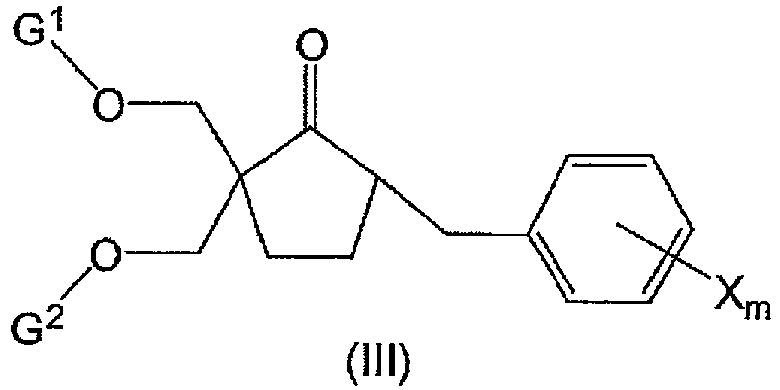
the method comprising a step of obtaining a compound represented by general formula (II) below by reacting a compound represented by general formula (I) below with an acid:

The production method of the present invention preferably further comprises a step of obtaining a cyclopentanone derivative represented by general formula (III) above by protecting the hydroxy groups of a compound represented by general formula (II) above with protecting groups that dissociate under acidic conditions: - In the production method of the present invention, there are some cases where the cyclopentanone derivative represented by general formula (III) above is preferably a compound represented by general formula (IIIa) below:

- in formula (IIIa), X and m are each the same as X and m in formula (III); Y1 and Y2 are each independently a hydrogen atom, an alkyl group having from 1 to 4 carbons, an alkenyl group having from 1 to 4 carbons, or a substituted or unsubstituted phenyl group, naphthyl group, or benzyl group; and Y1 and Y2 may bond with one another to form a ring.
In general formula (IIIa) above, Y1 and Y2 are preferably each independently a hydrogen atom or an alkyl group having from 1 to 4 carbons. - In general formula (IIIa) above, both Y1 and Y2 are more preferably methyl groups or hydrogen atoms.
- In general formula (III) above of the production method of the present invention, m is preferably an integer from 0 to 3, and when m is 1 or greater, X is preferably a halogen atom, an alkyl group having from 1 to 3 carbons, or a haloalkyl group having from 1 to 3 carbons.
- In general formula (III) of the production method of the present invention, m is more preferably an integer from 0 to 2, and when m is 1 or 2, X is more preferably a halogen atom.
- Another embodiment of the present invention is a production method for a compound represented by general formula (II) above, wherein the compound represented by general formula (I) above is reacted with an acid.
- Yet another embodiment of the present invention is a production method for a cyclopentanone derivative represented by general formula (III) above, wherein the hydroxy groups of a compound represented by general formula (II) above are protected by protecting groups that dissociate under acidic conditions.
- The present invention also include a compound represented by general formula (II) above.
- Embodiments of the present invention will be described in further detail hereinafter using examples. Of course, the present invention is not limited to the examples below, and it goes without saying that various modes are possible with regard to the details thereof. Furthermore, the present invention is not limited to the embodiments described above, and various modifications are possible within the scope indicated in the claims. Embodiments obtained by appropriately combining the technical means disclosed by the embodiments are also included in the technical scope of the present invention. In addition, all of the documents cited in this specification are hereby incorporated by reference.
- In this working example, methyl 1-(4-chlorobenzyl)-3,3-bishydroxymethyl-2-oxocyclopentane carboxylate (compound (2)) was synthesized from methyl 1-(4-(chlorobenzyl)-2-oxocyclopentane carboxylate (compound (1)) in accordance with reaction scheme 3 described below. Thereafter, 2-(4-chlorobenzyl)-8,8-dimethyl-7,9-dioxaspiro[4,5]decan-1-one (compound (4)) was synthesized from compound (2). Furthermore, 5-(4-chlorobenzyl)-2,2-bis(hydroxymethyl)-1-(1H-1,2,4-triazol-1-ylmethyl)cyclopentanol (compound (6)) was synthesized from compound (4).
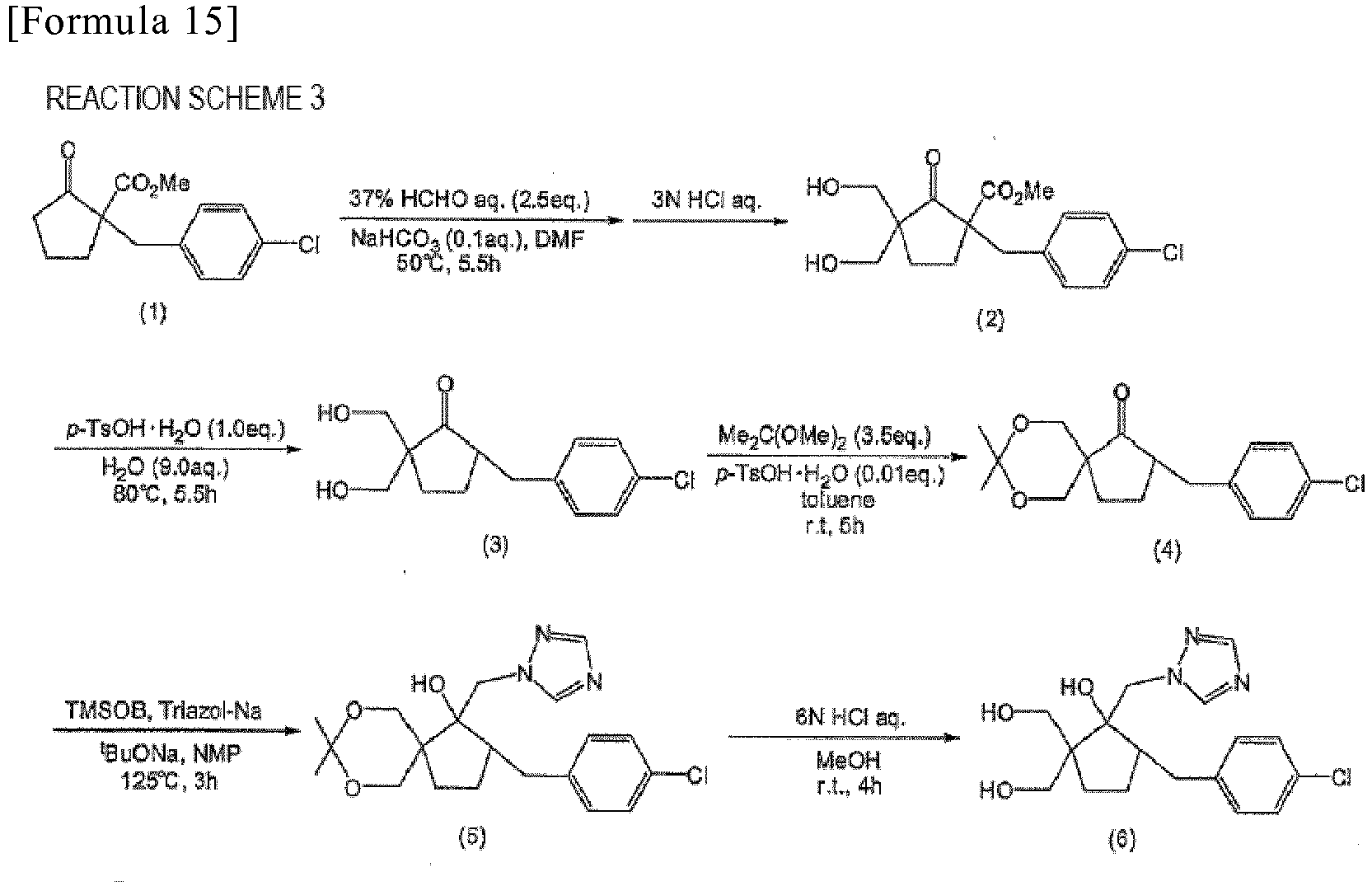
- Methyl 1-(4-(chlorobenzyl)-2-oxocyclopentane carboxylate (compound (1)) (19.1 g) was dissolved in dimethylformamide (10 mL). Then sodium hydrogen carbonate (602 mg) and a 37% formaldehyde aqueous solution (13.5 mL) were added and stirred at 50°C for 5.5 hours. Thereafter, a 3N hydrochloric acid aqueous solution (30 mL) was added to the mixture and stirred at room temperature for a while. Following the completion of the reaction, the solution was extracted with ethyl acetate, and after the solution was washed with saturated saline, the organic layer was dried with anhydrous sodium sulfate. The solvent was distilled out, and the residue was purified by silica gel column chromatography to obtain 22.7 g of the target product (compound (2)) as a colorless crystal.
Yield: 22.7 g
Yield: 97.2% - To compound (2) (1.00 g, 3.06 × 10⁻³ mol), p-toluenesulfonic acid monohydrate (582 mg, 3.06 × 10⁻³ mol) and water (496 µL, 2.75 × 10⁻² mol) were added and stirred at 80°C for 5.5 hours. Following the completion of the reaction, the solution was extracted with chloroform, and after the solution was washed with saturated saline, the organic layer was dried with anhydrous sodium sulfate. The solvent was distilled out, and the residue was purified by silica gel column chromatography to obtain 712 mg of the target product (compound (3)) as a colorless crystal.
Yield: 712 mg
Yield: 93.8%
1H-NMR (400 MHz, CDCl3):δ = 1.26-1.65(1H, m), 1.78-1.94(2H, m), 2.02-2.09(1H, m), 2.27-2.33(2H, m), 2.50-2.58(1H, m), 2.61(1H, dd, J=13.5, 8.7 Hz), 3.06(1H, dd, J=13.5, 4.1 Hz), 3.54(1H, dd, J=11.1, 7.4 Hz), 3.59(1H, dd, J=11.1, 4.2 Hz), 3.69(1H, dd, J=10.9, 4.1 Hz), 3.77(1H, dd, J=10.9, 7.2 Hz), 7.07-7.10(2H, m), 7.23-7.26(2H, m). - Compound (3)(497 mg,1.85×10-3 mol) was dissolved in toluene (1.5 mL). Then p-toluenesulfonic acid monohydrate (3.50 mg, 1.85 × 10⁻⁵ mol) and acetone dimethyl acetal (567 µL, 4.62 × 10⁻³ mol) were added and stirred at room temperature for 3 hours. Thereafter, acetone dimethyl acetal (226 µL, 1.85 × 10⁻³ mol) was added and stirred at room temperature for 2 hours. Following the completion of the reaction, a saturated sodium hydrogen carbonate aqueous solution was added thereto and stirred for a while. This solution was then extracted with toluene, and after the solution was washed with a saturated sodium hydrogen carbonate aqueous solution and then with saturated saline, the organic layer was dried with anhydrous sodium sulfate. The solvent was distilled out, and the residue was purified by silica gel column chromatography to obtain 524 mg of the target product (compound (4)) as a colorless crystal.
Yield: 524 mg
Yield: 91.7%
1H-NMR (400 MHz, CDCl3):δ = 1.38(3H, s), 1.49(3H, s), 1.49-1.59(1H, m), 1.80-1.88(1H, m), 2.04-2.12(1H, m), 2.39-2.50(2H, m), 2.60(1H, dd, J=13.9, 8.4 Hz), 3.00(1H, dd, J=13.9, 4.5 Hz), 3.24(1H, dd, J=11.4, 2.6 Hz), 3.47(1H, dd, J=11.4, 2.6 Hz), 3.78(1H, dd, J=11.4, 1.6 Hz), 4.06(1H, d, J=11.4 Hz), 7.04-7.07(2H, m), 7.22-7.25(2H, m). - First, after NaH (0.91 g (ca. 60% in mineral oil)) was suspended in N-methylpyrrolidone (NMP) (8 mL), 1,2,4-triazole (1.67 g) was added and stirred for 0.5 hours to produce a sodium salt. Next, compound (4) (5.00 g) was added. After this was heated to approximately 90°C (bath temperature), trimethylsulfoxonium bromide (TMSOB) (4.20 g) and t-BuONa (0.77 g) were intermittently added over the course of 1.5 hours and then reacted for 1.5 hours. After the reaction solution was further heated to approximately 125°C (bath temperature) and reacted for 1 hour, saturated ammonium chloride and water were added to the reaction solution and then extracted with ethyl acetate. After the organic layer was dried with anhydrous sodium sulfate, the solvent was distilled out, and the crude product was purified by silica gel column chromatography to obtain the target product (compound (5)) as an isomer mixture consisting of a 93:7 ratio of the cis-form to the trans-form.
Yield: 4.68 g
Yield rate: 74.3% - Reference Production Example 1-3: Synthesis of 5-(4-chlorobenzyl)-2,2-bis(hydroxymethyl)-1-(1H-1,2,4-triazol-1-yl methyl)cyclopentanol (compound (6)) Compound (5) (8.98 g) was dissolved in a mixture of methanol (30 mL) and a 6N hydrochloric acid aqueous solution (40 mL) and stirred for 4 hours at room temperature. After water was added to the mixture, the mixture was neutralized with sodium carbonate and sodium bicarbonate. Next, after this was extracted with ethyl acetate, the organic layer was washed with saturated saline. After the organic layer was dried with anhydrous sodium sulfate, the solvent was distilled out to obtain the target product (compound (6)) as an isomer mixture.
Yield: 7.96 g
Yield rate: 98.7% - In this working example, 2-(4-chlorobenzyl)-7,9-dioxaspiro[4,5]decan-1-one (compound (7)) was synthesized from compound (3) in accordance with reaction scheme 4 described below.

- Compound (3) (2.73 g, 1.02 × 10⁻² mol) was dissolved in toluene (8.1 mL), and dimethoxymethane (885 µL, 1.00 × 10⁻² mol) and p-toluenesulfonic acid monohydrate (190 mg, 1.0 × 10⁻³ mol) were added thereto and stirred at 60°C for 5 hours and then at 80°C for 8 hours. Following the completion of the reaction, the solution was washed with a saturated sodium hydrogen carbonate aqueous solution and then with saturated saline, and dried with anhydrous sodium sulfate. The solvent was distilled out, and the residue was purified by silica gel column chromatography to obtain 2.05 g of the target product (compound (7)) as a colorless solid.
Yield: 2.05 g
Yield: 71.7%
1H-NMR (400 MHz, CDCl3):δ = 1.51-1.59(1H,m),1.83-1.93(1H,m),2.03-2.14(1H,m),2.37-2.46(1H,m),2.46-2.52(1H,m),2.60(1H,dd,J=13.8,8.3 Hz),3.00(1H,dd,J=13.8,4.4 Hz),3.47(1H,dd,J=11.1,2.3 Hz),3.54(1H,dd,J=11.1,1.5 Hz),3.70(1H,dd,J=11.1,2.3 Hz),3.88(1H,d,J=11.1 Hz),4.67(1H,d,J=6.1 Hz),4.97(1H,d,J=6.1 Hz),7.05(2H,d,J=8.4 Hz),7.23(1H,d,J=8.4 Hz). - The present invention can be used in the production of a 2-benzyl-5,5-bis(hydroxymethyl)-cyclopentanone derivative having a protected hydroxy group serving as a raw material for an agricultural chemical or the like.
Claims (10)
- A production method for a cyclopentanone derivative represented by general formula (III) below:

the method comprising a step of obtaining a compound represented by general formula (II) below by reacting a compound represented by general formula (I) below with an acid:


- The production method for a cyclopentanone derivative according to claim 1, further comprising a step of obtaining the cyclopentanone derivative represented by general formula (III) above by protecting a hydroxy group of the compound represented by general formula (II) above with a protecting group that dissociates under acidic conditions.
- The production method for a cyclopentanone derivative according to claim 1 or 2, wherein the cyclopentanone derivative represented by general formula (III) above is a compound represented by general formula (IIIa) below:
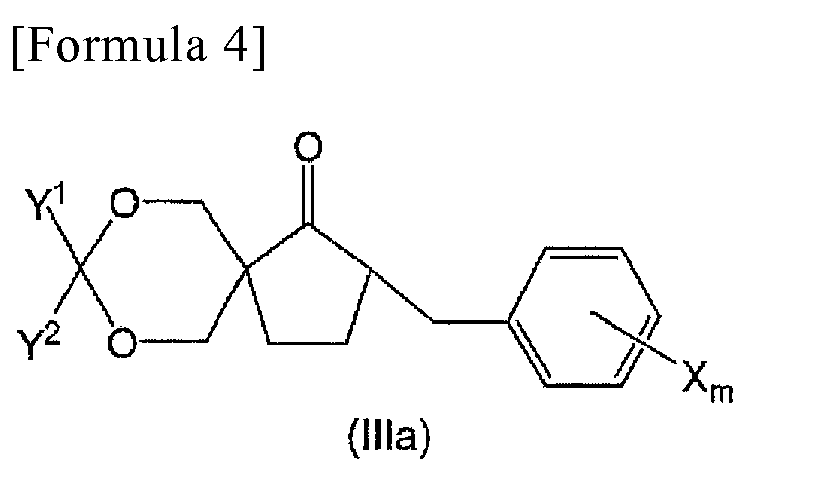
- The production method for a cyclopentanone derivative according to claim 3, wherein Y1 and Y2 are each independently a hydrogen atom or an alkyl group having from 1 to 4 carbons.
- The production method for a cyclopentanone derivative according to claim 3 or 4, wherein both Y1 and Y2 are methyl groups or hydrogen atoms.
- The production method for a cyclopentanone derivative according to any one of claims 1 to 5, wherein in general formula (III) above, m is an integer from 0 to 3, and when m is 1 or greater, X is a halogen atom, an alkyl group having from 1 to 3 carbons, or a haloalkyl group having from 1 to 3 carbons.
- The production method for a cyclopentanone derivative according to any one of claims 1 to 6, wherein in general formula (III) above, m is an integer from 0 to 2, and when m is 1 or 2, X is a halogen atom.
- A production method for a compound represented by general formula (II) below:

wherein a compound represented by general formula (I) below is reacted with an acid:
- A production method for a cyclopentanone derivative represented by general formula (III) below:

a hydroxy group of a compound represented by general formula (II) below being protected by a protecting group that dissociates under acidic conditions:
- A compound represented by general formula (II) below:

Applications Claiming Priority (3)
| Application Number | Priority Date | Filing Date | Title |
|---|---|---|---|
| JP2012260333 | 2012-11-28 | ||
| JP2012267707 | 2012-12-06 | ||
| PCT/JP2013/074281 WO2014083911A1 (en) | 2012-11-28 | 2013-09-09 | Method for producing cyclopentanone derivative, intermediate compound, and method for producing intermediate compound |
Publications (2)
| Publication Number | Publication Date |
|---|---|
| EP2927220A1 true EP2927220A1 (en) | 2015-10-07 |
| EP2927220A4 EP2927220A4 (en) | 2016-05-25 |
Family
ID=50827561
Family Applications (1)
| Application Number | Title | Priority Date | Filing Date |
|---|---|---|---|
| EP13857920.6A Withdrawn EP2927220A4 (en) | 2012-11-28 | 2013-09-09 | Method for producing cyclopentanone derivative, intermediate compound, and method for producing intermediate compound |
Country Status (5)
| Country | Link |
|---|---|
| US (1) | US20150315175A1 (en) |
| EP (1) | EP2927220A4 (en) |
| JP (1) | JPWO2014083911A1 (en) |
| CN (1) | CN104903305A (en) |
| WO (1) | WO2014083911A1 (en) |
Families Citing this family (2)
| Publication number | Priority date | Publication date | Assignee | Title |
|---|---|---|---|---|
| CN113387787A (en) * | 2021-05-26 | 2021-09-14 | 杭州国瑞生物科技有限公司 | Synthesis method of 2-benzyl cyclopentanone |
| US20230271996A1 (en) * | 2021-12-25 | 2023-08-31 | Scinopharm Taiwan, Ltd. | Process for preparing cedazuridine |
Family Cites Families (6)
| Publication number | Priority date | Publication date | Assignee | Title |
|---|---|---|---|---|
| US8455965B2 (en) * | 2009-11-30 | 2013-06-04 | Qualcomm Incorporated | Fabrication and integration of devices with top and bottom electrodes including magnetic tunnel junctions |
| UA108867C2 (en) * | 2009-12-08 | 2015-06-25 | APPROACHES OF AZOLS, THE METHOD OF THEIR PRODUCTS (OPTIONS), INTERMEDIATES, AGRICULTURAL AND HORTICULTURAL PRODUCTS | |
| JP5826839B2 (en) * | 2011-06-07 | 2015-12-02 | 株式会社クレハ | Azole derivatives, methods for producing azole derivatives, and intermediate compounds |
| CN103596917B (en) * | 2011-06-07 | 2016-08-17 | 株式会社吴羽 | The manufacture method of cyclopentanone compound and midbody compound |
| UA110647C2 (en) * | 2011-06-07 | 2016-01-25 | Куреха Корпорейшн | Azole derivative, method of its preparation, intermediate compounds and chemical agent designed for use in agriculture and horticulture, and an agent for protecting industrial materials |
| JP5869006B2 (en) * | 2012-01-17 | 2016-02-24 | 株式会社クレハ | Method for producing cyclopentanone derivative, intermediate compound and method for producing intermediate compound |
-
2013
- 2013-09-09 JP JP2014550059A patent/JPWO2014083911A1/en not_active Withdrawn
- 2013-09-09 CN CN201380062167.4A patent/CN104903305A/en active Pending
- 2013-09-09 EP EP13857920.6A patent/EP2927220A4/en not_active Withdrawn
- 2013-09-09 US US14/647,483 patent/US20150315175A1/en not_active Abandoned
- 2013-09-09 WO PCT/JP2013/074281 patent/WO2014083911A1/en not_active Ceased
Also Published As
| Publication number | Publication date |
|---|---|
| CN104903305A (en) | 2015-09-09 |
| JPWO2014083911A1 (en) | 2017-01-05 |
| US20150315175A1 (en) | 2015-11-05 |
| EP2927220A4 (en) | 2016-05-25 |
| WO2014083911A1 (en) | 2014-06-05 |
Similar Documents
| Publication | Publication Date | Title |
|---|---|---|
| JP3202607B2 (en) | Method for producing 2- (4-alkoxy-3-cyanophenyl) thiazole derivative | |
| US9388158B2 (en) | Production method for cyclopentanone derivative, intermediate compound, and production method for intermediate compound | |
| JP7260480B2 (en) | Preparation of Arylpyrrole Compounds in the Presence of DIPEA Base | |
| EP2927207A1 (en) | Production method for carbonyl compound | |
| US20150315175A1 (en) | Production method for cyclopentanone derivative, intermediate compound, and production method for intermediate compound | |
| DK3250556T3 (en) | PROCEDURES FOR THE PREPARATION OF COMPOUNDS, SUCH AS 3-ARYL BUTANALS THAT CAN BE USED FOR THE SYNTHESIS OF MEDETOMIDINE | |
| US8975434B2 (en) | Method for producing cyclopentanone compound, and intermediate compound | |
| IT201800000667A1 (en) | PROCEDURE FOR THE PREPARATION OF DISPLACED DIARYLOXYHETERODIAZOLIC COMPOUNDS | |
| US20190194104A1 (en) | Process for the synthesis of 9,9-bis(hydroxymethyl)fluorene | |
| CN104540818A (en) | Method for producing cycloalkanol derivative, and method for producing azole derivative | |
| Zeng et al. | Nucleophilic monofluoroalkylation with fluorinated phosphonium salt toward carbonyl and imine compounds | |
| EP2141151B1 (en) | Method for producing 2-haloimidazole compound | |
| US10508072B2 (en) | Method for producing acid halide solution, mixed solution, and method for producing monoester compound | |
| CN109232240B (en) | Method for synthesizing chloroacrylic acid fluoroalcohol ester | |
| JP6507976B2 (en) | Method for producing imidazole-2-carboxylic acid ester derivative or salt thereof | |
| EP1232151B1 (en) | Method for production of benzofuranone oximes | |
| EP0780362B1 (en) | 3,3-Dioxy-4,4,4-trifluorobutyric acid derivatives | |
| EP3409657A1 (en) | Method for producing acid halide solution and method for producing monoester compound | |
| EP3015466A1 (en) | Method for producing azole derivative | |
| JPWO2010013510A1 (en) | Method for producing optically active compound | |
| EP2927206A1 (en) | Production method for carbonyl compound | |
| US7388101B1 (en) | Tetrahydrofuran derivatives having cis substituent, their intermediates, and their preparation method | |
| EP2702039A1 (en) | A process for preparation of dicyanocarboxylate derivatives | |
| US8115019B2 (en) | Cis-2, 6-disubstituted tetrahydropyran derivatives and preparation method thereof | |
| DE2918468A1 (en) | PROCESS FOR THE PRODUCTION OF ALPHA-HALOGENECYCLOBUTANONES |
Legal Events
| Date | Code | Title | Description |
|---|---|---|---|
| PUAI | Public reference made under article 153(3) epc to a published international application that has entered the european phase |
Free format text: ORIGINAL CODE: 0009012 |
|
| 17P | Request for examination filed |
Effective date: 20150619 |
|
| AK | Designated contracting states |
Kind code of ref document: A1 Designated state(s): AL AT BE BG CH CY CZ DE DK EE ES FI FR GB GR HR HU IE IS IT LI LT LU LV MC MK MT NL NO PL PT RO RS SE SI SK SM TR |
|
| AX | Request for extension of the european patent |
Extension state: BA ME |
|
| DAX | Request for extension of the european patent (deleted) | ||
| RA4 | Supplementary search report drawn up and despatched (corrected) |
Effective date: 20160421 |
|
| RIC1 | Information provided on ipc code assigned before grant |
Ipc: C07C 49/747 20060101ALI20160415BHEP Ipc: C07D 319/08 20060101AFI20160415BHEP Ipc: C07C 45/65 20060101ALI20160415BHEP |
|
| GRAP | Despatch of communication of intention to grant a patent |
Free format text: ORIGINAL CODE: EPIDOSNIGR1 |
|
| INTG | Intention to grant announced |
Effective date: 20161011 |
|
| STAA | Information on the status of an ep patent application or granted ep patent |
Free format text: STATUS: THE APPLICATION IS DEEMED TO BE WITHDRAWN |
|
| 18D | Application deemed to be withdrawn |
Effective date: 20170222 |