EP2927207A1 - Production method for carbonyl compound - Google Patents
Production method for carbonyl compound Download PDFInfo
- Publication number
- EP2927207A1 EP2927207A1 EP13858727.4A EP13858727A EP2927207A1 EP 2927207 A1 EP2927207 A1 EP 2927207A1 EP 13858727 A EP13858727 A EP 13858727A EP 2927207 A1 EP2927207 A1 EP 2927207A1
- Authority
- EP
- European Patent Office
- Prior art keywords
- group
- general formula
- compound represented
- carbons
- carbonyl compound
- Prior art date
- Legal status (The legal status is an assumption and is not a legal conclusion. Google has not performed a legal analysis and makes no representation as to the accuracy of the status listed.)
- Withdrawn
Links
- 150000001728 carbonyl compounds Chemical class 0.000 title claims abstract description 70
- 238000004519 manufacturing process Methods 0.000 title description 12
- 150000001875 compounds Chemical class 0.000 claims abstract description 73
- 150000003512 tertiary amines Chemical class 0.000 claims abstract description 61
- 125000000217 alkyl group Chemical group 0.000 claims abstract description 60
- 238000000034 method Methods 0.000 claims abstract description 57
- 229910000039 hydrogen halide Inorganic materials 0.000 claims abstract description 44
- 239000012433 hydrogen halide Substances 0.000 claims abstract description 44
- 150000003839 salts Chemical class 0.000 claims abstract description 43
- 238000005933 dealkoxycarbonylation reaction Methods 0.000 claims abstract description 18
- 238000006243 chemical reaction Methods 0.000 claims description 59
- ZMANZCXQSJIPKH-UHFFFAOYSA-N Triethylamine Chemical group CCN(CC)CC ZMANZCXQSJIPKH-UHFFFAOYSA-N 0.000 claims description 36
- 125000006239 protecting group Chemical group 0.000 claims description 32
- 125000001188 haloalkyl group Chemical group 0.000 claims description 24
- 125000004435 hydrogen atom Chemical group [H]* 0.000 claims description 23
- 125000000623 heterocyclic group Chemical group 0.000 claims description 22
- 125000002887 hydroxy group Chemical group [H]O* 0.000 claims description 21
- JUJWROOIHBZHMG-UHFFFAOYSA-N Pyridine Chemical compound C1=CC=NC=C1 JUJWROOIHBZHMG-UHFFFAOYSA-N 0.000 claims description 20
- 125000000753 cycloalkyl group Chemical group 0.000 claims description 19
- 125000003118 aryl group Chemical group 0.000 claims description 16
- 229910052799 carbon Inorganic materials 0.000 claims description 15
- 125000004432 carbon atom Chemical group C* 0.000 claims description 15
- 230000002378 acidificating effect Effects 0.000 claims description 14
- 125000003545 alkoxy group Chemical group 0.000 claims description 12
- 125000003342 alkenyl group Chemical group 0.000 claims description 11
- VEXZGXHMUGYJMC-UHFFFAOYSA-N Hydrochloric acid Chemical compound Cl VEXZGXHMUGYJMC-UHFFFAOYSA-N 0.000 claims description 10
- 125000005843 halogen group Chemical group 0.000 claims description 10
- 125000001997 phenyl group Chemical group [H]C1=C([H])C([H])=C(*)C([H])=C1[H] 0.000 claims description 10
- UMJSCPRVCHMLSP-UHFFFAOYSA-N pyridine Natural products COC1=CC=CN=C1 UMJSCPRVCHMLSP-UHFFFAOYSA-N 0.000 claims description 10
- GETQZCLCWQTVFV-UHFFFAOYSA-N trimethylamine Chemical compound CN(C)C GETQZCLCWQTVFV-UHFFFAOYSA-N 0.000 claims description 10
- 125000000304 alkynyl group Chemical group 0.000 claims description 8
- 125000001797 benzyl group Chemical group [H]C1=C([H])C([H])=C(C([H])=C1[H])C([H])([H])* 0.000 claims description 8
- 125000000262 haloalkenyl group Chemical group 0.000 claims description 8
- 125000000232 haloalkynyl group Chemical group 0.000 claims description 8
- 125000004438 haloalkoxy group Chemical group 0.000 claims description 6
- BSKHPKMHTQYZBB-UHFFFAOYSA-N 2-methylpyridine Chemical compound CC1=CC=CC=N1 BSKHPKMHTQYZBB-UHFFFAOYSA-N 0.000 claims description 5
- 125000001624 naphthyl group Chemical group 0.000 claims description 5
- 125000000449 nitro group Chemical group [O-][N+](*)=O 0.000 claims description 5
- CPELXLSAUQHCOX-UHFFFAOYSA-N Hydrogen bromide Chemical compound Br CPELXLSAUQHCOX-UHFFFAOYSA-N 0.000 claims description 4
- 125000004093 cyano group Chemical group *C#N 0.000 claims description 4
- -1 (1-methyl)ethyl group Chemical group 0.000 description 161
- YXFVVABEGXRONW-UHFFFAOYSA-N Toluene Chemical compound CC1=CC=CC=C1 YXFVVABEGXRONW-UHFFFAOYSA-N 0.000 description 33
- XEKOWRVHYACXOJ-UHFFFAOYSA-N Ethyl acetate Chemical compound CCOC(C)=O XEKOWRVHYACXOJ-UHFFFAOYSA-N 0.000 description 21
- 125000002496 methyl group Chemical group [H]C([H])([H])* 0.000 description 16
- 239000002904 solvent Substances 0.000 description 15
- DHKHKXVYLBGOIT-UHFFFAOYSA-N acetaldehyde Diethyl Acetal Natural products CCOC(C)OCC DHKHKXVYLBGOIT-UHFFFAOYSA-N 0.000 description 12
- 239000002585 base Substances 0.000 description 11
- 125000001495 ethyl group Chemical group [H]C([H])([H])C([H])([H])* 0.000 description 11
- 239000000203 mixture Substances 0.000 description 11
- 125000001511 cyclopentyl group Chemical group [H]C1([H])C([H])([H])C([H])([H])C([H])(*)C1([H])[H] 0.000 description 10
- VYPSYNLAJGMNEJ-UHFFFAOYSA-N Silicium dioxide Chemical compound O=[Si]=O VYPSYNLAJGMNEJ-UHFFFAOYSA-N 0.000 description 9
- PMZURENOXWZQFD-UHFFFAOYSA-L Sodium Sulfate Chemical compound [Na+].[Na+].[O-]S([O-])(=O)=O PMZURENOXWZQFD-UHFFFAOYSA-L 0.000 description 9
- HEMHJVSKTPXQMS-UHFFFAOYSA-M Sodium hydroxide Chemical compound [OH-].[Na+] HEMHJVSKTPXQMS-UHFFFAOYSA-M 0.000 description 9
- 230000015572 biosynthetic process Effects 0.000 description 9
- 239000012295 chemical reaction liquid Substances 0.000 description 9
- 239000012044 organic layer Substances 0.000 description 9
- 239000000741 silica gel Substances 0.000 description 9
- 229910002027 silica gel Inorganic materials 0.000 description 9
- 238000003786 synthesis reaction Methods 0.000 description 9
- FXHOOIRPVKKKFG-UHFFFAOYSA-N N,N-Dimethylacetamide Chemical compound CN(C)C(C)=O FXHOOIRPVKKKFG-UHFFFAOYSA-N 0.000 description 8
- 230000007935 neutral effect Effects 0.000 description 8
- 239000010410 layer Substances 0.000 description 7
- XHFLOLLMZOTPSM-UHFFFAOYSA-M sodium;hydrogen carbonate;hydrate Chemical class [OH-].[Na+].OC(O)=O XHFLOLLMZOTPSM-UHFFFAOYSA-M 0.000 description 7
- XLYOFNOQVPJJNP-UHFFFAOYSA-N water Substances O XLYOFNOQVPJJNP-UHFFFAOYSA-N 0.000 description 7
- 239000002253 acid Substances 0.000 description 6
- 238000006114 decarboxylation reaction Methods 0.000 description 6
- 230000007062 hydrolysis Effects 0.000 description 6
- 238000006460 hydrolysis reaction Methods 0.000 description 6
- 125000004123 n-propyl group Chemical group [H]C([H])([H])C([H])([H])C([H])([H])* 0.000 description 6
- 239000000243 solution Substances 0.000 description 6
- 125000001424 substituent group Chemical group 0.000 description 6
- 125000000999 tert-butyl group Chemical group [H]C([H])([H])C(*)(C([H])([H])[H])C([H])([H])[H] 0.000 description 6
- ILWRPSCZWQJDMK-UHFFFAOYSA-N triethylazanium;chloride Chemical compound Cl.CCN(CC)CC ILWRPSCZWQJDMK-UHFFFAOYSA-N 0.000 description 6
- 125000006615 aromatic heterocyclic group Chemical group 0.000 description 5
- 229910052801 chlorine Inorganic materials 0.000 description 5
- 125000001309 chloro group Chemical group Cl* 0.000 description 5
- 229910052731 fluorine Inorganic materials 0.000 description 5
- 125000001153 fluoro group Chemical group F* 0.000 description 5
- 230000007246 mechanism Effects 0.000 description 5
- NRRVDQRTYGCXGC-UHFFFAOYSA-N 5-benzyl-2,2-bis(hydroxymethyl)cyclopentan-1-one Chemical class OCC1(CO)CCC(Cc2ccccc2)C1=O NRRVDQRTYGCXGC-UHFFFAOYSA-N 0.000 description 4
- 0 C(C1)C2C1C=*OC2 Chemical compound C(C1)C2C1C=*OC2 0.000 description 4
- 125000001931 aliphatic group Chemical group 0.000 description 4
- 125000000959 isobutyl group Chemical group [H]C([H])([H])C([H])(C([H])([H])[H])C([H])([H])* 0.000 description 4
- 125000004108 n-butyl group Chemical group [H]C([H])([H])C([H])([H])C([H])([H])C([H])([H])* 0.000 description 4
- AOJFQRQNPXYVLM-UHFFFAOYSA-N pyridin-1-ium;chloride Chemical compound [Cl-].C1=CC=[NH+]C=C1 AOJFQRQNPXYVLM-UHFFFAOYSA-N 0.000 description 4
- 125000002914 sec-butyl group Chemical group [H]C([H])([H])C([H])([H])C([H])(*)C([H])([H])[H] 0.000 description 4
- 125000003903 2-propenyl group Chemical group [H]C([*])([H])C([H])=C([H])[H] 0.000 description 3
- IAZDPXIOMUYVGZ-UHFFFAOYSA-N Dimethylsulphoxide Chemical compound CS(C)=O IAZDPXIOMUYVGZ-UHFFFAOYSA-N 0.000 description 3
- ZMXDDKWLCZADIW-UHFFFAOYSA-N N,N-Dimethylformamide Chemical compound CN(C)C=O ZMXDDKWLCZADIW-UHFFFAOYSA-N 0.000 description 3
- SJRJJKPEHAURKC-UHFFFAOYSA-N N-Methylmorpholine Chemical compound CN1CCOCC1 SJRJJKPEHAURKC-UHFFFAOYSA-N 0.000 description 3
- RWRDLPDLKQPQOW-UHFFFAOYSA-N Pyrrolidine Chemical compound C1CCNC1 RWRDLPDLKQPQOW-UHFFFAOYSA-N 0.000 description 3
- 125000002029 aromatic hydrocarbon group Chemical group 0.000 description 3
- RAXXELZNTBOGNW-UHFFFAOYSA-N imidazole Natural products C1=CNC=N1 RAXXELZNTBOGNW-UHFFFAOYSA-N 0.000 description 3
- 125000000956 methoxy group Chemical group [H]C([H])([H])O* 0.000 description 3
- 238000007086 side reaction Methods 0.000 description 3
- YLQBMQCUIZJEEH-UHFFFAOYSA-N tetrahydrofuran Natural products C=1C=COC=1 YLQBMQCUIZJEEH-UHFFFAOYSA-N 0.000 description 3
- RXYPXQSKLGGKOL-UHFFFAOYSA-N 1,4-dimethylpiperazine Chemical compound CN1CCN(C)CC1 RXYPXQSKLGGKOL-UHFFFAOYSA-N 0.000 description 2
- FCEHBMOGCRZNNI-UHFFFAOYSA-N 1-benzothiophene Chemical compound C1=CC=C2SC=CC2=C1 FCEHBMOGCRZNNI-UHFFFAOYSA-N 0.000 description 2
- 125000001478 1-chloroethyl group Chemical group [H]C([H])([H])C([H])(Cl)* 0.000 description 2
- 125000004776 1-fluoroethyl group Chemical group [H]C([H])([H])C([H])(F)* 0.000 description 2
- PAMIQIKDUOTOBW-UHFFFAOYSA-N 1-methylpiperidine Chemical compound CN1CCCCC1 PAMIQIKDUOTOBW-UHFFFAOYSA-N 0.000 description 2
- AVFZOVWCLRSYKC-UHFFFAOYSA-N 1-methylpyrrolidine Chemical compound CN1CCCC1 AVFZOVWCLRSYKC-UHFFFAOYSA-N 0.000 description 2
- 125000000453 2,2,2-trichloroethyl group Chemical group [H]C([H])(*)C(Cl)(Cl)Cl 0.000 description 2
- 125000004206 2,2,2-trifluoroethyl group Chemical group [H]C([H])(*)C(F)(F)F 0.000 description 2
- 125000004778 2,2-difluoroethyl group Chemical group [H]C([H])(*)C([H])(F)F 0.000 description 2
- GQHTUMJGOHRCHB-UHFFFAOYSA-N 2,3,4,6,7,8,9,10-octahydropyrimido[1,2-a]azepine Chemical compound C1CCCCN2CCCN=C21 GQHTUMJGOHRCHB-UHFFFAOYSA-N 0.000 description 2
- OISVCGZHLKNMSJ-UHFFFAOYSA-N 2,6-dimethylpyridine Chemical compound CC1=CC=CC(C)=N1 OISVCGZHLKNMSJ-UHFFFAOYSA-N 0.000 description 2
- 125000005999 2-bromoethyl group Chemical group 0.000 description 2
- 125000001340 2-chloroethyl group Chemical group [H]C([H])(Cl)C([H])([H])* 0.000 description 2
- 125000004777 2-fluoroethyl group Chemical group [H]C([H])(F)C([H])([H])* 0.000 description 2
- XGVGTFSWOQMISL-UHFFFAOYSA-N 3-[(4-chlorophenyl)methyl]-8,8-dimethyl-7,9-dioxaspiro[4.5]decan-4-one Chemical compound C1OC(C)(C)OCC11C(=O)C(CC=2C=CC(Cl)=CC=2)CC1 XGVGTFSWOQMISL-UHFFFAOYSA-N 0.000 description 2
- DLPBZANLIRTMKU-UHFFFAOYSA-N 5-[(4-chlorophenyl)methyl]-2,2-dimethylcyclopentan-1-one Chemical compound O=C1C(C)(C)CCC1CC1=CC=C(Cl)C=C1 DLPBZANLIRTMKU-UHFFFAOYSA-N 0.000 description 2
- XKRFYHLGVUSROY-UHFFFAOYSA-N Argon Chemical compound [Ar] XKRFYHLGVUSROY-UHFFFAOYSA-N 0.000 description 2
- IJGRMHOSHXDMSA-UHFFFAOYSA-N Atomic nitrogen Chemical compound N#N IJGRMHOSHXDMSA-UHFFFAOYSA-N 0.000 description 2
- WKBOTKDWSSQWDR-UHFFFAOYSA-N Bromine atom Chemical group [Br] WKBOTKDWSSQWDR-UHFFFAOYSA-N 0.000 description 2
- OKTJSMMVPCPJKN-UHFFFAOYSA-N Carbon Chemical compound [C] OKTJSMMVPCPJKN-UHFFFAOYSA-N 0.000 description 2
- GCDDAIQWVIHHQF-UHFFFAOYSA-N ClC1=CC=C(CC2CCC(C2=O)(COCOC)COCOC)C=C1 Chemical compound ClC1=CC=C(CC2CCC(C2=O)(COCOC)COCOC)C=C1 GCDDAIQWVIHHQF-UHFFFAOYSA-N 0.000 description 2
- SIKJAQJRHWYJAI-UHFFFAOYSA-N Indole Chemical compound C1=CC=C2NC=CC2=C1 SIKJAQJRHWYJAI-UHFFFAOYSA-N 0.000 description 2
- KFZMGEQAYNKOFK-UHFFFAOYSA-N Isopropanol Chemical compound CC(C)O KFZMGEQAYNKOFK-UHFFFAOYSA-N 0.000 description 2
- YNAVUWVOSKDBBP-UHFFFAOYSA-N Morpholine Chemical compound C1COCCN1 YNAVUWVOSKDBBP-UHFFFAOYSA-N 0.000 description 2
- JGFZNNIVVJXRND-UHFFFAOYSA-N N,N-Diisopropylethylamine (DIPEA) Chemical compound CCN(C(C)C)C(C)C JGFZNNIVVJXRND-UHFFFAOYSA-N 0.000 description 2
- SECXISVLQFMRJM-UHFFFAOYSA-N N-Methylpyrrolidone Chemical compound CN1CCCC1=O SECXISVLQFMRJM-UHFFFAOYSA-N 0.000 description 2
- AHVYPIQETPWLSZ-UHFFFAOYSA-N N-methyl-pyrrolidine Natural products CN1CC=CC1 AHVYPIQETPWLSZ-UHFFFAOYSA-N 0.000 description 2
- GLUUGHFHXGJENI-UHFFFAOYSA-N Piperazine Chemical compound C1CNCCN1 GLUUGHFHXGJENI-UHFFFAOYSA-N 0.000 description 2
- NQRYJNQNLNOLGT-UHFFFAOYSA-N Piperidine Chemical compound C1CCNCC1 NQRYJNQNLNOLGT-UHFFFAOYSA-N 0.000 description 2
- KYQCOXFCLRTKLS-UHFFFAOYSA-N Pyrazine Chemical compound C1=CN=CC=N1 KYQCOXFCLRTKLS-UHFFFAOYSA-N 0.000 description 2
- KAESVJOAVNADME-UHFFFAOYSA-N Pyrrole Chemical compound C=1C=CNC=1 KAESVJOAVNADME-UHFFFAOYSA-N 0.000 description 2
- SMWDFEZZVXVKRB-UHFFFAOYSA-N Quinoline Chemical compound N1=CC=CC2=CC=CC=C21 SMWDFEZZVXVKRB-UHFFFAOYSA-N 0.000 description 2
- WYURNTSHIVDZCO-UHFFFAOYSA-N Tetrahydrofuran Chemical compound C1CCOC1 WYURNTSHIVDZCO-UHFFFAOYSA-N 0.000 description 2
- YTPLMLYBLZKORZ-UHFFFAOYSA-N Thiophene Chemical compound C=1C=CSC=1 YTPLMLYBLZKORZ-UHFFFAOYSA-N 0.000 description 2
- 239000004480 active ingredient Substances 0.000 description 2
- 239000003513 alkali Substances 0.000 description 2
- 125000004848 alkoxyethyl group Chemical group 0.000 description 2
- 125000004849 alkoxymethyl group Chemical group 0.000 description 2
- 150000001350 alkyl halides Chemical class 0.000 description 2
- 230000007423 decrease Effects 0.000 description 2
- 230000003247 decreasing effect Effects 0.000 description 2
- 125000004772 dichloromethyl group Chemical group [H]C(Cl)(Cl)* 0.000 description 2
- 125000001028 difluoromethyl group Chemical group [H]C(F)(F)* 0.000 description 2
- 230000000694 effects Effects 0.000 description 2
- 125000001301 ethoxy group Chemical group [H]C([H])([H])C([H])([H])O* 0.000 description 2
- 125000005745 ethoxymethyl group Chemical group [H]C([H])([H])C([H])([H])OC([H])([H])* 0.000 description 2
- 238000000605 extraction Methods 0.000 description 2
- 125000004216 fluoromethyl group Chemical group [H]C([H])(F)* 0.000 description 2
- IXCSERBJSXMMFS-UHFFFAOYSA-N hydrogen chloride Substances Cl.Cl IXCSERBJSXMMFS-UHFFFAOYSA-N 0.000 description 2
- 229910000041 hydrogen chloride Inorganic materials 0.000 description 2
- 239000011261 inert gas Substances 0.000 description 2
- 125000004184 methoxymethyl group Chemical group [H]C([H])([H])OC([H])([H])* 0.000 description 2
- ZGRCRAJXOKDIRJ-UHFFFAOYSA-N methyl 1-[(4-chlorophenyl)methyl]-3,3-bis(methoxymethoxymethyl)-2-oxocyclopentane-1-carboxylate Chemical compound O=C1C(COCOC)(COCOC)CCC1(C(=O)OC)CC1=CC=C(Cl)C=C1 ZGRCRAJXOKDIRJ-UHFFFAOYSA-N 0.000 description 2
- QGUHMUXBDNKLNM-UHFFFAOYSA-N methyl 1-[(4-chlorophenyl)methyl]-3,3-dimethyl-2-oxocyclopentane-1-carboxylate Chemical compound C=1C=C(Cl)C=CC=1CC1(C(=O)OC)CCC(C)(C)C1=O QGUHMUXBDNKLNM-UHFFFAOYSA-N 0.000 description 2
- CKYORIXJGIAVSF-UHFFFAOYSA-N methyl 3-[(4-chlorophenyl)methyl]-8,8-dimethyl-4-oxo-7,9-dioxaspiro[4.5]decane-3-carboxylate Chemical compound C1CC2(COC(C)(C)OC2)C(=O)C1(C(=O)OC)CC1=CC=C(Cl)C=C1 CKYORIXJGIAVSF-UHFFFAOYSA-N 0.000 description 2
- DAZXVJBJRMWXJP-UHFFFAOYSA-N n,n-dimethylethylamine Chemical compound CCN(C)C DAZXVJBJRMWXJP-UHFFFAOYSA-N 0.000 description 2
- 125000004430 oxygen atom Chemical group O* 0.000 description 2
- XSCHRSMBECNVNS-UHFFFAOYSA-N quinoxaline Chemical compound N1=CC=NC2=CC=CC=C21 XSCHRSMBECNVNS-UHFFFAOYSA-N 0.000 description 2
- 125000003808 silyl group Chemical group [H][Si]([H])([H])[*] 0.000 description 2
- HPALAKNZSZLMCH-UHFFFAOYSA-M sodium;chloride;hydrate Chemical class O.[Na+].[Cl-] HPALAKNZSZLMCH-UHFFFAOYSA-M 0.000 description 2
- 239000000126 substance Substances 0.000 description 2
- 125000003718 tetrahydrofuranyl group Chemical group 0.000 description 2
- 125000001412 tetrahydropyranyl group Chemical group 0.000 description 2
- 125000003866 trichloromethyl group Chemical group ClC(Cl)(Cl)* 0.000 description 2
- 125000002023 trifluoromethyl group Chemical group FC(F)(F)* 0.000 description 2
- NFLGAXVYCFJBMK-RKDXNWHRSA-N (+)-isomenthone Natural products CC(C)[C@H]1CC[C@@H](C)CC1=O NFLGAXVYCFJBMK-RKDXNWHRSA-N 0.000 description 1
- HEVMDQBCAHEHDY-UHFFFAOYSA-N (Dimethoxymethyl)benzene Chemical compound COC(OC)C1=CC=CC=C1 HEVMDQBCAHEHDY-UHFFFAOYSA-N 0.000 description 1
- DSSYKIVIOFKYAU-XCBNKYQSSA-N (R)-camphor Chemical compound C1C[C@@]2(C)C(=O)C[C@@H]1C2(C)C DSSYKIVIOFKYAU-XCBNKYQSSA-N 0.000 description 1
- JYEUMXHLPRZUAT-UHFFFAOYSA-N 1,2,3-triazine Chemical compound C1=CN=NN=C1 JYEUMXHLPRZUAT-UHFFFAOYSA-N 0.000 description 1
- DDPRYTUJYNYJKV-UHFFFAOYSA-N 1,4-diethylpiperazine Chemical compound CCN1CCN(CC)CC1 DDPRYTUJYNYJKV-UHFFFAOYSA-N 0.000 description 1
- BUZYGTVTZYSBCU-UHFFFAOYSA-N 1-(4-chlorophenyl)ethanone Chemical compound CC(=O)C1=CC=C(Cl)C=C1 BUZYGTVTZYSBCU-UHFFFAOYSA-N 0.000 description 1
- 125000006083 1-bromoethyl group Chemical group 0.000 description 1
- AXWLKJWVMMAXBD-UHFFFAOYSA-N 1-butylpiperidine Chemical compound CCCCN1CCCCC1 AXWLKJWVMMAXBD-UHFFFAOYSA-N 0.000 description 1
- 125000004972 1-butynyl group Chemical group [H]C([H])([H])C([H])([H])C#C* 0.000 description 1
- ONQBOTKLCMXPOF-UHFFFAOYSA-N 1-ethylpyrrolidine Chemical compound CCN1CCCC1 ONQBOTKLCMXPOF-UHFFFAOYSA-N 0.000 description 1
- ZKUKXSWKWGHYKJ-UHFFFAOYSA-N 1-methylazepane Chemical compound CN1CCCCCC1 ZKUKXSWKWGHYKJ-UHFFFAOYSA-N 0.000 description 1
- 125000006017 1-propenyl group Chemical group 0.000 description 1
- 125000000530 1-propynyl group Chemical group [H]C([H])([H])C#C* 0.000 description 1
- OPLDIHWEFBYKBR-UHFFFAOYSA-N 2-[(4-chlorophenyl)methyl]cyclopentan-1-one Chemical compound C1=CC(Cl)=CC=C1CC1C(=O)CCC1 OPLDIHWEFBYKBR-UHFFFAOYSA-N 0.000 description 1
- 125000004974 2-butenyl group Chemical group C(C=CC)* 0.000 description 1
- 125000000069 2-butynyl group Chemical group [H]C([H])([H])C#CC([H])([H])* 0.000 description 1
- 125000006022 2-methyl-2-propenyl group Chemical group 0.000 description 1
- IIFFFBSAXDNJHX-UHFFFAOYSA-N 2-methyl-n,n-bis(2-methylpropyl)propan-1-amine Chemical compound CC(C)CN(CC(C)C)CC(C)C IIFFFBSAXDNJHX-UHFFFAOYSA-N 0.000 description 1
- 125000004493 2-methylbut-1-yl group Chemical group CC(C*)CC 0.000 description 1
- OMSBSIXAZZRIRW-UHFFFAOYSA-N 2-methylpyridine;hydrochloride Chemical compound Cl.CC1=CC=CC=N1 OMSBSIXAZZRIRW-UHFFFAOYSA-N 0.000 description 1
- 125000001494 2-propynyl group Chemical group [H]C#CC([H])([H])* 0.000 description 1
- MCIPQLOKVXSHTD-UHFFFAOYSA-N 3,3-diethoxyprop-1-ene Chemical compound CCOC(C=C)OCC MCIPQLOKVXSHTD-UHFFFAOYSA-N 0.000 description 1
- UQPKDCMRJBEZMM-UHFFFAOYSA-N 3-[(4-chlorophenyl)methyl]-7,9-dioxaspiro[4.5]decan-4-one Chemical compound C1=CC(Cl)=CC=C1CC1C(=O)C2(COCOC2)CC1 UQPKDCMRJBEZMM-UHFFFAOYSA-N 0.000 description 1
- 125000004975 3-butenyl group Chemical group C(CC=C)* 0.000 description 1
- 125000006032 3-methyl-3-butenyl group Chemical group 0.000 description 1
- PFUKZFFEUQXNRF-UHFFFAOYSA-N 3-methylpyridin-1-ium;chloride Chemical compound [Cl-].CC1=CC=C[NH+]=C1 PFUKZFFEUQXNRF-UHFFFAOYSA-N 0.000 description 1
- LMRKVKPRHROQRR-UHFFFAOYSA-N 4-butylmorpholine Chemical compound CCCCN1CCOCC1 LMRKVKPRHROQRR-UHFFFAOYSA-N 0.000 description 1
- HVCNXQOWACZAFN-UHFFFAOYSA-N 4-ethylmorpholine Chemical compound CCN1CCOCC1 HVCNXQOWACZAFN-UHFFFAOYSA-N 0.000 description 1
- BSADJIPSKPADNV-UHFFFAOYSA-N 4-methylpyridin-1-ium;chloride Chemical compound Cl.CC1=CC=NC=C1 BSADJIPSKPADNV-UHFFFAOYSA-N 0.000 description 1
- ZCYVEMRRCGMTRW-UHFFFAOYSA-N 7553-56-2 Chemical group [I] ZCYVEMRRCGMTRW-UHFFFAOYSA-N 0.000 description 1
- NOWKCMXCCJGMRR-UHFFFAOYSA-N Aziridine Chemical compound C1CN1 NOWKCMXCCJGMRR-UHFFFAOYSA-N 0.000 description 1
- QWOJMRHUQHTCJG-UHFFFAOYSA-N CC([CH2-])=O Chemical compound CC([CH2-])=O QWOJMRHUQHTCJG-UHFFFAOYSA-N 0.000 description 1
- YNQLUTRBYVCPMQ-UHFFFAOYSA-N CCc1ccccc1 Chemical compound CCc1ccccc1 YNQLUTRBYVCPMQ-UHFFFAOYSA-N 0.000 description 1
- 241000723346 Cinnamomum camphora Species 0.000 description 1
- KRHYYFGTRYWZRS-UHFFFAOYSA-N Fluorane Chemical compound F KRHYYFGTRYWZRS-UHFFFAOYSA-N 0.000 description 1
- NFLGAXVYCFJBMK-UHFFFAOYSA-N Menthone Chemical compound CC(C)C1CCC(C)CC1=O NFLGAXVYCFJBMK-UHFFFAOYSA-N 0.000 description 1
- KWYHDKDOAIKMQN-UHFFFAOYSA-N N,N,N',N'-tetramethylethylenediamine Chemical compound CN(C)CCN(C)C KWYHDKDOAIKMQN-UHFFFAOYSA-N 0.000 description 1
- RUOFIIKCANAEBW-UHFFFAOYSA-N N-Ethyl-hexahydro-1H-azepine Chemical compound CCN1CCCCCC1 RUOFIIKCANAEBW-UHFFFAOYSA-N 0.000 description 1
- HTLZVHNRZJPSMI-UHFFFAOYSA-N N-ethylpiperidine Chemical compound CCN1CCCCC1 HTLZVHNRZJPSMI-UHFFFAOYSA-N 0.000 description 1
- ZCQWOFVYLHDMMC-UHFFFAOYSA-N Oxazole Chemical compound C1=COC=N1 ZCQWOFVYLHDMMC-UHFFFAOYSA-N 0.000 description 1
- PCNDJXKNXGMECE-UHFFFAOYSA-N Phenazine Natural products C1=CC=CC2=NC3=CC=CC=C3N=C21 PCNDJXKNXGMECE-UHFFFAOYSA-N 0.000 description 1
- WTKZEGDFNFYCGP-UHFFFAOYSA-N Pyrazole Chemical compound C=1C=NNC=1 WTKZEGDFNFYCGP-UHFFFAOYSA-N 0.000 description 1
- CZPWVGJYEJSRLH-UHFFFAOYSA-N Pyrimidine Chemical compound C1=CN=CN=C1 CZPWVGJYEJSRLH-UHFFFAOYSA-N 0.000 description 1
- DHXVGJBLRPWPCS-UHFFFAOYSA-N Tetrahydropyran Chemical compound C1CCOCC1 DHXVGJBLRPWPCS-UHFFFAOYSA-N 0.000 description 1
- FZWLAAWBMGSTSO-UHFFFAOYSA-N Thiazole Chemical compound C1=CSC=N1 FZWLAAWBMGSTSO-UHFFFAOYSA-N 0.000 description 1
- 239000005703 Trimethylamine hydrochloride Substances 0.000 description 1
- 150000001241 acetals Chemical class 0.000 description 1
- 239000003905 agrochemical Substances 0.000 description 1
- 125000005907 alkyl ester group Chemical group 0.000 description 1
- 125000003368 amide group Chemical group 0.000 description 1
- 150000001408 amides Chemical class 0.000 description 1
- 150000001412 amines Chemical class 0.000 description 1
- HOPRXXXSABQWAV-UHFFFAOYSA-N anhydrous collidine Natural products CC1=CC=NC(C)=C1C HOPRXXXSABQWAV-UHFFFAOYSA-N 0.000 description 1
- 230000003466 anti-cipated effect Effects 0.000 description 1
- 229910052786 argon Inorganic materials 0.000 description 1
- 239000012300 argon atmosphere Substances 0.000 description 1
- 239000012298 atmosphere Substances 0.000 description 1
- 125000004429 atom Chemical group 0.000 description 1
- HONIICLYMWZJFZ-UHFFFAOYSA-N azetidine Chemical compound C1CNC1 HONIICLYMWZJFZ-UHFFFAOYSA-N 0.000 description 1
- 125000003828 azulenyl group Chemical group 0.000 description 1
- RFRXIWQYSOIBDI-UHFFFAOYSA-N benzarone Chemical compound CCC=1OC2=CC=CC=C2C=1C(=O)C1=CC=C(O)C=C1 RFRXIWQYSOIBDI-UHFFFAOYSA-N 0.000 description 1
- RWCCWEUUXYIKHB-UHFFFAOYSA-N benzophenone Chemical compound C=1C=CC=CC=1C(=O)C1=CC=CC=C1 RWCCWEUUXYIKHB-UHFFFAOYSA-N 0.000 description 1
- 239000012965 benzophenone Substances 0.000 description 1
- 125000006267 biphenyl group Chemical group 0.000 description 1
- 238000007664 blowing Methods 0.000 description 1
- 125000005997 bromomethyl group Chemical group 0.000 description 1
- 229960000846 camphor Drugs 0.000 description 1
- 229930008380 camphor Natural products 0.000 description 1
- 125000004218 chloromethyl group Chemical group [H]C([H])(Cl)* 0.000 description 1
- UTBIMNXEDGNJFE-UHFFFAOYSA-N collidine Natural products CC1=CC=C(C)C(C)=N1 UTBIMNXEDGNJFE-UHFFFAOYSA-N 0.000 description 1
- 230000000052 comparative effect Effects 0.000 description 1
- 125000001995 cyclobutyl group Chemical group [H]C1([H])C([H])([H])C([H])(*)C1([H])[H] 0.000 description 1
- 125000000113 cyclohexyl group Chemical group [H]C1([H])C([H])([H])C([H])([H])C([H])(*)C([H])([H])C1([H])[H] 0.000 description 1
- FNIATMYXUPOJRW-UHFFFAOYSA-N cyclohexylidene Chemical group [C]1CCCCC1 FNIATMYXUPOJRW-UHFFFAOYSA-N 0.000 description 1
- PWAPCRSSMCLZHG-UHFFFAOYSA-N cyclopentylidene Chemical group [C]1CCCC1 PWAPCRSSMCLZHG-UHFFFAOYSA-N 0.000 description 1
- 125000001559 cyclopropyl group Chemical group [H]C1([H])C([H])([H])C1([H])* 0.000 description 1
- 125000004786 difluoromethoxy group Chemical group [H]C(F)(F)O* 0.000 description 1
- HPYNZHMRTTWQTB-UHFFFAOYSA-N dimethylpyridine Natural products CC1=CC=CN=C1C HPYNZHMRTTWQTB-UHFFFAOYSA-N 0.000 description 1
- 125000002534 ethynyl group Chemical group [H]C#C* 0.000 description 1
- JKFAIQOWCVVSKC-UHFFFAOYSA-N furazan Chemical compound C=1C=NON=1 JKFAIQOWCVVSKC-UHFFFAOYSA-N 0.000 description 1
- 239000007789 gas Substances 0.000 description 1
- 238000010438 heat treatment Methods 0.000 description 1
- 229910000042 hydrogen bromide Inorganic materials 0.000 description 1
- 229910000040 hydrogen fluoride Inorganic materials 0.000 description 1
- XMBWDFGMSWQBCA-UHFFFAOYSA-N hydrogen iodide Chemical compound I XMBWDFGMSWQBCA-UHFFFAOYSA-N 0.000 description 1
- 229910000043 hydrogen iodide Inorganic materials 0.000 description 1
- 238000005984 hydrogenation reaction Methods 0.000 description 1
- XLYOFNOQVPJJNP-UHFFFAOYSA-M hydroxide Chemical compound [OH-] XLYOFNOQVPJJNP-UHFFFAOYSA-M 0.000 description 1
- 125000003454 indenyl group Chemical group C1(C=CC2=CC=CC=C12)* 0.000 description 1
- PZOUSPYUWWUPPK-UHFFFAOYSA-N indole Natural products CC1=CC=CC2=C1C=CN2 PZOUSPYUWWUPPK-UHFFFAOYSA-N 0.000 description 1
- RKJUIXBNRJVNHR-UHFFFAOYSA-N indolenine Natural products C1=CC=C2CC=NC2=C1 RKJUIXBNRJVNHR-UHFFFAOYSA-N 0.000 description 1
- 239000012770 industrial material Substances 0.000 description 1
- 238000011835 investigation Methods 0.000 description 1
- 229910052740 iodine Inorganic materials 0.000 description 1
- WNZQDUSMALZDQF-UHFFFAOYSA-N isobenzofuranone Natural products C1=CC=C2C(=O)OCC2=C1 WNZQDUSMALZDQF-UHFFFAOYSA-N 0.000 description 1
- 125000001449 isopropyl group Chemical group [H]C([H])([H])C([H])(*)C([H])([H])[H] 0.000 description 1
- 125000000654 isopropylidene group Chemical group C(C)(C)=* 0.000 description 1
- ZLTPDFXIESTBQG-UHFFFAOYSA-N isothiazole Chemical compound C=1C=NSC=1 ZLTPDFXIESTBQG-UHFFFAOYSA-N 0.000 description 1
- CTAPFRYPJLPFDF-UHFFFAOYSA-N isoxazole Chemical compound C=1C=NOC=1 CTAPFRYPJLPFDF-UHFFFAOYSA-N 0.000 description 1
- 229930007503 menthone Natural products 0.000 description 1
- AUHZEENZYGFFBQ-UHFFFAOYSA-N mesitylene Substances CC1=CC(C)=CC(C)=C1 AUHZEENZYGFFBQ-UHFFFAOYSA-N 0.000 description 1
- OIPOJEDRCKVDJK-UHFFFAOYSA-N methyl 3-(4-chlorophenyl)-3-oxopropanoate Chemical compound COC(=O)CC(=O)C1=CC=C(Cl)C=C1 OIPOJEDRCKVDJK-UHFFFAOYSA-N 0.000 description 1
- AKIUDFDEHYYLJS-UHFFFAOYSA-N methyl 3-[(4-chlorophenyl)methyl]-2-oxocyclopentane-1-carboxylate Chemical compound O=C1C(C(=O)OC)CCC1CC1=CC=C(Cl)C=C1 AKIUDFDEHYYLJS-UHFFFAOYSA-N 0.000 description 1
- GDBJJCPHMKRMGO-UHFFFAOYSA-N methyl 3-[(4-chlorophenyl)methyl]-4-oxo-7,9-dioxaspiro[4.5]decane-3-carboxylate Chemical compound C1CC2(COCOC2)C(=O)C1(C(=O)OC)CC1=CC=C(Cl)C=C1 GDBJJCPHMKRMGO-UHFFFAOYSA-N 0.000 description 1
- 239000012046 mixed solvent Substances 0.000 description 1
- 238000012986 modification Methods 0.000 description 1
- 230000004048 modification Effects 0.000 description 1
- SRLHDBRENZFCIN-UHFFFAOYSA-N n,n-di(butan-2-yl)butan-2-amine Chemical compound CCC(C)N(C(C)CC)C(C)CC SRLHDBRENZFCIN-UHFFFAOYSA-N 0.000 description 1
- FRQONEWDWWHIPM-UHFFFAOYSA-N n,n-dicyclohexylcyclohexanamine Chemical compound C1CCCCC1N(C1CCCCC1)C1CCCCC1 FRQONEWDWWHIPM-UHFFFAOYSA-N 0.000 description 1
- NILJCGYQNXKIRL-UHFFFAOYSA-N n,n-dicyclopentylcyclopentanamine Chemical compound C1CCCC1N(C1CCCC1)C1CCCC1 NILJCGYQNXKIRL-UHFFFAOYSA-N 0.000 description 1
- QJEWDNDJRVJYBY-UHFFFAOYSA-N n,n-dicyclopropylcyclopropanamine Chemical compound C1CC1N(C1CC1)C1CC1 QJEWDNDJRVJYBY-UHFFFAOYSA-N 0.000 description 1
- ULWOJODHECIZAU-UHFFFAOYSA-N n,n-diethylpropan-2-amine Chemical compound CCN(CC)C(C)C ULWOJODHECIZAU-UHFFFAOYSA-N 0.000 description 1
- DIAIBWNEUYXDNL-UHFFFAOYSA-N n,n-dihexylhexan-1-amine Chemical compound CCCCCCN(CCCCCC)CCCCCC DIAIBWNEUYXDNL-UHFFFAOYSA-N 0.000 description 1
- XTAZYLNFDRKIHJ-UHFFFAOYSA-N n,n-dioctyloctan-1-amine Chemical compound CCCCCCCCN(CCCCCCCC)CCCCCCCC XTAZYLNFDRKIHJ-UHFFFAOYSA-N 0.000 description 1
- OOHAUGDGCWURIT-UHFFFAOYSA-N n,n-dipentylpentan-1-amine Chemical compound CCCCCN(CCCCC)CCCCC OOHAUGDGCWURIT-UHFFFAOYSA-N 0.000 description 1
- CYQYCASVINMDFD-UHFFFAOYSA-N n,n-ditert-butyl-2-methylpropan-2-amine Chemical compound CC(C)(C)N(C(C)(C)C)C(C)(C)C CYQYCASVINMDFD-UHFFFAOYSA-N 0.000 description 1
- 125000003136 n-heptyl group Chemical group [H]C([H])([H])C([H])([H])C([H])([H])C([H])([H])C([H])([H])C([H])([H])C([H])([H])* 0.000 description 1
- 125000001280 n-hexyl group Chemical group C(CCCCC)* 0.000 description 1
- 125000000740 n-pentyl group Chemical group [H]C([H])([H])C([H])([H])C([H])([H])C([H])([H])C([H])([H])* 0.000 description 1
- 125000003506 n-propoxy group Chemical group [H]C([H])([H])C([H])([H])C([H])([H])O* 0.000 description 1
- 229910052757 nitrogen Inorganic materials 0.000 description 1
- KPADFPAILITQBG-UHFFFAOYSA-N non-4-ene Chemical compound CCCCC=CCCC KPADFPAILITQBG-UHFFFAOYSA-N 0.000 description 1
- AHHWIHXENZJRFG-UHFFFAOYSA-N oxetane Chemical compound C1COC1 AHHWIHXENZJRFG-UHFFFAOYSA-N 0.000 description 1
- 230000003647 oxidation Effects 0.000 description 1
- 238000007254 oxidation reaction Methods 0.000 description 1
- 125000003538 pentan-3-yl group Chemical group [H]C([H])([H])C([H])([H])C([H])(*)C([H])([H])C([H])([H])[H] 0.000 description 1
- PBMFSQRYOILNGV-UHFFFAOYSA-N pyridazine Chemical compound C1=CC=NN=C1 PBMFSQRYOILNGV-UHFFFAOYSA-N 0.000 description 1
- 239000002994 raw material Substances 0.000 description 1
- 230000035484 reaction time Effects 0.000 description 1
- 125000003548 sec-pentyl group Chemical group [H]C([H])([H])C([H])([H])C([H])([H])C([H])(*)C([H])([H])[H] 0.000 description 1
- 238000003756 stirring Methods 0.000 description 1
- GFYHSKONPJXCDE-UHFFFAOYSA-N sym-collidine Natural products CC1=CN=C(C)C(C)=C1 GFYHSKONPJXCDE-UHFFFAOYSA-N 0.000 description 1
- 229930192474 thiophene Natural products 0.000 description 1
- 150000003852 triazoles Chemical class 0.000 description 1
- IMFACGCPASFAPR-UHFFFAOYSA-N tributylamine Chemical compound CCCCN(CCCC)CCCC IMFACGCPASFAPR-UHFFFAOYSA-N 0.000 description 1
- NRTLTGGGUQIRRT-UHFFFAOYSA-N triethylazanium;bromide Chemical compound [Br-].CC[NH+](CC)CC NRTLTGGGUQIRRT-UHFFFAOYSA-N 0.000 description 1
- IMNIMPAHZVJRPE-UHFFFAOYSA-N triethylenediamine Chemical compound C1CN2CCN1CC2 IMNIMPAHZVJRPE-UHFFFAOYSA-N 0.000 description 1
- 125000000876 trifluoromethoxy group Chemical group FC(F)(F)O* 0.000 description 1
- 125000004385 trihaloalkyl group Chemical group 0.000 description 1
- 125000004951 trihalomethoxy group Chemical group 0.000 description 1
- RKBCYCFRFCNLTO-UHFFFAOYSA-N triisopropylamine Chemical compound CC(C)N(C(C)C)C(C)C RKBCYCFRFCNLTO-UHFFFAOYSA-N 0.000 description 1
- SZYJELPVAFJOGJ-UHFFFAOYSA-N trimethylamine hydrochloride Chemical compound Cl.CN(C)C SZYJELPVAFJOGJ-UHFFFAOYSA-N 0.000 description 1
- YFTHZRPMJXBUME-UHFFFAOYSA-N tripropylamine Chemical compound CCCN(CCC)CCC YFTHZRPMJXBUME-UHFFFAOYSA-N 0.000 description 1
- 125000000391 vinyl group Chemical group [H]C([*])=C([H])[H] 0.000 description 1
Classifications
-
- C—CHEMISTRY; METALLURGY
- C07—ORGANIC CHEMISTRY
- C07C—ACYCLIC OR CARBOCYCLIC COMPOUNDS
- C07C45/00—Preparation of compounds having >C = O groups bound only to carbon or hydrogen atoms; Preparation of chelates of such compounds
- C07C45/61—Preparation of compounds having >C = O groups bound only to carbon or hydrogen atoms; Preparation of chelates of such compounds by reactions not involving the formation of >C = O groups
- C07C45/65—Preparation of compounds having >C = O groups bound only to carbon or hydrogen atoms; Preparation of chelates of such compounds by reactions not involving the formation of >C = O groups by splitting-off hydrogen atoms or functional groups; by hydrogenolysis of functional groups
-
- C—CHEMISTRY; METALLURGY
- C07—ORGANIC CHEMISTRY
- C07D—HETEROCYCLIC COMPOUNDS
- C07D319/00—Heterocyclic compounds containing six-membered rings having two oxygen atoms as the only ring hetero atoms
- C07D319/04—1,3-Dioxanes; Hydrogenated 1,3-dioxanes
- C07D319/08—1,3-Dioxanes; Hydrogenated 1,3-dioxanes condensed with carbocyclic rings or ring systems
Definitions
- the present invention relates to a method of producing a carbonyl compound, and particularly relates to a method of producing a carbonyl compound by subjecting a ⁇ -ketoester compound to dealkoxycarbonylation.
- Patent Document 1 A certain type of 2-(halogenated hydrocarbon substituted)-5-benzyl-1-azolylmethylcyclopentanol derivative is described in Patent Document 1 as a compound that can be used as an active ingredient for agricultural and horticultural chemicals, industrial material protectants, and the like.
- a method of producing a 2-benzyl-5,5-bis(hydroxymethyl)-cyclopentanone derivative having a protected hydroxy group from a 1-benzyl-2-oxocyclopentane carboxylic acid alkyl ester derivative, which is a ⁇ -ketoester compound, is also described in Patent Document 1 as a part of a step in the production method of this derivative.
- Patent Document 1 WO/2011/070771 (published June 16, 2011 )
- An object of the present invention is to provide a novel production method that can produce a carbonyl compound from ⁇ -ketoester compound at a higher yield.
- the method of producing a carbonyl compound according to the present invention is a method of producing a carbonyl compound represented by general formula (I) below from a compound represented by general formula (II) below, and the method comprises a step of subjecting the compound represented by general formula (II) below to dealkoxycarbonylation in the presence of a hydrogen halide salt of tertiary amine.
- Z 1 represents a substituted or unsubstituted alkyl group, cycloalkyl group, aryl group, or heterocyclic group
- Z 3 and Z 2 each independently represent a hydrogen atom, a substituted or unsubstituted alkyl group, cycloalkyl group, aryl group, or heterocyclic group
- R represents an alkyl group having from 1 to 4 carbons.
- Z 1 and Z 2 may be bonded to each other.
- Z 1 , Z 2 , and Z 3 are the same as Z 1 , Z 2 , and Z 3 in general formula (II) above, respectively.
- a carbonyl compound By the method of producing a carbonyl compound according to the present invention, a carbonyl compound can be produced at a high yield from a ⁇ -ketoester compound.
- the yield of a 5-benzyl-2,2-bis(hydroxymethyl) cyclopentanone derivative having a protected hydroxy group can be enhanced by performing a reaction using a hydrogen halide salt of tertiary amine in a production step for obtaining a 5-benzyl-2,2-bis(hydroxymethyl) cyclopentanone derivative having a protected hydroxy group from a 1-benzyl-3,3-bis(hydroxymethyl)-2-oxocyclopentane carboxylic acid alkyl ester derivative having a protected hydroxy group.
- the present inventors have also found that a carbonyl compound can be produced at a high yield by using a hydrogen halide salt of tertiary amine in another reaction using another ⁇ -ketoester compound. Therefore, the present invention has been completed.
- the method of producing a carbonyl compound according to the present invention is a method of producing a carbonyl compound represented by general formula (I) below from a ⁇ -ketoester compound (hereinafter, referred to as "compound (II)") represented by general formula (II) below, and the method produces a carbonyl compound represented by general formula (I) by subjecting the compound (II) to dealkoxycarbonylation in the presence of a hydrogen halide salt of tertiary amine.
- Z 1 represents an alkyl group, cycloalkyl group, aryl group, or heterocyclic group, and the alkyl group, cycloalkyl group, aryl group, and heterocyclic group may have a substituent.
- the number of carbons in alkyl group of Z 1 is not particularly limited; however, the alkyl group can be exemplified by an alkyl group having from 1 to 8 carbons.
- the alkyl group having from 1 to 8 carbons include an ethyl group, methyl group, (1-methyl)ethyl group, n-propyl group, 1-methylpropyl group, 2-methylpropyl group, 1,1-dimethylethyl group, n-butyl group, n-pentyl group, n-hexyl group, n-heptyl group, n-octyl group, and the like.
- the number of carbons constituting the ring of the cycloalkyl group of Z 1 is not particularly limited; however, the cycloalkyl group can be exemplified by a cycloalkyl group having from 3 to 6 carbons.
- Examples of the cycloalkyl group having from 3 to 6 carbons include a cyclopropyl group, cyclobutyl group, cyclopentyl group, cyclohexyl group, and the like.
- Examples of the aryl group of Z 1 include a phenyl group, naphthyl group, indene group, azulene group, diphenyl group, and the like.
- the number of atoms constituting the ring of a heterocyclic group of Z 1 is not particularly limited; however, the heterocyclic group can be exemplified by an aliphatic heterocyclic group having from 3 to 6 members and an aromatic heterocyclic group having from 5 or 6 members.
- Examples of a heterocyclic ring constituting the aliphatic heterocyclic ring having from 3 to 6 members include azetidine, aziridine, piperidine, piperazine, morpholine, pyrrolidine, oxetane, tetrahydrofuran, tetrahydropyran, and the like.
- heterocyclic ring constituting the aromatic heterocyclic group having from 5 to 6 members examples include thiophene, pyridine, thiazole, furan, pyrrole, oxazole, isoxazole, isothiazole, triazole, furazan, imidazole, pyrazole, pyrazine, pyrimidine, triazine, pyridazine, and the like.
- examples thereof also include condensed heterocyclic rings, such as indole, benzofuran, benzothiophene, quinoline, and quinoxaline; and the like.
- Examples of the substituent that can be contained in the alkyl group, cycloalkyl group, aryl group, and heterocyclic group of Z 1 include a halogen atom, an aliphatic hydrocarbon group, an aromatic hydrocarbon group, an aromatic heterocyclic group, an aliphatic hydrocarbon group in which at least one hydrogen atom is substituted with an aromatic hydrocarbon group or aromatic heterocyclic group, an alkoxy group, a carbonyloxyalkyl group, an amide group, a cyano group, a nitro group, and the like.
- a hydrogen atom in these substituents may be substituted with a halogen atom, hydroxy group, alkoxy group, alkyl group, haloalkyl group, aromatic hydrocarbon group, aromatic heterocyclic group, and the like.
- the hydroxy group may be protected by a protecting group that protects the hydroxy group.
- Z 2 and Z 3 each independently represent a hydrogen atom, alkyl group, cycloalkyl group, aryl group, or heterocyclic group, and the alkyl group, cycloalkyl group, aryl group, and heterocyclic group may have a substituent.
- Examples of the alkyl group, the cycloalkyl group, the aryl group, the heterocyclic group, and the substituent that can be contained in these alkyl group, cycloalkyl group, aryl group, and heterocyclic group of Z 2 and Z 3 are the same as the alkyl group, the cycloalkyl group, the aryl group, the heterocyclic group, and the substituent that can be contained in these alkyl group, cycloalkyl group, aryl group, and heterocyclic group of Z 1 , respectively.
- Z 2 and Z 3 may be the same or different from each other.
- Z 1 and Z 2 may be bonded to each other and, together with a carbon atom to which Z 1 is bonded and a carbon atom to which Z 2 is bonded, form a ring.
- R represents an alkyl group having from 1 to 4 carbons. Examples thereof include a methyl group, ethyl group, (1-methyl)ethyl group, n-propyl group, 1-methylpropyl group, 2-methylpropyl group, n-butyl group, 1,1-dimethylethyl group, and the like.
- tertiary amine constituting the hydrogen halide salt of tertiary amine examples include aliphatic amines such as trimethylamine, triethylamine, ethyldimethylamine, tri-n-propylamine, triisopropylamine, tri-n-butylamine, triisobutylamine, tri-sec-butylamine, tri-tert-butylamine, tri-n-pentylamine, tri-n-hexylamine, tri-n-octylamine, diethylisopropylamine, diisopropylethylamine, tricyclopropylamine, tricyclobutylamine, tetramethylethylene diamine, tricyclopentylamine, and tricyclohexylamine; nitrogen-containing heterocyclic aliphatic amines such as N-methylpyrrolidine, N-ethylpyrrolidine, N-methylpiperidine, N-ethylpiperidine,
- triethylamine, trimethylamine, ethyldimethylamine, N-methylpyrrolidine, pyridine, and picoline are preferable; triethylamine, trimethylamine, pyridine, and picoline are more preferable; and triethylamine and pyridine are particularly preferable.
- Examples of the hydrogen halide constituting the hydrogen halide salt of tertiary amine include hydrogen fluoride, hydrogen chloride, hydrogen bromide, and hydrogen iodide. Among these, hydrogen chloride is preferable.
- preferable hydrogen halide salt of tertiary amine include a hydrochloride of triethylamine, triethylamine hydrobromide, trimethylamine hydrochloride, a hydrochloride of pyridine, 2-picoline hydrochloride, 3-picoline hydrochloride, and 4-picoline hydrochloride.
- a hydrochloride of triethylamine and a hydrochloride of pyridine are preferable.
- a hydrogen halide salt of tertiary amine can be formed in a system by blowing a hydrogen halide, as a gas, into the system after adding tertiary amine into the system, it is preferable to use a hydrogen halide salt of tertiary amine that is prepared in advance.
- the reaction of dealkoxycarbonylation is preferably performed in a solvent.
- the solvent is not particularly limited as long as the solvent does not participate in the reaction.
- amides such as N,N-dimethylformamide, N,N-dimethylacetamide, and N-methyl-2-pyrrolidone can be preferably used.
- the solvent may be a mixed solvent with another solvent that can be mixed with these solvents (e.g. toluene, DMSO, and the like).
- the amount of the hydrogen halide salt of tertiary amine is, in terms of moles, for example, from 0.3 to 10-fold, preferably from 0.5 to 5-fold, and more preferably from 0.8 to 3-fold, the amount of the compound (II).
- the reaction temperature is, for example, from 0 to 250°C, preferably from room temperature to 200°C, and more preferably from 50 to 180°C.
- the reaction time is, for example, from 0.05 hours to a few days, preferably from 0.1 hours to 5 days, and more preferably from 0.5 hours to 2 days.
- reaction conditions can be easily designed and set by a person skilled in the art by referring to conventionally known production methods.
- dealkoxycarbonylation indicates that -CO 2 R is eventually substituted with a hydrogen atom. From the perspective of obtaining a carbonyl compound by removing -CO 2 R from a ⁇ -ketoester compound, hydrolysis and decarboxylation of the ⁇ -ketoester compound are the same. However, since, in the production method using a hydrogen halide salt of tertiary amine of the present invention, the reaction proceeds in the absence of water, the "dealkoxycarbonylation” in the present invention is clearly distinguished from a reaction including hydrolysis that requires water. Note that, if water is present in the reaction system, a hydroxide ion may be generated from the water molecule under a condition containing bases, thereby causing undesired side reactions. Therefore, it is preferred that the system contains no water.
- the reaction is performed using a salt of tertiary amine, but not an acid or alkali, it is possible to perform the reaction under a neutral or almost neutral condition. Therefore, even for a compound which is unstable to an acid or alkali and the yield of which is anticipated to be lowered under acidic conditions or basic conditions, the reaction can be performed with a high yield.
- the reaction mechanism of the dealkoxycarbonylation in the method of producing a carbonyl compound according to the present invention is conceived to include the following reaction mechanism, for example.
- a halogen atom attacks an alkyl group of an alkyl ester group of the compound (II).
- this forms ⁇ -ketocarboxylic acid rapidly from the compound (II) since the hydrogen halide salt of tertiary amine is a proton source. Therefore, a compound represented by general formula (I) is formed by decarboxylation of the generated ⁇ -ketocarboxylic acid.
- the generated alkyl halide reacts with the tertiary amine in the system to form a quaternary amine salt.
- the reaction mechanism is not particularly limited as long as the reaction proceeds using a hydrogen halide salt of tertiary amine.
- the method is not limited to cases where a single reaction mechanism proceeds the reaction, and the method may be a method where the reaction is proceeded by a plurality of reaction mechanisms.
- a preferable aspect of the method of producing a carbonyl compound according to the present invention is a method of producing a carbonyl compound represented by general formula (Ia).
- the method produces a carbonyl compound represented by general formula (Ia) by subjecting a ⁇ -ketoester compound having a cyclopentane ring represented by general formula (IIa) below (hereinafter, referred to as "compound (IIa)”) to dealkoxycarbonylation in the presence of a hydrogen halide salt of tertiary amine.
- Y represents an alkyl group or haloalkyl group having from 1 to 6 carbons, an alkenyl group or haloalkenyl group having from 2 to 6 carbons, an alkynyl group or haloalkynyl group having from 2 to 6 carbons, or a group in which a part of hydrogen atoms of the alkyl group, haloalkyl group, alkenyl group, haloalkenyl group, alkynyl group, or haloalkynyl group is substituted with -OG (G represents a protecting group of a hydroxy group).
- alkyl group having from 1 to 6 carbons examples include a methyl group, ethyl group, (1-methyl)ethyl group, n-propyl group, 1-methylpropyl group, 2-methylpropyl group, n-butyl group, 1-methylbutyl group, 2-methylbutyl group, 1-ethylpropyl group, 1,1-dimethylethyl group, and the like.
- alkyl groups having from 1 to 4 carbons are preferable.
- a methyl group and an ethyl group are more preferable, and a methyl group is even more preferable.
- haloalkyl group having from 1 to 6 carbons examples include a chloromethyl group, dichloromethyl group, trichloromethyl group, 2-chloroethyl group, 1-chloroethyl group, 2,2-dichloroethyl group, 1,2-dichloroethyl group, 2,2,2-trichloroethyl group, 3-chloropropyl group, 2,3-dichloropropyl group, 1-chloro-1-methylethyl group, 2-chloro-1-methylethyl group, 2-chloropropyl group, 4-chlorobutyl group, 5-chloropentyl group, fluoromethyl group, difluoromethyl group, trifluoromethyl group, 2-fluoroethyl group, 1-fluoroethyl group, 2,2-difluoroethyl group, 1,2-difluoroethyl group, 2,2,2-trifluoroethyl group, 3-fluoropropyl
- alkenyl group having from 2 to 6 carbons examples include an ethenyl group, 1,2-dimethylethenyl group, 4-methyl-1,3-butadienyl group, 1-propenyl group, 2-propenyl group, 2-methyl-2-propenyl group, 3-methyl-2-propenyl group, 2-butenyl group, 3-butenyl group, 3-methyl-3-butenyl group, and the like.
- alkenyl groups having from 2 to 4 carbons are preferable.
- haloalkenyl group having from 2 to 6 carbons examples include a 2-chloroethenyl group, 2,2-dichloroethenyl group, 2-chloro-2-propenyl group, 3,3-dichloro-2-propenyl group, 2,3-dichloro-2-propenyl group, 3,3-dichloro-2-methyl-2-propenyl group, 3-chloro-2-butenyl group, 2-fluoroethenyl group, 2,2-difluoroethenyl group, 2-fluoro-2-propenyl group, 3,3-difluoro-2-propenyl group, 2,3-difluoro-2-propenyl group, 3,3-difluoro-2-methyl-2-propenyl group, 3-fluoro-2-butenyl group, 2-bromoethenyl group, 2,2-dibromoethenyl group, 2-bromo-2-propenyl group, 3,3
- alkynyl group having from 2 to 6 carbons examples include an ethynyl group, 1-propynyl group, 2-propynyl group, 1-butynyl group, 2-butynyl group, and the like. Among these, alkynyl groups having from 2 to 4 carbons are preferable.
- haloalkynyl group having from 2 to 6 carbons examples include a 2-fluoroethynyl group, 2-chloroethynyl group, 3-fluoro-2-propynyl group, 3-chloro-2-propynyl group, 3-bromo-2-propynyl group, and the like. Among these, haloalkynyl groups having from 2 to 4 carbons are preferable.
- the protecting group G in -OG is a protecting group that protects a hydroxy group.
- the protecting group is not particularly limited as long as the protecting group dissociates under a proper condition to form a hydroxy group.
- Examples of the protecting group G include a protecting group that dissociates under acidic conditions, a protecting group that splits under reducing conditions such as a hydrogenation reaction, and the like.
- n represents an integer from 0 to 6, and n is preferably from 0 to 3, and more preferably from 0 to 2.
- a plurality of Y may be the same or different each other.
- two Y moieties may be bonded to one carbon atom.
- a plurality of Y may be bonded to each other and, together with carbon atom(s) to which the plurality of Y are bonded, form a ring;
- X represents a halogen atom, an alkyl group having from 1 to 4 carbons, a haloalkyl group having from 1 to 4 carbons, an alkoxy group having from 1 to 4 carbons, a haloalkoxy group having from 1 to 4 carbons, a phenyl group, a cyano group, or a nitro group.
- halogen atom of X examples include a fluorine atom, chlorine atom, bromine atom, iodine atom, and the like. Among these, a fluorine atom, chlorine atom, and bromine atom are preferable, and a fluorine atom and chlorine atom are more preferable.
- alkyl group having from 1 to 4 carbons of X include a methyl group, ethyl group, n-propyl group, isopropyl group, n-butyl group, isobutyl group, sec-butyl group, and tert-butyl group.
- alkyl groups having from 1 to 3 carbons are preferable.
- Alkyl groups having from 1 to 2 carbons are more preferable, and a methyl group is even more preferable.
- haloalkyl group having from 1 to 4 carbons of X examples include a dichloromethyl group, trichloromethyl group, 2-chloroethyl group, 1-chloroethyl group, 2,2-dichloroethyl group, 1,2-dichloroethyl group, 2,2,2-trichloroethyl group, 3-chloropropyl group, 2,3-dichloropropyl group, 1-chloro-1-methylethyl group, 2-chloro-1-methylethyl group, 2-chloropropyl group, 4-chlorobutyl group, fluoromethyl group, difluoromethyl group, trifluoromethyl group, 2-fluoroethyl group, 1-fluoroethyl group, 2,2-difluoroethyl group, 1,2-difluoroethyl group, 2,2,2-trifluoroethyl group, 3-fluoropropyl group, 2,3-difluoro
- Examples of the alkoxy group having from 1 to 4 carbons of X include a methoxy group, ethoxy group, n-propoxy group, and the like. Among these, alkoxy groups having from 1 to 3 carbons are preferable, and alkoxy groups having 1 or 2 carbons are more preferable. A methoxy group is even more preferable.
- haloalkoxy group having from 1 to 4 carbons of X examples include a trifluoromethoxy group, difluoromethoxy group, 1,1,2,2,2-pentafluoroethoxy group, 2,2,2-tifluoroethoxy group, and the like.
- haloalkoxy groups having from 1 to 3 carbons are preferable, and haloalkoxy groups having 1 or 2 carbons are more preferable.
- Dihalomethoxy groups and trihalomethoxy groups having 1 carbon are even more preferable.
- n represents an integer from 0 to 5.
- m is preferably an integer from 0 to 3, more preferably an integer from 0 to 2, and even more preferably 0 or 1.
- a plurality of X may be the same or different each other.
- X may be positioned at any one of 2- to 6- positions of the benzene ring; however, when m is 1, X is preferably at a position that forms a 4-substituted benzyl.
- R is the same as R in general formula (II) above.
- the type and used amount of the hydrogen halide salt of tertiary amine and type of solvent used in the reaction that dealkoxycarbonylates the compound (IIa), reaction conditions of the reaction, and the like are the same as the above-described types and used amount of the hydrogen halide salt of tertiary amine, type of solvent, reaction conditions, and the like.
- Preferable examples of the compound (IIa) include a compound represented by general formula (IIa-1) below and a compound represented by general formula (IIa-2) below.
- a more preferable aspect of the method of producing a carbonyl compound according to the present invention is a method of producing a carbonyl compound represented by general formula (Ib).
- the method produces a carbonyl compound represented by general formula (Ib) by subjecting a ⁇ -ketoester compound having a cyclopentane ring represented by general formula (IIb) below (hereinafter, referred to as "compound (IIb)”) to dealkoxycarbonylation in the presence of a hydrogen halide salt of tertiary amine.
- Y 1 and Y 2 each independently represent an alkyl group or haloalkyl group having from 1 to 6 carbons, or a group in which a part of hydrogen atoms of the alkyl group or haloalkyl group is substituted with -OG 1 (G 1 represents a protecting group of a hydroxy group).
- alkyl group and haloalkyl group having from 1 to 6 carbons of Y 1 and Y 2 are the same as those for the alkyl group and haloalkyl group having from 1 to 6 carbons of Y described above.
- Y 1 and Y 2 may be bonded to each other and, together with a carbon atom to which Y 1 and Y 2 are bonded, form a ring.
- the protecting group G 1 is a protecting group that protects a hydroxy group.
- the protecting group is not particularly limited as long as the protecting group dissociates under a proper condition to form a hydroxy group.
- Examples of the protecting group G 1 include a protecting group that dissociates under acidic conditions.
- Examples of the protecting group that dissociates under acidic conditions include alkoxymethyl groups and alkoxyethyl groups in which alkoxy moiety has from 1 to 4 carbons (e.g. methoxymethyl group, ethoxymethyl group, and the like), alkyl groups having from 1 to 4 carbons (e.g.
- the protecting groups for two hydroxy groups may be bonded to each other; for example, a case where two hydroxy groups are protected at the same time by an acetal, such as methylene acetal or ethylidene acetal, is possible.
- examples thereof also include protecting groups that split under reducing conditions.
- protecting group that splits under reducing conditions include a benzyl group, substituted or unsubstituted benzyl groups, such as a p-methoxybenzyl group, and the like.
- R, X, and m are the same as R, X, and m in general formula (II) above.
- the type and used amount of the hydrogen halide salt of tertiary amine and type of the solvent used in the reaction that dealkoxycarbonylates the compound (IIb), reaction conditions of the reaction, and the like are the same as the above-described types and used amount of the hydrogen halide salt of tertiary amine, type of solvent, reaction conditions, and the like.
- Another preferable aspect of the method of producing a carbonyl compound according to the present invention is a method of producing a carbonyl compound represented by general formula (Ic) (hereinafter, referred to as "compound (Ic)”).
- the method produces a compound (Ic) by subjecting a ⁇ -ketoester compound having a cyclopentane ring represented by general formula (IIc) below (hereinafter, referred to as "compound (IIc)”) to dealkoxycarbonylation in the presence of a hydrogen halide salt of tertiary amine.
- G 2 and G 3 each independently represents a protective group that protects a hydroxy group, and, in particular, represents a protective group that dissociates under acidic conditions.
- G 2 and G 3 may be bonded to each other and, together with oxygen atoms to which, respectively, G 2 and G 3 are bonded, carbon atoms to which, respectively, the oxygen atoms are bonded, and a carbon atom of the cyclopentane ring to which these carbon atoms are bonded, form a ring.
- Examples of the protecting group for cases where G 2 and G 3 are not bonded to each other include alkoxymethyl groups in which alkoxy moiety has from 1 to 4 carbons (e.g. methoxymethyl group, ethoxymethyl group, and the like), alkoxyethyl groups in which alkoxy moiety has from 1 to 4 carbons (e.g. 1-ethoxyethyl group, 1-methyl-1-methoxyethyl group, and the like), alkyl groups having from 1 to 4 carbons (e.g.
- t-butyl group methyl group, and the like
- substituted or unsubstituted benzyl groups substituted or unsubstituted tetrahydropyranyl groups, substituted or unsubstituted tetrahydrofuranyl groups, allyl groups, and silyl groups (e.g. triethylsilyl group, t-butyldimethylsilyl group, and the like).
- examples of the protecting group for cases where G 2 and G 3 are bonded to each other include methylene acetal, ethylidene acetal, t-butylmethylidene ketal, 1-t-butylethylidene ketal, 1-phenylethylidene ketal, acrolein acetal, isopropylidene ketal (acetonide), cyclopentylidene ketal, cyclohexylidene ketal, cycloheptylidene ketal, benzylidene acetal, p-methoxybenzylidene acetal, 2,4-dimethoxybenzylidene ketal, 3,4-dimethoxybenzylidene ketal, 2-nitrobenzylidene acetal, 4-nitrobenzylidene acetal, mesitylene acetal, 1-naphthaldehyde acetal, benzophenone ketal,
- R, X, and m are the same as R, X, and m in general formula (II) above.
- the type and used amount of the hydrogen halide salt of tertiary amine and type of solvent used in the reaction that dealkoxycarbonylates the compound (IIc), reaction conditions of the reaction, and the like are the same as the above-described types and used amount of the hydrogen halide salt of tertiary amine, type of solvent, reaction conditions, and the like.
- G 2 and G 3 are protecting groups that dissociate under acidic conditions. Therefore, for cases where hydrolysis and decarboxylation reactions are used in an attempt to obtain the compound (Ic) from the compound (IIc), the yield of the compound (Ic) decreases if the reaction is performed under acidic conditions.
- the inventors of the present application conducted various investigations, it was found that, when the compound (IIc) was hydrolyzed/decarboxylated under basic conditions, the yield of the compound (Ic) decreased due to the occurrence of side reactions involving the opening of cyclopentane rings. Therefore, for a reaction to obtain the compound (Ic) from the compound (IIc), performing the reaction under a neutral or almost neutral condition is desired.
- the production method of the present invention in which dealkoxycarbonylation is performed using a hydrogen halide salt of tertiary amine, it is possible to perform the reaction under a neutral or almost neutral condition. Therefore, the production method of the present invention in which dealkoxycarbonylation is performed using a hydrogen halide salt of tertiary amine exhibits excellent effect especially in a method of producing the compound (Ic) from the compound (IIc) for which performing the reaction under a neutral or almost neutral condition is desired.
- a side reaction in which a cyclopentane ring is opened upon performing hydrolysis/decarboxylation under basic conditions can occur not only in a reaction for the compound (IIc) but also in reactions for the compound (IIa) and the compound (IIb) in which a cyclopentane ring is contained. Therefore, when it is not desirable to perform hydrolysis/decarboxylation of the compound (IIa) and the compound (IIb) under acidic conditions due to some reasons (e.g. for cases where the yield will be decreased by performing hydrolysis/decarboxylation under acidic conditions), the production method of the present invention in which dealkoxycarbonylation is performed using a hydrogen halide salt of tertiary amine is particularly preferably employed.
- the reaction system may be acidic. Therefore, when the production method of the present invention is applied to a compound, the yield of which is expected to be lowered by a reaction under acidic conditions, such as the compound (IIc) and a compound represented by general formula (IId) or (IIe) described below having a protecting group that dissociates under acidic conditions, a base is preferably added to the reaction system. By adding a base in the reaction system, decrease in the yield of the target product can be prevented. Examples of a base to be added include tertiary amines.
- a tertiary amine that is added as a base may be the same as or different from the tertiary amine that constitutes the hydrogen halide salt of tertiary amine used in the reaction. However, it is preferable to use a tertiary amine that is the same as the tertiary amine used in the reaction.
- the added amount of the base may be suitably set depending on the type and used amount of the hydrogen halide salt of tertiary amine and type of the added base.
- the amount of the base may be, in terms of moles, for example, from 0.01 to 2-fold, preferably from 0.05 to 1-fold, more preferably from 0.1 to 0.5-fold, the amount of the hydrogen halide salt of tertiary amine.
- a preferable aspect for cases where G 2 and G 3 are bonded to each other to form a ring is a method of producing a carbonyl compound represented by general formula (Id).
- the method produces a carbonyl compound represented by general formula (Id) by subjecting a ⁇ -ketoester compound having a cyclopentane ring represented by general formula (IId) below to dealkoxycarbonylation in the presence of a hydrogen halide salt of tertiary amine.
- G 4 and G 5 each independently represent a hydrogen atom, an alkyl group having from 1 to 4 carbons, an alkenyl group having from 1 to 4 carbons, a phenyl group, a naphthyl group, or a benzyl group.
- a phenyl moiety of the phenyl group, naphthyl group, and benzyl group of G 4 and G 5 may be substituted with an alkyl group having from 1 to 4 carbons (e.g. methyl group, ethyl group, and the like); an alkoxy group having from 1 to 4 carbons (e.g.
- G 4 and G 5 may be bonded to each other and, together with a carbon atom to which G 4 and G 5 are bonded, form a ring.
- G 4 and G 5 are more preferably each independently a hydrogen atom or an alkyl group having from 1 to 4 carbons, such as a methyl group, ethyl group, and n-propyl group; and even more preferably each independently a hydrogen atom, methyl group, or ethyl group.
- both of G 4 and G 5 are particularly preferably methyl groups.
- R, X, and m are the same as R, X, and m in general formula (II) above.
- the type and used amount of the hydrogen halide salt of tertiary amine and type of solvent used in the reaction that dealkoxycarbonylates the ⁇ -ketoester compound represented by general formula (IId), reaction conditions of the reaction, and the like are the same as the above-described types and used amount of the hydrogen halide salt of tertiary amine, type of solvent, reaction conditions, and the like.
- a particularly preferable aspect of the method of producing a carbonyl compound according to the present invention is a method of producing a carbonyl compound represented by general formula (Ie).
- the method produces a carbonyl compound represented by general formula (Ie) by subjecting a ⁇ -ketoester compound having a cyclopentane ring represented by general formula (IIe) below to dealkoxycarbonylation in the presence of a hydrogen halide salt of tertiary amine.
- G 6 and G 7 each independently represent a hydrogen atom or an alkyl group having from 1 to 4 carbons, such as a methyl group, ethyl group, and n-propyl group.
- G 6 and G 7 are preferably each independently a hydrogen atom, methyl group, or ethyl group.
- both of G 6 and G 7 are more preferably methyl groups.
- X 1 represents a hydrogen atom, chlorine atom, or fluorine atom.
- the method of producing a carbonyl compound according to the present invention is a method of producing a carbonyl compound represented by general formula (I) below from a compound represented by general formula (II) below, and the method comprises a step of subjecting the compound represented by general formula (II) below to dealkoxycarbonylation in the presence of a hydrogen halide salt of tertiary amine.
- Z 1 represents a substituted or unsubstituted alkyl group, cycloalkyl group, aryl group, or heterocyclic group
- Z 3 and Z 2 each independently represent a hydrogen atom, a substituted or unsubstituted alkyl group, cycloalkyl group, aryl group, or heterocyclic group
- R represents an alkyl group having from 1 to 4 carbons.
- Z 1 and Z 2 may be bonded to each other.
- a tertiary amine constituting the hydrogen halide salt of tertiary amine is preferably triethylamine, trimethylamine, pyridine, or picoline.
- the hydrogen halide salt of tertiary amine is preferably a hydrochloride of tertiary amine or a hydrobromide of tertiary amine.
- the compound represented by general formula (II) above is preferably a compound represented by general formula (IIa) below; and the carbonyl compound represented by general formula (I) above is preferably a carbonyl compound represented by general formula (Ia) below:
- R represents an alkyl group having from 1 to 4 carbons
- Y represents an alkyl group or haloalkyl group having from 1 to 6 carbons
- an alkynyl group or haloalkynyl group having from 2 to 6 carbons or a group in which a part of hydrogen atoms of the alkyl group, haloalkyl group, alkenyl group, haloalkenyl group, alkynyl group, or haloalkynyl group is substituted with -OG (G represents a protecting group of a hydroxy group); and n is an integer from 0 to 6.
- a plurality of Y may be the same or different.
- a plurality of Y may be bonded to each other and, together with carbon atom(s) to which the plurality of Y are bonded, form a ring.
- X represents a halogen atom, an alkyl group having from 1 to 4 carbons, a haloalkyl group having from 1 to 4 carbons, an alkoxy group having from 1 to 4 carbons, a haloalkoxy group having from 1 to 4 carbons, a phenyl group, a cyano group, or a nitro group; and m is an integer from 0 to 5, when m is 2 or greater, a plurality of X may be the same or different.
- X, Y, m, and n are the same as X, Y, m, and n in general formula (IIa) above, respectively.
- the compound represented by general formula (IIa) above is preferably a compound represented by general formula (IIb) below; and the carbonyl compound represented by general formula (Ia) above is preferably a carbonyl compound represented by general formula (Ib) below:
- Y 1 and Y 2 each independently represent an alkyl group or haloalkyl group having from 1 to 6 carbons, or a group in which a part of hydrogen atoms of the alkyl group or haloalkyl group is substituted with -OG 1 (G 1 represents a protecting group of a hydroxy group), and Y 1 and Y 2 may be bonded to each other and, together with a carbon atom to which Y 1 and Y 2 are bonded, form a ring.
- R, X, and m are the same as R, X, and m in general formula (IIa) above, respectively.
- X, Y 1 , Y 2 , and m are the same as X, Y 1 , Y 2 , and m in general formula (IIb) above, respectively.
- the compound represented by general formula (IIb) above is preferably a compound represented by general formula (IIc) below; and the carbonyl compound represented by general formula (Ib) above is preferably a carbonyl compound represented by general formula (Ic) below:
- G 2 and G 3 each independently represent a protecting group that dissociates under acidic conditions, and G 2 and G 3 may be bonded to each other.
- R, X, and m are the same as R, X, and m in general formula (IIa) above, respectively.
- X, G 2 , G 3 , and m are the same as X, G 2 , G 3 , and m in general formula (IIc) above, respectively.
- the compound represented by general formula (IIc) above is preferably a compound represented by general formula (IId) below; and the carbonyl compound represented by general formula (Ic) above is preferably a carbonyl compound represented by general formula (Id) below:
- G 4 and G 5 each independently represent a hydrogen atom, an alkyl group having from 1 to 4 carbons, an alkenyl group having from 1 to 4 carbons, a substituted or unsubstituted phenyl group, naphthyl group, or benzyl group, and G 4 and G 5 may be bonded to each other and, together with a carbon atom to which G 4 and G 5 are bonded, form a ring.
- R, X, and m are the same as R, X, and m in general formula (IIa) above, respectively.
- G 4 and G 5 are the same as X, G 4 , G 5 , and m in general formula (IId) above, respectively.
- G 4 and G 5 are preferably each independently a hydrogen atom or an alkyl group having from 1 to 4 carbons.
- a tertiary amine is preferably further added to the reaction system.
- m is preferably an integer from 0 to 2; and when m is 1 or 2, X is preferably a halogen atom.
- the organic layer was dried using anhydrous sodium sulfate and concentrated. Thereafter, the dried and concentrated product was purified using a silica gel column, and a target product was obtained. The yield in grams was 1.51 g, and the percent yield was 88%.
- the organic layer was dried using anhydrous sodium sulfate and concentrated. Thereafter, the dried and concentrated product was purified using a silica gel column, and a target product was obtained. The yield in grams was 2.92 g, and the percent yield was 88%.
- the organic layer was dried using anhydrous sodium sulfate and concentrated. Thereafter, the dried and concentrated product was purified using a silica gel column, and a target product was obtained. The yield in grams was 1.08 g, and the percent yield was 90%.
- the mixture was allowed to cool to room temperature and then subjected to extraction using toluene.
- the organic layer was washed with saturated brine solution, and then dried using anhydrous sodium sulfate. Thereafter, the dried product was purified using a silica gel column, and a target product was obtained.
- the yield in grams was 6.75 g, and the percent yield was 80%.
- the present invention can be used in the production of a 2-benzyl-5,5-di(protected hydroxymethyl)-cyclopentanone derivative serving as a raw material for an agricultural chemical or the like.
Landscapes
- Chemical & Material Sciences (AREA)
- Organic Chemistry (AREA)
- Chemical Kinetics & Catalysis (AREA)
- Organic Low-Molecular-Weight Compounds And Preparation Thereof (AREA)
- Heterocyclic Compounds That Contain Two Or More Ring Oxygen Atoms (AREA)
- Low-Molecular Organic Synthesis Reactions Using Catalysts (AREA)
Abstract
Description
- The present invention relates to a method of producing a carbonyl compound, and particularly relates to a method of producing a carbonyl compound by subjecting a β-ketoester compound to dealkoxycarbonylation.
- A certain type of 2-(halogenated hydrocarbon substituted)-5-benzyl-1-azolylmethylcyclopentanol derivative is described in Patent Document 1 as a compound that can be used as an active ingredient for agricultural and horticultural chemicals, industrial material protectants, and the like. A method of producing a 2-benzyl-5,5-bis(hydroxymethyl)-cyclopentanone derivative having a protected hydroxy group from a 1-benzyl-2-oxocyclopentane carboxylic acid alkyl ester derivative, which is a β-ketoester compound, is also described in Patent Document 1 as a part of a step in the production method of this derivative.
- Patent Document 1:
WO/2011/070771 (published June 16, 2011 ) - In order to produce a 2-(halogenated hydrocarbon substituted)-5-benzyl-1-azolylmethylcyclopentanol derivative, which is used as an active ingredient of agricultural and horticultural chemicals and the like, at lower cost and in a large quantity, the yield of a 2-benzyl-5,5-bis(hydroxymethyl)-cyclopentanone derivative having a protected hydroxy group needs to be enhanced.
- The present invention is completed in the light of the problems described above. An object of the present invention is to provide a novel production method that can produce a carbonyl compound from β-ketoester compound at a higher yield.
- To solve the above-described problems, the method of producing a carbonyl compound according to the present invention is a method of producing a carbonyl compound represented by general formula (I) below from a compound represented by general formula (II) below, and the method comprises a step of subjecting the compound represented by general formula (II) below to dealkoxycarbonylation in the presence of a hydrogen halide salt of tertiary amine.

- In general formula (II), Z1 represents a substituted or unsubstituted alkyl group, cycloalkyl group, aryl group, or heterocyclic group; Z3 and Z2 each independently represent a hydrogen atom, a substituted or unsubstituted alkyl group, cycloalkyl group, aryl group, or heterocyclic group; and R represents an alkyl group having from 1 to 4 carbons. Z1 and Z2 may be bonded to each other.
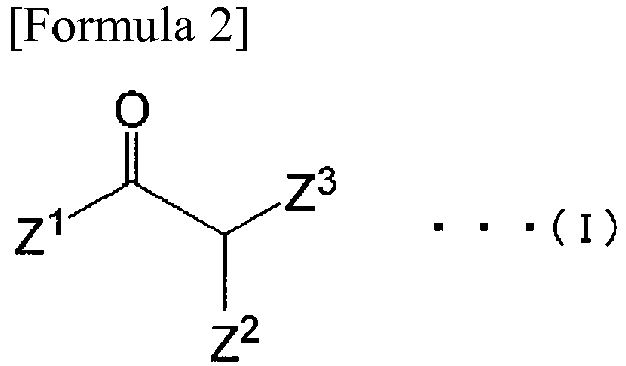
- In general formula (I), Z1, Z2, and Z3 are the same as Z1, Z2, and Z3 in general formula (II) above, respectively.
- By the method of producing a carbonyl compound according to the present invention, a carbonyl compound can be produced at a high yield from a β-ketoester compound.
- As a result of diligent research, the present inventors have found that the yield of a 5-benzyl-2,2-bis(hydroxymethyl) cyclopentanone derivative having a protected hydroxy group can be enhanced by performing a reaction using a hydrogen halide salt of tertiary amine in a production step for obtaining a 5-benzyl-2,2-bis(hydroxymethyl) cyclopentanone derivative having a protected hydroxy group from a 1-benzyl-3,3-bis(hydroxymethyl)-2-oxocyclopentane carboxylic acid alkyl ester derivative having a protected hydroxy group. In addition, the present inventors have also found that a carbonyl compound can be produced at a high yield by using a hydrogen halide salt of tertiary amine in another reaction using another β-ketoester compound. Therefore, the present invention has been completed.
- An embodiment of the method of producing a carbonyl compound according to the present invention will be described hereinafter.
- The method of producing a carbonyl compound according to the present invention is a method of producing a carbonyl compound represented by general formula (I) below from a β-ketoester compound (hereinafter, referred to as "compound (II)") represented by general formula (II) below, and the method produces a carbonyl compound represented by general formula (I) by subjecting the compound (II) to dealkoxycarbonylation in the presence of a hydrogen halide salt of tertiary amine.

- In the formula, Z1 represents an alkyl group, cycloalkyl group, aryl group, or heterocyclic group, and the alkyl group, cycloalkyl group, aryl group, and heterocyclic group may have a substituent.
- The number of carbons in alkyl group of Z1 is not particularly limited; however, the alkyl group can be exemplified by an alkyl group having from 1 to 8 carbons. Examples of the alkyl group having from 1 to 8 carbons include an ethyl group, methyl group, (1-methyl)ethyl group, n-propyl group, 1-methylpropyl group, 2-methylpropyl group, 1,1-dimethylethyl group, n-butyl group, n-pentyl group, n-hexyl group, n-heptyl group, n-octyl group, and the like.
- The number of carbons constituting the ring of the cycloalkyl group of Z1 is not particularly limited; however, the cycloalkyl group can be exemplified by a cycloalkyl group having from 3 to 6 carbons. Examples of the cycloalkyl group having from 3 to 6 carbons include a cyclopropyl group, cyclobutyl group, cyclopentyl group, cyclohexyl group, and the like.
- Examples of the aryl group of Z1 include a phenyl group, naphthyl group, indene group, azulene group, diphenyl group, and the like.
- The number of atoms constituting the ring of a heterocyclic group of Z1 is not particularly limited; however, the heterocyclic group can be exemplified by an aliphatic heterocyclic group having from 3 to 6 members and an aromatic heterocyclic group having from 5 or 6 members. Examples of a heterocyclic ring constituting the aliphatic heterocyclic ring having from 3 to 6 members include azetidine, aziridine, piperidine, piperazine, morpholine, pyrrolidine, oxetane, tetrahydrofuran, tetrahydropyran, and the like. Furthermore, examples of a heterocyclic ring constituting the aromatic heterocyclic group having from 5 to 6 members include thiophene, pyridine, thiazole, furan, pyrrole, oxazole, isoxazole, isothiazole, triazole, furazan, imidazole, pyrazole, pyrazine, pyrimidine, triazine, pyridazine, and the like. Examples thereof also include condensed heterocyclic rings, such as indole, benzofuran, benzothiophene, quinoline, and quinoxaline; and the like.
- Examples of the substituent that can be contained in the alkyl group, cycloalkyl group, aryl group, and heterocyclic group of Z1 include a halogen atom, an aliphatic hydrocarbon group, an aromatic hydrocarbon group, an aromatic heterocyclic group, an aliphatic hydrocarbon group in which at least one hydrogen atom is substituted with an aromatic hydrocarbon group or aromatic heterocyclic group, an alkoxy group, a carbonyloxyalkyl group, an amide group, a cyano group, a nitro group, and the like. Furthermore, a hydrogen atom in these substituents may be substituted with a halogen atom, hydroxy group, alkoxy group, alkyl group, haloalkyl group, aromatic hydrocarbon group, aromatic heterocyclic group, and the like. Furthermore, the hydroxy group may be protected by a protecting group that protects the hydroxy group.
- Z2 and Z3 each independently represent a hydrogen atom, alkyl group, cycloalkyl group, aryl group, or heterocyclic group, and the alkyl group, cycloalkyl group, aryl group, and heterocyclic group may have a substituent. Examples of the alkyl group, the cycloalkyl group, the aryl group, the heterocyclic group, and the substituent that can be contained in these alkyl group, cycloalkyl group, aryl group, and heterocyclic group of Z2 and Z3 are the same as the alkyl group, the cycloalkyl group, the aryl group, the heterocyclic group, and the substituent that can be contained in these alkyl group, cycloalkyl group, aryl group, and heterocyclic group of Z1, respectively.
- Z2 and Z3 may be the same or different from each other.
- Z1 and Z2 may be bonded to each other and, together with a carbon atom to which Z1 is bonded and a carbon atom to which Z2 is bonded, form a ring.
- R represents an alkyl group having from 1 to 4 carbons. Examples thereof include a methyl group, ethyl group, (1-methyl)ethyl group, n-propyl group, 1-methylpropyl group, 2-methylpropyl group, n-butyl group, 1,1-dimethylethyl group, and the like.
- Examples of the tertiary amine constituting the hydrogen halide salt of tertiary amine include aliphatic amines such as trimethylamine, triethylamine, ethyldimethylamine, tri-n-propylamine, triisopropylamine, tri-n-butylamine, triisobutylamine, tri-sec-butylamine, tri-tert-butylamine, tri-n-pentylamine, tri-n-hexylamine, tri-n-octylamine, diethylisopropylamine, diisopropylethylamine, tricyclopropylamine, tricyclobutylamine, tetramethylethylene diamine, tricyclopentylamine, and tricyclohexylamine; nitrogen-containing heterocyclic aliphatic amines such as N-methylpyrrolidine, N-ethylpyrrolidine, N-methylpiperidine, N-ethylpiperidine, N-n-butylpiperidine, N-methylhexamethylene imine, N-ethylhexamethylene imine, N-methylmorpholine, N-ethylmorpholine, N-butylmorpholine, N,N'-dimethylpiperazine, N,N'-diethylpiperazine, 1,5-diazabicyclo[4.3.1]non-5-ene, 1,4-diazabicyclo[2.2.2]octane, and 1,8-diazabicyclo[5.4.0]undec-7-ene; and nitrogen-containing heterocyclic aromatic amines such as pyridine, picoline, collidine, and lutidine. Among these, triethylamine, trimethylamine, ethyldimethylamine, N-methylpyrrolidine, pyridine, and picoline are preferable; triethylamine, trimethylamine, pyridine, and picoline are more preferable; and triethylamine and pyridine are particularly preferable.
- Examples of the hydrogen halide constituting the hydrogen halide salt of tertiary amine include hydrogen fluoride, hydrogen chloride, hydrogen bromide, and hydrogen iodide. Among these, hydrogen chloride is preferable.
- Specific examples of preferable hydrogen halide salt of tertiary amine include a hydrochloride of triethylamine, triethylamine hydrobromide, trimethylamine hydrochloride, a hydrochloride of pyridine, 2-picoline hydrochloride, 3-picoline hydrochloride, and 4-picoline hydrochloride. Among these, a hydrochloride of triethylamine and a hydrochloride of pyridine are preferable.
- Although a hydrogen halide salt of tertiary amine can be formed in a system by blowing a hydrogen halide, as a gas, into the system after adding tertiary amine into the system, it is preferable to use a hydrogen halide salt of tertiary amine that is prepared in advance.
- The reaction of dealkoxycarbonylation is preferably performed in a solvent. The solvent is not particularly limited as long as the solvent does not participate in the reaction. For example, amides such as N,N-dimethylformamide, N,N-dimethylacetamide, and N-methyl-2-pyrrolidone can be preferably used. Furthermore, the solvent may be a mixed solvent with another solvent that can be mixed with these solvents (e.g. toluene, DMSO, and the like).
- The amount of the hydrogen halide salt of tertiary amine is, in terms of moles, for example, from 0.3 to 10-fold, preferably from 0.5 to 5-fold, and more preferably from 0.8 to 3-fold, the amount of the compound (II).
- The reaction temperature is, for example, from 0 to 250°C, preferably from room temperature to 200°C, and more preferably from 50 to 180°C. Furthermore, the reaction time is, for example, from 0.05 hours to a few days, preferably from 0.1 hours to 5 days, and more preferably from 0.5 hours to 2 days.
- Note that, even when the reaction is not performed under inert gas, the reaction proceeds without problems. However, depending on the type of amine that is used, if the reaction takes place for a long time at a high temperature and if the reaction proceeds in the air, problems, such as coloration of the reaction liquid caused by being affected by air oxidation, may occur. In such a case, it is more preferable to perform the reaction under an inert gas (e.g. nitrogen, argon, and the like) atmosphere.
- Other reaction conditions can be easily designed and set by a person skilled in the art by referring to conventionally known production methods.
- In the present specification, "dealkoxycarbonylation" indicates that -CO2R is eventually substituted with a hydrogen atom. From the perspective of obtaining a carbonyl compound by removing -CO2R from a β-ketoester compound, hydrolysis and decarboxylation of the β-ketoester compound are the same. However, since, in the production method using a hydrogen halide salt of tertiary amine of the present invention, the reaction proceeds in the absence of water, the "dealkoxycarbonylation" in the present invention is clearly distinguished from a reaction including hydrolysis that requires water. Note that, if water is present in the reaction system, a hydroxide ion may be generated from the water molecule under a condition containing bases, thereby causing undesired side reactions. Therefore, it is preferred that the system contains no water.
- In the production method according to the present invention, since the reaction is performed using a salt of tertiary amine, but not an acid or alkali, it is possible to perform the reaction under a neutral or almost neutral condition. Therefore, even for a compound which is unstable to an acid or alkali and the yield of which is anticipated to be lowered under acidic conditions or basic conditions, the reaction can be performed with a high yield.
- The reaction mechanism of the dealkoxycarbonylation in the method of producing a carbonyl compound according to the present invention is conceived to include the following reaction mechanism, for example.
First, a halogen atom attacks an alkyl group of an alkyl ester group of the compound (II). As well as generating alkyl halide in the system, this forms β-ketocarboxylic acid rapidly from the compound (II) since the hydrogen halide salt of tertiary amine is a proton source. Therefore, a compound represented by general formula (I) is formed by decarboxylation of the generated β-ketocarboxylic acid. On the other hand, the generated alkyl halide reacts with the tertiary amine in the system to form a quaternary amine salt. - However, in the method of producing a carbonyl compound according to the present invention, the reaction mechanism is not particularly limited as long as the reaction proceeds using a hydrogen halide salt of tertiary amine. The method is not limited to cases where a single reaction mechanism proceeds the reaction, and the method may be a method where the reaction is proceeded by a plurality of reaction mechanisms.
- A preferable aspect of the method of producing a carbonyl compound according to the present invention is a method of producing a carbonyl compound represented by general formula (Ia). The method produces a carbonyl compound represented by general formula (Ia) by subjecting a β-ketoester compound having a cyclopentane ring represented by general formula (IIa) below (hereinafter, referred to as "compound (IIa)") to dealkoxycarbonylation in the presence of a hydrogen halide salt of tertiary amine.

- In the formula, Y represents an alkyl group or haloalkyl group having from 1 to 6 carbons, an alkenyl group or haloalkenyl group having from 2 to 6 carbons, an alkynyl group or haloalkynyl group having from 2 to 6 carbons, or a group in which a part of hydrogen atoms of the alkyl group, haloalkyl group, alkenyl group, haloalkenyl group, alkynyl group, or haloalkynyl group is substituted with -OG (G represents a protecting group of a hydroxy group).
- Examples of the alkyl group having from 1 to 6 carbons include a methyl group, ethyl group, (1-methyl)ethyl group, n-propyl group, 1-methylpropyl group, 2-methylpropyl group, n-butyl group, 1-methylbutyl group, 2-methylbutyl group, 1-ethylpropyl group, 1,1-dimethylethyl group, and the like. Among these, alkyl groups having from 1 to 4 carbons are preferable. A methyl group and an ethyl group are more preferable, and a methyl group is even more preferable.
- Examples of the haloalkyl group having from 1 to 6 carbons include a chloromethyl group, dichloromethyl group, trichloromethyl group, 2-chloroethyl group, 1-chloroethyl group, 2,2-dichloroethyl group, 1,2-dichloroethyl group, 2,2,2-trichloroethyl group, 3-chloropropyl group, 2,3-dichloropropyl group, 1-chloro-1-methylethyl group, 2-chloro-1-methylethyl group, 2-chloropropyl group, 4-chlorobutyl group, 5-chloropentyl group, fluoromethyl group, difluoromethyl group, trifluoromethyl group, 2-fluoroethyl group, 1-fluoroethyl group, 2,2-difluoroethyl group, 1,2-difluoroethyl group, 2,2,2-trifluoroethyl group, 3-fluoropropyl group, 2,3-difluoropropyl group, 1-fluoro-1-methylethyl group, 2-fluoro-1-methylethyl group, 2-fluoropropyl group, 3,3,3-trifluoropropyl group, 2,2,3,3-tetrafluoropropyl group, 2,2,3,3,3-pentafluoropropyl group, 4-fluorobutyl group, 5-fluoropentyl group, bromomethyl group, dibromomethyl group, tribromomethyl group, 2-bromoethyl group, 1-bromoethyl group, 2,2-dibromoethyl group, 1,2-dibromoethyl group, 2,2,2-tribromoethyl group, 3-bromopropyl group, 2,3-dibromopropyl group, 1-bromo-1-methylethyl group, 2-bromo-1-methylethyl group, 2-bromopropyl group, 4-bromobutyl group, 5-bromopentyl group, iodomethyl group, diiodomethyl group, 2-iodoethyl group, 1-iodoethyl group, 2,2-diiodoethyl group, 1,2-diiodoethyl group, 2,2,2-triiodoethyl group, 3-iodopropyl group, 2,3-diiodopropyl group, 1-iodo-1-methylethyl group, 2-iodo-1-methylethyl group, 2-iodopropyl group, 4-iodobutyl group, and the like. Among these, haloalkyl groups having from 1 to 4 carbons are preferable, and haloalkyl groups having from 1 to 3 carbons are more preferable.
- Examples of the alkenyl group having from 2 to 6 carbons include an ethenyl group, 1,2-dimethylethenyl group, 4-methyl-1,3-butadienyl group, 1-propenyl group, 2-propenyl group, 2-methyl-2-propenyl group, 3-methyl-2-propenyl group, 2-butenyl group, 3-butenyl group, 3-methyl-3-butenyl group, and the like. Among these, alkenyl groups having from 2 to 4 carbons are preferable.
- Examples of the haloalkenyl group having from 2 to 6 carbons include a 2-chloroethenyl group, 2,2-dichloroethenyl group, 2-chloro-2-propenyl group, 3,3-dichloro-2-propenyl group, 2,3-dichloro-2-propenyl group, 3,3-dichloro-2-methyl-2-propenyl group, 3-chloro-2-butenyl group, 2-fluoroethenyl group, 2,2-difluoroethenyl group, 2-fluoro-2-propenyl group, 3,3-difluoro-2-propenyl group, 2,3-difluoro-2-propenyl group, 3,3-difluoro-2-methyl-2-propenyl group, 3-fluoro-2-butenyl group, 2-bromoethenyl group, 2,2-dibromoethenyl group, 2-bromo-2-propenyl group, 3,3-dibromo-2-propenyl group, 2,3-dibromo-2-propenyl group, 3,3-dibromo-2-methyl-2-propenyl group, 3-bromo-2-butenyl group, 2-iodoethenyl group, 2,2-diiodoethenyl group, 2-iodo-2-propenyl group, 3,3-diiodo-2-propenyl group, 2,3-diiodo-2-propenyl group, and the like. Among these, haloalkenyl groups having from 2 to 4 carbons are preferable.
- Examples of the alkynyl group having from 2 to 6 carbons include an ethynyl group, 1-propynyl group, 2-propynyl group, 1-butynyl group, 2-butynyl group, and the like. Among these, alkynyl groups having from 2 to 4 carbons are preferable.
- Examples of the haloalkynyl group having from 2 to 6 carbons include a 2-fluoroethynyl group, 2-chloroethynyl group, 3-fluoro-2-propynyl group, 3-chloro-2-propynyl group, 3-bromo-2-propynyl group, and the like. Among these, haloalkynyl groups having from 2 to 4 carbons are preferable.
- The protecting group G in -OG is a protecting group that protects a hydroxy group. The protecting group is not particularly limited as long as the protecting group dissociates under a proper condition to form a hydroxy group. Examples of the protecting group G include a protecting group that dissociates under acidic conditions, a protecting group that splits under reducing conditions such as a hydrogenation reaction, and the like.
- n represents an integer from 0 to 6, and n is preferably from 0 to 3, and more preferably from 0 to 2. When n is 2 or greater, a plurality of Y may be the same or different each other. Furthermore, when n is 2 or greater, two Y moieties may be bonded to one carbon atom. Furthermore, when n is 2 or greater, a plurality of Y may be bonded to each other and, together with carbon atom(s) to which the plurality of Y are bonded, form a ring;
- X represents a halogen atom, an alkyl group having from 1 to 4 carbons, a haloalkyl group having from 1 to 4 carbons, an alkoxy group having from 1 to 4 carbons, a haloalkoxy group having from 1 to 4 carbons, a phenyl group, a cyano group, or a nitro group.
- Examples of the halogen atom of X include a fluorine atom, chlorine atom, bromine atom, iodine atom, and the like. Among these, a fluorine atom, chlorine atom, and bromine atom are preferable, and a fluorine atom and chlorine atom are more preferable.
- Specific examples of the alkyl group having from 1 to 4 carbons of X include a methyl group, ethyl group, n-propyl group, isopropyl group, n-butyl group, isobutyl group, sec-butyl group, and tert-butyl group. Among these, alkyl groups having from 1 to 3 carbons are preferable. Alkyl groups having from 1 to 2 carbons are more preferable, and a methyl group is even more preferable.
- Examples of the haloalkyl group having from 1 to 4 carbons of X include a dichloromethyl group, trichloromethyl group, 2-chloroethyl group, 1-chloroethyl group, 2,2-dichloroethyl group, 1,2-dichloroethyl group, 2,2,2-trichloroethyl group, 3-chloropropyl group, 2,3-dichloropropyl group, 1-chloro-1-methylethyl group, 2-chloro-1-methylethyl group, 2-chloropropyl group, 4-chlorobutyl group, fluoromethyl group, difluoromethyl group, trifluoromethyl group, 2-fluoroethyl group, 1-fluoroethyl group, 2,2-difluoroethyl group, 1,2-difluoroethyl group, 2,2,2-trifluoroethyl group, 3-fluoropropyl group, 2,3-difluoropropyl group, 1-fluoro-1-methylethyl group, 2-fluoro-1-methylethyl group, 2-fluoropropyl group, 3,3,3-trifluoropropyl group, 2,2,3,3-tetrafluoropropyl group, 2,2,3,3,3-pentafluoropropyl group, 4-fluorobutyl group, dibromomethyl group, tribromomethyl group, 2-bromoethyl group, 2,2-dibromoethyl group, 1,2-dibromoethyl group, 2,2,2-tribromoethyl group, 3-bromopropyl group, 2,3-dibromopropyl group, 1-bromo-1-methylethyl group, 2-bromo-1-methylethyl group, 2-bromopropyl group, diiodomethyl group, 2,2-diiodoethyl group, 1,2-diiodoethyl group, 2,2,2-triiodoethyl group, 2,3-diiodopropyl group, 1-iodo-1-methylethyl group, 2-iodo-1-methylethyl group, and the like. Among these, haloalkyl groups having from 1 to 3 carbons are preferable, and haloalkyl groups having 1 or 2 carbons are more preferable. Trihaloalkyl groups having 1 carbon are even more preferable.
- Examples of the alkoxy group having from 1 to 4 carbons of X include a methoxy group, ethoxy group, n-propoxy group, and the like. Among these, alkoxy groups having from 1 to 3 carbons are preferable, and alkoxy groups having 1 or 2 carbons are more preferable. A methoxy group is even more preferable.
- Examples of the haloalkoxy group having from 1 to 4 carbons of X include a trifluoromethoxy group, difluoromethoxy group, 1,1,2,2,2-pentafluoroethoxy group, 2,2,2-tifluoroethoxy group, and the like. Among these, haloalkoxy groups having from 1 to 3 carbons are preferable, and haloalkoxy groups having 1 or 2 carbons are more preferable. Dihalomethoxy groups and trihalomethoxy groups having 1 carbon are even more preferable.
- m represents an integer from 0 to 5. m is preferably an integer from 0 to 3, more preferably an integer from 0 to 2, and even more preferably 0 or 1. When m is 2 or greater, a plurality of X may be the same or different each other. When m is 1 or greater, X may be positioned at any one of 2- to 6- positions of the benzene ring; however, when m is 1, X is preferably at a position that forms a 4-substituted benzyl.
- R is the same as R in general formula (II) above.
- The type and used amount of the hydrogen halide salt of tertiary amine and type of solvent used in the reaction that dealkoxycarbonylates the compound (IIa), reaction conditions of the reaction, and the like are the same as the above-described types and used amount of the hydrogen halide salt of tertiary amine, type of solvent, reaction conditions, and the like.
- Preferable examples of the compound (IIa) include a compound represented by general formula (IIa-1) below and a compound represented by general formula (IIa-2) below.


- A more preferable aspect of the method of producing a carbonyl compound according to the present invention is a method of producing a carbonyl compound represented by general formula (Ib). The method produces a carbonyl compound represented by general formula (Ib) by subjecting a β-ketoester compound having a cyclopentane ring represented by general formula (IIb) below (hereinafter, referred to as "compound (IIb)") to dealkoxycarbonylation in the presence of a hydrogen halide salt of tertiary amine.

- In the formula, Y1 and Y2 each independently represent an alkyl group or haloalkyl group having from 1 to 6 carbons, or a group in which a part of hydrogen atoms of the alkyl group or haloalkyl group is substituted with -OG1 (G1 represents a protecting group of a hydroxy group).
- Examples of the alkyl group and haloalkyl group having from 1 to 6 carbons of Y1 and Y2 are the same as those for the alkyl group and haloalkyl group having from 1 to 6 carbons of Y described above.
- Y1 and Y2 may be bonded to each other and, together with a carbon atom to which Y1 and Y2 are bonded, form a ring.
- The protecting group G1 is a protecting group that protects a hydroxy group. The protecting group is not particularly limited as long as the protecting group dissociates under a proper condition to form a hydroxy group. Examples of the protecting group G1 include a protecting group that dissociates under acidic conditions. Examples of the protecting group that dissociates under acidic conditions include alkoxymethyl groups and alkoxyethyl groups in which alkoxy moiety has from 1 to 4 carbons (e.g. methoxymethyl group, ethoxymethyl group, and the like), alkyl groups having from 1 to 4 carbons (e.g. methyl group, ethyl group, t-butyl group, and the like), substituted or unsubstituted benzyl groups, substituted or unsubstituted tetrahydropyranyl groups, substituted or unsubstituted tetrahydrofuranyl groups, allyl groups, silyl groups (e.g. triethylsilyl group, t-butyldimethylsilyl group, and the like), and the like. Furthermore, the protecting groups for two hydroxy groups may be bonded to each other; for example, a case where two hydroxy groups are protected at the same time by an acetal, such as methylene acetal or ethylidene acetal, is possible.
- Furthermore, examples thereof also include protecting groups that split under reducing conditions. Examples of the protecting group that splits under reducing conditions include a benzyl group, substituted or unsubstituted benzyl groups, such as a p-methoxybenzyl group, and the like.
- Furthermore, R, X, and m are the same as R, X, and m in general formula (II) above.
- The type and used amount of the hydrogen halide salt of tertiary amine and type of the solvent used in the reaction that dealkoxycarbonylates the compound (IIb), reaction conditions of the reaction, and the like are the same as the above-described types and used amount of the hydrogen halide salt of tertiary amine, type of solvent, reaction conditions, and the like.
- Another preferable aspect of the method of producing a carbonyl compound according to the present invention is a method of producing a carbonyl compound represented by general formula (Ic) (hereinafter, referred to as "compound (Ic)"). The method produces a compound (Ic) by subjecting a β-ketoester compound having a cyclopentane ring represented by general formula (IIc) below (hereinafter, referred to as "compound (IIc)") to dealkoxycarbonylation in the presence of a hydrogen halide salt of tertiary amine.


- In the formula, G2 and G3 each independently represents a protective group that protects a hydroxy group, and, in particular, represents a protective group that dissociates under acidic conditions. Note that G2 and G3 may be bonded to each other and, together with oxygen atoms to which, respectively, G2 and G3 are bonded, carbon atoms to which, respectively, the oxygen atoms are bonded, and a carbon atom of the cyclopentane ring to which these carbon atoms are bonded, form a ring.
- Examples of the protecting group for cases where G2 and G3 are not bonded to each other include alkoxymethyl groups in which alkoxy moiety has from 1 to 4 carbons (e.g. methoxymethyl group, ethoxymethyl group, and the like), alkoxyethyl groups in which alkoxy moiety has from 1 to 4 carbons (e.g. 1-ethoxyethyl group, 1-methyl-1-methoxyethyl group, and the like), alkyl groups having from 1 to 4 carbons (e.g. t-butyl group, methyl group, and the like), substituted or unsubstituted benzyl groups, substituted or unsubstituted tetrahydropyranyl groups, substituted or unsubstituted tetrahydrofuranyl groups, allyl groups, and silyl groups (e.g. triethylsilyl group, t-butyldimethylsilyl group, and the like).
- On the other hand, examples of the protecting group for cases where G2 and G3 are bonded to each other include methylene acetal, ethylidene acetal, t-butylmethylidene ketal, 1-t-butylethylidene ketal, 1-phenylethylidene ketal, acrolein acetal, isopropylidene ketal (acetonide), cyclopentylidene ketal, cyclohexylidene ketal, cycloheptylidene ketal, benzylidene acetal, p-methoxybenzylidene acetal, 2,4-dimethoxybenzylidene ketal, 3,4-dimethoxybenzylidene ketal, 2-nitrobenzylidene acetal, 4-nitrobenzylidene acetal, mesitylene acetal, 1-naphthaldehyde acetal, benzophenone ketal, camphor ketal, menthone ketal, methoxymethylene acetal, ethoxymethylene acetal, dimethoxymethylene orthoester, 1-methoxyethylidene orthoester, 1-ethoxyethylidene orthoester, methylidene orthoester, phthalide orthoester, 1,2-dimethoxyethylidene orthoester, α-methoxybenzylidene orthoester, 2-oxacyclopentylidene orthoester, butane-2,3-bis-acetal, cyclohexane-1,2-diacetal, bis-dihydropyran ketal, di-t-butylsilylene, 1,3-(1,1,3,3-tetraisopropyl)disiloxanilidene, and 1,1,3,3-tetra-t-butoxydisiloxanilidene.
- Furthermore, R, X, and m are the same as R, X, and m in general formula (II) above.
- The type and used amount of the hydrogen halide salt of tertiary amine and type of solvent used in the reaction that dealkoxycarbonylates the compound (IIc), reaction conditions of the reaction, and the like are the same as the above-described types and used amount of the hydrogen halide salt of tertiary amine, type of solvent, reaction conditions, and the like.
- G2 and G3 are protecting groups that dissociate under acidic conditions. Therefore, for cases where hydrolysis and decarboxylation reactions are used in an attempt to obtain the compound (Ic) from the compound (IIc), the yield of the compound (Ic) decreases if the reaction is performed under acidic conditions. On the other hand, when the inventors of the present application conducted various investigations, it was found that, when the compound (IIc) was hydrolyzed/decarboxylated under basic conditions, the yield of the compound (Ic) decreased due to the occurrence of side reactions involving the opening of cyclopentane rings. Therefore, for a reaction to obtain the compound (Ic) from the compound (IIc), performing the reaction under a neutral or almost neutral condition is desired. According to the production method of the present invention in which dealkoxycarbonylation is performed using a hydrogen halide salt of tertiary amine, it is possible to perform the reaction under a neutral or almost neutral condition. Therefore, the production method of the present invention in which dealkoxycarbonylation is performed using a hydrogen halide salt of tertiary amine exhibits excellent effect especially in a method of producing the compound (Ic) from the compound (IIc) for which performing the reaction under a neutral or almost neutral condition is desired.
- Furthermore, a side reaction in which a cyclopentane ring is opened upon performing hydrolysis/decarboxylation under basic conditions can occur not only in a reaction for the compound (IIc) but also in reactions for the compound (IIa) and the compound (IIb) in which a cyclopentane ring is contained. Therefore, when it is not desirable to perform hydrolysis/decarboxylation of the compound (IIa) and the compound (IIb) under acidic conditions due to some reasons (e.g. for cases where the yield will be decreased by performing hydrolysis/decarboxylation under acidic conditions), the production method of the present invention in which dealkoxycarbonylation is performed using a hydrogen halide salt of tertiary amine is particularly preferably employed.
- Since the hydrogen halide salt of tertiary amine is an acid of strong acid and weak base, the reaction system may be acidic. Therefore, when the production method of the present invention is applied to a compound, the yield of which is expected to be lowered by a reaction under acidic conditions, such as the compound (IIc) and a compound represented by general formula (IId) or (IIe) described below having a protecting group that dissociates under acidic conditions, a base is preferably added to the reaction system. By adding a base in the reaction system, decrease in the yield of the target product can be prevented. Examples of a base to be added include tertiary amines. Note that a tertiary amine that is added as a base may be the same as or different from the tertiary amine that constitutes the hydrogen halide salt of tertiary amine used in the reaction. However, it is preferable to use a tertiary amine that is the same as the tertiary amine used in the reaction.
- For cases where a base is added, the added amount of the base may be suitably set depending on the type and used amount of the hydrogen halide salt of tertiary amine and type of the added base. However, for example, for cases where a tertiary amine that is the same as the tertiary amine used in the hydrogen halide salt of tertiary amine is added as a base, the amount of the base may be, in terms of moles, for example, from 0.01 to 2-fold, preferably from 0.05 to 1-fold, more preferably from 0.1 to 0.5-fold, the amount of the hydrogen halide salt of tertiary amine.
- A preferable aspect for cases where G2 and G3 are bonded to each other to form a ring is a method of producing a carbonyl compound represented by general formula (Id). The method produces a carbonyl compound represented by general formula (Id) by subjecting a β-ketoester compound having a cyclopentane ring represented by general formula (IId) below to dealkoxycarbonylation in the presence of a hydrogen halide salt of tertiary amine.

- In the formula, G4 and G5 each independently represent a hydrogen atom, an alkyl group having from 1 to 4 carbons, an alkenyl group having from 1 to 4 carbons, a phenyl group, a naphthyl group, or a benzyl group. A phenyl moiety of the phenyl group, naphthyl group, and benzyl group of G4 and G5 may be substituted with an alkyl group having from 1 to 4 carbons (e.g. methyl group, ethyl group, and the like); an alkoxy group having from 1 to 4 carbons (e.g. methoxy group, ethoxy group, and the like); a nitro group; or a halogen atom (e.g. fluorine atom, chlorine atom, and the like). Note that G4 and G5 may be bonded to each other and, together with a carbon atom to which G4 and G5 are bonded, form a ring. Among these, G4 and G5 are more preferably each independently a hydrogen atom or an alkyl group having from 1 to 4 carbons, such as a methyl group, ethyl group, and n-propyl group; and even more preferably each independently a hydrogen atom, methyl group, or ethyl group. Furthermore, both of G4 and G5 are particularly preferably methyl groups.
- Furthermore, R, X, and m are the same as R, X, and m in general formula (II) above.
- The type and used amount of the hydrogen halide salt of tertiary amine and type of solvent used in the reaction that dealkoxycarbonylates the β-ketoester compound represented by general formula (IId), reaction conditions of the reaction, and the like are the same as the above-described types and used amount of the hydrogen halide salt of tertiary amine, type of solvent, reaction conditions, and the like.
- A particularly preferable aspect of the method of producing a carbonyl compound according to the present invention is a method of producing a carbonyl compound represented by general formula (Ie). The method produces a carbonyl compound represented by general formula (Ie) by subjecting a β-ketoester compound having a cyclopentane ring represented by general formula (IIe) below to dealkoxycarbonylation in the presence of a hydrogen halide salt of tertiary amine.

- In the formula, G6 and G7 each independently represent a hydrogen atom or an alkyl group having from 1 to 4 carbons, such as a methyl group, ethyl group, and n-propyl group. Among these, G6 and G7 are preferably each independently a hydrogen atom, methyl group, or ethyl group. Furthermore, both of G6 and G7 are more preferably methyl groups.
- X1 represents a hydrogen atom, chlorine atom, or fluorine atom.
- To solve the above-described problems, the method of producing a carbonyl compound according to the present invention is a method of producing a carbonyl compound represented by general formula (I) below from a compound represented by general formula (II) below, and the method comprises a step of subjecting the compound represented by general formula (II) below to dealkoxycarbonylation in the presence of a hydrogen halide salt of tertiary amine.

- In general formula (II), Z1 represents a substituted or unsubstituted alkyl group, cycloalkyl group, aryl group, or heterocyclic group; Z3 and Z2 each independently represent a hydrogen atom, a substituted or unsubstituted alkyl group, cycloalkyl group, aryl group, or heterocyclic group; and R represents an alkyl group having from 1 to 4 carbons. Z1 and Z2 may be bonded to each other.

- In general formula (I), Z1, Z2, and Z3 are the same as Z1, Z2, and Z3 in general formula (II) above, respectively.
Furthermore, in the method of producing a carbonyl compound according to the present invention, a tertiary amine constituting the hydrogen halide salt of tertiary amine is preferably triethylamine, trimethylamine, pyridine, or picoline. - Furthermore, in the method of producing a carbonyl compound according to the present invention, the hydrogen halide salt of tertiary amine is preferably a hydrochloride of tertiary amine or a hydrobromide of tertiary amine.
- Furthermore, in the method of producing a carbonyl compound according to the present invention, the compound represented by general formula (II) above is preferably a compound represented by general formula (IIa) below; and the carbonyl compound represented by general formula (I) above is preferably a carbonyl compound represented by general formula (Ia) below:

- In general formula (IIa), R represents an alkyl group having from 1 to 4 carbons, Y represents an alkyl group or haloalkyl group having from 1 to 6 carbons, an alkenyl group or haloalkenyl group having from 2 to 6 carbons, an alkynyl group or haloalkynyl group having from 2 to 6 carbons, or a group in which a part of hydrogen atoms of the alkyl group, haloalkyl group, alkenyl group, haloalkenyl group, alkynyl group, or haloalkynyl group is substituted with -OG (G represents a protecting group of a hydroxy group); and n is an integer from 0 to 6. When n is 2 or greater, a plurality of Y may be the same or different. When n is 2 or greater, a plurality of Y may be bonded to each other and, together with carbon atom(s) to which the plurality of Y are bonded, form a ring. X represents a halogen atom, an alkyl group having from 1 to 4 carbons, a haloalkyl group having from 1 to 4 carbons, an alkoxy group having from 1 to 4 carbons, a haloalkoxy group having from 1 to 4 carbons, a phenyl group, a cyano group, or a nitro group; and m is an integer from 0 to 5, when m is 2 or greater, a plurality of X may be the same or different.

- In general formula (Ia), X, Y, m, and n are the same as X, Y, m, and n in general formula (IIa) above, respectively.
Furthermore, in the method of producing a carbonyl compound according to the present invention, the compound represented by general formula (IIa) above is preferably a compound represented by general formula (IIb) below; and the carbonyl compound represented by general formula (Ia) above is preferably a carbonyl compound represented by general formula (Ib) below:
- In general formula (IIb), Y1 and Y2 each independently represent an alkyl group or haloalkyl group having from 1 to 6 carbons, or a group in which a part of hydrogen atoms of the alkyl group or haloalkyl group is substituted with -OG1 (G1 represents a protecting group of a hydroxy group), and Y1 and Y2 may be bonded to each other and, together with a carbon atom to which Y1 and Y2 are bonded, form a ring. R, X, and m are the same as R, X, and m in general formula (IIa) above, respectively.

- In general formula (Ib), X, Y1, Y2, and m are the same as X, Y1, Y2, and m in general formula (IIb) above, respectively.
Furthermore, in the method of producing a carbonyl compound according to the present invention, the compound represented by general formula (IIb) above is preferably a compound represented by general formula (IIc) below; and the carbonyl compound represented by general formula (Ib) above is preferably a carbonyl compound represented by general formula (Ic) below:
- In general formula (IIc), G2 and G3 each independently represent a protecting group that dissociates under acidic conditions, and G2 and G3 may be bonded to each other. R, X, and m are the same as R, X, and m in general formula (IIa) above, respectively.

- In general formula (Ic), X, G2, G3, and m are the same as X, G2, G3, and m in general formula (IIc) above, respectively.
Furthermore, in the method of producing a carbonyl compound according to the present invention, the compound represented by general formula (IIc) above is preferably a compound represented by general formula (IId) below; and the carbonyl compound represented by general formula (Ic) above is preferably a carbonyl compound represented by general formula (Id) below:
- In general formula (IId), G4 and G5 each independently represent a hydrogen atom, an alkyl group having from 1 to 4 carbons, an alkenyl group having from 1 to 4 carbons, a substituted or unsubstituted phenyl group, naphthyl group, or benzyl group, and G4 and G5 may be bonded to each other and, together with a carbon atom to which G4 and G5 are bonded, form a ring. R, X, and m are the same as R, X, and m in general formula (IIa) above, respectively.

- In general formula (Id), X, G4, G5, and m are the same as X, G4, G5, and m in general formula (IId) above, respectively.
Furthermore, in the method of producing a carbonyl compound according to the present invention, G4 and G5 are preferably each independently a hydrogen atom or an alkyl group having from 1 to 4 carbons. - Furthermore, in the method of producing a carbonyl compound according to the present invention, a tertiary amine is preferably further added to the reaction system.
- Furthermore, in the method of producing a carbonyl compound according to the present invention, m is preferably an integer from 0 to 2; and when m is 1 or 2, X is preferably a halogen atom.
- Embodiments of the present invention will be described in more detail hereinafter using examples. Of course, the present invention is not limited to the examples below, and it goes without saying that various modes are possible with regard to the details thereof. Furthermore, the present invention is not limited to the embodiments described above, and various modifications are possible within the scope indicated in the claims. Embodiments obtained by appropriately combining the technical means disclosed by the embodiments are also included in the technical scope of the present invention. In addition, all of the documents disclosed in the present specification are hereby incorporated by reference.
- In 1-(4-chlorobenzyl)-3,3-bis((methoxymethoxy)methyl)-2-oxocyclopentane carboxylic acid methyl ester (2.0 g, 0.00482 mol), N,N-dimethylacetamide (2 mL), triethylamine (0.20 mL, 0.00482 x 0.3 mol), and triethylamine hydrochloride (0.995 g, 0.0482 x 1.5 mol) were added and stirred at 130°C for 8 hours. In the reaction liquid, ethyl acetate and saturated sodium bicarbonate water were added, and the mixture was partitioned. After extracting the aqueous layer using ethyl acetate, the organic layer was dried using anhydrous sodium sulfate and concentrated. Thereafter, the dried and concentrated product was purified using a silica gel column, and a target product was obtained.
The yield in grams was 1.51 g, and the percent yield was 88%. - Working Example 2: Synthesis of 2-(4-chlorobenzyl)-8,8-dimethyl-7,9-dioxaspiro[4.5]decan-1-one In 2-(4-chlorobenzyl)-8,8-dimethyl-1-oxo-7,9-dioxaspiro[4.5]decane-2-carboxylic acid methyl ester (2.0 g, 0.00546 mol), N,N-dimethylacetamide (2 mL), triethylamine (0.20 mL, 0.00546 x 0.3 mol), and triethylamine hydrochloride (1.13 g, 0.0546 x 1.5 mol) were added and stirred at 155°C for 1.5 hours. In the reaction liquid, toluene and saturated sodium bicarbonate water were added, and the mixture was partitioned. After extracting the aqueous layer using toluene, the organic layer was dried using anhydrous sodium sulfate and concentrated. Thereafter, the dried and concentrated product was purified using a silica gel column, and a target product was obtained.
The yield in grams was 1.62 g, and the percent yield was 96%. - In 2-(4-chlorobenzyl)-1-oxo-7,9-dioxaspiro[4.5]decane-2-carboxylic acid methyl ester (4.0 g, 0.0118 mol), N,N-dimethylacetamide (4 mL), triethylamine (0.15 mL, 0.0118 x 0.1 mol), and triethylamine hydrochloride (1.79 g, 0.0118 x 1.1 mol) were added and stirred at 120°C for 4 hours. In the reaction liquid, toluene and saturated sodium bicarbonate water were added, and the mixture was partitioned. After extracting the aqueous layer using toluene, the organic layer was dried using anhydrous sodium sulfate and concentrated. Thereafter, the dried and concentrated product was purified using a silica gel column, and a target product was obtained.
The yield in grams was 2.92 g, and the percent yield was 88%. - In 1-(4-chlorobenzyl)-3,3-dimethyl-2-oxocyclopentane carboxylic acid methyl ester (1.5 g, 0.00509 mol), N,N-dimethylacetamide (1.5 mL) and pyridine hydrochloride (0.706 g, 0.00509 x 1.2 mol) were added and stirred at 155°C for 4 hours. In the reaction liquid, pyridine hydrochloride (0.177 g, 0.00509 x 0.3 mol) was added and further stirred at 155°C for another 6 hours. In the reaction liquid, toluene and saturated sodium bicarbonate water were added, and the mixture was partitioned. After extracting the aqueous layer using toluene, the organic layer was dried using anhydrous sodium sulfate and concentrated. Thereafter, the dried and concentrated product was purified using a silica gel column, and a target product was obtained.
The yield in grams was 1.08 g, and the percent yield was 90%. - In 1-(4-chlorobenzyl)-3,3-dimethyl-2-oxocyclopentane carboxylic acid methyl ester (1.0 g, 0.00339 mol), N,N-dimethylacetamide (1 mL) and triethylamine hydrochloride (0.56 g, 0.00339 x 1.2 mol) were added and stirred at 150°C for 2 hours. In the reaction liquid, toluene and saturated sodium bicarbonate water were added, and the mixture was partitioned. After extracting the aqueous layer using toluene, the organic layer was dried using anhydrous sodium sulfate and concentrated. Thereafter, the dried and concentrated product was purified using a silica gel column, and a target product was obtained.
The yield in grams was 0.745 g, and the percent yield was 93%. - In 3-(4-chlorobenzyl)-2-oxocyclopentane carboxylic acid methyl ester (1.0 g, 0.00375 mol), N,N-dimethylacetamide (1 mL) and triethylamine hydrochloride (0.774 g, 0.00375 x 1.5 mol) were added and stirred at 130°C for 2 hours, and then at 140°C for another 3 hours. In the reaction liquid, ethyl acetate and saturated sodium bicarbonate water were added, and the mixture was partitioned. After extracting the aqueous layer using ethyl acetate, the organic layer was dried using anhydrous sodium sulfate and concentrated. Thereafter, the dried and concentrated product was purified using a silica gel column, and a target product was obtained.
The yield in grams was 0.71 g, and the percent yield was 91 %. - In 3-(4-chlorophenyl)-3-oxopropionic acid methyl ester (1.0 g, 0.0047 mol), N,N-dimethylacetamide (1 mL) and triethylamine hydrochloride (0.97 g, 0.0047 x 1.5 mol) were added and stirred at 140°C for 3 hours under an argon atmosphere. In the reaction liquid, ethyl acetate and saturated sodium bicarbonate water were added, and the mixture was partitioned. After extracting the aqueous layer using ethyl acetate, the organic layer was dried using anhydrous sodium sulfate and concentrated. Thereafter, the dried and concentrated product was purified using a silica gel column, and a target product was obtained.
The yield in grams was 0.688 g, and the percent yield was 95%. - In isopropanol (5.5 mL), 1-(4-chlorobenzyl)-3,3-bis((methoxymethoxy)methyl)-2-oxocyclopentane carboxylic acid methyl ester (2.2895 g, 5.52 mmol) was dissolved, and a 2 M sodium hydroxide solution (5.5 mL) was added thereto. The mixture was stirred at 90°C for 2 hours. Following the completion of the reaction, water was added, and the mixture was subjected to extraction using ethyl acetate. The organic layer was washed with saturated brine solution and water, and dried using anhydrous sodium sulfate. The solvent was distilled out, and the residue was purified using silica gel to obtain a target product.
The yield in grams was 1.3029 g, and the percent yield was 66%. - After adding toluene (1 mL) in 2-(4-chlorobenzyl)-8,8-dimethyl-1-oxo-7,9-dioxaspiro[4.5]decane-2-carboxylic acid methyl ester (10.0 g, 0.0273 mol), the mixture was suspended in a 0.5 M sodium hydroxide solution (27.3 mL, 0.0273 mol x 0.5 mol) and reacted at 110°C. The reaction was continued by adding a 0.5 M sodium hydroxide solution (27.3 mL, 0.0273 mol x 0.5 mol) every 2 hours (for three times total), and heating and stirring were performed for total of 9 hours. Following the completion of the reaction, the mixture was allowed to cool to room temperature and then subjected to extraction using toluene. The organic layer was washed with saturated brine solution, and then dried using anhydrous sodium sulfate. Thereafter, the dried product was purified using a silica gel column, and a target product was obtained.
The yield in grams was 6.75 g, and the percent yield was 80%. - The present invention can be used in the production of a 2-benzyl-5,5-di(protected hydroxymethyl)-cyclopentanone derivative serving as a raw material for an agricultural chemical or the like.
Claims (11)
- A method of producing a carbonyl compound represented by general formula (I) below from a compound represented by general formula (II) below;
the method comprising a step of: subjecting the compound represented by general formula (II) below to dealkoxycarbonylation in the presence of a hydrogen halide salt of tertiary amine: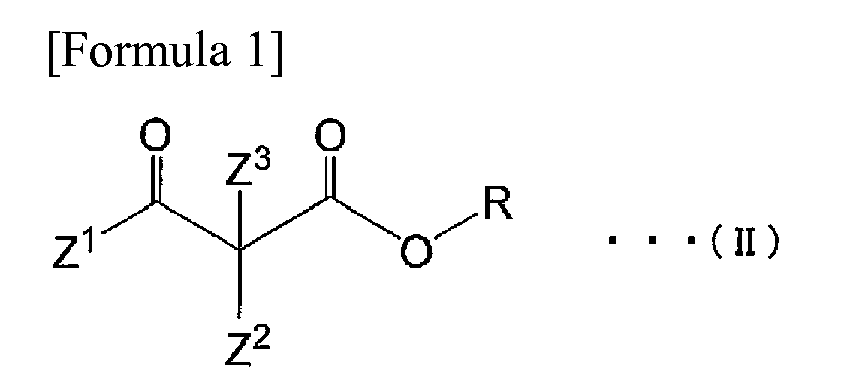

- The method of producing a carbonyl compound according to claim 1, wherein a tertiary amine constituting the hydrogen halide salt of tertiary amine is triethylamine, trimethylamine, pyridine, or picoline.
- The method of producing a carbonyl compound according to claim 1 or 2, wherein the hydrogen halide salt of tertiary amine is a hydrochloride of tertiary amine or a hydrobromide of tertiary amine.
- The method of producing a carbonyl compound according to any one of claims 1 to 3, wherein the hydrogen halide salt of tertiary amine is a hydrochloride of triethylamine or a hydrochloride of pyridine.
- The method of producing a carbonyl compound according to any one of claims 1 to 4, wherein the compound represented by general formula (II) above is a compound represented by general formula (IIa) below; and
the carbonyl compound represented by general formula (I) above is a carbonyl compound represented by general formula (Ia) below:

- The method of producing a carbonyl compound according to claim 5, wherein the compound represented by general formula (IIa) above is a compound represented by general formula (IIb) below; and
the carbonyl compound represented by general formula (Ia) above is a carbonyl compound represented by general formula (Ib) below:

- The method of producing a carbonyl compound according to claim 6, wherein the compound represented by general formula (IIb) above is a compound represented by general formula (IIc) below; and
the carbonyl compound represented by general formula (Ib) above is a carbonyl compound represented by general formula (Ic) below:


- The method of producing a carbonyl compound according to claim 7, wherein the compound represented by general formula (IIc) above is a compound represented by general formula (IId) below; and
the carbonyl compound represented by general formula (Ic) above is a carbonyl compound represented by general formula (Id) below:


- The method of producing a carbonyl compound according to claim 8, wherein G4 and G5 are each independently a hydrogen atom or an alkyl group having from 1 to 4 carbons.
- The method of producing a carbonyl compound according to any one of claims 7 to 9, further comprising a step of: adding a tertiary amine in the reaction system.
- The method of producing a carbonyl compound according to any one of claims 5 to 10, wherein m is an integer from 0 to 2; and when m is 1 or 2, X is a halogen atom.
Applications Claiming Priority (2)
| Application Number | Priority Date | Filing Date | Title |
|---|---|---|---|
| JP2012259166 | 2012-11-27 | ||
| PCT/JP2013/076866 WO2014083936A1 (en) | 2012-11-27 | 2013-10-02 | Production method for carbonyl compound |
Publications (2)
| Publication Number | Publication Date |
|---|---|
| EP2927207A1 true EP2927207A1 (en) | 2015-10-07 |
| EP2927207A4 EP2927207A4 (en) | 2016-07-13 |
Family
ID=50827582
Family Applications (1)
| Application Number | Title | Priority Date | Filing Date |
|---|---|---|---|
| EP13858727.4A Withdrawn EP2927207A4 (en) | 2012-11-27 | 2013-10-02 | Production method for carbonyl compound |
Country Status (6)
| Country | Link |
|---|---|
| US (1) | US9206106B2 (en) |
| EP (1) | EP2927207A4 (en) |
| JP (1) | JPWO2014083936A1 (en) |
| CN (1) | CN104684881A (en) |
| IN (1) | IN2015DN02854A (en) |
| WO (1) | WO2014083936A1 (en) |
Cited By (1)
| Publication number | Priority date | Publication date | Assignee | Title |
|---|---|---|---|---|
| EP4491674A4 (en) * | 2022-03-08 | 2026-03-04 | Kj Chemicals Corp | COMPOSITION WITH HIGHLY SECURE AMIDE COMPOUND |
Families Citing this family (5)
| Publication number | Priority date | Publication date | Assignee | Title |
|---|---|---|---|---|
| US20150315170A1 (en) * | 2012-11-27 | 2015-11-05 | Kureha Corporation | Production method of carbonyl compound |
| WO2015075981A1 (en) * | 2013-11-22 | 2015-05-28 | 株式会社クレハ | Method for producing carbonyl compound |
| CN104591989B (en) * | 2015-01-05 | 2017-08-29 | 上海华谊(集团)公司 | The preparation method of 5 [(4 chlorphenyl) methyl] 2,2 cyclopentanone dimethyls |
| JP6435207B2 (en) * | 2015-02-10 | 2018-12-05 | 公益財団法人相模中央化学研究所 | Process for producing (2,2,2-trifluoroethyl) ketone |
| CN114276243A (en) * | 2021-12-13 | 2022-04-05 | 浙江九洲药业股份有限公司 | Synthetic method of loxoprofen and analogs thereof |
Family Cites Families (18)
| Publication number | Priority date | Publication date | Assignee | Title |
|---|---|---|---|---|
| FR2518538A1 (en) * | 1981-12-18 | 1983-06-24 | Rhone Poulenc Sante | NEW HALOGENATED B-KETOESTERS, THEIR PREPARATION AND THEIR USE |
| JPH0625140B2 (en) | 1986-11-10 | 1994-04-06 | 呉羽化学工業株式会社 | Novel azole derivative, method for producing the same and agricultural / horticultural drug of the derivative |
| JPH06104643B2 (en) | 1986-11-10 | 1994-12-21 | 呉羽化学工業株式会社 | Cyclopentanone derivative |
| US5202460A (en) * | 1989-06-22 | 1993-04-13 | Rhone Poulenc Sante | Terpene derivatives, their preparation and their use |
| JPH03184838A (en) | 1989-12-15 | 1991-08-12 | Kawasaki Steel Corp | Manufacture of pcm damping steel sheet |
| JPH06157394A (en) | 1991-03-08 | 1994-06-03 | Microbial Chem Res Found | Method for synthesizing Benastatin C and D |
| FR2674245B1 (en) | 1991-03-20 | 1994-05-27 | Inst Francais Du Petrole | PROCESS FOR SEPARATING BUTENES AND BUTANES BY EXTRACTIVE DISTILLATION. |
| JPH0578272A (en) | 1991-06-14 | 1993-03-30 | Dainippon Ink & Chem Inc | Optically active difluorocyclopropane derivative, liquid crystal composition containing the same, and liquid crystal display device |
| JPH0784413B2 (en) * | 1991-09-18 | 1995-09-13 | 呉羽化学工業株式会社 | 3- (Unsubstituted or substituted benzyl) -1-alkyl-2-oxocyclopentanecarboxylic acid alkyl ester derivative, its production method, bactericide and use as intermediate |
| JPH05271142A (en) | 1992-03-27 | 1993-10-19 | Nippon Zeon Co Ltd | Production of carbonyl compound |
| DK0623575T3 (en) | 1993-04-27 | 1999-07-26 | Solvay Fluor & Derivate | Process for producing ketones |
| GB2335658A (en) | 1998-03-25 | 1999-09-29 | Rhone Poulenc Agriculture | Processes for preparing 1-aryl-3-cyclopropyl-propane-1,3-dione intermediates |
| JP2001048826A (en) | 1999-08-05 | 2001-02-20 | Sds Biotech:Kk | Method for producing 1-phenyl-1,3-butanedione derivative |
| JP4783519B2 (en) | 2001-06-08 | 2011-09-28 | 高砂香料工業株式会社 | Method for producing 3-acyl-2-butanone |
| ES2362616T3 (en) * | 2005-01-19 | 2011-07-08 | Meiji Seika Kaisha Ltd. | DERIVED FROM IMIDAZOTIAZOL AND PROCESS TO PRODUCE THE SAME. |
| WO2008015134A1 (en) * | 2006-08-01 | 2008-02-07 | Basf Se | Process for preparing pentamethylene 1,5-diisocyanate |
| UA108867C2 (en) * | 2009-12-08 | 2015-06-25 | APPROACHES OF AZOLS, THE METHOD OF THEIR PRODUCTS (OPTIONS), INTERMEDIATES, AGRICULTURAL AND HORTICULTURAL PRODUCTS | |
| CN102211994B (en) * | 2010-04-06 | 2014-09-17 | 上海药明康德新药开发有限公司 | Industrialized synthesis method of 3-(2-bromophenyl)propionic acid |
-
2013
- 2013-10-02 EP EP13858727.4A patent/EP2927207A4/en not_active Withdrawn
- 2013-10-02 US US14/437,510 patent/US9206106B2/en not_active Expired - Fee Related
- 2013-10-02 IN IN2854DEN2015 patent/IN2015DN02854A/en unknown
- 2013-10-02 JP JP2014550074A patent/JPWO2014083936A1/en active Pending
- 2013-10-02 WO PCT/JP2013/076866 patent/WO2014083936A1/en not_active Ceased
- 2013-10-02 CN CN201380051768.5A patent/CN104684881A/en active Pending
Cited By (1)
| Publication number | Priority date | Publication date | Assignee | Title |
|---|---|---|---|---|
| EP4491674A4 (en) * | 2022-03-08 | 2026-03-04 | Kj Chemicals Corp | COMPOSITION WITH HIGHLY SECURE AMIDE COMPOUND |
Also Published As
| Publication number | Publication date |
|---|---|
| IN2015DN02854A (en) | 2015-09-11 |
| US20150299080A1 (en) | 2015-10-22 |
| CN104684881A (en) | 2015-06-03 |
| US9206106B2 (en) | 2015-12-08 |
| WO2014083936A1 (en) | 2014-06-05 |
| EP2927207A4 (en) | 2016-07-13 |
| JPWO2014083936A1 (en) | 2017-01-05 |
Similar Documents
| Publication | Publication Date | Title |
|---|---|---|
| US9206106B2 (en) | Production method of carbonyl compound | |
| JP5848757B2 (en) | Method for preparing 2,2-difluoroethylamine derivatives by alkylation with 2,2-difluoroethyl-1-haloethanes | |
| KR20190032421A (en) | Purification method of sodium sugammadex | |
| JP5869006B2 (en) | Method for producing cyclopentanone derivative, intermediate compound and method for producing intermediate compound | |
| Du et al. | Intramolecular redox reaction for the synthesis of N-aryl pyrroles catalyzed by Lewis acids | |
| EP3088391B1 (en) | Method for producing benzyl ester 2-aminonicotinate derivative | |
| EP2927206A1 (en) | Production method for carbonyl compound | |
| JP5254625B2 (en) | Intermediate preparation method | |
| WO2015075981A1 (en) | Method for producing carbonyl compound | |
| JP2009541315A (en) | Enhanced safety and improved oxidation process useful for the production of moxidectin with stabilized 2-iodoxybenzoic acid (SIBX) | |
| TWI403504B (en) | Method for producing 2-haloimidazole compound | |
| WO2014083911A1 (en) | Method for producing cyclopentanone derivative, intermediate compound, and method for producing intermediate compound | |
| Haveman et al. | Direct decarboxylative 18F-fluorination of benzoic acids using visible light catalysis | |
| Chen et al. | The investigation of fluorination reaction of p-substituted benzenesulfonimides with fluorine–nitrogen mixed gas to synthesize NFSI analogues | |
| JP5238172B2 (en) | Nitrogen-containing six-membered ring compound having perfluoroalkyl group and process for producing the same | |
| JP6723817B2 (en) | Method for producing (trifluoromethyl)malonic acid ester | |
| WO2016132805A1 (en) | PRACTICAL PROCESSES FOR PRODUCING FLUORINATED α-KETOCARBOXYLIC ESTERS AND ANALOGUES THEREOF | |
| JP5716483B2 (en) | Method for producing 1,3-difluoroacetone | |
| JPS5931509B2 (en) | Method for producing 3-hydroxy-3-methylphthalide or its nuclear substituted product | |
| WO2015194247A1 (en) | Method for producing cyclopentanol derivative | |
| EP3015466A1 (en) | Method for producing azole derivative | |
| JPH04295484A (en) | Production of 3-hydroxycephem derivative | |
| JP5179532B2 (en) | Method for producing acetamidine derivative | |
| JP5413441B2 (en) | Method for producing 4-substituted tetrahydropyran | |
| JP2013129616A (en) | Brominating agent and application of the same |
Legal Events
| Date | Code | Title | Description |
|---|---|---|---|
| PUAI | Public reference made under article 153(3) epc to a published international application that has entered the european phase |
Free format text: ORIGINAL CODE: 0009012 |
|
| 17P | Request for examination filed |
Effective date: 20150413 |
|
| AK | Designated contracting states |
Kind code of ref document: A1 Designated state(s): AL AT BE BG CH CY CZ DE DK EE ES FI FR GB GR HR HU IE IS IT LI LT LU LV MC MK MT NL NO PL PT RO RS SE SI SK SM TR |
|
| AX | Request for extension of the european patent |
Extension state: BA ME |
|
| DAX | Request for extension of the european patent (deleted) | ||
| RA4 | Supplementary search report drawn up and despatched (corrected) |
Effective date: 20160610 |
|
| RIC1 | Information provided on ipc code assigned before grant |
Ipc: C07C 49/753 20060101ALI20160606BHEP Ipc: C07C 45/65 20060101AFI20160606BHEP Ipc: C07B 61/00 20060101ALI20160606BHEP Ipc: C07D 319/08 20060101ALI20160606BHEP |
|
| STAA | Information on the status of an ep patent application or granted ep patent |
Free format text: STATUS: THE APPLICATION IS DEEMED TO BE WITHDRAWN |
|
| 18D | Application deemed to be withdrawn |
Effective date: 20170110 |