EP2927204A1 - Liquid propellant - Google Patents
Liquid propellant Download PDFInfo
- Publication number
- EP2927204A1 EP2927204A1 EP13857990.9A EP13857990A EP2927204A1 EP 2927204 A1 EP2927204 A1 EP 2927204A1 EP 13857990 A EP13857990 A EP 13857990A EP 2927204 A1 EP2927204 A1 EP 2927204A1
- Authority
- EP
- European Patent Office
- Prior art keywords
- liquid propellant
- carbon atoms
- dinitramide
- nitrate
- liquid
- Prior art date
- Legal status (The legal status is an assumption and is not a legal conclusion. Google has not performed a legal analysis and makes no representation as to the accuracy of the status listed.)
- Granted
Links
Images
Classifications
-
- C—CHEMISTRY; METALLURGY
- C06—EXPLOSIVES; MATCHES
- C06B—EXPLOSIVES OR THERMIC COMPOSITIONS; MANUFACTURE THEREOF; USE OF SINGLE SUBSTANCES AS EXPLOSIVES
- C06B31/00—Compositions containing an inorganic nitrogen-oxygen salt
-
- C—CHEMISTRY; METALLURGY
- C06—EXPLOSIVES; MATCHES
- C06B—EXPLOSIVES OR THERMIC COMPOSITIONS; MANUFACTURE THEREOF; USE OF SINGLE SUBSTANCES AS EXPLOSIVES
- C06B25/00—Compositions containing a nitrated organic compound
-
- C—CHEMISTRY; METALLURGY
- C06—EXPLOSIVES; MATCHES
- C06B—EXPLOSIVES OR THERMIC COMPOSITIONS; MANUFACTURE THEREOF; USE OF SINGLE SUBSTANCES AS EXPLOSIVES
- C06B25/00—Compositions containing a nitrated organic compound
- C06B25/34—Compositions containing a nitrated organic compound the compound being a nitrated acyclic, alicyclic or heterocyclic amine
-
- C—CHEMISTRY; METALLURGY
- C06—EXPLOSIVES; MATCHES
- C06B—EXPLOSIVES OR THERMIC COMPOSITIONS; MANUFACTURE THEREOF; USE OF SINGLE SUBSTANCES AS EXPLOSIVES
- C06B47/00—Compositions in which the components are separately stored until the moment of burning or explosion, e.g. "Sprengel"-type explosives; Suspensions of solid component in a normally non-explosive liquid phase, including a thickened aqueous phase
-
- F—MECHANICAL ENGINEERING; LIGHTING; HEATING; WEAPONS; BLASTING
- F02—COMBUSTION ENGINES; HOT-GAS OR COMBUSTION-PRODUCT ENGINE PLANTS
- F02K—JET-PROPULSION PLANTS
- F02K9/00—Rocket-engine plants, i.e. plants carrying both fuel and oxidant therefor; Control thereof
- F02K9/42—Rocket-engine plants, i.e. plants carrying both fuel and oxidant therefor; Control thereof using liquid or gaseous propellants
- F02K9/425—Propellants
Definitions
- the present disclosure relates to a liquid propellant, and more specifically, relates to a liquid propellant using a dinitramide derivative and an amine nitrate.
- a liquid propellant is used as a propelling source for a flying object, such as a rocket, and the like.
- thrust can be controlled by suspending combustion and re-ignition, and therefore, a liquid propellant is utilized in posture control for an artificial satellite and the like using a thruster, as well as a main engine of a rocket.
- liquid propellants there are two types, that is, a two-component mixture type and a one-component type.
- the two-component mixture type can achieve large thrust by being burned using a liquid oxidizer and a liquid fuel but, since a supply device requires two systems, a complicated system is needed.
- the one-component type may be burned by a contact with a catalyst or external energy, and therefore, has a characteristic in which the system may be simplified.
- Examples of a liquid oxidizer used for a two-component mixture type liquid propellant include liquid oxygen, dinitrogen tetroxide, and the like, and examples of a liquid fuel used therefor includes liquid hydrogen, and the like.
- propellants using hydrazine an aqueous solution of hydroxylamine nitrate have been developed and studied.
- Hydrazine has high toxicity and is easily evaporated, and therefore, in handing hydrazine, wearing of a special suit and an air supply equipment therefor are needed. Furthermore, specified working staff and medical staff are needed, parallel work is prohibited during filling work, and like problems, which notably reduce work efficiency in launching, arise.
- Hydroxylamine nitrate has many problems in safety and technical aspects, including, for example, a problem in which hydroxylamine nitrate has detonation, which was a cause of an explosion accident in a row material plant, and the like.
- PATENT DOCUMENT 1 describes a liquid oxidizer using one or more oxidizers selected from a group consisting of hydroxylamine nitrate, hydrozinium nitroformate, ammonium dinitramide, ammonium nitrate, and a hydrogen peroxide, and a hybrid propellant using the liquid oxidizer.
- liquid oxidizer an aqueous solution of hydroxylamine nitrate, hydrozinium nitroformate, ammonium dinitramide, ammonium nitrate, and a hydrogen peroxide
- a system at extremely-low temperature and toxicity which may be problems of liquid oxide and dinitrogen tetroxide that are conventional liquid oxidizers, are improved and specific impulse equivalent to that achieved by a conventional technique can be achieved, but noticeable increase in specific impulse has not been achieved.
- PATENT DOCUMENT 2 describes a propellant using, as an oxidizer, a salt using dinitramide anion.
- a propellant using, as an oxidizer, a salt using dinitramide anion.
- monohydric alcohol, dihydric alcohol, trihydric alcohol, or polyhydric alcohol specifically, glycerol (glycerine), or glycine
- ADN ammonium dinitramide
- water, glycerol are described as examples of specifically preferable compounds. Even when a mixture of ADN and glycerol or glycine is used, water is indispensable in using the mixture as a liquid propellant, and as a result, specific impulse is disadvantageously reduced.
- An object of the present invention is to provide a liquid propellant with excellent specific impulse, which has low toxicity and can be easily handled.
- the present inventors found that the above-described object can be resolved by using a liquid propellant containing at least a dinitramide derivative represented by general formula (1) and an amine nitrate represented by general formula (2) and completed the present invention.
- the present invention is as follows.
- a first invention is directed to a liquid propellant characterized by containing at least a dinitramide derivative represented by the following general formula (1) and an amine nitrate represented by the following general formula (2).
- R 1 - R 4 which may be the same or different, are hydrogen atom or alkyl groups having 1-8 carbon atoms.
- R 5 is an alkyl group having 1-8 carbon atoms
- R 6 - R 7 which may be the same or different, are hydrogen atom or alkyl group having 1-8 carbon atoms.
- a second invention is directed to the liquid propellant described in the first invention, characterized in that the dinitramide derivative is ammonium dinitramide represented by the following formula (A).
- a third invention is directed to the liquid propellant described in the first or second invention, characterized in that the amine nitrate is monoalkylamine nitrate.
- a fourth invention is directed to the liquid propellant described in any one of the first to third inventions, characterized by containing a urea derivative, which will be described later, and in that the amount of urea derivative is preferably 5 - 20 wt%.
- a fifth invention is directed to the liquid propellant described in any one of the first to fourth inventions, characterized in that the weight ratio of the dinitramide derivative to the amine nitrate is 1/9 to 9/1, and preferably, 4/6 to 7/3.
- a sixth invention is directed to the liquid propellant described in any one of the first to fifth inventions, characterized in that the total amount of the dinitramide derivative and the amine nitrate is 80 wt% or more.
- a seventh invention is directed to the liquid propellant described in any one of the first to sixth inventions, in which the liquid propellant is substantially free of hydrazine.
- a liquid propellant with excellent specific impulse which can be easily handled, and preferably, has low toxicity, can be provided.
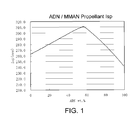
- FIG. 1 is a graph illustrating the relationship for specific impulse of a liquid propellant using ammonium dinitramide and monomethylamine nitrate.
- the present invention is directed to a liquid propellant characterized by containing at least a dinitramide derivative represented by the above-described general formula (1) and an amine nitrate represented by the above-described general formula (2).
- liquid propellant herein means a propellant that has fluidity when the liquid propellant is supplied and ejected in a rocket engine system. As long as fluidity is not lost, the liquid propellant may contain a solid material.
- R 1 - R 4 which may be the same or different, are hydrogen atom or alkyl group having 1-8 carbon atoms.
- alkyl groups having 1-8 carbon atoms alkyl groups having 1 - 6 carbon atoms are preferable, and specifically, examples of the alkyl groups having 1-8 carbon atoms include a methyl group, an ethyl group, a propyl group, a butyl group, a pentyl group, a hexyl group, and the like, and among these, a methyl group is specifically preferable because the methyl group has excellent solubility.
- Examples of a cationic part of ammonium dinitramide represented by the general formula (1) includes an ammonium cation, a tetramethylammonium cation, a tetraethylammonium cation, a tetrapropylammonium cation, a tetraisopropylammonium cation, a tetrabutylammonium cation, a trimethylethylammonium cation, a triethylmethylammonium cation, a dimethyldiethylammonium cation, a dimethylethylmethoxyethylammonium cation, a dimethylethylmethoxymethylammonium cation, a dimethylethylethoxyethylammonium cation, a trimethylpropylammonium cation, a dimethylethylpropylaminium cation, a trie
- the ammonium cation is specifically preferable because the ammonium cation has excellent specific impulse. That is, it is preferable to use the ammonium dinitramide represented by the formula (A), that is, a compound in which R 1 - R 4 are all hydrogen atoms.
- ammonium dinitramide As a method for producing ammonium dinitramide, a known production method ( JP1997-500795 A , WO91/19669 A , and the like) may be used. Ammonium dinitramide of the above-described general formula (1) can be obtained by preparing a corresponding cation in accordance with the production method.
- R 5 is an alkyl group having 1-8 carbon atoms and R 6 -R 7 , which may be the same or different, are hydrogen atom or alkyl group having 1-8 carbon atoms. At least one of R 6 and R 7 may be an alkyl group that is the same as that of R 5 or different from that of R 5 .
- alkyl groups having 1-8 carbon atoms alkyl groups having 1 - 6 carbon atoms are preferable, and specifically, examples of the alkyl groups having 1-8 carbon atoms include a methyl group, an ethyl group, a propyl group, a butyl group, a pentyl group, a hexyl group, and the like, and among these, the methyl group is specifically preferable because the methyl group has excellent solubility.
- Examples of amine of the amine nitrate represented by the general formula (2) include monoalkylamine, dialkylamine, and trialkylamine.
- monoalkylamine examples include monomethylamine, monoethylamine, monopropylamine, monobutylamine, monopentylamine, monohexylamine, and the like.
- dialkylamine examples include dimetylamine, diethylamine, dipropylamine, dibutylamine, dipentylamine, dihexylamine, methylethylamine, methylpropylamine, methylbutylamine, ethylpropylamine, ethylbutylamine, and the like.
- trialkylamine examples include trymethylamine, triethylamine, trypropylamine, tributylamine, tripentylamine, triheptylamine, dimethylethylamine, diethylmethylamin, and the like.
- both of R 6 and R 7 in the general formula (2) are preferably hydrogen atoms, and specifically, R 5 is preferably a methyl group.
- amine nitrate represented by the general formula (2) commercially available amine nitrate may be used and amine nitrate obtained by a known production method may be used.
- the production method for example, a method in which corresponding amine and a nitric acid are caused to react may be used, and specific examples will be described later as Examples.
- the liquid propellant using the dinitramide derivative represented by the general formula (1) and the amine nitrate represented by the general formula (2) does not need to use hydrazine and has lower toxicity than a liquid propellant using hydrazine, so that the liquid propellant may be easily handled even without ensuring safety with a protective suite, and the like, and also, has more excellent specific impulse than that of a liquid propellant that has been used up until now. Therefore, preferably, the liquid propellant according to the present invention is substantially free of hydrazine.
- the expression "substantially free of hydrazine" means, for example, that a content thereof is 1 wt% or less.
- the total amount of the dinitramide derivative represented by the general formula (1) and the amine nitride represented by the general formula (2) in the liquid propellant according to the present invention is 75 wt% or more, more preferably, 80 wt% or more, and further more preferably, 90 wt% or more.
- the weight of the dinitramide derivative represented by the above-described general formula (1) and the amine nitrate represented by the above-described general formula (2) is preferably 10/90 to 90/10, more preferably, 20/80 to 80/20, and further more preferably, 40/60 to 70/30.
- Specifically excellent specific impulse may be achieved by setting the ratio in the above-described ranges.
- the liquid propellant according to the present invention may contain a urea derivative, which will be described below, in order to depress the freezing point of the liquid propellant.
- a urea derivative may be “urea” itself.
- the liquid propellant according to the present invention preferably contains 5 - 20 wt% of a urea derivative.
- the urea derivative is a compound represented by the following general formula (3), which has a urea bond in a molecule.
- R 8 - R 11 which may be the same or different, are hydrogen atom, alkyl group having 1 - 6 carbon atoms, alkenyl group having 2-6 carbon atoms, aryl group having 6 - 10 carbon atoms, alkylamino group having 1 - 6 carbon atoms, or dialkylamino group having 2 - 6 carbon atoms.
- two or more of R 8 - R 11 may be bonded together to form a five- or six-membered ring, and these groups may further have halogen group(s).
- urea derivative represented by the general formula (3) include urea, N-methyl-N'-methylurea, N-methyl-N'-ethylurea, N-methyl-N'-propylurea, N-methyl-N'-butylurea, N-metyl-N'-pentylurea, N-methyl-N'-hexylurea, N-methyl-N'-phenylurea, N-methyl-N'-stearylurea, N-ethyl-N'-ethylurea, N-ethyl-N'-propylurea, N-ethyl-N'-butylurea, N-ethyl-N'-pentylurea, N-ethyl-N'-hexylurea, N-ethyl-N'-phenylurea, N-ethyl-N'-stearylurea, N-butyl-pentylurea, N-eth
- the liquid propellant according to the present invention is in a liquid state, and therefore, water is not necessarily used, but in order to depress the freezing point of the liquid propellant or the like, water may be added, as appropriate.
- a fuel for the liquid propellant according to the present invention, in order to adjust various performances, a fuel may be used.
- the fuel include alcohols, aminos, ketones, and the like.
- alcohols examples include methanol, ethanol, ethanediol, propanol, isopropanol, propanediol, propanetriol, butanol, butanediol, and the like.
- aminos examples include glycine, alanine, valine, leucine, isoleucine, and the like.
- ketones include acetone, methylethylketone, methylpropylketone, methylisobutylketone, dimethylketone, diethylketone, methylamylketone, cyclohexanone, isophorone, and the like.
- a liquid propellant may contain an additive and thus be used.
- the additive include a combustion catalyst, a combustion aid, and the like.
- a combustion catalyst is a catalyst that promotes combustion, and more specifically, increases reaction activity, enables ignition at low temperature, and can be used in a wide range.
- Examples of the combustion catalyst include rhodium, ruthenium, platinum, palladium, iridium, and the like.
- a combustion aid is an additive that increases specific impulse of a liquid propellant, and examples of the combustion aid include aluminum, magnesium, boron, titanium, graphite, and the like, in a powder form.
- the average density at 23 °C was about 1.44 g/cm 3 or less.
- the average density for the liquid propellant according to the present invention at 23 °C is preferably 1.45 - 1.52 g/cm 3 .
- excellent specific impulse which will be described later, may be achieved by increasing the average density.
- Specific impulse is a measure of fuel efficiency of a rocket engine, and represents the magnitude of thrust with respect to a propellant flow rate.
- specific impulse thrust/(propellant flow rate * gravitational acceleration)" is used and the units are seconds.
- specific impulse is "seconds for which the generation of unit thrust can be continued by a propellant of a unit weight”.
- Specific impulse is related to the pressure and temperature of the inside of an engine, the composition and thermodynamic characteristic of a combustion product, an atmospheric pressure, and an expansion velocity.
- Vacuum specific impulse of a liquid propellant can be calculated using NASA CEA2 chemical equilibrium calculation program ( Chemical Equilibrium with Application, NASA-Glenn chemical equilibrium program CEA2, May 21 2004, by Bonnie McBride and Sanford Gordon ). The results calculated for the specific impulse of a liquid propellant using ammonium dinitramide and monomethylamine nitrate by the program are given in FIG. 1 .
- the specific impulse calculated using the above-described chemical equilibrium calculation program at a chamber pressure of 10 bar with an opening area ratio of 100 is preferably 240 sec or more, more preferably, 260 sec or more, and specifically, even more preferably, 280 sec or more.
- the liquid propellant according to the present invention can achieve specific impulse of, for example, 240 sec or more, and more preferably, 240 - 320 sec. Therefore, the liquid propellant according to the present invention may be optimally used as a liquid propellant for rockets.
- Examples 1 - 10 and Comparative Examples 1 - 5 a component 1, a component 2, an additive, and a solvent corresponding to Table 1 were used.
- a component 1, a component 2, an additive, and a solvent corresponding to Table 1 were used.
- ammonium dinitramide, urea, hydrazine, glycerol, and ammonium nitrate commercially available reagents were used.
- monomethylamine nitrate monomethylamine nitrate produced in the following manner was used.
- Reaction was caused by dropping 187.6 parts of 70% nitric acid to 146.5 parts of a monomethylamine 40% aqueous solution and stirring the obtained mixture at 10 °C or less. After reaction, water was distilled away from the obtained aqueous solution under the conditions of 60 °C and 30 mmHg to obtain a saturated aqueous solution of monomethylamine nitrate. The saturated aqueous solution of monomethylamine nitrate was added to 280 parts of isopropyl alcohol and the obtained mixture was stirred to precipitate a crystal of monomethylamine nitrate. The obtained crystal was filtered, was washed with isopropyl alcohol, and was dried, and thus, 186.4 parts of monomethylamine nitrate was obtained.
- Example 1 Liquid Propellant Component 1 (wt%) Component 2 (wt%) Additive (wt%) Solvent (wt%)
- Example 1 ADN MMAN - - 25 75
- Example 2 ADN MMAN - - 50 50
- Example 3 ADN MMAN - - 57 43
- Example 4 ADN MMAN - - 75 25
- Example 5 ADN MMAN Urea - 52 39 9
- Example 6 ADN MMAN - Water 52 39 9
- Example 7 ADN MMAN Urea 50 30 20
- Example 8 ADN MMAN Urea 40 40 20
- Example 9 ADN MMAN Urea 40 50 10 Example 10 ADN MMAN Urea 60 30 10 Comparative Example 1 ADN GLU - Water 61 13 26 Comparative Example 2 N 2 H 4 - - - 100 Comparative Example 3 ADN AN - - 60 40 Comparative Example 4 ADN AN Urea - 50 40 10 Comparative Example 5 ADN AN - Water 50 40 10
- the state of the liquid propellant at ambient temperature was evaluated by visual examination.
- a liquid that does not contain a solid state material at all, a liquid that partially contains a solid state material, and a perfect solid are labeled as A, B, and X, respectively.
- the vacuum specific impulse and the state of the liquid propellant at normal temperature are summarized in Table 2.
- a liquid propellant according to the present invention does not have toxicity, is easy to handle, and has excellent specific impulse, and therefore, can be used not only for a liquid propellant for rockets but also for various applications.
Landscapes
- Chemical & Material Sciences (AREA)
- Organic Chemistry (AREA)
- Engineering & Computer Science (AREA)
- Inorganic Chemistry (AREA)
- Combustion & Propulsion (AREA)
- Mechanical Engineering (AREA)
- General Engineering & Computer Science (AREA)
- Organic Low-Molecular-Weight Compounds And Preparation Thereof (AREA)
Abstract
Description
- The present disclosure relates to a liquid propellant, and more specifically, relates to a liquid propellant using a dinitramide derivative and an amine nitrate.
- In general, a liquid propellant is used as a propelling source for a flying object, such as a rocket, and the like. In the space rocket field, thrust can be controlled by suspending combustion and re-ignition, and therefore, a liquid propellant is utilized in posture control for an artificial satellite and the like using a thruster, as well as a main engine of a rocket.
- In general, there are two types of liquid propellants, that is, a two-component mixture type and a one-component type. The two-component mixture type can achieve large thrust by being burned using a liquid oxidizer and a liquid fuel but, since a supply device requires two systems, a complicated system is needed. The one-component type may be burned by a contact with a catalyst or external energy, and therefore, has a characteristic in which the system may be simplified.
- Examples of a liquid oxidizer used for a two-component mixture type liquid propellant include liquid oxygen, dinitrogen tetroxide, and the like, and examples of a liquid fuel used therefor includes liquid hydrogen, and the like. Although these are propellants that satisfy a certain performance requirement, liquid oxygen and liquid hydrogen have to be handled at extremely low temperature, dinitrogen tetroxide has high toxicity, and therefore, a protective suit or the like has to be used to ensure safety, thus resulting in a problem in handling.
- For one-component type propellants, propellants using hydrazine, an aqueous solution of hydroxylamine nitrate have been developed and studied.
- Hydrazine has high toxicity and is easily evaporated, and therefore, in handing hydrazine, wearing of a special suit and an air supply equipment therefor are needed. Furthermore, specified working staff and medical staff are needed, parallel work is prohibited during filling work, and like problems, which notably reduce work efficiency in launching, arise.
- Hydroxylamine nitrate has many problems in safety and technical aspects, including, for example, a problem in which hydroxylamine nitrate has detonation, which was a cause of an explosion accident in a row material plant, and the like.
- PATENT DOCUMENT 1 describes a liquid oxidizer using one or more oxidizers selected from a group consisting of hydroxylamine nitrate, hydrozinium nitroformate, ammonium dinitramide, ammonium nitrate, and a hydrogen peroxide, and a hybrid propellant using the liquid oxidizer. By using, as the liquid oxidizer, an aqueous solution of hydroxylamine nitrate, hydrozinium nitroformate, ammonium dinitramide, ammonium nitrate, and a hydrogen peroxide, a system at extremely-low temperature and toxicity, which may be problems of liquid oxide and dinitrogen tetroxide that are conventional liquid oxidizers, are improved and specific impulse equivalent to that achieved by a conventional technique can be achieved, but noticeable increase in specific impulse has not been achieved.
- PATENT DOCUMENT 2 describes a propellant using, as an oxidizer, a salt using dinitramide anion. As the fuel, monohydric alcohol, dihydric alcohol, trihydric alcohol, or polyhydric alcohol (specifically, glycerol (glycerine), or glycine) is useful, and ammonium dinitramide (ADN), water, glycerol are described as examples of specifically preferable compounds. Even when a mixture of ADN and glycerol or glycine is used, water is indispensable in using the mixture as a liquid propellant, and as a result, specific impulse is disadvantageously reduced.
- In view of the foregoing, there have been demands for a liquid propellant with excellent specific impulse, which has low toxicity and can be easily handled.
-
- PATENT DOCUMENT 1:
JP2002-020191 A - PATENT DOCUMENT 2:
JP 2002-537218 A - An object of the present invention is to provide a liquid propellant with excellent specific impulse, which has low toxicity and can be easily handled.
- As a result of keen examinations, the present inventors found that the above-described object can be resolved by using a liquid propellant containing at least a dinitramide derivative represented by general formula (1) and an amine nitrate represented by general formula (2) and completed the present invention.
- That is, the present invention is as follows.
- A first invention is directed to a liquid propellant characterized by containing at least a dinitramide derivative represented by the following general formula (1) and an amine nitrate represented by the following general formula (2).

- In the general formula (1), R1 - R4, which may be the same or different, are hydrogen atom or alkyl groups having 1-8 carbon atoms.

- In the general formula (2), R5 is an alkyl group having 1-8 carbon atoms, and R6 - R7, which may be the same or different, are hydrogen atom or alkyl group having 1-8 carbon atoms.
- A second invention is directed to the liquid propellant described in the first invention, characterized in that the dinitramide derivative is ammonium dinitramide represented by the following formula (A).

- A third invention is directed to the liquid propellant described in the first or second invention, characterized in that the amine nitrate is monoalkylamine nitrate.
- A fourth invention is directed to the liquid propellant described in any one of the first to third inventions, characterized by containing a urea derivative, which will be described later, and in that the amount of urea derivative is preferably 5 - 20 wt%.
- A fifth invention is directed to the liquid propellant described in any one of the first to fourth inventions, characterized in that the weight ratio of the dinitramide derivative to the amine nitrate is 1/9 to 9/1, and preferably, 4/6 to 7/3.
- A sixth invention is directed to the liquid propellant described in any one of the first to fifth inventions, characterized in that the total amount of the dinitramide derivative and the amine nitrate is 80 wt% or more.
- A seventh invention is directed to the liquid propellant described in any one of the first to sixth inventions, in which the liquid propellant is substantially free of hydrazine.
- According to the present invention, a liquid propellant with excellent specific impulse, which can be easily handled, and preferably, has low toxicity, can be provided.
-
FIG. 1 is a graph illustrating the relationship for specific impulse of a liquid propellant using ammonium dinitramide and monomethylamine nitrate. - The present invention is directed to a liquid propellant characterized by containing at least a dinitramide derivative represented by the above-described general formula (1) and an amine nitrate represented by the above-described general formula (2).
- The term "liquid propellant" herein means a propellant that has fluidity when the liquid propellant is supplied and ejected in a rocket engine system. As long as fluidity is not lost, the liquid propellant may contain a solid material.
- In the above-described general formula (1), R1 - R4, which may be the same or different, are hydrogen atom or alkyl group having 1-8 carbon atoms.
- Preferably, as the alkyl groups having 1-8 carbon atoms, alkyl groups having 1 - 6 carbon atoms are preferable, and specifically, examples of the alkyl groups having 1-8 carbon atoms include a methyl group, an ethyl group, a propyl group, a butyl group, a pentyl group, a hexyl group, and the like, and among these, a methyl group is specifically preferable because the methyl group has excellent solubility.
- Examples of a cationic part of ammonium dinitramide represented by the general formula (1) includes an ammonium cation, a tetramethylammonium cation, a tetraethylammonium cation, a tetrapropylammonium cation, a tetraisopropylammonium cation, a tetrabutylammonium cation, a trimethylethylammonium cation, a triethylmethylammonium cation, a dimethyldiethylammonium cation, a dimethylethylmethoxyethylammonium cation, a dimethylethylmethoxymethylammonium cation, a dimethylethylethoxyethylammonium cation, a trimethylpropylammonium cation, a dimethylethylpropylaminium cation, a triethylpropylammonium cation, and the like.
- Among these, the ammonium cation is specifically preferable because the ammonium cation has excellent specific impulse. That is, it is preferable to use the ammonium dinitramide represented by the formula (A), that is, a compound in which R1 - R4 are all hydrogen atoms.
- As a method for producing ammonium dinitramide, a known production method (
JP1997-500795 A WO91/19669 A - In the general formula (2), R5 is an alkyl group having 1-8 carbon atoms and R6-R7, which may be the same or different, are hydrogen atom or alkyl group having 1-8 carbon atoms. At least one of R6 and R7 may be an alkyl group that is the same as that of R5 or different from that of R5.
- Preferably, as alkyl groups having 1-8 carbon atoms, alkyl groups having 1 - 6 carbon atoms are preferable, and specifically, examples of the alkyl groups having 1-8 carbon atoms include a methyl group, an ethyl group, a propyl group, a butyl group, a pentyl group, a hexyl group, and the like, and among these, the methyl group is specifically preferable because the methyl group has excellent solubility.
- Examples of amine of the amine nitrate represented by the general formula (2) include monoalkylamine, dialkylamine, and trialkylamine.
- Examples of monoalkylamine include monomethylamine, monoethylamine, monopropylamine, monobutylamine, monopentylamine, monohexylamine, and the like.
- Examples of dialkylamine include dimetylamine, diethylamine, dipropylamine, dibutylamine, dipentylamine, dihexylamine, methylethylamine, methylpropylamine, methylbutylamine, ethylpropylamine, ethylbutylamine, and the like.
- Examples of trialkylamine include trymethylamine, triethylamine, trypropylamine, tributylamine, tripentylamine, triheptylamine, dimethylethylamine, diethylmethylamin, and the like.
- Among these, monoalkylamine is preferable because monoalkylamine has excellent specific impulse, and specifically, monomethylamine is preferable. In other words, both of R6 and R7 in the general formula (2) are preferably hydrogen atoms, and specifically, R5 is preferably a methyl group. As amine nitrate represented by the general formula (2), commercially available amine nitrate may be used and amine nitrate obtained by a known production method may be used. As the production method, for example, a method in which corresponding amine and a nitric acid are caused to react may be used, and specific examples will be described later as Examples.
- The liquid propellant using the dinitramide derivative represented by the general formula (1) and the amine nitrate represented by the general formula (2) does not need to use hydrazine and has lower toxicity than a liquid propellant using hydrazine, so that the liquid propellant may be easily handled even without ensuring safety with a protective suite, and the like, and also, has more excellent specific impulse than that of a liquid propellant that has been used up until now. Therefore, preferably, the liquid propellant according to the present invention is substantially free of hydrazine. The expression "substantially free of hydrazine" means, for example, that a content thereof is 1 wt% or less. Preferably, the total amount of the dinitramide derivative represented by the general formula (1) and the amine nitride represented by the general formula (2) in the liquid propellant according to the present invention is 75 wt% or more, more preferably, 80 wt% or more, and further more preferably, 90 wt% or more.
- Regarding the ratio between the dinitramide derivative represented by the above-described general formula (1) and the amine nitrate represented by the above-described general formula (2), (the weight of the dinitramide derivative)/(the weight of the amine nitrate) is preferably 10/90 to 90/10, more preferably, 20/80 to 80/20, and further more preferably, 40/60 to 70/30. Specifically excellent specific impulse may be achieved by setting the ratio in the above-described ranges.
- The liquid propellant according to the present invention may contain a urea derivative, which will be described below, in order to depress the freezing point of the liquid propellant. In the present invention, "a urea derivative" may be "urea" itself. The liquid propellant according to the present invention preferably contains 5 - 20 wt% of a urea derivative.
- The urea derivative is a compound represented by the following general formula (3), which has a urea bond in a molecule.

- Specific examples of the urea derivative represented by the general formula (3) include urea, N-methyl-N'-methylurea, N-methyl-N'-ethylurea, N-methyl-N'-propylurea, N-methyl-N'-butylurea, N-metyl-N'-pentylurea, N-methyl-N'-hexylurea, N-methyl-N'-phenylurea, N-methyl-N'-stearylurea, N-ethyl-N'-ethylurea, N-ethyl-N'-propylurea, N-ethyl-N'-butylurea, N-ethyl-N'-pentylurea, N-ethyl-N'-hexylurea, N-ethyl-N'-phenylurea, N-ethyl-N'-stearylurea, N-butyl-N'-pentylurea, N-butyl-N'-hexylurea, N-butyl-N'-phenylurea, N-butyl-N'-stearylurea, and the like, and among these, urea, that is, a form in which R8 - R11 are all hydrogen, is specifically preferable because urea has an excellent advantage of depressing the freezing point.
- Whether or not water is used as a solvent, the liquid propellant according to the present invention is in a liquid state, and therefore, water is not necessarily used, but in order to depress the freezing point of the liquid propellant or the like, water may be added, as appropriate.
- For the liquid propellant according to the present invention, in order to adjust various performances, a fuel may be used. Examples of the fuel include alcohols, aminos, ketones, and the like.
- Examples of alcohols include methanol, ethanol, ethanediol, propanol, isopropanol, propanediol, propanetriol, butanol, butanediol, and the like.
- Examples of aminos include glycine, alanine, valine, leucine, isoleucine, and the like.
- Examples of ketones include acetone, methylethylketone, methylpropylketone, methylisobutylketone, dimethylketone, diethylketone, methylamylketone, cyclohexanone, isophorone, and the like.
- As the liquid propellant according to the present invention, a liquid propellant may contain an additive and thus be used. Examples of the additive include a combustion catalyst, a combustion aid, and the like.
- A combustion catalyst is a catalyst that promotes combustion, and more specifically, increases reaction activity, enables ignition at low temperature, and can be used in a wide range. Examples of the combustion catalyst include rhodium, ruthenium, platinum, palladium, iridium, and the like.
- A combustion aid is an additive that increases specific impulse of a liquid propellant, and examples of the combustion aid include aluminum, magnesium, boron, titanium, graphite, and the like, in a powder form.
- As for a conventional liquid propellant, such as dinitrogen tetroxide, and the like, the average density at 23 °C was about 1.44 g/cm3 or less. On the other hand, the average density for the liquid propellant according to the present invention at 23 °C is preferably 1.45 - 1.52 g/cm3. As described above, excellent specific impulse, which will be described later, may be achieved by increasing the average density.
- Specific impulse is a measure of fuel efficiency of a rocket engine, and represents the magnitude of thrust with respect to a propellant flow rate. As a calculation formula, "specific impulse = thrust/(propellant flow rate * gravitational acceleration)" is used and the units are seconds. In other words, specific impulse is "seconds for which the generation of unit thrust can be continued by a propellant of a unit weight". Specific impulse is related to the pressure and temperature of the inside of an engine, the composition and thermodynamic characteristic of a combustion product, an atmospheric pressure, and an expansion velocity.
- Vacuum specific impulse of a liquid propellant can be calculated using NASA CEA2 chemical equilibrium calculation program (Chemical Equilibrium with Application, NASA-Glenn chemical equilibrium program CEA2, May 21 2004, by Bonnie McBride and Sanford Gordon). The results calculated for the specific impulse of a liquid propellant using ammonium dinitramide and monomethylamine nitrate by the program are given in
FIG. 1 . - The specific impulse calculated using the above-described chemical equilibrium calculation program at a chamber pressure of 10 bar with an opening area ratio of 100 is preferably 240 sec or more, more preferably, 260 sec or more, and specifically, even more preferably, 280 sec or more.
- The liquid propellant according to the present invention can achieve specific impulse of, for example, 240 sec or more, and more preferably, 240 - 320 sec. Therefore, the liquid propellant according to the present invention may be optimally used as a liquid propellant for rockets.
- The present invention will be described below with reference to Examples, but the present invention is not limited to the Examples.
- For Examples 1 - 10 and Comparative Examples 1 - 5, a component 1, a component 2, an additive, and a solvent corresponding to Table 1 were used. For ammonium dinitramide, urea, hydrazine, glycerol, and ammonium nitrate, commercially available reagents were used. For monomethylamine nitrate, monomethylamine nitrate produced in the following manner was used.
- Reaction was caused by dropping 187.6 parts of 70% nitric acid to 146.5 parts of a monomethylamine 40% aqueous solution and stirring the obtained mixture at 10 °C or less. After reaction, water was distilled away from the obtained aqueous solution under the conditions of 60 °C and 30 mmHg to obtain a saturated aqueous solution of monomethylamine nitrate. The saturated aqueous solution of monomethylamine nitrate was added to 280 parts of isopropyl alcohol and the obtained mixture was stirred to precipitate a crystal of monomethylamine nitrate. The obtained crystal was filtered, was washed with isopropyl alcohol, and was dried, and thus, 186.4 parts of monomethylamine nitrate was obtained.
[Table 1] Liquid Propellant Component 1 (wt%) Component 2 (wt%) Additive (wt%) Solvent (wt%) Example 1 ADN MMAN - - 25 75 Example 2 ADN MMAN - - 50 50 Example 3 ADN MMAN - - 57 43 Example 4 ADN MMAN - - 75 25 Example 5 ADN MMAN Urea - 52 39 9 Example 6 ADN MMAN - Water 52 39 9 Example 7 ADN MMAN Urea 50 30 20 Example 8 ADN MMAN Urea 40 40 20 Example 9 ADN MMAN Urea 40 50 10 Example 10 ADN MMAN Urea 60 30 10 Comparative Example 1 ADN GLU - Water 61 13 26 Comparative Example 2 N2H4 - - - 100 Comparative Example 3 ADN AN - - 60 40 Comparative Example 4 ADN AN Urea - 50 40 10 Comparative Example 5 ADN AN - Water 50 40 10 - Abbreviated words in Table 1 represent as follows.
- ADN: ammonium dinitramide (compound A)
- MMAN: monomethylamine nitrate
- Urea: urea
- GLU: glycerol (glycerine)
- N2H4: hydrazine
- AN: ammonium nitrate
- In order to obtain vacuum specific impulse of a liquid propellant, calculation was performed using NASA CEA2 chemical equilibrium calculation program (Chemical Equilibrium with Application, NASA-Glenn chemical equilibrium program CEA2, May 21 2004, by Bonnie McBride and Sanford Gordon). As initial conditions, heat of formation of each component was input as follows, 10 bar was input for the chamber pressure, and 100 was input for the nozzle opening area ratio, and thus, calculation was performed.
- The heat of formation (cal/mol) of each component input for use in the above-described calculation is as follows.
Ammonium dinitramide (N4H4O4) : -35,500 Monomethylamine nitrate (CH6O3N2) : -80,981 Urea (CH4ON2) : -79,679 Hydrazine (N2H4) : +12,103 Glycerol (C3H8O3) : -159,775 Water (H2O) : -68,315 - The state of the liquid propellant at ambient temperature was evaluated by visual examination. A liquid that does not contain a solid state material at all, a liquid that partially contains a solid state material, and a perfect solid are labeled as A, B, and X, respectively. The vacuum specific impulse and the state of the liquid propellant at normal temperature are summarized in Table 2.
[Table 2] Vacuum Specific Impulse Isp (sec) State of Liquid Propellant at Normal Temperature Example 1 284.9 B Example 2 306.8 B Example 3 311.3 B Example 4 285.3 B Example 5 293.7 A Example 6 283.8 A Example 7 280.0 A Example 8 273.7 A Example 9 281.3 A Example 10 299.4 A Comparative Example 1 256.5 A Comparative Example 2 237.5 A Comparative Example 3 221.1 X Comparative Example 4 245.3 B Comparative Example 5 234.2 B - According to Table 2, it is understood that the specific impulse is better for Examples 1 - 10 than for Comparative Examples 1 - 5. Also, in Examples 1 - 10, since the freezing point depressed, and therefore, it is understood that the liquid propellant fully contains a liquid at normal temperature.
- A liquid propellant according to the present invention does not have toxicity, is easy to handle, and has excellent specific impulse, and therefore, can be used not only for a liquid propellant for rockets but also for various applications.
- The present invention is based on Japanese Patent Application No.
2012-263446 filed on November 30, 2012
Claims (14)
- A liquid propellant, comprising at least:a dinitramide derivative represented by the following general formula (1)
 an amine nitrate represented by the following general formula (2)
- The liquid propellant of claim 1, wherein
the dinitramide derivative is ammonium dinitramide represented by the following formula (A)
- The liquid propellant of claim 1, wherein
the total amount of the dinitramide derivative and the amine nitrate is 80 wt% or more. - The liquid propellant of claim 1, wherein
the amine nitrate is monoalkylamine nitrate. - The liquid propellant of claim 1, further comprising:a urea derivative represented by the following general formula (3)

- The liquid propellant of claim 5, wherein
the amount of urea derivative is 5 - 20 wt%. - The liquid propellant of claim 1, wherein
the weight ratio of the dinitramide derivative to the amine nitrate is 4/6 to 7/3. - The liquid propellant of claim 1, wherein
the liquid propellant is substantially free of hydrazine. - The liquid propellant of claim 1, wherein
R1 - R4 and R6 - R7 are all hydrogen atoms. - The liquid propellant of claim 3, wherein
R1 - R4 and R6 - R7 are all hydrogen atoms - The liquid propellant of claim 3, wherein
the weight ratio of the dinitramide derivative to the amine nitrate is 4/6 to 7/3. - The liquid propellant of claim 11, wherein
R1 - R4 and R6 - R7 are all hydrogen atoms. - The liquid propellant of claim 5, wherein
the total amount of the dinitramide derivative and the amine nitrate is 80 wt% or more, and R1 - R4 and R6 - R7 are all hydrogen atoms. - The liquid propellant of claim 13, wherein
the liquid propellant is substantially free of hydrazine.
Applications Claiming Priority (2)
| Application Number | Priority Date | Filing Date | Title |
|---|---|---|---|
| JP2012263446 | 2012-11-30 | ||
| PCT/JP2013/082160 WO2014084344A1 (en) | 2012-11-30 | 2013-11-29 | Liquid propellant |
Publications (3)
| Publication Number | Publication Date |
|---|---|
| EP2927204A1 true EP2927204A1 (en) | 2015-10-07 |
| EP2927204A4 EP2927204A4 (en) | 2016-08-24 |
| EP2927204B1 EP2927204B1 (en) | 2018-05-30 |
Family
ID=50827972
Family Applications (1)
| Application Number | Title | Priority Date | Filing Date |
|---|---|---|---|
| EP13857990.9A Active EP2927204B1 (en) | 2012-11-30 | 2013-11-29 | Liquid propellant |
Country Status (4)
| Country | Link |
|---|---|
| US (1) | US20150299063A1 (en) |
| EP (1) | EP2927204B1 (en) |
| JP (1) | JP5819011B2 (en) |
| WO (1) | WO2014084344A1 (en) |
Families Citing this family (5)
| Publication number | Priority date | Publication date | Assignee | Title |
|---|---|---|---|---|
| JP6472628B2 (en) * | 2014-09-30 | 2019-02-20 | カーリットホールディングス株式会社 | Manufacturing method of liquid propellant |
| US10866003B2 (en) | 2017-04-14 | 2020-12-15 | Johnson Controls Technology Company | Thermostat with preemptive heating, cooling, and ventilation in response to elevated occupancy detection via proxy |
| JP7088740B2 (en) * | 2018-05-17 | 2022-06-21 | カーリットホールディングス株式会社 | Liquid propellant and its additives |
| JP2022025386A (en) * | 2020-07-29 | 2022-02-10 | カーリットホールディングス株式会社 | Liquid propellant |
| DE102020122337A1 (en) | 2020-08-26 | 2022-03-03 | LabOrbital GmbH | Hot gas generating device with monergolic ionic fuel and low voltage ignition |
Family Cites Families (10)
| Publication number | Priority date | Publication date | Assignee | Title |
|---|---|---|---|---|
| US3212254A (en) * | 1957-08-14 | 1965-10-19 | Phillips Petroleum Co | Two component amine nitrate monopropellants and method of propulsion |
| US3013382A (en) * | 1957-08-14 | 1961-12-19 | Phillips Petroleum Co | Monopropellants |
| US2978864A (en) * | 1958-05-19 | 1961-04-11 | Commercial Solvents Corp | Ammonium nitrate explosives |
| US3586553A (en) * | 1969-04-11 | 1971-06-22 | Du Pont | Water-bearing explosive containing proten and nitrogen-base salt |
| US5254324A (en) | 1990-06-18 | 1993-10-19 | Sri International | Dinitramide salts and method of making same |
| US5375868A (en) | 1993-03-03 | 1994-12-27 | Sarver; Jeff | Ski having compound curve undersurface |
| EP0950648A1 (en) * | 1998-04-15 | 1999-10-20 | Nederlandse Organisatie Voor Toegepast-Natuurwetenschappelijk Onderzoek Tno | Monopropellant system |
| US6004410A (en) * | 1998-07-28 | 1999-12-21 | Trw Inc. | Apparatus comprising an inflatable vehicle occupant protection device and a gas generating composition therefor |
| SE513930C2 (en) | 1999-02-26 | 2000-11-27 | Svenska Rymdaktiebolaget | Liquid fuel |
| JP4537543B2 (en) | 2000-07-03 | 2010-09-01 | 細谷火工株式会社 | Liquid oxidizers and hybrid propellants |
-
2013
- 2013-11-29 EP EP13857990.9A patent/EP2927204B1/en active Active
- 2013-11-29 WO PCT/JP2013/082160 patent/WO2014084344A1/en not_active Ceased
- 2013-11-29 JP JP2014549911A patent/JP5819011B2/en active Active
- 2013-11-29 US US14/648,889 patent/US20150299063A1/en not_active Abandoned
Non-Patent Citations (2)
| Title |
|---|
| None |
| See also references of WO2014084344A1 |
Also Published As
| Publication number | Publication date |
|---|---|
| EP2927204A4 (en) | 2016-08-24 |
| WO2014084344A1 (en) | 2014-06-05 |
| JP5819011B2 (en) | 2015-11-18 |
| JPWO2014084344A1 (en) | 2017-01-05 |
| EP2927204B1 (en) | 2018-05-30 |
| US20150299063A1 (en) | 2015-10-22 |
Similar Documents
| Publication | Publication Date | Title |
|---|---|---|
| JP4536262B2 (en) | Dinitramide liquid monopropellant | |
| EP2927204B1 (en) | Liquid propellant | |
| Trache et al. | Recent advances in new oxidizers for solid rocket propulsion | |
| US6984273B1 (en) | Premixed liquid monopropellant solutions and mixtures | |
| US20020121081A1 (en) | Liquid/solid fuel hybrid propellant system for a rocket | |
| Shamshina et al. | Catalytic ignition of ionic liquids for propellant applications | |
| Dendage et al. | Hydrazinium nitroformate (HNF) and HNF based propellants: A review | |
| JP4312383B2 (en) | Centralized propellant system | |
| EP1390323B1 (en) | Ammonium dinitramide based liquid monopropellants exhibiting improved combustion stability and storage life | |
| JP7088740B2 (en) | Liquid propellant and its additives | |
| JP6472628B2 (en) | Manufacturing method of liquid propellant | |
| JP2019199395A (en) | Liquid propellant | |
| US3066169A (en) | Preparation of polynitro-nitramines | |
| Gafarov et al. | Aliphatic nitramino alcohols and their derivatives | |
| JP2022025386A (en) | Liquid propellant | |
| JP2015218096A (en) | Liquid propellant | |
| CN114196454A (en) | A solid fuel containing high nitrogen compounds | |
| JP2010089999A (en) | Nitric ester composition and gas generation agent using the same | |
| US4797168A (en) | Azidodinitro propellants | |
| Farhat et al. | Improvement of catalytic decomposition of ammonium nitrate with new bimetallic catalysts | |
| US20190100475A1 (en) | Propellant Composition | |
| WO2009072955A1 (en) | New chemical compound suitable for use as a plasticiser in explosive and propellant compositions | |
| US3347925A (en) | Difluoroamino-substituted nitramines and method of preparation | |
| US20200024138A1 (en) | Phase-changing borane containing fuel | |
| Künzel et al. | Organic azido compounds as energetic materials |
Legal Events
| Date | Code | Title | Description |
|---|---|---|---|
| PUAI | Public reference made under article 153(3) epc to a published international application that has entered the european phase |
Free format text: ORIGINAL CODE: 0009012 |
|
| 17P | Request for examination filed |
Effective date: 20150630 |
|
| AK | Designated contracting states |
Kind code of ref document: A1 Designated state(s): AL AT BE BG CH CY CZ DE DK EE ES FI FR GB GR HR HU IE IS IT LI LT LU LV MC MK MT NL NO PL PT RO RS SE SI SK SM TR |
|
| AX | Request for extension of the european patent |
Extension state: BA ME |
|
| DAX | Request for extension of the european patent (deleted) | ||
| REG | Reference to a national code |
Ref country code: DE Ref legal event code: R079 Ref document number: 602013038399 Country of ref document: DE Free format text: PREVIOUS MAIN CLASS: C06D0005000000 Ipc: F02K0009420000 |
|
| RA4 | Supplementary search report drawn up and despatched (corrected) |
Effective date: 20160722 |
|
| RIC1 | Information provided on ipc code assigned before grant |
Ipc: C06B 25/34 20060101ALI20160718BHEP Ipc: C06B 47/00 20060101ALI20160718BHEP Ipc: F02K 9/42 20060101AFI20160718BHEP Ipc: C06B 31/00 20060101ALI20160718BHEP |
|
| TPAC | Observations filed by third parties |
Free format text: ORIGINAL CODE: EPIDOSNTIPA |
|
| 17Q | First examination report despatched |
Effective date: 20170206 |
|
| TPAC | Observations filed by third parties |
Free format text: ORIGINAL CODE: EPIDOSNTIPA |
|
| GRAP | Despatch of communication of intention to grant a patent |
Free format text: ORIGINAL CODE: EPIDOSNIGR1 |
|
| INTG | Intention to grant announced |
Effective date: 20180216 |
|
| GRAS | Grant fee paid |
Free format text: ORIGINAL CODE: EPIDOSNIGR3 |
|
| TPAC | Observations filed by third parties |
Free format text: ORIGINAL CODE: EPIDOSNTIPA |
|
| GRAA | (expected) grant |
Free format text: ORIGINAL CODE: 0009210 |
|
| AK | Designated contracting states |
Kind code of ref document: B1 Designated state(s): AL AT BE BG CH CY CZ DE DK EE ES FI FR GB GR HR HU IE IS IT LI LT LU LV MC MK MT NL NO PL PT RO RS SE SI SK SM TR |
|
| REG | Reference to a national code |
Ref country code: GB Ref legal event code: FG4D |
|
| REG | Reference to a national code |
Ref country code: CH Ref legal event code: EP |
|
| REG | Reference to a national code |
Ref country code: AT Ref legal event code: REF Ref document number: 1003849 Country of ref document: AT Kind code of ref document: T Effective date: 20180615 |
|
| REG | Reference to a national code |
Ref country code: IE Ref legal event code: FG4D |
|
| REG | Reference to a national code |
Ref country code: DE Ref legal event code: R096 Ref document number: 602013038399 Country of ref document: DE |
|
| REG | Reference to a national code |
Ref country code: NL Ref legal event code: MP Effective date: 20180530 |
|
| REG | Reference to a national code |
Ref country code: LT Ref legal event code: MG4D |
|
| REG | Reference to a national code |
Ref country code: FR Ref legal event code: PLFP Year of fee payment: 6 |
|
| PG25 | Lapsed in a contracting state [announced via postgrant information from national office to epo] |
Ref country code: CY Free format text: LAPSE BECAUSE OF FAILURE TO SUBMIT A TRANSLATION OF THE DESCRIPTION OR TO PAY THE FEE WITHIN THE PRESCRIBED TIME-LIMIT Effective date: 20180530 Ref country code: FI Free format text: LAPSE BECAUSE OF FAILURE TO SUBMIT A TRANSLATION OF THE DESCRIPTION OR TO PAY THE FEE WITHIN THE PRESCRIBED TIME-LIMIT Effective date: 20180530 Ref country code: LT Free format text: LAPSE BECAUSE OF FAILURE TO SUBMIT A TRANSLATION OF THE DESCRIPTION OR TO PAY THE FEE WITHIN THE PRESCRIBED TIME-LIMIT Effective date: 20180530 Ref country code: NO Free format text: LAPSE BECAUSE OF FAILURE TO SUBMIT A TRANSLATION OF THE DESCRIPTION OR TO PAY THE FEE WITHIN THE PRESCRIBED TIME-LIMIT Effective date: 20180830 Ref country code: SE Free format text: LAPSE BECAUSE OF FAILURE TO SUBMIT A TRANSLATION OF THE DESCRIPTION OR TO PAY THE FEE WITHIN THE PRESCRIBED TIME-LIMIT Effective date: 20180530 Ref country code: ES Free format text: LAPSE BECAUSE OF FAILURE TO SUBMIT A TRANSLATION OF THE DESCRIPTION OR TO PAY THE FEE WITHIN THE PRESCRIBED TIME-LIMIT Effective date: 20180530 Ref country code: BG Free format text: LAPSE BECAUSE OF FAILURE TO SUBMIT A TRANSLATION OF THE DESCRIPTION OR TO PAY THE FEE WITHIN THE PRESCRIBED TIME-LIMIT Effective date: 20180830 |
|
| PG25 | Lapsed in a contracting state [announced via postgrant information from national office to epo] |
Ref country code: RS Free format text: LAPSE BECAUSE OF FAILURE TO SUBMIT A TRANSLATION OF THE DESCRIPTION OR TO PAY THE FEE WITHIN THE PRESCRIBED TIME-LIMIT Effective date: 20180530 Ref country code: LV Free format text: LAPSE BECAUSE OF FAILURE TO SUBMIT A TRANSLATION OF THE DESCRIPTION OR TO PAY THE FEE WITHIN THE PRESCRIBED TIME-LIMIT Effective date: 20180530 Ref country code: GR Free format text: LAPSE BECAUSE OF FAILURE TO SUBMIT A TRANSLATION OF THE DESCRIPTION OR TO PAY THE FEE WITHIN THE PRESCRIBED TIME-LIMIT Effective date: 20180831 Ref country code: HR Free format text: LAPSE BECAUSE OF FAILURE TO SUBMIT A TRANSLATION OF THE DESCRIPTION OR TO PAY THE FEE WITHIN THE PRESCRIBED TIME-LIMIT Effective date: 20180530 |
|
| REG | Reference to a national code |
Ref country code: AT Ref legal event code: MK05 Ref document number: 1003849 Country of ref document: AT Kind code of ref document: T Effective date: 20180530 |
|
| PG25 | Lapsed in a contracting state [announced via postgrant information from national office to epo] |
Ref country code: NL Free format text: LAPSE BECAUSE OF FAILURE TO SUBMIT A TRANSLATION OF THE DESCRIPTION OR TO PAY THE FEE WITHIN THE PRESCRIBED TIME-LIMIT Effective date: 20180530 |
|
| PG25 | Lapsed in a contracting state [announced via postgrant information from national office to epo] |
Ref country code: AT Free format text: LAPSE BECAUSE OF FAILURE TO SUBMIT A TRANSLATION OF THE DESCRIPTION OR TO PAY THE FEE WITHIN THE PRESCRIBED TIME-LIMIT Effective date: 20180530 Ref country code: EE Free format text: LAPSE BECAUSE OF FAILURE TO SUBMIT A TRANSLATION OF THE DESCRIPTION OR TO PAY THE FEE WITHIN THE PRESCRIBED TIME-LIMIT Effective date: 20180530 Ref country code: DK Free format text: LAPSE BECAUSE OF FAILURE TO SUBMIT A TRANSLATION OF THE DESCRIPTION OR TO PAY THE FEE WITHIN THE PRESCRIBED TIME-LIMIT Effective date: 20180530 Ref country code: SK Free format text: LAPSE BECAUSE OF FAILURE TO SUBMIT A TRANSLATION OF THE DESCRIPTION OR TO PAY THE FEE WITHIN THE PRESCRIBED TIME-LIMIT Effective date: 20180530 Ref country code: RO Free format text: LAPSE BECAUSE OF FAILURE TO SUBMIT A TRANSLATION OF THE DESCRIPTION OR TO PAY THE FEE WITHIN THE PRESCRIBED TIME-LIMIT Effective date: 20180530 Ref country code: PL Free format text: LAPSE BECAUSE OF FAILURE TO SUBMIT A TRANSLATION OF THE DESCRIPTION OR TO PAY THE FEE WITHIN THE PRESCRIBED TIME-LIMIT Effective date: 20180530 Ref country code: CZ Free format text: LAPSE BECAUSE OF FAILURE TO SUBMIT A TRANSLATION OF THE DESCRIPTION OR TO PAY THE FEE WITHIN THE PRESCRIBED TIME-LIMIT Effective date: 20180530 |
|
| PG25 | Lapsed in a contracting state [announced via postgrant information from national office to epo] |
Ref country code: IT Free format text: LAPSE BECAUSE OF FAILURE TO SUBMIT A TRANSLATION OF THE DESCRIPTION OR TO PAY THE FEE WITHIN THE PRESCRIBED TIME-LIMIT Effective date: 20180530 Ref country code: SM Free format text: LAPSE BECAUSE OF FAILURE TO SUBMIT A TRANSLATION OF THE DESCRIPTION OR TO PAY THE FEE WITHIN THE PRESCRIBED TIME-LIMIT Effective date: 20180530 |
|
| REG | Reference to a national code |
Ref country code: DE Ref legal event code: R097 Ref document number: 602013038399 Country of ref document: DE |
|
| PLBE | No opposition filed within time limit |
Free format text: ORIGINAL CODE: 0009261 |
|
| STAA | Information on the status of an ep patent application or granted ep patent |
Free format text: STATUS: NO OPPOSITION FILED WITHIN TIME LIMIT |
|
| 26N | No opposition filed |
Effective date: 20190301 |
|
| PG25 | Lapsed in a contracting state [announced via postgrant information from national office to epo] |
Ref country code: SI Free format text: LAPSE BECAUSE OF FAILURE TO SUBMIT A TRANSLATION OF THE DESCRIPTION OR TO PAY THE FEE WITHIN THE PRESCRIBED TIME-LIMIT Effective date: 20180530 |
|
| REG | Reference to a national code |
Ref country code: CH Ref legal event code: PL |
|
| PG25 | Lapsed in a contracting state [announced via postgrant information from national office to epo] |
Ref country code: LU Free format text: LAPSE BECAUSE OF NON-PAYMENT OF DUE FEES Effective date: 20181129 Ref country code: MC Free format text: LAPSE BECAUSE OF FAILURE TO SUBMIT A TRANSLATION OF THE DESCRIPTION OR TO PAY THE FEE WITHIN THE PRESCRIBED TIME-LIMIT Effective date: 20180530 |
|
| REG | Reference to a national code |
Ref country code: BE Ref legal event code: MM Effective date: 20181130 |
|
| REG | Reference to a national code |
Ref country code: IE Ref legal event code: MM4A |
|
| PG25 | Lapsed in a contracting state [announced via postgrant information from national office to epo] |
Ref country code: LI Free format text: LAPSE BECAUSE OF NON-PAYMENT OF DUE FEES Effective date: 20181130 Ref country code: CH Free format text: LAPSE BECAUSE OF NON-PAYMENT OF DUE FEES Effective date: 20181130 |
|
| PG25 | Lapsed in a contracting state [announced via postgrant information from national office to epo] |
Ref country code: IE Free format text: LAPSE BECAUSE OF NON-PAYMENT OF DUE FEES Effective date: 20181129 |
|
| PG25 | Lapsed in a contracting state [announced via postgrant information from national office to epo] |
Ref country code: BE Free format text: LAPSE BECAUSE OF NON-PAYMENT OF DUE FEES Effective date: 20181130 Ref country code: AL Free format text: LAPSE BECAUSE OF FAILURE TO SUBMIT A TRANSLATION OF THE DESCRIPTION OR TO PAY THE FEE WITHIN THE PRESCRIBED TIME-LIMIT Effective date: 20180530 |
|
| PG25 | Lapsed in a contracting state [announced via postgrant information from national office to epo] |
Ref country code: MT Free format text: LAPSE BECAUSE OF NON-PAYMENT OF DUE FEES Effective date: 20181129 |
|
| PG25 | Lapsed in a contracting state [announced via postgrant information from national office to epo] |
Ref country code: TR Free format text: LAPSE BECAUSE OF FAILURE TO SUBMIT A TRANSLATION OF THE DESCRIPTION OR TO PAY THE FEE WITHIN THE PRESCRIBED TIME-LIMIT Effective date: 20180530 |
|
| PG25 | Lapsed in a contracting state [announced via postgrant information from national office to epo] |
Ref country code: PT Free format text: LAPSE BECAUSE OF FAILURE TO SUBMIT A TRANSLATION OF THE DESCRIPTION OR TO PAY THE FEE WITHIN THE PRESCRIBED TIME-LIMIT Effective date: 20180530 |
|
| PG25 | Lapsed in a contracting state [announced via postgrant information from national office to epo] |
Ref country code: MK Free format text: LAPSE BECAUSE OF NON-PAYMENT OF DUE FEES Effective date: 20180530 Ref country code: HU Free format text: LAPSE BECAUSE OF FAILURE TO SUBMIT A TRANSLATION OF THE DESCRIPTION OR TO PAY THE FEE WITHIN THE PRESCRIBED TIME-LIMIT; INVALID AB INITIO Effective date: 20131129 |
|
| PG25 | Lapsed in a contracting state [announced via postgrant information from national office to epo] |
Ref country code: IS Free format text: LAPSE BECAUSE OF FAILURE TO SUBMIT A TRANSLATION OF THE DESCRIPTION OR TO PAY THE FEE WITHIN THE PRESCRIBED TIME-LIMIT Effective date: 20180930 |
|
| REG | Reference to a national code |
Ref country code: DE Ref legal event code: R081 Ref document number: 602013038399 Country of ref document: DE Owner name: CARLIT CO., LTD., JP Free format text: FORMER OWNER: CARLIT HOLDINGS CO. LTD., TOKYO, JP |
|
| PGFP | Annual fee paid to national office [announced via postgrant information from national office to epo] |
Ref country code: DE Payment date: 20241001 Year of fee payment: 12 |
|
| PGFP | Annual fee paid to national office [announced via postgrant information from national office to epo] |
Ref country code: GB Payment date: 20241002 Year of fee payment: 12 |
|
| PGFP | Annual fee paid to national office [announced via postgrant information from national office to epo] |
Ref country code: FR Payment date: 20241001 Year of fee payment: 12 |