EP2924046A1 - Novel complex and use of same - Google Patents
Novel complex and use of same Download PDFInfo
- Publication number
- EP2924046A1 EP2924046A1 EP13856069.3A EP13856069A EP2924046A1 EP 2924046 A1 EP2924046 A1 EP 2924046A1 EP 13856069 A EP13856069 A EP 13856069A EP 2924046 A1 EP2924046 A1 EP 2924046A1
- Authority
- EP
- European Patent Office
- Prior art keywords
- complex
- formula
- group
- sime
- ligand
- Prior art date
- Legal status (The legal status is an assumption and is not a legal conclusion. Google has not performed a legal analysis and makes no representation as to the accuracy of the status listed.)
- Withdrawn
Links
Images




Classifications
-
- C—CHEMISTRY; METALLURGY
- C07—ORGANIC CHEMISTRY
- C07F—ACYCLIC, CARBOCYCLIC OR HETEROCYCLIC COMPOUNDS CONTAINING ELEMENTS OTHER THAN CARBON, HYDROGEN, HALOGEN, OXYGEN, NITROGEN, SULFUR, SELENIUM OR TELLURIUM
- C07F7/00—Compounds containing elements of Groups 4 or 14 of the Periodic Table
- C07F7/28—Titanium compounds
-
- B—PERFORMING OPERATIONS; TRANSPORTING
- B01—PHYSICAL OR CHEMICAL PROCESSES OR APPARATUS IN GENERAL
- B01J—CHEMICAL OR PHYSICAL PROCESSES, e.g. CATALYSIS OR COLLOID CHEMISTRY; THEIR RELEVANT APPARATUS
- B01J31/00—Catalysts comprising hydrides, coordination complexes or organic compounds
- B01J31/16—Catalysts comprising hydrides, coordination complexes or organic compounds containing coordination complexes
- B01J31/18—Catalysts comprising hydrides, coordination complexes or organic compounds containing coordination complexes containing nitrogen, phosphorus, arsenic or antimony as complexing atoms, e.g. in pyridine ligands, or in resonance therewith, e.g. in isocyanide ligands C=N-R or as complexed central atoms
- B01J31/1805—Catalysts comprising hydrides, coordination complexes or organic compounds containing coordination complexes containing nitrogen, phosphorus, arsenic or antimony as complexing atoms, e.g. in pyridine ligands, or in resonance therewith, e.g. in isocyanide ligands C=N-R or as complexed central atoms the ligands containing nitrogen
-
- B—PERFORMING OPERATIONS; TRANSPORTING
- B01—PHYSICAL OR CHEMICAL PROCESSES OR APPARATUS IN GENERAL
- B01J—CHEMICAL OR PHYSICAL PROCESSES, e.g. CATALYSIS OR COLLOID CHEMISTRY; THEIR RELEVANT APPARATUS
- B01J31/00—Catalysts comprising hydrides, coordination complexes or organic compounds
- B01J31/16—Catalysts comprising hydrides, coordination complexes or organic compounds containing coordination complexes
- B01J31/22—Organic complexes
- B01J31/2282—Unsaturated compounds used as ligands
- B01J31/2295—Cyclic compounds, e.g. cyclopentadienyls
-
- B—PERFORMING OPERATIONS; TRANSPORTING
- B01—PHYSICAL OR CHEMICAL PROCESSES OR APPARATUS IN GENERAL
- B01J—CHEMICAL OR PHYSICAL PROCESSES, e.g. CATALYSIS OR COLLOID CHEMISTRY; THEIR RELEVANT APPARATUS
- B01J31/00—Catalysts comprising hydrides, coordination complexes or organic compounds
- B01J31/16—Catalysts comprising hydrides, coordination complexes or organic compounds containing coordination complexes
- B01J31/24—Phosphines, i.e. phosphorus bonded to only carbon atoms, or to both carbon and hydrogen atoms, including e.g. sp2-hybridised phosphorus compounds such as phosphabenzene, phosphole or anionic phospholide ligands
- B01J31/2404—Cyclic ligands, including e.g. non-condensed polycyclic ligands, the phosphine-P atom being a ring member or a substituent on the ring
-
- B—PERFORMING OPERATIONS; TRANSPORTING
- B01—PHYSICAL OR CHEMICAL PROCESSES OR APPARATUS IN GENERAL
- B01J—CHEMICAL OR PHYSICAL PROCESSES, e.g. CATALYSIS OR COLLOID CHEMISTRY; THEIR RELEVANT APPARATUS
- B01J8/00—Chemical or physical processes in general, conducted in the presence of fluids and solid particles; Apparatus for such processes
- B01J8/02—Chemical or physical processes in general, conducted in the presence of fluids and solid particles; Apparatus for such processes with stationary particles, e.g. in fixed beds
-
- C—CHEMISTRY; METALLURGY
- C01—INORGANIC CHEMISTRY
- C01C—AMMONIA; CYANOGEN; COMPOUNDS THEREOF
- C01C1/00—Ammonia; Compounds thereof
- C01C1/02—Preparation, purification or separation of ammonia
- C01C1/04—Preparation of ammonia by synthesis
- C01C1/0405—Preparation of ammonia by synthesis from N2 and H2 in presence of a catalyst
- C01C1/0411—Preparation of ammonia by synthesis from N2 and H2 in presence of a catalyst characterised by the catalyst
-
- C—CHEMISTRY; METALLURGY
- C07—ORGANIC CHEMISTRY
- C07F—ACYCLIC, CARBOCYCLIC OR HETEROCYCLIC COMPOUNDS CONTAINING ELEMENTS OTHER THAN CARBON, HYDROGEN, HALOGEN, OXYGEN, NITROGEN, SULFUR, SELENIUM OR TELLURIUM
- C07F17/00—Metallocenes
-
- C—CHEMISTRY; METALLURGY
- C07—ORGANIC CHEMISTRY
- C07F—ACYCLIC, CARBOCYCLIC OR HETEROCYCLIC COMPOUNDS CONTAINING ELEMENTS OTHER THAN CARBON, HYDROGEN, HALOGEN, OXYGEN, NITROGEN, SULFUR, SELENIUM OR TELLURIUM
- C07F7/00—Compounds containing elements of Groups 4 or 14 of the Periodic Table
- C07F7/003—Compounds containing elements of Groups 4 or 14 of the Periodic Table without C-Metal linkages
-
- C—CHEMISTRY; METALLURGY
- C07—ORGANIC CHEMISTRY
- C07F—ACYCLIC, CARBOCYCLIC OR HETEROCYCLIC COMPOUNDS CONTAINING ELEMENTS OTHER THAN CARBON, HYDROGEN, HALOGEN, OXYGEN, NITROGEN, SULFUR, SELENIUM OR TELLURIUM
- C07F9/00—Compounds containing elements of Groups 5 or 15 of the Periodic Table
- C07F9/02—Phosphorus compounds
- C07F9/28—Phosphorus compounds with one or more P—C bonds
- C07F9/50—Organo-phosphines
- C07F9/5045—Complexes or chelates of phosphines with metallic compounds or metals
-
- B—PERFORMING OPERATIONS; TRANSPORTING
- B01—PHYSICAL OR CHEMICAL PROCESSES OR APPARATUS IN GENERAL
- B01J—CHEMICAL OR PHYSICAL PROCESSES, e.g. CATALYSIS OR COLLOID CHEMISTRY; THEIR RELEVANT APPARATUS
- B01J2208/00—Processes carried out in the presence of solid particles; Reactors therefor
- B01J2208/00796—Details of the reactor or of the particulate material
- B01J2208/00805—Details of the particulate material
-
- B—PERFORMING OPERATIONS; TRANSPORTING
- B01—PHYSICAL OR CHEMICAL PROCESSES OR APPARATUS IN GENERAL
- B01J—CHEMICAL OR PHYSICAL PROCESSES, e.g. CATALYSIS OR COLLOID CHEMISTRY; THEIR RELEVANT APPARATUS
- B01J2231/00—Catalytic reactions performed with catalysts classified in B01J31/00
- B01J2231/60—Reduction reactions, e.g. hydrogenation
- B01J2231/62—Reductions in general of inorganic substrates, e.g. formal hydrogenation, e.g. of N2
-
- B—PERFORMING OPERATIONS; TRANSPORTING
- B01—PHYSICAL OR CHEMICAL PROCESSES OR APPARATUS IN GENERAL
- B01J—CHEMICAL OR PHYSICAL PROCESSES, e.g. CATALYSIS OR COLLOID CHEMISTRY; THEIR RELEVANT APPARATUS
- B01J2531/00—Additional information regarding catalytic systems classified in B01J31/00
- B01J2531/02—Compositional aspects of complexes used, e.g. polynuclearity
- B01J2531/0213—Complexes without C-metal linkages
- B01J2531/0222—Metal clusters, i.e. complexes comprising 3 to about 1000 metal atoms with metal-metal bonds to provide one or more all-metal (M)n rings, e.g. Rh4(CO)12
-
- B—PERFORMING OPERATIONS; TRANSPORTING
- B01—PHYSICAL OR CHEMICAL PROCESSES OR APPARATUS IN GENERAL
- B01J—CHEMICAL OR PHYSICAL PROCESSES, e.g. CATALYSIS OR COLLOID CHEMISTRY; THEIR RELEVANT APPARATUS
- B01J2531/00—Additional information regarding catalytic systems classified in B01J31/00
- B01J2531/40—Complexes comprising metals of Group IV (IVA or IVB) as the central metal
- B01J2531/46—Titanium
-
- C—CHEMISTRY; METALLURGY
- C07—ORGANIC CHEMISTRY
- C07F—ACYCLIC, CARBOCYCLIC OR HETEROCYCLIC COMPOUNDS CONTAINING ELEMENTS OTHER THAN CARBON, HYDROGEN, HALOGEN, OXYGEN, NITROGEN, SULFUR, SELENIUM OR TELLURIUM
- C07F11/00—Compounds containing elements of Groups 6 or 16 of the Periodic Table
- C07F11/005—Compounds containing elements of Groups 6 or 16 of the Periodic Table compounds without a metal-carbon linkage
-
- C—CHEMISTRY; METALLURGY
- C07—ORGANIC CHEMISTRY
- C07F—ACYCLIC, CARBOCYCLIC OR HETEROCYCLIC COMPOUNDS CONTAINING ELEMENTS OTHER THAN CARBON, HYDROGEN, HALOGEN, OXYGEN, NITROGEN, SULFUR, SELENIUM OR TELLURIUM
- C07F7/00—Compounds containing elements of Groups 4 or 14 of the Periodic Table
-
- C—CHEMISTRY; METALLURGY
- C07—ORGANIC CHEMISTRY
- C07F—ACYCLIC, CARBOCYCLIC OR HETEROCYCLIC COMPOUNDS CONTAINING ELEMENTS OTHER THAN CARBON, HYDROGEN, HALOGEN, OXYGEN, NITROGEN, SULFUR, SELENIUM OR TELLURIUM
- C07F9/00—Compounds containing elements of Groups 5 or 15 of the Periodic Table
-
- C—CHEMISTRY; METALLURGY
- C07—ORGANIC CHEMISTRY
- C07F—ACYCLIC, CARBOCYCLIC OR HETEROCYCLIC COMPOUNDS CONTAINING ELEMENTS OTHER THAN CARBON, HYDROGEN, HALOGEN, OXYGEN, NITROGEN, SULFUR, SELENIUM OR TELLURIUM
- C07F9/00—Compounds containing elements of Groups 5 or 15 of the Periodic Table
- C07F9/02—Phosphorus compounds
- C07F9/28—Phosphorus compounds with one or more P—C bonds
- C07F9/50—Organo-phosphines
- C07F9/5022—Aromatic phosphines (P-C aromatic linkage)
-
- Y—GENERAL TAGGING OF NEW TECHNOLOGICAL DEVELOPMENTS; GENERAL TAGGING OF CROSS-SECTIONAL TECHNOLOGIES SPANNING OVER SEVERAL SECTIONS OF THE IPC; TECHNICAL SUBJECTS COVERED BY FORMER USPC CROSS-REFERENCE ART COLLECTIONS [XRACs] AND DIGESTS
- Y02—TECHNOLOGIES OR APPLICATIONS FOR MITIGATION OR ADAPTATION AGAINST CLIMATE CHANGE
- Y02P—CLIMATE CHANGE MITIGATION TECHNOLOGIES IN THE PRODUCTION OR PROCESSING OF GOODS
- Y02P20/00—Technologies relating to chemical industry
- Y02P20/50—Improvements relating to the production of bulk chemicals
- Y02P20/52—Improvements relating to the production of bulk chemicals using catalysts, e.g. selective catalysts
Definitions
- the present invention relates to a novel hydrido complex capable of fixing dinitrogen, a method for synthesizing the hydrido complex, and use of the hydrido complex.
- a technology for fixing dinitrogen and using them is extremely important in industry, including the agricultural sector.
- the fixation of dinitrogen is known for example as the fixation of dinitrogen by root nodule bacteria.
- the fixation of dinitrogen is performed exclusively by the Haber-Bosch process.
- Non-patent Literatures 1 and 2 etc. metal complexes (Non-patent Literatures 1 and 2 etc.) or hydrido complexes (Non-patent Literatures 3 and 4 etc.) capable of fixing dinitrogen have been reported. However, none of them fixes dinitrogen in a form that can be easily taken as ammonia from the complex. For industrial applications, there has been a desperate need for a further novel proposal.
- the present invention has been made in view of the problems described above, and it is an object of the present invention to provide a novel hydrido complex that fixes dinitrogen in a relatively mild environment, a method for synthesizing the hydrido complex, and use of the hydrido complex.
- the present invention provides any one of the following:
- the present invention can provide a novel hydrido complex that fixes dinitrogen in a relatively mild environment, a method for synthesizing the hydrido complex, and use of the hydrido complex.
- An example of a complex according to the present invention is a hydrido complex represented by formula (1A) or formula (1B):
- M1 to M3 are each independently Ti (titanium atom), Zr, (zirconium atom), Hf (hafnium atom), V (vanadium atom), Nb (niobium atom), Ta (tantalum atom), Cr (chromium atom), Mo (molybdenum atom), or W (tungsten atom), preferably each independently Ti, Zr, or Hf.
- all of M1 to M3 are identical atoms. More preferably, all of M1 to M3 are Ti.
- M1 to M4 are each independently Ti, Zr, Hf, V, Nb, Ta, Cr, Mo, or W, preferably each independently Ti, Zr, or Hf.
- all of M1 to M4 are identical atoms. More preferably, all of M1 to M4 are Ti.
- L1 to L3 are each independently is a ligand selected from among a ligand (referred to as "Cp ligand") including a substituted or unsubstituted cyclopentadienyl derivative, a diphenylamine ligand, a diphenylphosphine ligand, and a carboimideamide ligand.
- Cp ligand a ligand including a substituted or unsubstituted cyclopentadienyl derivative, a diphenylamine ligand, a diphenylphosphine ligand, and a carboimideamide ligand.
- all of L1 to L3 are identical ligands. More preferably, all of L1 to L3 are identical Cp ligands.
- L1 to L4 are each independently is a ligand selected from among a substituted or unsubstituted Cp ligand, a diphenylamine ligand, a diphenylphosphine ligand, and a carboimideamide ligand.
- a ligand selected from among a substituted or unsubstituted Cp ligand, a diphenylamine ligand, a diphenylphosphine ligand, and a carboimideamide ligand.
- all of L1 to L4 are identical ligands. More preferably, all of L1 to L4 are identical Cp ligands.
- the Cp ligand is pi-bonded to the central metal M.
- the Cp ligand is for example a non-bridging ligand.
- non-bridging ligand here means a ligand whose cyclopentadienyl derivative is pi-bonded to the central metal and which does not have a coordinating atom or a coordinating group other than the cyclopentadienyl derivative.
- the Cp ligand is for example a bridging ligand.
- bridging ligand here means a ligand which further includes a coordinating atom or a coordinating group in addition to the cyclopentadienyl derivative.
- the Cp ligand is preferably a non-bridging ligand.
- the substituted or unsubstituted cyclopentadienyl derivative of the Cp ligand is one selected from the group consisting of a substituted or unsubstituted cyclopentadienyl ring, a substituted or unsubstituted fluorenyl ring, a substituted or unsubstituted octahydro fluorenyl ring, a substituted or unsubstituted indenyl ring, and a substituted or unsubstituted tetrahydroindenyl ring.
- the most preferred cyclopentadienyl derivative is a cyclopentadienyl ring having a substituent(s).
- the cyclopentadienyl ring is represented by the composition formula: C 5 H 5-X R X .
- X represents an integer of 0 to 5.
- Each R is independently a hydrocarbyl group; a substituted hydrocarbyl group; or a substituted metalloid group in which a hydrocarbyl group, an amide group, a phosphide group, and/or an alkoxide group has/have been substituted.
- one of C in the composition formula may be substituted by a 14th-group atom (excluding a carbon atom and a lead atom) or a 15th-group atom.
- the hydrocarbyl group is preferably a C1-C20 hydrocarbyl group, more preferably a C1-C20 (preferably C1-C10, more preferably C1-C6) alkyl group, phenyl group, benzyl group, etc., most preferably a methyl group.
- hydrocarbyl group having a substituent is a hydrocarbyl group at least one of the hydrogen atoms of which has been substituted by a halogen atom, am amide group, a phosphide group, an alkoxy group, an aryloxy group, or the like.
- examples of the metalloid in the substituted metalloid group include germyl (Ge), stannyl (Sn), silyl (Si), etc.
- the number of substitutions of substituents having substituted in the metalloid group is determined by the type of metalloid (e.g. in the case of a silyl group, the number of substitutions of hydrocarbyl groups (substituents) is 3). It should be noted that the carbon number of a hydrocarbyl group as a substituent in the substituted metalloid group is preferably in the range of 1 to 20.
- At least one of the R groups of the cyclopentadienyl ring is a substituted metalloid group (preferably a silyl group) in which a hdyrocarbyl group has been substituted, more preferably a trimethylsilyl group.
- R1 to R5 are each independently a hydrogen atom that binds to a carbon atom constituting the skeleton of the cyclopentadienyl ring; a C1-C20 hydrocarbyl group; or a substituted metalloid group in which a C1-C20 hydrocarbyl group, an amide group, a phosphide group, and/or an alkoxide group has/have been substituted, is a bond with M1 to M3 in formula (1A) or a bond with M1 to M4 in formula (1B), and two to five of R1 to R5 are the hydrocarbyl group or substituted metalloid group.
- one of the carbon atoms constituting the skeleton of the cyclopentadienyl ring represented by formula (2) may be substituted by a 14th-group atom (excluding a carbon atom and a lead atom) or a 15th-group atom. It should be noted that it is preferable that L1 to L3 in formula (1A) or L1 to L4 in formula (1B) be identical ligands represented by formula (2).
- each R is independently a substituted metalloid group in which a C1-C20 hydrocarbyl group, an amide group, a phosphide group, and/or an alkoxide group has/have been substituted (preferably a substituted metalloid group in which a C1-C20 hydrocarbyl group has been substituted).
- a specific example of this metalloid group is any one of those represented by formula (4) below.
- each R' is independently a C1-C8 hydrocarbyl group, preferably a C1-C6 hydrocarbyl group, more preferably a C 1-C4 hydrocarbyl group (preferably a chain alkyl group).
- E is N (nitrogen atom) or P (phosphorus atom).
- each R is independently a C1-C20 hydrocarbyl group (preferably a C1-C6 chain alkyl group); or a substituted metalloid group in which a C1-C20 hydrocarbyl group, an amide group, a phosphide group, and/or an alkoxide group has/have been substituted (preferably a substituted metalloid group in which a C1-C20 hydrocarbyl group has been substituted).
- a specific example of this metalloid group is any one of those represented by formula (4) above.
- n is an integer of 1 or larger to 5 or smaller
- E is a hetero atom such as N (nitrogen atom), P (phosphorous atom), or As (arsenic atom), preferably N or P.
- an example of the cyclopentadienyl ring represented by formula (2) is one (which is equivalent to formula (3-8) in which, in formula (2), all of R1 to R5 are methyl groups (which is equivalent to formula (3-8) or one (which is equivalent to formula (3-1)) in which, in formula (2), four of R1 to R5 are methyl groups and the other one of R1 to R5 is a trialkylsilyl group having a C1-C6 alkyl group.
- the substituted or unsubstituted fluorenyl ring is represented by the composition formula: C 13 H 9-X R X (where X is an integer of 0 to 9, and R is either a C1-C20 hydrocarbyl group that may have a substituent or a substituted metalloid group and is similar to the R of the aforementioned cyclopentadienyl ring: C 5 H 5-X R X ).
- the substituted or unsubstituted octahydro fluorenyl ring is represented, for example, by the composition formula: C 13 H 17-X R X (where X is an integer of 0 to 17, and R is either a C1-C20 hydrocarbyl group that may have a substituent or a substituted metalloid group and is similar to the R of the aforementioned cyclopentadienyl ring: C 5 H 5 - X R X ).
- each R is independently a C1-C20, preferably C1-C6, hydrocarbyl group or a substituted metalloid group.
- a specific example of this metalloid group is any one of those represented by formula (4) above.
- Formulas (5-3) and (5-4) are equivalent to specific examples of compounds represented by formulas (5-1) and (5-2), respectively.
- the Cp ligand may alternatively be a substituted or unsubstituted indenyl ring (composition formula: C 9 H 7-X R X , where X is an integer of 0 to 7), tetrahydroindenyl ring (composition formula: C 9 H 11-X R X , where X is an integer of 0 to 11), or the like.
- R is similar to the R of the aforementioned cyclopentadienyl ring.
- a preferred example of the indenyl ring is represented by formula (6):
- each R is independently a C1-C20, preferably C1-C6, hydrocarbyl group or a substituted metalloid group.
- a specific example of this metalloid group is any one of those represented by formula (4) above.
- the diphenylamine ligand is a ligand having a diphenylamine skeleton (-N(Ph) 2 ) in which two phenyl groups are bonded to a nitrogen atom.
- Any hydrogen atom on each of the phenyl groups may be substituted, for example, by a C1-C20 hydrocarbyl group, a metalloid group in which a C1-C20 hydrocarbyl group has been substituted, or a substituent such as a -PR 2 group, a -SR group, or a -OR group.
- each R is independently a C1-C20, preferably C 1-C6, hydrocarbyl group or a metalloid group in which such a hydrocarbyl group has been substituted. It should be noted that it is preferable that the two R groups of the -PR 2 group be identical to each other.
- a preferred example of the diphenylamine ligand is represented by formula (7):
- each R is independently a C1-C20, preferably C 1-C6, hydrocarbyl group or a substituted metalloid group.
- a specific example of this metalloid group is any one of those represented by formula (4) above.
- R is a hydrocarbyl group
- the hydrocarbyl group be an alkyl group or an aryl group.
- the four R groups be identical groups.
- the diphenylphosphine ligand is a ligand having a diphenylphosphine skeleton (-P(Ph) 2 ) in which two phenyl groups are bonded to a phosphorous atom.
- Any hydrogen atom on each of the phenyl groups may be substituted, for example, by a C1-C20 hydrocarbyl group, a metalloid group in which a C1-C20 hydrocarbyl group has been substituted, or a substituent such as a -SR group or a -OR group.
- each R is independently a C1-C20, preferably C 1-C6, hydrocarbyl group or a metalloid group in which such a hydrocarbyl group has been substituted.
- a preferred example of the diphenylphosphine ligand is represented by formula (8):
- each R is independently a C1-C20, preferably C 1-C6, hydrocarbyl group or a substituted metalloid group.
- a specific example of this metalloid group is any one of those represented by formula (4) above.
- R is a hydrocarbyl group
- the hydrocarbyl group be an alkyl group or an aryl group.
- the two R groups be identical groups.
- each R may be independently any group, but in a preferred carboimideamide ligand, each R is independently a C1-C20, preferably C1-C6, hydrocarbyl group or a substituted metalloid group.
- a specific example of this metalloid group is any one of those represented by formula (4) above.
- R is a hydrocarbyl group, it is preferable that the hydrocarbyl group be an alkyl group or an aryl group.
- More specific examples of the carboimideamide ligand include N1,N1-diphenylbenzene carboimideamide etc.
- the hydrido complex represented by formula (1A) and the hydrido complex represented by formula (1B) may each be not only a neutral complex, but also a cationic or anionic complex that is obtained from the neutral complex.
- Specific examples of complexes according to the present invention encompass: a cationic complex, such as [ ⁇ (C 5 Me 4 SiMe 3 )Ti ⁇ 3 ( ⁇ -H) 6 ][B(C 6 F 5 ) 4 ] or [ ⁇ (C 5 Me 4 SiMe 3 )Ti ⁇ 3 ( ⁇ -H) 5 ][ ⁇ B(C 6 F 5 ) 4 ⁇ 2 ], which is obtained from a neutral complex [ ⁇ (C 5 Me 4 SiMe 3 )Ti ⁇ 3 ( ⁇ 3 -H)( ⁇ 2 -H) 6 ]; and an anionic complex, such as Li[ ⁇ (C 5 Me 4 SiMe 3 )Ti ⁇ 3 ( ⁇ -H) 8 ], which is obtained from [ ⁇ (C 5 Me 4 SiMe 3
- the hydrido complex represented by formula (1A) may be synthesized by any method.
- the hydrido complex represented by formula (1A) may be synthesized by bringing a compound represented by formula (10) and hydrogen molecules into contact with each other.
- M in formula (10) is identical to M1 to M3 in formula (1A)
- L in formula (10) is identical to L1 to L3 in formula (1A). That is, use of only one type of compound represented by formula (10) gives a complex represented by formula (1A) in which M1 to M3 are identical and L1 to L3 are identical.
- each R is independently a monoanionic ligand. More specific examples of R include, but are not limited to, monoanionic ligands such as hydrido, halide, a substituted or unsubstituted C1-C20 hydrocarbyl group, an alkoxy group or aryloxy group, and an amide group or a phosphino group. Among these, each R is preferably independently a C1-C20 hydrocarbyl group that may have a substituent, particularly preferably a trimethylsilyl group.
- halide examples include chloride, bromide, fluoride, and iodide.
- C1-C20 hydrocarbyl group examples include: alkyl groups such as a methyl group, an ethyl group, a propyl group, a butyl group, an amyl group, an isoamyl group, a hexyl group, an isobutyl group, a heptyl group, an octyl group, a nonyl group, a decyl group, a cetyl group, and a 2-ethylhexyl group; and unsubstituted hydrocarbyl groups such as a phenyl group and a benzyl group.
- alkyl groups such as a methyl group, an ethyl group, a propyl group, a butyl group, an amyl group, an isoamyl group, a hexyl group, an isobutyl group, a heptyl group, an octyl group, a nonyl group,
- substituted hydrocarbyl groups such as a substituted benzyl group, a trialkylsilylmethyl group, and a bis(trialkylsilyl) group.
- Preferred examples of the hydrocarbyl group include a methyl group, an ethyl group, a phenyl group, a substituted or unsubstituted benzyl group, and a trialkylsilylmethyl group, and more preferred examples include a trimethylsilylmethyl group.
- alkoxy group or aryloxy group include a methoxy group, a substituted or unsubstituted phenoxy group, and the like.
- amide group examples include a dimethylamide group, a diethylamide group, a methylethylamide group, a di-t-butylamide group, a diisopropylamide group, a substituted or unsubstituted diphenylamide group, and the like.
- Preferred examples of the phosphino group include a diphenyl phosphino group, a dicyclohexyl phosphino group, a diethyl phosphino group, a dimethyl phosphino group, and the like.
- alkylidene examples include methylidene, ethylidene, propylidene, and the like.
- R groups may bind to each other, or may be combined to form a dianionic ligand (dianion ligand) or a trianionic ligand (trianion ligand).
- dianionic ligand examples include alkylidene, diene, a cyclo-metalated hydrocarbyl group, a bidentate chelate ligand, and the like.
- the compound represented by formula (10) and hydrogen molecules can be brought into contact with each other preferably in a solvent in which the compound represented by formula (10) can dissolve.
- the type of solvent needs only be selected according to the type of compound represented by formula (10).
- the solvent include hexane, pentane, heptane, a mixed solvent obtained by mixing two or more of these solvents, and the like.
- the solvent is not limited to a particular temperature during the contact, and the temperature can be selected according to the type of solvent. For example, the temperature falls within the range of 25°C to 80°C, preferably the range of 40°C to 60°C.
- the hydrogen molecules be supplied as a pressurized gas.
- the hydrogen molecules are supplied while being kept at a pressure that is higher than normal pressure but equal to or lower than a pressure of 5 atmospheres (atm).
- the duration of contact (reaction) between the compound represented by formula (10) and hydrogen molecules is not limited to a particular length of time.
- the duration falls within the range of 4 hours to 24 hours, preferably the range of 12 hours to 24 hours.
- the molar ratio between the compound represented by formula (10) and hydrogen molecules for use in contact needs only be determined in consideration of the reaction equivalents thereof, and is not limited to a particular molar ratio.
- a reaction product obtained through the reaction between the compound represented by formula (10) and hydrogen molecules be collected as a precipitate that is obtained, for example, by performing washing or the like of the product, then adding the product into a first crystallization solvent for crystallization to collect a solution phase, and then replacing the solvent of the solution phase thus collected with a second crystallization solvent for recrystallization.
- the first crystallization solvent include THF and the like.
- the second crystallization solvent include hexane and the like.
- a cationic complex from the hydrido complex represented by formula (1A) can be synthesized, for example, from a neutral hydrido complex and a promoter such as [Ph 3 C][B(C 6 F 5 ) 4 ], B(C 6 F 5 ) 3 , or methylaluminoxane (MAO).
- a promoter such as [Ph 3 C][B(C 6 F 5 ) 4 ], B(C 6 F 5 ) 3 , or methylaluminoxane (MAO).
- an anionic complex from the hydrido complex represented by formula (1A) can be synthesized, for example, by adding to a neutral hydrido complex any of the following: a combination of R-Li (organic lithium compound) such as Me 3 SiCH 2 Li and H 2 ; a combination of a Grignard reagent such as RMgBr and H 2 ; and a combination of NaH or KH and H 2 .
- R is for example an alkyl group or another hydrocarbon group.
- the elements constituting the combination may be added to the neutral hydrido complex under any condition (e.g. in any order.
- the hydrido complex represented by formula (1B) may be synthesized by any method.
- the hydrido complex represented by formula (1B) may be synthesized by bringing the aforementioned compound represented by formula (10), hydrogen molecules, and nitrogen molecules into contact with one another.
- M in formula (10) is identical to M1 to M4 in formula (1B)
- L in formula (10) is identical to L1 to L4 in formula (1B). That is, use of only one type of compound represented by formula (10) gives a complex represented by formula (1B) in which M1 to M4 are identical and L1 to L4 are identical.
- a cationic or anionic complex from the hydrido complex represented by formula (1B) can be synthesized according to the method for synthesizing a cationic or anionic complex from the hydrido complex represented by formula (1A).
- the present invention also provides a complex (hereinafter referred to as "nitrogen fixation complex") formed by the incorporation of nitrogen atoms.
- This complex is obtained by bringing at least one type of complex and nitrogen molecules into contact with each other.
- the at least one type of complex is selected from the group consisting of a hydrido complex represented by formula (1A), a hydrido complex represented by formula (1B), and a cationic or anionic complex from any of these complexes.
- a preferred example of the nitrogen fixation complex is a complex represented by formula (3) or a cationic or anionic complex from the complex:
- M1 to M3 and L1 to L3 are identical to those of formula (1A), X1 to X3 are each -H- or -N(H)-, and at least one (preferably two or three) of X1 to X3 is -N(H)-. It should be noted that the -'s of X1 to X3 are binding arms to M1 to M3.
- the H of at least one of X1 to X3, which are -N(H)- may be substituted by a substituent such as a boryl group (e.g. a pinacol boryl group), a silyl group, or an alkyl group, so that a complex having a boron bond(s), a silicon bond(s), or a carbon bond(s) may be formed.
- a substituent such as a boryl group (e.g. a pinacol boryl group), a silyl group, or an alkyl group.
- pinacol borane (HB pin ) (36 mg, 0.3 mmol) is brought into reaction in the time range of 30 minutes to 12 hours, in the temperature range of 20°C to 80°C, and in the presence of C 6 D 6 .
- nitrogen fixation complex is a complex that is obtained, for example, by bringing the complex represented by formula (3) or a cationic or anionic complex from the complex into contact with a Lewis acid (which will be defined later) represented by formula M5X n .
- a particularly preferred example is a complex represented by formula (3') or a cationic or anionic complex from the complex.
- the complex represented by formula (3') or a cationic or anionic complex from the complex is obtained, for example, by bringing a complex represented by formula (3) in which all three of X1 to X3 are -N(H)-'s or a cationic or anionic complex from the complex into contact with the Lewis acid represented by formula M5X n .
- M 1 to M3 are each independently Ti, Zr, Hf, V, Nb, Ta, Cr, Mo, or W, and L1 to L3 are each independently a ligand selected from among a ligand (Cp) including a substituted or unsubstituted cyclopentadienyl derivative, a diphenylamine ligand, a diphenylphosphine ligand, and a carboimideamide ligand.
- Cp ligand
- the definition of these ligands is the same as that of the complex represented by formula (3).
- M 5 is for example Cu (copper), Zn (zinc), Sc (scandium), or Y (yttrium), X is F, Cl, Br, I, or -OSO 2 CF 3 , and n (which indicates the number of X's) is an integer represented by p-3 (where p is the coordination number of M5; for example, p is 4 in a case where M5 is Cu, p is 5 in a case where M5 is Zn, and p is 6 in a case where M5 is Sc). It is preferable that M5 be selected from among Cu, Zn, and Sc. Further, for example, X is Cl.
- the present invention provides a method for synthesizing ammonia with use of a complex represented by formula (1A), a complex represented by formula (1B), a cationic or anionic complex from any of these complexes, or the nitrogen fixation complex described above.
- An example of synthesis of ammonia with use of a complex represented by formula (1A) include a dinitrogen fixing/ converting step of bringing hydrogen molecules and nitrogen molecules into contact with the complex.
- the dinitrogen fixing/converting step may be performed by a process (A) of bringing nitrogen molecules into contact with the complex represented by formula (1A) for dinitrogen fixation and then further bringing hydrogen molecules into contact with the complex or a process (B) of bringing hydrogen molecules and nitrogen molecules into contact with the complex in a simultaneous parallel manner.
- a nitrogen fixation complex represented by formula (3) is formed by bringing nitrogen molecules into contact with the complex represented by formula (1A). Then, presumably, ammonia is synthesized by hydrogen molecules being brought into contact with the nitrogen fixation complex represented by formula (3). Further, presumably, the nitrogen fixation complex represented by formula (3) returns to the complex represented by formula (1A) when the nitrogen atoms having been fixed is released along with the synthesis of ammonia. This makes it possible to continuously synthesize ammonia by continuously bringing hydrogen molecules and nitrogen molecules into contact with the complex represented by formula (1A) through repeated application of the process (A) to the complex.
- nitrogen molecules may be brought into contact with the complex represented by formula (1A) under any conditions.
- nitrogen molecules may be brought into contact with the complex represented by formula (1A) in the temperature range of -30°C to 200°C and at a pressure (partial pressure in the case of a mixture gas) of nitrogen molecules (nitrogen gas) in the range of 1 atm to 100 atm.
- the duration of contact (reaction) is not limited to a particular length of time. For example, the duration falls within the range of 1 hour to 24 hours.
- Nitrogen molecules need only be brought into contact with the complex represented by formula (1A) as simple nitrogen molecules or as a component of a mixture gas.
- the mixture gas may be one that contains hydrogen molecules and nitrogen molecules, but is preferably one that contains more nitrogen molecules in number of moles.
- the synthesis of a nitrogen fixation complex represented by formula (3) in which one of X1 to X3 is -N(H)- the synthesis of a nitrogen fixation complex represented by formula (3) in which two of X1 to X3 are -N(H)-'s, and, as needed, the synthesis of a nitrogen fixation complex represented by formula (3) in which three of X1 to X3 are -N(H)-'s occur in stages, there may be stepwise increase in the number of moles of nitrogen molecules (or the pressure of nitrogen molecules) that are used at each stage.
- hydrogen molecules may be brought into contact with the nitrogen fixation complex represented by formula (3) under any conditions.
- hydrogen molecules may be brought into contact with the nitrogen fixation complex represented by formula (3) in the temperature range of -30°C to 200°C and at a pressure (partial pressure in the case of a mixture gas) of hydrogen molecules (hydrogen gas) in the range of 1 atm to 100 atm.
- the duration of contact (reaction) is not limited to a particular length of time. For example, the duration falls within the range of 1 hour to 24 hours.
- Hydrogen molecules need only be brought into contact with the nitrogen fixation complex represented by formula (3) as simple hydrogen molecules or as a component of a mixture gas.
- the mixture gas may be one that contains hydrogen molecules and nitrogen molecules, but is preferably one that contains more hydrogen molecules in number of moles.
- hydrogen molecules and nitrogen molecules may be brought into contact with the complex represented by formula (1A) in a simultaneous parallel manner under any conditions.
- hydrogen molecules and nitrogen molecules may be brought into contact with the complex represented by formula (1A) in the temperature range of 25°C to 200°C and at a pressure (partial pressure) of hydrogen molecules (hydrogen gas) in the range of 1 atm to 100 atm and a pressure (partial pressure) of nitrogen molecules (nitrogen gas) in the range of 1 atm to 100 atm.
- the duration of contact (reaction) is not limited to a particular length of time. For example, the duration falls within the range of 1 hour to 24 hours. It should be noted that a mixture gas containing other molecules in addition to the hydrogen molecules and the nitrogen molecules may be brought into contact with the complex represented by formula (3).
- ammonia is presumably synthesized from the complex represented by formula (1A) through the complex represented by formula (3). This makes it possible to continuously synthesize ammonia by continuously bringing hydrogen molecules and nitrogen molecules into contact with the complex represented by formula (1A) through continuous application of the process (B) to the complex.
- ammonia may be synthesized by bringing a Lewis acid represented by formula M5X n into reaction with the nitrogen fixation complex represented by formula (3), which was obtained from the process (A) or (B), to form a Lewis acid complex represented by formula (3') to which a Lewis acid group has bonded and further applying the process (B) to the Lewis acid complex (3').
- M5 and X in the Lewis acid are identical to M5 and X in the complex (3'), respectively.
- n is the number of X's binding to M5).
- M5 in the Lewis acid is a polyvalent element, preferably a metal atom, e.g.
- X is an atom selected from among F, Cl, Br, I, and OSO 2 CF 3 .
- the Lewis acid be a metallic halide, more preferably one selected for example from among CuCl, ZnCl 2 , ScCl 3 and YCl 3 , particularly preferably CuCl, ZnCl 2 , or ScCl 3 .
- Lewis acid examples include Ag(OSO 2 CF 3 ), a Lewis acid represented by formula EX 3 (which here is B, Al, Ga, or In and where X is F, Cl, Br, I, Ph (phenyl group), or C 6 F 5 ), a Lewis acid represented by formula EX 2 (which here is Ge or Sn and where X is F, Cl, Br, I, Ph, or C 6 F 5 ), and a Lewis acid containing a transition metal atom, such as FeCl 2 , RuCl 3 , RhCl 3 , IrCl 3 , PdCl 2 , or PtCl 2 .
- a transition metal atom such as FeCl 2 , RuCl 3 , RhCl 3 , IrCl 3 , PdCl 2 , or PtCl 2 .
- the Lewis acid may be brought into contact with the complex represented by formula (3) under any conditions. For example, stirring at a temperature in the range of 20°C to 80°C for a period of time in the range of 1 hour to 12 hours may be followed by still standing at a temperature in the range of -35°C to 20°C for a period of time in the range of 1 hour to 24 hours.
- the complex represented by formula (1A) or the nitrogen fixation complex represented by formula (3) may be used while being dissolved in a solvent or while being in the form a solid.
- the solvent include hexane, pentane, heptane, a mixed solvent obtained by mixing two or more of these solvents, and the like.
- the complex may be used while being fixed to a carrier Examples of the carrier include silica gel, alumina (aluminum oxide), active carbon, titania (titanium dioxide), and the like.
- the carrier may alternatively be an electride obtained by incorporating electrons into a 12CaO ⁇ 7Al 2 O 3 structure.
- the synthesis of ammonia with use or a cationic or anionic complex from the complex represented by formula (1A) can be performed under substantially the same conditions as the synthesis of ammonia with use of the complex represented by formula (1A). Further, the synthesis of ammonia with use of the complex represented by formula (1B) or a cationic or anionic complex from the complex, too, can be performed according to the method for synthesizing ammonia with use of the complex represented by formula (1A).
- the present invention provides a fixed bed for use in ammonia synthesis.
- This fixed bed is obtained by fixing a complex represented by formula (1A), a complex represented by formula (1B), a cationic or anionic complex from any of these complexes, or a nitrogen fixation complex represented by formula (3).
- the fixed bed may be configured such that any of these complexes or the nitrogen fixation complex is fixed as a solid to a column, the carrier, or the like or bonded to the carrier while being dissolved in the solvent (see Fig. 1 ).
- the present invention provides an ammonia synthesis apparatus including the fixed bed described above (see Fig. 1 ). It is preferable that the ammonia synthesis apparatus further include hydrogen supply equipment and nitrogen supply equipment.
- LiCH 2 SiMe 3 (812 mg, 8.63 mmol) was slowly added to a stirred suspension of [(C 5 Me 4 SiMe 3 )TiCl 3 ](1.0 g, 2.88 mmol) in toluene at -40°C. The mixture was then warmed to room temperature and stirred for 3 minutes. After removal of the solvent under vacuum, the residual solid was extracted with hexane and filtrated. After reduction of the solution volume under reduced pressure, the orange-colored solution was cooled at -33°C overnight to give a complex 1-Ti (908 mg, 1.81 mmol, 63%) as pale yellow crystals.
- Crystals for X-ray analysis were obtained in the manner described above.
- the crystals were manipulated in the glovebox under a microscope in the glovebox, and were sealed in thin-walled glass capillaries.
- the determination of crystal class and unit cell parameters was carried out by the SMART program package.
- Raw frame data were processed using SAINT and SADABS to yield a data file..
- the structure was solved by using SHELXTL program.
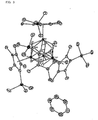
- Figs. 2 and 3 show models of crystal structures obtained as a result of the foregoing analysis, respectively.
- Fig. 2 shows a result of the X-ray crystallographic study of the complex 3.
- Fig. 2 omits to show two ⁇ 3 -imino ligands having disorders in position.
- Fig. 3 shows a result of the X-ray crystallographic study of the complex 2-Ti.
- the complex 4 (101 mg, 0.138 mmol) was dissolved in hexane (1.5 mL) at room temperature for 12 hours. The solution turned from brown to dark purple. After the reaction, the solution was concentrated and crystallized at -33°C to precipitate a complex 7 (94 mg, 0.125 mg, 91%) as a dark purple solid. Single crystals of a THF-coordinated complex 7-THF suitable for X-ray diffraction study were obtained from THF solution at -33°C.
- Figs. 5 and 6 show models of crystal structures 4 and 7 obtained as a result of the foregoing analysis, respectively.
- Fig. 6 shows a result of the X-ray structural analysis of the complex 7 (complex 7-THF).
- Fig. 8 shows a time-conversion curve of the complex 4 with N 2 .
- Fig. 8 is a time-conversion curve regarding the reaction between the complex 4 and N2 in THF-d 8 (-30°C: 0 to 63 min, -10°C: 63 to 185 min, 0°C: 185 to 192 min, 20°C: 192 to 1113 min).
- ammonia can be catalytically synthesized by pressurizing and heating the complex 8 with use of a mixture gas of nitrogen and hydrogen.
- the complex 9 (10 mg, 0.013 mmol) obtained through the reaction between the complex 4 and nitrogen was allowed to react with pinacol borane (HB pin ) (36 mg, 0.28 mmol) for 30 minutes at room temperature in the presence of C 6 D 6 to give a dark green complex 11 having a boron bond on nitrogen (in a yield of 78% with respect to the molar quantity of the complex 9). Then, the complex 11 was allowed to react with pinacol borane (HB pin ) for 12 hours at 80°C in the presence of C 6 D 6 to give a red or orange complex 12.
- pinacol borane HB pin
- the complex 7 (10 mg, 0.013 mmol) obtained through the reaction between the complex 4 and nitrogen was allowed to react with pinacol borane (HB pin ) (16 mg, 0.13 mmol) for 30 minutes at room temperature in the presence of C 6 D 6 to give a complex 13 having a boron bond on nitrogen (in a yield of 50% with respect to the molar quantity of the complex 7).
- pinacol borane HB pin
- the present invention is applicable to fixation of dinitrogen or taking out of dinitrogen that have been fixed.
Landscapes
- Chemical & Material Sciences (AREA)
- Organic Chemistry (AREA)
- Chemical Kinetics & Catalysis (AREA)
- Inorganic Chemistry (AREA)
- Engineering & Computer Science (AREA)
- Materials Engineering (AREA)
- Analytical Chemistry (AREA)
- Health & Medical Sciences (AREA)
- Life Sciences & Earth Sciences (AREA)
- Biochemistry (AREA)
- General Health & Medical Sciences (AREA)
- Molecular Biology (AREA)
- Catalysts (AREA)
Abstract
Description
- The present invention relates to a novel hydrido complex capable of fixing dinitrogen, a method for synthesizing the hydrido complex, and use of the hydrido complex.
- A technology for fixing dinitrogen and using them is extremely important in industry, including the agricultural sector. In nature, the fixation of dinitrogen is known for example as the fixation of dinitrogen by root nodule bacteria. Industrially, however, the fixation of dinitrogen is performed exclusively by the Haber-Bosch process.
-
- Non-patent Literature 1
R. R. Schrock, Science, 2003, 301, 76. - Non-patent
Literature 2
Nishibayashi, Nature Chem., 2010, 2, 120. - Non-patent Literature 3
M. D. Fryzuk, et al., Science, 1997, 275, 1445. - Non-patent
Literature 4
H. Kawaguchi et al., Angew. Chem. Int. Ed., 2007, 46, 8778. - However, the Haber-Bosch process is a technique that can only be efficiently implemented in a very high-temperature and high-pressure environment. Therefore, there has been a desperate need for a technique for performing dinitrogen fixation in a milder environment.
- It should be noted that metal complexes (Non-patent
Literatures 1 and 2 etc.) or hydrido complexes (Non-patentLiteratures 3 and 4 etc.) capable of fixing dinitrogen have been reported. However, none of them fixes dinitrogen in a form that can be easily taken as ammonia from the complex. For industrial applications, there has been a desperate need for a further novel proposal. - The present invention has been made in view of the problems described above, and it is an object of the present invention to provide a novel hydrido complex that fixes dinitrogen in a relatively mild environment, a method for synthesizing the hydrido complex, and use of the hydrido complex.
- In order to attain the object, the present invention provides any one of the following:
- (1) A complex represented by formula (1A) or (1B) or a cationic or anionic complex from the complex:

- (2) The complex as set forth in (1), wherein L1 to L4 (L1 to L3 in the case of formula (1A)) of formulas (1A) and (1B) are identical ligands each of which is represented by formula (2):
 is a bond with M1 to M4 (M1 to M3 in the case of formula (1A)), and two to five of R1 to R5 are the hydrocarbyl group or substituted metalloid group, and wherein one of the carbon atoms constituting the skeleton of the cyclopentadienyl ring may be substituted by a 14th-group atom (excluding a carbon atom and a lead atom) or a 15th-group atom.
- (3) The complex as set forth in (2), wherein, in formula (2), all of R1 to R5 are methyl groups, or four of R1 to R5 are methyl groups and the other one of R1 to R5 is a trialkylsilyl group.
- (4) The complex as set forth in any one of (1) to (3), wherein each of M1 to M4 (M1 to M3 in the case of formula (1A)) of formulas (1A) and (1B) is Ti.
- (5) A complex as set forth in any one of (1) to (4), the complex being represented by formula (1A).
- (6) A complex having nitrogen atoms incorporated therein by bringing a complex as set forth in any one of (1) to (5) and nitrogen molecules into contact with each other.
- (7) The complex as set forth in (6), the complex being a complex represented by formula (3) or a cationic or anionic complex from the complex:

- (8) A complex represented by formula (3') or a cationic or anionic complex from the complex:

- (9) A method for synthesizing ammonia, comprising the step of bringing hydrogen molecules and nitrogen molecules into contact with a complex as set forth in any one of (1) to (8) or brining hydrogen molecules into contact with a complex as set forth in claim (6) or (7).
- (10) A fixed bed for use in ammonia synthesis, comprising a complex as set forth in any one of (1) to (8), the complex being fixed.
- The present invention can provide a novel hydrido complex that fixes dinitrogen in a relatively mild environment, a method for synthesizing the hydrido complex, and use of the hydrido complex.
-
-
Fig. 1 schematically shows an example of a method for synthesizing ammonia that can be carried out with use of a metal polyhydrido complex according to the present invention. -
Fig. 2 shows a crystal structure of a complex molecule according to a reference example. -
Fig. 3 shows a crystal structure of a complex molecule according to the reference example. -
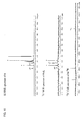
Fig. 4 shows the NMR spectrum of a complex molecule according to an example. -
Fig. 5 shows a crystal structure of a complex molecule according to the example. -
Fig. 6 shows a crystal structure of a complex molecule according to the example. -
Fig. 7 shows a time-conversion curve of a complex molecule according to the example. -
Fig. 8 shows a time-conversion curve of a complex molecule according to the example. -
Fig. 9 shows the NMR spectrum of a complex molecule according to the example. -
Fig. 10 shows the NMR spectrum of a complex molecule according to the example. - An example of a complex according to the present invention is a hydrido complex represented by formula (1A) or formula (1B):


- In formula (1A), M1 to M3 are each independently Ti (titanium atom), Zr, (zirconium atom), Hf (hafnium atom), V (vanadium atom), Nb (niobium atom), Ta (tantalum atom), Cr (chromium atom), Mo (molybdenum atom), or W (tungsten atom), preferably each independently Ti, Zr, or Hf. Preferably, all of M1 to M3 are identical atoms. More preferably, all of M1 to M3 are Ti. Similarly, in formula (1B), M1 to M4 are each independently Ti, Zr, Hf, V, Nb, Ta, Cr, Mo, or W, preferably each independently Ti, Zr, or Hf. Preferably, all of M1 to M4 are identical atoms. More preferably, all of M1 to M4 are Ti.
- In formula (1A), L1 to L3 are each independently is a ligand selected from among a ligand (referred to as "Cp ligand") including a substituted or unsubstituted cyclopentadienyl derivative, a diphenylamine ligand, a diphenylphosphine ligand, and a carboimideamide ligand. Preferably, all of L1 to L3 are identical ligands. More preferably, all of L1 to L3 are identical Cp ligands. Similarly, in formula (1B), L1 to L4 are each independently is a ligand selected from among a substituted or unsubstituted Cp ligand, a diphenylamine ligand, a diphenylphosphine ligand, and a carboimideamide ligand. Preferably, all of L1 to L4 are identical ligands. More preferably, all of L1 to L4 are identical Cp ligands.
- In the present invention, the Cp ligand is pi-bonded to the central metal M. The Cp ligand is for example a non-bridging ligand. The term "non-bridging ligand" here means a ligand whose cyclopentadienyl derivative is pi-bonded to the central metal and which does not have a coordinating atom or a coordinating group other than the cyclopentadienyl derivative. Alternatively, the Cp ligand is for example a bridging ligand. The term "bridging ligand" here means a ligand which further includes a coordinating atom or a coordinating group in addition to the cyclopentadienyl derivative. The Cp ligand is preferably a non-bridging ligand.
- The substituted or unsubstituted cyclopentadienyl derivative of the Cp ligand is one selected from the group consisting of a substituted or unsubstituted cyclopentadienyl ring, a substituted or unsubstituted fluorenyl ring, a substituted or unsubstituted octahydro fluorenyl ring, a substituted or unsubstituted indenyl ring, and a substituted or unsubstituted tetrahydroindenyl ring. Among them, the most preferred cyclopentadienyl derivative is a cyclopentadienyl ring having a substituent(s).
- The cyclopentadienyl ring is represented by the composition formula: C5H5-XRX. In this composition formula, X represents an integer of 0 to 5. Each R is independently a hydrocarbyl group; a substituted hydrocarbyl group; or a substituted metalloid group in which a hydrocarbyl group, an amide group, a phosphide group, and/or an alkoxide group has/have been substituted. It should be noted that one of C in the composition formula may be substituted by a 14th-group atom (excluding a carbon atom and a lead atom) or a 15th-group atom.
- The hydrocarbyl group is preferably a C1-C20 hydrocarbyl group, more preferably a C1-C20 (preferably C1-C10, more preferably C1-C6) alkyl group, phenyl group, benzyl group, etc., most preferably a methyl group.
- Further, an example of a hydrocarbyl group having a substituent (the substituted hydrocarbyl group) is a hydrocarbyl group at least one of the hydrogen atoms of which has been substituted by a halogen atom, am amide group, a phosphide group, an alkoxy group, an aryloxy group, or the like.
- Further, examples of the metalloid in the substituted metalloid group include germyl (Ge), stannyl (Sn), silyl (Si), etc. Further, the number of substitutions of substituents having substituted in the metalloid group is determined by the type of metalloid (e.g. in the case of a silyl group, the number of substitutions of hydrocarbyl groups (substituents) is 3). It should be noted that the carbon number of a hydrocarbyl group as a substituent in the substituted metalloid group is preferably in the range of 1 to 20.
- It should be noted that at least one of the R groups of the cyclopentadienyl ring is a substituted metalloid group (preferably a silyl group) in which a hdyrocarbyl group has been substituted, more preferably a trimethylsilyl group.
- A preferred example of the cyclopentadienyl ring is represented by formula (2):

- In formula (2), R1 to R5 are each independently a hydrogen atom that binds to a carbon atom constituting the skeleton of the cyclopentadienyl ring; a C1-C20 hydrocarbyl group; or a substituted metalloid group in which a C1-C20 hydrocarbyl group, an amide group, a phosphide group, and/or an alkoxide group has/have been substituted,is a bond with M1 to M3 in formula (1A) or a bond with M1 to M4 in formula (1B), and two to five of R1 to R5 are the hydrocarbyl group or substituted metalloid group. Further, one of the carbon atoms constituting the skeleton of the cyclopentadienyl ring represented by formula (2) may be substituted by a 14th-group atom (excluding a carbon atom and a lead atom) or a 15th-group atom. It should be noted that it is preferable that L1 to L3 in formula (1A) or L1 to L4 in formula (1B) be identical ligands represented by formula (2).

- The following are examples of the cyclopentadienyl ring represented by formula (2):

- In formulas (3-1), (3-2), and (3-5), each R is independently a substituted metalloid group in which a C1-C20 hydrocarbyl group, an amide group, a phosphide group, and/or an alkoxide group has/have been substituted (preferably a substituted metalloid group in which a C1-C20 hydrocarbyl group has been substituted). A specific example of this metalloid group is any one of those represented by formula (4) below. In formula (4), each R' is independently a C1-C8 hydrocarbyl group, preferably a C1-C6 hydrocarbyl group, more preferably a C 1-C4 hydrocarbyl group (preferably a chain alkyl group).

- In formula (3-5), E is N (nitrogen atom) or P (phosphorus atom).
- Further, in formula (3-6), each R is independently a C1-C20 hydrocarbyl group (preferably a C1-C6 chain alkyl group); or a substituted metalloid group in which a C1-C20 hydrocarbyl group, an amide group, a phosphide group, and/or an alkoxide group has/have been substituted (preferably a substituted metalloid group in which a C1-C20 hydrocarbyl group has been substituted). A specific example of this metalloid group is any one of those represented by formula (4) above. Furthermore, in formula (3-6), n is an integer of 1 or larger to 5 or smaller, and E is a hetero atom such as N (nitrogen atom), P (phosphorous atom), or As (arsenic atom), preferably N or P.
- Further, an example of the cyclopentadienyl ring represented by formula (2) is one (which is equivalent to formula (3-8) in which, in formula (2), all of R1 to R5 are methyl groups (which is equivalent to formula (3-8) or one (which is equivalent to formula (3-1)) in which, in formula (2), four of R1 to R5 are methyl groups and the other one of R1 to R5 is a trialkylsilyl group having a C1-C6 alkyl group.
- As the Cp ligand, the substituted or unsubstituted fluorenyl ring is represented by the composition formula: C13H9-XRX (where X is an integer of 0 to 9, and R is either a C1-C20 hydrocarbyl group that may have a substituent or a substituted metalloid group and is similar to the R of the aforementioned cyclopentadienyl ring: C5H5-XRX). Alternatively, as the Cp ligand, the substituted or unsubstituted octahydro fluorenyl ring is represented, for example, by the composition formula: C13H17-XRX (where X is an integer of 0 to 17, and R is either a C1-C20 hydrocarbyl group that may have a substituent or a substituted metalloid group and is similar to the R of the aforementioned cyclopentadienyl ring: C5H5-XRX).
- Preferred examples of the fluorenyl ring are represented by the following formulas:

- In formulas (5-1) and (5-2), each R is independently a C1-C20, preferably C1-C6, hydrocarbyl group or a substituted metalloid group. A specific example of this metalloid group is any one of those represented by formula (4) above. Formulas (5-3) and (5-4) are equivalent to specific examples of compounds represented by formulas (5-1) and (5-2), respectively.
- The Cp ligand may alternatively be a substituted or unsubstituted indenyl ring (composition formula: C9H7-XRX, where X is an integer of 0 to 7), tetrahydroindenyl ring (composition formula: C9H11-XRX, where X is an integer of 0 to 11), or the like. In these formulas, R is similar to the R of the aforementioned cyclopentadienyl ring.
A preferred example of the indenyl ring is represented by formula (6):
- In formula (6), each R is independently a C1-C20, preferably C1-C6, hydrocarbyl group or a substituted metalloid group. A specific example of this metalloid group is any one of those represented by formula (4) above.
- In the present invention, the diphenylamine ligand is a ligand having a diphenylamine skeleton (-N(Ph)2) in which two phenyl groups are bonded to a nitrogen atom. Any hydrogen atom on each of the phenyl groups may be substituted, for example, by a C1-C20 hydrocarbyl group, a metalloid group in which a C1-C20 hydrocarbyl group has been substituted, or a substituent such as a -PR2 group, a -SR group, or a -OR group. In the -PR2 group, the -SR group, and the -OR group, each R is independently a C1-C20, preferably C 1-C6, hydrocarbyl group or a metalloid group in which such a hydrocarbyl group has been substituted. It should be noted that it is preferable that the two R groups of the -PR2 group be identical to each other.
A preferred example of the diphenylamine ligand is represented by formula (7):
- In formula (7), each R is independently a C1-C20, preferably C 1-C6, hydrocarbyl group or a substituted metalloid group. A specific example of this metalloid group is any one of those represented by formula (4) above. In a case where R is a hydrocarbyl group, it is preferable that the hydrocarbyl group be an alkyl group or an aryl group. In formula (7), it is preferable that the four R groups be identical groups.
- In the present invention, the diphenylphosphine ligand is a ligand having a diphenylphosphine skeleton (-P(Ph)2) in which two phenyl groups are bonded to a phosphorous atom. Any hydrogen atom on each of the phenyl groups may be substituted, for example, by a C1-C20 hydrocarbyl group, a metalloid group in which a C1-C20 hydrocarbyl group has been substituted, or a substituent such as a -SR group or a -OR group. In the -SR group and the -OR group, each R is independently a C1-C20, preferably C 1-C6, hydrocarbyl group or a metalloid group in which such a hydrocarbyl group has been substituted.
A preferred example of the diphenylphosphine ligand is represented by formula (8):
- In formula (8), each R is independently a C1-C20, preferably C 1-C6, hydrocarbyl group or a substituted metalloid group. A specific example of this metalloid group is any one of those represented by formula (4) above. In a case where R is a hydrocarbyl group, it is preferable that the hydrocarbyl group be an alkyl group or an aryl group. In formula (8), it is preferable that the two R groups be identical groups.
- In the present invention, the carboimideamide ligand is a ligand having a structure (-N=C-NH- structure) represented by formula (9):


- In formula (9), each R may be independently any group, but in a preferred carboimideamide ligand, each R is independently a C1-C20, preferably C1-C6, hydrocarbyl group or a substituted metalloid group. A specific example of this metalloid group is any one of those represented by formula (4) above. In a case where R is a hydrocarbyl group, it is preferable that the hydrocarbyl group be an alkyl group or an aryl group. More specific examples of the carboimideamide ligand include N1,N1-diphenylbenzene carboimideamide etc.
- It should be noted that the hydrido complex represented by formula (1A) and the hydrido complex represented by formula (1B) may each be not only a neutral complex, but also a cationic or anionic complex that is obtained from the neutral complex. Specific examples of complexes according to the present invention encompass: a cationic complex, such as [{(C5Me4SiMe3)Ti}3(µ-H)6][B(C6F5)4] or [{(C5Me4SiMe3)Ti}3(µ-H)5][{B(C6F5)4}2], which is obtained from a neutral complex [{(C5Me4SiMe3)Ti}3(µ3-H)(µ2-H)6]; and an anionic complex, such as Li[{(C5Me4SiMe3)Ti}3(µ-H)8], which is obtained from [{(C5Me4SiMe3)Ti}3(µ3-H)(µ2-H)6].
- The hydrido complex represented by formula (1A) may be synthesized by any method. For example, the hydrido complex represented by formula (1A) may be synthesized by bringing a compound represented by formula (10) and hydrogen molecules into contact with each other.

- Further, in formula (10), each R is independently a monoanionic ligand. More specific examples of R include, but are not limited to, monoanionic ligands such as hydrido, halide, a substituted or unsubstituted C1-C20 hydrocarbyl group, an alkoxy group or aryloxy group, and an amide group or a phosphino group. Among these, each R is preferably independently a C1-C20 hydrocarbyl group that may have a substituent, particularly preferably a trimethylsilyl group.
- Examples of the halide include chloride, bromide, fluoride, and iodide.
- Preferred examples of the C1-C20 hydrocarbyl group include: alkyl groups such as a methyl group, an ethyl group, a propyl group, a butyl group, an amyl group, an isoamyl group, a hexyl group, an isobutyl group, a heptyl group, an octyl group, a nonyl group, a decyl group, a cetyl group, and a 2-ethylhexyl group; and unsubstituted hydrocarbyl groups such as a phenyl group and a benzyl group. Other possible examples include substituted hydrocarbyl groups such as a substituted benzyl group, a trialkylsilylmethyl group, and a bis(trialkylsilyl) group. Preferred examples of the hydrocarbyl group include a methyl group, an ethyl group, a phenyl group, a substituted or unsubstituted benzyl group, and a trialkylsilylmethyl group, and more preferred examples include a trimethylsilylmethyl group.
- Preferred examples of the alkoxy group or aryloxy group include a methoxy group, a substituted or unsubstituted phenoxy group, and the like.
- Preferred examples of the amide group include a dimethylamide group, a diethylamide group, a methylethylamide group, a di-t-butylamide group, a diisopropylamide group, a substituted or unsubstituted diphenylamide group, and the like.
- Preferred examples of the phosphino group include a diphenyl phosphino group, a dicyclohexyl phosphino group, a diethyl phosphino group, a dimethyl phosphino group, and the like.
- Preferred examples of alkylidene include methylidene, ethylidene, propylidene, and the like.
- Further, R groups may bind to each other, or may be combined to form a dianionic ligand (dianion ligand) or a trianionic ligand (trianion ligand). Examples of the dianionic ligand include alkylidene, diene, a cyclo-metalated hydrocarbyl group, a bidentate chelate ligand, and the like.
- The compound represented by formula (10) and hydrogen molecules can be brought into contact with each other preferably in a solvent in which the compound represented by formula (10) can dissolve. The type of solvent needs only be selected according to the type of compound represented by formula (10). Examples of the solvent include hexane, pentane, heptane, a mixed solvent obtained by mixing two or more of these solvents, and the like. Further, the solvent is not limited to a particular temperature during the contact, and the temperature can be selected according to the type of solvent. For example, the temperature falls within the range of 25°C to 80°C, preferably the range of 40°C to 60°C. Further, for the purpose of increasing the amount of hydrogen molecules that are supplied into the solvent, it is preferable that the hydrogen molecules (gas) be supplied as a pressurized gas. For example, the hydrogen molecules are supplied while being kept at a pressure that is higher than normal pressure but equal to or lower than a pressure of 5 atmospheres (atm).
- The duration of contact (reaction) between the compound represented by formula (10) and hydrogen molecules is not limited to a particular length of time. For example, the duration falls within the range of 4 hours to 24 hours, preferably the range of 12 hours to 24 hours. Further, the molar ratio between the compound represented by formula (10) and hydrogen molecules for use in contact needs only be determined in consideration of the reaction equivalents thereof, and is not limited to a particular molar ratio.
- It is preferable that a reaction product obtained through the reaction between the compound represented by formula (10) and hydrogen molecules be collected as a precipitate that is obtained, for example, by performing washing or the like of the product, then adding the product into a first crystallization solvent for crystallization to collect a solution phase, and then replacing the solvent of the solution phase thus collected with a second crystallization solvent for recrystallization. Examples of the first crystallization solvent include THF and the like. Further, examples of the second crystallization solvent include hexane and the like.
- It should be noted that a cationic complex from the hydrido complex represented by formula (1A) can be synthesized, for example, from a neutral hydrido complex and a promoter such as [Ph3C][B(C6F5)4], B(C6F5)3, or methylaluminoxane (MAO). Furthermore, an anionic complex from the hydrido complex represented by formula (1A) can be synthesized, for example, by adding to a neutral hydrido complex any of the following: a combination of R-Li (organic lithium compound) such as Me3SiCH2Li and H2; a combination of a Grignard reagent such as RMgBr and H2; and a combination of NaH or KH and H2. It should be noted here that R is for example an alkyl group or another hydrocarbon group. Further, the elements constituting the combination may be added to the neutral hydrido complex under any condition (e.g. in any order.
- It should be noted that the descriptions in the Examples below, too, are referred to regarding the method for synthesizing the hydrido complex represented by formula (1A).
- Further, the hydrido complex represented by formula (1B) may be synthesized by any method. For example, the hydrido complex represented by formula (1B) may be synthesized by bringing the aforementioned compound represented by formula (10), hydrogen molecules, and nitrogen molecules into contact with one another.
It should be noted that M in formula (10) is identical to M1 to M4 in formula (1B), and L in formula (10) is identical to L1 to L4 in formula (1B). That is, use of only one type of compound represented by formula (10) gives a complex represented by formula (1B) in which M1 to M4 are identical and L1 to L4 are identical. Further, a cationic or anionic complex from the hydrido complex represented by formula (1B) can be synthesized according to the method for synthesizing a cationic or anionic complex from the hydrido complex represented by formula (1A). - The present invention also provides a complex (hereinafter referred to as "nitrogen fixation complex") formed by the incorporation of nitrogen atoms. This complex is obtained by bringing at least one type of complex and nitrogen molecules into contact with each other. The at least one type of complex is selected from the group consisting of a hydrido complex represented by formula (1A), a hydrido complex represented by formula (1B), and a cationic or anionic complex from any of these complexes.
- A preferred example of the nitrogen fixation complex is a complex represented by formula (3) or a cationic or anionic complex from the complex:


- In formula (3), M1 to M3 and L1 to L3 are identical to those of formula (1A), X1 to X3 are each -H- or -N(H)-, and at least one (preferably two or three) of X1 to X3 is -N(H)-. It should be noted that the -'s of X1 to X3 are binding arms to M1 to M3.
- In the complex represented by formula (3) or a cationic or anionic complex from the complex, nitrogen atoms are incorporated in such a manner that the NN triple bond in the nitrogen molecule is dissociated and a N-H bond is formed. This makes it easy to release the incorporated nitrogen atoms under relatively mild conditions as will be described later.
- Further, in the complex represented by formula (3), the H of at least one of X1 to X3, which are -N(H)-, may be substituted by a substituent such as a boryl group (e.g. a pinacol boryl group), a silyl group, or an alkyl group, so that a complex having a boron bond(s), a silicon bond(s), or a carbon bond(s) may be formed. The addition of various functional groups to nitrogen allows nitrogen to be used, for example, for the synthesis of a nitrogen-containing organic compound.
- For example, in a case where at least one of the -N(H)-'s of the complex represented by formula (3) is boronated with pinacol borane (HBpin), pinacol borane (HBpin) (36 mg, 0.3 mmol) is brought into reaction in the time range of 30 minutes to 12 hours, in the temperature range of 20°C to 80°C, and in the presence of C6D6.
- It should be noted that a method for synthesizing the complex represented by formula (3) or a cationic or anionic complex from the complex will be described in section [3. Method for Synthesizing Ammonia] below.
- Another example of the nitrogen fixation complex is a complex that is obtained, for example, by bringing the complex represented by formula (3) or a cationic or anionic complex from the complex into contact with a Lewis acid (which will be defined later) represented by formula M5Xn. A particularly preferred example is a complex represented by formula (3') or a cationic or anionic complex from the complex. The complex represented by formula (3') or a cationic or anionic complex from the complex is obtained, for example, by bringing a complex represented by formula (3) in which all three of X1 to X3 are -N(H)-'s or a cationic or anionic complex from the complex into contact with the Lewis acid represented by formula M5Xn.


M 5 is for example Cu (copper), Zn (zinc), Sc (scandium), or Y (yttrium), X is F, Cl, Br, I, or -OSO2CF3, and n (which indicates the number of X's) is an integer represented by p-3 (where p is the coordination number of M5; for example, p is 4 in a case where M5 is Cu, p is 5 in a case where M5 is Zn, and p is 6 in a case where M5 is Sc). It is preferable that M5 be selected from among Cu, Zn, and Sc. Further, for example, X is Cl. - It should be noted that a method for synthesizing the complex represented by formula (3') or a cationic or anionic complex from the complex will be described in section [3. Method for Synthesizing Ammonia] below.
- The present invention provides a method for synthesizing ammonia with use of a complex represented by formula (1A), a complex represented by formula (1B), a cationic or anionic complex from any of these complexes, or the nitrogen fixation complex described above.
- An example of synthesis of ammonia with use of a complex represented by formula (1A) include a dinitrogen fixing/ converting step of bringing hydrogen molecules and nitrogen molecules into contact with the complex. The dinitrogen fixing/converting step may be performed by a process (A) of bringing nitrogen molecules into contact with the complex represented by formula (1A) for dinitrogen fixation and then further bringing hydrogen molecules into contact with the complex or a process (B) of bringing hydrogen molecules and nitrogen molecules into contact with the complex in a simultaneous parallel manner.
- In the synthesis of ammonia by the process (A), first, a nitrogen fixation complex represented by formula (3) is formed by bringing nitrogen molecules into contact with the complex represented by formula (1A). Then, presumably, ammonia is synthesized by hydrogen molecules being brought into contact with the nitrogen fixation complex represented by formula (3). Further, presumably, the nitrogen fixation complex represented by formula (3) returns to the complex represented by formula (1A) when the nitrogen atoms having been fixed is released along with the synthesis of ammonia. This makes it possible to continuously synthesize ammonia by continuously bringing hydrogen molecules and nitrogen molecules into contact with the complex represented by formula (1A) through repeated application of the process (A) to the complex.
- In the process (A), nitrogen molecules may be brought into contact with the complex represented by formula (1A) under any conditions. For example, nitrogen molecules may be brought into contact with the complex represented by formula (1A) in the temperature range of -30°C to 200°C and at a pressure (partial pressure in the case of a mixture gas) of nitrogen molecules (nitrogen gas) in the range of 1 atm to 100 atm. The duration of contact (reaction) is not limited to a particular length of time. For example, the duration falls within the range of 1 hour to 24 hours. Nitrogen molecules need only be brought into contact with the complex represented by formula (1A) as simple nitrogen molecules or as a component of a mixture gas. The mixture gas may be one that contains hydrogen molecules and nitrogen molecules, but is preferably one that contains more nitrogen molecules in number of moles. In a case where the synthesis of a nitrogen fixation complex represented by formula (3) in which one of X1 to X3 is -N(H)-, the synthesis of a nitrogen fixation complex represented by formula (3) in which two of X1 to X3 are -N(H)-'s, and, as needed, the synthesis of a nitrogen fixation complex represented by formula (3) in which three of X1 to X3 are -N(H)-'s occur in stages, there may be stepwise increase in the number of moles of nitrogen molecules (or the pressure of nitrogen molecules) that are used at each stage.
- In the process (A), hydrogen molecules may be brought into contact with the nitrogen fixation complex represented by formula (3) under any conditions. For example, hydrogen molecules may be brought into contact with the nitrogen fixation complex represented by formula (3) in the temperature range of -30°C to 200°C and at a pressure (partial pressure in the case of a mixture gas) of hydrogen molecules (hydrogen gas) in the range of 1 atm to 100 atm. The duration of contact (reaction) is not limited to a particular length of time. For example, the duration falls within the range of 1 hour to 24 hours. Hydrogen molecules need only be brought into contact with the nitrogen fixation complex represented by formula (3) as simple hydrogen molecules or as a component of a mixture gas. The mixture gas may be one that contains hydrogen molecules and nitrogen molecules, but is preferably one that contains more hydrogen molecules in number of moles.
- Alternatively, in the process (B), hydrogen molecules and nitrogen molecules may be brought into contact with the complex represented by formula (1A) in a simultaneous parallel manner under any conditions. For example, hydrogen molecules and nitrogen molecules may be brought into contact with the complex represented by formula (1A) in the temperature range of 25°C to 200°C and at a pressure (partial pressure) of hydrogen molecules (hydrogen gas) in the range of 1 atm to 100 atm and a pressure (partial pressure) of nitrogen molecules (nitrogen gas) in the range of 1 atm to 100 atm. The duration of contact (reaction) is not limited to a particular length of time. For example, the duration falls within the range of 1 hour to 24 hours. It should be noted that a mixture gas containing other molecules in addition to the hydrogen molecules and the nitrogen molecules may be brought into contact with the complex represented by formula (3).
- In the synthesis of ammonia by the process (B), too, ammonia is presumably synthesized from the complex represented by formula (1A) through the complex represented by formula (3). This makes it possible to continuously synthesize ammonia by continuously bringing hydrogen molecules and nitrogen molecules into contact with the complex represented by formula (1A) through continuous application of the process (B) to the complex.
- Alternatively, ammonia may be synthesized by bringing a Lewis acid represented by formula M5Xn into reaction with the nitrogen fixation complex represented by formula (3), which was obtained from the process (A) or (B), to form a Lewis acid complex represented by formula (3') to which a Lewis acid group has bonded and further applying the process (B) to the Lewis acid complex (3'). It should be noted here that M5 and X in the Lewis acid are identical to M5 and X in the complex (3'), respectively. Further, n is the number of X's binding to M5).
It should be noted that M5 in the Lewis acid is a polyvalent element, preferably a metal atom, e.g. an atom selected from among Cu (copper), Zn (zinc), Sc (scandium), and Y (yttrium), particularly from among Cu, Zn, and Sc. Further, an example of X is an atom selected from among F, Cl, Br, I, and OSO2CF3. - It is preferable that the Lewis acid be a metallic halide, more preferably one selected for example from among CuCl, ZnCl2, ScCl3 and YCl3, particularly preferably CuCl, ZnCl2, or ScCl3.
- Further, other examples of the Lewis acid include Ag(OSO2CF3), a Lewis acid represented by formula EX3 (which here is B, Al, Ga, or In and where X is F, Cl, Br, I, Ph (phenyl group), or C6F5), a Lewis acid represented by formula EX2 (which here is Ge or Sn and where X is F, Cl, Br, I, Ph, or C6F5), and a Lewis acid containing a transition metal atom, such as FeCl2, RuCl3, RhCl3, IrCl3, PdCl2, or PtCl2.
- The Lewis acid may be brought into contact with the complex represented by formula (3) under any conditions. For example, stirring at a temperature in the range of 20°C to 80°C for a period of time in the range of 1 hour to 12 hours may be followed by still standing at a temperature in the range of -35°C to 20°C for a period of time in the range of 1 hour to 24 hours.
- The complex represented by formula (1A) or the nitrogen fixation complex represented by formula (3) may be used while being dissolved in a solvent or while being in the form a solid. Examples of the solvent include hexane, pentane, heptane, a mixed solvent obtained by mixing two or more of these solvents, and the like. The complex may be used while being fixed to a carrier Examples of the carrier include silica gel, alumina (aluminum oxide), active carbon, titania (titanium dioxide), and the like. The carrier may alternatively be an electride obtained by incorporating electrons into a 12CaO·7Al2O3 structure.
- The synthesis of ammonia with use or a cationic or anionic complex from the complex represented by formula (1A) can be performed under substantially the same conditions as the synthesis of ammonia with use of the complex represented by formula (1A). Further, the synthesis of ammonia with use of the complex represented by formula (1B) or a cationic or anionic complex from the complex, too, can be performed according to the method for synthesizing ammonia with use of the complex represented by formula (1A).
- The present invention provides a fixed bed for use in ammonia synthesis. This fixed bed is obtained by fixing a complex represented by formula (1A), a complex represented by formula (1B), a cationic or anionic complex from any of these complexes, or a nitrogen fixation complex represented by formula (3). The fixed bed may be configured such that any of these complexes or the nitrogen fixation complex is fixed as a solid to a column, the carrier, or the like or bonded to the carrier while being dissolved in the solvent (see
Fig. 1 ). - Further, the present invention provides an ammonia synthesis apparatus including the fixed bed described above (see
Fig. 1 ). It is preferable that the ammonia synthesis apparatus further include hydrogen supply equipment and nitrogen supply equipment. - All reactions were carried out under a dry and oxygen-free argon atmosphere by using Schlenk techniques or a nitrogen or argon atmosphere in an Mbraun glovebox. The argon was purified by being passed through a Dryclean column (4A molecular sieves, Nikka Seiko Co.) and a Gasclean GC-XR column (Nikka Seiko Co.). The nitrogen and the argon in the glovebox were constantly circulated through a copper/ molecular sieve catalyst unit. The oxygen and moisture concentrations were monitored by an O2/H2O Combi-Analyzer (Mbraun) to ensure both were always below 1 ppm. Samples for NMR spectroscopic measurements were prepared by using Schlenk techniques or in the glovebox by use of J. Young valve NMR tubes. 1H, 13C, and 15N NMR spectra were recorded on a JEOL-AL400, a JNM-AL300, or JNM-ECA600 spectrometer. IR spectra were recorded on a Shimazu IRPrestige-21 spectrometer using nujol mulls between KBr disks. Elemental analyses were performed by a MICRO CORDER JM10. Anhydrous THF, hexane, benzene, Et2O, and toluene were purified by use of a SPS-800 solvent purification system (Mbraun), and dried over fresh new Na chips in the glovebox. C5Me4H(SiMe3) was purchased from Aldrich, and used as received. Other reagents (TiCl4 and LiCH2SiMe3) were used as received.
- For abbreviated designations of the following compounds, see chemical formulas in section [3. Example] below.
- LiCH2SiMe3 (812 mg, 8.63 mmol) was slowly added to a stirred suspension of [(C5Me4SiMe3)TiCl3](1.0 g, 2.88 mmol) in toluene at -40°C. The mixture was then warmed to room temperature and stirred for 3 minutes. After removal of the solvent under vacuum, the residual solid was extracted with hexane and filtrated. After reduction of the solution volume under reduced pressure, the orange-colored solution was cooled at -33°C overnight to give a complex 1-Ti (908 mg, 1.81 mmol, 63%) as pale yellow crystals.
Complex 1-Ti: 1H NMR (C6D6, rt): 2.05 (s, 6H, C5Me4SiMe3), 1.83 (s, 6H, C5Me4SiMe3), 1.45 (s, 6H, TiCH2SiMe3), 0.27 (s, 36H, C5Me4SiMe3, TiCH2SiMe3). 13C NMR (C6D6, rt): 128.4 (s, C5Me4SiMe3), 127.5 (s, C5Me4SiMe3), 122.6 (s, ipso-C5Me4SiMe3), 85.8 (s, TiCH2SiMe3), 16.0 (s, C5Me4SiMe3), 13.07 (s, C5Me4SiMe3), 3.0 (s, TiCH2SiMe3), 1.9 (s, C5Me4SiMe3). Anal. Calcd for C24H54Si4Ti: C, 57.32; H, 10.82. Found: C, 57.32; H, 10.50. - A hexane solution (2.0 mL) of the complex 1-Ti (100 mg, 0.199 mmol) in 10 mL Hiper Glass Cylinder (TAIATSU TECHNO (registered trademark)) was filled with 1 atm of N2 and 4 atm of H2. The solution was stirred at 60°C for 1 day. The color of the solution changed from pale yellow to dark purple. After the reaction, the solution was evaporated and the residue was washed with cold hexane to give a complex 3 (45 mg, 0.045 mmol, 90%) as a dark purple solid. Single crystals of the complex 3 suitable for X-ray diffraction study were obtained from the concentrated C6H6 solution of the complex 3 at room temperature. The preparation of the 15N-enriched compound [(C5Me4SiMe3)4Ti4(µ3-15NH)2(µ-H)4]: complex 3-15N was carried out in exactly the same manner as for the parent complex 3.
Complex 3: 1H NMR (C6D6, rt): 11.01 (s, 2H, µ3-NH), 2.27 (s, 12H, C5Me4SiMe3), 2.03 (s, 12H, C5Me4SiMe3), 1.91 (s, 12H, C5Me4SiMe3), 1.88 (s, 12H, C5Me4SiMe3), 1.82 (s, 4H, µ-H), 0.49 (s, 18H, C5Me4SiMe3), 0.34 (s, 18H, C5Me4SiMe3). 13C NMR (C6D6, rt): 126.4 (s, C5Me4SiMe3), 125.6 (s, C5Me4SiMe3), 123.2 (s, C5Me4SiMe3), 122.2 (s, C5Me4SiMe3), 115.4 (s, ipso-C5Me4SiMe3), 114.7 (s, ipso-C5Me4SiMe3), 16.9 (s, C5Me4SiMe3), 13.9 (s, C5Me4SiMe3), 13.3 (s, C5Me4SiMe3), 3.2 (s, C5Me4SiMe3), 3.0 (s, C5Me4SiMe3). Calcd for C48H90N2Si4Ti4: C, 57.71; H, 9.08; N, 2.80. Found: C, 58.11; H, 8.78; N, 2.75.
Complex 3-15N: 1H NMR (C6D6, rt): 11.04 (d, JNH = 66.5 Hz, 15NH), 2.28 (s, 12H, C5Me4SiMe3), 2.04 (s, 12H, C5Me4SiMe3), 1.92 (s, 12H, C5Me4SiMe3), 1.89 (s, 12H, C5Me4SiMe3), 1.76 (s, 4H, µ-H), 0.50 (s, 18H, C5Me4SiMe3), 0.35 (s, 18H, C5Me4SiMe3). 13C NMR (C6D6, rt): 126.4 (s, C5Me4SiMe3), 125.6 (s, C5Me4SiMe3), 123.2 (s, C5Me4SiMe3), 122.2 (s, C5Me4SiMe3), 115.4 (s, ipso-C5Me4SiMe3), 114.7 (s, ipso-C5Me4SiMe3), 16.9 (s, C5Me4SiMe3), 13.9 (s, C5Me4SiMe3), 13.4 (s, C5Me4SiMe3), 3.2 (s, C5Me4SiMe3), 3.0 (s, C5Me4SiMe3). 15N NMR (60.81 MHz, C6D6, MeNO2, rt):σ 52.7 (s, JNH = 66.8 Hz, µ3-NH). - A hexane solution (2.0 mL) of the complex 1-Ti (252 mg, 0.501 mmol) in 10 mL Hiper Glass Cylinder (TAIATSU TECHNO (registered trademark)) was filled with H2 (4 atm). The pale yellow solution was stirred at 60°C for 17 hours. After the reaction, the solution changed to dark red, which was evaporated and crystallized in THF at -33°C to give a complex 2-Ti (12 mg, 0.012 mmol, 10%) as a dark brown solid. Single crystal of the complex 2-Ti suitable for X-ray diffraction study were obtained from the concentrated C6H6 solution at room temperature.
Complex 2-Ti: 1H NMR (C6D6, rt): 2.41 (s, 24H, C5Me4SiMe3), 2.28 (s, 24H, C5Me4SiMe3), 0.52 (s, 36H, C5Me4SiMe3), -1.21 (s, 8H, µ-H). 13C NMR (C6D6, rt): 127.1 (s, C5Me4SiMe3), 122.4 (s, C5Me4SiMe3), 114.2 (s, ipso-C5Me4SiMe3), 18.3 (s, C5Me4SiMe3), 14.1 (s, C5Me4SiMe3), 3.7 (s, C5Me4SiMe3). Calcd for C48H92Si4Ti4: C, 59.25; H, 9.53. Found: C, 59.07; H, 8.69. - (X-ray Crystallographic Studies of the Complex 3 and the Complex 2-Ti)
- Crystals for X-ray analysis were obtained in the manner described above. The crystals were manipulated in the glovebox under a microscope in the glovebox, and were sealed in thin-walled glass capillaries. Data collection was performed at -100°C on Bruker SMART APEX diffractometer with CCD area detector, using graphite monochromated Mo-Ka radiation (λ=0.71073 Å). The determination of crystal class and unit cell parameters was carried out by the SMART program package. Raw frame data were processed using SAINT and SADABS to yield a data file.. The structure was solved by using SHELXTL program. Refinement for the complexes 2-Ti and 3 was performed on F2 anisotropically for non-hydrogen atoms by the full-matrix least-squares methods. The analytical scattering factors for neutral atoms were used throughout the analysis. Disorder at the H5 and H6 atoms in the complex 2-Ti was refined at 50% occupancy. Disorder at the N1, N2, H2, H3, H4, and H5 atoms in the complex 3 was refined at 50% occupancy. The residual electron densities were of no chemical significance.
-
Figs. 2 and3 show models of crystal structures obtained as a result of the foregoing analysis, respectively.Fig. 2 shows a result of the X-ray crystallographic study of the complex 3. For the purpose of clarification,Fig. 2 omits to show two µ3-imino ligands having disorders in position.Fig. 3 shows a result of the X-ray crystallographic study of the complex 2-Ti. -

- After the complex 2-Ti had been crystallized from a product obtained according to the same procedure as the synthesis of the complex 2-Ti, the residual solution portion was evaporated under reduced pressure and crystallized in hexane at -33°C to give a complex 4 (84 mg, 0.115 mmol, 69%) as a dark purple solid. Single crystals of the complex 4 suitable for X-ray diffraction study were obtained from the concentrated THF solution of the complex 4 at -33°C.
Fig. 4 shows a 1H NMR spectrum (400 MHz, Toluene-d8, room temperature) of thecomplex 4.
Complex 4: 1H NMR (Toluene-d8, rt): 2.88 (s, 18H, C5Me4SiMe3), 2.66 (s, 7H, µ-H), 2.10 (s, 18H, C5Me4SiMe3), 0.25 (s, 27H, C5Me4SiMe3). 13C NMR (Toluene-d8, rt): 129.1 (obscured by Toluene-d8, C5Me4SiMe3), 123.3 (s, C5Me4SiMe3), 113.0 (s, ipso-C5Me4SiMe3), 17.2 (s, C5Me4SiMe3), 12.9 (s, C5Me4SiMe3), 2.5 (s, C5Me4SiMe3). 1H NMR (THF-d8, rt): 2.85 (s, 18H, C5Me4SiMe3), 2.53 (s, 7H, µ-H), 2.12 (s, 18H, C5Me4SiMe3), 0.12 (s, 27H, C5Me4SiMe3). 13C NMR (THF-d8, rt): 129.6 (s, C5Me4SiMe3), 123.8 (s, C5Me4SiMe3), 113.4 (s, ipso-C5Me4SiMe3), 17.5 (s, C5Me4SiMe3), 13.0 (s, C5Me4SiMe3), 2.6 (s, C5Me4SiMe3). Calcd for C36H70Si3Ti3: C, 59.17; H, 9.65. Found: C, 58.93; H, 8.79. -

- In the N2 glovebox, the complex 4 (101 mg, 0.138 mmol) was dissolved in hexane (1.5 mL) at room temperature for 12 hours. The solution turned from brown to dark purple. After the reaction, the solution was concentrated and crystallized at -33°C to precipitate a complex 7 (94 mg, 0.125 mg, 91%) as a dark purple solid. Single crystals of a THF-coordinated complex 7-THF suitable for X-ray diffraction study were obtained from THF solution at -33°C.
Complex 7: 1H NMR (Toluene-d8, rt): 37.65 (brs, 1H, NH), 11.69 (s, 6H, C5Me4SiMe3), 6.93 (s, 6H, C5Me4SiMe3), 4.21 (s, 6H, C5Me4SiMe3), 3.99 (s, 6H, C5Me4SiMe3), 3.92 (s, 6H, C5Me4SiMe3), 3.89 (s, 6H, C5Me4SiMe3), 0.58 (s, 18H, C5Me4SiMe3), 0.42 (s, 9H, C5Me4SiMe3). 1H NMR (THF-d8, -70°C): 17.23 (brs, 1H, NH), 2.48 (s, 6H, C5Me4SiMe3), 2.13 (s, 12H, C5Me4SiMe3), 2.08 (s, 6H, C5Me4SiMe3), 1.95 (s, 6H, C5Me4SiMe3), 1.89 (s, 6H, C5Me4SiMe3), 0.19 (s, 18H, C5Me4SiMe3), 0.01 (s, 9H, C5Me4SiMe3).
7-15N: 1H NMR (Toluene-d8, rt): 37.46 (d, JHN = 65.2 Hz, 1H, 15N-H), 11.62 (s, 6H, C5Me4SiMe3), 6.91 (s, 6H, C5Me4SiMe3), 4.20 (s, 6H, C5Me4SiMe3), 3.98 (s, 6H, C5Me4SiMe3), 3.92 (s, 6H, C5Me4SiMe3), 3.88 (s, 6H, C5Me4SiMe3), 0.59 (s, 18H, C5Me4SiMe3), 0.43 (s, 9H, C5Me4SiMe3). 1H NMR (THF-d8, -50°C): 17.62 (d, JHN = 63.6 Hz, 1H, 15N-H), 2.59 (s, 6H, C5Me4SiMe3), 2.32 (s, 6H, C5Me4SiMe3), 2.19 (s, 6H, C5Me4SiMe3), 2.15 (s, 6H, C5Me4SiMe3), 2.07 (s, 6H, C5Me4SiMe3), 2.01 (s, 6H, C5Me4SiMe3), 0.17 (s, 18H, C5Me4SiMe3), -0.01 (s, 9H, C5Me4SiMe3). 15NNMR (40.5 MHz, THF-d8, MeNO2, -50°C): σ 402.9 (s, µ-N), 46.9 (s, µ-NH). Calcd for C36H66N2Si3Ti3: C, 57.29; H, 8.81; N, 3.71. Found: C, 57.77; H, 8.73; N, 3.30. - As with the complex 3 and the complex 2-Ti, the complex 4 and the complex 7 were subjected to X-ray crystallographic study. Disorder at the H7 atom in the complex 4 among the analysis results was refined at 61% occupancy. The residual electron densities were of no chemical significance. Crystal data and analysis results including the complex 3 and the complex 2-Ti are listed in Table 1.
[Table 1] 2-Ti 3 4 7-THF formula C48H92Si4Ti4·C6H6 C48H89N2Si4Ti4·C6H6 C36H70Si3Ti3 C40H74N2OSi3Ti3 formula weight 1051.28 1075.27 730.89 826.98 crystal system Monoclinic Monoclinic Monoclinic Triclinic space group C2/c C2/c P21/n P-1 a, Å 24.170(4) 24.230(2) 11.130(2) 10.001(4) b, Å 12.0995(17) 12.1088(10) 18.990(3) 12.717(5) c, Å 21.178(3) 21.3889(18) 19.587(4) 18.445(8) α, deg 95.274(8) β, deg 109.124(4) 108.5300(10) 90.426(2) 90.099(7) γ, deg 90.002(7) V, Å3 5851.4(15) 5950.2(9) 4139.6(13) 2335.8(17) Z 4 4 4 2 Dcalcd, g/cm3 1.193 1.200 1.173 1.176 temp, K 173(2) 173(2) 173(2) 173(2) µ, mm-1(MoKα) 0.640 0.632 0.673 0.607 2θmax 54.0 55.0 54.0 54.0 reflections collected 17739 18144 24221 14103 independent reflections (R int) 6309 (0.1111) 6740 (0.0204) 8898 (0.0283) 9791 (0.1014) R1 (I> 2σ(I)) 0.0589 0.0309 0.0334 0.1044 wR2 (I > 2σ(I)) 0.1637 0.0887 0.0907 0.2618 wR2 (all data) 0.1679 0.0924 0.0955 0.2811 parameters 308 314 433 445 GOF 1.029 1.017 1.017 0.943 -
Figs. 5 and6 show models ofcrystal structures 4 and 7 obtained as a result of the foregoing analysis, respectively.Fig. 5 shows a result of the X-ray structural analysis (H7:H7D=61:39) of thecomplex 4.Fig. 6 shows a result of the X-ray structural analysis of the complex 7 (complex 7-THF). - A J. Young valve NMR sample tube was charged with 0.5 mL of toluene-d8 and the complex 4 (10 mg, 0.014 mmol). The solution was frozen in liquid nitrogen and degassed, and 1 atm of N2 gas was added. The solution was kept at -0°C, and the reaction was monitored by 1H NMR. After 3 hours, the complex 4 was converted to an intermediate 5 (75% or lower) and an intermediate 7 (10% or lower) with the formation of H2 (σH 4.5). Then, the temperature was increased from 0 to -20°C. After 4 hours, the intermediate 5 was converted to a complex 7 (95% or lower).
Fig. 7 shows a time-conversion curve of the complex 4 with N2.Fig. 7 is a time-conversion curve regarding the reaction between the complex 4 and N2 in THF-d8 (0°C: 0 to 212 min, 20°C: 212 to 448 min). - NMR data for the reaction intermediate (C5Me4SiMe3)3Ti3(µ-η1:η2:η2-N2)(µ-H)3 (intermediate 5) is as indicated below.
Intermediate 5: 1H NMR (Toluene-d8, 0°C): 10.20 (s, 1H, Ti-H), 2.56 (s, 6H, C5Me4SiMe3), 2.01 (s, 6H, C5Me4SiMe3), 1.93 (s, 6H, C5Me4SiMe3), 1.89 (s, 6H, C5Me4SiMe3), 1.81 (s, 6H, C5Me4SiMe3), 1.66 (s, 6H, C5Me4SiMe3), 0.27 (s, 18H, C5Me4SiMe3), 0.01 (s, 9H, C5Me4SiMe3), -13.69 (s, 2H, Ti-H-Ti).
5-15N: 15N NMR (60.81 MHz, Toluene-d8, MeNO2, -30°C): 262.8 (d, JNN = 21.0 Hz, N-N), 73.0 (d, JNN = 21.0 Hz, N-N). 5-d3: 2H NMR (62 MHz, Toluene-d8, -30°C): 10.3 (s, 1D, µ-D), -13.9 (s, 2D, µ-D). -

- A J. Young valve NMR sample tube was charged with 0.5 mL of THF-d8 and the complex 4 (15 mg, 0.019 mmol). The solution was frozen in liquid nitrogen and degassed, and 1 atm of N2 gas was added. The solution was kept at -30°C, and the reaction was monitored by 1H NMR. After 42 minutes, the complex 4 was converted to an intermediate 5 (80% or lower) and an intermediate 7 (10% or lower) with the formation of H2 (oH 4.5). Then, the temperature was increased from -30 to - 10°C. After 3 hours, the intermediate 5 was converted to a complex 6 (95% or lower). Finally, the temperature was raised to 20°C. After 19 hours, the complex 6 was completely converted to the intermediate 7 (94% or lower).
Fig. 8 shows a time-conversion curve of the complex 4 with N2.Fig. 8 is a time-conversion curve regarding the reaction between the complex 4 and N2 in THF-d8 (-30°C: 0 to 63 min, -10°C: 63 to 185 min, 0°C: 185 to 192 min, 20°C: 192 to 1113 min). - NMR data for the two reaction intermediates (C5Me4SiMe3)3Ti3(µ-η1:η2:η2-N2)(µ-H)3] (intermediate 5) and (C5Me4SiMe3)3Ti3(µ3-N)(µ-N)(µ-H)3] (intermediate 6) is as indicated below.
Fig. 9 shows an NMR spectrum (5-d3:62 MHz in THF, *THF-d8, -70°C / 5-15N:60.81 MHz, THF-d8, MeNO2, -30°C) of the intermediate 5.Fig. 10 shows an NMR spectrum (6:400 MHz, THF-d8, -50°C / 6-d3:62 MHz in THF, *THF-d8, -50°C / 6-15N:60.81 MHz, THF-d8, MeNO2, -50 °C) of the intermediate 6.
Intermediate 5: 1H NMR (THF-d8, -30°C): 9.73 (s, 1H, Ti-H), 2.52 (s, 6H, C5Me4SiMe3), 2.00 (s, 6H, C5Me4SiMe3), 1.91 (s, 6H, C5Me4SiMe3), 1.84 (s, 6H, C5Me4SiMe3), 1.80 (s, 6H, C5Me4SiMe3), 1.72 (s, 6H, C5Me4SiMe3), 0.15 (s, 18H, C5Me4SiMe3), -0.10 (s, 9H, C5Me4SiMe3), -13.80 (s, 2H, Ti-H-Ti).
Intermediate 5-15N: 15N NMR (60.81 MHz, THF-d8, MeNO2, -30°C): 73.1 (d, JNN = 21.5 Hz, N-N), 262.9 (d, JNN = 21.5 Hz, N-N).
Intermediate 5-d3: 2H NMR (62 MHz, THF-d8, -70°C): 8.86 (s, ID, µ-D), -13.72 (s, 2D, µ-D).
Complex 6: 1H NMR (THF-d8, -70°C): 4.65 (t, JHH = 28.0 Hz, 1H, Ti-H-Ti), 2.67 (d, JHH= 28.0 Hz, 2H, Ti-H-Ti), 2.47 (s, 6H, C5Me4SiMe3), 2.20 (s, 6H, C5Me4SiMe3), 2.07 (s, 6H, C5Me4SiMe3), 2.02 (s, 12H, C5Me4SiMe3), 1.74 (obscured by THF-d8, C5Me4SiMe3), 0.26 (s, 18H, C5Me4SiMe3), 0.18 (s, 9H, C5Me4SiMe3).
Complex 6-15N: 15N NMR (60.81 MHz, THF-d8, MeNO2, -50°C): 593.4 (s, µ-N), 444.8 (s, µ-N).
Complex 6-d3: 2H NMR (62 MHz, THF-d8, -50°C): 4.56 (s, 1D, µ-D), 2.77 (s, 2D, µ-D). -


- A J. Young valve NMR sample tube was charged with the complex 7 (10 mg, 0.013 mmol: D in the reaction formula) thus obtained. After degassing, 1 atm of 15N2 gas was added. The system was warmed to 160°C for 24 hours. After the completion of the reaction, it was confirmed from the results of NMR that a complex 8 (E in the reaction formula) had been synthesized at a degree of conversion of 85% or higher. It should be noted that L in the reaction formula represents (C5Me4SiMe3).
8: 1H NMR (400 MHz, C6D6, rt): 14.02 (s, 3H, µ-NH), 2.34 (s, 18H, C5Me4SiMe3), 1.90 (s, 18H, C5Me4SiMe3), 0.32 (s, 27H, C5Me4SiMe3). - A new catalyst process of synthesizing ammonia from nitrogen and hydrogen by using the
complexes 1, 7, and 8 as key catalysts is developed. For example, ammonia can be catalytically synthesized by pressurizing and heating the complex 8 with use of a mixture gas of nitrogen and hydrogen. -


- To the complex 4 obtained in Example 1, 1 atm of N2 gas was added. The solution was kept at room temperature.
- The addition of N2 to the complex 4 caused the complex 4 to be converted to an intermediate 7 with the generation of H2. To the intermediate 7, 1 to 20 atm of N2 gas was further added to give a complex 9. To a toluene solution of the complex 9 (175 mg, 0.224 mmol) thus obtained, CuCl (copper chloride) (22.2 mg, 0.224 mmol) was added as a Lewis acid MXn. The mixture was stirred for 1 hour at room temperature. Then, the reaction solution was let stand still overnight at -35°C to give a titanium-copper chloride complex 10 (MXn=CuCl) (162 mg, 0.184 mmol, in a yield of 82% with respect to the molar quantity of the complex 9) as reddish brown crystals.
Complex 10 (MXn=CuCl): 1H NMR (C6D6, rt) : 12.03 (brs, 3H, NH), 2.23 (s, 18H, C5Me4SiMe3), 1.86 (s, 18H, C5Me4SiMe3), 0.33 (s, 27H, Si(CH3)3). 13C{1H} NMR (C6D6, rt): 127.5 (s, C5Me4SiMe3), 124.9 (s, C5Me4SiMe3), 116.2 (s, ipso-C5Me4SiMe3), 15.1 (s, s, C5Me4SiMe3), 11.8 (s, C5Me4SiMe3), 2.36 (s, C5Me4SiMe3). 15N{1H} NMR (40.52 MHz, toluene-d8, MeNO2, rt): 406.1 (s, µ3-15N), 21.9 (s, µ2-15NH). Calcd for C36H66ClCuN4Si3Ti3: C, 49.03; H, 7.54; N, 6.35. found: C, 49.25; H, 7.48; N, 6.35. - Further, the same method was applied to give a titanium-zinc chloride complex 10 (MXn=ZnCl2) (in a yield of 58% with respect to the molar quantity of the complex 9) as dark green crystals and a titanium-scandium chloride complex 10 (MXn=ScCl3) (in a yield of 48% with respect to the molar quantity of the complex 9) as red crystals.
Complex 10 (MXn=ZnCl2): 1H NMR (C6D6, rt): 2.14, 2.12, 2.09, 2.00, 1.97, 1.95 (s, 6×6H, C5Me4SiMe3), 0.31 (s, 18H, Si(CH3)3), 0.29 (s, 9H, Si(CH3)3). NH protons were not observed. Calcd for C36H66Cl2N4Si3Ti3Zn: C, 47.04; H, 7.24; N, 6.10. found: C, 47.07; H, 7.05; N, 6.01.
Complex 10 (MXn=ScCl3): 1H NMR (C6D6, rt) : 12.82 (brs, 3H, NH), 2.36 (s, 18H, C5Me4SiMe3), 2.20 (s, 18H, C5Me4SiMe3), 0.32 (s, 27H, Si(CH3)3). -

- The complex 10 (MXn=CuCl) was taken as a solid (11.9 mg, 13.5 µmol) into a high-pressure flow reaction apparatus, and 5 atm of N2 gas and 15 atm of H2 gas were added. The reaction was allowed to take place for 4 days at 160°C. The gas component was quantified by an indophenol method and ion chromatography analysis to give ammonia (53.8 µmol, 399%) in a yield of approximately 400% with respect to the molar quantity of the complex 10.
- Further, with use of a catalyst in which the complex 10 (12.5 mg, 14.2 µmol) was supported on a carrier material such as silica (such as MCM-41) or alumina, hydrogen at normal pressures was allowed to flow for 5 hours at a temperature of 100°C, whereby ammonia (55.5 µmol, 391%) was obtained in a yield of approximately 400% with respect to the molar quantity of the complex 10.
-

- The complex 9 (10 mg, 0.013 mmol) obtained through the reaction between the complex 4 and nitrogen was allowed to react with pinacol borane (HBpin) (36 mg, 0.28 mmol) for 30 minutes at room temperature in the presence of C6D6 to give a dark green complex 11 having a boron bond on nitrogen (in a yield of 78% with respect to the molar quantity of the complex 9). Then, the complex 11 was allowed to react with pinacol borane (HBpin) for 12 hours at 80°C in the presence of C6D6 to give a red or orange complex 12. Further, the complex 7 (10 mg, 0.013 mmol) obtained through the reaction between the complex 4 and nitrogen was allowed to react with pinacol borane (HBpin) (16 mg, 0.13 mmol) for 30 minutes at room temperature in the presence of C6D6 to give a complex 13 having a boron bond on nitrogen (in a yield of 50% with respect to the molar quantity of the complex 7).
- The present invention is applicable to fixation of dinitrogen or taking out of dinitrogen that have been fixed.
Claims (10)
- A complex represented by formula (1A) or (1B) or a cationic or anionic complex from the complex:

- The complex as set forth in claim 1, wherein L1 to L4 (L1 to L3 in the case of formula (1A)) of formulas (1A) and (1B) are identical ligands each of which is represented by formula (2):

 is a bond with M1 to M4 (M1 to M3 in the case of formula (1A)), and two to five of R1 to R5 are the hydrocarbyl group or substituted metalloid group, and wherein one of the carbon atoms constituting the skeleton of the cyclopentadienyl ring may be substituted by a 14th-group atom (excluding a carbon atom and a lead atom) or a 15th-group atom.
- The complex as set forth in claim 2, wherein, in formula (2), all of R1 to R5 are methyl groups, or four of R1 to R5 are methyl groups and the other one of R 1 to R5 is a trialkylsilyl group.
- The complex as set forth in any one of claims 1 to 3, wherein each of M 1 to M4 (M1 to M3 in the case of formula (1A)) of formulas (1A) and (1B) is Ti.
- A complex as set forth in any one of claims 1 to 4, the complex being represented by formula (1A).
- A complex having nitrogen atoms incorporated therein by bringing a complex as set forth in any one of claims 1 to 5 and nitrogen molecules into contact with each other.
- The complex as set forth in claim 6, the complex being a complex represented by formula (3) or a cationic or anionic complex from the complex:

- A complex represented by formula (3') or a cationic or anionic complex from the complex:

- A method for synthesizing ammonia, comprising the step of bringing hydrogen molecules and nitrogen molecules into contact with a complex as set forth in any one of claims 1 to 8 or brining hydrogen molecules into contact with a complex as set forth in claim 6 or 7.
- A fixed bed for use in ammonia synthesis, comprising a complex as set forth in any one of claims 1 to 8, the complex being fixed.
Applications Claiming Priority (3)
| Application Number | Priority Date | Filing Date | Title |
|---|---|---|---|
| JP2012254712 | 2012-11-20 | ||
| JP2013130982 | 2013-06-21 | ||
| PCT/JP2013/081276 WO2014080939A1 (en) | 2012-11-20 | 2013-11-20 | Novel complex and use of same |
Publications (2)
| Publication Number | Publication Date |
|---|---|
| EP2924046A1 true EP2924046A1 (en) | 2015-09-30 |
| EP2924046A4 EP2924046A4 (en) | 2016-07-13 |
Family
ID=50776119
Family Applications (1)
| Application Number | Title | Priority Date | Filing Date |
|---|---|---|---|
| EP13856069.3A Withdrawn EP2924046A4 (en) | 2012-11-20 | 2013-11-20 | NEW COMPLEX AND USE |
Country Status (4)
| Country | Link |
|---|---|
| US (1) | US9890184B2 (en) |
| EP (1) | EP2924046A4 (en) |
| JP (1) | JP6004500B2 (en) |
| WO (1) | WO2014080939A1 (en) |
Families Citing this family (2)
| Publication number | Priority date | Publication date | Assignee | Title |
|---|---|---|---|---|
| ES2952082B2 (en) * | 2022-03-21 | 2024-03-04 | Univ Alcala Henares | MONOCYCLOPENTADIENYL COMPLEXES FOR AMMONIA SYNTHESIS |
| WO2025183223A1 (en) * | 2024-03-01 | 2025-09-04 | 出光興産株式会社 | Reducing agent for synthesizing nitrogen-containing compound |
Family Cites Families (7)
| Publication number | Priority date | Publication date | Assignee | Title |
|---|---|---|---|---|
| US5541349A (en) * | 1994-09-12 | 1996-07-30 | The Dow Chemical Company | Metal complexes containing partially delocalized II-bound groups and addition polymerization catalysts therefrom |
| JP2004083534A (en) * | 2002-08-29 | 2004-03-18 | Japan Science & Technology Corp | New metal hydride cluster anions |
| JP2004115401A (en) * | 2002-09-25 | 2004-04-15 | Japan Science & Technology Corp | Novel metal polyhydride cluster |
| FR2887253A1 (en) * | 2005-06-20 | 2006-12-22 | Phosphoenix Sarl | New optically active organo phosphorus compound useful to prepare phosphine-metal catalysts useful to carry out asymmetrical syntheses in organic chemistry |
| JP2008169201A (en) * | 2006-12-11 | 2008-07-24 | Tokyo Univ Of Agriculture & Technology | Novel optically active biaryl phosphorus compound and method for producing the same |
| DE102008027005A1 (en) * | 2008-06-05 | 2009-12-10 | Merck Patent Gmbh | Organic electronic device containing metal complexes |
| KR101596608B1 (en) * | 2011-08-05 | 2016-02-22 | 고쿠리츠 다이가쿠 호진 교토 다이가쿠 | Metal nanoparticle-pcp complex and manufacturing method therefor |
-
2013
- 2013-11-20 US US14/443,888 patent/US9890184B2/en not_active Expired - Fee Related
- 2013-11-20 WO PCT/JP2013/081276 patent/WO2014080939A1/en not_active Ceased
- 2013-11-20 EP EP13856069.3A patent/EP2924046A4/en not_active Withdrawn
- 2013-11-20 JP JP2014548596A patent/JP6004500B2/en not_active Expired - Fee Related
Also Published As
| Publication number | Publication date |
|---|---|
| JP6004500B2 (en) | 2016-10-12 |
| US20150291635A1 (en) | 2015-10-15 |
| EP2924046A4 (en) | 2016-07-13 |
| JPWO2014080939A1 (en) | 2017-01-05 |
| WO2014080939A1 (en) | 2014-05-30 |
| US9890184B2 (en) | 2018-02-13 |
Similar Documents
| Publication | Publication Date | Title |
|---|---|---|
| Heeres et al. | Catalytic oligomerization of terminal alkynes by lanthanide carbyls (. eta. 5-C5Me5) 2LnCH (SiMe3) 2 (Ln= Y, La, Ce) | |
| Schmedake et al. | Electronic and steric properties of stable silylene ligands in metal (0) carbonyl complexes | |
| Bennett et al. | Highly fluxional arene cyclooctatetraene complexes of zerovalent iron, ruthenium, and osmium. Single-crystal x-ray study of (cyclooctatetraene)(hexamethylbenzene) ruthenium (0), Ru (. eta. 6HMB)(1-4-. eta.-COT) | |
| Vrtis et al. | Mechanistic studies of the reductive coupling of carbon monoxide in seven-coordinate niobium (I) and tantalum (I) dicarbonyl complexes | |
| Adatia et al. | Chemistry of phosphido-bridged dimolybdenum complexes. Part 3. Reinvestigation of the reaction between [Mo 2 (η-C 5 H 5) 2 (CO) 6] and P 2 Ph 4; X-ray structures of [Mo 2 (η-C 5 H 5) 2 (µ-PPh 2) 2 (CO) 2],[Mo 2 (η-C 5 H 5) 2 (µ-PPh 2) 2 (µ-CO)], and trans-[Mo 2 (η-C 5 H 5) 2 (µ-PPh 2) 2 O (CO)] | |
| Deetlefs et al. | Stoichiometric and catalytic reactions of gold utilizing ionic liquids | |
| Camp et al. | CS 2 activation at uranium (iii) siloxide ate complexes: the effect of a Lewis acidic site | |
| Takao et al. | Synthesis, Characterization, and Reactivities of Diruthenium Complexes Containing a. mu.-Silane Ligand and Structural Studies of the. mu.-Silane Complex [Cp'Ru (CO)] 2 (. mu.-. eta. 2:. eta. 2-H2SitBu2) | |
| Fortier et al. | Redox chemistry of discrete low-valent titanium complexes and low-valent titanium synthons | |
| Pontiggia et al. | Cationic iridium complexes of the Xantphos ligand. Flexible coordination modes and the isolation of the hydride insertion product with an alkene | |
| Abernethy et al. | Poly (azolyl) chelate chemistry 14.[1] κ2-S, S′ vs κ3-H, S, S′-H2B (mt) 2 (mt= methimazolyl) borate coordination in the complex [W (CO){H2B (mt) 2} 2] | |
| Braunstein et al. | Synthesis and reactivity of Pd2Mn, MPdFe, MPdMn2, and MPdFe2 clusters (M= palladium, platinum) stabilized by Ph2PCH2PPh2 (dppm) ligands. Crystal structure of [Pd2Mn2 (. mu. 3-CO)(. mu.-CO)(CO) 7 (. mu.-dppm) 2] | |
| Thakker et al. | Synthetic control of the cis/trans geometry of [M (cyclam)(CCR) 2] OTf complexes and photophysics of cis-[Cr (cyclam)(CCCF3) 2] OTf and cis-[Rh (cyclam)(CCCF3) 2] OTf | |
| Bassett et al. | Chemistry of low-valent metal isocyanide complexes. Part 1. Synthesis of zerovalent iron and ruthenium complexes. Crystal and molecular structures of tetrakis (t-butyl isocyanide)(triphenylphosphine) ruthenium and pentakis (t-butyl isocyanide) iron | |
| US9890184B2 (en) | Complex and use of same | |
| Toth et al. | Towards supported catalyst models: the synthesis, characterization, redox chemistry, and structures of the complexes Ti (OAr′) 4 (Ar′= C6H4 (2-t-Bu), C6H (2, 3, 5, 6-Me) 4) | |
| Gemel et al. | Ruthenium tris (pyrazolyl) borate complexes. Formation and characterization of acetone, dimethylformamide and vinylidene complexes containing N, N-donor co-ligands | |
| Mayr et al. | Formal coupling of two alkylidyne ligands on a metal center | |
| Werner et al. | Synthetic, Structural, and Theoretical Studies on a Novel Rhodium (I) Complex Containing a. pi.-Allyl-Type Ylide Ligand | |
| Adiraju et al. | Copper (I) complexes of anionic tridentate CNC pincer ligands | |
| Hendershot et al. | Synthesis and characterization of neopentyl-and [(trimethylsilyl) methyl] antimony compounds. Molecular structures of (Me3CCH2) 3Sb,(Me3CCH2) 3SbI2,(Me3SiCH2) 3Sb, and (Me3SiCH2) 3SbI2 | |
| Vollhardt et al. | Formal Insertion of the HCO⊕ Fragment into a Trinuclear Cluster Metal‐Carbyne Bond: Synthesis, Structure and Reactivity of Cluster‐bound Ethynol | |
| Chivers et al. | Preparation and ligand properties of thionylimino derivatives of arsenic (III). X-ray crystal structure of pentacarbonyl [(thionylimino) diphenylarsine] chromium | |
| Barrau et al. | Stable divalent heteroleptic species ArO (X) M [Ar= 2, 4, 6-Tris (dimethylaminomethyl) phenyl-, M= Ge, Sn, Pb] | |
| de la Mata et al. | Synthesis and reactivity of new silyl-substituted monocyclopentadienyl molybdenum and tungsten complexes |
Legal Events
| Date | Code | Title | Description |
|---|---|---|---|
| PUAI | Public reference made under article 153(3) epc to a published international application that has entered the european phase |
Free format text: ORIGINAL CODE: 0009012 |
|
| 17P | Request for examination filed |
Effective date: 20150527 |
|
| AK | Designated contracting states |
Kind code of ref document: A1 Designated state(s): AL AT BE BG CH CY CZ DE DK EE ES FI FR GB GR HR HU IE IS IT LI LT LU LV MC MK MT NL NO PL PT RO RS SE SI SK SM TR |
|
| AX | Request for extension of the european patent |
Extension state: BA ME |
|
| DAX | Request for extension of the european patent (deleted) | ||
| RA4 | Supplementary search report drawn up and despatched (corrected) |
Effective date: 20160615 |
|
| RIC1 | Information provided on ipc code assigned before grant |
Ipc: C07F 7/00 20060101ALI20160609BHEP Ipc: B01J 31/22 20060101ALI20160609BHEP Ipc: C07F 17/00 20060101AFI20160609BHEP Ipc: B01J 31/24 20060101ALI20160609BHEP Ipc: B01J 31/18 20060101ALI20160609BHEP Ipc: C01C 1/02 20060101ALI20160609BHEP Ipc: C07F 7/28 20060101ALI20160609BHEP |
|
| STAA | Information on the status of an ep patent application or granted ep patent |
Free format text: STATUS: EXAMINATION IS IN PROGRESS |
|
| 17Q | First examination report despatched |
Effective date: 20191017 |
|
| GRAP | Despatch of communication of intention to grant a patent |
Free format text: ORIGINAL CODE: EPIDOSNIGR1 |
|
| STAA | Information on the status of an ep patent application or granted ep patent |
Free format text: STATUS: GRANT OF PATENT IS INTENDED |
|
| RIC1 | Information provided on ipc code assigned before grant |
Ipc: C07F 7/28 20060101ALI20200707BHEP Ipc: C01C 1/04 20060101ALI20200707BHEP Ipc: C01C 1/02 20060101ALI20200707BHEP Ipc: C07F 7/00 20060101ALI20200707BHEP Ipc: B01J 31/18 20060101AFI20200707BHEP Ipc: C07F 17/00 20060101ALI20200707BHEP Ipc: B01J 31/22 20060101ALI20200707BHEP Ipc: B01J 31/24 20060101ALI20200707BHEP |
|
| INTG | Intention to grant announced |
Effective date: 20200724 |
|
| STAA | Information on the status of an ep patent application or granted ep patent |
Free format text: STATUS: THE APPLICATION IS DEEMED TO BE WITHDRAWN |
|
| 18D | Application deemed to be withdrawn |
Effective date: 20201204 |