EP2924040A1 - 2-Amino-1-(o-tolyl)pyrrolo[3,2-b]quinoxaline-3-carboxamide derivates - Google Patents
2-Amino-1-(o-tolyl)pyrrolo[3,2-b]quinoxaline-3-carboxamide derivates Download PDFInfo
- Publication number
- EP2924040A1 EP2924040A1 EP14162148.2A EP14162148A EP2924040A1 EP 2924040 A1 EP2924040 A1 EP 2924040A1 EP 14162148 A EP14162148 A EP 14162148A EP 2924040 A1 EP2924040 A1 EP 2924040A1
- Authority
- EP
- European Patent Office
- Prior art keywords
- compound
- cancer
- treatment
- compounds
- cells
- Prior art date
- Legal status (The legal status is an assumption and is not a legal conclusion. Google has not performed a legal analysis and makes no representation as to the accuracy of the status listed.)
- Withdrawn
Links
- UXTXRVSXYRFEIE-UHFFFAOYSA-N NC1=C(C2=NC=3C=CC=CC3N=C2N1C1=C(C=CC=C1)C)C(=O)N Chemical compound NC1=C(C2=NC=3C=CC=CC3N=C2N1C1=C(C=CC=C1)C)C(=O)N UXTXRVSXYRFEIE-UHFFFAOYSA-N 0.000 title description 3
- 150000001875 compounds Chemical class 0.000 claims abstract description 87
- 239000000825 pharmaceutical preparation Substances 0.000 claims abstract description 36
- 206010028980 Neoplasm Diseases 0.000 claims abstract description 35
- 238000000034 method Methods 0.000 claims abstract description 25
- 201000011510 cancer Diseases 0.000 claims abstract description 21
- 208000037265 diseases, disorders, signs and symptoms Diseases 0.000 claims abstract description 18
- 201000010099 disease Diseases 0.000 claims abstract description 17
- 208000011580 syndromic disease Diseases 0.000 claims abstract description 15
- CBOIHMRHGLHBPB-UHFFFAOYSA-N hydroxymethyl Chemical compound O[CH2] CBOIHMRHGLHBPB-UHFFFAOYSA-N 0.000 claims abstract description 4
- 239000004480 active ingredient Substances 0.000 claims description 19
- 150000003839 salts Chemical class 0.000 claims description 18
- 239000003814 drug Substances 0.000 claims description 11
- 239000012453 solvate Substances 0.000 claims description 5
- 238000004519 manufacturing process Methods 0.000 claims description 4
- 239000002552 dosage form Substances 0.000 claims description 2
- 210000004027 cell Anatomy 0.000 description 40
- IAZDPXIOMUYVGZ-UHFFFAOYSA-N Dimethylsulphoxide Chemical compound CS(C)=O IAZDPXIOMUYVGZ-UHFFFAOYSA-N 0.000 description 36
- 229940125782 compound 2 Drugs 0.000 description 32
- LFQSCWFLJHTTHZ-UHFFFAOYSA-N Ethanol Chemical compound CCO LFQSCWFLJHTTHZ-UHFFFAOYSA-N 0.000 description 29
- 239000000243 solution Substances 0.000 description 29
- IAZDPXIOMUYVGZ-WFGJKAKNSA-N Dimethyl sulfoxide Chemical compound [2H]C([2H])([2H])S(=O)C([2H])([2H])[2H] IAZDPXIOMUYVGZ-WFGJKAKNSA-N 0.000 description 24
- 235000002639 sodium chloride Nutrition 0.000 description 18
- CSCPPACGZOOCGX-UHFFFAOYSA-N Acetone Chemical compound CC(C)=O CSCPPACGZOOCGX-UHFFFAOYSA-N 0.000 description 15
- 239000001257 hydrogen Substances 0.000 description 15
- 229910052739 hydrogen Inorganic materials 0.000 description 15
- VLKZOEOYAKHREP-UHFFFAOYSA-N n-Hexane Chemical compound CCCCCC VLKZOEOYAKHREP-UHFFFAOYSA-N 0.000 description 15
- 102100031983 Ephrin type-B receptor 4 Human genes 0.000 description 14
- 238000006243 chemical reaction Methods 0.000 description 14
- OKKJLVBELUTLKV-UHFFFAOYSA-N Methanol Chemical compound OC OKKJLVBELUTLKV-UHFFFAOYSA-N 0.000 description 12
- YXFVVABEGXRONW-UHFFFAOYSA-N Toluene Chemical compound CC1=CC=CC=C1 YXFVVABEGXRONW-UHFFFAOYSA-N 0.000 description 12
- -1 halogen acids Chemical class 0.000 description 12
- 125000001424 substituent group Chemical group 0.000 description 11
- 102000001253 Protein Kinase Human genes 0.000 description 10
- 229940079593 drug Drugs 0.000 description 10
- 239000000203 mixture Substances 0.000 description 10
- 108060006633 protein kinase Proteins 0.000 description 10
- QTBSBXVTEAMEQO-UHFFFAOYSA-N Acetic acid Chemical compound CC(O)=O QTBSBXVTEAMEQO-UHFFFAOYSA-N 0.000 description 9
- 239000000047 product Substances 0.000 description 9
- XLYOFNOQVPJJNP-UHFFFAOYSA-N water Substances O XLYOFNOQVPJJNP-UHFFFAOYSA-N 0.000 description 9
- XEKOWRVHYACXOJ-UHFFFAOYSA-N Ethyl acetate Chemical compound CCOC(C)=O XEKOWRVHYACXOJ-UHFFFAOYSA-N 0.000 description 8
- QAOWNCQODCNURD-UHFFFAOYSA-N Sulfuric acid Chemical compound OS(O)(=O)=O QAOWNCQODCNURD-UHFFFAOYSA-N 0.000 description 8
- 230000033115 angiogenesis Effects 0.000 description 8
- 239000003112 inhibitor Substances 0.000 description 8
- 239000003446 ligand Substances 0.000 description 8
- 239000011541 reaction mixture Substances 0.000 description 8
- 239000007787 solid Substances 0.000 description 8
- 239000002904 solvent Substances 0.000 description 8
- 239000000725 suspension Substances 0.000 description 8
- 239000000370 acceptor Substances 0.000 description 7
- 230000015572 biosynthetic process Effects 0.000 description 7
- 230000000694 effects Effects 0.000 description 7
- 102000012803 ephrin Human genes 0.000 description 7
- 108060002566 ephrin Proteins 0.000 description 7
- 238000005259 measurement Methods 0.000 description 7
- 125000001997 phenyl group Chemical group [H]C1=C([H])C([H])=C(*)C([H])=C1[H] 0.000 description 7
- 238000003786 synthesis reaction Methods 0.000 description 7
- 238000005406 washing Methods 0.000 description 7
- 238000001644 13C nuclear magnetic resonance spectroscopy Methods 0.000 description 6
- 238000005160 1H NMR spectroscopy Methods 0.000 description 6
- YMWUJEATGCHHMB-UHFFFAOYSA-N Dichloromethane Chemical compound ClCCl YMWUJEATGCHHMB-UHFFFAOYSA-N 0.000 description 6
- 108010055191 EphA3 Receptor Proteins 0.000 description 6
- 102100030324 Ephrin type-A receptor 3 Human genes 0.000 description 6
- PEDCQBHIVMGVHV-UHFFFAOYSA-N Glycerine Chemical compound OCC(O)CO PEDCQBHIVMGVHV-UHFFFAOYSA-N 0.000 description 6
- 241001465754 Metazoa Species 0.000 description 6
- 241000699670 Mus sp. Species 0.000 description 6
- 108091000080 Phosphotransferase Proteins 0.000 description 6
- 235000014113 dietary fatty acids Nutrition 0.000 description 6
- 239000000194 fatty acid Substances 0.000 description 6
- 229930195729 fatty acid Natural products 0.000 description 6
- 238000002844 melting Methods 0.000 description 6
- 230000008018 melting Effects 0.000 description 6
- 102000020233 phosphotransferase Human genes 0.000 description 6
- 210000002381 plasma Anatomy 0.000 description 6
- 238000002360 preparation method Methods 0.000 description 6
- 206010006187 Breast cancer Diseases 0.000 description 5
- 208000026310 Breast neoplasm Diseases 0.000 description 5
- ZBNZXTGUTAYRHI-UHFFFAOYSA-N Dasatinib Chemical compound C=1C(N2CCN(CCO)CC2)=NC(C)=NC=1NC(S1)=NC=C1C(=O)NC1=C(C)C=CC=C1Cl ZBNZXTGUTAYRHI-UHFFFAOYSA-N 0.000 description 5
- 102000050554 Eph Family Receptors Human genes 0.000 description 5
- 108091008815 Eph receptors Proteins 0.000 description 5
- 102000004022 Protein-Tyrosine Kinases Human genes 0.000 description 5
- 108090000412 Protein-Tyrosine Kinases Proteins 0.000 description 5
- 125000000217 alkyl group Chemical group 0.000 description 5
- 238000004458 analytical method Methods 0.000 description 5
- LOKCTEFSRHRXRJ-UHFFFAOYSA-I dipotassium trisodium dihydrogen phosphate hydrogen phosphate dichloride Chemical compound P(=O)(O)(O)[O-].[K+].P(=O)(O)([O-])[O-].[Na+].[Na+].[Cl-].[K+].[Cl-].[Na+] LOKCTEFSRHRXRJ-UHFFFAOYSA-I 0.000 description 5
- 238000010494 dissociation reaction Methods 0.000 description 5
- 230000005593 dissociations Effects 0.000 description 5
- 238000001727 in vivo Methods 0.000 description 5
- 230000037361 pathway Effects 0.000 description 5
- 239000002953 phosphate buffered saline Substances 0.000 description 5
- 150000003141 primary amines Chemical class 0.000 description 5
- 238000006467 substitution reaction Methods 0.000 description 5
- SPSSDDOTEZKOOV-UHFFFAOYSA-N 2,3-dichloroquinoxaline Chemical compound C1=CC=C2N=C(Cl)C(Cl)=NC2=C1 SPSSDDOTEZKOOV-UHFFFAOYSA-N 0.000 description 4
- AQJRBPLUJNFYKW-UHFFFAOYSA-N 2-(3-chloro-1h-quinoxalin-2-ylidene)propanedinitrile Chemical compound C1=CC=C2NC(=C(C#N)C#N)C(Cl)=NC2=C1 AQJRBPLUJNFYKW-UHFFFAOYSA-N 0.000 description 4
- 239000006144 Dulbecco’s modified Eagle's medium Substances 0.000 description 4
- LYCAIKOWRPUZTN-UHFFFAOYSA-N Ethylene glycol Chemical compound OCCO LYCAIKOWRPUZTN-UHFFFAOYSA-N 0.000 description 4
- VEXZGXHMUGYJMC-UHFFFAOYSA-N Hydrochloric acid Chemical compound Cl VEXZGXHMUGYJMC-UHFFFAOYSA-N 0.000 description 4
- 239000002067 L01XE06 - Dasatinib Substances 0.000 description 4
- XMWQAJRDCRUPFE-UHFFFAOYSA-N NC1=C(C=2C(=NC3=CC=CC=C3N2)N1C1=C(C=CC(=C1)CO)C)C#N Chemical compound NC1=C(C=2C(=NC3=CC=CC=C3N2)N1C1=C(C=CC(=C1)CO)C)C#N XMWQAJRDCRUPFE-UHFFFAOYSA-N 0.000 description 4
- YKUQAHASVYSMDV-UHFFFAOYSA-N NC1=C(C=2C(=NC3=CC=CC=C3N2)N1C1=C(C=CC(=C1)OC)C)C(=O)N Chemical compound NC1=C(C=2C(=NC3=CC=CC=C3N2)N1C1=C(C=CC(=C1)OC)C)C(=O)N YKUQAHASVYSMDV-UHFFFAOYSA-N 0.000 description 4
- PLXBWHJQWKZRKG-UHFFFAOYSA-N Resazurin Chemical compound C1=CC(=O)C=C2OC3=CC(O)=CC=C3[N+]([O-])=C21 PLXBWHJQWKZRKG-UHFFFAOYSA-N 0.000 description 4
- VYPSYNLAJGMNEJ-UHFFFAOYSA-N Silicium dioxide Chemical compound O=[Si]=O VYPSYNLAJGMNEJ-UHFFFAOYSA-N 0.000 description 4
- UIIMBOGNXHQVGW-UHFFFAOYSA-M Sodium bicarbonate Chemical compound [Na+].OC([O-])=O UIIMBOGNXHQVGW-UHFFFAOYSA-M 0.000 description 4
- FAPWRFPIFSIZLT-UHFFFAOYSA-M Sodium chloride Chemical compound [Na+].[Cl-] FAPWRFPIFSIZLT-UHFFFAOYSA-M 0.000 description 4
- 230000037396 body weight Effects 0.000 description 4
- ILAHWRKJUDSMFH-UHFFFAOYSA-N boron tribromide Chemical compound BrB(Br)Br ILAHWRKJUDSMFH-UHFFFAOYSA-N 0.000 description 4
- 239000000872 buffer Substances 0.000 description 4
- 239000001768 carboxy methyl cellulose Substances 0.000 description 4
- 230000001413 cellular effect Effects 0.000 description 4
- 239000007795 chemical reaction product Substances 0.000 description 4
- 239000003795 chemical substances by application Substances 0.000 description 4
- 229960002448 dasatinib Drugs 0.000 description 4
- 230000001419 dependent effect Effects 0.000 description 4
- 239000003937 drug carrier Substances 0.000 description 4
- 235000019439 ethyl acetate Nutrition 0.000 description 4
- 230000005284 excitation Effects 0.000 description 4
- 230000009036 growth inhibition Effects 0.000 description 4
- 238000011534 incubation Methods 0.000 description 4
- 208000032839 leukemia Diseases 0.000 description 4
- 239000007788 liquid Substances 0.000 description 4
- 238000007911 parenteral administration Methods 0.000 description 4
- 239000000546 pharmaceutical excipient Substances 0.000 description 4
- 229920001223 polyethylene glycol Polymers 0.000 description 4
- 235000013855 polyvinylpyrrolidone Nutrition 0.000 description 4
- 239000001267 polyvinylpyrrolidone Substances 0.000 description 4
- 229920000036 polyvinylpyrrolidone Polymers 0.000 description 4
- 102000004169 proteins and genes Human genes 0.000 description 4
- 108090000623 proteins and genes Proteins 0.000 description 4
- 108020003175 receptors Proteins 0.000 description 4
- 102000005962 receptors Human genes 0.000 description 4
- 239000000741 silica gel Substances 0.000 description 4
- 229910002027 silica gel Inorganic materials 0.000 description 4
- 239000003381 stabilizer Substances 0.000 description 4
- 238000012360 testing method Methods 0.000 description 4
- 239000010936 titanium Substances 0.000 description 4
- BCQKYGYTOHXGLL-UHFFFAOYSA-N (3-amino-4-methylphenyl)methanol Chemical compound CC1=CC=C(CO)C=C1N BCQKYGYTOHXGLL-UHFFFAOYSA-N 0.000 description 3
- HQAKIUSGLUOLHJ-UHFFFAOYSA-N 2-(3-chloroquinoxalin-2-yl)propanedinitrile Chemical compound C1=CC=C2N=C(C(C#N)C#N)C(Cl)=NC2=C1 HQAKIUSGLUOLHJ-UHFFFAOYSA-N 0.000 description 3
- ZHMCGBRGDVCXLS-UHFFFAOYSA-N 2-amino-1-(5-hydroxy-2-methylphenyl)pyrrolo[3,2-b]quinoxaline-3-carboxamide Chemical compound NC1=C(C=2C(=NC3=CC=CC=C3N2)N1C1=C(C=CC(=C1)O)C)C(=O)N ZHMCGBRGDVCXLS-UHFFFAOYSA-N 0.000 description 3
- RPJXLEZOFUNGNZ-UHFFFAOYSA-N 5-methoxy-2-methylaniline Chemical compound COC1=CC=C(C)C(N)=C1 RPJXLEZOFUNGNZ-UHFFFAOYSA-N 0.000 description 3
- WEVYAHXRMPXWCK-UHFFFAOYSA-N Acetonitrile Chemical compound CC#N WEVYAHXRMPXWCK-UHFFFAOYSA-N 0.000 description 3
- 108091003079 Bovine Serum Albumin Proteins 0.000 description 3
- FBPFZTCFMRRESA-FSIIMWSLSA-N D-Glucitol Natural products OC[C@H](O)[C@H](O)[C@@H](O)[C@H](O)CO FBPFZTCFMRRESA-FSIIMWSLSA-N 0.000 description 3
- FBPFZTCFMRRESA-JGWLITMVSA-N D-glucitol Chemical compound OC[C@H](O)[C@@H](O)[C@H](O)[C@H](O)CO FBPFZTCFMRRESA-JGWLITMVSA-N 0.000 description 3
- 102100023721 Ephrin-B2 Human genes 0.000 description 3
- 108010044090 Ephrin-B2 Proteins 0.000 description 3
- 108010010803 Gelatin Proteins 0.000 description 3
- 101000823316 Homo sapiens Tyrosine-protein kinase ABL1 Proteins 0.000 description 3
- 241000699666 Mus <mouse, genus> Species 0.000 description 3
- ZMXDDKWLCZADIW-UHFFFAOYSA-N N,N-Dimethylformamide Chemical compound CN(C)C=O ZMXDDKWLCZADIW-UHFFFAOYSA-N 0.000 description 3
- DASSXHRGQPGMQP-UHFFFAOYSA-N NC1=C(C=2C(=NC3=CC=CC=C3N2)N1C1=C(C=CC(=C1)CO)C)C(=O)N Chemical compound NC1=C(C=2C(=NC3=CC=CC=C3N2)N1C1=C(C=CC(=C1)CO)C)C(=O)N DASSXHRGQPGMQP-UHFFFAOYSA-N 0.000 description 3
- KWYUFKZDYYNOTN-UHFFFAOYSA-M Potassium hydroxide Chemical compound [OH-].[K+] KWYUFKZDYYNOTN-UHFFFAOYSA-M 0.000 description 3
- DNIAPMSPPWPWGF-UHFFFAOYSA-N Propylene glycol Chemical compound CC(O)CO DNIAPMSPPWPWGF-UHFFFAOYSA-N 0.000 description 3
- HEMHJVSKTPXQMS-UHFFFAOYSA-M Sodium hydroxide Chemical compound [OH-].[Na+] HEMHJVSKTPXQMS-UHFFFAOYSA-M 0.000 description 3
- 229920002472 Starch Polymers 0.000 description 3
- 102100022596 Tyrosine-protein kinase ABL1 Human genes 0.000 description 3
- DPXJVFZANSGRMM-UHFFFAOYSA-N acetic acid;2,3,4,5,6-pentahydroxyhexanal;sodium Chemical compound [Na].CC(O)=O.OCC(O)C(O)C(O)C(O)C=O DPXJVFZANSGRMM-UHFFFAOYSA-N 0.000 description 3
- 239000002253 acid Substances 0.000 description 3
- 239000002775 capsule Substances 0.000 description 3
- 125000003636 chemical group Chemical group 0.000 description 3
- 239000007810 chemical reaction solvent Substances 0.000 description 3
- KRKNYBCHXYNGOX-UHFFFAOYSA-N citric acid Chemical compound OC(=O)CC(O)(C(O)=O)CC(O)=O KRKNYBCHXYNGOX-UHFFFAOYSA-N 0.000 description 3
- 238000000576 coating method Methods 0.000 description 3
- 230000004069 differentiation Effects 0.000 description 3
- 239000006185 dispersion Substances 0.000 description 3
- 238000011156 evaluation Methods 0.000 description 3
- 238000002474 experimental method Methods 0.000 description 3
- 238000000605 extraction Methods 0.000 description 3
- 239000012091 fetal bovine serum Substances 0.000 description 3
- 238000003818 flash chromatography Methods 0.000 description 3
- 229920000159 gelatin Polymers 0.000 description 3
- 235000019322 gelatine Nutrition 0.000 description 3
- 235000011852 gelatine desserts Nutrition 0.000 description 3
- HQKMJHAJHXVSDF-UHFFFAOYSA-L magnesium stearate Substances [Mg+2].CCCCCCCCCCCCCCCCCC([O-])=O.CCCCCCCCCCCCCCCCCC([O-])=O HQKMJHAJHXVSDF-UHFFFAOYSA-L 0.000 description 3
- 229920000609 methyl cellulose Polymers 0.000 description 3
- 239000001923 methylcellulose Substances 0.000 description 3
- 235000010981 methylcellulose Nutrition 0.000 description 3
- 229910052757 nitrogen Inorganic materials 0.000 description 3
- 239000003921 oil Substances 0.000 description 3
- 235000019198 oils Nutrition 0.000 description 3
- 150000007524 organic acids Chemical class 0.000 description 3
- 230000008569 process Effects 0.000 description 3
- 108091008598 receptor tyrosine kinases Proteins 0.000 description 3
- 102000027426 receptor tyrosine kinases Human genes 0.000 description 3
- 230000009467 reduction Effects 0.000 description 3
- 238000010992 reflux Methods 0.000 description 3
- 235000019812 sodium carboxymethyl cellulose Nutrition 0.000 description 3
- 229920001027 sodium carboxymethylcellulose Polymers 0.000 description 3
- 239000000600 sorbitol Substances 0.000 description 3
- 235000010356 sorbitol Nutrition 0.000 description 3
- 235000019698 starch Nutrition 0.000 description 3
- 238000002198 surface plasmon resonance spectroscopy Methods 0.000 description 3
- 239000000454 talc Substances 0.000 description 3
- 229910052623 talc Inorganic materials 0.000 description 3
- 235000012222 talc Nutrition 0.000 description 3
- 238000012447 xenograft mouse model Methods 0.000 description 3
- UFFBMTHBGFGIHF-UHFFFAOYSA-N 2,6-dimethylaniline Chemical compound CC1=CC=CC(C)=C1N UFFBMTHBGFGIHF-UHFFFAOYSA-N 0.000 description 2
- IOOMXAQUNPWDLL-UHFFFAOYSA-N 2-[6-(diethylamino)-3-(diethyliminiumyl)-3h-xanthen-9-yl]-5-sulfobenzene-1-sulfonate Chemical compound C=12C=CC(=[N+](CC)CC)C=C2OC2=CC(N(CC)CC)=CC=C2C=1C1=CC=C(S(O)(=O)=O)C=C1S([O-])(=O)=O IOOMXAQUNPWDLL-UHFFFAOYSA-N 0.000 description 2
- VHUUQVKOLVNVRT-UHFFFAOYSA-N Ammonium hydroxide Chemical compound [NH4+].[OH-] VHUUQVKOLVNVRT-UHFFFAOYSA-N 0.000 description 2
- XKRFYHLGVUSROY-UHFFFAOYSA-N Argon Chemical compound [Ar] XKRFYHLGVUSROY-UHFFFAOYSA-N 0.000 description 2
- CIWBSHSKHKDKBQ-JLAZNSOCSA-N Ascorbic acid Chemical compound OC[C@H](O)[C@H]1OC(=O)C(O)=C1O CIWBSHSKHKDKBQ-JLAZNSOCSA-N 0.000 description 2
- IJGRMHOSHXDMSA-UHFFFAOYSA-N Atomic nitrogen Chemical compound N#N IJGRMHOSHXDMSA-UHFFFAOYSA-N 0.000 description 2
- 229910015845 BBr3 Inorganic materials 0.000 description 2
- GTYRXCSDZQGWCX-UHFFFAOYSA-N C1=CC=C2NC(=CC#N)C(Cl)=NC2=C1 Chemical class C1=CC=C2NC(=CC#N)C(Cl)=NC2=C1 GTYRXCSDZQGWCX-UHFFFAOYSA-N 0.000 description 2
- OYPRJOBELJOOCE-UHFFFAOYSA-N Calcium Chemical compound [Ca] OYPRJOBELJOOCE-UHFFFAOYSA-N 0.000 description 2
- 206010009944 Colon cancer Diseases 0.000 description 2
- FBPFZTCFMRRESA-KVTDHHQDSA-N D-Mannitol Chemical compound OC[C@@H](O)[C@@H](O)[C@H](O)[C@H](O)CO FBPFZTCFMRRESA-KVTDHHQDSA-N 0.000 description 2
- 229920002307 Dextran Polymers 0.000 description 2
- RTZKZFJDLAIYFH-UHFFFAOYSA-N Diethyl ether Chemical compound CCOCC RTZKZFJDLAIYFH-UHFFFAOYSA-N 0.000 description 2
- XTHFKEDIFFGKHM-UHFFFAOYSA-N Dimethoxyethane Chemical compound COCCOC XTHFKEDIFFGKHM-UHFFFAOYSA-N 0.000 description 2
- 108010055323 EphB4 Receptor Proteins 0.000 description 2
- 102000030797 EphB4 Receptor Human genes 0.000 description 2
- AEMRFAOFKBGASW-UHFFFAOYSA-N Glycolic acid Chemical compound OCC(O)=O AEMRFAOFKBGASW-UHFFFAOYSA-N 0.000 description 2
- 101000932478 Homo sapiens Receptor-type tyrosine-protein kinase FLT3 Proteins 0.000 description 2
- LELOWRISYMNNSU-UHFFFAOYSA-N Hydrocyanic acid Natural products N#C LELOWRISYMNNSU-UHFFFAOYSA-N 0.000 description 2
- UFHFLCQGNIYNRP-UHFFFAOYSA-N Hydrogen Chemical compound [H][H] UFHFLCQGNIYNRP-UHFFFAOYSA-N 0.000 description 2
- KFZMGEQAYNKOFK-UHFFFAOYSA-N Isopropanol Chemical compound CC(C)O KFZMGEQAYNKOFK-UHFFFAOYSA-N 0.000 description 2
- ZDXPYRJPNDTMRX-VKHMYHEASA-N L-glutamine Chemical compound OC(=O)[C@@H](N)CCC(N)=O ZDXPYRJPNDTMRX-VKHMYHEASA-N 0.000 description 2
- 239000005517 L01XE01 - Imatinib Substances 0.000 description 2
- 239000005551 L01XE03 - Erlotinib Substances 0.000 description 2
- 239000002147 L01XE04 - Sunitinib Substances 0.000 description 2
- 239000005536 L01XE08 - Nilotinib Substances 0.000 description 2
- CSNNHWWHGAXBCP-UHFFFAOYSA-L Magnesium sulfate Chemical compound [Mg+2].[O-][S+2]([O-])([O-])[O-] CSNNHWWHGAXBCP-UHFFFAOYSA-L 0.000 description 2
- 229930195725 Mannitol Natural products 0.000 description 2
- GNPLKJARAARCPQ-UHFFFAOYSA-N NC1=C(C=2C(=NC3=CC=CC=C3N=2)N1C1=C(C=CC(=C1)OC)C)C#N Chemical compound NC1=C(C=2C(=NC3=CC=CC=C3N=2)N1C1=C(C=CC(=C1)OC)C)C#N GNPLKJARAARCPQ-UHFFFAOYSA-N 0.000 description 2
- MWUXSHHQAYIFBG-UHFFFAOYSA-N Nitric oxide Chemical compound O=[N] MWUXSHHQAYIFBG-UHFFFAOYSA-N 0.000 description 2
- OFBQJSOFQDEBGM-UHFFFAOYSA-N Pentane Chemical compound CCCCC OFBQJSOFQDEBGM-UHFFFAOYSA-N 0.000 description 2
- NBIIXXVUZAFLBC-UHFFFAOYSA-N Phosphoric acid Chemical compound OP(O)(O)=O NBIIXXVUZAFLBC-UHFFFAOYSA-N 0.000 description 2
- 239000002202 Polyethylene glycol Substances 0.000 description 2
- 102100028286 Proto-oncogene tyrosine-protein kinase receptor Ret Human genes 0.000 description 2
- 102100020718 Receptor-type tyrosine-protein kinase FLT3 Human genes 0.000 description 2
- 206010038389 Renal cancer Diseases 0.000 description 2
- GWEVSGVZZGPLCZ-UHFFFAOYSA-N Titan oxide Chemical compound O=[Ti]=O GWEVSGVZZGPLCZ-UHFFFAOYSA-N 0.000 description 2
- 150000001412 amines Chemical class 0.000 description 2
- 239000000908 ammonium hydroxide Substances 0.000 description 2
- 239000007864 aqueous solution Substances 0.000 description 2
- 238000003556 assay Methods 0.000 description 2
- WPYMKLBDIGXBTP-UHFFFAOYSA-N benzoic acid Chemical compound OC(=O)C1=CC=CC=C1 WPYMKLBDIGXBTP-UHFFFAOYSA-N 0.000 description 2
- 239000011230 binding agent Substances 0.000 description 2
- 210000004369 blood Anatomy 0.000 description 2
- 239000008280 blood Substances 0.000 description 2
- 210000000481 breast Anatomy 0.000 description 2
- 239000011575 calcium Substances 0.000 description 2
- 229910052791 calcium Inorganic materials 0.000 description 2
- 239000001506 calcium phosphate Substances 0.000 description 2
- 125000004432 carbon atom Chemical group C* 0.000 description 2
- 150000001768 cations Chemical class 0.000 description 2
- 229920002678 cellulose Polymers 0.000 description 2
- 239000001913 cellulose Substances 0.000 description 2
- 235000010980 cellulose Nutrition 0.000 description 2
- 239000011248 coating agent Substances 0.000 description 2
- 208000029742 colonic neoplasm Diseases 0.000 description 2
- 229940126214 compound 3 Drugs 0.000 description 2
- 125000004093 cyano group Chemical group *C#N 0.000 description 2
- 238000001514 detection method Methods 0.000 description 2
- 238000011161 development Methods 0.000 description 2
- 230000018109 developmental process Effects 0.000 description 2
- 235000021186 dishes Nutrition 0.000 description 2
- 229960001433 erlotinib Drugs 0.000 description 2
- AAKJLRGGTJKAMG-UHFFFAOYSA-N erlotinib Chemical compound C=12C=C(OCCOC)C(OCCOC)=CC2=NC=NC=1NC1=CC=CC(C#C)=C1 AAKJLRGGTJKAMG-UHFFFAOYSA-N 0.000 description 2
- NJSUFZNXBBXAAC-UHFFFAOYSA-N ethanol;toluene Chemical compound CCO.CC1=CC=CC=C1 NJSUFZNXBBXAAC-UHFFFAOYSA-N 0.000 description 2
- 239000000945 filler Substances 0.000 description 2
- 238000011049 filling Methods 0.000 description 2
- 239000012737 fresh medium Substances 0.000 description 2
- 239000008273 gelatin Substances 0.000 description 2
- 229940093915 gynecological organic acid Drugs 0.000 description 2
- 229910052736 halogen Inorganic materials 0.000 description 2
- 239000007902 hard capsule Substances 0.000 description 2
- 239000000852 hydrogen donor Substances 0.000 description 2
- KTUFNOKKBVMGRW-UHFFFAOYSA-N imatinib Chemical compound C1CN(C)CCN1CC1=CC=C(C(=O)NC=2C=C(NC=3N=C(C=CN=3)C=3C=NC=CC=3)C(C)=CC=2)C=C1 KTUFNOKKBVMGRW-UHFFFAOYSA-N 0.000 description 2
- 229960002411 imatinib Drugs 0.000 description 2
- 238000002347 injection Methods 0.000 description 2
- 239000007924 injection Substances 0.000 description 2
- 230000003993 interaction Effects 0.000 description 2
- 238000001990 intravenous administration Methods 0.000 description 2
- JVTAAEKCZFNVCJ-UHFFFAOYSA-N lactic acid Chemical compound CC(O)C(O)=O JVTAAEKCZFNVCJ-UHFFFAOYSA-N 0.000 description 2
- 208000002780 macular degeneration Diseases 0.000 description 2
- 229910052749 magnesium Inorganic materials 0.000 description 2
- 235000019359 magnesium stearate Nutrition 0.000 description 2
- CUONGYYJJVDODC-UHFFFAOYSA-N malononitrile Chemical compound N#CCC#N CUONGYYJJVDODC-UHFFFAOYSA-N 0.000 description 2
- 239000000594 mannitol Substances 0.000 description 2
- 235000010355 mannitol Nutrition 0.000 description 2
- 201000001441 melanoma Diseases 0.000 description 2
- 150000007522 mineralic acids Chemical class 0.000 description 2
- 229960001346 nilotinib Drugs 0.000 description 2
- HHZIURLSWUIHRB-UHFFFAOYSA-N nilotinib Chemical compound C1=NC(C)=CN1C1=CC(NC(=O)C=2C=C(NC=3N=C(C=CN=3)C=3C=NC=CC=3)C(C)=CC=2)=CC(C(F)(F)F)=C1 HHZIURLSWUIHRB-UHFFFAOYSA-N 0.000 description 2
- 125000004433 nitrogen atom Chemical group N* 0.000 description 2
- RNVCVTLRINQCPJ-UHFFFAOYSA-N o-toluidine Chemical compound CC1=CC=CC=C1N RNVCVTLRINQCPJ-UHFFFAOYSA-N 0.000 description 2
- 238000005457 optimization Methods 0.000 description 2
- 235000005985 organic acids Nutrition 0.000 description 2
- 230000026731 phosphorylation Effects 0.000 description 2
- 238000006366 phosphorylation reaction Methods 0.000 description 2
- 235000010482 polyoxyethylene sorbitan monooleate Nutrition 0.000 description 2
- 239000002244 precipitate Substances 0.000 description 2
- 239000003755 preservative agent Substances 0.000 description 2
- 238000000746 purification Methods 0.000 description 2
- 238000011002 quantification Methods 0.000 description 2
- 238000001953 recrystallisation Methods 0.000 description 2
- 230000001105 regulatory effect Effects 0.000 description 2
- 208000037803 restenosis Diseases 0.000 description 2
- 239000012047 saturated solution Substances 0.000 description 2
- 238000013207 serial dilution Methods 0.000 description 2
- 239000011734 sodium Substances 0.000 description 2
- 229910052708 sodium Inorganic materials 0.000 description 2
- 229910000030 sodium bicarbonate Inorganic materials 0.000 description 2
- 239000011780 sodium chloride Substances 0.000 description 2
- 238000001228 spectrum Methods 0.000 description 2
- 238000003756 stirring Methods 0.000 description 2
- UCSJYZPVAKXKNQ-HZYVHMACSA-N streptomycin Chemical compound CN[C@H]1[C@H](O)[C@@H](O)[C@H](CO)O[C@H]1O[C@@H]1[C@](C=O)(O)[C@H](C)O[C@H]1O[C@@H]1[C@@H](NC(N)=N)[C@H](O)[C@@H](NC(N)=N)[C@H](O)[C@H]1O UCSJYZPVAKXKNQ-HZYVHMACSA-N 0.000 description 2
- 239000000126 substance Substances 0.000 description 2
- 235000000346 sugar Nutrition 0.000 description 2
- WINHZLLDWRZWRT-ATVHPVEESA-N sunitinib Chemical compound CCN(CC)CCNC(=O)C1=C(C)NC(\C=C/2C3=CC(F)=CC=C3NC\2=O)=C1C WINHZLLDWRZWRT-ATVHPVEESA-N 0.000 description 2
- 229960001796 sunitinib Drugs 0.000 description 2
- 239000000829 suppository Substances 0.000 description 2
- 239000002511 suppository base Substances 0.000 description 2
- 238000004809 thin layer chromatography Methods 0.000 description 2
- QORWJWZARLRLPR-UHFFFAOYSA-H tricalcium bis(phosphate) Chemical class [Ca+2].[Ca+2].[Ca+2].[O-]P([O-])([O-])=O.[O-]P([O-])([O-])=O QORWJWZARLRLPR-UHFFFAOYSA-H 0.000 description 2
- 210000004881 tumor cell Anatomy 0.000 description 2
- 230000002792 vascular Effects 0.000 description 2
- 230000006459 vascular development Effects 0.000 description 2
- AOSZTAHDEDLTLQ-AZKQZHLXSA-N (1S,2S,4R,8S,9S,11S,12R,13S,19S)-6-[(3-chlorophenyl)methyl]-12,19-difluoro-11-hydroxy-8-(2-hydroxyacetyl)-9,13-dimethyl-6-azapentacyclo[10.8.0.02,9.04,8.013,18]icosa-14,17-dien-16-one Chemical compound C([C@@H]1C[C@H]2[C@H]3[C@]([C@]4(C=CC(=O)C=C4[C@@H](F)C3)C)(F)[C@@H](O)C[C@@]2([C@@]1(C1)C(=O)CO)C)N1CC1=CC=CC(Cl)=C1 AOSZTAHDEDLTLQ-AZKQZHLXSA-N 0.000 description 1
- SHAHPWSYJFYMRX-GDLCADMTSA-N (2S)-2-(4-{[(1R,2S)-2-hydroxycyclopentyl]methyl}phenyl)propanoic acid Chemical compound C1=CC([C@@H](C(O)=O)C)=CC=C1C[C@@H]1[C@@H](O)CCC1 SHAHPWSYJFYMRX-GDLCADMTSA-N 0.000 description 1
- LNAZSHAWQACDHT-XIYTZBAFSA-N (2r,3r,4s,5r,6s)-4,5-dimethoxy-2-(methoxymethyl)-3-[(2s,3r,4s,5r,6r)-3,4,5-trimethoxy-6-(methoxymethyl)oxan-2-yl]oxy-6-[(2r,3r,4s,5r,6r)-4,5,6-trimethoxy-2-(methoxymethyl)oxan-3-yl]oxyoxane Chemical compound CO[C@@H]1[C@@H](OC)[C@H](OC)[C@@H](COC)O[C@H]1O[C@H]1[C@H](OC)[C@@H](OC)[C@H](O[C@H]2[C@@H]([C@@H](OC)[C@H](OC)O[C@@H]2COC)OC)O[C@@H]1COC LNAZSHAWQACDHT-XIYTZBAFSA-N 0.000 description 1
- BJEPYKJPYRNKOW-REOHCLBHSA-N (S)-malic acid Chemical compound OC(=O)[C@@H](O)CC(O)=O BJEPYKJPYRNKOW-REOHCLBHSA-N 0.000 description 1
- IXPNQXFRVYWDDI-UHFFFAOYSA-N 1-methyl-2,4-dioxo-1,3-diazinane-5-carboximidamide Chemical compound CN1CC(C(N)=N)C(=O)NC1=O IXPNQXFRVYWDDI-UHFFFAOYSA-N 0.000 description 1
- JKMHFZQWWAIEOD-UHFFFAOYSA-N 2-[4-(2-hydroxyethyl)piperazin-1-yl]ethanesulfonic acid Chemical compound OCC[NH+]1CCN(CCS([O-])(=O)=O)CC1 JKMHFZQWWAIEOD-UHFFFAOYSA-N 0.000 description 1
- XEYAPWIXVHZARG-UHFFFAOYSA-N 2-amino-1-(3-fluorophenyl)pyrrolo[3,2-b]quinoxaline-3-carboxamide Chemical compound C12=NC3=CC=CC=C3N=C2C(C(=O)N)=C(N)N1C1=CC=CC(F)=C1 XEYAPWIXVHZARG-UHFFFAOYSA-N 0.000 description 1
- CHHKMVNVTYIPGZ-UHFFFAOYSA-N 2-amino-1-(3-methoxyphenyl)pyrrolo[3,2-b]quinoxaline-3-carboxamide Chemical compound COC1=CC=CC(N2C3=NC4=CC=CC=C4N=C3C(C(N)=O)=C2N)=C1 CHHKMVNVTYIPGZ-UHFFFAOYSA-N 0.000 description 1
- QKNYBSVHEMOAJP-UHFFFAOYSA-N 2-amino-2-(hydroxymethyl)propane-1,3-diol;hydron;chloride Chemical compound Cl.OCC(N)(CO)CO QKNYBSVHEMOAJP-UHFFFAOYSA-N 0.000 description 1
- WFNLHDJJZSJARK-UHFFFAOYSA-N 2-chloro-6-methylaniline Chemical compound CC1=CC=CC(Cl)=C1N WFNLHDJJZSJARK-UHFFFAOYSA-N 0.000 description 1
- WEVYNIUIFUYDGI-UHFFFAOYSA-N 3-[6-[4-(trifluoromethoxy)anilino]-4-pyrimidinyl]benzamide Chemical compound NC(=O)C1=CC=CC(C=2N=CN=C(NC=3C=CC(OC(F)(F)F)=CC=3)C=2)=C1 WEVYNIUIFUYDGI-UHFFFAOYSA-N 0.000 description 1
- NUNAWQZKZVVELQ-UHFFFAOYSA-N 3-amino-4-methylphenol Chemical group CC1=CC=C(O)C=C1N NUNAWQZKZVVELQ-UHFFFAOYSA-N 0.000 description 1
- 244000215068 Acacia senegal Species 0.000 description 1
- 102100027647 Activin receptor type-2B Human genes 0.000 description 1
- 235000019489 Almond oil Nutrition 0.000 description 1
- GUBGYTABKSRVRQ-XLOQQCSPSA-N Alpha-Lactose Chemical compound O[C@@H]1[C@@H](O)[C@@H](O)[C@@H](CO)O[C@H]1O[C@@H]1[C@@H](CO)O[C@H](O)[C@H](O)[C@H]1O GUBGYTABKSRVRQ-XLOQQCSPSA-N 0.000 description 1
- 206010002091 Anaesthesia Diseases 0.000 description 1
- 239000005711 Benzoic acid Substances 0.000 description 1
- 241000208199 Buxus sempervirens Species 0.000 description 1
- SLKJRNFEPTVVAY-UHFFFAOYSA-N C12=NC3=CC=CC=C3N=C2C(C(=O)N)=C(N)N1C1=CC=CC=C1 Chemical compound C12=NC3=CC=CC=C3N=C2C(C(=O)N)=C(N)N1C1=CC=CC=C1 SLKJRNFEPTVVAY-UHFFFAOYSA-N 0.000 description 1
- 102000038625 CMGCs Human genes 0.000 description 1
- 108091007913 CMGCs Proteins 0.000 description 1
- 102000000584 Calmodulin Human genes 0.000 description 1
- 108010041952 Calmodulin Proteins 0.000 description 1
- 229920002134 Carboxymethyl cellulose Polymers 0.000 description 1
- 0 Cc(ccc(*)c1)c1-[n]1c2nc(cccc3)c3nc2c(C(N)=O)c1N Chemical compound Cc(ccc(*)c1)c1-[n]1c2nc(cccc3)c3nc2c(C(N)=O)c1N 0.000 description 1
- 229940126657 Compound 17 Drugs 0.000 description 1
- 229920002261 Corn starch Polymers 0.000 description 1
- 208000011231 Crohn disease Diseases 0.000 description 1
- 108090000695 Cytokines Proteins 0.000 description 1
- 102000004127 Cytokines Human genes 0.000 description 1
- FEWJPZIEWOKRBE-JCYAYHJZSA-N Dextrotartaric acid Chemical compound OC(=O)[C@H](O)[C@@H](O)C(O)=O FEWJPZIEWOKRBE-JCYAYHJZSA-N 0.000 description 1
- 206010012689 Diabetic retinopathy Diseases 0.000 description 1
- KCXVZYZYPLLWCC-UHFFFAOYSA-N EDTA Chemical compound OC(=O)CN(CC(O)=O)CCN(CC(O)=O)CC(O)=O KCXVZYZYPLLWCC-UHFFFAOYSA-N 0.000 description 1
- 101150076616 EPHA2 gene Proteins 0.000 description 1
- 101150097734 EPHB2 gene Proteins 0.000 description 1
- 102000004190 Enzymes Human genes 0.000 description 1
- 108090000790 Enzymes Proteins 0.000 description 1
- 108010055211 EphA1 Receptor Proteins 0.000 description 1
- 101150078651 Epha4 gene Proteins 0.000 description 1
- 101150025643 Epha5 gene Proteins 0.000 description 1
- 102100030322 Ephrin type-A receptor 1 Human genes 0.000 description 1
- 102100030340 Ephrin type-A receptor 2 Human genes 0.000 description 1
- 102100021616 Ephrin type-A receptor 4 Human genes 0.000 description 1
- 102100021605 Ephrin type-A receptor 5 Human genes 0.000 description 1
- 102100021601 Ephrin type-A receptor 8 Human genes 0.000 description 1
- 102100030779 Ephrin type-B receptor 1 Human genes 0.000 description 1
- 102100031968 Ephrin type-B receptor 2 Human genes 0.000 description 1
- 102100031982 Ephrin type-B receptor 3 Human genes 0.000 description 1
- 102100031984 Ephrin type-B receptor 6 Human genes 0.000 description 1
- 102100036725 Epithelial discoidin domain-containing receptor 1 Human genes 0.000 description 1
- 101710131668 Epithelial discoidin domain-containing receptor 1 Proteins 0.000 description 1
- VGGSQFUCUMXWEO-UHFFFAOYSA-N Ethene Chemical compound C=C VGGSQFUCUMXWEO-UHFFFAOYSA-N 0.000 description 1
- 208000010412 Glaucoma Diseases 0.000 description 1
- WQZGKKKJIJFFOK-GASJEMHNSA-N Glucose Natural products OC[C@H]1OC(O)[C@H](O)[C@@H](O)[C@@H]1O WQZGKKKJIJFFOK-GASJEMHNSA-N 0.000 description 1
- 229920000084 Gum arabic Polymers 0.000 description 1
- 239000007995 HEPES buffer Substances 0.000 description 1
- 208000017604 Hodgkin disease Diseases 0.000 description 1
- 208000010747 Hodgkins lymphoma Diseases 0.000 description 1
- 241000282412 Homo Species 0.000 description 1
- 101000937269 Homo sapiens Activin receptor type-2B Proteins 0.000 description 1
- 101000898676 Homo sapiens Ephrin type-A receptor 8 Proteins 0.000 description 1
- 101001064150 Homo sapiens Ephrin type-B receptor 1 Proteins 0.000 description 1
- 101001064458 Homo sapiens Ephrin type-B receptor 3 Proteins 0.000 description 1
- 101001064451 Homo sapiens Ephrin type-B receptor 6 Proteins 0.000 description 1
- 101000916644 Homo sapiens Macrophage colony-stimulating factor 1 receptor Proteins 0.000 description 1
- 101000687968 Homo sapiens Membrane-associated tyrosine- and threonine-specific cdc2-inhibitory kinase Proteins 0.000 description 1
- 101000606502 Homo sapiens Protein-tyrosine kinase 6 Proteins 0.000 description 1
- 101000984753 Homo sapiens Serine/threonine-protein kinase B-raf Proteins 0.000 description 1
- 101000662993 Homo sapiens Serine/threonine-protein kinase TNNI3K Proteins 0.000 description 1
- 101000823271 Homo sapiens Tyrosine-protein kinase ABL2 Proteins 0.000 description 1
- 101000984551 Homo sapiens Tyrosine-protein kinase Blk Proteins 0.000 description 1
- 101000922131 Homo sapiens Tyrosine-protein kinase CSK Proteins 0.000 description 1
- 101000912503 Homo sapiens Tyrosine-protein kinase Fgr Proteins 0.000 description 1
- 101000606067 Homo sapiens Tyrosine-protein kinase TXK Proteins 0.000 description 1
- DGAQECJNVWCQMB-PUAWFVPOSA-M Ilexoside XXIX Chemical compound C[C@@H]1CC[C@@]2(CC[C@@]3(C(=CC[C@H]4[C@]3(CC[C@@H]5[C@@]4(CC[C@@H](C5(C)C)OS(=O)(=O)[O-])C)C)[C@@H]2[C@]1(C)O)C)C(=O)O[C@H]6[C@@H]([C@H]([C@@H]([C@H](O6)CO)O)O)O.[Na+] DGAQECJNVWCQMB-PUAWFVPOSA-M 0.000 description 1
- 208000007766 Kaposi sarcoma Diseases 0.000 description 1
- 208000008839 Kidney Neoplasms Diseases 0.000 description 1
- 229930182816 L-glutamine Natural products 0.000 description 1
- OUYCCCASQSFEME-QMMMGPOBSA-N L-tyrosine Chemical compound OC(=O)[C@@H](N)CC1=CC=C(O)C=C1 OUYCCCASQSFEME-QMMMGPOBSA-N 0.000 description 1
- GUBGYTABKSRVRQ-QKKXKWKRSA-N Lactose Natural products OC[C@H]1O[C@@H](O[C@H]2[C@H](O)[C@@H](O)C(O)O[C@@H]2CO)[C@H](O)[C@@H](O)[C@H]1O GUBGYTABKSRVRQ-QKKXKWKRSA-N 0.000 description 1
- 206010058467 Lung neoplasm malignant Diseases 0.000 description 1
- 206010025323 Lymphomas Diseases 0.000 description 1
- 102100028198 Macrophage colony-stimulating factor 1 receptor Human genes 0.000 description 1
- FYYHWMGAXLPEAU-UHFFFAOYSA-N Magnesium Chemical compound [Mg] FYYHWMGAXLPEAU-UHFFFAOYSA-N 0.000 description 1
- 102100024262 Membrane-associated tyrosine- and threonine-specific cdc2-inhibitory kinase Human genes 0.000 description 1
- 208000034578 Multiple myelomas Diseases 0.000 description 1
- 241001529936 Murinae Species 0.000 description 1
- 208000022873 Ocular disease Diseases 0.000 description 1
- 240000007594 Oryza sativa Species 0.000 description 1
- 235000007164 Oryza sativa Nutrition 0.000 description 1
- 239000005662 Paraffin oil Substances 0.000 description 1
- 235000019483 Peanut oil Nutrition 0.000 description 1
- 229930182555 Penicillin Natural products 0.000 description 1
- JGSARLDLIJGVTE-MBNYWOFBSA-N Penicillin G Chemical compound N([C@H]1[C@H]2SC([C@@H](N2C1=O)C(O)=O)(C)C)C(=O)CC1=CC=CC=C1 JGSARLDLIJGVTE-MBNYWOFBSA-N 0.000 description 1
- 206010035226 Plasma cell myeloma Diseases 0.000 description 1
- 108010051742 Platelet-Derived Growth Factor beta Receptor Proteins 0.000 description 1
- 102100026547 Platelet-derived growth factor receptor beta Human genes 0.000 description 1
- 229920000604 Polyethylene Glycol 200 Polymers 0.000 description 1
- 239000004743 Polypropylene Substances 0.000 description 1
- 229920001213 Polysorbate 20 Polymers 0.000 description 1
- 229920001214 Polysorbate 60 Polymers 0.000 description 1
- ZLMJMSJWJFRBEC-UHFFFAOYSA-N Potassium Chemical compound [K] ZLMJMSJWJFRBEC-UHFFFAOYSA-N 0.000 description 1
- 102100039810 Protein-tyrosine kinase 6 Human genes 0.000 description 1
- 201000004681 Psoriasis Diseases 0.000 description 1
- 239000012979 RPMI medium Substances 0.000 description 1
- 239000012980 RPMI-1640 medium Substances 0.000 description 1
- 208000006265 Renal cell carcinoma Diseases 0.000 description 1
- 206010038923 Retinopathy Diseases 0.000 description 1
- 102000001332 SRC Human genes 0.000 description 1
- 108060006706 SRC Proteins 0.000 description 1
- 238000004639 Schlenk technique Methods 0.000 description 1
- 102100027103 Serine/threonine-protein kinase B-raf Human genes 0.000 description 1
- 102100037670 Serine/threonine-protein kinase TNNI3K Human genes 0.000 description 1
- VMHLLURERBWHNL-UHFFFAOYSA-M Sodium acetate Chemical compound [Na+].CC([O-])=O VMHLLURERBWHNL-UHFFFAOYSA-M 0.000 description 1
- 208000000102 Squamous Cell Carcinoma of Head and Neck Diseases 0.000 description 1
- 235000021355 Stearic acid Nutrition 0.000 description 1
- 229930006000 Sucrose Natural products 0.000 description 1
- CZMRCDWAGMRECN-UGDNZRGBSA-N Sucrose Chemical compound O[C@H]1[C@H](O)[C@@H](CO)O[C@@]1(CO)O[C@@H]1[C@H](O)[C@@H](O)[C@H](O)[C@@H](CO)O1 CZMRCDWAGMRECN-UGDNZRGBSA-N 0.000 description 1
- 101001045447 Synechocystis sp. (strain PCC 6803 / Kazusa) Sensor histidine kinase Hik2 Proteins 0.000 description 1
- 102100033456 TGF-beta receptor type-1 Human genes 0.000 description 1
- FEWJPZIEWOKRBE-UHFFFAOYSA-N Tartaric acid Natural products [H+].[H+].[O-]C(=O)C(O)C(O)C([O-])=O FEWJPZIEWOKRBE-UHFFFAOYSA-N 0.000 description 1
- 108010011702 Transforming Growth Factor-beta Type I Receptor Proteins 0.000 description 1
- 235000021307 Triticum Nutrition 0.000 description 1
- 244000098338 Triticum aestivum Species 0.000 description 1
- 102100022651 Tyrosine-protein kinase ABL2 Human genes 0.000 description 1
- 102100027053 Tyrosine-protein kinase Blk Human genes 0.000 description 1
- 102100031167 Tyrosine-protein kinase CSK Human genes 0.000 description 1
- 102100026150 Tyrosine-protein kinase Fgr Human genes 0.000 description 1
- 102100024036 Tyrosine-protein kinase Lck Human genes 0.000 description 1
- 102100026857 Tyrosine-protein kinase Lyn Human genes 0.000 description 1
- 102100039079 Tyrosine-protein kinase TXK Human genes 0.000 description 1
- 240000008042 Zea mays Species 0.000 description 1
- 235000005824 Zea mays ssp. parviglumis Nutrition 0.000 description 1
- 235000002017 Zea mays subsp mays Nutrition 0.000 description 1
- SMEGJBVQLJJKKX-HOTMZDKISA-N [(2R,3S,4S,5R,6R)-5-acetyloxy-3,4,6-trihydroxyoxan-2-yl]methyl acetate Chemical compound CC(=O)OC[C@@H]1[C@H]([C@@H]([C@H]([C@@H](O1)O)OC(=O)C)O)O SMEGJBVQLJJKKX-HOTMZDKISA-N 0.000 description 1
- 238000011481 absorbance measurement Methods 0.000 description 1
- 235000010489 acacia gum Nutrition 0.000 description 1
- 239000000205 acacia gum Substances 0.000 description 1
- 229940081735 acetylcellulose Drugs 0.000 description 1
- 230000002378 acidificating effect Effects 0.000 description 1
- 230000001464 adherent effect Effects 0.000 description 1
- 206010064930 age-related macular degeneration Diseases 0.000 description 1
- 238000007605 air drying Methods 0.000 description 1
- 235000010443 alginic acid Nutrition 0.000 description 1
- 239000000783 alginic acid Substances 0.000 description 1
- 229920000615 alginic acid Polymers 0.000 description 1
- 229960001126 alginic acid Drugs 0.000 description 1
- 150000004781 alginic acids Chemical class 0.000 description 1
- 239000008168 almond oil Substances 0.000 description 1
- BJEPYKJPYRNKOW-UHFFFAOYSA-N alpha-hydroxysuccinic acid Natural products OC(=O)C(O)CC(O)=O BJEPYKJPYRNKOW-UHFFFAOYSA-N 0.000 description 1
- PNEYBMLMFCGWSK-UHFFFAOYSA-N aluminium oxide Inorganic materials [O-2].[O-2].[O-2].[Al+3].[Al+3] PNEYBMLMFCGWSK-UHFFFAOYSA-N 0.000 description 1
- 229910000147 aluminium phosphate Inorganic materials 0.000 description 1
- 238000001949 anaesthesia Methods 0.000 description 1
- 230000037005 anaesthesia Effects 0.000 description 1
- 239000012491 analyte Substances 0.000 description 1
- 239000003963 antioxidant agent Substances 0.000 description 1
- 235000006708 antioxidants Nutrition 0.000 description 1
- 238000013459 approach Methods 0.000 description 1
- 239000012736 aqueous medium Substances 0.000 description 1
- 229910052786 argon Inorganic materials 0.000 description 1
- 210000004618 arterial endothelial cell Anatomy 0.000 description 1
- 206010003246 arthritis Diseases 0.000 description 1
- 235000010323 ascorbic acid Nutrition 0.000 description 1
- 229960005070 ascorbic acid Drugs 0.000 description 1
- 239000011668 ascorbic acid Substances 0.000 description 1
- 239000012298 atmosphere Substances 0.000 description 1
- 230000035578 autophosphorylation Effects 0.000 description 1
- 235000010233 benzoic acid Nutrition 0.000 description 1
- 230000000903 blocking effect Effects 0.000 description 1
- 210000004556 brain Anatomy 0.000 description 1
- FUFJGUQYACFECW-UHFFFAOYSA-L calcium hydrogenphosphate Chemical compound [Ca+2].OP([O-])([O-])=O FUFJGUQYACFECW-UHFFFAOYSA-L 0.000 description 1
- 235000011010 calcium phosphates Nutrition 0.000 description 1
- CJZGTCYPCWQAJB-UHFFFAOYSA-L calcium stearate Chemical compound [Ca+2].CCCCCCCCCCCCCCCCCC([O-])=O.CCCCCCCCCCCCCCCCCC([O-])=O CJZGTCYPCWQAJB-UHFFFAOYSA-L 0.000 description 1
- 235000013539 calcium stearate Nutrition 0.000 description 1
- 239000008116 calcium stearate Substances 0.000 description 1
- 239000012830 cancer therapeutic Substances 0.000 description 1
- 235000010948 carboxy methyl cellulose Nutrition 0.000 description 1
- 125000002843 carboxylic acid group Chemical group 0.000 description 1
- 125000002057 carboxymethyl group Chemical group [H]OC(=O)C([H])([H])[*] 0.000 description 1
- 239000008112 carboxymethyl-cellulose Substances 0.000 description 1
- 238000012754 cardiac puncture Methods 0.000 description 1
- 239000000969 carrier Substances 0.000 description 1
- 239000004359 castor oil Substances 0.000 description 1
- 235000019438 castor oil Nutrition 0.000 description 1
- 238000004113 cell culture Methods 0.000 description 1
- 210000000170 cell membrane Anatomy 0.000 description 1
- 230000003833 cell viability Effects 0.000 description 1
- 229920002301 cellulose acetate Polymers 0.000 description 1
- 210000003169 central nervous system Anatomy 0.000 description 1
- 210000003679 cervix uteri Anatomy 0.000 description 1
- 238000012512 characterization method Methods 0.000 description 1
- 239000003153 chemical reaction reagent Substances 0.000 description 1
- 235000015165 citric acid Nutrition 0.000 description 1
- 210000001072 colon Anatomy 0.000 description 1
- 238000004440 column chromatography Methods 0.000 description 1
- 238000001816 cooling Methods 0.000 description 1
- 235000005822 corn Nutrition 0.000 description 1
- 239000008120 corn starch Substances 0.000 description 1
- 235000012343 cottonseed oil Nutrition 0.000 description 1
- 239000002385 cottonseed oil Substances 0.000 description 1
- 230000008878 coupling Effects 0.000 description 1
- 238000010168 coupling process Methods 0.000 description 1
- 238000005859 coupling reaction Methods 0.000 description 1
- 239000006071 cream Substances 0.000 description 1
- 239000012043 crude product Substances 0.000 description 1
- 238000013461 design Methods 0.000 description 1
- 239000003599 detergent Substances 0.000 description 1
- 235000019700 dicalcium phosphate Nutrition 0.000 description 1
- 235000013681 dietary sucrose Nutrition 0.000 description 1
- 238000002022 differential scanning fluorescence spectroscopy Methods 0.000 description 1
- IJKVHSBPTUYDLN-UHFFFAOYSA-N dihydroxy(oxo)silane Chemical compound O[Si](O)=O IJKVHSBPTUYDLN-UHFFFAOYSA-N 0.000 description 1
- 208000035475 disorder Diseases 0.000 description 1
- 239000000386 donor Substances 0.000 description 1
- 231100000673 dose–response relationship Toxicity 0.000 description 1
- 239000006196 drop Substances 0.000 description 1
- 238000007876 drug discovery Methods 0.000 description 1
- 239000000975 dye Substances 0.000 description 1
- 238000002330 electrospray ionisation mass spectrometry Methods 0.000 description 1
- 230000008030 elimination Effects 0.000 description 1
- 238000003379 elimination reaction Methods 0.000 description 1
- 230000013020 embryo development Effects 0.000 description 1
- 239000003995 emulsifying agent Substances 0.000 description 1
- 210000004696 endometrium Anatomy 0.000 description 1
- 210000002889 endothelial cell Anatomy 0.000 description 1
- 238000005516 engineering process Methods 0.000 description 1
- 239000002702 enteric coating Substances 0.000 description 1
- 238000009505 enteric coating Methods 0.000 description 1
- 238000007824 enzymatic assay Methods 0.000 description 1
- BEFDCLMNVWHSGT-UHFFFAOYSA-N ethenylcyclopentane Chemical compound C=CC1CCCC1 BEFDCLMNVWHSGT-UHFFFAOYSA-N 0.000 description 1
- 125000001495 ethyl group Chemical group [H]C([H])([H])C([H])([H])* 0.000 description 1
- 150000004665 fatty acids Chemical class 0.000 description 1
- 239000010685 fatty oil Substances 0.000 description 1
- 210000002950 fibroblast Anatomy 0.000 description 1
- 238000002866 fluorescence resonance energy transfer Methods 0.000 description 1
- 239000007850 fluorescent dye Substances 0.000 description 1
- 239000006260 foam Substances 0.000 description 1
- 238000009472 formulation Methods 0.000 description 1
- 125000000524 functional group Chemical group 0.000 description 1
- 210000001035 gastrointestinal tract Anatomy 0.000 description 1
- 238000007429 general method Methods 0.000 description 1
- 208000005017 glioblastoma Diseases 0.000 description 1
- 239000008103 glucose Substances 0.000 description 1
- ZDXPYRJPNDTMRX-UHFFFAOYSA-N glutamine Natural products OC(=O)C(N)CCC(N)=O ZDXPYRJPNDTMRX-UHFFFAOYSA-N 0.000 description 1
- ZEMPKEQAKRGZGQ-XOQCFJPHSA-N glycerol triricinoleate Natural products CCCCCC[C@@H](O)CC=CCCCCCCCC(=O)OC[C@@H](COC(=O)CCCCCCCC=CC[C@@H](O)CCCCCC)OC(=O)CCCCCCCC=CC[C@H](O)CCCCCC ZEMPKEQAKRGZGQ-XOQCFJPHSA-N 0.000 description 1
- 229930004094 glycosylphosphatidylinositol Natural products 0.000 description 1
- 239000008187 granular material Substances 0.000 description 1
- 239000003102 growth factor Substances 0.000 description 1
- 239000001963 growth medium Substances 0.000 description 1
- 150000002367 halogens Chemical class 0.000 description 1
- 201000000459 head and neck squamous cell carcinoma Diseases 0.000 description 1
- 201000002222 hemangioblastoma Diseases 0.000 description 1
- 201000011066 hemangioma Diseases 0.000 description 1
- 238000004128 high performance liquid chromatography Methods 0.000 description 1
- 238000000589 high-performance liquid chromatography-mass spectrometry Methods 0.000 description 1
- 229930195733 hydrocarbon Natural products 0.000 description 1
- 150000002430 hydrocarbons Chemical class 0.000 description 1
- WGCNASOHLSPBMP-UHFFFAOYSA-N hydroxyacetaldehyde Natural products OCC=O WGCNASOHLSPBMP-UHFFFAOYSA-N 0.000 description 1
- 239000001866 hydroxypropyl methyl cellulose Substances 0.000 description 1
- 235000010979 hydroxypropyl methyl cellulose Nutrition 0.000 description 1
- 229920003088 hydroxypropyl methyl cellulose Polymers 0.000 description 1
- UFVKGYZPFZQRLF-UHFFFAOYSA-N hydroxypropyl methyl cellulose Chemical compound OC1C(O)C(OC)OC(CO)C1OC1C(O)C(O)C(OC2C(C(O)C(OC3C(C(O)C(O)C(CO)O3)O)C(CO)O2)O)C(CO)O1 UFVKGYZPFZQRLF-UHFFFAOYSA-N 0.000 description 1
- 229920003132 hydroxypropyl methylcellulose phthalate Polymers 0.000 description 1
- 229940031704 hydroxypropyl methylcellulose phthalate Drugs 0.000 description 1
- 238000000338 in vitro Methods 0.000 description 1
- 239000003978 infusion fluid Substances 0.000 description 1
- 230000002401 inhibitory effect Effects 0.000 description 1
- 230000005764 inhibitory process Effects 0.000 description 1
- 150000007529 inorganic bases Chemical class 0.000 description 1
- 238000007918 intramuscular administration Methods 0.000 description 1
- 230000000302 ischemic effect Effects 0.000 description 1
- 210000003734 kidney Anatomy 0.000 description 1
- 201000010982 kidney cancer Diseases 0.000 description 1
- 238000000021 kinase assay Methods 0.000 description 1
- 229940043355 kinase inhibitor Drugs 0.000 description 1
- 239000004310 lactic acid Substances 0.000 description 1
- 235000014655 lactic acid Nutrition 0.000 description 1
- 239000008101 lactose Substances 0.000 description 1
- 229910052744 lithium Inorganic materials 0.000 description 1
- 239000000314 lubricant Substances 0.000 description 1
- 210000004072 lung Anatomy 0.000 description 1
- 201000005202 lung cancer Diseases 0.000 description 1
- 208000020816 lung neoplasm Diseases 0.000 description 1
- 239000011777 magnesium Substances 0.000 description 1
- 229910052943 magnesium sulfate Inorganic materials 0.000 description 1
- 239000001630 malic acid Substances 0.000 description 1
- 235000011090 malic acid Nutrition 0.000 description 1
- 230000003211 malignant effect Effects 0.000 description 1
- 239000002609 medium Substances 0.000 description 1
- 230000002503 metabolic effect Effects 0.000 description 1
- 229960002900 methylcellulose Drugs 0.000 description 1
- 230000003641 microbiacidal effect Effects 0.000 description 1
- 229940124561 microbicide Drugs 0.000 description 1
- 230000002438 mitochondrial effect Effects 0.000 description 1
- 238000002156 mixing Methods 0.000 description 1
- 208000025113 myeloid leukemia Diseases 0.000 description 1
- 201000003142 neovascular glaucoma Diseases 0.000 description 1
- 230000007514 neuronal growth Effects 0.000 description 1
- 239000012299 nitrogen atmosphere Substances 0.000 description 1
- 208000002154 non-small cell lung carcinoma Diseases 0.000 description 1
- 238000000655 nuclear magnetic resonance spectrum Methods 0.000 description 1
- QIQXTHQIDYTFRH-UHFFFAOYSA-N octadecanoic acid Chemical compound CCCCCCCCCCCCCCCCCC(O)=O QIQXTHQIDYTFRH-UHFFFAOYSA-N 0.000 description 1
- OQCDKBAXFALNLD-UHFFFAOYSA-N octadecanoic acid Natural products CCCCCCCC(C)CCCCCCCCC(O)=O OQCDKBAXFALNLD-UHFFFAOYSA-N 0.000 description 1
- 239000002674 ointment Substances 0.000 description 1
- 239000004006 olive oil Substances 0.000 description 1
- 235000008390 olive oil Nutrition 0.000 description 1
- 150000007530 organic bases Chemical class 0.000 description 1
- 239000012044 organic layer Substances 0.000 description 1
- 125000001477 organic nitrogen group Chemical group 0.000 description 1
- 239000003960 organic solvent Substances 0.000 description 1
- 239000003791 organic solvent mixture Substances 0.000 description 1
- 230000003204 osmotic effect Effects 0.000 description 1
- 210000001672 ovary Anatomy 0.000 description 1
- 210000000496 pancreas Anatomy 0.000 description 1
- 239000012188 paraffin wax Substances 0.000 description 1
- 239000006072 paste Substances 0.000 description 1
- 239000000312 peanut oil Substances 0.000 description 1
- 229940049954 penicillin Drugs 0.000 description 1
- 230000000144 pharmacologic effect Effects 0.000 description 1
- ABLZXFCXXLZCGV-UHFFFAOYSA-N phosphonic acid group Chemical group P(O)(O)=O ABLZXFCXXLZCGV-UHFFFAOYSA-N 0.000 description 1
- 238000003566 phosphorylation assay Methods 0.000 description 1
- 239000003757 phosphotransferase inhibitor Substances 0.000 description 1
- XNGIFLGASWRNHJ-UHFFFAOYSA-L phthalate(2-) Chemical compound [O-]C(=O)C1=CC=CC=C1C([O-])=O XNGIFLGASWRNHJ-UHFFFAOYSA-L 0.000 description 1
- 239000000049 pigment Substances 0.000 description 1
- 239000004014 plasticizer Substances 0.000 description 1
- 239000000256 polyoxyethylene sorbitan monolaurate Substances 0.000 description 1
- 235000010486 polyoxyethylene sorbitan monolaurate Nutrition 0.000 description 1
- 229920001155 polypropylene Polymers 0.000 description 1
- 229920000053 polysorbate 80 Polymers 0.000 description 1
- 239000011591 potassium Substances 0.000 description 1
- 229910052700 potassium Inorganic materials 0.000 description 1
- 229920001592 potato starch Polymers 0.000 description 1
- 229940116317 potato starch Drugs 0.000 description 1
- 238000001556 precipitation Methods 0.000 description 1
- 108090000765 processed proteins & peptides Proteins 0.000 description 1
- 230000002035 prolonged effect Effects 0.000 description 1
- 210000002307 prostate Anatomy 0.000 description 1
- 230000006432 protein unfolding Effects 0.000 description 1
- 238000010926 purge Methods 0.000 description 1
- WRHZVMBBRYBTKZ-UHFFFAOYSA-N pyrrole-2-carboxylic acid Chemical compound OC(=O)C1=CC=CN1 WRHZVMBBRYBTKZ-UHFFFAOYSA-N 0.000 description 1
- 238000003753 real-time PCR Methods 0.000 description 1
- 201000010174 renal carcinoma Diseases 0.000 description 1
- 235000009566 rice Nutrition 0.000 description 1
- 229940100486 rice starch Drugs 0.000 description 1
- 238000003118 sandwich ELISA Methods 0.000 description 1
- 238000007789 sealing Methods 0.000 description 1
- 239000008159 sesame oil Substances 0.000 description 1
- 235000011803 sesame oil Nutrition 0.000 description 1
- RMAQACBXLXPBSY-UHFFFAOYSA-N silicic acid Chemical compound O[Si](O)(O)O RMAQACBXLXPBSY-UHFFFAOYSA-N 0.000 description 1
- 235000012239 silicon dioxide Nutrition 0.000 description 1
- 150000003384 small molecules Chemical class 0.000 description 1
- 235000010413 sodium alginate Nutrition 0.000 description 1
- 239000000661 sodium alginate Substances 0.000 description 1
- 229940005550 sodium alginate Drugs 0.000 description 1
- URGAHOPLAPQHLN-UHFFFAOYSA-N sodium aluminosilicate Chemical class [Na+].[Al+3].[O-][Si]([O-])=O.[O-][Si]([O-])=O URGAHOPLAPQHLN-UHFFFAOYSA-N 0.000 description 1
- 239000007901 soft capsule Substances 0.000 description 1
- 239000004334 sorbic acid Substances 0.000 description 1
- 235000010199 sorbic acid Nutrition 0.000 description 1
- 229940075582 sorbic acid Drugs 0.000 description 1
- 239000003549 soybean oil Substances 0.000 description 1
- 235000012424 soybean oil Nutrition 0.000 description 1
- 241000894007 species Species 0.000 description 1
- 239000007921 spray Substances 0.000 description 1
- 239000008107 starch Substances 0.000 description 1
- 239000008117 stearic acid Substances 0.000 description 1
- 239000011550 stock solution Substances 0.000 description 1
- 210000002784 stomach Anatomy 0.000 description 1
- 229960005322 streptomycin Drugs 0.000 description 1
- 238000007920 subcutaneous administration Methods 0.000 description 1
- 229960004793 sucrose Drugs 0.000 description 1
- 150000008163 sugars Chemical class 0.000 description 1
- IIACRCGMVDHOTQ-UHFFFAOYSA-N sulfamic acid group Chemical class S(N)(O)(=O)=O IIACRCGMVDHOTQ-UHFFFAOYSA-N 0.000 description 1
- 125000000542 sulfonic acid group Chemical group 0.000 description 1
- 239000006228 supernatant Substances 0.000 description 1
- 239000002700 tablet coating Substances 0.000 description 1
- 238000009492 tablet coating Methods 0.000 description 1
- 239000011975 tartaric acid Substances 0.000 description 1
- 235000002906 tartaric acid Nutrition 0.000 description 1
- 230000001225 therapeutic effect Effects 0.000 description 1
- 239000004408 titanium dioxide Substances 0.000 description 1
- 150000003626 triacylglycerols Chemical class 0.000 description 1
- 229940078499 tricalcium phosphate Drugs 0.000 description 1
- 235000019731 tricalcium phosphate Nutrition 0.000 description 1
- 229910000391 tricalcium phosphate Inorganic materials 0.000 description 1
- YNJBWRMUSHSURL-UHFFFAOYSA-N trichloroacetic acid Chemical compound OC(=O)C(Cl)(Cl)Cl YNJBWRMUSHSURL-UHFFFAOYSA-N 0.000 description 1
- LENZDBCJOHFCAS-UHFFFAOYSA-N tris Chemical compound OCC(N)(CO)CO LENZDBCJOHFCAS-UHFFFAOYSA-N 0.000 description 1
- OUYCCCASQSFEME-UHFFFAOYSA-N tyrosine Natural products OC(=O)C(N)CC1=CC=C(O)C=C1 OUYCCCASQSFEME-UHFFFAOYSA-N 0.000 description 1
- 108020005087 unfolded proteins Proteins 0.000 description 1
- 210000003932 urinary bladder Anatomy 0.000 description 1
- 235000015112 vegetable and seed oil Nutrition 0.000 description 1
- 239000008158 vegetable oil Substances 0.000 description 1
- 235000013311 vegetables Nutrition 0.000 description 1
- 239000003981 vehicle Substances 0.000 description 1
- 210000003462 vein Anatomy 0.000 description 1
- 230000007998 vessel formation Effects 0.000 description 1
- 238000005303 weighing Methods 0.000 description 1
- 239000000080 wetting agent Substances 0.000 description 1
- 229940100445 wheat starch Drugs 0.000 description 1
Images


Classifications
-
- C—CHEMISTRY; METALLURGY
- C07—ORGANIC CHEMISTRY
- C07D—HETEROCYCLIC COMPOUNDS
- C07D487/00—Heterocyclic compounds containing nitrogen atoms as the only ring hetero atoms in the condensed system, not provided for by groups C07D451/00 - C07D477/00
- C07D487/02—Heterocyclic compounds containing nitrogen atoms as the only ring hetero atoms in the condensed system, not provided for by groups C07D451/00 - C07D477/00 in which the condensed system contains two hetero rings
- C07D487/04—Ortho-condensed systems
-
- A—HUMAN NECESSITIES
- A61—MEDICAL OR VETERINARY SCIENCE; HYGIENE
- A61P—SPECIFIC THERAPEUTIC ACTIVITY OF CHEMICAL COMPOUNDS OR MEDICINAL PREPARATIONS
- A61P35/00—Antineoplastic agents
Definitions
- the invention relates to 2-amino-1-(o-tolyl)pyrrolo[3,2-b]quinoxaline-3-carboxamide derivates, pharmaceutical preparations thereof and their use in the treatment of diseases, in particular of cancer and intraocular neovascular syndromes.
- Receptor tyrosine kinases are attractive targets for cancer therapeutics.
- the receptor tyrosine kinase EphB4 is involved in many types of cancer ( Cheng N., Brantley D.M. and Chen J., Cytokine Growth Factor Rev., 2002, 13:75-85 ).
- Ephrins and their receptors were first identified in studies for neuronal growth during development. Unlike other families of receptor tyrosine kinases, which bind soluble ligands, ephrin receptors interact with cell surface-bound ephrin ligands. Ephrins attach to the cell membrane either through a glycosylphosphatidyl inositol anchor (ephrin A) or a transmembrane domain (ephrin B). Ephrin receptors are likewise divided in two subclasses EphA and EphB, depending on the type of interaction with their ligands ephrin A or B.
- Ephrins and their receptors have been shown to play an essential role in vascular development during embryogenesis and in adult angiogenesis, as key regulators of vascular assembly, arteriovenous differentiation, and boundary formation. Both EphA and EphB receptors and their ligands are involved in vascular development. Especially, ephrin B2 is expressed in arterial endothelial cells, whereas its cognate receptor, EphB4 is expressed in venous endothelial cells. EphB4 (also named HTK) and its ligand, ephrin B2 (HTKL), play important roles in establishing and determining vascular networks. Blocking this receptor/ligand pair inhibits the end stage of tumour blood vessel formation, as well as causes direct growth inhibition of certain cancers.
- inhibitors that bind to their target receptor with high selectivity as compared to other targets are often highly desirable to limit off-target binding, which is unproductive and can lead to undesired side-effects.
- EphB4 seems to be rather recalcitrant to inhibition. Despite its potential therapeutic importance, few non-peptidic small molecule inhibitors have been reported in the literature up to date ( Miyazaki Y. et al., Bioorg. Med. Chem. Lett. 2007, 17:250-254 , Zhao H. and Huang D., PLoS ONE, 2011, Volume 6, Issue 6 ; Martiny-Baron G. et al., Angiogenesis, 2010, Volume 13, Issue 3: 259-67 ).
- alkyl chains are applied as substituents (page 126, first paragraph).
- Formation of additional hydrogen bonds between an inhibitor and the side chain of Glu664 by providing a hydrogen bond donor on the phenyl ring is also discussed (page 126, second paragraph).
- the effect of an increase in steric hindrance and a disruption of molecular planarity in terms of selectivity and solubility is discussed (page 126, third paragraph).
- Lafleur describes rather undefined compounds of the general formula (I) wherein an unambiguous definition of the substituents R x is not given (see page 127; scheme 2). Furthermore, no clear indication with respect to a certain substitution pattern is given. This is due to the fact that there is no differentiation between the individual substituents R x on the phenyl ring, since each substituent is simply referred to as R x .
- R x of the five non-distinguished R x may comprise an alkyl group.
- Another one R x of the five non-distinguished R x may comprise an alkyl group or a halogen.
- a further one R x of the five non-distinguished R x may comprise a hydrogen bond acceptor or a hydrogen donor.
- no definition is given as to which chemical groups fall under the definition of hydrogen bond acceptors or hydrogen bond donors.
- any chemical group which can provide or accept hydrogen bonds will fall under this definition.
- the objective of the invention is to provide 2-amino-1-(o-tolyl)pyrrolo[3,2-b]quinoxaline-3-carboxamide derivates which comprise a donor-acceptor moiety. These compounds particularly comprise a high selectivity to protein kinases, and notably to one or more protein-tyrosine kinases. Further objects of the inventions are to provide pharmaceutical preparations thereof and the use of the compounds or pharmaceutical preparations in the treatment of diseases, in particular of cancer and intraocular neovascular syndromes.
- An aspect of the invention relates to a compound characterized by a general formula 1, wherein R 1 is OH or CH 2 OH.
- Another aspect of the invention relates to a pharmaceutical preparation for treatment of diseases, in particular of cancer or intraocular neovascular syndromes comprising at least one compound of the general formula 1.
- a further aspect of the invention relates to a compound or a pharmaceutical preparation according to the invention for use in a method of treatment of disease.
- Another aspect of the invention relates to a compound or a pharmaceutical preparation according to the invention for use in a method for treatment of cancer or intraocular neovascular syndromes, in particular for use in a method for treatment of cancer.
- parent molecule refers to the 2-amino-1-phenyl-pyrrolo[3,2-b]quinoxaline-3-carboxamide basis structure of the compounds of the invention.
- Donor-Acceptor refers to a moiety, which is able to provide a hydrogen bonding as a hydrogen donor and a hydrogen bonding as a hydrogen acceptor to an adjacent molecule.
- the invention relates to compounds of the a general formula (1), wherein R 1 is OH or CH 2 OH .
- the substituent R 1 is in meta position in relation to the attachment position of the benzene moiety to the parent moiety and in para position to the attachment position of the CH 3 -moety yielding a 1, 2, 5 substitution pattern with the parent moiety being in the position 1.
- This substitution pattern favorably distorts the planarity of the inventive compounds and increases their solubility in aqueous media, while optimizing the inventive compound conformation within and volume-filling of the target protein binding site.
- the substituent R 1 comprises a Donor-Acceptor moiety, namely a functional group OH, which is capable of providing hydrogen bonds as well as accepting hydrogen bonds, notably to Glu664 of EphB4.
- the compound of the invention is 2-amino-1-(5-hydroxy-2-methyl-phenyl)pyrrolo[3,2-b]quinoxaline-3-carboxamide In some embodiments, the compound of the invention is 2-amino-1-[5-(hydroxymethyl)-2-methyl-phenyl]pyrrolo[3,2-b]quinoxaline-3-carboxamide
- the compounds of the general formula 1 may be isolated in form of salts, in particular in form of pharmaceutically acceptable salts. The same applies to all of the before mentioned embodiments.
- the compounds of the general formula 1 may be isolated in form of a tautomer, a hydrate or a solvate.
- Such salts are formed, for example, as acid addition salts, preferably with organic or inorganic acids, from compounds of the general formula 1 with a basic nitrogen atom, in particular the pharmaceutically acceptable salts are formed in such a way.
- Suitable inorganic acids are, without being limited to, halogen acids, such as hydrochloric acid, sulfuric acid, or phosphoric acid and the like.
- Suitable organic acids are, without being limited to, carboxylic, phosphonic, sulfonic or sulfamic acids and the like.
- Such organic acids may be, without being limited to, acetic acid, glycolic acid, lactic acid, malic acid, tartaric acid, or citric acid.
- Salts may also be formed, for example, as salts with organic or inorganic bases, from compounds of the general formula 1 with a nitrogen atom bearing an acidic hydrogen.
- suitable cations are - without being limited to - sodium, potassium, calcium or magnesium cations, or cations of organic nitrogen bases, e.g. protonated mono-, di- or tri-(2-hydroxethyl)amine.
- any reference to the free compounds hereinbefore and hereinafter is to be understood as referring also to the corresponding salts, as appropriate and expedient.
- any reference to the compounds of the general formula 1 is to be understood as referring also to the corresponding tautomers. The same applies to a hydrate or a solvate.
- Another aspect of the invention relates to a pharmaceutical preparation comprising at least one compound according to one of the claims 1 to 3 as an active ingredient.
- the pharmaceutical preparation comprises at least one compound according to the invention as an active ingredient and at least one pharmaceutically acceptable carrier.
- the pharmaceutical preparation comprises at least one compound according to the invention in its free form as an active ingredient.
- the pharmaceutical preparation comprises at least one compound according to the invention in its free form as an active ingredient and at least one pharmaceutically acceptable carrier.
- the pharmaceutical preparation comprises at least one compound according to the invention in form of a salt, a tautomer, a pharmaceutically acceptable salt, a hydrate or a solvate.
- the pharmaceutical preparation comprises at least one compound according to the invention in form of a salt, a tautomer, a pharmaceutically acceptable salt, a hydrate or a solvate and at least one pharmaceutically acceptable carrier.
- the invention relates to pharmaceutical preparations comprising at least one compound mentioned hereinbefore as active ingredient, which can be used especially in the treatment of the diseases mentioned.
- the pharmaceutical preparations may be used in particular for a method for treatment of cancer or intraocular neovascular syndromes, more particularly for a method for treatment of cancer.
- the pharmaceutical preparations is for enteral administration, such as nasal, buccal, rectal or, especially, oral administration, and for parenteral administration, such as intravenous, intramuscular or subcutaneous administration, to warm-blooded animals, in particular humans, are especially preferred.
- enteral administration such as nasal, buccal, rectal or, especially, oral administration
- parenteral administration such as intravenous, intramuscular or subcutaneous administration, to warm-blooded animals, in particular humans
- the preparations comprise the active ingredient alone or, in particular, together with a pharmaceutically acceptable carrier.
- the dosage of the active ingredient depends upon the disease to be treated and upon the species, its age, weight, and individual condition, the individual pharmacokinetic data, and the mode of administration.
- a pharmaceutical preparation for the treatment of angiogenesis dependent cancers and intraocular neovascular syndromes in particular for a method for treatment of cancer, of a warm-blooded animal, in particular a human requiring such treatment, comprises a compound of the general formula 1 as active ingredient in a quantity that is therapeutically active against the said diseases.
- the pharmaceutical preparations comprise from approximately 1% to approximately 95% active ingredient.
- Unit dose forms are, for example, coated and uncoated tablets, ampoules, vials, suppositories, or capsules. Further dosage forms are, for example, ointments, creams, pastes, foams, tinctures, lip-sticks, drops, sprays, dispersions, etc. Examples are capsules containing from about 0.05 g to about 1.0 g active ingredient.
- the pharmaceutical preparations of the present invention are prepared in a manner known per se, for example by means of conventional mixing, granulating, coating, dissolving or lyophilizing processes.
- the pharmaceutical preparations is in form of solutions of the active ingredient, and also suspensions or dispersions, especially isotonic aqueous solutions, dispersions or suspensions which, for example in the case of lyophilized preparations comprising the active ingredient alone or together with a carrier, for example mannitol, can be made up before use.
- suspensions or dispersions especially isotonic aqueous solutions, dispersions or suspensions which, for example in the case of lyophilized preparations comprising the active ingredient alone or together with a carrier, for example mannitol, can be made up before use.
- the pharmaceutical preparations may be sterilized and/or may comprise excipients, for example preservatives, stabilizers, wetting agents and/or emulsifiers, solubilizers, salts for regulating osmotic pressure and/or buffers and are prepared in a manner known per se, for example by means of conventional dissolving and lyophilizing processes.
- the said solutions or suspensions may comprise viscosity-increasing agents, typically sodium carboxymethylcellulose, carboxymethylcellulose, dextran, polyvinylpyrrolidone, or gelatins, or also solubilizers, e.g. Tween 80® (polyoxyethylene(20)sorbitan mono-oleate).
- the pharmaceutical preparation comprises suspensions in oil, which comprise as the oil component a vegetable, synthetic, or semi-synthetic oils customary for injection purposes.
- the pharmaceutical preparation comprises liquid fatty acid esters that contain as the acid component a long-chained fatty acid having from 8 to 22, especially from 12 to 22, carbon atoms.
- the alcohol component of these fatty acid esters has a maximum of 6 carbon atoms and is a monovalent or polyvalent, for example a mono-, di- or trivalent, alcohol, especially glycol and glycerol.
- the pharmaceutical preparation comprises mixtures of fatty acid esters, vegetable oils such as, without being limited to, cottonseed oil, almond oil, olive oil, castor oil, sesame oil, soybean oil and groundnut oil.
- injectable preparations are usually carried out under sterile conditions, as is the filling, for example, into ampoules or vials, and the sealing of the containers.
- Suitable carriers are especially fillers, such as sugars, for example lactose, saccharose, mannitol or sorbitol, cellulose preparations, and/or calcium phosphates, for example tricalcium phosphate or calcium hydrogen phosphate, and also binders, such as starches, for example corn, wheat, rice or potato starch, methylcellulose, hydroxypropyl methylcellulose, sodium carboxymethylcellulose, and/or polyvinylpyrrolidone, and/or, if desired, disintegrators, such as the above-mentioned starches, also carboxymethyl starch, crosslinked polyvinyl pyrrolidone, alginic acid or a salt thereof, such as sodium alginate.
- Additional excipients are especially flow conditioners and lubricants, for example silicic acid, talc, stearic acid or salts thereof, such as magnesium or calcium stearate, and/or polyethylene glycol, or derivatives thereof.
- Tablet cores can be provided with suitable, optionally enteric, coatings through the use of, inter alia, concentrated sugar solutions which may comprise gum arabic, talc, polyvinylpyrrolidone, polyethylene glycol and/or titanium dioxide, or coating solutions in suitable organic solvents or solvent mixtures, or, for the preparation of enteric coatings, solutions of suitable cellulose preparations, such as acetylcellulose phthalate or hydroxypropylmethylcellulose phthalate. Dyes or pigments may be added to the tablets or tablet coatings, for example for identification purposes or to indicate different doses of active ingredient.
- concentrated sugar solutions which may comprise gum arabic, talc, polyvinylpyrrolidone, polyethylene glycol and/or titanium dioxide
- suitable organic solvents or solvent mixtures or, for the preparation of enteric coatings, solutions of suitable cellulose preparations, such as acetylcellulose phthalate or hydroxypropylmethylcellulose phthalate.
- Dyes or pigments may be added to the tablets or tablet coatings, for example for identification
- the pharmaceutical preparation is suitable for oral administration also include hard capsules consisting of gelatin, and also soft, sealed capsules consisting of gelatin and a plasticizer, such as glycerol or sorbitol.
- the hard capsules may contain the active ingredient in the form of granules, for example in admixture with fillers, such as corn starch, binders, and/or glidants, such as talc or magnesium stearate, and optionally stabilizers.
- the active ingredient is preferably dissolved or suspended in suitable liquid excipients, such as fatty oils, paraffin oil or liquid polyethylene glycols or fatty acid esters of ethylene or propylene glycol, to which stabilizers and detergents, for example of the polyoxy ethylene sorbitan fatty acid ester type, may also be added.
- suitable liquid excipients such as fatty oils, paraffin oil or liquid polyethylene glycols or fatty acid esters of ethylene or propylene glycol, to which stabilizers and detergents, for example of the polyoxy ethylene sorbitan fatty acid ester type, may also be added.
- the pharmaceutical preparation is suitable for rectal administration are, for example, suppositories that consist of a combination of the active ingredient and a suppository base.
- Suitable suppository bases are, for example, natural or synthetic triglycerides, paraffin hydrocarbons, polyethylene glycols or higher alkanols.
- the pharmaceutical preparation is suitable for parenteral administration, aqueous solutions of an active ingredient in water-soluble form or aqueous injection suspensions that contain viscosity-increasing substances, for example sodium carboxymethylcellulose, sorbitol and/or dextran, and, if desired, stabilizers, are especially suitable.
- the active ingredient optionally together with excipients, can also be in the form of a lyophilizate and can be made into a solution before parenteral administration by the addition of suitable solvents. Solutions such as are used, for example, for parenteral administration can also be employed as infusion solutions.
- Preferred preservatives are, for example, antioxidants, such as ascorbic acid, or microbicides, such as sorbic acid or benzoic acid.
- a further aspect of the invention relates to a compound according to any of the claims 1 to 3 or a pharmaceutical preparation according to claim 4 for use in a method of treatment of disease.
- the compounds of the general formula 1 have valuable pharmacological properties.
- Ephrin receptor kinases in particular EphB4 kinase
- angiogenesis is especially appropriate for the use against diseases or disorders such as cancer including, but not limited to, colon cancer and angiogenesis-dependent cancers, intraocular neovascular syndromes and related diseases, e.g. psoriasis and rheumathoid arthritis (see e.g. Folkman et al., J. Biol. Chem. 267:10931-34 (1992 ); Klagsbrun et al., Annu. Rev. Physiol. 53:217-39 (1991 ); and Garner A., In: Pathobiology of Ocular Disease. A Dynamic Approach, 2nd Edition (Marcel Dekker, NY, 1994), pp 1625-1710 ).
- Angiogenesis-dependent cancers are, for example, so-called solid tumors, especially cancers of the gastrointestinal tract, the pancreas, breast, stomach, cervix, bladder, kidney, prostate, ovaries, endometrium, lung, brain, melanoma, Kaposi's sarcoma, squamous cell carcinoma of head and neck, malignant pleural mesotheriorna, lymphoma or multiple myeloma, also haemangioblastoma and haemangioma, and further liquid tumors, e.g. leukemias.
- solid tumors especially cancers of the gastrointestinal tract, the pancreas, breast, stomach, cervix, bladder, kidney, prostate, ovaries, endometrium, lung, brain, melanoma, Kaposi's sarcoma, squamous cell carcinoma of head and neck, malignant pleural mesotheriorna, lymphoma or multiple myeloma, also hae
- Intraocular neovascular syndromes are e.g. diabetic retinopathy, neovascular glaucoma, ischemic retinopathies and macular degeneration, e.g. age-related macular degeneration.
- Other angiogenesis related diseases are restenosis, e.g. stent-induced restenosis, Crohn's disease, and Hodgkin's disease.
- the invention relates to a method of treatment of angiogenesis dependent cancers and intraocular neovascular syndromes in a patient in need thereof, characterized in that a therapeutically effective amount of a compound of formula 1 as described hereinbefore as such or in form of a pharmaceutical preparation comprising it is administered to the patient in need thereof.
- Another aspect of the invention relates to a compound according to any of the claims 1 to 3 or a pharmaceutical preparation according to claim 4 for use in a method for treatment of cancer or intraocular neovascular syndromes, in particular for a method for treatment of cancer.
- the compounds of the general formula 1 can be administered as such or especially in the form of pharmaceutical preparations, preferably in an amount effective against the said diseases, to a warm-blooded animal, for example a human, requiring such treatment.
- the daily dose administered is from approximately 0.05 g to approximately 5 g, preferably from approximately 0.25 g to approximately 1.5 g, of a compound of the present invention.
- a selectivity profile of compound 2 with respect to protein kinases is depicted in Figure 1 .
- the protein kinases are selected from tyrosine kinases (TK), tyrosine kinase-like kinases (TKL), STE-Group, Cell Kinases 1 (CK1), AGC-Group, Calmodulin/Calcium regulated kinases (CAMK), CMGC Group and other kinases.
- TK tyrosine kinases
- TKL tyrosine kinase-like kinases
- CK1 Cell Kinases 1
- AGC-Group Calmodulin/Calcium regulated kinases
- CAMK Calmodulin/Calcium regulated kinases
- CMGC Group CMGC Group
- compound 2 shows a selective binding affinity relative to one or more of the following protein kinases: ABL1(F317L)-phosphorylated, ABL1 (H396P)-phosphorylated, ABL1 (Y253F)-phosphorylated, ABL1-phosphorylated, ABL2, ACVR2B, BLK, BMPR1 B, BRAF(V600E), BRK, CSF1R, CSK, DDR1, EPHA1, EPHA2, EPHA4, EPHA5, EPHA8, EPHB1, EPHB2, EPHB3, EPHB4, EPHB6, FGR, FLT3, FLT3(ITD), FRK, FYN, HCK, KIT, KIT(D816V), KIT(V559D), KIT(V559D, V654A), LCK, LYN, PDGFRB, PKMYT1, RET, RET(M918T), SRC, TGFBR1, TNNI3K, TXK, YES.
- Figure 2 (dasatinib; N -(2-chloro-6-methylphenyl)-2-[[6-[4-(2-hydroxyethyl)-1-piperazinyl]-2-methyl-4-pyrimidinyl]amino]-5-thiazole carboxamide), Figure 3 (erlotinib; N-(3-Ethinylphenyl)-6,7-bis- (2-methoxyethoxy)chinazolin-4-amine) and Figure 4 (sunitinib; -[2-(Diethylamino)ethyl]-5-[(Z)- (5-fluor-1,2-dihydro-2-oxo-3H-indol-3-yliden)- methyl] -2,4-dimethyl-1 H-pyrrol-3-carboxamide) show the selectivity of FDA approved known compounds for comparison.
- Compound 2 was screened by the National Cancer Institute (NCI) at 5 doses on the NCI-60 DTP Human Tumor Cell Line Screen.
- Figure 5 shows the high potency (low GI50 and/or TGI and/or LC50) of compound 2 relative to select cell-lines, including but not limited to the SNB-75 glioblastoma-grade IV cells, K562 myelogenous leukemia cells, A498 renal carcinoma cells, LOX IMV1 melanoma cells, and HS 578T and MDA-MB-231 breast cancer cells.
- the effect of compound 2 on MDA-MB-231 breast cancer cells was examined.
- the breast cancer cells were implanted subcutaneously in xenograft mouse models and the development of the body weight and the tumor volume were observed over time (21 days).
- Group 1 is the vehicle control group consisting of 9 animals, whereas group 2 consisted of 9 animals receiving 50 mg/kg of compound 2 twice-daily.
- compound 2 provides a remarkable group-median tumor volume control.
- Multiplicities are abbreviated as follows: singlet (s), doublet (d), triplet (t), quartet (q), doublet-doublet (dd), quintet (quint), septet (sept), multiplet (m), and broad (br).
- Melting points were determined on a Büchi Melting Point B-540 instrument. 2,3-Dichloroquinoxaline, o-toluidine, 5-methoxy-2-methylaniline, 3-amino-4-methylbenzyl alcohol, 2,6-dimethylaniline, 2-chloro-6-methylaniline were purchased from Fluka.
- High-resolution electrospray ionization mass spectrometry was performed on a Finnigan MAT 900 (Thermo Finnigan, San Jose, CA, USA) double-focusing magnetic sector mass spectrometer. Ten spectra were acquired. A mass accuracy ⁇ 2 ppm was obtained in the peak matching acquisition mode by using a solution containing 2 ⁇ L PEG200, 2 ⁇ L PPG450, and 1.5 mg NaOAc (all obtained from Sigma-Aldrich, Buchs, Switzerland) dissolved in 100 mL MeOH (HPLC Supra grade, Scharlau, E-Barcelona) as internal standard.
- reaction pathway to the intermediate 5a is depicted in scheme 1.
- the reaction solvent is selected from the group consisting of toluene, methanol, ethanol (EtOH), isopropanol, dimethylformamide and mixtures thereof, and is preferably EtOH, toluene or a mixture thereof.
- the reaction solvent is a 1:1 EtOH:Toluene solution.
- the reaction mixture is heated to a reaction temperature of 130 to 160 °C for 3 h.
- the washing solution is selected from the group consisting of EtOH, ether, hexane, pentane, toluene or mixtures thereof, and is preferably EtOH.
- the reaction product is concentrated under reduced pressure and purified by flash chromatography on silica gel.
- the basified water has a pH in the range of 6.7 to 7.3, and in particular of 7.0.
- the water was basified with a solution of ammonium hydroxide (25%), nitric oxide, NaOH or KOH.
- the reaction product is extracted with EtOAc and a saturated solution of NaHCO 3 , EtOAc, acetone.
- the reaction product is extracted at a temperature in the range of 20 to 30 °C.
- the reaction product is extracted at a temperature of 160 °C with acetone.
- the washing solution is selected from the group of ethanol, hexane and water.
- the washing solution is water and hexane.
- solvents for recrystallization are selected from the group consisting of ethanol and acetone.
- a solvent for recrystallization is acetone.
- the primary amine is 3-amino-4-methyl-phenol (6a) for the production of compound 2 or 3-amino-4-methyl-phenyl)methanol (3-Amino-4-methylbenzyl alcohol) (6b) for the production of compound 3, if a reaction pathway according scheme 1 and 2 is applied.
- compound 2 can be produced by a selective reduction of the respective methoxy-compound (8).
- the reaction pathway is depicted in scheme 3:
- Compound 8 can be produced according to the reaction pathway depicted in scheme 1 and 2 by using 5-methoxy-2-methyl-aniline as the primary ammine (6c).
- a selective reduction to compound 2 may be achieved by using for example BBr 3 in anhydrous CH 2 Cl 2 at -78 °C and refluxing.
- Compound 2 comprises an IC 50 value on EphB4 of 11 nmol/L.
- compounds 17 and 87 are reported to comprise IC 50 values on EphB4 of 380 and 300 nmol/L, respectively.
- Mouse embryonic fibroblast cells stably transfected to overexpress full-length human EphB4, were plated at 4 ⁇ 10 4 cells/well in DMEM supplemented with 10% FCS in 48-well culture dishes. Medium was replaced by DMEM without FCS before test compounds prediluted in 100% DMSO were added (final DMSO concentration of 1 %). After incubation for 90 min at 37 °C, cells were stimulated for 2 h at 4 °C using murine ephrinB2-Fc at a final concentration of 2 ⁇ g/ml.
- EphB4 phosphorylation was assessed in a 96-well plate via sandwich ELISA using a myc capture antibody and an antiphosphotyrosine detection antibody.
- Compounds were tested for their inhibitory impact on EphB4 cellular kinase activity as assessed by measurement of EphB4 autophosphorylation.
- Compound 2 comprises a cellular IC 50 value of less than 6 nmol/L.
- Compound 3 comprises an IC 50 of 160 nmol/L.
- Prior art compound 17 comprises an IC 50 of 640 nmol/L.
- Comparison compound 8 comprises an IC 50 of 720 nmol/L.
- MDA-MB-231 (breast cancer) and KM12 (colon cancer) cells obtained from the UZH Cancer Institute
- HOP-92 (lung cancer) cells purchased from the National Cancer Institute (NCl)
- A498 (kidney cancer) cells obtained from Prof. Krek (Institute of Cell Biology, ETH Zurich) were cultured in Dulbecco's modified Eagle's medium (DMEM) supplemented with 10% (v/v) fetal bovine serum.
- DMEM Dulbecco's modified Eagle's medium
- K562 leukemia cells obtained from Dr. Silvio Hemmi (Institute of Molecular Life Sciences, UZH) were cultured using RPMI medium supplemented with 5% (v/v) fetal bovine serum.
- All the media was additionally supplemented with 100 units/mL of penicillin, 100 ⁇ g/mL of streptomycin, 4.5 g/L glucose, 0.11g/L sodium pyrubate and 2mM glutamine and the cells were grown at 37 °C in 5% CO 2 atmosphere with 80% relative humidity.
- MDA-MB-231, HT-29, KM12, HOP-92 and A498 cells were plated at 10,000 cells per well (100 ⁇ L per well) in 96-well culture dishes and allowed to incubate for 24 h. The old media was removed, the cells were washed with PBS (phosphate-buffered saline) and fresh media was added. A 5 mmol/L solution of inhibitor (in 100% DMSO) was serially diluted in the culture media (12 different concentrations were used) and allowed to incubate for 72 h (MDA-MB-231) or 48h (A498). Control cells were treated with the same DMSO concentrations.
- the media was once more removed and the cells were washed with PBS to then be incubated with fresh media containing 86 nmol/L resazurin.
- the fluorescence was quantified using a fluorescence microplate reader (Biotek, FLx800TM) at the respective excitation and emission wavelength of 560 and 590 nm. Resazurin becomes fluorescent under mitochondrial reduction and its emission directly correlates with the metabolic stability of the cells.
- the measured fluorescence values were corrected from the control samples containing DMSO and GI 50 values were determined by plotting the fraction of metabolically active cells against the log of the drug concentration. All measurements were performed at least in triplicate.
- K-562 leukemia cells these were seeded at a density of 20,000 cells per well in 100 ⁇ L of RMPI media in a 96 well microtiter plates. After 24 hours, 12.5 ⁇ L of a 10 fold concentrated test compound or DMSO solution in RMPI media was added in every well. After 48 hour incubation, cell viability was assessed by measuring the ability of the cells to process resazurin. Resazurin was added to every well to obtain a final concentration of 86nmol/L, and after 3 hours, the fluorescence was quantified using a fluorescence microplate reader (Biotek, FLx800TM) at the respective excitation and emission wavelength of 560 and 590 nm as described above.
- a fluorescence microplate reader Biotek, FLx800TM
- Table 1a GI 50 MDA-MB-231 Compound no. GI50 ( ⁇ mol/l) Compound 2 2.64 Table 1b: GI 50 K562 Compound no. GI50 ( ⁇ mol/l) Compound 2 1.05 Prior Art 17 35.63 Prior Art 87 73.07 Table 1c: GI 50 A498 Compound no. GI50 ( ⁇ mol/l) Compound 2 5.88 Compound 8 59.29 Prior Art 17 49.96 Prior Art 87 99.64 Table 1d: GI 50 HT-29 Compound no. GI50 ( ⁇ mol/l) Compound 2 4.59 Table 1e: GI 50 KM12 Compound no. GI50 ( ⁇ mol/l) Compound 2 1.55 Table 1f: GI 50 HOP-92 Compound no. GI50 ( ⁇ mol/l) Compound 2 0.49
- NCI 60 panel cell lines were grown in RPMI 1640 medium supplemented with 5% (v/v) fetal bovine serum and 2 mM L-glutamine at 37° C, 5 % CO2, 95 % air and 100 % relative humidity. Cells were seeded at 5,000 - 40,000 cells/well depending on their doubling time.
- DMSO stock solutions of the compounds (400X) were added at 5 different concentrations (in 4, 10 or 1 ⁇ 2 log serial dilutions). After 48 h cells were fixed with trichloroacetic acid (10% or 16% final concentration for adherent cells and suspension cells respectively) and incubated for 60 minutes at 4°C. After discarding the supernatant, plates were washed with water (5x) and air dried. Sulforhodamine B (SRB) solution (100 ⁇ l) at 0.4 % (w/v) in 1% acetic acid was added to each well and incubated for 10 minutes at 4°C, followed by washing with 1% acetic acid (5x) and air drying.
- SRB Sulforhodamine B
- the bound stain was solubilized with 10mM trizma base and determined by absorbance measurement on an automated plate reader at a wavelength of 515 nm.
- GI 50 Growth inhibition of 50%
- C-Tz C-Tz
- TGI Total growth inhibition
- Table 2 GI 50 in a selection of cancer cell lines of the National Cancer Institute for compound 2 Cell line GI50 ( ⁇ mol/l) Renal RXF393 0.361 Renal A498 0.162 CNS SNB75 0.028 Colon HT29 0.244 Leukemia K562 0.229 Breast HS578T/MDA-MB-231 0.100/0.317 NSCLC HOP92 0.152
- EphA3 was determined using Surface Plasmon Resonance measurements on a ProteOn XPR36 (Bio-Rad Laboratories, AG). EphA3 was immobilized on a GLH chip (Bio-Rad Laboratories AG) by standard amine coupling procedures achieving a RU of 4000-6000 and equilibrated with steriled-filtered buffer (10mM HEPES, 150mM NaCl, 3mM EDTA, 0.005% Tween 20 pH 8.0) with a flow rate of 60 ⁇ L/min.
- Compound 2 comprises a dissociation constant (KD) of 6 nmol/L, an association rate constant kon of 2 * 106/ ⁇ s (the association rate constant characterizes how quickly the compound binds to its target) and ⁇ off of 658 s (is the residence time, the time the compound remains associated on the target; ⁇ off is the reciprocal value of koff, which is the dissociation rate constant).
- KD dissociation constant
- kon the association rate constant characterizes how quickly the compound binds to its target
- ⁇ off 658 s
- Compound 2 comprises a difference in the melting temperature T m (corresponding to the temperature at which the concentrations of folded and unfolded protein are equal) with respect to EphA3 of 11.44 °C ( ⁇ T m ), whereas prior art compounds 17 and 87 presented differences in the melting temperature T m with respect to EphA3 of 1.6 and 0.7 °C, respectively.
- T m melting temperature
- prior art compounds 17 and 87 presented differences in the melting temperature T m with respect to EphA3 of 1.6 and 0.7 °C, respectively.
- the high shift in melting temperature provided by compound 2 attests to it strongly binding EphA3, thereby significantly shifting the protein melting temperature.
- blood samples 300-400 ⁇ L were collected from the mice under general inhalant anaesthesia by cardiac puncture and stored on ice in 0.6 mL polypropylene heparin-lithium-coated tubes. Within 1 hour of collection, each tube was centrifuged at 2500 G for 15 minutes at 4°C and harvested plasma stored at -20°C.
- Compound concentration in plasma at each time point was determined following acetonitrile precipitation of each sample followed by HPLC-MS analysis performed in triplicates, i.e., based on the mean of the compound concentration at that time point in blood samples of three mice.
- mice 9 week old female NCr Nu/Nu mice (Charles River Laboratories, Inc.) were injected at the flank with 5x10 6 MDA-MB-231 cells. Once tumor volume reached 108-126 mm 3 (as measured by digital caliper) mice were randomized into a treatment and vehicle-control group of 9 animals each.
- the treatment group received oral doses of 50 mg/kg of compound 2 twice daily for 21 days (with the exception of a single dose on the first day), formulated as a homogeneous suspension in DMSO/1% methylcellulose (5/95, v/v).
- the control group received the same formulation but excluding compound 2. Tumor volume of all mice was evaluated bi-weekly up to day 19. Median tumor volume progression of both groups is given in Figure 6 .
Landscapes
- Chemical & Material Sciences (AREA)
- Organic Chemistry (AREA)
- Health & Medical Sciences (AREA)
- Chemical Kinetics & Catalysis (AREA)
- General Chemical & Material Sciences (AREA)
- Medicinal Chemistry (AREA)
- Nuclear Medicine, Radiotherapy & Molecular Imaging (AREA)
- Pharmacology & Pharmacy (AREA)
- Life Sciences & Earth Sciences (AREA)
- Animal Behavior & Ethology (AREA)
- General Health & Medical Sciences (AREA)
- Public Health (AREA)
- Veterinary Medicine (AREA)
- Pharmaceuticals Containing Other Organic And Inorganic Compounds (AREA)
Abstract
The invention relates to a compound characterized by a general formula (1),

wherein R1 is OH or CH2OH. The invention relates further to a pharmaceutical preparation comprising at least one of said compounds. A further aspect of the invention the use of said compound or said pharmaceutical preparation in a method of treatment of disease, in particular the treatment of cancer or intraocular neovascular syndromes.
Description
- The invention relates to 2-amino-1-(o-tolyl)pyrrolo[3,2-b]quinoxaline-3-carboxamide derivates, pharmaceutical preparations thereof and their use in the treatment of diseases, in particular of cancer and intraocular neovascular syndromes.
- Receptor tyrosine kinases are attractive targets for cancer therapeutics. For instance, the receptor tyrosine kinase EphB4 is involved in many types of cancer (Cheng N., Brantley D.M. and Chen J., Cytokine Growth Factor Rev., 2002, 13:75-85).
- Ephrins and their receptors were first identified in studies for neuronal growth during development. Unlike other families of receptor tyrosine kinases, which bind soluble ligands, ephrin receptors interact with cell surface-bound ephrin ligands. Ephrins attach to the cell membrane either through a glycosylphosphatidyl inositol anchor (ephrin A) or a transmembrane domain (ephrin B). Ephrin receptors are likewise divided in two subclasses EphA and EphB, depending on the type of interaction with their ligands ephrin A or B. Ephrins and their receptors have been shown to play an essential role in vascular development during embryogenesis and in adult angiogenesis, as key regulators of vascular assembly, arteriovenous differentiation, and boundary formation. Both EphA and EphB receptors and their ligands are involved in vascular development. Especially, ephrin B2 is expressed in arterial endothelial cells, whereas its cognate receptor, EphB4 is expressed in venous endothelial cells. EphB4 (also named HTK) and its ligand, ephrin B2 (HTKL), play important roles in establishing and determining vascular networks. Blocking this receptor/ligand pair inhibits the end stage of tumour blood vessel formation, as well as causes direct growth inhibition of certain cancers.
- In this context, inhibitors that bind to their target receptor with high selectivity as compared to other targets are often highly desirable to limit off-target binding, which is unproductive and can lead to undesired side-effects.
- EphB4 seems to be rather recalcitrant to inhibition. Despite its potential therapeutic importance, few non-peptidic small molecule inhibitors have been reported in the literature up to date (Miyazaki Y. et al., Bioorg. Med. Chem. Lett. 2007, 17:250-254, Zhao H. and Huang D., PLoS ONE, 2011, ; Martiny-Baron G. et al., Angiogenesis, 2010, Volume 13, Issue 3: 259-67).
- The 2012 doctoral thesis of Lafleur "Design and Synthesis of Selective Kinase Inhibitors" (available at the Zentralbibliothek Zürich, in Zurich, Switzerland) describes the lead optimization and fluorescence properties of two EphB4 Inhibitors, namely 2-amino-1-(3-methoxyphenyl)pyrrolo[3,2-b]quinoxaline-3-carboxamide and 2-amino-1-(3-fluorophenyl) pyrrolo[3,2-b]quinoxaline-3-carboxamide. Concerning the lead optimization, Lafleur refers to different possible substitutions on the phenyl ring (see formula I) in order to achieve different effects. For example, in order to increase the van der Waals interactions with side chains of Val626, Ala645, and Thr693, alkyl chains are applied as substituents (page 126, first paragraph). Formation of additional hydrogen bonds between an inhibitor and the side chain of Glu664 by providing a hydrogen bond donor on the phenyl ring is also discussed (page 126, second paragraph). Furthermore, the effect of an increase in steric hindrance and a disruption of molecular planarity in terms of selectivity and solubility is discussed (page 126, third paragraph).
- It has further to be noted that Lafleur describes rather undefined compounds of the general formula (I)

- Even if the examples of table 2 (page 128) are taken into consideration, it is not clear without ambiguity which chemical groups fall under the definition of Rx. It appears that one Rx of the five non-distinguished Rx may comprise an alkyl group. Another one Rx of the five non-distinguished Rx may comprise an alkyl group or a halogen. A further one Rx of the five non-distinguished Rx may comprise a hydrogen bond acceptor or a hydrogen donor. With the exception of one example (see line two, page 128, concerning hydrogen bond donors) no definition is given as to which chemical groups fall under the definition of hydrogen bond acceptors or hydrogen bond donors. Thus, any chemical group which can provide or accept hydrogen bonds will fall under this definition. Furthermore, there is also no concluding definition of alkyl, such that any possible alkyl group will fall under this definition. Given the lack of examples or clear definitions, the general formula (I) is unclear with respect to the described possible substituents Rx. At best, the general formula (I) can be seen as a generic formula with rather broad "lists" (two or more) of substituents for each of the five non-distinguished substituents Rx. Furthermore, considering the lack of differentiation between the individual substituents Rx on the phenyl ring, a clear substitution pattern on the phenyl ring is not unambiguously disclosed in the thesis.
- The thesis discloses only unspecific compounds due to the unclear or undefined substituents Rx on the phenyl ring. Furthermore, the use of a donor-acceptor moiety or the provision of compounds comprising a high selectivity to protein kinases is not disclosed.
- The objective of the invention is to provide 2-amino-1-(o-tolyl)pyrrolo[3,2-b]quinoxaline-3-carboxamide derivates which comprise a donor-acceptor moiety. These compounds particularly comprise a high selectivity to protein kinases, and notably to one or more protein-tyrosine kinases. Further objects of the inventions are to provide pharmaceutical preparations thereof and the use of the compounds or pharmaceutical preparations in the treatment of diseases, in particular of cancer and intraocular neovascular syndromes.
- This objective is attained by the subject-matter of the independent claims.
- An aspect of the invention relates to a compound characterized by a
general formula 1,
- Another aspect of the invention relates to a pharmaceutical preparation for treatment of diseases, in particular of cancer or intraocular neovascular syndromes comprising at least one compound of the
general formula 1. - A further aspect of the invention relates to a compound or a pharmaceutical preparation according to the invention for use in a method of treatment of disease.
- Another aspect of the invention relates to a compound or a pharmaceutical preparation according to the invention for use in a method for treatment of cancer or intraocular neovascular syndromes, in particular for use in a method for treatment of cancer.
- As used herein the term "parent molecule," refers to the 2-amino-1-phenyl-pyrrolo[3,2-b]quinoxaline-3-carboxamide basis structure

- As used herein the term "Donor-Acceptor" refers to a moiety, which is able to provide a hydrogen bonding as a hydrogen donor and a hydrogen bonding as a hydrogen acceptor to an adjacent molecule.
- According to one aspect the invention relates to compounds of the a general formula (1),
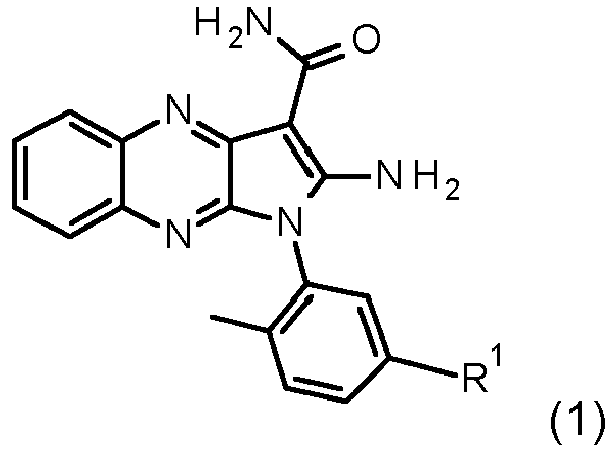
- The substituent R1 is in meta position in relation to the attachment position of the benzene moiety to the parent moiety and in para position to the attachment position of the CH3-moety yielding a 1, 2, 5 substitution pattern with the parent moiety being in the
position 1. This substitution pattern favorably distorts the planarity of the inventive compounds and increases their solubility in aqueous media, while optimizing the inventive compound conformation within and volume-filling of the target protein binding site. - Furthermore, the substituent R1 comprises a Donor-Acceptor moiety, namely a functional group OH, which is capable of providing hydrogen bonds as well as accepting hydrogen bonds, notably to Glu664 of EphB4.
- In some embodiments, the compound of the invention is 2-amino-1-(5-hydroxy-2-methyl-phenyl)pyrrolo[3,2-b]quinoxaline-3-carboxamide


- In some embodiments, the compounds of the
general formula 1 may be isolated in form of salts, in particular in form of pharmaceutically acceptable salts. The same applies to all of the before mentioned embodiments. - In some embodiments, the compounds of the
general formula 1 may be isolated in form of a tautomer, a hydrate or a solvate. - Such salts are formed, for example, as acid addition salts, preferably with organic or inorganic acids, from compounds of the
general formula 1 with a basic nitrogen atom, in particular the pharmaceutically acceptable salts are formed in such a way. Suitable inorganic acids are, without being limited to, halogen acids, such as hydrochloric acid, sulfuric acid, or phosphoric acid and the like. Suitable organic acids are, without being limited to, carboxylic, phosphonic, sulfonic or sulfamic acids and the like. Such organic acids may be, without being limited to, acetic acid, glycolic acid, lactic acid, malic acid, tartaric acid, or citric acid. - Salts may also be formed, for example, as salts with organic or inorganic bases, from compounds of the
general formula 1 with a nitrogen atom bearing an acidic hydrogen. Examples of suitable cations are - without being limited to - sodium, potassium, calcium or magnesium cations, or cations of organic nitrogen bases, e.g. protonated mono-, di- or tri-(2-hydroxethyl)amine. - In view of the close relationship between the novel compounds in their free form and those in the form of their salts, any reference to the free compounds hereinbefore and hereinafter is to be understood as referring also to the corresponding salts, as appropriate and expedient. Likewise, in view of the close relationship between the novel compounds of the
general formula 1 and their tautomers, any reference to the compounds of thegeneral formula 1 is to be understood as referring also to the corresponding tautomers. The same applies to a hydrate or a solvate. - Another aspect of the invention relates to a pharmaceutical preparation comprising at least one compound according to one of the
claims 1 to 3 as an active ingredient. - In some embodiments, the pharmaceutical preparation comprises at least one compound according to the invention as an active ingredient and at least one pharmaceutically acceptable carrier.
- In some embodiments, the pharmaceutical preparation comprises at least one compound according to the invention in its free form as an active ingredient.
- In some embodiments, the pharmaceutical preparation comprises at least one compound according to the invention in its free form as an active ingredient and at least one pharmaceutically acceptable carrier.
- In some embodiments, the pharmaceutical preparation comprises at least one compound according to the invention in form of a salt, a tautomer, a pharmaceutically acceptable salt, a hydrate or a solvate.
- In some embodiments, the pharmaceutical preparation comprises at least one compound according to the invention in form of a salt, a tautomer, a pharmaceutically acceptable salt, a hydrate or a solvate and at least one pharmaceutically acceptable carrier.
- Furthermore the invention relates to pharmaceutical preparations comprising at least one compound mentioned hereinbefore as active ingredient, which can be used especially in the treatment of the diseases mentioned. The pharmaceutical preparations may be used in particular for a method for treatment of cancer or intraocular neovascular syndromes, more particularly for a method for treatment of cancer.
- In some embodiments, the pharmaceutical preparations is for enteral administration, such as nasal, buccal, rectal or, especially, oral administration, and for parenteral administration, such as intravenous, intramuscular or subcutaneous administration, to warm-blooded animals, in particular humans, are especially preferred. The preparations comprise the active ingredient alone or, in particular, together with a pharmaceutically acceptable carrier. The dosage of the active ingredient depends upon the disease to be treated and upon the species, its age, weight, and individual condition, the individual pharmacokinetic data, and the mode of administration.
- In some embodiments, a pharmaceutical preparation for the treatment of angiogenesis dependent cancers and intraocular neovascular syndromes, in particular for a method for treatment of cancer, of a warm-blooded animal, in particular a human requiring such treatment, comprises a compound of the
general formula 1 as active ingredient in a quantity that is therapeutically active against the said diseases. - In some embodiments, the pharmaceutical preparations comprise from approximately 1% to approximately 95% active ingredient. Unit dose forms are, for example, coated and uncoated tablets, ampoules, vials, suppositories, or capsules. Further dosage forms are, for example, ointments, creams, pastes, foams, tinctures, lip-sticks, drops, sprays, dispersions, etc. Examples are capsules containing from about 0.05 g to about 1.0 g active ingredient.
- In some embodiments, the pharmaceutical preparations of the present invention are prepared in a manner known per se, for example by means of conventional mixing, granulating, coating, dissolving or lyophilizing processes.
- In some embodiments, the pharmaceutical preparations is in form of solutions of the active ingredient, and also suspensions or dispersions, especially isotonic aqueous solutions, dispersions or suspensions which, for example in the case of lyophilized preparations comprising the active ingredient alone or together with a carrier, for example mannitol, can be made up before use.
- In some embodiments, the pharmaceutical preparations may be sterilized and/or may comprise excipients, for example preservatives, stabilizers, wetting agents and/or emulsifiers, solubilizers, salts for regulating osmotic pressure and/or buffers and are prepared in a manner known per se, for example by means of conventional dissolving and lyophilizing processes. The said solutions or suspensions may comprise viscosity-increasing agents, typically sodium carboxymethylcellulose, carboxymethylcellulose, dextran, polyvinylpyrrolidone, or gelatins, or also solubilizers, e.g. Tween 80® (polyoxyethylene(20)sorbitan mono-oleate).
- In some embodiments, the pharmaceutical preparation comprises suspensions in oil, which comprise as the oil component a vegetable, synthetic, or semi-synthetic oils customary for injection purposes.
- In some embodiments, the pharmaceutical preparation comprises liquid fatty acid esters that contain as the acid component a long-chained fatty acid having from 8 to 22, especially from 12 to 22, carbon atoms. The alcohol component of these fatty acid esters has a maximum of 6 carbon atoms and is a monovalent or polyvalent, for example a mono-, di- or trivalent, alcohol, especially glycol and glycerol.
- In some embodiments, the pharmaceutical preparation comprises mixtures of fatty acid esters, vegetable oils such as, without being limited to, cottonseed oil, almond oil, olive oil, castor oil, sesame oil, soybean oil and groundnut oil.
- The manufacture of injectable preparations is usually carried out under sterile conditions, as is the filling, for example, into ampoules or vials, and the sealing of the containers.
- Suitable carriers are especially fillers, such as sugars, for example lactose, saccharose, mannitol or sorbitol, cellulose preparations, and/or calcium phosphates, for example tricalcium phosphate or calcium hydrogen phosphate, and also binders, such as starches, for example corn, wheat, rice or potato starch, methylcellulose, hydroxypropyl methylcellulose, sodium carboxymethylcellulose, and/or polyvinylpyrrolidone, and/or, if desired, disintegrators, such as the above-mentioned starches, also carboxymethyl starch, crosslinked polyvinyl pyrrolidone, alginic acid or a salt thereof, such as sodium alginate. Additional excipients are especially flow conditioners and lubricants, for example silicic acid, talc, stearic acid or salts thereof, such as magnesium or calcium stearate, and/or polyethylene glycol, or derivatives thereof.
- Tablet cores can be provided with suitable, optionally enteric, coatings through the use of, inter alia, concentrated sugar solutions which may comprise gum arabic, talc, polyvinylpyrrolidone, polyethylene glycol and/or titanium dioxide, or coating solutions in suitable organic solvents or solvent mixtures, or, for the preparation of enteric coatings, solutions of suitable cellulose preparations, such as acetylcellulose phthalate or hydroxypropylmethylcellulose phthalate. Dyes or pigments may be added to the tablets or tablet coatings, for example for identification purposes or to indicate different doses of active ingredient.
- In some embodiments, the pharmaceutical preparation is suitable for oral administration also include hard capsules consisting of gelatin, and also soft, sealed capsules consisting of gelatin and a plasticizer, such as glycerol or sorbitol. The hard capsules may contain the active ingredient in the form of granules, for example in admixture with fillers, such as corn starch, binders, and/or glidants, such as talc or magnesium stearate, and optionally stabilizers. In soft capsules, the active ingredient is preferably dissolved or suspended in suitable liquid excipients, such as fatty oils, paraffin oil or liquid polyethylene glycols or fatty acid esters of ethylene or propylene glycol, to which stabilizers and detergents, for example of the polyoxy ethylene sorbitan fatty acid ester type, may also be added.
- In some embodiments, the pharmaceutical preparation is suitable for rectal administration are, for example, suppositories that consist of a combination of the active ingredient and a suppository base. Suitable suppository bases are, for example, natural or synthetic triglycerides, paraffin hydrocarbons, polyethylene glycols or higher alkanols.
- In some embodiments, the pharmaceutical preparation is suitable for parenteral administration, aqueous solutions of an active ingredient in water-soluble form or aqueous injection suspensions that contain viscosity-increasing substances, for example sodium carboxymethylcellulose, sorbitol and/or dextran, and, if desired, stabilizers, are especially suitable. The active ingredient, optionally together with excipients, can also be in the form of a lyophilizate and can be made into a solution before parenteral administration by the addition of suitable solvents. Solutions such as are used, for example, for parenteral administration can also be employed as infusion solutions.
- Preferred preservatives are, for example, antioxidants, such as ascorbic acid, or microbicides, such as sorbic acid or benzoic acid.
- A further aspect of the invention relates to a compound according to any of the
claims 1 to 3 or a pharmaceutical preparation according toclaim 4 for use in a method of treatment of disease. - The compounds of the
general formula 1 have valuable pharmacological properties. - Compounds of the
general formula 1 inhibit Ephrin receptor kinases, in particular EphB4 kinase, are modulating angiogenesis, and are especially appropriate for the use against diseases or disorders such as cancer including, but not limited to, colon cancer and angiogenesis-dependent cancers, intraocular neovascular syndromes and related diseases, e.g. psoriasis and rheumathoid arthritis (see e.g. Folkman et al., J. Biol. Chem. 267:10931-34 (1992); Klagsbrun et al., Annu. Rev. Physiol. 53:217-39 (1991); and Garner A., In: Pathobiology of Ocular Disease. A Dynamic Approach, 2nd Edition (Marcel Dekker, NY, 1994), pp 1625-1710). - Angiogenesis-dependent cancers are, for example, so-called solid tumors, especially cancers of the gastrointestinal tract, the pancreas, breast, stomach, cervix, bladder, kidney, prostate, ovaries, endometrium, lung, brain, melanoma, Kaposi's sarcoma, squamous cell carcinoma of head and neck, malignant pleural mesotheriorna, lymphoma or multiple myeloma, also haemangioblastoma and haemangioma, and further liquid tumors, e.g. leukemias.
- Intraocular neovascular syndromes are e.g. diabetic retinopathy, neovascular glaucoma, ischemic retinopathies and macular degeneration, e.g. age-related macular degeneration. Other angiogenesis related diseases are restenosis, e.g. stent-induced restenosis, Crohn's disease, and Hodgkin's disease.
- Furthermore the invention relates to a method of treatment of angiogenesis dependent cancers and intraocular neovascular syndromes in a patient in need thereof, characterized in that a therapeutically effective amount of a compound of
formula 1 as described hereinbefore as such or in form of a pharmaceutical preparation comprising it is administered to the patient in need thereof. - Another aspect of the invention relates to a compound according to any of the
claims 1 to 3 or a pharmaceutical preparation according toclaim 4 for use in a method for treatment of cancer or intraocular neovascular syndromes, in particular for a method for treatment of cancer. The compounds of thegeneral formula 1 can be administered as such or especially in the form of pharmaceutical preparations, preferably in an amount effective against the said diseases, to a warm-blooded animal, for example a human, requiring such treatment. In the case of an individual having a bodyweight of about 70 kg the daily dose administered is from approximately 0.05 g to approximately 5 g, preferably from approximately 0.25 g to approximately 1.5 g, of a compound of the present invention. -
-
Fig.1 shows the selectivity profile ofcompound 2 with respect to protein kinases; -
Fig.2 shows the selectivity profile of dasatinib with respect to protein kinases as published by DiscoveRx at www.discoverx.com/tools-resources/interaction-maps; the legend applicable toFig. 2-4 is inFig. 2 ; -
Fig.3 shows the selectivity profile of erlotinib with respect to protein kinases as published by DiscoveRx at www.discoverx.com/tools-resources/interaction-maps; -
Fig.4 shows the selectivity profile of sunitinib with respect to protein kinases as published by DiscoveRx at www.discoverx.com/tools-resources/interaction-maps; -
Fig.5 shows the log base-10 values of GI50, TGI and LC50 (as defined and measured according to the Examples section hereafter) ofcompound 2, as well as a graphical representation of the Z-score of each given value (GI50, TGI, LC50) for a given cell line relative to the mean and standard deviation of that value for all 60 cell lines of the NCI-60 panel of cancer cell-lines -
Fig.6 shows the effect ofcompound 2 on MDA-MB-231 breast cancer cells implanted subcutaneously in xenograft mouse models. - A selectivity profile of
compound 2 with respect to protein kinases is depicted inFigure 1 . The protein kinases are selected from tyrosine kinases (TK), tyrosine kinase-like kinases (TKL), STE-Group, Cell Kinases 1 (CK1), AGC-Group, Calmodulin/Calcium regulated kinases (CAMK), CMGC Group and other kinases. The larger the respective dot, the higher the binding affinity of the compound to the respective protein kinases.Compound 2 shows selectivity towards tyrosine kinases (TK). Furthermorecompound 2 shows a selective binding affinity relative to one or more of the following protein kinases: ABL1(F317L)-phosphorylated, ABL1 (H396P)-phosphorylated, ABL1 (Y253F)-phosphorylated, ABL1-phosphorylated, ABL2, ACVR2B, BLK, BMPR1 B, BRAF(V600E), BRK, CSF1R, CSK, DDR1, EPHA1, EPHA2, EPHA4, EPHA5, EPHA8, EPHB1, EPHB2, EPHB3, EPHB4, EPHB6, FGR, FLT3, FLT3(ITD), FRK, FYN, HCK, KIT, KIT(D816V), KIT(V559D), KIT(V559D, V654A), LCK, LYN, PDGFRB, PKMYT1, RET, RET(M918T), SRC, TGFBR1, TNNI3K, TXK, YES. As per Kawasaki Y. and Freire E. in Drug Discovery Today, 2011 November; 16(21-22): 985-990, "[e]xtremely high affinity and selectivity are two of the most sought-after properties of drug molecules." -
Figure 2 (dasatinib; N-(2-chloro-6-methylphenyl)-2-[[6-[4-(2-hydroxyethyl)-1-piperazinyl]-2-methyl-4-pyrimidinyl]amino]-5-thiazole carboxamide),Figure 3 (erlotinib; N-(3-Ethinylphenyl)-6,7-bis- (2-methoxyethoxy)chinazolin-4-amine) andFigure 4 (sunitinib; -[2-(Diethylamino)ethyl]-5-[(Z)- (5-fluor-1,2-dihydro-2-oxo-3H-indol-3-yliden)- methyl] -2,4-dimethyl-1 H-pyrrol-3-carboxamide) show the selectivity of FDA approved known compounds for comparison. -
Compound 2 was screened by the National Cancer Institute (NCI) at 5 doses on the NCI-60 DTP Human Tumor Cell Line Screen.Figure 5 shows the high potency (low GI50 and/or TGI and/or LC50) ofcompound 2 relative to select cell-lines, including but not limited to the SNB-75 glioblastoma-grade IV cells, K562 myelogenous leukemia cells, A498 renal carcinoma cells, LOX IMV1 melanoma cells, andHS 578T and MDA-MB-231 breast cancer cells. - The effect of
compound 2 on MDA-MB-231 breast cancer cells was examined. The breast cancer cells were implanted subcutaneously in xenograft mouse models and the development of the body weight and the tumor volume were observed over time (21 days).Group 1 is the vehicle control group consisting of 9 animals, whereasgroup 2 consisted of 9 animals receiving 50 mg/kg ofcompound 2 twice-daily. As could be seen inFigure 6 ,compound 2 provides a remarkable group-median tumor volume control. - All reactions, unless otherwise stated, were carried out under a nitrogen atmosphere using standard Schlenk-techniques. All reagents were used as received unless otherwise noted. Solvents were purchased in the best quality available, degassed by purging thoroughly with nitrogen and dried over activated molecular sieves of appropriate size.
- Alternatively, they were purged with argon and passed through alumina columns in a solvent purification system (Innovative Technology). Reactions were monitored by thin layer chromatography (TLC) using Merck
TLC silica gel 60 F254. Flash column chromatography was performed over silica gel (230-400 mesh). NMR spectra were recorded onAV2 400 orAV2 500 MHz Bruker spectrometers. Chemical shifts are given in ppm. The spectra are calibrated to the residual 1H and 13C signals of the solvents. - Multiplicities are abbreviated as follows: singlet (s), doublet (d), triplet (t), quartet (q), doublet-doublet (dd), quintet (quint), septet (sept), multiplet (m), and broad (br). Melting points were determined on a Büchi Melting Point B-540 instrument. 2,3-Dichloroquinoxaline, o-toluidine, 5-methoxy-2-methylaniline, 3-amino-4-methylbenzyl alcohol, 2,6-dimethylaniline, 2-chloro-6-methylaniline were purchased from Fluka.
- High-resolution electrospray ionization mass spectrometry was performed on a Finnigan MAT 900 (Thermo Finnigan, San Jose, CA, USA) double-focusing magnetic sector mass spectrometer. Ten spectra were acquired. A mass accuracy ≤2 ppm was obtained in the peak matching acquisition mode by using a solution containing 2 µL PEG200, 2 µL PPG450, and 1.5 mg NaOAc (all obtained from Sigma-Aldrich, Buchs, Switzerland) dissolved in 100 mL MeOH (HPLC Supra grade, Scharlau, E-Barcelona) as internal standard.
- A reaction pathway to the intermediate 5a is depicted in
scheme 1.
- The following is taken from (a) Pratt, E.F. and Kereszte.Jc. "Syntheses of Indolizino- and Dihydroindolizinoquinoxalines"J Org Chem 1967, 32 (1):49-53, and (b) Obafemi, C.A.; Pfleiderer, W. "Synthesis and some reactions of 3-chloro-2-(cyanomethylene)-1,2-dihydroquinoxalines." Molecules 2004, 9 (4):223-231. To a solution of 10.45 mmol NaH in anhydrous dimethoxyethane, 10.04 mmol malononitrile was added. The reaction mixture was stirred at 25 °C for 30 min and 5.02 mmol 2,3-dichloroquinoxaline (4) was added. The resulting mixture was stirred at 25 °C for 3 h and then heated to reflux for one additional hour. The reaction mixture was cooled to 0 °C and 30 mL of 0.4 M HCl was slowly added. After stirring for 30 min at 0 °C, the formed precipitate was filtered off and recrystallized in EtOH to afford 2-(3-Chloroquinoxalin-2(1 H)-ylidene)malononitrile (5a) in 74% yield.
- A reaction pathway to the
general formula 1 is depicted inscheme 2.
- To a mixture of 1 eq 2-(3-chloroquinoxalin-2-yl)malononitrile (5a) in a
reaction solvent 4 eq of the primary amine (6) was added. The reaction mixture was heated to a reaction temperature in the range of 50 to 150 °C for 2 to 4 h, in particular to 130 °C for 3 h, cooled, and the formed solid was filtered off and washed with a washing solution to afford the corresponding carbonitrile (7) in pure form. - In some embodiments, the reaction solvent is selected from the group consisting of toluene, methanol, ethanol (EtOH), isopropanol, dimethylformamide and mixtures thereof, and is preferably EtOH, toluene or a mixture thereof. In some embodiments, the reaction solvent is a 1:1 EtOH:Toluene solution. In some embodiments, the reaction mixture is heated to a reaction temperature of 130 to 160 °C for 3 h. In some embodiments, the washing solution is selected from the group consisting of EtOH, ether, hexane, pentane, toluene or mixtures thereof, and is preferably EtOH. In some embodiments, the reaction product is concentrated under reduced pressure and purified by flash chromatography on silica gel.
- Subsequently 1 eq of the carbonitrile (7) was dissolved in 0.15 M sulfuric acid and poured in ice cold basified water and the formed solid was filtered off and optionally washed with a washing solution. Extraction afforded the corresponding products (1) in pure form, wherein optionally the extraction is carried out at a certain temperature (e.g. 30 to 50 °C, preferably around 25°C). Optionally, the desired product may be washed with a washing solution. The organic layer was dried over MgSO4, filtered, and concentrated under reduced pressure yields the product. Optional purification by column chromatography on silica gel may be applied. Additionally or alternatively the product may be recrystallized.
- In some embodiments, the basified water has a pH in the range of 6.7 to 7.3, and in particular of 7.0. In some embodiments, the water was basified with a solution of ammonium hydroxide (25%), nitric oxide, NaOH or KOH. In some embodiments, the reaction product is extracted with EtOAc and a saturated solution of NaHCO3, EtOAc, acetone. In some embodiments, the reaction product is extracted at a temperature in the range of 20 to 30 °C. In some embodiments, the reaction product is extracted at a temperature of 160 °C with acetone. In some embodiments, the washing solution is selected from the group of ethanol, hexane and water. In some embodiments, the washing solution is water and hexane. In some embodiments, solvents for recrystallization are selected from the group consisting of ethanol and acetone. In some embodiments, a solvent for recrystallization is acetone.
- The primary amine is 3-amino-4-methyl-phenol (6a) for the production of
compound 2 or 3-amino-4-methyl-phenyl)methanol (3-Amino-4-methylbenzyl alcohol) (6b) for the production ofcompound 3, if a reactionpathway according scheme - Alternatively,
compound 2 can be produced by a selective reduction of the respective methoxy-compound (8). The reaction pathway is depicted in scheme 3:
- Compound 8 can be produced according to the reaction pathway depicted in
scheme -

- To a solution of 2-amino-1-(5-methoxy-2-methylphenyl)-1 H-pyrrolo[2,3-b]quinoxaline-3-carboxamide (8, 135 mg, 0.39 mmol) in anhydrous CH2Cl2 (5 mL) at -78 °C was added BBr3 (1 M in CH2Cl2, 972 µL, 0.97 mmol). The reaction was allowed to warm to room temperature and was then heated for 1 h to 130 °C. The formed solid was filtered off and purified by flash chromatography on silica gel (gradient EtOAc:MeOH 99:1 to 98:2) to afford the desired product in pure form (48 mg, 37% yield).
- 1H NMR (500 MHz, DMSO-d6 ): δ = 9.73 (s, 1 H), 8.02 (s, 2H), 7.94 (dd, J = 8.3 Hz, J = 1.3 Hz, 1 H), 7.78 (dd, J = 8.2 Hz, J = 1.3 Hz, 1 H), 7.75 (s, 1 H), 7.57 (ddd, J = 8.3 Hz, J = 6.9 Hz, J = 1.3 Hz, 1 H), 7.46 (ddd, J = 8.2 Hz, J = 6.9 Hz, J = 1.3 Hz, 1 H), 7.37 (s, 1 H), 7.30 (d, J = 8.4 Hz, 1 H), 6.94 (dd, J = 8.4 Hz, J = 2.5 Hz, 1 H), 6.81 (d, J = 2.5 Hz, 1 H), 1.88 (s, 3H);
13C NMR (125 MHz, DMSO-d6 ): δ = 166.6, 158.8, 156.3, 143.0, 141.4, 139.6, 136.8, 131.9, 131.3, 127.6, 126.8, 126.6, 125.1, 117.2, 116.2, 82.4, 16.2, one C missing due to overlapping;
IR (film): υ̃ = 3455, 3380, 3292, 3200, 1633, 1511, 1461, 1021, 753, 595 cm-1;
HRMS (ESI): m/z: calcd for C18H15N5O2H+: 334.1299, found: 334.1296. -

- A solution of 2-amino-1-(5-(hydroxymethyl)-2-methylphenyl)-1H-pyrrolo[2,3-b]quinoxaline-3-carbonitrile (7b, 186 mg, 0.56 mmol) in sulfuric acid (3 mL) was stirred for 30 min at 25 °C. The reaction was poured in ice cold water and the formed solid was filtered off and washed with water and hexane. The crude product was then heated in acetone (5 mL) at 160 °C for 1 h. After cooling to room temperature, the solid was filtered off and washed with hexane to afford the desired product in pure form (143 mg, 72% yield).
- 1H NMR (500 MHz, DMSO-d6 ): δ = 8.03 (s, 2H), 7.94 (dd, J = 8.3 Hz, J = 1.3 Hz, 1 H), 7.77-7.75 (m, 2H), 7.57 (ddd, J = 8.3 Hz, J = 7.0 Hz, J = 1.3 Hz, 1 H), 7.49-7.48 (m, 2H), 7.46 (ddd, J = 8.3 Hz, J = 7.0 Hz, J = 1.3 Hz, 1 H), 7.39-7.36 (m, 2H), 5.34 (t, J = 5.6 Hz, 1 H), 4.57 (d, J = 5.6 Hz, 2H), 2.00 (s, 3H);
- 13C NMR (125 MHz, DMSO-d6 ): δ = 166.6, 159.0, 143.1, 142.0, 141.4, 139.6, 136.8, 135.3, 131.0, 130.7, 127.9, 127.6, 127.4, 126.8, 126.6, 125.1, 82.5, 62.0, 16.9;
IR (film): υ̃= 3339, 3247, 3162, 1661, 1603, 1148, 1036, 876, 762, 702 cm-1;
HRMS (ESI): m/z: calcd for C19H17N5O2H+: 348.1455, found: 348.1458. -

- The following is taken from (a) Pratt, E. F. and Kereszte.Jc. "Syntheses of Indolizino- and Dihydroindolizinoquinoxalines." J Org Chem 1967, 32 (1):49-53, and (b) Obafemi, C. A.; Pfleiderer, W. "Synthesis and some reactions of 3-chloro-2-(cyanomethylene)-1,2-dihydroquinoxalines." Molecules 2004, 9 (4):223-231. To a solution of NaH (250 mg, 10.45 mmol) in anhydrous dimethoxyethane (20 mL) was carrefully added malononitrile (663 mg, 10.04 mmol). The reaction mixture was stirred at 25 °C for 30 min and 2,3-dichloroquinoxaline (4, 1 g, 5.02 mmol) was added. The resulting mixture was stirred at 25 °C for 3 h and then heated to reflux for one additional hour. The reaction mixture was cooled to 0 °C and 0.4 M HCl (30 mL) was slowly added. After stirring for 30 min at 0 °C, the formed precipitate was filtered off and recrystallized in EtOH to afford compound 5a in pure form (845 mg, 74% yield).
- 1H NMR (400 MHz, DMSO-d6 ): δ = 7.67-7.62 (m, 2H), 7.57 (ddd, J = 8.4 Hz, J = 6.8 Hz, J = 1.1 Hz, 1 H), 7.36 (ddd, J = 8.1 Hz, J = 6.8 Hz, J = 1.2 Hz, 1 H), NH-not observed;
13C NMR (100 MHz, DMSO-d6 ): δ = 149.3, 141.9, 134.8, 134.1, 131.3, 127.5, 125.5, 120.2, 118.6, 44.5, one C missing due to overlapping;
IR (film): υ̃= 3235, 3203, 3100, 3056, 3013, 2979, 2220, 2208, 1616, 1577, 1488, 1410, 1096, 969, 799, 764, 594 cm-1;
MS (ESI): m/z: calcd for C11H5ClN4Na+: 251.0, found: 250.9. -

- To a mixture of 2-(3-chloroquinoxalin-2-yl)malononitrile (5a, 1 eq) in a 1 : 1 EtOH-Toluene solution (0.09 M), the primary amine (6b, 4 eq of (3-amino-4-methylphenyl)methanol; HOCH2C6H3(CH3)NH2) was added. The reaction mixture was heated to 130 °C for 3 h, cooled, and the formed solid was filtered off and washed with EtOH to afford the corresponding products in pure form.
Yield: 74%; - 1H NMR (500 MHz, DMSO-d6 ): δ = 8.28 (s, 2H), 7.94 (d, J = 8.0 Hz, 1 H), 7.75 (d, J = 7.8 Hz, 1 H), 7.58 (ddd, J = 8.0 Hz, J = 7.1 Hz, J = 1.0 Hz, 1 H), 7.49-7.47 (m, 3H), 7.34 (s, 1 H), 5.33 (t, J = 5.5 Hz, 1 H), 4.56 (d, J = 5.5 Hz, 2H), 1.98 (s, 3H);
- 13C NMR (125 MHz, DMSO-d6 ): δ = 159.7, 143.6, 142.3, 142.1, 140.3, 137.2, 135.3, 131.1, 130.5, 128.1, 127.5, 127.4, 127.1, 126.8, 125.7, 115.1, 62.0, 60.3, 16.8;
IR (film): υ̃= 3343, 3309, 3124, 2208, 1637, 1550, 1446, 766, 599 cm-1;
HRMS (ESI): m/z: calcd for C19H15N5OH+: 330.1349, found: 330.1346. - 2-Amino-1-(5-methoxy-2-methylphenyl)-1H-pyrrolo[2,3-b]quinoxaline-3-carbonitrile (7c)

- To a mixture of 2-(3-chloroquinoxalin-2-yl)malononitrile (5a, 1 eq) in a 1 : 1 EtOH-Toluene solution (0.09 M), the primary amine (6c, 4 eq of 5-methoxy-2-methyl-aniline; CH3OC6H3(CH3)NH2) was added. The reaction mixture was heated to 130 °C for 3 h, cooled, and the formed solid was filtered off and washed with EtOH to afford the corresponding products in pure form (Yield: 53%).
- 1H NMR (500 MHz, DMSO-d6 ): δ = 8.30 (s, 2H), 7.94 (dd, J = 8.3 Hz, J = 1.3 Hz, 1 H), 7.77 (dd, J = 8.3 Hz, J = 1.3 Hz, 1 H), 7.58 (ddd, J = 8.3 Hz, J = 6.9 Hz, J = 1.3 Hz, 1 H), 7.48 (ddd, J = 8.3 Hz, J = 6.9 Hz, J = 1.3 Hz, 1 H), 7.41 (d, J = 8.5 Hz, 1 H), 7.13-7.09 (m, 2H), 3.77 (s, 3H), 1.91 (s, 3H);
13C NMR (125 MHz, DMSO-d6 ): δ = 159.6, 158.3, 143.6, 142.2, 140.3, 137.3, 131.9, 131.4, 128.7, 127.5, 127.0, 126.8, 125.6, 116.2, 115.2, 115.1, 60.2, 55.4, 16.2;
IR (film): υ̃ = 3315, 3144, 3061, 2208, 1636, 1546, 1506, 1447, 1313, 1209, 1030, 820, 760, 735 cm-1;
HRMS (ESI): m/z: calcd for C19H15N5OH+: 330.1349, found: 330.1348. -

- A solution of 2-amino-1-(5-(hydroxymethyl)-2-methylphenyl)-1H-pyrrolo[2,3-b]quinoxaline-3-carbonitrile (7c, 151.8 mg, 0.459 mmol) in sulfuric acid (3 mL) was stirred for 30 min at 25 °C. The reaction was poured in ice cold water, basified with a solution of ammonium hydroxide (25%) and the formed solid was filtered off. Extraction with EtOAc and a saturated solution of NaHCO3 afforded the corresponding products in pure form, (115 mg, 72% yield).
- 1H NMR (300 MHz, DMSO-d6 ): δ = 7.94 (d, J = 7.7 Hz, 1 H), 7.79-7.76 (m, 2H), 7.57 (ddd, J = 8.2 Hz, J = 6.9 Hz, J = 1.3 Hz, 1 H), 7.49-7.37 (m, 3H), 7.15-7.09 (m, 2H), 3.78 (s, 3H), 1.94 (s, 3H), NH2-not observed;
13C NMR (125 MHz, DMSO-d6 ): δ = 166.6, 158.9, 158.2, 143.1, 141.5, 139.6, 136.8, 131.8, 131.6, 128.7, 127.6, 126.8, 126.6, 125.1, 115.9, 115.0, 82.5, 55.4, 16.3;
IR (film): υ̃ = 3482, 3405, 3295, 3067, 2998, 2930, 1630, 1612, 1507, 1465, 1308, 1227, 1119, 1027, 817, 745, 596 cm-1;
HRMS (ESI): m/z: calcd for C19H17N5O2H+: 348.1455, found: 348.1454. - In the following, compounds 17 and 87 correspond to
prior art compounds Figure 5 in Zhao H. and Huang D., "Hydrogen Bonding Penalty upon Ligand Binding", PLoS ONE, 2011, . These were purchased from InterBioScreen. - Selected compounds were tested in the Z'-LYTE™ Kinase Assay Kit-
Tyr 1 Peptide (Invitrogen, USA) in a Corning 384 well microtiter plate. Fluorescence progress curves were measured upon excitation at 400 nm and emission at 445 and 520 nm. The assay contained a final concentration of EphB4 and ATP of 25 ng/µL and 125 µM (which is near its Km), respectively, and was run at room temperature for 2 h. IC50 Values (inhibitor concentration at which enzyme activity is reduced by 50%) are determined after carrying out assays at ten different concentrations between 20 µM and 10 pM.Compound 2 comprises an IC50 value on EphB4 of 11 nmol/L. In Zhao H. and Huang D. "Hydrogen Bonding Penalty upon Ligand Binding", PLoS ONE, 2011, compounds 17 and 87 (corresponding tocompounds Figure 5 therein) are reported to comprise IC50 values on EphB4 of 380 and 300 nmol/L, respectively. - The cellular phosphorylation experiments were performed at ProQinase GmbH. Mouse embryonic fibroblast cells, stably transfected to overexpress full-length human EphB4, were plated at 4×10⁴ cells/well in DMEM supplemented with 10% FCS in 48-well culture dishes. Medium was replaced by DMEM without FCS before test compounds prediluted in 100% DMSO were added (final DMSO concentration of 1 %). After incubation for 90 min at 37 °C, cells were stimulated for 2 h at 4 °C using murine ephrinB2-Fc at a final concentration of 2 µg/ml. Quantification of EphB4 phosphorylation was assessed in a 96-well plate via sandwich ELISA using a myc capture antibody and an antiphosphotyrosine detection antibody. Compounds were tested for their inhibitory impact on EphB4 cellular kinase activity as assessed by measurement of EphB4 autophosphorylation.
Compound 2 comprises a cellular IC50 value of less than 6 nmol/L. Compound 3 comprises an IC50 of 160 nmol/L. Prior art compound 17 comprises an IC50 of 640 nmol/L. Comparison compound 8 comprises an IC50 of 720 nmol/L. - MDA-MB-231 (breast cancer) and KM12 (colon cancer) cells obtained from the UZH Cancer Institute, HOP-92 (lung cancer) cells purchased from the National Cancer Institute (NCl) and A498 (kidney cancer) cells obtained from Prof. Krek (Institute of Cell Biology, ETH Zurich) were cultured in Dulbecco's modified Eagle's medium (DMEM) supplemented with 10% (v/v) fetal bovine serum. K562 leukemia cells obtained from Dr. Silvio Hemmi (Institute of Molecular Life Sciences, UZH) were cultured using RPMI medium supplemented with 5% (v/v) fetal bovine serum. All the media was additionally supplemented with 100 units/mL of penicillin, 100µg/mL of streptomycin, 4.5 g/L glucose, 0.11g/L sodium pyrubate and 2mM glutamine and the cells were grown at 37 °C in 5% CO2 atmosphere with 80% relative humidity.
- MDA-MB-231, HT-29, KM12, HOP-92 and A498 cells were plated at 10,000 cells per well (100 µL per well) in 96-well culture dishes and allowed to incubate for 24 h. The old media was removed, the cells were washed with PBS (phosphate-buffered saline) and fresh media was added. A 5 mmol/L solution of inhibitor (in 100% DMSO) was serially diluted in the culture media (12 different concentrations were used) and allowed to incubate for 72 h (MDA-MB-231) or 48h (A498). Control cells were treated with the same DMSO concentrations. After the incubation period the media was once more removed and the cells were washed with PBS to then be incubated with fresh media containing 86 nmol/L resazurin. After 3 hours, the fluorescence was quantified using a fluorescence microplate reader (Biotek, FLx800™) at the respective excitation and emission wavelength of 560 and 590 nm. Resazurin becomes fluorescent under mitochondrial reduction and its emission directly correlates with the metabolic stability of the cells. The measured fluorescence values were corrected from the control samples containing DMSO and GI50 values were determined by plotting the fraction of metabolically active cells against the log of the drug concentration. All measurements were performed at least in triplicate.
- In the case of K-562 leukemia cells, these were seeded at a density of 20,000 cells per well in 100µL of RMPI media in a 96 well microtiter plates. After 24 hours, 12.5 µL of a 10 fold concentrated test compound or DMSO solution in RMPI media was added in every well. After 48 hour incubation, cell viability was assessed by measuring the ability of the cells to process resazurin. Resazurin was added to every well to obtain a final concentration of 86nmol/L, and after 3 hours, the fluorescence was quantified using a fluorescence microplate reader (Biotek, FLx800™) at the respective excitation and emission wavelength of 560 and 590 nm as described above. All measurements were performed at least in triplicate.
Table 1a: GI50 MDA-MB-231 Compound no. GI50 (µmol/l) Compound 22.64 Table 1b: GI50 K562 Compound no. GI50 (µmol/l) Compound 21.05 Prior Art 17 35.63 Prior Art 87 73.07 Table 1c: GI50 A498 Compound no. GI50 (µmol/l) Compound 25.88 Compound 8 59.29 Prior Art 17 49.96 Prior Art 87 99.64 Table 1d: GI50 HT-29 Compound no. GI50 (µmol/l) Compound 24.59 Table 1e: GI50 KM12 Compound no. GI50 (µmol/l) Compound 21.55 Table 1f: GI50 HOP-92 Compound no. GI50 (µmol/l) Compound 20.49 -
Compound 2 was further screened against cancer cell lines by the National Cancer Institute (NCI). This screen was performed as per the description provided at http://dtp.nci.nih.gov/branches/btb/ivclsp.html. "TheNCI 60 panel cell lines were grown in RPMI 1640 medium supplemented with 5% (v/v) fetal bovine serum and 2 mM L-glutamine at 37° C, 5 % CO2, 95 % air and 100 % relative humidity. Cells were seeded at 5,000 - 40,000 cells/well depending on their doubling time. After 24 hours of incubation, DMSO stock solutions of the compounds (400X) were added at 5 different concentrations (in 4, 10 or ½ log serial dilutions). After 48 h cells were fixed with trichloroacetic acid (10% or 16% final concentration for adherent cells and suspension cells respectively) and incubated for 60 minutes at 4°C. After discarding the supernatant, plates were washed with water (5x) and air dried. Sulforhodamine B (SRB) solution (100 µl) at 0.4 % (w/v) in 1% acetic acid was added to each well and incubated for 10 minutes at 4°C, followed by washing with 1% acetic acid (5x) and air drying. The bound stain was solubilized with 10mM trizma base and determined by absorbance measurement on an automated plate reader at a wavelength of 515 nm. The percentage growth inhibition was calculated as followed, being Tz time zero measurements, C control growth measurements and Ti test growth experiments in the present of the drug.
[(Ti-Tz)/(C-Tz)] x 100 for concentrations for which Ti>/=Tz
[(Ti-Tz)/Tz] x 100 for concentrations for which Ti<Tz. - Three dose response parameters were calculated for each cell line. Growth inhibition of 50% (GI50) is calculated from [(Ti-Tz)/(C-Tz)] x 100 = 50 and corresponds to the drug concentration required in order to reduce by 50% the net protein increase in comparison to the control experiments. Total growth inhibition (TGI) is calculated from Ti = Tz. The LC50 indicates the drug concentration needed to reduce by 50% the measured protein at the end of the drug treatment as compared to that of the beginning and is derived from [(Ti-Tz)/Tz] x 100 = -50."
Table 2: GI50 in a selection of cancer cell lines of the National Cancer Institute for compound 2Cell line GI50 (µmol/l) Renal RXF393 0.361 Renal A498 0.162 CNS SNB75 0.028 Colon HT29 0.244 Leukemia K562 0.229 Breast HS578T/MDA-MB-231 0.100/0.317 NSCLC HOP92 0.152 - The affinity of
compound 2 towards EphA3 was determined using Surface Plasmon Resonance measurements on a ProteOn XPR36 (Bio-Rad Laboratories, AG). EphA3 was immobilized on a GLH chip (Bio-Rad Laboratories AG) by standard amine coupling procedures achieving a RU of 4000-6000 and equilibrated with steriled-filtered buffer (10mM HEPES, 150mM NaCl, 3mM EDTA, 0.005% Tween 20 pH 8.0) with a flow rate of 60µL/min. Association ofcompound 2 was performed at 25 °C using serial dilutions of the inhibitors in duplicates for 400s, whereas dissociation of the inhibitors from the chip was monitored for 36,000 seconds. Data were normalized using interspot referencing and subtraction of a separate analyte channel run with buffer and BSA. All sensograms were fitted using a 1:1 Langmuir model provided by the ProteOn Manager Software (Bio-Rad Laboratories AG), and the association (kon) and dissociation (keff) rate constants were used to determine the equilibrium dissociation constants (KD). -
Compound 2 comprises a dissociation constant (KD) of 6 nmol/L, an association rate constant kon of 2 * 106/µs (the association rate constant characterizes how quickly the compound binds to its target) and τoff of 658 s (is the residence time, the time the compound remains associated on the target; τoff is the reciprocal value of koff, which is the dissociation rate constant). According to the abstract by Manley P. et al. entitled "Nilotinib, in Comparison to Both Dasatinib and Imatinib, Possesses a Greatly Prolonged Residence Time When Bound to the BCR-ABL Kinase SH1 Domain" of the December 2011 53rd ASH (American Society of Hematology) Annual Meeting and Exposition (https://ash.confex.com/ash/2011/webprogram/Paper35985.html), the residence time is comparable with that of marketed drugs: imatinib (28 min for dephosphorylated ABL), nilotinib (202 or 205 min for dephosphorylated and phosphorylated ABL, respectively) and dasatinib (15 or 4 min). Long residence time favors not only in vivo drug efficacy but also in vivo selectivity due to the resulting high local concentration of the drug in the vicinity of the target (Nat. Rev. Drug Discov. 2006, 5, 730-739, J. Biomol. Screen September 30, 2013). - To a 2 µmol/L solution of EphA3 in 10mM Tris HCl buffer (pH 8.0) containing 100mM NaCl, 5X SYPRO Orange fluorescent dye together with the test compounds prediluted in DMSO at a concentration of 20 µmol/L (1.4% final DMSO concentration). A final volume of 40 µL was added per well in a 96-well plate and incubated at room temperature for 1 h. The plates were centrifuged for 3 min at 450 rcf. The temperature gradient was performed in the range of 25 to 75 °C (50 acquisitions per degree at a ramp rate of 4.4 °C/s) using a LightCycler 480 Real-Time PCR System. The detection of protein unfolding was performed with an excitation wavelength of 488 nm and an emission of 580 nm. All measurements were performed in triplicate.
Compound 2 comprises a difference in the melting temperature Tm (corresponding to the temperature at which the concentrations of folded and unfolded protein are equal) with respect to EphA3 of 11.44 °C (Δ Tm), whereas prior art compounds 17 and 87 presented differences in the melting temperature Tm with respect to EphA3 of 1.6 and 0.7 °C, respectively. The high shift in melting temperature provided bycompound 2 attests to it strongly binding EphA3, thereby significantly shifting the protein melting temperature. - Evaluation of the in vivo pharmacokinetics of a subset of compounds was performed through analysis of compound concentration in the blood plasma of male CD-1 (ICD) mice (each weighing 20-30 g) over a 24 hour period (at time points of 3, 10, 30, 60, 120, 240, 360 and 1440 minutes) following a single oral (PO) and intravenous (IV, in tail vein) administration of a compound dose corresponding to 5 mg of compound/kg of mouse body weight (PO) and 1 mg of compound/kg of mouse body weight (IV). For IV dosing, each compound was formulated as a clear solution in DMSO/
Solutol® HS 15/phosphate-buffered saline, pH 7.4 (PBS) (5/5/90, v/v/v). For PO dosing, compounds were formulated as a homogeneous suspension in DMSO/1% methylcellulose (5/95, v/v). - At the relevant time point, blood samples (300-400 µL) were collected from the mice under general inhalant anaesthesia by cardiac puncture and stored on ice in 0.6 mL polypropylene heparin-lithium-coated tubes. Within 1 hour of collection, each tube was centrifuged at 2500 G for 15 minutes at 4°C and harvested plasma stored at -20°C.
- Compound concentration in plasma at each time point was determined following acetonitrile precipitation of each sample followed by HPLC-MS analysis performed in triplicates, i.e., based on the mean of the compound concentration at that time point in blood samples of three mice.
- In the following table 3:
- T1/2 is the terminal elimination half-life following IV and PO dosing (obtained from non-compartmental analysis (NCA) of the plasma data using WinNonLin).
- Tmax is the time following PO administration at which the maximum concentration is observed (obtained from non-compartmental analysis (NCA) of the plasma data using WinNonLin).
- Cmax corresponds to the concentration observed at Tmax following PO administration (obtained from non-compartmental analysis (NCA) of the plasma data using WinNonLin).
- Bioavailability was calculated as the ratio of:
- [AUClast(PO)*Dose(IV)] / [AUClast(IV)*Dose(PO)]
- where AUClast is the area under the curve (estimated by summing incremental areas of a series of trapezoids) of a plot of compound concentration versus time, up to the time of the last observation that is greater than the limit of quantification.
- 9 week old female NCr Nu/Nu mice (Charles River Laboratories, Inc.) were injected at the flank with 5x10⁶ MDA-MB-231 cells. Once tumor volume reached 108-126 mm3 (as measured by digital caliper) mice were randomized into a treatment and vehicle-control group of 9 animals each. The treatment group received oral doses of 50 mg/kg of
compound 2 twice daily for 21 days (with the exception of a single dose on the first day), formulated as a homogeneous suspension in DMSO/1% methylcellulose (5/95, v/v). The control group received the same formulation but excludingcompound 2. Tumor volume of all mice was evaluated bi-weekly up today 19. Median tumor volume progression of both groups is given inFigure 6 .
| Compound no. | T1/2 (min, IV) | T1/2 (min, PO) | Cmax (ng/ml, PO) | Tmax (min, PO) | Bioavailibility (%) |
| | 101 | 100 | 240 | 30 | 25 |
Claims (9)
- A compound characterized by a general formula (1),

- The compound according to claim 1, wherein R1 is OH.
- The compound according to any of the previous claims, wherein the compound is isolated in its free form, in form of a salt, a tautomer, a pharmaceutically acceptable salt, a hydrate or a solvate
- A pharmaceutical preparation comprising at least one compound according to any one of the claims 1 to 3 as an active ingredient.
- A compound according to any of the claims 1 to 3 or a pharmaceutical preparation according to claim 4 for use in a method of treatment of disease.
- A compound according to any of the claims 1 to 3 or a pharmaceutical preparation according to claim 4 for use in a method of treatment of cancer or intraocular neovascular syndromes, in particular for use in a method of treatment of cancer.
- A dosage form for use in a method for preventing of treating of disease, in particular in a method for treatment of cancer or intraocular neovascular syndromes, comprising a compound according to any one of claims 1 to 3.
- A method for manufacture a medicament for use in a method for preventing or treating of disease, in particular in a method for treatment of cancer or intraocular neovascular syndromes, comprising the use of a compound according to any one of claims 1 to 3.
- A method for preventing or treating of disease, in particular a method for preventing or treating of cancer or intraocular neovascular syndromes, comprising the administration of a compound according to any one of claims 1 to 3 or a pharmaceutical preparation according to claim 4 to a patient in need thereof.
Priority Applications (2)
| Application Number | Priority Date | Filing Date | Title |
|---|---|---|---|
| EP14162148.2A EP2924040A1 (en) | 2014-03-27 | 2014-03-27 | 2-Amino-1-(o-tolyl)pyrrolo[3,2-b]quinoxaline-3-carboxamide derivates |
| PCT/EP2015/056812 WO2015144923A1 (en) | 2014-03-27 | 2015-03-27 | 2-amino-1-(o-tolyl)pyrrolo[3,2-b]quinoxaline-3-carboxamide derivates |
Applications Claiming Priority (1)
| Application Number | Priority Date | Filing Date | Title |
|---|---|---|---|
| EP14162148.2A EP2924040A1 (en) | 2014-03-27 | 2014-03-27 | 2-Amino-1-(o-tolyl)pyrrolo[3,2-b]quinoxaline-3-carboxamide derivates |
Publications (1)
| Publication Number | Publication Date |
|---|---|
| EP2924040A1 true EP2924040A1 (en) | 2015-09-30 |
Family
ID=50382353
Family Applications (1)
| Application Number | Title | Priority Date | Filing Date |
|---|---|---|---|
| EP14162148.2A Withdrawn EP2924040A1 (en) | 2014-03-27 | 2014-03-27 | 2-Amino-1-(o-tolyl)pyrrolo[3,2-b]quinoxaline-3-carboxamide derivates |
Country Status (2)
| Country | Link |
|---|---|
| EP (1) | EP2924040A1 (en) |
| WO (1) | WO2015144923A1 (en) |
Families Citing this family (2)
| Publication number | Priority date | Publication date | Assignee | Title |
|---|---|---|---|---|
| US12435090B2 (en) | 2021-10-04 | 2025-10-07 | Repare Therapeutics Inc. | Compounds, pharmaceutical compositions, and methods of preparing compounds and of their use |
| US20250197405A1 (en) * | 2022-03-15 | 2025-06-19 | Insilico Medicine Ip Limited | Heteroaromatic compounds as pkmyt1 inhibitors and use thereof |
-
2014
- 2014-03-27 EP EP14162148.2A patent/EP2924040A1/en not_active Withdrawn
-
2015
- 2015-03-27 WO PCT/EP2015/056812 patent/WO2015144923A1/en not_active Ceased
Non-Patent Citations (19)
| Title |
|---|
| CHENG N.; BRANTLEY D.M.; CHEN J., CYTOKINE GROWTH FACTOR REV., vol. 13, 2002, pages 75 - 85 |
| FOLKMAN ET AL., J. BIOL. CHEM., vol. 267, 1992, pages 10931 - 34 |
| GARNER A.: "Pathobiology of Ocular Disease. A Dynamic Approach", 1994, MARCEL DEKKER, pages: 1625 - 1710 |
| HONGTAO ZHAO ET AL: "Hydrogen Bonding Penalty upon Ligand Binding", PLOS ONE, vol. 6, no. 6, 17 June 2011 (2011-06-17), pages e19923, XP055130798, ISSN: 1932-6203, DOI: 10.1371/journal.pone.0019923 * |
| J. BIOMOL. SCREEN, 30 September 2013 (2013-09-30) |
| KAWASAKI Y.; FREIRE E., DRUG DISCOVERY TODAY, vol. 16, no. 21-22, November 2011 (2011-11-01), pages 985 - 990 |
| KLAGSBRUN ET AL., ANNU. REV. PHYSIOL., vol. 53, 1991, pages 217 - 39 |
| LAFLEUR ET AL: "Design and synthesis of selective kinase inhibitors", 23 January 2012, DISSERTATION,, PAGE(S) 166PP, XP009179379 * |
| MANLEY P. ET AL.: "Nilotinib, in Comparison to Both Dasatinib and Imatinib, Possesses a Greatly Prolonged Residence Time When Bound to the BCR-ABL Kinase SH1 Domain", 53RD ASH (AMERICAN SOCIETY OF HEMATOLOGY) ANNUAL MEETING AND EXPOSITION, December 2011 (2011-12-01), Retrieved from the Internet <URL:https://ash.confex.com/ash/2011/webprogram/Paper35985.html> |
| MARTINY-BARON G. ET AL., ANGIOGENESIS, vol. 13, no. 3, 2010, pages 259 - 67 |
| MIYAZAKI Y. ET AL., BIOORG. MED. CHEM. LETT., vol. 17, 2007, pages 250 - 254 |
| NAT. REV. DRUG DISCOV., vol. 5, 2006, pages 730 - 739 |
| OBAFEMI, C.A.; PFLEIDERER, W.: "Synthesis and some reactions of 3-chloro-2-(cyanomethylene)-1,2-dihydroquinoxalines.", MOLECULES, vol. 9, no. 4, 2004, pages 223 - 231 |
| PFLEIDERER, W.: "Synthesis and some reactions of 3-chloro-2-(cyanomethylene)-1,2-dihydroquinoxalines.", MOLECULES, vol. 9, no. 4, 2004, pages 223 - 231 |
| PRATT, E. F.; KERESZTE.JC.: "Syntheses of Indolizino- and Dihydroindolizinoquinoxalines.", J ORG CHEM, vol. 32, no. 1, 1967, pages 49 - 53 |
| PRATT, E.F.; KERESZTE.JC.: "Syntheses of Indolizino- and Dihydroindolizinoquinoxalines", J ORG CHEM, vol. 32, no. 1, 1967, pages 49 - 53 |
| ZHAO H.; HUANG D., PLOS ONE, vol. 6, no. 6, 2011 |
| ZHAO H.; HUANG D.: "Hydrogen Bonding Penalty upon Ligand Binding", PLOS ONE, 2011 |
| ZHAO H.; HUANG D.: "Hydrogen Bonding Penalty upon Ligand Binding", PLOS ONE, vol. 6, no. 6, 2011, XP055130798, DOI: doi:10.1371/journal.pone.0019923 |
Also Published As
| Publication number | Publication date |
|---|---|
| WO2015144923A9 (en) | 2015-12-30 |
| WO2015144923A1 (en) | 2015-10-01 |
Similar Documents
| Publication | Publication Date | Title |
|---|---|---|
| CN102264725B (en) | Protein kinase inhibitors | |
| KR101546493B1 (en) | [12-] [15-] Imidazo[12-B]pyridazine and pyrazolo[15-A]pyrimidine derivatives and their use as protein kinase inhibitors | |
| US7820821B2 (en) | Benzazole derivatives, compositions, and methods of use as aurora kinase inhibitors | |
| JP4845379B2 (en) | Imidazopyridine as a cyclin-dependent kinase inhibitor | |
| CN107652284B (en) | CDK inhibitors for the treatment of proliferative diseases | |
| US11932647B2 (en) | Cyclic iminopyrimidine derivatives as kinase inhibitors | |
| TWI401255B (en) | Compound for inhibiting mitosis | |
| CN114057771B (en) | Macrocyclic compounds and their preparation methods and applications | |
| TW200829582A (en) | Anilinopiperazine derivatives and methods of use thereof | |
| TWI523856B (en) | BCR-ABL kinase inhibitor and its application | |
| KR20230124648A (en) | Solid Forms of EIF4E Inhibitors | |
| EP3418277B1 (en) | Substituted amino six-membered nitric heterocyclic ring compound and preparation and use thereof | |
| WO2015144926A1 (en) | 2-amino-1-phenyl-pyrrolo[3,2-b]quinoxaline-3-carboxamide derivates | |
| CN104066736B (en) | Substituted pyrazolopyrimidines as AKT kinase inhibitors | |
| WO2015144923A9 (en) | 2-amino-1-(o-tolyl)pyrrolo[3,2-b]quinoxaline-3-carboxamide derivates | |
| JP2010528088A (en) | Kinase inhibitor | |
| AU2020374269A1 (en) | Novel heterocyclic-substituted pyrimidine derivative exhibiting cancer cell growth inhibitory effect, and pharmaceutical composition containing same | |
| WO2022218276A1 (en) | Solid form of fluorine-containing macrocyclic structure compound, preparation method, and application | |
| JP2021526150A (en) | Pyrazolopyrimidine compounds as adenosine receptor antagonists | |
| WO2011009695A1 (en) | New anti-angiogenic compounds | |
| KR20130098982A (en) | Crystal of tricyclic pyrazolopyrimidine derivative | |
| HK1125631B (en) | Benzazole derivatives, compositions, and methods of use as aurora kinase inhibitors | |
| HK1159630B (en) | Protein kinase inhibitors | |
| MX2008009811A (en) | Benzazole derivatives, compositions, and methods of use as aurora kinase inhibitors | |
| JP2010031001A (en) | Heterocyclic compound, method for producing the same and use of the same |
Legal Events
| Date | Code | Title | Description |
|---|---|---|---|
| PUAI | Public reference made under article 153(3) epc to a published international application that has entered the european phase |
Free format text: ORIGINAL CODE: 0009012 |
|
| AK | Designated contracting states |
Kind code of ref document: A1 Designated state(s): AL AT BE BG CH CY CZ DE DK EE ES FI FR GB GR HR HU IE IS IT LI LT LU LV MC MK MT NL NO PL PT RO RS SE SI SK SM TR |
|
| AX | Request for extension of the european patent |
Extension state: BA ME |
|
| STAA | Information on the status of an ep patent application or granted ep patent |
Free format text: STATUS: THE APPLICATION IS DEEMED TO BE WITHDRAWN |
|
| 18D | Application deemed to be withdrawn |
Effective date: 20160331 |