EP2923763A1 - Biochip - Google Patents
Biochip Download PDFInfo
- Publication number
- EP2923763A1 EP2923763A1 EP15160772.8A EP15160772A EP2923763A1 EP 2923763 A1 EP2923763 A1 EP 2923763A1 EP 15160772 A EP15160772 A EP 15160772A EP 2923763 A1 EP2923763 A1 EP 2923763A1
- Authority
- EP
- European Patent Office
- Prior art keywords
- vessel
- reaction mixture
- modified silicone
- liquid
- nucleic acid
- Prior art date
- Legal status (The legal status is an assumption and is not a legal conclusion. Google has not performed a legal analysis and makes no representation as to the accuracy of the status listed.)
- Withdrawn
Links
Images


Classifications
-
- C—CHEMISTRY; METALLURGY
- C12—BIOCHEMISTRY; BEER; SPIRITS; WINE; VINEGAR; MICROBIOLOGY; ENZYMOLOGY; MUTATION OR GENETIC ENGINEERING
- C12Q—MEASURING OR TESTING PROCESSES INVOLVING ENZYMES, NUCLEIC ACIDS OR MICROORGANISMS; COMPOSITIONS OR TEST PAPERS THEREFOR; PROCESSES OF PREPARING SUCH COMPOSITIONS; CONDITION-RESPONSIVE CONTROL IN MICROBIOLOGICAL OR ENZYMOLOGICAL PROCESSES
- C12Q1/00—Measuring or testing processes involving enzymes, nucleic acids or microorganisms; Compositions therefor; Processes of preparing such compositions
- C12Q1/68—Measuring or testing processes involving enzymes, nucleic acids or microorganisms; Compositions therefor; Processes of preparing such compositions involving nucleic acids
- C12Q1/6844—Nucleic acid amplification reactions
- C12Q1/686—Polymerase chain reaction [PCR]
-
- C—CHEMISTRY; METALLURGY
- C12—BIOCHEMISTRY; BEER; SPIRITS; WINE; VINEGAR; MICROBIOLOGY; ENZYMOLOGY; MUTATION OR GENETIC ENGINEERING
- C12Q—MEASURING OR TESTING PROCESSES INVOLVING ENZYMES, NUCLEIC ACIDS OR MICROORGANISMS; COMPOSITIONS OR TEST PAPERS THEREFOR; PROCESSES OF PREPARING SUCH COMPOSITIONS; CONDITION-RESPONSIVE CONTROL IN MICROBIOLOGICAL OR ENZYMOLOGICAL PROCESSES
- C12Q1/00—Measuring or testing processes involving enzymes, nucleic acids or microorganisms; Compositions therefor; Processes of preparing such compositions
- C12Q1/68—Measuring or testing processes involving enzymes, nucleic acids or microorganisms; Compositions therefor; Processes of preparing such compositions involving nucleic acids
- C12Q1/6844—Nucleic acid amplification reactions
-
- B—PERFORMING OPERATIONS; TRANSPORTING
- B01—PHYSICAL OR CHEMICAL PROCESSES OR APPARATUS IN GENERAL
- B01L—CHEMICAL OR PHYSICAL LABORATORY APPARATUS FOR GENERAL USE
- B01L3/00—Containers or dishes for laboratory use, e.g. laboratory glassware; Droppers
- B01L3/50—Containers for the purpose of retaining a material to be analysed, e.g. test tubes
- B01L3/508—Rigid containers without fluid transport within
- B01L3/5082—Test tubes per se
-
- B—PERFORMING OPERATIONS; TRANSPORTING
- B01—PHYSICAL OR CHEMICAL PROCESSES OR APPARATUS IN GENERAL
- B01L—CHEMICAL OR PHYSICAL LABORATORY APPARATUS FOR GENERAL USE
- B01L3/00—Containers or dishes for laboratory use, e.g. laboratory glassware; Droppers
- B01L3/50—Containers for the purpose of retaining a material to be analysed, e.g. test tubes
- B01L3/502—Containers for the purpose of retaining a material to be analysed, e.g. test tubes with fluid transport, e.g. in multi-compartment structures
-
- B—PERFORMING OPERATIONS; TRANSPORTING
- B01—PHYSICAL OR CHEMICAL PROCESSES OR APPARATUS IN GENERAL
- B01L—CHEMICAL OR PHYSICAL LABORATORY APPARATUS FOR GENERAL USE
- B01L3/00—Containers or dishes for laboratory use, e.g. laboratory glassware; Droppers
- B01L3/50—Containers for the purpose of retaining a material to be analysed, e.g. test tubes
- B01L3/502—Containers for the purpose of retaining a material to be analysed, e.g. test tubes with fluid transport, e.g. in multi-compartment structures
- B01L3/5027—Containers for the purpose of retaining a material to be analysed, e.g. test tubes with fluid transport, e.g. in multi-compartment structures by integrated microfluidic structures, i.e. dimensions of channels and chambers are such that surface tension forces are important, e.g. lab-on-a-chip
- B01L3/502769—Containers for the purpose of retaining a material to be analysed, e.g. test tubes with fluid transport, e.g. in multi-compartment structures by integrated microfluidic structures, i.e. dimensions of channels and chambers are such that surface tension forces are important, e.g. lab-on-a-chip characterised by multiphase flow arrangements
- B01L3/502784—Containers for the purpose of retaining a material to be analysed, e.g. test tubes with fluid transport, e.g. in multi-compartment structures by integrated microfluidic structures, i.e. dimensions of channels and chambers are such that surface tension forces are important, e.g. lab-on-a-chip characterised by multiphase flow arrangements specially adapted for droplet or plug flow, e.g. digital microfluidics
-
- B—PERFORMING OPERATIONS; TRANSPORTING
- B01—PHYSICAL OR CHEMICAL PROCESSES OR APPARATUS IN GENERAL
- B01L—CHEMICAL OR PHYSICAL LABORATORY APPARATUS FOR GENERAL USE
- B01L3/00—Containers or dishes for laboratory use, e.g. laboratory glassware; Droppers
- B01L3/50—Containers for the purpose of retaining a material to be analysed, e.g. test tubes
- B01L3/508—Rigid containers without fluid transport within
- B01L3/5085—Rigid containers without fluid transport within for multiple samples, e.g. microtitration plates
- B01L3/50851—Rigid containers without fluid transport within for multiple samples, e.g. microtitration plates specially adapted for heating or cooling samples
-
- B—PERFORMING OPERATIONS; TRANSPORTING
- B01—PHYSICAL OR CHEMICAL PROCESSES OR APPARATUS IN GENERAL
- B01L—CHEMICAL OR PHYSICAL LABORATORY APPARATUS FOR GENERAL USE
- B01L2200/00—Solutions for specific problems relating to chemical or physical laboratory apparatus
- B01L2200/06—Fluid handling related problems
-
- B—PERFORMING OPERATIONS; TRANSPORTING
- B01—PHYSICAL OR CHEMICAL PROCESSES OR APPARATUS IN GENERAL
- B01L—CHEMICAL OR PHYSICAL LABORATORY APPARATUS FOR GENERAL USE
- B01L2200/00—Solutions for specific problems relating to chemical or physical laboratory apparatus
- B01L2200/06—Fluid handling related problems
- B01L2200/0636—Focussing flows, e.g. to laminate flows
-
- B—PERFORMING OPERATIONS; TRANSPORTING
- B01—PHYSICAL OR CHEMICAL PROCESSES OR APPARATUS IN GENERAL
- B01L—CHEMICAL OR PHYSICAL LABORATORY APPARATUS FOR GENERAL USE
- B01L2200/00—Solutions for specific problems relating to chemical or physical laboratory apparatus
- B01L2200/06—Fluid handling related problems
- B01L2200/0673—Handling of plugs of fluid surrounded by immiscible fluid
-
- B—PERFORMING OPERATIONS; TRANSPORTING
- B01—PHYSICAL OR CHEMICAL PROCESSES OR APPARATUS IN GENERAL
- B01L—CHEMICAL OR PHYSICAL LABORATORY APPARATUS FOR GENERAL USE
- B01L2300/00—Additional constructional details
- B01L2300/08—Geometry, shape and general structure
- B01L2300/0809—Geometry, shape and general structure rectangular shaped
- B01L2300/0816—Cards, e.g. flat sample carriers usually with flow in two horizontal directions
-
- B—PERFORMING OPERATIONS; TRANSPORTING
- B01—PHYSICAL OR CHEMICAL PROCESSES OR APPARATUS IN GENERAL
- B01L—CHEMICAL OR PHYSICAL LABORATORY APPARATUS FOR GENERAL USE
- B01L2400/00—Moving or stopping fluids
- B01L2400/04—Moving fluids with specific forces or mechanical means
- B01L2400/0403—Moving fluids with specific forces or mechanical means specific forces
- B01L2400/0457—Moving fluids with specific forces or mechanical means specific forces passive flow or gravitation
-
- B—PERFORMING OPERATIONS; TRANSPORTING
- B01—PHYSICAL OR CHEMICAL PROCESSES OR APPARATUS IN GENERAL
- B01L—CHEMICAL OR PHYSICAL LABORATORY APPARATUS FOR GENERAL USE
- B01L2400/00—Moving or stopping fluids
- B01L2400/08—Regulating or influencing the flow resistance
- B01L2400/084—Passive control of flow resistance
- B01L2400/088—Passive control of flow resistance by specific surface properties
-
- B—PERFORMING OPERATIONS; TRANSPORTING
- B01—PHYSICAL OR CHEMICAL PROCESSES OR APPARATUS IN GENERAL
- B01L—CHEMICAL OR PHYSICAL LABORATORY APPARATUS FOR GENERAL USE
- B01L7/00—Heating or cooling apparatus; Heat insulating devices
- B01L7/52—Heating or cooling apparatus; Heat insulating devices with provision for submitting samples to a predetermined sequence of different temperatures, e.g. for treating nucleic acid samples
- B01L7/525—Heating or cooling apparatus; Heat insulating devices with provision for submitting samples to a predetermined sequence of different temperatures, e.g. for treating nucleic acid samples with physical movement of samples between temperature zones
- B01L7/5255—Heating or cooling apparatus; Heat insulating devices with provision for submitting samples to a predetermined sequence of different temperatures, e.g. for treating nucleic acid samples with physical movement of samples between temperature zones by moving sample containers
Definitions
- the present invention relates to a biochip.
- a method in which a reaction is performed using a vessel for performing a biochemical reaction called a tube or a chip is generally used.
- biochip a vessel for performing a biochemical reaction
- an apparatus is complicated in order to realize a thermal cycle required for the reaction, and it takes time to perform the reaction. Therefore, a biochip or a reaction apparatus for performing PCR in a short time using a very small amount of a reagent or a specimen has been demanded.
- JP-A-2009-136250 discloses a biochip and an apparatus for performing a reaction through a thermal cycle by allowing a reaction mixture contained in the form of a liquid droplet to move reciprocatingly in a tube filled with a liquid (such as a mineral oil) which is immiscible with the reaction mixture and has a different specific gravity from that of the reaction mixture.
- a liquid such as a mineral oil
- the biochip disclosed in PTL 1 is used in an application in which an amplification product is detected by measuring fluorescence from the outside of a vessel, it is necessary to form the vessel from a transparent material.
- a transparent material a resin or a heat-resistant glass can be used, however, these materials are easily charged with electricity by friction or the like. It is possible to prevent static electricity by performing a hydrophilic treatment on an inner surface of the vessel, however, the reaction mixture which is an aqueous solution adheres to the vessel to hinder the movement of the reaction mixture. Due to this, it was difficult to adopt a hydrophilic treatment for a biochip.
- a silicone oil or a mineral oil can be used from the viewpoint of stability against heat or the reaction mixture.
- these oils are generally insulating materials, and therefore, a liquid droplet of the reaction mixture introduced into the oil is easily polarized. Due to this, when a vessel formed from a transparent material is filled with such an oil and the reaction mixture is introduced into the oil, an electric field is generated between the reaction mixture and the vessel, and the reaction mixture is attracted and adheres to the inner wall of the vessel or floats in the oil due to repulsion in some cases.
- JP-A-2012-125169 discloses a biochip which is configured such that when a vessel filled with a liquid immiscible with a reaction mixture is used, the volume resistivity of the liquid is set to more than 0 ⁇ cm and 5 ⁇ 10 13 ⁇ cm or less in order to eliminate the electric charge generated in the biochip and subject the reaction mixture to a stable thermal cycle.
- An advantage of some aspects of the invention is to provide a biochip in which a reaction mixture is prevented from adhering to the inner wall of a vessel so that the reaction mixture can appropriately move in the vessel.
- a biochip according to an aspect of the invention is a biochip comprising:
- the liquid may be a mineral oil or a silicone oil.
- the additive may be any of X-22-160AS, X-22-3701E, KF-857, KF-859, KF-862, KF-867, KF-6017, KF-8005 (Shin-Etsu Silicone Co., Ltd.), SR1000, SS4230, SS4267, YR3370, XS66-C1191, TSF4703, TSF4708, XF42-C5196, and XF42-C5197 (Momentive Performance Materials, Inc.).
- the biochip may comprise a liquid droplet of a reaction mixture.
- the reaction mixture may contain a reagent for a nucleic acid amplification reaction.
- the concentration of the additive may be 1% (v/v) or more and 50% (v/v) or less.
- the vessel may be made of polypropylene.
- the surfactant may be NP-40, Triton X-100, or Twe
- a nucleic acid amplification apparatus includes any one of the above-described biochips, which is fitted therein.
- a biochip in which a reaction mixture is prevented from adhering to the inner wall of a vessel so that the reaction mixture can appropriately move in the vessel can be provided.
- the biochip according to the invention is a biochip comprising:
- FIG. 1 is a cross-sectional view of a biochip 100.
- FIG. 1 shows a state in which a reaction mixture is placed in the biochip.
- the biochip 100 is configured to include a vessel 150 and a sealing section 120.
- the size and shape of the biochip 100 are not particularly limited, but for example, the biochip may be designed in consideration of at least one of the amount of an oil 130 which is immiscible with a reaction mixture 140, the thermal conductivity of the oil 130, the shape of the vessel 150 and the sealing section 120, and the ease of handling.
- the vessel 150 of the biochip 100 can be formed from a transparent material. According to this, the movement of the reaction mixture 140 in the vessel 150 can be observed from the outside of the biochip 100, or the biochip 100 can be used in an application in which the measurement or the like is performed from the outside of the vessel 150 such as real-time PCR.
- transparent refers to a condition in which the visibility to such an extent that the reaction mixture 140 in the vessel 150 can be observed from the outside of the vessel 150 can be ensured, and it is not necessary that the entire biochip 100 should be transparent as long as this condition is met.
- the vessel 150 is desirably formed from a material with a low autofluorescence.
- the vessel 150 is preferably formed from a material which can withstand heating in PCR.
- the material of the vessel 150 is preferably a material, on which nucleic acids or proteins are less adsorbed, and which does not inhibit the enzymatic reaction by a polymerase or the like.
- the material which satisfies these conditions is not particularly limited, and for example, polypropylene, polyethylene, a cycloolefin polymer (for example, ZEONEX (registered trademark) 480R), a heat-resistant glass (for example, PYREX (registered trademark) glass), or the like, or a composite material thereof may be used, however, polypropylene is preferred.
- the vessel 150 is formed into a cylindrical shape, and the direction of the center axis (the vertical direction in Fig. 1 ) coincides with the longitudinal direction.
- the vessel 150 used here is preferably a tube and may be a tube for a microcentrifuge or a tube designed for PCR.
- the vessel 150 has a shape with a longitudinal direction, in other words, an elongated shape, for example, in the case where the temperature of the biochip 100 is controlled so that regions having different temperatures are formed in the oil 130 in the vessel 150 using an elevating-type thermal cycler, which will be described later, the distance between the regions having different temperatures is easily increased, According to this, it becomes easy to control the temperature of the oil 130 to be different from region to region in the vessel 150, and therefore, a thermal cycle suitable for PCR can be realized.
- the "elevating-type thermal cycler” is an apparatus which performs a thermal cycle by forming at least two temperature regions in an oil filled in the vessel 150 and allowing the reaction mixture 140 which is phase-separated from the oil to move reciprocatingly between these temperature regions.
- the shape of the vessel 150 is not particularly limited as long as it has a longitudinal direction, however, in the case where the vessel 150 is used for elevating-type PCR, it is preferred that the shape is a substantially cylindrical shape and the ratio of the inner diameter D to the length L in the longitudinal direction is in the range of 1:5 to 5:20. It is more preferred that the inner diameter D is from 1.5 to 2 mm, and the length L is from 10 to 20 mm.
- the vessel 150 has an opening section and the sealing section 120 which seals the opening section, and in the vessel 150, the reaction mixture 140 and the liquid 130 which has a different specific gravity from that of the reaction mixture 140 and is phase-separated from the reaction mixture 140 are contained. It is preferred that in the case where the opening section is sealed by the sealing section 120, air does not remain in the vessel 150. It is because if an air bubble remains in the vessel 150, the movement of the reaction mixture 140 may be hindered.
- the sealing section 120 can be formed from the same material as that of the vessel 150.
- the structure of the sealing section 120 may be any as long as it can hermetically seal the vessel 150, and can be a structure of, for example, a screw cap, a plug, an inlay, or the like. In FIG. 1 , the sealing section 120 has a structure of a screw cap.
- the reaction to which the reaction mixture 140 is subjected is not particularly limited, however, the reaction mixture 140 may be subjected to a nucleic acid amplification reaction and may contain a reagent for a nucleic acid amplification reaction and may also contain a target nucleic acid to be amplified.
- the target nucleic acid include a DNA prepared from a specimen such as blood, urine, saliva, spinal fluid, or a tissue and a cDNA obtained by reverse transcription of an RNA prepared from any of the above specimens.
- the reagent for a nucleic acid amplification reaction may contain a primer for amplifying a target nucleic acid, a buffer, a polymerase, dNTPs, MgCl 2 , a fluorescent probe for detecting an amplification product of the target nucleic acid, and the like.
- the DNA polymerase is not particularly limited, but is preferably a heat-resistant enzyme or an enzyme for use in PCR. There are a great number of commercially available products, for example, Taq polymerase, Tfi polymerase, Tth polymerase, modified forms thereof, and the like, however, a DNA polymerase capable of performing hot start PCR is preferred.
- the concentration of dNTPs or a salt may be set to a concentration suitable for the enzyme to be used, however, the concentration of dNTPs may be set to generally 10 to 1000 ⁇ M, preferably 100 to 500 ⁇ M, the concentration of Mg 2+ may be set to generally 1 to 100 mM, preferably 5 to 10 mM, and the concentration of Cl - may be set to 1 to 2000 mM, preferably 200 to 700 mM.
- the total ion concentration is not particularly limited, but may be higher than 50 mM, and is preferably higher than 100 mM, more preferably higher than 120 mM, further more preferably higher than 150 mM, still further more preferably higher than 200 mM.
- the upper limit thereof is preferably 500 mM or less, more preferably 300 mM or less, further more preferably 200 mM or less.
- Each oligonucleotide for the primer is used at 0.1 to 10 ⁇ M, preferably 0.1 to 1 ⁇ M.
- the reaction mixture 140 may further contain a surfactant.
- the surfactant is not particularly limited, however, examples thereof include NP-40, Triton X-100, and Tween 20.
- the concentration of the surfactant is not particularly limited, but is preferably a concentration which does not inhibit the nucleic acid amplification reaction, and may be from 0.001% to 0.1%, and is preferably from 0.002% to 0.02%, most preferably from 0.005% to 0.01%.
- the surfactant may be a carry-over from a stock solution of the enzyme described above, however, a surfactant solution may be added to the reaction mixture 140 separately therefrom.
- reaction mixture 140 By using a liquid which is immiscible with the reaction mixture 140 as the liquid 130, when the reaction mixture 140 is placed in the vessel 150, the reaction mixture 140 and the liquid 130 are phase-separated from each other, and therefore, the reaction mixture 140 can be formed into a liquid droplet in the liquid 130. In this manner, the reaction mixture 140 is maintained in the form of a liquid droplet in the liquid 130.
- the liquid 130 is preferably a liquid having a specific gravity smaller than that of the reaction mixture 140.
- the liquid droplet of the reaction mixture 140 when the reaction mixture 140 is placed in the liquid 130, the liquid droplet of the reaction mixture 140 has a specific gravity larger than that of the liquid 130, and therefore moves in the direction in which the gravitational force acts by the action of the gravity.
- the liquid 130 may be a liquid having a specific gravity larger than that of the reaction mixture 140.
- the liquid droplet of the reaction mixture 140 has a specific gravity smaller than that of the liquid 130, and therefore moves in the direction opposite to the direction in which the gravitational force acts by the action of the gravity.
- the liquid 130 preferably contains an oil, and for example, a silicone oil or a mineral oil can be used.
- a silicone oil or a mineral oil can be used.
- the "silicone” means an oiligomer or a polymer having a siloxane bond as a main skeleton.
- a silicone in the form of a liquid in a temperature range in which the silicone is used in a thermal cycling process is particularly referred to as "silicone oil”.
- an oil which is purified from petroleum and is in the form of a liquid in a temperature range in which the oil is used in a thermal cycling process is referred to as "mineral oil”.
- These oils have high stability against heat, and for example, products having a viscosity of 5 ⁇ 10 3 Nsm -2 or less are also easily available, and therefore, these oils are preferred for use in elevating-type PCR.
- silicone oil examples include dimethyl silicone oils such as KF-96L-0.65cs, KF-96L-1cs, KF-96L-2cs, KF-96L-5cs (Shin-Etsu Silicone Co., Ltd.), SH200 C FLUID 5 CS (Dow Corning Toray Co., Ltd.), TSF451-5A, and TSF451-10 (Momentive Performance Materials Japan LLC Company Ltd.).
- dimethyl silicone oils such as KF-96L-0.65cs, KF-96L-1cs, KF-96L-2cs, KF-96L-5cs (Shin-Etsu Silicone Co., Ltd.), SH200 C FLUID 5 CS (Dow Corning Toray Co., Ltd.), TSF451-5A, and TSF451-10 (Momentive Performance Materials Japan LLC Company Ltd.).
- Examples of the mineral oil include oils containing alkane having about 14 to 20 carbon atoms as a principal component, and specific examples thereof include n-tetradecane, n-pentadecane, n-hexadecane, n-heptadecane, n-octadecane, n-nonadecane, and n-tetracosane.
- the liquid 130 contains an additive.
- the additive is a carbinol-modified silicone resin, a carboxyl-modified silicone resin, an amino-modified silicone resin, a polyether-modified silicone resin, a silanol-modified silicone resin, or a fluoro-modified silicone resin, and for example, a modified silicone oil such as X-22-160AS, X-22-3701E, KF-857, KF-859, KF-862, KF-867, KF-6017, or KF-8005 (Shin-Etsu Silicone Co., Ltd.), a silicone resin such as SR1000, SS4230, SS4267, or YR3370 (Momentive Performance Materials, Inc.), a fluoro-modified silicone resin such as XS66-C1191 (Momentive Performance Materials, Inc.), or the like, and other than these, a modified silicone oil such as TSF4703, TSF4708, XF42-C5196, or X
- the concentration of the additive is not particularly limited, but can be determined in consideration of the structure, material, shape, or the like of the vessel.
- the concentration thereof is set to preferably 1% (v/v) or more and 50% (v/v) or less, more preferably 2% (v/v) or more and 20% (v/v) or less, further more preferably 5% (v/v) - all these values are based on the total amount of liquid plus additive.
- a nucleic acid amplification reaction tube 100 in the form of a tube is used as the biochip to be used for performing a nucleic acid amplification reaction.
- an elevating-type nucleic acid amplification reaction apparatus hereinafter also referred to as "elevating-type PCR apparatus" suitable for the nucleic acid amplification reaction tube 100 will be described in detail.
- FIGS. 2A and 2B show one example of an elevating-type PCR apparatus 1.
- FIG. 2A shows a state in which a lid 50 of the elevating-type PCR apparatus 1 is closed
- FIG. 2B shows a state in which the lid 50 of the elevating-type PCR apparatus 1 is opened and the nucleic acid amplification reaction tube 100 is fitted in a fitting section 11.
- FIG. 3 is an exploded perspective view of a main body 10 of the elevating-type PCR apparatus 1 according to the embodiment.
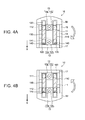
- FIG. 4A is a cross-sectional view schematically showing the cross section taken along the line A-A in FIG. 2A of the main body 10 of the elevating-type PCR apparatus 1 according to the embodiment.
- This elevating-type PCR apparatus 1 includes the main body 10 and a driving mechanism 20 as shown in FIG. 2A .
- the main body 10 includes the fitting section 11, a first heating section 12, and a second heating section 13.
- a spacer 14 is provided between the first heating section 12 and the second heating section 13.
- the first heating section 12 is disposed on the side of a bottom plate 17, and the second heating section 13 is disposed on the side of the lid 50.
- the first heating section 12, the second heating section 13, and the spacer 14 are fixed by a flange 16, the bottom plate 17, and a fixing plate 19.
- the fitting section 11 is configured such that the nucleic acid amplification reaction tube 100, which will be described later, is fitted therein.
- the fitting section 11 of this embodiment has a slot structure in which the nucleic acid amplification reaction tube 100 is inserted and fitted, and is configured such that the nucleic acid amplification reaction tube 100 is inserted into a hole penetrating a first heat block 12b of the first heating section 12, the spacer 14, and a second heat block 13b of the second heating section 13.
- the number of the fitting sections 11 may be more than one, and in the example shown in FIG. 2B , twenty fitting sections 11 are provided for the main body 10.
- This elevating-type PCR apparatus 1 includes a structure in which the nucleic acid amplification reaction tube 100 is held at a predetermined position with respect to the first heating section 12 and the second heating section 13. More specifically, as shown in FIGS. 4A and 4B , in a flow channel 110 constituting the nucleic acid amplification reaction tube 100, which will be described later, a first region 111 can be heated by the first heating section 12 and a second region 112 can be heated by the second heating section 13.
- a structure that defines the position of the nucleic acid amplification reaction tube 100 is the bottom plate 17, and as shown in FIG. 4A , by inserting the nucleic acid amplification reaction tube 100 to a position in contact with the bottom plate 17, the nucleic acid amplification reaction tube 100 can be held at a predetermined position with respect to the first heating section 12 and the second heating section 13.
- the first heating section 12 heats the first region 111 of the nucleic acid amplification reaction tube 100, which will be described later, to a first temperature.
- the first heating section 12 is disposed at a position so as to heat the first region 111 of the nucleic acid amplification reaction tube 100.
- the first heating section 12 may include a mechanism that generates heat and a member that transfers the generated heat to the nucleic acid amplification reaction tube 100.
- the first heating section 12 includes a first heater 12a and a first heat block 12b.
- the first heater 12a is a cartridge heater, and is connected to an external power source (not shown) through a conductive wire 15.
- the first heater 12a is inserted into the first heat block 12b, and the first heat block 12b is heated by heat generated by the first heater 12a.
- the first heat block 12b is a member that transfers heat generated by the first heater 12a to the nucleic acid amplification reaction tube 100.
- the first heat block 12b is a block made of aluminum.
- the second heating section 13 heats the second region 112 of the nucleic acid amplification reaction tube 100 to a second temperature different from the first temperature.
- the second heating section 13 in the main body 10, the second heating section 13 is disposed at a position so as to heat the second region 112 of the nucleic acid amplification reaction tube 100.
- the second heating section 13 includes a second heater 13a and the second heat block 13b.
- the second heating section 13 is configured in the same manner as the first heating section 12 except that the region of the nucleic acid amplification reaction tube 100 to be heated and the heating temperature are different from those for the first heating section 12.
- the temperatures of the first heating section 12 and the second heating section 13 are controlled by a temperature sensor (not shown) and a control section (not shown), which will be described later.
- the temperatures of the first heating section 12 and the second heating section 13 are preferably set so as to heat the nucleic acid amplification reaction tube 100 to a desired temperature.
- the first region 111 of the nucleic acid amplification reaction tube 100 can be heated to the first temperature, and the second region 112 can be heated to the second temperature.
- the temperature sensor in this embodiment is a thermocouple.
- the driving mechanism 20 is a mechanism that drives the fitting section 11, the first heating section 12, and the second heating section 13.
- the driving mechanism 20 includes a motor (not shown) and a drive shaft (not shown), and the drive shaft is connected to the flange 16 of the main body 10.
- the drive shaft in this embodiment is provided perpendicular to the longitudinal direction of the fitting section 11, and when the motor is activated, the main body 10 is rotated about the drive shaft as the axis of rotation.
- the elevating-type PCR apparatus 1 of this embodiment includes the control section (not shown).
- the control section controls at least one of the first temperature, the second temperature, a first period, a second period, and the number of thermal cycles, which will be described later.
- the control section controls the operation of the driving mechanism 20, thereby controlling the period in which the fitting section 11, the first heating section 12, and the second heating section 13 are held in a predetermined arrangement.
- the control section may have mechanisms different from item to item to be controlled, or may control all items collectively.
- the control section in the elevating-type PCR apparatus 1 of this embodiment is an electronic control system and controls all of the above-described items.
- the control section of this embodiment includes a processor such as CPU (not shown) and a storage device such as an ROM (Read Only Memory) or an RAM (Random Access Memory).
- a processor such as CPU (not shown)
- a storage device such as an ROM (Read Only Memory) or an RAM (Random Access Memory).
- various programs, data, etc. for controlling the above-described respective items are stored.
- the storage device has a work area for temporarily storing data in processing, processing results, etc. of various processes.
- the spacer 14 is provided between the first heating section 12 and the second heating section 13.
- the spacer 14 of this embodiment is a member that holds the first heating section 12 or the second heating section 13.
- the spacer 14 is a heat insulating material, and in the example shown in FIG. 4A , the fitting section 11 penetrates the spacer 14.
- the main body 10 of this embodiment includes the fixing plate 19.
- the fixing plate 19 is a member that holds the fitting section 11, the first heating section 12, and the second heating section 13.
- two fixing plates 19 are fitted in the flanges 16, and the first heating section 12, the second heating section 13, and the bottom plate 17 are fixed by the fixing plates 19.
- the elevating-type PCR apparatus 1 of this embodiment includes the lid 50.
- the fitting section 11 is covered with the lid 50.
- the lid 50 may be fixed to the main body 10 by a fixing section 51.
- the fixing section 51 is a magnet.
- a magnet is provided on a surface of the main body 10 which comes into contact with the lid 50.
- a magnet is provided also for the lid 50 at a place with which the magnet of the main body 10 comes into contact.
- the fixing plate 19, the bottom plate 17, the lid 50, and the flange 16 are formed using a heat insulating material.
- FIGS. 4A and 4B are cross-sectional views schematically showing the cross section taken along the line A-A in FIG. 2A of the elevating-type PCR apparatus 1.
- FIGS. 4A and 4B show a state in which the nucleic acid amplification reaction tube 100 is fitted in the elevating-type PCR apparatus 1.
- FIG. 4A shows a first arrangement
- FIG. 4B shows a second arrangement.
- the nucleic acid amplification reaction tube 100 according to the embodiment will be described, and thereafter, the thermal cycling process using the elevating-type PCR apparatus 1 according to the embodiment in the case of using the nucleic acid amplification reaction tube 100 will be described.
- the nucleic acid amplification reaction tube 100 includes a flow channel 110 and a sealing section 120.
- the flow channel 110 is filled with a reaction mixture 140 and an oil 130 which has a specific gravity smaller than that of the reaction mixture 140 and is immiscible with the reaction mixture 140, and sealed with the sealing section 120.
- the flow channel 110 is formed such that the reaction mixture 140 moves in close proximity to opposed inner walls.
- the term “opposed inner walls” of the flow channel 110 refers to two regions of a wall surface of the flow channel 110 having an opposed positional relationship.
- the phrase “in close proximity to” refers to a state in which the distance between the reaction mixture 140 and the wall surface of the flow channel 110 is close, and includes a case where the reaction mixture 140 is in contact with the wall surface of the flow channel 110. Therefore, the phrase “the reaction mixture 140 moves in close proximity to opposed inner walls” refers to that "the reaction mixture 140 moves in a state of being close in distance to both of the two regions of a wall surface of the flow channel 110 having an opposed positional relationship", that is, the reaction mixture 140 moves along the opposed inner walls.
- the outer shape of the nucleic acid amplification reaction tube 100 is a cylindrical shape, and the flow channel 110 is formed in the direction of the center axis (the vertical direction in Fig. 1 ) therein.
- the shape of the flow channel 110 is a cylindrical shape having a circular cross section in the direction perpendicular to the longitudinal direction of the flow channel 110, that is, in the direction perpendicular to the direction of the movement of the reaction mixture 140 in a region in the flow channel 110 (this cross section is defined as the "cross section" of the flow channel 110).
- the opposed inner walls of the flow channel 110 are regions including two points on the wall surface of the flow channel 110 constituting the diameter of the cross section of the flow channel 110, and the reaction mixture 140 moves in the longitudinal direction of the flow channel 110 along the opposed inner walls.
- the first region 111 of the nucleic acid amplification reaction tube 100 is a partial region of the flow channel 110 which is heated to the first temperature by the first heating section 12.
- the second region 112 is a partial region of the flow channel 110 which is different from the first region 111 and is heated to the second temperature by the second heating section 13.
- the first region 111 is a region including one end portion in the longitudinal direction of the flow channel 110
- the second region 112 is a region including the other end portion in the longitudinal direction of the flow channel 110. In the example shown in FIGS.
- a region surrounded by the dotted line including an end portion on the proximal side of the sealing section 120 of the flow channel 110 is the second region 112
- a region surrounded by the dotted line including an end portion on the distal side of the sealing section 120 is the first region 111.
- the flow channel 110 contains the oil 130 and a liquid droplet of the reaction mixture 140.
- the oil 130 and the reaction mixture 140 are prepared according to the description of the above (1) Biochip.
- FIGS. 4A and 4B the thermal cycling process using a thermal cycler 1 according to the embodiment will be described.
- the direction indicated by the arrow g in the downward direction in the drawing
- the thermal cycling process a case where shuttle PCR (two-stage temperature PCR) is performed will be described as an example of the thermal cycling process.
- the respective steps described below are shown as an example of the thermal cycling process, and according to need, the order of the steps may be changed, two or more steps may be performed continuously or concurrently, or a step may be added.
- the shuttle PCR is a method of amplifying a nucleic acid in a reaction mixture by subjecting the reaction mixture to a two-stage temperature process at a high temperature and a low temperature repeatedly. In the process at a high temperature, denaturation of a double-stranded DNA occurs and in the process at a low temperature, annealing (a reaction in which a primer is bound to a single-stranded DNA) and elongation (a reaction in which a complementary strand to the DNA is formed by using the primer as a starting point) occur.
- the high temperature is a temperature between 80°C and 100°C and the low temperature is a temperature between 50°C and 70°C.
- the processes at the respective temperatures are performed for a predetermined period, and a period of maintaining the reaction mixture at a high temperature is generally shorter than a period of maintaining the reaction mixture at a low temperature.
- the period for the process at a high temperature may be set to about 1 to 10 seconds, and the period for the process at a low temperature may be set to about 10 to 60 seconds, or a period longer than this range may be adopted depending on the condition of the reaction.
- the nucleic acid amplification reaction tube 100 is fitted in the fitting section 11.
- the reaction mixture 140 is introduced into the flow channel 110 previously filled with the oil 130
- the flow channel 110 is sealed with the sealing section 120
- the nucleic acid amplification reaction tube 100 is fitted in the fitting section 11.
- the introduction of the reaction mixture 140 can be performed using a micropipette, an ink-jet dispenser, or the like.
- the first heating section 12 is in contact with the nucleic acid amplification reaction tube 100 at a place including the first region 111 and the second heating section 13 is in contact with the nucleic acid amplification reaction tube 100 at a place including the second region 112.
- the arrangement of the fitting section 11, the first heating section 12, and the second heating section 13 is the first arrangement.
- the first region 111 of the nucleic acid amplification reaction tube 100 is located in a lowermost portion of the flow channel 110 with respect to the gravitational direction.
- the first region 111 is located in a lowermost portion of the flow channel 110 with respect to the gravitational direction, and therefore, the reaction mixture 140 having a specific gravity larger than that of the oil 130 is located in the first region 111.
- the fitting section 11 is covered with the lid 50, and then the elevating-type PCR apparatus 1 is activated.
- the nucleic acid amplification reaction tube 100 is heated by the first heating section 12 and the second heating section 13.
- the first heating section 12 and the second heating section 13 heat different regions of the nucleic acid amplification reaction tube 100 to different temperatures. That is, the first heating section 12 heats the first region 111 to the first temperature, and the second heating section 13 heats the second region 112 to the second temperature. Accordingly, a temperature gradient in which the temperature gradually changes between the first temperature and the second temperature is formed between the first region 111 and the second region 112 of the flow channel 110. Here, a temperature gradient in which the temperature decreases from the first region 111 to the second region 112 is formed.
- the thermal cycling process of this embodiment is shuttle PCR, and therefore, the first temperature is set to a temperature suitable for the denaturation of a double-stranded DNA, and the second temperature is set to a temperature suitable for the annealing and elongation.
- the arrangement of the fitting section 11, the first heating section 12, and the second heating section 13 is the first arrangement, when the nucleic acid amplification reaction tube 100 is heated, the reaction mixture 140 is heated to the first temperature.
- the main body 10 is driven by the driving mechanism 20, and the arrangement of the fitting section 11, the first heating section 12, and the second heating section 13 is switched over from the first arrangement to the second arrangement.
- the second arrangement is an arrangement in which the second region 112 is located in a lowermost portion of the flow channel 110 with respect to the gravitational direction.
- the second region 112 is a region located in a lowermost portion of the flow channel 110 with respect to the gravitational direction when the fitting section 11, the first heating section 12, and the second heating section 13 are in a predetermined arrangement different from the first arrangement.
- the driving mechanism 20 rotatively drives the main body 10.
- the flanges 16 are rotatively driven by the motor by using the drive shaft as the axis of rotation, the fitting section 11, the first heating section 12, and the second heating section 13 which are fixed to the flanges 16 are rotated.
- the drive shaft is a shaft extending in the direction perpendicular to the longitudinal direction of the fitting section 11, when the drive shaft is rotated by the activation of the motor, the fitting section 11, the first heating section 12, and the second heating section 13 are rotated.
- the main body 10 is rotated at 180°. By doing this, the arrangement of the fitting section 11, the first heating section 12, and the second heating section 13 is switched over from the first arrangement to the second arrangement.
- the positional relationship between the first region 111 and the second region 112 with respect to the gravitational direction is opposite from that of the first arrangement, and therefore, the reaction mixture 140 moves from the first region 111 to the second region 112 by the gravitational force.
- the operation of the driving mechanism 20 is stopped after the arrangement of the fitting section 11, the first heating section 12, and the second heating section 13 has reached the second arrangement, the fitting section 11, the first heating section 12, and the second heating section 13 are held in the second arrangement.
- the main body 10 is rotated again.
- a nucleic acid amplification reaction is performed by rotating the main body 10 while switching over between the first arrangement and the second arrangement in this manner until the number of thermal cycles has reached a predetermined number of cycles.
- a polypropylene tube for an elevating-type PCR apparatus was filled with an oil, and then, 1.6 ⁇ L of each of the surfactant solutions was added thereto to form a liquid droplet of the surfactant solution. Then, the tube was laid on its side and left to stand for 5 minutes in a state where the liquid droplet was not in contact with the bottom. Thereafter, the tube was made to stand upright, and thereby the surfactant solution was made to move to the bottom of the tube. One minute after the surfactant solution reached the bottom, the tube was turned upside down, and the state of adhesion of the surfactant solution to the bottom of the tube was evaluated.
- each of the additives shown in Table 2 was added at 5% (v/v) to KF-96L-2cs, which is a dimethyl silicone oil with high purity, followed by mixing, and the resulting mixture was used as the oil. Further, the reaction mixture was prepared as follows. Takara Ex Taq HS (x50) 0.25 10 ⁇ Ex Taq Buffer 5.0 dNTP Mixture (2.5 mM each) 4.0 InfA forward primer (20 ⁇ M) 2.0 InfA reverse primer (20 ⁇ M) 2.0 InfA probe (10 ⁇ M) 1.0 plasmid 5.0 DW up to 50.0 (unit: ⁇ L)
- the commercially available Takara Ex Taq HS contains 0.5% NP-40 and 0.5% Tween 20, and therefore, the thus prepared reaction mixture contained 0.02% NP-40 and 0.02% Tween 20.
Landscapes
- Chemical & Material Sciences (AREA)
- Health & Medical Sciences (AREA)
- Chemical Kinetics & Catalysis (AREA)
- Analytical Chemistry (AREA)
- General Health & Medical Sciences (AREA)
- Life Sciences & Earth Sciences (AREA)
- Organic Chemistry (AREA)
- Hematology (AREA)
- Clinical Laboratory Science (AREA)
- Engineering & Computer Science (AREA)
- Wood Science & Technology (AREA)
- Proteomics, Peptides & Aminoacids (AREA)
- Zoology (AREA)
- Biotechnology (AREA)
- Immunology (AREA)
- Microbiology (AREA)
- Molecular Biology (AREA)
- Biophysics (AREA)
- Physics & Mathematics (AREA)
- Biochemistry (AREA)
- Bioinformatics & Cheminformatics (AREA)
- General Engineering & Computer Science (AREA)
- Genetics & Genomics (AREA)
- Dispersion Chemistry (AREA)
- Apparatus Associated With Microorganisms And Enzymes (AREA)
Abstract
a vessel;
a liquid which is contained in the vessel; and
an additive which is a carbinol-modified silicone resin, a carboxyl-modified silicone resin, an amino-modified silicone resin, a polyether-modified silicone resin, a silanol-modified silicone resin, or a fluoro-modified silicone resin,
wherein a liquid droplet of a reaction mixture which (i) has a different specific gravity from that of the liquid; (ii) is immiscible with the liquid and (iii) contains a surfactant, can move in the longitudinal direction of the vessel when placed in the vessel.
Description
- The present invention relates to a biochip.
- In recent years, as a result of development of technologies utilizing genes, medical treatments utilizing genes such as gene diagnosis and gene therapy are drawing attention. In addition, many methods utilizing genes in determination of breed varieties or breed improvement have also been developed in agricultural and livestock industries. As technologies for utilizing genes, nucleic acid amplification technologies such as a PCR (Polymerase Chain Reaction) method are widely used. Nowadays, a PCR method has become an indispensable technology for elucidation of information on biological materials.
- In the PCR method, a method in which a reaction is performed using a vessel for performing a biochemical reaction called a tube or a chip (hereinafter referred to as "biochip") is generally used. However, in the method of the related art, there are problems that a large amount of a reagent or the like is needed, an apparatus is complicated in order to realize a thermal cycle required for the reaction, and it takes time to perform the reaction. Therefore, a biochip or a reaction apparatus for performing PCR in a short time using a very small amount of a reagent or a specimen has been demanded.
- In order to solve such a problem,
JP-A-2009-136250 - However, in the case where the biochip disclosed in PTL 1 is used in an application in which an amplification product is detected by measuring fluorescence from the outside of a vessel, it is necessary to form the vessel from a transparent material. As the transparent material, a resin or a heat-resistant glass can be used, however, these materials are easily charged with electricity by friction or the like. It is possible to prevent static electricity by performing a hydrophilic treatment on an inner surface of the vessel, however, the reaction mixture which is an aqueous solution adheres to the vessel to hinder the movement of the reaction mixture. Due to this, it was difficult to adopt a hydrophilic treatment for a biochip.
- On the other hand, as the liquid which is immiscible with the reaction mixture and has a different specific gravity from that of the reaction mixture, a silicone oil or a mineral oil can be used from the viewpoint of stability against heat or the reaction mixture. However, these oils are generally insulating materials, and therefore, a liquid droplet of the reaction mixture introduced into the oil is easily polarized. Due to this, when a vessel formed from a transparent material is filled with such an oil and the reaction mixture is introduced into the oil, an electric field is generated between the reaction mixture and the vessel, and the reaction mixture is attracted and adheres to the inner wall of the vessel or floats in the oil due to repulsion in some cases. If PCR of a system in which the reaction mixture is allowed to move by the gravitational force in the biochip as described in PTL 1 (hereinafter, in this specification, this system is referred to as "elevating-type system") is performed in such a state, the reaction mixture does not appropriately move, and therefore, a desired thermal cycle cannot be performed in some cases.
- Therefore,
JP-A-2012-125169 - However, even if static electricity is prevented as described in PTL 2, a liquid droplet still adheres to the vessel, and therefore, the liquid droplet cannot appropriately move in the oil in some cases.
- An advantage of some aspects of the invention is to provide a biochip in which a reaction mixture is prevented from adhering to the inner wall of a vessel so that the reaction mixture can appropriately move in the vessel.
- The invention can be implemented as the following aspects.
A biochip according to an aspect of the invention is a biochip comprising: - a vessel;
- a liquid which is contained in the vessel; and
- an additive which is a carbinol-modified silicone resin, a carboxyl-modified silicone resin, an amino-modified silicone resin, a polyether-modified silicone resin, a silanol-modified silicone resin, or a fluoro-modified silicone resin,
- The liquid may be a mineral oil or a silicone oil. The additive may be any of X-22-160AS, X-22-3701E, KF-857, KF-859, KF-862, KF-867, KF-6017, KF-8005 (Shin-Etsu Silicone Co., Ltd.), SR1000, SS4230, SS4267, YR3370, XS66-C1191, TSF4703, TSF4708, XF42-C5196, and XF42-C5197 (Momentive Performance Materials, Inc.). The biochip may comprise a liquid droplet of a reaction mixture. The reaction mixture may contain a reagent for a nucleic acid amplification reaction. The concentration of the additive may be 1% (v/v) or more and 50% (v/v) or less. The vessel may be made of polypropylene. The surfactant may be NP-40, Triton X-100, or Tween 20.
- A nucleic acid amplification apparatus according to another aspect of the invention includes any one of the above-described biochips, which is fitted therein.
- According to the aspects of the invention, a biochip in which a reaction mixture is prevented from adhering to the inner wall of a vessel so that the reaction mixture can appropriately move in the vessel can be provided.
- The invention will be described with reference to the accompanying drawings, wherein like numbers reference like elements.
-
FIG. 1 is a cross-sectional view of a nucleic acid amplification reaction chip according to an embodiment of the invention. The arrow g indicates the direction of the gravitational force. -
FIGS. 2A and 2B are perspective views of an elevating-type PCR apparatus according to one embodiment of the invention.FIG. 2A shows a state in which a lid is closed, andFIG. 2B shows a state in which the lid is opened. -
FIG. 3 is an exploded perspective view of a main body of the elevating-type PCR apparatus according to one embodiment of the invention. -
FIGS. 4A and 4B are cross-sectional views schematically showing the cross section taken along the line A-A inFIG. 2A of the main body of the elevating-type PCR apparatus according to one embodiment of the invention.FIG. 4A shows a first arrangement, andFIG. 4B shows a second arrangement. - The object, characteristics, and advantages of the invention as well as the idea thereof will be apparent to those skilled in the art from the description given herein, and the invention can be easily reproduced by those skilled in the art based on the description given herein. It is to be understood that the embodiments, specific examples, etc. of the invention described below are to be taken as preferred embodiments of the invention, and are presented for illustrative or explanatory purposes and are not intended to limit the invention. It is further apparent to those skilled in the art that various changes and modifications may be made based on the description given herein within the intent and scope of the invention disclosed herein.
- The biochip according to the invention is a biochip comprising:
- a vessel;
- a liquid which is contained in the vessel; and
- an additive which is a carbinol-modified silicone resin, a carboxyl-modified silicone resin, an amino-modified silicone resin, a polyether-modified silicone resin, a silanol-modified silicone resin, or a fluoro-modified silicone resin,
- wherein a liquid droplet of a reaction mixture which (i) has a different specific gravity from that of the liquid; (ii) is immiscible with the liquid and (iii) contains a surfactant, can move in the longitudinal direction of the vessel when placed in the vessel.. In this biochip, a risk that the reaction mixture in the form of a liquid droplet adheres to the inner wall of the vessel is reduced, so that the reaction mixture easily moves in the longitudinal direction of the vessel. Hereinafter, the configuration of the biochip will be described in detail.
-
FIG. 1 is a cross-sectional view of abiochip 100.FIG. 1 shows a state in which a reaction mixture is placed in the biochip. - The
biochip 100 according to the invention is configured to include avessel 150 and asealing section 120. The size and shape of thebiochip 100 are not particularly limited, but for example, the biochip may be designed in consideration of at least one of the amount of anoil 130 which is immiscible with areaction mixture 140, the thermal conductivity of theoil 130, the shape of thevessel 150 and thesealing section 120, and the ease of handling. - The
vessel 150 of thebiochip 100 can be formed from a transparent material. According to this, the movement of thereaction mixture 140 in thevessel 150 can be observed from the outside of thebiochip 100, or thebiochip 100 can be used in an application in which the measurement or the like is performed from the outside of thevessel 150 such as real-time PCR. The term "transparent" as used herein refers to a condition in which the visibility to such an extent that thereaction mixture 140 in thevessel 150 can be observed from the outside of thevessel 150 can be ensured, and it is not necessary that theentire biochip 100 should be transparent as long as this condition is met. - The application of the
biochip 100 is not particularly limited, however, for example, in the case where thebiochip 100 is used in an application with a fluorescence measurement such as real-time PCR, thevessel 150 is desirably formed from a material with a low autofluorescence. Thevessel 150 is preferably formed from a material which can withstand heating in PCR. Further, the material of thevessel 150 is preferably a material, on which nucleic acids or proteins are less adsorbed, and which does not inhibit the enzymatic reaction by a polymerase or the like. The material which satisfies these conditions is not particularly limited, and for example, polypropylene, polyethylene, a cycloolefin polymer (for example, ZEONEX (registered trademark) 480R), a heat-resistant glass (for example, PYREX (registered trademark) glass), or the like, or a composite material thereof may be used, however, polypropylene is preferred. - In the
biochip 100 shown inFIG. 1 , thevessel 150 is formed into a cylindrical shape, and the direction of the center axis (the vertical direction inFig. 1 ) coincides with the longitudinal direction. Thevessel 150 used here is preferably a tube and may be a tube for a microcentrifuge or a tube designed for PCR. Since thevessel 150 has a shape with a longitudinal direction, in other words, an elongated shape, for example, in the case where the temperature of thebiochip 100 is controlled so that regions having different temperatures are formed in theoil 130 in thevessel 150 using an elevating-type thermal cycler, which will be described later, the distance between the regions having different temperatures is easily increased, According to this, it becomes easy to control the temperature of theoil 130 to be different from region to region in thevessel 150, and therefore, a thermal cycle suitable for PCR can be realized. The "elevating-type thermal cycler" is an apparatus which performs a thermal cycle by forming at least two temperature regions in an oil filled in thevessel 150 and allowing thereaction mixture 140 which is phase-separated from the oil to move reciprocatingly between these temperature regions. - The shape of the
vessel 150 is not particularly limited as long as it has a longitudinal direction, however, in the case where thevessel 150 is used for elevating-type PCR, it is preferred that the shape is a substantially cylindrical shape and the ratio of the inner diameter D to the length L in the longitudinal direction is in the range of 1:5 to 5:20. It is more preferred that the inner diameter D is from 1.5 to 2 mm, and the length L is from 10 to 20 mm. - The
vessel 150 has an opening section and thesealing section 120 which seals the opening section, and in thevessel 150, thereaction mixture 140 and the liquid 130 which has a different specific gravity from that of thereaction mixture 140 and is phase-separated from thereaction mixture 140 are contained. It is preferred that in the case where the opening section is sealed by thesealing section 120, air does not remain in thevessel 150. It is because if an air bubble remains in thevessel 150, the movement of thereaction mixture 140 may be hindered. Thesealing section 120 can be formed from the same material as that of thevessel 150. The structure of thesealing section 120 may be any as long as it can hermetically seal thevessel 150, and can be a structure of, for example, a screw cap, a plug, an inlay, or the like. InFIG. 1 , thesealing section 120 has a structure of a screw cap. - The reaction to which the
reaction mixture 140 is subjected is not particularly limited, however, thereaction mixture 140 may be subjected to a nucleic acid amplification reaction and may contain a reagent for a nucleic acid amplification reaction and may also contain a target nucleic acid to be amplified. Examples of the target nucleic acid include a DNA prepared from a specimen such as blood, urine, saliva, spinal fluid, or a tissue and a cDNA obtained by reverse transcription of an RNA prepared from any of the above specimens. The reagent for a nucleic acid amplification reaction may contain a primer for amplifying a target nucleic acid, a buffer, a polymerase, dNTPs, MgCl2, a fluorescent probe for detecting an amplification product of the target nucleic acid, and the like. The DNA polymerase is not particularly limited, but is preferably a heat-resistant enzyme or an enzyme for use in PCR. There are a great number of commercially available products, for example, Taq polymerase, Tfi polymerase, Tth polymerase, modified forms thereof, and the like, however, a DNA polymerase capable of performing hot start PCR is preferred. The concentration of dNTPs or a salt may be set to a concentration suitable for the enzyme to be used, however, the concentration of dNTPs may be set to generally 10 to 1000 µM, preferably 100 to 500 µM, the concentration of Mg2+ may be set to generally 1 to 100 mM, preferably 5 to 10 mM, and the concentration of Cl- may be set to 1 to 2000 mM, preferably 200 to 700 mM. The total ion concentration is not particularly limited, but may be higher than 50 mM, and is preferably higher than 100 mM, more preferably higher than 120 mM, further more preferably higher than 150 mM, still further more preferably higher than 200 mM. The upper limit thereof is preferably 500 mM or less, more preferably 300 mM or less, further more preferably 200 mM or less. Each oligonucleotide for the primer is used at 0.1 to 10 µM, preferably 0.1 to 1 µM. - The
reaction mixture 140 may further contain a surfactant. The surfactant is not particularly limited, however, examples thereof include NP-40, Triton X-100, andTween 20. The concentration of the surfactant is not particularly limited, but is preferably a concentration which does not inhibit the nucleic acid amplification reaction, and may be from 0.001% to 0.1%, and is preferably from 0.002% to 0.02%, most preferably from 0.005% to 0.01%. The surfactant may be a carry-over from a stock solution of the enzyme described above, however, a surfactant solution may be added to thereaction mixture 140 separately therefrom. - By using a liquid which is immiscible with the
reaction mixture 140 as the liquid 130, when thereaction mixture 140 is placed in thevessel 150, thereaction mixture 140 and the liquid 130 are phase-separated from each other, and therefore, thereaction mixture 140 can be formed into a liquid droplet in the liquid 130. In this manner, thereaction mixture 140 is maintained in the form of a liquid droplet in the liquid 130. - The liquid 130 is preferably a liquid having a specific gravity smaller than that of the
reaction mixture 140. In this case, when thereaction mixture 140 is placed in the liquid 130, the liquid droplet of thereaction mixture 140 has a specific gravity larger than that of the liquid 130, and therefore moves in the direction in which the gravitational force acts by the action of the gravity. Further, the liquid 130 may be a liquid having a specific gravity larger than that of thereaction mixture 140. In this case, the liquid droplet of thereaction mixture 140 has a specific gravity smaller than that of the liquid 130, and therefore moves in the direction opposite to the direction in which the gravitational force acts by the action of the gravity. - The liquid 130 preferably contains an oil, and for example, a silicone oil or a mineral oil can be used. Here, the "silicone" means an oiligomer or a polymer having a siloxane bond as a main skeleton. In this specification, among silicones, a silicone in the form of a liquid in a temperature range in which the silicone is used in a thermal cycling process is particularly referred to as "silicone oil". Further, in this specification, an oil which is purified from petroleum and is in the form of a liquid in a temperature range in which the oil is used in a thermal cycling process is referred to as "mineral oil". These oils have high stability against heat, and for example, products having a viscosity of 5×10³ Nsm-2 or less are also easily available, and therefore, these oils are preferred for use in elevating-type PCR.
- Examples of the silicone oil include dimethyl silicone oils such as KF-96L-0.65cs, KF-96L-1cs, KF-96L-2cs, KF-96L-5cs (Shin-Etsu Silicone Co., Ltd.),
SH200 C FLUID 5 CS (Dow Corning Toray Co., Ltd.), TSF451-5A, and TSF451-10 (Momentive Performance Materials Japan LLC Company Ltd.). Examples of the mineral oil include oils containing alkane having about 14 to 20 carbon atoms as a principal component, and specific examples thereof include n-tetradecane, n-pentadecane, n-hexadecane, n-heptadecane, n-octadecane, n-nonadecane, and n-tetracosane. - The liquid 130 contains an additive. The additive is a carbinol-modified silicone resin, a carboxyl-modified silicone resin, an amino-modified silicone resin, a polyether-modified silicone resin, a silanol-modified silicone resin, or a fluoro-modified silicone resin, and for example, a modified silicone oil such as X-22-160AS, X-22-3701E, KF-857, KF-859, KF-862, KF-867, KF-6017, or KF-8005 (Shin-Etsu Silicone Co., Ltd.), a silicone resin such as SR1000, SS4230, SS4267, or YR3370 (Momentive Performance Materials, Inc.), a fluoro-modified silicone resin such as XS66-C1191 (Momentive Performance Materials, Inc.), or the like, and other than these, a modified silicone oil such as TSF4703, TSF4708, XF42-C5196, or XF42-C5197 (Momentive Performance Materials, Inc.) can be used. The concentration of the additive is not particularly limited, but can be determined in consideration of the structure, material, shape, or the like of the vessel. For example, the concentration thereof is set to preferably 1% (v/v) or more and 50% (v/v) or less, more preferably 2% (v/v) or more and 20% (v/v) or less, further more preferably 5% (v/v) - all these values are based on the total amount of liquid plus additive.
- In this embodiment, as the biochip to be used for performing a nucleic acid amplification reaction, a nucleic acid
amplification reaction tube 100 in the form of a tube is used. Hereinafter, one example of an elevating-type nucleic acid amplification reaction apparatus (hereinafter also referred to as "elevating-type PCR apparatus") suitable for the nucleic acidamplification reaction tube 100 will be described in detail. -
FIGS. 2A and 2B show one example of an elevating-type PCR apparatus 1.FIG. 2A shows a state in which alid 50 of the elevating-type PCR apparatus 1 is closed, andFIG. 2B shows a state in which thelid 50 of the elevating-type PCR apparatus 1 is opened and the nucleic acidamplification reaction tube 100 is fitted in afitting section 11.FIG. 3 is an exploded perspective view of amain body 10 of the elevating-type PCR apparatus 1 according to the embodiment.FIG. 4A is a cross-sectional view schematically showing the cross section taken along the line A-A inFIG. 2A of themain body 10 of the elevating-type PCR apparatus 1 according to the embodiment. - This elevating-type PCR apparatus 1 includes the
main body 10 and adriving mechanism 20 as shown inFIG. 2A . As shown inFIG. 3 , themain body 10 includes thefitting section 11, afirst heating section 12, and asecond heating section 13. Aspacer 14 is provided between thefirst heating section 12 and thesecond heating section 13. In themain body 10 of this embodiment, thefirst heating section 12 is disposed on the side of abottom plate 17, and thesecond heating section 13 is disposed on the side of thelid 50. In themain body 10 of this embodiment, thefirst heating section 12, thesecond heating section 13, and thespacer 14 are fixed by aflange 16, thebottom plate 17, and a fixingplate 19. - The
fitting section 11 is configured such that the nucleic acidamplification reaction tube 100, which will be described later, is fitted therein. As shown inFIG. 2B andFIG. 3 , thefitting section 11 of this embodiment has a slot structure in which the nucleic acidamplification reaction tube 100 is inserted and fitted, and is configured such that the nucleic acidamplification reaction tube 100 is inserted into a hole penetrating afirst heat block 12b of thefirst heating section 12, thespacer 14, and asecond heat block 13b of thesecond heating section 13. The number of thefitting sections 11 may be more than one, and in the example shown inFIG. 2B , twentyfitting sections 11 are provided for themain body 10. - This elevating-type PCR apparatus 1 includes a structure in which the nucleic acid
amplification reaction tube 100 is held at a predetermined position with respect to thefirst heating section 12 and thesecond heating section 13. More specifically, as shown inFIGS. 4A and 4B , in aflow channel 110 constituting the nucleic acidamplification reaction tube 100, which will be described later, afirst region 111 can be heated by thefirst heating section 12 and asecond region 112 can be heated by thesecond heating section 13. In this embodiment, a structure that defines the position of the nucleic acidamplification reaction tube 100 is thebottom plate 17, and as shown inFIG. 4A , by inserting the nucleic acidamplification reaction tube 100 to a position in contact with thebottom plate 17, the nucleic acidamplification reaction tube 100 can be held at a predetermined position with respect to thefirst heating section 12 and thesecond heating section 13. - When the nucleic acid
amplification reaction tube 100 is fitted in thefitting section 11, thefirst heating section 12 heats thefirst region 111 of the nucleic acidamplification reaction tube 100, which will be described later, to a first temperature. In the example shown inFIG. 4A , in themain body 10, thefirst heating section 12 is disposed at a position so as to heat thefirst region 111 of the nucleic acidamplification reaction tube 100. - The
first heating section 12 may include a mechanism that generates heat and a member that transfers the generated heat to the nucleic acidamplification reaction tube 100. In the example shown inFIG. 3 , thefirst heating section 12 includes afirst heater 12a and afirst heat block 12b. In this embodiment, thefirst heater 12a is a cartridge heater, and is connected to an external power source (not shown) through aconductive wire 15. Thefirst heater 12a is inserted into thefirst heat block 12b, and thefirst heat block 12b is heated by heat generated by thefirst heater 12a. Thefirst heat block 12b is a member that transfers heat generated by thefirst heater 12a to the nucleic acidamplification reaction tube 100. In this embodiment, thefirst heat block 12b is a block made of aluminum. - When the nucleic acid
amplification reaction tube 100 is fitted in thefitting section 11, thesecond heating section 13 heats thesecond region 112 of the nucleic acidamplification reaction tube 100 to a second temperature different from the first temperature. In the example shown inFIG. 4A , in themain body 10, thesecond heating section 13 is disposed at a position so as to heat thesecond region 112 of the nucleic acidamplification reaction tube 100. As shown inFIG. 2 , thesecond heating section 13 includes asecond heater 13a and thesecond heat block 13b. Thesecond heating section 13 is configured in the same manner as thefirst heating section 12 except that the region of the nucleic acidamplification reaction tube 100 to be heated and the heating temperature are different from those for thefirst heating section 12. - In this embodiment, the temperatures of the
first heating section 12 and thesecond heating section 13 are controlled by a temperature sensor (not shown) and a control section (not shown), which will be described later. The temperatures of thefirst heating section 12 and thesecond heating section 13 are preferably set so as to heat the nucleic acidamplification reaction tube 100 to a desired temperature. In this embodiment, by controlling thefirst heating section 12 at the first temperature and thesecond heating section 13 at the second temperature, thefirst region 111 of the nucleic acidamplification reaction tube 100 can be heated to the first temperature, and thesecond region 112 can be heated to the second temperature. The temperature sensor in this embodiment is a thermocouple. - The
driving mechanism 20 is a mechanism that drives thefitting section 11, thefirst heating section 12, and thesecond heating section 13. In this embodiment, thedriving mechanism 20 includes a motor (not shown) and a drive shaft (not shown), and the drive shaft is connected to theflange 16 of themain body 10. The drive shaft in this embodiment is provided perpendicular to the longitudinal direction of thefitting section 11, and when the motor is activated, themain body 10 is rotated about the drive shaft as the axis of rotation. - The elevating-type PCR apparatus 1 of this embodiment includes the control section (not shown). The control section controls at least one of the first temperature, the second temperature, a first period, a second period, and the number of thermal cycles, which will be described later. In the case where the control section controls the first period or the second period, the control section controls the operation of the
driving mechanism 20, thereby controlling the period in which thefitting section 11, thefirst heating section 12, and thesecond heating section 13 are held in a predetermined arrangement. The control section may have mechanisms different from item to item to be controlled, or may control all items collectively. However, the control section in the elevating-type PCR apparatus 1 of this embodiment is an electronic control system and controls all of the above-described items. The control section of this embodiment includes a processor such as CPU (not shown) and a storage device such as an ROM (Read Only Memory) or an RAM (Random Access Memory). In the storage device, various programs, data, etc. for controlling the above-described respective items are stored. Further, the storage device has a work area for temporarily storing data in processing, processing results, etc. of various processes. - As shown in the example of
FIG. 3 andFIG. 4A , in themain body 10 of this embodiment, thespacer 14 is provided between thefirst heating section 12 and thesecond heating section 13. Thespacer 14 of this embodiment is a member that holds thefirst heating section 12 or thesecond heating section 13. In this embodiment, thespacer 14 is a heat insulating material, and in the example shown inFIG. 4A , thefitting section 11 penetrates thespacer 14. - The
main body 10 of this embodiment includes the fixingplate 19. The fixingplate 19 is a member that holds thefitting section 11, thefirst heating section 12, and thesecond heating section 13. In the example shown inFIG. 2B andFIG. 3 , two fixingplates 19 are fitted in theflanges 16, and thefirst heating section 12, thesecond heating section 13, and thebottom plate 17 are fixed by the fixingplates 19. - The elevating-type PCR apparatus 1 of this embodiment includes the
lid 50. In the example shown inFIG. 2A andFIG. 4A , thefitting section 11 is covered with thelid 50. Thelid 50 may be fixed to themain body 10 by a fixingsection 51. In this embodiment, the fixingsection 51 is a magnet. As shown in the example ofFIG. 2B andFIG. 3 , a magnet is provided on a surface of themain body 10 which comes into contact with thelid 50. Although not shown inFIG. 2B andFIG. 3 , a magnet is provided also for thelid 50 at a place with which the magnet of themain body 10 comes into contact. When thefitting section 11 is covered with thelid 50, thelid 50 is fixed to themain body 10 by a magnetic force. - It is preferred that the fixing
plate 19, thebottom plate 17, thelid 50, and theflange 16 are formed using a heat insulating material. -
FIGS. 4A and 4B are cross-sectional views schematically showing the cross section taken along the line A-A inFIG. 2A of the elevating-type PCR apparatus 1.FIGS. 4A and 4B show a state in which the nucleic acidamplification reaction tube 100 is fitted in the elevating-type PCR apparatus 1.FIG. 4A shows a first arrangement, andFIG. 4B shows a second arrangement. Hereinafter, first, the nucleic acidamplification reaction tube 100 according to the embodiment will be described, and thereafter, the thermal cycling process using the elevating-type PCR apparatus 1 according to the embodiment in the case of using the nucleic acidamplification reaction tube 100 will be described. - As shown in the example of
FIG. 1 , the nucleic acidamplification reaction tube 100 according to the embodiment includes aflow channel 110 and asealing section 120. Theflow channel 110 is filled with areaction mixture 140 and anoil 130 which has a specific gravity smaller than that of thereaction mixture 140 and is immiscible with thereaction mixture 140, and sealed with thesealing section 120. - The
flow channel 110 is formed such that thereaction mixture 140 moves in close proximity to opposed inner walls. Here, the term "opposed inner walls" of theflow channel 110 refers to two regions of a wall surface of theflow channel 110 having an opposed positional relationship. The phrase "in close proximity to" refers to a state in which the distance between thereaction mixture 140 and the wall surface of theflow channel 110 is close, and includes a case where thereaction mixture 140 is in contact with the wall surface of theflow channel 110. Therefore, the phrase "thereaction mixture 140 moves in close proximity to opposed inner walls" refers to that "thereaction mixture 140 moves in a state of being close in distance to both of the two regions of a wall surface of theflow channel 110 having an opposed positional relationship", that is, thereaction mixture 140 moves along the opposed inner walls. - In the example shown in
Fig. 1 , the outer shape of the nucleic acidamplification reaction tube 100 is a cylindrical shape, and theflow channel 110 is formed in the direction of the center axis (the vertical direction inFig. 1 ) therein. The shape of theflow channel 110 is a cylindrical shape having a circular cross section in the direction perpendicular to the longitudinal direction of theflow channel 110, that is, in the direction perpendicular to the direction of the movement of thereaction mixture 140 in a region in the flow channel 110 (this cross section is defined as the "cross section" of the flow channel 110). Therefore, in the nucleic acidamplification reaction tube 100 of this embodiment, the opposed inner walls of theflow channel 110 are regions including two points on the wall surface of theflow channel 110 constituting the diameter of the cross section of theflow channel 110, and thereaction mixture 140 moves in the longitudinal direction of theflow channel 110 along the opposed inner walls. - The
first region 111 of the nucleic acidamplification reaction tube 100 is a partial region of theflow channel 110 which is heated to the first temperature by thefirst heating section 12. Thesecond region 112 is a partial region of theflow channel 110 which is different from thefirst region 111 and is heated to the second temperature by thesecond heating section 13. In the nucleic acidamplification reaction tube 100 of this embodiment, thefirst region 111 is a region including one end portion in the longitudinal direction of theflow channel 110, and thesecond region 112 is a region including the other end portion in the longitudinal direction of theflow channel 110. In the example shown inFIGS. 4A and 4B , a region surrounded by the dotted line including an end portion on the proximal side of thesealing section 120 of theflow channel 110 is thesecond region 112, and a region surrounded by the dotted line including an end portion on the distal side of thesealing section 120 is thefirst region 111. - As shown in
FIG. 1 , theflow channel 110 contains theoil 130 and a liquid droplet of thereaction mixture 140. Theoil 130 and thereaction mixture 140 are prepared according to the description of the above (1) Biochip. - Hereinafter, with reference to
FIGS. 4A and 4B , the thermal cycling process using a thermal cycler 1 according to the embodiment will be described. InFIGS. 4A and 4B , the direction indicated by the arrow g (in the downward direction in the drawing) is the gravitational direction. In this embodiment, a case where shuttle PCR (two-stage temperature PCR) is performed will be described as an example of the thermal cycling process. The respective steps described below are shown as an example of the thermal cycling process, and according to need, the order of the steps may be changed, two or more steps may be performed continuously or concurrently, or a step may be added. - The shuttle PCR is a method of amplifying a nucleic acid in a reaction mixture by subjecting the reaction mixture to a two-stage temperature process at a high temperature and a low temperature repeatedly. In the process at a high temperature, denaturation of a double-stranded DNA occurs and in the process at a low temperature, annealing (a reaction in which a primer is bound to a single-stranded DNA) and elongation (a reaction in which a complementary strand to the DNA is formed by using the primer as a starting point) occur.
- In general, in shuttle PCR, the high temperature is a temperature between 80°C and 100°C and the low temperature is a temperature between 50°C and 70°C. The processes at the respective temperatures are performed for a predetermined period, and a period of maintaining the reaction mixture at a high temperature is generally shorter than a period of maintaining the reaction mixture at a low temperature. For example, the period for the process at a high temperature may be set to about 1 to 10 seconds, and the period for the process at a low temperature may be set to about 10 to 60 seconds, or a period longer than this range may be adopted depending on the condition of the reaction.
- Since the appropriate period, temperature, number of cycles (number of times of repetition of the process at a high temperature and the process at a low temperature) varies depending on the type or amount of a reagent to be used, it is preferred to determine an appropriate protocol in consideration of the type of a reagent or the amount of the
reaction mixture 140 before performing the reaction. - First, the nucleic acid
amplification reaction tube 100 is fitted in thefitting section 11. In this embodiment, after thereaction mixture 140 is introduced into theflow channel 110 previously filled with theoil 130, theflow channel 110 is sealed with thesealing section 120, and then, the nucleic acidamplification reaction tube 100 is fitted in thefitting section 11. The introduction of thereaction mixture 140 can be performed using a micropipette, an ink-jet dispenser, or the like. In a state in which the nucleic acidamplification reaction tube 100 is fitted in thefitting section 11, thefirst heating section 12 is in contact with the nucleic acidamplification reaction tube 100 at a place including thefirst region 111 and thesecond heating section 13 is in contact with the nucleic acidamplification reaction tube 100 at a place including thesecond region 112. - Here, the arrangement of the
fitting section 11, thefirst heating section 12, and thesecond heating section 13 is the first arrangement. As shown inFIG. 4A , in the first arrangement, thefirst region 111 of the nucleic acidamplification reaction tube 100 is located in a lowermost portion of theflow channel 110 with respect to the gravitational direction. In the first arrangement, thefirst region 111 is located in a lowermost portion of theflow channel 110 with respect to the gravitational direction, and therefore, thereaction mixture 140 having a specific gravity larger than that of theoil 130 is located in thefirst region 111. In this embodiment, after the nucleic acidamplification reaction tube 100 is fitted in thefitting section 11, thefitting section 11 is covered with thelid 50, and then the elevating-type PCR apparatus 1 is activated. - Subsequently, the nucleic acid
amplification reaction tube 100 is heated by thefirst heating section 12 and thesecond heating section 13. Thefirst heating section 12 and thesecond heating section 13 heat different regions of the nucleic acidamplification reaction tube 100 to different temperatures. That is, thefirst heating section 12 heats thefirst region 111 to the first temperature, and thesecond heating section 13 heats thesecond region 112 to the second temperature. Accordingly, a temperature gradient in which the temperature gradually changes between the first temperature and the second temperature is formed between thefirst region 111 and thesecond region 112 of theflow channel 110. Here, a temperature gradient in which the temperature decreases from thefirst region 111 to thesecond region 112 is formed. The thermal cycling process of this embodiment is shuttle PCR, and therefore, the first temperature is set to a temperature suitable for the denaturation of a double-stranded DNA, and the second temperature is set to a temperature suitable for the annealing and elongation. - Since the arrangement of the
fitting section 11, thefirst heating section 12, and thesecond heating section 13 is the first arrangement, when the nucleic acidamplification reaction tube 100 is heated, thereaction mixture 140 is heated to the first temperature. When the first period has elapsed, themain body 10 is driven by thedriving mechanism 20, and the arrangement of thefitting section 11, thefirst heating section 12, and thesecond heating section 13 is switched over from the first arrangement to the second arrangement. The second arrangement is an arrangement in which thesecond region 112 is located in a lowermost portion of theflow channel 110 with respect to the gravitational direction. In other words, thesecond region 112 is a region located in a lowermost portion of theflow channel 110 with respect to the gravitational direction when thefitting section 11, thefirst heating section 12, and thesecond heating section 13 are in a predetermined arrangement different from the first arrangement. In the thermal cycler 1 of this embodiment, by the control of the control section, thedriving mechanism 20 rotatively drives themain body 10. When theflanges 16 are rotatively driven by the motor by using the drive shaft as the axis of rotation, thefitting section 11, thefirst heating section 12, and thesecond heating section 13 which are fixed to theflanges 16 are rotated. Since the drive shaft is a shaft extending in the direction perpendicular to the longitudinal direction of thefitting section 11, when the drive shaft is rotated by the activation of the motor, thefitting section 11, thefirst heating section 12, and thesecond heating section 13 are rotated. In the example shown inFIGS. 4A and 4B , themain body 10 is rotated at 180°. By doing this, the arrangement of thefitting section 11, thefirst heating section 12, and thesecond heating section 13 is switched over from the first arrangement to the second arrangement. - Here, the positional relationship between the
first region 111 and thesecond region 112 with respect to the gravitational direction is opposite from that of the first arrangement, and therefore, thereaction mixture 140 moves from thefirst region 111 to thesecond region 112 by the gravitational force. When the operation of thedriving mechanism 20 is stopped after the arrangement of thefitting section 11, thefirst heating section 12, and thesecond heating section 13 has reached the second arrangement, thefitting section 11, thefirst heating section 12, and thesecond heating section 13 are held in the second arrangement. When the second period has elapsed in the second arrangement, themain body 10 is rotated again. A nucleic acid amplification reaction is performed by rotating themain body 10 while switching over between the first arrangement and the second arrangement in this manner until the number of thermal cycles has reached a predetermined number of cycles. - Hereinafter, the invention will be described in more detail by showing Examples, however, the invention is not limited thereto.
- In this example, with reference to the concentration of a surfactant contained in a commercially available enzyme (DNA polymerase), surfactant solutions having various concentrations were prepared, and the adhesion of each of the solutions to a tube was observed.
- First, a polypropylene tube for an elevating-type PCR apparatus was filled with an oil, and then, 1.6 µL of each of the surfactant solutions was added thereto to form a liquid droplet of the surfactant solution. Then, the tube was laid on its side and left to stand for 5 minutes in a state where the liquid droplet was not in contact with the bottom. Thereafter, the tube was made to stand upright, and thereby the surfactant solution was made to move to the bottom of the tube. One minute after the surfactant solution reached the bottom, the tube was turned upside down, and the state of adhesion of the surfactant solution to the bottom of the tube was evaluated. A case where the surfactant solution immediately fell down was evaluated as "good" , and a case where even the slightest sign of adhesion of the surfactant solution to the bottom of the tube was observed, ranging from a case where the surfactant solution fell down when the tube was shaken to a case where the surfactant solution did not fall down even if the tube was shaken, was evaluated as "bad". As the oil, KF-96L-2cs which is a dimethyl silicone oil with high purity was used.
- As a result, when the concentration of the surfactant was a given value or higher, the surfactant solution adhered to the bottom of the tube. In Table 1, with respect to the tube used, the highest concentration at which the surfactant solution did not adhere to the bottom of the tube is shown. That is, when the concentration of the surfactant was equal to or lower than the concentration shown in Table 1, the reaction mixture did not adhere to the inner wall, however, when the concentration of the surfactant was higher than the concentration shown in Table 1, the adhesion of the reaction mixture to the inner wall was observed.
Table 1 NP-40 0.002 Triton X-100 0.01 Tween 200.1 Unit: % (v/v) - When a surfactant is contained in the reaction mixture at a given concentration or higher in this manner, a phenomenon in which the reaction mixture is adhered to the inner wall of the tube and does not fall down even if the tube is turned upside down occurs.
- In this Example, each of the additives shown in Table 2 was added at 5% (v/v) to KF-96L-2cs, which is a dimethyl silicone oil with high purity, followed by mixing, and the resulting mixture was used as the oil. Further, the reaction mixture was prepared as follows.
Takara Ex Taq HS (x50) 0.25 10×Ex Taq Buffer 5.0 dNTP Mixture (2.5 mM each) 4.0 InfA forward primer (20 µM) 2.0 InfA reverse primer (20 µM) 2.0 InfA probe (10 µM) 1.0 plasmid 5.0 DW up to 50.0 (unit: µL) - The commercially available Takara Ex Taq HS contains 0.5% NP-40 and 0.5
% Tween 20, and therefore, the thus prepared reaction mixture contained 0.02% NP-40 and 0.02% Tween 20. - By using these oils and the reaction mixture, the state of adhesion of the reaction mixture to the tube was observed. The state of adhesion of the reaction mixture to the tube was evaluated in the same manner as in the above (1).
Table 2 Additive Type of additive Evaluation X-22-160AS carbinol-modified silicone oil good X-22-3701E carboxyl-modified silicone oil good KF-857 amino-modified silicone oil good KF-859 amino-modified silicone oil good KF-862 amino-modified silicone oil good KF-867 amino-modified silicone oil good KF-6017 polyether-modified silicone oil good KF-8005 amino-modified silicone oil good SR1000 silanol-modified silicone resin good SS4230 silanol-modified silicone resin good SS4267 silanol-modified silicone resin good TSF4703 amino-modified silicone oil good TSF4708 amino-modified silicone oil good YR3370 silanol-modified silicone resin good XF42-C5196 amino-modified silicone oil good XF42-C5197 amino-modified silicone oil good XS66-C1191 fluoro-modified silicone resin good non - bad - In this manner, by adding any of the additives shown in Table 2 at about 5% (v/v), the adhesion of the reaction mixture to the tube can be prevented.
Claims (9)
- A biochip comprising:a vessel;a liquid which is contained in the vessel; andan additive which is a carbinol-modified silicone resin, a carboxyl-modified silicone resin, an amino-modified silicone resin, a polyether-modified silicone resin, a silanol-modified silicone resin, or a fluoro-modified silicone resin,wherein a liquid droplet of a reaction mixture which (i) has a different specific gravity from that of the liquid contained in the vessel; (ii) is immiscible with the liquid contained in the vessel; and (iii) contains a surfactant, can move in the longitudinal direction of the vessel when placed in the vessel.
- The biochip according to claim 1, wherein the liquid is a mineral oil or a silicone oil.
- The biochip according to claim 1 or claim 2, wherein the additive is any of X-22-160AS, X-22-3701E, KF-857, KF-859, KF-862, KF-867, KF-6017, KF-8005 (Shin-Etsu Silicone Co., Ltd.), SR1000, SS4230, SS4267, YR3370, XS66-C1191, TSF4703, TSF4708, XF42-C5196, and XF42-C5197 (Momentive Performance Materials, Inc.).
- The biochip according to any preceding claim, wherein the concentration of the additive is 1% (v/v) or more and 50% (v/v) or less based on the total volume of the liquid and the additive.
- The biochip according to any preceding claim, wherein the vessel is made of polypropylene.
- The biochip according to any preceding claim, wherein the biochip comprises the liquid droplet of the reaction mixture.
- The biochip according to claim 6, wherein the reaction mixture contains a reagent for a nucleic acid amplification reaction.
- The biochip according to claim 6 or claim 7, wherein the surfactant in the liquid droplet is NP-40, Triton X-100, or Tween 20.
- A nucleic acid amplification apparatus, comprising the biochip according to any preceding claim, which is fitted therein.
Applications Claiming Priority (1)
| Application Number | Priority Date | Filing Date | Title |
|---|---|---|---|
| JP2014066849A JP2015188343A (en) | 2014-03-27 | 2014-03-27 | Biochip |
Publications (1)
| Publication Number | Publication Date |
|---|---|
| EP2923763A1 true EP2923763A1 (en) | 2015-09-30 |
Family
ID=52810976
Family Applications (1)
| Application Number | Title | Priority Date | Filing Date |
|---|---|---|---|
| EP15160772.8A Withdrawn EP2923763A1 (en) | 2014-03-27 | 2015-03-25 | Biochip |
Country Status (4)
| Country | Link |
|---|---|
| US (2) | US20150275272A1 (en) |
| EP (1) | EP2923763A1 (en) |
| JP (1) | JP2015188343A (en) |
| CN (1) | CN104946508A (en) |
Citations (6)
| Publication number | Priority date | Publication date | Assignee | Title |
|---|---|---|---|---|
| US6242235B1 (en) * | 1998-06-24 | 2001-06-05 | Promega Corp. | Polymerase stabilization by polyethoxylated amine surfactants |
| JP2009136250A (en) | 2007-12-10 | 2009-06-25 | Seiko Epson Corp | Biological sample reaction chip, biological sample reaction device, and biological sample reaction method |
| US20100159528A1 (en) * | 2007-06-13 | 2010-06-24 | Ge Healthcare Bio-Science Corp. | Polymerase stabilization |
| US20110180571A1 (en) * | 2006-04-18 | 2011-07-28 | Advanced Liquid Logic, Inc. | Droplet Actuators, Modified Fluids and Methods |
| EP2465608A2 (en) * | 2010-12-14 | 2012-06-20 | Seiko Epson Corporation | Biotip |
| EP2527038A1 (en) * | 2011-05-23 | 2012-11-28 | Seiko Epson Corporation | Reaction vessel |
Family Cites Families (3)
| Publication number | Priority date | Publication date | Assignee | Title |
|---|---|---|---|---|
| KR101383389B1 (en) * | 2009-07-24 | 2014-04-08 | 모리나가 뉴교 가부시키가이샤 | Method and kit for detection of microorganism |
| JP6138684B2 (en) * | 2010-08-31 | 2017-05-31 | キヤノン ユー.エス. ライフ サイエンシズ, インコーポレイテッドCanon U.S. Life Sciences, Inc. | Compositions and methods for in-system priming of microfluidic devices |
| JP5896100B2 (en) * | 2011-03-01 | 2016-03-30 | セイコーエプソン株式会社 | Heat cycle equipment |
-
2014
- 2014-03-27 JP JP2014066849A patent/JP2015188343A/en not_active Withdrawn
-
2015
- 2015-03-25 CN CN201510133083.6A patent/CN104946508A/en active Pending
- 2015-03-25 EP EP15160772.8A patent/EP2923763A1/en not_active Withdrawn
- 2015-03-26 US US14/669,438 patent/US20150275272A1/en not_active Abandoned
-
2017
- 2017-08-23 US US15/683,909 patent/US20170349935A1/en not_active Abandoned
Patent Citations (7)
| Publication number | Priority date | Publication date | Assignee | Title |
|---|---|---|---|---|
| US6242235B1 (en) * | 1998-06-24 | 2001-06-05 | Promega Corp. | Polymerase stabilization by polyethoxylated amine surfactants |
| US20110180571A1 (en) * | 2006-04-18 | 2011-07-28 | Advanced Liquid Logic, Inc. | Droplet Actuators, Modified Fluids and Methods |
| US20100159528A1 (en) * | 2007-06-13 | 2010-06-24 | Ge Healthcare Bio-Science Corp. | Polymerase stabilization |
| JP2009136250A (en) | 2007-12-10 | 2009-06-25 | Seiko Epson Corp | Biological sample reaction chip, biological sample reaction device, and biological sample reaction method |
| EP2465608A2 (en) * | 2010-12-14 | 2012-06-20 | Seiko Epson Corporation | Biotip |
| JP2012125169A (en) | 2010-12-14 | 2012-07-05 | Seiko Epson Corp | Biotip |
| EP2527038A1 (en) * | 2011-05-23 | 2012-11-28 | Seiko Epson Corporation | Reaction vessel |
Also Published As
| Publication number | Publication date |
|---|---|
| US20170349935A1 (en) | 2017-12-07 |
| CN104946508A (en) | 2015-09-30 |
| US20150275272A1 (en) | 2015-10-01 |
| JP2015188343A (en) | 2015-11-02 |
Similar Documents
| Publication | Publication Date | Title |
|---|---|---|
| JP4357962B2 (en) | Nucleic acid sequence amplification method and apparatus using thermal convection | |
| RU2542281C2 (en) | Thermal cycler and method of thermal cycle | |
| CN105980558B (en) | Sample preparation method and equipment | |
| JP5967361B2 (en) | Heat cycle equipment | |
| US20150275162A1 (en) | Cartridge for nucleic acid amplification reaction and nucleic acid amplification device | |
| EP2913406A1 (en) | Nucleic acid amplification method | |
| EP2923763A1 (en) | Biochip | |
| US20160121332A1 (en) | Nucleic acid amplification reaction apparatus and nucleic acid detection method | |
| US20160145674A1 (en) | Nucleic acid amplification method | |
| US20150343448A1 (en) | Nucleic acid amplification reaction apparatus | |
| US20160145675A1 (en) | Nucleic acid amplification reaction apparatus and nucleic acid amplification method | |
| JP2016168018A (en) | Nucleic acid amplification reaction apparatus and nucleic acid amplification method | |
| JP2018046786A (en) | Biochip | |
| EP3015170A1 (en) | Method for discriminating presence or absence of mutation in dna | |
| JP5899624B2 (en) | Reaction vessel | |
| US20130330811A1 (en) | Thermal cycler | |
| US20130260383A1 (en) | Thermal cycler and control method of thermal cycler | |
| JP6090554B2 (en) | Heat cycle equipment | |
| US20150140649A1 (en) | Nucleic acid extraction device | |
| US20160152969A1 (en) | Nucleic acid extraction device | |
| JP2018033413A (en) | Nucleic acid amplification reaction vessel, nucleic acid amplification reaction apparatus, and nucleic acid amplification reaction method | |
| JP2018046766A (en) | Nucleic acid amplification reaction container, nucleic acid amplification reaction device, and nucleic acid amplification reaction method | |
| JP2018033412A (en) | Reaction vessel, thermal cycle apparatus and nucleic acid amplification reaction method |
Legal Events
| Date | Code | Title | Description |
|---|---|---|---|
| PUAI | Public reference made under article 153(3) epc to a published international application that has entered the european phase |
Free format text: ORIGINAL CODE: 0009012 |
|
| AK | Designated contracting states |
Kind code of ref document: A1 Designated state(s): AL AT BE BG CH CY CZ DE DK EE ES FI FR GB GR HR HU IE IS IT LI LT LU LV MC MK MT NL NO PL PT RO RS SE SI SK SM TR |
|
| AX | Request for extension of the european patent |
Extension state: BA ME |
|
| 17P | Request for examination filed |
Effective date: 20160317 |
|
| RBV | Designated contracting states (corrected) |
Designated state(s): AL AT BE BG CH CY CZ DE DK EE ES FI FR GB GR HR HU IE IS IT LI LT LU LV MC MK MT NL NO PL PT RO RS SE SI SK SM TR |
|
| 17Q | First examination report despatched |
Effective date: 20170404 |
|
| GRAP | Despatch of communication of intention to grant a patent |
Free format text: ORIGINAL CODE: EPIDOSNIGR1 |
|
| INTG | Intention to grant announced |
Effective date: 20180104 |
|
| STAA | Information on the status of an ep patent application or granted ep patent |
Free format text: STATUS: THE APPLICATION IS DEEMED TO BE WITHDRAWN |
|
| 18D | Application deemed to be withdrawn |
Effective date: 20180515 |