EP2923702A1 - Composition of cyclodextrin with budesonide derivatives for treatment and prevention of pulmonary inflammatory disease - Google Patents
Composition of cyclodextrin with budesonide derivatives for treatment and prevention of pulmonary inflammatory disease Download PDFInfo
- Publication number
- EP2923702A1 EP2923702A1 EP14162158.1A EP14162158A EP2923702A1 EP 2923702 A1 EP2923702 A1 EP 2923702A1 EP 14162158 A EP14162158 A EP 14162158A EP 2923702 A1 EP2923702 A1 EP 2923702A1
- Authority
- EP
- European Patent Office
- Prior art keywords
- budesonide
- cyclodextrin
- composition according
- pharmaceutical composition
- treatment
- Prior art date
- Legal status (The legal status is an assumption and is not a legal conclusion. Google has not performed a legal analysis and makes no representation as to the accuracy of the status listed.)
- Withdrawn
Links
Images


Classifications
-
- A—HUMAN NECESSITIES
- A61—MEDICAL OR VETERINARY SCIENCE; HYGIENE
- A61K—PREPARATIONS FOR MEDICAL, DENTAL OR TOILETRY PURPOSES
- A61K31/00—Medicinal preparations containing organic active ingredients
- A61K31/56—Compounds containing cyclopenta[a]hydrophenanthrene ring systems; Derivatives thereof, e.g. steroids
- A61K31/58—Compounds containing cyclopenta[a]hydrophenanthrene ring systems; Derivatives thereof, e.g. steroids containing heterocyclic rings, e.g. danazol, stanozolol, pancuronium or digitogenin
-
- A—HUMAN NECESSITIES
- A61—MEDICAL OR VETERINARY SCIENCE; HYGIENE
- A61K—PREPARATIONS FOR MEDICAL, DENTAL OR TOILETRY PURPOSES
- A61K31/00—Medicinal preparations containing organic active ingredients
- A61K31/56—Compounds containing cyclopenta[a]hydrophenanthrene ring systems; Derivatives thereof, e.g. steroids
-
- A—HUMAN NECESSITIES
- A61—MEDICAL OR VETERINARY SCIENCE; HYGIENE
- A61K—PREPARATIONS FOR MEDICAL, DENTAL OR TOILETRY PURPOSES
- A61K31/00—Medicinal preparations containing organic active ingredients
- A61K31/56—Compounds containing cyclopenta[a]hydrophenanthrene ring systems; Derivatives thereof, e.g. steroids
- A61K31/57—Compounds containing cyclopenta[a]hydrophenanthrene ring systems; Derivatives thereof, e.g. steroids substituted in position 17 beta by a chain of two carbon atoms, e.g. pregnane or progesterone
-
- A—HUMAN NECESSITIES
- A61—MEDICAL OR VETERINARY SCIENCE; HYGIENE
- A61K—PREPARATIONS FOR MEDICAL, DENTAL OR TOILETRY PURPOSES
- A61K31/00—Medicinal preparations containing organic active ingredients
- A61K31/56—Compounds containing cyclopenta[a]hydrophenanthrene ring systems; Derivatives thereof, e.g. steroids
- A61K31/57—Compounds containing cyclopenta[a]hydrophenanthrene ring systems; Derivatives thereof, e.g. steroids substituted in position 17 beta by a chain of two carbon atoms, e.g. pregnane or progesterone
- A61K31/573—Compounds containing cyclopenta[a]hydrophenanthrene ring systems; Derivatives thereof, e.g. steroids substituted in position 17 beta by a chain of two carbon atoms, e.g. pregnane or progesterone substituted in position 21, e.g. cortisone, dexamethasone, prednisone or aldosterone
-
- A—HUMAN NECESSITIES
- A61—MEDICAL OR VETERINARY SCIENCE; HYGIENE
- A61K—PREPARATIONS FOR MEDICAL, DENTAL OR TOILETRY PURPOSES
- A61K31/00—Medicinal preparations containing organic active ingredients
- A61K31/70—Carbohydrates; Sugars; Derivatives thereof
- A61K31/715—Polysaccharides, i.e. having more than five saccharide radicals attached to each other by glycosidic linkages; Derivatives thereof, e.g. ethers, esters
- A61K31/716—Glucans
- A61K31/724—Cyclodextrins
-
- A—HUMAN NECESSITIES
- A61—MEDICAL OR VETERINARY SCIENCE; HYGIENE
- A61K—PREPARATIONS FOR MEDICAL, DENTAL OR TOILETRY PURPOSES
- A61K47/00—Medicinal preparations characterised by the non-active ingredients used, e.g. carriers or inert additives; Targeting or modifying agents chemically bound to the active ingredient
- A61K47/30—Macromolecular organic or inorganic compounds, e.g. inorganic polyphosphates
- A61K47/36—Polysaccharides; Derivatives thereof, e.g. gums, starch, alginate, dextrin, hyaluronic acid, chitosan, inulin, agar or pectin
- A61K47/40—Cyclodextrins; Derivatives thereof
-
- A—HUMAN NECESSITIES
- A61—MEDICAL OR VETERINARY SCIENCE; HYGIENE
- A61K—PREPARATIONS FOR MEDICAL, DENTAL OR TOILETRY PURPOSES
- A61K47/00—Medicinal preparations characterised by the non-active ingredients used, e.g. carriers or inert additives; Targeting or modifying agents chemically bound to the active ingredient
- A61K47/50—Medicinal preparations characterised by the non-active ingredients used, e.g. carriers or inert additives; Targeting or modifying agents chemically bound to the active ingredient the non-active ingredient being chemically bound to the active ingredient, e.g. polymer-drug conjugates
- A61K47/69—Medicinal preparations characterised by the non-active ingredients used, e.g. carriers or inert additives; Targeting or modifying agents chemically bound to the active ingredient the non-active ingredient being chemically bound to the active ingredient, e.g. polymer-drug conjugates the conjugate being characterised by physical or galenical forms, e.g. emulsion, particle, inclusion complex, stent or kit
- A61K47/6949—Medicinal preparations characterised by the non-active ingredients used, e.g. carriers or inert additives; Targeting or modifying agents chemically bound to the active ingredient the non-active ingredient being chemically bound to the active ingredient, e.g. polymer-drug conjugates the conjugate being characterised by physical or galenical forms, e.g. emulsion, particle, inclusion complex, stent or kit inclusion complexes, e.g. clathrates, cavitates or fullerenes
- A61K47/6951—Medicinal preparations characterised by the non-active ingredients used, e.g. carriers or inert additives; Targeting or modifying agents chemically bound to the active ingredient the non-active ingredient being chemically bound to the active ingredient, e.g. polymer-drug conjugates the conjugate being characterised by physical or galenical forms, e.g. emulsion, particle, inclusion complex, stent or kit inclusion complexes, e.g. clathrates, cavitates or fullerenes using cyclodextrin
-
- A—HUMAN NECESSITIES
- A61—MEDICAL OR VETERINARY SCIENCE; HYGIENE
- A61K—PREPARATIONS FOR MEDICAL, DENTAL OR TOILETRY PURPOSES
- A61K9/00—Medicinal preparations characterised by special physical form
- A61K9/0012—Galenical forms characterised by the site of application
- A61K9/007—Pulmonary tract; Aromatherapy
- A61K9/0073—Sprays or powders for inhalation; Aerolised or nebulised preparations generated by other means than thermal energy
-
- A—HUMAN NECESSITIES
- A61—MEDICAL OR VETERINARY SCIENCE; HYGIENE
- A61K—PREPARATIONS FOR MEDICAL, DENTAL OR TOILETRY PURPOSES
- A61K9/00—Medicinal preparations characterised by special physical form
- A61K9/08—Solutions
-
- A—HUMAN NECESSITIES
- A61—MEDICAL OR VETERINARY SCIENCE; HYGIENE
- A61P—SPECIFIC THERAPEUTIC ACTIVITY OF CHEMICAL COMPOUNDS OR MEDICINAL PREPARATIONS
- A61P11/00—Drugs for disorders of the respiratory system
-
- A—HUMAN NECESSITIES
- A61—MEDICAL OR VETERINARY SCIENCE; HYGIENE
- A61P—SPECIFIC THERAPEUTIC ACTIVITY OF CHEMICAL COMPOUNDS OR MEDICINAL PREPARATIONS
- A61P29/00—Non-central analgesic, antipyretic or antiinflammatory agents, e.g. antirheumatic agents; Non-steroidal antiinflammatory drugs [NSAID]
-
- A—HUMAN NECESSITIES
- A61—MEDICAL OR VETERINARY SCIENCE; HYGIENE
- A61P—SPECIFIC THERAPEUTIC ACTIVITY OF CHEMICAL COMPOUNDS OR MEDICINAL PREPARATIONS
- A61P37/00—Drugs for immunological or allergic disorders
- A61P37/08—Antiallergic agents
-
- C—CHEMISTRY; METALLURGY
- C08—ORGANIC MACROMOLECULAR COMPOUNDS; THEIR PREPARATION OR CHEMICAL WORKING-UP; COMPOSITIONS BASED THEREON
- C08B—POLYSACCHARIDES; DERIVATIVES THEREOF
- C08B37/00—Preparation of polysaccharides not provided for in groups C08B1/00 - C08B35/00; Derivatives thereof
- C08B37/0006—Homoglycans, i.e. polysaccharides having a main chain consisting of one single sugar, e.g. colominic acid
- C08B37/0009—Homoglycans, i.e. polysaccharides having a main chain consisting of one single sugar, e.g. colominic acid alpha-D-Glucans, e.g. polydextrose, alternan, glycogen; (alpha-1,4)(alpha-1,6)-D-Glucans; (alpha-1,3)(alpha-1,4)-D-Glucans, e.g. isolichenan or nigeran; (alpha-1,4)-D-Glucans; (alpha-1,3)-D-Glucans, e.g. pseudonigeran; Derivatives thereof
- C08B37/0012—Cyclodextrin [CD], e.g. cycle with 6 units (alpha), with 7 units (beta) and with 8 units (gamma), large-ring cyclodextrin or cycloamylose with 9 units or more; Derivatives thereof
- C08B37/0015—Inclusion compounds, i.e. host-guest compounds, e.g. polyrotaxanes
-
- C—CHEMISTRY; METALLURGY
- C08—ORGANIC MACROMOLECULAR COMPOUNDS; THEIR PREPARATION OR CHEMICAL WORKING-UP; COMPOSITIONS BASED THEREON
- C08L—COMPOSITIONS OF MACROMOLECULAR COMPOUNDS
- C08L5/00—Compositions of polysaccharides or of their derivatives not provided for in groups C08L1/00 or C08L3/00
- C08L5/16—Cyclodextrin; Derivatives thereof
Definitions
- the present invention relates to a pharmaceutical composition of cyclodextrin compound and budesonide derivative and use thereof for the treatment and/or prevention of pulmonary inflammatory disease.
- Pulmonary inflammatory disease is a disease state characterized by airflow limitation that is not fully reversible.
- the airflow limitation is associated with an abnormal inflammatory response of the lungs, for example to noxious particles (fine particles such as those found in smoke and haze, with a diameter of 2.5 micrometers or less).
- Pulmonary inflammatory diseases comprise inflammatory asthma i.e. asthma at a severe stage, chronic obstructive disease (COPD) such as chronic bronchitis, obstructive bronchiolitis, emphysema, pulmonary fibrosis, cystic fibrosis, and the like.
- COPD chronic obstructive disease
- the present invention overcomes the current shortcomings and disadvantages associated with the use of current steroidal therapy in PID patients.
- composition for use in the therapeutic treatment and/or prevention of pulmonary inflammatory diseases in a host mammal in need of such treatment.
- the composition comprises a combination of cyclodextrin compound with a budesonide derivative of formula (I)
- C 1-5 -alkyl as used herein, it means a straight or branched saturated or unsaturated hydrocarbon group with 1- 5 carbon atoms such as methyl, propyl, butyl, isopentyl, 1-methylbutyl, 1,2-dimethylbutyl, 2-ethylbutyl, and the like.
- C 3-8 -cycloalkyl as used herein, it means a saturated or partially unsaturated hydrocarbyl group with 3 or more carbons in a ring, preferably from 3 to 8 carbon atoms.
- Examples of cycloalkyl group are cyclopropyl, cyclobutyl, cyclopentyl, cyclohexyl and the like.
- C 1-5 -alkoxy also denoted C 1-5 -alkyloxy, as used herein, it means an a straight or branched monovalent substituent comprising a C 1-5 -alkyl group linked through an ether oxygen having its free valence bond from the ether oxygen and having 1 to 5 carbon atoms such as methoxy, ethoxy, propyloxy, isopropoxy, butyloxy, sec-butyloxy, ter-butyloxy, 2-methylbutoxy, pentyloxy, and the like.
- C 1-5 -alkoxy-C 1-5 -alkyl means 2-10 carbon atoms interrupted by an oxygen atom such as -CH 2 -O-CH 3 , -CH 2 CH 2 O-CH 3 , -CH 2 -O-CH 2 CH 3 ,-CH 2 -O-CH(CH 3 ) 2 , -CH 2 CH 2 -O-CH(CH 3 ) 2 , -CH(CH 3 )CH 2 -O-CH 3 and the like.
- C 1-5 -alkylthio refers to a straight or branched monovalent substituent comprising a C 1-5 -alkyl group linked through a divalent sulphur atom having its free valence bond from the sulphur atom and having 1 to 5 carbon atoms such as methylthio, ethylthio, propylthio, isopropylthio, butylthio, pentylthio, 3-methylpentylthio and the like.
- sulfinyl group such as methylsulfinyl, ethylsulfinyl, propylsulfinyl, isopropylsulfinyl, tert-butylsulfinyl, pentylsulfinyl, 2-ethylbutylsulfinyl and the like.
- furan as used herein, it means:
- furan carbonyloxy as used herein, it means:
- halogen means fluorine, chlorine, bromine or iodine.
- R 4 and R 5 may form together a hydrocarbon ring of 3 to 5 atoms, of which two carbon atoms may optionally be replaced by an oxygen atom and the ring may optionally be substituted with a C 1-5 alkyl group, including for example bis oxy hydrocarbon ring of 3 to 5 atoms, of which two carbon atoms may be replaced with an oxygen atom, and may optionally be substituted with an alkyl group, such as 1,3-dioxolan-2-yl)propyl or
- Preferred budesonide derivatives according to the present invention are mometasone furoate or fluticasone furoate represented by the general formula (I) with a furane carbonyloxy group respectively in R3 or R4 as illustrated hereafter
- Mometasone furoate is commercially available from Pfizer and Merck whereas fluticasone furoate is commercially available from GSK
- budesonide derivatives according to the present invention are fluticasone propionate or beclomethasone dipropionate represented by the general formula (I) with at least a propylcarbonyloxy group or propionate group in R4 as follows:
- Fluticasone propionate is commercially available from GSK under the trade name Flixotide
- beclomethasone dipropionate is commercially available from TEVA, UCB, SANDOZ, and CHIESI under the trade name QVAR, Asmabec, Ecobec and Beclophar.
- budesonide is a corticosteroid and is represented by the general formula (I) wherein:
- Budesonide is also named (R,S)-11(3,16a,17,21-tetrahydroxypregna-1,4-diene-3,20-dione cyclic 16,17-acetal with butyraldehyde, or 16,17-(butylidenebis(oxy))-11,21-dihydroxy-, (11- ⁇ ,16- ⁇ )-pregna-1,4-diene-3,20-dione.
- the chemical formula, molecular weight and CAS number for Budesonide are C 25 H 34 0 6 , MW: 430.5 and 51333-22-3, respectively.
- Budesonide is a racemate consisting of a mixture of the two diastereomers 22R and 22S and is provided commercially as a mixture of the two isomers (22R and 22S).
- budesonide in solution Commercial formulations of budesonide in solution are provided by AstraZeneca LP (Wilmington, Del.) under the trademarks, Pulmicort Respules®, Rhinocort® Aqua, Rhinocort® and in powder under the trademark Nasal Inhaler and Pulmicort® Turbuhaler, and under its generic name.
- Budesonide in powder form (raw material) is provided by Indis (Belgium)
- Cyclodextrins are known to be cyclic oligosaccharides produced by bacterial degradation from starch. Cyclodextrins are composed of 6,7 or 8 ⁇ -D-glucopyranoside units and named accordingly ⁇ , ⁇ or ⁇ cyclodextrins.
- Cyclodextrin compounds according to the present invention include cyclodextrin per se, alkyl-cyclodextrin (R-CD) wherein R is methyl, ethyl, propyl or butyl; carboxyalkyl-cyclodextrin(CR-CD), etherified-cyclodextrin (RO-CD) , hydroxyalkyl-cyclodextrin(HR-CD), glucosyl-cyclodextrin, di and triglycerides-cyclodextrin or a combination thereof and their pharmaceutically acceptable salts which are water soluble in at least an amount of 0.5gr/100ml at 25°C.
- the water-soluble cyclodextrin compound preferably used in the present invention refers to a cyclodextrin compound having water solubility of at least that of ß-cyclodextrin (1.85g/100ml).
- water-soluble cyclodextrin compounds include, hydroxypropylcyclodextrin, maltosylcyclodextrin, and salts thereof.
- cyclodextrin compounds include methylcyclodextrins (products of the cyclodextrins methylation) such as 2-O- methylß-cyclodextrin; dimethylcyclodextrin (DIMEB) (preferably substituted in 2 and in 6); trimethylcyclodextrin (preferably substituted in 2, 3 and 6);_"random methylated” cyclodextrins (RAMEB or RM) (preferably substituted at random in 2, 3 and 6, but with a number of 1,7 to 1,9 methyl by unit glucopyrannose), hydroxypropylcyclodextrins (HPCD), hydroxypropylated cyclodextrins preferably substituted randomly mainly in position 2 and 3 (HP- ⁇ CD, HP- ⁇ CD)), , hydroxyethyl-cyclodextrins, carboxymethylethylcyclodextrins, ethylcyclodextrins, cycl
- cyclodextrins compounds in accordance with the present invention include : ⁇ -cyclodextrin with optionally a chemical function grafted on the glucopyrannose units such as hydroxypropyl- ⁇ cyclodextrin(HP ⁇ CD), - ⁇ cyclodextrin(SBE ⁇ CD), random methylated- ⁇ cyclodextrin( RM ⁇ CD), dimethyl- ⁇ cyclodextrin( DIME ⁇ CD), trimethyl- ⁇ cyclodextrin(TRIME ⁇ CD), hydroxybutyl ⁇ cyclodextrin(HB ⁇ CD), glucosyl ⁇ cyclodextrin, maltosyl ⁇ cyclodextrin and 2-O-methyl ⁇ cyclodextrin(Crysmeb) and their pharmaceutically acceptable salts and any combination thereof.
- ⁇ -cyclodextrin with optionally a chemical function grafted on the glucopyrannose units such as hydroxypropyl- ⁇ cyclodextrin(HP
- cyclodextrin in accordance with the present invention is hydroxypropyl- ⁇ cyclodextrin (also called HP ⁇ CD or HPBCD hereafter)
- cyclodextrin compounds according to the present invention are produced by the well-known enzymatic degradation of starch such as the method described in " Cyclodextrin Technology, J Szejtli, Kluwer Academic Publishers 1998, pp 1-78 , which is incorporated herein by reference in its entirety , followed by grafting of an appropriate chemical group. They are commercially available from Roquette (France).
- the most preferred pharmaceutical composition comprises budesonide derivative and a cyclodextrin compound in a molar ratio between 1-1 and 1 - 100, preferably 1 and 75 and most preferably 1:50.
- the budesonide /hydroxypropyl- ⁇ cyclodextrin concentration ratio is preferably in a molar ratio ratio of 1:50.
- the pharmaceutical composition according to the present invention comprising a cyclodextrin compound and a budesonide derivative may be prepared by adding an excess of budesonide derivative in powder form to an adequate amount of cyclodextrin in liquid solution.
- the liquid cyclodextrin solution is a water or water-alcohol or alcohol based solution such as ethanol.
- the budesonide derivative and the cyclodextrin compound are mixed under continuous agitation at room temperature. The excess amount of budesonide derivative is removed by filtration.
- Both components are weighted to give a resulting budesonide derivative and cyclodextrine mixture in a weight concentration ratio of between 1:1500 to 1:2, preferably 1:60 ratio.
- the liquid mixture may then be dried during atomisation by an appropriate well know technic of the art in order to produce a micronized dried powder.
- the pharmaceutical composition can also include a pharmaceutically acceptable excipient, such as a carrier as for example lactose, magnesium stearate, mannitol, polyols, leucine derivatives and the like.
- the liquid mixture may also be added to a cyclodextrin in isotonic Buffer at the same concentration as the one of the cyclodextrin in liquid solution of the mixing step, to produce a pharmaceutical composition in liquid solution.
- the pharmaceutical composition in liquid solution may also contain well known pharmaceutically acceptable excipients such as isotonic buffers, preservatives, solvent or viscosity modulating agents and auxiliary substances.
- Appropriate isotonic buffer systems are based on sodium phosphate (PBS), sodium acetate or sodium borate.
- Preservatives may be included to prevent microbial contamination of the pharmaceutical composition during use. Suitable preservatives are, for example, benzalkonium chloride, chlorobutanol, methylparaben, propylparaben, phenylethyl alcohol, sorbic acid. Such preservatives are used typically in an amount of from 0.01 to 1% weight/volume.
- Suitable auxiliary substances and pharmaceutically-acceptable salt are described in Remington's Pharmaceutical Sciences, 16th ed., 1980, Mack Publishing Co., edited by Oslo et al, which is incorporated herein by reference in its entirety.
- an appropriate amount of a pharmaceutically-acceptable salt is used in a pharmaceutical composition of the present invention to render the composition isotonic.
- pharmaceutically acceptable substances include saline, Ringer's solution and dextrose solution.
- the pH of the solution is preferably from about 5 to about 8, and more preferably from about 7 to about 7.5.
- the pharmaceutical composition according to the present invention is used for treatment and/or prevention of pulmonary inflammatory disease in a host mammal in need of such treatment, preferably for chronic obstructive pulmonary disease, such as chronic bronchitis, obstructive bronchiolitis, emphysema, pulmonary fibrosis, cystic fibrosis and most preferably for tobacco-induced chronic obstructive pulmonary disease and cystic fibrosis disease.
- chronic obstructive pulmonary disease such as chronic bronchitis, obstructive bronchiolitis, emphysema, pulmonary fibrosis, cystic fibrosis and most preferably for tobacco-induced chronic obstructive pulmonary disease and cystic fibrosis disease.
- compositions of the present invention may be formulated into oral, parenteral or topical dosage forms, particularly in dosage forms for aerosol or nasal inhalation administration, a topical form of administration.
- the pharmaceutical composition of the present invention may be delivered in solution, suspension, as a micronized powder mixture and the like. Additionally the pharmaceutical compositions of the present invention may be administered by , for example a nebulizer, a metered dose inhaler or a dry powder inhaler or any other device that is designed for such topical administration.
- the pharmaceutical composition according to the present invention may be administered as a molecular dose in a range from 0.05 to 1000mcg, preferably from 0.1 to 500mcg and especially in the range from 50 to 200 mcg per day.
- a preferred pharmaceutical composition contemplated by the present invention comprises budesonide and cyclodextrin in liquid solution, most preferably budesonide and HP- ⁇ -cyclodextrin.
- a most preferred pharmaceutical composition contemplated by the present invention contains budesonide and cyclodextrin in liquid solution at a concentration of 100 ⁇ gr/ml of budésonide in a solution of HP- ⁇ -cyclodextrin 20mM in an isotonic buffer.
- a cyclodextrin compound with a budesonide derivative in the pharmaceutical compositions according to the present invention are preferably a complex budesonide derivate - cyclodextrin compound in a stoichiometric ratio 1:1 or 2:1.
- the complex budesonide with HP- ⁇ -cyclodextrin is in a stoichiometric ratio 1:1.
- Budesonide is purchased from Indis (Belgium) and hydroxypropyl-beta-cyclodextrin, from Roquette (France). Commercial budesonide suspension at 250 ⁇ g/ml (Pulmicort®) is purchased from AstraZeneca (Sweden).
- the pharmaceutical composition in solution is prepared by adding excess budesonide in a powder form to a cyclodextrin solution of a precise concentration of 5, 10, 25, 50 and 100 mM in water (the calculated and exactly weighed amount of cyclodextrin is corrected for water content by calculating the molarity using a Karl-Fischer titrator).
- the mixture process takes 24 hours at room temperature under a continuous agitation of 350rpm .
- the excess amount of budesonide is removed by filtrating the resulting mixture with a 0.22 ⁇ m filter unit.
- budesonide concentration in solution is verified with a validated HPLC method and the mixture is then diluted with a PBS-cyclodextrin solution (at the same precise concentration of 5, 10, 25, 50 and 100mM than before) to reach the required budesonide concentration for in-vivo testing.
- PBS-cyclodextrin solution at the same precise concentration of 5, 10, 25, 50 and 100mM than before
- budesonide is soluble in water /PBS and the pharmaceutical compositions appears as a clear and transparent inhalation solution.
- Example 1a with 100 ⁇ g / ml budesonide and 10mM HP- ⁇ -CD
- a preferred pharmaceutical formulation for inhalation solution comprises 100 ⁇ g/ml of budesonide and 10mM of hydroxypropyl beta cyclodextrin.
- the solution is prepared by dissolving 0,6979g of HP- ⁇ -CD 5% water (corrected for its water content) in 50ml of purified, pyrogen free water (or sterile PBS), adding excess budesonide and stir at room temperature for 24 hours at 350rpm.
- the budesonide in excess is removed by filtration through a 0.22 ⁇ m filter unit and the resulting solution is dosed with a validated HPLC method.
- the resulting solution is then diluted with an HP- ⁇ -CD solution (in PBS or water) at 10mM to reach the concentration of 100 ⁇ g/ml of budesonide.
- the isotonicity is reached by adding NaCl.
- the final solution is sterilized by filtration through a 0.22 ⁇ m polypropylene membrane or by a steam sterilization process.
- Example 1b with 100 ⁇ g / ml budesonide and 20mM HP- ⁇ -CD
- a second preferred pharmaceutical formulation for inhalation solution comprises 100 ⁇ g/ml of budesonide and 20mM of hydroxypropyl beta cyclodextrin.
- the solution is prepared by dissolving 1,3958g of HP- ⁇ -CD 5%water (correct for its water content) in 50ml of purified, pyrogen free water (or sterile PBS), adding excess budesonide and stir for 24 hours at 350rpm.
- the budesonide in excess is removed by filtration through a 0.22 ⁇ m filter unit and the resulting solution is dosed with a validated HPLC method.
- the resulting solution is then diluted with an HP- ⁇ -CD solution (in PBS or water) at 20mM to reach the concentration of 100 ⁇ g/ml of budesonide.
- the isotonicity is reached by adding NaCl.
- the final solution is sterilized by filtration through a 0.22 ⁇ m polypropylene membrane or by a steam sterilization process.
- Example 1c with 250 ⁇ g / ml budesonide and 20mM HP- ⁇ -CD
- a third preferred pharmaceutical formulation for inhalation solution comprises 250 ⁇ g/ml of budesonide and 20mM of hydroxypropyl beta cyclodextrin.
- the solution is prepared by dissolving 1,3958g of HP- ⁇ -CD 5% water (correct for its water content) in 50ml of purified, pyrogen free water (or sterile PBS), adding excess budesonide and stir for 24 hours at 350rpm.
- the budesonide in excess is removed by filtration through a 0.22 ⁇ m filter unit and the resulting solution is dosed with a validated HPLC method.
- the resulting solution is then diluted with an HP- ⁇ -CD solution (in PBS or water) at 20mM to reach the concentration of 250 ⁇ g/ml of budesonide.
- the isotonicity is reached by adding NaCl.
- the final solution is sterilized by filtration through a 0.22 ⁇ m polypropylene membrane or by a steam sterilization process.
- Example 1d with 100 ⁇ g / ml fluticasone and 10mM HP- ⁇ -CD
- a fourth preferred pharmaceutical formulation for inhalation solution comprises 100 ⁇ g/ml of Fluticasone and 10mM of hydroxypropyl beta cyclodextrin.
- the solution is prepared by dissolving 0,6979g of HP- ⁇ -CD 5% water( corrected for its water content) in 50ml of purified, pyrogen free water (or sterile PBS), adding excess fluticasone and stir at room temperature for 24 hours at 350rpm.
- the fluticasone in excess is removed by filtration through a 0.22 ⁇ m filter unit and the resulting solution is dosed with a validated HPLC method.
- the resulting solution is then diluted with an HP- ⁇ -CD solution (in PBS or water) at 10mM to reach the concentration of 100 ⁇ g/ml of fluticasone.
- the isotonicity is reached by adding NaCl.
- the final solution is sterilized by filtration through a 0.22 ⁇ m polypropylene membrane or by a steam sterilization process.
- Example 1e with 40 ⁇ g / ml fluticasone and 10mM HP- ⁇ -CD
- a fifth preferred pharmaceutical formulation for inhalation solution comprises 40 ⁇ g/ml of Fluticasone and 10mM of hydroxypropyl beta cyclodextrin.
- the solution is prepared by dissolving 0,6979g of HP- ⁇ -CD 5% water(t corrected for its water content) in 50ml of purified, pyrogen free water (or sterile PBS), adding excess fluticasone and stir at room temperature for 24 hours at 350rpm. The fluticasone in excess is removed by filtration through a 0.22 ⁇ m filter unit and the resulting solution is dosed with a validated HPLC method.
- the resulting solution is then diluted with an HP- ⁇ -CD solution (in PBS or water) at 10mM to reach the concentration of 40 ⁇ g/ml of fluticasone.
- the isotonicity is reached by adding NaCl.
- the final solution is sterilized by filtration through a 0.22 ⁇ m polypropylene membrane or by a steam sterilization process.
- Example 1f with 40 ⁇ glml belcomethasone and 10mM HP- ⁇ -CD
- a seventh preferred pharmaceutical formulation for inhalation solution comprises 40 ⁇ g/ml of Beclomethasone and 10mM of hydroxypropyl beta cyclodextrin.
- the solution is prepared by dissolving 0,6979g of HP- ⁇ -CD 5%( corrected for its water content) in 50ml of purified, pyrogen free water (or sterile PBS), adding excess beclomethasone and stir at room temperature for 24 hours at 350rpm.
- the beclomethasone in excess is removed by filtration through a 0.22 ⁇ m filter unit and the resulting solution is dosed with a validated HPLC method.
- the resulting solution is then diluted with an HP- ⁇ -CD solution (in PBS or water) at 10mM to reach the concentration of 40 ⁇ g/ml of beclomethasone.
- the isotonicity is reached by adding NaCl.
- the final solution is sterilized by filtration through a 0.22 ⁇ m polypropylene membrane or by a steam sterilization process.
- a preferred pharmaceutical formulation for inhalation solution comprises 40 ⁇ g/ml of Fluticasone from ECIC and 10mM of hydroxypropyl beta cyclodextrin.
- the solution is prepared by dissolving 0,6979g of HP- ⁇ -CD 5%water (corrected for its water content) in 50ml of purified, pyrogen free water, adding excess fluticasone and stir for 24 hours at 350rpm.
- the fluticasone in excess is removed by filtration through a 0.22 ⁇ m filter unit and the resulting solution is dosed with a validated HPLC method.
- the resulting solution is then diluted with an HP- ⁇ -CD solution at 10mM to reach the concentration of 40 ⁇ g/ml of fluticasone.
- the final solution is spray dried with a ProCept spray drier-chiller in optimised conditions to obtain a reasonable powder yield (>90%)with particles of about 3 microns.
- the spray drying's technic is well known by the man skilled in the art.
- the spray drier-chiller and its drying process are reported in Procept datasheet or at (http://www.procept.be/spray-dryer-chiller) which is incorporated herein by reference in its entirety.
- EXAMPLE 3 Evaluation of Pharmaceutical Composition from Example 1 in a Model of Airway Obstruction and Inflammation.
- IP means intraperitoneal injection and BHR means bronchial hyper-responsiveness
- OVA ovalbumin
- mice are subjected to 50 ⁇ l intra-nasal instillations from day 18 to 24 and are sacrificed on day 26 as previously reported by Cataldo et al in Am.J.Pathol ;161 (2):491-498(2002) which is incorporated herein by reference in its entirety.
- Placebo mice are intra-nasal injected with PBS.
- Phosphate Buffered Saline (PBS) is purchased from Lonza (Verviers, Belgium), hydroxypropyl-beta-cyclodextrin (degree of substitution with hydroxypropyl group: 0.62) is purchased from Roquette (France), budesonide is purchased from Indis (Belgium) and commercial budesonide suspension at 250 ⁇ g/ml (Pulmicort®) is purchased from AstraZeneca (Sweden). Metacholine was from Sigma-Aldrich (Germany).
- hydroxypropyl-beta-cyclodextrin (20 mM) is mixed with budesonide (250 ⁇ g/ml) and budesonide suspension (250 ⁇ g/ml) according to example 1a above. All other materials are of analytical grade.
- Sterile, apyrogenic and isotonic cyclodextrin derivative-corticosteroid solutions are prepared at various concentrations. Solutions are tested following the Bacterial Endotoxin Test guidelines of FDA 35 2012 using Limulus Amebocyte Lysate (LAL) for sterile water for inhalation ( ⁇ 0,5 USP Units of Endotoxin/ml).
- LAL Limulus Amebocyte Lysate
- BALF Bronchoalveolar lavage fluid
- mice Immediately after assessment of airway responsiveness and 24 hours after the last allergen exposure, mice are sacrificed and a Bronchoalveolar lavage is performed using 4x1ml of PBS-EDTA 0.05mM (Calbiochem, Darmstadt, Germany) as previously described by Cataldo DD, Tournoy KG, Vermaelen K et al. Am J Pathol; 161(2):491-498(2002 ) which is incorporated herein by reference in its entirety.
- BALF supernatant is collected for protein assessment while cells are used for differential cell counts. Differential cell counts based on morphologic criteria are carried out on cytocentrifuged preparations after staining with haematoxylin-eosin (Diff-Quick, Dade, Belgium))
- bronchoalveolar fluid BALF
- the supernatant is frozen at -80°C for protein assessment and the cell pellet is re-suspended in 1 ml PBS-EDTA 0.05mM.
- the differential cell counts are performed on cytocentrifuged preparations (Cytospin) after staining with Diff-Quick (Dade, Belgium).
- the thorax is opened and the left main bronchus was clamped.
- the left lung is excised and frozen immediately at -80°C for protein extraction.
- the right lung is infused with 4ml paraformaldehyde 4%, embedded in paraffin and used for histology. Sections of 5 ⁇ m thickness are cut off from paraffin and are stained with haematoxylin-eosin.
- the extent of peribronchial inflammation is estimated by a score calculated by quantification of peribronchial inflammatory cells, as previously described by Cataldo DD, Tournoy KG, Vermaelen K et al. in Am J Pathol 2002; 161(2):491-498 .
- a value of 0 is adjudged when no inflammation is detectable, a value of 1 when there is occasionally inflammatory cells, a value of 2 when most bronchi are surrounded by a thin layer (1 to 5 cells) of inflammatory cells and a value of 3 when most bronchi are surrounded by a thick layer (>5 cells) of inflammatory cells. Since 6-8 randomly selected tissue sections per mouse are scored, inflammation scores are expressed as a mean value and can be compared between groups. As stated above, the left lung is excised and frozen immediately at -80 °C and then disrupted in liquid N 2 by using a Mikro-Dismembrator (Braun Biotech International, Gmbh Mels Institute, Germany) to form a homogenized powder.
- This crushed lung tissue is incubated overnight at 4 °C in a solution containing 2 M urea, 1 M NaCl and 50 mM Tris (pH 7.5) and subsequently centrifuged for15 min at 16 000 x g for protein extraction.
- IL13 levels are measured in non-pooled lung protein samples by ELISA (duoset kit, R&D Systems, Abingdon, United Kingdom) following manufacturer's instructions.
- Mice are anesthetized by intraperitoneal injection (200 ⁇ l) of a mixture of ketamine (10 mg/ml, Merial, Brussels, Belgium) and xylazine (1 mg/ml, VMD, Arendonk, Belgium).
- a tracheotomy is performed by inserting a 20 gauge polyethylene catheter into the trachea and ligating it around the catheter to avoid leaks and disconnections.
- Mice are ventilated with a flexiVent ® small animal ventilator (SCIREQ, Montreal, Canada) at a frequency of 250 breaths per minute and a tidal volume of 10 ml/kg.
- a positive end expiratory pressure is set at 2 hPa. Measurement started after 2 minutes of mechanical ventilation.
- a sinusoidal 1-Hz oscillation is then applied to the tracheal tube and is allowed a calculation of dynamic resistance, elastance, and compliance of the airway by multiple linear regressions.
- a second manoeuvre consisting in an 8-s forced oscillatory signal ranging frequencies between 0.5 and 19.6 Hz allows measurement of impedance to evaluate tissue damping, tissue elastance, and tissue hysteresivity (33).
- mice are exposed to a saline aerosol (PBS) is followed by aerosols containing increasing doses (3, 6, 9, 12g/1) of metacholine (ICN Biomedicals, Asse Relegem, Belgium).
- Aerosols are generated by the mean of an ultrasonic nebuliser (SYST'AM, LS 2000, Dupont Medical, Rhode-Saint-Genèse, Belgium) and is delivered to the inspiratory line of the flexiVent ® using a bias flow of medical air following the manufacturer's instructions. Each aerosol is delivered for 2 minutes and periods of measurement as described above were made at one-minute intervals following each aerosol.
- the mean airway resistance after metacholine exposure is the main parameter measured during the challenge.
- Figure 2 illustrates Peribronchial inflammation score measured in histology with a placebo, budesonide 100 ⁇ g/ml, a pharmaceutical composition according to example 1a and budesonide 250 ⁇ g/ml Ovalbumin exposed mice (Placebo) display a significant increase in inflammatory cells number in their lung tissues. Exposure to a complex of budesonide 100 ⁇ g/ml and HP- ⁇ -CD 10mMinduce display a significant decrease in inflammatory cells number when compared to placebo.
- the budesonide (100 ⁇ g/ml) - HP- ⁇ -CD (10mM) complex induce the same inflammation decrease than budesonide alone at a higher concentration (250 ⁇ g/ml) and is significantly more effective than the budesonide alone at the same concentration (100 ⁇ g/ml).
- Figure 3 illustrates: IL13 levels are measured in lung protein extracts.
- the lungs are crushed using a Mikro-Dismembrator (Braun Biotech International, Gmbh Melsungen, Germany). Crushed lung tissue was incubated overnight at 4°C in a solution containing urea 1M for protein extraction. The supernatant is stored at -80°C for ELISA tests.
- EXAMPLE 4 Evaluation of pharmaceutical composition from Example 1a, 1b and 1c in COPD models.
- COPD chronic obstructive pulmonary disease
- C57BL/6 mice are exposed to a high concentration of ozone (03), which is a highly reactive oxidant air pollutant.
- Inhaled 03 in animal models is responsible of airway inflammation (by neutrophil cells) and hyper-responsiveness.
- the second model is using tobacco smoke as cigarette is known to be the main driver of COPD. Cigarette smoke exposure also leads to an airway inflammation mediated by neutrophil cells).
- Ozone and cigarette are potent inducers of oxidative stress and this stress can lead to chronic inflammation as observed in long term study.
- C57BL/6 mice are firstly treated by a 50 ⁇ l intra-nasal injection as a pre-treatment (between Day 0 and Day 1) before being exposed to a high concentration of ozone (2ppm) during 3 hours, preceded by a therapeutic 50 ⁇ l intra-nasal injection 3 hours before (between Day 2 and Day 4). Mice are sacrificed on Day 5. Placebo mice are injected with PBS.
- Bronchoalveolar lavage fluid (BALF) analysis, pulmonary histology analysis, bronchial responsiveness measurement and statistical analysis are the same as previously described in Example 3 (airway inflammation and hyper-responsiveness).
- IL17 and KC (CXCL1) levels are measured in non-pooled lung protein samples by ELISA (duoset kit, R&D Systems, Abingdon, United Kingdom) following manufacturer's instructions.
- Figure 4 illustrates Peribronchial inflammation score that is measured in histology for a placebo, a composition according to Example 1a and budesonide 250 ⁇ g/ml .
- Ozone-exposed mice display a significant increase in inflammatory cells number in their lung tissues, as compared to other groups. Exposure to a complex comprising budesonide at 100 ⁇ g/ml and HP- ⁇ -CD at 10mM induce a significant decrease of inflammatory cells number when compared to placebo.
- the budesonide (100 ⁇ g/ml) - HP- ⁇ -CD (10mM) complex induce the same inflammation decrease than budesonide alone at a higher concentration (250 ⁇ g/ml).
- Figure 5 illustrates Airway responsiveness measurement: Enhanced Paused (Penh) is measured in mice after receiving placebo or treatments with a pharmaceutical composition prepared according to Example 1a.
- ozone exposure induces an expected significant increase of bronchial hyper-responsiveness in mice that are submitted to metacholine challenge.
- a complex comprising budesonide at 100 ⁇ g/ml and HP- ⁇ -CD at 10mM induces a significant decrease of bronchial hyper-responsiveness at 48 g/L of metacholine.
- the budesonide (100 ⁇ g/ml) - HP- ⁇ -CD (10mM) complex induce the same bronchial hyper-responsiveness decrease than budesonide alone at a higher concentration (250 ⁇ g/ml).
- Figure 6 illustrates IL17 ELISA measurements in lung protein extracts of Ozone-exposed mice. Different treatments with HPBCD and budesonide alone or in combination are compared.
- the pharmaceutical compositions are prepared according to Example 1a either in a combination mixture (budesonide-HPBCD) or with each active compound alone (budesonide 250 ⁇ g/ml or HPBCD 10mM) in the same PBS buffer solution.
- a complex comprising budesonide at 250 ⁇ g/ml or 100 ⁇ g/ml or 10 ⁇ g/ml and HP- ⁇ -CD at 10mM induces a significant decrease in IL17 levels.
- IL17 levels are increased after ozone exposure and might participate in the pathogenesis of ozone-induced neutrophils inflammation. This is the first demonstration that the budesonide-cyclodextrin complex given by inhalation is able to decrease ozone-induced IL17 levels.
- Figure 7 illustrates IL13 ELISA measurements in lung protein extracts of ozone-exposed mice. Different treatments with HPBCD and budesonide alone or in combination are compared.
- the pharmaceutical compositions are prepared according to Example 1a either in a combination mixture (budesonide-HPBCD) or with each active compound alone (budesonide 250 ⁇ g/ml or HPBCD 10mM) in the same PBS buffer solution.
- a complex comprising budesonide at 250 ⁇ g/ml or 100 ⁇ g/ml or 10 ⁇ g/ml and HP- ⁇ -CD at 10mM induces a decrease in IL17 levels.
- IL13 has previously been shown to be modulated after ozone exposure and to participate in the airway dysfunction subsequent to ozone exposure. See, for example, Williams S., Nath P, Leung S, et al Eur Respir J. 2008 Sep;32(3):571-8 ) which is incorporated herein by reference in its entirety.
- ozone-induced IL13 levels are shown to be significantly decreased by inhalation of a compound comprising budesonide.
- the inhalation of budesonide-cyclodextrin complex decreases IL13 levels as compared to inhaled budesonide (2008Sep;250 ⁇ g/ml).
- Figure 8 illustrates KC (CXCL1) ELISA measurements in lung protein extracts of ozone-exposed mice.
- compositions are prepared according to Example 1a either in a combination mixture (budesonide-HPBCD) or with each active compound alone (budesonide 250 ⁇ g/ml or HPBCD 10mM) in the same PBS buffer solution.
- a complex comprising budesonide at 250 ⁇ g/ml or 100 ⁇ g/ml and HP- ⁇ -CD at 10mM induces a decrease in KC levels.
- CXCL-1 a cytokine that plays a key role in the venue of neutrophils in bronchial walls following the exposure to irritants or oxidants can be decreased by inhaled budesonide derivatives. This is only the budesonide-cyclodextrin complex that decrease ozone-induced KC production.
- C57BL/6 mice are exposed to 10 cigarettes 5 days per week during 6 weeks using the Inexpose® system (Scireq, Montreal, Canada). Mice are treated by a 50 ⁇ l intra-nasal injection 5 days per week during 6 weeks. Mice are sacrificed on Day 43. Placebo mices also called sham exposed mices are injected with PBS.
- BALF Bronchoalveolar lavage fluid
- Results of inflammatory cells in bronchoalveolar lavage fluid number are expressed as mean +/- SEM and the comparison between the groups is performed using Mann-Whitney test. Tests are performed using GraphPad Prism 5. P values ⁇ 0.05 are considered as significant.
- composition according to Example 1b and 1c are used as specific inhalation solutions comprising:
- Figure 9 illustrates the Effects of budesonide-cyclodextrin mixture on BALF neutrophil percentage Table 1: Percentage of neutrophils (+/- SEM) in BALF Sham-Exposed mice Placebo (PBS) treated Budesonide 500 ⁇ g/ml Budesonide 100 ⁇ g/ml + CD 20mM Budesonide 250 ⁇ g/ml + CD 20mM Neutrophils (%) 0,65 (+/-0,37) 6,08 (+/- 2,51) 9,64 (+/- 5,35) 0,62 (+/- 0,27) 1,46 (+/- 0,23)
- Cigarette smoke-exposed mice display a significant increase in neutrophil number in their bronchoalveolar lavage fluids (BALF), as compared to sham-exposed mice. Exposure to all tested concentrations of budesonide-HP- ⁇ -CD (20mM) complexes induces a significant decrease in neutrophil number when compared to cigarette smoke-exposed mice. All the budesonide-HP- ⁇ -CD (20mM) complexes induce a higher decrease than budesonide alone at a higher concentration (500 ⁇ g/ml). Budesonide alone is significantly not efficient enough to decrease the inflammation level in BALF of treated mice.
- BALF bronchoalveolar lavage fluids
- HP- ⁇ -CD carbohydrates contain no chromophores, UV detection is not feasible.
- UV detection is not feasible.
- no techniques have been described for the quantification of HP- ⁇ -CD in a pharmaceutical aqueous solution. Since NMR spectroscopy is widely used to understand the interaction between CD and drugs and to evaluate the number of substituted glucopyranose units (molar substitution), 1H nuclear magnetic resonance spectrometry is applied for the detection and quantification of HP- ⁇ -CD in water.
- Trimethylsilyl-3-propionic acid- d4 (TMSP) and deuterium oxide (99.96% D) are purchased from Eurisotop (Gif-sur-Yvette, France).
- Maleic acid is obtained from Sigma-Aldrich.
- Standard solutions of HP- ⁇ -CD are diluted in Milli-Q ® water to obtain the calibration standards at six concentration levels within the range 0.05mg/ml - 5mg/ml.
- 100 ⁇ l of D 2 0 buffer, 100 ⁇ l of maleic acid (5mM) and 10 ⁇ l of TMSP are added for NMR analysis.
- a preferred pharmaceutical composition budesonide-HP- ⁇ -CD was prepared according to example 1a, with the exception that the isotonic buffer has been replaced by D 2 O
- Budesonide HP- ⁇ -CD in D 2 O is recorded at 298 K on a Bruker Avance spectrometer operating at 500.13 MHz for the proton signal acquisition.
- the instrument is equipped with a 5 mm TCI cryoprobe with a Z-gradient.
- a 1D NOESY-presat sequence (64 scans) is used in order to minimize the water signal.
- Maleic acid is used as internal standard for quantification and TMSP for the zero calibration.
- the focus is on the hydroxypropyl group.
- the peak area of the doublet from the methyl group is measured at 1.1 ppm, which is part of the hydroxypropyl group ( figure 10B ).
- This specific peak can also be quantified when the HP- ⁇ -CD is in presence of budesonide,
- the peak at 1.1 ppm remains quantifiable and has kept the same area than without budesonide ( figure 10A ).
- Other peaks could also be used for the quantification of HP- ⁇ -CD including the peak at 5.2ppm.
- the validation of the method is performed on three series of experiments. The following criteria are tested: selectivity, specificity (compared to ⁇ -cyclodextrin), response function (calibration curve), linearity, precision (repeatability and intermediate precision), trueness, limit of detection (LOD), limit of quantification (LOQ), matrix effect and accuracy( figure 12 ). Total error is used as decision criterion for the validation process.
- Figure 11 Illustrates a 1D-COSY spectrum of the HP- ⁇ -CD - budesonide complex.
- K.AConnors in Chem. Rev 1997, 97,1325-1357 which is incorporated herein by reference in its entirety, it is well known that H-3 and H-5 protons from HP- ⁇ -CD are located inside the cyclodextrin cavity.
- a correlation with theses protons suggest therefore that budesonide or a part of budesonide is included inside HP- ⁇ -CD .
- two correlation spots indicate an interaction between budesonide aromatic rings H-5 HP- ⁇ -CD proton suggesting an inclusion leading to a water soluble complex.
Landscapes
- Health & Medical Sciences (AREA)
- Chemical & Material Sciences (AREA)
- Life Sciences & Earth Sciences (AREA)
- Medicinal Chemistry (AREA)
- General Health & Medical Sciences (AREA)
- Pharmacology & Pharmacy (AREA)
- Animal Behavior & Ethology (AREA)
- Public Health (AREA)
- Veterinary Medicine (AREA)
- Epidemiology (AREA)
- Engineering & Computer Science (AREA)
- Bioinformatics & Cheminformatics (AREA)
- Organic Chemistry (AREA)
- Chemical Kinetics & Catalysis (AREA)
- Pulmonology (AREA)
- Polymers & Plastics (AREA)
- Otolaryngology (AREA)
- Molecular Biology (AREA)
- General Chemical & Material Sciences (AREA)
- Nuclear Medicine, Radiotherapy & Molecular Imaging (AREA)
- Inorganic Chemistry (AREA)
- Materials Engineering (AREA)
- Biochemistry (AREA)
- Pain & Pain Management (AREA)
- Rheumatology (AREA)
- Immunology (AREA)
- Pharmaceuticals Containing Other Organic And Inorganic Compounds (AREA)
- Medicinal Preparation (AREA)
- Steroid Compounds (AREA)
Abstract
A pharmaceutical composition for use in the therapeutic and/or prevention treatment of pulmonary inflammatory disease, comprising a cyclodextrin compound and a budesonide derivative of formula I

Description
- The present invention relates to a pharmaceutical composition of cyclodextrin compound and budesonide derivative and use thereof for the treatment and/or prevention of pulmonary inflammatory disease.
- Pulmonary inflammatory disease (PID) is a disease state characterized by airflow limitation that is not fully reversible. The airflow limitation is associated with an abnormal inflammatory response of the lungs, for example to noxious particles (fine particles such as those found in smoke and haze, with a diameter of 2.5 micrometers or less).
Pulmonary inflammatory diseases comprise inflammatory asthma i.e. asthma at a severe stage, chronic obstructive disease (COPD) such as chronic bronchitis, obstructive bronchiolitis, emphysema, pulmonary fibrosis, cystic fibrosis, and the like. - In PID patients, there is a significant neutrophilic inflammation in the bronchial walls leading to progressive destruction of airways structures by the repeated productions of proteases and oxidants (oxygen reactive species). To date, marketed therapies are not able to adequately decrease or prevent this neutrophilic inflammation in PID patients. In particular, it is well know that inhaled or oral steroids display no efficiency against neutrophilic inflammation. For example, in a study conducted by S. Culpitt et al.: Am J Respir Crit Care Med 160: 1635-1639(1999), which was performed in COPD patients, it reports the lack of efficacy of high doses inhaled steroids in COPD-related neutrophilic inflammation and chemotactic agents for neutrophils (mainly IL-8 in humans).
- In view of the ineffectiveness of current steroidal treatment in PID patients, there is a need for effective steroidal treatment to adequaly decrease or prevent neutrophilic inflammation in PID patients.
- The present invention overcomes the current shortcomings and disadvantages associated with the use of current steroidal therapy in PID patients.
- We have now found a new pharmaceutical composition for use in the therapeutic treatment and/or prevention of pulmonary inflammatory diseases in a host mammal in need of such treatment. The composition comprises a combination of cyclodextrin compound with a budesonide derivative of formula (I)
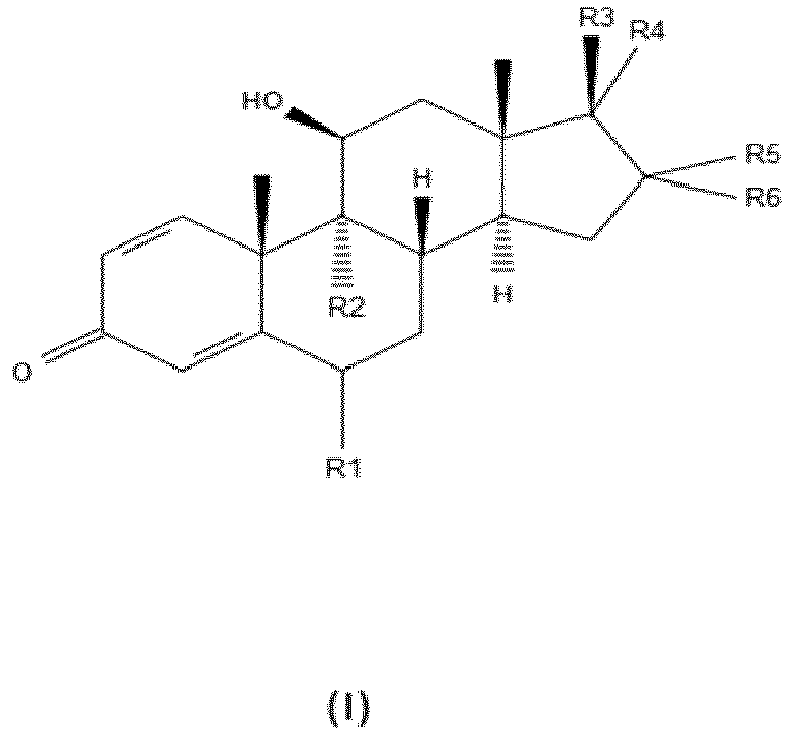
- wherein R1 and R2 each independently represent a hydrogen atom, a halogen, C15-alkyl, C3-8-cycloalkyl, hydroxy, C1-5-alkoxy, C1-5-alkoxy-C1-5-alkyl, C1-5-alkyl optionally mono- or polysubstituted with a halogen atom , C1-5-alkoxycarbonyl, or C1-5-alkoxycarbonyl-C1-6-alkyl;
- R3, R4, R5 and R6 each independently represent hydrogen, a hydroxyl, C1-5-alkoxy, C1-5-alkoxycarbonyl, hydroxycarbonyl, C1-5-alkylcarbonyl optionally mono- or polysubstituted with a halogen atom, C1-5-alkylcarbonyloxy, C3-8-cycloalkylcarbonyloxy, C1-5 alkyl thio, C1-5alkyl sulfonyl, C1-5-alkylsulfinyl , furan , furan carbonyloxy, C1-5-alkythiocarbonyl optionally mono- or polysubstituted with a halogen atom , or propionyloxymethylcarbonyl;
- R4 and R5 optionally form together a hydrocarbon ring of 3 to 5 atoms, two carbon atoms optionally being replaced by an oxygen atom and the ring being optionally substituted by a C1-5 alkyl group. For example bis-oxy hydrocarbon ring of 3 to 5 atoms, with two carbon atoms being replaced by an oxygen atom, and optionally substituted by an alkyl group such as a propyl group ; or a salt thereof with a pharmaceutically acceptable acid or base, or any optical isomer or mixture of optical isomers, including a racemic mixture or any tautomeric form thereof for use in the therapeutic and/or prevention treatment of pulmonary inflammatory disease_ in a host mammal in need of such treatment.
- By C1-5-alkyl as used herein, it means a straight or branched saturated or unsaturated hydrocarbon group with 1- 5 carbon atoms such as methyl, propyl, butyl, isopentyl, 1-methylbutyl, 1,2-dimethylbutyl, 2-ethylbutyl, and the like.
- By C3-8-cycloalkyl as used herein, it means a saturated or partially unsaturated hydrocarbyl group with 3 or more carbons in a ring, preferably from 3 to 8 carbon atoms. Examples of cycloalkyl group are cyclopropyl, cyclobutyl, cyclopentyl, cyclohexyl and the like.
- By C1-5-alkoxy, also denoted C1-5-alkyloxy, as used herein, it means an a straight or branched monovalent substituent comprising a C1-5-alkyl group linked through an ether oxygen having its free valence bond from the ether oxygen and having 1 to 5 carbon atoms such as methoxy, ethoxy, propyloxy, isopropoxy, butyloxy, sec-butyloxy, ter-butyloxy, 2-methylbutoxy, pentyloxy, and the like.
- By C1-5-alkoxy-C1-5-alkyl, as used herein, it means 2-10 carbon atoms interrupted by an oxygen atom such as -CH2-O-CH3, -CH2CH2O-CH3, -CH2-O-CH2CH3,-CH2-O-CH(CH3)2 , -CH2CH2-O-CH(CH3)2 , -CH(CH3)CH2-O-CH3 and the like.
- By "C1-5-alkylthio" , alone or in combination, as used herein, it refers to a straight or branched monovalent substituent comprising a C1-5-alkyl group linked through a divalent sulphur atom having its free valence bond from the sulphur atom and having 1 to 5 carbon atoms such as methylthio, ethylthio, propylthio, isopropylthio, butylthio, pentylthio, 3-methylpentylthio and the like.
- By C1-5-alkylsulfonyl" as used herein, it refers to a monovalent substituent comprising a C1-5-alkyl group linked through a sulfonyl group (-S(=O)2-), such as methylsulfonyl, ethylsulfonyl, propylsulfonyl, isopropylsulfonyl, butylsulfonyl, pentylsulfonyl, 2-methylpentylsulfonyl and the like.
- By C1-5-alkylsulfinyl" as used herein, it refers to a monovalent substituent comprising a C1-5-alkyl group linked through a sulfinyl group (-S(=O)-), such as methylsulfinyl, ethylsulfinyl, propylsulfinyl, isopropylsulfinyl, tert-butylsulfinyl, pentylsulfinyl, 2-ethylbutylsulfinyl and the like.
- By furan, as used herein, it means:

- By furan carbonyloxy as used herein, it means:

- By halogen" as used herein, it means fluorine, chlorine, bromine or iodine.
- By R4 and R5, optionally they may form together a hydrocarbon ring of 3 to 5 atoms, of which two carbon atoms may optionally be replaced by an oxygen atom and the ring may optionally be substituted with a C1-5 alkyl group, including for example bis oxy hydrocarbon ring of 3 to 5 atoms, of which two carbon atoms may be replaced with an oxygen atom, and may optionally be substituted with an alkyl group, such as 1,3-dioxolan-2-yl)propyl or

- Preferred budesonide derivatives according to the present invention are mometasone furoate or fluticasone furoate represented by the general formula (I) with a furane carbonyloxy group respectively in R3 or R4 as illustrated hereafter

- Mometasone furoate is commercially available from Pfizer and Merck whereas fluticasone furoate is commercially available from GSK
- Other preferred budesonide derivatives according to the present invention are fluticasone propionate or beclomethasone dipropionate represented by the general formula (I) with at least a propylcarbonyloxy group or propionate group in R4 as follows:

- Fluticasone propionate is commercially available from GSK under the trade name Flixotide, and beclomethasone dipropionate is commercially available from TEVA, UCB, SANDOZ, and CHIESI under the trade name QVAR, Asmabec, Ecobec and Beclophar.
- In accordance with the present invention, the most preferred budesonide derivative is budesonide. Budesonide is a corticosteroid and is represented by the general formula (I) wherein:

- Budesonide is also named (R,S)-11(3,16a,17,21-tetrahydroxypregna-1,4-diene-3,20-dione cyclic 16,17-acetal with butyraldehyde, or 16,17-(butylidenebis(oxy))-11,21-dihydroxy-, (11-β,16-α)-pregna-1,4-diene-3,20-dione. The chemical formula, molecular weight and CAS number for Budesonide are C25H3406, MW: 430.5 and 51333-22-3, respectively. Budesonide is a racemate consisting of a mixture of the two diastereomers 22R and 22S and is provided commercially as a mixture of the two isomers (22R and 22S).
- Commercial formulations of budesonide in solution are provided by AstraZeneca LP (Wilmington, Del.) under the trademarks, Pulmicort Respules®, Rhinocort® Aqua, Rhinocort® and in powder under the trademark Nasal Inhaler and Pulmicort® Turbuhaler, and under its generic name.
Budesonide in powder form (raw material) is provided by Indis (Belgium) - Cyclodextrins are known to be cyclic oligosaccharides produced by bacterial degradation from starch. Cyclodextrins are composed of 6,7 or 8 α-D-glucopyranoside units and named accordingly α, β or γ cyclodextrins.

- Cyclodextrin compounds according to the present invention include cyclodextrin per se, alkyl-cyclodextrin (R-CD) wherein R is methyl, ethyl, propyl or butyl; carboxyalkyl-cyclodextrin(CR-CD), etherified-cyclodextrin (RO-CD) , hydroxyalkyl-cyclodextrin(HR-CD), glucosyl-cyclodextrin, di and triglycerides-cyclodextrin or a combination thereof and their pharmaceutically acceptable salts which are water soluble in at least an amount of 0.5gr/100ml at 25°C.
The water-soluble cyclodextrin compound preferably used in the present invention refers to a cyclodextrin compound having water solubility of at least that of ß-cyclodextrin (1.85g/100ml). Examples of such water-soluble cyclodextrin compounds include, hydroxypropylcyclodextrin, maltosylcyclodextrin, and salts thereof. - Other preferred cyclodextrin compounds according to the present invention include methylcyclodextrins (products of the cyclodextrins methylation) such as 2-O- methylß-cyclodextrin; dimethylcyclodextrin (DIMEB) (preferably substituted in 2 and in 6); trimethylcyclodextrin (preferably substituted in 2, 3 and 6);_"random methylated" cyclodextrins (RAMEB or RM) (preferably substituted at random in 2, 3 and 6, but with a number of 1,7 to 1,9 methyl by unit glucopyrannose), hydroxypropylcyclodextrins (HPCD), hydroxypropylated cyclodextrins preferably substituted randomly mainly in
position 2 and 3 (HP-βCD, HP-γ CD)), , hydroxyethyl-cyclodextrins, carboxymethylethylcyclodextrins, ethylcyclodextrins, cyclodextrins amphiphilic obtained by grafting hydrocarbonated chains in the hydroxyl groups and being able to form nanoparticles, cholesterol cyclodextrins and triglycerides-cyclodextrins obtained by grafting cyclodextrins monoaminated (with a spacer arm) as described in Critical Review in Therapeutic drug Carrier Systems, Stephen D. Bruck Ed, Cyclodextrin-Enabling Excipient; their present and future use in Pharmaceuticals , D. Thomson, Volume 14, ), which is incorporated herein by reference in its entirety. - Most preferred cyclodextrins compounds in accordance with the present invention include : β-cyclodextrin with optionally a chemical function grafted on the glucopyrannose units such as hydroxypropyl-βcyclodextrin(HPβCD), - βcyclodextrin(SBEβCD), random methylated-βcyclodextrin( RMβCD), dimethyl-βcyclodextrin( DIMEβCD), trimethyl-βcyclodextrin(TRIMEβCD), hydroxybutyl βcyclodextrin(HBβCD), glucosyl βcyclodextrin, maltosyl βcyclodextrin and 2-O-methyl βcyclodextrin(Crysmeb) and their pharmaceutically acceptable salts and any combination thereof..
- The most preferred cyclodextrin in accordance with the present invention is hydroxypropyl-β cyclodextrin (also called HPβCD or HPBCD hereafter)
- The cyclodextrin compounds according to the present invention are produced by the well-known enzymatic degradation of starch such as the method described in "Cyclodextrin Technology, J Szejtli, Kluwer Academic Publishers 1998, pp 1-78, which is incorporated herein by reference in its entirety , followed by grafting of an appropriate chemical group. They are commercially available from Roquette (France).
- The most preferred pharmaceutical composition comprises budesonide derivative and a cyclodextrin compound in a molar ratio between 1-1 and 1 - 100, preferably 1 and 75 and most preferably 1:50. The budesonide /hydroxypropyl-β cyclodextrin concentration ratio is preferably in a molar ratio ratio of 1:50.
- The pharmaceutical composition according to the present invention comprising a cyclodextrin compound and a budesonide derivative may be prepared by adding an excess of budesonide derivative in powder form to an adequate amount of cyclodextrin in liquid solution. The liquid cyclodextrin solution is a water or water-alcohol or alcohol based solution such as ethanol. The budesonide derivative and the cyclodextrin compound are mixed under continuous agitation at room temperature. The excess amount of budesonide derivative is removed by filtration.
- Both components are weighted to give a resulting budesonide derivative and cyclodextrine mixture in a weight concentration ratio of between 1:1500 to 1:2, preferably 1:60 ratio.
- The liquid mixture may then be dried during atomisation by an appropriate well know technic of the art in order to produce a micronized dried powder. In such a case, the pharmaceutical composition can also include a pharmaceutically acceptable excipient, such as a carrier as for example lactose, magnesium stearate, mannitol, polyols, leucine derivatives and the like.
- The liquid mixture may also be added to a cyclodextrin in isotonic Buffer at the same concentration as the one of the cyclodextrin in liquid solution of the mixing step, to produce a pharmaceutical composition in liquid solution.
- The pharmaceutical composition in liquid solution may also contain well known pharmaceutically acceptable excipients such as isotonic buffers, preservatives, solvent or viscosity modulating agents and auxiliary substances.
- Appropriate isotonic buffer systems are based on sodium phosphate (PBS), sodium acetate or sodium borate.
- Preservatives may be included to prevent microbial contamination of the pharmaceutical composition during use. Suitable preservatives are, for example, benzalkonium chloride, chlorobutanol, methylparaben, propylparaben, phenylethyl alcohol, sorbic acid. Such preservatives are used typically in an amount of from 0.01 to 1% weight/volume.
- Suitable auxiliary substances and pharmaceutically-acceptable salt are described in Remington's Pharmaceutical Sciences, 16th ed., 1980, Mack Publishing Co., edited by Oslo et al, which is incorporated herein by reference in its entirety. Typically, an appropriate amount of a pharmaceutically-acceptable salt is used in a pharmaceutical composition of the present invention to render the composition isotonic. Examples of pharmaceutically acceptable substances include saline, Ringer's solution and dextrose solution. In accordance with the present invention, the pH of the solution is preferably from about 5 to about 8, and more preferably from about 7 to about 7.5.
- The pharmaceutical composition according to the present invention is used for treatment and/or prevention of pulmonary inflammatory disease in a host mammal in need of such treatment, preferably for chronic obstructive pulmonary disease, such as chronic bronchitis, obstructive bronchiolitis, emphysema, pulmonary fibrosis, cystic fibrosis and most preferably for tobacco-induced chronic obstructive pulmonary disease and cystic fibrosis disease.
- The pharmaceutical compositions of the present invention may be formulated into oral, parenteral or topical dosage forms, particularly in dosage forms for aerosol or nasal inhalation administration, a topical form of administration. The pharmaceutical composition of the present invention may be delivered in solution, suspension, as a micronized powder mixture and the like. Additionally the pharmaceutical compositions of the present invention may be administered by , for example a nebulizer, a metered dose inhaler or a dry powder inhaler or any other device that is designed for such topical administration.
- The pharmaceutical composition according to the present invention may be administered as a molecular dose in a range from 0.05 to 1000mcg, preferably from 0.1 to 500mcg and especially in the range from 50 to 200 mcg per day.
- A preferred pharmaceutical composition contemplated by the present invention comprises budesonide and cyclodextrin in liquid solution, most preferably budesonide and HP-β-cyclodextrin.
- A most preferred pharmaceutical composition contemplated by the present invention contains budesonide and cyclodextrin in liquid solution at a concentration of 100µgr/ml of budésonide in a solution of HP-β-cyclodextrin 20mM in an isotonic buffer.
- The combination of a cyclodextrin compound with a budesonide derivative in the pharmaceutical compositions according to the present invention are preferably a complex budesonide derivate - cyclodextrin compound in a stoichiometric ratio 1:1 or 2:1. Particularly the complex budesonide with HP-β-cyclodextrin is in a stoichiometric ratio 1:1.
- The following examples, references, and figures are provided to aid the understanding of the present invention. It is understood that modifications can be made in the procedures set forth without departing from the invention.
- The foregoing_and other objects, advantages and features of the present invention, and the manner in which the same are accomplished, will become more readily apparent upon consideration of the following figures and examples, wherein:
-
Fig. 1 Solubility diagram of budesonide in water solution with increasing concentration of HP-β-cyclodextrin (HPβCD). -
Fig. 2 : Model of airway obstruction and inflammation: Peribronchial inflammation score measured in histology -
Fig. 3 : Il13 levels measured in lung proteins extracts -
Fig. 4 : COPD model: peribronchial inflammation score measured in histology. -
Fig. 5 : Airway responsiveness measurements: enhanced paused (Penh) was measured in mice after receiving placebo or treatments -
Fig. 6 : IL17 ELISA measurements in lung protein extracts of ozone-exposed mice. -
Fig. 7 : IL13 ELISA measurements in lung protein extracts of ozone-exposed mice. -
Fig. 8 : KC (CXL1) ELISA measurements in lung protein extracts of ozone-exposed mice -
Fig. 9 : Effects of budesonide-cyclodextrin on BALF neutrophil percentage -
Fig. 10 : Illustration of an inclusion complex comprising a budesonide derivative and a cyclodextrin by 1H-NMR spectrum of a budesonide-Hydroxypropyl-β-cyclodextrin complex (Fig10a ) compared to a reference 1H-RMN spectrum of Hydroxypropyl-β-cyclodextrin alone (Fig10b ). -
Fig. 11 : Illustration of an inclusion complex comprising a budesonide derivative and a cyclodextrin by 1D-COSY-NMR spectra of a budesonide-Hydroxypropyl-β-cyclodextrin complex. -
Fig. 12 : Accuracy profile is obtained by considering Weighed (1/X) Quadratic Regression. - Examples of various embodiments of the present invention will now be further illustrated with reference to the following examples. Thus, the following examples are provided to illustrate the invention, but are not intended to be limiting thereof. Parts and percentages are by weight unless otherwise specified.
- Budesonide is purchased from Indis (Belgium) and hydroxypropyl-beta-cyclodextrin, from Roquette (France). Commercial budesonide suspension at 250 µg/ml (Pulmicort®) is purchased from AstraZeneca (Sweden).
- In
figure 1 , the pharmaceutical composition in solution is prepared by adding excess budesonide in a powder form to a cyclodextrin solution of a precise concentration of 5, 10, 25, 50 and 100 mM in water (the calculated and exactly weighed amount of cyclodextrin is corrected for water content by calculating the molarity using a Karl-Fischer titrator). The mixture process takes 24 hours at room temperature under a continuous agitation of 350rpm . The excess amount of budesonide is removed by filtrating the resulting mixture with a 0.22µm filter unit. The budesonide concentration in solution is verified with a validated HPLC method and the mixture is then diluted with a PBS-cyclodextrin solution (at the same precise concentration of 5, 10, 25, 50 and 100mM than before) to reach the required budesonide concentration for in-vivo testing.
At such concentrations, for example 100µg/ml or 250µg/ml, budesonide is soluble in water /PBS and the pharmaceutical compositions appears as a clear and transparent inhalation solution. - A preferred pharmaceutical formulation for inhalation solution comprises 100µg/ml of budesonide and 10mM of hydroxypropyl beta cyclodextrin. The solution is prepared by dissolving 0,6979g of HP-β-
CD 5% water (corrected for its water content) in 50ml of purified, pyrogen free water (or sterile PBS), adding excess budesonide and stir at room temperature for 24 hours at 350rpm. The budesonide in excess is removed by filtration through a 0.22µm filter unit and the resulting solution is dosed with a validated HPLC method. The resulting solution is then diluted with an HP-β-CD solution (in PBS or water) at 10mM to reach the concentration of 100µg/ml of budesonide. The isotonicity is reached by adding NaCl. Preferably the final solution is sterilized by filtration through a 0.22 µm polypropylene membrane or by a steam sterilization process. - A second preferred pharmaceutical formulation for inhalation solution comprises 100µg/ml of budesonide and 20mM of hydroxypropyl beta cyclodextrin. The solution is prepared by dissolving 1,3958g of HP-β-
CD 5%water ( corrected for its water content) in 50ml of purified, pyrogen free water (or sterile PBS), adding excess budesonide and stir for 24 hours at 350rpm. The budesonide in excess is removed by filtration through a 0.22 µm filter unit and the resulting solution is dosed with a validated HPLC method. The resulting solution is then diluted with an HP-β-CD solution (in PBS or water) at 20mM to reach the concentration of 100µg/ml of budesonide. The isotonicity is reached by adding NaCl. Preferably the final solution is sterilized by filtration through a 0.22 µm polypropylene membrane or by a steam sterilization process. - A third preferred pharmaceutical formulation for inhalation solution comprises 250µg/ml of budesonide and 20mM of hydroxypropyl beta cyclodextrin. The solution is prepared by dissolving 1,3958g of HP-β-
CD 5% water ( corrected for its water content) in 50ml of purified, pyrogen free water (or sterile PBS), adding excess budesonide and stir for 24 hours at 350rpm. The budesonide in excess is removed by filtration through a 0.22 µm filter unit and the resulting solution is dosed with a validated HPLC method. The resulting solution is then diluted with an HP-β-CD solution (in PBS or water) at 20mM to reach the concentration of 250µg/ml of budesonide. The isotonicity is reached by adding NaCl. Preferably the final solution is sterilized by filtration through a 0.22 µm polypropylene membrane or by a steam sterilization process. - A fourth preferred pharmaceutical formulation for inhalation solution comprises 100µg/ml of Fluticasone and 10mM of hydroxypropyl beta cyclodextrin. The solution is prepared by dissolving 0,6979g of HP-β-
CD 5% water( corrected for its water content) in 50ml of purified, pyrogen free water (or sterile PBS), adding excess fluticasone and stir at room temperature for 24 hours at 350rpm. The fluticasone in excess is removed by filtration through a 0.22 µm filter unit and the resulting solution is dosed with a validated HPLC method. The resulting solution is then diluted with an HP-β-CD solution (in PBS or water) at 10mM to reach the concentration of 100µg/ml of fluticasone. The isotonicity is reached by adding NaCl. Preferably the final solution is sterilized by filtration through a 0.22 µm polypropylene membrane or by a steam sterilization process. - A fifth preferred pharmaceutical formulation for inhalation solution comprises 40µg/ml of Fluticasone and 10mM of hydroxypropyl beta cyclodextrin. The solution is prepared by dissolving 0,6979g of HP-β-
CD 5% water(t corrected for its water content) in 50ml of purified, pyrogen free water (or sterile PBS), adding excess fluticasone and stir at room temperature for 24 hours at 350rpm. The fluticasone in excess is removed by filtration through a 0.22 µm filter unit and the resulting solution is dosed with a validated HPLC method. The resulting solution is then diluted with an HP-β-CD solution (in PBS or water) at 10mM to reach the concentration of 40µg/ml of fluticasone. The isotonicity is reached by adding NaCl. Preferably the final solution is sterilized by filtration through a 0.22 µm polypropylene membrane or by a steam sterilization process. - A seventh preferred pharmaceutical formulation for inhalation solution comprises 40µg/ml of Beclomethasone and 10mM of hydroxypropyl beta cyclodextrin. The solution is prepared by dissolving 0,6979g of HP-β-
CD 5%( corrected for its water content) in 50ml of purified, pyrogen free water (or sterile PBS), adding excess beclomethasone and stir at room temperature for 24 hours at 350rpm. The beclomethasone in excess is removed by filtration through a 0.22 µm filter unit and the resulting solution is dosed with a validated HPLC method. The resulting solution is then diluted with an HP-β-CD solution (in PBS or water) at 10mM to reach the concentration of 40µg/ml of beclomethasone. The isotonicity is reached by adding NaCl. Preferably the final solution is sterilized by filtration through a 0.22 µm polypropylene membrane or by a steam sterilization process. - A preferred pharmaceutical formulation for inhalation solution comprises 40µg/ml of Fluticasone from ECIC and 10mM of hydroxypropyl beta cyclodextrin. The solution is prepared by dissolving 0,6979g of HP-β-
CD 5%water (corrected for its water content) in 50ml of purified, pyrogen free water, adding excess fluticasone and stir for 24 hours at 350rpm. The fluticasone in excess is removed by filtration through a 0.22 µm filter unit and the resulting solution is dosed with a validated HPLC method. The resulting solution is then diluted with an HP-β-CD solution at 10mM to reach the concentration of 40µg/ml of fluticasone. The final solution is spray dried with a ProCept spray drier-chiller in optimised conditions to obtain a reasonable powder yield (>90%)with particles of about 3 microns.The spray drying's technic is well known by the man skilled in the art. The spray drier-chiller and its drying process are reported in Procept datasheet or at (http://www.procept.be/spray-dryer-chiller) which is incorporated herein by reference in its entirety. -

- In order to study modulation of airway inflammation , BALB/c mice of 6 to 8 weeks old are sensitized by intraperitoneal injection of 10 µg ovalbumin (OVA) (Sigma Aldrich, Schnelldorf, Germany) emulsified in aluminum hydroxide (Alumlnject; Perbio, Erembodegem, Belgium) on days 0 (DO) and 7(D7). Mice are subsequently exposed to allergens by daily inhalation of an aerosol of
OVA 1%, for 30 minutes, generated by ultrasonic nebulizer (Devilbiss 2000), from day 21 to 25. Mice are subjected to 50µl intra-nasal instillations from day 18 to 24 and are sacrificed on day 26 as previously reported by Cataldo et al in Am.J.Pathol ;161 (2):491-498(2002) which is incorporated herein by reference in its entirety. - Placebo mice are intra-nasal injected with PBS.
- Male C57B1/6, 6 to 8 weeks old, are purchased from Charles River (Koln, Germany) and bred in our facility. All animal experiments procedures are approved by the ethical committee of the University of Liège. Food and water are supplied ad libitum.
- Phosphate Buffered Saline (PBS) is purchased from Lonza (Verviers, Belgium), hydroxypropyl-beta-cyclodextrin (degree of substitution with hydroxypropyl group: 0.62) is purchased from Roquette (France), budesonide is purchased from Indis (Belgium) and commercial budesonide suspension at 250 µg/ml (Pulmicort®) is purchased from AstraZeneca (Sweden). Metacholine was from Sigma-Aldrich (Germany). For mouse administration, hydroxypropyl-beta-cyclodextrin (20 mM) is mixed with budesonide (250 µg/ml) and budesonide suspension (250 µg/ml) according to example 1a above. All other materials are of analytical grade. Sterile, apyrogenic and isotonic cyclodextrin derivative-corticosteroid solutions are prepared at various concentrations. Solutions are tested following the Bacterial Endotoxin Test guidelines of FDA 35 2012 using Limulus Amebocyte Lysate (LAL) for sterile water for inhalation (<0,5 USP Units of Endotoxin/ml).
- Immediately after assessment of airway responsiveness and 24 hours after the last allergen exposure, mice are sacrificed and a Bronchoalveolar lavage is performed using 4x1ml of PBS-EDTA 0.05mM (Calbiochem, Darmstadt, Germany) as previously described by Cataldo DD, Tournoy KG, Vermaelen K et al. Am J Pathol; 161(2):491-498(2002) which is incorporated herein by reference in its entirety.
- BALF supernatant is collected for protein assessment while cells are used for differential cell counts. Differential cell counts based on morphologic criteria are carried out on cytocentrifuged preparations after staining with haematoxylin-eosin (Diff-Quick, Dade, Belgium))
- Cells are recovered by gentle manual aspiration. After centrifugation of bronchoalveolar fluid (BALF) (1200 rpm for 10 minutes, at 4°C), the supernatant is frozen at -80°C for protein assessment and the cell pellet is re-suspended in 1 ml PBS-EDTA 0.05mM. The differential cell counts are performed on cytocentrifuged preparations (Cytospin) after staining with Diff-Quick (Dade, Belgium).
- After BAL, the thorax is opened and the left main bronchus was clamped. The left lung is excised and frozen immediately at -80°C for protein extraction. The right lung is infused with 4ml paraformaldehyde 4%, embedded in paraffin and used for histology. Sections of 5 µm thickness are cut off from paraffin and are stained with haematoxylin-eosin. The extent of peribronchial inflammation is estimated by a score calculated by quantification of peribronchial inflammatory cells, as previously described by Cataldo DD, Tournoy KG, Vermaelen K et al. in Am J Pathol 2002; 161(2):491-498. A value of 0 is adjudged when no inflammation is detectable, a value of 1 when there is occasionally inflammatory cells, a value of 2 when most bronchi are surrounded by a thin layer (1 to 5 cells) of inflammatory cells and a value of 3 when most bronchi are surrounded by a thick layer (>5 cells) of inflammatory cells. Since 6-8 randomly selected tissue sections per mouse are scored, inflammation scores are expressed as a mean value and can be compared between groups.
As stated above, the left lung is excised and frozen immediately at -80 °C and then disrupted in liquid N2 by using a Mikro-Dismembrator (Braun Biotech International, Gmbh Melsungen, Germany) to form a homogenized powder. This crushed lung tissue is incubated overnight at 4 °C in a solution containing 2 M urea, 1 M NaCl and 50 mM Tris (pH 7.5) and subsequently centrifuged for15 min at 16 000 x g for protein extraction.
IL13 levels are measured in non-pooled lung protein samples by ELISA (duoset kit, R&D Systems, Abingdon, United Kingdom) following manufacturer's instructions. - Mice are anesthetized by intraperitoneal injection (200 µl) of a mixture of ketamine (10 mg/ml, Merial, Brussels, Belgium) and xylazine (1 mg/ml, VMD, Arendonk, Belgium). A tracheotomy is performed by inserting a 20 gauge polyethylene catheter into the trachea and ligating it around the catheter to avoid leaks and disconnections. Mice are ventilated with a flexiVent® small animal ventilator (SCIREQ, Montreal, Canada) at a frequency of 250 breaths per minute and a tidal volume of 10 ml/kg. A positive end expiratory pressure is set at 2 hPa. Measurement started after 2 minutes of mechanical ventilation. A sinusoidal 1-Hz oscillation is then applied to the tracheal tube and is allowed a calculation of dynamic resistance, elastance, and compliance of the airway by multiple linear regressions. A second manoeuvre consisting in an 8-s forced oscillatory signal ranging frequencies between 0.5 and 19.6 Hz allows measurement of impedance to evaluate tissue damping, tissue elastance, and tissue hysteresivity (33). Following measurement of baseline lung function, mice are exposed to a saline aerosol (PBS) is followed by aerosols containing increasing doses (3, 6, 9, 12g/1) of metacholine (ICN Biomedicals, Asse Relegem, Belgium). Aerosols are generated by the mean of an ultrasonic nebuliser (SYST'AM,
LS 2000, Dupont Medical, Rhode-Saint-Genèse, Belgium) and is delivered to the inspiratory line of the flexiVent® using a bias flow of medical air following the manufacturer's instructions. Each aerosol is delivered for 2 minutes and periods of measurement as described above were made at one-minute intervals following each aerosol. The mean airway resistance after metacholine exposure is the main parameter measured during the challenge. - Results of pulmonary histology levels are expressed as mean +/- SEM and the comparison between the groups is performed using a one-way analysis of variance follow by a Tukey posttest. Tests are performed using GraphPad Prism 5.Significance level: Alpha = 0.05 (95% confidence intervals).
-
Figure 2 illustrates Peribronchial inflammation score measured in histology with a placebo, budesonide 100µg/ml, a pharmaceutical composition according to example 1a and budesonide 250µg/ml
Ovalbumin exposed mice (Placebo) display a significant increase in inflammatory cells number in their lung tissues. Exposure to a complex of budesonide 100µg/ml and HP-β-CD 10mMinduce display a significant decrease in inflammatory cells number when compared to placebo. The budesonide (100µg/ml) - HP-β-CD (10mM) complex induce the same inflammation decrease than budesonide alone at a higher concentration (250µg/ml) and is significantly more effective than the budesonide alone at the same concentration (100µg/ml). -
Figure 3 illustrates: IL13 levels are measured in lung protein extracts. - The lungs are crushed using a Mikro-Dismembrator (Braun Biotech International, Gmbh Melsungen, Germany). Crushed lung tissue was incubated overnight at 4°C in a solution containing urea 1M for protein extraction. The supernatant is stored at -80°C for ELISA tests.
- Mouse display higher levels of IL13 in their lung tissue after allergen exposure when they are treated with budesonide 250 µg/ml as compared to those that are treated with the complex budesonide250 µg/ml -
cyclodextrin 10 mM. Mice treated withbudesonide 100 µg/ml display in a similar manner higher IL13 levels than mice that are treated withbudesonide 100 µg/ml -cyclodextrin 10 mM. - Two different mice models are used in order to mimic chronic obstructive pulmonary disease (COPD). In the first model, C57BL/6 mice are exposed to a high concentration of ozone (03), which is a highly reactive oxidant air pollutant. Inhaled 03 in animal models is responsible of airway inflammation (by neutrophil cells) and hyper-responsiveness. The second model is using tobacco smoke as cigarette is known to be the main driver of COPD. Cigarette smoke exposure also leads to an airway inflammation mediated by neutrophil cells). Ozone and cigarette are potent inducers of oxidative stress and this stress can lead to chronic inflammation as observed in long term study.
- A schematic description of an experience under ozone exposure are reported hereafter

- In the schematic description, C57BL/6 mice are firstly treated by a 50µl intra-nasal injection as a pre-treatment (between
Day 0 and Day 1) before being exposed to a high concentration of ozone (2ppm) during 3 hours, preceded by a therapeutic 50µlintra-nasal injection 3 hours before (betweenDay 2 and Day 4). Mice are sacrificed onDay 5. Placebo mice are injected with PBS. - Bronchoalveolar lavage fluid (BALF) analysis, pulmonary histology analysis, bronchial responsiveness measurement and statistical analysis are the same as previously described in Example 3 (airway inflammation and hyper-responsiveness). IL17 and KC (CXCL1) levels are measured in non-pooled lung protein samples by ELISA (duoset kit, R&D Systems, Abingdon, United Kingdom) following manufacturer's instructions.
-
Figure 4 illustrates Peribronchial inflammation score that is measured in histology for a placebo, a composition according to Example 1a and budesonide 250µg/ml . - Ozone-exposed mice (placebo) display a significant increase in inflammatory cells number in their lung tissues, as compared to other groups. Exposure to a complex comprising budesonide at 100µg/ml and HP-β-CD at 10mM induce a significant decrease of inflammatory cells number when compared to placebo. The budesonide (100µg/ml) - HP-β-CD (10mM) complex induce the same inflammation decrease than budesonide alone at a higher concentration (250µg/ml).
-
Figure 5 illustrates Airway responsiveness measurement: Enhanced Paused (Penh) is measured in mice after receiving placebo or treatments with a pharmaceutical composition prepared according to Example 1a. - When compared to other groups, ozone exposure induces an expected significant increase of bronchial hyper-responsiveness in mice that are submitted to metacholine challenge. When compared to placebo group, a complex comprising budesonide at 100µg/ml and HP-β-CD at 10mM induces a significant decrease of bronchial hyper-responsiveness at 48 g/L of metacholine. The budesonide (100µg/ml) - HP-β-CD (10mM) complex induce the same bronchial hyper-responsiveness decrease than budesonide alone at a higher concentration (250µg/ml).
-
Figure 6 illustrates IL17 ELISA measurements in lung protein extracts of Ozone-exposed mice. Different treatments with HPBCD and budesonide alone or in combination are compared. The pharmaceutical compositions are prepared according to Example 1a either in a combination mixture (budesonide-HPBCD) or with each active compound alone (budesonide 250 µg/ml or HPBCD 10mM) in the same PBS buffer solution. - When compared to Budesonide-treated group (250 µg/ml), a complex comprising budesonide at 250 µg/ml or 100µg/ml or 10 µg/ml and HP-β-CD at 10mM induces a significant decrease in IL17 levels.
- IL17 levels are increased after ozone exposure and might participate in the pathogenesis of ozone-induced neutrophils inflammation. This is the first demonstration that the budesonide-cyclodextrin complex given by inhalation is able to decrease ozone-induced IL17 levels.
-
Figure 7 illustrates IL13 ELISA measurements in lung protein extracts of ozone-exposed mice. Different treatments with HPBCD and budesonide alone or in combination are compared. The pharmaceutical compositions are prepared according to Example 1a either in a combination mixture (budesonide-HPBCD) or with each active compound alone (budesonide 250 µg/ml or HPBCD 10mM) in the same PBS buffer solution. - When compared to Budesonide-treated group (250 µg/ml), a complex comprising budesonide at 250µg/ml or 100µg/ml or 10 µg/ml and HP-β-CD at 10mM induces a decrease in IL17 levels.
- IL13 has previously been shown to be modulated after ozone exposure and to participate in the airway dysfunction subsequent to ozone exposure. See, for example, Williams S., Nath P, Leung S, et al Eur Respir J. 2008 Sep;32(3):571-8) which is incorporated herein by reference in its entirety.
- This is the first time that ozone-induced IL13 levels are shown to be significantly decreased by inhalation of a compound comprising budesonide. The inhalation of budesonide-cyclodextrin complex decreases IL13 levels as compared to inhaled budesonide (2008Sep;250µg/ml).
-
Figure 8 illustrates KC (CXCL1) ELISA measurements in lung protein extracts of ozone-exposed mice. - Different inhalation treatments with HPBCD and budesonide alone or in combination are compared. The pharmaceutical compositions are prepared according to Example 1a either in a combination mixture (budesonide-HPBCD) or with each active compound alone (budesonide 250 µg/ml or HPBCD 10mM) in the same PBS buffer solution.
- When compared to Budesonide-treated group (250 µg/ml), a complex comprising budesonide at 250 µg/ml or 100µg/ml and HP-β-CD at 10mM induces a decrease in KC levels.
- This is the first demonstration that CXCL-1, a cytokine that plays a key role in the venue of neutrophils in bronchial walls following the exposure to irritants or oxidants can be decreased by inhaled budesonide derivatives. This is only the budesonide-cyclodextrin complex that decrease ozone-induced KC production.
- C57BL/6 mice are exposed to 10
cigarettes 5 days per week during 6 weeks using the Inexpose® system (Scireq, Montreal, Canada). Mice are treated by a 50µlintra-nasal injection 5 days per week during 6 weeks. Mice are sacrificed on Day 43. Placebo mices also called sham exposed mices are injected with PBS. - Bronchoalveolar lavage fluid (BALF) analysis is the same as previously described in Example 3 (model of airway obstruction and inflammation).
- Results of inflammatory cells in bronchoalveolar lavage fluid number are expressed as mean +/- SEM and the comparison between the groups is performed using Mann-Whitney test. Tests are performed using
GraphPad Prism 5. P values < 0.05 are considered as significant. - In the present experiment, pharmaceutical composition according to Example 1b and 1c are used as specific inhalation solutions comprising:
- 100µg/ml of budesonide and 20mM of hydroxypropyl beta cyclodextrin (Example 1b)
- 250µg/ml of budesonide and 20mM of hydroxypropyl beta cyclodextrin (Example 1c)
-
Figure 9 illustrates the Effects of budesonide-cyclodextrin mixture on BALF neutrophil percentageTable 1: Percentage of neutrophils (+/- SEM) in BALF Sham-Exposed mice Placebo (PBS) treated Budesonide 500µg/ml Budesonide 100µg/ml + CD 20mM Budesonide 250µg/ml + CD 20mM Neutrophils (%) 0,65 (+/-0,37) 6,08 (+/- 2,51) 9,64 (+/- 5,35) 0,62 (+/- 0,27) 1,46 (+/- 0,23) - Cigarette smoke-exposed mice display a significant increase in neutrophil number in their bronchoalveolar lavage fluids (BALF), as compared to sham-exposed mice. Exposure to all tested concentrations of budesonide-HP-β-CD (20mM) complexes induces a significant decrease in neutrophil number when compared to cigarette smoke-exposed mice. All the budesonide-HP-β-CD (20mM) complexes induce a higher decrease than budesonide alone at a higher concentration (500µg/ml). Budesonide alone is significantly not efficient enough to decrease the inflammation level in BALF of treated mice.
- As HP-β-CD carbohydrates contain no chromophores, UV detection is not feasible. Until now no techniques have been described for the quantification of HP-β-CD in a pharmaceutical aqueous solution. Since NMR spectroscopy is widely used to understand the interaction between CD and drugs and to evaluate the number of substituted glucopyranose units (molar substitution), 1H nuclear magnetic resonance spectrometry is applied for the detection and quantification of HP-β-CD in water.
- HP-β-CD (molar substitution = 0.64) is kindly donated by Roquette (France). Trimethylsilyl-3-propionic acid-d4 (TMSP) and deuterium oxide (99.96% D) are purchased from Eurisotop (Gif-sur-Yvette, France). Maleic acid is obtained from Sigma-Aldrich.
- For the validation process, standard solutions of HP-β-CD are diluted in Milli-Q® water to obtain the calibration standards at six concentration levels within the range 0.05mg/ml - 5mg/ml. At 500µl of these solutions, 100µl of
D 20 buffer, 100µl of maleic acid (5mM) and 10µl of TMSP are added for NMR analysis. A preferred pharmaceutical composition budesonide-HP-β-CD was prepared according to example 1a, with the exception that the isotonic buffer has been replaced by D2O - Budesonide HP-β-CD in D2O is recorded at 298 K on a Bruker Avance spectrometer operating at 500.13 MHz for the proton signal acquisition. The instrument is equipped with a 5 mm TCI cryoprobe with a Z-gradient. A 1D NOESY-presat sequence (64 scans) is used in order to minimize the water signal. Maleic acid is used as internal standard for quantification and TMSP for the zero calibration.
- In order to specifically detect HP-β-CD, the focus is on the hydroxypropyl group. Thus, the peak area of the doublet from the methyl group is measured at 1.1 ppm, which is part of the hydroxypropyl group (
figure 10B ).This specific peak can also be quantified when the HP-β-CD is in presence of budesonide, The peak at 1.1 ppm remains quantifiable and has kept the same area than without budesonide (figure 10A ). Other peaks could also be used for the quantification of HP-β-CD including the peak at 5.2ppm. - The validation of the method is performed on three series of experiments. The following criteria are tested: selectivity, specificity (compared to β-cyclodextrin), response function (calibration curve), linearity, precision (repeatability and intermediate precision), trueness, limit of detection (LOD), limit of quantification (LOQ), matrix effect and accuracy(
figure 12 ). Total error is used as decision criterion for the validation process. The acceptance limits are set at +/- 7.5% and the minimum probability to obtain future results within these limits is set at β = 95% (β-expectation limits). The technique is therefore validated in the range described above. -
Figure 11 Illustrates a 1D-COSY spectrum of the HP-β-CD - budesonide complex.
According to K.AConnors in Chem. Rev 1997, 97,1325-1357, which is incorporated herein by reference in its entirety, it is well known that H-3 and H-5 protons from HP-β-CD are located inside the cyclodextrin cavity. A correlation with theses protons suggest therefore that budesonide or a part of budesonide is included inside HP-β-CD .
Indeed, two correlation spots (at 7.4-7.5ppm and 5.8-6.1ppm) indicate an interaction between budesonide aromatic rings H-5 HP-β-CD proton suggesting an inclusion leading to a water soluble complex.
Claims (16)
- A pharmaceutical composition, comprising
a cyclodextrin compound and a budesonide derivative of formula I wherein R1 and R2 represent each independently hydrogen atom, halogen, C1-5-alkyl, C3-8-cycloalkyl, hydroxy, C1-5-alkoxy, C1-5-alkoxy-C1-5-alkyl, C1-5-alkyl optionally mono- or polysubstituted with a halogen atom , C1-5-alkoxycarbonyl, C1-5-alkoxycarbonyl-C1-6-alkyl,,R3, R4, R5 and R6 represent each independently hydrogen, hydroxyl, C1-5-alkoxy, C1-5-alkoxycarbonyl, hydroxycarbonyl, C1-5-alkylcarbonyl optionally mono- or polysubstituted with a halogen atom, C1-5-alkylcarbonyloxy, C3-8-cycloalkylcarbonyloxy, C1-5 alkyl thio, C1-5alkyl sulfonyl, C1-5-alkylsulfinyl , furan , furan carbonyloxy, C1-5-alkythiocarbonyl optionally mono- or polysubstituted with a halogen atom ;R4 and R5 optionally form together a hydrocarbon ring of 3 to 5 atoms, two carbon atoms optionally being replaced by an oxygen atom and the ring being optionally substituted by a C1-5 alkyl group or a salt thereof with a pharmaceutically acceptable acid or base, or any optical isomer or mixture of optical isomers, including a racemic mixture or any tautomeric form thereof for use in the therapeutic and/or prevention treatment of pulmonary inflammatory disease_ in a host mammal in need of such treatment.
 - The pharmaceutical composition according to claim 1 wherein the budesonide derivate/ and the cyclodextrin compound are in a weight concentration ratio between 1:1500 and 1:2, preferably 1:60.
- The pharmaceutical composition according to claim 1 or 2 wherein the budesonide derivative is selected from the group consisting of mometasone furoate, fluticasone furoate, fluticasone propionate, beclomethasone, budesonide or a combination thereof and their pharmaceutically acceptable salts.
- The pharmaceutical composition according to any one of claims 1 to 3 comprising a budesonide derivative wherein R1,R2, R6 are hydrogen; R3 is a hydroxyethanone group and R4 form with R5 a 1,3-dioxolan-2-yl)propyl or

- The pharmaceutical composition according to any one of claims 1 to 3 comprising a budesonide derivative wherein R1 is hydrogen , R2 is C1 , R3 is furanecarboxyl, R4 is chloromethylcarbonyl and R5 and R6 are hydrogen (mometasone furoate).
- The pharmaceutical composition according to any one of claim 1 to 3 comprising a budesonide derivative wherein R1 and R2 are Fluor, R3 is a fluoromethylthiocarbonyl, R4 is a furanecarboxyl and R5 and R6 are hydrogen, (fluticasone furoate).
- The pharmaceutical composition according to any one of claim 1 to 3 comprising a budesonide derivative wherein R1 and R2 are Fluor, R3 is a fluoromethylthiocarbonyl, R4 is a propylcarboxyl and R5 and R6 are hydrogen (fluticasone propionate)
- The pharmaceutical composition according to any one of claim 1 to 3 comprising a budesonide derivative wherein R2 is chlorine, R1 , R5 and R6 are hydrogen, R3 is propionyloxymethylcarbonyl and R4 is a propylcarbonyloxy group

- The pharmaceutical composition according to any one of claim 1 to 8 wherein the budesonide derivative forms with the cyclodextrin compound a complex in a 1:1 stoichiometric ratio.
- The composition according to any one of claim 1 to 9 wherein the cyclodextrin compound is selected from the group consisting of :β-cyclodextrin, hydroxypropyl-βcyclodextrin, , random methylated-βcyclodextrin, dimethyl-βcyclodextrin, trimethyl-βcyclodextrin, hydroxypropyl β-cyclodextrin,hydroxybutyl βcyclodextrin, glucosyl-βcyclodextrin, maltosyl-βcyclodextrin , 2-O-methyl-βcyclodextrin or a combination thereof and their pharmaceutically acceptable salts.
- The composition according to any one of claim 1 to 10 wherein the cyclodextrin compound is hydroxypropyl β-cyclodextrin
- The composition according to any one of claim 1 to 11 wherein the pulmonary inflammatory disease_is a chronic obstructive disease.
- A Method for prophylactic treatment of pulmonary inflammatory disease_comprising an administration to a patient in need of such treatment of an effective dose of the composition according to any one of claim 1 to 12.
- A Method for therapeutic treatment of pulmonary inflammatory disease_comprising an administration to a patient in need of such treatment of an effective dose of the composition according to any one of claim 1 to 12.
- A method of treatment according to claim 13 or 14 wherein the cyclodextrin compound and the budesonide derivative are administered respectively at a nominal dosage of 0.1mg and 25mgr/dose.
- An inhalation system for the treatment of pulmonary inflammatory disease_in a patient of need thereof comprising the pharmaceutical composition according to claim 1 to 12.
Priority Applications (26)
| Application Number | Priority Date | Filing Date | Title |
|---|---|---|---|
| EP14162158.1A EP2923702A1 (en) | 2014-03-28 | 2014-03-28 | Composition of cyclodextrin with budesonide derivatives for treatment and prevention of pulmonary inflammatory disease |
| MX2016012509A MX377038B (en) | 2014-03-28 | 2015-03-30 | COMPOSITIONS OF CYCLODEXTRIN AND BUDESONIDE DERIVATIVES AND METHODS. |
| RU2016138795A RU2722414C2 (en) | 2014-03-28 | 2015-03-30 | Compositions based on cyclodextrin and a budesonide derivative and methods for production thereof |
| EP22193800.4A EP4122469A1 (en) | 2014-03-28 | 2015-03-30 | Composition comprising cyclodextrin and budesonide derivatives for the treatment and prophylaxis of pulmonary inflammations |
| CA2944080A CA2944080A1 (en) | 2014-03-28 | 2015-03-30 | Composition comprising cyclodextrin and budesonide derivatives for the treatment and prophylaxis of pulmonary inflammations |
| BR112016022405A BR112016022405A2 (en) | 2014-03-28 | 2015-03-30 | COMPOSITIONS OF CYCLODEXTRIN AND BUDESONIDE DERIVATIVE AND METHODS |
| KR1020167030166A KR102391676B1 (en) | 2014-03-28 | 2015-03-30 | Composition comprising cyclodextrin and budesonide derivatives for the treatment and prophylaxis of pulmonary inflammations |
| TW104110203A TWI725935B (en) | 2014-03-28 | 2015-03-30 | Cyclodextrin and budesonide derivative compositions and methods |
| JP2017501502A JP2017509709A (en) | 2014-03-28 | 2015-03-30 | Cyclodextrin and budesonide derivative compositions and methods |
| EP15741867.4A EP3151836B1 (en) | 2014-03-28 | 2015-03-30 | Composition comprising cyclodextrin and budesonide derivatives for use in the treatment and prophylaxis of pulmonary inflammations |
| NZ724902A NZ724902A (en) | 2014-03-28 | 2015-03-30 | Composition comprising cyclodextrin and budesonide derivatives for the treatment and prophylaxis of pulmonary inflammations |
| CN202110176573.XA CN113144215A (en) | 2014-03-28 | 2015-03-30 | Composition comprising cyclodextrin and budesonide derivatives for the treatment and prevention of pulmonary inflammation |
| AU2015238174A AU2015238174A1 (en) | 2014-03-28 | 2015-03-30 | Composition comprising cyclodextrin and budesonide derivatives for the treatment and prophylaxis of pulmonary inflammations |
| PCT/EP2015/056929 WO2015144938A2 (en) | 2014-03-28 | 2015-03-30 | Cyclodextrin and budesonide derivative compositions and methods |
| PY201501514336A PY1514336A (en) | 2014-03-28 | 2015-03-30 | COMPOSITIONS DERIVED FROM CYCLODEXTRIN AND BUDESONIDE AND METHODS |
| UAA201610090A UA123894C2 (en) | 2014-03-28 | 2015-03-30 | COMPOSITION BASED ON CYCLODEXTRINE AND BUDESONIDE DERIVATIVE |
| US14/672,831 US9993487B2 (en) | 2014-03-28 | 2015-03-30 | Cyclodextrin and budesonide derivative compositions and methods |
| DK15741867.4T DK3151836T3 (en) | 2014-03-28 | 2015-03-30 | COMPOSITION COMPRISING CYCLODEXTRIN AND BUDESONIDE DERIVATIVES FOR USE IN THE TREATMENT AND PROPHYLAXIS OF PULMONARY INFLAMMATIONS |
| MA39407A MA39407A1 (en) | 2014-03-28 | 2015-03-30 | Cyclodextrin and budesonide derivative compositions and processes |
| ES15741867T ES2942710T3 (en) | 2014-03-28 | 2015-03-30 | Composition comprising cyclodextrin and budesonide derivatives for use in the treatment and prophylaxis of pulmonary inflammations |
| CN201580017376.6A CN106413759B (en) | 2014-03-28 | 2015-03-30 | Composition comprising cyclodextrin and budesonide derivatives for the treatment and prevention of pulmonary inflammation |
| SG11201608075VA SG11201608075VA (en) | 2014-03-28 | 2015-03-30 | Composition comprising cyclodextrin and budesonide derivatives for the treatment and prophylaxis of pulmonary inflammations |
| MX2020004223A MX2020004223A (en) | 2014-03-28 | 2016-09-26 | COMPOSITIONS OF CYCLODEXTRINE AND DERIVATIVES OF BUDESONIDE AND METHODS. |
| IL248106A IL248106B (en) | 2014-03-28 | 2016-09-28 | Compounds containing cyclodextrin and budesonide derivatives for the treatment and prevention of pulmonary infection |
| JP2020032976A JP7008097B2 (en) | 2014-03-28 | 2020-02-28 | Cyclodextrin and budesonide derivative compositions and methods |
| AU2020205304A AU2020205304B2 (en) | 2014-03-28 | 2020-07-16 | Composition comprising cyclodextrin and budesonide derivatives for the treatment and prophylaxis of pulmonary inflammations |
Applications Claiming Priority (1)
| Application Number | Priority Date | Filing Date | Title |
|---|---|---|---|
| EP14162158.1A EP2923702A1 (en) | 2014-03-28 | 2014-03-28 | Composition of cyclodextrin with budesonide derivatives for treatment and prevention of pulmonary inflammatory disease |
Publications (1)
| Publication Number | Publication Date |
|---|---|
| EP2923702A1 true EP2923702A1 (en) | 2015-09-30 |
Family
ID=50389899
Family Applications (2)
| Application Number | Title | Priority Date | Filing Date |
|---|---|---|---|
| EP14162158.1A Withdrawn EP2923702A1 (en) | 2014-03-28 | 2014-03-28 | Composition of cyclodextrin with budesonide derivatives for treatment and prevention of pulmonary inflammatory disease |
| EP15741867.4A Active EP3151836B1 (en) | 2014-03-28 | 2015-03-30 | Composition comprising cyclodextrin and budesonide derivatives for use in the treatment and prophylaxis of pulmonary inflammations |
Family Applications After (1)
| Application Number | Title | Priority Date | Filing Date |
|---|---|---|---|
| EP15741867.4A Active EP3151836B1 (en) | 2014-03-28 | 2015-03-30 | Composition comprising cyclodextrin and budesonide derivatives for use in the treatment and prophylaxis of pulmonary inflammations |
Country Status (13)
| Country | Link |
|---|---|
| US (1) | US9993487B2 (en) |
| EP (2) | EP2923702A1 (en) |
| JP (1) | JP2017509709A (en) |
| CN (1) | CN113144215A (en) |
| AU (2) | AU2015238174A1 (en) |
| CA (1) | CA2944080A1 (en) |
| MA (1) | MA39407A1 (en) |
| MX (1) | MX377038B (en) |
| RU (1) | RU2722414C2 (en) |
| SG (1) | SG11201608075VA (en) |
| TW (1) | TWI725935B (en) |
| UA (1) | UA123894C2 (en) |
| WO (1) | WO2015144938A2 (en) |
Cited By (4)
| Publication number | Priority date | Publication date | Assignee | Title |
|---|---|---|---|---|
| WO2021048322A1 (en) * | 2019-09-10 | 2021-03-18 | Aquilon Pharmaceuticals | Golf ball-like microparticles for use in the treatment and prevention of pulmonary diseases |
| WO2024251923A1 (en) * | 2023-06-07 | 2024-12-12 | Aquilon Pharmaceuticals | Preservative-free compositions comprising a complex of a corticosteroid and hpbcd for the treatment or prevention of an inflammatory disease through nasal administration |
| BE1031691B1 (en) * | 2023-06-07 | 2025-01-23 | Aquilon Pharmaceuticals | PRESERVATIVE-FREE COMPOSITIONS COMPRISING A CORTICOSTEROID AND HPBCD COMPLEX FOR THE TREATMENT OR PREVENTION OF AN INFLAMMATORY DISEASE BY NASAL ADMINISTRATION |
| BE1031693B1 (en) * | 2023-06-07 | 2025-01-23 | Aquilon Pharmaceuticals | PRESERVATIVE-FREE COMPOSITIONS COMPRISING A CORTICOSTEROID AND HPBCD COMPLEX FOR THE TREATMENT OR PREVENTION OF AN INFLAMMATORY DISEASE BY NASAL ADMINISTRATION |
Families Citing this family (5)
| Publication number | Priority date | Publication date | Assignee | Title |
|---|---|---|---|---|
| NZ724902A (en) * | 2014-03-28 | 2023-03-31 | Univ Liege | Composition comprising cyclodextrin and budesonide derivatives for the treatment and prophylaxis of pulmonary inflammations |
| BE1027425B1 (en) | 2019-07-01 | 2021-02-08 | Aquilon Pharmaceuticals | INHALABLE COMPOSITION INCLUDING CYCLODEXTRIN FOR USE IN THE TREATMENT OF NASAL INFLAMMATIONS |
| CN113457468B (en) * | 2021-06-24 | 2022-10-28 | 北京工业大学 | Tannin-hydroxypropyl beta cyclodextrin composite nanofiltration membrane and preparation method thereof |
| WO2023118014A1 (en) | 2021-12-20 | 2023-06-29 | Aquilon Pharmaceuticals | Inhalable compositions comprising a complex of hpbcd and budesonide or ciclesonide for the treatment or prevention of a respiratory viral disease or lipopolysaccharide-induced inflammation, in particular lipopolysaccharide-induced inflammation associated with a respiratory viral disease |
| BE1030002B1 (en) | 2021-12-29 | 2023-09-01 | Aquilon Pharmaceuticals | INHABLE COMPOSITIONS COMPRISING A COMPLEX OF HPBCD AND BUDESONIDE OR CICLESONIDE FOR THE TREATMENT OR PREVENTION OF A VIRAL RESPIRATORY DISEASE |
Citations (3)
| Publication number | Priority date | Publication date | Assignee | Title |
|---|---|---|---|---|
| WO2005065649A1 (en) * | 2003-12-31 | 2005-07-21 | Cydex, Inc. | Inhalant formulation containing sulfoalkyl ether ϝ-cyclodextrin and corticosteroid |
| EP1894559A1 (en) * | 2006-09-01 | 2008-03-05 | PARI Pharma GmbH | Means to solubilise steroids for inhalation |
| US20090312724A1 (en) * | 2007-06-28 | 2009-12-17 | Cydex Pharmaceuticals, Inc. | Nasal and Ophthalmic Delivery of Aqueous Corticosteroid Solutions |
Family Cites Families (7)
| Publication number | Priority date | Publication date | Assignee | Title |
|---|---|---|---|---|
| US5681828A (en) * | 1995-12-19 | 1997-10-28 | Pitha; Josef | Selective alkylations of cyclodextrins leading to derivatives which have a rigidly extended cavity |
| EP1655034A1 (en) * | 2004-10-10 | 2006-05-10 | Université de Liège | Use of cyclodextrin for treatment and prevention of bronchial inflammatory diseases. |
| US9034846B2 (en) | 2004-10-10 | 2015-05-19 | Universite De Liege | Use of cyclodextrin for treatment and prevention of bronchial inflammatory diseases |
| BRPI0620225A2 (en) * | 2005-12-20 | 2011-11-01 | Tika Läkemedel Ab | methods and systems for the distribution of corticosteroids having an increased pharmacokinetic profile |
| CN106038481A (en) * | 2007-06-28 | 2016-10-26 | 锡德克斯药物公司 | Nasal and ophthalmic delivery of aqueous corticosteroid solutions |
| EP2100599A1 (en) * | 2008-03-13 | 2009-09-16 | Laboratorios Almirall, S.A. | Inhalation composition containing aclidinium for treatment of asthma and chronic obstructive pulmonary disease |
| WO2015109201A1 (en) | 2014-01-17 | 2015-07-23 | Nephron Pharmaceuticals Corporation | Budesonide cyclodextrin formulation |
-
2014
- 2014-03-28 EP EP14162158.1A patent/EP2923702A1/en not_active Withdrawn
-
2015
- 2015-03-30 WO PCT/EP2015/056929 patent/WO2015144938A2/en not_active Ceased
- 2015-03-30 RU RU2016138795A patent/RU2722414C2/en active
- 2015-03-30 CN CN202110176573.XA patent/CN113144215A/en active Pending
- 2015-03-30 SG SG11201608075VA patent/SG11201608075VA/en unknown
- 2015-03-30 UA UAA201610090A patent/UA123894C2/en unknown
- 2015-03-30 MX MX2016012509A patent/MX377038B/en active IP Right Grant
- 2015-03-30 AU AU2015238174A patent/AU2015238174A1/en not_active Abandoned
- 2015-03-30 MA MA39407A patent/MA39407A1/en unknown
- 2015-03-30 CA CA2944080A patent/CA2944080A1/en active Pending
- 2015-03-30 JP JP2017501502A patent/JP2017509709A/en active Pending
- 2015-03-30 EP EP15741867.4A patent/EP3151836B1/en active Active
- 2015-03-30 TW TW104110203A patent/TWI725935B/en active
- 2015-03-30 US US14/672,831 patent/US9993487B2/en active Active
-
2020
- 2020-07-16 AU AU2020205304A patent/AU2020205304B2/en active Active
Patent Citations (3)
| Publication number | Priority date | Publication date | Assignee | Title |
|---|---|---|---|---|
| WO2005065649A1 (en) * | 2003-12-31 | 2005-07-21 | Cydex, Inc. | Inhalant formulation containing sulfoalkyl ether ϝ-cyclodextrin and corticosteroid |
| EP1894559A1 (en) * | 2006-09-01 | 2008-03-05 | PARI Pharma GmbH | Means to solubilise steroids for inhalation |
| US20090312724A1 (en) * | 2007-06-28 | 2009-12-17 | Cydex Pharmaceuticals, Inc. | Nasal and Ophthalmic Delivery of Aqueous Corticosteroid Solutions |
Non-Patent Citations (9)
| Title |
|---|
| "Remington's Pharmaceutical Sciences", 1980, MACK PUBLISHING CO. |
| CATALDO DD; TOURNOY KG; VERMAELEN K ET AL., AM J PATHOL, vol. 161, no. 2, 2002, pages 491 - 498 |
| CATALDO ET AL., AM.J.PATHOL, vol. 161, no. 2, 2002, pages 491 - 498 |
| DJEDAINI F ET AL: "NUCLEAR MAGNETIC RESONANCE INVESTIGATION OF THE STOICHIOMETRIES IN BETA-CYCLODEXTRIN: STEROID INCLUSION COMPLEXES", JOURNAL OF PHARMACEUTICAL SCIENCES, AMERICAN PHARMACEUTICAL ASSOCIATION, WASHINGTON, US, vol. 80, no. 12, 1 December 1991 (1991-12-01), pages 1157 - 1161, XP000242285, ISSN: 0022-3549, DOI: 10.1002/JPS.2600801213 * |
| J SZEJTLI: "Cyclodextrin Technology", 1998, KLUWER ACADEMIC PUBLISHERS, pages: 1 - 78 |
| K.ACONNORS, CHEM. REV, vol. 97, 1997, pages 1325 - 1357 |
| S. CULPITT ET AL., AM J RESPIR CRIT CARE MED, vol. 160, 1999, pages 1635 - 1639 |
| STEPHEN D; BRUCK ED: "Cyclodextrin-Enabling Excipient; their present and future use in Pharmaceuticals", CRITICAL REVIEW IN THERAPEUTIC DRUG CARRIER SYSTEMS, vol. 14, no. 1, 1997, pages L-114 |
| WILLIAMS S.; NATH P; LEUNG S ET AL., EUR RESPIR J., vol. 32, no. 3, September 2008 (2008-09-01), pages 571 - 8 |
Cited By (7)
| Publication number | Priority date | Publication date | Assignee | Title |
|---|---|---|---|---|
| WO2021048322A1 (en) * | 2019-09-10 | 2021-03-18 | Aquilon Pharmaceuticals | Golf ball-like microparticles for use in the treatment and prevention of pulmonary diseases |
| BE1027612B1 (en) * | 2019-09-10 | 2021-05-03 | Aquilon Pharmaceuticals | GOLF BALL-SHAPED MICROPARTICLES FOR USE IN THE TREATMENT AND PREVENTION OF PULMONARY DISEASES |
| CN114364374A (en) * | 2019-09-10 | 2022-04-15 | 阿奎隆制药公司 | Golf ball-shaped particles for the treatment and prevention of lung disease |
| EP4190321A1 (en) * | 2019-09-10 | 2023-06-07 | Aquilon Pharmaceuticals | Microparticles with golf ball depressions for use in the treatment and prevention of pulmonary diseases |
| WO2024251923A1 (en) * | 2023-06-07 | 2024-12-12 | Aquilon Pharmaceuticals | Preservative-free compositions comprising a complex of a corticosteroid and hpbcd for the treatment or prevention of an inflammatory disease through nasal administration |
| BE1031691B1 (en) * | 2023-06-07 | 2025-01-23 | Aquilon Pharmaceuticals | PRESERVATIVE-FREE COMPOSITIONS COMPRISING A CORTICOSTEROID AND HPBCD COMPLEX FOR THE TREATMENT OR PREVENTION OF AN INFLAMMATORY DISEASE BY NASAL ADMINISTRATION |
| BE1031693B1 (en) * | 2023-06-07 | 2025-01-23 | Aquilon Pharmaceuticals | PRESERVATIVE-FREE COMPOSITIONS COMPRISING A CORTICOSTEROID AND HPBCD COMPLEX FOR THE TREATMENT OR PREVENTION OF AN INFLAMMATORY DISEASE BY NASAL ADMINISTRATION |
Also Published As
| Publication number | Publication date |
|---|---|
| CN113144215A (en) | 2021-07-23 |
| SG11201608075VA (en) | 2016-10-28 |
| UA123894C2 (en) | 2021-06-23 |
| RU2016138795A3 (en) | 2019-02-07 |
| TWI725935B (en) | 2021-05-01 |
| AU2015238174A1 (en) | 2016-10-20 |
| RU2722414C2 (en) | 2020-05-29 |
| JP2017509709A (en) | 2017-04-06 |
| TW201625265A (en) | 2016-07-16 |
| MX377038B (en) | 2025-03-07 |
| AU2020205304B2 (en) | 2023-04-27 |
| WO2015144938A2 (en) | 2015-10-01 |
| EP3151836B1 (en) | 2023-03-08 |
| AU2020205304A1 (en) | 2020-08-06 |
| CA2944080A1 (en) | 2015-10-01 |
| EP3151836A2 (en) | 2017-04-12 |
| MX2016012509A (en) | 2017-07-04 |
| US20160051568A1 (en) | 2016-02-25 |
| MA39407A1 (en) | 2017-09-29 |
| US9993487B2 (en) | 2018-06-12 |
| RU2016138795A (en) | 2018-05-03 |
| WO2015144938A3 (en) | 2016-03-31 |
Similar Documents
| Publication | Publication Date | Title |
|---|---|---|
| AU2020205304B2 (en) | Composition comprising cyclodextrin and budesonide derivatives for the treatment and prophylaxis of pulmonary inflammations | |
| Edsbäcker et al. | Do airway clearance mechanisms influence the local and systemic effects of inhaled corticosteroids? | |
| AU2004312096A1 (en) | Inhalant formulation containing sulfoalkyl ether gamma-cyclodextrin and corticosteroid | |
| ES2340511T3 (en) | USE OF CYCLODEXTRINE FOR THE TREATMENT AND PREVENTION OF BRONCHIAL INFLAMMATORY DISEASES. | |
| US20090022671A1 (en) | Treatment methods | |
| US20220249540A1 (en) | Inhalable composition compromising cyclodextrin for use in the treatment of nasal inflammations | |
| EP2934479B1 (en) | Ciclesonide for the treatment of airway disease in horses | |
| WO2010042701A2 (en) | Corticosteroid compositions and methods of treatments thereof | |
| JP7008097B2 (en) | Cyclodextrin and budesonide derivative compositions and methods | |
| JP2024540319A (en) | Use of low molecular weight hyaluronic acid for the treatment of pulmonary mucosal inflammation | |
| Poli et al. | Comparison of the bioavailability and systemic effects of beclometasone dipropionate suspension for nebulization and beclometasone dipropionate via a metered-dose inhaler after single-dose administration in healty male volunteers | |
| WO2024251923A1 (en) | Preservative-free compositions comprising a complex of a corticosteroid and hpbcd for the treatment or prevention of an inflammatory disease through nasal administration | |
| AU2011235943B2 (en) | Inhalant formulation containing sulfoalkyl ether cyclodextrin and corticosteroid | |
| JP2014500863A (en) | Highly sulfated disaccharides for treating elastase-related disorders |
Legal Events
| Date | Code | Title | Description |
|---|---|---|---|
| PUAI | Public reference made under article 153(3) epc to a published international application that has entered the european phase |
Free format text: ORIGINAL CODE: 0009012 |
|
| AK | Designated contracting states |
Kind code of ref document: A1 Designated state(s): AL AT BE BG CH CY CZ DE DK EE ES FI FR GB GR HR HU IE IS IT LI LT LU LV MC MK MT NL NO PL PT RO RS SE SI SK SM TR |
|
| AX | Request for extension of the european patent |
Extension state: BA ME |
|
| STAA | Information on the status of an ep patent application or granted ep patent |
Free format text: STATUS: THE APPLICATION IS DEEMED TO BE WITHDRAWN |
|
| 18D | Application deemed to be withdrawn |
Effective date: 20160331 |