EP2921953B1 - Method and system for upgrading digital video recorder - Google Patents
Method and system for upgrading digital video recorder Download PDFInfo
- Publication number
- EP2921953B1 EP2921953B1 EP13854390.5A EP13854390A EP2921953B1 EP 2921953 B1 EP2921953 B1 EP 2921953B1 EP 13854390 A EP13854390 A EP 13854390A EP 2921953 B1 EP2921953 B1 EP 2921953B1
- Authority
- EP
- European Patent Office
- Prior art keywords
- dvr
- firmware version
- request
- dvrs
- version information
- Prior art date
- Legal status (The legal status is an assumption and is not a legal conclusion. Google has not performed a legal analysis and makes no representation as to the accuracy of the status listed.)
- Active
Links
Images


Classifications
-
- G—PHYSICS
- G06—COMPUTING OR CALCULATING; COUNTING
- G06F—ELECTRIC DIGITAL DATA PROCESSING
- G06F8/00—Arrangements for software engineering
- G06F8/60—Software deployment
- G06F8/65—Updates
-
- G—PHYSICS
- G06—COMPUTING OR CALCULATING; COUNTING
- G06F—ELECTRIC DIGITAL DATA PROCESSING
- G06F8/00—Arrangements for software engineering
- G06F8/60—Software deployment
- G06F8/65—Updates
- G06F8/654—Updates using techniques specially adapted for alterable solid state memories, e.g. for EEPROM or flash memories
-
- G—PHYSICS
- G06—COMPUTING OR CALCULATING; COUNTING
- G06F—ELECTRIC DIGITAL DATA PROCESSING
- G06F9/00—Arrangements for program control, e.g. control units
- G06F9/06—Arrangements for program control, e.g. control units using stored programs, i.e. using an internal store of processing equipment to receive or retain programs
- G06F9/44—Arrangements for executing specific programs
- G06F9/445—Program loading or initiating
-
- H—ELECTRICITY
- H04—ELECTRIC COMMUNICATION TECHNIQUE
- H04N—PICTORIAL COMMUNICATION, e.g. TELEVISION
- H04N5/00—Details of television systems
- H04N5/76—Television signal recording
- H04N5/765—Interface circuits between an apparatus for recording and another apparatus
- H04N5/77—Interface circuits between an apparatus for recording and another apparatus between a recording apparatus and a television camera
Definitions
- the present disclosure relates to system update techniques, and particularly, to a method and a system of updating digital video recorders (DVR).
- DVR digital video recorders
- LAN local area network
- the management server sends configuration parameters of the firmware server to the DVRs which obtain files of a version from the firmware server by using the configuration parameters to perform the update.
- "Method of upgrading program of portable device and portable device having program upgrade function" ( US 20080301671 A1 ) describes a portable device searches for a newer version of program in nearby portable devices, obtains a program file of a newer version from a nearby portable device if a nearby portable device has a newer version of the program, or requests a nearby portable device (i.e., second porable device) to obtain version information of a third portable device around the second portable device and obtains a program file of a newer version from the third portable device via the second portable device if the third portable device has a newer version of the program.
- a nearby portable device i.e., second porable device
- Various examples of the present disclosure provide a method of updating DVRs to realize automatic update of DVRs and improve the efficiency of the update process.
- Various examples of the present disclosure provide a system of updating DVRs to realize automatic update of DVRs and improve the efficiency of the update process.
- the present disclosure is described by referring mainly to an example thereof.
- numerous specific details are set forth in order to provide a thorough understanding of the present disclosure. It will be readily apparent however, that the present disclosure may be practiced without limitation to these specific details. In other instances, some methods and structures have not been described in detail so as not to unnecessarily obscure the present disclosure.
- the term "includes” means includes but not limited to, the term “including” means including but not limited to.
- the term “based on” means based at least in part on. Quantities of an element, unless specifically mentioned, may be one or a plurality of, or at least one.
- FIG. 1 is a schematic diagram illustrating a communication system in accordance with an example of the present disclosure.
- the communication system may include plural DVRs 10 and a communication network 20.
- the communication network 20 may be a local area network (LAN) established using any LAN protocols.
- the plural DVRs 10 may communicate with each other via the communication network 20.
- LAN local area network
- the following takes a process of updating a DVR in a LAN as an example to illustrate the technical mechanism of various examples.
- Other DVRs can initiate an update process in a similar manner provided by various examples of the present disclosure.
- the DVR that initiates the update process is also referred to as a to-be-updated DVR, i.e., a DVR that is to be updated.
- FIG. 2 is a flowchart illustrating a method of updating DVRs in accordance with examples of the present disclosure.
- the method may include the following procedures.
- a first DVR obtains a firmware version identity of at least one second DVR within a LAN where the first DVR belongs.
- the first DVR compares the obtained firmware version identity with a firmware version identity of the first DVR, determines a firmware version identity of the latest firmware version.
- the first DVR obtains files of the latest firmware version from a third DVR that provides the firmware version identity of the latest firmware version, and performs version update using the files obtained.
- FIG. 3 is a flowchart illustrating a method of updating DVRs in accordance with examples of the present disclosure.
- the method may include the following procedures.
- a first DVR requests firmware version identities and IP addresses of other DVRs in the LAN where the first DVR belongs.
- the DVRs in the LAN communicate with each other.
- the first DVR obtains firmware version identities of other DVRs in the LAN by: sending a connect request to the other DVRs in the LAN, receiving a connect complete response from a second DVR, sending a version request (also referred to as first request) to the second DVR, and receiving a firmware version identity returned by the second DVR.
- Various examples may adopt conventional communication mechanisms, or a custom designed communication mechanism.
- the connection request may be a Socket connect request, or the like.
- the DVRs need to have communication addresses of other DVRs, e.g., IP addresses, MAC addresses or the like.
- the first DVR searches for other active DVRs in the LAN by using a search active device protocol (SADP) before sending the connect request to another DVR in the LAN.
- SADP search active device protocol
- the first DVR may obtain IP addresses of other active DVRs in the LAN so as to send the connect request to the DVRs found.
- DVRs in other examples may adopt other automatic discovery schemes to obtain communication addresses of other DVRs.
- the first DVR obtains a communication address and an identity of another DVR through the above search process, record a relation which associates the communication address with the identity.
- the first DVR may number the other DVRs, and store a relation which associates the obtained communication address of a DVR with the number allocated to the DVR.
- Other examples may adopt other scheme to record the communication addresses of the DVRs. There are numerous other schemes which are thus not enumerated herein.
- the first DVR may store communication addresses of other DVRs, e.g., in a list, for future use after discovering other active DVRs.
- the first DVR may perform the above search process each time the update process is performed.
- Update procedures may be performed when the DVR starts up by default, or may be performed when there is the need, or may be performed at pre-defined times.
- a DVR may receive a startup command to start an update process, and execute the SADP procedures to discover other active DVRs in the LAN.
- the startup command may be a command received from an external device, or may be a command triggered by a timer in the DVR.
- the updating procedures may be a task configured in the DVR for system update.
- the first DVR compares the obtained firmware version identities with a local firmware version identity of the first DVR, and selects a firmware version identity larger than the local firmware version identity, thus the firmware version identity of the latest (or newest) firmware version is determined.
- the procedure of selecting a firmware version identity of a firmware version newer than the local firmware version may include selecting a firmware version identity larger than the local firmware version identity.
- the procedure of determining the firmware version identity of the latest firmware version from the selected firmware version identities includes determining the largest firmware version identity.
- the manner of implementing this procedure is decided by the numbering scheme of the firmware version identities. The above merely takes a situation where a newer version has a larger value of the firmware version identity as an example, and other examples may adopt other manners to determine the latest firmware version.
- the first DVR sends a file request (referred to as second request) to a third DVR that provides the firmware version identity of the latest firmware version by using the IP address which is associated with the firmware version identity, and performs version update using files obtained.
- second request a file request
- third DVR that provides the firmware version identity of the latest firmware version by using the IP address which is associated with the firmware version identity, and performs version update using files obtained.
- the first DVR may obtain the files from the third DVR by: sending a connect request to the third DVR using the communication address (e.g., an IP address, a MAC address or the like) associated with the firmware version identity of the latest firmware version, receiving a connect complete response, sending the second request to the third DVR, and receiving files sent by the third DVR.
- the communication address e.g., an IP address, a MAC address or the like
- the first DVR may obtain the communication address of a second DVR when receiving the firmware version identity returned by the second DVR, and record a relation which associates the firmware version identity provided by the second DVR with the communication address of the second DVR.
- the first DVR may record the communication address of a second DVR when the first DVR discovers the second DVR, and store the firmware version identity provided by the second DVR in a record where the communication address of the second DVR is stored.
- the first DVR may record a relation which associates the communication address and the identity of a second DVR with the firmware version identity provided by the second DVR. Contents in the response message which includes the firmware version identity may differ according to the implementation manner adopted.
- the response message may only include a firmware version identity, and the IP address of the DVR that sent the response message may be obtained from the IP packet header of the response message.
- the response message may include a firmware version identity and an identity of the second DVR.
- the first DVR that received the response message may search records of communication addresses and identities of DVRs obtained in the previous search process to obtain the communication address of the second DVR.
- a first DVR requests firmware version identities of other DVRs in the LAN where the first DVR belongs, determines the firmware version identity of the latest firmware version, request files of the latest firmware version from a third DVR that provided the firmware version identity of the latest firmware version, and performs version update using the files obtained.
- no management server or firmware server is needed.
- other DVRs in the LAN can perform version update automatically.
- automatic update of DVRs is implemented.
- update procedures are distributed to multiple DVRs within the LAN, the efficiency of the update process is improved, especially when there are a large number of DVRs to be updated.
- the method of updating DVRs is illustrated by taking the processes as shown in FIG. 4 , 5 and 6 as an example.
- the DVR that initiates an update process is referred to as the first DVR, and the other DVRs are referred to as second DVRs or a server DVR.
- FIG. 4 is a flowchart illustrating a method of updating DVRs in accordance with examples of the present disclosure.
- the method may include the following procedures.
- a first DVR also referred to as a client DVR
- a second DVR also referred to as a server DVR
- the second DVR returns a connect complete response to the first DVR after receiving the connect request.
- the first DVR sends a first request to the second DVR.
- the second DVR may determine whether the request is for obtaining a firmware version identity or for obtaining files according to the request.
- the second DVR sends a firmware version identity of the second DVR to the first DVR according to the first request received at S42.
- the first DVR receives and records the firmware version identity of the second DVR and the IP address of the second DVR (the IP address may be obtained from the payload of the received response message or from the IP header of the received response message), and determines a firmware version identity of the latest firmware version based on the received firmware version identity.
- the procedure of determining the firmware version identity of the latest firmware version may include: the first DVR compares the received firmware version identity with the firmware version identity of the first DVR, selects firmware version identities that are larger than the firmware version identity of the first DVR, and determining a firmware version identity of the latest firmware version according to the selected firmware version identities.
- the first DVR may disconnect the connection with the second DVR after receiving the response message.
- the connection may be re-established at block S44.
- the first DVR sends a connect request to one of the second DVRs that is corresponding to the firmware version identity of the latest firmware version (which is referred to as the third DVR); after receiving the connect request, the first DVR returns a connect complete response to the first DVR.
- the first DVR sends a second request to the third DVR.
- the third DVR may determine whether the request is for obtaining a firmware version identity or for obtaining files according to the request.
- the third DVR sends files of the firmware version of the third DVR to the first DVR according to the second request received at block S45, and the first DVR performs version update after receiving the files.
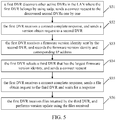
- FIG. 5 is a flowchart illustrating a method of updating DVRs in accordance with examples of the present disclosure.
- the method may include the following procedures.
- a first DVR searches a LAN where the first DVR belongs for other active DVRs by using SADP, and sends a connect request to each of second DVRs found out.
- the DVR that initiates an update process is referred to as the first DVR, and other DVRs are referred to as second DVRs.
- the first DVR receives a connect complete response, and sends a first request to a second DVR.
- the first DVR receives a firmware version identity sent by the second DVR, and records the firmware version identity with the IP address of the second DVR.
- the first DVR selects one of the second DVRs that has the latest firmware version (which is referred to as a third DVR), and sends a connect request to the third DVR.
- the procedure of determining the version identity of the latest firmware version may include: the first DVR compares received firmware version identities with the firmware version identity of the first DVR, selects firmware version identities larger than the firmware version identity of the first DVR, and determines the firmware version identity of the latest firmware version according to the selected firmware version identities.
- the first DVR receives a connect complete response, and sends a second request to the third DVR.
- the first DVR receives files sent by the third DVR, and performs version update using the received files.
- the first DVR may be configured to not respond to inquiry about firmware version from other clients.
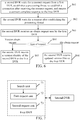
- FIG. 6 is a flowchart illustrating a method of updating DVRs in accordance with examples of the present disclosure.
- the method may include the following procedures.
- a second DVR waits for a connect request from a first DVR, establishes a processing thread to establish a connection after receiving the connect request, and sends a connect complete response to the first DVR.
- the DVR that initiates the update process is referred to as the first DVR, and other DVRs are referred to as second DVRs.
- the second DVR may process multiple requests in parallel by establishing multiple processing threads.
- the second DVR waits for a request after establishing the processing thread.
- the second DVR receives an obtain request from the first DVR.
- the second DVR judges the type of the received request received at block S63, performs the procedure in block S65 if the request is for obtaining a firmware version identity, or performs the procedure in block S66 if the request is for obtaining files of the firmware version.
- the second DVR sends the firmware version identity of the second DVR to the first DVR.
- the second DVR sends files of the firmware version of the second DVR to the first DVR.
- FIG. 7 is a schematic diagram illustrating a system of updating DVRs in accordance with examples of the present disclosure.
- the system may include plural DVRs.
- the DVR that initiates an update process is referred to as the first DVR, and other DVRs are referred to as second DVRs.
- the first DVR is configured to obtain a firmware version identity of at least one second DVR within a LAN where the first DVR belongs, compare the obtained firmware version identity with a firmware version identity of the first DVR, determine a firmware version identity of the latest firmware version, obtain files of the latest firmware version from a third DVR that provides the firmware version identity of the latest firmware version, and perform version update using the files obtained.
- the first DVR may include a first request unit 72 and a second request unit 73.
- the first request unit 72 is configured to obtain a firmware version identity of at least one second DVR in a LAN where the first DVR belongs, compare the firmware version identity obtained with a firmware version identity of the first DVR, and determine a version identity of the latest firmware version.
- the second request unit 73 is configured to obtain files of the latest firmware version from a third DVR that provides the firmware version identity of the latest firmware version, and perform version update using the files obtained.
- the first request unit 72 is configured to send a first request to other DVRs in the LAN, and receive version identities and IP addresses sent by the other DVRs.
- the second request unit 73 is configured to compare the obtained firmware version identities with a firmware version identity of the first DVR, select firmware version identities of firmware versions newer than the firmware version of the first DVR (e.g., selecting firmware version identities larger than the firmware version identity of the first DVR), determine a firmware version identity of the latest firmware version according to selected firmware version identities, send a second request to a third DVR by using an IP address corresponding to the firmware version identity of the latest firmware version, receive files sent by the third DVR, and perform version update using the files obtained.
- the third DVR is configured to send a firmware version identity of the third DVR to the first DVR in response to the first request, and send files of the firmware version of the third DVR to the first DVR in response to the second request.
- the first request unit 72 is configured to send a connect request to other DVRs in the LAN where the first DVR belongs, receive connect complete responses, send the first request to the other DVRs, and receive firmware version identities and IP addresses sent by the other DVRs.
- the first DVR may also include a search unit 71, configured to discover other active DVRs in the LAN by using an active device discover protocol, send a command to the first request unit 72.
- the first request unit 72 receives the command, and sends a connect request to the other DVRs discovered.
- the second request unit 73 is configured to send a connect request to a third DVR that provides the version identity of the latest firmware version, receive a connect complete response, send a second request to the third DVR, and receive files sent by the third DVR.
- the third DVR is configured to send a firmware version identity of the third DVR to the first DVR in response to the first request, and send files of the firmware version of the third DVR to the first DVR in response to the second request.
- the first DVR and other DVRs are all DVRs.
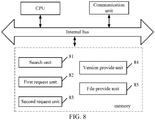
- FIG. 8 is a schematic diagram illustrating an example of a DVR in accordance with examples of the present disclosure.
- the DVR may include a CPU, a memory, a communication unit and an internal bus.
- the memory stores a series of machine-readable instructions executable by the CPU to make the CPU perform actions to implement the technical mechanism of examples of the present disclosure.
- the communication unit is configured to communicate with other devices in the network.
- the internal bus enables communication between the units, may be a bus connected to each of the units or a collection of wires connecting the units.
- the memory may store a search unit 81, a first request unit 82 and a second request unit 83.
- the search unit 81, the first request unit 82 and the second request unit 83 have similar functions with the above search unit 71, the first request unit 72 and the second request unit 73 respectively.
- the memory may also store a version provide unit 84 and a file provide unit 85.
- the version provide unit 84 is configured to provide a firmware version identity of the DVR to a DVR that sent a firmware version request.
- the file provide unit 85 is configured to provide files of a firmware version of the DVR to a DVR that sent a file request.
- a DVR automatically detects latest firmware version in a LAN and performs system update by applying a client/server (C/S) technique and a peer-to-peer (P2P) technique to plural DVRs in the LAN, and each DVR may serve as a server DVR and a client DVR at the same time. No management server or firmware server is needed in the LAN. Server DVRs and client DVRs may establish connections and transport data using the TCP protocol.
- C/S client/server
- P2P peer-to-peer
- a module may be implemented by hardware and or machine-executable instructions.
- a hardware module may comprise dedicated circuitry or logic that is permanently configured (e.g., as a special-purpose processor, such as a field programmable gate array (FPGA) or an application-specific integrated circuit (ASIC)) to perform certain operations.
- a module may also comprise programmable logic or circuitry (e.g., as encompassed within a general-purpose processor or other programmable processor) that is temporarily configured by software to perform certain operations. It will be appreciated that the decision to implement a hardware module mechanically, in dedicated and permanently configured circuitry, or in temporarily configured circuitry (e.g., configured by software) may be driven by cost and time considerations.
- a machine-readable storage medium is also provided, which is to store instructions executable by a machine to implement the method of various examples.
- a system or apparatus may have a storage medium which stores machine-readable program codes for implementing functions of any of the above examples.
- a computing device or a CPU or an MPU in the system or the apparatus may read and execute the program codes stored in the storage medium.
- the program codes may cause an operating system running in a computer to implement part or all of the operations.
- the program codes may be read out from a storage medium and be written in a storage device in an extension board inserted in the computer or in a storage device in an extension unit connected to the computer.
- a CPU in the extension board or the extension unit executes at least part of the operations according to the instructions of the program codes to realize the technical mechanism of any of the above examples.
- the storage medium for providing the program codes may include floppy disk, hard drive, magneto-optical disk, compact disk (such as CD-ROM, CD-R, CD-RW, DVD-ROM, DVD-RAM, DVD-RW, DVD+RW), magnetic tape drive, Flash card, ROM and so on.
- the program code may be downloaded from a server computer via a communication network.
Landscapes
- Engineering & Computer Science (AREA)
- Software Systems (AREA)
- Theoretical Computer Science (AREA)
- General Engineering & Computer Science (AREA)
- Physics & Mathematics (AREA)
- General Physics & Mathematics (AREA)
- Computer Security & Cryptography (AREA)
- Multimedia (AREA)
- Signal Processing (AREA)
- Stored Programmes (AREA)
Description
- The present disclosure claims priority of
Chinese patent application No. 201210466148.5 - The present disclosure relates to system update techniques, and particularly, to a method and a system of updating digital video recorders (DVR).
- Updating all of hard disc video recorders (i.e., digital video recorders, DVR) within a local area network (LAN) usually requires cooperation of a management server and a firmware server.
- The management server sends configuration parameters of the firmware server to the DVRs which obtain files of a version from the firmware server by using the configuration parameters to perform the update.
"Method of upgrading program of portable device and portable device having program upgrade function"(US 20080301671 A1 ) describes a portable device searches for a newer version of program in nearby portable devices, obtains a program file of a newer version from a nearby portable device if a nearby portable device has a newer version of the program, or requests a nearby portable device (i.e., second porable device) to obtain version information of a third portable device around the second portable device and obtains a program file of a newer version from the third portable device via the second portable device if the third portable device has a newer version of the program. This scheme enables a version synchronization in small areas, but it may take a long time to have all devices updated to the newest version of a program.
"Software updating system, software updating method and software updating program" (EP 1372063 A1 ) describes a user terminal obtians a version information file from a first server and obtains an update compression file from a second server storing the most up-to-date applications. This scheme provides a method of updating software to the most up-to-date application, and the updating process requires each device to be capable of communicating to the first server and the second server. - Various examples of the present disclosure provide a method of updating DVRs to realize automatic update of DVRs and improve the efficiency of the update process.
- Various examples of the present disclosure provide a system of updating DVRs to realize automatic update of DVRs and improve the efficiency of the update process.
- The invention is set out in the independent claims.
- Features of the present disclosure are illustrated by way of example and not limited in the following figures, in which like numerals indicate like elements, in which:
-
FIG.1 is a schematic diagram illustrating a communication system; -
FIG. 2 is a flowchart illustrating a method of updating DVRs in accordance with examples of the present disclosure; -
FIG. 3 is a flowchart illustrating a method of updating DVRs in accordance with examples of the present disclosure; -
FIG. 4 is a flowchart illustrating a method of updating DVRs in accordance with examples of the present disclosure; -
FIG. 5 is a flowchart illustrating a method of updating DVRs in accordance with examples of the present disclosure; -
FIG. 6 is a flowchart illustrating a method of updating DVRs in accordance with examples of the present disclosure; -
FIG. 7 is a schematic diagram illustrating a system of updating DVRs in accordance with examples of the present disclosure; -
FIG. 8 is a schematic diagram illustrating an example of a DVR in accordance with examples of the present disclosure. - For simplicity and illustrative purposes, the present disclosure is described by referring mainly to an example thereof. In the following description, numerous specific details are set forth in order to provide a thorough understanding of the present disclosure. It will be readily apparent however, that the present disclosure may be practiced without limitation to these specific details. In other instances, some methods and structures have not been described in detail so as not to unnecessarily obscure the present disclosure. As used herein, the term "includes" means includes but not limited to, the term "including" means including but not limited to. The term "based on" means based at least in part on. Quantities of an element, unless specifically mentioned, may be one or a plurality of, or at least one.
-
FIG. 1 is a schematic diagram illustrating a communication system in accordance with an example of the present disclosure. As shown inFIG. 1 , the communication system may includeplural DVRs 10 and acommunication network 20. Thecommunication network 20 may be a local area network (LAN) established using any LAN protocols. Theplural DVRs 10 may communicate with each other via thecommunication network 20. - The following takes a process of updating a DVR in a LAN as an example to illustrate the technical mechanism of various examples. Other DVRs can initiate an update process in a similar manner provided by various examples of the present disclosure. The DVR that initiates the update process is also referred to as a to-be-updated DVR, i.e., a DVR that is to be updated.
-
FIG. 2 is a flowchart illustrating a method of updating DVRs in accordance with examples of the present disclosure. The method may include the following procedures. - At block S21, a first DVR obtains a firmware version identity of at least one second DVR within a LAN where the first DVR belongs.
- At block S22, the first DVR compares the obtained firmware version identity with a firmware version identity of the first DVR, determines a firmware version identity of the latest firmware version.
- At block S23, the first DVR obtains files of the latest firmware version from a third DVR that provides the firmware version identity of the latest firmware version, and performs version update using the files obtained.
-
FIG. 3 is a flowchart illustrating a method of updating DVRs in accordance with examples of the present disclosure. The method may include the following procedures. - At block S31, a first DVR requests firmware version identities and IP addresses of other DVRs in the LAN where the first DVR belongs.
- DVRs in the LAN communicate with each other. In an example, the first DVR obtains firmware version identities of other DVRs in the LAN by: sending a connect request to the other DVRs in the LAN, receiving a connect complete response from a second DVR, sending a version request (also referred to as first request) to the second DVR, and receiving a firmware version identity returned by the second DVR. Various examples may adopt conventional communication mechanisms, or a custom designed communication mechanism. For example, the connection request may be a Socket connect request, or the like.
- In order to communicate with each other, the DVRs need to have communication addresses of other DVRs, e.g., IP addresses, MAC addresses or the like. In an example, the first DVR searches for other active DVRs in the LAN by using a search active device protocol (SADP) before sending the connect request to another DVR in the LAN. By using the SADP, the first DVR may obtain IP addresses of other active DVRs in the LAN so as to send the connect request to the DVRs found. DVRs in other examples may adopt other automatic discovery schemes to obtain communication addresses of other DVRs. In an example, the first DVR obtains a communication address and an identity of another DVR through the above search process, record a relation which associates the communication address with the identity. In another example, the first DVR may number the other DVRs, and store a relation which associates the obtained communication address of a DVR with the number allocated to the DVR. Other examples may adopt other scheme to record the communication addresses of the DVRs. There are numerous other schemes which are thus not enumerated herein.
- According to some examples, the first DVR may store communication addresses of other DVRs, e.g., in a list, for future use after discovering other active DVRs. In other examples, the first DVR may perform the above search process each time the update process is performed.
- Update procedures may be performed when the DVR starts up by default, or may be performed when there is the need, or may be performed at pre-defined times. For example, a DVR may receive a startup command to start an update process, and execute the SADP procedures to discover other active DVRs in the LAN. The startup command may be a command received from an external device, or may be a command triggered by a timer in the DVR. In an example, the updating procedures may be a task configured in the DVR for system update.
- At block S32, the first DVR compares the obtained firmware version identities with a local firmware version identity of the first DVR, and selects a firmware version identity larger than the local firmware version identity, thus the firmware version identity of the latest (or newest) firmware version is determined.
- In an example, the procedure of selecting a firmware version identity of a firmware version newer than the local firmware version may include selecting a firmware version identity larger than the local firmware version identity. The procedure of determining the firmware version identity of the latest firmware version from the selected firmware version identities includes determining the largest firmware version identity. The manner of implementing this procedure is decided by the numbering scheme of the firmware version identities. The above merely takes a situation where a newer version has a larger value of the firmware version identity as an example, and other examples may adopt other manners to determine the latest firmware version.
- At block S33, the first DVR sends a file request (referred to as second request) to a third DVR that provides the firmware version identity of the latest firmware version by using the IP address which is associated with the firmware version identity, and performs version update using files obtained.
- In an example, the first DVR may obtain the files from the third DVR by: sending a connect request to the third DVR using the communication address (e.g., an IP address, a MAC address or the like) associated with the firmware version identity of the latest firmware version, receiving a connect complete response, sending the second request to the third DVR, and receiving files sent by the third DVR.
- In an example, the first DVR may obtain the communication address of a second DVR when receiving the firmware version identity returned by the second DVR, and record a relation which associates the firmware version identity provided by the second DVR with the communication address of the second DVR. In another example, the first DVR may record the communication address of a second DVR when the first DVR discovers the second DVR, and store the firmware version identity provided by the second DVR in a record where the communication address of the second DVR is stored. In other examples, the first DVR may record a relation which associates the communication address and the identity of a second DVR with the firmware version identity provided by the second DVR. Contents in the response message which includes the firmware version identity may differ according to the implementation manner adopted. For example, when the communication is implemented using the IP mechanism, the response message may only include a firmware version identity, and the IP address of the DVR that sent the response message may be obtained from the IP packet header of the response message. In other examples, the response message may include a firmware version identity and an identity of the second DVR. The first DVR that received the response message may search records of communication addresses and identities of DVRs obtained in the previous search process to obtain the communication address of the second DVR. There are various other schemes which are not enumerated herein.
- According to examples, a first DVR requests firmware version identities of other DVRs in the LAN where the first DVR belongs, determines the firmware version identity of the latest firmware version, request files of the latest firmware version from a third DVR that provided the firmware version identity of the latest firmware version, and performs version update using the files obtained. According to the mechanism, no management server or firmware server is needed. After one or multiple DVRs in a LAN are updated (e.g., an administrator may manually update the one or multiple DVRs), other DVRs in the LAN can perform version update automatically. As such, automatic update of DVRs is implemented. Further, since update procedures are distributed to multiple DVRs within the LAN, the efficiency of the update process is improved, especially when there are a large number of DVRs to be updated.
- The method of updating DVRs is illustrated by taking the processes as shown in
FIG. 4 ,5 and6 as an example. In the following examples, the DVR that initiates an update process is referred to as the first DVR, and the other DVRs are referred to as second DVRs or a server DVR. -
FIG. 4 is a flowchart illustrating a method of updating DVRs in accordance with examples of the present disclosure. The method may include the following procedures. - At block S41, a first DVR (also referred to as a client DVR) sends a connect request to a second DVR (also referred to as a server DVR), and the second DVR returns a connect complete response to the first DVR after receiving the connect request.
- At block S42, the first DVR sends a first request to the second DVR. After receiving the first request, the second DVR may determine whether the request is for obtaining a firmware version identity or for obtaining files according to the request.
- At block S43, the second DVR sends a firmware version identity of the second DVR to the first DVR according to the first request received at S42.
- The first DVR receives and records the firmware version identity of the second DVR and the IP address of the second DVR (the IP address may be obtained from the payload of the received response message or from the IP header of the received response message), and determines a firmware version identity of the latest firmware version based on the received firmware version identity. The procedure of determining the firmware version identity of the latest firmware version may include: the first DVR compares the received firmware version identity with the firmware version identity of the first DVR, selects firmware version identities that are larger than the firmware version identity of the first DVR, and determining a firmware version identity of the latest firmware version according to the selected firmware version identities.
- In an example, the first DVR may disconnect the connection with the second DVR after receiving the response message. Thus, the connection may be re-established at block S44.
- At block S44, the first DVR sends a connect request to one of the second DVRs that is corresponding to the firmware version identity of the latest firmware version (which is referred to as the third DVR); after receiving the connect request, the first DVR returns a connect complete response to the first DVR.
- At block S45, the first DVR sends a second request to the third DVR. After receiving the second request, the third DVR may determine whether the request is for obtaining a firmware version identity or for obtaining files according to the request.
- At block S46, the third DVR sends files of the firmware version of the third DVR to the first DVR according to the second request received at block S45, and the first DVR performs version update after receiving the files.
-
FIG. 5 is a flowchart illustrating a method of updating DVRs in accordance with examples of the present disclosure. The method may include the following procedures. - At block S51, a first DVR searches a LAN where the first DVR belongs for other active DVRs by using SADP, and sends a connect request to each of second DVRs found out.
- In an example, the DVR that initiates an update process is referred to as the first DVR, and other DVRs are referred to as second DVRs.
- At block S52, the first DVR receives a connect complete response, and sends a first request to a second DVR.
- At block S53, the first DVR receives a firmware version identity sent by the second DVR, and records the firmware version identity with the IP address of the second DVR.
- At block S54, after inquiring all of active second DVRs, the first DVR selects one of the second DVRs that has the latest firmware version (which is referred to as a third DVR), and sends a connect request to the third DVR.
- The procedure of determining the version identity of the latest firmware version may include: the first DVR compares received firmware version identities with the firmware version identity of the first DVR, selects firmware version identities larger than the firmware version identity of the first DVR, and determines the firmware version identity of the latest firmware version according to the selected firmware version identities.
- At block S55, the first DVR receives a connect complete response, and sends a second request to the third DVR.
- At block S56, the first DVR receives files sent by the third DVR, and performs version update using the received files.
- When updating the system, the first DVR may be configured to not respond to inquiry about firmware version from other clients.
-
FIG. 6 is a flowchart illustrating a method of updating DVRs in accordance with examples of the present disclosure. The method may include the following procedures. - At block S61, a second DVR waits for a connect request from a first DVR, establishes a processing thread to establish a connection after receiving the connect request, and sends a connect complete response to the first DVR.
- In an example, the DVR that initiates the update process is referred to as the first DVR, and other DVRs are referred to as second DVRs.
- The second DVR may process multiple requests in parallel by establishing multiple processing threads.
- At block S62, the second DVR waits for a request after establishing the processing thread.
- At block S63, the second DVR receives an obtain request from the first DVR.
- At block S64, the second DVR judges the type of the received request received at block S63, performs the procedure in block S65 if the request is for obtaining a firmware version identity, or performs the procedure in block S66 if the request is for obtaining files of the firmware version.
- At block S65, the second DVR sends the firmware version identity of the second DVR to the first DVR.
- At block S66, the second DVR sends files of the firmware version of the second DVR to the first DVR.
-
FIG. 7 is a schematic diagram illustrating a system of updating DVRs in accordance with examples of the present disclosure. The system may include plural DVRs. In this example, the DVR that initiates an update process is referred to as the first DVR, and other DVRs are referred to as second DVRs. - The first DVR is configured to obtain a firmware version identity of at least one second DVR within a LAN where the first DVR belongs, compare the obtained firmware version identity with a firmware version identity of the first DVR, determine a firmware version identity of the latest firmware version, obtain files of the latest firmware version from a third DVR that provides the firmware version identity of the latest firmware version, and perform version update using the files obtained.
- In an example, the first DVR may include a
first request unit 72 and asecond request unit 73. Thefirst request unit 72 is configured to obtain a firmware version identity of at least one second DVR in a LAN where the first DVR belongs, compare the firmware version identity obtained with a firmware version identity of the first DVR, and determine a version identity of the latest firmware version. Thesecond request unit 73 is configured to obtain files of the latest firmware version from a third DVR that provides the firmware version identity of the latest firmware version, and perform version update using the files obtained. - In an example, the
first request unit 72 is configured to send a first request to other DVRs in the LAN, and receive version identities and IP addresses sent by the other DVRs. Thesecond request unit 73 is configured to compare the obtained firmware version identities with a firmware version identity of the first DVR, select firmware version identities of firmware versions newer than the firmware version of the first DVR (e.g., selecting firmware version identities larger than the firmware version identity of the first DVR), determine a firmware version identity of the latest firmware version according to selected firmware version identities, send a second request to a third DVR by using an IP address corresponding to the firmware version identity of the latest firmware version, receive files sent by the third DVR, and perform version update using the files obtained. - The third DVR is configured to send a firmware version identity of the third DVR to the first DVR in response to the first request, and send files of the firmware version of the third DVR to the first DVR in response to the second request.
- In an example, the
first request unit 72 is configured to send a connect request to other DVRs in the LAN where the first DVR belongs, receive connect complete responses, send the first request to the other DVRs, and receive firmware version identities and IP addresses sent by the other DVRs. - In an example, the first DVR may also include a
search unit 71, configured to discover other active DVRs in the LAN by using an active device discover protocol, send a command to thefirst request unit 72. Thefirst request unit 72 receives the command, and sends a connect request to the other DVRs discovered. - In an example, the
second request unit 73 is configured to send a connect request to a third DVR that provides the version identity of the latest firmware version, receive a connect complete response, send a second request to the third DVR, and receive files sent by the third DVR. - The third DVR is configured to send a firmware version identity of the third DVR to the first DVR in response to the first request, and send files of the firmware version of the third DVR to the first DVR in response to the second request.
- In an example, the first DVR and other DVRs are all DVRs.
-
FIG. 8 is a schematic diagram illustrating an example of a DVR in accordance with examples of the present disclosure. The DVR may include a CPU, a memory, a communication unit and an internal bus. - The memory stores a series of machine-readable instructions executable by the CPU to make the CPU perform actions to implement the technical mechanism of examples of the present disclosure.
- The communication unit is configured to communicate with other devices in the network.
- The internal bus enables communication between the units, may be a bus connected to each of the units or a collection of wires connecting the units.
- In an example, the memory may store a
search unit 81, afirst request unit 82 and asecond request unit 83. Thesearch unit 81, thefirst request unit 82 and thesecond request unit 83 have similar functions with theabove search unit 71, thefirst request unit 72 and thesecond request unit 73 respectively. - In an example, the memory may also store a version provide
unit 84 and a file provideunit 85. The version provideunit 84 is configured to provide a firmware version identity of the DVR to a DVR that sent a firmware version request. The file provideunit 85 is configured to provide files of a firmware version of the DVR to a DVR that sent a file request. - According to examples, a DVR automatically detects latest firmware version in a LAN and performs system update by applying a client/server (C/S) technique and a peer-to-peer (P2P) technique to plural DVRs in the LAN, and each DVR may serve as a server DVR and a client DVR at the same time. No management server or firmware server is needed in the LAN. Server DVRs and client DVRs may establish connections and transport data using the TCP protocol.
- It should be understood that in the above processes and structures, not all of the procedures and modules are necessary. Certain procedures or modules may be omitted according to the needs. The order of the procedures is not fixed, and can be adjusted according to the needs. The modules are defined based on function simply for facilitating description. In implementation, a module may be implemented by multiple modules, and functions of multiple modules may be implemented by the same module. The modules may reside in the same device or distribute in different devices. The "first", "second" in the above descriptions are merely for distinguishing two similar objects, and have no substantial meanings.
- In various embodiments, a module may be implemented by hardware and or machine-executable instructions. For example, a hardware module may comprise dedicated circuitry or logic that is permanently configured (e.g., as a special-purpose processor, such as a field programmable gate array (FPGA) or an application-specific integrated circuit (ASIC)) to perform certain operations. A module may also comprise programmable logic or circuitry (e.g., as encompassed within a general-purpose processor or other programmable processor) that is temporarily configured by software to perform certain operations. It will be appreciated that the decision to implement a hardware module mechanically, in dedicated and permanently configured circuitry, or in temporarily configured circuitry (e.g., configured by software) may be driven by cost and time considerations.
- A machine-readable storage medium is also provided, which is to store instructions executable by a machine to implement the method of various examples. Specifically, a system or apparatus may have a storage medium which stores machine-readable program codes for implementing functions of any of the above examples. A computing device (or a CPU or an MPU) in the system or the apparatus may read and execute the program codes stored in the storage medium. In addition, the program codes may cause an operating system running in a computer to implement part or all of the operations. In addition, the program codes may be read out from a storage medium and be written in a storage device in an extension board inserted in the computer or in a storage device in an extension unit connected to the computer. In this example, a CPU in the extension board or the extension unit executes at least part of the operations according to the instructions of the program codes to realize the technical mechanism of any of the above examples.
- The storage medium for providing the program codes may include floppy disk, hard drive, magneto-optical disk, compact disk (such as CD-ROM, CD-R, CD-RW, DVD-ROM, DVD-RAM, DVD-RW, DVD+RW), magnetic tape drive, Flash card, ROM and so on. Optionally, the program code may be downloaded from a server computer via a communication network.
- The scope of the claims should not be limited by the embodiments set forth in the examples, but should be given the broadest interpretation consistent with the description as a whole.
Claims (15)
- A method of updating digital video recorders, DVR, characterized by comprising:obtaining (S31), by a first DVR, firmware version information and IP addresses of the other DVRs within a local area network, LAN, where the first DVR belongs;comparing (S32) all of the obtained version information with firmware version information of the first DVR to determine the newest firmware version; andobtaining (S33) a file of the newest firmware version from a second DVR that provides the firmware version information of the newest firmware version by using an IP address provided by the second DVR; andperforming (S33) version update of the first DVR using the file obtained.
- The method of claim 1, wherein
obtaining the firmware version information and the IP addresses of the other DVRs in the LAN where the first DVR belongs comprises: sending, by the first DVR, a first request to each of the other DVRs in the LAN, and receiving firmware version number and an IP address provided by each of the other DVRs;
obtaining the file of the newest firmware version from the second DVR that provided the firmware version information of the newest firmware version comprises: sending, by the first DVR, a second request to the second DVR by using the IP address corresponding to the firmware version information of the newest firmware version. - The method of claim 1, wherein
comparing all of the obtained firmware version information with the firmware version information of the first DVR to determine the newest firmware version comprises: comparing (S32), by the first DVR, firmware version numbers specified by all of the obtained firmware version information with a firmware version number of the first DVR, selecting (S32) at least one firmware version number larger than the firmware version number of the first DVR, and determining (S32) the largest firmware version number in the selected at least one firmware version number to be the firmware version number of the newest firmware version. - The method of claim 1, wherein obtaining by the first DVR firmware version information and IP addresses of the other DVRs in the LAN comprises:
sending, by the first DVR, a connect request to a third DVR of the other DVRs, receiving a connect complete response from the third DVR, sending a first request to the third DVR, and receiving firmware version information of the third DVR. - The method of claim 1, further comprising:
discovering (S51), by the first DVR using an active device discover protocol, at least one active DVR in the LAN as the other DVRs. - The method of claim 1, further comprising:
receiving, by the first DVR, a startup command to start an update process, and discovering other active DVRs in the LAN as the other DVRs by using an active device discover protocol. - The method of any of claims 1 to 6, wherein obtaining by the first DVR the file of the newest firmware version from the second DVR that provided the firmware version information of the newest firmware version comprises:
sending (S51), by the first DVR, a connect request to the second DVR, receiving a connect complete response, sending a second request to the second DVR, and receiving the file sent by the second DVR. - The method of claim 1, further comprising:receiving (S63), by the first DVR, a third request sent by a fourth DVR, and sending (S65) firmware version information and an IP address of the first DVR to the fourth DVR; andreceiving (S63), by the first DVR, a fourth request sent by the fourth DVR, and sending (S66) files of a firmware version of the first DVR to the fourth DVR.
- A system of updating digital video recorders (10), DVR, characterized by that:
a first DVR (10) is configured to obtain firmware version information and IP addresses of the other DVRs (10) within a local area network (20), LAN, where the first DVR belongs, compare all of the obtained firmware version information with firmware version information of the first DVR (10) to determine the newest firmware version, obtain a file of the newest firmware version from a second DVR (10) that provides the firmware version information of the newest firmware version by using an IP address provided by the second DVR (10), and perform version update using the file obtained. - The system of claim 9, wherein the first DVR comprises a first request unit and a second request unit, wherein
the first request unit (72) is configured to send the first request to each of the other DVRs in the LAN, and receive firmware version information and an IP address provided by each of the other DVRs; and
the second request unit (73) is configured to send the second request to the second DVR using an IP address corresponding to the firmware version information of the newest firmware version, receive a file of the newest firmware version sent by the second DVR, and perform version update using the file received;
wherein the second DVR is configured to send firmware version information of the second DVR to the first DVR in response to the first request, and send a file of a firmware version of the second DVR to the first DVR in response to the second request. - The system of claim 10, wherein the second request unit (73) is further configured to compare firmware version numbers specified by all of the obtained firmware version information with a firmware version number of the first DVR, select at least one firmware version number larger than the firmware version number of the first DVR, and determine the largest firmware version number in the selected at least one firmware version number to be the firmware version number of the newest firmware version.
- The system of claim 10, wherein the first request unit (72) is configured to send a connect request to a third DVR of the other DVRs, receive a connect complete response from the third DVR, send the first request to the third DVR, and receive firmware version information and an IP address sent by the third DVR.
- The system of claim 10, wherein the first DVR further comprises a search unit (71), configured to discover other active DVRs in the LAN using an active device discover protocol, and send a command to the first request unit; the first request unit is configured to receive the command, and send the connect request to the active DVRs discovered.
- The system of claim 10, wherein the second request unit (73) is configured to send a connect request to the second DVR, receive a connect complete response, send the second request to the second DVR, and receive the file sent by the second DVR.
- The system of claim 9, wherein the first DVR comprises:a version provide unit (84), configured to receive a third request sent by a fourth DVR, and send firmware version information and an IP address of the DVR to the fourth DVR; anda file provide unit (85), configured to receive a fourth request sent by the fourth DVR, and send a file of the firmware version of the DVR to the fourth DVR.
Applications Claiming Priority (2)
| Application Number | Priority Date | Filing Date | Title |
|---|---|---|---|
| CN201210466148.5A CN103826080B (en) | 2012-11-16 | 2012-11-16 | The method and system of batch upgrade are carried out to DVR |
| PCT/CN2013/086831 WO2014075591A1 (en) | 2012-11-16 | 2013-11-11 | Method and system for upgrading digital video recorder |
Publications (3)
| Publication Number | Publication Date |
|---|---|
| EP2921953A1 EP2921953A1 (en) | 2015-09-23 |
| EP2921953A4 EP2921953A4 (en) | 2016-06-01 |
| EP2921953B1 true EP2921953B1 (en) | 2021-07-28 |
Family
ID=50730587
Family Applications (1)
| Application Number | Title | Priority Date | Filing Date |
|---|---|---|---|
| EP13854390.5A Active EP2921953B1 (en) | 2012-11-16 | 2013-11-11 | Method and system for upgrading digital video recorder |
Country Status (4)
| Country | Link |
|---|---|
| US (1) | US20160274884A1 (en) |
| EP (1) | EP2921953B1 (en) |
| CN (1) | CN103826080B (en) |
| WO (1) | WO2014075591A1 (en) |
Families Citing this family (3)
| Publication number | Priority date | Publication date | Assignee | Title |
|---|---|---|---|---|
| CN105577449A (en) * | 2016-01-19 | 2016-05-11 | 江苏小牛电动科技有限公司 | An automatic upgrade method and device based on an electric vehicle central control system |
| CN109019217B (en) * | 2017-10-28 | 2020-09-18 | 吉安品位环保科技有限公司 | Elevator control software field debugging system |
| CN112083939A (en) * | 2019-12-31 | 2020-12-15 | 蓝桥赛维科技(北京)有限公司 | Batch upgrading method, device, system and medium |
Citations (1)
| Publication number | Priority date | Publication date | Assignee | Title |
|---|---|---|---|---|
| US20130275956A1 (en) * | 2012-04-17 | 2013-10-17 | Hon Hai Precision Industry Co., Ltd. | Firmware upgrade method and system and terminal device using the method |
Family Cites Families (24)
| Publication number | Priority date | Publication date | Assignee | Title |
|---|---|---|---|---|
| US6438479B1 (en) * | 1997-12-29 | 2002-08-20 | Hitachi, Ltd. | Control apparatus for an automatic transmission of a vehicle and method |
| JPH11282656A (en) * | 1998-03-30 | 1999-10-15 | Brother Ind Ltd | Program rewriting device, network system, and storage medium |
| EP1372063A4 (en) * | 2001-03-19 | 2008-03-19 | Sony Corp | SYSTEM, METHOD AND PROGRAM FOR UPDATING SOFTWARE |
| US20020188934A1 (en) * | 2001-06-12 | 2002-12-12 | Nortel Networks Limited | Method and system for upgrading existing firmware on third party hardware |
| FI114602B (en) * | 2002-06-18 | 2004-11-15 | Nokia Corp | A method and apparatus for programming update information on a network unit to a mobile station |
| US20050160308A1 (en) * | 2004-01-09 | 2005-07-21 | General Instrument Corporation | Failure recovery for digital video recorders |
| JP4340686B2 (en) * | 2004-03-31 | 2009-10-07 | パイオニア株式会社 | Speech recognition apparatus and speech recognition method |
| KR20060019893A (en) * | 2004-08-30 | 2006-03-06 | 엘지전자 주식회사 | Simultaneous Multiple Update Method and System of Digital Video Recorder Software Using Network |
| KR100618321B1 (en) * | 2004-11-20 | 2006-08-31 | 삼성전자주식회사 | Firmware Upgrade Method of Image Forming Device Using Mobile Terminal |
| CN105138354B (en) * | 2006-03-01 | 2019-12-13 | 安讯士有限公司 | method and system for upgrading a plurality of devices |
| US20080005733A1 (en) * | 2006-06-29 | 2008-01-03 | Balaji Ramachandran | Method and apparatus for updating firmware and software |
| US20080109647A1 (en) * | 2006-11-07 | 2008-05-08 | Lee Merrill Gavens | Memory controllers for performing resilient firmware upgrades to a functioning memory |
| KR100857705B1 (en) * | 2007-05-28 | 2008-09-08 | (주)케이티에프테크놀로지스 | How to upgrade the program and the system to do it |
| US20100082782A1 (en) * | 2008-09-30 | 2010-04-01 | Yi Ding | Providing peripheral device attributes to a client for selection |
| US8856776B2 (en) * | 2009-02-05 | 2014-10-07 | International Business Machines Corporation | Updating firmware without disrupting service |
| EP2239659A1 (en) * | 2009-04-09 | 2010-10-13 | Siemens Aktiengesellschaft | A network device and a system thereof |
| JP2011095950A (en) * | 2009-10-29 | 2011-05-12 | Seiko Epson Corp | Network device, network device system, and method for updating software of network device |
| KR20110047711A (en) * | 2009-10-30 | 2011-05-09 | 삼성전자주식회사 | How to create firmware for electronic devices and their upgrades |
| EP2755131B1 (en) * | 2009-12-22 | 2020-09-02 | DISH Technologies L.L.C. | A method and system for changing software or firmware on an electronic device |
| US8869138B2 (en) * | 2011-11-11 | 2014-10-21 | Wyse Technology L.L.C. | Robust firmware update with recovery logic |
| CN101795295A (en) * | 2010-03-11 | 2010-08-04 | 北京安天电子设备有限公司 | Local area network virus library upgrading system and method based on P2P technology |
| US20120216183A1 (en) * | 2011-02-23 | 2012-08-23 | Amit Mahajan | Firmware updation in electronic devices |
| US8677343B2 (en) * | 2011-09-16 | 2014-03-18 | Cisco Technology, Inc. | Centrally coordinated firmware upgrade model across network for minimizing uptime loss and firmware compatibility |
| WO2014097436A1 (en) * | 2012-12-20 | 2014-06-26 | Necディスプレイソリューションズ株式会社 | Control device, display device, firmware updating method, and firmware updating program |
-
2012
- 2012-11-16 CN CN201210466148.5A patent/CN103826080B/en active Active
-
2013
- 2013-11-11 EP EP13854390.5A patent/EP2921953B1/en active Active
- 2013-11-11 WO PCT/CN2013/086831 patent/WO2014075591A1/en not_active Ceased
- 2013-11-11 US US14/442,124 patent/US20160274884A1/en not_active Abandoned
Patent Citations (1)
| Publication number | Priority date | Publication date | Assignee | Title |
|---|---|---|---|---|
| US20130275956A1 (en) * | 2012-04-17 | 2013-10-17 | Hon Hai Precision Industry Co., Ltd. | Firmware upgrade method and system and terminal device using the method |
Also Published As
| Publication number | Publication date |
|---|---|
| EP2921953A4 (en) | 2016-06-01 |
| US20160274884A1 (en) | 2016-09-22 |
| EP2921953A1 (en) | 2015-09-23 |
| CN103826080A (en) | 2014-05-28 |
| WO2014075591A1 (en) | 2014-05-22 |
| CN103826080B (en) | 2018-02-16 |
Similar Documents
| Publication | Publication Date | Title |
|---|---|---|
| JP5988117B2 (en) | Method and apparatus for implementing high-speed network connections | |
| JP4274311B2 (en) | IDENTIFICATION INFORMATION CREATION METHOD, INFORMATION PROCESSING DEVICE, AND COMPUTER PROGRAM | |
| US7437145B2 (en) | Wireless control apparatus, system, control method, and program | |
| CN111405042B (en) | Electronic device discovery method and device, storage medium and electronic device | |
| US10417014B2 (en) | System service reloading method and apparatus | |
| US20170078408A1 (en) | Pre-association discovery of services | |
| US10616066B2 (en) | Device discovery in a network environment | |
| US20100250725A1 (en) | Interoperability using a local proxy server | |
| US20110093612A1 (en) | Device, method and computer readable medium for bgp route monitoring | |
| CN103299683A (en) | System, method and apparatus for dynamic wireless network discovery | |
| US7512139B2 (en) | Methods and systems for enabling remote booting of remote boot clients in a switched network defining a plurality of virtual local area networks (VLANS) | |
| US12185229B2 (en) | Discovery of which NEF or AF is serving a UE | |
| US10693967B2 (en) | Data connection establishment method, server, and mobile terminal | |
| EP2921953A1 (en) | Method and system for upgrading digital video recorder | |
| US8909600B2 (en) | Information processing apparatus, information processing method, and storage medium | |
| US20150289194A1 (en) | Communication apparatus, control method for the same, communication system, and non-transitory computer-readable storage medium | |
| CN111131484A (en) | Node mounting method, device, network node and storage medium | |
| CN111147598A (en) | HTTP message processing method and device | |
| US7457820B1 (en) | Method of distributing multiresolution digital documents | |
| EP3698604B1 (en) | Electronic apparatus and control method thereof | |
| KR20070084276A (en) | How to determine your needs, devices and software | |
| CN101754422B (en) | Network discovery method, device and access point | |
| JP6605149B2 (en) | Method and apparatus for detecting shared terminal | |
| CN115695372A (en) | DNS server selection method, device, equipment and computer storage medium | |
| CN116321100B (en) | Implementation method for network function discovery of AMF in lightweight 5GC |
Legal Events
| Date | Code | Title | Description |
|---|---|---|---|
| PUAI | Public reference made under article 153(3) epc to a published international application that has entered the european phase |
Free format text: ORIGINAL CODE: 0009012 |
|
| 17P | Request for examination filed |
Effective date: 20150608 |
|
| AK | Designated contracting states |
Kind code of ref document: A1 Designated state(s): AL AT BE BG CH CY CZ DE DK EE ES FI FR GB GR HR HU IE IS IT LI LT LU LV MC MK MT NL NO PL PT RO RS SE SI SK SM TR |
|
| AX | Request for extension of the european patent |
Extension state: BA ME |
|
| DAX | Request for extension of the european patent (deleted) | ||
| RA4 | Supplementary search report drawn up and despatched (corrected) |
Effective date: 20160503 |
|
| RIC1 | Information provided on ipc code assigned before grant |
Ipc: G06F 9/445 20060101AFI20160427BHEP |
|
| STAA | Information on the status of an ep patent application or granted ep patent |
Free format text: STATUS: EXAMINATION IS IN PROGRESS |
|
| 17Q | First examination report despatched |
Effective date: 20170926 |
|
| REG | Reference to a national code |
Ref country code: DE Ref legal event code: R079 Ref document number: 602013078567 Country of ref document: DE Free format text: PREVIOUS MAIN CLASS: G06F0009445000 Ipc: G06F0008654000 |
|
| GRAP | Despatch of communication of intention to grant a patent |
Free format text: ORIGINAL CODE: EPIDOSNIGR1 |
|
| STAA | Information on the status of an ep patent application or granted ep patent |
Free format text: STATUS: GRANT OF PATENT IS INTENDED |
|
| RIC1 | Information provided on ipc code assigned before grant |
Ipc: G06F 8/654 20180101AFI20210217BHEP Ipc: G06F 9/445 20180101ALI20210217BHEP |
|
| INTG | Intention to grant announced |
Effective date: 20210317 |
|
| GRAS | Grant fee paid |
Free format text: ORIGINAL CODE: EPIDOSNIGR3 |
|
| GRAA | (expected) grant |
Free format text: ORIGINAL CODE: 0009210 |
|
| STAA | Information on the status of an ep patent application or granted ep patent |
Free format text: STATUS: THE PATENT HAS BEEN GRANTED |
|
| AK | Designated contracting states |
Kind code of ref document: B1 Designated state(s): AL AT BE BG CH CY CZ DE DK EE ES FI FR GB GR HR HU IE IS IT LI LT LU LV MC MK MT NL NO PL PT RO RS SE SI SK SM TR |
|
| REG | Reference to a national code |
Ref country code: GB Ref legal event code: FG4D |
|
| REG | Reference to a national code |
Ref country code: CH Ref legal event code: EP |
|
| REG | Reference to a national code |
Ref country code: DE Ref legal event code: R096 Ref document number: 602013078567 Country of ref document: DE |
|
| REG | Reference to a national code |
Ref country code: AT Ref legal event code: REF Ref document number: 1415311 Country of ref document: AT Kind code of ref document: T Effective date: 20210815 |
|
| REG | Reference to a national code |
Ref country code: IE Ref legal event code: FG4D |
|
| REG | Reference to a national code |
Ref country code: LT Ref legal event code: MG9D |
|
| REG | Reference to a national code |
Ref country code: NL Ref legal event code: MP Effective date: 20210728 |
|
| REG | Reference to a national code |
Ref country code: AT Ref legal event code: MK05 Ref document number: 1415311 Country of ref document: AT Kind code of ref document: T Effective date: 20210728 |
|
| PG25 | Lapsed in a contracting state [announced via postgrant information from national office to epo] |
Ref country code: HR Free format text: LAPSE BECAUSE OF FAILURE TO SUBMIT A TRANSLATION OF THE DESCRIPTION OR TO PAY THE FEE WITHIN THE PRESCRIBED TIME-LIMIT Effective date: 20210728 Ref country code: RS Free format text: LAPSE BECAUSE OF FAILURE TO SUBMIT A TRANSLATION OF THE DESCRIPTION OR TO PAY THE FEE WITHIN THE PRESCRIBED TIME-LIMIT Effective date: 20210728 Ref country code: SE Free format text: LAPSE BECAUSE OF FAILURE TO SUBMIT A TRANSLATION OF THE DESCRIPTION OR TO PAY THE FEE WITHIN THE PRESCRIBED TIME-LIMIT Effective date: 20210728 Ref country code: BG Free format text: LAPSE BECAUSE OF FAILURE TO SUBMIT A TRANSLATION OF THE DESCRIPTION OR TO PAY THE FEE WITHIN THE PRESCRIBED TIME-LIMIT Effective date: 20211028 Ref country code: AT Free format text: LAPSE BECAUSE OF FAILURE TO SUBMIT A TRANSLATION OF THE DESCRIPTION OR TO PAY THE FEE WITHIN THE PRESCRIBED TIME-LIMIT Effective date: 20210728 Ref country code: LT Free format text: LAPSE BECAUSE OF FAILURE TO SUBMIT A TRANSLATION OF THE DESCRIPTION OR TO PAY THE FEE WITHIN THE PRESCRIBED TIME-LIMIT Effective date: 20210728 Ref country code: NL Free format text: LAPSE BECAUSE OF FAILURE TO SUBMIT A TRANSLATION OF THE DESCRIPTION OR TO PAY THE FEE WITHIN THE PRESCRIBED TIME-LIMIT Effective date: 20210728 Ref country code: NO Free format text: LAPSE BECAUSE OF FAILURE TO SUBMIT A TRANSLATION OF THE DESCRIPTION OR TO PAY THE FEE WITHIN THE PRESCRIBED TIME-LIMIT Effective date: 20211028 Ref country code: PT Free format text: LAPSE BECAUSE OF FAILURE TO SUBMIT A TRANSLATION OF THE DESCRIPTION OR TO PAY THE FEE WITHIN THE PRESCRIBED TIME-LIMIT Effective date: 20211129 Ref country code: ES Free format text: LAPSE BECAUSE OF FAILURE TO SUBMIT A TRANSLATION OF THE DESCRIPTION OR TO PAY THE FEE WITHIN THE PRESCRIBED TIME-LIMIT Effective date: 20210728 Ref country code: FI Free format text: LAPSE BECAUSE OF FAILURE TO SUBMIT A TRANSLATION OF THE DESCRIPTION OR TO PAY THE FEE WITHIN THE PRESCRIBED TIME-LIMIT Effective date: 20210728 |
|
| PG25 | Lapsed in a contracting state [announced via postgrant information from national office to epo] |
Ref country code: PL Free format text: LAPSE BECAUSE OF FAILURE TO SUBMIT A TRANSLATION OF THE DESCRIPTION OR TO PAY THE FEE WITHIN THE PRESCRIBED TIME-LIMIT Effective date: 20210728 Ref country code: LV Free format text: LAPSE BECAUSE OF FAILURE TO SUBMIT A TRANSLATION OF THE DESCRIPTION OR TO PAY THE FEE WITHIN THE PRESCRIBED TIME-LIMIT Effective date: 20210728 Ref country code: GR Free format text: LAPSE BECAUSE OF FAILURE TO SUBMIT A TRANSLATION OF THE DESCRIPTION OR TO PAY THE FEE WITHIN THE PRESCRIBED TIME-LIMIT Effective date: 20211029 |
|
| PG25 | Lapsed in a contracting state [announced via postgrant information from national office to epo] |
Ref country code: DK Free format text: LAPSE BECAUSE OF FAILURE TO SUBMIT A TRANSLATION OF THE DESCRIPTION OR TO PAY THE FEE WITHIN THE PRESCRIBED TIME-LIMIT Effective date: 20210728 |
|
| REG | Reference to a national code |
Ref country code: DE Ref legal event code: R097 Ref document number: 602013078567 Country of ref document: DE |
|
| PG25 | Lapsed in a contracting state [announced via postgrant information from national office to epo] |
Ref country code: SM Free format text: LAPSE BECAUSE OF FAILURE TO SUBMIT A TRANSLATION OF THE DESCRIPTION OR TO PAY THE FEE WITHIN THE PRESCRIBED TIME-LIMIT Effective date: 20210728 Ref country code: SK Free format text: LAPSE BECAUSE OF FAILURE TO SUBMIT A TRANSLATION OF THE DESCRIPTION OR TO PAY THE FEE WITHIN THE PRESCRIBED TIME-LIMIT Effective date: 20210728 Ref country code: RO Free format text: LAPSE BECAUSE OF FAILURE TO SUBMIT A TRANSLATION OF THE DESCRIPTION OR TO PAY THE FEE WITHIN THE PRESCRIBED TIME-LIMIT Effective date: 20210728 Ref country code: EE Free format text: LAPSE BECAUSE OF FAILURE TO SUBMIT A TRANSLATION OF THE DESCRIPTION OR TO PAY THE FEE WITHIN THE PRESCRIBED TIME-LIMIT Effective date: 20210728 Ref country code: CZ Free format text: LAPSE BECAUSE OF FAILURE TO SUBMIT A TRANSLATION OF THE DESCRIPTION OR TO PAY THE FEE WITHIN THE PRESCRIBED TIME-LIMIT Effective date: 20210728 Ref country code: AL Free format text: LAPSE BECAUSE OF FAILURE TO SUBMIT A TRANSLATION OF THE DESCRIPTION OR TO PAY THE FEE WITHIN THE PRESCRIBED TIME-LIMIT Effective date: 20210728 |
|
| REG | Reference to a national code |
Ref country code: DE Ref legal event code: R119 Ref document number: 602013078567 Country of ref document: DE |
|
| PLBE | No opposition filed within time limit |
Free format text: ORIGINAL CODE: 0009261 |
|
| STAA | Information on the status of an ep patent application or granted ep patent |
Free format text: STATUS: NO OPPOSITION FILED WITHIN TIME LIMIT |
|
| PG25 | Lapsed in a contracting state [announced via postgrant information from national office to epo] |
Ref country code: MC Free format text: LAPSE BECAUSE OF FAILURE TO SUBMIT A TRANSLATION OF THE DESCRIPTION OR TO PAY THE FEE WITHIN THE PRESCRIBED TIME-LIMIT Effective date: 20210728 |
|
| 26N | No opposition filed |
Effective date: 20220429 |
|
| REG | Reference to a national code |
Ref country code: CH Ref legal event code: PL |
|
| PG25 | Lapsed in a contracting state [announced via postgrant information from national office to epo] |
Ref country code: LU Free format text: LAPSE BECAUSE OF NON-PAYMENT OF DUE FEES Effective date: 20211111 Ref country code: IT Free format text: LAPSE BECAUSE OF FAILURE TO SUBMIT A TRANSLATION OF THE DESCRIPTION OR TO PAY THE FEE WITHIN THE PRESCRIBED TIME-LIMIT Effective date: 20210728 Ref country code: BE Free format text: LAPSE BECAUSE OF NON-PAYMENT OF DUE FEES Effective date: 20211130 |
|
| REG | Reference to a national code |
Ref country code: BE Ref legal event code: MM Effective date: 20211130 |
|
| PG25 | Lapsed in a contracting state [announced via postgrant information from national office to epo] |
Ref country code: IE Free format text: LAPSE BECAUSE OF NON-PAYMENT OF DUE FEES Effective date: 20211111 Ref country code: DE Free format text: LAPSE BECAUSE OF NON-PAYMENT OF DUE FEES Effective date: 20220601 |
|
| PG25 | Lapsed in a contracting state [announced via postgrant information from national office to epo] |
Ref country code: FR Free format text: LAPSE BECAUSE OF NON-PAYMENT OF DUE FEES Effective date: 20211130 |
|
| PG25 | Lapsed in a contracting state [announced via postgrant information from national office to epo] |
Ref country code: HU Free format text: LAPSE BECAUSE OF FAILURE TO SUBMIT A TRANSLATION OF THE DESCRIPTION OR TO PAY THE FEE WITHIN THE PRESCRIBED TIME-LIMIT; INVALID AB INITIO Effective date: 20131111 |
|
| P01 | Opt-out of the competence of the unified patent court (upc) registered |
Effective date: 20230424 |
|
| PG25 | Lapsed in a contracting state [announced via postgrant information from national office to epo] |
Ref country code: CY Free format text: LAPSE BECAUSE OF FAILURE TO SUBMIT A TRANSLATION OF THE DESCRIPTION OR TO PAY THE FEE WITHIN THE PRESCRIBED TIME-LIMIT Effective date: 20210728 |
|
| PG25 | Lapsed in a contracting state [announced via postgrant information from national office to epo] |
Ref country code: LI Free format text: LAPSE BECAUSE OF NON-PAYMENT OF DUE FEES Effective date: 20220701 Ref country code: CH Free format text: LAPSE BECAUSE OF NON-PAYMENT OF DUE FEES Effective date: 20220701 |
|
| PG25 | Lapsed in a contracting state [announced via postgrant information from national office to epo] |
Ref country code: MK Free format text: LAPSE BECAUSE OF FAILURE TO SUBMIT A TRANSLATION OF THE DESCRIPTION OR TO PAY THE FEE WITHIN THE PRESCRIBED TIME-LIMIT Effective date: 20210728 |
|
| PG25 | Lapsed in a contracting state [announced via postgrant information from national office to epo] |
Ref country code: MT Free format text: LAPSE BECAUSE OF FAILURE TO SUBMIT A TRANSLATION OF THE DESCRIPTION OR TO PAY THE FEE WITHIN THE PRESCRIBED TIME-LIMIT Effective date: 20210728 |
|
| PG25 | Lapsed in a contracting state [announced via postgrant information from national office to epo] |
Ref country code: TR Free format text: LAPSE BECAUSE OF FAILURE TO SUBMIT A TRANSLATION OF THE DESCRIPTION OR TO PAY THE FEE WITHIN THE PRESCRIBED TIME-LIMIT Effective date: 20210728 |
|
| PGFP | Annual fee paid to national office [announced via postgrant information from national office to epo] |
Ref country code: GB Payment date: 20251126 Year of fee payment: 13 |