EP2919192A2 - Image processing apparatus, and operation method and program therefor - Google Patents
Image processing apparatus, and operation method and program therefor Download PDFInfo
- Publication number
- EP2919192A2 EP2919192A2 EP15158153.5A EP15158153A EP2919192A2 EP 2919192 A2 EP2919192 A2 EP 2919192A2 EP 15158153 A EP15158153 A EP 15158153A EP 2919192 A2 EP2919192 A2 EP 2919192A2
- Authority
- EP
- European Patent Office
- Prior art keywords
- target region
- pixels
- energy function
- shape
- image processing
- Prior art date
- Legal status (The legal status is an assumption and is not a legal conclusion. Google has not performed a legal analysis and makes no representation as to the accuracy of the status listed.)
- Granted
Links
Images




Classifications
-
- G—PHYSICS
- G06—COMPUTING OR CALCULATING; COUNTING
- G06T—IMAGE DATA PROCESSING OR GENERATION, IN GENERAL
- G06T7/00—Image analysis
- G06T7/10—Segmentation; Edge detection
- G06T7/12—Edge-based segmentation
-
- G—PHYSICS
- G06—COMPUTING OR CALCULATING; COUNTING
- G06F—ELECTRIC DIGITAL DATA PROCESSING
- G06F18/00—Pattern recognition
- G06F18/20—Analysing
- G06F18/24—Classification techniques
-
- G—PHYSICS
- G06—COMPUTING OR CALCULATING; COUNTING
- G06T—IMAGE DATA PROCESSING OR GENERATION, IN GENERAL
- G06T7/00—Image analysis
- G06T7/0002—Inspection of images, e.g. flaw detection
- G06T7/0012—Biomedical image inspection
-
- G—PHYSICS
- G06—COMPUTING OR CALCULATING; COUNTING
- G06T—IMAGE DATA PROCESSING OR GENERATION, IN GENERAL
- G06T7/00—Image analysis
- G06T7/10—Segmentation; Edge detection
-
- G—PHYSICS
- G06—COMPUTING OR CALCULATING; COUNTING
- G06T—IMAGE DATA PROCESSING OR GENERATION, IN GENERAL
- G06T7/00—Image analysis
- G06T7/10—Segmentation; Edge detection
- G06T7/143—Segmentation; Edge detection involving probabilistic approaches, e.g. Markov random field [MRF] modelling
-
- G—PHYSICS
- G06—COMPUTING OR CALCULATING; COUNTING
- G06T—IMAGE DATA PROCESSING OR GENERATION, IN GENERAL
- G06T7/00—Image analysis
- G06T7/10—Segmentation; Edge detection
- G06T7/149—Segmentation; Edge detection involving deformable models, e.g. active contour models
-
- G—PHYSICS
- G06—COMPUTING OR CALCULATING; COUNTING
- G06T—IMAGE DATA PROCESSING OR GENERATION, IN GENERAL
- G06T2207/00—Indexing scheme for image analysis or image enhancement
- G06T2207/30—Subject of image; Context of image processing
- G06T2207/30004—Biomedical image processing
- G06T2207/30096—Tumor; Lesion
Definitions
- the present invention relates to an image processing apparatus for extracting a predetermined target region from an image, and an operation method and a program therefor.
- segmentation of the image may be posed as a problem of assigning a value (label) of 0 or 1 representing belonging to a target region or belonging to another region to each variable x 1 , x 2 , ... x n corresponding to each pixel in the image, and a quadratic energy function E such as that represented by Expression (1), in which energy decreases as the assigning (i.e., the labeling) becomes more desirable, is defined to determine a solution that minimizes the quadratic energy function E.
- E x i , ... , x n ⁇ i E i x i + ⁇ i ⁇ j E ij x i ⁇ x j
- Non Patent Literature 1 As a method of solving such a minimization problem, in Non Patent Literature 1, there is proposed a method of globally determining a solution using a minimum cut algorithm when energy is submodular, and determining an optimal solution or an approximate solution using a quadratic pseudo-Boolean optimization (QPBO) algorithm when energy is non-submodular.
- QPBO quadratic pseudo-Boolean optimization
- Non Patent Literature 2 there is proposed a method of solving a minimization problem of a third order or higher energy function by converting the minimization problem into an equivalent minimization problem of a quadratic energy function.
- Non Patent Literature 3 there is proposed a method in which segmentation of an image is provided with robustness by, when defining high order submodular energy, setting the values of higher-order terms to be at a minimum value when the same label is assigned to all of the variables, so that energy gradually increases along with an increase in the number of variables assigned to different labels.
- Non Patent Literatures 1 to 3 discloses a method of utilizing high order energy suited to extraction of a target region having a predictable shape.
- An image processing apparatus is configured to assign a binary label representing belonging to a target region or belonging to another region to each pixel in an image
- the image processing apparatus including: a shape setting unit configured to set a predicted shape of the target region; an energy function setting unit configured to: select a pixel group including N pixels in the image, where N is a natural number of 4 or more, which have a positional relationship representing the set predicted shape; and set an energy function including an N-th order term in which a variable is a label of each of the N pixels of the selected pixel group, so that a value of the N-th order term is at a minimum value when a combination of the labels assigned to the N pixels of the selected pixel group is a pattern matching the set predicted shape of the target region, and increases in stages from the minimum value along with an increase in a number of pixels to which a label different from the pattern is assigned; and a labeling unit configured to perform the labeling by minimizing the set energy function.
- the energy function setting unit may set the energy function using the pattern including one or more of each of the binary labels.
- the energy function setting unit may set the energy function using the pattern including only labels representing belonging to the target region.
- the energy function setting unit may be configured to: further select, when all of the N pixels of the selected pixel group belong to the target region, a second pixel group including M pixels in the image, where M is a natural number of 4 or more, which are located at a position expected to belong to the another region; and set the energy function further including an M-th order term in which a variable is a label of each of the M pixels of the selected second pixel group, so that a value of the M-th order term is at a second minimum value when all of the labels assigned to the M pixels of the second pixel group are the label representing belonging to the another region, and increases in stages from the second minimum value along with an increase in the number of pixels assigned with the label representing belonging to the target region.
- the energy function setting unit may set the energy function so that an increment of the value of the N-th order term increases based on assignment of, among the N pixels of the selected pixel group, a label different from the pattern to pixels farther away from an outline of the predicted target region assumed when the combination of the labels assigned to the N pixels of the pixel group is the pattern.
- the shape setting unit may set a plurality of different shapes as the predicted shape of the target region
- the energy function setting unit may be configured to: select pixel groups respectively corresponding to the set plurality of different shapes, the pixel groups each including N pixels that have a positional relationship representing each of the set plurality of different shapes; determine N-th order terms corresponding to each of the selected pixel groups in which a variable is a label of each pixel of the each of the selected pixel groups; and set the energy function including a sum of the N-th order terms, so that a value of each of the N-th order terms is at a minimum value when a combination of the labels assigned to pixels of the pixel group corresponding to the N-th order term is a pattern matching the set shape corresponding to the pixel group, and increases in stages from the minimum value along with an increase in the number of pixels to which a label different from the pattern is assigned.
- the shape setting unit may set a plurality of ellipses each having a different degree of circularity as the predicted shape of the target region. Further, when the target region is a muscle region, the shape setting unit may set a plurality of relaxation curves each having a different degree of change in curvature as the predicted shape of the target region. Further, when the target region is a vascular region, the shape setting unit may set a plurality of circles or spheres each having a different size and a different position, or each having any one of a different size or a different position as the predicted shape of the target region. Further, when the target region is an organ region, the shape setting unit may set a plurality of organ shapes each having a different principal component parameter obtained by principal component analysis as the predicted shape of the target region.
- An image processing method is executed by an image processing apparatus, which includes a shape setting unit, an energy function setting unit, and a labeling unit, for assigning a binary label representing belonging to a target region or belonging to another region to each pixel in an image.
- the image processing method includes: setting, by the shape setting unit, a predicted shape of the target region; selecting, by the energy function setting unit, a pixel group including N pixels in the image, where N is a natural number of 4 or more, which have a positional relationship representing the set predicted shape, to set an energy function including an N-th order term in which a variable is a label of each of the N pixels of the selected pixel group, so that a value of the N-th order term is at a minimum value when a combination of the labels assigned to the N pixels of the selected pixel group is a pattern matching the set predicted shape of the target region, and increases in stages from the minimum value along with an increase in a number of pixels to which a label different from the pattern is assigned; and performing, by the labeling unit, the labeling by minimizing the set energy function.
- An image processing program assigns a binary label representing belonging to a target region or belonging to another region to each pixel in an image, the image processing program causing a computer to function as: a shape setting unit configured to set a predicted shape of the target region; an energy function setting unit configured to: select a pixel group including N pixels in the image, where N is a natural number of 4 or more, which have a positional relationship representing the set predicted shape of the target region; and set an energy function including an N-th order term in which a variable is a label of each of the N pixels of the selected pixel group, so that a value of the N-th order term is at a minimum value when a combination of the labels assigned to the N pixels of the selected pixel group is a pattern matching the set predicted shape of the target region, and increases in stages from the minimum value along with an increase in a number of pixels to which a label different from the pattern is assigned; and a labeling unit configured to perform the labeling by minimizing the set energy function.
- the above-mentioned image processing program usually, includes a plurality of program modules, and the above-mentioned functions of the respective units are each realized by one or a plurality of program modules.
- This group of program modules is recorded on a recording medium, such as a CD-ROM and a DVD.
- this group of program modules is provided to the user by being recorded in a downloadable state in storage accompanying a server computer or in network storage.
- the image processing apparatus, and the operation method and the program therefor, according to one embodiment of the present invention are configured to, when assigning a binary label representing belonging to a target region or belonging to another region to each pixel in an image, set the predicted shape of the target region, and select a pixel group including N pixels in the image, where N is a natural number of 4 or more, which have a positional relationship representing the set predicted shape of the target region, to set an energy function including an N-th order term in which a variable is a label of each pixel of the selected pixel group, so that a value of the N-th order term is at a minimum value when a combination of the labels assigned to the pixels of the selected pixel group is a pattern matching the set predicted shape of the target region, and increases in stages from the minimum value along with an increase in the number of pixels to which a label different from the pattern is assigned.
- An image processing apparatus 1 is realized by an image processing program being loaded to a computer and executed.
- the image processing apparatus 1 includes a central processing unit (CPU) 2, a memory 4, and a storage 3, such as a hard disk drive (HDD).
- a display apparatus 5, such as a display, and an input apparatus 6, such as a mouse and a keyboard, are connected to the image processing apparatus 1.
- FIG. 2 schematically illustrates the functions implemented in the image processing apparatus 1 as blocks.
- the image data input unit 41 is configured to receive an input of an image P (two-dimensional or three-dimensional image data) of an image processing target including a target region to be extracted, and store the received image P in the storage 3.
- the target region is, for example, a region having a specific shape that is predictable to a certain extent, such as an organ region and a tumor region.
- the shape setting unit 42 is configured to set a predicted shape of the target region.
- the predicted shape of the target region can be set manually or automatically.
- the shapes predicted for each type of region that may be a target of the extraction processing can be registered in advance, and a predicted shape of the target region to be extracted can be acquired and set from among the registered predicted shapes.
- an input can be received from a user who specifies the shape to be predicted of the target region, and the specified shape can be set as the predicted shape.
- the relaxation curves are represented by a polynomial equation.
- the plurality of relaxation curves having a different degree of change in curvature may be generated by changing the parameters of this polynomial equation.
- the target region is a vascular region
- a plurality of circles or spheres having different sizes or positions may be set as the predicted shapes of the target region.
- ASM active shape model
- U1 represents a first principal component
- U2 represents a second principal component.
- the shape setting unit 42 may have, in addition to or in place of the function of setting the predicted shapes of the target region by the above-mentioned method, a function of analyzing the image P of the image processing target, the input thereof being received by the image data input unit 41, to set the predicted shapes of the target region based on a result of the analysis. For example, a plurality of shapes, which are obtained by temporarily extracting an outline of the target region from the image P of the image processing target by an arbitrary method, by determining at least one principal component parameter of the temporarily extracted outline by principal component analysis, and by changing the determined principal component parameter, may be set as the predicted shapes of the target region.
- the image P of the image processing target is an axial cross-sectional image of the abdomen and the target region is an abdominal cavity
- an outline of the abdominal cavity is roughly extracted based on information on regions of bones and lung fields (air) in the image P, and at least one principal component parameter or the like of the extracted outline is determined by principal component analysis.
- the determined principal component parameter is changed to obtain a plurality of shapes, and the plurality of shapes are set as the predicted shapes of the target region.
- the energy function setting unit 43 is configured to set an energy function E giving an energy value in each case of assigning a value (label) of 0 or 1 representing belonging to a target region or belonging to another region to each variable x 1 , x 2 , ... x n corresponding to each pixel in the image.
- the energy function E is set so that the energy value decreases as the division of the region represented by the assigning (i.e., labeling) becomes more desirable.
- an energy function E such as that represented by Expression (2) is set. [Math.
- a first-term energy ⁇ E i (x ⁇ ) is a linear term in which the label assigned to each pixel is the variable
- a second-term energy ⁇ E ij (x i ,x j ) is a quadratic term in which the labels of a pair of adjacent two pixels are the variable.
- a third-term energy ⁇ E c (X c ) is an N-th order term in which the variable is the labels of a pixel group including N pixels, N being a natural number of 4 or more, which are selected as having a positional relationship representing the predicted shape of the target region.
- the value of the N-th order term is set so as to be at a minimum value when the combination of the labels assigned to pixels of the pixel group is a pattern matching the predicted shape of the target region, and so as to increase in stages from the minimum value along with an increase in the number of pixels to which a label different from the pattern is assigned. Note that, a case is now described in which there is one predicted shape set by the shape setting unit 42. A case in which there are a plurality of different shapes is described later.
- N pixels having a positional relationship representing the predicted shape of the target region is a pixel group from which the general shape of the overall target region is extractable based on the arrangement and the combination of labels of the pixel group, and may be, for example, a pixel group, the pixels of which are distributed along an outline of the predicted shape (the shape to be extracted such as the above-mentioned circle, ellipse, and relaxation curve etc.).
- the selection of the N pixels having a positional relationship representing the predicted shape of the target region is different depending on which of two methods, submodular or non-submodular, is used for setting the energy in the above-mentioned third term ⁇ E c (X c ).
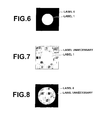
- the energy value is set so as to decrease when, as illustrated in FIG. 6 , a label 1 representing the target region is assigned to the pixels in the target region indicated by the circular region in FIG. 6 , and a label 0 representing belonging to another region that is not the target region is assigned to the pixels in the another region. Therefore, as the N pixels, one or more pixels are selected from inside and from outside the predicted shape.
- the energy value is set so as to decrease when, as illustrated in FIG. 7 , the label 1 representing the target region is assigned to the pixels in the target region. Therefore, all of the N pixels are selected from inside the predicted shape.
- the submodular method may also be carried out by adding the energies having an energy value that decreases when, as illustrated in FIG. 8 , the label 0 representing belonging to another region is assigned to the pixels in the another region.
- This added energy is an M-th order term in which the variable is the labels of a second pixel group including M pixels, M being a natural number of 4 or more, which are positioned outside the predicted shape.
- the value of the M-th order term can be set to be at a second minimum value when all of the labels assigned to pixels of the second pixel group are the label 0 representing belonging to another region, and increase in stages from the second minimum value along with an increase in the number of pixels assigned with the label 1 representing belonging to the target region.
- Expression (3) shows an example of an energy function capable of being employed as the above-mentioned third-term energy ⁇ E c (X c ) in the case of the submodular method.
- ⁇ is a weighting coefficient assigned to each variable x i ⁇ 1,0 ⁇
- ⁇ is a truncation coefficient
- z ⁇ 1,0 ⁇ is an auxiliary variable.
- the energy ⁇ E c (X c ) is at a minimum value when a value (label) of 1 is assigned to all of the variables x i .
- the energy ⁇ E c (X c ) gradually increases with an increase in the number of variables assigned with a value (label) of 0, and within the range of ⁇ i x i being more than ⁇ , the energy ⁇ E c (X c ) has a fixed maximum value of 0. [Math.
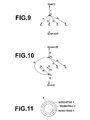
- FIG. 9 expresses Expression (3) as a graph, in which the magnitude of the minimum among the required cuts for dividing the apexes of the graph into an apex group including a Sink point and an apex group including a Source point matches the minimum value of the energy values given by the energy function of Expression (3).
- Expression (4) shows an example of an energy function capable of being employed as the above-mentioned third-term energy ⁇ E c (X c ) in the case of the non-submodular method.
- S 0 (X 0 ) is a set of variables assigned with the label of 0 in labeling X 0
- S 1 (X 0 ) is a set of variables assigned with the label of 1 in labeling X 0 .
- ⁇ (>0) is a real number.
- FIG. 10 expresses Expression (4) as a graph.
- Expression (4) determines the energy function of a polynomial equation (pseudo-Boolean equation) giving a minimum value 0 when the combination of the labels assigned to pixels of the above-mentioned pixel group including N pixels is a pattern matching the predicted shape of the target region, and giving a value ⁇ (>0) in other cases, and converts (Type-I conversion: see Non Patent Literature 2) a minimization problem of the thus determined high order energy function into a minimization problem of a quadratic energy function such as that represented by Expression (5) using the auxiliary variables z 0 and z 1 .
- Expression (4) adds a weighting coefficient ⁇ i to be assigned to each variable x i . [Math.
- the energy ⁇ E c (X c ) is at a minimum value when the combination of the labels assigned to pixels of the above-mentioned pixel group including N pixels is a pattern matching the predicted shape of the target region, and increases in stages from the minimum value along with an increase in the number of pixels assigned with a label different from the pattern.
- the weighting coefficients ⁇ i assigned to respective variables x i may be set to be all the same value.
- the weighting coefficient ⁇ i may also be set to increase as a pixel represented by the variable is farther from an outline of the above-mentioned predicted shape.
- the weighting coefficient ⁇ i is set to a different value depending on the distance from the outline of the predicted shape, there is an increase in the increment of the energy value (the value of the N-th order term) caused by pixels that are a greater distance away from the outline of the predicted shape and hence are assigned with a different label from the pattern matching the predicted shape of the target region. Therefore, a labeling effect more suited to the shape of the target region may be obtained than when all the weighting coefficients ⁇ i are set to the same value.
- a value of 1 is assigned as the weighting of each pixel on an inner side by one pixel from an outline S of the predicted shape of the target region
- a value of 2 is assigned as the weighting of each pixel on the inner side by even one more pixel
- a value of 3 is assigned as the weighting of each pixel on the inner side by still even one more pixel
- two regions A and B such as those illustrated in FIGS. 12 and 13 , in which the difference in area from the predicted shape is the same for both the regions, are assumed.
- the difference in area corresponds to the region labeled differently from the pattern matching the predicted shape of the target region.
- the region B which is a dissimilar shape to the predicted shape, contains more pixels that are farther away from the outline of the predicted shape than the region A, which is a similar shape to the predicted shape. Therefore, the case of the region A has a smaller energy than the case of the region B, and hence is determined as having more desirable labeling.
- the energy function setting unit 43 sets the energy function E by providing an N-th order energy such as the third term of Expression (2) corresponding to each shape, and adding all of those energies to Expression (2).
- the condition for giving the minimum value at each energy namely, the case where the result of labeling matches the shape corresponding to that energy, is the condition for giving a local minimum even for the whole energy function E. Consequently, an energy function E capable of corresponding to each of those plurality of shapes may be provided.
- the labeling unit 44 labels the binary label representing belonging to a target region or belonging to another region to each pixel in an image P by minimizing the energy function E set by the energy function setting unit 43.
- the labeling unit 44 basically, globally determines a solution using a minimum cut algorithm when the energy function E is submodular, and determines an optimal solution or an approximate solution using a quadratic pseudo-Boolean optimization (QPBO) algorithm when the energy function E is non-submodular (see Non Patent Literature 1).
- QPBO quadratic pseudo-Boolean optimization
- the optimal solution is determined by solving the minimization problem by converting the minimization problem into an equivalent minimization problem of a quadratic energy function based on Expression (3) or Expression (4).
- the display control unit 45 is configured to display the image P in which the range of the target region is displayed by a border and the like on a display apparatus as a result of the labeling by the labeling unit 44.
- the image data input unit 41 receives an input of the image P of an image processing target including a target region to be extracted, and stores the received image P in the storage 3 (S1).
- the shape setting unit 42 sets the predicted shape of the target region to be extracted (S2).
- the energy function setting unit 43 sets the energy function E for giving an energy value in each case of assigning a binary label representing belonging to the target region or belonging to another region to each variable corresponding to each pixel in the image, the energy function E being set so that the energy value decreases when the division of the region represented by the assigning is more desirable (S3).
- the energy function E includes an N-th order term in which the variable is the label of each pixel of a pixel group including N pixels (N being a natural number of 4 or more) that have a positional relationship representing the predicted shape set in Step S2.
- the value of this N-th order term is set so as to be at a minimum value when the combination of the labels assigned to pixels of the pixel group is a pattern matching the predicted shape of the target region, and so as to increase in stages from the minimum value along with an increase in the number of pixels to which a label different from the pattern is assigned.
- the energy function setting unit 43 may register in advance an energy function for each type of region capable of being a target of the extraction processing, and acquire and set the energy function corresponding to the target region to be extracted from among the registered energy functions.
- the labeling unit 44 assigns a binary label representing belonging to a target region or belonging to another region to each pixel in the image P by minimizing the energy function E set in Step S3 (S4).
- the labeling unit 44 may calculate, for example, the energy given in each case of assigning a label to each pixel in the image, and output the assignment of labels for which energy is at a minimum as a final result.
- the display control unit 45 displays the image P in which a range assigned with a label representing belonging to the target region is displayed by a border and the like on the display apparatus 5 (S5), and then the processing finishes.
- the shape setting unit 42 sets the predicted shape of the target region
- the energy function setting unit 43 selects a pixel group including N pixels in the image P, where N is a natural number of 4 or more, which have a positional relationship representing the set predicted shape, to set an energy function E including an N-th order term in which a variable is a label of each pixel of the selected pixel group, so that a value of the N-th order term is at a minimum value when a combination of the labels assigned to the pixels of the selected pixel group is a pattern matching the set predicted shape of the target region, and increases in stages from the minimum value along with an increase in the number of pixels to which a label different from the pattern is assigned, and the labeling unit 44 assigns the labels by minimizing the set energy function E.
- the energy function E when setting the energy function E so that the increment of the energy value (the value of the N-th order term), which is caused by pixels that are a greater distance away from the outline of the predicted shape and are assigned with a different label from the pattern matching the predicted shape of the target region, increases by determining the weighting coefficient ⁇ i in the N-th order term of pixels represented by the corresponding variable to be larger for pixels farther away from the outline of the predicted shape, a labeling effect more suited to the shape of the target region may be obtained than when all the weighting coefficients ⁇ i are set to the same value.
- the method according to the present invention is not limited to binary labeling of a target region and a non-target region.
- a method of encoding multiple values into binary values reference may be made to the descriptions in S. Ramalingam et al., "Exact Inference in Multi-label CRFs with Higher Order Cliques", Proc. CVPR, pp. 1-8, 2008 .
Landscapes
- Engineering & Computer Science (AREA)
- Physics & Mathematics (AREA)
- Theoretical Computer Science (AREA)
- General Physics & Mathematics (AREA)
- Computer Vision & Pattern Recognition (AREA)
- Software Systems (AREA)
- Probability & Statistics with Applications (AREA)
- Data Mining & Analysis (AREA)
- General Health & Medical Sciences (AREA)
- Quality & Reliability (AREA)
- Radiology & Medical Imaging (AREA)
- Nuclear Medicine, Radiotherapy & Molecular Imaging (AREA)
- Medical Informatics (AREA)
- Health & Medical Sciences (AREA)
- Life Sciences & Earth Sciences (AREA)
- General Engineering & Computer Science (AREA)
- Evolutionary Computation (AREA)
- Evolutionary Biology (AREA)
- Bioinformatics & Computational Biology (AREA)
- Bioinformatics & Cheminformatics (AREA)
- Artificial Intelligence (AREA)
- Image Analysis (AREA)
- Image Processing (AREA)
- Apparatus For Radiation Diagnosis (AREA)
Abstract
Description
- The present invention relates to an image processing apparatus for extracting a predetermined target region from an image, and an operation method and a program therefor.
- Hitherto, a method of formulating segmentation of an image as an energy minimization problem, and solving the energy minimization problem by using a graph cut algorithm has been known. For example, segmentation of the image may be posed as a problem of assigning a value (label) of 0 or 1 representing belonging to a target region or belonging to another region to each variable x1, x2, ... xn corresponding to each pixel in the image, and a quadratic energy function E such as that represented by Expression (1), in which energy decreases as the assigning (i.e., the labeling) becomes more desirable, is defined to determine a solution that minimizes the quadratic energy function E.
[Math. 1]
- As a method of solving such a minimization problem, in
Non Patent Literature 1, there is proposed a method of globally determining a solution using a minimum cut algorithm when energy is submodular, and determining an optimal solution or an approximate solution using a quadratic pseudo-Boolean optimization (QPBO) algorithm when energy is non-submodular. - Further, in
Non Patent Literature 2, there is proposed a method of solving a minimization problem of a third order or higher energy function by converting the minimization problem into an equivalent minimization problem of a quadratic energy function. InNon Patent Literature 3, there is proposed a method in which segmentation of an image is provided with robustness by, when defining high order submodular energy, setting the values of higher-order terms to be at a minimum value when the same label is assigned to all of the variables, so that energy gradually increases along with an increase in the number of variables assigned to different labels. -
- [NPL 1] C. Rother, et al., "Optimizing Binary MRFs via Extended Roof Duality", CVPR, pp. 1-8, 2007.
- [NPL 2] C. Rother, et al., "Minimizing Sparse Higher Order Energy Functions of Discrete Variables", CVPR, pp. 1-8, 2009.
- [NPL 3] P. Kohli et al., "Robust Higher Order Potentials for Enforcing Label Consistency", International Journal of Computer Vision archive, 82(3), pp. 302-324, 2009
- However, in the field of image processing, when extracting a target region having a specific shape that is predictable to a certain extent, such as an organ region or a tumor region, from a medical image, for example, in order to improve the extraction performance, the effective use of high order energy based on the shape characteristics of the target region is desirable. However, none of
Non Patent Literatures 1 to 3 discloses a method of utilizing high order energy suited to extraction of a target region having a predictable shape. - Therefore, it is an object of the present invention to provide an image processing apparatus, and an operation method and a program therefor, capable of extracting a target region having a predictable shape more accurately and more robustly.
- An image processing apparatus according to one embodiment of the present invention is configured to assign a binary label representing belonging to a target region or belonging to another region to each pixel in an image, the image processing apparatus including: a shape setting unit configured to set a predicted shape of the target region; an energy function setting unit configured to: select a pixel group including N pixels in the image, where N is a natural number of 4 or more, which have a positional relationship representing the set predicted shape; and set an energy function including an N-th order term in which a variable is a label of each of the N pixels of the selected pixel group, so that a value of the N-th order term is at a minimum value when a combination of the labels assigned to the N pixels of the selected pixel group is a pattern matching the set predicted shape of the target region, and increases in stages from the minimum value along with an increase in a number of pixels to which a label different from the pattern is assigned; and a labeling unit configured to perform the labeling by minimizing the set energy function.
- In the image processing apparatus according to one embodiment of the present invention, the energy function setting unit may set the energy function using the pattern including one or more of each of the binary labels.
- Further, the energy function setting unit may set the energy function using the pattern including only labels representing belonging to the target region. In this case, the energy function setting unit may be configured to: further select, when all of the N pixels of the selected pixel group belong to the target region, a second pixel group including M pixels in the image, where M is a natural number of 4 or more, which are located at a position expected to belong to the another region; and set the energy function further including an M-th order term in which a variable is a label of each of the M pixels of the selected second pixel group, so that a value of the M-th order term is at a second minimum value when all of the labels assigned to the M pixels of the second pixel group are the label representing belonging to the another region, and increases in stages from the second minimum value along with an increase in the number of pixels assigned with the label representing belonging to the target region.
- Further, in the image processing apparatus according to one embodiment of the present invention, the energy function setting unit may set the energy function so that an increment of the value of the N-th order term increases based on assignment of, among the N pixels of the selected pixel group, a label different from the pattern to pixels farther away from an outline of the predicted target region assumed when the combination of the labels assigned to the N pixels of the pixel group is the pattern.
- Further, in the image processing apparatus according to one embodiment of the present invention, the shape setting unit may set a plurality of different shapes as the predicted shape of the target region, and the energy function setting unit may be configured to: select pixel groups respectively corresponding to the set plurality of different shapes, the pixel groups each including N pixels that have a positional relationship representing each of the set plurality of different shapes; determine N-th order terms corresponding to each of the selected pixel groups in which a variable is a label of each pixel of the each of the selected pixel groups; and set the energy function including a sum of the N-th order terms, so that a value of each of the N-th order terms is at a minimum value when a combination of the labels assigned to pixels of the pixel group corresponding to the N-th order term is a pattern matching the set shape corresponding to the pixel group, and increases in stages from the minimum value along with an increase in the number of pixels to which a label different from the pattern is assigned.
- Further, in the image processing apparatus according to one embodiment of the present invention, when the target region is a tumor region, the shape setting unit may set a plurality of ellipses each having a different degree of circularity as the predicted shape of the target region. Further, when the target region is a muscle region, the shape setting unit may set a plurality of relaxation curves each having a different degree of change in curvature as the predicted shape of the target region. Further, when the target region is a vascular region, the shape setting unit may set a plurality of circles or spheres each having a different size and a different position, or each having any one of a different size or a different position as the predicted shape of the target region. Further, when the target region is an organ region, the shape setting unit may set a plurality of organ shapes each having a different principal component parameter obtained by principal component analysis as the predicted shape of the target region.
- An image processing method according to one embodiment of the present invention is executed by an image processing apparatus, which includes a shape setting unit, an energy function setting unit, and a labeling unit, for assigning a binary label representing belonging to a target region or belonging to another region to each pixel in an image. The image processing method includes: setting, by the shape setting unit, a predicted shape of the target region; selecting, by the energy function setting unit, a pixel group including N pixels in the image, where N is a natural number of 4 or more, which have a positional relationship representing the set predicted shape, to set an energy function including an N-th order term in which a variable is a label of each of the N pixels of the selected pixel group, so that a value of the N-th order term is at a minimum value when a combination of the labels assigned to the N pixels of the selected pixel group is a pattern matching the set predicted shape of the target region, and increases in stages from the minimum value along with an increase in a number of pixels to which a label different from the pattern is assigned; and performing, by the labeling unit, the labeling by minimizing the set energy function.
- An image processing program according to one embodiment of the present invention assigns a binary label representing belonging to a target region or belonging to another region to each pixel in an image, the image processing program causing a computer to function as: a shape setting unit configured to set a predicted shape of the target region; an energy function setting unit configured to: select a pixel group including N pixels in the image, where N is a natural number of 4 or more, which have a positional relationship representing the set predicted shape of the target region; and set an energy function including an N-th order term in which a variable is a label of each of the N pixels of the selected pixel group, so that a value of the N-th order term is at a minimum value when a combination of the labels assigned to the N pixels of the selected pixel group is a pattern matching the set predicted shape of the target region, and increases in stages from the minimum value along with an increase in a number of pixels to which a label different from the pattern is assigned; and a labeling unit configured to perform the labeling by minimizing the set energy function.
- Further, the above-mentioned image processing program, usually, includes a plurality of program modules, and the above-mentioned functions of the respective units are each realized by one or a plurality of program modules. This group of program modules is recorded on a recording medium, such as a CD-ROM and a DVD. Alternatively, this group of program modules is provided to the user by being recorded in a downloadable state in storage accompanying a server computer or in network storage.
- The image processing apparatus, and the operation method and the program therefor, according to one embodiment of the present invention are configured to, when assigning a binary label representing belonging to a target region or belonging to another region to each pixel in an image, set the predicted shape of the target region, and select a pixel group including N pixels in the image, where N is a natural number of 4 or more, which have a positional relationship representing the set predicted shape of the target region, to set an energy function including an N-th order term in which a variable is a label of each pixel of the selected pixel group, so that a value of the N-th order term is at a minimum value when a combination of the labels assigned to the pixels of the selected pixel group is a pattern matching the set predicted shape of the target region, and increases in stages from the minimum value along with an increase in the number of pixels to which a label different from the pattern is assigned. Therefore, a labeling result that is more suited to the shape of the target region can be obtained, and cases in which the actual shape of the target region differs from the predicted shape to some extent can be handled flexibly. Consequently, a target region having a predictable shape can be extracted more accurately and more robustly.
-
-
FIG. 1 illustrates a schematic configuration of an image processing apparatus. -
FIG. 2 is a block diagram illustrating functions implemented in the image processing apparatus. -
FIG. 3 illustrates a method of setting a predicted shape of a tumor region. -
FIG. 4 illustrates a method of setting a predicted shape of a muscle region. -
FIG. 5 illustrates a method of setting a predicted shape of an organ region. -
FIG. 6 illustrates a non-submodular method. -
FIG. 7 illustrates a submodular method. -
FIG. 8 illustrates another submodular method. -
FIG. 9 is a graph showing an N-th order submodular energy. -
FIG. 10 is a graph showing an N-th order non-submodular energy. -
FIG. 11 illustrates an example in which a weighting coefficient is set in stages based on a distance from an outline of a predicted shape. -
FIG. 12 illustrates an effect obtained by setting the weighting coefficient in stages. -
FIG. 13 illustrates an effect obtained by setting the weighting coefficient in stages. -
FIG. 14 shows how to set energy functions capable of corresponding to a plurality of shapes. -
FIG. 15 is a flowchart illustrating a flow of processing carried out by the image processing apparatus. - An embodiment of the present invention is described below with reference to the drawings. An
image processing apparatus 1 according to the present invention is realized by an image processing program being loaded to a computer and executed. As illustrated inFIG. 1 , theimage processing apparatus 1 includes a central processing unit (CPU) 2, amemory 4, and astorage 3, such as a hard disk drive (HDD). Further, adisplay apparatus 5, such as a display, and aninput apparatus 6, such as a mouse and a keyboard, are connected to theimage processing apparatus 1. - An image processing program and data referenced by the program are stored in the
storage 3, and are loaded into the memory when the image processing program is started. The image processing program defines, as the processing to be executed in the CPU, image data input processing, shape setting processing, energy function setting processing, labeling processing, and display control processing. Then, by the CPU executing each processing described above in accordance with the definitions of the program, as illustrated inFIG. 2 , the computer functions as an imagedata input unit 41, ashape setting unit 42, an energyfunction setting unit 43, alabeling unit 44, and adisplay control unit 45. In this case,FIG. 2 schematically illustrates the functions implemented in theimage processing apparatus 1 as blocks. - The image
data input unit 41 is configured to receive an input of an image P (two-dimensional or three-dimensional image data) of an image processing target including a target region to be extracted, and store the received image P in thestorage 3. At this point, the target region is, for example, a region having a specific shape that is predictable to a certain extent, such as an organ region and a tumor region. - The
shape setting unit 42 is configured to set a predicted shape of the target region. The predicted shape of the target region can be set manually or automatically. When setting automatically, for example, the shapes predicted for each type of region that may be a target of the extraction processing can be registered in advance, and a predicted shape of the target region to be extracted can be acquired and set from among the registered predicted shapes. When setting manually, an input can be received from a user who specifies the shape to be predicted of the target region, and the specified shape can be set as the predicted shape. - The
shape setting unit 42 may be configured to set one shape or to set a plurality of different shapes as the predicted shape of the target region. For example, when the target region is an elliptical (including an exact circle) tumor region having a specifiable long diameter, as the predicted shapes of the target region, theshape setting unit 42 may set a plurality of ellipses Sk (k=1, 2, ...) having different degrees of circularity that have a common long diameter d as illustrated inFIG. 3 . - Further, when the target region is a muscle region in which both end points of the muscle are specifiable, such as when extracting the psoas major muscle from a CT image, a plurality of relaxation curves Sk (k=1, 2, ...) each sharing both end points C1 and C2 and each having a different degree of change in curvature, such as those illustrated in
FIG. 4 , may be set as the predicted shapes of the target region. In this case, the relaxation curves are represented by a polynomial equation. The plurality of relaxation curves having a different degree of change in curvature may be generated by changing the parameters of this polynomial equation. - In addition, when the target region is a vascular region, a plurality of circles or spheres having different sizes or positions may be set as the predicted shapes of the target region. Still further, when the target region is an organ region, like an active shape model (ASM), for example, a plurality of organ shapes Sk (k=1, 2, ...) obtained by determining an average shape S1 and a vector for changing the average shape by performing principal component analysis, independent component analysis, and the like on the shape of the organ region, and, as illustrated in
FIG. 5 , changing a parameter of each of those vectors, may be set as the predicted shapes of the target region. Note that, inFIG. 5 , U1 represents a first principal component, and U2 represents a second principal component. - Further, the
shape setting unit 42 may have, in addition to or in place of the function of setting the predicted shapes of the target region by the above-mentioned method, a function of analyzing the image P of the image processing target, the input thereof being received by the imagedata input unit 41, to set the predicted shapes of the target region based on a result of the analysis. For example, a plurality of shapes, which are obtained by temporarily extracting an outline of the target region from the image P of the image processing target by an arbitrary method, by determining at least one principal component parameter of the temporarily extracted outline by principal component analysis, and by changing the determined principal component parameter, may be set as the predicted shapes of the target region. For example, when the image P of the image processing target is an axial cross-sectional image of the abdomen and the target region is an abdominal cavity, an outline of the abdominal cavity is roughly extracted based on information on regions of bones and lung fields (air) in the image P, and at least one principal component parameter or the like of the extracted outline is determined by principal component analysis. Then, the determined principal component parameter is changed to obtain a plurality of shapes, and the plurality of shapes are set as the predicted shapes of the target region. - The energy
function setting unit 43 is configured to set an energy function E giving an energy value in each case of assigning a value (label) of 0 or 1 representing belonging to a target region or belonging to another region to each variable x1, x2, ... xn corresponding to each pixel in the image. The energy function E is set so that the energy value decreases as the division of the region represented by the assigning (i.e., labeling) becomes more desirable. For example, an energy function E such as that represented by Expression (2) is set.
[Math. 2]
- In Expression (2), a first-term energy ΣEi(x¡) is a linear term in which the label assigned to each pixel is the variable, and a second-term energy ΣEij(xi,xj) is a quadratic term in which the labels of a pair of adjacent two pixels are the variable.
- Further, a third-term energy ΣEc(Xc) is an N-th order term in which the variable is the labels of a pixel group including N pixels, N being a natural number of 4 or more, which are selected as having a positional relationship representing the predicted shape of the target region. The value of the N-th order term is set so as to be at a minimum value when the combination of the labels assigned to pixels of the pixel group is a pattern matching the predicted shape of the target region, and so as to increase in stages from the minimum value along with an increase in the number of pixels to which a label different from the pattern is assigned. Note that, a case is now described in which there is one predicted shape set by the
shape setting unit 42. A case in which there are a plurality of different shapes is described later. - Here, the meaning of N pixels having a positional relationship representing the predicted shape of the target region is a pixel group from which the general shape of the overall target region is extractable based on the arrangement and the combination of labels of the pixel group, and may be, for example, a pixel group, the pixels of which are distributed along an outline of the predicted shape (the shape to be extracted such as the above-mentioned circle, ellipse, and relaxation curve etc.).
- Further, the selection of the N pixels having a positional relationship representing the predicted shape of the target region is different depending on which of two methods, submodular or non-submodular, is used for setting the energy in the above-mentioned third term ΣEc(Xc). In a non-submodular method, the energy value is set so as to decrease when, as illustrated in
FIG. 6 , alabel 1 representing the target region is assigned to the pixels in the target region indicated by the circular region inFIG. 6 , and alabel 0 representing belonging to another region that is not the target region is assigned to the pixels in the another region. Therefore, as the N pixels, one or more pixels are selected from inside and from outside the predicted shape. - In a submodular method, the energy value is set so as to decrease when, as illustrated in
FIG. 7 , thelabel 1 representing the target region is assigned to the pixels in the target region. Therefore, all of the N pixels are selected from inside the predicted shape. The submodular method may also be carried out by adding the energies having an energy value that decreases when, as illustrated inFIG. 8 , thelabel 0 representing belonging to another region is assigned to the pixels in the another region. - This added energy is an M-th order term in which the variable is the labels of a second pixel group including M pixels, M being a natural number of 4 or more, which are positioned outside the predicted shape. The value of the M-th order term can be set to be at a second minimum value when all of the labels assigned to pixels of the second pixel group are the
label 0 representing belonging to another region, and increase in stages from the second minimum value along with an increase in the number of pixels assigned with thelabel 1 representing belonging to the target region. - Expression (3) shows an example of an energy function capable of being employed as the above-mentioned third-term energy ΣEc(Xc) in the case of the submodular method. In Expression (3), αi (i=1, 2, ... n) is a weighting coefficient assigned to each variable xi∈{1,0}, γ is a truncation coefficient, and z∈{1,0} is an auxiliary variable. In Expression (3), the energy ΣEc(Xc) is at a minimum value when a value (label) of 1 is assigned to all of the variables xi. Within the range of Σαixi being γ or less, the energy ΣEc(Xc) gradually increases with an increase in the number of variables assigned with a value (label) of 0, and within the range of Σαixi being more than γ, the energy ΣEc(Xc) has a fixed maximum value of 0.
[Math. 3]
- Further,
FIG. 9 expresses Expression (3) as a graph, in which the magnitude of the minimum among the required cuts for dividing the apexes of the graph into an apex group including a Sink point and an apex group including a Source point matches the minimum value of the energy values given by the energy function of Expression (3). - In addition, Expression (4) shows an example of an energy function capable of being employed as the above-mentioned third-term energy ΣEc(Xc) in the case of the non-submodular method. In Expression (4), αi (i=1, 2, ... n) is a weighting coefficient assigned to each variable xi∈{1,0} and z0,z1 ∈ {1,0} are each an auxiliary variable. Further, S0(X0) is a set of variables assigned with the label of 0 in labeling X0, and S1(X0) is a set of variables assigned with the label of 1 in labeling X0. In addition, θ (>0) is a real number. Further,
FIG. 10 expresses Expression (4) as a graph.
[Math. 4]
- Expression (4) determines the energy function of a polynomial equation (pseudo-Boolean equation) giving a
minimum value 0 when the combination of the labels assigned to pixels of the above-mentioned pixel group including N pixels is a pattern matching the predicted shape of the target region, and giving a value θ (>0) in other cases, and converts (Type-I conversion: see Non Patent Literature 2) a minimization problem of the thus determined high order energy function into a minimization problem of a quadratic energy function such as that represented by Expression (5) using the auxiliary variables z0 and z1. In addition, Expression (4) adds a weighting coefficient αi to be assigned to each variable xi.
[Math. 5]
- Consequently, in Expression (4), the energy ΣEc(Xc) is at a minimum value when the combination of the labels assigned to pixels of the above-mentioned pixel group including N pixels is a pattern matching the predicted shape of the target region, and increases in stages from the minimum value along with an increase in the number of pixels assigned with a label different from the pattern.
- Further, in the above-mentioned third-term energy ΣEc(Xc) defined by Expression (3) or Expression (4), the weighting coefficients αi assigned to respective variables xi may be set to be all the same value. Alternatively, the weighting coefficient αi may also be set to increase as a pixel represented by the variable is farther from an outline of the above-mentioned predicted shape. In particular, when the weighting coefficient αi is set to a different value depending on the distance from the outline of the predicted shape, there is an increase in the increment of the energy value (the value of the N-th order term) caused by pixels that are a greater distance away from the outline of the predicted shape and hence are assigned with a different label from the pattern matching the predicted shape of the target region. Therefore, a labeling effect more suited to the shape of the target region may be obtained than when all the weighting coefficients αi are set to the same value.
- For example, as illustrated in
FIG. 11 , it is assumed that a value of 1 is assigned as the weighting of each pixel on an inner side by one pixel from an outline S of the predicted shape of the target region, a value of 2 is assigned as the weighting of each pixel on the inner side by even one more pixel, and a value of 3 is assigned as the weighting of each pixel on the inner side by still even one more pixel, and two regions A and B such as those illustrated inFIGS. 12 and 13 , in which the difference in area from the predicted shape is the same for both the regions, are assumed. In such a case, the difference in area corresponds to the region labeled differently from the pattern matching the predicted shape of the target region. Accordingly, in the portion forming the above-mentioned difference in area, the region B, which is a dissimilar shape to the predicted shape, contains more pixels that are farther away from the outline of the predicted shape than the region A, which is a similar shape to the predicted shape. Therefore, the case of the region A has a smaller energy than the case of the region B, and hence is determined as having more desirable labeling. - Further, when a plurality of different shapes are set as the predicted shape by the
shape setting unit 42, the energyfunction setting unit 43 sets the energy function E by providing an N-th order energy such as the third term of Expression (2) corresponding to each shape, and adding all of those energies to Expression (2). In this case, for example, as shown inFIG. 14 , the energy Em (m=1, 2, ...) provided corresponding to each of the plurality of shapes is obtained as a sum. The condition for giving the minimum value at each energy, namely, the case where the result of labeling matches the shape corresponding to that energy, is the condition for giving a local minimum even for the whole energy function E. Consequently, an energy function E capable of corresponding to each of those plurality of shapes may be provided. - The
labeling unit 44 labels the binary label representing belonging to a target region or belonging to another region to each pixel in an image P by minimizing the energy function E set by the energyfunction setting unit 43. Thelabeling unit 44, basically, globally determines a solution using a minimum cut algorithm when the energy function E is submodular, and determines an optimal solution or an approximate solution using a quadratic pseudo-Boolean optimization (QPBO) algorithm when the energy function E is non-submodular (see Non Patent Literature 1). When the energy function E is a third order or higher energy function, the optimal solution is determined by solving the minimization problem by converting the minimization problem into an equivalent minimization problem of a quadratic energy function based on Expression (3) or Expression (4). - The
display control unit 45 is configured to display the image P in which the range of the target region is displayed by a border and the like on a display apparatus as a result of the labeling by thelabeling unit 44. - Next, a flow of the processing performed by the
image processing apparatus 1 is described with reference to the flowchart ofFIG. 15 . First, the imagedata input unit 41 receives an input of the image P of an image processing target including a target region to be extracted, and stores the received image P in the storage 3 (S1). Next, theshape setting unit 42 sets the predicted shape of the target region to be extracted (S2). Then, the energyfunction setting unit 43 sets the energy function E for giving an energy value in each case of assigning a binary label representing belonging to the target region or belonging to another region to each variable corresponding to each pixel in the image, the energy function E being set so that the energy value decreases when the division of the region represented by the assigning is more desirable (S3). At this point, the energy function E includes an N-th order term in which the variable is the label of each pixel of a pixel group including N pixels (N being a natural number of 4 or more) that have a positional relationship representing the predicted shape set in Step S2. The value of this N-th order term is set so as to be at a minimum value when the combination of the labels assigned to pixels of the pixel group is a pattern matching the predicted shape of the target region, and so as to increase in stages from the minimum value along with an increase in the number of pixels to which a label different from the pattern is assigned. Further, at this point, the energyfunction setting unit 43 may register in advance an energy function for each type of region capable of being a target of the extraction processing, and acquire and set the energy function corresponding to the target region to be extracted from among the registered energy functions. - Next, the
labeling unit 44 assigns a binary label representing belonging to a target region or belonging to another region to each pixel in the image P by minimizing the energy function E set in Step S3 (S4). At this point, thelabeling unit 44 may calculate, for example, the energy given in each case of assigning a label to each pixel in the image, and output the assignment of labels for which energy is at a minimum as a final result. Further, thedisplay control unit 45 displays the image P in which a range assigned with a label representing belonging to the target region is displayed by a border and the like on the display apparatus 5 (S5), and then the processing finishes. - Based on the configuration described above, according to the image processing apparatus 1 of this embodiment, when assigning a binary label representing belonging to a target region to be extracted or belonging to another region to each pixel in the image P, the shape setting unit 42 sets the predicted shape of the target region, the energy function setting unit 43 selects a pixel group including N pixels in the image P, where N is a natural number of 4 or more, which have a positional relationship representing the set predicted shape, to set an energy function E including an N-th order term in which a variable is a label of each pixel of the selected pixel group, so that a value of the N-th order term is at a minimum value when a combination of the labels assigned to the pixels of the selected pixel group is a pattern matching the set predicted shape of the target region, and increases in stages from the minimum value along with an increase in the number of pixels to which a label different from the pattern is assigned, and the labeling unit 44 assigns the labels by minimizing the set energy function E. Therefore, a labeling result that is more suited to the shape of the target region can be obtained, and cases in which the actual shape of the target region differs from the predicted shape to some extent can be handled flexibly. Consequently, a target region having a predictable shape can be extracted more accurately and more robustly.
- In addition, in the above-mentioned embodiment, when setting the energy function E so that the increment of the energy value (the value of the N-th order term), which is caused by pixels that are a greater distance away from the outline of the predicted shape and are assigned with a different label from the pattern matching the predicted shape of the target region, increases by determining the weighting coefficient αi in the N-th order term of pixels represented by the corresponding variable to be larger for pixels farther away from the outline of the predicted shape, a labeling effect more suited to the shape of the target region may be obtained than when all the weighting coefficients αi are set to the same value.
- In addition, the method according to the present invention is not limited to binary labeling of a target region and a non-target region. The inventive method may also be applied to problems in multi-value labeling in which labeling is carried out using three or more multiple values. For example, when a label xi takes 1 different values of 1, 2, ..., the inventive method may also be applied by, based on a predetermined method, performing binary encoding in which a label xi satisfying xi<k is encoded as 0 and a label xi satisfying xi=k or xi>k is encoded as 1, for example. Regarding a method of encoding multiple values into binary values, reference may be made to the descriptions in S. Ramalingam et al., "Exact Inference in Multi-label CRFs with Higher Order Cliques", Proc. CVPR, pp. 1-8, 2008.
Claims (14)
- An image processing apparatus (1) configured to assign a binary label representing belonging to a target region or belonging to another region to each pixel in an image, the image processing apparatus (1) being characterized by comprising:a shape setting unit (42) configured to set a predicted shape of the target region;an energy function setting unit (43) configured to:select a pixel group comprising N pixels in the image, where N is a natural number of 4 or more, which have a positional relationship representing the set predicted shape; andset an energy function comprising an N-th order term in which a variable is a label of each of the N pixels of the selected pixel group, so that a value of the N-th order term is at a minimum value when a combination of the labels assigned to the N pixels of the selected pixel group is a pattern matching the set predicted shape of the target region, and increases in stages from the minimum value along with an increase in a number of pixels to which a label different from the pattern is assigned; anda labeling unit (44) configured to perform the labeling by minimizing the set energy function.
- An image processing apparatus (1) according to claim 1, characterized in that the energy function setting unit (43) sets the energy function using the pattern comprising one or more of each of the binary labels.
- An image processing apparatus (1) according to claim 1, characterized in that the energy function setting unit (43) sets the energy function using the pattern comprising only labels representing belonging to the target region.
- An image processing apparatus (1) according to claim 3, characterized in that the energy function setting unit (43) is configured to:further select, when all of the N pixels of the selected pixel group belong to the target region, a second pixel group comprising M pixels in the image, where M is a natural number of 4 or more, which are located at a position expected to belong to the another region; andset the energy function further comprising an M-th order term in which a variable is a label of each of the M pixels of the selected second pixel group, so that a value of the M-th order term is at a second minimum value when all of the labels assigned to the M pixels of the second pixel group are the label representing belonging to the another region, and increases in stages from the second minimum value along with an increase in the number of pixels assigned with the label representing belonging to the target region.
- An image processing apparatus (1) according to claim 1 or 2, characterized in that the energy function setting unit (43) sets the energy function so that an increment of the value of the N-th order term increases based on assignment of, among the N pixels of the pixel group, a label different from the pattern to pixels farther away from an outline of the predicted shape.
- An image processing apparatus (1) according to any one of claims 1 to 5, characterized in that:the shape setting unit (42) sets a plurality of different shapes as the predicted shape of the target region; andthe energy function setting unit (43) is configured to:select pixel groups respectively corresponding to the set plurality of different shapes, the pixel groups each comprising N pixels that have a positional relationship representing each of the set plurality of different shapes;determine N-th order terms corresponding to each of the selected pixel groups, in each of which a variable is a label of each pixel of the each of the selected pixel groups; andset the energy function comprising a sum of the N-th order terms, so that a value of each of the N-th order terms is at a minimum value when a combination of the labels assigned to pixels of the pixel group corresponding to the N-th order term is a pattern matching the set shape corresponding to the pixel group, and increases in stages from the minimum value along with an increase in the number of pixels to which a label different from the pattern is assigned.
- An image processing apparatus (1) according to claim 6, characterized in that:the target region comprises a tumor region; andthe shape setting unit (42) sets a plurality of ellipses each having a different degree of circularity as the plurality of different shapes.
- An image processing apparatus (1) according to claim 6, characterized in that:the target region comprises a muscle region; andthe shape setting unit (42) sets a plurality of relaxation curves each having a different degree of change in curvature as the plurality of different shapes.
- An image processing apparatus (1) according to claim 6, characterized in that:the target region comprises a vascular region; andthe shape setting unit (42) sets a plurality of circles or spheres each having a different size and a different position, or each having any one of a different size or a different position as the plurality of different shapes.
- An image processing apparatus (1) according to claim 6, characterized in that:the target region comprises an organ region; andthe shape setting unit (42) sets a plurality of organ shapes each having a different principal component parameter obtained by principal component analysis as the plurality of different shapes.
- An image processing apparatus (1) according to any one of claims 1 to 6, characterized in that the shape setting unit (42) analyzes the image, and sets the predicted shape of the target region based on a result of the analysis.
- An image processing apparatus (1) according to claim 11, characterized in that the shape setting unit (42) sets, as the predicted shapes of the target region, a plurality of shapes obtained by temporarily extracting an outline of the target region from the image, by determining at least one principal component parameter of the temporarily extracted outline by principal component analysis, and by changing the determined at least one principal component parameter.
- An image processing method for assigning a binary label representing belonging to a target region or belonging to another region to each pixel in an image, the image processing method being characterized by comprising:setting a predicted shape of the target region;selecting a pixel group comprising N pixels in the image, where N is a natural number of 4 or more, which have a positional relationship representing the set predicted shape of the target region, to set an energy function comprising an N-th order term in which a variable is a label of each of the N pixels of the selected pixel group, so that a value of the N-th order term is at a minimum value when a combination of the labels assigned to the N pixels of the selected pixel group is a pattern matching the set predicted shape of the target region, and increases in stages from the minimum value along with an increase in a number of pixels to which a label different from the pattern is assigned; andperforming the labeling by minimizing the set energy function.
- A medium having recorded thereon an image processing program for assigning a binary label representing belonging to a target region or belonging to another region to each pixel in an image, the image processing program being characterized by causing a computer to function as:a shape setting unit (42) configured to set a predicted shape of the target region;an energy function setting unit (43) configured to:select a pixel group comprising N pixels in the image, where N is a natural number of 4 or more, which have a positional relationship representing the set predicted shape of the target region; and
set an energy function comprising an N-th order term in which a variable is a label of each of the N pixels of the selected pixel group, so that a value of the N-th order term is at a minimum value when a combination of the labels assigned to the N pixels of the selected pixel group is a pattern matching the set predicted shape of the target region, and increases in stages from the minimum value along with an increase in a number of pixels to which a label different from the pattern is assigned; anda labeling unit (44) configured to perform the labeling by minimizing the set energy function.
Applications Claiming Priority (2)
| Application Number | Priority Date | Filing Date | Title |
|---|---|---|---|
| JP2014048599 | 2014-03-12 | ||
| JP2015026070A JP5946153B2 (en) | 2014-03-12 | 2015-02-13 | Image processing apparatus, operating method thereof, and program |
Publications (3)
| Publication Number | Publication Date |
|---|---|
| EP2919192A2 true EP2919192A2 (en) | 2015-09-16 |
| EP2919192A3 EP2919192A3 (en) | 2016-02-24 |
| EP2919192B1 EP2919192B1 (en) | 2019-11-27 |
Family
ID=52726958
Family Applications (1)
| Application Number | Title | Priority Date | Filing Date |
|---|---|---|---|
| EP15158153.5A Active EP2919192B1 (en) | 2014-03-12 | 2015-03-09 | Image processing apparatus, and operation method and program therefor |
Country Status (3)
| Country | Link |
|---|---|
| US (1) | US10068148B2 (en) |
| EP (1) | EP2919192B1 (en) |
| JP (1) | JP5946153B2 (en) |
Cited By (1)
| Publication number | Priority date | Publication date | Assignee | Title |
|---|---|---|---|---|
| WO2018166289A1 (en) * | 2017-03-15 | 2018-09-20 | 北京京东尚科信息技术有限公司 | Image generation method and device |
Families Citing this family (2)
| Publication number | Priority date | Publication date | Assignee | Title |
|---|---|---|---|---|
| JP6656058B2 (en) * | 2016-04-06 | 2020-03-04 | 京セラ株式会社 | Abdominal cross-sectional image generation apparatus and abdominal cross-sectional image generation system |
| CN113723424B (en) * | 2020-05-25 | 2024-08-13 | 中移(苏州)软件技术有限公司 | Target detection method and device, equipment and storage medium |
Family Cites Families (8)
| Publication number | Priority date | Publication date | Assignee | Title |
|---|---|---|---|---|
| JP4184842B2 (en) * | 2003-03-19 | 2008-11-19 | 富士フイルム株式会社 | Image discrimination device, method and program |
| US7676081B2 (en) * | 2005-06-17 | 2010-03-09 | Microsoft Corporation | Image segmentation of foreground from background layers |
| EP1865464B1 (en) | 2006-06-08 | 2013-11-20 | National University Corporation Kobe University | Processing device and program product for computer-aided image based diagnosis |
| JP2010244321A (en) * | 2009-04-07 | 2010-10-28 | Seiko Epson Corp | Image processing for setting a face model that represents a face image |
| JP5564643B2 (en) * | 2009-06-12 | 2014-07-30 | 博 石川 | Information processing method and information processing apparatus |
| US9153031B2 (en) * | 2011-06-22 | 2015-10-06 | Microsoft Technology Licensing, Llc | Modifying video regions using mobile device input |
| US8824797B2 (en) | 2011-10-03 | 2014-09-02 | Xerox Corporation | Graph-based segmentation integrating visible and NIR information |
| US9361699B2 (en) * | 2012-06-27 | 2016-06-07 | Imec Taiwan Co. | Imaging system and method |
-
2015
- 2015-02-13 JP JP2015026070A patent/JP5946153B2/en active Active
- 2015-03-09 US US14/642,045 patent/US10068148B2/en active Active
- 2015-03-09 EP EP15158153.5A patent/EP2919192B1/en active Active
Non-Patent Citations (4)
| Title |
|---|
| C. ROTHER ET AL.: "Minimizing Sparse Higher Order Energy Functions of Discrete Variables", CVPR, 2009, pages 1 - 8 |
| C. ROTHER ET AL.: "Optimizing Binary MRFs via Extended Roof Duality", CVPR, 2007, pages 1 - 8, XP055480846, DOI: doi:10.1109/CVPR.2007.383203 |
| P. KOHLI ET AL.: "Robust Higher Order Potentials for Enforcing Label Consistency", INTERNATIONAL JOURNAL OF COMPUTER VISION ARCHIVE, vol. 82, no. 3, 2009, pages 302 - 324, XP019690452 |
| S. RAMALINGAM ET AL.: "Exact Inference in Multi-label CRFs with Higher Order Cliques", PROC. CVPR, 2008, pages 1 - 8, XP031296959 |
Cited By (2)
| Publication number | Priority date | Publication date | Assignee | Title |
|---|---|---|---|---|
| WO2018166289A1 (en) * | 2017-03-15 | 2018-09-20 | 北京京东尚科信息技术有限公司 | Image generation method and device |
| CN108629815A (en) * | 2017-03-15 | 2018-10-09 | 北京京东尚科信息技术有限公司 | image generating method and device |
Also Published As
| Publication number | Publication date |
|---|---|
| JP2015187836A (en) | 2015-10-29 |
| EP2919192B1 (en) | 2019-11-27 |
| US20150262026A1 (en) | 2015-09-17 |
| US10068148B2 (en) | 2018-09-04 |
| JP5946153B2 (en) | 2016-07-05 |
| EP2919192A3 (en) | 2016-02-24 |
Similar Documents
| Publication | Publication Date | Title |
|---|---|---|
| US10600185B2 (en) | Automatic liver segmentation using adversarial image-to-image network | |
| JP5521881B2 (en) | Image identification information addition program and image identification information addition device | |
| US12159404B2 (en) | Detecting and segmenting regions of interest in biomedical images using neural networks | |
| US9152926B2 (en) | Systems, methods, and media for updating a classifier | |
| CN110837836A (en) | Semi-supervised Semantic Segmentation Based on Maximizing Confidence | |
| US20110029469A1 (en) | Information processing apparatus, information processing method and program | |
| US10181086B2 (en) | Image analysis method for extracting feature of image and apparatus therefor | |
| JP2015032308A (en) | Convolutional-neural-network-based classifier and classifying method and training methods for the same | |
| KR20160066926A (en) | Apparatus and method for classification of data, apparatus and method for segmentation of region of interest | |
| EP2681693B1 (en) | Method for improving classification results of a classifier | |
| US20100034459A1 (en) | Method and apparatus for calculating features of image data | |
| EP2919192B1 (en) | Image processing apparatus, and operation method and program therefor | |
| US9965698B2 (en) | Image processing apparatus, non-transitory computer-readable recording medium having stored therein image processing program, and operation method of image processing apparatus | |
| Vidovic et al. | Opening the black box: Revealing interpretable sequence motifs in kernel-based learning algorithms | |
| US20200356811A1 (en) | Computer Vision Systems and Methods for Machine Learning Using a Set Packing Framework | |
| EP2902968A1 (en) | Classification device, classification programme, and operating method for classification device | |
| CN112734697B (en) | Image processing method, device, storage medium and electronic equipment | |
| JP4477439B2 (en) | Image segmentation system | |
| Boillet et al. | Confidence estimation for object detection in document images | |
| US11676050B2 (en) | Systems and methods for neighbor frequency aggregation of parametric probability distributions with decision trees using leaf nodes | |
| Gajawada et al. | Vinayaka: A semi-supervised projected clustering method using differential evolution | |
| JP2011248680A (en) | Image processing system | |
| US20240403723A1 (en) | Information processing device, information processing method, and recording medium | |
| Ždímalová et al. | Optimized GrabCut algorithm in medical image analyses | |
| Baek et al. | Segmentation and intensity estimation of microarray images using a gamma-t mixture model |
Legal Events
| Date | Code | Title | Description |
|---|---|---|---|
| PUAI | Public reference made under article 153(3) epc to a published international application that has entered the european phase |
Free format text: ORIGINAL CODE: 0009012 |
|
| AK | Designated contracting states |
Kind code of ref document: A2 Designated state(s): AL AT BE BG CH CY CZ DE DK EE ES FI FR GB GR HR HU IE IS IT LI LT LU LV MC MK MT NL NO PL PT RO RS SE SI SK SM TR |
|
| AX | Request for extension of the european patent |
Extension state: BA ME |
|
| PUAL | Search report despatched |
Free format text: ORIGINAL CODE: 0009013 |
|
| AK | Designated contracting states |
Kind code of ref document: A3 Designated state(s): AL AT BE BG CH CY CZ DE DK EE ES FI FR GB GR HR HU IE IS IT LI LT LU LV MC MK MT NL NO PL PT RO RS SE SI SK SM TR |
|
| AX | Request for extension of the european patent |
Extension state: BA ME |
|
| RIC1 | Information provided on ipc code assigned before grant |
Ipc: G06K 9/46 20060101ALI20160120BHEP Ipc: G06T 7/00 20060101AFI20160120BHEP Ipc: G06K 9/52 20060101ALI20160120BHEP Ipc: G06K 9/62 20060101ALI20160120BHEP |
|
| 17P | Request for examination filed |
Effective date: 20160823 |
|
| RBV | Designated contracting states (corrected) |
Designated state(s): AL AT BE BG CH CY CZ DE DK EE ES FI FR GB GR HR HU IE IS IT LI LT LU LV MC MK MT NL NO PL PT RO RS SE SI SK SM TR |
|
| STAA | Information on the status of an ep patent application or granted ep patent |
Free format text: STATUS: REQUEST FOR EXAMINATION WAS MADE |
|
| R17P | Request for examination filed (corrected) |
Effective date: 20160823 |
|
| STAA | Information on the status of an ep patent application or granted ep patent |
Free format text: STATUS: EXAMINATION IS IN PROGRESS |
|
| 17Q | First examination report despatched |
Effective date: 20180622 |
|
| REG | Reference to a national code |
Ref country code: DE Ref legal event code: R079 Ref document number: 602015042363 Country of ref document: DE Free format text: PREVIOUS MAIN CLASS: G06T0007000000 Ipc: G06T0007120000 |
|
| RIC1 | Information provided on ipc code assigned before grant |
Ipc: G06T 7/12 20170101AFI20190506BHEP Ipc: G06T 7/143 20170101ALI20190506BHEP Ipc: G06T 7/149 20170101ALI20190506BHEP |
|
| GRAP | Despatch of communication of intention to grant a patent |
Free format text: ORIGINAL CODE: EPIDOSNIGR1 |
|
| STAA | Information on the status of an ep patent application or granted ep patent |
Free format text: STATUS: GRANT OF PATENT IS INTENDED |
|
| INTG | Intention to grant announced |
Effective date: 20190614 |
|
| GRAS | Grant fee paid |
Free format text: ORIGINAL CODE: EPIDOSNIGR3 |
|
| GRAA | (expected) grant |
Free format text: ORIGINAL CODE: 0009210 |
|
| STAA | Information on the status of an ep patent application or granted ep patent |
Free format text: STATUS: THE PATENT HAS BEEN GRANTED |
|
| AK | Designated contracting states |
Kind code of ref document: B1 Designated state(s): AL AT BE BG CH CY CZ DE DK EE ES FI FR GB GR HR HU IE IS IT LI LT LU LV MC MK MT NL NO PL PT RO RS SE SI SK SM TR |
|
| REG | Reference to a national code |
Ref country code: GB Ref legal event code: FG4D |
|
| REG | Reference to a national code |
Ref country code: CH Ref legal event code: EP |
|
| REG | Reference to a national code |
Ref country code: AT Ref legal event code: REF Ref document number: 1207548 Country of ref document: AT Kind code of ref document: T Effective date: 20191215 |
|
| REG | Reference to a national code |
Ref country code: DE Ref legal event code: R096 Ref document number: 602015042363 Country of ref document: DE |
|
| REG | Reference to a national code |
Ref country code: IE Ref legal event code: FG4D |
|
| REG | Reference to a national code |
Ref country code: NL Ref legal event code: MP Effective date: 20191127 |
|
| REG | Reference to a national code |
Ref country code: LT Ref legal event code: MG4D |
|
| PG25 | Lapsed in a contracting state [announced via postgrant information from national office to epo] |
Ref country code: SE Free format text: LAPSE BECAUSE OF FAILURE TO SUBMIT A TRANSLATION OF THE DESCRIPTION OR TO PAY THE FEE WITHIN THE PRESCRIBED TIME-LIMIT Effective date: 20191127 Ref country code: LV Free format text: LAPSE BECAUSE OF FAILURE TO SUBMIT A TRANSLATION OF THE DESCRIPTION OR TO PAY THE FEE WITHIN THE PRESCRIBED TIME-LIMIT Effective date: 20191127 Ref country code: FI Free format text: LAPSE BECAUSE OF FAILURE TO SUBMIT A TRANSLATION OF THE DESCRIPTION OR TO PAY THE FEE WITHIN THE PRESCRIBED TIME-LIMIT Effective date: 20191127 Ref country code: BG Free format text: LAPSE BECAUSE OF FAILURE TO SUBMIT A TRANSLATION OF THE DESCRIPTION OR TO PAY THE FEE WITHIN THE PRESCRIBED TIME-LIMIT Effective date: 20200227 Ref country code: NO Free format text: LAPSE BECAUSE OF FAILURE TO SUBMIT A TRANSLATION OF THE DESCRIPTION OR TO PAY THE FEE WITHIN THE PRESCRIBED TIME-LIMIT Effective date: 20200227 Ref country code: GR Free format text: LAPSE BECAUSE OF FAILURE TO SUBMIT A TRANSLATION OF THE DESCRIPTION OR TO PAY THE FEE WITHIN THE PRESCRIBED TIME-LIMIT Effective date: 20200228 Ref country code: LT Free format text: LAPSE BECAUSE OF FAILURE TO SUBMIT A TRANSLATION OF THE DESCRIPTION OR TO PAY THE FEE WITHIN THE PRESCRIBED TIME-LIMIT Effective date: 20191127 Ref country code: NL Free format text: LAPSE BECAUSE OF FAILURE TO SUBMIT A TRANSLATION OF THE DESCRIPTION OR TO PAY THE FEE WITHIN THE PRESCRIBED TIME-LIMIT Effective date: 20191127 |
|
| PG25 | Lapsed in a contracting state [announced via postgrant information from national office to epo] |
Ref country code: RS Free format text: LAPSE BECAUSE OF FAILURE TO SUBMIT A TRANSLATION OF THE DESCRIPTION OR TO PAY THE FEE WITHIN THE PRESCRIBED TIME-LIMIT Effective date: 20191127 Ref country code: HR Free format text: LAPSE BECAUSE OF FAILURE TO SUBMIT A TRANSLATION OF THE DESCRIPTION OR TO PAY THE FEE WITHIN THE PRESCRIBED TIME-LIMIT Effective date: 20191127 Ref country code: IS Free format text: LAPSE BECAUSE OF FAILURE TO SUBMIT A TRANSLATION OF THE DESCRIPTION OR TO PAY THE FEE WITHIN THE PRESCRIBED TIME-LIMIT Effective date: 20200327 |
|
| PG25 | Lapsed in a contracting state [announced via postgrant information from national office to epo] |
Ref country code: AL Free format text: LAPSE BECAUSE OF FAILURE TO SUBMIT A TRANSLATION OF THE DESCRIPTION OR TO PAY THE FEE WITHIN THE PRESCRIBED TIME-LIMIT Effective date: 20191127 |
|
| PG25 | Lapsed in a contracting state [announced via postgrant information from national office to epo] |
Ref country code: CZ Free format text: LAPSE BECAUSE OF FAILURE TO SUBMIT A TRANSLATION OF THE DESCRIPTION OR TO PAY THE FEE WITHIN THE PRESCRIBED TIME-LIMIT Effective date: 20191127 Ref country code: ES Free format text: LAPSE BECAUSE OF FAILURE TO SUBMIT A TRANSLATION OF THE DESCRIPTION OR TO PAY THE FEE WITHIN THE PRESCRIBED TIME-LIMIT Effective date: 20191127 Ref country code: PT Free format text: LAPSE BECAUSE OF FAILURE TO SUBMIT A TRANSLATION OF THE DESCRIPTION OR TO PAY THE FEE WITHIN THE PRESCRIBED TIME-LIMIT Effective date: 20200419 Ref country code: RO Free format text: LAPSE BECAUSE OF FAILURE TO SUBMIT A TRANSLATION OF THE DESCRIPTION OR TO PAY THE FEE WITHIN THE PRESCRIBED TIME-LIMIT Effective date: 20191127 Ref country code: DK Free format text: LAPSE BECAUSE OF FAILURE TO SUBMIT A TRANSLATION OF THE DESCRIPTION OR TO PAY THE FEE WITHIN THE PRESCRIBED TIME-LIMIT Effective date: 20191127 Ref country code: EE Free format text: LAPSE BECAUSE OF FAILURE TO SUBMIT A TRANSLATION OF THE DESCRIPTION OR TO PAY THE FEE WITHIN THE PRESCRIBED TIME-LIMIT Effective date: 20191127 |
|
| REG | Reference to a national code |
Ref country code: DE Ref legal event code: R097 Ref document number: 602015042363 Country of ref document: DE |
|
| PG25 | Lapsed in a contracting state [announced via postgrant information from national office to epo] |
Ref country code: SM Free format text: LAPSE BECAUSE OF FAILURE TO SUBMIT A TRANSLATION OF THE DESCRIPTION OR TO PAY THE FEE WITHIN THE PRESCRIBED TIME-LIMIT Effective date: 20191127 Ref country code: SK Free format text: LAPSE BECAUSE OF FAILURE TO SUBMIT A TRANSLATION OF THE DESCRIPTION OR TO PAY THE FEE WITHIN THE PRESCRIBED TIME-LIMIT Effective date: 20191127 |
|
| REG | Reference to a national code |
Ref country code: AT Ref legal event code: MK05 Ref document number: 1207548 Country of ref document: AT Kind code of ref document: T Effective date: 20191127 |
|
| PLBE | No opposition filed within time limit |
Free format text: ORIGINAL CODE: 0009261 |
|
| STAA | Information on the status of an ep patent application or granted ep patent |
Free format text: STATUS: NO OPPOSITION FILED WITHIN TIME LIMIT |
|
| PG25 | Lapsed in a contracting state [announced via postgrant information from national office to epo] |
Ref country code: MC Free format text: LAPSE BECAUSE OF FAILURE TO SUBMIT A TRANSLATION OF THE DESCRIPTION OR TO PAY THE FEE WITHIN THE PRESCRIBED TIME-LIMIT Effective date: 20191127 |
|
| REG | Reference to a national code |
Ref country code: CH Ref legal event code: PL |
|
| 26N | No opposition filed |
Effective date: 20200828 |
|
| PG25 | Lapsed in a contracting state [announced via postgrant information from national office to epo] |
Ref country code: AT Free format text: LAPSE BECAUSE OF FAILURE TO SUBMIT A TRANSLATION OF THE DESCRIPTION OR TO PAY THE FEE WITHIN THE PRESCRIBED TIME-LIMIT Effective date: 20191127 Ref country code: SI Free format text: LAPSE BECAUSE OF FAILURE TO SUBMIT A TRANSLATION OF THE DESCRIPTION OR TO PAY THE FEE WITHIN THE PRESCRIBED TIME-LIMIT Effective date: 20191127 Ref country code: PL Free format text: LAPSE BECAUSE OF FAILURE TO SUBMIT A TRANSLATION OF THE DESCRIPTION OR TO PAY THE FEE WITHIN THE PRESCRIBED TIME-LIMIT Effective date: 20191127 |
|
| REG | Reference to a national code |
Ref country code: BE Ref legal event code: MM Effective date: 20200331 |
|
| PG25 | Lapsed in a contracting state [announced via postgrant information from national office to epo] |
Ref country code: LU Free format text: LAPSE BECAUSE OF NON-PAYMENT OF DUE FEES Effective date: 20200309 |
|
| PG25 | Lapsed in a contracting state [announced via postgrant information from national office to epo] |
Ref country code: CH Free format text: LAPSE BECAUSE OF NON-PAYMENT OF DUE FEES Effective date: 20200331 Ref country code: IT Free format text: LAPSE BECAUSE OF FAILURE TO SUBMIT A TRANSLATION OF THE DESCRIPTION OR TO PAY THE FEE WITHIN THE PRESCRIBED TIME-LIMIT Effective date: 20191127 Ref country code: IE Free format text: LAPSE BECAUSE OF NON-PAYMENT OF DUE FEES Effective date: 20200309 Ref country code: FR Free format text: LAPSE BECAUSE OF NON-PAYMENT OF DUE FEES Effective date: 20200331 Ref country code: LI Free format text: LAPSE BECAUSE OF NON-PAYMENT OF DUE FEES Effective date: 20200331 |
|
| PG25 | Lapsed in a contracting state [announced via postgrant information from national office to epo] |
Ref country code: BE Free format text: LAPSE BECAUSE OF NON-PAYMENT OF DUE FEES Effective date: 20200331 |
|
| GBPC | Gb: european patent ceased through non-payment of renewal fee |
Effective date: 20200309 |
|
| PG25 | Lapsed in a contracting state [announced via postgrant information from national office to epo] |
Ref country code: GB Free format text: LAPSE BECAUSE OF NON-PAYMENT OF DUE FEES Effective date: 20200309 |
|
| PG25 | Lapsed in a contracting state [announced via postgrant information from national office to epo] |
Ref country code: TR Free format text: LAPSE BECAUSE OF FAILURE TO SUBMIT A TRANSLATION OF THE DESCRIPTION OR TO PAY THE FEE WITHIN THE PRESCRIBED TIME-LIMIT Effective date: 20191127 Ref country code: MT Free format text: LAPSE BECAUSE OF FAILURE TO SUBMIT A TRANSLATION OF THE DESCRIPTION OR TO PAY THE FEE WITHIN THE PRESCRIBED TIME-LIMIT Effective date: 20191127 Ref country code: CY Free format text: LAPSE BECAUSE OF FAILURE TO SUBMIT A TRANSLATION OF THE DESCRIPTION OR TO PAY THE FEE WITHIN THE PRESCRIBED TIME-LIMIT Effective date: 20191127 |
|
| PG25 | Lapsed in a contracting state [announced via postgrant information from national office to epo] |
Ref country code: MK Free format text: LAPSE BECAUSE OF FAILURE TO SUBMIT A TRANSLATION OF THE DESCRIPTION OR TO PAY THE FEE WITHIN THE PRESCRIBED TIME-LIMIT Effective date: 20191127 |
|
| P01 | Opt-out of the competence of the unified patent court (upc) registered |
Effective date: 20230515 |
|
| PGFP | Annual fee paid to national office [announced via postgrant information from national office to epo] |
Ref country code: DE Payment date: 20250128 Year of fee payment: 11 |