EP2918592A1 - New functionalized unsaturated double-decker derivatives of divinylsilsesquioxanes - Google Patents
New functionalized unsaturated double-decker derivatives of divinylsilsesquioxanes Download PDFInfo
- Publication number
- EP2918592A1 EP2918592A1 EP15461513.2A EP15461513A EP2918592A1 EP 2918592 A1 EP2918592 A1 EP 2918592A1 EP 15461513 A EP15461513 A EP 15461513A EP 2918592 A1 EP2918592 A1 EP 2918592A1
- Authority
- EP
- European Patent Office
- Prior art keywords
- cis
- trans
- nmr
- mole
- group containing
- Prior art date
- Legal status (The legal status is an assumption and is not a legal conclusion. Google has not performed a legal analysis and makes no representation as to the accuracy of the status listed.)
- Granted
Links
- JWVQFOHASQEEAG-QLDTWFHLSA-N CC(O)(O[SiH-](c1ccccc1)(O1)O[Si+](C(O2)[Si+](c3ccccc3)O[Si+](/C=C/c3ccccc3)(c(cc3)ccc3OC)O3)(c4ccccc4)O)O[Si@@](c4ccccc4)(O)O[Si+]3(c3ccccc3)O[Si+]2(c2ccccc2)O[Si-](c2ccccc2)[O]1[S+](CCc1ccccc1)c(cc1)ccc1OC Chemical compound CC(O)(O[SiH-](c1ccccc1)(O1)O[Si+](C(O2)[Si+](c3ccccc3)O[Si+](/C=C/c3ccccc3)(c(cc3)ccc3OC)O3)(c4ccccc4)O)O[Si@@](c4ccccc4)(O)O[Si+]3(c3ccccc3)O[Si+]2(c2ccccc2)O[Si-](c2ccccc2)[O]1[S+](CCc1ccccc1)c(cc1)ccc1OC JWVQFOHASQEEAG-QLDTWFHLSA-N 0.000 description 1
- 0 CC*S1(OS(C)(CC*)OSOC)[O+]SOSOS(C(C)*)(ONSC)O[S@@](C*)(C=CC)O1 Chemical compound CC*S1(OS(C)(CC*)OSOC)[O+]SOSOS(C(C)*)(ONSC)O[S@@](C*)(C=CC)O1 0.000 description 1
- MVBGBCLOLQSKKA-CALDRFFZSA-N Cc1ccc(/C=C/[Si](c2ccccc2)(O[Si@](c2ccccc2)(O[C@@H](OC)[SiH2]c2ccccc2)O2)O[Si](c3ccccc3)(OSc3ccccc3)O[Si]3(c4ccccc4)O/[Si](/c4ccccc4)=[O]\[Si](/C=C/c4ccc(C)cc4)(c4ccccc4)O[Si](c4ccccc4)(OC)O[Si]2(c2ccccc2)O3)cc1 Chemical compound Cc1ccc(/C=C/[Si](c2ccccc2)(O[Si@](c2ccccc2)(O[C@@H](OC)[SiH2]c2ccccc2)O2)O[Si](c3ccccc3)(OSc3ccccc3)O[Si]3(c4ccccc4)O/[Si](/c4ccccc4)=[O]\[Si](/C=C/c4ccc(C)cc4)(c4ccccc4)O[Si](c4ccccc4)(OC)O[Si]2(c2ccccc2)O3)cc1 MVBGBCLOLQSKKA-CALDRFFZSA-N 0.000 description 1
Classifications
-
- C—CHEMISTRY; METALLURGY
- C07—ORGANIC CHEMISTRY
- C07F—ACYCLIC, CARBOCYCLIC OR HETEROCYCLIC COMPOUNDS CONTAINING ELEMENTS OTHER THAN CARBON, HYDROGEN, HALOGEN, OXYGEN, NITROGEN, SULFUR, SELENIUM OR TELLURIUM
- C07F7/00—Compounds containing elements of Groups 4 or 14 of the Periodic Table
- C07F7/02—Silicon compounds
- C07F7/21—Cyclic compounds having at least one ring containing silicon, but no carbon in the ring
Definitions
- the subject of invention are new functionalized unsaturated double-decker derivatives of divinylsilsesquioxanes.
- the vinyl groups at the silicon atoms are at the two opposite sides of the molecule and decide about its asymmetry relative to R 3 groups at the silicon atoms of siloxane rings ( WO2003/024870 ).
- the presence of unsaturated carbon-carbon bonds additionally improves the photophysical properties of these compounds.
- Miyashita has described carbazole silsesquioxane derivatives and their interesting optoelectronic properties that permit their use as organic electroluminescence diodes ( M. Kohri, J. Matusi, A. Watanabe, T. Miyashita Chem. Lett. 2010, 39, 1162 ).
- the subject of the invention are new functionalized unsaturated double-decker derivatives of divinylsilsesquioxanes, of the general formula 1, in which
- the catalyst is used in the amount from 1x10 -3 to 1x10 -1 mole Ru per each mole of the unsaturated group taking part in the reaction of divinylsilsesquioxane of the general formula 3 with an olefin of the general formula 4; it is favourable to use the catalyst in the amount from 0.5x10 -2 to 2x10 -2 and the most favourable to use 1 ⁇ 10 -2 mole.
- a favourable effect on the course of the reaction has an addition of copper(I) or copper(II) salts as co-catalyst, in particular copper(I) salt, and the most favourable effect has the use of copper(I) chloride in the amount of 10 -1 - 10 Cu mole, favourably 5 Cu moles per 1 Ru mole.
- the reaction is performed in a solvent, under neutral gas atmosphere, in an open or closed system, it is favourable to use gas without oxygen and moisture.
- open systems the reaction is performed at a temperature not higher than the boiling point of the reaction mixture.
- closed systems the reaction is performed at temperatures not higher than 200°C.
- the reaction is performed in a solvent chosen from among: aromatic organic compounds, favourably in toluene, benzene, xylenes, the most favourably in toluene; chlorinated aliphatic compounds or their mixtures. It is favourable to perform the reaction in 1,2-dichloroethane, chloroform, methyl chloride; the most favourable is to use methylene chloride or toluene. It is favourable to perform the reaction in the following way. Proper amounts of divinylsilsesquioxane solvent, alkene and catalyst are placed in a reactor under neutral gas atmosphere. The reaction mixture is stirred upon heating up to 40°C or higher temperature, and the process is continued at a temperature from 40°C to the boiling point of the reaction mixture. It is favourable to maintain a constant temperature throughout the process. The reaction takes from 1 to 48 hours..
- a co-catalyst is introduced to the mixture of reagents and a catalyst after having heated it to a temperature above 40°C.
- the temperature at which the co-catalyst is introduced must be not lower than 40°C but not higher than the boiling point of the reaction mixture.
- the presence of the co-catalyst enhances the rate of the reaction and the yield of the product, and reduces the amount of side products formed. It is favourable to have all the reagents dried and deoxygenated prior to the reaction.
- the reaction in closed systems is performed in the same conditions and in the open systems.
- the raw product is isolated from the reaction mixture by precipitation initiated by a solvent chosen from the groups of aliphatic hydrocarbons containing carbon atoms from C 5 to C 10 , MeOH, MeCN, the most favourable is hexane, or by solvent removal. If the second procedure is used, after evaporation of the solvent, the catalyst is washed out by a solvent which is an aliphatic hydrocarbon containing carbon atoms from C 5 to C 10 , which selectively dissolves only the catalyst.
- the raw product can be subjected to further purification on a chromatographic column with the eluent made of a mixture of aliphatic hydrocarbon and a chloroderivative of an aliphatic hydrocarbon; it is favourable to use hexane: methylene chloride at a ratio from the range 10-0 : 0-10, the most favourably at the ratio 5:5. After purification the eluent is evaporated and pure product is obtained.
Landscapes
- Chemical & Material Sciences (AREA)
- Organic Chemistry (AREA)
- Low-Molecular Organic Synthesis Reactions Using Catalysts (AREA)
Abstract

- R2 are the same and stand for an alkyl group containing carbon atoms from C1 to C2, substituted or unsubstituted aryl group containing from 1 to 2 rings,
- R3 are the same and stand for a substituted or unsubstituted aryl group containing from 1 to 2 rings or a group of the formula -R4-R5- where R4 stands for an alkyl group containing carbon atoms from C1 to C3, while R5 stands for aryl group containing from 1 to 2 rings.
Description
- The subject of invention are new functionalized unsaturated double-decker derivatives of divinylsilsesquioxanes.
- The structure of double-decker divinyl-substituted silsesquioxanes is different from that of the symmetric system of cubic cages described by the formula (RSiO3/2)n n = 8 (T8) and includes two cyclosiloxane rings in parallel planes with 8 inert R1 groups at the silicon atoms of each ring. The rings are joined by bridges of two types: the first type joins the opposite oxygen atoms, while the second type is via O2SiCH=CH2 groups. In this structure the vinyl groups at the silicon atoms are at the two opposite sides of the molecule and decide about its asymmetry relative to R3 groups at the silicon atoms of siloxane rings (
WO2003/024870 ). - Double-decker functionalized unsaturated derivatives of divinylsilsesquioxanes, built of an inorganic siloxane skeleton that can bind a wide range of functional groups, make suitable substrate for the synthesis of hybrid materials and can be used as nanofillers in the new generation composite materials. The presence of unsaturated carbon-carbon bonds additionally improves the photophysical properties of these compounds. Miyashita has described carbazole silsesquioxane derivatives and their interesting optoelectronic properties that permit their use as organic electroluminescence diodes (M. Kohri, J. Matusi, A. Watanabe, T. Miyashita Chem. Lett. 2010, 39, 1162). Lee has presented the use of silsesquioxane derivatives as ligands for the synthesis of titanium coordination compounds that represent the group of metallasilsesquioxane coordination oligomers (M. T. Hay, B. Seurer, D. Holmes, A. Lee Macromolecules 2010, 43, 2108), while Basset has reported their use in the synthesis of zirconium and hafnium complexes used as models of catalysts for polymerisation of olefins immobilised on silica (J. Espinas, J. D. A. Pelletier, E. Abou-Hamad, L. Emsley, J.-M. Basset Organometallics 2012, 31, 7610). The unsaturated amine and norbornene derivatives of silesquioxanes described by Kakimoto have been used for modification of polyimides; when built in the main polymer chain they considerably improved its thermal and optical properties (S. Wu, T. Hayakawa, M. Kakimoto, H. Oikawa Macromolecules 2008, 41).
- The known method for the synthesis of double-decker divinylsilsesquioxanes has been presented in patent
EP. 1428795 and involves the condensation of vinyldichloromethylsilane with a silane derivative of silsesquioxane comprising four reactive Si-OH groups. In this method it is necessary to use chlorosilane susceptible to hydrolysis in the presence of trace amounts of moisture, which interferes with the synthesis and isolation of the product desired. Seurer, B.; Vij, V.; Haddad, T.; Mabry, J. M.; Lee, A. Macromolecules 2010, 43, 9337-9347) have revealed the aryl derivatives of silsesquioxanes containing unsaturated bonds, but these bonds are at the external ends of aryl substituents. - Another known method for functionalization of vinylsilsesquioxanes has been revealed in the Polish patent application
P. 392166 - The subject of the invention are new functionalized unsaturated double-decker derivatives of divinylsilsesquioxanes, of the general formula 1,

- R1 are the same and stand for aryl group containing from 1 to 2 rings,
- R2 are the same and stand for :
- alkyl group from C1 to C2
- unsubstituted aryl group containing from 1 to 2 rings, or
- monosubstituted aryl group containing from 1 to 2 rings and substituted at any site of the ring with an alkoxyl group comprising an alkyl group with carbon atoms from C1 to C3,
- R3 are the same and stand for
- a group of formula 2
-R4-R5- (2)
where R4 stands for an alkyl group comprising carbon atoms from C1 to C3, and R5 stands for an aryl group containing from 1 to 2 rings, - unsubstituted aryl group containing from 1 to 2 rings,
- aryl group containing from 1 to 2 rings and substituted at any site with:
- ▪ an alkyl group containing carbon atoms from C1 to C2
- ▪ an alkoxyl group comprising an alkyl group containing carbon atoms from C1 to C2
- ▪ halogen X = F, Cl, Br
- ▪ fully substituted halogenalkyl containing carbon atoms from C1 to C2 and F or Cl
- a group of formula 2
- The synthesis of functionalized unsaturated double-decker derivatives of divinylsilsesquioxanes of formula 1,

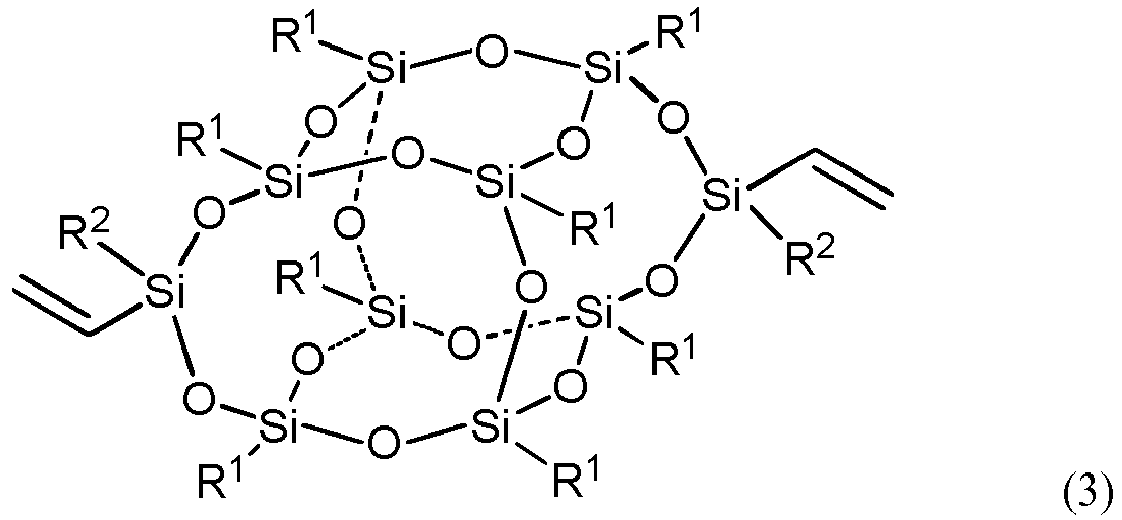

- The ruthenium complex used as a catalyst has a general formula 5
RuHCl(CO)[P(R5)3]n (5)
in which n stands for 2 or 3; if n=3, then R5 stands for triphenylphosphine, while if n=2, then R5 stands for tricyclohexylphosphine or triisopropylphosphine. - The catalyst is used in the amount from 1x10⁻³ to 1x10⁻¹ mole Ru per each mole of the unsaturated group taking part in the reaction of divinylsilsesquioxane of the general formula 3 with an olefin of the general formula 4; it is favourable to use the catalyst in the amount from 0.5x10⁻² to 2x10⁻² and the most favourable to use 1×10⁻² mole. A favourable effect on the course of the reaction has an addition of copper(I) or copper(II) salts as co-catalyst, in particular copper(I) salt, and the most favourable effect has the use of copper(I) chloride in the amount of 10-1 - 10 Cu mole, favourably 5 Cu moles per 1 Ru mole.
- The reaction is performed in a solvent, under neutral gas atmosphere, in an open or closed system, it is favourable to use gas without oxygen and moisture. In open systems the reaction is performed at a temperature not higher than the boiling point of the reaction mixture. In closed systems the reaction is performed at temperatures not higher than 200°C. It is favourable, but not necessary, to use an excess of olefin with respect to divinylsilsesquioxane to hasten the reaction. It is favourable to use olefin in excess of 1.1 to 2 moles per each mole of CH2=CH groups in divinylsilsesquioxane of formula 3, the most favourable excess of olefin in close to 1.5.
- The reaction is performed in a solvent chosen from among: aromatic organic compounds, favourably in toluene, benzene, xylenes, the most favourably in toluene; chlorinated aliphatic compounds or their mixtures. It is favourable to perform the reaction in 1,2-dichloroethane, chloroform, methyl chloride; the most favourable is to use methylene chloride or toluene. It is favourable to perform the reaction in the following way. Proper amounts of divinylsilsesquioxane solvent, alkene and catalyst are placed in a reactor under neutral gas atmosphere. The reaction mixture is stirred upon heating up to 40°C or higher temperature, and the process is continued at a temperature from 40°C to the boiling point of the reaction mixture. It is favourable to maintain a constant temperature throughout the process. The reaction takes from 1 to 48 hours..
- If a co-catalyst is used, it is introduced to the mixture of reagents and a catalyst after having heated it to a temperature above 40°C. The temperature at which the co-catalyst is introduced must be not lower than 40°C but not higher than the boiling point of the reaction mixture. The presence of the co-catalyst enhances the rate of the reaction and the yield of the product, and reduces the amount of side products formed. It is favourable to have all the reagents dried and deoxygenated prior to the reaction. The reaction in closed systems is performed in the same conditions and in the open systems.
- The raw product is isolated from the reaction mixture by precipitation initiated by a solvent chosen from the groups of aliphatic hydrocarbons containing carbon atoms from C5 to C10, MeOH, MeCN, the most favourable is hexane, or by solvent removal. If the second procedure is used, after evaporation of the solvent, the catalyst is washed out by a solvent which is an aliphatic hydrocarbon containing carbon atoms from C5 to C10, which selectively dissolves only the catalyst. The raw product can be subjected to further purification on a chromatographic column with the eluent made of a mixture of aliphatic hydrocarbon and a chloroderivative of an aliphatic hydrocarbon; it is favourable to use hexane: methylene chloride at a ratio from the range 10-0 : 0-10, the most favourably at the ratio 5:5. After purification the eluent is evaporated and pure product is obtained.
- The synthesis of double-decker derivatives of divinylsilsesquioxanes according to the invention is illustrated by the examples given below.
- The products were analysed by taking the following spectra:
- 1H and 13C-NMR on a spectrometer VarianGemini 300, at 300 and 75 MHz
- 29Si NMR on a spectrometer VarianAvance 600, at 119 and 203 MHz.
- Mass spectra on a 4000 Q TRAP instrument made by Applied Biosystems.
- A reactor of 5 mL in capacity, equipped with a magnetic stirrer, reflux condenser and a cap permitting connection of the reaction system to the vacuum-gas line, was charged under argon atmosphere, with 0.1 g of (8.29×10⁻⁵ mol) di[9,19-methylvinyl]-1,3,5,7,11,13,15,17 octa(phenyl)pentacyclo[11.7.1.1.13,11.15,17.17,15]decasiloxane (DDSQ-Me) and then, subsequently with 2 mL of methylene chloride and 17×10-3 g (1.66×10⁻⁴ mole) styrene. The reaction mixture was heated to 45°C under continuous stirring. Then, 0.0012 g (1,66×10⁻⁶ mole) of carbonylchlorohydridebis(tricyclohexylphosphine)ruthenium(II) was added and after 5 minutes a portion of 0.0008 g (8.29×10⁻⁶ mole) of copper(I) chloride was added. The reaction mixture was heated for 18 hours at 45°C. Then, the solvent was evaporated under vacuum and 2 mL of n-hexane was added to wash out the catalyst. After filtration, the precipitate was dissolved in a mixture of hexane : methylene chloride at the volume ratio 1:2 and deposited on a chromatographic column filled with silica in order to remove the traces of catalyst left from the product. The product was obtained in the form of white powder in the yield of 95%.
- In the same way as described in example I, a reaction was performed between 0.1 g (8.29×10⁻⁵ mole) of divinylsilsesquioxane (DDSQ-Me) and 31×10-3 g (1.66×10⁻⁴ mole) of 4-bromostyrene, in the presence of 0.0012 g (1.66 ×10⁻⁶ mole) of carbonylchlorohydridebis(tricyclohexylphosphine)-ruthenium(II) and 0.0008 g (8.29×10⁻⁶ mole) copper(I) chloride. The product was obtained in the form of white powder in the yield of 93%.
- In the same way as described in example I, a reaction was performed between 0.15 g (1.24×10⁻⁴ mole) of divinylsilsesquioxane (DDSQ-Me) and 35×10-3 g (2.49×10⁻⁴ mole) of 4-chlorostyrene in the presence of 0.0018 g (2.49 ×10⁻⁶ mole) of carbonylchlorohydridebis(tricyclohexylphosphine)-ruthenium(II) and 0.0012 g (1.24×10⁻⁵ mole) copper(I) chloride. The product was obtained in the form of white powder in the yield of 94%.
- In the same way as described in example I, a reaction was performed between 0.12 g (9.95×10⁻⁵ mole) of divinylsilsesquioxane (DDSQ-Me) and 27×10-3 g (1.99×10⁻⁴ mole) of 4-methoxystyrene in the presence of 0.0014 g (1.99 ×10⁻⁶ mole) of carbonylchlorohydridebis(tricyclohexylphosphine)-ruthenium(II) and 0.0010 g (9.95×10⁻⁶ mole) of copper(I) chloride. The product was obtained in the form of white powder in the yield of 91 %.
- In the same way as in example I, a reaction was performed between 0.1 g (8.29×10⁻⁵ mole) of divinylsilsesquioxane (DDSQ-Me) and 28×10-3 g (1.66×10⁻⁴ mol) of 4-(trifluormethyl)styrene in the presence of 0.0012 g (1.66 ×10⁻⁶ mole) of carbonylchlorohydridebis(tricyclohexylphosphine)-ruthenium(II) and 0.0008 g (8.29×10⁻⁶ mole) copper(I) chloride. The product was obtained in the form of white powder in the yield of 90%.
- In the same way as described in example I, a reaction was performed between 0.1 g (7,52×10⁻⁵ mole) of di[9.19-phenylvinyl]-1,3,5,7,11,13,15,17 octa(phenyl)pentacyclo [11.7.1.13,11.15,17.17,15] decasiloxane (DDSQ-Ph) and 15×10-3 g (1.50×10⁻⁴ mole) of styrene in the presence of 0.0011 g (1.50 ×10⁻⁶ mole) of carbonylchlorohydridebis(tricyclohexylphosphine)ruthenium(II) and 0.0007 g (7.52×10⁻⁶ mole) of copper(I) chloride. The product was obtained in the form of white powder in the yield of 903%.
- In the same way as described in example I, a reaction was performed between 0.14 g (1.05×10⁻⁴ mole) divinylsilsesquioxane (DDSQ-Ph) and 36×10-3 g (2.10×10⁻⁴ mole) 4-(trifluormethyl)styrene in the presence of 0.0015 g (2.10 ×10⁻⁶ mole) carbonylchlorohydridebis(tricyclohexylphosphine)-ruthenium(II) and 0.0010 g (1.05×10⁻⁵ mole) of copper(I) chloride. The product was obtained in the form of white powder in the yield of 88%.
- In the same way as described in example I, a reaction was performed between 0.11 g (8,27×10⁻⁵ mole) of divinylsilsesquioxane (DDSQ-Ph) and 20×10-3 g (1.65×10⁻⁴ mole) 4-methylstyrene in the presence of 0.0012 g (1.65 ×10⁻⁶ mol) carbonylchlorohydridebis(tricyclohexylphosphine)-ruthenium(II) and 0.0008 g (8.27×10⁻⁶ mole) of copper(I) chloride. The product was obtained in the form of white powder in the yield of 91 %.
- In the same way as described in example I, a reaction was performed between 0.1 g (7.52×10⁻⁵ mole) of divinylsilsesquioxane (DDSQ-Ph) and 28×10-3 g (1,50×10⁻⁴ mole) of 4-bromostyrene in the presence of 0.0011 g (1.50 ×10⁻⁶ mole) carbonylchlorohydridebis(tricyclohexylphosphine)-ruthenium(II) and 0.0007 g (7.52×10⁻⁶ mole) copper(I) chloride. The product was obtained in the form of white powder in the yield of 95%.
- In the same way as described in example I, a reaction was performed between 0.14 g (1.05×10⁻⁴ mole) of divinylsilsesquioxane (DDSQ-Ph) and 29×10-3 g (2.10×10⁻⁴ mol) of 4-chlorostyrene in the presence of 0.0015 g (2.10 ×10⁻⁶ mole) carbonylchlorohydridebis(tricyclohexylphosphine)-ruthenium(II) and 0.0010 g (1.05×10⁻⁵ mole) copper(I) chloride. The product was obtained in the form of white powder in the yield of 91 %.
- In the same way as described in example I, a reaction was performed between 0.1 g (7.19×10⁻⁵ mol) di[9,19-(4-methoxyphenyl) vinyl]-1,3,5,7,11,13,15,17 octa(phenyl)pentacylo[11.7.1.13,11.15,17.17,15] deca-siloxane (DDSQ-4-MeOPh) and 14.5×10⁻³ g (1.44×10⁻⁴ mole) styrene in the presence of 0.0010 g (1.44 ×10⁻⁶ mole) of carbonylchlorohydridebis(tricyclohexylphosphine)ruthenium(II) and 0.0007 g (7.19×10⁻⁶ mole) of copper(I) chloride. The product was obtained in the form of white powder in the yield of 87%.
- In the same way as described in example I, a reaction was performed between 0.12 g (8.63×10⁻⁵ mole) of divinylsilsesquioxane (DDSQ-4-MeOPh) and 31.5×10⁻³ g (1.72×10⁻⁴ mole) of 4-bromostyrene in the presence of 0.0012 g (1.72 ×10⁻⁶ mole) of carbonylchlorohydridebis-(tricyclohexylphosphine)ruthenium(II) and 0.0008 g (8.63×10⁻⁶ mole) of copper(I) chloride. The product was obtained in the form of white powder in the yield of 85%.
- In the same way as described in example I, a reaction was performed between 0.1 g (7.19×10⁻⁵ mole) of divinylsilsesquioxane (DDSQ-4-MeOPh) and 19.6×10⁻³ g (1.44×10⁻⁴ mole) of 4-chlorostyrene in the presence of 0.0010 g (1.44 ×10⁻⁶ mole) carbonylchlorohydridebis-(tricyclohexylphosphine)ruthenium(II) and 0.0007 g (7.19×10⁻⁶ mole) of copper(I) chloride. The product was obtained in the form of white powder in the yield of 90%.
Table Example I Name of compound Mixture of cis- and trans-di[9,19-(E)-styrylmethyl]-1,3,5,7,11,13,15,17 octa(phenyl)pentacyclo[11.7.1.13,11.15,17.17,15]decasiloxane Formula of compound 
Results of NMR + HRMS analyses 1H NMR (CDCl3, δ, ppm): 0.439-0.445 (overlapping s, 6H, CH 3; cis and trans mixture), 6.44 (d, 2H, JHH = 19.3 Hz, =CH-Si), 7.12 (d, 2H, JHH = 19.3 Hz, =CH-C6H5), 6.89-7.6 (m, 50H, C6 H 5-) 13C NMR (CDCl3, δ, ppm): -0.79, 123.94, 126.78, 127.52 (t, J = 7.9 Hz), 127.77, 128.38 (d, J = 1.7 Hz), 130.11, 130.21, 130.3, 130.34, 130.54, 130.79, 131.93, 146.59 29Si NMR (CDCl3, δ, ppm): -30.17 (cis, trans), -78.30 (cis, trans), -79.15 (cis), -79.51 (trans), -79.84 (cis) HRMS (FD): calcd. for C66H60O14Si10Na: 1379.1574; found: 1379.1569 Example II Name of compound Mixture of cis- and trans- di[9,19-(E)-4-bromostyrylmethyl]-1,3,5,7,11,13,15,17 octa(phenyl)pentacyclo[11.7.1.13,11.15,17.17,15]decasiloxane Formula of compound 
Results of NMR + HRMS analyses 1H NMR (CDCl3, δ, ppm): 0.439-0.445 (overlapping s, 6H, CH 3; cis and trans mixture), 6.40 (d, 2H, JHH = 19.3 Hz, =CH-Si), 7.23 (d, 2H, JHH = 19.3 Hz, =CH-C6H4-Br),6.93-7.58 (m, 48H, C6 H 5- and C6 H 4-Br) 13C NMR (CDCl3, δ, ppm): -0.83, 122.27 (d, J = 1.0 Hz), 124.93, 127.57 (t, J = 5.4 Hz), 127.81, 128.24, 130.39 (d, J = 8.1 Hz), 131.46, 131.78, 133.91, 134.02, 134.05, 136.41, 145.21 29Si NMR (CDCl3, δ, ppm): -30.46 (cis, trans), -78.27 (cis, trans), -79.31 (cis), -79.54 (trans), -79.76 (cis) HRMS (FD): calcd. for C66H58Br2O14Si10Na: 1534.9784; found: 1534.9783 Example III Name of compou Mixture of cis- and trans- di[9,19-(E)-4-chlorostyrylmethyl]-1,3,5,7,11,13,15,17 octa(phenyl)pentacyclo[11.7.1.13,11.15,17.17,15]decasiloxane Formula of compound 
Results of NMR + HRMS analyses 1H NMR (CDCl3, δ, ppm): 0.430-0.431 (overlapping s, 6H, CH 3, cis and trans mixture), 6.39 (d, 2H, JHH = 19.3 Hz, =CH-Si), 6.92-7.58 (m, 50H, C6 H 5-, C6 H 4-Cl and =CH-C6H4-Cl) 13C NMR (CDCl3, δ, ppm): -0.83, 124.77, 127.57 (t, J = 5.9 Hz), 127.81, 127.94, 128.51, 130.34, 130.42, 130.72, 131.8, 139.92, 134.03, 134.06, 135.99, 145.16 29Si NMR (CDCl3, δ, ppm): -30.44 (cis, trans), -78.28 (cis, trans), -79.30 (cis), -79.54 (trans), -79.77 (cis) HRMS (FD): calcd. for C66H58Cl2O14Si10Na: 1447.0794; found: 1447.0781 Example IV Name of compou Mixture of cis- and trans- di[9,19-(E)-4-methoxystyrylmethyl]-1,3,5,7,11,13,15,17 octa(phenyl)pentacyclo[11.7.1.13,1115,17.17,15]decasiloxane Formula of compound 
Results of NMR + HRMS analyses 1H NMR (CDCl3, δ, ppm): 0.43-0.44 (overlapping s, 6H, CH 3, cis and trans mixture), 2.34-2.35 (overlapping s, 6H, -OCH 3, cis and trans mixture), 6.38 (br d, 2H, JHH = 19.3 Hz, =CH-Si), 7.09 (br d, 2H, JHH = 19.3 Hz, =CH-C6H4-OMe), 6.91-7.64 (m, 48H, C6 H 5- and C6 H 4-OMe) 13C NMR (CDCl3, δ, ppm): -0.76, 21.26, 122.64, 126.74, 127.52 (t, J = 6.1 Hz), 127.76, 129.08, 130.19, 130.31, 132.01, 133.98, 134.11, 134.9, 138.31, 138.33, 146.55 29Si NMR (CDCl3, δ, ppm): -29.93 (cis, trans), -78.30 (cis, trans), -79.16 (cis), -79.50 (trans), -79.80 (cis) HRMS (FD): calcd. for C68H64O16Si10Na: 1439.1785; found: 1439.1787 Example V Name of compou Mixture of cis- and trans-di[9,19-(E)-4-(trifluoromethyl)styrylmethyl]-1,3,5,7,11,13,15,17 octa(phenyl)pentacyclo[11.7.1.13,1115,17.17,15]decasiloxane Formula of compound 
Results of NMR + HRMS analyses 1H NMR (CDCl3, δ, ppm): 0.46-0.47 (overlapping s, 6H, CH 3, cis and trans mixture), 6.52 (br d, 2H, JHH = 19.3 Hz, =CH-Si), 7.11 (br d, 2H, JHH = 19.3 Hz, =CH-C6H4-CF3), 6.91-7.62 (m, 48H, C6 H 5- and C6 H 4-CF3) 13C NMR (CDCl3, δ, ppm): -0.83, 123.03 (d, J = 1.7 Hz), 125.31 (q, CF3), 126.86, 126.87, 127.29, 127.59 (t, J = 9.5 Hz), 127.87, 130.42, 130.51, 130.67, 130.85, 131.73, 133.93, 134.01, 134.05, 134.08, 140.81 (d, J = 1.1 Hz), 144.95 29Si NMR (CDCl3, δ, ppm): -36.00 (cis, trans), -83.42 (cis, trans), -84.54 (cis), -84.73 (trans), -84.88 (cis) HRMS (FD): calcd. for C68H58F6O14Si10Na: 1515.1321; found: 1515.1322 Example VI Name of compou Mixture of cis- and trans- di[9,19-(E)-styrylphenyl]-1,3,5,7,11,13,15,17 octa(phenyl)pentacyclo[11.7.1.13,11.15,17.17,15]decasiloxane Formula of compound 
Results of NMR + HRMS analyses 1H NMR (CDCl3, δ, ppm): 6.56 (d, 2H, JHH = 19.2 Hz, =CH-Si, cis and trans mixture), 7.13 (d, 2H, JHH = 19.2 Hz, =CH-C6H5), 6.94-7.75 (m, 60H, C6 H 5-) 13C NMR (CDCl3, δ, ppm): 122.26, 126.9, 127.44 (t, J = 7.6 Hz), 127.8, 128.37, 128.53, 130.15 (d, J = 6.1 Hz), 130.41, 130.52, 131.65, 134.01, 134.07, 134.1, 134.54, 137.37, 148.07 29Si NMR (CDCl3, δ, ppm): -45.07 (cis, trans), -77.97 (cis, trans), -79.24 (cis), -79.36 (trans), -78.48 (cis) HRMS (FD): calcd. for C76H64O14Si10Na: 1503.1887; found: 1503.1874 Example VII Name of compou Mixture of cis- and trans- di[9,19-(E)-4-(trifluoromethyl)styrylphenyl]-1,3,5,7,11,13,15,17 octa(phenyl)pentacyclo[11.7.1.13,11.15,17.17,15]decasiloxane Formula of compound 
Results of NMR + HRMS analyses 1H NMR (CDCl3, δ, ppm): 6.63 (d, 2H, JHH = 19.2 Hz, =CH-Si), 7.12 (d, 2H, JHH = 19.2 Hz, =CH-C6H4-CF3), 6.97-7.75 (m, 58H, C6 H 5- and C6 H 4-CF3) 13C NMR (CDCl3, δ, ppm): 125.16, 125.25, 125.32 (q, CF3), 125.78 (d, J = 2.0 Hz), 126.98, 127.52 (t, J = 9.7 Hz), 127.89, 127.95, 130.28, 130.34, 130.39, 130.42, 130.5, 130.57, 131.46, 134.03 (d, J = 9.8 Hz), 140.67, 146.31 29Si NMR (CDCl3, δ, ppm): -45.21 (cis, trans), -77.87 (cis, trans), -79.35 (cis), -79.40 (trans), -79.42 (cis) HRMS (FD): calcd. for C78H62F6O14Si10Na: 1639.1634; found: 1639.1635 Example VIII Name of compou Mixture of cis- and trans- di[9,19-(E)-4-methylstyrylphenyl]-1,3,5,7,11,13,15,17 octa(phenyl)pentacyclo[11.7.1.13,11.15,17.17,15]decasiloxane Formula of compound 
Results of NMR + HRMS analyses 1H NMR (CDCl3, δ, ppm): 2.34 (br s, 6H, CH 3, cis and trans mixture), 6.51 (d, 2H, JHH = 19.2 Hz, =CH-Si), 7.11 (d, 2H, JHH = 19.2 Hz, =CH-C6H4-Me), 6.99-7.74 (m, 58H, C6 H 5- and C6 H 4-Me) 13C NMR (CDCl3, δ, ppm): 120.94, 126.87, 127.45 (t, J = 9.6 Hz), 127.79, 129.08, 130.06, 130.16, 130.38, 130.62 (t, J = 5.7 Hz), 131.75, 134.05, 134.14 (t, J = 4.5 Hz), 134.75, 134.8 (d, J = 1.6 Hz), 138.51, 148.07 29Si NMR (CDCl3, δ, ppm): -49.46 (cis, trans), -83.21 (cis, trans), -84.49 (cis), -84.57 (trans), -84.66 (cis) HRMS (FD): calcd. for C78H68O14Si10Na: 1531.2199; found: 1531.2198 Example IX Name of compou trans-di[9,19-(E)-4-bromostyrylphenyl]-1,3,5,7,11,13,15,17 octa(phenyl)pentacyclo[11.7.1.13,11.15,17.17,15]decasiloxane Formula of compound 
Results of NMR + HRMS analyses 1H NMR (CDCl3, δ, ppm): 6.43 (d, 2H, JHH = 19.2 Hz, =CH-Si), 6.96 (d, 2H, JHH = 19.2 Hz, =CH-C6H4-Br), 6.9-7.66 (m, 58H, C6 H 5- and C6 H 4-Br) 13C NMR (CDCl3, δ, ppm): 122.46 (d, J = 3.1 Hz), 123.4, 127.5 (t, J = 12.2 Hz), 127.85, 127.89, 128.36, 130.26, 130.33, 130.48, 130.5, 131.47 (d, J = 2.2 Hz), 131.54, 133.99, 134.07 (d, J = 2.4 Hz), 136.33 (d, J = 0.9 Hz), 146.64 29Si NMR (CDCl3, δ, ppm): -50.02(cis, trans), -83.12 (cis, trans), -84.58 (cis), - 84.59 (trans), -84.61 (cis) HRMS (FD): calcd. for C76H62Br2O14Si10Na: 1659.0097; found: 1659.0099 Example X Name of compound Mixture of cis- and trans- di[9,19-(E)-4-chlorostyrylphenyl]-1,3,5,7,11,13,15,17 octa(phenyl)pentacyclo[11.7.1.13,11.15,17.17,15]decasiloxane Formula of compound 
Results of NMR + HRMS analyses 1H NMR (CDCl3, δ, ppm): 6.51 (d, 2H, JHH = 19.2 Hz, =CH-Si), 7.07 (d, 2H, JHH = 19.2 Hz, =CH-C6H4-Cl), 6.99-7.75 (m, 58H, C6 H 5- and C6 H 4-Cl) 13C NMR (CDCl3, δ, ppm): 123.2, 127.48 (t, J= 9.3 Hz), 127.82, 127.86, 128.05, 128.49 (d, J= 1.4 Hz), 130.22, 130.29, 130.47, 131.53, 133.97, 134.05 (d, J = 1.9 Hz), 135.88, 146.72 29Si NMR (CDCl3, δ, ppm): -44.81(cis, trans), -77.93 (cis, trans), -79.38 (cis), - 79.40 (trans), -79.48 (cis) HRMS (FD): calcd. for C76H62Cl2O14Si10Na: 1571.1107; found: 1571.1107 Example XI Name of compou Mixture of cis- and trans- di[9,19-(E)-styryl-4-methoxyphenyl]-1,3,5,7,11,13,15,17 octa(phenyl)pentacyclo[11.7.1.13,1115,17.17,15]decasiloxane Formula of compound 
Results of NMR + HRMS analyses 1H NMR (CDCl3, δ, ppm): 3.79 (br s, 6H, OCH 3, cis and trans mixture), 6.58 (d, 2H, JHH = 19.2 Hz, =CH-Si), 7.26 (d, 2H, JHH = 19.2 Hz, =CH-C6H5), 6.81-7.67 (m, 58H, C6 H 5- and C6 H 4-OMe) 13C NMR (CDCl3, δ, ppm): 54.94, 113.55, 122.7, 125.72, 126.89, 127.42 (t, J = 12.2 Hz), 127.8, 128.37, 128.47, 130.18, 130.38, 130.64, 131.79, 134.09 (d, J = 15 Hz), 135.79, 137.5, 147.87, 161.23 29Si NMR (CDCl3, δ, ppm): -49.04 (cis, trans), -83.26 (cis, trans), -84.55 (cis), -84.65 (trans), -84.74 (cis) HRMS (FD): calcd. for C78H68O16Si10Na: 1563.2098; found: 1563.2080 Example XII Name of compou trans-di[9,19-(E)-4-bromostyryl-4-methoxyphenyl]-1,3,5,7,11,13,15,17 octa(phenyl)pentacyclo[11.7.1.13,11.15,17.17,15]decasiloxane Formula of compound 
Results of NMR + HRMS analyses 1H NMR (CDCl3, δ, ppm): 3.78-3.79 (overlapping s, 6H, OCH 3, cis and trans mixture), 6.52 (d, 2H, JHH = 19.2 Hz, =CH-Si), 7.29 (d, 2H, JHH = 19.2 Hz, =CH-C6H4-Br), 6.8-7.65 (m, 56H, C6 H 5-, C6H4-Br and C6 H 4-OMe) 13C NMR (CDCl3, δ, ppm): 54.96, 113.61, 122.39 (d, J = 3.2 Hz), 123.82 (d, J = 2.6 Hz), 125.37 (d, J = 1.9 Hz), 127.47 (t, J = 14.8 Hz), 127.84, 128.34, 130.31, 130.47, 131.46 (d, J = 1.9 Hz), 131.66, 134, 134.10, 134.12, 135.75 (d, J = 1.0 Hz), 136.41, 146.40, 161.33 29Si NMR (CDCl3, δ, ppm): -44.14 (cis, trans), -78.02 (cis, trans), -79.49 (br s, cis, trans) HRMS (FD): calcd. for C78H66Br2O16Si10Na: 1719.0308; found: 1719.0302 Example XIII Name of compou trans- di[9,19-(E)-4-chlorostyryl-4-methoxyphenyl]-1,3,5,7,11,13,15,17 octa(phenyl)pentacyclo[11.7.1.13,11.15,17.17,15]decasiloxane Formula of compound 
Results of NMR + HRMS analyses 1H NMR (CDCl3, δ, ppm): 3.77-3.78 (overlapping s, 6H, OCH 3, cis and trans mixture), 6.50 (d, 2H, JHH = 19.2 Hz, =CH-Si), 7.13 (d, 2H, JHH = 19.2 Hz, =CH-C6H4-Cl), 6.79-7.63 (m, 56H, C6 H 5-, C6H4-Cl and C6 H 4-OMe) 13C NMR (CDCl3, δ, ppm): 54.97, 113.61, 123.63 (d, J = 2.3 Hz), 125.41 (d, J = 1.6 Hz), 127.46 (t, J = 14.2 Hz), 127.84, 128.06, 128.51 (d, J = 1.7 Hz), 130.3, 130.46, 130.58, 131.67, 134.01, 134.12 (d, J = 2.0 Hz), 135.76 (d, J = 1.0 Hz), 135.99, 146.35, 161.32 (d, J = 1.1 Hz) 29Si NMR (CDCl3, δ, ppm): -49.34 (cis, trans), -83.24 (cis, trans), -84.71 (br s, cis, trans) HRMS (FD): calcd. for C78H66Cl2O16Si10Na: 1631.1319; found: 1631.1334
Claims (1)
- New functionalized unsaturated double-decker derivatives of divinylsilsesquioxanes of the general formula 1,
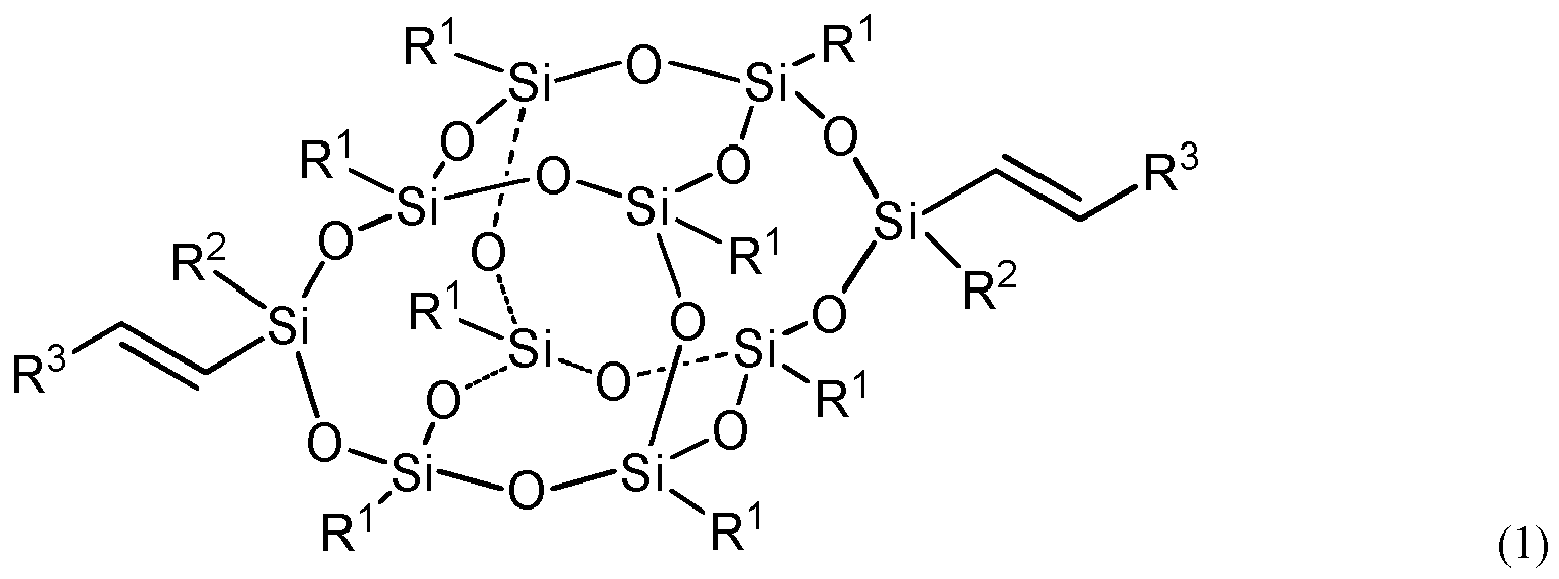 - R1 are the same and stand for an aryl group containing from 1 to 2 rings,- R2 are the same and stand for:• alkyl group containing carbon atoms from C1 to C2• unsubstituted aryl group containing from 1 to 2 rings• monosubstituted aryl group containing from 1 to 2 rings and substituted at any site of the ring with an alkoxyl group comprising an alkyl group with carbon atoms from C1 to C3,
R3 are the same and stand for• group of formula 2
-R4-R5- (2)
where R4 stands for an alkyl group containing carbon atoms from C1 to C3, and R5 stands for an aryl group containing from 1 to 2 rings• unsubstituted aryl group containing from 1 to 2 rings,• aryl group containing from 1 to 2 rings and substituted at any site with:▪ an alkyl group containing carbon atoms from C1 to C2▪ an alkoxyl group comprising an alkyl group containing carbon atoms from C1 to C2▪ halogen X = F, Cl, Br▪ fully substituted halogenalkyl containing carbon atoms from C1 to C2 and F or Cl
Applications Claiming Priority (1)
| Application Number | Priority Date | Filing Date | Title |
|---|---|---|---|
| PL407444A PL228312B1 (en) | 2014-03-10 | 2014-03-10 | New functionalized unsaturated derivatives of divinyl silsesquioxanes of double-decker type and method for obtaining them |
Publications (2)
| Publication Number | Publication Date |
|---|---|
| EP2918592A1 true EP2918592A1 (en) | 2015-09-16 |
| EP2918592B1 EP2918592B1 (en) | 2017-05-31 |
Family
ID=52629510
Family Applications (1)
| Application Number | Title | Priority Date | Filing Date |
|---|---|---|---|
| EP15461513.2A Active EP2918592B1 (en) | 2014-03-10 | 2015-03-06 | New functionalized unsaturated double-decker derivatives of divinylsilsesquioxanes |
Country Status (4)
| Country | Link |
|---|---|
| US (1) | US9150596B2 (en) |
| EP (1) | EP2918592B1 (en) |
| CN (1) | CN104910205B (en) |
| PL (2) | PL228312B1 (en) |
Families Citing this family (1)
| Publication number | Priority date | Publication date | Assignee | Title |
|---|---|---|---|---|
| PL234668B1 (en) * | 2017-12-20 | 2020-03-31 | Univ Im Adama Mickiewicza W Poznaniu | Asymmetrical, difunctionalized unsaturated derivatives of divinyl silsesquioxanes of double-decker type |
Citations (2)
| Publication number | Priority date | Publication date | Assignee | Title |
|---|---|---|---|---|
| WO2003024870A1 (en) | 2001-09-18 | 2003-03-27 | Chisso Corporation | Silsesquioxane derivatives and process for production thereof |
| PL392166A1 (en) | 2010-08-20 | 2012-02-27 | Univ Adama Mickiewicza | New functionalized cellular octavinyl silsesquioxanes and the method of obtaining the functionalized cellular octavinyl silsesquioxanes |
Family Cites Families (3)
| Publication number | Priority date | Publication date | Assignee | Title |
|---|---|---|---|---|
| JP4483344B2 (en) | 2003-03-13 | 2010-06-16 | チッソ株式会社 | Compound having silsesquioxane skeleton and polymer thereof |
| DE602005009127D1 (en) * | 2004-12-28 | 2008-10-02 | Chisso Corp | silicon compound |
| JP4946169B2 (en) * | 2006-05-15 | 2012-06-06 | Jnc株式会社 | Acid anhydride and polymer having silsesquioxane skeleton |
-
2014
- 2014-03-10 PL PL407444A patent/PL228312B1/en unknown
-
2015
- 2015-03-06 US US14/640,618 patent/US9150596B2/en not_active Expired - Fee Related
- 2015-03-06 PL PL15461513T patent/PL2918592T3/en unknown
- 2015-03-06 EP EP15461513.2A patent/EP2918592B1/en active Active
- 2015-03-09 CN CN201510102738.3A patent/CN104910205B/en not_active Expired - Fee Related
Patent Citations (3)
| Publication number | Priority date | Publication date | Assignee | Title |
|---|---|---|---|---|
| WO2003024870A1 (en) | 2001-09-18 | 2003-03-27 | Chisso Corporation | Silsesquioxane derivatives and process for production thereof |
| EP1428795A1 (en) | 2001-09-18 | 2004-06-16 | Chisso Corporation | Silsesquioxane derivatives and process for production thereof |
| PL392166A1 (en) | 2010-08-20 | 2012-02-27 | Univ Adama Mickiewicza | New functionalized cellular octavinyl silsesquioxanes and the method of obtaining the functionalized cellular octavinyl silsesquioxanes |
Non-Patent Citations (7)
| Title |
|---|
| J. ESPINAS; J. D. A. PELLETIER; E. ABOU-HAMAD; L. EMSLEY; J.-M. BASSET, ORGANOMETALLICS, vol. 31, 2012, pages 7610 |
| M. KOHRI; J. MATUSI; A. WATANABE; T. MIYASHITA, CHEM. LETT., vol. 39, 2010, pages 1162 |
| M. T. HAY; B. SEURER; D. HOLMES; A. LEE, MACROMOLECULES, vol. 43, 2010, pages 2108 |
| MAKOTO SEINO ET AL: "Hydrosilylation Polymerization of Double-Decker-Shaped Silsesquioxane Having Hydrosilane with Diynes", MACROMOLECULES, vol. 39, no. 10, 1 May 2006 (2006-05-01), pages 3473 - 3475, XP055180888, ISSN: 0024-9297, DOI: 10.1021/ma052631p * |
| PATRYCJA ZAK ET AL: "Silylative Coupling versus Metathesis-Efficient Methods for the Synthesis of Difunctionalized Double-Decker Silsesquioxane Derivatives", CHEMISTRY - A EUROPEAN JOURNAL, vol. 20, no. 30, 10 July 2014 (2014-07-10), pages 9387 - 9393, XP055179971, ISSN: 0947-6539, DOI: 10.1002/chem.201402862 * |
| S. WU; T. HAYAKAWA; M. KAKIMOTO; H. OIKAWA, MACROMOLECULES, 2008, pages 41 |
| SEURER, B.; VIJ, V.; HADDAD, T.; MABRY, J. M.; LEE, A., MACROMOLECULES, vol. 43, 2010, pages 9337 - 9347 |
Also Published As
| Publication number | Publication date |
|---|---|
| PL2918592T3 (en) | 2017-09-29 |
| EP2918592B1 (en) | 2017-05-31 |
| CN104910205A (en) | 2015-09-16 |
| CN104910205B (en) | 2018-05-04 |
| PL228312B1 (en) | 2018-03-30 |
| US9150596B2 (en) | 2015-10-06 |
| PL407444A1 (en) | 2015-09-14 |
| US20150252064A1 (en) | 2015-09-10 |
Similar Documents
| Publication | Publication Date | Title |
|---|---|---|
| EP2255877B1 (en) | Method for preparation of ruthenium-based metathesis catalysts with chelating alkylidene ligands | |
| Lázaro et al. | Heterogeneous catalysts based on supported Rh–NHC complexes: synthesis of high molecular weight poly (silyl ether) s by catalytic hydrosilylation | |
| KR20140035318A (en) | Metal-catalyzed mono-hydrosilylation of polyunsaturated compounds | |
| Żak et al. | Synthesis and characterization of functionalized molecular and macromolecular double-decker silsesquioxane systems | |
| TW201524602A (en) | Cobalt catalysts and their use for hydrosilylation and dehydrogenative silylation | |
| KR20180132808A (en) | Precious metal-free hydrogen-hydrogensifiable mixtures | |
| KR20240052960A (en) | Hydrosilylation method catalyzed by cobalt complex | |
| Władyczyn et al. | Hydroxyalkyl-substituted double-decker silsesquioxanes: effective separation of cis and trans isomers | |
| JP7656613B2 (en) | CATALYST PARTICLES AND METHODS FOR DEHYDROGENATING SILYLATION - Patent application | |
| Dutkiewicz et al. | Functionalization of polyhedral oligomeric silsesquioxane (POSS) via nucleophilic substitution | |
| JP7300523B2 (en) | Cationic germanium(II) compounds, methods for their preparation, and use as catalysts in hydrosilylation | |
| EP2918592B1 (en) | New functionalized unsaturated double-decker derivatives of divinylsilsesquioxanes | |
| Schwartzen et al. | Chalice‐Type Tridentate Silicon Lewis Acids of C3 Symmetry in a Single Step Starting from Hexadehydrotribenzo [12] annulene | |
| EP2606054B1 (en) | Functionalized polyhedral octavinylsilsesquioxanes | |
| Mehendale et al. | Self-assembly of para-OH functionalized ECE-metalated pincer complexes | |
| KR20150099835A (en) | Method for the hydrosilylation of a siloxane photocatalysed by a polyoxometalate compound | |
| CN106146569A (en) | The novel functional unsaturation derivant of (double methyl ethylene germanium epoxide) seven substituted silsesquioxanes and the method for synthesis thereof | |
| PL234668B1 (en) | Asymmetrical, difunctionalized unsaturated derivatives of divinyl silsesquioxanes of double-decker type | |
| PL235670B1 (en) | New trisubstituted trisiloxysilsesquioksanes with the structure of incompletely closed cage and the method for obtaining trisubstituted trisiloxysilsesquioksanes with the structure of incompletely closed cage | |
| WO2024191514A1 (en) | Process and catalyst composition for preparing organosilicon compounds via isomerization of internal olefins and hydrosilylation | |
| JP2023506460A (en) | Hydrosilylatable mixtures containing strong electron donors as catalyst additives | |
| CN106146547A (en) | Vinyl germanium silsesquioxane | |
| PL235668B1 (en) | New monosubstituted siloxysilsesquioksanes and method for obtaining monosubstituted siloxysilsesquioksanes | |
| PL236042B1 (en) | New unsaturated derivatives of di(vinyl germa)silsesquioxanes of double-decker type and method for obtaining them | |
| PL235672B1 (en) | New derivatives of silsesquioxanes with a silicon atom built in the cage edge and new method for obtaining derivatives of silsesquioxanes with a silicon atom built in the cage edge |
Legal Events
| Date | Code | Title | Description |
|---|---|---|---|
| PUAI | Public reference made under article 153(3) epc to a published international application that has entered the european phase |
Free format text: ORIGINAL CODE: 0009012 |
|
| 17P | Request for examination filed |
Effective date: 20150601 |
|
| AK | Designated contracting states |
Kind code of ref document: A1 Designated state(s): AL AT BE BG CH CY CZ DE DK EE ES FI FR GB GR HR HU IE IS IT LI LT LU LV MC MK MT NL NO PL PT RO RS SE SI SK SM TR |
|
| AX | Request for extension of the european patent |
Extension state: BA ME |
|
| 17Q | First examination report despatched |
Effective date: 20160620 |
|
| GRAP | Despatch of communication of intention to grant a patent |
Free format text: ORIGINAL CODE: EPIDOSNIGR1 |
|
| INTG | Intention to grant announced |
Effective date: 20170210 |
|
| GRAS | Grant fee paid |
Free format text: ORIGINAL CODE: EPIDOSNIGR3 |
|
| GRAA | (expected) grant |
Free format text: ORIGINAL CODE: 0009210 |
|
| AK | Designated contracting states |
Kind code of ref document: B1 Designated state(s): AL AT BE BG CH CY CZ DE DK EE ES FI FR GB GR HR HU IE IS IT LI LT LU LV MC MK MT NL NO PL PT RO RS SE SI SK SM TR |
|
| REG | Reference to a national code |
Ref country code: CH Ref legal event code: EP Ref country code: GB Ref legal event code: FG4D |
|
| REG | Reference to a national code |
Ref country code: AT Ref legal event code: REF Ref document number: 897359 Country of ref document: AT Kind code of ref document: T Effective date: 20170615 |
|
| REG | Reference to a national code |
Ref country code: IE Ref legal event code: FG4D |
|
| REG | Reference to a national code |
Ref country code: DE Ref legal event code: R096 Ref document number: 602015002928 Country of ref document: DE |
|
| REG | Reference to a national code |
Ref country code: NL Ref legal event code: MP Effective date: 20170531 |
|
| REG | Reference to a national code |
Ref country code: LT Ref legal event code: MG4D |
|
| REG | Reference to a national code |
Ref country code: AT Ref legal event code: MK05 Ref document number: 897359 Country of ref document: AT Kind code of ref document: T Effective date: 20170531 |
|
| PG25 | Lapsed in a contracting state [announced via postgrant information from national office to epo] |
Ref country code: LT Free format text: LAPSE BECAUSE OF FAILURE TO SUBMIT A TRANSLATION OF THE DESCRIPTION OR TO PAY THE FEE WITHIN THE PRESCRIBED TIME-LIMIT Effective date: 20170531 Ref country code: FI Free format text: LAPSE BECAUSE OF FAILURE TO SUBMIT A TRANSLATION OF THE DESCRIPTION OR TO PAY THE FEE WITHIN THE PRESCRIBED TIME-LIMIT Effective date: 20170531 Ref country code: ES Free format text: LAPSE BECAUSE OF FAILURE TO SUBMIT A TRANSLATION OF THE DESCRIPTION OR TO PAY THE FEE WITHIN THE PRESCRIBED TIME-LIMIT Effective date: 20170531 Ref country code: NO Free format text: LAPSE BECAUSE OF FAILURE TO SUBMIT A TRANSLATION OF THE DESCRIPTION OR TO PAY THE FEE WITHIN THE PRESCRIBED TIME-LIMIT Effective date: 20170831 Ref country code: GR Free format text: LAPSE BECAUSE OF FAILURE TO SUBMIT A TRANSLATION OF THE DESCRIPTION OR TO PAY THE FEE WITHIN THE PRESCRIBED TIME-LIMIT Effective date: 20170901 Ref country code: HR Free format text: LAPSE BECAUSE OF FAILURE TO SUBMIT A TRANSLATION OF THE DESCRIPTION OR TO PAY THE FEE WITHIN THE PRESCRIBED TIME-LIMIT Effective date: 20170531 Ref country code: AT Free format text: LAPSE BECAUSE OF FAILURE TO SUBMIT A TRANSLATION OF THE DESCRIPTION OR TO PAY THE FEE WITHIN THE PRESCRIBED TIME-LIMIT Effective date: 20170531 |
|
| PG25 | Lapsed in a contracting state [announced via postgrant information from national office to epo] |
Ref country code: SE Free format text: LAPSE BECAUSE OF FAILURE TO SUBMIT A TRANSLATION OF THE DESCRIPTION OR TO PAY THE FEE WITHIN THE PRESCRIBED TIME-LIMIT Effective date: 20170531 Ref country code: LV Free format text: LAPSE BECAUSE OF FAILURE TO SUBMIT A TRANSLATION OF THE DESCRIPTION OR TO PAY THE FEE WITHIN THE PRESCRIBED TIME-LIMIT Effective date: 20170531 Ref country code: RS Free format text: LAPSE BECAUSE OF FAILURE TO SUBMIT A TRANSLATION OF THE DESCRIPTION OR TO PAY THE FEE WITHIN THE PRESCRIBED TIME-LIMIT Effective date: 20170531 Ref country code: BG Free format text: LAPSE BECAUSE OF FAILURE TO SUBMIT A TRANSLATION OF THE DESCRIPTION OR TO PAY THE FEE WITHIN THE PRESCRIBED TIME-LIMIT Effective date: 20170831 Ref country code: IS Free format text: LAPSE BECAUSE OF FAILURE TO SUBMIT A TRANSLATION OF THE DESCRIPTION OR TO PAY THE FEE WITHIN THE PRESCRIBED TIME-LIMIT Effective date: 20170930 Ref country code: NL Free format text: LAPSE BECAUSE OF FAILURE TO SUBMIT A TRANSLATION OF THE DESCRIPTION OR TO PAY THE FEE WITHIN THE PRESCRIBED TIME-LIMIT Effective date: 20170531 |
|
| PG25 | Lapsed in a contracting state [announced via postgrant information from national office to epo] |
Ref country code: DK Free format text: LAPSE BECAUSE OF FAILURE TO SUBMIT A TRANSLATION OF THE DESCRIPTION OR TO PAY THE FEE WITHIN THE PRESCRIBED TIME-LIMIT Effective date: 20170531 Ref country code: EE Free format text: LAPSE BECAUSE OF FAILURE TO SUBMIT A TRANSLATION OF THE DESCRIPTION OR TO PAY THE FEE WITHIN THE PRESCRIBED TIME-LIMIT Effective date: 20170531 Ref country code: SK Free format text: LAPSE BECAUSE OF FAILURE TO SUBMIT A TRANSLATION OF THE DESCRIPTION OR TO PAY THE FEE WITHIN THE PRESCRIBED TIME-LIMIT Effective date: 20170531 Ref country code: RO Free format text: LAPSE BECAUSE OF FAILURE TO SUBMIT A TRANSLATION OF THE DESCRIPTION OR TO PAY THE FEE WITHIN THE PRESCRIBED TIME-LIMIT Effective date: 20170531 Ref country code: CZ Free format text: LAPSE BECAUSE OF FAILURE TO SUBMIT A TRANSLATION OF THE DESCRIPTION OR TO PAY THE FEE WITHIN THE PRESCRIBED TIME-LIMIT Effective date: 20170531 |
|
| PG25 | Lapsed in a contracting state [announced via postgrant information from national office to epo] |
Ref country code: SM Free format text: LAPSE BECAUSE OF FAILURE TO SUBMIT A TRANSLATION OF THE DESCRIPTION OR TO PAY THE FEE WITHIN THE PRESCRIBED TIME-LIMIT Effective date: 20170531 Ref country code: IT Free format text: LAPSE BECAUSE OF FAILURE TO SUBMIT A TRANSLATION OF THE DESCRIPTION OR TO PAY THE FEE WITHIN THE PRESCRIBED TIME-LIMIT Effective date: 20170531 |
|
| REG | Reference to a national code |
Ref country code: DE Ref legal event code: R097 Ref document number: 602015002928 Country of ref document: DE |
|
| REG | Reference to a national code |
Ref country code: FR Ref legal event code: PLFP Year of fee payment: 4 |
|
| PLBE | No opposition filed within time limit |
Free format text: ORIGINAL CODE: 0009261 |
|
| STAA | Information on the status of an ep patent application or granted ep patent |
Free format text: STATUS: NO OPPOSITION FILED WITHIN TIME LIMIT |
|
| 26N | No opposition filed |
Effective date: 20180301 |
|
| PG25 | Lapsed in a contracting state [announced via postgrant information from national office to epo] |
Ref country code: SI Free format text: LAPSE BECAUSE OF FAILURE TO SUBMIT A TRANSLATION OF THE DESCRIPTION OR TO PAY THE FEE WITHIN THE PRESCRIBED TIME-LIMIT Effective date: 20170531 |
|
| REG | Reference to a national code |
Ref country code: CH Ref legal event code: PL |
|
| PG25 | Lapsed in a contracting state [announced via postgrant information from national office to epo] |
Ref country code: MC Free format text: LAPSE BECAUSE OF FAILURE TO SUBMIT A TRANSLATION OF THE DESCRIPTION OR TO PAY THE FEE WITHIN THE PRESCRIBED TIME-LIMIT Effective date: 20170531 |
|
| REG | Reference to a national code |
Ref country code: BE Ref legal event code: MM Effective date: 20180331 |
|
| REG | Reference to a national code |
Ref country code: IE Ref legal event code: MM4A |
|
| PG25 | Lapsed in a contracting state [announced via postgrant information from national office to epo] |
Ref country code: LU Free format text: LAPSE BECAUSE OF NON-PAYMENT OF DUE FEES Effective date: 20180306 |
|
| PG25 | Lapsed in a contracting state [announced via postgrant information from national office to epo] |
Ref country code: IE Free format text: LAPSE BECAUSE OF NON-PAYMENT OF DUE FEES Effective date: 20180306 |
|
| PG25 | Lapsed in a contracting state [announced via postgrant information from national office to epo] |
Ref country code: LI Free format text: LAPSE BECAUSE OF NON-PAYMENT OF DUE FEES Effective date: 20180331 Ref country code: CH Free format text: LAPSE BECAUSE OF NON-PAYMENT OF DUE FEES Effective date: 20180331 Ref country code: BE Free format text: LAPSE BECAUSE OF NON-PAYMENT OF DUE FEES Effective date: 20180331 |
|
| PGFP | Annual fee paid to national office [announced via postgrant information from national office to epo] |
Ref country code: FR Payment date: 20190212 Year of fee payment: 5 |
|
| PG25 | Lapsed in a contracting state [announced via postgrant information from national office to epo] |
Ref country code: MT Free format text: LAPSE BECAUSE OF NON-PAYMENT OF DUE FEES Effective date: 20180306 |
|
| PG25 | Lapsed in a contracting state [announced via postgrant information from national office to epo] |
Ref country code: TR Free format text: LAPSE BECAUSE OF FAILURE TO SUBMIT A TRANSLATION OF THE DESCRIPTION OR TO PAY THE FEE WITHIN THE PRESCRIBED TIME-LIMIT Effective date: 20170531 |
|
| PG25 | Lapsed in a contracting state [announced via postgrant information from national office to epo] |
Ref country code: PT Free format text: LAPSE BECAUSE OF FAILURE TO SUBMIT A TRANSLATION OF THE DESCRIPTION OR TO PAY THE FEE WITHIN THE PRESCRIBED TIME-LIMIT Effective date: 20170531 |
|
| PG25 | Lapsed in a contracting state [announced via postgrant information from national office to epo] |
Ref country code: CY Free format text: LAPSE BECAUSE OF FAILURE TO SUBMIT A TRANSLATION OF THE DESCRIPTION OR TO PAY THE FEE WITHIN THE PRESCRIBED TIME-LIMIT Effective date: 20170531 Ref country code: HU Free format text: LAPSE BECAUSE OF FAILURE TO SUBMIT A TRANSLATION OF THE DESCRIPTION OR TO PAY THE FEE WITHIN THE PRESCRIBED TIME-LIMIT; INVALID AB INITIO Effective date: 20150306 Ref country code: MK Free format text: LAPSE BECAUSE OF NON-PAYMENT OF DUE FEES Effective date: 20170531 |
|
| PG25 | Lapsed in a contracting state [announced via postgrant information from national office to epo] |
Ref country code: AL Free format text: LAPSE BECAUSE OF FAILURE TO SUBMIT A TRANSLATION OF THE DESCRIPTION OR TO PAY THE FEE WITHIN THE PRESCRIBED TIME-LIMIT Effective date: 20170531 |
|
| PG25 | Lapsed in a contracting state [announced via postgrant information from national office to epo] |
Ref country code: FR Free format text: LAPSE BECAUSE OF NON-PAYMENT OF DUE FEES Effective date: 20200331 |
|
| PGFP | Annual fee paid to national office [announced via postgrant information from national office to epo] |
Ref country code: GB Payment date: 20240223 Year of fee payment: 10 |
|
| PGFP | Annual fee paid to national office [announced via postgrant information from national office to epo] |
Ref country code: DE Payment date: 20250305 Year of fee payment: 11 |
|
| GBPC | Gb: european patent ceased through non-payment of renewal fee |
Effective date: 20250306 |
|
| PG25 | Lapsed in a contracting state [announced via postgrant information from national office to epo] |
Ref country code: GB Free format text: LAPSE BECAUSE OF NON-PAYMENT OF DUE FEES Effective date: 20250306 |
|
| PGFP | Annual fee paid to national office [announced via postgrant information from national office to epo] |
Ref country code: PL Payment date: 20260220 Year of fee payment: 12 |