EP2918579A1 - Synthesis of 2-arylmethyl-5-aryl-thiophene - Google Patents
Synthesis of 2-arylmethyl-5-aryl-thiophene Download PDFInfo
- Publication number
- EP2918579A1 EP2918579A1 EP14159828.4A EP14159828A EP2918579A1 EP 2918579 A1 EP2918579 A1 EP 2918579A1 EP 14159828 A EP14159828 A EP 14159828A EP 2918579 A1 EP2918579 A1 EP 2918579A1
- Authority
- EP
- European Patent Office
- Prior art keywords
- compound
- formula
- alkyl
- phenyl
- process according
- Prior art date
- Legal status (The legal status is an assumption and is not a legal conclusion. Google has not performed a legal analysis and makes no representation as to the accuracy of the status listed.)
- Ceased
Links
- 238000003786 synthesis reaction Methods 0.000 title abstract description 7
- 230000015572 biosynthetic process Effects 0.000 title abstract description 6
- 238000000034 method Methods 0.000 claims abstract description 56
- 229930182470 glycoside Natural products 0.000 claims abstract description 36
- 238000004519 manufacturing process Methods 0.000 claims abstract description 3
- 150000001875 compounds Chemical class 0.000 claims description 72
- -1 cyano, carboxy Chemical group 0.000 claims description 62
- 125000004169 (C1-C6) alkyl group Chemical group 0.000 claims description 34
- 125000001997 phenyl group Chemical group [H]C1=C([H])C([H])=C(*)C([H])=C1[H] 0.000 claims description 27
- YMWUJEATGCHHMB-UHFFFAOYSA-N Dichloromethane Chemical compound ClCCl YMWUJEATGCHHMB-UHFFFAOYSA-N 0.000 claims description 18
- 125000001153 fluoro group Chemical group F* 0.000 claims description 16
- 238000002360 preparation method Methods 0.000 claims description 15
- 238000005859 coupling reaction Methods 0.000 claims description 14
- 125000004191 (C1-C6) alkoxy group Chemical group 0.000 claims description 13
- 125000000449 nitro group Chemical group [O-][N+](*)=O 0.000 claims description 13
- WQZGKKKJIJFFOK-GASJEMHNSA-N Glucose Natural products OC[C@H]1OC(O)[C@H](O)[C@@H](O)[C@@H]1O WQZGKKKJIJFFOK-GASJEMHNSA-N 0.000 claims description 12
- KDLHZDBZIXYQEI-UHFFFAOYSA-N Palladium Chemical compound [Pd] KDLHZDBZIXYQEI-UHFFFAOYSA-N 0.000 claims description 12
- 239000008103 glucose Substances 0.000 claims description 12
- 125000005843 halogen group Chemical group 0.000 claims description 11
- FYSNRJHAOHDILO-UHFFFAOYSA-N thionyl chloride Chemical compound ClS(Cl)=O FYSNRJHAOHDILO-UHFFFAOYSA-N 0.000 claims description 10
- AQRLNPVMDITEJU-UHFFFAOYSA-N triethylsilane Chemical compound CC[SiH](CC)CC AQRLNPVMDITEJU-UHFFFAOYSA-N 0.000 claims description 10
- 229960001713 canagliflozin Drugs 0.000 claims description 9
- VHOFTEAWFCUTOS-TUGBYPPCSA-N canagliflozin hydrate Chemical compound O.CC1=CC=C([C@H]2[C@@H]([C@@H](O)[C@H](O)[C@@H](CO)O2)O)C=C1CC(S1)=CC=C1C1=CC=C(F)C=C1.CC1=CC=C([C@H]2[C@@H]([C@@H](O)[C@H](O)[C@@H](CO)O2)O)C=C1CC(S1)=CC=C1C1=CC=C(F)C=C1 VHOFTEAWFCUTOS-TUGBYPPCSA-N 0.000 claims description 9
- 229910052739 hydrogen Inorganic materials 0.000 claims description 9
- 239000001257 hydrogen Substances 0.000 claims description 9
- 125000002887 hydroxy group Chemical group [H]O* 0.000 claims description 9
- 125000004454 (C1-C6) alkoxycarbonyl group Chemical group 0.000 claims description 8
- 125000006700 (C1-C6) alkylthio group Chemical group 0.000 claims description 8
- KZMGYPLQYOPHEL-UHFFFAOYSA-N Boron trifluoride etherate Chemical compound FB(F)F.CCOCC KZMGYPLQYOPHEL-UHFFFAOYSA-N 0.000 claims description 8
- 230000008878 coupling Effects 0.000 claims description 8
- 238000010168 coupling process Methods 0.000 claims description 8
- 125000006239 protecting group Chemical group 0.000 claims description 8
- 239000002904 solvent Substances 0.000 claims description 7
- 150000001335 aliphatic alkanes Chemical class 0.000 claims description 6
- VSCWAEJMTAWNJL-UHFFFAOYSA-K aluminium trichloride Chemical compound Cl[Al](Cl)Cl VSCWAEJMTAWNJL-UHFFFAOYSA-K 0.000 claims description 6
- 239000003054 catalyst Substances 0.000 claims description 6
- 150000002431 hydrogen Chemical group 0.000 claims description 6
- CTSLXHKWHWQRSH-UHFFFAOYSA-N oxalyl chloride Chemical compound ClC(=O)C(Cl)=O CTSLXHKWHWQRSH-UHFFFAOYSA-N 0.000 claims description 6
- 229910052763 palladium Inorganic materials 0.000 claims description 6
- 239000008194 pharmaceutical composition Substances 0.000 claims description 6
- KMUONIBRACKNSN-UHFFFAOYSA-N potassium dichromate Chemical compound [K+].[K+].[O-][Cr](=O)(=O)O[Cr]([O-])(=O)=O KMUONIBRACKNSN-UHFFFAOYSA-N 0.000 claims description 6
- LEHBURLTIWGHEM-UHFFFAOYSA-N pyridinium chlorochromate Chemical compound [O-][Cr](Cl)(=O)=O.C1=CC=[NH+]C=C1 LEHBURLTIWGHEM-UHFFFAOYSA-N 0.000 claims description 6
- 125000001424 substituent group Chemical group 0.000 claims description 6
- 125000004178 (C1-C4) alkyl group Chemical group 0.000 claims description 5
- 125000000229 (C1-C4)alkoxy group Chemical group 0.000 claims description 5
- 125000004916 (C1-C6) alkylcarbonyl group Chemical group 0.000 claims description 5
- QGJOPFRUJISHPQ-UHFFFAOYSA-N Carbon disulfide Chemical class S=C=S QGJOPFRUJISHPQ-UHFFFAOYSA-N 0.000 claims description 5
- 125000000852 azido group Chemical group *N=[N+]=[N-] 0.000 claims description 5
- 229910052794 bromium Inorganic materials 0.000 claims description 5
- 229910052801 chlorine Inorganic materials 0.000 claims description 5
- 125000001309 chloro group Chemical group Cl* 0.000 claims description 5
- 125000004093 cyano group Chemical group *C#N 0.000 claims description 5
- 229910052740 iodine Inorganic materials 0.000 claims description 5
- AHFWIQIYAXSLBA-RQXATKFSSA-N ipragliflozin Chemical compound O[C@@H]1[C@@H](O)[C@H](O)[C@@H](CO)O[C@H]1C1=CC=C(F)C(CC=2SC3=CC=CC=C3C=2)=C1 AHFWIQIYAXSLBA-RQXATKFSSA-N 0.000 claims description 5
- 229950000991 ipragliflozin Drugs 0.000 claims description 5
- 239000000546 pharmaceutical excipient Substances 0.000 claims description 5
- 125000002924 primary amino group Chemical group [H]N([H])* 0.000 claims description 5
- 229910021578 Iron(III) chloride Inorganic materials 0.000 claims description 4
- 239000002841 Lewis acid Substances 0.000 claims description 4
- 239000003937 drug carrier Substances 0.000 claims description 4
- 150000002170 ethers Chemical class 0.000 claims description 4
- RBTARNINKXHZNM-UHFFFAOYSA-K iron trichloride Chemical compound Cl[Fe](Cl)Cl RBTARNINKXHZNM-UHFFFAOYSA-K 0.000 claims description 4
- 150000007517 lewis acids Chemical class 0.000 claims description 4
- YJVFFLUZDVXJQI-UHFFFAOYSA-L palladium(ii) acetate Chemical compound [Pd+2].CC([O-])=O.CC([O-])=O YJVFFLUZDVXJQI-UHFFFAOYSA-L 0.000 claims description 4
- UKLNMMHNWFDKNT-UHFFFAOYSA-M sodium chlorite Chemical compound [Na+].[O-]Cl=O UKLNMMHNWFDKNT-UHFFFAOYSA-M 0.000 claims description 4
- LMBFAGIMSUYTBN-MPZNNTNKSA-N teixobactin Chemical compound C([C@H](C(=O)N[C@@H]([C@@H](C)CC)C(=O)N[C@@H](CO)C(=O)N[C@H](CCC(N)=O)C(=O)N[C@H]([C@@H](C)CC)C(=O)N[C@@H]([C@@H](C)CC)C(=O)N[C@@H](CO)C(=O)N[C@H]1C(N[C@@H](C)C(=O)N[C@@H](C[C@@H]2NC(=N)NC2)C(=O)N[C@H](C(=O)O[C@H]1C)[C@@H](C)CC)=O)NC)C1=CC=CC=C1 LMBFAGIMSUYTBN-MPZNNTNKSA-N 0.000 claims description 4
- 125000001637 1-naphthyl group Chemical group [H]C1=C([H])C([H])=C2C(*)=C([H])C([H])=C([H])C2=C1[H] 0.000 claims description 3
- 125000001622 2-naphthyl group Chemical group [H]C1=C([H])C([H])=C2C([H])=C(*)C([H])=C([H])C2=C1[H] 0.000 claims description 3
- 125000003349 3-pyridyl group Chemical group N1=C([H])C([*])=C([H])C([H])=C1[H] 0.000 claims description 3
- UFHFLCQGNIYNRP-UHFFFAOYSA-N Hydrogen Chemical compound [H][H] UFHFLCQGNIYNRP-UHFFFAOYSA-N 0.000 claims description 3
- 239000005708 Sodium hypochlorite Substances 0.000 claims description 3
- 125000005605 benzo group Chemical group 0.000 claims description 3
- 238000009835 boiling Methods 0.000 claims description 3
- 239000012320 chlorinating reagent Substances 0.000 claims description 3
- 238000002156 mixing Methods 0.000 claims description 3
- 230000003647 oxidation Effects 0.000 claims description 3
- 238000007254 oxidation reaction Methods 0.000 claims description 3
- 230000001590 oxidative effect Effects 0.000 claims description 3
- KHIWWQKSHDUIBK-UHFFFAOYSA-N periodic acid Chemical compound OI(=O)(=O)=O KHIWWQKSHDUIBK-UHFFFAOYSA-N 0.000 claims description 3
- UHZYTMXLRWXGPK-UHFFFAOYSA-N phosphorus pentachloride Chemical compound ClP(Cl)(Cl)(Cl)Cl UHZYTMXLRWXGPK-UHFFFAOYSA-N 0.000 claims description 3
- FAIAAWCVCHQXDN-UHFFFAOYSA-N phosphorus trichloride Chemical compound ClP(Cl)Cl FAIAAWCVCHQXDN-UHFFFAOYSA-N 0.000 claims description 3
- 239000012286 potassium permanganate Substances 0.000 claims description 3
- 125000004528 pyrimidin-5-yl group Chemical group N1=CN=CC(=C1)* 0.000 claims description 3
- 229960002218 sodium chlorite Drugs 0.000 claims description 3
- SUKJFIGYRHOWBL-UHFFFAOYSA-N sodium hypochlorite Chemical compound [Na+].Cl[O-] SUKJFIGYRHOWBL-UHFFFAOYSA-N 0.000 claims description 3
- 229960001922 sodium perborate Drugs 0.000 claims description 3
- BAZAXWOYCMUHIX-UHFFFAOYSA-M sodium perchlorate Chemical compound [Na+].[O-]Cl(=O)(=O)=O BAZAXWOYCMUHIX-UHFFFAOYSA-M 0.000 claims description 3
- 229910001488 sodium perchlorate Inorganic materials 0.000 claims description 3
- YKLJGMBLPUQQOI-UHFFFAOYSA-M sodium;oxidooxy(oxo)borane Chemical compound [Na+].[O-]OB=O YKLJGMBLPUQQOI-UHFFFAOYSA-M 0.000 claims description 3
- 125000000446 sulfanediyl group Chemical group *S* 0.000 claims description 3
- 239000011592 zinc chloride Substances 0.000 claims description 3
- JIAARYAFYJHUJI-UHFFFAOYSA-L zinc dichloride Chemical compound [Cl-].[Cl-].[Zn+2] JIAARYAFYJHUJI-UHFFFAOYSA-L 0.000 claims description 3
- 229910006124 SOCl2 Inorganic materials 0.000 claims description 2
- 239000007800 oxidant agent Substances 0.000 claims description 2
- JVSWSDQXHVLNKE-UHFFFAOYSA-N 5-(4-fluorophenyl)thiophene-2-carbonyl chloride Chemical compound C1=CC(F)=CC=C1C1=CC=C(C(Cl)=O)S1 JVSWSDQXHVLNKE-UHFFFAOYSA-N 0.000 description 10
- YOFXYDVYMHOXSY-UHFFFAOYSA-N 5-(4-fluorophenyl)thiophene-2-carboxylic acid Chemical compound S1C(C(=O)O)=CC=C1C1=CC=C(F)C=C1 YOFXYDVYMHOXSY-UHFFFAOYSA-N 0.000 description 10
- JSWYSOJZYJPLNN-UHFFFAOYSA-N 5-(4-fluorophenyl)thiophene-2-carbaldehyde Chemical compound C1=CC(F)=CC=C1C1=CC=C(C=O)S1 JSWYSOJZYJPLNN-UHFFFAOYSA-N 0.000 description 8
- 239000011541 reaction mixture Substances 0.000 description 7
- VLRIERSBZHUCOW-UHFFFAOYSA-N 2-[(5-bromo-2-methylphenyl)methyl]-5-(4-fluorophenyl)thiophene Chemical compound CC1=CC=C(Br)C=C1CC1=CC=C(C=2C=CC(F)=CC=2)S1 VLRIERSBZHUCOW-UHFFFAOYSA-N 0.000 description 6
- WEVYAHXRMPXWCK-UHFFFAOYSA-N Acetonitrile Chemical compound CC#N WEVYAHXRMPXWCK-UHFFFAOYSA-N 0.000 description 6
- KFZMGEQAYNKOFK-UHFFFAOYSA-N Isopropanol Chemical compound CC(C)O KFZMGEQAYNKOFK-UHFFFAOYSA-N 0.000 description 6
- HEDRZPFGACZZDS-MICDWDOJSA-N Trichloro(2H)methane Chemical compound [2H]C(Cl)(Cl)Cl HEDRZPFGACZZDS-MICDWDOJSA-N 0.000 description 6
- 238000006243 chemical reaction Methods 0.000 description 6
- 238000001644 13C nuclear magnetic resonance spectroscopy Methods 0.000 description 4
- PURJRGMZIKXDMW-UHFFFAOYSA-N 2-(4-fluorophenyl)thiophene Chemical compound C1=CC(F)=CC=C1C1=CC=CS1 PURJRGMZIKXDMW-UHFFFAOYSA-N 0.000 description 4
- PXHVJJICTQNCMI-UHFFFAOYSA-N Nickel Chemical compound [Ni] PXHVJJICTQNCMI-UHFFFAOYSA-N 0.000 description 4
- 239000000543 intermediate Substances 0.000 description 4
- XLYOFNOQVPJJNP-UHFFFAOYSA-N water Substances O XLYOFNOQVPJJNP-UHFFFAOYSA-N 0.000 description 4
- DSNLQVKYUASMTN-UHFFFAOYSA-N (5-bromo-2-methylphenyl)-[5-(4-fluorophenyl)thiophen-2-yl]methanone Chemical compound CC1=CC=C(Br)C=C1C(=O)C1=CC=C(C=2C=CC(F)=CC=2)S1 DSNLQVKYUASMTN-UHFFFAOYSA-N 0.000 description 3
- CSCPPACGZOOCGX-UHFFFAOYSA-N Acetone Chemical compound CC(C)=O CSCPPACGZOOCGX-UHFFFAOYSA-N 0.000 description 3
- RTZKZFJDLAIYFH-UHFFFAOYSA-N Diethyl ether Chemical compound CCOCC RTZKZFJDLAIYFH-UHFFFAOYSA-N 0.000 description 3
- IAZDPXIOMUYVGZ-UHFFFAOYSA-N Dimethylsulphoxide Chemical compound CS(C)=O IAZDPXIOMUYVGZ-UHFFFAOYSA-N 0.000 description 3
- XEKOWRVHYACXOJ-UHFFFAOYSA-N Ethyl acetate Chemical compound CCOC(C)=O XEKOWRVHYACXOJ-UHFFFAOYSA-N 0.000 description 3
- YXFVVABEGXRONW-UHFFFAOYSA-N Toluene Chemical compound CC1=CC=CC=C1 YXFVVABEGXRONW-UHFFFAOYSA-N 0.000 description 3
- 125000003118 aryl group Chemical group 0.000 description 3
- 239000011230 binding agent Substances 0.000 description 3
- 229940079593 drug Drugs 0.000 description 3
- 239000003814 drug Substances 0.000 description 3
- 229910052751 metal Inorganic materials 0.000 description 3
- 239000002184 metal Substances 0.000 description 3
- 239000002245 particle Substances 0.000 description 3
- RYGMFSIKBFXOCR-UHFFFAOYSA-N Copper Chemical compound [Cu] RYGMFSIKBFXOCR-UHFFFAOYSA-N 0.000 description 2
- PHOQVHQSTUBQQK-SQOUGZDYSA-N D-glucono-1,5-lactone Chemical compound OC[C@H]1OC(=O)[C@H](O)[C@@H](O)[C@@H]1O PHOQVHQSTUBQQK-SQOUGZDYSA-N 0.000 description 2
- 238000005727 Friedel-Crafts reaction Methods 0.000 description 2
- MHAJPDPJQMAIIY-UHFFFAOYSA-N Hydrogen peroxide Chemical compound OO MHAJPDPJQMAIIY-UHFFFAOYSA-N 0.000 description 2
- MZRVEZGGRBJDDB-UHFFFAOYSA-N N-Butyllithium Chemical compound [Li]CCCC MZRVEZGGRBJDDB-UHFFFAOYSA-N 0.000 description 2
- UIIMBOGNXHQVGW-UHFFFAOYSA-M Sodium bicarbonate Chemical compound [Na+].OC([O-])=O UIIMBOGNXHQVGW-UHFFFAOYSA-M 0.000 description 2
- 102000000070 Sodium-Glucose Transport Proteins Human genes 0.000 description 2
- 108010080361 Sodium-Glucose Transport Proteins Proteins 0.000 description 2
- 229920002472 Starch Polymers 0.000 description 2
- QAOWNCQODCNURD-UHFFFAOYSA-L Sulfate Chemical compound [O-]S([O-])(=O)=O QAOWNCQODCNURD-UHFFFAOYSA-L 0.000 description 2
- WYURNTSHIVDZCO-UHFFFAOYSA-N Tetrahydrofuran Chemical compound C1CCOC1 WYURNTSHIVDZCO-UHFFFAOYSA-N 0.000 description 2
- 125000000217 alkyl group Chemical group 0.000 description 2
- 239000002775 capsule Substances 0.000 description 2
- 229910052802 copper Inorganic materials 0.000 description 2
- 239000010949 copper Substances 0.000 description 2
- 206010012601 diabetes mellitus Diseases 0.000 description 2
- CNUDBTRUORMMPA-UHFFFAOYSA-N formylthiophene Chemical compound O=CC1=CC=CS1 CNUDBTRUORMMPA-UHFFFAOYSA-N 0.000 description 2
- 229910052744 lithium Inorganic materials 0.000 description 2
- 239000000314 lubricant Substances 0.000 description 2
- HQKMJHAJHXVSDF-UHFFFAOYSA-L magnesium stearate Chemical compound [Mg+2].CCCCCCCCCCCCCCCCCC([O-])=O.CCCCCCCCCCCCCCCCCC([O-])=O HQKMJHAJHXVSDF-UHFFFAOYSA-L 0.000 description 2
- 239000000463 material Substances 0.000 description 2
- UAEPNZWRGJTJPN-UHFFFAOYSA-N methylcyclohexane Chemical compound CC1CCCCC1 UAEPNZWRGJTJPN-UHFFFAOYSA-N 0.000 description 2
- 239000000203 mixture Substances 0.000 description 2
- 229910052759 nickel Inorganic materials 0.000 description 2
- 238000010606 normalization Methods 0.000 description 2
- 239000012074 organic phase Substances 0.000 description 2
- 125000004430 oxygen atom Chemical group O* 0.000 description 2
- 239000012071 phase Substances 0.000 description 2
- SCVFZCLFOSHCOH-UHFFFAOYSA-M potassium acetate Chemical compound [K+].CC([O-])=O SCVFZCLFOSHCOH-UHFFFAOYSA-M 0.000 description 2
- 239000000843 powder Substances 0.000 description 2
- 239000002244 precipitate Substances 0.000 description 2
- 239000000243 solution Substances 0.000 description 2
- 239000008107 starch Substances 0.000 description 2
- 235000019698 starch Nutrition 0.000 description 2
- 239000000126 substance Substances 0.000 description 2
- 239000000725 suspension Substances 0.000 description 2
- 239000003826 tablet Substances 0.000 description 2
- WLWNRAWQDZRXMB-YLFCFFPRSA-N (2r,3r,4r,5s)-n,3,4,5-tetrahydroxy-1-(4-phenoxyphenyl)sulfonylpiperidine-2-carboxamide Chemical compound ONC(=O)[C@H]1[C@@H](O)[C@H](O)[C@@H](O)CN1S(=O)(=O)C(C=C1)=CC=C1OC1=CC=CC=C1 WLWNRAWQDZRXMB-YLFCFFPRSA-N 0.000 description 1
- JGXXOHBTIVPILP-UHFFFAOYSA-N 1-(5-bromo-2-methylphenyl)-2-chloroethanone Chemical compound CC1=CC=C(Br)C=C1C(=O)CCl JGXXOHBTIVPILP-UHFFFAOYSA-N 0.000 description 1
- AITNMTXHTIIIBB-UHFFFAOYSA-N 1-bromo-4-fluorobenzene Chemical compound FC1=CC=C(Br)C=C1 AITNMTXHTIIIBB-UHFFFAOYSA-N 0.000 description 1
- ZBTMRBYMKUEVEU-UHFFFAOYSA-N 1-bromo-4-methylbenzene Chemical compound CC1=CC=C(Br)C=C1 ZBTMRBYMKUEVEU-UHFFFAOYSA-N 0.000 description 1
- 238000005160 1H NMR spectroscopy Methods 0.000 description 1
- YQTCQNIPQMJNTI-UHFFFAOYSA-N 2,2-dimethylpropan-1-one Chemical group CC(C)(C)[C]=O YQTCQNIPQMJNTI-UHFFFAOYSA-N 0.000 description 1
- MGXZKAYHSITHMW-UHFFFAOYSA-N 2-(4-fluorophenyl)-5-[(5-iodo-2-methylphenyl)methyl]thiophene Chemical compound CC1=CC=C(I)C=C1CC1=CC=C(C=2C=CC(F)=CC=2)S1 MGXZKAYHSITHMW-UHFFFAOYSA-N 0.000 description 1
- TUCRZHGAIRVWTI-UHFFFAOYSA-N 2-bromothiophene Chemical compound BrC1=CC=CS1 TUCRZHGAIRVWTI-UHFFFAOYSA-N 0.000 description 1
- PMRMSGNJEJXYGD-UHFFFAOYSA-N 3-chloro-3-(4-fluorophenyl)prop-2-enal Chemical compound FC1=CC=C(C(Cl)=CC=O)C=C1 PMRMSGNJEJXYGD-UHFFFAOYSA-N 0.000 description 1
- 125000001255 4-fluorophenyl group Chemical group [H]C1=C([H])C(*)=C([H])C([H])=C1F 0.000 description 1
- SEENCYZQHCUTSB-UHFFFAOYSA-N 5-bromo-2-methylbenzoic acid Chemical compound CC1=CC=C(Br)C=C1C(O)=O SEENCYZQHCUTSB-UHFFFAOYSA-N 0.000 description 1
- JOGHNBXDSOKTPG-UHFFFAOYSA-N 5-bromo-2-methylbenzoyl chloride Chemical compound CC1=CC=C(Br)C=C1C(Cl)=O JOGHNBXDSOKTPG-UHFFFAOYSA-N 0.000 description 1
- WUBHOZQZSHGUFI-UHFFFAOYSA-N 5-iodo-2-methylbenzoic acid Chemical compound CC1=CC=C(I)C=C1C(O)=O WUBHOZQZSHGUFI-UHFFFAOYSA-N 0.000 description 1
- GUBGYTABKSRVRQ-XLOQQCSPSA-N Alpha-Lactose Chemical class O[C@@H]1[C@@H](O)[C@@H](O)[C@@H](CO)O[C@H]1O[C@@H]1[C@@H](CO)O[C@H](O)[C@H](O)[C@H]1O GUBGYTABKSRVRQ-XLOQQCSPSA-N 0.000 description 1
- VGTRBRPPIPHEAY-ZDZKKMIBSA-N C[C@@H]([C@H]([C@H]([C@@H]1O)O)O[C@@H](C2C=C(Cc3cc(cccc4)c4[s]3)C(F)=CC2)[C@@H]1O)O Chemical compound C[C@@H]([C@H]([C@H]([C@@H]1O)O)O[C@@H](C2C=C(Cc3cc(cccc4)c4[s]3)C(F)=CC2)[C@@H]1O)O VGTRBRPPIPHEAY-ZDZKKMIBSA-N 0.000 description 1
- XTNGUQKDFGDXSJ-ZXGKGEBGSA-N Cc1ccc([C@@H]([C@@H]([C@H]2O)O)O[C@H](CO)[C@H]2O)cc1Cc1ccc(-c(cc2)ccc2F)[s]1 Chemical compound Cc1ccc([C@@H]([C@@H]([C@H]2O)O)O[C@H](CO)[C@H]2O)cc1Cc1ccc(-c(cc2)ccc2F)[s]1 XTNGUQKDFGDXSJ-ZXGKGEBGSA-N 0.000 description 1
- FBPFZTCFMRRESA-FSIIMWSLSA-N D-Glucitol Chemical class OC[C@H](O)[C@H](O)[C@@H](O)[C@H](O)CO FBPFZTCFMRRESA-FSIIMWSLSA-N 0.000 description 1
- FBPFZTCFMRRESA-KVTDHHQDSA-N D-Mannitol Chemical class OC[C@@H](O)[C@@H](O)[C@H](O)[C@H](O)CO FBPFZTCFMRRESA-KVTDHHQDSA-N 0.000 description 1
- FBPFZTCFMRRESA-JGWLITMVSA-N D-glucitol Chemical class OC[C@H](O)[C@@H](O)[C@H](O)[C@H](O)CO FBPFZTCFMRRESA-JGWLITMVSA-N 0.000 description 1
- GUBGYTABKSRVRQ-QKKXKWKRSA-N Lactose Natural products OC[C@H]1O[C@@H](O[C@H]2[C@H](O)[C@@H](O)C(O)O[C@@H]2CO)[C@H](O)[C@@H](O)[C@H]1O GUBGYTABKSRVRQ-QKKXKWKRSA-N 0.000 description 1
- WHXSMMKQMYFTQS-UHFFFAOYSA-N Lithium Chemical compound [Li] WHXSMMKQMYFTQS-UHFFFAOYSA-N 0.000 description 1
- FYYHWMGAXLPEAU-UHFFFAOYSA-N Magnesium Chemical compound [Mg] FYYHWMGAXLPEAU-UHFFFAOYSA-N 0.000 description 1
- 229930195725 Mannitol Chemical class 0.000 description 1
- FXHOOIRPVKKKFG-UHFFFAOYSA-N N,N-Dimethylacetamide Chemical compound CN(C)C(C)=O FXHOOIRPVKKKFG-UHFFFAOYSA-N 0.000 description 1
- 239000002202 Polyethylene glycol Substances 0.000 description 1
- 229940123518 Sodium/glucose cotransporter 2 inhibitor Drugs 0.000 description 1
- 229930006000 Sucrose Chemical class 0.000 description 1
- CZMRCDWAGMRECN-UGDNZRGBSA-N Sucrose Chemical class O[C@H]1[C@H](O)[C@@H](CO)O[C@@]1(CO)O[C@@H]1[C@H](O)[C@@H](O)[C@H](O)[C@@H](CO)O1 CZMRCDWAGMRECN-UGDNZRGBSA-N 0.000 description 1
- RTAQQCXQSZGOHL-UHFFFAOYSA-N Titanium Chemical compound [Ti] RTAQQCXQSZGOHL-UHFFFAOYSA-N 0.000 description 1
- HCHKCACWOHOZIP-UHFFFAOYSA-N Zinc Chemical compound [Zn] HCHKCACWOHOZIP-UHFFFAOYSA-N 0.000 description 1
- 125000002777 acetyl group Chemical group [H]C([H])([H])C(*)=O 0.000 description 1
- 150000001263 acyl chlorides Chemical class 0.000 description 1
- 229910052782 aluminium Inorganic materials 0.000 description 1
- XAGFODPZIPBFFR-UHFFFAOYSA-N aluminium Chemical compound [Al] XAGFODPZIPBFFR-UHFFFAOYSA-N 0.000 description 1
- 150000007860 aryl ester derivatives Chemical class 0.000 description 1
- 150000001502 aryl halides Chemical class 0.000 description 1
- 125000003236 benzoyl group Chemical group [H]C1=C([H])C([H])=C(C([H])=C1[H])C(*)=O 0.000 description 1
- 125000001797 benzyl group Chemical group [H]C1=C([H])C([H])=C(C([H])=C1[H])C([H])([H])* 0.000 description 1
- 239000012267 brine Substances 0.000 description 1
- CJZGTCYPCWQAJB-UHFFFAOYSA-L calcium stearate Chemical compound [Ca+2].CCCCCCCCCCCCCCCCCC([O-])=O.CCCCCCCCCCCCCCCCCC([O-])=O CJZGTCYPCWQAJB-UHFFFAOYSA-L 0.000 description 1
- 235000013539 calcium stearate Nutrition 0.000 description 1
- 239000008116 calcium stearate Substances 0.000 description 1
- 239000000969 carrier Substances 0.000 description 1
- 239000001913 cellulose Chemical class 0.000 description 1
- 229920002678 cellulose Chemical class 0.000 description 1
- 235000010980 cellulose Nutrition 0.000 description 1
- 239000003153 chemical reaction reagent Substances 0.000 description 1
- 229910017052 cobalt Inorganic materials 0.000 description 1
- 239000010941 cobalt Substances 0.000 description 1
- GUTLYIVDDKVIGB-UHFFFAOYSA-N cobalt atom Chemical compound [Co] GUTLYIVDDKVIGB-UHFFFAOYSA-N 0.000 description 1
- 238000004440 column chromatography Methods 0.000 description 1
- 229940125898 compound 5 Drugs 0.000 description 1
- MHDVGSVTJDSBDK-UHFFFAOYSA-N dibenzyl ether Chemical class C=1C=CC=CC=1COCC1=CC=CC=C1 MHDVGSVTJDSBDK-UHFFFAOYSA-N 0.000 description 1
- 235000013681 dietary sucrose Nutrition 0.000 description 1
- 239000003085 diluting agent Substances 0.000 description 1
- 201000010099 disease Diseases 0.000 description 1
- 208000037265 diseases, disorders, signs and symptoms Diseases 0.000 description 1
- KPUWHANPEXNPJT-UHFFFAOYSA-N disiloxane Chemical class [SiH3]O[SiH3] KPUWHANPEXNPJT-UHFFFAOYSA-N 0.000 description 1
- 239000007884 disintegrant Substances 0.000 description 1
- 239000002552 dosage form Substances 0.000 description 1
- 230000000694 effects Effects 0.000 description 1
- 150000002148 esters Chemical class 0.000 description 1
- 238000001914 filtration Methods 0.000 description 1
- YVECGMZCTULTIS-PBXRRBTRSA-N glucal Chemical compound OC[C@H]1OC=C[C@@H](O)[C@@H]1O YVECGMZCTULTIS-PBXRRBTRSA-N 0.000 description 1
- 235000012209 glucono delta-lactone Nutrition 0.000 description 1
- 229960003681 gluconolactone Drugs 0.000 description 1
- 125000002791 glucosyl group Chemical group C1([C@H](O)[C@@H](O)[C@H](O)[C@H](O1)CO)* 0.000 description 1
- 150000004676 glycans Chemical class 0.000 description 1
- 239000008187 granular material Substances 0.000 description 1
- 229910052736 halogen Inorganic materials 0.000 description 1
- 150000002367 halogens Chemical class 0.000 description 1
- 150000004677 hydrates Chemical class 0.000 description 1
- 239000003112 inhibitor Substances 0.000 description 1
- 239000008101 lactose Substances 0.000 description 1
- 239000007788 liquid Substances 0.000 description 1
- UBJFKNSINUCEAL-UHFFFAOYSA-N lithium;2-methylpropane Chemical compound [Li+].C[C-](C)C UBJFKNSINUCEAL-UHFFFAOYSA-N 0.000 description 1
- 239000011777 magnesium Substances 0.000 description 1
- 229910052749 magnesium Inorganic materials 0.000 description 1
- 235000019359 magnesium stearate Nutrition 0.000 description 1
- BRKADVNLTRCLOW-UHFFFAOYSA-M magnesium;fluorobenzene;bromide Chemical compound [Mg+2].[Br-].FC1=CC=[C-]C=C1 BRKADVNLTRCLOW-UHFFFAOYSA-M 0.000 description 1
- 239000000594 mannitol Chemical class 0.000 description 1
- 235000010355 mannitol Nutrition 0.000 description 1
- 150000002739 metals Chemical class 0.000 description 1
- GYNNXHKOJHMOHS-UHFFFAOYSA-N methyl-cycloheptane Natural products CC1CCCCCC1 GYNNXHKOJHMOHS-UHFFFAOYSA-N 0.000 description 1
- 239000012188 paraffin wax Substances 0.000 description 1
- 238000007911 parenteral administration Methods 0.000 description 1
- 239000006187 pill Substances 0.000 description 1
- 229920001223 polyethylene glycol Polymers 0.000 description 1
- 229920005862 polyol Polymers 0.000 description 1
- 150000003077 polyols Chemical class 0.000 description 1
- 229920001282 polysaccharide Polymers 0.000 description 1
- 239000005017 polysaccharide Substances 0.000 description 1
- 229920000036 polyvinylpyrrolidone Polymers 0.000 description 1
- 239000001267 polyvinylpyrrolidone Substances 0.000 description 1
- 235000013855 polyvinylpyrrolidone Nutrition 0.000 description 1
- 235000011056 potassium acetate Nutrition 0.000 description 1
- 238000011321 prophylaxis Methods 0.000 description 1
- 239000002994 raw material Substances 0.000 description 1
- 150000003839 salts Chemical class 0.000 description 1
- 229910000030 sodium bicarbonate Inorganic materials 0.000 description 1
- AJPJDKMHJJGVTQ-UHFFFAOYSA-M sodium dihydrogen phosphate Chemical compound [Na+].OP(O)([O-])=O AJPJDKMHJJGVTQ-UHFFFAOYSA-M 0.000 description 1
- 229910000162 sodium phosphate Inorganic materials 0.000 description 1
- GRVFOGOEDUUMBP-UHFFFAOYSA-N sodium sulfide (anhydrous) Chemical compound [Na+].[Na+].[S-2] GRVFOGOEDUUMBP-UHFFFAOYSA-N 0.000 description 1
- HPALAKNZSZLMCH-UHFFFAOYSA-M sodium;chloride;hydrate Chemical compound O.[Na+].[Cl-] HPALAKNZSZLMCH-UHFFFAOYSA-M 0.000 description 1
- 239000007787 solid Substances 0.000 description 1
- 239000012453 solvate Substances 0.000 description 1
- 239000000600 sorbitol Chemical class 0.000 description 1
- 235000010356 sorbitol Nutrition 0.000 description 1
- 239000007858 starting material Substances 0.000 description 1
- 238000003756 stirring Methods 0.000 description 1
- 238000007920 subcutaneous administration Methods 0.000 description 1
- 229960004793 sucrose Drugs 0.000 description 1
- 235000000346 sugar Nutrition 0.000 description 1
- 150000005846 sugar alcohols Chemical class 0.000 description 1
- 150000008163 sugars Chemical class 0.000 description 1
- 229910021653 sulphate ion Inorganic materials 0.000 description 1
- 239000000829 suppository Substances 0.000 description 1
- 239000006188 syrup Substances 0.000 description 1
- 235000020357 syrup Nutrition 0.000 description 1
- 125000001981 tert-butyldimethylsilyl group Chemical group [H]C([H])([H])[Si]([H])(C([H])([H])[H])[*]C(C([H])([H])[H])(C([H])([H])[H])C([H])([H])[H] 0.000 description 1
- YLQBMQCUIZJEEH-UHFFFAOYSA-N tetrahydrofuran Natural products C=1C=COC=1 YLQBMQCUIZJEEH-UHFFFAOYSA-N 0.000 description 1
- 239000010936 titanium Substances 0.000 description 1
- 229910052719 titanium Inorganic materials 0.000 description 1
- 238000011282 treatment Methods 0.000 description 1
- 125000000026 trimethylsilyl group Chemical group [H]C([H])([H])[Si]([*])(C([H])([H])[H])C([H])([H])[H] 0.000 description 1
- 239000001993 wax Substances 0.000 description 1
- 229910052725 zinc Inorganic materials 0.000 description 1
- 239000011701 zinc Substances 0.000 description 1
Classifications
-
- C—CHEMISTRY; METALLURGY
- C07—ORGANIC CHEMISTRY
- C07D—HETEROCYCLIC COMPOUNDS
- C07D333/00—Heterocyclic compounds containing five-membered rings having one sulfur atom as the only ring hetero atom
- C07D333/02—Heterocyclic compounds containing five-membered rings having one sulfur atom as the only ring hetero atom not condensed with other rings
- C07D333/04—Heterocyclic compounds containing five-membered rings having one sulfur atom as the only ring hetero atom not condensed with other rings not substituted on the ring sulphur atom
- C07D333/06—Heterocyclic compounds containing five-membered rings having one sulfur atom as the only ring hetero atom not condensed with other rings not substituted on the ring sulphur atom with only hydrogen atoms, hydrocarbon or substituted hydrocarbon radicals, directly attached to the ring carbon atoms
- C07D333/12—Radicals substituted by halogen atoms or nitro or nitroso radicals
-
- C—CHEMISTRY; METALLURGY
- C07—ORGANIC CHEMISTRY
- C07D—HETEROCYCLIC COMPOUNDS
- C07D333/00—Heterocyclic compounds containing five-membered rings having one sulfur atom as the only ring hetero atom
- C07D333/50—Heterocyclic compounds containing five-membered rings having one sulfur atom as the only ring hetero atom condensed with carbocyclic rings or ring systems
- C07D333/52—Benzo[b]thiophenes; Hydrogenated benzo[b]thiophenes
- C07D333/54—Benzo[b]thiophenes; Hydrogenated benzo[b]thiophenes with only hydrogen atoms, hydrocarbon or substituted hydrocarbon radicals, directly attached to carbon atoms of the hetero ring
-
- C—CHEMISTRY; METALLURGY
- C07—ORGANIC CHEMISTRY
- C07D—HETEROCYCLIC COMPOUNDS
- C07D409/00—Heterocyclic compounds containing two or more hetero rings, at least one ring having sulfur atoms as the only ring hetero atoms
- C07D409/02—Heterocyclic compounds containing two or more hetero rings, at least one ring having sulfur atoms as the only ring hetero atoms containing two hetero rings
- C07D409/10—Heterocyclic compounds containing two or more hetero rings, at least one ring having sulfur atoms as the only ring hetero atoms containing two hetero rings linked by a carbon chain containing aromatic rings
Definitions
- This invention relates to a new and advantageous process for the synthesis of 2-arylmethyl-5-aryl-thiophene, which can be used as an intermediate in the synthesis of C-aryl glycosides.
- C-Aryl glycosides comprise a glucose ring moiety that is arylated at C1, as shown below:
- C-aryl glycosides have known to be an inhibitor of subtype 2 sodium-glucose transport protein (SGLT2) used for the normalization of plasma glucose levels.
- SGLT2 inhibitor may be canagliflozin ((2 S ,3 R ,4 R ,5 S ,6 R )-2- ⁇ 3-[5-[4-fluoro-phenyl)-thiophen-2-ylmethyl]-4-methyl-phenyl ⁇ -6-hydroxymethyl-tetrahydro-pyran-3,4,5-triol) having a following formula I
- Canagliflozin and its preparation processes are disclosed in WO 2005/012326 A1 , according to which 2-(5-bromo-2-methyl-benzyl)-5-(4-fluoro-phenyl)-thiophene is obtained from starting materials of 2-(4-fluoro-phenyl)-thiophene and 5-bromo-2-methyl-benzoic acid via 2-(5-bromo-2-methyl-benzoyl)-5-(4-fluoro-phenyl)-thiophene intermediate.
- WO 2012/160218 A1 describes processes for the preparation of 2-(5-bromo-2-methyl-benzyl)-5-(4-fluoro-phenyl)-thiophene from 5-bromo-2-methyl-benzoyl chloride and 2-(4-fluorophenyl)-thiophene.
- WO 2010/043682 A1 describes that 2-(4-fluoro-phenyl)-thiophene is prepared by coupling 2-bromo-thiophene with 4-fluoro-phenylmagnesium bromide in the presence of nickel or palladium catalyst. 2-(4-Fluoro-phenyl)-thiophene is then reacted with 5-iodo-2-methyl-benzoic acid derivate to give 2-(5-iodo-2-methyl-benzyl)-5-(4-fluoro-phenyl)-thiophene.
- aryl moiety such as 2-arylmethyl-5-aryl-thiophene may represent major portion of the drug molecule and thus carry most of the cost burden. Therefore, there remains a need for shorter and more efficient process for the preparation of aforementioned intermediates in order to bring the overall synthesis of C-aryl glycosides to the most affordable level.
- the new process defined above provides 2-arylmethyl-5-aryl-thiophene in a shorter and more efficient way without the need of using expensive materials and reagents, which provides an industrially preferable and economically improved process using said compounds as intermediates.
- the compound of formula 5 or 5' is converted into a derivate suitable for the following Friedel-Crafts reaction, acyl chloride compound of formula 6 or 6'.
- Any known method to form a derivative suitable for Friedel-Crafts reaction can be used for this step, for example, but not limited to, thionyl chloride, oxalyl chloride, phosphorus trichloride or phosphorus pentachloride can be used.
- the compound of formula 6 or 6' is reacted with a compound of formula 7, stoichiometrically or with excess of the compound of formula 7, to give a compound of formula 8 or 8'.
- the reaction of the compound of formula 6 or 6' and the compound of formula 7 is conducted in the presence of an appropriate Lewis acid, for example, FeCl 3 , ZnCl 2 or AlCl 3 , in an appropriate solvent such as halogenated alkanes, alkanes, ethers or CS 2 , for example in dichloromethane.
- the reaction can be carried out either at ambient temperature or heated to any temperature from ambient to the boiling point of the solvent.
- the compound of formula 8 or 8' is reduced to give the compound of formula 1 or 1 '.
- Any known reduction method can be used for this step, for example, but not limited to, triethylsilane in the presence of borontrifluoride etherate can be used.
- R 1 represents hydrogen, halo, C 1 -C 6 -alkyl, hydroxy, C 1 -C 6 -alkoxy, thio, C 1 -C 6 -alkylthio, C 1 -C 6 -alkylcarbonylamino, or C 1 -C 6 -alkanesulfonylamino; and Q 1 and Q 2 are selected from hydrogen, or represent a condensed ring selected from benzo, pyrrolo[b], furano[b], thieno[b] or imidazo[d].
- R 1 is C 1 -C 6 -alkyl, in particular CH 3 , or halo, in particular fluoro.
- R 2 is halo, C 1 -C 6 -alkyl, nitro, cyano, carboxy, or C 1 -C 6 -alkoxycarbonyl, in a more preferred embodiment of the present invention R 2 is Br, I or Cl. In a most preferred embodiment of the present invention R 2 is Br.
- R 2 is preferably selected from groups which can be used in the coupling reaction with an appropriate glucose or its derivative, and in a particular embodiment of the present invention R 2 is a group capable of reacting or exchanging with metals such as, but not limited to, magnesium, lithium, copper, aluminum, titanium, palladium, zinc, and so on, in particular halogen.
- Q 1 and Q 2 respectively represent hydrogen.
- Ar is selected from phenyl, 1-naphthyl, 2-naphthyl, 3-pyridyl, 5-pyrimidinyl, 2-indolyl or 3-indolyl, which is optionally substituted by one or more substituents selected from fluoro, chloro, C 1 -C 6 -alkyl, C 3 -C 7 -cycloalkyl, phenyl, hydroxy, C 1 -C 6 -alkoxy, cyano, carboxy, C 1 -C 6 -alkoxycarbonyl, C 1 -C 6 -alkylcarbonyl, C 1 -C 6 -alkanesulfonyl, C 6 -C 12 -arenesulfonyl, C 1 -C 6 -alkylthio, amino, optionally mono- or disubstituted with C 1 -C 6 -alkyl, C 3 -C 5 -alkyleneamino, 1-
- C 1 -C 6 -alkyl itself and each C 1 -C 6 -alkyl of selected groups, C 3 -C 7 -cycloalkyl, phenyl, C 3 -C 5 -alkyleneamino, 1-piperazinyl are optionally further substituted by one or more groups selected from C 1 -C 4 -alkyl, C 1 -C 4 -alkoxy, di-C 1 -C 6 -alkylamino, C 3 -C 5 -alkyleneamino phenyl, 1-piperazinyl, fluoro, cyano, or nitro.
- Ar is phenyl, which is optionally substituted by one or more substituents defined as above. More preferably, Ar is halo-substituted phenyl, in particular phenyl para-substituted by fluoro.
- the compound of formula 5 may be prepared by a reaction illustrated in Scheme 2.
- the compound of formula 4 is prepared by reacting the compound of formula 2 with the compound of formula 3.
- Ar and X are as defined above.
- the coupling reaction is conducted in the presence of palladium catalyst, preferably palladium acetate.
- the compound of formula 5' is prepared by a reaction illustrated in Scheme 3.
- the compound of formula 4' can be produced as described, for example, in Podea, Paula Veronica et al, Tetrahedron: Asymmetry, 19(4), 500-511; 2008 .
- the aldehyde compound of formula 4 or 4' is oxidized to give the carboxylic acid compound of formula 5 or 5'.
- Any known oxidation method can be used for this step, for example, but not limited to, sodium chlorite, sodium perchlorate, sodium hypochlorite, potassium dichromate, oxone, sodium perborate, pyridinium chlorochromate, periodic acid and potassium permanganate can be used.
- C-aryl glycosides may be prepared by coupling the compound of formula 1 with an appropriate glucose or its derivative.
- the hydroxyl groups of glucose or its derivative may be protected with suitable protecting groups, which may be subsequently removed after the coupling reaction with the aryl compound.
- protecting groups mean a group which may be attached to an oxygen atom to protect said oxygen atom from participating in a reaction and which may be readily removed following the reaction.
- Suitable protecting groups include, but are not limited to, ethers such as benzyl, para- methoxybenzyl or other substituted benzyl ethers, aryl, alkyl; esters such as acetyl, pivaloyl, benzoyl and other alkyl or aryl esters; silyl ethers such as trimethylsilyl, tert-butyldimethylsilyl and similar or any other suitable protecting groups.
- Other suitable protecting groups may be found in texts such as T.W. Greene & P. G. M. Wuts, Protective Groups in Organic Synthesis, John Wiley & Sons, 1991 .
- the compound of formula 1 or 1 ' is effectively used for the preparation of particularly selected C-aryl glycosides, preferably ⁇ -C-aryl glycosides.
- C-aryl glycosides preferably ⁇ -C-aryl glycosides.
- Preferred examples of ⁇ -C-aryl glycosides include a compound of formula I (canagliflozin) and a compound of formula II (ipragliflozin).
- the coupling reaction herein may be carried out in accordance with a suitable coupling reaction mechanism, for instance in the presence of a metal catalyst.
- a metal catalyst may include, but are not limited to, palladium, nickel, copper, cobalt, and so on.
- Exemplary coupling reactions may include, but are not limited to, the coupling of a hydroxyl-protected glucose or its derivative such as gluconolactone or glucal with a metalated aryl derivative, or of a metalated glucose or its derivative with an aryl halide, or of a hydroxyl-protected glycosyl halide with a metalated aryl compound.
- the compound of formula 1 is lithiated with a suitable alkyl lithium such as tert-butyl lithium, n-butyl lithium, and so on, in a suitable solvent such as diethyl ether, tetrahydrofuran, and so on, and subsequently, reacted with a gluconolactone derivative.
- a suitable alkyl lithium such as tert-butyl lithium, n-butyl lithium, and so on
- a suitable solvent such as diethyl ether, tetrahydrofuran, and so on
- the C-aryl glycoside compound which is prepared according to the invention, notably canagliflozin and ipragliflozin, can be beneficially used or administered preferably as a pharmaceutical composition comprising the C-aryl glycoside compound and a pharmaceutically acceptable excipient and/or carrier.
- the C-aryl glycoside compound prepared according to the invention may be used or administered on its own or combined with other drugs, especially with drugs used for the normalization of plasma glucose levels, for example for the treatment or the prophylaxis of diabetes mellitus.
- a pharmaceutical composition comprising the C-aryl glycoside compound is prepared by comprising the steps of preparing the C-aryl glycoside compound, as described above, and mixing the C-aryl glycoside compound with a pharmaceutically acceptable carrier and/or excipient.
- the administration form can be suitably chosen, for example, a form suitable for oral, parenteral, rectal administration and/or administration by inhalation, and the dosage form may be solid, liquid or powdery.
- the pharmaceutical composition comprising the C-aryl glycoside compound prepared according to the invention may suitably be in the form of tablets, pills, capsules, syrups, powders or granules for oral administration; or as sterile parenteral or subcutaneous solutions, suspensions for parenteral administration; or as suppositories for rectal administration.
- Suitable excipients and/or carriers include, without being limited to, diluents, binders, disintegrants, lubricants, etc.
- the compound or a finely divided form thereof, or particles comprising the compound are mixed with a carrier or binder substance, e.g. a mono-, di- or polysaccharide such as sugars and starch, a sugar alcohol or another polyol.
- lactose, saccharose, sorbitol, mannitol, starch, cellulose derivatives, a binder such as polyvinylpyrrolidone, and a lubricant such as magnesium stearate, calcium stearate, polyethylene glycol, waxes, paraffin, and the like are mixed, and then compressed into tablets.
- the compound or a finely divided form thereof, or particles containing the same may be coated by another substance.
- the powder mixture or particles containing the compound may also be dispensed into capsules.
- the pharmaceutical composition comprising the C-aryl glycoside compound prepared according to the invention in a desired dose is generally suitable to treat or prevent a disease or condition of a patient in need thereof, specifically to display a desired activity when lowering plasma glucose levels, for example treating or preventing diabetes mellitus.
- the C-aryl glycoside compound is a compound of formula I (canagliflozin) or a compound of formula II (ipragliflozin). Particularly preferred is the preparation of canagliflozin.
- C-aryl glycoside as employed herein may include any salts, hydrates and solvates thereof, and crystalline forms thereof.
Landscapes
- Chemical & Material Sciences (AREA)
- Organic Chemistry (AREA)
- Pharmaceuticals Containing Other Organic And Inorganic Compounds (AREA)
Abstract
The present invention provides a new synthetic process for the production of 2-arylmethyl-5-aryl-thiophene, an intermediate in the synthesis of C-aryl glycosides.
Description
- This invention relates to a new and advantageous process for the synthesis of 2-arylmethyl-5-aryl-thiophene, which can be used as an intermediate in the synthesis of C-aryl glycosides.
- C-Aryl glycosides comprise a glucose ring moiety that is arylated at C1, as shown below:

- Some C-aryl glycosides have known to be an inhibitor of subtype 2 sodium-glucose transport protein (SGLT2) used for the normalization of plasma glucose levels. Exemplary C-aryl glycosides SGLT2 inhibitor may be canagliflozin ((2S,3R,4R,5S,6R)-2-{3-[5-[4-fluoro-phenyl)-thiophen-2-ylmethyl]-4-methyl-phenyl}-6-hydroxymethyl-tetrahydro-pyran-3,4,5-triol) having a following formula I

- Canagliflozin and its preparation processes are disclosed in
WO 2005/012326 A1 , according to which 2-(5-bromo-2-methyl-benzyl)-5-(4-fluoro-phenyl)-thiophene is obtained from starting materials of 2-(4-fluoro-phenyl)-thiophene and 5-bromo-2-methyl-benzoic acid via 2-(5-bromo-2-methyl-benzoyl)-5-(4-fluoro-phenyl)-thiophene intermediate. - Similarly,
WO 2012/160218 A1 describes processes for the preparation of 2-(5-bromo-2-methyl-benzyl)-5-(4-fluoro-phenyl)-thiophene from 5-bromo-2-methyl-benzoyl chloride and 2-(4-fluorophenyl)-thiophene. -
WO 2010/043682 A1 describes that 2-(4-fluoro-phenyl)-thiophene is prepared by coupling 2-bromo-thiophene with 4-fluoro-phenylmagnesium bromide in the presence of nickel or palladium catalyst. 2-(4-Fluoro-phenyl)-thiophene is then reacted with 5-iodo-2-methyl-benzoic acid derivate to give 2-(5-iodo-2-methyl-benzyl)-5-(4-fluoro-phenyl)-thiophene. - The preparation of 2-(5-bromo-2-methyl-benzyl)-5-(4-fluoro-phenyl)-thiophene is also described in
WO 2011/079772 A1 , according to which 2-(5-bromo-2-methyl-benzoyl)-5-(4-fluoro-phenyl)-thiophene is prepared by coupling 3-chloro-3-(4-fluoro-phenyl)-propenal with 2-chloro-1-(2-methyl-5-bromo-phenyl)-ethanone in the presence of sodium sulphide, followed by reducing the resulting 2-(5-bromo-2-methyl-benzoyl)-5-(4-fluoro-phenyl)-thiophene with triethylsilane to give 2-(5-bromo-2-methyl-benzyl)-5-(4-fluoro-phenyl)-thiophene. - The above processes have disadvantages in terms of employing expensive materials and/or long processes.
- In the synthesis of C-aryl glycosides such as canagliflozin of formula I, aryl moiety such as 2-arylmethyl-5-aryl-thiophene may represent major portion of the drug molecule and thus carry most of the cost burden. Therefore, there remains a need for shorter and more efficient process for the preparation of aforementioned intermediates in order to bring the overall synthesis of C-aryl glycosides to the most affordable level.
- Various aspects, advantageous features and preferred embodiments of the present invention as summarized in the following items, respectively alone or in combination, contribute to solving the object of the invention.
- (1) A process for the manufacture of a compound of formula 1 or 1'

- wherein R1 represents hydrogen, halo, C1-C6-alkyl, hydroxy, C1-C6-alkoxy, thio, C1-C6-alkylthio, C1-C6-alkylcarbonylamino, or C1-C6-alkanesulfonylamino;
- R2 represents halo, C1-C6-alkyl, nitro, cyano, carboxy, or C1-C6-alkoxycarbonyl; and Q1 and Q2 are selected from hydrogen, or represent a condensed ring selected from benzo, pyrrolo[b], furano[b], thieno[b] or imidazo[d];
- wherein Ar is selected from phenyl, 1-naphthyl, 2-naphthyl, 3-pyridyl, 5-pyrimidinyl, 2-indolyl or 3-indolyl, which is optionally substituted by one or more substituents selected from fluoro, chloro, C1-C6-alkyl, C3-C7-cycloalkyl, phenyl, hydroxy, C1-C6-alkoxy, cyano, carboxy, C1-C6-alkoxycarbonyl, C1-C6-alkylcarbonyl, C1-C6-alkanesulfonyl, C6-C12-arenesulfonyl, C1-C6-alkylthio, amino, optionally mono- or disubstituted with C1-C6-alkyl, C3-C5-alkyleneamino, 1-piperazinyl, nitro, azido, or -SiA1A2A3, wherein A1, A2, and A3 are selected from C1-C6-alkyl, C3-C7-cycloalkyl, phenyl, or C1-C6-alkoxy; and
- wherein C1-C6-alkyl itself and each C1-C6-alkyl of selected groups, C3-C7-cycloalkyl, phenyl, C3-C5-alkyleneamino, 1-piperazinyl are optionally further substituted by one or more groups selected from C1-C4-alkyl, C1-C4-alkoxy, di-C1-C6-alkylamino, C3-C5-alkyleneamino phenyl, 1-piperazinyl, fluoro, cyano, or nitro;
- a) converting a compound of formula 5 or 5' into a compound of formula 6 or 6'
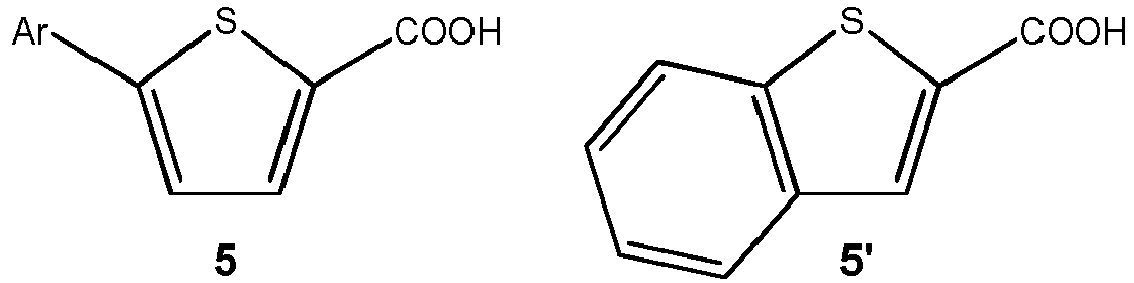

- b) reacting the compound of formula 6 or 6'
with a compound of formula 7
to obtain a compound of formula 8 or 8'
- c) reducing the compound of formula 8 or 8'
to obtain the compound of formula 1 or 1'.
- (2) The process according to item 1, wherein step a) is conducted in the presence of a chlorinating agent.
- (3) The process according to item 1 or item 2, wherein the chlorinating agent is SOCl2, oxalyl chloride, PCl3 or PCl5.
- (4) The process according to any one of preceding items, wherein step b) is conducted in the presence of a Lewis acid.
- (5) The process according to item 4, wherein the Lewis acid is FeCl3, ZnCl2 or AlCl3.
- (6) The process according to any one of preceding items, wherein step b) is conducted in a solvent such as halogenated alkanes, alkanes, ethers or CS2.
- (7) The process according to item 6, wherein step b) is conducted in dichloromethane.
- (8) The process according to any one of preceding items, wherein step b) is conducted at a temperature from ambient to the boiling point of the solvent.
- (9) The process according to any one of preceding items, wherein the compound of formula 8 or 8' is reduced with triethylsilane in the presence of borontrifluoride etherate.
- (10) The process according to any one of preceding items, wherein the compound of formula 5 is prepared by a process comprising the steps of:
- a) reacting a compound of formula 2
Ar-X 2
wherein X is halo, and Ar is defined as above,
with a compound of formula 3

- b) oxidizing the compound of formula 4
to obtain the compound of formula 5.
- a) reacting a compound of formula 2
- (11) The process according to item 10, wherein X is Br, Cl or I, preferably Br.
- (12) The process according to item 10 or item 11, wherein step a) is conducted in the presence of palladium catalyst, preferably palladium acetate.
- (13) The process according to any one of items 1 to 9, wherein the compound of formula 5' is prepared by oxidizing the compound of formula 4'
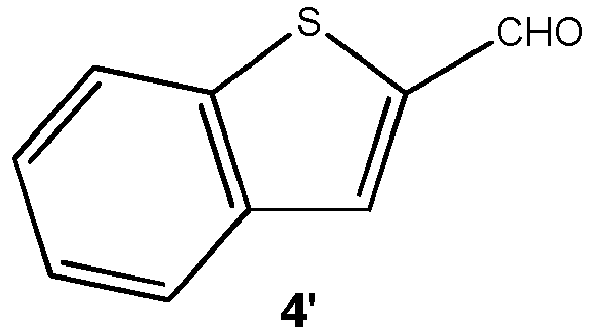
- (14) The process according to any one of items 10 to 13, wherein the oxidation in step b) is conducted in the presence of an oxidizing agent selected from the group consisting of sodium chlorite, sodium perchlorate, sodium hypochlorite, potassium dichromate, oxone, sodium perborate, pyridinium chlorochromate, periodic acid and potassium permanganate.
- (15) The process according to any one of preceding items, wherein Q1 and Q2 respectively represent hydrogen.
- (16) The process according to any one of preceding items, wherein Ar is phenyl, which is optionally substituted by one or more substituents selected from fluoro, chloro, C1-C6-alkyl, C3-C7-cycloalkyl, phenyl, hydroxy, C1-C6-alkoxy, cyano, carboxy, C1-C6-alkoxycarbonyl, C1-C6-alkylcarbonyl, C1-C6-alkanesulfonyl, C6-C12-arenesulfonyl, C1-C6-alkylthio, amino, optionally mono- or disubstituted with C1-C6-alkyl, C3-C5-alkyleneamino, 1-piperazinyl, nitro, azido, or -SiA1A2A3, wherein A1, A2, and A3 are selected from C1-C6-alkyl, C3-C7-cycloalkyl, phenyl, or C1-C6-alkoxy; and wherein C1-C6-alkyl itself and each C1-C6-alkyl of selected groups, C3-C7-cycloalkyl, phenyl, C3-C5-alkyleneamino, 1-piperazinyl are optionally further substituted by one or more groups selected from C1-C4-alkyl, C1-C4-alkoxy, di-C1-C6-alkylamino, C3-C5-alkyleneamino phenyl, 1-piperazinyl, fluoro, cyano, or nitro.
- (17) The process according to item 16, wherein Ar is halo-substituted phenyl, preferably phenyl para-substituted by fluoro.
- (18) The process according to any one of preceding items, wherein R1 is C1-C6-alkyl, preferably CH3, or halo, preferably fluoro; more preferably R1 is CH3.
- (19) The process according to any one of preceding items, wherein R2 is Br, I or Cl, preferably Br.
- (20) The process according to any one of preceding items, further comprising coupling the compound of formula 1 or 1' with a glucose or its derivative moiety to give a C-aryl glycoside compound.
- (21) The process according to item 20, comprising the steps of:
- a) coupling the compound of formula 1 or 1'
with a hydroxyl-protected glucose or its derivative, and - b) removing protecting groups from the resulting compound
to obtain a C-aryl glycoside compound.
- a) coupling the compound of formula 1 or 1'
- (22) Use of the compound of formula 1 or 1'

for the preparation of C-aryl glycosides. - (23) A process for the preparation of a pharmaceutical composition comprising a C-aryl glycoside compound, comprising the steps of:
- a) preparing a C-aryl glycoside compound by carrying out a process according to item 20 or item 21, and
- b) mixing the C-aryl glycoside compound with a pharmaceutically acceptable carrier and/or excipient.
- (24) The process or use according to any one of items 20 to 23, wherein the C-aryl glycoside compound is a compound of formula I (canagliflozin)

- (25) The process or use according to any one of items 20 to 23, wherein the C-aryl glycoside compound is a compound of formula II (ipragliflozin)

- The new process defined above provides 2-arylmethyl-5-aryl-thiophene in a shorter and more efficient way without the need of using expensive materials and reagents, which provides an industrially preferable and economically improved process using said compounds as intermediates.
- The present invention is now described in more detail by preferred embodiments and examples, which are however presented for illustrative purpose only.
- A general concept of the process of the present invention may be represented in Scheme 1.

- In the first step, the compound of formula 5 or 5' is converted into a derivate suitable for the following Friedel-Crafts reaction, acyl chloride compound of formula 6 or 6'. Any known method to form a derivative suitable for Friedel-Crafts reaction can be used for this step, for example, but not limited to, thionyl chloride, oxalyl chloride, phosphorus trichloride or phosphorus pentachloride can be used.
- In the next step, the compound of formula 6 or 6' is reacted with a compound of formula 7, stoichiometrically or with excess of the compound of formula 7, to give a compound of formula 8 or 8'. In a specific embodiment of the present invention the reaction of the compound of formula 6 or 6' and the compound of formula 7 is conducted in the presence of an appropriate Lewis acid, for example, FeCl3, ZnCl2 or AlCl3, in an appropriate solvent such as halogenated alkanes, alkanes, ethers or CS2, for example in dichloromethane. Preferably, the reaction can be carried out either at ambient temperature or heated to any temperature from ambient to the boiling point of the solvent.
- In the final step, the compound of formula 8 or 8' is reduced to give the compound of formula 1 or 1'. Any known reduction method can be used for this step, for example, but not limited to, triethylsilane in the presence of borontrifluoride etherate can be used.
- In the present invention, R1 represents hydrogen, halo, C1-C6-alkyl, hydroxy, C1-C6-alkoxy, thio, C1-C6-alkylthio, C1-C6-alkylcarbonylamino, or C1-C6-alkanesulfonylamino; and Q1 and Q2 are selected from hydrogen, or represent a condensed ring selected from benzo, pyrrolo[b], furano[b], thieno[b] or imidazo[d]. Preferably, R1 is C1-C6-alkyl, in particular CH3, or halo, in particular fluoro. R2 is halo, C1-C6-alkyl, nitro, cyano, carboxy, or C1-C6-alkoxycarbonyl, in a more preferred embodiment of the present invention R2 is Br, I or Cl. In a most preferred embodiment of the present invention R2 is Br. R2 is preferably selected from groups which can be used in the coupling reaction with an appropriate glucose or its derivative, and in a particular embodiment of the present invention R2 is a group capable of reacting or exchanging with metals such as, but not limited to, magnesium, lithium, copper, aluminum, titanium, palladium, zinc, and so on, in particular halogen.
- In a further embodiment of the present invention Q1 and Q2 respectively represent hydrogen.
- In the present invention, Ar is selected from phenyl, 1-naphthyl, 2-naphthyl, 3-pyridyl, 5-pyrimidinyl, 2-indolyl or 3-indolyl, which is optionally substituted by one or more substituents selected from fluoro, chloro, C1-C6-alkyl, C3-C7-cycloalkyl, phenyl, hydroxy, C1-C6-alkoxy, cyano, carboxy, C1-C6-alkoxycarbonyl, C1-C6-alkylcarbonyl, C1-C6-alkanesulfonyl, C6-C12-arenesulfonyl, C1-C6-alkylthio, amino, optionally mono- or disubstituted with C1-C6-alkyl, C3-C5-alkyleneamino, 1-piperazinyl, nitro, azido, or -SIA1A2A3, wherein A1, A2, and A3 are selected from C1-C6-alkyl, C3-C7-cycloalkyl, phenyl, or C1-C6-alkoxy. Here, C1-C6-alkyl itself and each C1-C6-alkyl of selected groups, C3-C7-cycloalkyl, phenyl, C3-C5-alkyleneamino, 1-piperazinyl are optionally further substituted by one or more groups selected from C1-C4-alkyl, C1-C4-alkoxy, di-C1-C6-alkylamino, C3-C5-alkyleneamino phenyl, 1-piperazinyl, fluoro, cyano, or nitro.
- In a preferred embodiment of the present invention Ar is phenyl, which is optionally substituted by one or more substituents defined as above. More preferably, Ar is halo-substituted phenyl, in particular phenyl para-substituted by fluoro.
- In a particular embodiment, the compound of formula 5 may be prepared by a reaction illustrated in Scheme 2.

- In the first step, the compound of formula 4 is prepared by reacting the compound of formula 2 with the compound of formula 3. Ar and X are as defined above. In a preferred embodiment of the present invention the coupling reaction is conducted in the presence of palladium catalyst, preferably palladium acetate.
- In another particular embodiment, the compound of formula 5' is prepared by a reaction illustrated in Scheme 3.

- The compound of formula 4' can be produced as described, for example, in Podea, Paula Veronica et al, Tetrahedron: Asymmetry, 19(4), 500-511; 2008.
- In the next step, the aldehyde compound of formula 4 or 4' is oxidized to give the carboxylic acid compound of formula 5 or 5'. Any known oxidation method can be used for this step, for example, but not limited to, sodium chlorite, sodium perchlorate, sodium hypochlorite, potassium dichromate, oxone, sodium perborate, pyridinium chlorochromate, periodic acid and potassium permanganate can be used.
- In a further aspect of the present invention C-aryl glycosides may be prepared by coupling the compound of formula 1 with an appropriate glucose or its derivative. Typically, the hydroxyl groups of glucose or its derivative may be protected with suitable protecting groups, which may be subsequently removed after the coupling reaction with the aryl compound. Here, protecting groups mean a group which may be attached to an oxygen atom to protect said oxygen atom from participating in a reaction and which may be readily removed following the reaction. Suitable protecting groups include, but are not limited to, ethers such as benzyl, para-methoxybenzyl or other substituted benzyl ethers, aryl, alkyl; esters such as acetyl, pivaloyl, benzoyl and other alkyl or aryl esters; silyl ethers such as trimethylsilyl, tert-butyldimethylsilyl and similar or any other suitable protecting groups. Other suitable protecting groups may be found in texts such as T.W. Greene & P. G. M. Wuts, Protective Groups in Organic Synthesis, John Wiley & Sons, 1991.
- In a particular embodiment of such a further aspect of the present invention, the compound of formula 1 or 1' is effectively used for the preparation of particularly selected C-aryl glycosides, preferably β-C-aryl glycosides. Preferred examples of β-C-aryl glycosides include a compound of formula I (canagliflozin) and a compound of formula II (ipragliflozin).


- In the present invention the coupling reaction herein may be carried out in accordance with a suitable coupling reaction mechanism, for instance in the presence of a metal catalyst. Examples of a metal catalyst may include, but are not limited to, palladium, nickel, copper, cobalt, and so on. Exemplary coupling reactions may include, but are not limited to, the coupling of a hydroxyl-protected glucose or its derivative such as gluconolactone or glucal with a metalated aryl derivative, or of a metalated glucose or its derivative with an aryl halide, or of a hydroxyl-protected glycosyl halide with a metalated aryl compound.
- In a preferred embodiment of the present invention the compound of formula 1 is lithiated with a suitable alkyl lithium such as tert-butyl lithium, n-butyl lithium, and so on, in a suitable solvent such as diethyl ether, tetrahydrofuran, and so on, and subsequently, reacted with a gluconolactone derivative.
- The C-aryl glycoside compound, which is prepared according to the invention, notably canagliflozin and ipragliflozin, can be beneficially used or administered preferably as a pharmaceutical composition comprising the C-aryl glycoside compound and a pharmaceutically acceptable excipient and/or carrier. Further, the C-aryl glycoside compound prepared according to the invention may be used or administered on its own or combined with other drugs, especially with drugs used for the normalization of plasma glucose levels, for example for the treatment or the prophylaxis of diabetes mellitus.
- In a further aspect of the present invention, a pharmaceutical composition comprising the C-aryl glycoside compound is prepared by comprising the steps of preparing the C-aryl glycoside compound, as described above, and mixing the C-aryl glycoside compound with a pharmaceutically acceptable carrier and/or excipient. The administration form can be suitably chosen, for example, a form suitable for oral, parenteral, rectal administration and/or administration by inhalation, and the dosage form may be solid, liquid or powdery. Therefore, the pharmaceutical composition comprising the C-aryl glycoside compound prepared according to the invention may suitably be in the form of tablets, pills, capsules, syrups, powders or granules for oral administration; or as sterile parenteral or subcutaneous solutions, suspensions for parenteral administration; or as suppositories for rectal administration.
- Suitable excipients and/or carriers include, without being limited to, diluents, binders, disintegrants, lubricants, etc. For example, the compound or a finely divided form thereof, or particles comprising the compound, are mixed with a carrier or binder substance, e.g. a mono-, di- or polysaccharide such as sugars and starch, a sugar alcohol or another polyol. For example, lactose, saccharose, sorbitol, mannitol, starch, cellulose derivatives, a binder such as polyvinylpyrrolidone, and a lubricant such as magnesium stearate, calcium stearate, polyethylene glycol, waxes, paraffin, and the like are mixed, and then compressed into tablets. The compound or a finely divided form thereof, or particles containing the same may be coated by another substance. The powder mixture or particles containing the compound may also be dispensed into capsules.
- The pharmaceutical composition comprising the C-aryl glycoside compound prepared according to the invention in a desired dose is generally suitable to treat or prevent a disease or condition of a patient in need thereof, specifically to display a desired activity when lowering plasma glucose levels, for example treating or preventing diabetes mellitus.
- In a preferred embodiment of the present invention the C-aryl glycoside compound is a compound of formula I (canagliflozin) or a compound of formula II (ipragliflozin). Particularly preferred is the preparation of canagliflozin.
- The term "C-aryl glycoside" as employed herein may include any salts, hydrates and solvates thereof, and crystalline forms thereof.
- The following Examples are non-limiting and serve to illustrate the invention.
-

- 4-Bromo-1-fluoro-benzene (2, 33 ml) and thiophene carbaldehyde (3, 56 ml), potassium acetate (59 g) and palladium acetate (66 mg) were dissolved in dimethylacetamide (500 ml) and heated at 140 - 150 °C for 22 h. The reaction mixture was concentrated and water (300 ml) was added. Resulting precipitate was washed with water and recrystallized from 2-propanol to give 35.4 g of the title compound 4. 13C NMR (CDCl3): 116.25, 116.42, 124.10, 128.28, 128.35, 137.46, 142.53, 153.06, 164.43, 164.42, 182.77.
-

- 5-(4-Fluoro-phenyl)-thiophene-2-carbaldehyde (4, 5.44 g) was dissolved in acetonitrile (50 ml). NaH2PO4 (0.92 g) in water (11 ml) was added to the reaction mixture and 30% hydrogen peroxide (2.75 ml) was further added thereto. A solution of NaClO2 (4.20 g) in water (25 ml) was slowly added for 30 mins. The reaction mixture was heated to 40 °C and stirred at that temperature for another hour. Precipitate was collected by filtration to give 6.21 g of the title compound 5. 13C NMR (CDCl3): 116.18, 116.35, 124.69, 128.04, 128.11, 128.59, 129.57, 134.06, 134.17, 148.26, 161.36, 162.98, 163.32.
-

- 5-(4-Fluoro-phenyl)-thiophene-2-carboxylic acid (5, 5.0 g) was dissolved in toluene (50 ml) and thionyl chloride (3.26 ml) was added. The mixture was heated at 90 °C for 20 h after which another 1 ml of thionyl chloride was added and heated for another hour at 90 °C. The reaction mixture was evaporated to give 5.34 g of the title compound 6. MS, m/z= 240. 1H NMR (acetone): 7.29 (m, 2H); 7.66 (d, 1 H), 7.88 (m, 2H), 8.07 (d, 1 H).
-

- 5-(4-Fluoro-phenyl)-thiophene-2-carbonyl chloride (6, 1.20 g) and 4-bromo-toluene (7, 9.85 g) were dissolved in dichloromethane (10 ml), and then FeCl3 (0.97 g) was added. The reaction mixture was stirred at room temperature for 20 h. 2M HCl (10 ml) was added and phases were separated. Organic phase was washed with 2M HCl (3 x 10 ml) and subsequently with brine (30 ml), and dried over sulfate and then concentrated. Raw material was purified with column chromatography (ethyl acetate/methylcyclohexane) to give 0.77 g of the title compound 8. 13C NMR (CDCl3): 19.41, 116.41, 116.59, 119.01, 124.33, 128.40, 128.47, 129.67, 130.70, 132.95, 133.37, 135.59, 137.05, 140.22, 142.89, 153.55, 162.55, 164.54, 188.62.
-

- 2-(5-Bromo-2-methyl-benzoyl)-5-(4-fluoro-phenyl)-phenyl)-thiophene (8, 3.75 g) was dissolved in dichloromethane (40 ml) and acetonitrile (40 ml), to which triethylsilane (4.63 ml) was added and cooled to 0 °C. Boron trifluoride etherate (3.45 ml) was added to the suspension and the reaction mixture was left to warm up to room temperature then continued to stir at that temperature for 26 h. The reaction mixture was cooled on ice and 50 ml of NaHCO3 was slowly added, followed by adding dichloromethane (50 ml). Phases were separated and organic phase was dried over sulphate, and then evaporated. The residue was recrystallized from 2-propanol to give 3.65 g of the title compound 1a. 13C NMR (DMSO): 18.52, 32.84, 115.83, 116.00, 118.81, 123.52, 126.86, 126.99, 127.05, 129.50, 130.41, 131.60, 132.37, 135.54, 140.63, 141.16, 142.46, 160.48, 162.42. MS, m/z= 360.
Claims (15)
- A process for the manufacture of a compound of formula 1 or 1'
 wherein R1 represents hydrogen, halo, C1-C6-alkyl, hydroxy, C1-C6-alkoxy, thio, C1-C6-alkylthio, C1-C6-alkylcarbonylamino, or C1-C6-alkanesulfonylamino;R2 represents halo, C1-C6-alkyl, nitro, cyano, carboxy, or C1-C6-alkoxycarbonyl; andQ1 and Q2 are selected from hydrogen, or represent a condensed ring selected from benzo, pyrrolo[b], furano[b], thieno[b] or imidazo[d];wherein Ar is selected from phenyl, 1-naphthyl, 2-naphthyl, 3-pyridyl, 5-pyrimidinyl, 2-indolyl or 3-indolyl, which is optionally substituted by one or more substituents selected from fluoro, chloro, C1-C6-alkyl, C3-C7-cycloalkyl, phenyl, hydroxy, C1-C6-alkoxy, cyano, carboxy, C1-C6-alkoxycarbonyl, C1-C6-alkylcarbonyl, C1-C6-alkanesulfonyl, C6-C12-arenesulfonyl, C1-C6-alkylthio, amino, optionally mono- or disubstituted with C1-C6-alkyl, C3-C5-alkyleneamino, 1-piperazinyl, nitro, azido, or -SiA1A2A3, wherein A1, A2, and A3 are selected from C1-C6-alkyl, C3-C7-cycloalkyl, phenyl, or C1-C6-alkoxy; andwherein C1-C6-alkyl itself and each C1-C6-alkyl of selected groups, C3-C7-cycloalkyl, phenyl, C3-C5-alkyleneamino, 1-piperazinyl are optionally further substituted by one or more groups selected from C1-C4-alkyl, C1-C4-alkoxy, di-C1-C6-alkylamino, C3-C5-alkyleneamino phenyl, 1-piperazinyl, fluoro, cyano, or nitro;said process comprising the steps of:a) converting a compound of formula 5 or 5' into a compound of formula 6 or 6'
 b) reacting the compound of formula 6 or 6'
with a compound of formula 7
to obtain a compound of formula 8 or 8' c) reducing the compound of formula 8 or 8'
to obtain the compound of formula 1 or 1'. - The process according to claim 1, wherein step a) is conducted in the presence of a chlorinating agent, preferably SOCl2, oxalyl chloride, PCl3 or PCl5.
- The process according to any one of preceding claims, wherein step b) is conducted in the presence of a Lewis acid, preferably FeCl3, ZnCl2 or AlCl3.
- The process according to any one of preceding claims, wherein step b) is conducted in a solvent such as halogenated alkanes, alkanes, ethers or CS2, preferably in dichloromethane.
- The process according to any one of preceding claims, wherein step b) is conducted at a temperature from ambient to the boiling point of the solvent.
- The process according to any one of preceding claims, wherein the compound of formula 8 or 8' is reduced with triethylsilane in the presence of borontrifluoride etherate.
- The process according to any one of preceding claims, the compound of formula 5 or 5' is prepared by a process comprising the steps ofa1) reacting a compound of formula 2
Ar-X 2
wherein X is halo, and Ar is defined as above,
with a compound of formula 3
 a2) providing a compound of formula 4'
 b) oxidizing the compound of formula 4 or 4'
to obtain the compound of formula 5 or 5'. - The process according to claim 7, wherein X is Br, Cl or I, preferably Br.
- The process according to claim 7 or 8, wherein step a1) is conducted in the presence of palladium catalyst, preferably palladium acetate.
- The process according to any one of claims 7 to 9, wherein the oxidation in step b) is conducted in the presence of an oxidizing agent selected from the group consisting of sodium chlorite, sodium perchlorate, sodium hypochlorite, potassium dichromate, oxone, sodium perborate, pyridinium chlorochromate, periodic acid and potassium permanganate.
- The process according to any one of preceding claims, wherein Q1 and Q2 respectively represent hydrogen; or
wherein Ar is phenyl, which is optionally substituted by one or more substituents selected from fluoro, chloro, C1-C6-alkyl, C3-C7-cycloalkyl, phenyl, hydroxy, C1-C6-alkoxy, cyano, carboxy, C1-C6-alkoxycarbonyl, C1-C6-alkylcarbonyl, C1-C6-alkanesulfonyl, C6-C12-arenesulfonyl, C1-C6-alkylthio, amino, optionally mono- or disubstituted with C1-C6-alkyl, C3-C5-alkyleneamino, 1-piperazinyl, nitro, azido, or -SiA1A2A3, wherein A1, A2, and A3 are selected from C1-C6-alkyl, C3-C7-cycloalkyl, phenyl, or C1-C6-alkoxy; and wherein C1-C6-alkyl itself and each C1-C6-alkyl of selected groups, C3-C7-cycloalkyl, phenyl, C3-C5-alkyleneamino, 1-piperazinyl are optionally further substituted by one or more groups selected from C1-C4-alkyl, C1-C4-alkoxy, di-C1-C6-alkylamino, C3-C5-alkyleneamino phenyl, 1-piperazinyl, fluoro, cyano, or nitro; preferably halo-substituted phenyl, more preferably phenyl para-substituted by fluoro; or
wherein R1 is C1-C6-alkyl, preferably CH3, or halo, preferably fluoro; more preferably CH3; or R2 is Br, I or Cl, preferably Br. - The process according to any one of preceding claims, further comprising coupling the compound of formula 1 or 1' with a glucose or its derivative moiety to give a C-aryl glycoside compound; preferably comprising the steps of:a) coupling the compound of formula 1 or 1'
with a hydroxyl-protected glucose or its derivative, andb) removing protecting groups from the resulting compound
to obtain a C-aryl glycoside compound. - Use of the compound of formula 1 or 1'

for the preparation of C-aryl glycosides. - A process for the preparation of a pharmaceutical composition comprising a C-aryl glycoside compound, comprising the steps of:a) preparing a C-aryl glycoside compound by carrying out a process according to claim 12, andb) mixing the C-aryl glycoside compound with a pharmaceutically acceptable carrier and/or excipient.
- The process or use according to any one of claims 12 to 14, wherein the C-aryl glycoside compound is a compound of formula I (Canagliflozin)

a compound of formula II (Ipragliflozin)
Priority Applications (1)
| Application Number | Priority Date | Filing Date | Title |
|---|---|---|---|
| EP14159828.4A EP2918579A1 (en) | 2014-03-14 | 2014-03-14 | Synthesis of 2-arylmethyl-5-aryl-thiophene |
Applications Claiming Priority (1)
| Application Number | Priority Date | Filing Date | Title |
|---|---|---|---|
| EP14159828.4A EP2918579A1 (en) | 2014-03-14 | 2014-03-14 | Synthesis of 2-arylmethyl-5-aryl-thiophene |
Publications (1)
| Publication Number | Publication Date |
|---|---|
| EP2918579A1 true EP2918579A1 (en) | 2015-09-16 |
Family
ID=50277064
Family Applications (1)
| Application Number | Title | Priority Date | Filing Date |
|---|---|---|---|
| EP14159828.4A Ceased EP2918579A1 (en) | 2014-03-14 | 2014-03-14 | Synthesis of 2-arylmethyl-5-aryl-thiophene |
Country Status (1)
| Country | Link |
|---|---|
| EP (1) | EP2918579A1 (en) |
Cited By (2)
| Publication number | Priority date | Publication date | Assignee | Title |
|---|---|---|---|---|
| CN107011316A (en) * | 2017-06-07 | 2017-08-04 | 上海微巨实业有限公司 | A kind of preparation method of 2 [(aminomethyl phenyl of 5 bromine 2) methyl] 5 (4 fluorophenyl) thiophene |
| CN110724123A (en) * | 2019-11-14 | 2020-01-24 | 扬州工业职业技术学院 | A kind of synthetic method of canagliflozin intermediate |
Citations (5)
| Publication number | Priority date | Publication date | Assignee | Title |
|---|---|---|---|---|
| WO2005012326A1 (en) | 2003-08-01 | 2005-02-10 | Tanabe Seiyaku Co., Ltd. | Novel compounds having inhibitory activity against sodium-dependant transporter |
| WO2010043682A2 (en) | 2008-10-17 | 2010-04-22 | Janssen Pharmaceutica Nv | Process for the preparation of compounds useful as inhibitors of sglt |
| WO2011079772A1 (en) | 2009-12-31 | 2011-07-07 | 上海特化医药科技有限公司 | Method for preparation of 2,5-disubstituted thiophene compound |
| WO2012140120A1 (en) * | 2011-04-13 | 2012-10-18 | Janssen Pharmaceutica Nv | Process for the preparation of compounds useful as inhibitors of sglt2 |
| WO2012160218A1 (en) | 2011-05-26 | 2012-11-29 | Tfchem | Family of aryl, heteroaryl, o-aryl and o-heteroaryl carbasugars |
-
2014
- 2014-03-14 EP EP14159828.4A patent/EP2918579A1/en not_active Ceased
Patent Citations (5)
| Publication number | Priority date | Publication date | Assignee | Title |
|---|---|---|---|---|
| WO2005012326A1 (en) | 2003-08-01 | 2005-02-10 | Tanabe Seiyaku Co., Ltd. | Novel compounds having inhibitory activity against sodium-dependant transporter |
| WO2010043682A2 (en) | 2008-10-17 | 2010-04-22 | Janssen Pharmaceutica Nv | Process for the preparation of compounds useful as inhibitors of sglt |
| WO2011079772A1 (en) | 2009-12-31 | 2011-07-07 | 上海特化医药科技有限公司 | Method for preparation of 2,5-disubstituted thiophene compound |
| WO2012140120A1 (en) * | 2011-04-13 | 2012-10-18 | Janssen Pharmaceutica Nv | Process for the preparation of compounds useful as inhibitors of sglt2 |
| WO2012160218A1 (en) | 2011-05-26 | 2012-11-29 | Tfchem | Family of aryl, heteroaryl, o-aryl and o-heteroaryl carbasugars |
Non-Patent Citations (3)
| Title |
|---|
| FREDERIC J J BIHEL ET AL: "New PDE4 inhibitors based on pharmacophoric similarity between papaverine and tofisopam", BIOORGANIC & MEDICINAL CHEMISTRY LETTERS, PERGAMON, AMSTERDAM, NL, vol. 21, no. 21, 6 August 2011 (2011-08-06), pages 6567 - 6572, XP028308817, ISSN: 0960-894X, [retrieved on 20110812], DOI: 10.1016/J.BMCL.2011.08.036 * |
| T.W. GREENE; P. G. M. WUTS: "Protective Groups in Organic Synthesis", 1991, JOHN WILEY & SONS |
| VERONICA ET AL., TETRAHEDRON: ASYMMETRY, vol. 19, no. 4, 2008, pages 500 - 511 |
Cited By (3)
| Publication number | Priority date | Publication date | Assignee | Title |
|---|---|---|---|---|
| CN107011316A (en) * | 2017-06-07 | 2017-08-04 | 上海微巨实业有限公司 | A kind of preparation method of 2 [(aminomethyl phenyl of 5 bromine 2) methyl] 5 (4 fluorophenyl) thiophene |
| CN110724123A (en) * | 2019-11-14 | 2020-01-24 | 扬州工业职业技术学院 | A kind of synthetic method of canagliflozin intermediate |
| CN110724123B (en) * | 2019-11-14 | 2022-03-01 | 扬州工业职业技术学院 | A kind of synthetic method of canagliflozin intermediate |
Similar Documents
| Publication | Publication Date | Title |
|---|---|---|
| JP5905926B2 (en) | Process for preparing compounds useful as inhibitors of SGLT | |
| KR101674806B1 (en) | Novel aminoalkylbenzothiazepine derivatives and use thereof | |
| CN102648196B (en) | Can be used as the preparation method of the compound of the inhibitor of SGLT2 | |
| JP5653213B2 (en) | Methods and compounds useful for the preparation of sodium-glucose cotransporter 2 inhibitors | |
| JP2014043464A (en) | Process for preparation of compound useful as inhibitor of sglt | |
| WO2008013321A1 (en) | Novel sglt inhibitors | |
| NZ527029A (en) | Synthesis for the preparation of compounds for screening as potential tubulin binding agents | |
| EP2262803A1 (en) | Polysubstituted derivatives of 2-aryl-6-phenyl-imidazo[l,2-a] pyridines, and preparation and therapeutic use thereof | |
| CN102115468A (en) | Synthesis method of 2, 5-disubstituted thiophene compound | |
| CN103596944A (en) | Process for the preparation of compounds useful as inhibitors of SGLT2 | |
| KR20170042687A (en) | Carboxylic acid compound, method for preparation thereof, and use thereof | |
| US20160318859A1 (en) | Florfenicol synthesizing method | |
| CN104327027B (en) | One class novel C aryl glucoside SGLT2 inhibitor | |
| JPH0261476B2 (en) | ||
| CN106146457B (en) | 5-chloro-2-acyl chloride thiophene intermediate and preparation method thereof | |
| CN101260095B (en) | 13-Halo-3,15-dioxogibberellic acid ester and its preparation method | |
| JP7738857B2 (en) | Method for producing ketone derivatives | |
| CN109111490B (en) | Halogenated pivaloyl glucopyranose and its preparation method for SGLT2 inhibitor | |
| CN101497590A (en) | 13-alkoxy-3,15-dioxo-gibberellic acid ester and preparation thereof | |
| JP2025049156A (en) | Method for producing compounds such as C-aryl hydroxyglycoside derivatives | |
| KUME et al. | ORALLY ACTIVE CEPHALOSPORINS III. SYNTHESIS AND STRUCTURE-ACTIVITY RELATIONSHIPS OF NEW 3-HETEROCYCLICTHIOMETHYLTHIO-7β-[(Z)-2-(2-AMINOTHIAZOL-4-YL)-2-HYDROXYIMINOACETAMIDO]-3-CEPHEM-4-CARBOXYLIC ACIDS | |
| JP2024169283A (en) | Method for producing compounds such as C-arylalkoxyglycoside derivatives | |
| JPH0446244B2 (en) | ||
| JPS58183695A (en) | Active cefuroxime derivative for oral administration, manufacture and medicinal composition | |
| KR910001008B1 (en) | 3-unsaturated alkyl cephems from 3-triflyl cephems |
Legal Events
| Date | Code | Title | Description |
|---|---|---|---|
| PUAI | Public reference made under article 153(3) epc to a published international application that has entered the european phase |
Free format text: ORIGINAL CODE: 0009012 |
|
| AK | Designated contracting states |
Kind code of ref document: A1 Designated state(s): AL AT BE BG CH CY CZ DE DK EE ES FI FR GB GR HR HU IE IS IT LI LT LU LV MC MK MT NL NO PL PT RO RS SE SI SK SM TR |
|
| AX | Request for extension of the european patent |
Extension state: BA ME |
|
| STAA | Information on the status of an ep patent application or granted ep patent |
Free format text: STATUS: THE APPLICATION HAS BEEN REFUSED |
|
| 18R | Application refused |
Effective date: 20151102 |