EP2913870A1 - Negative electrode for lithium-ion secondary cell and method for manufacturing same - Google Patents
Negative electrode for lithium-ion secondary cell and method for manufacturing same Download PDFInfo
- Publication number
- EP2913870A1 EP2913870A1 EP13850911.2A EP13850911A EP2913870A1 EP 2913870 A1 EP2913870 A1 EP 2913870A1 EP 13850911 A EP13850911 A EP 13850911A EP 2913870 A1 EP2913870 A1 EP 2913870A1
- Authority
- EP
- European Patent Office
- Prior art keywords
- lithium
- negative electrode
- carbon
- secondary cell
- ion secondary
- Prior art date
- Legal status (The legal status is an assumption and is not a legal conclusion. Google has not performed a legal analysis and makes no representation as to the accuracy of the status listed.)
- Withdrawn
Links
- 229910001416 lithium ion Inorganic materials 0.000 title claims abstract description 97
- HBBGRARXTFLTSG-UHFFFAOYSA-N Lithium ion Chemical compound [Li+] HBBGRARXTFLTSG-UHFFFAOYSA-N 0.000 title claims abstract description 94
- 238000000034 method Methods 0.000 title claims description 24
- 238000004519 manufacturing process Methods 0.000 title claims description 6
- OKTJSMMVPCPJKN-UHFFFAOYSA-N Carbon Chemical compound [C] OKTJSMMVPCPJKN-UHFFFAOYSA-N 0.000 claims abstract description 220
- 229910052799 carbon Inorganic materials 0.000 claims abstract description 148
- 239000000758 substrate Substances 0.000 claims abstract description 119
- XEEYBQQBJWHFJM-UHFFFAOYSA-N Iron Chemical compound [Fe] XEEYBQQBJWHFJM-UHFFFAOYSA-N 0.000 claims abstract description 67
- 229910002804 graphite Inorganic materials 0.000 claims abstract description 37
- 239000010439 graphite Substances 0.000 claims abstract description 37
- 229910021389 graphene Inorganic materials 0.000 claims abstract description 34
- 229910052742 iron Inorganic materials 0.000 claims abstract description 33
- 229910052751 metal Inorganic materials 0.000 claims abstract description 25
- 239000002184 metal Substances 0.000 claims abstract description 25
- 238000001237 Raman spectrum Methods 0.000 claims abstract description 13
- XKRFYHLGVUSROY-UHFFFAOYSA-N Argon Chemical compound [Ar] XKRFYHLGVUSROY-UHFFFAOYSA-N 0.000 claims abstract description 10
- 229910052786 argon Inorganic materials 0.000 claims abstract description 5
- 238000005268 plasma chemical vapour deposition Methods 0.000 claims description 29
- QVGXLLKOCUKJST-UHFFFAOYSA-N atomic oxygen Chemical compound [O] QVGXLLKOCUKJST-UHFFFAOYSA-N 0.000 claims description 25
- 239000001301 oxygen Substances 0.000 claims description 25
- 229910052760 oxygen Inorganic materials 0.000 claims description 25
- 239000007789 gas Substances 0.000 claims description 24
- 239000010935 stainless steel Substances 0.000 claims description 23
- 229910001220 stainless steel Inorganic materials 0.000 claims description 23
- 238000004140 cleaning Methods 0.000 claims description 18
- 239000008151 electrolyte solution Substances 0.000 claims description 18
- VNWKTOKETHGBQD-UHFFFAOYSA-N methane Chemical compound C VNWKTOKETHGBQD-UHFFFAOYSA-N 0.000 claims description 16
- 239000001257 hydrogen Substances 0.000 claims description 11
- 229910052739 hydrogen Inorganic materials 0.000 claims description 11
- UFHFLCQGNIYNRP-UHFFFAOYSA-N Hydrogen Chemical compound [H][H] UFHFLCQGNIYNRP-UHFFFAOYSA-N 0.000 claims description 8
- 125000004432 carbon atom Chemical group C* 0.000 claims description 6
- 230000007547 defect Effects 0.000 claims description 6
- 230000001788 irregular Effects 0.000 claims description 6
- 239000002994 raw material Substances 0.000 claims description 6
- 229910000975 Carbon steel Inorganic materials 0.000 claims description 4
- 239000010962 carbon steel Substances 0.000 claims description 4
- 229910000640 Fe alloy Inorganic materials 0.000 claims description 3
- 238000007599 discharging Methods 0.000 abstract 1
- 239000010410 layer Substances 0.000 description 82
- 229910052744 lithium Inorganic materials 0.000 description 38
- WHXSMMKQMYFTQS-UHFFFAOYSA-N Lithium Chemical compound [Li] WHXSMMKQMYFTQS-UHFFFAOYSA-N 0.000 description 36
- 150000002894 organic compounds Chemical class 0.000 description 23
- 239000007773 negative electrode material Substances 0.000 description 19
- 229910052710 silicon Inorganic materials 0.000 description 16
- 239000010703 silicon Substances 0.000 description 16
- XUIMIQQOPSSXEZ-UHFFFAOYSA-N Silicon Chemical compound [Si] XUIMIQQOPSSXEZ-UHFFFAOYSA-N 0.000 description 15
- 230000015572 biosynthetic process Effects 0.000 description 13
- -1 carbon nanowalls Chemical compound 0.000 description 12
- 239000013078 crystal Substances 0.000 description 11
- 230000005540 biological transmission Effects 0.000 description 10
- PXHVJJICTQNCMI-UHFFFAOYSA-N Nickel Chemical compound [Ni] PXHVJJICTQNCMI-UHFFFAOYSA-N 0.000 description 7
- 239000003575 carbonaceous material Substances 0.000 description 7
- 238000006243 chemical reaction Methods 0.000 description 7
- 238000000151 deposition Methods 0.000 description 7
- 230000008021 deposition Effects 0.000 description 7
- 239000000463 material Substances 0.000 description 7
- 239000010409 thin film Substances 0.000 description 7
- 239000011149 active material Substances 0.000 description 6
- 239000000956 alloy Substances 0.000 description 6
- 239000002717 carbon nanostructure Substances 0.000 description 6
- 239000002041 carbon nanotube Substances 0.000 description 6
- 229910021393 carbon nanotube Inorganic materials 0.000 description 6
- 230000000052 comparative effect Effects 0.000 description 6
- 238000011156 evaluation Methods 0.000 description 6
- 239000010408 film Substances 0.000 description 6
- 239000002086 nanomaterial Substances 0.000 description 6
- 230000008569 process Effects 0.000 description 6
- 229910045601 alloy Inorganic materials 0.000 description 5
- 239000011888 foil Substances 0.000 description 5
- 230000002687 intercalation Effects 0.000 description 5
- 238000009830 intercalation Methods 0.000 description 5
- 230000007246 mechanism Effects 0.000 description 5
- 229910052720 vanadium Inorganic materials 0.000 description 5
- KMTRUDSVKNLOMY-UHFFFAOYSA-N Ethylene carbonate Chemical compound O=C1OCCO1 KMTRUDSVKNLOMY-UHFFFAOYSA-N 0.000 description 4
- 230000003247 decreasing effect Effects 0.000 description 4
- IEJIGPNLZYLLBP-UHFFFAOYSA-N dimethyl carbonate Chemical compound COC(=O)OC IEJIGPNLZYLLBP-UHFFFAOYSA-N 0.000 description 4
- 230000005484 gravity Effects 0.000 description 4
- 229910052759 nickel Inorganic materials 0.000 description 4
- 239000007774 positive electrode material Substances 0.000 description 4
- 239000000126 substance Substances 0.000 description 4
- VZSRBBMJRBPUNF-UHFFFAOYSA-N 2-(2,3-dihydro-1H-inden-2-ylamino)-N-[3-oxo-3-(2,4,6,7-tetrahydrotriazolo[4,5-c]pyridin-5-yl)propyl]pyrimidine-5-carboxamide Chemical compound C1C(CC2=CC=CC=C12)NC1=NC=C(C=N1)C(=O)NCCC(N1CC2=C(CC1)NN=N2)=O VZSRBBMJRBPUNF-UHFFFAOYSA-N 0.000 description 3
- 229910001290 LiPF6 Inorganic materials 0.000 description 3
- 239000004698 Polyethylene Substances 0.000 description 3
- 238000001069 Raman spectroscopy Methods 0.000 description 3
- 229910001566 austenite Inorganic materials 0.000 description 3
- 150000001721 carbon Chemical class 0.000 description 3
- 230000003197 catalytic effect Effects 0.000 description 3
- 239000002131 composite material Substances 0.000 description 3
- 238000012986 modification Methods 0.000 description 3
- 230000004048 modification Effects 0.000 description 3
- 229920000573 polyethylene Polymers 0.000 description 3
- 230000009467 reduction Effects 0.000 description 3
- 238000009751 slip forming Methods 0.000 description 3
- 238000001947 vapour-phase growth Methods 0.000 description 3
- 229910000859 α-Fe Inorganic materials 0.000 description 3
- RYGMFSIKBFXOCR-UHFFFAOYSA-N Copper Chemical compound [Cu] RYGMFSIKBFXOCR-UHFFFAOYSA-N 0.000 description 2
- PXGOKWXKJXAPGV-UHFFFAOYSA-N Fluorine Chemical compound FF PXGOKWXKJXAPGV-UHFFFAOYSA-N 0.000 description 2
- UQSXHKLRYXJYBZ-UHFFFAOYSA-N Iron oxide Chemical compound [Fe]=O UQSXHKLRYXJYBZ-UHFFFAOYSA-N 0.000 description 2
- NIPNSKYNPDTRPC-UHFFFAOYSA-N N-[2-oxo-2-(2,4,6,7-tetrahydrotriazolo[4,5-c]pyridin-5-yl)ethyl]-2-[[3-(trifluoromethoxy)phenyl]methylamino]pyrimidine-5-carboxamide Chemical compound O=C(CNC(=O)C=1C=NC(=NC=1)NCC1=CC(=CC=C1)OC(F)(F)F)N1CC2=C(CC1)NN=N2 NIPNSKYNPDTRPC-UHFFFAOYSA-N 0.000 description 2
- AFCARXCZXQIEQB-UHFFFAOYSA-N N-[3-oxo-3-(2,4,6,7-tetrahydrotriazolo[4,5-c]pyridin-5-yl)propyl]-2-[[3-(trifluoromethoxy)phenyl]methylamino]pyrimidine-5-carboxamide Chemical compound O=C(CCNC(=O)C=1C=NC(=NC=1)NCC1=CC(=CC=C1)OC(F)(F)F)N1CC2=C(CC1)NN=N2 AFCARXCZXQIEQB-UHFFFAOYSA-N 0.000 description 2
- 229910000990 Ni alloy Inorganic materials 0.000 description 2
- 239000004743 Polypropylene Substances 0.000 description 2
- 235000002595 Solanum tuberosum Nutrition 0.000 description 2
- 244000061456 Solanum tuberosum Species 0.000 description 2
- 229910052782 aluminium Inorganic materials 0.000 description 2
- XAGFODPZIPBFFR-UHFFFAOYSA-N aluminium Chemical compound [Al] XAGFODPZIPBFFR-UHFFFAOYSA-N 0.000 description 2
- 125000004429 atom Chemical group 0.000 description 2
- 239000003054 catalyst Substances 0.000 description 2
- 239000011247 coating layer Substances 0.000 description 2
- 150000001875 compounds Chemical class 0.000 description 2
- 229910052802 copper Inorganic materials 0.000 description 2
- 239000010949 copper Substances 0.000 description 2
- 238000000354 decomposition reaction Methods 0.000 description 2
- 239000003792 electrolyte Substances 0.000 description 2
- 238000010894 electron beam technology Methods 0.000 description 2
- 229910052731 fluorine Inorganic materials 0.000 description 2
- 239000011737 fluorine Substances 0.000 description 2
- 229910021385 hard carbon Inorganic materials 0.000 description 2
- 229910003002 lithium salt Inorganic materials 0.000 description 2
- 159000000002 lithium salts Chemical class 0.000 description 2
- 229910001496 lithium tetrafluoroborate Inorganic materials 0.000 description 2
- ACFSQHQYDZIPRL-UHFFFAOYSA-N lithium;bis(1,1,2,2,2-pentafluoroethylsulfonyl)azanide Chemical compound [Li+].FC(F)(F)C(F)(F)S(=O)(=O)[N-]S(=O)(=O)C(F)(F)C(F)(F)F ACFSQHQYDZIPRL-UHFFFAOYSA-N 0.000 description 2
- QSZMZKBZAYQGRS-UHFFFAOYSA-N lithium;bis(trifluoromethylsulfonyl)azanide Chemical compound [Li+].FC(F)(F)S(=O)(=O)[N-]S(=O)(=O)C(F)(F)F QSZMZKBZAYQGRS-UHFFFAOYSA-N 0.000 description 2
- 229910000734 martensite Inorganic materials 0.000 description 2
- 238000005259 measurement Methods 0.000 description 2
- 239000002923 metal particle Substances 0.000 description 2
- 239000011356 non-aqueous organic solvent Substances 0.000 description 2
- NRNCYVBFPDDJNE-UHFFFAOYSA-N pemoline Chemical compound O1C(N)=NC(=O)C1C1=CC=CC=C1 NRNCYVBFPDDJNE-UHFFFAOYSA-N 0.000 description 2
- 239000012071 phase Substances 0.000 description 2
- 229920001155 polypropylene Polymers 0.000 description 2
- 238000011160 research Methods 0.000 description 2
- 239000000243 solution Substances 0.000 description 2
- 230000007847 structural defect Effects 0.000 description 2
- 239000012808 vapor phase Substances 0.000 description 2
- 229910000881 Cu alloy Inorganic materials 0.000 description 1
- OIFBSDVPJOWBCH-UHFFFAOYSA-N Diethyl carbonate Chemical compound CCOC(=O)OCC OIFBSDVPJOWBCH-UHFFFAOYSA-N 0.000 description 1
- 229910017060 Fe Cr Inorganic materials 0.000 description 1
- 229910002544 Fe-Cr Inorganic materials 0.000 description 1
- 229910001030 Iron–nickel alloy Inorganic materials 0.000 description 1
- 229910003063 Li1−xCoO2 Inorganic materials 0.000 description 1
- 229910032387 LiCoO2 Inorganic materials 0.000 description 1
- ZOKXTWBITQBERF-UHFFFAOYSA-N Molybdenum Chemical compound [Mo] ZOKXTWBITQBERF-UHFFFAOYSA-N 0.000 description 1
- 229920001774 Perfluoroether Polymers 0.000 description 1
- VYPSYNLAJGMNEJ-UHFFFAOYSA-N Silicium dioxide Chemical compound O=[Si]=O VYPSYNLAJGMNEJ-UHFFFAOYSA-N 0.000 description 1
- RTAQQCXQSZGOHL-UHFFFAOYSA-N Titanium Chemical compound [Ti] RTAQQCXQSZGOHL-UHFFFAOYSA-N 0.000 description 1
- HMDDXIMCDZRSNE-UHFFFAOYSA-N [C].[Si] Chemical compound [C].[Si] HMDDXIMCDZRSNE-UHFFFAOYSA-N 0.000 description 1
- 239000000654 additive Substances 0.000 description 1
- 230000000996 additive effect Effects 0.000 description 1
- 229910003481 amorphous carbon Inorganic materials 0.000 description 1
- 238000004458 analytical method Methods 0.000 description 1
- 239000003125 aqueous solvent Substances 0.000 description 1
- 229910021383 artificial graphite Inorganic materials 0.000 description 1
- 239000011230 binding agent Substances 0.000 description 1
- 239000002134 carbon nanofiber Substances 0.000 description 1
- 229910001567 cementite Inorganic materials 0.000 description 1
- 239000000919 ceramic Substances 0.000 description 1
- 230000008859 change Effects 0.000 description 1
- 238000005229 chemical vapour deposition Methods 0.000 description 1
- 229910052804 chromium Inorganic materials 0.000 description 1
- UPHIPHFJVNKLMR-UHFFFAOYSA-N chromium iron Chemical compound [Cr].[Fe] UPHIPHFJVNKLMR-UHFFFAOYSA-N 0.000 description 1
- 239000011248 coating agent Substances 0.000 description 1
- 238000000576 coating method Methods 0.000 description 1
- 239000010941 cobalt Substances 0.000 description 1
- 229910017052 cobalt Inorganic materials 0.000 description 1
- GUTLYIVDDKVIGB-UHFFFAOYSA-N cobalt atom Chemical compound [Co] GUTLYIVDDKVIGB-UHFFFAOYSA-N 0.000 description 1
- 239000010960 cold rolled steel Substances 0.000 description 1
- 239000000470 constituent Substances 0.000 description 1
- 239000000356 contaminant Substances 0.000 description 1
- 230000001419 dependent effect Effects 0.000 description 1
- FSIRXIHZBIXHKT-MHTVFEQDSA-N edatrexate Chemical compound C=1N=C2N=C(N)N=C(N)C2=NC=1CC(CC)C1=CC=C(C(=O)N[C@@H](CCC(O)=O)C(O)=O)C=C1 FSIRXIHZBIXHKT-MHTVFEQDSA-N 0.000 description 1
- 230000000694 effects Effects 0.000 description 1
- 239000007772 electrode material Substances 0.000 description 1
- 238000002003 electron diffraction Methods 0.000 description 1
- JBTWLSYIZRCDFO-UHFFFAOYSA-N ethyl methyl carbonate Chemical compound CCOC(=O)OC JBTWLSYIZRCDFO-UHFFFAOYSA-N 0.000 description 1
- 230000005284 excitation Effects 0.000 description 1
- 238000002474 experimental method Methods 0.000 description 1
- 238000010304 firing Methods 0.000 description 1
- 230000004927 fusion Effects 0.000 description 1
- 239000011245 gel electrolyte Substances 0.000 description 1
- 239000007770 graphite material Substances 0.000 description 1
- 238000010438 heat treatment Methods 0.000 description 1
- 230000006872 improvement Effects 0.000 description 1
- 239000012535 impurity Substances 0.000 description 1
- 230000006698 induction Effects 0.000 description 1
- 238000003780 insertion Methods 0.000 description 1
- 230000037431 insertion Effects 0.000 description 1
- 239000011229 interlayer Substances 0.000 description 1
- 239000002608 ionic liquid Substances 0.000 description 1
- 150000002500 ions Chemical class 0.000 description 1
- 230000002427 irreversible effect Effects 0.000 description 1
- 239000007788 liquid Substances 0.000 description 1
- 150000002641 lithium Chemical group 0.000 description 1
- AMXOYNBUYSYVKV-UHFFFAOYSA-M lithium bromide Chemical compound [Li+].[Br-] AMXOYNBUYSYVKV-UHFFFAOYSA-M 0.000 description 1
- KWGKDLIKAYFUFQ-UHFFFAOYSA-M lithium chloride Chemical compound [Li+].[Cl-] KWGKDLIKAYFUFQ-UHFFFAOYSA-M 0.000 description 1
- 229910001540 lithium hexafluoroarsenate(V) Inorganic materials 0.000 description 1
- GELKBWJHTRAYNV-UHFFFAOYSA-K lithium iron phosphate Chemical compound [Li+].[Fe+2].[O-]P([O-])([O-])=O GELKBWJHTRAYNV-UHFFFAOYSA-K 0.000 description 1
- FUJCRWPEOMXPAD-UHFFFAOYSA-N lithium oxide Chemical compound [Li+].[Li+].[O-2] FUJCRWPEOMXPAD-UHFFFAOYSA-N 0.000 description 1
- 229910001947 lithium oxide Inorganic materials 0.000 description 1
- MHCFAGZWMAWTNR-UHFFFAOYSA-M lithium perchlorate Chemical compound [Li+].[O-]Cl(=O)(=O)=O MHCFAGZWMAWTNR-UHFFFAOYSA-M 0.000 description 1
- 229910001386 lithium phosphate Inorganic materials 0.000 description 1
- INHCSSUBVCNVSK-UHFFFAOYSA-L lithium sulfate Inorganic materials [Li+].[Li+].[O-]S([O-])(=O)=O INHCSSUBVCNVSK-UHFFFAOYSA-L 0.000 description 1
- QVXQYMZVJNYDNG-UHFFFAOYSA-N lithium;bis(trifluoromethylsulfonyl)methylsulfonyl-trifluoromethane Chemical compound [Li+].FC(F)(F)S(=O)(=O)[C-](S(=O)(=O)C(F)(F)F)S(=O)(=O)C(F)(F)F QVXQYMZVJNYDNG-UHFFFAOYSA-N 0.000 description 1
- DVATZODUVBMYHN-UHFFFAOYSA-K lithium;iron(2+);manganese(2+);phosphate Chemical compound [Li+].[Mn+2].[Fe+2].[O-]P([O-])([O-])=O DVATZODUVBMYHN-UHFFFAOYSA-K 0.000 description 1
- ILXAVRFGLBYNEJ-UHFFFAOYSA-K lithium;manganese(2+);phosphate Chemical compound [Li+].[Mn+2].[O-]P([O-])([O-])=O ILXAVRFGLBYNEJ-UHFFFAOYSA-K 0.000 description 1
- MCVFFRWZNYZUIJ-UHFFFAOYSA-M lithium;trifluoromethanesulfonate Chemical compound [Li+].[O-]S(=O)(=O)C(F)(F)F MCVFFRWZNYZUIJ-UHFFFAOYSA-M 0.000 description 1
- 239000007769 metal material Substances 0.000 description 1
- 229910044991 metal oxide Inorganic materials 0.000 description 1
- 150000004706 metal oxides Chemical class 0.000 description 1
- 239000000203 mixture Substances 0.000 description 1
- 239000011733 molybdenum Substances 0.000 description 1
- 229910052750 molybdenum Inorganic materials 0.000 description 1
- 229910021392 nanocarbon Inorganic materials 0.000 description 1
- 239000005486 organic electrolyte Substances 0.000 description 1
- 239000003960 organic solvent Substances 0.000 description 1
- 238000007747 plating Methods 0.000 description 1
- 229920000098 polyolefin Polymers 0.000 description 1
- 229920001296 polysiloxane Polymers 0.000 description 1
- 238000010248 power generation Methods 0.000 description 1
- 238000001556 precipitation Methods 0.000 description 1
- RUOJZAUFBMNUDX-UHFFFAOYSA-N propylene carbonate Chemical compound CC1COC(=O)O1 RUOJZAUFBMNUDX-UHFFFAOYSA-N 0.000 description 1
- 230000036647 reaction Effects 0.000 description 1
- 230000002441 reversible effect Effects 0.000 description 1
- 230000000630 rising effect Effects 0.000 description 1
- 150000003839 salts Chemical class 0.000 description 1
- 229920006395 saturated elastomer Polymers 0.000 description 1
- 238000004098 selected area electron diffraction Methods 0.000 description 1
- 229910052814 silicon oxide Inorganic materials 0.000 description 1
- 239000002002 slurry Substances 0.000 description 1
- 239000007784 solid electrolyte Substances 0.000 description 1
- 238000004544 sputter deposition Methods 0.000 description 1
- 238000003860 storage Methods 0.000 description 1
- 238000004381 surface treatment Methods 0.000 description 1
- 229910052715 tantalum Inorganic materials 0.000 description 1
- GUVRBAGPIYLISA-UHFFFAOYSA-N tantalum atom Chemical compound [Ta] GUVRBAGPIYLISA-UHFFFAOYSA-N 0.000 description 1
- RBTVSNLYYIMMKS-UHFFFAOYSA-N tert-butyl 3-aminoazetidine-1-carboxylate;hydrochloride Chemical compound Cl.CC(C)(C)OC(=O)N1CC(N)C1 RBTVSNLYYIMMKS-UHFFFAOYSA-N 0.000 description 1
- 238000012360 testing method Methods 0.000 description 1
- 229910052719 titanium Inorganic materials 0.000 description 1
- 239000010936 titanium Substances 0.000 description 1
- 229910052723 transition metal Inorganic materials 0.000 description 1
- 150000003624 transition metals Chemical class 0.000 description 1
- 238000013519 translation Methods 0.000 description 1
- WFKWXMTUELFFGS-UHFFFAOYSA-N tungsten Chemical compound [W] WFKWXMTUELFFGS-UHFFFAOYSA-N 0.000 description 1
- 239000010937 tungsten Substances 0.000 description 1
- 229910052721 tungsten Inorganic materials 0.000 description 1
Images



Classifications
-
- B—PERFORMING OPERATIONS; TRANSPORTING
- B82—NANOTECHNOLOGY
- B82Y—SPECIFIC USES OR APPLICATIONS OF NANOSTRUCTURES; MEASUREMENT OR ANALYSIS OF NANOSTRUCTURES; MANUFACTURE OR TREATMENT OF NANOSTRUCTURES
- B82Y30/00—Nanotechnology for materials or surface science, e.g. nanocomposites
-
- B—PERFORMING OPERATIONS; TRANSPORTING
- B82—NANOTECHNOLOGY
- B82Y—SPECIFIC USES OR APPLICATIONS OF NANOSTRUCTURES; MEASUREMENT OR ANALYSIS OF NANOSTRUCTURES; MANUFACTURE OR TREATMENT OF NANOSTRUCTURES
- B82Y40/00—Manufacture or treatment of nanostructures
-
- C—CHEMISTRY; METALLURGY
- C01—INORGANIC CHEMISTRY
- C01B—NON-METALLIC ELEMENTS; COMPOUNDS THEREOF; METALLOIDS OR COMPOUNDS THEREOF NOT COVERED BY SUBCLASS C01C
- C01B32/00—Carbon; Compounds thereof
- C01B32/15—Nano-sized carbon materials
- C01B32/182—Graphene
-
- H—ELECTRICITY
- H01—ELECTRIC ELEMENTS
- H01M—PROCESSES OR MEANS, e.g. BATTERIES, FOR THE DIRECT CONVERSION OF CHEMICAL ENERGY INTO ELECTRICAL ENERGY
- H01M10/00—Secondary cells; Manufacture thereof
- H01M10/05—Accumulators with non-aqueous electrolyte
- H01M10/052—Li-accumulators
- H01M10/0525—Rocking-chair batteries, i.e. batteries with lithium insertion or intercalation in both electrodes; Lithium-ion batteries
-
- H—ELECTRICITY
- H01—ELECTRIC ELEMENTS
- H01M—PROCESSES OR MEANS, e.g. BATTERIES, FOR THE DIRECT CONVERSION OF CHEMICAL ENERGY INTO ELECTRICAL ENERGY
- H01M4/00—Electrodes
- H01M4/02—Electrodes composed of, or comprising, active material
- H01M4/04—Processes of manufacture in general
- H01M4/0402—Methods of deposition of the material
- H01M4/0421—Methods of deposition of the material involving vapour deposition
- H01M4/0428—Chemical vapour deposition
-
- H—ELECTRICITY
- H01—ELECTRIC ELEMENTS
- H01M—PROCESSES OR MEANS, e.g. BATTERIES, FOR THE DIRECT CONVERSION OF CHEMICAL ENERGY INTO ELECTRICAL ENERGY
- H01M4/00—Electrodes
- H01M4/02—Electrodes composed of, or comprising, active material
- H01M4/13—Electrodes for accumulators with non-aqueous electrolyte, e.g. for lithium-accumulators; Processes of manufacture thereof
- H01M4/133—Electrodes based on carbonaceous material, e.g. graphite-intercalation compounds or CFx
-
- H—ELECTRICITY
- H01—ELECTRIC ELEMENTS
- H01M—PROCESSES OR MEANS, e.g. BATTERIES, FOR THE DIRECT CONVERSION OF CHEMICAL ENERGY INTO ELECTRICAL ENERGY
- H01M4/00—Electrodes
- H01M4/02—Electrodes composed of, or comprising, active material
- H01M4/13—Electrodes for accumulators with non-aqueous electrolyte, e.g. for lithium-accumulators; Processes of manufacture thereof
- H01M4/139—Processes of manufacture
- H01M4/1393—Processes of manufacture of electrodes based on carbonaceous material, e.g. graphite-intercalation compounds or CFx
-
- H—ELECTRICITY
- H01—ELECTRIC ELEMENTS
- H01M—PROCESSES OR MEANS, e.g. BATTERIES, FOR THE DIRECT CONVERSION OF CHEMICAL ENERGY INTO ELECTRICAL ENERGY
- H01M4/00—Electrodes
- H01M4/02—Electrodes composed of, or comprising, active material
- H01M4/36—Selection of substances as active materials, active masses, active liquids
- H01M4/58—Selection of substances as active materials, active masses, active liquids of inorganic compounds other than oxides or hydroxides, e.g. sulfides, selenides, tellurides, halogenides or LiCoFy; of polyanionic structures, e.g. phosphates, silicates or borates
- H01M4/583—Carbonaceous material, e.g. graphite-intercalation compounds or CFx
- H01M4/587—Carbonaceous material, e.g. graphite-intercalation compounds or CFx for inserting or intercalating light metals
-
- H—ELECTRICITY
- H01—ELECTRIC ELEMENTS
- H01M—PROCESSES OR MEANS, e.g. BATTERIES, FOR THE DIRECT CONVERSION OF CHEMICAL ENERGY INTO ELECTRICAL ENERGY
- H01M4/00—Electrodes
- H01M4/02—Electrodes composed of, or comprising, active material
- H01M4/64—Carriers or collectors
- H01M4/66—Selection of materials
- H01M4/661—Metal or alloys, e.g. alloy coatings
-
- Y—GENERAL TAGGING OF NEW TECHNOLOGICAL DEVELOPMENTS; GENERAL TAGGING OF CROSS-SECTIONAL TECHNOLOGIES SPANNING OVER SEVERAL SECTIONS OF THE IPC; TECHNICAL SUBJECTS COVERED BY FORMER USPC CROSS-REFERENCE ART COLLECTIONS [XRACs] AND DIGESTS
- Y02—TECHNOLOGIES OR APPLICATIONS FOR MITIGATION OR ADAPTATION AGAINST CLIMATE CHANGE
- Y02E—REDUCTION OF GREENHOUSE GAS [GHG] EMISSIONS, RELATED TO ENERGY GENERATION, TRANSMISSION OR DISTRIBUTION
- Y02E60/00—Enabling technologies; Technologies with a potential or indirect contribution to GHG emissions mitigation
- Y02E60/10—Energy storage using batteries
-
- Y—GENERAL TAGGING OF NEW TECHNOLOGICAL DEVELOPMENTS; GENERAL TAGGING OF CROSS-SECTIONAL TECHNOLOGIES SPANNING OVER SEVERAL SECTIONS OF THE IPC; TECHNICAL SUBJECTS COVERED BY FORMER USPC CROSS-REFERENCE ART COLLECTIONS [XRACs] AND DIGESTS
- Y02—TECHNOLOGIES OR APPLICATIONS FOR MITIGATION OR ADAPTATION AGAINST CLIMATE CHANGE
- Y02P—CLIMATE CHANGE MITIGATION TECHNOLOGIES IN THE PRODUCTION OR PROCESSING OF GOODS
- Y02P70/00—Climate change mitigation technologies in the production process for final industrial or consumer products
- Y02P70/50—Manufacturing or production processes characterised by the final manufactured product
Definitions
- the present invention relates to a negative electrode for a lithium-ion secondary cell and a method for manufacturing the same.
- a lithium-ion secondary cell has the structure in which an electrolytic solution containing a non-aqueous solvent and a lithium salt dissolved therein or a lithium solid electrolyte is provided between a negative electrode active material and a positive electrode active material, and lithium ions are moved back and forth between the negative electrode active material and the positive electrode active material and are intercalated in the active material applied on a collector substrate of a negative electrode, so that charge and discharge can be performed.
- a carbon nanotube is categorized into a one-dimensional carbon nanostructure which is grown in one direction from a substrate surface by a plasma CVD method or the like
- a carbon nanowall has been known which is categorized into a two-dimensional structure grown in a sheet shape on a substrate surface in a direction perpendicular thereto with a graphite layer or an amorphous layer provided therebetween (PTLs 1 to 4 and NPLs 1 and 2).
- PTL 4 has proposed that in a method for manufacturing carbon nanowalls in which carbon nanowalls are formed on a substrate surface in a plasma atmosphere of hydrogen and a raw material substance containing carbon and fluorine as constituent elements, by addition of oxygen atom radicals or radicals of molecules containing oxygen to the plasma atmosphere, the crystallinity of the carbon nanowall (CNW) is improved.
- the carbon nanowall is a crystal which is formed from nano-size graphite crystallites and which has a relatively high completeness.
- the carbon nanowall is a plate-like nanostructure which is formed of approximately several to one hundred of graphene sheets overlapped with each other and which has a thickness of several to several tens of nanometers.
- a wall height of the carbon nanowall is increased to several hundreds to several thousands of nanometers in proportion to a growth time, the growth of a wall thickness is saturated up to approximately 40 nm.
- the presence of catalytic metal particles, such as iron or cobalt, on a substrate surface is essential, in the case of the carbon nanowalls, catalytic metal particles are not particularly required. It has been known that by using a plasma CVD apparatus, when a carbon source gas is supplied at a substrate temperature of approximately 400°C to 500°C and an in-chamber pressure of approximately 100 Pa or less, the carbon nanowall grows on a substrate selectively in a direction opposite to that in which an active species effective for the grown comes down.
- the carbon nanowall As a negative electrode material to be used for improvement in high-speed charge/discharge characteristics of a lithium-ion secondary cell, it is considered that the carbon nanowall has an ideal structure, and attention has been paid thereto as the negative electrode material (NPL 3 and PTLs 5 and 6).
- PTL 5 has disclosed that the carbon nanowall is a micrographite having a height of several micrometers and can be obtained by a vapor phase growth method without using catalysts in which a raw material gas is supplied onto a substrate at a temperature of 700°C to 1,000°C and a pressure of 0.5 ⁇ 10 -3 to 1.0 ⁇ 10 -2 Torr.
- PTL 6 has disclosed a rapid charge/discharge type thin lithium cell in which flaky carbon nanowalls formed of aggregates of oriented crystallites each having a size of 10 to 30 nm are vapor-phase grown on a collector substrate to stand in a direction perpendicular thereto and are used as the negative electrode without any modification.
- the number of lithium atoms which can be intercalated between graphite layers is one atom per six carbon atoms, and the maximum charge-discharge capacity is limited to 372 mAh/g.
- Amorphous hard carbon has also been known as a carbon material of the negative electrode of a lithium-ion secondary cell.
- the hard carbon has various shortcomings, such as a large irreversible capacity and a small discharge capacity per volume.
- silicon theoretically capable of obtaining a charge-discharge capacity exceeding that of a carbon-based negative electrode material, an alloy primarily containing silicon, a silicon oxide, and the like have drawn attention as the negative electrode material.
- silicon can be used as the negative electrode active material by forming an alloy with lithium and can also incorporate a large number of lithium atoms as compared to that of graphite, an increase in capacity of a lithium-ion secondary cell can be expected (for example, see NPL 4 and PTLs 7 to 9).
- silicon is a material having a significantly high capacity as compared to that of a carbon material
- the volume of alloyed silicon which occludes lithium ions is increased by approximately 4 times that of silicon before occlusion.
- a negative electrode using silicon as the negative electrode active material is repeatedly expanded and contracted in synchronism with charge discharge cycles, and as a result, the negative electrode active material is mechanically destroyed.
- silicon is used as the negative electrode active material of a lithium-ion secondary cell, in particular, the negative electrode active material is seriously degraded by the charge discharge cycles described above, and when charge and discharge are repeatedly performed several times, the cell capacity is almost lost.
- a negative electrode for a lithium-ion secondary cell in which after a carbon nanostructure layer is formed by applying a slurry of carbon nanofibers or carbon nanotubes to electrically conductive collector foil formed of copper, titanium, nickel, or the like, followed by firing, a silicon layer having a thickness of 100 to 500 nm is further formed on the above carbon nanostructure layer by sputtering to form a composite nanostructure layer containing silicon and carbon (NPL 5 and PTL 10) and a negative electrode for a lithium-ion secondary cell in which a film of nanoscale silicon grains is deposited on surfaces of carbon nanotubes (PTL 11).
- a negative electrode material has also been proposed in which a negative electrode active material formed of grains or coating films of silicon or the like is fixed to vertical wall surfaces of graphene sheets of carbon nanowalls formed on a collector substrate, and the change in volume of the negative electrode active material in synchronism with charge discharge cycles is reduced by the spaces between the graphene sheets of the carbon nanowalls so as to increase the capacity (PTL 12 and NPL 6).
- the present invention was made to solve the existing problems described above and aims to provide a negative electrode for a lithium-ion secondary cell, the negative electrode having a novel structure in which a carbon used for the negative electrode has a significantly far larger charge-discharge capacity per unit weight than the theoretical capacity of graphite and in which the structure of a negative electrode surface is stable against repeatedly performed charge and discharge; and also aims to provide a lithium-ion secondary cell which uses the negative electrode described above and which has a significantly large charge-discharge capacity.
- the negative electrode for a lithium-ion secondary cell of the present invention is characterized in that a carbon layer is formed from graphene sheets grown on a surface of an iron-based metal substrate so as to stand in oblique directions with respect to the surface thereof, and the carbon layer is used as a negative electrode surface.
- the negative electrode for a lithium-ion secondary cell of the present invention is characterized in that the carbon layer is formed of a carbon nanochips layer of graphene sheets grown slantingly from the surface of the substrate in various directions.
- This carbon nanochips layer is one group of nanocarbon structures which are independently and slantingly grown from the surface of the iron-based metal substrate in irregular directions.
- the coverage of the substrate surface by this carbon nanochips layer is preferably 100%.
- the "coverage” in this case indicates the rate of the substrate surface covered with carbon nanochips when viewed in a direction perpendicular to the substrate surface, the coverage of the surface substrate which is not covered at all is 0%, and the coverage of the surface substrate which is covered without any spaces between the carbon nanochips is 100%.
- the iron-based metal substrate may be either a thin plate or foil formed from any one of pure iron, carbon steel, stainless steel, and an iron alloy.
- the iron-based metal substrate may be formed from a material used as a negative electrode collector.
- the iron-based metal substrate may be a substrate having an iron-based metal coating layer formed on a surface of a collector substrate.
- this carbon nanostructure is grown slantingly in various and oblique directions with respect to the substrate surface so as to cover the substrate surface and has a flaky shape similar to that of a potato chip (hereinafter appropriately referred to as "carbon nanochip”, and the aggregate thereof will be referred to as “carbon nanochips”).
- g/d is in a range of 0.30 to 0.80 (g represents the peak intensity of a g band at approximately 1,600 cm -1 caused by in-plane hexagonal lattice vibration of carbon atoms, and d represents the peak intensity of a d band at approximately 1,360 cm -1 which indicates a graphite defect).
- the negative electrode for a lithium-ion secondary cell of the present invention can be manufactured by a method comprising a step of forming a carbon nanochips layer on a negative electrode substrate by a CVD method using a mixed gas containing hydrogen and methane under the conditions in which a flow rate ratio of H 2 /CH 4 , a substrate temperature, a DC bias voltage, and a growth time are set to 1/5 to 2/1, 650°C to 850°C, -200 to 0 V, and 15 minutes to 2 hours, respectively, the carbon nanochips layer being formed from graphene sheets independently grown from the negative electrode substrate surface to stand slantingly in various directions, that is, in irregular directions.
- an oxygen cleaning step is preferably performed by generating plasma in a chamber in the presence of oxygen.
- the oxygen cleaning is performed before the substrate is set in the chamber so as to clean the inside thereof together with electrodes or is performed after the substrate is set in the chamber so as to clean the inside thereof together with the substrate surface.
- Raman spectroscopy is an effective method for evaluating carbon materials since sensitively reflecting the structures of various carbon materials. According to Raman spectroscopy, a graphite single crystal shows a single band at 1,581 cm -1 ; as the structure of a carbon material is disordered, a new band at approximately 1,360 cm -1 is generated, and the intensity thereof is gradually increased; and next, the band at approximately 1,580 cm -1 is shifted to a high frequency side, and the widths of the two bands are gradually increased.
- the carbon nanochip has a low crystallinity and many structural defects, such as crystal defects, at voids of graphene networks, spaces between graphene sheets, and front end sides at which carbon nanochips are brought into contact with each other, it is believed that when a thin film layer of carbon nanochips is used as a negative electrode surface for a lithium-ion secondary cell, lithium ions passing through those structural defects are intercalated in each carbon nanochip and/or the spaces between the carbon nanochips and are occluded in the negative electrode at the beginning of charge.
- a lithium-ion secondary cell using the negative electrode for a lithium-ion secondary cell of the present invention is assembled such that the carbon nanochips layer is used as a negative electrode surface and is directly brought into contact with an electrolytic solution for a lithium-ion secondary cell.
- a lithium-ion secondary cell using a carbon having the nanostructure as described above as the negative electrode surface shows a significantly large charge-discharge capacity.
- the charge-discharge capacity described above is a capacity surprisingly far larger than the theoretical electrical capacity obtained from the model in which lithium enters between atoms of a carbon crystal by intercalation.
- the iron-based metal is used as the substrate on which a carbon having a nanostructure is grown, when graphene sheets are formed by supplying a carbon source gas on the substrate using a vapor phase method, iron which is a substrate component is exposed to the carbon source to generate fine grains of iron, iron oxide, iron carbide, and/or the like, the components of those fine grains are precipitated on the topmost surface of the substrate, and a small amount of the components is incorporated in the graphene sheets.
- the iron-based metal is, for example, stainless steel containing Cr, Ni, and/or the like, it is believed that fine grains of those components or oxides thereof are also generated and precipitated on the topmost surface of the substrate, and in addition, a small amount of the components or the like is incorporated in the graphene sheets.
- the upper limit of the charge-discharge capacity is determined by the intercalation amount of lithium ions between atomic layers of crystals of graphite
- the charge-discharge capacity is determined by the amount of the organic compound containing lithium, which is continuously formed on a thin film layer of the carbon nanochips of the negative electrode, the upper limit of the charge-discharge capacity determined by the intercalation amount of lithium ions is not present, and hence a large charge-discharge capacity is obtained.
- a lithium-ion secondary cell using the negative electrode of the present invention When a lithium-ion secondary cell using the negative electrode of the present invention is charged, a lithium-ion secondary cell in which the organic compound layer containing lithium is formed on the carbon nanochips layer is obtained.
- the structure of the negative electrode surface is stable since being hardly changed by repeatedly performed charge and discharge.
- the charge-discharge capacity is not proportional to the amount of the active material of the negative electrode, and hence, significant reduction in size and weight of the cell can be achieved.
- a high potential drive at approximately 3.2 to 4.2 V can also be performed.
- the negative electrode for a lithium-ion secondary cell of the present invention there has not been known a negative electrode having a mechanism in which an organic compound layer containing lithium is formed on a negative electrode surface during charge, and this organic compound layer containing lithium is decomposed during discharge, and in addition, a secondary cell using the negative electrode as described above has also not been known in the past.
- the negative electrode for a lithium-ion secondary cell of the present invention is driven not only by the occlusion mechanism of lithium ions in the negative electrode active material as that of a related lithium-ion secondary cell but also by the charge-discharge mechanism in which the organic compound layer containing lithium is formed and decomposed on the negative electrode surface, and the chemical reaction at the interface between the carbon covering the entire surface of the negative electrode and the electrolytic solution is used; hence, the volume of the active material of the negative electrode is not influenced by the charge-discharge capacity, and significant reduction in size and weight of the cell can be achieved.
- a substrate on which a carbon nanochips layer is to be grown is formed of an iron-based metal thin plate or foil.
- an iron-based metal in order to form the carbon nanochips layer, although the substrate is required to have heat resistance since the temperature thereof is set to 650°C or more, an iron-based metal has a sufficient heat resistance.
- the iron-based metal for example, there may be mentioned pure iron and an alloy material, such as carbon steel, stainless steel, a Fe-Cr alloy, a Fe-Ni alloy, or a Fe-Cr-Ni alloy, containing iron as a primary component.
- the iron-based metal substrate may be a substrate having an iron-based metal coating layer formed by a surface treatment method, such as plating or deposition, on a surface of a metal substrate of copper, a copper alloy, nickel, a nickel alloy, iron, an iron alloy, stainless steel, molybdenum, tungsten, or a tantalum, which has been used as a collector.
- a surface treatment method such as plating or deposition
- the stainless steel for example, austenite stainless steel, such as SUS304, and ferrite stainless steel, such as SUS430, may be mentioned.
- a carbon nanochips layer is formed from many graphene sheets grown slantingly in various direction, that is, grown slantingly in irregular directions, with respect to the surface of the iron-based metal substrate described above,.
- the carbon nanochips are graphene sheets grown using arbitrary positions of the surface of the iron-based metal substrate as growth nuclei, and the shape of each graphene sheet is a flake similar to that of a potato chip.
- the front ends at the growth terminal sides are in contact with each other or are very close to each other.
- the carbon nanochips layer covers approximately 90% or more of the substrate surface and preferably 100% thereof.
- excellent electrical conductivity with the collector is obtained. Since having a self-organizing function as is the carbon nanowall, many carbon nanochips are grown at the growth nuclei of the surface of the iron-based metal substrate with intervals of several to several tens of nanometers.
- the carbon nanochips layer is grown only to a height of up to approximately 200 nm. Although the reason for this has not been clearly understood, it is believed that in a plasma CVD method, the nuclear formation at the front end of the growth is inhibited by plasma. Although CNW is grown to a height of several micrometers, the height of the carbon nanochips layer is at most approximately 200 nm. The height (thickness) of the carbon nanochips layer is an average height obtained by observation of the cross section of the thin film layer using an electron microscope. The thickness of the graphene sheet of the carbon nanochips is approximately several to several hundreds of nanometers, preferably approximately 5 to 100 nm, and more preferably approximately 5 to 50 nm.
- the carbon nanochips can be discriminated therefrom. That is, in a Raman spectrum of the graphene sheet forming the carbon nanochips layer which is measured using an argon laser at a wavelength of 532 nm, g/d is in a range of 0.30 to 0.80 (g represents the peak intensity of a g band at approximately 1,600 cm -1 caused by the in-plane hexagonal lattice vibration of carbon atoms, and d represents the peak intensity of a d band at approximately 1,360 cm -1 which indicates a graphite defect). Furthermore, g/d is more preferably in a range of 0.40 to 0.70.
- the g/d ratio of the graphite grown on the substrate by a plasma CVD method is changed by the substrate temperature.
- Fig. 1 in the chart of the Raman spectrum of a sample ( Fig. 1A ) grown at a substrate temperature of 750°C, the peak of a d' band at a shoulder of the g band of approximately 1,630 cm -1 , which is characteristic of graphite forming carbon nanowalls, is also clearly observed even in the graphite forming carbon nanochips at the same level as that of the g band.
- a sample Fig.
- the graphene sheets forming the carbon nanochips are not grown in a direction perpendicular to the substrate surface, and for example, since the g/d ratio of the graphite is smaller than the g/d ratio of graphite of a typical nanowall, the graphene sheets of the present invention can be clearly discriminated therefrom.
- the carbon nanowall has a wall structure which independently stands approximately perpendicular to the surface of the substrate and which has a thickness of several to several tens of nanometers and a width and a height of several micrometers.
- the CNW is formed of approximately several to one hundred of graphene sheets laminated to each other and has a flat plate shape so that the surfaces of the graphene sheets are arranged to be parallel to the surface of the CNW, and at the upper end portion of the flat plate, the end surfaces of the graphene sheets are exposed. Since the growth origin of the CNW is bonded to the substrate surface, the CNW is preferably electrically connected to the collector.
- the Raman spectrum of the graphite of CNW shows a peak of a g band at approximately 1,600 cm -1 caused by the in-plane hexagonal lattice vibration of carbon atoms and a peak of a d band at approximately 1,360 cm -1 which indicates a graphite defect, and a d' peak observed at approximately 1,630 cm -1 is a peak characteristic of CNW observed when many edges of graphenes are present.
- the intensity ratio g/d of the g peak to the d peak is used as an index showing the degree of graphite properties.
- g/d relates to the wall size, and as g/d is decreased, the wall size is decreased.
- any one of austenite, martensite, and ferrite stainless steel may be used.
- any types of stainless steel such as austenite stainless steel (such as SUS304, SUS304-L, SUS302, SUS301, SUS310S, SUS321, SUS316, or SUS316-L), ferrite stainless steel (such as SUS430 or SUS434), martensite stainless steel (such as SUS410S or SUS420J2), and precipitation hardened stainless steel (such as SUS631 or ASL-350), defined by JIS G4305: 2005 "Cold-rolled stainless steel plate, sheet and strip".
- the thickness of the substrate is not particularly limited, and although a thickness of approximately 1 mm or less may be used without any problems, a foil material having a thickness of approximately 5 to 100 micrometers which has been used as a collector is more preferable, and a foil material having a thickness of 5 to 20 micrometers is more preferable from a practical point of view.
- the carbon nanochips can be preferably formed by a plasma CVD method using a methane-hydrogen mixed gas as a raw material.
- a plasma CVD apparatus is not particularly limited, when an apparatus having a parallel plate electrode is used, as shown in Fig. 2 , the plate electrode including a first electrode 81 and a second electrode 82 is disposed in a vacuum chamber 80, and a substrate 83 is placed on the second electrode 82 parallel to the plate electrode. Subsequently, a mixed gas containing hydrogen and methane is supplied between the plate electrodes in parallel thereto from a gas inlet 84.
- An electrical power is input to the first electrode 81 by an RF power source 85, and an RF wave is irradiated on the mixed gas for plasmanization thereof, so that a capacity coupled plasma atmosphere (CCP) is formed among the first electrode 81, the second electrode 82, and the substrate 83.
- the temperature of the substrate 83 is controlled by a heater (not shown) in the second electrode 82.
- An observation window 86 may be provided at a side surface of the vacuum chamber 80.
- the plasma CVD apparatus is not limited to that described above, and for example, a mixed gas may be supplied from an upper side of a vacuum chamber as disclosed in PTLs 1 and 3.
- the inside of the chamber is preferably cleaned by oxygen cleaning.
- the oxygen cleaning may be performed either before or after the substrate is set in the chamber.
- oxygen is used as a flow gas, and the gas flow rate is set to 10 to 100 sccm and preferably approximately 10 to 60 sccm.
- the substrate temperature is set to 60°C to 300°C
- the process pressure is set to 10 to 130 Pa and preferably approximately 10 to 100 Pa
- the time is set to approximately 10 minutes to 1 hour and preferably approximately 10 to 30 minutes.
- the output and the frequency of an applied high-frequency wave may be set to approximately 100 to 200 W and 13.56 MHz, respectively.
- a carbon nanochips layer can be easily formed in which many flaky graphene sheets are grown in various and oblique directions so as to cover the entire surface of the substrate while spaces are formed between the graphene sheets.
- the plasma CVD method is a method which, in order to activate a chemical reaction, performs a chemical vapor phase growth by plasmanizing a raw material gas.
- the plasma CVD represents the concept including, regardless of the type of excitation method for plasma generation, high-frequency plasma CVD using a high frequency, ECR plasma CVD applying a microwave and an ECR magnetic field, induction coupled plasma (ICP) CVD, UHF plasma CVD, VHF plasma CVD, and the like.
- preferable conditions of the plasma CVD method are as follows.
- a flow gas a mixed gas containing hydrogen and methane is used.
- the substrate temperature is preferably 650°C to 850°C.
- the process pressure in the chamber, the output of an applied high frequency wave, the frequency thereof, and the distance from the electrode to the substrate are set to 0.05 to 0.5 torr (6.7 to 66.7 Pa), approximately 50 to 200 W, 13.56 MHz, and approximately 20 to 30 mm, respectively, and the growth may be performed for approximately 15 minutes to 2 hours.
- the substrate temperature is necessarily set to 650°C or more and preferably more than 700°C and is set to 850°C or less and more preferably 800°C or less.
- the growth time is necessarily set to 15 minutes or more.
- the bias at a substrate side in the plasma CVD method is preferably set to 0 V or less in view of nanochip shape formation.
- the carbon nanochips layer is likely to be formed when the bias is 0 V or less, a bias of -100 to 0 V is preferable.
- the control of the distance from the substrate to the electrode for example, the shape of the carbon nanochips layer can be controlled.
- the distance from the electrode to the substrate is most preferably 20 to 30 mm, and when the distance is 20 mm or less, the carbon nanochip is difficult to form, and a flat shape is formed. When this distance is more than 30 mm, fine grains or flat shapes are formed.
- the carbon nanochips layer of the negative electrode of the present invention functioning as a negative electrode surface is directly brought into contact with an electrolytic solution for a lithium-ion secondary cell and is then assembled with a positive electrode with a separator provided therebetween to form a lithium-ion secondary cell, when this lithium-ion secondary cell is charged, a lithium-ion secondary cell is formed in which an organic compound layer containing lithium is formed on the carbon nanochips layer.
- the volume of the active material of the negative electrode is not influenced by the charge-discharge capacity, and significant reduction in size and weight of the cell can be achieved.
- a high potential drive at approximately 3.2 to 4.2 V can also be performed.
- the negative electrode for a lithium-ion secondary cell of the present invention is used in combination with a positive electrode formed of LiCoO 2 or the like, and an electrolytic solution for a lithium-ion secondary cell, such as an electrolytic solution formed of ethylene carbonate and dimethyl carbonate, is also used to form a lithium-ion secondary cell, when this lithium-ion secondary cell is charged, on the negative electrode surface, an organic compound layer containing lithium is formed from an organic compound containing lithium.
- an electrolytic solution for a lithium-ion secondary cell such as an electrolytic solution formed of ethylene carbonate and dimethyl carbonate
- this organic compound layer containing lithium is primarily formed of lithium and carbon derived from the electrolytic solution and is continuously grown on the negative electrode surface, the organic compound layer containing lithium is increased in its thickness and reaches the positive electrode or is continuously grown until the reaction of the electrolytic solution is finished, and as a result, a large charge capacity can be realized. Furthermore, while the organic compound layer containing lithium is decomposed during discharge, lithium ions are returned to the electrolytic solution, so that a reversible reaction occurs by charge and discharge. Hence, the charge discharge cycle characteristics are also excellent.
- the features of the charge discharge reaction as described above are obtained since the formation of the organic compound layer containing lithium and the decomposition thereof are performed in the cell at a base potential.
- a secondary cell (full cell) reaction, and the like it is inferred that the formation of the organic compound layer containing lithium and the decomposition thereof are performed in a range of -0.5 to -3.5 V with respect to a hydrogen standard potential, and that charge and discharge are performed at approximately the same potential as that in the case of a negative electrode using related graphite. That is, a high potential drive at approximately 3.2 to 4.2 V, which is the feature of a related lithium-ion secondary cell, can be performed.
- a positive electrode collector may be formed, for example, from aluminum, nickel, or stainless steel.
- the positive electrode active material may include a lithium oxide, a composite oxide containing lithium and a transition metal, a lithium sulfate, an interlayer compound containing lithium, a lithium phosphate compound (such as iron lithium phosphate, manganese lithium phosphate, or iron manganese lithium phosphate), or the like.
- the separator may be formed of a porous film of a polyolefin, such as polypropylene (PP) or polyethylene (PE), or a ceramic porous film.
- nonaqueous organic solvent ethylene carbonate, propylene carbonate, dimethyl carbonate, diethyl carbonate, and ethyl methyl carbonate are preferable.
- a fluoroether may also be used.
- the nonaqueous organic solvent may also contain an additive, such as an organic silicone compound.
- lithium hexafluorophosphate LiPF 6
- lithium tetrafluoroborate LiBF 4
- lithium perchlorate LiClO 4
- lithium hexafluoroarsenate LiAsF 6
- bis(pentafluoroethane sulfonyl)imide lithium LiN(C 2 F 5 SO 2 ) 2
- lithium trifluoromethane sulfonate LiCF 3 SO 3
- bis(trifluoromethane sulfonyl)imide lithium LiN(CF 3 SO 2 ) 2
- lithium tris(trifluoromethane sulfonyl)methide LiC(CF 3 SO 2 ) 3
- lithium chloride LiCl
- lithium bromide LiBr
- Example 1 relates to a half cell which used a negative electrode in which carbon nanochips were formed on a substrate processed with no oxygen cleaning step
- Example 2 relates to a half cell which used a negative electrode in which carbon nanochips were formed on a substrate processed by an oxygen cleaning step
- Examples 3 and 4 relates to full cells which used the negative electrodes of Examples 1 and 2, respectively.
- a stainless steel sheet (SUS304 used in Example 1-1, SUS316 used in Example 1-2, and SUS430 used in Example 1-3) having a thickness of 1 mm was punched out to form a disc having a diameter of 16 mm, and this disc was used as the substrate.
- plasma CVD was performed under the following conditions.
- FIG. 3 A scanning electron microscopic photo of a surface of a sample of Example 1-1 thus obtained is shown in Fig. 3 .
- transmission electron microscopic photos see Figs. 4 and 5
- electron beam diffraction photos see Fig. 6
- a thin film layer formed so as to cover the surface of the stainless steel sheet was a layer in which many flaky graphene sheets were grown in irregular directions and in close contact with each other and that carbon nanochips, which were flaky nanostructures, each formed an extremely small crystal.
- Example 1-2 in which the substrate formed of SUS316 was used and Example 1-3 in which the substrate formed of SUS430 was used, carbon nanochips layers were formed, and the same result was also obtained as that in Example 1-1 in which the substrate formed of SUS304 was used.
- Comparative Example 1 by a known method (method disclosed in Japanese Unexamined Patent Application Publication No. 2008-239369 ), carbon nanowalls were formed on the substrate used in Example 1. That is, CF 4 was supplied between parallel plate electrodes in a chamber of a CVD apparatus, and while the substrate was heated at approximately 500°C, the carbon nanowalls were formed by PECVD (plasma-enhanced chemical vapor phase deposition method). The in-chamber pressure was 100 mTorr (13.3 Pa), and the growth was performed for 8 hours. The height obtained by observation of the cross section of the carbon nanowall layer using an electron microscope was approximately 1,500 nm.
- PECVD plasma-enhanced chemical vapor phase deposition method
- Example 2 before the formation of the carbon nanochips layer by a plasma CVD in Example 1, in the state in which the substrate and the plasma CVD electrodes were set in the chamber, an oxygen cleaning step was performed under the following conditions.
- the other conditions were the same as those of Example 1 in which the formation of the carbon nanochips layer was performed by a plasma CVD method at a substrate temperature of 750°C, and description thereof will be omitted.
- a secondary cell half cell was formed using the carbon nanochips layer as a negative electrode surface and a lithium metal as a counter electrode with a polyethylene separator provided therebetween, and the charge discharge characteristics of the cell were measured.
- the electrolytic solution the ratio of ethylene carbonate to dimethyl carbonate was set to 1 to 1, lithium hexafluorophosphate (LiPF 6 ) was used as the electrolyte, and the concentration thereof was set to 1 mol/L.
- Evaluation of the charge discharge characteristics was performed using a constant current (CC) mode in a temperature environment of 25°C, and at a C rate of 0.1 in charge and discharge, charge was performed to a final charge voltage of 0 V, and discharge was performed to a final discharge voltage of 2.5 V.
- CC constant current
- Fig. 8 is a graph showing the charge discharge characteristics in the case of Example 1
- Fig. 9 is a graph showing the charge discharge characteristics in the case of Example 2.
- the charge capacity was approximately 90 ⁇ Ah
- the discharge capacity was approximately 50 ⁇ Ah
- the charge capacity was approximately 255 ⁇ Ah
- the discharge capacity was approximately 130 ⁇ Ah.
- the specific gravity is 2.2 g/cm 3 , which is the specific gravity of graphite, the filling rate is 100%, the electrode area is 2.0 cm 2 , and the height of the carbon nanochips layer is 100 nm, the weight thereof is calculated to be 44.21 ⁇ g.
- this weight is assumed as a deposition amount, as an assumed minimum value of the discharge capacity per unit weight obtained from the above discharge capacity, approximately 1,130 mAh/g and approximately 2,940 mAh/g were obtained in Examples 1 and 2, respectively.
- This discharge capacity is significantly far higher than 372 mAh/g, which is the theoretical discharge capacity calculated from the amount of lithium (one lithium atom per 6 carbon atoms) that can be intercalated between the layers of graphene sheets.
- the organic compound layer is not observed at all on the surface of the negative electrode by a transmission electron microscopic photo of a cross section of the negative electrode taken after the cell is discharged, and hence it is confirmed that lithium is released. In addition, it is also found that the structure of the surface of the negative electrode is not changed.
- Example 1 Since the charge-discharge capacity of Example 1 was significantly different from that of Example 2, and the rising rate of charge and discharge of the negative electrode of Example 2 in which the oxygen cleaning was performed was fast as compared to that of the negative electrode of Example 1 in which the oxygen cleaning was not performed, it was found that the secondary cell of Example 2 had superior performance to that of Example 1.
- the electrolytic solution for a lithium-ion cell a solution formed by dissolving LiPF 6 in a mixed liquid containing ethylene carbonate and dimethyl carbonate at a mass ratio of 50 to 50 so as to have a concentration of 1 mol/L was charge in the container.
- Example 2 By the use of the negative electrode of Example 2, a full cell was formed in a manner similar to that of Example 3, and the charge discharge characteristics thereof were measured. As a result, as shown in Fig. 16 , the charge and discharge potentials were stable from 3.8 to 4.1 V, and as for the charge-discharge capacity ( ⁇ Ah) at a first cycle, the charge capacity was 2,300, and the discharge capacity was 2,200, so that it was found that excellent charge discharge characteristics were obtained.
- the discharge capacity at the first cycle based on the deposition amount assumed as that in Examples 1 and 2 was high, such as approximately 49,800 mAh/g.
- Example 5 relates to a half cell using a negative electrode in which carbon nanochips were formed on a substrate processed with no oxygen cleaning step
- Example 6 relates to a half cell using a negative electrode in which carbon nanochips were formed on a substrate processed with an oxygen cleaning step
- Examples 7 and 8 relate to full cells which used the negative electrodes of Examples 5 and 6, respectively.
- JIS SPCC general purpose cold rolled steel sheet having a thickness of 1 mm was punched out to form a disc having a diameter of 16 mm, and this disc was used as the substrate.
- a carbon nanochips layer was formed under the same conditions as those of Example 1.
- Example 6 before the formation of the carbon nanochips layer in Example 5, an oxygen cleaning step was performed under the same conditions as those of Example 2.
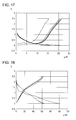
- Fig. 17 the charge discharge characteristics in the case of Example 5 are shown.
- the charge capacities were 22, 17, 22, 22, and 23, and the discharge capacities were 21, 16, 21, 21, and 22.
- Fig. 18 the charge discharge characteristics in the case of Example 6 are shown.
- the charge capacities were 100, 67, and 65, and the discharge capacities were 63, 62, and 61.
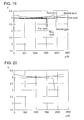
- Example 5 By the use of the negative electrode of Example 5, a coin cell (full cell) was formed in a manner similar to that of Example 3, and the charge discharge characteristics were measured. As a result, as shown in Fig. 19 , the charge and discharge potentials were stable from 3.8 to 4.1 V, and as for the charge-discharge capacity ( ⁇ Ah) from a first to a third cycle, the charge capacities were 2,499, 2,421, and 1,996, and the discharge capacities were 1,557, 1,972, and 1,580, so that it was found that excellent charge discharge characteristics were obtained.
- the discharge capacity at the first cycle based on the deposition amount assumed as that in Examples 1 and 2 was high, such as approximately 35,220 mAh/g.
- Example 6 By the use of the negative electrode of Example 6, a coin cell (full cell) was formed in a manner similar to that of Example 3, and the charge discharge characteristics were measured. As a result, as shown in Fig. 20 , the charge and discharge potentials were stable from 3.8 to 4.1 V, and as for the charge-discharge capacity ( ⁇ Ah) at a first cycle, the charge capacity was 2,280, and the discharge capacity was 1,869, so that it was found that excellent charge discharge characteristics were obtained.
- the discharge capacity at the first cycle based on the deposition amount assumed as that in Examples 1 and 2 was high, such as approximately 42,280 mAh/g.
- Example 9 relates to a half cell using a negative electrode in which carbon nanochips were formed on a substrate processed with no oxygen cleaning step
- Example 10 relates to a full cell which used the negative electrode of Example 9.
- a pure iron plate (purity: 99.95%, manufactured by The Nilaco Corp.) having a thickness of 50 ⁇ m was punched out to form a disc having a diameter of 16 mm, and this disc was used as the substrate.
- a carbon nanochips layer was formed under the same conditions as those of Example 1.
- Example 9 By the use of the negative electrode formed as described above in Example 9, a secondary cell (half cell) was formed using a lithium metal as a counter electrode, and the charge discharge characteristics were measured in a manner similar to that of Example 1.
- Fig. 21 the charge discharge characteristics in the case of Example 9 are shown.
- the charge-discharge capacity ( ⁇ Ah) from a first to a fifth cycle the charge capacities were 54, 31, 30, 29, and 29, and the discharge capacities were 28, 27, 27, 27, and 27.
- Example 9 By the use of the negative electrode of Example 9, a full cell was formed in a manner similar to that of Example 3, and the charge discharge characteristics were measured. As a result, as shown in Fig. 22 , the charge and discharge potentials were stable from 3.8 to 4.1 V, and as for the charge-discharge capacity ( ⁇ Ah) from a first to a third cycle, the charge capacities were 2,499, 2,139, and 1,784, and the discharge capacities were 1,393, 1,734, and 1,330, so that it was found that excellent charge discharge characteristics were obtained.
- the discharge capacity at the first cycle based on the deposition amount assumed as that in Examples 1 and 2 was high, such as approximately 31,510 mAh/g.
- a lithium-ion secondary cell using the negative electrode for a lithium-ion secondary cell of the present invention When a lithium-ion secondary cell using the negative electrode for a lithium-ion secondary cell of the present invention is applied to a cell for an electronic apparatus, such as a mobile phone, a tablet terminal, or a personal computer, the operation time thereof can be significantly increased.
- the above lithium-ion secondary cell is applied to a power source of a transport apparatus, such as an automobile, although the weight and the volume of the lithium-ion secondary cell are similar to those of a related cell, a surprisingly long drive distance can be realized.
- a large-scale cell formed by the present invention can be used for electric power storage of natural energy generated by solar cells and/or wind power generation and also used as measures to respond to a rapid increase in electric power demand in summer time.
Landscapes
- Chemical & Material Sciences (AREA)
- Engineering & Computer Science (AREA)
- Chemical Kinetics & Catalysis (AREA)
- Electrochemistry (AREA)
- General Chemical & Material Sciences (AREA)
- Materials Engineering (AREA)
- Nanotechnology (AREA)
- Manufacturing & Machinery (AREA)
- Inorganic Chemistry (AREA)
- Physics & Mathematics (AREA)
- Condensed Matter Physics & Semiconductors (AREA)
- General Physics & Mathematics (AREA)
- Crystallography & Structural Chemistry (AREA)
- Organic Chemistry (AREA)
- Composite Materials (AREA)
- Battery Electrode And Active Subsutance (AREA)
- Carbon And Carbon Compounds (AREA)
- Cell Electrode Carriers And Collectors (AREA)
- Secondary Cells (AREA)
Abstract
Description
- The present invention relates to a negative electrode for a lithium-ion secondary cell and a method for manufacturing the same.
- In recent years, mobile type electronic apparatuses, such as a mobile phone and a notebook personal computer, have played an important role in the information society. Those electronic apparatuses are required to be driven for a long time, and inevitably, a secondary cell functioning as a drive power source has been desired to have a higher energy density. As power sources for those electronic apparatuses and transport apparatuses, such as a vehicle, a light-weight lithium-ion secondary cell capable of having a high energy density is required to have higher performance.
- A lithium-ion secondary cell has the structure in which an electrolytic solution containing a non-aqueous solvent and a lithium salt dissolved therein or a lithium solid electrolyte is provided between a negative electrode active material and a positive electrode active material, and lithium ions are moved back and forth between the negative electrode active material and the positive electrode active material and are intercalated in the active material applied on a collector substrate of a negative electrode, so that charge and discharge can be performed.
- As the negative electrode active material for a lithium-ion secondary cell, although amorphous carbon having a relatively low crystallinity was used when a lithium-ion cell was first introduced on the market, in recent years, an artificial graphite material which has a high specific gravity and which is likely to obtain a high energy density has been mainly used. In general, graphite grains or carbon nanotubes, each having a high crystallinity, are mixed with a binder and then applied to a collector substrate
- Although a carbon nanotube is categorized into a one-dimensional carbon nanostructure which is grown in one direction from a substrate surface by a plasma CVD method or the like, a carbon nanowall has been known which is categorized into a two-dimensional structure grown in a sheet shape on a substrate surface in a direction perpendicular thereto with a graphite layer or an amorphous layer provided therebetween (
PTLs 1 to 4 andNPLs 1 and 2).PTL 4 has proposed that in a method for manufacturing carbon nanowalls in which carbon nanowalls are formed on a substrate surface in a plasma atmosphere of hydrogen and a raw material substance containing carbon and fluorine as constituent elements, by addition of oxygen atom radicals or radicals of molecules containing oxygen to the plasma atmosphere, the crystallinity of the carbon nanowall (CNW) is improved. - The carbon nanowall is a crystal which is formed from nano-size graphite crystallites and which has a relatively high completeness. The carbon nanowall is a plate-like nanostructure which is formed of approximately several to one hundred of graphene sheets overlapped with each other and which has a thickness of several to several tens of nanometers. Although a wall height of the carbon nanowall is increased to several hundreds to several thousands of nanometers in proportion to a growth time, the growth of a wall thickness is saturated up to approximately 40 nm.
- In the growth of the carbon nanotubes (CNT), although the presence of catalytic metal particles, such as iron or cobalt, on a substrate surface is essential, in the case of the carbon nanowalls, catalytic metal particles are not particularly required. It has been known that by using a plasma CVD apparatus, when a carbon source gas is supplied at a substrate temperature of approximately 400°C to 500°C and an in-chamber pressure of approximately 100 Pa or less, the carbon nanowall grows on a substrate selectively in a direction opposite to that in which an active species effective for the grown comes down.
- As a negative electrode material to be used for improvement in high-speed charge/discharge characteristics of a lithium-ion secondary cell, it is considered that the carbon nanowall has an ideal structure, and attention has been paid thereto as the negative electrode material (
NPL 3 andPTLs 5 and 6).PTL 5 has disclosed that the carbon nanowall is a micrographite having a height of several micrometers and can be obtained by a vapor phase growth method without using catalysts in which a raw material gas is supplied onto a substrate at a temperature of 700°C to 1,000°C and a pressure of 0.5×10⁻³ to 1.0×10⁻² Torr. - In addition, PTL 6 has disclosed a rapid charge/discharge type thin lithium cell in which flaky carbon nanowalls formed of aggregates of oriented crystallites each having a size of 10 to 30 nm are vapor-phase grown on a collector substrate to stand in a direction perpendicular thereto and are used as the negative electrode without any modification.
- However, in a negative electrode using graphite, such as carbon nanowalls, the number of lithium atoms which can be intercalated between graphite layers is one atom per six carbon atoms, and the maximum charge-discharge capacity is limited to 372 mAh/g.
- Amorphous hard carbon has also been known as a carbon material of the negative electrode of a lithium-ion secondary cell. However, although having a charge capacity exceeding the theoretical capacity of graphite, the hard carbon has various shortcomings, such as a large irreversible capacity and a small discharge capacity per volume.
- Accordingly, silicon theoretically capable of obtaining a charge-discharge capacity exceeding that of a carbon-based negative electrode material, an alloy primarily containing silicon, a silicon oxide, and the like have drawn attention as the negative electrode material. The reason for this is that since silicon can be used as the negative electrode active material by forming an alloy with lithium and can also incorporate a large number of lithium atoms as compared to that of graphite, an increase in capacity of a lithium-ion secondary cell can be expected (for example, see
NPL 4 and PTLs 7 to 9). - However, although silicon is a material having a significantly high capacity as compared to that of a carbon material, the volume of alloyed silicon which occludes lithium ions is increased by approximately 4 times that of silicon before occlusion. Hence, a negative electrode using silicon as the negative electrode active material is repeatedly expanded and contracted in synchronism with charge discharge cycles, and as a result, the negative electrode active material is mechanically destroyed. When silicon is used as the negative electrode active material of a lithium-ion secondary cell, in particular, the negative electrode active material is seriously degraded by the charge discharge cycles described above, and when charge and discharge are repeatedly performed several times, the cell capacity is almost lost.
- Accordingly, as a method to overcome the shortcoming as described above, there have been developed a negative electrode for a lithium-ion secondary cell in which after a carbon nanostructure layer is formed by applying a slurry of carbon nanofibers or carbon nanotubes to electrically conductive collector foil formed of copper, titanium, nickel, or the like, followed by firing, a silicon layer having a thickness of 100 to 500 nm is further formed on the above carbon nanostructure layer by sputtering to form a composite nanostructure layer containing silicon and carbon (
NPL 5 and PTL 10) and a negative electrode for a lithium-ion secondary cell in which a film of nanoscale silicon grains is deposited on surfaces of carbon nanotubes (PTL 11). - Furthermore, a negative electrode material has also been proposed in which a negative electrode active material formed of grains or coating films of silicon or the like is fixed to vertical wall surfaces of graphene sheets of carbon nanowalls formed on a collector substrate, and the change in volume of the negative electrode active material in synchronism with charge discharge cycles is reduced by the spaces between the graphene sheets of the carbon nanowalls so as to increase the capacity (PTL 12 and NPL 6).
-
- PTL 1:
US2003/0129305A - PTL 2: Domestic Re-publication of
PCT International Publication for Patent Application No. WO2005/021430 - PTL 3: Japanese Unexamined Patent Application Publication No.
2006-312577 - PTL 4: Japanese Unexamined Patent Application Publication No.
2008-239357 - PTL 5: Japanese Unexamined Patent Application Publication No.
2008-063196 - PTL 6: Japanese Unexamined Patent Application Publication No.
2010-009980 - PTL 7: Japanese Unexamined Patent Application Publication No.
2003-077529 - PTL 8:
US2004/0126659A - PTL 9: Japanese Unexamined Patent Application Publication No.
2007-194204 4671950 - PTL 10:
US2011/0311874A - PTL 11: Japanese Unexamined Patent Application Publication (Translation of PCT Application) No.
2009-521082 - PTL 12: Japanese Unexamined Patent Application Publication No.
2011-103256 -
- NPL 1: Mineo Hiramatus et al., "Oriented Growth Of Carbon Nanowalls by RF Plasma CVD", J. Plasma Fusion Res. Vol. 81, No. 9, (2005), 669 to 673
- NPL 2: Akihiko Yoshimura et al., "Creation and Structure Evaluation of Novel Carbon Nanomaterial by Plasma CVD", IHI Technical Report, Vol. 48, No. 3, (2008 to 2009), 176 to 181
- NPL 3: Masaru Tachibana, "High-speed charge/discharge characteristics of carbon nanowalls for negative electrode material for lithium-ion secondary cell", Materia Japan, Vol. 49, No. 7, 320 to 322 (2010)
- NPL 4: Uday Kasavajjula et at., "Nano-and bulk-silicon-based insertion anodes for lithium-ion secondary cells", Journal of Power Sources, 163, (2007), 1003 to 1039
- NPL 5: Po-Chiang Chen et al., "Hybrid Silicon-Carbon Nanostructured Composites as Superior Anodes for Lithium Ion Batteries", Nano Research, 4, Num. 3, 290 to 296, (2011)
- NPL 6: Victor A. Krivchenko et al., "Carbon nanowalls decorated with silicon for lithium-ion batteries", CARBON, 50, (2012), 1438 to 1442, Available on line, 29 October 2011
- As described above, by the use of a related negative electrode using graphite as an active material, the theoretical limit is generated in the charge-discharge capacity. In the rapid charge/discharge type thin lithium cell disclosed in
NPL 3 and PTL 6, end surfaces of the carbon nanowalls exposed to an electrolytic solution are each used as an inlet and an outlet of lithium ions, and the discharge capacity is approximately several hundreds of milliampere·hour/g and cannot be further increased. - In addition, in the case in which silicon is used as a negative electrode material of a lithium-ion cell, since the volume is remarkably changed when an alloy is formed between silicon and lithium, the negative electrode material is collapsed by repeatedly performed charge and discharge, and as a result, stable charge/discharge performance cannot be disadvantageously maintained.
- The present invention was made to solve the existing problems described above and aims to provide a negative electrode for a lithium-ion secondary cell, the negative electrode having a novel structure in which a carbon used for the negative electrode has a significantly far larger charge-discharge capacity per unit weight than the theoretical capacity of graphite and in which the structure of a negative electrode surface is stable against repeatedly performed charge and discharge; and also aims to provide a lithium-ion secondary cell which uses the negative electrode described above and which has a significantly large charge-discharge capacity.
- In order to achieve the above object, intensive research on various negative electrodes for lithium-ion secondary cells using carbon materials was carried out by the present inventors. As a result, it was found that when carbon formed of nanosize graphene sheets, such as carbon nanowalls, is used as a carbon material for the negative electrode, and when an iron-based metal material is used as a substrate on which the graphene sheets are grown, a carbon nanostructure having novel configuration and characteristics can be grown. In addition, an unexpected fact was also found that when a lithium-ion secondary cell is formed by using this carbon nanostructure as a negative electrode surface without any modifications, the charge-discharge capacity is significantly increased. As a result, the present invention was completed.
- That is, the negative electrode for a lithium-ion secondary cell of the present invention is characterized in that a carbon layer is formed from graphene sheets grown on a surface of an iron-based metal substrate so as to stand in oblique directions with respect to the surface thereof, and the carbon layer is used as a negative electrode surface. In addition, the negative electrode for a lithium-ion secondary cell of the present invention is characterized in that the carbon layer is formed of a carbon nanochips layer of graphene sheets grown slantingly from the surface of the substrate in various directions.
- This carbon nanochips layer is one group of nanocarbon structures which are independently and slantingly grown from the surface of the iron-based metal substrate in irregular directions. The coverage of the substrate surface by this carbon nanochips layer is preferably 100%. The "coverage" in this case indicates the rate of the substrate surface covered with carbon nanochips when viewed in a direction perpendicular to the substrate surface, the coverage of the surface substrate which is not covered at all is 0%, and the coverage of the surface substrate which is covered without any spaces between the carbon nanochips is 100%.
- The iron-based metal substrate may be either a thin plate or foil formed from any one of pure iron, carbon steel, stainless steel, and an iron alloy. In addition, the iron-based metal substrate may be formed from a material used as a negative electrode collector. In addition, the iron-based metal substrate may be a substrate having an iron-based metal coating layer formed on a surface of a collector substrate.
- Unlike a related carbon nanowall which is grown to stand approximately perpendicular to the substrate surface, this carbon nanostructure is grown slantingly in various and oblique directions with respect to the substrate surface so as to cover the substrate surface and has a flaky shape similar to that of a potato chip (hereinafter appropriately referred to as "carbon nanochip", and the aggregate thereof will be referred to as "carbon nanochips").
- In a Raman spectrum of graphite of this carbon nanochips layer measured using an argon laser having a wavelength of 532 nm, g/d is in a range of 0.30 to 0.80 (g represents the peak intensity of a g band at approximately 1,600 cm-1 caused by in-plane hexagonal lattice vibration of carbon atoms, and d represents the peak intensity of a d band at approximately 1,360 cm-1 which indicates a graphite defect).
- The negative electrode for a lithium-ion secondary cell of the present invention can be manufactured by a method comprising a step of forming a carbon nanochips layer on a negative electrode substrate by a CVD method using a mixed gas containing hydrogen and methane under the conditions in which a flow rate ratio of H2/CH4, a substrate temperature, a DC bias voltage, and a growth time are set to 1/5 to 2/1, 650°C to 850°C, -200 to 0 V, and 15 minutes to 2 hours, respectively, the carbon nanochips layer being formed from graphene sheets independently grown from the negative electrode substrate surface to stand slantingly in various directions, that is, in irregular directions.
- In addition, before the above plasma CVD method is performed, an oxygen cleaning step is preferably performed by generating plasma in a chamber in the presence of oxygen. The oxygen cleaning is performed before the substrate is set in the chamber so as to clean the inside thereof together with electrodes or is performed after the substrate is set in the chamber so as to clean the inside thereof together with the substrate surface.
- From the Raman spectrum, it is found that as compared to a known carbon nanowall which is grown to stand vertically, the carbon nanochip has a low crystallinity. In addition, an amorphous phase formed at an initial growth stage remains as it was. Incidentally, Raman spectroscopy is an effective method for evaluating carbon materials since sensitively reflecting the structures of various carbon materials. According to Raman spectroscopy, a graphite single crystal shows a single band at 1,581 cm-1; as the structure of a carbon material is disordered, a new band at approximately 1,360 cm-1 is generated, and the intensity thereof is gradually increased; and next, the band at approximately 1,580 cm-1 is shifted to a high frequency side, and the widths of the two bands are gradually increased. It has been reported that according to a typical carbon nanowall, peaks at approximately 1,590 cm-1 (g band: peak derived from graphite), approximately 1,350 cm-1 (d band: peak caused by a defect or the like), and approximately 1,620 cm-1 (d': peak characteristic of CNW which is believed to appear when the crystal size of graphite is small or a large number of edges of graphene sheets are present) are observed (NPL 1).
- Since the carbon nanochip has a low crystallinity and many structural defects, such as crystal defects, at voids of graphene networks, spaces between graphene sheets, and front end sides at which carbon nanochips are brought into contact with each other, it is believed that when a thin film layer of carbon nanochips is used as a negative electrode surface for a lithium-ion secondary cell, lithium ions passing through those structural defects are intercalated in each carbon nanochip and/or the spaces between the carbon nanochips and are occluded in the negative electrode at the beginning of charge.
- A lithium-ion secondary cell using the negative electrode for a lithium-ion secondary cell of the present invention is assembled such that the carbon nanochips layer is used as a negative electrode surface and is directly brought into contact with an electrolytic solution for a lithium-ion secondary cell. According to the test results obtained by the present inventors, a lithium-ion secondary cell using a carbon having the nanostructure as described above as the negative electrode surface shows a significantly large charge-discharge capacity. In addition, the charge-discharge capacity described above is a capacity surprisingly far larger than the theoretical electrical capacity obtained from the model in which lithium enters between atoms of a carbon crystal by intercalation. Although the reason of this surprisingly high charge-discharge capacity has not been clearly understood, the following is inferred.
- That is, according to the present invention, it is believed that since the iron-based metal is used as the substrate on which a carbon having a nanostructure is grown, when graphene sheets are formed by supplying a carbon source gas on the substrate using a vapor phase method, iron which is a substrate component is exposed to the carbon source to generate fine grains of iron, iron oxide, iron carbide, and/or the like, the components of those fine grains are precipitated on the topmost surface of the substrate, and a small amount of the components is incorporated in the graphene sheets. When the iron-based metal is, for example, stainless steel containing Cr, Ni, and/or the like, it is believed that fine grains of those components or oxides thereof are also generated and precipitated on the topmost surface of the substrate, and in addition, a small amount of the components or the like is incorporated in the graphene sheets.
- When a lithium-ion secondary cell is charged after the negative electrode thus obtained is assembled therein, since the substances formed of the above metal nano grains, oxide nano grains, and/or carbide nano grains function as a catalyst, lithium ions are allowed to react with an organic electrolyte or an organic electrolytic solution to form an organic compound containing lithium, and this organic compound is precipitated on the graphene sheets. Since the organic compound containing lithium is continuously formed as a thin film having a predetermined thickness on the negative electrode, a large amount of lithium ions is occluded in this thin film, and hence a large charge-discharge capacity is obtained.
- That is, although in a negative electrode using related carbon, the upper limit of the charge-discharge capacity is determined by the intercalation amount of lithium ions between atomic layers of crystals of graphite, in the present invention, the charge-discharge capacity is determined by the amount of the organic compound containing lithium, which is continuously formed on a thin film layer of the carbon nanochips of the negative electrode, the upper limit of the charge-discharge capacity determined by the intercalation amount of lithium ions is not present, and hence a large charge-discharge capacity is obtained.
- When a lithium-ion secondary cell using the negative electrode of the present invention is charged, a lithium-ion secondary cell in which the organic compound layer containing lithium is formed on the carbon nanochips layer is obtained. In addition, since a mechanism in which the organic compound layer containing lithium is decomposed during discharge works, the structure of the negative electrode surface is stable since being hardly changed by repeatedly performed charge and discharge. In this cell, besides the intercalation, because of the generation of the organic compound containing lithium by a catalytic function, the charge-discharge capacity is not proportional to the amount of the active material of the negative electrode, and hence, significant reduction in size and weight of the cell can be achieved. In addition, as is a related lithium-ion secondary cell, a high potential drive at approximately 3.2 to 4.2 V can also be performed.
- As is the negative electrode for a lithium-ion secondary cell of the present invention, there has not been known a negative electrode having a mechanism in which an organic compound layer containing lithium is formed on a negative electrode surface during charge, and this organic compound layer containing lithium is decomposed during discharge, and in addition, a secondary cell using the negative electrode as described above has also not been known in the past.
- In a related intercalation type lithium-ion secondary cell using a charge discharge mechanism in which lithium ions are occluded in and released from an electrode active material, since the material has an intrinsic theoretical limit of the occlusion amount of lithium ions, the charge-discharge capacity per volume or weight of the cell is limited by an active material to be used. On the other hand, in a secondary cell using the negative electrode for a lithium-ion secondary cell of the present invention, as long as the space in which the organic compound layer containing lithium can be continuously formed on the negative electrode surface and a sufficient amount of an electrolytic solution are provided, a surprisingly large charge-discharge capacity can be ensured.
- As described above, the negative electrode for a lithium-ion secondary cell of the present invention is driven not only by the occlusion mechanism of lithium ions in the negative electrode active material as that of a related lithium-ion secondary cell but also by the charge-discharge mechanism in which the organic compound layer containing lithium is formed and decomposed on the negative electrode surface, and the chemical reaction at the interface between the carbon covering the entire surface of the negative electrode and the electrolytic solution is used; hence, the volume of the active material of the negative electrode is not influenced by the charge-discharge capacity, and significant reduction in size and weight of the cell can be achieved.
-
- [
Fig. 1] Fig. 1 shows charts of Raman spectra of graphite of carbon nanochips layers grown on SUS304 stainless steel sheets at substrate temperatures of 750°C (A) and 600°C (B). - [
Fig. 2] Fig. 2 is a schematic cross-sectional view showing one structure of a plasma CVD apparatus used to form a carbon nanochips layer. - [
Fig. 3] Fig. 3 is an electron microscopic photo substituted for drawing of a carbon nanochips layer grown on a SUS304 stainless steel sheet when viewed from the above of a substrate surface. - [
Fig. 4] Fig. 4 is a transmission electron microscopic photo substituted for drawing of a carbon nanochips layer (TEM bright-field image, x240,000 times). - [
Fig. 5] Fig. 5 is a transmission electron microscopic photo substituted for drawing of the carbon nanochips layer (portion enclosed by a dotted line at the right side ofFig. 4 , x2,000,000 times). - [
Fig. 6] Fig. 6 shows electron beam diffraction images of the carbon nanochips layer by a transmission electron microscope (nano-beam electron diffraction images of points A and B ofFig. 5 , beam diameter: approximately 5 nm; a selected-area electron diffraction image of point C ofFig. 4 , selected-area diameter: approximately 600 nm, camera constant L·λ: 20.06 Å·mm). - [
Fig. 7] Fig. 7 shows Raman spectra of graphite of carbon nanochips layers of negative electrodes for a lithium-ion secondary cell of Example 1 and Comparative Example 1. - [
Fig. 8] Fig. 8 is a graph showing charge discharge characteristics (half cell) of the negative electrode for a lithium-ion secondary cell of Example 1. - [
Fig. 9] Fig. 9 is a graph showing charge discharge characteristics (half cell) of a negative electrode for a lithium-ion secondary cell of Example 2. - [
Fig. 10] Fig. 10 is a transmission electron microscopic photo substituted for drawing of a cross section of the negative electrode for a lithium-ion secondary cell of Example 1 after charge is performed (magnification: 24,000 times). - [
Fig. 11] Fig. 11 is a transmission electron microscopic photo substituted for drawing of a cross section of the negative electrode for a lithium-ion secondary cell of Example 2 after charge is performed (magnification: 24,000 times). - [
Fig. 12] Fig. 12 is a transmission electron microscopic photo substituted for drawing of a cross section of the negative electrode for a lithium-ion secondary cell of Example 1 after discharge is performed (magnification: 24,000 times). - [
Fig. 13] Fig. 13 is a transmission electron microscopic photo substituted for drawing of a cross section of the negative electrode for a lithium-ion secondary cell of Example 2 after discharge is performed (magnification: 24,000 times). - [
Fig. 14] Fig. 14 is a schematic cross-sectional view of a lithium-ion secondary cell of each of Examples 3, 4, 7, 8, and 10. - [
Fig. 15] Fig. 15 is a graph showing charge discharge characteristics (full cell) of the secondary cell of Example 3. - [
Fig. 16] Fig. 16 is a graph showing charge discharge characteristics (full cell) of the secondary cell of Example 4. - [
Fig. 17] Fig. 17 is a graph showing charge discharge characteristics (half cell) of a negative electrode for a lithium-ion secondary cell of Example 5. - [
Fig. 18] Fig. 18 is a graph showing charge discharge characteristics (half cell) of a negative electrode for a lithium-ion secondary cell of Example 6. - [
Fig. 19] Fig. 19 is a graph showing charge discharge characteristics (full cell) of the secondary cell of Example 7. - [
Fig. 20] Fig. 20 is a graph showing charge discharge characteristics (full cell) of the secondary cell of Example 8. - [
Fig. 21] Fig. 21 is a graph showing charge discharge characteristics (half cell) of a negative electrode for a lithium-ion secondary cell of Example 9. - [
Fig. 22] Fig. 22 is a graph showing charge discharge characteristics (full cell) of the secondary cell of Example 10. - In a negative electrode for a lithium-ion secondary cell of the present invention, a substrate on which a carbon nanochips layer is to be grown is formed of an iron-based metal thin plate or foil. In the present invention, in order to form the carbon nanochips layer, although the substrate is required to have heat resistance since the temperature thereof is set to 650°C or more, an iron-based metal has a sufficient heat resistance. As the iron-based metal, for example, there may be mentioned pure iron and an alloy material, such as carbon steel, stainless steel, a Fe-Cr alloy, a Fe-Ni alloy, or a Fe-Cr-Ni alloy, containing iron as a primary component.
- As the iron-based metal as described above, a known material as a negative electrode collector material may be used. In addition, the iron-based metal substrate may be a substrate having an iron-based metal coating layer formed by a surface treatment method, such as plating or deposition, on a surface of a metal substrate of copper, a copper alloy, nickel, a nickel alloy, iron, an iron alloy, stainless steel, molybdenum, tungsten, or a tantalum, which has been used as a collector. As the stainless steel, for example, austenite stainless steel, such as SUS304, and ferrite stainless steel, such as SUS430, may be mentioned. In addition, as the negative electrode of the present invention, a carbon nanochips layer is formed from many graphene sheets grown slantingly in various direction, that is, grown slantingly in irregular directions, with respect to the surface of the iron-based metal substrate described above,.
- The carbon nanochips are graphene sheets grown using arbitrary positions of the surface of the iron-based metal substrate as growth nuclei, and the shape of each graphene sheet is a flake similar to that of a potato chip. The front ends at the growth terminal sides are in contact with each other or are very close to each other. As a result, the carbon nanochips layer covers approximately 90% or more of the substrate surface and preferably 100% thereof. In addition, since the root of each carbon nanochip is directly bonded to the substrate surface, excellent electrical conductivity with the collector is obtained. Since having a self-organizing function as is the carbon nanowall, many carbon nanochips are grown at the growth nuclei of the surface of the iron-based metal substrate with intervals of several to several tens of nanometers.
- The carbon nanochips layer is grown only to a height of up to approximately 200 nm. Although the reason for this has not been clearly understood, it is believed that in a plasma CVD method, the nuclear formation at the front end of the growth is inhibited by plasma. Although CNW is grown to a height of several micrometers, the height of the carbon nanochips layer is at most approximately 200 nm. The height (thickness) of the carbon nanochips layer is an average height obtained by observation of the cross section of the thin film layer using an electron microscope. The thickness of the graphene sheet of the carbon nanochips is approximately several to several hundreds of nanometers, preferably approximately 5 to 100 nm, and more preferably approximately 5 to 50 nm.
- Since showing a different Raman spectrum from that of the carbon nanowall, the carbon nanochips can be discriminated therefrom. That is, in a Raman spectrum of the graphene sheet forming the carbon nanochips layer which is measured using an argon laser at a wavelength of 532 nm, g/d is in a range of 0.30 to 0.80 (g represents the peak intensity of a g band at approximately 1,600 cm-1 caused by the in-plane hexagonal lattice vibration of carbon atoms, and d represents the peak intensity of a d band at approximately 1,360 cm-1 which indicates a graphite defect). Furthermore, g/d is more preferably in a range of 0.40 to 0.70.
- As shown in the charts of Raman spectra of
Fig. 1 , the g/d ratio of the graphite grown on the substrate by a plasma CVD method is changed by the substrate temperature. InFig. 1 , in the chart of the Raman spectrum of a sample (Fig. 1A ) grown at a substrate temperature of 750°C, the peak of a d' band at a shoulder of the g band of approximately 1,630 cm-1, which is characteristic of graphite forming carbon nanowalls, is also clearly observed even in the graphite forming carbon nanochips at the same level as that of the g band. However, in a sample (Fig. 1B ) grown at a substrate temperature of 600°C, the d' band is not observed, and the carbon nanochips are not grown. That is, according to the present invention, the graphene sheets forming the carbon nanochips are not grown in a direction perpendicular to the substrate surface, and for example, since the g/d ratio of the graphite is smaller than the g/d ratio of graphite of a typical nanowall, the graphene sheets of the present invention can be clearly discriminated therefrom. - Incidentally, as disclosed in
PTLs 1 and 9 andNPLs 2 and 6, as for the characteristics and the structure of the carbon nanowall (CNW) itself, the carbon nanowall has a wall structure which independently stands approximately perpendicular to the surface of the substrate and which has a thickness of several to several tens of nanometers and a width and a height of several micrometers. The CNW is formed of approximately several to one hundred of graphene sheets laminated to each other and has a flat plate shape so that the surfaces of the graphene sheets are arranged to be parallel to the surface of the CNW, and at the upper end portion of the flat plate, the end surfaces of the graphene sheets are exposed. Since the growth origin of the CNW is bonded to the substrate surface, the CNW is preferably electrically connected to the collector. - The Raman spectrum of the graphite of CNW shows a peak of a g band at approximately 1,600 cm-1 caused by the in-plane hexagonal lattice vibration of carbon atoms and a peak of a d band at approximately 1,360 cm-1 which indicates a graphite defect, and a d' peak observed at approximately 1,630 cm-1 is a peak characteristic of CNW observed when many edges of graphenes are present. As the intensity of the d peak is increased, the amount of impurities is increased. The intensity ratio g/d of the g peak to the d peak is used as an index showing the degree of graphite properties. In addition, in CNW, g/d relates to the wall size, and as g/d is decreased, the wall size is decreased.
- When stainless steel is used as the substrate, any one of austenite, martensite, and ferrite stainless steel may be used. For example, there may be used any types of stainless steel, such as austenite stainless steel (such as SUS304, SUS304-L, SUS302, SUS301, SUS310S, SUS321, SUS316, or SUS316-L), ferrite stainless steel (such as SUS430 or SUS434), martensite stainless steel (such as SUS410S or SUS420J2), and precipitation hardened stainless steel (such as SUS631 or ASL-350), defined by JIS G4305: 2005 "Cold-rolled stainless steel plate, sheet and strip".
- The thickness of the substrate is not particularly limited, and although a thickness of approximately 1 mm or less may be used without any problems, a foil material having a thickness of approximately 5 to 100 micrometers which has been used as a collector is more preferable, and a foil material having a thickness of 5 to 20 micrometers is more preferable from a practical point of view.
- In addition, the carbon nanochips can be preferably formed by a plasma CVD method using a methane-hydrogen mixed gas as a raw material. Although the specification of a plasma CVD apparatus is not particularly limited, when an apparatus having a parallel plate electrode is used, as shown in
Fig. 2 , the plate electrode including afirst electrode 81 and asecond electrode 82 is disposed in avacuum chamber 80, and asubstrate 83 is placed on thesecond electrode 82 parallel to the plate electrode. Subsequently, a mixed gas containing hydrogen and methane is supplied between the plate electrodes in parallel thereto from agas inlet 84. An electrical power is input to thefirst electrode 81 by anRF power source 85, and an RF wave is irradiated on the mixed gas for plasmanization thereof, so that a capacity coupled plasma atmosphere (CCP) is formed among thefirst electrode 81, thesecond electrode 82, and thesubstrate 83. The temperature of thesubstrate 83 is controlled by a heater (not shown) in thesecond electrode 82. Anobservation window 86 may be provided at a side surface of thevacuum chamber 80. The plasma CVD apparatus is not limited to that described above, and for example, a mixed gas may be supplied from an upper side of a vacuum chamber as disclosed inPTLs - Before the carbon nanochips layer is formed by a plasma CVD method, by an oxygen cleaning step of generating plasma in the chamber in the presence of oxygen, the inside of the chamber is preferably cleaned by oxygen cleaning. The oxygen cleaning may be performed either before or after the substrate is set in the chamber. By the oxygen cleaning, it is believed that contaminants adhered to the inside of the chamber, such as to the electrodes, is not only removed, but also the oxide film on the substrate surface is prevented from being contaminated during the formation of the carbon nanochips layer, and in addition, the metal oxide film on the substrate surface is activated by an oxygen atmosphere.
- As preferable conditions for the oxygen cleaning step, oxygen is used as a flow gas, and the gas flow rate is set to 10 to 100 sccm and preferably approximately 10 to 60 sccm. The substrate temperature is set to 60°C to 300°C, the process pressure is set to 10 to 130 Pa and preferably approximately 10 to 100 Pa, and the time is set to approximately 10 minutes to 1 hour and preferably approximately 10 to 30 minutes. In addition, the output and the frequency of an applied high-frequency wave may be set to approximately 100 to 200 W and 13.56 MHz, respectively.
- In a plasma CVD method using a methane-hydrogen mixed gas as a raw material, when the substrate temperature is set to 650°C or more under the growth conditions which will be described later, an amorphous phase is likely to be formed, and in addition, unlike a known carbon nanowall which is formed to stand perpendicularly to the substrate, a carbon nanochips layer can be easily formed in which many flaky graphene sheets are grown in various and oblique directions so as to cover the entire surface of the substrate while spaces are formed between the graphene sheets.
- The plasma CVD method is a method which, in order to activate a chemical reaction, performs a chemical vapor phase growth by plasmanizing a raw material gas. The plasma CVD represents the concept including, regardless of the type of excitation method for plasma generation, high-frequency plasma CVD using a high frequency, ECR plasma CVD applying a microwave and an ECR magnetic field, induction coupled plasma (ICP) CVD, UHF plasma CVD, VHF plasma CVD, and the like.
- In the present invention, preferable conditions of the plasma CVD method are as follows. As a flow gas, a mixed gas containing hydrogen and methane is used. In order to independently grow carbon nanochips from the substrate surface slantingly in random directions, the ratio of hydrogen to methane is preferably set to H2/CH4=1/5 to 2/1. As this ratio is decreased, the size of crystallites is increased, and g/d is decreased. Since dependent on the apparatus, although the flow rate of the mixed gas is appropriately selected in accordance with the apparatus, in general, a flow rate of approximately 10 to 500 sccm is used as a standard rate. The substrate temperature is preferably 650°C to 850°C. The process pressure in the chamber, the output of an applied high frequency wave, the frequency thereof, and the distance from the electrode to the substrate are set to 0.05 to 0.5 torr (6.7 to 66.7 Pa), approximately 50 to 200 W, 13.56 MHz, and approximately 20 to 30 mm, respectively, and the growth may be performed for approximately 15 minutes to 2 hours.
- In order to form the carbon nanochips layer, the substrate temperature is necessarily set to 650°C or more and preferably more than 700°C and is set to 850°C or less and more preferably 800°C or less. When the substrate temperature is set to a high temperature of more than 900°C, it is not preferable since the mode of crystal growth of graphite is changed, and graphite grain growth occurs. The growth time is necessarily set to 15 minutes or more. By the heating temperature of the substrate and the time therefor, the height (growth) of the carbon nanochips layer can be controlled, and carbon nanochips having a height of approximately 100 to 200 nm can be grown for approximately 1 to 2 hours. Since the nanochip shape is unlikely to be obtained as the process pressure inside the chamber is increased, a process pressure of approximately 0.05 to 0.1 Torr (6.7 to 13.3 Pa) is more preferable.
- In addition, the bias at a substrate side in the plasma CVD method is preferably set to 0 V or less in view of nanochip shape formation. Although the carbon nanochips layer is likely to be formed when the bias is 0 V or less, a bias of -100 to 0 V is preferable.
- In addition, when this method is performed, by the control of the distance from the substrate to the electrode, for example, the shape of the carbon nanochips layer can be controlled. For example, when the parallel plate is used, the distance from the electrode to the substrate is most preferably 20 to 30 mm, and when the distance is 20 mm or less, the carbon nanochip is difficult to form, and a flat shape is formed. When this distance is more than 30 mm, fine grains or flat shapes are formed.
- After the carbon nanochips layer of the negative electrode of the present invention functioning as a negative electrode surface is directly brought into contact with an electrolytic solution for a lithium-ion secondary cell and is then assembled with a positive electrode with a separator provided therebetween to form a lithium-ion secondary cell, when this lithium-ion secondary cell is charged, a lithium-ion secondary cell is formed in which an organic compound layer containing lithium is formed on the carbon nanochips layer. In this cell, the volume of the active material of the negative electrode is not influenced by the charge-discharge capacity, and significant reduction in size and weight of the cell can be achieved. In addition, as is a related lithium-ion secondary cell, a high potential drive at approximately 3.2 to 4.2 V can also be performed.
- After the negative electrode for a lithium-ion secondary cell of the present invention is used in combination with a positive electrode formed of LiCoO2 or the like, and an electrolytic solution for a lithium-ion secondary cell, such as an electrolytic solution formed of ethylene carbonate and dimethyl carbonate, is also used to form a lithium-ion secondary cell, when this lithium-ion secondary cell is charged, on the negative electrode surface, an organic compound layer containing lithium is formed from an organic compound containing lithium. Since this organic compound layer containing lithium is primarily formed of lithium and carbon derived from the electrolytic solution and is continuously grown on the negative electrode surface, the organic compound layer containing lithium is increased in its thickness and reaches the positive electrode or is continuously grown until the reaction of the electrolytic solution is finished, and as a result, a large charge capacity can be realized. Furthermore, while the organic compound layer containing lithium is decomposed during discharge, lithium ions are returned to the electrolytic solution, so that a reversible reaction occurs by charge and discharge. Hence, the charge discharge cycle characteristics are also excellent.
- The features of the charge discharge reaction as described above are obtained since the formation of the organic compound layer containing lithium and the decomposition thereof are performed in the cell at a base potential. In consideration of a half cell reaction experiment, a secondary cell (full cell) reaction, and the like, it is inferred that the formation of the organic compound layer containing lithium and the decomposition thereof are performed in a range of -0.5 to -3.5 V with respect to a hydrogen standard potential, and that charge and discharge are performed at approximately the same potential as that in the case of a negative electrode using related graphite. That is, a high potential drive at approximately 3.2 to 4.2 V, which is the feature of a related lithium-ion secondary cell, can be performed.
- An organic solvent and an electrolyte of the electrolytic solution, the positive electrode, the separator, the structure of a package container forming this secondary cell, the size thereof, and the like are not particular limited, and those which have been known may be used. A positive electrode collector may be formed, for example, from aluminum, nickel, or stainless steel. The positive electrode active material may include a lithium oxide, a composite oxide containing lithium and a transition metal, a lithium sulfate, an interlayer compound containing lithium, a lithium phosphate compound (such as iron lithium phosphate, manganese lithium phosphate, or iron manganese lithium phosphate), or the like. The separator may be formed of a porous film of a polyolefin, such as polypropylene (PP) or polyethylene (PE), or a ceramic porous film.
- As a nonaqueous organic solvent, ethylene carbonate, propylene carbonate, dimethyl carbonate, diethyl carbonate, and ethyl methyl carbonate are preferable. In order to improve flame retardancy of the electrolytic solution, a fluoroether may also be used. The nonaqueous organic solvent may also contain an additive, such as an organic silicone compound.
- As an electrolytic salt, for example, there may be mentioned lithium hexafluorophosphate (LiPF6), lithium tetrafluoroborate (LiBF4), lithium perchlorate (LiClO4), lithium hexafluoroarsenate (LiAsF6), bis(pentafluoroethane sulfonyl)imide lithium (LiN(C2F5SO2)2), lithium trifluoromethane sulfonate (LiCF3SO3), bis(trifluoromethane sulfonyl)imide lithium (LiN(CF3SO2)2), lithium tris(trifluoromethane sulfonyl)methide (LiC(CF3SO2)3), lithium chloride (LiCl), or lithium bromide (LiBr). In addition, a gel electrolyte may also be used. Furthermore, an electrolytic solution containing an ionic liquid and a lithium salt may also be used.
- Hereinafter, Examples 1 to 4 in which a SUS304 stainless steel sheet was used as the iron-based metal substrate will be described. Example 1 relates to a half cell which used a negative electrode in which carbon nanochips were formed on a substrate processed with no oxygen cleaning step, Example 2 relates to a half cell which used a negative electrode in which carbon nanochips were formed on a substrate processed by an oxygen cleaning step, and Examples 3 and 4 relates to full cells which used the negative electrodes of Examples 1 and 2, respectively.
- A stainless steel sheet (SUS304 used in Example 1-1, SUS316 used in Example 1-2, and SUS430 used in Example 1-3) having a thickness of 1 mm was punched out to form a disc having a diameter of 16 mm, and this disc was used as the substrate.
- Next, after the stainless steel sheet punched out into a disc shape was placed in a chamber of a plasma CVD apparatus (see
Fig. 2 ), plasma CVD was performed under the following conditions. - Flow gas mixed gas of hydrogen (10 percent by volume) + methane (50 percent by volume); Mixed
gas flow rate 60 sccm; Substrate temperature 750°C; Process pressure 0.1 torr (13.3 Pa);Time 1 hour; DC bias voltage 0 V; Output of applied high frequency wave 100 W; Frequency of applied high frequency wave 13.56 MHz; Distance from electrode tosubstrate 25 mm. - A scanning electron microscopic photo of a surface of a sample of Example 1-1 thus obtained is shown in
Fig. 3 . In addition, from transmission electron microscopic photos (seeFigs. 4 and 5 ) and electron beam diffraction photos (seeFig. 6 ) of the sample thus obtained, it was found that a thin film layer formed so as to cover the surface of the stainless steel sheet was a layer in which many flaky graphene sheets were grown in irregular directions and in close contact with each other and that carbon nanochips, which were flaky nanostructures, each formed an extremely small crystal. - From the electron microscopic photo of
Fig. 3 , it is found that although flat carbon crystals characteristic of the carbon nanowalls are observed, unlike a related carbon nanowall which has been known, the growth direction thereof is not strictly perpendicular to the substrate, the crystals are independently grown from the substrate surface slantingly in irregular directions, and the front end sides of the grown crystals are brought into contact with each other or are close to each other so as to cover the substrate surface. The height (thickness) of the carbon nanochips layer obtained by observation of the cross section of the thin film layer using an electron microscope was approximately 50 to 100 nm. - In addition, in Example 1-2 in which the substrate formed of SUS316 was used and Example 1-3 in which the substrate formed of SUS430 was used, carbon nanochips layers were formed, and the same result was also obtained as that in Example 1-1 in which the substrate formed of SUS304 was used.
- In Comparative Example 1, by a known method (method disclosed in Japanese Unexamined Patent Application Publication No.
2008-239369 - Raman spectra of the samples of Example 1 and Comparative Example 1 were measured by a microscopic laser Raman spectroscopic apparatus (Horiba LabRAMHR-800) using an argon laser having a wavelength of 532 nm. The results are shown in
Fig. 7 . FromFig. 7 , g/d of Example 1 was 0.42, and g/d of Comparative Example 1 was 0.28, so that it was found that the crystallinity of graphite of Example 1 was lower than that of Comparative Example 1. - In Example 2, before the formation of the carbon nanochips layer by a plasma CVD in Example 1, in the state in which the substrate and the plasma CVD electrodes were set in the chamber, an oxygen cleaning step was performed under the following conditions. The other conditions were the same as those of Example 1 in which the formation of the carbon nanochips layer was performed by a plasma CVD method at a substrate temperature of 750°C, and description thereof will be omitted.
-
Flow gas 100% of oxygen;Gas flow rate 60 sccm; Substrate temperature controlled at 80°C as minimum and 180°C as maximum; Process pressure 0.8 Torr (100 Pa);Time 1 hour; Output of applied high frequency wave 100 W; Frequency of applied high frequency wave 13.56 MHz. - By the use of the negative electrode for a lithium-ion secondary cell formed as described above in each of Examples 1 and 2, a secondary cell (half cell) was formed using the carbon nanochips layer as a negative electrode surface and a lithium metal as a counter electrode with a polyethylene separator provided therebetween, and the charge discharge characteristics of the cell were measured. As the electrolytic solution, the ratio of ethylene carbonate to dimethyl carbonate was set to 1 to 1, lithium hexafluorophosphate (LiPF6) was used as the electrolyte, and the concentration thereof was set to 1 mol/L. Evaluation of the charge discharge characteristics was performed using a constant current (CC) mode in a temperature environment of 25°C, and at a C rate of 0.1 in charge and discharge, charge was performed to a final charge voltage of 0 V, and discharge was performed to a final discharge voltage of 2.5 V.
-
Fig. 8 is a graph showing the charge discharge characteristics in the case of Example 1, andFig. 9 is a graph showing the charge discharge characteristics in the case of Example 2. In Example 1, the charge capacity was approximately 90 µAh, and the discharge capacity was approximately 50 µAh, and in Example 2, the charge capacity was approximately 255 µAh, and the discharge capacity was approximately 130 µAh. Although it is estimated that the specific gravity of the carbon nanochips is smaller than that of graphite, since the thickness of the carbon nanochip is small, such as 100 nm or less, accurate measurement of the mass and volume thereof was difficult to perform. Accordingly, when it is assumed that the specific gravity is 2.2 g/cm3, which is the specific gravity of graphite, the filling rate is 100%, the electrode area is 2.0 cm2, and the height of the carbon nanochips layer is 100 nm, the weight thereof is calculated to be 44.21 µg. When this weight is assumed as a deposition amount, as an assumed minimum value of the discharge capacity per unit weight obtained from the above discharge capacity, approximately 1,130 mAh/g and approximately 2,940 mAh/g were obtained in Examples 1 and 2, respectively. This discharge capacity is significantly far higher than 372 mAh/g, which is the theoretical discharge capacity calculated from the amount of lithium (one lithium atom per 6 carbon atoms) that can be intercalated between the layers of graphene sheets. - The reason for this surprising result is inferred as follows. That is, beside the ion occlusion between the graphite layers forming carbon nanochips and between the carbon nanochips, since the organic compound layer containing lithium which occludes lithium is formed on the carbon nanochips, the charge-discharge capacity is dramatically increased. As shown in
Figs. 10 and11 , by a transmission electron microscopic photo of a cross section of the negative electrode taken after the cell is charged, it is confirmed that as this organic compound layer containing lithium, a certain type of layer is formed. In addition, by the composition analysis using EDX, carbon, fluorine, and lithium are detected in the above layer, so that an organic compound containing lithium formed by charge is confirmed. On the other hand, inFigs. 12 and13 , the organic compound layer is not observed at all on the surface of the negative electrode by a transmission electron microscopic photo of a cross section of the negative electrode taken after the cell is discharged, and hence it is confirmed that lithium is released. In addition, it is also found that the structure of the surface of the negative electrode is not changed. - Since the charge-discharge capacity of Example 1 was significantly different from that of Example 2, and the rising rate of charge and discharge of the negative electrode of Example 2 in which the oxygen cleaning was performed was fast as compared to that of the negative electrode of Example 1 in which the oxygen cleaning was not performed, it was found that the secondary cell of Example 2 had superior performance to that of Example 1.
- By the use of the negative electrode of Example 1, a full cell (coin cell: No. 2032) was formed, and the charge-discharge capacity thereof was measured. That is, as shown in
Fig. 14 , apositive electrode 28 containing a positive electrode active material Li1-xCoO2 (x=0 to 1, layered structure, capacity: 1.6 mAh/cm2) was brought into contact with anegative electrode 24 of Example 1 formed as described with aseparator 25 provided therebetween, and acollector 27 using aluminum as a substrate was further brought into contact with thepositive electrode 28 and was also brought into contact with a cell container 22 with aplate spring 26 provided therebetween. In addition, thenegative electrode 24 was brought into contact with acell container 21 with acollector 23 provided therebetween. In addition, as the electrolytic solution for a lithium-ion cell, a solution formed by dissolving LiPF6 in a mixed liquid containing ethylene carbonate and dimethyl carbonate at a mass ratio of 50 to 50 so as to have a concentration of 1 mol/L was charge in the container. - For the evaluation of charge discharge characteristics, constant current (CC) charge and discharge were performed at a charge and discharge current of 50 µA in a temperature environment of 25°C. As a result, as shown in
Fig. 15 , the charge and discharge potentials were stable from 3.8 to 4.1 V, and as for the charge-discharge capacity (µAh) from a first to a third cycle, the charge capacities were 2,499, 2,267, and 1,706, and the discharge capacities were 1,222, 1,698, and 1,605, so that it was found that excellent charge discharge characteristics were obtained. The discharge capacity at the first cycle based on the deposition amount assumed as that in Examples 1 and 2 was high, such as approximately 27,640 mAh/g. - By the use of the negative electrode of Example 2, a full cell was formed in a manner similar to that of Example 3, and the charge discharge characteristics thereof were measured. As a result, as shown in
Fig. 16 , the charge and discharge potentials were stable from 3.8 to 4.1 V, and as for the charge-discharge capacity (µAh) at a first cycle, the charge capacity was 2,300, and the discharge capacity was 2,200, so that it was found that excellent charge discharge characteristics were obtained. The discharge capacity at the first cycle based on the deposition amount assumed as that in Examples 1 and 2 was high, such as approximately 49,800 mAh/g. - Hereinafter, Examples 5 to 8 in which a carbon steel thin plate was used as the iron-based metal substrate will be described. Example 5 relates to a half cell using a negative electrode in which carbon nanochips were formed on a substrate processed with no oxygen cleaning step, Example 6 relates to a half cell using a negative electrode in which carbon nanochips were formed on a substrate processed with an oxygen cleaning step, and Examples 7 and 8 relate to full cells which used the negative electrodes of Examples 5 and 6, respectively.
- A general purpose cold rolled steel sheet (JIS SPCC) having a thickness of 1 mm was punched out to form a disc having a diameter of 16 mm, and this disc was used as the substrate.
- A carbon nanochips layer was formed under the same conditions as those of Example 1.
- In Example 6, before the formation of the carbon nanochips layer in Example 5, an oxygen cleaning step was performed under the same conditions as those of Example 2.
- By the use of the negative electrode formed as described above in each of Examples 5 and 6, a secondary cell (half cell) was formed using a lithium metal as a counter electrode, and the charge discharge characteristics were measured in a manner similar to that of Example 1.
- In
Fig. 17 , the charge discharge characteristics in the case of Example 5 are shown. As for the charge-discharge capacity (µAh) from a first to a fifth cycle, the charge capacities were 22, 17, 22, 22, and 23, and the discharge capacities were 21, 16, 21, 21, and 22. InFig. 18 , the charge discharge characteristics in the case of Example 6 are shown. As for the charge-discharge capacity from a first to a third cycle, the charge capacities were 100, 67, and 65, and the discharge capacities were 63, 62, and 61. - By the use of the negative electrode for a lithium-ion secondary cell formed as described above in each of Examples 5 and 6, a lithium-ion secondary cell of each of Examples 7 and 8 was formed.
- By the use of the negative electrode of Example 5, a coin cell (full cell) was formed in a manner similar to that of Example 3, and the charge discharge characteristics were measured. As a result, as shown in
Fig. 19 , the charge and discharge potentials were stable from 3.8 to 4.1 V, and as for the charge-discharge capacity (µAh) from a first to a third cycle, the charge capacities were 2,499, 2,421, and 1,996, and the discharge capacities were 1,557, 1,972, and 1,580, so that it was found that excellent charge discharge characteristics were obtained. The discharge capacity at the first cycle based on the deposition amount assumed as that in Examples 1 and 2 was high, such as approximately 35,220 mAh/g. - By the use of the negative electrode of Example 6, a coin cell (full cell) was formed in a manner similar to that of Example 3, and the charge discharge characteristics were measured. As a result, as shown in
Fig. 20 , the charge and discharge potentials were stable from 3.8 to 4.1 V, and as for the charge-discharge capacity (µAh) at a first cycle, the charge capacity was 2,280, and the discharge capacity was 1,869, so that it was found that excellent charge discharge characteristics were obtained. The discharge capacity at the first cycle based on the deposition amount assumed as that in Examples 1 and 2 was high, such as approximately 42,280 mAh/g. - Hereinafter, Examples 9 and 10 in which pure iron foil was used as the iron-based metal substrate will be described. Example 9 relates to a half cell using a negative electrode in which carbon nanochips were formed on a substrate processed with no oxygen cleaning step, and Example 10 relates to a full cell which used the negative electrode of Example 9.
- A pure iron plate (purity: 99.95%, manufactured by The Nilaco Corp.) having a thickness of 50 µm was punched out to form a disc having a diameter of 16 mm, and this disc was used as the substrate.
- A carbon nanochips layer was formed under the same conditions as those of Example 1.
- By the use of the negative electrode formed as described above in Example 9, a secondary cell (half cell) was formed using a lithium metal as a counter electrode, and the charge discharge characteristics were measured in a manner similar to that of Example 1. In
Fig. 21 , the charge discharge characteristics in the case of Example 9 are shown. As for the charge-discharge capacity (µAh) from a first to a fifth cycle, the charge capacities were 54, 31, 30, 29, and 29, and the discharge capacities were 28, 27, 27, 27, and 27. - By the use of the negative electrode of Example 9, a full cell was formed in a manner similar to that of Example 3, and the charge discharge characteristics were measured. As a result, as shown in
Fig. 22 , the charge and discharge potentials were stable from 3.8 to 4.1 V, and as for the charge-discharge capacity (µAh) from a first to a third cycle, the charge capacities were 2,499, 2,139, and 1,784, and the discharge capacities were 1,393, 1,734, and 1,330, so that it was found that excellent charge discharge characteristics were obtained. The discharge capacity at the first cycle based on the deposition amount assumed as that in Examples 1 and 2 was high, such as approximately 31,510 mAh/g. - The present invention is not limited at all to the above embodiments of the present invention. Various changes and modifications which can be easily conceived by a person skilled in the art may also be included in the present invention as long as without departing from the claims described therein.
- When a lithium-ion secondary cell using the negative electrode for a lithium-ion secondary cell of the present invention is applied to a cell for an electronic apparatus, such as a mobile phone, a tablet terminal, or a personal computer, the operation time thereof can be significantly increased. In addition, when the above lithium-ion secondary cell is applied to a power source of a transport apparatus, such as an automobile, although the weight and the volume of the lithium-ion secondary cell are similar to those of a related cell, a surprisingly long drive distance can be realized. Furthermore, when applied to an electric power system, such as a smart grid, a large-scale cell formed by the present invention can be used for electric power storage of natural energy generated by solar cells and/or wind power generation and also used as measures to respond to a rapid increase in electric power demand in summer time.
- 21, 22 cell container, 25 separator, 28 positive electrode, 24 negative electrode, 23, 27 collector, 26 plate spring, 29 gasket, 80 vacuum chamber, 81 first electrode, 82 second electrode, 83 substrate, 84 gas inlet, 85 RF power source, 86 observation window
Claims (10)
- A negative electrode for a lithium-ion secondary cell, the negative electrode comprising: a substrate formed of an iron-based metal; and graphene sheets grown on the substrate to stand in directions oblique to a surface of the substrate to form a carbon layer, wherein the carbon layer is used as a negative electrode surface.
- The negative electrode for a lithium-ion secondary cell according to Claim 1, wherein the carbon layer consists of a carbon nanochips layer formed from graphene sheets grown slantingly from the surface of the substrate in various directions.
- The negative electrode for a lithium-ion secondary cell according to Claim 2, wherein the coverage of the substrate surface by the carbon nanochips layer is 100%.
- The negative electrode for a lithium-ion secondary cell according to Claim 1, wherein the iron-based metal includes pure iron, carbon steel, stainless steel, or an iron alloy.
- The negative electrode for a lithium-ion secondary cell according to Claim 1, wherein in a Raman spectrum of graphite forming the carbon nanochips layer measured using an argon laser having a wavelength of 532 nm, g/d is in a range of 0.30 to 0.80 (g represents the peak intensity of a g band at approximately 1,600 cm-1 caused by in-plane hexagonal lattice vibration of carbon atoms, and d represents the peak intensity of a d band at approximately 1,360 cm-1 which indicates a graphite defect).
- The negative electrode for a lithium-ion secondary cell according to Claim 1, wherein the carbon nanochips layer is a layer formed by a plasma CVD method using a methane-hydrogen mixed gas as a raw material.
- A lithium-ion secondary cell assembled by directly bringing a carbon nanochips layer of the negative electrode for a lithium-ion secondary cell according to any one of Claims 1 to 6 as a negative electrode surface into contact with an electrolytic solution for a lithium-ion secondary cell.
- A method for manufacturing the negative electrode for a lithium-ion secondary cell according to any one of Claims 1 to 6, the method comprising: a step of forming on the substrate a carbon nanochips layer composed of graphene sheets independently grown from a negative electrode substrate surface slantingly in irregular directions by a plasma CVD method using a mixed gas containing hydrogen and methane under the conditions in which a flow rate ratio of H2/CH4 is set to 1/5 to 2/1, a substrate temperature is set to 650°C to 850°C, a DC bias voltage is set to -200 to 0 V, and a growth time is set to 15 minutes to 2 hours.
- The method for manufacturing the negative electrode for a lithium-ion secondary cell according to Claim 8, further comprising, before the plasma CVD method is performed, a step of performing oxygen cleaning of the inside of a chamber by generating plasma in the chamber in the presence of oxygen.
- The method for manufacturing the negative electrode for a lithium-ion secondary cell according to Claim 9, wherein the oxygen cleaning is performed before or after the substrate is set in the chamber.
Applications Claiming Priority (2)
| Application Number | Priority Date | Filing Date | Title |
|---|---|---|---|
| JP2012238289 | 2012-10-29 | ||
| PCT/JP2013/078737 WO2014069310A1 (en) | 2012-10-29 | 2013-10-23 | Negative electrode for lithium-ion secondary cell and method for manufacturing same |
Publications (2)
| Publication Number | Publication Date |
|---|---|
| EP2913870A1 true EP2913870A1 (en) | 2015-09-02 |
| EP2913870A4 EP2913870A4 (en) | 2016-06-08 |
Family
ID=50627219
Family Applications (1)
| Application Number | Title | Priority Date | Filing Date |
|---|---|---|---|
| EP13850911.2A Withdrawn EP2913870A4 (en) | 2012-10-29 | 2013-10-23 | Negative electrode for lithium-ion secondary cell and method for manufacturing same |
Country Status (6)
| Country | Link |
|---|---|
| US (1) | US9520595B2 (en) |
| EP (1) | EP2913870A4 (en) |
| JP (1) | JP6312598B2 (en) |
| KR (1) | KR20150079888A (en) |
| CN (1) | CN104798226B (en) |
| WO (1) | WO2014069310A1 (en) |
Families Citing this family (7)
| Publication number | Priority date | Publication date | Assignee | Title |
|---|---|---|---|---|
| WO2016031084A1 (en) * | 2014-08-29 | 2016-03-03 | Nec Corporation | Carbon material, anode material and spacer additive for lithium ion battery |
| US10151027B2 (en) * | 2016-03-02 | 2018-12-11 | Purdue Research Foundation | Plasma-enhanced chemical vapor deposition methods for graphene deposition |
| KR102244058B1 (en) | 2016-08-24 | 2021-04-22 | 삼성에스디아이 주식회사 | Negative active material for rechargeable lithium battery, and rechargeable lithium battery including same |
| CN108821271A (en) * | 2018-09-27 | 2018-11-16 | 青岛科技大学 | A kind of graphene preparation facilities |
| CN111604325A (en) * | 2019-06-06 | 2020-09-01 | 北京危安宝科技有限公司 | Pole piece cleaning and purifying device and method |
| WO2021201199A1 (en) * | 2020-04-01 | 2021-10-07 | 国立大学法人東海国立大学機構 | Power storage device and electrode for power storage device |
| JP7420204B2 (en) * | 2022-02-25 | 2024-01-23 | 株式会社プロテリアル | Silicon nitride substrate evaluation method, evaluation device, and evaluation system |
Family Cites Families (17)
| Publication number | Priority date | Publication date | Assignee | Title |
|---|---|---|---|---|
| JP3953276B2 (en) | 2000-02-04 | 2007-08-08 | 株式会社アルバック | Graphite nanofiber, electron emission source and manufacturing method thereof, display element having the electron emission source, and lithium ion secondary battery |
| JP2003077529A (en) | 2001-09-03 | 2003-03-14 | Sanyo Electric Co Ltd | Lithium battery and lithium secondary battery |
| US20030129305A1 (en) | 2002-01-08 | 2003-07-10 | Yihong Wu | Two-dimensional nano-sized structures and apparatus and methods for their preparation |
| EP1576678A2 (en) | 2002-09-10 | 2005-09-21 | California Institute Of Technology | High-capacity nanostructured silicon and lithium alloys thereof |
| EP1661855A4 (en) * | 2003-08-27 | 2012-01-18 | Mineo Hiramatsu | Carbon nanowall producing method, carbon nanowall, and production apparatus |
| JP4853861B2 (en) | 2005-04-05 | 2012-01-11 | 国立大学法人京都工芸繊維大学 | Method and apparatus for forming carbon nanostructure |
| FR2895572B1 (en) | 2005-12-23 | 2008-02-15 | Commissariat Energie Atomique | MATERIAL BASED ON CARBON AND SILICON NANOTUBES FOR USE IN NEGATIVE ELECTRODES FOR LITHIUM ACCUMULATOR |
| KR100763892B1 (en) | 2006-01-20 | 2007-10-05 | 삼성에스디아이 주식회사 | Anode active material, manufacturing method thereof, and anode and lithium battery using same |
| WO2008023733A1 (en) * | 2006-08-25 | 2008-02-28 | Panasonic Corporation | Non-aqueous electrolyte secondary battery negative electrode, its manufacturing method, and non-aqueous electrolyte secondary battery |
| JP5309317B2 (en) | 2006-09-08 | 2013-10-09 | 古河電気工業株式会社 | Method and apparatus for producing carbon nanostructure |
| JP2008239357A (en) | 2007-03-25 | 2008-10-09 | Univ Nagoya | Method for manufacturing carbon nanowall |
| JP2008239369A (en) | 2007-03-26 | 2008-10-09 | Toyota Motor Corp | Carbon nanowall (CNW) purification method, purified carbon nanowall, method for producing fuel cell catalyst layer, fuel cell catalyst layer, and solid polymer fuel cell |
| JP5250209B2 (en) * | 2007-04-11 | 2013-07-31 | 株式会社アルバック | Cleaning method for plasma CVD apparatus |
| JP5412638B2 (en) * | 2008-06-27 | 2014-02-12 | 公立大学法人横浜市立大学 | Negative electrode material for lithium ion battery and rapid charge / discharge type lithium ion battery using the same |
| JP5130275B2 (en) | 2009-11-11 | 2013-01-30 | トヨタ自動車株式会社 | Negative electrode for lithium secondary battery and method for producing the same |
| WO2011137448A2 (en) | 2010-04-30 | 2011-11-03 | University Of Southern California | Silicon-carbon nanostructured electrodes |
| WO2013187452A1 (en) * | 2012-06-13 | 2013-12-19 | 株式会社三五 | Negative electrode for lithium secondary batteries and method for producing same |
-
2013
- 2013-10-23 US US14/439,063 patent/US9520595B2/en not_active Expired - Fee Related
- 2013-10-23 CN CN201380056421.XA patent/CN104798226B/en not_active Expired - Fee Related
- 2013-10-23 EP EP13850911.2A patent/EP2913870A4/en not_active Withdrawn
- 2013-10-23 WO PCT/JP2013/078737 patent/WO2014069310A1/en not_active Ceased
- 2013-10-23 KR KR1020157014076A patent/KR20150079888A/en not_active Ceased
- 2013-10-23 JP JP2014544454A patent/JP6312598B2/en not_active Expired - Fee Related
Also Published As
| Publication number | Publication date |
|---|---|
| JP6312598B2 (en) | 2018-04-18 |
| KR20150079888A (en) | 2015-07-08 |
| WO2014069310A1 (en) | 2014-05-08 |
| CN104798226A (en) | 2015-07-22 |
| EP2913870A4 (en) | 2016-06-08 |
| JPWO2014069310A1 (en) | 2016-09-08 |
| US20150311526A1 (en) | 2015-10-29 |
| US9520595B2 (en) | 2016-12-13 |
| CN104798226B (en) | 2018-01-05 |
Similar Documents
| Publication | Publication Date | Title |
|---|---|---|
| US9368795B2 (en) | Lithium secondary battery negative electrode and method for manufacturing the same | |
| JP7654633B2 (en) | Silicon composition material for use as a battery anode - Patents.com | |
| Chen et al. | Self-supported Li 4 Ti 5 O 12 nanosheet arrays for lithium ion batteries with excellent rate capability and ultralong cycle life | |
| US9520595B2 (en) | Negative electrode for lithium-ion secondary cell and method for manufacturing same | |
| Lin et al. | Graphene nanowalls conformally coated with amorphous/nanocrystalline Si as high-performance binder-free nanocomposite anode for lithium-ion batteries | |
| Zhou et al. | Two dimensional layered Co 0.85 Se nanosheets as a high-capacity anode for lithium-ion batteries | |
| Zhu et al. | Growth of ultrathin SnO2 on carbon nanotubes by atomic layer deposition and their application in lithium ion battery anodes | |
| JP2021116191A (en) | Composite carbon material and lithium-ion secondary battery | |
| Kaliyappan et al. | Atomic-scale manipulation of electrode surface to construct extremely stable high-performance sodium ion capacitor | |
| JP6010611B2 (en) | Li-ion battery anode | |
| US20170054138A1 (en) | Ultra-high output power and extremely robust cycle life negative electrode material for lithium secondary battery and method for manufacturing the same, using layer structure of metal oxide nanoparticles and porous graphene | |
| US11996238B2 (en) | Nitridation-induced in situ coupling of Ni-CO4N particles in nitrogen-doped carbon nanosheets for hybrid supercapacitors | |
| Wang et al. | Electrodeposited Ni (OH) 2 nanoflakes on graphite nanosheets prepared by plasma-enhanced chemical vapor deposition for supercapacitor electrode | |
| Li et al. | 3D heterostructure Fe3O4/Ni/C nanoplate arrays on Ni foam as binder-free anode for high performance lithium-ion battery | |
| Chen et al. | Three-dimensional flexible molybdenum oxynitride thin film as a high capacity anode for Li-ion batteries | |
| Liu et al. | Metal-injection and interface density engineering induced nickel diselenide with rapid kinetics for high-energy sodium storage | |
| Govindarajan et al. | Sputter-deposited binder-free nanopyramidal Cr/γ-Mo2N TFEs for high-performance supercapacitors | |
| Zhao et al. | Silver–nickel oxide core–shell nanoflower arrays as high-performance anode for lithium-ion batteries | |
| Du et al. | Ni3Si2–Si nanowires on Ni foam as a high-performance anode of Li-ion batteries | |
| JP4625926B2 (en) | ELECTRODE MATERIAL FOR LITHIUM ION SECONDARY BATTERY, ITS MANUFACTURING METHOD, AND SECONDARY BATTERY | |
| Yao et al. | CoNiO nanowire arrays as a high-performance anode material for lithium-ion batteries | |
| TWI521774B (en) | Lithium secondary battery negative electrode and manufacturing method thereof | |
| Zhang et al. | Binder-free C@ NiCo2O4 on Ni foam with ultra-stable pseudocapacitive lithium ion storage | |
| Kim et al. | Novel hybrid Si film/highly branched graphene nanosheets for anode materials in lithium-ion batteries | |
| US11476464B1 (en) | Coated vertically aligned carbon nanotubes on nickel foam |
Legal Events
| Date | Code | Title | Description |
|---|---|---|---|
| PUAI | Public reference made under article 153(3) epc to a published international application that has entered the european phase |
Free format text: ORIGINAL CODE: 0009012 |
|
| 17P | Request for examination filed |
Effective date: 20150430 |
|
| AK | Designated contracting states |
Kind code of ref document: A1 Designated state(s): AL AT BE BG CH CY CZ DE DK EE ES FI FR GB GR HR HU IE IS IT LI LT LU LV MC MK MT NL NO PL PT RO RS SE SI SK SM TR |
|
| AX | Request for extension of the european patent |
Extension state: BA ME |
|
| DAX | Request for extension of the european patent (deleted) | ||
| RIC1 | Information provided on ipc code assigned before grant |
Ipc: C01B 31/02 20060101ALI20160428BHEP Ipc: H01M 4/1393 20100101ALI20160428BHEP Ipc: H01M 10/0525 20100101ALI20160428BHEP Ipc: H01M 4/66 20060101ALI20160428BHEP Ipc: H01M 4/133 20100101AFI20160428BHEP Ipc: H01M 4/04 20060101ALI20160428BHEP Ipc: H01M 4/587 20100101ALI20160428BHEP |
|
| RA4 | Supplementary search report drawn up and despatched (corrected) |
Effective date: 20160506 |
|
| STAA | Information on the status of an ep patent application or granted ep patent |
Free format text: STATUS: EXAMINATION IS IN PROGRESS |
|
| 17Q | First examination report despatched |
Effective date: 20170222 |
|
| RIC1 | Information provided on ipc code assigned before grant |
Ipc: B82Y 30/00 20110101ALI20180413BHEP Ipc: H01M 4/66 20060101ALI20180413BHEP Ipc: H01M 4/1393 20100101ALI20180413BHEP Ipc: H01M 4/04 20060101ALI20180413BHEP Ipc: C01B 32/182 20170101AFI20180413BHEP Ipc: H01M 10/0525 20100101ALI20180413BHEP Ipc: B82Y 40/00 20110101ALI20180413BHEP Ipc: H01M 4/587 20100101ALI20180413BHEP Ipc: H01M 4/133 20100101ALI20180413BHEP |
|
| GRAP | Despatch of communication of intention to grant a patent |
Free format text: ORIGINAL CODE: EPIDOSNIGR1 |
|
| STAA | Information on the status of an ep patent application or granted ep patent |
Free format text: STATUS: GRANT OF PATENT IS INTENDED |
|
| INTG | Intention to grant announced |
Effective date: 20180525 |
|
| STAA | Information on the status of an ep patent application or granted ep patent |
Free format text: STATUS: THE APPLICATION IS DEEMED TO BE WITHDRAWN |
|
| 18D | Application deemed to be withdrawn |
Effective date: 20181005 |