EP2913589A1 - Acoustic damping device for chambers with grazing flow - Google Patents
Acoustic damping device for chambers with grazing flow Download PDFInfo
- Publication number
- EP2913589A1 EP2913589A1 EP14157239.6A EP14157239A EP2913589A1 EP 2913589 A1 EP2913589 A1 EP 2913589A1 EP 14157239 A EP14157239 A EP 14157239A EP 2913589 A1 EP2913589 A1 EP 2913589A1
- Authority
- EP
- European Patent Office
- Prior art keywords
- flow
- mouth
- gas
- damper
- opening
- Prior art date
- Legal status (The legal status is an assumption and is not a legal conclusion. Google has not performed a legal analysis and makes no representation as to the accuracy of the status listed.)
- Granted
Links
Images





Classifications
-
- F—MECHANICAL ENGINEERING; LIGHTING; HEATING; WEAPONS; BLASTING
- F23—COMBUSTION APPARATUS; COMBUSTION PROCESSES
- F23M—CASINGS, LININGS, WALLS OR DOORS SPECIALLY ADAPTED FOR COMBUSTION CHAMBERS, e.g. FIREBRIDGES; DEVICES FOR DEFLECTING AIR, FLAMES OR COMBUSTION PRODUCTS IN COMBUSTION CHAMBERS; SAFETY ARRANGEMENTS SPECIALLY ADAPTED FOR COMBUSTION APPARATUS; DETAILS OF COMBUSTION CHAMBERS, NOT OTHERWISE PROVIDED FOR
- F23M20/00—Details of combustion chambers, not otherwise provided for, e.g. means for storing heat from flames
- F23M20/005—Noise absorbing means
-
- F—MECHANICAL ENGINEERING; LIGHTING; HEATING; WEAPONS; BLASTING
- F01—MACHINES OR ENGINES IN GENERAL; ENGINE PLANTS IN GENERAL; STEAM ENGINES
- F01D—NON-POSITIVE DISPLACEMENT MACHINES OR ENGINES, e.g. STEAM TURBINES
- F01D25/00—Component parts, details, or accessories, not provided for in, or of interest apart from, other groups
- F01D25/30—Exhaust heads, chambers, or the like
-
- F—MECHANICAL ENGINEERING; LIGHTING; HEATING; WEAPONS; BLASTING
- F02—COMBUSTION ENGINES; HOT-GAS OR COMBUSTION-PRODUCT ENGINE PLANTS
- F02C—GAS-TURBINE PLANTS; AIR INTAKES FOR JET-PROPULSION PLANTS; CONTROLLING FUEL SUPPLY IN AIR-BREATHING JET-PROPULSION PLANTS
- F02C7/00—Features, components parts, details or accessories, not provided for in, or of interest apart form groups F02C1/00 - F02C6/00; Air intakes for jet-propulsion plants
- F02C7/24—Heat or noise insulation
-
- F—MECHANICAL ENGINEERING; LIGHTING; HEATING; WEAPONS; BLASTING
- F23—COMBUSTION APPARATUS; COMBUSTION PROCESSES
- F23R—GENERATING COMBUSTION PRODUCTS OF HIGH PRESSURE OR HIGH VELOCITY, e.g. GAS-TURBINE COMBUSTION CHAMBERS
- F23R3/00—Continuous combustion chambers using liquid or gaseous fuel
- F23R3/002—Wall structures
-
- F—MECHANICAL ENGINEERING; LIGHTING; HEATING; WEAPONS; BLASTING
- F23—COMBUSTION APPARATUS; COMBUSTION PROCESSES
- F23R—GENERATING COMBUSTION PRODUCTS OF HIGH PRESSURE OR HIGH VELOCITY, e.g. GAS-TURBINE COMBUSTION CHAMBERS
- F23R3/00—Continuous combustion chambers using liquid or gaseous fuel
- F23R3/02—Continuous combustion chambers using liquid or gaseous fuel characterised by the air-flow or gas-flow configuration
- F23R3/04—Air inlet arrangements
- F23R3/06—Arrangement of apertures along the flame tube
-
- F—MECHANICAL ENGINEERING; LIGHTING; HEATING; WEAPONS; BLASTING
- F05—INDEXING SCHEMES RELATING TO ENGINES OR PUMPS IN VARIOUS SUBCLASSES OF CLASSES F01-F04
- F05D—INDEXING SCHEME FOR ASPECTS RELATING TO NON-POSITIVE-DISPLACEMENT MACHINES OR ENGINES, GAS-TURBINES OR JET-PROPULSION PLANTS
- F05D2220/00—Application
- F05D2220/30—Application in turbines
- F05D2220/32—Application in turbines in gas turbines
-
- F—MECHANICAL ENGINEERING; LIGHTING; HEATING; WEAPONS; BLASTING
- F05—INDEXING SCHEMES RELATING TO ENGINES OR PUMPS IN VARIOUS SUBCLASSES OF CLASSES F01-F04
- F05D—INDEXING SCHEME FOR ASPECTS RELATING TO NON-POSITIVE-DISPLACEMENT MACHINES OR ENGINES, GAS-TURBINES OR JET-PROPULSION PLANTS
- F05D2260/00—Function
- F05D2260/96—Preventing, counteracting or reducing vibration or noise
-
- F—MECHANICAL ENGINEERING; LIGHTING; HEATING; WEAPONS; BLASTING
- F23—COMBUSTION APPARATUS; COMBUSTION PROCESSES
- F23R—GENERATING COMBUSTION PRODUCTS OF HIGH PRESSURE OR HIGH VELOCITY, e.g. GAS-TURBINE COMBUSTION CHAMBERS
- F23R2900/00—Special features of, or arrangements for continuous combustion chambers; Combustion processes therefor
- F23R2900/00014—Reducing thermo-acoustic vibrations by passive means, e.g. by Helmholtz resonators
Definitions
- the invention relates to the acoustic damping of combustion dynamics.
- Combustion dynamics in the meaning of this application comprises pulsations, acoustic oscillations, pressure and velocity fluctuations and what is called in the everyday language "noise”.
- combustion dynamics occur in combustors of gas turbines, for example, as a consequence of changes in the fuel supply. Excessive pressure fluctuations may result in damage of machine components.
- the term "chamber" is used and comprises all locations where combustion dynamics occur. In these chambers a gas (for example a mixture of fuel and air or a hot combustion gas) flows with a high velocity.
- acoustic damping devices like Helmholtz resonators, half-wave tubes, quarter-wave tubes or other types of damping devices with or without flow through of gas.
- acoustic damping devices may have one or more resonance frequencies. If under operation of the gas turbine the combustion dynamics stimulate the resonance frequencies of the acoustic damping devices, the combustion dynamics are reduced or damped.
- Figure 1 illustrates the reflection coefficient (Y-Axis) and its dependency from the frequency.
- the line 1 shows the theoretical reflection coefficient when using an acoustic damping device with a resonance frequency of approximately 300 Hertz. As can be seen, at a frequency of 300 Hertz the reflection coefficient has a relative minimum of approximately 0.5. At frequencies of approximately 225 Hertz and 375 Hertz, the reflection coefficient has a local maximum of about 0.75.
- a combustion chamber of a gas turbine is equipped with an acoustic damping absorber having a resonance frequency of 300 Hertz. Assuming that under operation in this combustion chamber fluctuations ensue comprising frequencies of 300 Hertz it can be expected, that due to the local minimum of the reflection coefficient at 300 Hertz the fluctuations with a frequency of 300 Hertz are effectively damped and reduced.
- an acoustic damper comprising a neck and a damping volume, wherein the neck comprises a mouth being in fluid connection with a chamber that comprises adjacent to the mouth of the neck at least one opening for sealing gas.
- grazing flow is the flow of a gas more or less parallel to a wall that comprises the mouth of the damper. This grazing flow has a main or preferred direction more or less perpendicular to the neck of the damper and therefore may disturb the bias flow of gas through the neck and the mouth into the damping volume.
- the grazing flow is deflected and therefore does not disturb the bias flow through the neck and the mouth of the damper and as a result the performance of the damper is improved.
- the at least one opening for sealing gas is located upstream of the mouth so as to deflect the grazing gas flow away from the mouth of the damper. If this opening is located upstream of the mouth it most efficiently protects the mouth from the grazing gas flow.
- the preferred direction of the grazing flow may change it is preferred if three, four or even more openings are located around the mouth of the damper so as to deflect the grazing flow independent from its actual direction of flow and to protect the mouth of the damper from the grazing flow.
- the openings for sealing gas may have a circular, elliptic or square cross section.
- the selection of a specific cross section of the openings may be based on the efficiency, i.e. an optimal deflection of the grazing gas flow and little sealing gas consumption. Reducing the flow of sealing gas raises the overall efficiency of a gas turbine, since supplying a sealing gas with a higher pressure than the pressure inside the chamber requires energy.
- any suitable source of a high pressure gas that is available may be used for the aerodynamic shielding of grazing flows according to the invention.
- the sealing gas that flows through the opening to the chamber may be the similar to that gas that flows through the damper into the chamber.
- the claimed invention may be based on any type of acoustic damper, for example a resonator with one or more damping volumes, a half-wave tube a quarter-wave tube, a multi-volume damper, a liner or any kind of acoustic flow-through damper.
- acoustic damper for example a resonator with one or more damping volumes, a half-wave tube a quarter-wave tube, a multi-volume damper, a liner or any kind of acoustic flow-through damper.
- the claimed invention also may be applied to dampers with no flow through of the acoustic damper type.
- the claimed invention may preferably be applied if the mouth of the damper opens into a combustor chamber, a mixing chamber a plenum and/or an air channel of a gas turbine.
- Figure 2 shows a schematic cross section of a chamber 5, for example a combustion chamber CC of a gas turbine that is limited by at least one wall 7 comprising an inner surface 9.
- the chamber 5 is equipped with an acoustic damper 11 comprising a neck 13 and a damping volume 15.
- the neck 13 connects the damping volume 15 to the combustion chamber 5.
- the opening of the neck 13 towards the combustion chamber 5 is referred to as "mouth" 17 of the neck 13.
- the damping device 11 in this exemplary embodiment may be a Helmholtz resonator, but the claimed invention is not limited to this type of acoustic damping device.
- the claimed invention may be used in conjunction with any type of acoustic damping device like a half-wave tube, a quarter-wave tube and the like.
- the claimed invention may be used in conjunction with flow through acoustic damping devices and acoustic damping devices without flow through.
- the mouth 17 of the neck 13 and the inner surface 9 of the wall 7 have the same level.
- This gas has a preferred direction of flow (illustrated by the arrow 19) and is also referred to as grazing flow 19.
- the preferred direction of this grazing flow 19 is essentially perpendicular to a bias flow 21 between the damping volume 15 and the combustion chamber 5 and disturbs the bias flow 21 through the neck 13. This negative effect of the grazing flow 19 on the bias flow 21 reduces the performance of the damper 11 as has been explained in conjunction with figure 1 above.
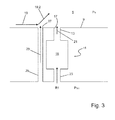
- FIG 3 illustrates a first embodiment of the claimed invention.
- the reference numerals used are the same as in figure 2 and therefore only the differences are described in detail.
- the bias flow has a preferred direction of flow from left to right and therefore upstream of the mouth 17 in figure 3 means on the left side of the mouth 17.
- the damper 11 is a flow through damper which means that the damping volume 15 is connected via the neck 13 with the combustion chamber 5. At the opposite end of the damping volume 15 the damping volume 15 is connected via a small bore 23 to a further chamber R1.
- the flow resistance of the tube 23 is greater than the flow resistance of the neck 13. This means that the pressure reduction ⁇ p 23 at the bore 23 is greater than the pressure reduction ⁇ p 13 at the neck 13 of the damper. In other words: ⁇ p 23 > ⁇ p 13 .
- the chamber R1 may be any high pressure environment, for example the hood or the liner pressure or a reservoir for cooling air.
- the chamber 5 is the combustion chamber of a gas turbine, but the claimed invention is not restricted to that.
- the flow resistance of the bore 25 is smaller than the flow resistance of the bore 23. This can be achieved by providing a larger diameter to bore 25 than to bore 23.
- a gas flow 29, illustrated by an arrow through the bore 25, is far greater than the bias flow 21 although the damper 11 and the bore 25 are supplied from the same chamber R 1 with air or gas and open into the same chamber 5.
- the velocity of the sealing gas flow through the bore 25 is even higher than the velocity of the grazing flow 19.
- the grazing flow 19 does not reach the mouth 17 of the damper 11 and therefore the bias flow 21 is not disturbed by the grazing flow 19 anymore. Consequently, the efficiency and effectiveness of the damper 11 is high and independent from the grazing flow 19.
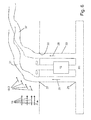
- FIG 4 the same arrangement is shown in another perspective.
- the air or gas 29 that exits the opening 27 enters the chamber 5 with a high velocity and protects the mouth 17 of the damper 11 from the grazing flow 19 by deflecting the grazing flow 19 away from the inner surface 9 and the mouth 17.
- the gas or air entering the chamber 5 to the bore 25 is a wind shield 31 that protects the mouth 17 and the bias flow 21 of the damper from the grazing flow 19.
- the mouth 17 is on the leeward side of the "windshield 31" that generated by the flow 29 of air or gas through the bore 25. Since the mouth 17 should be on the leeward side of the windshield 31 in most cases it is preferred that the at least one opening 27 is located upstream of the mouth 17.
- FIG. 4 On the left side of figure 4 a top view from the chamber 5 onto the inner surface 9 with the mouth 17 and the opening 27 is illustrated. It can be seen that the grazing flow 19 is also deflected in a lateral direction which further improves the effectiveness of the windshield 31.
- Figure 5 illustrates a second embodiment of the invention with two bore 25 and 32 adjacent to the mouth 17 of the damper 11.
- one opening 27 is upstream of the mouth 17 and a further opening 35 is downstream of the mouth 17.
- the windshield 37 derived from the air or gas stream through the opening 35 supports and reinforces the windshield 31 starting from the first opening 27. Therefore, the bias flow 21 through the mouth 17 is even better protected from the grazing flow.
- the opening 27 has an elliptic cross-section which broadens the windshield 31 and therefore results in a better protection of the bias flow 21.
- FIG 7e there is one opening 7 with a rectangular cross-section and in figure 7f) an embodiment is illustrated with four openings 27 with rectangular cross-section.
- Figure 7g illustrates an embodiment with one opening 12 and 27 with a bent cross section.
- FIG 7h The embodiment illustrated in figure 7h) is known from figures 5 and 6 .
- the embodiments illustrated in figure 7e) and 7j) illustrate further embodiments with three and four opening 27.
Landscapes
- Engineering & Computer Science (AREA)
- Chemical & Material Sciences (AREA)
- Combustion & Propulsion (AREA)
- Mechanical Engineering (AREA)
- General Engineering & Computer Science (AREA)
- Soundproofing, Sound Blocking, And Sound Damping (AREA)
- Turbine Rotor Nozzle Sealing (AREA)
- Exhaust Silencers (AREA)
- Testing Of Engines (AREA)
Abstract
Description
- The invention relates to the acoustic damping of combustion dynamics. Combustion dynamics in the meaning of this application comprises pulsations, acoustic oscillations, pressure and velocity fluctuations and what is called in the everyday language "noise".
- Combustion dynamics occur in combustors of gas turbines, for example, as a consequence of changes in the fuel supply. Excessive pressure fluctuations may result in damage of machine components. For reasons of simplification subsequently the term "chamber" is used and comprises all locations where combustion dynamics occur. In these chambers a gas (for example a mixture of fuel and air or a hot combustion gas) flows with a high velocity.
- To reduce these combustion dynamics it is well known in the art, to install acoustic damping devices like Helmholtz resonators, half-wave tubes, quarter-wave tubes or other types of damping devices with or without flow through of gas.
- These acoustic damping devices may have one or more resonance frequencies. If under operation of the gas turbine the combustion dynamics stimulate the resonance frequencies of the acoustic damping devices, the combustion dynamics are reduced or damped.
-
Figure 1 illustrates the reflection coefficient (Y-Axis) and its dependency from the frequency. - The
line 1 shows the theoretical reflection coefficient when using an acoustic damping device with a resonance frequency of approximately 300 Hertz. As can be seen, at a frequency of 300 Hertz the reflection coefficient has a relative minimum of approximately 0.5. At frequencies of approximately 225 Hertz and 375 Hertz, the reflection coefficient has a local maximum of about 0.75. - To give an example: a combustion chamber of a gas turbine is equipped with an acoustic damping absorber having a resonance frequency of 300 Hertz. Assuming that under operation in this combustion chamber fluctuations ensue comprising frequencies of 300 Hertz it can be expected, that due to the local minimum of the reflection coefficient at 300 Hertz the fluctuations with a frequency of 300 Hertz are effectively damped and reduced.
- In technical experiments the applicant made measurements and compared the theoretical reflection coefficient (line 1) with measurements taken at a frequency range between 50 Hertz and 400 Hertz.
The measured values are illustrated infigure 1 bydots 3. - By comparing the measured values with the theoretical reflection coefficient (line 1) it can be seen that in the range between 250 Hertz and 350 Hertz the measured
values 3 do not show a local minimum as should be expected. In other words: The acoustic damping device does not work sufficiently. - It is an object of the invention, to provide an acoustic damper that is capable of damping effectively in a gas turbine under operation and therefore effectively reduces combustion dynamics ensued from operation of the gas turbine at certain frequencies.
- This objective has been achieved by using an acoustic damper comprising a neck and a damping volume, wherein the neck comprises a mouth being in fluid connection with a chamber that comprises adjacent to the mouth of the neck at least one opening for sealing gas.
- The sealing gas, air or any other suitable gas, that flows through the at least one opening into the chamber has the effect of a "fence" or a shield that protects the mouth of the damper from grazing flow. In conjunction with the claimed invention grazing flow is the flow of a gas more or less parallel to a wall that comprises the mouth of the damper. This grazing flow has a main or preferred direction more or less perpendicular to the neck of the damper and therefore may disturb the bias flow of gas through the neck and the mouth into the damping volume.
- By means of the claimed opening or a number of openings located adjacent to the mouth of a damper the grazing flow is deflected and therefore does not disturb the bias flow through the neck and the mouth of the damper and as a result the performance of the damper is improved.
- In a preferred embodiment of the claimed invention the at least one opening for sealing gas is located upstream of the mouth so as to deflect the grazing gas flow away from the mouth of the damper. If this opening is located upstream of the mouth it most efficiently protects the mouth from the grazing gas flow.
- To even more efficiently deflect the grazing flow away from the mouth of the damper it may be advantageous to provide two or more openings upstream of the mouth. In embodiments where the preferred direction of the grazing flow may change it is preferred if three, four or even more openings are located around the mouth of the damper so as to deflect the grazing flow independent from its actual direction of flow and to protect the mouth of the damper from the grazing flow.
- To optimize the effect of the claimed openings adjacent to the mouth the openings for sealing gas may have a circular, elliptic or square cross section. Of course, the selection of a specific cross section of the openings may be based on the efficiency, i.e. an optimal deflection of the grazing gas flow and little sealing gas consumption. Reducing the flow of sealing gas raises the overall efficiency of a gas turbine, since supplying a sealing gas with a higher pressure than the pressure inside the chamber requires energy.
- In principle, any suitable source of a high pressure gas that is available may be used for the aerodynamic shielding of grazing flows according to the invention. In case the damper is a flow through damper the sealing gas that flows through the opening to the chamber may be the similar to that gas that flows through the damper into the chamber.
- The claimed invention may be based on any type of acoustic damper, for example a resonator with one or more damping volumes, a half-wave tube a quarter-wave tube, a multi-volume damper, a liner or any kind of acoustic flow-through damper.
- The claimed invention also may be applied to dampers with no flow through of the acoustic damper type.
- The claimed invention may preferably be applied if the mouth of the damper opens into a combustor chamber, a mixing chamber a plenum and/or an air channel of a gas turbine.
- Further advantages and details of the claimed invention are subsequently described in conjunction with the drawings and their description.
- The figures show:
- Figure 1
- The reflection coefficient of an exemplary acoustic damper with a resonance frequency at 300 Hertz,
- Figure 2
- a combustor chamber with an acoustic damper as known from the prior art and
-
Figures 3 to 7 several embodiments of the claimed invention. -
Figure 2 shows a schematic cross section of achamber 5, for example a combustion chamber CC of a gas turbine that is limited by at least onewall 7 comprising aninner surface 9. As can be seen fromfigure 2 , thechamber 5 is equipped with anacoustic damper 11 comprising aneck 13 and adamping volume 15. Theneck 13 connects thedamping volume 15 to thecombustion chamber 5. The opening of theneck 13 towards thecombustion chamber 5 is referred to as "mouth" 17 of theneck 13. - The
damping device 11 in this exemplary embodiment may be a Helmholtz resonator, but the claimed invention is not limited to this type of acoustic damping device. The claimed invention may be used in conjunction with any type of acoustic damping device like a half-wave tube, a quarter-wave tube and the like. The claimed invention may be used in conjunction with flow through acoustic damping devices and acoustic damping devices without flow through. - As can be seen from
figure 2 , themouth 17 of theneck 13 and theinner surface 9 of thewall 7 have the same level. - In the
chamber 5 more or less parallel to the inner surface 9 a gas flows. This gas has a preferred direction of flow (illustrated by the arrow 19) and is also referred to as grazingflow 19. The preferred direction of this grazingflow 19 is essentially perpendicular to abias flow 21 between thedamping volume 15 and thecombustion chamber 5 and disturbs thebias flow 21 through theneck 13. This negative effect of thegrazing flow 19 on thebias flow 21 reduces the performance of thedamper 11 as has been explained in conjunction withfigure 1 above. -
Figure 3 illustrates a first embodiment of the claimed invention. The reference numerals used are the same as infigure 2 and therefore only the differences are described in detail. - In
figure 3 the bias flow has a preferred direction of flow from left to right and therefore upstream of themouth 17 infigure 3 means on the left side of themouth 17. - In this embodiment the
damper 11 is a flow through damper which means that thedamping volume 15 is connected via theneck 13 with thecombustion chamber 5. At the opposite end of thedamping volume 15 thedamping volume 15 is connected via asmall bore 23 to a further chamber R1. - As can be seen from
figure 3 , adjacent to themouth 17 and upstream of themouth 17 there is afurther bore 25 with an opening 27. Thebore 25 connectschambers 5 and R1. - Since the pressure PR1 in the chamber R1 is higher than the pressure p5 in the
chamber 5 sealing air flows through thebore 25 and theopening 27 from chamber R1 intochamber 5. Since thebore 23 has a rather small diameter its flow resistance is great and consequently thebore 23 restricts thebias flow 21 through thedamper 11. - The resulting pressure difference Δp (= pR1-p5) causes not only the
bias flow 21 throughdamper 11, but aflow 29 of sealing gas throughbore 25 andopening 27. - The flow resistance of the
tube 23 is greater than the flow resistance of theneck 13. This means that the pressure reduction Δp23 at thebore 23 is greater than the pressure reduction Δp13 at theneck 13 of the damper. In other words: Δp23 > Δp13. - This means that the
tube 23 due to its small diameter and/or its length acts as a flow restrictor reducing thebias flow 21 through theneck 13. - The chamber R1 may be any high pressure environment, for example the hood or the liner pressure or a reservoir for cooling air. In most appliances of the claimed invention the
chamber 5 is the combustion chamber of a gas turbine, but the claimed invention is not restricted to that. - The sealing gas flowing through
bore 25 and entering thechamber 5 via opening 27 in a direction more or less perpendicular to thegrazing flow 19 it deflects the grazing flow away from themouth 17 of thedamper 11. - As described in conjunction with
figure 2 in thechamber 5, there may be agrazing flow 19 whose velocity is far greater than the velocity of thebias flow 21. - The flow resistance of the
bore 25 is smaller than the flow resistance of thebore 23. This can be achieved by providing a larger diameter to bore 25 than to bore 23. - Consequently, a
gas flow 29, illustrated by an arrow through thebore 25, is far greater than thebias flow 21 although thedamper 11 and thebore 25 are supplied from the same chamber R1 with air or gas and open into thesame chamber 5. - As can be seen by comparison of the
arrows bore 25 is even higher than the velocity of thegrazing flow 19. - The great velocity of the air or
gas flow 29 through thebore 25 deflects thegrazing flow 19 away from theinner surface 9 and away from themouth 17 of thedamper 11, as is illustrated by the arrow 19.2 infigure 3 . This effect is illustrated by the arrow 19.2 (deflected grazing flow). - Doing so, the
grazing flow 19 does not reach themouth 17 of thedamper 11 and therefore thebias flow 21 is not disturbed by thegrazing flow 19 anymore. Consequently, the efficiency and effectiveness of thedamper 11 is high and independent from thegrazing flow 19. - Going back to
figure 1 , the behavior of thedamper 11 according to the claimed invention is similar to theline 1 infigure 1 . Of course, this is only an example and the same invention may be applied todampers 11 with damping frequencies different from 300 Hertz. - In
figure 4 the same arrangement is shown in another perspective. In the right part offigure 4 it can be seen that the air orgas 29 that exits theopening 27 enters thechamber 5 with a high velocity and protects themouth 17 of thedamper 11 from thegrazing flow 19 by deflecting thegrazing flow 19 away from theinner surface 9 and themouth 17. The gas or air entering thechamber 5 to thebore 25 is awind shield 31 that protects themouth 17 and thebias flow 21 of the damper from thegrazing flow 19. - In other words: The
mouth 17 is on the leeward side of the "windshield 31" that generated by theflow 29 of air or gas through thebore 25. Since themouth 17 should be on the leeward side of thewindshield 31 in most cases it is preferred that the at least oneopening 27 is located upstream of themouth 17. - On the left side of
figure 4 a top view from thechamber 5 onto theinner surface 9 with themouth 17 and theopening 27 is illustrated. It can be seen that thegrazing flow 19 is also deflected in a lateral direction which further improves the effectiveness of thewindshield 31. -
Figure 5 illustrates a second embodiment of the invention with two bore 25 and 32 adjacent to themouth 17 of thedamper 11. In this case, oneopening 27 is upstream of themouth 17 and afurther opening 35 is downstream of themouth 17. As can be seen fromfigure 6 , thewindshield 37 derived from the air or gas stream through theopening 35 supports and reinforces thewindshield 31 starting from thefirst opening 27.
Therefore, thebias flow 21 through themouth 17 is even better protected from the grazing flow. - In
figure 7 several designs and arrangements of the bores that serve to supply sealing gas orair 29 for building up awindshield 31 are illustrated. - The embodiment 7a) has already been described in conjunction with
figure 4 . - In the embodiment illustrated in
figure 7b) theopening 27 has an elliptic cross-section which broadens thewindshield 31 and therefore results in a better protection of thebias flow 21. - In the embodiment illustrated in
figure 7c) there are twoopenings 27 with an elliptic cross-section arranged upstream of themouth 17. - According to the embodiment, illustrated in
figure 7d) , there are fiveopenings 27 with circular cross-sections located upstream of themouth 17. - In
figure 7e) there is oneopening 7 with a rectangular cross-section and infigure 7f) an embodiment is illustrated with fouropenings 27 with rectangular cross-section. -
Figure 7g) illustrates an embodiment with oneopening 12 and 27 with a bent cross section. - The embodiment illustrated in
figure 7h) is known fromfigures 5 and6 . The embodiments illustrated infigure 7e) and 7j) illustrate further embodiments with three and fouropening 27. -
- 1
- line
- 3
- dot
- 5
- chamber
- 7
- wall
- 9
- inner surface
- 11
- acoustic damper
- 13
-
neck 13 - 15
- damping volume
- 17
- mouth of the neck
- 19
- arrow/grazing flow
- 19.2
- deflected grazing flow
- 21
- bias flow
- 23
- bore
- R1
- further chamber
- 25
- bore
- 27
- opening
- 29
- gas / air flow
- 31
- wind shield
- 33
- bore
- 35
- opening
Claims (9)
- Acoustic damper (11) comprising a neck (13) and a damping volume (15), wherein the neck (13) comprises a mouth (17) being in fluid connection with a chamber (5), characterized in, that adjacent to the mouth (17) of the neck (13) at least one opening (27, 35) for a sealing gas is located.
- Damper according to claim 1, characterized in, that inside the chamber (5) a gas with a preferred direction of flow (19) flows over the mouth (17), and that the at least one opening (27, 35) for sealing gas is located upstream of the mouth (17).
- Damper according to claim 1 or 2, characterized in, that the gas flowing through at least one opening (27, 35) for sealing deflects the flow of gas with a preferred direction of flow (19) away from the mouth (17) of the neck (13).
- Damper according to one of the foregoing claims, characterized in, that the several openings (27, 25), preferably 3 to 8, even more preferably 4 or 5 openings (27, 35), are located around the mouth (17) of the neck (13).
- Damper according to one of the foregoing claims, characterized in, that the at least one opening (27, 35) for sealing gas have a circular, elliptic or square cross-section.
- Damper according to one of the foregoing claims, characterized in, that the at least one opening (27, 35) for sealing gas is supplied with gas from a highpressure environment, for example a hood of the gas turbine.
- Damper according to one of the foregoing claims, characterized in, that the sealing gas that flows though the at least one opening (27, 35) is cooling air or a mixture of burnt or unburnt air and fuel.
- Damper according to one of the foregoing claims, characterized in, that the damper (11) is a Helmholtz resonator with one or more damping volumes (15, 33), a half-wave tube, a quarter-wave tube, multi-volume damper, a liner or any kind of acoustic flow through damper.
- Damper according to one of the foregoing claims characterized in, that the chamber (5) is a combustor chamber, a mixing chamber, a plenum and/or an air channel of a gas turbine.
Priority Applications (5)
| Application Number | Priority Date | Filing Date | Title |
|---|---|---|---|
| EP14157239.6A EP2913589B1 (en) | 2014-02-28 | 2014-02-28 | Acoustic damping device for chambers with grazing flow |
| US14/631,945 US9429042B2 (en) | 2014-02-28 | 2015-02-26 | Acoustic damping device for chambers with grazing flow |
| KR1020150027905A KR20150102723A (en) | 2014-02-28 | 2015-02-27 | Acoustic damping device for chambers with grazing flow |
| CN201510296481.XA CN104879781B (en) | 2014-02-28 | 2015-02-27 | Sound damping device for the room with slipstream |
| JP2015038270A JP2015165136A (en) | 2014-02-28 | 2015-02-27 | Sound attenuator for chambers with grazing flow |
Applications Claiming Priority (1)
| Application Number | Priority Date | Filing Date | Title |
|---|---|---|---|
| EP14157239.6A EP2913589B1 (en) | 2014-02-28 | 2014-02-28 | Acoustic damping device for chambers with grazing flow |
Publications (2)
| Publication Number | Publication Date |
|---|---|
| EP2913589A1 true EP2913589A1 (en) | 2015-09-02 |
| EP2913589B1 EP2913589B1 (en) | 2020-01-22 |
Family
ID=50190304
Family Applications (1)
| Application Number | Title | Priority Date | Filing Date |
|---|---|---|---|
| EP14157239.6A Active EP2913589B1 (en) | 2014-02-28 | 2014-02-28 | Acoustic damping device for chambers with grazing flow |
Country Status (5)
| Country | Link |
|---|---|
| US (1) | US9429042B2 (en) |
| EP (1) | EP2913589B1 (en) |
| JP (1) | JP2015165136A (en) |
| KR (1) | KR20150102723A (en) |
| CN (1) | CN104879781B (en) |
Cited By (2)
| Publication number | Priority date | Publication date | Assignee | Title |
|---|---|---|---|---|
| WO2017042250A1 (en) * | 2015-09-08 | 2017-03-16 | Siemens Aktiengesellschaft | Gas turbine combustor liner with helmholtz damper |
| US11506382B2 (en) | 2019-09-12 | 2022-11-22 | General Electric Company | System and method for acoustic dampers with multiple volumes in a combustion chamber front panel |
Families Citing this family (5)
| Publication number | Priority date | Publication date | Assignee | Title |
|---|---|---|---|---|
| US10228138B2 (en) | 2016-12-02 | 2019-03-12 | General Electric Company | System and apparatus for gas turbine combustor inner cap and resonating tubes |
| US10220474B2 (en) | 2016-12-02 | 2019-03-05 | General Electricd Company | Method and apparatus for gas turbine combustor inner cap and high frequency acoustic dampers |
| US10221769B2 (en) | 2016-12-02 | 2019-03-05 | General Electric Company | System and apparatus for gas turbine combustor inner cap and extended resonating tubes |
| US10941939B2 (en) | 2017-09-25 | 2021-03-09 | General Electric Company | Gas turbine assemblies and methods |
| US11486262B2 (en) * | 2021-03-03 | 2022-11-01 | General Electric Company | Diffuser bleed assembly |
Citations (3)
| Publication number | Priority date | Publication date | Assignee | Title |
|---|---|---|---|---|
| US20050097890A1 (en) * | 2003-08-29 | 2005-05-12 | Mitsubishi Heavy Industries, Ltd. | Gas turbine combustor |
| EP1865259A2 (en) * | 2006-06-09 | 2007-12-12 | Rolls-Royce Deutschland Ltd & Co KG | Gas-turbine combustion chamber wall for a lean-burning gas-turbine combustion chamber |
| WO2013029981A1 (en) * | 2011-09-01 | 2013-03-07 | Siemens Aktiengesellschaft | Combustion chamber for a gas turbine plant |
Family Cites Families (1)
| Publication number | Priority date | Publication date | Assignee | Title |
|---|---|---|---|---|
| US20150082794A1 (en) * | 2013-09-26 | 2015-03-26 | Reinhard Schilp | Apparatus for acoustic damping and operational control of damping, cooling, and emissions in a gas turbine engine |
-
2014
- 2014-02-28 EP EP14157239.6A patent/EP2913589B1/en active Active
-
2015
- 2015-02-26 US US14/631,945 patent/US9429042B2/en active Active
- 2015-02-27 JP JP2015038270A patent/JP2015165136A/en active Pending
- 2015-02-27 KR KR1020150027905A patent/KR20150102723A/en not_active Withdrawn
- 2015-02-27 CN CN201510296481.XA patent/CN104879781B/en active Active
Patent Citations (3)
| Publication number | Priority date | Publication date | Assignee | Title |
|---|---|---|---|---|
| US20050097890A1 (en) * | 2003-08-29 | 2005-05-12 | Mitsubishi Heavy Industries, Ltd. | Gas turbine combustor |
| EP1865259A2 (en) * | 2006-06-09 | 2007-12-12 | Rolls-Royce Deutschland Ltd & Co KG | Gas-turbine combustion chamber wall for a lean-burning gas-turbine combustion chamber |
| WO2013029981A1 (en) * | 2011-09-01 | 2013-03-07 | Siemens Aktiengesellschaft | Combustion chamber for a gas turbine plant |
Cited By (2)
| Publication number | Priority date | Publication date | Assignee | Title |
|---|---|---|---|---|
| WO2017042250A1 (en) * | 2015-09-08 | 2017-03-16 | Siemens Aktiengesellschaft | Gas turbine combustor liner with helmholtz damper |
| US11506382B2 (en) | 2019-09-12 | 2022-11-22 | General Electric Company | System and method for acoustic dampers with multiple volumes in a combustion chamber front panel |
Also Published As
| Publication number | Publication date |
|---|---|
| JP2015165136A (en) | 2015-09-17 |
| US9429042B2 (en) | 2016-08-30 |
| EP2913589B1 (en) | 2020-01-22 |
| CN104879781B (en) | 2019-08-13 |
| US20150247426A1 (en) | 2015-09-03 |
| KR20150102723A (en) | 2015-09-07 |
| CN104879781A (en) | 2015-09-02 |
Similar Documents
| Publication | Publication Date | Title |
|---|---|---|
| US9429042B2 (en) | Acoustic damping device for chambers with grazing flow | |
| EP2860449B1 (en) | Acoustic damping device | |
| JP6138232B2 (en) | Combustion chamber seal segment with damping device | |
| KR101576720B1 (en) | Gas turbine combustor | |
| US8839624B2 (en) | Combustion device of a gas turbine including a plurality of passages and chambers defining helmholtz resonators | |
| US20160003162A1 (en) | Damping device for a gas turbine, gas turbine and method for damping thermoacoustic oscillations | |
| JP5112926B2 (en) | System for reducing combustor dynamics | |
| EP3034945B1 (en) | Gas turbine fuel pipe comprising a damper | |
| US10036327B2 (en) | Damper with bent neck for gas turbine | |
| US8869533B2 (en) | Combustion system for a gas turbine comprising a resonator | |
| CN102116475B (en) | Method and apparatus of combustor dynamics mitigation | |
| CN104565187A (en) | Helmholtz damper for gas turbine with cooling air flow | |
| US20140345283A1 (en) | Combustion chamber for a gas turbine plant | |
| US11686474B2 (en) | Damper for swirl-cup combustors | |
| EP2865948A1 (en) | Quarter wave damping device for a gas turbine combustor | |
| US9261058B2 (en) | Near-wall roughness for damping devices reducing pressure oscillations in combustion systems | |
| CN105452773B (en) | Apparatus and method for damping sound | |
| JP2010043851A (en) | Contoured impingement sleeve hole | |
| US10928068B2 (en) | Annular Helmholtz damper for a gas turbine can combustor | |
| US8857189B2 (en) | Gas turbine combustion burner | |
| WO2011134713A1 (en) | Burner system and method for damping such a burner system | |
| US8939253B1 (en) | System and method for suppression of unwanted noise in ground test facilities | |
| KR20010045480A (en) | Impinging jet nozzle | |
| CN103032897A (en) | Turbomachine combustor assembly including combustion dynamics mitigation system |
Legal Events
| Date | Code | Title | Description |
|---|---|---|---|
| PUAI | Public reference made under article 153(3) epc to a published international application that has entered the european phase |
Free format text: ORIGINAL CODE: 0009012 |
|
| 17P | Request for examination filed |
Effective date: 20140228 |
|
| AK | Designated contracting states |
Kind code of ref document: A1 Designated state(s): AL AT BE BG CH CY CZ DE DK EE ES FI FR GB GR HR HU IE IS IT LI LT LU LV MC MK MT NL NO PL PT RO RS SE SI SK SM TR |
|
| AX | Request for extension of the european patent |
Extension state: BA ME |
|
| RAP1 | Party data changed (applicant data changed or rights of an application transferred) |
Owner name: GENERAL ELECTRIC TECHNOLOGY GMBH |
|
| RAP1 | Party data changed (applicant data changed or rights of an application transferred) |
Owner name: ANSALDO ENERGIA SWITZERLAND AG |
|
| GRAP | Despatch of communication of intention to grant a patent |
Free format text: ORIGINAL CODE: EPIDOSNIGR1 |
|
| STAA | Information on the status of an ep patent application or granted ep patent |
Free format text: STATUS: GRANT OF PATENT IS INTENDED |
|
| INTG | Intention to grant announced |
Effective date: 20190902 |
|
| GRAS | Grant fee paid |
Free format text: ORIGINAL CODE: EPIDOSNIGR3 |
|
| GRAA | (expected) grant |
Free format text: ORIGINAL CODE: 0009210 |
|
| STAA | Information on the status of an ep patent application or granted ep patent |
Free format text: STATUS: THE PATENT HAS BEEN GRANTED |
|
| AK | Designated contracting states |
Kind code of ref document: B1 Designated state(s): AL AT BE BG CH CY CZ DE DK EE ES FI FR GB GR HR HU IE IS IT LI LT LU LV MC MK MT NL NO PL PT RO RS SE SI SK SM TR |
|
| REG | Reference to a national code |
Ref country code: GB Ref legal event code: FG4D |
|
| REG | Reference to a national code |
Ref country code: CH Ref legal event code: EP |
|
| REG | Reference to a national code |
Ref country code: DE Ref legal event code: R096 Ref document number: 602014060243 Country of ref document: DE |
|
| REG | Reference to a national code |
Ref country code: AT Ref legal event code: REF Ref document number: 1227135 Country of ref document: AT Kind code of ref document: T Effective date: 20200215 |
|
| REG | Reference to a national code |
Ref country code: IE Ref legal event code: FG4D |
|
| REG | Reference to a national code |
Ref country code: NL Ref legal event code: MP Effective date: 20200122 |
|
| REG | Reference to a national code |
Ref country code: LT Ref legal event code: MG4D |
|
| PG25 | Lapsed in a contracting state [announced via postgrant information from national office to epo] |
Ref country code: NO Free format text: LAPSE BECAUSE OF FAILURE TO SUBMIT A TRANSLATION OF THE DESCRIPTION OR TO PAY THE FEE WITHIN THE PRESCRIBED TIME-LIMIT Effective date: 20200422 Ref country code: FI Free format text: LAPSE BECAUSE OF FAILURE TO SUBMIT A TRANSLATION OF THE DESCRIPTION OR TO PAY THE FEE WITHIN THE PRESCRIBED TIME-LIMIT Effective date: 20200122 Ref country code: RS Free format text: LAPSE BECAUSE OF FAILURE TO SUBMIT A TRANSLATION OF THE DESCRIPTION OR TO PAY THE FEE WITHIN THE PRESCRIBED TIME-LIMIT Effective date: 20200122 Ref country code: NL Free format text: LAPSE BECAUSE OF FAILURE TO SUBMIT A TRANSLATION OF THE DESCRIPTION OR TO PAY THE FEE WITHIN THE PRESCRIBED TIME-LIMIT Effective date: 20200122 Ref country code: PT Free format text: LAPSE BECAUSE OF FAILURE TO SUBMIT A TRANSLATION OF THE DESCRIPTION OR TO PAY THE FEE WITHIN THE PRESCRIBED TIME-LIMIT Effective date: 20200614 |
|
| PG25 | Lapsed in a contracting state [announced via postgrant information from national office to epo] |
Ref country code: SE Free format text: LAPSE BECAUSE OF FAILURE TO SUBMIT A TRANSLATION OF THE DESCRIPTION OR TO PAY THE FEE WITHIN THE PRESCRIBED TIME-LIMIT Effective date: 20200122 Ref country code: GR Free format text: LAPSE BECAUSE OF FAILURE TO SUBMIT A TRANSLATION OF THE DESCRIPTION OR TO PAY THE FEE WITHIN THE PRESCRIBED TIME-LIMIT Effective date: 20200423 Ref country code: IS Free format text: LAPSE BECAUSE OF FAILURE TO SUBMIT A TRANSLATION OF THE DESCRIPTION OR TO PAY THE FEE WITHIN THE PRESCRIBED TIME-LIMIT Effective date: 20200522 Ref country code: LV Free format text: LAPSE BECAUSE OF FAILURE TO SUBMIT A TRANSLATION OF THE DESCRIPTION OR TO PAY THE FEE WITHIN THE PRESCRIBED TIME-LIMIT Effective date: 20200122 Ref country code: HR Free format text: LAPSE BECAUSE OF FAILURE TO SUBMIT A TRANSLATION OF THE DESCRIPTION OR TO PAY THE FEE WITHIN THE PRESCRIBED TIME-LIMIT Effective date: 20200122 Ref country code: BG Free format text: LAPSE BECAUSE OF FAILURE TO SUBMIT A TRANSLATION OF THE DESCRIPTION OR TO PAY THE FEE WITHIN THE PRESCRIBED TIME-LIMIT Effective date: 20200422 |
|
| REG | Reference to a national code |
Ref country code: CH Ref legal event code: PL |
|
| REG | Reference to a national code |
Ref country code: DE Ref legal event code: R097 Ref document number: 602014060243 Country of ref document: DE |
|
| REG | Reference to a national code |
Ref country code: BE Ref legal event code: MM Effective date: 20200229 |
|
| PG25 | Lapsed in a contracting state [announced via postgrant information from national office to epo] |
Ref country code: EE Free format text: LAPSE BECAUSE OF FAILURE TO SUBMIT A TRANSLATION OF THE DESCRIPTION OR TO PAY THE FEE WITHIN THE PRESCRIBED TIME-LIMIT Effective date: 20200122 Ref country code: SM Free format text: LAPSE BECAUSE OF FAILURE TO SUBMIT A TRANSLATION OF THE DESCRIPTION OR TO PAY THE FEE WITHIN THE PRESCRIBED TIME-LIMIT Effective date: 20200122 Ref country code: LU Free format text: LAPSE BECAUSE OF NON-PAYMENT OF DUE FEES Effective date: 20200228 Ref country code: LT Free format text: LAPSE BECAUSE OF FAILURE TO SUBMIT A TRANSLATION OF THE DESCRIPTION OR TO PAY THE FEE WITHIN THE PRESCRIBED TIME-LIMIT Effective date: 20200122 Ref country code: SK Free format text: LAPSE BECAUSE OF FAILURE TO SUBMIT A TRANSLATION OF THE DESCRIPTION OR TO PAY THE FEE WITHIN THE PRESCRIBED TIME-LIMIT Effective date: 20200122 Ref country code: ES Free format text: LAPSE BECAUSE OF FAILURE TO SUBMIT A TRANSLATION OF THE DESCRIPTION OR TO PAY THE FEE WITHIN THE PRESCRIBED TIME-LIMIT Effective date: 20200122 Ref country code: MC Free format text: LAPSE BECAUSE OF FAILURE TO SUBMIT A TRANSLATION OF THE DESCRIPTION OR TO PAY THE FEE WITHIN THE PRESCRIBED TIME-LIMIT Effective date: 20200122 Ref country code: CZ Free format text: LAPSE BECAUSE OF FAILURE TO SUBMIT A TRANSLATION OF THE DESCRIPTION OR TO PAY THE FEE WITHIN THE PRESCRIBED TIME-LIMIT Effective date: 20200122 Ref country code: RO Free format text: LAPSE BECAUSE OF FAILURE TO SUBMIT A TRANSLATION OF THE DESCRIPTION OR TO PAY THE FEE WITHIN THE PRESCRIBED TIME-LIMIT Effective date: 20200122 Ref country code: DK Free format text: LAPSE BECAUSE OF FAILURE TO SUBMIT A TRANSLATION OF THE DESCRIPTION OR TO PAY THE FEE WITHIN THE PRESCRIBED TIME-LIMIT Effective date: 20200122 |
|
| REG | Reference to a national code |
Ref country code: AT Ref legal event code: MK05 Ref document number: 1227135 Country of ref document: AT Kind code of ref document: T Effective date: 20200122 |
|
| PLBE | No opposition filed within time limit |
Free format text: ORIGINAL CODE: 0009261 |
|
| STAA | Information on the status of an ep patent application or granted ep patent |
Free format text: STATUS: NO OPPOSITION FILED WITHIN TIME LIMIT |
|
| PG25 | Lapsed in a contracting state [announced via postgrant information from national office to epo] |
Ref country code: LI Free format text: LAPSE BECAUSE OF NON-PAYMENT OF DUE FEES Effective date: 20200229 Ref country code: CH Free format text: LAPSE BECAUSE OF NON-PAYMENT OF DUE FEES Effective date: 20200229 |
|
| 26N | No opposition filed |
Effective date: 20201023 |
|
| PG25 | Lapsed in a contracting state [announced via postgrant information from national office to epo] |
Ref country code: IE Free format text: LAPSE BECAUSE OF NON-PAYMENT OF DUE FEES Effective date: 20200228 Ref country code: FR Free format text: LAPSE BECAUSE OF NON-PAYMENT OF DUE FEES Effective date: 20200322 Ref country code: IT Free format text: LAPSE BECAUSE OF FAILURE TO SUBMIT A TRANSLATION OF THE DESCRIPTION OR TO PAY THE FEE WITHIN THE PRESCRIBED TIME-LIMIT Effective date: 20200122 Ref country code: AT Free format text: LAPSE BECAUSE OF FAILURE TO SUBMIT A TRANSLATION OF THE DESCRIPTION OR TO PAY THE FEE WITHIN THE PRESCRIBED TIME-LIMIT Effective date: 20200122 |
|
| PG25 | Lapsed in a contracting state [announced via postgrant information from national office to epo] |
Ref country code: SI Free format text: LAPSE BECAUSE OF FAILURE TO SUBMIT A TRANSLATION OF THE DESCRIPTION OR TO PAY THE FEE WITHIN THE PRESCRIBED TIME-LIMIT Effective date: 20200122 Ref country code: PL Free format text: LAPSE BECAUSE OF FAILURE TO SUBMIT A TRANSLATION OF THE DESCRIPTION OR TO PAY THE FEE WITHIN THE PRESCRIBED TIME-LIMIT Effective date: 20200122 Ref country code: BE Free format text: LAPSE BECAUSE OF NON-PAYMENT OF DUE FEES Effective date: 20200229 |
|
| GBPC | Gb: european patent ceased through non-payment of renewal fee |
Effective date: 20200422 |
|
| PG25 | Lapsed in a contracting state [announced via postgrant information from national office to epo] |
Ref country code: GB Free format text: LAPSE BECAUSE OF NON-PAYMENT OF DUE FEES Effective date: 20200422 |
|
| PG25 | Lapsed in a contracting state [announced via postgrant information from national office to epo] |
Ref country code: TR Free format text: LAPSE BECAUSE OF FAILURE TO SUBMIT A TRANSLATION OF THE DESCRIPTION OR TO PAY THE FEE WITHIN THE PRESCRIBED TIME-LIMIT Effective date: 20200122 Ref country code: MT Free format text: LAPSE BECAUSE OF FAILURE TO SUBMIT A TRANSLATION OF THE DESCRIPTION OR TO PAY THE FEE WITHIN THE PRESCRIBED TIME-LIMIT Effective date: 20200122 Ref country code: CY Free format text: LAPSE BECAUSE OF FAILURE TO SUBMIT A TRANSLATION OF THE DESCRIPTION OR TO PAY THE FEE WITHIN THE PRESCRIBED TIME-LIMIT Effective date: 20200122 |
|
| PG25 | Lapsed in a contracting state [announced via postgrant information from national office to epo] |
Ref country code: MK Free format text: LAPSE BECAUSE OF FAILURE TO SUBMIT A TRANSLATION OF THE DESCRIPTION OR TO PAY THE FEE WITHIN THE PRESCRIBED TIME-LIMIT Effective date: 20200122 Ref country code: AL Free format text: LAPSE BECAUSE OF FAILURE TO SUBMIT A TRANSLATION OF THE DESCRIPTION OR TO PAY THE FEE WITHIN THE PRESCRIBED TIME-LIMIT Effective date: 20200122 |
|
| P01 | Opt-out of the competence of the unified patent court (upc) registered |
Effective date: 20240430 |
|
| PGFP | Annual fee paid to national office [announced via postgrant information from national office to epo] |
Ref country code: DE Payment date: 20260217 Year of fee payment: 13 |