EP2912172B1 - Techniques for co2 capture using sulfurihydrogenibium sp. carbonic anhydrase - Google Patents
Techniques for co2 capture using sulfurihydrogenibium sp. carbonic anhydrase Download PDFInfo
- Publication number
- EP2912172B1 EP2912172B1 EP13850207.5A EP13850207A EP2912172B1 EP 2912172 B1 EP2912172 B1 EP 2912172B1 EP 13850207 A EP13850207 A EP 13850207A EP 2912172 B1 EP2912172 B1 EP 2912172B1
- Authority
- EP
- European Patent Office
- Prior art keywords
- seq
- amino acid
- variant
- carbonic anhydrase
- artificial sequence
- Prior art date
- Legal status (The legal status is an assumption and is not a legal conclusion. Google has not performed a legal analysis and makes no representation as to the accuracy of the status listed.)
- Active
Links
Images






Classifications
-
- B—PERFORMING OPERATIONS; TRANSPORTING
- B01—PHYSICAL OR CHEMICAL PROCESSES OR APPARATUS IN GENERAL
- B01D—SEPARATION
- B01D53/00—Separation of gases or vapours; Recovering vapours of volatile solvents from gases; Chemical or biological purification of waste gases, e.g. engine exhaust gases, smoke, fumes, flue gases, aerosols
- B01D53/34—Chemical or biological purification of waste gases
- B01D53/74—General processes for purification of waste gases; Apparatus or devices specially adapted therefor
- B01D53/84—Biological processes
-
- B—PERFORMING OPERATIONS; TRANSPORTING
- B01—PHYSICAL OR CHEMICAL PROCESSES OR APPARATUS IN GENERAL
- B01D—SEPARATION
- B01D53/00—Separation of gases or vapours; Recovering vapours of volatile solvents from gases; Chemical or biological purification of waste gases, e.g. engine exhaust gases, smoke, fumes, flue gases, aerosols
- B01D53/14—Separation of gases or vapours; Recovering vapours of volatile solvents from gases; Chemical or biological purification of waste gases, e.g. engine exhaust gases, smoke, fumes, flue gases, aerosols by absorption
- B01D53/1456—Removing acid components
- B01D53/1475—Removing carbon dioxide
-
- B—PERFORMING OPERATIONS; TRANSPORTING
- B01—PHYSICAL OR CHEMICAL PROCESSES OR APPARATUS IN GENERAL
- B01D—SEPARATION
- B01D53/00—Separation of gases or vapours; Recovering vapours of volatile solvents from gases; Chemical or biological purification of waste gases, e.g. engine exhaust gases, smoke, fumes, flue gases, aerosols
- B01D53/14—Separation of gases or vapours; Recovering vapours of volatile solvents from gases; Chemical or biological purification of waste gases, e.g. engine exhaust gases, smoke, fumes, flue gases, aerosols by absorption
- B01D53/1493—Selection of liquid materials for use as absorbents
-
- C—CHEMISTRY; METALLURGY
- C12—BIOCHEMISTRY; BEER; SPIRITS; WINE; VINEGAR; MICROBIOLOGY; ENZYMOLOGY; MUTATION OR GENETIC ENGINEERING
- C12M—APPARATUS FOR ENZYMOLOGY OR MICROBIOLOGY; APPARATUS FOR CULTURING MICROORGANISMS FOR PRODUCING BIOMASS, FOR GROWING CELLS OR FOR OBTAINING FERMENTATION OR METABOLIC PRODUCTS, i.e. BIOREACTORS OR FERMENTERS
- C12M21/00—Bioreactors or fermenters specially adapted for specific uses
- C12M21/18—Apparatus specially designed for the use of free, immobilized or carrier-bound enzymes
-
- C—CHEMISTRY; METALLURGY
- C12—BIOCHEMISTRY; BEER; SPIRITS; WINE; VINEGAR; MICROBIOLOGY; ENZYMOLOGY; MUTATION OR GENETIC ENGINEERING
- C12M—APPARATUS FOR ENZYMOLOGY OR MICROBIOLOGY; APPARATUS FOR CULTURING MICROORGANISMS FOR PRODUCING BIOMASS, FOR GROWING CELLS OR FOR OBTAINING FERMENTATION OR METABOLIC PRODUCTS, i.e. BIOREACTORS OR FERMENTERS
- C12M29/00—Means for introduction, extraction or recirculation of materials, e.g. pumps
- C12M29/20—Degassing; Venting; Bubble traps
-
- C—CHEMISTRY; METALLURGY
- C12—BIOCHEMISTRY; BEER; SPIRITS; WINE; VINEGAR; MICROBIOLOGY; ENZYMOLOGY; MUTATION OR GENETIC ENGINEERING
- C12N—MICROORGANISMS OR ENZYMES; COMPOSITIONS THEREOF; PROPAGATING, PRESERVING, OR MAINTAINING MICROORGANISMS; MUTATION OR GENETIC ENGINEERING; CULTURE MEDIA
- C12N9/00—Enzymes; Proenzymes; Compositions thereof; Processes for preparing, activating, inhibiting, separating or purifying enzymes
- C12N9/88—Lyases (4.)
-
- B—PERFORMING OPERATIONS; TRANSPORTING
- B01—PHYSICAL OR CHEMICAL PROCESSES OR APPARATUS IN GENERAL
- B01D—SEPARATION
- B01D2252/00—Absorbents, i.e. solvents and liquid materials for gas absorption
- B01D2252/20—Organic absorbents
- B01D2252/204—Amines
- B01D2252/20494—Amino acids, their salts or derivatives
-
- B—PERFORMING OPERATIONS; TRANSPORTING
- B01—PHYSICAL OR CHEMICAL PROCESSES OR APPARATUS IN GENERAL
- B01D—SEPARATION
- B01D2252/00—Absorbents, i.e. solvents and liquid materials for gas absorption
- B01D2252/60—Additives
- B01D2252/602—Activators, promoting agents, catalytic agents or enzymes
-
- B—PERFORMING OPERATIONS; TRANSPORTING
- B01—PHYSICAL OR CHEMICAL PROCESSES OR APPARATUS IN GENERAL
- B01D—SEPARATION
- B01D2255/00—Catalysts
- B01D2255/80—Type of catalytic reaction
- B01D2255/804—Enzymatic
-
- C—CHEMISTRY; METALLURGY
- C12—BIOCHEMISTRY; BEER; SPIRITS; WINE; VINEGAR; MICROBIOLOGY; ENZYMOLOGY; MUTATION OR GENETIC ENGINEERING
- C12Y—ENZYMES
- C12Y402/00—Carbon-oxygen lyases (4.2)
- C12Y402/01—Hydro-lyases (4.2.1)
- C12Y402/01001—Carbonate dehydratase (4.2.1.1), i.e. carbonic anhydrase
-
- Y—GENERAL TAGGING OF NEW TECHNOLOGICAL DEVELOPMENTS; GENERAL TAGGING OF CROSS-SECTIONAL TECHNOLOGIES SPANNING OVER SEVERAL SECTIONS OF THE IPC; TECHNICAL SUBJECTS COVERED BY FORMER USPC CROSS-REFERENCE ART COLLECTIONS [XRACs] AND DIGESTS
- Y02—TECHNOLOGIES OR APPLICATIONS FOR MITIGATION OR ADAPTATION AGAINST CLIMATE CHANGE
- Y02C—CAPTURE, STORAGE, SEQUESTRATION OR DISPOSAL OF GREENHOUSE GASES [GHG]
- Y02C20/00—Capture or disposal of greenhouse gases
- Y02C20/40—Capture or disposal of greenhouse gases of CO2
-
- Y—GENERAL TAGGING OF NEW TECHNOLOGICAL DEVELOPMENTS; GENERAL TAGGING OF CROSS-SECTIONAL TECHNOLOGIES SPANNING OVER SEVERAL SECTIONS OF THE IPC; TECHNICAL SUBJECTS COVERED BY FORMER USPC CROSS-REFERENCE ART COLLECTIONS [XRACs] AND DIGESTS
- Y02—TECHNOLOGIES OR APPLICATIONS FOR MITIGATION OR ADAPTATION AGAINST CLIMATE CHANGE
- Y02P—CLIMATE CHANGE MITIGATION TECHNOLOGIES IN THE PRODUCTION OR PROCESSING OF GOODS
- Y02P20/00—Technologies relating to chemical industry
- Y02P20/50—Improvements relating to the production of bulk chemicals
- Y02P20/59—Biological synthesis; Biological purification
Definitions
- the technical field relates to CO 2 capture and the use of Sulfurihydrogenibium sp. carbonic anhydrase (SspCA) and mutants for catalyzing the hydration reaction of CO 2 into bicarbonate and hydrogen ions or catalyzing the desorption reaction to produce a CO 2 gas.
- SspCA Sulfurihydrogenibium sp. carbonic anhydrase
- GHGs man-made greenhouse gas
- the CCS process removes CO 2 from a CO 2 containing gas and involves the production of a highly concentrated CO 2 gas stream which is compressed and transported to a geologic sequestration site.
- This site may be a depleted oil field, a saline aquifer or any suitable storage site.
- Sequestration in oceans and mineral carbonation are two alternate ways to sequester CO 2 that are in the research phase.
- Captured CO 2 can also be used for enhanced oil recovery or for carbonation of alkaline waste streams for sequestration as mineral solids.
- Carbonic anhydrase is an enzyme that has been used for CO 2 absorption applications. Carbonic anhydrase is not just a single enzyme form, but a broad group of metalloproteins that exists in genetically unrelated families of isoforms, ⁇ , ⁇ , ⁇ , ⁇ and ⁇ . Different classes, isoforms and variants of carbonic anhydrase have been used in order to catalyze the hydration reaction of CO 2 into bicarbonate and hydrogen ions and the bicarbonate dehydration reaction into CO 2 and water, as follows: CO 2 + H 2 O ⁇ H + + HCO 3 - (Reaction 1)
- the catalyzed turnover rate of the hydration reaction can reach 1 x 10 6 molecules/second.
- Carbonic anhydrase from Sulfurihydrogenibium sp. has been described in EMBL database accession n° ACN99362; Russo et al (2012, Chemical Enginnering Transactions, 27, 181-186 ; GENBANK database accession n° ACD66216; Capasso et al (2012, Journal of Enzyme Inhibition and Medicinal Chemistry, 27, 892-897 ).
- the present disclosure provides a recombinant carbonic anhydrase polypeptide comprising an amino acid sequence having at least 65% identity with SEQ ID NO: 8, or a functional derivative thereof.
- the present disclosure provides a recombinant carbonic anhydrase polypeptide comprising an amino acid sequence having at least 65% identity with SEQ ID NO: 8 and comprising at least one amino acid difference relative to SEQ ID NO: 8 at a position selected from the group consisting of X18; X20; X38; X52; X57; X82; X100; X130; X150 and X181, wherein X represents an amino acid, or a functional derivative thereof.
- the recombinant carbonic anhydrase polypeptide described therein comprising an amino acid sequence having at least 65% identity of SEQ ID NO: 8 and comprising at least two amino acid differences relative to SEQ ID NO: 8 at positions selected from the group consisting of X18; X20; X38; X52; X57; X82; X100; X130; X150 and X181, or a functional derivative thereof.
- the recombinant carbonic anhydrase polypeptide described therein comprising an amino acid sequence having at least 65% identity with SEQ ID NO: 8 and comprising at least three amino acid differences relative to SEQ ID NO: 8 at positions selected from the group consisting of X18; X20; X38; X52; X57; X82; X100; X130; X150 and X181, or a functional derivative thereof.
- the recombinant carbonic anhydrase polypeptide described therein comprising an amino acid sequence having at least 65% identity with SEQ ID NO: 8 and comprising at least four amino acid differences relative to SEQ ID NO: 8 at positions selected from the group consisting of X18; X20; X38; X52; X57; X82; X100; X130; X150 and X181, or a functional derivative thereof.
- the recombinant carbonic anhydrase polypeptide described therein comprising an amino acid sequence having at least 65% identity with SEQ ID NO: 8 and comprising at least five amino acid differences relative to SEQ ID NO: 8 at positions selected from the group consisting of X18; X20; X38; X52; X57; X82; X100; X130; X150 and X181, or a functional derivative thereof.
- the recombinant carbonic anhydrase polypeptide described therein comprising an amino acid sequence having at least 65% identity with SEQ ID NO: 8 and comprising at least six amino acid differences relative to SEQ ID NO: 8 at positions selected from the group consisting of X18; X20; X38; X52; X57; X82; X100; X130; X150 and X181, or a functional derivative thereof.
- the recombinant carbonic anhydrase polypeptide described therein comprising an amino acid sequence having at least 65% identity with SEQ ID NO: 8 and comprising at least seven amino acid differences relative to SEQ ID NO: 8 at positions selected from the group consisting of X18; X20; X38; X52; X57; X82; X100; X130; X150 and X181, or a functional derivative thereof.
- the recombinant carbonic anhydrase polypeptide described therein comprising an amino acid sequence having at least 65% identity with SEQ ID NO: 8 and comprising at least eight amino acid differences relative to SEQ ID NO: 8 at positions selected from the group consisting of X18; X20; X38; X52; X57; X82; X100; X130; X150 and X181, or a functional derivative thereof.
- the recombinant carbonic anhydrase polypeptide described therein comprising an amino acid sequence having at least 65% identity with SEQ ID NO: 8 and comprising at least nine amino acid differences relative to SEQ ID NO: 8 at positions selected from the group consisting of X18; X20; X38; X52; X57; X82; X100; X130; X150 and X181, or a functional derivative thereof.
- the recombinant carbonic anhydrase polypeptide described therein comprising an amino acid sequence having at least 65% identity with SEQ ID NO: 8 and comprising at least ten amino acid differences relative to SEQ ID NO: 8 at positions selected from the group consisting of X18; X20; X38; X52; X57; X82; X100; X130; X150 and X181, or a functional derivative thereof.
- the recombinant carbonic anhydrase polypeptide described therein comprising an amino acid sequence having at least 65% identity with SEQ ID NO: 8 and comprising amino acid differences relative to SEQ ID NO: 8 selected from the group consisting of Q18X; K20X; K38X; Y52X; K57X; G82X; I100X; G130X; K150X and T181X, wherein Q, K, G, I, Y and T are known amino acids and X is any amino acid, or a functional derivative thereof.
- the recombinant carbonic anhydrase polypeptide described therein comprising an amino acid sequence having at least 65% identity with SEQ ID NO: 8 and comprising amino acid differences relative to SEQ ID NO: 8 selected from the group consisting of X18A; X18C, X18F, X18L; X18R; X18S, X18T, X18W; X20A; X20G; X20L; X20N; X20R; X20S, X20T, X20W; X38A; X38D; X38G; X38L; X38N; X38P; X38R, X38S, X38W; X52C; X52E; X52G; X52P; X52T; X57A, X57G; X57L, X57N; X57P; X57R; X57S; X57V; X82C;
- the recombinant carbonic anhydrase polypeptide described therein comprising an amino acid sequence having at least 70% identity with SEQ ID NO: 8, or a functional derivative thereof.
- the recombinant carbonic anhydrase polypeptide described therein comprising an amino acid sequence having at least 75% identity with SEQ ID NO: 8, or a functional derivative thereof.
- the recombinant carbonic anhydrase polypeptide described therein comprising an amino acid sequence having at least 80% identity with SEQ ID NO: 8, or a functional derivative thereof.
- the recombinant carbonic anhydrase polypeptide described therein comprising an amino acid sequence having at least 85% identity with SEQ ID NO: 8, or a functional derivative thereof.
- the recombinant carbonic anhydrase polypeptide described therein comprising an amino acid sequence having at least 90% identity with SEQ ID NO: 8, or a functional derivative thereof.
- the recombinant carbonic anhydrase polypeptide described therein comprising an amino acid sequence having at least 91% identity with SEQ ID NO: 8, or a functional derivative thereof.
- the recombinant carbonic anhydrase polypeptide described therein comprising an amino acid sequence having at least 92% identity with SEQ ID NO: 8, or a functional derivative thereof.
- the recombinant carbonic anhydrase polypeptide described therein comprising an amino acid sequence having at least 93% identity with SEQ ID NO: 8, or a functional derivative thereof.
- the recombinant carbonic anhydrase polypeptide described therein comprising an amino acid sequence having at least 94% identity with SEQ ID NO: 8, or a functional derivative thereof.
- the recombinant carbonic anhydrase polypeptide described therein comprising an amino acid sequence having at least 95% identity with SEQ ID NO: 8, or a functional derivative thereof.
- the recombinant carbonic anhydrase polypeptide described therein comprising an amino acid sequence having at least 96% identity with SEQ ID NO: 8, or a functional derivative thereof.
- the recombinant carbonic anhydrase polypeptide described therein comprising an amino acid sequence having at least 97% identity with SEQ ID NO: 8, or a functional derivative thereof.
- the recombinant carbonic anhydrase polypeptide described therein comprising an amino acid sequence having at least 98% identity with SEQ ID NO: 8, or a functional derivative thereof.
- the recombinant carbonic anhydrase polypeptide described therein comprising an amino acid sequence having at least 99% identity with SEQ ID NO: 8, or a functional derivative thereof.
- the recombinant carbonic anhydrase polypeptide described therein comprising an amino acid sequence having at least 99.5% identity with SEQ ID NO: 8, or a functional derivative thereof.
- the recombinant carbonic anhydrase polypeptide described therein which further comprises at least one amino acid difference relative to SEQ ID NO: 8 selected from the group consisting of E14D; G65S; K88E; K114I; E116D; V122I; M126L; G148A; N155I and S205C, or a functional derivative thereof.
- the disclosure provides a carbonic anhydrase polypeptide comprising the sequence as set forth in SEQ ID NO: 10, SEQ ID NO: 12, SEQ ID NO: 14, SEQ ID NO: 16, SEQ ID NO: 18, SEQ ID NO: 20, SEQ ID NO: 22, SEQ ID NO: 24, SEQ ID NO: 26, SEQ ID NO: 28, SEQ ID NO: 30, SEQ ID NO: 32, SEQ ID NO: 34 ,SEQ ID NO: 36, SEQ ID NO: 38, SEQ ID NO: 40, SEQ ID NO: 42, SEQ ID NO: 44, SEQ ID NO: 46, SEQ ID NO: 48, SEQ ID NO: 50, SEQ ID NO: 52, SEQ ID NO: 54, SEQ ID NO: 56, SEQ ID NO: 58, SEQ ID NO: 60, SEQ ID NO: 62, SEQ ID NO: 64, SEQ ID NO: 66, SEQ ID NO: 68, SEQ ID NO: 70, SEQ ID NO: 72, SEQ ID NO: 74, SEQ ID NO:
- the functional derivative thereof may include an amino acid sequence having at least 60%, 65%, 70%, 75%, 80%, 85%, 86%, 87%, 88%, 89%, 90%, 91%, 92%, 93%, 94%, 95%, 96%, 97%, 98% 99% or 99,5% identity with the sequence as set forth in SEQ ID NO:1 or SEQ ID NO: 8.
- the functional derivative thereof may include an amino acid sequence having at least 60%, 65%, 70%, 75%, 80%, 85%, 86%, 87%, 88%, 89%, 90%, 91%, 92%, 93%, 94%, 95%, 96%, 97%, 98%, 99 or 99,5% identity with the sequence as set forth in SEQ ID NO: 8.
- the carbonic anhydrase polypeptide of the disclosure is neither SEQ ID NO:1 nor SEQ ID No.8.
- the recombinant carbonic anhydrase polypeptide described therein is different from SEQ ID NO: 2 or SEQ ID NO: 8.
- the recombinant polypeptide of the disclosure has an improved property relative to the same property of the polypeptide of SEQ ID NO: 8; selected from one or more of:
- a recombinant polypeptide of the disclosure wherein the SspCA, within its lifetime, transforms at least 4.3 x 10 7 mmole.m -2 .bar -1 of CO 2 .
- the present disclosure provides a polynucleotide comprising a nucleotide sequence encoding the carbonic anhydrase polypeptide of the disclosure.
- the present disclosure provides a polynucleotide comprising a nucleotide sequence encoding the carbonic anhydrase polypeptide of the disclosure, such as SEQ ID NO: 9, SEQ ID NO: 11, SEQ ID NO: 13, SEQ ID NO: 15, SEQ ID NO: 17, SEQ ID NO: 19, SEQ ID NO: 21, SEQ ID NO: 23, SEQ ID NO: 25, SEQ ID NO: 27, SEQ ID NO: 29, SEQ ID NO: 31, SEQ ID NO: 33, SEQ ID NO: 35, SEQ ID NO: 37, SEQ ID NO: 39, SEQ ID NO: 41, SEQ ID NO: 43, SEQ ID NO: 45, SEQ ID NO: 47, SEQ ID NO: 49, SEQ ID NO: 51, SEQ ID NO: 53, SEQ ID NO: 55, SEQ ID NO: 57, SEQ ID NO: 59, SEQ ID NO: 61, SEQ ID NO: 63, SEQ ID NO: 65, SEQ ID NO: 67, SEQ ID NO: 69,
- an expression or cloning vector comprising a nucleotide sequence encoding the carbonic anhydrase polypeptide as defined therein.
- transgenic cell comprising the expression or cloning vector as defined therein.
- the present disclosure provides various techniques related to the use of the carbonic anhydrase polypeptide as defined therein for removing CO 2 from a CO 2 -containing effluent.
- the present disclosure provides various techniques related to the use of Ssp carbonic anhydrase (SspCA) for CO 2 capture and/or catalyzing the absorption of CO 2 from a gas into a liquid phase.
- SspCA Ssp carbonic anhydrase
- carbonic anhydrase polypeptide comprising the sequence as set forth in SEQ ID NO: 2, or functional derivative thereof.
- carbonic anhydrase polypeptide comprising the sequence as set forth in SEQ ID NO: 8, or functional derivative thereof.
- there is a method for absorbing CO 2 from a CO 2 -containing gas comprising: contacting the CO 2 -containing gas with an aqueous absorption solution to dissolve the CO 2 into the aqueous absorption solution; providing a Sulfurihydrogenibium sp. carbonic anhydrase (SspCA) or functional derivative thereof to catalyze the hydration reaction of the dissolved CO 2 into bicarbonate and hydrogen ions; and providing operating conditions such that the SspCA displays enhanced stability and/or activity.
- SspCA Sulfurihydrogenibium sp. carbonic anhydrase
- a method for absorbing CO 2 from a CO 2 -containing gas comprising:
- the method of the disclosure for absorbing CO 2 from a CO 2 -containing gas comprises the use of SspCA of SEQ ID NO: 2 or SEQ ID NO: 8.
- the SspCA displays enhanced stability and/or activity compared to the activity of SspCA of SEQ ID NO: 8.
- the SspCA provides an enhanced CO 2 flux of at least 8.5 or 22 times a corresponding CO 2 flux with no enzyme.
- the SspCA provides an enhanced CO 2 flux of up to 22 times a corresponding CO 2 flux with no enzyme.
- the disclosure provides a method described therein, wherein the at least one absorption compound comprises a primary amine, a secondary amine, a tertiary amine, a primary alkanolamine, a secondary alkanolamine, a tertiary alkanolamine, a primary amino acid, a secondary amino acid, a tertiary amino acid, dialkylether of polyalkylene glycols, dialkylether or dimethylether of polyethylene glycol, amino acid or a derivative thereof, monoethanolamine (MEA), 2-amino-2-methyl-1-propanol (AMP), 2-(2-aminoethylamino)ethanol (AEE), 2-amino-2-hydroxymethyl-1,3-propanediol (Tris or AHPD), N-methyldiethanolamine (MDEA), dimethylmonoethanolamine (DMMEA), diethylmonoethanolamine (DEMEA), triisopropanolamine (TIPA), triethanolamine (TEA), a
- the disclosure provides a method described therein, wherein the at least one absorption compound comprises a primary amine, a secondary amine, a tertiary amine, a primary alkanolamine, a secondary alkanolamine, a tertiary alkanolamine, a primary amino acid, a secondary amino acid, a tertiary amino acid or a combination thereof.
- the inv disclosure ention provides a method described therein, wherein the at least one absorption compound comprises dialkylether of polyalkylene glycols, dialkylether or dimethylether of polyethylene glycol, amino acid or derivative thereof or a combination thereof.
- the disclosure provides a method described therein, wherein the at least one absorption compound comprises piperazine or derivatives thereof.
- the disclosure provides a method described therein, wherein the piperazine or derivatives thereof are substituted by at least one of alkanol group.
- the disclosure provides a method described therein, wherein the at least one absorption compound comprises monoethanolamine (MEA), 2-amino-2-methyl-1-propanol (AMP), 2-(2-aminoethylamino)ethanol (AEE), 2-amino-2-hydroxymethyl-1,3-propanediol (Tris or AHPD), N-methyldiethanolamine (MDEA), dimethylmonoethanolamine (DMMEA), diethylmonoethanolamine (DEMEA), triisopropanolamine (TIPA), triethanolamine (TEA), DEA, DIPA, MMEA, TIA, TBEE, HEP, AHPD, hindered diamine (HDA), bis-(tertiarybutylaminoethoxy)-ethane (BTEE), ethoxyethoxyethanol-tertiarybutylamine (EEETB), bis-(tertiarybutylaminoethyl)ether, 1,2-bis-(tertiarybut
- the disclosure provides a method described therein, wherein the at least one absorption compound comprises an amino acid or derivative thereof.
- the disclosure provides a method described therein, wherein the amino acid or derivative thereof comprises glycine, proline, arginine, histidine, lysine, aspartic acid, glutamic acid, methionine, serine, threonine, glutamine, cysteine, asparagine, valine, leucine, isoleucine, alanine, tyrosine, tryptophan, phenylalanine, taurine, N,cyclohexyl 1,3-propanediamine, N-secondary butyl glycine, N-methyl N-secondary butyl glycine,diethylglycine, dimethylglycine, sarcosine, methyl taurine, methyl- ⁇ -aminopropionicacid, N-( ⁇ -ethoxy)taurine, N-( ⁇ -aminoethyl)taurine, N-methyl alanine, 6-aminohexanoic acid, potassium or sodium salt
- the disclosure provides a method described therein, wherein the absorption compound comprises a carbonate compound.
- the disclosure provides a method described therein, wherein the absorption compound comprises sodium carbonate, potassium carbonate or MDEA.
- the disclosure provides a method described therein, wherein the absorption compound comprises sodium carbonate.
- the disclosure provides a method described therein, wherein the absorption compound comprises potassium carbonate.
- the disclosure provides a method described therein, wherein the temperature of the absorption solution is at least 10°C.
- the disclosure provides a method described therein, wherein the temperature of the absorption solution is at least 25°C.
- the step of contacting is performed at a temperature between about 10°C and about 98°C, between about 35°C and about 80°C, between about 40°C and about 70°C, or between about 60°C and about 65°C, optionally at 10°C, 20°C, 30°C, 40°C, 50°C, 60°C, 70°C, 80 °C or 98°C or any other value in between.
- the absorption solution may include an absorption compound, which may include sodium or potassium carbonate.
- the concentration of the SspCA or functional derivative is between about 0.1 g/L and about 50 g/L, optionally between about 0.3g/L and about 10 g/L in the absorption solution.
- the pH of the absorption solution is between about 8 and about 11.
- the CO 2 loading is between about 0.05 and about 1 mol CO 2 /mol amine or mol CO 2 /mol cation.
- the method described therein further comprises subjecting the ion-rich solution to desorption to produce a regenerated absorption solution and a CO 2 gas stream.
- At least a portion of the SspCA is a component of the absorption solution and the ion-rich solution and catalyzes the desorption reaction.
- the absorption is operated at a temperature between about 10°C and about 98°C, optionally between about 35°C and about 80°C, between about 40°C and about 70°C, or between about 60°C and about 65°C, optionally at 10°C, 20°C, 30°C, 40°C, 50°C, 60°C, 70°C, 80 °C or 98°C or any other value in between.
- the desorption is operated at a temperature between about 30°C and about 110°C, optionally between about 40°C and about 100°C or between about 45°C and about 95°C.
- Desorption operation can be operated under a wide range of pressure from 0.05 bar up to 50 bars.
- the absorption solution includes at least one absorption compound.
- the at least one absorption compound may include a primary amine, a secondary amine, a tertiary amine, a primary alkanolamine, a secondary alkanolamine, a tertiary alkanolamine, a primary amino acid, a secondary amino acid, a tertiary amino acid, a carbonate or a combination thereof.
- the at least one absorption compound may include dialkylether of polyalkylene glycols, dialkylether or dimethylether of polyethylene glycol, amino acid or derivative thereof or a combination thereof.
- the at least one absorption compound may include piperazine or derivative thereof, which may be substituted by at least one of alkanol group.
- the at least one absorption compound may include monoethanolamine (MEA), 2-amino-2-methyl-1-propanol (AMP), 2-(2-aminoethylamino)ethanol (AEE), 2-amino-2-hydroxymethyl-1,3-propanediol (Tris), N-methyldiethanolamine (MDEA), dimethylmonoethanolamine (DMMEA), diethylmonoethanolamine (DEMEA), triisopropanolamine (TIPA), triethanolamine (TEA), DEA, DIPA, methyl monoethanolamine (MMEA), TIA, TBEE, HEP, AHPD, hindered diamine (HDA), bis-(tertiarybutylaminoethoxy)-ethane (BTEE), ethoxyethoxyethanol-tertiarybutylamine (EEETB), bis-(tertiarybutylaminoethyl)ether, 1,2-bis-(tertiarybutylaminoethoxy)ethane and
- the at least one absorption compound may include an amino acid or derivative thereof, which may include glycine, proline, arginine, histidine, lysine, aspartic acid, glutamic acid, methionine, serine, threonine, glutamine, cysteine, asparagine, valine, leucine, isoleucine, alanine, tyrosine, tryptophan, phenylalanine, taurine, N,cyclohexyl 1,3-propanediamine, N-secondary butyl glycine, N-methyl N-secondary butyl glycine,diethylglycine, dimethylglycine, sarcosine, methyl taurine, methyl- ⁇ -aminopropionicacid, N-( ⁇ -ethoxy)taurine, N-( ⁇ -aminoethyl)taurine, N-methyl alanine, 6-aminohexanoic acid, potassium or sodium salt of the amino
- the method further includes subjecting the ion-rich solution to desorption to produce a regenerated absorption solution and a CO 2 gas stream.
- At least a portion of the SspCA may be a component of the absorption solution and the ion-rich solution and catalyzes the desorption reaction.
- there may be a method for CO 2 capture including:
- there may be a method for CO 2 capture including:
- the absorption stage may be operated with at least one of the following absorption operating parameters:
- the desorption stage is operated with the following desorption operating parameter: desorption temperature in between about 30°C and about 110°C.
- the absorption stage and desorption stage may be operated within an overall operating temperature zone wherein the SspCA or functional derivative thereof displays enhanced temperature stability and/or activity and/or an overall enhancement of the use of the enzyme.
- the absorption stage and desorption stage are operated within an overall operating temperature zone wherein the SspCA or functional derivative thereof displays enhanced temperature stability.
- there is a method for desorption of CO 2 from a solution comprising bicarbonate and hydrogen ions comprising providing conditions for desorption of the CO 2 in the presence of a Sulfurihydrogenibium sp. carbonic anhydrase (SspCA) or functional derivative thereof, so as to catalyze the desorption of CO 2 gas from the solution, thereby producing an ion-depleted solution and a CO 2 gas stream.
- a Sulfurihydrogenibium sp. carbonic anhydrase (SspCA) or functional derivative thereof so as to catalyze the desorption of CO 2 gas from the solution, thereby producing an ion-depleted solution and a CO 2 gas stream.
- there is a method for stripping CO 2 from a bicarbonate-containing aqueous absorption solution comprising: contacting the bicarbonate-containing solution with a CO 2 free gas to transform the bicarbonate ion back into CO 2 in the absorption solution and desorb it so it is transferred into the gas; providing a Sulfurihydrogenibium sp. carbonic anhydrase (SspCA) or functional derivative thereof to catalyze the dehydration reaction of the bicarbonate and hydrogen ions into CO 2 and water; and providing operating conditions such that the SspCA or functional derivative displays enhanced stability and/or activity.
- SspCA Sulfurihydrogenibium sp. carbonic anhydrase
- an absorption unit comprising:
- an absorption unit comprising:
- the system may further include a regeneration stage for regenerating the ion-rich solution.
- the regeneration stage may include a desorption unit and/or a mineralization unit.
- the system may also include a temperature regulator for regulating the temperature of the absorption unit to promote enhanced stability and/or activity of the SspCA or functional derivative thereof.
- the disclosure provides the system, method or use described therein, wherein the operating conditions are provided such that the combined stability and activity of the SspCA or functional derivative thereof provide enhanced overall CO 2 capture over time per given enzyme utilization.
- the disclosure provides the system, method or use described therein, wherein the operating conditions and SspCA are provided such that the SspCA or functional derivative thereof, within its lifetime, transforms at least 4.3 x 10 7 mmole.m -2 .bar -1 of CO 2 .
- SspCA is a carbonic anhydrase that catalyzes the interconversion of CO 2 and water to bicarbonate and hydrogen ions or vice versa.
- SspCA is obtained or derived from the thermophilic bacteria Sulfurihydrogenibium sp. Y03A0P1 (SspCA) ( Russo et al.
- the listed carbonic anhydrase enzymes may also be used in CO 2 capture techniques described herein.
- the carbonic anhydrases that are derived from thermophilic organisms may be preferably used.
- those that belong to the Aquificales order such as Sulfurihydrogenobium azorense and Thermovibrio ammonificans, may be particularly preferred for certain CO 2 capture techniques.
- the carbonic anhydrases from the Nitratiruptor genus, such as Nitratiruptor sp SB155-2, may also be preferably used.
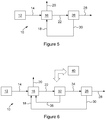
- an example of the overall CO 2 capture system 10 includes a source 12 of CO 2 containing gas 14.
- the source may be a power plant, an aluminum smelter, refinery or another type of CO 2 producing operation at high or atmospheric pressure, or may also be ambient air for some specific applications such as air fractionation or air cleaning.
- the CO 2 containing gas 14 is supplied to an absorption unit 16, which is also fed with an aqueous absorption solution 18 for contacting the CO 2 containing gas 14.
- the aqueous absorption solution 18 includes carbonic anhydrase including SspCA or a functional derivative thereof and an absorption compound.
- the carbonic anhydrase may be free in the aqueous absorption solution 18 as dissolved enzyme or aggregates or particles of enzymes.
- the carbonic anhydrase may be on or in particles that are present in the aqueous absorption solution 18 and flow with it through the absorption unit 16.
- the carbonic anhydrase may be immobilized with respect to the particles using any method while keeping at least some of its activity. Some immobilization techniques include covalent bonding, entrapment, and so on.
- the carbonic anhydrase may be immobilized with respect to supports, which may be various structures such as packing material, within the absorption unit 16 so as to remain within the absorption unit 16 as the aqueous absorption solution 18 flows through it.
- the CO 2 containing gas 14 may be a CO 2 -containing effluent from various sources that includes a proportion of CO 2 and other gases.
- the gas may include from about 0.03% to 60% (v/v) of CO 2 although the CO 2 concentration may be greater.
- the CO 2 -containing gas may also be a gas having high CO 2 content up to 100%, which may be useful for the production of compounds such as sodium bicarbonate from CO 2 gas as one of the starting materials.
- the absorption unit 16 may be of various types, such as a packed reactor, a spray reactor, a bubble column type reactor, and so on. There may be one or more reactors that may be provided in series or in parallel. In the absorption unit 16, the SspCA catalyses the hydration reaction of CO 2 into bicarbonate and hydrogen ions and thus a CO 2 depleted gas 20 and an ion rich solution 22 are produced.
- the ion rich solution 22 is then supplied to a desorption unit 26 to produce a CO 2 stream 28 and an ion depleted solution 30.
- SspCA may also be present to catalyse the dehydration reaction of bicarbonate ions into CO 2 and thus a CO 2 depleted gas 20 and an ion lean solution 22 is produced.
- the ion rich solution 22 may be supplied to another type of regeneration step such as mineral carbonation and the like.
- the system 10 may also include a separation unit 32 arranged in between the absorption unit 16 and the desorption unit 26, for removing at least some and possibly all of the SspCA in the event the enzyme is flowing with the ion rich solution 22, e.g. when the enzyme is free in solution or immobilized with respect to particles.
- the separation unit 32 produces an enzyme depleted stream 34 that may be supplied to the desorption unit 26 and an enzyme rich stream 36 that may be recycled, in whole or in part, to the absorption unit 16.
- the separation unit may also include one or more separators in series or parallel.
- the separators may be filters or other types of separators, depending on the removal characteristics for the enzymes and the form of the enzymes or particles.
- the system may also include various other treatment units for preparing the ion rich solution for the desorption unit and/or for preparing the ion deplete unit for recycling into the absorption unit.
- treatment units for preparing the ion rich solution for the desorption unit and/or for preparing the ion deplete unit for recycling into the absorption unit.
- There may be pH adjustment units or various monitoring units.
- At least some SspCA is provided in the desorption unit.
- the SspCA may be provided within the input ion rich solution or added separately.
- the SspCA may be tailored, designed, immobilised or otherwise delivered in order to withstand the conditions in the desorption unit.
- SspCA may catalyze the conversion of bicarbonate ion to CO 2 as described in Reaction 1 (reverse reaction).
- the system may also include a measurement device 40 for monitoring properties of various streams and adjusting operation of the absorption unit 16 to achieve desired properties. Adjusting could be done by various methods including modifying the liquid and/or gas flow rates, for example, or adjusting other operating conditions.
- the absorption unit may be operated at conditions so as to leverage the activity and/or stability of the SspCA used to catalyze the CO 2 hydration reaction.
- SspCA can present high residual activity over a range of elevated temperatures in aqueous absorption solution including sodium carbonate or potassium carbonate.
- SspCA also presents high activity at lower ambient temperature to provide elevated CO 2 flux in aqueous absorption solutions including sodium carbonate, potassium carbonate or MDEA.
- the operating conditions may include an operating temperature and at least one operating absorption compound within the absorption solution.
- the operating conditions may further include pH, CO 2 loading, gas and liquid flow rates and compositions, and so on.
- the operating conditions are coordinated for maximum leverage of the SspCA functionality in CO 2 capture.
- the operating conditions may include temperature conditions that, depending on various other parameters of the CO 2 capture operation, may provide an absorption temperature higher than 10°C and lower than 98°C, such as 15°C, 20°C, 25°C, 30°C, 35°C, 40°C, 45°C, 50°C, 55°C, 60°C, 65°C, 70°C, 75°C, 80°C, 85°C, 90°C, 95°C, 98°C, or any temperature in between.
- the temperature conditions in the absorption unit may vary within a certain temperature range, since the operating temperatures at different locations within the absorption unit will be different.
- the temperature of the absorption solution can substantially fluctuate throughout absorption and desorption stages that can be used in some CO 2 capture operations.
- the operating conditions may include temperature conditions that, depending on various other parameters of the CO 2 capture operation, may provide a desorption temperature higher than 10°C and lower than 110°C, such as 15°C, 20°C, 25°C, 30°C, 35°C, 40°C, 45°C, 50°C, 55°C, 60°C, 65°C, 70°C, 75°C, 80°C, 85°C, 90°C, 95°C, 100°C, 105°C, 110°C or any temperature in between.
- the temperature conditions in the desorption unit may vary within a certain temperature range, since the operating temperatures at different locations within the desorption unit will be different.
- the temperature of the absorption solution can substantially fluctuate throughout absorption and desorption stages that can be used in some CO 2 capture operations.
- the operating conditions may include an aqueous absorption solution including an absorption compound, which will be further discussed below.
- the enzyme is preferably used in combination with an absorption solution that will supply the CO 2 carrying capacity for the process.
- the solution may have a composition allowing acceleration of the enzyme catalytic rate by capturing the hydrogen ion released during the hydration reaction.
- SspCA allows the CO 2 capture operation to be accelerated, reducing the size of the required capture vessels and associated capital costs.
- energetically favorable absorption compounds such as tertiary and hindered amines, carbonate/bicarbonate solutions and amino acids/amino acid salts can be employed to reduce associated process energy consumption, where these absorption compounds would normally be too slow to be used efficiently without enzymatic catalysis.
- the aqueous absorption solution may include at least one absorption compound that aids in the absorption of CO 2 .
- the absorption compound may include potassium carbonate, sodium carbonate, ammonium carbonate, at least one amine, which may be a primary amine, a secondary amine, a tertiary amine, a primary alkanolamine, a secondary alkanolamine, a tertiary alkanolamine, and/or an amino acid with primary, secondary or tertiary amino group(s) or a combination thereof.
- Combinations of absorption compounds include a carbonate and at least one of the amines and/or amino acids mentioned therein or herein, to produce a promoted carbonate absorption solution.
- the absorption compound may be monoethanolamine (MEA), 2-amino-2-methyl-1-propanol (AMP), 2-(2-aminoethylamino)ethanol (AEE), 2-amino-2-hydroxymethyl-1,3-propanediol (Tris or AHPD), N-methyldiethanolamine (MDEA), dimethylmonoethanolamine (DMMEA), diethylmonoethanolamine (DEMEA), triisopropanolamine (TIPA), triethanolamine (TEA), DEA, DIPA, MMEA, TIA, TBEE, HEP, AHPD, hindered diamine (HDA), bis-(tertiarybutylaminoethoxy)-ethane (BTEE), ethoxyethoxyethanol-tertiarybutylamine (EEETB), bis-(tertiarybutylaminoethyl)ether, 1,2-bis-(tertiarybutylaminoethoxy)ethane and/or
- the absorption compound may be piperidine, piperazine, derivatives of piperidine, piperazine which are substituted by at least one alkanol group, dialkylether of polyalkylene glycols, dialkylether or dimethylether of polyethylene glycol, amino acids comprising glycine, proline, arginine, histidine, lysine, aspartic acid, glutamic acid, methionine, serine, threonine, glutamine, cysteine, asparagine, valine, leucine, isoleucine, alanine, tyrosine, tryptophan, phenylalanine, and derivatives such as taurine, N,cyclohexyl 1,3-propanediamine, N-secondary butyl glycine, N-methyl N-secondary butyl glycine, diethylglycine, dimethylglycine, sarcosine, methyl taurine, methyl- ⁇ -aminopropionica
- the absorption compound used to make up the aqueous absorption solution may be at least one of the example compounds, i.e. potassium carbonate, sodium carbonate and/or MDEA.
- the concentration of the absorption compound in the solution may be between about 0.1 M and about 10 M, depending on various factors.
- the concentration of the amine-based solution may be between about 0.1M and 8M and when the absorption compound is amino acid-based, the concentration of the amino acid-based solution may be between about 0.1M and 6M.
- the pH of the absorption solution may be between about 8 and about 12, depending for example on the absorption compound and on the CO 2 loading of the solution.
- the SspCA may be dissolved in the absorption solution.
- concentration of the SspCA or functional derivative thereof may be between about 0.1 and about 50 g/L, between about 0.1 and about 10 g/L or between about 0.1 and about 5 g/L.
- the amount of immobilized SspCA may be similar so as to provide a similar activity as the therein mentioned concentrations of dissolved SspCA.
- the SspCA or functional derivative thereof may be provided free or dissolved in the solvent, immobilized or entrapped or otherwise attached to particles that are in the absorption solution or to packing material or other structures that are fixed within the reaction chamber.
- the SspCA or functional derivative thereof is immobilized with respect to a support material
- this may be accomplished by an immobilization technique selected from adsorption, covalent bonding, entrapment, copolymerization, cross-linking, and encapsulation, or combination thereof.
- the SspCA or functional derivative thereof may be immobilized on a support that is in the form of particles, beads or packing.
- Such supports may be solid or porous with or without coating(s) on their surface.
- the SspCA or functional derivative thereof may be covalently attached to the support and/or the coating of the support, or entrapped inside the support or the coating.
- the coating may be a porous material that entraps the SspCA or functional derivative thereof within pores and/or immobilizes the SspCA by covalent bonding to the surfaces of the support.
- the support material may be made from a compound different than the SspCA or functional derivative thereof.
- the support material may include nylon, cellulose, silica, silica gel, chitosan, polyacrylamide, polyurethane, alginate, polystyrene, polymethylmetacrylate, magnetic material, sepharose, titanium dioxide, zirconium dioxide and/or alumina, respective derivatives thereof, and/or other materials.
- the support material may have a density between about 0.6 g/ml and about 5 g/ml such as a density above 1g/ml, a density above 2 g/mL, a density above 3 g/mL or a density of about 4 g/mL.
- the SspCA or functional derivative thereof may be provided as cross-linked enzyme aggregates (CLEAs) and/or as cross-linked enzyme crystals (CLECs).
- the particles may be sized to have a diameter at or below about 17 ⁇ m, optionally about 10 ⁇ m, about 5 ⁇ m, about 4 ⁇ m, about 3 ⁇ m, about 2 ⁇ m, about 1 ⁇ m, about 0.9 ⁇ m, about 0.8 ⁇ m, about 0.7 ⁇ m, about 0.6 ⁇ m, about 0.5 ⁇ m, about 0.4 ⁇ m, about 0.3 ⁇ m, about 0.2 ⁇ m, about 0.1 ⁇ m, about 0.05 ⁇ m, or about 0.025 ⁇ m.
- the particles may also have a distribution of different sizes.
- the SspCA used in connection with the techniques described herein may be an isolated and/or substantially pure form.
- the disclosure provides a carbonic anhydrase polypeptide comprising the sequence as set forth in SEQ ID NO: 2 or functional derivative thereof, an expression or cloning vector comprising a nucleotide sequence encoding such carbonic anhydrase, and a transgenic cell comprising such expression or cloning vector.
- the SspCA or the derivative thereof can be used in various processes and scenarios such as those described in the following patent references: CA 2.291.785 ; CA 2.329.113 , CA 2.393.016 , CA 2,443,222 , US 6,908,507 ; EU 1 377 531 , US 7,514,056 , US 7,596,952 ; US 8,066,965 , US 8,277,769 , US 6,946,288 , US 7,740,689 , PCT/CA2012/050063 , US 13/503.808 , US 12/984.852 , US 13/388.854 , US 13/264.294 , US 13/388.871 , US 13/508.246 , US 11/460.402 .
- polypeptide refers to any peptide or protein comprising two or more amino acids joined to each other by peptide bonds or modified peptide bonds.
- Polypeptide(s) refers to both short chains, commonly referred to as peptides, oligopeptides and oligomers, and to longer chains generally referred to as proteins.
- Polypeptides may contain amino acids other than the 20 gene-encoded amino acids, optionally polypeptides may contain glycine, proline, arginine, histidine, lysine, aspartic acid, glutamic acid, methionine, serine, threonine, glutamine, cysteine, asparagine, valine, leucine, isoleucine, alanine, tyrosine, tryptophan, phenylalanine, selenocysteine, selenomethionine, pyrrolysine.
- Polypeptide(s) include those modified either by natural processes, such as processing and other post-translational modifications, but also by chemical modification techniques.
- the expression "functional derivative” refers to a protein/peptide/polypeptide sequence that possesses a functional biological activity that is substantially similar to the biological activity of the original protein/peptide/polypeptide sequence. In other words, it refers to a polypeptide of the carbonic anhydrase as defined herein that substantially retain(s) the capacity of catalyzing the hydration of carbon dioxide.
- a functional derivative of the carbonic anhydrase protein/peptide as defined herein may or may not contain post-translational modifications such as covalently linked carbohydrates, if such modifications are not necessary for the performance of a specific function.
- the "functional derivative” may also comprise nucleic acid sequence variants.
- the carbonic anhydrase as defined herein may comprise a Tag such as a histidine Tag.
- the term “functional derivative” is meant to encompass the "variants”, the “mutants”, the “fragments” or the “chemical derivatives” of a carbonic anhydrase protein/peptide. Methods for measuring carbonic anhydrase activity are known such as stirred cell reactor assay or the method described by Chirica et al. ( Chirica et al. European Journal of Biochemistry, 1997, 244, 755-60 ).
- These functional derivatives have at least 60%, 65%, 70%, 75%, 80%, 85%, 86%, 87%, 88%, 89%, 90%, 91%, 92%, 93%, 94%, 95%, 96%, 97%, 98% 99% or 99.5% identity with the sequence as set forth in SEQ ID NO: 8, optionally over the entire length of the sequence or on a partial alignment of the sequences.
- polynucleotide fragment refers to a polynucleotide whose sequence (e.g., cDNA) is an isolated portion of the subject nucleic acid constructed artificially (e.g., by chemical synthesis) or by cleaving a natural product into multiple pieces, using restriction endonucleases or mechanical shearing, or a portion of a nucleic acid synthesized by PCR, DNA polymerase or any other polymerizing technique well known in the art, or expressed in a host cell by recombinant nucleic acid technology well known to one of skill in the art.
- sequence e.g., cDNA
- polypeptide or fragments thereof refers to peptides, oligopeptides and proteins. This term also does not exclude post-expression modification of polypeptides. For example, polypeptides that include the covalent attachment of glycosyl groups, acetyl groups, lipid groups and the like are encompassed by the term polypeptide.
- sequence identity refers to an exact nucleotide-to-nucleotide or amino acid-to-amino acid correspondence of two polynucleotides or polypeptide sequences, respectively.
- Two or more sequences can be compared by determining their "percent identity.”
- the percent identity of two sequences, whether nucleic acid or amino acid sequences is the number of exact matches between two aligned sequences divided by the length of the shorter sequence and multiplied by 100.
- An approximate alignment for nucleic acid sequences is provided by the local homology algorithm of Smith and Waterman, Advances in Applied Mathematics 2:482-489 (1981 ). This algorithm can be applied to amino acid sequences by using the scoring matrix developed by Dayhoff, Atlas of Protein Sequences and Structure, M. O. Dayhoff ed., 5 suppl.
- BLAST BLAST
- polypeptide of the present disclosure preferably has an amino acid sequence having at least about 60%, 65%, 70%, 75%, 80%, 81%, 82%, 83%, 84% 85%, 86%, 87%, 88%, 89%, 90%, 91%, 92%, 93%, 94%, 95%, 96%, 97%, 98%, 99%, 99,5% or any other value in between to SEQ ID NO: 2 or SEQ ID NO: 8, or functional derivatives thereof, optionally over the entire length of the peptide.
- This program compares amino acid sequences and finds the optimal alignment by inserting spaces in either sequence as appropriate. It is possible to calculate amino acid identity or homology for an optimal alignment.
- a program like BLASTp will align the longest stretch of similar sequences and assign a value to the fit. It is thus possible to obtain a comparison where several regions of similarity are found, each having a different score. Both types of identity analysis are contemplated for the present disclosure.
- isolated polypeptide or isolated and purified polypeptide
- This term refers primarily to a protein produced by expression of an isolated and modified polynucleotide molecule contemplated by the disclosure. Alternatively, this term may refer to a protein which has been sufficiently separated from other proteins with which it would naturally be associated, so as to exist in “substantially pure” form.
- substantially pure refers to a preparation comprising at least 50 % by weight of the carbonic anhydrase polypeptide or derivative thereof on total protein content. More preferably, the preparation comprises at least 75% by weight, and most preferably 90-99% by weight, of the carbonic anhydrase polypeptide or derivative thereof.
- Purity is measured by methods appropriate for the carbonic anhydrase polypeptide or derivative thereof as described herein (e.g. chromatographic methods, agarose or polyacrylamide gel electrophoresis, HPLC analysis, and the like).
- the SspCA polypeptide or functional derivative thereof may also comprise amino acids substitution such that the carbonic anhydrase or functional derivative thereof retains catalytic activity (i.e. the interconversion of CO 2 with HCO 3 - and H+).
- substituted amino acid is intended to include natural amino acids and non-natural amino acids. Non-natural amino acids include amino acid derivatives, analogues and mimetics.
- a "derivative" of an amino acid refers to a form of the amino acid in which one or more reactive groups on the compound have been derivatized with a substituent group.
- an "analogue” of an amino acid refers to a compound that retains chemical structures of the amino acid necessary for functional activity of the amino acid yet also contains certain chemical structures that differ from the amino acid.
- a “mimetic” of an amino acid refers to a compound in that mimics the chemical conformation of the amino acid.
- polynucleotide(s) generally refers to any polyribonucleotide or poly-deoxyribonucleotide, which may be unmodified RNA or DNA or modified RNA or DNA. This definition includes, without limitation, single- and double-stranded DNA, DNA that is a mixture of single- and double-stranded regions or single-, double- and triple-stranded regions, cDNA, single- and double-stranded RNA, and RNA that is a mixture of single- and double-stranded regions, hybrid molecules comprising DNA and RNA that may be single-stranded or, more typically, double-stranded, or triple-stranded regions, or a mixture of single- and double-stranded regions.
- polynucleotide(s) also embraces short nucleotides or fragments, often referred to as “oligonucleotides", that due to mutagenesis are not 100% identical but nevertheless code for the same amino acid
- polynucleotide of the disclosure has a nucleic acid sequence which encodes a polypeptide which is at least about 60%, 65%, 70%, 75%, 80%, 81%, 82%, 83%, 84% 85%, 86%, 87%, 88%, 89%, 90%, 91%, 92%, 93%, 94%, 95%, 96%, 97%, 98%, 99%, 99,5% or any other value between 60 and 99,5% identical to SEQ ID NO 1 or SEQ ID NO: 8 or functional derivative thereof.
- polynucleotide of the disclosure has a nucleic acid sequence which is at least about 60%, 65%, 70%, 75%, 80%, 81%, 82%, 83%, 84% 85%, 86%, 87%, 88%, 89%, 90%, 91%, 92%, 93%, 94%, 95%, 96%, 97%, 98%, 99%, 99,5% or any other value between 60 and 99,5% identical to SEQ ID NO 7 or functional derivative thereof.
- isolated polynucleotide refers to a DNA molecule that is separated from sequences with which it is immediately contiguous to (in the 5' and 3' directions) in the naturally occurring genome of the organism from which it was derived.
- the "isolated polynucleotide” may comprise a DNA molecule inserted into a vector, such as a plasmid or virus vector, or integrated into the genomic DNA of a procaryote or eucaryote.
- An “isolated polynucleotide molecule” may also comprise a cDNA molecule.
- vector refers to a polynucleotide construct designed for transduction/transfection of one or more cell types.
- Vectors may be, for example, cloning vectors which are designed for isolation, propagation and replication of inserted nucleotides, expression vectors which are designed for transcription of a nucleotide sequence in a host cell, or a viral vector which is designed to result in the production of a recombinant virus or virus-like particle, or shuttle vectors, which comprise the attributes of more than one type of vector.
- a number of vectors suitable for stable transfection of cells and bacteria are available to the public (e.g.
- plasmids adenoviruses, baculoviruses, yeast baculoviruses, plant viruses, adeno-associated viruses, retroviruses, Herpes Simplex Viruses, Alphaviruses, Lentiviruses), as are methods for constructing such cell lines. It will be understood that the present disclosure encompasses any type of vector comprising any of the polynucleotide molecules of the disclosure.
- transgenic cell refers to a genetically engineered cell. Methods for genetically engineering a cell are known such as molecular cloning and gene targeting. These methods can include chemical-based transfection, non chemical method, particle-based method or viral method.
- the host cell may be any type of cell such as a transiently-transfected or stably-transfected mammalian cell line, an isolated primary cell, an insect cell, a yeast ( Saccharomyces cerevisiae or Pichia pastoris ), a plant cell, a microorganism, or a bacterium (such as E. coli ).
- naturally occurring or wild-type refer to material in the form as it occurs in nature.
- a naturally occurring or wild-type polypeptide or polynucleotide sequence is a sequence present in an organism that is isolated from a source in nature and which has not been intentionally modified by human manipulation.
- the expressions "Recombinant”,”engineered” or “non-naturally occurring” it do not appears in nature, it is an artificial construct.
- a cell, nucleic acid, or polypeptide refers to a material that either has been modified in a manner that would not otherwise be found in nature, or is identical thereto but produced or derived from synthetic materials and/or by manipulation using recombinant techniques.
- Reference sequence refers to a defined sequence to which another sequence is compared.
- the reference sequence is SEQ ID NO: 2 and preferably SEQ ID NO: 8.
- Coding sequence refers to the nucleic acid sequence(s) that would yield the amino acid sequence of a given protein.
- amino acid residue refers to the specific monomer at a sequence position of a polypeptide (e.g., G82 indicates that the "amino acid” or “residue” at position 82 of SEQ ID NO: XX is a glycine (G).
- the amino acid may be alanine (3 letter code : ala or one letter code : A), arginine (arg or R), asparagine (asn or N), aspartic acid (asp or D), cysteine (cys or C), glutamine (gln or Q), glutamic acid (glu or E), glycine (gly or G), histidine (his or H), Isoleucine (ile or I), leucine (leu or L), lysine (lys or K), methionine (met or M), phenylalanine (phe or F), proline (pro or P), serine (ser or S), threonine (thr or T), tryptophan (trp or W), tyrosine (tyr or Y), valine (val or V)
- amino acid difference refers to an amino acid at a given position in a protein sequence that is different from the one in the reference sequence. It refers to a change in the amino acid residue at a position of a polypeptide sequence relative to the amino acid residue at a corresponding position in a reference sequence.
- the positions of amino acid differences generally are referred to herein as "Xn,” where n refers to the corresponding position in the reference sequence upon which the residue difference is based.
- a “residue difference at position X82 as compared to SEQ ID NO: 8” refers to a change of the amino acid residue at the polypeptide position corresponding to position 82 of SEQ ID NO: 8.
- a "residue difference at position X82 as compared to SEQ ID NO: 8" an amino acid substitution of any residue other than glycine at the position of the polypeptide corresponding to position 82 of SEQ ID NO: 8.
- the specific amino acid residue difference at a position is indicated as "XnY” where "Xn” specifies the corresponding position as described therein, and "Y” is the single letter identifier of the amino acid found in the engineered polypeptide (i.e., the different residue than in the reference polypeptide).
- the present disclosure also provides specific amino acid differences denoted by the conventional notation "AnB", where A is the single letter identifier of the residue in the reference sequence, "n” is the number of the residue position in the reference sequence, and B is the single letter identifier of the residue substitution in the sequence of the engineered polypeptide.
- A is the single letter identifier of the residue in the reference sequence
- n is the number of the residue position in the reference sequence
- B is the single letter identifier of the residue substitution in the sequence of the engineered polypeptide.
- G82C would refer to the substitution of the amino acid residue, glycine (G) at position 82 of reference sequence with the amino acid cystein (C).
- a polypeptide of the present disclosure can include one or more amino acid residue differences relative to a reference sequence, which is indicated by a list of the specified positions where changes are made relative to the reference sequence.
- the present disclosure includes engineered polypeptide sequences comprising one or more amino acid differences that include either/or both conservative and non-con
- Constant amino acid substitution refers to an amino acid at a given position in a protein sequence, that is different but similar from the one in the reference sequence. The similarity can be evaluated by using the scoring matrix developed by Dayhoff, Atlas of Protein Sequences and Structure, M. O. Dayhoff ed., 5 suppl. 3:353-358, National Biomedical Research Foundation, Washington, D.C., USA .
- Non-conservative substitution refers to an amino acid, at a given position in a protein sequence that is different and not similar from the one in the reference sequence.
- deletion refers to one or several amino acid(s) at a given position in a protein sequence, that is or are absent when compared to the reference sequence.
- Insertion refers to one or several amino acid(s) at a given position in a protein sequence, that is or are in excess when compared to the reference sequence.
- Improved enzyme property refers to a property that is better in one enzyme when compared to the reference one. It can be an increase in stability toward some denaturing agent, an increase in thermostability, an increase in solvent stability, an increase in pH stability,an increase in enzyme activity, reduced inhibition by products (eg. bicarbonate and/or carbonate ions), improved stability in presence of the sodium cation, improved stability in presence of the potassium cation, improved solvent solubility, or a combination thereof.
- Stability in presence of refers to the capacity of the enzyme to remain active over a period of time when in the presence of a denaturing compound. It is usually described as a percentage of remaining activity over time.
- Thermostability refers to the capacity of the enzyme to remain active over a period of time when when exposed to a given temperature. It is usually described as a percentage of remaining activity over time.
- solvent stability refers to the capacity of the enzyme to remain active over a period of time when when exposed to a given solvant. It is usually described as a percentage of remaining activity over time.
- pH stability refers to the capacity of the enzyme to remain active over a period of time when when exposed to a given pH, such as a higher pH. It is usually described as a percentage of remaining activity over time.
- Increased enzyme activity refers to the capacity of an enzyme to catalyze more reaction, such as hydration of CO 2 and/or dehydratation of the HCO 3 - ion, per time unit than the reference enzyme in some given conditions, such as higher Temperature, higher pH (improved pH activity profile).
- the relevant value e.g. of temperature, concentration, pH, etc.
- the margin of error of the temperature may range between ⁇ 0.5°C to ⁇ 1°C
- the margin of error of the pH may be ⁇ 0.1
- the margin of error of the concentration may be ⁇ 20%.
- Example 1 Materials, methods and producing of SspCA having a polypeptide sequence described in SEQ ID NO: 8
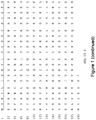
- SspCA enzyme was produced without the signal peptide: the first 20 amino acids were replaced by a single methionine. The first 20 amino acids (signal peptide) are underlined in Fig 1 .
- the enzyme was purified and characterized in a stirred cell reactor and a micro stirred cell reactor.
- the resulting coding nucleotide sequence is shown in Figure 7 and the encoded SspCA amino acid sequence is shown at Figure 8 . Amino acid residue numbering will follow that of Figure 8 .
- the stirred cell reactor (SCR) assay was similar to the one described in Penders N.J.M.C. et al. entitled Kinetics of absorption of carbon dioxide in aqueous MDEA solutions with carbonic anhydrase at 298K (International Journal of Greenhouse Gas Control, (2012) 9:385-392 ).
- SCR stirred cell reactor
- micro stirred cell assays were performed using 2 ml cells in the appropriate solvent under 1 atmosphere of 100% CO 2 at 22°C.
- the pH changes were monitored using a pH indicator present in the solution and a spectrophotometer.
- the pH could then be correlated to an absorbed CO 2 concentration using a standard curve of optical density versus CO 2 loading and then a CO 2 absorption flux is obtained.
- SspCA The activities of SspCA and various other enzymes were compared. The activity was tested in three different absorption solutions: an aqueous absorption solution including MDEA 2M, an aqueous absorption solution including sodium carbonate (Na 2 CO 3 ) 0.3M pH 10 and an aqueous absorption solution including potassium carbonate (K 2 CO 3 ) 1.45M pH 10. The tests were performed in a SCR reactor at 25°C. As shown in Table 1 presented below, SspCA has a higher activity (flux) than M6X in all three absorption solutions.
- SspCA presents approximately 8.5 to 22 times greater activity compared to no enzyme depending on the absorption compound and conditions that were used. SspCA also presents the same or up to 2 times greater activity compared to the M6X carbonic anhydrase depending on the absorption compound and conditions that were used. From the above tests, SspCA is faster than CA_C and slower than CA_B.
- the stabilities of SspCA and M6X were also compared.
- the stability was evaluated by exposing the enzymes to an absorption solution including sodium carbonate 0.3M at pH 10, potassium carbonate 1.45M pH 10 and/or potassium carbonate 1.45M pH 10, at 60°C. The tests were performed in a SCR reactor at 25°C and under 100% CO 2 conditions.
- SspCA was more stable than M6X.
- M6X was inactivated after one day whereas SspCA still had about 86% of the initial activity after six days of exposure and 65% after 14 days. The half life of those enzymes could be estimated at ⁇ 1 day for M6X, 1.7 days for CA_B and 22 days for SspCA.
- SspCA presents not only greater initial activity compared to M6X, but maintains elevated activity over a longer period of time and thus shows greater stability. Furthermore, SspCA presents slightly lower initial activity than CA_B but shows a greater stability.
- Example 4 Residual activities of SspCA, M6X, CA_A, CA_B and CA_C in sodium carbonate or MDEA solutions
- the short term stability of M6X, CA_A, CA_B, CA_B and SspCA was compared in two absorption solutions.
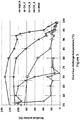
- the first aqueous absorption solution included sodium carbonate 0.3M at pH 10 and the results are illustrated in Fig 3 .
- the second aqueous absorption solution included MDEA 4.2M (pH 11.3) and the results are illustrated in Fig 4 . All enzymes were provided at a concentration of 0.2 g/l.
- the test included exposing the absorption solutions including the enzymes to different temperatures for one hour and then the residual activity was measured using micro stirred cell at 22°C.
- the temperature required to reduce the activity of the enzyme to 50% residual activity was 57°C for M6X, 70°C for CA_A, 72°C for CA_B, 90°C for CA_C and 95°C for SspCA, in the sodium carbonate solution.
- the SspCA showed higher residual activity at all tested temperatures over the range of 55°C to 100°C.
- the SspCA showed notably higher residual activity around the temperature range of 85°C to 95°C compared to the other enzymes.
- the temperature required to reduce the activity of the enzyme to 50% residual activity was 65°C for M6X, 69°C for SspCA, 68°C for CA_A, 79°C for CA_B and >85°C for CA_C, in the MDEA solution.
- the SspCA is more stable than M6X (variant from human carbonic anhydrase).
- Example 5 Comparison of amino acid sequences between carbonic anhydrase obtained from Sulfurihydrogenibium sp. Y03A0P1 and the most similar protein in GenBank
- the most similar carbonic anhydrase from the carbonic anhydrase obtained from Sulfurihydrogenibium sp. Y03A0P1 is from Sulfurihydrogenibium azorense Az-Fu1 with 58% identity, and the nearest one outside the Sulfurihydrogenibium genus is the one from Tolumonas auensis with 50% identity.
- SspSCA would have an enhanced impact in CO 2 capture in sodium and potassium carbonate solutions because of its highest activity and stability.
- the experimental data support that SspCA will transform many more CO 2 molecules than the other enzymes during its lifetime in the process given its high activity level and higher stability at higher temperature. For instance, from Exemple 2 above, using the same conditions as in that test, we can expect that a solution with SspCA, within its lifetime, will transform 4.3 x 10 7 mmole.m -2 .bar -1 while one with CA_B will transform 3.7 x 10 6 mmole.m -2 .bar -1 .
- CA carbonic anhydrase
- the improved properties can be one or a combination of: improved thermostability, improved activity (hydration of CO 2 and/or dehydratation of the HCO 3 - ion), improved high pH stability (eg. pH 7 to 12), improved pH activity profile, reduced inhibition by products (eg. bicarbonate and/or carbonate ions), improved stability in presence of the sodium cation, improved stability in presence of the potassium cation, improved solvent solubility, or a combination thereof.
- the improved variants comprise at least one or more amino acid substitutions in their amino acid sequence relative to that of wild-type SspCA (Seq ID No: 8) that results in CA exhibiting improved properties.
- An improved variant can have in its amino acid sequence 1 or more substitutions, 2 or more substitutions, 3 or more substitutions, 4 or more substitutions, 5 or more substitutions, 6 or more substitutions, 7 or more substitutions, 8 or more substitutions, 9 or more substitutions, 10 or more substitutions.
- the improved variant may additionaly comprise neutral mutations.
- the improved variant can be substantially identical to SspCA.
- the sequence of the disclosure has an amino acid sequence which is at least about 60%, 65%, 70%, 75%, 80%, 81%, 82%, 83%, 84% 85%, 86%, 87%, 88%, 89%, 90%, 91%, 92%, 93%, 94%, 95%, 96%, 97%, 98%, 99% or 99,5% identical to SEQ ID NO 8.
- the substitutions comprise but are not limited to any mutations at positions listed in Tables 5, 6 and 9 or any functional derivative thereof.
- the mutation can be conservative or non-conservative. Non-limiting examples of conservative mutations are given in Table 3. Conservative mutations are known to usually provide similar effect to protein structure and function.
- the functional derivative can comprise substitution, insertion and/or deletion, or combination thereof.
- the variant can be free or immobilized.
- Table 3 Possible conservative mutations Class Amino acid Conservative mutation class Non-polar A, V, L, I Non-polar Other non-polar Other non-polar G, M Non-polar Aromatic H, F, Y, W Aromatic Polar Q, N, S, T Polar > acidic, basic Acidic D, E Acidic > polar Basic K, R Basic > polar Other C, P None
- the functional derivative can have any substitution at surface-exposed residues. It is known by those skilled in the art that most neutral substitutions, i.e. mutations that retain biological and biophysical properties of a given protein, are found at these positions. Mutations tend also to be found at residue not involved in the function of the protein and away from the active site region. Table 4 describes the location and features of every SspCA residue in its 3D-structure (PDB ID 4G7A).
- Table 5 provides a description of the amino acid substitutions as reflected in SEQ ID NO, together with the observed activity of the mutated enzyme after 15 min at 92°C. The stability was evaluated by comparison of the residual activity signal level after a 15 min exposure in 0.3M Na 2 CO 3 /NaHCO 3 pH 10.
- Table 9 provides the construction of the mutants.
- Table 9 Mutants DNA and Polypeptide SEQ ID. Mutant Description SEQ ID NO (DNA) SEQ ID NO (Polypeptide) Q18A 9 10 Q18C 11 12 Q18F 13 14 Q18L 15 16 Q18R 17 18 Q18S 19 20 Q18W 21 22 K20A 23 24 K20G 25 26 K20L 27 28 K20N 29 30 K20R 31 32 K20S 33 34 K20T 35 36 K38A 37 38 K38C 39 40 K38D 41 42 K38G 43 44 K38L 45 46 K38N 47 48 K38P 49 50 K38R 51 52 K38S 53 54 K38W 55 56 Y52C 57 58 Y52E 59 60 Y52G 61 62 Y52P 63 64 Y52T 65 66 K57A 67 68 K57G 69 70 K57L 71 72 K57N 73 74 K57P 75 76 K57R 77 78 K57S 79 80 K57V 81 82
Landscapes
- Chemical & Material Sciences (AREA)
- Engineering & Computer Science (AREA)
- Health & Medical Sciences (AREA)
- Life Sciences & Earth Sciences (AREA)
- Wood Science & Technology (AREA)
- Organic Chemistry (AREA)
- Bioinformatics & Cheminformatics (AREA)
- Zoology (AREA)
- Genetics & Genomics (AREA)
- Biomedical Technology (AREA)
- Analytical Chemistry (AREA)
- Chemical Kinetics & Catalysis (AREA)
- Oil, Petroleum & Natural Gas (AREA)
- General Chemical & Material Sciences (AREA)
- General Engineering & Computer Science (AREA)
- General Health & Medical Sciences (AREA)
- Molecular Biology (AREA)
- Biochemistry (AREA)
- Biotechnology (AREA)
- Microbiology (AREA)
- Environmental & Geological Engineering (AREA)
- Sustainable Development (AREA)
- Medicinal Chemistry (AREA)
- Enzymes And Modification Thereof (AREA)
- Micro-Organisms Or Cultivation Processes Thereof (AREA)
- Treating Waste Gases (AREA)
Description
- The technical field relates to CO2 capture and the use of Sulfurihydrogenibium sp. carbonic anhydrase (SspCA) and mutants for catalyzing the hydration reaction of CO2 into bicarbonate and hydrogen ions or catalyzing the desorption reaction to produce a CO2 gas.
- Increasingly dire warnings of the dangers of climate change by the world's scientific community combined with greater public awareness and concern over the issue has prompted increased momentum towards global regulation aimed at reducing man-made greenhouse gas (GHGs) emissions, most notably carbon dioxide. Ultimately, a significant cut in North American and global CO2 emissions will require reductions from the electricity production sector, the single largest source of CO2 worldwide. According to the International Energy Agency's (IEA) GHG Program, as of 2006 there were nearly 5,000 fossil fuel power plants worldwide generating nearly 11 billion tons of CO2, representing nearly 40% of total global anthropogenic CO2 emissions. Of these emissions from the power generation sector, 61% were from coal fired plants. Although the long-term agenda advocated by governments is replacement of fossil fuel generation by renewables, growing energy demand, combined to the enormous dependence on fossil generation in the near term dictates that this fossil base remain operational. Thus, to implement an effective GHG reduction system will require that the CO2 emissions generated by this sector be mitigated, with carbon capture and storage (CCS) providing one of the best known solutions.
- The CCS process removes CO2 from a CO2 containing gas and involves the production of a highly concentrated CO2 gas stream which is compressed and transported to a geologic sequestration site. This site may be a depleted oil field, a saline aquifer or any suitable storage site. Sequestration in oceans and mineral carbonation are two alternate ways to sequester CO2 that are in the research phase. Captured CO2 can also be used for enhanced oil recovery or for carbonation of alkaline waste streams for sequestration as mineral solids.
- Conventional technologies for CO2 capture are based primarily on the use of aqueous amine (e.g. alkanolamines) which is circulated through two main distinct units: an absorption unit coupled to a desorption (or stripping) unit. However in the context of low CO2 partial pressures encountered in gases from combustion, these conventional technologies give rise to processes with high energy penalty and thus high operational expenditure, as it is the case with monoethanolamine (MEA), or processes with high capital expenditure, as for the case of kinetically limited absorption solutions resulting in large equipment such as with methydiethanolamine (MDEA) for example. Higher pressure CO2 separation from process streams seen in H2 production or gasification is typically usually easier to achieve due to the higher pressures in such processes.
- Carbonic anhydrase is an enzyme that has been used for CO2 absorption applications. Carbonic anhydrase is not just a single enzyme form, but a broad group of metalloproteins that exists in genetically unrelated families of isoforms, α, β, γ, δ and ε. Different classes, isoforms and variants of carbonic anhydrase have been used in order to catalyze the hydration reaction of CO2 into bicarbonate and hydrogen ions and the bicarbonate dehydration reaction into CO2 and water, as follows:
CO2 + H2O ↔ H+ + HCO3 - (Reaction 1)
- Under optimum conditions, the catalyzed turnover rate of the hydration reaction can reach 1 x 10⁶ molecules/second.
- Carbonic anhydrase from Sulfurihydrogenibium sp. has been described in EMBL database accession n° ACN99362; Russo et al (2012, Chemical Enginnering Transactions, 27, 181-186; GENBANK database accession n° ACD66216; Capasso et al (2012, Journal of Enzyme Inhibition and Medicinal Chemistry, 27, 892-897).
- However, there are several challenges related to the use of carbonic anhydrase in CO2 capture operations. For instance, the temperature stability in time, the chemical resistance and the activity of the carbonic anhydrase under process conditions are factors that have an impact on process design, process performance and operating costs.
- There is thus a need to overcome at least some of the challenges related to the use of carbonic anhydrase for CO2 capture.
- The scope of the present invention is defined by the claims and any information that does not fall within the claims is provided for information only.
- The present disclosure provides a recombinant carbonic anhydrase polypeptide comprising an amino acid sequence having at least 65% identity with SEQ ID NO: 8, or a functional derivative thereof.
- The present disclosure provides a recombinant carbonic anhydrase polypeptide comprising an amino acid sequence having at least 65% identity with SEQ ID NO: 8 and comprising at least one amino acid difference relative to SEQ ID NO: 8 at a position selected from the group consisting of X18; X20; X38; X52; X57; X82; X100; X130; X150 and X181, wherein X represents an amino acid, or a functional derivative thereof.
- The recombinant carbonic anhydrase polypeptide described therein, comprising an amino acid sequence having at least 65% identity of SEQ ID NO: 8 and comprising at least two amino acid differences relative to SEQ ID NO: 8 at positions selected from the group consisting of X18; X20; X38; X52; X57; X82; X100; X130; X150 and X181, or a functional derivative thereof.
- The recombinant carbonic anhydrase polypeptide described therein, comprising an amino acid sequence having at least 65% identity with SEQ ID NO: 8 and comprising at least three amino acid differences relative to SEQ ID NO: 8 at positions selected from the group consisting of X18; X20; X38; X52; X57; X82; X100; X130; X150 and X181, or a functional derivative thereof.
- The recombinant carbonic anhydrase polypeptide described therein comprising an amino acid sequence having at least 65% identity with SEQ ID NO: 8 and comprising at least four amino acid differences relative to SEQ ID NO: 8 at positions selected from the group consisting of X18; X20; X38; X52; X57; X82; X100; X130; X150 and X181, or a functional derivative thereof.
- The recombinant carbonic anhydrase polypeptide described therein, comprising an amino acid sequence having at least 65% identity with SEQ ID NO: 8 and comprising at least five amino acid differences relative to SEQ ID NO: 8 at positions selected from the group consisting of X18; X20; X38; X52; X57; X82; X100; X130; X150 and X181, or a functional derivative thereof.
- The recombinant carbonic anhydrase polypeptide described therein, comprising an amino acid sequence having at least 65% identity with SEQ ID NO: 8 and comprising at least six amino acid differences relative to SEQ ID NO: 8 at positions selected from the group consisting of X18; X20; X38; X52; X57; X82; X100; X130; X150 and X181, or a functional derivative thereof.
- The recombinant carbonic anhydrase polypeptide described therein, comprising an amino acid sequence having at least 65% identity with SEQ ID NO: 8 and comprising at least seven amino acid differences relative to SEQ ID NO: 8 at positions selected from the group consisting of X18; X20; X38; X52; X57; X82; X100; X130; X150 and X181, or a functional derivative thereof.
- The recombinant carbonic anhydrase polypeptide described therein, comprising an amino acid sequence having at least 65% identity with SEQ ID NO: 8 and comprising at least eight amino acid differences relative to SEQ ID NO: 8 at positions selected from the group consisting of X18; X20; X38; X52; X57; X82; X100; X130; X150 and X181, or a functional derivative thereof.
- The recombinant carbonic anhydrase polypeptide described therein, comprising an amino acid sequence having at least 65% identity with SEQ ID NO: 8 and comprising at least nine amino acid differences relative to SEQ ID NO: 8 at positions selected from the group consisting of X18; X20; X38; X52; X57; X82; X100; X130; X150 and X181, or a functional derivative thereof.
- The recombinant carbonic anhydrase polypeptide described therein, comprising an amino acid sequence having at least 65% identity with SEQ ID NO: 8 and comprising at least ten amino acid differences relative to SEQ ID NO: 8 at positions selected from the group consisting of X18; X20; X38; X52; X57; X82; X100; X130; X150 and X181, or a functional derivative thereof.
- The recombinant carbonic anhydrase polypeptide described therein, comprising an amino acid sequence having at least 65% identity with SEQ ID NO: 8 and comprising amino acid differences relative to SEQ ID NO: 8 selected from the group consisting of Q18X; K20X; K38X; Y52X; K57X; G82X; I100X; G130X; K150X and T181X, wherein Q, K, G, I, Y and T are known amino acids and X is any amino acid, or a functional derivative thereof.
- The recombinant carbonic anhydrase polypeptide described therein, comprising an amino acid sequence having at least 65% identity with SEQ ID NO: 8 and comprising amino acid differences relative to SEQ ID NO: 8 selected from the group consisting of X18A; X18C, X18F, X18L; X18R; X18S, X18T, X18W; X20A; X20G; X20L; X20N; X20R; X20S, X20T, X20W; X38A; X38D; X38G; X38L; X38N; X38P; X38R, X38S, X38W; X52C; X52E; X52G; X52P; X52T; X57A, X57G; X57L, X57N; X57P; X57R; X57S; X57V; X82C; X82E; X100A; X100E, X100N; X100S, X100V; X100Y; X130A; X130C; X130L; X150A; X150I; X150N; X150S; X181Q; X181L; X181M; X181R, wherein A, F, L, R, S, G, N, T, D, P, C, E, S, V, W, Y, I, Q and M are known amino acids, or a functional derivative thereof.
- The recombinant carbonic anhydrase polypeptide described therein, comprising an amino acid sequence having at least 65% identity with SEQ ID NO: 8 and comprising amino acid differences relative to SEQ ID NO: 8 selected from the group consisting of Q18A; Q18C, Q18F, Q18L; Q18R; Q18S, Q18T, Q18W; K20A; K20G; K20L; K20N; K20R; K20S; K20T, K20W; K38A; K38D; K38G; K38L; K38N; K38P; K38R, K38S, K38W; Y52C; Y52E; Y52G; Y52P; Y52T; K57A, K57G; K57L, K57N; K57P; K57R; K57S; K57V; G82C; G82E; I100A; I100E, I100N; I100S; I100V, I100Y; G130A; G130C; G130L; K150A; K150I; K150N; K150S; T181Q; T181L; T181M; T181R, wherein Q, K, G, Y, I and T are known amino acids, or a functional derivative thereof.
- The recombinant carbonic anhydrase polypeptide described therein, comprising an amino acid sequence having at least 70% identity with SEQ ID NO: 8, or a functional derivative thereof.
- The recombinant carbonic anhydrase polypeptide described therein, comprising an amino acid sequence having at least 75% identity with SEQ ID NO: 8, or a functional derivative thereof.
- The recombinant carbonic anhydrase polypeptide described therein, comprising an amino acid sequence having at least 80% identity with SEQ ID NO: 8, or a functional derivative thereof.
- The recombinant carbonic anhydrase polypeptide described therein, comprising an amino acid sequence having at least 85% identity with SEQ ID NO: 8, or a functional derivative thereof.
- The recombinant carbonic anhydrase polypeptide described therein, comprising an amino acid sequence having at least 90% identity with SEQ ID NO: 8, or a functional derivative thereof.
- The recombinant carbonic anhydrase polypeptide described therein, comprising an amino acid sequence having at least 91% identity with SEQ ID NO: 8, or a functional derivative thereof.
- The recombinant carbonic anhydrase polypeptide described therein, comprising an amino acid sequence having at least 92% identity with SEQ ID NO: 8, or a functional derivative thereof.
- The recombinant carbonic anhydrase polypeptide described therein, comprising an amino acid sequence having at least 93% identity with SEQ ID NO: 8, or a functional derivative thereof.
- The recombinant carbonic anhydrase polypeptide described therein, comprising an amino acid sequence having at least 94% identity with SEQ ID NO: 8, or a functional derivative thereof.
- The recombinant carbonic anhydrase polypeptide described therein, comprising an amino acid sequence having at least 95% identity with SEQ ID NO: 8, or a functional derivative thereof.
- The recombinant carbonic anhydrase polypeptide described therein, comprising an amino acid sequence having at least 96% identity with SEQ ID NO: 8, or a functional derivative thereof.
- The recombinant carbonic anhydrase polypeptide described therein, comprising an amino acid sequence having at least 97% identity with SEQ ID NO: 8, or a functional derivative thereof.
- The recombinant carbonic anhydrase polypeptide described therein, comprising an amino acid sequence having at least 98% identity with SEQ ID NO: 8, or a functional derivative thereof.
- The recombinant carbonic anhydrase polypeptide described therein, comprising an amino acid sequence having at least 99% identity with SEQ ID NO: 8, or a functional derivative thereof.
- The recombinant carbonic anhydrase polypeptide described therein, comprising an amino acid sequence having at least 99.5% identity with SEQ ID NO: 8, or a functional derivative thereof.
- The recombinant carbonic anhydrase polypeptide described therein, comprising additional neutral mutations, or a functional derivative thereof.
- The recombinant carbonic anhydrase polypeptide described therein, which further comprises at least one amino acid difference relative to SEQ ID NO: 8 selected from the group consisting of E14D; G65S; K88E; K114I; E116D; V122I; M126L; G148A; N155I and S205C, or a functional derivative thereof.
- The disclosure provides a carbonic anhydrase polypeptide comprising the sequence as set forth in SEQ ID NO: 10, SEQ ID NO: 12, SEQ ID NO: 14, SEQ ID NO: 16, SEQ ID NO: 18, SEQ ID NO: 20, SEQ ID NO: 22, SEQ ID NO: 24, SEQ ID NO: 26, SEQ ID NO: 28, SEQ ID NO: 30, SEQ ID NO: 32, SEQ ID NO: 34 ,SEQ ID NO: 36, SEQ ID NO: 38, SEQ ID NO: 40, SEQ ID NO: 42, SEQ ID NO: 44, SEQ ID NO: 46, SEQ ID NO: 48, SEQ ID NO: 50, SEQ ID NO: 52, SEQ ID NO: 54, SEQ ID NO: 56, SEQ ID NO: 58, SEQ ID NO: 60, SEQ ID NO: 62, SEQ ID NO: 64, SEQ ID NO: 66, SEQ ID NO: 68, SEQ ID NO: 70, SEQ ID NO: 72, SEQ ID NO: 74, SEQ ID NO: 76, SEQ ID NO: 78, SEQ ID NO: 80, SEQ ID NO: 82, SEQ ID NO: 84, SEQ ID NO: 86, SEQ ID NO: 88, SEQ ID NO: 90, SEQ ID NO: 92, SEQ ID NO: 94, SEQ ID NO: 96, SEQ ID NO: 98, SEQ ID NO: 100, SEQ ID NO: 102, SEQ ID NO: 104, SEQ ID NO: 106, SEQ ID NO: 108, SEQ ID NO: 110, SEQ ID NO: 112, SEQ ID NO: 114, SEQ ID NO: 116, SEQ ID NO: 118, SEQ ID NO: 120, SEQ ID NO: 122, SEQ ID NO: 124, SEQ ID NO: 126, SEQ ID NO: 128, SEQ ID NO: 130, SEQ ID NO: 132, SEQ ID NO: 134, SEQ ID NO: 136, SEQ ID NO: 138, SEQ ID NO: 140, SEQ ID NO: 142, SEQ ID NO: 144, SEQ ID NO: 146, SEQ ID NO: 148, SEQ ID NO: 150, SEQ ID NO: 152, SEQ ID NO: 154, SEQ ID NO: 156, SEQ ID NO: 158, SEQ ID NO: 160, SEQ ID NO: 162, SEQ ID NO: 164, SEQ ID NO: 166, SEQ ID NO: 168, SEQ ID NO: 170, SEQ ID NO: 172, SEQ ID NO: 174, SEQ ID NO: 176, SEQ ID NO: 178, SEQ ID NO: 180, SEQ ID NO: 182, SEQ ID NO: 184, SEQ ID NO: 186, SEQ ID NO: 188, SEQ ID NO: 190, SEQ ID NO: 192, SEQ ID NO: 194, SEQ ID NO: 196, SEQ ID NO: 200, SEQ ID NO: 202, SEQ ID NO: 204, SEQ ID NO: 206, SEQ ID NO: 208 or a functional derivative thereof comprising an amino acid sequence having at least 60%, 65%, 70%, 75%, 80%, 85%, 86%, 87%, 88%, 89%, 90%, 91%, 92%, 93%, 94%, 95%, 96%, 97%, 98%, 99% or 99,5% identity with the sequence as set forth in SEQ ID NO: 8.
- The functional derivative thereof may include an amino acid sequence having at least 60%, 65%, 70%, 75%, 80%, 85%, 86%, 87%, 88%, 89%, 90%, 91%, 92%, 93%, 94%, 95%, 96%, 97%, 98% 99% or 99,5% identity with the sequence as set forth in SEQ ID NO:1 or SEQ ID NO: 8.
- The functional derivative thereof may include an amino acid sequence having at least 60%, 65%, 70%, 75%, 80%, 85%, 86%, 87%, 88%, 89%, 90%, 91%, 92%, 93%, 94%, 95%, 96%, 97%, 98%, 99 or 99,5% identity with the sequence as set forth in SEQ ID NO: 8.
- In some aspects, the carbonic anhydrase polypeptide of the disclosure is neither SEQ ID NO:1 nor SEQ ID No.8.
- In some aspects, the recombinant carbonic anhydrase polypeptide described therein is different from SEQ ID NO: 2 or SEQ ID NO: 8.
- In some aspects, the recombinant polypeptide of the disclosure has an improved property relative to the same property of the polypeptide of SEQ ID NO: 8; selected from one or more of:
- a. Improved stability and or activity and or solubility in presence of sodium ion;
- b. Improved stability and or activity and or solubility in presence of potassium ion
- c. Improved stability and or activity and or solubility in presence of carbonate ion;
- d. Improved stability and or activity and or solubility under high pH conditions;
- e. Improved stability and or activity and or solubility under high temperature conditions and
- f. Improved pH-activity profile.
- In some aspects, there is provided a recombinant polypeptide of the disclosure, wherein the SspCA, within its lifetime, transforms at least 4.3 x 10⁷ mmole.m-2.bar-1 of CO2.
- The present disclosure provides a polynucleotide comprising a nucleotide sequence encoding the carbonic anhydrase polypeptide of the disclosure.
- The present disclosure provides a polynucleotide comprising a nucleotide sequence encoding the carbonic anhydrase polypeptide of the disclosure, such as SEQ ID NO: 9, SEQ ID NO: 11, SEQ ID NO: 13, SEQ ID NO: 15, SEQ ID NO: 17, SEQ ID NO: 19, SEQ ID NO: 21, SEQ ID NO: 23, SEQ ID NO: 25, SEQ ID NO: 27, SEQ ID NO: 29, SEQ ID NO: 31, SEQ ID NO: 33, SEQ ID NO: 35, SEQ ID NO: 37, SEQ ID NO: 39, SEQ ID NO: 41, SEQ ID NO: 43, SEQ ID NO: 45, SEQ ID NO: 47, SEQ ID NO: 49, SEQ ID NO: 51, SEQ ID NO: 53, SEQ ID NO: 55, SEQ ID NO: 57, SEQ ID NO: 59, SEQ ID NO: 61, SEQ ID NO: 63, SEQ ID NO: 65, SEQ ID NO: 67, SEQ ID NO: 69, SEQ ID NO: 71, SEQ ID NO: 73, SEQ ID NO: 75, SEQ ID NO: 77, SEQ ID NO: 79, SEQ ID NO: 81, SEQ ID NO: 83, SEQ ID NO: 85, SEQ ID NO: 87, SEQ ID NO: 89, SEQ ID NO: 91, SEQ ID NO: 93, SEQ ID NO: 95, SEQ ID NO: 97, SEQ ID NO: 99, SEQ ID NO: 101, SEQ ID NO: 103, SEQ ID NO: 105, SEQ ID NO: 107, SEQ ID NO: 109, SEQ ID NO: 111, SEQ ID NO: 113, SEQ ID NO: 115, SEQ ID NO: 117, SEQ ID NO: 119, SEQ ID NO: 121, SEQ ID NO: 123, SEQ ID NO: 125, SEQ ID NO: 127, SEQ ID NO: 129, SEQ ID NO: 131, SEQ ID NO: 133, SEQ ID NO: 135, SEQ ID NO: 137, SEQ ID NO: 139, SEQ ID NO: 141, SEQ ID NO: 143, SEQ ID NO: 145, SEQ ID NO: 147, SEQ ID NO: 149, SEQ ID NO: 151, SEQ ID NO: 153, SEQ ID NO: 155, SEQ ID NO: 157, SEQ ID NO: 159, SEQ ID NO: 161, SEQ ID NO: 163, SEQ ID NO: 165, SEQ ID NO: 167, SEQ ID NO: 169, SEQ ID NO: 171, SEQ ID NO: 173, SEQ ID NO: 175, SEQ ID NO: 177, SEQ ID NO: 179, SEQ ID NO: 181, SEQ ID NO: 183, SEQ ID NO: 185, SEQ ID NO: 187, SEQ ID NO: 189, SEQ ID NO: 191, SEQ ID NO: 193, SEQ ID NO: 195, SEQ ID NO: 199, SEQ ID NO: 201, SEQ ID NO: 203, SEQ ID NO: 205, or SEQ ID NO: 207.
- In some aspects, there is an expression or cloning vector comprising a nucleotide sequence encoding the carbonic anhydrase polypeptide as defined therein.
- In some aspects, there is a transgenic cell comprising the expression or cloning vector as defined therein.
- The present disclosure provides various techniques related to the use of the carbonic anhydrase polypeptide as defined therein for removing CO2 from a CO2-containing effluent.
- The present disclosure provides various techniques related to the use of Ssp carbonic anhydrase (SspCA) for CO2 capture and/or catalyzing the absorption of CO2 from a gas into a liquid phase.
- In some aspects, there is a use of the carbonic anhydrase polypeptide as defined therein for removing CO2 from a CO2-containing effluent.
- In some aspects, there is a use of the carbonic anhydrase polypeptide comprising the sequence as set forth in SEQ ID NO: 2, or functional derivative thereof.
- In some aspects, there is a use of the carbonic anhydrase polypeptide comprising the sequence as set forth in SEQ ID NO: 8, or functional derivative thereof.
- In some aspects, there is a method for absorbing CO2 from a CO2-containing gas, comprising: contacting the CO2-containing gas with an aqueous absorption solution to dissolve the CO2 into the aqueous absorption solution; providing a Sulfurihydrogenibium sp. carbonic anhydrase (SspCA) or functional derivative thereof to catalyze the hydration reaction of the dissolved CO2 into bicarbonate and hydrogen ions; and providing operating conditions such that the SspCA displays enhanced stability and/or activity.
- In some aspects, there is a method for absorbing CO2 from a CO2-containing gas, comprising:
- contacting the CO2-containing gas with an aqueous absorption solution to dissolve the CO2 into the aqueous absorption solution; and
- providing the Sulfurihydrogenibium sp. carbonic anhydrase (SspCA) described therein to catalyze the hydration reaction of the dissolved CO2 into bicarbonate and hydrogen ions.
- In some aspects, the method of the disclosure for absorbing CO2 from a CO2-containing gas, comprises the use of SspCA of SEQ ID NO: 2 or SEQ ID NO: 8.
- In some aspects, the SspCA displays enhanced stability and/or activity compared to the activity of SspCA of SEQ ID NO: 8.
- In some aspects, the SspCA provides an enhanced CO2 flux of at least 8.5 or 22 times a corresponding CO2 flux with no enzyme.
- In some aspects, the SspCA provides an enhanced CO2 flux of up to 22 times a corresponding CO2 flux with no enzyme.
- In some aspects, the disclosure provides a method described therein, wherein the at least one absorption compound comprises a primary amine, a secondary amine, a tertiary amine, a primary alkanolamine, a secondary alkanolamine, a tertiary alkanolamine, a primary amino acid, a secondary amino acid, a tertiary amino acid, dialkylether of polyalkylene glycols, dialkylether or dimethylether of polyethylene glycol, amino acid or a derivative thereof, monoethanolamine (MEA), 2-amino-2-methyl-1-propanol (AMP), 2-(2-aminoethylamino)ethanol (AEE), 2-amino-2-hydroxymethyl-1,3-propanediol (Tris or AHPD), N-methyldiethanolamine (MDEA), dimethylmonoethanolamine (DMMEA), diethylmonoethanolamine (DEMEA), triisopropanolamine (TIPA), triethanolamine (TEA), DEA, DIPA, MMEA, TIA, TBEE, HEP, AHPD, hindered diamine (HDA), bis-(tertiarybutylaminoethoxy)-ethane (BTEE), ethoxyethoxyethanol-tertiarybutylamine (EEETB), bis-(tertiarybutylaminoethyl)ether, 1,2-bis-(tertiarybutylaminoethoxy)ethane and/or bis-(2-isopropylaminopropyl)ether, or a combination thereof.
- In some aspects, the disclosure provides a method described therein, wherein the at least one absorption compound comprises a primary amine, a secondary amine, a tertiary amine, a primary alkanolamine, a secondary alkanolamine, a tertiary alkanolamine, a primary amino acid, a secondary amino acid, a tertiary amino acid or a combination thereof.
- In some aspects, the inv disclosure ention provides a method described therein, wherein the at least one absorption compound comprises dialkylether of polyalkylene glycols, dialkylether or dimethylether of polyethylene glycol, amino acid or derivative thereof or a combination thereof.
- In some aspects, the disclosure provides a method described therein, wherein the at least one absorption compound comprises piperazine or derivatives thereof.
- In some aspects, the disclosure provides a method described therein, wherein the piperazine or derivatives thereof are substituted by at least one of alkanol group.
- In some aspects, the disclosure provides a method described therein, wherein the at least one absorption compound comprises monoethanolamine (MEA), 2-amino-2-methyl-1-propanol (AMP), 2-(2-aminoethylamino)ethanol (AEE), 2-amino-2-hydroxymethyl-1,3-propanediol (Tris or AHPD), N-methyldiethanolamine (MDEA), dimethylmonoethanolamine (DMMEA), diethylmonoethanolamine (DEMEA), triisopropanolamine (TIPA), triethanolamine (TEA), DEA, DIPA, MMEA, TIA, TBEE, HEP, AHPD, hindered diamine (HDA), bis-(tertiarybutylaminoethoxy)-ethane (BTEE), ethoxyethoxyethanol-tertiarybutylamine (EEETB), bis-(tertiarybutylaminoethyl)ether, 1,2-bis-(tertiarybutylaminoethoxy)ethane and/or bis-(2-isopropylam inopropyl)ether.
- In some aspects, the disclosure provides a method described therein, wherein the at least one absorption compound comprises an amino acid or derivative thereof.
- In some aspects, the disclosure provides a method described therein, wherein the amino acid or derivative thereof comprises glycine, proline, arginine, histidine, lysine, aspartic acid, glutamic acid, methionine, serine, threonine, glutamine, cysteine, asparagine, valine, leucine, isoleucine, alanine, tyrosine, tryptophan, phenylalanine, taurine, N,
cyclohexyl 1,3-propanediamine, N-secondary butyl glycine, N-methyl N-secondary butyl glycine,diethylglycine, dimethylglycine, sarcosine, methyl taurine, methyl-α-aminopropionicacid, N-(β-ethoxy)taurine, N-(β-aminoethyl)taurine, N-methyl alanine, 6-aminohexanoic acid, potassium or sodium salt of the amino acid or a combination thereof. - In some aspects, the disclosure provides a method described therein, wherein the absorption compound comprises a carbonate compound.
- In some aspects, the disclosure provides a method described therein, wherein the absorption compound comprises sodium carbonate, potassium carbonate or MDEA.
- In some aspects, the disclosure provides a method described therein, wherein the absorption compound comprises sodium carbonate.
- In some aspects, the disclosure provides a method described therein, wherein the absorption compound comprises potassium carbonate.
- In some aspects, the disclosure provides a method described therein, wherein the temperature of the absorption solution is at least 10°C.
- In some aspects, the disclosure provides a method described therein, wherein the temperature of the absorption solution is at least 25°C.
- In some aspects, the step of contacting is performed at a temperature between about 10°C and about 98°C, between about 35°C and about 80°C, between about 40°C and about 70°C, or between about 60°C and about 65°C, optionally at 10°C, 20°C, 30°C, 40°C, 50°C, 60°C, 70°C, 80 °C or 98°C or any other value in between. The absorption solution may include an absorption compound, which may include sodium or potassium carbonate.
- In some aspects, the concentration of the SspCA or functional derivative is between about 0.1 g/L and about 50 g/L, optionally between about 0.3g/L and about 10 g/L in the absorption solution.
- In some aspects, the pH of the absorption solution is between about 8 and about 11.
- In some aspects, the CO2 loading is between about 0.05 and about 1 mol CO2/mol amine or mol CO2/mol cation.
- In some aspects, the method described therein further comprises subjecting the ion-rich solution to desorption to produce a regenerated absorption solution and a CO2 gas stream.
- In some aspects, at least a portion of the SspCA is a component of the absorption solution and the ion-rich solution and catalyzes the desorption reaction.
- In some aspects, the absorption is operated at a temperature between about 10°C and about 98°C, optionally between about 35°C and about 80°C, between about 40°C and about 70°C, or between about 60°C and about 65°C, optionally at 10°C, 20°C, 30°C, 40°C, 50°C, 60°C, 70°C, 80 °C or 98°C or any other value in between.
- In some aspects, the desorption is operated at a temperature between about 30°C and about 110°C, optionally between about 40°C and about 100°C or between about 45°C and about 95°C. Desorption operation can be operated under a wide range of pressure from 0.05 bar up to 50 bars.
- In some aspects, the absorption solution includes at least one absorption compound. The at least one absorption compound may include a primary amine, a secondary amine, a tertiary amine, a primary alkanolamine, a secondary alkanolamine, a tertiary alkanolamine, a primary amino acid, a secondary amino acid, a tertiary amino acid, a carbonate or a combination thereof. The at least one absorption compound may include dialkylether of polyalkylene glycols, dialkylether or dimethylether of polyethylene glycol, amino acid or derivative thereof or a combination thereof. The at least one absorption compound may include piperazine or derivative thereof, which may be substituted by at least one of alkanol group. The at least one absorption compound may include monoethanolamine (MEA), 2-amino-2-methyl-1-propanol (AMP), 2-(2-aminoethylamino)ethanol (AEE), 2-amino-2-hydroxymethyl-1,3-propanediol (Tris), N-methyldiethanolamine (MDEA), dimethylmonoethanolamine (DMMEA), diethylmonoethanolamine (DEMEA), triisopropanolamine (TIPA), triethanolamine (TEA), DEA, DIPA, methyl monoethanolamine (MMEA), TIA, TBEE, HEP, AHPD, hindered diamine (HDA), bis-(tertiarybutylaminoethoxy)-ethane (BTEE), ethoxyethoxyethanol-tertiarybutylamine (EEETB), bis-(tertiarybutylaminoethyl)ether, 1,2-bis-(tertiarybutylaminoethoxy)ethane and/or bis-(2-isopropylaminopropyl)ether. The at least one absorption compound may include an amino acid or derivative thereof, which may include glycine, proline, arginine, histidine, lysine, aspartic acid, glutamic acid, methionine, serine, threonine, glutamine, cysteine, asparagine, valine, leucine, isoleucine, alanine, tyrosine, tryptophan, phenylalanine, taurine, N,
cyclohexyl 1,3-propanediamine, N-secondary butyl glycine, N-methyl N-secondary butyl glycine,diethylglycine, dimethylglycine, sarcosine, methyl taurine, methyl-α-aminopropionicacid, N-(β-ethoxy)taurine, N-(β-aminoethyl)taurine, N-methyl alanine, 6-aminohexanoic acid, potassium or sodium salt of the amino acid, sodium carbonate, potassium carbonate or a combination thereof. - In some aspects, the method further includes subjecting the ion-rich solution to desorption to produce a regenerated absorption solution and a CO2 gas stream. At least a portion of the SspCA may be a component of the absorption solution and the ion-rich solution and catalyzes the desorption reaction.
- In some aspects, there may be a method for CO2 capture, including:
- in an absorption stage:
- contacting a CO2-containing gas with an aqueous absorption solution to dissolve the CO2 into the aqueous absorption solution;
- providing Sulfurihydrogenibium sp. carbonic anhydrase (SspCA) or functional derivative thereof in the absorption solution to catalyze the hydration reaction of the dissolved CO2 into bicarbonate and hydrogen ions, thereby producing an ion-rich solution comprising at least some of the SspCA and a CO2-depleted gas;and/or
- in a desorption stage:
providing conditions for treating the ion-rich solution comprising at least some of the SspCA, or functional derivative thereof so as to catalyze the desorption of CO2 gas from the ion-rich solution, thereby producing a regenerated absorption solution and a CO2 gas stream. - In some aspects, there may be a method for CO2 capture, including:
- in an absorption stage:
- contacting a CO2-containing gas with an aqueous absorption solution to dissolve the CO2 into the aqueous absorption solution;
- providing Sulfurihydrogenibium sp. carbonic anhydrase (SspCA) of the disclosure or functional derivative thereof in the absorption solution to catalyze the hydration reaction of the dissolved CO2 into bicarbonate and hydrogen ions, thereby producing an ion-rich solution comprising at least some of the SspCA and a CO2-depleted gas;and/or
- in a desorption stage:
providing conditions for treating the ion-rich solution comprising at least some of the SspCA of the disclosure, or functional derivative thereof so as to catalyze the desorption of CO2 gas from the ion-rich solution, thereby producing a regenerated absorption solution and a CO2 gas stream. - In some aspects, the absorption stage may be operated with at least one of the following absorption operating parameters:
- absorption temperature in between about 10°C and about 98°C;
- concentration of an absorption compound in the absorption solution between about 0.1M and about 5M;
- pH of the absorption solution in between about 8 and about 11; and/or
- CO2 loading in between about 0.05 and about 1 mol CO2/mol amine or mol CO2/mol cation.
- In some aspects, the desorption stage is operated with the following desorption operating parameter: desorption temperature in between about 30°C and about 110°C.
- The absorption stage and desorption stage may be operated within an overall operating temperature zone wherein the SspCA or functional derivative thereof displays enhanced temperature stability and/or activity and/or an overall enhancement of the use of the enzyme.
- The absorption stage and desorption stage are operated within an overall operating temperature zone wherein the SspCA or functional derivative thereof displays enhanced temperature stability.
- In some aspects, there is a method for desorption of CO2 from a solution comprising bicarbonate and hydrogen ions, comprising providing conditions for desorption of the CO2 in the presence of a Sulfurihydrogenibium sp. carbonic anhydrase (SspCA) or functional derivative thereof, so as to catalyze the desorption of CO2 gas from the solution, thereby producing an ion-depleted solution and a CO2 gas stream.
- In some aspects, there is a method for stripping CO2 from a bicarbonate-containing aqueous absorption solution, comprising: contacting the bicarbonate-containing solution with a CO2 free gas to transform the bicarbonate ion back into CO2 in the absorption solution and desorb it so it is transferred into the gas; providing a Sulfurihydrogenibium sp. carbonic anhydrase (SspCA) or functional derivative thereof to catalyze the dehydration reaction of the bicarbonate and hydrogen ions into CO2 and water; and providing operating conditions such that the SspCA or functional derivative displays enhanced stability and/or activity.
- In some aspects, there is a system for absorbing CO2 from a CO2-containing gas, comprising:
an absorption unit comprising: - a gas inlet for receiving the CO2-containing gas;
- a liquid inlet for receiving an aqueous absorption solution;
- a reaction chamber for contacting the CO2-containing gas with the aqueous absorption solution to dissolve the CO2 into the aqueous absorption solution, wherein Sulfurihydrogenibium sp. carbonic anhydrase (SspCA) or functional derivative thereof is present for catalyzing the hydration reaction of the dissolved CO2 into bicarbonate and hydrogen ions, thereby producing an ion-rich solution and a CO2-depleted gas;
- a liquid outlet for releasing the ion-rich solution; and
- a gas outlet for releasing the CO2-depleted gas.
- In some aspects, there is a system for absorbing CO2 from a CO2-containing gas, comprising:
an absorption unit comprising: - a gas inlet for receiving the CO2-containing gas;
- a liquid inlet for receiving an aqueous absorption solution;
- a reaction chamber for contacting the CO2-containing gas with the aqueous absorption solution to dissolve the CO2 into the aqueous absorption solution, wherein Sulfurihydrogenibium sp. carbonic anhydrase (SspCA) of the disclosure or functional derivative thereof is present for catalyzing the hydration reaction of the dissolved CO2 into bicarbonate and hydrogen ions, thereby producing an ion-rich solution and a CO2-depleted gas;
- a liquid outlet for releasing the ion-rich solution; and
- a gas outlet for releasing the CO2-depleted gas.
- The system may further include a regeneration stage for regenerating the ion-rich solution. The regeneration stage may include a desorption unit and/or a mineralization unit.
- The system may also include a temperature regulator for regulating the temperature of the absorption unit to promote enhanced stability and/or activity of the SspCA or functional derivative thereof.
- In some aspects, the disclosure provides the system, method or use described therein, wherein the operating conditions are provided such that the combined stability and activity of the SspCA or functional derivative thereof provide enhanced overall CO2 capture over time per given enzyme utilization.
- In some aspects, the disclosure provides the system, method or use described therein, wherein the operating conditions and SspCA are provided such that the SspCA or functional derivative thereof, within its lifetime, transforms at least 4.3 x 10⁷ mmole.m-2.bar-1 of CO2.
-
-
Figure 1 shows an amino acid sequence SEQ ID NO: 2 of SspCA and its nucleic acid encoding sequence SEQ ID NO: 1. The cleaved signal peptide is underscored and may be replaced with a methionine. -
Figure 2 shows sequence similarities between SspCA and the most similar proteins in GenBank, which were located by performing a protein Blast against known sequences in GenBank. -
Figure 3 is a graph of residual activity versus a one hour temperature challenge for various carbonic anhydrases including SspCA in sodium carbonate 0.3M,pH 10, at different temperatures. -
Figure 4 is a graph of residual activity versus a one hour temperature challenge for various carbonic anhydrases including SspCA in MDEA 4.2M, at pH 11.3, at different temperatures. -
Figure 5 is a process flow diagram illustrating one aspect of the present disclosure, using a CO2 capture system. -
Figure 6 is another process flow diagram illustrating one aspect of the present disclosure, using a CO2 capture system including a separation unit. -
Figure 7 shows a polynucleotide sequence SEQ ID NO: 7 encoding SspCA without its signal peptide. The ATG codon, encoding methionine, replaced the signal peptide encoding sequence. -
Figure 8 shows a polypeptide sequence SEQ ID NO: 8 corresponding to SspCA without its signal peptide. A methionine replaces the signal peptide. -
Figures 9 shows the polypeptide sequence SEQ ID NO: 197 of M6X Enzyme. -
Figure 10 shows a sequence alignment between SspCA (SEQ ID NO: 8) and M6X enzyme (SEQ ID NO: 197). - Various techniques are provided herein for CO2 capture using SspCA for catalysis, leveraging the stability and activity of the SspCA for operating conditions of the CO2 capture process.
- Referring to
Fig 1 , an amino acid sequence of an SspCA is illustrated. The cleaved signal peptide is underscored and may be replaced with a methionine. Various SspCA variants and functional derivatives may also be used in the CO2 capture techniques described herein. SspCA is a carbonic anhydrase that catalyzes the interconversion of CO2 and water to bicarbonate and hydrogen ions or vice versa. SspCA is obtained or derived from the thermophilic bacteria Sulfurihydrogenibium sp. Y03A0P1 (SspCA) (Russo et al. Chemical Engineering Transactions, vol 27, 2012, p.181-186 ISSN: 1974-9791), which was first isolated in hot springs of Yellowstone park and includes the amino acid sequence as set forth in SEQ ID NO:1 (GenBank under ACD 66216.1), belonging to the alpha class of carbonic anhydrases. Methods for isolating/obtaining an enzyme from bacteria are known, such as immunoprecipitation, ultracentrifugation or chromatographic methods. Further details and definitions related to SspCA may be found in the Definitions section below. - Referring now to
Fig 2 , the listed carbonic anhydrase enzymes may also be used in CO2 capture techniques described herein. In particular, the carbonic anhydrases that are derived from thermophilic organisms may be preferably used. In addition, among the thermophiles, those that belong to the Aquificales order, such as Sulfurihydrogenobium azorense and Thermovibrio ammonificans, may be particularly preferred for certain CO2 capture techniques. The carbonic anhydrases from the Nitratiruptor genus, such as Nitratiruptor sp SB155-2, may also be preferably used. - Referring now to
Fig 5 , an example of the overall CO2 capture system 10 includes asource 12 of CO2 containing gas 14. The source may be a power plant, an aluminum smelter, refinery or another type of CO2 producing operation at high or atmospheric pressure, or may also be ambient air for some specific applications such as air fractionation or air cleaning. The CO2 containing gas 14 is supplied to anabsorption unit 16, which is also fed with anaqueous absorption solution 18 for contacting the CO2 containing gas 14. In some implementations, theaqueous absorption solution 18 includes carbonic anhydrase including SspCA or a functional derivative thereof and an absorption compound. The carbonic anhydrase may be free in theaqueous absorption solution 18 as dissolved enzyme or aggregates or particles of enzymes. The carbonic anhydrase may be on or in particles that are present in theaqueous absorption solution 18 and flow with it through theabsorption unit 16. The carbonic anhydrase may be immobilized with respect to the particles using any method while keeping at least some of its activity. Some immobilization techniques include covalent bonding, entrapment, and so on. The carbonic anhydrase may be immobilized with respect to supports, which may be various structures such as packing material, within theabsorption unit 16 so as to remain within theabsorption unit 16 as theaqueous absorption solution 18 flows through it. - The CO2 containing gas 14 may be a CO2-containing effluent from various sources that includes a proportion of CO2 and other gases. For example the gas may include from about 0.03% to 60% (v/v) of CO2 although the CO2 concentration may be greater. The CO2-containing gas may also be a gas having high CO2 content up to 100%, which may be useful for the production of compounds such as sodium bicarbonate from CO2 gas as one of the starting materials.
- The
absorption unit 16 may be of various types, such as a packed reactor, a spray reactor, a bubble column type reactor, and so on. There may be one or more reactors that may be provided in series or in parallel. In theabsorption unit 16, the SspCA catalyses the hydration reaction of CO2 into bicarbonate and hydrogen ions and thus a CO2 depletedgas 20 and an ionrich solution 22 are produced. - The ion
rich solution 22 is then supplied to adesorption unit 26 to produce a CO2 stream 28 and an ion depletedsolution 30. SspCA may also be present to catalyse the dehydration reaction of bicarbonate ions into CO2 and thus a CO2 depletedgas 20 and an ionlean solution 22 is produced. Alternatively, the ionrich solution 22 may be supplied to another type of regeneration step such as mineral carbonation and the like. - Referring now to
Fig 6 , thesystem 10 may also include aseparation unit 32 arranged in between theabsorption unit 16 and thedesorption unit 26, for removing at least some and possibly all of the SspCA in the event the enzyme is flowing with the ionrich solution 22, e.g. when the enzyme is free in solution or immobilized with respect to particles. Theseparation unit 32 produces an enzyme depletedstream 34 that may be supplied to thedesorption unit 26 and an enzymerich stream 36 that may be recycled, in whole or in part, to theabsorption unit 16. The separation unit may also include one or more separators in series or parallel. The separators may be filters or other types of separators, depending on the removal characteristics for the enzymes and the form of the enzymes or particles. - The system may also include various other treatment units for preparing the ion rich solution for the desorption unit and/or for preparing the ion deplete unit for recycling into the absorption unit. There may be pH adjustment units or various monitoring units.
- In some implementations, at least some SspCA is provided in the desorption unit. The SspCA may be provided within the input ion rich solution or added separately. The SspCA may be tailored, designed, immobilised or otherwise delivered in order to withstand the conditions in the desorption unit. SspCA may catalyze the conversion of bicarbonate ion to CO2 as described in Reaction 1 (reverse reaction).
- Referring still to
Fig 6 , the system may also include ameasurement device 40 for monitoring properties of various streams and adjusting operation of theabsorption unit 16 to achieve desired properties. Adjusting could be done by various methods including modifying the liquid and/or gas flow rates, for example, or adjusting other operating conditions. - In some implementations, the absorption unit may be operated at conditions so as to leverage the activity and/or stability of the SspCA used to catalyze the CO2 hydration reaction. For example, it has been found that SspCA can present high residual activity over a range of elevated temperatures in aqueous absorption solution including sodium carbonate or potassium carbonate. SspCA also presents high activity at lower ambient temperature to provide elevated CO2 flux in aqueous absorption solutions including sodium carbonate, potassium carbonate or MDEA. The operating conditions may include an operating temperature and at least one operating absorption compound within the absorption solution. The operating conditions may further include pH, CO2 loading, gas and liquid flow rates and compositions, and so on.
- In some implementations, the operating conditions are coordinated for maximum leverage of the SspCA functionality in CO2 capture.
- In some implementations, the operating conditions may include temperature conditions that, depending on various other parameters of the CO2 capture operation, may provide an absorption temperature higher than 10°C and lower than 98°C, such as 15°C, 20°C, 25°C, 30°C, 35°C, 40°C, 45°C, 50°C, 55°C, 60°C, 65°C, 70°C, 75°C, 80°C, 85°C, 90°C, 95°C, 98°C, or any temperature in between. It should also be understood that the temperature conditions in the absorption unit may vary within a certain temperature range, since the operating temperatures at different locations within the absorption unit will be different. In addition, the temperature of the absorption solution can substantially fluctuate throughout absorption and desorption stages that can be used in some CO2 capture operations.
- In some implementations, the operating conditions may include temperature conditions that, depending on various other parameters of the CO2 capture operation, may provide a desorption temperature higher than 10°C and lower than 110°C, such as 15°C, 20°C, 25°C, 30°C, 35°C, 40°C, 45°C, 50°C, 55°C, 60°C, 65°C, 70°C, 75°C, 80°C, 85°C, 90°C, 95°C, 100°C, 105°C, 110°C or any temperature in between. It should also be understood that the temperature conditions in the desorption unit may vary within a certain temperature range, since the operating temperatures at different locations within the desorption unit will be different. In addition, the temperature of the absorption solution can substantially fluctuate throughout absorption and desorption stages that can be used in some CO2 capture operations.
- In some implementations, the operating conditions may include an aqueous absorption solution including an absorption compound, which will be further discussed below.
- The enzyme is preferably used in combination with an absorption solution that will supply the CO2 carrying capacity for the process. The solution may have a composition allowing acceleration of the enzyme catalytic rate by capturing the hydrogen ion released during the hydration reaction. Using SspCA allows the CO2 capture operation to be accelerated, reducing the size of the required capture vessels and associated capital costs. In addition, by taking advantage of this accelerative mechanism, energetically favorable absorption compounds such as tertiary and hindered amines, carbonate/bicarbonate solutions and amino acids/amino acid salts can be employed to reduce associated process energy consumption, where these absorption compounds would normally be too slow to be used efficiently without enzymatic catalysis.
- The aqueous absorption solution may include at least one absorption compound that aids in the absorption of CO2. The absorption compound may include potassium carbonate, sodium carbonate, ammonium carbonate, at least one amine, which may be a primary amine, a secondary amine, a tertiary amine, a primary alkanolamine, a secondary alkanolamine, a tertiary alkanolamine, and/or an amino acid with primary, secondary or tertiary amino group(s) or a combination thereof. Combinations of absorption compounds include a carbonate and at least one of the amines and/or amino acids mentioned therein or herein, to produce a promoted carbonate absorption solution.
- In some scenarios, the absorption compound may be monoethanolamine (MEA), 2-amino-2-methyl-1-propanol (AMP), 2-(2-aminoethylamino)ethanol (AEE), 2-amino-2-hydroxymethyl-1,3-propanediol (Tris or AHPD), N-methyldiethanolamine (MDEA), dimethylmonoethanolamine (DMMEA), diethylmonoethanolamine (DEMEA), triisopropanolamine (TIPA), triethanolamine (TEA), DEA, DIPA, MMEA, TIA, TBEE, HEP, AHPD, hindered diamine (HDA), bis-(tertiarybutylaminoethoxy)-ethane (BTEE), ethoxyethoxyethanol-tertiarybutylamine (EEETB), bis-(tertiarybutylaminoethyl)ether, 1,2-bis-(tertiarybutylaminoethoxy)ethane and/or bis-(2-isopropylaminopropyl)ether, and the like.
- In some scenarios, the absorption compound may be piperidine, piperazine, derivatives of piperidine, piperazine which are substituted by at least one alkanol group, dialkylether of polyalkylene glycols, dialkylether or dimethylether of polyethylene glycol, amino acids comprising glycine, proline, arginine, histidine, lysine, aspartic acid, glutamic acid, methionine, serine, threonine, glutamine, cysteine, asparagine, valine, leucine, isoleucine, alanine, tyrosine, tryptophan, phenylalanine, and derivatives such as taurine, N,
cyclohexyl 1,3-propanediamine, N-secondary butyl glycine, N-methyl N-secondary butyl glycine, diethylglycine, dimethylglycine, sarcosine, methyl taurine, methyl-α-aminopropionicacid, N-(β-ethoxy)taurine, N-(β-aminoethyl)taurine, N-methyl alanine, 6-aminohexanoic acid, potassium or sodium salt of the amino acid or a combination thereof. - The absorption compound used to make up the aqueous absorption solution may be at least one of the example compounds, i.e. potassium carbonate, sodium carbonate and/or MDEA.
- In some scenarios, the concentration of the absorption compound in the solution may be between about 0.1 M and about 10 M, depending on various factors. When the absorption compound is amine-based, the concentration of the amine-based solution may be between about 0.1M and 8M and when the absorption compound is amino acid-based, the concentration of the amino acid-based solution may be between about 0.1M and 6M.
- The pH of the absorption solution may be between about 8 and about 12, depending for example on the absorption compound and on the CO2 loading of the solution.
- The SspCA may be dissolved in the absorption solution. The concentration of the SspCA or functional derivative thereof may be between about 0.1 and about 50 g/L, between about 0.1 and about 10 g/L or between about 0.1 and about 5 g/L. When the SspCA is not dissolved in the solution but is rather immobilized on mobile particles or fixed packing material, the amount of immobilized SspCA may be similar so as to provide a similar activity as the therein mentioned concentrations of dissolved SspCA.
- As noted above, the SspCA or functional derivative thereof may be provided free or dissolved in the solvent, immobilized or entrapped or otherwise attached to particles that are in the absorption solution or to packing material or other structures that are fixed within the reaction chamber.
- In the case where the SspCA or functional derivative thereof is immobilized with respect to a support material, this may be accomplished by an immobilization technique selected from adsorption, covalent bonding, entrapment, copolymerization, cross-linking, and encapsulation, or combination thereof.
- In one scenario, the SspCA or functional derivative thereof may be immobilized on a support that is in the form of particles, beads or packing. Such supports may be solid or porous with or without coating(s) on their surface. The SspCA or functional derivative thereof may be covalently attached to the support and/or the coating of the support, or entrapped inside the support or the coating. The coating may be a porous material that entraps the SspCA or functional derivative thereof within pores and/or immobilizes the SspCA by covalent bonding to the surfaces of the support. The support material may be made from a compound different than the SspCA or functional derivative thereof. The support material may include nylon, cellulose, silica, silica gel, chitosan, polyacrylamide, polyurethane, alginate, polystyrene, polymethylmetacrylate, magnetic material, sepharose, titanium dioxide, zirconium dioxide and/or alumina, respective derivatives thereof, and/or other materials. The support material may have a density between about 0.6 g/ml and about 5 g/ml such as a density above 1g/ml, a density above 2 g/mL, a density above 3 g/mL or a density of about 4 g/mL.
- In some scenarios, the SspCA or functional derivative thereof may be provided as cross-linked enzyme aggregates (CLEAs) and/or as cross-linked enzyme crystals (CLECs).
- In the case of using enzymatic SspCA particles, including CLEAs or CLECs, the particles may be sized to have a diameter at or below about 17 µm, optionally about 10 µm, about 5 µm, about 4 µm, about 3 µm, about 2 µm, about 1 µm, about 0.9 µm, about 0.8 µm, about 0.7 µm, about 0.6 µm, about 0.5 µm, about 0.4 µm, about 0.3 µm, about 0.2 µm, about 0.1 µm, about 0.05 µm, or about 0.025 µm. The particles may also have a distribution of different sizes.
- The SspCA used in connection with the techniques described herein may be an isolated and/or substantially pure form.
- There is also provided a carbonic anhydrase polypeptide or functional derivatives thereof, which is stable and active at a broad range of temperatures.
- In one aspect, the disclosure provides a carbonic anhydrase polypeptide comprising the sequence as set forth in SEQ ID NO: 2 or functional derivative thereof, an expression or cloning vector comprising a nucleotide sequence encoding such carbonic anhydrase, and a transgenic cell comprising such expression or cloning vector.
- The SspCA or the derivative thereof can be used in various processes and scenarios such as those described in the following patent references:
CA 2.291.785 ;CA 2.329.113 ,CA 2.393.016 ,CA 2,443,222 ,US 6,908,507 ;EU 1 377 531US 7,514,056 ,US 7,596,952 ;US 8,066,965 ,US 8,277,769 ,US 6,946,288 ,US 7,740,689 ,PCT/CA2012/050063 US 13/503.808 US 12/984.852US 13/388.854 US 13/264.294 US 13/388.871 US 13/508.246 US 11/460.402 - In order to further appreciate some of the terms used herein, the following definitions and discussion are provided.
- The expression "polypeptide" refers to any peptide or protein comprising two or more amino acids joined to each other by peptide bonds or modified peptide bonds. "Polypeptide(s)" refers to both short chains, commonly referred to as peptides, oligopeptides and oligomers, and to longer chains generally referred to as proteins. Polypeptides may contain amino acids other than the 20 gene-encoded amino acids, optionally polypeptides may contain glycine, proline, arginine, histidine, lysine, aspartic acid, glutamic acid, methionine, serine, threonine, glutamine, cysteine, asparagine, valine, leucine, isoleucine, alanine, tyrosine, tryptophan, phenylalanine, selenocysteine, selenomethionine, pyrrolysine. "Polypeptide(s)" include those modified either by natural processes, such as processing and other post-translational modifications, but also by chemical modification techniques. Such modifications are well described in basic texts and in more detailed monographs, as well as in a voluminous research literature and they are well known to those of skill in the art. It will be appreciated that the same type of modification may be present in the same or varying degree at several sites in a given polypeptide.
- The expression "functional derivative" refers to a protein/peptide/polypeptide sequence that possesses a functional biological activity that is substantially similar to the biological activity of the original protein/peptide/polypeptide sequence. In other words, it refers to a polypeptide of the carbonic anhydrase as defined herein that substantially retain(s) the capacity of catalyzing the hydration of carbon dioxide. A functional derivative of the carbonic anhydrase protein/peptide as defined herein may or may not contain post-translational modifications such as covalently linked carbohydrates, if such modifications are not necessary for the performance of a specific function. The "functional derivative" may also comprise nucleic acid sequence variants. These variants may result from the degeneracy of the genetic code or from a mutation, substitution, addition or deletion. Further, the carbonic anhydrase as defined herein may comprise a Tag such as a histidine Tag. The term "functional derivative" is meant to encompass the "variants", the "mutants", the "fragments" or the "chemical derivatives" of a carbonic anhydrase protein/peptide. Methods for measuring carbonic anhydrase activity are known such as stirred cell reactor assay or the method described by Chirica et al. (Chirica et al. European Journal of Biochemistry, 1997, 244, 755-60). These functional derivatives have at least 60%, 65%, 70%, 75%, 80%, 85%, 86%, 87%, 88%, 89%, 90%, 91%, 92%, 93%, 94%, 95%, 96%, 97%, 98% 99% or 99.5% identity with the sequence as set forth in SEQ ID NO: 8, optionally over the entire length of the sequence or on a partial alignment of the sequences.
- The term "polynucleotide fragment", as used herein, refers to a polynucleotide whose sequence (e.g., cDNA) is an isolated portion of the subject nucleic acid constructed artificially (e.g., by chemical synthesis) or by cleaving a natural product into multiple pieces, using restriction endonucleases or mechanical shearing, or a portion of a nucleic acid synthesized by PCR, DNA polymerase or any other polymerizing technique well known in the art, or expressed in a host cell by recombinant nucleic acid technology well known to one of skill in the art.
- The term "polypeptide or fragments thereof" as used herein refers to peptides, oligopeptides and proteins. This term also does not exclude post-expression modification of polypeptides. For example, polypeptides that include the covalent attachment of glycosyl groups, acetyl groups, lipid groups and the like are encompassed by the term polypeptide.
- Techniques for determining nucleic acid and amino acid "sequence identity" are known in the art. Typically, such techniques include determining the nucleotide sequence of the mRNA for a gene and/or determining the amino acid sequence encoded thereby, and comparing these sequences to a second nucleotide or amino acid sequence. In general, "identity" refers to an exact nucleotide-to-nucleotide or amino acid-to-amino acid correspondence of two polynucleotides or polypeptide sequences, respectively. Two or more sequences (polynucleotide or amino acid) can be compared by determining their "percent identity." The percent identity of two sequences, whether nucleic acid or amino acid sequences, is the number of exact matches between two aligned sequences divided by the length of the shorter sequence and multiplied by 100. An approximate alignment for nucleic acid sequences is provided by the local homology algorithm of Smith and Waterman, Advances in Applied Mathematics 2:482-489 (1981). This algorithm can be applied to amino acid sequences by using the scoring matrix developed by Dayhoff, Atlas of Protein Sequences and Structure, M. O. Dayhoff ed., 5 suppl. 3:353-358, National Biomedical Research Foundation, Washington, D.C., USA, and normalized by Gribskov, Nucl. Acids Res. 14(6):6745-6763 (1986). An exemplary implementation of this algorithm to determine percent identity of a sequence is provided by the Genetics Computer Group (Madison, Wis.) in the "BestFit" utility application. The default parameters for this method are described in the Wisconsin Sequence Analysis Package Program Manual, Version 8 (1995) (available from Genetics Computer Group, Madison, Wis.). Another method of establishing percent identity which can be used in the context of the present invention is the MPSRCH package of programs copyrighted by the University of Edinburgh, developed by John F. Collins and Shane S. Sturrok, and distributed by IntelliGenetics, Inc. (Mountain View, Calif.). From this suite of packages the Smith-Waterman algorithm can be employed where default parameters are used for the scoring table (for example, gap open penalty of 12, gap extension penalty of one, and a gap of six).
- From the data generated the "Match" value reflects "sequence identity." Other suitable programs for calculating the percent identity between sequences are generally known in the art, for example, another alignment program is BLAST, used with default parameters. For example, BLASTN and BLASTP can be used using the following default parameters: genetic code=standard; filter=none; strand=both; cutoff=60; expect=10; Matrix BLOSUM62; Descriptions=50 sequences; sort by=HIGH SCORE; Databases=non-redundant, GenBank+EMBL+DDBJ+PDB+GenBank CDS translations+Swiss protein+Spupdate+PIR.
- By "substantially identical" when referring to a polypeptide, it will be understood that the polypeptide of the present disclosure preferably has an amino acid sequence having at least about 60%, 65%, 70%, 75%, 80%, 81%, 82%, 83%, 84% 85%, 86%, 87%, 88%, 89%, 90%, 91%, 92%, 93%, 94%, 95%, 96%, 97%, 98%, 99%, 99,5% or any other value in between to SEQ ID NO: 2 or SEQ ID NO: 8, or functional derivatives thereof, optionally over the entire length of the peptide.
- One can use a program such as the CLUSTAL program to compare amino acid sequences. This program compares amino acid sequences and finds the optimal alignment by inserting spaces in either sequence as appropriate. It is possible to calculate amino acid identity or homology for an optimal alignment. A program like BLASTp will align the longest stretch of similar sequences and assign a value to the fit. It is thus possible to obtain a comparison where several regions of similarity are found, each having a different score. Both types of identity analysis are contemplated for the present disclosure.
- With respect to protein or polypeptide, the term "isolated polypeptide" or "isolated and purified polypeptide" is sometimes used herein. This term refers primarily to a protein produced by expression of an isolated and modified polynucleotide molecule contemplated by the disclosure. Alternatively, this term may refer to a protein which has been sufficiently separated from other proteins with which it would naturally be associated, so as to exist in "substantially pure" form.
- The term "substantially pure" refers to a preparation comprising at least 50 % by weight of the carbonic anhydrase polypeptide or derivative thereof on total protein content. More preferably, the preparation comprises at least 75% by weight, and most preferably 90-99% by weight, of the carbonic anhydrase polypeptide or derivative thereof.
- Purity is measured by methods appropriate for the carbonic anhydrase polypeptide or derivative thereof as described herein (e.g. chromatographic methods, agarose or polyacrylamide gel electrophoresis, HPLC analysis, and the like).
- The SspCA polypeptide or functional derivative thereof may also comprise amino acids substitution such that the carbonic anhydrase or functional derivative thereof retains catalytic activity (i.e. the interconversion of CO2 with HCO3 - and H+). The term "substituted amino acid" is intended to include natural amino acids and non-natural amino acids. Non-natural amino acids include amino acid derivatives, analogues and mimetics. As used herein, a "derivative" of an amino acid refers to a form of the amino acid in which one or more reactive groups on the compound have been derivatized with a substituent group. As used herein an "analogue" of an amino acid refers to a compound that retains chemical structures of the amino acid necessary for functional activity of the amino acid yet also contains certain chemical structures that differ from the amino acid. As used herein, a "mimetic" of an amino acid refers to a compound in that mimics the chemical conformation of the amino acid.
- As used herein, the term "polynucleotide(s)" generally refers to any polyribonucleotide or poly-deoxyribonucleotide, which may be unmodified RNA or DNA or modified RNA or DNA. This definition includes, without limitation, single- and double-stranded DNA, DNA that is a mixture of single- and double-stranded regions or single-, double- and triple-stranded regions, cDNA, single- and double-stranded RNA, and RNA that is a mixture of single- and double-stranded regions, hybrid molecules comprising DNA and RNA that may be single-stranded or, more typically, double-stranded, or triple-stranded regions, or a mixture of single- and double-stranded regions. The term "polynucleotide(s)" also embraces short nucleotides or fragments, often referred to as "oligonucleotides", that due to mutagenesis are not 100% identical but nevertheless code for the same amino acid sequence.
- By "substantially identical" when referring to a polynucleotide, it will be understood that the polynucleotide of the disclosure has a nucleic acid sequence which encodes a polypeptide which is at least about 60%, 65%, 70%, 75%, 80%, 81%, 82%, 83%, 84% 85%, 86%, 87%, 88%, 89%, 90%, 91%, 92%, 93%, 94%, 95%, 96%, 97%, 98%, 99%, 99,5% or any other value between 60 and 99,5% identical to
SEQ ID NO 1 or SEQ ID NO: 8 or functional derivative thereof. - By "substantially identical" when referring to a polynucleotide, it will be understood that the polynucleotide of the disclosure has a nucleic acid sequence which is at least about 60%, 65%, 70%, 75%, 80%, 81%, 82%, 83%, 84% 85%, 86%, 87%, 88%, 89%, 90%, 91%, 92%, 93%, 94%, 95%, 96%, 97%, 98%, 99%, 99,5% or any other value between 60 and 99,5% identical to
SEQ ID NO 7 or functional derivative thereof. - With reference to polynucleotides of the disclosure, the term "isolated polynucleotide" is sometimes used. This term, when applied to DNA, refers to a DNA molecule that is separated from sequences with which it is immediately contiguous to (in the 5' and 3' directions) in the naturally occurring genome of the organism from which it was derived. For example, the "isolated polynucleotide" may comprise a DNA molecule inserted into a vector, such as a plasmid or virus vector, or integrated into the genomic DNA of a procaryote or eucaryote. An "isolated polynucleotide molecule" may also comprise a cDNA molecule.
- As used herein, the term "vector" refers to a polynucleotide construct designed for transduction/transfection of one or more cell types. Vectors may be, for example, cloning vectors which are designed for isolation, propagation and replication of inserted nucleotides, expression vectors which are designed for transcription of a nucleotide sequence in a host cell, or a viral vector which is designed to result in the production of a recombinant virus or virus-like particle, or shuttle vectors, which comprise the attributes of more than one type of vector. A number of vectors suitable for stable transfection of cells and bacteria are available to the public (e.g. plasmids, adenoviruses, baculoviruses, yeast baculoviruses, plant viruses, adeno-associated viruses, retroviruses, Herpes Simplex Viruses, Alphaviruses, Lentiviruses), as are methods for constructing such cell lines. It will be understood that the present disclosure encompasses any type of vector comprising any of the polynucleotide molecules of the disclosure.
- The term "transgenic cell" refers to a genetically engineered cell. Methods for genetically engineering a cell are known such as molecular cloning and gene targeting. These methods can include chemical-based transfection, non chemical method, particle-based method or viral method. The host cell may be any type of cell such as a transiently-transfected or stably-transfected mammalian cell line, an isolated primary cell, an insect cell, a yeast (Saccharomyces cerevisiae or Pichia pastoris), a plant cell, a microorganism, or a bacterium (such as E. coli).
- The expressions "naturally occurring" or" wild-type" refer to material in the form as it occurs in nature. For example, a naturally occurring or wild-type polypeptide or polynucleotide sequence is a sequence present in an organism that is isolated from a source in nature and which has not been intentionally modified by human manipulation.The expressions "Recombinant","engineered" or "non-naturally occurring" : it do not appears in nature, it is an artificial construct. e.g., a cell, nucleic acid, or polypeptide, refers to a material that either has been modified in a manner that would not otherwise be found in nature, or is identical thereto but produced or derived from synthetic materials and/or by manipulation using recombinant techniques.
- The expression "Reference sequence" refers to a defined sequence to which another sequence is compared. In one aspect of the disclosure, the reference sequence is SEQ ID NO: 2 and preferably SEQ ID NO: 8.
- The expression "Coding sequence" refers to the nucleic acid sequence(s) that would yield the amino acid sequence of a given protein.
- The expressions "Amino acid", "Residue", "Amino acid residue" refer to the specific monomer at a sequence position of a polypeptide (e.g., G82 indicates that the "amino acid" or "residue" at position 82 of SEQ ID NO: XX is a glycine (G). The amino acid may be alanine (3 letter code : ala or one letter code : A), arginine (arg or R), asparagine (asn or N), aspartic acid (asp or D), cysteine (cys or C), glutamine (gln or Q), glutamic acid (glu or E), glycine (gly or G), histidine (his or H), Isoleucine (ile or I), leucine (leu or L), lysine (lys or K), methionine (met or M), phenylalanine (phe or F), proline (pro or P), serine (ser or S), threonine (thr or T), tryptophan (trp or W), tyrosine (tyr or Y), valine (val or V)
- The expression "Amino acid difference"refers to an amino acid at a given position in a protein sequence that is different from the one in the reference sequence. It refers to a change in the amino acid residue at a position of a polypeptide sequence relative to the amino acid residue at a corresponding position in a reference sequence. The positions of amino acid differences generally are referred to herein as "Xn," where n refers to the corresponding position in the reference sequence upon which the residue difference is based. For example, a "residue difference at position X82 as compared to SEQ ID NO: 8" refers to a change of the amino acid residue at the polypeptide position corresponding to position 82 of SEQ ID NO: 8. Thus, if the reference polypeptide of SEQ ID NO: 8 has a glycine at position 82, then a "residue difference at position X82 as compared to SEQ ID NO: 8" an amino acid substitution of any residue other than glycine at the position of the polypeptide corresponding to position 82 of SEQ ID NO: 8. In most instances herein, the specific amino acid residue difference at a position is indicated as "XnY" where "Xn" specifies the corresponding position as described therein, and "Y" is the single letter identifier of the amino acid found in the engineered polypeptide (i.e., the different residue than in the reference polypeptide). In some instances, the present disclosure also provides specific amino acid differences denoted by the conventional notation "AnB", where A is the single letter identifier of the residue in the reference sequence, "n" is the number of the residue position in the reference sequence, and B is the single letter identifier of the residue substitution in the sequence of the engineered polypeptide. For example, "G82C" would refer to the substitution of the amino acid residue, glycine (G) at position 82 of reference sequence with the amino acid cystein (C). In some instances, a polypeptide of the present disclosure can include one or more amino acid residue differences relative to a reference sequence, which is indicated by a list of the specified positions where changes are made relative to the reference sequence. The present disclosure includes engineered polypeptide sequences comprising one or more amino acid differences that include either/or both conservative and non-conservative amino acid substitutions.
- The term "Conservative amino acid substitution" refers to an amino acid at a given position in a protein sequence, that is different but similar from the one in the reference sequence. The similarity can be evaluated by using the scoring matrix developed by Dayhoff, Atlas of Protein Sequences and Structure, M. O. Dayhoff ed., 5 suppl. 3:353-358, National Biomedical Research Foundation, Washington, D.C., USA.
- The term "Non-conservative substitution refers to an amino acid, at a given position in a protein sequence that is different and not similar from the one in the reference sequence.
- The term "Deletion" refers to one or several amino acid(s) at a given position in a protein sequence, that is or are absent when compared to the reference sequence.
- The term "Insertion" refers to one or several amino acid(s) at a given position in a protein sequence, that is or are in excess when compared to the reference sequence.
- The term "Improved enzyme property" refers to a property that is better in one enzyme when compared to the reference one. It can be an increase in stability toward some denaturing agent, an increase in thermostability, an increase in solvent stability, an increase in pH stability,an increase in enzyme activity, reduced inhibition by products (eg. bicarbonate and/or carbonate ions), improved stability in presence of the sodium cation, improved stability in presence of the potassium cation, improved solvent solubility, or a combination thereof.
- The term "Stability in presence of" refers to the capacity of the enzyme to remain active over a period of time when in the presence of a denaturing compound. It is usually described as a percentage of remaining activity over time.
- The term "Thermostability" refers to the capacity of the enzyme to remain active over a period of time when when exposed to a given temperature. It is usually described as a percentage of remaining activity over time.
- The term "Solvent stability" refers to the capacity of the enzyme to remain active over a period of time when when exposed to a given solvant. It is usually described as a percentage of remaining activity over time.
- The term "pH stability" refers to the capacity of the enzyme to remain active over a period of time when when exposed to a given pH, such as a higher pH. It is usually described as a percentage of remaining activity over time.
- The term "Increased enzyme activity" refers to the capacity of an enzyme to catalyze more reaction, such as hydration of CO2 and/or dehydratation of the HCO3 - ion, per time unit than the reference enzyme in some given conditions, such as higher Temperature, higher pH (improved pH activity profile).
- By "about", it is meant that the relevant value (e.g. of temperature, concentration, pH, etc.) can vary within a certain range depending on the margin of error of the method or apparatus used to evaluate such value. For instance, the margin of error of the temperature may range between ± 0.5°C to ± 1°C, the margin of error of the pH may be ± 0.1 and the margin of error of the concentration may be ± 20%.
- Various aspects of the present invention will be more readily understood by referring to the following examples. These examples are illustrative of the wide range of applicability of the present invention. Although any methods and materials similar or equivalent to those described herein can be used in the practice for testing of the present invention, the preferred methods and materials are described.
- An SspCA enzyme was produced without the signal peptide: the first 20 amino acids were replaced by a single methionine. The first 20 amino acids (signal peptide) are underlined in
Fig 1 . The enzyme was purified and characterized in a stirred cell reactor and a micro stirred cell reactor. The resulting coding nucleotide sequence is shown inFigure 7 and the encoded SspCA amino acid sequence is shown atFigure 8 . Amino acid residue numbering will follow that ofFigure 8 . - The stirred cell reactor (SCR) assay was similar to the one described in Penders N.J.M.C. et al. entitled Kinetics of absorption of carbon dioxide in aqueous MDEA solutions with carbonic anhydrase at 298K (International Journal of Greenhouse Gas Control, (2012) 9:385-392). In brief, the pressure drop in the gas phase over the absorbing solution is monitored. This CO2 pressure drop over time is translated into CO2 absorption flux.
- The micro stirred cell assays were performed using 2 ml cells in the appropriate solvent under 1 atmosphere of 100% CO2 at 22°C. The pH changes were monitored using a pH indicator present in the solution and a spectrophotometer. The pH could then be correlated to an absorbed CO2 concentration using a standard curve of optical density versus CO2 loading and then a CO2 absorption flux is obtained.
- Comparative tests were performed to compare the stability and activity of SspCA with other carbonic anhydrases. SspCA was compared with the following other carbonic anhydrases:
- (i) A thermostable variant of the human carbonic anhydrase type II (HCAII) referred to as "M6X", described in
US patent No. 7,521,217 and developed by CO2 Solutions Inc. having about 34.2% identity with SEQ ID NO: 8. From scientific literature, HCAII is known as one of the fastest enzymes with a kcat/Km of about 1x10⁸ M-1s-1. - (ii) A thermostable enzyme that is a variant of M6X developed by CO2 Solutions Inc. and referred to as "CA_A";
- (iii) Two other thermostable beta class carbonic anhydrases referred to as" "CA_B" and "CA_C" obtained from Codexis Inc. located at 200 Penobscot Drive, Redwood City, California.
- The activities of SspCA and various other enzymes were compared. The activity was tested in three different absorption solutions: an aqueous absorption solution including MDEA 2M, an aqueous absorption solution including sodium carbonate (Na2CO3) 0.3
M pH 10 and an aqueous absorption solution including potassium carbonate (K2CO3) 1.45M pH 10. The tests were performed in a SCR reactor at 25°C. As shown in Table 1 presented below, SspCA has a higher activity (flux) than M6X in all three absorption solutions.Table 1: Activity of SspCA and other carbonic anhydrase enzymes (0.2g/l) in various absorption solutions Enzyme Solvent Flux mmole.min-1.m-2.bar-1 no enzyme Na Carbonates 0,3M pH=10 65 M6x Na Carbonates 0,3M pH=10 780 SspCA Na Carbonates 0,3M pH=10 1420 CA A Na Carbonates 0,3M pH=10945 CA B Na Carbonates 0,3M pH=10 1565 CA C Na Carbonates 0,3M pH=10 1315 no enzyme MDEA 2M 210 M6X MDEA 2M 1280 SspCA MDEA 2M 1780 CA_A MDEA 2M 1090 CA_ B MDEA 2M 2210 CA_C MDEA 2M 1540 no enzyme K2CO3 1.45 M pH 1077 M6X K2CO3 1.45 M pH 10900 SspCA K2CO3 1.45 M pH 10918 CA_A K2CO3 1.45 M pH 10Not available CA_ B K2CO3 1.45 M pH 103830 CA_C K2CO3 1.45 M pH 10Not available - From these results, SspCA presents approximately 8.5 to 22 times greater activity compared to no enzyme depending on the absorption compound and conditions that were used. SspCA also presents the same or up to 2 times greater activity compared to the M6X carbonic anhydrase depending on the absorption compound and conditions that were used. From the above tests, SspCA is faster than CA_C and slower than CA_B.
- The stabilities of SspCA and M6X were also compared. The stability was evaluated by exposing the enzymes to an absorption solution including sodium carbonate 0.3M at
pH 10, potassium carbonate 1.45M pH 10 and/or potassium carbonate 1.45M pH 10, at 60°C. The tests were performed in a SCR reactor at 25°C and under 100% CO2 conditions. As shown in Table 2 presented below, SspCA was more stable than M6X. In sodium carbonate, M6X was inactivated after one day whereas SspCA still had about 86% of the initial activity after six days of exposure and 65% after 14 days. The half life of those enzymes could be estimated at <1 day for M6X, 1.7 days for CA_B and 22 days for SspCA. The trend is the same in potassium carbonate.Table 2: Stability of SspCA and M6X (0.2g/l) in sodium or potassium carbonate at 60°C (activity measured at 25°C) Enzyme Days Solvent Fluxc mmole.min-1.m-2.bar-1 M6X 0 Na Carbonate 0,3M pH=10 720 M6X 1 Na Carbonate 0,3M pH=10 0 M6X 0 K Carbonate 1.45M pH=10 1100 M6X 1 K Carbonate 1.45M pH=10 0 M6X 0 K Carbonate 1.45M pH=12 1520 M6X 1 K Carbonate 1.45M pH=12 27 SspCA 0 Na Carbonate 0,3M pH=10 1360 SspCA 1 Na Carbonate 0,3M pH=10 1530 SspCA 6 Na Carbonate 0,3M pH=10 1170 SspCA 14 Na Carbonate 0,3M pH=10 890 SspCA 0 K Carbonate 1.45M pH=10 918 SspCA 1 K Carbonate 1.45M pH=10 593 SspCA 3 K Carbonate 1.45M pH=10 609 SspCA 7 K Carbonate 1.45M pH=10 498 SspCA 0 K Carbonate 1.45M pH=12 970 SspCA 1 K Carbonate 1.45M pH=12 665 CA_ B 0 Na Carbonate 0,3M pH=10 1500 CA B 1 Na Carbonate 0,3M pH=10 840 CA_ B 3 Na Carbonate 0,3M pH=10 607 Fluxc = Flux with enzyme - Flux no enzyme - From these results, SspCA presents not only greater initial activity compared to M6X, but maintains elevated activity over a longer period of time and thus shows greater stability. Furthermore, SspCA presents slightly lower initial activity than CA_B but shows a greater stability.
- The short term stability of M6X, CA_A, CA_B, CA_B and SspCA was compared in two absorption solutions. The first aqueous absorption solution included sodium carbonate 0.3M at
pH 10 and the results are illustrated inFig 3 . The second aqueous absorption solution included MDEA 4.2M (pH 11.3) and the results are illustrated inFig 4 . All enzymes were provided at a concentration of 0.2 g/l. The test included exposing the absorption solutions including the enzymes to different temperatures for one hour and then the residual activity was measured using micro stirred cell at 22°C. - Referring to
Fig 3 , the temperature required to reduce the activity of the enzyme to 50% residual activity was 57°C for M6X, 70°C for CA_A, 72°C for CA_B, 90°C for CA_C and 95°C for SspCA, in the sodium carbonate solution. The SspCA showed higher residual activity at all tested temperatures over the range of 55°C to 100°C. The SspCA showed notably higher residual activity around the temperature range of 85°C to 95°C compared to the other enzymes. - Referring to
Fig 4 , the temperature required to reduce the activity of the enzyme to 50% residual activity was 65°C for M6X, 69°C for SspCA, 68°C for CA_A, 79°C for CA_B and >85°C for CA_C, in the MDEA solution. The SspCA is more stable than M6X (variant from human carbonic anhydrase). - As shown at
Fig 2 , the most similar carbonic anhydrase from the carbonic anhydrase obtained from Sulfurihydrogenibium sp. Y03A0P1 is from Sulfurihydrogenibium azorense Az-Fu1 with 58% identity, and the nearest one outside the Sulfurihydrogenibium genus is the one from Tolumonas auensis with 50% identity. - Based on data in Tables 1 and 2 and in
Figs 3 and4 , SspSCA would have an enhanced impact in CO2 capture in sodium and potassium carbonate solutions because of its highest activity and stability. In a typical CO2 capture process using carbonate based solutions, the experimental data support that SspCA will transform many more CO2 molecules than the other enzymes during its lifetime in the process given its high activity level and higher stability at higher temperature. For instance, fromExemple 2 above, using the same conditions as in that test, we can expect that a solution with SspCA, within its lifetime, will transform 4.3 x 10⁷ mmole.m-2.bar-1 while one with CA_B will transform 3.7 x 10⁶ mmole.m-2.bar-1. This may be obtained by multiplying initial Flux (Flux at day 0) with half-life. This enhanced transformation of CO2 is significant and can allow improved efficiency and economics of CO2 capture operations. Operating conditions may thus be provided in absorption and/or desorption for leveraging the higher combined stability and activity effect of the SspCA to achieve an overall increase in biocatalytic impact. - Recombinant (or engineered) carbonic anhydrase (CA) polypeptides having improved properties relative to wild-type SspCA (
Figure 8 ) were generated. The latter CAs are hereafter refered as improved variants or improved mutants. The improved variants were generated using directed evolution techniques that are well known by those skilled in the art. - The improved properties can be one or a combination of: improved thermostability, improved activity (hydration of CO2 and/or dehydratation of the HCO3 - ion), improved high pH stability (eg.
pH 7 to 12), improved pH activity profile, reduced inhibition by products (eg. bicarbonate and/or carbonate ions), improved stability in presence of the sodium cation, improved stability in presence of the potassium cation, improved solvent solubility, or a combination thereof. - The improved variants comprise at least one or more amino acid substitutions in their amino acid sequence relative to that of wild-type SspCA (Seq ID No: 8) that results in CA exhibiting improved properties. An improved variant can have in its
amino acid sequence 1 or more substitutions, 2 or more substitutions, 3 or more substitutions, 4 or more substitutions, 5 or more substitutions, 6 or more substitutions, 7 or more substitutions, 8 or more substitutions, 9 or more substitutions, 10 or more substitutions. The improved variant may additionaly comprise neutral mutations. The improved variant can be substantially identical to SspCA. By "substantially identical" the sequence of the disclosure has an amino acid sequence which is at least about 60%, 65%, 70%, 75%, 80%, 81%, 82%, 83%, 84% 85%, 86%, 87%, 88%, 89%, 90%, 91%, 92%, 93%, 94%, 95%, 96%, 97%, 98%, 99% or 99,5% identical toSEQ ID NO 8. The substitutions comprise but are not limited to any mutations at positions listed in Tables 5, 6 and 9 or any functional derivative thereof. The mutation can be conservative or non-conservative. Non-limiting examples of conservative mutations are given in Table 3. Conservative mutations are known to usually provide similar effect to protein structure and function. The functional derivative can comprise substitution, insertion and/or deletion, or combination thereof. The variant can be free or immobilized.Table 3 Possible conservative mutations Class Amino acid Conservative mutation class Non-polar A, V, L, I Non-polar Other non-polar Other non-polar G, M Non-polar Aromatic H, F, Y, W Aromatic Polar Q, N, S, T Polar > acidic, basic Acidic D, E Acidic > polar Basic K, R Basic > polar Other C, P None - The functional derivative can have any substitution at surface-exposed residues. It is known by those skilled in the art that most neutral substitutions, i.e. mutations that retain biological and biophysical properties of a given protein, are found at these positions. Mutations tend also to be found at residue not involved in the function of the protein and away from the active site region. Table 4 describes the location and features of every SspCA residue in its 3D-structure (PDB ID 4G7A).
Table 4 Features of each Ssp-CA residue Position Structural location / feature X1 Surface exposed X2 Surface exposed X3 Surface exposed X4 Surface exposed X5 Surface exposed X6 Surface exposed X7 Surface exposed X8 Surface exposed X9 Surface exposed X10 Surface exposed X11 Surface exposed X12 Surface exposed X13 Surface exposed X14 Surface exposed X15 Surface exposed X16 Buried X17 Surface exposed X18 Surface exposed X19 Surface exposed X20 Surface exposed X21 Surface exposed X22 Surface exposed X23 Surface exposed X24 Surface exposed X25 Surface exposed X26 Buried, disulfide bridge X27 Surface exposed X28 Surface exposed X29 Surface exposed X30 Surface exposed X31 Surface exposed X32 Buried X33 Surface exposed X34 Surface exposed X35 Surface exposed X36 Buried X37 Surface exposed X38 Surface exposed X39 Surface exposed X40 Surface exposed X41 Surface exposed X42 Surface exposed X43 Surface exposed X44 Surface exposed X45 Surface exposed X46 Surface exposed X47 Surface exposed X48 Surface exposed X49 Surface exposed X50 Surface exposed X51 Surface exposed X52 Surface exposed X53 Surface exposed X54 Surface exposed X55 Surface exposed X56 Buried X57 Surface exposed X58 Surface exposed X59 Buried X60 Surface exposed X61 Buried X62 Surface exposed X63 Surface exposed X64 Surface exposed X65 Surface exposed X66 Surface exposed, proton shuttle X67 Surface exposed X68 Buried X69 Surface exposed X70 Buried X71 Surface exposed X72 Surface exposed X73 Surface exposed X74 Surface exposed X75 Surface exposed X76 Surface exposed X77 Surface exposed X78 Buried X79 Surface exposed X80 Surface exposed X81 Surface exposed X82 Surface exposed X83 Surface exposed X84 Surface exposed X85 Surface exposed X86 Surface exposed X87 Surface exposed X88 Surface exposed X89 Surface exposed X90 Buried X91 Buried, metal coordinating X92 Buried X93 Buried, metal coordinating X94 Surface exposed X95 Surface exposed X96 Surface exposed X97 Surface exposed X98 Buried X99 Surface exposed X100 Surface exposed X101 Surface exposed X102 Surface exposed X103 Surface exposed X104 Surface exposed X105 Surface exposed X106 Surface exposed X107 Buried X108 Buried X109 Buried X110 Buried, metal coordinating X111 Buried X112 Surface exposed, active site pocket X113 Buried X114 Surface exposed X115 Surface exposed X116 Surface exposed X117 Surface exposed X118 Surface exposed X119 Surface exposed X120 Surface exposed X121 Buried X122 active site pocket, inner sphere X123 Buried X124 Buried X125 Buried X126 Buried X127 Buried X128 Surface exposed X129 Surface exposed X130 Surface exposed X131 Surface exposed X132 Surface exposed X133 Surface exposed X134 Surface exposed X135 Surface exposed X136 Buried X137 Surface exposed X138 Surface exposed X139 Buried X140 Surface exposed X141 Surface exposed X142 Surface exposed X143 Surface exposed X144 Surface exposed X145 Surface exposed X146 Surface exposed X147 Surface exposed X148 Surface exposed X149 Surface exposed X150 Surface exposed X151 Surface exposed X152 Surface exposed X153 Surface exposed X154 Surface exposed X155 Surface exposed X156 Surface exposed X157 Surface exposed X158 Surface exposed X159 Surface exposed X160 Surface exposed X161 Buried X162 Surface exposed X163 Surface exposed X164 Surface exposed X165 Surface exposed X166 Surface exposed X167 Surface exposed X168 Surface exposed X169 Surface exposed X170 Surface exposed X171 Surface exposed X172 Surface exposed X173 Surface exposed X174 Buried, active site pocket X175 Surface exposed, active site pocket X176 Surface exposed, active site pocket X177 Surface exposed, active site pocket X178 Surface exposed, active site pocket X179 Surface exposed X180 Surface exposed, disulfide bridge X181 Surface exposed X182 Surface exposed X183 Surface exposed X184 Surface exposed X185 Surface exposed X186 Buried, active site pocket X187 Buried X188 Buried X189 Buried X190 Surface exposed X191 Surface exposed X192 Surface exposed X193 Surface exposed X194 Surface exposed X195 Buried X196 Surface exposed X197 Surface exposed X198 Surface exposed X199 Surface exposed X200 Surface exposed X201 Surface exposed X202 Surface exposed X203 Buried X204 Surface exposed X205 Surface exposed X206 Surface exposed X207 Surface exposed X208 Surface exposed X209 Surface exposed X210 Buried X211 Surface exposed X212 Surface exposed X213 Surface exposed X214 Surface exposed X215 Surface exposed X216 Surface exposed X217 Surface exposed X218 Surface exposed X219 Surface exposed X220 Surface exposed X221 Surface exposed X222 Surface exposed X223 Buried X224 Surface exposed X225 Surface exposed X226 Surface exposed X227 Surface exposed - Following tables 5 and 6 describe the mutations highlighted by the directed evolution works presented herein. To the knowledge of the inventors, none of these mutations were published previously. All of these mutations occur at SspCA surface and they are well distributed. Some mutations are conservative while others are not.
- Table 5 provides a description of the amino acid substitutions as reflected in SEQ ID NO, together with the observed activity of the mutated enzyme after 15 min at 92°C. The stability was evaluated by comparison of the residual activity signal level after a 15 min exposure in 0.3M Na2CO3/NaHCO3 pH 10.
- The legend for Tables 5 and 6 is:
- -
- = Residual activity level about that of wild-type SspCA
- +
- = Residual activity level of about 100% to 200% that of wild-type SspCA
- ++
- = Residual activity level of about 200% to 400% that of wild-type SspCA
- +++
- = Residual activity level of about 400% to 800% that of wild-type SspCA
- ++++
- = Residual activity level of about 800% to 1600% that of wild-type SspCA
- NT
- = Not tested
- Table 9 provides the construction of the mutants.
Table 9 Mutants DNA and Polypeptide SEQ ID. Mutant Description SEQ ID NO (DNA) SEQ ID NO (Polypeptide) Q18A 9 10 Q18C 11 12 Q18F 13 14 Q18L 15 16 Q18R 17 18 Q18S 19 20 Q18W 21 22 K20A 23 24 K20G 25 26 K20L 27 28 K20N 29 30 K20R 31 32 K20S 33 34 K20T 35 36 K38A 37 38 K38C 39 40 K38D 41 42 K38G 43 44 K38L 45 46 K38N 47 48 K38P 49 50 K38R 51 52 K38S 53 54 K38W 55 56 Y52C 57 58 Y52E 59 60 Y52G 61 62 Y52P 63 64 Y52T 65 66 K57A 67 68 K57G 69 70 K57L 71 72 K57N 73 74 K57P 75 76 K57R 77 78 K57S 79 80 K57V 81 82 G82C 83 84 G82E 85 86 I100A 87 88 I100E 89 90 I100N 91 92 I100S 93 94 I100V 95 96 I100Y 97 98 E116D 99 100 G130A 101 102 G130C 103 104 G130L 105 106 K150A 107 108 K150S 109 110 N155I 111 112 T181L 113 114 T181Q 115 116 T181R 117 118 S205C 119 120 Q18T-K20A 121 122 Q18R-K20A 123 124 E2K-T181M-K197I 125 126 E14D-Q18R 127 128 Y52C-V122I-K150N-G226S 129 130 G65S-K150I 131 132 K57R-G130C 133 134 G82C-K88E 135 136 G82C-G148A 137 138 M126L-G130L 139 140 G82C-I100V 141 142 K38C-G82C-I100V 143 144 K38G-G82C-I100V 145 146 K38R-G82C-I100V 147 148 K38S-G82C-I100V 149 150 K38W-G82C-I100V 151 152 K38S-K57A-G82C-I100V 153 154 K38S-K57G-G82C-I100V 155 156 K38S-K57L-G82C-I100V 157 158 K38S-K57S-G82C-I100V 159 160 K38S-K57V-G82C-I100V 161 162 Q18F-K20G-K38S-K57L-G82C-I100V 163 164 Q18R-K20G-K38S-K57L-G82C-I100V 165 166 Q18W-K20G-K38S-K57L-G82C-I100V 167 168 Q18R-K20W-K38S-K57L-G82C-I100V 169 170 Q18R-K20A-K38S-K57L-G82C-I100V 171 172 Q18R-K20R-K38S-K57L-G82C-I100V 173 174 Q18C-K20S-K38S-K57L-G82C-I100V 175 176 Q18C-K20V-K38S-K57L-G82C-I100V 177 178 Q18A-K20T-K38S-K57L-G82C-I100V 179 180 G65S 181 182 K88E 183 184 K114I 185 186 V122I 187 188 M126L 189 190 G148A 191 192 E14D 193 194 Q18F-K20R-K38S-K57L-G82C-I100V 195 196 Q18T 199 200 K20W 201 202 K150I 203 204 K150N 205 206 T181M 207 208 -
- <110> CO2 Solutions Inc.
- <120> TECHNIQUES FOR CO2 CAPTURE USING SULFURIHYDROGENIBIUM SP. CARBONIC ANHYDRASE
- <130> 00677-0175
- <150>
US 61/719,710
<151> 2012-10-29 - <160> 208
- <170> PatentIn version 3.5
- <210> 1
<211> 741
<212> DNA
<213> SULFURIHYDROGENIBIUM SP. - <400> 1

- <210> 2
<211> 246
<212> PRT
<213> SULFURIHYDROGENIBIUM SP. - <400> 2


- <210> 3
- <400> 3
000 - <210> 4
- <400> 4
000 - <210> 5
- <400> 5
000 - <210> 6
- <400> 6
000 - <210> 7
<211> 684
<212> DNA
<213> Sulfurihydrogenibium sp. - <400> 7

- <210> 8
<211> 227
<212> PRT
<213> Sulfurihydrogenibium sp. - <400> 8


- <210> 9
<211> 684
<212> DNA
<213> Artificial sequence - <220>
<223> Variant: Q18A - <400> 9


- <210> 10
<211> 227
<212> PRT
<213> Artificial sequence - <220>
<223> Variant: Q18A - <400> 10


- <210> 11
<211> 684
<212> DNA
<213> Artificial sequence - <220>
<223> Variant: Q18C - <400> 11

- <210> 12
<211> 227
<212> PRT
<213> Artificial sequence - <220>
<223> Variant: Q18C - <400> 12


- <210> 13
<211> 684
<212> DNA
<213> Artificial sequence - <220>
<223> Variant: Q18F - <400> 13

- <210> 14
<211> 227
<212> PRT
<213> Artificial sequence - <220>
<223> Variant: Q18F - <400> 14


- <210> 15
<211> 684
<212> DNA
<213> Artificial sequence - <220>
<223> Variant: Q18L - <400> 15


- <210> 16
<211> 227
<212> PRT
<213> Artificial sequence - <220>
<223> Variant: Q18L - <400> 16


- <210> 17
<211> 684
<212> DNA
<213> Artificial sequence - <220>
<223> Variant: Q18R - <400> 17

- <210> 18
<211> 227
<212> PRT
<213> Artificial sequence - <220>
<223> Variant: Q18R - <400> 18

- <210> 19
<211> 684
<212> DNA
<213> Artificial sequence - <220>
<223> Variant: Q18S - <400> 19

- <210> 20
<211> 227
<212> PRT
<213> Artificial sequence - <220>
<223> Variant: Q18S - <400> 20
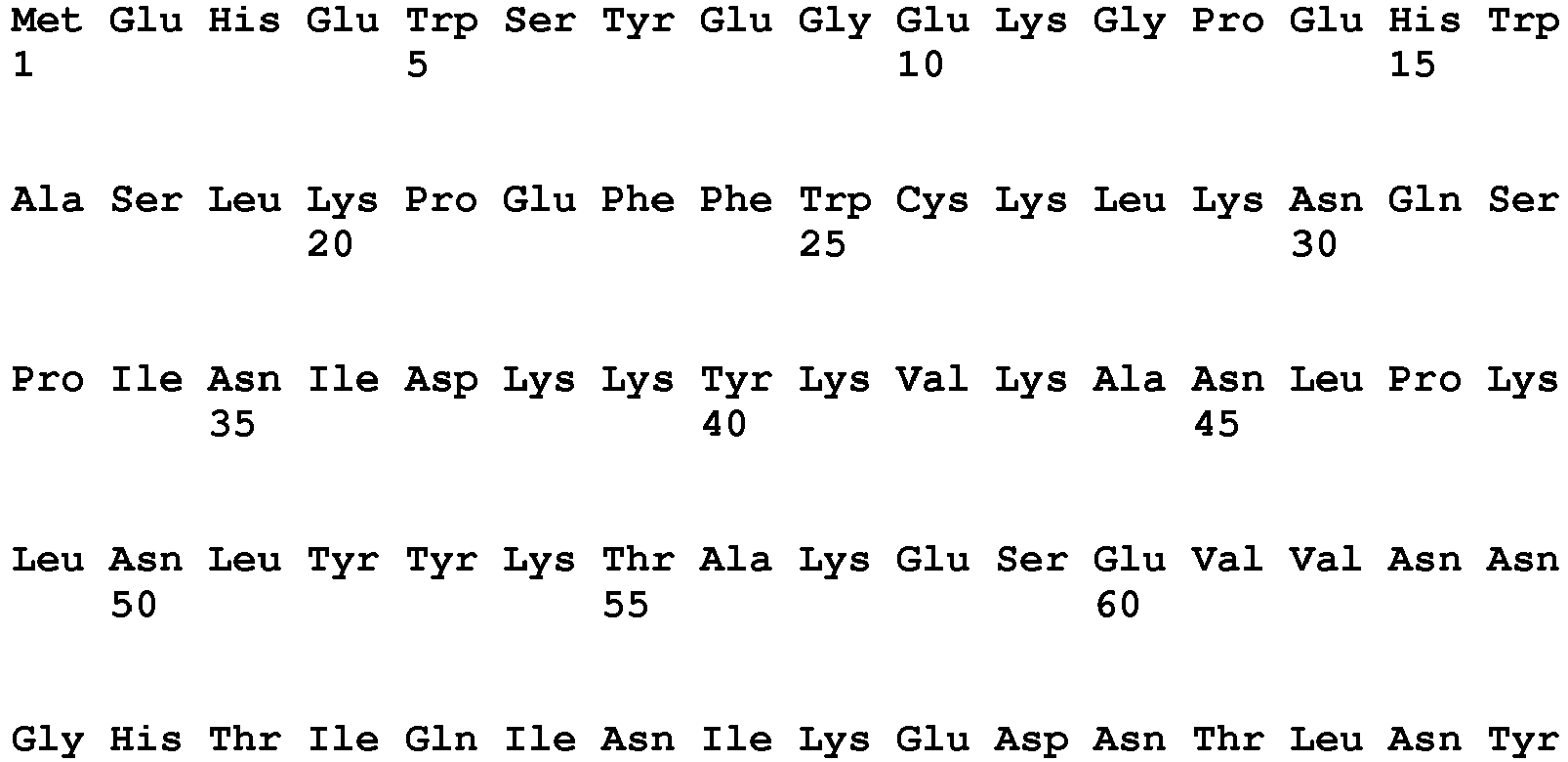
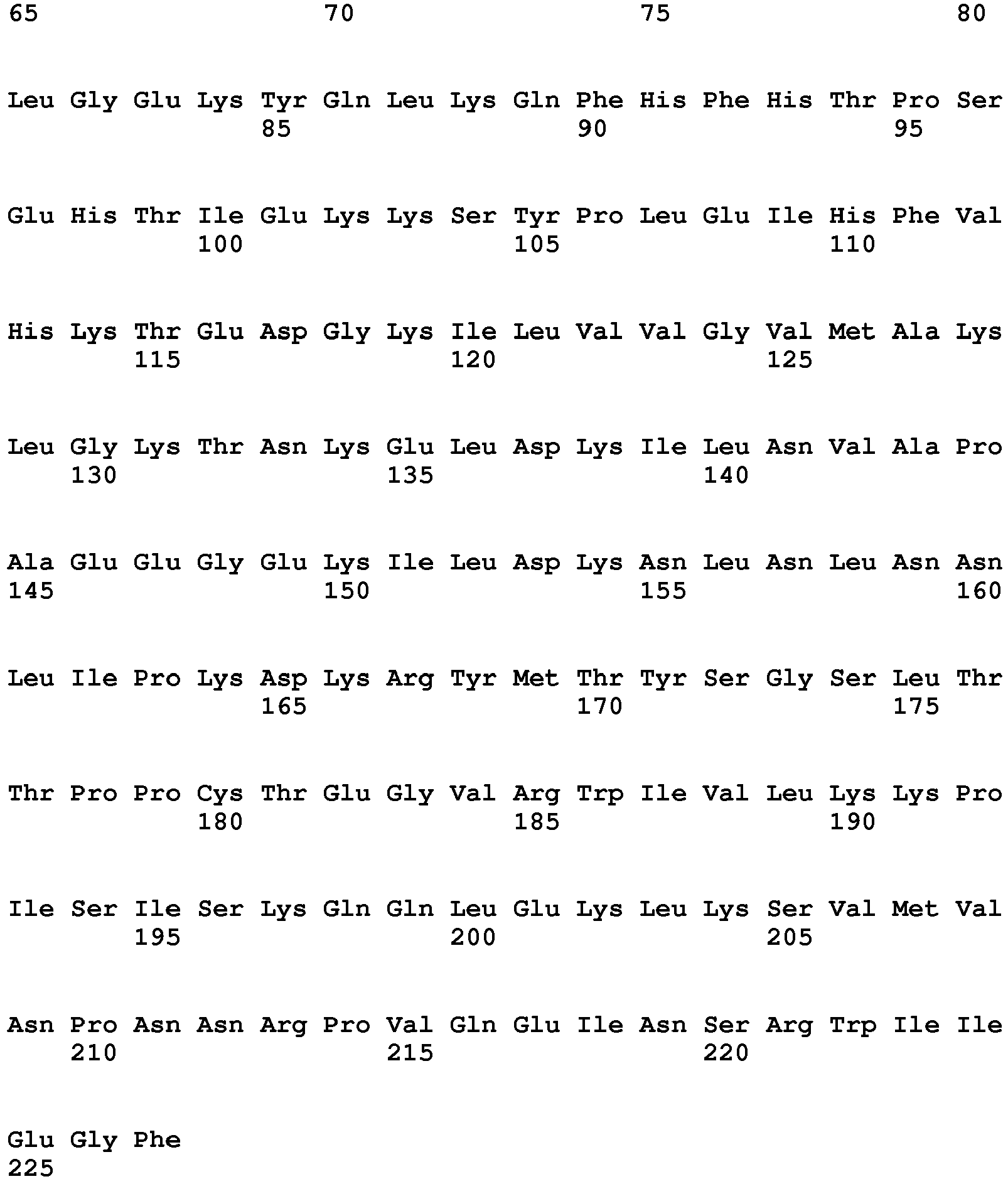
- <210> 21
<211> 684
<212> DNA
<213> Artificial sequence - <220>
<223> Variant: Q18W - <400> 21


- <210> 22
<211> 227
<212> PRT
<213> Artificial sequence - <220>
<223> Variant: Q18W - <400> 22


- <210> 23
<211> 684
<212> DNA
<213> Artificial sequence - <220>
<223> Variant: K20A - <400> 23

- <210> 24
<211> 227
<212> PRT
<213> Artificial sequence - <220>
<223> Variant: K20A - <400> 24

- <210> 25
<211> 684
<212> DNA
<213> Artificial sequence - <220>
<223> Variant: K20G - <400> 25

- <210> 26
<211> 227
<212> PRT
<213> Artificial sequence - <220>
<223> Variant: K20G - <400> 26


- <210> 27
<211> 684
<212> DNA
<213> Artificial sequence - <220>
<223> Variant: K20L - <400> 27


- <210> 28
<211> 227
<212> PRT
<213> Artificial sequence - <220>
<223> Variant: K20L - <400> 28


- <210> 29
<211> 684
<212> DNA
<213> Artificial sequence - <220>
<223> Variant: K20N - <400> 29

- <210> 30
<211> 227
<212> PRT
<213> Artificial sequence - <220>
<223> Variant: K20N - <400> 30


- <210> 31
<211> 684
<212> DNA
<213> Artificial sequence - <220>
<223> Variant: K20R - <400> 31

- <210> 32
<211> 227
<212> PRT
<213> Artificial sequence - <220>
<223> Variant: K20R - <400> 32
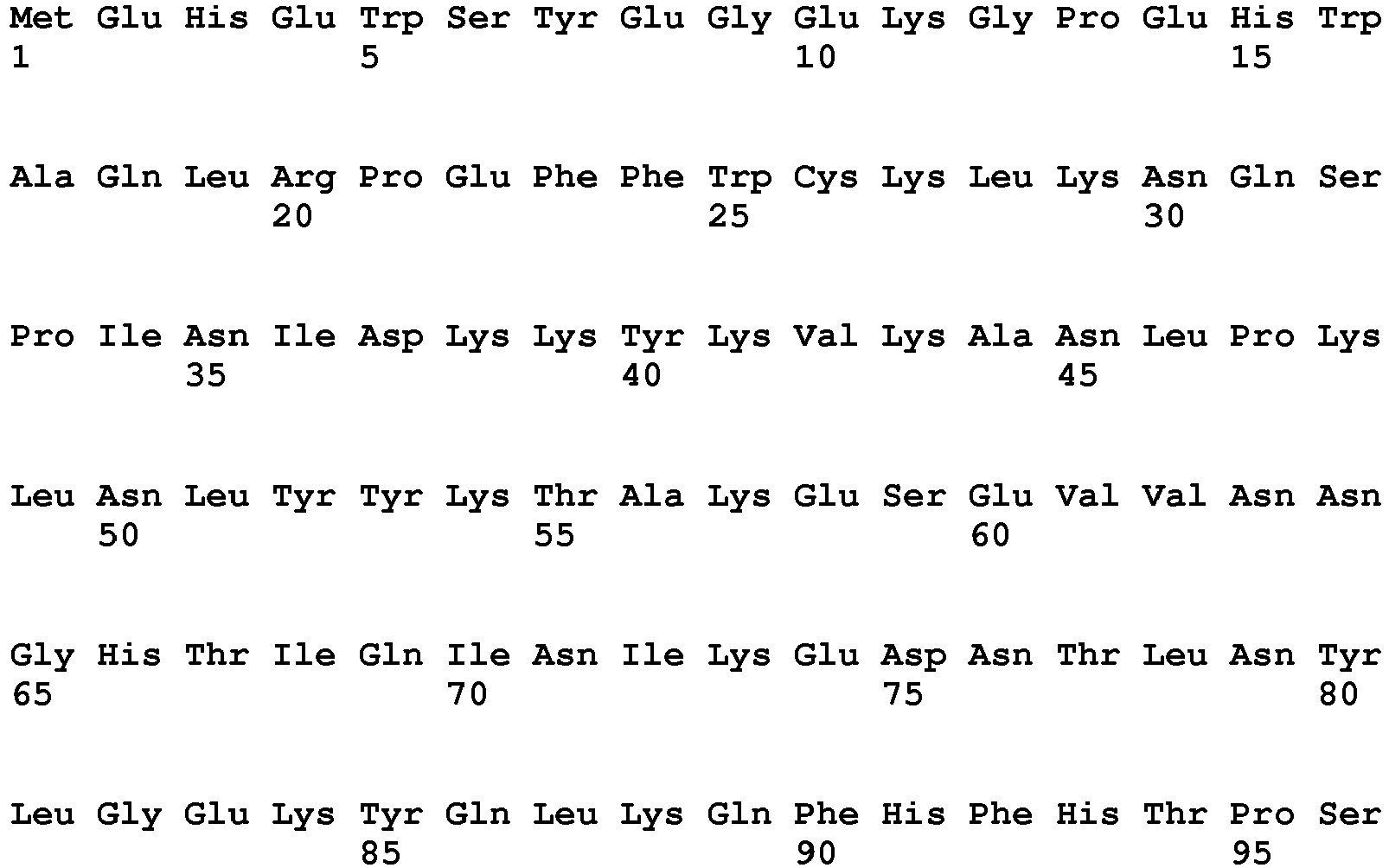

- <210> 33
<211> 684
<212> DNA
<213> Artificial sequence - <220>
<223> Variant: K20S - <400> 33


- <210> 34
<211> 227
<212> PRT
<213> Artificial sequence - <220>
<223> Variant: K20S - <400> 34


- <210> 35
<211> 684
<212> DNA
<213> Artificial sequence - <220>
<223> Variant: K20T - <400> 35

- <210> 36
<211> 227
<212> PRT
<213> Artificial sequence - <220>
<223> Variant: K20T - <400> 36


- <210> 37
<211> 684
<212> DNA
<213> Artificial sequence - <220>
<223> Variant: K38A - <400> 37

- <210> 38
<211> 227
<212> PRT
<213> Artificial sequence - <220>
<223> Variant: K38A - <400> 38


- <210> 39
<211> 684
<212> DNA
<213> Artificial sequence - <220>
<223> Variant: K38C - <400> 39


- <210> 40
<211> 227
<212> PRT
<213> Artificial sequence - <220>
<223> Variant: K38C - <400> 40


- <210> 41
<211> 684
<212> DNA
<213> Artificial sequence - <220>
<223> Variant: K38D - <400> 41

- <210> 42
<211> 227
<212> PRT
<213> Artificial sequence - <220>
<223> Variant: K38D - <400> 42


- <210> 43
<211> 684
<212> DNA
<213> Artificial sequence - <220>
<223> Variant: K38G - <400> 43


- <210> 44
<211> 227
<212> PRT
<213> Artificial sequence - <220>
<223> Variant: K38G - <400> 44


- <210> 45
<211> 684
<212> DNA
<213> Artificial sequence - <220>
<223> Variant: K38L - <400> 45

- <210> 46
<211> 227
<212> PRT
<213> Artificial sequence - <220>
<223> Variant: K38L - <400> 46


- <210> 47
<211> 684
<212> DNA
<213> Artificial sequence - <220>
<223> Variant: K38N - <400> 47

- <210> 48
<211> 227
<212> PRT
<213> Artificial sequence - <220>
<223> Variant: K38N - <400> 48
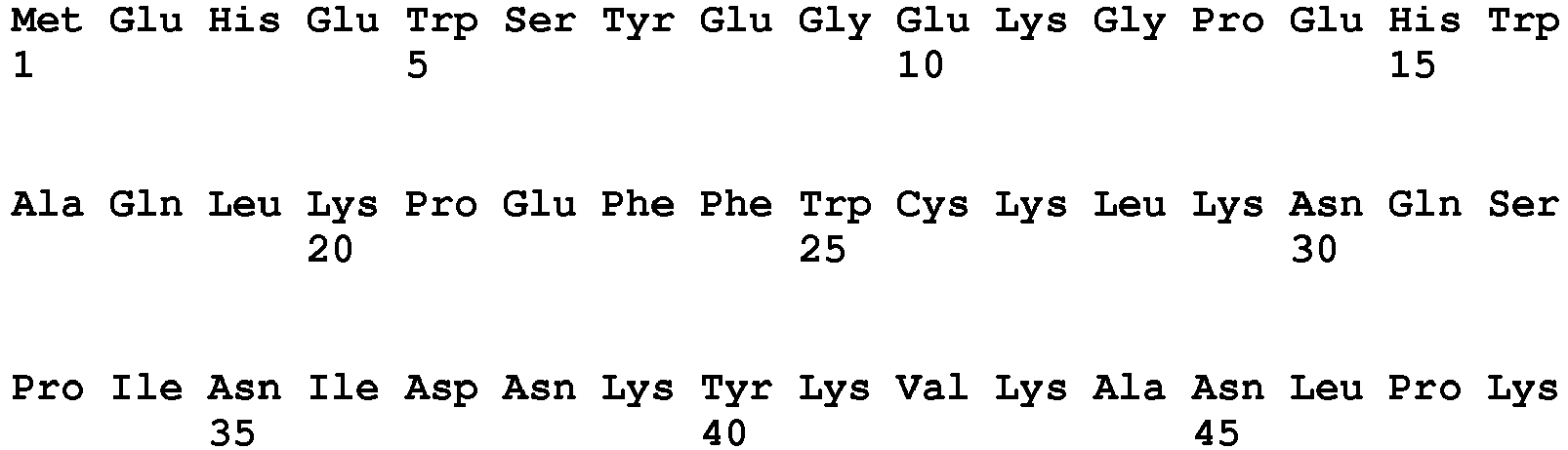

- <210> 49
<211> 684
<212> DNA
<213> Artificial sequence - <220>
<223> Variant: K38P - <400> 49


- <210> 50
<211> 227
<212> PRT
<213> Artificial sequence - <220>
<223> Variant: K38P - <400> 50


- <210> 51
<211> 684
<212> DNA
<213> Artificial sequence - <220>
<223> Variant: K38R - <400> 51

- <210> 52
<211> 227
<212> PRT
<213> Artificial sequence - <220>
<223> Variant: K38R - <400> 52


- <210> 53
<211> 684
<212> DNA
<213> Artificial sequence - <220>
<223> Variant: K38S - <400> 53

- <210> 54
<211> 227
<212> PRT
<213> Artificial sequence - <220>
<223> Variant: K38S - <400> 54


- <210> 55
<211> 684
<212> DNA
<213> Artificial sequence - <220>
<223> Variant: K38W - <400> 55

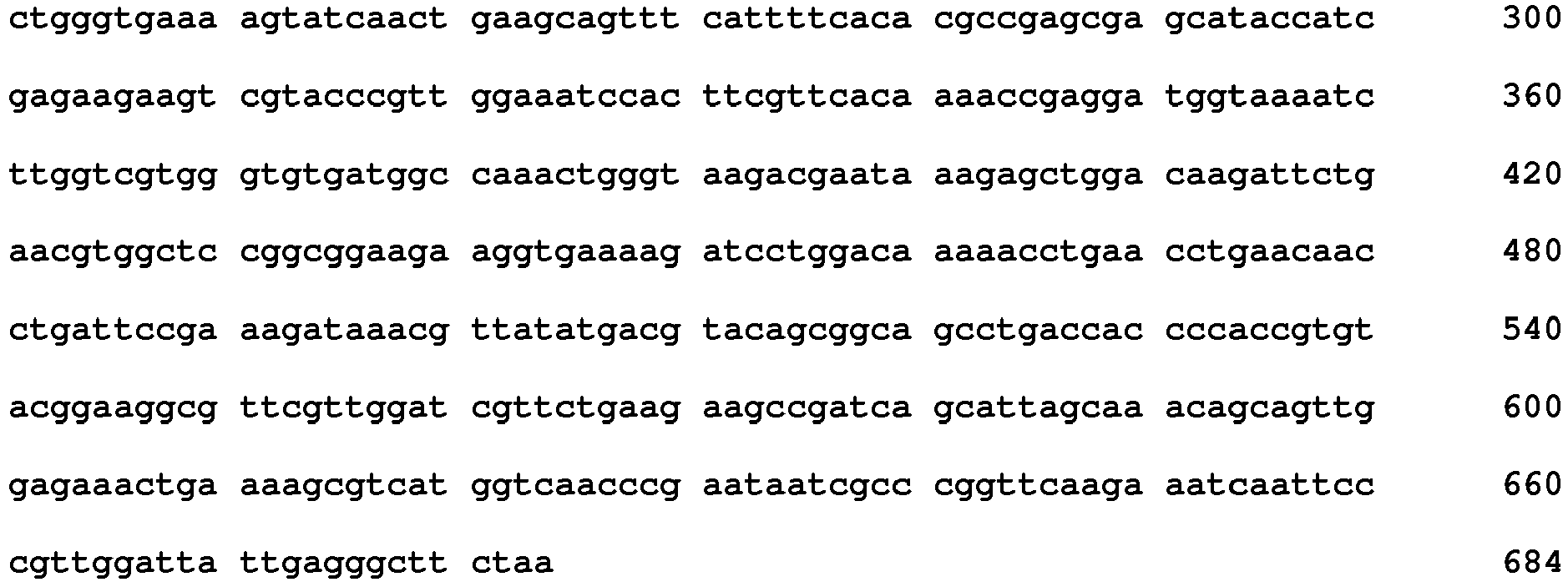
- <210> 56
<211> 227
<212> PRT
<213> Artificial sequence - <220>
<223> Variant: K38W - <400> 56


- <210> 57
<211> 684
<212> DNA
<213> Artificial sequence - <220>
<223> Variant: Y52C - <400> 57

- <210> 58
<211> 227
<212> PRT
<213> Artificial sequence - <220>
<223> Variant: Y52C - <400> 58


- <210> 59
<211> 684
<212> DNA
<213> Artificial sequence - <220>
<223> Variant: Y52E - <400> 59

- <210> 60
<211> 227
<212> PRT
<213> Artificial sequence - <220>
<223> Variant: Y52E - <400> 60


- <210> 61
<211> 684
<212> DNA
<213> Artificial sequence - <220>
<223> Variant: Y52G - <400> 61


- <210> 62
<211> 227
<212> PRT
<213> Artificial sequence - <220>
<223> Variant: Y52G - <400> 62
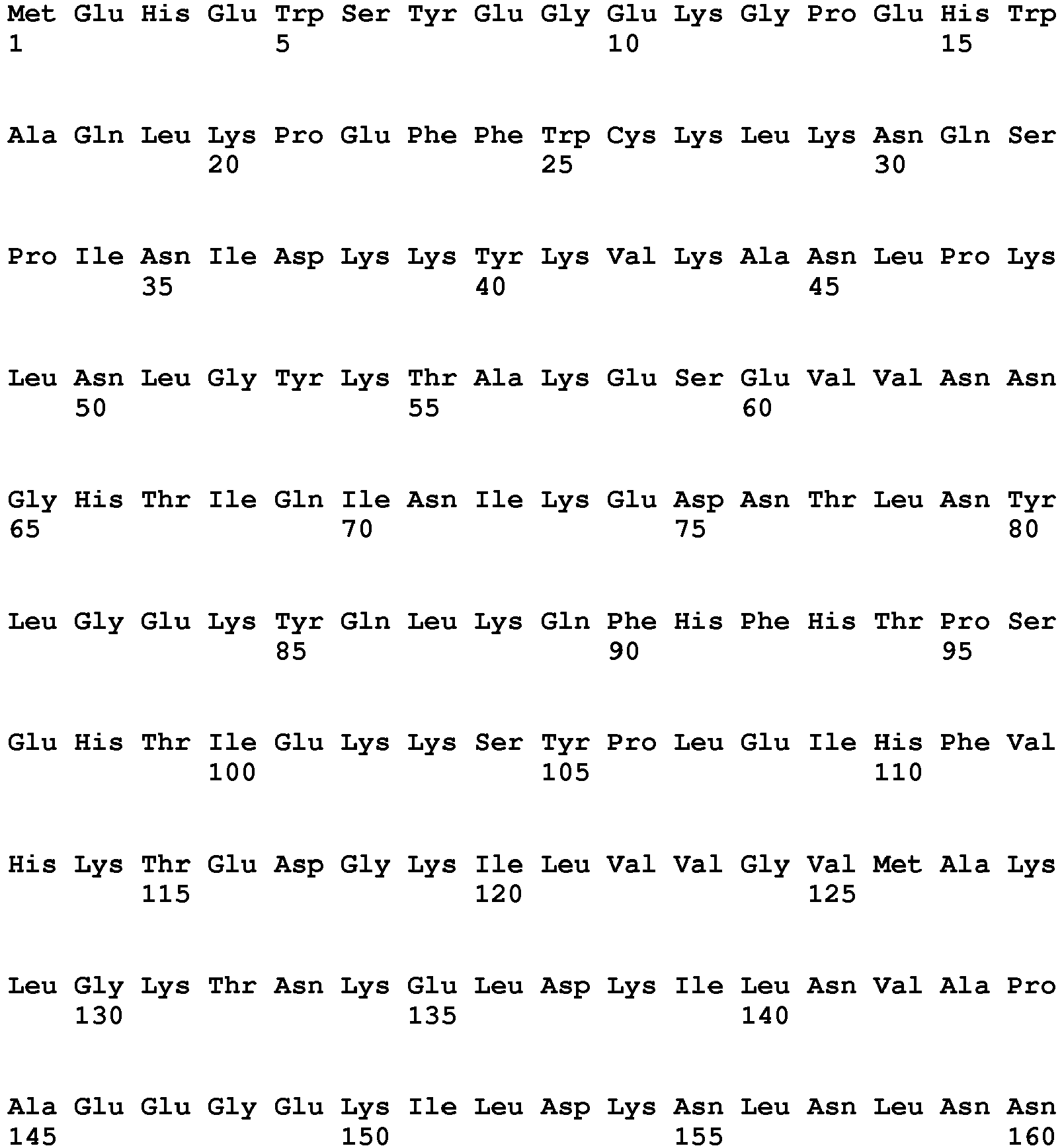

- <210> 63
<211> 684
<212> DNA
<213> Artificial sequence - <220>
<223> Variant: Y52P - <400> 63

- <210> 64
<211> 227
<212> PRT
<213> Artificial sequence - <220>
<223> Variant: Y52P - <400> 64

- <210> 65
<211> 684
<212> DNA
<213> Artificial sequence - <220>
<223> Variant: Y52T - <400> 65

- <210> 66
<211> 227
<212> PRT
<213> Artificial sequence - <220>
<223> Variant: Y52T - <400> 66


- <210> 67
<211> 684
<212> DNA
<213> Artificial sequence - <220>
<223> Variant: K57A - <400> 67


- <210> 68
<211> 227
<212> PRT
<213> Artificial sequence - <220>
<223> Variant: K57A - <400> 68

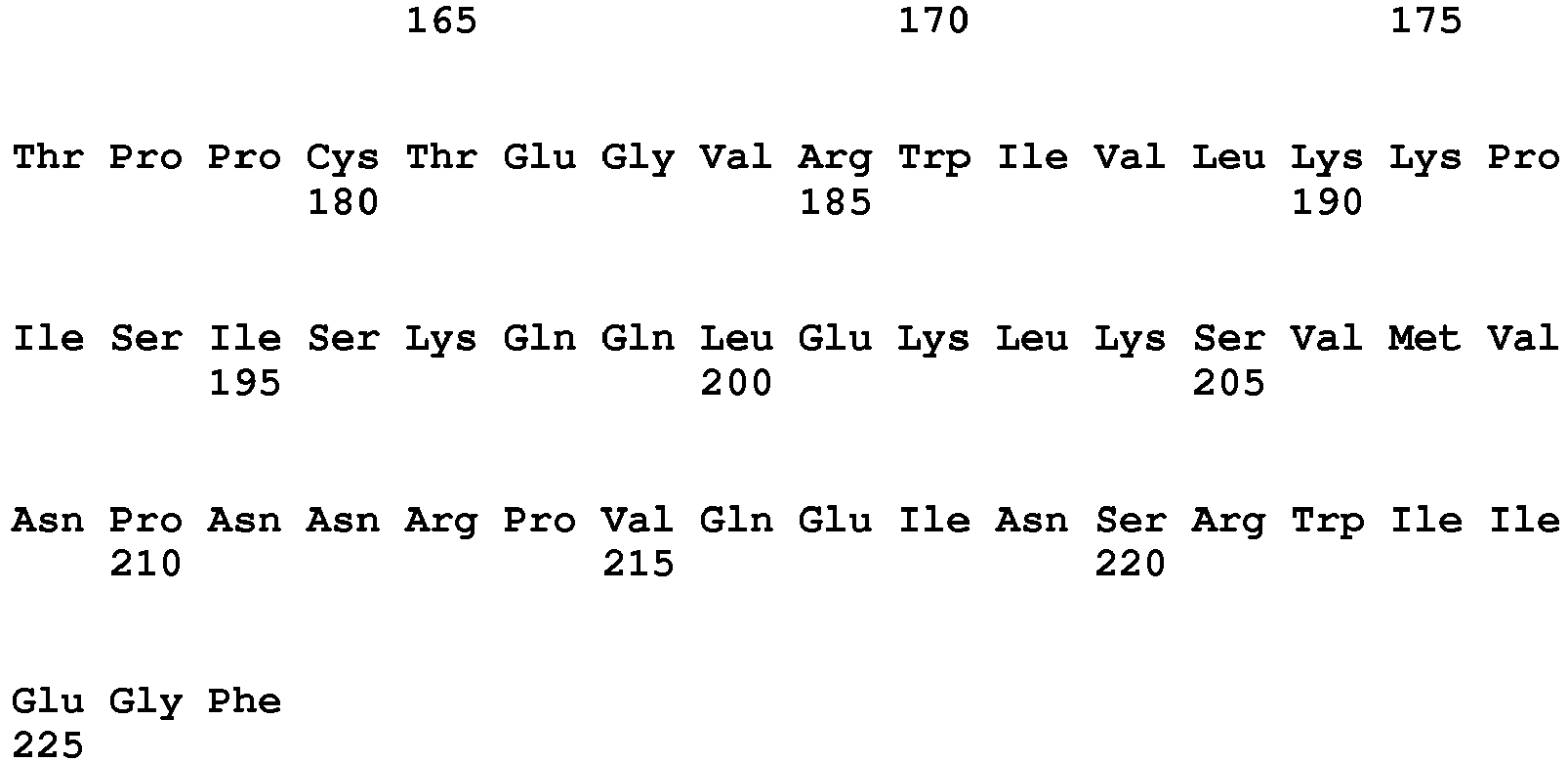
- <210> 69
<211> 684
<212> DNA
<213> Artificial sequence - <220>
<223> Variant: K57G - <400> 69

- <210> 70
<211> 227
<212> PRT
<213> Artificial sequence - <220>
<223> Variant: K57G - <400> 70

- <210> 71
<211> 684
<212> DNA
<213> Artificial sequence - <220>
<223> Variant: K57L - <400> 71

- <210> 72
<211> 227
<212> PRT
<213> Artificial sequence - <220>
<223> Variant: K57L - <400> 72


- <210> 73
<211> 684
<212> DNA
<213> Artificial sequence - <220>
<223> Variant: K57N - <400> 73


- <210> 74
<211> 227
<212> PRT
<213> Artificial sequence - <220>
<223> Variant: K57N - <400> 74


- <210> 75
<211> 684
<212> DNA
<213> Artificial sequence - <220>
<223> Variant: K57P - <400> 75

- <210> 76
<211> 227
<212> PRT
<213> Artificial sequence - <220>
<223> Variant: K57P - <400> 76


- <210> 77
<211> 684
<212> DNA
<213> Artificial sequence - <220>
<223> Variant: K57R - <400> 77

- <210> 78
<211> 227
<212> PRT
<213> Artificial sequence - <220>
<223> Variant: K57R - <400> 78


- <210> 79
<211> 684
<212> DNA
<213> Artificial sequence - <220>
<223> Variant: K57S - <400> 79


- <210> 80
<211> 227
<212> PRT
<213> Artificial sequence - <220>
<223> Variant: K57S - <400> 80


- <210> 81
<211> 684
<212> DNA
<213> Artificial sequence - <220>
<223> Variant: K57V - <400> 81

- <210> 82
<211> 227
<212> PRT
<213> Artificial sequence - <220>
<223> Variant: K57V - <400> 82


- <210> 83
<211> 684
<212> DNA
<213> Artificial sequence - <220>
<223> Variant: G82C - <400> 83

- <210> 84
<211> 227
<212> PRT
<213> Artificial sequence - <220>
<223> Variant: G82C - <400> 84


- <210> 85
<211> 684
<212> DNA
<213> Artificial sequence - <220>
<223> Variant: G82E - <400> 85
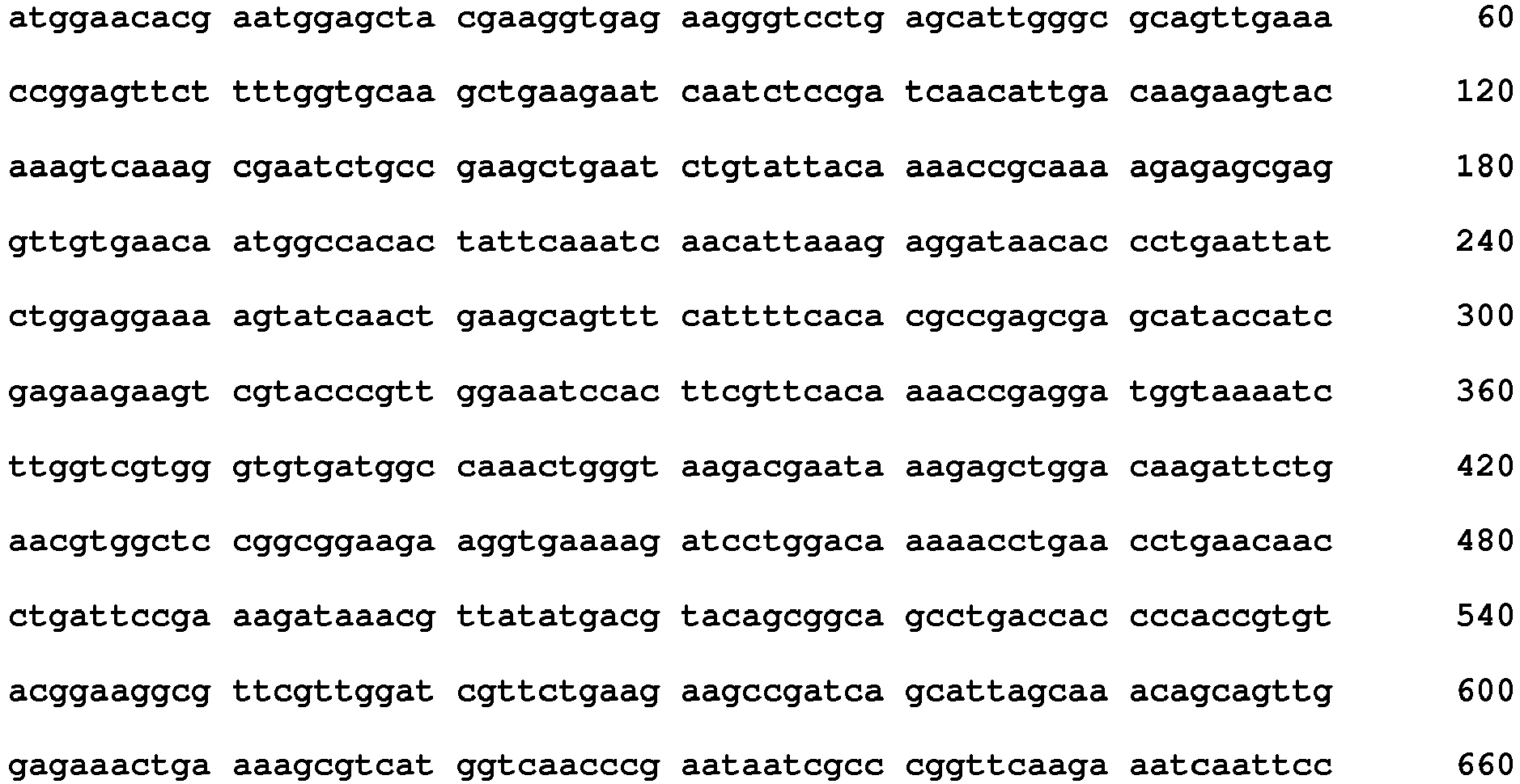

- <210> 86
<211> 227
<212> PRT
<213> Artificial sequence - <220>
<223> Variant: G82E - <400> 86


- <210> 87
<211> 684
<212> DNA
<213> Artificial sequence - <220>
<223> Variant: I100A - <400> 87

- <210> 88
<211> 227
<212> PRT
<213> Artificial sequence - <220>
<223> Variant: I100A - <400> 88


- <210> 89
<211> 684
<212> DNA
<213> Artificial sequence - <220>
<223> Variant: I100E - <400> 89


- <210> 90
<211> 227
<212> PRT
<213> Artificial sequence - <220>
<223> Variant: I100E - <400> 90


- <210> 91
<211> 684
<212> DNA
<213> Artificial sequence - <220>
<223> Variant: I100N - <400> 91

- <210> 92
<211> 227
<212> PRT
<213> Artificial sequence - <220>
<223> Variant: I100N - <400> 92


- <210> 93
<211> 684
<212> DNA
<213> Artificial sequence - <220>
<223> Variant: I100S - <400> 93
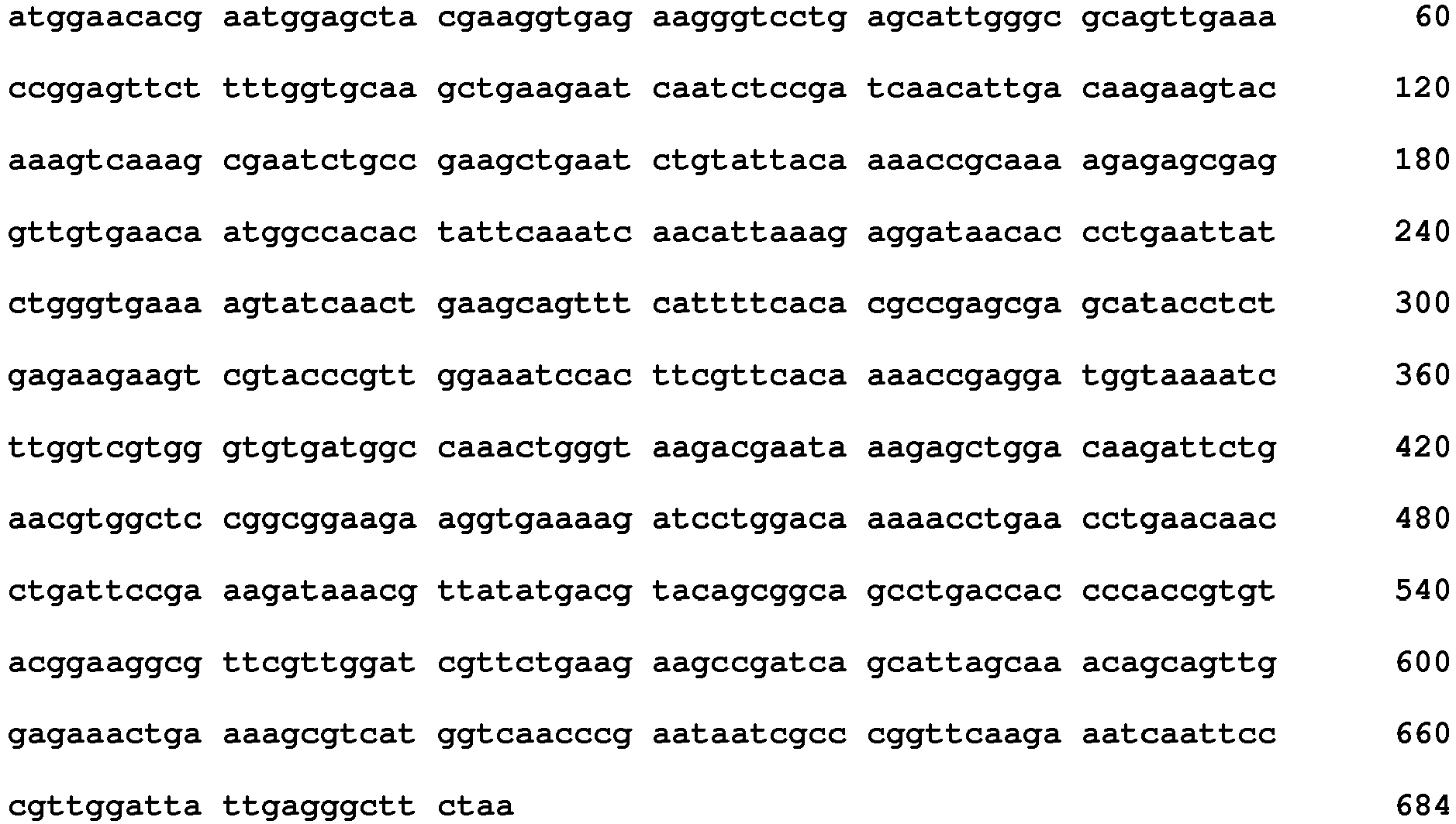
- <210> 94
<211> 227
<212> PRT
<213> Artificial sequence - <220>
<223> Variant: I100S - <400> 94


- <210> 95
<211> 684
<212> DNA
<213> Artificial sequence - <220>
<223> Variant: I100V - <400> 95


- <210> 96
<211> 227
<212> PRT
<213> Artificial sequence - <220>
<223> Variant: I100V - <400> 96


- <210> 97
<211> 684
<212> DNA
<213> Artificial sequence - <220>
<223> Variant: I100Y - <400> 97

- <210> 98
<211> 227
<212> PRT
<213> Artificial sequence - <220>
<223> Variant: I100Y - <400> 98


- <210> 99
<211> 684
<212> DNA
<213> Artificial sequence - <220>
<223> Variant: E116D - <400> 99

- <210> 100
<211> 227
<212> PRT
<213> Artificial sequence - <220>
<223> Variant: E116D - <400> 100
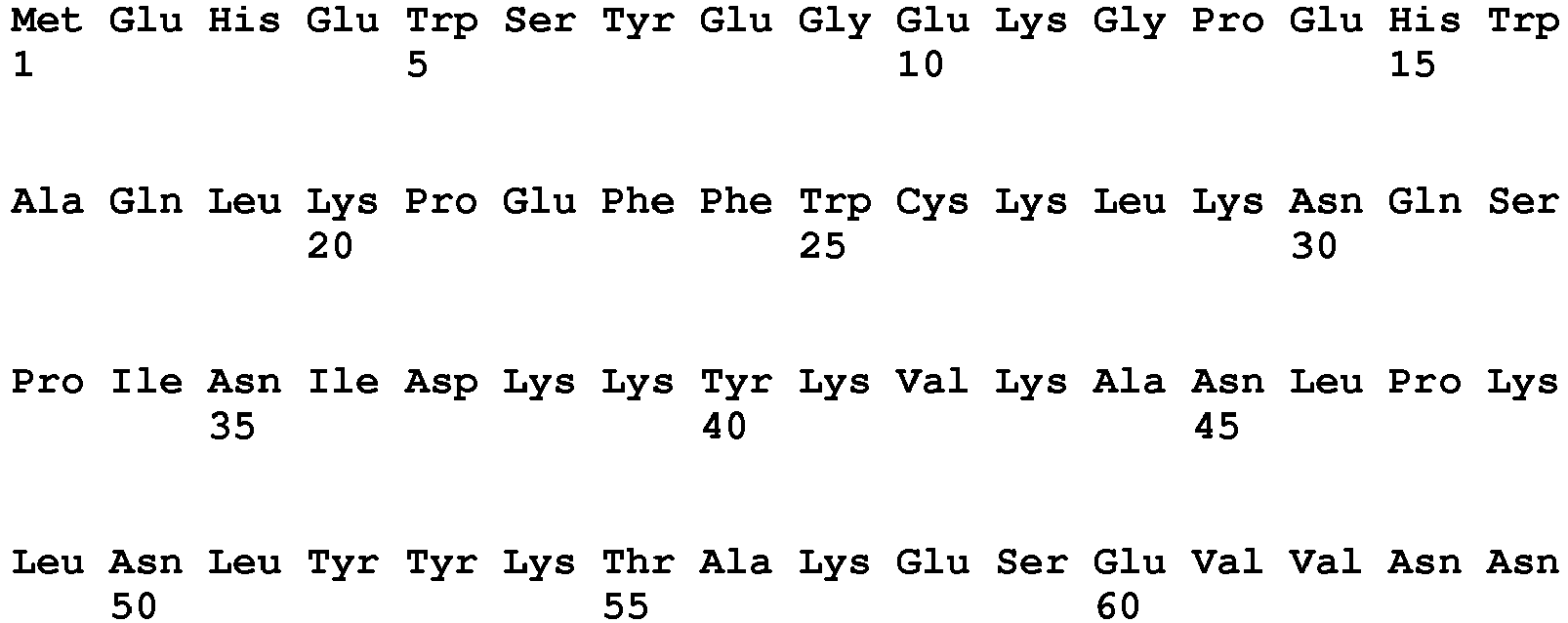

- <210> 101
<211> 684
<212> DNA
<213> Artificial sequence - <220>
<223> Variant: G130A - <400> 101


- <210> 102
<211> 227
<212> PRT
<213> Artificial sequence - <220>
<223> Variant: G130A - <400> 102


- <210> 103
<211> 684
<212> DNA
<213> Artificial sequence - <220>
<223> Variant: G130C - <400> 103

- <210> 104
<211> 227
<212> PRT
<213> Artificial sequence - <220>
<223> Variant: G130C - <400> 104

- <210> 105
<211> 684
<212> DNA
<213> Artificial sequence - <220>
<223> Variant: G130L - <400> 105

- <210> 106
<211> 227
<212> PRT
<213> Artificial sequence - <220>
<223> Variant: G130L - <400> 106


- <210> 107
<211> 684
<212> DNA
<213> Artificial sequence - <220>
<223> Variant: K150A - <400> 107


- <210> 108
<211> 227
<212> PRT
<213> Artificial sequence - <220>
<223> Variant: K150A - <400> 108
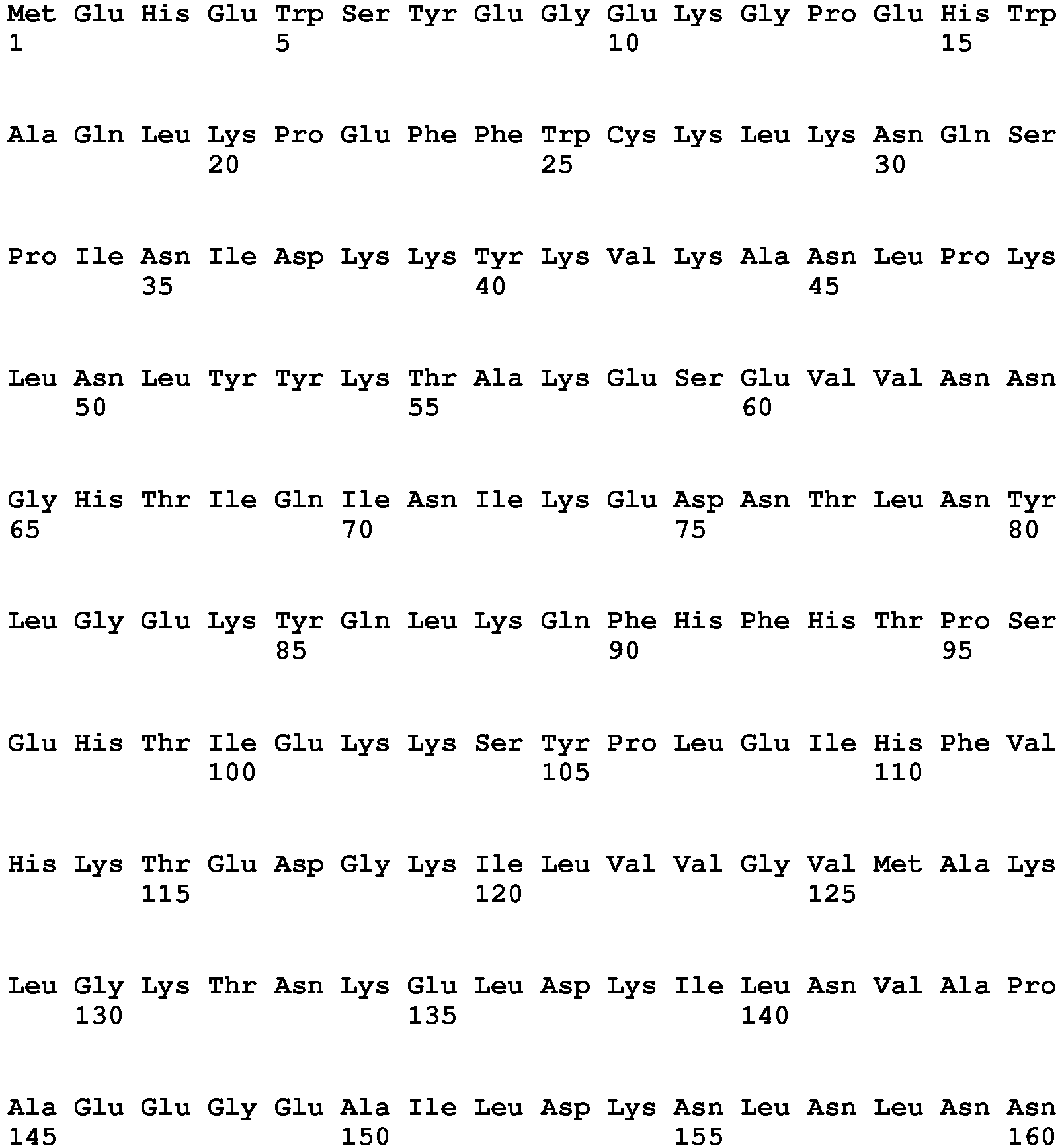

- <210> 109
<211> 684
<212> DNA
<213> Artificial sequence - <220>
<223> Variant: K150S - <400> 109

- <210> 110
<211> 227
<212> PRT
<213> Artificial sequence - <220>
<223> Variant: K150S - <400> 110

- <210> 111
<211> 684
<212> DNA
<213> Artificial sequence - <220>
<223> Variant: N155I - <400> 111

- <210> 112
<211> 227
<212> PRT
<213> Artificial sequence - <220>
<223> Variant: N155I - <400> 112


- <210> 113
<211> 684
<212> DNA
<213> Artificial sequence - <220>
<223> Variant: T181L - <400> 113


- <210> 114
<211> 227
<212> PRT
<213> Artificial sequence - <220>
<223> Variant: T181L - <400> 114


- <210> 115
<211> 684
<212> DNA
<213> Artificial sequence - <220>
<223> Variant: T181Q - <400> 115

- <210> 116
<211> 227
<212> PRT
<213> Artificial sequence - <220>
<223> Variant: T181Q - <400> 116


- <210> 117
<211> 684
<212> DNA
<213> Artificial sequence - <220>
<223> Variant: T181R - <400> 117

- <210> 118
<211> 227
<212> PRT
<213> Artificial sequence - <220>
<223> Variant: T181R - <400> 118


- <210> 119
<211> 684
<212> DNA
<213> Artificial sequence - <220>
<223> Variant: S205C - <400> 119


- <210> 120
<211> 227
<212> PRT
<213> Artificial sequence - <220>
<223> Variant: S205C - <400> 120
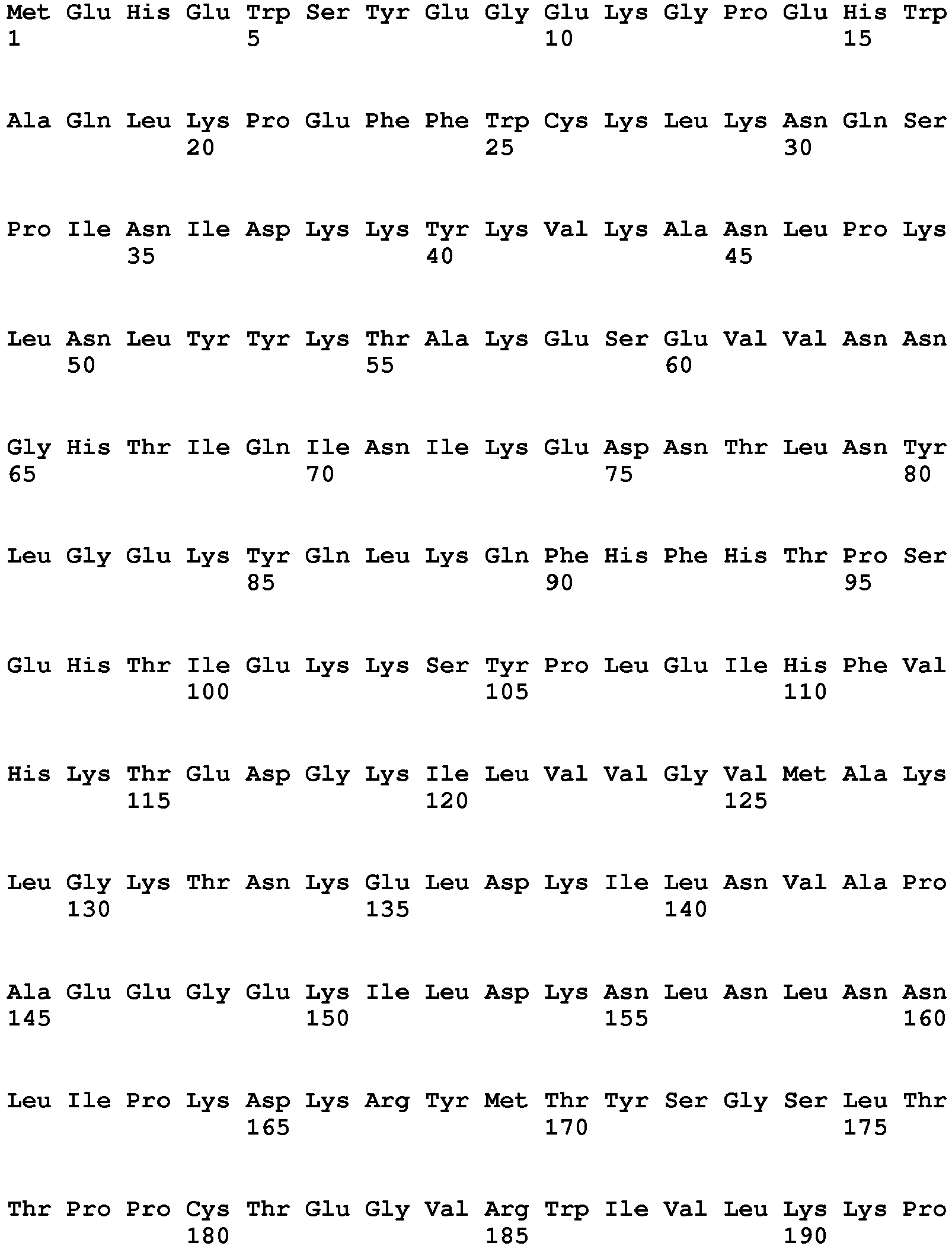

- <210> 121
<211> 684
<212> DNA
<213> Artificial sequence - <220>
<223> Variant: Q18T-K20A - <400> 121

- <210> 122
<211> 227
<212> PRT
<213> Artificial sequence - <220>
<223> Variant: Q18T-K20A - <400> 122


- <210> 123
<211> 684
<212> DNA
<213> Artificial sequence - <220>
<223> Variant: Q18R-K20A - <400> 123

- <210> 124
<211> 227
<212> PRT
<213> Artificial sequence - <220>
<223> Variant: Q18R-K20A - <400> 124


- <210> 125
<211> 684
<212> DNA
<213> Artificial sequence - <220>
<223> Variant: E2K-T181M-K197I - <400> 125


- <210> 126
<211> 227
<212> PRT
<213> Artificial sequence - <220>
<223> Variant: E2K-T181M-K197I - <400> 126

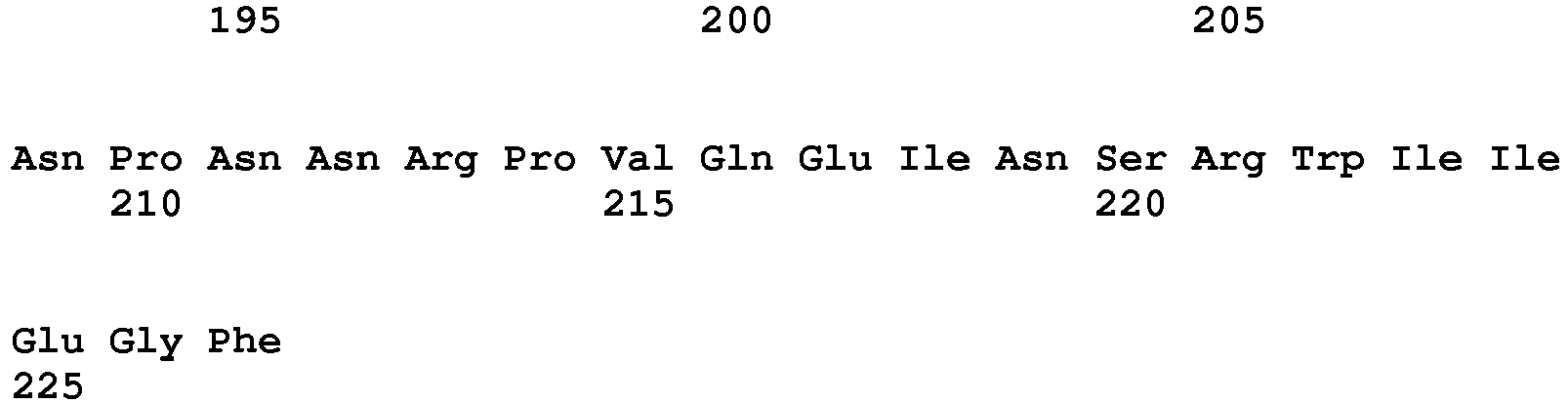
- <210> 127
<211> 684
<212> DNA
<213> Artificial sequence - <220>
<223> Variant: E14D-Q18R - <400> 127

- <210> 128
<211> 227
<212> PRT
<213> Artificial sequence - <220>
<223> Variant: E14D-Q18R - <400> 128


- <210> 129
<211> 684
<212> DNA
<213> Artificial sequence - <220>
<223> Variant: Y52C-V122I-K150N-G226S - <400> 129


- <210> 130
<211> 227
<212> PRT
<213> Artificial sequence - <220>
<223> Variant: Y52C-V122I-K150N-G226S - <400> 130


- <210> 131
<211> 684
<212> DNA
<213> Artificial sequence - <220>
<223> Variant: G65S-K150I - <400> 131

- <210> 132
<211> 227
<212> PRT
<213> Artificial sequence - <220>
<223> Variant: G65S-K150I - <400> 132


- <210> 133
<211> 684
<212> DNA
<213> Artificial sequence - <220>
<223> Variant: K57R-G130C - <400> 133

- <210> 134
<211> 227
<212> PRT
<213> Artificial sequence - <220>
<223> Variant: K57R-G130C - <400> 134


- <210> 135
<211> 684
<212> DNA
<213> Artificial sequence - <220>
<223> Variant: G82C-K88E - <400> 135


- <210> 136
<211> 227
<212> PRT
<213> Artificial sequence - <220>
<223> Variant: G82C-K88E - <400> 136


- <210> 137
<211> 684
<212> DNA
<213> Artificial sequence - <220>
<223> Variant: G82C-G148A - <400> 137

- <210> 138
<211> 227
<212> PRT
<213> Artificial sequence - <220>
<223> Variant: G82C-G148A - <400> 138
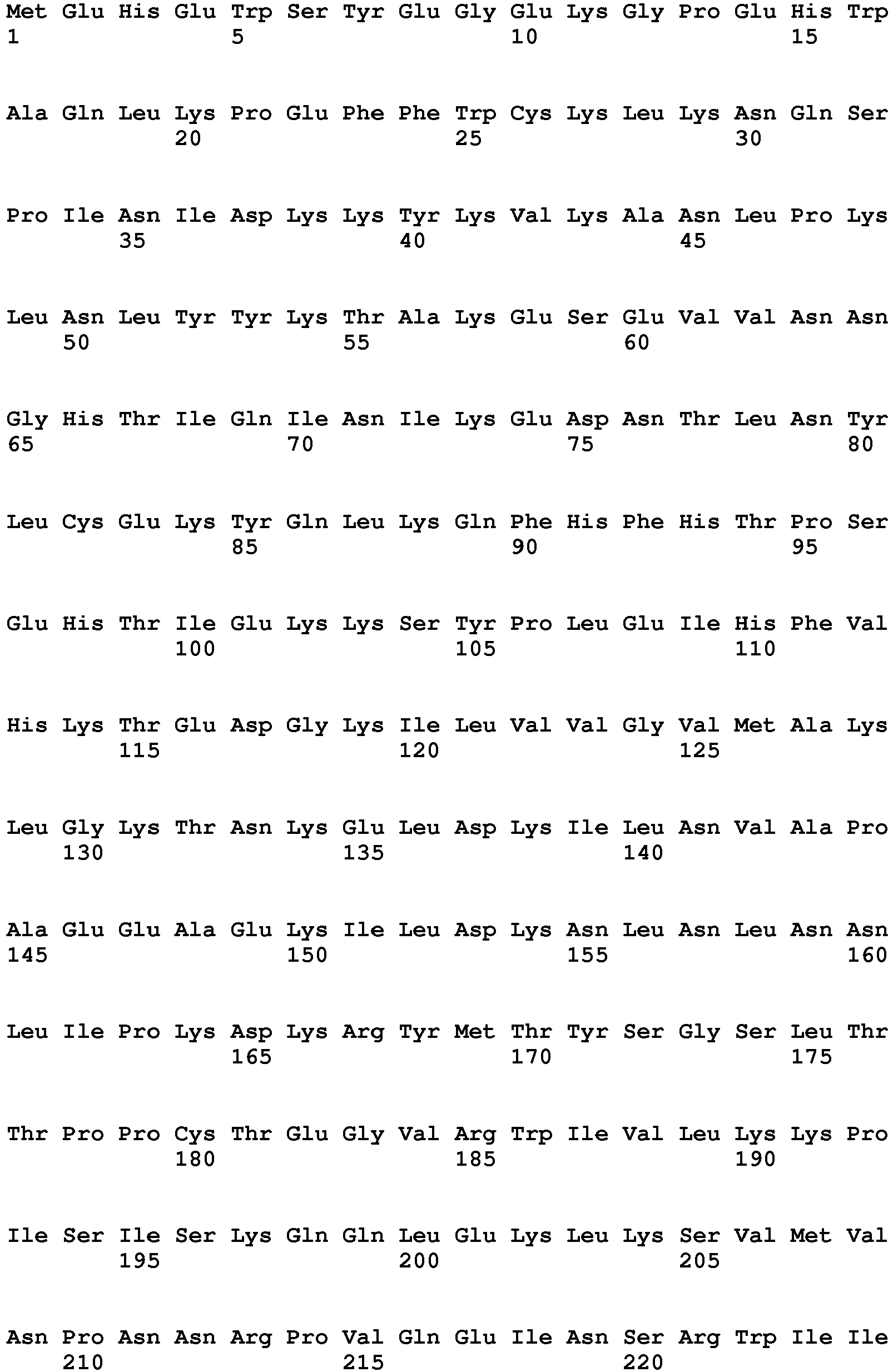

- <210> 139
<211> 684
<212> DNA
<213> Artificial sequence - <220>
<223> Variant: M126L-G130L - <400> 139

- <210> 140
<211> 227
<212> PRT
<213> Artificial sequence - <220>
<223> Variant: M126L-G130L - <400> 140


- <210> 141
<211> 684
<212> DNA
<213> Artificial sequence - <220>
<223> Variant: G82C-I100V - <400> 141


- <210> 142
<211> 227
<212> PRT
<213> Artificial sequence - <220>
<223> Variant: G82C-I100V - <400> 142

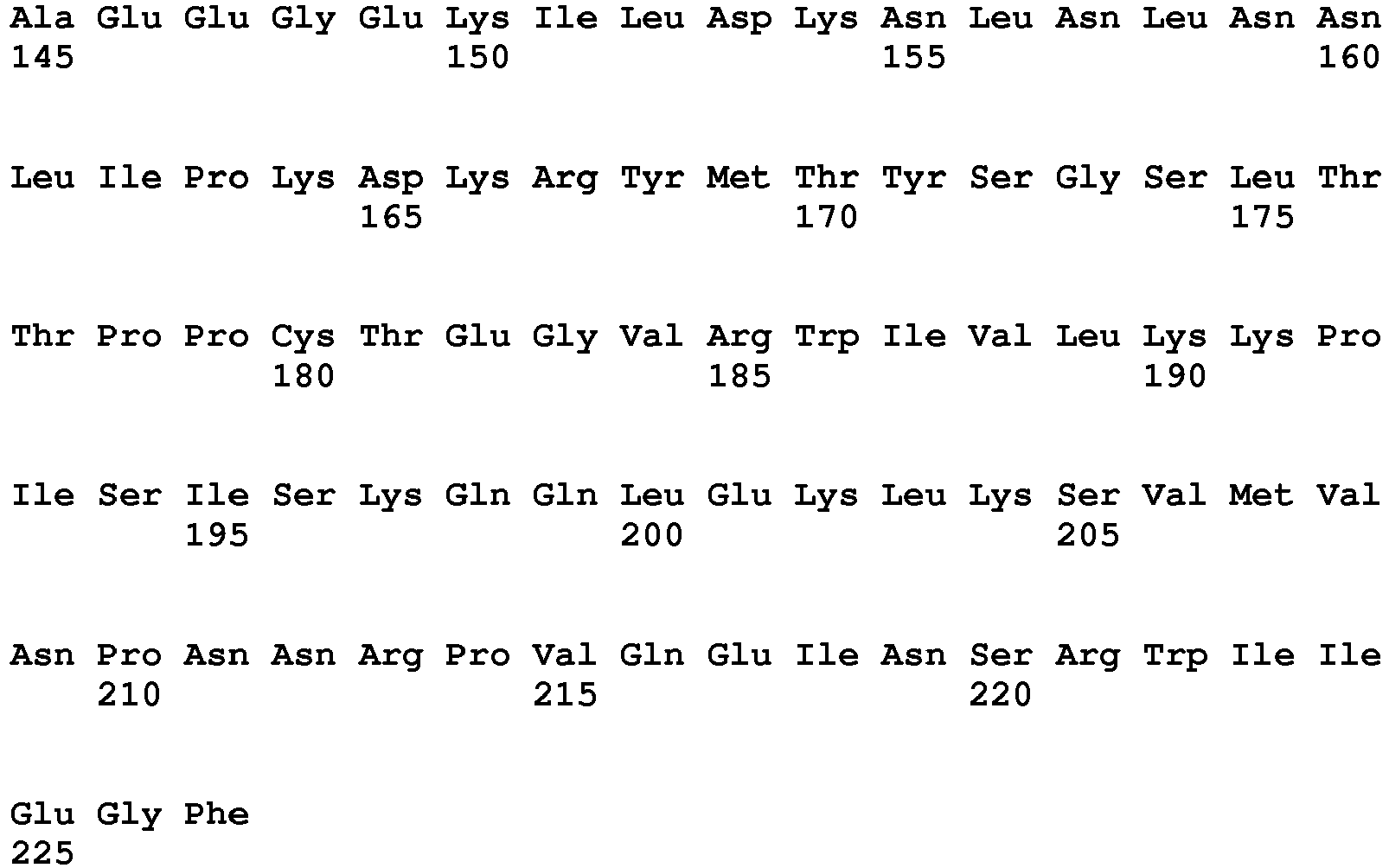
- <210> 143
<211> 684
<212> DNA
<213> Artificial sequence - <220>
<223> Variant: K38C-G82C-I100V - <400> 143

- <210> 144
<211> 227
<212> PRT
<213> Artificial sequence - <220>
<223> Variant: K38C-G82C-I100V - <400> 144

- <210> 145
<211> 684
<212> DNA
<213> Artificial sequence - <220>
<223> Variant: K38G-G82C-I100V - <400> 145

- <210> 146
<211> 227
<212> PRT
<213> Artificial sequence - <220>
<223> Variant: K38G-G82C-I100V - <400> 146


- <210> 147
<211> 684
<212> DNA
<213> Artificial sequence - <220>
<223> Variant: K38R-G82C-I100V - <400> 147

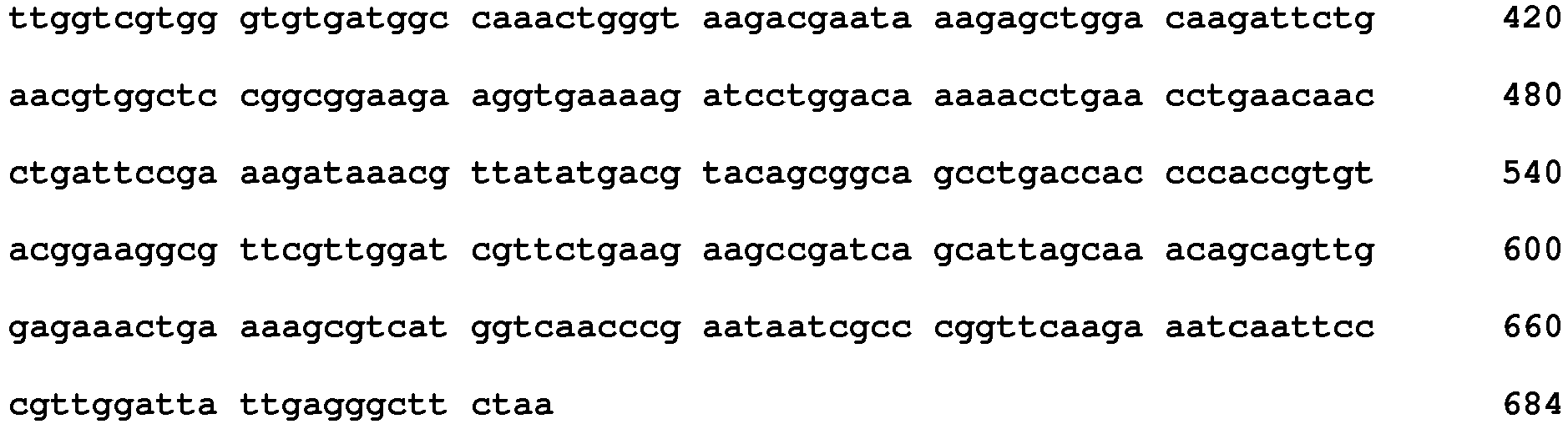
- <210> 148
<211> 227
<212> PRT
<213> Artificial sequence - <220>
<223> Variant: K38R-G82C-I100V - <400> 148


- <210> 149
<211> 684
<212> DNA
<213> Artificial sequence - <220>
<223> Variant: K38S-G82C-I100V - <400> 149

- <210> 150
<211> 227
<212> PRT
<213> Artificial sequence - <220>
<223> Variant: K38S-G82C-I100V - <400> 150

- <210> 151
<211> 684
<212> DNA
<213> Artificial sequence - <220>
<223> Variant: K38W-G82C-I100V - <400> 151

- <210> 152
<211> 227
<212> PRT
<213> Artificial sequence - <220>
<223> Variant: K38W-G82C-I100V - <400> 152


- <210> 153
<211> 684
<212> DNA
<213> Artificial sequence - <220>
<223> Variant: K38S-K57A-G82C-I100V - <400> 153


- <210> 154
<211> 227
<212> PRT
<213> Artificial sequence - <220>
<223> Variant: K38S-K57A-G82C-I100V - <400> 154


- <210> 155
<211> 684
<212> DNA
<213> Artificial sequence - <220>
<223> Variant: K38S-K57G-G82C-I100V - <400> 155

- <210> 156
<211> 227
<212> PRT
<213> Artificial sequence - <220>
<223> Variant: K38S-K57G-G82C-I100V - <400> 156


- <210> 157
<211> 684
<212> DNA
<213> Artificial sequence - <220>
<223> Variant: K38S-K57L-G82C-I100V - <400> 157

- <210> 158
<211> 227
<212> PRT
<213> Artificial sequence - <220>
<223> Variant: K38S-K57L-G82C-I100V - <400> 158

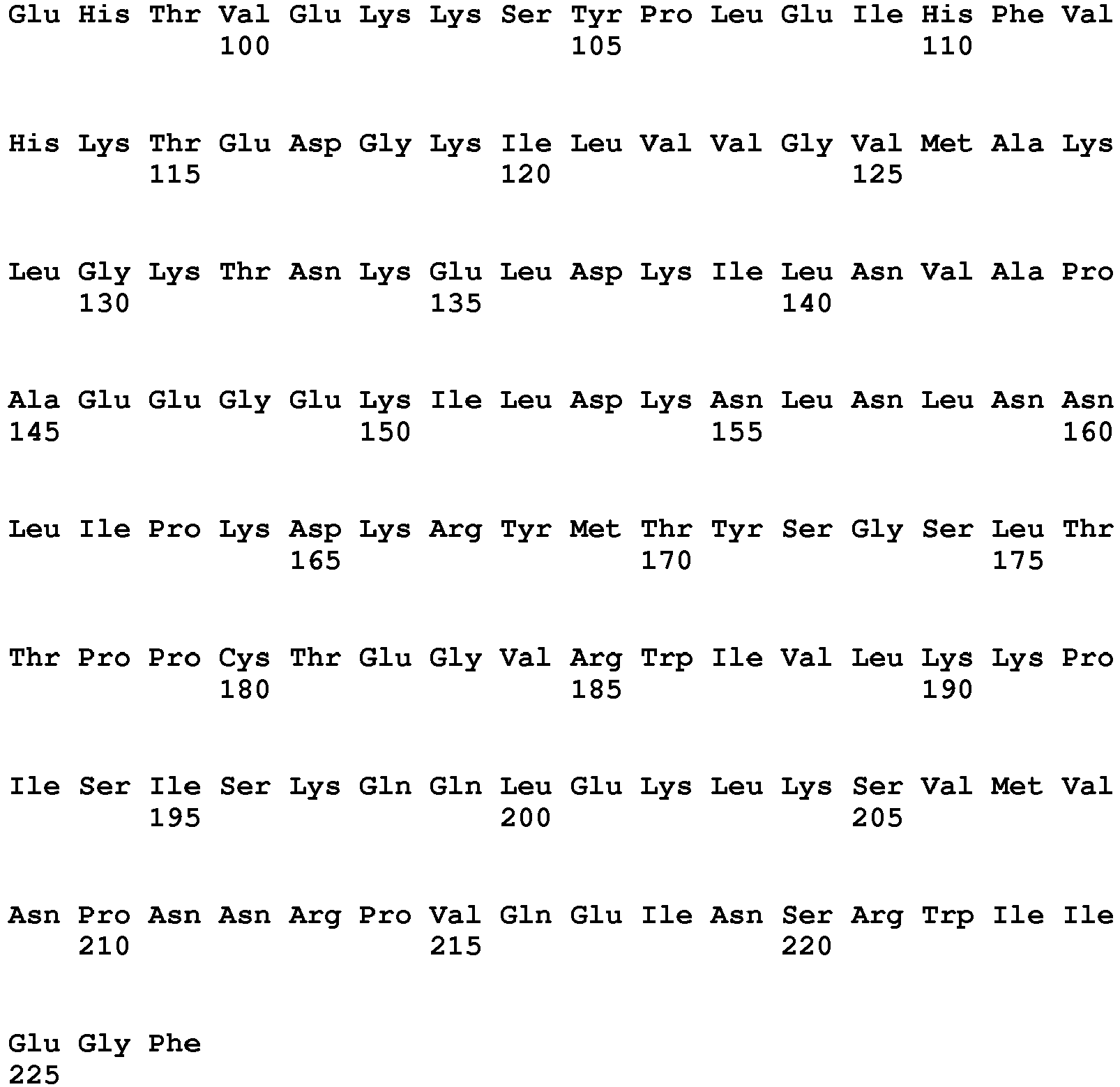
- <210> 159
<211> 684
<212> DNA
<213> Artificial sequence - <220>
<223> Variant: K38S-K57S-G82C-I100V - <400> 159


- <210> 160
<211> 227
<212> PRT
<213> Artificial sequence - <220>
<223> Variant: K38S-K57S-G82C-I100V - <400> 160

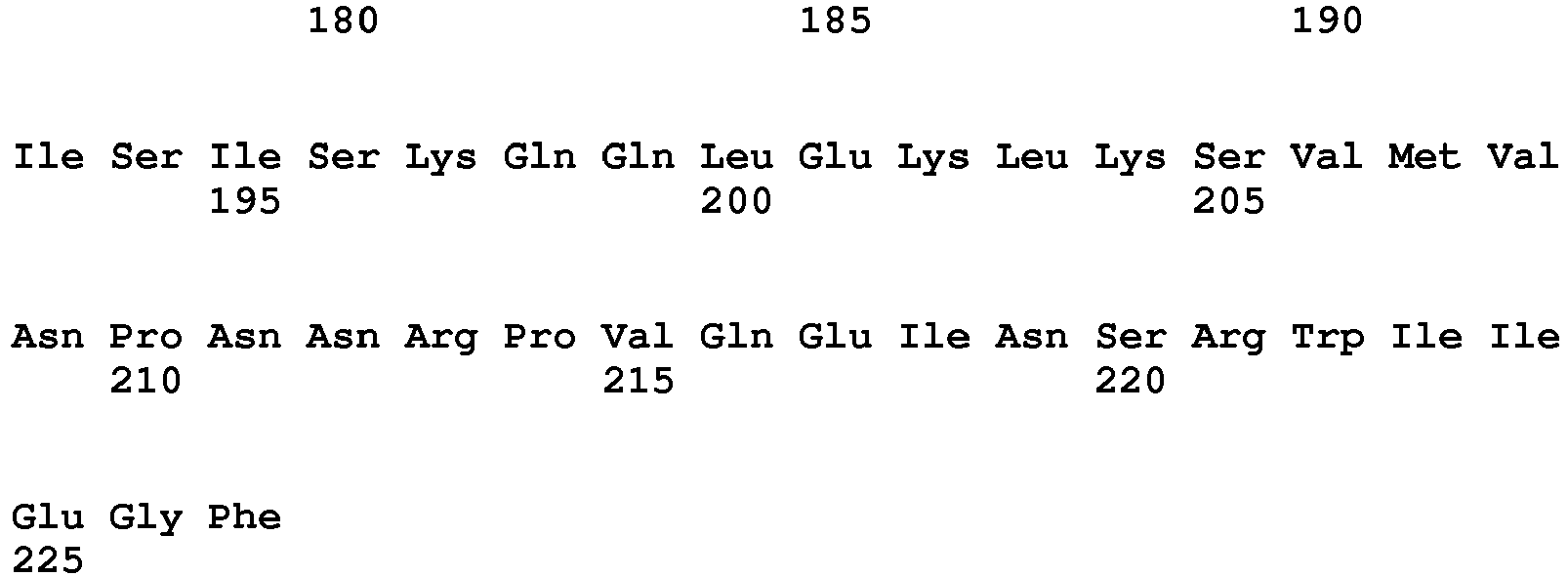
- <210> 161
<211> 684
<212> DNA
<213> Artificial sequence - <220>
<223> Variant: K38S-K57V-G82C-I100V - <400> 161

- <210> 162
<211> 227
<212> PRT
<213> Artificial sequence - <220>
<223> Variant: K38S-K57V-G82C-I100V - <400> 162


- <210> 163
<211> 684
<212> DNA
<213> Artificial sequence - <220>
<223> Variant: Q18F-K20G-K38S-K57L-G82C-I100V - <400> 163

- <210> 164
<211> 227
<212> PRT
<213> Artificial sequence - <220>
<223> Variant: Q18F-K20G-K38S-K57L-G82C-I100V - <400> 164
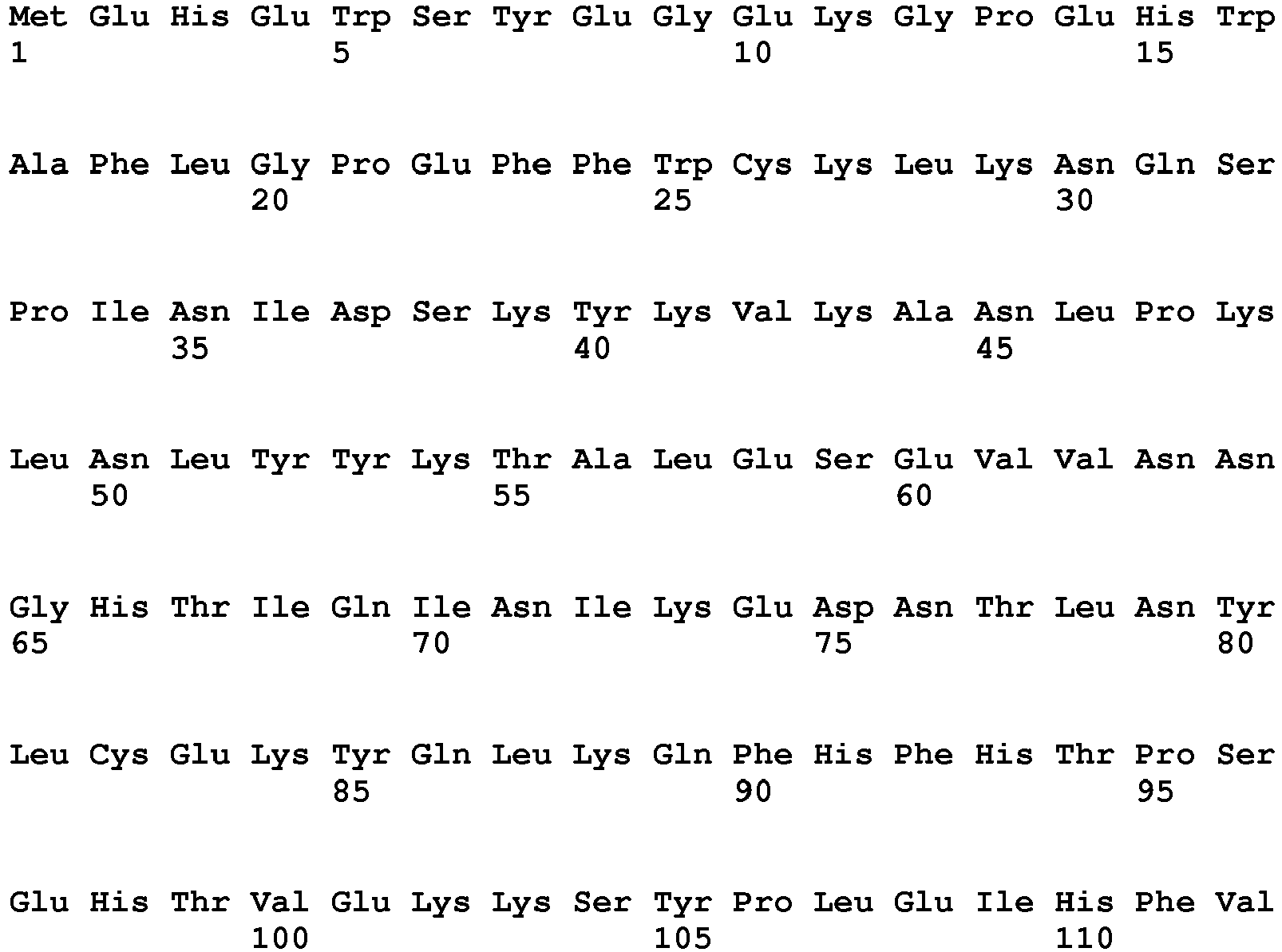

- <210> 165
<211> 684
<212> DNA
<213> Artificial sequence - <220>
<223> Variant: Q18R-K20G-K38S-K57L-G82C-I100V - <400> 165


- <210> 166
<211> 227
<212> PRT
<213> Artificial sequence - <220>
<223> Variant: Q18R-K20G-K38S-K57L-G82C-I100V - <400> 166


- <210> 167
<211> 684
<212> DNA
<213> Artificial sequence - <220>
<223> Variant: Q18W-K20G-K38S-K57L-G82C-I100V - <400> 167
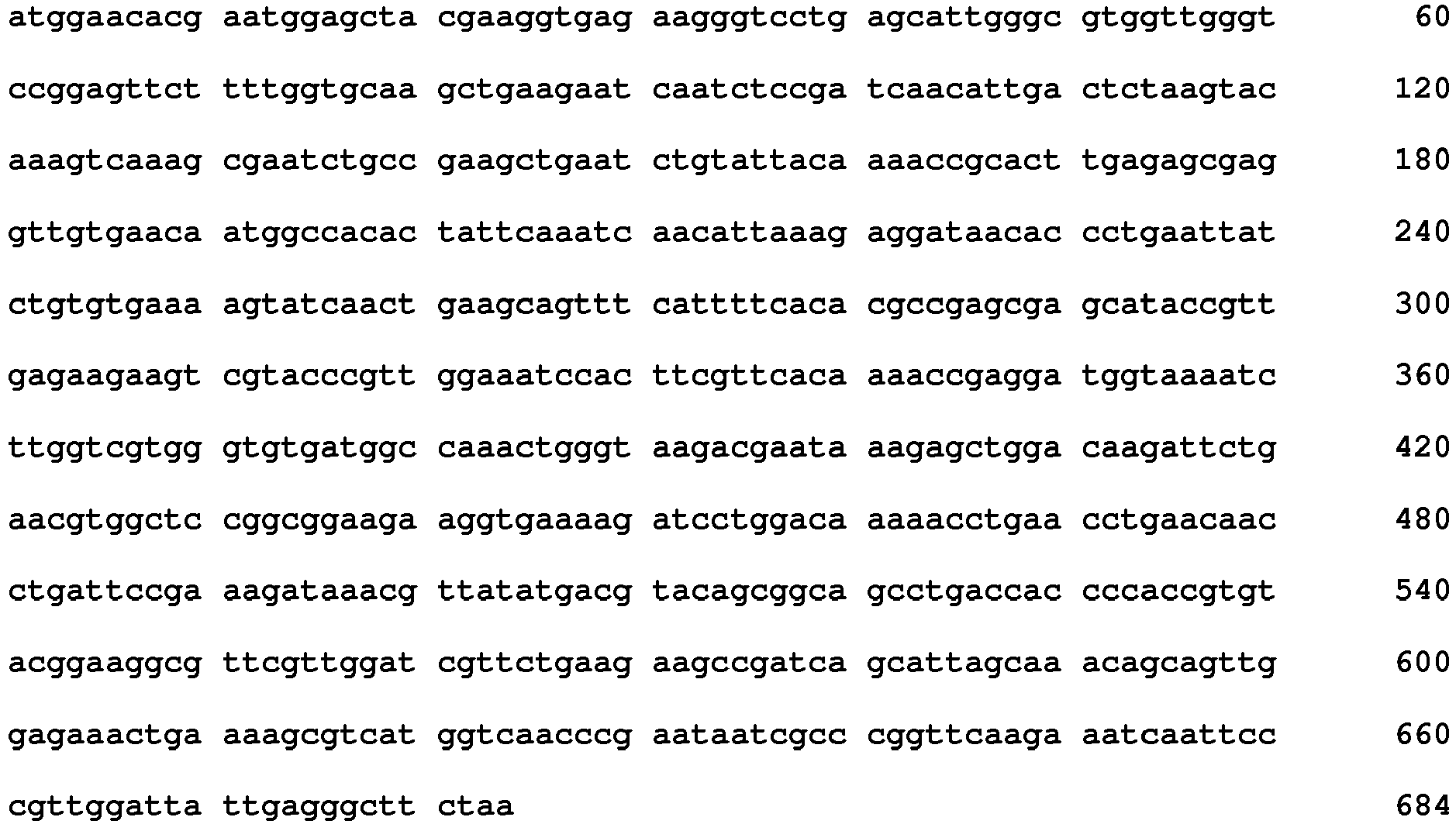
- <210> 168
<211> 227
<212> PRT
<213> Artificial sequence - <220>
<223> Variant: Q18W-K20G-K38S-K57L-G82C-I100V - <400> 168


- <210> 169
<211> 684
<212> DNA
<213> Artificial sequence - <220>
<223> Variant: Q18R-K20W-K38S-K57L-G82C-I100V - <400> 169


- <210> 170
<211> 227
<212> PRT
<213> Artificial sequence - <220>
<223> Variant: Q18R-K20W-K38S-K57L-G82C-I100V - <400> 170


- <210> 171
<211> 684
<212> DNA
<213> Artificial sequence - <220>
<223> Variant: Q18R-K20A-K38S-K57L-G82C-I100V - <400> 171

- <210> 172
<211> 227
<212> PRT
<213> Artificial sequence - <220>
<223> Variant: Q18R-K20A-K38S-K57L-G82C-I100V - <400> 172


- <210> 173
<211> 684
<212> DNA
<213> Artificial sequence - <220>
<223> Variant: Q18R-K20R-K38S-K57L-G82C-I100V - <400> 173

- <210> 174
<211> 227
<212> PRT
<213> Artificial sequence - <220>
<223> Variant: Q18R-K20R-K38S-K57L-G82C-I100V - <400> 174


- <210> 175
<211> 684
<212> DNA
<213> Artificial sequence - <220>
<223> Variant: Q18C-K20S-K38S-K57L-G82C-I100V - <400> 175


- <210> 176
<211> 227
<212> PRT
<213> Artificial sequence - <220>
<223> Variant: Q18C-K20S-K38S-K57L-G82C-I100V - <400> 176


- <210> 177
<211> 684
<212> DNA
<213> Artificial sequence - <220>
<223> Variant: Q18C-K20V-K38S-K57L-G82C-I100V - <400> 177

- <210> 178
<211> 227
<212> PRT
<213> Artificial sequence - <220>
<223> Variant: Q18C-K20V-K38S-K57L-G82C-I100V - <400> 178


- <210> 179
<211> 684
<212> DNA
<213> Artificial sequence - <220>
<223> Variant: Q18A-K20T-K38S-K57L-G82C-I100V - <400> 179

- <210> 180
<211> 227
<212> PRT
<213> Artificial sequence - <220>
<223> Variant: Q18A-K20T-K38S-K57L-G82C-I100V - <400> 180


- <210> 181
<211> 684
<212> DNA
<213> Artificial sequence - <220>
<223> Variant: G65S - <400> 181


- <210> 182
<211> 227
<212> PRT
<213> Artificial sequence - <220>
<223> Variant: G65S - <400> 182


- <210> 183
<211> 684
<212> DNA
<213> Artificial sequence - <220>
<223> Variant: K88E - <400> 183

- <210> 184
<211> 227
<212> PRT
<213> Artificial sequence - <220>
<223> Variant: K88E - <400> 184


- <210> 185
<211> 684
<212> DNA
<213> Artificial sequence - <220>
<223> Variant: K114I - <400> 185

- <210> 186
<211> 227
<212> PRT
<213> Artificial sequence - <220>
<223> Variant: K114I - <400> 186


- <210> 187
<211> 684
<212> DNA
<213> Artificial sequence - <220>
<223> Variant: V122I - <400> 187


- <210> 188
<211> 227
<212> PRT
<213> Artificial sequence - <220>
<223> Variant: V122I - <400> 188


- <210> 189
<211> 684
<212> DNA
<213> Artificial sequence - <220>
<223> Variant: M126L - <400> 189

- <210> 190
<211> 227
<212> PRT
<213> Artificial sequence - <220>
<223> Variant: M126L - <400> 190

- <210> 191
<211> 684
<212> DNA
<213> Artificial sequence - <220>
<223> Variant: G148A - <400> 191

- <210> 192
<211> 227
<212> PRT
<213> Artificial sequence - <220>
<223> Variant: G148A - <400> 192


- <210> 193
<211> 684
<212> DNA
<213> Artificial sequence - <220>
<223> Variant: E14D - <400> 193
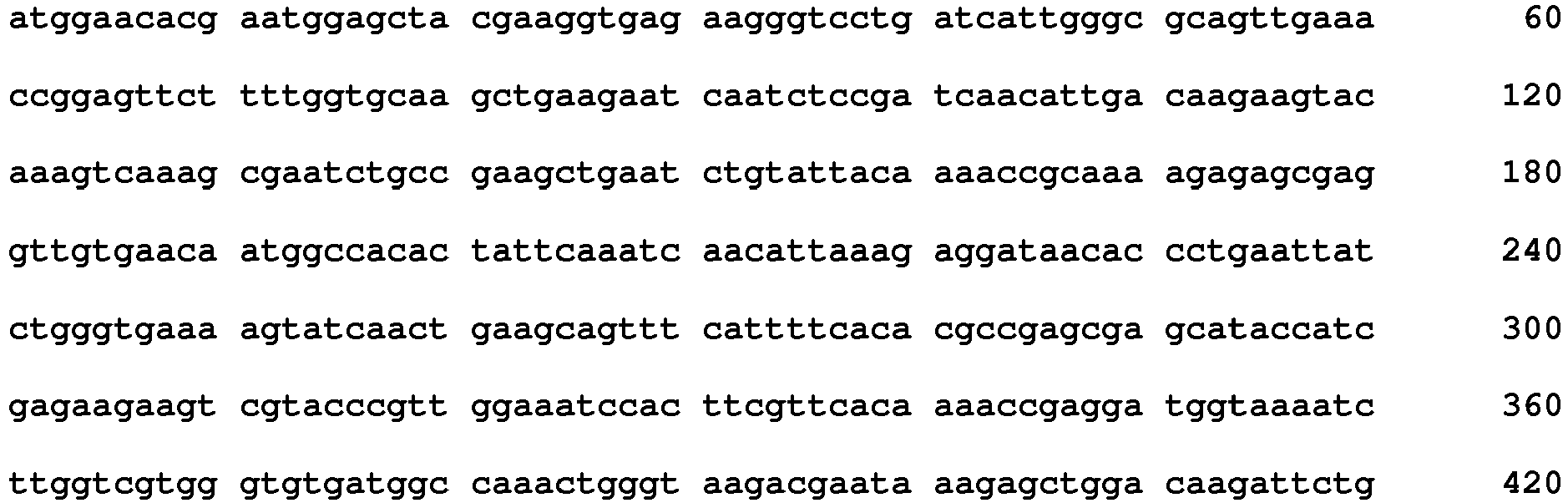

- <210> 194
<211> 227
<212> PRT
<213> Artificial sequence - <220>
<223> Variant: E14D - <400> 194

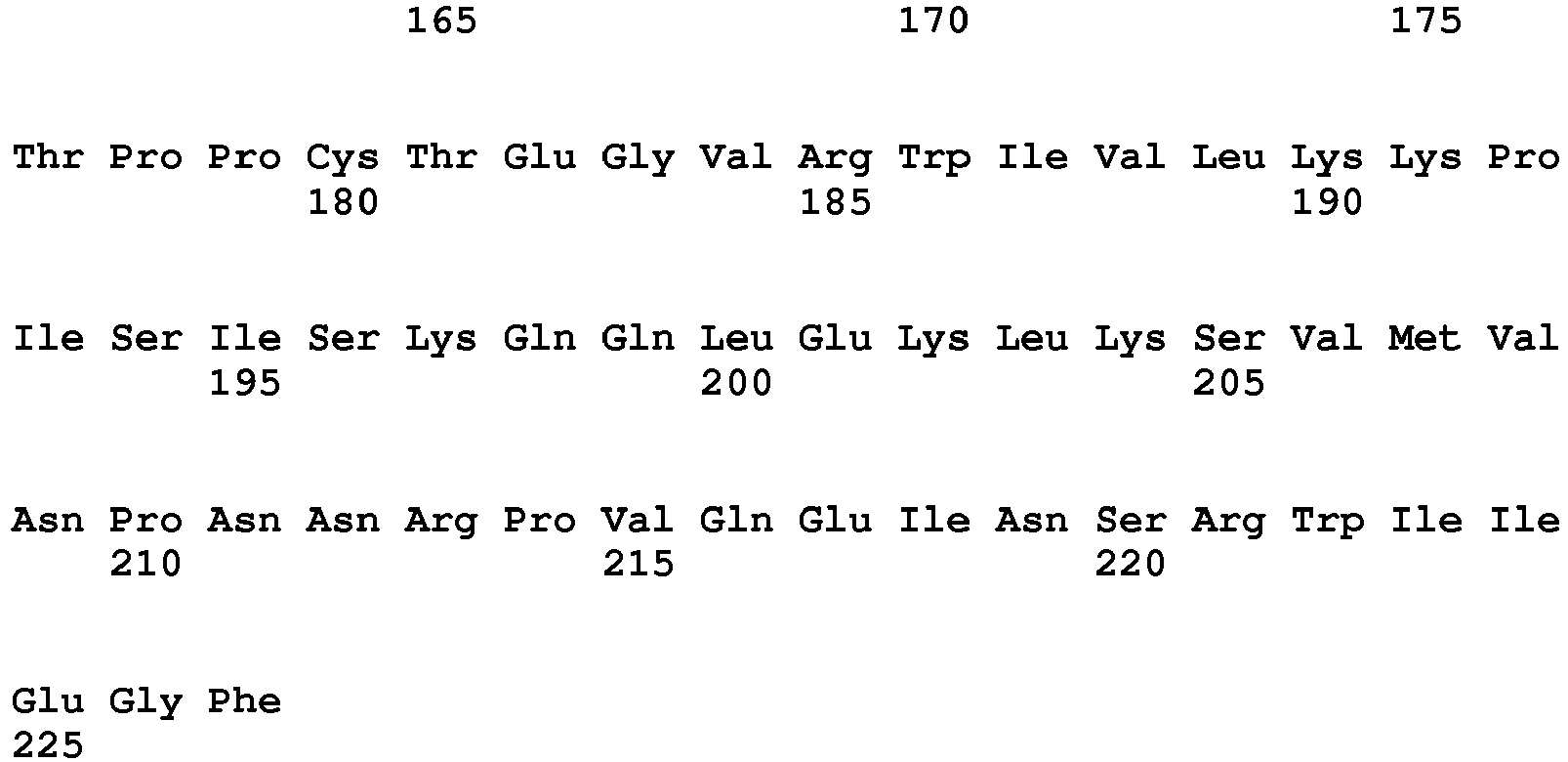
- <210> 195
<211> 684
<212> DNA
<213> Artificial sequence - <220>
<223> Variant: Q18F-K20R-K38S-K57L-G82C-I100V - <400> 195

- <210> 196
<211> 227
<212> PRT
<213> Artificial sequence - <220>
<223> Variant: Q18F-K20R-K38S-K57L-G82C-I100V - <400> 196

- <210> 197
<211> 260
<212> PRT
<213> Artificial sequence - <220>
<223> Variant M6X Enzyme - <400> 197


- <210> 198
- <400> 198
000 - <210> 199
<211> 684
<212> DNA
<213> Artificial sequence - <220>
<223> Variant: Q18T - <400> 199

- <210> 200
<211> 227
<212> PRT
<213> Artificial sequence - <220>
<223> Variant: Q18T - <400> 200


- <210> 201
<211> 684
<212> DNA
<213> Artificial sequence - <220>
<223> Variant: K20W - <400> 201

- <210> 202
<211> 227
<212> PRT
<213> Artificial sequence - <220>
<223> Variant: K20W - <400> 202


- <210> 203
<211> 684
<212> DNA
<213> Artificial sequence - <220>
<223> Variant: K150I - <400> 203


- <210> 204
<211> 227
<212> PRT
<213> Artificial sequence - <220>
<223> VARIANT: K150I - <400> 204


- <210> 205
<211> 684
<212> DNA
<213> Artificial sequence - <220>
<223> Variant: K150N - <400> 205

- <210> 206
<211> 227
<212> PRT
<213> Artificial sequence - <220>
<223> Variant: K150N - <400> 206


- <210> 207
<211> 684
<212> DNA
<213> Artificial sequence - <220>
<223> Variant: T181M - <400> 207

- <210> 208
<211> 227
<212> PRT
<213> Artificial sequence - <220>
<223> Variant: T181M - <400> 208


| Variants exhibiting improved stability following a 15 min exposure at 92°C in 0.3M Na2CO3/NaHCO3 pH 10 | ||
| Seq ID NO (nt/aa) | Amino acid substitution | Activity after 15 min×92°C Challenge† |
| 9/10 | Q18A | + |
| 15/16 | Q18L | + |
| 17/18 | Q18R | + |
| 19/20 | Q18S | + |
| 23/24 | K20A | + |
| 25/26 | K20G | + |
| 27/28 | K20L | + |
| 29/30 | K20N | + |
| 31/32 | K20R | + |
| 35/36 | K20T | + |
| 37/38 | K38A | + |
| 41/42 | K38D | + |
| 43/44 | K38G | + |
| 45/46 | K38L | + |
| 47/48 | K38N | + |
| 49/50 | K38P | + |
| 51/52 | K38R | + |
| 57/58 | Y52C | + |
| 59/60 | Y52E | + |
| 61/62 | Y52G | + |
| 63/64 | Y52P | + |
| 65/66 | Y52T | + |
| 69/70 | K57G | + |
| 73/74 | K57N | + |
| 75/76 | K57P | + |
| 77/78 | K57R | + |
| 79/80 | K57S | + |
| 81/82 | K57V | + |
| 83/84 | G82C | ++ |
| 85/86 | G82E | + |
| 87/88 | I100A | + |
| 89/90 | I100E | + |
| 91/92 | I100N | + |
| 93/94 | I100S | + |
| 97/98 | II00Y | + |
| 99/100 | E116D | + |
| 101/102 | G130A | + |
| 103/104 | G130C | + |
| 105/106 | G130L | + |
| 107/108 | K150A | + |
| 109/110 | K150S | + |
| 111/112 | N155I | + |
| 113/114 | T181L | + |
| 115/116 | T181Q | + |
| 117/118 | T181R | + |
| 119/120 | S205C | + |
| 121/122 | Q18T-K20A | + |
| 123/124 | Q18R-K20A | + |
| 125/126 | E2K;T181M; K197I | + |
| 127/128 | E14D;Q18R | + |
| 129/130 | Y52C; V122I; K150N; G226S | + |
| 131/132 | G65S;K150I | + |
| 133/134 | K57R; G130C | + |
| 135/136 | G82C; K88E | + |
| 137/138 | G82C; G148A | + |
| 139/140 | M126L; G130L | + |
| 141/142 | G82C; I100V | ++ |
| 143/144 | K38C; G82C; I100V | +++ |
| 145/146 | K38G; G82C; I100V | +++ |
| 147/148 | K38R; G82C; I100V | +++ |
| 149/150 | K38S; G82C; I100V | +++ |
| 151/152 | K38W; G82C; I100V | +++ |
| 153/154 | K38S; K57A; G82C; I100V | ++++ |
| 155/156 | K38S; K57G; G82C; I100V | ++++ |
| 157/158 | K38S; K57L; G82C; I100V | ++++ |
| 159/160 | K38S; K57S; G82C; I100V | ++++ |
| 161/162 | K38S; K57V; G82C; I100V; | ++++ |
| 163/164 | Q18F; K20G; K38S; K57L; G82C; I100V | +++++ |
| 165/166 | Q18R; K20G; K38S; K57L; G82C; I100V | +++++ |
| 167/168 | Q18W; K20G; K38S; K57L; G82C; I100V | +++++ |
| 169/170 | Q18R; K20W; K38S; K57L; G82C; I100V | +++++ |
| 171/172 | Q18R; K20A; K38S; K57L; G82C; I100V | +++++ |
| 173/174 | Q18R; K20R; K38S; K57L; G82C; I100V | +++++ |
| 175/176 | Q18C; K20S; K38S; K57L; G82C; I100V | +++++ |
| 177/178 | Q18C; K20V; K38S; K57L; G82C; I100V | +++++ |
| 179/180 | Q18A; K20T; K38S; K57L; G82C; I100V | +++++ |
| 195/196 | Q18F; K20R; K38S; K57L; G82C; I100V | +++++ |
| † Stability evaluated by comparison of the residual activity signal level after a 15min exposure in 0.3M Na2CO3/NaHCO3 pH 10. |
| Residual activity levels of SSp-CA variants challenged under various conditions | ||||
| Seq ID (nt/aa) | Amino acid substitution | Assay 1 0.3M Na2CO3 pH 10 85°C×16h | Assay 2 0.3M Na2CO3 pH 10 96°C×1h | Assay 3 0.3M Na2CO3 pH 10 98°C×1h |
| 193/194 | E14D | NT | - | NT |
| 15/16 | Q18L | + | + | NT |
| 17/18 | Q18R | + | + | NT |
| 29/30 | K20N | + | + | NT |
| 35/36 | K20T | + | + | NT |
| 47/48 | K38N | + | + | NT |
| 57/58 | Y52C | - | + | NT |
| 73/74 | K57N | + | + | NT |
| 181/182 | G65S | NT | - | NT |
| 83/84 | G82C | ++ | ++ | + |
| 93/94 | I100S | NT | + | NT |
| 185/186 | K114I | NT | - | NT |
| 99/100 | E116D | NT | - | NT |
| 189/190 | V122I | NT | - | NT |
| 103/104 | G130C | NT | + | NT |
| 193/194 | G148A | NT | - | NT |
| 107/108 | K150A | NT | - | NT |
| 1019/110 | K150S | NT | - | NT |
| 111/112 | N155I | NT | - | NT |
| 113/114 | T181L | NT | - | NT |
| 115/116 | T181Q | NT | - | NT |
| 117/118 | T181R | NT | + | NT |
| 119/120 | S205C | NT | - | NT |
| 141/142 | G82C; I100V | ++ | ++ | ++ |
| 143/144 | K38C; G82C; I100V | ++ | NT | +++ |
| 145/146 | K38G; G82C; I100V | ++ | NT | +++ |
| 147/148 | K38R; G82C; I100V; | + | NT | ++ |
| 149/150 | K38S; G82C;1100V | +++ | NT | +++ |
| 151/152 | K38W; G82C; I100V | +++ | NT | +++ |
| 153/154 | K38S; K57A; G82C; I100V; | ++ | NT NT | +++ |
| 155/156 | K38S; K57G; G82C; I100V | NT | NT | +++ |
| 157/158 | K38S; K57L; G82C; I100V | NT | NT | +++ |
| 159/160 | K38S; K57S; G82C; I100V; | NT | NT | +++ |
| 161/162 | K38S; K57V; G82C; I100V | NT | NT | +++ |
| 195/196 | Q18F; K20R; K38S; K57L; G82C; I100V | ++++ | NT | ++++ |
| 167/168 | Q18W; K20G; K38S; K57L; G82C; I100V | +++ | NT | +++ |
| 165/166 | Q18R; K20G; K38S; K57L; G82C; I100V | +++ | NT | +++ |
| 169/170 | Q18R; K20W; K38S; K57L; G82C; I100V | +++ | NT | +++ |
| 171/172 | Q18R; K20A; K38S; K57L; G82C; I100V | +++ | NT | +++ |
| 173/174 | Q18R; K20R; K38S; K57L; G82C; I100V | +++ | NT | +++ |
| Legend: - = Residual activity about that of wild-type SspCA + = Residual activity about 100% to 200% that of wild-type SspCA ++ = Residual activity about 200% to 400% that of wild-type SspCA +++ = Residual activity about 400% to 800% that of wild-type SspCA ++++ = Residual activity about 800% to 1600% that of wild-type SspCA NT = Not tested |
| Neutral mutations highlighted along the screening process with SEQ ID indicated | ||||
| SEQ ID DNA/PROT | Position on SEQ ID No: 8 | Naturally occurring amino acid | Neutral mutation | |
| 193/194 | 14 | | Asp | |
| 181/182 | 65 | Gly | Ser | |
| 183/184 | 88 | Lys | Glu | |
| 185/186 | 114 | | Ile | |
| 99/100 | 116 | Glu | Asp | |
| 187/188 | 122 | Val | Ile | |
| 189/190 | 126 | Met | Leu | |
| 191/192 | 148 | Gly | Ala | |
| 111/112 | 155 | Asn | Ile | |
| 119/120 | 205 | Ser | Cys | |
| Neutral peptide insertions | |
| Position pair between which insertion occurs on SEQ ID NO: 8 | Insertion |
| 12-13 | LSTGRCWCRSSTWCKLKG |
| 12-13 | PEHWAGLLPEFFWCKEKG |
| 53-54 | KLNLH |
| 151-152 | PPAEEAKT |
Claims (15)
- A recombinant carbonic anhydrase polypeptide or a functional derivative thereof having the carbonic anhydrase activity, comprising an amino acid sequence having at least 65% identity with SEQ ID NO: 8 over the entire length of the sequence and comprising at least one, two, three, four, five, six, seven, eight, nine, or ten amino acid difference(s) relative to SEQ ID NO: 8 at a position selected from the group consisting of 18, 20, 38, 52, 57, 82, 100, 130, 150, and 181, wherein the recombinant carbonic anhydrase polypeptide or functional derivative has improved thermostability in the presence of carbonate ion relative to the polypeptide of SEQ ID NO: 8, after a 15-minute exposure at 92°C in 0.3 M Na2CO3/NaHCO3 pH 10.
- The recombinant carbonic anhydrase polypeptide or functional derivative of claim 1, wherein the at least one, two, three, four, five, six, seven, eight, nine, or ten amino acid difference(s) relative to SEQ ID NO: 8 is/are selected from the group consisting of 18A, 18C, 18F, 18L, 18R, 18S, 18T, 18W, 20A, 20G, 20L, 20N, 20R, 20S, 20T, 20W, 38A, 38D, 38G, 38L, 38N, 38P, 38R, 38S, 38W, 52C, 52E, 52G, 52P, 52T, 57A, 57G, 57L, 57N, 57P, 57R, 57S, 57V, 82C, 82E, 100A, 100E, 100N, 100S, 100V, 100Y, 130A, 130C, 130L, 150A, 1501, 150N, 150S, 181Q, 181L, 181M, and 181R.
- The recombinant carbonic anhydrase polypeptide or functional derivative of claim 1 or 2 having at least 70%, 75%, 80%, or 85% identity with SEQ ID NO: 8 over the entire length of the sequence.
- The recombinant carbonic anhydrase polypeptide or functional derivative of claim 1 or 2 having at least 90%, 91%, 92%, 93%, 94%, 95%, 96%, 97%, 98%, 99%, or 99.5% identity with SEQ ID NO: 8 over the entire length of the sequence.
- The recombinant carbonic anhydrase polypeptide or functional derivative of any one of claims 1 to 4 comprising additional neutral mutations.
- The recombinant carbonic anhydrase polypeptide or functional derivative of any one of claims 1 to 4 which further comprises at least one amino acid difference relative to SEQ ID NO: 8 selected from the group consisting of E14D, G65S, K88E, K114I, E116D, V122I, M126L, G148A, N155I, and S205C.
- The recombinant carbonic anhydrase polypeptide or functional derivative of any one of claims 1 to 6 having a further improved property relative to the same property of the polypeptide of SEQ ID NO: 8 selected from one or more of:a. Improved stability, activity, and/or solubility in presence of sodium ion;b. Improved stability, activity, and/or solubility in presence of potassium ion;c. Improved stability and/ or activity and/ or solubility under high pH conditions; andd. Improved pH-activity profile,or said recombinant polypeptide, when present at 0.2g/l within its lifetime, transforms at least 4.3 x 10⁷ mmole.m-2.bar-1 of CO2.
- A method for absorbing CO2 from a CO2-containing gas, comprising:contacting the CO2-containing gas with an aqueous absorption solution to dissolve the CO2 into the aqueous absorption solution; andproviding the recombinant carbonic anhydrase polypeptide or functional derivative as defined in any one of claims 1 to 7 to catalyze the hydration reaction of the dissolved CO2 into bicarbonate and hydrogen ions.
- The method of claim 8, whereina) the recombinant carbonic anhydrase polypeptide or functional derivative as defined in any one of claims 1 to 7 displays enhanced stability and/or activity compared to the activity of SspCA of SEQ ID NO: 8;b) the recombinant carbonic anhydrase polypeptide or functional derivative as defined in any one of claims 1 to 7 provides an enhanced CO2 flux of at least 8.5 times a corresponding CO2 flux with no enzyme; orc) the recombinant carbonic anhydrase polypeptide or functional derivative as defined in any one of claims 1 to 7 provides an enhanced CO2 flux of up to 22 times a corresponding CO2 flux with no enzyme.
- The method of claim 8, wherein the absorption solution comprises at least one absorption compound comprising:i) a primary amine, a secondary amine, a tertiary amine, a primary alkanolamine, a secondary alkanolamine, a tertiary alkanolamine, a primary amino acid, a secondary amino acid, a tertiary amino acid, dialkylether of polyalkylene glycols, dialkylether or dimethylether of polyethylene glycol, amino acid or a derivative thereof, monoethanolamine (MEA), 2-amino-2-methyl-1-propanol (AMP), 2-(2-aminoethylamino)ethanol (AEE), 2-amino-2-hydroxymethyl-1,3-propanediol (Tris or AHPD), N-methyldiethanolamine (MDEA), dimethylmonoethanolamine (DMMEA), diethylmonoethanolamine (DEMEA), triisopropanolamine (TIPA), triethanolamine (TEA), DEA, DIPA, MMEA, TIA, TBEE, HEP, AHPD, hindered diamine (HDA), bis-(tertiarybutylaminoethoxy)-ethane (BTEE), ethoxyethoxyethanol-tertiarybutylamine (EEETB), bis-(tertiarybutylaminoethyl)ether, 1,2-bis-(tertiarybutylaminoethoxy)ethane and/or bis-(2-isopropylaminopropyl)ether, or a combination thereof;ii) a primary amine, a secondary amine, a tertiary amine, a primary alkanolamine, a secondary alkanolamine, a tertiary alkanolamine, a primary amino acid, a secondary amino acid, a tertiary amino acid; or a combination thereof;iii) dialkylether of polyalkylene glycols, dialkylether or dimethylether of polyethylene glycol, amino acid or derivative thereof, or a combination thereof;iv) piperazine or derivative thereof, preferably substituted by at least one of alkanol group;v) monoethanolamine (MEA), 2-amino-2-methyl-1-propanol (AMP), 2-(2-aminoethylamino)ethanol (AEE), 2-amino-2-hydroxymethyl-1,3-propanediol (Tris or AHPD), N-methyldiethanolamine (MDEA), dimethylmonoethanolamine (DMMEA), diethylmonoethanolamine (DEMEA), triisopropanolamine (TIPA), triethanolamine (TEA), DEA, DIPA, MMEA, TIA, TBEE, HEP, AHPD, hindered diamine (HDA), bis-(tertiarybutylaminoethoxy)-ethane (BTEE), ethoxyethoxyethanol-tertiarybutylamine (EEETB), bis-(tertiarybutylaminoethyl)ether, 1,2-bis-(tertiarybutylaminoethoxy)ethane and/or bis-(2-isopropylaminopropyl)ether;vi) an amino acid or derivative thereof, which is preferably a glycine, proline, arginine, histidine, lysine, aspartic acid, glutamic acid, methionine, serine, threonine, glutamine, cysteine, asparagine, valine, leucine, isoleucine, alanine, tyrosine, tryptophan, phenylalanine, taurine, N,cyclohexyl 1,3-propanediamine, N-secondary butyl glycine, N-methyl N-secondary butyl glycine,diethylglycine, dimethylglycine, sarcosine, methyl taurine, methyl-α-aminopropionicacid, N-(β-ethoxy)taurine, N-(β-aminoethyl)taurine, N-methyl alanine, 6-aminohexanoic acid, potassium or sodium salt of the amino acid, or a combination thereof;vii) a carbonate compound;viii) sodium carbonate, potassium carbonate, or MDEA;ix) sodium carbonate; orx) potassium carbonate.
- The method of claim 10, wherein the temperature of the absorption solution is at least 10°C, and/or
the step of contacting is performed at a temperature between 10°C and 98°C, between 35°C and 80°C, between 40°C and 70°C, or between 60°C and 65°C, and/or
the concentration of the carbonic anhydrase polypeptide or functional derivative as defined in any one of claims 1 to 7 is between 0.1 g/L and 50 g/L in the absorption solution, optionally between 0.3g/L and 10g/L, and/or
the pH of the absorption solution is between 8 and 11. - The method of any one of claims 8 to 11, wherein the CO2 loading is between 0.05 and 1 mol CO2/mol amine or mol CO2/mol cation.
- The method of any one of claims 8 to 12, further comprising subjecting the ion-rich solution to desorption to produce a regenerated absorption solution and a CO2 gas stream.
- The method of any one of claims 8 to 13, wherein at least a portion of the recombinant carbonic anhydrase polypeptide or functional derivative thereof as defined in any one of claims 1 to 7 is a component of the absorption solution and the ion-rich solution and catalyzes the desorption reaction.
- The method of any one of claims 8 to 14, wherein the absorption is operated at a temperature between 10°C and 98°C, optionally between 35°C and 80°C, between 40°C and 70°C, or between 60°C and 65°C, optionally at 10°C, 20°C, 30°C, 40°C, 50°C, 60°C, 70°C, 80 °C, 85°C, 90°C, 95°C or 98°C or any other value in between and /or the desorption is operated at a temperature between 30°C and 110°C, preferably between 40°C and 100°C or preferably between 45°C and 95°C.
Applications Claiming Priority (2)
| Application Number | Priority Date | Filing Date | Title |
|---|---|---|---|
| US201261719710P | 2012-10-29 | 2012-10-29 | |
| PCT/CA2013/050818 WO2014066999A1 (en) | 2012-10-29 | 2013-10-29 | Techniques for co2 capture using sulfurihydrogenibium sp. carbonic anhydrase |
Publications (3)
| Publication Number | Publication Date |
|---|---|
| EP2912172A1 EP2912172A1 (en) | 2015-09-02 |
| EP2912172A4 EP2912172A4 (en) | 2016-10-19 |
| EP2912172B1 true EP2912172B1 (en) | 2018-12-05 |
Family
ID=50626253
Family Applications (1)
| Application Number | Title | Priority Date | Filing Date |
|---|---|---|---|
| EP13850207.5A Active EP2912172B1 (en) | 2012-10-29 | 2013-10-29 | Techniques for co2 capture using sulfurihydrogenibium sp. carbonic anhydrase |
Country Status (4)
| Country | Link |
|---|---|
| US (2) | US9968885B2 (en) |
| EP (1) | EP2912172B1 (en) |
| CA (1) | CA2889779C (en) |
| WO (1) | WO2014066999A1 (en) |
Families Citing this family (9)
| Publication number | Priority date | Publication date | Assignee | Title |
|---|---|---|---|---|
| US9968885B2 (en) | 2012-10-29 | 2018-05-15 | Co2 Solutions Inc. | Techniques for CO2 capture using sulfurihydrogenibium sp. carbonic anhydrase |
| CA2890582C (en) * | 2014-08-27 | 2022-07-19 | Normand Voyer | Co2 capture methods using thermovibrio ammonificans carbonic anhydrase |
| CA2996077A1 (en) * | 2015-09-03 | 2017-03-09 | Co2 Solutions Inc. | Variants of thermovibrio ammonificans carbonic anhydrase and co2 capture methods using thermovibrio ammonificans carbonic anhydrase variants |
| KR102388401B1 (en) * | 2020-03-26 | 2022-04-19 | 경상국립대학교산학협력단 | Mutant of carbonic anhydrase from Thermosulfurimonas dismutans with enhanced protein expression and uses thereof |
| CA3191564A1 (en) | 2020-09-08 | 2022-03-17 | Frederick William Macdougall | Coalification and carbon sequestration using deep ocean hydrothermal borehole vents |
| US11794893B2 (en) | 2020-09-08 | 2023-10-24 | Frederick William MacDougall | Transportation system for transporting organic payloads |
| US20240229005A9 (en) * | 2021-02-19 | 2024-07-11 | Alliance For Sustainable Energy, Llc | Engineered thermostable carbonic anhydrase enzymes |
| CN113694888B (en) * | 2021-08-02 | 2023-06-09 | 北京工业大学 | Preparation method and application of niobium modified organic layered double oxide/graphene oxide nanocomposite as CO2 adsorbent |
| US12528046B2 (en) * | 2023-07-28 | 2026-01-20 | Susteon Inc. | High performance CO2 capture solvent compositions, and CO2 capture systems and processes utilizing same |
Family Cites Families (20)
| Publication number | Priority date | Publication date | Assignee | Title |
|---|---|---|---|---|
| GB9711439D0 (en) | 1997-06-04 | 1997-07-30 | Rogers Peter A | Bioreactor for dioxide management |
| CA2329113C (en) | 2000-12-19 | 2008-08-05 | Co2 Solution Inc. | A treatment unit for treating a fluid and method thereof |
| DE60221373D1 (en) | 2001-04-13 | 2007-09-06 | Co2 Solution Inc | METHOD AND DEVICE FOR PRODUCING CEMENT LINKERS |
| CA2393016C (en) | 2001-07-13 | 2011-01-04 | Saipem S.P.A. | Triphasic bioreactor and process for gas effluent treatment |
| US6946288B2 (en) | 2002-05-31 | 2005-09-20 | Co2 Solution, Inc. | Ventilation system for an enclosure in which people live and a method thereof |
| CA2405635A1 (en) | 2002-09-27 | 2004-03-27 | C02 Solution Inc. | A process and a plant for the production of useful carbonated species and for the recycling of carbon dioxide emissions from power plants |
| US7514056B2 (en) | 2005-02-07 | 2009-04-07 | Co2 Solution Inc. | Process and installation for the fractionation of air into specific gases |
| AU2006217575B2 (en) | 2005-02-24 | 2010-12-23 | Co2 Solutions Inc. | An improved CO2 absorption solution |
| CA2541986A1 (en) | 2005-04-21 | 2006-10-21 | Co2 Solution Inc. | Carbonic anhydrase having increased stability under high temperatue conditions |
| CA2544997A1 (en) | 2005-04-28 | 2006-10-28 | Carmen Parent | Immobilized biological material with improved functionality and method for producing the same |
| CA2554395C (en) | 2005-07-27 | 2013-10-08 | Carmen Parent | Gas purification apparatus and process using biofiltration and enzymatic reactions |
| EP2461894B1 (en) | 2009-08-04 | 2017-06-14 | CO2 Solutions Inc. | Process for co2 capture using micro-particles comprising biocatalysts |
| EP2461893A4 (en) | 2009-08-04 | 2013-01-09 | Co2 Solution Inc | FORMULATION AND METHOD FOR CO2 CAPTURE USING AMINO ACIDS AND |
| EP2490791B1 (en) | 2009-08-04 | 2017-07-05 | CO2 Solution Inc. | Process for co2 capture using carbonates and biocatalysts |
| CA2777272A1 (en) | 2009-11-04 | 2011-05-12 | Co2 Solutions Inc. | Enzymatic process and bioreactor using elongated structures for co2 capture treatments |
| HUE050812T2 (en) | 2010-10-29 | 2021-01-28 | Saipem Spa | Enzyme enhanced c02 desorption processes |
| EP2678094A4 (en) | 2011-02-03 | 2014-12-10 | Co2 Solutions Inc | C02 treatments using enzymatic particles sized according to reactive liquid film thickness for enhanced catalysis |
| WO2013064195A1 (en) * | 2011-11-04 | 2013-05-10 | Enel Ingegneria E Ricerca S.P.A. | A new heat-stable carbonic anhydrase and uses thereof |
| US9968885B2 (en) | 2012-10-29 | 2018-05-15 | Co2 Solutions Inc. | Techniques for CO2 capture using sulfurihydrogenibium sp. carbonic anhydrase |
| WO2015056858A1 (en) | 2013-10-17 | 2015-04-23 | 포항공과대학교 산학협력단 | Carbonic anhydrase having high-temperature stability and carbon dioxide collector comprising same |
-
2013
- 2013-10-29 US US14/439,218 patent/US9968885B2/en active Active
- 2013-10-29 EP EP13850207.5A patent/EP2912172B1/en active Active
- 2013-10-29 CA CA2889779A patent/CA2889779C/en active Active
- 2013-10-29 WO PCT/CA2013/050818 patent/WO2014066999A1/en not_active Ceased
-
2018
- 2018-05-11 US US15/977,965 patent/US20180257033A1/en not_active Abandoned
Also Published As
| Publication number | Publication date |
|---|---|
| CA2889779C (en) | 2022-06-21 |
| US20150283502A1 (en) | 2015-10-08 |
| WO2014066999A1 (en) | 2014-05-08 |
| EP2912172A1 (en) | 2015-09-02 |
| CA2889779A1 (en) | 2014-05-08 |
| US20180257033A1 (en) | 2018-09-13 |
| EP2912172A4 (en) | 2016-10-19 |
| US9968885B2 (en) | 2018-05-15 |
Similar Documents
| Publication | Publication Date | Title |
|---|---|---|
| US9968885B2 (en) | Techniques for CO2 capture using sulfurihydrogenibium sp. carbonic anhydrase | |
| CA2890582C (en) | Co2 capture methods using thermovibrio ammonificans carbonic anhydrase | |
| US10415028B2 (en) | Variants of thermovibrio ammonificans carbonic anhydrase and CO2 capture methods using thermovibrio ammonificans carbonic anhydrase variants | |
| US9533258B2 (en) | Process for capturing CO2 from a gas using carbonic anhydrase and potassium carbonate | |
| US8569031B2 (en) | Chemically modified carbonic anhydrases useful in carbon capture systems | |
| EP2678094A1 (en) | C02 treatments using enzymatic particles sized according to reactive liquid film thickness for enhanced catalysis | |
| WO2012167388A1 (en) | Enhanced enzymatic co2 capture techniques according to solution pka, temperature and/or enzyme character | |
| CN113874500A (en) | Carbonic anhydrase variants for improved CO2 capture | |
| Chen et al. | Progress in modeling of carbon capture technologies | |
| EP2849872A1 (en) | Co2 capture with carbonic anhydrase and tertiary amino solvents for enhanced flux ratio | |
| EP3666366B1 (en) | Composite decarbonization solution added with carbon nano tube for recycling carbon dioxide in a mixed gas | |
| Alvizo et al. | Highly stable beta-class carbonic anhydrases useful in carbon capture systems | |
| Heymans et al. | Lab-pilot Scale CO2 Capture Vacuum Pressure Swing Adsorption using MOFs |
Legal Events
| Date | Code | Title | Description |
|---|---|---|---|
| PUAI | Public reference made under article 153(3) epc to a published international application that has entered the european phase |
Free format text: ORIGINAL CODE: 0009012 |
|
| 17P | Request for examination filed |
Effective date: 20150528 |
|
| AK | Designated contracting states |
Kind code of ref document: A1 Designated state(s): AL AT BE BG CH CY CZ DE DK EE ES FI FR GB GR HR HU IE IS IT LI LT LU LV MC MK MT NL NO PL PT RO RS SE SI SK SM TR |
|
| AX | Request for extension of the european patent |
Extension state: BA ME |
|
| DAX | Request for extension of the european patent (deleted) | ||
| RIC1 | Information provided on ipc code assigned before grant |
Ipc: B01D 53/62 20060101ALI20160523BHEP Ipc: C12N 15/60 20060101ALI20160523BHEP Ipc: C12N 9/88 20060101AFI20160523BHEP Ipc: B01D 53/84 20060101ALI20160523BHEP Ipc: B01D 53/14 20060101ALI20160523BHEP Ipc: B01D 53/34 20060101ALI20160523BHEP |
|
| RA4 | Supplementary search report drawn up and despatched (corrected) |
Effective date: 20160919 |
|
| RIC1 | Information provided on ipc code assigned before grant |
Ipc: B01D 53/62 20060101ALI20160913BHEP Ipc: B01D 53/84 20060101ALI20160913BHEP Ipc: B01D 53/14 20060101ALI20160913BHEP Ipc: B01D 53/34 20060101ALI20160913BHEP Ipc: C12N 9/88 20060101AFI20160913BHEP Ipc: C12N 15/60 20060101ALI20160913BHEP |
|
| STAA | Information on the status of an ep patent application or granted ep patent |
Free format text: STATUS: EXAMINATION IS IN PROGRESS |
|
| 17Q | First examination report despatched |
Effective date: 20171213 |
|
| GRAP | Despatch of communication of intention to grant a patent |
Free format text: ORIGINAL CODE: EPIDOSNIGR1 |
|
| STAA | Information on the status of an ep patent application or granted ep patent |
Free format text: STATUS: GRANT OF PATENT IS INTENDED |
|
| INTG | Intention to grant announced |
Effective date: 20180517 |
|
| GRAS | Grant fee paid |
Free format text: ORIGINAL CODE: EPIDOSNIGR3 |
|
| GRAA | (expected) grant |
Free format text: ORIGINAL CODE: 0009210 |
|
| STAA | Information on the status of an ep patent application or granted ep patent |
Free format text: STATUS: THE PATENT HAS BEEN GRANTED |
|
| AK | Designated contracting states |
Kind code of ref document: B1 Designated state(s): AL AT BE BG CH CY CZ DE DK EE ES FI FR GB GR HR HU IE IS IT LI LT LU LV MC MK MT NL NO PL PT RO RS SE SI SK SM TR |
|
| REG | Reference to a national code |
Ref country code: GB Ref legal event code: FG4D |
|
| REG | Reference to a national code |
Ref country code: CH Ref legal event code: EP |
|
| REG | Reference to a national code |
Ref country code: AT Ref legal event code: REF Ref document number: 1073076 Country of ref document: AT Kind code of ref document: T Effective date: 20181215 |
|
| REG | Reference to a national code |
Ref country code: IE Ref legal event code: FG4D |
|
| REG | Reference to a national code |
Ref country code: DE Ref legal event code: R096 Ref document number: 602013047953 Country of ref document: DE |
|
| REG | Reference to a national code |
Ref country code: NL Ref legal event code: FP |
|
| REG | Reference to a national code |
Ref country code: AT Ref legal event code: MK05 Ref document number: 1073076 Country of ref document: AT Kind code of ref document: T Effective date: 20181205 |
|
| REG | Reference to a national code |
Ref country code: LT Ref legal event code: MG4D |
|
| PG25 | Lapsed in a contracting state [announced via postgrant information from national office to epo] |
Ref country code: AT Free format text: LAPSE BECAUSE OF FAILURE TO SUBMIT A TRANSLATION OF THE DESCRIPTION OR TO PAY THE FEE WITHIN THE PRESCRIBED TIME-LIMIT Effective date: 20181205 Ref country code: NO Free format text: LAPSE BECAUSE OF FAILURE TO SUBMIT A TRANSLATION OF THE DESCRIPTION OR TO PAY THE FEE WITHIN THE PRESCRIBED TIME-LIMIT Effective date: 20190305 Ref country code: LV Free format text: LAPSE BECAUSE OF FAILURE TO SUBMIT A TRANSLATION OF THE DESCRIPTION OR TO PAY THE FEE WITHIN THE PRESCRIBED TIME-LIMIT Effective date: 20181205 Ref country code: BG Free format text: LAPSE BECAUSE OF FAILURE TO SUBMIT A TRANSLATION OF THE DESCRIPTION OR TO PAY THE FEE WITHIN THE PRESCRIBED TIME-LIMIT Effective date: 20190305 Ref country code: LT Free format text: LAPSE BECAUSE OF FAILURE TO SUBMIT A TRANSLATION OF THE DESCRIPTION OR TO PAY THE FEE WITHIN THE PRESCRIBED TIME-LIMIT Effective date: 20181205 Ref country code: HR Free format text: LAPSE BECAUSE OF FAILURE TO SUBMIT A TRANSLATION OF THE DESCRIPTION OR TO PAY THE FEE WITHIN THE PRESCRIBED TIME-LIMIT Effective date: 20181205 Ref country code: ES Free format text: LAPSE BECAUSE OF FAILURE TO SUBMIT A TRANSLATION OF THE DESCRIPTION OR TO PAY THE FEE WITHIN THE PRESCRIBED TIME-LIMIT Effective date: 20181205 Ref country code: FI Free format text: LAPSE BECAUSE OF FAILURE TO SUBMIT A TRANSLATION OF THE DESCRIPTION OR TO PAY THE FEE WITHIN THE PRESCRIBED TIME-LIMIT Effective date: 20181205 |
|
| PG25 | Lapsed in a contracting state [announced via postgrant information from national office to epo] |
Ref country code: GR Free format text: LAPSE BECAUSE OF FAILURE TO SUBMIT A TRANSLATION OF THE DESCRIPTION OR TO PAY THE FEE WITHIN THE PRESCRIBED TIME-LIMIT Effective date: 20190306 Ref country code: SE Free format text: LAPSE BECAUSE OF FAILURE TO SUBMIT A TRANSLATION OF THE DESCRIPTION OR TO PAY THE FEE WITHIN THE PRESCRIBED TIME-LIMIT Effective date: 20181205 Ref country code: RS Free format text: LAPSE BECAUSE OF FAILURE TO SUBMIT A TRANSLATION OF THE DESCRIPTION OR TO PAY THE FEE WITHIN THE PRESCRIBED TIME-LIMIT Effective date: 20181205 Ref country code: AL Free format text: LAPSE BECAUSE OF FAILURE TO SUBMIT A TRANSLATION OF THE DESCRIPTION OR TO PAY THE FEE WITHIN THE PRESCRIBED TIME-LIMIT Effective date: 20181205 |
|
| PG25 | Lapsed in a contracting state [announced via postgrant information from national office to epo] |
Ref country code: IT Free format text: LAPSE BECAUSE OF FAILURE TO SUBMIT A TRANSLATION OF THE DESCRIPTION OR TO PAY THE FEE WITHIN THE PRESCRIBED TIME-LIMIT Effective date: 20181205 Ref country code: CZ Free format text: LAPSE BECAUSE OF FAILURE TO SUBMIT A TRANSLATION OF THE DESCRIPTION OR TO PAY THE FEE WITHIN THE PRESCRIBED TIME-LIMIT Effective date: 20181205 Ref country code: PT Free format text: LAPSE BECAUSE OF FAILURE TO SUBMIT A TRANSLATION OF THE DESCRIPTION OR TO PAY THE FEE WITHIN THE PRESCRIBED TIME-LIMIT Effective date: 20190405 Ref country code: PL Free format text: LAPSE BECAUSE OF FAILURE TO SUBMIT A TRANSLATION OF THE DESCRIPTION OR TO PAY THE FEE WITHIN THE PRESCRIBED TIME-LIMIT Effective date: 20181205 |
|
| PG25 | Lapsed in a contracting state [announced via postgrant information from national office to epo] |
Ref country code: RO Free format text: LAPSE BECAUSE OF FAILURE TO SUBMIT A TRANSLATION OF THE DESCRIPTION OR TO PAY THE FEE WITHIN THE PRESCRIBED TIME-LIMIT Effective date: 20181205 Ref country code: SK Free format text: LAPSE BECAUSE OF FAILURE TO SUBMIT A TRANSLATION OF THE DESCRIPTION OR TO PAY THE FEE WITHIN THE PRESCRIBED TIME-LIMIT Effective date: 20181205 Ref country code: IS Free format text: LAPSE BECAUSE OF FAILURE TO SUBMIT A TRANSLATION OF THE DESCRIPTION OR TO PAY THE FEE WITHIN THE PRESCRIBED TIME-LIMIT Effective date: 20190405 Ref country code: SM Free format text: LAPSE BECAUSE OF FAILURE TO SUBMIT A TRANSLATION OF THE DESCRIPTION OR TO PAY THE FEE WITHIN THE PRESCRIBED TIME-LIMIT Effective date: 20181205 Ref country code: EE Free format text: LAPSE BECAUSE OF FAILURE TO SUBMIT A TRANSLATION OF THE DESCRIPTION OR TO PAY THE FEE WITHIN THE PRESCRIBED TIME-LIMIT Effective date: 20181205 |
|
| REG | Reference to a national code |
Ref country code: DE Ref legal event code: R097 Ref document number: 602013047953 Country of ref document: DE |
|
| PLBE | No opposition filed within time limit |
Free format text: ORIGINAL CODE: 0009261 |
|
| STAA | Information on the status of an ep patent application or granted ep patent |
Free format text: STATUS: NO OPPOSITION FILED WITHIN TIME LIMIT |
|
| PG25 | Lapsed in a contracting state [announced via postgrant information from national office to epo] |
Ref country code: SI Free format text: LAPSE BECAUSE OF FAILURE TO SUBMIT A TRANSLATION OF THE DESCRIPTION OR TO PAY THE FEE WITHIN THE PRESCRIBED TIME-LIMIT Effective date: 20181205 Ref country code: DK Free format text: LAPSE BECAUSE OF FAILURE TO SUBMIT A TRANSLATION OF THE DESCRIPTION OR TO PAY THE FEE WITHIN THE PRESCRIBED TIME-LIMIT Effective date: 20181205 |
|
| 26N | No opposition filed |
Effective date: 20190906 |
|
| PG25 | Lapsed in a contracting state [announced via postgrant information from national office to epo] |
Ref country code: TR Free format text: LAPSE BECAUSE OF FAILURE TO SUBMIT A TRANSLATION OF THE DESCRIPTION OR TO PAY THE FEE WITHIN THE PRESCRIBED TIME-LIMIT Effective date: 20181205 |
|
| REG | Reference to a national code |
Ref country code: DE Ref legal event code: R119 Ref document number: 602013047953 Country of ref document: DE |
|
| PG25 | Lapsed in a contracting state [announced via postgrant information from national office to epo] |
Ref country code: MC Free format text: LAPSE BECAUSE OF FAILURE TO SUBMIT A TRANSLATION OF THE DESCRIPTION OR TO PAY THE FEE WITHIN THE PRESCRIBED TIME-LIMIT Effective date: 20181205 |
|
| REG | Reference to a national code |
Ref country code: CH Ref legal event code: PL |
|
| PG25 | Lapsed in a contracting state [announced via postgrant information from national office to epo] |
Ref country code: DE Free format text: LAPSE BECAUSE OF NON-PAYMENT OF DUE FEES Effective date: 20200501 Ref country code: LI Free format text: LAPSE BECAUSE OF NON-PAYMENT OF DUE FEES Effective date: 20191031 Ref country code: LU Free format text: LAPSE BECAUSE OF NON-PAYMENT OF DUE FEES Effective date: 20191029 Ref country code: CH Free format text: LAPSE BECAUSE OF NON-PAYMENT OF DUE FEES Effective date: 20191031 |
|
| REG | Reference to a national code |
Ref country code: BE Ref legal event code: MM Effective date: 20191031 |
|
| PG25 | Lapsed in a contracting state [announced via postgrant information from national office to epo] |
Ref country code: BE Free format text: LAPSE BECAUSE OF NON-PAYMENT OF DUE FEES Effective date: 20191031 |
|
| GBPC | Gb: european patent ceased through non-payment of renewal fee |
Effective date: 20191029 |
|
| PG25 | Lapsed in a contracting state [announced via postgrant information from national office to epo] |
Ref country code: IE Free format text: LAPSE BECAUSE OF NON-PAYMENT OF DUE FEES Effective date: 20191029 Ref country code: FR Free format text: LAPSE BECAUSE OF NON-PAYMENT OF DUE FEES Effective date: 20191031 Ref country code: GB Free format text: LAPSE BECAUSE OF NON-PAYMENT OF DUE FEES Effective date: 20191029 |
|
| PG25 | Lapsed in a contracting state [announced via postgrant information from national office to epo] |
Ref country code: CY Free format text: LAPSE BECAUSE OF FAILURE TO SUBMIT A TRANSLATION OF THE DESCRIPTION OR TO PAY THE FEE WITHIN THE PRESCRIBED TIME-LIMIT Effective date: 20181205 |
|
| PG25 | Lapsed in a contracting state [announced via postgrant information from national office to epo] |
Ref country code: MT Free format text: LAPSE BECAUSE OF FAILURE TO SUBMIT A TRANSLATION OF THE DESCRIPTION OR TO PAY THE FEE WITHIN THE PRESCRIBED TIME-LIMIT Effective date: 20181205 Ref country code: HU Free format text: LAPSE BECAUSE OF FAILURE TO SUBMIT A TRANSLATION OF THE DESCRIPTION OR TO PAY THE FEE WITHIN THE PRESCRIBED TIME-LIMIT; INVALID AB INITIO Effective date: 20131029 |
|
| PG25 | Lapsed in a contracting state [announced via postgrant information from national office to epo] |
Ref country code: MK Free format text: LAPSE BECAUSE OF FAILURE TO SUBMIT A TRANSLATION OF THE DESCRIPTION OR TO PAY THE FEE WITHIN THE PRESCRIBED TIME-LIMIT Effective date: 20181205 |
|
| P01 | Opt-out of the competence of the unified patent court (upc) registered |
Effective date: 20230728 |
|
| PGFP | Annual fee paid to national office [announced via postgrant information from national office to epo] |
Ref country code: NL Payment date: 20251024 Year of fee payment: 13 |