EP2912039B1 - Derivatives of camptothecin, a method of producing them and their use - Google Patents
Derivatives of camptothecin, a method of producing them and their use Download PDFInfo
- Publication number
- EP2912039B1 EP2912039B1 EP13824167.4A EP13824167A EP2912039B1 EP 2912039 B1 EP2912039 B1 EP 2912039B1 EP 13824167 A EP13824167 A EP 13824167A EP 2912039 B1 EP2912039 B1 EP 2912039B1
- Authority
- EP
- European Patent Office
- Prior art keywords
- methyl
- hydroxycamptothecin
- ethyl
- bis
- morpholinyl
- Prior art date
- Legal status (The legal status is an assumption and is not a legal conclusion. Google has not performed a legal analysis and makes no representation as to the accuracy of the status listed.)
- Active
Links
Images


Classifications
-
- C—CHEMISTRY; METALLURGY
- C07—ORGANIC CHEMISTRY
- C07D—HETEROCYCLIC COMPOUNDS
- C07D491/00—Heterocyclic compounds containing in the condensed ring system both one or more rings having oxygen atoms as the only ring hetero atoms and one or more rings having nitrogen atoms as the only ring hetero atoms, not provided for by groups C07D451/00 - C07D459/00, C07D463/00, C07D477/00 or C07D489/00
- C07D491/22—Heterocyclic compounds containing in the condensed ring system both one or more rings having oxygen atoms as the only ring hetero atoms and one or more rings having nitrogen atoms as the only ring hetero atoms, not provided for by groups C07D451/00 - C07D459/00, C07D463/00, C07D477/00 or C07D489/00 in which the condensed system contains four or more hetero rings
-
- A—HUMAN NECESSITIES
- A61—MEDICAL OR VETERINARY SCIENCE; HYGIENE
- A61P—SPECIFIC THERAPEUTIC ACTIVITY OF CHEMICAL COMPOUNDS OR MEDICINAL PREPARATIONS
- A61P31/00—Antiinfectives, i.e. antibiotics, antiseptics, chemotherapeutics
-
- A—HUMAN NECESSITIES
- A61—MEDICAL OR VETERINARY SCIENCE; HYGIENE
- A61P—SPECIFIC THERAPEUTIC ACTIVITY OF CHEMICAL COMPOUNDS OR MEDICINAL PREPARATIONS
- A61P35/00—Antineoplastic agents
-
- A—HUMAN NECESSITIES
- A61—MEDICAL OR VETERINARY SCIENCE; HYGIENE
- A61P—SPECIFIC THERAPEUTIC ACTIVITY OF CHEMICAL COMPOUNDS OR MEDICINAL PREPARATIONS
- A61P35/00—Antineoplastic agents
- A61P35/02—Antineoplastic agents specific for leukemia
Definitions
- the subject of the present invention are water-soluble derivatives of camptothecin, their synthesis and use. These compounds exhibit preferable biological properties, useful in anti-neoplasm therapy.
- Topoisomerases are important enzymes that convert the chemical energy of molecules with a superhelical structure. These enzymes unwind the DNA double helix weakening the twisting tension of the DNA molecule, making the template accessible to replication or transcription enzymes 1,2 .
- top I topoisomerase I
- Tyr723 which interacts with the phosphate skeleton causing the formation of 3'-phosphotyrosine.
- the DNA interacts with the released 5'-OH group of phosphotyrosine 2 .
- various small aromatic molecules such as camptothecin (CPT), a naturally occurring product, or its derivative topotecan (TPT), known in clinical use as HycamtinTM ,4,5,6 may be incorporated into the degradation site caused by top I activity and stabilize the DNA-top I complex.
- CPT camptothecin
- TPT derivative topotecan
- Topoisomerase I and II "poisons" are objects of great interest in biochemistry, because they constitute an important chemotherapeutic method of combating cancer.
- topoisomerase I DNA is thus an important method of fighting cancer using chemotherapy.
- bioorganic strategies of use in achieving this goal such as the non-covalent binding of the poison at the site of degradation, 8, 11, 12 cross linking using binding metals, 13 DNA alkylation 14 , 15 or photochemical DNA damage. 16
- CPT camptothecin family
- Camptothecin derivatives are disclosed in JP2032032888 , in Kingsbury W D et al: JOURNAL OF MEDICINAL CHEMISTRY, vol. 34, no. 1, 1991, pages 98-107 , in WO2011/154574 and in WO2008/012003 .
- the present invention relates to the synthesis of novel, water-soluble derivatives exhibiting unexpected preferable properties in terms of covalent DNA binding.
- the subject of the present invention is a compound defined by the general formula (I):
- a compound according to the present invention is preferably a compound selected from a group encompassing:
- Another subject of the present invention is a method of obtaining the above-defined compounds, characterised in that compound SN38, 7-ethyl-10-hydroxycamptothecin, is subjected to a reaction with an appropriate amine and formaldehyde in an environment of acetonitrile and acetic acid at boiling temperature and this results in derivatives of 10-hydroxycamptothecin substituted as in the definition of compounds defined by the formula (I).
- the subject of the present invention is also the use of the intermediate compound defined by the formula (II) in the production of anti-neoplasm drugs.
- this compound is useful in the production of a drug for the treatment of breast cancer.
- this compound is useful in the production of a drug for the treatment of leukaemia.
- this compound is useful in the production of a drug for the treatment of colon cancer.
- the subject of the present invention is also the use of the intermediate compound defined by the formula (III) in the production of anti-neoplasm drugs.
- this compound is useful in the production of a drug for the treatment of breast cancer.
- this compound is useful in the production of a drug for the treatment of leukaemia.
- this compound is useful in the production of a drug for the treatment of colon cancer.
- ring A of TPT may undergo a photochemicallyinduced transformation into the intermediate compound o-methylenequinone, which may react in situ with the nucleophilic centres of guanine in duplex DNA (Schematic 1).
- compounds according to the present invention exhibit the property of spontaneous, covalent binding of DNA oligomers.
- the progress of the reaction depends on the binding of TPT to the last GC base pair, as was shown in the case of the natural oligomer d(GCGATCGC) 2 , inside the decomposition site in the DNA decamer.
- the present invention is based on camptothecin derivatives and their synthesis, which makes it possible to obtain soluble derivatives with particularly preferable characteristics.
- Compounds according to the present invention make it possible to conduct an alkylation reaction of the nucleophilic nitrogen atom in bases being a part of tumour DNA in an effective and easy way. It was shown that compounds according to the present invention exhibit spontaneous or UV-induced binding with a DNA oligomer.
- the present invention may constitute a breakthrough in chemotherapy due to the uncommonly preferable properties of the claimed compounds, thus delivering an effective tool for combating neoplastic diseases.
- SN38 (7-ethyl-10-hydroxycamptothecin) (3,3 mg; 8 x 10 -3 mmol) was suspended in 2,4 ml CH 3 CN, and then supplemented with acetic acid (103 ⁇ L), 37% aqueous CH 2 0 (8 ⁇ L; 0.0986 mmol), 8,5 ⁇ l morpholine (0.098 mmol).
- the resulting mixture was mixed at a temperature of 80°C. After 10 h the solvent was evaporated off under a vacuum (at 40°C) and rinsed with diethyl ether (3 x 1mL). The resulting residue was lyophilized using 2 ml H 2 0 and dissolved in deuterated DMSO.
- UV nm 378, 366, 329, 268, 224, 202.
- the residue was extracted using 0.5% HCl (3 x 1ml) in order to extract water-soluble derivatives of camptothecin.
- the insoluble camptothecin was removed through filtration.
- the purification of the residue was performed using HPLC in the following manner: the residue was dissolved in the liquid phase (20% CH 3 CN, 80% 0.1% aqueous HCOOH) and loaded onto an RP-C18 LPH column 150 mm x 10 mm, and then eluted at a rate of 3ml/min. The course of the chromatography was monitored using UV detection at 260 nm. Fractions were collected (retention time: 8,5 min) and were lyophilized yielding a pure product (> 95%).
- the purification of the residue was performed using HPLC in the following manner: the residue was dissolved in the liquid phase (20% CH 3 CN, 80% 0.1% aqueous HCOOH) and loaded onto a RP-Cl8 LPH column 150 mm x 10mm, and then eluted at a rate of 3ml/min. The course of the chromatography was monitored using UV detection at 260 nm. Fractions were collected (retention time: 8,5 min) and were lyophilized yielding a pure product (>96 %).
- Methyl trifluoromethanesulphonate (0.1 ml; 0.9 mmol) was dissolved in CH 2 Cl 2 (3 ml), and then supplemented with a small quantity of K 2 CO 3 . The mixture was mixed for 30 min. in order to neutralize trifluoromethanesulphonic acid (CF 3 SO 3 H). The solution was filtered free of K 2 CO 3 , added to dry free TPT (1,8 mg; 4,4x10 -3 mmol) and was mixed for 24 h at room temperature. The mixture was evaporated off until dry under a vacuum at room temperature and dissolved in deuterated DMSO-d 6 .
- N-methylated TPT ([Me3N + CF 3 S0 3 -] salt TPT) constituted up to 50% of the mixture.
- Solvent 0.1 % HCOOH, ACN 1: 1; ion source: ESI ; injected volume 1 ⁇ L; m/z range: 150 - 1500; ion retention time in the ion trap: 10 ms; detector voltage: 1,7 kV; interface voltage: 4,5 and -4,5 kV; CDL temperature: 200 C; Heat Block temperature: 200 C; carrier gas: 1,5 L/min; flow rate: 0.1 ml/min; wavelength: Ch1: 254 nm, Ch2: 220 nm; Apparatus: Shimadzu LCMS-IT-TOF.
- the solution was exposed using a UV lamp with a wavelength of 365 nm, for 20 hrs.
- the formed precipitate was filtered off, and the solution was evaporated off until dry under reduced pressure.
- the solid was dissolved in deionised water.
- the mass spectrum for negative MALDI ions was recorded using a Voyager-Elite apparatus (PerSeptive Biosystems Inc., Framingham, MA, USA), equipped with a nitrogen laser (337 nm) in linear mode with an accelerating voltage of 20 kV and delayed ion extraction.
- the mass spectrum was obtained from at least 100 laser impulses and transformed using Data Explorer Ver. 4 software (Applied Biosystems, Foster City, CA).
- MALDI-TOF analysis made it possible to obtain an m/z mass with an accuracy higher than 0.1 % (i.e. ⁇ 1 mass unit for [M-1] - of 1000).
- L1210 murine leukaemia cells The culture of L1210 murine leukaemia cells was conducted in RPMI-1640 medium, supplemented with 10% thermally inactivated foetal bovine serum, penicillin (100 UI/ml), streptomycin (100 ⁇ g/ml), amphotericin (250 ng/ml), L-glutamine (2mM) and 1 % nonessential aminoacids.
- the cells were cultured at 37°C, in an atmosphere of 5% CO 2 and 95 % air. The medium was exchanged every 48 hours. For all experiments, the cells were inoculated at density of 1 x 10 5 cells/ml.
- This test is based on a measurement of the amount of formazan formed by the ability of mitochondrial dehydrogenase (part of the respiratory chain) to reduce the water-soluble 3-(4,5-dimethylthiazolo-2-ylo]-2,5 ⁇ diphenyltetrazole (MTT) bromide. Damaged or dead cells exhibit a low or no dehydrogenase activity. This test may be used to determine cell viability.
- the solution of 7-ethyl-9-(dimethylamino)methyl-10-hydroxycamptothecin or 7-ethyl-9-(N-morpholinyl)methyl-10-hydroxycamptothecin was prepared in DMSO.
- L1210 cells were incubated for 24 hours with a solution of 7-ethyl-9-(dimethylamino)methyl-10-hydroxycamptothecin or 7-ethyl-9-(N-morpholinyl)methyl-10-hydroxycamptothecin at concentrations of 1 ⁇ M, 5 ⁇ M, 10 ⁇ M, 20 ⁇ M, 30 ⁇ M, 40 ⁇ M and 50 ⁇ M.
- the cells were incubated for 3 hours in MTT solution, and the crystals formed were dissolved using isopropanol.
- Formazan absorbance was measured on a "Power Wavex microplate" spectrophotometer (Biotek Instruments) at a wavelength of 570 nm.
- the culture of the MCF-7 human breast cancer cell line was conducted in Eagle's Minimum Essential Medium (MEM), supplemented with 10 % thermally inactivated foetal bovine serum, penicillin (100 Ul/ml), streptomycin (100 ⁇ g/ml), amphotericin (250 ng/ml), L-glutamine (2mM) and 1 % non-essential aminoacids.
- MEM Eagle's Minimum Essential Medium
- penicillin 100 Ul/ml
- streptomycin 100 ⁇ g/ml
- amphotericin 250 ng/ml
- L-glutamine (2mM) L-glutamine
- This test is based on a measurement of the amount of formazan fonned by the ability of mitochondrial dehydrogenase (part of the respiratory chain) to reduce the water-soluble 3-(4,5-dimethylthiazolo-2-ylo]-2,5-diphenyltetrazole (MTT) bromide. Damaged or dead cells exhibit a low or no dehydrogenase activity. This test may be used to determine cell viability. The solution of 7-ethyl-9-(dimethylamino)methyl-10-hydroxycamptothecin or 7-ethyl-9-(N-morpholinyl)methyl-10-hydroxycamptothecin was prepared in DMSO.
- cells MCF-7 were incubated for 24 hours with a solution of 7-ethyl-9-(dimethylamino)methyl-10-hydroxycamptothecin or 7-ethyl-9-(N-morpholinyl)methyl-10-hydroxycamptothecin at concentrations of 1 ⁇ M, 5 ⁇ M, 10 ⁇ M, 20 ⁇ M, 30 ⁇ M, 40 ⁇ M and 50 ⁇ M.
- concentrations 1 ⁇ M, 5 ⁇ M, 10 ⁇ M, 20 ⁇ M, 30 ⁇ M, 40 ⁇ M and 50 ⁇ M.
- PBS buffer After rinsing with PBS buffer, cells were incubated for 3 hours in MTT solution, and the crystals formed were dissolved using isopropanol.
- Formazan absorbance was measured w "Power Wavex microplate” spectrophotometer (Biotek Instruments) at a wavelength of 570 nm..
- the culture of Caco-2 human colon cancer cells was conducted in Eagle's Minimum Essential Medium Eagle (MEM), supplemented with 20 % thermally inactivated foetal bovine serum, penicillin (100 UI/ml), streptomycin (100 ⁇ g/ml), amphotericin (250 ng/ml), L-glutamine (2mM) and. 1 % non-essential amine.
- MEM Eagle's Minimum Essential Medium Eagle
- penicillin 100 UI/ml
- streptomycin 100 ⁇ g/ml
- amphotericin 250 ng/ml
- L-glutamine L-glutamine
- This test is based on a measurement of the amount of formazan formed by the ability of mitochondrial dehydrogenase (part of the respiratory chain) to reduce the water-soluble 3-(4,5-dimethylthiazolo-2-ylo]-2,5-diphenyltetrazole (MTT) bromide. Damaged or dead cells exhibit a low or no dehydrogenase activity. This test may be used to determine cell viability.
- the solution 7-ethyl-9-(dimethylamino)methyl-10-hydroxycamptothecin or 7-ethyl-9-(N-morpholinyl)methyl-10-hydroxycamptothecin was prepared in DMSO.
- cells Caco-2 were incubated for 24 hours with a solution of 7-ethyl-9-(dimethylamino)methyl-10-hydroxycamptothecin or 7-ethyl-9-(N-morpholinyl)methyl-10-hydroxycamptothecin at concentrations of 1 ⁇ M, 5 ⁇ M, 10 ⁇ M, 20 ⁇ M, 30 ⁇ M, 40 ⁇ M and 50 ⁇ M.
- concentrations 1 ⁇ M, 5 ⁇ M, 10 ⁇ M, 20 ⁇ M, 30 ⁇ M, 40 ⁇ M and 50 ⁇ M.
- PBS buffer After rinsing with PBS buffer, cells were incubated for 3 hours in MTT solution and the crystals formed were dissolved using isopropanol.
- Formazan absorbance was measured in "Power Wavex" microplate spectrophotometer (Biotek Instruments) at a wavelength of 570 nm.
- the biological analysis results using 7-ethyl-9-(N-morphofinyl)methyl-10-hydroxycamptothecin in the three evaluated cell lines: L-1210 - murine leukaemia cells, MCP-7 - human breast cancer cells and Caco-2 human colon cancer cells are shown in Fig. 5 .
- DNA oligomers were purchased from Integrated DNA Technologies, Inc. and purified as described. 12
- the oligonucleotide d(GCGATCGC) 2 from Integrated DNA Technologies, Inc. was purified using ion exchange chromatography, using a HiTrapTM-Q column (Pharmacia Biotech) using gradient elution with ammonium bicarbonate (0.1 M - 0.8 M) and desalted on a column packed with Sephadex G-10. Purity> 95+
- Topotecan hydrochloride was purchased from Alexis Biochemicals and used directly without additional purification. Purity> 98+
- topotecan hydrochloride (2 mg, 4.4 x 10 -3 mmol) was dissolved in H 2 O (0.5 mL) and pH was set to 7 using aqueous NaHCO 3 . Free TPT was extracted using CH 2 Cl 2 and dried under a vacuum.
- HMBC spectra with a gradient coherence of 1 H - 13 C were obtained, using an acquisition time of 0.2 s, 1 H - 90° impulse width of 7.8 ⁇ s, 13 C - 90° impulse width of 11.5 ⁇ s, spectrum range of 5000 Hz, 2048 given points in the 1 H dimension and 25000 Hz, 1024 increments in the 13 C dimension, and a relaxation delay of 1.2 s.
- DOSY NMR is a method with a high potential for analysing mixtures of chemical compounds in solution, used to measure the translation coefficient of diffusion D t . Larger molecules diffuse much slower than smaller ones. Each spectral line in the 1 H - 1D NMR spectrum of a given chemical individual is characterised in terms of the same D t coefficient, differing for each molecule with a different molecular mass.
- the experiments were performed using the following conditions: 16 spectra were collected using the PFGDSTE sequence 18 (Double Stimulated Echo with convection compensation) with an initial saturation of the residual water signal.
- the gradient strength was increased as a square function in the range from 2 to 50 G/cm.
- the diffusion time ( ⁇ ) and duration of the magnetic field gradient ( ⁇ ) were 150 ms and 1.0 ms, respectively.
- the remaining parameters were: sweep width of 8000 Hz, 32K memory points, 64 scans and a data acquisition time of 2.7 s and a relaxation delay of 2 sand 16 dummy scans. Data are transformed using a Varian package for DOSY 17 .
Landscapes
- Organic Chemistry (AREA)
- Chemical & Material Sciences (AREA)
- Health & Medical Sciences (AREA)
- Life Sciences & Earth Sciences (AREA)
- General Health & Medical Sciences (AREA)
- Nuclear Medicine, Radiotherapy & Molecular Imaging (AREA)
- General Chemical & Material Sciences (AREA)
- Pharmacology & Pharmacy (AREA)
- Chemical Kinetics & Catalysis (AREA)
- Animal Behavior & Ethology (AREA)
- Medicinal Chemistry (AREA)
- Public Health (AREA)
- Veterinary Medicine (AREA)
- Oncology (AREA)
- Hematology (AREA)
- Communicable Diseases (AREA)
- Pharmaceuticals Containing Other Organic And Inorganic Compounds (AREA)
- Nitrogen Condensed Heterocyclic Rings (AREA)
Description
- The subject of the present invention are water-soluble derivatives of camptothecin, their synthesis and use. These compounds exhibit preferable biological properties, useful in anti-neoplasm therapy.
- Topoisomerases are important enzymes that convert the chemical energy of molecules with a superhelical structure. These enzymes unwind the DNA double helix weakening the twisting tension of the DNA molecule, making the template accessible to replication or transcription enzymes 1,2.
- In the case of topoisomerase I (top I), responsible for the degradation of one bond through nicking one strand and the relaxation of supercoiled DNA, in humans this reaction occurs with the participation of Tyr723, which interacts with the phosphate skeleton causing the formation of 3'-phosphotyrosine.3 As a result of the rotation of the nicked strand, the DNA interacts with the released 5'-OH group of phosphotyrosine2. In this way, various small aromatic molecules, such as camptothecin (CPT), a naturally occurring product, or its derivative topotecan (TPT), known in clinical use as Hycamtin™,4,5,6 may be incorporated into the degradation site caused by top I activity and stabilize the DNA-top I complex.7-1O This leads to cell death, which explains why TPT and its analogues are usually classified as poisons that change the significant enzyme into a DNA-damaging molecule. Topoisomerase I and II "poisons" are objects of great interest in biochemistry, because they constitute an important chemotherapeutic method of combating cancer.
- The inhibition of topoisomerase I DNA is thus an important method of fighting cancer using chemotherapy. There are a number of effective bioorganic strategies of use in achieving this goal, such as the non-covalent binding of the poison at the site of degradation,8, 11, 12 cross linking using binding metals, 13DNA alkylation14, 15 or photochemical DNA damage.16
- Derivatives belonging to the camptothecin family play a significant role, such as Hycamtin™ or irinotecan, or Camptosar™, are used in clinical treatment as anti-cancer agents. So far, all known derivatives that participate in the inhibition of top I merely form complexes with the nicked DNA. In conjunction with the abovementioned molecular complex structure, these compounds poorly bind tumour DNA.
There is little data regarding the photochemical transformation using compounds of the camptothecin family (CPT). There is also a lack of other possible mechanisms of the interaction of camptothecin derivatives with tumour DNA. Extant publications concentrate only on the inhibition of the enzyme top I by way offonning tripartite complexes containing an oligomer of DNA/ top I /organic ligand.
There is thus a large need to deliver a new solution, ensuring the formation of a stable complex using camptothecin derivatives.
Camptothecin derivatives are disclosed inJP2032032888 WO2011/154574 and inWO2008/012003 .
The present invention relates to the synthesis of novel, water-soluble derivatives exhibiting unexpected preferable properties in terms of covalent DNA binding. - The subject of the present invention is a compound defined by the general formula (I):

- where R1 denotes (N-piperidinyl)methyl; (N-piperazinyl)methyl; (N-(N-methylpiperazinyl)methyl; (N-morpholinyl)methyl; (N-pyrrolidinyl)methyl; (N-azetidinyl)methyl; (N-aziridinyl)methyl; (N-methylamino)methyl; (N,N-diethylamino)methyl;
- R2 denotes ethyl; R3 denotes H; (N-piperidinyl)methyl; (N-piperazinyl)methyl; (N-(N-methylpiperazinyl)methyl; (N-morpholinyl)methyl; (N-pyrrolidinyl)methyl; (N-azetidinyl)methyl; (N-aziridinyl)methyl; (N-methylamino methyl; (N,N-diethylamino)methyl; or R1 denotes H; R2 denotes ethyl; R3 denotes (N-piperidinyl)methyl; (N-piperazinyl)methyl; (N-(N-methylpiperazinyl)methyl; (N-morpholinyl)methyl; (N-pyrrolidinyl)methyl; (N-azetidinyl)methyl; (N-aziridinyl)methyl; (N-methylamino)methyl; (N,N-diethylamino)methyl.
- A compound according to the present invention is preferably a compound selected from a group encompassing:
- 7-ethyl-9-(N-morpholinyl)methyl-10-hydroxycamptothecin,
- 7-ethyl-11-(N-morpholinyl)methyl-10-hydroxycamptothecin,
- 7-ethyl-9, 11-bis(N-morpholinyl)methyl-10-hydroxycamptothecin,
- 7-ethyl-9-(N-piperidinyl)methyl-10-hydroxycamptothecin,
- 7-ethyl-11-(N-piperidinyl)methyl-10-hydroxycamptothecin,
- 7 -ethyl-9, 11-bis(N-piperidinyl)methyl-10-hydroxycamptothecin,
- 7-ethyl-9-(N-piperazinyl)methyl-10-hydroxycamptothecin,
- 7-ethyl-11-(N-piperazinyl)methyl-10-hydroxycamptothecin,
- 7-ethyl-9, 11-bis(N-piperazinyl)methyl-10-hydroxycamptothecin,
- 7-ethyl-9-(N-(N-methylpiperazinyl)methyl-10-hydroxycamptothecin,
- 7-methyl-11-N-(N-methylpiperazinyl)methyl-10-hydroxycamptothecin,
- 7-ethyl-9, 11-bis(N-(N-methylpiperazinyl)methyl-10-hydroxycamptothecin,
- 7-ethyl-9-(N-pyrrolidinyl)methyl-10-hydroxycamptothecin,
- 7-ethyl-11-(N-pyrrolidinyl)methyl-10-hydroxycamptothecin,
- 7-ethyl-9, 11-bis(N-pyrrolidinyl)methyl-10-hydroxycamptothecin,
- 7-ethyl-9-(N-azetidinyl)methyl-10-hydroxycamptothecin,
- 7-ethyl-11-(N-azetidinyl)methyl-10-hydroxycamptothecin,
- 7-ethyl-9, 11-bis(N-azetidinyl)methyl-10-hydroxycamptothecin,
- 7-ethyl-9-(N-aziridinyl)methyl-10-hydroxycamptothecin,
- 7-ethyl-11-(N-aziridinyl)methyl-10-hydroxycamptothecin,
- 7-ethyl-9, 11-bis(N-aziridinyl)methyl-10-hydroxycamptothecin,
- 7-ethyl-9-(N-methylamino)methyl-10-hydroxycamptothecin,
- 7-ethyl-11-(N-methylamino)methyl-10-hydroxycamptothecin,
- 7-ethyl-9, 11-bis(N-methylamino)methyl-10-hydroxycamptothecin,
- 7-ethyl-9-(N,N-diethylamino)methyl-10-hydroxycamptothecin,
- 7-ethyl-11-N,N-diethylamino)methyl-10-hydroxycamptothecin,
- 7 -ethyl-9, 11-bis(N,N-diethylamino)methyl-10-hydroxycamptothecin.
- Another subject of the present invention is a method of obtaining the above-defined compounds, characterised in that compound SN38, 7-ethyl-10-hydroxycamptothecin, is subjected to a reaction with an appropriate amine and formaldehyde in an environment of acetonitrile and acetic acid at boiling temperature and this results in derivatives of 10-hydroxycamptothecin substituted as in the definition of compounds defined by the formula (I).
- The next subject of the present invention is an intermediate compound (QM) o-methylenequinone defined by the formula (II) appropriate for substituting compounds defined by the formula (I) as defined above:

- The next subject of the present invention is an intermediate compound (QM) o-methylenequinone defined by the formula (III) appropriate for substituting compounds defined by the formula (I) as defined above:
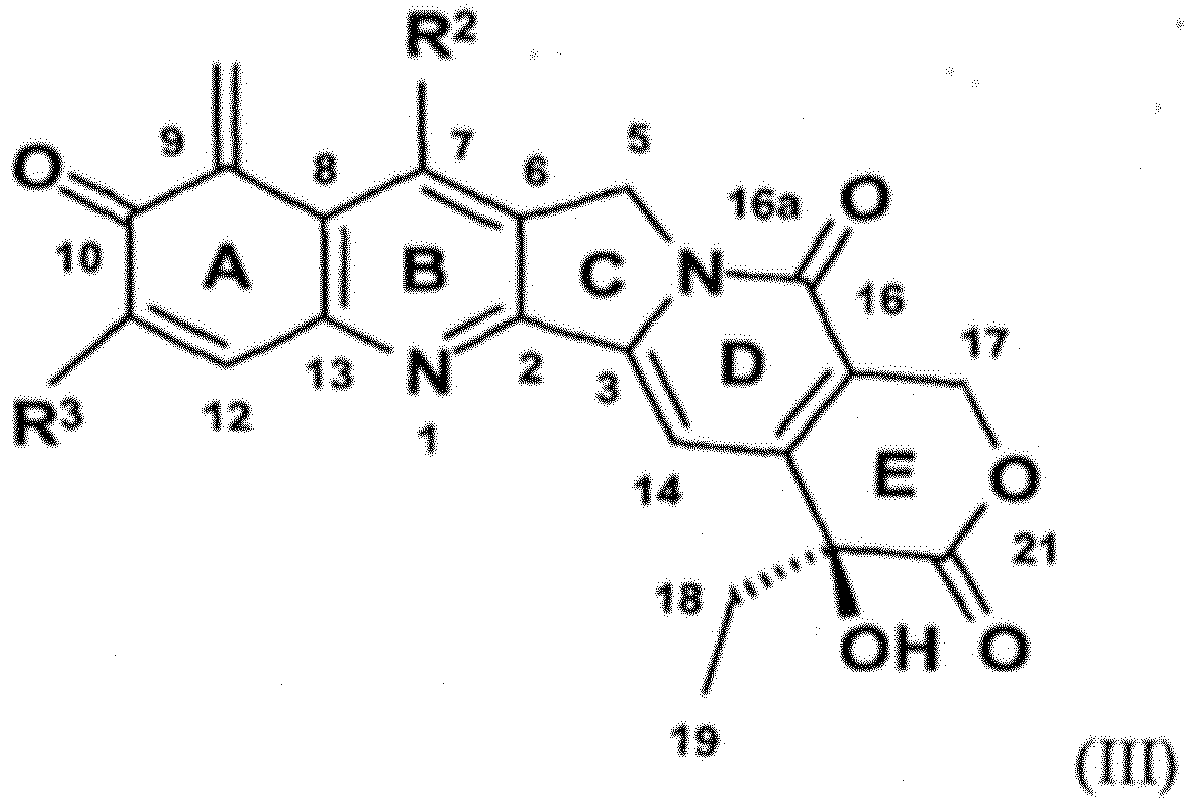
- The subject of the present invention is also the use of the intermediate compound defined by the formula (II) in the production of anti-neoplasm drugs.
- Preferably, this compound is useful in the production of a drug for the treatment of breast cancer.
- Preferably, this compound is useful in the production of a drug for the treatment of leukaemia.
- Preferably, this compound is useful in the production of a drug for the treatment of colon cancer.
- The subject of the present invention is also the use of the intermediate compound defined by the formula (III) in the production of anti-neoplasm drugs.
- Preferably, this compound is useful in the production of a drug for the treatment of breast cancer.
- Preferably, this compound is useful in the production of a drug for the treatment of leukaemia.
- Preferably, this compound is useful in the production of a drug for the treatment of colon cancer.
- According to the present invention, ring A of TPT may undergo a photochemicallyinduced transformation into the intermediate compound o-methylenequinone, which may react in situ with the nucleophilic centres of guanine in duplex DNA (Schematic 1).
- Moreover, compounds according to the present invention exhibit the property of spontaneous, covalent binding of DNA oligomers.

- The progress of the reaction depends on the binding of TPT to the last GC base pair, as was shown in the case of the natural oligomer d(GCGATCGC)2, inside the decomposition site in the DNA decamer.
The present invention is based on camptothecin derivatives and their synthesis, which makes it possible to obtain soluble derivatives with particularly preferable characteristics. Compounds according to the present invention make it possible to conduct an alkylation reaction of the nucleophilic nitrogen atom in bases being a part of tumour DNA in an effective and easy way. It was shown that compounds according to the present invention exhibit spontaneous or UV-induced binding with a DNA oligomer. - The subject of the present invention in its example embodiments is shown in the figures in which:
-
Fig.1 represents PFGSE NMR analysis results for derivatives of DNA/TPT prior to UV exposure. The denoted lines indicate diffusion coefficients, Di, for DNA (with a noncovalently bound derivative of TPT), ca. 1.7 x 10⁻¹⁰ m2/s, and unbound derivative of TPT in a rapid exchange with DNA, 2.3 x 10⁻¹⁰ m2/s; -
Fig. 2 represents a PFGSE NMR experiment using derivatives of DNA/TPT following UV exposure. The denoted lines indicate diffusion coefficients, Di, ca. 1.4 x 10⁻¹⁰ m2/s for the DNA-TPT bioconjugate; -
Fig. 3 represents a MALDI MS diagram for alkylation products of d(GCGATCGC)2 using the salt [Me3N+CF3SO3] TPT following UV exposure; the double-stranded (ds) region of the alkylated conjugate is shown alkylated. Solid arrows indicate unalkylated dsDNA, whereas dashed arrows indicate the monoalkyl conjugate of TPT; -
Fig. 4 represents biological analysis results using 7-ethyl-9-dimethylaminomethyl-10-hydroxycamptothecin with three evaluated cell lines: L-1210 - murine leukaemia, MCF -7 human breast cancer cells and Caco-2 (human colon cancer cells); -
Fig. 5 represents biological analysis results using 7-ethyl-9-(N-morpholinyl)methyl-10-hydroxycamptothecin with three evaluated cell lines: L-1210 - murine leukaemia, MCF-7 - human breast cancer cells and Caco-2 (human colon cancer cells); -
Fig. 6 represents the ESI MS spectrum of the compound defined in Claim 1 with a visible o-methylenequinone signal, m/z 405.1371. - Due to the present invention, it was possible to obtain a covalent, spontaneous or UV-induced, DNA alkylation reaction by derivatives of camptothecin, as was shown in the following example embodiments using DNA oligomers.
- The results obtained are very significant in terms of the use of the compounds according to the present invention in medicine, in particular in anti-cancer therapy.
- In the embodiments of the present invention we give example compounds and prove the formation of conjugates using PFGSE NMR, which facilitates the easy differentiation of molecular complexes from covalent hybrid conjugates through a measurement of their diffusion coefficients. Moreover, the present invention was tested in biological systems using cancer lines, yielding a preferable IC50 parameter value at a 20 µM concentration.
- In light of the above, the present invention may constitute a breakthrough in chemotherapy due to the uncommonly preferable properties of the claimed compounds, thus delivering an effective tool for combating neoplastic diseases.
- The present invention is disclosed using the following example embodiments, without limiting in any way the scope nor methods in which it may be embodied.
- SN38 (7-ethyl-10-hydroxycamptothecin) (3,3 mg; 8 x 10⁻³ mmol) was suspended in 2,4 ml CH3CN, and then supplemented with acetic acid (103 µL), 37% aqueous CH20 (8µL; 0.0986 mmol), 8,5 µl morpholine (0.098 mmol). The resulting mixture was mixed at a temperature of 80°C. After 10 h the solvent was evaporated off under a vacuum (at 40°C) and rinsed with diethyl ether (3 x 1mL). The resulting residue was lyophilized using 2
ml H 20 and dissolved in deuterated DMSO. On the basis of 1H NMR spectra, we detected the presence of two substances: SN38 and 7-ethyl-9-(N-morpholinyl)methyl-10-hydroxycamptothecin (efficiency: 33%). LR-MS (ESI): m/z 393 [M+H]+, 492 [M+H]+. The deuteriated DMSO was evaporated off under a vacuum. The residue was extracted using 0.5% HCI (3x 1 ml) in order to extract water-soluble derivatives of morpholinylcamptothecin. The insoluble 7-ethyl-10-hydroxycamptothecin was removed through filtration. Next, this was purified using HPLC on an RP-C18 LPH column (150 mm x 10 mm) using the following liquid phase system: 20% CH3CN / 80% aqueous 0.1 % HCOOH at a flow rate of 3ml/min. The course of the chromatography was monitored using UV detection at a wavelength of 260 nm. Fractions were collected (retention time: 8,5 min) and were lyophilized yielding a pure product (> 98%). - Spectral data: 7-ethyl-9-(N-morpholinyl)methyl-10-hydroxycamptothecin
- LR-MS (ESI): m/z 492 [M+H]+
- 1H NMR δ (
D 20, TSPA) 500 MHz: 1.01 (t, 1=7.3 Hz, 3H), 1.45 (t, J=7.3Hz, 3H), 2.00 (m, 2H), 3.13 (m, 1H), 3.22 (m, 1H), 3.32 (m, 4H), 3.97 (m, 4H), 4.87 (d, J=15.0Hz, 1H), 4.88 (d, J=15.0Hz, 1H), 4.93 (d, J=18.7 Hz, 1H), 4.96 (d, J=18.7 Hz, IH), 5.41 (J=16.14 Hz, 1H), 5.55 (1=16.14 Hz, 1H), 7,25 (d, J=9.17 Hz, 1H), 7.26 (s, 1), 7.59 (d, 1=9.17 Hz, 1H). - 13C NMR δ (
D 20, TSPA); HSQC 6.1, 13.4, 24.6, 30.5, 42.9, 49.8, 55.0. 63.4, 65.8, 97.8, 121.5, 130.7; HMBC 73.2, 117.5, 146.0. 146.9, 150.5, 174.30 - UV nm: 378, 366, 329, 268, 224, 202.
- IR (KBr) cm-1:1038, 1056, 1108, 1162, 1261, 1303, 1383, 1423, 1463, 1513, 1593, 1656, 1744, 2853, 2922,2958,3401
- Production of 7-ethyl-9-(N-morpholinyl)methyl-10-hydroxycamptothecin SN38 (2.9 mg, 7 x 10⁻³mmol) was suspended in 2,1 ml CH3CN, and then supplemented with acetic acid (190 µL), 37 % aqueous CH20 (6,8 µL, 0.084mmol), and morpholine (7.3 µL, 0.084 mmol). The resulting mixture was mixed at a temperature of 80°C. After 8 h was evaporated off under a vacuum soluble (in 40°C) and rinsed with diethyl ether (3x 1ml); The resulting residue was lyophilized using 2
ml H 20 and dissolved in deuterated DMSO. On the basis of 1H NMR spectra, we noted the presence of. two substances: SN38 and 7-ethyl-9-(N-morpholinyl)methyl-10-hydroxycamptothecin (efficiency: 25%). LR-MS (ESI): m/z 393 [M+H]+, 492 [M+H]+. The deuterated DMSO was evaporated off under a vacuum. The residue was extracted using 0.5% HCl (3 x 1ml) in order to extract water-soluble derivatives of camptothecin. The insoluble camptothecin was removed through filtration. The purification of the residue was performed using HPLC in the following manner: the residue was dissolved in the liquid phase (20% CH3CN, 80% 0.1% aqueous HCOOH) and loaded onto an RP-C18 LPH column 150 mm x 10 mm, and then eluted at a rate of 3ml/min. The course of the chromatography was monitored using UV detection at 260 nm. Fractions were collected (retention time: 8,5 min) and were lyophilized yielding a pure product (> 95%). - Spectral data: 7-ethyl-9-(N-morpholinyl)methyl-10-hydroxycamptothecin as in example I
- Production of 7-ethyl-9-(N-morpholinyl)methyl-10-hydroxycamptothecin SN38 (2,27mg, 5,54 x 10⁻³ mmol) was suspended in 1,65 ml CH3CN, and then supplemented with acetic acid (142 µl), 37 % aqueous CH20 (10.8µl; 0.133 mmol), morpholine (11,6 µl 0.133 mmol). The resulting mixture was mixed at a temperature of 80°C. After 6 h was evaporated off under a vacuum soluble (in 40°C) and rinsed with diethyl ether (3 x 1mI). The resulting residue was lyophilized using 2
ml H 20 and dissolved in deuterated DMSO. On the basis of 1H NMR spectra, we noted the presence of two substances: SN38 and 7-ethyl-9-N-morpholinylmethyl- 10-hydroxycamptothecin (efficiency: 37%). LR-MS (ESI): m/z 393 [M+H]+, 492 [M+H]+. The deuterated DMSO was evaporated off under a vacuum. Residue was extracted using 0.5% HCI (3xlml) in order to extract water-soluble derivatives of camptothecin. The insoluble camptothecin was removed through filtration. The purification of the residue was performed using HPLC in the following manner: the residue was dissolved in the liquid phase (20% CH3CN, 80% 0.1% aqueous HCOOH) and loaded onto a RP-Cl8 LPH column 150 mm x 10mm, and then eluted at a rate of 3ml/min. The course of the chromatography was monitored using UV detection at 260 nm. Fractions were collected (retention time: 8,5 min) and were lyophilized yielding a pure product (>96 %). - Spectral data: 7 -ethyl-9-(N -morpholinyl)methyl-10-hydroxycamptothecin as in example I.
- Methyl trifluoromethanesulphonate (0.1 ml; 0.9 mmol) was dissolved in CH2Cl2 (3 ml), and then supplemented with a small quantity of K2CO3. The mixture was mixed for 30 min. in order to neutralize trifluoromethanesulphonic acid (CF3SO3H). The solution was filtered free of K2CO3, added to dry free TPT (1,8 mg; 4,4x10⁻³ mmol) and was mixed for 24 h at room temperature. The mixture was evaporated off until dry under a vacuum at room temperature and dissolved in deuterated DMSO-d6. On the basis of 1H NMR spectra, we detected the presence of five products: N-methylated TPT-([Me3N+ CF3S03], TPT salt); N,O dimethylated TPT, protonated TPT-[TPTH+ CF3S03], and 23-CH2OH alcohol. N-methylated TPT ([Me3N+ CF3S03-] salt TPT) constituted up to 50% of the mixture. We perfomed an LR ESI MS of the reaction mixture; LR-MS (EST): m/z: 149 (CF3SO3]- 422 [M+H]+, 436 [M]+, 450 [M]+.
- The evaporated to dryness the reaction mixture was rinsed with water (5 x 1 ml). The precipitate was filtered off and the aqueous layer was lyophilized. Next, this was purified using HPLC on an RP-C18 LPH column (150 mm x 10 mm) using the following liquid phases: 10% CH3CN / 90% aqueous 0.1 % HCOOH for the first 15 min, whereafter the system was changed for 20 % CH3CNI 80% aqueous 0.1 % HCOOH with a steady flow rate of 3ml/min. The course of the chromatography was monitored using UV detection at a wavelength of 260 nm. Fractions were collected (retention time: 25 min) and were lyophilized yielding 2 products.
- LR-MS (ESI): m/z 422 [M+H]+ - [TPTH+ CF3SO3-] - non-reactive in UV; 436 [M]+ - [Me3N+ CF3SO3 -] - reactive UV.
- Chromatography in a reversed phase system, C-18, was performed using an analytical column (Bionacom Velocity C 18 LPH, 4,6 x 250 mm, 5 microns) and a semi-preparative column (Bionacom Velocity C 18 LPH, 10 mm x 150 mm, 5 microns) in a Shimadzu LC-8A HPLC apparatus equipped with a Shimadzu SPD-6A UV spectrophotometric detector.
- Solvent: 0.1 % HCOOH, ACN 1: 1; ion source: ESI ; injected volume 1 µL; m/z range: 150 - 1500; ion retention time in the ion trap: 10 ms; detector voltage: 1,7 kV; interface voltage: 4,5 and -4,5 kV; CDL temperature: 200 C; Heat Block temperature: 200 C; carrier gas: 1,5 L/min; flow rate: 0.1 ml/min; wavelength: Ch1: 254 nm, Ch2: 220 nm; Apparatus: Shimadzu LCMS-IT-TOF.
- We performed a PFGSE analysis using a DNA/TPT derivative prior to UV exposure (
fig. 1 ) and after UV exposure (fig.2 ). Next, we separated the unbound TPT derivative and analyzed it chromatographically using HPLC. - Based on the resulting spectrum, we detected a clear difference between the molecular complex and bioconjugate. The experimental results constitute evidence of the existence of a covalent bond between the chemically modified CPT unit and a DNA oligomer.
- A dry sample prepared according to the above procedure, containing up to 50% TPT salt [Me3N+ CF3S03], was added in excess (2 eq.) to an aqueous solution containing 1 mmol of the oligonucleotide d(GCGATCGC)2 without buffer, in quartz NMR tubes. The solution was exposed using a UV lamp with a wavelength of 365 nm, for 20 hrs. The formed precipitate was filtered off, and the solution was evaporated off until dry under reduced pressure. In order to perform MALDI, the solid was dissolved in deionised water. The mass spectrum for negative MALDI ions was recorded using a Voyager-Elite apparatus (PerSeptive Biosystems Inc., Framingham, MA, USA), equipped with a nitrogen laser (337 nm) in linear mode with an accelerating voltage of 20 kV and delayed ion extraction.
- A mixture of 50 mg/ml of a 3-hydroxypicolinic acid solution in 50% acetonitrile and 50 mg/ml of a diammonium hydro citrate solution in deionised in water (8:1, vol/vol) was used as a template. One µL of the oligonucleotide solution in deionised water at a concentration of 0.01 OD/µL was mixed on a MALDI plate with one µL of template and left to air dry.
- The mass spectrum was obtained from at least 100 laser impulses and transformed using Data Explorer Ver. 4 software (Applied Biosystems, Foster City, CA). MALDI-TOF analysis made it possible to obtain an m/z mass with an accuracy higher than 0.1 % (i.e. ± 1 mass unit for [M-1]- of 1000).
- MALDI MS analysis results for products of the d(GCGATCGC)2 alkylation using a TPT salt [Me3N+CF3SO3 -] following UV exposure show the existence of a double-stranded region in the alkylated conjugate of DNA, as shown in
Fig. 3 . - The culture of L1210 murine leukaemia cells was conducted in RPMI-1640 medium, supplemented with 10% thermally inactivated foetal bovine serum, penicillin (100 UI/ml), streptomycin (100 µg/ml), amphotericin (250 ng/ml), L-glutamine (2mM) and 1 % nonessential aminoacids. The cells were cultured at 37°C, in an atmosphere of 5% CO2 and 95 % air. The medium was exchanged every 48 hours. For all experiments, the cells were inoculated at density of 1 x 10⁵ cells/ml.
- This test is based on a measurement of the amount of formazan formed by the ability of mitochondrial dehydrogenase (part of the respiratory chain) to reduce the water-soluble 3-(4,5-dimethylthiazolo-2-ylo]-2,5∼diphenyltetrazole (MTT) bromide. Damaged or dead cells exhibit a low or no dehydrogenase activity. This test may be used to determine cell viability. The solution of 7-ethyl-9-(dimethylamino)methyl-10-hydroxycamptothecin or 7-ethyl-9-(N-morpholinyl)methyl-10-hydroxycamptothecin was prepared in DMSO. In order to determine the cytotoxicity of the evaluated compounds, L1210 cells were incubated for 24 hours with a solution of 7-ethyl-9-(dimethylamino)methyl-10-hydroxycamptothecin or 7-ethyl-9-(N-morpholinyl)methyl-10-hydroxycamptothecin at concentrations of 1 µM, 5 µM, 10 µM, 20 µM, 30 µM, 40 µM and 50 µM. After centrifugation and rinsing with PBS buffer, the cells were incubated for 3 hours in MTT solution, and the crystals formed were dissolved using isopropanol. Formazan absorbance was measured on a "Power Wavex microplate" spectrophotometer (Biotek Instruments) at a wavelength of 570 nm.
- To evaluate the statistical significance of changes in the level of cytotoxicity we used analysis of variance (ANOVA) with Dunnett's post-hoc test at a significance level of p <0.05. Calculations were performed using the Statistica Ver. 9.0 package (StatSoft, Inc. USA).
- The culture of the MCF-7 human breast cancer cell line was conducted in Eagle's Minimum Essential Medium (MEM), supplemented with 10 % thermally inactivated foetal bovine serum, penicillin (100 Ul/ml), streptomycin (100 µg/ml), amphotericin (250 ng/ml), L-glutamine (2mM) and 1 % non-essential aminoacids. The cells were cultured at 37°C, in an atmosphere of 5% CO2 and 95 % air. The medium was exchanged every 48 hours, and after 80% confluence was attained, the cells were passaged with a 0.25 % trypsin solution. In all experiments, cells were inoculated at a density of 5 x 10⁴ cells/ml.
- This test is based on a measurement of the amount of formazan fonned by the ability of mitochondrial dehydrogenase (part of the respiratory chain) to reduce the water-soluble 3-(4,5-dimethylthiazolo-2-ylo]-2,5-diphenyltetrazole (MTT) bromide. Damaged or dead cells exhibit a low or no dehydrogenase activity. This test may be used to determine cell viability. The solution of 7-ethyl-9-(dimethylamino)methyl-10-hydroxycamptothecin or 7-ethyl-9-(N-morpholinyl)methyl-10-hydroxycamptothecin was prepared in DMSO. In order to determine the cytotoxicity of the evaluated compounds, cells MCF-7 were incubated for 24 hours with a solution of 7-ethyl-9-(dimethylamino)methyl-10-hydroxycamptothecin or 7-ethyl-9-(N-morpholinyl)methyl-10-hydroxycamptothecin at concentrations of 1 µM, 5 µM, 10 µM, 20 µM, 30 µM, 40 µM and 50 µM. After rinsing with PBS buffer, cells were incubated for 3 hours in MTT solution, and the crystals formed were dissolved using isopropanol. Formazan absorbance was measured w "Power Wavex microplate" spectrophotometer (Biotek Instruments) at a wavelength of 570 nm..
- To evaluate the statistical significance of changes in the level of cytotoxicity we used analysis of variance (ANOVA) with Dunnett's post-hoc test at a significance level of p <0.05. Calculations were performed using the Statistica Ver. 9.0 package (StatSoft, Inc. USA).
- The culture of Caco-2 human colon cancer cells was conducted in Eagle's Minimum Essential Medium Eagle (MEM), supplemented with 20 % thermally inactivated foetal bovine serum, penicillin (100 UI/ml), streptomycin (100 µg/ml), amphotericin (250 ng/ml), L-glutamine (2mM) and. 1 % non-essential amine. The cells were cultured at 37°C, in an atmosphere of 5% CO2 and 95 % air. The medium was exchanged every 48 hours, and after 80% confluence was attained, the cells were passaged with a 0.25 % trypsin solution. In all experiments, cells were inoculated at a density of 6,5 x 10⁴ cells/ml.
- This test is based on a measurement of the amount of formazan formed by the ability of mitochondrial dehydrogenase (part of the respiratory chain) to reduce the water-soluble 3-(4,5-dimethylthiazolo-2-ylo]-2,5-diphenyltetrazole (MTT) bromide. Damaged or dead cells exhibit a low or no dehydrogenase activity. This test may be used to determine cell viability. The solution 7-ethyl-9-(dimethylamino)methyl-10-hydroxycamptothecin or 7-ethyl-9-(N-morpholinyl)methyl-10-hydroxycamptothecin was prepared in DMSO. In order to detennine the cytotoxicity of the evaluated compounds, cells Caco-2 were incubated for 24 hours with a solution of 7-ethyl-9-(dimethylamino)methyl-10-hydroxycamptothecin or 7-ethyl-9-(N-morpholinyl)methyl-10-hydroxycamptothecin at concentrations of 1 µM, 5 µM, 10 µM, 20 µM, 30 µM, 40 µM and 50 µM. After rinsing with PBS buffer, cells were incubated for 3 hours in MTT solution and the crystals formed were dissolved using isopropanol. Formazan absorbance was measured in "Power Wavex" microplate spectrophotometer (Biotek Instruments) at a wavelength of 570 nm.
- To evaluate the statistical significance of changes in the level of cytotoxicity we used analysis of variance (ANOVA) with Dunnett's post-hoc test at a significance level of p <0.05. Calculations were performed using the Statistica Ver. 9.0 package (StatSoft, Inc. USA).
- The biological analysis results using 7-ethyl-9-(dimethylamino)methyl-10-hydroxycamptothecin in the three evaluated cell lines: L-1210 - murine leukaemia cells, MCF-7 - human breast cancer cells and Caco-2 human colon cancer cells are shown in Fg. 4. The biological analysis results using 7-ethyl-9-(N-morphofinyl)methyl-10-hydroxycamptothecin in the three evaluated cell lines: L-1210 - murine leukaemia cells, MCP-7 - human breast cancer cells and Caco-2 human colon cancer cells are shown in
Fig. 5 . - DNA oligomers were purchased from Integrated DNA Technologies, Inc. and purified as described.12 The oligonucleotide d(GCGATCGC)2 from Integrated DNA Technologies, Inc. was purified using ion exchange chromatography, using a HiTrap™-Q column (Pharmacia Biotech) using gradient elution with ammonium bicarbonate (0.1 M - 0.8 M) and desalted on a column packed with Sephadex G-10. Purity> 95+
- Topotecan hydrochloride was purchased from Alexis Biochemicals and used directly without additional purification. Purity> 98+
- In order to obtain the free TPT base, topotecan hydrochloride (2 mg, 4.4 x 10⁻³ mmol) was dissolved in H2O (0.5 mL) and pH was set to 7 using aqueous NaHCO3. Free TPT was extracted using CH2Cl2 and dried under a vacuum.
- 1H NMR spectra were obtained using a VARIAN VNMRS 500 MHz spectrometer using a Nalorac ID probe equipped with a gradient unit generating a gradient of 60 Gs/cm along the Z axis, at a temperature of 25,0° C. Chemical shifts were made in reference to TSPA as an internal standard dissolved in D2O.
- The parameters of the 1H NMR analysis were: 25,3°C; sw = 8000 Hz (spectrum range); nt = 16, or 64, or 256; (number of scans), 32 K memory points; at = 2 s (acquisition time), d1 = 6 s (relaxation delay), satdly = 2 s (presaturation delay), 1b = 0.3 Hz (line broadening).
- Analysis parameters 13C NMR; 25,0°C;
The 1H/ 13C-HSQC. 1H-13C HSQC spectra (heteronuclear single quantum correlation) were obtained using a spectrum range of 5000 Hz, 2048 points in the 1H domain and 8000 Hz, 800 x 2 increments in the 13C domain; 128 scans per increment t1, with a relaxation delay of 1 s and 1J(C,H) = 135 Hz. The data were linearly extrapolated to 1600 points and filled with zeros to 4096 points in F1 prior to a Fourier transformation. - 1H/ 13 C-HMBC spectra (heteronuclear multiple bonds correlation) HMBC spectra with a gradient coherence of 1H - 13C were obtained, using an acquisition time of 0.2 s, 1H - 90° impulse width of 7.8 µs, 13C - 90° impulse width of 11.5 µs, spectrum range of 5000 Hz, 2048 given points in the 1H dimension and 25000 Hz, 1024 increments in the 13C dimension, and a relaxation delay of 1.2 s. Data were obtained in the form of absolute values, using 64 scans per t1 increment. The experiment was optimized for nJ(C,H) = 8 Hz, and for 1J(C,H) = 140 Hz with a low-pass filter. The data were linearly extrapolated to 2048 points and filled with zeros to 4096 points in F1 prior to a Fourier transformation.
- DOSY NMR is a method with a high potential for analysing mixtures of chemical compounds in solution, used to measure the translation coefficient of diffusion Dt. Larger molecules diffuse much slower than smaller ones. Each spectral line in the 1H - 1D NMR spectrum of a given chemical individual is characterised in terms of the same Dt coefficient, differing for each molecule with a different molecular mass.
- The experiments were performed using the following conditions: 16 spectra were collected using the PFGDSTE sequence18 (Double Stimulated Echo with convection compensation) with an initial saturation of the residual water signal. The gradient coil value was calibrated using the known water diffusion coefficient (Dt=19.02 x 10⁻¹⁰ m2/s)19. The gradient strength was increased as a square function in the range from 2 to 50 G/cm. The diffusion time (Δ) and duration of the magnetic field gradient (δ) were 150 ms and 1.0 ms, respectively. The remaining parameters were: sweep width of 8000 Hz, 32K memory points, 64 scans and a data acquisition time of 2.7 s and a relaxation delay of 2 sand 16 dummy scans. Data are transformed using a Varian package for DOSY17.
-
- 1. Wang, J. C. DNA topoisomerases. Annu. Rev. Biocherm. 1996,65,635-92.
- 2. Stewart, L.; Redinbo, M. R.; Qiu, X.; HoI, W. G.; Champoux, J. J. A model for the mechanism of human topoisomerase I. Science 1998, 279, 1534-41.
- 3. Redinbo, M. R.; Stewart, L.; Kuhn, P.; Champoux, J. J.; Hoi, W. G. J. Crystal structures of human topoisomerase I in covalent and noncovalent complexes with DNA. Science 1998, 279, 1504-1513.
- 4. Pizzolato, J. F.; Saltz, L. B. The camptothecins. Lancet 2003, 361,2235-42.
- 5. Zunino, F.; Pratesi, G. Camptothecins in clinical development. Expert Opin. Investig. Drugs 2004, 13, 269-84.
- 6. Takimoto, C. H.; Wright, J.; Arbuck, S. G. Clinical applications of the camptothecins. Biochim. Biophys. Acta 1998, 1400. 107-19.
- 7. Rivory, L. P.; Robert, J. Pharmacology of camptothecin and its derivatives. Bull. Cancer 1995, 82, 265-285.
- 8. Slichenmyer, W. J.; Rowinsky, E. K; Donehower, R. C.; Kaufmnn, S. H. The current status of camptothecin analogs as antitumor agents. J. Natl. Cancer Inst. 1993, 85, 271-291.
- 9. Staker, B. L.; Hjerrild, K.; Feese, M. D.; Behnke, C. A.; Burgin, A. B.; Stewart, L. The mechanism of topoisomerase I poisoning by a camptothecin analog. Proc. Natl. Acad. Sci. USA 2002, 99,15387-15392.
- 10. Pommier, Y; Kohlhagen, G.; Kohn, K W.; Leteurtre, F.; Wani, M. C.; Wall, M. E. Interaction of an alkylating camptothecin derivative with a DNA base at topoisomerase I-DNA cleavage sites. Proc. Natl. Acad. Sci. USA 1995, 92,8861-8865.
- 11. Dallavalle, S., Merlini, L. Camptothecin and Analogs: Structure and Synthetic Efforts. In Modern Alkaloids, Prof. Ernesto Fattorusso, P. O. T.-S., Ed. 2007; pp 503-520.
- 12. Bocian, W.; Kawcki, R,; Bednarek, E.; Sitkowski, J.; Williamson, M. P.; Hansen, P. E.; Kozerski, L. Binding of Topotecan to a Nicked DNA Oligomer in Solution. Chem. Eur. J. 2008, 14, 788-2794.

- 13. Reedijk, J. Why does Cisplatin reach Guanine-n7 with competing s-donor ligands available in the cell? Chern. Rev. 1999, 99,2499-510.
- 14. Pande, P.; Shearer, J.; Yang, J.; Greenberg, W. A.; Rokita, S. E. Alkylation of Nucleic Acids by a Model Quinone Methide. J. Arn. Chern. Soc. 1999, 121, 6773-6779.
- 15. Veldhuyzen, W. F.; Lam, Y. F.; Rokita, S. E. 2'-Deoxyguanosine reacts with a model quinone methide at multiple sites. Chern. Res. Toxicol. 2001, 14, 1345-51.
- 16. Svoboda, J.; Konig, B. Templated photochemistry: toward catalysts enhancing the efficiency and selectivity of photoreactions in homogeneous solutions. Chern. Rev. 2006, 106, 5413-30.
- 17. Johnson, C. S. Diffusion Ordered NMR Spectroscopy: Principles and Applications. Prog. Nucl. Magn. Reson. 1999, 34, 203- 255.
- 18. Nilsson, M.; Gil, A. M.; Delgadillo, I.; Morris, G. A. Improving pulse sequences for 3D diffusion ordered NMR spectroscopy: 2DJ-IDOSY. Anal Chern. 2004, 76,5418-22.
- 19. Mills, R. Self-Diffusion in Normal and Heavy Water in the Range 1- 45 C. J. Phys. Chem. 1973, 77, 685-688.
Claims (12)
- A compound defined by the general formula (I)
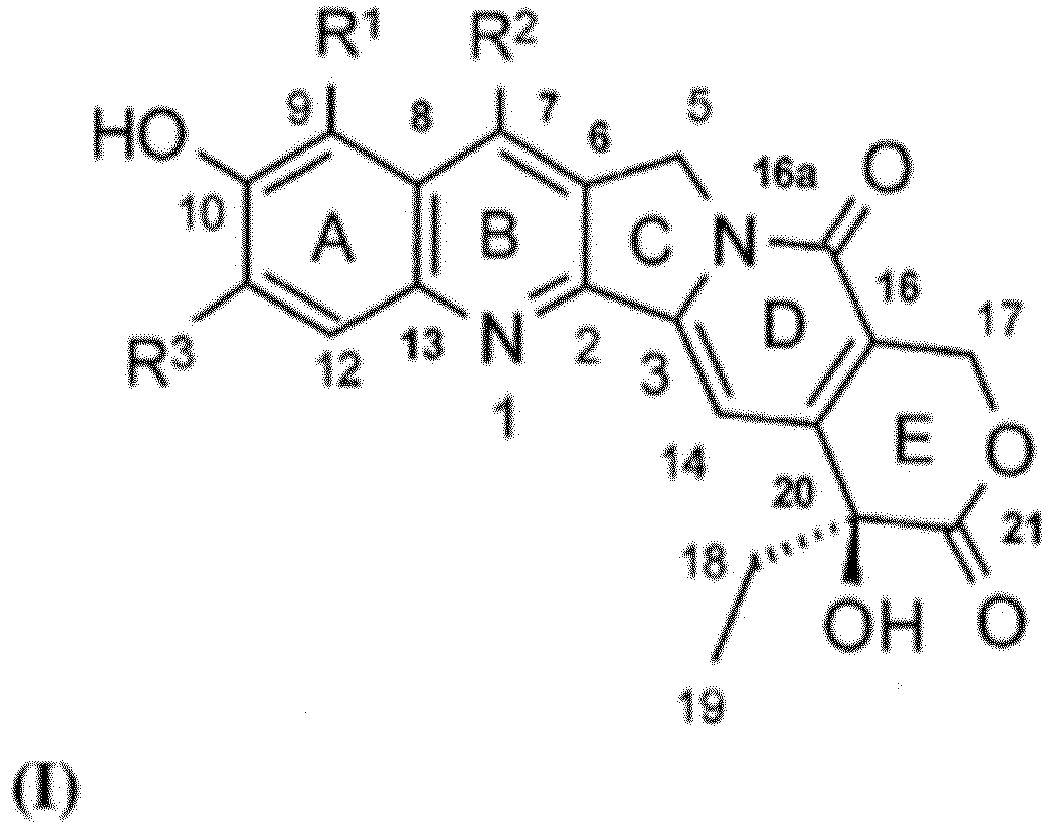
or R1 denotes H; R2 denotes ethyl; R3 denotes (N-piperidinyl)methyl, (N-piperazinyl)methyl, N-(N-methylpiperazinyl)methyl, (N-morpholinyl)methyl, (N-pyrrolidinyl)methyl, (N-azetidinyl)methyl, (N-aziridinyl)methyl, (N-methylamino)methyl, (N ,N-diethylamino)methyl. - A method of obtaining the compound defined in Claim 1, characterised in that the compound SN38, 7-ethyl-10-hydroxycamptothecin, is subjected to a reaction with an appropriate amine and formaldehyde in an environment of acetonitrile and acetic acid at boiling temperature yielding derivatives of 10-hydroxycamptothecin substituted as defined in Claim 1.
- A compound according to Claim 1, characterised in that it is a compound selected from a group encompassing:7-ethyl-9-(N-morphofinyl)methyl-10-hydroxycamptothecin,7-ethyl-11-(N-morpholinyl)methyl-10-hydroxycamptothecin,7-ethyl-9, 11-bis(N-morpholinyl)methyl-10-hydroxycamptothecin,7-ethyl-9-(N -piperidinyl)methyl-10-hydroxycamptothecin,7-ethyl-11-(N-piperidinyl)methyl-10-hydroxycamptothecin,7-ethyl-9, 11-bis(N-piperidinyl)methyl-10-hydroxycamptothecin,7-ethyl-9-(N-piperazinyl)methyl-10-hydroxycamptothecin,7-ethyl-11-(N-piperazinyl)methyl-10-hydroxycamptothecin,7-ethyl-9, 11-bis(N-piperazinyl)methyl-10-hydroxycamptothecin,7-ethyl-9-(N-(N-methylpiperazinyl)methyl-10-hydroxycamptothecin,7-ethyl-11-(N-(N-methylpiperazinyl)methyl-10-hydroxycamptothecin,7-ethyl-9, 11-bis(N-(N-methylpiperazinyl)methyl-10-hydroxycamptothecin,7-ethyl-9-(N-pyrrolidinyl)methyl-10-hydroxycamptothecin,7-ethyl-11-(N-pyrrolidinyl)methyl-10-hydroxycamptothecin,7-ethyl-9, 11-bis(N-pyrrolidinyl)methyl-10-hydroxycamptothecin,7-ethyl-9-(N-azetidinyl)methyl-10-hydroxycamptothecin,7-ethyl-11-(N-azetidinyl)methyl-10-hydroxycamptothecin,7-ethyl-9, 11-bis(N-azetidinyl)methyl-10-hydroxycamptothecin,7-ethyl-9-(N-aziridinyl)methyl-10-hydroxycamptothecin,7-ethyl-11-(N-aziridinyl)methyl-10-hydroxycamptothecin,7-methyl-9,11-bis(N-aziridinyl)methyl-10-hydroxycamptothecin,7-ethyl-9-(N-methylamino)methyl-10-hydroxycamptothecin,7-ethyl-11(N-methylamino)methyl-10-hydroxycamptothecin,7-ethyl-9,11-bis(N-methylamino)methyl-10-hydroxycamptothecin,7-ethyl-9-(N,N-diethylamino)methyl-10-hydroxycamptothecin,7-ethyl-11-(N,N-diethylamino)methyl-10-hydroxycamptothecin,7-methyl-9,11-bis(N,N-diethylamino)methyl-10-hydroxycamptothecin
- An intermediate compound (-QM) o-methylenequinone defined by the formula (II) wherein the R1 and R2 are defined as in Claim 1:

- An intermediate compound (-QM) o-methylenequinone defined by the formula (III) wherein the R2 and R3 are defined as Claim 1:

- Compound according to any of previous claim for use in anti-cancer therapy.
- Compound according to Claim 4 for use in the treatment of breast cancer.
- Compound according to Claim 4 for use in the treatment of leukaemia.
- Compound according to Claim 4 for use in the treatment of colon cancer.
- Compound according to Claim 5 for use in the treatment of breast cancer.
- Compound according to Claim 5 for use in the treatment of leukaemia.
- Compound according to Claim 5 for use in the treatment of colon cancer.
Priority Applications (1)
| Application Number | Priority Date | Filing Date | Title |
|---|---|---|---|
| PL13824167T PL2912039T3 (en) | 2012-10-25 | 2013-10-25 | Derivatives of camptothecin, a method of producing them and their use |
Applications Claiming Priority (2)
| Application Number | Priority Date | Filing Date | Title |
|---|---|---|---|
| PL401345A PL235836B1 (en) | 2012-10-25 | 2012-10-25 | Camptothecin derivatives, their preparation and use |
| PCT/IB2013/059668 WO2014064654A1 (en) | 2012-10-25 | 2013-10-25 | Derivatives of camptothecin, a method of producing them and their use |
Publications (2)
| Publication Number | Publication Date |
|---|---|
| EP2912039A1 EP2912039A1 (en) | 2015-09-02 |
| EP2912039B1 true EP2912039B1 (en) | 2017-07-12 |
Family
ID=50001041
Family Applications (1)
| Application Number | Title | Priority Date | Filing Date |
|---|---|---|---|
| EP13824167.4A Active EP2912039B1 (en) | 2012-10-25 | 2013-10-25 | Derivatives of camptothecin, a method of producing them and their use |
Country Status (4)
| Country | Link |
|---|---|
| US (1) | US9682992B2 (en) |
| EP (1) | EP2912039B1 (en) |
| PL (2) | PL235836B1 (en) |
| WO (1) | WO2014064654A1 (en) |
Families Citing this family (4)
| Publication number | Priority date | Publication date | Assignee | Title |
|---|---|---|---|---|
| CN109206432A (en) * | 2017-06-30 | 2019-01-15 | 江苏汉邦科技有限公司 | A kind of preparation method of camptothecine monomer |
| LU102067B1 (en) | 2020-09-17 | 2022-03-18 | Narodowy Inst Lekow | 7-Ethyl-10-hydroxycamptothecin derivatives for use in the treatment of cancer |
| WO2025255212A1 (en) * | 2024-06-07 | 2025-12-11 | Codeable Therapeutics, Incorporated | Topoisomerase inhibitors, antibody-drug conjugates comprising them, and methods of their use |
| CN119912467B (en) * | 2025-01-22 | 2025-10-24 | 上海科技大学 | A deuterated camptothecin derivative and its preparation method and use |
Family Cites Families (6)
| Publication number | Priority date | Publication date | Assignee | Title |
|---|---|---|---|---|
| US5004758A (en) * | 1987-12-01 | 1991-04-02 | Smithkline Beecham Corporation | Water soluble camptothecin analogs useful for inhibiting the growth of animal tumor cells |
| JP2684104B2 (en) | 1990-02-09 | 1997-12-03 | 株式会社ヤクルト本社 | Novel camptothecin derivative |
| ITMI20061474A1 (en) | 2006-07-26 | 2008-01-27 | Indena Spa | DERIVATIVES OF CAMPTOTECIN WITH ANTITUMORAL ACTIVITY |
| CN101133813B (en) | 2007-09-17 | 2010-06-09 | 国投中鲁果汁股份有限公司 | Concentrated cucumber clear juice and method for producing the same |
| ES2371171B1 (en) | 2010-06-08 | 2012-11-16 | Consejo Superior De Investigaciones Científicas (Csic) | CAMPTOTECHINE DERIVATIVES AS ANTITUMOR AGENTS. |
| CN103113381B (en) * | 2013-02-26 | 2014-12-10 | 大连理工大学 | A series of water-soluble hydroxycamptothecin cycloalkanol derivatives and their preparation methods and uses |
-
2012
- 2012-10-25 PL PL401345A patent/PL235836B1/en unknown
-
2013
- 2013-10-25 WO PCT/IB2013/059668 patent/WO2014064654A1/en not_active Ceased
- 2013-10-25 EP EP13824167.4A patent/EP2912039B1/en active Active
- 2013-10-25 US US14/432,553 patent/US9682992B2/en not_active Expired - Fee Related
- 2013-10-25 PL PL13824167T patent/PL2912039T3/en unknown
Non-Patent Citations (1)
| Title |
|---|
| None * |
Also Published As
| Publication number | Publication date |
|---|---|
| EP2912039A1 (en) | 2015-09-02 |
| PL2912039T3 (en) | 2018-01-31 |
| PL401345A1 (en) | 2014-04-28 |
| US20150266888A1 (en) | 2015-09-24 |
| PL235836B1 (en) | 2020-11-02 |
| US9682992B2 (en) | 2017-06-20 |
| WO2014064654A1 (en) | 2014-05-01 |
Similar Documents
| Publication | Publication Date | Title |
|---|---|---|
| EP3750887B1 (en) | Biaryl derivatives and their pharmaceutical application for the treatment of pd-1/pd-l1 signal pathway-mediated diseases | |
| US9682992B2 (en) | Derivatives of camptothecin, a method of producing them and their use | |
| EP2781520B1 (en) | Three-ring pi3k and/or mtor inhibitor | |
| CN103570738A (en) | Novel artemisinin derivatives and preparation method and use thereof | |
| JP2024532768A (en) | Camptothecin derivatives, pharmaceutical compositions thereof and their applications | |
| EP4063363A1 (en) | Pyrazolo-heteroaryl derivative, preparation method therefor, and medical use thereof | |
| ITMI960338A1 (en) | CAMPTOTECIN DERIVATIVES AND THEIR USE AS ANTI-CANCER AGENTS | |
| Kang et al. | Discovery of a novel water-soluble, rapid-release triptolide prodrug with improved drug-like properties and high efficacy in human acute myeloid leukemia | |
| Tan et al. | Synthesis of novel 10-hydroxycamptothecin derivatives utilizing topotecan hydrochloride as ortho-quinonemethide precursor | |
| Mazzini et al. | The interaction of nemorubicin metabolite PNU-159682 with DNA fragments d (CGTACG) 2, d (CGATCG) 2 and d (CGCGCG) 2 shows a strong but reversible binding to G: C base pairs | |
| Naumczuk et al. | New generation of camptothecin derivatives spontaneously alkylating DNA | |
| Kozerski et al. | Solution and solid state 13C NMR and X-ray studies of genistein complexes with amines. Potential biological function of the C-7, C-5, and C-4′-OH groups | |
| Dallavalle et al. | Novel cytotoxic 7-iminomethyl and 7-aminomethyl derivatives of camptothecin | |
| Ye et al. | Antitumor agents 294. Novel E-ring-modified camptothecin–4β-anilino-4′-O-demethyl-epipodophyllotoxin conjugates as DNA topoisomerase I inhibitors and cytotoxic agents | |
| RamaKrishna et al. | Adducts of 6-methylbenzo [a] pyrene and 6-fluorobenzo [a] pyrene formed by electrochemical oxidation in the presence of deoxyribonucleosides | |
| CN101495485B (en) | Camptothecin derivatives having antitumor activity | |
| Ferri et al. | Synthesis, structural, and biological evaluation of bis-heteroarylmaleimides and bis-heterofused imides | |
| CN118530261A (en) | Condensed bicyclic derivatives, preparation methods thereof and their application in medicine | |
| Naumczuk et al. | A NMR study of binding the metabolite of SN38 derivatives to a model nicked DNA decamer mimicking target of Topo I inhibitors | |
| Mazzini et al. | Mode of binding of camptothecins to double helix oligonucleotides | |
| Li et al. | Identification of the metabolites of 9-nitro-20 (S)-camptothecin in rats | |
| Wadkins et al. | Topoisomerase I-DNA Complex Stability Induced by Camptothecins and Its Role in Drug Activity# | |
| Naumczuk et al. | Spontaneous 2′-deoxyguanosine alkylation by a new generation of topoisomerase I inhibitors of the camptothecin family | |
| Naumczuk et al. | Regioselective alkylation reaction of the 2′-deoxyctidine with 9-aminomethyl derivatives of SN38 | |
| Naumczuk et al. | Solvent-dependent regioselectivity of 2′-deoxyadenosine alkylation by 9-aminomethyl derivatives of SN38 |
Legal Events
| Date | Code | Title | Description |
|---|---|---|---|
| PUAI | Public reference made under article 153(3) epc to a published international application that has entered the european phase |
Free format text: ORIGINAL CODE: 0009012 |
|
| 17P | Request for examination filed |
Effective date: 20150512 |
|
| AK | Designated contracting states |
Kind code of ref document: A1 Designated state(s): AL AT BE BG CH CY CZ DE DK EE ES FI FR GB GR HR HU IE IS IT LI LT LU LV MC MK MT NL NO PL PT RO RS SE SI SK SM TR |
|
| AX | Request for extension of the european patent |
Extension state: BA ME |
|
| 17Q | First examination report despatched |
Effective date: 20151105 |
|
| DAX | Request for extension of the european patent (deleted) | ||
| GRAP | Despatch of communication of intention to grant a patent |
Free format text: ORIGINAL CODE: EPIDOSNIGR1 |
|
| INTG | Intention to grant announced |
Effective date: 20160928 |
|
| GRAS | Grant fee paid |
Free format text: ORIGINAL CODE: EPIDOSNIGR3 |
|
| GRAJ | Information related to disapproval of communication of intention to grant by the applicant or resumption of examination proceedings by the epo deleted |
Free format text: ORIGINAL CODE: EPIDOSDIGR1 |
|
| GRAL | Information related to payment of fee for publishing/printing deleted |
Free format text: ORIGINAL CODE: EPIDOSDIGR3 |
|
| RIN1 | Information on inventor provided before grant (corrected) |
Inventor name: HYZ, KAROLINA Inventor name: BOCIAN, WOJCIECH Inventor name: WIKTORSKA, KATARZYNA Inventor name: BEDNAREK, ELZBIETA Inventor name: LUBELSKA, KATARZYNA Inventor name: KOZERSKI, LECH Inventor name: KAWECKI, ROBERT Inventor name: SITKOWSKI, JERZY Inventor name: NAUMCZUK, BEATA |
|
| INTC | Intention to grant announced (deleted) | ||
| GRAP | Despatch of communication of intention to grant a patent |
Free format text: ORIGINAL CODE: EPIDOSNIGR1 |
|
| INTG | Intention to grant announced |
Effective date: 20170316 |
|
| GRAA | (expected) grant |
Free format text: ORIGINAL CODE: 0009210 |
|
| AK | Designated contracting states |
Kind code of ref document: B1 Designated state(s): AL AT BE BG CH CY CZ DE DK EE ES FI FR GB GR HR HU IE IS IT LI LT LU LV MC MK MT NL NO PL PT RO RS SE SI SK SM TR |
|
| REG | Reference to a national code |
Ref country code: GB Ref legal event code: FG4D |
|
| REG | Reference to a national code |
Ref country code: CH Ref legal event code: EP |
|
| REG | Reference to a national code |
Ref country code: AT Ref legal event code: REF Ref document number: 908201 Country of ref document: AT Kind code of ref document: T Effective date: 20170715 |
|
| REG | Reference to a national code |
Ref country code: IE Ref legal event code: FG4D |
|
| REG | Reference to a national code |
Ref country code: DE Ref legal event code: R096 Ref document number: 602013023540 Country of ref document: DE |
|
| REG | Reference to a national code |
Ref country code: FR Ref legal event code: PLFP Year of fee payment: 5 |
|
| REG | Reference to a national code |
Ref country code: CH Ref legal event code: NV Representative=s name: ISLER AND PEDRAZZINI AG, CH |
|
| REG | Reference to a national code |
Ref country code: NL Ref legal event code: MP Effective date: 20170712 |
|
| REG | Reference to a national code |
Ref country code: LT Ref legal event code: MG4D |
|
| REG | Reference to a national code |
Ref country code: AT Ref legal event code: MK05 Ref document number: 908201 Country of ref document: AT Kind code of ref document: T Effective date: 20170712 |
|
| PG25 | Lapsed in a contracting state [announced via postgrant information from national office to epo] |
Ref country code: AT Free format text: LAPSE BECAUSE OF FAILURE TO SUBMIT A TRANSLATION OF THE DESCRIPTION OR TO PAY THE FEE WITHIN THE PRESCRIBED TIME-LIMIT Effective date: 20170712 Ref country code: FI Free format text: LAPSE BECAUSE OF FAILURE TO SUBMIT A TRANSLATION OF THE DESCRIPTION OR TO PAY THE FEE WITHIN THE PRESCRIBED TIME-LIMIT Effective date: 20170712 Ref country code: NL Free format text: LAPSE BECAUSE OF FAILURE TO SUBMIT A TRANSLATION OF THE DESCRIPTION OR TO PAY THE FEE WITHIN THE PRESCRIBED TIME-LIMIT Effective date: 20170712 Ref country code: SE Free format text: LAPSE BECAUSE OF FAILURE TO SUBMIT A TRANSLATION OF THE DESCRIPTION OR TO PAY THE FEE WITHIN THE PRESCRIBED TIME-LIMIT Effective date: 20170712 Ref country code: NO Free format text: LAPSE BECAUSE OF FAILURE TO SUBMIT A TRANSLATION OF THE DESCRIPTION OR TO PAY THE FEE WITHIN THE PRESCRIBED TIME-LIMIT Effective date: 20171012 Ref country code: LT Free format text: LAPSE BECAUSE OF FAILURE TO SUBMIT A TRANSLATION OF THE DESCRIPTION OR TO PAY THE FEE WITHIN THE PRESCRIBED TIME-LIMIT Effective date: 20170712 Ref country code: HR Free format text: LAPSE BECAUSE OF FAILURE TO SUBMIT A TRANSLATION OF THE DESCRIPTION OR TO PAY THE FEE WITHIN THE PRESCRIBED TIME-LIMIT Effective date: 20170712 |
|
| PG25 | Lapsed in a contracting state [announced via postgrant information from national office to epo] |
Ref country code: ES Free format text: LAPSE BECAUSE OF FAILURE TO SUBMIT A TRANSLATION OF THE DESCRIPTION OR TO PAY THE FEE WITHIN THE PRESCRIBED TIME-LIMIT Effective date: 20170712 Ref country code: GR Free format text: LAPSE BECAUSE OF FAILURE TO SUBMIT A TRANSLATION OF THE DESCRIPTION OR TO PAY THE FEE WITHIN THE PRESCRIBED TIME-LIMIT Effective date: 20171013 Ref country code: LV Free format text: LAPSE BECAUSE OF FAILURE TO SUBMIT A TRANSLATION OF THE DESCRIPTION OR TO PAY THE FEE WITHIN THE PRESCRIBED TIME-LIMIT Effective date: 20170712 Ref country code: RS Free format text: LAPSE BECAUSE OF FAILURE TO SUBMIT A TRANSLATION OF THE DESCRIPTION OR TO PAY THE FEE WITHIN THE PRESCRIBED TIME-LIMIT Effective date: 20170712 Ref country code: BG Free format text: LAPSE BECAUSE OF FAILURE TO SUBMIT A TRANSLATION OF THE DESCRIPTION OR TO PAY THE FEE WITHIN THE PRESCRIBED TIME-LIMIT Effective date: 20171012 Ref country code: IS Free format text: LAPSE BECAUSE OF FAILURE TO SUBMIT A TRANSLATION OF THE DESCRIPTION OR TO PAY THE FEE WITHIN THE PRESCRIBED TIME-LIMIT Effective date: 20171112 |
|
| REG | Reference to a national code |
Ref country code: DE Ref legal event code: R097 Ref document number: 602013023540 Country of ref document: DE |
|
| PG25 | Lapsed in a contracting state [announced via postgrant information from national office to epo] |
Ref country code: RO Free format text: LAPSE BECAUSE OF FAILURE TO SUBMIT A TRANSLATION OF THE DESCRIPTION OR TO PAY THE FEE WITHIN THE PRESCRIBED TIME-LIMIT Effective date: 20170712 Ref country code: DK Free format text: LAPSE BECAUSE OF FAILURE TO SUBMIT A TRANSLATION OF THE DESCRIPTION OR TO PAY THE FEE WITHIN THE PRESCRIBED TIME-LIMIT Effective date: 20170712 Ref country code: CZ Free format text: LAPSE BECAUSE OF FAILURE TO SUBMIT A TRANSLATION OF THE DESCRIPTION OR TO PAY THE FEE WITHIN THE PRESCRIBED TIME-LIMIT Effective date: 20170712 |
|
| PLBE | No opposition filed within time limit |
Free format text: ORIGINAL CODE: 0009261 |
|
| STAA | Information on the status of an ep patent application or granted ep patent |
Free format text: STATUS: NO OPPOSITION FILED WITHIN TIME LIMIT |
|
| PG25 | Lapsed in a contracting state [announced via postgrant information from national office to epo] |
Ref country code: SM Free format text: LAPSE BECAUSE OF FAILURE TO SUBMIT A TRANSLATION OF THE DESCRIPTION OR TO PAY THE FEE WITHIN THE PRESCRIBED TIME-LIMIT Effective date: 20170712 Ref country code: IT Free format text: LAPSE BECAUSE OF FAILURE TO SUBMIT A TRANSLATION OF THE DESCRIPTION OR TO PAY THE FEE WITHIN THE PRESCRIBED TIME-LIMIT Effective date: 20170712 Ref country code: MC Free format text: LAPSE BECAUSE OF FAILURE TO SUBMIT A TRANSLATION OF THE DESCRIPTION OR TO PAY THE FEE WITHIN THE PRESCRIBED TIME-LIMIT Effective date: 20170712 Ref country code: SK Free format text: LAPSE BECAUSE OF FAILURE TO SUBMIT A TRANSLATION OF THE DESCRIPTION OR TO PAY THE FEE WITHIN THE PRESCRIBED TIME-LIMIT Effective date: 20170712 Ref country code: EE Free format text: LAPSE BECAUSE OF FAILURE TO SUBMIT A TRANSLATION OF THE DESCRIPTION OR TO PAY THE FEE WITHIN THE PRESCRIBED TIME-LIMIT Effective date: 20170712 |
|
| 26N | No opposition filed |
Effective date: 20180413 |
|
| REG | Reference to a national code |
Ref country code: IE Ref legal event code: MM4A |
|
| PG25 | Lapsed in a contracting state [announced via postgrant information from national office to epo] |
Ref country code: LU Free format text: LAPSE BECAUSE OF NON-PAYMENT OF DUE FEES Effective date: 20171025 |
|
| REG | Reference to a national code |
Ref country code: FR Ref legal event code: PLFP Year of fee payment: 6 |
|
| REG | Reference to a national code |
Ref country code: BE Ref legal event code: MM Effective date: 20171031 |
|
| PG25 | Lapsed in a contracting state [announced via postgrant information from national office to epo] |
Ref country code: SI Free format text: LAPSE BECAUSE OF FAILURE TO SUBMIT A TRANSLATION OF THE DESCRIPTION OR TO PAY THE FEE WITHIN THE PRESCRIBED TIME-LIMIT Effective date: 20170712 Ref country code: BE Free format text: LAPSE BECAUSE OF NON-PAYMENT OF DUE FEES Effective date: 20171031 |
|
| PG25 | Lapsed in a contracting state [announced via postgrant information from national office to epo] |
Ref country code: MT Free format text: LAPSE BECAUSE OF NON-PAYMENT OF DUE FEES Effective date: 20171025 |
|
| PG25 | Lapsed in a contracting state [announced via postgrant information from national office to epo] |
Ref country code: IE Free format text: LAPSE BECAUSE OF NON-PAYMENT OF DUE FEES Effective date: 20171025 |
|
| PG25 | Lapsed in a contracting state [announced via postgrant information from national office to epo] |
Ref country code: HU Free format text: LAPSE BECAUSE OF FAILURE TO SUBMIT A TRANSLATION OF THE DESCRIPTION OR TO PAY THE FEE WITHIN THE PRESCRIBED TIME-LIMIT; INVALID AB INITIO Effective date: 20131025 |
|
| PG25 | Lapsed in a contracting state [announced via postgrant information from national office to epo] |
Ref country code: CY Free format text: LAPSE BECAUSE OF FAILURE TO SUBMIT A TRANSLATION OF THE DESCRIPTION OR TO PAY THE FEE WITHIN THE PRESCRIBED TIME-LIMIT Effective date: 20170712 |
|
| PG25 | Lapsed in a contracting state [announced via postgrant information from national office to epo] |
Ref country code: MK Free format text: LAPSE BECAUSE OF FAILURE TO SUBMIT A TRANSLATION OF THE DESCRIPTION OR TO PAY THE FEE WITHIN THE PRESCRIBED TIME-LIMIT Effective date: 20170712 |
|
| PG25 | Lapsed in a contracting state [announced via postgrant information from national office to epo] |
Ref country code: TR Free format text: LAPSE BECAUSE OF FAILURE TO SUBMIT A TRANSLATION OF THE DESCRIPTION OR TO PAY THE FEE WITHIN THE PRESCRIBED TIME-LIMIT Effective date: 20170712 |
|
| PG25 | Lapsed in a contracting state [announced via postgrant information from national office to epo] |
Ref country code: PT Free format text: LAPSE BECAUSE OF FAILURE TO SUBMIT A TRANSLATION OF THE DESCRIPTION OR TO PAY THE FEE WITHIN THE PRESCRIBED TIME-LIMIT Effective date: 20170712 |
|
| PG25 | Lapsed in a contracting state [announced via postgrant information from national office to epo] |
Ref country code: AL Free format text: LAPSE BECAUSE OF FAILURE TO SUBMIT A TRANSLATION OF THE DESCRIPTION OR TO PAY THE FEE WITHIN THE PRESCRIBED TIME-LIMIT Effective date: 20170712 |
|
| PGFP | Annual fee paid to national office [announced via postgrant information from national office to epo] |
Ref country code: GB Payment date: 20230919 Year of fee payment: 11 |
|
| PGFP | Annual fee paid to national office [announced via postgrant information from national office to epo] |
Ref country code: PL Payment date: 20230810 Year of fee payment: 11 Ref country code: FR Payment date: 20230918 Year of fee payment: 11 |
|
| PGFP | Annual fee paid to national office [announced via postgrant information from national office to epo] |
Ref country code: DE Payment date: 20230918 Year of fee payment: 11 Ref country code: CH Payment date: 20231102 Year of fee payment: 11 |
|
| REG | Reference to a national code |
Ref country code: DE Ref legal event code: R119 Ref document number: 602013023540 Country of ref document: DE |
|
| REG | Reference to a national code |
Ref country code: CH Ref legal event code: PL |
|
| GBPC | Gb: european patent ceased through non-payment of renewal fee |
Effective date: 20241025 |
|
| PG25 | Lapsed in a contracting state [announced via postgrant information from national office to epo] |
Ref country code: DE Free format text: LAPSE BECAUSE OF NON-PAYMENT OF DUE FEES Effective date: 20250501 |
|
| PG25 | Lapsed in a contracting state [announced via postgrant information from national office to epo] |
Ref country code: GB Free format text: LAPSE BECAUSE OF NON-PAYMENT OF DUE FEES Effective date: 20241025 |
|
| PG25 | Lapsed in a contracting state [announced via postgrant information from national office to epo] |
Ref country code: FR Free format text: LAPSE BECAUSE OF NON-PAYMENT OF DUE FEES Effective date: 20241031 |
|
| PG25 | Lapsed in a contracting state [announced via postgrant information from national office to epo] |
Ref country code: CH Free format text: LAPSE BECAUSE OF NON-PAYMENT OF DUE FEES Effective date: 20241031 |