EP2912019B1 - Heteroaryl inhibitors of pde4 - Google Patents
Heteroaryl inhibitors of pde4 Download PDFInfo
- Publication number
- EP2912019B1 EP2912019B1 EP13848739.2A EP13848739A EP2912019B1 EP 2912019 B1 EP2912019 B1 EP 2912019B1 EP 13848739 A EP13848739 A EP 13848739A EP 2912019 B1 EP2912019 B1 EP 2912019B1
- Authority
- EP
- European Patent Office
- Prior art keywords
- methyl
- mmol
- phenyl
- compounds
- compound
- Prior art date
- Legal status (The legal status is an assumption and is not a legal conclusion. Google has not performed a legal analysis and makes no representation as to the accuracy of the status listed.)
- Active
Links
- 0 *c1cccc(-c2c(*)c(C(F)(F)F)cc(Cc3ccc(CCO)cc3)c2)c1 Chemical compound *c1cccc(-c2c(*)c(C(F)(F)F)cc(Cc3ccc(CCO)cc3)c2)c1 0.000 description 1
- RCSDYNLZSDJUMK-UHFFFAOYSA-N CCCc1cc(Cc2ccc(C[n]3ncc(Cl)c3)cc2)nc(-c2cc(Cl)ccc2)n1 Chemical compound CCCc1cc(Cc2ccc(C[n]3ncc(Cl)c3)cc2)nc(-c2cc(Cl)ccc2)n1 RCSDYNLZSDJUMK-UHFFFAOYSA-N 0.000 description 1
- BUMUEGTWHXIPBR-UHFFFAOYSA-N CCc1c(C2CCCC2)nc(Cc2ccc(CCO)cc2)cc1C(F)(F)F Chemical compound CCc1c(C2CCCC2)nc(Cc2ccc(CCO)cc2)cc1C(F)(F)F BUMUEGTWHXIPBR-UHFFFAOYSA-N 0.000 description 1
- QBPGYGUJUWEXTG-UHFFFAOYSA-N CCc1cc(Cc2ccc(C(C)(C)C(N)=O)cc2)nc(-c2cc(Cl)ccc2)n1 Chemical compound CCc1cc(Cc2ccc(C(C)(C)C(N)=O)cc2)nc(-c2cc(Cl)ccc2)n1 QBPGYGUJUWEXTG-UHFFFAOYSA-N 0.000 description 1
- FUJWOWGJBPZCTE-UHFFFAOYSA-N CCc1cc(Cc2ccc(CC(N)=O)cc2)nc(-c2cc(Cl)ccc2)n1 Chemical compound CCc1cc(Cc2ccc(CC(N)=O)cc2)nc(-c2cc(Cl)ccc2)n1 FUJWOWGJBPZCTE-UHFFFAOYSA-N 0.000 description 1
- ZPXJKISBDCYVAL-UHFFFAOYSA-N CCc1cc(Cc2ccc(CC(OC)=O)cc2)nc(C2CCCC2)n1 Chemical compound CCc1cc(Cc2ccc(CC(OC)=O)cc2)nc(C2CCCC2)n1 ZPXJKISBDCYVAL-UHFFFAOYSA-N 0.000 description 1
- MMANISXHIWXYST-UHFFFAOYSA-N CCc1cc(Cc2ccc(C[n]3ncc(Cl)c3)cc2)nc(-c2cc(Cl)ccc2)n1 Chemical compound CCc1cc(Cc2ccc(C[n]3ncc(Cl)c3)cc2)nc(-c2cc(Cl)ccc2)n1 MMANISXHIWXYST-UHFFFAOYSA-N 0.000 description 1
- QUYCCIFOFIQTHV-UHFFFAOYSA-N NC(Cc1ccc(CC2=CC(C(F)(F)F)=C[IH]C(c3cc(Cl)ccc3)=C2)cc1)=O Chemical compound NC(Cc1ccc(CC2=CC(C(F)(F)F)=C[IH]C(c3cc(Cl)ccc3)=C2)cc1)=O QUYCCIFOFIQTHV-UHFFFAOYSA-N 0.000 description 1
Classifications
-
- C—CHEMISTRY; METALLURGY
- C07—ORGANIC CHEMISTRY
- C07D—HETEROCYCLIC COMPOUNDS
- C07D213/00—Heterocyclic compounds containing six-membered rings, not condensed with other rings, with one nitrogen atom as the only ring hetero atom and three or more double bonds between ring members or between ring members and non-ring members
- C07D213/02—Heterocyclic compounds containing six-membered rings, not condensed with other rings, with one nitrogen atom as the only ring hetero atom and three or more double bonds between ring members or between ring members and non-ring members having three double bonds between ring members or between ring members and non-ring members
- C07D213/04—Heterocyclic compounds containing six-membered rings, not condensed with other rings, with one nitrogen atom as the only ring hetero atom and three or more double bonds between ring members or between ring members and non-ring members having three double bonds between ring members or between ring members and non-ring members having no bond between the ring nitrogen atom and a non-ring member or having only hydrogen or carbon atoms directly attached to the ring nitrogen atom
- C07D213/60—Heterocyclic compounds containing six-membered rings, not condensed with other rings, with one nitrogen atom as the only ring hetero atom and three or more double bonds between ring members or between ring members and non-ring members having three double bonds between ring members or between ring members and non-ring members having no bond between the ring nitrogen atom and a non-ring member or having only hydrogen or carbon atoms directly attached to the ring nitrogen atom with hetero atoms or with carbon atoms having three bonds to hetero atoms with at the most one bond to halogen, e.g. ester or nitrile radicals, directly attached to ring carbon atoms
- C07D213/72—Nitrogen atoms
-
- C—CHEMISTRY; METALLURGY
- C07—ORGANIC CHEMISTRY
- C07D—HETEROCYCLIC COMPOUNDS
- C07D403/00—Heterocyclic compounds containing two or more hetero rings, having nitrogen atoms as the only ring hetero atoms, not provided for by group C07D401/00
- C07D403/02—Heterocyclic compounds containing two or more hetero rings, having nitrogen atoms as the only ring hetero atoms, not provided for by group C07D401/00 containing two hetero rings
- C07D403/12—Heterocyclic compounds containing two or more hetero rings, having nitrogen atoms as the only ring hetero atoms, not provided for by group C07D401/00 containing two hetero rings linked by a chain containing hetero atoms as chain links
-
- C—CHEMISTRY; METALLURGY
- C07—ORGANIC CHEMISTRY
- C07F—ACYCLIC, CARBOCYCLIC OR HETEROCYCLIC COMPOUNDS CONTAINING ELEMENTS OTHER THAN CARBON, HYDROGEN, HALOGEN, OXYGEN, NITROGEN, SULFUR, SELENIUM OR TELLURIUM
- C07F5/00—Compounds containing elements of Groups 3 or 13 of the Periodic Table
- C07F5/02—Boron compounds
- C07F5/027—Organoboranes and organoborohydrides
-
- A—HUMAN NECESSITIES
- A61—MEDICAL OR VETERINARY SCIENCE; HYGIENE
- A61K—PREPARATIONS FOR MEDICAL, DENTAL OR TOILETRY PURPOSES
- A61K31/00—Medicinal preparations containing organic active ingredients
- A61K31/33—Heterocyclic compounds
- A61K31/395—Heterocyclic compounds having nitrogen as a ring hetero atom, e.g. guanethidine or rifamycins
- A61K31/435—Heterocyclic compounds having nitrogen as a ring hetero atom, e.g. guanethidine or rifamycins having six-membered rings with one nitrogen as the only ring hetero atom
-
- A—HUMAN NECESSITIES
- A61—MEDICAL OR VETERINARY SCIENCE; HYGIENE
- A61K—PREPARATIONS FOR MEDICAL, DENTAL OR TOILETRY PURPOSES
- A61K31/00—Medicinal preparations containing organic active ingredients
- A61K31/33—Heterocyclic compounds
- A61K31/395—Heterocyclic compounds having nitrogen as a ring hetero atom, e.g. guanethidine or rifamycins
- A61K31/435—Heterocyclic compounds having nitrogen as a ring hetero atom, e.g. guanethidine or rifamycins having six-membered rings with one nitrogen as the only ring hetero atom
- A61K31/44—Non condensed pyridines; Hydrogenated derivatives thereof
-
- A—HUMAN NECESSITIES
- A61—MEDICAL OR VETERINARY SCIENCE; HYGIENE
- A61K—PREPARATIONS FOR MEDICAL, DENTAL OR TOILETRY PURPOSES
- A61K31/00—Medicinal preparations containing organic active ingredients
- A61K31/33—Heterocyclic compounds
- A61K31/395—Heterocyclic compounds having nitrogen as a ring hetero atom, e.g. guanethidine or rifamycins
- A61K31/435—Heterocyclic compounds having nitrogen as a ring hetero atom, e.g. guanethidine or rifamycins having six-membered rings with one nitrogen as the only ring hetero atom
- A61K31/44—Non condensed pyridines; Hydrogenated derivatives thereof
- A61K31/4418—Non condensed pyridines; Hydrogenated derivatives thereof having a carbocyclic group directly attached to the heterocyclic ring, e.g. cyproheptadine
-
- A—HUMAN NECESSITIES
- A61—MEDICAL OR VETERINARY SCIENCE; HYGIENE
- A61K—PREPARATIONS FOR MEDICAL, DENTAL OR TOILETRY PURPOSES
- A61K31/00—Medicinal preparations containing organic active ingredients
- A61K31/33—Heterocyclic compounds
- A61K31/395—Heterocyclic compounds having nitrogen as a ring hetero atom, e.g. guanethidine or rifamycins
- A61K31/495—Heterocyclic compounds having nitrogen as a ring hetero atom, e.g. guanethidine or rifamycins having six-membered rings with two or more nitrogen atoms as the only ring heteroatoms, e.g. piperazine or tetrazines
- A61K31/496—Non-condensed piperazines containing further heterocyclic rings, e.g. rifampin, thiothixene or sparfloxacin
-
- A—HUMAN NECESSITIES
- A61—MEDICAL OR VETERINARY SCIENCE; HYGIENE
- A61K—PREPARATIONS FOR MEDICAL, DENTAL OR TOILETRY PURPOSES
- A61K31/00—Medicinal preparations containing organic active ingredients
- A61K31/33—Heterocyclic compounds
- A61K31/395—Heterocyclic compounds having nitrogen as a ring hetero atom, e.g. guanethidine or rifamycins
- A61K31/495—Heterocyclic compounds having nitrogen as a ring hetero atom, e.g. guanethidine or rifamycins having six-membered rings with two or more nitrogen atoms as the only ring heteroatoms, e.g. piperazine or tetrazines
- A61K31/505—Pyrimidines; Hydrogenated pyrimidines, e.g. trimethoprim
-
- A—HUMAN NECESSITIES
- A61—MEDICAL OR VETERINARY SCIENCE; HYGIENE
- A61K—PREPARATIONS FOR MEDICAL, DENTAL OR TOILETRY PURPOSES
- A61K31/00—Medicinal preparations containing organic active ingredients
- A61K31/33—Heterocyclic compounds
- A61K31/395—Heterocyclic compounds having nitrogen as a ring hetero atom, e.g. guanethidine or rifamycins
- A61K31/495—Heterocyclic compounds having nitrogen as a ring hetero atom, e.g. guanethidine or rifamycins having six-membered rings with two or more nitrogen atoms as the only ring heteroatoms, e.g. piperazine or tetrazines
- A61K31/505—Pyrimidines; Hydrogenated pyrimidines, e.g. trimethoprim
- A61K31/506—Pyrimidines; Hydrogenated pyrimidines, e.g. trimethoprim not condensed and containing further heterocyclic rings
-
- A—HUMAN NECESSITIES
- A61—MEDICAL OR VETERINARY SCIENCE; HYGIENE
- A61K—PREPARATIONS FOR MEDICAL, DENTAL OR TOILETRY PURPOSES
- A61K31/00—Medicinal preparations containing organic active ingredients
- A61K31/33—Heterocyclic compounds
- A61K31/395—Heterocyclic compounds having nitrogen as a ring hetero atom, e.g. guanethidine or rifamycins
- A61K31/495—Heterocyclic compounds having nitrogen as a ring hetero atom, e.g. guanethidine or rifamycins having six-membered rings with two or more nitrogen atoms as the only ring heteroatoms, e.g. piperazine or tetrazines
- A61K31/505—Pyrimidines; Hydrogenated pyrimidines, e.g. trimethoprim
- A61K31/517—Pyrimidines; Hydrogenated pyrimidines, e.g. trimethoprim ortho- or peri-condensed with carbocyclic ring systems, e.g. quinazoline, perimidine
-
- A—HUMAN NECESSITIES
- A61—MEDICAL OR VETERINARY SCIENCE; HYGIENE
- A61K—PREPARATIONS FOR MEDICAL, DENTAL OR TOILETRY PURPOSES
- A61K31/00—Medicinal preparations containing organic active ingredients
- A61K31/33—Heterocyclic compounds
- A61K31/395—Heterocyclic compounds having nitrogen as a ring hetero atom, e.g. guanethidine or rifamycins
- A61K31/495—Heterocyclic compounds having nitrogen as a ring hetero atom, e.g. guanethidine or rifamycins having six-membered rings with two or more nitrogen atoms as the only ring heteroatoms, e.g. piperazine or tetrazines
- A61K31/505—Pyrimidines; Hydrogenated pyrimidines, e.g. trimethoprim
- A61K31/519—Pyrimidines; Hydrogenated pyrimidines, e.g. trimethoprim ortho- or peri-condensed with heterocyclic rings
-
- A—HUMAN NECESSITIES
- A61—MEDICAL OR VETERINARY SCIENCE; HYGIENE
- A61K—PREPARATIONS FOR MEDICAL, DENTAL OR TOILETRY PURPOSES
- A61K31/00—Medicinal preparations containing organic active ingredients
- A61K31/33—Heterocyclic compounds
- A61K31/395—Heterocyclic compounds having nitrogen as a ring hetero atom, e.g. guanethidine or rifamycins
- A61K31/53—Heterocyclic compounds having nitrogen as a ring hetero atom, e.g. guanethidine or rifamycins having six-membered rings with three nitrogens as the only ring hetero atoms, e.g. chlorazanil, melamine
-
- A—HUMAN NECESSITIES
- A61—MEDICAL OR VETERINARY SCIENCE; HYGIENE
- A61K—PREPARATIONS FOR MEDICAL, DENTAL OR TOILETRY PURPOSES
- A61K31/00—Medicinal preparations containing organic active ingredients
- A61K31/33—Heterocyclic compounds
- A61K31/395—Heterocyclic compounds having nitrogen as a ring hetero atom, e.g. guanethidine or rifamycins
- A61K31/535—Heterocyclic compounds having nitrogen as a ring hetero atom, e.g. guanethidine or rifamycins having six-membered rings with at least one nitrogen and one oxygen as the ring hetero atoms, e.g. 1,2-oxazines
- A61K31/5375—1,4-Oxazines, e.g. morpholine
- A61K31/5377—1,4-Oxazines, e.g. morpholine not condensed and containing further heterocyclic rings, e.g. timolol
-
- A—HUMAN NECESSITIES
- A61—MEDICAL OR VETERINARY SCIENCE; HYGIENE
- A61K—PREPARATIONS FOR MEDICAL, DENTAL OR TOILETRY PURPOSES
- A61K31/00—Medicinal preparations containing organic active ingredients
- A61K31/69—Boron compounds
-
- A—HUMAN NECESSITIES
- A61—MEDICAL OR VETERINARY SCIENCE; HYGIENE
- A61K—PREPARATIONS FOR MEDICAL, DENTAL OR TOILETRY PURPOSES
- A61K45/00—Medicinal preparations containing active ingredients not provided for in groups A61K31/00 - A61K41/00
- A61K45/06—Mixtures of active ingredients without chemical characterisation, e.g. antiphlogistics and cardiaca
-
- A—HUMAN NECESSITIES
- A61—MEDICAL OR VETERINARY SCIENCE; HYGIENE
- A61P—SPECIFIC THERAPEUTIC ACTIVITY OF CHEMICAL COMPOUNDS OR MEDICINAL PREPARATIONS
- A61P25/00—Drugs for disorders of the nervous system
- A61P25/24—Antidepressants
-
- A—HUMAN NECESSITIES
- A61—MEDICAL OR VETERINARY SCIENCE; HYGIENE
- A61P—SPECIFIC THERAPEUTIC ACTIVITY OF CHEMICAL COMPOUNDS OR MEDICINAL PREPARATIONS
- A61P25/00—Drugs for disorders of the nervous system
- A61P25/28—Drugs for disorders of the nervous system for treating neurodegenerative disorders of the central nervous system, e.g. nootropic agents, cognition enhancers, drugs for treating Alzheimer's disease or other forms of dementia
-
- A—HUMAN NECESSITIES
- A61—MEDICAL OR VETERINARY SCIENCE; HYGIENE
- A61P—SPECIFIC THERAPEUTIC ACTIVITY OF CHEMICAL COMPOUNDS OR MEDICINAL PREPARATIONS
- A61P43/00—Drugs for specific purposes, not provided for in groups A61P1/00-A61P41/00
-
- C—CHEMISTRY; METALLURGY
- C07—ORGANIC CHEMISTRY
- C07D—HETEROCYCLIC COMPOUNDS
- C07D213/00—Heterocyclic compounds containing six-membered rings, not condensed with other rings, with one nitrogen atom as the only ring hetero atom and three or more double bonds between ring members or between ring members and non-ring members
- C07D213/02—Heterocyclic compounds containing six-membered rings, not condensed with other rings, with one nitrogen atom as the only ring hetero atom and three or more double bonds between ring members or between ring members and non-ring members having three double bonds between ring members or between ring members and non-ring members
- C07D213/04—Heterocyclic compounds containing six-membered rings, not condensed with other rings, with one nitrogen atom as the only ring hetero atom and three or more double bonds between ring members or between ring members and non-ring members having three double bonds between ring members or between ring members and non-ring members having no bond between the ring nitrogen atom and a non-ring member or having only hydrogen or carbon atoms directly attached to the ring nitrogen atom
- C07D213/24—Heterocyclic compounds containing six-membered rings, not condensed with other rings, with one nitrogen atom as the only ring hetero atom and three or more double bonds between ring members or between ring members and non-ring members having three double bonds between ring members or between ring members and non-ring members having no bond between the ring nitrogen atom and a non-ring member or having only hydrogen or carbon atoms directly attached to the ring nitrogen atom with substituted hydrocarbon radicals attached to ring carbon atoms
- C07D213/54—Radicals substituted by carbon atoms having three bonds to hetero atoms with at the most one bond to halogen, e.g. ester or nitrile radicals
- C07D213/56—Amides
-
- C—CHEMISTRY; METALLURGY
- C07—ORGANIC CHEMISTRY
- C07D—HETEROCYCLIC COMPOUNDS
- C07D213/00—Heterocyclic compounds containing six-membered rings, not condensed with other rings, with one nitrogen atom as the only ring hetero atom and three or more double bonds between ring members or between ring members and non-ring members
- C07D213/02—Heterocyclic compounds containing six-membered rings, not condensed with other rings, with one nitrogen atom as the only ring hetero atom and three or more double bonds between ring members or between ring members and non-ring members having three double bonds between ring members or between ring members and non-ring members
- C07D213/04—Heterocyclic compounds containing six-membered rings, not condensed with other rings, with one nitrogen atom as the only ring hetero atom and three or more double bonds between ring members or between ring members and non-ring members having three double bonds between ring members or between ring members and non-ring members having no bond between the ring nitrogen atom and a non-ring member or having only hydrogen or carbon atoms directly attached to the ring nitrogen atom
- C07D213/60—Heterocyclic compounds containing six-membered rings, not condensed with other rings, with one nitrogen atom as the only ring hetero atom and three or more double bonds between ring members or between ring members and non-ring members having three double bonds between ring members or between ring members and non-ring members having no bond between the ring nitrogen atom and a non-ring member or having only hydrogen or carbon atoms directly attached to the ring nitrogen atom with hetero atoms or with carbon atoms having three bonds to hetero atoms with at the most one bond to halogen, e.g. ester or nitrile radicals, directly attached to ring carbon atoms
- C07D213/72—Nitrogen atoms
- C07D213/74—Amino or imino radicals substituted by hydrocarbon or substituted hydrocarbon radicals
-
- C—CHEMISTRY; METALLURGY
- C07—ORGANIC CHEMISTRY
- C07D—HETEROCYCLIC COMPOUNDS
- C07D221/00—Heterocyclic compounds containing six-membered rings having one nitrogen atom as the only ring hetero atom, not provided for by groups C07D211/00 - C07D219/00
- C07D221/02—Heterocyclic compounds containing six-membered rings having one nitrogen atom as the only ring hetero atom, not provided for by groups C07D211/00 - C07D219/00 condensed with carbocyclic rings or ring systems
- C07D221/04—Ortho- or peri-condensed ring systems
-
- C—CHEMISTRY; METALLURGY
- C07—ORGANIC CHEMISTRY
- C07D—HETEROCYCLIC COMPOUNDS
- C07D239/00—Heterocyclic compounds containing 1,3-diazine or hydrogenated 1,3-diazine rings
- C07D239/02—Heterocyclic compounds containing 1,3-diazine or hydrogenated 1,3-diazine rings not condensed with other rings
- C07D239/24—Heterocyclic compounds containing 1,3-diazine or hydrogenated 1,3-diazine rings not condensed with other rings having three or more double bonds between ring members or between ring members and non-ring members
- C07D239/26—Heterocyclic compounds containing 1,3-diazine or hydrogenated 1,3-diazine rings not condensed with other rings having three or more double bonds between ring members or between ring members and non-ring members with only hydrogen atoms, hydrocarbon or substituted hydrocarbon radicals, directly attached to ring carbon atoms
-
- C—CHEMISTRY; METALLURGY
- C07—ORGANIC CHEMISTRY
- C07D—HETEROCYCLIC COMPOUNDS
- C07D239/00—Heterocyclic compounds containing 1,3-diazine or hydrogenated 1,3-diazine rings
- C07D239/70—Heterocyclic compounds containing 1,3-diazine or hydrogenated 1,3-diazine rings condensed with carbocyclic rings or ring systems
-
- C—CHEMISTRY; METALLURGY
- C07—ORGANIC CHEMISTRY
- C07D—HETEROCYCLIC COMPOUNDS
- C07D251/00—Heterocyclic compounds containing 1,3,5-triazine rings
- C07D251/02—Heterocyclic compounds containing 1,3,5-triazine rings not condensed with other rings
- C07D251/12—Heterocyclic compounds containing 1,3,5-triazine rings not condensed with other rings having three double bonds between ring members or between ring members and non-ring members
- C07D251/14—Heterocyclic compounds containing 1,3,5-triazine rings not condensed with other rings having three double bonds between ring members or between ring members and non-ring members with hydrogen or carbon atoms directly attached to at least one ring carbon atom
- C07D251/22—Heterocyclic compounds containing 1,3,5-triazine rings not condensed with other rings having three double bonds between ring members or between ring members and non-ring members with hydrogen or carbon atoms directly attached to at least one ring carbon atom to two ring carbon atoms
-
- C—CHEMISTRY; METALLURGY
- C07—ORGANIC CHEMISTRY
- C07D—HETEROCYCLIC COMPOUNDS
- C07D251/00—Heterocyclic compounds containing 1,3,5-triazine rings
- C07D251/02—Heterocyclic compounds containing 1,3,5-triazine rings not condensed with other rings
- C07D251/12—Heterocyclic compounds containing 1,3,5-triazine rings not condensed with other rings having three double bonds between ring members or between ring members and non-ring members
- C07D251/26—Heterocyclic compounds containing 1,3,5-triazine rings not condensed with other rings having three double bonds between ring members or between ring members and non-ring members with only hetero atoms directly attached to ring carbon atoms
- C07D251/30—Only oxygen atoms
-
- C—CHEMISTRY; METALLURGY
- C07—ORGANIC CHEMISTRY
- C07D—HETEROCYCLIC COMPOUNDS
- C07D251/00—Heterocyclic compounds containing 1,3,5-triazine rings
- C07D251/02—Heterocyclic compounds containing 1,3,5-triazine rings not condensed with other rings
- C07D251/12—Heterocyclic compounds containing 1,3,5-triazine rings not condensed with other rings having three double bonds between ring members or between ring members and non-ring members
- C07D251/26—Heterocyclic compounds containing 1,3,5-triazine rings not condensed with other rings having three double bonds between ring members or between ring members and non-ring members with only hetero atoms directly attached to ring carbon atoms
- C07D251/40—Nitrogen atoms
- C07D251/42—One nitrogen atom
-
- C—CHEMISTRY; METALLURGY
- C07—ORGANIC CHEMISTRY
- C07D—HETEROCYCLIC COMPOUNDS
- C07D401/00—Heterocyclic compounds containing two or more hetero rings, having nitrogen atoms as the only ring hetero atoms, at least one ring being a six-membered ring with only one nitrogen atom
- C07D401/02—Heterocyclic compounds containing two or more hetero rings, having nitrogen atoms as the only ring hetero atoms, at least one ring being a six-membered ring with only one nitrogen atom containing two hetero rings
- C07D401/04—Heterocyclic compounds containing two or more hetero rings, having nitrogen atoms as the only ring hetero atoms, at least one ring being a six-membered ring with only one nitrogen atom containing two hetero rings directly linked by a ring-member-to-ring-member bond
-
- C—CHEMISTRY; METALLURGY
- C07—ORGANIC CHEMISTRY
- C07D—HETEROCYCLIC COMPOUNDS
- C07D401/00—Heterocyclic compounds containing two or more hetero rings, having nitrogen atoms as the only ring hetero atoms, at least one ring being a six-membered ring with only one nitrogen atom
- C07D401/02—Heterocyclic compounds containing two or more hetero rings, having nitrogen atoms as the only ring hetero atoms, at least one ring being a six-membered ring with only one nitrogen atom containing two hetero rings
- C07D401/12—Heterocyclic compounds containing two or more hetero rings, having nitrogen atoms as the only ring hetero atoms, at least one ring being a six-membered ring with only one nitrogen atom containing two hetero rings linked by a chain containing hetero atoms as chain links
-
- C—CHEMISTRY; METALLURGY
- C07—ORGANIC CHEMISTRY
- C07D—HETEROCYCLIC COMPOUNDS
- C07D405/00—Heterocyclic compounds containing both one or more hetero rings having oxygen atoms as the only ring hetero atoms, and one or more rings having nitrogen as the only ring hetero atom
- C07D405/02—Heterocyclic compounds containing both one or more hetero rings having oxygen atoms as the only ring hetero atoms, and one or more rings having nitrogen as the only ring hetero atom containing two hetero rings
- C07D405/04—Heterocyclic compounds containing both one or more hetero rings having oxygen atoms as the only ring hetero atoms, and one or more rings having nitrogen as the only ring hetero atom containing two hetero rings directly linked by a ring-member-to-ring-member bond
-
- C—CHEMISTRY; METALLURGY
- C07—ORGANIC CHEMISTRY
- C07D—HETEROCYCLIC COMPOUNDS
- C07D409/00—Heterocyclic compounds containing two or more hetero rings, at least one ring having sulfur atoms as the only ring hetero atoms
- C07D409/02—Heterocyclic compounds containing two or more hetero rings, at least one ring having sulfur atoms as the only ring hetero atoms containing two hetero rings
- C07D409/04—Heterocyclic compounds containing two or more hetero rings, at least one ring having sulfur atoms as the only ring hetero atoms containing two hetero rings directly linked by a ring-member-to-ring-member bond
-
- C—CHEMISTRY; METALLURGY
- C07—ORGANIC CHEMISTRY
- C07D—HETEROCYCLIC COMPOUNDS
- C07D409/00—Heterocyclic compounds containing two or more hetero rings, at least one ring having sulfur atoms as the only ring hetero atoms
- C07D409/14—Heterocyclic compounds containing two or more hetero rings, at least one ring having sulfur atoms as the only ring hetero atoms containing three or more hetero rings
-
- C—CHEMISTRY; METALLURGY
- C07—ORGANIC CHEMISTRY
- C07D—HETEROCYCLIC COMPOUNDS
- C07D413/00—Heterocyclic compounds containing two or more hetero rings, at least one ring having nitrogen and oxygen atoms as the only ring hetero atoms
- C07D413/02—Heterocyclic compounds containing two or more hetero rings, at least one ring having nitrogen and oxygen atoms as the only ring hetero atoms containing two hetero rings
- C07D413/12—Heterocyclic compounds containing two or more hetero rings, at least one ring having nitrogen and oxygen atoms as the only ring hetero atoms containing two hetero rings linked by a chain containing hetero atoms as chain links
-
- C—CHEMISTRY; METALLURGY
- C07—ORGANIC CHEMISTRY
- C07D—HETEROCYCLIC COMPOUNDS
- C07D413/00—Heterocyclic compounds containing two or more hetero rings, at least one ring having nitrogen and oxygen atoms as the only ring hetero atoms
- C07D413/14—Heterocyclic compounds containing two or more hetero rings, at least one ring having nitrogen and oxygen atoms as the only ring hetero atoms containing three or more hetero rings
-
- C—CHEMISTRY; METALLURGY
- C07—ORGANIC CHEMISTRY
- C07D—HETEROCYCLIC COMPOUNDS
- C07D495/00—Heterocyclic compounds containing in the condensed system at least one hetero ring having sulfur atoms as the only ring hetero atoms
- C07D495/02—Heterocyclic compounds containing in the condensed system at least one hetero ring having sulfur atoms as the only ring hetero atoms in which the condensed system contains two hetero rings
- C07D495/04—Ortho-condensed systems
-
- C—CHEMISTRY; METALLURGY
- C07—ORGANIC CHEMISTRY
- C07F—ACYCLIC, CARBOCYCLIC OR HETEROCYCLIC COMPOUNDS CONTAINING ELEMENTS OTHER THAN CARBON, HYDROGEN, HALOGEN, OXYGEN, NITROGEN, SULFUR, SELENIUM OR TELLURIUM
- C07F5/00—Compounds containing elements of Groups 3 or 13 of the Periodic Table
- C07F5/02—Boron compounds
- C07F5/025—Boronic and borinic acid compounds
Definitions
- PDE4 phosphodiesterase 4
- Chronic inflammation is a multi-factorial disease complication characterized by activation of multiple types of inflammatory cells, for example cells of lymphoid lineage (including T lymphocytes) and myeloid lineage (including granulocytes, macrophages, and monocytes).
- Proinflammatory mediators including cytokines, such as tumor necrosis factor (TNF) and interleukin-1 (IL-1), are produced by these activated cells.
- TNF tumor necrosis factor
- IL-1 interleukin-1
- Cyclic adenosine monophosphate is a second messenger that mediates the biologic responses of cells to a wide range of extracellular stimuli.
- adenylate cyclase is activated to convert adenosine triphosphate (ATP) to cAMP. It is theorized that the agonist induced actions of cAMP within the cell are mediated predominately by the action of cAMP-dependent protein kinases.
- cAMP cyclic nucleotide phosphodiesterases
- Class I includes all known mammalian PDEs and is comprised of 11 identified families that are products of separate genes.
- Some PDEs are highly specific for hydrolysis of cAMP (PDE4, PDE7, PDE8), some are highly cGMP-specific (PDE5, PDE6, PDE9), and some have mixed specificity (PDE1, PDE2, PDE3, PDE10, PDE11). All of the characterized mammalian PDEs are dimeric, but the importance of the dimeric structure for function in each of the PDEs is unknown.
- the PDE4 subfamily is comprised of 4 members: PDE4A, PDE4B, PDE4C, and PDE4D. These enzymes possess N-terminal regulatory domains that presumably mediate dimerization, which results in optimally regulated PDE activity. In addition, activity is regulated via cAMP-dependent protein kinase phosphorylation sites in this upstream regulatory domain. PDE4 enzymes are broadly expressed and distributed.
- Elevated levels of cAMP in human myeloid and lymphoid lineage cells are associated with the suppression of cell activation.
- the intracellular enzyme family of PDEs therefore, regulates the level of cAMP in cells.
- PDE4 is a predominant PDE isotype in these cells, and is a major contributor to cAMP degradation. Accordingly, the inhibition of PDE function would prevent the conversion of cAMP to the inactive metabolite 5'-AMP and, consequently, maintain higher cAMP levels, and, accordingly, suppress cell activation.
- PDE4 inhibitors have been shown to inhibit production of TNF ⁇ and partially inhibit IL-1 ⁇ release by monocytes (see Semmler et al., Int. J. Immunopharmacol., 15, pp. 409-413, (1993 ); Molnar-Kimber et al., Mediators of Inflammation, 1, pp. 411-417, (1992 )). PDE4 inhibitors also have been shown to inhibit the production of superoxide radicals from human polymorphonuclear leukocytes (see Verghese et al., J. Mol. Cell. Cardiol., 21 (Suppl. 2), S61 (1989 ); Nielson et al., J. Allergy Immunol., 86, pp.
- Inflammatory cell activation and excessive or unregulated cytokine (e.g., TNF ⁇ and IL-1 ⁇ ) production are implicated in allergic, autoimmune, and inflammatory diseases and disorders, discussed herein.
- cytokine e.g., TNF ⁇ and IL-1 ⁇
- TNF ⁇ TNF ⁇
- stimulation of collagenases stimulation of angiogenesis in vivo
- stimulation of bone resorption stimulation of bone resorption
- an ability to increase the adherence of tumor cells to endothelium are consistent with a role for TNF in the development and metastatic spread of cancer in the host.
- TNF ⁇ recently has been directly implicated in the promotion of growth and metastasis of tumor cells (see Orosz et al., J. Exp. Med., 177, pp. 1391-1398, (1993 )).
- PDE4 inhibitors as antiinflammatory agents. Early evidence indicates that PDE4 inhibition has beneficial effects on a variety of inflammatory cells such as monocytes, macrophages, T-cells of the Th-1 lineage, and granulocytes. The synthesis and/or release of many proinflammatory mediators, such as cytokines, lipid mediators, superoxide, and biogenic amines, such as histamine, have been attenuated in these cells by the action of PDE4 inhibitors. The PDE4 inhibitors also affect other cellular functions including T-cell proliferation, granulocyte transmigration in response to chemotoxic substances, and integrity of endothelial cell junctions within the vasculature.
- Methylxanthines such as caffeine and theophylline
- the drug rolipram an antidepressant agent, was one of the first reported specific PDE4 inhibitors, with a reported IC 50 of about 200 nM with respect to inhibiting recombinant human PDE4.
- compounds that selectively inhibit PDE4, isoforms PDE4B or PDE4D, or a PDE4 isoform containing a UCR1 activating mutation would be useful in the treatment of disease, including neurologic and psychological diseases, and in the enhancement of memory and cognition.
- selective PDE4 inhibitors would be useful in the treatment of diseases that would benefit from elevated cAMP levels or reduced PDE4 function in a particular target tissue.
- Certain compounds disclosed herein may possess useful PDE4 inhibiting activity, and may be used in the treatment or prophylaxis of a disease or condition in which PDE4 plays an active role.
- certain embodiments also provide pharmaceutical compositions comprising one or more compounds disclosed herein together with a pharmaceutically acceptable carrier, as well as methods of making and using the compounds and compositions.
- Certain embodiments provide methods for inhibiting PDE4.
- Other embodiments provide methods for treating a PDE4 -mediated disorder in a patient in need of such treatment, comprising administering to said patient a therapeutically effective amount of a compound or composition according to the present invention.
- Certain compounds disclosed herein as therapeutic agents, for example, in treating inflammatory diseases and other diseases involving elevated levels of cytokines and proinflammatory mediators. Also provided is the use of certain compounds disclosed herein for use in the manufacture of a medicament for the treatment of a disease or condition ameliorated by the inhibition of PDE4.
- Also provided herein is a method for achieving an effect in a patient comprising the administration of a therapeutically effective amount of a compound as disclosed herein, or a salt thereof, to a patient, wherein the effect is chosen from cognition enhancement.
- Compounds of the present invention may be selective amongst the PDE4 isoforms PDE4A, PDE4B, PDE4C, and PDE4D in various ways.
- compounds described herein may be selective for PDE4B and/or PDE4D over the other two isoforms, be a pan-inhibitor of all the isoforms, or be selective for only one isoform.
- compounds of the present invention may be selective for PDE4B over other isoforms.
- the PDE4 is PDE4D.
- the PDE4 is PDE4B.
- Also provided is a method of modulation of a PDE4-mediated function in a subject comprising the administration of a therapeutically effective amount of a compound as disclosed herein.
- the PDE4 is PDE4.
- the modulation is enhancement.
- the function is cognition.
- composition comprising a compound as disclosed herein, together with a pharmaceutically acceptable carrier.
- the pharmaceutical composition is formulated for oral administration.
- disease as used herein is intended to be generally synonymous, and is used interchangeably with, the terms “disorder” and “condition” (as in medical condition), in that all reflect an abnormal condition of the human or animal body or of one of its parts that impairs normal functioning, is typically manifested by distinguishing signs and symptoms, and causes the human or animal to have a reduced duration or quality of life.
- combination therapy means the administration of two or more therapeutic agents to treat a therapeutic condition or disorder described in the present disclosure. Such administration encompasses co-administration of these therapeutic agents in a substantially simultaneous manner, such as in a single capsule having a fixed ratio of active ingredients or in multiple, separate capsules for each active ingredient. In addition, such administration also encompasses use of each type of therapeutic agent in a sequential manner. In either case, the treatment regimen will provide beneficial effects of the drug combination in treating the conditions or disorders described herein.
- PDE4 inhibitor is used herein to refer to a compound that exhibits an IC 50 with respect to PDE4 activity of no more than about 100 ⁇ M and more typically not more than about 50 ⁇ M, as measured in the PDE4 assay described generally hereinbelow.
- IC 50 is that concentration of inhibitor which reduces the activity of an enzyme (e.g., PDE4) to half-maximal level. Certain representative compounds of the present invention have been discovered to exhibit inhibition against PDE4.
- compounds will exhibit an IC 50 with respect to PDE4 of no more than about 10 ⁇ M; in further embodiments, compounds will exhibit an IC 50 with respect to PDE4 of no more than about 5 ⁇ M; in yet further embodiments, compounds will exhibit an IC 50 with respect to PDE4 of not more than about 1 ⁇ M, as measured in the PDE4 assay described herein. In yet further embodiments, compounds will exhibit an IC 50 with respect to PDE4 of not more than about 200 nM.
- terapéuticaally effective is intended to qualify the amount of active ingredients used in the treatment of a disease or disorder. This amount will achieve the goal of reducing or eliminating the said disease or disorder.
- terapéuticaally acceptable refers to those compounds (or salts, prodrugs, tautomers, zwitterionic forms, etc.) which are suitable for use in contact with the tissues of patients without undue toxicity, irritation, and allergic response, are commensurate with a reasonable benefit/risk ratio, and are effective for their intended use.
- patient means all mammals including humans. Examples of patients include humans, cows, dogs, cats, goats, sheep, pigs, and rabbits. Preferably, the patient is a human.
- prodrug refers to a compound that is made more active in vivo.
- Certain compounds disclosed herein may also exist as prodrugs, as described in Hydrolysis in Drug and Prodrug Metabolism: Chemistry, Biochemistry, and Enzymology (Testa, Bernard and Mayer, Joachim M. Wiley-VHCA, Zurich, Switzerland 2003 ).
- Prodrugs of the compounds described herein are structurally modified forms of the compound that readily undergo chemical changes under physiological conditions to provide the compound.
- prodrugs can be converted to the compound by chemical or biochemical methods in an ex vivo environment. For example, prodrugs can be slowly converted to a compound when placed in a transdermal patch reservoir with a suitable enzyme or chemical reagent.
- Prodrugs are often useful because, in some situations, they may be easier to administer than the compound, or parent drug. They may, for instance, be bioavailable by oral administration whereas the parent drug is not. The prodrug may also have improved solubility in pharmaceutical compositions over the parent drug.
- a wide variety of prodrug derivatives are known in the art, such as those that rely on hydrolytic cleavage or oxidative activation of the prodrug.
- An example, without limitation, of a prodrug would be a compound which is administered as an ester (the "prodrug"), but then is metabolically hydrolyzed to the carboxylic acid, the active entity. Additional examples include peptidyl derivatives of a compound.
- the compounds disclosed herein can exist as therapeutically acceptable salts.
- the present invention includes compounds listed above in the form of salts, including acid addition salts. Suitable salts include those formed with both organic and inorganic acids. Such acid addition salts will normally be pharmaceutically acceptable. However, salts of non-pharmaceutically acceptable salts may be of utility in the preparation and purification of the compound in question. Basic addition salts may also be formed and be pharmaceutically acceptable.
- Pharmaceutical Salts Properties, Selection, and Use (Stahl, P. Heinrich. Wiley-VCHA, Zurich, Switzerland, 2002 ).
- terapéuticaally acceptable salt represents salts or zwitterionic forms of the compounds disclosed herein which are water or oil-soluble or dispersible and therapeutically acceptable as defined herein.
- the salts can be prepared during the final isolation and purification of the compounds or separately by reacting the appropriate compound in the form of the free base with a suitable acid.
- Representative acid addition salts include acetate, adipate, alginate, L-ascorbate, aspartate, benzoate, benzenesulfonate (besylate), bisulfate, butyrate, camphorate, camphorsulfonate, citrate, digluconate, formate, fumarate, gentisate, glutarate, glycerophosphate, glycolate, hemisulfate, heptanoate, hexanoate, hippurate, hydrochloride, hydrobromide, hydroiodide, 2-hydroxyethansulfonate (isethionate), lactate, maleate, malonate, DL-mandelate, mesitylenesulfonate, methanesulfonate, naphthylenesulfonate, nicotinate, 2-naphthalenesulfonate, oxalate, pamoate, pectinate, persulfate, 3-phenyl
- basic groups in the compounds disclosed herein can be quaternized with methyl, ethyl, propyl, and butyl chlorides, bromides, and iodides; dimethyl, diethyl, dibutyl, and diamyl sulfates; decyl, lauryl, myristyl, and steryl chlorides, bromides, and iodides; and benzyl and phenethyl bromides.
- acids which can be employed to form therapeutically acceptable addition salts include inorganic acids such as hydrochloric, hydrobromic, sulfuric, and phosphoric, and organic acids such as oxalic, maleic, succinic, and citric. Salts can also be formed by coordination of the compounds with an alkali metal or alkaline earth ion.
- the present invention contemplates sodium, potassium, magnesium, and calcium salts of the compounds disclosed herein, and the like.
- Basic addition salts can be prepared during the final isolation and purification of the compounds by reaction of a carboxy group with a suitable base such as the hydroxide, carbonate, or bicarbonate of a metal cation or with ammonia or an organic primary, secondary, or tertiary amine.
- a suitable base such as the hydroxide, carbonate, or bicarbonate of a metal cation or with ammonia or an organic primary, secondary, or tertiary amine.
- the cations of therapeutically acceptable salts include lithium, sodium, potassium, calcium, magnesium, and aluminum, as well as nontoxic quaternary amine cations such as ammonium, tetramethylammonium, tetraethylammonium, methylamine, dimethylamine, trimethylamine, triethylamine, diethylamine, ethylamine, tributylamine, pyridine, N,N- dimethylaniline, N -methylpiperidine, N -methylmorpholine, dicyclohexylamine, procaine, dibenzylamine, N,N- dibenzylphenethylamine, 1-ephenamine, and N , N' -dibenzylethylenediamine.
- Other representative organic amines useful for the formation of base addition salts include ethylenediamine, ethanolamine, diethanolamine, piperidine, and piperazine.
- a salt of a compound can be made by reaction of the appropriate compound, in the form of the free base, with the appropriate acid.
- compositions which comprise one or more of certain compounds disclosed herein, or one or more pharmaceutically acceptable salts, esters, prodrugs, amides, or solvates thereof, together with one or more pharmaceutically acceptable carriers thereof and optionally one or more other therapeutic ingredients.
- the carrier(s) must be "acceptable” in the sense of being compatible with the other ingredients of the formulation and not deleterious to the recipient thereof. Proper formulation is dependent upon the route of administration chosen.
- compositions disclosed herein may be manufactured in any manner known in the art, e.g., by means of conventional mixing, dissolving, granulating, dragee-making, levigating, emulsifying, encapsulating, entrapping or compression processes.
- the formulations include those suitable for oral, parenteral (including subcutaneous, intradermal, intramuscular, intravenous, intraarticular, and intramedullary), intraperitoneal, transmucosal, transdermal, rectal and topical (including dermal, buccal, sublingual and intraocular) administration although the most suitable route may depend upon for example the condition and disorder of the recipient.
- the formulations may conveniently be presented in unit dosage form and may be prepared by any of the methods well known in the art of pharmacy. Typically, these methods include the step of bringing into association a compound of the subject invention or a pharmaceutically acceptable salt, ester, amide, prodrug or solvate thereof ("active ingredient”) with the carrier which constitutes one or more accessory ingredients.
- active ingredient a pharmaceutically acceptable salt, ester, amide, prodrug or solvate thereof
- the formulations are prepared by uniformly and intimately bringing into association the active ingredient with liquid carriers or finely divided solid carriers or both and then, if necessary, shaping the product into the desired formulation.
- Formulations of the compounds disclosed herein suitable for oral administration may be presented as discrete units such as capsules, cachets or tablets each containing a predetermined amount of the active ingredient; as a powder or granules; as a solution or a suspension in an aqueous liquid or a non-aqueous liquid; or as an oil-in-water liquid emulsion or a water-in-oil liquid emulsion.
- the active ingredient may also be presented as a bolus, electuary or paste.
- compositions which can be used orally include tablets, push-fit capsules made of gelatin, as well as soft, sealed capsules made of gelatin and a plasticizer, such as glycerol or sorbitol. Tablets may be made by compression or molding, optionally with one or more accessory ingredients. Compressed tablets may be prepared by compressing in a suitable machine the active ingredient in a free-flowing form such as a powder or granules, optionally mixed with binders, inert diluents, or lubricating, surface active or dispersing agents. Molded tablets may be made by molding in a suitable machine a mixture of the powdered compound moistened with an inert liquid diluent.
- the tablets may optionally be coated or scored and may be formulated so as to provide slow or controlled release of the active ingredient therein. All formulations for oral administration should be in dosages suitable for such administration.
- the push-fit capsules can contain the active ingredients in admixture with filler such as lactose, binders such as starches, and/or lubricants such as talc or magnesium stearate and, optionally, stabilizers.
- the active compounds may be dissolved or suspended in suitable liquids, such as fatty oils, liquid paraffin, or liquid polyethylene glycols.
- stabilizers may be added.
- Dragee cores are provided with suitable coatings.
- concentrated sugar solutions may be used, which may optionally contain gum arabic, talc, polyvinyl pyrrolidone, carbopol gel, polyethylene glycol, and/or titanium dioxide, lacquer solutions, and suitable organic solvents or solvent mixtures.
- Dyestuffs or pigments may be added to the tablets or dragee coatings for identification or to characterize different combinations of active compound doses.
- the compounds may be formulated for parenteral administration by injection, e.g ., by bolus injection or continuous infusion.
- Formulations for injection may be presented in unit dosage form, e.g., in ampoules or in multi-dose containers, with an added preservative.
- the compositions may take such forms as suspensions, solutions or emulsions in oily or aqueous vehicles, and may contain formulatory agents such as suspending, stabilizing and/or dispersing agents.
- the formulations may be presented in unit-dose or multi-dose containers, for example sealed ampoules and vials, and may be stored in powder form or in a freeze-dried (lyophilized) condition requiring only the addition of the sterile liquid carrier, for example, saline or sterile pyrogen-free water, immediately prior to use.
- sterile liquid carrier for example, saline or sterile pyrogen-free water
- Extemporaneous injection solutions and suspensions may be prepared from sterile powders, granules and tablets of the kind previously described.
- Formulations for parenteral administration include aqueous and non-aqueous (oily) sterile injection solutions of the active compounds which may contain antioxidants, buffers, bacteriostats and solutes which render the formulation isotonic with the blood of the intended recipient; and aqueous and non-aqueous sterile suspensions which may include suspending agents and thickening agents.
- Suitable lipophilic solvents or vehicles include fatty oils such as sesame oil, or synthetic fatty acid esters, such as ethyl oleate or triglycerides, or liposomes.
- Aqueous injection suspensions may contain substances which increase the viscosity of the suspension, such as sodium carboxymethyl cellulose, sorbitol, or dextran.
- the suspension may also contain suitable stabilizers or agents which increase the solubility of the compounds to allow for the preparation of highly concentrated solutions.
- the compounds may also be formulated as a depot preparation. Such long acting formulations may be administered by implantation (for example subcutaneously or intramuscularly) or by intramuscular injection.
- the compounds may be formulated with suitable polymeric or hydrophobic materials (for example as an emulsion in an acceptable oil) or ion exchange resins, or as sparingly soluble derivatives, for example, as a sparingly soluble salt.
- compositions may take the form of tablets, lozenges, pastilles, or gels formulated in conventional manner.
- Such compositions may comprise the active ingredient in a flavored basis such as sucrose and acacia or tragacanth.
- the compounds may also be formulated in rectal compositions such as suppositories or retention enemas, e.g ., containing conventional suppository bases such as cocoa butter, polyethylene glycol, or other glycerides.
- Certain compounds disclosed herein may be administered topically, that is by non-systemic administration. This includes the application of a compound disclosed herein externally to the epidermis or the buccal cavity and the instillation of such a compound into the ear, eye and nose, such that the compound does not significantly enter the blood stream.
- systemic administration refers to oral, intravenous, intraperitoneal and intramuscular administration.
- Formulations suitable for topical administration include liquid or semi-liquid preparations suitable for penetration through the skin to the site of inflammation such as gels, liniments, lotions, creams, ointments or pastes, and drops suitable for administration to the eye, ear or nose.
- the active ingredient for topical administration may comprise, for example, from 0.001% to 10% w/w (by weight) of the formulation. In certain embodiments, the active ingredient may comprise as much as 10% w/w. In other embodiments, it may comprise less than 5% w/w. In certain embodiments, the active ingredient may comprise from 2% w/w to 5% w/w. In other embodiments, it may comprise from 0.1% to 1% w/w of the formulation.
- Topical ophthalmic, otic, and nasal formulations of the present invention may comprise excipients in addition to the active ingredient.
- Excipients commonly used in such formulations include, but are not limited to, tonicity agents, preservatives, chelating agents, buffering agents, and surfactants.
- Other excipients comprise solubilizing agents, stabilizing agents, comfort-enhancing agents, polymers, emollients, pH-adjusting agents and/or lubricants.
- excipients may be used in formulations of the present invention including water, mixtures of water and water-miscible solvents, such as C1-C7-alkanols, vegetable oils or mineral oils comprising from 0.5 to 5% non-toxic water-soluble polymers, natural products, such as alginates, pectins, tragacanth, karaya gum, guar gum, xanthan gum, carrageenan, agar and acacia, starch derivatives, such as starch acetate and hydroxypropyl starch, and also other synthetic products such as polyvinyl alcohol, polyvinylpyrrolidone, polyvinyl methyl ether, polyethylene oxide, preferably cross-linked polyacrylic acid and mixtures of those products.
- concentration of the excipient is, typically, from 1 to 100,000 times the concentration of the active ingredient.
- the excipients to be included in the formulations are typically selected on the basis of their inertness towards the active ingredient component
- suitable tonicity-adjusting agents include, but are not limited to, mannitol, sodium chloride, glycerin, sorbitol and the like.
- Suitable buffering agents include, but are not limited to, phosphates, borates, acetates and the like.
- Suitable surfactants include, but are not limited to, ionic and nonionic surfactants (though nonionic surfactants are preferred), RLM 100, POE 20 cetylstearyl ethers such as PROCOL® CS20 and poloxamers such as PLURONIC® F68.
- the formulations set forth herein may comprise one or more preservatives.
- preservatives include p-hydroxybenzoic acid ester, sodium perborate, sodium chlorite, alcohols such as chlorobutanol, benzyl alcohol or phenyl ethanol, guanidine derivatives such as polyhexamethylene biguanide, sodium perborate, polyquaternium-1, amino alcohols such as AMP-95, or sorbic acid.
- the formulation may be self-preserved so that no preservation agent is required.
- the formulation may be a solution, a suspension, or a gel.
- the formulations are for topical application to the eye, nose, or ear in aqueous solution in the form of drops.
- aqueous typically denotes an aqueous formulation wherein the formulation is >50%, more preferably >75% and in particular >90% by weight water.
- These drops may be delivered from a single dose ampoule which may preferably be sterile and thus render bacteriostatic components of the formulation unnecessary.
- the drops may be delivered from a multi-dose bottle which may preferably comprise a device which extracts any preservative from the formulation as it is delivered, such devices being known in the art.
- components of the invention may be delivered to the eye as a concentrated gel or a similar vehicle, or as dissolvable inserts that are placed beneath the eyelids.
- the formulations of the present invention that are adapted for topical administration to the eye are preferably isotonic, or slightly hypotonic in order to combat any hypertonicity of tears caused by evaporation and/or disease. This may require a tonicity agent to bring the osmolality of the formulation to a level at or near 210-320 milliosmoles per kilogram (mOsm/kg).
- the formulations of the present invention generally have an osmolality in the range of 220-320 mOsm/kg, and preferably have an osmolality in the range of 235-300 mOsm/kg.
- the ophthalmic formulations will generally be formulated as sterile aqueous solutions.
- the compositions of the present invention are formulated with one or more tear substitutes.
- tear substitutes include, but are not limited to: monomeric polyols, such as, glycerol, propylene glycol, and ethylene glycol; polymeric polyols such as polyethylene glycol; cellulose esters such hydroxypropylmethyl cellulose, carboxy methylcellulose sodium and hydroxy propylcellulose; dextrans such as dextran 70; vinyl polymers, such as polyvinyl alcohol; and carbomers, such as carbomer 934P, carbomer 941, carbomer 940 and carbomer 974P. Certain formulations of the present invention may be used with contact lenses or other ophthalmic products.
- formulations are prepared using a buffering system that maintains the formulation at a pH of about 4.5 to a pH of about 8.
- a most preferred formulation pH is from 7 to 8.
- a formulation of the present invention is administered once a day.
- the formulations may also be formulated for administration at any frequency of administration, including once a week, once every 5 days, once every 3 days, once every 2 days, twice a day, three times a day, four times a day, five times a day, six times a day, eight times a day, every hour, or any greater frequency.
- Such dosing frequency is also maintained for a varying duration of time depending on the therapeutic regimen.
- the duration of a particular therapeutic regimen may vary from one-time dosing to a regimen that extends for months or years.
- the formulations are administered at varying dosages, but typical dosages are one to two drops at each administration, or a comparable amount of a gel or other formulation.
- One of ordinary skill in the art would be familiar with determining a therapeutic regimen for a specific indication.
- Gels for topical or transdermal administration may comprise, generally, a mixture of volatile solvents, nonvolatile solvents, and water.
- the volatile solvent component of the buffered solvent system may include lower (C1-C6) alkyl alcohols, lower alkyl glycols and lower glycol polymers.
- the volatile solvent is ethanol.
- the volatile solvent component is thought to act as a penetration enhancer, while also producing a cooling effect on the skin as it evaporates.
- the nonvolatile solvent portion of the buffered solvent system is selected from lower alkylene glycols and lower glycol polymers. In certain embodiments, propylene glycol is used.
- the nonvolatile solvent slows the evaporation of the volatile solvent and reduces the vapor pressure of the buffered solvent system.
- the amount of this nonvolatile solvent component, as with the volatile solvent, is determined by the pharmaceutical compound or drug being used. When too little of the nonvolatile solvent is in the system, the pharmaceutical compound may crystallize due to evaporation of volatile solvent, while an excess may result in a lack of bioavailability due to poor release of drug from solvent mixture.
- the buffer component of the buffered solvent system may be selected from any buffer commonly used in the art; in certain embodiments, water is used. A common ratio of ingredients is about 20% of the nonvolatile solvent, about 40% of the volatile solvent, and about 40% water. There are several optional ingredients which can be added to the topical composition.
- gelling agents can include, but are not limited to, semisynthetic cellulose derivatives (such as hydroxypropylmethylcellulose) and synthetic polymers, galactomannan polymers (such as guar and derivatives thereof), and cosmetic agents.
- Lotions include those suitable for application to the skin or eye.
- An eye lotion may comprise a sterile aqueous solution optionally containing a bactericide and may be prepared by methods similar to those for the preparation of drops.
- Lotions or liniments for application to the skin may also include an agent to hasten drying and to cool the skin, such as an alcohol or acetone, and/or a moisturizer such as glycerol or an oil such as castor oil or arachis oil.
- Creams, ointments or pastes are semi-solid formulations of the active ingredient for external application. They may be made by mixing the active ingredient in finely-divided or powdered form, alone or in solution or suspension in an aqueous or non-aqueous fluid, with the aid of suitable machinery, with a greasy or non-greasy base.
- the base may comprise hydrocarbons such as hard, soft or liquid paraffin, glycerol, beeswax, a metallic soap; a mucilage; an oil of natural origin such as almond, corn, arachis, castor or olive oil; wool fat or its derivatives or a fatty acid such as steric or oleic acid together with an alcohol such as propylene glycol or a macrogel.
- the formulation may incorporate any suitable surface active agent such as an anionic, cationic or non-ionic surfactant such as a sorbitan ester or a polyoxyethylene derivative thereof.
- suitable surface active agent such as an anionic, cationic or non-ionic surfactant such as a sorbitan ester or a polyoxyethylene derivative thereof.
- Suspending agents such as natural gums, cellulose derivatives or inorganic materials such as silicaceous silicas, and other ingredients such as lanolin, may also be included.
- Drops may comprise sterile aqueous or oily solutions or suspensions and may be prepared by dissolving the active ingredient in a suitable aqueous solution of a bactericidal and/or fungicidal agent and/or any other suitable preservative, and, in certain embodiments, including a surface active agent.
- the resulting solution may then be clarified by filtration, transferred to a suitable container which is then sealed and sterilized by autoclaving or maintaining at 98-100°C for half an hour.
- the solution may be sterilized by filtration and transferred to the container by an aseptic technique.
- bactericidal and fungicidal agents suitable for inclusion in the drops are phenylmercuric nitrate or acetate (0.002%), benzalkonium chloride (0.01%) and chlorhexidine acetate (0.01%).
- Suitable solvents for the preparation of an oily solution include glycerol, diluted alcohol and propylene glycol.
- Formulations for topical administration in the mouth include lozenges comprising the active ingredient in a flavored basis such as sucrose and acacia or tragacanth, and pastilles comprising the active ingredient in a basis such as gelatin and glycerin or sucrose and acacia.
- compounds may be conveniently delivered from an insufflator, nebulizer pressurized packs or other convenient means of delivering an aerosol spray.
- Pressurized packs may comprise a suitable propellant such as dichlorodifluoromethane, trichlorofluoromethane, dichlorotetrafluoroethane, carbon dioxide or other suitable gas.
- the dosage unit may be determined by providing a valve to deliver a metered amount.
- the compounds according to the invention may take the form of a dry powder composition, for example a powder mix of the compound and a suitable powder base such as lactose or starch.
- the powder composition may be presented in unit dosage form, in for example, capsules, cartridges, gelatin or blister packs from which the powder may be administered with the aid of an inhalator or insufflator.
- Preferred unit dosage formulations are those containing an effective dose, as herein below recited, or an appropriate fraction thereof, of the active ingredient.
- formulations described above may include other agents conventional in the art having regard to the type of formulation in question, for example those suitable for oral administration may include flavoring agents.
- Compounds may be administered orally or via injection at a dose of from 0.1 to 500 mg/kg per day.
- the dose range for adult humans is generally from 5 mg to 2 g/day.
- Tablets or other forms of presentation provided in discrete units may conveniently contain an amount of one or more compounds which is effective at such dosage or as a multiple of the same, for instance, units containing 5 mg to 500 mg, usually around 10 mg to 200 mg.
- the amount of active ingredient that may be combined with the carrier materials to produce a single dosage form will vary depending upon the host treated and the particular mode of administration.
- the compounds can be administered in various modes, e.g. orally, topically, or by injection.
- the precise amount of compound administered to a patient will be the responsibility of the attendant physician.
- the specific dose level for any particular patient will depend upon a variety of factors including the activity of the specific compound employed, the age, body weight, general health, sex, diets, time of administration, route of administration, rate of excretion, drug combination, the precise disorder being treated, and the severity of the indication or condition being treated.
- the route of administration may vary depending on the condition and its severity.
- the compounds described herein may be administered in combination with another therapeutic agent.
- another therapeutic agent such as a pharmaceutically acceptable salt, ester, or prodrug thereof.
- the therapeutic effectiveness of one of the compounds described herein may be enhanced by administration of an adjuvant (i.e., by itself the adjuvant may only have minimal therapeutic benefit, but in combination with another therapeutic agent, the overall therapeutic benefit to the patient is enhanced).
- the benefit of experienced by a patient may be increased by administering one of the compounds described herein with another therapeutic agent (which also includes a therapeutic regimen) that also has therapeutic benefit.
- another therapeutic agent which also includes a therapeutic regimen
- increased therapeutic benefit may result by also providing the patient with another therapeutic agent for diabetes.
- the overall benefit experienced by the patient may simply be additive of the two therapeutic agents or the patient may experience a synergistic benefit.
- non-limiting examples of possible combination therapies include use of the compounds of the invention with anti-nausea medications (for example, odansetron), antidepressants, nootropics, anti-acetylcholinesterases, N-methyl D-aspartate (NMDA) receptor antagonists, amyloid beta therapeutics, and tau therapeutics, neurotrophic growth factors, cell based therapies and other regenerative medicine therapies for treatment of neurodegenerative diseases, amongst other therapies which will be apparent to one skilled in the art.
- anti-nausea medications for example, odansetron
- antidepressants for example, nootropics, anti-acetylcholinesterases, N-methyl D-aspartate (NMDA) receptor antagonists, amyloid beta therapeutics, and tau therapeutics
- NMDA N-methyl D-aspartate
- amyloid beta therapeutics amyloid beta therapeutics
- tau therapeutics neurotrophic growth factors
- Antidepressants include, for example:
- Nootropic drugs also known as cognition enhancers, include stimulants, dopaminergics, cholinergics, serotonergics, and many of the antidepressants listed above, as well as certain natural products (e.g., caffeine, tryptophan, 5-HTP, nicotine).
- Amyloid beta (a-beta or ⁇ ) therapies and tau therapies target the pathological accumulation of a-beta and tau proteins associated with neurodegenerative diseases such as Alzheimer's disease and progressive supernuclear palsy, respectively.
- A-beta therapies include ⁇ -secretase inhibitors, ⁇ -secretase inhibitors, A ⁇ 42 -lowering agents (e.g. tarenflurbil), anti-aggregation agents (e.g. apomorphine), antibodies and other immunotherapies.
- Tau therapies include Tau phosphorylation inhibitors, tau fibrillization inhibitors, and tau degradation enhancers.
- the multiple therapeutic agents may be administered in any order or even simultaneously. If simultaneously, the multiple therapeutic agents may be provided in a single, unified form, or in multiple forms (by way of example only, either as a single pill or as two separate pills). One of the therapeutic agents may be given in multiple doses, or both may be given as multiple doses. If not simultaneous, the timing between the multiple doses may be any duration of time ranging from a few minutes to four weeks.
- the compounds of the subject invention may also be useful for the treatment of certain diseases and disorders of the nervous system.
- Central nervous system disorders in which PDE4 inhibition may be useful include mild cognitive impairment (MCI).
- disease as used herein is intended to be generally synonymous, and is used interchangeably with, the terms “disorder” and “condition” (as in medical condition), in that all reflect an abnormal condition of the human or animal body or of one of its parts that impairs normal functioning, is typically manifested by distinguishing signs and symptoms, and causes the human or animal to have a reduced duration or quality of life.
- combination therapy means the administration of two or more therapeutic agents to treat a therapeutic condition or disorder described in the present disclosure. Such administration encompasses co-administration of these therapeutic agents in a substantially simultaneous manner, such as in a single capsule having a fixed ratio of active ingredients or in multiple, separate capsules for each active ingredient. In addition, such administration also encompasses use of each type of therapeutic agent in a sequential manner. In either case, the treatment regimen will provide beneficial effects of the drug combination in treating the conditions or disorders described herein.
- PDE4 inhibitor is used herein to refer to a compound that exhibits an IC 50 with respect to PDE4 activity of no more than about 100 ⁇ M and more typically not more than about 50 ⁇ M, as measured in the PDE4 assay described generally hereinbelow.
- IC 50 is that concentration of inhibitor which reduces the activity of an enzyme (e.g., PDE4) to half-maximal level. Certain representative compounds of the present invention have been discovered to exhibit inhibition against PDE4.
- compounds will exhibit an IC 50 with respect to PDE4 of no more than about 10 ⁇ M; in further embodiments, compounds will exhibit an IC 50 with respect to PDE4 of no more than about 5 ⁇ M; in yet further embodiments, compounds will exhibit an IC 50 with respect to PDE4 of not more than about 1 ⁇ M, as measured in the PDE4 assay described herein. In yet further embodiments, compounds will exhibit an IC 50 with respect to PDE4 of not more than about 200 nM.
- terapéuticaally effective is intended to qualify the amount of active ingredients used in the treatment of a disease or disorder. This amount will achieve the goal of reducing or eliminating the said disease or disorder.
- terapéuticaally acceptable refers to those compounds (or salts, prodrugs, tautomers, zwitterionic forms, etc.) which are suitable for use in contact with the tissues of patients without undue toxicity, irritation, and allergic response, are commensurate with a reasonable benefit/risk ratio, and are effective for their intended use.
- patient means all mammals including humans. Examples of patients include humans, cows, dogs, cats, goats, sheep, pigs, and rabbits. Preferably, the patient is a human.
- prodrug refers to a compound that is made more active in vivo.
- Certain compounds disclosed herein may also exist as prodrugs, as described in Hydrolysis in Drug and Prodrug Metabolism: Chemistry, Biochemistry, and Enzymology (Testa, Bernard and Mayer, Joachim M. Wiley-VHCA, Zurich, Switzerland 2003 ).
- Prodrugs of the compounds described herein are structurally modified forms of the compound that readily undergo chemical changes under physiological conditions to provide the compound.
- prodrugs can be converted to the compound by chemical or biochemical methods in an ex vivo environment. For example, prodrugs can be slowly converted to a compound when placed in a transdermal patch reservoir with a suitable enzyme or chemical reagent.
- Prodrugs are often useful because, in some situations, they may be easier to administer than the compound, or parent drug. They may, for instance, be bioavailable by oral administration whereas the parent drug is not. The prodrug may also have improved solubility in pharmaceutical compositions over the parent drug.
- a wide variety of prodrug derivatives are known in the art, such as those that rely on hydrolytic cleavage or oxidative activation of the prodrug.
- An example, without limitation, of a prodrug would be a compound which is administered as an ester (the "prodrug"), but then is metabolically hydrolyzed to the carboxylic acid, the active entity. Additional examples include peptidyl derivatives of a compound.
- the compounds disclosed herein can exist as therapeutically acceptable salts.
- the present invention includes compounds listed above in the form of salts, including acid addition salts. Suitable salts include those formed with both organic and inorganic acids. Such acid addition salts will normally be pharmaceutically acceptable. However, salts of non-pharmaceutically acceptable salts may be of utility in the preparation and purification of the compound in question. Basic addition salts may also be formed and be pharmaceutically acceptable.
- Pharmaceutical Salts Properties, Selection, and Use (Stahl, P. Heinrich. Wiley-VCHA, Zurich, Switzerland, 2002 ).
- terapéuticaally acceptable salt represents salts or zwitterionic forms of the compounds disclosed herein which are water or oil-soluble or dispersible and therapeutically acceptable as defined herein.
- the salts can be prepared during the final isolation and purification of the compounds or separately by reacting the appropriate compound in the form of the free base with a suitable acid.
- Representative acid addition salts include acetate, adipate, alginate, L-ascorbate, aspartate, benzoate, benzenesulfonate (besylate), bisulfate, butyrate, camphorate, camphorsulfonate, citrate, digluconate, formate, fumarate, gentisate, glutarate, glycerophosphate, glycolate, hemisulfate, heptanoate, hexanoate, hippurate, hydrochloride, hydrobromide, hydroiodide, 2-hydroxyethansulfonate (isethionate), lactate, maleate, malonate, DL-mandelate, mesitylenesulfonate, methanesulfonate, naphthylenesulfonate, nicotinate, 2-naphthalenesulfonate, oxalate, pamoate, pectinate, persulfate, 3-phenyl
- basic groups in the compounds disclosed herein can be quaternized with methyl, ethyl, propyl, and butyl chlorides, bromides, and iodides; dimethyl, diethyl, dibutyl, and diamyl sulfates; decyl, lauryl, myristyl, and steryl chlorides, bromides, and iodides; and benzyl and phenethyl bromides.
- acids which can be employed to form therapeutically acceptable addition salts include inorganic acids such as hydrochloric, hydrobromic, sulfuric, and phosphoric, and organic acids such as oxalic, maleic, succinic, and citric. Salts can also be formed by coordination of the compounds with an alkali metal or alkaline earth ion.
- the present invention contemplates sodium, potassium, magnesium, and calcium salts of the compounds disclosed herein, and the like.
- Basic addition salts can be prepared during the final isolation and purification of the compounds by reaction of a carboxy group with a suitable base such as the hydroxide, carbonate, or bicarbonate of a metal cation or with ammonia or an organic primary, secondary, or tertiary amine.
- a suitable base such as the hydroxide, carbonate, or bicarbonate of a metal cation or with ammonia or an organic primary, secondary, or tertiary amine.
- the cations of therapeutically acceptable salts include lithium, sodium, potassium, calcium, magnesium, and aluminum, as well as nontoxic quaternary amine cations such as ammonium, tetramethylammonium, tetraethylammonium, methylamine, dimethylamine, trimethylamine, triethylamine, diethylamine, ethylamine, tributylamine, pyridine, N,N -dimethylaniline, N -methylpiperidine, N -methylmorpholine, dicyclohexylamine, procaine, dibenzylamine, N,N -dibenzylphenethylamine, 1-ephenamine, and N,N -dibenzylethylenediamine.
- Other representative organic amines useful for the formation of base addition salts include ethylenediamine, ethanolamine, diethanolamine, piperidine, and piperazine.
- a salt of a compound can be made by reaction of the appropriate compound, in the form of the free base, with the appropriate acid.
- compositions which comprise one or more of certain compounds disclosed herein, or one or more pharmaceutically acceptable salts, esters, prodrugs, amides, or solvates thereof, together with one or more pharmaceutically acceptable carriers thereof and optionally one or more other therapeutic ingredients.
- the carrier(s) must be "acceptable” in the sense of being compatible with the other ingredients of the formulation and not deleterious to the recipient thereof. Proper formulation is dependent upon the route of administration chosen.
- compositions disclosed herein may be manufactured in any manner known in the art, e.g., by means of conventional mixing, dissolving, granulating, dragee-making, levigating, emulsifying, encapsulating, entrapping or compression processes.
- the formulations include those suitable for oral, parenteral (including subcutaneous, intradermal, intramuscular, intravenous, intraarticular, and intramedullary), intraperitoneal, transmucosal, transdermal, rectal and topical (including dermal, buccal, sublingual and intraocular) administration although the most suitable route may depend upon for example the condition and disorder of the recipient.
- the formulations may conveniently be presented in unit dosage form and may be prepared by any of the methods well known in the art of pharmacy. Typically, these methods include the step of bringing into association a compound of the subject invention or a pharmaceutically acceptable salt, ester, amide, prodrug or solvate thereof ("active ingredient”) with the carrier which constitutes one or more accessory ingredients.
- active ingredient a pharmaceutically acceptable salt, ester, amide, prodrug or solvate thereof
- the formulations are prepared by uniformly and intimately bringing into association the active ingredient with liquid carriers or finely divided solid carriers or both and then, if necessary, shaping the product into the desired formulation.
- Formulations of the compounds disclosed herein suitable for oral administration may be presented as discrete units such as capsules, cachets or tablets each containing a predetermined amount of the active ingredient; as a powder or granules; as a solution or a suspension in an aqueous liquid or a non-aqueous liquid; or as an oil-in-water liquid emulsion or a water-in-oil liquid emulsion.
- the active ingredient may also be presented as a bolus, electuary or paste.
- compositions which can be used orally include tablets, push-fit capsules made of gelatin, as well as soft, sealed capsules made of gelatin and a plasticizer, such as glycerol or sorbitol. Tablets may be made by compression or molding, optionally with one or more accessory ingredients. Compressed tablets may be prepared by compressing in a suitable machine the active ingredient in a free-flowing form such as a powder or granules, optionally mixed with binders, inert diluents, or lubricating, surface active or dispersing agents. Molded tablets may be made by molding in a suitable machine a mixture of the powdered compound moistened with an inert liquid diluent.
- the tablets may optionally be coated or scored and may be formulated so as to provide slow or controlled release of the active ingredient therein. All formulations for oral administration should be in dosages suitable for such administration.
- the push-fit capsules can contain the active ingredients in admixture with filler such as lactose, binders such as starches, and/or lubricants such as talc or magnesium stearate and, optionally, stabilizers.
- the active compounds may be dissolved or suspended in suitable liquids, such as fatty oils, liquid paraffin, or liquid polyethylene glycols.
- stabilizers may be added.
- Dragee cores are provided with suitable coatings.
- concentrated sugar solutions may be used, which may optionally contain gum arabic, talc, polyvinyl pyrrolidone, carbopol gel, polyethylene glycol, and/or titanium dioxide, lacquer solutions, and suitable organic solvents or solvent mixtures.
- Dyestuffs or pigments may be added to the tablets or dragee coatings for identification or to characterize different combinations of active compound doses.
- the compounds may be formulated for parenteral administration by injection, e.g ., by bolus injection or continuous infusion.
- Formulations for injection may be presented in unit dosage form, e.g., in ampoules or in multi-dose containers, with an added preservative.
- the compositions may take such forms as suspensions, solutions or emulsions in oily or aqueous vehicles, and may contain formulatory agents such as suspending, stabilizing and/or dispersing agents.
- the formulations may be presented in unit-dose or multi-dose containers, for example sealed ampoules and vials, and may be stored in powder form or in a freeze-dried (lyophilized) condition requiring only the addition of the sterile liquid carrier, for example, saline or sterile pyrogen-free water, immediately prior to use.
- sterile liquid carrier for example, saline or sterile pyrogen-free water
- Extemporaneous injection solutions and suspensions may be prepared from sterile powders, granules and tablets of the kind previously described.
- Formulations for parenteral administration include aqueous and non-aqueous (oily) sterile injection solutions of the active compounds which may contain antioxidants, buffers, bacteriostats and solutes which render the formulation isotonic with the blood of the intended recipient; and aqueous and non-aqueous sterile suspensions which may include suspending agents and thickening agents.
- Suitable lipophilic solvents or vehicles include fatty oils such as sesame oil, or synthetic fatty acid esters, such as ethyl oleate or triglycerides, or liposomes.
- Aqueous injection suspensions may contain substances which increase the viscosity of the suspension, such as sodium carboxymethyl cellulose, sorbitol, or dextran.
- the suspension may also contain suitable stabilizers or agents which increase the solubility of the compounds to allow for the preparation of highly concentrated solutions.
- the compounds may also be formulated as a depot preparation. Such long acting formulations may be administered by implantation (for example subcutaneously or intramuscularly) or by intramuscular injection.
- the compounds may be formulated with suitable polymeric or hydrophobic materials (for example as an emulsion in an acceptable oil) or ion exchange resins, or as sparingly soluble derivatives, for example, as a sparingly soluble salt.
- compositions may take the form of tablets, lozenges, pastilles, or gels formulated in conventional manner.
- Such compositions may comprise the active ingredient in a flavored basis such as sucrose and acacia or tragacanth.
- the compounds may also be formulated in rectal compositions such as suppositories or retention enemas, e.g ., containing conventional suppository bases such as cocoa butter, polyethylene glycol, or other glycerides.
- Certain compounds disclosed herein may be administered topically, that is by non-systemic administration. This includes the application of a compound disclosed herein externally to the epidermis or the buccal cavity and the instillation of such a compound into the ear, eye and nose, such that the compound does not significantly enter the blood stream.
- systemic administration refers to oral, intravenous, intraperitoneal and intramuscular administration.
- Formulations suitable for topical administration include liquid or semi-liquid preparations suitable for penetration through the skin to the site of inflammation such as gels, liniments, lotions, creams, ointments or pastes, and drops suitable for administration to the eye, ear or nose.
- the active ingredient for topical administration may comprise, for example, from 0.001% to 10% w/w (by weight) of the formulation. In certain embodiments, the active ingredient may comprise as much as 10% w/w. In other embodiments, it may comprise less than 5% w/w. In certain embodiments, the active ingredient may comprise from 2% w/w to 5% w/w. In other embodiments, it may comprise from 0.1% to 1% w/w of the formulation.
- Topical ophthalmic, otic, and nasal formulations of the present invention may comprise excipients in addition to the active ingredient.
- Excipients commonly used in such formulations include, but are not limited to, tonicity agents, preservatives, chelating agents, buffering agents, and surfactants.
- Other excipients comprise solubilizing agents, stabilizing agents, comfort-enhancing agents, polymers, emollients, pH-adjusting agents and/or lubricants.
- excipients may be used in formulations of the present invention including water, mixtures of water and water-miscible solvents, such as C1-C7-alkanols, vegetable oils or mineral oils comprising from 0.5 to 5% non-toxic water-soluble polymers, natural products, such as alginates, pectins, tragacanth, karaya gum, guar gum, xanthan gum, carrageenan, agar and acacia, starch derivatives, such as starch acetate and hydroxypropyl starch, and also other synthetic products such as polyvinyl alcohol, polyvinylpyrrolidone, polyvinyl methyl ether, polyethylene oxide, preferably cross-linked polyacrylic acid and mixtures of those products.
- concentration of the excipient is, typically, from 1 to 100,000 times the concentration of the active ingredient.
- the excipients to be included in the formulations are typically selected on the basis of their inertness towards the active ingredient component
- suitable tonicity-adjusting agents include, but are not limited to, mannitol, sodium chloride, glycerin, sorbitol and the like.
- Suitable buffering agents include, but are not limited to, phosphates, borates, acetates and the like.
- Suitable surfactants include, but are not limited to, ionic and nonionic surfactants (though nonionic surfactants are preferred), RLM 100, POE 20 cetylstearyl ethers such as PROCOL® CS20 and poloxamers such as PLURONIC® F68.
- the formulations set forth herein may comprise one or more preservatives.
- preservatives include p-hydroxybenzoic acid ester, sodium perborate, sodium chlorite, alcohols such as chlorobutanol, benzyl alcohol or phenyl ethanol, guanidine derivatives such as polyhexamethylene biguanide, sodium perborate, polyquaternium-1, amino alcohols such as AMP-95, or sorbic acid.
- the formulation may be self-preserved so that no preservation agent is required.
- the formulation may be a solution, a suspension, or a gel.
- the formulations are for topical application to the eye, nose, or ear in aqueous solution in the form of drops.
- aqueous typically denotes an aqueous formulation wherein the formulation is >50%, more preferably >75% and in particular >90% by weight water.
- These drops may be delivered from a single dose ampoule which may preferably be sterile and thus render bacteriostatic components of the formulation unnecessary.
- the drops may be delivered from a multi-dose bottle which may preferably comprise a device which extracts any preservative from the formulation as it is delivered, such devices being known in the art.
- components of the invention may be delivered to the eye as a concentrated gel or a similar vehicle, or as dissolvable inserts that are placed beneath the eyelids.
- the formulations of the present invention that are adapted for topical administration to the eye are preferably isotonic, or slightly hypotonic in order to combat any hypertonicity of tears caused by evaporation and/or disease. This may require a tonicity agent to bring the osmolality of the formulation to a level at or near 210-320 milliosmoles per kilogram (mOsm/kg).
- the formulations of the present invention generally have an osmolality in the range of 220-320 mOsm/kg, and preferably have an osmolality in the range of 235-300 mOsm/kg.
- the ophthalmic formulations will generally be formulated as sterile aqueous solutions.
- the compositions of the present invention are formulated with one or more tear substitutes.
- tear substitutes include, but are not limited to: monomeric polyols, such as, glycerol, propylene glycol, and ethylene glycol; polymeric polyols such as polyethylene glycol; cellulose esters such hydroxypropylmethyl cellulose, carboxy methylcellulose sodium and hydroxy propylcellulose; dextrans such as dextran 70; vinyl polymers, such as polyvinyl alcohol; and carbomers, such as carbomer 934P, carbomer 941, carbomer 940 and carbomer 974P. Certain formulations of the present invention may be used with contact lenses or other ophthalmic products.
- formulations are prepared using a buffering system that maintains the formulation at a pH of about 4.5 to a pH of about 8.
- a most preferred formulation pH is from 7 to 8.
- a formulation of the present invention is administered once a day.
- the formulations may also be formulated for administration at any frequency of administration, including once a week, once every 5 days, once every 3 days, once every 2 days, twice a day, three times a day, four times a day, five times a day, six times a day, eight times a day, every hour, or any greater frequency.
- Such dosing frequency is also maintained for a varying duration of time depending on the therapeutic regimen.
- the duration of a particular therapeutic regimen may vary from one-time dosing to a regimen that extends for months or years.
- the formulations are administered at varying dosages, but typical dosages are one to two drops at each administration, or a comparable amount of a gel or other formulation.
- One of ordinary skill in the art would be familiar with determining a therapeutic regimen for a specific indication.
- Gels for topical or transdermal administration may comprise, generally, a mixture of volatile solvents, nonvolatile solvents, and water.
- the volatile solvent component of the buffered solvent system may include lower (C1-C6) alkyl alcohols, lower alkyl glycols and lower glycol polymers.
- the volatile solvent is ethanol.
- the volatile solvent component is thought to act as a penetration enhancer, while also producing a cooling effect on the skin as it evaporates.
- the nonvolatile solvent portion of the buffered solvent system is selected from lower alkylene glycols and lower glycol polymers. In certain embodiments, propylene glycol is used.
- the nonvolatile solvent slows the evaporation of the volatile solvent and reduces the vapor pressure of the buffered solvent system.
- the amount of this nonvolatile solvent component, as with the volatile solvent, is determined by the pharmaceutical compound or drug being used. When too little of the nonvolatile solvent is in the system, the pharmaceutical compound may crystallize due to evaporation of volatile solvent, while an excess may result in a lack of bioavailability due to poor release of drug from solvent mixture.
- the buffer component of the buffered solvent system may be selected from any buffer commonly used in the art; in certain embodiments, water is used. A common ratio of ingredients is about 20% of the nonvolatile solvent, about 40% of the volatile solvent, and about 40% water. There are several optional ingredients which can be added to the topical composition.
- gelling agents can include, but are not limited to, semisynthetic cellulose derivatives (such as hydroxypropylmethylcellulose) and synthetic polymers, galactomannan polymers (such as guar and derivatives thereof), and cosmetic agents.
- Lotions include those suitable for application to the skin or eye.
- An eye lotion may comprise a sterile aqueous solution optionally containing a bactericide and may be prepared by methods similar to those for the preparation of drops.
- Lotions or liniments for application to the skin may also include an agent to hasten drying and to cool the skin, such as an alcohol or acetone, and/or a moisturizer such as glycerol or an oil such as castor oil or arachis oil.
- Creams, ointments or pastes are semi-solid formulations of the active ingredient for external application. They may be made by mixing the active ingredient in finely-divided or powdered form, alone or in solution or suspension in an aqueous or non-aqueous fluid, with the aid of suitable machinery, with a greasy or non-greasy base.
- the base may comprise hydrocarbons such as hard, soft or liquid paraffin, glycerol, beeswax, a metallic soap; a mucilage; an oil of natural origin such as almond, corn, arachis, castor or olive oil; wool fat or its derivatives or a fatty acid such as steric or oleic acid together with an alcohol such as propylene glycol or a macrogel.
- the formulation may incorporate any suitable surface active agent such as an anionic, cationic or non-ionic surfactant such as a sorbitan ester or a polyoxyethylene derivative thereof.
- suitable surface active agent such as an anionic, cationic or non-ionic surfactant such as a sorbitan ester or a polyoxyethylene derivative thereof.
- Suspending agents such as natural gums, cellulose derivatives or inorganic materials such as silicaceous silicas, and other ingredients such as lanolin, may also be included.
- Drops may comprise sterile aqueous or oily solutions or suspensions and may be prepared by dissolving the active ingredient in a suitable aqueous solution of a bactericidal and/or fungicidal agent and/or any other suitable preservative, and, in certain embodiments, including a surface active agent.
- the resulting solution may then be clarified by filtration, transferred to a suitable container which is then sealed and sterilized by autoclaving or maintaining at 98-100°C for half an hour.
- the solution may be sterilized by filtration and transferred to the container by an aseptic technique.
- bactericidal and fungicidal agents suitable for inclusion in the drops are phenylmercuric nitrate or acetate (0.002%), benzalkonium chloride (0.01%) and chlorhexidine acetate (0.01%).
- Suitable solvents for the preparation of an oily solution include glycerol, diluted alcohol and propylene glycol.
- Formulations for topical administration in the mouth include lozenges comprising the active ingredient in a flavored basis such as sucrose and acacia or tragacanth, and pastilles comprising the active ingredient in a basis such as gelatin and glycerin or sucrose and acacia.
- compounds may be conveniently delivered from an insufflator, nebulizer pressurized packs or other convenient means of delivering an aerosol spray.
- Pressurized packs may comprise a suitable propellant such as dichlorodifluoromethane, trichlorofluoromethane, dichlorotetrafluoroethane, carbon dioxide or other suitable gas.
- the dosage unit may be determined by providing a valve to deliver a metered amount.
- the compounds according to the invention may take the form of a dry powder composition, for example a powder mix of the compound and a suitable powder base such as lactose or starch.
- the powder composition may be presented in unit dosage form, in for example, capsules, cartridges, gelatin or blister packs from which the powder may be administered with the aid of an inhalator or insufflator.
- Preferred unit dosage formulations are those containing an effective dose, as herein below recited, or an appropriate fraction thereof, of the active ingredient.
- formulations described above may include other agents conventional in the art having regard to the type of formulation in question, for example those suitable for oral administration may include flavoring agents.
- Compounds may be administered orally or via injection at a dose of from 0.1 to 500 mg/kg per day.
- the dose range for adult humans is generally from 5 mg to 2 g/day.
- Tablets or other forms of presentation provided in discrete units may conveniently contain an amount of one or more compounds which is effective at such dosage or as a multiple of the same, for instance, units containing 5 mg to 500 mg, usually around 10 mg to 200 mg.
- the amount of active ingredient that may be combined with the carrier materials to produce a single dosage form will vary depending upon the host treated and the particular mode of administration.
- the compounds can be administered in various modes, e.g. orally, topically, or by injection.
- the precise amount of compound administered to a patient will be the responsibility of the attendant physician.
- the specific dose level for any particular patient will depend upon a variety of factors including the activity of the specific compound employed, the age, body weight, general health, sex, diets, time of administration, route of administration, rate of excretion, drug combination, the precise disorder being treated, and the severity of the indication or condition being treated.
- the route of administration may vary depending on the condition and its severity.
- the compounds described herein may be administered in combination with another therapeutic agent.
- another therapeutic agent such as a pharmaceutically acceptable salt, ester, or prodrug thereof.
- the therapeutic effectiveness of one of the compounds described herein may be enhanced by administration of an adjuvant (i.e., by itself the adjuvant may only have minimal therapeutic benefit, but in combination with another therapeutic agent, the overall therapeutic benefit to the patient is enhanced).
- the benefit of experienced by a patient may be increased by administering one of the compounds described herein with another therapeutic agent (which also includes a therapeutic regimen) that also has therapeutic benefit.
- another therapeutic agent which also includes a therapeutic regimen
- increased therapeutic benefit may result by also providing the patient with another therapeutic agent for diabetes.
- the overall benefit experienced by the patient may simply be additive of the two therapeutic agents or the patient may experience a synergistic benefit.
- non-limiting examples of possible combination therapies include use of the compounds of the invention with anti-nausea medications (for example, odansetron), antidepressants, nootropics, anti-acetylcholinesterases, N-methyl D-aspartate (NMDA) receptor antagonists, amyloid beta therapeutics, and tau therapeutics, neurotrophic growth factors, cell based therapies and other regenerative medicine therapies for treatment of neurodegenerative diseases, amongst other therapies which will be apparent to one skilled in the art.
- anti-nausea medications for example, odansetron
- antidepressants for example, nootropics, anti-acetylcholinesterases, N-methyl D-aspartate (NMDA) receptor antagonists, amyloid beta therapeutics, and tau therapeutics
- NMDA N-methyl D-aspartate
- amyloid beta therapeutics amyloid beta therapeutics
- tau therapeutics neurotrophic growth factors
- Antidepressants include, for example:
- Nootropic drugs also known as cognition enhancers, include stimulants, dopaminergics, cholinergics, serotonergics, and many of the antidepressants listed above, as well as certain natural products (e.g., caffeine, tryptophan, 5-HTP, nicotine).
- Amyloid beta (a-beta or ⁇ ) therapies and tau therapies target the pathological accumulation of a-beta and tau proteins associated with neurodegenerative diseases such as Alzheimer's disease and progressive supernuclear palsy, respectively.
- A-beta therapies include ⁇ -secretase inhibitors, ⁇ -secretase inhibitors, A ⁇ 42 -lowering agents (e.g. tarenflurbil), anti-aggregation agents (e.g. apomorphine), antibodies and other immunotherapies.
- Tau therapies include Tau phosphorylation inhibitors, tau fibrillization inhibitors, and tau degradation enhancers.
- the multiple therapeutic agents may be administered in any order or even simultaneously. If simultaneously, the multiple therapeutic agents may be provided in a single, unified form, or in multiple forms (by way of example only, either as a single pill or as two separate pills). One of the therapeutic agents may be given in multiple doses, or both may be given as multiple doses. If not simultaneous, the timing between the multiple doses may be any duration of time ranging from a few minutes to four weeks.
- the compounds of the subject invention may also be useful for the treatment of certain diseases and disorders of the nervous system.
- Central nervous system disorders in which PDE4 inhibition may be useful include mild cognitive impairment (MCI).
- the resulting mixture was stirred under Ar at 90 °C for 2hr. until the starting chloride was consumed. After cooling to room temperature, the reaction mixture was filtered through celite washing with ethyl acetate until the filtrate was colorless. The filtrate was washed with sat. sodium chloride (3 x 25 mL), dried over sodium sulfate, filtered and concentrated under reduced pressure.
- Example 141 and Example 142 Methyl 2-(4-((2-(3-chlorophenyl)-6-(trifluoromethyl)pyridin-4-yl)methyl)phenyl)acetate and 2-(4-((2-(3-chlorophenyl)-6-(trifluoromethyl)pyridin-4-yl)methyl)phenyl)acetic acid
- Example 190 4-(4-((4-Chloro-1 H -pyrazol-1-yl)methyl)benzyl)-2-(3-chlorophenyl)-6-ethylpyrimidine
- Step 4 Preparation of ethyl 2-methyl-2-(4-((4,4,5,5-tetramethyl-1,3,2-dioxaborolan-2-yl)methyl)phenyl)propanoate
- Step 5 Preparation of methyl 2-(4-((2-(3-chlorophenyl)-6-ethylpyrimidin-4-yl)methyl)phenyl)-2-methylpropanoate
- PDE4 activity may be measured by any method known in the art.
- a kinetic assay of cAMP hydrolysis by purified PDE4 was used, in which PDE4 activity was measured by coupling the formation of the PDE4 reaction product, 5'-adenosine monophosphate, to the oxidation of reduced nicotinamide adenine dinucleotide (NADH) by the use of three coupling enzymes (myokinase, pyruvate kinase and lactate dehydrogenase), which allows fluorescent determination of reaction rates.
- Assays are performed in 96-well plates in a total volume of 200 ⁇ l/well.
- DMSO dimethylsulfoxide
- Final concentrations of assay components are as follows: 50 mM Tris, pH 8, 10 mM MgCl 2 , 50 mM KCl, 2% DMSO, 5 mM tris(2-carboxyethyl)phosphine (TCEP), 0.4 mM phosphenolpyruvate (PEP), 0.01 mM NADH, 0.04 mM adenosine triphosphate (ATP), 0.004 mM cAMP, 7.5 units myokinase from yeast, 1.6 units pyruvate kinase, 2 units lactate dehydrogenase, and either 0.5 nM human PDE4D7 or 10 nM human PDE4B1.
- PDE4 inhibitors may be shown to be effective in an animal model of depression (such as forced swimming test) and animal models of memory (such as maze test and novel object recognition test). See Saccomano, N. A. et al., J. Med. Chem. 34, p 291-298, 1991 ; O'Donnell, J. M. and Zhang, H. T., Trends Pharmacol. Sci., 25, p 158-163 (2004 ; Zhang, H. T. and O'Donnell, J. M, Psychopharmacology, 150, p 311-316, 2000 .
- compounds disclosed herein are expected to be effective in diseases that are improved by activation of the central nervous system.
- diseases include depression, anxiety, degradation of learning and memory ability, Alzheimer's disease, arteriosclerotic dementia, Parkinson's disease, Huntington's disease and late motor disorders.
- the forced-swim test is the most widely used test of antidepressant drug action.
- FST forced-swim test
- a rat is placed in an inescapable cylinder of water.
- the rat is removed from the water after 15 minutes. Immobility has been interpreted as an expression of behavioral despair or entrapment and is reversed by the single dose administration of almost all available antidepressants.
- Intact adult male or female rats are used for the FST. Either outbred or inbred strains of rats may be used for the study. The rats are group housed and allowed to acclimate for 7 days after arrival. All rats will be housed on standard bedding, kept under a reversed 12:12 hr light:dark (lights on ⁇ 6 pm:6 am), and will receive food and water ad lib.
- test compounds are dosed at 0.1, 0.3, 1, 3, and 10 mg/kg by oral gavage.
- the dosing volume will be 10 ml/Kg for PO.
- the vehicle for dosing will be chosen based on the solubility of the compound.
- the compound may be dosed in solution or may be dosed in suspension depending upon solubility.
- PO dosing is performed by oral gavage while the rat is restrained by hand using a flexible tube appropriate for rat.
- Rats are placed in a cylindrical 5 gallon tank so the animals can swim or float without touching the bottom with their tails.
- the test is recorded via video camera for analysis offline or scored in real time by an observer.
- Behavior is scored by categorizing behavior as active escape (swimming, climbing), passive (floating immobile) or neutral (quiet paddling or grooming behaviors).
- onset to the first 5 second bout of immobility, the number of bouts of immobility, and total time spent immobile is recorded. Immobility may be compared during the first 5 min of the FST or during the last 5 min of the FST. Comparison of data between groups is by ANOVA.
- Compounds disclosed herein are expected to demonstrate activity in the models disclosed above, and to have utility in the treatment of diseases disclosed herein, including disorders of the central nervous system, psychological disorders, and disorders of cognition.
- PDE4 inhibitors for example PDE4D inhibitors
- PDE4D inhibitors are expected to have utility as memory enhancers and cognitive adjuvants.
- One test for the efficacy of compounds disclosed herein may be carried out as described by Li, YF et al., "Phosphodiesterase-4D knock-out and RNA interference-mediated knock-down enhance memory and increase hippocampal neurogenesis via increased cAMP signaling," J Neurosci. 2011 January 5; 31(1): 172-183 .
- Compounds disclosed herein are expected to demonstrate activity in the models disclosed above, and to have utility in the treatment of diseases disclosed herein, including disorders of the central nervous system, psychological disorders, and disorders of cognition.
- solubility in aqueous buffer about 5 mg of a compound may be mixed with 500 ⁇ L of pH 7.4, 0.1 M sodium phosphate buffer. The mixture is adjusted to the original pH of 7.4 and then mixed overnight or longer via rotary mixing. The sample is checked for pH and then filtered through a 0.45 ⁇ m filter. If the pH drifted away, the sample is adjusted to its original pH and mixed for at least 15 minutes before filtration. The filtrate is analyzed using HPLC. Generally, solubility ⁇ 1 mg/mL is considered to be better than solubility of ⁇ 1 mg/mL, as it is generally easier to formulate for oral delivery. Certain compounds disclosed herein are expected to have solubility of ⁇ 1 mg/mL.
- ideal solubility may vary; for example, an aqueous formulation may benefit from an even higher solubility.
- a formulation containing hydrophilic carriers and one or more surfactants may be used to deliver a compound of low aqueous solubility.
- a compound may be dissolved in 3 mL of acetonitrile/water mixture (50/50). 100 ⁇ L of the stock solution is added to 20 mL each of 0.025 M pH 5.0 sodium acetate buffer (A5.0), 0.025 M pH 5.0 citrate buffer (C5.0) and 0.025 M pH 7.4 sodium phosphate buffer (P7.4). A two mL aliquot of each solution is kept in a glass vial equipped a cap lined with Teflon. Two vials containing the solution may be stored at 4°C or -20°C as control. Other aliquots may be stressed at RT, 45°C or 75°C for specified time check points, e.g.
Landscapes
- Chemical & Material Sciences (AREA)
- Organic Chemistry (AREA)
- Health & Medical Sciences (AREA)
- Life Sciences & Earth Sciences (AREA)
- Veterinary Medicine (AREA)
- Public Health (AREA)
- General Health & Medical Sciences (AREA)
- Medicinal Chemistry (AREA)
- Animal Behavior & Ethology (AREA)
- Pharmacology & Pharmacy (AREA)
- Epidemiology (AREA)
- Engineering & Computer Science (AREA)
- Bioinformatics & Cheminformatics (AREA)
- General Chemical & Material Sciences (AREA)
- Chemical Kinetics & Catalysis (AREA)
- Nuclear Medicine, Radiotherapy & Molecular Imaging (AREA)
- Biomedical Technology (AREA)
- Neurology (AREA)
- Neurosurgery (AREA)
- Psychiatry (AREA)
- Pain & Pain Management (AREA)
- Hospice & Palliative Care (AREA)
- Pharmaceuticals Containing Other Organic And Inorganic Compounds (AREA)
- Plural Heterocyclic Compounds (AREA)
- Heterocyclic Carbon Compounds Containing A Hetero Ring Having Oxygen Or Sulfur (AREA)
- Pyridine Compounds (AREA)
- Heterocyclic Carbon Compounds Containing A Hetero Ring Having Nitrogen And Oxygen As The Only Ring Hetero Atoms (AREA)
- Medicines That Contain Protein Lipid Enzymes And Other Medicines (AREA)
Description
- This application claims the benefit of United States Provisional Applications No.
61/718,285, filed October 25, 2012 61/733,675, filed December 5, 2012 61/776,937, filed March 12, 2013 - Disclosed herein are new bicyclic heteroaryl compounds and compositions and their application as pharmaceuticals for the treatment of disease. Methods of inhibition of phosphodiesterase 4 (PDE4) activity in a human or animal subject are also provided for the treatment diseases such as inflammatory diseases and other diseases involving elevated levels of cytokines and proinflammatory mediators.
- Chronic inflammation is a multi-factorial disease complication characterized by activation of multiple types of inflammatory cells, for example cells of lymphoid lineage (including T lymphocytes) and myeloid lineage (including granulocytes, macrophages, and monocytes). Proinflammatory mediators, including cytokines, such as tumor necrosis factor (TNF) and interleukin-1 (IL-1), are produced by these activated cells. Accordingly, an agent that suppresses the activation of these cells, or their production of proinflammatory cytokines, would be useful in the therapeutic treatment of inflammatory diseases and other diseases involving elevated levels of cytokines.
- Cyclic adenosine monophosphate (cAMP) is a second messenger that mediates the biologic responses of cells to a wide range of extracellular stimuli. When the appropriate agonist binds to specific cell surface receptors, adenylate cyclase is activated to convert adenosine triphosphate (ATP) to cAMP. It is theorized that the agonist induced actions of cAMP within the cell are mediated predominately by the action of cAMP-dependent protein kinases. The intracellular actions of cAMP are terminated by either a transport of the nucleotide to the outside of the cell, or by enzymatic cleavage by cyclic nucleotide phosphodiesterases (PDEs), which hydrolyze the 3'-phosphodiester bond to form 5'-adenosine monophosphate (5'-AMP). 5'-AMP is an inactive metabolite.
- The superfamily of PDEs is subdivided into two major classes, class I and class II, which have no recognizable sequence similarity. Class I includes all known mammalian PDEs and is comprised of 11 identified families that are products of separate genes. Some PDEs are highly specific for hydrolysis of cAMP (PDE4, PDE7, PDE8), some are highly cGMP-specific (PDE5, PDE6, PDE9), and some have mixed specificity (PDE1, PDE2, PDE3, PDE10, PDE11). All of the characterized mammalian PDEs are dimeric, but the importance of the dimeric structure for function in each of the PDEs is unknown.
- The PDE4 subfamily is comprised of 4 members: PDE4A, PDE4B, PDE4C, and PDE4D. These enzymes possess N-terminal regulatory domains that presumably mediate dimerization, which results in optimally regulated PDE activity. In addition, activity is regulated via cAMP-dependent protein kinase phosphorylation sites in this upstream regulatory domain. PDE4 enzymes are broadly expressed and distributed.
- Elevated levels of cAMP in human myeloid and lymphoid lineage cells are associated with the suppression of cell activation. The intracellular enzyme family of PDEs, therefore, regulates the level of cAMP in cells. PDE4 is a predominant PDE isotype in these cells, and is a major contributor to cAMP degradation. Accordingly, the inhibition of PDE function would prevent the conversion of cAMP to the inactive metabolite 5'-AMP and, consequently, maintain higher cAMP levels, and, accordingly, suppress cell activation.
- PDE4 inhibitors have been shown to inhibit production of TNFα and partially inhibit IL-1β release by monocytes (see Semmler et al., Int. J. Immunopharmacol., 15, pp. 409-413, (1993); Molnar-Kimber et al., Mediators of Inflammation, 1, pp. 411-417, (1992)). PDE4 inhibitors also have been shown to inhibit the production of superoxide radicals from human polymorphonuclear leukocytes (see Verghese et al., J. Mol. Cell. Cardiol., 21 (Suppl. 2), S61 (1989); Nielson et al., J. Allergy Immunol., 86, pp. 801-808, (1990)); to inhibit the release of vasoactive amines and prostanoids from human basophils (see Peachell et al., J. Immunol., 148, pp. 2503-2510, (1992)); to inhibit respiratory bursts in eosinophils (see Dent et al., J. Pharmacol., 103, pp. 1339-1346, (1991)); and to inhibit the activation of human T-lymphocytes (see Robicsek et al., Biochem. Pharmacol., 42, pp. 869-877, (1991)).
- Inflammatory cell activation and excessive or unregulated cytokine (e.g., TNFα and IL-1β) production are implicated in allergic, autoimmune, and inflammatory diseases and disorders, discussed herein.
- Additionally, several properties of TNFα, such as stimulation of collagenases, stimulation of angiogenesis in vivo, stimulation of bone resorption, and an ability to increase the adherence of tumor cells to endothelium, are consistent with a role for TNF in the development and metastatic spread of cancer in the host. TNFα recently has been directly implicated in the promotion of growth and metastasis of tumor cells (see Orosz et al., J. Exp. Med., 177, pp. 1391-1398, (1993)).
- Investigators have shown considerable interest in the use of PDE4 inhibitors as antiinflammatory agents. Early evidence indicates that PDE4 inhibition has beneficial effects on a variety of inflammatory cells such as monocytes, macrophages, T-cells of the Th-1 lineage, and granulocytes. The synthesis and/or release of many proinflammatory mediators, such as cytokines, lipid mediators, superoxide, and biogenic amines, such as histamine, have been attenuated in these cells by the action of PDE4 inhibitors. The PDE4 inhibitors also affect other cellular functions including T-cell proliferation, granulocyte transmigration in response to chemotoxic substances, and integrity of endothelial cell junctions within the vasculature.
- The design, synthesis, and screening of various PDE4 inhibitors have been reported. Methylxanthines, such as caffeine and theophylline, were the first PDE inhibitors discovered, but these compounds are nonselective with respect to which PDE is inhibited. The drug rolipram, an antidepressant agent, was one of the first reported specific PDE4 inhibitors, with a reported IC50 of about 200 nM with respect to inhibiting recombinant human PDE4.
- Investigators have continued to search for PDE4 inhibitors that are more selective with respect to inhibiting PDE4, that have a lower IC50 than rolipram, and that avoid the undesirable central nervous system (CNS) side effects, such as retching, vomiting, and sedation, associated with the administration of rolipram. In addition, several companies are now undertaking clinical trials of other PDE4 inhibitors. However, problems relating to efficacy and adverse side effects, such as emesis and central nervous system disturbances, remain unsolved.
- Accordingly, compounds that selectively inhibit PDE4, isoforms PDE4B or PDE4D, or a PDE4 isoform containing a UCR1 activating mutation (such as PDE4B1 containing UCR1 activating mutation S133D, PDE4B1*; or PDE4D7 containing UCR1 activating mutation S54D, PDE4D7*), and, in certain embodiments, that reduce or eliminate the adverse side effects associated with prior PDE4 inhibitors, would be useful in the treatment of disease, including neurologic and psychological diseases, and in the enhancement of memory and cognition. In addition, selective PDE4 inhibitors would be useful in the treatment of diseases that would benefit from elevated cAMP levels or reduced PDE4 function in a particular target tissue.
- Compounds and pharmaceutical compositions, certain of which have been found to inhibit PDE4 have been discovered, together with methods of synthesizing and using the compounds including methods for the treatment of PDE4 -mediated diseases in a patient by administering the compounds.
- Certain compounds disclosed herein may possess useful PDE4 inhibiting activity, and may be used in the treatment or prophylaxis of a disease or condition in which PDE4 plays an active role. Thus, in broad aspect, certain embodiments also provide pharmaceutical compositions comprising one or more compounds disclosed herein together with a pharmaceutically acceptable carrier, as well as methods of making and using the compounds and compositions. Certain embodiments provide methods for inhibiting PDE4. Other embodiments provide methods for treating a PDE4 -mediated disorder in a patient in need of such treatment, comprising administering to said patient a therapeutically effective amount of a compound or composition according to the present invention. Related embodiments disclose the use of certain compounds disclosed herein as therapeutic agents, for example, in treating inflammatory diseases and other diseases involving elevated levels of cytokines and proinflammatory mediators. Also provided is the use of certain compounds disclosed herein for use in the manufacture of a medicament for the treatment of a disease or condition ameliorated by the inhibition of PDE4.
- Provided is a compound chosen from the Examples disclosed herein.
- Also provided is the use of a compound as disclosed herein as a medicament.
- Also provided is the use of a compound as disclosed herein as a medicament for the treatment of a PDE4-mediated disease.
- Also provided is a compound as disclosed herein for use in the manufacture of a medicament for the treatment of a PDE4-mediated disease.
- Also provided is the use of a compound as disclosed herein for the treatment of a PDE4-mediated disease.
- Also provided herein is a method for achieving an effect in a patient comprising the administration of a therapeutically effective amount of a compound as disclosed herein, or a salt thereof, to a patient, wherein the effect is chosen from cognition enhancement.
- Compounds of the present invention may be selective amongst the PDE4 isoforms PDE4A, PDE4B, PDE4C, and PDE4D in various ways. For example, compounds described herein may be selective for PDE4B and/or PDE4D over the other two isoforms, be a pan-inhibitor of all the isoforms, or be selective for only one isoform. In certain embodiments, compounds of the present invention may be selective for PDE4B over other isoforms.
- In certain embodiments, the PDE4 is PDE4D.
- In certain embodiments, the PDE4 is PDE4B.
- Also provided is a method of modulation of a PDE4-mediated function in a subject comprising the administration of a therapeutically effective amount of a compound as disclosed herein.
- In certain embodiments, the PDE4 is PDE4.
- In certain embodiments, the modulation is enhancement.
- In certain embodiments, the function is cognition.
- Also provided is a pharmaceutical composition comprising a compound as disclosed herein, together with a pharmaceutically acceptable carrier.
- In certain embodiments, the pharmaceutical composition is formulated for oral administration.
- As used herein, the terms below have the meanings indicated.
- When ranges of values are disclosed, and the notation "from n1 ... to n2" or "between n1 ... and n2" is used, where n1 and n2 are the numbers, then unless otherwise specified, this notation is intended to include the numbers themselves and the range between them. This range may be integral or continuous between and including the end values. By way of example, the range "from 2 to 6 carbons" is intended to include two, three, four, five, and six carbons, since carbons come in integer units. Compare, by way of example, the range "from 1 to 3 µM (micromolar)," which is intended to include 1 µM, 3 µM, and everything in between to any number of significant figures (e.g., 1.255 µM, 2.1 µM, 2.9999 µM, etc.). When n is set at 0 in the context of "0 carbon atoms", it is intended to indicate a bond or null.
- The term "about," as used herein, is intended to qualify the numerical values which it modifies, denoting such a value as variable within a margin of error. When no particular margin of error, such as a standard deviation to a mean value given in a chart or table of data, is recited, the term "about" should be understood to mean that range which would encompass the recited value and the range which would be included by rounding up or down to that figure as well, taking into account significant figures.
- Asymmetric centers exist in the compounds disclosed herein. These centers are designated by the symbols "R" or "S," depending on the configuration of substituents around the chiral carbon atom. It should be understood that the invention encompasses all stereochemical isomeric forms, including diastereomeric, enantiomeric, and epimeric forms, as well as d-isomers and 1-isomers, and mixtures thereof. Individual stereoisomers of compounds can be prepared synthetically from commercially available starting materials which contain chiral centers or by preparation of mixtures of enantiomeric products followed by separation such as conversion to a mixture of diastereomers followed by separation or recrystallization, chromatographic techniques, direct separation of enantiomers on chiral chromatographic columns, or any other appropriate method known in the art. Starting compounds of particular stereochemistry are either commercially available or can be made and resolved by techniques known in the art. Additionally, the compounds disclosed herein may exist as geometric isomers. The present invention includes all cis, trans, syn, anti, entgegen (E), and zusammen (Z) isomers as well as the appropriate mixtures thereof. Additionally, compounds may exist as tautomers; all tautomeric isomers are provided by this invention. Additionally, the compounds disclosed herein can exist in unsolvated as well as solvated forms with pharmaceutically acceptable solvents such as water, ethanol, and the like. In general, the solvated forms are considered equivalent to the unsolvated forms.
- The term "disease" as used herein is intended to be generally synonymous, and is used interchangeably with, the terms "disorder" and "condition" (as in medical condition), in that all reflect an abnormal condition of the human or animal body or of one of its parts that impairs normal functioning, is typically manifested by distinguishing signs and symptoms, and causes the human or animal to have a reduced duration or quality of life.
- The term "combination therapy" means the administration of two or more therapeutic agents to treat a therapeutic condition or disorder described in the present disclosure. Such administration encompasses co-administration of these therapeutic agents in a substantially simultaneous manner, such as in a single capsule having a fixed ratio of active ingredients or in multiple, separate capsules for each active ingredient. In addition, such administration also encompasses use of each type of therapeutic agent in a sequential manner. In either case, the treatment regimen will provide beneficial effects of the drug combination in treating the conditions or disorders described herein.
- "PDE4 inhibitor" is used herein to refer to a compound that exhibits an IC50 with respect to PDE4 activity of no more than about 100 µM and more typically not more than about 50 µM, as measured in the PDE4 assay described generally hereinbelow. "IC50" is that concentration of inhibitor which reduces the activity of an enzyme (e.g., PDE4) to half-maximal level. Certain representative compounds of the present invention have been discovered to exhibit inhibition against PDE4. In certain embodiments, compounds will exhibit an IC50 with respect to PDE4 of no more than about 10 µM; in further embodiments, compounds will exhibit an IC50 with respect to PDE4 of no more than about 5 µM; in yet further embodiments, compounds will exhibit an IC50 with respect to PDE4 of not more than about 1 µM, as measured in the PDE4 assay described herein. In yet further embodiments, compounds will exhibit an IC50 with respect to PDE4 of not more than about 200 nM.
- The phrase "therapeutically effective" is intended to qualify the amount of active ingredients used in the treatment of a disease or disorder. This amount will achieve the goal of reducing or eliminating the said disease or disorder.
- The term "therapeutically acceptable" refers to those compounds (or salts, prodrugs, tautomers, zwitterionic forms, etc.) which are suitable for use in contact with the tissues of patients without undue toxicity, irritation, and allergic response, are commensurate with a reasonable benefit/risk ratio, and are effective for their intended use.
- As used herein, reference to "treatment" of a patient is intended to include prophylaxis. The term "patient" means all mammals including humans. Examples of patients include humans, cows, dogs, cats, goats, sheep, pigs, and rabbits. Preferably, the patient is a human.
- The term "prodrug" refers to a compound that is made more active in vivo. Certain compounds disclosed herein may also exist as prodrugs, as described in Hydrolysis in Drug and Prodrug Metabolism: Chemistry, Biochemistry, and Enzymology (Testa, Bernard and Mayer, Joachim M. Wiley-VHCA, Zurich, Switzerland 2003). Prodrugs of the compounds described herein are structurally modified forms of the compound that readily undergo chemical changes under physiological conditions to provide the compound. Additionally, prodrugs can be converted to the compound by chemical or biochemical methods in an ex vivo environment. For example, prodrugs can be slowly converted to a compound when placed in a transdermal patch reservoir with a suitable enzyme or chemical reagent. Prodrugs are often useful because, in some situations, they may be easier to administer than the compound, or parent drug. They may, for instance, be bioavailable by oral administration whereas the parent drug is not. The prodrug may also have improved solubility in pharmaceutical compositions over the parent drug. A wide variety of prodrug derivatives are known in the art, such as those that rely on hydrolytic cleavage or oxidative activation of the prodrug. An example, without limitation, of a prodrug would be a compound which is administered as an ester (the "prodrug"), but then is metabolically hydrolyzed to the carboxylic acid, the active entity. Additional examples include peptidyl derivatives of a compound.
- The compounds disclosed herein can exist as therapeutically acceptable salts. The present invention includes compounds listed above in the form of salts, including acid addition salts. Suitable salts include those formed with both organic and inorganic acids. Such acid addition salts will normally be pharmaceutically acceptable. However, salts of non-pharmaceutically acceptable salts may be of utility in the preparation and purification of the compound in question. Basic addition salts may also be formed and be pharmaceutically acceptable. For a more complete discussion of the preparation and selection of salts, refer to Pharmaceutical Salts: Properties, Selection, and Use (Stahl, P. Heinrich. Wiley-VCHA, Zurich, Switzerland, 2002).
- The term "therapeutically acceptable salt," as used herein, represents salts or zwitterionic forms of the compounds disclosed herein which are water or oil-soluble or dispersible and therapeutically acceptable as defined herein. The salts can be prepared during the final isolation and purification of the compounds or separately by reacting the appropriate compound in the form of the free base with a suitable acid. Representative acid addition salts include acetate, adipate, alginate, L-ascorbate, aspartate, benzoate, benzenesulfonate (besylate), bisulfate, butyrate, camphorate, camphorsulfonate, citrate, digluconate, formate, fumarate, gentisate, glutarate, glycerophosphate, glycolate, hemisulfate, heptanoate, hexanoate, hippurate, hydrochloride, hydrobromide, hydroiodide, 2-hydroxyethansulfonate (isethionate), lactate, maleate, malonate, DL-mandelate, mesitylenesulfonate, methanesulfonate, naphthylenesulfonate, nicotinate, 2-naphthalenesulfonate, oxalate, pamoate, pectinate, persulfate, 3-phenylproprionate, phosphonate, picrate, pivalate, propionate, pyroglutamate, succinate, sulfonate, tartrate, L-tartrate, trichloroacetate, trifluoroacetate, phosphate, glutamate, bicarbonate, para-toluenesulfonate (p-tosylate), and undecanoate. Also, basic groups in the compounds disclosed herein can be quaternized with methyl, ethyl, propyl, and butyl chlorides, bromides, and iodides; dimethyl, diethyl, dibutyl, and diamyl sulfates; decyl, lauryl, myristyl, and steryl chlorides, bromides, and iodides; and benzyl and phenethyl bromides. Examples of acids which can be employed to form therapeutically acceptable addition salts include inorganic acids such as hydrochloric, hydrobromic, sulfuric, and phosphoric, and organic acids such as oxalic, maleic, succinic, and citric. Salts can also be formed by coordination of the compounds with an alkali metal or alkaline earth ion. Hence, the present invention contemplates sodium, potassium, magnesium, and calcium salts of the compounds disclosed herein, and the like.
- Basic addition salts can be prepared during the final isolation and purification of the compounds by reaction of a carboxy group with a suitable base such as the hydroxide, carbonate, or bicarbonate of a metal cation or with ammonia or an organic primary, secondary, or tertiary amine. The cations of therapeutically acceptable salts include lithium, sodium, potassium, calcium, magnesium, and aluminum, as well as nontoxic quaternary amine cations such as ammonium, tetramethylammonium, tetraethylammonium, methylamine, dimethylamine, trimethylamine, triethylamine, diethylamine, ethylamine, tributylamine, pyridine, N,N-dimethylaniline, N-methylpiperidine, N-methylmorpholine, dicyclohexylamine, procaine, dibenzylamine, N,N-dibenzylphenethylamine, 1-ephenamine, and N,N'-dibenzylethylenediamine. Other representative organic amines useful for the formation of base addition salts include ethylenediamine, ethanolamine, diethanolamine, piperidine, and piperazine.
- A salt of a compound can be made by reaction of the appropriate compound, in the form of the free base, with the appropriate acid.
- While it may be possible for the compounds of the subject invention to be administered as the raw chemical, it is also possible to present them as a pharmaceutical formulation (equivalently, a "pharmaceutical composition"). Accordingly, provided herein are pharmaceutical formulations which comprise one or more of certain compounds disclosed herein, or one or more pharmaceutically acceptable salts, esters, prodrugs, amides, or solvates thereof, together with one or more pharmaceutically acceptable carriers thereof and optionally one or more other therapeutic ingredients. The carrier(s) must be "acceptable" in the sense of being compatible with the other ingredients of the formulation and not deleterious to the recipient thereof. Proper formulation is dependent upon the route of administration chosen. Any of the well-known techniques, carriers, and excipients may be used as suitable and as understood in the art; e.g., in Remington's Pharmaceutical Sciences. The pharmaceutical compositions disclosed herein may be manufactured in any manner known in the art, e.g., by means of conventional mixing, dissolving, granulating, dragee-making, levigating, emulsifying, encapsulating, entrapping or compression processes.
- The formulations include those suitable for oral, parenteral (including subcutaneous, intradermal, intramuscular, intravenous, intraarticular, and intramedullary), intraperitoneal, transmucosal, transdermal, rectal and topical (including dermal, buccal, sublingual and intraocular) administration although the most suitable route may depend upon for example the condition and disorder of the recipient. The formulations may conveniently be presented in unit dosage form and may be prepared by any of the methods well known in the art of pharmacy. Typically, these methods include the step of bringing into association a compound of the subject invention or a pharmaceutically acceptable salt, ester, amide, prodrug or solvate thereof ("active ingredient") with the carrier which constitutes one or more accessory ingredients. In general, the formulations are prepared by uniformly and intimately bringing into association the active ingredient with liquid carriers or finely divided solid carriers or both and then, if necessary, shaping the product into the desired formulation.
- Formulations of the compounds disclosed herein suitable for oral administration may be presented as discrete units such as capsules, cachets or tablets each containing a predetermined amount of the active ingredient; as a powder or granules; as a solution or a suspension in an aqueous liquid or a non-aqueous liquid; or as an oil-in-water liquid emulsion or a water-in-oil liquid emulsion. The active ingredient may also be presented as a bolus, electuary or paste.
- Pharmaceutical preparations which can be used orally include tablets, push-fit capsules made of gelatin, as well as soft, sealed capsules made of gelatin and a plasticizer, such as glycerol or sorbitol. Tablets may be made by compression or molding, optionally with one or more accessory ingredients. Compressed tablets may be prepared by compressing in a suitable machine the active ingredient in a free-flowing form such as a powder or granules, optionally mixed with binders, inert diluents, or lubricating, surface active or dispersing agents. Molded tablets may be made by molding in a suitable machine a mixture of the powdered compound moistened with an inert liquid diluent. The tablets may optionally be coated or scored and may be formulated so as to provide slow or controlled release of the active ingredient therein. All formulations for oral administration should be in dosages suitable for such administration. The push-fit capsules can contain the active ingredients in admixture with filler such as lactose, binders such as starches, and/or lubricants such as talc or magnesium stearate and, optionally, stabilizers. In soft capsules, the active compounds may be dissolved or suspended in suitable liquids, such as fatty oils, liquid paraffin, or liquid polyethylene glycols. In addition, stabilizers may be added. Dragee cores are provided with suitable coatings. For this purpose, concentrated sugar solutions may be used, which may optionally contain gum arabic, talc, polyvinyl pyrrolidone, carbopol gel, polyethylene glycol, and/or titanium dioxide, lacquer solutions, and suitable organic solvents or solvent mixtures. Dyestuffs or pigments may be added to the tablets or dragee coatings for identification or to characterize different combinations of active compound doses.
- The compounds may be formulated for parenteral administration by injection, e.g., by bolus injection or continuous infusion. Formulations for injection may be presented in unit dosage form, e.g., in ampoules or in multi-dose containers, with an added preservative. The compositions may take such forms as suspensions, solutions or emulsions in oily or aqueous vehicles, and may contain formulatory agents such as suspending, stabilizing and/or dispersing agents. The formulations may be presented in unit-dose or multi-dose containers, for example sealed ampoules and vials, and may be stored in powder form or in a freeze-dried (lyophilized) condition requiring only the addition of the sterile liquid carrier, for example, saline or sterile pyrogen-free water, immediately prior to use. Extemporaneous injection solutions and suspensions may be prepared from sterile powders, granules and tablets of the kind previously described.
- Formulations for parenteral administration include aqueous and non-aqueous (oily) sterile injection solutions of the active compounds which may contain antioxidants, buffers, bacteriostats and solutes which render the formulation isotonic with the blood of the intended recipient; and aqueous and non-aqueous sterile suspensions which may include suspending agents and thickening agents. Suitable lipophilic solvents or vehicles include fatty oils such as sesame oil, or synthetic fatty acid esters, such as ethyl oleate or triglycerides, or liposomes. Aqueous injection suspensions may contain substances which increase the viscosity of the suspension, such as sodium carboxymethyl cellulose, sorbitol, or dextran. Optionally, the suspension may also contain suitable stabilizers or agents which increase the solubility of the compounds to allow for the preparation of highly concentrated solutions.
- In addition to the formulations described previously, the compounds may also be formulated as a depot preparation. Such long acting formulations may be administered by implantation (for example subcutaneously or intramuscularly) or by intramuscular injection. Thus, for example, the compounds may be formulated with suitable polymeric or hydrophobic materials (for example as an emulsion in an acceptable oil) or ion exchange resins, or as sparingly soluble derivatives, for example, as a sparingly soluble salt.
- For buccal or sublingual administration, the compositions may take the form of tablets, lozenges, pastilles, or gels formulated in conventional manner. Such compositions may comprise the active ingredient in a flavored basis such as sucrose and acacia or tragacanth.
- The compounds may also be formulated in rectal compositions such as suppositories or retention enemas, e.g., containing conventional suppository bases such as cocoa butter, polyethylene glycol, or other glycerides.
- Certain compounds disclosed herein may be administered topically, that is by non-systemic administration. This includes the application of a compound disclosed herein externally to the epidermis or the buccal cavity and the instillation of such a compound into the ear, eye and nose, such that the compound does not significantly enter the blood stream. In contrast, systemic administration refers to oral, intravenous, intraperitoneal and intramuscular administration.
- Formulations suitable for topical administration include liquid or semi-liquid preparations suitable for penetration through the skin to the site of inflammation such as gels, liniments, lotions, creams, ointments or pastes, and drops suitable for administration to the eye, ear or nose. The active ingredient for topical administration may comprise, for example, from 0.001% to 10% w/w (by weight) of the formulation. In certain embodiments, the active ingredient may comprise as much as 10% w/w. In other embodiments, it may comprise less than 5% w/w. In certain embodiments, the active ingredient may comprise from 2% w/w to 5% w/w. In other embodiments, it may comprise from 0.1% to 1% w/w of the formulation.
- Topical ophthalmic, otic, and nasal formulations of the present invention may comprise excipients in addition to the active ingredient. Excipients commonly used in such formulations include, but are not limited to, tonicity agents, preservatives, chelating agents, buffering agents, and surfactants. Other excipients comprise solubilizing agents, stabilizing agents, comfort-enhancing agents, polymers, emollients, pH-adjusting agents and/or lubricants. Any of a variety of excipients may be used in formulations of the present invention including water, mixtures of water and water-miscible solvents, such as C1-C7-alkanols, vegetable oils or mineral oils comprising from 0.5 to 5% non-toxic water-soluble polymers, natural products, such as alginates, pectins, tragacanth, karaya gum, guar gum, xanthan gum, carrageenan, agar and acacia, starch derivatives, such as starch acetate and hydroxypropyl starch, and also other synthetic products such as polyvinyl alcohol, polyvinylpyrrolidone, polyvinyl methyl ether, polyethylene oxide, preferably cross-linked polyacrylic acid and mixtures of those products. The concentration of the excipient is, typically, from 1 to 100,000 times the concentration of the active ingredient. In preferred embodiments, the excipients to be included in the formulations are typically selected on the basis of their inertness towards the active ingredient component of the formulations.
- Relative to ophthalmic, otic, and nasal formulations, suitable tonicity-adjusting agents include, but are not limited to, mannitol, sodium chloride, glycerin, sorbitol and the like. Suitable buffering agents include, but are not limited to, phosphates, borates, acetates and the like. Suitable surfactants include, but are not limited to, ionic and nonionic surfactants (though nonionic surfactants are preferred), RLM 100, POE 20 cetylstearyl ethers such as PROCOL® CS20 and poloxamers such as PLURONIC® F68.
- The formulations set forth herein may comprise one or more preservatives. Examples of such preservatives include p-hydroxybenzoic acid ester, sodium perborate, sodium chlorite, alcohols such as chlorobutanol, benzyl alcohol or phenyl ethanol, guanidine derivatives such as polyhexamethylene biguanide, sodium perborate, polyquaternium-1, amino alcohols such as AMP-95, or sorbic acid. In certain embodiments, the formulation may be self-preserved so that no preservation agent is required.
- For ophthalmic, otic, or nasal administration, the formulation may be a solution, a suspension, or a gel. In preferred aspects, the formulations are for topical application to the eye, nose, or ear in aqueous solution in the form of drops. The term "aqueous" typically denotes an aqueous formulation wherein the formulation is >50%, more preferably >75% and in particular >90% by weight water. These drops may be delivered from a single dose ampoule which may preferably be sterile and thus render bacteriostatic components of the formulation unnecessary. Alternatively, the drops may be delivered from a multi-dose bottle which may preferably comprise a device which extracts any preservative from the formulation as it is delivered, such devices being known in the art.
- For ophthalmic disorders, components of the invention may be delivered to the eye as a concentrated gel or a similar vehicle, or as dissolvable inserts that are placed beneath the eyelids.
- The formulations of the present invention that are adapted for topical administration to the eye are preferably isotonic, or slightly hypotonic in order to combat any hypertonicity of tears caused by evaporation and/or disease. This may require a tonicity agent to bring the osmolality of the formulation to a level at or near 210-320 milliosmoles per kilogram (mOsm/kg). The formulations of the present invention generally have an osmolality in the range of 220-320 mOsm/kg, and preferably have an osmolality in the range of 235-300 mOsm/kg. The ophthalmic formulations will generally be formulated as sterile aqueous solutions.
- In certain ophthalmic embodiments, the compositions of the present invention are formulated with one or more tear substitutes. A variety of tear substitutes are known in the art and include, but are not limited to: monomeric polyols, such as, glycerol, propylene glycol, and ethylene glycol; polymeric polyols such as polyethylene glycol; cellulose esters such hydroxypropylmethyl cellulose, carboxy methylcellulose sodium and hydroxy propylcellulose; dextrans such as dextran 70; vinyl polymers, such as polyvinyl alcohol; and carbomers, such as carbomer 934P, carbomer 941, carbomer 940 and carbomer 974P. Certain formulations of the present invention may be used with contact lenses or other ophthalmic products.
- In certain embodiments, formulations are prepared using a buffering system that maintains the formulation at a pH of about 4.5 to a pH of about 8. A most preferred formulation pH is from 7 to 8.
- In certain embodiments, a formulation of the present invention is administered once a day. However, the formulations may also be formulated for administration at any frequency of administration, including once a week, once every 5 days, once every 3 days, once every 2 days, twice a day, three times a day, four times a day, five times a day, six times a day, eight times a day, every hour, or any greater frequency. Such dosing frequency is also maintained for a varying duration of time depending on the therapeutic regimen. The duration of a particular therapeutic regimen may vary from one-time dosing to a regimen that extends for months or years. The formulations are administered at varying dosages, but typical dosages are one to two drops at each administration, or a comparable amount of a gel or other formulation. One of ordinary skill in the art would be familiar with determining a therapeutic regimen for a specific indication.
- Gels for topical or transdermal administration may comprise, generally, a mixture of volatile solvents, nonvolatile solvents, and water. In certain embodiments, the volatile solvent component of the buffered solvent system may include lower (C1-C6) alkyl alcohols, lower alkyl glycols and lower glycol polymers. In further embodiments, the volatile solvent is ethanol. The volatile solvent component is thought to act as a penetration enhancer, while also producing a cooling effect on the skin as it evaporates. The nonvolatile solvent portion of the buffered solvent system is selected from lower alkylene glycols and lower glycol polymers. In certain embodiments, propylene glycol is used. The nonvolatile solvent slows the evaporation of the volatile solvent and reduces the vapor pressure of the buffered solvent system. The amount of this nonvolatile solvent component, as with the volatile solvent, is determined by the pharmaceutical compound or drug being used. When too little of the nonvolatile solvent is in the system, the pharmaceutical compound may crystallize due to evaporation of volatile solvent, while an excess may result in a lack of bioavailability due to poor release of drug from solvent mixture. The buffer component of the buffered solvent system may be selected from any buffer commonly used in the art; in certain embodiments, water is used. A common ratio of ingredients is about 20% of the nonvolatile solvent, about 40% of the volatile solvent, and about 40% water. There are several optional ingredients which can be added to the topical composition. These include, but are not limited to, chelators and gelling agents. Appropriate gelling agents can include, but are not limited to, semisynthetic cellulose derivatives (such as hydroxypropylmethylcellulose) and synthetic polymers, galactomannan polymers (such as guar and derivatives thereof), and cosmetic agents.
- Lotions include those suitable for application to the skin or eye. An eye lotion may comprise a sterile aqueous solution optionally containing a bactericide and may be prepared by methods similar to those for the preparation of drops. Lotions or liniments for application to the skin may also include an agent to hasten drying and to cool the skin, such as an alcohol or acetone, and/or a moisturizer such as glycerol or an oil such as castor oil or arachis oil.
- Creams, ointments or pastes are semi-solid formulations of the active ingredient for external application. They may be made by mixing the active ingredient in finely-divided or powdered form, alone or in solution or suspension in an aqueous or non-aqueous fluid, with the aid of suitable machinery, with a greasy or non-greasy base. The base may comprise hydrocarbons such as hard, soft or liquid paraffin, glycerol, beeswax, a metallic soap; a mucilage; an oil of natural origin such as almond, corn, arachis, castor or olive oil; wool fat or its derivatives or a fatty acid such as steric or oleic acid together with an alcohol such as propylene glycol or a macrogel. The formulation may incorporate any suitable surface active agent such as an anionic, cationic or non-ionic surfactant such as a sorbitan ester or a polyoxyethylene derivative thereof. Suspending agents such as natural gums, cellulose derivatives or inorganic materials such as silicaceous silicas, and other ingredients such as lanolin, may also be included.
- Drops may comprise sterile aqueous or oily solutions or suspensions and may be prepared by dissolving the active ingredient in a suitable aqueous solution of a bactericidal and/or fungicidal agent and/or any other suitable preservative, and, in certain embodiments, including a surface active agent. The resulting solution may then be clarified by filtration, transferred to a suitable container which is then sealed and sterilized by autoclaving or maintaining at 98-100°C for half an hour. Alternatively, the solution may be sterilized by filtration and transferred to the container by an aseptic technique. Examples of bactericidal and fungicidal agents suitable for inclusion in the drops are phenylmercuric nitrate or acetate (0.002%), benzalkonium chloride (0.01%) and chlorhexidine acetate (0.01%). Suitable solvents for the preparation of an oily solution include glycerol, diluted alcohol and propylene glycol.
- Formulations for topical administration in the mouth, for example buccally or sublingually, include lozenges comprising the active ingredient in a flavored basis such as sucrose and acacia or tragacanth, and pastilles comprising the active ingredient in a basis such as gelatin and glycerin or sucrose and acacia.
- For administration by inhalation, compounds may be conveniently delivered from an insufflator, nebulizer pressurized packs or other convenient means of delivering an aerosol spray. Pressurized packs may comprise a suitable propellant such as dichlorodifluoromethane, trichlorofluoromethane, dichlorotetrafluoroethane, carbon dioxide or other suitable gas. In the case of a pressurized aerosol, the dosage unit may be determined by providing a valve to deliver a metered amount. Alternatively, for administration by inhalation or insufflation, the compounds according to the invention may take the form of a dry powder composition, for example a powder mix of the compound and a suitable powder base such as lactose or starch. The powder composition may be presented in unit dosage form, in for example, capsules, cartridges, gelatin or blister packs from which the powder may be administered with the aid of an inhalator or insufflator.
- Preferred unit dosage formulations are those containing an effective dose, as herein below recited, or an appropriate fraction thereof, of the active ingredient.
- It should be understood that in addition to the ingredients particularly mentioned above, the formulations described above may include other agents conventional in the art having regard to the type of formulation in question, for example those suitable for oral administration may include flavoring agents.
- Compounds may be administered orally or via injection at a dose of from 0.1 to 500 mg/kg per day. The dose range for adult humans is generally from 5 mg to 2 g/day. Tablets or other forms of presentation provided in discrete units may conveniently contain an amount of one or more compounds which is effective at such dosage or as a multiple of the same, for instance, units containing 5 mg to 500 mg, usually around 10 mg to 200 mg.
- The amount of active ingredient that may be combined with the carrier materials to produce a single dosage form will vary depending upon the host treated and the particular mode of administration.
- The compounds can be administered in various modes, e.g. orally, topically, or by injection. The precise amount of compound administered to a patient will be the responsibility of the attendant physician. The specific dose level for any particular patient will depend upon a variety of factors including the activity of the specific compound employed, the age, body weight, general health, sex, diets, time of administration, route of administration, rate of excretion, drug combination, the precise disorder being treated, and the severity of the indication or condition being treated. Also, the route of administration may vary depending on the condition and its severity.
- In certain instances, it may be appropriate to administer at least one of the compounds described herein (or a pharmaceutically acceptable salt, ester, or prodrug thereof) in combination with another therapeutic agent. By way of example only, if one of the side effects experienced by a patient upon receiving one of the compounds herein is hypertension, then it may be appropriate to administer an anti-hypertensive agent in combination with the initial therapeutic agent. Or, by way of example only, the therapeutic effectiveness of one of the compounds described herein may be enhanced by administration of an adjuvant (i.e., by itself the adjuvant may only have minimal therapeutic benefit, but in combination with another therapeutic agent, the overall therapeutic benefit to the patient is enhanced). Or, by way of example only, the benefit of experienced by a patient may be increased by administering one of the compounds described herein with another therapeutic agent (which also includes a therapeutic regimen) that also has therapeutic benefit. By way of example only, in a treatment for diabetes involving administration of one of the compounds described herein, increased therapeutic benefit may result by also providing the patient with another therapeutic agent for diabetes. In any case, regardless of the disease, disorder or condition being treated, the overall benefit experienced by the patient may simply be additive of the two therapeutic agents or the patient may experience a synergistic benefit.
- Specific, non-limiting examples of possible combination therapies include use of the compounds of the invention with anti-nausea medications (for example, odansetron), antidepressants, nootropics, anti-acetylcholinesterases, N-methyl D-aspartate (NMDA) receptor antagonists, amyloid beta therapeutics, and tau therapeutics, neurotrophic growth factors, cell based therapies and other regenerative medicine therapies for treatment of neurodegenerative diseases, amongst other therapies which will be apparent to one skilled in the art.
- Antidepressants include, for example:
- selective serotonin reuptake inhibitors (SSRIs), such as citalopram, dapoxetine, escitalopram, fluoxetine, fluvoxamine, paroxetine, and sertraline;
- serotonin-norepinephrine reuptake inhibitors (SNRIs), such as venlafaxine, desvenlafaxine, minalcipran, levominalcipran, duloxetine, sibutramine, and bicifadine;
- noradrenergic and specific serotonergic antidepressants (NaSSAs), such as mianserin, mirtazepine, esmirtazepine, and setiptiline;
- norepinephrine reuptake inhibitors (NRIs), such asatomoxetine, mazindol, reboxetine, esreboxetine, viloxazine, and other specific and nonspecific agents which prevent or mitigate reuptake of norepinephrine (e.g., SNRIs, NDRIs);
- norepinephrine-dopamine reuptake inhibitors (NDRIs), such as buproprion;
- selective serotonin reuptake enhancers, such as tianeptine and amineptine;
- norepinephrine-dopamine disinhibitors (NDDIs), such agomelatine;
- tricyclic antidepressants, including tertiary and secondary amine varieties, such as amitriptyline, clomipramine, doxepin, imipramine, trimipramine, desipramine, nortriptyline, and protriptyline; and
- monoamine oxidase inhibitors (MAOIs), such as isocarboxazid, moclobemide, phenelzine, selegiline, and tranylcyrpomine.
- Nootropic drugs, also known as cognition enhancers, include stimulants, dopaminergics, cholinergics, serotonergics, and many of the antidepressants listed above, as well as certain natural products (e.g., caffeine, tryptophan, 5-HTP, nicotine).
- racetams such as piracetam, pramiracetam, oxiracetam, and aniracetam
- amphetamine analogues such as amphetamine (Adderall, Dexedrine), lisdexamfetamine, and methamphetamine;
- wakefulness enhancers such as modafinil;
- dopamine reuptake inhibitors such as methylphenidate, and possibly modafinil;
- acetylcholinesterase inhibitors used to treat Alzheimer's disease such as tacrine, donepezil, galantamine, rivastigmine;
- NMDA receptor antagonists such as memantine;
- Selective 5-HT6 receptor antagonists such as Lu AE58054;
- Nicotinic alpha-7 receptor agonists such as EVP-6124;
- Amyloid beta (a-beta or αβ) therapies and tau therapies target the pathological accumulation of a-beta and tau proteins associated with neurodegenerative diseases such as Alzheimer's disease and progressive supernuclear palsy, respectively. A-beta therapies include β-secretase inhibitors, γ-secretase inhibitors, Aβ42-lowering agents (e.g. tarenflurbil), anti-aggregation agents (e.g. apomorphine), antibodies and other immunotherapies. Tau therapies include Tau phosphorylation inhibitors, tau fibrillization inhibitors, and tau degradation enhancers.
- In any case, the multiple therapeutic agents (at least one of which is a compound disclosed herein) may be administered in any order or even simultaneously. If simultaneously, the multiple therapeutic agents may be provided in a single, unified form, or in multiple forms (by way of example only, either as a single pill or as two separate pills). One of the therapeutic agents may be given in multiple doses, or both may be given as multiple doses. If not simultaneous, the timing between the multiple doses may be any duration of time ranging from a few minutes to four weeks.
- The compounds of the subject invention may also be useful for the treatment of certain diseases and disorders of the nervous system. Central nervous system disorders in which PDE4 inhibition may be useful include mild cognitive impairment (MCI).
- Asymmetric centers exist in the compounds disclosed herein. These centers are designated by the symbols "R" or "S," depending on the configuration of substituents around the chiral carbon atom. It should be understood that the invention encompasses all stereochemical isomeric forms, including diastereomeric, enantiomeric, and epimeric forms, as well as d-isomers and 1-isomers, and mixtures thereof. Individual stereoisomers of compounds can be prepared synthetically from commercially available starting materials which contain chiral centers or by preparation of mixtures of enantiomeric products followed by separation such as conversion to a mixture of diastereomers followed by separation or recrystallization, chromatographic techniques, direct separation of enantiomers on chiral chromatographic columns, or any other appropriate method known in the art. Starting compounds of particular stereochemistry are either commercially available or can be made and resolved by techniques known in the art. Additionally, the compounds disclosed herein may exist as geometric isomers. The present invention includes all cis, trans, syn, anti, entgegen (E), and zusammen (Z) isomers as well as the appropriate mixtures thereof. Additionally, compounds may exist as tautomers; all tautomeric isomers are provided by this invention. Additionally, the compounds disclosed herein can exist in unsolvated as well as solvated forms with pharmaceutically acceptable solvents such as water, ethanol, and the like. In general, the solvated forms are considered equivalent to the unsolvated forms.
- The term "disease" as used herein is intended to be generally synonymous, and is used interchangeably with, the terms "disorder" and "condition" (as in medical condition), in that all reflect an abnormal condition of the human or animal body or of one of its parts that impairs normal functioning, is typically manifested by distinguishing signs and symptoms, and causes the human or animal to have a reduced duration or quality of life.
- The term "combination therapy" means the administration of two or more therapeutic agents to treat a therapeutic condition or disorder described in the present disclosure. Such administration encompasses co-administration of these therapeutic agents in a substantially simultaneous manner, such as in a single capsule having a fixed ratio of active ingredients or in multiple, separate capsules for each active ingredient. In addition, such administration also encompasses use of each type of therapeutic agent in a sequential manner. In either case, the treatment regimen will provide beneficial effects of the drug combination in treating the conditions or disorders described herein.
- "PDE4 inhibitor" is used herein to refer to a compound that exhibits an IC50 with respect to PDE4 activity of no more than about 100 µM and more typically not more than about 50 µM, as measured in the PDE4 assay described generally hereinbelow. "IC50" is that concentration of inhibitor which reduces the activity of an enzyme (e.g., PDE4) to half-maximal level. Certain representative compounds of the present invention have been discovered to exhibit inhibition against PDE4. In certain embodiments, compounds will exhibit an IC50 with respect to PDE4 of no more than about 10 µM; in further embodiments, compounds will exhibit an IC50 with respect to PDE4 of no more than about 5 µM; in yet further embodiments, compounds will exhibit an IC50 with respect to PDE4 of not more than about 1 µM, as measured in the PDE4 assay described herein. In yet further embodiments, compounds will exhibit an IC50 with respect to PDE4 of not more than about 200 nM.
- The phrase "therapeutically effective" is intended to qualify the amount of active ingredients used in the treatment of a disease or disorder. This amount will achieve the goal of reducing or eliminating the said disease or disorder.
- The term "therapeutically acceptable" refers to those compounds (or salts, prodrugs, tautomers, zwitterionic forms, etc.) which are suitable for use in contact with the tissues of patients without undue toxicity, irritation, and allergic response, are commensurate with a reasonable benefit/risk ratio, and are effective for their intended use.
- As used herein, reference to "treatment" of a patient is intended to include prophylaxis. The term "patient" means all mammals including humans. Examples of patients include humans, cows, dogs, cats, goats, sheep, pigs, and rabbits. Preferably, the patient is a human.
- The term "prodrug" refers to a compound that is made more active in vivo. Certain compounds disclosed herein may also exist as prodrugs, as described in Hydrolysis in Drug and Prodrug Metabolism: Chemistry, Biochemistry, and Enzymology (Testa, Bernard and Mayer, Joachim M. Wiley-VHCA, Zurich, Switzerland 2003). Prodrugs of the compounds described herein are structurally modified forms of the compound that readily undergo chemical changes under physiological conditions to provide the compound. Additionally, prodrugs can be converted to the compound by chemical or biochemical methods in an ex vivo environment. For example, prodrugs can be slowly converted to a compound when placed in a transdermal patch reservoir with a suitable enzyme or chemical reagent. Prodrugs are often useful because, in some situations, they may be easier to administer than the compound, or parent drug. They may, for instance, be bioavailable by oral administration whereas the parent drug is not. The prodrug may also have improved solubility in pharmaceutical compositions over the parent drug. A wide variety of prodrug derivatives are known in the art, such as those that rely on hydrolytic cleavage or oxidative activation of the prodrug. An example, without limitation, of a prodrug would be a compound which is administered as an ester (the "prodrug"), but then is metabolically hydrolyzed to the carboxylic acid, the active entity. Additional examples include peptidyl derivatives of a compound.
- The compounds disclosed herein can exist as therapeutically acceptable salts. The present invention includes compounds listed above in the form of salts, including acid addition salts. Suitable salts include those formed with both organic and inorganic acids. Such acid addition salts will normally be pharmaceutically acceptable. However, salts of non-pharmaceutically acceptable salts may be of utility in the preparation and purification of the compound in question. Basic addition salts may also be formed and be pharmaceutically acceptable. For a more complete discussion of the preparation and selection of salts, refer to Pharmaceutical Salts: Properties, Selection, and Use (Stahl, P. Heinrich. Wiley-VCHA, Zurich, Switzerland, 2002).
- The term "therapeutically acceptable salt," as used herein, represents salts or zwitterionic forms of the compounds disclosed herein which are water or oil-soluble or dispersible and therapeutically acceptable as defined herein. The salts can be prepared during the final isolation and purification of the compounds or separately by reacting the appropriate compound in the form of the free base with a suitable acid. Representative acid addition salts include acetate, adipate, alginate, L-ascorbate, aspartate, benzoate, benzenesulfonate (besylate), bisulfate, butyrate, camphorate, camphorsulfonate, citrate, digluconate, formate, fumarate, gentisate, glutarate, glycerophosphate, glycolate, hemisulfate, heptanoate, hexanoate, hippurate, hydrochloride, hydrobromide, hydroiodide, 2-hydroxyethansulfonate (isethionate), lactate, maleate, malonate, DL-mandelate, mesitylenesulfonate, methanesulfonate, naphthylenesulfonate, nicotinate, 2-naphthalenesulfonate, oxalate, pamoate, pectinate, persulfate, 3-phenylproprionate, phosphonate, picrate, pivalate, propionate, pyroglutamate, succinate, sulfonate, tartrate, L-tartrate, trichloroacetate, trifluoroacetate, phosphate, glutamate, bicarbonate, para-toluenesulfonate (p-tosylate), and undecanoate. Also, basic groups in the compounds disclosed herein can be quaternized with methyl, ethyl, propyl, and butyl chlorides, bromides, and iodides; dimethyl, diethyl, dibutyl, and diamyl sulfates; decyl, lauryl, myristyl, and steryl chlorides, bromides, and iodides; and benzyl and phenethyl bromides. Examples of acids which can be employed to form therapeutically acceptable addition salts include inorganic acids such as hydrochloric, hydrobromic, sulfuric, and phosphoric, and organic acids such as oxalic, maleic, succinic, and citric. Salts can also be formed by coordination of the compounds with an alkali metal or alkaline earth ion. Hence, the present invention contemplates sodium, potassium, magnesium, and calcium salts of the compounds disclosed herein, and the like.
- Basic addition salts can be prepared during the final isolation and purification of the compounds by reaction of a carboxy group with a suitable base such as the hydroxide, carbonate, or bicarbonate of a metal cation or with ammonia or an organic primary, secondary, or tertiary amine. The cations of therapeutically acceptable salts include lithium, sodium, potassium, calcium, magnesium, and aluminum, as well as nontoxic quaternary amine cations such as ammonium, tetramethylammonium, tetraethylammonium, methylamine, dimethylamine, trimethylamine, triethylamine, diethylamine, ethylamine, tributylamine, pyridine, N,N-dimethylaniline, N-methylpiperidine, N-methylmorpholine, dicyclohexylamine, procaine, dibenzylamine, N,N-dibenzylphenethylamine, 1-ephenamine, and N,N-dibenzylethylenediamine. Other representative organic amines useful for the formation of base addition salts include ethylenediamine, ethanolamine, diethanolamine, piperidine, and piperazine.
- A salt of a compound can be made by reaction of the appropriate compound, in the form of the free base, with the appropriate acid.
- While it may be possible for the compounds of the subject invention to be administered as the raw chemical, it is also possible to present them as a pharmaceutical formulation (equivalently, a "pharmaceutical composition"). Accordingly, provided herein are pharmaceutical formulations which comprise one or more of certain compounds disclosed herein, or one or more pharmaceutically acceptable salts, esters, prodrugs, amides, or solvates thereof, together with one or more pharmaceutically acceptable carriers thereof and optionally one or more other therapeutic ingredients. The carrier(s) must be "acceptable" in the sense of being compatible with the other ingredients of the formulation and not deleterious to the recipient thereof. Proper formulation is dependent upon the route of administration chosen. Any of the well-known techniques, carriers, and excipients may be used as suitable and as understood in the art; e.g., in Remington's Pharmaceutical Sciences. The pharmaceutical compositions disclosed herein may be manufactured in any manner known in the art, e.g., by means of conventional mixing, dissolving, granulating, dragee-making, levigating, emulsifying, encapsulating, entrapping or compression processes.
- The formulations include those suitable for oral, parenteral (including subcutaneous, intradermal, intramuscular, intravenous, intraarticular, and intramedullary), intraperitoneal, transmucosal, transdermal, rectal and topical (including dermal, buccal, sublingual and intraocular) administration although the most suitable route may depend upon for example the condition and disorder of the recipient. The formulations may conveniently be presented in unit dosage form and may be prepared by any of the methods well known in the art of pharmacy. Typically, these methods include the step of bringing into association a compound of the subject invention or a pharmaceutically acceptable salt, ester, amide, prodrug or solvate thereof ("active ingredient") with the carrier which constitutes one or more accessory ingredients. In general, the formulations are prepared by uniformly and intimately bringing into association the active ingredient with liquid carriers or finely divided solid carriers or both and then, if necessary, shaping the product into the desired formulation.
- Formulations of the compounds disclosed herein suitable for oral administration may be presented as discrete units such as capsules, cachets or tablets each containing a predetermined amount of the active ingredient; as a powder or granules; as a solution or a suspension in an aqueous liquid or a non-aqueous liquid; or as an oil-in-water liquid emulsion or a water-in-oil liquid emulsion. The active ingredient may also be presented as a bolus, electuary or paste.
- Pharmaceutical preparations which can be used orally include tablets, push-fit capsules made of gelatin, as well as soft, sealed capsules made of gelatin and a plasticizer, such as glycerol or sorbitol. Tablets may be made by compression or molding, optionally with one or more accessory ingredients. Compressed tablets may be prepared by compressing in a suitable machine the active ingredient in a free-flowing form such as a powder or granules, optionally mixed with binders, inert diluents, or lubricating, surface active or dispersing agents. Molded tablets may be made by molding in a suitable machine a mixture of the powdered compound moistened with an inert liquid diluent. The tablets may optionally be coated or scored and may be formulated so as to provide slow or controlled release of the active ingredient therein. All formulations for oral administration should be in dosages suitable for such administration. The push-fit capsules can contain the active ingredients in admixture with filler such as lactose, binders such as starches, and/or lubricants such as talc or magnesium stearate and, optionally, stabilizers. In soft capsules, the active compounds may be dissolved or suspended in suitable liquids, such as fatty oils, liquid paraffin, or liquid polyethylene glycols. In addition, stabilizers may be added. Dragee cores are provided with suitable coatings. For this purpose, concentrated sugar solutions may be used, which may optionally contain gum arabic, talc, polyvinyl pyrrolidone, carbopol gel, polyethylene glycol, and/or titanium dioxide, lacquer solutions, and suitable organic solvents or solvent mixtures. Dyestuffs or pigments may be added to the tablets or dragee coatings for identification or to characterize different combinations of active compound doses.
- The compounds may be formulated for parenteral administration by injection, e.g., by bolus injection or continuous infusion. Formulations for injection may be presented in unit dosage form, e.g., in ampoules or in multi-dose containers, with an added preservative. The compositions may take such forms as suspensions, solutions or emulsions in oily or aqueous vehicles, and may contain formulatory agents such as suspending, stabilizing and/or dispersing agents. The formulations may be presented in unit-dose or multi-dose containers, for example sealed ampoules and vials, and may be stored in powder form or in a freeze-dried (lyophilized) condition requiring only the addition of the sterile liquid carrier, for example, saline or sterile pyrogen-free water, immediately prior to use. Extemporaneous injection solutions and suspensions may be prepared from sterile powders, granules and tablets of the kind previously described.
- Formulations for parenteral administration include aqueous and non-aqueous (oily) sterile injection solutions of the active compounds which may contain antioxidants, buffers, bacteriostats and solutes which render the formulation isotonic with the blood of the intended recipient; and aqueous and non-aqueous sterile suspensions which may include suspending agents and thickening agents. Suitable lipophilic solvents or vehicles include fatty oils such as sesame oil, or synthetic fatty acid esters, such as ethyl oleate or triglycerides, or liposomes. Aqueous injection suspensions may contain substances which increase the viscosity of the suspension, such as sodium carboxymethyl cellulose, sorbitol, or dextran. Optionally, the suspension may also contain suitable stabilizers or agents which increase the solubility of the compounds to allow for the preparation of highly concentrated solutions.
- In addition to the formulations described previously, the compounds may also be formulated as a depot preparation. Such long acting formulations may be administered by implantation (for example subcutaneously or intramuscularly) or by intramuscular injection. Thus, for example, the compounds may be formulated with suitable polymeric or hydrophobic materials (for example as an emulsion in an acceptable oil) or ion exchange resins, or as sparingly soluble derivatives, for example, as a sparingly soluble salt.
- For buccal or sublingual administration, the compositions may take the form of tablets, lozenges, pastilles, or gels formulated in conventional manner. Such compositions may comprise the active ingredient in a flavored basis such as sucrose and acacia or tragacanth.
- The compounds may also be formulated in rectal compositions such as suppositories or retention enemas, e.g., containing conventional suppository bases such as cocoa butter, polyethylene glycol, or other glycerides.
- Certain compounds disclosed herein may be administered topically, that is by non-systemic administration. This includes the application of a compound disclosed herein externally to the epidermis or the buccal cavity and the instillation of such a compound into the ear, eye and nose, such that the compound does not significantly enter the blood stream. In contrast, systemic administration refers to oral, intravenous, intraperitoneal and intramuscular administration.
- Formulations suitable for topical administration include liquid or semi-liquid preparations suitable for penetration through the skin to the site of inflammation such as gels, liniments, lotions, creams, ointments or pastes, and drops suitable for administration to the eye, ear or nose. The active ingredient for topical administration may comprise, for example, from 0.001% to 10% w/w (by weight) of the formulation. In certain embodiments, the active ingredient may comprise as much as 10% w/w. In other embodiments, it may comprise less than 5% w/w. In certain embodiments, the active ingredient may comprise from 2% w/w to 5% w/w. In other embodiments, it may comprise from 0.1% to 1% w/w of the formulation.
- Topical ophthalmic, otic, and nasal formulations of the present invention may comprise excipients in addition to the active ingredient. Excipients commonly used in such formulations include, but are not limited to, tonicity agents, preservatives, chelating agents, buffering agents, and surfactants. Other excipients comprise solubilizing agents, stabilizing agents, comfort-enhancing agents, polymers, emollients, pH-adjusting agents and/or lubricants. Any of a variety of excipients may be used in formulations of the present invention including water, mixtures of water and water-miscible solvents, such as C1-C7-alkanols, vegetable oils or mineral oils comprising from 0.5 to 5% non-toxic water-soluble polymers, natural products, such as alginates, pectins, tragacanth, karaya gum, guar gum, xanthan gum, carrageenan, agar and acacia, starch derivatives, such as starch acetate and hydroxypropyl starch, and also other synthetic products such as polyvinyl alcohol, polyvinylpyrrolidone, polyvinyl methyl ether, polyethylene oxide, preferably cross-linked polyacrylic acid and mixtures of those products. The concentration of the excipient is, typically, from 1 to 100,000 times the concentration of the active ingredient. In preferred embodiments, the excipients to be included in the formulations are typically selected on the basis of their inertness towards the active ingredient component of the formulations.
- Relative to ophthalmic, otic, and nasal formulations, suitable tonicity-adjusting agents include, but are not limited to, mannitol, sodium chloride, glycerin, sorbitol and the like. Suitable buffering agents include, but are not limited to, phosphates, borates, acetates and the like. Suitable surfactants include, but are not limited to, ionic and nonionic surfactants (though nonionic surfactants are preferred), RLM 100, POE 20 cetylstearyl ethers such as PROCOL® CS20 and poloxamers such as PLURONIC® F68.
- The formulations set forth herein may comprise one or more preservatives. Examples of such preservatives include p-hydroxybenzoic acid ester, sodium perborate, sodium chlorite, alcohols such as chlorobutanol, benzyl alcohol or phenyl ethanol, guanidine derivatives such as polyhexamethylene biguanide, sodium perborate, polyquaternium-1, amino alcohols such as AMP-95, or sorbic acid. In certain embodiments, the formulation may be self-preserved so that no preservation agent is required.
- For ophthalmic, otic, or nasal administration, the formulation may be a solution, a suspension, or a gel. In preferred aspects, the formulations are for topical application to the eye, nose, or ear in aqueous solution in the form of drops. The term "aqueous" typically denotes an aqueous formulation wherein the formulation is >50%, more preferably >75% and in particular >90% by weight water. These drops may be delivered from a single dose ampoule which may preferably be sterile and thus render bacteriostatic components of the formulation unnecessary. Alternatively, the drops may be delivered from a multi-dose bottle which may preferably comprise a device which extracts any preservative from the formulation as it is delivered, such devices being known in the art.
- For ophthalmic disorders, components of the invention may be delivered to the eye as a concentrated gel or a similar vehicle, or as dissolvable inserts that are placed beneath the eyelids.
- The formulations of the present invention that are adapted for topical administration to the eye are preferably isotonic, or slightly hypotonic in order to combat any hypertonicity of tears caused by evaporation and/or disease. This may require a tonicity agent to bring the osmolality of the formulation to a level at or near 210-320 milliosmoles per kilogram (mOsm/kg). The formulations of the present invention generally have an osmolality in the range of 220-320 mOsm/kg, and preferably have an osmolality in the range of 235-300 mOsm/kg. The ophthalmic formulations will generally be formulated as sterile aqueous solutions.
- In certain ophthalmic embodiments, the compositions of the present invention are formulated with one or more tear substitutes. A variety of tear substitutes are known in the art and include, but are not limited to: monomeric polyols, such as, glycerol, propylene glycol, and ethylene glycol; polymeric polyols such as polyethylene glycol; cellulose esters such hydroxypropylmethyl cellulose, carboxy methylcellulose sodium and hydroxy propylcellulose; dextrans such as dextran 70; vinyl polymers, such as polyvinyl alcohol; and carbomers, such as carbomer 934P, carbomer 941, carbomer 940 and carbomer 974P. Certain formulations of the present invention may be used with contact lenses or other ophthalmic products.
- In certain embodiments, formulations are prepared using a buffering system that maintains the formulation at a pH of about 4.5 to a pH of about 8. A most preferred formulation pH is from 7 to 8.
- In certain embodiments, a formulation of the present invention is administered once a day. However, the formulations may also be formulated for administration at any frequency of administration, including once a week, once every 5 days, once every 3 days, once every 2 days, twice a day, three times a day, four times a day, five times a day, six times a day, eight times a day, every hour, or any greater frequency. Such dosing frequency is also maintained for a varying duration of time depending on the therapeutic regimen. The duration of a particular therapeutic regimen may vary from one-time dosing to a regimen that extends for months or years. The formulations are administered at varying dosages, but typical dosages are one to two drops at each administration, or a comparable amount of a gel or other formulation. One of ordinary skill in the art would be familiar with determining a therapeutic regimen for a specific indication.
- Gels for topical or transdermal administration may comprise, generally, a mixture of volatile solvents, nonvolatile solvents, and water. In certain embodiments, the volatile solvent component of the buffered solvent system may include lower (C1-C6) alkyl alcohols, lower alkyl glycols and lower glycol polymers. In further embodiments, the volatile solvent is ethanol. The volatile solvent component is thought to act as a penetration enhancer, while also producing a cooling effect on the skin as it evaporates. The nonvolatile solvent portion of the buffered solvent system is selected from lower alkylene glycols and lower glycol polymers. In certain embodiments, propylene glycol is used. The nonvolatile solvent slows the evaporation of the volatile solvent and reduces the vapor pressure of the buffered solvent system. The amount of this nonvolatile solvent component, as with the volatile solvent, is determined by the pharmaceutical compound or drug being used. When too little of the nonvolatile solvent is in the system, the pharmaceutical compound may crystallize due to evaporation of volatile solvent, while an excess may result in a lack of bioavailability due to poor release of drug from solvent mixture. The buffer component of the buffered solvent system may be selected from any buffer commonly used in the art; in certain embodiments, water is used. A common ratio of ingredients is about 20% of the nonvolatile solvent, about 40% of the volatile solvent, and about 40% water. There are several optional ingredients which can be added to the topical composition. These include, but are not limited to, chelators and gelling agents. Appropriate gelling agents can include, but are not limited to, semisynthetic cellulose derivatives (such as hydroxypropylmethylcellulose) and synthetic polymers, galactomannan polymers (such as guar and derivatives thereof), and cosmetic agents.
- Lotions include those suitable for application to the skin or eye. An eye lotion may comprise a sterile aqueous solution optionally containing a bactericide and may be prepared by methods similar to those for the preparation of drops. Lotions or liniments for application to the skin may also include an agent to hasten drying and to cool the skin, such as an alcohol or acetone, and/or a moisturizer such as glycerol or an oil such as castor oil or arachis oil.
- Creams, ointments or pastes are semi-solid formulations of the active ingredient for external application. They may be made by mixing the active ingredient in finely-divided or powdered form, alone or in solution or suspension in an aqueous or non-aqueous fluid, with the aid of suitable machinery, with a greasy or non-greasy base. The base may comprise hydrocarbons such as hard, soft or liquid paraffin, glycerol, beeswax, a metallic soap; a mucilage; an oil of natural origin such as almond, corn, arachis, castor or olive oil; wool fat or its derivatives or a fatty acid such as steric or oleic acid together with an alcohol such as propylene glycol or a macrogel. The formulation may incorporate any suitable surface active agent such as an anionic, cationic or non-ionic surfactant such as a sorbitan ester or a polyoxyethylene derivative thereof. Suspending agents such as natural gums, cellulose derivatives or inorganic materials such as silicaceous silicas, and other ingredients such as lanolin, may also be included.
- Drops may comprise sterile aqueous or oily solutions or suspensions and may be prepared by dissolving the active ingredient in a suitable aqueous solution of a bactericidal and/or fungicidal agent and/or any other suitable preservative, and, in certain embodiments, including a surface active agent. The resulting solution may then be clarified by filtration, transferred to a suitable container which is then sealed and sterilized by autoclaving or maintaining at 98-100°C for half an hour. Alternatively, the solution may be sterilized by filtration and transferred to the container by an aseptic technique. Examples of bactericidal and fungicidal agents suitable for inclusion in the drops are phenylmercuric nitrate or acetate (0.002%), benzalkonium chloride (0.01%) and chlorhexidine acetate (0.01%). Suitable solvents for the preparation of an oily solution include glycerol, diluted alcohol and propylene glycol.
- Formulations for topical administration in the mouth, for example buccally or sublingually, include lozenges comprising the active ingredient in a flavored basis such as sucrose and acacia or tragacanth, and pastilles comprising the active ingredient in a basis such as gelatin and glycerin or sucrose and acacia.
- For administration by inhalation, compounds may be conveniently delivered from an insufflator, nebulizer pressurized packs or other convenient means of delivering an aerosol spray. Pressurized packs may comprise a suitable propellant such as dichlorodifluoromethane, trichlorofluoromethane, dichlorotetrafluoroethane, carbon dioxide or other suitable gas. In the case of a pressurized aerosol, the dosage unit may be determined by providing a valve to deliver a metered amount. Alternatively, for administration by inhalation or insufflation, the compounds according to the invention may take the form of a dry powder composition, for example a powder mix of the compound and a suitable powder base such as lactose or starch. The powder composition may be presented in unit dosage form, in for example, capsules, cartridges, gelatin or blister packs from which the powder may be administered with the aid of an inhalator or insufflator.
- Preferred unit dosage formulations are those containing an effective dose, as herein below recited, or an appropriate fraction thereof, of the active ingredient.
- It should be understood that in addition to the ingredients particularly mentioned above, the formulations described above may include other agents conventional in the art having regard to the type of formulation in question, for example those suitable for oral administration may include flavoring agents.
- Compounds may be administered orally or via injection at a dose of from 0.1 to 500 mg/kg per day. The dose range for adult humans is generally from 5 mg to 2 g/day. Tablets or other forms of presentation provided in discrete units may conveniently contain an amount of one or more compounds which is effective at such dosage or as a multiple of the same, for instance, units containing 5 mg to 500 mg, usually around 10 mg to 200 mg.
- The amount of active ingredient that may be combined with the carrier materials to produce a single dosage form will vary depending upon the host treated and the particular mode of administration.
- The compounds can be administered in various modes, e.g. orally, topically, or by injection. The precise amount of compound administered to a patient will be the responsibility of the attendant physician. The specific dose level for any particular patient will depend upon a variety of factors including the activity of the specific compound employed, the age, body weight, general health, sex, diets, time of administration, route of administration, rate of excretion, drug combination, the precise disorder being treated, and the severity of the indication or condition being treated. Also, the route of administration may vary depending on the condition and its severity.
- In certain instances, it may be appropriate to administer at least one of the compounds described herein (or a pharmaceutically acceptable salt, ester, or prodrug thereof) in combination with another therapeutic agent. By way of example only, if one of the side effects experienced by a patient upon receiving one of the compounds herein is hypertension, then it may be appropriate to administer an anti-hypertensive agent in combination with the initial therapeutic agent. Or, by way of example only, the therapeutic effectiveness of one of the compounds described herein may be enhanced by administration of an adjuvant (i.e., by itself the adjuvant may only have minimal therapeutic benefit, but in combination with another therapeutic agent, the overall therapeutic benefit to the patient is enhanced). Or, by way of example only, the benefit of experienced by a patient may be increased by administering one of the compounds described herein with another therapeutic agent (which also includes a therapeutic regimen) that also has therapeutic benefit. By way of example only, in a treatment for diabetes involving administration of one of the compounds described herein, increased therapeutic benefit may result by also providing the patient with another therapeutic agent for diabetes. In any case, regardless of the disease, disorder or condition being treated, the overall benefit experienced by the patient may simply be additive of the two therapeutic agents or the patient may experience a synergistic benefit.
- Specific, non-limiting examples of possible combination therapies include use of the compounds of the invention with anti-nausea medications (for example, odansetron), antidepressants, nootropics, anti-acetylcholinesterases, N-methyl D-aspartate (NMDA) receptor antagonists, amyloid beta therapeutics, and tau therapeutics, neurotrophic growth factors, cell based therapies and other regenerative medicine therapies for treatment of neurodegenerative diseases, amongst other therapies which will be apparent to one skilled in the art.
- Antidepressants include, for example:
- selective serotonin reuptake inhibitors (SSRIs), such as citalopram, dapoxetine, escitalopram, fluoxetine, fluvoxamine, paroxetine, and sertraline;
- serotonin-norepinephrine reuptake inhibitors (SNRIs), such as venlafaxine, desvenlafaxine, minalcipran, levominalcipran, duloxetine, sibutramine, and bicifadine;
- noradrenergic and specific serotonergic antidepressants (NaSSAs), such as mianserin, mirtazepine, esmirtazepine, and setiptiline;
- norepinephrine reuptake inhibitors (NRIs), such asatomoxetine, mazindol, reboxetine, esreboxetine, viloxazine, and other specific and nonspecific agents which prevent or mitigate reuptake of norepinephrine (e.g., SNRIs, NDRIs);
- norepinephrine-dopamine reuptake inhibitors (NDRIs), such as buproprion;
- selective serotonin reuptake enhancers, such as tianeptine and amineptine;
- norepinephrine-dopamine disinhibitors (NDDIs), such agomelatine;
- tricyclic antidepressants, including tertiary and secondary amine varieties, such as amitriptyline, clomipramine, doxepin, imipramine, trimipramine, desipramine, nortriptyline, and protriptyline; and
- monoamine oxidase inhibitors (MAOIs), such as isocarboxazid, moclobemide, phenelzine, selegiline, and tranylcyrpomine.
- Nootropic drugs, also known as cognition enhancers, include stimulants, dopaminergics, cholinergics, serotonergics, and many of the antidepressants listed above, as well as certain natural products (e.g., caffeine, tryptophan, 5-HTP, nicotine).
- racetams such as piracetam, pramiracetam, oxiracetam, and aniracetam
- amphetamine analogues such as amphetamine (Adderall, Dexedrine), lisdexamfetamine, and methamphetamine;
- wakefulness enhancers such as modafinil;
- dopamine reuptake inhibitors such as methylphenidate, and possibly modafinil;
- acetylcholinesterase inhibitors used to treat Alzheimer's disease such as tacrine, donepezil, galantamine, rivastigmine;
- NMDA receptor antagonists such as memantine;
- Selective 5-HT6 receptor antagonists such as Lu AE58054;
- Nicotinic alpha-7 receptor agonists such as EVP-6124;
- Amyloid beta (a-beta or αβ) therapies and tau therapies target the pathological accumulation of a-beta and tau proteins associated with neurodegenerative diseases such as Alzheimer's disease and progressive supernuclear palsy, respectively. A-beta therapies include β-secretase inhibitors, γ-secretase inhibitors, Aβ42-lowering agents (e.g. tarenflurbil), anti-aggregation agents (e.g. apomorphine), antibodies and other immunotherapies. Tau therapies include Tau phosphorylation inhibitors, tau fibrillization inhibitors, and tau degradation enhancers.
- In any case, the multiple therapeutic agents (at least one of which is a compound disclosed herein) may be administered in any order or even simultaneously. If simultaneously, the multiple therapeutic agents may be provided in a single, unified form, or in multiple forms (by way of example only, either as a single pill or as two separate pills). One of the therapeutic agents may be given in multiple doses, or both may be given as multiple doses. If not simultaneous, the timing between the multiple doses may be any duration of time ranging from a few minutes to four weeks.
- The compounds of the subject invention may also be useful for the treatment of certain diseases and disorders of the nervous system. Central nervous system disorders in which PDE4 inhibition may be useful include mild cognitive impairment (MCI).
- The following schemes and general procedures can be used to practice the present invention.

-

- A 500-mL round bottomed flask was charged with 3-chlorobenzonitrile (23.3 g, 169 mmol, 1 eq.), ethanol (8.48 g, 184 mmol, 1.09 eq.), and HCl (4 N in dioxane, 169 mL, 676 mmol, 4 eq.). The resulting mixture was stirred at room temperature for 54 hr. The volatile material was removed under reduced pressure and the residue was treated with ether. The resulting solid was collected by filtration and washed with ether. The product was used in the next step without further purification (26.9 g, 84% yield). 1H NMR (DMSO-d6 , 500 MHz) δ 12.0 (br s, 2H), 8.25-8.20 (m, 1H), 8.12-8.08 (m, 1H), 7.90-7.85 (m, 1H), 7.67 (t, J = 8.0 Hz, 1H), 4.63 (q, J = 7.0 Hz, 2H), 1.48 (t, J = 7.0 Hz, 3H).
-

- A 1-L round bottom flask was charged with ethyl 3-chlorobenzimidate hydrochloride (26.9 g, mmol, 122 mmol, 1 eq.) and NH3 (7N in methanol, 360 mL, 2.52 mol, 20 eq.) in methanol (270 mL). The resulting mixture was stirred at room temperature for 3 days. The volatile material was removed under reduced pressure and the resultant off-white solid was used in the next step without further purification (23.9 g, 89% yield). 1H NMR (DMSO-d6 , 500 MHz) δ 9.48 (br s, 4H), 7.97-7.94 (m, 1H), 7.84-7.79 (m, 2H), 7.65 (t, J = 8.0 Hz, 1H).
-
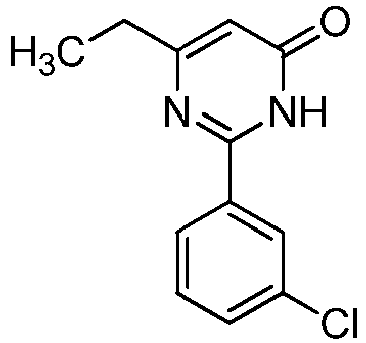
- A 1-L round bottomed flask was charged with 3-chlorobenzimidamide (23.9 g, 154 mmol, 1 eq.), ethyl 3-oxopentanoate (27.8 g, 193 mmol, 1.25 eq.), and ethanol (500 mL). To the mixture was added sodium methoxide (10.0 g, 185 mmol, 1.20 eq.). The resulting mixture was stirred under reflux for 20 hr. After cooling to room temperature, the mixture was evaporated under reduced pressure to 50 mL. The residual slurry was cautiously treated with 2N HCl (219 mL). Solid was collected by filtration and washed with water followed by ether to afford 2-(3-chlorophenyl)-6-ethylpyrimidin-4(3H)-one (9.3 g, 39% yield), which was carried forward into the next step without further purification. 1H NMR (CD3OD, 500 MHz) δ 8.07 (s, 1H), 7.96 (d, J = 8.0 Hz, 1H), 7.62-7.58 (m, 1H), 7.52 (t, J = 8.0, Hz, 1H), 6.27 (s, 1H), 2.66 (q, J = 7.5 Hz, 2H), 1.29 (t, J = 7.5 Hz, 3H).
-

- A 250-mL round bottom flask was charged with 2-(3-chlorophenyl)-6-ethylpyrimidin-4(3H)-one (9.3 g, 39.8 mmol, 1 eq.). POCl3 (50 mL, 536 mmOl, 13.4 eq.) was cautiously added at 0 °C. The resulting mixture was stirred at 100 °C for 5hr. After cooling to room temperature, the mixture was added slowly dropwise to cold aq. NaHCO3. NaOH was added to keep the pH ∼7 during quenching. The mixture was extracted with ethyl acetate. The organic extract was dried over sodium sulfate, filtered and concentrated under reduced pressure. Purification by silica gel chromatography using dichloromethane/ethyl acetate as eluent afforded 4-chloro-2-(3-chlorophenyl)-6-ethylpyrimidine (9.3 g, 99% yield) as a white solid. 1H NMR (CD3OD, 500 MHz) δ 8.32 (s, 1H), 8.28 (d, J = 7.5 Hz, 1H), 7.50-7.46 (m, 1H), 7.45-7.40 (m, 1H), 7.27 (s, 1H), 2.83 (q, J = 7.5 Hz, 2H), 1.34 (t, J = 7.5 Hz, 3H).


- To a microwave vessel was added the methyl or ethyl ester. Ammonia in methanol (7 M, 3 - 10 mL) was added and the vessel was sealed with an aluminum cap. The resulting mixture was stirred at 100 °C for 24 - 48 h. The crude reaction solution was cooled, evaporated and purified by column chromatography (silica, hexanes/ethyl acetate or methanol/dichloromethane) or preparative HPLC (water/acetonitrile with 0.05% TFA) to afford the desired product. In some cases, HCl in methanol was used to form HCl salt of the desired product.

- To a solution of methyl or ethyl ester (1.0 equiv) in dioxane and water (2:1) was added lithium hydroxide (5 equiv). The suspension was stirred for 4 - 24 h or until the starting material was consumed (monitored by LCMS analysis). The reaction was diluted with water, acidified with HCl (2 M), and extracted with ethyl acetate. The combined organic layer was dried over anhydrous sodium sulfate, filtered, and the filtrate was concentrated. The residue was purified by column chromatography (silica, hexanes/ethyl acetate or methanol/dichloromethane) or preparative HPLC (water/acetonitrile with 0.05% TFA) to afford the desired product.

- To a solution of methyl or ethyl ester (1.0 equiv) in DCM at 0 °C was added DIBAL (3 equiv, 1.0 M in THF). The mixture was stirred for 2 h and warmed to rt for 30 min or until the starting material was consumed (monitored by LCMS analysis). The reaction was quenched with methanol, HCl (2 M), and water and then extracted with DCM. The combined organic layer was dried over anhydrous sodium sulfate, filtered, and the filtrate was concentrated. The residue was purified by column chromatography (silica, hexanes/ethyl acetate or methanol/dichloromethane) or preparative HPLC (water/acetonitrile with 0.05% TFA) to afford the desired product.

- To a solution of methyl or ethyl ester or carboxylic acid (1.0 equiv) in THF at 0 °C was added BH3•DMS (2 equiv). The mixture was warmed to rt and stirred for 4 h or until the starting material was consumed (monitored by LCMS analysis). The reaction was quenched with HCl (0.5 M), diluted with satd. aq. sodium bicarbonate, and extracted with ethyl acetate. The combined organic layer was dried over anhydrous sodium sulfate, filtered, and the filtrate was concentrated. The residue was purified by column chromatography (silica, hexanes/ethyl acetate or methanol/dichloromethane) or preparative HPLC (water/acetonitrile with 0.05% TFA) to afford the desired product. In some cases, HCl in methanol was used to form HCl salt of the desired product.

- To a solution of dichloropyridine (1.0 equiv) in toluene/ethanol (2:1) was added boronic acid or ester (1.1 equiv), cesium carbonate (3 equiv) and tetrakis(triphenylphosphine)palladium (5 mol%). Nitrogen gas was passed through the suspension for 10 min. The reaction mixture was stirred with heat at 90 °C for 2 - 6 h or until the starting material was consumed (monitored by LCMS analysis). The reaction mixture was cooled, diluted with water, and extracted with ethyl acetate. The combined organic layer was dried over anhydrous sodium sulfate, filtered, and the filtrate was concentrated. The residue was purified by column chromatography (silica, hexanes/ethyl acetate) to afford the desired product.

- To a solution of chloropyridine or chloropyrimidine (1.0 equiv) in dioxane was added boronic ester (1.0 - 1.2 equiv), Pd(dppf)Cl2 (10 mol%), and sodium carbonate (3 equiv). The mixture was degassed with a series of vacuum/argon exchanges. The reaction mixture was stirred with heat between 80 - 90 °C for 1 - 4 h or until the starting material was consumed (monitored by LCMS analysis). The reaction mixture was cooled, diluted with water, and extracted with ethyl acetate. The combined organic layer was dried over anhydrous sodium sulfate, filtered, and the filtrate was concentrated. The residue was purified by column chromatography (silica, hexanes/ethyl acetate or methanol/dichloromethane) or preparative HPLC (water/acetonitrile with 0.05% TFA) to afford the desired product. In some cases, HCl in methanol was used to form HCl salt of the desired product.
- The invention is further illustrated by the following examples. In the Examples below, abbreviations are used which have meanings known in the art. For example: rt means room temperature; aq means aqueous; eq means equivalent; TLC means thin layer chromatography; Ar means argon; atm means atmosphere, a measurement; m.p. means melting point; and DCM means dichloromethane.
-

-

- To a stirred suspension of 2-(4-(bromomethyl)phenyl)acetic acid (5.00 g, 21.8 mmol, 1.0 eq.) in methanol (75 mL) was added chlorotrimethylsilane (0.64 mL, 5.02 mmol, 0.23 eq.) at room temperature. The resulting mixture was stirred at room temperature for 2 hr, at which time the reaction was a clear colorless solution. The volatile material was removed under reduced pressure, the residue dissolved in methanol (25 mL), and the volatile material was removed under reduced pressure. This process was repeated two additional times to afford methyl 2-(4-(bromomethyl)phenyl)acetate as an orange solid (5.30 g, quantitative yield). 1H NMR (CDCl3, 500 MHz) δ 7.37-7.33 (m, 2H), 7.26-7.24 (m, 2H), 4.48 (s, 2H), 3.69 (s, 3H), 3.62 (s, 2H). [Lit. J. Med. Chem. 2009, 52, 1180-9.]
-
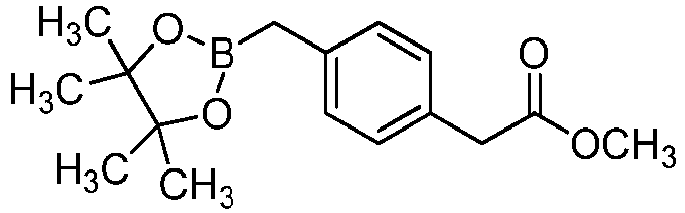
- A 250-mL round bottom flask, with stirrer bar, was charged with 2-(4-(bromomethyl)phenyl)acetate (3.45 g, 14.2 mmol, 1.0 eq.), pinacol diborane (4.32 g, 17.0 mmol, 1.2 eq.), tetrakis(triphenylphosphine)palladium(0) (1.64 g, 1.42 mmol, 0.10 eq.), and K2CO3 (5.88 g, 42.6 mmol, 3.0 eq.). Dioxane (80 mL) was added. The resulting mixture was stirred under Ar at 80 °C for 23 hrs. After cooling to room temperature, the reaction was diluted with ethyl acetate (200 mL) and then filtered through celite. The filtrate was washed with sat. sodium chloride (3 x 25 mL), dried over sodium sulfate, filtered, and concentrated under reduced pressure. The residue (9.5 g) was purified by chromatography on silica gel using hexane/ethyl acetate (10:0 to 0:10) as eluent to afford methyl 2-(4-((4,4,5,5-tetramethyl-1,3,2-dioxaborolan-2-yl)methyl)phenyl)acetate (2.88 g, 70% yield) as a colorless semisolid. 1H NMR (CDCl3, 500 MHz) δ 7.14 (s, 4H), 3.67 (s, 3H), 3.57 (s, 2H), 2.27 (s, 2H), 1.23 (s, 12H).
-

- A 50-mL flask, with stirrer bar, was charged with 4-chloro-2-(3-chlorophenyl)-6-ethylpyrimidine (870 mg, 3.44 mol, 1 eq.), methyl 2-(4-((4,4,5,5-tetramethyl-1,3,2-dioxaborolan-2-yl)methyl)phenyl)acetate (1.00 g, 3.44 mmol, 1 eq.), Pd(dppf)Cl2 (280 mg, 0.34 mmol, 0.10 eq.), and powdered Na2CO3 (1.09 g, 10.3 mmol, 3.0 eq.). Dioxane (16 mL) and water (8 mL) were added. The resulting mixture was stirred under Ar at 90 °C for 2hr. until the starting chloride was consumed. After cooling to room temperature, the reaction mixture was filtered through celite washing with ethyl acetate until the filtrate was colorless. The filtrate was washed with sat. sodium chloride (3 x 25 mL), dried over sodium sulfate, filtered and concentrated under reduced pressure. The residue (1.8 g) was purified by chromatography on silica gel using hexane/dichloromethane (10:0 to 0:10) as eluent, followed by chromatography on silica gel using hexane/ethyl acetate (10:0 to 3:1) as eluent, to afford methyl 2-(4-((2-(3-chlorophenyl)-6-ethylpyrimidin-4-yl)methyl)phenyl)acetate (0.65 g, 50% yield) as a colorless oil. MW = 380.87. 1H NMR (CDCl3, 500 MHz) δ 8.49-8.47 (m, 1H), 8.37 (dt, J = 7.5, 1.5 Hz, 1H), 7.44-7.38 (m, 2H), 7.31-7.27 (m, 2H), 7.27-7.23 (m, 2H, overlaps with CDCl3), 6.85 (s, 1H), 4.10 (s, 2H), 3.69 (s, 3H), 3.61 (s, 2H), 2.76 (q, J = 7.5 Hz, 2H), 1.31 (t, J = 7.5 Hz, 3H).
-

- A 20-mL vial was charged with methyl 2-(4-((2-(3-chlorophenyl)-6-ethylpyrimidin-4-yl)methyl)phenyl)acetate (113 mg, 0.30 mmol, 1.0 eq.) and ammonium chloride (48 mg, 0.89 mmol, 3.0 eq.). To this was added methanol (3 mL) followed by NH3 (7.5 mL, 7N in methanol, 53 mmol, 177 eq.). The vial was sealed and the resulting mixture was stirred at 100 °C for 43 hr. The crude reaction solution was adsorbed onto silica then purified by chromatography on silica gel using dichloromethane/methanol (0 to 5%) as eluent, followed by chromatography on silica gel using hexane/ethyl acetate (100:0 to 0:100) as eluent, to give 2-(4-((2-(3-chlorophenyl)-6-ethylpyrimidin-4-yl)methyl)phenyl)acetamide (37 mg, 35% yield) as a white solid. MW = 365.86. 1H NMR (DMSO-d6 , 500 MHz) δ 8.38-8.33 (m, 2H), 7.61-7.53 (m, 2H), 7.41 (br s, 1H), 7.29 (d, J = 8.0 Hz, 2H), 7.25 (s, 1H), 7.20 (d, J = 8.0 Hz, 2H), 6.82 (br s, 1H), 4.09 (s, 2H), 3.32 (s, 2H), 2.77 (q, J = 7.5 Hz, 2H), 1.26 (t, J = 7.5 Hz, 3H).
-

- A 25-mL flask, with stirrer bar, was charged with methyl 2-(4-((2-(3-chlorophenyl)-6-ethylpyrimidin-4-yl)methyl)phenyl)acetate (64 mg, 0.17 mmol, 1.0 eq.) and THF (3 mL). Water (3 mL) and LiOH•H2O (21 mg, 0.50 mmol, 3.0 eq.) were added. The resulting mixture was stirred at room temperature for 17hrs until the starting ester was consumed. The reaction mixture was diluted with water (10 mL) and acidified with 2N HCl. The mixture was extracted with ethyl acetate. The organic extract was washed with sat. sodium chloride (5 mL), dried over sodium sulfate, filtered, and concentrated under reduced pressure. The residue (88 mg) was purified by chromatography on silica gel using dichloromethane/methanol (10:0 to 9:1) as eluent to afford 2-(4-((2-(3-chlorophenyl)-6-ethylpyrimidin-4-yl)methyl)phenyl)acetic acid (40 mg, 66% yield) as a white solid. MW = 366.84. 1H NMR (DMSO-d6 , 500 MHz) δ 12.31 (br s, 1H), 8.40-8.33 (m, 2H), 7.62-7.53 (m, 2H), 7.31(d, J = 8.0 Hz, 2H), 7.26 (s, 1H), 7.21(d, J = 8.0 Hz, 2H), 4.10 (s, 2H), 3.51 (s, 2H), 2.78 (q, J = 7.5 Hz, 2H), 1.26 (t, J = 7.5 Hz, 3H).
-

- A 25-mL flask, with stirrer bar, was charged with methyl 2-(4-((2-(3-chlorophenyl)-6-ethylpyrimidin-4-yl)methyl)phenyl)acetate (52 mg, 0.13 mmol, 1.0 eq.) and THF (3 mL). The flask was cooled to 0 °C under nitrogen. A solution of 1M LiAlH4 in THF (0.31 mL, 0.31 mmol, 2.3 eq.) was added and the reaction was allowed to slowly warm to room temperature. After 4.5hrs, the reaction mixture was quenched with methanol, diluted with water (10 mL), and acidified with 2N HCl to pH ∼3. The mixture was extracted with ethyl acetate (3 x 12 mL). The organic extract was washed with sat. sodium chloride (5 mL), dried over sodium sulfate, filtered, and concentrated under reduced pressure. The residue (49 mg) was purified by chromatography on silica gel using hexanes/ethyl acetate (1:0 to 1:1) as eluent to afford 2-(4-((2-(3-chlorophenyl)-6-ethylpyrimidin-4-yl)methyl)phenyl)ethanol (17 mg, 36% yield) as a colorless oil. MW = 352.86. 1H NMR (DMSO-d6 , 500 MHz) δ 8.38-8.33 (m, 2H), 7.61-7.53 (m, 2H), 7.28-7.25 (m, 3H), 7.16 (d, J = 8.0 Hz, 2H), 4.58 (t, J = 5.5 Hz, 1H), 4.08 (s, 2H), 3.60-3.53 (m, 2H), 2.77 (q, J = 7.5 Hz, 2H), 2.67 (t, J = 7.0 Hz, 2H), 1.26 (t, J = 7.5 Hz, 3H).
-

-

- A 500-mL round bottomed flask was charged with 2,4-dichloro-6-trifluoromethylpyridine (2.00 g, 9.26 mmol), (3-chlorophenyl)boronic acid (1.59 g, 10.2 mmol), tetrakis(triphenylphosphine)palladium(0) (0.535 g, 0.46 mmol), and Cs2CO3 (9.05 g, 27.8 mmol). Toluene (40 ml), EtOH (10 ml) and water (20 ml) were added. The resulting mixture was stirred under Ar at 90 °C for 4 h. After cooling to room temperature, the reaction mixture was diluted with ethyl acetate (100 mL) and hexanes (100 mL). The aqueous layer was separated and the organic layer was washed with saturated sodium chloride (2 × 25 mL), dried over sodium sulfate, filtered, and concentrated under reduced pressure. The residue was purified by chromatography on silica using hexane/ethyl acetate (100:1 to 95:5) as eluent followed by chromatography on silica using hexane/dichloromethane (100:0 to 80:20) as eluent to afford the title compound (1.48 g, 55%) as a white solid. MW = 292.08. 1H NMR (CDCl3, 500 MHz) δ 8.06-8.04 (m, 1H), 7.92 (dt, J = 7.0, 2.0 Hz, 1H), 7.89 (d, J = 1.5 Hz, 1H), 7.64 (d, J = 1.5 Hz, 1H), 7.48-7.42 (m, 2H).
-

- A 20-mL sealed tube, with stirrer bar, was charged with 4-chloro-2-(3-chlorophenyl)-6-(trifluoromethyl)pyridine (0.263 g, 0.90 mol), methyl 2-(4-((4,4,5,5-tetramethyl-1,3,2-dioxaborolan-2-yl)methyl)phenyl)acetate (0.261 g, 0.90 mmol), Pd(dppf)Cl2 (0.073 g, 0.09 mmol), and powdered Na2CO3 (0.286 g, 2.70 mmol). Dioxane (8 mL) and water (4 mL) were added. The resulting mixture was stirred under Ar at 90 °C for 27 h. until the starting chloride was consumed. After cooling to room temperature, the reaction mixture was absorbed onto silica and purified by chromatography on silica using dichloromethane/methanol (10:0 to 9:1) as eluent to afford methyl 2-(4-((2-(3-chlorophenyl)-6-(trifluoromethyl)pyridin-4-yl)methyl)phenyl)acetate
- (0.018 g, 4%) as a light brown solid. MW = 419.82. M.p. 72-74 °C. 1H NMR (CDCl3, 500 MHz) δ 8.03-8.00 (m, 1H), 7.91-7.86 (m, 1H), 7.68 (s, 1H), 7.46-7.44 (m, 1H), 7.42-7.37 (m, 2H), 7.29-7.26 (m, 2H), 7.18-7.15 (m, 2H), 4.09 (s, 2H), 3.70 (s, 3H), 3.62 (s, 2H); APCI MS m/z 420 [M+H]+.
- (0.396 g). Prep HPLC of sample (0.055 g) afforded 2-(4-((2-(3-chlorophenyl)-6-(trifluoromethyl)pyridin-4-yl)methyl)phenyl)acetic acid (0.027 g, 7%) as a white solid. MW = 405.80. M.p. 124-126 °C. 1H NMR (CDCl3, 500 MHz) δ 8.03-8.00 (m, 1H), 7.91-7.85 (m, 1H), 7.68 (s, 1H), 7.46-7.44 (m, 1H), 7.42-7.37 (m, 2H), 7.30-7.26 (m, 2H), 7.19-7.15 (m, 2H), 4.09 (s, 2H), 3.65 (s, 2H); APCI MS m/z 406 [M+H]+.
-

- A 50-mL round bottom flask was charged with methyl 2-(4-((2-(3-chlorophenyl)-6-(trifluoromethyl)pyridin-4-yl)methyl)phenyl)acetate (0.165 g, 0.40 mmol) and THF (10 mL) at rt. Borane-dimethylsulfide complex (0.154 mL, 1.62 mmol) was added and the resulting solution was stirred at 55 °C for 3 h. After this time, the reaction was quenched with methanol then treated with 2N aqueous HCl (5 drops), and concentrated under reduced pressure. The residue was diluted with methanol and then concentrated under reduced pressure. The residue was purified by column chromatography on silica using hexanes/ethyl acetate (10:0 to 1:1) as the eluent followed by column chromatography on silica using hexanes/dichloromethane (10:0 to 0:10) as the eluent to afford the title compound (0.064 g, 18%) as a colorless gum. MW = 391.81. 1H NMR (DMSO-d6 , 500 MHz) δ 8.33 (s, 1H), 8.17-8.15 (m, 1H), 8.11-8.06 (m, 1H), 7.77 (d, J = 0.5 Hz, 1H), 7.60-7.54 (m, 2H), 7.28 (d, J = 8.0 Hz, 2H), 7.16 (d, J = 8.0 Hz, 2H), 4.58 (t, J = 5.0 Hz, 1H), 4.12 (s, 2H), 3.59-3.54 (m, 2H), 2.67 (t, J = 5.0 Hz, 2H); APCI MS m/z 392 [M+H]+.
-

- An 100-mL round bottom flask was charged with 2-(4-((2-(3-chlorophenyl)-6-(trifluoromethyl)pyridin-4-yl)methyl)phenyl)acetic acid (0.17 g, 0.42 mmol) in dichloromethane (10 ml). To this solution at 0 °C was added oxalyl chloride (0.18 mL, 2.10 mmol) followed by DMF (1 drop). After stirring for 5 h the volatile material was removed under reduced pressure to afford crude acid chloride. The residue was dissolved in dichloromethane (10 mL), cooled to 0 °C, and 7N ammonia in methanol (10.0 mL, 70 mmol) was added. After stirring for 0.5 h, the volatile material was removed under reduced pressure. The residue was purified by chromatography on silica using hexanes/ethyl acetate (10:0 to 0:10) as eluent followed by chromatography on silica using dichloromethane/methanol (10:0 to 9:1) as eluent to afford the title compound (0.079 g, 21%) as an off-white solid. MW = 404.81. M.p. 148-160 °C. 1H NMR (DMSO-d6 , 500 MHz) δ 8.33 (s, 1H), 8.17-8.15 (m, 1H), 8.11-8.05 (m, 1H), 7.76 (d, J = 0.5 Hz, 1H), 7.60-7.55 (m, 2H), 7.41 (br s, 1H), 7.31 (d, J = 8.0 Hz, 2H), 7.21 (d, J = 8.0 Hz, 2H), 6.82 (br s, 1H), 4.11 (s, 2H), 3.32 (s, 2H); APCI MS m/z 405 [M+H]+.
-

-

- A mixture of 4-(chloromethyl) benzyl alcohol (0.500 g, 3.19 mmol), 4-chloro-1H-pyrazole (0.753 g, 7.34 mmol), and potassium carbonate (0.908 g, 7.02 mmol) in acetonitrile (40 mL) was stirred at rt overnight. After this time, the mixture was diluted with water and extracted with ethyl acetate. The combined organic layer was dried over anhydrous sodium sulfate, filtered and the filtrate was concentrated. The residue was purified by column chromatography (silica, hexanes/ethyl acetate) to afford the title compound (0.375 g, 75%) as a white solid. MW = 222.67. 1H NMR (CDCl3, 500 MHz) δ 7.45 (s, 1H), 7.37 (s, 1H), 7.35 (s, 1H), 7.33 (s, 1H), 7.23 (s, 1H), 7.22 (s, 1H), 5.24 (s, 2H), 4.70 (d, J = 5.9 Hz, 2H), 1.68 (t, J = 5.9 Hz, 1H).
-

- A solution of (4-((4-chloro-1H-pyrazol-1-yl)methyl)phenyl)methanol (0.375 g, 1.68 mmol) in methylene chloride (7 mL) at 0 °C under a nitrogen atmosphere was treated with PBr3 (0.456 g, 1.68 mmol) and the mixture was warmed to rt and stirred for 1 h. After this time, the mixture was diluted with saturated aqueous sodium bicarbonate and ice and then extracted with dichloromethane. The combined organic layer was dried over anhydrous sodium sulfate, filtered, and the filtrate was concentrated. The residue was purified by column chromatography (silica, hexanes/dichloromethane) to afford the title compound (0.342 g, 91%) as a white solid. MW = 285.57. 1H NMR (CDCl3, 500 MHz) δ 7.46 (s, 1H), 7.38 (d, J = 8.1 Hz, 2H), 7.35 (s, 1H), 7.19 (d, J = 8.1 Hz, 2H), 5.24 (s, 2H), 4.47 (s, 2H).
-

- A mixture of 1-(4-(bromomethyl)benzyl)-4-chloro-1H-pyrazole (0.340 g, 1.19 mmol), pinacol diborane (0.363 g, 1.43 mmol), tetrakis(triphenylphosphine)palladium(0) (0.137 g, 0.12 mmol) and K2CO3 (0.793 g, 3.57 mmol) in dioxane (10 mL) was stirred under an argon atmosphere at 80 °C for 18 h. After this time, the mixture was cooled, diluted with ethyl acetate (40 mL), and filtered through celite. The filtrate was washed with saturated sodium chloride (3 × 5 mL), dried over sodium sulfate, filtered, and concentrated. The residue was purified by column chromatography (silica, hexanes/dichloromethane) to afford the title compound (0.240 g, crude) as a dark yellow oil. MW = 332.63. 1H NMR (CDCl3, 500 MHz) δ 10.01 (s, 1H), 7.89-7.84 (m, 2H), 7.49 (s, 1H), 7.46-7.43 (m, 1H), 7.41 (s, 1H), 7.36-7.29 (m, 3H), 7.19-7.06 (m, 3H), 5.33 (s, 2H), 5.21-5.18 (m, 2H), 2.89 (s, 1H), 1.61 (s, 2H), 1.23 (s, 3H).
-

- A mixture of 4-chloro-2-(3-chlorophenyl)-6-ethylpyrimidine (0.100 g, 0.40 mmol), 4-chloro-1-(4-((4,4,5,5-tetramethyl-1,3,2-dioxaborolan-2-yl)methyl)benzyl)-1H-pyrazole (0.197 g, 0.59 mmol), Pd(dppf)Cl2 (0.032 g, 0.04 mmol), and powdered Na2CO3 (0.126 g, 1.19 mmol) in dioxane (2.4 mL) and water (1.6 mL) was stirred under an argon atmosphere at 90 °C for 6 h, cooled, and filtered through celite with ethyl acetate washing. The filtrate was washed with saturated sodium chloride (3 × 25 mL), dried over anhydrous sodium sulfate, filtered, and concentrated. The residue was purified by column chromatography (silica, hexane/dichloromethane) to afford the title compound (0.043 g, 43%) as a yellow oil. MW = 423.34. 1H NMR (DMSO-d6 , 500 MHz) δ 8.38-8.32 (m, 2H), 8.05 (s, 1H), 7.62-7.50 (m, 3H), 7.35 (d, J = 8.1 Hz, 2H), 7.25 (s, 1H), 7.20 (d, J = 8.1 Hz, 2H), 5.25 (s, 2H), 4.11 (s, 2H), 2.77 (q, J = 7.6 Hz, 2H), 1.26 (t, J = 7.6 Hz, 3H); APCI MS m/z 423 [M + H]+.
-

-

- An 250-mL round bottom flask was charged with 2-(4-((2-(3-chlorophenyl)-6-ethylpyrimidin-4-yl)methyl)phenyl)acetic acid (0.22 g, 0.60 mmol) in dichloromethane (15 ml). To this solution at 0 °C was added oxalyl chloride (0.25 mL, 3.00 mmol) followed by DMF (1 drop). After stirring for 4 h, the volatile material was removed under reduced pressure to afford crude acid chloride as a red oil. MW = 385.29.
-

- To a stirred solution of crude 2-(4-((2-(3-chlorophenyl)-6-ethylpyrimidin-4-yl)methyl)phenyl)acetyl chloride (-0.20 mmol) in dichloromethane (8 mL) at 0 °C was added n-propylamine (0.082 mL, 1.00 mmol) followed by diisopropylethylamine (0.17 mL, 1.00 mmol). After stirring for 2.5 h, the reaction mixture was diluted with dichloromethane (50 mL) and water (5 mL). The mixture was acidified with 2N aqueous HCl until pH ∼5. The organic layer was washed with saturated sodium chloride (5 mL), dried over sodium sulfate, filtered, and concentrated under reduced pressure. The residue was purified by chromatography on silica using hexanes/ethyl acetate (10:0 to 1:1) as eluent followed by preparative HPLC (water/acetonitrile with 0.05% TFA) to afford the title compound (0.044 g, 55%) as a white solid. MW = 407.94. M.p. 123-125 °C. 1H NMR (DMSO-d6 , 500 MHz) δ 8.37-8.31 (m, 2H), 7.98-7.93 (m, 1H), 7.60 (dt, J = 8.5, 2.0 Hz, 1H), 7.55 (t, J = 7.5 Hz, 1H), 7.28 (d, J = 8.0 Hz, 2H), 7.24 (s, 1H), 7.20 (d, J = 8.0 Hz, 2H), 4.09 (s, 2H), 3.34 (s, 2H), 2.97 (q, J = 6.0 Hz, 2H), 2.77 (t, J = 7.5 Hz, 2H), 1.43-1.34 (m, 2H), 1.26 (t, J = 7.5 Hz, 3H), 0.81 (t, J = 7.5 Hz, 3H); APCI MS m/z 408 [M+H]+.
-

- To a stirred solution of crude 2-(4-((2-(3-chlorophenyl)-6-ethylpyrimidin-4-yl)methyl)phenyl)acetyl chloride (∼0.20 mmol) in dichloromethane (8 mL) at 0 °C was added N-methyl-n-propylamine (0.10 mL, 1.00 mmol) followed by diisopropylethylamine (0.17 mL, 1.00 mmol). After stirring for 3 h the reaction mixture was diluted with dichloromethane (50 mL) and water (5 mL). The mixture was acidified with 2N aqueous HCl until pH ~5. The organic layer was washed with saturated sodium chloride (5 mL), dried over sodium sulfate, filtered, and concentrated under reduced pressure. The residue was purified by chromatography on silica using hexanes/ethyl acetate (10:0 to 1:1) as eluent followed by preparative HPLC (water/acetonitrile with 0.05% TFA) to afford the title compound (0.040 g, 48%) as a colorless oil. MW = 421.96. 1H NMR (DMSO-d6 , 500 MHz) δ 8.37-8.33 (m, 2H), 7.59 (dt, J = 7.5, 2.0 Hz, 1H), 7.55 (t, J = 7.5 Hz, 1H), 7.29 (d, J = 8.0 Hz, 2H), 7.25 (d, J = 5.5 Hz, 1H), 7.18 (t, J = 8.0 Hz, 2H), 4.10 (s, 2H), 3.63 (d, J = 4.0 Hz, 2H), 3.27-3.19 (m, 2H), 2.94 (s, 1.6H), 2.81-2.79 (m, 3.4H), 1.47-1.37 (m, 2H), 1.26 (t, J = 7.5 Hz, 3H), 0.80-0.73 (m, 3H); APCI MS m/z 422 [M+H]+.
-

- To a stirred solution of crude 2-(4-((2-(3-chlorophenyl)-6-ethylpyrimidin-4-yl)methyl)phenyl)acetyl chloride (-0.20 mmol) in dichloromethane (8 mL) at 0 °C was added ethanolamine (0.060 mL, 1.00 mmol) followed by diisopropylethylamine (0.17 mL, 1.00 mmol). After stirring for 3 h, the reaction mixture was diluted with dichloromethane (50 mL) and water (5 mL). The mixture was acidified with 2N aqueous HCl until pH ∼5. The organic layer was washed with saturated sodium chloride (5 mL), dried over sodium sulfate, filtered, and concentrated under reduced pressure. The residue was purified by chromatography on silica using hexanes/ethyl acetate (10:0 to 0:10) as eluent followed by preparative HPLC (water/acetonitrile with 0.05% TFA) to afford the title compound (0.036 g, 45%) as a white solid. MW = 409.91. M.p. 136-138 °C. 1H NMR (DMSO-d6 , 500 MHz) δ 8.37-8.31 (m, 2H), 8.02-7.96 (m, 1H), 7.59 (dt, J = 6.5, 2.0 Hz, 1H), 7.55 (t, J = 8.0 Hz, 1H), 7.28 (d, J = 8.0 Hz, 2H), 7.25 (s, 1H), 7.20 (d, J = 8.0 Hz, 2H), 4.63 (t, J = 5.0 Hz, 1H), 4.09 (s, 2H), 3.40-3.35 (m, 4H), 3.90 (q, J = 6.0 Hz, 2H), 2.77 (q, J = 7.5 Hz, 2H), 1.26 (t, J = 7.5 Hz, 3H); APCI MS m/z 410 [M+H]+.
-

-
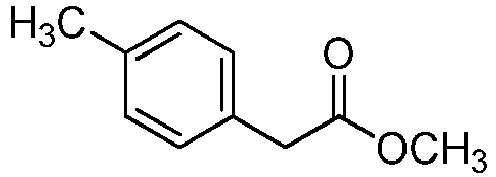
- A 500-mL round bottom flask, with stirrer bar, was charged with p-tolylacetic acid (10.0 g, 66.5 mmol) and methanol (240 mL). Concentrated sulfuric acid (0.1 mL) was added at room temperature. The resulting solution was stirred at 65 °C for 18 h. After this time, the mixture was concentrated in vacuo, and the residue was diluted with ethyl acetate (100 mL) and saturated sodium bicarbonate (50 mL). The organic layer was washed with saturated sodium chloride (2 × 20 mL), dried over sodium sulfate, filtered, and concentrated under reduced pressure to afford the title compound (11.8 g, 100%) as a colorless oil. MW = 164.20. 1H NMR (CDCl3, 300 MHz) δ 7.20-7.10 (m, 4H), 3.68 (s, 3H), 3.59 (s, 2H), 2.33 (s, 3H).
-

- A 500-mL round bottom flask, with stirrer bar, was charged with 2-(p-tolyl)acetate (11.8 g, 66.5 mmol), dimethylformamide (24 mL) and tetrahydrofuran (240 mL) then cooled to 0 °C. Sodium hydride (2.92 g, 60% suspension, 73.0 mmol) was added portionwise over 3 minutes. After stirring for 30 minutes, iodomethane (4.55 mL, 73.0 mmol) was added dropwise over 5 minutes and the mixture stirred for 1 hour. After this time, additional sodium hydride (2.92 g, 60% suspension, 73.0 mmol, 1.1 eq.) was added portionwise over 8 minutes to the suspension and the mixture stirred an additional 30 minutes. After this time, iodomethane (4.55 mL, 73.0 mmol) was added dropwise over 5 minutes. The resulting mixture was allowed to slowly warm to room temperature and stirred for 48 h. The reaction was then quenched with water (250 mL) and diluted with MTBE (300 mL). The aqueous layer was separated and extracted with MTBE (3 × 100 mL). The combined extract was washed with saturated sodium chloride (3 × 50 mL), then dried over sodium sulfate, filtered, and concentrated under reduced pressure to afford the title compound (13.5 g, 100%) as a colorless oil. MW = 192.25. 1H NMR (CDCl3, 300 MHz) δ 7.25-7.10 (m, 4H), 3.64 (s, 3H), 2.32 (s, 3H), 1.57 (s, 6H).
-

- A 500-mL round bottom flask, with stirrer bar, was charged with methyl 2-methyl-2-(p-tolyl)propanoate (2.50 g, 13.0 mmol), NBS (2.31 g, 13.0 mmol), and carbon tetrachloride (240 mL). The resulting solution was heated at reflux and AIBN (0.043 g, 0.26 mmol) was added. After stirring for 3.5 h, the reaction was cooled to room temperature and the solids removed by filtration. The filtrate was concentrated under reduced pressure. The residue was purified by chromatography on silica using hexane/ethyl acetate (100:0 to 80:20) as eluent as eluent to afford the title compound (2.20 g, 62%.) as a colorless oil. MW = 271.15. 1H NMR (CDCl3, 300 MHz) δ 7.39-7.28 (m, 4H), 4.48 (s, 2H), 3.65 (s, 3H), 1.57 (s, 6H).
-

- A 500-mL round bottom flask, with stirrer bar, was charged with methyl 2-(4-(bromomethyl)phenyl)-2-methylpropanoate (2.06 g, 7.59 mmol), pinacol diborane (2.31 g, 9.11 mmol), tetrakis(triphenylphosphine)palladium(0) (0.88 g, 0.76 mmol), and K2CO3 (3.15 g, 22.8 mmol). Dioxane (60 mL) was added and the resulting mixture was stirred under Ar at 80 °C for 20 h. After this time, the mixture was cooled to room temperature, diluted with ethyl acetate (200 mL), and filtered through celite. The filtrate was washed with brine (4 × 50 mL), dried over sodium sulfate, filtered, and concentrated under reduced pressure. The residue (4.4 g) was purified by chromatography on silica using hexane/ethyl acetate (100:0 to 50:50) as eluent to afford the title compound (1.07 g, 44%) as a colorless oil. MW = 318.22. 1H NMR (CDCl3, 500 MHz) δ 7.22-7.11 (m, 4H), 3.64 (s, 3H), 2.26 (s, 2H), 1.55 (s, 6H), 1.24 (s, 12H).
-

- A 20-mL sealed tube, with stirrer bar, was charged with 4-chloro-2-(3-chlorophenyl)-6-ethylpyrimidine (0.303 g, 1.20 mol), methyl 2-methyl-2-(4-((4,4,5,5-tetramethyl-1,3,2-dioxaborolan-2-yl)methyl)phenyl)propanoate (0.420 g, 1.32 mmol), Pd(dppf)Cl2 (0.098 g, 0.12 mmol), and powdered Na2CO3 (0.380 g, 3.60 mmol). Dioxane (6 mL) and water (3 mL) were added. The resulting mixture was stirred under Ar at 90 °C for 2 h. After this time, the mixture was cooled to room temperature and filtered through celite washing with ethyl acetate until the filtrate was colorless. The filtrate was washed with saturated sodium chloride (3 × 25 mL) then dried over sodium sulfate, filtered, and concentrated under reduced pressure. The residue (0.87 g) was purified by chromatography on silica using hexane/dichloromethane (10:0 to 8:2) as eluent to afford the title compound (0.47 g, 96%) as a colorless oil. MW = 408.92. 1H NMR (CDCl3, 300 MHz) δ 8.50-8.47 (m, 1H), 8.40-8.35 (m, 1H), 7.46-7.37 (m, 2H), 7.31-7.24 (m, 4H), 6.87 (s, 1H), 4.10 (s, 2H), 3.65 (s, 3H), 2.77 (q, J = 7.8 Hz, 2H), 1.57 (s, 6H), 1.32 (t, J = 7.5 Hz, 3H).; ESI MS m/z 409 [M+H]+.
-

- An 250-mL round bottom flask was charged with methyl 2-(4-((2-(3-chlorophenyl)-6-ethylpyrimidin-4-yl)methyl)phenyl)-2-methylpropanoate (0.472 g, 1.15 mmol), dioxane (24 ml) and water (12 ml). To this solution was then added lithium hydroxide monohydrate (0.242 g, 5.77 mmol). The resulting mixture was stirred at 50 °C for 7 h. After this time the reaction mixture was cooled and treated with 2M aqueous HCl until pH ~5. The volatile materials were removed under reduced pressure to afford the title compound (0.70 g, >100%) as a white solid. MW = 394.89. 1H NMR (DMSO-d 6, 500 MHz) δ 12.26 (br s, 1H), 8.38-8.34 (m, 2H), 7.61-7.53 (m, 2H), 7.35-7.27 (m, 5H), 4.09 (s, 2H), 2.78 (q, J = 8.0 Hz, 2H), 1.44 (s, 6H), 1.27 (t, J = 7.5 Hz, 3H). ESI MS m/z 395 [M+H]+.
-

- An 250-mL round bottom flask was charged with 2-(4-((2-(3-chlorophenyl)-6-ethylpyrimidin-4-yl)methyl)phenyl)-2-methylpropanoic acid (0.35 g, -0.57 mmol) in dichloromethane (10 ml) and dioxane (10 mL). To this mixture at 0 °C was added oxalyl chloride (0.24 mL, 2.87 mmol) followed by DMF (1 drop). After stirring for 6 h, the volatile material was removed under reduced pressure to afford crude acid chloride. The residue was dissolved in dichloromethane (24 mL), cooled to 0 °C and 7N ammonia in methanol (10.0 mL, 70 mmol) was added.
After stirring for 15 h the volatile material was removed under reduced pressure. The residue was diluted with dichloromethane (125 mL) and washed with saturated sodium chloride (3 × 15 mL), dried over sodium sulfate, filtered and concentrated under reduced pressure. The residue was purified by chromatography on silica using hexanes/ethyl acetate as eluent followed by preparative HPLC (water/acetonitrile with 0.05% TFA) to afford the title compound (0.057 g, 24%) as a yellow-orange solid. MW = 393.91. M.p. 35-37 °C. 1H NMR (DMSO-d 6, 500 MHz) δ 8.38-8.34 (m, 2H), 7.61-7.54 (m, 2H), 7.34-7.27 (m, 5H), 6.82 (br s, 2H), 4.09 (s, 2H), 2.78 (q, J = 7.5 Hz, 2H), 1.40 (s, 6H), 1.27 (t, J = 7.5 Hz, 3H). APCI MS m/z 394 [M+H]+. -

- A 25-mL round bottom flask was charged with methyl 2-(4-((2-(3-chlorophenyl)-6-ethylpyrimidin-4-yl)methyl)phenyl)-2-methylpropanoate (0.259 g, 0.57 mmol) and THF (6 mL) at rt. Borane-dimethylsulfide complex (0.158 mL, 1.67 mmol) was added and the resulting solution was stirred at 55 °C for 2.5 h. LCMS analysis indicated only partial reduction. Borane-dimethylsulfide complex (0.100 mL, 1.05 mmol) was added and the resulting solution was stirred at 55 °C for a further 19 h until the starting material was consumed (monitored by LCMS analysis). The reaction was quenched with methanol then treated with 2N aqueous HCl (0.1 mL) and concentrated under reduced pressure. The residue was diluted with methanol and then concentrated under reduced pressure. The residue absorbed onto silica (2 g) then purified by column chromatography on silica using hexanes/ethyl acetate (10:0 to 0:10) as the eluent to afford the title compound (0.078 g, 36%) as a colorless oil. MW = 380.91. 1H NMR (DMSO-d 6, 500 MHz) δ 8.38-8.34 (m, 2H), 7.61-7.54 (m, 2H), 7.33-7.26 (m, 5H), 4.60 (t, J = 5.5 Hz, 1H), 4.07 (s, 2H), 3.38 (d, J = 5.5 Hz, 2H), 2.78 (q, J = 7.5 Hz, 2H), 1.27 (t, J = 7.5 Hz, 3H), 1.18 (s, 6H); APCI MS m/z 381 [M+H]+.
-

-

- A 20-mL sealed tube, with stirrer bar, was charged with 4-chloro-2-(cyclopentyloxy)-6-(trifluoromethyl)pyrimidine (0.400 g, 1.50 mol), methyl 2-(4-((4,4,5,5-tetramethyl-1,3,2-dioxaborolan-2-yl)methyl)phenyl)acetate (0.478 g, 1.65 mmol), Pd(dppf)Cl2 (0.122 g, 0.15 mmol), and powdered Na2CO3 (0.477 g, 4.50 mmol). Dioxane (8 mL) and water (4 mL) were added. The resulting mixture was stirred under Ar at 90 °C for 2.5 h. After this time, the mixture was cooled to room temperature and filtered through celite washing with ethyl acetate until the filtrate was colorless. The aqueous layer was separated and the organic layer was washed with saturated sodium chloride (2 × 10 mL) then dried over sodium sulfate, filtered and concentrated under reduced pressure. The residue was purified by chromatography on silica using hexane/ethyl acetate (10:0 to 3:1) as eluent to afford the title compound (0.40 g, 67%) as a yellow oil. MW = 394.39. 1H NMR (CDCl3, 300 MHz) δ 7.25 (s, 4H), 7.14 (s, 1H), 5.46 (septet, J = 3.0 Hz, 1H), 4.08 (s, 2H), 3.69 (s, 3H), 3.62 (s, 2H), 2.04-1.73 (m, 6H), 1.72-1.56 (m, 2H); ESI MS m/z 327 [M-C5H9+2H]+.
-

- An 100-mL round bottom flask was charged with methyl 2-(4-((2-(cyclopentyloxy)-6-(trifluoromethyl)pyrimidin-4-yl)methyl)phenyl) acetate (0.100 g, 0.25 mmol), dioxane (6 ml) and water (3 ml). To this solution was then added lithium hydroxide monohydrate (0.053 g, 1.26 mmol). The resulting mixture was stirred at 50 °C for 1.5 h. The cooled reaction mixture was treated with 2N aqueous HCl until pH ∼5, then diluted with ethyl acetate (75 mL). The organic layer was washed with saturated sodium chloride (5 mL), dried over sodium sulfate, filtered, and concentrated under reduced pressure. The residue was purified by chromatography on silica using hexane/ethyl acetate (10:0 to 0:10) as the eluent, followed by preparative HPLC (water/acetonitrile with 0.05% TFA) to afford the title compound (0.051 g, 53%) as an off-white solid. MW = 380.36. M.p. 97-99 °C. 1H NMR (DMSO-d 6, 500 MHz) δ 12.28 (br s, 1H), 7.52 (s, 1H), 7.28 (d, J = 8.0 Hz, 2H), 7.20 (d, J = 8.0 Hz, 2H), 5.35 (septet, J = 3.0 Hz, 1H), 4.11 (s, 2H), 3.52 (s, 2H), 2.00-1.89 (m, 2H), 1.77-1.65 (m, 4H), 1.65-1.55 (m, 2H); APCI MS m/z 381 [M+H]+.
-

- A 20-mL vial was charged with methyl 2-(4-((2-(cyclopentyloxy)-6-(trifluoromethyl)pyrimidin-4-yl)methyl)phenyl) acetate (0.150 g, 0.38 mmol) in methanol (2 mL). To this mixture was added NH3 (10.8 mL, 7N in methanol, 76.0 mmol). The vial was sealed and the resulting mixture was stirred at 100 °C for 23 h. The crude reaction solution concentrated under reduced pressure. The residue was purified by chromatography on silica using hexanes/ethyl acetate (10:0 to 0:10) as eluent followed by chromatography on silica using dichloromethane/methanol (10:0 to 96:4) as eluent to afford the title compound (0.066 g, 46%) as a white solid. MW = 379.38. M.p. 130-132 °C. 1H NMR (DMSO-d 6, 500 MHz) δ 7.51 (s, 1H), 7.41 (br s, 1H), 7.26 (d, J = 8.0 Hz, 2H), 7.20 (d, J = 8.0 Hz, 2H), 6.83 (br s, 1H), 5.35 (septet, J = 3.0 Hz, 1H), 4.10 (s, 2H), 3.33 (s, 2H), 2.00-1.90 (m, 2H), 1.77-1.66 (m, 4H), 1.65-1.55 (m, 2H); ESI MS m/z 380 [M+H]+.
-

- A 25-mL round bottom flask was charged with methyl 2-(4-((2-(cyclopentyloxy)-6-(trifluoromethyl)pyrimidin-4-yl)methyl)phenyl) acetate (0.069 g, 0.17 mmol) and dichloromethane (6 mL) at 0 °C. A 1M solution of DIBAL-H in THF (0.70 mL, 0.70 mmol) was added and the resulting solution was stirred at 0 °C for 1 h until the starting material was consumed (monitored by LCMS analysis). The reaction was quenched with methanol then absorbed onto silica (2 g) and concentrated under reduced pressure. Purification by column chromatography on silica using hexanes/ethyl acetate (10:0 to 1:1) as the eluent afforded the title compound (0.055 g, 87%) as a white solid. MW = 366.38. M.p. 48-50 °C. 1H NMR (DMSO-d 6, 500 MHz) δ 7.51 (s, 1H), 7.23 (d, J = 7.5 Hz, 2H), 7.16 (d, J = 8.0 Hz, 2H), 5.38-5.32 (m, 1H), 4.58 (t, J = 5.5 Hz, 1H), 4.09 (s, 2H), 3.56 (q, J = 6.0 Hz, 2H), 2.68 (t, J= 7.0 Hz, 2H), 2.00-1.89 (m, 2H), 1.77-1.66 (m, 4H), 1.66-1.55 (m, 2H); APCI MS m/z 367 [M+H]+.
-

-

- A 500-mL round bottomed flask was charged with 3-chlorobenzimidamide (4.81 g, 25.3 mmol), ethyl 4,4,4-trifluoro-3-oxobutanoate (5.00 g, 27.1 mmol), and ethanol (90 mL) and cooled to 0 °C. A 25% sodium methoxide solution in methanol (13.0 mL, 55.3 mmol) was added to the mixture. The resulting mixture was stirred at reflux for 20 h. After this time, the mixture was cooled to room temperature and concentrated under reduced pressure to 25 mL. The residual slurry was cautiously treated with 2N HCl (50 mL) forming a solid. The solid was collected by filtration and washed with water followed by ether to afford the title compound (3.60 g, 48%) as a white solid, which was carried forward into the next step without further purification. MW = 274.63. 1H NMR (DMSO-d 6, 500 MHz) δ 13.39 (s, 1H), 8.18 (s, 1H), 8.10 (d, J = 7.5 Hz, 1H), 7.73-7.69 (m, 1H), 7.60 (t, J = 8.0 Hz, 1H), 6.94 (s, 1H).
-
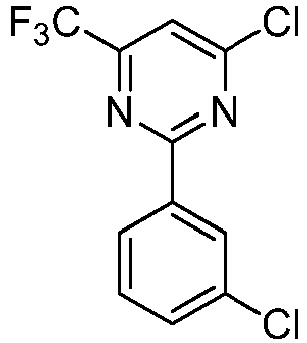
- A 250-mL round bottom flask was charged with 2-(3-chlorophenyl)-6-(trifluoromethyl)pyrimidin-4(3H)-one (3.60 g, 13.1 mmol). POCl3 (14.4 mL, 157 mmol) was cautiously added at 0 °C. The resulting mixture was stirred at 100 °C for 3.5 h. After cooling to room temperature, the mixture was concentrated under reduced pressure. The residue was dissolved in dichloromethane (50 mL) and treated with aqueous sodium bicarbonate until the pH ∼8. The aqueous layer was extracted with dichloromethane (4 × 25 mL). The combined organic extract was washed the saturated sodium chloride (20 mL), dried over sodium sulfate, filtered, and concentrated under reduced pressure. The residue was purified by silica chromatography using hexanes/dichloromethane (3:1) as eluent to afford the title compound (3.36 g, 87%) as a white solid. MW = 293.07. 1H NMR (CDCl3, 500 MHz) δ 8.49 (t, J = 1.5 Hz, 1H), 8.39 (dt, J = 8.0, 1.5 Hz, 1H), 7.57 (s, 1H), 7.53 (ddd, J = 8.0, 2.0, 1.0 Hz, 1H), 7.45 (t, J = 8.0 Hz, 1H).
-

- A 20-mL sealed tube, with stirrer bar, was charged with 4-chloro-2-(3-chlorophenyl)-6-(trifluoromethyl)pyrimidine (0.404 g, 1.38 mol), methyl 2-(4-((4,4,5,5-tetramethyl-1,3,2-dioxaborolan-2-yl)methyl)phenyl)acetate (0.400 g, 1.38 mmol), Pd(dppf)Cl2 (0.113 g, 0.14 mmol), and powdered Na2CO3 (0.438 g, 4.14 mmol). Dioxane (6 mL) and water (3 mL) were added. The resulting mixture was stirred under Ar at 90 °C for 1.25 h. After this time, the mixture was cooled to room temperature and filtered through celite washing with ethyl acetate until the filtrate was colorless. The aqueous layer was separated and the organic layer was washed with saturated sodium chloride (2 × 5 mL) then dried over sodium sulfate, filtered, and concentrated under reduced pressure. The residue was purified by chromatography on silica using hexane/ethyl acetate (95:5 to 2:1) as eluent to afford the title compound (0.284 g, 49%) as a light orange solid. MW = 420.81. M.p. 70-72 °C. 1H NMR (DMSO-d 6, 500 MHz) δ 8.36-8.33 (m, 2H), 7.68 (ddd, J= 8.0, 2.0, 1.0 Hz, 1H), 7.62 (t, J = 8.0 Hz, 1H), 7.37 (d, J = 7.0 Hz, 2H), 7.24 (d, J = 8.0 Hz, 2H), 4.31 (s, 2H), 3.64 (s, 2H), 3.59 (s, 3H); ESI MS m/z 421 [M+H]+.
-

- A 20-mL vial was charged with methyl 2-(4-((2-(3-chlorophenyl)-6-(trifluoromethyl)pyrimidin-4-yl)methyl)phenyl)acetate (0.136 g, 0.32 mmol) and ammonium chloride (0.052 g, 0.97 mmol, 3.0 eq.) in methanol (4 mL). To this mixture was added NH3 (8.0 mL, 7N in methanol, 56.0 mmol). The vial was sealed and the resulting mixture was stirred at 100 °C for 70 h. After this time, the crude reaction was concentrated under reduced pressure and the residue absorbed on silica (2 g) then purified by chromatography on silica using hexanes/ethyl acetate (10:0 to 0:10) as eluent followed by preparative HPLC (water/acetonitrile with 0.05% TFA) to afford the title compound (0.088 g, 67%) as a white solid. MW = 405.80. M.p. 170-172 °C. 1H NMR (DMSO-d 6, 500 MHz) δ 8.37-8.33 (m, 2H), 7.93 (s, 1H), 7.68 (ddd, J = 8.0, 2.0, 1.0 Hz, 1H), 7.62 (t, J = 8.0 Hz, 1H), 7.43 (br s, 1H), 7.34 (d, J = 8.0 Hz, 2H), 7.23 (d, J = 8.0 Hz, 2H), 6.82 (br s, 1H), 4.30 (s, 2H), 3.33 (s, 2H); APCI MS m/z 406 [M+H]+.
-

- A 25-mL round bottom flask was charged with methyl methyl 2-(4-((2-(3-chlorophenyl)-6-(trifluoromethyl)pyrimidin-4-yl)methyl)phenyl)acetate (0.126 g, 0.30 mmol) and THF (4 mL) at rt. Borane-dimethylsulfide complex (0.085 mL, 0.90 mmol) was added and the resulting solution was stirred at 55 °C for 2 h. LCMS analysis indicated only partial reduction. Borane-dimethylsulfide complex (0.045 mL, 0.47 mmol) was added and the resulting solution was stirred at 55 °C for a further 2.5 h until the starting material was consumed (monitored by LCMS analysis). The reaction was quenched with methanol then treated with 2N aqueous HCl (5 drops) and concentrated under reduced pressure. The residue was diluted with methanol and then concentrated under reduced pressure. The residue absorbed onto silica (2 g) then purified by column chromatography on silica using hexanes/ethyl acetate (10:0 to 3:1) as the eluent to afford the title compound (0.086 g, 73%) as an orange solid. MW = 392.80. M.p. 78-80 °C. 1H NMR (DMSO-d 6, 500 MHz) δ 8.37-8.33 (m, 2H), 7.93 (s, 1H), 7.68 (ddd, J= 8.0, 2.0, 1.0 Hz, 1H), 7.62 (t, J= 8.0 Hz, 1H), 7.32 (d, J = 8.0 Hz, 2H), 7.18 (d, J = 8.0 Hz, 2H), 4.59 (br s, 1H), 4.28 (s, 2H), 3.57 (d, J = 7.0 Hz, 2H), 2.68 (d, J = 7.0 Hz, 2H); APCI MS m/z 393 [M+H]+.
-

- A 20-mL sealed tube, with stirrer bar, was charged with 4-chloro-2-(3-chlorophenyl)-6-cyclopropylpyrimidine (0.365 g, 1.38 mol), methyl 2-(4-((4,4,5,5-tetramethyl-1,3,2-dioxaborolan-2-yl)methyl)phenyl)acetate (0.400 g, 1.38 mmol), Pd(dppf)Cl2 (0.113 g, 0.14 mmol), and powdered Na2CO3 (0.438 g, 4.14 mmol). Dioxane (6 mL) and water (3 mL) were added. The resulting mixture was stirred under Ar at 90 °C for 1.5 h until the starting chloride was consumed. After cooling to room temperature, the reaction mixture was filtered through celite washing with ethyl acetate until the filtrate was colorless. The aqueous layer was separated and the organic layer was washed with saturated sodium chloride (2 × 5 mL) then dried over sodium sulfate, filtered, and concentrated under reduced pressure. The residue was purified by chromatography on silica using hexane/ethyl acetate (95:5 to 1:2) as eluent to afford the title compound (0.285 g, 52%) as a colorless oil. MW = 392.88. 1H NMR (DMSO-d 6, 500 MHz) δ 8.30-8.27 (m, 2H), 7.59-7.51 (m, 2H), 7.31 (d, J = 8.0 Hz, 2H), 7.28 (s, 1H), 7.21 (d, J = 8.0 Hz, 2H), 4.07 (s, 2H), 3.64 (s, 2H), 3.59 (s, 3H), 2.16-2.09 (m, 1H), 1.16-1.05 (m, 4H); ESI MS m/z 393 [M+H]+.
-

- A 20-mL vial was charged with methyl 2-(4-((2-(3-chlorophenyl)-6-(trifluoromethyl)pyrimidin-4-yl)methyl)phenyl)acetate (0.125 g, 0.32 mmol) and ammonium chloride (0.051 g, 0.95 mmol) in methanol (4 mL). To this mixture was added NH3 (6.0 mL, 7N in methanol, 42.0 mmol). The vial was sealed and the resulting mixture was stirred at 100 °C for 69 h. After this time, the reaction mixture was concentrated under reduced pressure, the residue was absorbed on silica (2 g), and then purified by chromatography on silica using hexanes/ethyl acetate (10:0 to 0:10) as eluent to afford the title compound (0.095 g, 79%) as a white solid. MW = 377.87. M.p. 161-163 °C. 1H NMR (DMSO-d 6, 500 MHz) δ 8.31-8.27 (m, 2H), 7.59-7.51 (m, 2H), 7.41 (br s, 1H), 7.30-7.25 (m, 3H), 7.21 (d, J = 8.0 Hz, 2H), 6.82 (br s, 1H), 4.06 (s, 2H), 3.33 (s, 2H), 2.17-2.09 (m, 1H), 1.16-1.05 (m, 4H); ESI MS m/z 378 [M+H]+.
-

- A 25-mL round bottom flask was charged with methyl 2-(4-((2-(3-chlorophenyl)-6-cyclopropylpyrimidin-4-yl)methyl)phenyl)acetate (0.149 g, 0.38 mmol) and THF (5 mL) at rt. Borane-dimethylsulfide complex (0.108 mL, 1.13 mmol) was added and the resulting solution was stirred at 55 °C for 2.5 h until the starting material was consumed (monitored by LCMS analysis). The reaction was quenched with methanol then treated with 2N aqueous HCl (5 drops) and concentrated under reduced pressure. The residue was diluted with methanol and then concentrated under reduced pressure. The residue was absorbed onto silica (2 g) and purified by column chromatography on silica using hexanes/ethyl acetate (10:0 to 3:1) as the eluent to afford the title compound (0.113 g, 82%) as a colorless oil. MW = 364.87. 1H NMR (DMSO-d 6, 500 MHz) δ 8.31-8.27 (m, 2H), 7.59-7.51 (m, 2H), 7.27 (s, 1H), 7.26 (d, J = 8.0 Hz, 2H), 7.16 (d, J = 8.0 Hz, 2H), 4.58 (t, J = 5.0 Hz, 1H), 4.04 (s, 2H), 3.59-3.52 (m, 2H), 2.68 (t, J = 7.0 Hz, 2H), 2.16-2.09 (m, 1H), 1.16-1.05 (m, 4H); APCI MS m/z 365 [M+H]+.
-

- A mixture of 4-chloro-2-(3-chlorophenyl)-6-(trifluoromethyl)pyrimidine (0.076 g, 0.26 mmol), 4-chloro-1-(4-((4,4,5,5-tetramethyl-1,3,2-dioxaborolan-2-yl)methyl)benzyl)-1H-pyrazole (0.129 g, 0.39 mmol), Pd(dppf)Cl2 (0.021 g, 0.03 mmol), and powdered Na2CO3 (0.082 g, 0.77 mmol) in dioxane (2 mL) and water (1 mL) was stirred under an argon atmosphere at 90 °C for 3 h. After this time, the mixture was cooled and filtered through celite with ethyl acetate washes. The filtrate was washed with brine (3 × 15 mL), dried over sodium sulfate, filtered, and concentrated. The residue was purified by column chromatography (silica, hexane/ethyl acetate) to afford the title compound (0.073 g, 98%) as an off-white solid. MW = 463.28. 1H NMR (DMSO-d 6, 300 MHz) δ 8.37-8.30 (m, 2H), 8.07 (s, 1H), 7.96 (s, 1H), 7.72-7.66 (m, 1H), 7.65-7.58 (m, 1H), 7.54 (s, 1H), 7.40 (d, J = 8.1 Hz, 2H), 7.22 (d, J = 8.1 Hz, 2H), 5.26 (s, 2H), 4.31 (s, 2H); APCI MS m/z 463 [M + H]+.
-

- A mixture of 4-chloro-2-cyclopentyl-6-ethylpyrimidine (0.275 g, 0.95 mmol), methyl 2-(4-((4,4,5,5-tetramethyl-1,3,2-dioxaborolan-2-yl)methyl)phenyl)acetate (0.200 g, 0.95 mmol), Pd(dppf)Cl2 (0.078 g, 0.095 mmol), and powdered Na2CO3 (0.302 g, 2.85 mmol) in dioxane (5 mL) and water (3 mL) was stirred under an argon atmosphere at 90 °C for 48 h. After this time, the mixture was cooled and filtered through celite washing with ethyl acetate. The filtrate was washed with brine (3 × 15 mL), dried over sodium sulfate, filtered, and concentrated. The residue was purified by column chromatography (silica, hexane/ethyl acetate) to afford the title compound (0.027 g, 14%) as a brown oil. MW = 338.44. 1H NMR (DMSO-d 6, 500 MHz) δ 7.28-7.22 (m, 2H), 7.21-7.17 (m, 2H), 7.01 (s, 1H), 3.96 (s, 2H), 3.63 (s, 2H), 3.59 (s, 3H), 3.21 (quin, J = 8.1 Hz, 1H), 2.63 (q, J = 7.6 Hz, 2H), 2.01-1.90 (m, 2H), 1.88-1.79 (m, 2H), 1.78-1.70 (m, 2H), 1.69-1.57 (m, 2H), 1.17 (t, J = 7.6 Hz, 3H); APCI MS m/z 339 [M + H]+.
-

- A mixture of 4-chloro-2-cyclopentyl-6-ethylpyrimidine (0.200 g, 0.95 mmol), methyl 2-(4-((4,4,5,5-tetramethyl-1,3,2-dioxaborolan-2-yl)methyl)phenyl)acetate 0.(275 g, 0.95 mmol), Pd(dppf)Cl2 (0.078 g, 0.095 mmol), and powdered Na2CO3 (0.302 g, 2.85 mmol) in dioxane (5 mL) and water (3 mL) was stirred under argon at 90 °C for 24 h. After this time, the mixture was cooled and filtered through celite washing with ethyl acetate. The filtrate was washed with brieme (3 × 15 mL), dried over sodium sulfate, filtered, and concentrated. The residue was purified by column chromatography (silica, dichloromethane/methanol) to afford the title compound (0.121 g, 61%) as a brown oil. MW = 324.42. 1H NMR (DMSO-d 6, 500 MHz) δ 12.26 (s, 1H), 7.25-7.18 (m, 4H), 7.01 (s, 1H), 3.95 (s, 2H), 3.51 (s, 2H), 3.22 (t, J = 8.1 Hz, 1H), 2.67-2.59 (m, 2H), 2.01-1.92 (m, 2H), 1.88-1.71 (m, 4H), 1.67-1.58 (m, 2H) 1.17 (t, J = 7.6 Hz, 3H); APCI MS m/z 325 [M + H]+.
-

- A solution of 2-(4-((2-cyclopentyl-6-ethylpyrimidin-4-yl)methyl)phenyl)acetic acid (0.050 g, 0.15 mmol) in THF (5 mL) at rt under a nitrogen atmosphere was treated with BH3•SMe2 (0.047 g, 0.62 mmol) and the mixture was heated at 55 °C for 4 h. After this time, the mixture was cooled, diluted with methanol, and concentrated. The residue was purified by column chromatography (silica, hexanes/ethyl acetate) to afford the title compound (0.013 g, 30%) as a yellow oil. MW = 310.43. 1H NMR (DMSO-d 6, 500 MHz) δ 7.22-7.17 (m, 2H), 7.16-7.11 (m, 2H), 7.00 (s, 1H), 4.58 (t, J = 5.2 Hz, 1H), 3.93 (s, 2H), 3.60-3.53 (m, 2H), 3.21 (quin, J = 8.1 Hz, 1H), 2.71-2.58 (m, 4H), 2.01-1.91 (m, 2H), 1.88-1.79 (m, 2H), 1.78-1.69 (m, 2H), 1.67-1.57 (m, 2H), 1.16 (t, J = 7.6 Hz, 3H); APCI MS m/z 311 [M + H]+.
-

- A mixture of ammonia (7.0 N in methanol, 4 mL) and methyl 2-(4-((2-cyclopentyl-6-ethylpyrimidin-4-yl)methyl)phenyl)acetate (0.067 g, 0.20 mmol) and heated at 100 °C for 48 h. After this time, the mixture was cooled and filtered through celite with ethyl acetate washings. The filtrate was washed with brine (3 × 15 mL), dried over sodium sulfate, filtered, and concentrated. The residue was purified by column chromatography (silica, hexanes/ethyl acetate) to afford the title compound (0.039 g, 59%) as a white solid. MW = 323.43. 1H NMR (DMSO-d 6, 500 MHz) δ 7.44 (s, 1H), 7.27-7.11 (m, 4H), 7.01 (s, 1H), 6.86 (s, 1H), 3.95 (s, 2H) 3.31 (s, 2H), 3.29-3.14 (m, 1H), 2.62 (q, J = 7.6 Hz, 2H), 2.06-1.91 (m, 2H), 1.90-1.67 (m, 4H), 1.66-1.53 (m, 2H), 1.16 (t, J = 7.6 Hz, 3H); APCI MS m/z 324 [M + H]+.
-

-

- Following general procedure G, 4-chloro-2-cyclopentyl-6-(trifluoromethyl)pyrimidine (0.245 g, 0.98 mmol) was reacted with methyl 2-(4-((4,4,5,5-tetramethyl-1,3,2-dioxaborolan-2-yl)methyl)phenyl)acetate (0.284 g, 0.98 mmol) to afford crude product (0.179 g) as an oil. MW = 378.39. 1H NMR (CDCl3, 500 MHz) δ 7.26-7.22 (m, 4H), 7.16 (s, 1H), 4.13 (s, 2H), 3.70 (s, 3H), 3.62 (s, 2H), 3.42 (quin, J = 8.2 Hz, 1H), 2.15-2.07 (m, 2H), 2.00-1.80 (m, 4H), 1.76-1.65 (m, 2H); APCI MS m/z 379 [M + H]+.
-

- Following general procedure D, methyl 2-(4-((2-cyclopentyl-6-(trifluoromethyl)pyrimidin-4-yl)methyl)phenyl)acetate (0.55 mmol) was reacted with lithium hydroxide (0.055 g) to afford the title compound (0.051 g, 25% over two steps) as a light yellow oil. MW = 364.36. 1H NMR (DMSO-d 6, 500 MHz) δ 12.27 (s, 1H), 7.72 (s, 1H), 7.28 (d, J = 8.0 Hz, 2H), 7.20 (d, J = 8.0 Hz, 2H), 4.17 (s, 2H), 3.52 (s, 2H), 3.41-3.33 (m, 1H), 2.08-1.99 (m, 2H), 1.89-1.60 (m, 6H); APCI MS m/z 365 [M + H]+.
-

- To a solution of 2-(4-((2-cyclopentyl-6-(trifluoromethyl)pyrimidin-4-yl)methyl)phenyl)acetic acid (0.045 g, 0.12 mmol) in DMF (2 mL) was added EDC (0.047 g, 0.24 mmol), HOBT (0.033 g, 0.24 mmol) and 7N ammonia in methanol (0.17 mL, 1.2 mmol). The mixture was sealed and stirred at 85 °C for 3 h. After this time, the mixture was diluted with ethyl acetate and then washed with water. The organic layer were dried over anhydrous sodium sulfate, filtered, and the filtrate was concentrated. The residue was purified by column chromatography (silica, hexanes/ethyl acetate) to afford the title compound (0.034 g, 79%) as a white solid. MW = 363.38. 1H NMR (DMSO-d 6, 500 MHz) δ 7.71 (s, 1H), 7.41 (s, 1H), 7.26 (d, J = 8.0 Hz, 2H), 7.20 (d, J = 8.0 Hz, 2H), 6.83 (s, 1H), 4.16 (s, 2H), 3.41-3.33 (m, 1H), 3.33 (s, 2H), 2.09-1.99 (m, 2H), 1.89-1.61 (m, 6H); APCI MS m/z 364 [M + H]+.
-

- Following general procedure E1, methyl 2-(4-((2-cyclopentyl-6-(trifluoromethyl)pyrimidin-4-yl)methyl)phenyl)acetate (0.079 g, 0.21 mmol) was reacted with DIBAL (1.0 M, 1.0 mL, 1.0 mmol) to afford the title compound (0.061 g, 83%) as a light yellow oil. MW = 350.38. 1H NMR (DMSO-d 6, 500 MHz) δ 7.70 (s, 1H), 7.23 (d, J = 8.0 Hz, 2H), 7.16 (d, J = 8.0 Hz, 2H), 4.58 (t, J = 5.5 Hz, 1H), 4.15 (s, 2H), 3.41-3.33 (m, 1H), 2.68 (t, J = 7.0 Hz, 2H), 2.09-1.99 (m, 2H), 1.90-1.61 (m, 6H); APCI MS m/z 351 [M + H]+.
- The activity of many of the compounds in Examples 1-41 and 43-317 as PDE4 inhibitors is illustrated in the following assay. Certain compounds listed above, which have not yet been made and/or tested, are predicted to have activity in this assay as well.
- PDE4 activity may be measured by any method known in the art. Here, a kinetic assay of cAMP hydrolysis by purified PDE4 was used, in which PDE4 activity was measured by coupling the formation of the PDE4 reaction product, 5'-adenosine monophosphate, to the oxidation of reduced nicotinamide adenine dinucleotide (NADH) by the use of three coupling enzymes (myokinase, pyruvate kinase and lactate dehydrogenase), which allows fluorescent determination of reaction rates. Assays are performed in 96-well plates in a total volume of 200 µl/well. Compounds are dissolved in dimethylsulfoxide (DMSO) and added to plates in a volume of 10 µl followed by addition of 165 µl of assay mix. Plates are pre-incubated at 25 °C for 15 min and the reactions are initiated by the addition of 25 µl of cAMP followed by thorough mixing. Reaction rates are measured by monitoring the decrease in fluorescence using excitation at 355 nm and emission at 460 nm for a period of 10 min in a fluorescence plate reader. Initial rates (slopes) are determined from linear portions of the progress curves. Final concentrations of assay components are as follows: 50 mM Tris, pH 8, 10 mM MgCl2, 50 mM KCl, 2% DMSO, 5 mM tris(2-carboxyethyl)phosphine (TCEP), 0.4 mM phosphenolpyruvate (PEP), 0.01 mM NADH, 0.04 mM adenosine triphosphate (ATP), 0.004 mM cAMP, 7.5 units myokinase from yeast, 1.6 units pyruvate kinase, 2 units lactate dehydrogenase, and either 0.5 nM human PDE4D7 or 10 nM human PDE4B1. All data are percent normalized relative to controls and are presented as percent inhibition. An inhibitory concentration 50% (IC50) value is calculated by fitting of a sigmoidal dose response curve. Human PDE4D7 contained a mutation of serine 54 to aspartic acid to mimic activation by cAMP-dependent protein kinase A (PKA). Human PDE4B 1 contained a corresponding mutation of serine 133 to aspartic acid to also mimic PKA activation. These methods were adapted from Burgin, A.B. et al., "Design of Phosphodiesterase Type 4D (PDE4D) Allosteric Modulators for Cognition with Improved Safety," Nature Biotechnology 28, 63-70 (2010).
- Results are shown below in Table 1, in which + indicates < 1 µM and - indicates > 1 µM. A - does not mean that the compound is undesirable. "ND" indicates no data; these compounds may not yet have been tested. It is expected that these compounds when tested will be active and will have utility similar to those that have been tested ("NT"). Also, the asterisk (*) indicates that the PDE4 isoform contains a UCR1 activating mutation: PDE4B1* = PDE4B1 containing a UCR1 activating mutation S133D. PDE4D7* = PDE4D7 containing a UCR1 activating mutation S54D.
Table 1. Activity: Inhibition of PDE4 Ex. No. PDE4B1* IC50 PDE4D7* IC50 PDE4D7 IC50 65 + + + 66 - + - 67 + + + 141 - ND - 142 - ND - 143 + ND - 144 + ND - 200 - ND - 201 - ND - 202 - ND - 203 - ND - 204 - ND - 205 - ND - 208 - ND - 209 - ND - 210 - ND - 218 - + - 223 - ND - 224 - ND - 225 - ND - 226 - ND + 229 - ND - 230 + ND - 231 - ND - - PDE4 inhibitors may be shown to be effective in an animal model of depression (such as forced swimming test) and animal models of memory (such as maze test and novel object recognition test). See Saccomano, N. A. et al., J. Med. Chem. 34, p 291-298, 1991; O'Donnell, J. M. and Zhang, H. T., Trends Pharmacol. Sci., 25, p 158-163 (2004; Zhang, H. T. and O'Donnell, J. M, Psychopharmacology, 150, p 311-316, 2000. Since these improvements are hypothesized to be caused by activation of the central nerve system as a result of increase of the intracellular cAMP level, compounds disclosed herein are expected to be effective in diseases that are improved by activation of the central nervous system. Examples of such diseases include depression, anxiety, degradation of learning and memory ability, Alzheimer's disease, arteriosclerotic dementia, Parkinson's disease, Huntington's disease and late motor disorders.
- The forced-swim test (FST) is the most widely used test of antidepressant drug action. In the FST, a rat is placed in an inescapable cylinder of water. (See Krishnan V and Nestler EJ, "Animal models of depression: molecular perspectives," Current topics in behavioral neurosciences 2011;7:121-47; and Bergner CL et al., "Mouse models for studying depression-like states and antidepressant drugs," Methods Mol Biol 2010;602:267-82.) This causes stress to the animal and following an initial period of swimming and climbing, the rat eventually displays a floating or immobile posture. The rat is removed from the water after 15 minutes. Immobility has been interpreted as an expression of behavioral despair or entrapment and is reversed by the single dose administration of almost all available antidepressants.
- Intact, adult male or female rats are used for the FST. Either outbred or inbred strains of rats may be used for the study. The rats are group housed and allowed to acclimate for 7 days after arrival. All rats will be housed on standard bedding, kept under a reversed 12:12 hr light:dark (lights on ~6 pm:6 am), and will receive food and water ad lib.
- Comparison is made between a group of 10 rats that is dosed with vehicle only versus groups of 10 rats that are dosed with varying amounts of the test compound. Typically, test compounds are dosed at 0.1, 0.3, 1, 3, and 10 mg/kg by oral gavage. The dosing volume will be 10 ml/Kg for PO. The vehicle for dosing will be chosen based on the solubility of the compound. For oral dosing, the compound may be dosed in solution or may be dosed in suspension depending upon solubility. PO dosing is performed by oral gavage while the rat is restrained by hand using a flexible tube appropriate for rat.
- For the FST, rats are placed in a cylindrical 5 gallon tank so the animals can swim or float without touching the bottom with their tails. The test is recorded via video camera for analysis offline or scored in real time by an observer. Behavior is scored by categorizing behavior as active escape (swimming, climbing), passive (floating immobile) or neutral (quiet paddling or grooming behaviors). For each rat, onset to the first 5 second bout of immobility, the number of bouts of immobility, and total time spent immobile is recorded. Immobility may be compared during the first 5 min of the FST or during the last 5 min of the FST. Comparison of data between groups is by ANOVA.
- Compounds disclosed herein are expected to demonstrate activity in the models disclosed above, and to have utility in the treatment of diseases disclosed herein, including disorders of the central nervous system, psychological disorders, and disorders of cognition.
- PDE4 inhibitors, for example PDE4D inhibitors, are expected to have utility as memory enhancers and cognitive adjuvants. One test for the efficacy of compounds disclosed herein may be carried out as described by Li, YF et al., "Phosphodiesterase-4D knock-out and RNA interference-mediated knock-down enhance memory and increase hippocampal neurogenesis via increased cAMP signaling," J Neurosci. 2011 January 5; 31(1): 172-183.
- Compounds disclosed herein are expected to demonstrate activity in the models disclosed above, and to have utility in the treatment of diseases disclosed herein, including disorders of the central nervous system, psychological disorders, and disorders of cognition.
- To measure compound solubility in aqueous buffer, about 5 mg of a compound may be mixed with 500 µL of pH 7.4, 0.1 M sodium phosphate buffer. The mixture is adjusted to the original pH of 7.4 and then mixed overnight or longer via rotary mixing. The sample is checked for pH and then filtered through a 0.45 µm filter. If the pH drifted away, the sample is adjusted to its original pH and mixed for at least 15 minutes before filtration. The filtrate is analyzed using HPLC. Generally, solubility ≥ 1 mg/mL is considered to be better than solubility of < 1 mg/mL, as it is generally easier to formulate for oral delivery. Certain compounds disclosed herein are expected to have solubility of ≥ 1 mg/mL. However, ideal solubility may vary; for example, an aqueous formulation may benefit from an even higher solubility. Conversely, a formulation containing hydrophilic carriers and one or more surfactants may be used to deliver a compound of low aqueous solubility.
- To provide a measure of compound stability, about 3 mg of a compound may be dissolved in 3 mL of acetonitrile/water mixture (50/50). 100 µL of the stock solution is added to 20 mL each of 0.025 M pH 5.0 sodium acetate buffer (A5.0), 0.025 M pH 5.0 citrate buffer (C5.0) and 0.025 M pH 7.4 sodium phosphate buffer (P7.4). A two mL aliquot of each solution is kept in a glass vial equipped a cap lined with Teflon. Two vials containing the solution may be stored at 4°C or -20°C as control. Other aliquots may be stressed at RT, 45°C or 75°C for specified time check points, e.g. 1 day, 1 week, 2 weeks, 4 weeks, 8 weeks, or 12 weeks. The stressed samples in duplicate are assayed against the control using HPLC. The results are reported in % degradation. Preliminary shelf life (T90) is estimated assuming the rate of chemical degradation is double when the temperature is up 10 °C.
- It is expected that certain compounds disclosed herein, when tested, will be sufficiently shelf-stable.
- From the foregoing description, one skilled in the art can easily ascertain the essential characteristics of this invention, and without departing from the spirit and scope thereof, can make various changes and modifications of the invention to adapt it to various usages and conditions.
Claims (7)
- A compound chosen from:


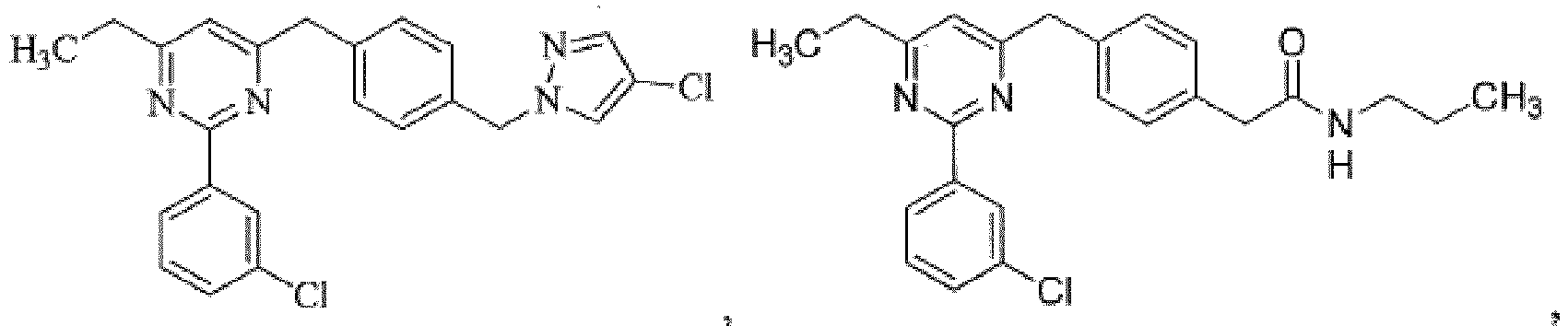


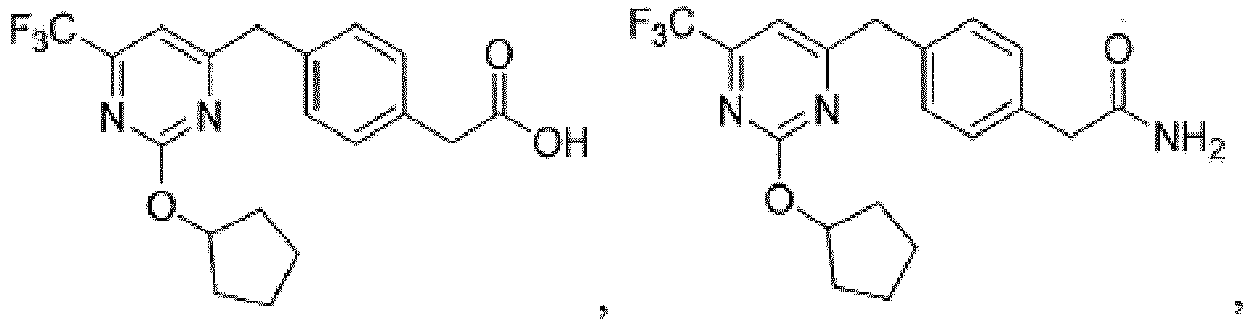


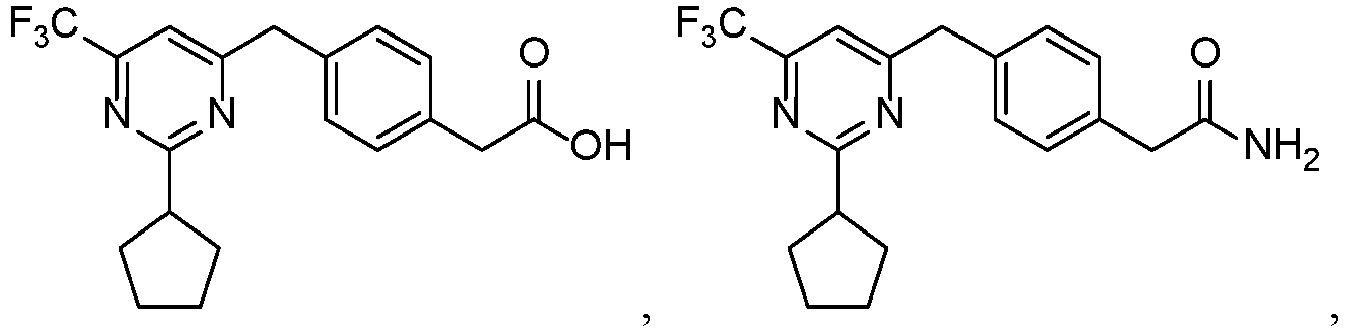

- A compound as recited in claim 1, wherein the compound is

- A compound as recited in claim 1, wherein the compound is

- A compound as recited in claim 1, wherein the compound is

- A compound as recited in any of claims 1 to 4 for use as a medicament
- A compound as recited in any of claims 1 to 4, for use in the treatment of enhancement of cognition.
- A pharmaceutical composition comprising a compound as recited in any of claims 1 to 4, together with a pharmaceutically acceptable carrier.
Priority Applications (2)
| Application Number | Priority Date | Filing Date | Title |
|---|---|---|---|
| EP21156065.1A EP3842420B1 (en) | 2012-10-25 | 2013-10-24 | Heteroaryl inhibitors of pde4 |
| PL13848739T PL2912019T3 (en) | 2012-10-25 | 2013-10-24 | Heteroaryl inhibitors of pde4 |
Applications Claiming Priority (4)
| Application Number | Priority Date | Filing Date | Title |
|---|---|---|---|
| US201261718285P | 2012-10-25 | 2012-10-25 | |
| US201261733675P | 2012-12-05 | 2012-12-05 | |
| US201361776937P | 2013-03-12 | 2013-03-12 | |
| PCT/US2013/066645 WO2014066659A1 (en) | 2012-10-25 | 2013-10-24 | Heteroaryl inhibitors of pde4 |
Related Child Applications (2)
| Application Number | Title | Priority Date | Filing Date |
|---|---|---|---|
| EP21156065.1A Division EP3842420B1 (en) | 2012-10-25 | 2013-10-24 | Heteroaryl inhibitors of pde4 |
| EP21156065.1A Division-Into EP3842420B1 (en) | 2012-10-25 | 2013-10-24 | Heteroaryl inhibitors of pde4 |
Publications (3)
| Publication Number | Publication Date |
|---|---|
| EP2912019A1 EP2912019A1 (en) | 2015-09-02 |
| EP2912019A4 EP2912019A4 (en) | 2016-04-20 |
| EP2912019B1 true EP2912019B1 (en) | 2021-03-24 |
Family
ID=50545269
Family Applications (2)
| Application Number | Title | Priority Date | Filing Date |
|---|---|---|---|
| EP21156065.1A Active EP3842420B1 (en) | 2012-10-25 | 2013-10-24 | Heteroaryl inhibitors of pde4 |
| EP13848739.2A Active EP2912019B1 (en) | 2012-10-25 | 2013-10-24 | Heteroaryl inhibitors of pde4 |
Family Applications Before (1)
| Application Number | Title | Priority Date | Filing Date |
|---|---|---|---|
| EP21156065.1A Active EP3842420B1 (en) | 2012-10-25 | 2013-10-24 | Heteroaryl inhibitors of pde4 |
Country Status (22)
| Country | Link |
|---|---|
| US (8) | US9221843B2 (en) |
| EP (2) | EP3842420B1 (en) |
| JP (1) | JP6289485B2 (en) |
| KR (1) | KR102189560B1 (en) |
| CN (1) | CN104768932B (en) |
| AU (1) | AU2013334236B2 (en) |
| BR (1) | BR112015009168B1 (en) |
| CA (1) | CA2886263C (en) |
| CL (1) | CL2015001068A1 (en) |
| DK (1) | DK2912019T3 (en) |
| ES (1) | ES2871821T3 (en) |
| HR (1) | HRP20230162T1 (en) |
| HU (1) | HUE056251T2 (en) |
| IL (1) | IL238409A (en) |
| LT (1) | LT3842420T (en) |
| MX (1) | MX368959B (en) |
| NZ (1) | NZ705881A (en) |
| PL (1) | PL2912019T3 (en) |
| PT (1) | PT2912019T (en) |
| SG (1) | SG11201502050XA (en) |
| SI (1) | SI3842420T1 (en) |
| WO (1) | WO2014066659A1 (en) |
Families Citing this family (60)
| Publication number | Priority date | Publication date | Assignee | Title |
|---|---|---|---|---|
| TWI633087B (en) | 2012-06-13 | 2018-08-21 | 赫孚孟拉羅股份公司 | New diazaspirocycloalkane and azaspirocycloalkane |
| EP3590940B1 (en) | 2012-09-25 | 2021-06-09 | F. Hoffmann-La Roche AG | Hexahydropyrrolo[3,4-c]pyrrole derivatives and related compounds as autotaxin (atx) inhibitors and as inhibitors of the lysophosphatidic acid (lpa) production for treating e.g. renal diseases |
| PL2912019T3 (en) | 2012-10-25 | 2021-11-02 | Tetra Discovery Partners Llc | Heteroaryl inhibitors of pde4 |
| WO2014117947A1 (en) * | 2013-02-04 | 2014-08-07 | Grünenthal GmbH | 4-amino substituted condensed pyrimidine compounds as pde4 inhibitors |
| MX2015009677A (en) * | 2013-02-04 | 2015-11-25 | Gruenenthal Gmbh | Novel substituted condensed pyrimidine compounds. |
| AR095079A1 (en) | 2013-03-12 | 2015-09-16 | Hoffmann La Roche | DERIVATIVES OF OCTAHIDRO-PIRROLO [3,4-C] -PIRROL AND PIRIDINA-FENILO |
| NO3074400T3 (en) | 2013-11-26 | 2018-04-14 | ||
| MA39792B1 (en) | 2014-03-26 | 2019-12-31 | Hoffmann La Roche | Bicyclic compounds as inhibitors of autotaxin (atx) and lysophosphatidic acid (lpa) production |
| EP3122751B1 (en) | 2014-03-26 | 2019-10-30 | F.Hoffmann-La Roche Ag | Condensed [1,4]diazepine compounds as autotaxin (atx) and lysophosphatidic acid (lpa) production inhibitors |
| US10442788B2 (en) | 2015-04-01 | 2019-10-15 | Enanta Pharmaceuticals, Inc. | Hepatitis B antiviral agents |
| MA41898A (en) | 2015-04-10 | 2018-02-13 | Hoffmann La Roche | BICYCLIC QUINAZOLINONE DERIVATIVES |
| WO2016183266A1 (en) | 2015-05-13 | 2016-11-17 | Enanta Pharmaceuticals, Inc. | Ehpatitis b antiviral agents |
| US10179131B2 (en) | 2015-07-13 | 2019-01-15 | Enanta Pharmaceuticals, Inc. | Hepatitis B antiviral agents |
| US10301255B2 (en) | 2015-07-22 | 2019-05-28 | Enanta Pharmaceuticals, Inc. | Hepatitis B antiviral agents |
| MX387736B (en) | 2015-09-04 | 2025-03-18 | Hoffmann La Roche | PHENOXYMETHYL DERIVATIVES. |
| MX2017015034A (en) | 2015-09-24 | 2018-04-13 | Hoffmann La Roche | New bicyclic compounds as dual atx/ca inhibitors. |
| PE20180451A1 (en) | 2015-09-24 | 2018-03-05 | Hoffmann La Roche | NEW BICYCLE COMPOUNDS AS ATX INHIBITORS |
| CN107635995B (en) | 2015-09-24 | 2022-08-19 | 豪夫迈·罗氏有限公司 | Bicyclic compounds as ATX inhibitors |
| KR20180054634A (en) | 2015-09-24 | 2018-05-24 | 에프. 호프만-라 로슈 아게 | As a dual auto-thixin (ATX) / carbonic anhydrase (CA) inhibitor, |
| US10280175B2 (en) | 2016-02-02 | 2019-05-07 | Enanta Pharmaceuticals, Inc. | Hepatitis B antiviral agents |
| KR102398439B1 (en) | 2016-03-07 | 2022-05-16 | 이난타 파마슈티칼스, 인코포레이티드 | Hepatitis B antiviral drugs |
| SG11201810834WA (en) | 2016-06-10 | 2018-12-28 | Enanta Pharm Inc | Hepatitis b antiviral agents |
| CN110382484B (en) | 2017-03-16 | 2022-12-06 | 豪夫迈·罗氏有限公司 | New bicyclic compounds as ATX inhibitors |
| MA49879A (en) | 2017-03-16 | 2020-06-24 | Hoffmann La Roche | USEFUL HETEROCYCLIC COMPOUNDS AS DUAL ATX / CA INHIBITORS |
| EA202090514A1 (en) | 2017-08-28 | 2020-06-24 | Энанта Фармасьютикалс, Инк. | ANTI-VIRAL AGAINST HEPATITIS IN |
| CN111108109A (en) | 2017-09-20 | 2020-05-05 | 利奥制药有限公司 | Substituted dihydrothienopyrimidines and their use as phosphodiesterase inhibitors |
| TW201927789A (en) | 2017-12-06 | 2019-07-16 | 美商因那塔製藥公司 | Hepatitis B antiviral agents |
| US10723733B2 (en) | 2017-12-06 | 2020-07-28 | Enanta Pharmaceuticals, Inc. | Hepatitis B antiviral agents |
| DK3724196T3 (en) | 2017-12-15 | 2023-01-16 | Union Therapeutics As | SUBSTITUTED AZETIDE DIHYDROTHIENOPYRIDINES AND THEIR USE AS PHOSPHODIESTERASE INHIBITORS |
| JP7198820B2 (en) | 2017-12-15 | 2023-01-04 | ユニオン・セラピューティクス・アクティエセルスカブ | Substituted azetidine dihydrothienopyrimidines and their use as phosphodiesterase inhibitors |
| WO2019143902A2 (en) | 2018-01-22 | 2019-07-25 | Enanta Pharmaceuticals, Inc. | Substituted heterocycles as antiviral agents |
| US10729688B2 (en) | 2018-03-29 | 2020-08-04 | Enanta Pharmaceuticals, Inc. | Hepatitis B antiviral agents |
| CA3135420A1 (en) * | 2018-04-05 | 2019-10-10 | Universiteit Hasselt | Selective pde4d inhibitors against demyelinating diseases |
| CN108997394A (en) * | 2018-06-12 | 2018-12-14 | 广州百霆医药科技有限公司 | Benzoxaborole Polymorphs alkyl compound and preparation method thereof |
| CA3113235A1 (en) | 2018-09-21 | 2020-03-26 | Enanta Pharmaceuticals, Inc. | Functionalized heterocycles as antiviral agents |
| CU20210023A7 (en) * | 2018-10-05 | 2021-10-12 | Pfizer | PYRIDINYL 1,2-OXABOROLAN-2-OL PHOSPHODIESTERASE 4 SUBSTITUTE PHENYL INHIBITORS |
| IL283190B2 (en) | 2018-11-21 | 2025-08-01 | Enanta Pharm Inc | Heterocyclics that function as antibiotic agents |
| CN111635400A (en) | 2019-03-02 | 2020-09-08 | 察略盛医药科技(上海)有限公司 | Pyrazolo[1,5-a]pyridine derivatives, preparation method and use thereof |
| US11028050B2 (en) * | 2019-04-18 | 2021-06-08 | Tetra Discovery Partners, Inc. | Salts and polymorphs of a PDE4 inhibitor |
| EP3969458A4 (en) | 2019-05-13 | 2023-05-17 | Borah, Inc. | Chemical compounds |
| US11236111B2 (en) | 2019-06-03 | 2022-02-01 | Enanta Pharmaceuticals, Inc. | Hepatitis B antiviral agents |
| WO2020247575A1 (en) | 2019-06-04 | 2020-12-10 | Enanta Pharmaceuticals, Inc. | Hepatitis b antiviral agents |
| WO2020247561A1 (en) | 2019-06-04 | 2020-12-10 | Enanta Pharmaceuticals, Inc, | Hepatitis b antiviral agents |
| KR20220031662A (en) * | 2019-07-03 | 2022-03-11 | 보라 인코포레이티드 | compound |
| WO2021007488A1 (en) | 2019-07-11 | 2021-01-14 | Enanta Pharmaceuticals, Inc. | Substituted heterocycles as antiviral agents |
| US11236108B2 (en) | 2019-09-17 | 2022-02-01 | Enanta Pharmaceuticals, Inc. | Functionalized heterocycles as antiviral agents |
| US11802125B2 (en) | 2020-03-16 | 2023-10-31 | Enanta Pharmaceuticals, Inc. | Functionalized heterocyclic compounds as antiviral agents |
| CN114149410B (en) * | 2020-09-07 | 2025-02-25 | 四川科伦博泰生物医药股份有限公司 | Pyridocyclic compounds and preparation methods and uses thereof |
| US20240116856A1 (en) * | 2020-11-05 | 2024-04-11 | Young Biopharma, Llc | Novel capsaicin analogs and uses thereof |
| MX2023007579A (en) * | 2020-12-25 | 2023-07-06 | Reistone Biopharma Company Ltd | Borate derivative and uses thereof. |
| CN115521946B (en) * | 2022-10-14 | 2024-06-21 | 浙江玖世生物科技有限公司 | TiO (titanium dioxide)xMethod for synthesizing (R) -1- [3, 5-di (trifluoromethyl) ] phenethyl alcohol by using base photo-enzyme catalyst |
| WO2024135840A1 (en) * | 2022-12-23 | 2024-06-27 | 塩野義製薬株式会社 | Capsule or granules containing pde4 inhibitor |
| CU20250021A7 (en) * | 2023-02-28 | 2026-03-10 | Innovstone Therapeutics Ltd | PDE4B INHIBITOR COMPOUND, USEFUL FOR THE TREATMENT OF PDE4B-MEDIATED DISEASES |
| JP2026514091A (en) | 2023-04-13 | 2026-05-01 | 上海壹迪生物技術有限公司 | Substituted dihydrothienopyrimidine compounds, methods for producing the same, and uses |
| GB202306663D0 (en) | 2023-05-05 | 2023-06-21 | Union Therapeutics As | Combination therapy |
| WO2025080415A1 (en) | 2023-10-12 | 2025-04-17 | Alto Neuroscience, Inc. | Treatment of neuropsychiatric disorders with tilivapram |
| WO2025161532A1 (en) * | 2024-02-01 | 2025-08-07 | 艾派克斯生物科技有限公司 | Pde4b inhibitor, and pharmaceutical composition thereof and use thereof |
| WO2025221488A1 (en) | 2024-04-16 | 2025-10-23 | Alto Neuroscience, Inc. | Transdermal administration of pde4 inhibitors for reduction in adverse events |
| WO2025240378A1 (en) * | 2024-05-13 | 2025-11-20 | Board Of Regents Of The University Of Nebraska | Inhibitors of phosphodiesterases |
| WO2026024131A1 (en) * | 2024-07-24 | 2026-01-29 | 제일약품주식회사 | Dihydrothiopyranopyrimidine compound and use thereof |
Family Cites Families (21)
| Publication number | Priority date | Publication date | Assignee | Title |
|---|---|---|---|---|
| DK23392D0 (en) | 1992-02-24 | 1992-02-24 | Novo Nordisk As | Heterocyclic Compounds, Their Uses and Preparation |
| FR2754260B1 (en) | 1996-10-04 | 1998-10-30 | Adir | NOVEL SUBSTITUTED DERIVATIVES OF BIPHENYL OR PHENYLPYRIDINE, PROCESS FOR THEIR PREPARATION AND THE PHARMACEUTICAL COMPOSITIONS CONTAINING THEM |
| WO2000015645A1 (en) | 1998-09-11 | 2000-03-23 | Kyorin Pharmaceutical Co., Ltd. | Phosphonic ester derivatives and process for producing the same |
| CA2477984A1 (en) | 2002-03-08 | 2003-09-18 | Pamela Ann Albaugh | Pyrrole-2, 5-dione derivatives and their use as gsk-3 inhibitors |
| US20050014767A1 (en) | 2003-01-29 | 2005-01-20 | Magnus Pfahl | Benzoxazole, benzothiazole, and benzimidazole derivatives for the treatment of cancer and other diseases |
| JP2006123639A (en) | 2004-10-27 | 2006-05-18 | Mitsubishi Electric Corp | Home door condition recognition system |
| WO2006123639A1 (en) * | 2005-05-18 | 2006-11-23 | Asahi Kasei Pharma Corporation | Pyrimidine derivative |
| US20060293343A1 (en) * | 2005-05-18 | 2006-12-28 | Asahi Kasei Pharma Corporation | Pyrimidine derivatives |
| US7919519B2 (en) | 2005-11-23 | 2011-04-05 | Epix Pharmaceuticals Inc. | S1P receptor modulating compounds and use thereof |
| WO2009146388A1 (en) | 2008-05-28 | 2009-12-03 | The Trustees Of Columbia University In The City Of New York | Voxel-based methods for assessing subjects using positron emission tomography |
| EP2348863A4 (en) * | 2008-09-04 | 2012-03-07 | Anacor Pharmaceuticals Inc | SMALL MOLECULES CONTAINING BORON |
| RU2380890C1 (en) | 2008-10-17 | 2010-02-10 | Государственное образовательное учреждение высшего профессионального образования Марийский государственный технический университет | Method for testing of grass cover on near-bed floodplain |
| WO2010059838A2 (en) | 2008-11-20 | 2010-05-27 | Decode Genetics Ehf | Pde4 inhibitors selective for the long form of pde4 for treating inflammation and avoiding side effects |
| CA2753604A1 (en) * | 2009-02-27 | 2010-09-02 | Boehringer Ingelheim International Gmbh | Drug combinations containing pde4-inhibitors and nsaids |
| EP2380890A1 (en) * | 2010-04-23 | 2011-10-26 | Almirall, S.A. | New 7,8-dihydro-1,6-naphthyridin-5(6h)-one-derivatives as PDE4 inhibitors |
| US8889123B2 (en) | 2010-08-19 | 2014-11-18 | Allergan, Inc. | Compositions and soft tissue replacement methods |
| PL2912019T3 (en) | 2012-10-25 | 2021-11-02 | Tetra Discovery Partners Llc | Heteroaryl inhibitors of pde4 |
| MX2015009677A (en) * | 2013-02-04 | 2015-11-25 | Gruenenthal Gmbh | Novel substituted condensed pyrimidine compounds. |
| WO2015048407A1 (en) | 2013-09-26 | 2015-04-02 | Tetra Discovery Partners, LLC | Heteroaryl inhibitors of pde4 |
| WO2016049595A1 (en) | 2014-09-26 | 2016-03-31 | Tetra Discovery Partners, LLC | Heteroaryl inhibitors of pde4 |
| US11028050B2 (en) * | 2019-04-18 | 2021-06-08 | Tetra Discovery Partners, Inc. | Salts and polymorphs of a PDE4 inhibitor |
-
2013
- 2013-10-24 PL PL13848739T patent/PL2912019T3/en unknown
- 2013-10-24 BR BR112015009168-7A patent/BR112015009168B1/en active IP Right Grant
- 2013-10-24 CA CA2886263A patent/CA2886263C/en active Active
- 2013-10-24 PT PT138487392T patent/PT2912019T/en unknown
- 2013-10-24 AU AU2013334236A patent/AU2013334236B2/en active Active
- 2013-10-24 DK DK13848739.2T patent/DK2912019T3/en active
- 2013-10-24 HR HRP20230162TT patent/HRP20230162T1/en unknown
- 2013-10-24 JP JP2015539801A patent/JP6289485B2/en active Active
- 2013-10-24 EP EP21156065.1A patent/EP3842420B1/en active Active
- 2013-10-24 CN CN201380055959.9A patent/CN104768932B/en active Active
- 2013-10-24 US US14/349,688 patent/US9221843B2/en active Active
- 2013-10-24 HU HUE13848739A patent/HUE056251T2/en unknown
- 2013-10-24 SG SG11201502050XA patent/SG11201502050XA/en unknown
- 2013-10-24 SI SI201332034T patent/SI3842420T1/en unknown
- 2013-10-24 WO PCT/US2013/066645 patent/WO2014066659A1/en not_active Ceased
- 2013-10-24 EP EP13848739.2A patent/EP2912019B1/en active Active
- 2013-10-24 KR KR1020157010502A patent/KR102189560B1/en active Active
- 2013-10-24 NZ NZ705881A patent/NZ705881A/en unknown
- 2013-10-24 LT LTEP21156065.1T patent/LT3842420T/en unknown
- 2013-10-24 ES ES13848739T patent/ES2871821T3/en active Active
- 2013-10-24 MX MX2015005015A patent/MX368959B/en active IP Right Grant
-
2015
- 2015-04-21 IL IL238409A patent/IL238409A/en active IP Right Grant
- 2015-04-24 CL CL2015001068A patent/CL2015001068A1/en unknown
- 2015-11-11 US US14/938,544 patent/US9777024B2/en active Active
-
2017
- 2017-08-18 US US15/680,842 patent/US10093686B2/en active Active
-
2018
- 2018-08-24 US US16/111,700 patent/US10364258B2/en active Active
-
2019
- 2019-04-26 US US16/396,457 patent/US10626129B2/en active Active
-
2020
- 2020-02-04 US US16/781,748 patent/US11401286B2/en active Active
-
2022
- 2022-06-23 US US17/808,439 patent/US11767334B2/en active Active
-
2023
- 2023-07-11 US US18/350,452 patent/US12264169B2/en active Active
Non-Patent Citations (1)
| Title |
|---|
| None * |
Also Published As
Similar Documents
| Publication | Publication Date | Title |
|---|---|---|
| ES2871821T3 (en) | Heteroaryl inhibitors of PDE4 | |
| EP3129023B1 (en) | Potent soluble epoxide hydrolase inhibitors | |
| US7745646B2 (en) | Bicyclic heteroaryl inhibitors of PDE4 | |
| US20090275586A1 (en) | Heterocyclic inhibitors of pde4 | |
| US8138205B2 (en) | Heteroarylalkoxy-substituted quinolone inhibitors of PDE4 | |
| US20130116279A1 (en) | Bicyclic heteroaryl inhibitors of pde4 | |
| WO2016049595A1 (en) | Heteroaryl inhibitors of pde4 | |
| HK1208026B (en) | Heteroaryl inhibitors of pde4 | |
| US20150086480A1 (en) | Heteroaryl inhibitors of pde4 | |
| HK1233944B (en) | Potent soluble epoxide hydrolase inhibitors |
Legal Events
| Date | Code | Title | Description |
|---|---|---|---|
| PUAI | Public reference made under article 153(3) epc to a published international application that has entered the european phase |
Free format text: ORIGINAL CODE: 0009012 |
|
| 17P | Request for examination filed |
Effective date: 20150323 |
|
| AK | Designated contracting states |
Kind code of ref document: A1 Designated state(s): AL AT BE BG CH CY CZ DE DK EE ES FI FR GB GR HR HU IE IS IT LI LT LU LV MC MK MT NL NO PL PT RO RS SE SI SK SM TR |
|
| AX | Request for extension of the european patent |
Extension state: BA ME |
|
| DAX | Request for extension of the european patent (deleted) | ||
| REG | Reference to a national code |
Ref country code: HK Ref legal event code: DE Ref document number: 1208026 Country of ref document: HK |
|
| RA4 | Supplementary search report drawn up and despatched (corrected) |
Effective date: 20160317 |
|
| RIC1 | Information provided on ipc code assigned before grant |
Ipc: A61P 25/24 20060101ALI20160311BHEP Ipc: A61K 31/4409 20060101ALI20160311BHEP Ipc: C07D 213/72 20060101AFI20160311BHEP |
|
| STAA | Information on the status of an ep patent application or granted ep patent |
Free format text: STATUS: EXAMINATION IS IN PROGRESS |
|
| 17Q | First examination report despatched |
Effective date: 20161214 |
|
| RIC1 | Information provided on ipc code assigned before grant |
Ipc: A61K 31/4409 20060101ALI20170509BHEP Ipc: A61P 25/24 20060101ALI20170509BHEP Ipc: C07D 213/72 20060101AFI20170509BHEP |
|
| GRAP | Despatch of communication of intention to grant a patent |
Free format text: ORIGINAL CODE: EPIDOSNIGR1 |
|
| STAA | Information on the status of an ep patent application or granted ep patent |
Free format text: STATUS: GRANT OF PATENT IS INTENDED |
|
| INTG | Intention to grant announced |
Effective date: 20200120 |
|
| GRAJ | Information related to disapproval of communication of intention to grant by the applicant or resumption of examination proceedings by the epo deleted |
Free format text: ORIGINAL CODE: EPIDOSDIGR1 |
|
| STAA | Information on the status of an ep patent application or granted ep patent |
Free format text: STATUS: EXAMINATION IS IN PROGRESS |
|
| GRAP | Despatch of communication of intention to grant a patent |
Free format text: ORIGINAL CODE: EPIDOSNIGR1 |
|
| STAA | Information on the status of an ep patent application or granted ep patent |
Free format text: STATUS: GRANT OF PATENT IS INTENDED |
|
| INTC | Intention to grant announced (deleted) | ||
| INTG | Intention to grant announced |
Effective date: 20201006 |
|
| GRAS | Grant fee paid |
Free format text: ORIGINAL CODE: EPIDOSNIGR3 |
|
| GRAA | (expected) grant |
Free format text: ORIGINAL CODE: 0009210 |
|
| STAA | Information on the status of an ep patent application or granted ep patent |
Free format text: STATUS: THE PATENT HAS BEEN GRANTED |
|
| AK | Designated contracting states |
Kind code of ref document: B1 Designated state(s): AL AT BE BG CH CY CZ DE DK EE ES FI FR GB GR HR HU IE IS IT LI LT LU LV MC MK MT NL NO PL PT RO RS SE SI SK SM TR |
|
| REG | Reference to a national code |
Ref country code: GB Ref legal event code: FG4D |
|
| REG | Reference to a national code |
Ref country code: CH Ref legal event code: EP |
|
| REG | Reference to a national code |
Ref country code: DE Ref legal event code: R096 Ref document number: 602013076485 Country of ref document: DE |
|
| REG | Reference to a national code |
Ref country code: IE Ref legal event code: FG4D |
|
| REG | Reference to a national code |
Ref country code: AT Ref legal event code: REF Ref document number: 1374380 Country of ref document: AT Kind code of ref document: T Effective date: 20210415 |
|
| REG | Reference to a national code |
Ref country code: DK Ref legal event code: T3 Effective date: 20210521 Ref country code: PT Ref legal event code: SC4A Ref document number: 2912019 Country of ref document: PT Date of ref document: 20210525 Kind code of ref document: T Free format text: AVAILABILITY OF NATIONAL TRANSLATION Effective date: 20210519 Ref country code: FI Ref legal event code: FGE |
|
| REG | Reference to a national code |
Ref country code: NL Ref legal event code: FP |
|
| REG | Reference to a national code |
Ref country code: SE Ref legal event code: TRGR |
|
| REG | Reference to a national code |
Ref country code: NO Ref legal event code: T2 Effective date: 20210324 |
|
| REG | Reference to a national code |
Ref country code: LT Ref legal event code: MG9D |
|
| PG25 | Lapsed in a contracting state [announced via postgrant information from national office to epo] |
Ref country code: GR Free format text: LAPSE BECAUSE OF FAILURE TO SUBMIT A TRANSLATION OF THE DESCRIPTION OR TO PAY THE FEE WITHIN THE PRESCRIBED TIME-LIMIT Effective date: 20210625 Ref country code: HR Free format text: LAPSE BECAUSE OF FAILURE TO SUBMIT A TRANSLATION OF THE DESCRIPTION OR TO PAY THE FEE WITHIN THE PRESCRIBED TIME-LIMIT Effective date: 20210324 Ref country code: BG Free format text: LAPSE BECAUSE OF FAILURE TO SUBMIT A TRANSLATION OF THE DESCRIPTION OR TO PAY THE FEE WITHIN THE PRESCRIBED TIME-LIMIT Effective date: 20210624 |
|
| PG25 | Lapsed in a contracting state [announced via postgrant information from national office to epo] |
Ref country code: LV Free format text: LAPSE BECAUSE OF FAILURE TO SUBMIT A TRANSLATION OF THE DESCRIPTION OR TO PAY THE FEE WITHIN THE PRESCRIBED TIME-LIMIT Effective date: 20210324 Ref country code: RS Free format text: LAPSE BECAUSE OF FAILURE TO SUBMIT A TRANSLATION OF THE DESCRIPTION OR TO PAY THE FEE WITHIN THE PRESCRIBED TIME-LIMIT Effective date: 20210324 |
|
| PG25 | Lapsed in a contracting state [announced via postgrant information from national office to epo] |
Ref country code: LT Free format text: LAPSE BECAUSE OF FAILURE TO SUBMIT A TRANSLATION OF THE DESCRIPTION OR TO PAY THE FEE WITHIN THE PRESCRIBED TIME-LIMIT Effective date: 20210324 Ref country code: EE Free format text: LAPSE BECAUSE OF FAILURE TO SUBMIT A TRANSLATION OF THE DESCRIPTION OR TO PAY THE FEE WITHIN THE PRESCRIBED TIME-LIMIT Effective date: 20210324 Ref country code: SM Free format text: LAPSE BECAUSE OF FAILURE TO SUBMIT A TRANSLATION OF THE DESCRIPTION OR TO PAY THE FEE WITHIN THE PRESCRIBED TIME-LIMIT Effective date: 20210324 |
|
| REG | Reference to a national code |
Ref country code: ES Ref legal event code: FG2A Ref document number: 2871821 Country of ref document: ES Kind code of ref document: T3 Effective date: 20211102 |
|
| REG | Reference to a national code |
Ref country code: AT Ref legal event code: UEP Ref document number: 1374380 Country of ref document: AT Kind code of ref document: T Effective date: 20210324 |
|
| PG25 | Lapsed in a contracting state [announced via postgrant information from national office to epo] |
Ref country code: SK Free format text: LAPSE BECAUSE OF FAILURE TO SUBMIT A TRANSLATION OF THE DESCRIPTION OR TO PAY THE FEE WITHIN THE PRESCRIBED TIME-LIMIT Effective date: 20210324 Ref country code: RO Free format text: LAPSE BECAUSE OF FAILURE TO SUBMIT A TRANSLATION OF THE DESCRIPTION OR TO PAY THE FEE WITHIN THE PRESCRIBED TIME-LIMIT Effective date: 20210324 |
|
| REG | Reference to a national code |
Ref country code: DE Ref legal event code: R097 Ref document number: 602013076485 Country of ref document: DE |
|
| PG25 | Lapsed in a contracting state [announced via postgrant information from national office to epo] |
Ref country code: AL Free format text: LAPSE BECAUSE OF FAILURE TO SUBMIT A TRANSLATION OF THE DESCRIPTION OR TO PAY THE FEE WITHIN THE PRESCRIBED TIME-LIMIT Effective date: 20210324 |
|
| PLBE | No opposition filed within time limit |
Free format text: ORIGINAL CODE: 0009261 |
|
| STAA | Information on the status of an ep patent application or granted ep patent |
Free format text: STATUS: NO OPPOSITION FILED WITHIN TIME LIMIT |
|
| PG25 | Lapsed in a contracting state [announced via postgrant information from national office to epo] |
Ref country code: SI Free format text: LAPSE BECAUSE OF FAILURE TO SUBMIT A TRANSLATION OF THE DESCRIPTION OR TO PAY THE FEE WITHIN THE PRESCRIBED TIME-LIMIT Effective date: 20210324 |
|
| REG | Reference to a national code |
Ref country code: HU Ref legal event code: AG4A Ref document number: E056251 Country of ref document: HU |
|
| 26N | No opposition filed |
Effective date: 20220104 |
|
| PG25 | Lapsed in a contracting state [announced via postgrant information from national office to epo] |
Ref country code: MC Free format text: LAPSE BECAUSE OF FAILURE TO SUBMIT A TRANSLATION OF THE DESCRIPTION OR TO PAY THE FEE WITHIN THE PRESCRIBED TIME-LIMIT Effective date: 20210324 |
|
| PG25 | Lapsed in a contracting state [announced via postgrant information from national office to epo] |
Ref country code: LU Free format text: LAPSE BECAUSE OF NON-PAYMENT OF DUE FEES Effective date: 20211024 |
|
| REG | Reference to a national code |
Ref country code: FR Ref legal event code: PLFP Year of fee payment: 10 |
|
| PG25 | Lapsed in a contracting state [announced via postgrant information from national office to epo] |
Ref country code: CY Free format text: LAPSE BECAUSE OF FAILURE TO SUBMIT A TRANSLATION OF THE DESCRIPTION OR TO PAY THE FEE WITHIN THE PRESCRIBED TIME-LIMIT Effective date: 20210324 |
|
| P01 | Opt-out of the competence of the unified patent court (upc) registered |
Effective date: 20230525 |
|
| PG25 | Lapsed in a contracting state [announced via postgrant information from national office to epo] |
Ref country code: MK Free format text: LAPSE BECAUSE OF FAILURE TO SUBMIT A TRANSLATION OF THE DESCRIPTION OR TO PAY THE FEE WITHIN THE PRESCRIBED TIME-LIMIT Effective date: 20210324 |
|
| PG25 | Lapsed in a contracting state [announced via postgrant information from national office to epo] |
Ref country code: MT Free format text: LAPSE BECAUSE OF FAILURE TO SUBMIT A TRANSLATION OF THE DESCRIPTION OR TO PAY THE FEE WITHIN THE PRESCRIBED TIME-LIMIT Effective date: 20210324 |
|
| REG | Reference to a national code |
Ref country code: CH Ref legal event code: U11 Free format text: ST27 STATUS EVENT CODE: U-0-0-U10-U11 (AS PROVIDED BY THE NATIONAL OFFICE) Effective date: 20251101 |
|
| PGFP | Annual fee paid to national office [announced via postgrant information from national office to epo] |
Ref country code: HU Payment date: 20251007 Year of fee payment: 13 |
|
| PGFP | Annual fee paid to national office [announced via postgrant information from national office to epo] |
Ref country code: NL Payment date: 20251026 Year of fee payment: 13 |
|
| PGFP | Annual fee paid to national office [announced via postgrant information from national office to epo] |
Ref country code: PT Payment date: 20251007 Year of fee payment: 13 |
|
| PGFP | Annual fee paid to national office [announced via postgrant information from national office to epo] |
Ref country code: IS Payment date: 20251016 Year of fee payment: 13 Ref country code: DE Payment date: 20251029 Year of fee payment: 13 |
|
| PGFP | Annual fee paid to national office [announced via postgrant information from national office to epo] |
Ref country code: GB Payment date: 20251027 Year of fee payment: 13 |
|
| PGFP | Annual fee paid to national office [announced via postgrant information from national office to epo] |
Ref country code: NO Payment date: 20251029 Year of fee payment: 13 |
|
| PGFP | Annual fee paid to national office [announced via postgrant information from national office to epo] |
Ref country code: AT Payment date: 20251029 Year of fee payment: 13 |
|
| PGFP | Annual fee paid to national office [announced via postgrant information from national office to epo] |
Ref country code: FI Payment date: 20251027 Year of fee payment: 13 Ref country code: DK Payment date: 20251027 Year of fee payment: 13 Ref country code: IT Payment date: 20251021 Year of fee payment: 13 |
|
| PGFP | Annual fee paid to national office [announced via postgrant information from national office to epo] |
Ref country code: FR Payment date: 20251027 Year of fee payment: 13 |
|
| PGFP | Annual fee paid to national office [announced via postgrant information from national office to epo] |
Ref country code: BE Payment date: 20251027 Year of fee payment: 13 Ref country code: TR Payment date: 20251007 Year of fee payment: 13 |
|
| PGFP | Annual fee paid to national office [announced via postgrant information from national office to epo] |
Ref country code: SE Payment date: 20251027 Year of fee payment: 13 Ref country code: CH Payment date: 20251101 Year of fee payment: 13 |
|
| PGFP | Annual fee paid to national office [announced via postgrant information from national office to epo] |
Ref country code: IE Payment date: 20251027 Year of fee payment: 13 Ref country code: CZ Payment date: 20251007 Year of fee payment: 13 |
|
| PGFP | Annual fee paid to national office [announced via postgrant information from national office to epo] |
Ref country code: PL Payment date: 20251003 Year of fee payment: 13 |
|
| PGFP | Annual fee paid to national office [announced via postgrant information from national office to epo] |
Ref country code: ES Payment date: 20251103 Year of fee payment: 13 |